After I was offered a job in Ethiopia in 1988 and while still in Kenya, in my anxiety to know where we were getting to, I contacted a consultant that had just been there to get preliminary information. We knew each other quite well and he was frank with me. “The place is beautiful” he said, and he added “if you can get there with your car in one piece! We blew a tire, went off the road and had a near miss as we hit a large rock that stopped us from going down a steep slope”. I am sure he was enjoying this -probably the look on my face- when he added “but don’t let me put you off!” Trying to digest this and making fruitless efforts to hide my discomfort, I asked for details about the living quarters and the work. He complied with the latter and then said: “You are lucky as you will have a very large garden”. This somehow lifted my spirits and then he finished me off by saying: “the whole of Ethiopia will be your back garden!” I refrained from more questions…
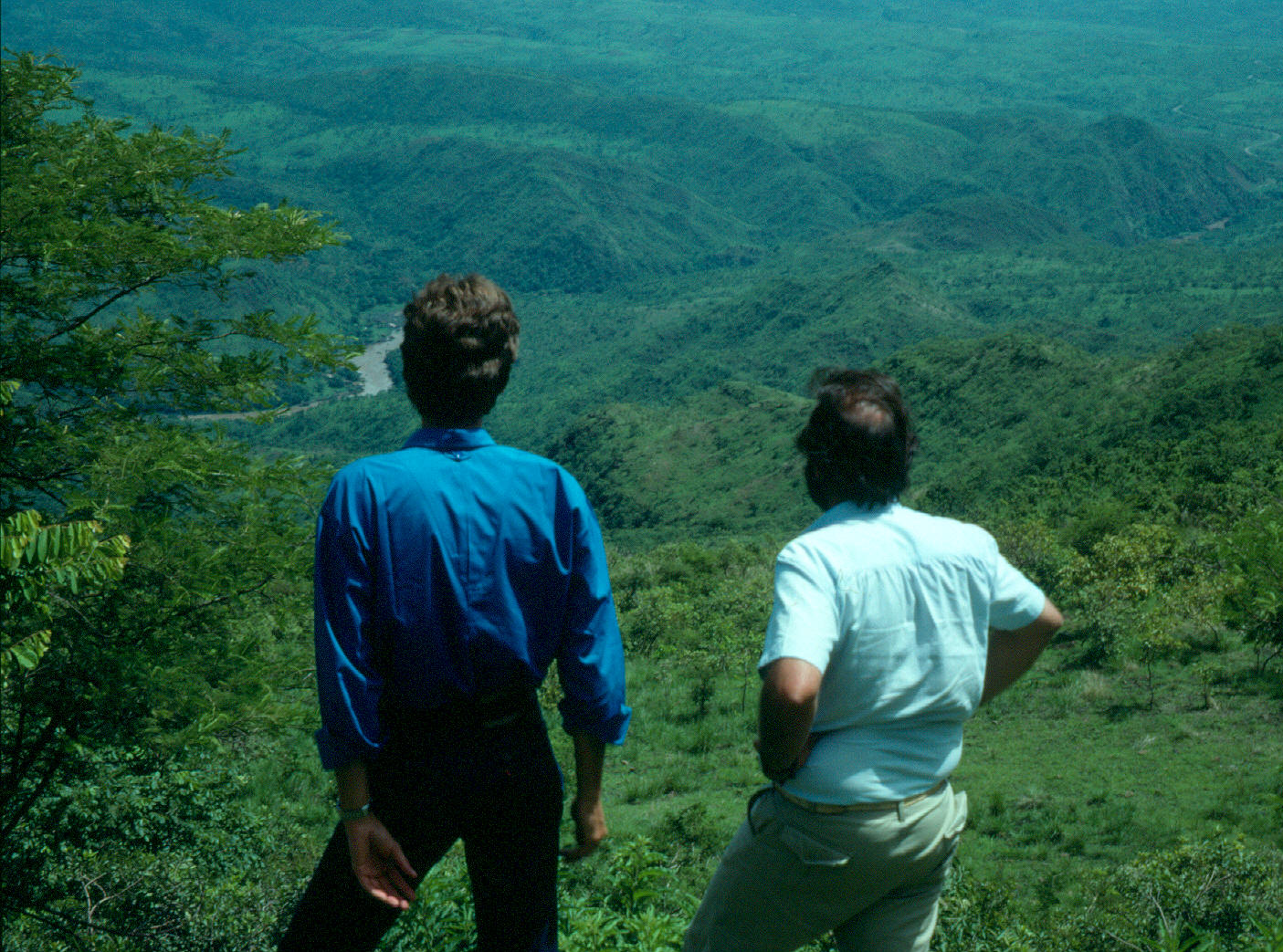
Contemplating our back garden with a visiting friend.
So we prepared for self-sufficiency through gardening! We bought seeds and tools and this was the beginning of our gardening experience in Africa. Our first visit to the local market confirmed that we had taken the right decision. There was a market every Saturday where farmers brought their produce, often walking very long distances over very hard terrain. A look at their feet clad in the ubiquitous sandals made from car tires vouched to that! Clearly their farming efforts were not directed towards the “forengis” (foreigners in Ethiopia) and fresh vegetables were rare. You could find tomatoes and, occasionally, onions. Both were sold by rows of farmers (mostly women) seated behind piles of 3 to 5 fruits. Attempts at buying all the tomatoes offered by any one of the sellers -through a kind Oromo interpreter- provoked a strong negative response as they were only happy to part with one or at most two units. That meant that to get a kg you needed to negotiate with about six farmers! A time consuming exercise!

A local market.
There was also a number of produce that was utterly unknown to us and I do not even recall their names or use. I do recall seeing Oromo potatoes (Coleus edulis) and ensete (Ensete ventricosum). The former is widely consumed in Oromia and we did enjoy them steamed or boiled. The ensete is an important contributor to food security in the region and “kocho” was on offer. This greyish paste is prepared from the fermented pulverised trunk and inflorescence. This is a delicacy consumed at weddings and other important feasts. We did eat it occasionally but it did not leave a lasting impression.
Through her dedication, after a few months, my wife had transformed our backyard into a vegetable haven that was the topic of conversation in the laboratory. There were tomatoes, Chinese cabbage, lettuce, spinach, beans, peas and various spices. We were enjoying our fresh produce!
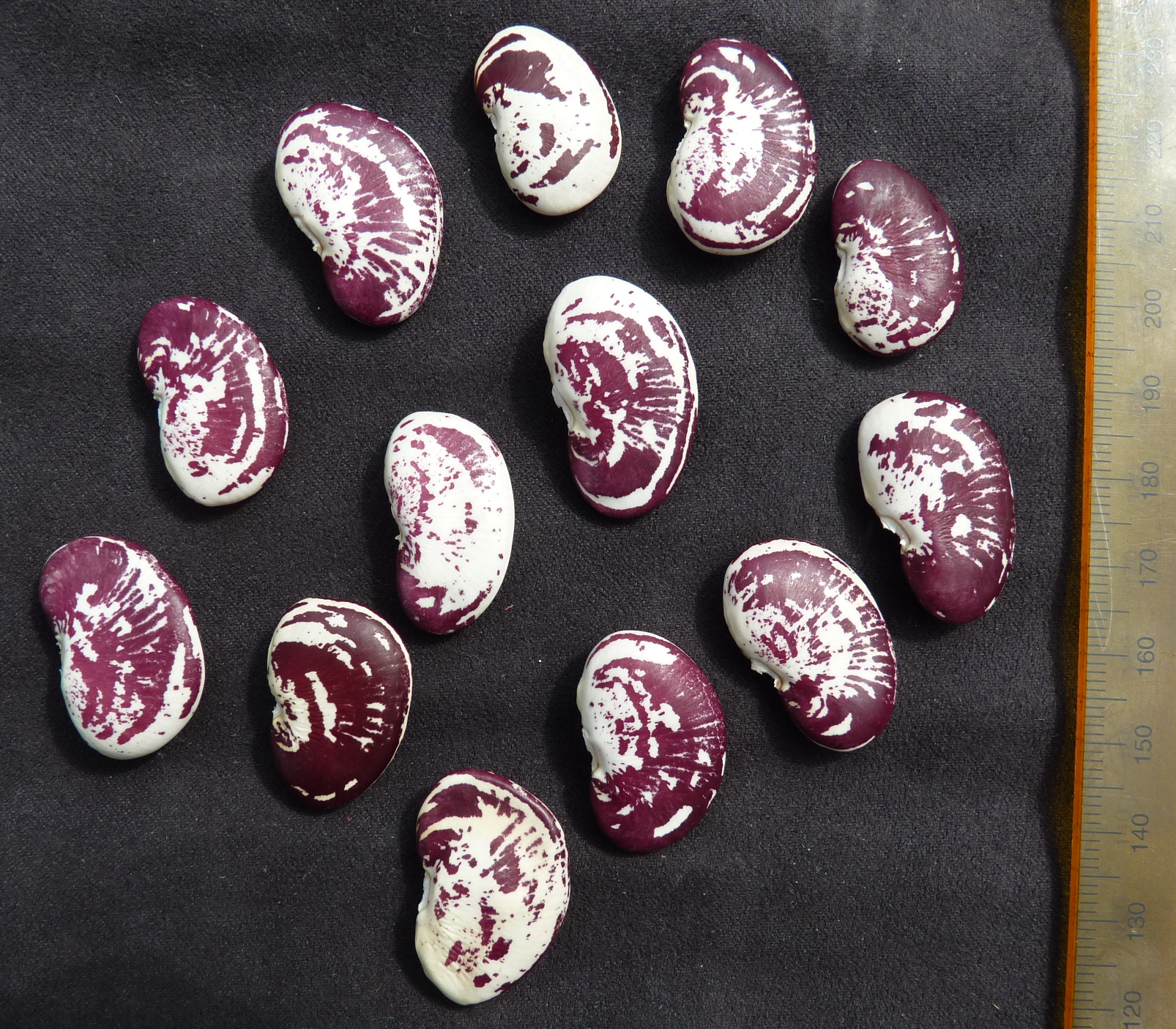
We discovered Seven year beans (scarlet runner beans) in Ethiopia.
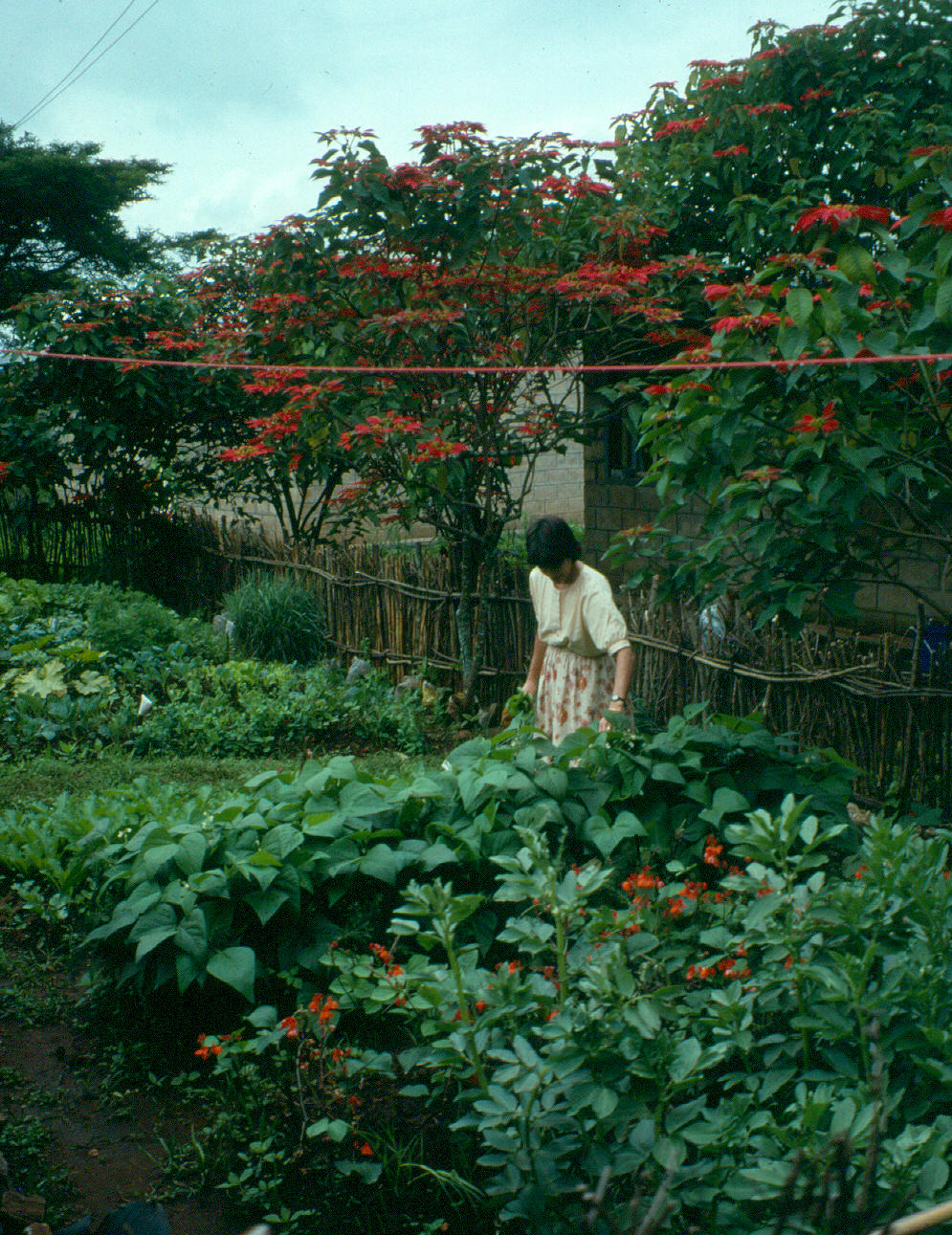
My wife tendering the garden.
This lasted until the monkeys discovered it! To enlighten you, we were dealing with two main species: the vervet (Chlorocebus aethiops) and the mantled guereza (Colobus guereza), also known as black and white colobus. We loved watching them in the wild but not in our garden. The vervets were the main menace but the colobus, a hervivorous species, would also come down from their normal arboreal habitat to enjoy our garden. It is one thing to deal with small pests (insects, mollusks) and another one to control birds and/or mammals! To make matters worse, monkeys have quite developed brains, are very daring and they arrive in troops! After the first rather devastating visit, the superior primates -us- needed to deploy appropriate measures to prevent this from happening again! Clearly, we were not able to take pest protection measures applied in developed countries (enclosing the garden in chicken wire, flash guns, etc.). We had a problem and needed to act fast!

Colobus monkeys keeping an eye on the garden.
We did not invent anything new when we decided to consult the local farmers to seek their wisdom on the problem. At the end of the “expert consultations” we came to the conclusion that the best and probably only acceptable solution was to scare them. So, following their advice, we needed to find someone to watch our garden. It is common to see planted areas being watched by farmers from small raised towers from where they can see the crop area and take measures to scare pests away, such as stone throwing, shouting, running after them and other measures that vary according to the intruder. It is a different thing to scare monkeys flock than to chase away an elephant or a hippo!
Acting as per the recommendations, we proceeded to find the suitable candidate by consultating with other neighbours. We were fortunate to find a young relative of one of the veterinarins that was presented to us as the solution and he was duly employed to carry out the task. After this measure, although the monkeys at first continued to besiege our garden, they soon gave up and moved off.

A Vervet monkey feeding on stolen produce.
Once this major problem was dealt with successfully, vegetables were produced in abundance as the climate there is very favourable for plant growth with an average temperature of 18°C and an annual rainfall of about 1800mm and insects were not a major problem.

 A Bushsnob out of Africa