Safari

Camping in Africa. Kenya (Spotted cat)

During one of the trips to the Transmara, while camping next to the Mara River, I had the surprise visit of the Manager of the Mara Buffalo Camp. As this had never happened before, I prepared to hear that I was not allowed to camp near the camp anymore so we stopped setting up our camp and went to meet him. I was wrong. He was a friendly Swiss that came to give me some good news.

He explained that at a rocky outcrop nearby there was a female leopard with two cubs that, unusually for East Africa in general and the Maasai Mara in particular, was very relaxed and let you watch her and her cubs without getting scared by human presence. He even offered to take us there at that precise moment if interested as he was taking a friend with him  for that purpose. We instantly forgot what we were doing, jumped on the car and followed him!

After driving towards the reserve, we arrived to a rocky gorge where there was a cave high in the rocks where, to our great surprise we found a small leopard cub resting at the entrance. He said that the mother may have been hunting or, perhaps, sleeping inside, together with the other absent cub. We could not believe our luck and after waiting for a while we thanked our Swiss benefactor profusely and left him in contemplation as we still needed to set up camp, cook and rest to continue with our journey the following day.

The leopard and her cubs became an added attraction to our frequent journeys to the Transmara and we found her again a few times during subsequent trips until one day she disappeared. For a few weeks we did not know what happened to her until, again by chance, found her again later, together with Jonathan Scott. The now well known photographer, film maker and book publisher was not that well known then as he was starting his rather successful stay at the Maasai Mara.

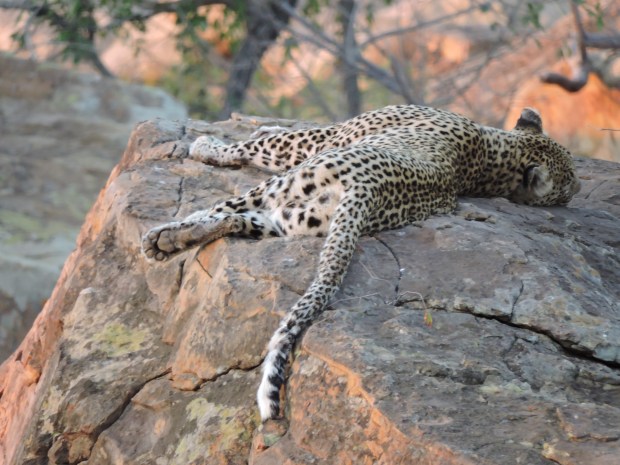
Jonathan was watching a female leopard with young cubs with all his equipment on the ready as the cubs played and the mother rested up a rocky outcrop. We learnt that it was the same female and after that encounter we saw her a few more times. The trick was to find  Jonathan’s green car  when driving through the general area where the leopard dwelled! It was clearly easier than looking for her!
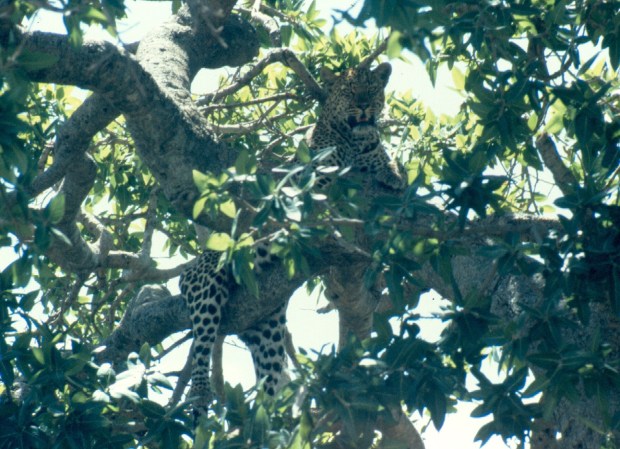
Leopard M mara tree copy

Relaxing…

I still recall one day when we found the leopard family in a very playful mood up and down a beautiful fig tree. It was such fun to watch them at play that I only stopped taking pictures the moment I ran out of film! I was really excited and very pleased with the pictures I had taken, although in those days you needed to wait until they were developed to see the results.

Before leaving, we approached Jonathan who we had met also at Kichwa Tembo Camp earlier and, feeling pleased with myself, I made a comment on how great what was taking place was and mentioned that I had taken lots of pictures as it was a fantastic opportunity. Jonathan listened to me and then gave me a reply that I have had in my mind since then: “I have not taken any pictures because the light is wrong”.

My heart sunk and I left crestfallen and in disbelief. When back in Nairobi the moment of truth of the pictures came I must confess that Jonathan had been right. Although some pictures were “rescuable”, the majority showed cat silhouettes against the sky! Later on, when I got Jonathan’s books I realized what he meant that day as the quality of his work is frankly superb!

As for us, despite our poor pictures, the memories remain and they at least serve the purpose to bring these back and to stimulate me to write posts such as this one!
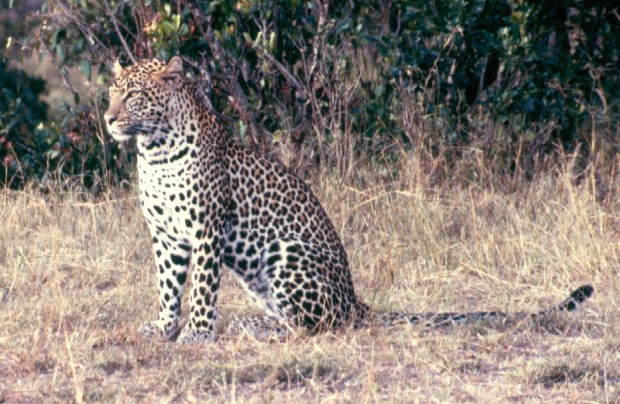
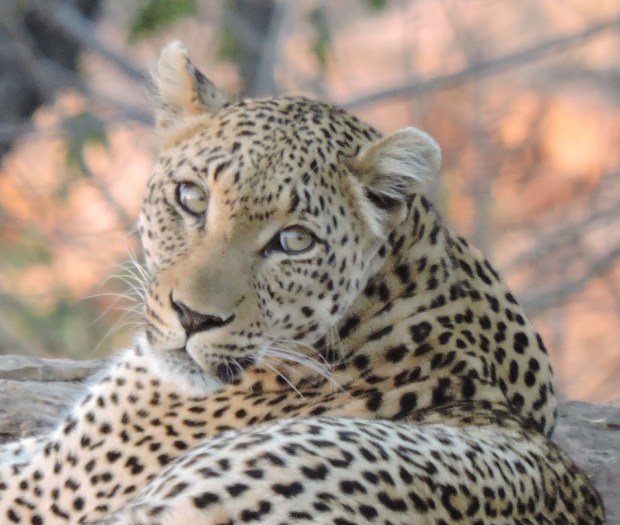
Leopard M mara sitting cropped copy

Surprised in the open.

Spot the beast 19

Back to Africa for a while while I develop another story from “Out of Africa”. Poor internet connection and farm work… are attempting against my productivity.

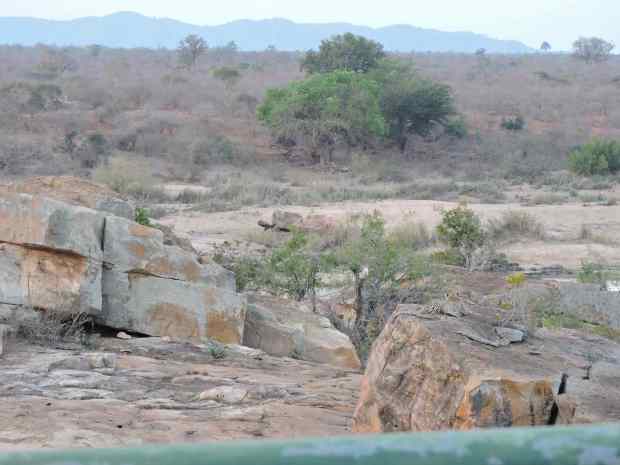
This is not a difficult “Spot the Beast” but I thought it is a nice situation to challenge your power of observation. I would be worried if you cannot find it within the first 10 seconds…

Here it is:

dscn9956-copy
?

?

?

?

?

?

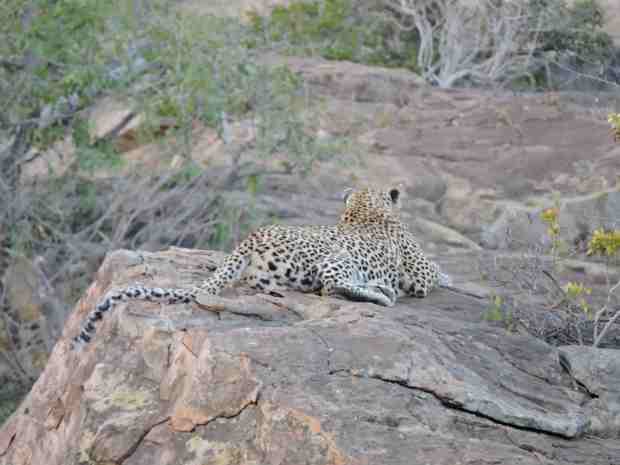
I hope you agree with me that she was not only beautiful but well placed to see what was happening!

dscn9954-copy

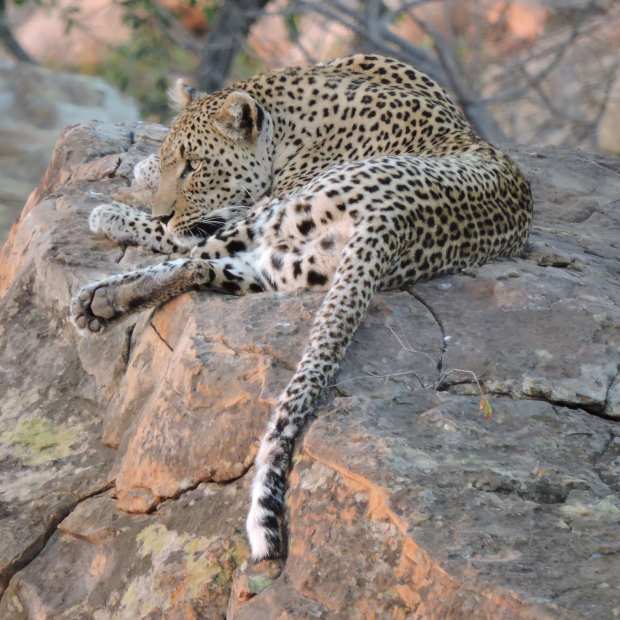
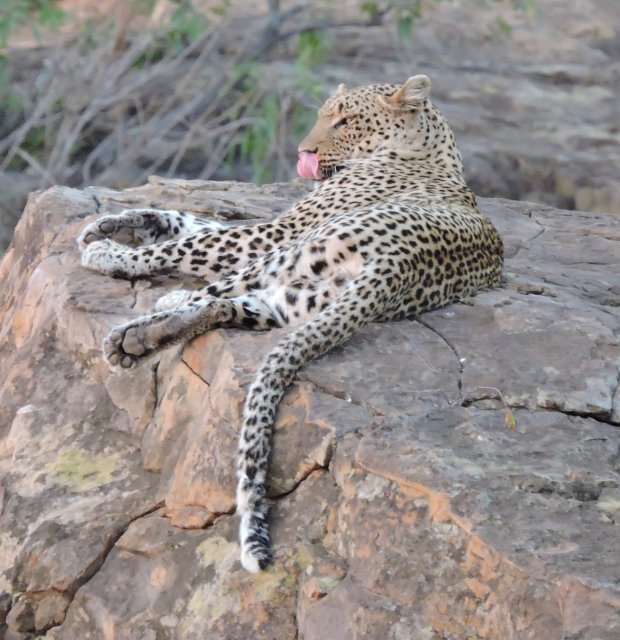
A few more pictures of her:

dscn9928-5-57-43-pm-9-25-00-am-copydscn9939-copy

dscn9924-10-09-30-am-3-33-32-pm-3-38-33-pmdscn9903-copy-8-55-16-am-8-58-58-am

Super moms

This post has been adapted from the Spanish original that appeared in the magazine Muy Interesante. I am grateful to the magazine for publishing the article and those readers interested in it can find it @ http://www.muyinteresante.es/naturaleza/fotos/vida-y-curiosidades-de-los-guepardos

After writing “A chase”[1]. late last year, I did research on cheetahs and found some useful information that I used to prepare “Super moms” and later I realized that I had forgotten that I had written “A chase” earlier! So now, I think that the present post follows it nicely as it offers what I hope is interesting facts on the cheetah, one of the most beautiful animals on this earth.

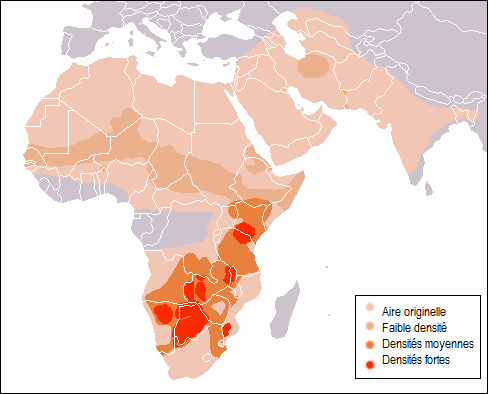
The vast majority of cheetahs (Acinonyx jubatus) live in Southern and Eastern Africa and also in some parts of Iran.

MAP OF CHEETAH DISTRIBUTION

acijubrep-copy

Areas with high (red), medium (brown) and low (pale brown) population density. In pink is its original range. Map credit: Attribution: By Al Pereira puis traduit par Deliryc64 [Public domain], via Wikimedia Commons.

It is one of the great cats although it has unique characteristics that place it in its own genus describing that its claws are semi-retractile unlike other felids that can retract them totally. While the latter use their claws to climb trees and tear flesh, cheetahs’ have a grip function to favour their acceleration, similar to the sprinters’ shoes.

foto-1Young cheetah in the Nairobi National Park, Kenya.

Although its taxonomic location is being reviewed at the moment, its closest relatives are the puma (Puma concolor) and the jaguarundi (Puma yagouaroundi). These three species together form the Puma lineage, one of eight that make up the Felidae family.

Since its discovery in 1775 by von Schreber the population of cheetahs has declined dramatically to the present situation. The International Union for the Conservation of Nature (IUCN) estimates that there are 6,700 adult and young animals distributed in 29 sub-populations and it is classified as a vulnerable species.

The cheetah needs large tracts of land and is currently heavily threatened by the loss of habitat due to the advance of the agricultural and industrial frontier. In addition, unlike the leopard (Panthera pardus) that can adapt to live close to people, the cheetah, a timid animal, is unable to do so.


Its relative docility and tolerance to humans has contributed significantly to its decline. Apart from being hunted as trophies, since the time of ancient Egypt, four thousand years ago, they were captured and kept as pets. This custom is still maintained today as they are displayed as status symbols and used for hunting in several countries. The consequence of this is that these animals have disappeared from much of their habitat.

In addition, these animals are very vulnerable in the wild because of the way they obtain their food. Cheetahs use their great speed to hunt but to be effective they need open spaces and excellent visibility since a false step can mean an injury that may condemn them to hunger since they are too timid to steal prey from other animals.

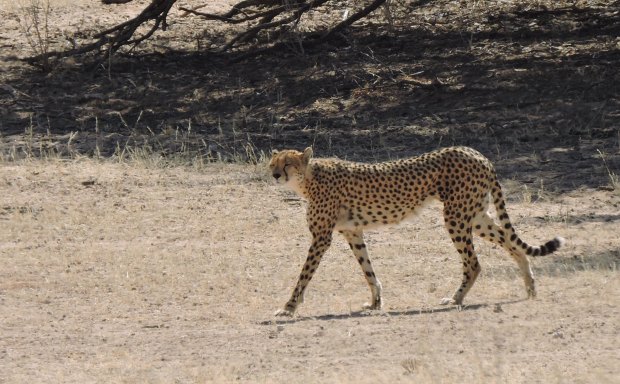
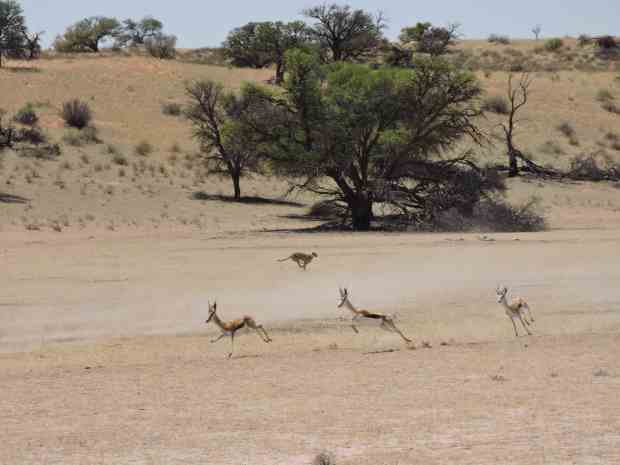
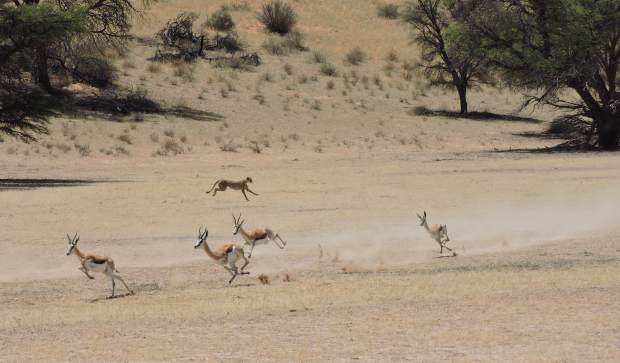
Female hunting springboks in the Kgalagadi Transfrontier Park.

The hunting of their prey, medium-sized gazelles, begins with their stalking until they reach a distance of between one and three hundred meters. From that moment a real “life race” between hunter and prey starts. After three leaps the cheetah is already about 45kph and during the chase it can reach over 110kph in short stretches. This makes it the fastest mammal on earth as we all learn at school but also one that enjoys an exquisite elegance of movement.

foto-3

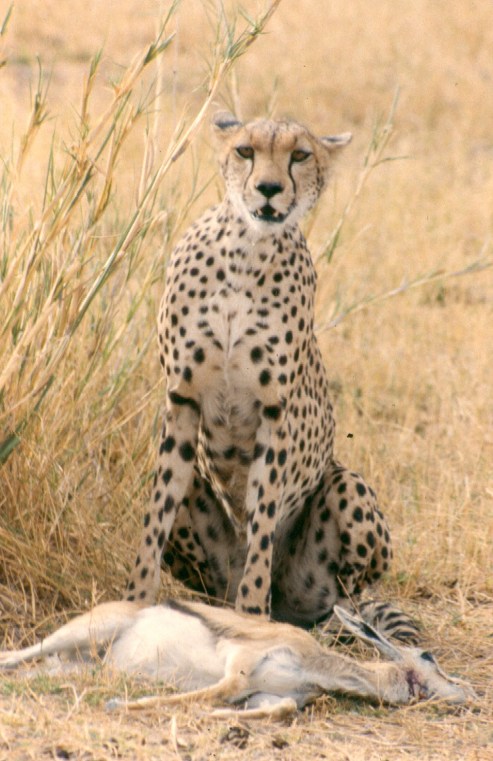
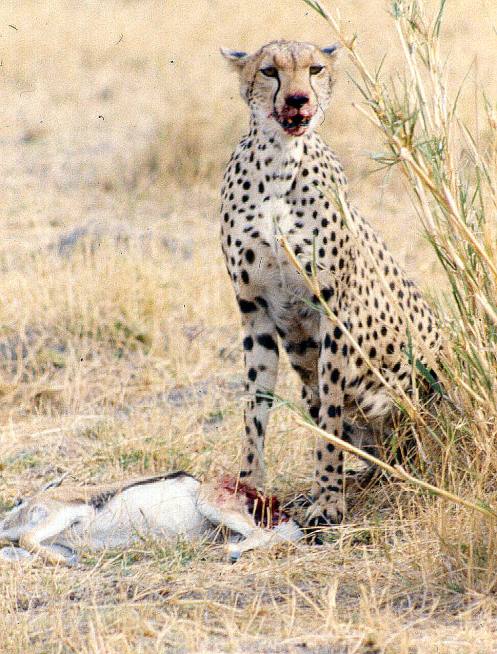
Resting after hunting and strangling a Thomson gazelle in Amboseli National Park, Kenya. See the teeth marks on the gazelle’s neck.
When it reaches the prey it makes it makes it trips it and, after it falls down it chokes it and kills it quite fast. The cheetah, usually exhausted after the chase needs to catch its breath and it only starts feeding after a while that can be as short as five or as long as fifty minutes. At that time it is common for other larger predators to steal its prey. Knowing that this can occur at any time, the cheetah eats fast and much, starting with the muscular hindquarters and it is able to eat up to 10kg of meat from a sitting.

foto-4

Eating a Thomson’s Gazelle.

The “public” life of the cheetah not only exposes them to losing their prey because of the interference of irresponsible tourists that, eager to obtain a better picture, interfere with their hunt but they can also lose one to two quarries every ten to stronger predators and, in some places, losses can reach up to fifty percent.

Cheetahs breed throughout the year and females ovulate when they have sexual contact with the male. For this reason their pups may be from different fathers boosting genetic diversity, an important factor in shrinking animal populations.

They gestate for almost three months and between three and five cubs are born, although in rare cases up to eight offspring have been observed. It is easy to imagine that for an animal that relies on speed to eat, being pregnant adds another complication to its life.

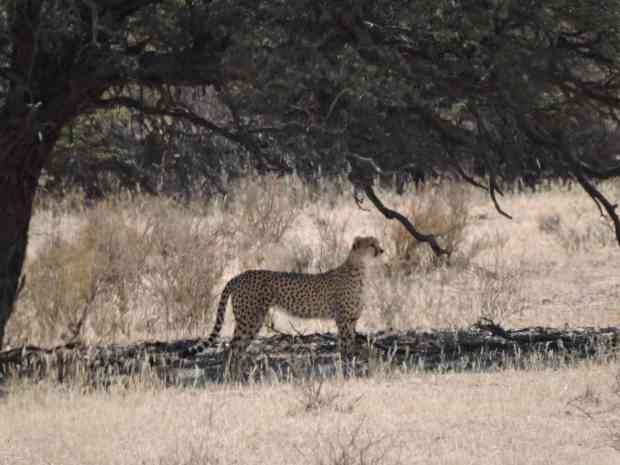
Cheetahs, especially females with cubs need to hunt almost daily and they are constantly monitoring their surroundings from a vantage point that can be a termite hill, a tree[2] and even a car!

This behavior not only allows them to detect possible prey but also prevent attacks on their offspring by lions, leopards and hyenas that would not hesitate to kill them. Failure to hunt either due to natural shortages or human interference may also mean that the cubs would starve.

foto-5-copy

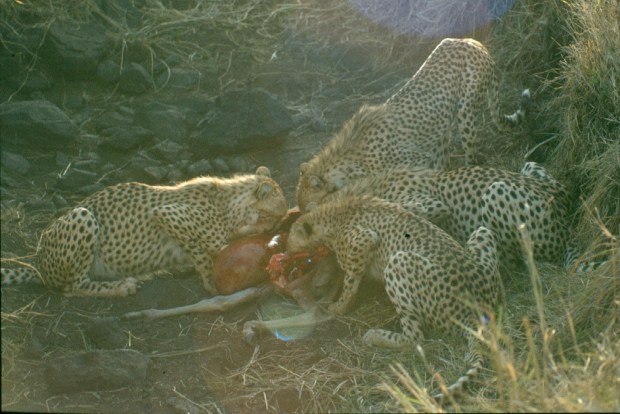
Four cheetah cubs with prey. National Park of Nairobi, Kenya.

Fortunately for the species, there are females that manage to breed the vast majority of their cubs and these are known as “super mothers.” Some even raise the cubs of other females! These super moms are not only successful hunters who manage to kill prey on a daily basis but that also know how to protect their offspring from predators.

One of these females called “Eleanor” is well known in the Serengeti National Park in Tanzania for having raised 10% of all the cheetahs that today live in the South of that huge park. This finding is one of the important achievements of the Serengeti Cheetah Project, led by researcher Sarah Durant[3].


[1] See: https://bushsnobinafrica.wordpress.com/2017/02/02/a-chase/

[2] For a rather extreme example see: https://bushsnobinafrica.wordpress.com/2014/06/30/tree-cheetahs-2/

[3] For interesting information on the subject see: http://www.tanzaniacarnivores.org/

A chase

It was driving from the Kalahari Tented Camp on the Auob River bed that we found a cheetah and her four cubs resting under the shade of a tree a long way off, at the edge of the dunes. An impossible find except for a detail: my wife was with me this time and she spotted them! As we had not had a good sighting of cheetah for quite a while, we stayed with them waiting for some action.

We watched them as they moved from the dunes to the actual dry riverbed, the mother always watchful while the cubs were engaged in a never-ending game of chasing and grabbing each other, already graceful and enjoyable to watch.

dscn9955-copy-12-25-52-pm

dscn9947-copydscn9953-copy

After a while, they got under a large tree and they decided to have a rest. Well the mother rested while the youngsters continued with their shenanigans. It was getting rather hot.

When we were considering a return to the coolness of our bungalow we saw, at about one hundred metres downriver a herd of about fifty springbok. They were slowly walking towards one of the waterholes located perhaps two hundred metres up river. We realized that they would need to walk in front of the cheetah so we abandoned our parting idea.

dscn9967-copy-2

By the time we looked back to the cats, the mother had already spotted the gazelle and she was already alert while the cubs were flat on the ground. Obviously, their playing had been suspended by mom’s orders!

dscn9913-copy

As the springbok got closer we saw the female cheetah crouch and her muscles tense so we knew that an attack was being prepared. The cubs were still invisible! “When is she going to go for them?” I thought while I readied the camera but, most importantly, my eyes to watch what was about to take place.

The springbok were still about fifty metres from the cheetah but, at that point, she started running towards the herd scattering gazelles in all directions. Although she did a beautiful sprint through open ground in front of us, she failed. After a while she walked back towards her waiting cubs that broke their cover to greet her, even when she was “empty-jawed”. I thought that the cheetah charged way too early but, who am I to judge a cheetah charge?

dscn9969-copy

dscn9970-copy-1dscn9974-copy

dscn9976-copy

dscn9977-copy

After the dust settled, we saw that the cheetah had split the herd. The lucky ones could continue their disturbed journey towards the water. The unlucky that stayed on the other side stopped for a while and then, reluctantly turned around and slowly retraced their steps. They will need to wait until the cheetah moved off to resume their quest.

The five cheetahs returned to the shade and they were still there when we finally left them after a few fine hours of fine wildlife watching. The following morning, while driving to our next camp, we saw them again, not far off, their black and slender silhouettes against the early morning sky.

dscn9890-7-12-03-pm-copy


Spot the beast 17

As easy as it is beautiful. This “beast” was seen cruising on the grass looking for prey.

DSCN8015 copy.jpgFrankly, I thought it would be easier to spot!

?

?

?

However, here it is the creature for you, a harmless Spotted bush snake (Philothamnus semivariegatus) seen at Hippo Pools Wilderness camp by the Mazowe river in the Umfurudzi Park of Zimbabwe.

dscn8005-9-25-00-am-copy

dscn8018-copy

These snakes are harmless and very beautiful!

The wait

Entering the Kgalagadi Transfrontier Park (KTP) we were given instructions on how to manage the place. Technically, we should drive at a maximum speed of 50 kph and deflate our tyres to 1.5 BAR to better navigate the severe corrugations. We were also advised to wait for the animals at the waterholes rather than drive long distances over this very dry park.

In fact, despite my initial doubt, was useful because of the way the park is. On the South African side, the KTP has two basic roads: one follows the Auob[1] dry river and the other one the Nossob[2] dry river in a North to South fashion.[3] The rivers and the roads that accompany them meet at Twee Rivieren where the main camp of the park is located.

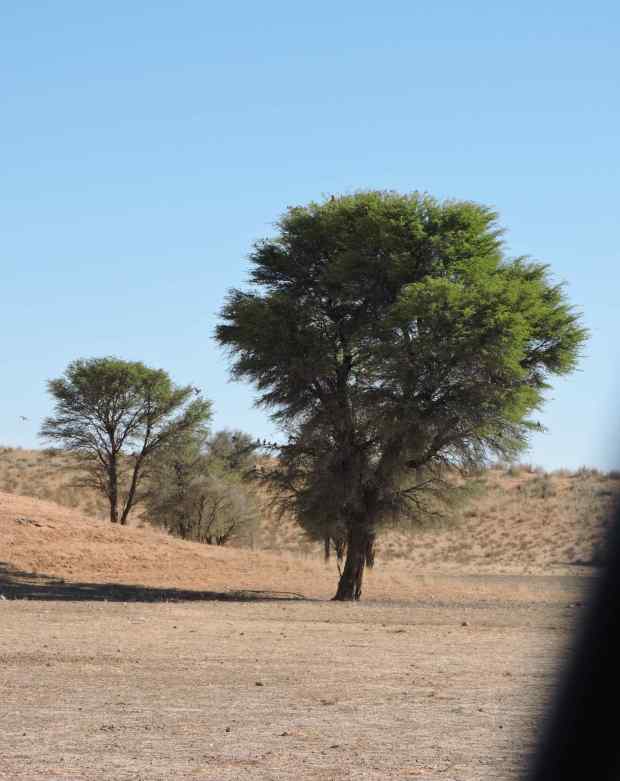
The dry riverbeds were not the expected sand rivers we see elsewhere but rather wide grassy valleys beyond which is the -inaccessible- Kalahari. Water for the animals is provided by waterholes that were sunk by the (Union of) South Africa to provide their troops with water in case South Africa wanted to use the area to invade South West Africa (Namibia). The waterholes are at roughly ten km intervals and most animals congregate around them.

Wherever you stay, you tend to drive a lot over the same stretches of roads to go and come back to camp every day so the recommendation of “sitting and waiting” at waterholes made sense. In some you have a constant parade of herbivores such as gemsbok, wildebeest and springbok as well as large number of birds such as various pigeons, sand grouse, sociable weavers and quelea. Jackals were the main predators we saw.

dscn9895-6-27-18-pm-copy

dscn9902-6-27-18-pm-copy

dscn9967-copy

At other waterholes we waited long spells for something to happen to no avail. After a while of looking at an empty place I got bored and I could not help thinking that surely the animals were at the next hole! After waiting a bit longer, this line of thought became a conviction and my unrest grew to such a point that my wife needed to coerce me to stay using her strongest argument: “I am not cooking tonight”.

After our stay in Nossob camp, on our way to Twee Rivieren, we stopped at yet another empty waterhole. As we had seen nothing in the previous two we had visited, we were looking carefully at the surrounding area as well as to the actual water hole. I was the first to see it and, surprised, said “look, a hyena coming”.

dscn0008-copy

My “hyena”…

My wife looked and, as usual but rather excitedly, she corrected me “it is a leopard” almost at the same time that I realized my error.

dscn0007-copy

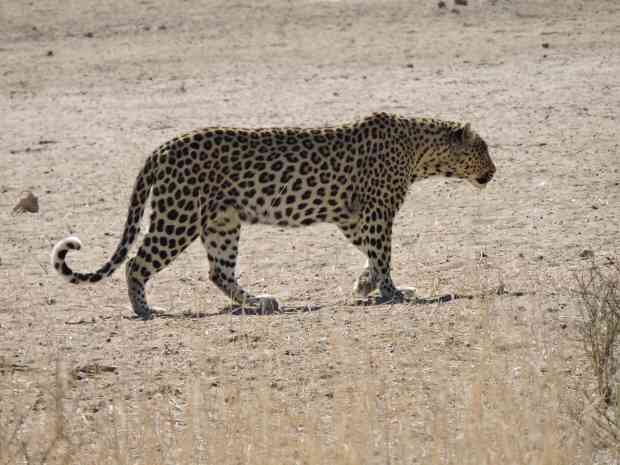
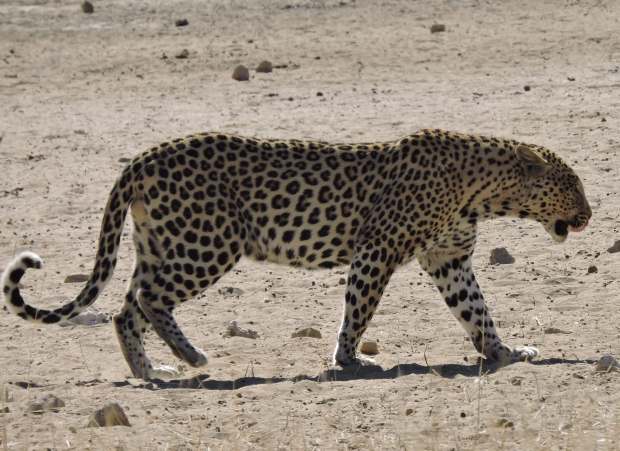
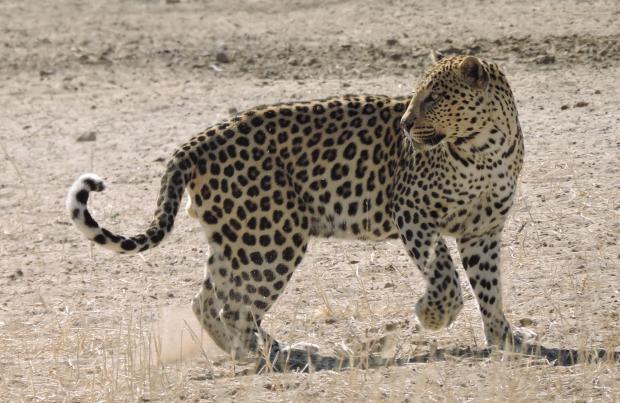
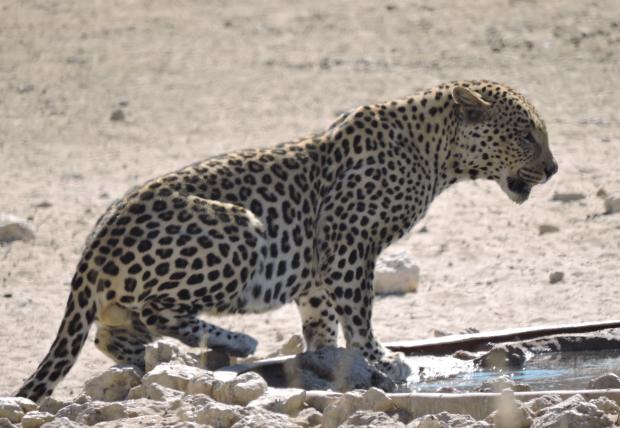
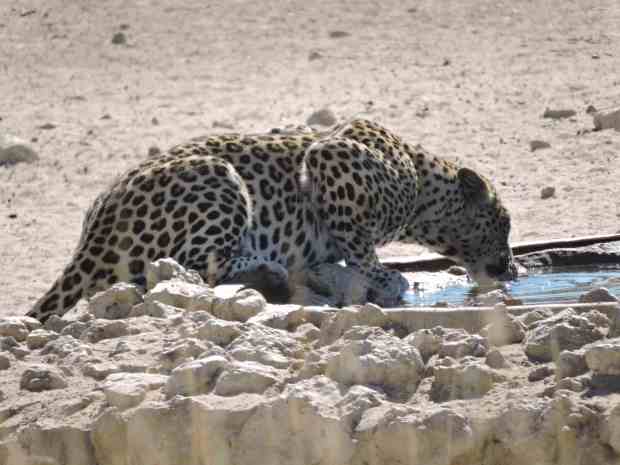
dscn0009-copydscn0004-copydscn9998-copyA leopard it was! A large male, that walked passed us and, arriving at the water it crouched to drink to placate its thirst. After a few minutes it walked off, marking a few key spots as it went slowly up the bushy riverbank. We followed it and saw it on and off as it walked up the dunes until we did not see it anymore.
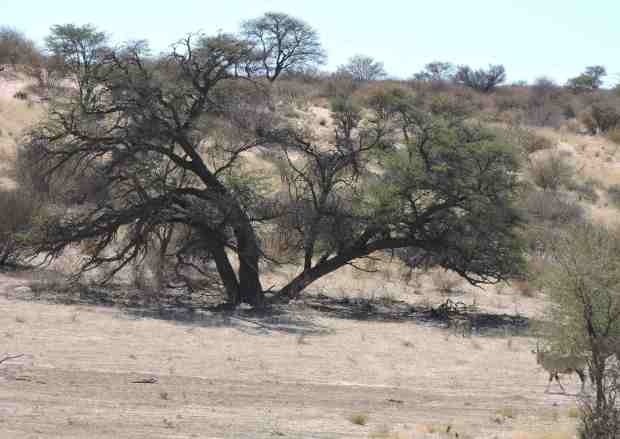
dscn0011-copy

The leopard withdrawal followed closely by gemsbok.

At that precise time a car arrived to join us. When they asked what we were watching and we told them that a male leopard had just moved off from the water three minutes ago, they were stunned and I did not blame them and I did not dare to show them our pictures either!

The leopard fleeting visit not only helped us to consider the KTP a great place but also further justified the waiting strategy at the waterholes. It also stressed the fact that a few minutes can make a huge difference and there is no amount of planning and organizing that can replace your good luck!


[1] Meaning bitter water.

[2] Meaning dark clay.

[3] The Auob last flowed in 1974 and the Nossob in 1964.

Easy pickings

Last September, after a few early morning drives at the Kalahari Transfrontier Park, we took it easy for a couple of days, visiting the waterholes late in the mornings and afternoons. The day before our departure from our last camp, Twee Rivieren, I suggested to go for an early drive but my wife preferred to continue relaxing so I went on my own. It was a bad idea as, somehow, the whole camp shared this thought and the only road out of the camp was a dust cloud, despite the 50kph speed limit.

Aware that the morning had not started as I dreamt, I drove slowly until I found a waterhole to stay and wait for the travelers to quiet down as it usually happens. I stopped after about 20km at the Rooiputs waterhole. I was alone there and, as expected, soon the traffic died down and I could enjoy some dustless tranquility.

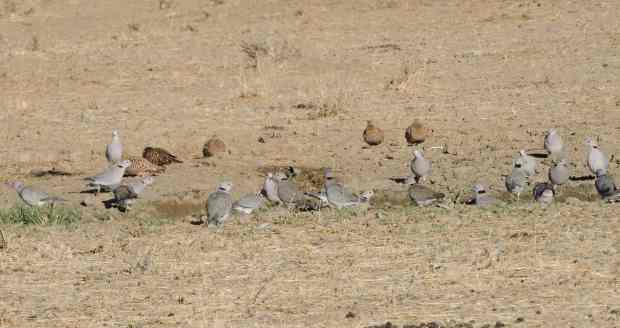
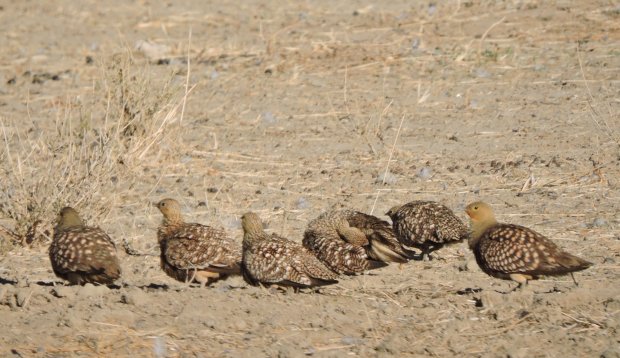
Apart from a few gemsbok staying a couple of hundred metres from the water and a lone jackal that was clearly mice-hunting in the dunes at the back, the waterhole had been completely taken over by birds. I spotted a good number of Namaqua sandgrouse on the ground and decided to take a few pictures of them.

dscn0019-8-36-37-pm-copy

The trees around the water were laden with small birds, mainly red-billed queleas, sociable weavers and red headed finches among others.

There were also a great number of laughing doves and ring-necked doves. The latter were in such numbers that it was like a curtain of moving birds that often obscured the water source as they flew in and out.

dscn0002-3-24-26-pm-copy

Hundreds of doves were “queuing” on the nearby trees to get to the water. Most of the time the available water was literally covered with birds and every now and then an explosion of birds flying in all directions followed a perceived threat. Often these were false alarms and the scared birds returned to drink immediately.

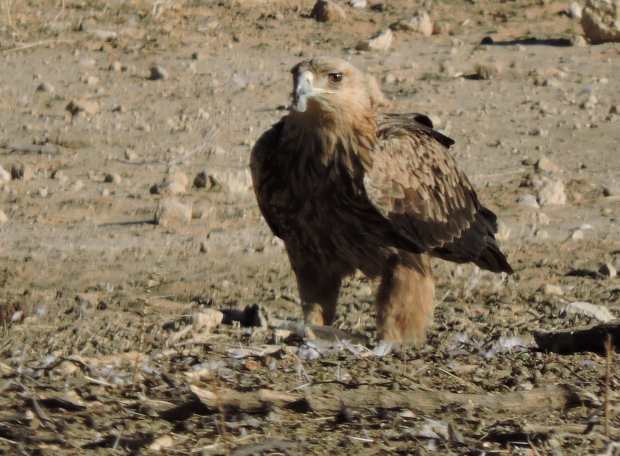
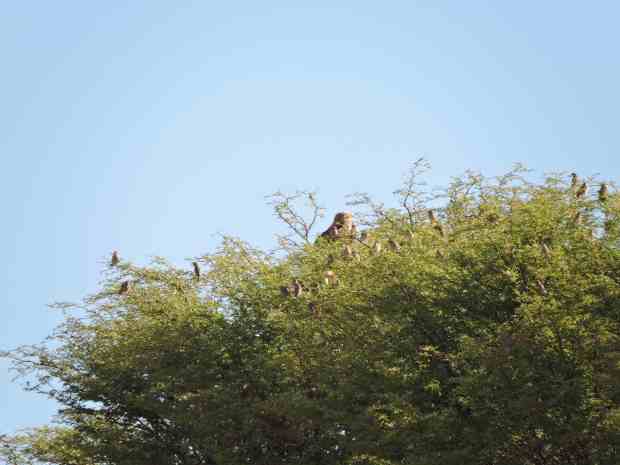
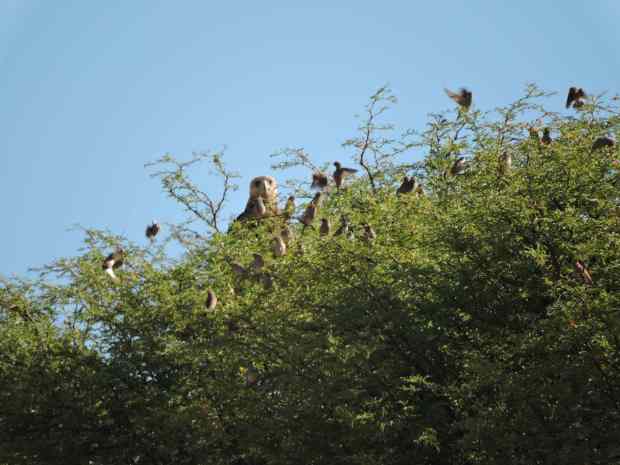
It was following one of these bird explosions that I saw a tawny eagle in the midst of the doves. When I spotted the eagle it had already caught a dove and it soon landed to eat it. “This is incredibly easy”, I thought and decided to stay there and wait for more action. When it finished eating it flew away but I was sure that it would come for more. It did.

Unexpectedly, the eagle did not return at great speed, just flew above the doves, lost altitude and then it entered the “dove cloud” and, almost effortlessly, grabbed another dove with its talons and landed to pluck it and eat it!

dscn0009-8-34-43-pm-copy

It all happened too fast for me and I only managed to take pictures of the raptor feeding about twenty metres from me. After eating, the eagle flew away again and landed on top of a nearby tree followed by a large retinue of small birds busy mobbing it.

dscn9900-8-45-15-pm-copy

dscn9895-8-44-50-pm-copy

dscn9892-8-44-50-pm-copy

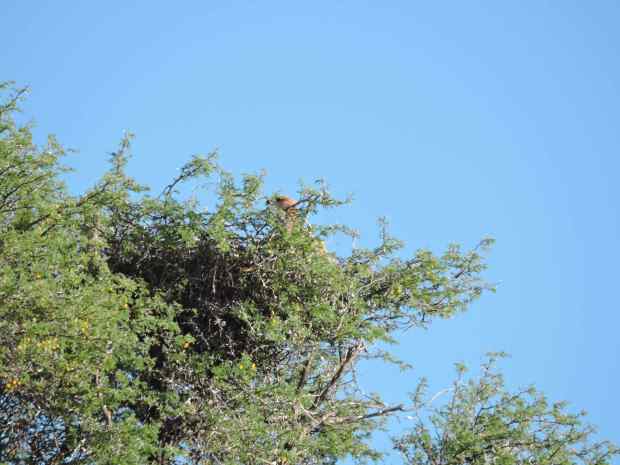
I continued watching the birds’ drinking dynamics when, after about ten minutes, the eagle (or another one?) repeated the operation and, again, caught another dove! After its third dove, the eagle flew to the same tree and then I saw a second eagle. Further inspection revealed that the clever eagles were nesting about fifty metres away, taking advantage of the easy pickings that the waterhole offered them!

dscn0079-copy

As they only need to fly a few hundred metres a day to get a full crop and feed their fledglings, I started wondering -like with the Scottish pigeons of my earlier post-about eagle obesity!

Luckily, my fears were dispelled as the next time one came for another pigeon it looked really mean and I did not detect any accumulation of fat round its waist!


Another draught victim?

Staying at Satara Rest Camp, following the advice of our Kruger National Park guidebook, we opted to drive along the Timbavati River hoping that there still was some water left and the animals were drinking there. We also had the white lions in mind! We drove to the picnic site but it was almost totally dry so we decided to carry on along the river.

dscn9933-copy

We did not!

dscn9940-copy

Driving along the Timvabati River.

dscn9944-copy

The carapace of a Leopard tortoise highlights the dryness of the Kruger.

Eventually we found some large pools that still had water and, as expected, several animal species were congregated there. We spent some time observing their interaction until it was time to return to our camp.

dscn9986-copy

On the way back we spotted a dead elephant. Although the sight was pitiful, we were already “death-conditioned” after witnessing several dead and dying hippos earlier on along the Lower Sabie River[1]. The animal was laying in an odd position that seemed to indicate a sudden collapse.

We could see that the elephant had some small tusks and, planning on reporting the find to the KNP authorities, we took the GPS coordinates. We looked at it through our binoculars and could not observe any breathing movement. Before we moved on, we noted that there were a couple of other elephants nearby and, aware that elephants have a special attitude when confronted with a dead mate, we decided to stay and observe their reaction.

We were somehow surprised when they just walked passed it without even looking at it! Sooner, our surprise became shock when, suddenly, the dead elephant moved an ear and resuscitated. Eventually, it stood up, stretched and started to feed totally unconcerned.

It was a case of “death by deep siesta”, something we had earlier observed with humans after a heavy lunch in tropical South America.


[1] https://bushsnobinafrica.wordpress.com/2016/10/03/hippo-drama/


A second sun?

“What on earth is that?” I asked while driving towards Upington on our way to the Augrabies Falls last September. My wife and copilot to who the question was directed could not understand what we were seeing either!

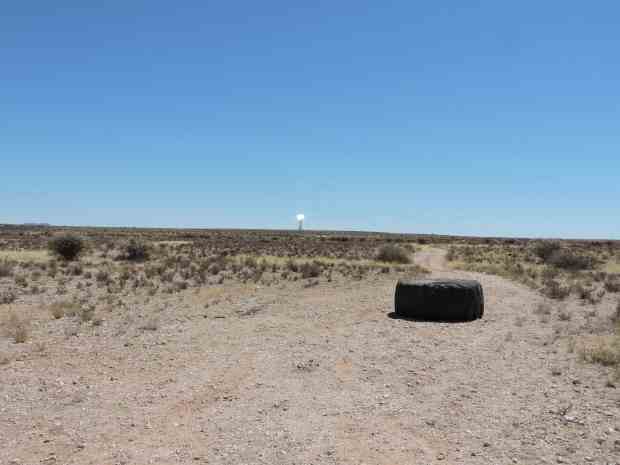
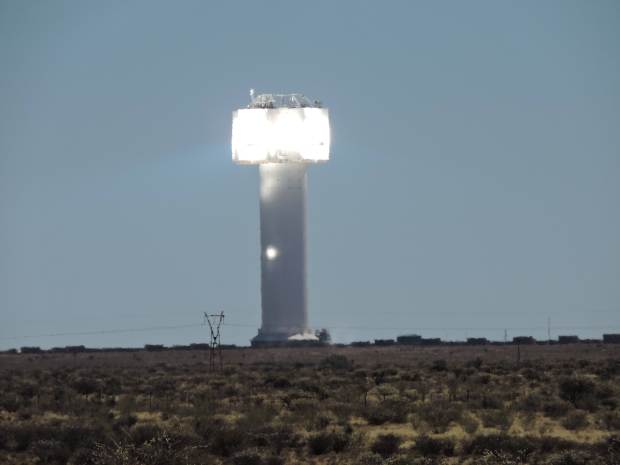
Somewhere in the horizon, well above the city’s buildings, there was a very bright source of white light. From a very long distance, it looked like the reflection of the sun on one of the new glass-covered sky scrappers that are found in places such as Dubai or Singapore. But in Upington? It could not be.

dscn9989-6-26-50-pm-copy

The first sighting of the light.

Getting closer it became clear that the light was coming from a rather tall structure as it really dominated the landscape as a second (white) sun! As we drove past Upington towards the falls, the light remained to our starboard for about 40 km until we no longer saw it.

While we drove we discussed the “phenomenon”. The first theory involved visitors from another galaxy. We have watched District 9[1] and we knew that this had taken place in South Africa but in another city. Additionally, UFOs are not normally stationary for long and they tend to move at amazing speed doing weird things in the sky. So, unless it was an extraterrestrial contraption that had unlikely just crash-landed, the object should be terrestrial.

At some point we drove closer and we were able to see more details. It was a humongous tower that, from its top, emitted a very strong white light like a gigantic white LED. We realized that it was something to do with electricity generation from sunlight and a quick WhatsApp (with pictures) consultation with our offspring in Europe confirmed that theory.

dscn9986-6-26-50-pm-copy

A view of the tower and surrounding structures.

The tower came back to life during our return to Upington, after enjoying the visit to the Augrabies falls. Now ready to find more information, we paid attention to all roads going in its direction and eventually found one with a large signpost that said “Solar One”. We confirmed our suspicions that this was a large energy project.

That night, while in Upington, I was able to Google it and, what I read was rather remarkable.

The full name of the contraption is Khi Solar One (KSO) and it is a solar thermal power plant capable of producing 50 megawatts of electricity. It is the first solar tower plant in Africa and the first to achieve 24 hours of operation with solar energy only. Not that there are many in the world anyway! In fact, there are about twelve towers (1 in South Africa, 1 in Turkey 3 in USA, 3 in Spain, 1 in India, 1 in Germany and 2 in China).[2]

The KSO solar field is made of more than four thousand heliostats[3], totaling up to 576,800 m2 of mirror surface placed on an area of 140 hectares. In this case, the mirrors focus the sun rays on a boiler located on top of the cement tower. The latter is over 200m high! The KSO uses a superheated steam cycle that is able to reach a maximum operating temperature of 530°C and the energy can be concentrated as much as 1,500 times that of the energy coming in from the sun!

The steam generated is then converted into mechanical energy in a turbine, which powers a generator to produce electricity. The plant is able to accumulate steam to provide up to two hours of thermal storage at the plant. Apparently, power towers must be large to be economical. This clearly explains its size!

The project was developed by Abengoa from Spain and financed by the Industrial Development Corporation and community group, Khi Community Trust. According to Abengoa, the 50 MW, steam-driven solar thermal plant which recently began commercial operation in early February 2016, supplies enough clean energy to power around 45,000 South African households.[4]

Of note is that Abengoa has been going through tough financial times recently and KSO is one of its assets that it may need to sell if a planned company restructure does not work.


[1] https://en.wikipedia.org/wiki/District_9

[2] From Wikipedia (no date). List of solar thermal power stations. Accessed on 19 October 2016. https://en.wikipedia.org/wiki/List_of_solar_thermal_power_stations

[3] A mirror that follows the sun in order to reflect sunlight toward a target.

[4] Energyblog (2016). Khi Solar One near Upington achieves a technological milestone. Written by Abengoa on 19 October 2016 and accessed on the same date. http://energy.org.za/news/khi-solar-one-near-upington-achieves-a-technological-milestone


Baobab myth?

I am sure that we all agree that baobabs (Adansonia digitata) are special trees. To see these true behemoths of the vegetal world in the African bush is always visually attractive and these trees have an important contribution to human as well as animal food security.

A large number of “famous” baobabs are scattered throughout Africa and Walker (2013)[1] has done a great job documenting forty special baobabs in Southern Africa while writing about his life devoted to conservation.

I have always regarded them as primeval trees that would take hundreds if not thousands of years to reach their monumental sizes. That is why what I saw after crossing the border from Botswana into South Africa shook the foundations of my baobab world…

This year we decided to do our annual trip to South Africa through Botswana for two main reasons: to avoid the normally chaotic border post at Beitbridge and to see more of Botswana. After spending the night in Palapye we crossed the border at Martin’s Drift and, after the event, we congratulated ourselves for the choice as, dealing with the border, only took a few minutes!

Still enjoying the “high” that an easy border crossing gives you we came across a farmstead with an access road lined by trees! Well, you would be thinking that the border crossing really affected my mind as most farms have such an entrance! Not so. The trees were fully grown baobabs! In addition, the land surrounding the farmhouse was also littered with the giants!


The trees I saw were not baby baobabs, not even teenagers! They belonged to my “adult baobab” category that includes trees that are hundreds or even thousands years old. Did early settlers plant the trees? Considering that the first Europeans arrived in the Limpopo Province (then the Transvaal) in 1836 via the Great Trek this could be possible. However, I believe that the trekkers had other more pressing activities than planting baobabs! This is confirmed by the finding of the first gold fields in the Transvaal fifty years later.

It was also unlikely that the trees, like the famous Morondava’s Avenue of the Baobabs in Madagascar were the remnants of a far greater baobab forest which existed in the past and not planted on purpose to grow as an avenue.

So, the mystery of the Limpopo baobab avenue remained in my mind throughout the journey through South Africa. It was only when back in Harare that I found time to Google the name of the farm and learnt that it is a hunting company[2]. Keen on finding out the origin of the trees I sent them an e-mail but I did not get a reply. I continued searching.

While looking up the issue, I remembered that a good Italian friend had bought really ancient olive trees that were moved from Southern Italy to his farm near Rome where they were planted! Apparently a trench is dug around the tree to uproot it, one side every year, then it gets pruned and, in about 4 years, it is ready to be “transplanted”. Could something like that be done with baobabs? The answer is yes!

There are 380 transplanted baobabs at the Lost City forest at Sun City, the heaviest weighed 75 tons at the time of the move! De Beers Venetia mine has relocated 110 baobabs to avoid them being damaged by its mining activities and, more recently, a large baobab in Musina, South Africa was moved from the new Musina Mall parking area and placed in a roundabout a few hundred metres away[3].

So, in the absence of a response from Choronga Safaris we can only say that there is a farm in the Limpopo Province of South Africa with an amazing baobab-lined entrance that, regardless of their origin is amazing but that we suspect that the trees were placed there rather recently.

I nearly fainted when, after this baobab revelation, I went out to have a look at the one I planted two years ago in a strategic place of the garden. There it was, about 60cm tall and starting to sprout. Although healthy, its growth is almost imperceptible and it still looks like a bonsai!

Seeing my pathetic project, I was tempted by a transplantation and a few baobab candidates I know came to mind! However, I abandoned the idea as it felt like cheating! I have planted the baobab for future members of the family to enjoy it and I will stick to this idea.

DSCN9951 copy.jpg

My “bonsai” baobab in Harare. The ruler is 30 cm long.

Well, to tell you the truth, the possible cost of a transplant really persuaded me not to do it so I will increase the amount of water it gets although I do not think that this will accelerate its growth. The only certainty is that I will not be able to drink tea under its shade.


[1] Walker, C. (2013). Baobab Trails. An Artist’s Journey of Wilderness and Wanderings. Ultra Litho (Pty) Ltd., Johannesburg. 287p.

[2] Choronga Safaris. Accessed on 7 October 2016. http://www.chorongasafaris.com/

[3] De Beers (2016). Moving story of a giant baobab tree. Accessed on 21 October 2016. https://www.debeersgroup.com/en/building-forever/our-stories/moving-story-of-a-giant-baobab-tree.html