Safari

Accounts on trips done, safari preparations, sand driving, mud driving, tips and travel-related issues.

Christmas at Kasaba Bay – Departure

Our plane to Lusaka was leaving at 11am so we got up early to prepare for the return journey. We needed to get back to Kasaba Bay, so we all got on the double cab, babies, toddlers, and nannies inside and adults at the back. We got there in good time and, after saying our farewells, we joined other passengers at the thatch-roofed wall-less terminal to wait for our Zambia Airways plane to arrive.

The crowd included our former companions from Ndole Bay that, I must say, looked more strained than us! We still had not forgotten that they had nicked some of our fish, so we just gave each other disdainful looks! We focused on entertaining our children during the wait.

Soon we heard the plane arriving and we got ready to board and queued with the rest, trying to get to the front of the line on account of our youngsters. While we were moving, we were approached by a visibly mortified Zambia Airways staff that informed us that there had been a problem and we were not on the flight!

The news left us shocked and speechless as we could not understand what had happened. The plane looked the same as the one that brought us seven days earlier so we did not comprehend where the ten extra people came from, unless there were members of the President´s entourage left behind? We did not enquire about their origin so we will never know what created “the problem”.

One more week at Kasaba Bay was not in our plans as we needed to go back to our project and, at the time, I was the Organization’s Representative in the country as well! We all used our strongest arguments such as “We cannot be left here with our babies” “It’s got to be a mistake” “We have confirmed flights” “We must go back to our work!” but none had the desired effect. We were grounded and told to move aside while the other passengers boarded. I thought I saw our former co-hosts at Ndole Bay board with a smirk, or perhaps I just imagined it…

The airline representative also told us that we would be accommodated at Kasaba Bay lodge with all costs met by Zambia Airways. When we asked when we would get another flight back, he said: “the next scheduled flight is next week, but please, do not worry, they are working on another plane to come to fetch you all tomorrow” and then added “keep checking with the control tower here for news”. The next thing we saw was his back while boarding the plane. The door was shut, and we were on our own! We looked around for the control tower, but we only saw a small room with a radio adjacent to the thatched terminal. Rather frustrated, we decided to tackle them later!

It was a beaten group that arrived at the lodge to spend the night. We did not know how many days we would be there! Luckily, the presidential party had vacated all the rooms and we were among the few guests present. We were taken to our chalets, settled down and, slowly, the importance of the bad experience started to fade as we realized that we were still at a nice place, we had food for our children and the lodge would provide for us free of charge. “Not too bad” I thought, trying to look at the bright side.

After a while, we decided to explore our surrounds. The lodge consisted of a large block with a reception and lobby areas and an adjacent dining area and kitchen. Guests stayed in chalets that were lined up at about fifty metres from the water edge with a view of the lake and its hazy mountainous frame. The lodge grounds were well kept, and it was clear that some work had gone into gardening. There was also a nice swimming pool and a bar was next to it. President Chiluba had chosen a nice place!

We were heading for the bar when we heard a woman shouting “go away, go away…” adorned with some other invectives that I prefer not to publish here. Then a very large elephant, tail up, was coming straight at us but luckily it veered off while we also tried to take cover. Behind the pachyderm came a tough looking stocky lady wielding a broomstick. The large bull was carrying a large chunk of a bougainvillea that it was clearly not allowed to take! It was a truly surreal and funny sight as the elephants we knew from East Africa did not interact with humans in that way.

After the elephant experience, our lunch and siesta, Bruno and I decided that it was time to tackle the radio room to find out what was taking place regarding our departure as well as to put some pressure on them so that our situation could be solved as soon as possible. The people were very polite but had no idea of the future. They knew the same things we did.

I was particularly insistent -assuming my Head of Agency status- and I mentioned that I needed to get back to Lusaka as I oversaw our organization’s main office and had diplomatic tasks to fulfil. While I was proffering my solemnest possible speech, I noticed that Bruno walked out of the room. Once I finished with my diatribe, I got the usual polite promise that they would try their best.

Rather annoyed I left the room and found Bruno outside, laughing loud. “What do you find so funny?” I asked him, rather upset at his apparent lack of solidarity. He looked at me and still laughing replied “Julio, I wish you could look at yourself in a mirror” and went on, saying: “who on earth is going to believe that you are the Head of an international agency looking like that!” Then I realized that I was rather scruffy after a week of bush life: dirty shirt and shorts, untidy beard and hair and a floppy hat. I realized that he was right, and I also burst out laughing. As often, Bruno had a good point!

After our control room futile visit, we went back to our lodge and spent the rest of the afternoon with the family. While at our bungalow, I spotted a large elephant coming towards the lodge following the lake shore. It walked a few metres from us, and I noted that it was a male with only one tusk. I brought the children to see it and told Bruno about it.

Our daughter Flori comes to know what elephant dung is!

Oblivious to our presence the elephant walked close to us and continued towards the lodge. After a while we heard a mighty noise coming from the kitchen area followed by loud shouting. The elephant re-appeared scurrying back to where it came from! We decided that it was a good time to enjoy the pool.

Before dinner it was time to get our toddlers back to our rooms for an early dinner and sleep while we got ready for a visit to the bar for a Mosi beer. The bar was a large rondavel with a thatch roof and no walls, very adequate for the place as the breeze made it very pleasant. There we joined other guests and we were enjoying the courtesy drinks from Zambia Airways when the barman announced that “One tusk” was coming for his drink!

We realized that we knew it when we saw it coming. It was huge. Immediately, a soda was poured on a rather large ashtray on the bar counter. Unaware of what was happening we waited. The elephant came very close and stuck its rather large trunk through the glassless window straight to the soda that had been poured for it. It sucked it dry in a second while we watched, rather concerned as we knew the power an elephant. As if to confirm our fears, after drinking it started waving its trunk about looking for more and forcing all patrons to congregate at the centre of the rondavel, away from the reach of its proboscis! This continued for a while until the barman -clearly used to the visitor- managed to chase him away.

The following day, a Sunday, we went back to the control room to make our case heard again to the company and continue keeping pressure up regarding our return. We were informed that two flights were expected that morning but no other details were available. We were cautiously hopeful and went back to the lodge to pass on the news and have breakfast. We decided to pack and be ready while waiting for the promised flights.

A plane arrived at about 10 am and we rushed to the airstrip only to be told that it was a flight going to Dar es Salaam and only stopping to drop some mail and food for the lodge. Our hopes dimed and we were starting to abandon the airstrip when the purr of another plane became louder and louder. It landed and out came a smiling plump pilot dressed in a tracksuit that introduced himself as Mr. Chizonda and informed us that he was there to take us all back to Lusaka on his 12-seater plane with the apologies of Zambia airways for leaving us the previous day.

We were elated and did not make him wait to get on our specially chartered plane back to Lusaka!
Christmas at Kasaba Bay – The mutiny

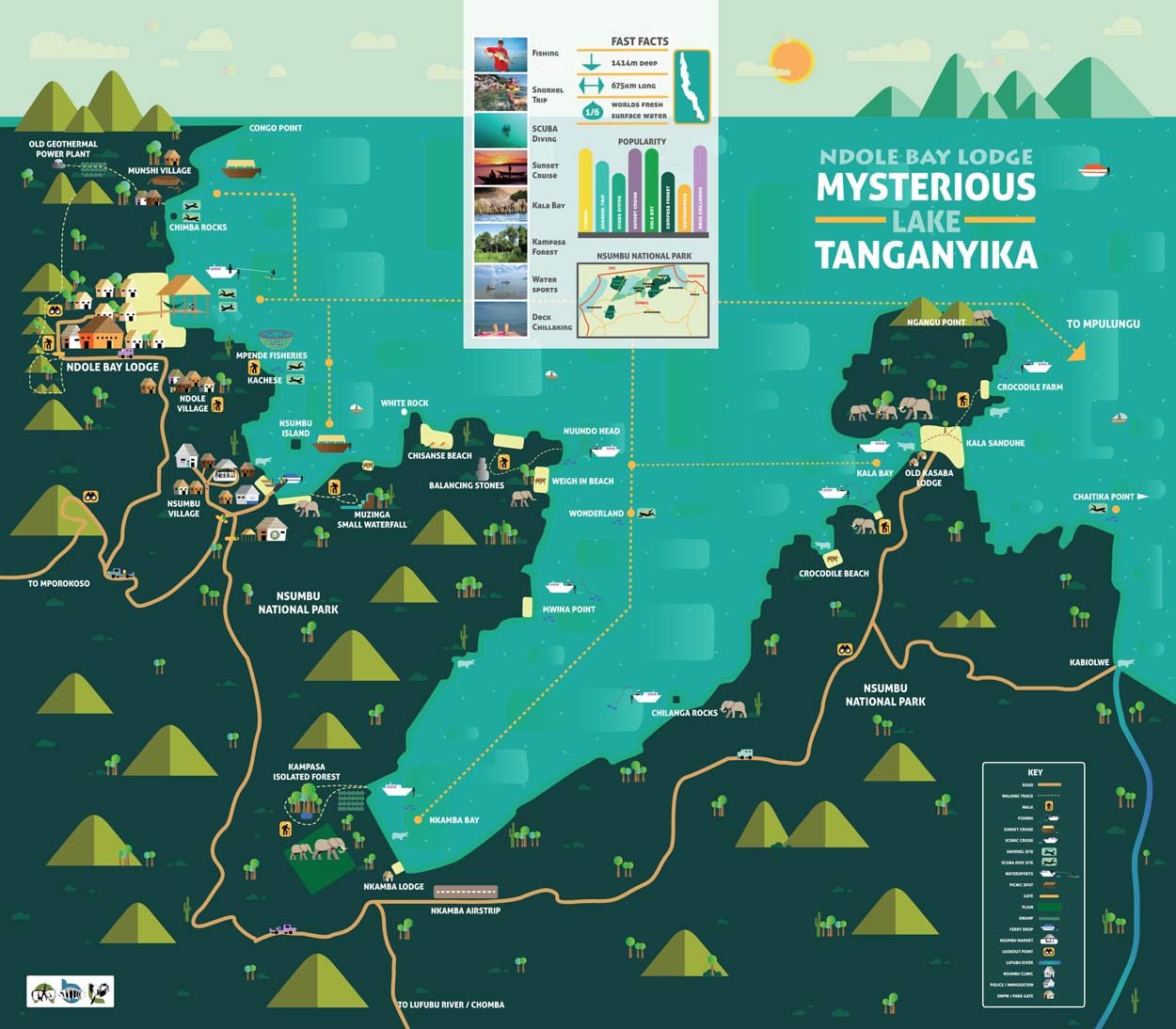
A great map of the area produced by Ndole Bay lodge. Nkamba Bay lodge is at the bottom left of the map. Copyright of Ndole Bay lodge (http://www.ndolebaylodge.com/)

After breakfast, we noted that the lodge employees congregated near the kitchen and that they were attentively listening to the manager. After a while, a heated discussion started. Apparently, it had something to do with the wages although we did not follow the deliberations with any attention.

We had already made up our minds to explore other accommodation located in the area and Anders had already gone to search for a better alternative. The ongoing mutiny had only reaffirmed our desire to leave. All we could do now was to wait for Anders, so we decided to spend sometime in the beach.

A couple of hours later Anders returned with good news. The Nkamba Lodge, sited about two hours from ours, at the Nkamba Bay, was a great looking place. Luckily, they had accommodation and Anders had already booked the last four rooms available, starting from that day! We quickly left the beach, packed and, after saying our farewell to the Manager and staff, we all climbed in the pick-up and departed. From now on, the other guests at the lodge would need to do their own fishing to survive!

Nkamba Lodge was built on higher ground and, at least for us at the time, it was a very beautiful and comfortable place that offered a magnificent view of the lake where we could see fishing boats moving in its clear waters.

The lodge was well run and that offered game viewing and Nile Perch fishing as its main attractions. What did we need! The lodge was in the Sumbu National Park where the rare Sitatunga and the Blue Duiker are found although we did not see them. We had spotted zebra and wildebeest from the car and we were told that lots of animals frequented the beaches, including Buffalo and, occasionally, Elephant, Lion and Leopard.

We also learnt that this side of the lake was teeming with Crocodiles –some up to six metres in length- so swimming was obviously not advisable and we tried hard to forget that we had been doing this for the last three days at the other lodge! We were also informed to “beware” of the Hippos that often emerged at night around the lodges on grass mowing duties. Birdlife was also plentiful and, apart from the spectacular Fish Eagles, we saw Skimmers and Spoonbills. We were also told that Palm Nut Vultures and Pel’s Fishing Owls were also occasionally seen but we were not lucky enough to spot either.

We decided that, apart from lounging in the pool and beach we could try our hand at fishing so the next morning, Anders, Bruno, and I departed before sunrise aiming towards the open lake where we were informed our chances were best, both of fishing and finding strong winds. Our skipper was the teenage son of the lodge Manager. The peace of the early morning was –regrettably- broken by the annoying sound of our outboard and the waves we created cut through an otherwise mirror-like lake surface.

We reached the chosen spot in a few minutes and started to fish for bait. This consisted in catching the Tanganyika Sardine (Limnothrissa miodon), locally known as kapenta. A small fish that rarely gets larger than 11 cm and that migrates vertically in the lake at different times during the day and night. It is fished by throwing a deep line with several hooks and subsequently pulling hard to foul hook them. If you are lucky –or hit a good shoal- you get several at once, if not, it can be hard work. Anders immediately became a “kapenta terminator” and supplied us with all the bait we required.

Once we had accumulated enough bait we moved to a spot where the large Nile Perch were known to live. There we baited large hooks fitted with steel trace and we threw our lines deep and waited. Not much happened and then we moved to another place where, again, our kapenta offers were ignored. Seen that we were getting rather impatient our skipper said: “I will call the fish” and without further explanation, removed his t-shirt and jumped into the lake!

Horrified, we watched him swim a few metres away from the boat while, aware of the six metre crocs that were supposed to be present, our eyes immediately started looking for water ripples that would indicate that one was coming. Our skipper stopped at about five metres from the boat and proceeded to repeatedly hit the water with both arms, splashing vigorously. He did this about ten times and then swam back very fast to the boat. Once onboard he explained that the technique worked for both Nile Perch and crocs, hence his fast swim back! It was clear that he had done this before but we declined to perform the attraction manoeuvre ourselves when he suggested it!

After a few minutes his trick seemed to work as Anders -again- got a mighty pull and our first –and only Nile perch- emerged. Not as large a monster as we expected but a rather babyish fish of about 5 kg that did not do much apart from letting itself being brought to the boat and immediately released as it was considered too small for the pot.

Soon it was lunchtime and, as we had no more bites, it was unanimously decided that it was time for a dip in the pool, a good lunch, and some resting on the beach. We agreed to return in the afternoon as both Bruno and I wanted our fish as well.

We went out again at about 16hs when the heat of the day had lessened and this time we saw a few large crocodiles so our skipper did not perform the earlier trick again! Perhaps because of that, we did not catch anything.

We started our return after sunset and then our engine stopped! All attempts at repairing it failed and we got stranded almost at the mouth of the bay. Although our skipper assured us that his father would come to our rescue, it was a weird feeling being alone in the lake with no lights and aware of being surrounded by large crocs so we kept our hands clear from the water. Luckily, Anders produced the brilliant idea of firing the flash of his camera at regular intervals and, after a while, we started hearing a boat engine that preceded the arrival of the lodge owner who towed us back to safety.

The following day we were due to catch our weekly flight back to Lusaka from Kasaba Bay while Anders and Birgit would continue with their Tanzania leg of their journey.

Christmas at Kasaba Bay – At the lodge

After our bad bar experience, we went for an early dinner of stew and rice and we went to bed thinking that the following day we would have a chance to do some sightseeing and perhaps a bit of fishing if we could rent one of the lodge´s boats, provided that these were available. Not a bad prospect considering what we had gone through. The rooms were fresh, and we slept well under our mosquito nets and, our both children and nannies were exhausted, sleep was very good.

The following morning started as a very luminous and warm day, perhaps we were well rested and very cheerful, and we headed for breakfast. The meal was served at the open-air restaurant area, and it was a simple affair: coffee or tea with toast, margarine and some kind of jam. The service was friendly but when we ordered more toast, the waiter informed us that if we get more bread now, tomorrow’s ration would be reduced! Having seen the supplies that came with us, this was not surprising but, nevertheless, the news sent strong alarm signals to our wives that had four children to look after!

The first measure that we decided to take with Bruno was a visit to the kitchen to make an evaluation of the availability of food both quantity and quality. So, led by the Manager we entered the place that looked as clean as it was empty, except for some egg crates on a bench but we did not spot or heard the chickens! Not seeing much food, we asked where it was kept, and we pointed at a freezer and fridge, but we refrained to press the cook for more details.

As we were leaving, the Manager pointed towards a mound on the table and, he said it was our dinner. Clearly it was a large chunk of beef that was being defrosted and it looked the worse for wear with some shades of green starting to appear. “Our cook will prepare a beef curry tonight,” said the Manager. We thanked him and the cook and completed our visit, more concerned than before.

Once alone we agreed that that the curry was going to be edible as, usually, it requires prolongued cooking and this, combined with the hot chilli peppers used would get rid of any possible threats to our health. However, we were both concerned about the food situation and we agreed that we needed to take some action to remedy it.

Our only available food source, apart from stealing food from the other guests, was the lake so we decided to try and harvest something from it.

Aware that the news would create unnecessary concern to our already worried family members, we decided not to mention the true result of our investigation and we focussed on booking a boat for the next day and the following so that we could go fishing. It seemed that it was either getting fish or going on a very low calory diet! So, all other recreational plans were shelved and we went straight to the jetty to find a boat that could take us to the lake the following day.

We negotiated a fee for a boat and a skipper and we agreed to an early start the following morning. Afterwards, we went back to our rooms to organize our fishing gear. We hoped to catch something but if we failed, we trusted that we could buy fish from the local fishermen so that we could have enough for the ten of us! Luckily, the chickens appeared for lunch and the curry, despite our misgivings, was rather good!

Next day, following the advice of our hosts we started our fishing trip very early. Not a ripple disturbed the lake, and it was a pity that our engine broke the magnificent silence of the dawn. It was a perfect start and, although later the wind picked up, the day continued to be nice and warm. We trolled for a few hours and, luckily, we managed to get some fish and we bought some more (the majority in fact!) from the lake fishermen that were very happy to get some cash from us! So, by lunchtime we were back, pleased and feeling like heroes. We took the fish to the kitchen and asked the cook to grill them for dinner. We could now go to the beach and relax with our families.

Dinnertime came and the fish were brought to the table. We waited for more to come as we knew what we had brought but nothing else came. Clearly, the amount on the table did not match our numbers! Then, in dismay, we noticed that our fellow Japanese guests were also served fish! A simple addition revealed that someone had decided to share our fish with our lodge companions! We knew that complaining would have been a futile exercise and quietly ate our “share”.

The following day was Christmas Eve and we expected Anders and Birgit´s arrival from Lusaka so, again, we booked another fishing trip for the morning but made sure that we would have our own fish roast at one of the BBQ places in the garden. We also hoped that Anders would bring some food and drinks to alleviate our situation.

This time we came back with enough Tanganyikan Tilapia (Oreochromis tanganicae) for all of us, including the visitors we expected. Again, I do not recall whether we fish them or we bought them from the local fishermen (as the day before) but I recall having intercepted a few local boats and negotiated for fish with them. In any case, to our survival purposes, it did not make a great difference. Once we felt “food secure”, we returned, cleaned the fish, seasoned them and took them to the kitchen ourselves to avoid any “losses”.

We heard Anders´ car a long way before it arrived, and we all went to greet our visitors. As expected, after a trip of well over one thousand kilometres in a Hilux pickup, they looked rather battered despite their young age. Birgit, still wearing her journey dress, was hardly able to walk while trying to take in the situation.

We learnt that she had come from Copenhagen to Lusaka, the pick-up and to the bush, still in her travel dress. They had spent the night somewhere on the way but the going had been tough, perhaps too much for her. Bravely, they still had plans to go on to Dar es Salaam after Lake Tanganyika… But it was Christmas Eve, and we did all we could to enjoy it.

We prepared a great BBQ and, this time, we roasted all of our fish that tasted delicious as most tilapia do in Africa. Our visitors did not disappoint us as they brought fresh provisions, both liquid and solid as well as presents for the kids. It all contributed to anice and merry atmosphere.

Over dinner we briefed our visitors on our situation the reasons about our situation and agreed that the major activity on Christmas Day would be to find out if there was room at another lodge so that we could enjoy the few days that we had left of our vacation.

Christmas in Kasaba Bay – Arrival

I am a great believer in sharing activities away from work to strengthen team spirit. I proposed to my project colleagues to take advantage of a special cheap offer of Zambia Airways (ZA) to spend the week of Christmas 1992 at on the shores of Lake Tanganyika in Northern Zambia. I had found out that there was a lodge known as Kasaba Bay that looked like a good place to stay there. I saw it as an excellent opportunity to visit this rather remote part of Zambia while doing some birdwatching, game-viewing, and fishing.

A great map of the area produced by Ndole Bay lodge. Copyright of Ndole Bay lodge (http://www.ndolebaylodge.com/). Kasaba Bay lodge is on the top right while Ndole Bay is on the top left. Nkamba Bay lodge is on the bottom of the map in the large Nkamba bay.

It was decided that a group was to travel by air: Bruno and Dominique with their two girls Fanny and Collette and their babysitter Beauty. I would go with Mabel, our children Flori and Julio and our babysitter Annie. Although Flori and Fanny and Julio and Collette were over two and one years old respectively, they were used to travelling and Zambia was, for all they knew at the time, their country as they were all brought up there.

Although Giuseppe would not join us as he was spending the holidays with his then girlfriend Lieve in Chipata, Anders, after collecting his girlfriend Birgit who was arriving from Copenhagen, would come by road to join us later their rather ambitious trip to Dar es Salaam. In retrospect Giuseppe was probably the wisest…

We booked the Kasaba Bay Lodge for the week, and it was a full ATR 42 (with about 50 passengers) that landed at Kasaba Bay after an uneventful flight of about two hours. The lodge was very close from the runway, so we got there before our plane started its journey back to Lusaka. The place looked promising with its small bungalows very near the lake shore and a rather large swimming pool with a comfortable thatched bar next to it. Although we were technically in the rainy season, the sky was clear, and it was warm, ideal conditions to enjoy swimming and fishing. We were informed that the the prevalence of bilharzia was very low as very few people lived nearby. Things were looking up and we were very happy to be out of Lusaka.

The plane passengers aimed for various destinations and about one half left by cars while a group of about twenty of us were taken to Kasaba Bay lodge where a reception committee was waiting for us. We did not need much imagination that the reception was rather more solemn than usual, and we were somehow surprised at the rather numerous security personnel stationed at the lodge. There was something amiss and this was dispelled soon with the Manager´s announcement.

“Ladies and gentlemen” he started, “welcome to Kasaba Bay lodge. We would like to inform you that His Excellency President Chiluba has honoured us with his presence at the lodge [1]. For this reason, all bookings that are not part of his entourage have been cancelled” That was all he could say before he was rudely interrupted by the waiting crowd, outraged by being “lodgeless”! This of course included us and even the so far polite Japanese visitors that lost their composure!

While the riot was taking place, the Manager tried, fruitlessly, to calm us down. Eventually, realizing that our protestations were futile, we stopped complaining and listened. “Please, do not worry” said a now dishevelled and nervous Manager, “we have made very good alternative arrangements for all of you. You will be taken to another lodge. He then proceeded to inform us that there were two boats ready at the yetty to take us to our new destination and he invited us to move there and wait for instructions.

While we were walking towards the lake, we saw our plane taking off and we realized that we would be at Lake Tanganyika for one week and that we better enjoy it. The ten of us were place in the same boat while the Japanese group and a couple of other foreigners were given the second one.

We were going to a lodge somewhere on the lake shore that I believe was an earlier version of the present Ndole Bay lodge or one sited in that general area. I regret that my memory fails me there.

By now it was near mid-day and the heat was getting intense. The boats were indeed at the jetty but far from ready and under the sun (the nearest trees were around the lodge!). We boarded and accommodated the ladies and our offspring as best as we could under a makeshift shade made of khangas while Bruno and I made sure that all our luggage was loaded on our boat. While this took place, provisions were also being loaded.

We saw rice, bread, cabbages, maize meal, and a couple of cool boxes brought to the boat. While this took place, we established communication with our skipper and learnt that we would navigate about three hours to our destination, that it was only a name to us at the time. The heat was intense, and our children were feeling hot and unhappy, so the situation was getting difficult when loaded was completed and we were ready to go.

But we did not go as we were waiting for chickens and eggs! These did not appear for another fifteen minutes. Once several birds and a few crates arrived, we started our journey and soon we forgot our past experience and got into the contemplation of a beautifully green lake in sharp contrast with the dry mountains that framed it. “Over there is Doctor Congo” joked our skipper referring to the opposite shore, the then Democratic Republic of Congo (DRC). The water was amazingly clean and warm, but we avoided touching it too much just in case.

It was a relief to set off and to dry our sweat with the lake breeze at last. As soon as we moved from the jetty we realized the enormity of this true land-locked sea with an area of 32,900 km² and a maximum length of 673 km. Encased by the Rift valley mountainous range, the dark green colour of the water was an indication of its depth that averages 500m but that can reach down to 1500m, one of the deepest of our planet. Apart from a large population of Crocodiles and Hippos, several fish species are found and the lake is renowned for its more than 250 species of cichlid fish, most of which are endemic.

We were not after cichlids but sport fish, mainly the Nile Perch (Lates niloticus), although we knew that there were other large game fish such as the Tiger fish (Hydrocynus vittatus) and Vundu Catfish (Heterobranchus longifilis). We were also aware of the off chance of catching a real monster, the Goliath Tiger fish (Hydrocynus goliath) that also lurked in the lake’s depths. Although unlikely, we knew that some world records for these species had been set here and came well prepared, just in case we had a chance to challenge them…

I had heard stories at Lusaka of people that had caught Nile Perch at the lake, and we had fished them in Kenya years before at Lake Victoria. Apparently, they would catch large perch by trolling at a considerable depth using a barbie doll as their lure! As my daughter did not agree with me using hers, we settled for the more conventional deep action lures! I chose the largest I had.

It was probably the usual African optimism that led the Manager of the Kasaba Bay lodge to say that the trip to Ndole would last one hour. Perhaps he did not know the place, or he travelled in faster boats. Ours, a long wooden contraption with a rather small engine, took the three hours that the skipper mentioned to get to our destination. By the time we arrived was mid-afternoon and we were low on drinking water and, except for our two younger and still suckling babies, we were all suffering from the heat and sunburns.

We disembarked, luckily before the other boat, and we walked in a single file towards the lodge. This was simple but the rooms were nicely set in the garden among rocks and nice tropical plants. There was also a shaded veranda where food would be served. A couple of good BBQ stands were also there among the boulders in the garden. There was no swimming pool but a nice sandy beach where some rather derelict but still usable straw umbrellas were placed. The lake water was amazingly clean, warm, and calm, very tempting to jump in but we decided that it was best to find our rooms first as there would be time lateer to enjoy beach life!

As we walked Bruno said: “Let’s go quickly to get our rooms before the other people pick the best” so we walked fast and got to the reception first and negotiated for our rooms. Although I am not sure that we achieved much, at least we felt satisfied! We were pleased to note that the rooms had new mosquito nets and that they were quite cool thanks to the straw roofs. So, we had a chance to relax and cool down after quite an eventful day. But the day was not yet over.

At about six in the afternoon Bruno made an appearance. “Let´s go for a beer” he said. We agreed and walked to the bar, a roomy where a barman waited for us. We asked for a couple of Mosi beers (the Zambian beer at the time) but we were informed that there was no beer in the lodge as they had not loaded any on our boats! “Maybe with luck they will bring some tomorrow” he said traying to believe his words. This was a bad start!

We spotted a fridge that was plugged in, but we were not sure that there was electricity or that anything was inside it. In any case we insisted: “So, what can we drink then?” we asked. The rather apologetic barman replied, “there are a few sodas, but they were just offloaded from the boats, and they are hot!” As we were not prepared to suffer hot Cokes, we asked what else could he offer, and the choice was whisky or green powder juice!

We did not feel like a scotch, so we settle for the green juice. This was another error. We were served glasses of room temperature green water, which tasted sweet with a weak apple after taste. It was rather undrinkable, and we baptized it “Green Mamba juice”! and we only drank it that day!

We realized that the bar situation was critical and decided to secure the bottle of whisky, so we went to our room to get money. When we returned, we learnt that our only hope for a decent drink had already been “booked” by the Japanese group. “We are in a bad condition”, Bruno said while we were leaving the bar never to return!

[1] The late Frederick Chiluba, then the leader of the Movement for Democratic Change, had beaten Kenneth Kaunda in the first democratic elections and he had probably decided that he needed a rest after the campaign. (Or maybe he shared my thoughts on team building and chose the same location!).

South Luangwa National Park

The visit of Mauro, my father-in-law, was a good excuse to travel to the South Luangwa National Park. Although flying with the defunct Zambia Airways was reasonably priced, we opted to travel by road so that we could see the country better.

Unfortunately, the journey from Lusaka to Chipata was rather monotonous and long (568 km) on an almost straight road. From there we still had to travel another 100 km on a dirt road to get to Mfuwe Lodge, our destination for the three days we stayed there. The lodge was run by the Government and offered basic services, but we found it comfortable as well as very reasonably priced.

Our daughter came with us, looked after by her grandad, too young to remember anything despite my efforts to introduce her to the abundant hippos that lived in the river.

The Luangwa River is a major tributary of the Zambezi River and one of the four large rivers of Zambia, together with the Zambezi, Kafue and Chambesi). The upper and middle parts supply water to the North and South Luangwa National Parks and it is also home to a very large population of crocodiles and hippos. It is here where the largest population of hippos in Africa can be found. Although during the dry season the hippos are confined to pools that become muddy, they managed to survive although sometimes they succumb to diseases such as anthrax [1]. This was not the case during our visit as the river was flowing and they were scattered all over it.

The Luangwa River with hippos.

We spent a long time watching the numerous large schools of hippo but in fact we were looking for a place from where we could fish safely as I was aware that the river´s muddy waters also harboured good sized catfish. We selected a treeless patch of a grassy bank about 1.5m above the water from where we had a good view of any animals approaching and could focus on catching fish.

The following morning while Mauro and I fished, Mabel kept an eye for danger, just in case as very little escapes her eyesight! We were not able to bring earthworms, so we resorted to some beef we had brought for the purpose (I was not yet aware at the time of the use of soap!). Although beef is not the ideal bait, we started having some good bites and our enthusiasm grew.

We fished from a similar river bank than the one behind the hippos.

For Mauro, a frequent fisherman of the muddy waters of the River Plate, the kind of fishing we did was a normal event and soon he caught a nice catfish that we returned as we were only fishing for sport. While I was busy catching nothing, he hooked another fish. This time it seemed to be quite sizeable as he had difficulties bringing it in. Eventually it surfaced and we saw that a large catfish that Mauro, with his experience, played well and soon was close to the bank.

Catfish are tough and they take a while to get tired so there was quite a bit of fighting before he started to lift it up from the water. When he had raised the fish about one metre, a large green form came up from the water, seized the fish and disappeared in a fraction of a second. We were completely taken by surprise by this and we looked at each other in disbelief for a while, speechless and it took a while before we could talk again! When we did, it was to agree that we had had enough fishing for the day as we did not wish to have another close encounter with a croc!

We were wise choosing the high bank as the crocodile, attracted by the commotion in the water, took its chance once it saw the fish being lifted and it could have come towards us if we would have been at the river´s edge! The event got imprinted in Mauro´s memory in such a way that, whenever we fished again, he will tell me of the day I tried to get rid of him!

After this incident we devoted the rest of our time to safer activities. So we, fruitlessly, looked for lion and leopard but were rewarded by seeing other game, including many elephants. I had the impression that elephants in Luangwa were smaller than others we had seen in other parts of Zambia but it was just that, an impression.

Elephants at South Luangwa National Park.

Apart from fishing and game viewing, our trip to the South Luangwa National Park had another purpose. I was very keen to meet one of my “bush heroes”, Norman Carr, then living at Kapani Safari Lodge. I had bought and read some of his books [2] and I admired his inspiring work in conservation [3] .

Luckily, he was at the camp, and we had the great pleasure to spend a few hours with him. He came across as an extremely knowledgeable and unassuming man and our meeting only increased the admiration I felt for him. Interestingly, I owned a copy of “The White Impala” dedicated to another person and signed by Norman that Mabel had bought at an auction in Kenya. He was quite amused when I asked him to re-dedicate it to me. He accepted and the book became one of my special wildlife books.

Before we left, Norman invited us to return to Kapani to spend more time there. Unfortunately, soon afterwards we left Zambia and did not return to South Luangwa and, sadly, Norman passed away in 1997.

[1] If interested in the subject, see https://bushsnob.com/2015/12/10/a-new-hippo/ and https://bushsnob.com/hippo-carnivory-press-coverage/

[2] Return to the Wild (Collins 1962), The White Impala (Collins 1969), Some Common Trees and Shrubs of Luangwa Valley (1978), Valley of the Elephants (Collins 1980), A guide to the wildlife of the Luangwa Valley (Collins 1987) and Kakuli (CBC 1996). (Kakuli means Old buffalo and it is the friendly name by which the locals called him).

[3] Norman Carr, born in Chinde (Portuguese East Africa) started his career as an Elephant Control Officer in Northern Rhodesia controlling elephants damaging crops from villagers. During this time Norman gathered a great deal of bush experience that it would later prove invaluable when setting up National Parks for the Government and train rangers and wardens. Apart from South Luangwa, he also established the Kafue National Park.

It was after serving with the King’s African Rifles during the Second World War that he returned to Rhodesia with a very advanced idea: villagers could make money out looking after of protecting elephants and other animals. This was the start of eco-tourism in Africa!

He established Kapani, his own tourist camp just outside the park gates, and started charging guests to watch wild animals, a novel concept at the time. Later, the loss of wildlife to increased poaching prompted him to set up the Rhino Trust in 1970 which later passed into the care of the Worldwide Fund for Nature. He was a major driving force in the development of the Luangwa valley area, particularly with his ground-breaking walking safaris. He then spent lots of energy developing projects in support of the local communities.

The above is just a short account on Norman´s life and work and the interested reader will have no difficulty “googling” information on him.

Trip notes

Recently, our friend “Pinkshade” found notes from the past that included info on what we had seen on our safari to Ngorongoro and Manyara in 1988. As she puts it “It doesn’t seem exhaustive but it reveals the most that we saw at that time… including the (most probably) Black-bellied bustard and the Eulophia welwitschii (terrestrial yellow orchid)! And, the bonus is a map drawn by the warden himself to help us to find the spots! Historical piece!!! To which, very disrespectfully we added some of our notes!”

Ngorongoro & Manyara safari – Fauna and Flora lists – February 1988 (with 4WD, XRay, Khanga, ScoutSpirit and PinkShade)

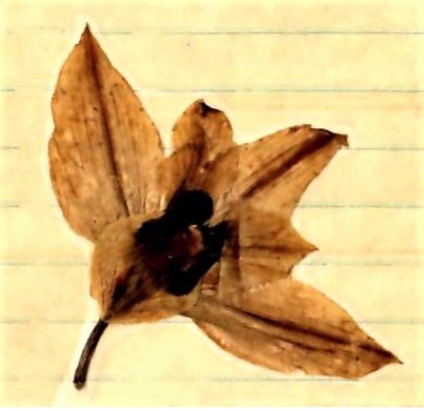
Dried flower of a terrestrial orchid (probably Eulophia welwitschii), cf. picture below.

List of birds:

  • Grey heron
  • Black-headed heron
  • African sacred ibis
  • African spoonbill
  • Yellow-billed stork
  • Lesser flamingo
  • Abdim’s stork
  • Saddle-billed stork
  • Marabou stork
  • Cape teal (or Cape Wigeon)
  • Red-billed duck (or Red-billed real)
  • Spur-winged goose
  • Maccoa duck
  • Egyptian goose
  • Francolin (undefined)
  • Kori bustard
  • Black-bellied bustard (cf. photo in post)
  • Grey crowned crane
  • Spur-winged lapwing (or Black-winged plover)
  • Blacksmith plover
  • Pied avocet
  • Speckled pigeon
  • Mousebird (undefined)
  • European swallow/Hirundo rustica (migration)
  • White stork (migration)
  • Lark (undefined)
  • Fisher’s sparrow lark
  • African stone chat
  • Olive thrush
  • Fiscal (undefined)
  • Tropical boubou
  • Yellow bishop
  • Superb starling
  • Black Kite

Only seen at Manyara:

  • Hamerkop
  • Greater flamingo
  • Knob-billed duck
  • Long-crested eagle
  • African harrier hawk
  • Pale chanting goshawk
  • Crowned lapwing
  • Namaqua dove
  • White-browed coucal
  • Lilac-breasted roller
  • European roller
  • Striped kingfisher
  • Little bee-eater
  • Hornbill (undefined)
  • Ground hornbill
  • Wagtail (undefined)
  • Red-headed bluebill
  • Long-tailed paradise whydah
  • Weaver (undefined)
  • Red-billed oxpecker
  • Pied crows

List of mammals:

  • Warthog
  • Hippopotamus
  • Giraffe
  • Eland
  • Wildebeest (gnu)
  • Kongoni
  • Grant’s gazelle
  • Thompson’s gazelle
  • Buffalo
  • Grant’s zebra
  • Impalas
  • Black rhinoceros (4 individuals)
  • Elephant
  • Golden jackal
  • Spotted hyena
  • Lion (a big group and some scattered ones)

Only seen at Manyara:

  • Black-backed jackal
  • Baboon
  • Dik-dik

List of plants:

  • Euphorbia kibwezensis
  • Heliotrope (undefined)
  • Cycnium tubulosum
  • Hibiscus (undefined)
  • Hibiscus aponeurus
  • Pavonia gallaensis
  • Crossandra subacaulis
  • Commicarpus pedunculosus
  • Crinum macowanii
  • Commelina sp.
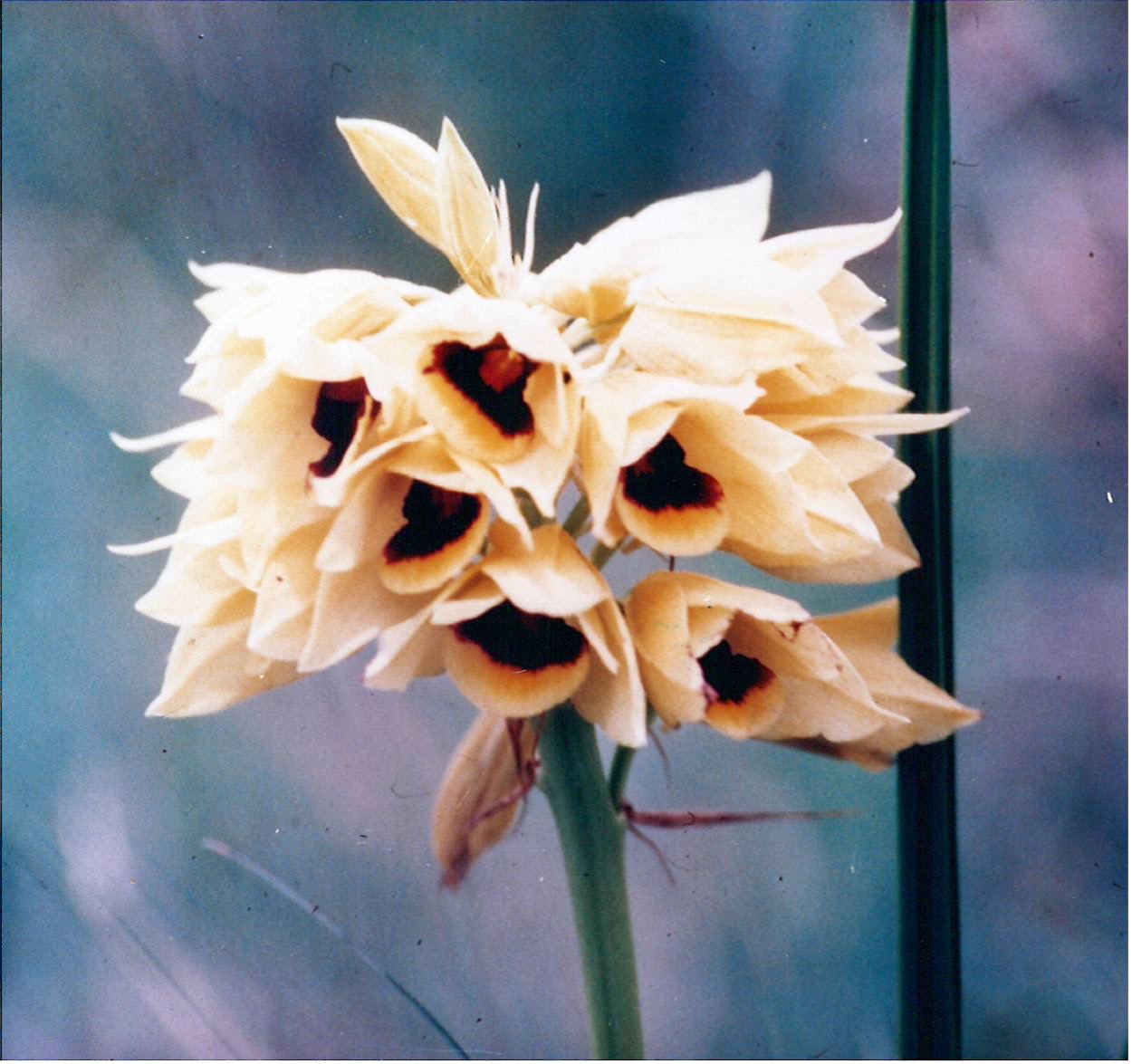
  • Eulophia welwitschii (?), terrestrial orchid (cf dried flower above and picture here-under)

Our picture of Eulophia welwitschii (?), to be compared with: http://pza.sanbi.org/eulophia-welwitschii

Only seen at Manyara:

  • Baobab
  • Euphorbia candelabrum
  • Datura stramonium
  • Lippia sp. (white)
  • Crotalaria agatiflora (Canary bird bush)
  • Spathodea campanulate (African tulip tree)
  • Kigelia Africana (African sausage tree)
  • Gloriosa superba
  • Erythrina abyssinica (Coral tree or Flame tree)
  • Calotropis procera (Sodom apple)
  • Solanum incanum
  • Solanum sp.
  • Scadoxus multiflorus (slightly north of the aera)

I thank Pinkshade for her contribution!

Lutale scraps

Bruno invited me to eat at Lutale a few times but there are two that were rather unforgettable. As a necessary background to the story, he had taught his cook Mr. Tembo the art of preparing Belgian fries and, I must say, the cook knew what he was doing. For those of you willing to try them, the perfect fries are made by double frying the potatoes. First, they are cooked at lower heat, then left to cool down, and, just before serving, they are fried again at a much higher temperature. The resulting potatoes are perfect: golden brown, dry and crispy outside and soft inside.

Giuseppe and I happened to be at Lutale together and Bruno invited us to have roasted chicken for lunch, so we obliged, and we were at the table without a minute wasted. Bruno started our get together by announcing that there had been a delay obtaining the chicken! He had “ordered” one from the village, but it had not arrived yet.

However, he added that Mr. Tembo would be bringing fried potatoes and mayonnaise for us to start eating. When they came, the fries were truly delicious and being hungry, the first instalment did not last very long. Luckily Mr. Tembo soon brought more. After the third potato delivery, the chicken was still absent and probably some boys were running after it in the bush! Luckily, the chips kept arriving so we kept ging for them.

After about an hour waiting we were full of chips, and then we heard a loud squawk that announced the arrival of our future lunch, still alive and well! At that time, we unanimously decided that our intended victim could live another day and we re-focused on the delicious fries. I cannot guess the amount of potatoes Mr. Tembo processed but I am sure that we went through a few kilogrammes. As protein-free diets go, it was a great success!

Another time Bruno invited me for dinner at a time when I was helping him with some of the work. I went to his house eager to try the fries again and this time Bruno was keen to announce that the menu was complete and almost ready.

Soon a smiling Mr. Tembo appeared with a large smoking tray that he placed on the table. My eyes immediately focused on the fries and my mouth watered when I confirmed that they looked as well as before! However, it immediately dried up when I saw the protein part of the dish. It had four legs and the size of a small rabbit! “We are having a cane rat for lunch” Bruno announced proudly although I could sense a touch of sarcasm in the tone of his voice.

I had eaten different animals in Latin America and in Africa before but never a large rat! However, I immediately recalled that our Zambian workers could jump out of a moving car whenever they saw one of these beasts on the road so I thought that it should be good and that was what Bruno was saying when I refocused on our meal.

The meat was white with a taste close to a roasted piglet, and I must say that its combination with the fries made it one of the best bush meals I have had. Mr. Tembo brought back a tray where only bones remained!

Traveling to Lutale had its moments too. Of the two drivers, I preferred Mr. Chewe for the bush as he knew the area and had good mechanical knowledge. The problem was that he drove with his eyes squinting and I usually joked with visitors that he knew the place so well that he could drive with his eyes closed! Mr. Chewe liked to hear this but always tokd me that it was not true.

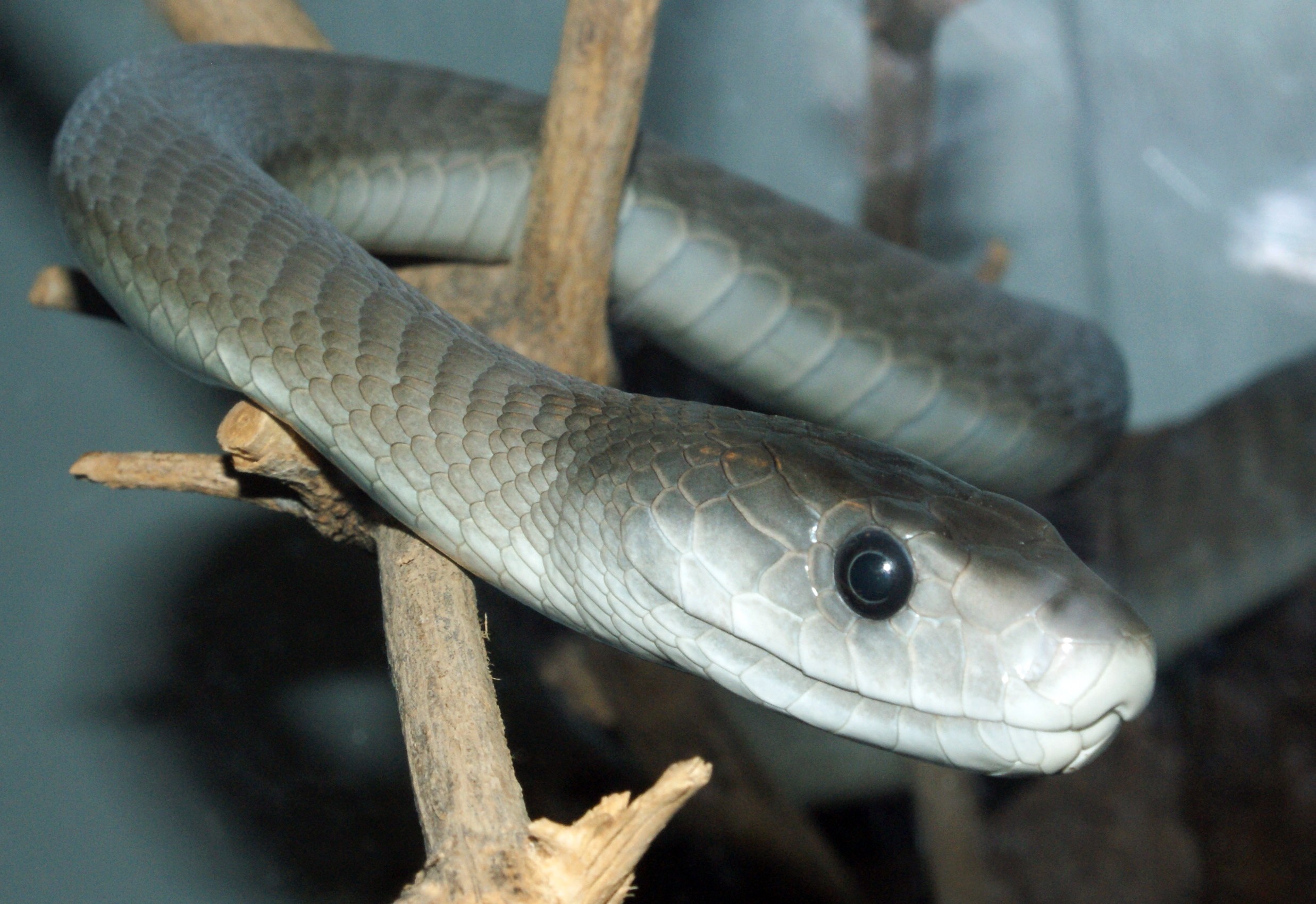
He had them well open a day when, in the dirt road getting close to Lutale, a snake started to cross the road in front of the car. It moved extremely fast but not fast enough. By the time we got to it, it occupied the whole width of the road! The snake, that I am sure was a black mamba (Dendroaspis polylepis) was moving from right to left and when we run over it, almost all of it had moved across. However, when it felt the wheels, it rose high, almost vertically.

A black mamba is really grey. Its name is due to the dark blue/black colour insde its mouth. Credit:TimVickers, Public domain, via Wikimedia Commons

I saw the head coming towards us but the speed of the events was such that I could not react fast enough and only watched it striking the outside mirror, a few centimetres from my arm. A lucky scape that enabled me to continue with my life! I was so shaken that I did not even feel sorry for the snake that, after the incident, we saw continuing its trip through the dry thicket. It was the only black mamba I saw in Zambia.

The dam at Lutale was an important feature for the village life as it offered permanent water as well as relief from the heat. Somehow Bruno had acquired a “banana” boat (dugout) that he kept moored near his house. I am sure he kept for a reason that was not solely to enjoy himself by inviting guests to climb on it and then pushing them gently into the dam while they desperately tried to keep the boat from tipping over!

There were large catfish in the dam and the locals were after them. A fisherman myself, I spent some time watching them. The technique they used was as simple as effective. It consisted of a 5-litre can from which a line and a large hook would be tied and baited with a chunk of chicken or any other animal protein available.

The cans were thrown into the dam and then followed in their floating across the dam until they started to bobble, indicating that a fish was feeding. When it got hooked, the can would start to travel and that was the time when the fishermen would go either on foot or in their dugout canoes to pick up their prey. A very ingenious way of fishing in closed water areas.

Car robbery!

I have already described our misfortune regarding our first car in Zambia (see: https://bushsnob.com/2021/04/03/bad-motoring-start/) and now comes the end of the story.

I have already mentioned that at the time we were there, Lusaka was rather insecure. The situation did not spare us.

It happened when Mabel, heavily pregnant with our son, accompanied by our daughter Flori (about one year old) were returning home after a shopping trip. As usual, on arrival to our gate she stopped the car and hooted, waiting for Lemek (the gardener) to open it. While she waited, two men approached the car and, pointing a gun at her, asked her to give them the car.

Despite her initial shock, Mabel managed to lock the doors and, showing great courage, told them to go away! Unfortunately, as expected, the robbers not only did not move but became increasingly aggressive, so she decided to give them the car as they were becoming violent and threatening to shoot her. It was at that time that Lemek opened the gate and closed it immediately, fearing that they would go inside and attempt to steal one of the cars parked inside or even to break into our house.

So, Mabel was on her own with the robbers! While agreeing to hand over the car, she unstrapped Flori from her child seat and left the car while pleading with the robbers (to no avail) to allow her to take her handbag and even her shopping!

So, the moment she opened the door she was grabbed by the arm and pulled out with the gun still aimed at her. Luckily, she was not injured physically but it took her a while to recover from the scare that she experienced.

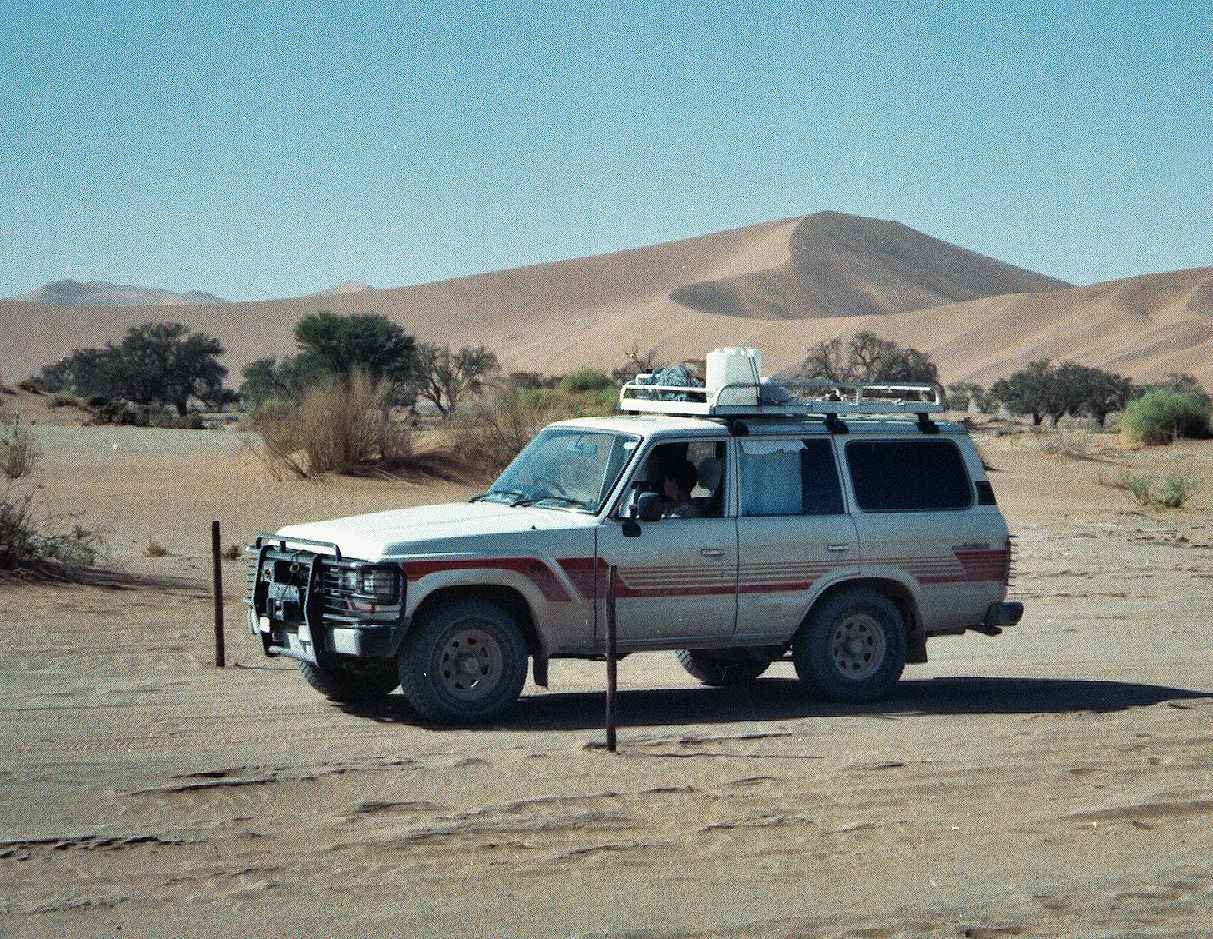
So it was that our car that had started its life giving us problems disappeared from our lives and left us with the money of the insurance. Luckily, we managed to find a replacement very fast. It was another Land Cruiser and, despite being older, it was much more comfortable. We soon forgot the stolen car and enjoyed our “new” one with which we did most of our travel until we departed [1].

Our replacement car during a trip to Namibia in 1992.

The robbery was still fresh in our minds when a copycat one took place about ten days later. This time the victim was our colleague and friend Giuseppe. Unfortunately, he was being driven by Mr. Mutale and the latter tried to resist the attackers. He was punched on the nose by the robbers but, luckily, nothing else happened, considering that robbers were rather rough on the local people. This time it was Giuseppe that got traumatized and needed to get through the insurance claiming process and to get a replacement car.

After that spell, we tightened the security measures at the house and, fortunately, no more cars were taken! Although shocking at the time, it was a small price to pay for two armed robberies!

[1] We left Zambia for Italy, so it was with great regret that I sold the car. A young Italian bought it and also got attached to it. When he was transferred to Kenya a couple of years later, he took the car with him and enjoyed for a few more years.

Spotted – 3

Maasailand in general and the Transmara area beyond were a great source of new things for us in Kenya. Spotting red clad Maasai, carrying their traditional weapons, walking about everywhere took a while to get used to! In addition, there were plenty of wild animals to be seen not to mention the beautiful landscape that was all new to us at the time.

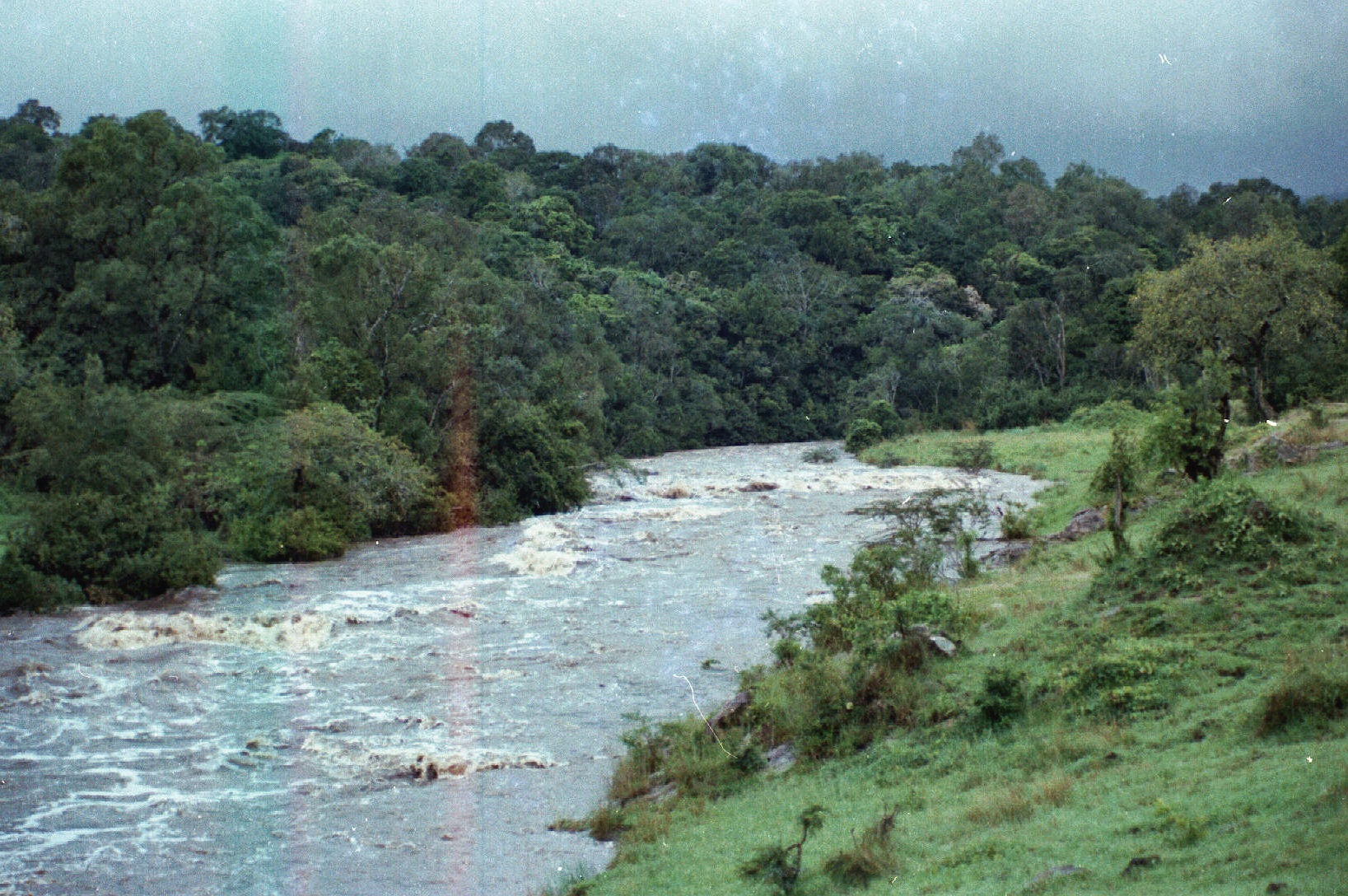
Intona Ranch was sited at the heart of the Transmara. The unfenced farm [1] of eight hundred hectares was -I believe- a gift of the Maasai to Joe Murumbi (see Joe Zazarte Murumbi in References) as a recognition for his service to Kenya (he was the son of a Maasai mother). The farm was a green park by the Migori River where riverine forest was present and where we used to go in the evenings to watch the flocks of Silvery-cheeked hornbills (Bycanistes brevis) returning to their favourite roosting perches.

The Migori River (in flood).
The fig tree that marked the entrance to Intona Ranch.

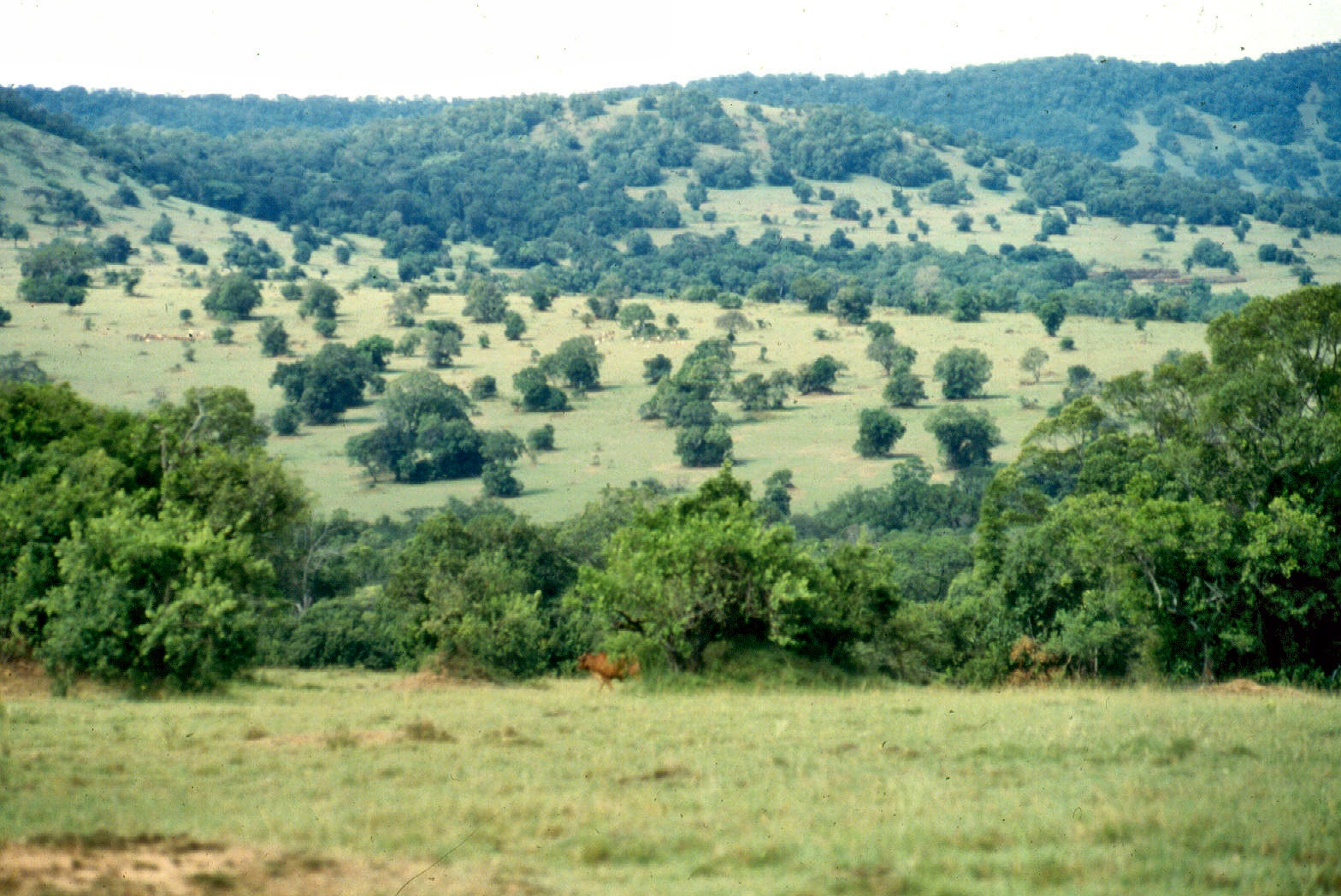
Scattered clumps of forest, many associated with very large termite mounds, with plenty of rare orchids speckled the landscape. This green oasis was maintained by rains that fell most afternoons due to the proximity of Lake Victoria. Apart from keeping the vegetation going, the evening storms produced the most striking sunsets that would turn red when the grass fires were raging around.

Part of Intona ranch.

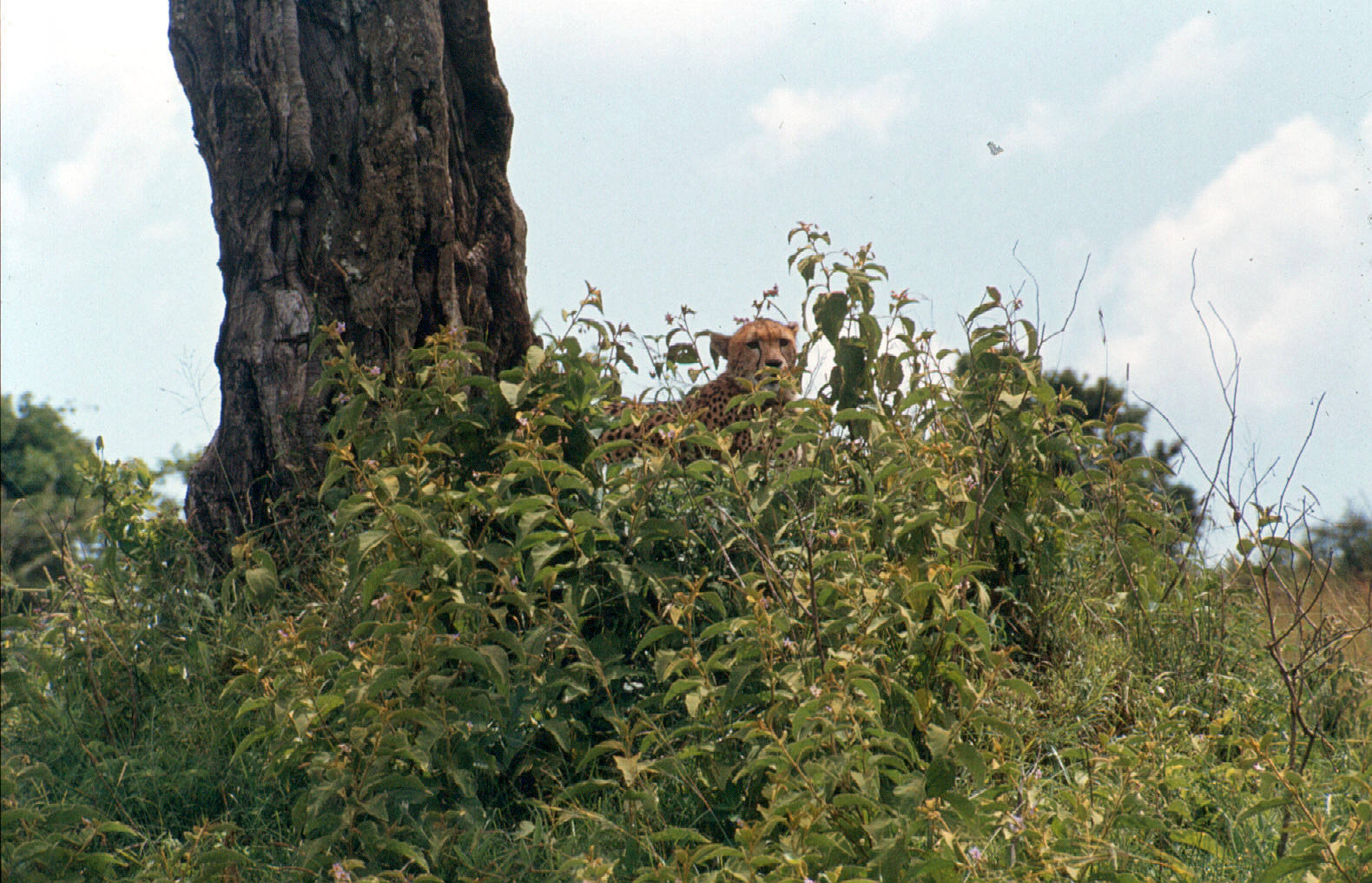
The Transmara could be seen as an extension at a slightly higher altitude of the famous Maasai Mara Game Reserve and therefore the farm was inhabited by all species present in the reserve. There were also some “specials” like the Giant Forest Hogs (Hylochoerus meinertzhageni) that also inhabited the Migori River area and the African Blue flycatcher (Elminia longicauda) that was found throughout the area to name just two. At the farm there were a family of resident cheetah that we often saw as well as lion and leopard that we sometimes heard.

One of Intona’s cheetah resting.

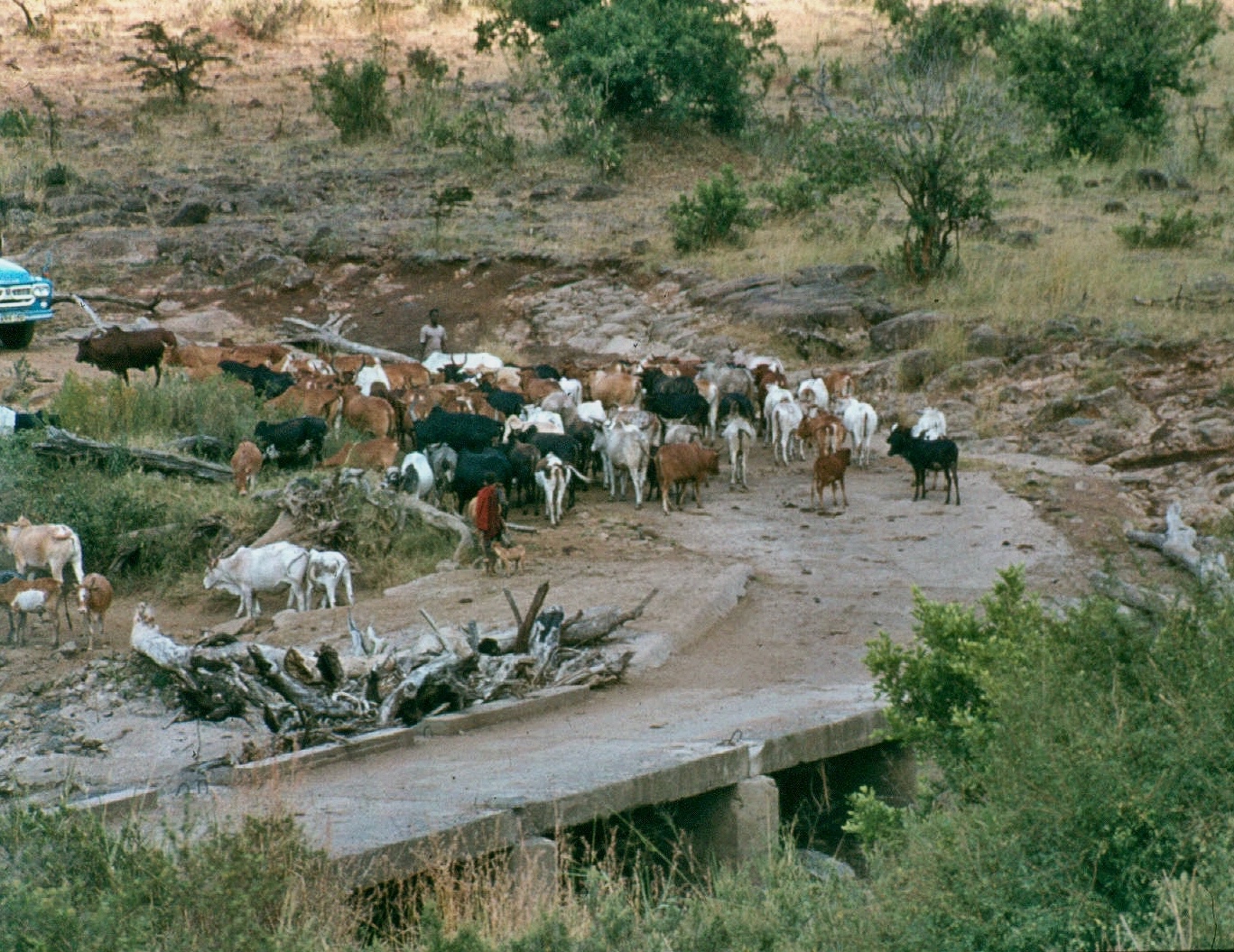
In the Transmara, the Maasai coexisted with the wild animals, not only by herds of harmless antelope and zebra but also migrating elephants and buffalo, in addition to the large predators, including numerous hyena that were seen and heard every night.

In sum, the ranch was like a dream come true for nature lovers as it was really a game park where Joe bred a few heads of cattle. I was truly lucky to work there and enjoy his hospitality for several years!

If the above was not sufficiently stunning, the house that Joe and Sheila had built there was, to put it mildly, unexpected and it took a while to get used to its presence once you had spotted it! We were used to people building amazing houses in Kenya such as the Djinn Palace [2] in the shores of Lake Naivasha (now a hotel) or the uninhabited Italian Villa [3] neat Thika that our friend Paul discovered and we explored.

One can only imagine the work involved in building such a large place in a remote location following the very high standards that Joe and Sheila must have placed for the architects to follow. Although I came to know the house well, I never counted the number of rooms it had but thirty-five rooms are mentioned by the press [4].

The front of Murumbi’s house at Intona.

There was even a small chapel and it was only recently that, through his close friend Alan Donovan, I learnt of its origin. He wrote: “Joe and Sheila loved their dogs (I can confirm that, Ed.). One of the dogs had nearly died and Joe had vowed to build a chapel if he survived. When the dog was retrieved from death’s jaw, the chapel was duly built for the staff at the ranch. The priest was called to bless the new chapel” [5]

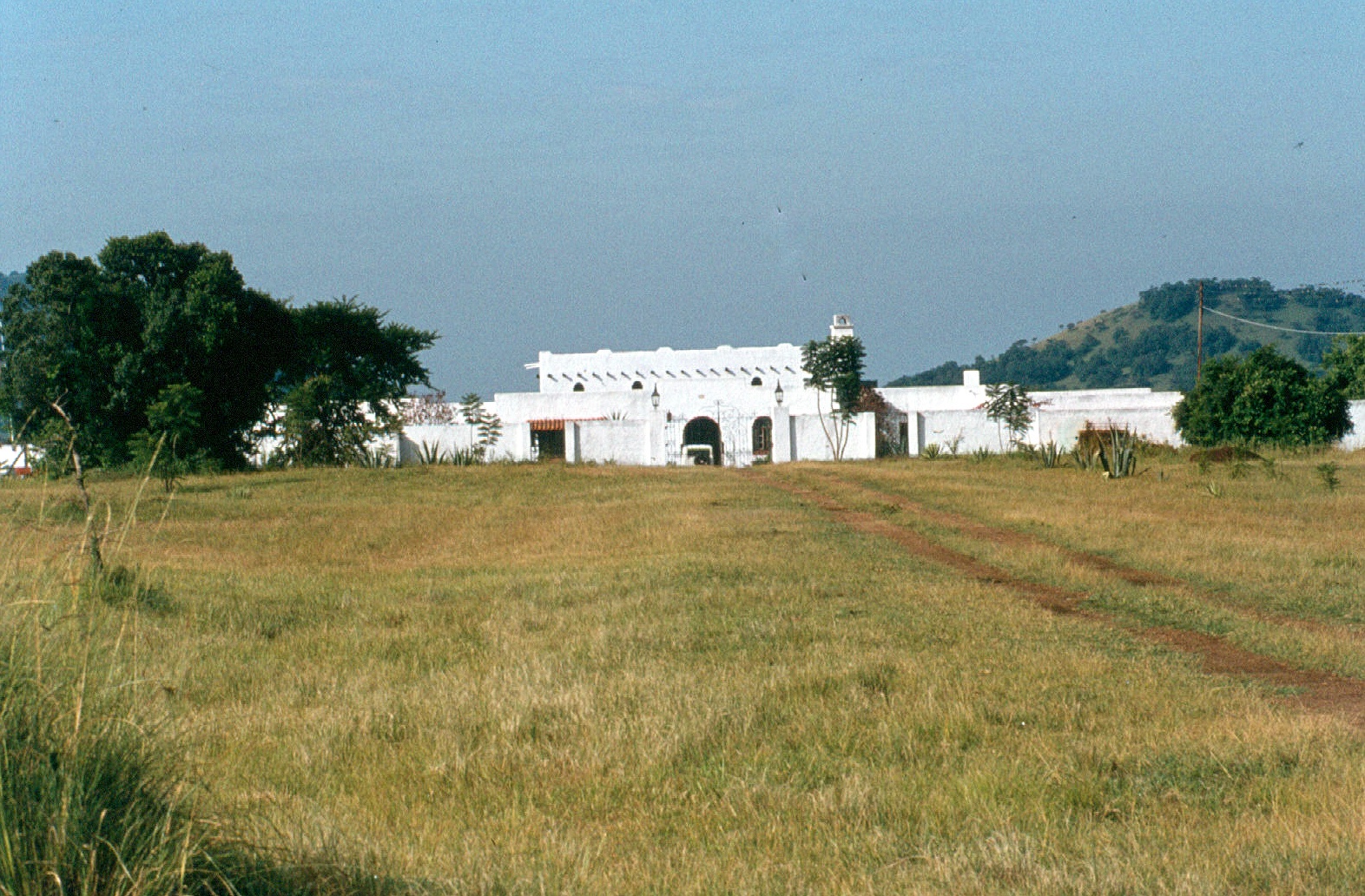
What I can say is that the very large and white house was built following the style found at the coast of the Indian Ocean and its outside doors had probably come from Lamu. It had all necessary items to enjoy life such as a large swimming pool, a couple of patios of different styles and verandahs strategically sited to catch the sun or shade at different times of the day. The roof was high and the rooms were very large, much more than I had seen until then!

In the seventies, Joe and Alan Donovan created African Heritage, a fine antique collecting entreprise that yielded some unique artifacts and became Africa’s first art gallery in Nairobi and pioneered the retail of art and craft [6]. Joe and Sheila had their main house in Muthaiga, an exclusive neighbourhood in Nairobi where they kept most of their art but a lot of these spilled over to the Transmara.

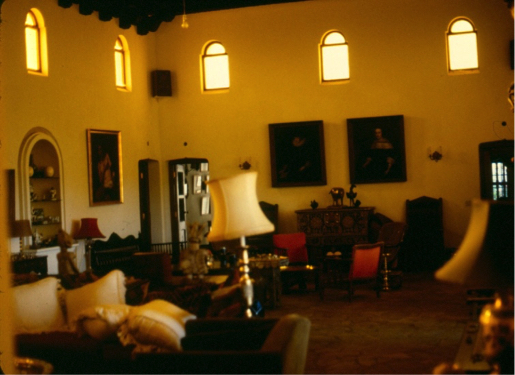
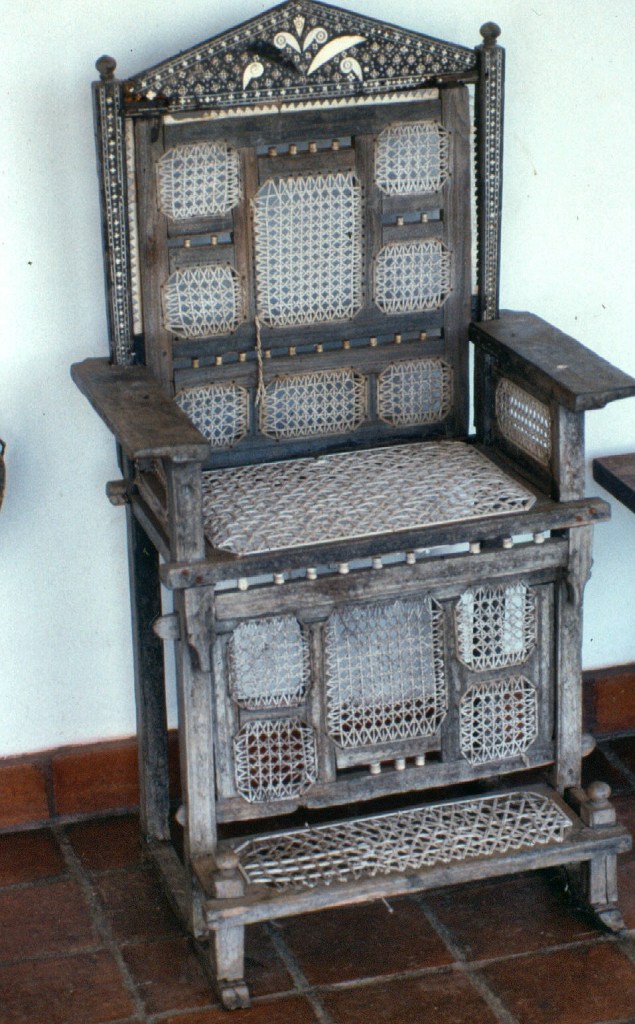
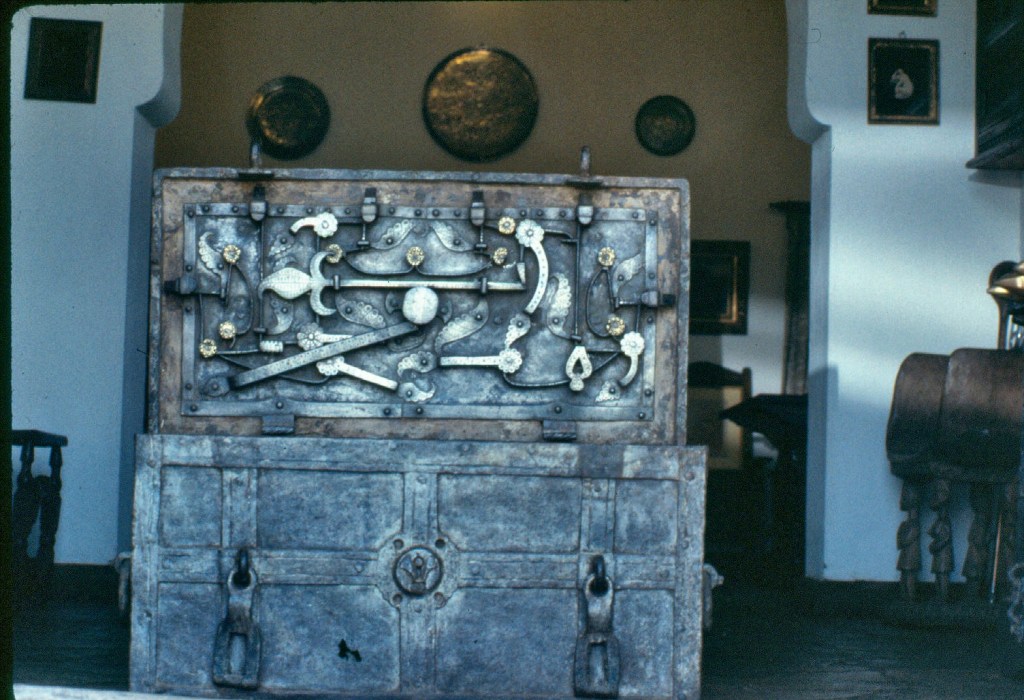
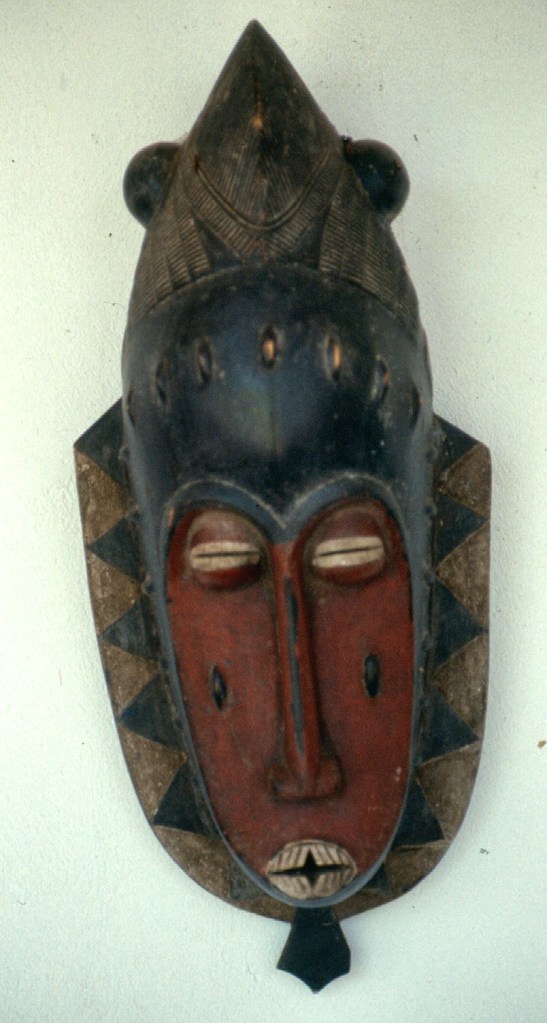
At the Intona house there were several works of art both, African and European. Among the latter there were several large oil paintings by some of the Dutch Masters (I was told). African art was all over, and this included Lamu chairs, different masks and an old trunk with an amazing lock. One of my favourites was what a called a Juju man [7]. This fierce-looking carving was parked in the hall until one day it disappeared. Later I learnt that my friend Alan had helped Joe to carry it to the UK where it was sold.

The sitting room.

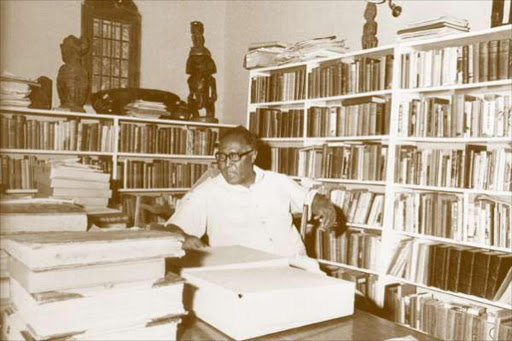
With so much art around, the house resembled a true museum but my interest was mainly in the library composed of two adjoining rooms with roof to floor and wall to wall bookshelves that held a treasure in books I had not seen before. It was rummaging through this true treasure that I spent most of the free time I had, mainly after sunset.

The library had windows to the front of the house where a large telescope pointed to the clear night skies of the Transmara. At first glance it revealed memorabilia of Joe’s political life, including various decorations and many pictures of Joe with other political players of the time. I remember pictures of him with Jomo Kenyatta, Haile Selassie and Julius Nyerere to mention those I can still “see” today.

Once I assimilated the memorabilia I focused on the books. These were mainly dealing with Africana, and they included most first editions of all major books published on Africa and, particularly, on Kenya, a list too long to be mentioned here and one that I now do not recall that well but many were antiques. However, having spent many hours delving through books with and without Joe, I still remember author proofs that had been sent to him for comments prior to their publication by various famous authors.

I vividly remember the evening that, despite his mobility problems [8], Joe invited me to the library “I wish to show you some special things” he said as I followed him to the library. He headed straight to one of the bookshelves located on the left wall and pulled out a large shallow drawer. It contained postal stamps! Joe became very enthusiastic and started to show me his collection.

He showed me the first stamp produced by Kenya Uganda and Tanzania in 1935 during the times of King George V. He had the complete set of Kenya stamps that included all first day issues as well as loose stamps. He then opened another drawer where he removed several Penny Black specimens, the first stamp issued in the UK in 1840 and all the ones that followed it up to the present date. He was extremely pleased with his collections!

Joe Murumbi in his library. Credit: https://www.the-star.co.ke/

Joe donated all his books and documents, numbering several thousands, to the Kenya nation. Among these are more than six thousand books published before the 1900s, and a rare original manuscript from David Livingstone. His books occupy the Joe Murumbi Gallery, a large area in the ground floor of the Kenya National Archives library. He also donated his African stamp collections, believed to be the most important in the world, after the Queen of England’s collection!

Sadly, Joe died in 1990 and Sheila in 2000. A Memorial Garden at the Nairobi City Park was established by the Murumbi Trust where, fortunately, they are both kept to be remembered as they deserve.

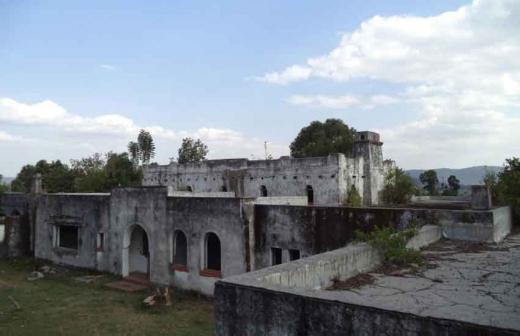
As for the magnificent house, before departing from Kenya I failed to convince the Director of the International Centre of Insect Physiology and Ecology to negotiate for it to become a training centre. Regretfully, the house started to deteriorate after Joe’s death and it is now, I believe, a subject of a legal wrangling. After severl years of neglect the house is now almost a ruin from which all movable fittings have been taken and most of it is overgrown by vegetation. A sad end to a beautiful place that I first “spotted” in 1981.

Credit of the three photos above: https://www.kenyans.co.ke/news/40142-former-vps-2000-acre-luxury-home-sorry-state-photos

[1] An old plow track was all that demarcated the ranch.

[2] “During the colonial era, “The Djinn Palace” was “where things usually were very lively” for the Happy Valley set, according to Ulf Aschan.[7] It was built for Ramsay-Hill’s wife, Molly (née Edith Mildred Maude; 1893–1939), who had an affair with and later married Josslyn Hay, 22nd Earl of Erroll“. From https://en.wikipedia.org/wiki/Oserian (Seen on 4 July 2021).

[3] What we called the “Italian Villa” was abandoned, complete with underwater illuminated pool, bath on the top of the roof from where the view of the Yatta plateau was amazing and its own cells where we were told by the caretaker that employees were locked as punishment. I read somewhere that its rich owner tried to surprise his fiancée that was driving a convertible along the Mombasa Road with a low flight past and killed her by accident. I have been searching for info on this villa and its history but, so far, fruitlessly.

[4], [5] and [8] See: https://www.standardmedia.co.ke/entertainment/lifestyle/2001259735/vice-presidents-mansion-now-home-to-wild-animals and https://www.kenyans.co.ke/news/40142-former-vps-2000-acre-luxury-home-sorry-state-photos Consulted on 28 June 2021.

[6] See: https://africanheritagehouse.info/portfolio-item/murumbi-legacy/ and https://artsandculture.google.com/exhibit/alan-donovan-my-journey-through-african-art-and-culture-african-heritage-house/jwLyrn0e9lfwJg?hl=en – Both consulted on 28 June 2021 for more information.

[7] We used this name meaning “magic man” as we thought it had some supernatural power. I googled and learnt that it was Nkondi, one of the mystical statuettes made by the Kongo people of the Congo region and considered aggressive. The name means hunter and they are believed to hunt down and attack wrong-doers, witches, or enemies.

[8] Joe was recovering from a stroke that he had suffered sometime before I met him.

The Chongwe confluence revisited

Mauro, my father-in-law that went with us to Lufupa in the Kafue National Park, loved fishing so we thought it would be a good idea to take him to the Chongwe confluence, after our earlier interesting fishing trip with our friend Chris [1]. Apart from fishing, he was also keen on camping, and, after all, we had acquired a rubber dinghy and we were also eager to use it again on a fishing trip.

So, to make the outing worthwhile, I took a Friday off so that we could spend an extra day in the bush. In addition to Mauro the group included Flori (at the time six months old) and Annie. The two latter members would sleep at the back of the car, just in case.

By the time of the trip, we were familiar with the road, not only from the trip with Chris but also because we had visited the Gwabi [2] Fishing camp in the shores of the Kafue River and spent a couple of weekends fishing there. The camp allowed you to launch your boat and, after a few kilometres down the Kafue River you could reach the Zambezi River and enjoy its quiet beauty.

This time, as with Chris, we left the road leading to Gwabi and turned towards Chiawa, crossed the Kafue river in the men-operated pontoon and continued to the Chongwe, hoping to remember the way but certain that, as long as we kept the Zambezi river on our right, the Chongwe River would block our route and there would be the camping area.

The going was slow as the road after the pontoon had deteriorated and presented us with a few ditches that were challenging but that we managed to cross to the amazement of Mauro that was not used to rough riding! We got to the camp in late afternoon. The grass at the campsite was -again- very tall and, although we could hear the river, we could not see it! Conversely, we could clearly see the elephant family that was busy feeding on the trees surrounding the camping area. The latter were very tolerant of our presence, and they gradually moved away a few metres. In that way we coexisted for as long as we were there.

Once Mauro recovered from the proximity of the elephants and the grunting of the hippos nearby we cut the grass until we had a good area for camp, and set up our tents. We finished just before darkness and, as we had carried our dinner cooked from home, I told Mauro that it was now time to try some evening fishing while dinner was made ready.

Carefully, we walked to the shore through the tall grass and arrived at the river that was, conveniently, clear of grass and offered a good area to fish from. We placed some large chunks of meat on our hooks, casted close to the shore and waited for the action to start.

While fishing with Chris, I had learnt that, apart from tiger fish, the Zambian rivers also harboured other predatory fish, among them the Vundu (Heterobranchus longifilis), a kind of catfish that could reach truly large sizes. The largest Vundu recorded reached 55kg [3] but there could be references of larger ones but I did not find them.

A small Vundu recently caught at Kariba, Zimbabwe.

Enthusiastic, I explained to Mauro what we were after, comparing the Vundu to fish that occur in the River Plate so that he could get the idea. He immediately shared my excitement. After a few more minutes Mabel called us for supper. Our hunger was stronger than our will to fish so, we secured the rods and put the “line out” alarms and joined the rest of the party to get some food.

We had not been at the table more than five minutes when we heard the unmistakable “zzzzzzzzzzzzzzzzzzzzzzzzzzzzzzz” of one of the reels that indicated that a fish was taking line fast.

We ran towards the shore, I grabbed the rod and pulled to try to hook the culprit. My effort made no difference and the “zzzzzzzzzzzzz” continued so I increased the drag but it made only small difference and still I was losing line. Soon all the line would had gone out and break. Mauro was as shocked and as impotent as I was and we were both getting ready for the final jerk that would mean a broken rod or a cut line when, suddenly, almost at the end of the line, it stopped. Relieved, I tried to reel in some line to have some in reserve in case another run would come. The line did not move. “Mauro, we have a really huge vundu. Please bring the torch to see where the line is” I said while holding the tense rod.

Light on the line revealed that it was nearly horizontal! The fish had stopped at a considerable distance from us and I suspected that the line had got caught on a submerged tree. Further manipulations, including the trick of pulling the line and suddenly releasing it failed to solve the problem. We pulled the line as much as we thought it prudent with no results and, eventually, we decided to leave it until the morning and go with the boat to try to recover the fish. We finished dinner during which the fish became the only topic of conversation.

After dinner, while sitting by the fire the speculation continued about the size of the fish and how we were going to tackle it the following day until, we were silenced by the unmistakable call of a leopard [4] very close to us! We were explaining Mauro that there was a leopard close when the hyenas added their own calls, adding theirs to the leopard’s.

Postponing our bedtime we hastily moved to the car to go and have a look. Although we saw hyenas, we failed to see the leopard and we returned to camp. While Mabel and Annie were putting Flori to sleep and Mauro aranged his tent, I opened my copy of “Fishes of Kariba” by Dale Kenmuir in pages 84-85 (I had opened the book a few times there so it always opened there!) and I re-read the description of theVundu behaviour “…powerful fighters and if not using the current to assist them will often ‘hole up’ somewhere. Hence you need a stout road and heavy breaking strain line to land one. Common baits are blue-mottled soup, liver, ox-heart, fish fillet, or bird entrails…try the Zambezi … (if not required for eating, please throw them back!)”. Convinced that we definitely have one holed up somewhere, I went to sleep trying to develop a plan to recover it.

The following morning started with the checking of the rod but the line had been cut during the night so we did not know what was at the end of it. After putting new line in the reel it was time to assemble the boat. We needed to pump its air tanks with a foot pump and install the floorboards, engine, etc. After about an hour we finally started our day of boating in the Zambezi with a full crew.

We spent the day trying to fish but sightseeing in the Zambezi was our first priority. We enjoyed cruising slowly through the river trying to avoid getting stranded on the frequent and shallow sand banks. We watched crocodiles in the water or basking in the sandy shores, their mouths opened releasing heat. We also spotted a few male buffalo enjoying the freshness of the shallows and seeking relief from the itching of the many parasites they usually carry.

The stars of the show, however, were the hippos. We came across a number of large pods engaged in their social activities and announcing their presence grunting from a distance so that we could avoid them without problems. We respected them greatly after an experience we had with a large male in lake Naivasha (Kenya). We were boating in a shallow part of the lake when a lone hippo appeared out of the blue and charged us. We had a very narrow escape pushing the boat to a deeper part before it caught up with us! We remembered this incident every time we saw hippos! However, if watched from a prudent distance, they are very entertaining.

We did not only watch animals but also attempted to fish but with not much success. We only had one good strike and, following Murphy’s Law, it happened while I was passing a cup of tea to Mauro and this interfered with the right response so the fish jumped and got away expelling the lure some distance away, luckily in the opposite direction from our boat.

We got back to camp in the afternoon, with time to start a fire and be better prepared for our second attempt at catching the -so far- elusive Vundu, a much talked about subject during the day! Again, we used sizeable chunks of beef well secured in our hooks. When we were satisfied with our preparations, I threw the first line at about 20 metres from the shore.

As soon as the meat hit the water, something stirred the water nearby and started moving. Then I saw more movement and about five greenish heads with long snouts converging towards my line! I reeled in frantically, trying to bring in the meat before the crocodiles grabbed it and run, trying to avoid a repeat of the events of the previous night! Clearly, the crocs were faster than the Vundu and the mistery of the night before was cleared: a croc had taken the meat, swam away, and stopped to eat it on one of the small islands that dotted the river nearby.

We abandoned night fishing as it would have been only good to fatten the crocs while Mauro was still shockedwith the concept of fishing with crocodiles. After a while we shared a good laugh with Mabel that, for a while, let us know that our fishing reputation had been dented.

[1] See: https://bushsnob.com/2021/05/05/the-chongwe-confluence/

[2] I was informed at the camp that a “gwabi” in the local language means an area where the river gets wider and the current reverses creating a swirl where -apparently- fish like to be.

[3] See: https://www.fishbase.se/Summary/SpeciesSummary.php?ID=2319&AT=vundu Consulted on 27 June 2021.

[4] A leopard call closely resembles the sound of a hand saw cutting a log and, as the lion roar, it is unmistakable.