Capybara smuggling

John was the Head of the Department of Applied Zoology at the University College of North Wales when I was studying for my MSc in Animal Parasitology in Bangor. He was a very kind and patient man that supervised and supported my Dissertation. During that time we met often to discuss my work.

We talked a lot about South America and Uruguay as he was curious to learn about my part of the world. It was during one of these conversations that he expressed his interest on capybaras as he was amazed at the existence of such a giant rodent. He was so keen on these animals that he asked me if I could get him a skull! I took note of his wish but I did not have much chance of getting one for him, away from South America. Even if I would have been there, capybaras are rare in Uruguay.

After a few days I remembered my uncle Lito in Salto, Uruguay. Years earlier he had studied architecture somewhere in the UK. When he came back to Uruguay, he became a very successful architect as he brought in new designs and techniques. His main hobby was to navigate the Uruguay River. With his wife they traveled extensively not only up and down the main river for many years and they also explored a number of its tributaries. It was during one of these trips that they discovered a beautiful spot up the Guaviyú River, one of the tributaries, south of Salto.

He got permission from the ranch owners to camp in the spot at will and he spent a lot of his annual holiday time camping in the woodlands. After retirement he prolongued the time he spent there to a couple of months every year. Luckily I had a chance of joining him at the camp a couple of times and we enjoyed fishing and walking while talking about several issues. I recalled that he once mentioned that there were capybaras in the area.

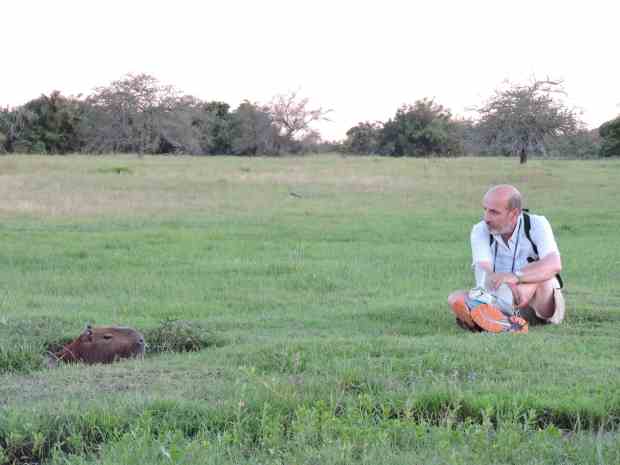
jc and capyb in hole

The Bushsnob waiting for his turn to enter the bathtub.

So, as uncle Lito offered my only chance for a capybara, I decided to write to him asking if he knew whether it would be possible to get one. I knew that it was a very long shot and I soon forgot all about it. I was really busy writing and typing my work (no word-processing computers in those days!) and damaging my back in the process.

While studying at Bangor, we stayed at Llanfairfechan, a small village nearby where, luckily, we have found Elsie, a great landlady that adopted us as family. So I was rather concerned when one day the usually placid Elsie came in a very agitated state to tell me that the Postman had brought something for me that she thought required my presence!

Curious, I followed her downstairs. The postman had an unwrapped brown paper in his hands that I could see had been a parcel once upon a time. He then said: “I believe this is for you” and presented me with the remains. “It was open for Customs inspection”he said before leaving.

After thanking him I focused on the open package, It contained a very white skull and a letter and it was definitely addressed to me! As soon as I saw the incisors I immediately recognized the large rodent skull and realized that my uncle Lito had done it and I had John’s dream in my hands!

The letter from uncle Lito explained that, after a few days of receiving my request, he had found a dead capybara while wondering in the woodlands. As this was too good an opportunity to ignore, he had collected the skull for me. Afterwards he had consulted a vet friend who recommended him to clean it by boiling it. This he did until the bone was clean until he judged that it was safe to send it to me!

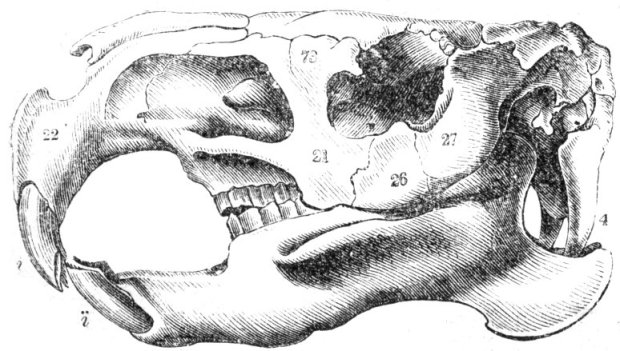
Capybara

A capybara skull. Source: Illustrierter Leitfaden der Naturgeschichte des Thierreiches, 1876. Original caption: “Fig. 29. Kopfskelett des Wasserschweines (Hydrochoerus capybara. Erxl.) i obere Schneidezähne, ï untere Schneidezähne.” Translation (partly): “Skull of a capybara (Hydrochaeris hydrochaeris), i upper inscisor, ï lower incisor”. Originator: Unknown.

I took the skull to John the following day and explained him the situation as well as recommending him to boil it again to be on the safe side. At first he looked at the bone blankly until he realized what it was and then he was extremely surprised and pleased to have it and, for the first time he actually embraced me to thank me, a rare occurrence as physical contact is not usual among British people.

The following day back home I was still typing when the landlady came again to tell me that the postman was at the door again! “What is is this time”, I thought while following her to the door. This was a “deja-vu” as the same man was there! This time he handed over a small sealed plastic bag that, on later inspection, contained the lower jaw! Now the skull was complete and John was even happier when he received the missing part.

I recommended him again to boil it and eventually the complete skull was proudly displayed in his office.

Easter Sunday

Easter Sunday started a beautiful day so our plans to show our friends Pepe1, Rosa and Alex -newish in town- some of the lesser known areas around Carmelo was possible. The idea was to visit Conchillas, a small town about 40 km to the south-east that happened to be the birthplace of my wife! After that visit we would wander around looking for a nice place to have a picnic. I had such a spot in mind but I was not sure that it would be feasible as I had last been there about 10 years before.

Conchillas is a special small town of about 500 inhabitants. It is special because it was, unusually for Uruguay, started by the British in the 1880s as a supplier of sand and stone for the building of the new port in Buenos Aires. The latter is located at about 40 km across the River Plate. After studies by the English company C.H. Walker and Co. Ltd. that discovered the Conchillas’ sand and stone deposits, the company started to develop the area bringing their own employees. Long stone houses were built and the Evans family -owner of the shops- even minted a special currency for the Walker Company to pay its workers. This unique currency would be used by them to buy goods from the company’s stores but it was also accepted in the rest of Uruguay!

After WWII -in 1951- the company sold the entire town, including its dwellers!, to two Uruguayan businessmen that, eventually sold the houses to their occupants and the public areas to the municipality.

We had a chance to visit the town and its cemetery where we could see the various tombs of the earlier British dwellers, including that of Mr. Evans himself!

After this cultural exercise it was time for driving in the countryside to find a picnic spot. I had an idea that I needed to test so I aimed for the place by driving through a road that follows the oriental margin of the River Plate in a north-westerly direction. I was aiming for a small stream where I guessed would be a suitable area to spend the afternoon.

I knew the Las Limetas2 stream from the 60s when we visited it for the first time while in High School. We had come back in later years while on holiday in Uruguay but I had not been there for at least 10 years and I had not really gone beyond looking at the stream from the small low bridge.

A surprise awaited. A new high bridge had been built as the old had been destroyed by a flood. The land around the new bridge had been cleared leaving a flat space where a picnic could take place. While the chairs and table were organized, I decided to explore the stream.

I knew a small secret: the place is well known by yielding fossils and to find some was my objective. Although I had no difficulty in finding petrified sea shells, I intended to surprise our friends with some special surprise: Glyptodon remains.

Glyptodons were large armadillo-like mammals that lived in this area during the Pleistocene epoch3. They were large mammals with a round shell that could reach the size of a small car. Glyptodons were buried in the area and sometimes they became visible in the sediment that formed the river banks. Pieces from the skeletons would detach and they would be found in the stream bed and surrounding area.

Extinct_animals_(Page_170)_BHL20384753 - Copy

A complete Glyptodon. Credit: Lankester, E. Ray [Public domain], via Wikimedia Commons.

Different fossilized remains can be found but only the carapace plaques known as osteoderms are unequivocally from Glyptodons to the uninitiated. So I rolled up my trousers and waded up and down the river while my friends thought I had gone crazy! After a while I realized that there were no osteoderms to be found. However I was encouraged to see fresh tracks of capybara and coypu at the sandy shores.

I was about to abandon my wet search when I spotted an odd looking stone that I picked up. It was a petrified bone that, although I do not know for sure, I believe to have come from a Glyptodon limb. Although it was not an osteoderm, I was relieved that I could impress my friends with the find as I could always make a good story.

Satisfied after my fossil-hunting as I had something to show for it, I re-joined our friends and proceeded to explain my “madness” to them and to show them my priceless discovery. Although I really made an effort to impress, my glory was short lived as everybody was enjoying the lovely sunshine and about to have lunch and hardly listened to my story. After a while I decided to stop pretending to be a fossil hunter and tossed the bone aside to join them in their conversation and food. We had a great (and fossil-less) day together.


2  The only meaning of “Limetas” I found was “a fat and short bottle with a long neck”.
3  It lasted from about 2,588,000 to 11,700 years ago.

Spot the beast 22

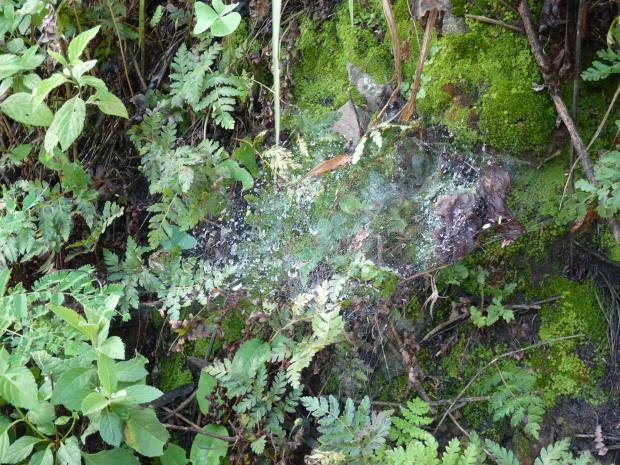
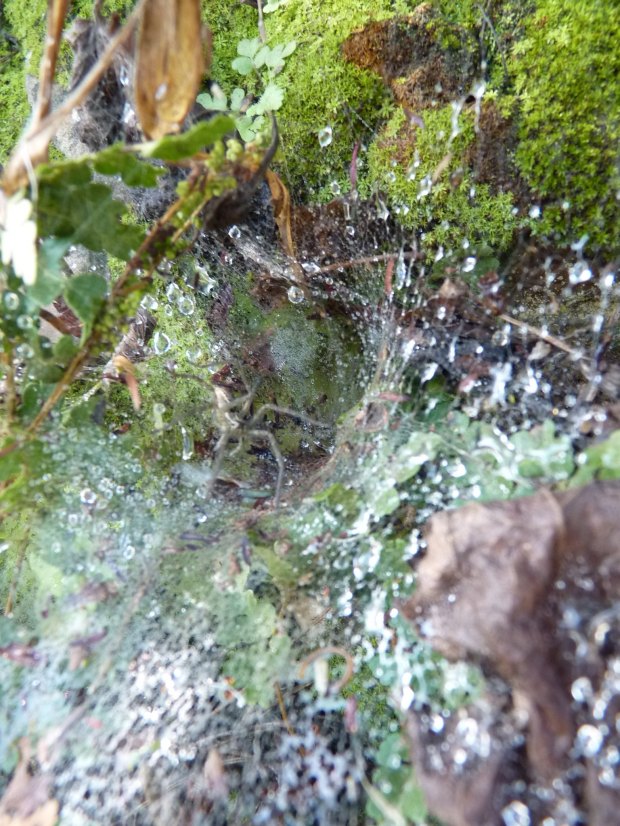
As usual, during a walk we spotted this sight that offers a hidden beast that I thought I would put to you to discover. See if you can see it.

Spot the spider copy

Being helpful, I can tell you two things: (i) I really liked the morning dew drops on the web and (ii) do not jump to conclusions too fast…

Here it is.

?

?

?

?

?

Spot spider revealed copy

The “spider” you spotted on the right of the picture was either a dead one or an old exoskeleton of the real one that was located deep inside the web tunnel!

Homely bats

In my earlier post I mentioned that we built some bat houses. The idea started with my daughter that somehow is very partial to bats. Together we had observed these unique mammals flying around in the farm at dusk and we thought we could attract them into small houses to avoid them getting in our roof.

We Googled for bat houses or bat boxes and found a large number of ideas. Finally we settled for a simple design taken from a page such as http://picphotos.net/plans-for-building-a-bat-house-to-control-bugs/ and built one as a test case adding our own modifications such as the addition of an inner layer of cork for insulation against the cold and a piece of cloth at the bottom as a landing pad.

A few months later when we returned to Salta, we were delighted to note that about half a dozen bats had moved in! Being ambitious I built a second house following the same concept and the well-known premise “if it works, do not mend it or improve it”! Again, it got inhabited fairly soon after opening its doors to the bat community.

After a couple of years I noted that the first box only had one bat left in residence and I thought “they are clever and moved to the newer house and probably a grumpy old bat was left behind!”

Then a few days ago I noted that the last resident bat of the old box had gone. Its inner cork lining had detached from the sides and it was probably interfering with the bat movement so I decided to remove it to have a look and re-position the box at a better place in relation to the house and the prevailing winds. While unhooking it I noted that the bat was still there but hanging on outside the box and that for this reason I had missed it.

After opening the box, when I pulled the cork lining I disturbed a number of bugs that, when I exposed them to the light, rapidly withdrew to the darker recesses of the box. “Hmm, I thought, negative phototropism”, remembering my high school days!

IMG_2156 copy

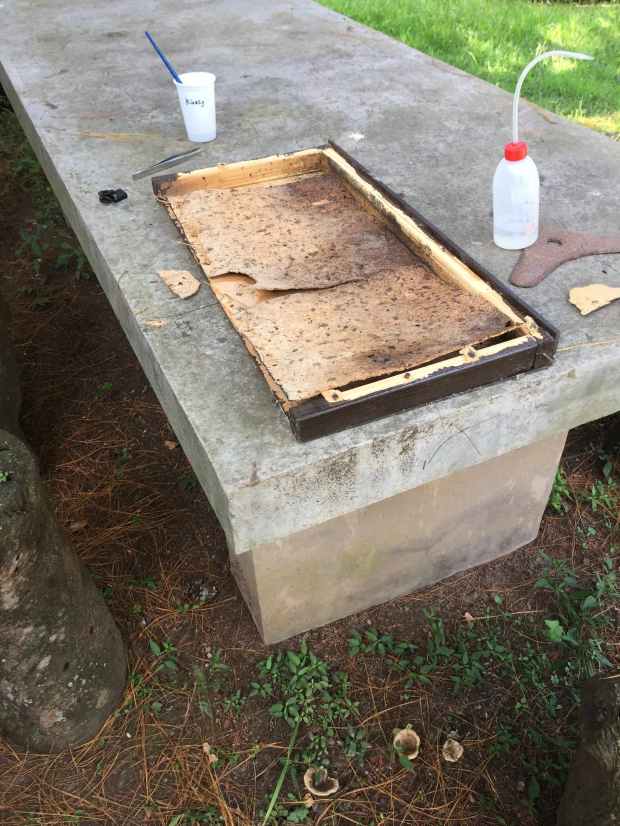
The old box opened for servicing. One of the walls have been removed to show the cork lining. The bugs were underneath.

Thinking that the situation was worth further investigation I prepared to catch some of them to identify them at a later stage, if possible. While rummaging around the house finding some alcohol, a catching jar, forceps and a brush I was thinking that I had found a colony of pseudoscorpions, really interesting arachnids that I have found earlier living in the bat guano at the Suswa caves in Kenya. I still have the memory of entering the cave with my wife and Paul and finding thousands of bats inside while we walked on their soft guano that was truly hutching with pseudoscorpions!

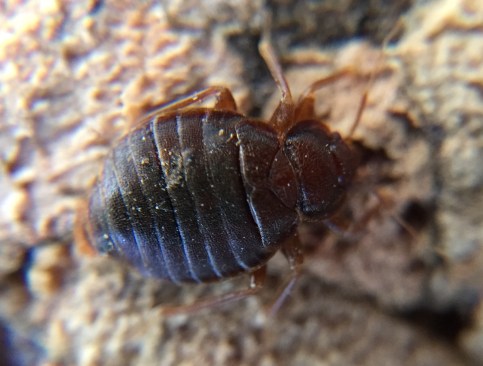
In the opened bat box there were many bugs but without pincers! I could see clearly different instars, from reddish brown adults to yellowish showing a darker gut content that reminded me of old blood. After a while I could count their legs and decided that I was watching insects and then I realized that they were bugs of some sort! I confirmed my suspicion when I took pictures of them and even saw the eggshells like those of animal or human lice.

I was lucky that my children had given me a set of VicTsing Clip 12 X Macro+ 24 X Super Macro lenses that enabled me to take the 12X to 36X magnification pictures of the bugs with my cell phone.

Adult lice 1 copy

I then realized that the bug infestation in the box had reached such an intensity that the bats must had felt very uncomfortable and decided to move out, away from their tormentors!

All this is still hypothetical, as I have not yet identified neither bats nor bugs with any degree of scientific rigour! However, my educated guess is that the bats are Big brown bats (Eptesicus furinalis), based on work done in the area[1].

The identification of the bugs was more difficult as not much is known (and available to me) on bats’ ectoparasites in Argentina! Again Google’s existence proved very valuable. Bat bugs do exist and one species that has been described for the Americas is very similar to the ones I observed. These are the Eastern bat bugs (Cimex adjunctus).

They are closely related to the infamous Bed bugs (Cimex lectularius). So what? you would ask. Well, I made the mistake of informing my wife about this close bat bug -bed bug relationship and she was not amused that I had been “playing” with them. As a consequence I had to shower carefully before I was allowed in bed!


[1] Moschione, F.N. (2014). Relevamiento de Fauna. Finca El Gallinato, La Caldera, Provincia de Salta. Informe Relevamiento 2013-2014. 55pp.

Cheeky birds

We try to get our farm house’s surrounds as bushy as possible by planting as many trees, shrubs and plants as they would grow. We have had many failures as last years we had severe frosts that took care of many of the tender trees we planted such as jacarandas, bombax, fig trees, olives and others.

20170209_153430 copy.jpg

Luckily the past two years have been benign in terms of temperature and we have witnessed an almost luxurious growth of almost every seedling we have planted. Knowing the place, we are ready for the next bad winter that will even things out again!

In the meantime we are enjoying the Crataegus and Cottoneaster in fruit at the moment that are attracting several species of fruit-eating birds such as the Plush-creasted jays (Cyanocorax chrysops) and the occasional Toucan (Ramphastos toco)! Apart from plants we have placed several artificial nests that have been occupied at various times by different occupants such as House wrens (Troglodytes aedon), Saffron finches (Sicalis flaveola), Sayaca tanagers (Thraupis sayaca), rufous-bellied thrushes (Turdus rufiventris) and others. As bats were seeing perched under our verandah, we also built a couple of houses for them after Googling for modern designs.

We also feed the birds and the Plush-creasted jays are constant visitors to the feeding plates together with the Rufous-collared sparrows  (Zonotrichia capensis). In addition we also have the visit of Gray-necked wood-rails (Aramides cajaneus) that have a running battle with the plush-crested jays for the dominance of the plates.

Despite their rather small size the Rufous-collared sparrows are by far the cleverer though. They are fearless of humans and although the jays let you realize when the birdseed is finished the sparrows come to let you know that they are hungry!

P1170473 copy

This year they overstepped the mark and for the first time they dared to come inside the house in search for food. I knew that they were known for doing this at the rural kitchens in Uruguay but it had not happened at our farm yet.

P1170532 copy

One evening we heard strange noises near the place we normally seat to read and talk and to our surprise a sparrow was walking about the house, tic, tic, tic their small jumps on our dry cow hides while walking about in search of dead or dying moths, an abundant source of food at our house as they tend to mass in the lights during the night and enter the house all the time.

After chasing and feeding on moths for the first few days, the bird discovered the small container with broken maize seeds that I used to fill the bird feeding plates, the  bottom half of a large soda bottle. It did not take long for it to get inside and pick the best morsels!

After a couple of days of visits, a second bird came and the pair went straight for the kill, getting inside the maize seed container without any delays.

They are now so confident that they either walk in or even fly in and out of the house depending on their desire for food! They have also got used to enter either from the back or front doors or, if they so wish to fly through the house avoiding us at the last millisecond but giving us some frights by brushing themselves against our faces!!

They are now part of the household inhabitants and we hardly noticed them, except when the time comes to clean their tiny droppings from the floor.


Murder in the verandah

I have placed a number of “man-made” bird nests at strategic locations in our farmhouse so that we can get those birds “friendly’ to humans to find good places to lay their eggs and raise their families.

Despite this initiative, some birds decide that these are not good enough and still choose to build their own, sometimes next to the ones I offered so I have realized that some birds’ thinking differ from mine!

So it was that a pair of Sayaca tanager (Thraupis sayaca), defined by my bird book as “tame” and inhabiting populated areas, decided to nest under our font verandah about four years ago. Luckily their breeding was successful and, eventually, young birds were seen leaving the nest. The same birds (although I am not sure that there were the same individuals) built another nest on top of the existing structure but the mummified remains of their offspring were the evidence of some kind of tragedy.

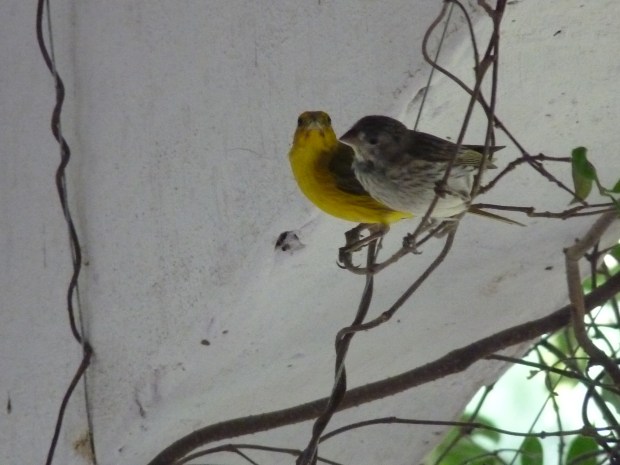
Last year, a pair of Saffron yellow finches(Sicalis flaveola), also keen on inhabited areas, added their own contribution to the already untidy grass mass and this year, the same bird species yet again completed the structure by adding more straw and deciding to breed there.

P1170505 copy

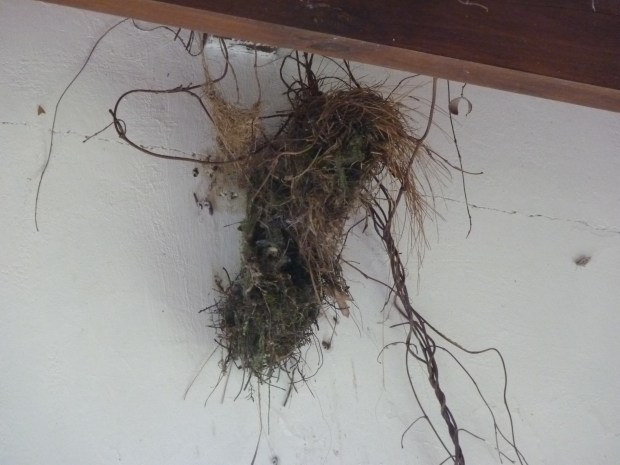
The untidy nest today. The original nest is the palee straw structure on the top left.

For the past couple of weeks the female had sat on the nest and the male was also seen nearby but not actually incubating and we did not observe any sign of hatchlings.

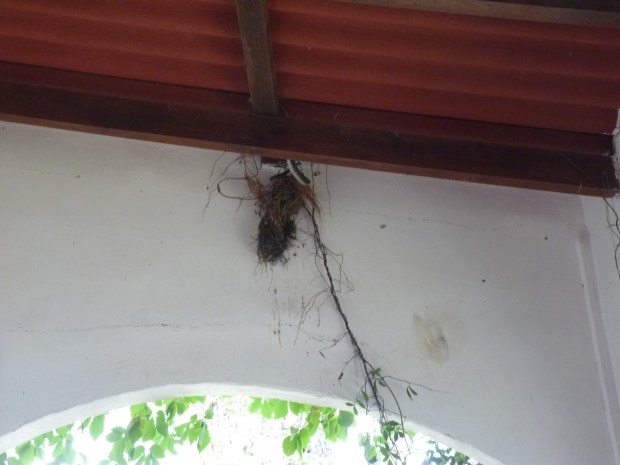
One afternoon, a couple of days ago, we returned from Salta town in mid afternoon after running some necessary errands there, and soon after arrival we heard loud shrills coming from the verandah. As expected my wife discerned what was happening. The nest was under the attack of a snake!

P1170484 copy

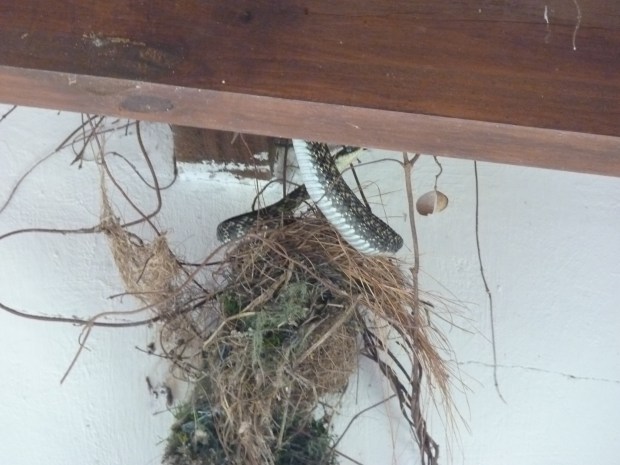
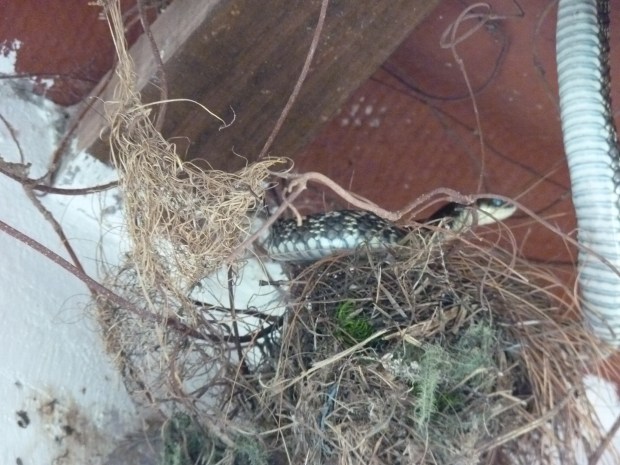
We knew that a snake lived on the roof of the house as it had been spotted sunning itself coiled and I had seen it slithering away by the side of the verandah. So there it was, its front end on the nest and its rear holding on to the roof timber.

P1170485 copy

P1170490 copy

P1170483 copyThe birds were mobbing the snake while chirping loudly and flying very close to the intruder but not actually pecking it (see videos below). However, they were clearly too small to have an impact on the aggressor and eventually they just perched nearby to watch the tragedy!
P1170491 copy

P1170493 copyOur arrival and photographic efforts disturbed the action taking place and the snake started to abandon the nest and eventually slipped down the stem of a climbing plant and, once it got into the thick of the plant, it immediately change direction and climbed back towards the roof of the house where we lost sight of it. I am not yet sure of its identity.
While the snake was moving, I caught the sight of a bulge in its otherwise slim body that was a signal that the attack was successful and that it had either eaten the eggs or the nestlings. (confirm what it ate when the snake is identified). ALthough the parents remained for a short while next to the nest, they have now abandoned it, another indication that the young are no longer there.

We wait and see what happens next as the Saffron yellow finches are known to lay eggs throughout the year and they may try again on the same nest. As I told you earlier, I do not understand the way birds think!

Regret the video quality but things were happening very fast and we were lucky that my wife was ready with her phone to record it!

Gallinato butterflies (1)

Our farm is located in the northern part of the Gallinato gorge in the La Caldera Department, Salta province. It is a transitional area between the Yungas and the Chaco. It rains abundantly during the summer months and it is dry during winter and spring.

It is still a forested area that offers not only interesting trees and plants but a varied and interesting animal life. A study carried out in 2013-14 in the adjacent farm[1] found 14 spp of Amphibiae, 23 spp of reptiles, 28 spp of mammals and 216 spp of birds. Both mammals and birds are rather difficult to observe but this is not the case of the 152 spp of butterflies found as well as an amazing number of moths and other critters that are easier to see. In other words, our farm is an insect paradise!

As our life evolves around avoiding the winter by commuting between Zimbabwe and Argentina and Uruguay we are in Salta during the summer, warm and humid, ideal conditions for the development of insects, particularly butterflies. Aware of this fact we have planted “butterflies-friendly” plants that attract a good number of these beautiful creatures to the area around our farmhouse. However, it is over the 5 km of the access road that butterflies are really amazing and we record most of what we see.

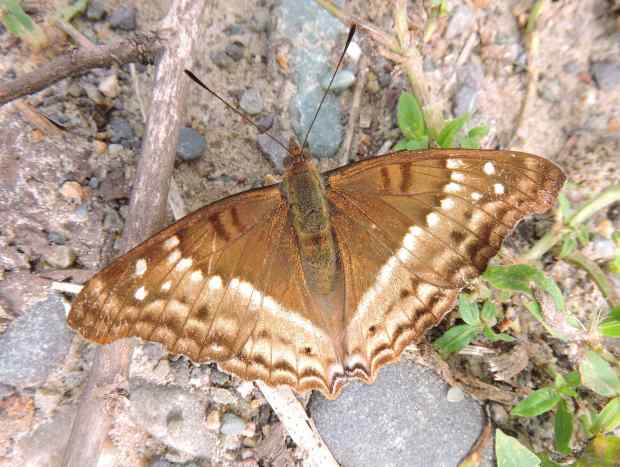
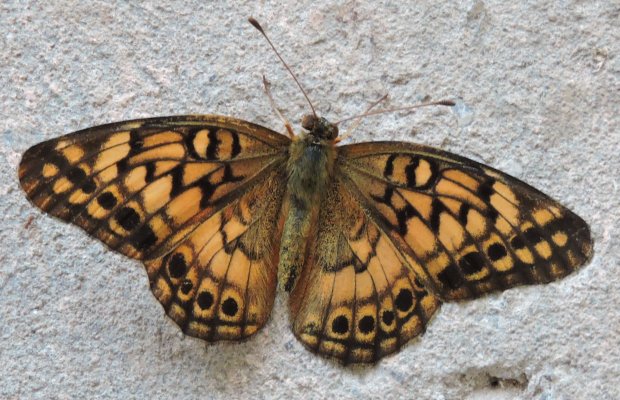
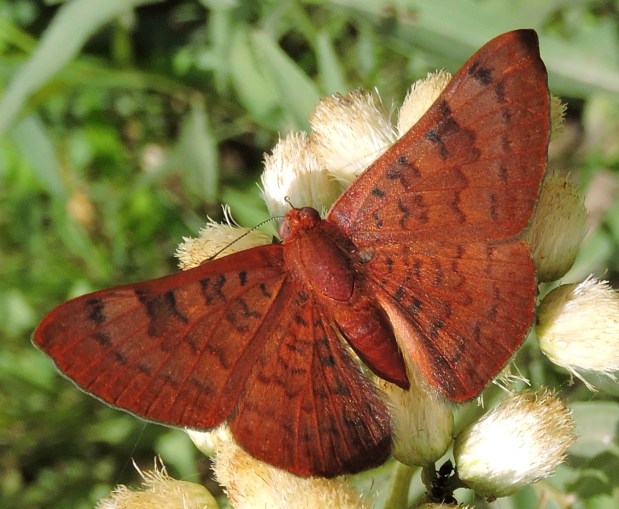
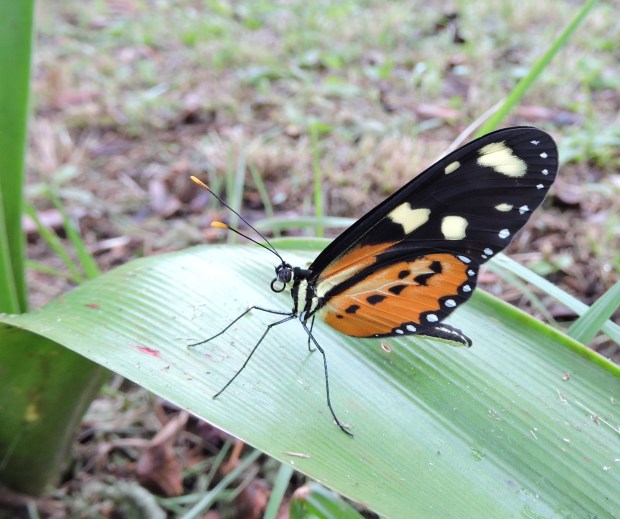
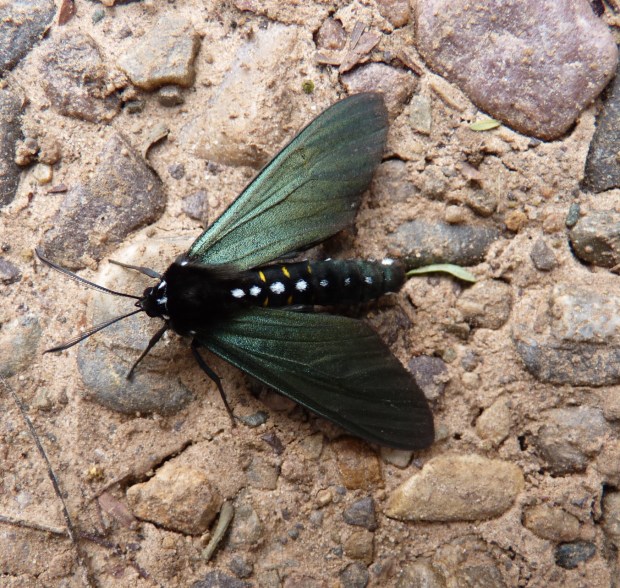
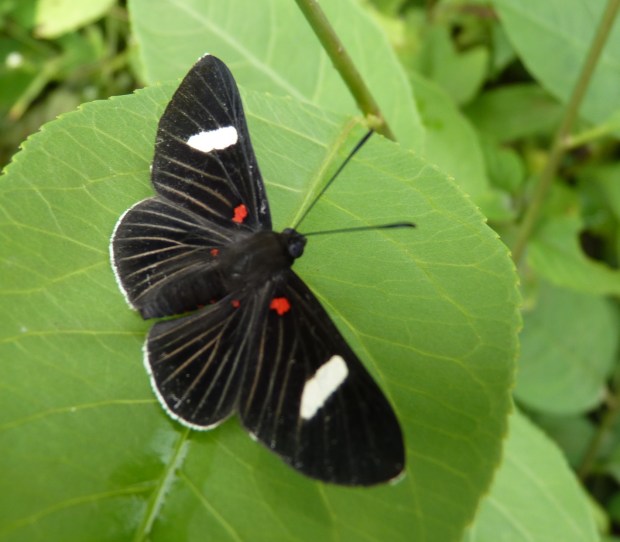
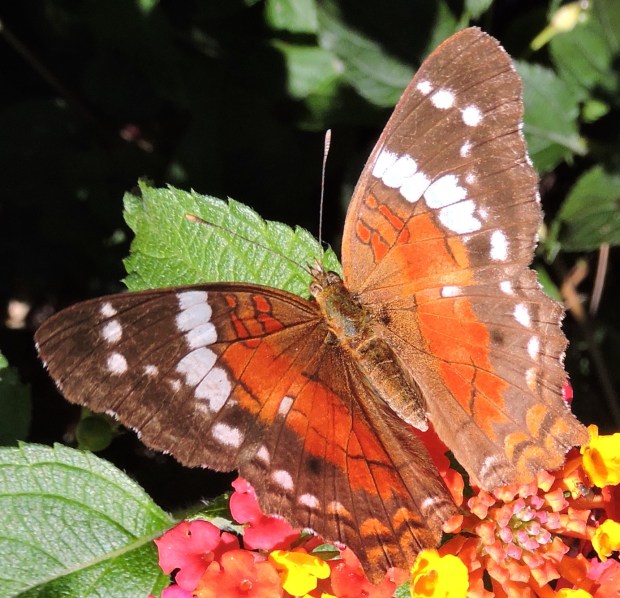
Over the next few posts I will present you with pictures of butterflies, moths and other “beasts” that we are finding this year during our morning walks when the rain allows us to walk.

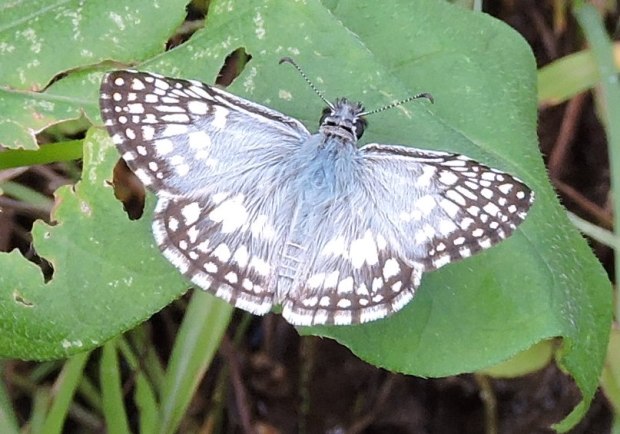
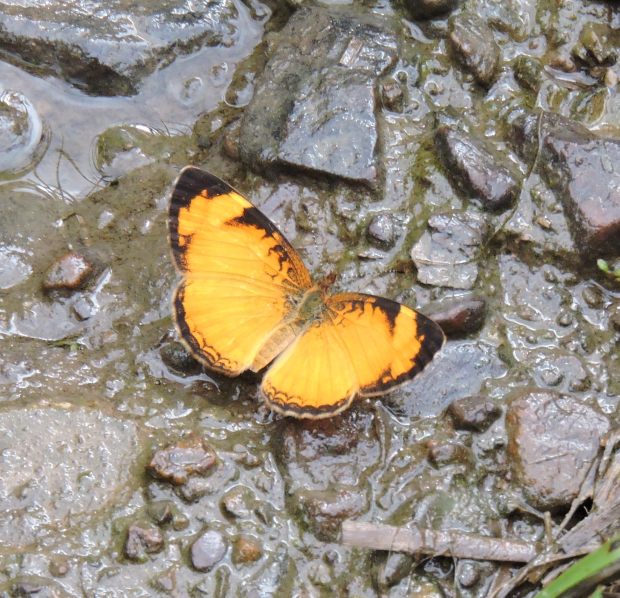
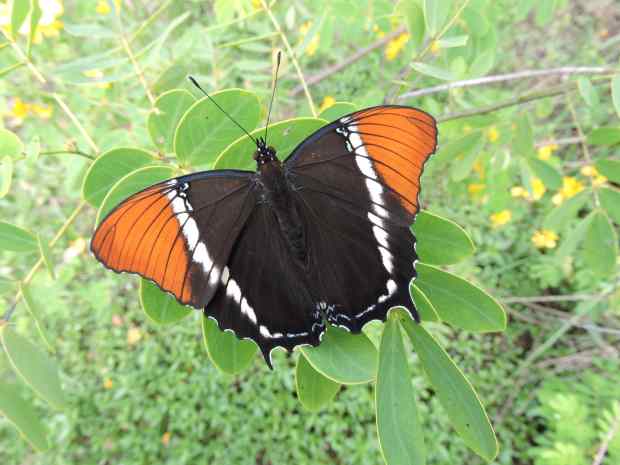
I start with the butterflies. I have omitted their names as I am not yet sure of a definitive classification and also because I think it is a question of beuty rather than scientific facts. However, unable to escape my technical background, I will be naming them when I am sure of their identity.

P1170420 copy

P1160420 copy

DSCN5339 copy

DSCN4376 copy

DSCN4158 copy

DSCN4073 copy

DSCN4038 copyDSCN3897 copy

DSCN3793 copy

DSCN3479 copy

[1] Moschione, F.N. (2014). Relevamiento de Fauna. Finca El Gallinato. La Caldera. Provincia de Salta. 55p.

Camping in Africa. Kenya (Spotted cat)

During one of the trips to the Transmara, while camping next to the Mara River, I had the surprise visit of the Manager of the Mara Buffalo Camp. As this had never happened before, I prepared to hear that I was not allowed to camp near the camp anymore so we stopped setting up our camp and went to meet him. I was wrong. He was a friendly Swiss that came to give me some good news.

He explained that at a rocky outcrop nearby there was a female leopard with two cubs that, unusually for East Africa in general and the Maasai Mara in particular, was very relaxed and let you watch her and her cubs without getting scared by human presence. He even offered to take us there at that precise moment if interested as he was taking a friend with him  for that purpose. We instantly forgot what we were doing, jumped on the car and followed him!

After driving towards the reserve, we arrived to a rocky gorge where there was a cave high in the rocks where, to our great surprise we found a small leopard cub resting at the entrance. He said that the mother may have been hunting or, perhaps, sleeping inside, together with the other absent cub. We could not believe our luck and after waiting for a while we thanked our Swiss benefactor profusely and left him in contemplation as we still needed to set up camp, cook and rest to continue with our journey the following day.

The leopard and her cubs became an added attraction to our frequent journeys to the Transmara and we found her again a few times during subsequent trips until one day she disappeared. For a few weeks we did not know what happened to her until, again by chance, found her again later, together with Jonathan Scott. The now well known photographer, film maker and book publisher was not that well known then as he was starting his rather successful stay at the Maasai Mara.

Jonathan was watching a female leopard with young cubs with all his equipment on the ready as the cubs played and the mother rested up a rocky outcrop. We learnt that it was the same female and after that encounter we saw her a few more times. The trick was to find  Jonathan’s green car  when driving through the general area where the leopard dwelled! It was clearly easier than looking for her!

Leopard M mara tree copy

Relaxing…

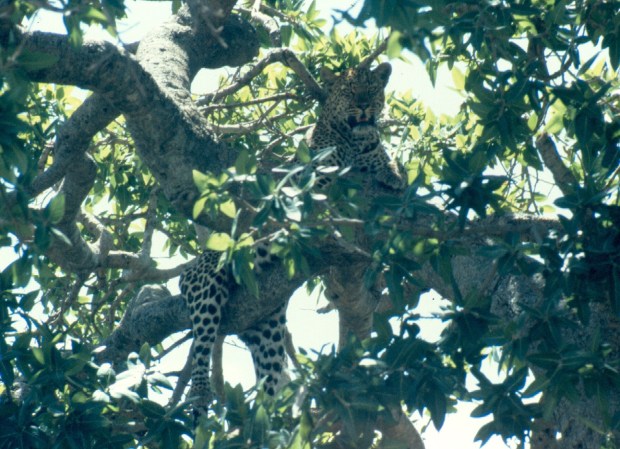
I still recall one day when we found the leopard family in a very playful mood up and down a beautiful fig tree. It was such fun to watch them at play that I only stopped taking pictures the moment I ran out of film! I was really excited and very pleased with the pictures I had taken, although in those days you needed to wait until they were developed to see the results.

Before leaving, we approached Jonathan who we had met also at Kichwa Tembo Camp earlier and, feeling pleased with myself, I made a comment on how great what was taking place was and mentioned that I had taken lots of pictures as it was a fantastic opportunity. Jonathan listened to me and then gave me a reply that I have had in my mind since then: “I have not taken any pictures because the light is wrong”.

My heart sunk and I left crestfallen and in disbelief. When back in Nairobi the moment of truth of the pictures came I must confess that Jonathan had been right. Although some pictures were “rescuable”, the majority showed cat silhouettes against the sky! Later on, when I got Jonathan’s books I realized what he meant that day as the quality of his work is frankly superb!

As for us, despite our poor pictures, the memories remain and they at least serve the purpose to bring these back and to stimulate me to write posts such as this one!

Leopard M mara sitting cropped copy

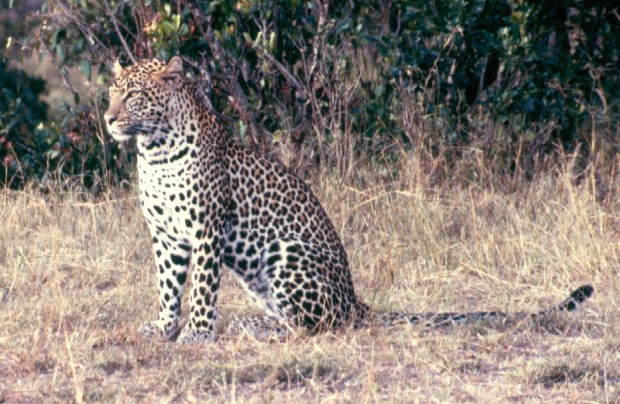
Surprised in the open.

Spot the beast 21

Back to Salta with another interesting creature for you to find.

P1140953 copy 1

I think this time it was rather easy but it is a lovely insect all the same and worth having a look at it. I call it the “lichenhopper!” Below some more close-ups of the beast.

P1140953 copy

P1140959 copy

P1140946 copy

Snakeworld

The place still exists. It is located a few km outside Harare, on the Bulawayo Road. We do not go there often nowadays. In fact, we have not visited it since we returned to reside in Harare after my retirement in 2013.

However, in the late 90’s we brought our children there a few times. The idea was to familiarize them with the various reptiles they were likely to find in Africa and avoid or at least minimize the “yuck” factor.

I still remember our first visit when we were fortunate to meet George, one of the guides working in the place. He was a small skinny man probably in his late forties. George only had one arm, his left. My recollection is that he had lost it after the bite of a cobra but the rest of the family believes that a crocodile was responsible for the loss. I am sure I am wrong!

The first time he guided us through the reptile collection it left such an impression that, whenever we came back for a visit, we looked for him as our chaperone. It was well worth it. He was not only extremely kind and patient with our children, but had a natural way of putting them in “direct contact” with the various reptiles. With him they handled for the first time varios beasts such as the resident monitor lizard, chameleons and a number of harmless snakes.

DSCN9945 12.10.31 PM copy

A chameleon from our Harare garden.

What really made the visit to Snakeworld different was George’s guided tour through the successive enclosures that hosted the snake collection. These were a succession of glass windows where the various African snakes were on display. You started from the various non venomous snakes and gradually worked your way through a crescendo in poison severity that reflected on our level of excitement.

The tour started with a quick walk through the harmless beasts. As some of these had already been handled, they attracted mild interest.

tom-dsc_1023-1

Mating Spotted bushsnakes at Masuma dam, Hwange National park.

The exception were the African pythons, located at the end of the “non-poisonous” wing. Their enclosure was large and populated by a few specimens, one of which was especially large if not very active. The ability of these snakes to kill and swallow prey much larger than themselves by virtue of being able to stretch their jaws was the main comment George made about them.

Gfp-african-rock-python

African rock python. Picture By Yinan Chen (www.goodfreephotos.com (gallery, image)) [Public Domain], via Wikimedia Commons.

While moving to the “poisonous” wing a few metres on, George prepared his audience for what was coming giving facts about the various snake teeth arrangements and various venoms.

The first dangerous ones were the boomslangs that only awoke mild interest on the youngsters. Conversely, I found their beautiful bluish-green colour and arboreal habits really fascinating and to see them brought to my memory and incident that happened a few years earlier while camping in Chobe National Park with our very young kids. We were sitting at our camp during lunchtime waiting for the heat to subside when, without warning, a green bundle landed between us with a thump. It was a boomslang that had just caught a lizard and clearly lost its balance! Almost before we could recover from our severe fright the snake re-climbed the tree and it was gone in seconds, only its bluish tinge and typical scales made me guess its identity.

But let’s go back to Snakeworld.

The twig snakes with their great ability to mimic -yes you guessed well- twigs, are always attractive as you can spend a few minutes before spotting them among the branches, even when you know they are there, looking at you!

While waiting for us to find them, George would give information about the biology of the various snakes, their distribution, conservation status and prey. Through him we learnt that Eastern Zimbabwe (the valley of the River Honde) was the place where the most dangerous snakes were likely to be found.

Then we moved to the final part of the exhibit, where George gave facts about each snake species. The latter ended with a statement about their lethality and this was the real “pièce de résistance” of the visit!

Dispholidus_typus1

A rather green boomslang. Picture by Day & Haghe [Public domain], via Wikimedia Commons

While boomslangs and twig snakes would kill you if they could get hold of some part of your body, death would occur after days of agony. The situation was more dramatic with the few that followed.

The gloated-looking puff adders with their excellent camouflage and slow slug-like displacement were striking as I could understand that stepping on one would be the most likely snake accident that could happen, as George confirmed.

Puff adder Sand river camp m mara copy

A freshly moulted and slow-moving Puff adder goes for a swim at the Sand River, Maasai Mara, Kenya in the 80’s.

The “cobra parade” started with the most common Egyptian cobra, that would kill you in a couple of days if not treated. We were getting anxious to continue but he would walk a couple of displays on and stop again showing us what looked like water stains inside one of the glass panels. Pointing at some beautiful terracota coloured snakes, he would explain that they would blind you if they would manage to hit your eyes with their spray of venom. I immediately remembered Alan and Joan Root filming spitting cobras in “Two in the Bush” where Joan wearing glasses was the target of a large spitting cobra while Alan filmed the scene! Two in the Bush is a great documentary worth watching!

spitting cobra b wackers copy

Young Spitting cobra pictured by bushsnob in Bushwhackers Camp, Kenya in the 80’s.

After the cobras it was the turn of the mythical mambas. The beautiful and deadly green mambas were first and they took us aback, honouring their names by sporting the most wonderful and shining pale green colour. George would explain that these were rare in Zimbabwe but rapidly lethal if not treated by the right anti-venom. We were all in awe at their almost “smiley” face that made them look deceivable friendly. “Luckily they live up trees”, George said to calm things down ‘but if beaten, you only last a couple of hours” he concluded.

Eastern_green_mamba_P9240107

Green mamba. By Picture taken by deror avi on 24th September 2006. (Own work) [Attribution], via Wikimedia Commons.

The black mambas were unnerving, not black but grey and reaching a size both in thickness and length that is not what you expect. Clearly an impossible foe to escape in the field if angry as, George told us, they can reach a speed far greater than a running human! Luckily, like most snakes, they are shy and move away way before we know they are there. “Do you enter their cage?” I asked George. His answer was short and clear: “No. If bitten you would only last a short time, maybe one hour”. “In South Africa, the black mamba’s bite is known as the kiss of death”, he added. The atmosphere was getting tense!

Dendroaspis_polylepis_(14)

Black mamba. Picture by TimVickers (Own work) [Public domain], via Wikimedia Commons.

Trying to control our excitement and imaginations we came to the last window where we could not see anything. When George pointed it to us, a humongous and colourful snake suddenly came together. One very large Gaboon viper (Bitis gabonica), its thickest part like my forearm and with a large head, lied totally immobile in front of our eyes.

Gabon_Viper_P9240109

Gaboon viper. Picture taken by deror avi on 24th September 2006. (Own work) [Attribution], via Wikimedia Commons.

Adorned with the most beautiful colouring, waiting to explode in a strike that would take care of its prey. Its colouring consists of a succession of cream coloured sub-rectangular splotches running down the center of the back, interspaced with dark brown hourglass markings with yellow edges while its sides have a series of fawn or brown rhomboidal shapes, with light vertical central bars.

Although its colouring seems to be rather obvious, it gives the snake an excellent camouflage on its tropical habitat littered with tree leaves. George, showing it his utmost respect, mentioned that this snake was only found in the Eastern Lowlands but that it was -luckily- rather uncommon. He also mentioned that the one we were looking at had been at Snakeworld for many years and that it was extremely aggressive. Then he added: “we call it two steps”. Although I realized why, our kids immediately asked him the reason. That was what George had been waiting for! “You get bitten by this one and you can only walk two steps, then you die”.

Although I am not able to confirm his statement, the snake was massive and at the time I could imagine that the amount of toxin it could inoculate through a good bite would be very large and rapidly lethal[1]. I can assure you that George’s “two step” statement had an impact on the family and to listen to George saying it again become one of the reasons to return to Snakeworld.

As time goes on we mature things. In our case we have incorporated George’s “step” scale into our own family “bush language” and, in the rare cases we spot a snake, the immediate comment is “was this a two-step one or a ten-step one?” I must admit that we get lots of amusement with what follows.


[1] The Gaboon viper is the world heaviest viper with two-inch long fangs! Not surprisingly, it dispenses the highest amount of venom of any snake. See: https://en.wikipedia.org/wiki/Gaboon_viper