Tongai came to see me today. Before he spoke I knew that there was something amiss so I braced myself for bad news. Information had come from his rural area that his cattle have disappeared. About one month ago, as the best possible saving strategy, through a loan from his employer i.e. me, he purchased four cows to start a herd in his home area.
Apparently the animals were taken to the dip tank, together with the family herd, for their periodic anti-tick treatment. This time they became very itchy and restless after the procedure which resulted in them breaking out of the holding pen. This means that they are now “bush-borne”. My immediate question, coming from someone that has spent his life in Africa, was “Why did only your cattle disappear?” The reply was convincing enough: “They are the new ones and they may have gone to their previous homes”. This sounded logical to me and we are still waiting (and hoping) for news that they have been found.
While talking to Tongai, memories of earlier cattle feats came rushing to my mind and I am now sitting at the breakfast table -the only sunny place on this Harare winter morning- writing this post to the detriment of the planned shopping that will need to wait until tomorrow.
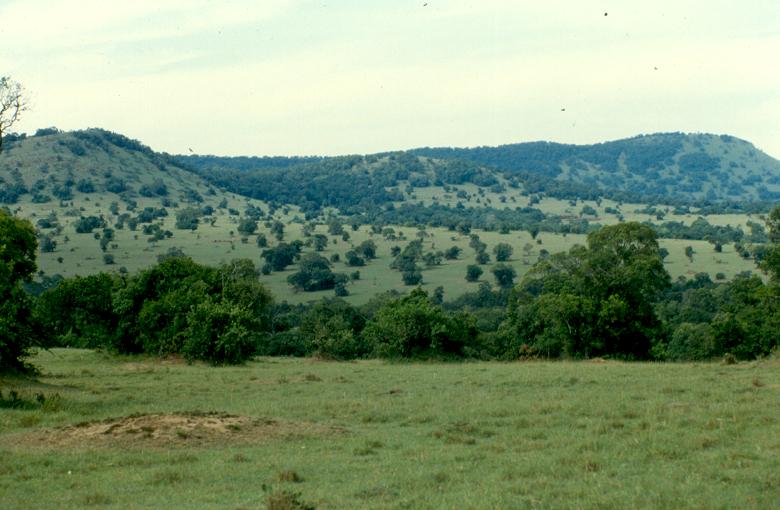
The evergreen and beautiful Transmara area where Intona Ranch was located.
In the page “The Blogger” I mentioned that my work in Kenya took me to Maasailand. I travelled there at monthly intervals for several years, crossing the Maasai Mara Game Reserve, up the Oloololo escarpment, into the Transmara District, pass Lolgorian and into Intona ranch where collaboration between the International Centre of Insect Physiology and Ecology and the Overseas Development Agency of the British Government (now the Department for International Development) was taking place on ticks and tick-borne diseases.

A calf ear showing a heavy infestation of Rhipicephalus appendiculatus, the Brown Ear Tick, vector of Theileriosis.
Please note that I will be referring to the Transmara and Intona ranch in future posts and I will satisfy your curiosity with further details as a lot of what I will tell you took place there or on the way there (see future posts under Memories). For the subject of this post it is enough to mention that I was in charge of a trial that involved the comparison of cattle with different levels of resistance to ticks. To this effect I had four groups of five cattle each in four adjacent paddocks, protected from large animals by an electric fence and from the many predators prevalent in the area by watchmen.

An “antique” blue slide to show the paddock design. There were five cattle in each of the sub-units 1 to 4.
The Transmara District of Kenya is home to the Maasai of various clans (Uasin Gishu, Moitanik and Siria). Intona ranch was -and although now rather derelict- is located in Maasailand and people on foot moved freely through it. This meant that we were constantly being visited by our neighbouring Maasai who came to offer us milk and other produce.
More background is needed here before I continue with the story.
Cattle are the centre of Maasai life and cattle owners have a colossal wealth of information about their animals stored in their memories. They know not only the parents of a particular animal but also its grand parents and a couple of generations before that at least! They can tell you their colour, whether they were of good stock or not, how they died and other information on their cattle that they consider relevant. They are very proud of their animals and their aim is to get as many as possible as this gives them a better social status. One of the first things I learnt about them is their belief that God gave them all the cattle on earth and therefore rustling cattle from other people will just be recovering what is theirs.
Clearly then, being a veterinarian -able to treat their animals- meant that I was held in high esteem. This often resulted in them bringing their sick animals to me for check ups and treatments! It was a community service that I provided with great pleasure.
Now back to the story.
Try to picture me arriving at Intona one late afternoon with a large lorry full of young cattle and you start to get the picture. If to that you add that the animals were of the beautiful Boran breed, you get the full picture! The news of this Gods’ send spread like bushfire in the area so visitors trickled in to watch the animals for hours at the time for many days and participated in endless conversations about them. I am sure that I was providing the equivalent of a cinema premier!

The young Boran cattle at Intona Ranch being prepared for the trial. Please note that they have bags in their ears to test them for tick resistance.
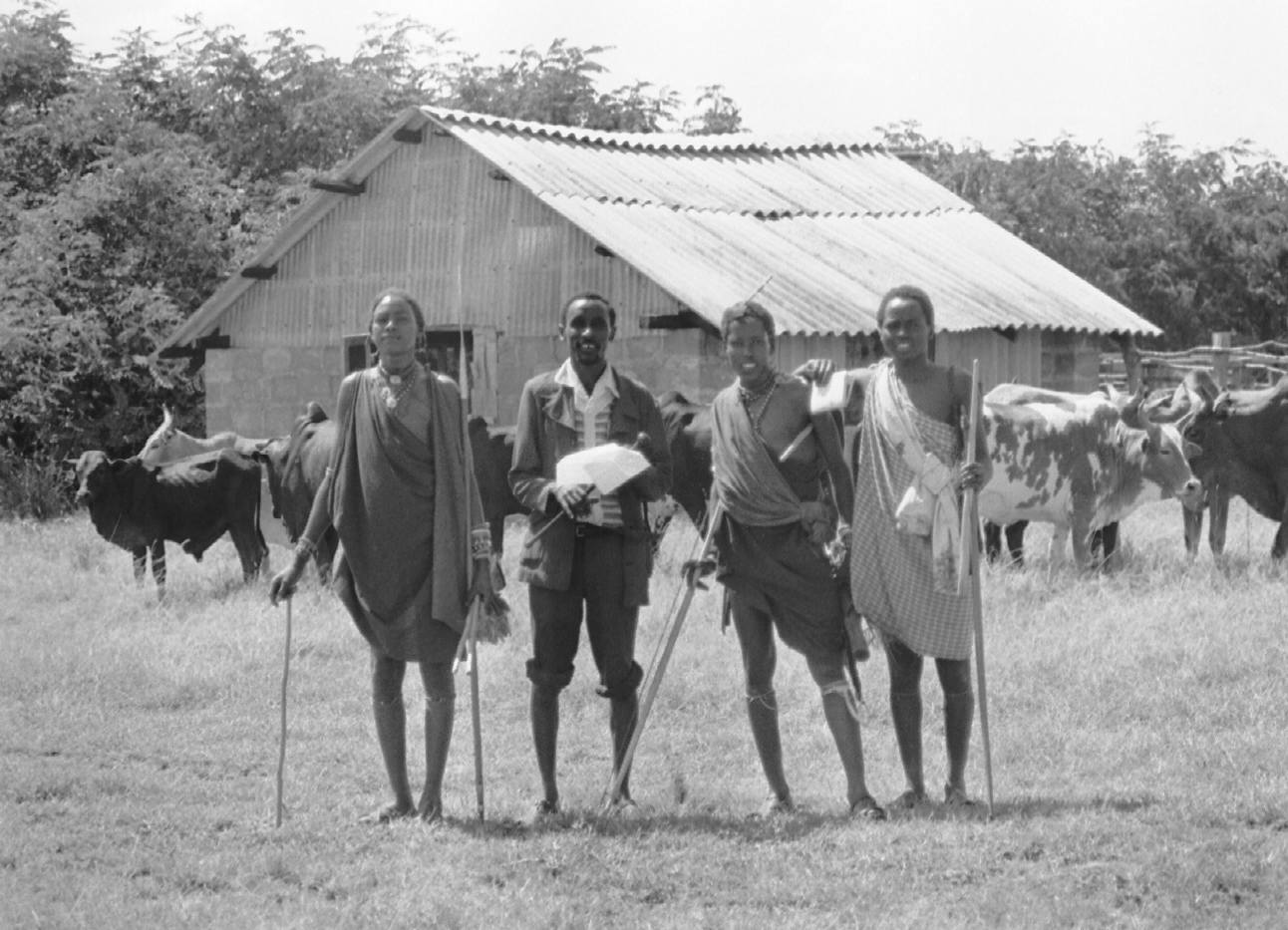
The Maasai kept coming to watch our cattle.
Aware that I was bringing part of their cattle back home -as they I am convinced
believed- I needed to make sure that the animals would stay with us for science’s sake so I stayed while I took some measures that I thought would consolidate my situation as a “legitimate borrower” of their cattle! So, the holding kraal -already looking like a fortress because of feline predators- was reinforced with fresh thorn bushes secured with barbed wire and armed watchmen placed on 24 hour watch rather than the usual night watch. I am not exaggerating!
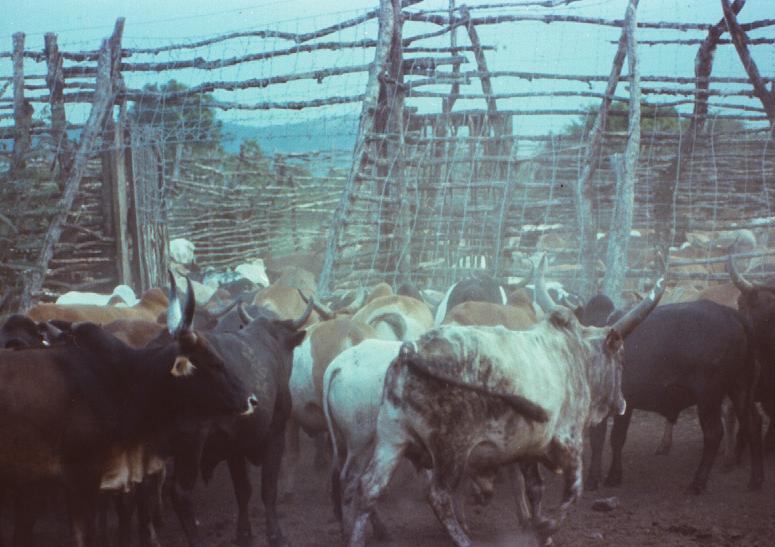
As if it would have been weak, the night enclosure was further reinforced…
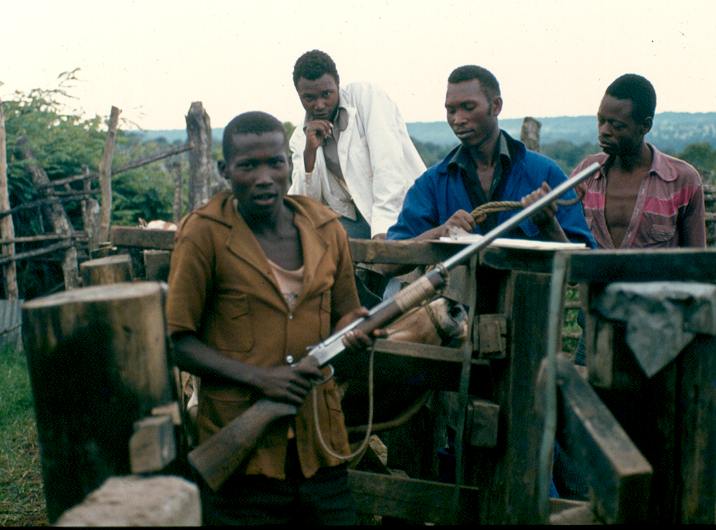
One of the night watchmen and co-workers.
These security arrangements done, the animals were prepared and -as per the two-treatment groups- randomly allocated to their pens, five in each of the four enclosures. We were finally underway with our work! After a few days, when I judged that things had settled down, I returned to Nairobi as I had other duties to perform. A couple of months passed and interesting data were beginning to emerge so we were very pleased and already thinking of scientific glory!
A phone call from the owners of Intona ranch on a Sunday afternoon brought me back to reality. This was very unusual so I braced for something serious, thinking on an accident of the personnel stationed there, my ever-present main cause of concern. “A radio message had come from the ranch telling us that all your cattle are gone!” the voice said. I gulped and only managed to utter “Oh my word, the trial is ruined! And then asked: “When did it happen?” “Saturday night”, came the curt reply. I knew that over the weekends our vigilance would be more relaxed but I was not really prepared for such a blow! “OK”, I managed, “I will go there first thing tomorrow and deal with the situation, thank you”. I was at a loss as I had no plan for such an event! That night I counted cows to go to sleep… Despite this, I spent hours thinking about how I was going to recover the 20 cattle and if not, trying to prepare a good explanation for our donors! I hardly slept and I was up at dawn to travel as soon as I could!
It normally took me one day to travel from Nairobi to Intona. It was not the distance that mattered but the condition of the road. It was rough from Narok to Aitong and it could be very muddy once on the Oloololo escarpment, particularly crossing the swamps and then the cherry on the cake: the infamous red hill, the nearest description would be to try and climb over a gigantic bar of red wet soap, stay on and come down on the right side!!! As in the Transmara it rained almost daily, I knew that was always waiting. None of this came to mind that day and I cannot recall the travel details. I pushed the faithful Land Rover -Series III panel van- slow but reliable, and I am sure that it was in this trip that I broke its chassis (something the mechanic discovered on the next service!).

On the way to Intona Ranch with co-workers.
As expected, a reception committee was waiting for me with worried looks. They had not slept well either. I was given full details of the disappearance, their conclusions, and recommendations. We inspected where the fence was cut and the animals removed. We needed to report the theft to a special branch of the Police known as the Anti Stock Theft Unit (ASTU). This required us to travel about 40 km towards Lake Victoria to Kilgoris, the capital of the Transmara District.
Without further delay we went there, accompanied by the ranch manager and Sami, the Maasai herdsman working in the trial. He had been with me for the last couple of years and he was trustworthy and, most importantly he could speak Maa (the Maasai language). He had already done some tracking and had an idea of the manyattas that could be involved. A manyatta is a Maasai settlement or compound, normally surrounded by thorn bushes where a family or group lives, either temporarily or permanently. Inside the fence are the houses and enclosures where cattle, sheep, goats and donkeys are kept during the night.
The Officers at the ASTU listened and logged our case and -as usual- were ready to assist us. As expected they needed transport. We agreed and immediately four hardy-looking Officers carrying their full gear, including the ubiquitous AK47s, boarded the car. Our cattle tracking had started!
While on the way back, Sami took over the communication with the ASTU contingent and I was given only scanty information as translating from Maa to English was the only way I could learn what was happening. I learnt that the fact that the ranch where we kept the cattle belonged to a very important -now retired- statesman worked in our favor! After a while I was informed that we would visit a few manyattas. I knew, from past experience, that this meant cross-country driving in heavily wooded land which would result in getting totally lost without the assistance of some local person. I trusted that Sami would be able to be such a person.
I did not need to worry as the ASTU guys knew the area very well, suggesting that what had happened to us had -perhaps- taken place earlier? It was a long field day. I drove to the various manyattas. Unable to understand the exchanges I limited my job to drive and to watch the various “interviews” that took place. At nightfall, after all manyattas had been visited, I took the people back to Kilgoris and got back to Intona very late at night, totally exhausted and looking forward to a good night sleep.
When I opened my eyes, after been shaken, I realized that I needed more sleep but I was able to recognize the ranch manager, his grin almost blinding. “The cattle are back!” he said and added, “They were returned to the paddock last night!” I jumped from the bed, all tiredness and lack of sleep instantly forgotten. We immediately went to the paddock and, effectively, the animals were back! Further, they were not just back, they were returned to the same places they were removed, five in each of the paddocks, no errors committed! They looked fine if a bit empty and thirsty. The only apparent damage was that the identification numbers had been burnt over to remove them and their plastic identification tags cut off. All things considered, this was a minor issue and they promptly healed and grazed their fill.
Greatly relieved we immediately travelled back to Kilgoris to report the resolution of the case to the ASTU and to close it. We also thanked them profusely as they had saved us (me!) from a potentially embarrassing situation.
After all formalities and acknowledgments were over, a question still burnt in my mind: How did they manage to have an almost instant response from the rustlers? I asked them as my curiosity needed to be satisfied! A matter of fact reply solved the puzzle: “We told them that if the cattle were not returned, we would shoot all their animals” Whether this threat would have been carried out or not, I will never know but it served its purpose and that was what I cared about at the time.
I hope that I will not need to resort to similar actions to recover Tongai’s cattle!





 A Bushsnob out of Africa