rain bird

What on earth!? (28)

I watched “Scarface”, a movie with Al Pacino and Michelle Pfeiffer (among others) about 40 years back while still in Kenya and, just to confirm that I am getting to the fossil state, we rented a video from a library somewhere in Nairobi.

As I have forgotten the plot I decided to have another go at it as I found it in Netflix. As often happens, after a while, I started remembering it and, somehow, after the first hour, I was loosing interest. I was about to stop it when I was surprised by what I heard! This was not another of the rarther abundant bad words in the movie but some other sound that I found, somehow out of place!

The scene in question takes place in Cochabamba (Bolivia) when Tony Montana (Pacino) is discussing a drug deal with Alejandro Sosa (Paul Shenar) the producer of the cocaine. While they are finalizing the deal, seated in Sosa´s mansion, between a few “f” words, I, somehow, heard the call of a bird with which I am very familiar with.

Nothing wrong with that you may think. However, the bird, as far as I know, only occurs in Africa!

Below I embedded the relevant part of the movie that, luckily, it was already selected by “Popcorn Picks”, a YouTube video channel to who I give credit (I would not know how to extract a piece of a movie).

I regret thatr this is a rather violent moment of the film and, to avoid you watching this, I recommend you to go almost to the end (5:54) in the clip below and then, again around 5:57 just when Sosa tells Tony “I only tell you one time, don´t f… with me Tony”.

Despite other background noises and the music, I believe that I hear the call of the red-chested cuckoo or rain bird (Cuculus solitarius), also known in South Africa as “”Piet-my-vrou”, an onomatopeic name that mimicks it call that you can hear below:

Embedded from YouTube (credit: Birding with Lynette Rudman).

In my surprise, trying to see where this part of the movie was filmed, I consulted https://www.imdb.com where abundant information on “Scarface” is found. I learnt there that the scene in question was filmed at 656 Park Lane, Santa Barbara, California, USA, not an area where you expect to find a rain bird. However, another cuckoo, the yellow-billed cuckoo (Coccyzus americanus), is present there but its call is totally different.

I admit that I can be mistaken but I find this an unusual and interesting find for being totaly unexpected. So, how could we explain it? I see a few options, including that what I heard was just a combination of other bird sounds that, somehow, mimicked the rain bird. Another, more likely, is that one of the aviaries (there are a few in Santa Barbara) or a private individual nearby was keeping a red-chested cuckoo. The final possibility is that the film makers used background sounds from their sound library, irrespective of its origin.

I just consider this as an unusual event that we would probably never unravel but I will appreciate any ideas or information you may have.

Rain bird

A few days back we have started hearing the by now familiar ‘wip-wip-weeu’ that the rain bird or red-chested cuckoo (Cuculus solitarius) make endlessly at the time the rains should start in Zimbabwe. But, where have they been since their appearance last year?


Before I knew much about bird movement and migration, I often asked myself this question. I recall watching in awe widowbirds displaying in Northern Kenya and asking my friend Paul about their whereabouts during the rest of the year. His reply, was that they would go to the Sudd[1], a huge swampy area located in Sudan.

Sudd_swamp Credit NASA (Public domain)

Sudd Swamp -a Flooded grasslands and savannas ecoregion in South Sudan. To the left the river/wetland Bahr al-Ghazal connecting to Lake No (top). This photograph was taken during the driest time of year—summer rains generally extend from July through September. Taken from space, May 1993. Credit: NASA (Public domain).

So, every time that someone asks me now where a particular bird is when it is not seen, I say that it is in the Sudd, a very convenient reply!

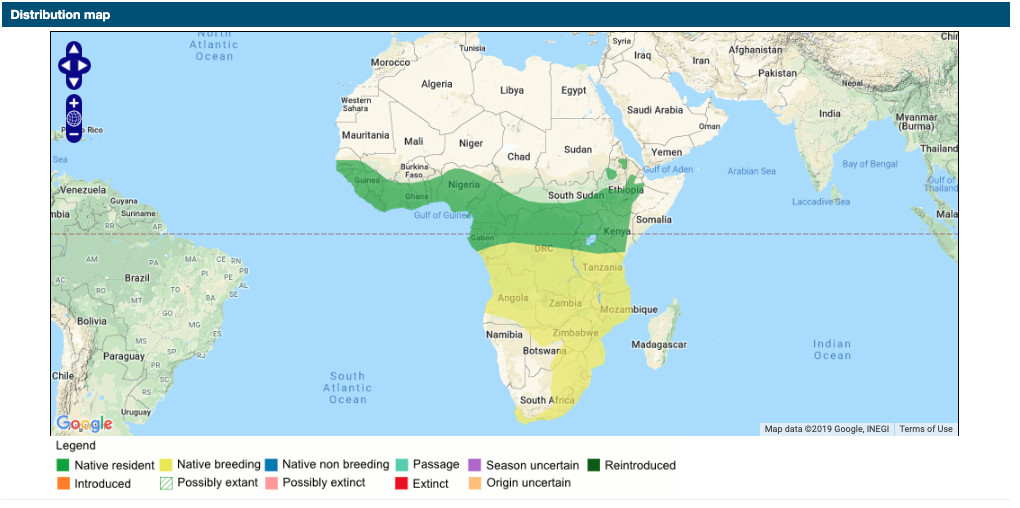
The truth about the rain bird is that they are intra-African migrants that breed in southern Africa between September and March, although most arrive in mid-October and the majority are gone by the end of April.

The rest of the year they reside in Sub-Saharan Africa, in countries of Central, East and West Africa, including the Sudd wetlands in South Sudan!

Screenshot 2019-11-02 at 10.22.38

Rainbird distribution map. Attribution: BirdLife International (2019) Species factsheet: Cuculus solitarius. Downloaded from http://www.birdlife.org on 02/11/2019.

Their preferred habitats are woodlands where they perch high up in the trees. The red-chested cuckoo is usually solitary and it takes on more than a single mate so it is polygamous. Every year they visit our garden where they are occasionally seen while they feed on caterpillars and other insects in the tall msasa trees.

Embed from Getty Images

While in Southern Africa -including Zimbabwe- the rain birds practice brood parasitism by breeding through egg-laying in other bird species nests, some twenty-seven of them! The most common hosts are thrushes and robin-chats and the Cape robin-chat (Cossypha caffra), the Cape wagtail (Motacilla capensis) and the white-throated robin-chat (Cossypha humeralis) are the most popular hosts.

The cuckoo’s resemblance with a small bird of prey (like a sparrow hawk for example) scares the future parents from their nests and the cuckoo female lays the egg that, not always, resembles their hosts’. It is estimated that they lay about twenty eggs scattered in various nests every season. Then it is up to the surrogate family to raise the chick.

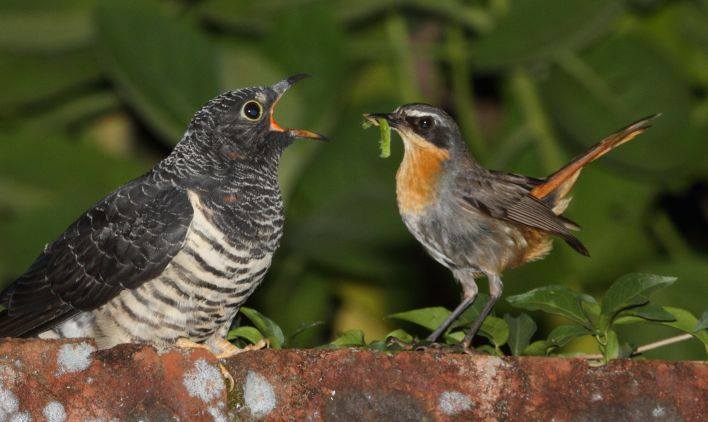
Piet-my-vrou_&_cape_robin

A cape robin feeding an almost fully-grown rain bird. Attribution: Alandmanson [CC BY-SA 4.0 (https://creativecommons.org/licenses/by-sa/4.0)%5D. https://upload.wikimedia.org/wikipedia/commons/f/f4/Piet-my-vrou_%26_cape_robin.jpg. Downloaded from Creative Commons on 2/11/19

A very interesting biological phenomenon helps the cuckoo chick to have a head start from the other chicks in the nest: the female cuckoo literally incubates the egg inside her for 24 hours before laying it! [1] This ensures that the chick will hatch first and eliminate the competition at the nest.

Cuckoos are great travellers, capable of flying enormous distances during their migration and, although the red-chested cuckoo covers less distances than others, it uses the same mechanisms to do so. These navigation skills are genetically passed on to their young. The latter stay behind to complete their development while their parents depart but the new generation are able to fly back north on their own to join their parents!

Now we only need good rains while we watch the cuckoos until they depart and then we wait for them to announce the rains in 2020.


[1] See: https://www.bbc.com/news/science-environment-11401254