As mentioned earlier [1] it was 1987 and we were still enjoying our work and life in Kenya. However, it was becoming evident that our modest savings would never secure our future, so we started looking for better opportunities. Regrettably, we could not find suitable work in Kenya, otherwise we would probably still be residing there today!
In mid 1988 a great opportunity with FAO appeared in Ethiopia at a place called Bedele of which neither we nor most of our friends had ever heard of before. Most but not all. Jim [2] however, had and immediately told me that Bedele was in western Ethiopia and also that it was “out in the sticks”, not a very encouraging start!
Later on I learnt that Andy, a tick expert from Zimbabwe -working in Nairobi- had just been in Ethiopia for a consultancy that included a short visit to Bedele itself. He confirmed that it was far from Addis Ababa and rather remote, but an interesting place where not much work on ticks and tickborne diseases had been done although the need for it was there.
When I asked him about the living conditions, he mentioned that he had stayed at the station where I was going to live -if I accepted the offer- for two years and mentioned that the area was very beautiful. “Do the bungalows have a garden” I asked, “the whole of Ethiopia will be your back garden!” was his reply. That left me rather concerned!
As the need for my services was rather urgent, before accepting the long-term position and while we prepared to leave Kenya, I offered to travel to Bedele to familiarize myself and to supervise the on-going work. I also carried the “Family terms of reference” that included the evaluation of our future accommodation, availability of supplies and other critical issues to survive in a remote place. Regarding the house, I was to draw a plan that, back in Nairobi, would be submitted to an architect friend so that we could take the relevant furniture and appliances.
So it was that I arrived at Bole airport in Addis Ababa on a two-week consultancy mission. The change between Kenya and Ethiopia was very dramatic as I was entering a country where a civil war had been raging from September 1974 when the Marxist Derg removed Emperor Haile Selassie from power and Eritrea had started fighting for its independence.
Bole looked like a military airport being used by civilian flights, mainly Ethiopian Airlines. There was no “yambo” welcome or smiling faces anywhere but armed soldiers with surly faces! I had arrived to my first communist dictatorship led by Mengistu Haile Mariam, a ruthless leader.
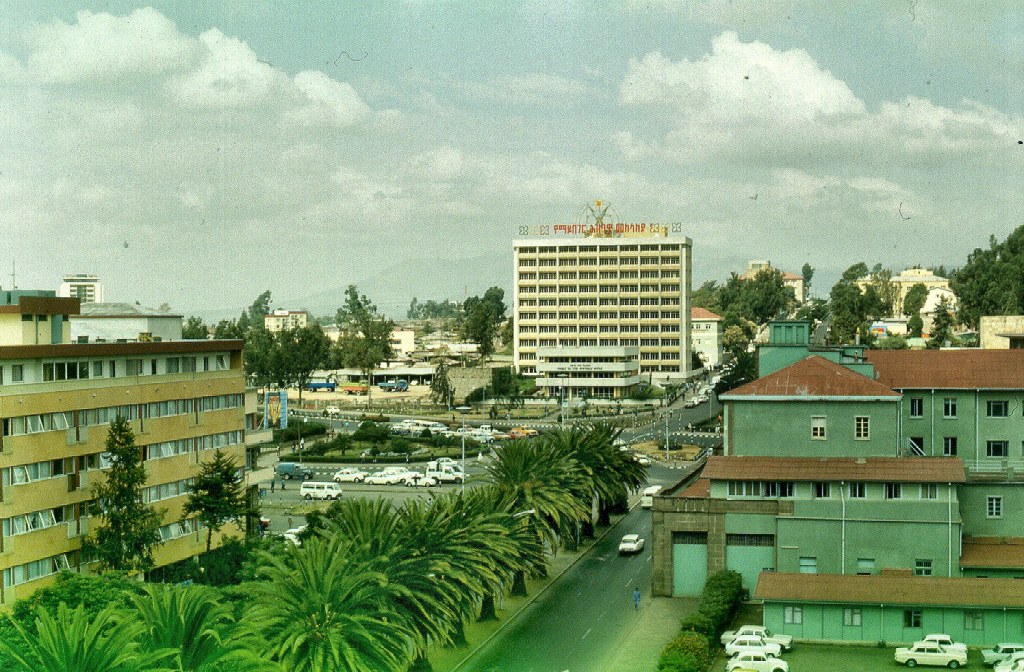
A (bad) view of Addis Ababa.
Addis Ababa from the window of our room in the Harambe Hotel.
Realizing that things would be different I was very happy to be greeted by people from FAO. They took me to the Ghion hotel where I would stay until I traveled to Bedele, a small town in Western Ethiopia where FAO had built a Veterinary Diagnostic Laboratory with a focus on trypanosomiasis and tickborne diseases.
So it was that, after the necessary protocol meetings that took a couple of days, I had the necessary travel permit that would allow me to travel to Bedele. The letter was written in Amharic and I could only hope that it gave the right information about my trip as the only thing that I could understand was my name! However, when I realized that the country’s Chief Veterinary Officer and the Director of the Bedele Laboratory were traveling with me, I relaxed.
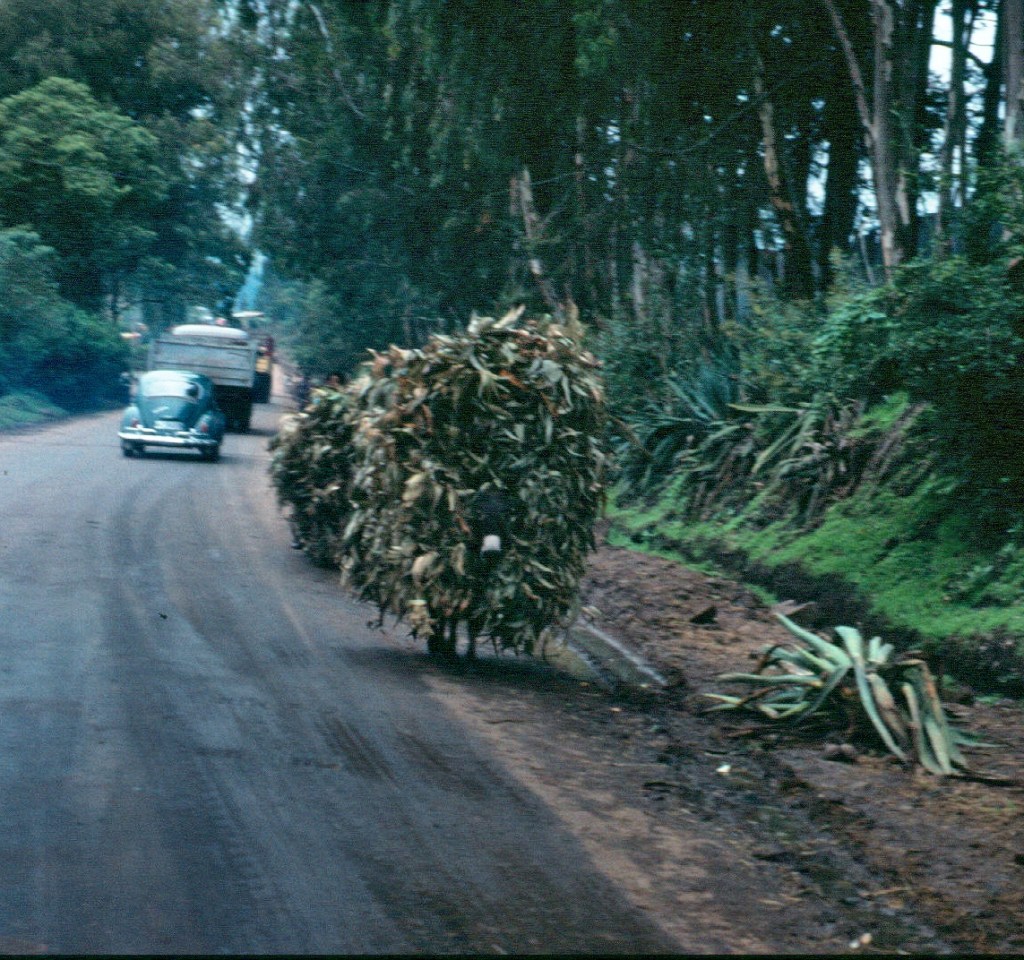
We left early in the morning and traveled very slowly in a westerly direction. Getting out of Addis Ababa was indeed a complex operation as there was no clear exit road and people used the tarmac to walk to their destinations with their livestock, sharing the road with the motor vehicles. Our speed increased somehow once we left the city as the people numbers decreased for a while (only to increase near every populated area!). Despite this, almost permanent hooting was required in order to advance.
Driving from Addis Ababa to Bedele on a Sunday required patience!There is a donkey somewhere under the leaves!
The trip took us through rather barren land dominated by teff fields [3] and the occasional trees, very occasional. The latter were really what remained of them after most of their branches had been chopped for fuel and only a green tuft remained, something I had not seen before.
Teff with yellow meskel flowers (Bidens macroptera or pachyloma?) in the forefront of the picture.
Goin through the Woliso area in Gurage country.
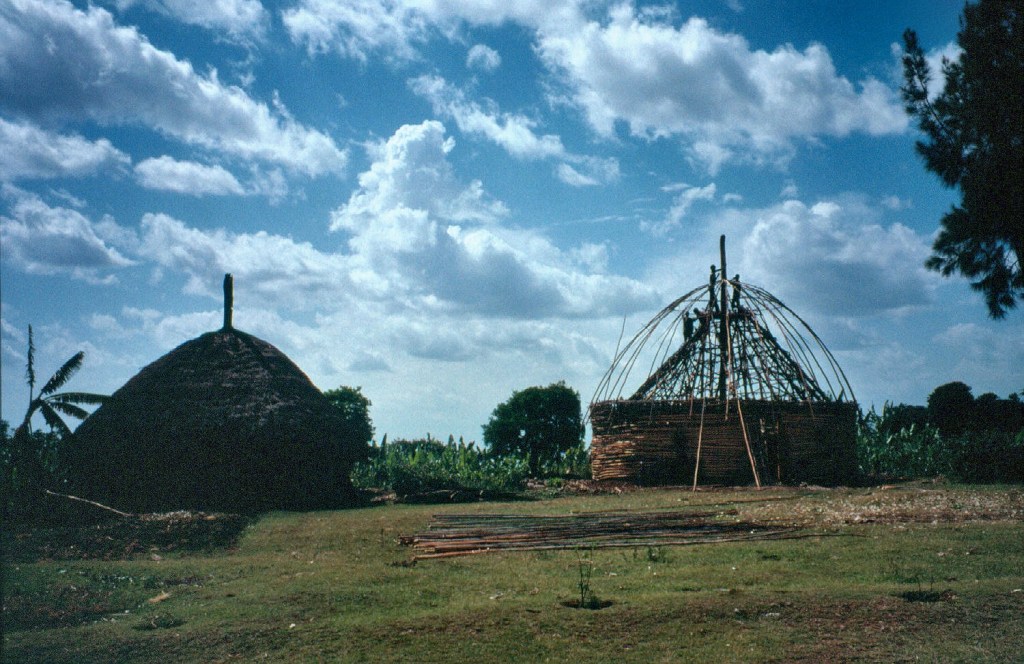
Houses in Woliso.
Near Jimma, the capital of the large Kaffa province and about 350 km from Addis Ababa, the landscape became greener and trees became more abundant. That coincided with the end of the tarmac and the start of a consolidated but very rough and dusty road, from where we continued towards Bedele, located in the province of Illubabor. We reached Bedele after a long 140 km journey from Jimma and, by the time we got there, presented our travel credentials for clearance by the local member of the Government and found food and accommodation, we were really tired and we slept soundly!
The following morning was cool and sunny and this enabled me to appreciate that Bedele was mainly a one street town set up in a rather well forested area. Bedele, also known and “Buno Bedele” was reputed to be the origin of the coffee and you could easily see the beautiful flat-top acacias with the coffee bushes growing under their shade.
During my visit I learnt that the work was mainly following an already on-going routine that required the collection of ticks from cattle at different locations both to get to know the species and to understand their population dynamics. The study was led by a scientist that had suffered a severe health problem and needed to be evacuated and unfortunately was unable to return.
I realized that I could handle the proposed work and hoped to stimulate other research activities and, hopefully, attract more funding to continue the work beyond the two years planned.
During the visit I met the Ethiopians that would work with me and I was impressed about their dedication as they had kept the work going despite having remained on their own for a few months by now. I accompanied them when they went to their study sites and I realized that Ethiopia was a really special place, difficult but full of new things for me that I judged we would enjoy.
During that time, I also leant that Jan and Janni, a couple from The Netherlands working on trypanosomiasis also lived at the station and we would share our time there although they were on holiday during the time of my visit. Our house was next to theirs and when I saw it I understood fully Andy’s remarks that my garden would be “the whole of Ethiopia”!
Our two-bedroom bungalow, the same as the remaining seven others, had a small kitchen, a sitting area and a toilet that included a shower two bedrooms. I duly measured all rooms and made a floor plan that hoped it would be useful to plan our future house. Supplies, however, looked a more complicated affair. Petrol was rationed and, apart from good coffee, food was available at a basic butchery and the Saturday market. Clearly we needed to prepare for “importing” our foodstuff from Addis Ababa at regular intervals.
Although the work offered both positive and negative aspects, after the visit I judged that the former outweighed the latter and I decided that we should give this new adventure, both professional and personal, a try and our adventures there will be the subject of the following posts.
[3] Eragrostis tef, native of the Horn of Africa, is a cereal grass with tiny seeds of less than one millimeter of diameter. It is cultivated for its tiny seeds “injera“, a sourdough-risen flatbread is made and also for its straw to feed livestock.
I remember at least two year-end holidays spent in the Maasai Mara.
The fact that we camped outside the reserve gave us some liberties and sometimes we returned late to camp. That particular Christmas eve we were ending our game drive and looking forward to our Christmans eve dinner when we bumped on a group of six lionesses walking through the plains, clearly hunting.
As this offered a great opportunity because of the number of game present in the area, I managed to convince Mabel that it was a good idea to follow them for a while to see whether we could watch a kill. She reluctantly agreed.
After following them for a while, darkness fell and we realized that, oh surprise, we were lost again!
Unable to return to camp we decided to continue with our plan and kept following the lionesses and, to avoid interfering with the hunt, we kept the lights of the car off and navigated under increasing darkness until we only had the moonlight. We did switch our lights on sporadically to see where we were going and to avoid losing our quarry.
Suddenly the lionesses started trotting and soon we lost them. My attempt at finding them took us through some stony ground until we came to one where the bottom of our car touched the rocks and we got stuck on rocks!
Getting out of the car to jack it up was not an option so I revved the engine and moved the car backwards and forwards until with a metal tearing noise the Land Rover jerked backwards and we were free.
We were now alone as the lionesses had continued with their hunt and disappeared into the thicket! It was clear that our optimistic project had come to its (natural) end and we had no idea where we were!
Wisely for once, we decided that setting up our small tent and sleep in the open surrounded by lions (and other beasts of the darkness!) was out of the question so the decision was taken to slowly look for a flat piece of land, stop the car and settled down for our Christmas eve night.
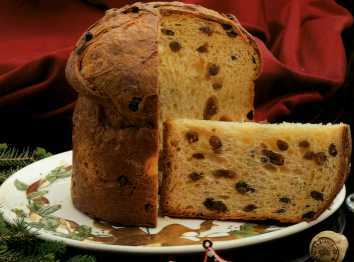
Searching the car we found water and a panettone [1] baked by Mabel! We did not wait for midnight to celebrate Christmas but opened our bottle of water and toasted while we cut slices of panettone that we finished. After our improvised dinner we started listening to the lions roaring around us, probably also celebrating a successful hunt that we had just missed to witness. We thought that, after all, it was a good way to spend the night!
Panettone. Credit: Codice1000 at Italian Wikipedia [Public domain]
Things started to lose their glamour when the time came to sleep as we did not carry blankets or sleeping bags with us so it would be a chilly night. I had ceded the front bench of the car to Mabel and I tried to find sleeping room at the back of our short wheel base Land Rover, an impossible task despite throwing out all hard objects through the back door. Despite this, there was still very little room there and, after trying a foetal position and then sitting with my back against the front seat without luck I must have passed out as I woke up with the first light.
But our troubles were not yet over!
It was a lovely Christmas day and we soon realized that we had driven inside the reserve and had spent the night at an area we knew and from where we could see the Mara Serena Lodge.
The Mara Serena lodge.
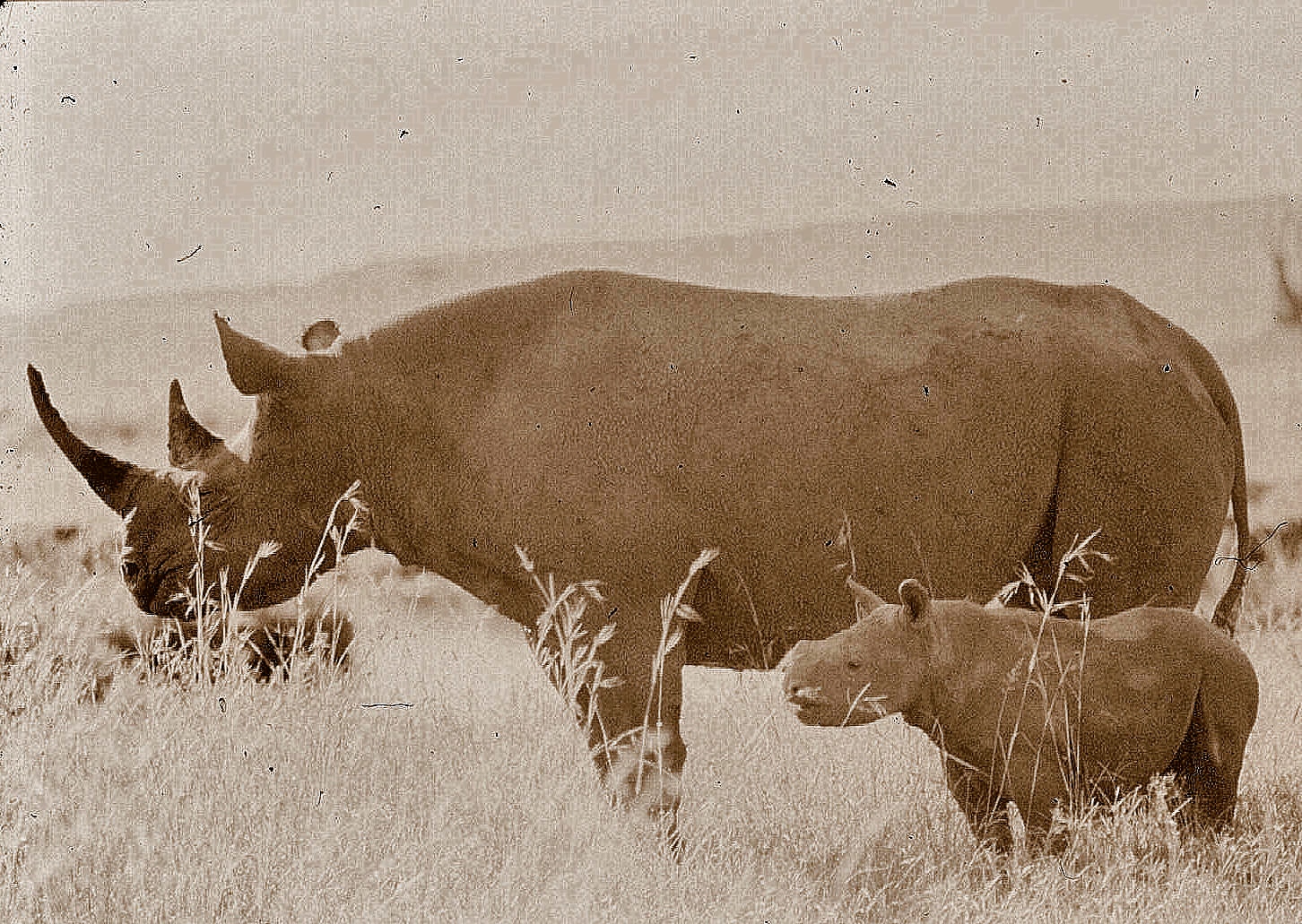
And then we got our Christmas presents: a female black rhino came walking slowly towards us, followed by a really small calf, very cute and playful. I believe that it had been named “Toto” (child), one of the attractions of the reserve at the time.
A female back rhino and her calf, the same sight that we found in the Maasai Mara on Christmas morning.
Unfortunately for us, with the rhino came the reserve rangers that were guarding it 24/7 and they drove straight at us as we were rather obvious and there was no way that we could have driven into the park to be there at that time in the morning! We told them that we had lost our way the day before and decided to spend the night where we stopped. Luckily, they understood our explanation of how we ended up there and pointed us the way back towards the area we had left our camp.
We wished each other a Merry Christmas and parted our ways, they keeping an eye on the rhinos and we, stiff but happy at the way that Christmas had finally arrived although we did not see our lion hunt.
The following year we decided to have a comfortable Christmas holiday and we started early to save to be able to spend it at Kitchwa Tembo, the tented lodge close to the Mara River bridge where I used to get help with punctures and fuel while traveling up the Oloololo escarpment on my way to Intona ranch.
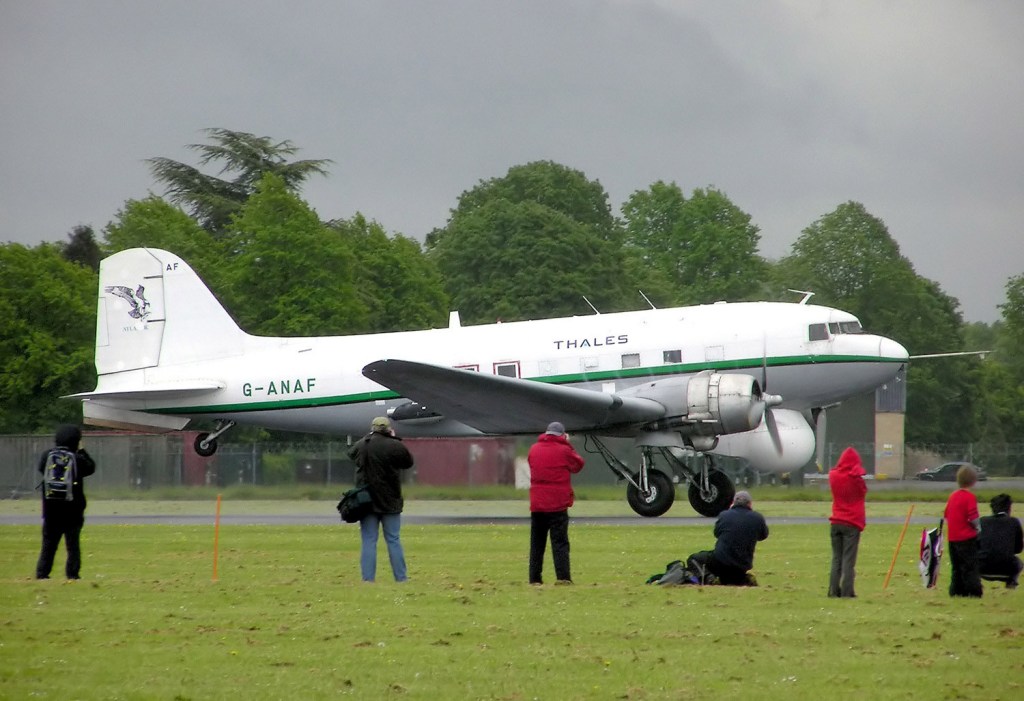
So, when the time arrived we booked seats in the daily flights between Nairobi and the Maasai Mara that were carried out by means of an Airkenya Douglas DC 3 plane that would take about 45 minutes to complete a journey that by road would take the best of one day!
A Douglas DC3 taking off. Credit- Arpingstone / Public domain
We boarded the plane at Wilson airport and we sat really looking up so when the plain started taxiing I immediately started thinking how could the pilot see the runway looking up! Luckily, once we started our take off the tail came up very rapidly and we became horizontal, and a few seconds later we were noisily airborne.
Our route took us over the Ngong Hills – former home of Karen Blixen, of Out of Africa fame – and then beyond the edge of the Rift Valley, magnificent views. After a while the pilot announced that we were flying at 10,500 feet and drinks were offered. Conversation was difficult as the two engines were quite noisy but it was a small price to pay for our first flight in an antique plane!
We approached the narrow paved strip at Musiara and the strong shiver indicated that we had lowered our landing gear and a smooth touchdown followed. Ten minutes later, after loading more passengers the plane hopped a few kilometres over the river to the Kichwa Tembo strip where, after checking that no animals were on the runway, we landed and boarded open vehicles that took us to our tent.
Walking in camp was “interesting” as a number of old male buffalo resided in the camp, probably seeking protection from lions so we were given a strong warning not to walk alone in the evenings but get one of the “askaris” to accompany us. These were Maasai warriors employed by the camp for this purpose.
Christmas Eve at the camp was quite different from the one we spent the previous year. The festivities started early with loud shouts of “elephant!, elephant!” by the staff while we were getting ready to have a cup of tea before our afternoon game drive. We rushed to a prudent distance and witnessed how a young female elephant and her calf walked among the now empty tables pulling table cloths and spilling crockery all over the garden until, clearly satisfied, they walked away leaving behind a devastated garden.
The incident, we were told, was quite common and the solicitous staff quickly re-assembled the tables and, soon and “elephantless” we could have our tea drinking. Once we finished, we went looking for game. This was a new experience as, for once, I could spend all the time looking for game rather than driving. The friendly guides knew the area and they showed us all the usual game, including elephants, lions and buffalo. We returned at sunset and enjoyed good showers and got ready for dinner.
We ate while waiting for midnight and we were treated to a great singing and dancing show by the camp staff that managed to create a really merry atmosphere, fun to watch and to participate. It was funny to see the staff of the lodge in Maasai costumes dancing around.
Eventually we celebrated Christmas with a glass of champagne and retired to our extremely comfortable tent, escorted by our usual askari that was now himself after having been a great dancer earlier.
Later that night we had high drama as it was obvious that lions also wished to celebrate the Season holidays in style and, apparently, they had gone for a buffalo. We heard the struggle and bellows of the “victim” for quite a while until silence returned and we assumed that the buffalo was a goner.
We anticipated an interesting game drive the following morning prior to our return flight but, although we found a pride of lions, we did not find a dead buffalo so we assumed that the animal -if that was what happened- had managed to escape!
Too soon the time came for our departing flight and we boarded the plane, together with other fellow tourists. Our return trip to Nairobi essentially retraced our outward journey and it was rather spectacular to see our approach to the Rift valley wall that, luckily, we climbed and soon we landed with tires squeaking on the Wilson’s tarmac runway. Our “antique” flight was successfully over.
Unfortunately, in 1992 one of Airkenya’s DC-3 was damaged in a landing accident at Musiara, luckily without any victims. Although that plane was not repaired but rather shipped back piecemeal by road to Nairobi, the service continued until 1997 when the DC3s were replaced by newer planes.
[1] Panettone is an Italian type of sweet bread loaf usually enjoyed for Christmas and New Year in many Latin countries. It required a well processed dough and it contains, among other possibilities, candied fruits, raisins and various nuts. It is served in wedge shapes, vertically cut, accompanied, in Uruguay, with cider, prosecco or champagne.
There were lots of topi (Damaliscus lunatus jimela) and kongoni (Alcelaphus buselaphus), also known as hartebeest, roaming the Maasai Mara and they would calf at the same time as the wildebeest so we would see them with their newly born calves while looking for the wildebeests giving birth.
During the course of darting wildebeest we removed snares whenever we saw animals with them.
On one of these occasions we saw a very young kongoni, probably one or two days old that was not only on its own but also very restless. Through the binoculars we saw that it carried an arrow on its forehead! It was most probably a Maasai arrow that was shot from behind the animal and entered the top of the skin of its head going through and it was hanging on its face, bothering him.
As Paul judged the animal too young for darting we decided to catch it to remove the arrow! The idea was to chase it with the car until we were close enough to jump out to grab it and remove the offending weapon. As the car we were driving only had seats at the front, we decided that Mabel (wisely not too interested in our antics!) would stay enjoying the sunshine on some nearby rocks.
We then removed the doors and we were ready for action and started to approach our target slowly. The strategy was to get close to the small calf and then -again- I would jump on it, immobilize it and then remove the arrow. We thought that it would tire fast and enable us to ghrab it.
After a while pursuing it we realized that our “tiring hypothesis” was wrong and the calf had much more energy than we anticipated. We would drive close to it but, just before I could jump on it, it would accelerate again or do a zig-zag movement that would leave us facing in another direction.
We drove an inordinate time, up and down the plain and we were close to get it a few times but it will always avoid us at the last second. drove up and down and passed in front of Mabel a couple of times. Eventually, during one of these turns it entered a rocky area where its mother had gone and we could no longer follow it. So, defeated we returned to collect Mabel.
She was not amused. During our absence she stopped following our fruitless activity not to place herself under the sun but to keep an eye on some lions that she had spotted some distance away so she remained very still to avoid attracting their attention. She had tried to stopped us while we passed by by shaking her arms and she was not amused when we told her that we thought she was greeting us!
I mentioned earlier that our friend Paul was working on animal diseases at various places, including the Maasai Mara Game Reserve where he was investigating the epidemiology of Malignant Catarrh fever. Apart from collecting placentas [1] he was also collecting blood samples to ascertain the presence of antibodies against this disease among the wildebeest population.
When I had time on my way to Intona ranch via the Maasai Mara or over weekends we joined him to spend time together enjoying the bush, which also included enjoying helping him with his work!
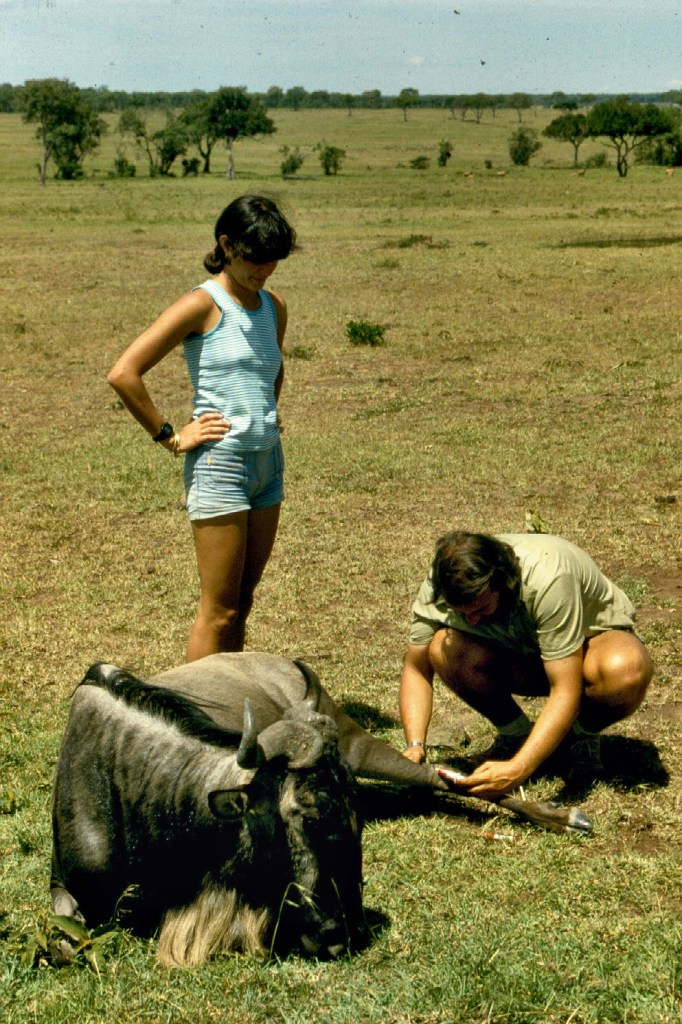
Taking a blood sample while Mabel looks on.
Clearly, to bleed the animals there was the need to immobilize them and this was done by firing a dart that in fact was a flying metal syringe that, on impact with the animal, would have a tiny detonation that would push the anesthetic into the animal. Although interesting, the procedure had risks as an accidental inoculation to a human was life-threatening and a syringe loaded with the antidote was prepared every time we went out.
The effect of the immobilizing drug was very fast and the animal would lie down within a few minutes. During that time, we needed to follow the animal until it started to slow down and finally stopped and became recumbent. Then, there was no need for much holding, as it did not struggle.
After finishing the work and removing the dart, we would apply a gentian violet spray to help with the healing of the small wound as well as to alert us that the animal had already been captured. Then we would inject the antidote intravenously and we literally jumped back as the animal will immediately recover, stand-up and move off as if nothing had happened! This was essential when darting animals in a place notorious for its large predators that were always on the prowl.
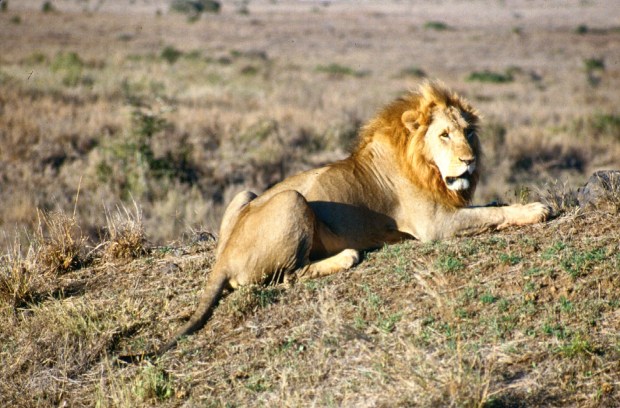
Hungry lioness.
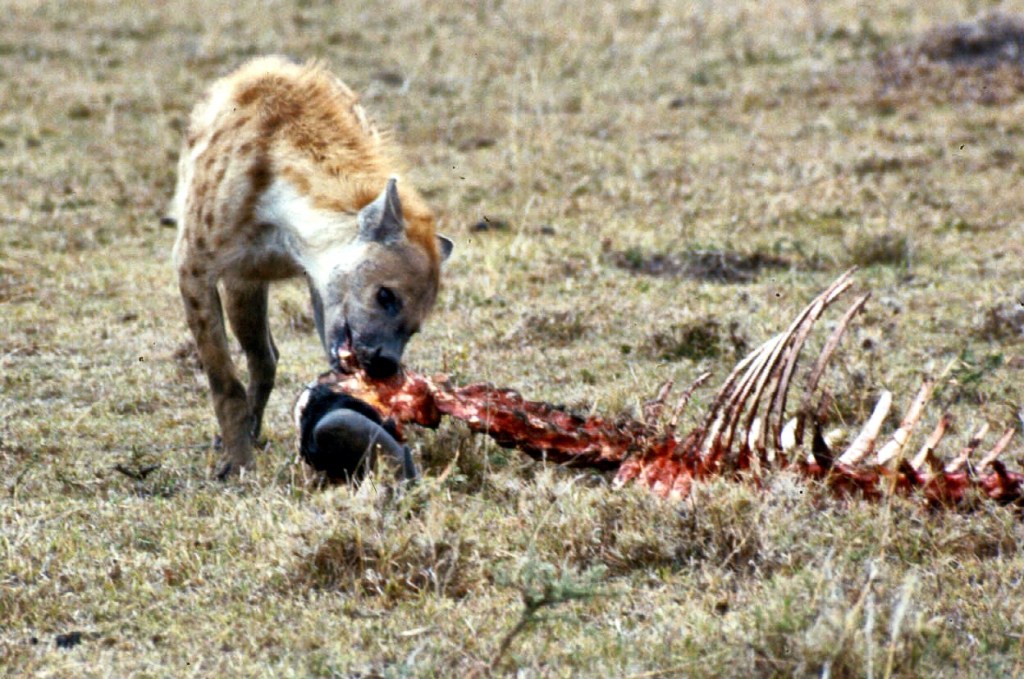
A hyena carrying the remains of a wildebeest.
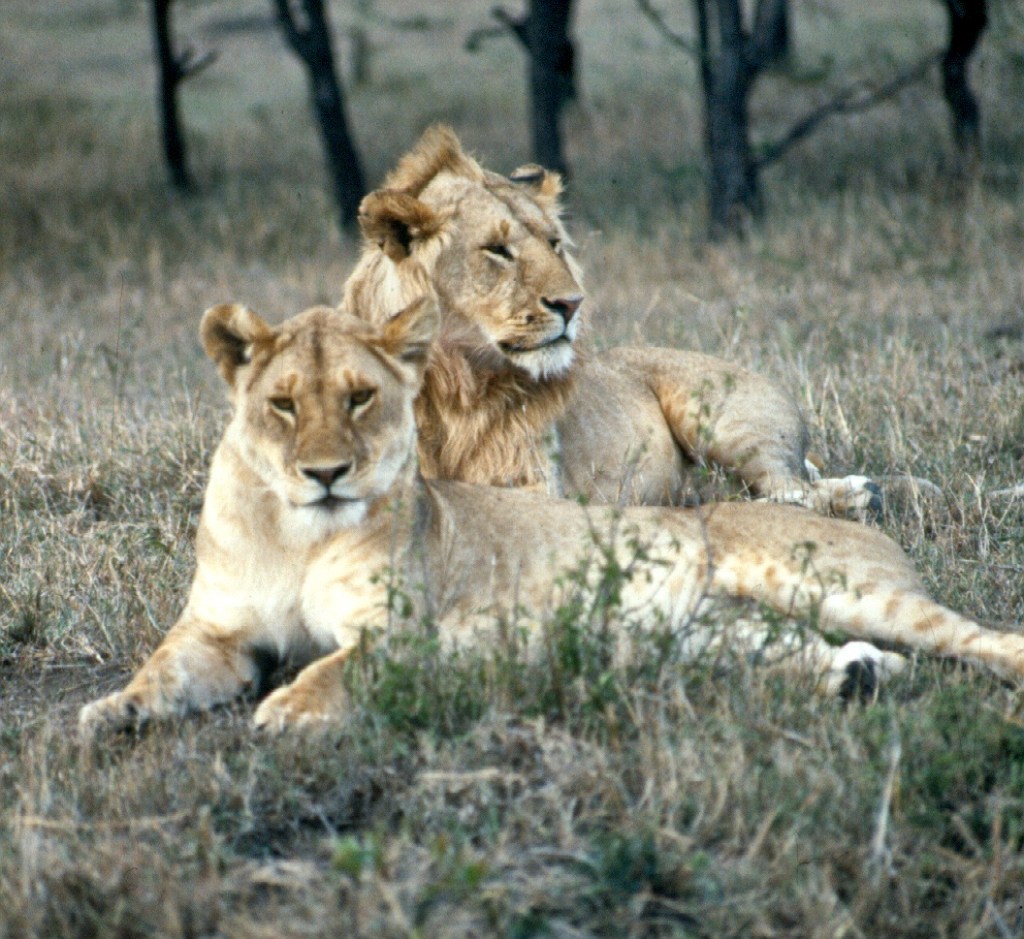
Some of the threats present…
Although I had a chance to dart a few animals, I mostly drove as the work needed a two-person team to be performed. I needed to learn how to drive in order to come within “shooting” distance of the animals. You needed to come obliquely as not to start them and then stop the car to allow the shooter to do the job. Breaking a branch or even a twig was sufficient to have to start all over again!
A dart placed at the right spot.
The shoulder was your target. Being in the centre of the animal you would still hit the neck if it went back or the flank if it happened to go forward. Although this sounds simple, sometimes the dart would go over or under the animal or it would jump and the dart would miss it. A missed shot meant an interruption of the work until the dart -usually half-buried in the grass- was recovered. Project resources were limited and a dart was costly. Luckily they had a coloured flight stabilizers that helped locating them.
Although the work proceeded smoothly, there was one instance when things did not go as planned.
At a time that most of the wildebeest had traveled to the Serengeti, there was a need to get some samples despite the low number of animals present. The work involved a lot of searching until individual animals were found and then approached for them to be darted.
After a lot of hard work we managed to dart one adult male that we processed fast to continue looking for others. We covered a lot of bush but found that the animals were particularly jittery and difficult to approach. Eventually we got a female and continued trying to the last one for the day.
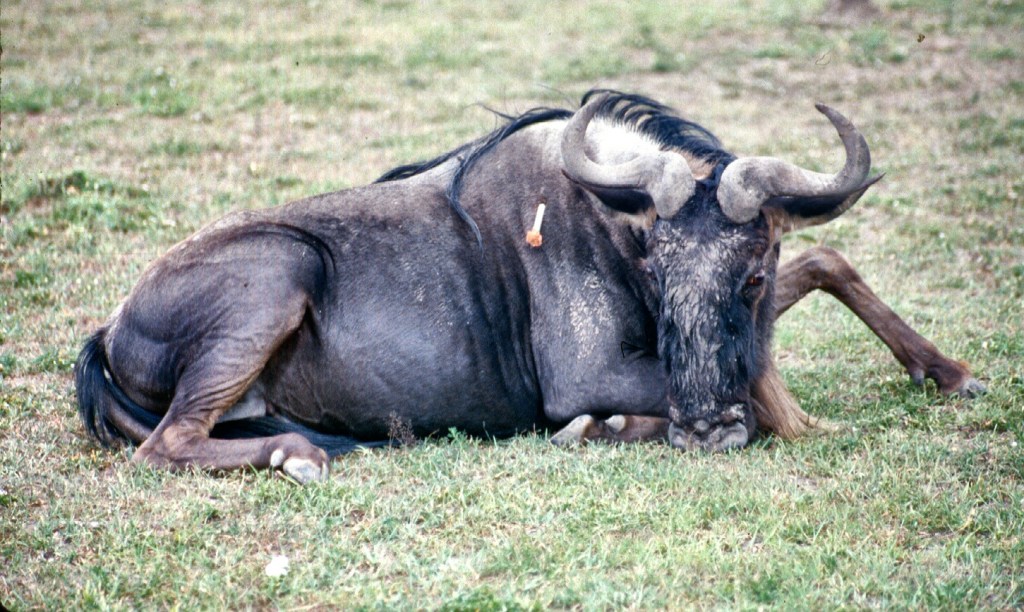
During mid-afternoon we found another male, we darted it and started to follow it waiting for it to go down. After a while -surprised- we saw that it would not go down as expected. We followed it and then when it turned we saw the gentian violet spray we had left on it when we had darted earlier!
Clearly, the animal was still under the influence of the antidote and the new dose of tranquilizer would only slow it down but it was not enough for it to lie down. We were in a fix as we could not leave it in that condition and more tranquilizing drug was not advisable.
Desperate situations demand desperate solutions so I volunteer to ambush it by hiding behind a bush while Paul drove it towards me. I thought it would require the same effort as holding a young steer, something I had done this before so I estimated it doable. After all, I only needed to hold it for a sufficiently long time to allow Paul to come and help me, overpower it and remove the dart.
We found a suitable area with woodlands on both sides and I hid behind some bushes with some rocks behind me (to prevent unwanted visitors surprising me) and waited. Although I did not see the car, I heard it coming closer so I got ready for the animal to walk in front of me and then jump to get it.
To my surprise, before I could move, quite a large head (much larger than I expected) was sniffing me! Despite my surprise I reacted by grabbing the animal’s neck hoping to keep it still. As I started being dragged over the plains of the Maasai Mara I realized that I had underestimated the strength of a male wildebeest, even a drugged one!
I soon lost my footing and remained hanging from my embrace of its rather muscular neck. The neck of a wildebeest from a car window is one thing but to actually try to span it with your arms while the creature runs, although groggy, is another one.
After about three leaps, my grip slackened and I ended up grabbing one of its front legs. My hold was rather short-lived as I was now under the beast being dragged, stepped on and knocking me against all ground irregularities. I let it go and stayedlying on the ground recovering from the ill treatment received.
I was not really hurt but a bit knocked and soon recovered and sat-up to wait for Paul while removing a few thorns from my arms and legs. Paul took a while to come as he was laughing so much at the scene! I understood his mirth as it must have been quite a funny act to watch!
Despite what I thought it was a brave attempt, the problem remained. The wildebeest was still groggy and vulnerable and it carried a valuable dart! We needed another plan as the animal was trotting just a few metres from us. So, plan B was hatched that would involve my cattle-lassoing skills I had acquired in Uruguay.
With the car’s towing rope I improvised my lasso and placed myself between the front of the car and the bull bar where I could keep in place while I could use both hands as I could not use a lasso with only one. I was a bit unstable on my perch but decided that it will have to do. As a precaution I tied the end of the improvised lasso to the bull bar.
As soon as the car approached the beast I threw my improvised lasso until, after the third or fourth try, I managed to get it from the horns. That was not my idea as I aimed for the neck but it will have to do. Seen that the lasso was firm I signalled Paul to slow down and stop. The animal continued trotting as far as the rope allowed it and then, gradually, we pulled it to bring it close and finally managed to extricate the dart, spray it again (this time on the other side as well) and, with some difficulty but with the aid of a wire, remove the lasso from its horns.
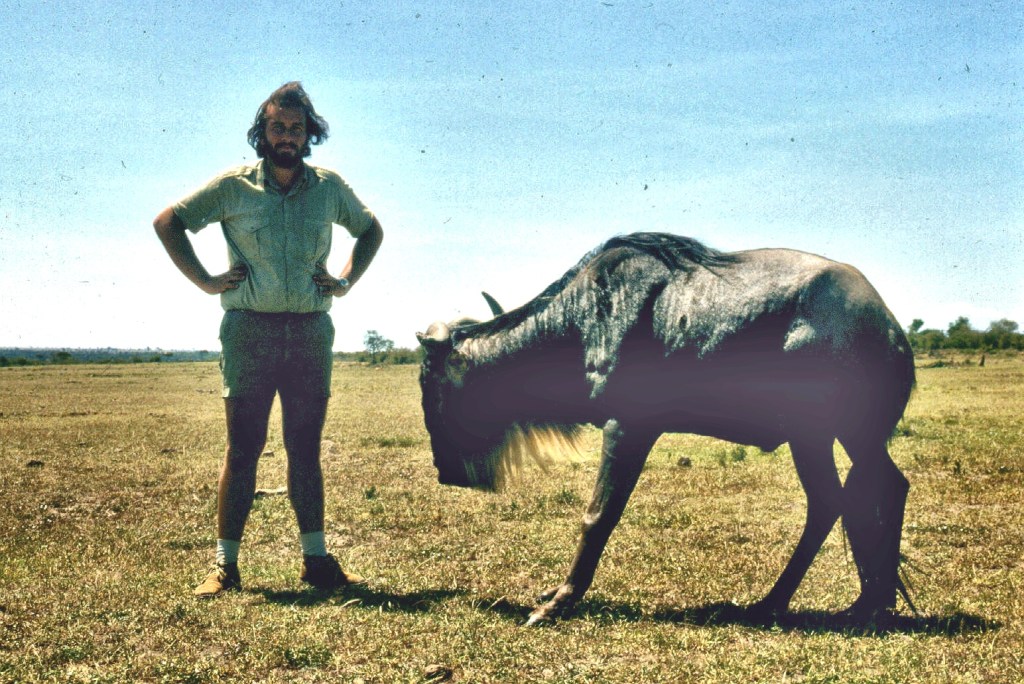
A rather dishevelled bushsnob posing with the exhausted wildebeest, waiting until it recovered fully.
The title does not refer -luckily- to a new extravagant car rally but a tale of a French couple, friends of Paul, who arrived from Paris in the morning and that same night they were camping in the Maasai Mara, after driving all the way from Nairobi!
By chance, we arrived that same afternoon and found them looking rather bewildered after enduring not only the overnight flight but, the long rough ride afterwards following Paul’s rather ambitious programme! The camp this time was a few km downstream from the Mara Buffalo Camp -where we usually camped- and only a faint track led to it. It was a nice place, the Mara river very close and the Oloololo escarpment, the same I climbed every time I needed to go to Intona, at the back.
Paul was busy with his field work, so we came at the right time for him and we agreed to take care of the French contingent the following morning. In any case, they managed to speak some English and we knew some French words from our high school so we were sure that we would understand each other as, after all, both our languages branched off from Latin.
We waited to start our morning drive until the French were ready, which was earlier than I expected. So, soon after sunrise we set off hoping, as usual, that we would be lucky with our game drive. The wildebeest migration was in full swing and I planned to drive in the general direction of Governors Camp and be back for lunch.
By then we knew how to enter into the reserve through the “back door” and also, through Paul, we also knew the general area where the wildebeest were grazing at that time. Finding the wildebeest increased the chances of meeting large predators, particularly lions and that is what most first time visitors to the Maasai Mara wish to see.
The drive was slow as everything was new for our guests and we needed to stop for them to take snapshots of most animals that for us were rather commonplace but we understood how they felt and happily obliged. After a while we spotted the first wildebeest and soon we could see the expected large herds. We stopped to take the view in and continued driving slowly, following the woodland’s margins where the cats could be hiding.
After going for about an hour Mabel spotted a lioness. We were lucky and we stopped to watch it and to take a few more pictures. The lioness was quite active and obviously hunting so we joined her in watching the wildebeest stopping the car at a prudent distance and searching for more lions that we suspected should be around.
The lioness watching the wildebeests.
We whispered to our visitors what we thought it may happen next and we waited. After a few minutes she stood up and, undetected, walked towards the grazing wildebeest and hid in long grass, still looking towards the wildebeests. We kept scanning the surrounding area and soon we caught a glimpse of another lioness some distance away.
It seemed that the lions were coming from several directions, preparing an ambush. We calculated where the hunt could take place and slowly drove towards it still leaving a wide berth for the animals to move without interference. We switched off the engine and stopped, being the only witnesses of what was happening.
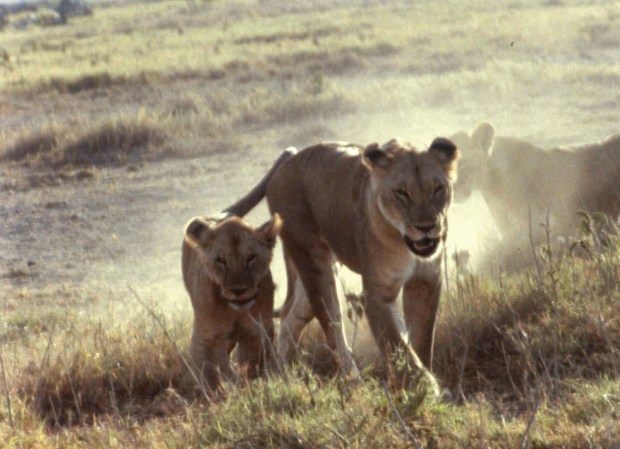
We did not have to wait too long before the what it was a peaceful scene transformed itself into a chaotic one when suddenly the bush burst with wildebeest running in all directions around us and some of them nearly bumped our car in their zest to run away! Luckily there was no dust and we spotted five or six lionesses chasing wildebeests.
Some followed wildebeests that had run into the woodlands but a couple of them run in the open. Soon we heard the agonic bleats of a wildebeest and I drove straight to the area while I heard shouts of “oh là là”, “quelle chance!” and other expressions of amazement by our Gallic visitors.
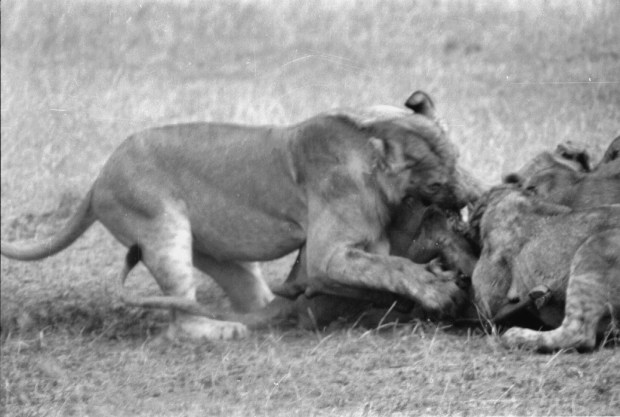
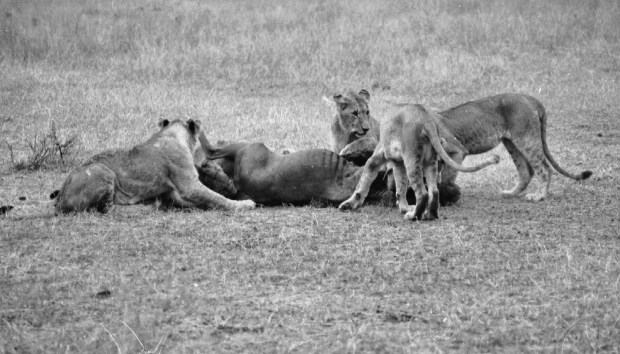
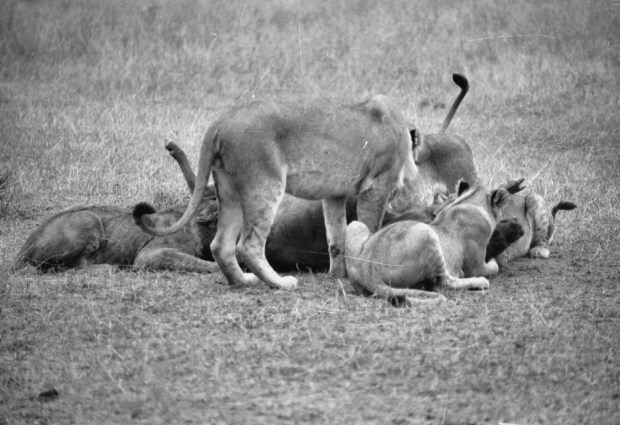
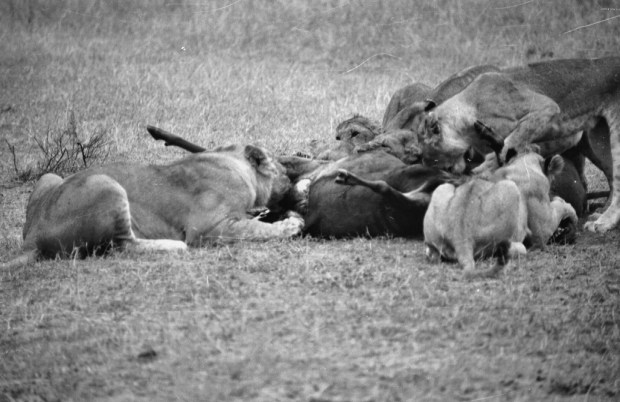
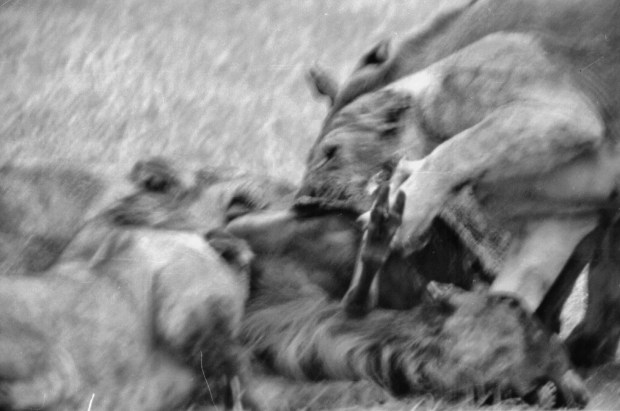
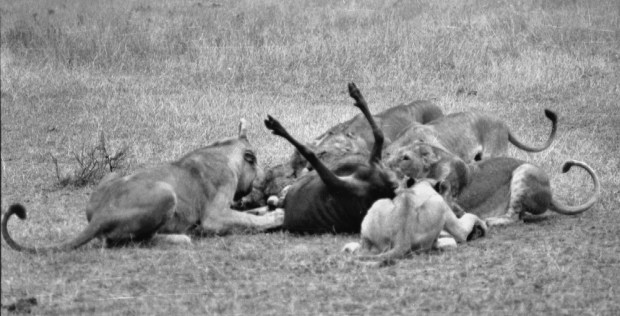
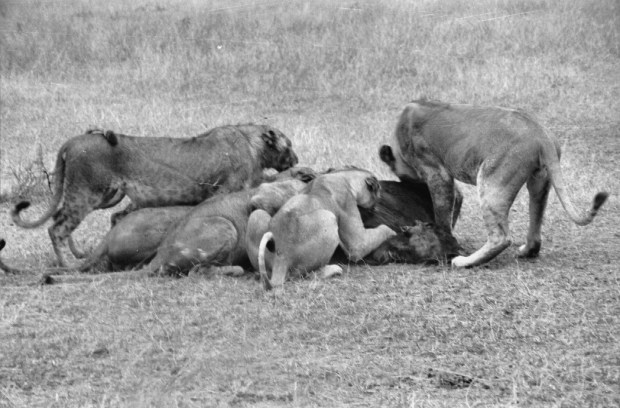
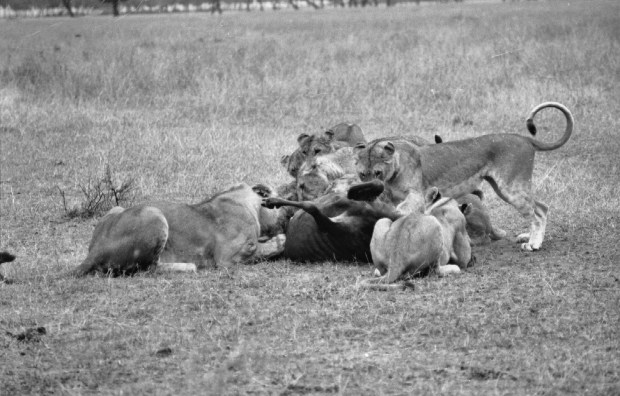
We were also excited as to watch a hunt is not an everyday event, even in the Maasai Mara, and we watched as two lionesses were busy suffocating a wildebeest by a hold in its throat while other lions, that had chased other wildebeests and failed, were trotting towards the ongoing kill. Soon, not only the females we had seen earlier but the whole pride, including adult males and young of different ages, were vying for position at the carcass and as often happens, started licking the dying animal and even feeding.
A few shots of the kill as it progressed. I point out to the tail of the lioness!
After a few minutes a couple of cars arrived but we were well placed and we spent about an hour watching the lions feast in all detail. As usual, fights broke out when the dominance of some individuals was challenged and the stronger took “the lion share”! We watched the scene mesmerized for a long while until the meat starting to run out.
Although the arrival of a few spotted hyenas and black-backed jackals was interesting, we resumed our drive I thought “after this, what else can we find that is more exciting?” but continued searching hoping that the visitors, that 48 hours earlier were in busy Paris had arrived for the first time in África and watched what some people that live there for years never manages to find!
We realized that lunchtime had passed unnoticed and we, unanimously, decided that we were not hungry so we agreed to drive following the Mara River to get to the hippo pools that were not too far. There we spent time observing hippos and the huge crocodiles that shared the pools with them. Judging by their girth, the latter were benefitting from the wildebeest presence and their frequent river crossings.
Engrossed watching animals we did not notice that a storm had gathered and we were somehow surprised to note the first raindrops. After a while the sight of the pools were obscured by the rain. Although it was a welcome thunderstorm, I knew that the kombi, although with a good clearance, did not have 4WD and therefore it was not a mud-wise vehicle. So, I took the decision to return to camp before it was too late, strongly suspecting that it was too late already!
I knew that the roads would soon be very sticky and as it started to get dark, I regretted that we have not paid more attention to the time and the weather. We moved a few kilometres back still under the rain and there was a lot of thunder and lightening. Things were not getting any better.
Rapidly, the road became a quagmire that forced me to gradually slow down to avoid skidding off it. Eventually I was forced to engage second and first gear as the going became laborious and I knew by previous experience that we were in trouble. We continued, just, and eventually the black cotton soil stopped us while the rain did not show signs to stop.
A quick and rather wet inspection revealed that one of the back wheels was stuck while the other spun uselessly. Under heavy rain I got one of the French to stand on the fender to get the wheel to grip while Mabel and the French lady pushed. I moved at full throttle with the French guy hanging on for dear life and splattering the “pushers” with black mud until I reached a drier, higher spot. I waited for the helpers to clean up and get back in the car to resume our journey. Luckily it was not too cold.
We continued to move on, push, wait and go again for a while and we managed a few more kilometres before we were stuck again and now, it was dark and we needed the car lights to see the road. I noted that our friends were not so excited leaving the car to push in the dark! Their fears were justified and now the “m” word started to be heard very frequently!
Somehow, we had enough adrenaline to keep us going and I managed to get the car up to a good speed, more than it was prudent but necessary to keep our momentum. At that time, we met a line of wildebeest on the road and I needed to slow down to avoid a head-on collision. I managed to avoid all of them but one. This particular beast came running from the side and hit us with one of its horns, leaving a deep dent all along the kombi, a scar that remained there from then on as a reminder of that trip!
Luckily, the rain decreased and the risk of getting stuck diminished but we realized that we were lost! Being dark did not help to find our bearings (we are hopeless at finding places, anyway) as we had passed a number of bush tracks any of which could have been the correct one. Then we realized that the storm was now our best ally. Every time that there was lightning we could see Oloololo escarpment and we knew that it ran parallel to the Mara river and that the camp was close to the river!
So we drove in that general direction, hoping to come to some known terrain, a difficult thing at night. Then, Mabel spotted a beam of light in the sky that we could not read at first but then Mabel speculated that it was Paul with his strong torch trying to pinpoint the camp for us.
We decided that a light meant human inhabitants so, without any arguments, we headed for the light. At some stage we recognized the track that led to our camp and we arrived a few minutes later, soaked wet, muddy and very tired.
After washing ourselves as well as we could and getting dry clothes, we met for a quick dinner heated under the tent’s flysheet as the rain was still falling on and off. Paul had heard an engine and thinking that we could be the only ones driving at night, decided to shine the torch saving us from an otherwise sure night in the bush.
As we had all gone through a lot over the last 12 hours and we started to mix languages, we decided that a camp bed was needed and we retired to our tents, still under the rain. Fortunately, our tents have kept the rain outside so soon we fell sleep with the memories of the day still fresh in our minds.
Regrettably we needed to return to Nairobi the following morning but not before sharing a good breakfast with Paul and his friends during which, well rested and calmer we re-lived our experiences, and we agreed that we had lived through a very lucky day indeed.
I thought we were fortunate when the decision was taken for me to work at Intona ranch in the Transmara as this would enable us to frequently drive through the fringes of the Maasai Mara Game Reserve, the northern extension of the Serengeti National Park in Tanzania and the jewel of the Kenya wildlife areas.
In fact, I had no idea of the joy that this decision would bring to our lives, something we only came to understand later on and even now the great memories of our time there still linger.
To be able to soak up the immensity of its grass plains during the various seasons was indeed a privilege. We swallowed dust traveling during the dry season on roads that, when the wet season arrived, you would be skidding all over even applying the best wheel control possible! We camped in the open with no fences many times in different places and enjoyed lots of different experiences over the years, some of them I did not do today. It was there where we started to learn “the ways of the bush” with our friend Paul [1].
Even considering that we were not strictly inside the reserve most of the time, the wild animals took the centre stage as you could not fail to find them, even if you wished to! [2] At its most empty the Maasai Mara plains would be dotted with Thomson’s gazelles, zebras, topis, kongonis and the resident wildebeests. As a good friend put it while looking mainly at the herd of Thomson’s gazelle: “they look shoals of tropical fish”.
The elephants and buffaloes were always making an appearance and of course, the lions -our favourite predators- were present, first as random finds and later less so when we knew their territories and places they favoured. The spotted hyenas could be counted in dozens and they were very common and we frankly took them for granted and never looked for them as they were always there!
But when the wildebeest and zebra migration arrived from the Serengeti, the plains were so full of animals that it was even difficult to drive because of the animal density! You would also hear them all the time as they were everywhere, always on the move, even while having their young. Sights and sounds difficult to imagine (and to forget!) unless you have been there!
Apart from their main migration Serengeti-Maasai Mara, they had “mini migrations” within the Maasai Mara. Often, we thought that their motives were to look for fresh grass, but we came to realize that they followed hints we could not get, and we often thought that they were playing a game of follow the leader!
During those times of abundance predators somehow became more obvious and numerous as many would come in pursuing the migration. In particular the packs of spotted hyenas would be seen very often as well as lions, now not only the prides we were somehow familiar with but other nomadic individuals that came and went with the migration.
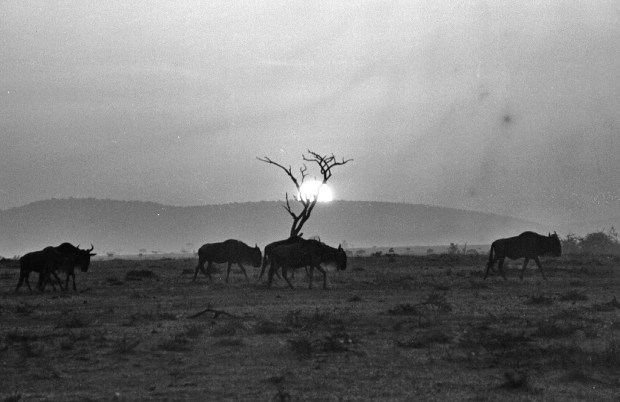
Gnus at sunrise
We spent hundreds of hours watching lions, searching for leopards, waiting for cheetah to go for the chase, trying to second-guess packs of spotted hyena while chasing their prey or watching the hippo antics at the several pools in the Mara River, while keeping an eye for the opportunistic crocodile to take the unaware drinker.
Some of the few black rhinos we encountered in Kenya. These were at Amboseli National Park.
Visiting this wildlife paradise also offered the chance of seeing the Maasai pastoralists walking on the various tracks, red specks in the vast distances, apparently oblivious to the myriads of animals surrounding them, their full attention on the welfare of their own animals.
As expected, over the years we lived through many events, luckily nothing that went wrong could not be righted and that was a very important condition to enjoy our experiences. I will try to narrate to you some of the anecdotes that took place during that time that I still remember so many years later.
I already described my journey to the Transmara that included passing through the periphery of the reserve [3]. There was a tar road from Nairobi to Narok, the Maasai capital and the last town to load fuel and any last minute items you forgot, although the choice was not that great. There was, however, a chemist and a restaurant where you could have “nyama choma” (roasted beef) with ugali (maize meal) easily and fast or, if you were feeling picky, the more elaborate chicken and chips (oil-soaked) for which you needed to wait quite a while longer. Your commensals would be mainly Maasai that were only too happy to have you with them after having deposited their spears and “rungus” (wooden throwing clubs or batons) nearby.
We never stayed there longer than a couple of hours and, usually we would drive through after refuelling. The stop at the petrol station was, at first, nothing out of the ordinary. However, later on we started noticing that the minibuses also stopped there, and, during the pause, they offloaded their passengers. The wealthy among the latter took their safari to Kenya very seriously and dressed better than the real hunters with clothes from famous brands!
The road from Narok until you reached the Maasai Mara Game Reserve proper was about 130 km, depending where in the reserve you would go. The first 85 km to Aitong were rough, dusty and corrugated but never muddy as it was a well consolidated road. But it will hammer your suspension severely.
A series II Land Rover we saw there holds our most extreme record of suspension destruction we have seen. It was returning to Narok with still about 20 km to go and it came towards us zigzagging badly. We moved off the road and stopped to let it pass. It was crawling to get back to Narok with the front spring leaves (on both sides!) sticking up the front of the car, as high as the bonnet, I believe soon to come out with unknown consequences, its crew looking rather anxious!
From Aitong you followed straight on through a smaller track, gentler on your car but dusty most of the time and muddy during the rains. Luckily, either when going there for work in the strong LWB panel van Land Rovers or in our kombi first and then our SWB Land Rover, we never broke down and had only punctures and mud-related delays.
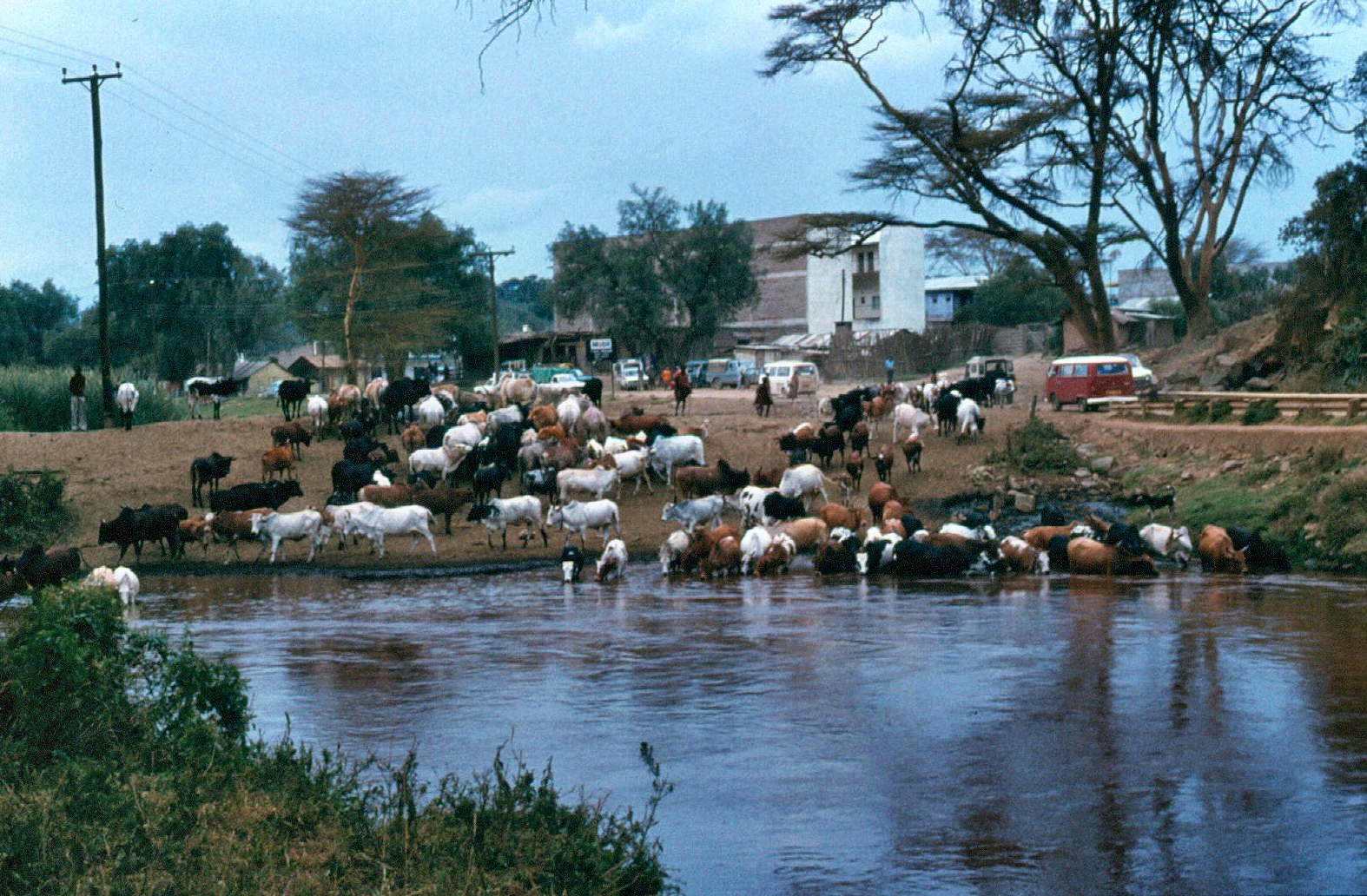
Going out of Narok. Maasai cattle drinks at the dam while the traffic goes by. Note the red VW kombi, the dominant minibus at the time.
During the first three or four years the VW kombis were the kings of the tourist minibuses and there were hundreds of them moving people to and from Nairobi so spares and service were available all over. Incredibly, later, VW introduced a new model and it was immediately apparent that it had a few shortcomings. Its large back doors kept opening and even bending so the owners resorted to welding them all around to avoid the problem with the result that loading them became a challenge!
We had a first-hand experience with one of those new models when we were following it at a distance to avoid the dust. At some stage we saw its right back wheel starting to separate from the car! We slowed down expecting a serious accident, but the wheel continued parallel to the car.
We then noted that the wheel had the axle attached to it still and this saved the car from a more serious accident giving it some stability albeit precarious. We hooted and made light signals but the driver did not stop and, eventually wheel and axle went their own way, and the minibus entered the bushes and came to an abrupt stop!
This was the beginning of the end of the VW domination and the start of the Toyota and Nissan era!
But not only the new VW kombis suffered from the “open backdoor syndrome”, we did too! It happened once we were returning from the reserve in our Land Rover and suddenly, we felt a welcome breeze, quite an improvement from what the small windows and front vents provided.
It was not until most of our cargo had gone that we noted that our -rather wide- backdoor was open. Perhaps we had driven two hundred metres like but it was sufficient to offload most of our belongings, including our cool box, tent, chairs, sleeping bags and personal luggage that rested in the middle of the road. Luckily no cars were coming behind us and we managed to pick up all the stuff. We needed a new cool box though!
Unfortunately, during the same journey when perhaps we were in a hurry or more casual than usual, we also lost our double mattress that “flew” from the roof. That was a great loss as it had been specially cut to fit within the roof rack if you wished to sleep in the first floor during hot nights. We only noted its absence after we arrived home and I am sure that there was a happy Maasai couple that slept comfortably from then on!
Another inattention led us through a more interesting situation. While driving during the rainy season, as we were prone to get stuck and also to find people stuck, we always carried a thick jute rope that, depending on its last use, it would be tied up either to the front or the back of the car and rolled up there as it was usually very muddy and also it occupied lots of space inside our short Land Rover.
Somehow, during one of our game drives the rope, that at the time happened to be at the back, became undone and, inadvertently, we were dragging it behind the car. We would have discovered this in due course but as it happened, a third party did it before us!
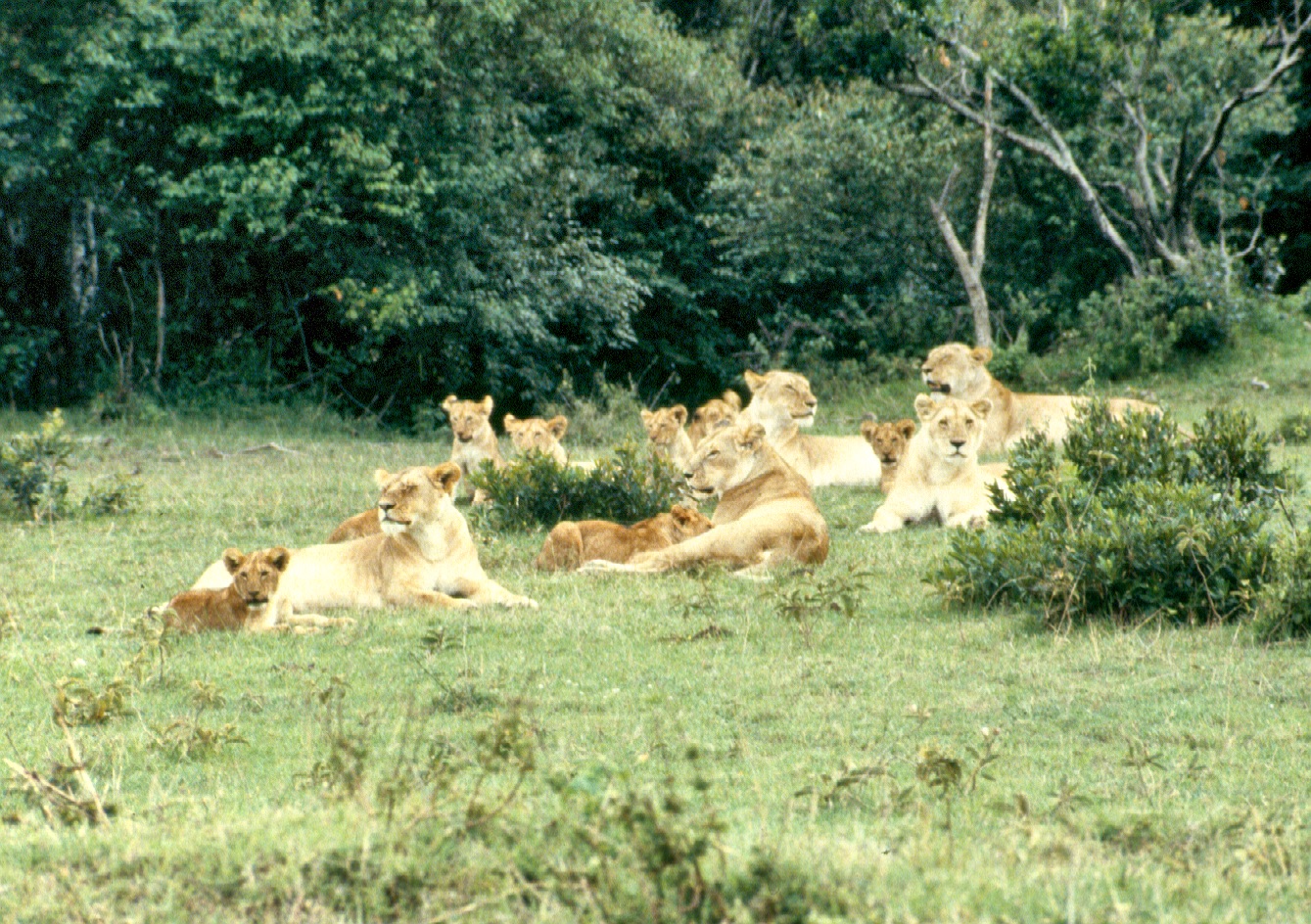
A lion pride, similar to the playful one.
The pride of lions we found resting around a termite mound, like pussycats do, unusually, started following our car. Things started to unravel when a few seconds later we felt a light jerk and, when we stopped we could see that about four or five cubs and three lionesses had grabbed our rope and were busy trying to kill it while being dragged by us.
Trying to free ourselves, we stopped and re-started but the lions, clearly in a playful mood, still held on! With no other option, as we were not going to get out of the car to chase them off, we continued driving slowly for a while with them behind until they started leaving the rope to return to their friends that had not bothered to leave their resting place.
The abundance of lions offered good opportunities to watch them hunting, either spectacularly chasing their prey or setting up ambushes and waiting for the possible victims to walk past. Sometimes their job was made easy by the victims’ accidental contribution.
One early afternoon we witnessed an unexpected kill while watching one of the large prides resting. Most of the lions were snoozing or just resting under the shade when suddenly we saw that some lionesses stirred and instantly they were fully alert before we knew what was happening.
Scanning the area, we saw a young warthog running towards the lions, unaware of their presence until it found itself among them and, by then, it was too late. Although the lions had eaten, they could not resist a chase and a couple of lionesses went for it. As the warthog was coming at a speed, it managed to avoid the attackers by swerving around them as these animals are very fast on short runs and the lionesses were full of meat.
Unfortunately for the warthog, after managing to cross a rather large pride it almost bumped on a large male lion that all it had to do to catch it was open its mouth! That was the end of an intrepid but careless warthog.
While on the subject of warthogs, we loved them running with their tails up as if having radio aerial to keep in touch with each other! As it sometmes happens, driving through a narrow track we surprised a family of warthogs that crossed in front of us. Unfortunately, one of the piglets (despite having its antenna up!) got separated from the others and started running on the other side of the road trying to reunite with its siblings.
We stopped to let it do it and then we heard a rather loud “swooosh” and saw the huge shape of a Martial Eagle coming straight and fast towards the separated youngster. The eagle hit the piglet with its talons and held on to it while the poor victim squealed and squirmed trying to get away. Then the eagle tried to take off and flew a few metres with its prey but it soon dropped it. The piglet hit the floor running in the direction where we had last seen its family. The eagle did not chase it but I guess that the unlucky warthog could not live too long after such an attack.
The opportunism of the eagle still amazes us. It must have been watching the warthogs either from a nearby tree or flying above them when the incident happened.
It is well known that cheetah -due to the need to see where they step when they reach high speeds- are diurnal hunters. The Maasai Mara offered them perfect ground to reach their top speeds while chasing their favourite prey ther, Thomson’s gazelles. We did find cheetah sometimes and were lucky to witness a couple of chases, one of which ended successfully.
This particular cheetah was a female and, after strangling its prey and resting, it started to emit high pitch calls that were answered by the arrival of two very young cubs that she allowed to play with the dying gazelle and, after a while, the female killed it and started to feed. It ate quite a bit of the hindquarters and only then allowed its cubs to try it although I think they were still too small to eat too much meat.
After a while of watching the trio we noted the approach of a large spotted hyena, clearly attracted by the commotion and the smell of death as it usually happened there. Clearly the hyena was stronger than the cheetah and its cubs were also at risk.
We expected the cheetah to yield and move away as it had eaten a good part of the animal already. It did not happen! Following some signal from their mother, the cubs vanished, and the cheetah stayed to face the intruder. We feared for its life as the hyena was clearly stronger and appeared determined to fight. Amazingly, the cheetah almost doubled its size as it bristled. Then, the new “super cheetah” went for the hyena.
As the hyena did not retreat, a prolonged face-off over the half-eaten gazelle followed but the cheetah would not back down either. Finally the hyena decided that what was left of the prey was not worth it and scampered off. Once alone, the cheetah returned to its normal size again, called its cubs and resumed feeding on the gazelle until most of their hindquarters, its richest part, were gone.
At that time in the Maasai Mara there was good “bush solidarity” and people would exchange information on their sightings. I confess that at first we relied a lot on the tourist vehicles from the various lodges to find game without asking them and by following them at a prudent distance.
As we started to learn our ways we gradually stopped this practice but we kept finding very helpful people that gave us great information. The Manager of the Mara Buffalo Camp was a good example. Apart from letting us camp in the area and use the lodge “facilities”, he was also a good source of information.
Through him we learnt that a female leopard had come to inhabit in a rocky gorge nearby. The animal was, unusually, very relaxed and allowed vehicles to approach her. The Manager, very excited about the find, asked us to follow him to show us where it lived and we obliged. We found it rather easily and from then on “Leopard gorge” as we called it became a constant feature of our trips to Intona ranch as, invariably, we would do the detour that went through the gorge to see if we could spot the leopard.
After a while the leopard disappeared and we did not see it until, a fortuitous encounter with Jonathan Scott at Kichwa Tembo. Exchanging news, he told us that he was following a female leopard with cubs and explained where to find it. “In any case”, he said, “if you miss her, you will spot my car!”
A few days later, we found Jonathan’s green Land Cruiser before we could spot the leopard and then, nearby, we spotted the three leopards. The mother was putting up with her bothersome cubs and their rough play. The cubs were still very young and rather dark, and they enjoyed climbing rocks and trees in a never-ending active mood. I took all the pictures I could and soon run out of film!
After a while we needed to continue our journey to so we went to thank Jonathan for such a great tip. I made a passing comment of how great it was to watch the animals and that I had taken lots of pictures. His reply clearly marked the difference between a real pro and an amateur like me “I did not take any today because the light is not right”. I kept quiet and eventually bought his great book on the leopard [4] to enjoy the pictures I could never had taken but with the nice feeling that we knew both, author and subject!
While on the issue of the rare observation of leopards we did have another close and surprising encounter. With our friend Luis, we had been driving over the plains for a while when we decided to stop for a rest and a bite. So, we parked under a nice tree near a rock ledge and we were eating when an agitated driver of an open safari vehicle came to tell us that we had stopped under a sleeping leopard! We checked and, effectively, it was resting above us. Luckily it had ignored the three large monkeys sitting, eating, drinking and talking below.
So these was a collection of brief observations and experiences we went through during our many visits to the fringes of the Maasai Mara and the reserve itself. More lengthy adventures follow soon.
[2] Southern Africans say, with a tinge of jealousy, that animals seem to be tied to pegs on the ground, so visible they are compared with their game watching in the “jesse”.








 A Bushsnob out of Africa