Bush stories and anecdotes

The heart of the blog, where I present observations, accounts, funny stories, etc.

KHANGAS. A contribution from my friends “Pinkshade” and “Khanga”

A few words about khangas

What it is:  As it is known nowadays, the khanga (or kanga) is a typical East African cloth (150 cm wide by 110 cm long) made out of light and colourful fabric (cotton or synthetic). It shows a wide border (pindo) all around, a symbol (small motif repeated or big motif alone, or both) in the middle area (mji) and it is usually bearing a kiswahili saying (jina), or not. It is normally sold by pairs (doti) and is mostly worn by women.
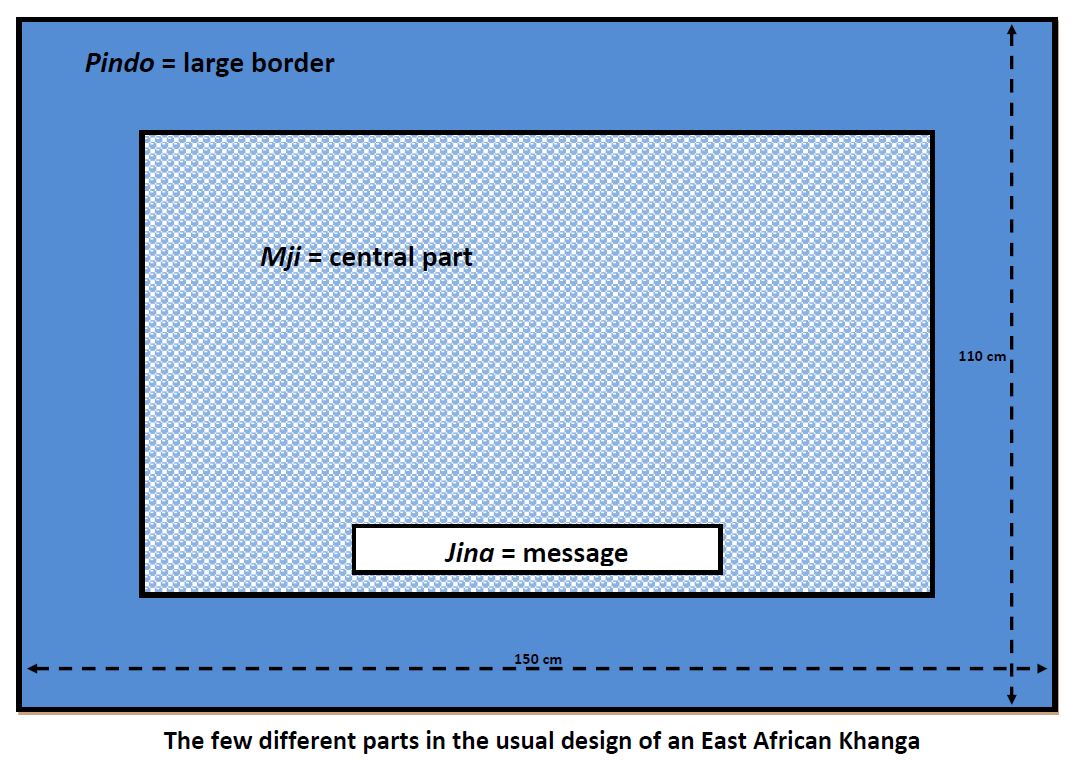
There are many ways to wrap it around (Jeannette Hanby & David Bygott, “Kangas – 101 Uses” 1984). They can also serve in multiple ways: as baby carriers, head wraps, aprons, pot holders, napkins, towels and much much more, like for covering shoes, handbags and so on… Its designs can be representative or geometrical, or both together and its price always stayed low so that anyone can afford it. The extremely light khangas are called “nyepesi”, and are very good in hot weather.

It’s history: They originated in the midst of the 19th. century and were distributed along the East African great lakes and sea shores. One of the most ancient design is the Khanga Kishutu that was usually offered to young brides (see khanga N° 27). Khangas have much evolved since they appeared. Designs and fabrics have changed as to adapt to different contexts. At the beginning of the 20th. century, Kaderdina Hajee Essak, also known as “Abdulla”, started to create designs and marked them “K.H.E. – Mali ya Abdulla”. He often added a proverb in Kiswahili. It became common then to have a message which could be religious, political, promotional, historical or philosophical. It is a short sentence presented like a proverb or a motto and which can have different meanings. The more mysterious or ambiguous the better! The first khanga designs mostly included dots in the middle area. So the khanga’s name may come out of the African guineafowl (called khanga in kiswahili) which has many little dots on her dark plumage. Some people say that it might also come from the bantu verb “kanga” which means to wrap! At first the khangas were designed and printed mostly in India, then in the Far East and Europe. But since the 50s, Tanzania and Kenya developed their own manufactories. For example in Kenya: Mountex in Nanyuki, Rivatex in Eldoret or Thika Cloth Mills.

“Apart from its protective and decorative role, a khanga is all about sending a message. It is the equivalent of the get well, greetings, or congratulations cards in the western culture but in this case the message goes a little bit beyond the normal meaning. For example, a fruit, a flower, a boat, or a bird could mean good upbringing or just the appreciation of beauty. On the other hand, a lion, a shark, or any such kind of dangerous animal could signal the sense of danger or a clear warning.” Quotation found in “Swahili language and culture” – http://www.glcom.com/hassan/kanga_history.html

More information (history, culture, uses and examples):

https://en.wikipedia.org/wiki/Kanga_(African_garment)

http://www.glcom.com/hassan/kanga_history.html

https://kabatilakanga.wordpress.com/2017/01/28/kanga-kisutu/

Jeannette Hanby & David Bygott, from “Kangas – 101 Uses”, 1984, Kibuyu Partners, kibuyu@yahoo.com.

Why collecting khangas?

Attraction to them: Khanga, PinkShade’s mother, acquired her pseudonym because of her demonstrative and exultant love for khangas, both the guineafowls and the pieces of fabrics. I must say that she always cherished fabrics a lot and used to buy some all over the world and include them in her household. So when she discovered these East African cultural jewels, she enjoyed them very much because they express a joyful way of life, with beautiful designs, enriched by the sayings which are like enigmas challenging us to discover their meaning. For her first visit in Kenya, I offered her very first one, N°4, which says “SAHAU YALIOPITA”, meaning “forget about the past”. It was particularly accurate as she had just become a widow a few months before. Impressed by that significant gift, she couldn’t prevent buying a few different ones in every place where we brought her to.

Surprising observation: At the end, when I noticed at her home a full drawer stuffed with bright colors, I realized that she managed to collect about 25 different designs, in only 3 short stays in Kenya. Not talking of the other khangas, coming from Tanzania, Madagascar and other countries.

Recalling and sharing: Knowing that the British Museum had a collection of about 12, I thought that it wasn’t that ridiculous at all to make a little catalogue of her Kenyan textiles showing a picture of each, with some short references. She immediately asked to combine them with mine. But see, there is some funny inversion as I hardly have 7 of them, after having stayed in the country for about 4 years! And on top of that I bought only 5 of them. One was offered by a dear friend (the precious kishutu one, N°27) and the red, white and black one with nice palms (N°17), by my dear mother ! Anyhow, altogether it makes 30 khangas. Each of them folded in 5 and piled up all together, they reach about 48 cm high, not speaking about the weight which rises up to 6 kg!

Conclusion: Now back home in Europe, we both think we miss the khangas so much, the richness of their diversity and their faculty to evolve according to events and fashions… so when do we set off and try to find some more?

Pictures and explanations of a collection of 30 khangas belonging to Pinkshade and Khanga follows and I hope you will enjoy them as much as I did. At the bottom I include a link to a PDF file where you can watch the original work from where I have adapted this post.

So, here there are for you to enjoy!
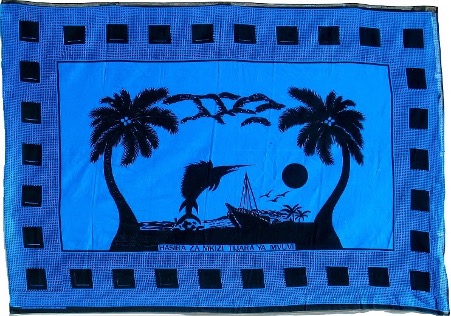
HASIRA ZA MKIZI TIJARA YA MVUVI

The anger of the cuttlefish is the gain of the fisherman

La colère de la seiche fait le bonheur du pêcheur

DESIGN N° 01-2479 MADE IN KENYA

Khangas which come in dark blue colour are normally called “kanga za magharibi” (dusk kangas)

Main subject: a swordfish and a dhow between two coconut trees

Owners: Pinkshade (P) and Khanga (K)
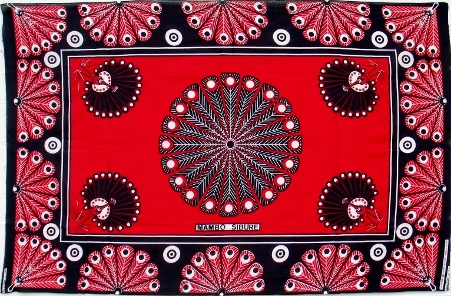
MAMBO SIBURE

Things don’t happen by chance

Rien ne se produit sans raison

or/ou

Things don’t look as they are

Les apparences sont trompeuses

N° RR 15187 RIVATEX ELDORET MADE IN KENYA

MALI YA ABDULLA R/K1? (5 or 9)

Main subject: Peacock

Owner: K

TULIZA ROHO YANGU

Breathe my soul

Eveille mon âme

DESIGN N° 01-2490 MADE IN KENYA

Main subject: Coconut tree

Owner: K
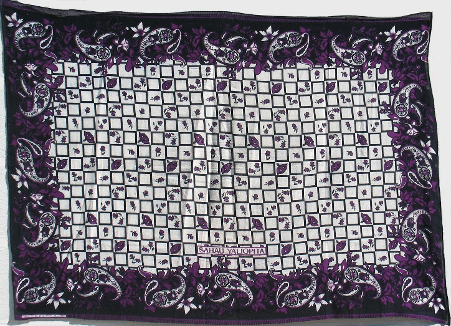
SAHAU YALIOPITA

Forget about the past

Ne te préoccupe pas du passé

DESIGN N° 01-2470 MADE IN KENYA

Border including paisleys

Owner: K (gift from P)
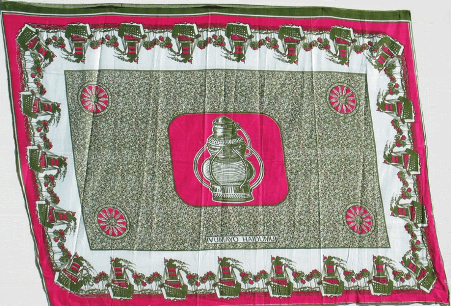
IVUMAYO HAIDUMU

What roars does not last / What is famed does not last

Le succès perdure rarement

No references found… bought in Mombasa

Main subjects: Lantern and boats

Owner: K
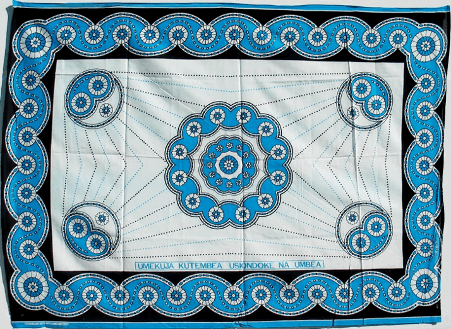
UMEKUJA KUTEMBEA USIONDOKE NA UMBEA

You came to visit us, don’t leave with gossip

Tu es venu nous rendre visite, ne repars pas avec des ragots

DESIGN N° 06-3687 MADE IN KENYA

Main subject: Flowers

Owner: K
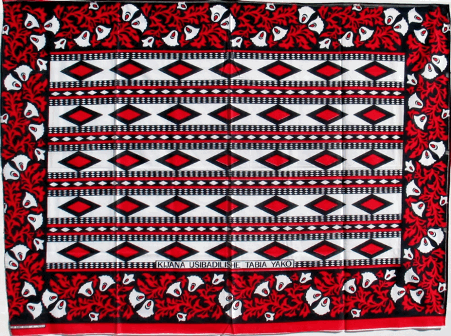
KIJANA USIBADILISHE TABIA YAKO

Young girl, do not change your behaviour!

Jeune fille, ne te laisse pas influencer!

DESIGN N° 01-3425 MADE IN KENYA

Geometrical and vegetation inspired

Owner: K

HASIDI JENGA SHULE SABASI ASOME

Jealous persons are building a school where hostility can be learned

Les gens jaloux créent une école où l’on peut apprendre l’hostilité

N° 06-3898 MADE IN KENYA

Main subjects: Cashew nuts and paisleys?

Owner: K

USIMUUTHI AKUPENDAYE

Do not envy the one who loves you

Ne sois pas jaloux de celui qui t’aime

DESIGN N° 01-3076 MADE IN KENYA

Main subject: Flowers

Owner: K

①⓪

SI MZIZI SI HIRIZI BALI MOYO UMERIDHI

If no roots, no charms, at least a heart you possess

Si tu es sans famille, sans beauté, il te reste néanmoins un cœur

N° RR 15934 RIVATEX ELDORET MADE IN KENYA

R/ 190K.H.E. REGO. (MALI YA ABDULLA) MOMBASA

Main subject: mixed paisleys and flowers

Owner: K
①①

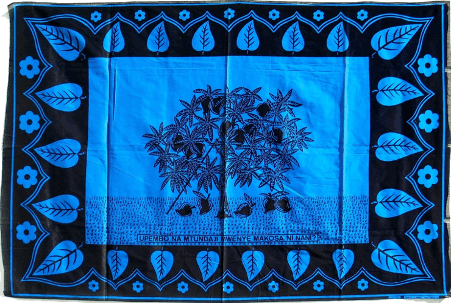
UPEMBO NA MTUNDAJI MWENYE MAKOSA NI NANI ?

Love is the reaper of who is at fault?

L’amour fauche celui qui est en faute ?

N° RR-15197 RIVATEX ELDORET MADE IN KENYA

Khangas which come in dark blue colour are normally called “kanga za magharibi” (dusk kangas)

Main subject: Mango tree

Owner: K
①②

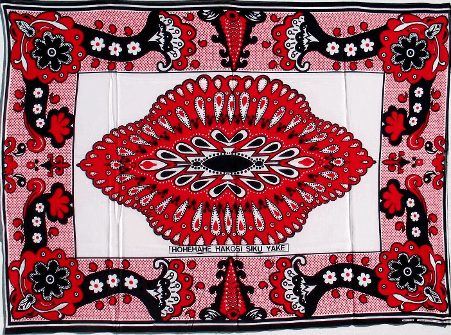
HOHEHAHE HAKOSI SIKU YAKE

There are more than enough voices in this world (?)

Il existe au monde plus d’avis qu’on ne puisse entendre (?)

or/ou

There will always be a lucky day for the lazy loiter, do not miss this day!

Il y aura toujours un jour de chance pour le paresseux, ne manque pas ce jour !

N° RR 15366 RIVATEX ELDORET MADE IN KENYA

Inspired by vegetative subjects

Owner K
①③

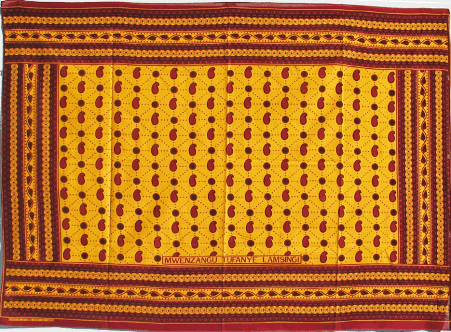
MWENZANGU TUFANYE LAMSINGI

Dear friend, let’s build together strong foundations

Cher ami, tissons de solides liens

DESIGN N° 01•2686 MADE IN KENYA

Main subject: Cashew nuts?

Owner: K
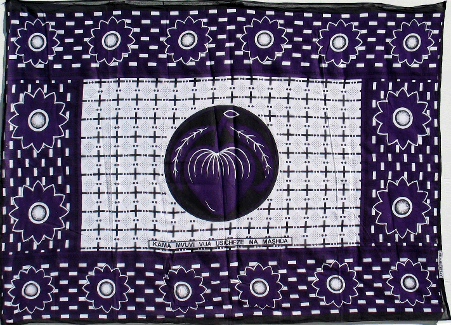
①④

KAMA MVUVI VUA USICHEZE NA MASHUA

If you are a fisherman, fishes won’t play with your boat

Si tu es un pêcheur, les poissons ne joueront pas autour de ton bateau

ou

Comme on fait son lit on se couche !

ATLAS.D.N.4159.

Main subject: Fruit? Cherimoya?

Owner: K
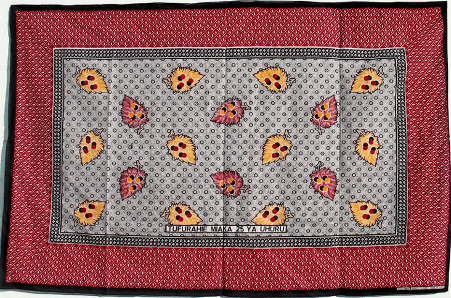
①⑤

TUFURAHIE MIAKA 25 YA UHURU

Let us celebrate 25 years of freedom

Fêtons 25 ans d’indépendance

N° RR 15882 RIVATEX ELDORET MADE IN KENYA

This model is part of the British Museum collections

It was created in 1988 to celebrate Kenya’s independence

Main subject: White mulberries?

Owner: K (doti)
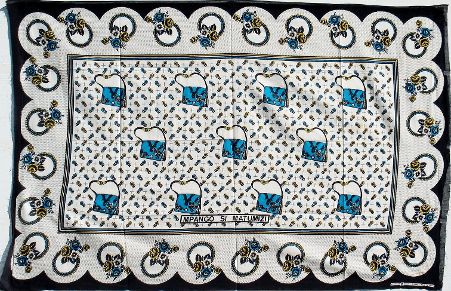
①⑥

MPANGO SI MATUMIZI

The plan has not been applied

Le plan n’a pas été mis à exécution

N° RR 15818 RIVATEX ELDORET MADE IN KENYA

Main subject: Handbags

Owner: K
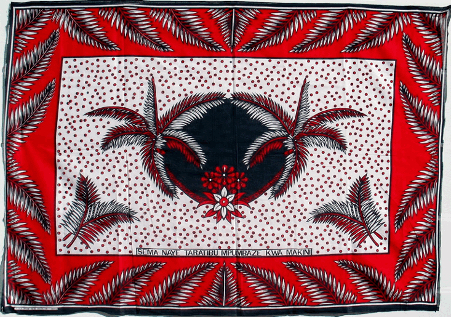
①⑦

SEMA NAYE TARATIBU MPUMBAZE KWA MAKINI

Talk to them calmly and attentively

Parle-leur calmement et attentivement

DESIGN N° 06-3910 MADE IN KENYA

Main subject: Palm leaves

Owners: K and P (split doti!)

①⑧

MIMI NA WEWE HATUACHANI

Me and you are bound together

Toi et moi sommes inséparables

MOUNTEX NANYUKI KS 200

Main subject: Flowers

Owner: P (doti)
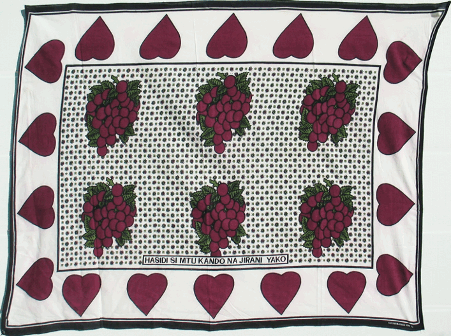
①⑨

HASIDI SI MTU KANDO NA JIRANI YAKO

A jealous person is never far from your neighbour

Il peut toujours se trouver quelqu’un de jaloux dans ton entourage

MOUNTEX NANYUKI KS 209

Main subjects: Grapes and hearts

Owner: K

②⓪

DUNIYA NI MATEMBEZI

The world is about walking, seeing and learning

Découvrir le monde, c’est marcher, observer et apprendre

ou

Les voyages forment la jeunesse

N° RR 15835 RIVATEX ELDORET MADE IN KENYA

MALI YA ABDULLA 134

Main subjects: Seaweeds?

Owner: K

②①

NAPENDA LAKINI NASHINDWA

I would like but I am unable

Je voudrais bien mais je ne peux pas

DESIGN N° 01-2226 MADE IN KENYA

Khangas which come in dark blue colour are normally called “kanga za magharibi” (dusk kangas)

Main subjects: Orange tree and cashew nuts?

Owner: K

②②

USINICHUKIE BURE

Do not discriminate me for nothing

Ne me discrimine pas en vain

N° RR 15225 RIVATEX ELDORET MADE IN KENYA

Main subjects: Pineapple and mulberries?

Owner: K
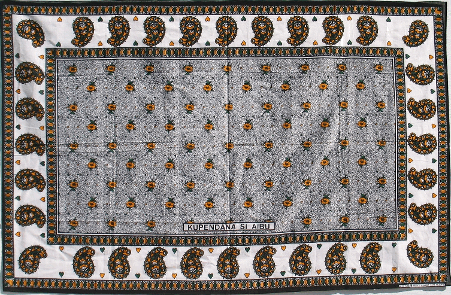
②③

KUPENDANA SI AIBU

Those who love one another do not feel ashamed

Il n’y a pas de honte pour ceux qui s’aiment

N° RR 15865 RIVATEX ELDORET MADE IN KENYA

Border including paisleys

Owner: K

②④

AJIDHANIYE AMESIMAMA AANGALIE ASIANGUKE

Who thinks to stand firm should be careful not to fall

Celui qui se croit solide doit veiller à ne pas faiblir

DESIGN N° 01 3064 MADE IN KENYA

Main subject: Sunflower

Owner: P (doti)
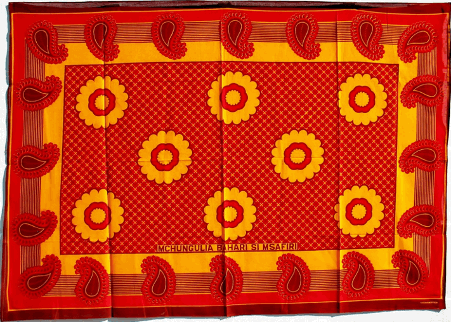
②⑤

MCHUNGULIA BAHARI SI MSAFIRI

Who only looks at the sea is not a traveller

Celui qui ne fait que regarder la mer n’est pas un marin

or/ou

Dreaming is not enough, acting is necessary

Rêver ne suffit pas, il est nécessaire d’agir

MOUNTEX NANYUKI

Border including paisleys

Owner: K

②⑥

USISAHAU IBADA

Don’t forget to worship

N’oublie pas de prier / N’oublie pas de vénérer

N° RR 15468 RIVATEX ELDORET MADE IN KENYA

Khangas which come in dark blue colour are normally called “kanga za magharibi” (dusk kangas)

Main subject: the Taj Mahal !

Owner: P

②⑦

N° RR 15165 RIVATEX ELDORET MADE IN KENYA

ANCIENT DESIGN KISHUTU

This khanga is said to have one of the oldest and most well-known designs. Called “khanga kishutu” it was traditionally worn on the East African Coast and Zanzibar by a bride on her wedding day. The design usually comes without a saying although sometimes it appears with a saying at the bottom.

The red-black-white ones like this one are called “khanga kishutu cha harusi”.

There is a blue version which is more popular in Mombasa.

This model is part of the British Museum collections

It somehow reminds of certain carpets designs

Owner: P (gift from a dear friend)

②⑧

USINILAUMU BURE

Do not blame me for nothing

Ne me blâme pas en vain

DESIGN N° 06-3462 MADE IN KENYA

Main subject: Pineapple

Owner: K

②⑨

NIVISHE NILISHE UKISHINDWA NIRUDISHE

Dress me, feed me but If you cannot, return me

Si tu n’as pas les moyens de m’entretenir, oublie-moi

N° RR 15901 RIVATEX ELDORET MADE IN KENYA

Main subject: Flowers

Owner: K
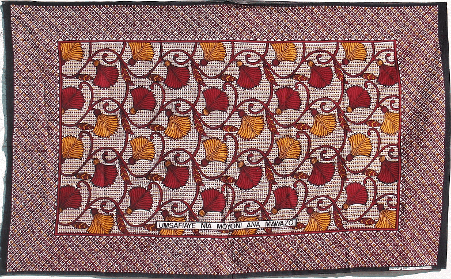
③⓪

UMSAFIAYE NIA MOYONI ANA MAWAZO

Those who have good intentions at heart (first) may have other thoughts later

Ceux qui ont de bonnes intentions au départ peuvent développer d’autres pensées

N° RR 16065 RIVATEX ELDORET MADE IN KENYA

This design looks like “Art Nouveau” style

Owner: P (doti)

[1] She chose “Khanga” as her pseudonym because of her fondness for these cloths.

This post is based on a brochure prepared by Khanga and Pinkshade. Here is a link to it:
Suicide season

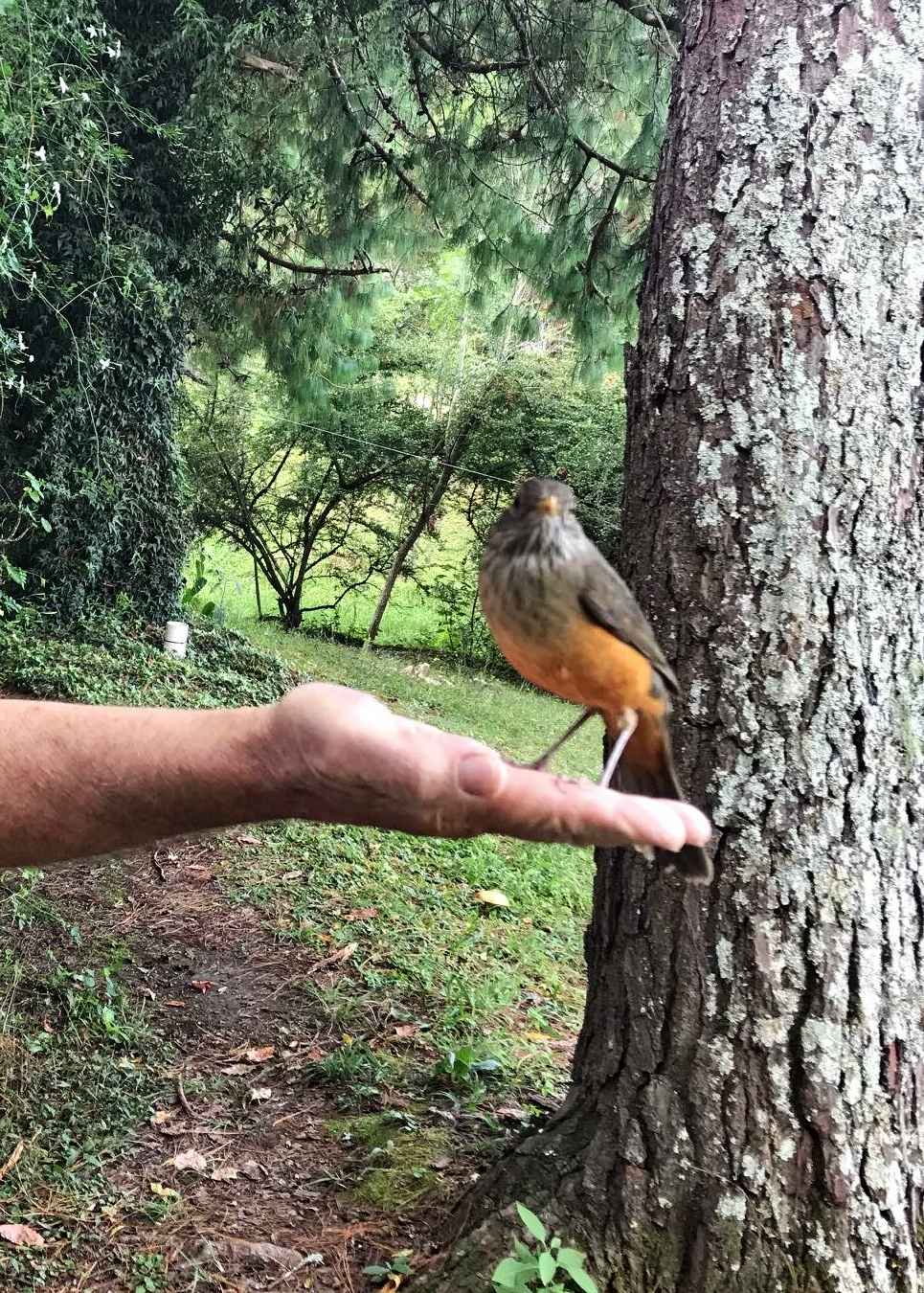
The Rufous-bellied thrush (Turdus rufiventris) is a songbird that occurs in most of eastern and southeast Brazil (where it is the national bird), Bolivia, Paraguay, Uruguay and central and northern Argentina. While in Uruguay they are known as “zorzales”, here in Salta they are called “Zorzales chalchaleros” or just “Chalchaleros”. While the English name for the species describes its distinctive reddish-orange underparts, the vernacular name in Salta reflects its preference for feeding on the fruits of a tree known as Chal-chal.

The Rufous-bellied thrush -very similar to the African Olive thrush (Turdus olivaceus)- occurs in different habitats (forests and urban treed areas) and it is common around rural houses where its song is one of the pleasures of rural living. An omnivorous bird that prefers arthropods and fruit it can eat broken maize during our dry winter season when food becomes scarce. As I mentioned earlier, one of its favourite fruits are produced by the Chal-chal (Allophylus edulis)[1].

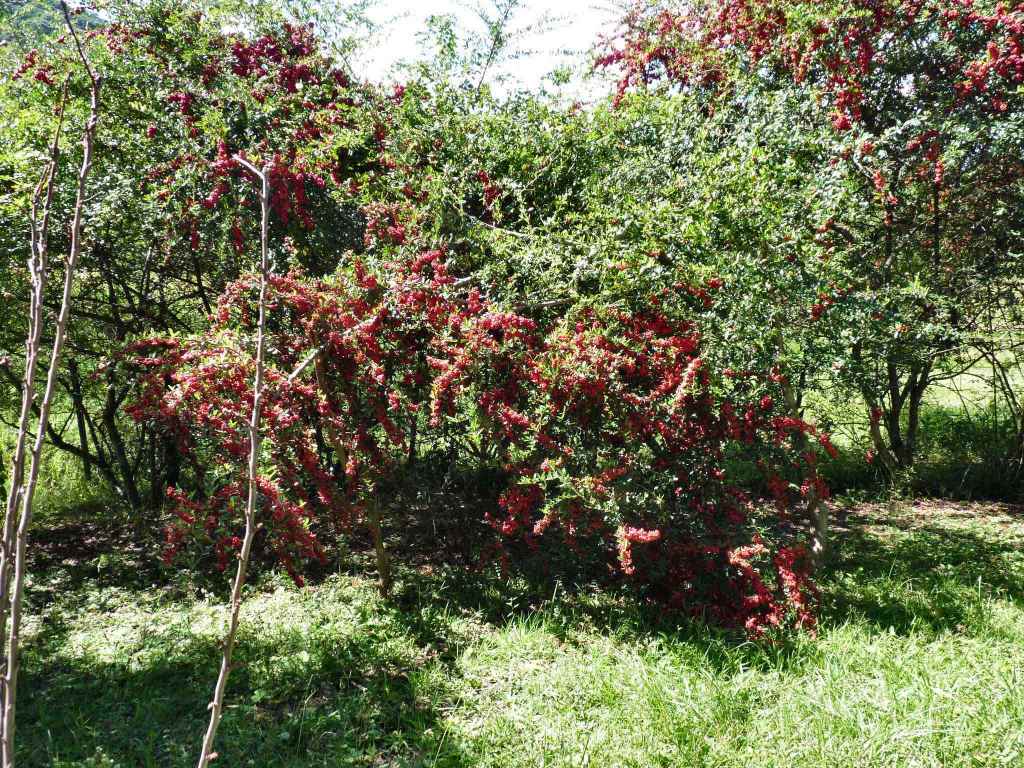
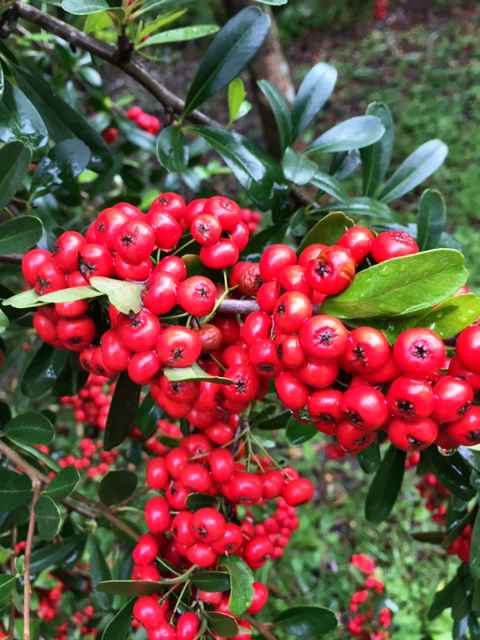
We do have Chal-chal trees in the farm but not close to the house. However, about ten years back we planted a row of Hawthorn bushes (Crataegus spp.) to act as a wind-breaker against the predominant eastern winds that often blow in this latitude. This resulted in a rather unexpected high wall of trees that not only help to stop the wind but also yield what I estimate to be several hundred kilogrammes of red berries, towards the end of the summer months.

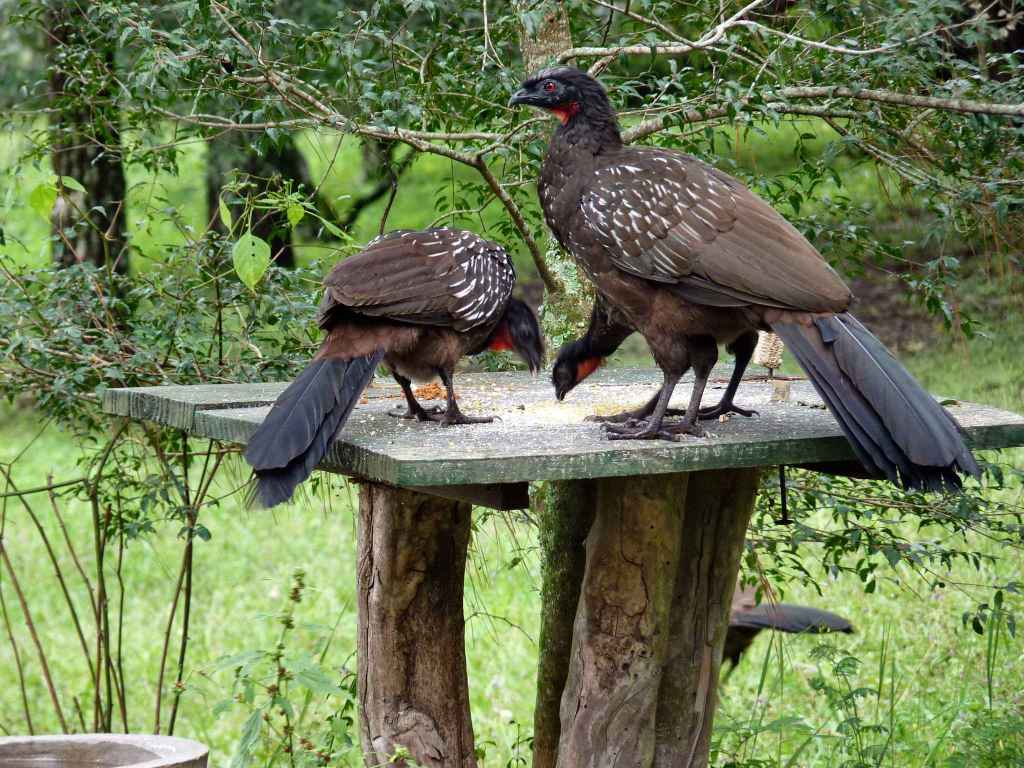
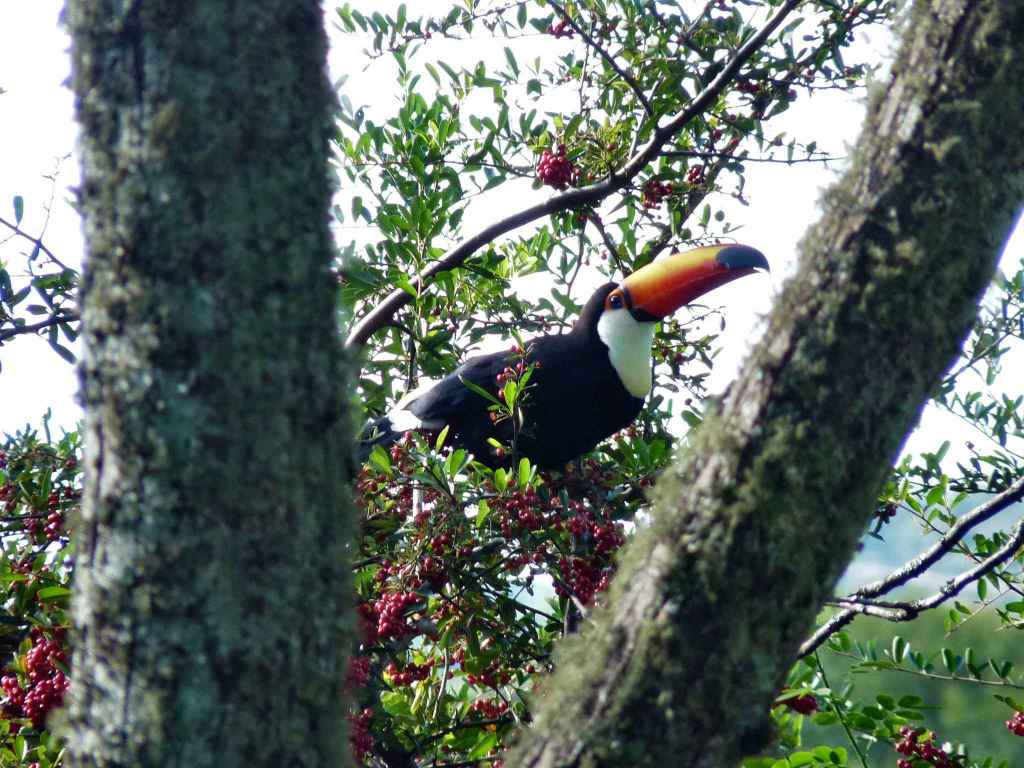
This plethora of fruits attracts a number of birds that include the large Dusky-legged guans (Penelope obscura), Chachalacas (Ortalis canicollis), Toco toucans (Ramphastos toco), Blue-and-yellow tanager (Rauenia bonariensis) and Sayaca tanager (Thraupis sayaca). Although the latter are rather spectacular, the most common birds that come to feed on the hawthorn are the Rufous-bellied thrushes. We probably have a few dozens of them constantly moving to and from the red berries.

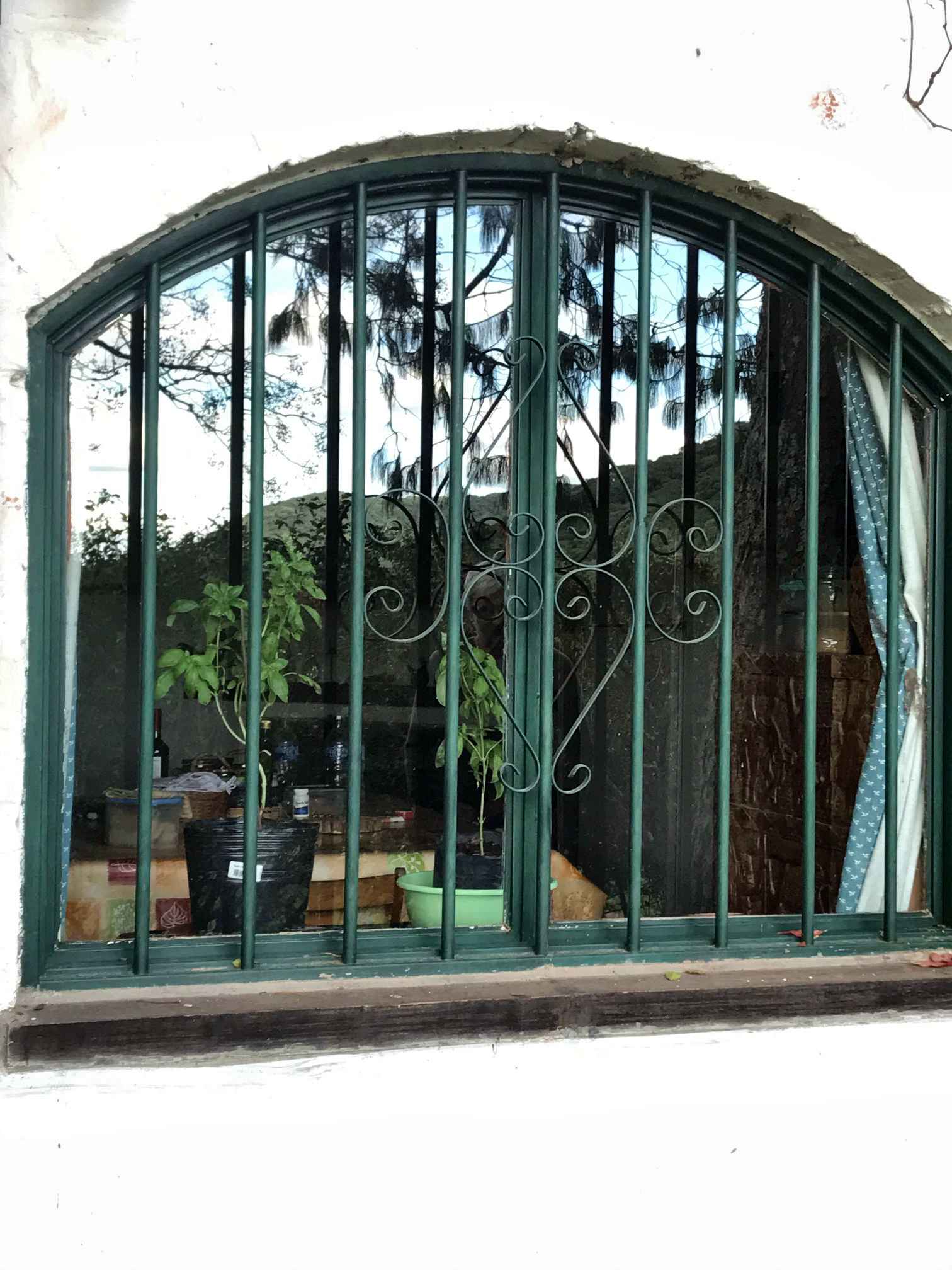
Year after year, the resulting thrush heavy and uncontrolled air traffic causes casualties announced by loud bangs coming from our only large east-facing window in the house (that also faces the row of hawthorn trees about twenty metres away). Usually, about two or three thrushes (no other species do this) either die or get stunned after heating the glass. So far we have accepted this as an unavoidable consequence of the increased number of birds brought about by the abundance of food.

The offending window showing the reflection of the surrounding garden.
A stunned thrush after crashing.
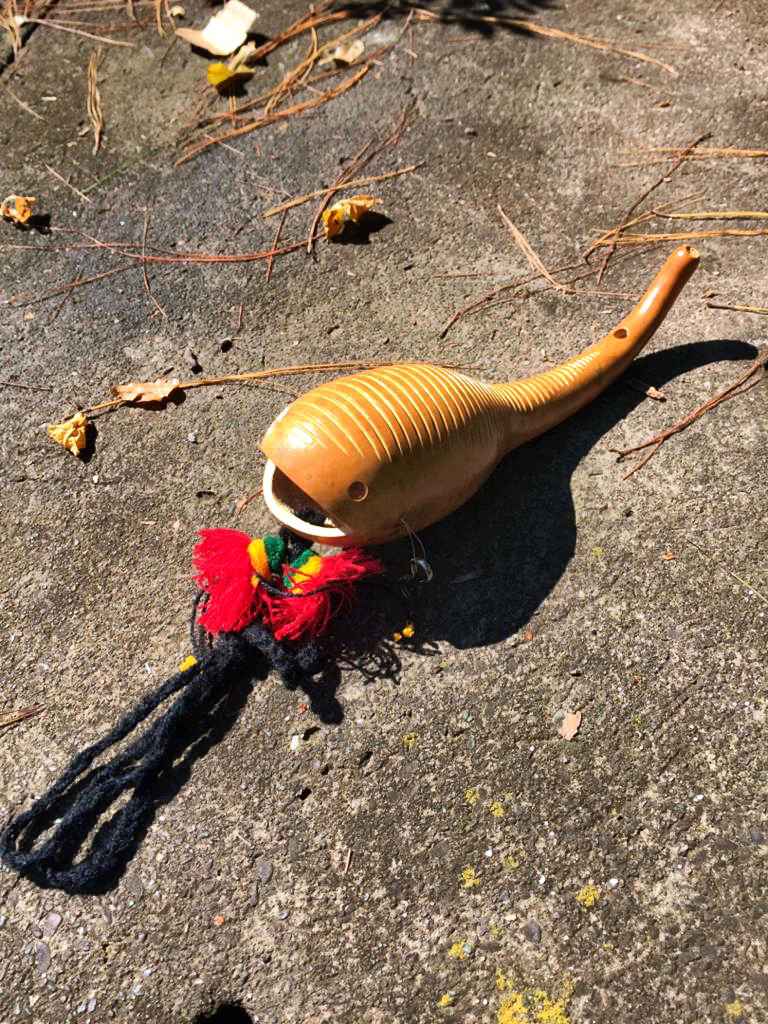
Sometimes the thrushes came at such speed that they broke through the mosquito screen as shown here by the Bolivian guiro (a musical instrument).

This year, however, the suicides (birdicides?) reached alarming levels and yesterday we had four hits (three dead and one recovered), a rather alarming number! Although the first bird that hit during early morning recovered, a second one crashed about an hour later so we decided to do something about it.

I remembered having read somewhere that if you drew lines on the glass with a highlight pen, somehow the birds eyesight would see them from far and avoid the window. I drew the lines and, satisfied with my job I called Mabel to see it. The moment we were close to the window a bird nearly hit Mabel’s head and the loud thud indicated another fatal outcome! The fluorescent lines did not work so, do not try this at home!

So, “encouraged” by Mabel I placed a rather obstrusive zig-zag of flourescent yellow tape that occupied the top of the glass, at the area the sky was reflected. We decided that it was better to interfere with our view rather than nhaving more casualties!

The yellow tapes in place.

So, proud with my work but now tired, I went for my obligatory siesta (a pleasure of these regions!) to recharge my batteries.

When one hour later I woke up, Mabel was very upset as a fourth bird had killed itself!

In desperation and after some more thinking, we remembered that we had bought some bird netting to protect our fruits. We placed the netting in front of the window in a way that resisted me throwing the Bolivian guiro that was the closest to a thrush I could find for a test!

The Bolivian guiro itself.

Below I show you the netting and a video showing how we expect it to work.

A lateral view of the netting.

We believe that the deaths will stop now but our discussion has turned now to resove the reason that compels the birds to do this.

A couple of years back we thought that the birds could see a mirror that we have in front of the window and tried to fly through. As the birds continued hitting the glass when we covered the mirror, this idea was abandoned.

However, we are convinced that the birds see the reflection of the sky in the window and try to fly through.

The presence of predators, in particular the Sharp-shinned hawk (Accipiter striatus) make us also believe that it could chase the thrushes and the latter, trying to escape, bump themselves against the window. In favour of this hypothesis is that we have seen the hawk catching thrushes and other smaller birds around us. However, it is unlikely that the hawk would try to kill four birds the same day when one would be sufficient for a few days.

That leaves us with the last hypothesis that had been put forward by Mabel: the ripe fruits of the hawthorn ferment in their crops and their small livers are not able to process the resulting alcohol with the result that they get drunk! The fact that the berries are ripe now and likely to ferment faster, supports this hypothesis. In addition, after “googling” the idea, I found that at least one similar event involving the hawthorn and Cedar waxwings (Bombycilla cedrorumhas) happened in the USA [2] and other instances of drunk birds also exist [3][4].

[1] I did not find an English name for this species.

[2] S. D. Fitzgerald, J. M. Sullivan and R. J. Everson (1990). Suspected Ethanol Toxicosis in Two Wild Cedar Waxwings. Avian Diseases 34, pp. 488-490.

[3 See: https://www.washingtonpost.com/news/morning-mix/wp/2018/10/04/drunk-birds-are-causing-havoc-in-a-minnesota-town-police-say-theyll-sober-up-soon/?noredirect=on or https://time.com/5415378/drunk-birds-minnesota/

[4] https://www.ncbi.nlm.nih.gov/pmc/articles/PMC7071081/

Bad motoring start…

We settled down in our house and gradually started to discover Lusaka and its ways. Of course, walking in the city was not advised as there was a high risk of getting mugged. In view of the situation, a car was a must and we needed it fast. Renting a car was not common those days so we relied on “borrowing” a small project vehicle to do our necessary errands.

Northmead, a small shopping centre was quite close to our house and there we did most of our shopping at first. Although safe, we learnt to be very alert of our surroundings while parking at shopping malls as we heard a lot of stories about robbers lurking about. Soon, Mabel discovered other shopping options in both Woodlands and Kabulonga that we started to frequent as well.

At first, goods supply was erratic and poor. Although amusing in retrospect, it was not so when you faced it. A supermarket would have half of its shelves full of one make of toilet paper and the other half with rice while another one will be full of salt, toothpaste and cooking fat and so on. Sugar was impossible to get and people would drive to Mazabuka (Southern Province) to buy it in bulk from the sugar factory located there and then sell it at a high price in the open market or pass it on to friends.  

Because of the situation people were organized in groups whose members placed orders and took turns to do the shopping for the various items and then they would meet at a house and distributed the shopping. A cumbersome but effective system that also worked for meat and its sub-products such as ham and bacon that were obtained at a farm in Chilanga.

Fruits and vegetables were on offer at markets where people from different farms would be offering all sorts of produce, including milk and eggs that complemented the production from the small livestock kept in the houses. These markets were mostly operating on Saturdays and they were a great source of information about what was going on in the city.

So, although with more difficulties than usual, we managed to get by and, luckily, the situation started to get more normal after a few months of being in the country.

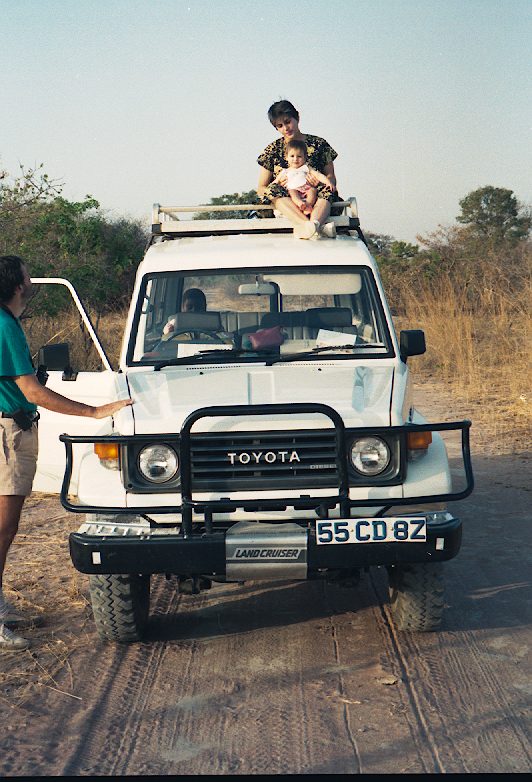
Clearly, a car was essential. After having a Land Cruiser in Ethiopia, we decided to go for a larger version: a long-wheel base hardtop, economic and resilient as well as roomy to carry our rubber dinghy, its engine and other needed items for our planned camping and fishing. A large car was a great decision as our family would start growing that same year and we planned to take our children with us at all times, regardless of their age.

Our new car on safari. Mabel and Florencia riding on the roofrack and Annie (our nanny) inside the car while Giuseppe looks on.

Buying a car in Zambia was not as simple as you may think. There was no internet and faxes were the new thing at the time, so you did not have the present-day advantage of buying online! At the time, although there were a few places that offered cars to be delivered fast, these were either of the wrong make or very expensive, so we did not pursue these options.

As in Ethiopia, we decided to place an order through the United Nations (UN) goods procurement agency. This process had advantages and disadvantages. Drawbacks included a three-month waiting time and the limited model choice together with the rather austere specifications of the UN vehicles [1]. This did not bother us but the low price that the UN was able to negotiate was too good to be ignored.

Zambia was still not trading with South Africa, so Durban was out of bounds. The same applied to Walvis Bay as negotiations for the independence of Namibia, that finally got its independence in March 1990, were not yet completed. Mozambique was still undergoing its civil war so both Maputo and Beira were not available! So, the car would arrive in Dar es Salaam, over 1,900 km North-east, a journey of about three days. Luckily, the system for such purchases was already in place as most vehicles imported into Lusaka (both official and private) would come through there.

After the three long months had passed, I got a fax announcing the date the car was due in Dar and from that time things started to move fast. I contacted the FAO Office where I was put in contact with Mr. Victor, the Senior driver, who would be in charge of bringing our car to Lusaka. He would fly to Dar with all the necessary documents, the needed cash and a hotel booking to be able to clear the car and drive it all the way back. Of course, I was to meet all expenses.

I took Victor to the airport and we agreed that he would let me know his arrival time in Lusaka so that I could meet him at home without stopping in Lusaka. This was an added precaution in view of the recent disappearance of a number of new vehicles from various international agencies.

The vehicles were somehow placed in containers and shipped by road to South Africa through what was some organized system that the Zambian authorities of the time could not (or wish not) stop. Interestingly, periodically, the South African police would recover some vehicles and the lists would be distributed among the various international agencies based in Lusaka, but I do not remember of any vehicle listed in them ever returned!

The day of the arrival of the car I stayed home to meet Victor, excited to be getting a new car. I heard the hooting at the entrance, and I was at the gate before Mr. Lemek (the gardener) could open it! It looked like a great car, so I followed it to the house parking area where I met a tired looking Victor and saw that the windscreen was cracked!

Trying to dissimulate my disappointment, I greeted him warmly but I could see that he was very worried and immediately started to apologize. I cut him short and told him that the journey had been very long, and he could not control where the loose stones present on the road would hit the car. Despite my remarks, he still looked very worried. It was then that I heard Mr. Victor saying “Sir, it also has a knock in the engine”. “What?”, I muttered, as if hit on the head with a hammer! He explained that he heard the noise from the first time that the engine started but he did not know what caused it. Again, aware that it was not his fault, I tried to minimize the problem while helping him to collect his belongings. I took Victor home and, honestly, my mind was racing on what to do next!

As soon as I came back, I started the car but I could not hear anything, so I tried to convince myself that it was not a serious issue. However, I phoned Toyota Zambia and they told me to bring it the following morning for them to inspect it. They also warned me that it would be difficult that they would accept liability for the problem as it had happened to a car that was not purchased through them. Additionally, they stated that the issue started in another country! A guarded reply that left me quite worried!

The following day I was at Toyota Zambia before it opened! Eventually I met Phillip (Phil), the Workshop Manager to who I explained my predicament. Luckily, he was a very reasonable man, so I started to feel better. He immediately brought the car to the workshop and tested the engine confirming that there was some abnormal engine noise. More checks made him suspicious of piston damage that would require opening the engine. My mood was somber again.

He must have seen my disappointment as he was quick to add that, after repairs the engine would still be as good as new adding that that engine was among the best engines Toyota ever made. He added that, before opening it, he would report the issue to his boss, the Toyota representative, and hoped that he would agree to do the work under the guarantee. However, Phil could not give me a positive answer until then.

I left the car at the workshop and waited for news while continuing with my project activities but still worried about the car. I waited for two days before Phil called and said that he had bad and good news. The latter was that the representative had agreed to cover all needed repairs under the guarantee. The bad news were that he had already opened the engine and the repair involved replacing a piston and other parts that I did not get. He also asked me to go to the workshop when I had time.

I dropped everything and went straight there. Phil showed me and explained what had happened. Trying to simplify things, the top ring in one of the pistons was “gapped too small”. Then, the heat of the engine caused its expansion and its ends run into each other. The ring pressure became too much for the cylinder and, with more heat, cooling was not sufficient and the piston head broke! Luckily, Phil said, he could find no damage to the inside of the cylinder. It was, he said, “a clear manufacturer error”.

The needed cylinders, valves and other smaller bits and pieces were ordered that same day and, amazingly, these were in Lusaka a few days later and the car was soon repaired and it run well for as long as we had it.

The phrase “every cloud has a silver lining” was true in this occasion as in many others. I got to know Phil and, later on, his wife Rosemary.  Phil retired a few months after I got my car back, but we kept our friendship alive until we left Zambia in 1993.

They lived in a lovely house in Woodlands extension, a leafy suburb a few kilometres from us where we spent a couple of afternoons watching his lovely fishpond that snaked through the garden adding a touch of colour from the koi and gold fish it had, an attractive feature for humans and cats alike. Rosemary and Phil kept several cats that were the children they did not have.

Depending on the weather we would sit in the verandah or on the lawn having a cup of tea with the traditional British scones. Rosemary served the tea and then sat at the piano to play classical music in a very British setting. The only difference was the good weather of Lusaka that, for me, made all the difference.

During his spare time with Toyota and more fully after retiring Phil repaired firearms, mainly from hunter friends and he had a well-equipped workshop. While visiting it Phil proudly showed me his patented invention: an ingenious adjustable chain wrench to remove any kind of oil and diesel filters. He was pleased that these were selling well.

He had also fitted his “bakkie” (pick-up) with another of his creations, a strong metal plate that would lock over the three pedals covering them completely making driving the vehicle impossible without removing it. I found the contraption an overkill and I teased him about it but he swore by it so, still learning about security in Zambia my jokes stopped!

Their kindness to cats was such that they were delighted to accept our offer of leaving the now quite elderlyTigger with them when we we left our elderly Tigger with them when we departed from Zambia [2]. We got frequent updates of our cat’s life until it died a couple of years later.

Rosemary and Phil moved back to the UK a few years after our own departure. Sadly, Rosemary passed away soon afterwards, but Phil managed to somehow adjust to the loss and to England. We kept in touch and we had the great pleasure of hosting him a few years later while we were living in Rome when we reminisced of our time in Zambia like two members of the “Whenwe” ethnic group [3].

[1] As an example, to get an air-conditioned car you required a strong justification endorsed by your country representative!

[2] Inky, our Siamese, had died earlier of kidney failure despite my efforts to keep her alive.

[3] People often start talking saying “When we were in Africa…” so, jokingly they (us included) are referred as “Whenwes”.

Reinforcements arrive

I do not recall the date, but it must have been March or April 1990 when I got up very early to go to the Lusaka airport for an important mission: to meet the first of the colleagues that would join the project. He was an Associate Professional Officer (APO) [1], called Bruno, a Belgian. He was arriving from his country on a Union de Transports Aériens (UTA) flight with a morning arrival time.

The day before I had managed to borrow one of the airport’s passes from FAO to enter into the luggage handling area, before the passengers entered Zambia. I also borrowed one of the FAO arrival signs, normally used by the drivers to collect visitors. I wanted to be absolutely sure to meet him, remembering my early Kenya arrival experience [2].

I was rather anxious because I was meeting a newcomer that would be critical for the project work and I did not know how we would get on. It would also be the first time in my career that I would have someone working with me in a project. He would also be bringing news from the FAO Headquarters, always useful information to get.

I arrived at the airport about one hour before the estimated arrival time, the pass worked and I went through security and stationed myself in what I thought was the most strategic place and I was sure not to be missed and I prepared to wait. The loud noise the “Jumbo” (Boeing 747) made landing at a relatively small airport clearly announced the arrival of the flight and soon the passengers started trickling in until the place was crowded as usual with people looking tired around the conveyor belt that, after a few minutes, jolted into life.

As usual, people started to get their suitcases and bags and walking towards the customs and exit. I waited, watching the flow while trying to spot my visitor before he spotted me! I had a few candidates in mind, and I kept watching. Conveyor belts are monotonous and often frustrating. This was the situation that day until two truly fluorescent bags, one rabid pink and another lemon yellow appeared and, for a while, distracted me but soon they were collected and it was back to the usual boring suitcase parade.

After about forty minutes the crowd thinned and, a few minutes later the hall was empty, the belt stopped, and the airport luggage handlers picked up the few suitcases that remained on the belt and took them away. No Bruno!

I had a good look around before leaving and confirmed that I was alone. Rather baffled I walked out, thinking what could have happened for him not to arrive. I walked outside the terminal heading for the car when I heard a voice behind me saying “ah, FAO!” Taken by surprise, I looked and saw a tall guy with a luggage trolley with the two fluorescent bags I had seen before: Bruno had spotted my FAO arrival sign. He was there after all and I was relieved!

He was not expecting me in the luggage hall but in the arrival hall, he explained and, not finding anyone in the latter, he thought that no one was meeting him and he was looking for a taxi to get to town. I took him to his hotel while talking about the country and the work that was expected from the project and from him as he would be in charge of the tick trial in Lutale, but more about that later.

Aware of the existence of the Zambezi River (although I had not seen it) I had purchased a Zodiac rubber dinghy (a very safe boat I was told) to be able to enjoy some river exploring and fishing. Convinced already that Bruno and us would get on, I invited him to go fishing in the Kafue river, close to Lusaka, the following day that happened to be a Sunday. Although it was not a good fishing day the outing was a good way to strengthen our connection, a very useful thing.

With Mabel, testing our new rubber dinghy at the Kafue Marina.

While Bruno was overlooking the trial in Lutale and settling in, I was devoting most of my efforts to keep the immunization work going in Southern Province, working with the Government personnel. I was rather stretched and trying to “push” FAO to recruit a Protozoologist that would take care of this work so that I could supervise the whole project. A month later FAO informed me of the candidate selected for the job and I agreed. Giuseppe, an Italian I knew briefly from Ethiopia was confirmed.

I also went to the airport when he arrived. This time, as we knew each other, the welcoming was easier and my confidence on the project success was boosted! I knew that Giuseppe was hard working and practical and capable of doing the job that he would in charge of. In addition, he brought more good news: another APO was being selected to work with him on the immunization against theileriosis.

Giuseppe got himself to Monze in Southern Province after a few days and stayed at the New Monze hotel for a few days until his personal effects arrived and he was able to rent one of the few houses available there.

The last member of the project arrived about a month afterwards. It was Anders, a young Danish veterinarian that went straight to Monze to join Giuseppe. The latter hosted him until he found his own place, something easier said than done. After a few weeks, he was lucky to find a house in the outskirts of the city. There we enjoyed the rural setting and having a few domestic animals around. I recall that he missed having fresh milk in the mornings and that he would get up very early to go to the local market to get it!

Bruno started his Lutale tour of duty staying at a small Government guest house used by visiting Government officials. So, he could only stay there for a short while. It had been agreed in his FAO briefing that, with project funding, he would build his own house and, after the work was completed, the future of the building would be decided with the Government. Chief Chibuluma, our host had agreed to this rather unusual solution so he started the building work.

In record time he had built a rather comfortable thatched-roofed house close to the village’s dam. The house had two bedrooms, an office and a comfortable sitting room. Electricity was provided by a generator until 22hs and he built a “Tanganyika boiler” that supplied ample hot water. He then announced that he was ready to bring his wife Dominique.

Tanganyika, Donkey or Rhodesian boiler. Credit to Kim Hannah Pearse, downloaded from Pinterest.

Very soon with Giuseppe and Anders we negotiated with George, the Director of Veterinary Services, that the expansion of the immunization programme would take place at an area known as Hufwa. Farmers there were requesting for assistance as they almost did not have calves surviving because of the heavy mortality due to theileriosis. They welcomed our proposal with open arms and the various villages agreed to build cattle holding facilities for the project to do its work. Soon we were flooded us with cattle beyond our capacity to immunize so we needed to improve our vaccine supply to cope with the demand!

The project had two drivers, Mr. Mutale and Mr. Chewe (not their real names) from the earlier project. The former was a city driver, used to move people within Lusaka. Although not noted for his fast thinking, he was an extremely careful driver that I enjoyed being driven by. Mr. Chewe, conversely, was very sharp and a true bush driver. He would not mind sleeping in the car if necessary and was able to make common repairs naturally. Eventually he was posted to Monze to help Giuseppe and Anders while Mr. Mutale remained in Lusaka supporting the project administration with limited field work.

Unlike the drivers, the former project secretary, seeing that no one was coming to continue the work, had moved to another FAO project. We needed to recruit a Secretary and we found Euphemia. She had experience working in a sister tsetse and trypanosomiasis project as the “second” secretary and immediately got going. Apart from efficient, she was also a very kind and good-natured person that brought her cheerfulness to our activities.

To me, she became invaluable as, not being maths person, I had difficulties closing the project accounts every quarter. I always had a difference that resisted my efforts to balance them for many hours and a couple of times, fed-up of fruitlessly looking for my error, I decided to send a driver to fill the tank with (for example) Kwacha 25.45 of diesel so as to get things right, something that the accountants in FAO kindly overlooked!

Seeing me struggling with the accounts Euphemia volunteered and immediately got the hand to it and at the right time she presented me with the draft accounts that, for some miracle, matched perfectly, a great help at the time! She got herself a new line in her terms of reference!

After a while traveling to and from Lusaka to the Veterinary laboratory in Chilanga, it became clear that there was no added advantage for the project to be there as we were occupying a driver and punishing a vehicle to get to a place that was difficult to reach and to communicate with. I talked to John, the manager of our sister project working on tsetse and trypanosomiasis that were also responsible for the Lutale training camp next to our project and he kindly agreed to also share his offices in town with us. This was a great move that facilitated the work and brought us close to colleagues that were also commuting to Lutale.

In the new office we had many project meetings and usually at lunch time we would order pizzas. Although these were acceptable to us, Giuseppe refused to eat them and always chose something else. The situation became untenable for him the day Euphemia ordered a “Tropical” pizza. When it came, the chunks of pinneaple were almost offensive for Giuseppe that made a great (good humoured) fuss and even moved to a different table to have his lunch! Aware of this, we sometimes ordered such a pizza just to watch his reaction! [3]

During the more than two years the project lasted, we also held periodic meetings outside Lusaka, close to the work areas of Lutale and Monze. As we had a good relationship, sometimes we chose a place at a nearby National Park at our expense to make the work more amenable by doing a bit of game viewing. During the meetings we would review progress, discuss options to solve difficulties and plan for the future activities. Our favourite places were Kafue National Park (close to Lutale) and Lochinvar National Park (close to Monze).

With Bruno (left) and Anders (right) at Lochinvar National Park.

As a neutral participant, I tried to moderate, often with little impact, the discussions between the three Europeans on European Union policies. However, the differences of approach between the Italians, Belgium and Denmark were such that it was difficult to find an agreement!

The game of French boules (Petanque) [4], promoted by Bruno, became the highlight of the meetings.The teams were the “Old” (Giuseppe and me) and the “Young” (Anders and Bruno). The game’s popularity was not because it was very exciting but because the reward for the winners of each round was a sip of a rather good Italian grappa, courtesy of Giuseppe. Of course, this was a double-edged sword as the more you won, the more you drank and the worse you played, making the game evenly matched at the end! DEspite this, the youngsters beat us at both the game and the grappa resilience!

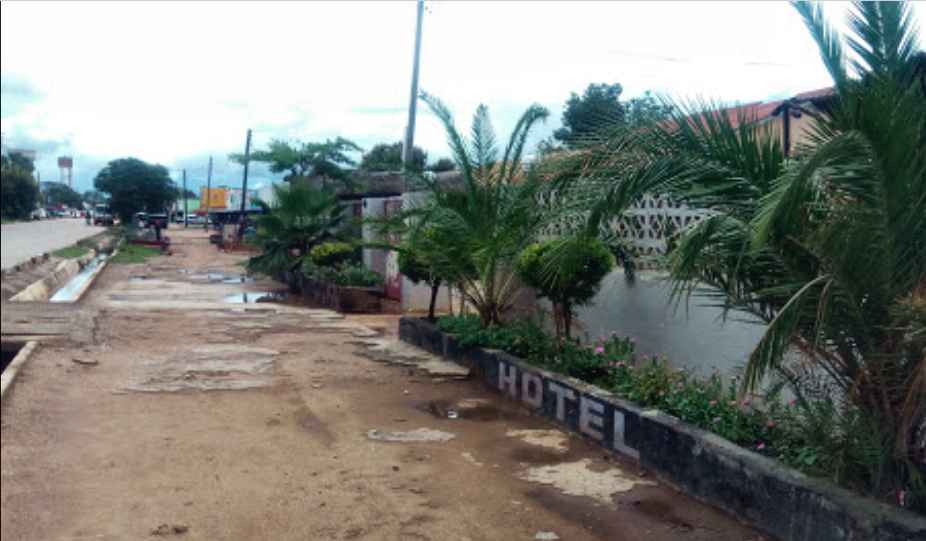
While in Monze, we used the Monze Hotel as our base. Although it was clean, it had no water during the day and very often, no electricity. The water shortage was such that I would leave the tap open when I left in the morning and by the end of the day there was probably 15 cm of water for my daily wash! It had a restaurant that offered a choice of grilled t-bone steak or chicken and, frankly, I do not recall what dessert there was if any!

Monze Hotel. Credit John Y. Mvula. Screenshot from Google maps.

Zambia had a lager beer called Mosi and it is interesting that the manufactureer defines it as “Named after the mighty Mosi oa Tunya (Victoria Falls) Mosi Lager is the iconic Zambian beer. Brewed for over 30 years it’s Zambia’s number one thirst quencher. Mosi is a clean, crisp and refreshing lager with a characteristic pleasant bitterness, and a delicate hop aroma”. What they do not say is that in the days we were in Zambia there was a joke going round that spoke about its poor quality control. The story went like this:

A customer asked for a beer at a bar and finds a fly inside the bottle. He calls the waiter, complains, and gets another bottle. As he keeps finding flies, eventually the fly is removed and the beer drunk to avoid time wasting. One day, a flyless beer is delivered and the customer calls the waiter and asks “where is my fly?”.

This well known joke did not deter the Zambian customers at the Monze hotel that, on weekends, would sit outside and buy a whole crate of twelve bottles that they would place under their chairs and drink away the whole night! Of, course, they could not see the flies as it was dark and they drank from the bottles!

Sometimes we would dine at the New Monze, usually grilled chicken with rice or chips. As Giuseppe with the tropical pizza, Bruno would not touch the local fries, used to the amazing double-fried Belgian chips!

One of these occasions was rather memorable.

While having a forced candle lit dinner, we decided to risk the flies and ordered four Mosi, aware that they would be rather warm as fridges did not like the electricity interruptions and mostly died of a power surge. Although we were talking away, after waiting an inordinate amount of time, one of us went to the bar to remind the waiter about our drinks order.

Eventually the waiter, who was also the barman and cashier, came and brought eight beers and not the four we had ordered. We looked at each other in surprise and asked him for the reason why he had brought double the amount we had asked. Looking rather confused he said “sorry” and took the four extra away.

While eating, we noted that the waiter was really accelerated and that other customers (that we could not see but heard) were complaining about the service. As this was not unusual, we finished our meal and asked for the bill. Again we waited a very long time and, as it did not come, rather fed-up, we all got up and walked to the small table where the waiter sat calculating the bills.

When he saw us, clearly absent-minded he started to add up our consumption when we noted that the candle fell over and a stream of burning wax spread over the table. Oblivious to this, the waiter continued writing while the tablecloth caught fire and surrounded a paraffin lamp that was also on the table.

Seeing that a conflagration that could destroy the hotel was likely, we took action while the waiter still did not seem to be aware of his surroundings! As no fire extinguishers were at hand we grabbed another table cloth and tried to suffocate the fire while removing the lamp. Water was brought up from the kitchen and poured on the table. It was only when splashed by the water that the waiter oake up from his trance and reacted to join us (and other customers) in our fire control efforts.

The smoke attracted the Manager who got furious with the waiter and strongly reprimanded him. We learnt that he had indulged in the rather common practice of smoking “uluwangula”, known to us as marijuana! [5] Luckily for him, he was not sacked although after that night he behaved like a normal waiter!

[1] The Associate Professional Officer’s programme would fund young graduates through FAO with funds from a number of European countries such as The Netherlands, Denmark, Belgium, Italy, etc.

[2] See: https://bushsnob.com/2014/09/30/africa

[3] Afterwards, after eating in Italy for a few years, I understood his views fully!

[4] The idea of French boules is to throw a metal ball close to a smaller one called “cochonnet” in French and you score by the number you get closer to it. When two vs. two play you get three balls each and one member of a team throws first, then a member of the other team throws, etc. until all twelve balls are played and the round ends. Then you count how many points you scored and add to the tally of each team. The first team reaching thirteen points after as many rounds as necessary wins the game. More details: https://frenchyourway.com.au/how-to-play-petanque-rules-of-petanque

[5] Also known as “dobo”, the local weed strain is considered of very poor quality and although illegal at the time, it was very common in the local markets. Zambians preferred to smoke marijuana imported from the Democratic Republic of Congo that they called “Congo poison”.

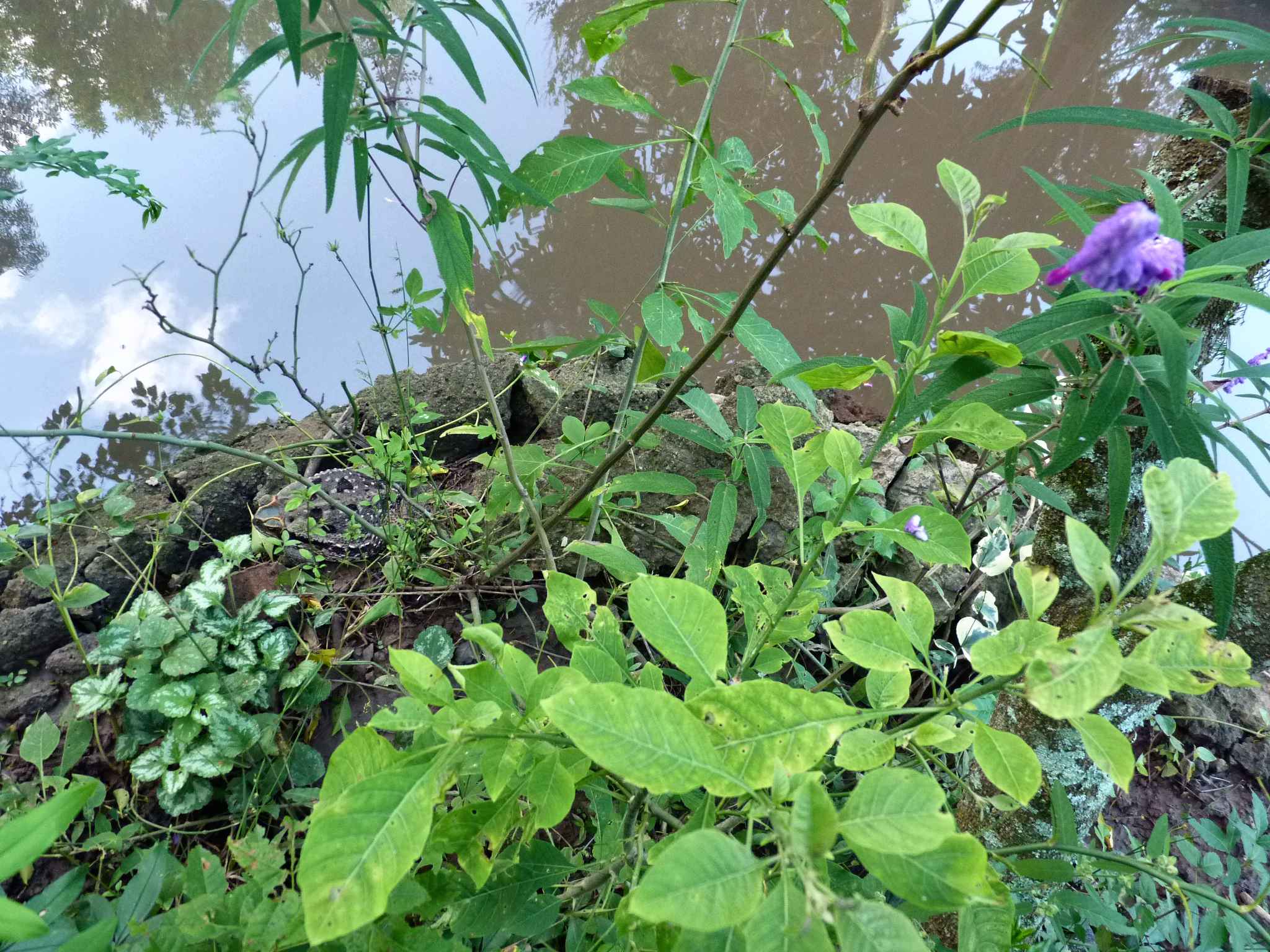
Spot the beast 79

?
?
?
?
?
?
?
?
?
?
?
?
?
?
?
?
?
?
?
?
?
?
?
?

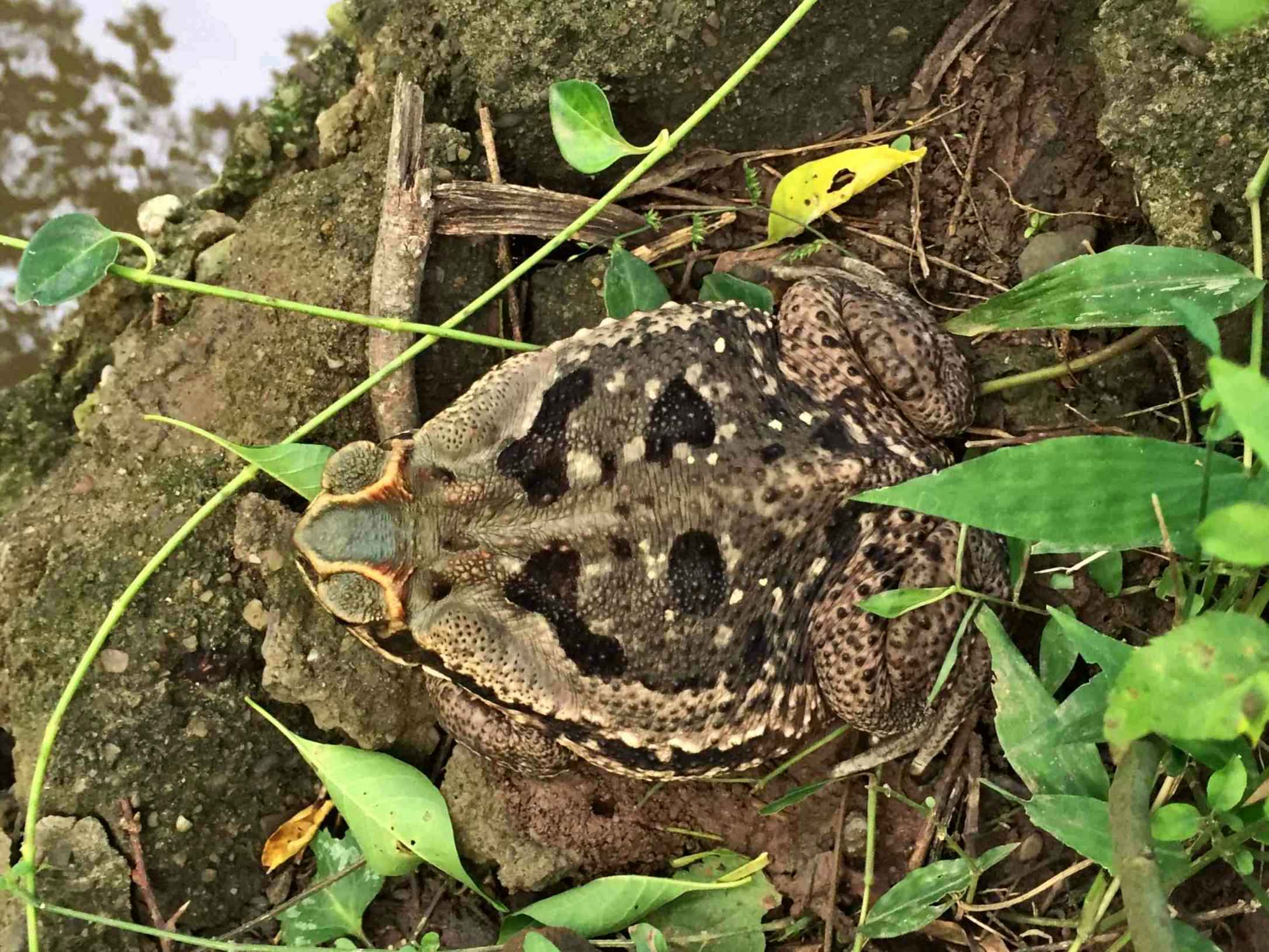
Our beast is a toad known around here as a “Rococo” and in English as a Schneider’s toad (Rhinella schneideri), a rather large toad known to occur from North and Central Argentina (including Salta, where we are), central Bolivia, the Atlantic coast of Brazil, Paraguay, and Uruguay in elevations up to 2,000 metres above sea level and in various habitats, including urban areas. They are often found around houses in rural areas.

The males can measure up to 17 cm in length and the females 25 cm. Their maximum weight can reach 2 kg! (the one in this post is probably 6-700g). It is a shy and mostly nocturnal beast that during the day relies on its colour and remaining flat and inmobile not to be detected by potential predators.

We often see this one at our small dam near the house but also it frequents our outside lights feeding on insects attracted to them.

Their call resembles a stake being hammered fast. The females deposit up to two thousand eggs in double strands deep in water pools and the rather large tadpoles hatch and feed on algae.

Despite its large size and excellent camouflage, rococos have some enemies, apart from men. The “Sapera” snake (Xenodon merremi) is one of its worst enemies but the toad can puff up with air to avoid being swallowed. It also secretes a bufotoxin that can cause vomiting, paralysis and even death in predators. We have observed a rococo attacked by a “caracara” (Polyborus pancus) that abandoned it when we approached them (I believe that the rococo only survived that beacuse of our fortuitous arrival).

The bowtie country

Landlocked Zambia got its independence from the UK in 1964 and for a number of reasons it got its shape that reminds me of a bowtie (a “Club round” type one for the specialists!). The knot squeezes and splits the Lusaka and Central Provinces while the left bow (Northern, Eastern, Luapula and Muchinga Provinces with small parts of Central and Lusaka Provinces) slightly smaller than the right one (Southern, Copperbelt, North-western, and Western with the largest portions of Central and Lusaka Provinces).

This rather special shape means that it is much closer to travel from Mansa, the capital of the Luapula Province to Kitwe in the Copperbelt through the Democratic Republic of the Congo, if that trip would be possible!

Although, if interested, you can search for Zambia in the internet and find lots of information, I will give you a few facts that should help to put our life there in context.

Among the twenty largest countries in Africa with 752,618 km2, Zambia has borders with eight other countries, quite a record! To the north there is the Democratic Republic of the Congo, Tanzania to the north-east, Malawi to the east, Mozambique to the southeast, Zimbabwe and Botswana to the south, Namibia to the southwest, and Angola to the west. It is truly at the junction of Central, Southern and Eastern Africa.

In 1953, the Federation of Rhodesia and Nyasaland that grouped together Northern Rhodesia (now Zambia), Southern Rhodesia (now Zimbabwe), and Nyasaland (now Malawi) was created despite a large majority of the population opposing it. Kenneth Kaunda led this opposition that ended in its dissolution in December 1963. Zambia was born and Kaunda became its first President.

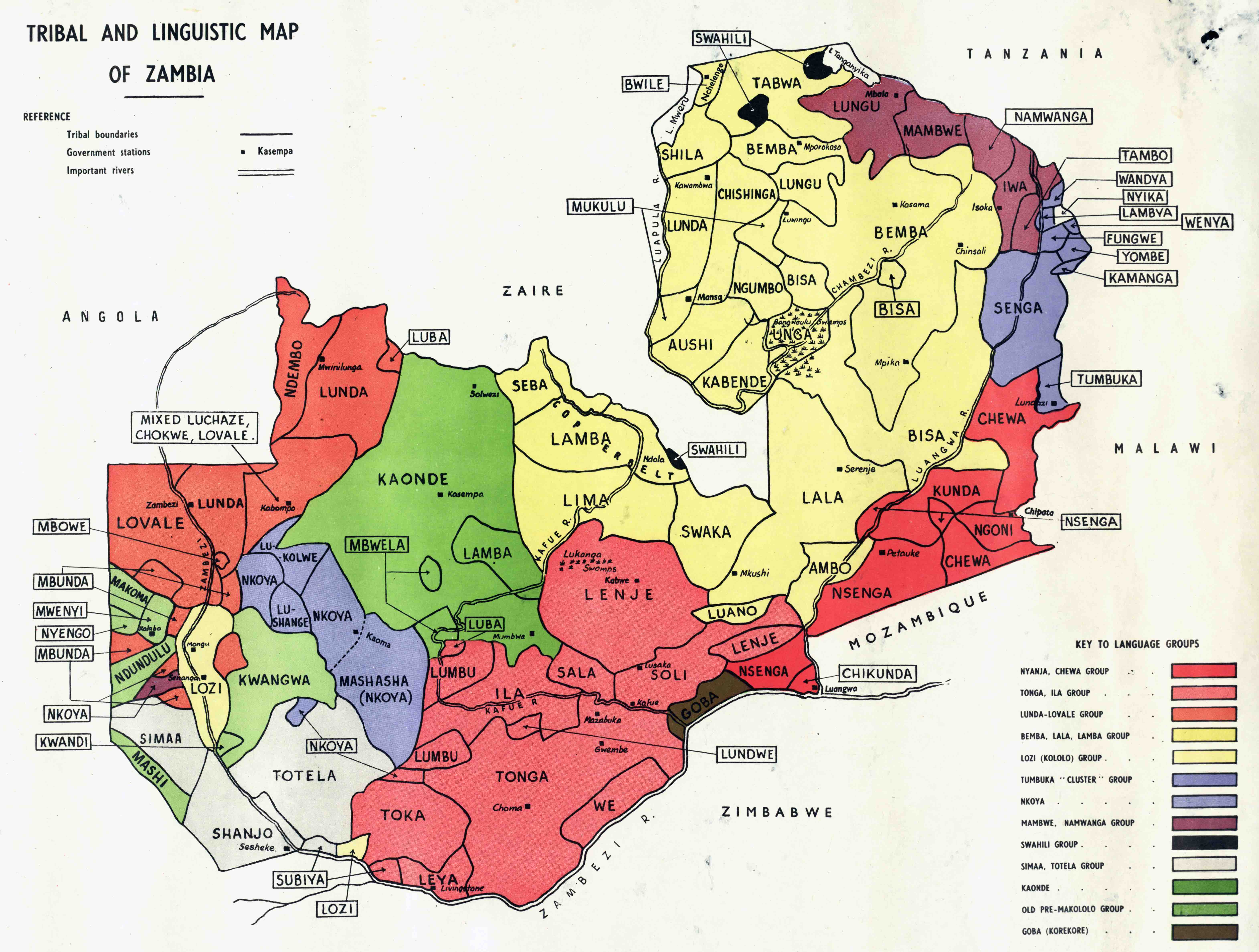
Kaunda was still there when we arrived, after 26 years. He did not have long to go but more about that in future posts. His party, the United National Independence Party (UNIP) ruled the country as a one-party state with the motto “One Zambia, One Nation”. Although there were about 73 ethnic groups, most of which Bantu-speaking, nine were the main ones, the Nyanja-Chewa, Bemba, Tonga, Tumbuka, Lunda, Luvale, Kaonde, Nkoya and Lozi. Although the tribal groups were important, rivalries as we had seen in both Kenya and Ethiopia were not evident, something I attributed to Kaunda’s “humanistic” ideas.

pic

Tribal and linguistic map of Zambia. Credit: Collection African Studies Centre, Leiden (The Netherlands). Author Unknown. Public domain. Via Wikimedia Commons.

My first blunder seeing many vehicles with the UNIP logo was that I thought that they belonged to one of the United Nations peace keeping organizations operating in the country. Luckily, after a couple of days of living in Lusaka, someone corrected me, not without some amusement.

Agriculture was important for the rather underpopulated country of 8 million (now 18 million) but mining, particularly copper extraction was the overwhelming driver of the economy and that was evident seeing the hundreds of lorries loaded with copper ingots moving through the country aiming for the ports in Mozambique and Tanzania.

Zambia had a difficult start as an independent country as, naturally, Kaunda supported the guerrilla war against the white-ruled Southern Rhodesia. This led to the militarization of the country and the closure of their border in 1973. The war escalated and in 1978 it reached Zambia’s territory when, after the shooting down of an Air Rhodesia passenger plane by the guerrilla, Southern Rhodesia retaliated with an attack to their enclaves throughout the country, including their military headquarters outside Lusaka.

Later, Kaunda played a key role in the resolution not only the conflict in Rhodesia (Zimbabwe) but also in Angola, and Namibia and, while we were there, supported the anti-apartheid movements in South Africa that culminated in the liberation of Nelson Mandela in February 1990 and the restoration of black rule in the country.

In 1990, there was still tension, not with Southern Rhodesia that was already Zimbabwe under Robert Mugabe but with South Africa. Zambia was supporting the various organizations fighting against apartheid and South Africa retaliated striking at dissident targets so, there were strict restrictions on taking pictures not only of the airport or any military facilities but also of bridges that were guarded by camouflaged anti-aircraft guns and controlled by army roadblocks.

Apart from the developments with South Africa, to make matters worse, the security situation was also bad and armed robberies were very common, particularly in Lusaka.

And then we arrived! It was late January 1990 during the rainy season to a rather steamy Lusaka. We stayed at the Andrews Motel, located a few kilometres beyond the “Kafue roundabout”, then the end of the city while we searched for a house. I do not recall much of the place as I was out most of the time but Mabel had to put up with it for a couple of months until we found a house.

While looking for a house we received lots of advice on where to live and what kind of house would be safe. “Get large dogs”, “it should have a good wall with razor wire”, “you must get a gun”, “do not rent a house without bars in all openings” and “your house must have an inner protected area” were some of the phrases we heard repeatedly, apart from recommendations on which suburb to pick!

Rather edgy we embarked in house-hunting and looked at a few houses within our rent bracket and settled for one in the Roma suburb, close to the city showgrounds (where the Annual Agricultural Show was held). More exactly we were at Nyoka road. Njoka meant Snake in Nyanja [1] and we hoped that it was only the name! This was confirmed a few months later when we became aware of the abundant rat population in the area as observed feeding on the fruits of the guava trees.

Although Mabel disagreed, I wished that a njoka would appear to take care of a few! Although Inky, our Siamese cat, caught some, Tigger, the marmalade was utterly useless, so we resorted to traps and shooting them with the pellet gun while feeding on the guavas!

The house fulfilled all the necessary security features that were apparently needed, particularly that, as a project manager, all project cars would be parked at my house every night as the stealing of cars was almost as frequent as the house robberies.

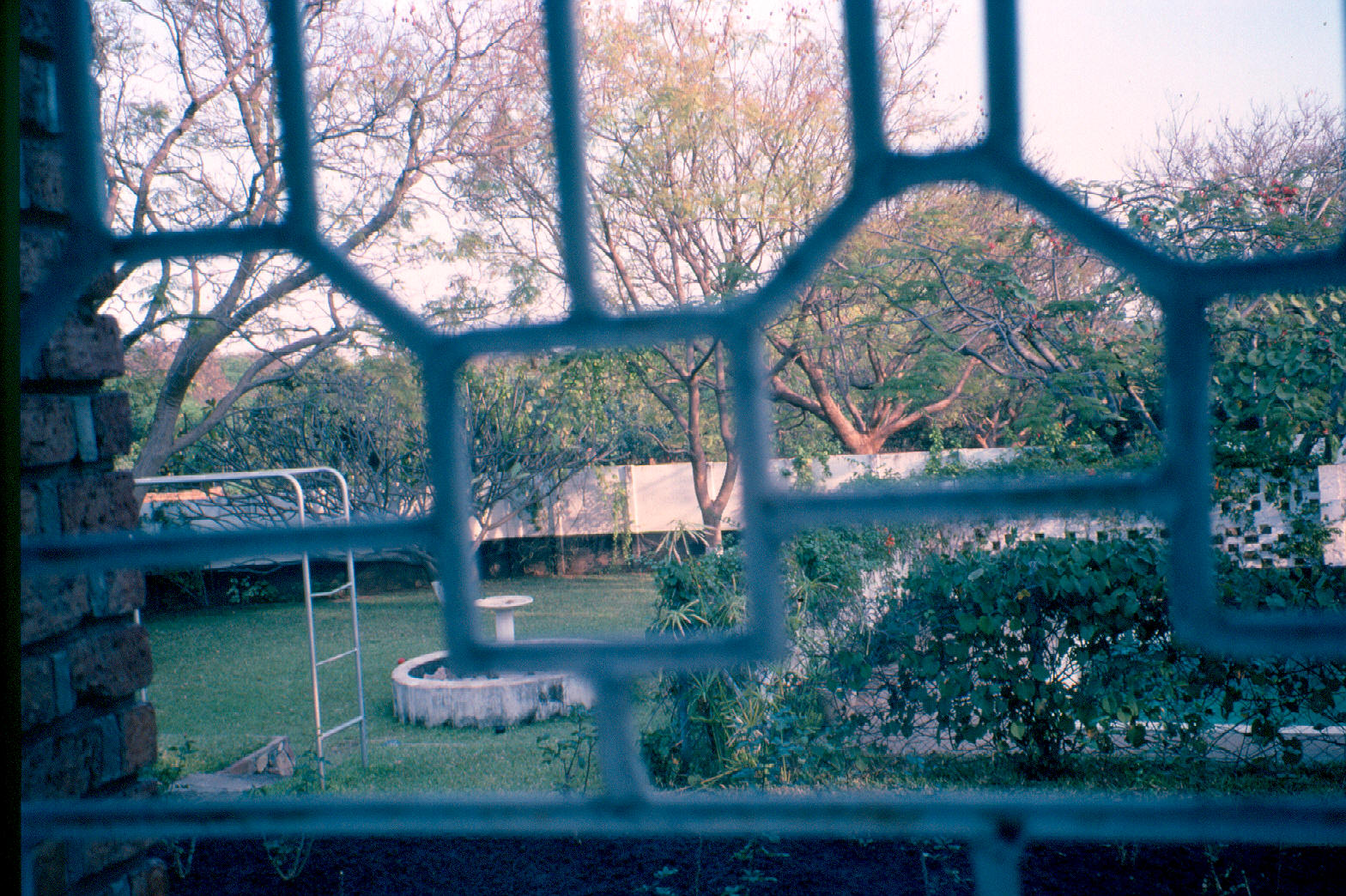
A poor picture showing the garden and the perimetral wall from one of the windows.

The house’s bedrooms were higher than the rest of the house and their windows looked down on the garden, a good vantage position to be. It also had, as repeatedly recommended, a strong “rape gate” (a rather straight but commonly used terminology to indicate the gate that isolates you and your family in the bedrooms while thieves steal your electronic stuff) fitted with two enormous padlocks housed inside steel tubing, very difficult to reach from the outside of the gate.

The house came with a caretaker called Mr. Phiri (not his real name) [2], highly recommended by Mrs. Wilson (not her real name), a former stewardess of the Union de Transports Aériens (UTA) [3], and the owner of the house.

As it was common those days, the house had a good vegetable garden that also came with a gardener called Mr. Lemek as well as an ample enclosure where we found a few hens and ducks as well as a number of rabbits housed in cages. Luckily, Mr. Lemek took care of both vegetables and animals and soon we added four Rhode Island Reds that produced lots of eggs all over our stay while the rabbit meat was mainly consumed by our house staff.

We installed “panic buttons” that, if pressed, would bring a contingent of guards that would enter the property to deal with the problem. We also recruited our own security guard, Mr. Nelson, an elderly gentleman that mostly sat in his guard house reading the Bible from his arrival at 18hs until he fell sleep, as most security guards do, until his shift was over at 6hs. There were also two resident dogs, Nero and Ginger, that we decided to keep as we were told that they were good guard dogs and they got on well with Mr. Nelson. In addition, we also were provided with a United Nations VHF radio to be used in emergencies.

Aware that security guards were usually the ones suffering injuries during armed robberies in Lusaka, we gave Mr. Nelson a whistle and instructed him to blow it if he saw something unusual and to run towards the staff houses at the back where he could seek refuge among the other people staying there, our gardener and the caretaker. Despite my objections, he insisted on keeping his catapult for which he made perfectly rounded clay balls to use as ammo.

The recommendation of getting a fire arm seemed very reasonable to us hearing of all incidents that were taking place in the city so I got a shotgun and a few cartridges that I was meant to use as a final line of defense in case the robbers attempted to break our final gate. Although I had shot partridge and hares in Uruguay during my youth, I am not a fan of firearms so, I disassembled, packed it carefully and hid it inside a trapdoor in the ceiling of our bedroom where I expected it to be for all the time we would be there.

So, we moved in although we only had very few personal effects for the reasons named in my earlier post and that took five months in arriving! It soon became clear that all we had been told about the insecurity was true and shooting was heard almost every night and we knew of several neighbours that would come out at night and shoot in the air in an effort to deter would be robbers! In addition, there was a “neighbourhood watch” formed by some neighbours accompanied by the police that would patrol the various neighbourhoods. I declined the invitation to join but, for a while, contributed financially to its operation.

Clearly Zambia was wild, and we had not yet seen the bush!

[1] Nyanja or Chewa is a Bantu language spoken in Malawi and Zambia, where it is an official language.

[2] People in Zambia were always referred as Mr. or Mrs., I believe this was due to Kaunda’s humanism emphasis on respect.

[3] UTA flew weekly to Lusaka until 1992 when it was taken over by Air France.

Spot the beast 78

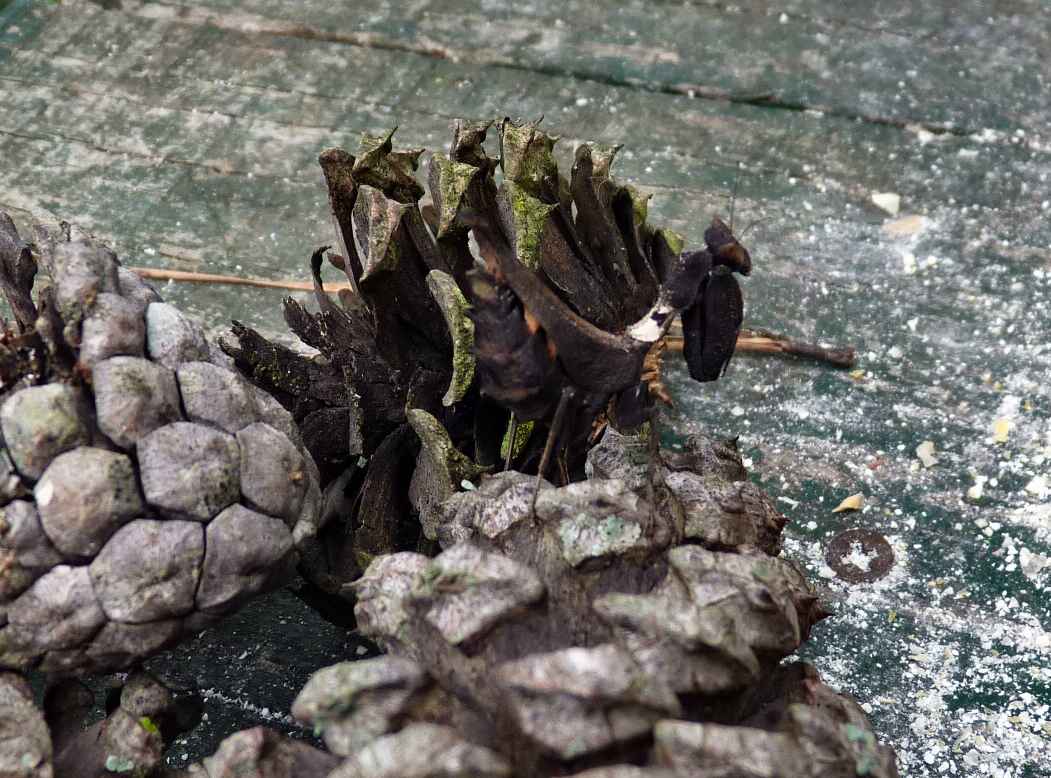
By chance I bumped into this beast yesterday. I wonder if you can identify it.

?
?
?
?
?
?
?
?
?
?
?
?
?
?
?
?
?
?
?

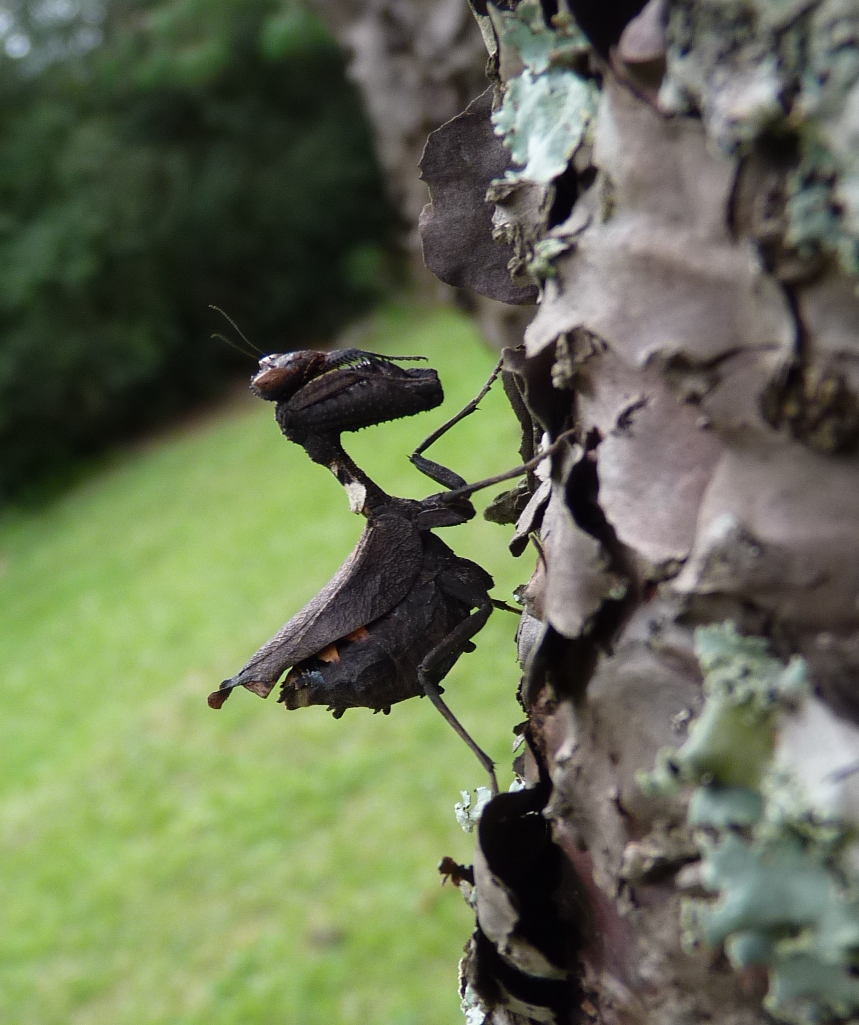
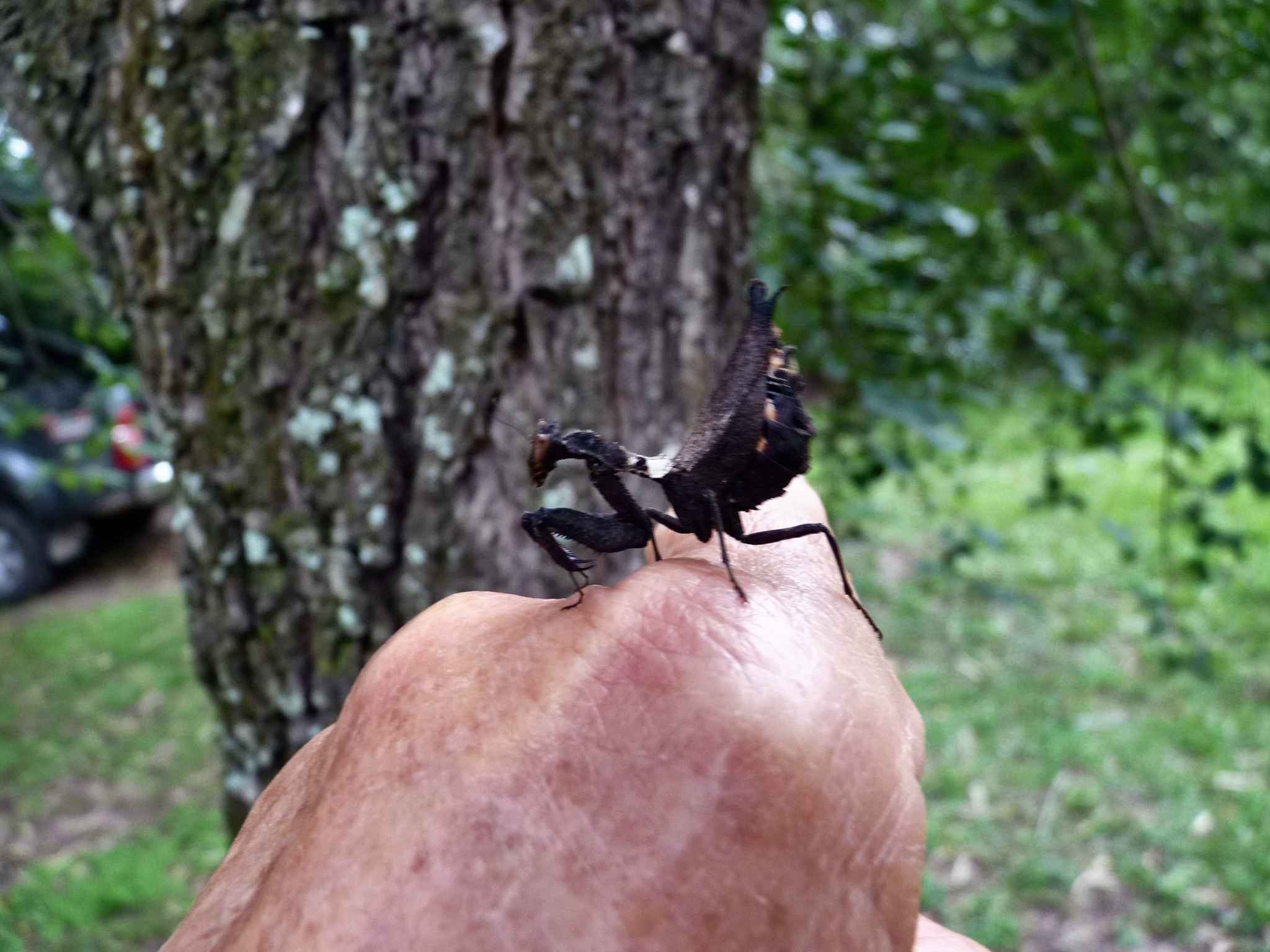
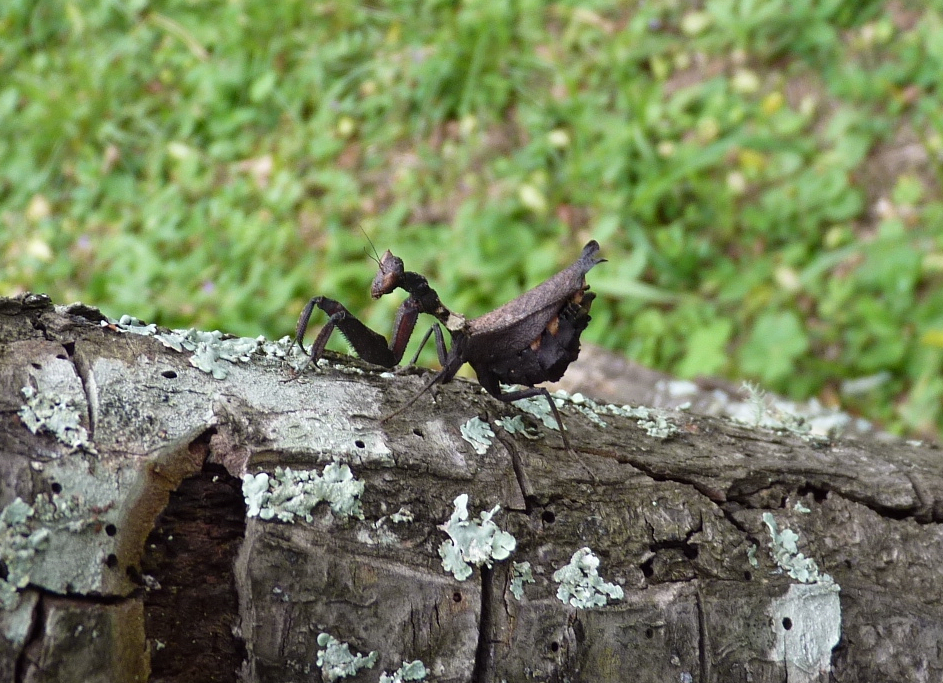
It is a very dark immature mantis, as usual looking rather fierce. Below a few more pictures of the beast for you to enjoy.

Zambia. The real Africa [1]

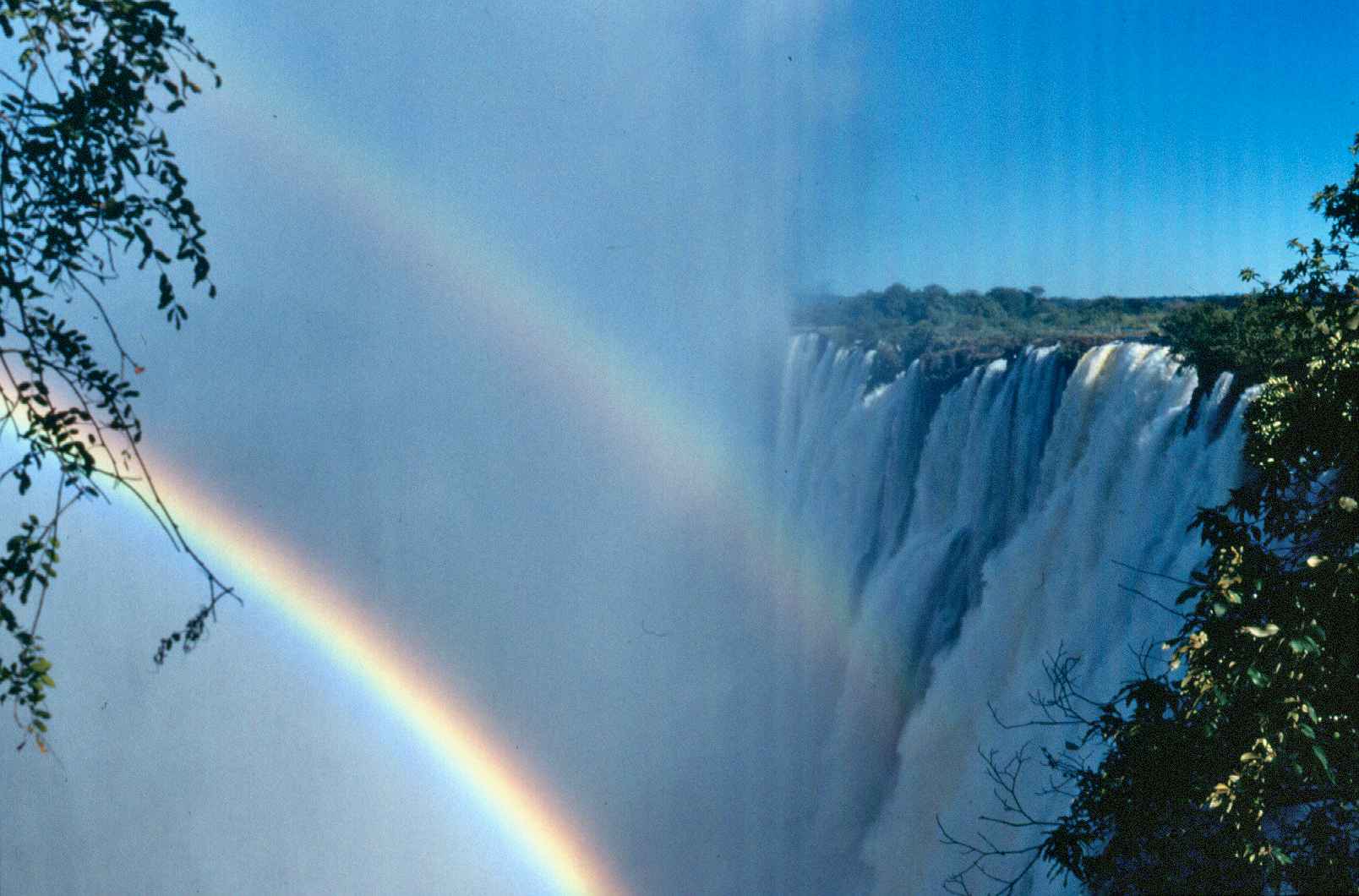
Victoria Falls. Eastern cataract and rainbows.

Luckily for me after Ethiopia FAO had a vacancy in a regional tick and tickborne disease control programme in Zambia as the former Project Manager became the coordinator of the whole programme and was moving off to Harare.

I had visited the country in the early eighties to see the work that the tick component of the FAO programme in Zambia was doing as it was similar to what I was starting in Kenya. So, I knew one of the areas where I was going to work. Luckily, I also knew George, the Director of Veterinary Services and I was aware that he was a good man and committed to the work that FAO was doing in the country. So, I did not expect a difficult start.

I would be in charge of two earlier projects that were now combined into one. These had been part of a rather large programme that, for several years, had supported the veterinary department in several aspects of animal disease control. One component was the study of the impact of tick infestation on cattle in Central Province, both weight gain and milk production while the other involved the immunization of cattle against theileriosis in Southern Province.

The tick project was based at Lutale, a locality near Mumbwa, a town 160 km from Lusaka, in the Central Province of Zambia, on the Great West Road that runs 590 km from Lusaka to Mongu, capital of Western Province. Originally the place was devoted to research and training on the control tsetse and trypanosomiasis but activities, although still going, had shrunk to training of medium level technical personnel, also run by FAO.

At Lutale we had an agreement with Chief Chibuluma to have our own herd of native Sanga (Bos taurus africanus) cattle that were the subjects of the study. Our job was to continue the work for about two additional years, introducing a new group of cattle to which a new “strategic” [2] tick control method would be applied, and their performance compared with undipped and dipped cattle to obtain figures on the economics of tick control under the conditions of the trial.

The project office at Lutale.

Theileriosis was endemic in Southern Province and successful immunization against this disease had been going on for several years by the earlier programme, on the lines developed by FAO in Muguga (under the leadership of my ex boss Matt). By request of the Government, FAO was tasked with the expansion of this procedure to a larger number of animals in an effort to reduce the heavy losses that were being experienced there.

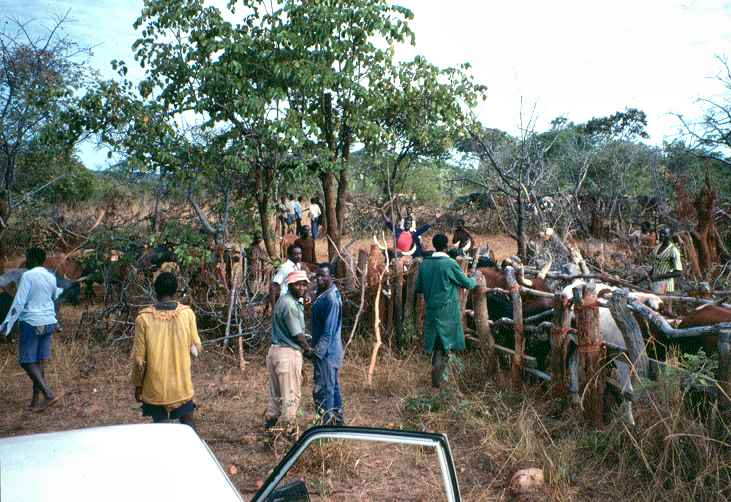
Gathering cattle for immunization against theileriosis.

As I needed to commute between Lutale and Monze, a town located 196 km south from Lusaka (in Southern Province) and in the direction of Livingstone and the Victoria Falls [3], I would be based in Lusaka, more exactly at the Central Veterinary Research Institute (CVRI) located in Chilanga District, 25km southwest of Lusaka, off the Kafue road in an area known as Balmoral. As we would reside in Lusaka, that meant a daily drive through a rather rough road. I realized that it was not the ideal place to be but I was in no condition to change anything at the time, apart from getting on with the work.

It was an ambitious project that gave me the responsibility for work that had been done earlier by two specialists and I was stretched to the limit. Luckily, after discussions with FAO and the Government, I managed to persuade them that I needed help, particularly with the immunization part of the project and the post of Protozoologist was created for Southern Province. This was a relief but it would still take some time to find and recruit a suitable candidate. In addition, I applied to FAO to be allocated a couple of Associate Professional Officers [4], one for each component of the project. In the meantime and for a few months I was alone to do and/or supervise all the work.

Mabel and I arrived at Lusaka via Nairobi and stayed at Andrews Motel for a few days until we managed to find a suitable house in town. We moved there as soon as our first shipment with essential household stuff arrived, hoping that the rest of our personal effects would come from Ethiopia in a couple of weeks. So we camped at another house, again.

A view of our Lusaka house and Emmanuel, our cook,unblocking the gutters.

As usual, we were wrong estimating that our belongings would arrive soon. Well, some of them did but they were not very useful as, for example, the bed boards arrived but not the rest of the bed or the top of my desk came but not its drawers or legs! When we complained to the shipping agency they apologized profusely and promised to follow up the issue. In the meantime, we needed to buy a number of items for the house that we already had but we had no other choice.

Our first consignment of personal effects.

A couple of weeks later the shipping agency informed us that there was a problem with our shipment (oh surprise!): it had been crated in boxes larger than the door of the plane that flew between Addis and Lusaka! But they told us that they would be a larger plane coming soon and that they would place the remaining of our items on it. So it was that another part of our consignment came two weeks later and we waited for about a month for the final third with which we could finally assemble all our furniture and appliances! By that time we had succeeded in buying almost everything again!

It was during that agitated time that Mabel got pregnant so our life changed as we went through gestation to the birth of our children. As medical facilities were very basic in Lusaka, we needed to travel to Harare for periodic check-ups and the eventual birth of our first child: Florencia. Our son Julio Junior followed 15 months later so we had little time for safaris, apart from those we could accommodate with the on going work.

Searching for pictures to illustrate the Zambia posts I found that most of the ones I could find include our children so my Zambia posts would be rather poor in that respect, made even worse by not being able to move towards my picture “bank” in Harare because of the Covid 19 pandemic! So I will do with what I have and prepare a picture library for the various posts later if I find the relevant pictures. I hope that you still enjoy reading them!

[1] This was Zambia’s motto at the time to promote tourism.

[2] The application of acaricides was done according to tick infestation levels and seasonality to reduce its cost without losses.

[3] At the time, different donors operated in different areas of Zambia, the Dutch in Western Province, the Belgians in Eastern Province, etc.

[4] The Associate Professional Officer’s programme would fund young graduates through FAO with funds from a number of European countries such as The Netherlands, Denmark, Belgium, Italy, etc

Spot the beast 77

While I work on my Zambia posts, I take the opportunity to challenge you to find this beast:
?
?
?
?
?
?
?
?
?
?
?
?
?
?

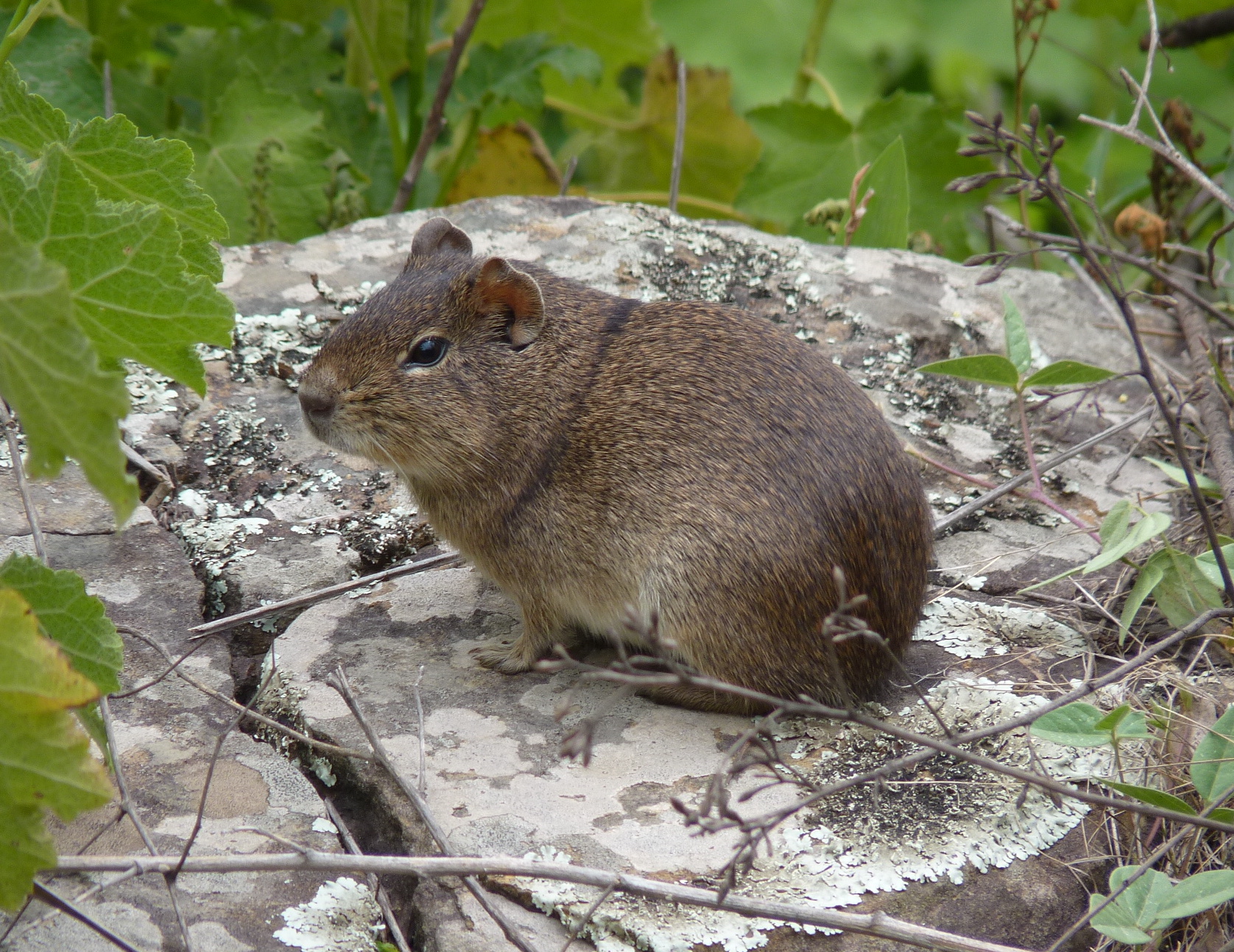
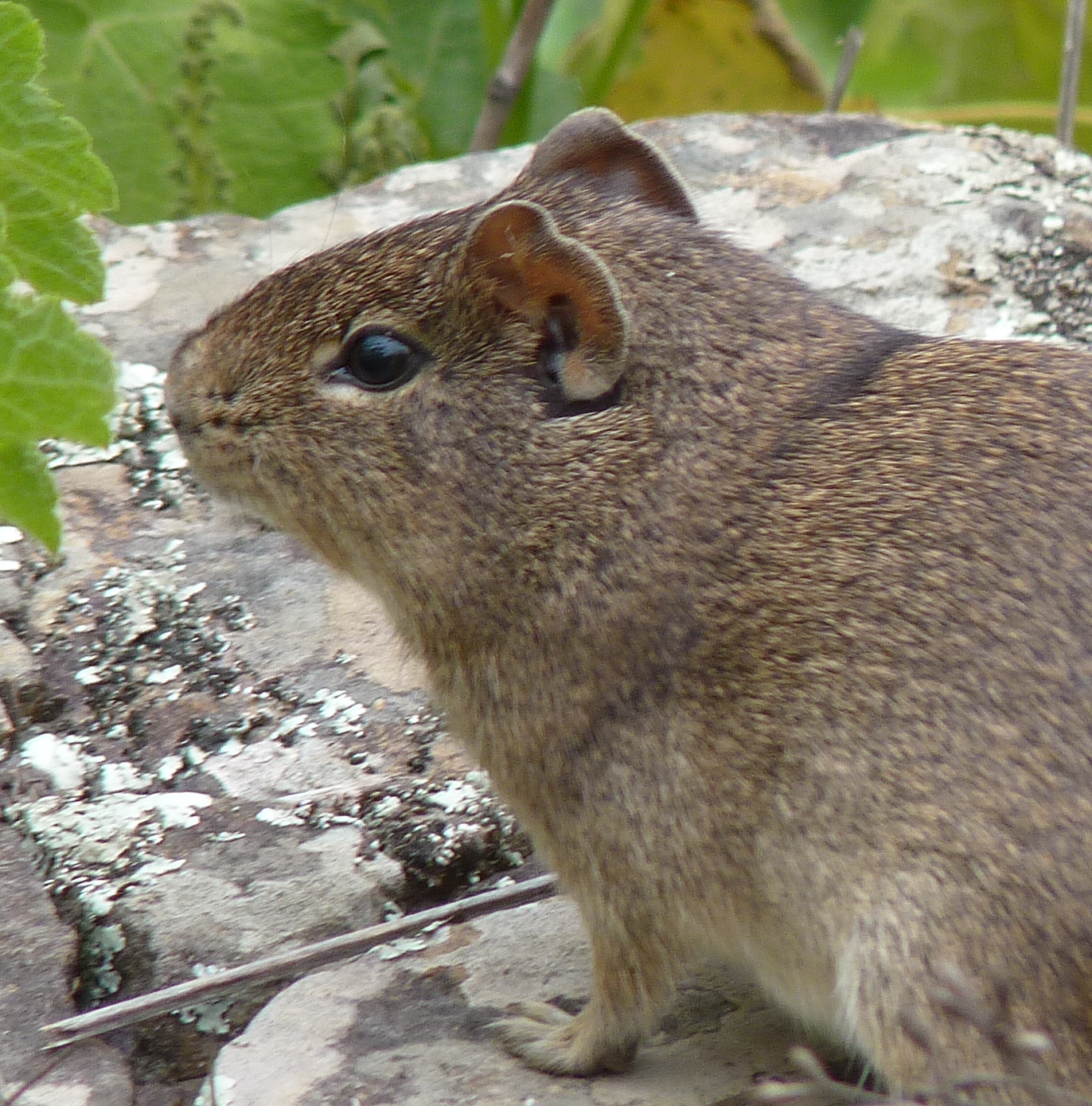
In fact, I took the picture as an excuse to present you with this small mammal, the apereá (Cavia aperea) or Brazilian guinea pig.

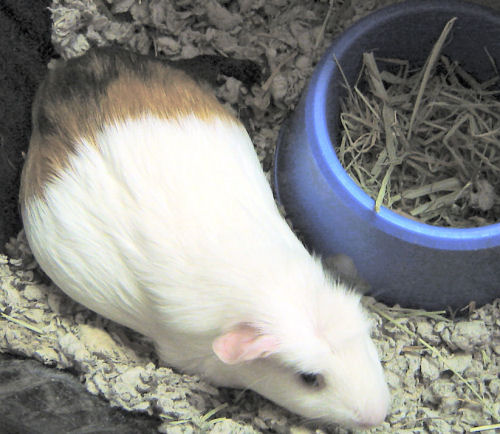
As you can gather, it is a relative of the well known domestic variety, the guinea pig (Cavia porcellus) a more colourful and better known around the world. Its name is confusing as it is not related to pigs and it did not come from Guinea but from the region we are now: the Andes where they are an important and sought after food item.

Credit: Photograph taken with a digital camera by Kazulanth of a pregnant guinea pig (Cavia porcellus) 1 week before delivering 3 pups. Via Wikimedia Commons.

The apereá is a diurnal and grass-eating mammal, pale grey-brown on its dorsal area and greyish-white ventrally. It is almost tailess with an adult length of about 25 to 30 cm and a top weight of about 600 g,

The apereá is found in Argentina, Brazil, Bolivia, Colombia, Ecuador, Guyana, Paraguay, Uruguay and Venezuela where it is a rather common mammal, often spotted on the roads, running away from cars, seeking shelter in their thick superficial grass burrows. They breed throughout the year and females can have up to five litters of one to five young each time.

The plague

I thought that my earlier post on Ethiopia was the last but I was wrong.

Something that happened two days ago at our farm in Salta reminded me of an incident at Bedele worth mentioning and that somehow seeped through the cracks of my memory (oh surprise!).

While de-weeding one of the fields I saw a swarm of immature locusts. These were nymphs of the soldier locusts (Chromacris speciosa), unmistakable with the shiny black and red markings. They are widely distributed in Brazil and Northern and Central Argentina.

Nymphs of Chromacris speciosa, rather striking insects.
Adult of Chromacris speciosa.

The first memory that came to mind was of my father, an Agronomist in charge of pest control in Uruguay, who told me about locusts for the first time. He described the enormous clouds that would obscure the sun and that his Jeep (Willys) would skid on the mass of insects and needed to engage 4WD to be able to move!

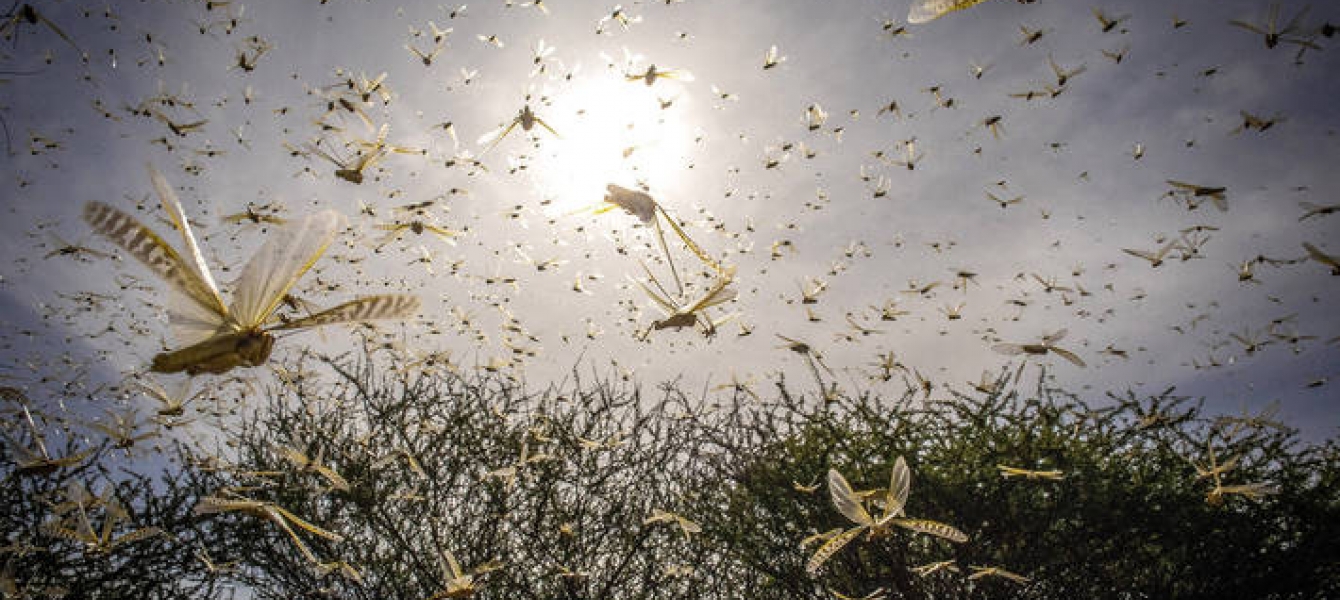
Then I remembered the day in Bedele when, although it dawned with a clear sky, suddenly, as it happens during the sun eclipses, light faded for no apparent reason. This lasted for a few minutes until the locust swarm arrived and landed on us! They covered the ground and landed on trees stressing branches to the point of breaking. Most of the green matter available was consumed within hours and they moved on as a wave, leaving scorched earth behind.

A desert locust swarm. Credit: FAO (http://www.fao.org/locusts/resources/photos/en/).

The invasion only lasted for a couple of days until they moved off. During this time we were the target of a very unpleasant experience when, without warning they would land on your back and prick you with their spiny legs!

We were suffering the impact of a periodic swarm of the desert locust (Schistocerca gregaria), found mainly in Africa. Interestingly, this insect can change its body in response to changes in the environment. Although this takes several generations, a solitary, shorter-winged (non-migratory form) can turn into a social locust that, because of being long-winged can travel really long distances in search of food.

When this happens, they can cause severe and extensive damage to food crops and fodder as a classic swarm can be as numerous as 150 million individuals, capable of covering hundreds of km in one day when on the go. Because of their transboundary nature, its spread must be monitored in various countries to control them while they are still not able to fly, usually in dry areas. This activity requires collaboration between countries through specialized bodies such as FAO and the Desert Locust Control Organization for Eastern Africa (DLCO-EA).

Finally, the rather nice grasshoppers we get in our gardens in Zimbabwe, known as Green Milkweed Locust or African Bush Grasshopper (Phymateus viridipes), are also capable of long migrations but they are not a pest although, to our annoyance, they are capable of eating our flowering plants.