Following on the issue of monkeys, I offer you this “interesting” article that glided down from another book! Just imagine the situation!

Source: Times of Zambia, Monday, December 14, 1992.
Following on the issue of monkeys, I offer you this “interesting” article that glided down from another book! Just imagine the situation!
Source: Times of Zambia, Monday, December 14, 1992.
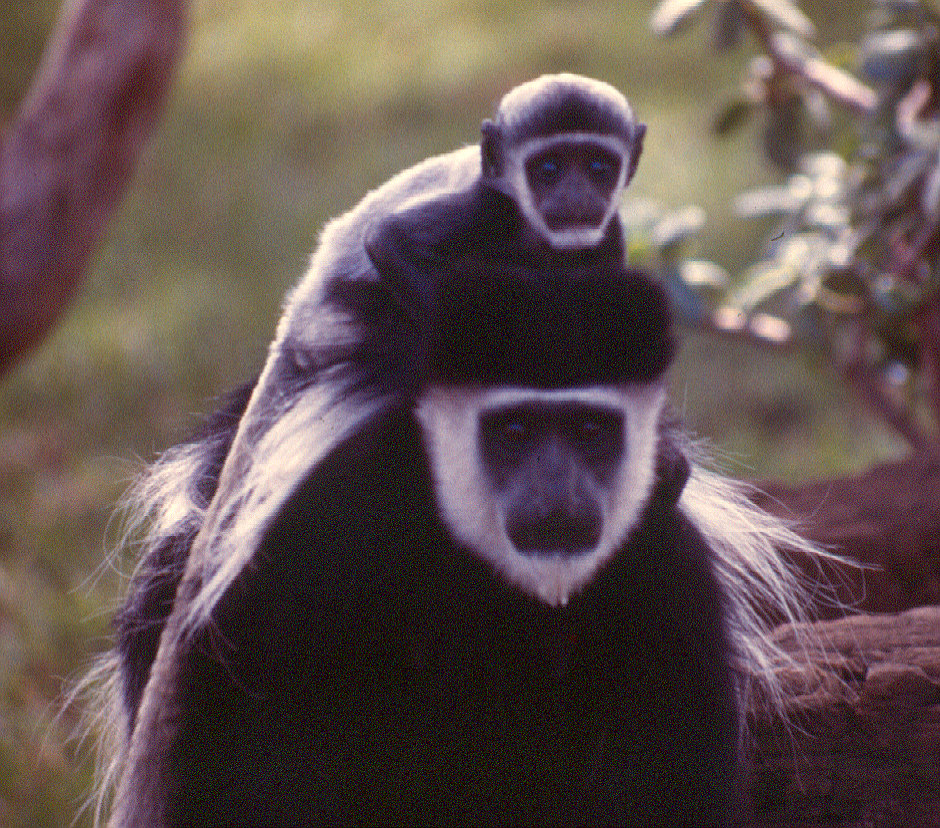
A female Black and White Colobus and baby. They are not a problem!
I always tell people who visit us in Africa to read a vey small and little known book called “A window onto Wilderness”, a jewel of a book that compiles reports from East African rangers and wardens giving you a feeling for the way things were over 50 years ago. Why do I mention this? Because what we see while on safari is just a peep into that “wilderness window” that then closes, but only for us! The events that we were lucky to witness still go on after we are gone. The same tusker that was feeding on Apple ring Acacia pods while we were in Mana Pools will still be there today while I write these lines, feeding on the pods that have fallen since our departure! Hence the fundamental importance of caring for these fragile ecosystems with all our might and the rather “over-used” cliché of “leave only our footprints behind”.
Wild animals only get close to humans seeking some benefit. Old lone buffalo bulls find hang around camps to gain protection from predators, carnivores take advantage of livestock and scavengers are after the rubbish pits.
Monkeys, both Baboons (Papio sp.) and vervets, (Chlorocebus sp.) have rather well developed brains and great agility, a good combination. Their lives are spent in the African bush (both trees and ground) where they feed on various types of food, being omnivorous like us. The proximity to humans offers them easier pickings so they raid crops and food. Coming back to the start of this post, we enter into the “monkey window” every time we go to stay at a wild place. They are ready and waiting for us!
It does not matter how many times you have been in the bush or how often you remind yourself to be aware of monkeys, they always catch you by surprise as they are –unbeknownst by us- stalking you for the first opportunity! This is what happened to us on our recent trip to Kruger, despite our extensive bush experience. While we were unpacking the car, a vervet took our powder milk and spilled it all around our lodge!
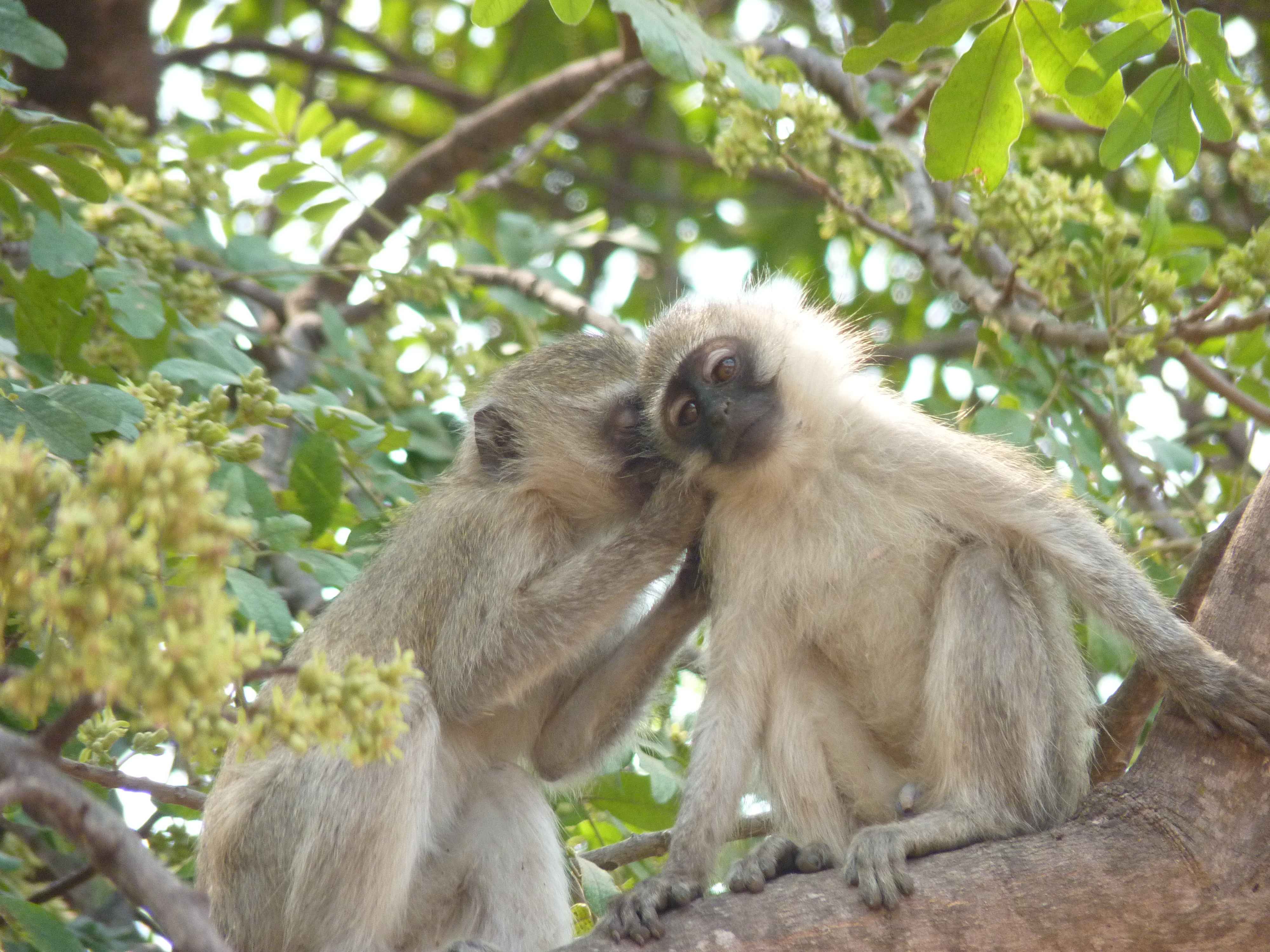
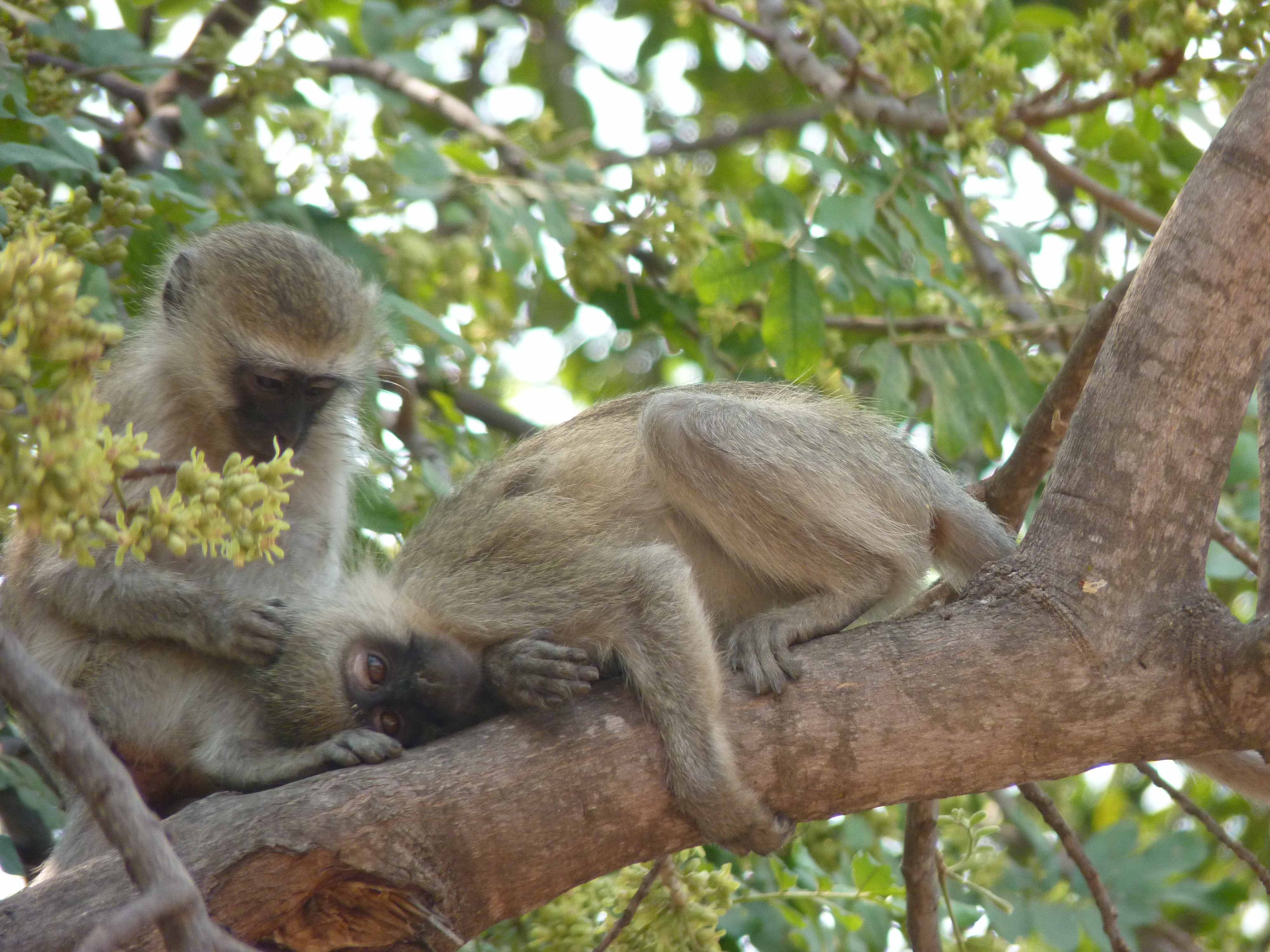
Vervet monkeys grooming.
Although entertaining and endearing, monkeys are wild animals and therefore potentially dangerous. I recall my wife walking alone in Mzima Springs (Tsavo West National Park, Kenya) in the mid eighties when a few vervets started threatening her and, when she showed her surprise mixed with fear, they became more vicious until the game rangers chased them off. It was a bad experience that she still remembers.

Vervet monkey eating what it should!
In addition to monkeys being daring, humans are stupid! I belong to the latter bracket… There is a place in Nairobi National Park, Kenya where you can leave the car and walk along the Athi river to watch the hippos and other game. It is a welcome chance to stretch your legs. The first time I visited the place it was mid morning and I was carrying a few bananas for our later lunch. Not for long… The moment I left the car I felt a pull and the bananas were gone! When I regained my wits, a male vervet was up a fever tree looking at me while holding all the bananas (I think it had a smile on its face!). A similar event happened to a good friend of ours (also a relative!) that lost her wallet in a similar manner and had to endure a “rain” of its contents and collect them carefully… “Please throw my VISA card now, Good, now my drivers license, good…’ and so on until all the contents and the wallet itself were scattered throughout the hotel garden!
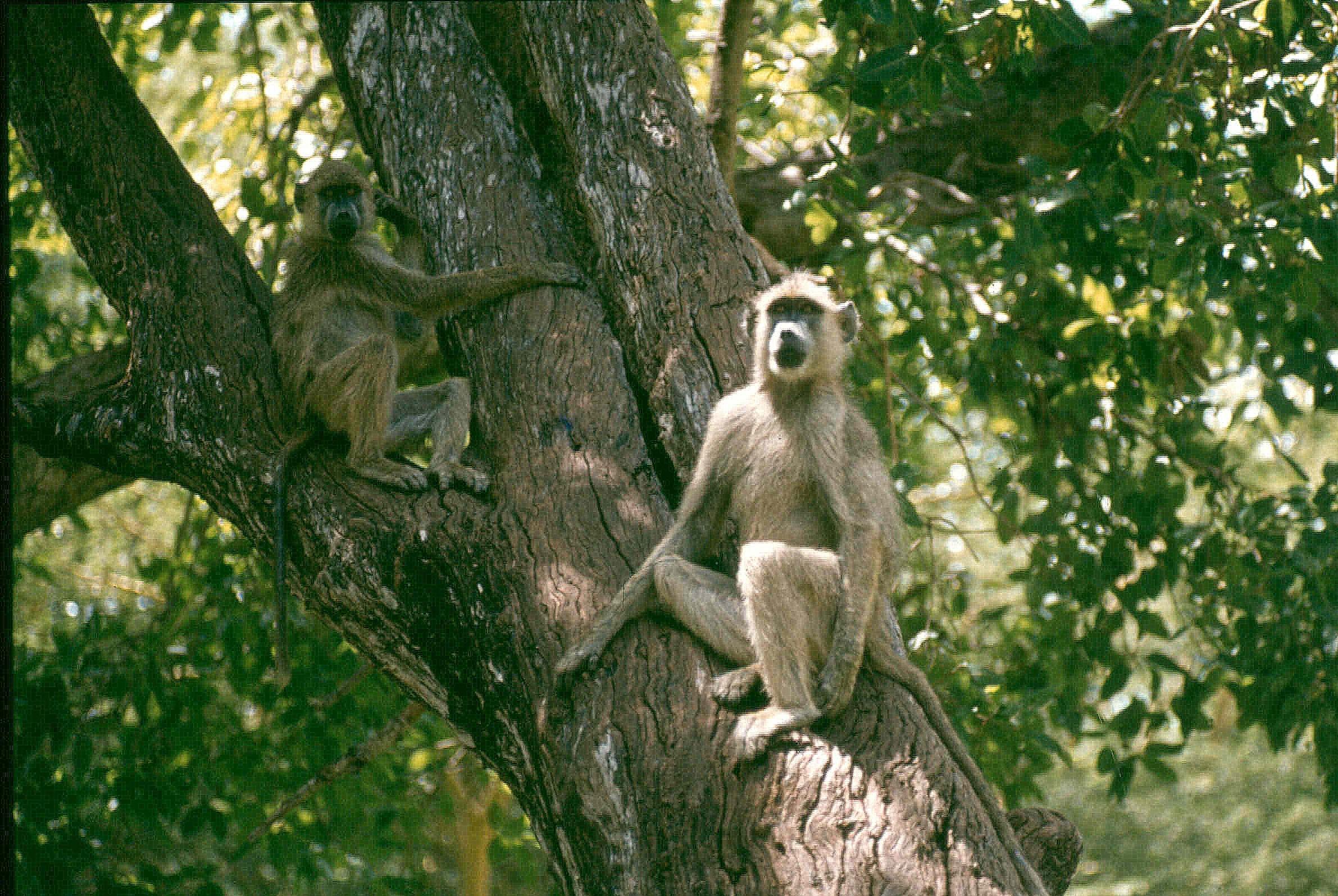
Young baboons keeping an eye on humans…
More dramatic was a similar incident -involving me of course- that happened at the Man Eaters petrol station, on the way to Mombasa from Nairobi. In that area yellow baboons (Papio cynocephalus) are found, thinner and leaner than their cousins the olive baboons (Papio anubis). They walk freely about the station. We stopped to re-fuel and I got out of the car to open the petrol cap without thinking that I had a packet of crisps in my hand. Again, before I became aware of it, a baboon (almost as large as me) confronted me and helped itself to my crisps. I resisted to no avail and I am convinced that in the scuffle that followed, it slapped me so that I would learn to surrender them quickly next time! Although funny now, it was rather scary at the time it happened!
On another occasion, the saying ‘like father like son’ comes to mind, unfortunately for my son. For the first time in my children’s 8 and 9 year old lives, their mother had gone on a trip to Rome and left them with me in Harare. This was apparently quite a traumatic experience for them, and although she was only gone for a fortnight, her absence was felt profoundly by all. Their older cousin, who stayed with us for a year was also with us, but thankfully faring better than the two monsters. After a week of countless tearful episodes and desperation on my part, I thought to distract them from their mother’s absence by taking them to the nearby Haka Park. Although not an animal ‘hotspot’ Haka park is a nice break from the nearby city and permits walking and climbing.
So I packed the three in the car along with a picnic lunch and headed to the park, where we whiled away the morning in tear-free style. When lunch time came around, we decided on a suitable picnic spot with a cement table and benches and settled down to eat. My daughter and I munched happily on our sandwiches while my nephew wandered about in his usual style and my son decided to sit at the next table over. As he appeared content as well, I left him to his own devices and continued to satisfy my hunger and keep an eye on the much more likely problem starter, my nephew. He was very much like a monkey himself with his affinity for trees and innate ability to climb almost anything (to my wife’s horror).
As lunch continued, my attention was drawn away from my son, probably by my much more talkative and bossy daughter, until suddenly we all heard an outraged howl. We turned in time to see my son having his sandwich snatched by a cute-looking vervet monkey, who then proceeded to sit in front of him and munch on my son’s former lunch. After an attempt to regain control of his lunch, which ended almost before it began with the monkey baring its teeth and chittering angrily (to our great amusement) my son proceeded to grab the remaining sandwiches and lock himself in the car. From the safety of the car he peered out of the window angrily (at us or at the monkey, I am not sure) while he proceeded to eat another sandwich in a monkey-free zone. Needless to say he endured quite a bit of teasing on our way home thanks to his assumption that the monkey was only after his company when it approached him!
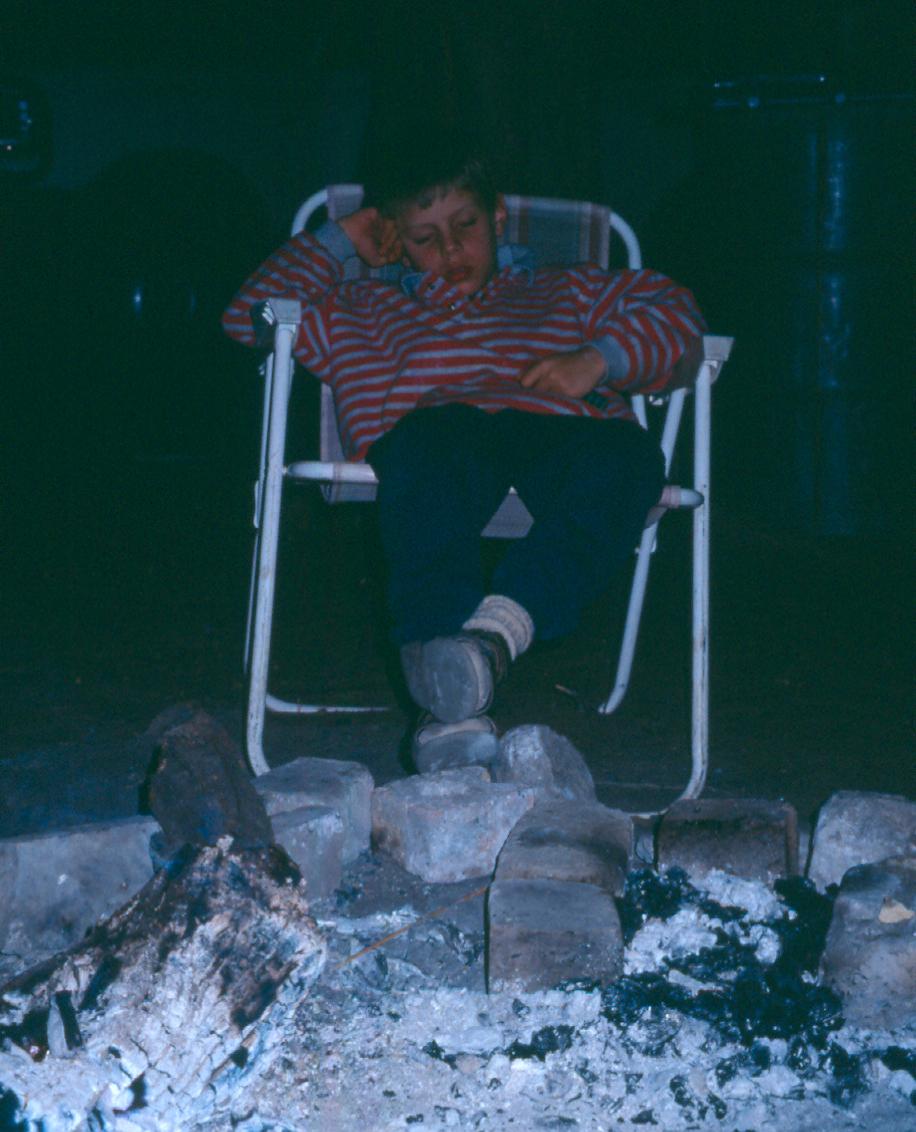
My son recovering from his duties as “monkey-chaser” at a camping site.
Baboons can be destructive as well, something I have also experienced and witnessed. My first hand experience happened when we were camping at Amboseli National Park in Kenya. I closed the sliding door of our VW kombi only to discover that a baboon was inside! Finding itself locked up it panicked and went “bananas” jumping all over the car and screaming its head off. Thankfully it was a young animal so it did not defecate and urinate as much as a fully grown animal would have done! It is sometimes amazing to see what can take place in a few seconds as I opened the door as fast as I could! It took long to clear the mess… Similar to the occasion when we camped at the fig tree camp in Lake Bogoria under a troop of baboons that made sleeping very difficult as they kept waking up throughout the night and screaming as if attacked by a leopard!!! They also pelted us with muck!!!
However, baboons can be even more destructive, something we learned while camping at Serondela in the Chobe National Park in Botswana. Our neighbours were clearly European tourists, judging by the neatness of their campsite. All items had a place and it was a stark contrast with our disorder! We came back in the evening and found the couple -we later learnt that they were Germans- looking at a heap of canvas and nylon where their tent had been before the baboons smelled the food that they had left inside. From then on, they slept in the car!
The last anecdote worth telling also took place in Kenya in the mid eighties at Meru National Park. Again, on arrival and while unloading our cars of the food needed for the three-day stay, our butter was taken, together with most of our tomatoes, although we managed to rescue a few that were scattered in the bush around the campsite. As these were damaged and already “touched” by the thieves, a lady friend and my wife decided to lay a deadly trap for the culprits, using the recovered tomatoes. The idea was to fill them with chili and black pepper and leave them out for the taking. This process demanded more work, skill and care than the preparation of our dinner, as the fruits needed to be hollowed and then stuffed with the deadly paste (oil was used to join the ingredients). Once the three or four tomatoes were ready, they were put in full view of the vervets while we watched, waiting for their response and hoping for them to learn a good lesson for the future! They took them almost instantly but what followed was not what was expected! The cautious thieves, after tasting them with the tips of their tongue, detected the trap and, immediately took all tomatoes to the nearby river, washed them carefully and shared them with their friends, to the anger of the female humans…
Although humorous, this account should serve as a lesson: animals are wild and must not be fed. It does not matter if they look cute and or entertaining, do not feed them. By so doing you are awarding them a death sentence as they will eventually need to be destroyed because they become too brave!
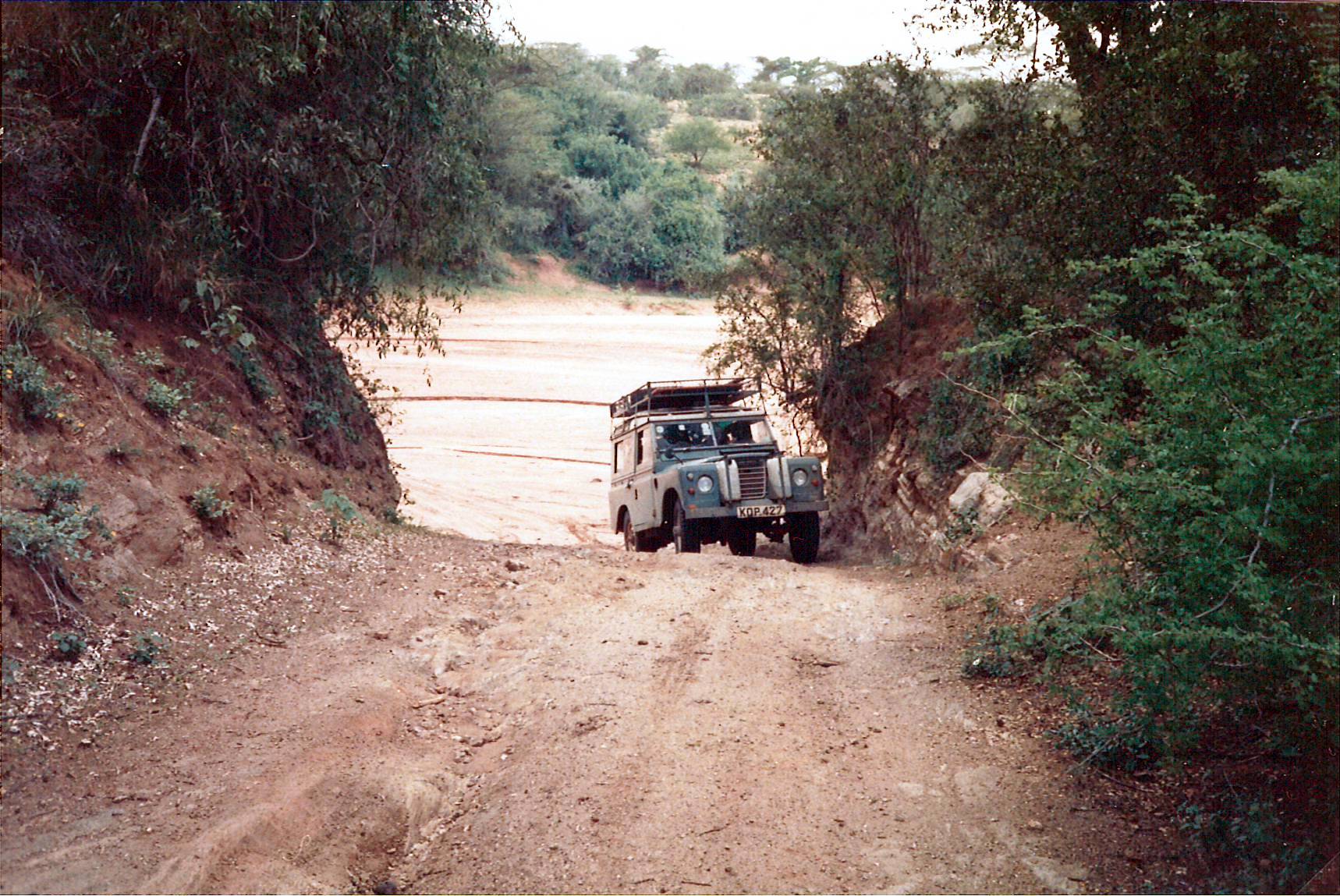
Coming out of a riverbed: Have you put the four-wheel drive on?
Programme
Participants
Reporting
Results
Thursday, 16th of April – Getting in the mood!
Our departure took place in Nairobi at 2.00 PM roughly. Unexpectedly, everybody from the town was along our way to greet us and enjoy our way through! Our success was huge and tremendously exciting. At around 3.00 PM we met a few cars driven by “amateurs” coming our way at high speed. All the cars were numbered, full of stickers and very noisy. It was a kind of a funny race, which looked like a pale copy of ours. We gave way very politely, full of respect for the beginnerswe thought that they were showing off a bit too much[5]. Anyway, the atmosphere was light and happy: the weather was perfect, hot and sunny. The roads, either tarmac or dirt, were dry. The coffee bushes were all in blossom, which gave a marvellous scent to the air. No better conditions were expected for a very enthusiastic and fair rally.
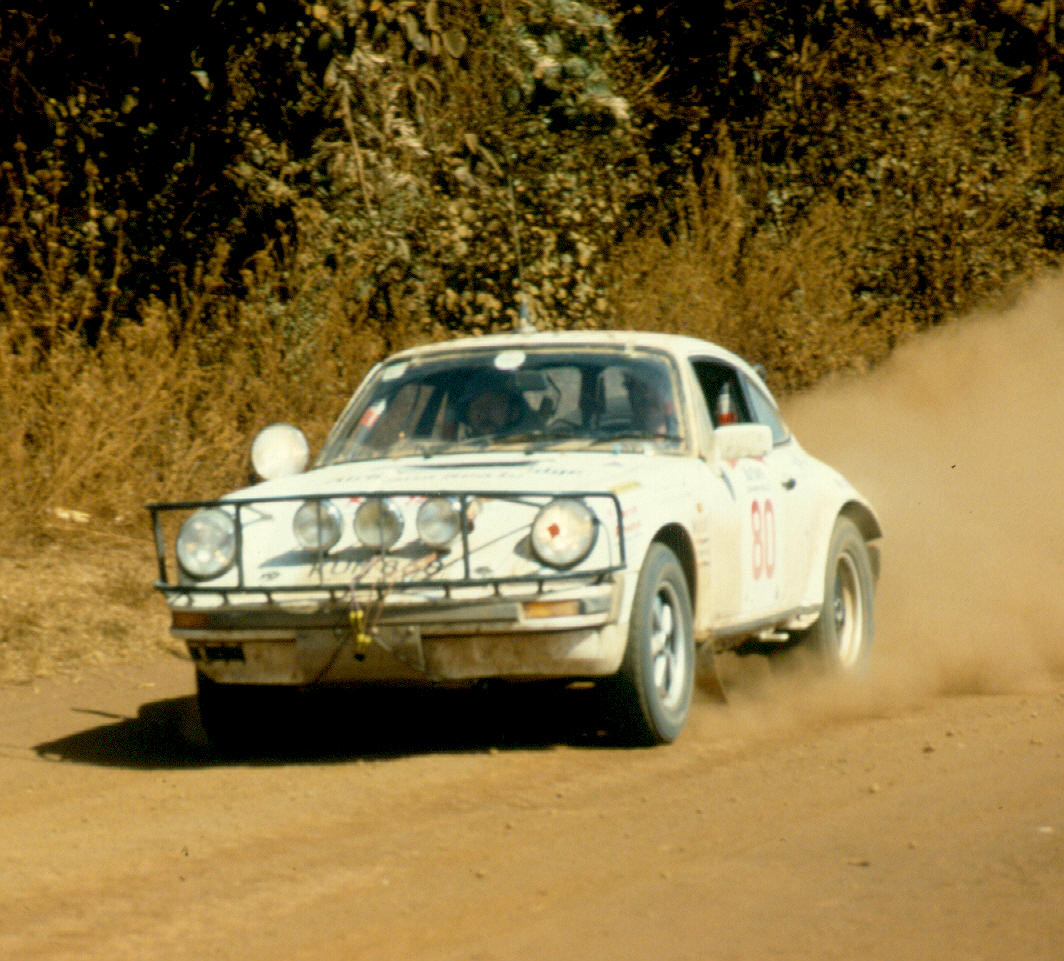
One of the “real” Safari Rally car: It looks more like a rally than like a safari!
We reached the town of Meru without any trouble, but well after dusk. Towards the end of the journey the Land Rover got a bit weak and it just managed to climb up to the “Pig and Whistle”, our stopping place for the first night. Once our luggage was in the cottages, we met at the terrace. But the noise of the Safari Rally going through Meru while we were having a lazy late drink (7.30 PM) made us feel tense! And so we slid to the annoying question: Is the Land Rover all right? Will it be ok tomorrow? The usually optimistic 4WD was dubious and the usually pessimistic ScoutSpirit showed -as usual- calm and detachment! Morality: one’s very deep characteristics can change depending on who or what is the subject of the problem! Later, the meal, excellent but overwhelming, helped us to forget about any possible doubts and the best plan was to ensure a good night to everybody!
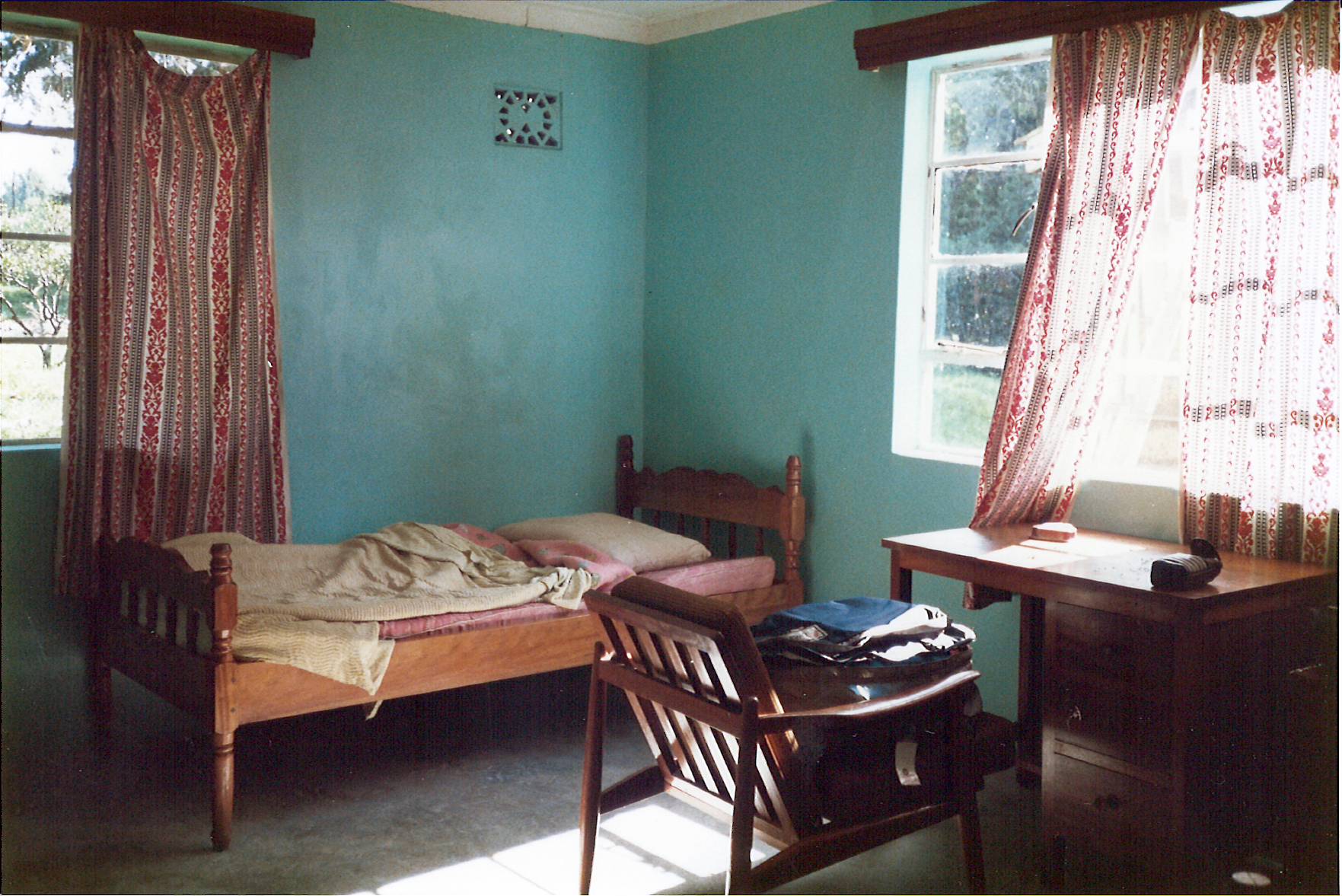
Our quiet room at the Pig & Whistle Hotel in Meru (built around 1930): A good night for a good rally’s leg.
Friday, 17th of April – Bivouacking in the bush!
We got up at 8.00 AM, a GORGEOUS[6] sunshine greeting us at the doorstep. Things stayed all right until the end of breakfast. But then, the Land Rover gave us bad news: It was tired, exhausted, no more power and wouldn’t say why. Kindly, the manager of the hotel proposed his mechanic. Good news, the fundi kwa gari[7] (the cars’ specialist = the mechanic!) was trained on Land Rovers. This was our luck in misfortune. The man came and gave his diagnostic: “Burnt cylinder head gasket”, something not nice to hear in that GORGEOUS morning when everything was just starting. It was 10.00 AM and he said that he could repair it for 1.00 PM. Doubtful but hopeful, 4WD and ScoutSpirit went with him and both cars to his garage.
Meanwhile, X-ray and I had a good “seed-collecting-time” while inspecting trees and various plants in the garden: Custard-apple trees, fig-trees, coral-trees, African tulip-trees, a sort of climbing cucumber, frangipani, etc. At 1.30 PM or so, men and cars came back, ready for another brilliant -if somehow delayed- start! We thanked the manager heartily, filled the tanks up and bought the newspapers. We left Meru after a light picnic. It would have been nice to have driven eastwards to Meru National Park, the only place in Kenya at that time which hosted white rhinos (introduced). This is also where Elsa, the very famous lioness raised by Joy Adamson, was buried. But, in view of the mechanical delay, we kept that itinerary for another possible safari and headed to the north, to Shaba National Reserve. By that time, I discovered that we were going to a place we had no map of! The Swiss part of me thought “well, we are really looking for adventure”. I understood later why it was not that adventurous: Shaba is a very small national reserve and there is only one main track through it! I was then ready to follow happily, not that I really had the choice but that I was much relieved not to go to the “outback” without enough training.
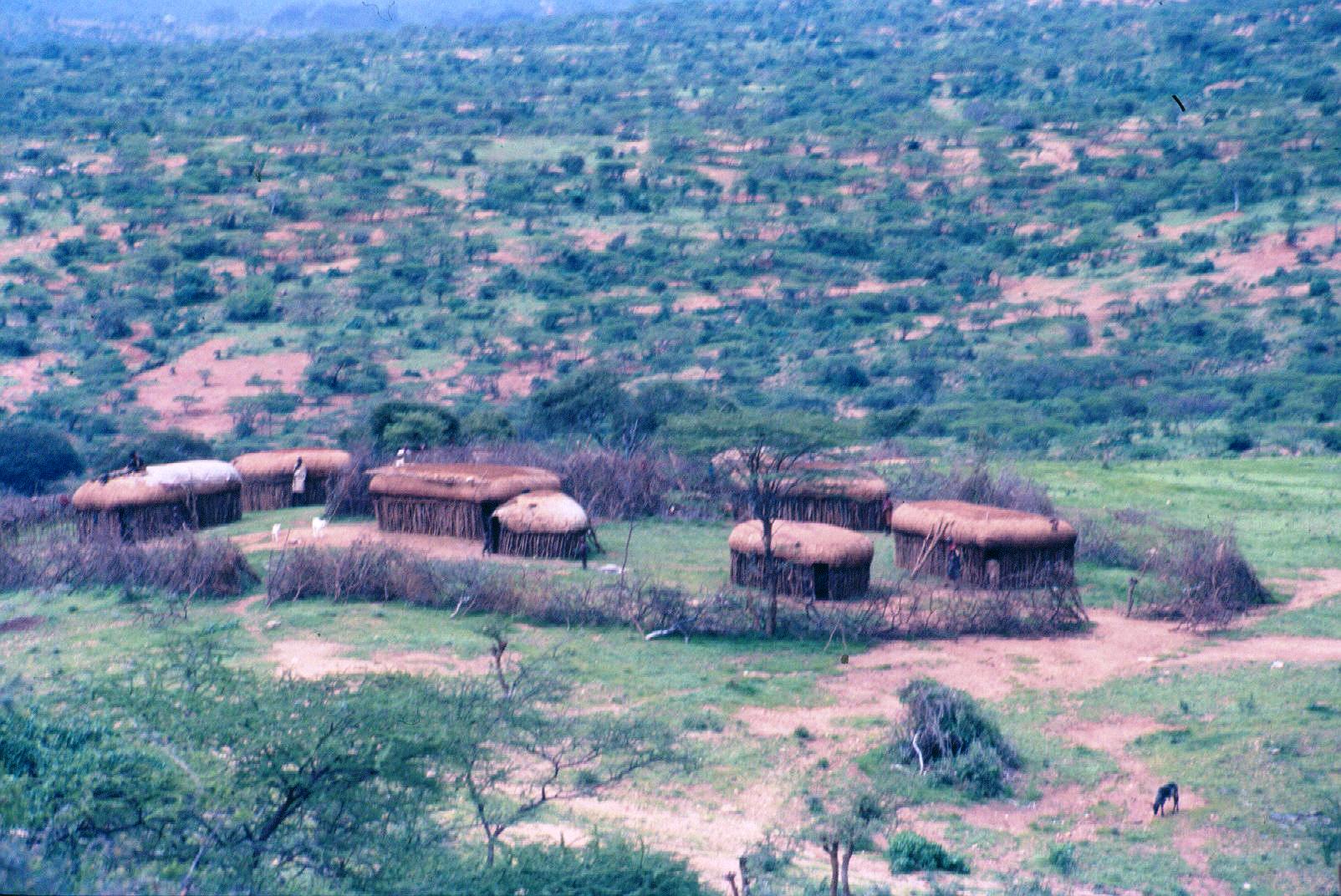
Samburu’s manayatta (family settlement with huts and traditional spiny fence): Somewhere on the way to Isiolo.
After Isiolo, we passed Samburu National Reserve and Buffalo Springs National Reserve on the left hand-side and turned to the right near a military camp. With Shaba National Reserve, these three national reserves make a well protected area, famous for its “northern dry-country” game, such as reticulated giraffes, Somali ostriches, Grevy zebras, gerenuks, oryx, kudus (both greater and lesser) and so on. From that point on, the semi-desertic landscape appeared and it was truly marvellous, well I would say GORGEOUS! We were -however- driving into temporary rivers because it had just been raining heavily (April is the start of the rainy season in Kenya but heavy rain is not expected in the northern part!). With rays of sunshine on the spurting water, the scenery was “not bad” at all. I had great fun trying to get a picture of the Land Rover surrounded by water, the sun shining through. As it was following ours, I was twisting myself out of the window, trying to stay inside despite the many bumps.
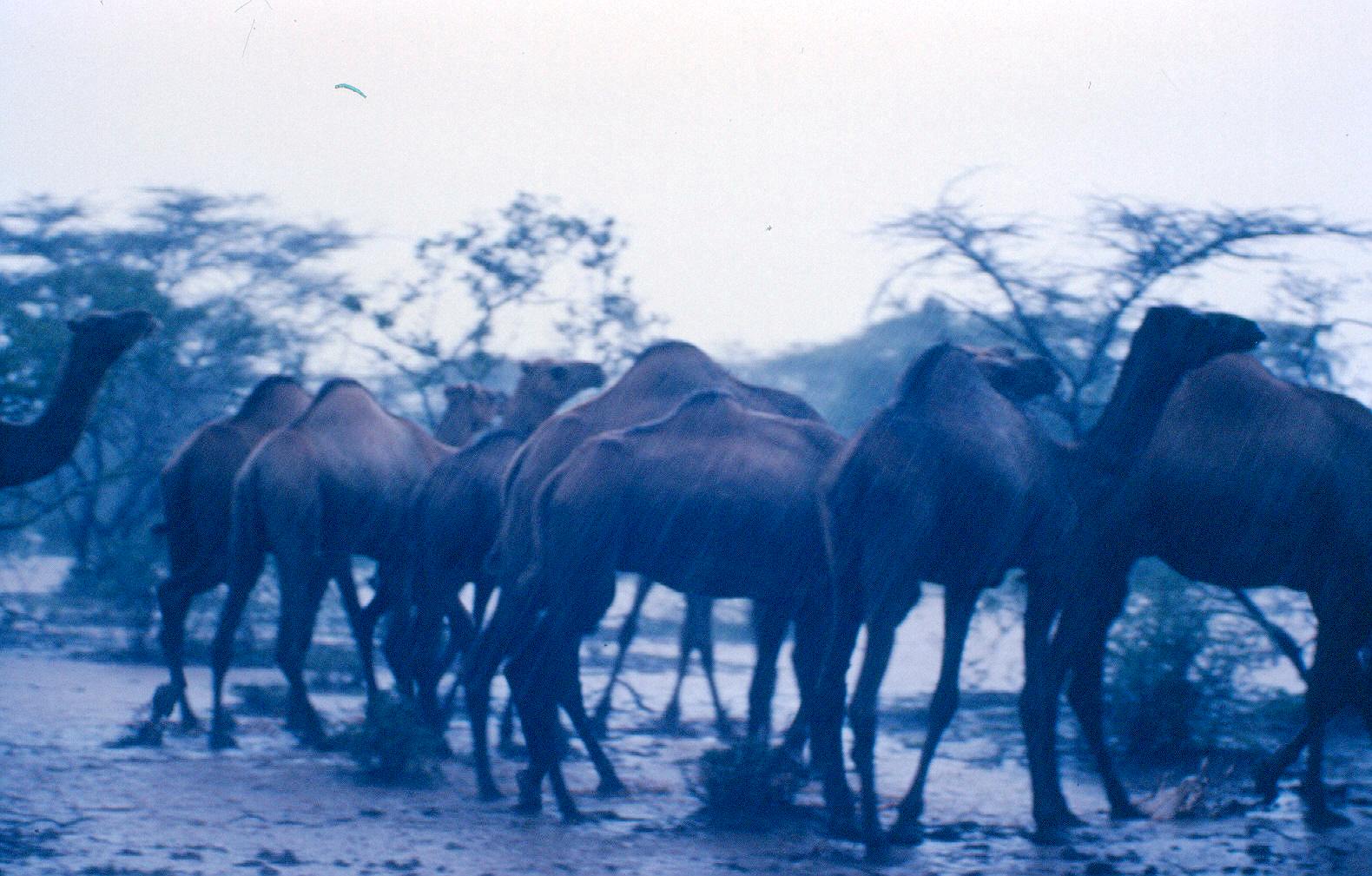
A group of camels: Under the unusual strong shower of that day…
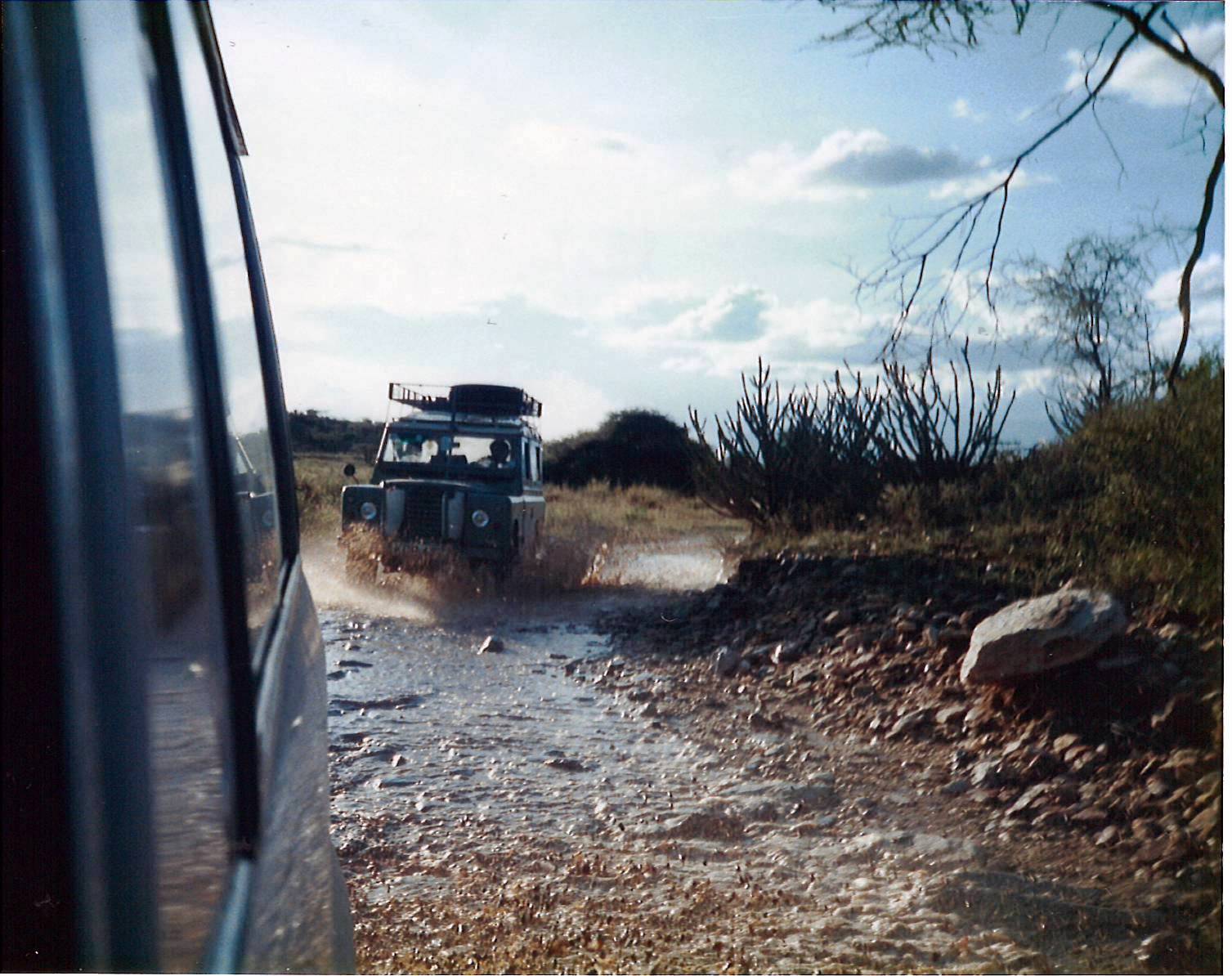
Sparkling water under sunshine: well-tried but the picture doesn’t really render the full atmosphere.
We eventually arrived at the gate of Shaba National Reserve. Built in the middle of that totally wild land, at the edge of that national reserve, the office was yellow, I mean completely yellow. Not even a frame or a nail was of another colour! When we got in, we saw that inside, it was yellow too, of course! We found a man waiting as If he was just expecting us to come at that time precisely! Nevertheless, I wonder how many persons he may see in a week, except for his few companions?
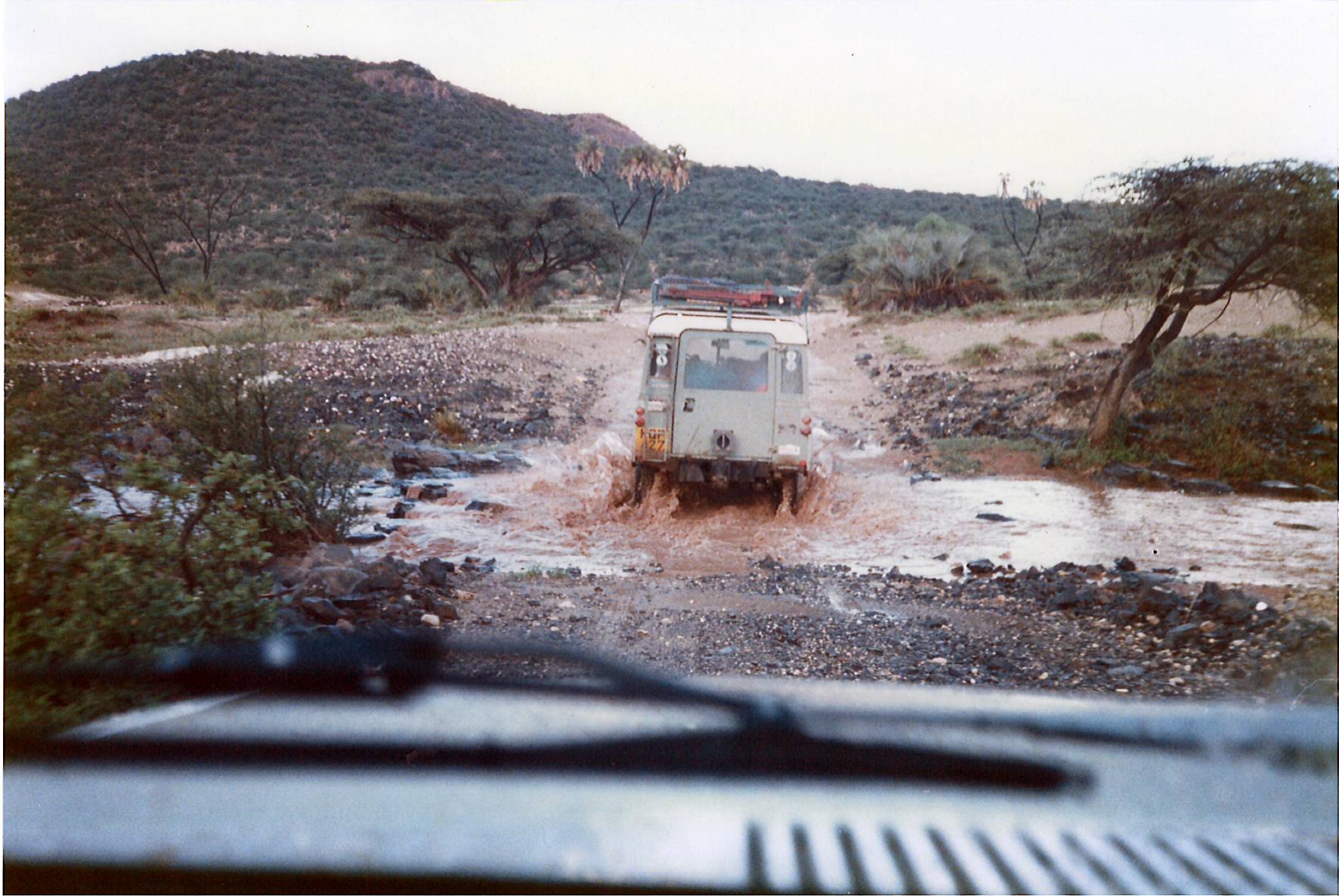
After a heavy rain: The dirt-road is flooded at many places…
We first went to visit the “ghost” tented-camp. It was a pathetic sight: Not GORGEOUS! The last drops of rain were dripping from the broken roof into our necks and the bright white toilet was shining in the deep green grass near a tree. But the camp may have been pleasant because it is right above the Ewaso Nyiro river[8] and has got springs and the shelter of big trees[9]. We decided then to go further and to find the other campsite. It was about 6.00 PM, we still had time, but not too much. As nothing like a signboard appeared (If you read the ninth footnote, you already know that without a signboard, there is no way to make sure that you have reached the campsite!), we thought that we had missed it. So we chose our own one in the middle of the bush: just the perfect place, away from animals’ tracks (we were mainly beware of hippos there), flat surface, two big trees, nice stones to hold the grid above the fireplace and water not far away. At the beginning, we didn’t notice the impressive quantity of very aggressive acacia thorns, so we thought that it was like paradise! Yes, if you forgot about the many punctures in your soles, it really was ideal.
The so-called “sleeping-room” was composed of a big tarpaulin and sheltered by a double flysheet, building one wall and the roof. It could sound strange but a car was part of it as we had only three poles to hold the stuff and the Land Rover was the fourth one… an interesting pole I must say. Other advantages of this architectural puzzle were that it supplied light and water and provided some handy space to prepare the meals and store. A few stones, a few logs and we got a big fire going. A few armchairs, a table and drinks and we were well settled. “Shouldn’t we stay two nights in this place? It is so GORGEOUS!” said 4WD and we were already agreeing “Yes, after all this work, it is not worth removing everything and starting again tomorrow… and would we find another spot like this?” First step towards settlement not to say laziness! We voluntarily postponed the decision to the following morning: “Let’s think about it tomorrow. Anyway, we will do as we will wish”.
We looked at the bedroom, so attractive with our four camp-beds, mattresses, pillows, sleeping-bags and mosquito-nets! We looked at the fire, its smoke chased by the wind towards the darkness. Happy us! The dinner, one of X-ray’s fantastic stews was bubbling on the fire and her famous “pineapple-pie” was also waiting for us as much as we were waiting for it with the memories of earlier occasions! We were having a good time and we were very much aware of it. A Scops owl called in the distance and we stared at the sky hoping to discover the announced full moon. We argued about the time of the moonrise and it eventually appeared (at 10.00 PM), shortly before we prepared for the night’s sleep. I must add here that the idea of bivouacking was a real excitement to ScoutSpirit and I as we never did it before… Having as unique protection a mosquito-net while you are deep asleep in a game reserve where lions, leopards, cheetahs, elephants, buffalos, hippos and hyenas may be roaring around is quite challenging… it gave a certain chill down our spines!
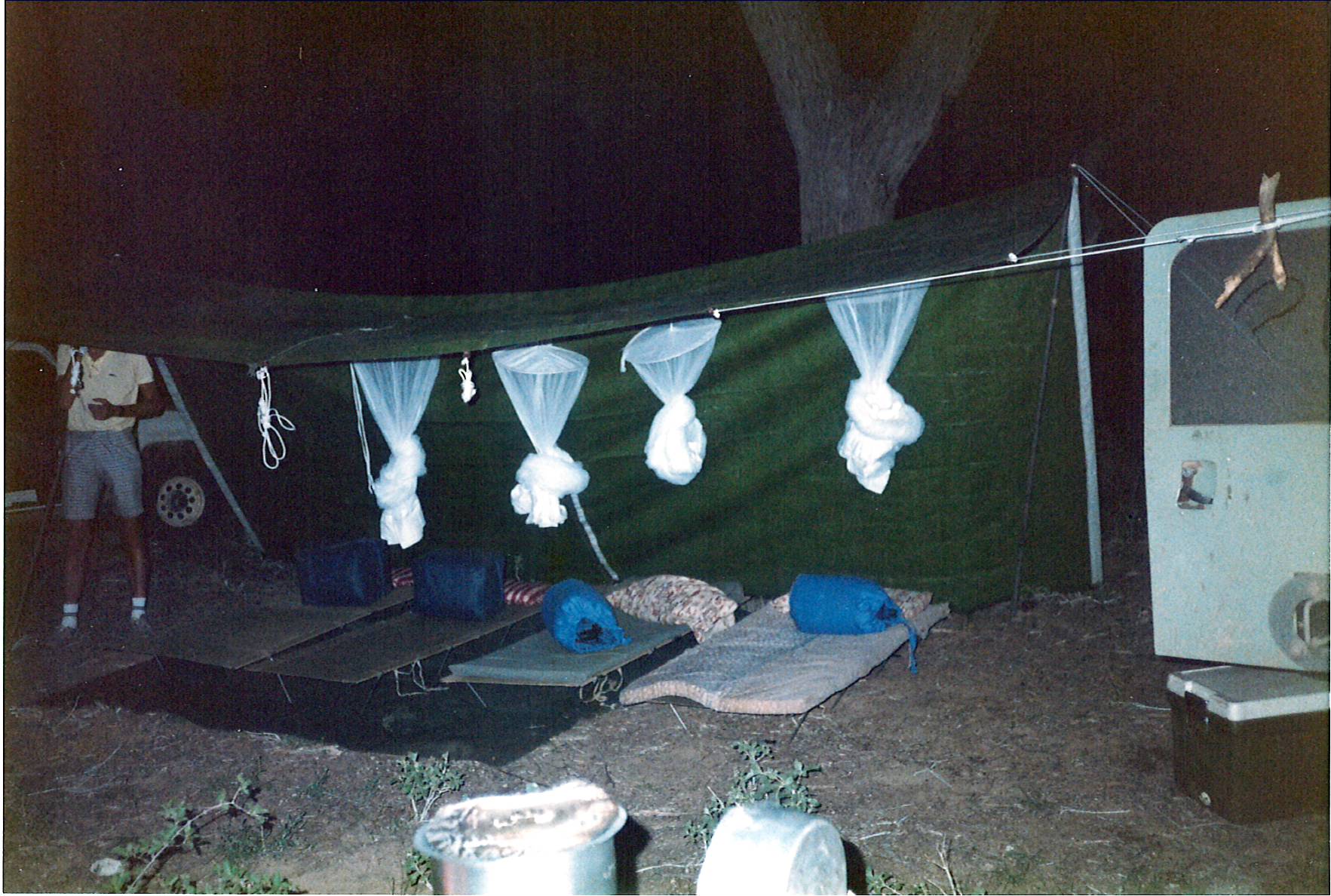
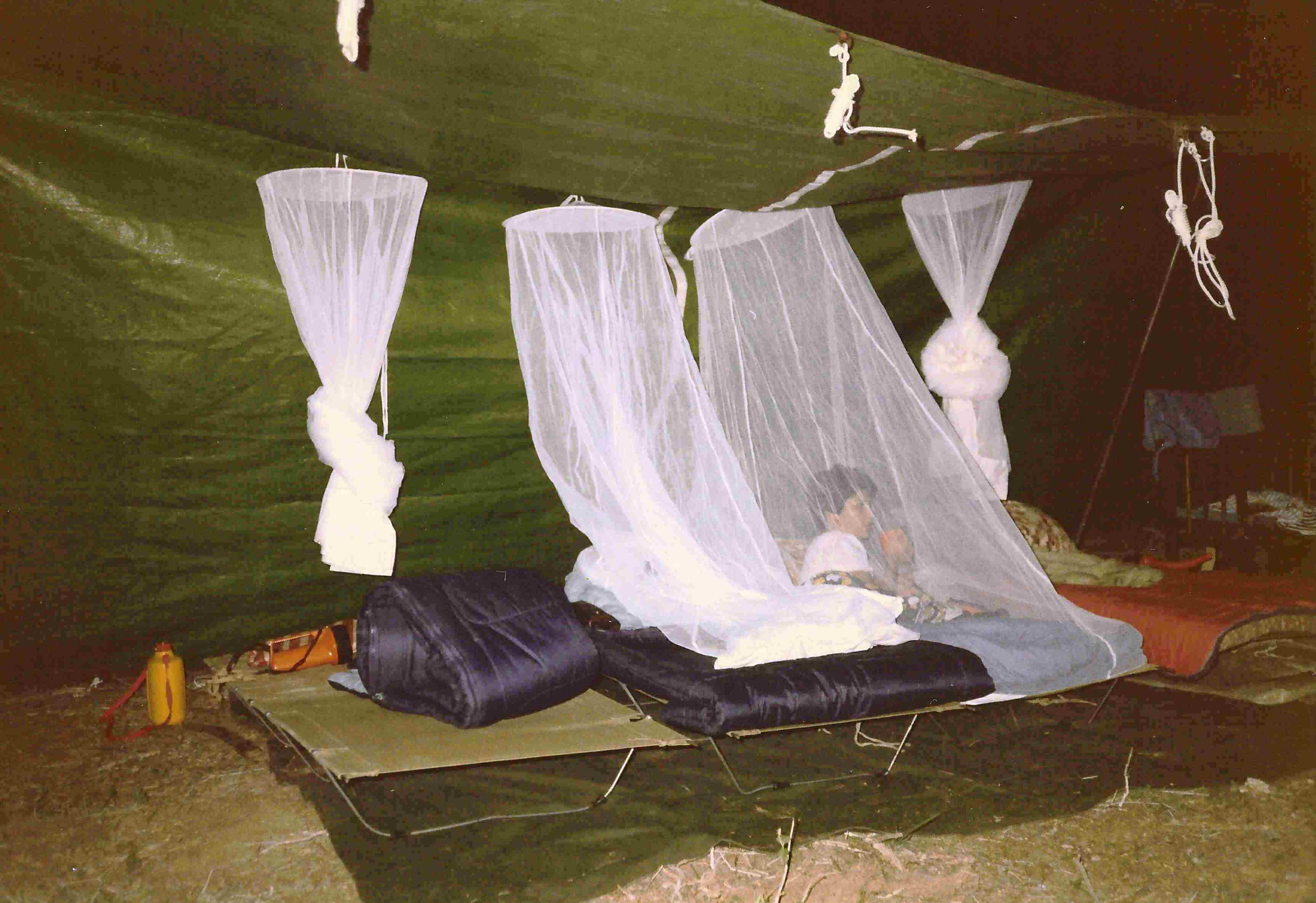
How to sleep in the bush: Bivouacking is nicer but a bit more scary than camping!
What a story to wash ourselves and get into bed! “Primo”: thorns all over the place, so don’t remove your shoes too early… “Secundo”: small instable bed, so keep your balance… “Tertio”: annoying mosquito-net to be wrapped around your mattress, so be patient and methodical… “Quarto”: dudus (pests or rather annoying insects) still coming into your “cell”, so start again from “Tertio”! “Something dreadful happened to me” shouted 4WD while collapsing in his bed, head lower than his feet! As an answer, we all laughed out loudly, getting rid of the tension that we accumulated during the operations. It was good that the well known and rather naughty practice of placing the remains of the meal under the bed of the “beginners” was not carried out. One can imagine the surprise of the “victims” the moment the hyenas tried to snatch the food from under their camp beds! Eventually we fall asleep and the day after…
Saturday, 18th of April – Getting soaked!
We woke up at 9.00 AM after a GORGEOUS night shared with nature and lit by a bright moonlight. We soon shared a “solid” breakfast before leaving for a game drive. The ladies were installed on the top of the Land Rover. ScoutSpirit was following just behind us with his car. We drove along the river, aiming for Penny’s falls. It was wild and beautiful. On our way, we passed some campsite (occupied!) and a sort of “kopje[10]”. Was this the campsite we aimed for the night before? ScoutSpirit, with whom we had lost sight of for a while, came back with a huge tortoise-shell which he found on the riverbank for us to see it. Soon before we reached the falls we forded a stream. When we looked back, we could see the Trooper diving into this narrow but quite deep stream that drains the marsh and forms the famous waterfalls further down! Fortunately, the car came out easily and we could reach the falls and leave the two vehicles under a big tree, shade being strongly recommended at this time of the day where the temperature can easily reach 40°C.
We had been told that here was where Joy Adamson lived for a period of her life. But there was no more building or sign of any settlement anymore to see around. Not being looked after, it certainly disappeared in the vegetation very quickly[11]. We climbed down a rough and steep slope heading for the Ewaso Nyiro river and discovered the magnificent falls with their dark red but transparent water from the marsh mixing up with the “white coffee” water from the main river: GORGEOUS again! On the sandy shore we had our lunch, roasting ourselves in the sun. After the picnic, 4WD and X-ray went walking a bit further and came on a few crocodiles… we set off for the cars quite rapidly!
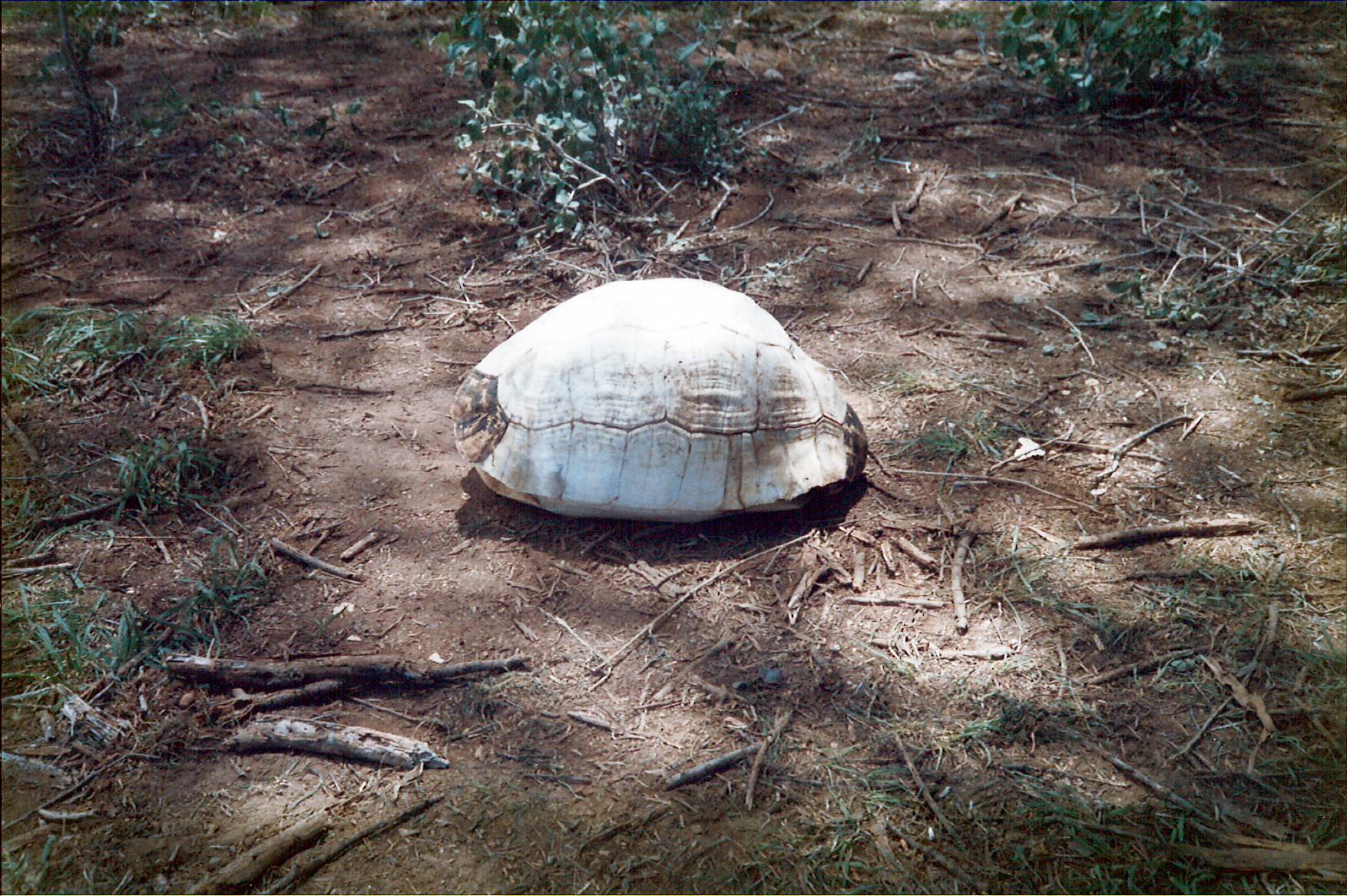
Measuring about 40 cm length: The famous tortoise-shell that “polluted” part of the safari!
On the way back, the second crossing of the small river became a problem: The Trooper stopped in the middle of it, just in front of us, and the engine failed kabiza (totally… and total bad news!). Anyhow, after a while, we saw ScoutSpirit crawling inside and appearing finally out of the boot-door! Water was about the same level as the doorstep. Hands under water, he attached the towrope and 4WD’s car pulled the Trooper backwards a little bit but not much as the four wheel-drive was not on. At the second attempt the job was done. But the Trooper still refused to start as the engine was soaked. Soon we realized that the floor was flooded too so we started to pick up some drooling things and put them outside to dry under the sun. Then we had to remove the water from the carpets and absorb it as much as possible. To complete the task, we drove back, doors open and full heat on. The “ex-dry” tortoise shell, still with us, got quite wet again. It was stinking like hell![12]
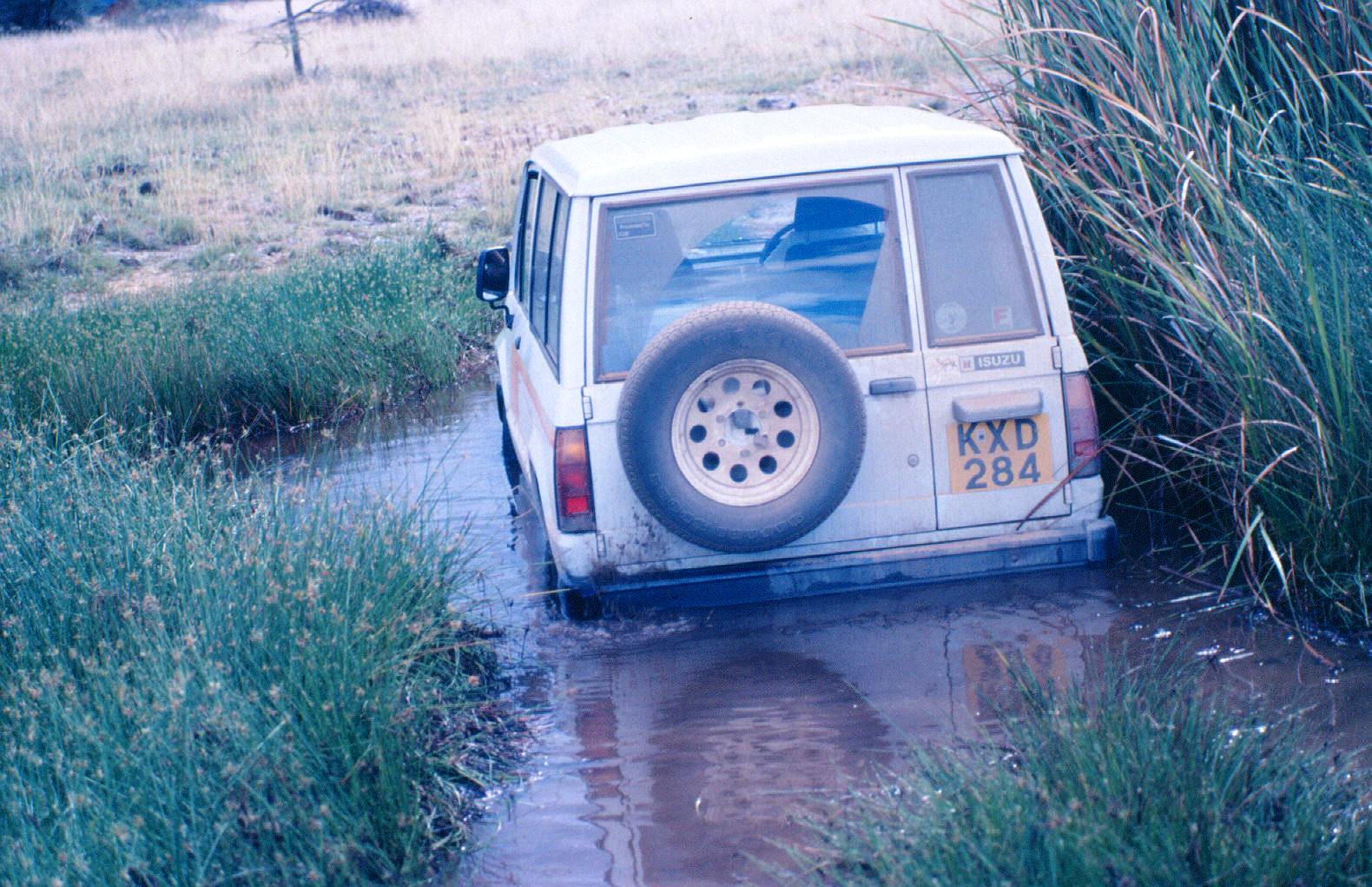
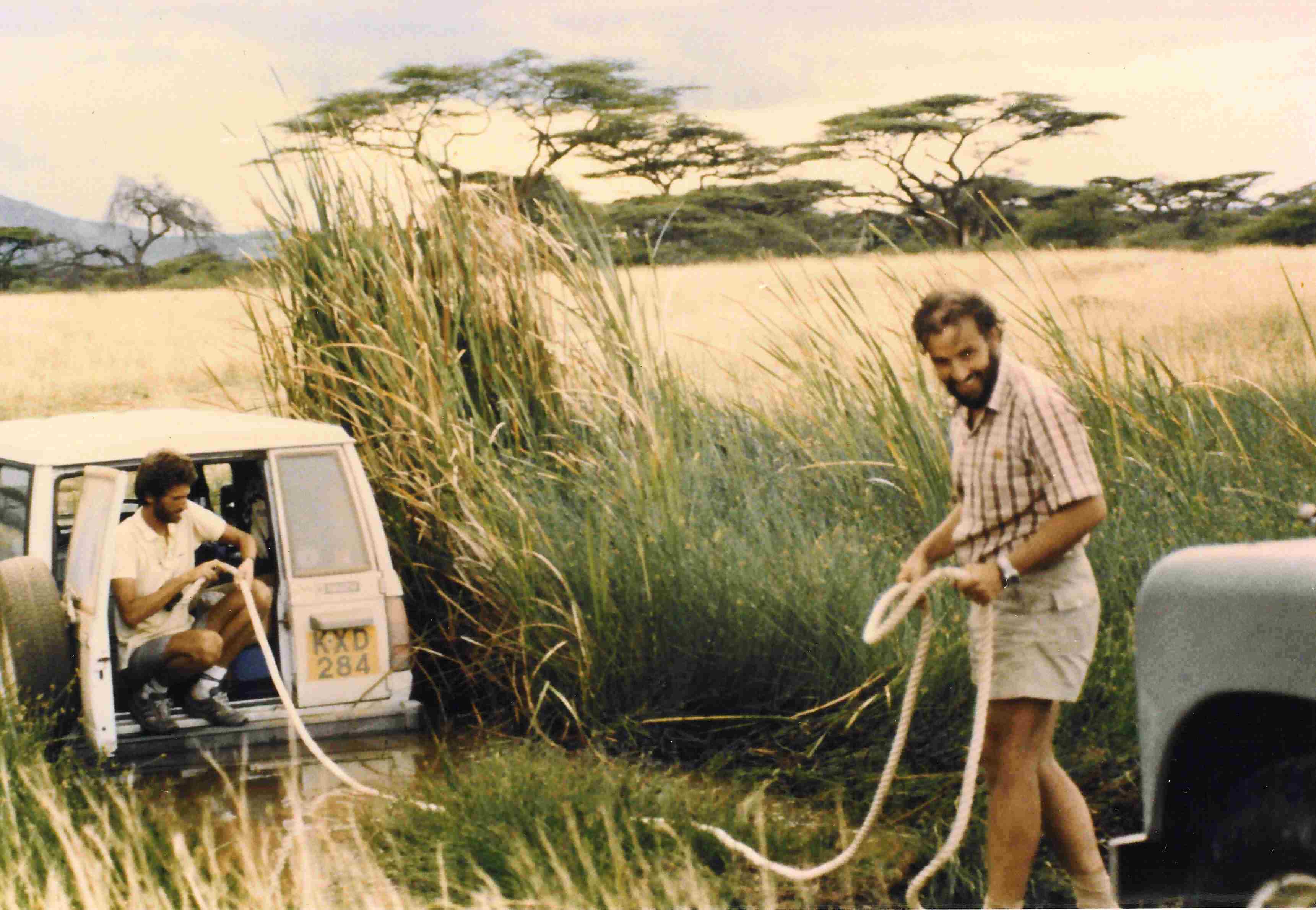
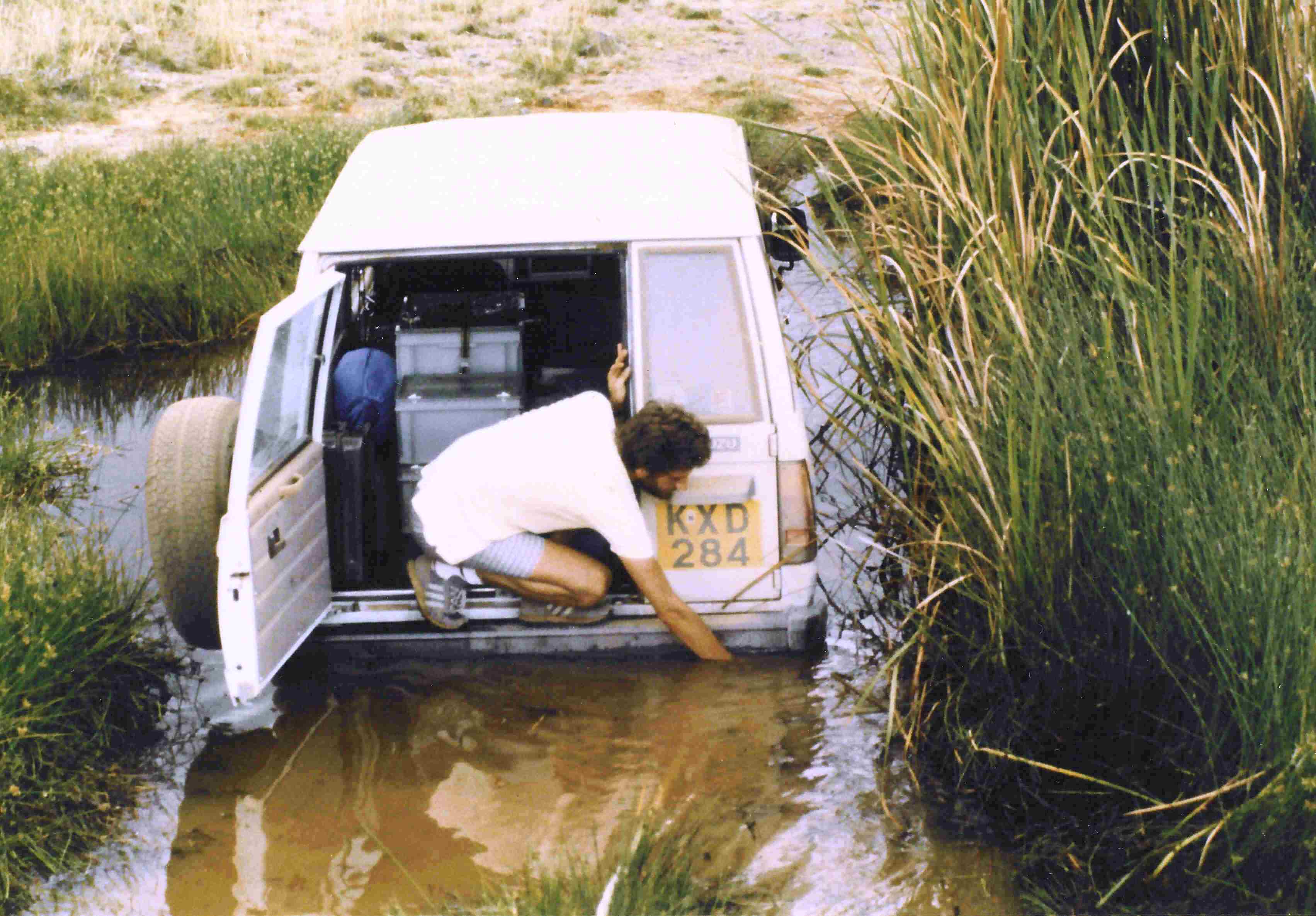
In the marsh: It is a pleasure to get stuck -and unstuck- with such good adversaries in that rally!
Next event was the episode of the famous snake. It was spotted by us, the ladies sitting on the roof, whose shouting resulted in such sudden braking by our driver that we almost landed on the sand. Of course, we were rather glad to be still on the car’s roof, especially when 4WD took the beast and put it on the bonnet. A kind of panicked interrogation took place in our heads… what was he doing and what If the snake was poisonous? “Would you hold it for me to take a picture?” asked 4WD to his patient wife. We nearly fainted! Eventually, the roles were reversed, 4WD held it and X-ray took the shot. 4WD was very happy holding the snake. Just as we were about to leave the poor thing, ScoutSpirit arrived and we had another episode of the same magnitude! Afterwards, the reptile went under one of our tires and we felt sorry at the risk to squash it. So ScoutSpirit didn’t hesitate to put his bare hand under the tire to chase it away despite our warning screams! By that time we started to understand that the men where teasing us. Silly ones[13]! From then on the atmosphere went a little bit crazy. 4WD got bored to drive alone while we were talking happily on the roof! He then left the pilot’s seat and had a chat with us, nearly standing out of the car but still driving…
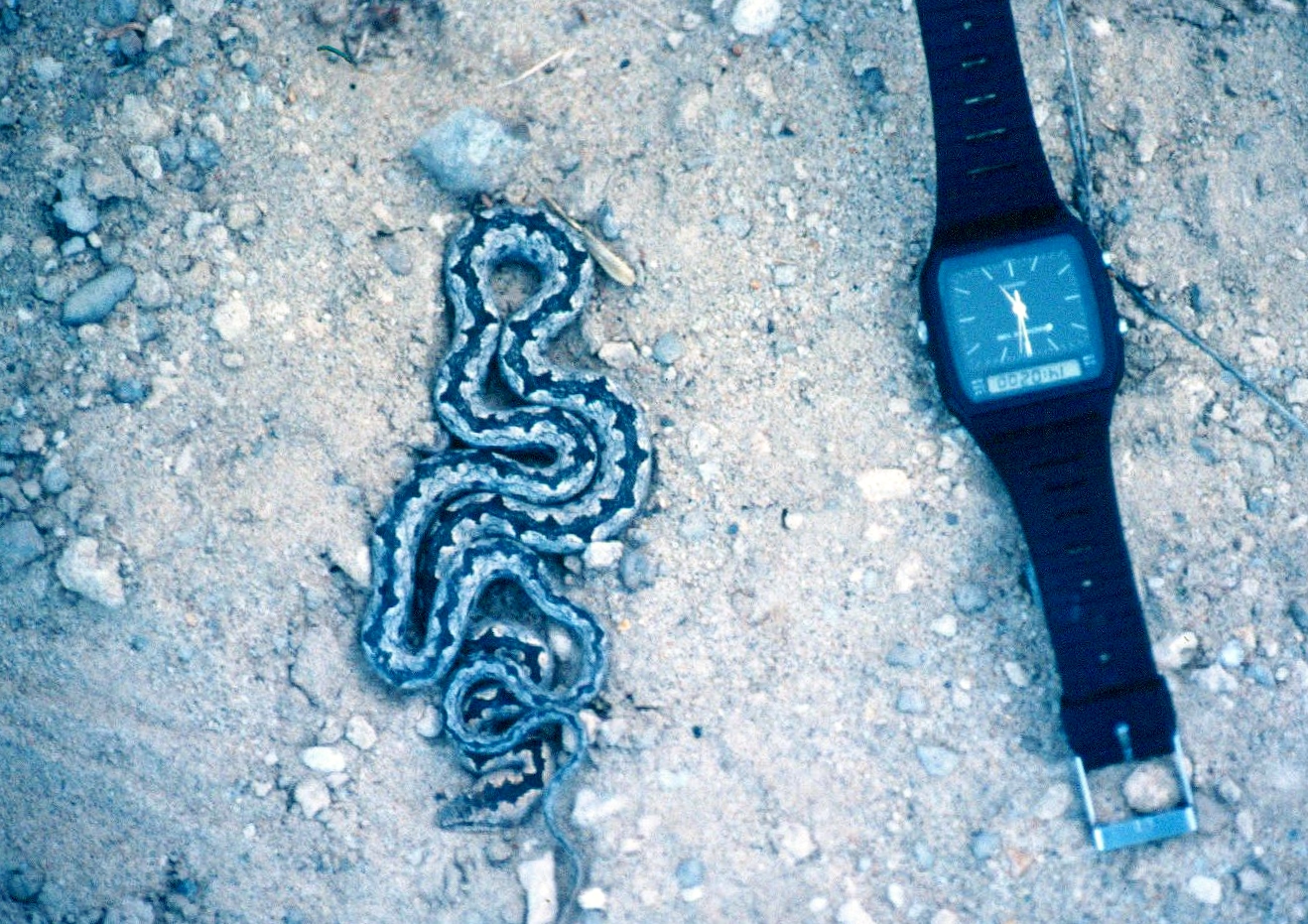
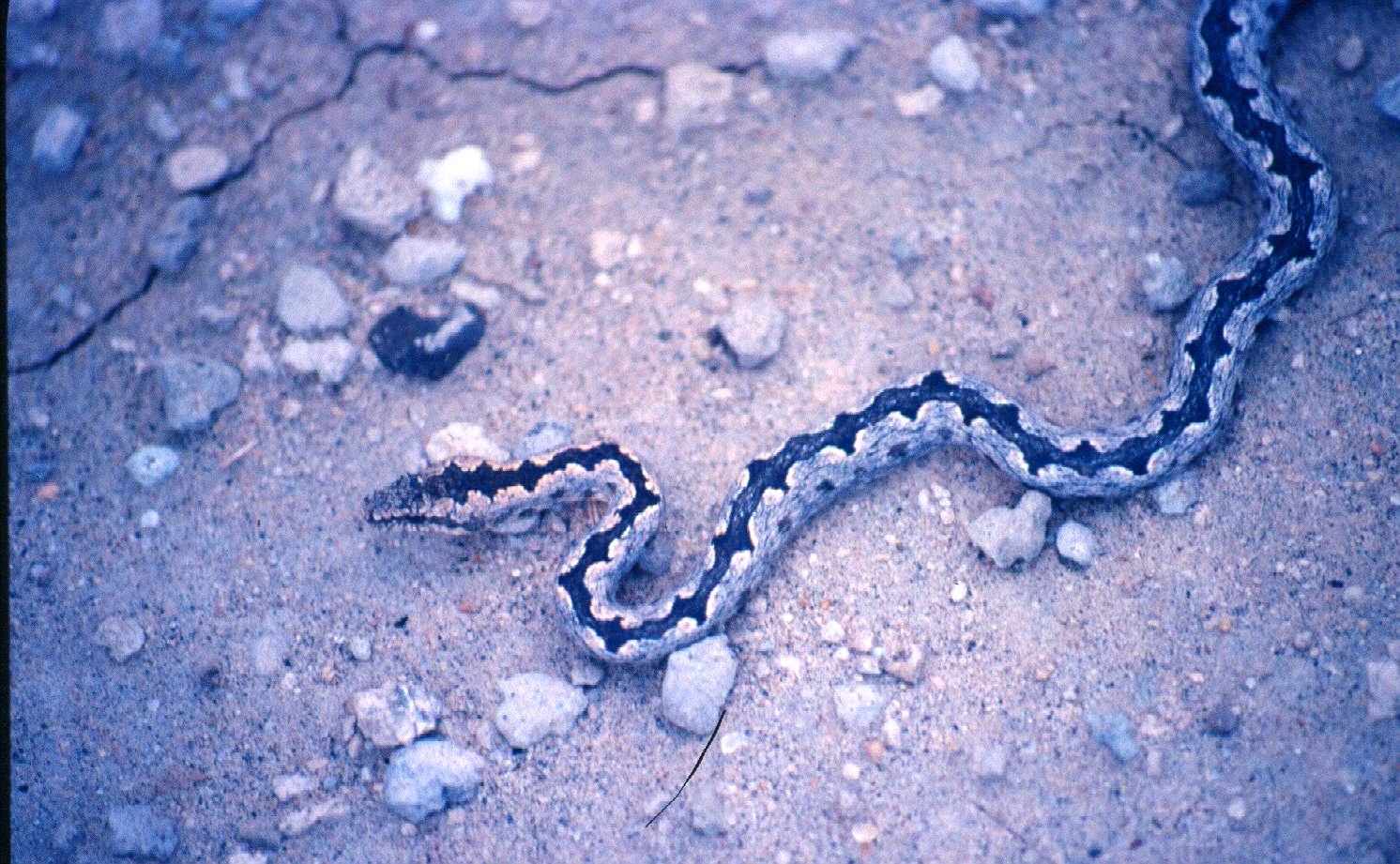
The very nice and small bark snake: At first we didn’t know it was supposedly harmless to man!
Then it was “mate time”. Mate is a South American beverage made out of a plant[14] that, once dried and crushed, is mixed with hot water in a calabash (also called mate) and drank through a sieving straw (bombilla). Every time the calabash is emptied by a drinker, it is filled with hot water again and passed to the next person of the group. This is a very social way of drinking that can be compared to our Swiss habit of eating melted cheese in the same pot for the whole table’s company, traditional and collective dish that we call “la fondue”. So you see, travelling with our Uruguayan friends, it was impossible to ignore that fantastic tradition, even on safari… as they also had to discover the famous fondue made with “El Molo” cheddar, dry papaya wine and vodka (all produced in Kenya), cooked on the fire in a famous Kisumu earth pot! But that took place in another safari and would be told about another time.
As we experienced it with great interest, mate is really good, social and somehow “sacred”! So much that we became very talkative for one hour non-stop! As dusk was coming closer, we hurried towards our “home-sweet-home”, still with doors wide open and full heat on for the Trooper to dry up. But we knew that it would take a few days to dry kabiza. We passed again by the beautiful rocks that we called “kopjes” and saw surprisingly no game at all. We came to the camp in the dark and under the rain which had spoiled our things: wet camp-beds, wet armchairs and worst, wet firewood! In spite of that, X-ray managed to light a pretty nice fire after we gathered some minute more-or-less dry twigs under some partly sheltered areas. Thus we could put our things around the fire in order to dry… It was time consuming. I was busy too with my belongings that had been soaked in the marsh-juice, so I kept waving them near the fire, in front of my dear friends who became sea-sick as a consequence!
By the time the meal was ready, everything was dry and we merrily started to eat our curry with poppadums: GORGEOUS for sure! The thought about “tomorrow” came again of course, but we sent it back as easily as the day before… not without bringing a few suppositions! Anyway, we quickly all disappeared under our mosquito nets after a quick wash. The moon came again, just raising at a quarter to 11.00 PM, nearly full, already shrank on one side, ‘cause of time passing by. The fire was special that night: Dry elephant-dung had been used because we thought that they might last longer than wood. So we could admire strange “squarish” pieces, very red, very luminous, with a particular scent, but not unpleasant, that we never had before…
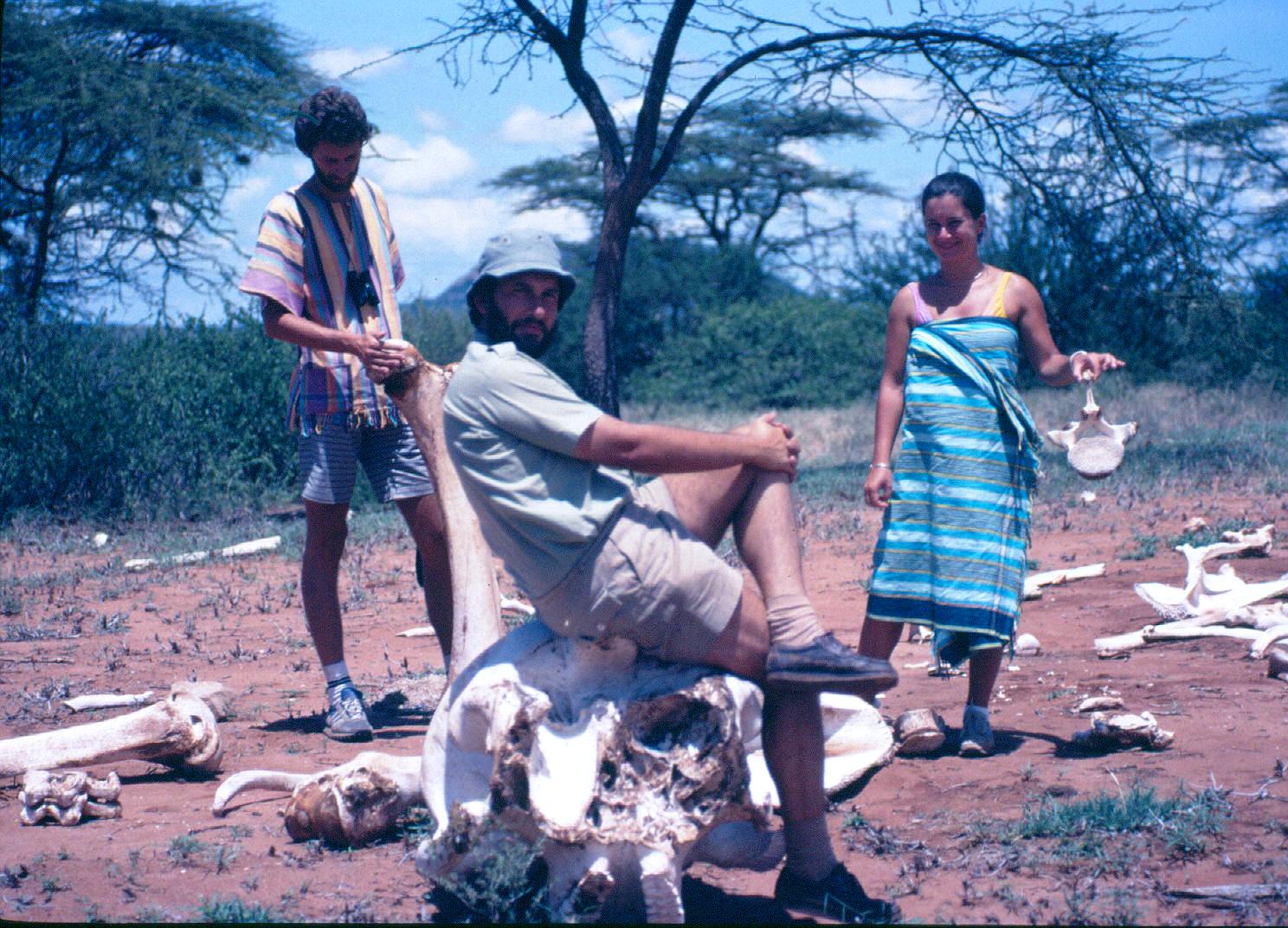
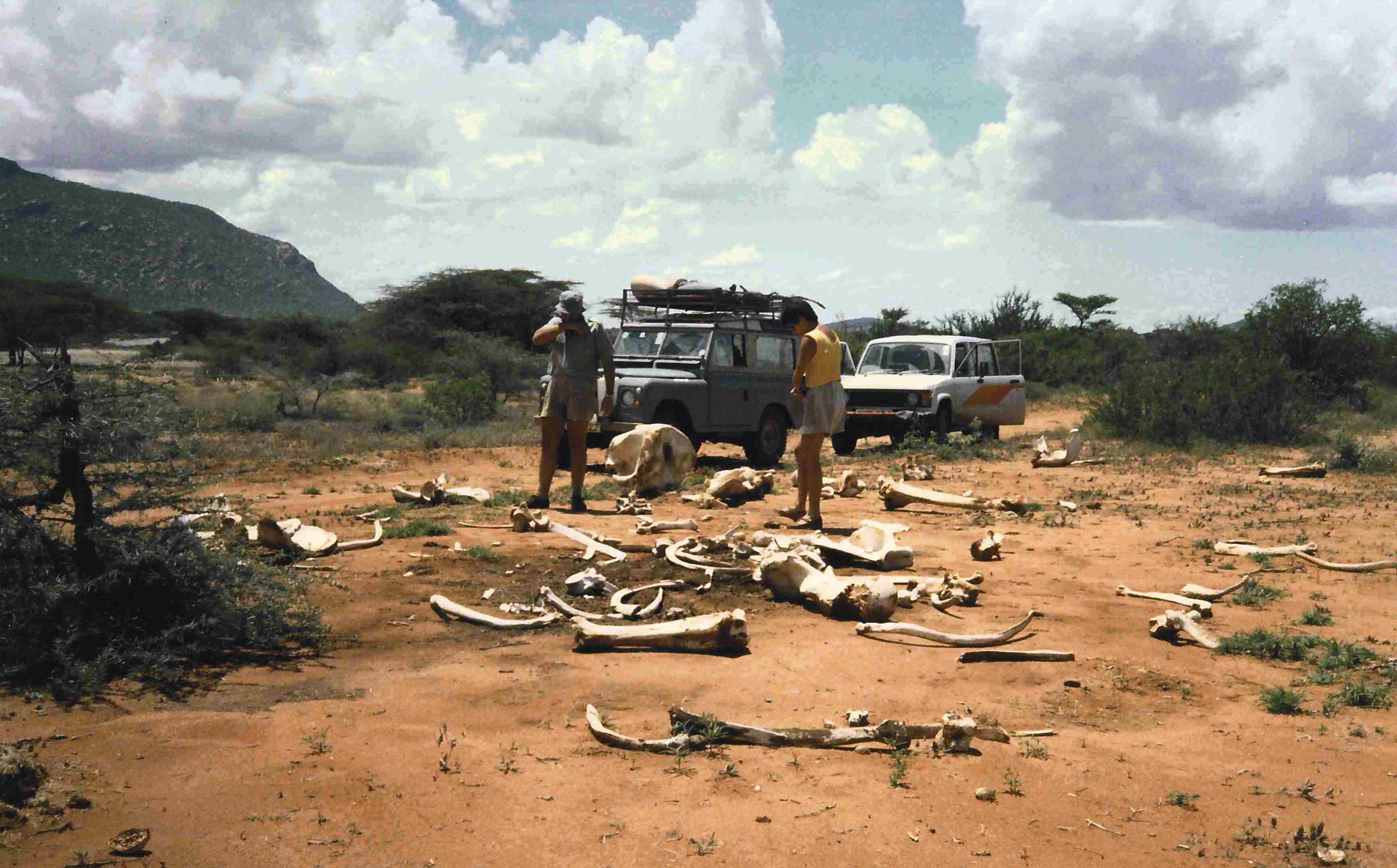
The elephant skeleton: A vast open cemetery that brings up many reflexions as the tusks were missing…
Sunday, 19th of April – Heading north shortly!
Yes, the idea of using the elephant dung was brilliant. The fire was still hot with quite a few embers and started on easily, earlier on that morning, said ScoutSpirit (I can’t tell as I was fast asleep at that time). After breakfast, the decision was taken to try and reach the Matthews range for the night. So straight away, we entered a big spell of activity till 11.00 AM. A few pictures were taken on our departure: The tortoise-shell that was still around and an elephant skeleton that was lying a bit further along the track. The hide of the latter was still there also, stinking horridly but no need to look for the tusks… poachers’ business! At 12.00 AM, we reached the gate and drove on towards the north. We passed Archers’ Post and, later on, drove straight ahead as we left the road leading to Wamba on the left hand-side. We could admire the very nice alignment of the dirt road towards the big mountains of the Matthews range: a GORGEOUS view although it soon became very clouded! The way began to grow wilder as we had to cross big luggas (dry riverbeds, but don’t ask me where this word comes from) and very rocky and hilly places… but always there was a hut or a shamba (cultivated field or/and dwellings, usually wooden houses) to see nearby. It started to rain cats and dogs thus inflating the rivers very quickly, so we decided to go back south and join Samburu National Reserve by a shortcut rather than to continue for the Matthews. It is well-known that the mountains attract the clouds and means much more rain than on the plains…The roads were too flooded to our taste and mainly too risky for the cars… there was no point to get stuck there for the night!
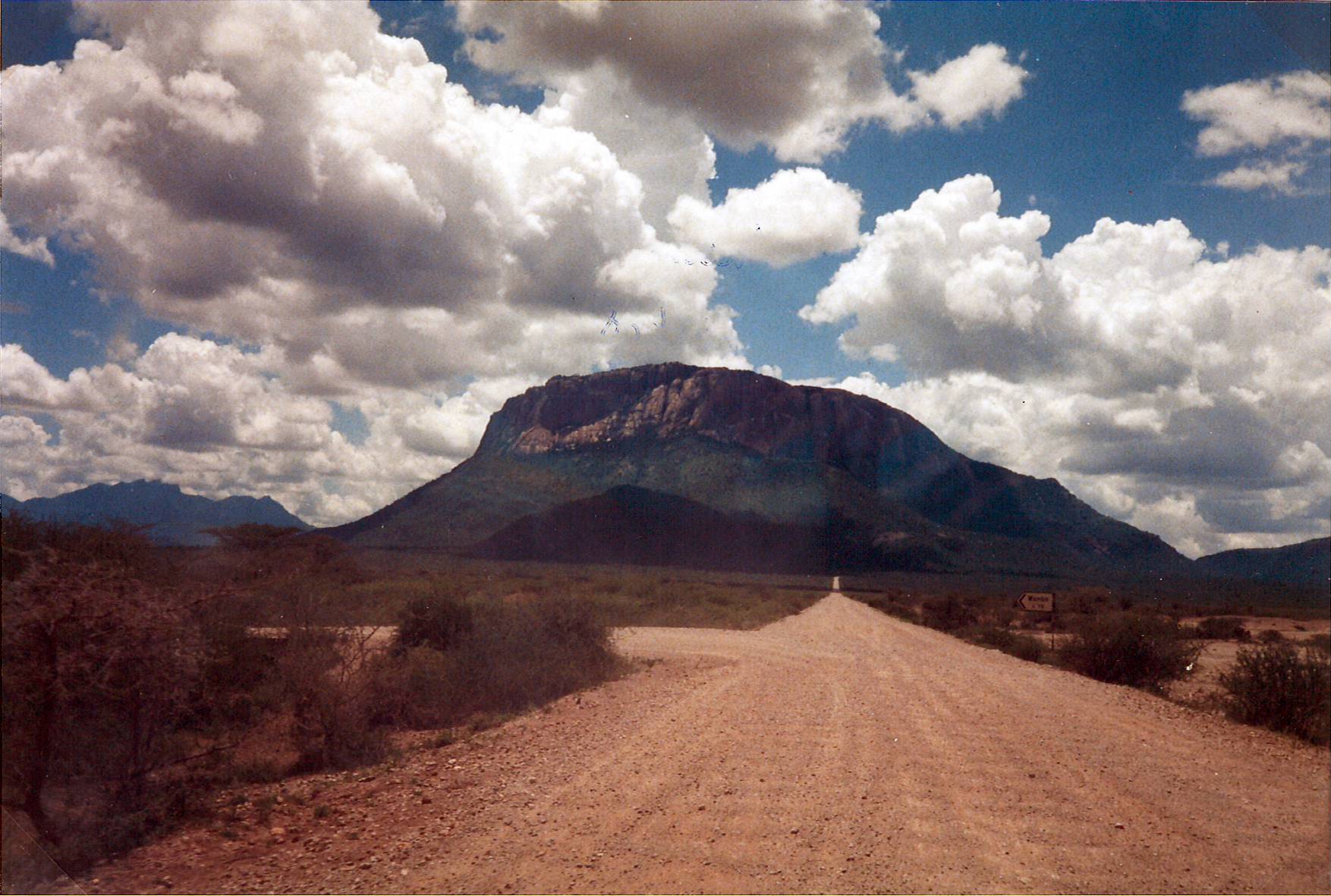
Matthews mountains and corrugated iron dirt-road: Above a certain speed, you “fly” and it stops shaking!
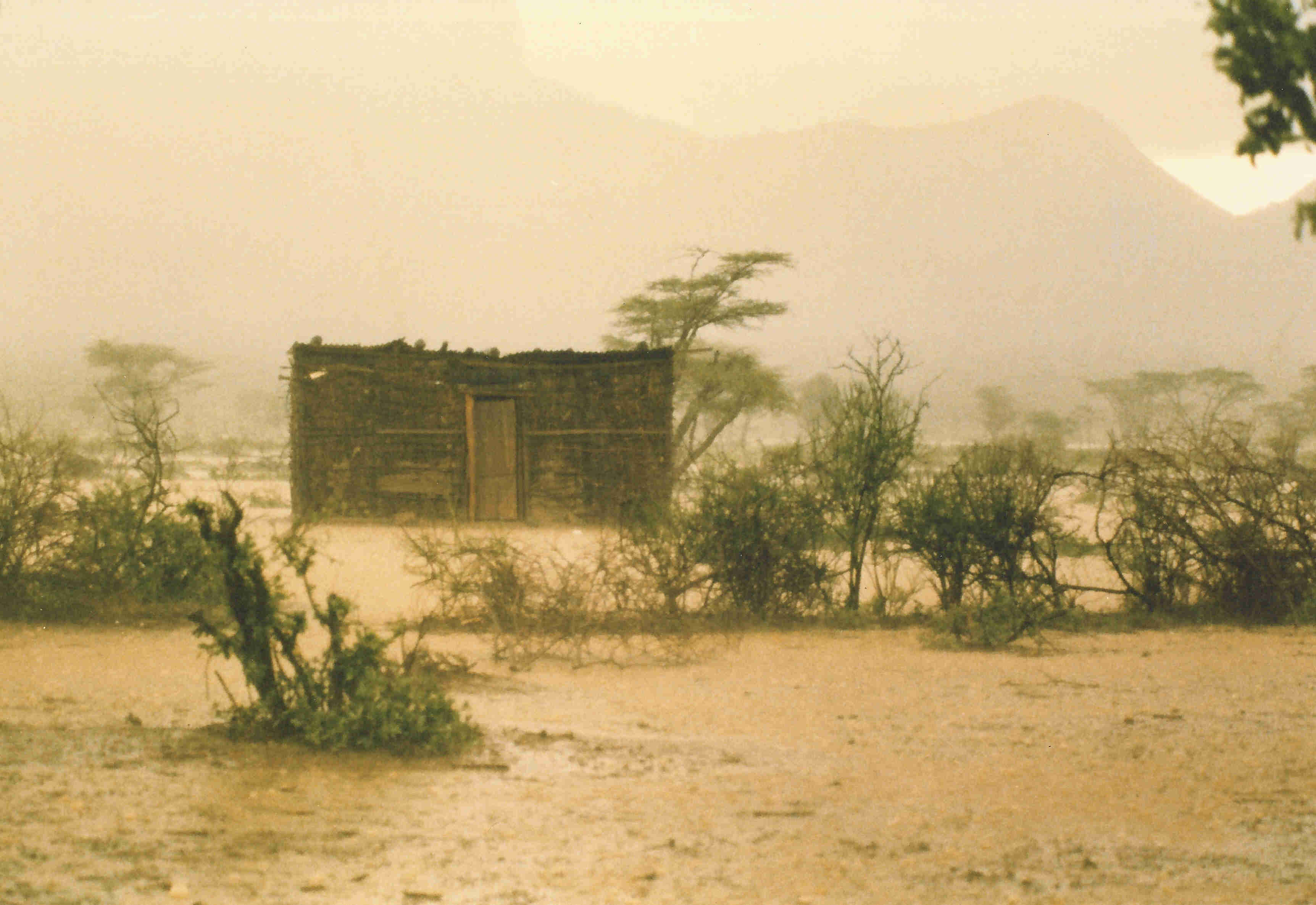
Very heavy shower: Everything was under water in no time!
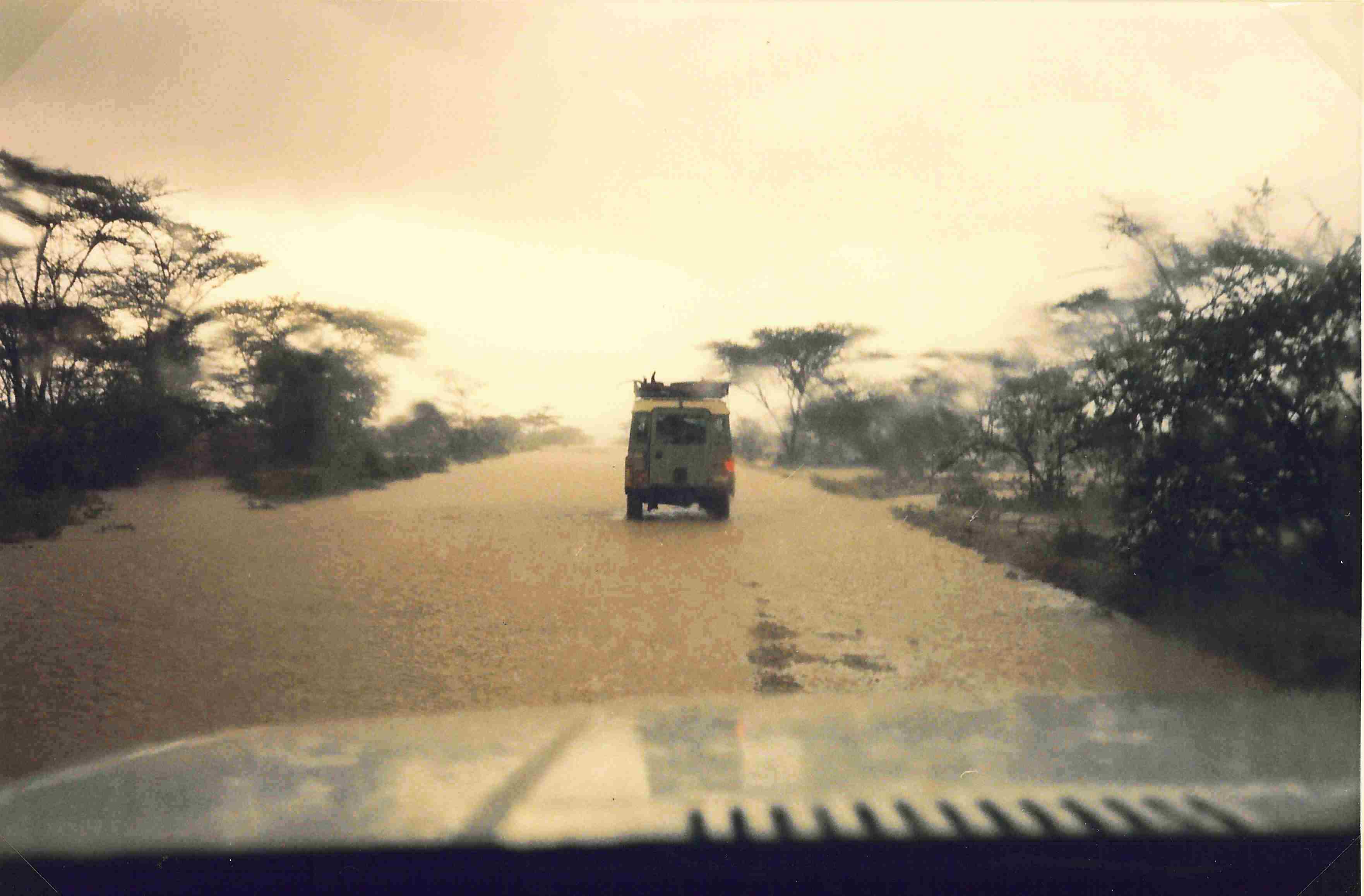
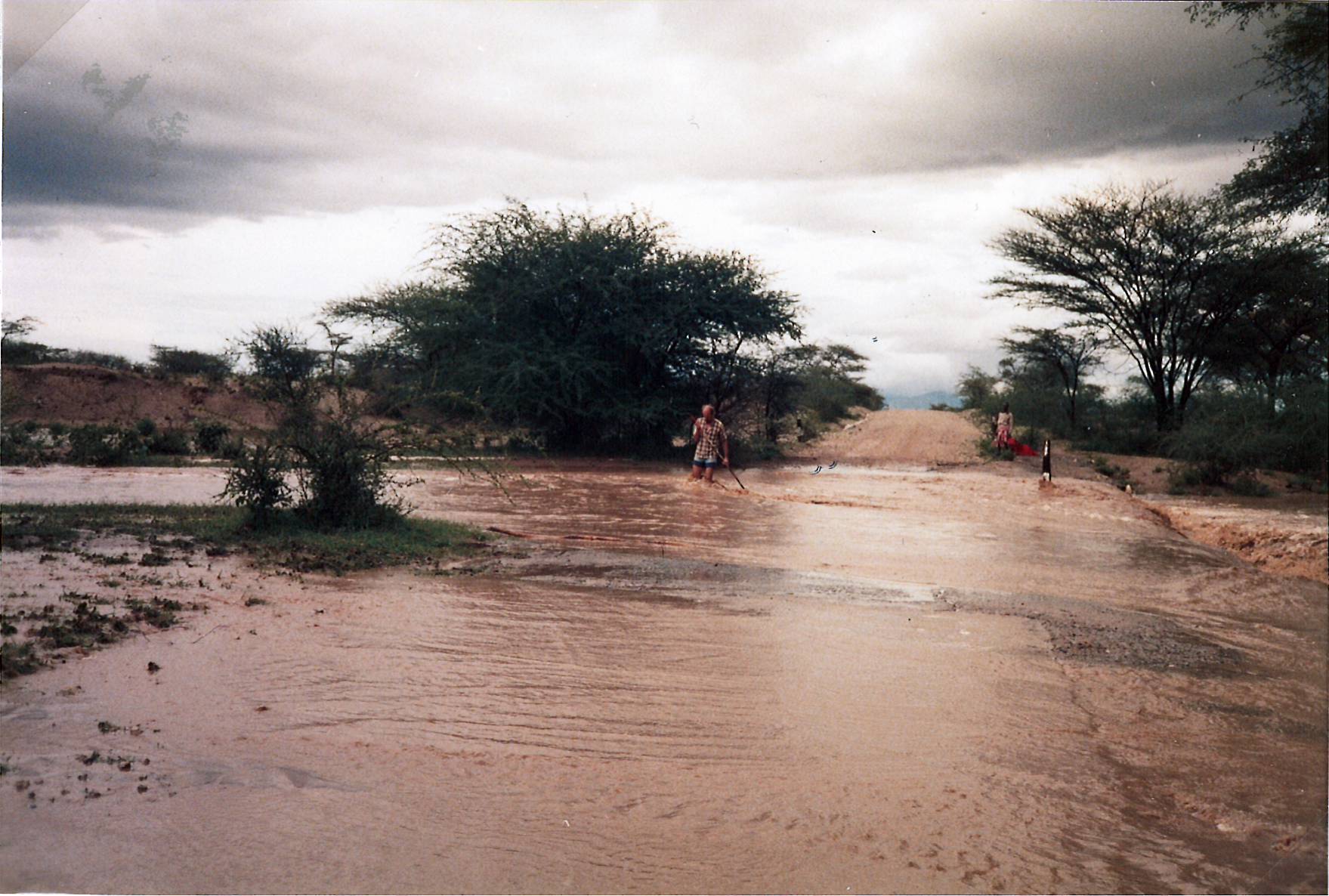
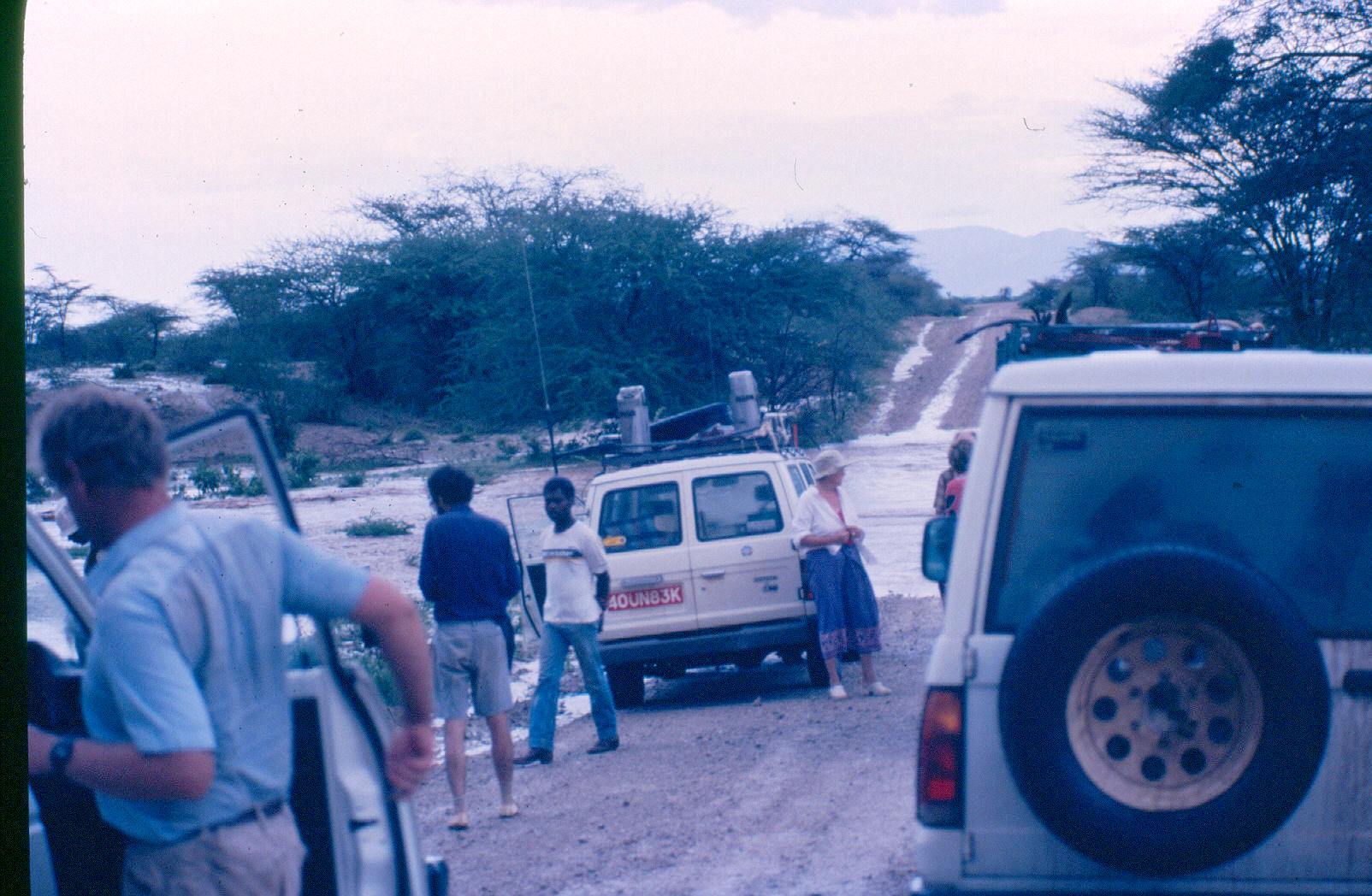
Flush-flooded roads: Everybody was testing the water’s depth and strength as to know whether to cross or not…
Once in Samburu, quite late in the afternoon, we did a quick game-drive and passed near the lodge, but on the opposite bank of the river, where they put some bait on a tree to attract leopards (although we don’t recommend this way of dealing with wild animals!). At the campsite (this time clearly announced by a board but nothing else revealing it!), everything was wet. But that was better than flooded! It was then time to set up the camp for the last night of that much appreciated Easter long week-end. Thank to the experts, it was done in no time… We were so busy that we forgot easily that the leopard didn’t come to the bait. Our menu, cooked on the fire, included fine spaghettis with a spicy egg and tomato sauce (Mediterranean way), delicious chapatis (Indian flat bread – the dough wouldn’t grow!) with butter, banana cream with plums, biscuits, tea, coffee… not bad as usual.
After that, the ladies talked until 2.00 AM. As the men were trying to have a rest, we decided to stop! In fact we woke them up at that very moment, because closing the bonnet of the Land Rover after disconnecting the light without any noise was impossible. The same happened with the doors. We started to laugh like mad and it was even noisier. We couldn’t stop. Even once in bed, we could hear each other laughing in our pillows. That went on and on for some time… “Oh shit” said 4WD, turning over in his camp-bed, most upset! But this didn’t help us to stop laughing, on the contrary…
Monday, 20th of April – Winning the rally!
Our Swiss-Uruguayan Easter Safari Rally had to be finished on that very day, in Nairobi. So we woke up at 7.30 AM and went quickly for a game-drive, the four of us in the same car, after a cup of tea and a piece of cake. Again, the ladies went on the Land Rover’s roof rack and, Good Lord, were still there at the end despite thorns and baboons menacing to jump on the roof near us! We haven’t seen much during that game-drive: a bunch of crocs, some hornbills and a few other birds, impalas, reticulated giraffes, oryx and baboons. That’s all! Nothing compared to other times in that area, not to speak about a safari in Ngorongoro’s crater or in Maasai Mara’s plains! But we weren’t there for watching animals, were we? Of course, we were there to win that bleedi rally… (just kidding!).
But, not joking anymore, the open view on the wide Ewaso Nyiro river, with its doum palms (Hyphaene thebaica) and acacias (Acacia elatior) was fully GORGEOUS. It looked somehow very exotic, almost like being near the Indian ocean! 4WD told us that, at the right season, the elephants and baboons or even other animals use to come here especially to eat the fermented fruits of the palm… After what they get drunk and you have to be careful not to be on their way! Up the banks, the umbrella thorn (another acacia) and the commiphora trees, also very thorny, are predominant. The latter produces a very nice scented resin (dried sap) which is used to make local incense or myrrh.
We came back to the campsite at around 11.00 AM and had a nice brunch. Then we packed up quickly (sigh) and went desperately for a swim at the neighbouring Buffalo Springs National Reserve, adjacent to Samburu’s. We found the springs crowded! A huge amount of school children were using the lovely basin where the main spring is collected and protected from the animals by a big circular stonewall. So we went for the “side-springs”, not to swim, which is not possible there, but to collect leeches instead of getting rid of our “miasmas” and accumulated safari dust.
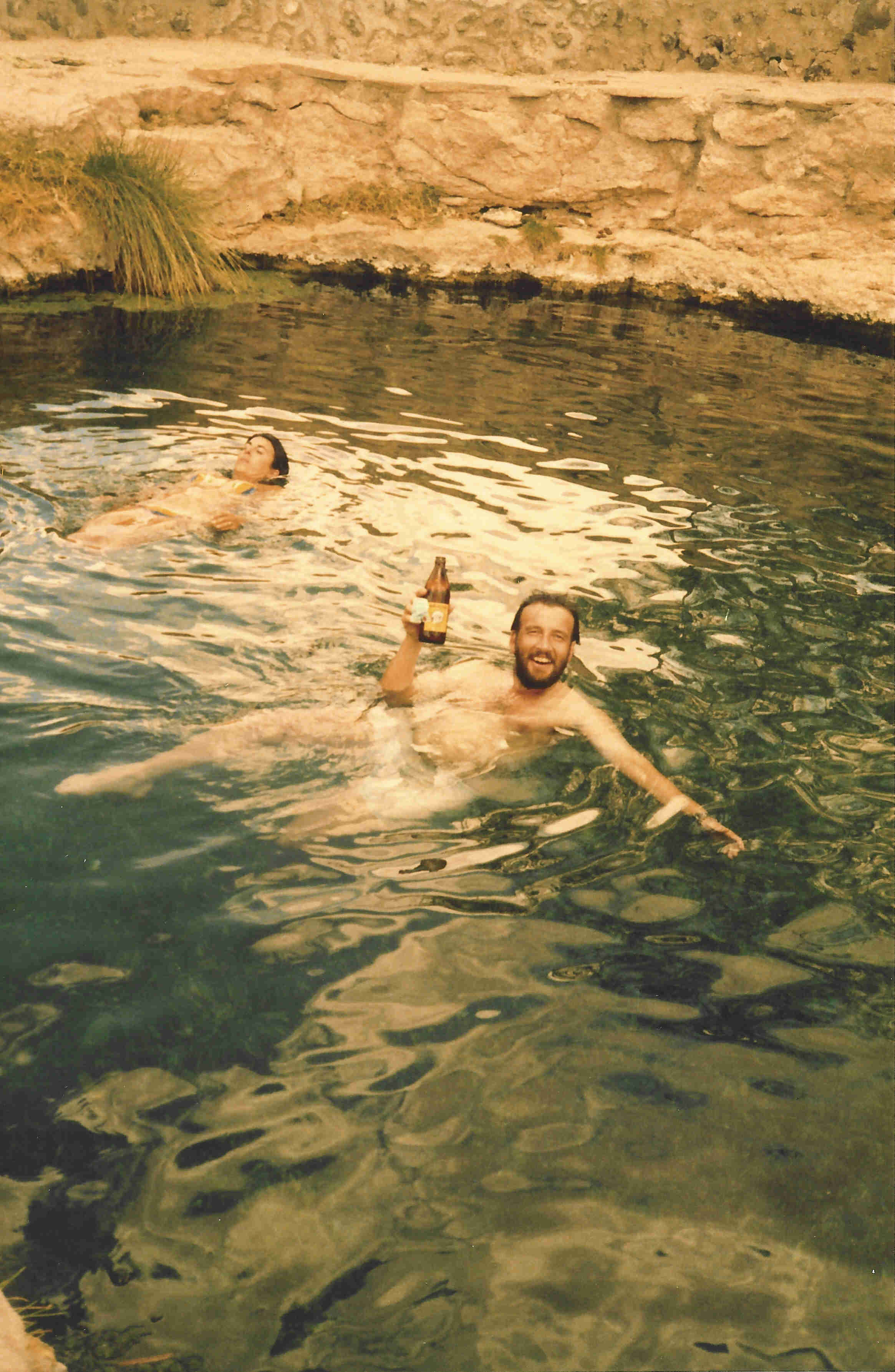
A good swim in spring water (picture taken on a previous safari): That is what we missed on that last day!
We quit the spot at 2.00 PM (sigh again). Short after we passed the gate, at only 3.00 PM, the fan belt of the Land Rover jumped out! But the mechanics (4WD and ScoutSpirit), put it right in no time. It is so reassuring to have fundis around! Both cars then headed for Nanyuki and stopped for petrol there. Next stop and arrival in Nairobi was near the “Premier Club”. It was established that both teams were first “ex-aequo”. We congratulated each other heartily and admitted that our drivers were very well trained and the organisation perfect!
So when do we start again?
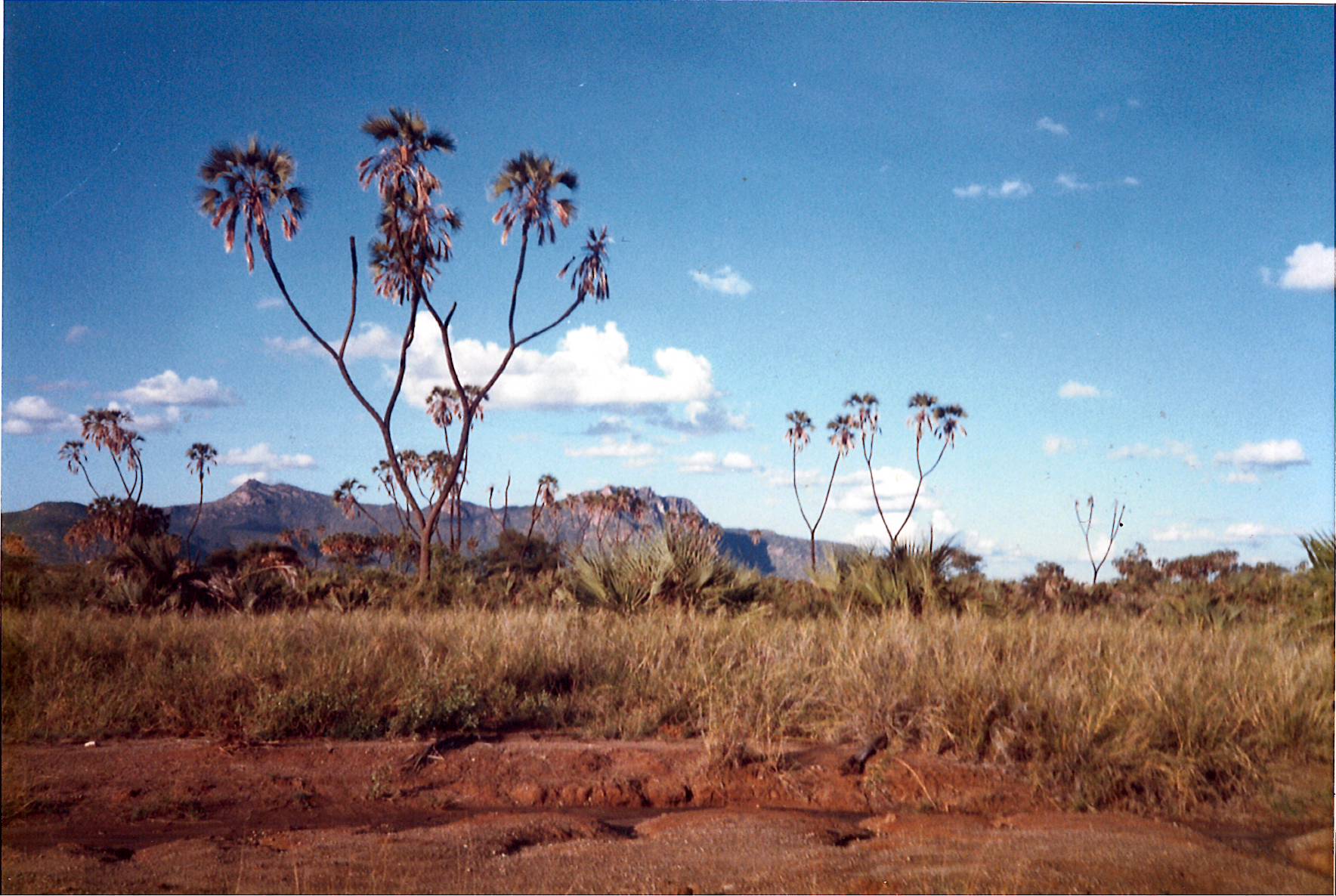
Landscape around the Ewaso Nyiro, nearby the Shaba campsite: Doum palms and red soil (laterite).
THE END
PinkShade
Footnotes
[1] 4WD (four-wheel drive): as he can make his way through everywhere and possibly through every situation. 4WD is an ancient nickname of the well-known today’s bushsnob!
[2] X-ray: as she has a very accurate view and the ability to spot before anybody any living creature miles around you in the bush!
[3] ScoutSpirit: as he is so calm and well organized that you could always count on him to provide what you did not bring or to have some spare place in his boot to host your things even If very heavily loaded!
[4] PinkShade: as she used to wear particular sunglasses that makes you see everything pinkish and also because she tried very hard to see the positive things although sometimes very anxious in that period of her life!
[5] You may have understood that they were the actual cars of the original African Safari Rally that took place at Easter in Kenya!
[6] You will see that “gorgeous”, pronounced with emphasis and a French/Spanish accent, sounded funny and it was adopted as THE word of this long week-end!
[7] Words in italics are Kiswahili terms that we adopted as we found them more expressive or poetical than ours.
[8] Staying near a river is a guarantee of good game spotting as many animals come to drink or bathe. The Ewaso Nyiro (brown river) is named after its quite dark water.
[9] Although these were the best and nearly sole qualities required for a campsite in almost any national park or reserve in Kenya. Yes, I know, coming from Switzerland where camping places have hot water, showers, washing machines, tumble-dryers, dishwashers, swimming pools, ping-pong tables, cooking places and very technical barbecue devices… it is always astonishing to come to a simple spot near a river and to be told proudly “this is the campsite, Madam” as you cannot tell the difference with the rest of the whole wild area!
[10] After the Afrikaans’ name given to rocky hills appearing like islands in the plains, i. g. in the Serengeti’s savannah. They could have their own ecosystems (plants, animals and interactions amongst them).
[11] Checking on internet nowadays (September 2014), it seems that a monument has been placed since then.
[12] The shell was handed over to the Reserve’s management on exit.
[13] The snake was an Eastern bark snake (Hemirhagerrhis nototaenia), mildly poisonous, unlikely to be harmful to man.
[14] Yerba mate (Ilex paraguariensis) is a cousin of our European holly (Ilex aquifolium), the latter being poisonous!
The sighting of the large tusker described in “A tusk task” was the subject of an intense exchange of messages between the bushsnob and the Emerging Tuskers Project (ETP) of the Letaba Elephant Hall of Kruger National Park.
I supplied the ETP with all the pictures and a video of the elephant. I also reviewed the approximate location of the site where the animal was observed and corrected it to the area around Shingwedzi Rest Camp. This was done after revising our route on the day of the sighting, based on bookings and pictures (both their contents and times taken).
The ETP then studied all available information and compared the unknown tusker with their elephant database and came to the following conclusion, communicated to me on 15 September 2014:
“Thank you very much for sending the additional images and narrowing down the location it did help considerably, I did receive all 11 (pictures).
In regards to your bull the answer is perhaps not one you were expecting but nonetheless very good news in that we have what appears to be a new tusker.
This bull is definitely not Mavalanga* as neither the ear markings from the left ear that are prominent nor is what I call the “donut”, the thickening on the middle of the trunk present. I have looked in detail at the ear markings and having compared them along with the shape of the ivory with all the possible bulls that we are currently monitoring as well as the known bulls and they do not match. The location and side images you provided eliminated my only other suspected bull, so the only feasible conclusion is a new bull.
Interestingly we received a second image from a guest who also suspected his sighting to be Mavalanga around the same time as your image was taken. We can see the ear markings clearly in this image so I am confident in my assessment.
It never ceases to fascinate me how these bulls can go for so long without being noticed especially with ivory this substantial, it also highlights the value of guest submissions to the project as this is how we learn about these wonderful bulls.
I have created a file for this bull and will definitely escalate him to the top of the list when the time for the naming review comes and hopefully at that time he will be confirmed as a new bull and named.
Kind Regards,
ETP”
Of course the bushsnob and his wife are both very excited to have contributed to the ETP by spotting such a remarkable tusker and, hopefully, they will be kept in the loop regarding the future naming of the tusker by the ETP.
* (see: http://www.sanparks.org/parks/kruger/elephants/tuskers/emerging.php#mavalanga)

A frontal view.

At the last minute after leaving Moremi Game Reserve, we decided to spend the night at Magkadigadi Pan National Park. We managed to get a last minute booking at Khumaga camp as we knew that animals -mainly zebra and wildebeest- were migrating through that area at the time. Additionally, we had been there in 1999 and we were curious to see it again as we had good memories of the place, particularly the games drives along the dry Boteti river where we often saw lions as well as a huge crocodile that used to live in a water pool that somehow survived the prevailing drought.

A view of the Boteti river in 1999.

A similar view to the above, but in 2014!
We noticed that things would be different when, after going through Khumaga town and just before arriving at the Boteti River, our GPS stewardess announced, “in 300 metres board the ferry”. “This machine is confused again” I said and there was general agreement in the car so we ignored her and continued driving. And then we saw a mighty river with very clean water and, surprise, surprise, a ferry parked at the end of the road, waiting for us! So we apologized to the GPS’ lady and approached the ferry.
While driving towards the water’s edge we remembered hearing, sometime ago, that the water was flowing again in the Boteti (later literature check up mentioned 2012 as the year that this happened). The view was totally different and new to us, suddenly making the idea of coming to Makgadikgadi National Park much more interesting! I am sure it was a great positive change for the wild animals (clearly also for the domestic stock as well!!!) that suffered water shortage for many years and their recovery must be on the way

Waiting to board the ferry at the “new” Boteti river.
After successfully getting the car on the ferry, under the expert guidance of the ferryman, we crossed the river in 15 minutes and arrived at the gate of the park, located on the other side of the river. We passed through the gate, drove a few km and, after seeing a large herd of zebra clearly returning from their afternoon drink in the river, we arrived at the campsite. The place was the same but now it was on the bank of a normal river, with water flowing and surrounded by green vegetation, a sharp contrast with our memories! It was a bitterly cold evening so we lit a good fire and were in bed early without seeing much!

Our campsite in 1999.
The following morning, the coldest I remember while on safari, we decided to go for a game drive before departing for Francistown and Harare. This time the drive took us along the now green river banks rather than through its dry bottom and we could not help but express our admiration for nature for having recovered so fast from what earlier resembled a bone-dry place.
The road afforded us the chance to drive closer to the water in some areas and observe its prolific birdlife. We did not see many mammals, as they were probably grazing on the plains. The exception was a beautiful Greater Kudu bull with great horns.

The Greater Kudu bull.
It was during one of these river loops that we saw the marabou storks (Leptoptilos crumeniferus). There were a few hundred adult birds. The first impression was of a group of elegant men in suits with coat-tails at a gentlemen’s club, getting ready for a ball and waiting for the ladies! However, the ladies were already there, dressed like men!

The “waltzers” from far…

They were well dressed… (Picture by Julio A. de Castro)

The orchestra Director. (Picture by Julio A. de Castro)

Showing off before finding a dancing partner? (Picture by Julio A. de Castro)
We saw a lot of interaction as birds were clearly courting and getting ready to nest. Apart from some birds trying their hand at various acrobatics and showing their superb flying and gliding skills, the more frequent activities were less spectacular. They consisted of offerings of grass to each other, accompanied by short jumps and beak clattering. The latter was a rather noisy activity, considering the size of their beaks!
After a long while observing their antics, a boat full of tourists approached and disturbed the birds, which flew away and landed again at a distance. However, the “magic” had been broken for us and we, unanimously, decided that it was time to get back to Zimbabwe while the bird spectacle was still fresh in our memories.

A video snapshot of the birds moving off. (Picture by Julio A. de Castro)
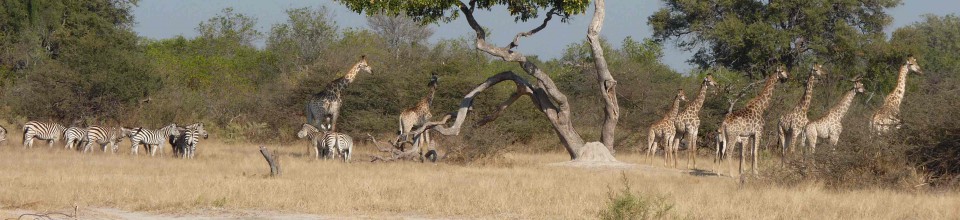
We arrived at the South Gate Camp in Moremi Game Reserve after re-stocking fuel and food at Maun. At the gate we learnt that our 1999 map was outdated! So we bought an updated one as a new area of the reserve, the Black Pools, Mogogelo area adjacent to the camp, had been opened to the public after our map was printed! This was good news as other known places looked quite far from us.
The campsite followed the same general lines of Nxai Pan with similar anti elephant fields in place. Fortunately the only stinkbugs present were those coming out of our car and unfolded gear that lived rather ephemeral lives, being rapidly consumed by the various birds that were attracted to them; clearly birds without taste!
The area around the camp was drying up but there were still a number of roads that we could not cross so there was a lot of turning around and/or looking for alternative routes. This was further complicated by differences between our new map and the reality of the drives that got us “lost” a few times with the result that some time was wasted finding the right way. Often when this was finally found, it was still blocked by the water and not fordable! This served as a reminder that this was a real safari and not a smoothly presented wildlife TV or video!
As water was still rather plentiful, the animals were scattered around the area, particularly the elephants. We did not see many predators although we heard lions and hyenas every night. We also found five hyenas on our way Khwai camp. An interesting find were the abundant Southern Lechwe (Kobus leche), the first ones we had seen since our days in Zambia in the early nineties. This is an interesting antelope that is found in marshes feeding on aquatic vegetation and seeking refuge from predators by going into rather deep-water areas. There they have an advantage as the skin of their legs is greasy and repels water. This fact gives them an advantage as it prevents them from getting water logged, which would slow them down in case of a needed exit.
Birds and mammals provided some amusement at the almost empty campsite and luckily, this time it did not smell. We did have the expected evening visits by spotted hyenas but they kept a polite distance from our tents. A Lesser Bush baby (Galago senegalensis), a tiny mammal of about 35 cm (tail included) and weighing about 150g was also seen every night. First we would hear its ‘louder than life’ screeching and, shining the torch in its general direction, we would spot its comparatively enormous eyes! Even so it was tricky to see it as it was busy jumping between trees, achieving almost impossible leaps for such a miniature animal and behaving more like a furry frog or perhaps a winged insect!
Redbilled woodhoopoes (Phoeniculus purpureus), White Helmetshrikes (Prionops retzii) and several Hornbills species also provided us with hours of entertainment. Both the Redbilled (Tockus erythrorhynchus) and Southern Yellowbilled (T. leucomelas) hornbills were present; the latter were particularly daring. These birds gained movie notoriety after Alan Root produced his documentary of the female raising her chicks while locked inside her nest, fed by her mate. A few of them hung around our camp and one, clearly a narcissist, spent a long time in front of the car window, trying to chase himself away in a prolonged and futile territorial dispute (with himself) that had no possible outcome, except possibly cracking the glass!
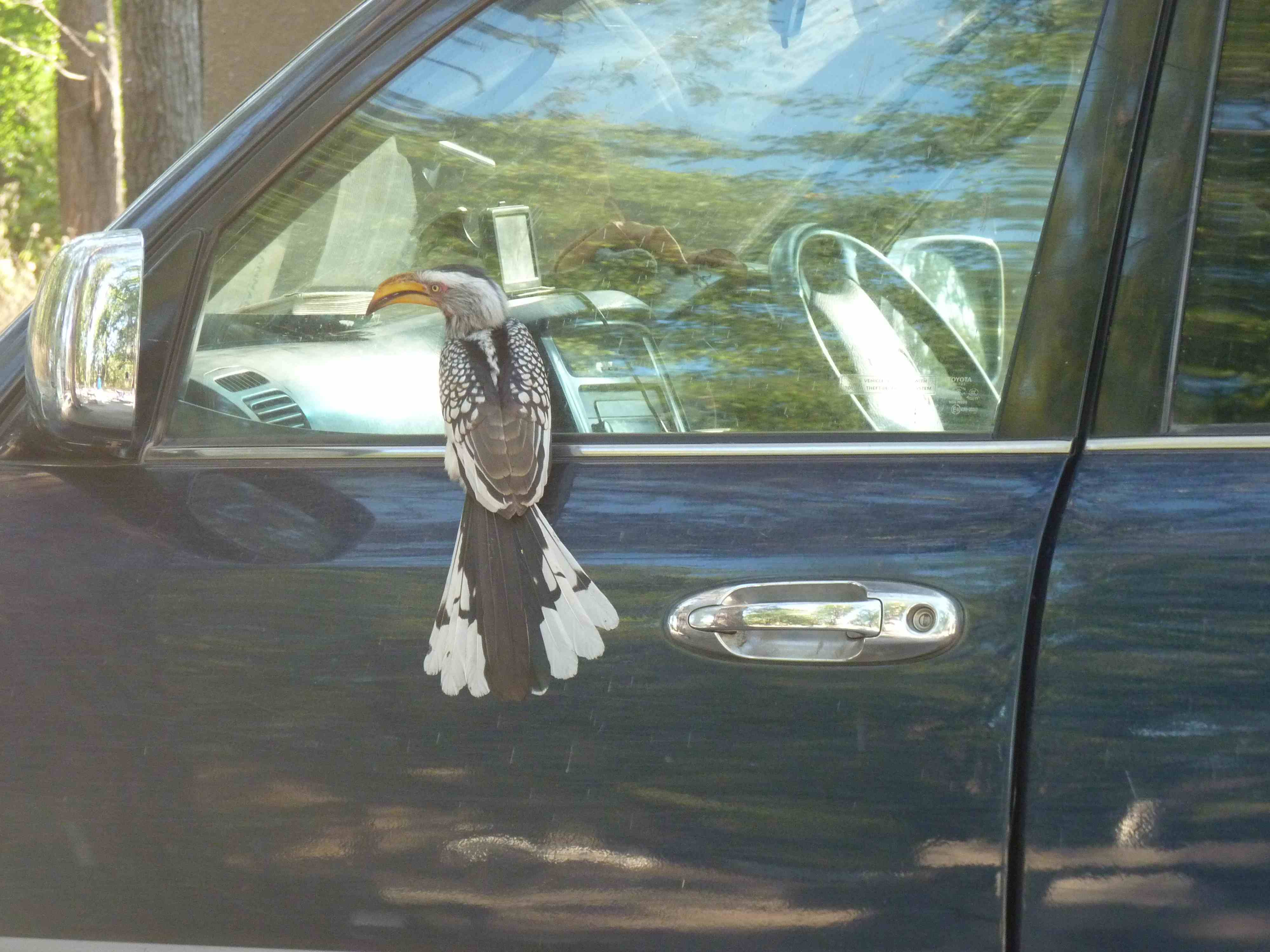
The Yellowbilled hornbill chasing himself away…
The hornbills kept landing at our table and trying to snatch morsels from us during meal times. However, just to show that they were not human-dependent, at some stage a Red-billed hornbill caught a rather large centipede that became a coveted prize among several contenders. Finally it became the property of a Yellow-billed that proceeded to batter it out of existence and to swallow it, not without difficulty.
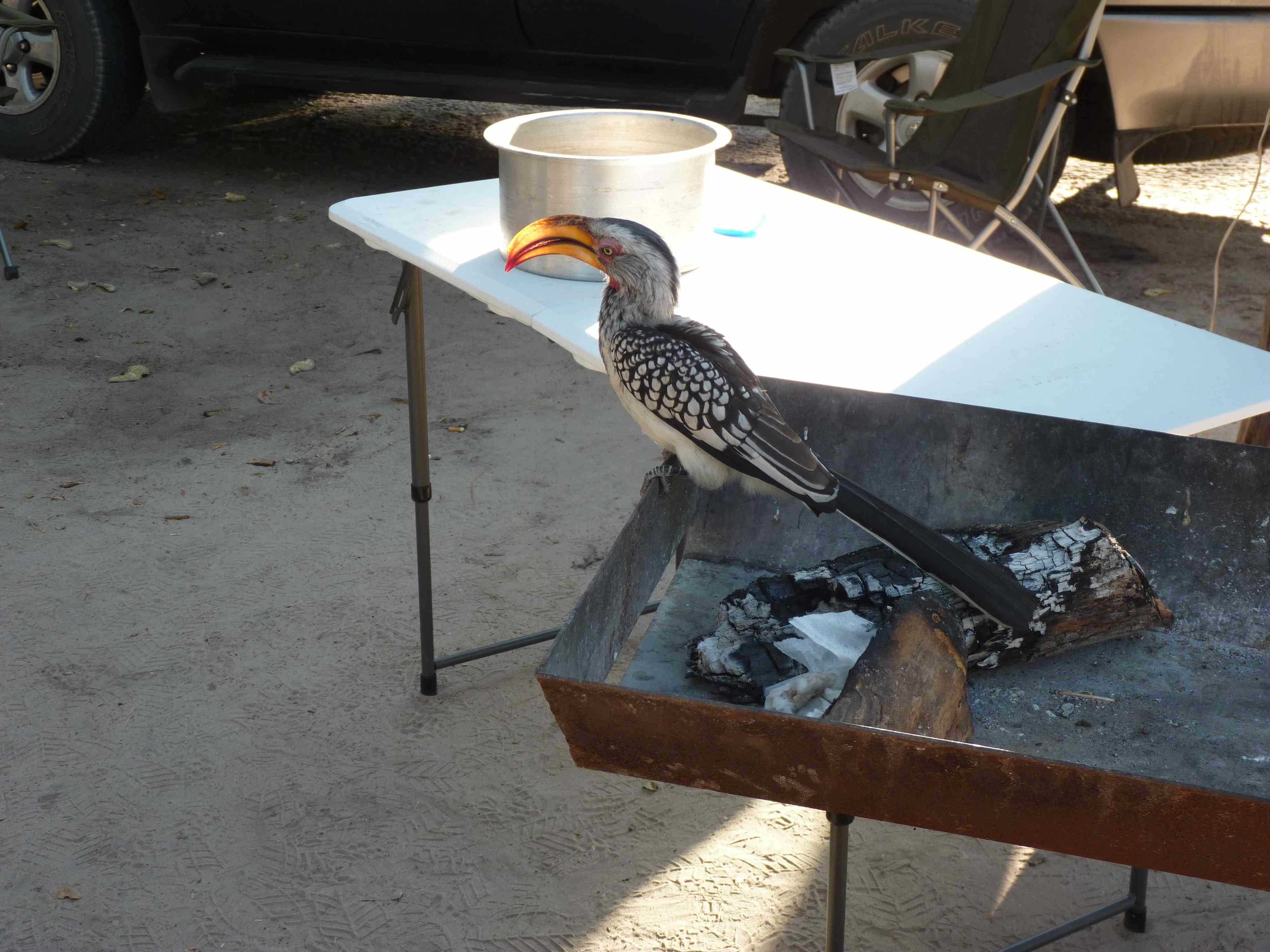
Visiting.
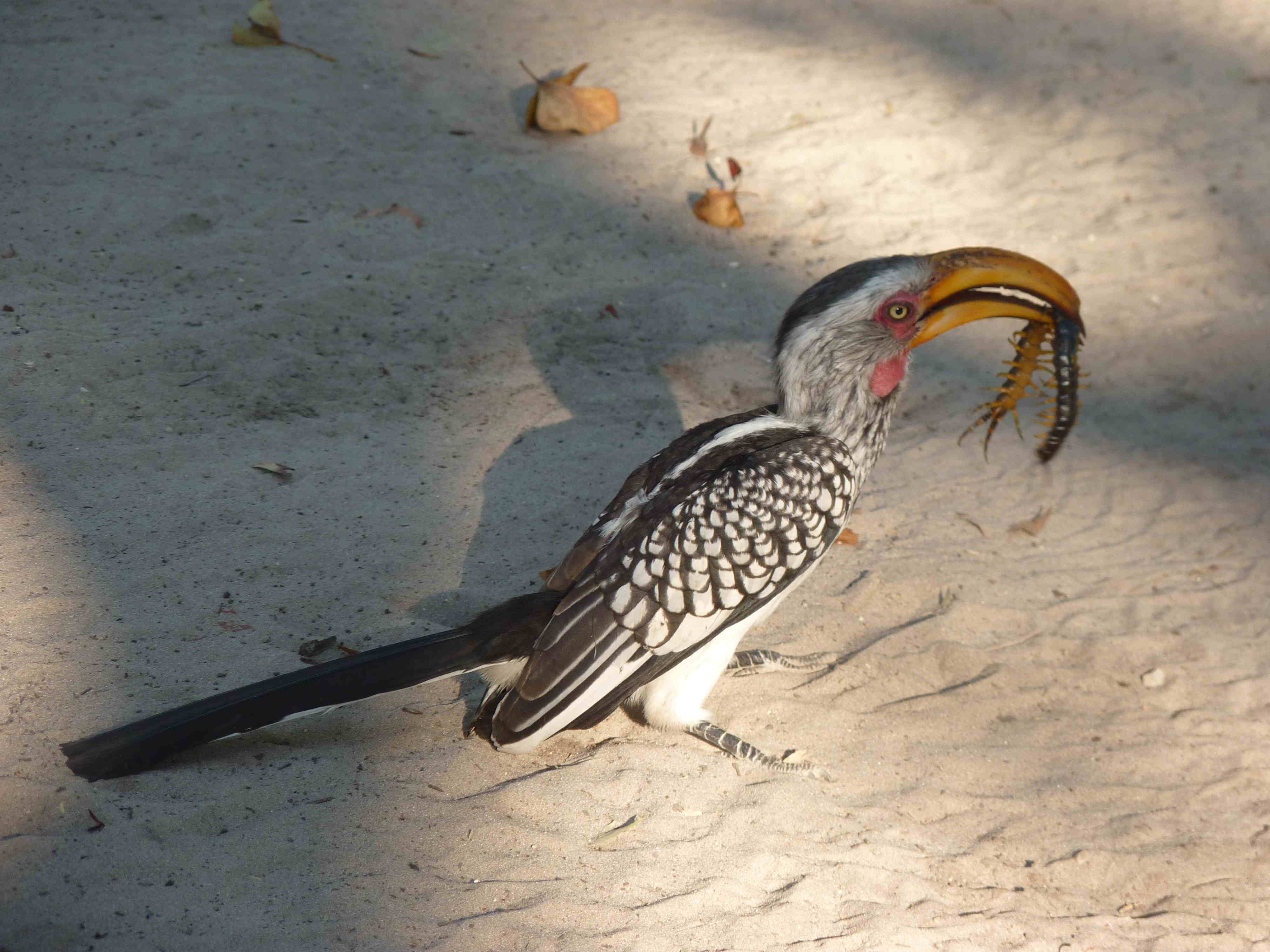
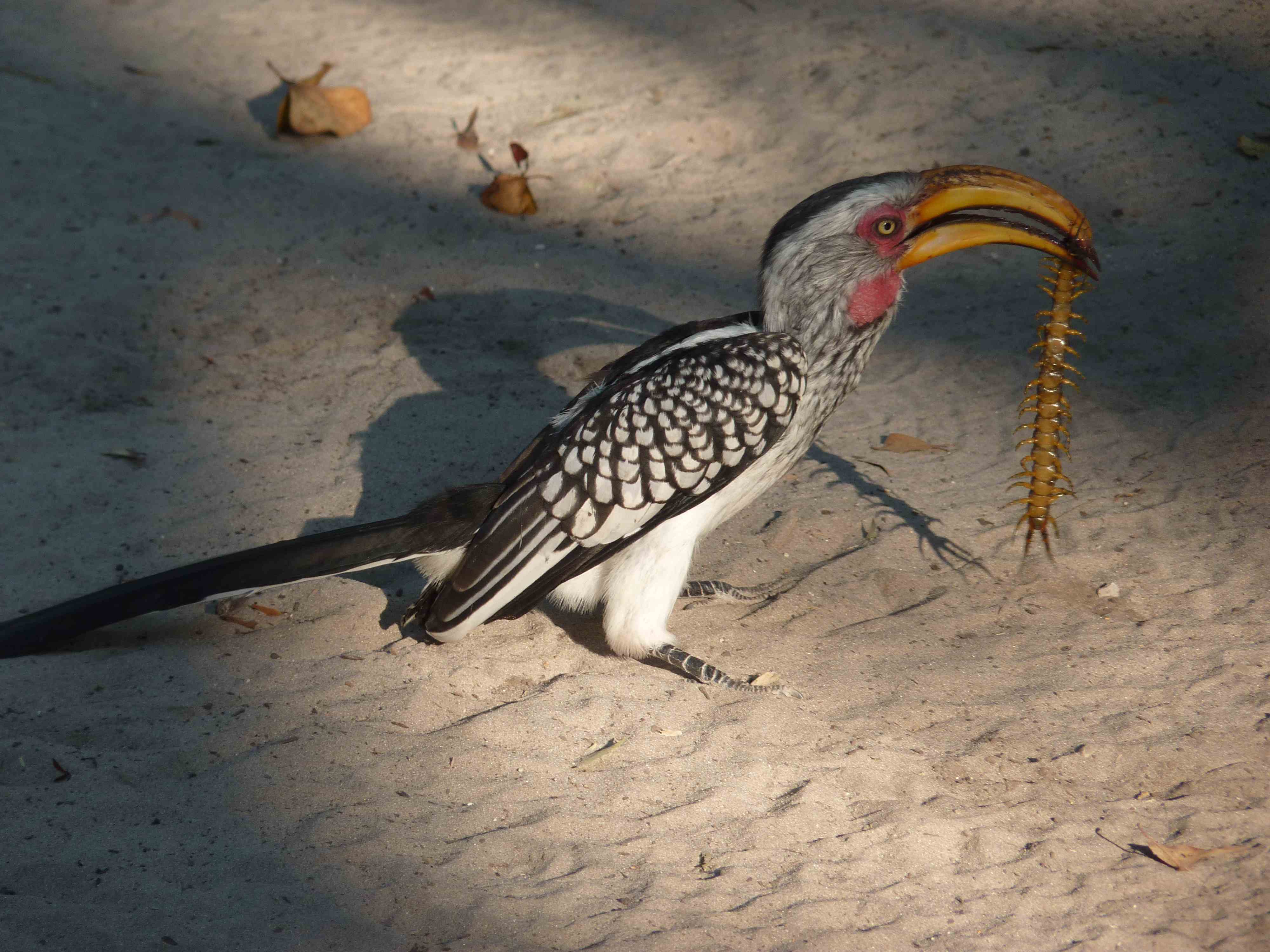
Yellowbilled hornbill bashing the centipede.
Our record of this area of Moremi will not be complete without mentioning that we were fortunate enough to see a group of Wattled cranes (Grus carunculatus). The Sassol Birds of Southern Africa guide describes these birds as “enormous”, rare, resident and endangered. I hasten to add that they were also shy and solitary, keeping their distance from other inhabitants of the swamps.
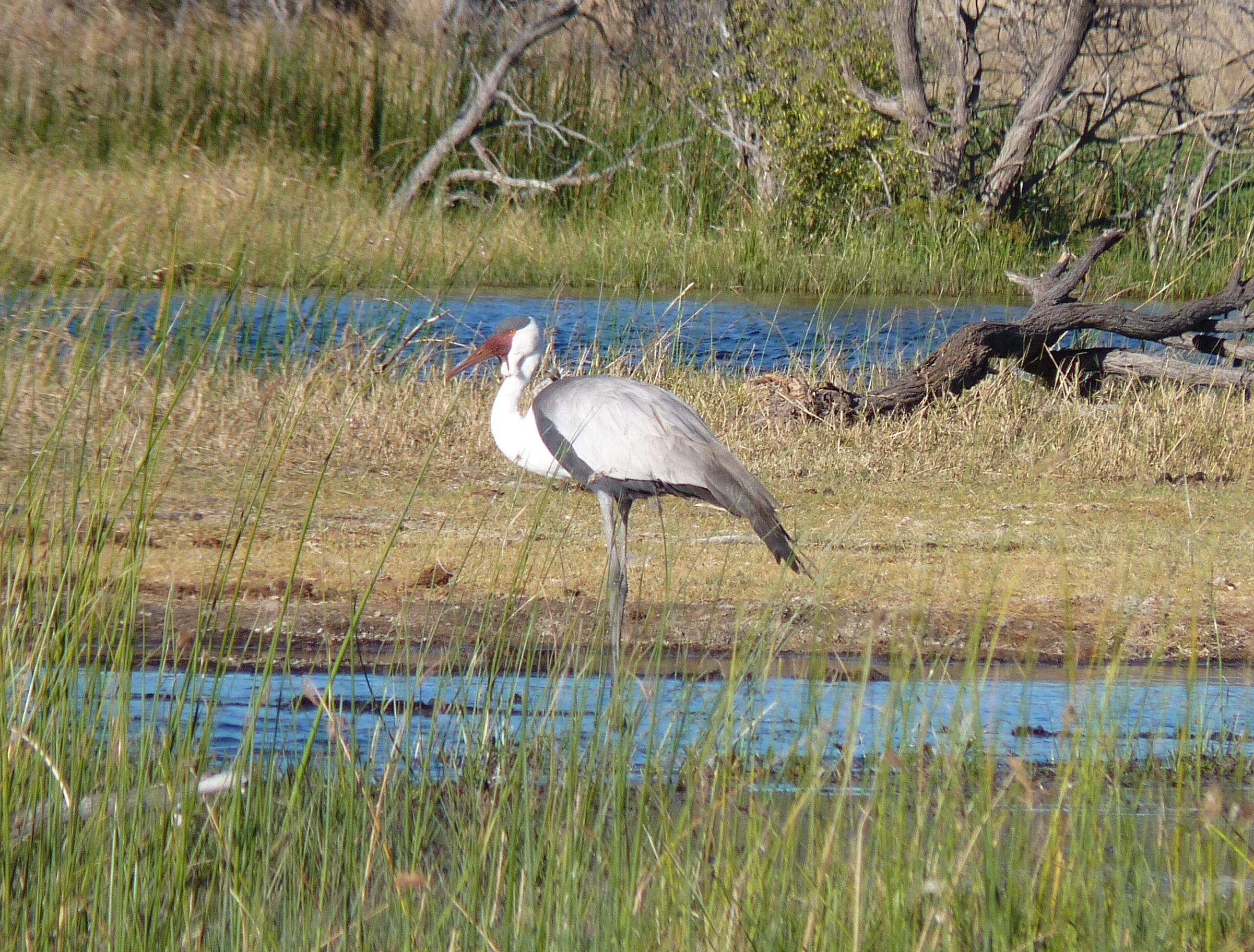
A solitary wattled crane.
The trip to Third Bridge did not offer anything special apart from two bridges (First and Second) made with trunks that enabled us to ford the various channels before arriving to the mythical Third Bridge. We also learnt that there is a Fourth bridge beyond the Third! There seems to be a bit of a lack of imagination in naming but there may be a reason -unknown to me- for this nomenclature. At some stage we were quietly watching a beautiful herd of Greater kudu when a car stopped next to ours and someone shouted “Hi, nice place but there are no ‘hanimals’!” And then as the now scared Kudu bolted he added, “Oh, there they were some!” We bit our tongues and did not tell him off as he deserved! Later on we found them buried in the sand, being helped by an angry tour operator who needed to extricate them in order to continue his own trip!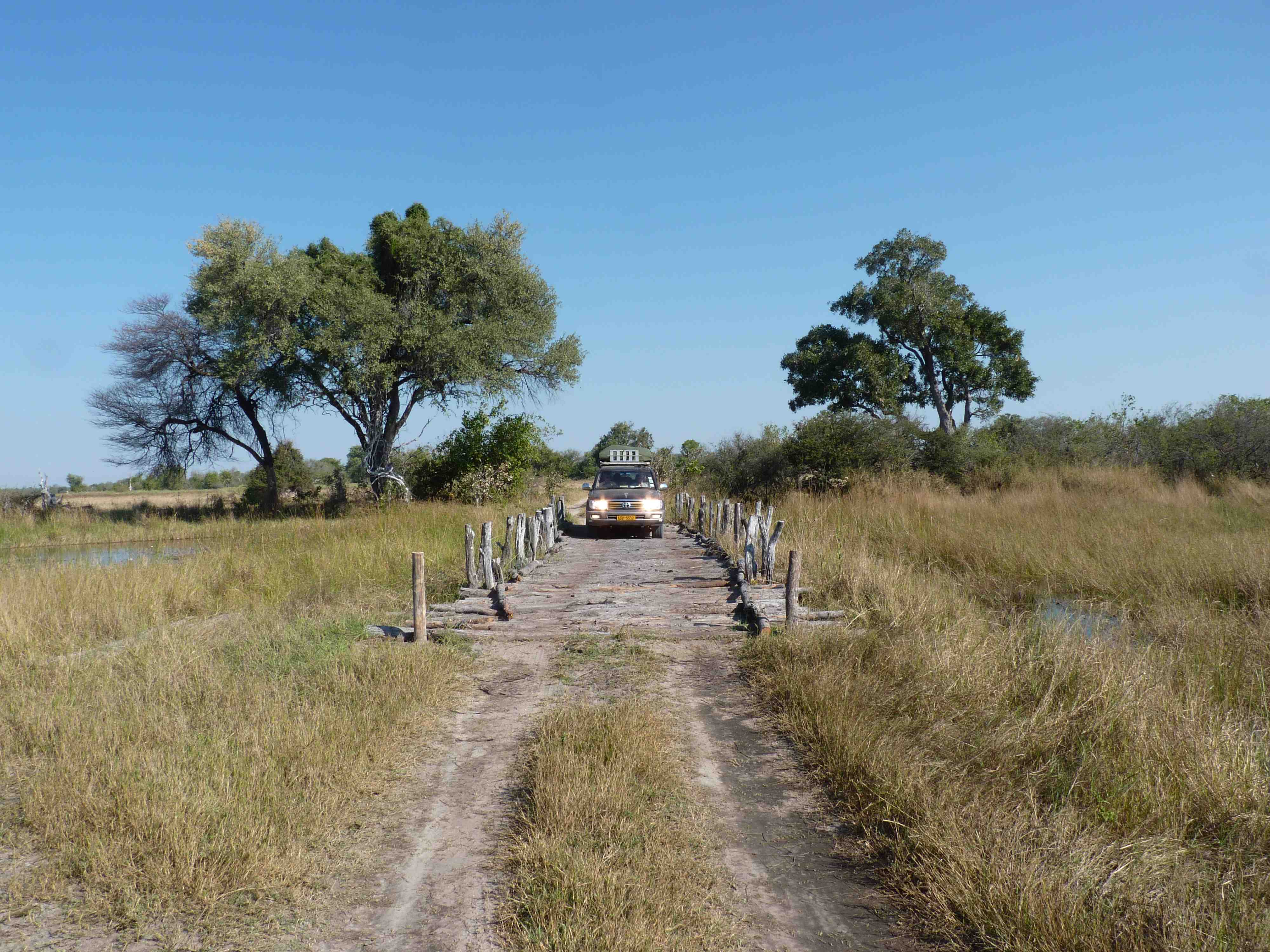
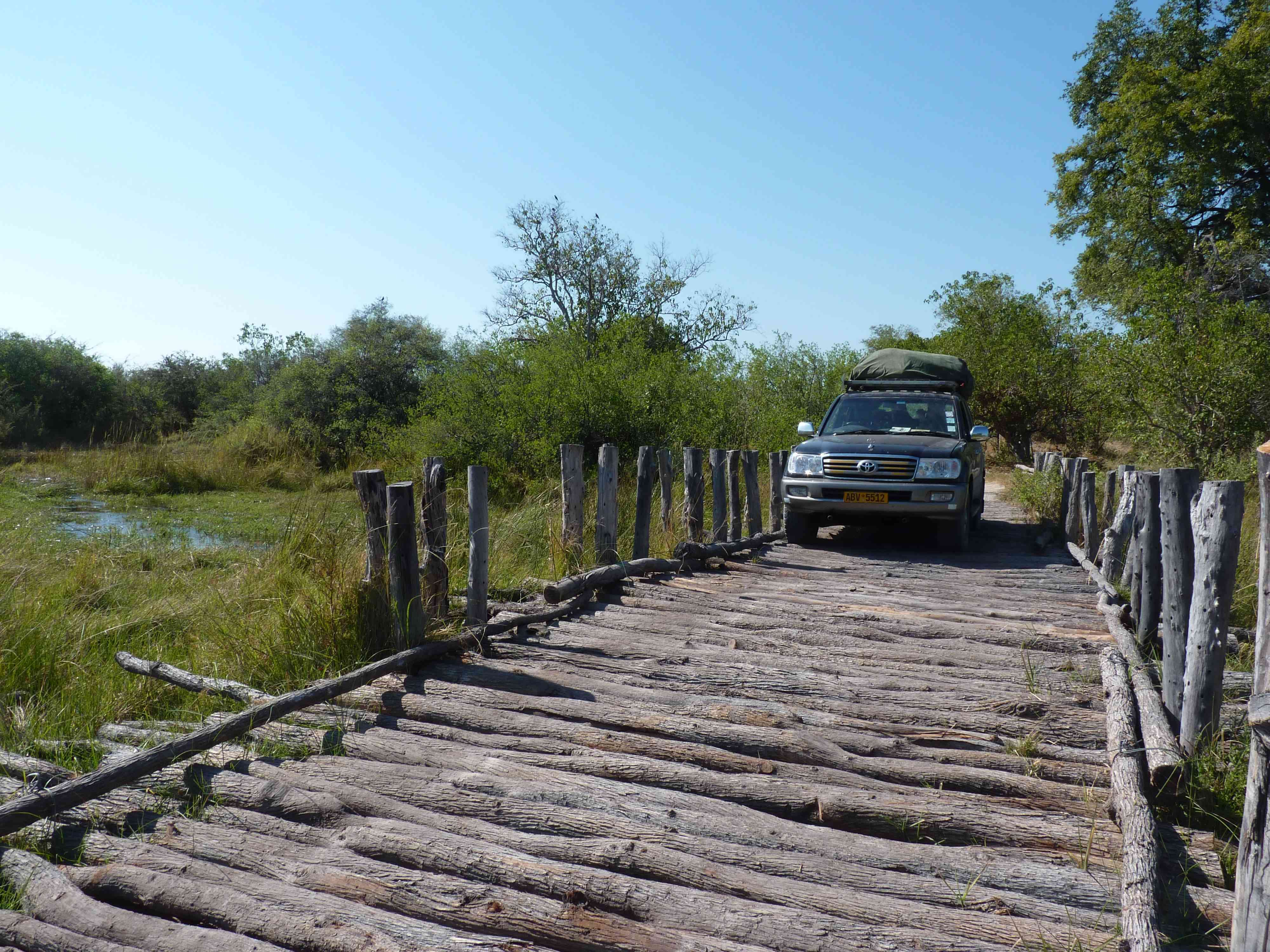
Bridges on the way to… Third Bridge.
While game watching we kept bumping into someone in a pickup with a very impressive camera array. We saw him (or rather his cameras) while watching the tree Cheetahs and later on while he was, in his own words, “getting the definitive picture of a roller”! We ended up talking to him and exchanged cards. Then we learnt that his name was Paul Souders and that he was 2013 Wildlife Photographer of the Year! Allow me to recommend his web site if you wish to see wonderful photographs at http://www.worldfoto.com/ and http://photoboy.com/2013/10/15/hudson-bay-canada-2/ where his winner picture can be found.
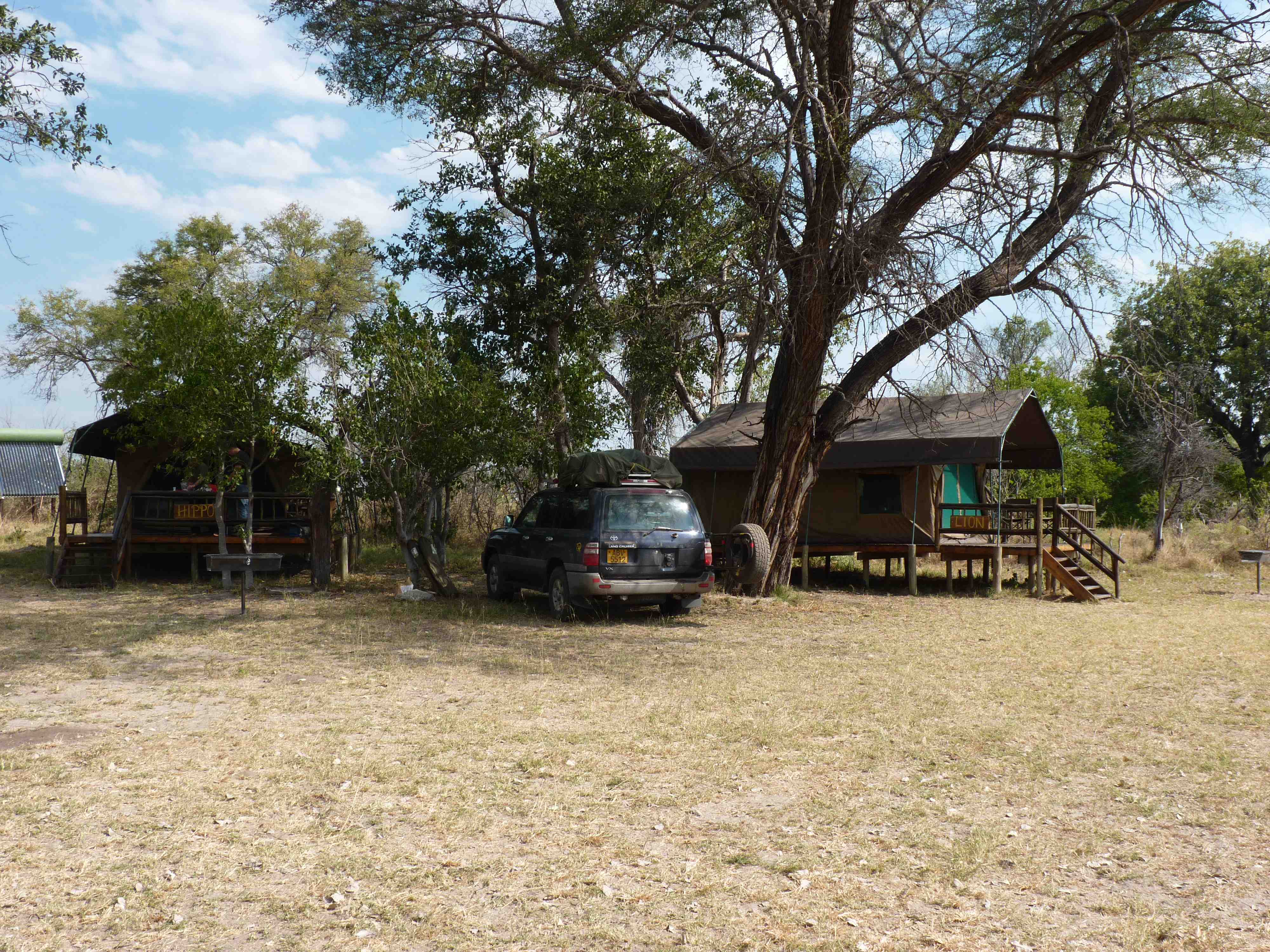
Our tent at the Third Bridge tented camp.
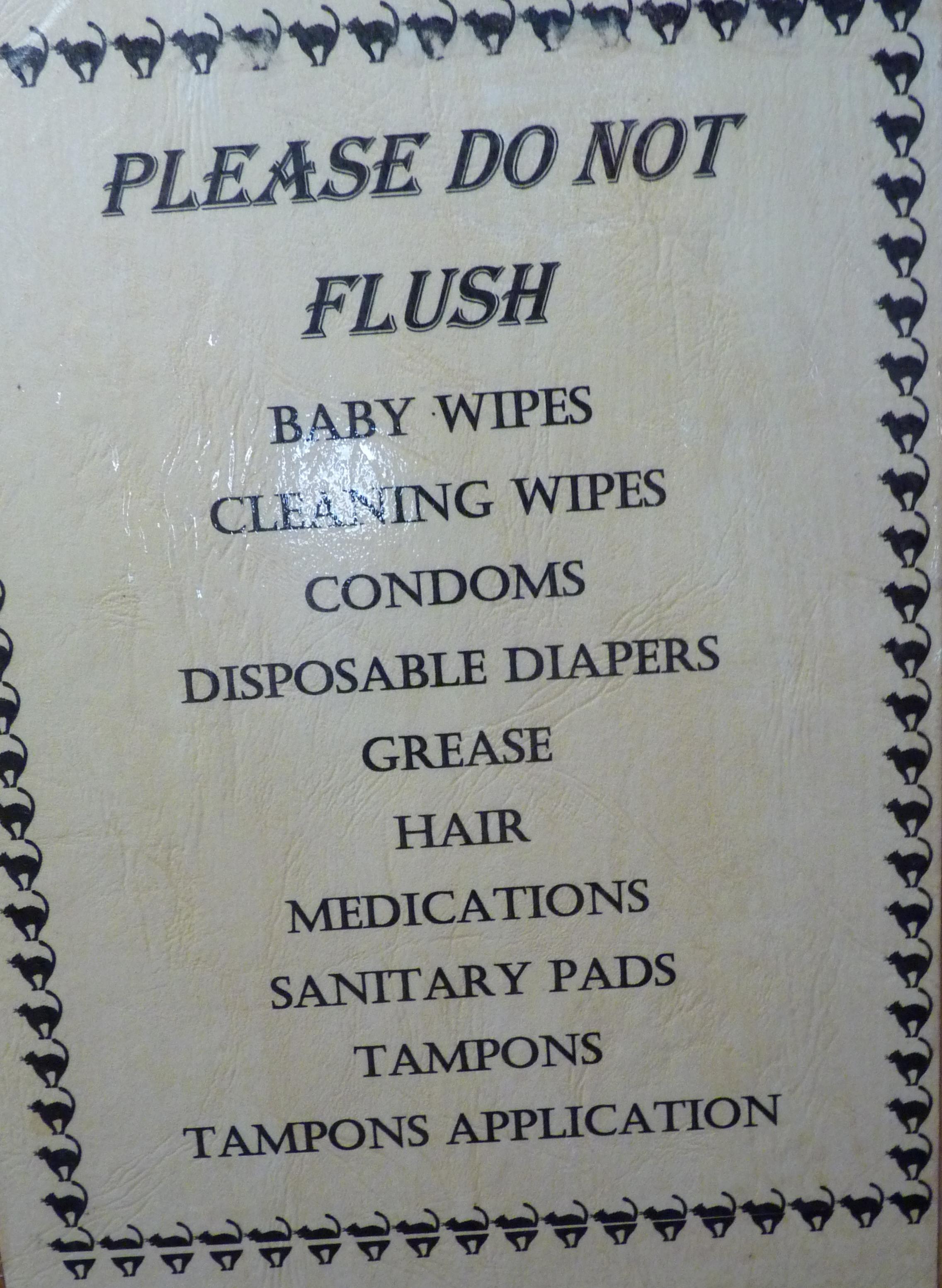
The sIgn from the Third Bridge tent. Do people really throw all this down the toilet?
On the second night, we were returning to our camp rather late and before crossing the Third bridge to get back to camp, we had to stop and queue as a group of about 10 painted dogs got there before us! As the water runs over most of the bridge, the dogs were hesitant to cross (we learnt later that there is a crocodile at the bridge).
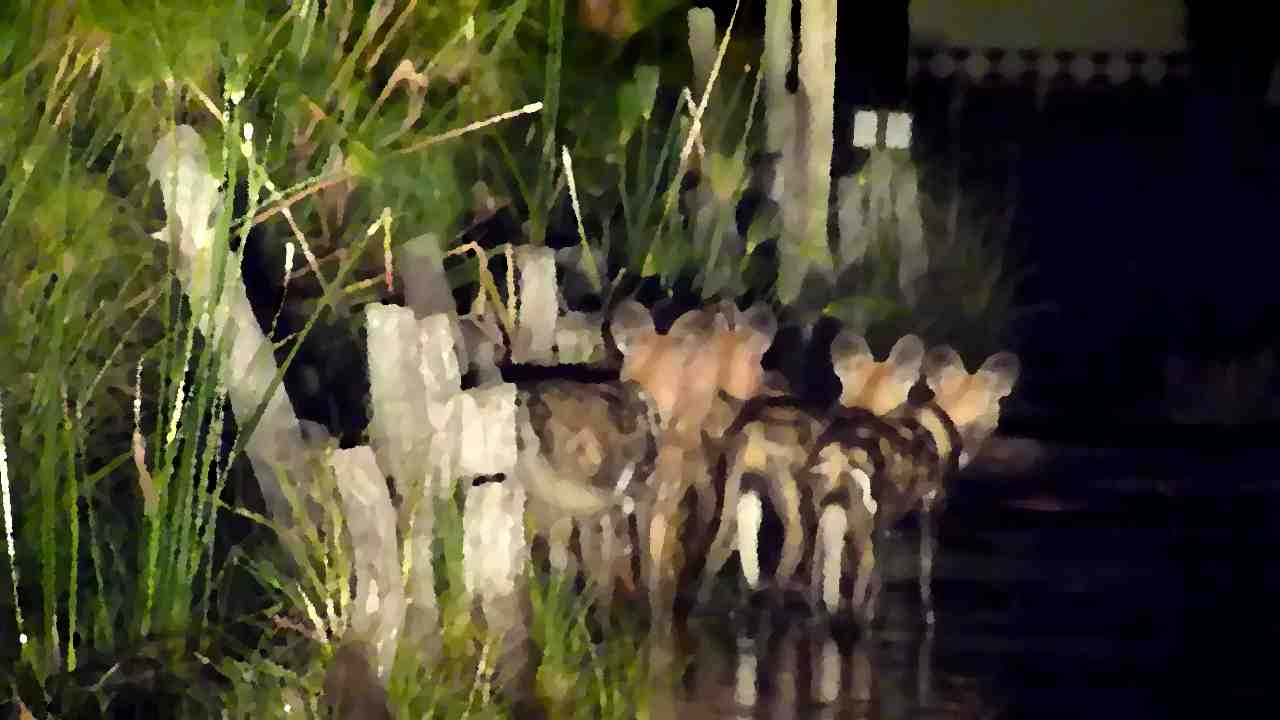
Painted dogs at Third Bridge. A bad still from a video taken with the car lights so I smudged it to try to be “artistic”…
After several minutes of goings and comings and not without a few jolts and recoils, one dared to take the first leap into the water. Soon all others followed and rapidly vanished into the dusky bush so fast that a car that came a minute after us did not see anything! Such as the nature of a real safari, a few minutes or even seconds can make a difference between a memorable sight or just MMBA (Miles and Miles of B… Africa)!
Note: All pictures by Julio A. de Castro

Moremi Game Reserve has been on our list of “places to visit before dying” for several years. Although in 1999 we visited Botswana, we had limited time and focused on Makgadikgadi Pans National Park and then flew into the Okavango delta where we stayed at a camp known as Oddballs.
Fifteen years later in May 2014, and taking advantage of our son’s holidays, we re-visited Botswana with the main objective of seeing Moremi Game Reserve. We made an additional effort to adjust our accommodation to the itinerary of the President of Botswana, as his visit to the area coincided with ours and, for some reason (perhaps justified?) he had priority over us!
Our itinerary was:
Nxai Pan National Park, South Camp (29 – 31 May).
Moremi Game Reserve, South Gate Camp (31 May – 3 June) and Third Bridge Tented Camp (3 – 5 June). The earlier post “Tree Cheetahs” is part of this visit.
Makgadikgadi Pans National Park, Khumaga Camp (5-6 June).
As the trip was long, we included two nights at Nxai Pan. We remembered the place because of the very large baobabs known as Baines’ baobabs, found on an island in the saltpan with not much else!
Regrettably, during our trip we lost one of the camera’s memory cards so many pictures are lost to humanity!
An innovation during this trip was that the Department of Wildlife and National Parks of Botswana (the Department) has tendered the management of its camps to different private companies. While this may be good for the maintenance of the camps and other reasons important to the Department, booking and paying becomes cumbersome. In our case, we had to pay three different companies to secure our bookings! (here I will insert link to Department’s page with info on bookings)
Coming from Zimbabwe, the entrance to Nxai Pan is 65 km from Gweta. We registered at this first gate where we learnt that the President had been there in the morning and that he had left already, leaving a good impression among the staff there! After negotiating another 37 km, most of which over deep sandy tracks, you arrive at the final entrance gate. A note referring to this road on the Department’s web page puts things into perspective, so I should have been prepared:
“The sandiness of this track should not be underestimated and only 4×4 vehicles should attempt the journey, engaging 4-wheel drive before negotiating the deep sand – carrying a spade is also wise!”
Wisely we did carry a still uninitiated spade and arrived at South Camp without problems. The place was well shaded and all facilities were excellent.
When it was time to use the ablution blocks, we encountered a surprise. They were protected by a field of hundreds of cement blocks aligned at a 10 cm distance from each other. Each block ended in a 5 cm sharp iron spike. We had seen similar but simpler arrangements of concentric stones to deter elephants from damaging trees. However, this was an advanced version, almost resembling anti-personnel barriers seen in WWII pictures! As the use of showers and toilets was essential, crossing them was imperative! (pic of baobab with stones?)
Careful exploration of the barrier revealed a slightly wider gap, large enough to plant our feet toe-to-heel and make slow progress, taking care not to lose our balance. This was challenging enough during the day. At night it became a potentially mortal field where all senses needed to be focused on the task to avoid falling to what it looked like sure maiming!
We arrived at the campsite quite late and after putting our tents up (and surviving the visit to the ablution blocks) we went to the nearby water hole for a quick look. This is perhaps the focal attraction of Nxai . It is near the campsite, in the heart of a large grassy plain and dotted with umbrella thorn trees. Here, several animal species can be seen, drawn by the availability of water.
Nxai Pan’s is at its best during the rain season when a multitude of animals congregate there (including large numbers of springbok) and various species reside there permanently. Although it was the dry season, we were lucky enough to see a pride of lions made up of two adult lionesses with five cubs, together with two adult males. They were well fed and being their usual lazy selves, totally ignoring possible prey such as giraffe, zebra and greater kudu that came (in numbers) to drink.
Unknown to us, a surprise was waiting for us back at the camp. As earlier we were focused on the “spike-crossing”, we had not noticed that the camp was crawling with small stinkbugs. Although they were rather nice looking with a combination of brown and orange, crushing them released their strong and rather pungent odour. To our great consternation, there were hundreds of the smelly things!

A green relative of the campsite invaders. Their pictures were lost with the camera card.
To make matters worse, like most insects, being attracted to light is in their genome! Protecting your glass of wine, cooking pots and dinner plates from their dive-bombing became a high priority, as there was not much else to be done about their presence! Despite our efforts, some drowned or got burnt to death in our pots. Fortunately no unexpected crunchy bits were found in our food!
Unlike dinner, achieving a stinkbug-free sleep was infinitely more complicated! The first alarm was sounded by our son when he discovered that they were getting inside the tents, despite the tight zippers: “my tent is full of bugs!” he said with a touch of exaggeration and adding a few epithets that I omit for the sake of the under-aged readers.
I was very pleased in my sleeping bag -having successfully negotiated the ablution spikes at night, so I decided to weather out the bug storm. I did so by adopting the ostrich trick of burying my head deeper in the bag, trusting that my poor sense of smell would not betray me. My companions did not join me in the use of this tactic, being of different genetic make up (my wife) and having inherited a lot of that (my son).
Although I believed it to be a fruitless procedure and told them so, they proceeded to methodically review all their belongings to remove the invaders from their clothing and shoes. This required a prolonged de-bugging session that was painstakingly achieved. They then proceeded to extract all the bugs from the tent. As this was all done with the aid of light and torches, it was a near never-ending exercise as new bugs kept getting in while others were being extracted.
Eventually an equilibrium that favoured the humans was achieved, the lights were turned off and calm was restored while I tried to keep first my chuckle and then my rude remarks to myself. The calm did not last too long as I heard my son say: “Shit, I just crushed another bug!” and opening the zipper to take it out. We spent a “perfumed” night, some of us resigned and others fighting the bugs to the bitter end!
Despite the rather “bugged night”, the following morning we left early for Baines’ baobabs. They were painted in 1862 by Thomas Baines, a famous painter and explorer of the last century during his journeys through southern Africa. Today, the same scene that entranced Baines is still there, unchanged as these trees take hundreds of years to grow! Perched on the edge of the large Kudiakam pan, dry for most of the year, they preside majestically over the salty flat span surrounding them. However, if the rains are good, the place becomes an island in a large sheet of water where water lilies appear, along with abundant waterfowl life. Needless to say that the place looked the same as in 1999…

Baines’ baobabs in 1999.
You get to the baobabs after driving a couple of hours over sand dunes on a rather rough and undulated road that eventually delivers you to the open area of the pan where you immediately spot the clump of trees in the distance. Luckily some pictures taken with the cell phone survived and I include them in this post.
The trees are rather dark and coppery, standing quite close to each other. One of the colossi has fallen but it is still growing on its side! I must confess that I did not count them and, judging by Baines’ own account of his discovery, he was not very precise either after seeing them for the first time when he wrote:
“… five full sized trees and two or three young ones were standing, so that when in leaf their foliage must form one magnificent shade. One gigantic trunk had fallen and lay prostrate, but still losing none of its vitality, sent forth branches and leaves like the rest.”
After watching a Secretary bird in search of snakes, a rather rare sight in this latitude, the trio of “stinkbug-wise” campers returned to the camp later in the evening. After an excellent shower to rid ourselves of the dust collected during our drive, and a hearty pasta dinner to settle us down, we soon were in our tents without bothering too much about our smelly foes.
The bugs were a real nuisance while we disassembled our camp, as the beasts contrived to find their way into all the folds of our tents, empty bags, chairs and any item that offered a crevice to be filled. It took a lot of work to remove them and, despite our efforts, we carried a few fragrant reminders of Nxai Pan with us to our next destination: South Gate at Moremi Game Reserve.
Note: Header picture by Julio A. de Castro.

I said earlier that I am not a botanist and I am interested in the animal rather than the plant world. However, a visit to Mana Pools National Park would not be complete without spending time “tree-watching” . Here I present some facts that I trust you will find of interest.
It’s difficult to describe the various Mana Pools’ habitats. They range from clumps of green Natal mahogany (Trichilia emetica), Sausage trees (Kigelia africana) and Zambezi fig trees (Ficus bussei) to the rather sparsely populated Apple ring acacia (Faidherbia albida) woodlands, not to mention the areas of dense bush (known in this region as “jesse”) found further inland in the hillier parts. The result is an amazing, if rather fragile, bio-diverse habitat that many animals share, including more than 300 bird species. The above pictures, hopefully give you a better idea of what I fail to describe!
Although the experts list many tree species, the uninitiated (like me) feel attracted by the most striking ones. The Apple ring acacia trees are the main species of the riverine Mana Pools’ woodlands scattered all over the flat plains. They are large trees that, with time, develop a characteristic knobby trunk and as mentioned in an earlier post, they produce pods rich in protein that constitute important food for the animals during the dry season. Regrettably, a friend told me that for some reason they have stopped multiplying. This is rather surprising as the seeds are found all over the place.

Apple ring Acacia woodlands.
The large Sausage trees were beginning to produce their strings of strongly scented dark red flowers. Many animals, including monkeys, also consume them. I remember seeing buffalo sniffing the ground for long periods at dusk at the campsite in Mana Pools on an earlier visit and to wonder what they were doing. It was only after a while that I realized that they were feeding on the Sausage tree flowers that had dropped to the otherwise dusty ground. Its fruits -rather large sausages weighing up to several kg- develop later on during the year, and various animals such as baboons, elephants and hippos consume them, while people also use them in beer brewing.
The Natal mahogany are large, dark green trees whose crowns in Mana Pools show a characteristic bottom foliage with an evenly trimmed horizontal lower edge, which is an example of the wild art of the master topiarist-browsers that feed on them, among whom are impala and greater kudu.
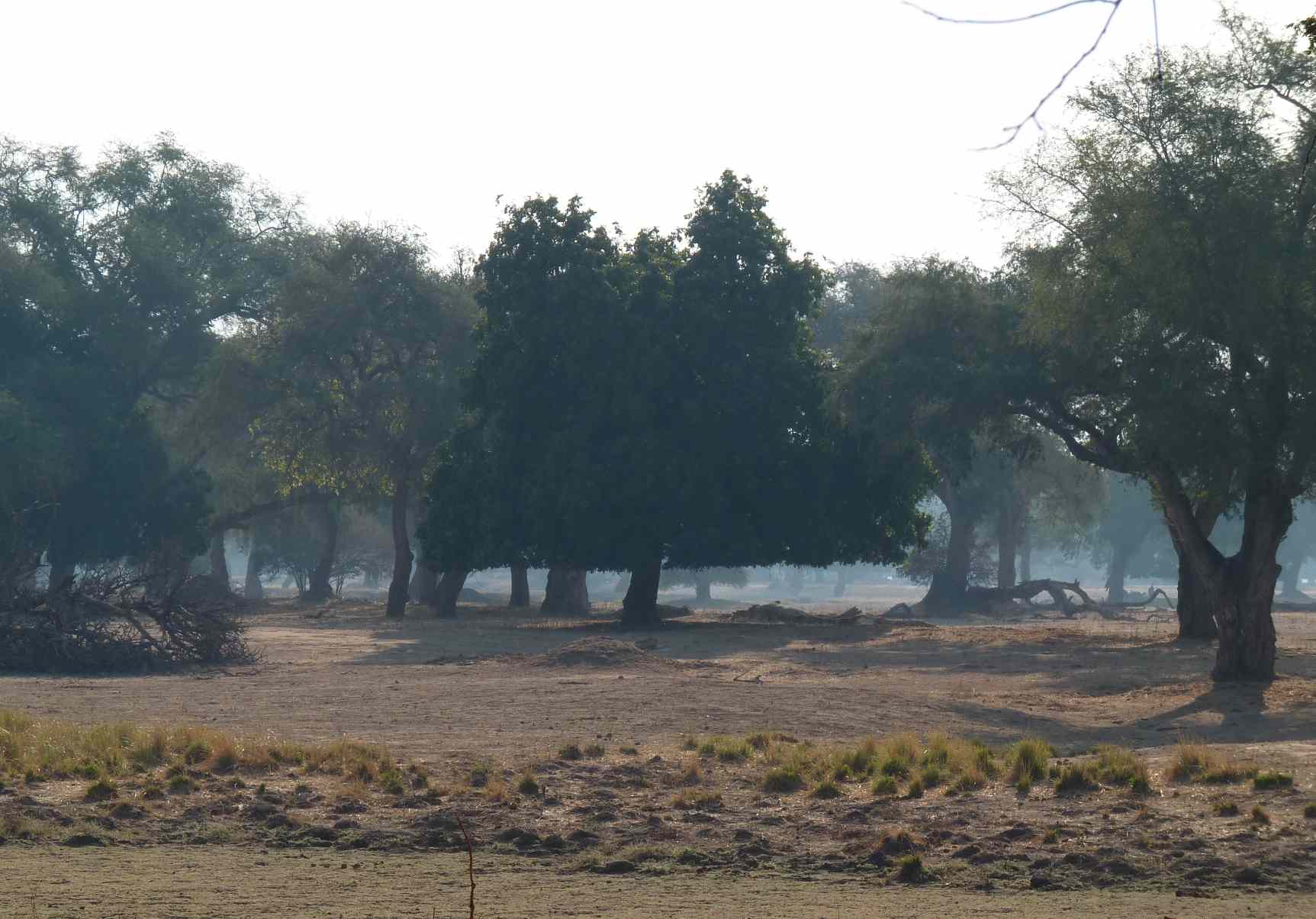
Can a human achieve such trim?
All trees complement each other to achieve this beautiful landscape. However, and perhaps surprisingly to the reader, there is a silent and long-term tree war being waged while we watch… I am not talking about Lord of the Rings’ Ents but rather a combination of several battles being fought by stationary trees since time immemorial. It all starts with a bird or monkey feeding on a fig and dropping its seeds in a suitable place up a tree, where a hollow filled with soil allows germination to take place.
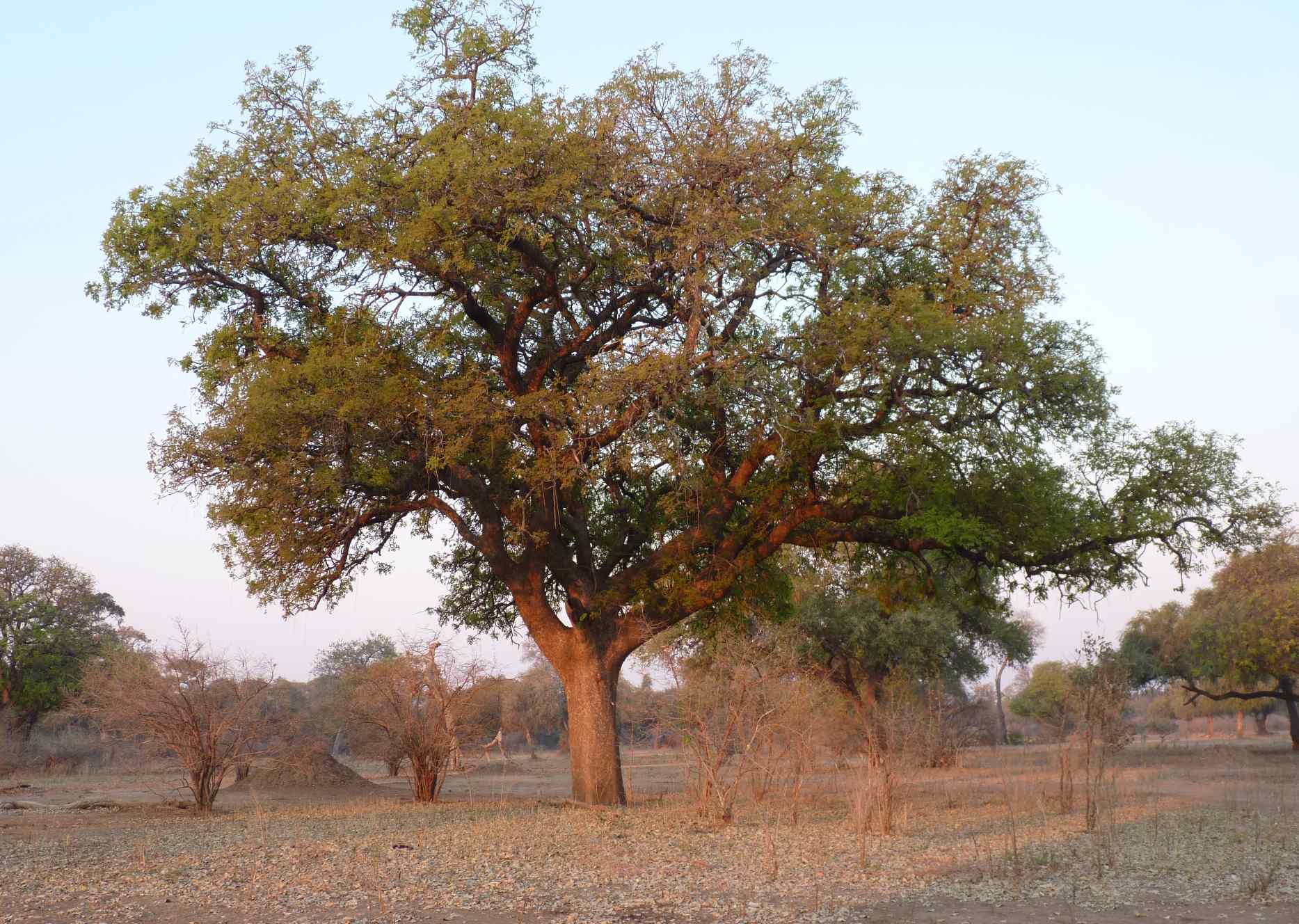
One more tree…

Good eyes are needed to spot the “enemy”…

A further close-up reveals the birth of a Zambezi fig tree.
Soon, an innocent-looking two-leaf seedling appears. After consolidating itself, it starts sending down aerial roots that surround the host tree and that will eventually reach the ground to bury themselves, becoming true roots. The fig tree uses the host to gain support and structure in its growth; the host is like a guiding stick similar to those used to support grapevines or tomato plants. In their quest for support and with their uncanny ability to survive in the most unlikely places, fig trees produce natural sculptural Masterpieces that occasionally damage ruins, which is an entirely different problem.
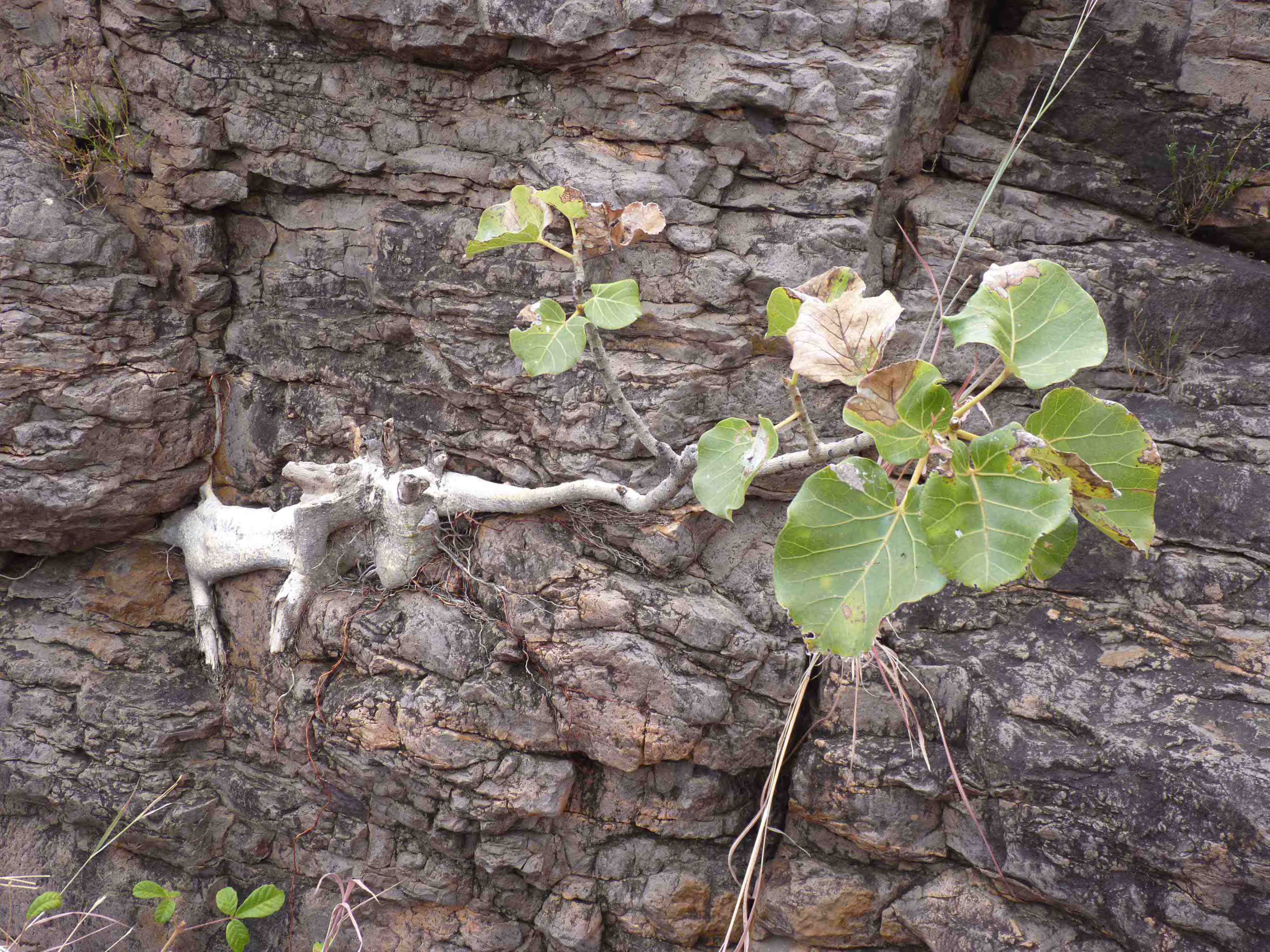
Fig tree growth can even crack rocks and buildings.
At some stage during the battle, it seems as if the two trees coexist naturally, adding great beauty to the forest. However, the process continues inexorably and the invader eventually strangles the host tree. This is purely mechanical as the pressure applied is such that it has the same effect as if the host tree would be ring-barked, interrupting the flow of water and nutrients between roots and the rest.
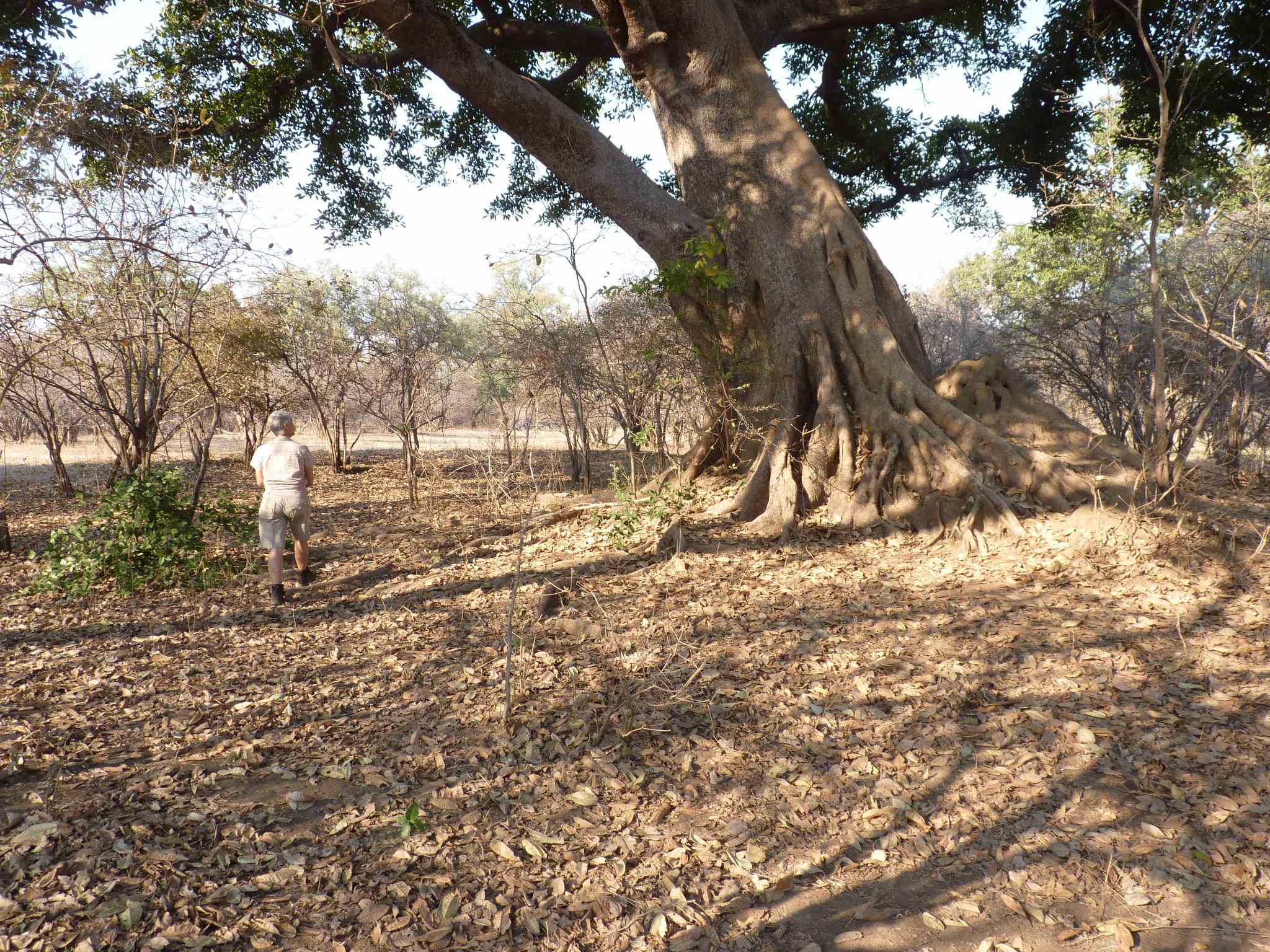
Watching a fig embrace. The host tree is still strong and visible on the left.
Luckily for some (in rare cases) animals may come to the rescue. The aerial roots are eaten by elephants and, in this way, these animals become an unwitting ally of the host tree, halting the growth of the fig and saving the host tree at least for a while.
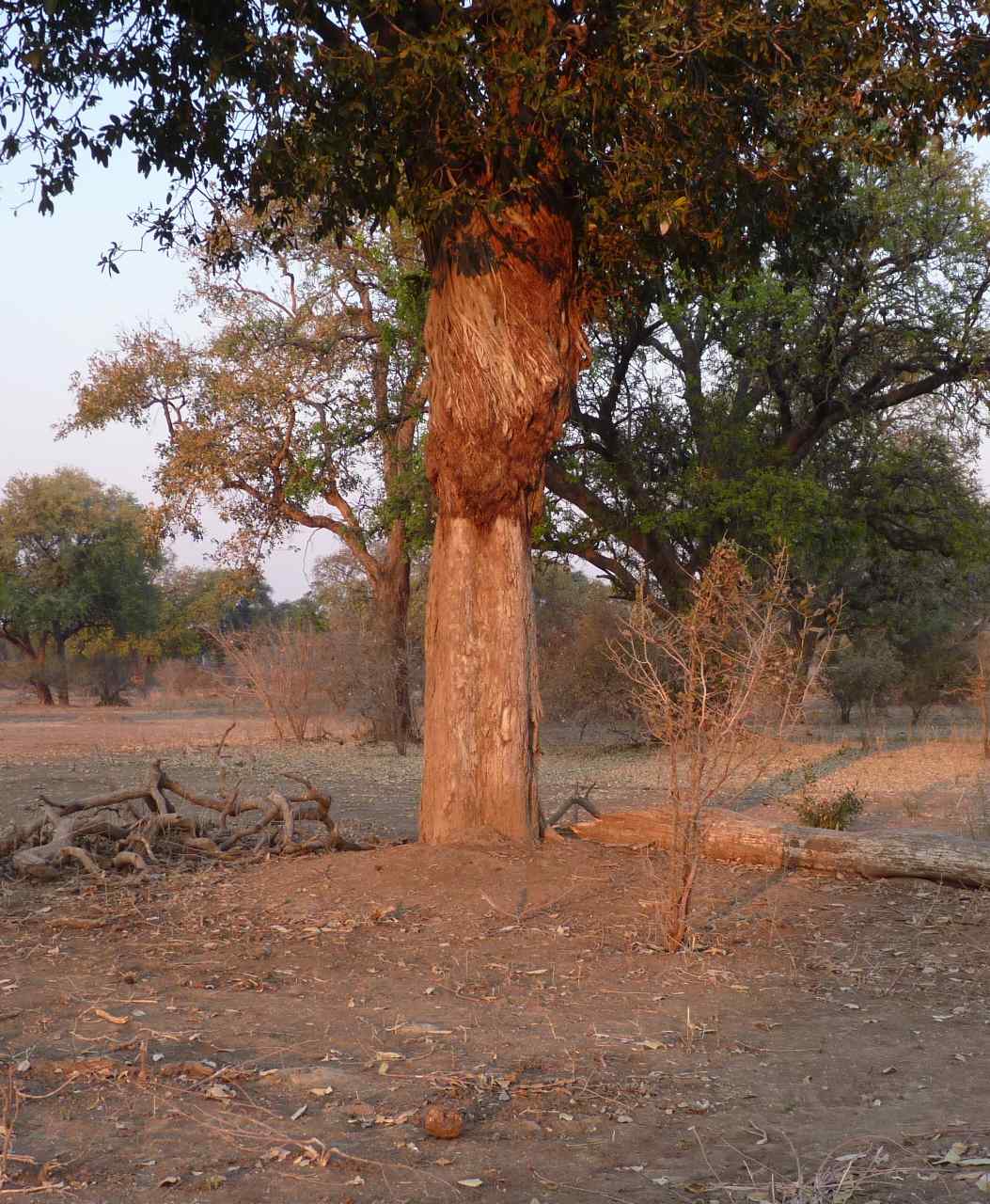
A closer view of the fig tree being browsed and stopped from engulfing the host tree.
However, this is an exception and the usual outcome is that the Zambezi fig tree becomes established, winning another battle.
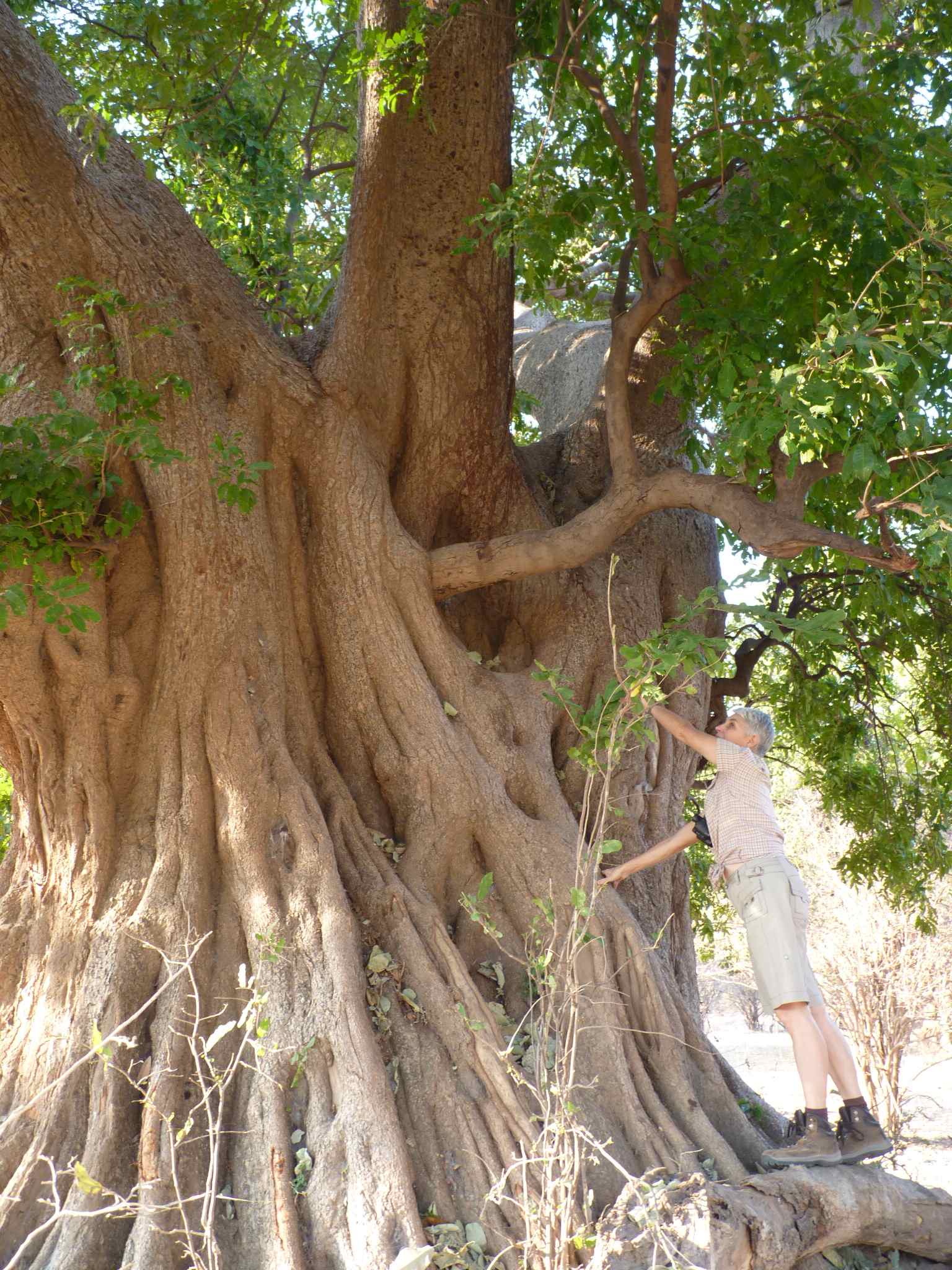
The branch on the right, above my wife, is what remains of the host tree.

A very large Zambezi fig tree.
Fig trees are beautiful shady trees with a great canopy that extends further than most trees, considering the size of their main trunk. This is often their weakness as, being soft, they often crack and fall which leads to the death of the tree.
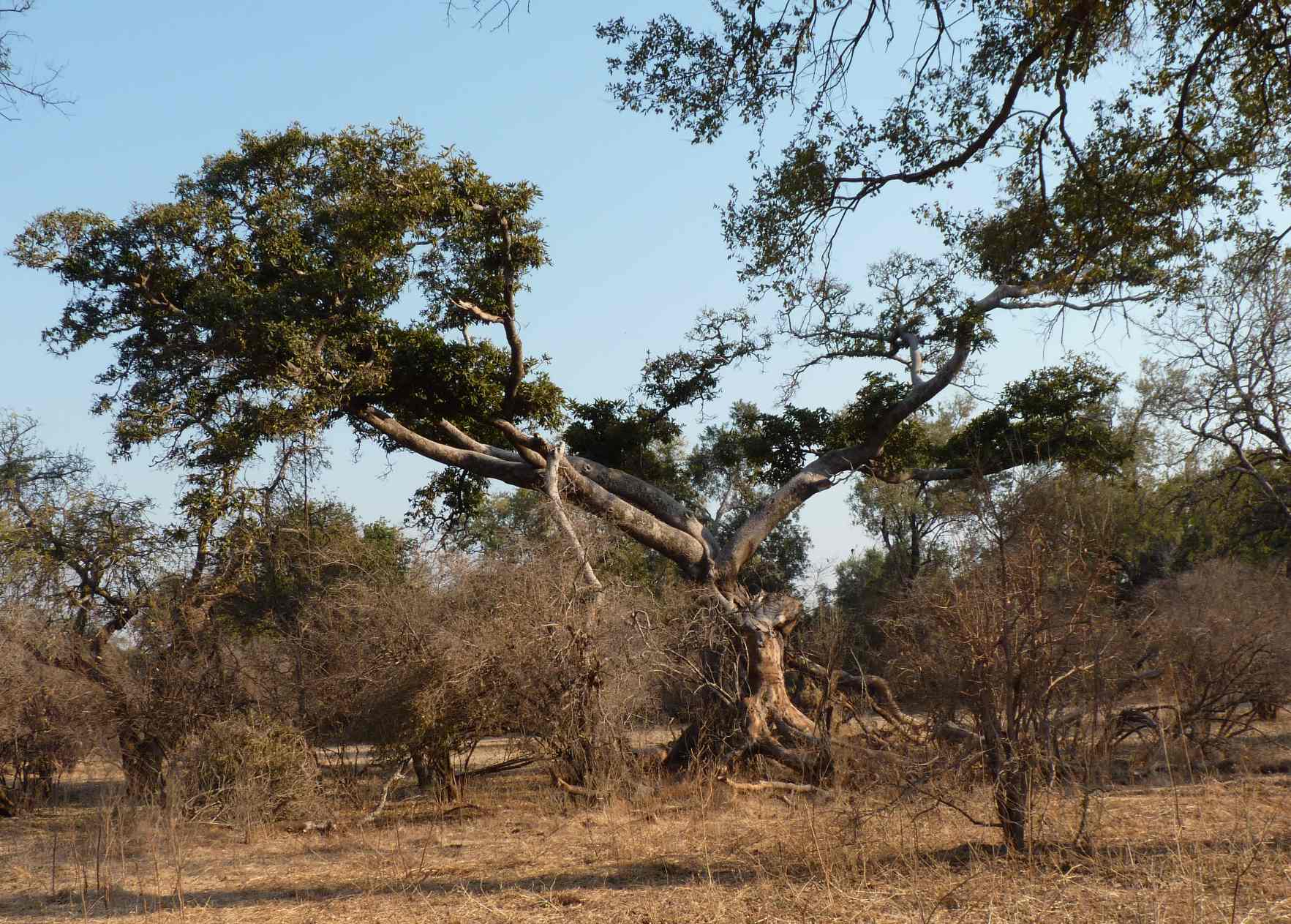
A collapsing fig tree.
Despite these battles that rage silently in plain sight, we should not worry as the outcome is by no means the doom of the striking Mana Pools woodlands!

To write these lines I needed to sit down and in so doing, I sat on a snake! Luckily any concerns you may have about my derrière are unnecessary as said snake was made of rubber. Yes, I know, I should not be playing with toys at my age but some of us are take longer to mature!
Baboons and vervet monkeys are a menace while camping in Africa, and Mana Pool’s lodges are no exception to the rule. We learnt that rubber snakes are a good deterrent so we alwayscatter a few around our area while on safari. They work well and we have had fun watching monkeys perform panicky gravity-defying summersaults while screaming in terror after spotting them! I will come back to the topic of monkeys and camping in the future, so for now I turn back to Mana Pools.
In my earlier post I mentioned that in Mana Pools you are able to go about freely on foot. Funnily enough, you often come into much closer contact with wild animals while in your lodge or campsite than when walking in the bush. The former (named by the Zimbabwe Parks & Wildlife Management Authority) is a small house with one or two bedrooms, a kitchen and a toilet.
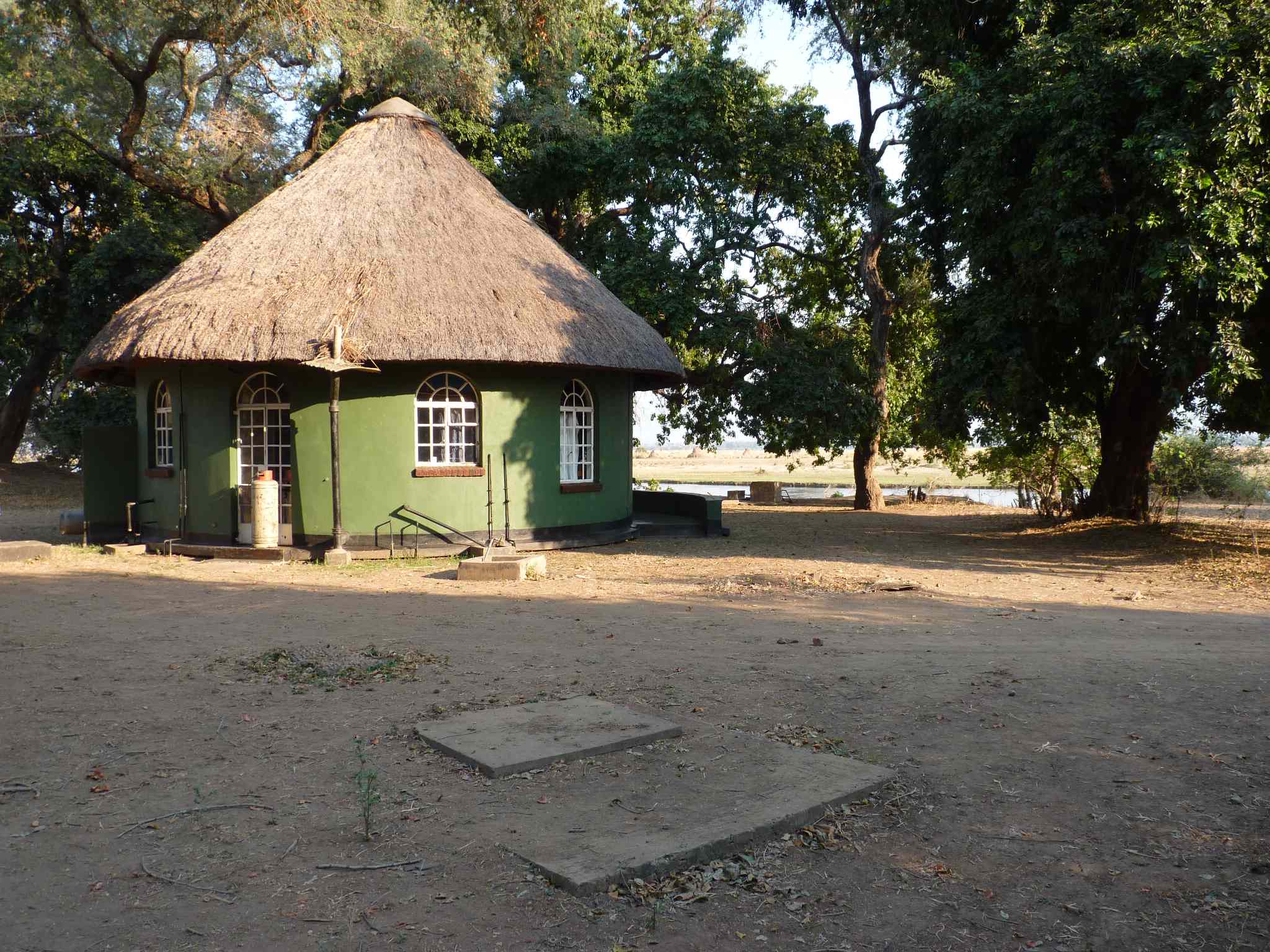
Mubvee, our lodge.
Solar lamps provide lighting and there is a freezer, a gas cooker and a BBQ place. The ubiquitous Tanganyika boiler -firewood operated- provides ample hot water while the vervet monkeys and baboons come free of charge!
The lodges are well positioned, only a few metres from the river bank providing great views of the Zambezi. The sunsets over the river were spectacular as usual.
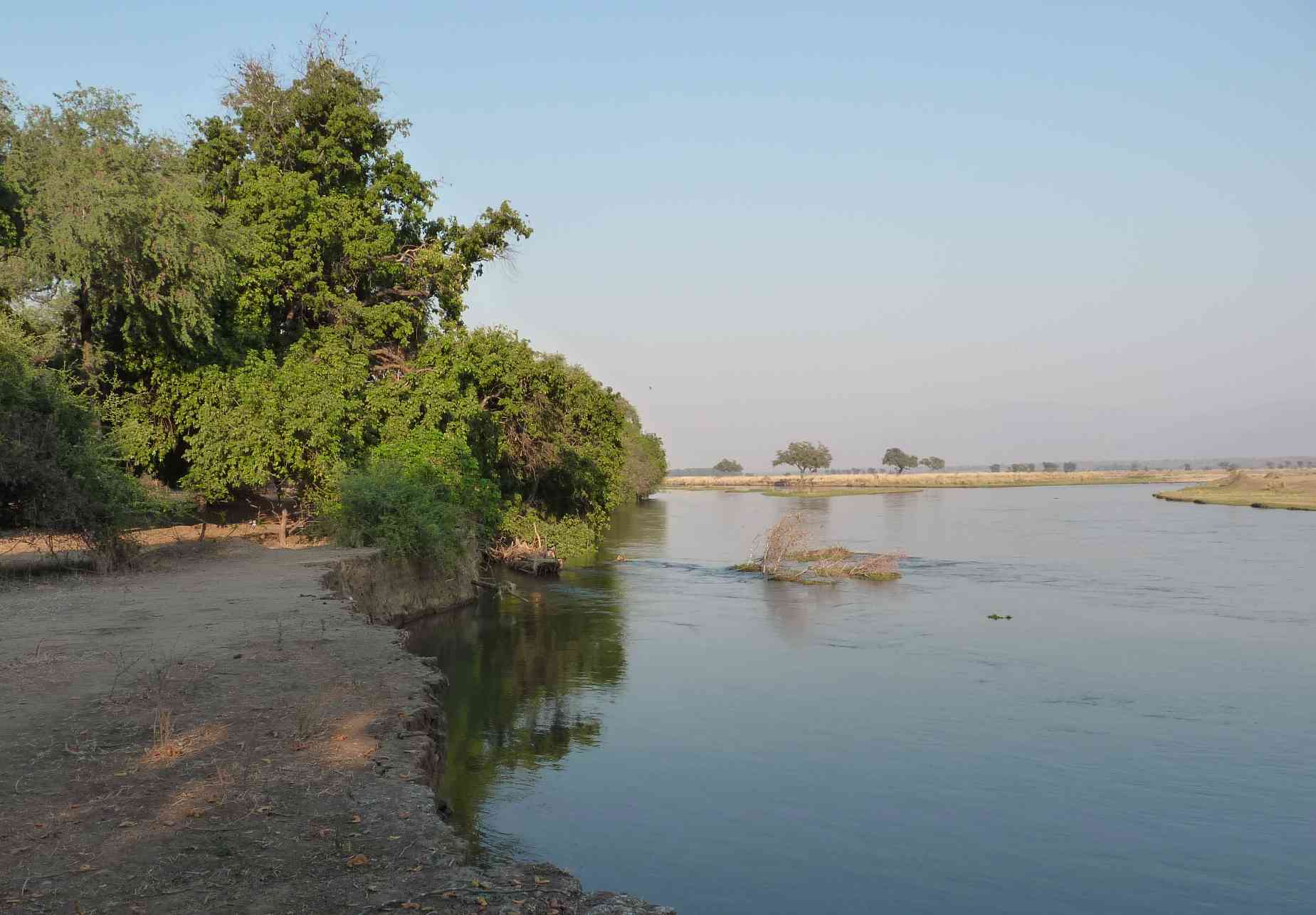
The Zambezi river seen from the lodge grounds.
At the time of our visit the sundowns were made even more dramatic by the bush fires raging on the mountains opposite us, across the river in Zambia. Most nights the hills were decorated with crisscrossed fire garlands that devoured the dry brush voraciously and added drama to the view.
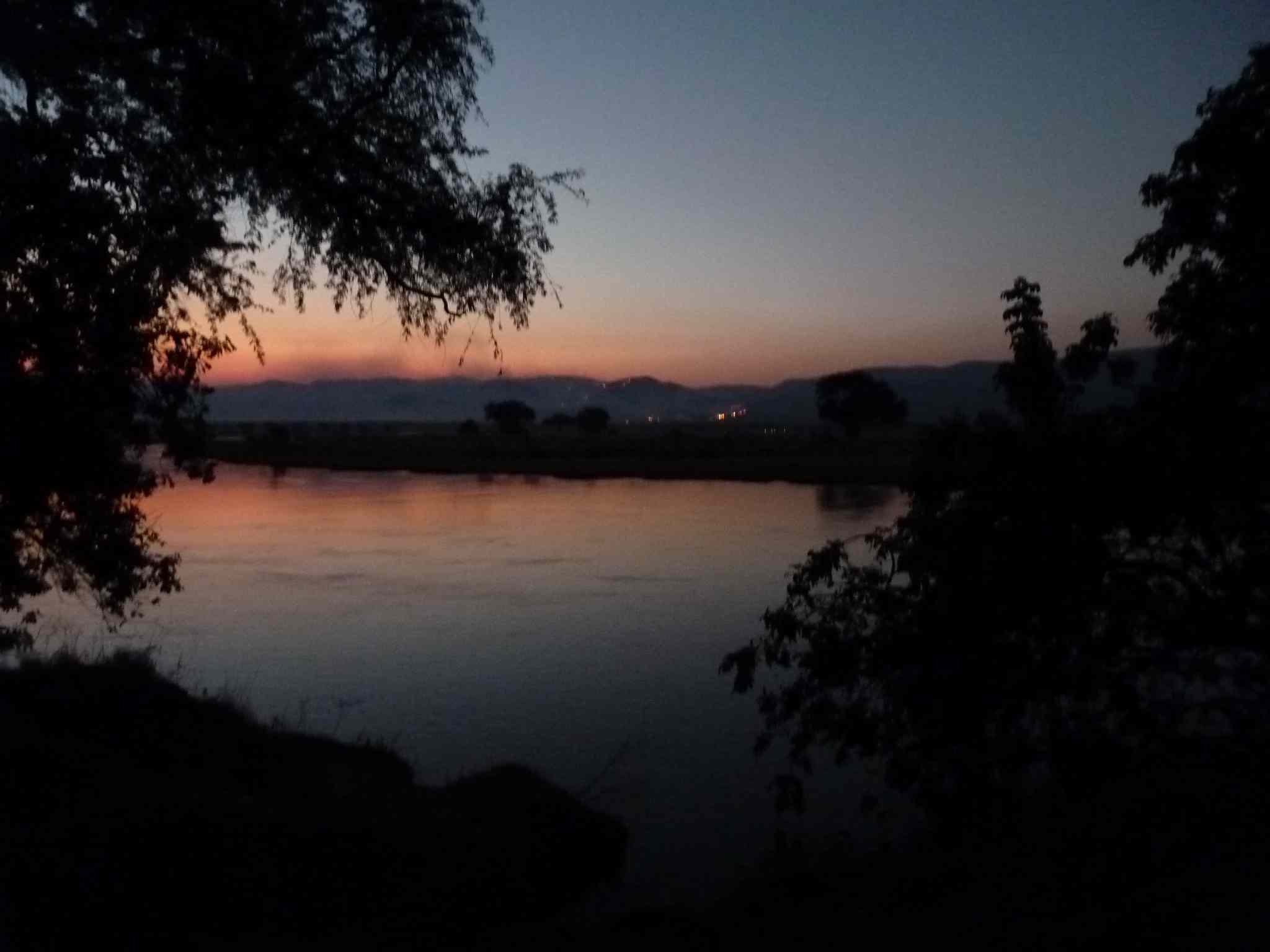
The sunset and bushfires.
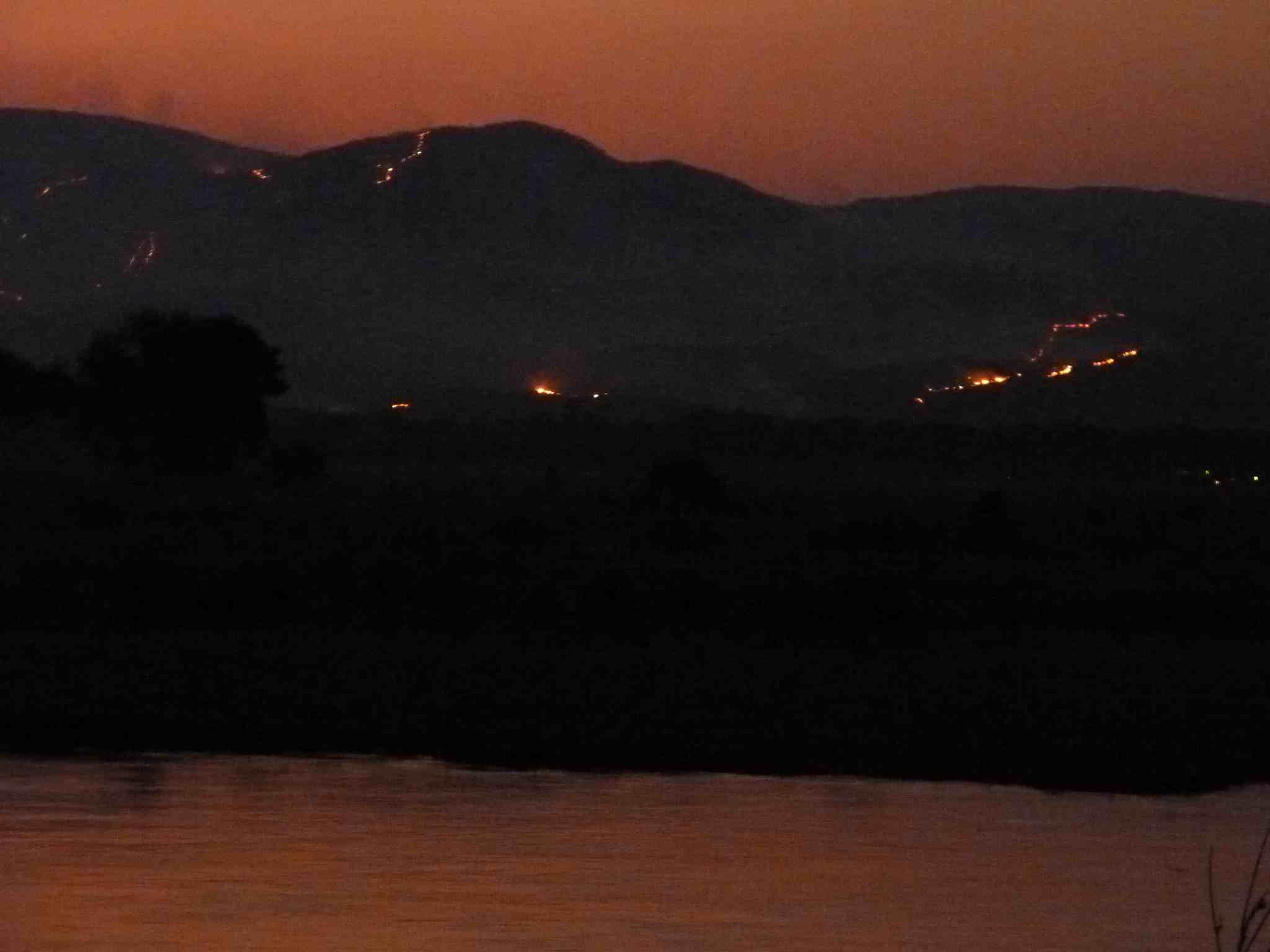
A view of the burning hills (apologies for the bad picture).
Usually we are at the lodge in the morning (before leaving for a walk or game drive), lunchtime (when you are not in the bush) and in the evening (always). It is during these times that you have the closest encounters with wild animals.
In the early mornings we were woken up by loud birdcalls that made going back to sleep rather difficult. The din came from the goings on of a colony of white fronted bee-eaters (Merops bullockoides) that had their burrows in the banks in front of our lodge. With them were also a large number of the much bigger southern carmine bee eaters (Merops nubicoides), adding more colour to the scene while basking under the morning sun in the treetops above our lodge (a magnificent sight).
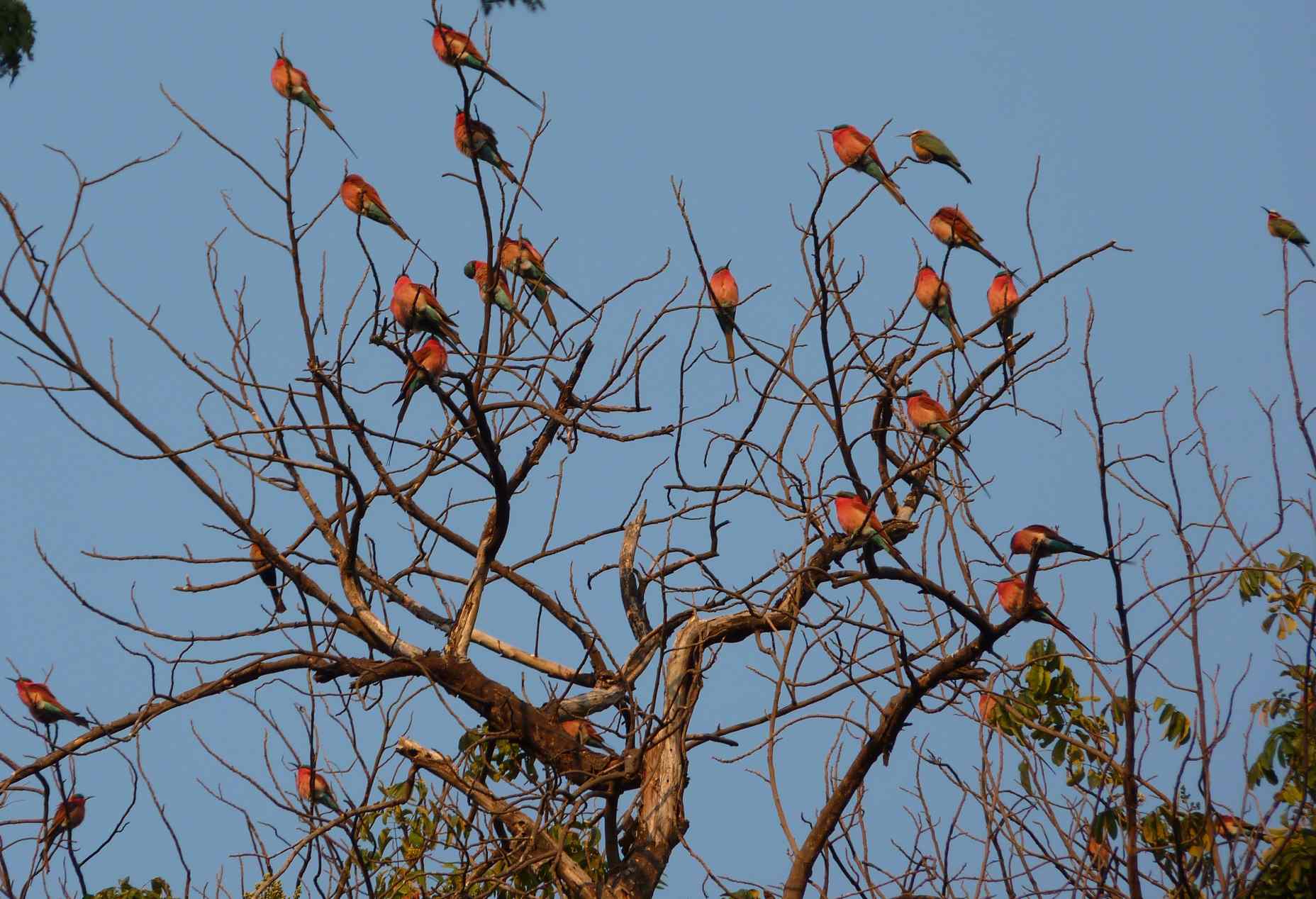
Southern carmine bee-eaters basking in the sun (please note the smaller white-fronted bee-eaters on the right of the picture).
The white-fronted bee-eaters were very active and most likely involved in courting and nesting. A bit of reading when we returned to Harare revealed that mixed colonies of these two species are common. I also learnt later that these birds are colonial but also cooperative. The latter means that many individuals of both sexes play a role as helpers* and that they may switch from breeder to helper and back to breeder many times over a lifespan.
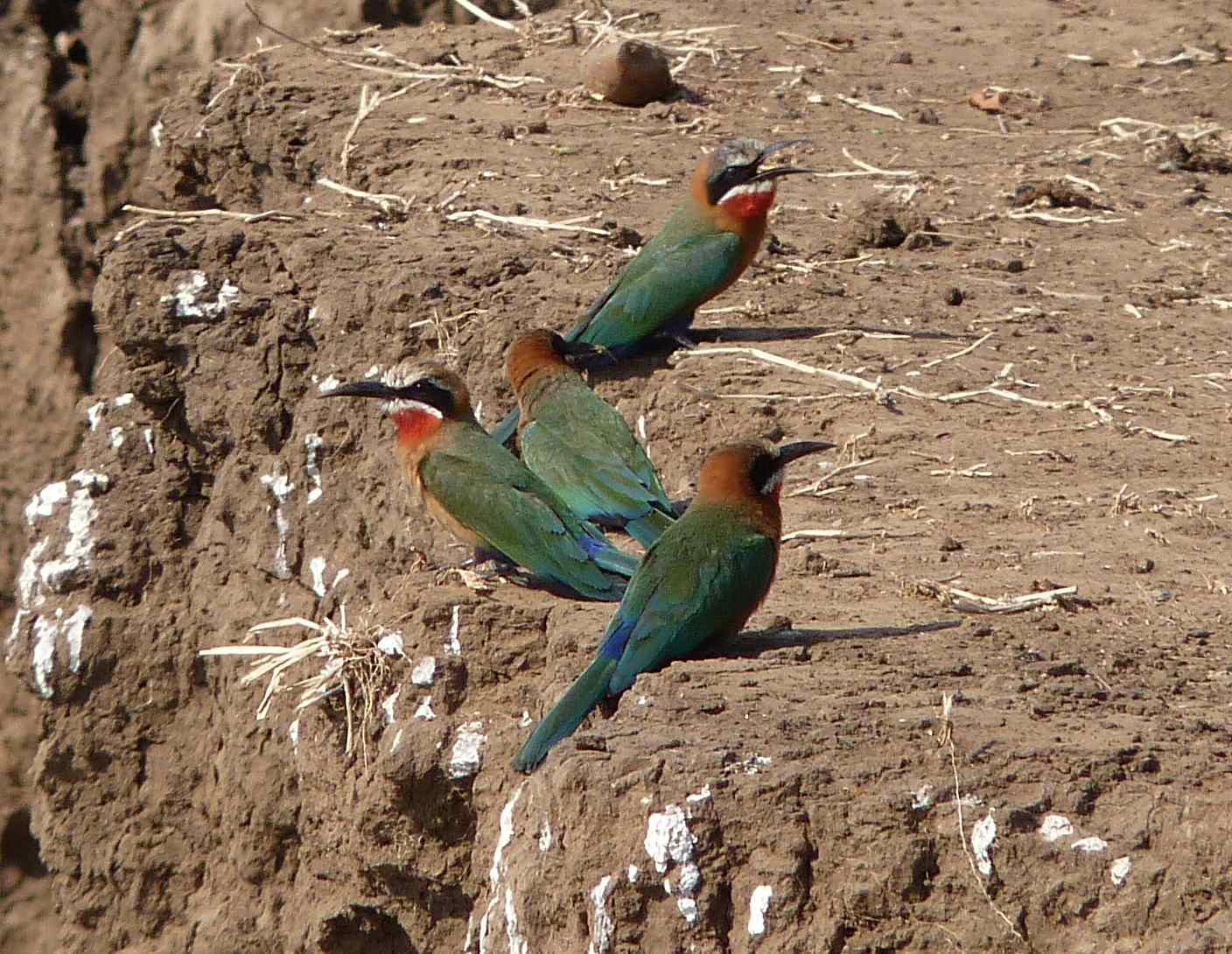
White fronted bee-eaters at the river bank. Their borrowed nests are below.
Every morning the carmine bee-eaters, after being sufficiently warmed by the sun, flew off for the day on unknown errands, and returned in the afternoon. Unfortunately I could not tell if these birds were also nesting in the banks but I suspect so.
The proximity of our lodge to the water’s edge provided us with a continuous parade of animals without having to move too much. These included some really huge crocodiles as well as buffaloes, hippos and elephants: they were on both sides of the channel that ran in front of the lodge. It was wonderful to see elephants wading to reach the opposite shore only to return once they ate their fill of their favorite vegetation.
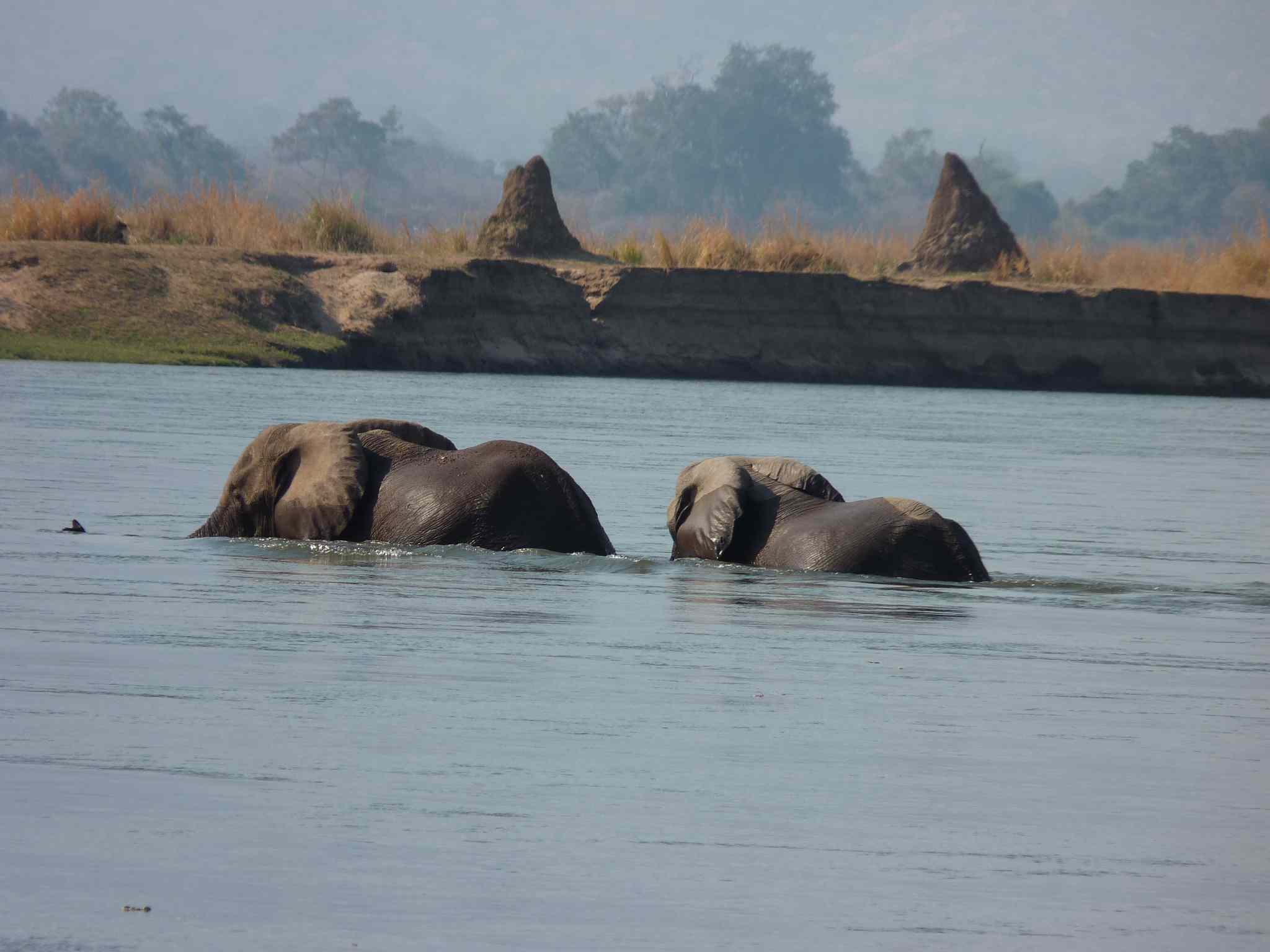
Elephants crossing the channel (note the two termite nests in the background).
It was during the first lunch hour -a bit too hot to go looking for animals- that, after a light salad lunch, I prepared myself for my usual short siesta. I placed myself under the shade of an acacia tree that provided ample shade (and pods!) and prepared myself for sleep while reading my book. It was warm but there was a soft breeze, which resulted in the perfect cool spot. These were ideal conditions and I was even prepared for a monkey-attack, just in case…
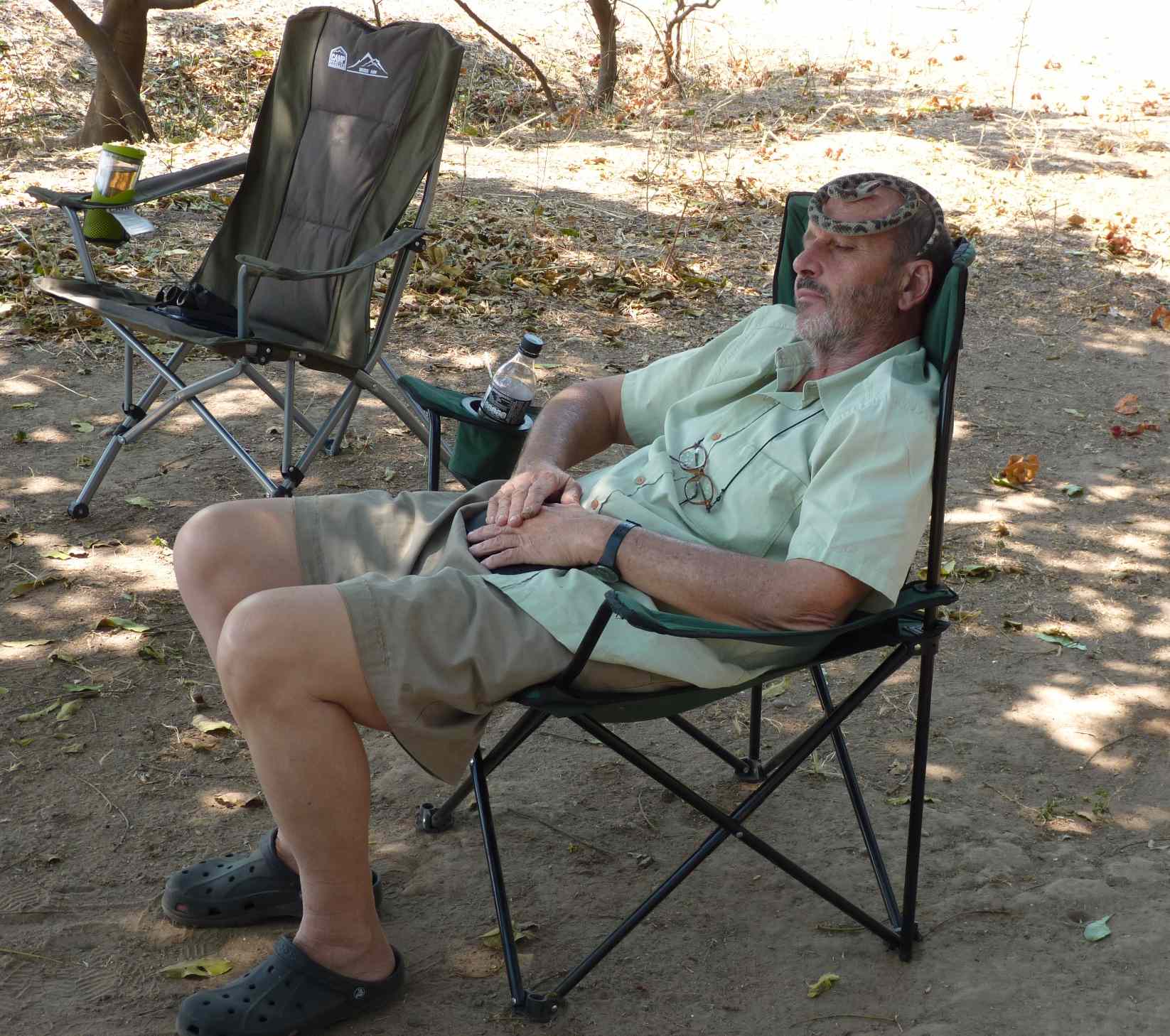
The bushsnob prepared for a “monkey-proof” siesta!
It all started with my wife becoming very agitated at the exact moment that I had duly dropped my book (on my face) and entered the “drifting off” stage of my nap! Her alert call brought me back to life. Before I could proffer my -I am sure expected- complaint, I heard a soft “Don’t move and look” I knew then that I should do as I was told! My eyes were filled with an elephant!

Thankfully, its attention was solely on the Apple ring Acacia pods.
I froze -purely out of fear rather than bushsnob wisdom- as the elephant was three metres away from me and still approaching! I immediately noticed that, although very close, it was after the pods on the floor and oblivious to its surroundings including me! With a super human effort, given my panic-driven semi paralytic state, I lifted my feet off the ground as it could have otherwise, unintentionally stepped on my bare feet (ouch…). The sight mesmerized me! Finally, it came to about a couple of metres and looked at me “Now I am history” I thought. However, it simply raised its head as if saluting me and continued with its feeding, slowly ambling past with the only heralds of its presence the crunching of pods, the rattle of those discarded and the occasional soft huffs of its trunk as it searched for more.
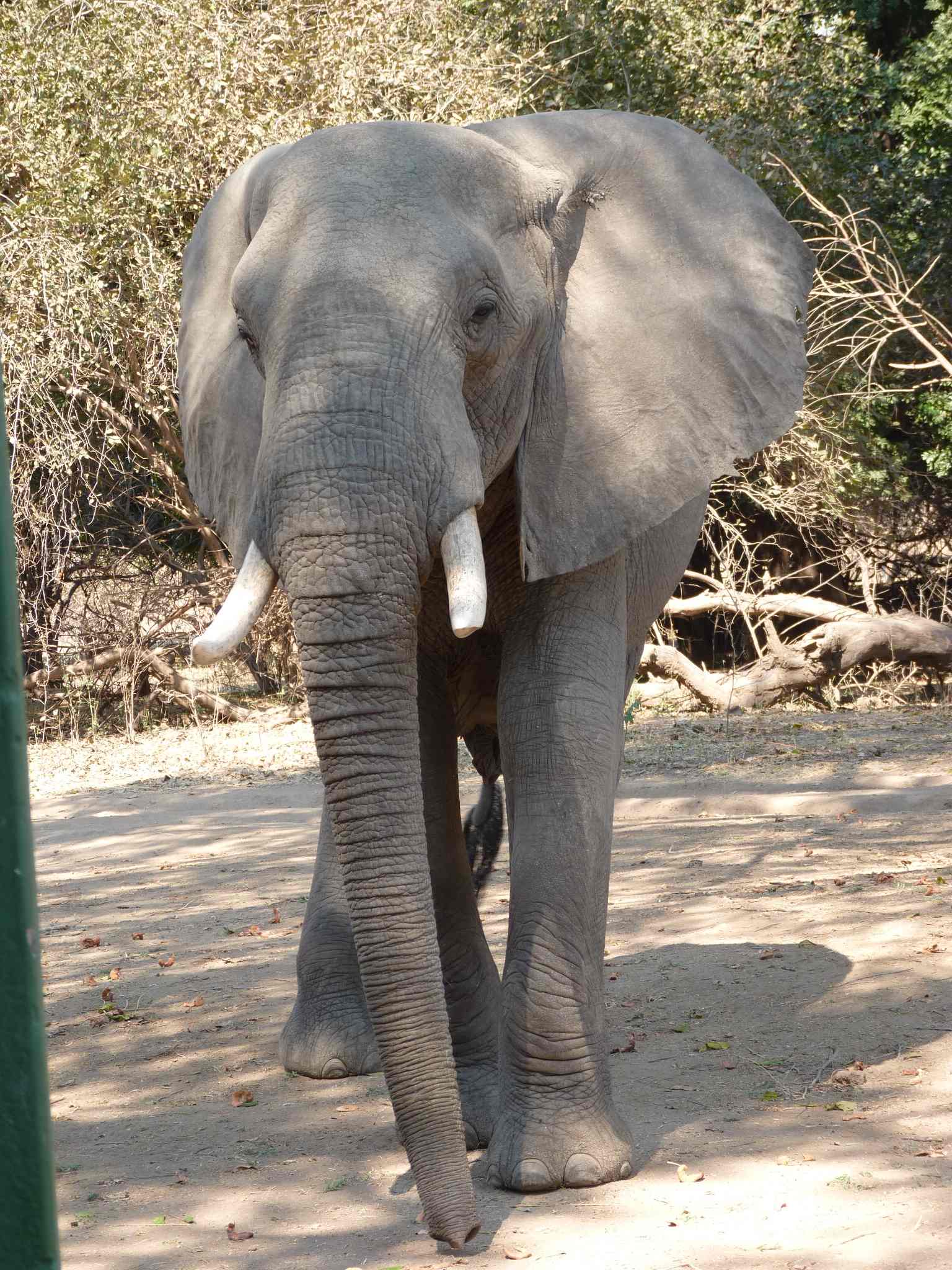
It was coming in my direction on silent feet…
The amazing thing about elephants is that despite their size, you will not hear them unless they want you to. While walking on tarmac elephant footpads make a whisper-like ‘chuff’, similar to the sound produced when one brushes a hand over the fabric of a pillow; on dusty earth they are virtually silent. At night, they silently walk through your campsite while browsing without disturbing anything. Finally, although I often trip over the tent ropes, I have never had an elephant doing so day or night!
As my knees had suddenly turned into jelly, I did not move, even after it passed and not even when my wife’s “order” was issued: “That was close! Get up quick and take a picture of it before it goes away” When I managed to collect all my wits and do a mental inventory of the condition of my various body parts, it was too late and I could only see its backside moving off. Although we have had these kind of encounters before this was a very close one and it is quite an experience to be literally “face to trunk” with a fully-grown male elephant! The siesta was abandoned, this time for a good reason!
This was not the only occasion that this happened during our stay at Mana Pools but I describe it to you so that you have an idea of our interactions with wildlife at the park. More than one tusker visited us everyday and a few family groups walked around the lodge during the day and night. They were even rude enough to try to spoil our BBQs!
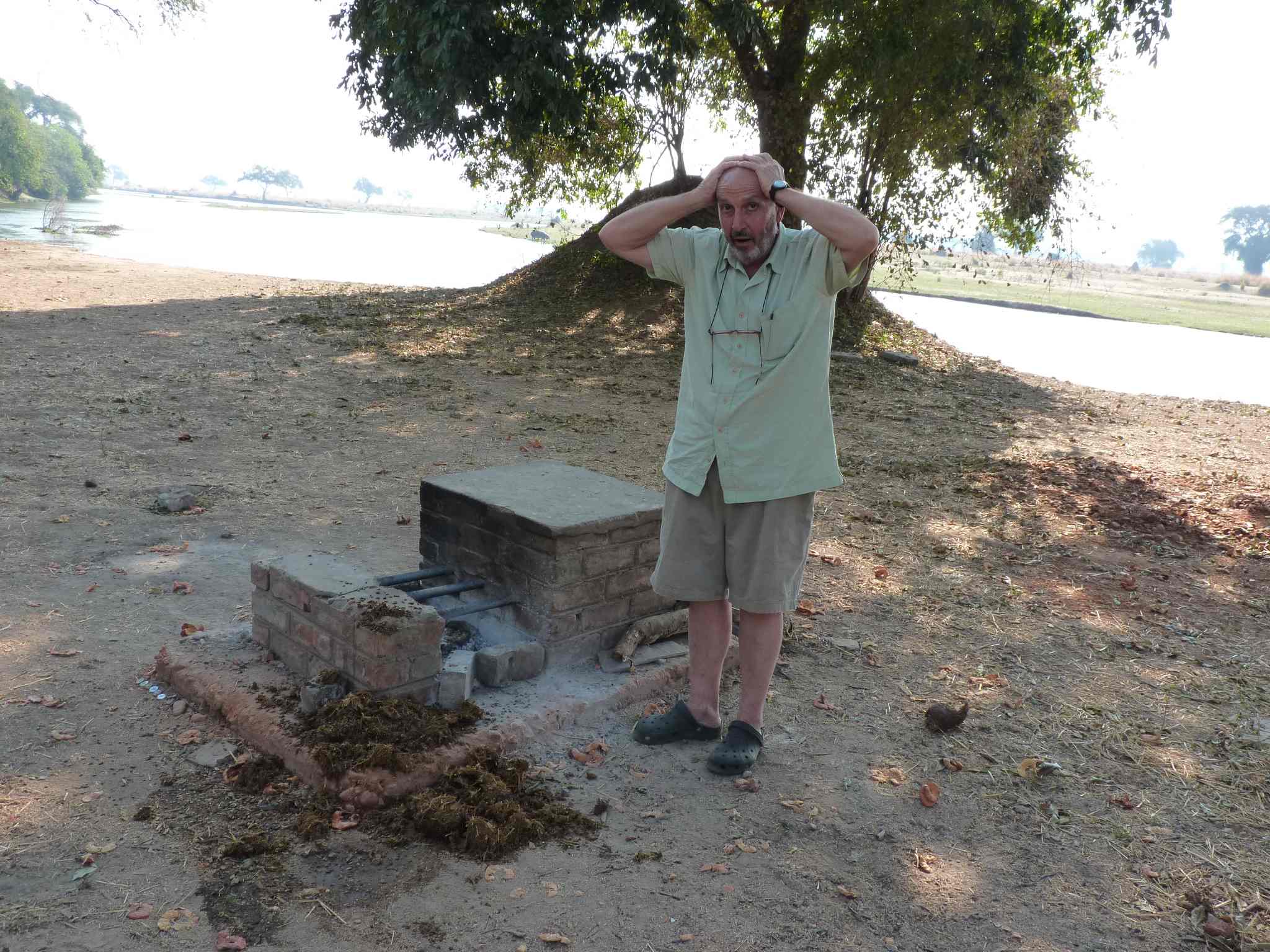
The bushsnob just discovered the bomb dropped by a “terrorist” elephant and he is horrified thinking on cleaning the mess (the faeces were almost pure Apple ring Acacia seeds!).
In addition to the pachyderms, a lone hippo kept us company everyday as it fed on the pods. It would arrive after sunset and we would hear it chomping while it walked about. Although it occasionally entered the circle of light provided by our lamps, it preferred to stay in the dark. This meant that every now and then, we would have to locate it as it was an additional hazard while walking around our lodge (particularly when going to the BBQ area or the water boiler) to avoid the danger of bumping into it!
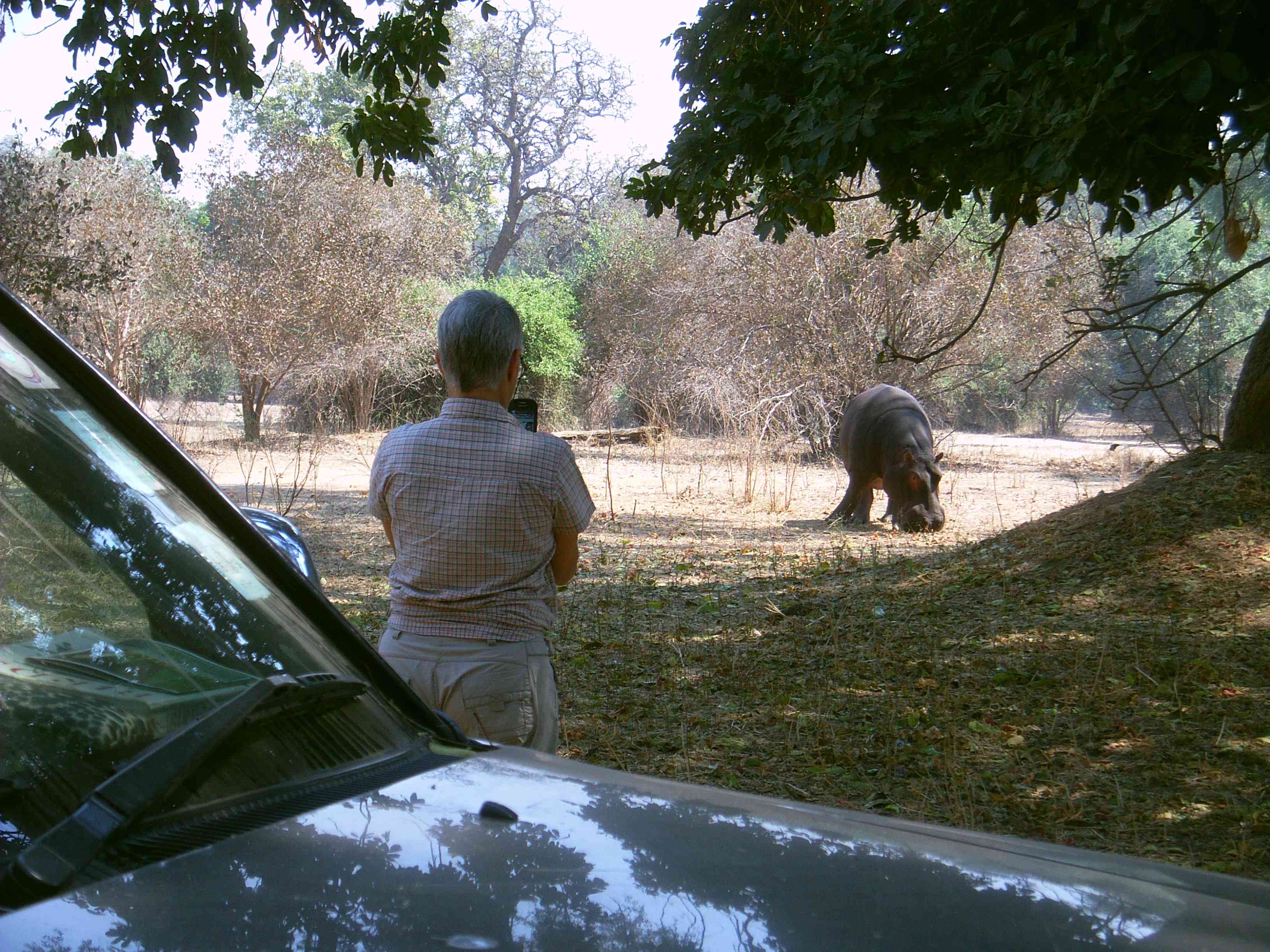
My wife keeping an eye on our hippo visitor during a rarer day visit.
A least one spotted hyena also did its food-run every evening. We did not think that hyenas were around as we did not hear them but they were afoot operating silently in the darkness! The lions were, quite to the contrary, rather close and very loud. They were heard, as my wife put it, “all night long” and a lioness and two cubs passed by while the occupant of our next-door lodge was having his morning coffee!
* Birds (normally juveniles and sexually mature young birds of both sexes) that remain in association
with their parents and help them raise subsequent broods.
We arrived at Mana Pools National Park (Mana Pools) at about 15:00 hours after a six hour drive from Harare. Just before the turn off to get into the final stretch of rough dirt road, we stopped at the edge of the escarpment to take in the hazy view of the Zambezi valley below, always a beautiful sight, and one that is full of anticipated adventure. The view was even hazier than usual, as this is the season of bush fires that add a blue tint to the horizon.

The view of the Zambezi valley from the main road.
The stop to contemplate the view had to be brief as we still had about two hours of driving to get to the park. As soon as we started the escarpment’s steep descent we came across a queue of lorries parked on both sides of the road. The normal sightings involve slow moving lorries either struggling uphill or burning brakes downhill, so this kind of mass convergence was not normal. We drove through the narrow “lorry tunnel” very slowly, passing around 60 lorries before we came to the reason for the queue. An unfortunate driver had lost control of his truck while going downhill and crashed at full speed against a rocky bend. The accident was recent as the rescue of the occupants’ was taking place as we passed by. This was a stark reminder of the dangers associated with driving.
The turn off into the rough road leading to Mana Pools came as a relief after witnessing such a mishap. We drove on and, after 80 km of dirt road; we arrived at Mana Pools, a UNESCO World Heritage site of similar standing to the Great Barrier Reef, the Tower of London or Yellowstone National Park. The recent book “Mana Pools” by Gregg Robinson presents excellent pictures and describes the park in great detail. What more can I say not being a poet but rather a humble veterinarian!
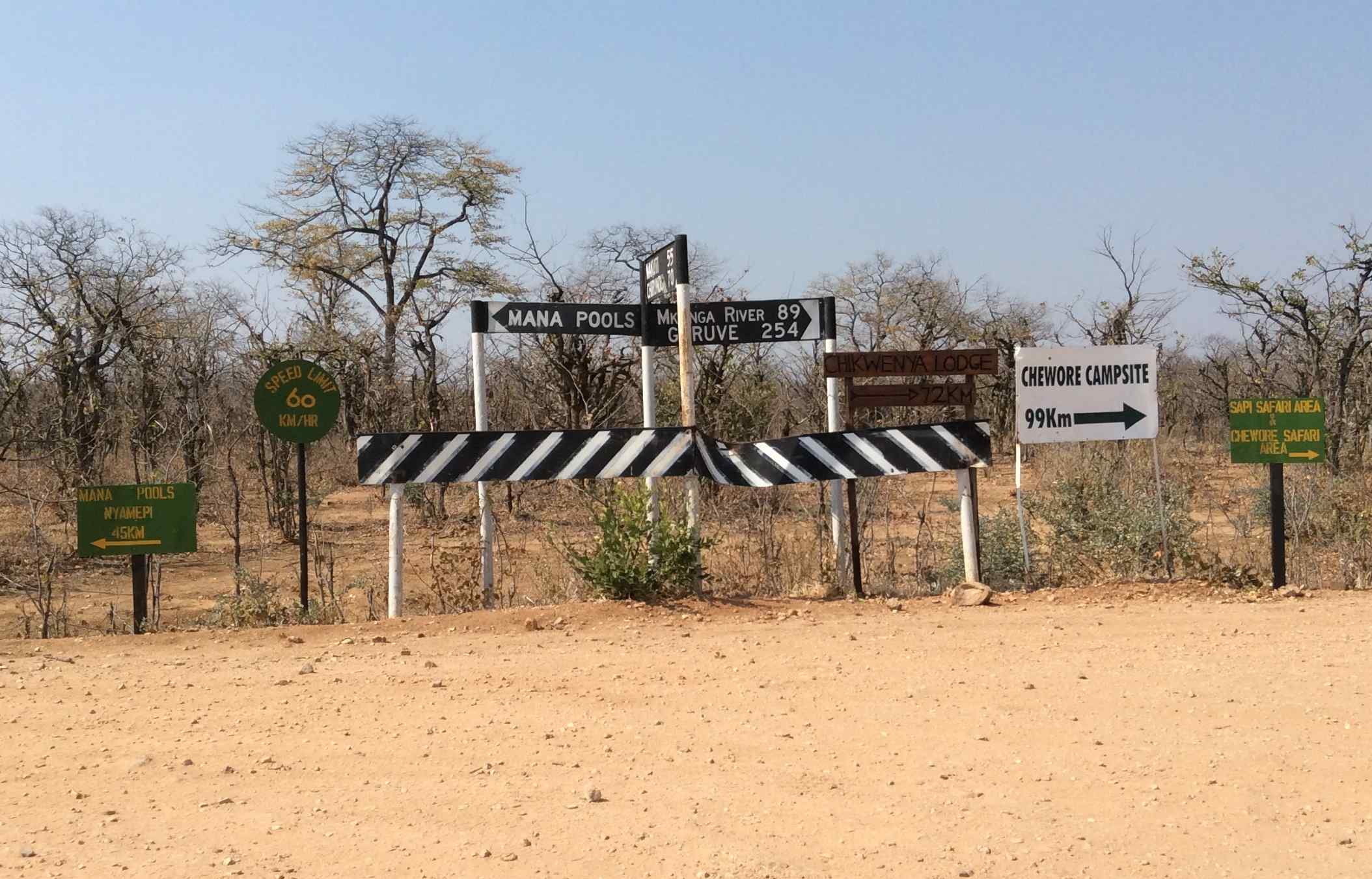
The road to Mana Pools.
Mana Pools is a place of unique natural beauty. The Zambezi River, with its hilly background, forms its northern border and the area to the South is a flat wooded expanse where earlier river meanderings have left a number of separate pools that give the park its name. This is where game abounds and, because of the nature of their habitat they can be spotted at a distance, similar to the East African parks.
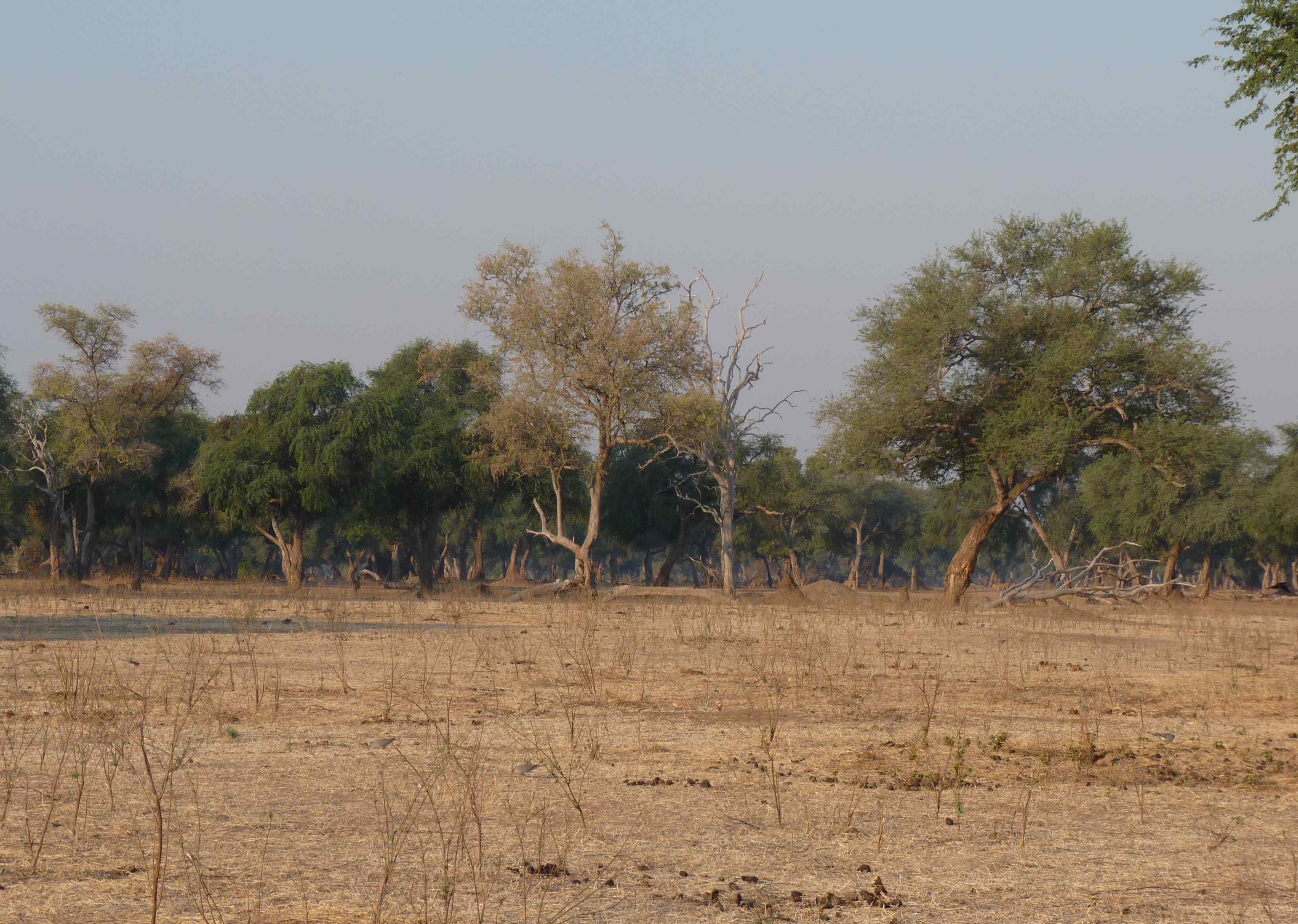
The Mana Pools woodlands in the afternoon.
In addition to its magnificent and ancient trees and its abundant wildlife, Mana Pools is -I believe- the only national park in Africa where you can leave your car and walk on your own despite there being dangerous animals at large. We know of two prides of lions and a pack of painted dogs that live in the area, not to mention numerous hyenas, several buffalo herds, many elephants, the occasional leopard, crocodiles and hippos, among others.
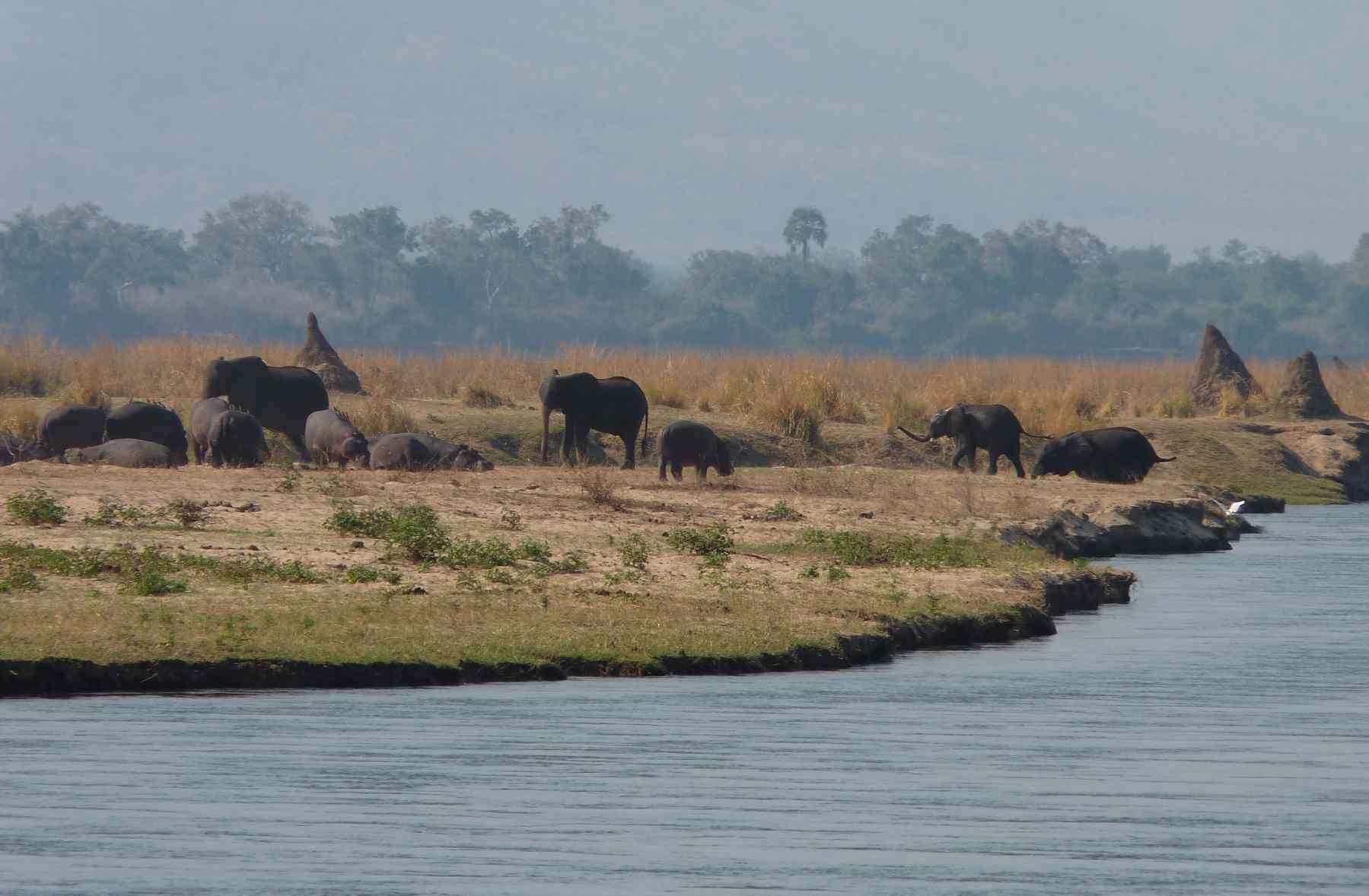
Hippos and elephants sharing the grazing area in the banks of the Zambezi River.
You may be surprised at this unusual and seemingly dangerous freedom but it works well due to a combination of animal tolerance and human caution. So, you are able to leave your metal cage and walk around freely! However, we must never forget that the animals we see around us are wild and as such, require the utmost respect and caution from us. Walking away from the protection of your car demands extreme prudence at all times, along with being aware of your surroundings, the direction of the wind, where you place your feet along with being able to read other important signs and, most importantly: to remember where you parked your vehicle!
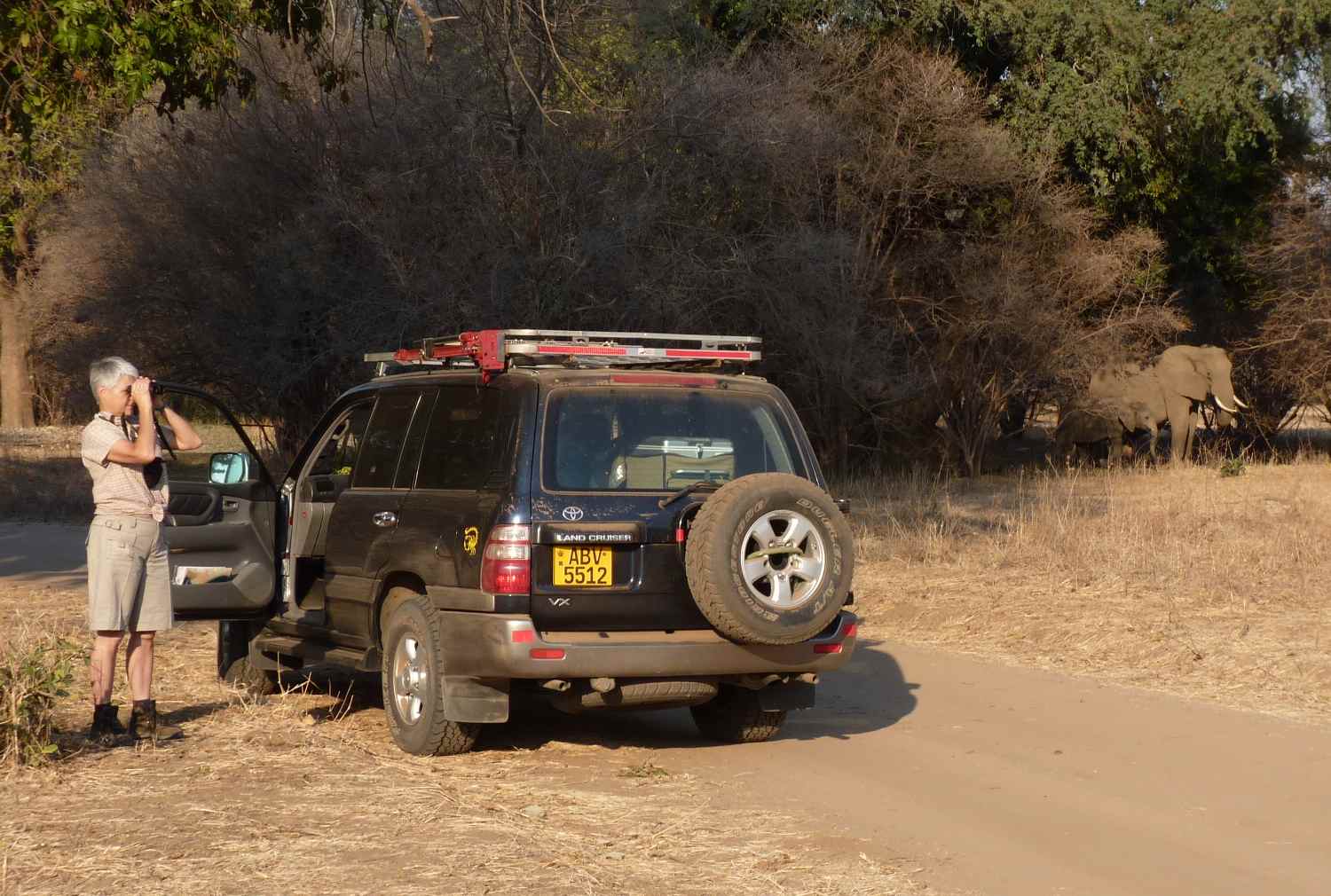
The beauty of leaving your car.
We found lions on our first day, ten minutes after leaving our lodge! There were two: a young male and an adult female. They were just visible in the bush, near Chisasiko pool. We stopped the car and joined other people already there having their morning coffee while watching the lions, a rather unique experience! The opinions were divided on whether they had or would hunt. To us they looked alert as if looking for prey but it was difficult to guesstimate!
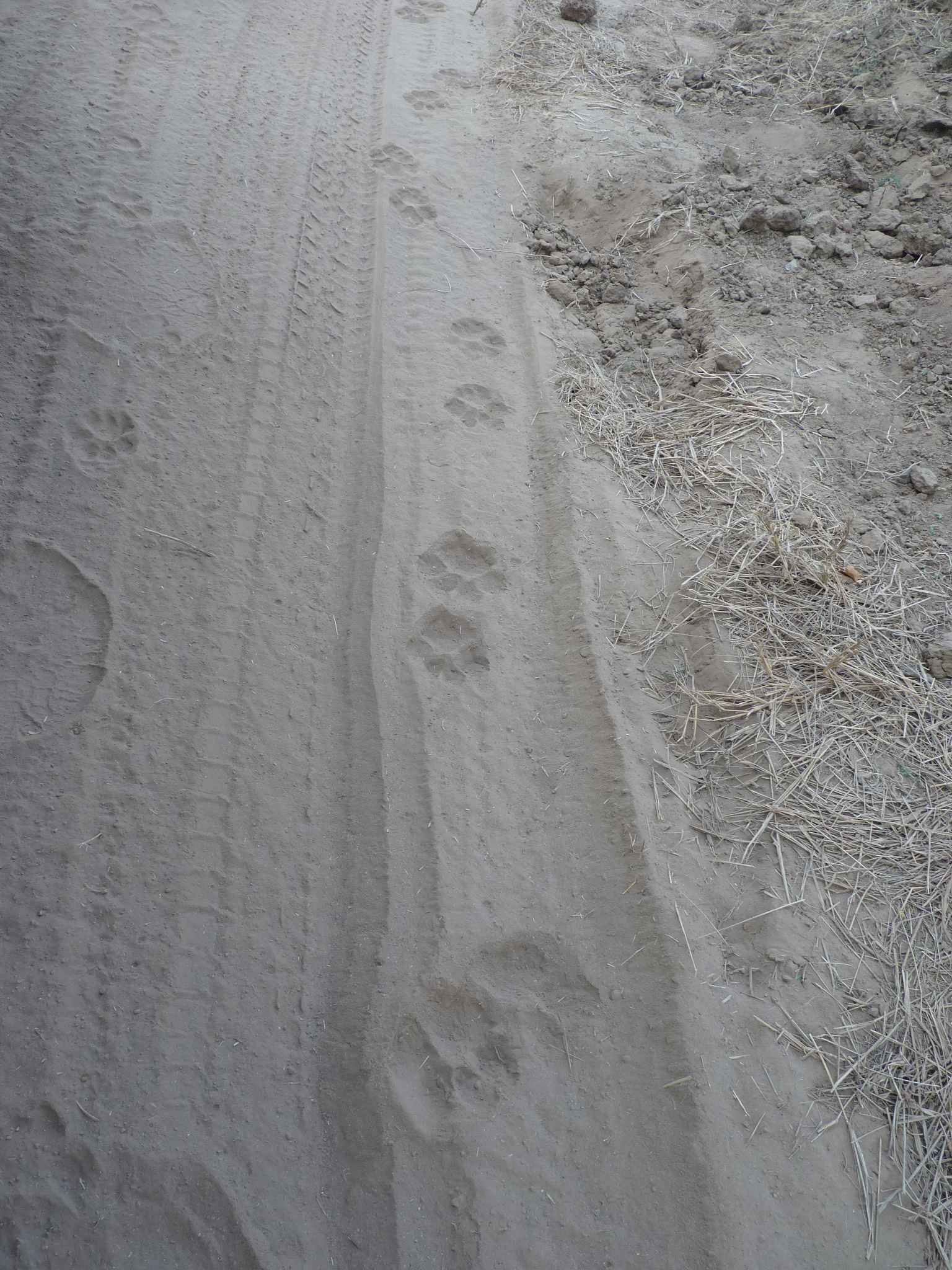
Lion paw marks on the dusty road before they entered the bush.
While the lion conversation was going on, a new vehicle arrived. It was a group of tourists with a professional guide in his late fifties, known to some of the people present. As usual, the excited crowd informed him of the lions’ location. What followed next was as unexpected as it was shocking! He, followed by his unknowing clients and another staff member with a gun, walked straight towards the lions, doing exactly what you must not do! What happened next was as predictable as it was unnecessary: the lions moved off! The group then turned back and left!

The Chisasiko pool, where the lions were.
“He is after a fat tip from his clients” was my angry and rather loud comment and then I heard my wife’s lapidary “poor man, it is sad that at his age he has to do this to get some extra money!” The latter was followed by another remark from a lady in the group “he left it a bit late!” Anyway, seeing that the situation had been modified by human folly beyond immediate recovery, we pushed on with the idea of coming back later as we knew that, despite the interference, the lions would remain in the area.
However, finding lions only ten minutes into your safari changes the situation as you become somehow “dependent” on what they will do next! Afterwards, while driving you wonder if they are hunting, moving or whether other lions have joined them (which means you could miss something unique!). We also made a mental note of their proximity to our lodge!
During our stay we were rewarded by nice sightings of buffalo, eland, greater kudu, waterbuck and zebra among others. We also saw a trio of fish eagles engaged in a loud territorial dispute and a proud saddle bill stork mother with her two grown offspring, although no male was around.

The two young saddle bill storks (left) and their mother. A hamerkop and a baboon complete the picture.
We did see the lions a few more times in the general area of the Chisasiko pool, but they did not hunt and on the final day they moved off towards the mouth of the Mana river, probably stalking a buffalo herd that resides in that area. We also spotted a pair of Selous mongooses and two side striped jackals (Canis adustus). Our general impression was that the park has a good animal population.
We also attempted to visit a new water hole, recommended by a friend as a good place for a “sundowner”. Equipped with the right ingredients for such occasions, we drove following a path that was clearly a firebreak with the anticipation of reaching a quiet place where animals would come to drink. Unfortunately, after driving about 10 km we came to a wide sand river with very broken and steep banks. There were very recent and deep wheel marks in the sand showing that someone else had tried to find the waterhole and got severely trapped in the deep sand. The story was reinforced by the warm ashes of the campfire they had lit while spending the night by the car! We decided not to risk the crossing!
The river was a lovely place to have a drink anyway. We also enjoyed a nice walk on the dry riverbed framed by rather high cliffs made of red soil, where trumpeter hornbills feeding on wild figs could be seen. We will come back next time for another attempt at crossing the river.
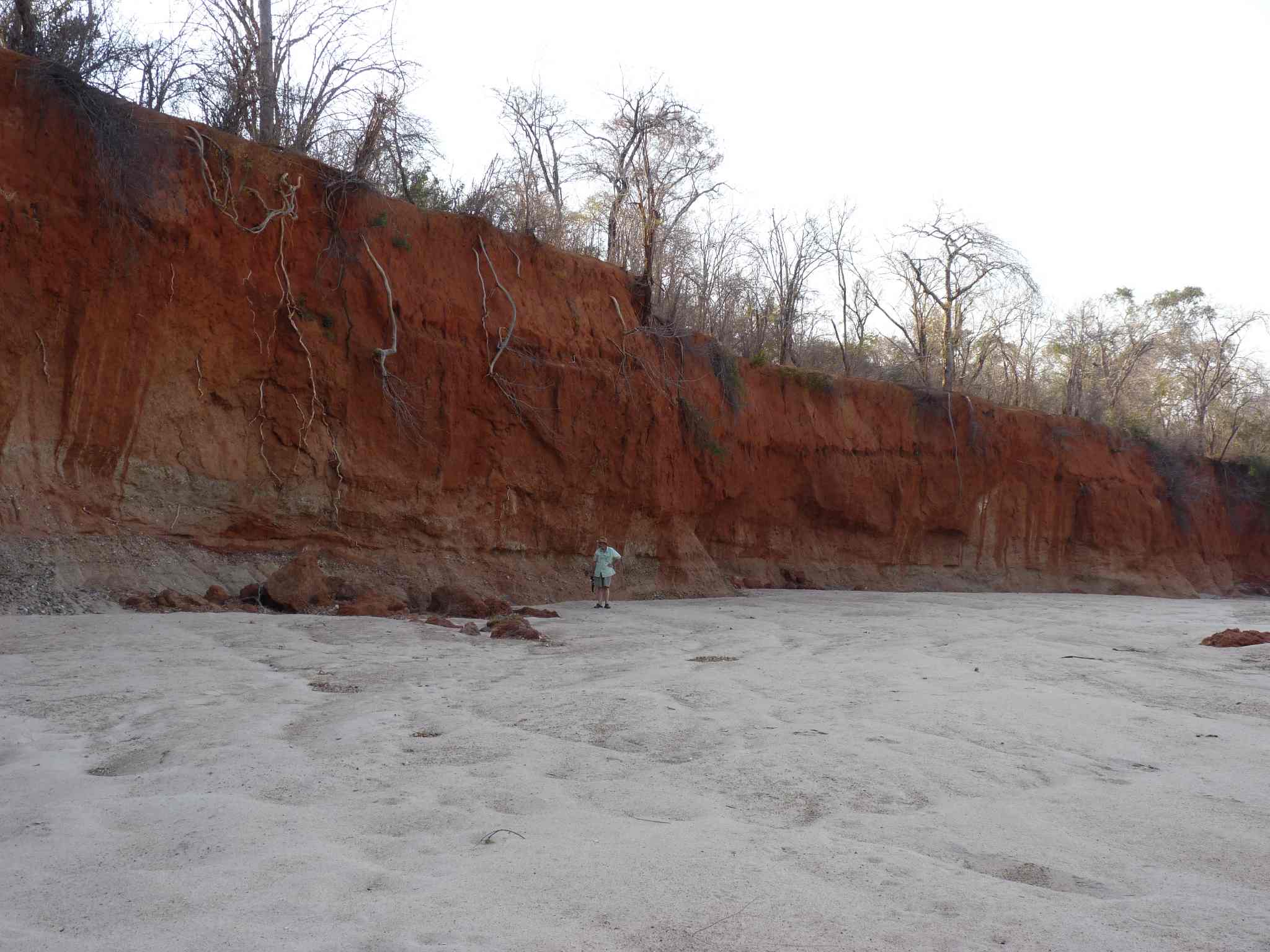
Walking by the red cliffs in the sandy river
Elephants were numerous throughout the park. Young animals were in abundance. We also saw a number of adult tuskers. The latter do not carry heavy tusks of the type we saw in Kruger and described in my earlier post.
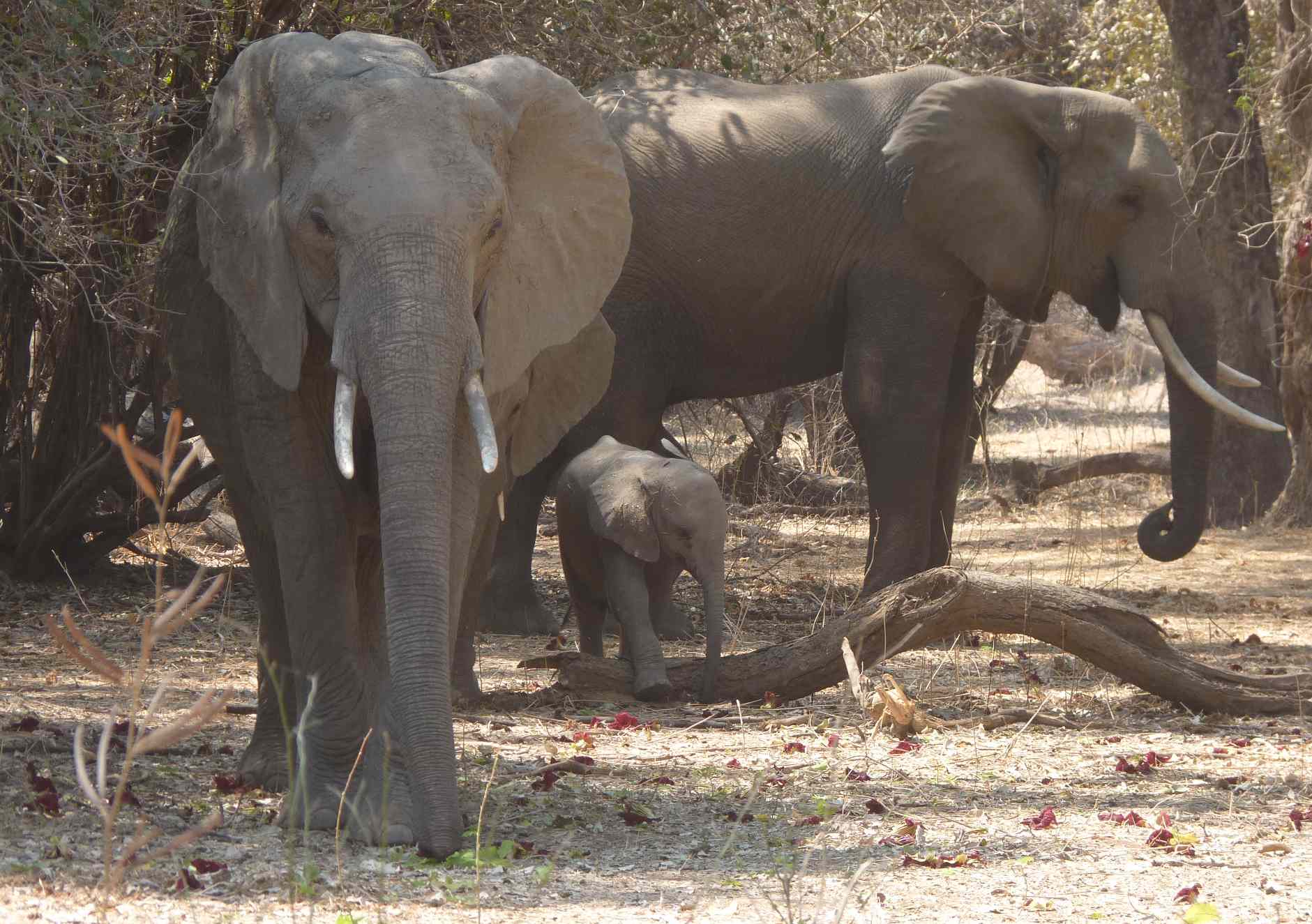
A small group with a young one. Note the Apple ring acacia pods on the ground.
Although I will focus on the Mana trees in one of the next accounts, one tree is a major protagonist in Mana: the Apple-ring Acacia (Faidherbia albida). It is the main tree of the Mana riverine plain forest and it produces a spiral shaped pod eaten by most herbivores in the park and it constitutes a valuable source of food in the dry season.
The elephants are very fond of these pods and at this time of the year they can be seen feeding on them all the time, wherever the trees are. To watch this activity is rather engrossing so we stopped often to watch them as they pick them up from the floor using their trunks as vacuum cleaners! However, as usual, the best are difficult to get! The tastier pods are those still high up in the trees!
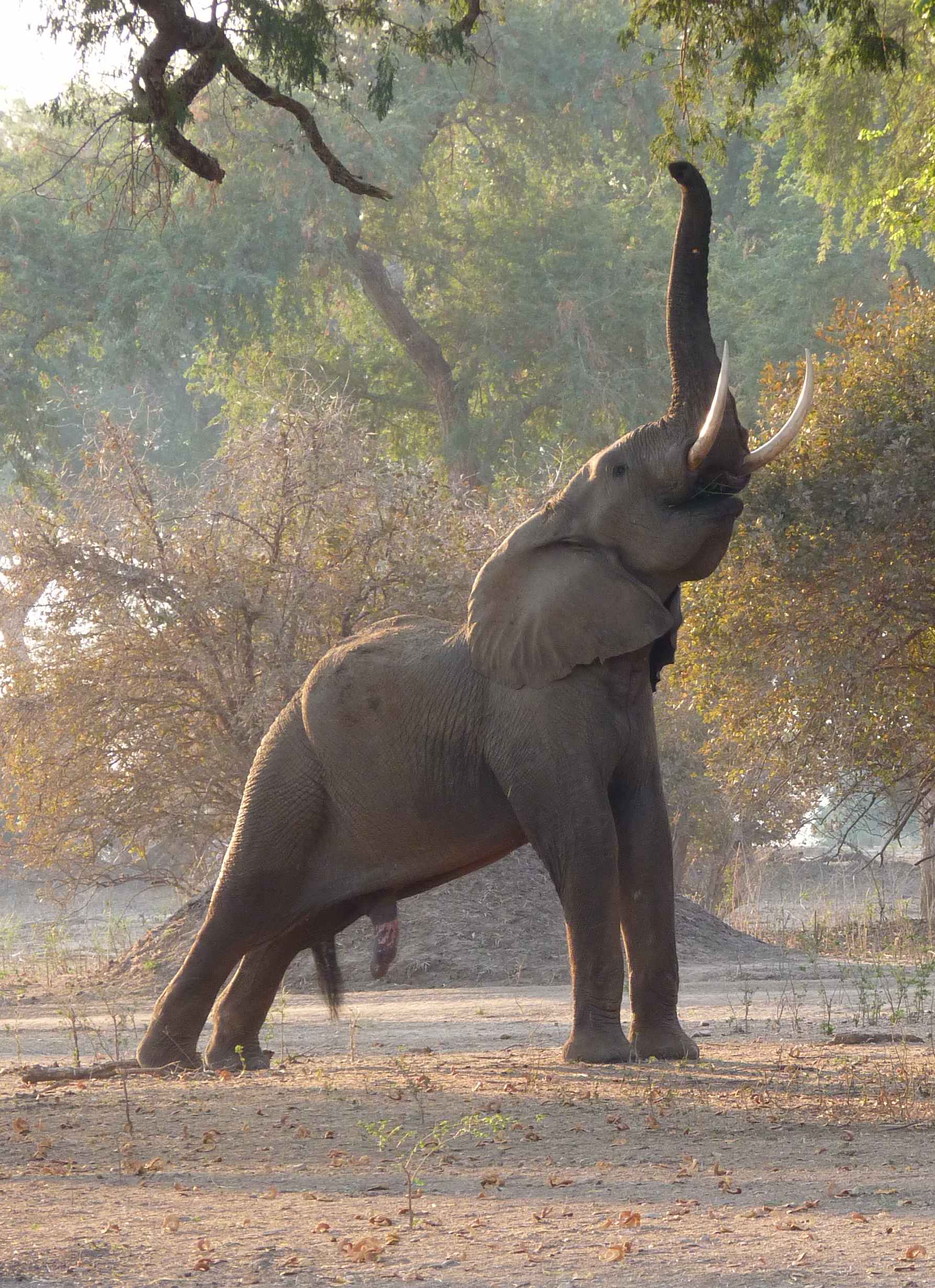
Pod collecting at full stretch.
Aware of this, elephants will go to great efforts to reach them and, with patience; you may be able to watch them doing it. This was, fortunately, our case as we came across several pod-eaters that stopped at nothing to get these treats!
During the second day of our stay we found a particular tusker that “agreed” to put on a show for us. He was dealing with a rather tall tree, so he stretched to the highest possible extent in order to reach the place in a wild circus-like act, and brought down branches full of pods. After finishing them and unable to get any more, he changed tactics by leaning his head against the tree trunk and proceeding to head-butt it vigorously, which provoked a “pod rain” that it subsequently picked up from the floor.
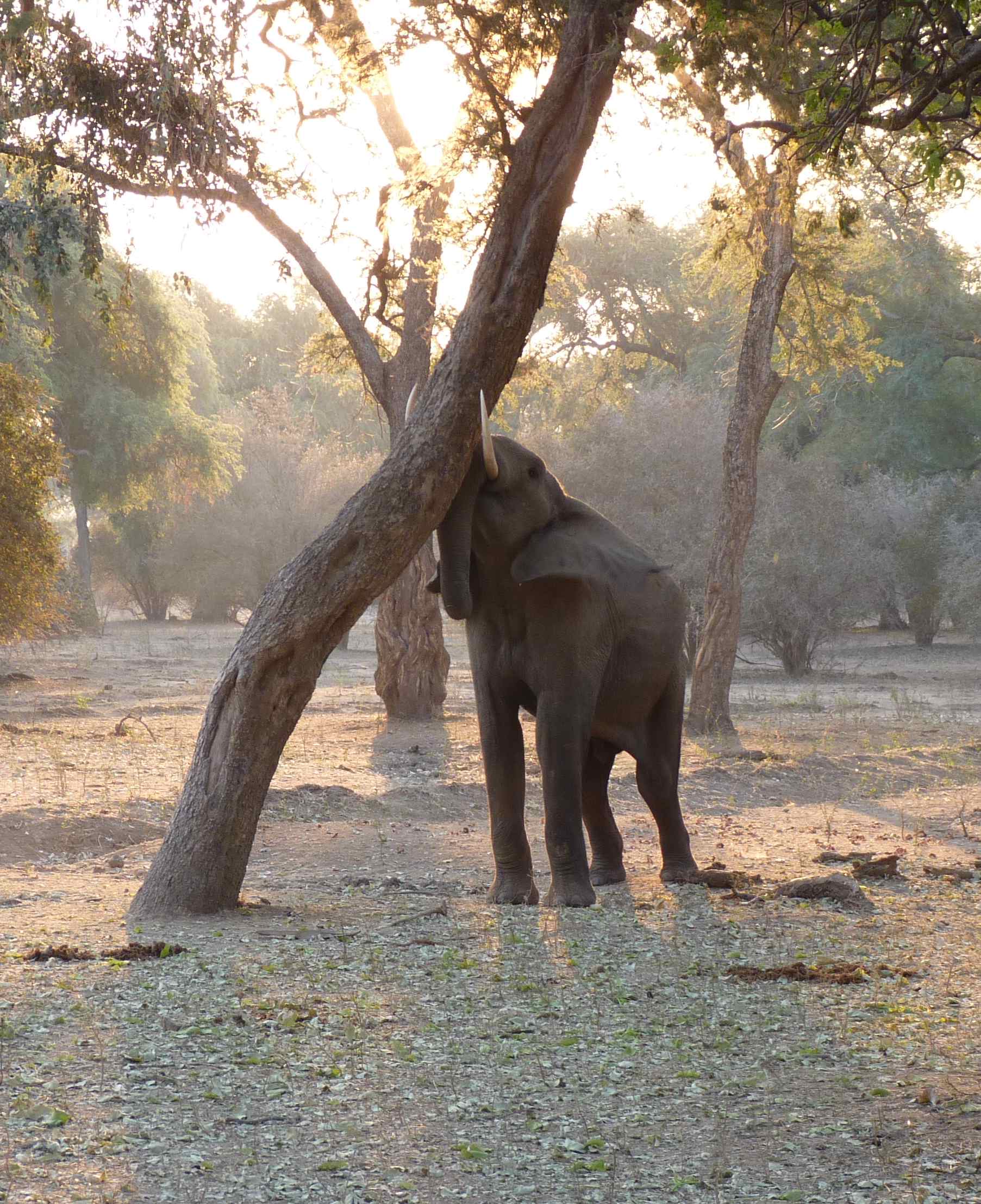
Shaking the tree.
As the tusker moved off in search of other tasty trees we also moved off, still looking for elephants. As we were driving slowly, we were overtaken by another vehicle that, we found parked by the road after a while. We stopped and asked its sole occupant if he had seen the lions. “Not today” he replied, “I have been here for three days and only saw them the first day” he added. We volunteered what we knew about the current lions’ location and asked “Any painted dogs*?” as we knew that these carnivores are often seen in Mana.
We could not believe his reply: “Do you mean other dogs apart from the one that we just saw crossing the road in front of your car?” “Are you serious?, we did not see anything!” my wife’s response came immediately. The reply came: “OK then, apart from the one I saw and you didn’t?” he said, clearly enjoying the moment and with a nice touch of humour. “We did not see it!” we confessed rather sheepishly, as it seemed unbelievable to us that this could have happened. He then added “I see them often as I am part of a painted dog conservation project that works here!”. Our embarrassment was somehow lessened as he had a “trained eye” for dogs!
Talking to him we learnt that the dogs are present in Mana around the “Mucheni” area and that the one he saw (and we didn’t!) was probably a male of a new pair that had just come from the Rukomechi area. We also learnt that the alpha male of the local Mana pack was missing and, although there could be several reasons for his absence, it is possible that it has died. We thanked him for the information but, despite it, we failed to see them during our safari. Our only consolation was that, although we did not see one, it was in the same place at the same time as us!!!
As a last attempt to save face, I tell you that we had seen painted dogs on a previous occasion in Mana Pools. We were on a game drive with my daughter/Editor when we spotted a pack on the road. There were about 16 dogs and they were moving rather fast. Taking advantage of the freedom of Mana Pools we parked the car in a hurry and followed them on foot, together with a group of tourists. It was very exciting as they caught an impala just before we got to them and they were feeding on it. Regrettably, the scene was interrupted by my loud talking -being a bushsnob- and the weird noise my camera made every time I switch it on! The picture below was taken at that time.

Wild dogs seen during an earlier visit.
* Lycaon pictus is commonly referred to as African wild, cape or hunting dog and African painted dog, among other names. I use "Painted dogs" as this is the name used by the project in Zimbabwe.

