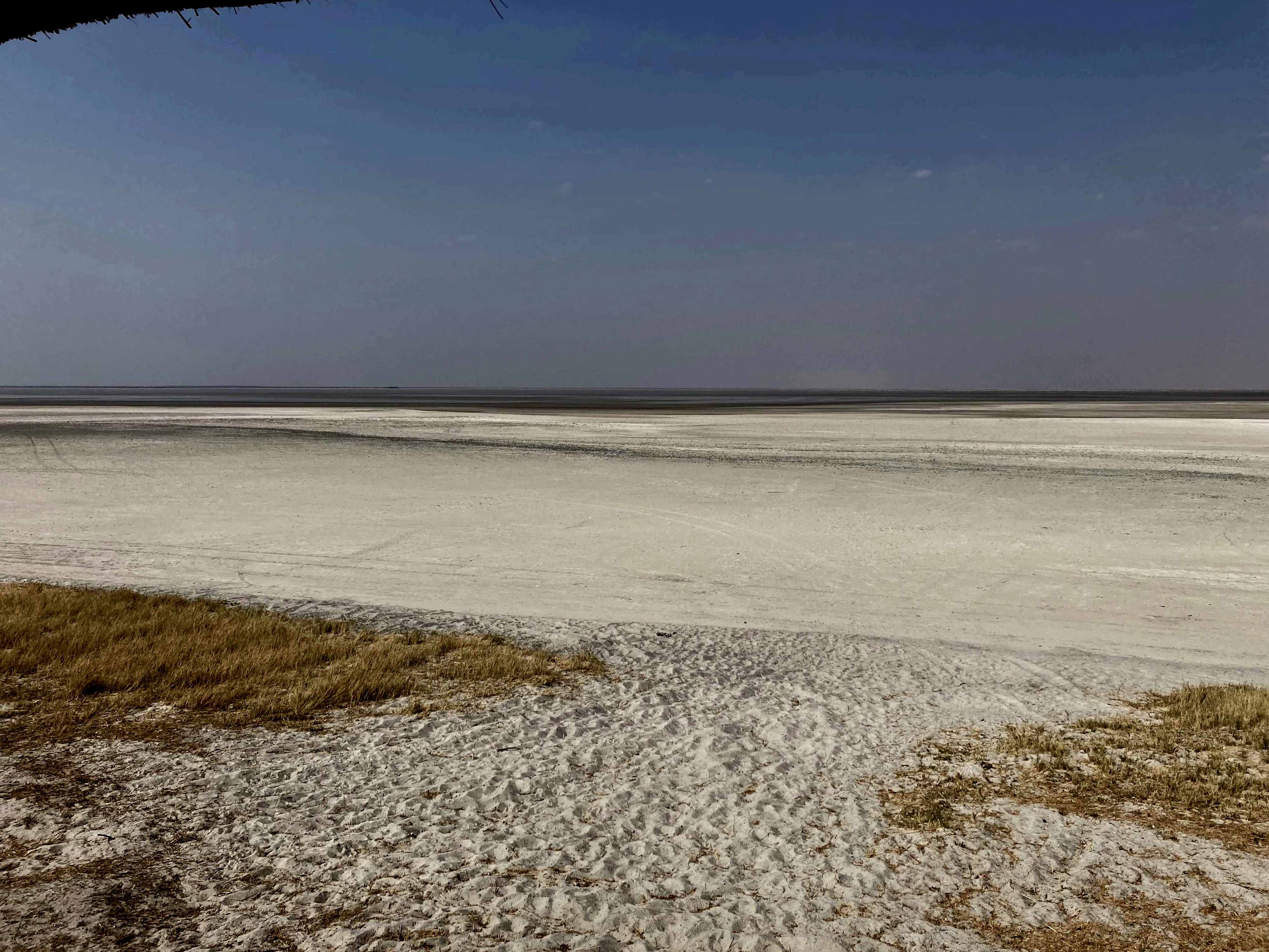
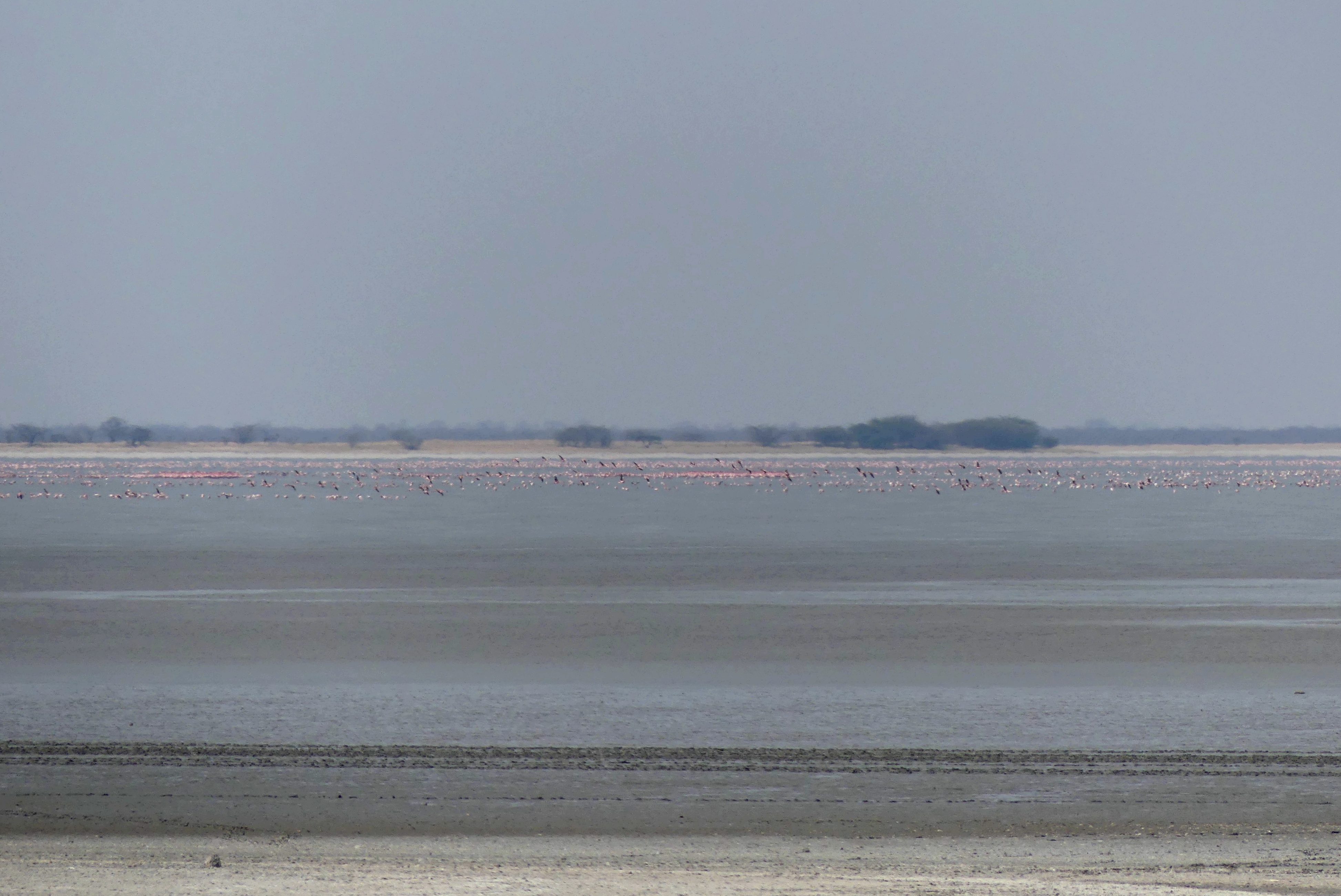
Our journey through Botswana took us to Nata, usually a one-day stopover on the way to some of the several national parks that Botswana has. We stayed at the Nata Lodge for the night and, before continuing our trip to Gweta, we visited the community-run Nata Bird Sanctuary, renowned for its birdlife, particularly the flamingoes. Usually a dry area, at the end of the rains it was very dry and the Sowa pan´s water had receded far away from the viewing platform. We spotted the pink ribbon a few kilometres into the pan, where there was still water. Through the binoculars we could appreciate that there were a truly large number that brought back fond memories of lake Nakuru in Kenya.
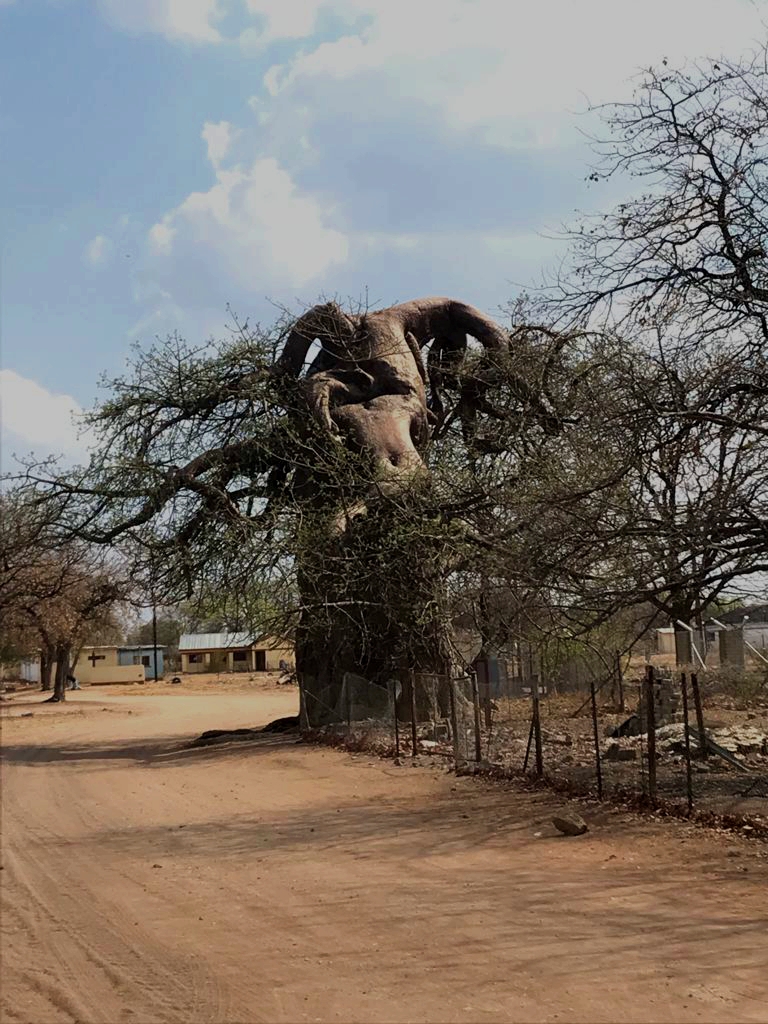
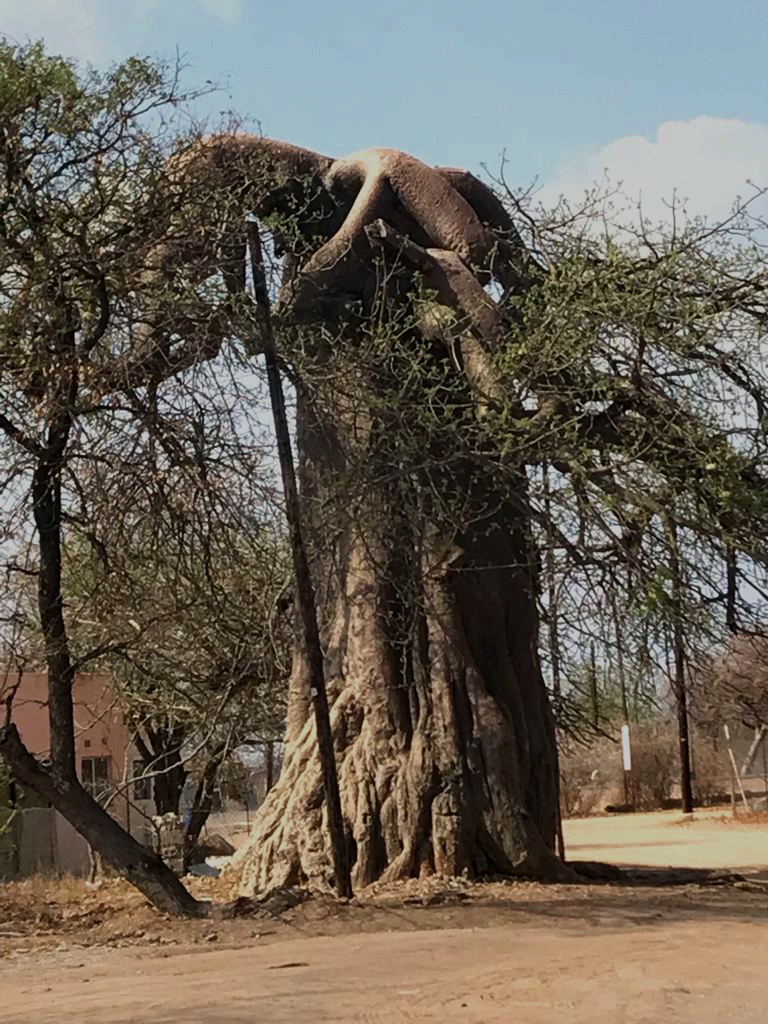
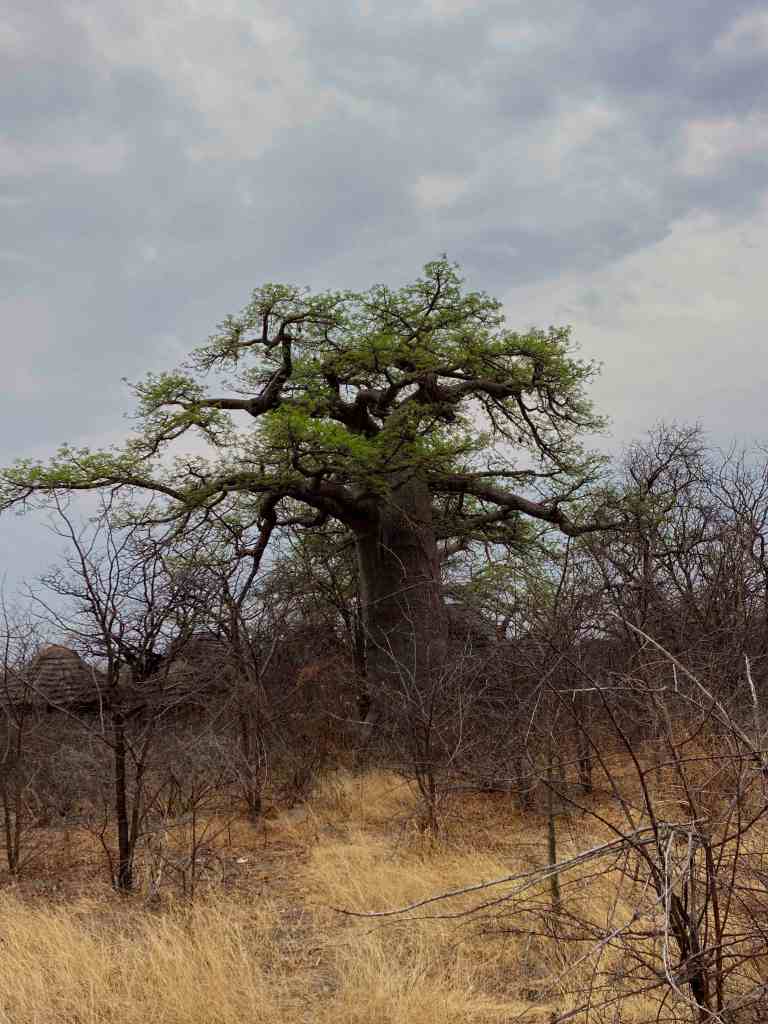
We continued our journey and we got to Gweta where we spent time sightseeing before it was time to check in our next lodge. Before we got there, we found the most amazing baobab, not because of its size but its shape. Clearly baobabs never stop surprising you.
It was truly hot, probably over 40°C. Luckily, before leaving Harare, preparing for the worst, I got the car air-condition fixed. Although, usually, we are quite indifferent to the air-conditioning in the car, this time we were defeated, and we used it all the time.
In Gweta we stayed at a weird place called Planet Baobab that we have seen before and avoided as; from the outside it looked rather odd. This time, following the strong recommendation of our tour agent we decided to spend three nights there. It was an error that we started regretting from our arrival.
For some reason, although we had booked the place, we had no written proof of it as they would not issue vouchers without an advanced payment. Uncertain of having a place to sleep in Gweta, we had -by luck- met the owner of the Gweta Lodge while in Nata and we had, tentatively, booked a room there as plan B.
So, we got to the Planet Baobab without knowing whether we would find a room! We were not too optimistic as the lodge seemed to be rather full. To our relief, we had a room for the night but the second night we were booked to sleep “under the stars”, somewhere in a pan (that we agreed that at our age would not be necessary as we have seen many starry skies before!) [1] Then, we could have our room back for the third night.
After some debate we managed to evade the second night outdoors and we got confirmation that all was well a couple of times before we accepted to stay and spent the rest of the afternoon walking about the camp and admiring the beautiful baobabs that surround the place. The room had two single beds and it was very hot at night. Unfortunately, the cord of the fan did not allow it to blow air to both of us that were in opposite sides of the room, so it was a hot night!
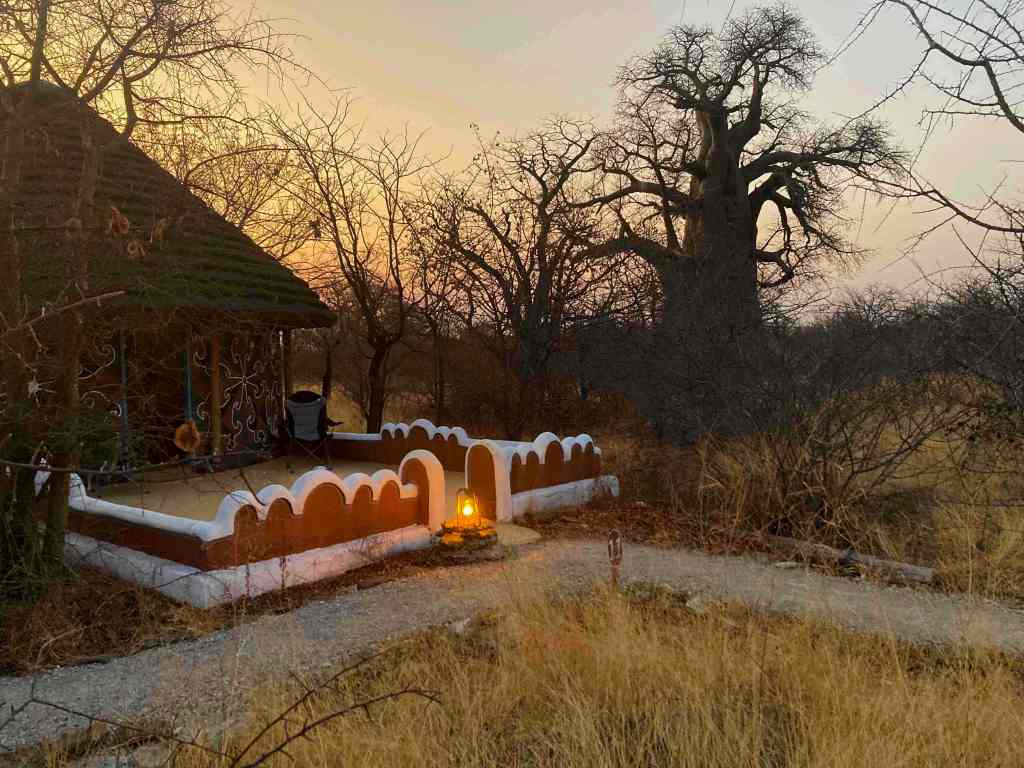
Another view of our bungalow.
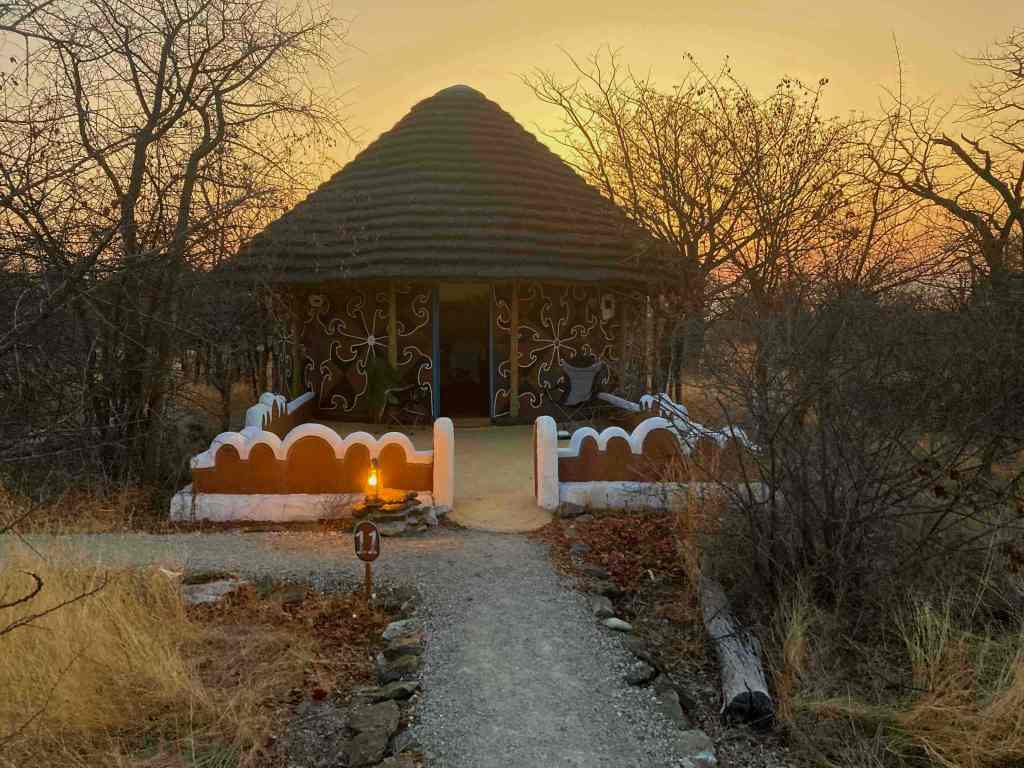
Our “hobbit” bungalow.
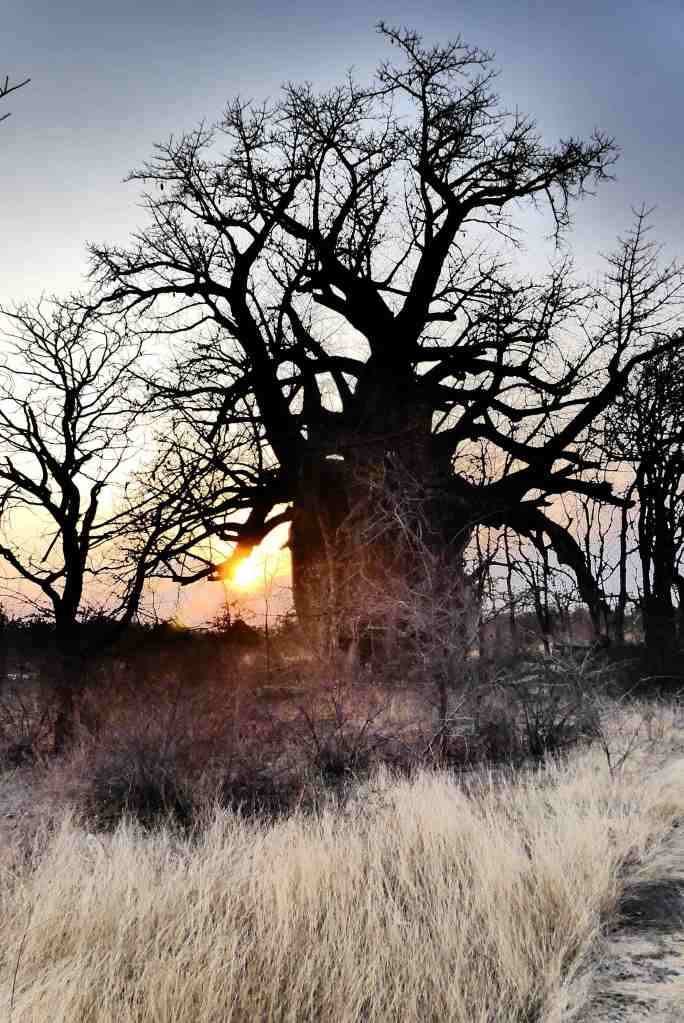
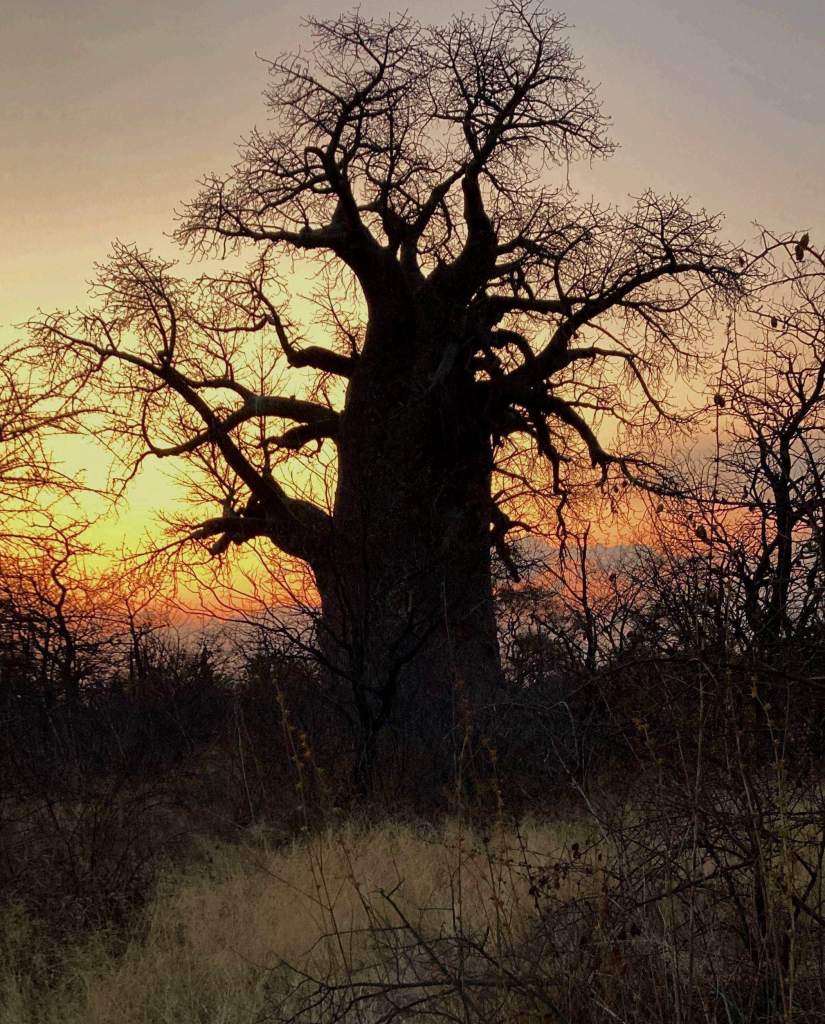
Another baobab sunset!
Another baobab.
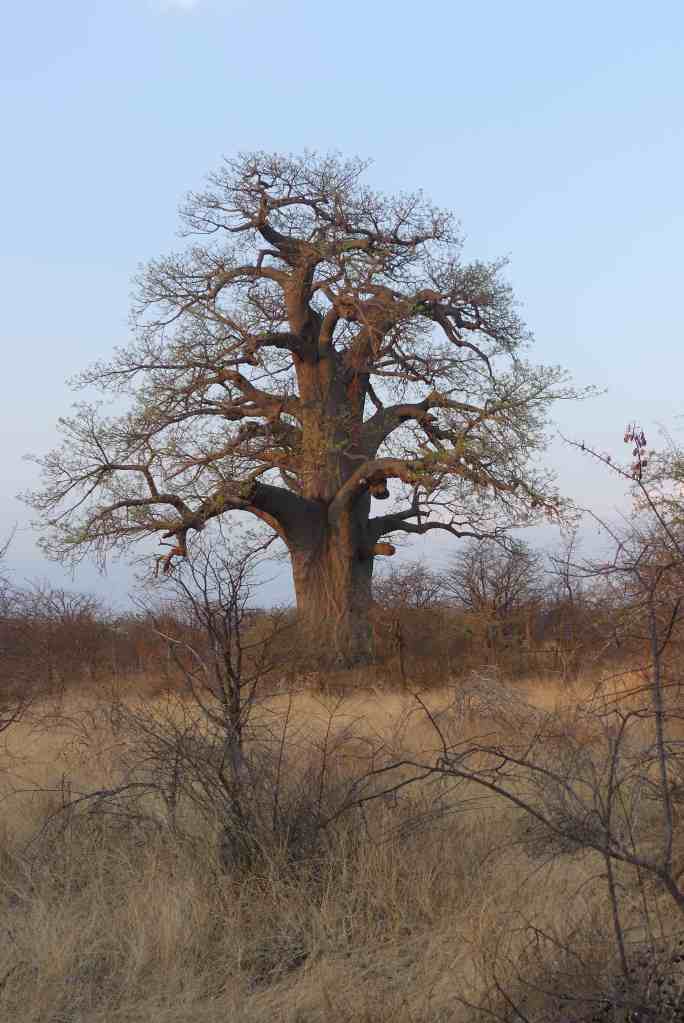
The only baobab with foliage at the camp.
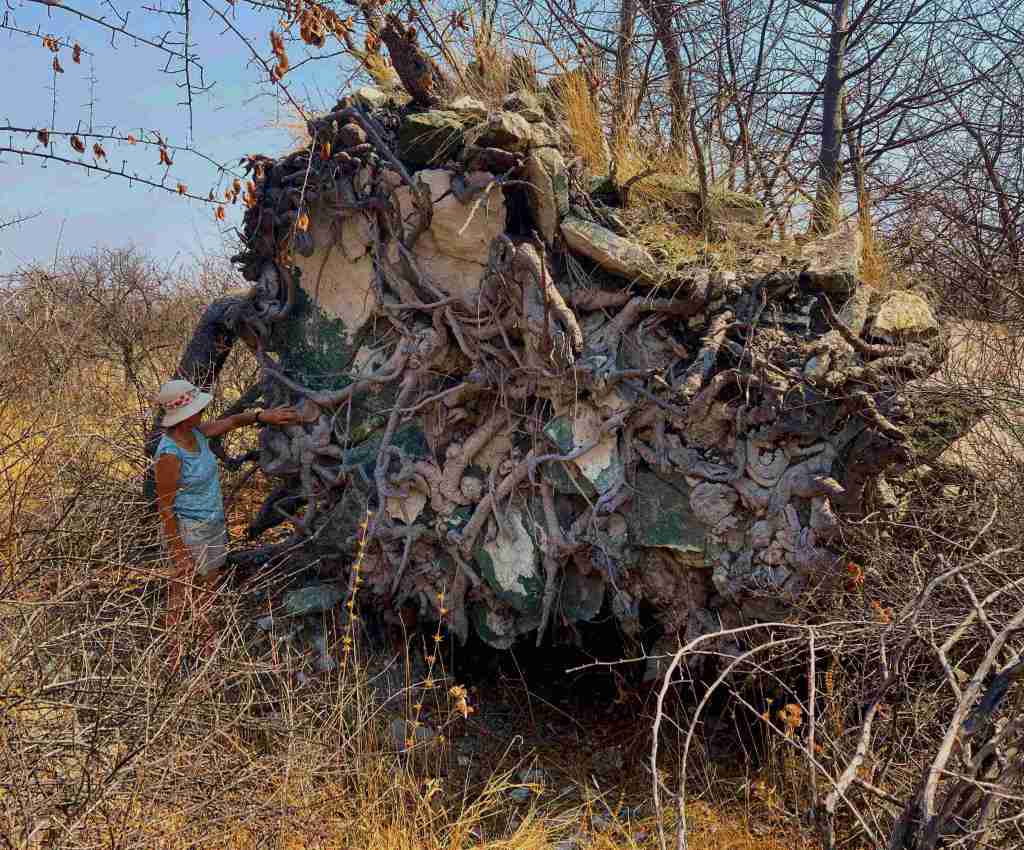
A fallen baobab showing its rather shallow roots.
A better baobab sunset.
The following morning, we left early to get to the Makgadikgadi Pans National Park (MPNP) where we had been before, once in the late 90´s when the Boteti River was not flowing and, more recently, when it was. I have read that thousands of zebra and wildebeest migrate from the river to the Nxai Pan every year and calculated that they should still be at the western part of the area at the water of the Boteti River until the rains started.
We drove leisurely the 70 km that separated us from the park entrance and found lots of zebras crossing the road in the direction of Nxai Pan and hoped that they were not the tail end of the migration! We got to the entrance of the MPNP and found no one at the reception office. We waited for about thirty minutes and then decided to search for someone to charge us the entrance fee!
Eventually, Mabel spotted a really friendly lady brushing the floor at the back of the office and she came to tell us that there was no one so we should just enter and pay on return. This was a first for us and we did so (we did pay before leaving).
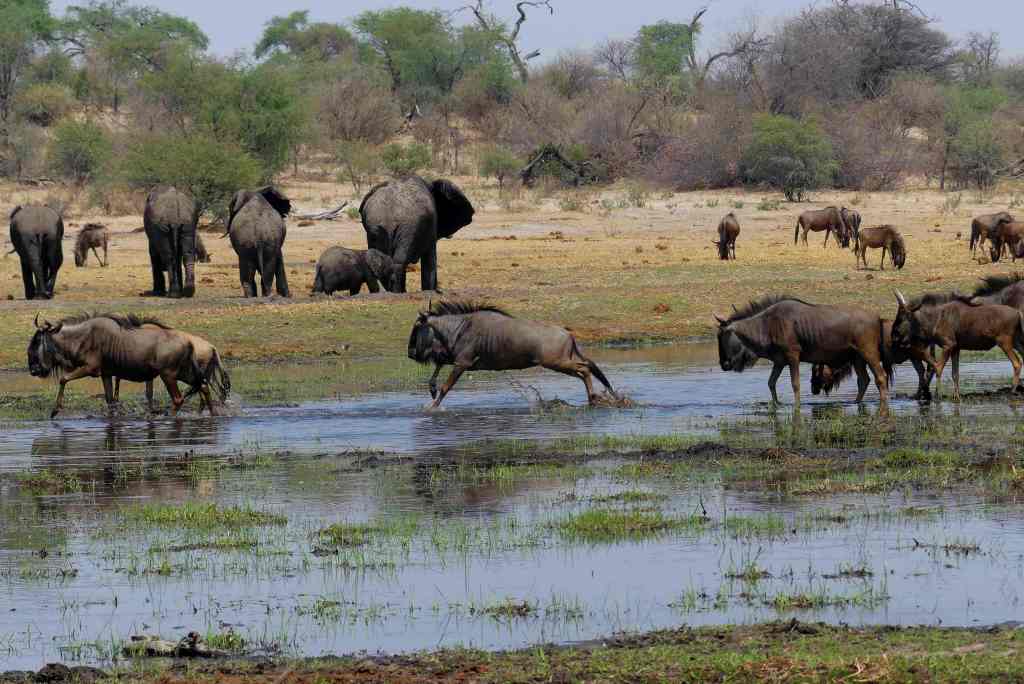
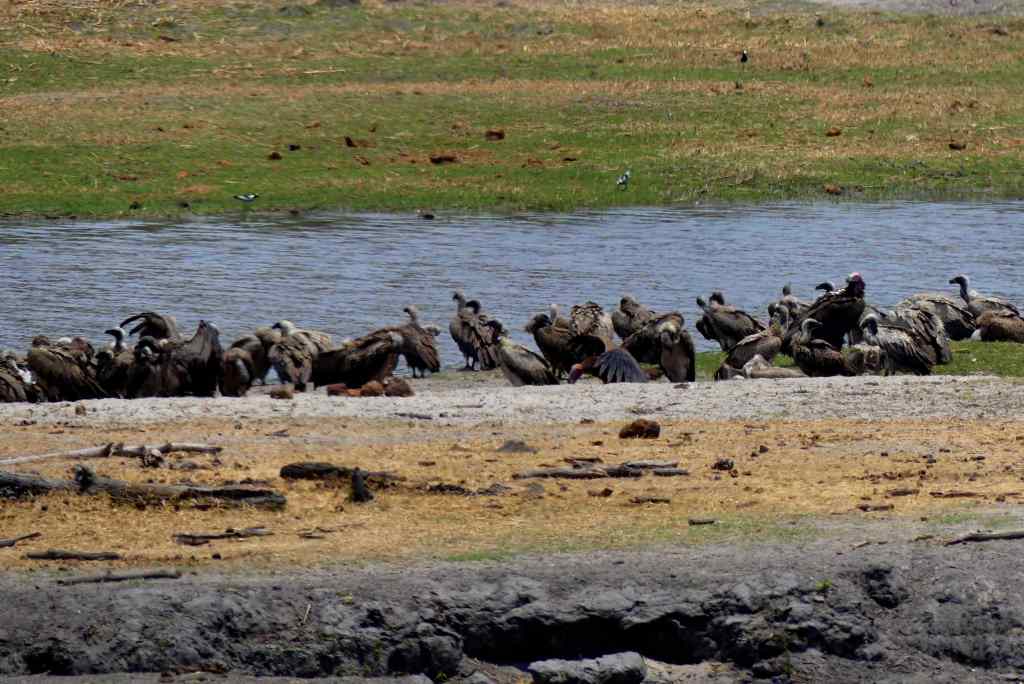
We drove through a sandy road for about 60km until we got to the river when the temperature was soaring. The view was truly spectacular as thousands of zebra and wildebeest were grazing at the river´s bed while elephants drank from the pools and hundreds of vultures rested at the water´s edge. Our enthusiasm made us forget the heat and start searching for the predators that were surely lurking at the river edge waiting in the shade for an opportunity.
Arriving at the Boteti River.
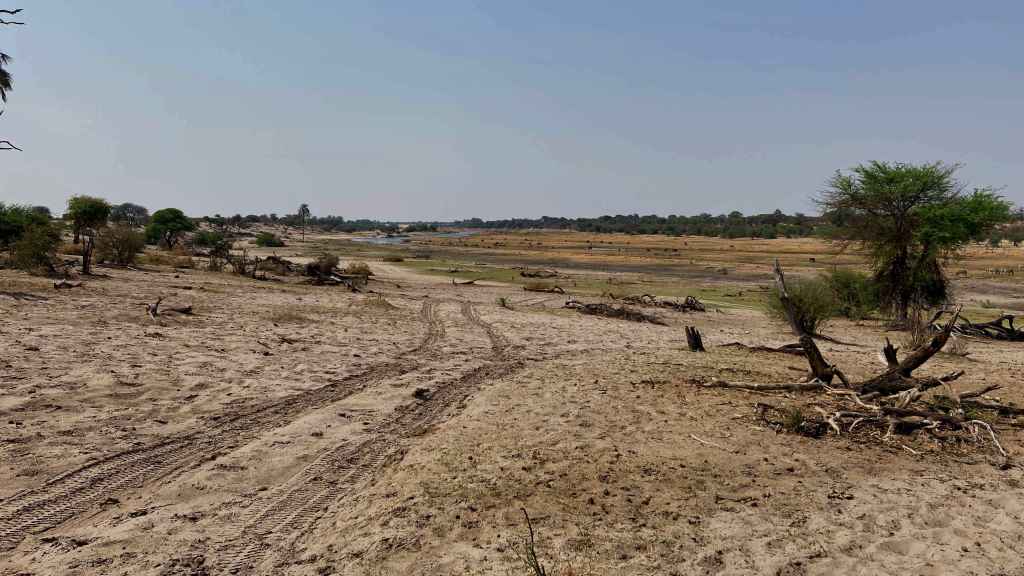
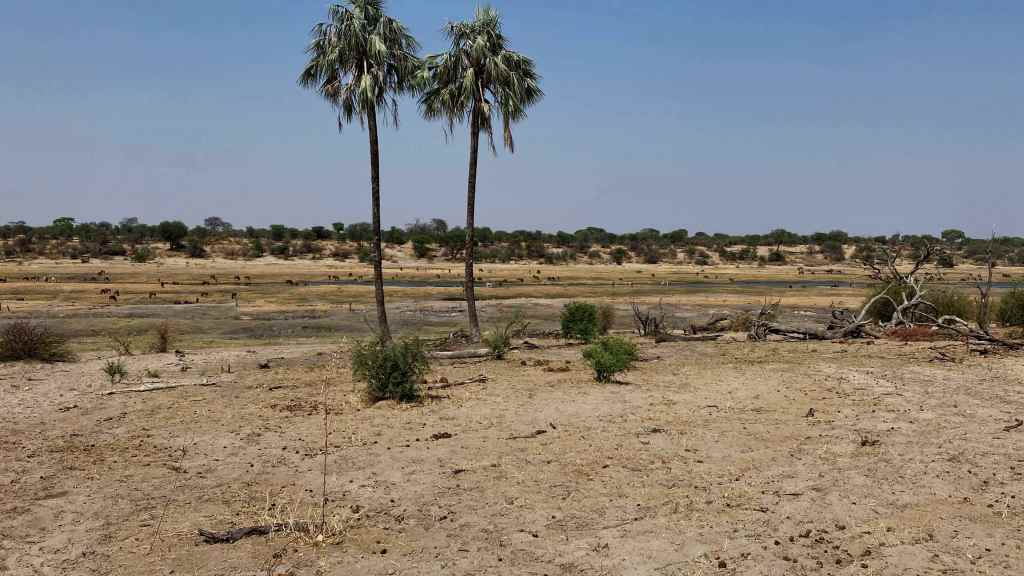
Another view of the Boteti River bed with Ilala palms.
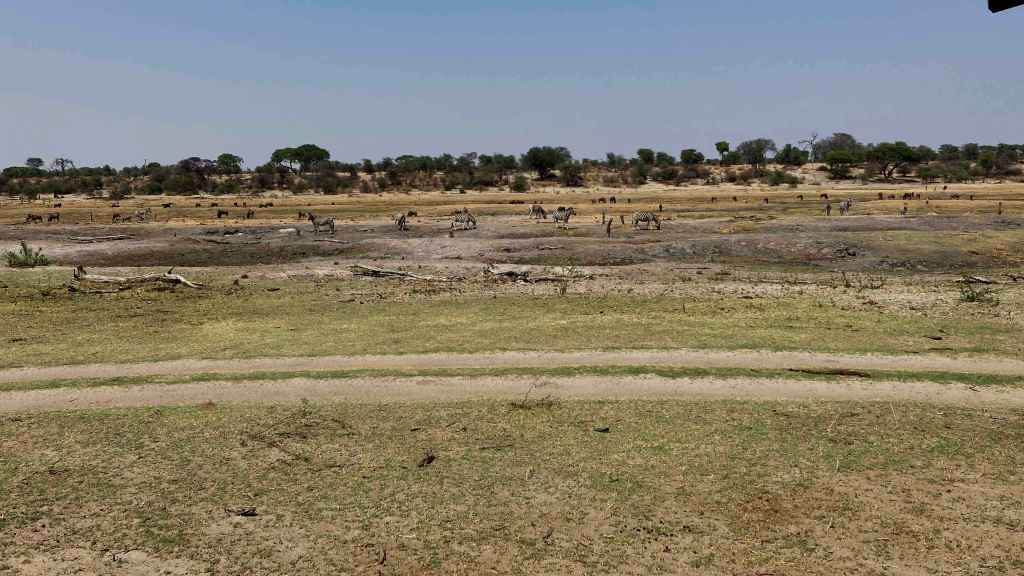
Luckily, the zebras and wildebeest were still there.
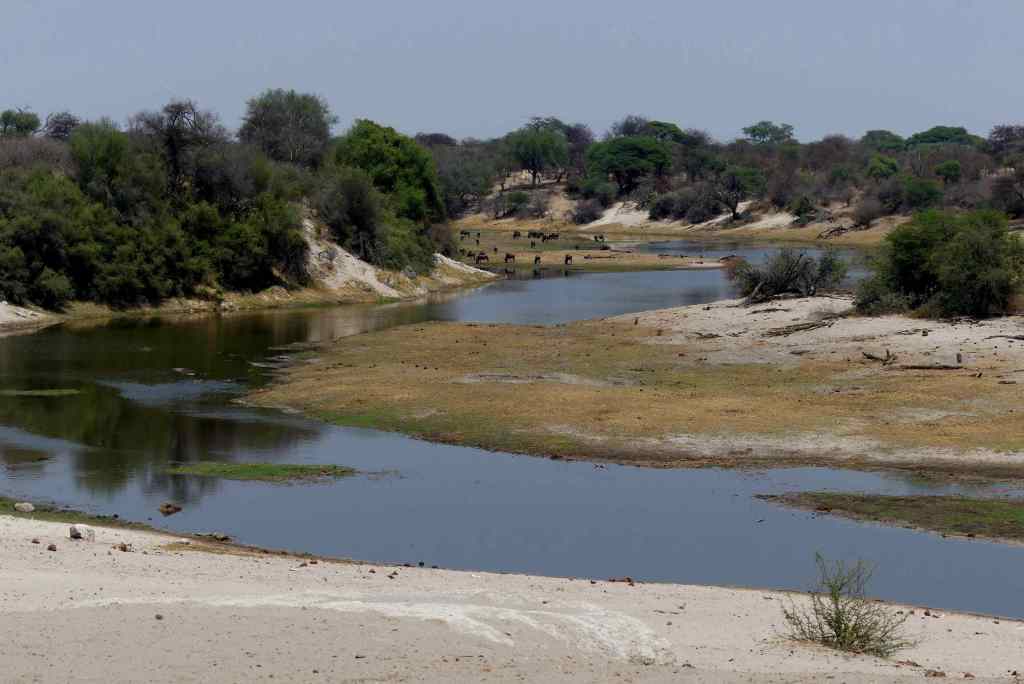
The “miracle” of the Boteti River crossing the desert.
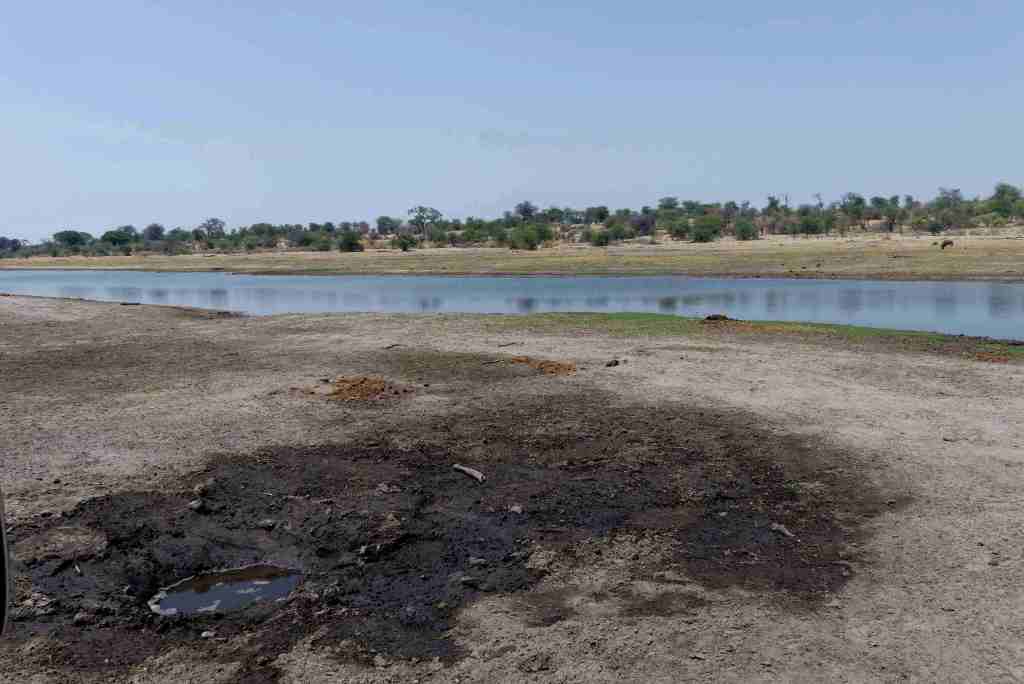
Despite having abundant water, elephants still dig for it, probably because it is cleaner?
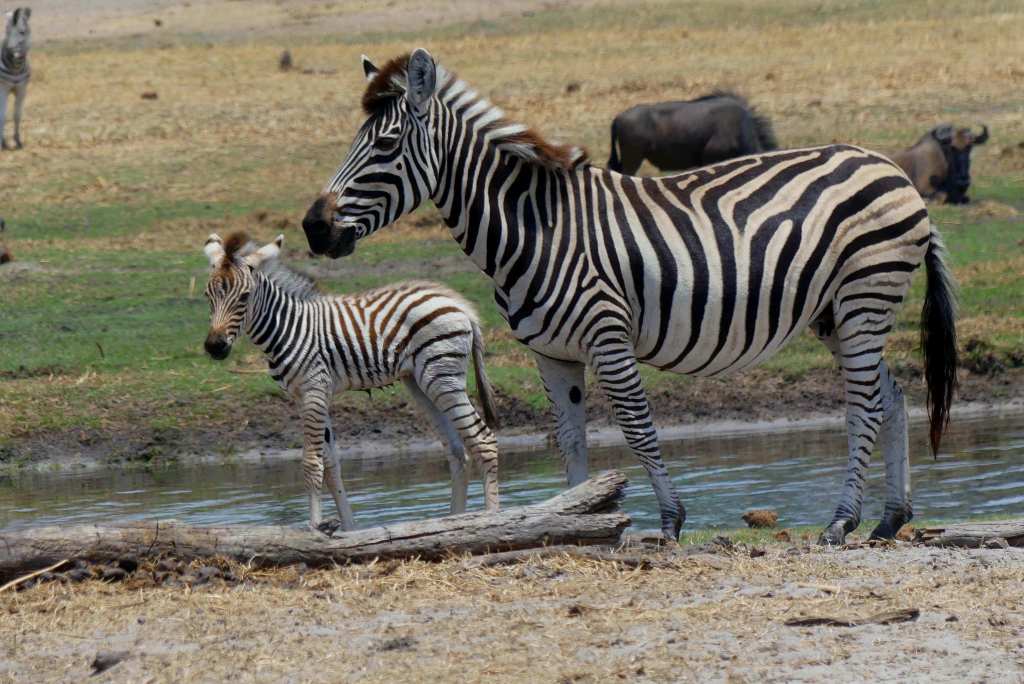
Zebra foals are always attractive.
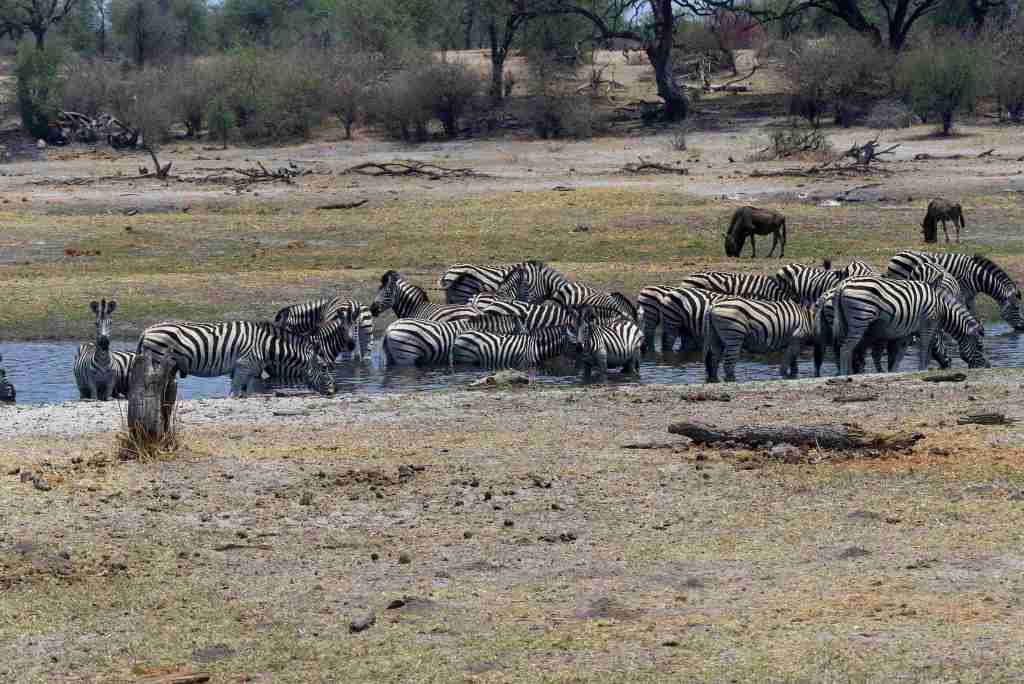
Zebras enjoying the Boteti River.
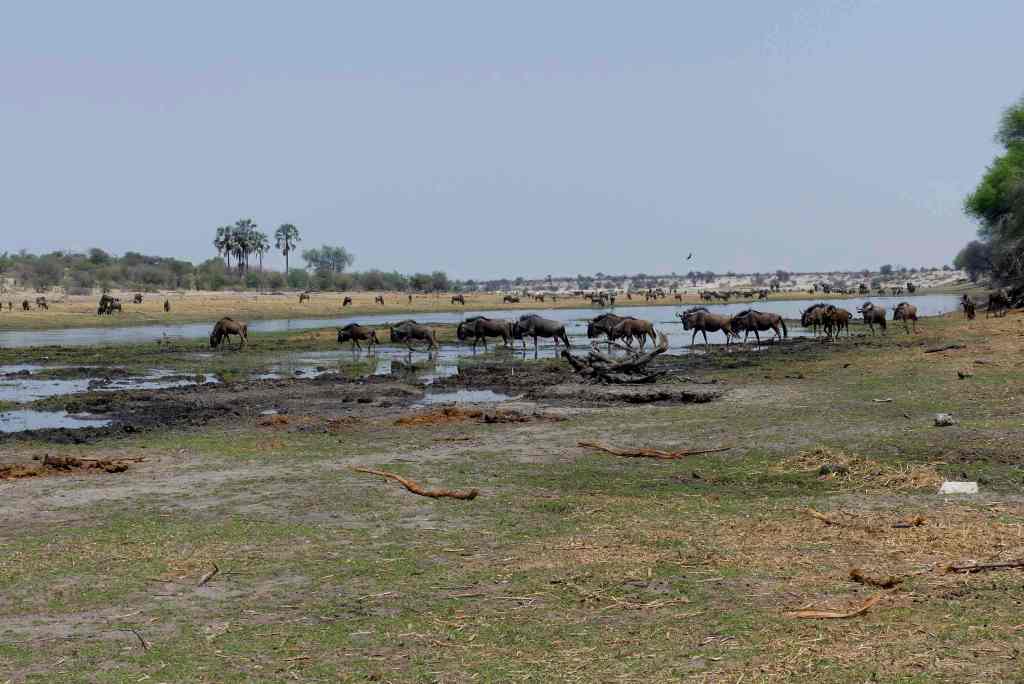
A “mini” wildebeest migration.
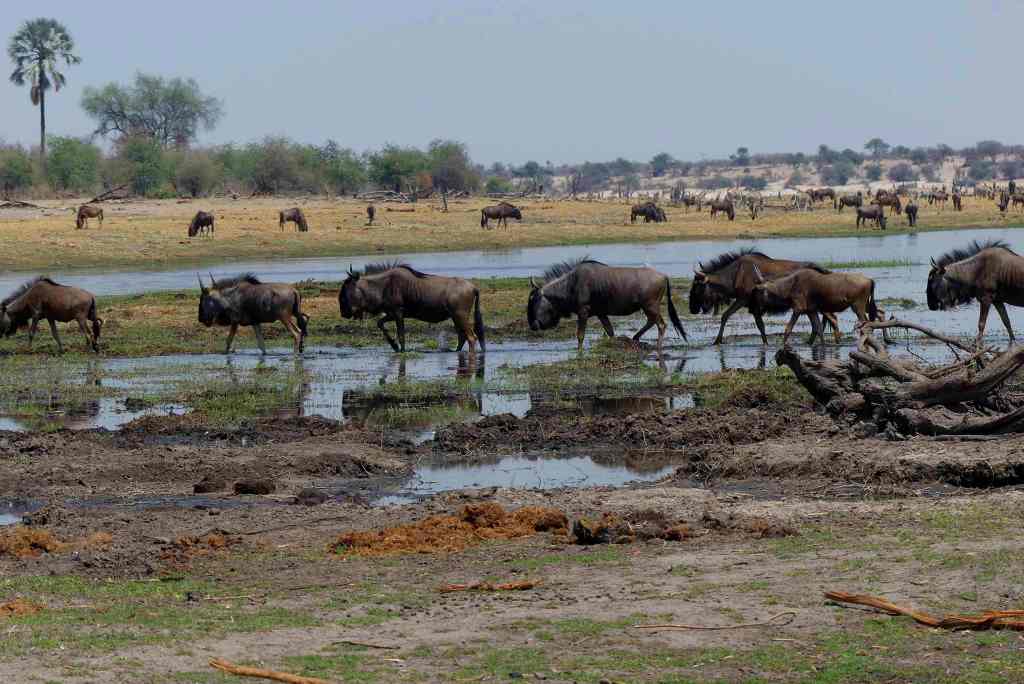
Starting crossing the river.
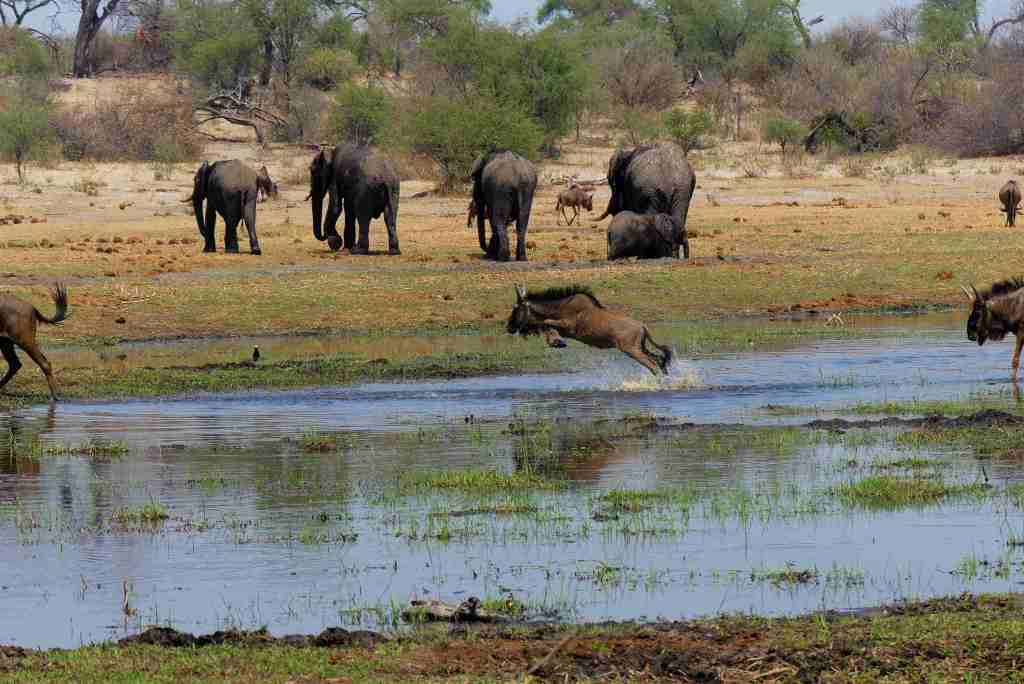
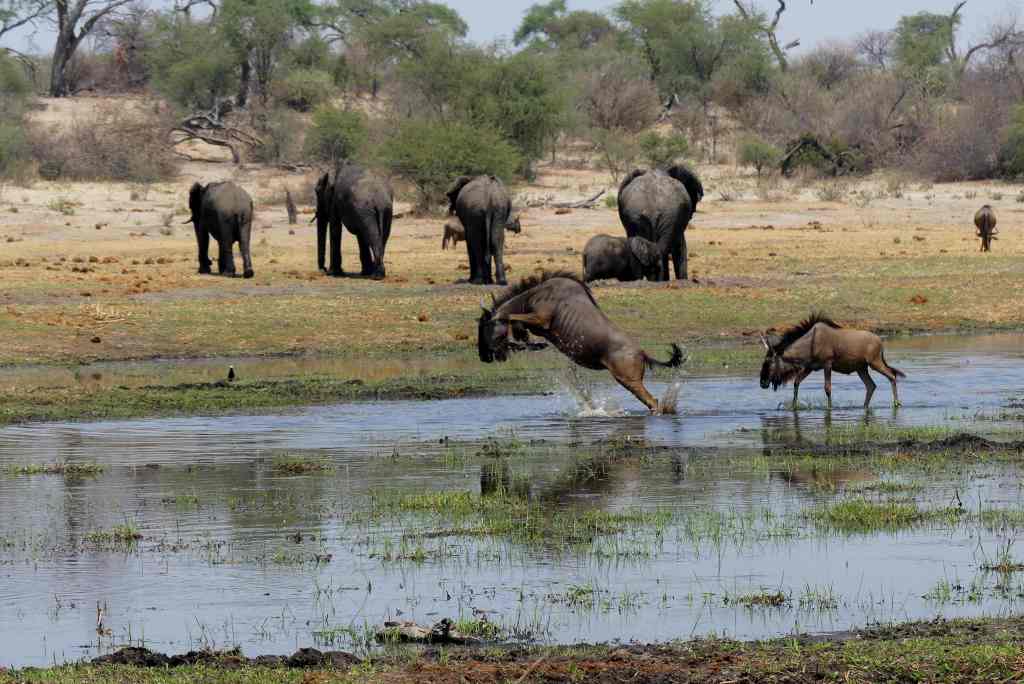
Avoiding a deeper area (in fact it was not that deep but they jumped because they saw the previous one doing so!)
Going for it while the elephants (clearly bored of their daily antics) give the wildebeests their full attention!
This one jumped up and landed one metre ahead!
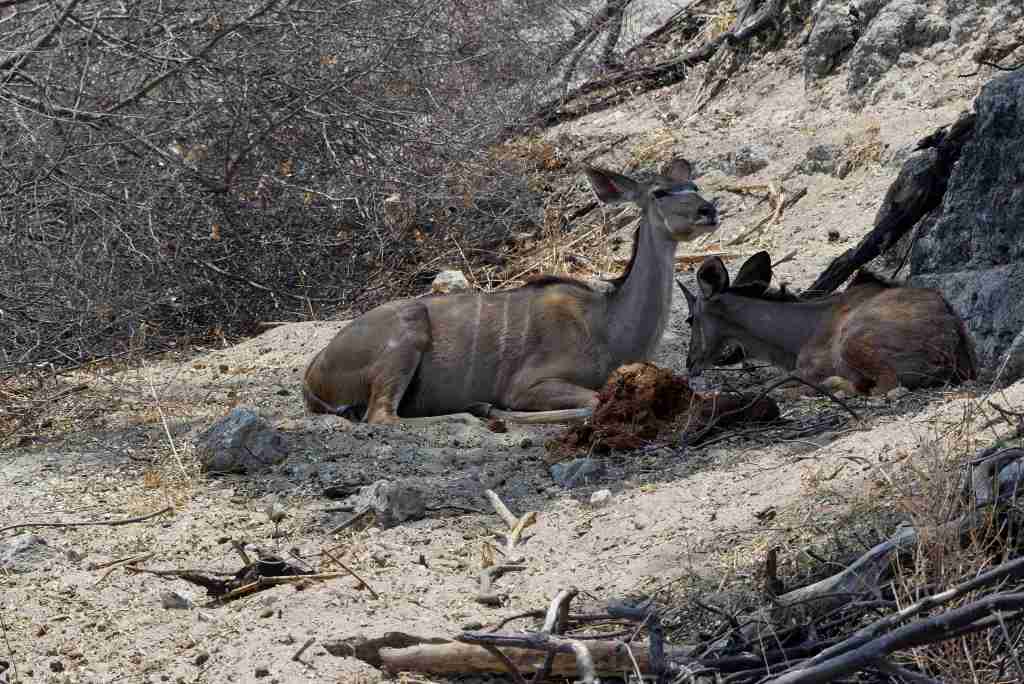
Female greated kudu and baby resting in a shady place.
Some of the vultures at the water edge.
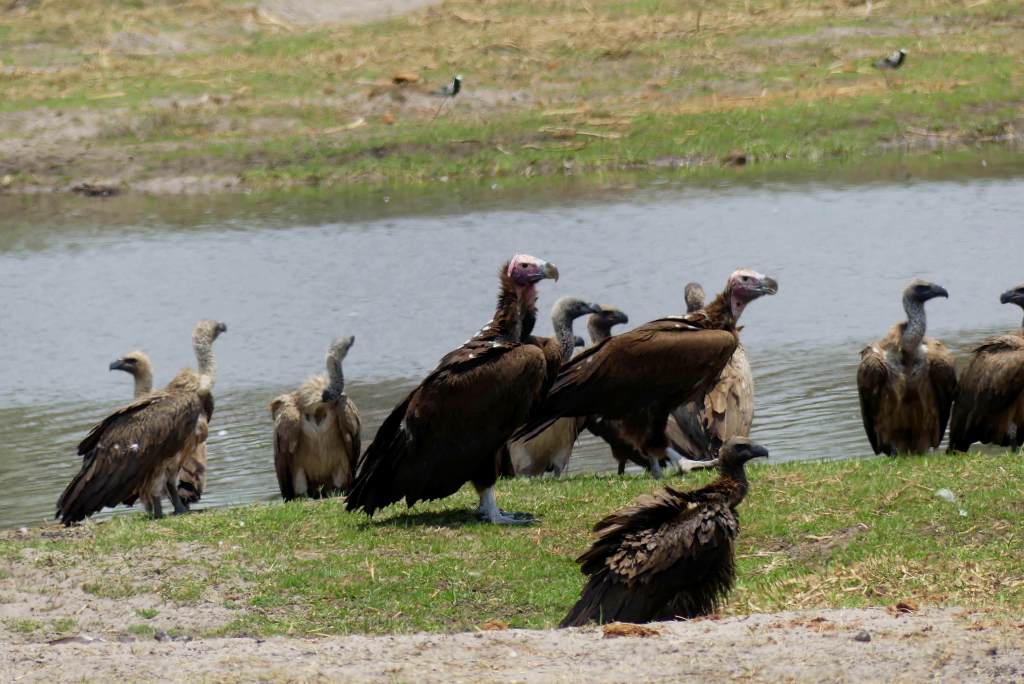
Outnumbered but not less spectacular, two lappet-faced vultures enjoy the sun while waiting for another kill.
We were contemplating this live documentary that rolled before our eyes when our musing was rudely interrupted by a loud bang. “A tire burst” said Mabel that was looking through the side window. “No, it was in the engine” I replied while I switched it off because I saw smoke coming out of the bonnet. We got out of the car and saw that the tires were intact. Luckily, there was no more smoke! So we could be in a tight spot as we had only met one more car carrying a single tourist lady!
I opened the bonnet to have a look and find what the problem was (not that I am any good at mechanics!). All large components of the engine seemed in place but we saw some yellowish stain around the radiator. Mabel spotted a burst hose that had clearly released whatever it was carrying! Seeing that there was no other damage, I started the engine, checking for some light that could indicate the cause of the problem such as “replace engine”.
All gauges were showing normal values, there weere no lights and we had the engine running smoothly. The 4WD, power steering and brakes were working so we relaxed and started our slow return to the lodge, still not knowing what had happened. After about twenty minutes driving, we started feeling hot and realized that we had no air-condition. We stopped and checked and confirmed that this had been the problem! Although it meant that we would have a hot journey back to Harare, the relevant bits of the car were fine.
We were hot by the time we got back to the Planet Baobab, much earlier than we had planned. On arrival, we were greeted by the same receptionist that had confirmed our second night. As there was no need for this to happen, it meant bad news, I thought. I was correct, he informed us that there had been a mix-up between the reservation office (in Gaborone) and the lodge. The result was that our night would be spent under the stars as our room was booked!
By now, following a similar incident earlier while at the Tuli block we had acquired some experience on how to deal with these situations and, aware of our Gweta Lodge booking, we refused! Our reply created some more consultations and, eventually we were allowed to stay and we cancelled our tentative booking at the Gweta Lodge.
The following day, without air-condition, it was too hot to attempt another trip, so we decided to relax at the swimming pool, getting ready for our departure the following day. While we were there, we witnessed the return of the open-air sleepers. They were mostly young tourists on their first trip to Africa. They looked rather battered, clearly dehidrated and sunburnt, and we congratulated ourselves for having avoided the experience.
[1] Later we learnt that we would have left at 1400hs, taken to one of the salt pans, allowed to drive quad bikes for 45min or wait in the car while the others did it, then visit a place to see tame meerkats, sleep in the open and return to the lodge at 1100am the following day. By then we would have dried up beyond recognition!
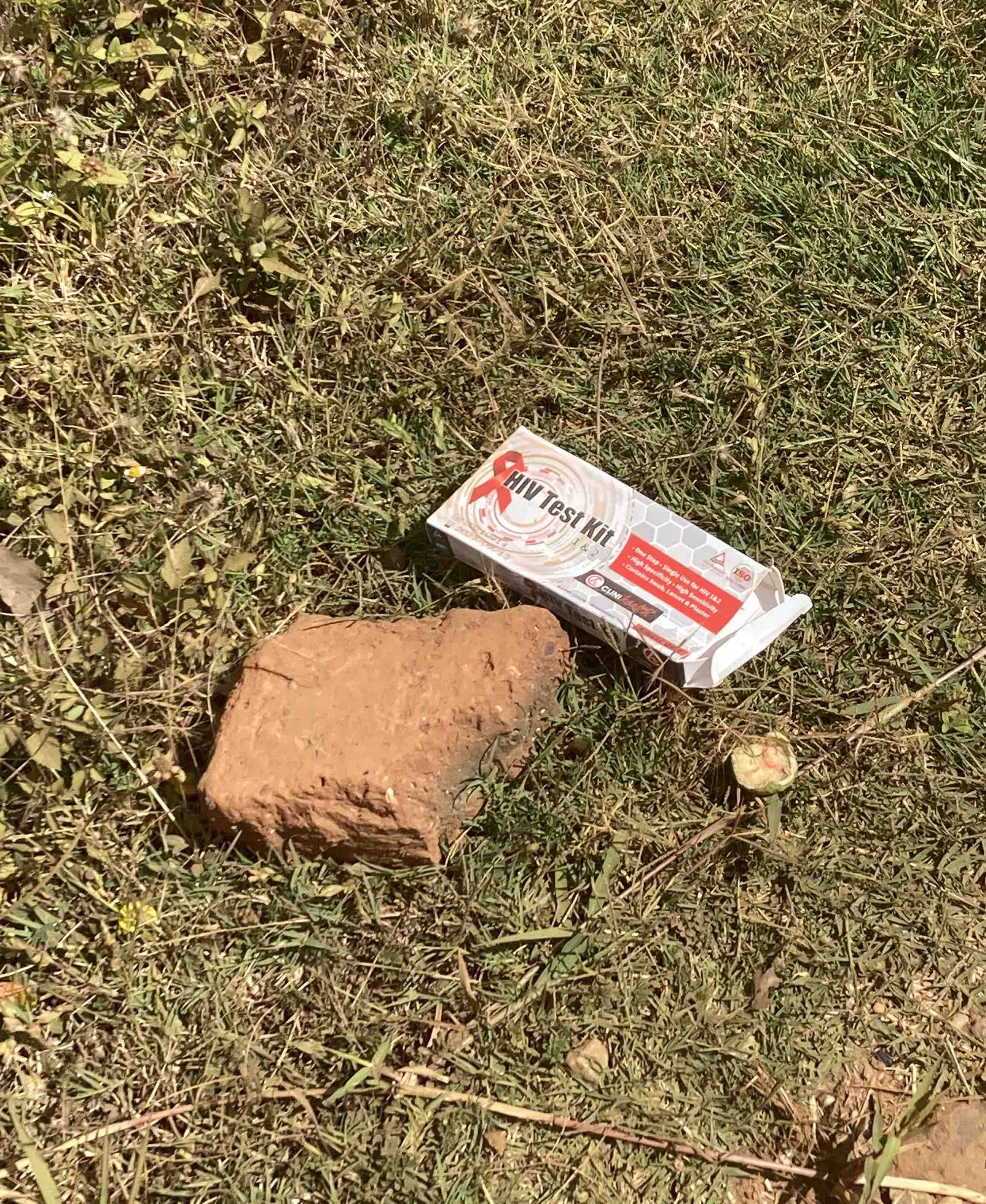
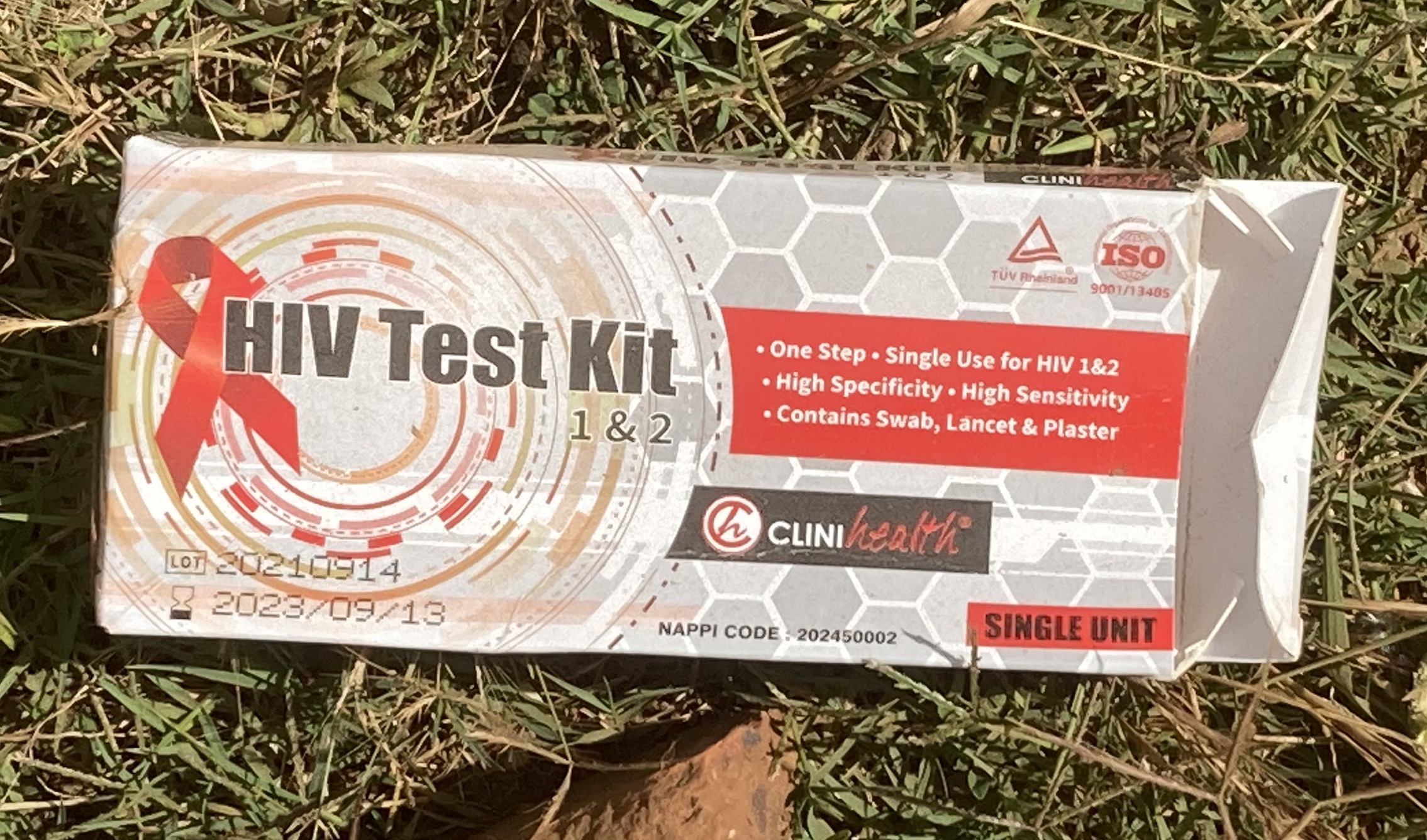
While walking in our Harare neighbourhood I spotted this discarded package that, on close inspection, was a HIV Test Kit.
It was a reminder that HIV is still a serious health challenge for humanity that, unfortunately, rarely appears in the headlines.
It is true that the disease situation has improved, particularly, when I recall the dramatic epidemic that ravaged Africa and Zambia (where we were) in the 90’s. Antiretroviral therapy and diagnostic kits have contributed to the control of the disease, reducing its transmission. While this is great, an undesirable spin-off is that the disease is less obvious and there is a risk that control measures are relaxed. In addition, the Covid-19 pandemic has monopolized our attention, making us less aware of HIV/AIDS.
We no longer see billboards on preventing HIV such as the “ABC of AIDS control” I saw in Gaborone [1] or this fight between warriors and an imaginary and “plurilegged” AIDS (SIDA in Portuguese) monster!
[1] It meant: A for “Abstain”, B for “Be faithful” and C for “Condomize”!
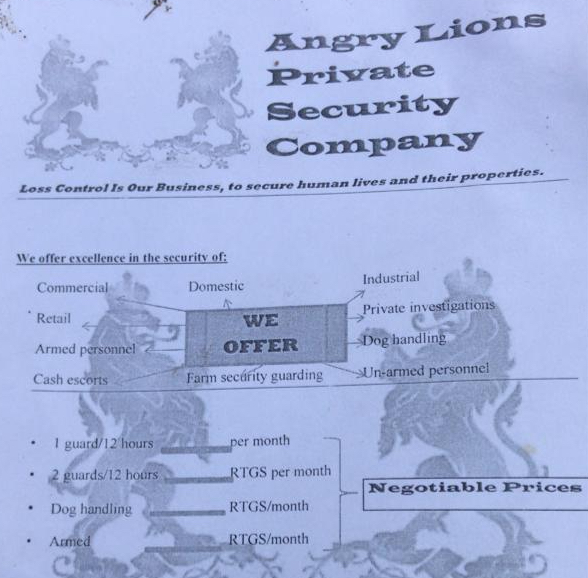
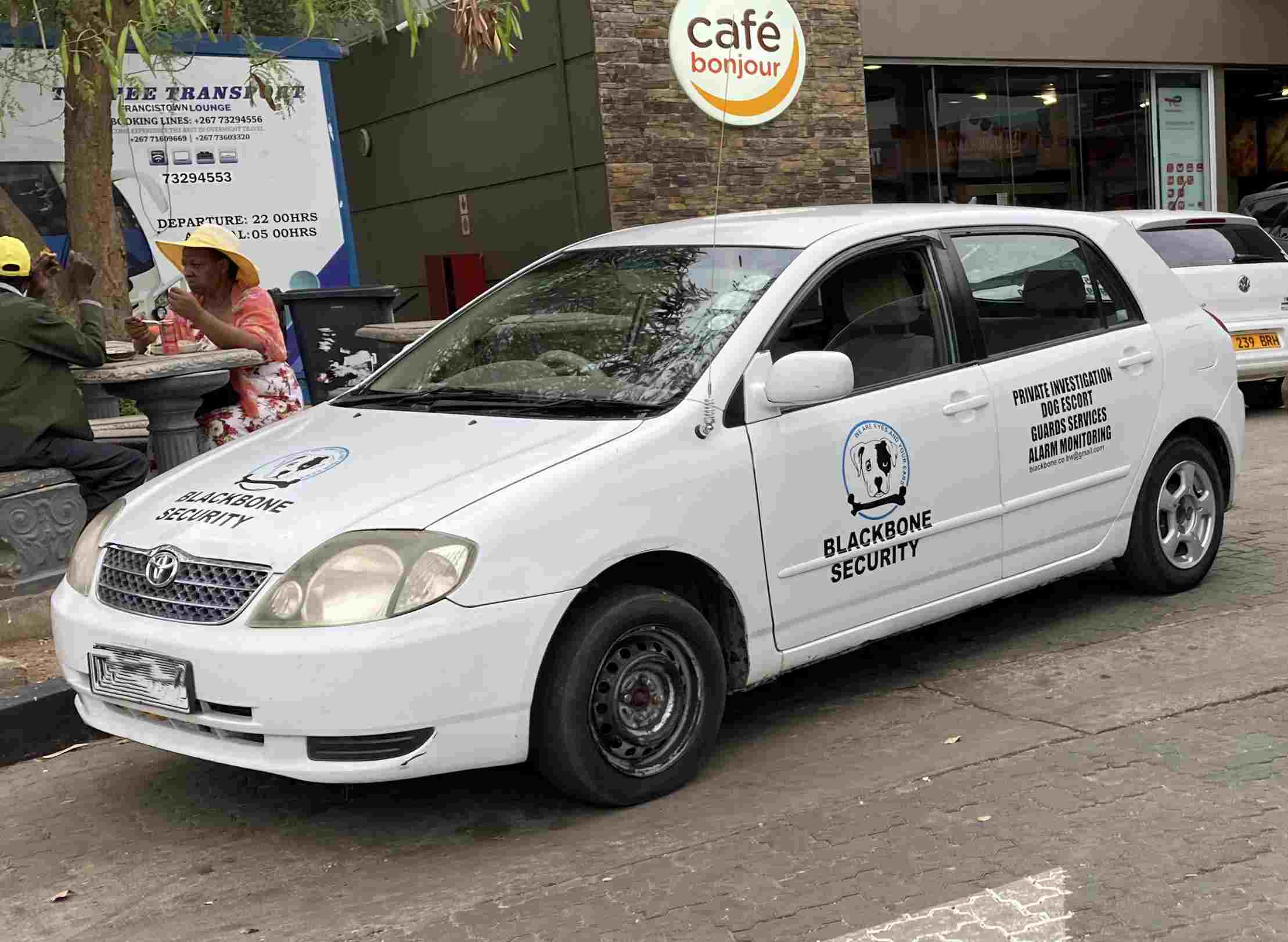
A short post to add two more security companies with imaginative names we spotted recently.
I like their motto: “Lost Control Is Our Business, to secure human lives and their properties”!
At first I read “Backbone” and found the name quite appropriate but then I realized that I had missed an “l”! Their motto: “We are eyes and your ears” is also interesting!
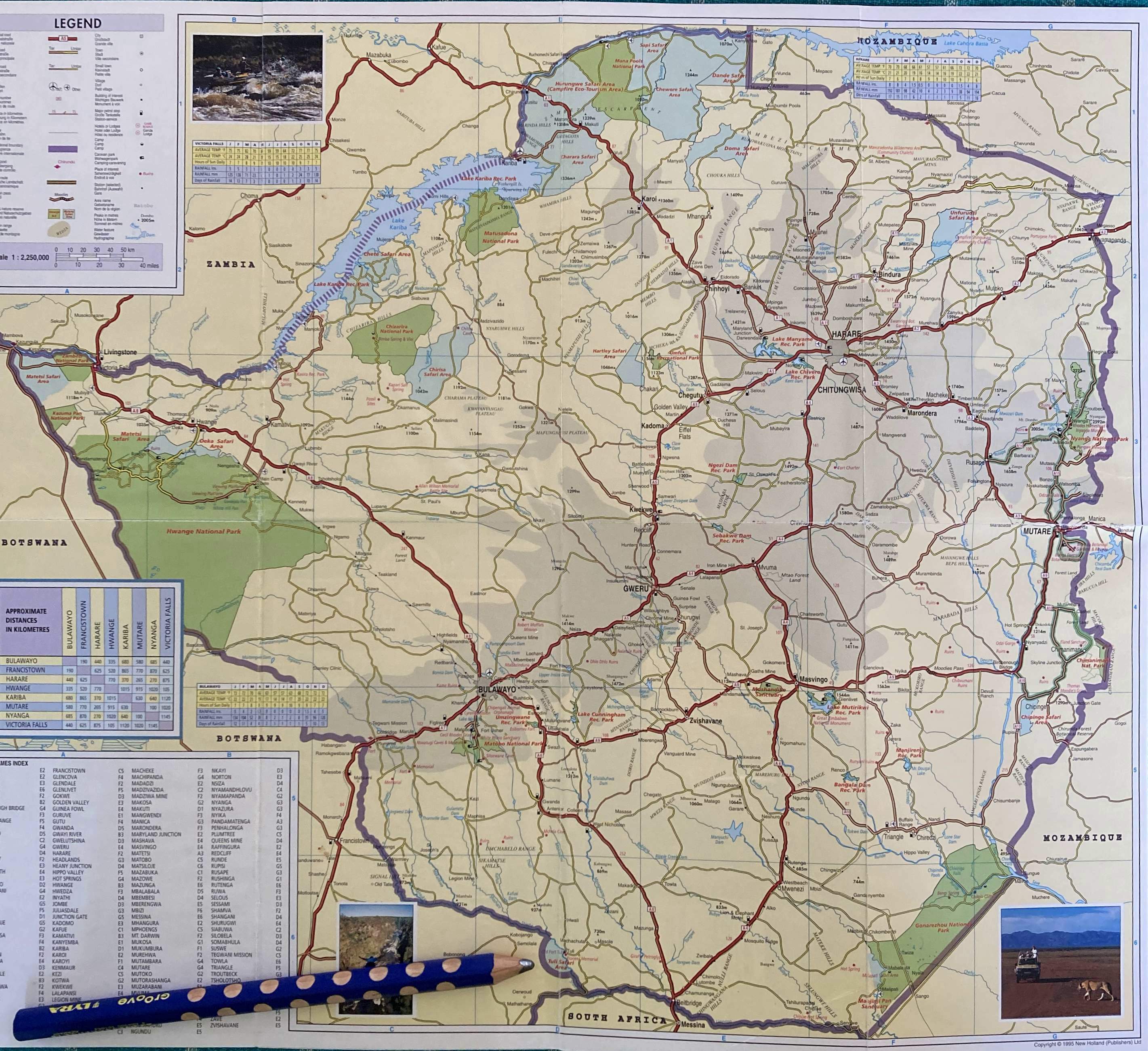
For many years I have wondered how the Tuli block came to being. How could such a perfect semi-circle be added to the border between Zimbabwe and Botswana? Why not just follow the Shashe River all the way?
The Tuli block (tip of the pencil) at the south-west corner of Zimbabwe.
Apart from seeing it in the map, we had driven through the Tuli block a few years back when travelling to South Africa. So, we decided to go and explore it. With little knowledge about the area on the Zimbabwe side, apart from comments that it was a hunting block, we decided to return to visit the Northern Tuli Game Reserve (NTGR) in the eastern part of Botswana.
Briefly, based on the history of the block from http://www.notugre.com, the first European explorers and missionaries arrived early in the 16th century and the area was used for hunting, trading and mission work among the peoples then living here. In 1890 Cecil John Rhodes commanded the “Pioneer Column” to annex Matabeleland and Mashonaland for the British Crown and established Fort Tuli (in Zimbabwe). At the same time, the Bangwato and Matabele tribes of the area were involved in a power struggle for the land until Chief Khama of the Bangwato tribe won control in 1895.
It was Chief Khama that, with other Chiefs went to England, saw the Queen, and stopped Rhodes ambitions. An agreement was reached that only the Tuli Block be given to the British South Africa company for their use to build the rail link and that later it would be divided into farms to protect the Bangwato and Botswana from the expansion of the Boers from the Northern Transvaal.
Much more recently, in the late 50´s and early 60´s, probably realizing that the area did not have much potential for livestock (my comment), ranchers in the area decided to literally “block” their lands into a large area for wildlife conservation and tourism. Today, 36 properties form the NTGR with an area of over 70 thousand hectares.
Clearly, the NTGR is much less known that the classic Botswana wildlife areas we had visited earlier such as the Makgadigadi and Nxai pans, Chobe National Park, Moremi Game Reserve and the Kalahari reserves, to name the main tourist areas. However, our aim was to see how the Tuli block was.
We usually are independent travellers but this time -strangely- we arranged the trip through a travel agency. Our search for accommodation quickly ruled out the well-known lodges such as Mashatu and Tuli for economic reasons but we found a much more reasonable place called Serolo Safari Camp located in the NTGR where we booked self-catering accommodation (see: https://tulitrails.com/?page_id=38).
So, with the NTGR as our first destination, we put into practice one of the advantages we saw when we bought a house in Zimbabwe: to be able to travel to several neighbouring countries. We headed South-east, first to Bulawayo for the night and the following morning drove the 100 km to the border at Plumtree and then to Francistown, just a further 90 km into Botswana.
We were happy to see that very few people intended to cross the border that day and we made plans for an early arrival in Francistown that would allow us more time for shopping. Things did not work out as planned… However, before I give you more details, let me explain that, this time, I travelled with two passports: the old one that would expire while we were in Botswana and a new one that I obtained a few days earlier, aware that this would happen.
Our visa for Zimbabwe was expiring the very day we crossed, and it was in my old passport. I was not concerned as I expected that the immigration would have looked at my visa in the old passport and place my exit stamp in the new one. It was not to be! The officer, insisting that the old passport was still valid, placed the exit stamp in it and, immediately I knew we were in trouble!
My fears were confirmed when we arrived at the Botswana side of the border, sited after about 2 km of “no man’s land”. A kind immigration officer explained to us that the Zimbabwe immigration should have stamped my new passport! So we were sent back! We were about to know something I had always wondered: how do you go back half-way through a border crossing! Well, the answer is with difficulty!
We turned around and, of course drove against the flow of traffic all the way back trying to be extremely friendly and greeting people and saying “sorry” every time we faced a car coming head-on towards us, not expecting to find a car going the other way. Eventually we arrived back at Zimbabwe, did a completely illegal manoeuvre to get the car pointing towards Botswana again and, trying to appear as calm as possible, we entered the building, again.
We explained the situation to the immigration officer that was still reluctant to stamp my new passport until a higher authority gave its clearance. Clearly the answer was positive so, after quite a wait, my new passport was stamped, and we managed to complete our crossing without further difficulties.
We arrived at Francistown later than expected, and rushed to buy the essential stuff for our self-catering stay at Serolo Safari Camp as well as getting new Botswana SIM cards, an essential item these days! Despite being a Sunday, we managed and, after a restful Sunday night at Francistown and a good breakfast on Monday, we headed for the NTGR, located at about 290 km to the South-east. We drove up to Serule and we turned for Bobolong and later Mathathane. Soon after the asphalt ended, and we headed in the direction of Platjan, the border post with South Africa, and turned into our camp following the signposts.
The area was very dry but, unlike other areas of Botswana, it was quite hilly and rocky although some greenery in the distance revealed the passing of the Limpopo River, not that far off. We both thought that it would be difficult to spot game in this terrain, but we decided to wait and see and continued until we got to the camp a handful of km farther on.
It was very hot but the camp had some magnificent large trees that provided with good shade, particularly around the central part known as the lapa [1]. There were five not so shaded tents overlooking a ravine where we were told game passed and one concrete hut at the back, not so nice as it overlooked the tents’ car park! Our hearts sunk when we were told that this was the accommodation for self-caterers. We looked at each other and knew that we would not stay there. It was a change or looking for another place to stay!
We presented our concern to the manageress and, after a few phone calls a solution was found. Another couple would be moved from a tent to the self-catering unit with the lure of the latter having air conditioning and we could have their tent, provided we paid the difference between self-catering and full board that, luckily, was not very high. We accepted.
Our tent.
I would call Serolo a no-frills lodge that could host a maximum of ten people on full board and two more on self-catering so it was never crowded. Staff were extremely kind and attentive and we enjoyed the cooking of Kennedy, the Chef, that managed to produce some truly good food in the bush.
We were not allowed to go on game drives in our car, but the accommodation included two game drives per day. To our horror, we needed to be at the lapa by 05:30 hours for the morning drive. Luckily, the afternoon one started at the very civilized time of 16:00 hours, after having enjoyed a “high tea”.
We are not used to be driven as part of a tourist group, so we needed to adjust to the new methodology. We did this with some degree of difficulty as clearly the aim of the drive was to find big cats, particularly leopards. Elephants were watched from a distance and birds were almost ignored. Luckily the intense heat made driving on an open car very bearable.
By the second game drive it became apparent that the area was more restricted than we expected, and we just repeated our route day after day. Part of the drive touched the Limpopo River with its beautiful riverine forest. There we saw abundance of impala and greater kudu grazing under some truly large trees. Ficus and Acacia species were the outstanding ones and we contemplated them in awe while enjoying their dense shade during the heat of the day. As it was the dry season, the river was not flowing (at least on the surface), but we saw still some large pools and probably abundant water under the sand.
Large trees by the Limpopo River. These are probably Nyala trees (Xanthocercis zambesiaca).Greater kudu females on the Limpopo River.Pools at the Limpopo River.Sunrise in the Limpopo River.
The rest of the driving was done through dry, often bare earth areas with patches of Mopani trees (severely damaged by the elephants). Several rocky formations were clearly ideal places to find leopards but, unfortunately, we had to be satisfied with klipspringers. Our drivers tried hard to find cats and they often drove through rough roads that involved a lot of low gear efforts by the aged Land Rover Defenders used by the camp.
A curious female greater kudu.
It was in the hilly area that we spotted five lion cubs, the offspring of two resident lionesses that were sired by one male lion. Later, we found one of the females resting by an old eland kill, showing signs of being very hot. Mabel caught a glimpse of the second lioness but the rest of us did not see it. During a later drive, we found the male lion resting and surrounded by the other members of the family. Probably the whole group was together, but we could not see them in great detail as they were far and hidden by both rocks and bushes on the other side of a gorge where we could not get to.
A young lion watching us from the rocks where they stayed.
A hot and sleepy lioness.
During the second day of game driving, we found an injured male impala. One of its hindlegs was in an unnatural position and it was unable to stand up. Interestingly, a black-backed jackal was lying down a couple of metres away. We agreed that the impala’s future appeared grim as it would have been an easy prey for a leopard or hyena, and we thought that the jackal was waiting for a larger predator to arrive and benefit from the leftovers. After waiting for a while, we left the pair and made a note to return in the evening, but we run out of time, and we did not know what happened until the following day.
First thing the following morning we returned to the impala and found it dead and the jackal (we assumed it was the same we saw the previous day) was feeding on it. Although we cannot know how the events unfolded, judging by the injuries that impala showed, I believe that it was killed by the jackal during the night. Jackals are ruthless killers, often tackling prey much larger than themselves.
The black-backed jackal feeding on the impala.
We saw elephants at a distance and our drivers seemed to be very wary of them keeping a good distance, perhaps because of the cars being open. Oone night a few elephants visited the waterhole adjacent to the lapa and leopards walked past the camp a couple of times but, of course, we were out on a game drive when that took place!
Elephants watched from a distance.
Oh, I forgot about the Tuli block semicircle. Well, it was not easy to find out the reason but, eventually I did. It happened in 1891 when then Mashonaland districts were established and Tuli was given jurisdiction over a 16km radius of the village, a perfect disruption to what otherwise would have been another river border between two countries!
[1] A lapa is usually an open structure that generally consists of a thatched roof sitting on wooden poles. These are usually used as entertainment areas in southern Africa.
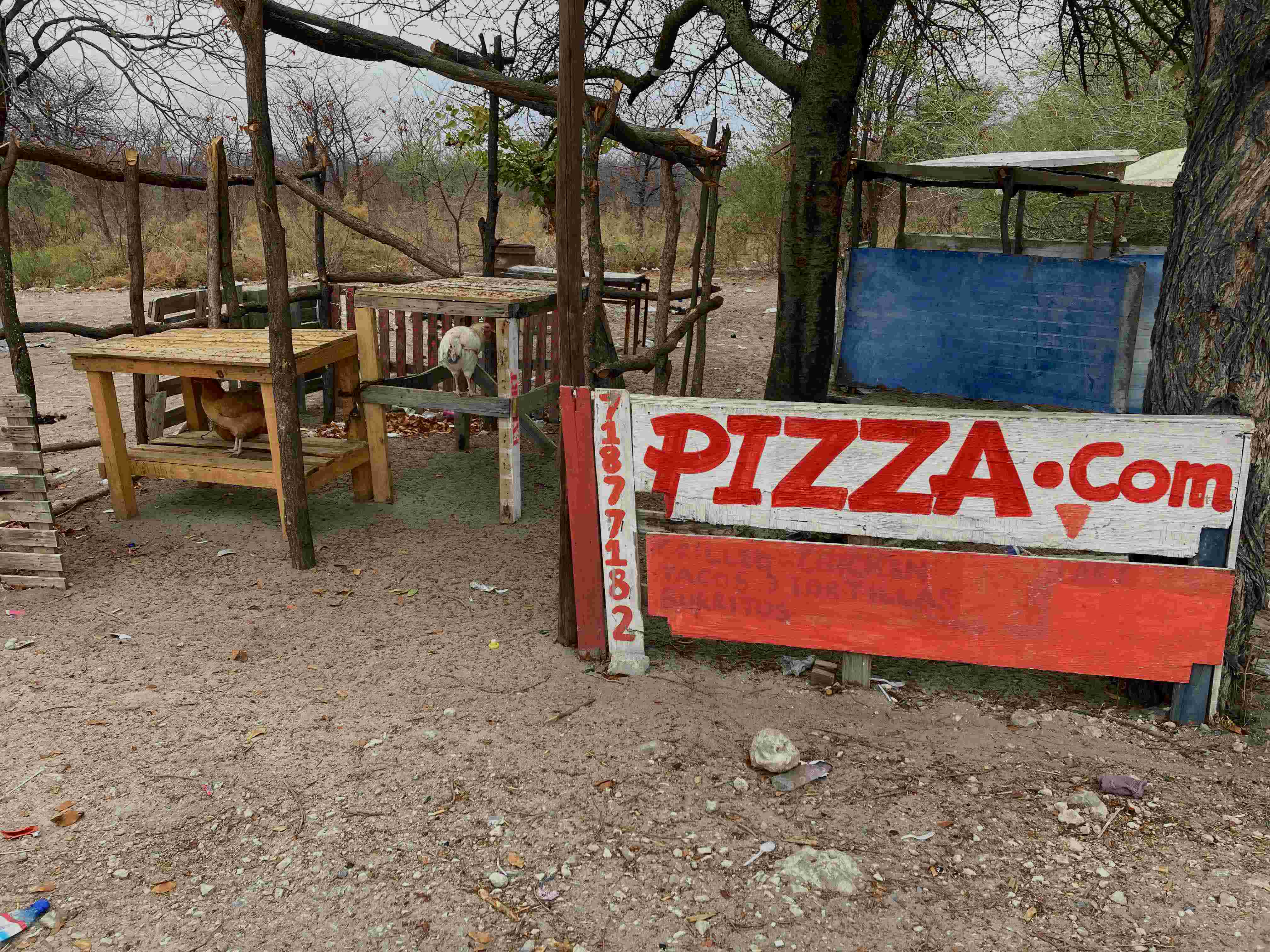
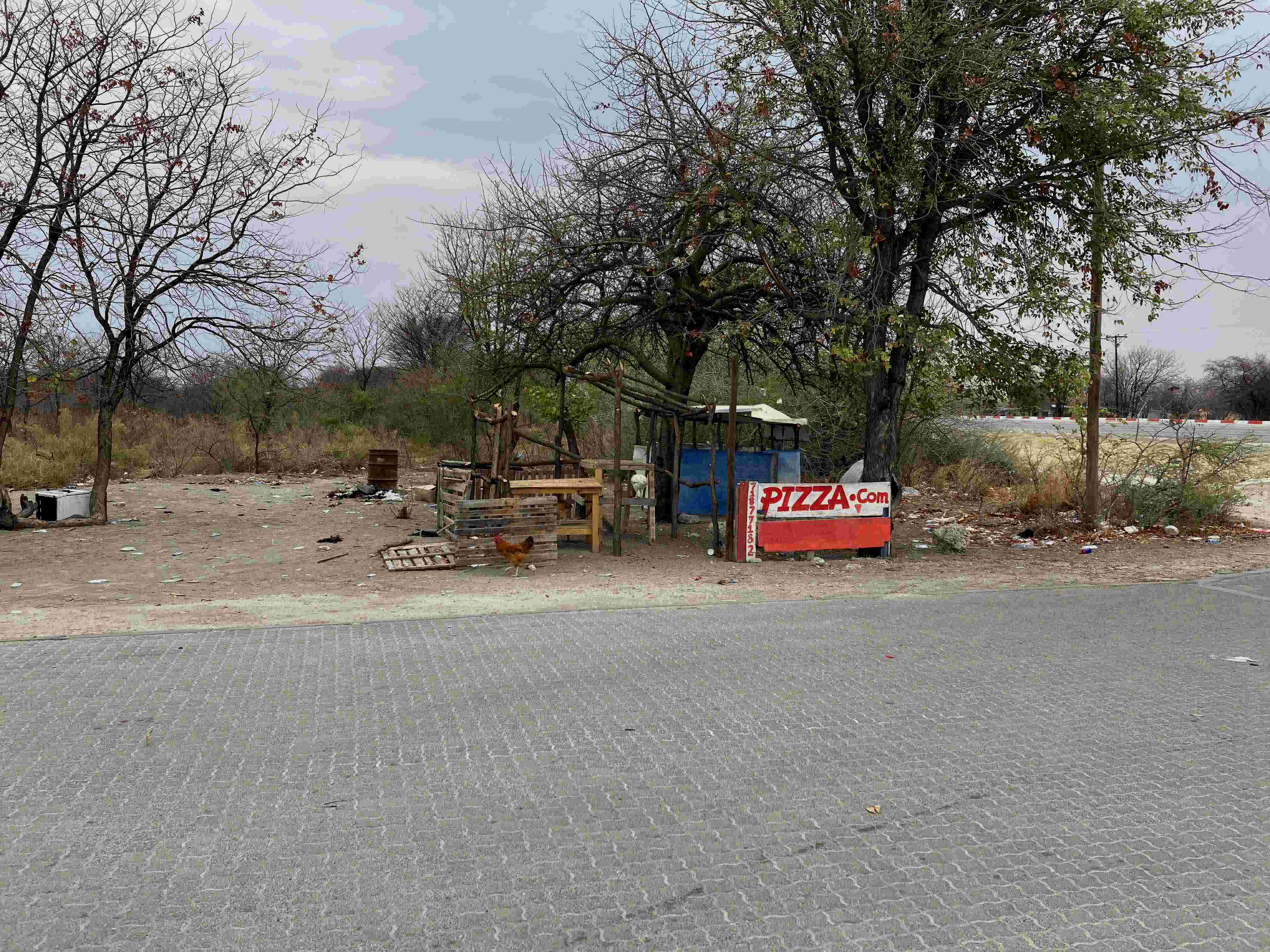
My lack of posts is due to an on-going trip in Botswana with little access to internet. Although I will write about it in the coming days, I present you with an interesting shop being advertised at Nata.
I see it as quite an ambitious undertaking to which I would like to suggest soon adding a “Chicken.com” subsidiary!
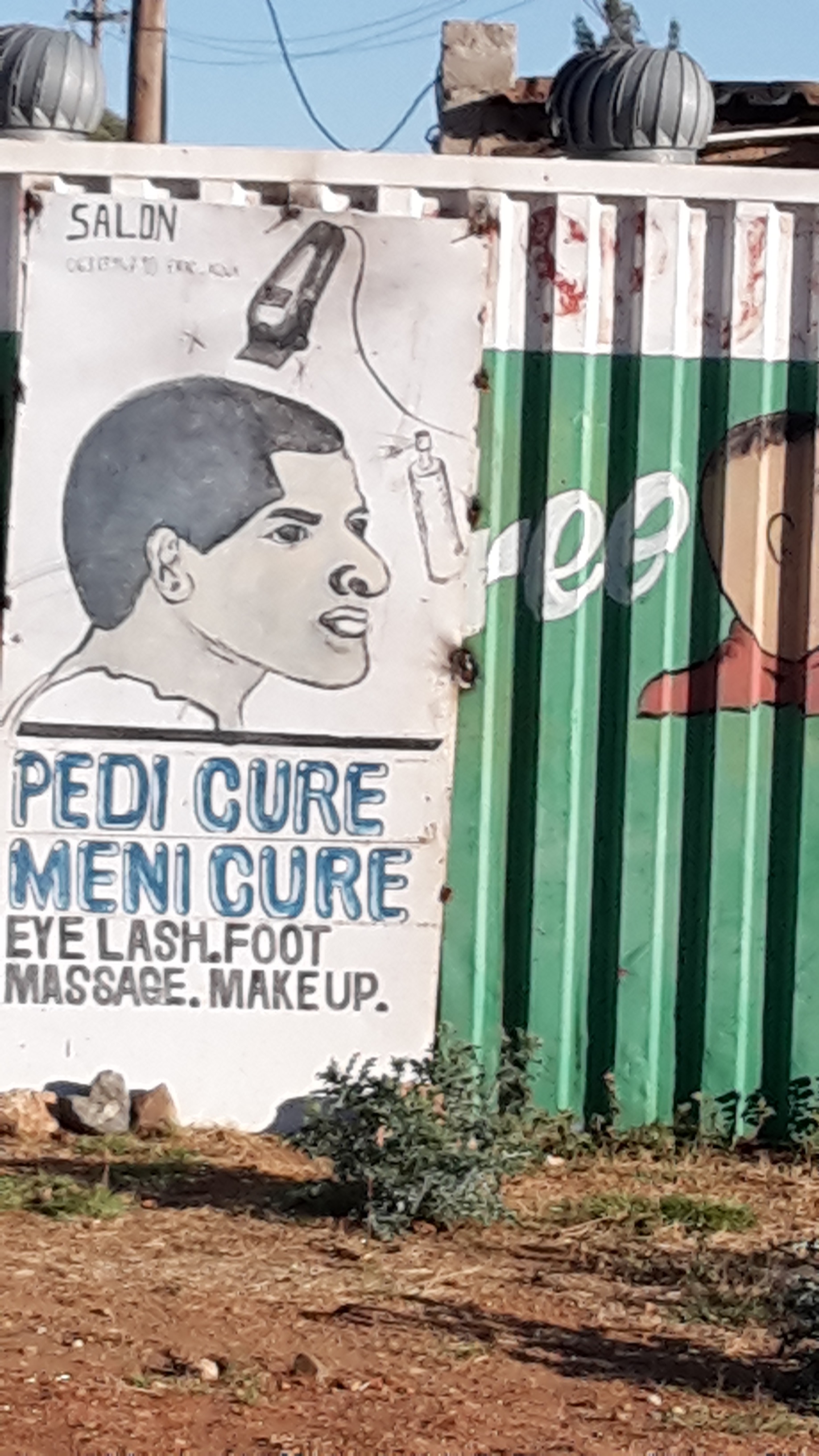
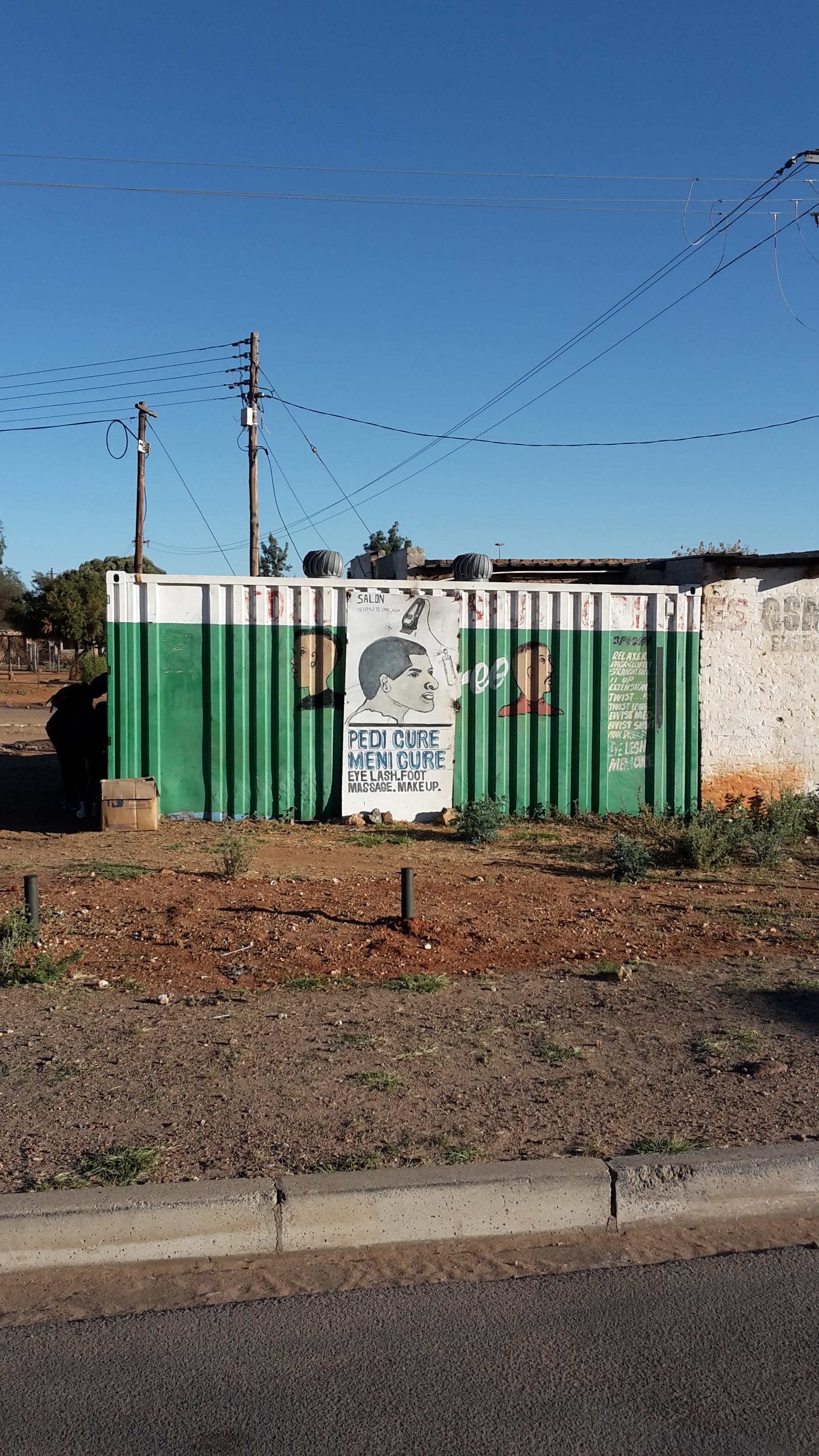
I believe we saw this advert travelling in South Africa. This beauty parlour offered “pedicure” and also “menicure”. At first I thought it was something to do with a cure for men! but then I realized that it meant “manicure”!
It also offered make up, eye lash and foot massage! But that is not all, to the right of the main sign there were other “Special” offers (written in white):
“Relaxer back and lower straight back”, “Straight back”, “straight up back extension”, “Twist back(?)”, “Twist long”, “ewist (twist?) med”and ewist (twist?) short”, “wool dre… (dreadlocks?), “eye lesh” and “men cure”.
You will agree with me that it was a great offer, all packed-up in a shipping container!
Security is a large business worldwide and Zimbabwe is no exception. While security companies choose allusive names such as “Safeguard”, “Guard Alert”, “Securico” and others, some of them do not.
I recall a company called “Tragic Security” that was a few years ago in charge of the security at the Beitbridge border post. Unfortunately, I did not get a picture of their sign as border posts are not the best places to be seen with a camera!
However, in Harare I have managed to take a couple of pictures of companies with what I find amusing names.
Clearly this company prefers to solve thieving amicably but not all are like this one as the following picture shows.
I would not like to be neither guarded nor attempt breaking into a place with such a company taking care of it.
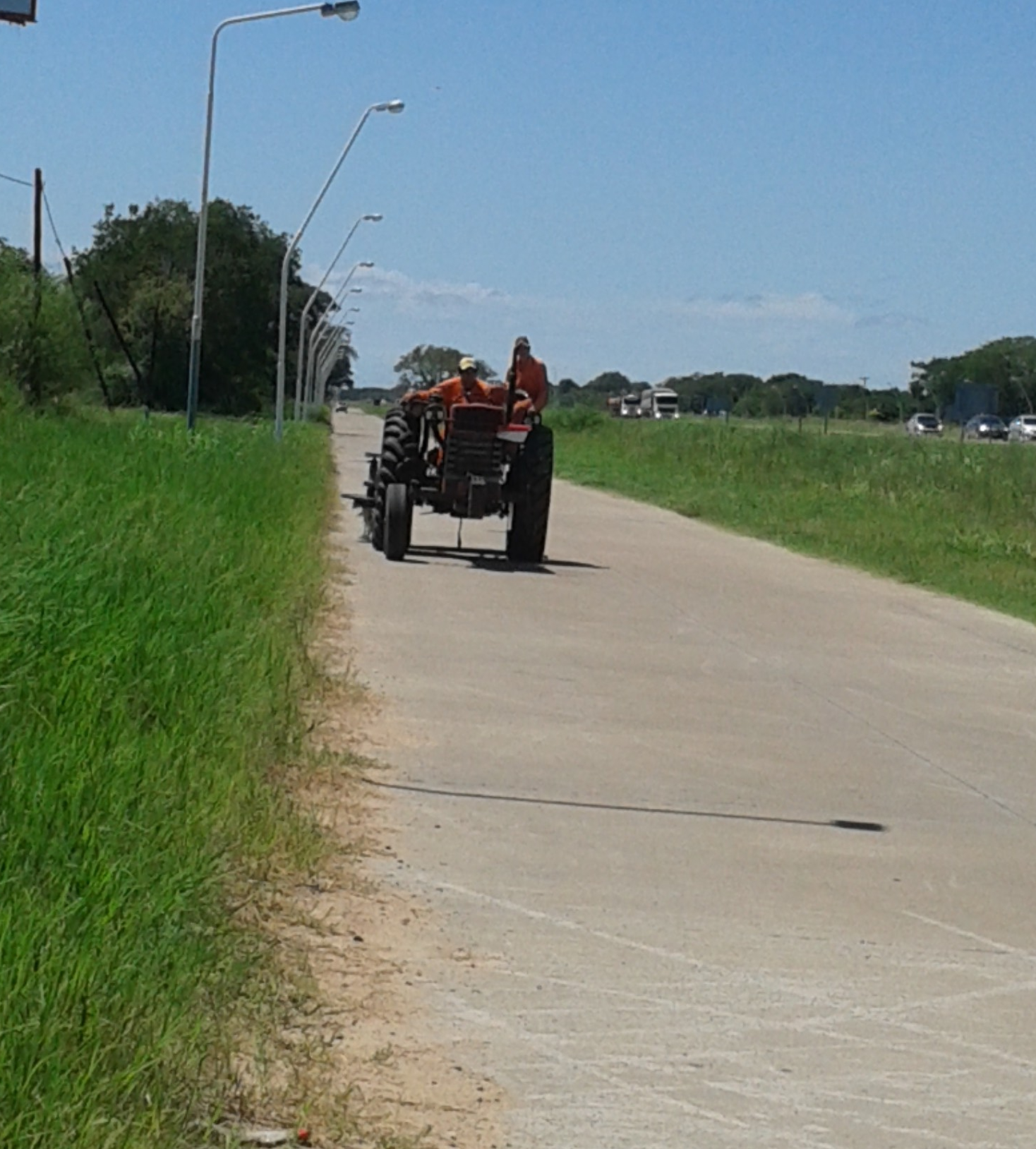
This was seen is the main road between the cities of Corrientes and Resistencia in Argentina. The cities are separated by the magnificent Paraná river and the road connecting the two is truly busy. It was while driving on the motorway that we spotted this oddity. We almost overlooked it but then we spotted something wrong. Can you see it?
It is not easy to see what is wrong! Here is another picture taken when the tractor got closer and with a different angle:
Usually, tractors move on four wheels! However, these gentlemen were driving -rather unconcerned- on three by some miracle of engineering equilibrium!
After our time at Kennedy One and Main Camp, it was time to have some more comfort so we headed for Robins Camp, to the relief of our visitors. It was nice to be back to a very nice place with welcoming staff and to be able to relax without the chores of camping, particulalry cooking and washing-up!
Robins Camp at dusk.
The bats that inhabit the tower were there although we did not spot the dwarf mongose group that we had seen earlier. We had our compensations as we watched other interesting birds in the camp and nearby.
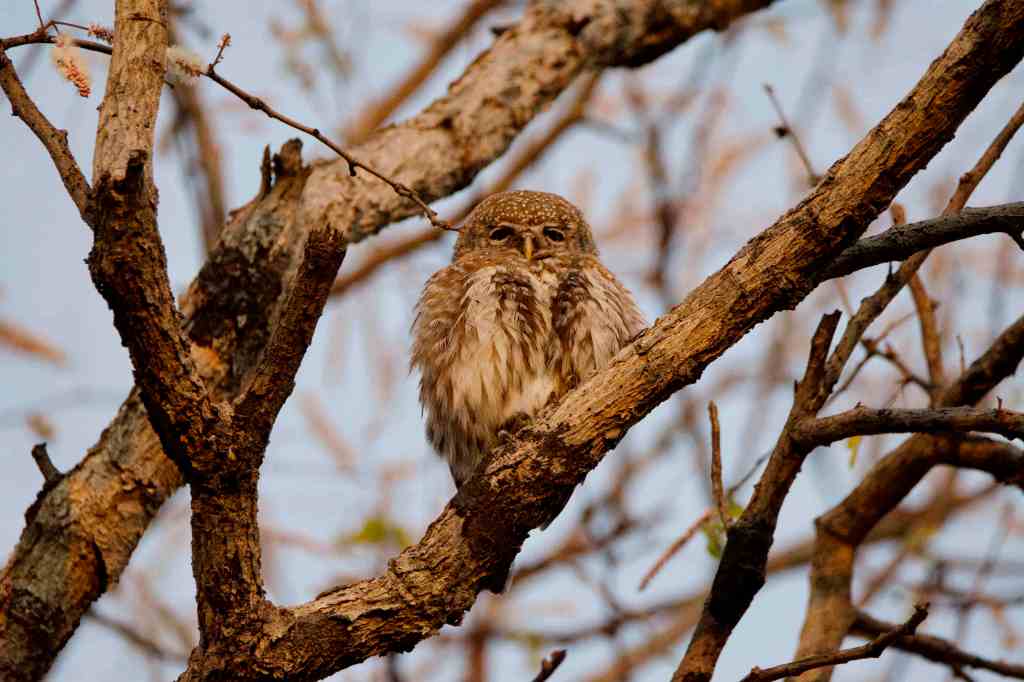
Every morning we found this Pearl-spotted owlet next to our bungalow.
A pair of young Ground hornbills.
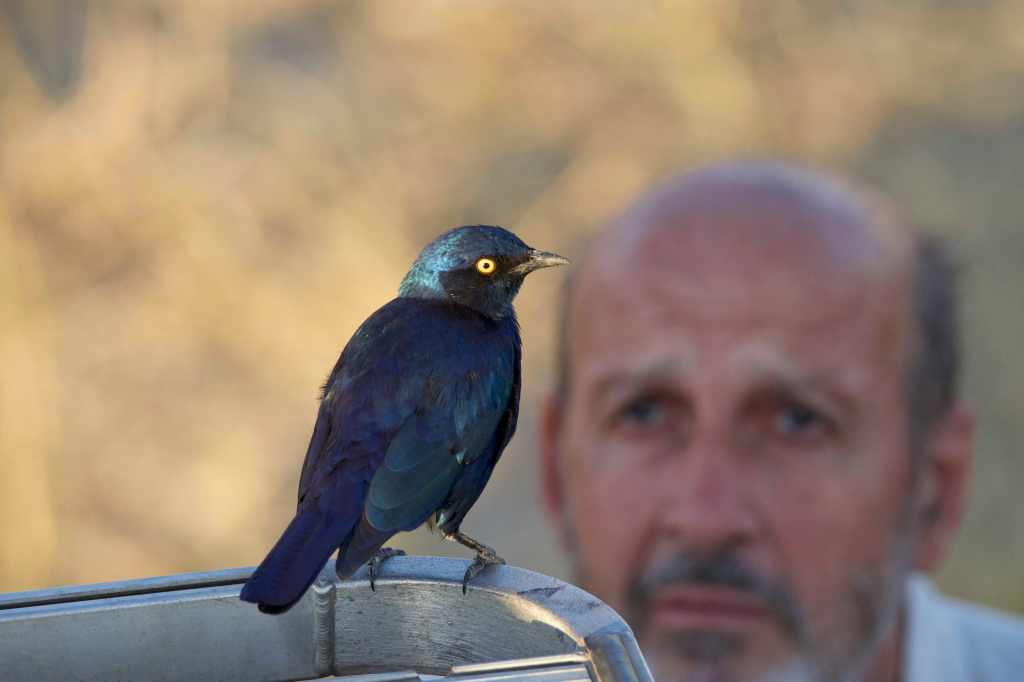
The bushsnob having a good look at a Glossy starling.
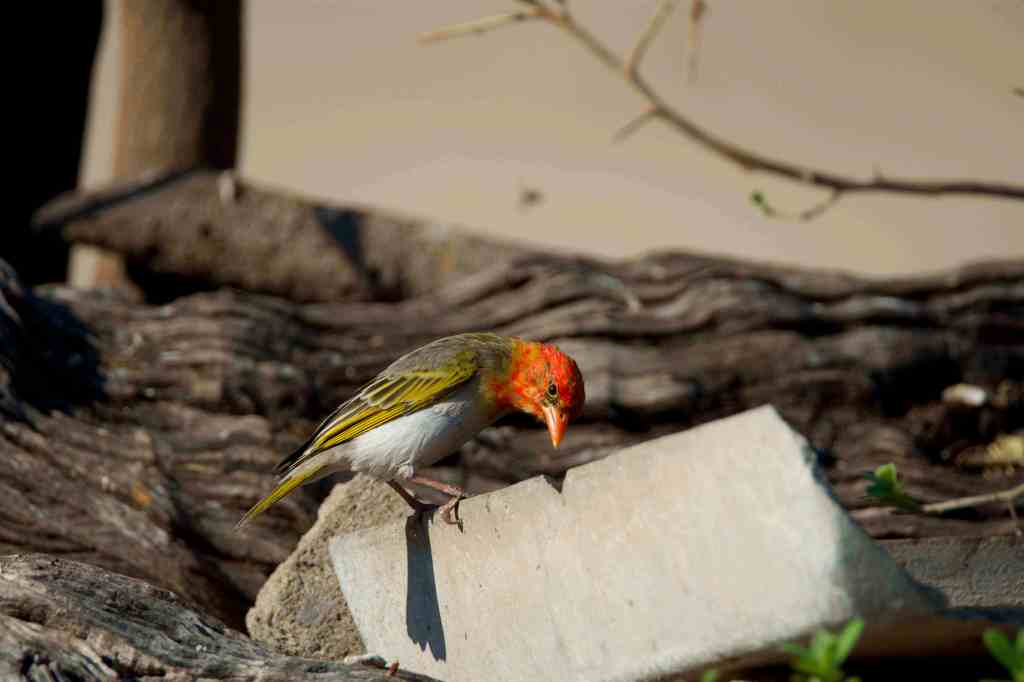
A male Red-headed weaver reaching its full breeding plumage.
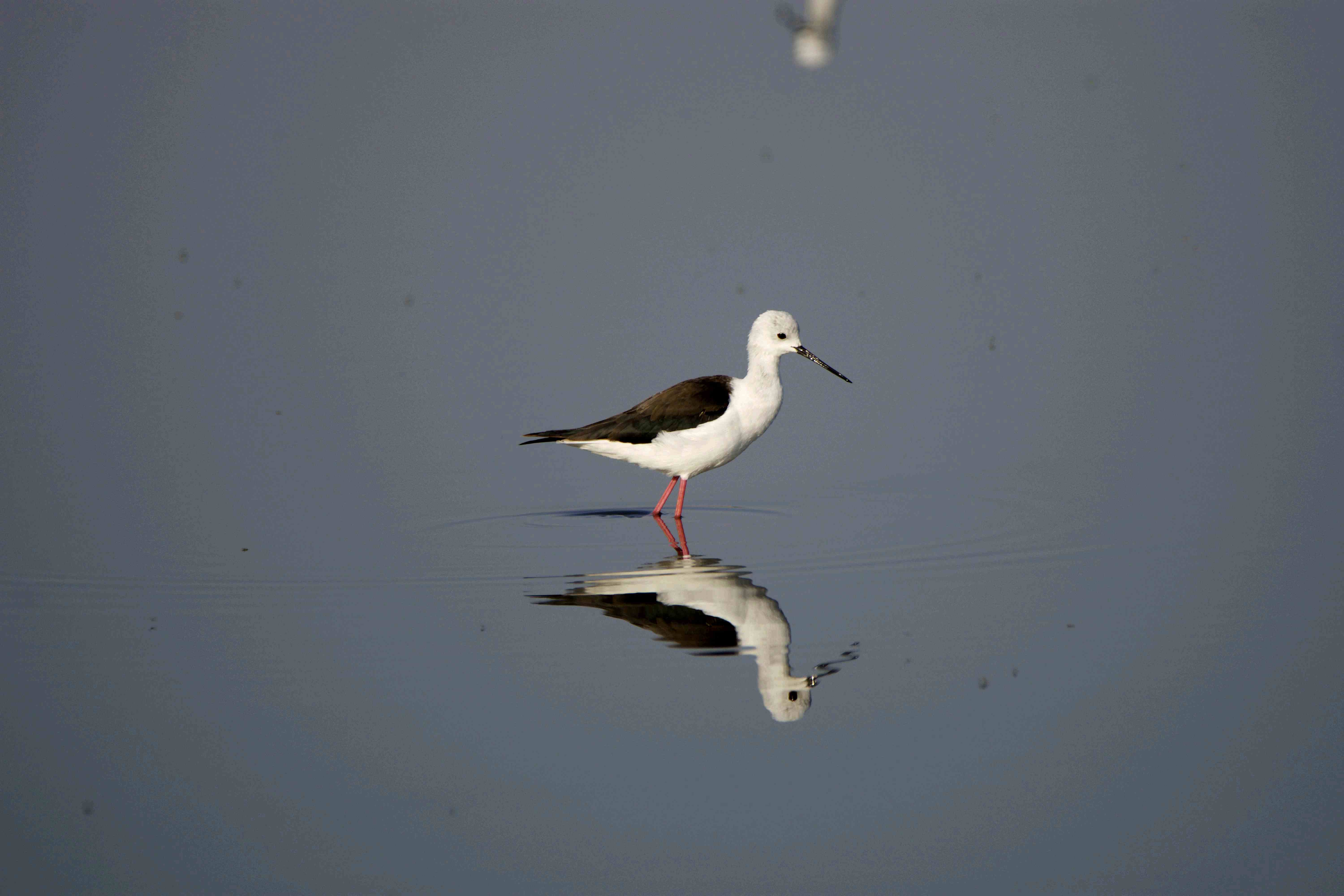
During our earlier visit to Hwange National Park (HNP) after the Covid pandemic (See: https://bushsnob.com/2022/04/03/zimbabwe-post-covid/) we visited a place known as the Salt pan and we were lucky to have a glimpse of a rather shy cheetah family that took off as soon as they saw us. We also “discovered” a salty water dam with several interesting water birds. Grey herons were the dominant species but there were also little grebes and the beautifully brittle stints with their very long and thin pink legs that seem to be unable to support even their very light weights. So slender the legs are that the water is almost still when they wade through.
At the time we also found a small family of hyenas and many vultures perched on the trees surrounding the dam, a sign that kills were frequent there.
So, during our present trip, the first morning at Robins Camp we started early and headed for the Salt pan.
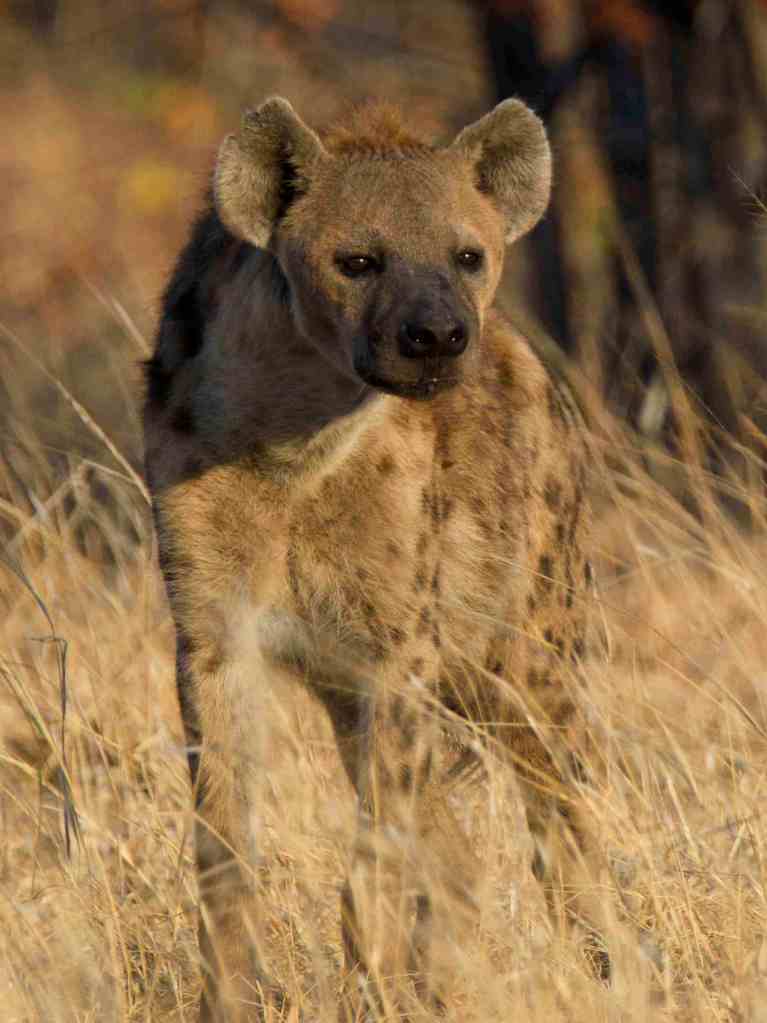
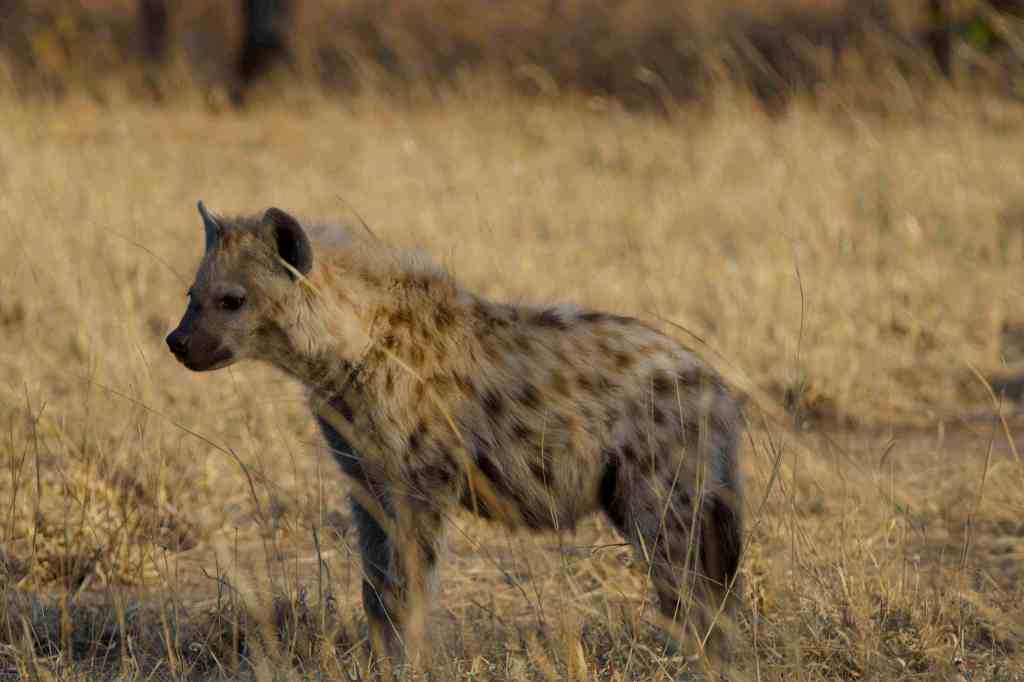
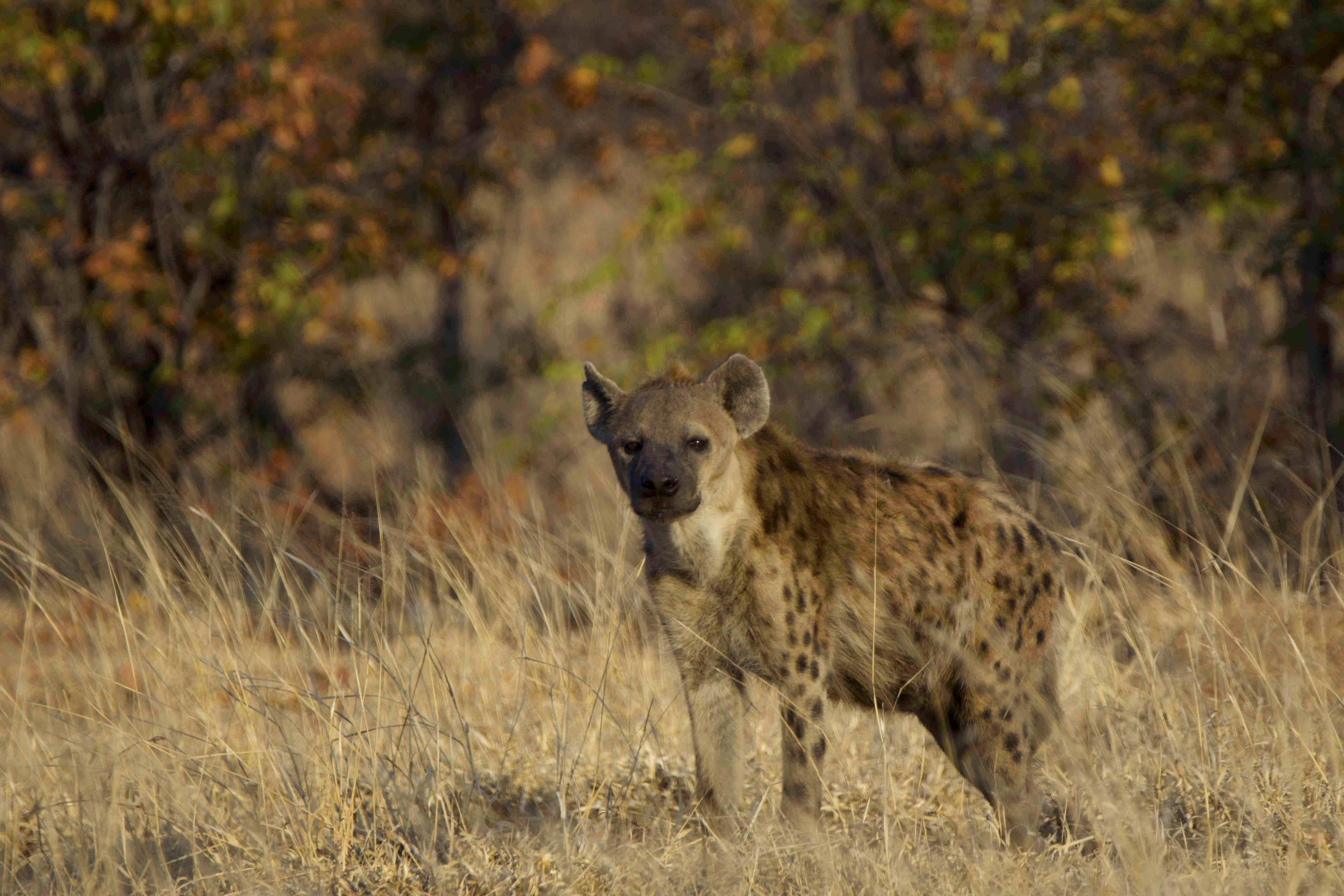
Three of the adult spotted hyenas.
This time we did not see the cheetah but, on our way to the pan, we met with a group of spotted hyenas composed of seven adults and two youngsters, the largest group we have seen so far in HNP and Zimbabwe. As they are one of the favourite animals of our daughter Flori, we stopped to watch.
One of the hyenas was probably carrying a chunk of meat and moving away from us never to be seen again. The rest of the adults continued walking and they tolerated our presence. We have had literally hundreds of daylight encounters with spotted hyenas over the years and they have always been rather unconcerned by our presence, keeping a considerable distance from us, either on foot or inside our car.
Although one of the young hyenas continued walking with the adults, the second either did not hear the adults‘ warning or it was an “infant terrible”, so it stayed behind, rather curious of our presence. At first it stopped to watch us but, not totally satisfied, it decided to come to have a close look at our car and its occupants. It approached us while loudly sniffing the air until it stopped at about one metre from us.
It remained there watching us intensively until, perhaps following some inaudible signal from the rest of the clan, it started to move towards the adults and we thought our close encounter was over but suddenly, it retraced its steps and repeated its exploration of the car a second time. Clearly satisfied with what it found and not showing any sign of concern, it finally moved back to the adults and the group moved off leaving us with the beautiful image of a young and curious animal.
We then continued our journey to the Salt pan area and found some interesting water birds such as grey herons and stilts, among others. There were a couple of dozen grey herons at the dam and we saw at least two pairs nesting there.












 A Bushsnob out of Africa