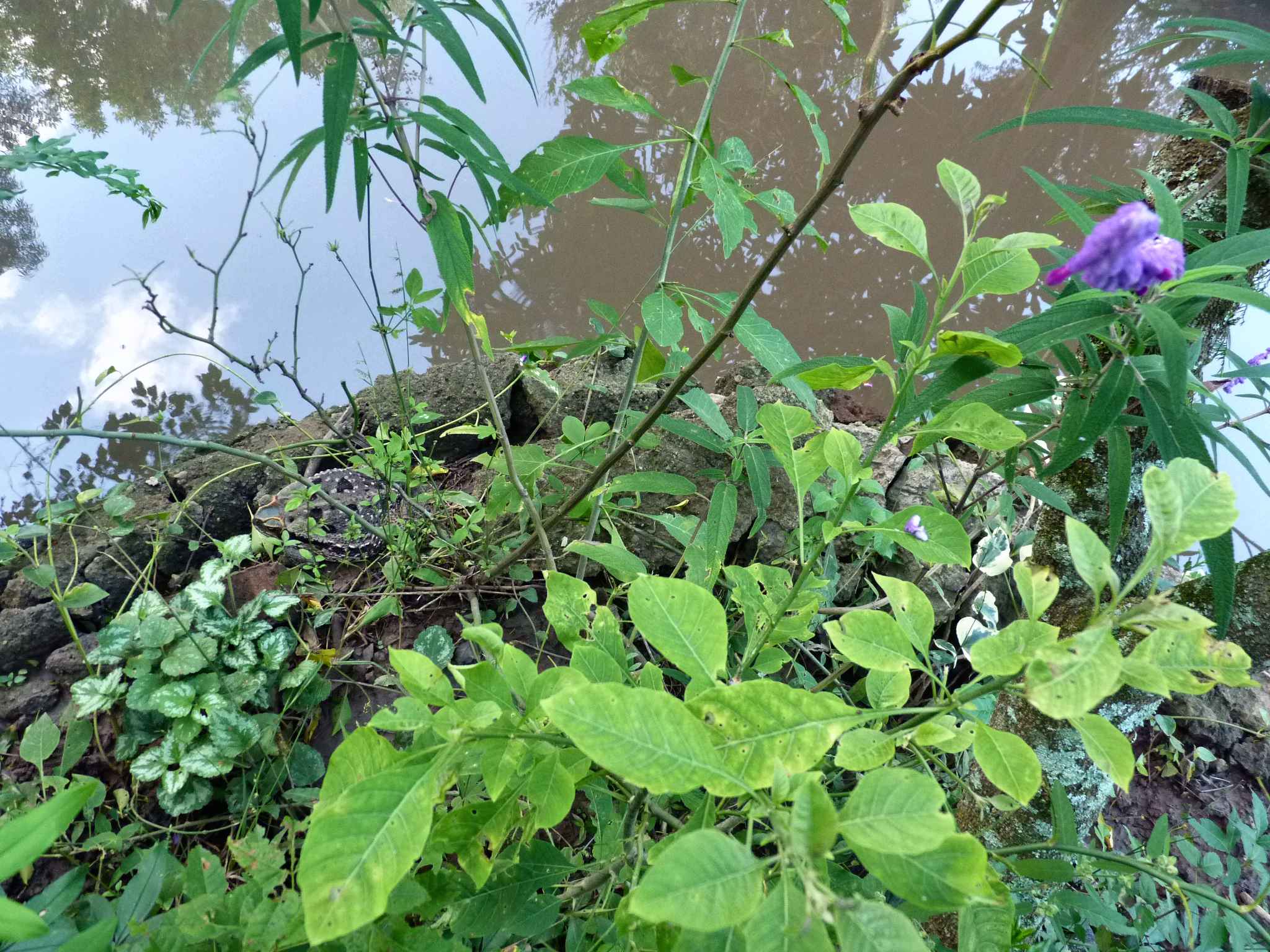
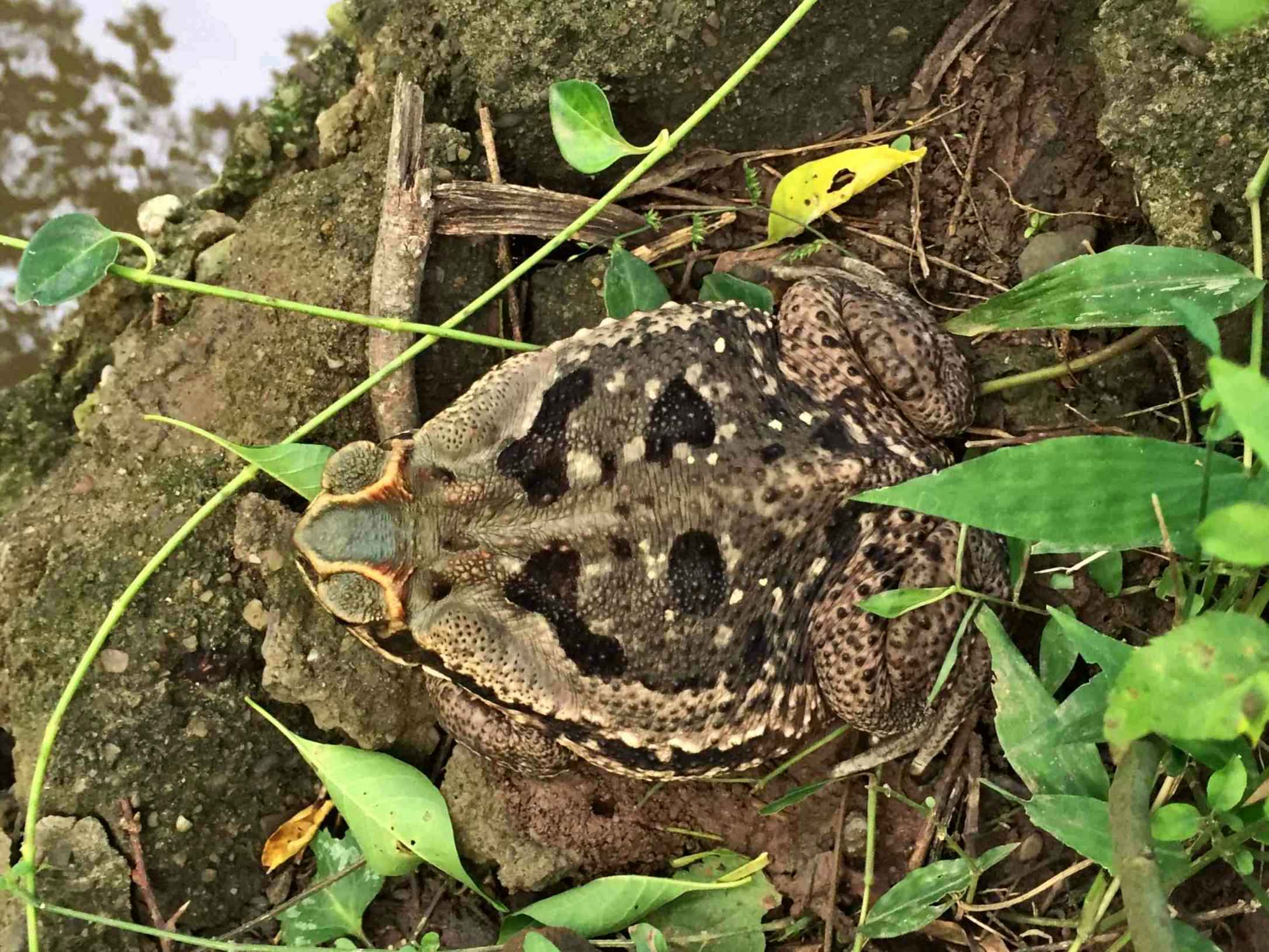
Our beast is a toad known around here as a “Rococo” and in English as a Schneider’s toad (Rhinella schneideri), a rather large toad known to occur from North and Central Argentina (including Salta, where we are), central Bolivia, the Atlantic coast of Brazil, Paraguay, and Uruguay in elevations up to 2,000 metres above sea level and in various habitats, including urban areas. They are often found around houses in rural areas.
The males can measure up to 17 cm in length and the females 25 cm. Their maximum weight can reach 2 kg! (the one in this post is probably 6-700g). It is a shy and mostly nocturnal beast that during the day relies on its colour and remaining flat and inmobile not to be detected by potential predators.
We often see this one at our small dam near the house but also it frequents our outside lights feeding on insects attracted to them.
Their call resembles a stake being hammered fast. The females deposit up to two thousand eggs in double strands deep in water pools and the rather large tadpoles hatch and feed on algae.
Despite its large size and excellent camouflage, rococos have some enemies, apart from men. The “Sapera” snake (Xenodon merremi) is one of its worst enemies but the toad can puff up with air to avoid being swallowed. It also secretes a bufotoxin that can cause vomiting, paralysis and even death in predators. We have observed a rococo attacked by a “caracara” (Polyborus pancus) that abandoned it when we approached them (I believe that the rococo only survived that beacuse of our fortuitous arrival).
Landlocked Zambia got its independence from the UK in 1964 and for a number of reasons it got its shape that reminds me of a bowtie (a “Club round” type one for the specialists!). The knot squeezes and splits the Lusaka and Central Provinces while the left bow (Northern, Eastern, Luapula and Muchinga Provinces with small parts of Central and Lusaka Provinces) slightly smaller than the right one (Southern, Copperbelt, North-western, and Western with the largest portions of Central and Lusaka Provinces).
This rather special shape means that it is much closer to travel from Mansa, the capital of the Luapula Province to Kitwe in the Copperbelt through the Democratic Republic of the Congo, if that trip would be possible!
Although, if interested, you can search for Zambia in the internet and find lots of information, I will give you a few facts that should help to put our life there in context.
Among the twenty largest countries in Africa with 752,618 km2, Zambia has borders with eight other countries, quite a record! To the north there is the Democratic Republic of the Congo, Tanzania to the north-east, Malawi to the east, Mozambique to the southeast, Zimbabwe and Botswana to the south, Namibia to the southwest, and Angola to the west. It is truly at the junction of Central, Southern and Eastern Africa.
In 1953, the Federation of Rhodesia and Nyasaland that grouped together Northern Rhodesia (now Zambia), Southern Rhodesia (now Zimbabwe), and Nyasaland (now Malawi) was created despite a large majority of the population opposing it. Kenneth Kaunda led this opposition that ended in its dissolution in December 1963. Zambia was born and Kaunda became its first President.
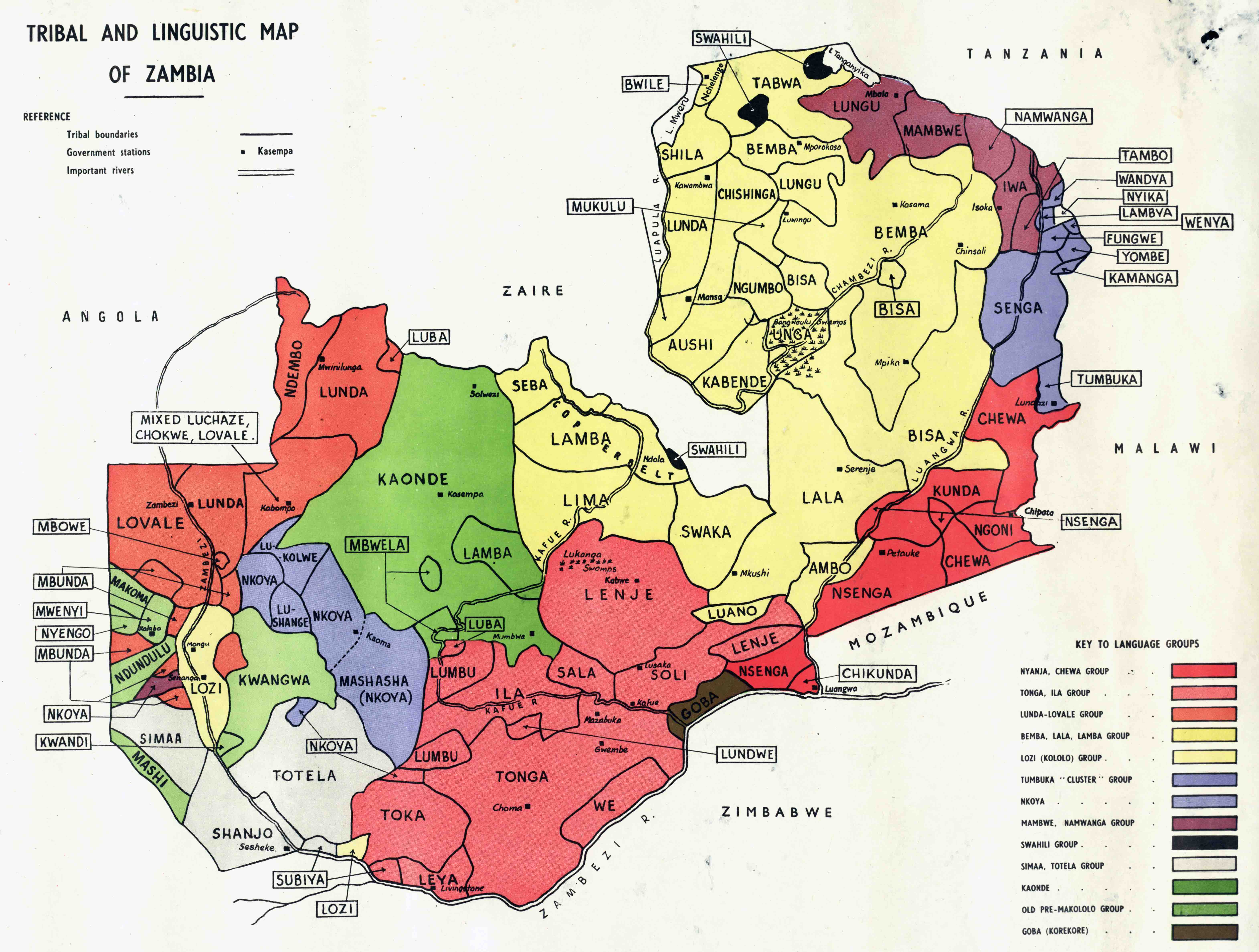
Kaunda was still there when we arrived, after 26 years. He did not have long to go but more about that in future posts. His party, the United National Independence Party (UNIP) ruled the country as a one-party state with the motto “One Zambia, One Nation”. Although there were about 73 ethnic groups, most of which Bantu-speaking, nine were the main ones, the Nyanja-Chewa, Bemba, Tonga, Tumbuka, Lunda, Luvale, Kaonde, Nkoya and Lozi. Although the tribal groups were important, rivalries as we had seen in both Kenya and Ethiopia were not evident, something I attributed to Kaunda’s “humanistic” ideas.
pic
Tribal and linguistic map of Zambia. Credit: Collection African Studies Centre, Leiden (The Netherlands). Author Unknown. Public domain. Via Wikimedia Commons.
My first blunder seeing many vehicles with the UNIP logo was that I thought that they belonged to one of the United Nations peace keeping organizations operating in the country. Luckily, after a couple of days of living in Lusaka, someone corrected me, not without some amusement.
Agriculture was important for the rather underpopulated country of 8 million (now 18 million) but mining, particularly copper extraction was the overwhelming driver of the economy and that was evident seeing the hundreds of lorries loaded with copper ingots moving through the country aiming for the ports in Mozambique and Tanzania.
Zambia had a difficult start as an independent country as, naturally, Kaunda supported the guerrilla war against the white-ruled Southern Rhodesia. This led to the militarization of the country and the closure of their border in 1973. The war escalated and in 1978 it reached Zambia’s territory when, after the shooting down of an Air Rhodesia passenger plane by the guerrilla, Southern Rhodesia retaliated with an attack to their enclaves throughout the country, including their military headquarters outside Lusaka.
Later, Kaunda played a key role in the resolution not only the conflict in Rhodesia (Zimbabwe) but also in Angola, and Namibia and, while we were there, supported the anti-apartheid movements in South Africa that culminated in the liberation of Nelson Mandela in February 1990 and the restoration of black rule in the country.
In 1990, there was still tension, not with Southern Rhodesia that was already Zimbabwe under Robert Mugabe but with South Africa. Zambia was supporting the various organizations fighting against apartheid and South Africa retaliated striking at dissident targets so, there were strict restrictions on taking pictures not only of the airport or any military facilities but also of bridges that were guarded by camouflaged anti-aircraft guns and controlled by army roadblocks.
Apart from the developments with South Africa, to make matters worse, the security situation was also bad and armed robberies were very common, particularly in Lusaka.
And then we arrived! It was late January 1990 during the rainy season to a rather steamy Lusaka. We stayed at the Andrews Motel, located a few kilometres beyond the “Kafue roundabout”, then the end of the city while we searched for a house. I do not recall much of the place as I was out most of the time but Mabel had to put up with it for a couple of months until we found a house.
While looking for a house we received lots of advice on where to live and what kind of house would be safe. “Get large dogs”, “it should have a good wall with razor wire”, “you must get a gun”, “do not rent a house without bars in all openings” and “your house must have an inner protected area” were some of the phrases we heard repeatedly, apart from recommendations on which suburb to pick!
Rather edgy we embarked in house-hunting and looked at a few houses within our rent bracket and settled for one in the Roma suburb, close to the city showgrounds (where the Annual Agricultural Show was held). More exactly we were at Nyoka road. Njoka meant Snake in Nyanja [1] and we hoped that it was only the name! This was confirmed a few months later when we became aware of the abundant rat population in the area as observed feeding on the fruits of the guava trees.
Although Mabel disagreed, I wished that a njoka would appear to take care of a few! Although Inky, our Siamese cat, caught some, Tigger, the marmalade was utterly useless, so we resorted to traps and shooting them with the pellet gun while feeding on the guavas!
The house fulfilled all the necessary security features that were apparently needed, particularly that, as a project manager, all project cars would be parked at my house every night as the stealing of cars was almost as frequent as the house robberies.
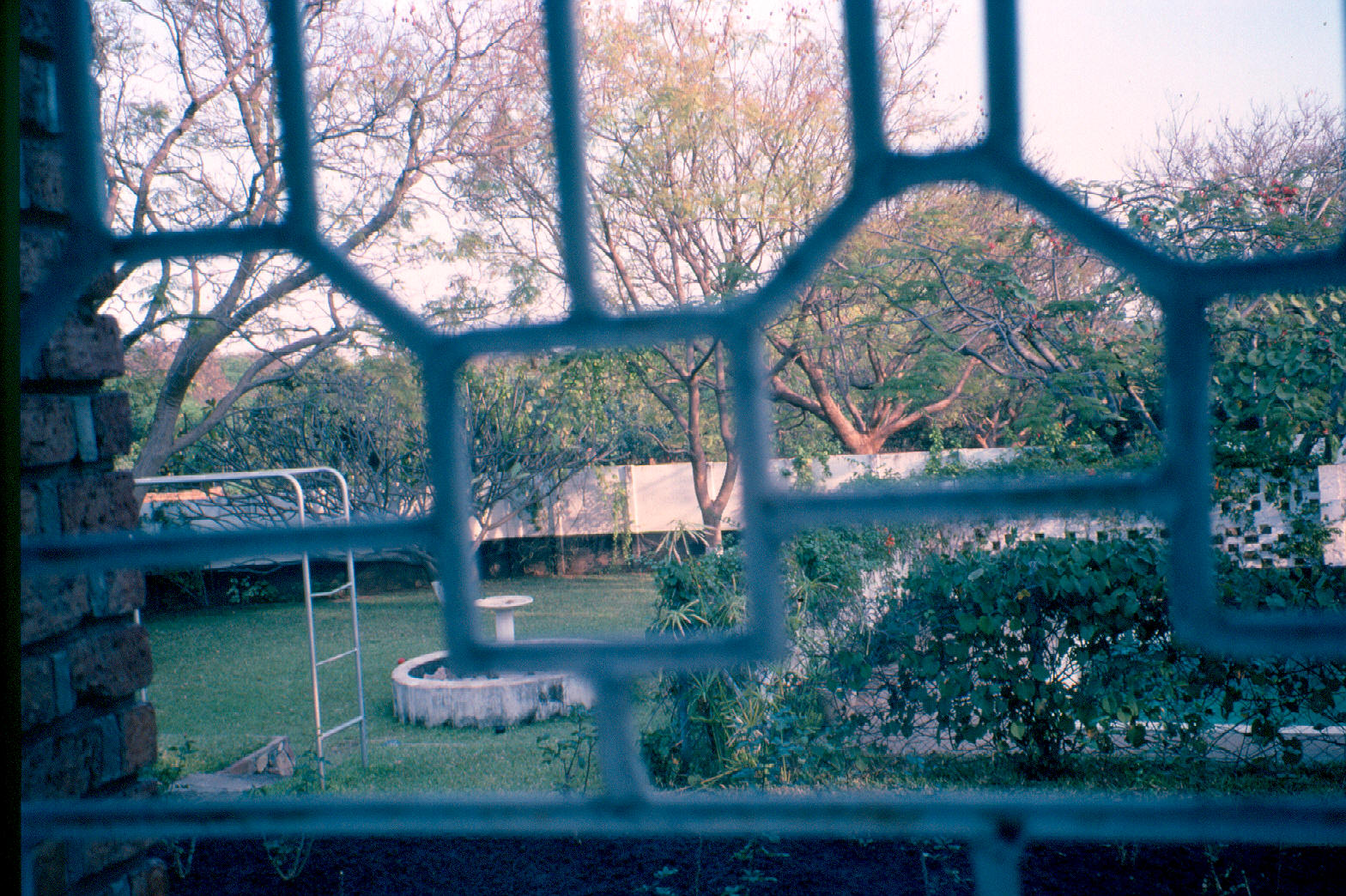
A poor picture showing the garden and the perimetral wall from one of the windows.
The house’s bedrooms were higher than the rest of the house and their windows looked down on the garden, a good vantage position to be. It also had, as repeatedly recommended, a strong “rape gate” (a rather straight but commonly used terminology to indicate the gate that isolates you and your family in the bedrooms while thieves steal your electronic stuff) fitted with two enormous padlocks housed inside steel tubing, very difficult to reach from the outside of the gate.
The house came with a caretaker called Mr. Phiri (not his real name) [2], highly recommended by Mrs. Wilson (not her real name), a former stewardess of the Union de Transports Aériens (UTA) [3], and the owner of the house.
As it was common those days, the house had a good vegetable garden that also came with a gardener called Mr. Lemek as well as an ample enclosure where we found a few hens and ducks as well as a number of rabbits housed in cages. Luckily, Mr. Lemek took care of both vegetables and animals and soon we added four Rhode Island Reds that produced lots of eggs all over our stay while the rabbit meat was mainly consumed by our house staff.
We installed “panic buttons” that, if pressed, would bring a contingent of guards that would enter the property to deal with the problem. We also recruited our own security guard, Mr. Nelson, an elderly gentleman that mostly sat in his guard house reading the Bible from his arrival at 18hs until he fell sleep, as most security guards do, until his shift was over at 6hs. There were also two resident dogs, Nero and Ginger, that we decided to keep as we were told that they were good guard dogs and they got on well with Mr. Nelson. In addition, we also were provided with a United Nations VHF radio to be used in emergencies.
Aware that security guards were usually the ones suffering injuries during armed robberies in Lusaka, we gave Mr. Nelson a whistle and instructed him to blow it if he saw something unusual and to run towards the staff houses at the back where he could seek refuge among the other people staying there, our gardener and the caretaker. Despite my objections, he insisted on keeping his catapult for which he made perfectly rounded clay balls to use as ammo.
The recommendation of getting a fire arm seemed very reasonable to us hearing of all incidents that were taking place in the city so I got a shotgun and a few cartridges that I was meant to use as a final line of defense in case the robbers attempted to break our final gate. Although I had shot partridge and hares in Uruguay during my youth, I am not a fan of firearms so, I disassembled, packed it carefully and hid it inside a trapdoor in the ceiling of our bedroom where I expected it to be for all the time we would be there.
So, we moved in although we only had very few personal effects for the reasons named in my earlier post and that took five months in arriving! It soon became clear that all we had been told about the insecurity was true and shooting was heard almost every night and we knew of several neighbours that would come out at night and shoot in the air in an effort to deter would be robbers! In addition, there was a “neighbourhood watch” formed by some neighbours accompanied by the police that would patrol the various neighbourhoods. I declined the invitation to join but, for a while, contributed financially to its operation.
Clearly Zambia was wild, and we had not yet seen the bush!
[1] Nyanja or Chewa is a Bantu language spoken in Malawi and Zambia, where it is an official language.
[2] People in Zambia were always referred as Mr. or Mrs., I believe this was due to Kaunda’s humanism emphasis on respect.
[3] UTA flew weekly to Lusaka until 1992 when it was taken over by Air France.
Luckily for me after Ethiopia FAO had a vacancy in a regional tick and tickborne disease control programme in Zambia as the former Project Manager became the coordinator of the whole programme and was moving off to Harare.
I had visited the country in the early eighties to see the work that the tick component of the FAO programme in Zambia was doing as it was similar to what I was starting in Kenya. So, I knew one of the areas where I was going to work. Luckily, I also knew George, the Director of Veterinary Services and I was aware that he was a good man and committed to the work that FAO was doing in the country. So, I did not expect a difficult start.
I would be in charge of two earlier projects that were now combined into one. These had been part of a rather large programme that, for several years, had supported the veterinary department in several aspects of animal disease control. One component was the study of the impact of tick infestation on cattle in Central Province, both weight gain and milk production while the other involved the immunization of cattle against theileriosis in Southern Province.
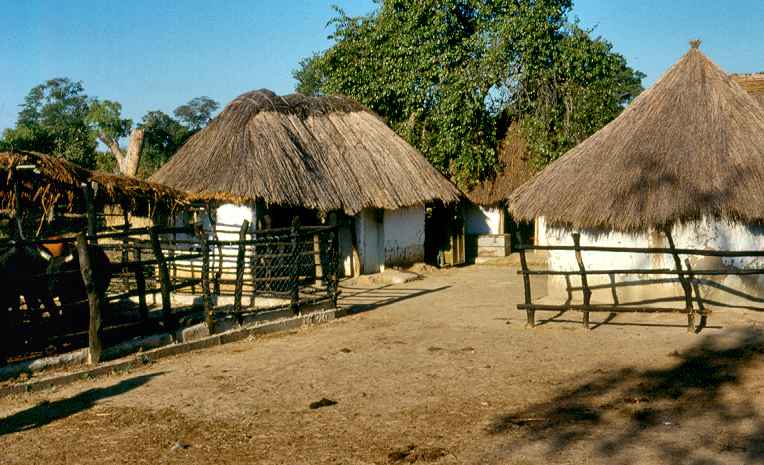
The tick project was based at Lutale, a locality near Mumbwa, a town 160 km from Lusaka, in the Central Province of Zambia, on the Great West Road that runs 590 km from Lusaka to Mongu, capital of Western Province. Originally the place was devoted to research and training on the control tsetse and trypanosomiasis but activities, although still going, had shrunk to training of medium level technical personnel, also run by FAO.
At Lutale we had an agreement with Chief Chibuluma to have our own herd of native Sanga (Bos taurus africanus) cattle that were the subjects of the study. Our job was to continue the work for about two additional years, introducing a new group of cattle to which a new “strategic” [2] tick control method would be applied, and their performance compared with undipped and dipped cattle to obtain figures on the economics of tick control under the conditions of the trial.
The project office at Lutale.
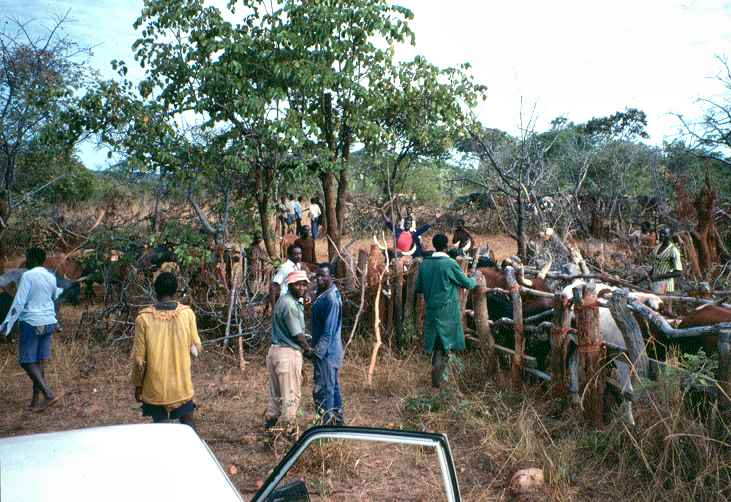
Theileriosis was endemic in Southern Province and successful immunization against this disease had been going on for several years by the earlier programme, on the lines developed by FAO in Muguga (under the leadership of my ex boss Matt). By request of the Government, FAO was tasked with the expansion of this procedure to a larger number of animals in an effort to reduce the heavy losses that were being experienced there.
Gathering cattle for immunization against theileriosis.
As I needed to commute between Lutale and Monze, a town located 196 km south from Lusaka (in Southern Province) and in the direction of Livingstone and the Victoria Falls [3], I would be based in Lusaka, more exactly at the Central Veterinary Research Institute (CVRI) located in Chilanga District, 25km southwest of Lusaka, off the Kafue road in an area known as Balmoral. As we would reside in Lusaka, that meant a daily drive through a rather rough road. I realized that it was not the ideal place to be but I was in no condition to change anything at the time, apart from getting on with the work.
It was an ambitious project that gave me the responsibility for work that had been done earlier by two specialists and I was stretched to the limit. Luckily, after discussions with FAO and the Government, I managed to persuade them that I needed help, particularly with the immunization part of the project and the post of Protozoologist was created for Southern Province. This was a relief but it would still take some time to find and recruit a suitable candidate. In addition, I applied to FAO to be allocated a couple of Associate Professional Officers [4], one for each component of the project. In the meantime and for a few months I was alone to do and/or supervise all the work.
Mabel and I arrived at Lusaka via Nairobi and stayed at Andrews Motel for a few days until we managed to find a suitable house in town. We moved there as soon as our first shipment with essential household stuff arrived, hoping that the rest of our personal effects would come from Ethiopia in a couple of weeks. So we camped at another house, again.
A view of our Lusaka house and Emmanuel, our cook,unblocking the gutters.
As usual, we were wrong estimating that our belongings would arrive soon. Well, some of them did but they were not very useful as, for example, the bed boards arrived but not the rest of the bed or the top of my desk came but not its drawers or legs! When we complained to the shipping agency they apologized profusely and promised to follow up the issue. In the meantime, we needed to buy a number of items for the house that we already had but we had no other choice.
Our first consignment of personal effects.
A couple of weeks later the shipping agency informed us that there was a problem with our shipment (oh surprise!): it had been crated in boxes larger than the door of the plane that flew between Addis and Lusaka! But they told us that they would be a larger plane coming soon and that they would place the remaining of our items on it. So it was that another part of our consignment came two weeks later and we waited for about a month for the final third with which we could finally assemble all our furniture and appliances! By that time we had succeeded in buying almost everything again!
It was during that agitated time that Mabel got pregnant so our life changed as we went through gestation to the birth of our children. As medical facilities were very basic in Lusaka, we needed to travel to Harare for periodic check-ups and the eventual birth of our first child: Florencia. Our son Julio Junior followed 15 months later so we had little time for safaris, apart from those we could accommodate with the on going work.
Searching for pictures to illustrate the Zambia posts I found that most of the ones I could find include our children so my Zambia posts would be rather poor in that respect, made even worse by not being able to move towards my picture “bank” in Harare because of the Covid 19 pandemic! So I will do with what I have and prepare a picture library for the various posts later if I find the relevant pictures. I hope that you still enjoy reading them!
[1] This was Zambia’s motto at the time to promote tourism.
[2] The application of acaricides was done according to tick infestation levels and seasonality to reduce its cost without losses.
[3] At the time, different donors operated in different areas of Zambia, the Dutch in Western Province, the Belgians in Eastern Province, etc.
[4] The Associate Professional Officer’s programme would fund young graduates through FAO with funds from a number of European countries such as The Netherlands, Denmark, Belgium, Italy, etc
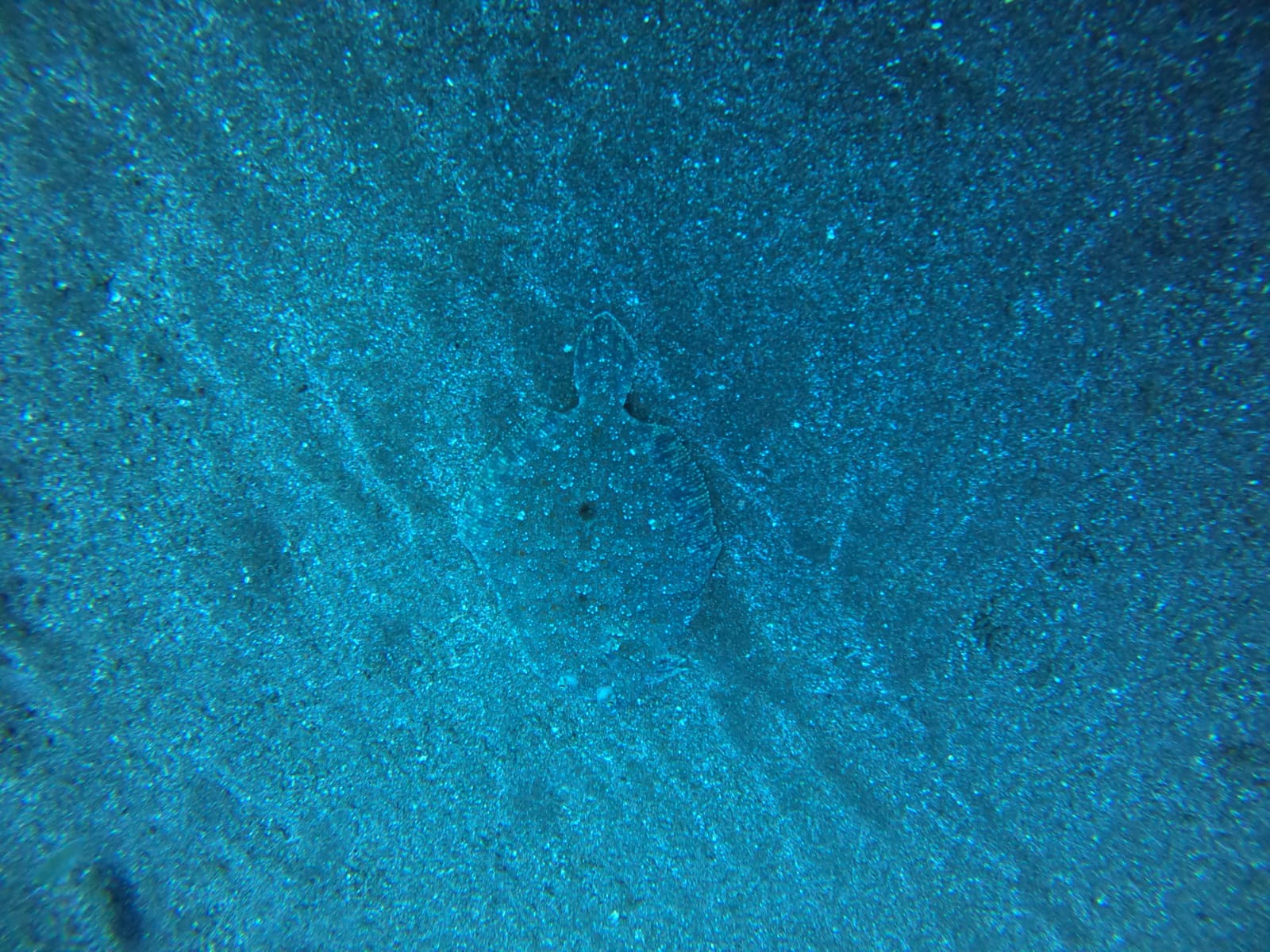
While I work on my Zambia posts, I take the opportunity to challenge you to find this beast:
? ? ? ? ? ? ? ? ? ? ? ? ? ?
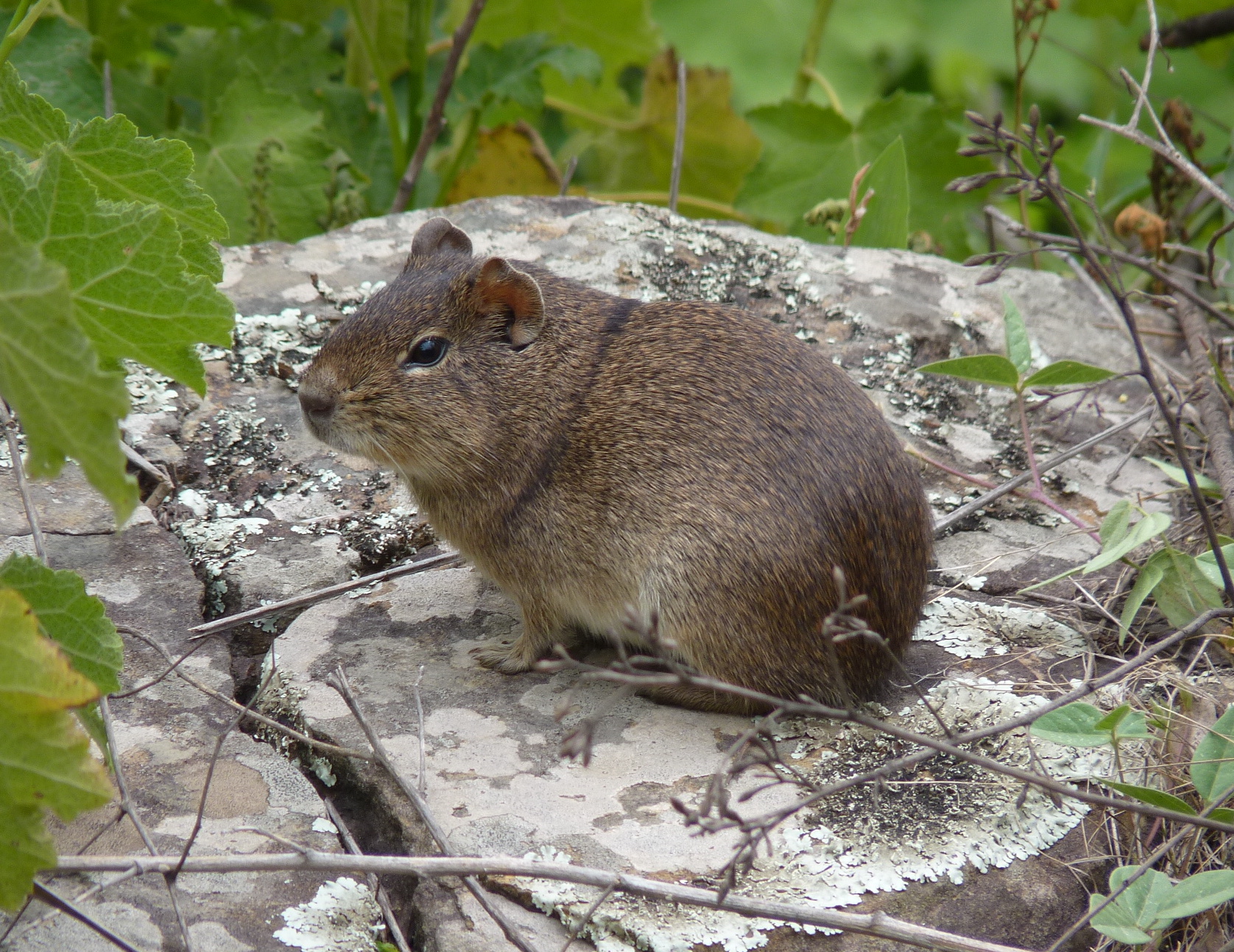
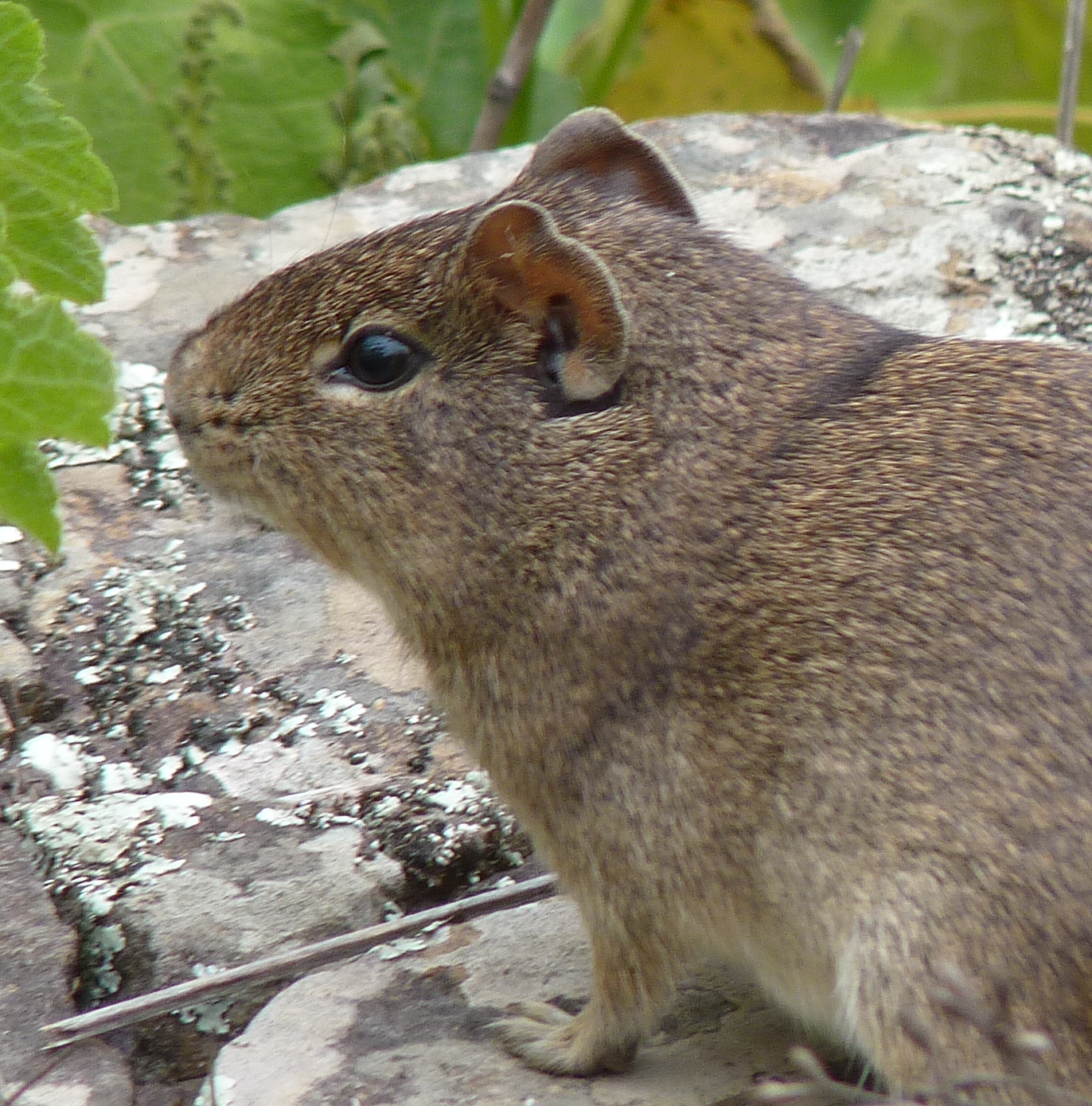
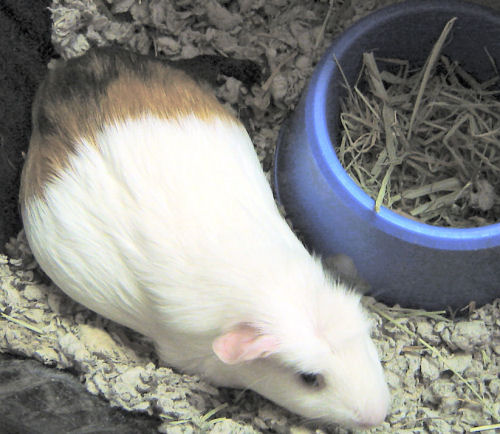
In fact, I took the picture as an excuse to present you with this small mammal, the apereá (Cavia aperea) or Brazilian guinea pig.
As you can gather, it is a relative of the well known domestic variety, the guinea pig (Cavia porcellus) a more colourful and better known around the world. Its name is confusing as it is not related to pigs and it did not come from Guinea but from the region we are now: the Andes where they are an important and sought after food item.
Credit: Photograph taken with a digital camera by Kazulanth of a pregnant guinea pig (Cavia porcellus) 1 week before delivering 3 pups. Via Wikimedia Commons.
The apereá is a diurnal and grass-eating mammal, pale grey-brown on its dorsal area and greyish-white ventrally. It is almost tailess with an adult length of about 25 to 30 cm and a top weight of about 600 g,
The apereá is found in Argentina, Brazil, Bolivia, Colombia, Ecuador, Guyana, Paraguay, Uruguay and Venezuela where it is a rather common mammal, often spotted on the roads, running away from cars, seeking shelter in their thick superficial grass burrows. They breed throughout the year and females can have up to five litters of one to five young each time.
I thought that my earlier post on Ethiopia was the last but I was wrong.
Something that happened two days ago at our farm in Salta reminded me of an incident at Bedele worth mentioning and that somehow seeped through the cracks of my memory (oh surprise!).
While de-weeding one of the fields I saw a swarm of immature locusts. These were nymphs of the soldier locusts (Chromacris speciosa), unmistakable with the shiny black and red markings. They are widely distributed in Brazil and Northern and Central Argentina.
Nymphs of Chromacris speciosa, rather striking insects.Adult of Chromacris speciosa.
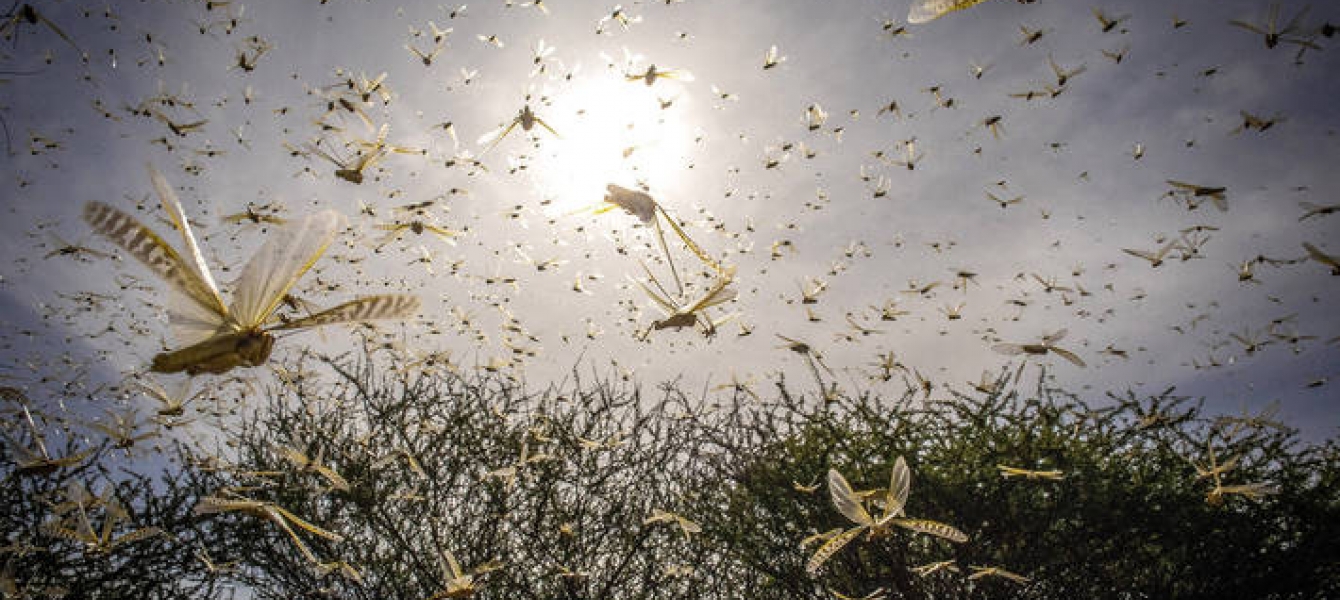
The first memory that came to mind was of my father, an Agronomist in charge of pest control in Uruguay, who told me about locusts for the first time. He described the enormous clouds that would obscure the sun and that his Jeep (Willys) would skid on the mass of insects and needed to engage 4WD to be able to move!
Then I remembered the day in Bedele when, although it dawned with a clear sky, suddenly, as it happens during the sun eclipses, light faded for no apparent reason. This lasted for a few minutes until the locust swarm arrived and landed on us! They covered the ground and landed on trees stressing branches to the point of breaking. Most of the green matter available was consumed within hours and they moved on as a wave, leaving scorched earth behind.
The invasion only lasted for a couple of days until they moved off. During this time we were the target of a very unpleasant experience when, without warning they would land on your back and prick you with their spiny legs!
We were suffering the impact of a periodic swarm of the desert locust (Schistocerca gregaria), found mainly in Africa. Interestingly, this insect can change its body in response to changes in the environment. Although this takes several generations, a solitary, shorter-winged (non-migratory form) can turn into a social locust that, because of being long-winged can travel really long distances in search of food.
When this happens, they can cause severe and extensive damage to food crops and fodder as a classic swarm can be as numerous as 150 million individuals, capable of covering hundreds of km in one day when on the go. Because of their transboundary nature, its spread must be monitored in various countries to control them while they are still not able to fly, usually in dry areas. This activity requires collaboration between countries through specialized bodies such as FAO and the Desert Locust Control Organization for Eastern Africa (DLCO-EA).
Finally, the rather nice grasshoppers we get in our gardens in Zimbabwe, known as Green Milkweed Locust or African Bush Grasshopper (Phymateus viridipes), are also capable of long migrations but they are not a pest although, to our annoyance, they are capable of eating our flowering plants.
As all things come to an end, the same happened with our stay at Bedele. Although we completed the study despite the difficulties we faced, as expected, the UNDP would not release further funding to expand the activities countrywide as we proposed. However, we managed to get some funding from the Danish International Development Agency (DANIDA) to continue the search for theileriosis in refugee cattle. This did not include international personnel, so I was no longer employed and I needed another job somewhere else. We will see about that later.
Although I have described a number of events that merited a separate description, there were a few others that, although minor, I believe are worth revealing. I will end this post with details of our departure from Ethiopia in December 1989, hence the title.
I have mentioned earlier that it rained lots at Bedele and that its dirt roads became a quagmire at that time to the point that to reach the butchery we needed to engage 4WD! Hygiene was not an issue in the place as, before you could get to the open window behind which the dark meat was hanged, you needed to tread carefully to avoid the cow bits and pieces that were strewn around the adjacent field as I have already described. However, there was a time when we did not need to make this journey.
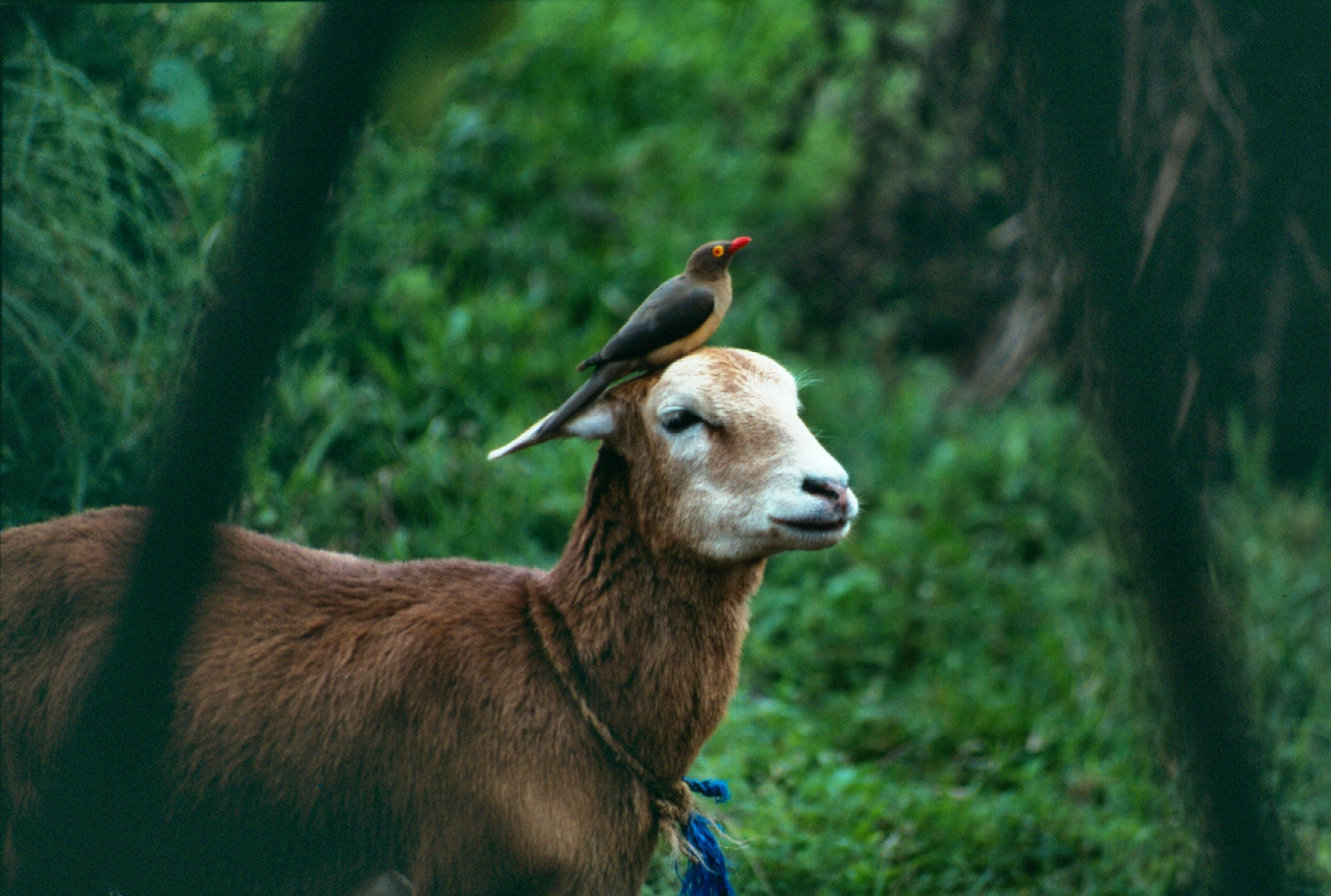
Sheep and red-billed oxpecker walking through the laboratory compound.
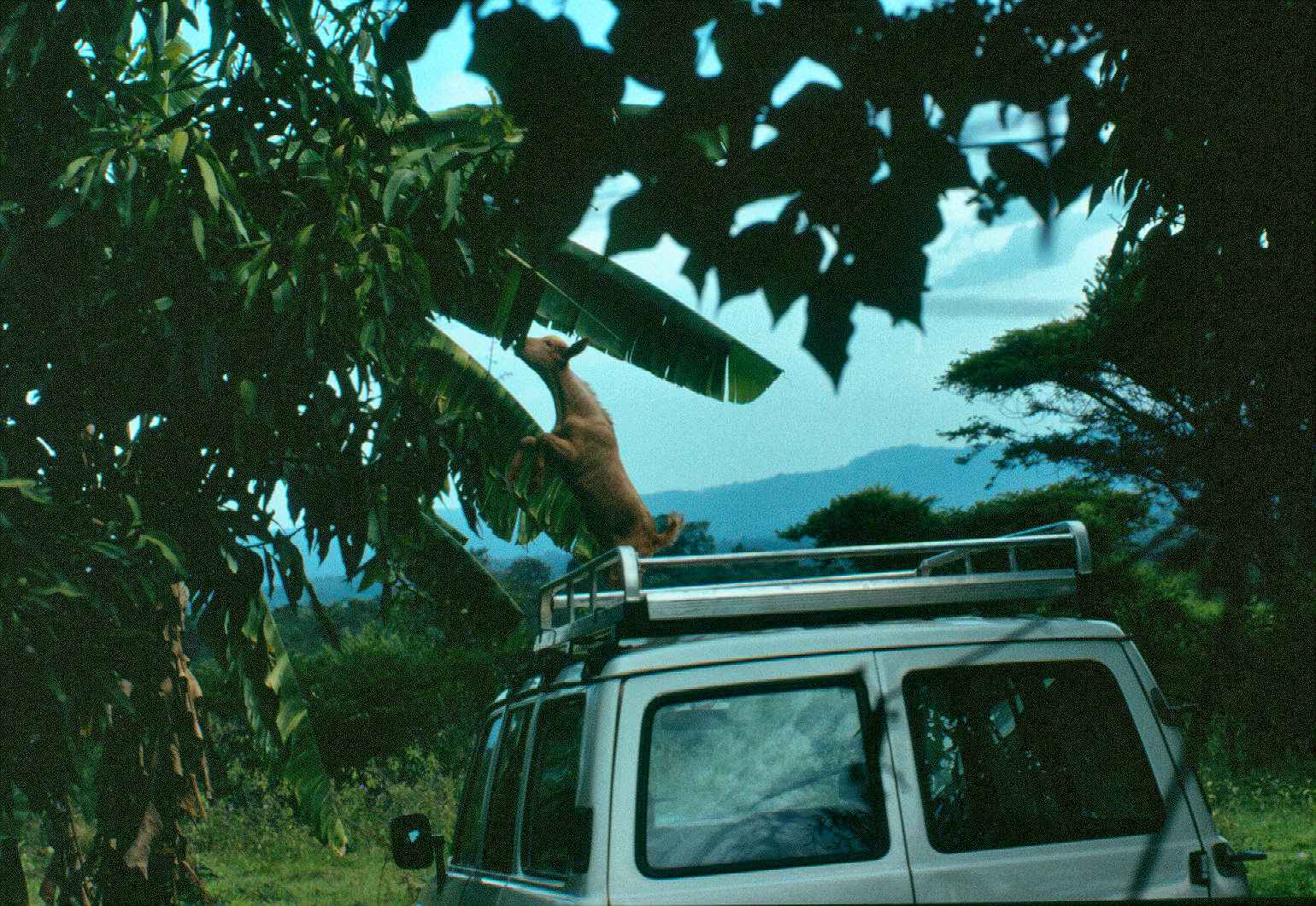
Livestock grazed everyday inside our laboratory enclosure as the front gate was always open. The animals often walked between our houses and a clever goat used to climb on one of our project cars to get to the bananas that grew across the road from our house. I remember that I made the mistake of chasing it off and the brute jumped from the roof to the bonnet and left a nice dent that remained for posterity!
The clever goat browsing on bananas before it jumped!
A day that was bucketing down I was returning to our house after negotiating for fuel for the next study trip with the political authorities, not an easy job. I entered our compound and saw a herd of sheep and goats lying down on the road, resisting the heavy downpour as well as their woolly coats allowed. I reduced my speed to the minimum to allow them to move off as one usually does in these occasions.
That day maybe this sheep was sleep or the bad visibility affected both of us. Whatever the reason(s) I noted that the left front wheel suddenly went over a bump. Fearing the worst, after it came down, I stopped and got out of the car to investigate. I had indeed driven over the head of the sheep killing it instantly, a most unfortunate incident! Before a minute had passed the upset owner came and started talking to me in Oromo language that I did not understand but it was clear that he was demanding compensation for his loss.
I tried to explain that it was an unfortunate accident caused by his animals parking in the middle of the road but I could see that we were not getting anywhere! Luckily, one of the laboratory workers was also returning on foot and I asked him to interpret what he was saying. As expected, the herder was demanding a very high price for his sheep and, to stop getting soaked, I offered to buy a “new” sheep the next day as compensation. He would not have it so, the discussion continued and it was only after a few offers and counter offers that we reached a reasonable settlement as I was considered the guilty party.
After getting the money, the owner picked up the sheep and started to move off with it. Seeing this, through my interpreter I told him that I had paid for it and that it was now my dead sheep! He abandoned his attempt so I collected my forced purchase and, after giving a lift to the accidental interpreter, I arrived home, wet and with a dead sheep that I proceeded to skin and quarter, still under the relentless rain.
Slaughtering the unfortunate sheep under the rain.
While I was working on the sheep I could not help recalling that in the past in some areas of Ethiopia people would cut chunks of beef to eat from their live animals, a rather dreadful procedure, that I believe I learnt while reading the late Richard Pankhurst’s book “Ethiopia Engraved”, a beautiful work by the main historian of the country.
Unfortunately, the sheep was a fit animal, used to long distance running and rather thin and tough. For a few days we consumed expensive meat but its ex owner (that still grazed the animals inside the compound) greeted me warmly!
Mabel’s garden included most of the common vegetables that, because of the combination of good temperature and abundant rain grew at an astonishing rate. Unfortunately, the garden was a temptation that a few animals could not resist.
We kept lots of insects at bay by home-made control methods such as planting marigolds around the garden, spraying with water and pepper and others, but these would do nothing to deter the monkeys.
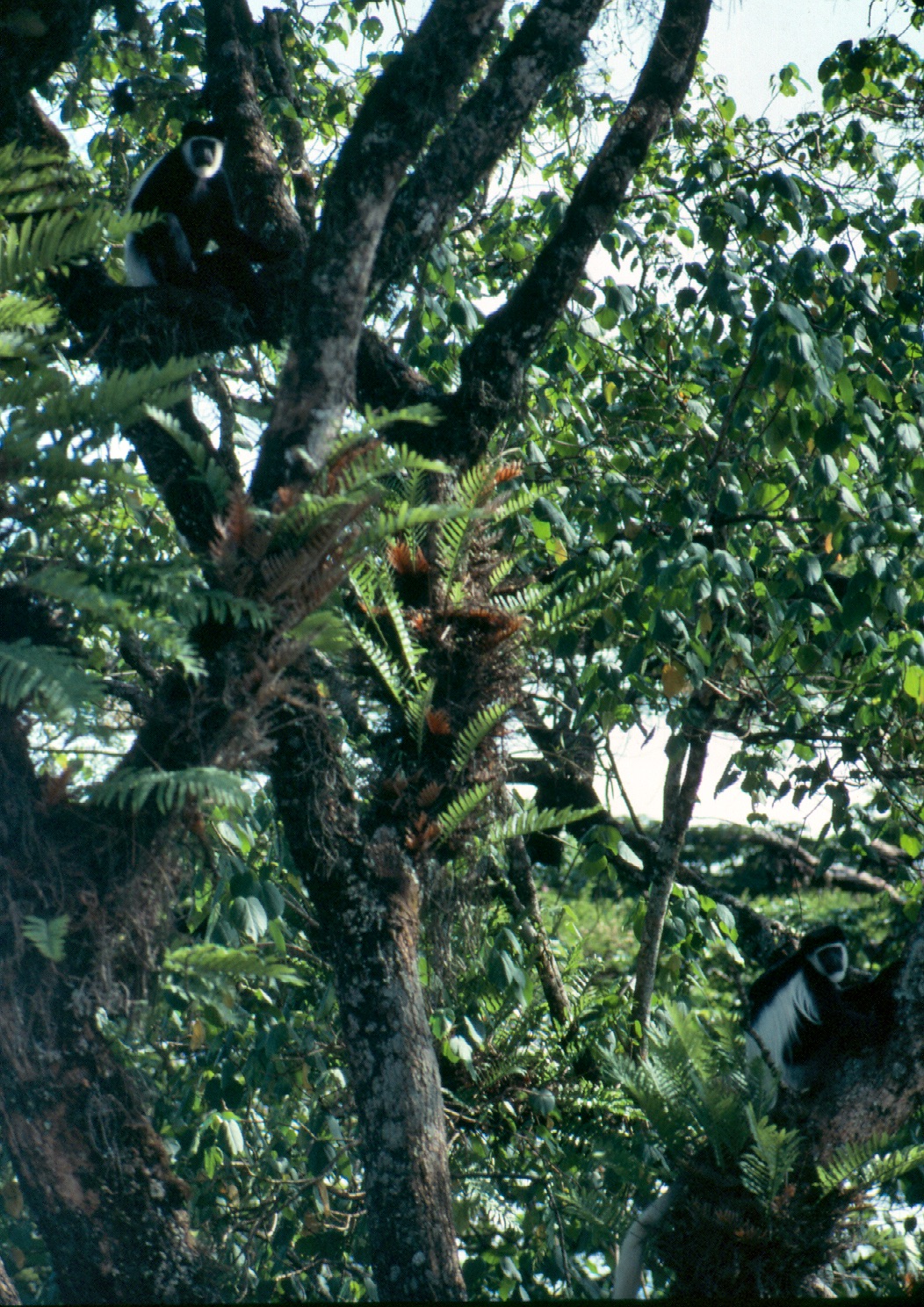
Although the lovely black and white colobus just watched enjoying their tree leaves diet, the grivets were always lurking somewhere close to jump at the opportunity to snatch a tomato or uproot a carrot. This was a challenge that, after a while, was cleverly resolved by Mabel by sharing the produce of the garden with our neighbours who assisted gratefully in chasing the monkeys away!
Although we produced vegetables, fruits were a different story. Although we had banana and mango trees in the compound, the monkeys would always get at them before us and we could only get them at the Bedele market on Saturdays. Something of a breakthrough was the discovery that cooked green mangoes were a great substitute for apples and from then on, we collected them green, before the monkeys, boiled them and froze them to be used as filling for pies. Mabel’s green mango strudel became well known in the compound!
Although at home we could “control” what we ate, the situation was different when traveling or when invited to a restaurant by our Ethiopian colleagues as the food needed some getting used to because it was rather different from what we were used to. I can only remember eating out at only one place in Bedele and this was only on special occasions. It was a family house with red velvet-like armchairs surrounding a low table where the food was served.
A very popular dish in Ethiopia is Doro Wat, chicken stewed with plenty of chilli and one egg. In Bedele the chicken (too rare and expensive) was replaced by mutton, but most of the time the egg stayed. This was known as “Doro Fänta” that meant “instead of chicken”! The latter is what we mostly ate. [1]
Attempts at changing our eating place were not successful and I cannot forget one particular eating house we went where we were offered the usual Doro Fänta but, when we asked to see the cooking, we were confronted with a pot where among the boiling bit and pieces of mutton, there were a couple of eyes coming now and then to the surface! We moved on and ended up in the place of the red velvet armchairs.
I mentioned that we bought honey from a farmer near Bedele. What I forgot was that the first time we went to purchase honey (that eventually came inside a sewn goat skin) we were invited to taste the product before purchasing it. We sat with the farmer around a polished concave stool where the honey was poured for us to taste it. It looked and tasted very good, except for the white grubs that were in it and that we were offered as a delicacy! I must confess that I thanked the farmer profusely but refused to eat them while Mabel, being a beekeeper herself, tasted a few and declared that they had a rather pleasant “nutty flavour”. Luckily, at least for me, the goat held enough honey to last us for a long while and we did not need to visit the farmer very often.
Driving from Addis to Bedele, the revolution propaganda weakened as the distance from the former increased. The arches that spanned the road were hefty and colourful near Addis and Marx, Engels and Mengistu depicted in them with the ubiquitous AK47s and revolutionary slogans written in Amharic. After Jimma, the propaganda disappeared almost completely except at the entrance/exit from the major towns. In Gambela, I only saw one rather insignificant sign by the road leading to the hotel that said: “We move forward with the revolution”.
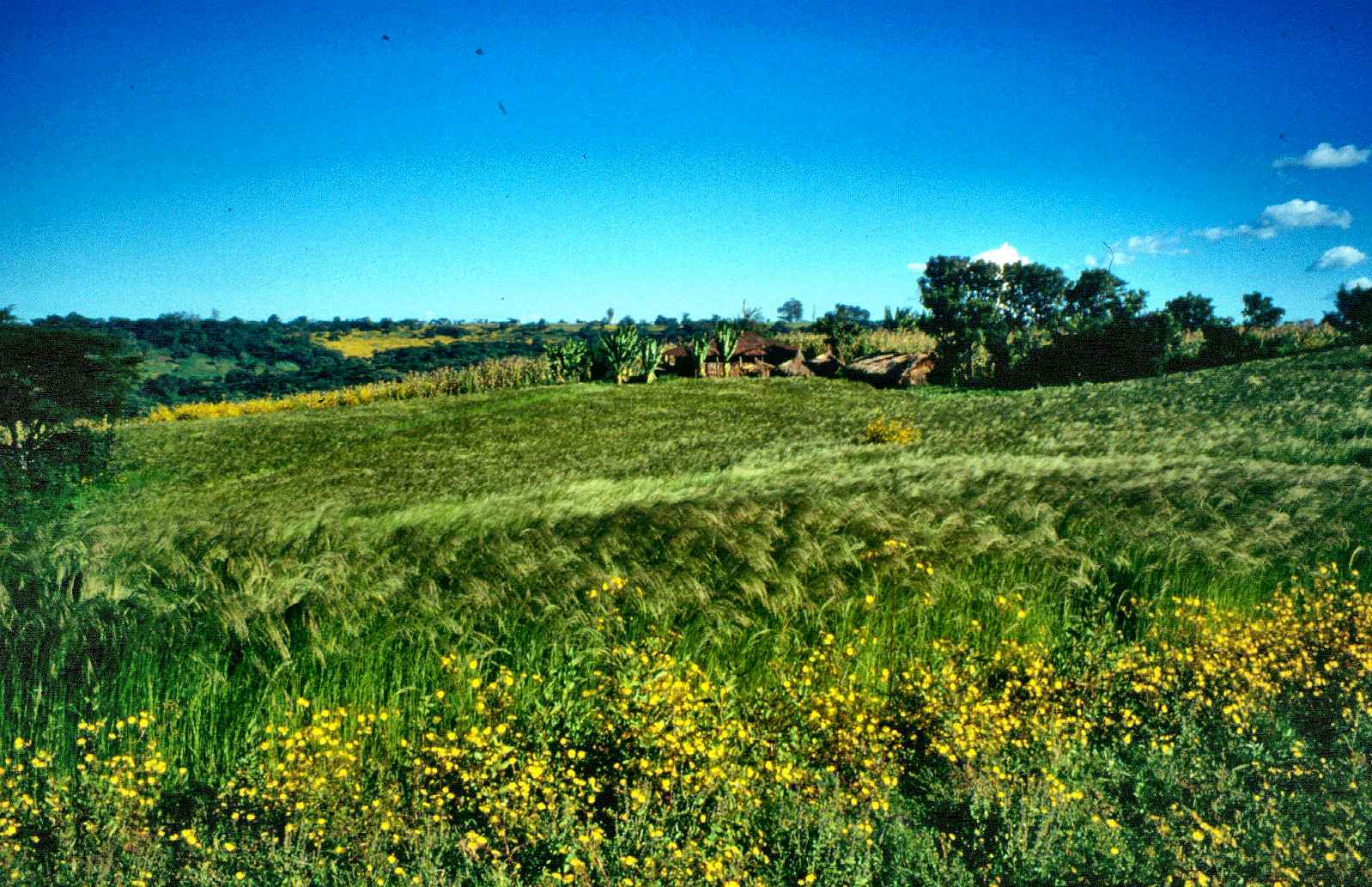
Apart from the rather newly installed revolutionary signs, we could not fail to notice the existence of the abundant yellow Meskel flowers (Bidens macroptera) that were very abundant along the road and had been there since time immemorial. These flowers, known as Adey Abeba, bloom in September, after the rains. Their appearance coincides with the Meskel festival, one of the main Ethiopian festivals, that takes place on 27th September and commemorates the finding of the true cross. The festival, celebrated with abundant food and drink, has been going for over 1600 years.
Meskel flowers surround teff fields on the way to Addis.
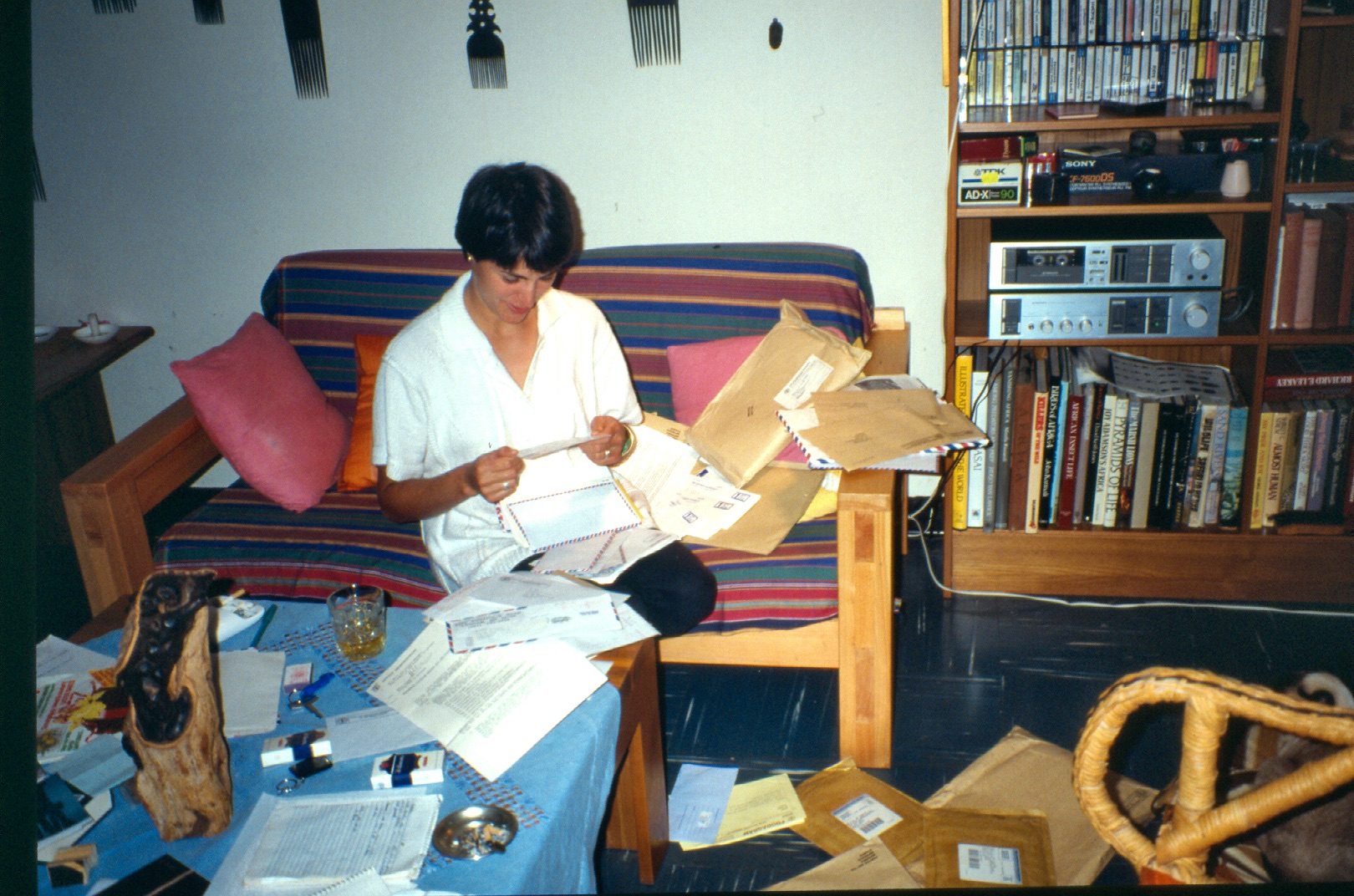
Life in Bedele was rather quiet but there were a few good moments. One of the highlights was the arrival of the mail from Addis that was brought to the laboratory by anyone traveling there. Apart from the shortwave radio tuned to the BBC World Service, this was our lifeline with the world and to open the mail was always a treat as we got news from home as well as books and developed films, to name a few items.
A great moment. Mabel opening the mail.
One day, while opening our letters I hatched a plan for a Christmas joke to our neighbour Jan. While he was in one of his extended bush stays I needed to go to Addis and be back just before Christmas. I knew that he would be alone as his wife was in The Netherlands and the idea was to lighten his time in Bedele.
When in Addis, we did our shopping and I took the opportunity to buy a few items for my plan such as Christmas crackers from the Victory duty free shop, chocolates and other usual Christmas presents, including stockings and nougat as well as a suitable box, the right wrapping papers and ribbons. Once back in Bedele I prepared a parcel where I put all these goodies and addressed it to Jan as if it had come by the FAO’s pouch. I put our organization’s Director General as the sender and I faked an appropriate card to add credibility to a most unbelievable and silly joke!
I now needed to wait for Jan to get back to hand him the parcel at Christmas. I waited for Christmas Eve when I knew he would be missing his wife to hand over to him all the genuine correspondence I had brought to him from Addis as well as my fake parcel, thinking that he would immediately discover the ruse. When the time came, rather naively, he showed surprise when saw the parcel, and he proceeded to open it. He was as delighted as incredulous that our Director General had remembered the loyal field staff and equally happy to receive the goodies that the parcel contained. He asked me, of course, if I also got one and I replied “yes, of course”. I could not believe that he had taken my joke seriously and, later on, it took some talking to convince him that it was just an innocent joke to brighten his Christmas!
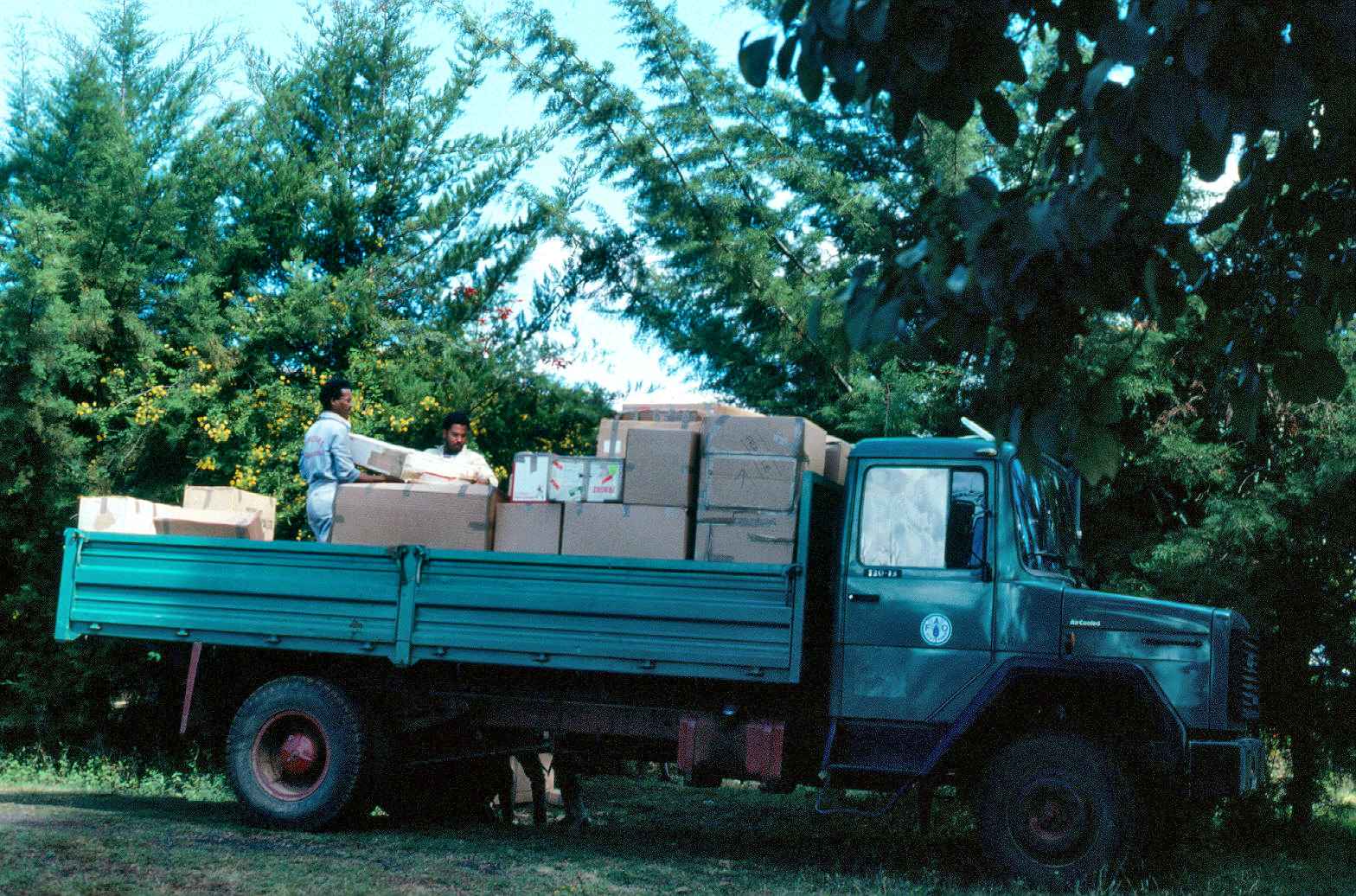
As our departure became imminent, a number of activities took place. Again, a lorry came to collect our personal effects and we remained for about a week only with the basic stuff (most borrowed from the laboratory and/or neighbours) and the two cats. During that time the arrangement for our farewell “celebrations” started.
Our belongings being loaded.
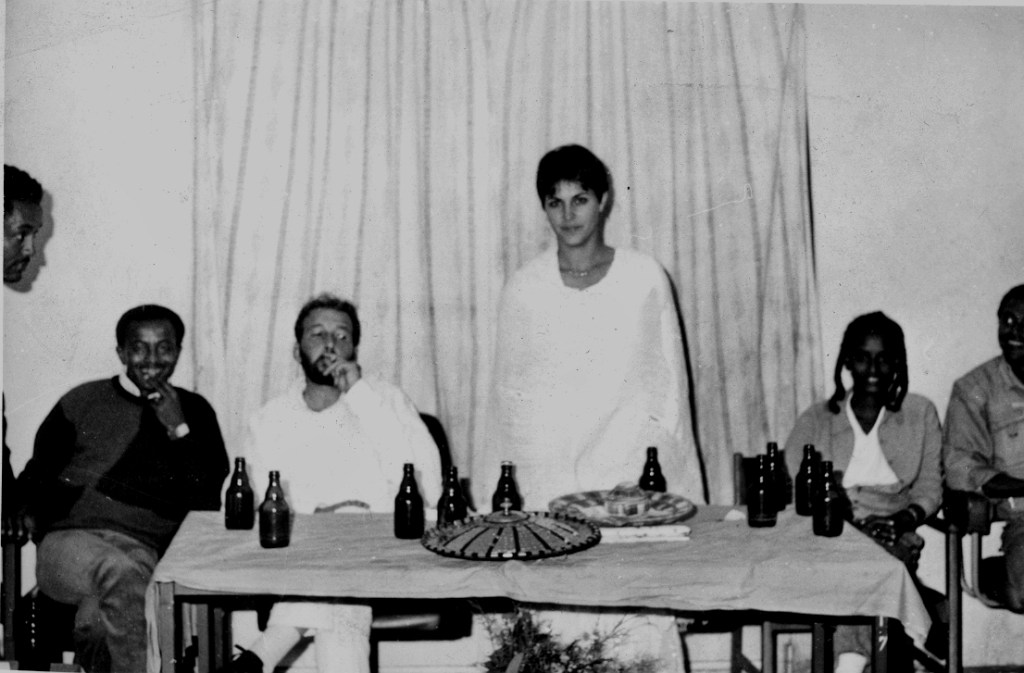
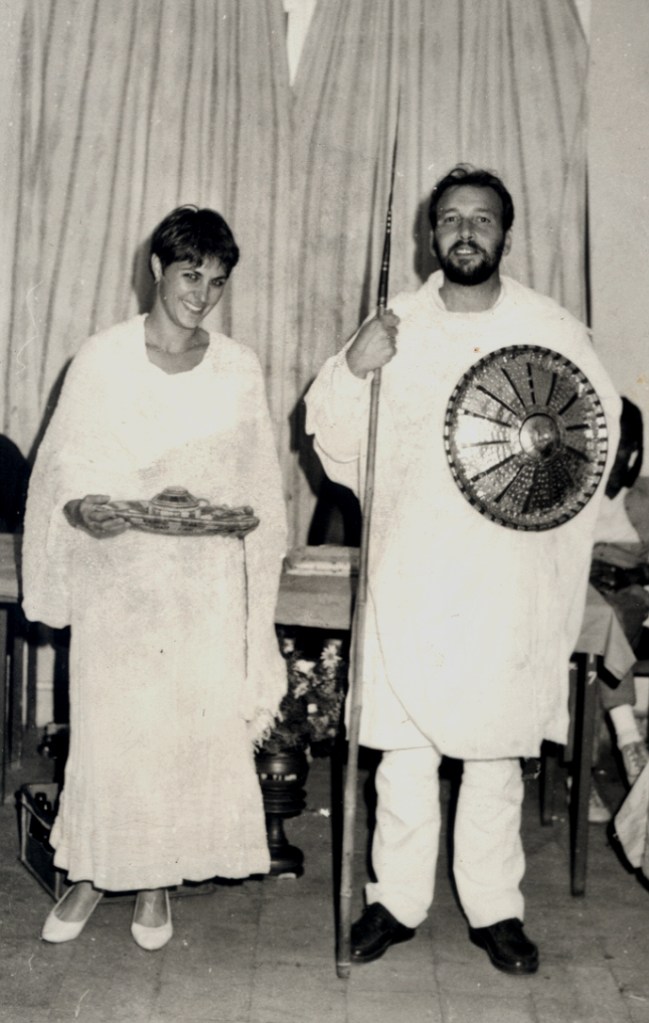
We were taken almost daily to the Bedele tailor where our measurements were taken so that our “ceremonial” garments could be made so that we would be sent off properly. The latter were fortunately ready for the day of the farewell ceremony and we were both dressed for the occasion in the Ethiopian traditional clothing.
Listening to speeches.
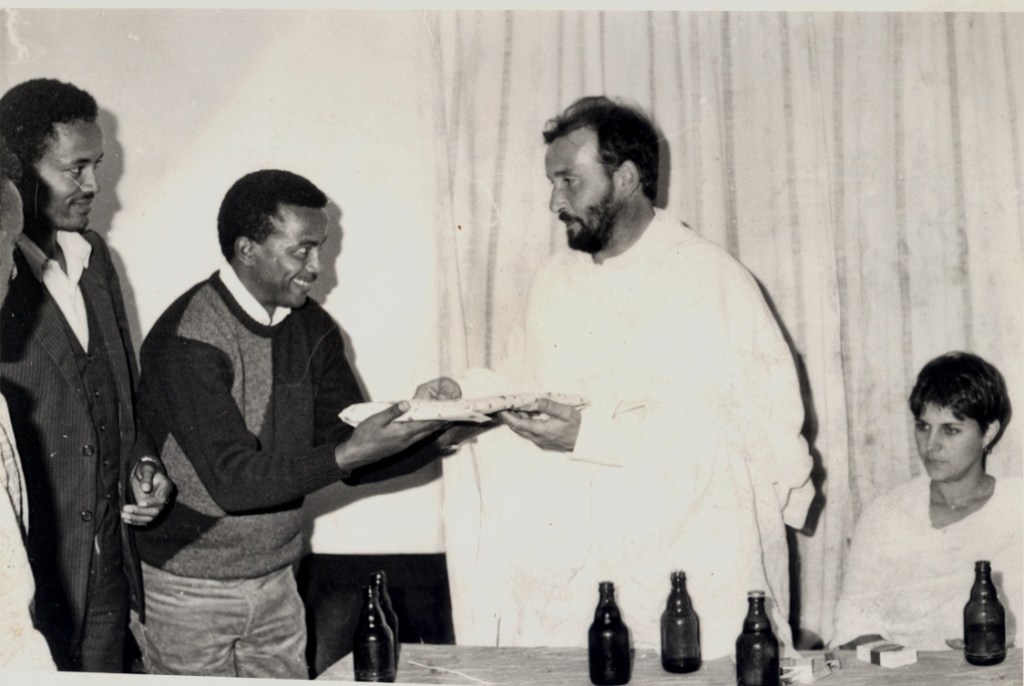
Getting official presents.
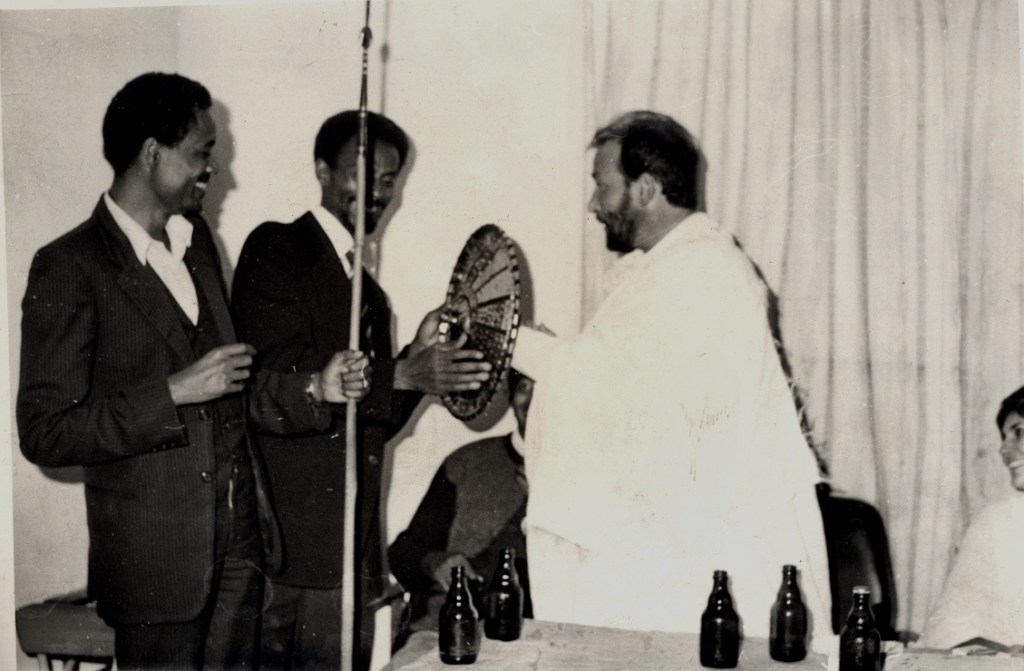
Being assembled as an Ethiopian warrior.
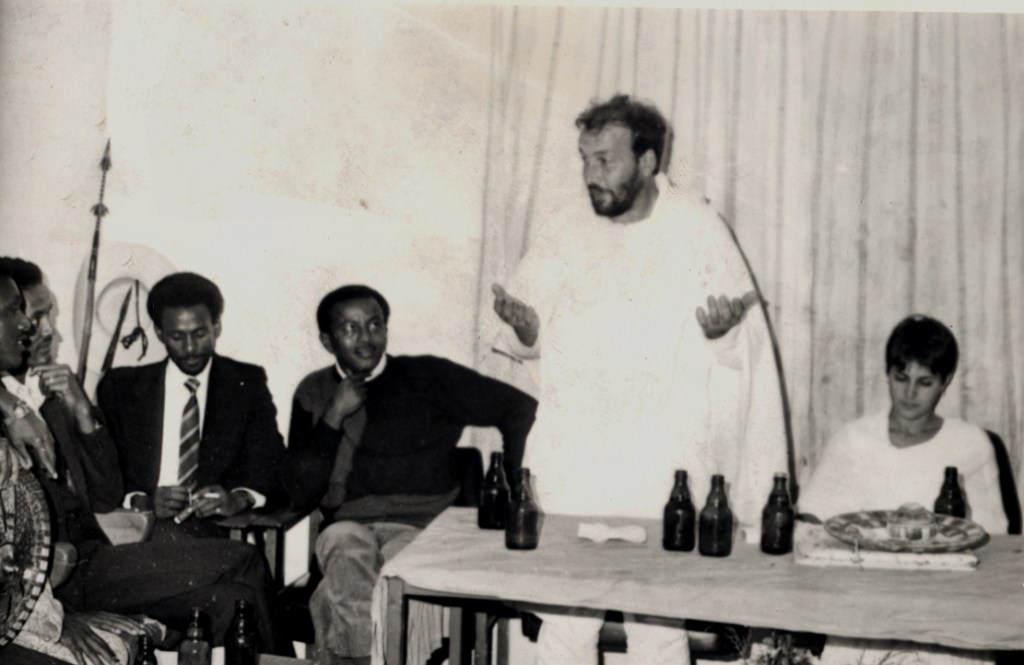
My official farewell speech.
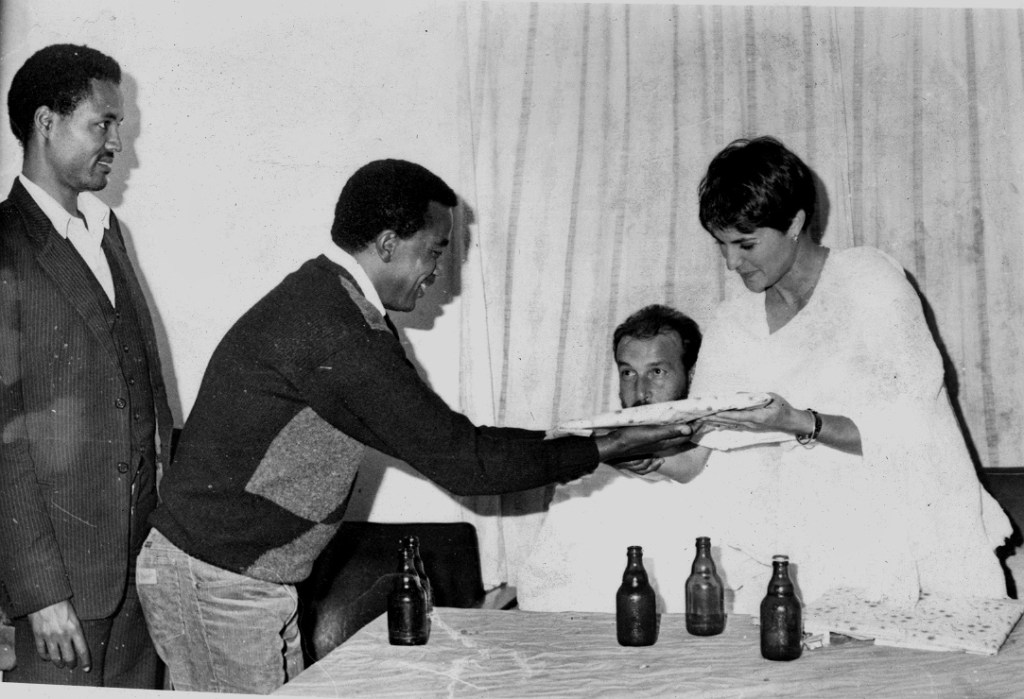
Presents for Mabel.
Mabel’s speech.
In traditional dress.
The official ceremony was a rather formal affair where speeches were given by the Director of the laboratory and project colleagues to which we both replied, mainly thanking them all for our time spent there. Then we exchanged presents and we had a traditional lunch. Things were going well up to this point but then the much feared dancing was announced!
I must say that we were (and still are) not dancers, not even tango! Even if we would have been, it would not had helped us much when confronted with the Eskista. Wikipedia [2] defines it as “… a traditional Ethiopian Amhara cultural dance performed by both men and women even children, that is known for its unique emphasis on intense shoulder movement. The dance is characterized by rolling the shoulder blades, bouncing the shoulders, and jilting the chest… The complex nature of Eskista makes it one of the most highly technical forms of traditional dance”.
A short video to show the movements involved in the Eskista dance.
We had failed at dancing Eskista a few times earlier and we knew we could not do it but we gave it our best try nevertheless, but still without any improvement. Luckily, soon enough, other colleagues that new what to do joined in and we managed to hide within the shaking crowd and, in this way, saved our joints from collapse.
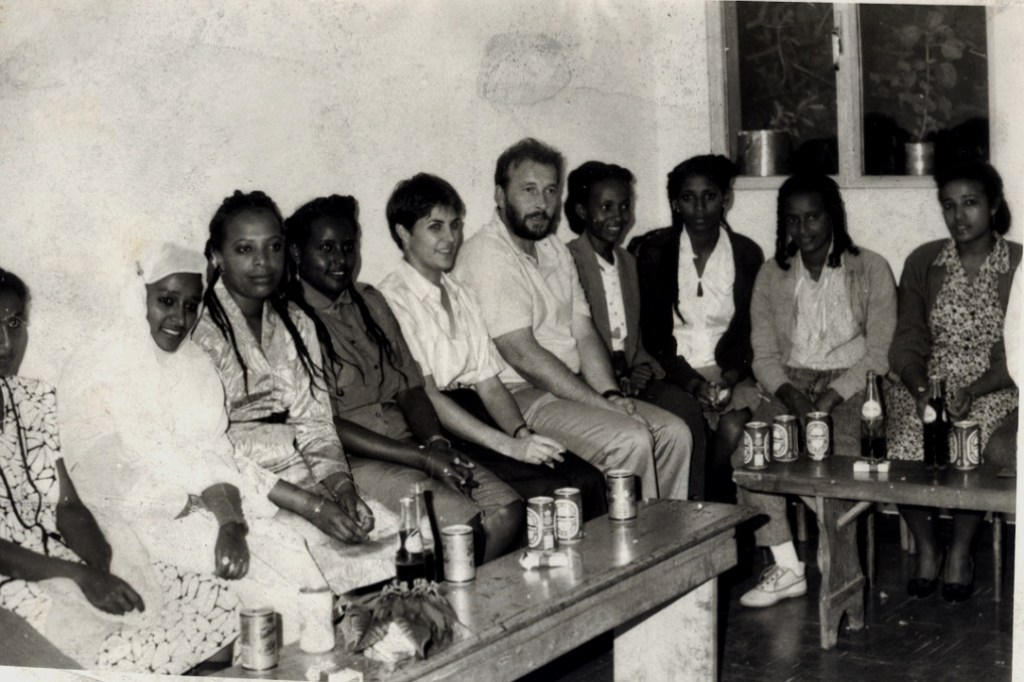
After such a nice but demanding party we rested while organizing our own farewell party at our now empty house to take place a couple of days later, the day before departure. We invited everybody in the laboratory. A few invitees from outside the campus were also included, the Director of the Bedele clinic, the political administrator and the recently arrived Czech engineer that was building the beer factory (that today makes the Bedele beer).
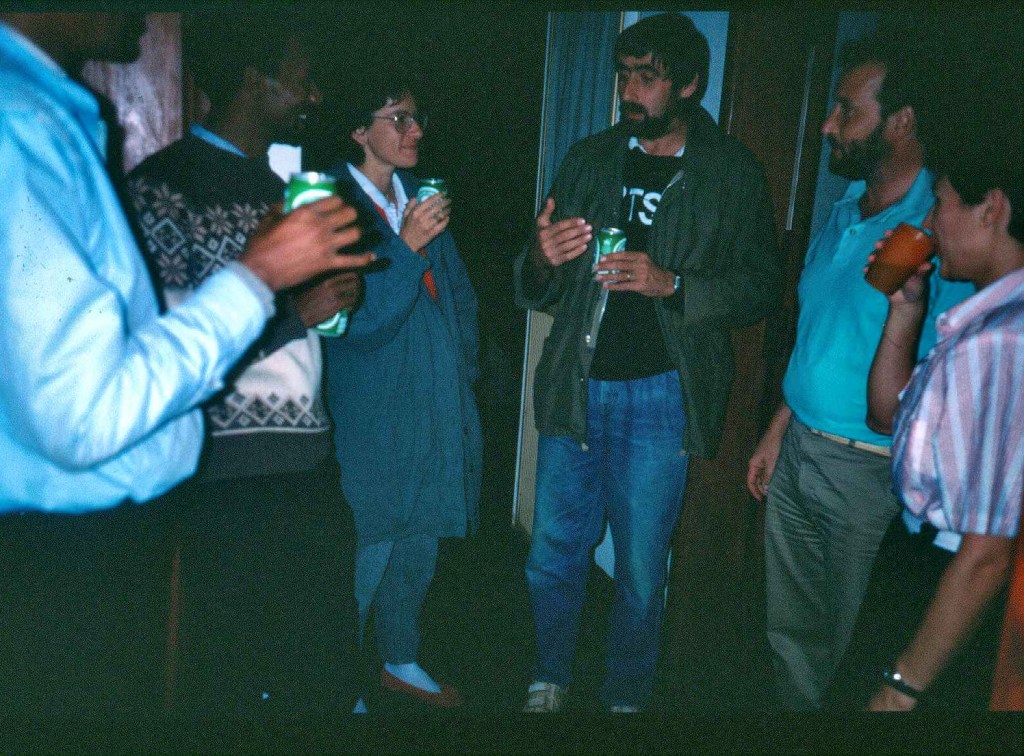
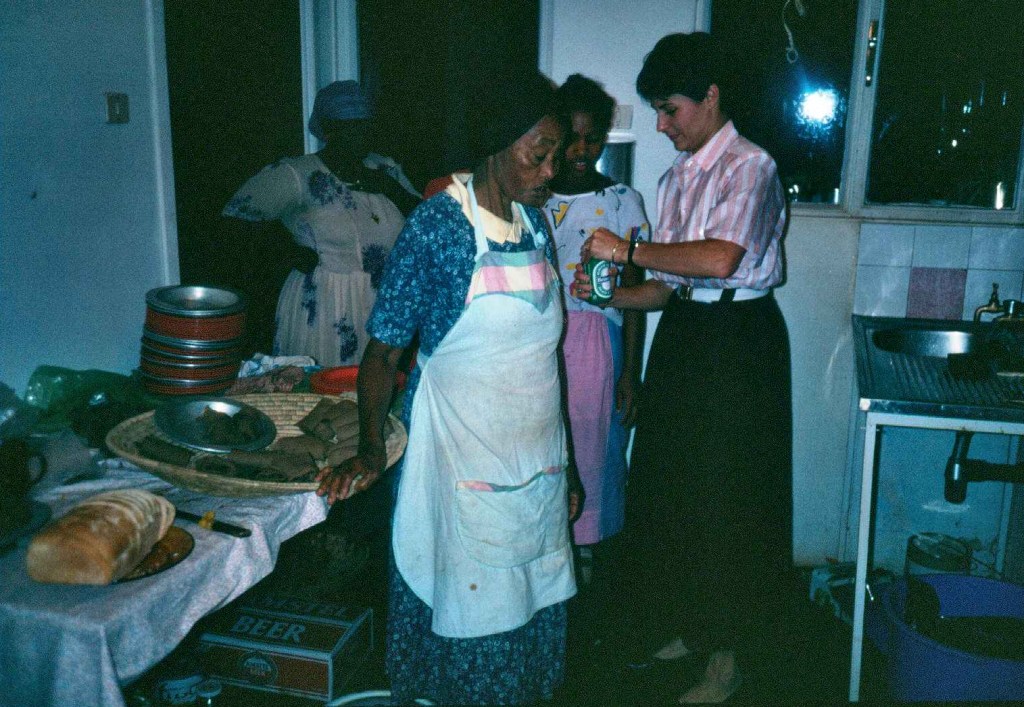
We calculated that we would have about sixty people attending so we borrowed most of the needed items from the laboratory, including plates, glasses and cutlery. We also managed to get tables but there were not enough chairs, so we got the long benches used for the Wednesday political meetings! We arranged them against the wall where we were to accommodate most of our guests. The ladies took care of the cooking and a few close colleagues and I organized the drinks that mainly consisted of soft drinks and beer.
The original seating arrangement for the home party.
The start of the home party.
Our Czech guests being welcomed.
A busy kitchen!
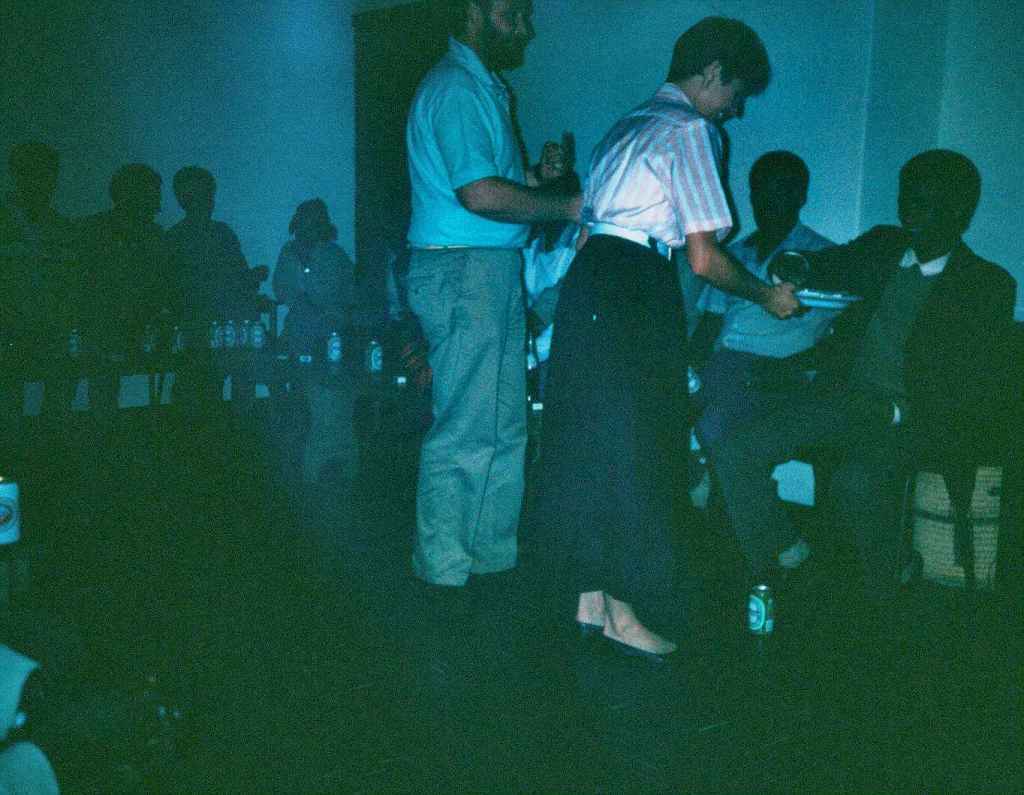
Serving our guests.
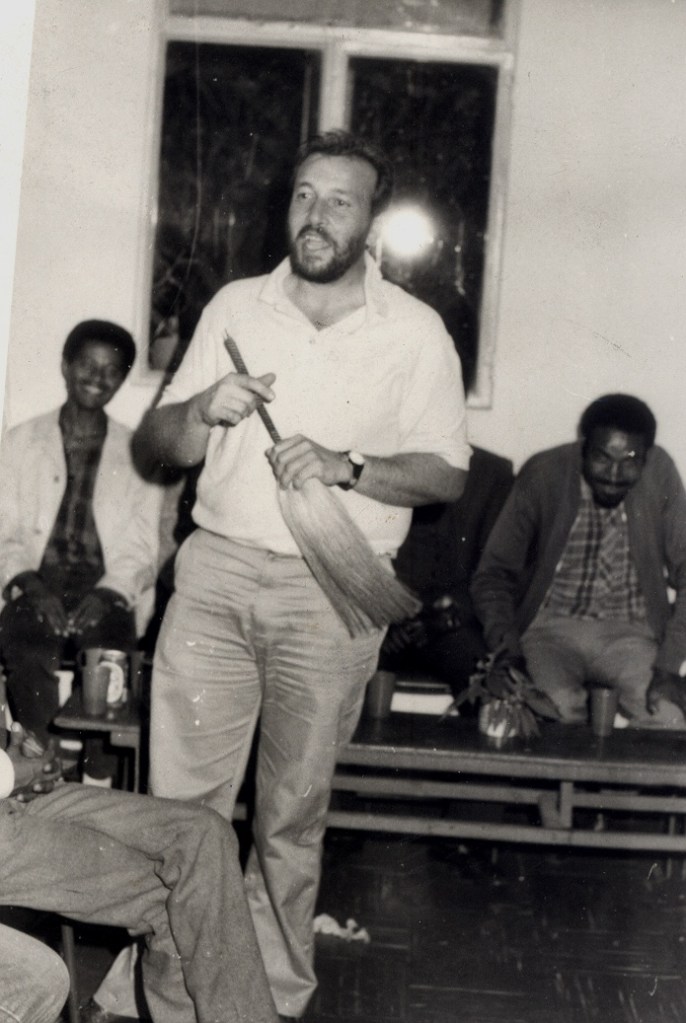
Being given a fly wisk.
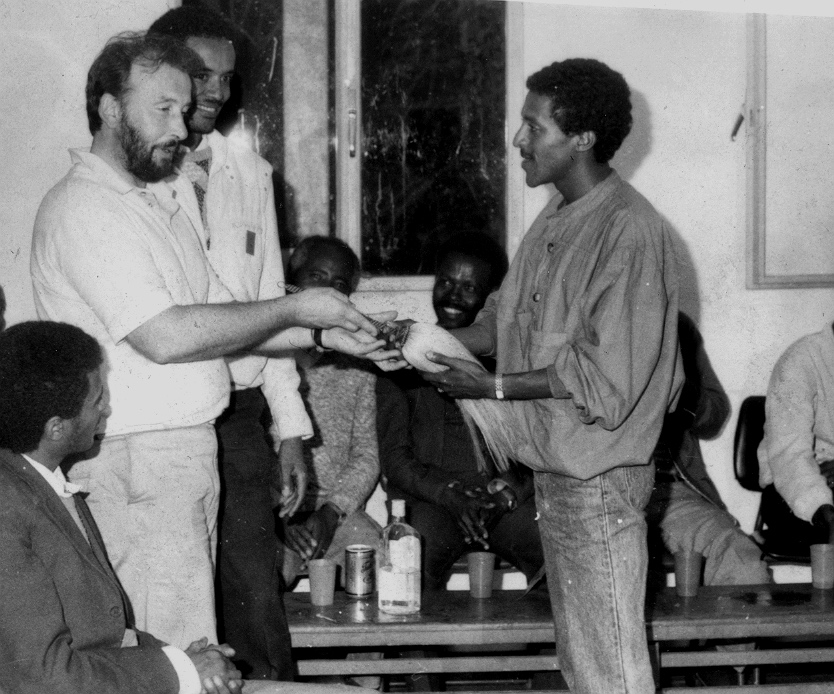
Thanking for the presents with my fly whisk.
The food is ready.
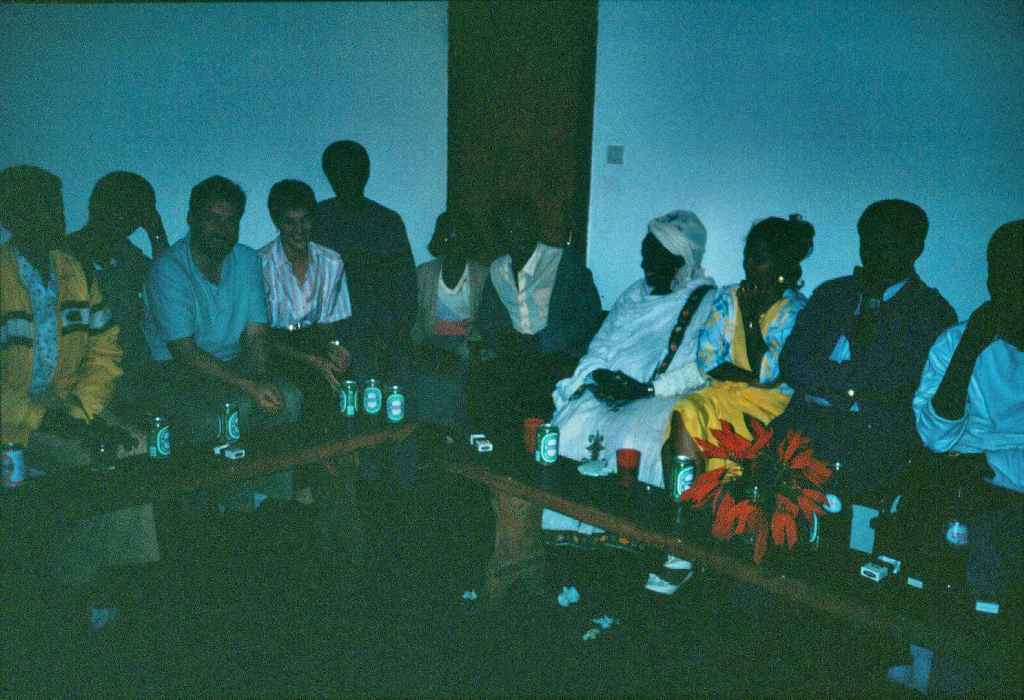
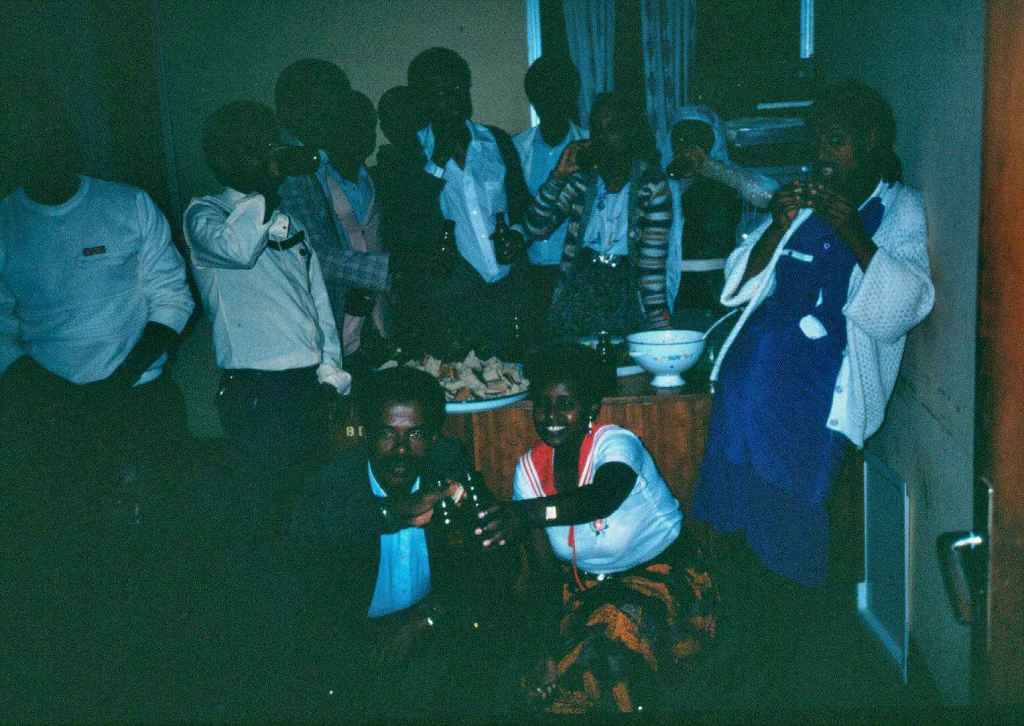
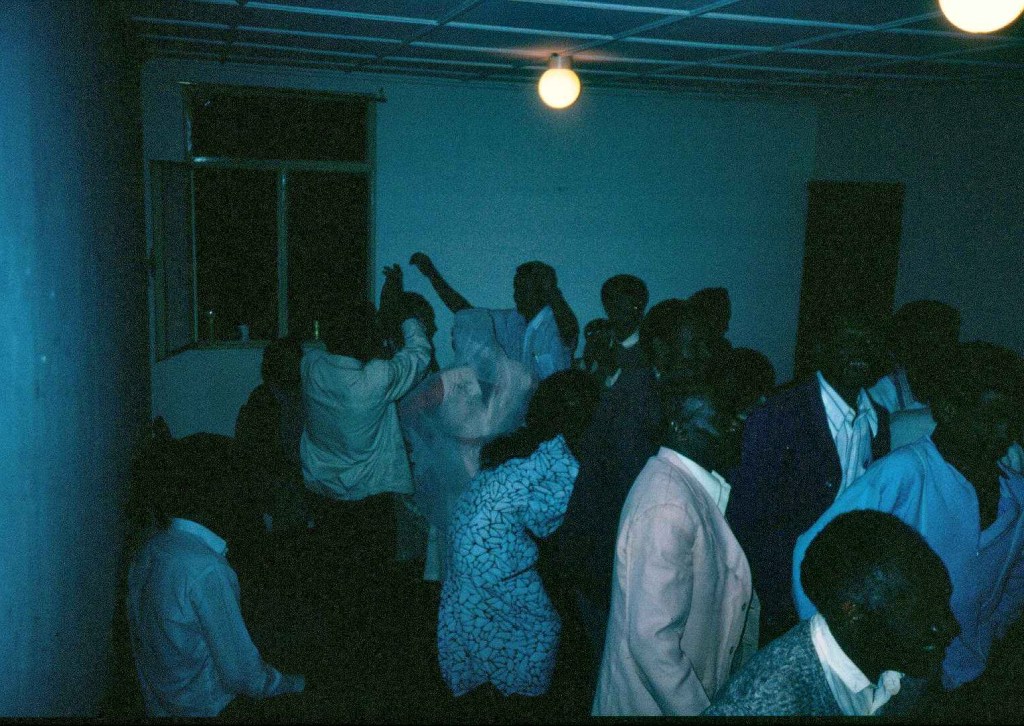
Finally, the party gets going!
The party was extremely well attended and after about an hour, nothing had happened, despite the guests having eaten and drank well. Something was missing and then we decided to enliven things by serving some clericot (a punch in English) that we prepared by mixing a few of the spirits that I was going to leave behind. The effect was amazing and the party really came to life and then it would not stop! Eventually, at about 3 am people started to leave gradually and we were able to retire to bed. The following morning I found a few people sleeping on the grass around the house. Clearly we had overdone it in the clericot department!
So it was that a day later we drove to Addis where, after formally closing the project and spendng a few days in a friends’ house, we departed Ethiopia.
Luckily, before we left I had already offered a job to continue working on ticks and tickborne diseases in Zambia and we headed there after stopping in Nairobi for some shopping and a few days rest (including the camel safari I had mentioned) with our very good friend Susan that we knew from our Kenya days.
[1] I was surprised to see that this was the subject of a study (that I have not read)! If interested, see: McCann, J.C. (2006). A response: Doro Fänta: Creativity vs. Adaptation in the Ethiopian Diaspora. Diaspora 15, 381-388.
A short post to share with you a special situation that we have been going through at the farm for the last week or so. White butterflies that usually fly past on a migration somewhere they only know, have arrived. Unlike previous years, they have decided to stay.
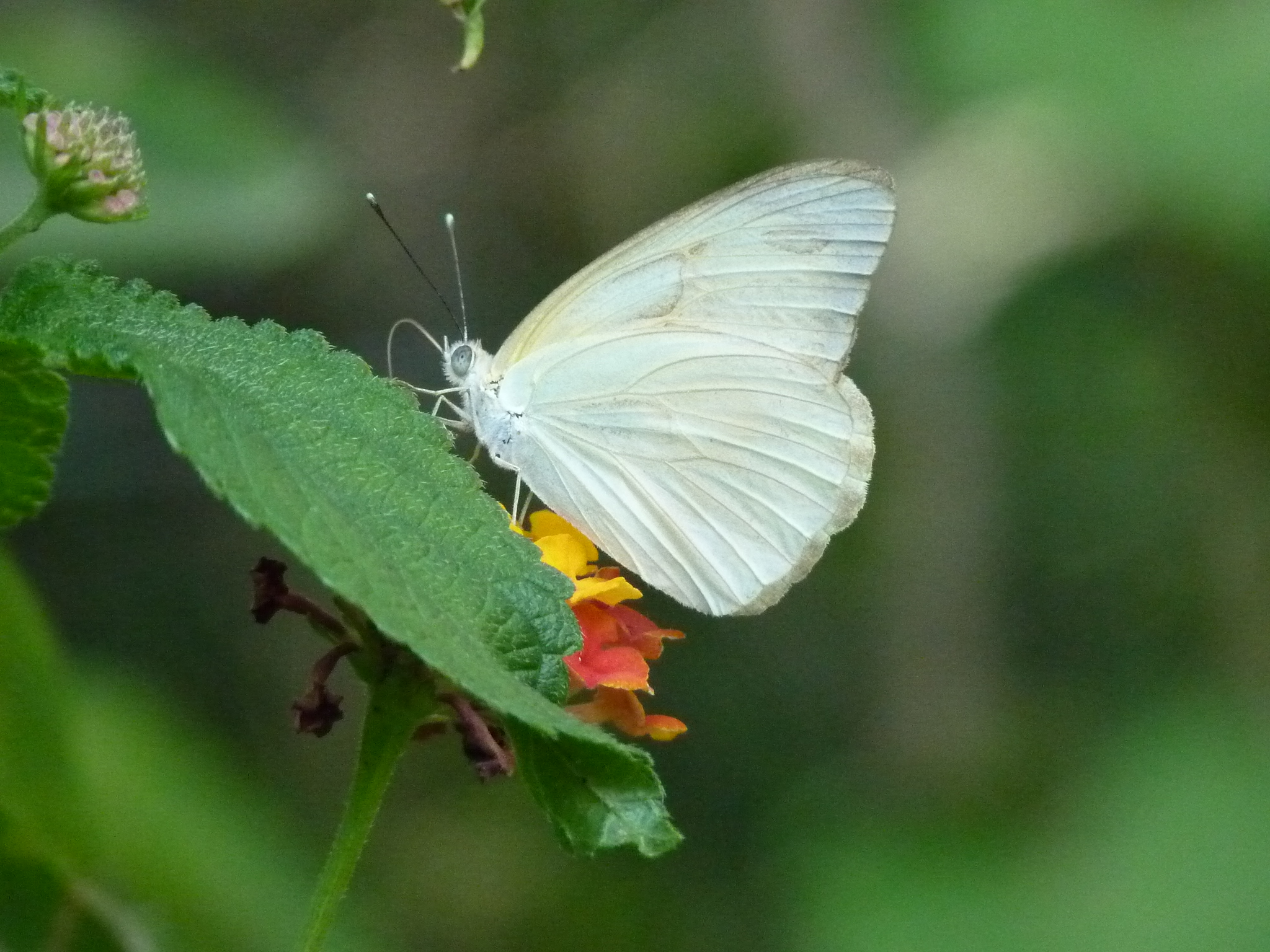
Ascia monuste, the great southern white or pirpinto in Argentina is the only species in the genus Ascia. It is found from the United States to Argentina where they migrate yearly but only in one direction and without return. Despite their English name, they are rather small with a wingspan of 63 to 86 mm.
Pirpinto feeding on a Lantana flower.
Their main aim is to find plants of the Brassicaceae family (Cabbage, Kale, etc.) to lay their eggs for their larvae to feed on them. However, as there are several sub-species, they can also feed on other plants such as Lettuce, Alfalfa, Cotton, Rice, Potato, Chicory, Cassava, Passion Fruit, Corn, Mustard, Radish, Rocket and Soybeans to name a few.
The larvae will develop in 4 to 5 days and the adults will be appearing a fortnight later and they will feed on the nectar of plants such as saltwort, lantana and verbena while laying their eggs on some of the target species mentioned above.
We were enjoying their visit as they staged a great show that reminds us that Nature is able to create amazing sights.
Unfortunately, Mabel noted that the winged visitors had discovered her treasured rocket plants and they were busy laying their eggs on them so our focus has recently and urgently moved from contemplation to biological control to save our veggies!
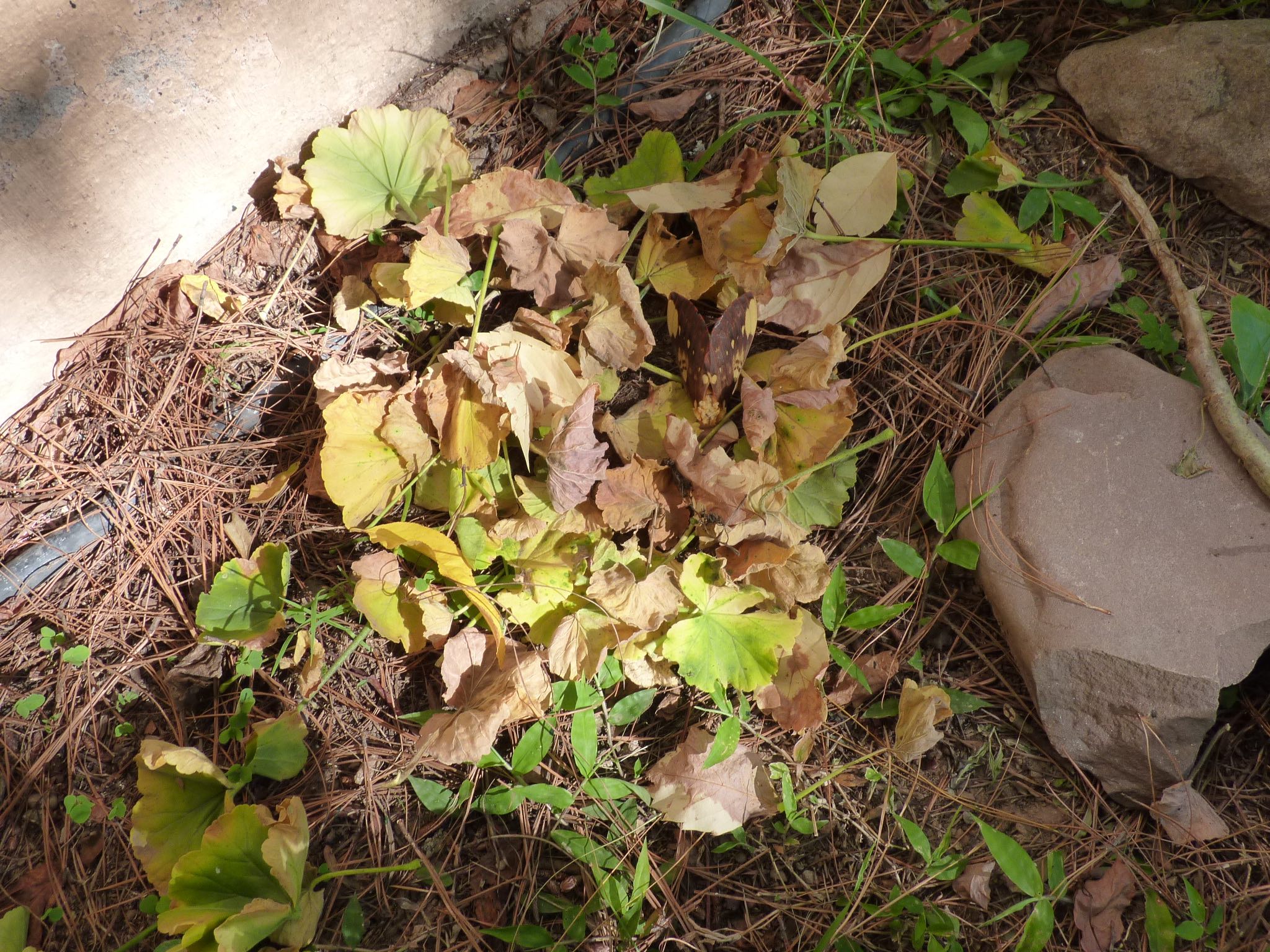
The advent of the rains in our farm in Salta brings, like every year, an explosion of life. Today’s beast is not very common but rather spectacular (if you can find it…). At the bottom I include more pictures and videos of it for you to appreciate its beauty.
? ? ? ? ? ? ? ? ? ? ? ? ? ? ?
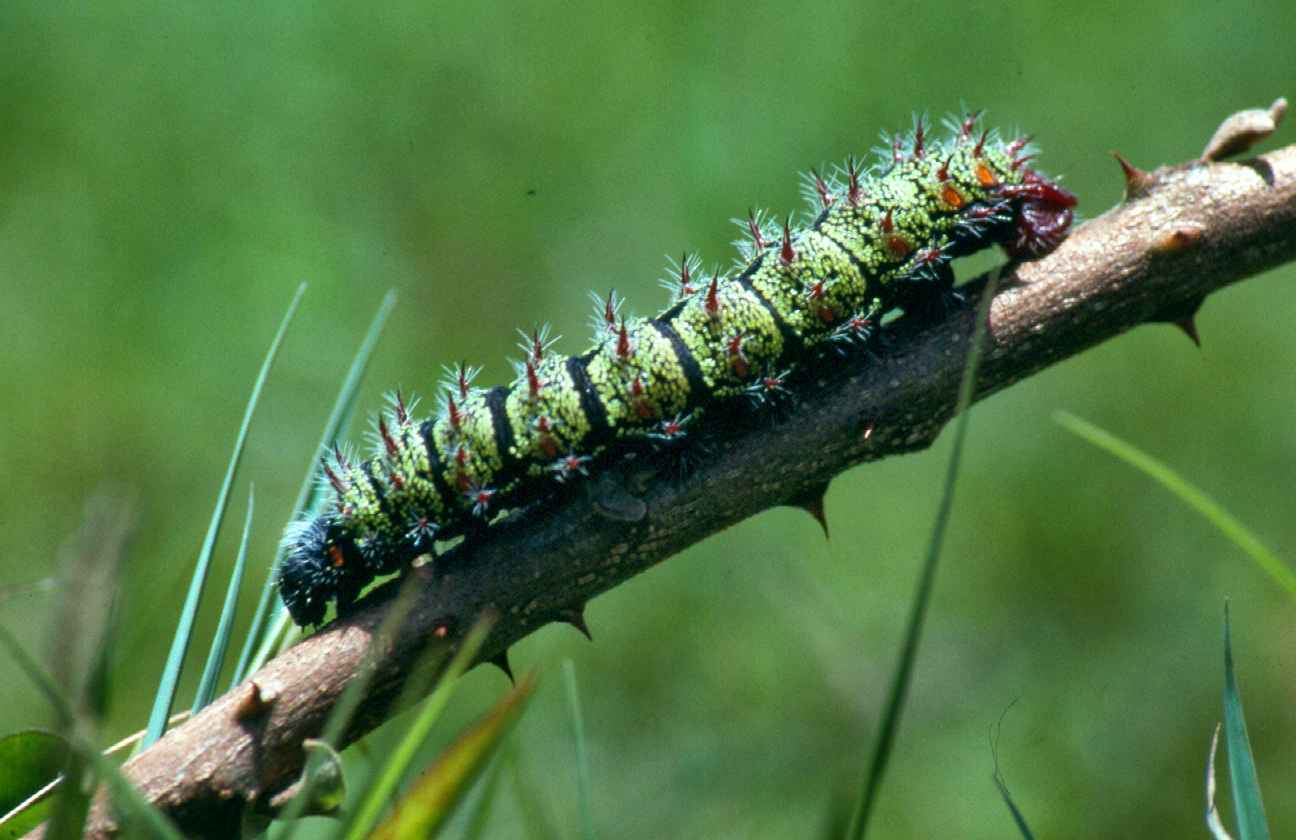
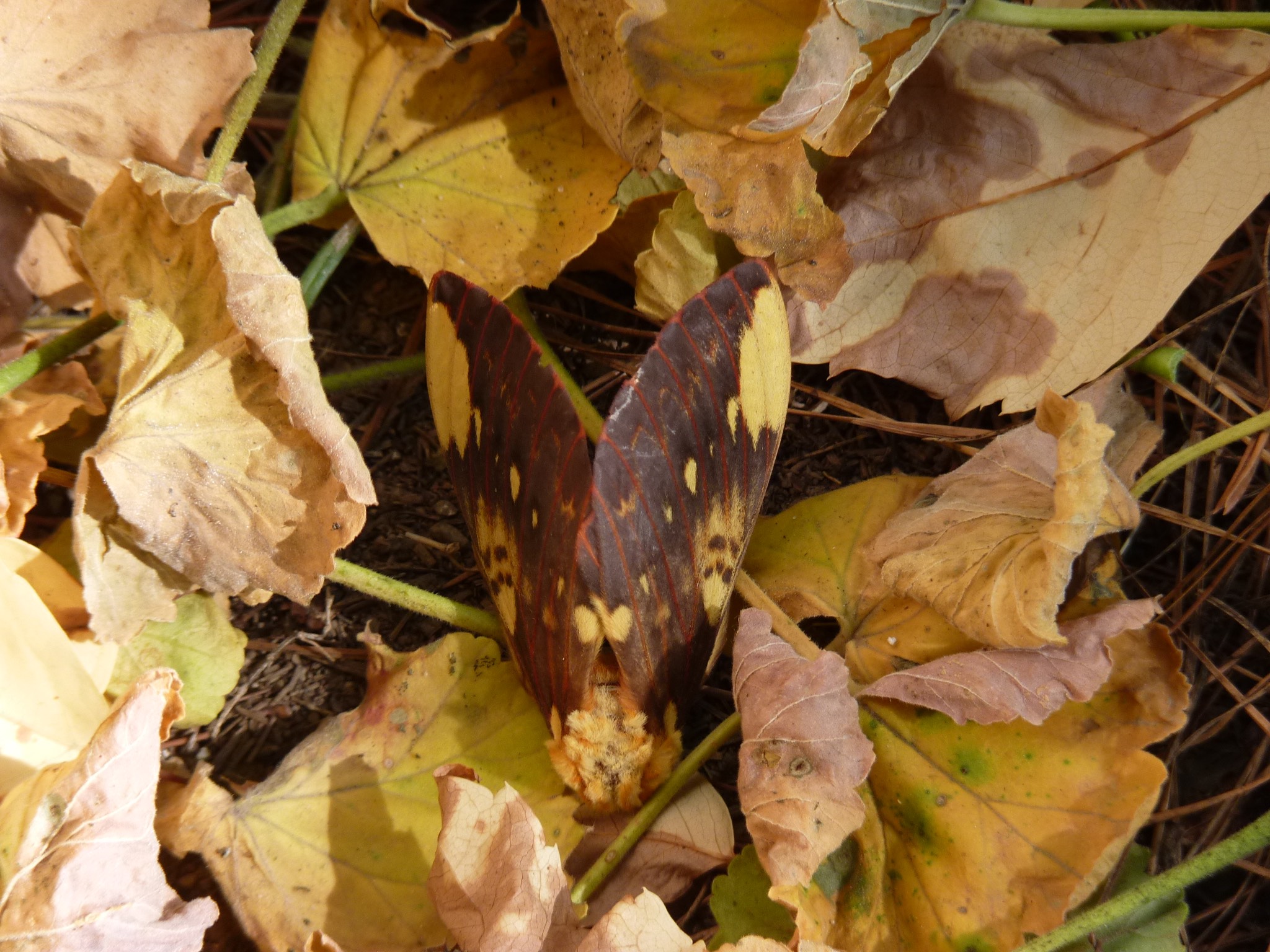
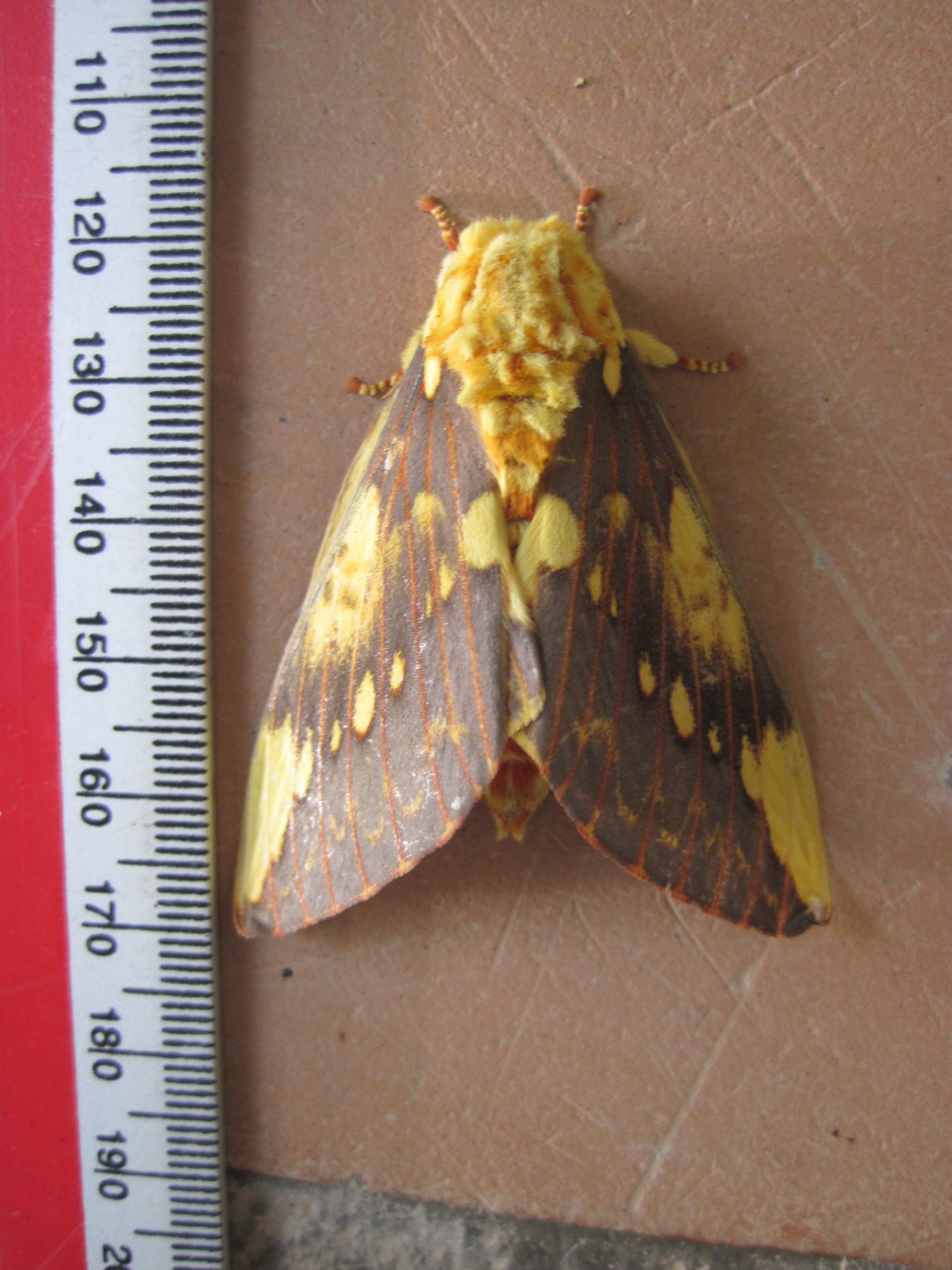
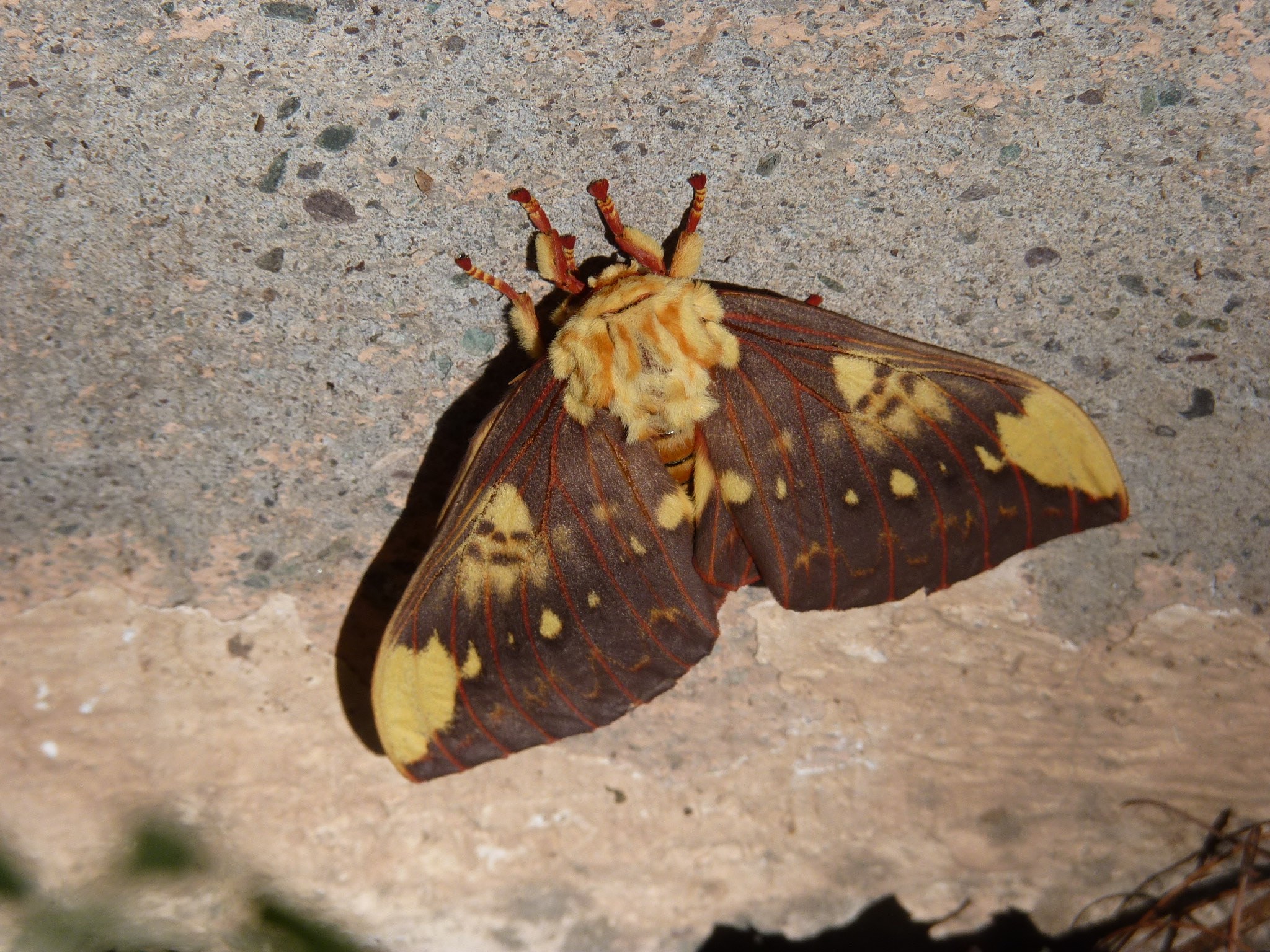
It was an Imperial moth (Eacles imperialis) first described by Drury in 1773, clearly being too obvious to be missed!
This moth is one of the largest and most stunning of the Imperial moths. It is found from Canada to Argentina. Both larvae and adults are highly variable in coloration. They have a wingspan ranging from of 80 to 174 mm, the females being larger than the males.
Their immature instars feed on pines, oaks, maples, sweetgam and sassafras trees. Adults emerge before sunrise and mate after midnight and the females lay eggs singly or in small groups on both sides of leaves. Both sexes do not feed and are short-lived.
Some more pictures and videos below:
I found these moths a couple of years back and observed that they responded in this way to the touch. I filmed them as I found the behaviour interesting. I imagine that this behaviour could be useful the moths to survive while mating and laying eggs?








 A Bushsnob out of Africa