Hippo disclosure

While searching for suitable pictures to post in Instagram (#bushsnob, just in case you are curious…) I found a picture of communal defecation by hippos at Masuma dam. As I have recently -and entirely by virtue of being observant- become involved with facts about hippos that will probably change the way we look at them, I thought this short post was justified.

5 - Hippo rescue attempt at 2 second view

Hippos chasing crocs to get at the impala carcass!

There are many great stories about animals in Africa and, although I learnt this one some time ago, it had been stored in a part of my brain that I no longer have access to, because of all the new activities I am involved in (the real reason will not be disclosed!).

DSCN9972 9.11.44 PM copy

A hippo “tusker”. Note the left tusker also protruding in the upper lip.

Anyhow, apparently when the world was created, God, as you can easily imagine, encountered many problems. A lot of them God solved immediately but several remained, perhaps because God was busy solving the important ones. Among these was the “Hippo problem”. The latter found itself in a dilemma about its lifestyle that required a consultation with God.

“God” hippo said, “I know you have created me, but what do I do now? What do I eat? Where do I live?” A busy God did not have time for individual animal bellyaching so, from the top of his head said: “Well, you will live in the water but you will eat grass”. Surprised Hippo repeated “I will live in the water but I will eat grass?” This did not make too much sense to it as it had seen his reflection in the water: big mouth and big teeth! “How am I going to convince fish that I will not eat them? They will not let me enter the water!” he commented. Still busy, God told Hippo to make a plan!

Hippo left God’s office deep in thought and organized a meeting with the fish to convince them of his life plan. “I must prove to the fish that I have not eaten them!’ thought Hippo, and he met with the fish and eventually they came up with a pact: Hippo could spend the days with them in the water if he could prove he was not eating them. Hippo would prove this by spreading its dung each time, to prove to the fish that he was a trustworthy neighbour! Hippos still do to this very day.

DSCN6337 copy 2

Hippos defecating together in the water.

As you know, hippos spin their tails while defecating to distribute their excrement over the greatest possible area and, contrary to what I thought, hippo defecation occurs in the water and it is not rare to see fish following them. Male hippos in particular are very precise in the spreading of their excrement!

Funnily enough, I do not remember having witnessed a hippo peeing! Apparently they pee backwards and are known as are retromingent animals.

Enough of hippo’s bodily functions!

Born a whistle!

A well-known saying in Spanish goes something like “if you are born a whistle you will never be a cornet”. I am sure that there are many of these kinds of sayings that are applicable to the various walks of life. I am a whistle when it comes to sea fearing. However, as the family had the idea of a sea holiday, we travelled to Mozambique. The latter offers about 2,500 km of seacoast and beaches for all tastes.

Views of the sea and beaches around Vilankulos.

The road trip was good with the usual border hassle that added a dose of stress to my otherwise calm retired life. As usual the Zimbabwean side was very formal and rather time-consuming but with the pleasant manners that you almost take for granted in our “second” home.

Mozambique was something else! We had only crossed the border in and out of this country while being a UN employee and I did not have any issues apart from some queuing at peak times. Luckily this time there was no queuing, only confusion! We arrived at the border to be welcome by “helpers” to give them a name, all wearing identification badges. I noted that the badges were showing their plastic backs only while I was verbally overwhelmed in Portuguese and English about their offers for “help” and directions on how to perform the usual two steps: immigration and customs! I knew where this was leading!

Perhaps it was the proximity of the festive season as we were at the border before Christmas or perhaps this is always the case. I will find out in next visits but confusion took over, despite being aware of it. First it was a small piece of paper at the entrance gate where the car and occupants were to be recorded, about three words and a number. For some reason it took an inordinate amount of time and arguments between my self-appointed “helpers” and the official at the gate. Eventually I got the important paper and started to walk the plank towards the building to face the rest of the ordeal.

Not so. A lot of shouting behind me called my attention and I was informed that I had been given the paper of a lorry driver from the Democratic Republic of Congo! So, it was back to get the right one and resume the walk. We all had visas from Harare, except one of us who needed to get it in the border so the wait was longer than expected but acceptable. Finally we were ready to do customs. This required the filling of a form and I naively thought, driving off. Not to be. The need for a physical inspection of the vehicle was announced!

This was clearly what the “helpers” were waiting for. As the Customs official walked towards the vehicle, they advised me in hashed tone, on the various ways of handling this apparently difficult procedure. In addition, while the we approached the car, the word “Christmas” was repeated often by my “helper” entourage, now numbering five and growing.

We were two vehicles in this trip. Our friends did not require a visa so they had already been “helped” through the car check-up. We were about to open ours at the request of the Customs Officer when one of our friends came and whispered that he was asked for a USD 10 payment and that he had agreed and obtained Customs’ clearance and, more importantly, the key to freedom: the valuable gate pass. Assessing the situation surrounding us: utter confusion, a growing crowd of “helpers” and the already expectant Customs Officer, we had no option but to follow our friend’s arrangement and handed over our first Christmas present of the journey!

DSC_0161 - Copy 3.34.12 PM copy

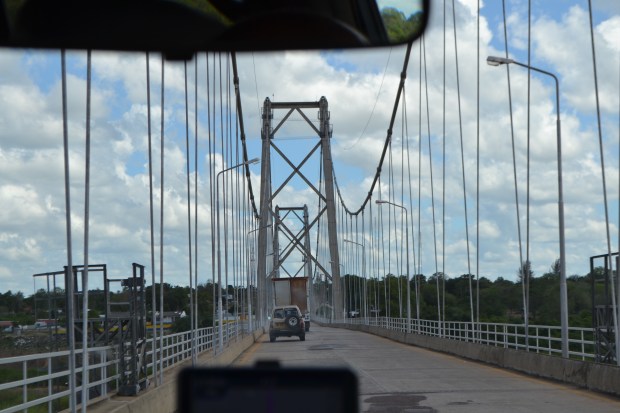
Crossing the bridge over the Save river.

We shared a house with our friends in Vilankulos and enjoyed the relaxed atmosphere while the younger members of the family were engaged in more muscle-demanding activities such as SCUBA diving and snorkeling.

Under severe peer pressure I consented to accompany them on a snorkeling trip to a well-known area of coral called “Two mile reef”. Trying to improve my snorkeling experience, I had acquired a floating aid in order to be able to save my energy for swimming in search of coral formations and other creatures rather than spending most of them on trying to stay afloat.

A selection of underwater finds. Pictures by Florencia de Castro, Mariana Terra and Julio A. de Castro.

I still had fresh in my mind an earlier experience at the same location when I got really exhausted and, eventually, seasick swimming in the rough sea! So I did not wish for a repeat! Luckily, the floating aid was a success and I did see some interesting coral formations and fish that I was not able to identify as I have decided that only terrestrial animals interest me in this life! Soon the tide changed and it was time to return; I was still swimming and could even climb on the boat unaided (I am not sure if this was me being fit or the ladder being lower but I prefer to think the former!).

DCIM100GOPRO

About to depart after a day spent snorkeling. The Washing Machine was yet to come!

A final word on the return trip. The passage between Two-mile reef and Bazaruto and Benguerra islands is infamously and justifiably known as the “Washing machine”. I can assure you that this was violent rock and rollish to put it mildly. The rest of the return trip was just choppy! Fortunately, we all survived -just- and got to land in relatively good shape. Once more I promised myself that this was “curtains” on seafaring for me. I did this fully aware that I have declared similar resolutions before only to forget and backslide, caught in a vicious peer pressure circle!

DCIM100GOPRO

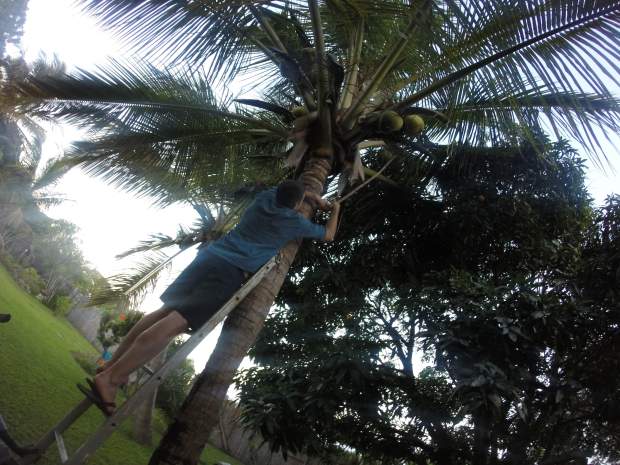
Coconut harvesting, the preliminary of coconut splitting.

Swimming at the beach, walking and coconut opening occupied the rest of my life in Vilankulos and I was really busy working on a novel that I have had in my mind for years and still refuses to be born! I was pleased to make some progress that encourages me to go on writing for a few more years.

The trip back was uneventful, including the border crossing, and we managed to get to the Vumba mountainous area in Zimbabwe in good time. We stayed the night at one of the Inns there and, after a good breakfast and a walk in the garden observing insects and birds (what a relief!), we headed back home where a rather green garden was waiting for us.

A dozen eggs

Luckily it is raining well in Harare. More than we expected so our pool -turned into a water reservoir for a few years now- spilled over and the area became a true wetland! Water was also running from the top of the garden in large rivulets that avoided our dikes and continued unstoppably to the bottom of the garden washing our scarce topsoil. The consequence was that we needed to perform some emergency repairs to our contention dikes.

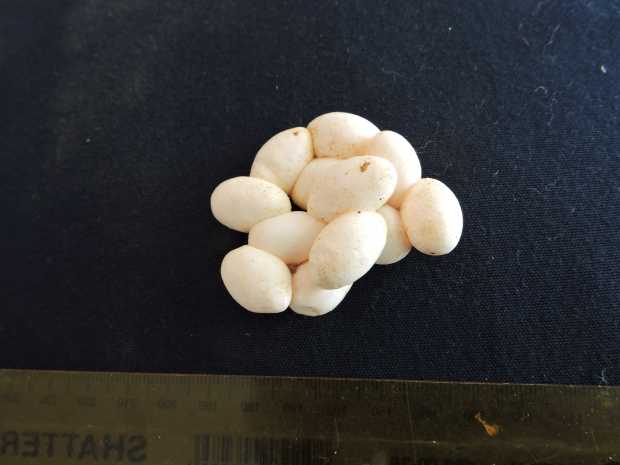
While digging from the sand the pile that we keep for this kind of work we found a cluster of twelve small eggs! Their shells were flexible so they clearly belonged to a reptile, probably a chameleon.

DSCN9892 9.49.56 AM copy

Stephen (our caretaker) and I were very excited to find them and went to communicate the good news to my wife as we were sure she would also be happy as I was quite sure them to be chameleon eggs. The news was received only with lukewarm enthusiasm and I was both disappointed and surprised!

It was after a few minutes of thinking that the penny finally dropped so I declared: “I am sure that they are not snake eggs”, trying to convince myself that there were not! “Why not?” was her immediate and rather expected reply. I could not argue so I decided to find out what they were!

I performed a rather thorough check in the Internet and could almost confirm that they were in fact what I thought. However, to keep the peace I agreed to leave them where they were found so that they will continue with their normal development.

Further reading educated me that it takes up to 300 days for chameleon eggs to hatch and the breeders of these animals in captivity start checking for hatching from day 220! So, if you had any hope of learning what came out of the eggs, you will need to wait until next year, if we are lucky to see the newly born emerging from the sand!

White flowers…

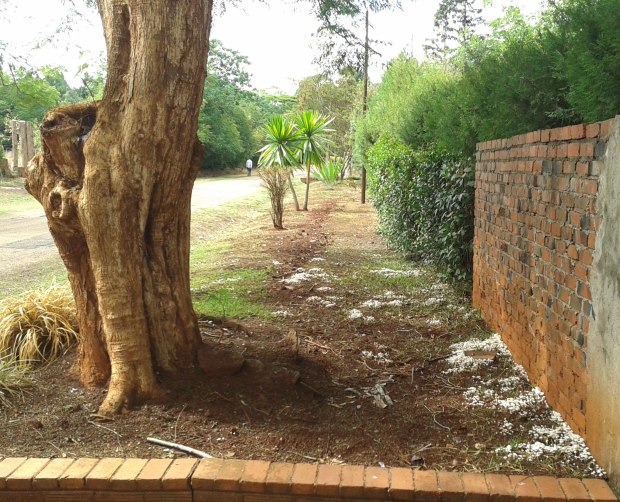
Although it rained again last night the morning started sunny so we managed to go for a walk. At some stage a carpet of white flowers growing near a house entrance called our attention.

20151217_090702 copy

As we found them a possible nice feature for our garden we got close to them to see what they were and, to our surprise, they were not flowers but small white mushrooms that I believe to be of the genus Termitomyces, probably T. clypeatus.

These are edible mushrooms that live in a mutualistic symbiosis with termites of the subfamily Macrotermitinae and quite common in Southern and Eastern Africa.

Rains at last!

I am sure that you are aware that the “el Niño” phenomenon is very strong this year and this affects the rainfall in Southern Africa. As a consequence we have had almost no rain in Harare and we are really struggling to keep plants and even trees not just going but living. We lost a mature avocado tree that dried and other trees are going that way!

May be not. Last night it rained almost the whole night and today it is totally cloudy! The air is moist now and the garden looks as if has been washed and the dust turned into mud. We were forced to cancel our morning walk and instead perform the odd jobs left for a “rainy day” and focus on the garden. The critters are out in force now!

Apart from termite alates and flying ants, we have dozens of chongololos[1] walking about the garden making Stephen, our caretaker, already concerned about the plants, particularly the edible ones! I placed a small piece of mango and, immediately, I got a few takers to show you.

DSCN9965 12.20.04 PM copy

While dealing with the chongololos I heard shouting from the other side of the house and found both Stephen and my wife contemplating a rather large brown chameleon that had been spotted on a small shrub. Fortunately we have been finding these reptiles recently as we enjoy watching them. As the say goes, they are the only animals able to see where they are going as well as where they have been!

DSCN9964 12.10.31 PM copy

DSCN9951 12.10.31 PM copy

DSCN9954 12.10.31 PM copy

DSCN9934 12.10.31 PM copy

DSCN9943 12.10.31 PM copy

After the chameleon photo and video session my wife left for the supermarket and I focused on some odd jobs. The main one was to repair a damaged umbrella as it will be handy these days. I was about to glue the broken part when more shouting from Stephen and his son Adam, currently enjoying his school holidays, again interrrupted my work. Knowing that when this happens there is always something interesting, I left the umbrella and went to have a look. I was not disappointed…

With wide smiles, they were already walking towards my workshop, each one was carrying one of the largest and most colourful moths I have ever seen! I suspect that their hatching had taken place during the last couple of days. They were really spectacular and I prefer to post a few pictures for you to better understand what I mean!

DSCN9972 12.18.56 PM copy

DSCN9975 12.18.57 PM copy

A quick search in the internet and insect books indicated that they are a member of the Emperor moths. As usual, their colours do not exactly match those from either internet specialized pages and the books I have! However, I believe them to be the Common Emperor or Cabbage Tree Emperor (Bunaea alcinoe).

At the moment they are kept inside the house where they are quiet and I am sure waiting for darkness. They will be released tonight so that they can get on with life so that we can enjoy seeing them again next year!

Oh, I almost forgot that Mr. Brown, our land tortoise that came with the house, made an appearance to remind us of its existence and to steal a lettuce leaf or two!

DSCN8247 copy


[1] The local name for millipedes.

A “new” hippo

DSCN6469 copy

Those of you who have read this blog on 22 February 2015 (https://bushsnobinafrica.wordpress.com/2015/02/22/hippos-from-hell/) and watched the videos I posted later (https://bushsnobinafrica.wordpress.com/2015/03/23/hippos-from-hell-the-videos/) would remember the extraordinary observations that the hippos present at Masuma dam at Hwange National Park were actually eating Impala meat. A reminder below:

This observation was so incredible to us –seeing it happening in front of our eyes without previous knowledge- that it was almost the sole topic of conversation for the rest of the trip! It was only after we returned and I found an earlier record of a similar event also observed at Masuma almost 20 years earlier[1] that my mind relaxed, but only for a short while. What we thought that happened it was what actually took place! I believed that the observations were of great importance and that they merited further follow up!

Luckily, establishing contact with Joseph Dudley (Joe), the responsible of the observations and publication, was straight forward and he replied to my message telling him of our experience within 24 hours! The possibility of some collaboration to write our observations was considered from the start. Later on Joe realized that there were a few reports and that it was worthwhile attempting a joint paper. On 20 October 2014 he wrote: ” I think that it would be good to connect the dots between these three recent observations ………..”[2] This was the start of Joe’s efforts to put together the people that have had experience on hippo carnivory and although he asserted to me recently (2 December 2015) that ” It was your contacting me after your experience in Hwange that pushed me to made this paper happen…” the idea of the joint paper and the effort of writing and coordinating it was his! My contribution to the exercise was minimal and I could safely say that I was only the straw that broke the camel’s back!

Civilities aside, Joe managed to put together a group of people with complementary expertise and steered it to the publication of a paper that I believe will change the way we look at hippos in the future[3].

In brief the paper postulates that hippos, an essential species within their ecosystem, should be considered not as obligate herbivores as at present but rather as facultative carnivores able to consume carcasses from other animals. Carnivory is not an aberrant behaviour confined to certain instances but a behavioral trait that takes place throughout the hippo’s distribution.

The accelerated rate of transmission of the deadly zoonotic disease anthrax recorded among hippos as compared with other animals is attributed to their habit of consuming meat from various animals, including the hippos themselves. This fact can have important implications for a better understanding and better management of future anthrax outbreaks not just in wildlife populations but, much more critically, in humans. The publication is receiving a rather wide coverage by the world press that I include on a separate page for reference. See: Hippo carnivory press coverage.

Just today (10 December 2015) Joe sent me a video from YouTube that I think is very timely as it rather eloquently shows hippos consuming a zebra and fending off crocodiles while doing so. You can watch the video below although it may be a bit too strong for some. Please accept my apologies but I think it is within the very interesting subject of this post.

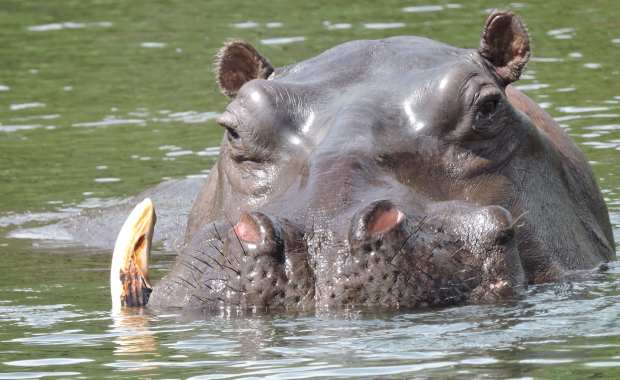
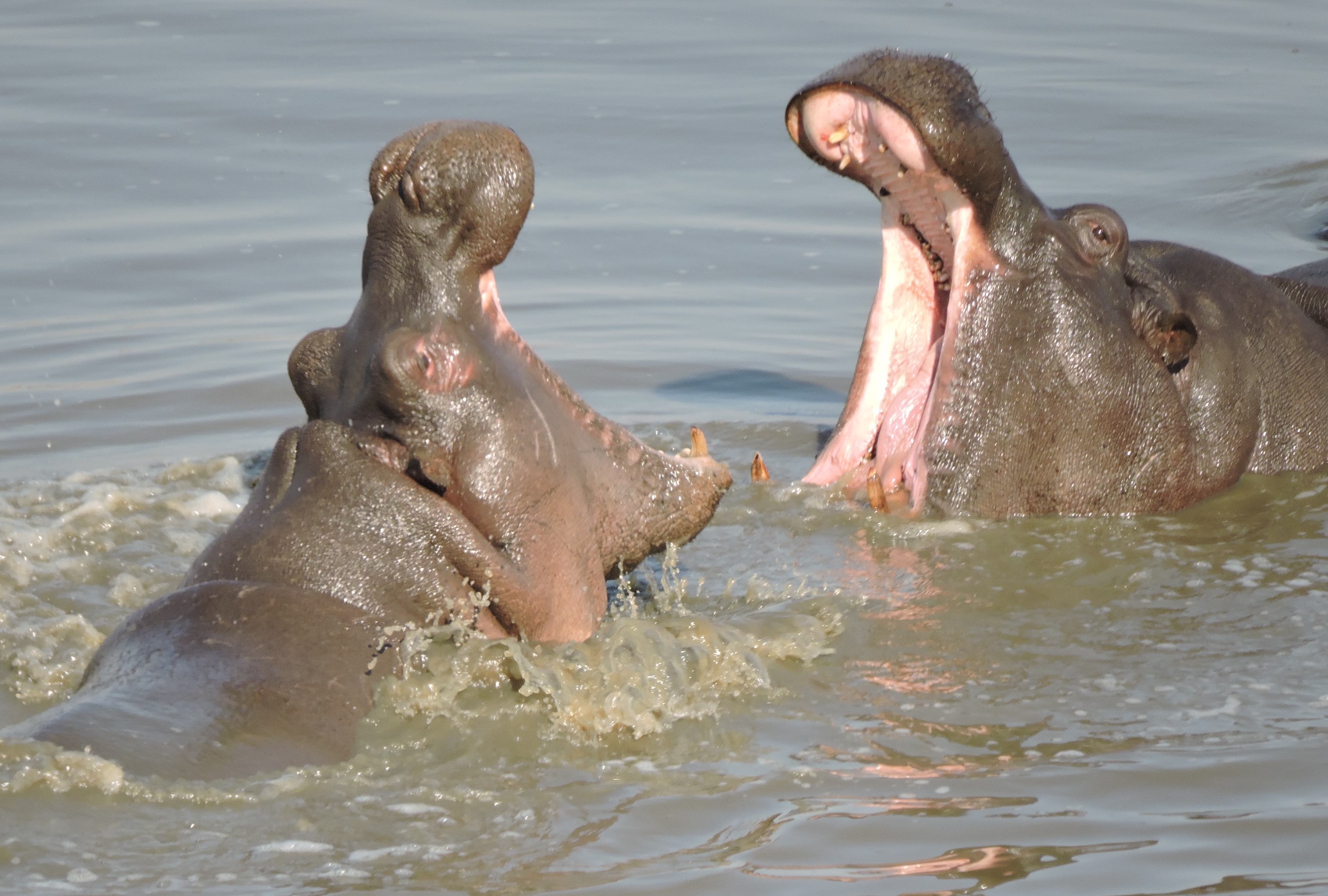
I end this post with a picture of a hippo taken on the Kavango river during our recent trip to Namibia that I will cover soon. Does it not look too fierce to be a herbivore?

DSCN9972 9.11.44 PM copy


[1] Dudley, J.P. (1998). Report of carnivory in the common hippo Hippopotamus amphibious. South African Journal of Wildlife Research 28, 58-59.

[2] At the time he had additional information on the subject from other colleagues.

[3] Dudley, J. P., Hang’Ombe, B. M., Leendertz, F. H., Dorward, L. J., de Castro, J., Subalusky, A. L. and Clauss, M. (2015), Carnivory in the common hippopotamus Hippopotamus amphibius: implications for the ecology and epidemiology of anthrax in African landscapes. Mammal Review. doi: 10.1111/mam.12056. The paper can be downloaded free from the following link for the next couple of weeks: http://wileyonlinelibrary.com/journal/mam ffollhttp://onlinelibrary.wiley.com/doi/10.1111/mam.12056/abstract for the next two weeks and then the Abstract will remain there.


Life in Matopos

There were not just stones at Matopos!

As soon as we entered the park we realized that it has had patchy rainfall. It was in one of the wet areas that we saw a congregation of birds of several species. There were a few African kites, Yellow-vented bulbuls, Amethyst sunbirds, Violet backed starlings and others that I was not able to identify as they flew off. The reason for this was not the presence of a predator like a snake but flying termites or termite alates whose purpose is to start new colonies and become the future king and queen, the stuff of fables. If they survived their nuptial flight, that is!

The flying termites are well fed by the colony because their reserves need to last them until they manage to reproduce and a new colony is established. Being so fat-loaded contributes to their doom as they are slow flyers and therefore a very sought after morsel that most animals in Africa appreciate, including some people that also eats them (friends that had tried indicate their rather good nutty taste when fried in butter).

Apart from the bird vs. termites affair, the most obvious Matopos dwellers were the lizards.

We saw a few different species but the common flat lizard was, yes, the most common! The ones we saw probably belonged to Platysaurus intermedius rhodesiensis, a sub-species that inhabits the area. We saw plenty of them at Rhodes grave so the “rhodesiensis” of the name seems to make sense… At first we thought that there were two separate species: a rather astonishingly colourful one with yellow, orange and blue and another brown with cream coloured dorsal lines.

DSCN9439 copy

The apparently different lizards…

They were crawling all over the rocks everywhere and some were even bold enough to come quite close to us searching for food morsels under our lunch table. It was during one of these approximations that both “species” came close and we saw that the bright coloured ones showed -at first sight- some aggression towards the duller ones. Wrong again! It immediately became apparent that we were witnesing sex among lizzards and that the two were part of the same species!

Clearly it was the lizard mating season! We watched them getting together and separate rapidly very often as the pictures badly show. Love among lizzards appeared a rather casual and sometimes rough affair. It was not rare to see the male biting the female in the head or tail to mate with her. After the event, they went their separate way or at least that is what seem to the non lizard experts!

Further reading at home confirmed that there were both members of the species that abound at the Matopos and, luckily, they are nowhere near threatened with extinction and listed as of “Least Concern” by the IUCN, for obvious reasons… Let’s hope that they continue to reproduce.


Stones and gravestones

I never thought much of the Matopos National Park, until now! The park, located less than an hour drive from Bulawayo, the second city of Zimbabwe, was a great find for us. Until now we had only stayed outside the park and only entered briefly to visit its main landmarks, quite a while ago.

This time, on our way to the Caprivi in Namibia, we decided to stay in the park to get a better feel for the place. In addition, I was reliably informed that some (very) large scorpions dwelled in its rocks. As rocks abound there the expectations were high and I anticipated to unearth a truly scorpion paradise!

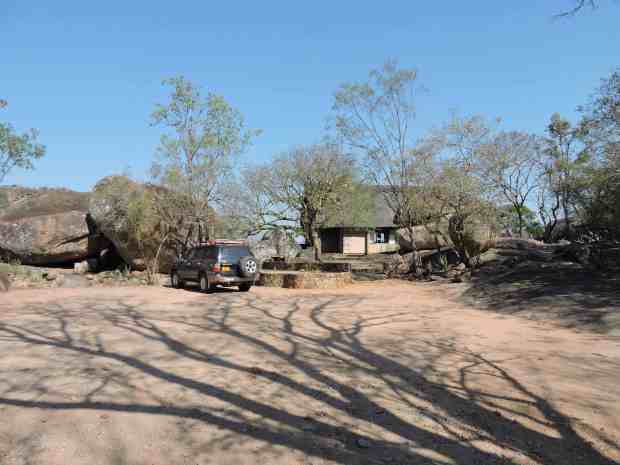
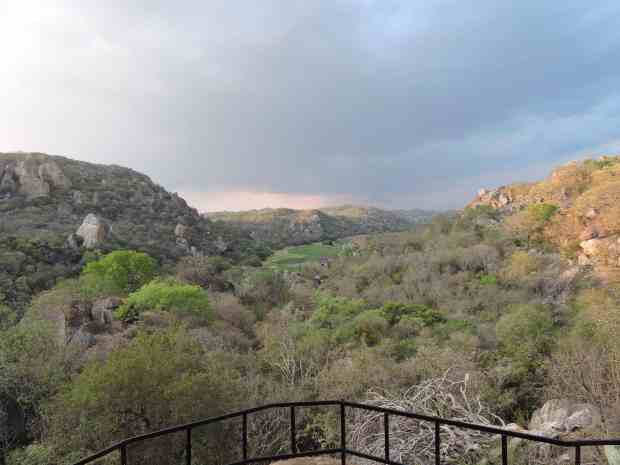
We stayed at the Black Eagle Lodge in the Maleme area of the park. Apart from being comfortable, it is sited on a rock outcrop with magnificent views of a dam below, all framed by the rocky hills. An amazing place to relax! An added bonus was that we had first row seats for the first storms appearing over the park as the rains were just starting after the long dry season.

DSCN9457 copy

The Black Eagle Lodge and its view, below.

DSCN9400 copy

DSCN9714 copy

DSCN9706 copy

The storm in full swing seen from the Black Eagle Lodge.

DSCN9729 copy

The sun rays break through the heavy clouds.

During our visit we decided to drive around rather than embarking on the few possible walks, some of them quite long. We also did not go into the game area of the park as we felt that we could see large animals in Namibia. The game section hosts two of the big five: white rhino (number and location undisclosed) as well as the elusive leopard.

DSCN9670 copy

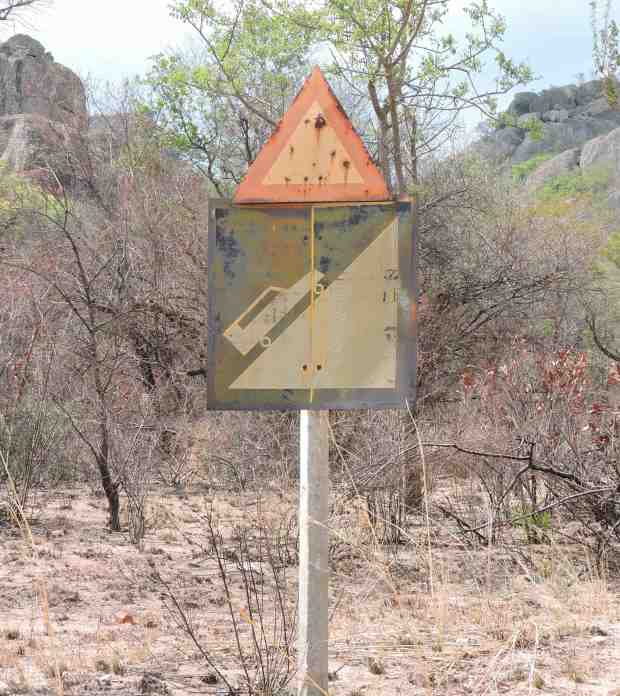
An old sign gives an idea of the kind or roads that expect you at Matopos.

We relished the landscape and were amazed by the rocky hills and their beautiful stone formations resembling castles and buildings to me but other things to more artistic people, I am sure. Particularly astonishing were a few weird stone formations that seem to be kept in equilibrium by some supernatural forces. The formations were like those depicted in the old Zimbabwe Dollar notes.

We also spent some time visiting Cecil Rhodes’ grave, reputed to be the most visited place in Zimbabwe after Victoria Falls! The short walk to reach it was well worth it as it offered an unsurpassed view of the surrounds. The view from the top of the hill, known as “World’s View”, was breathtaking.

Although we only had one full day at Matopos, we also managed to visit Nswatugi cave, after negotiating a rather tough track only possible with a 4WD and a rather short walk.

DSCN9605 copy

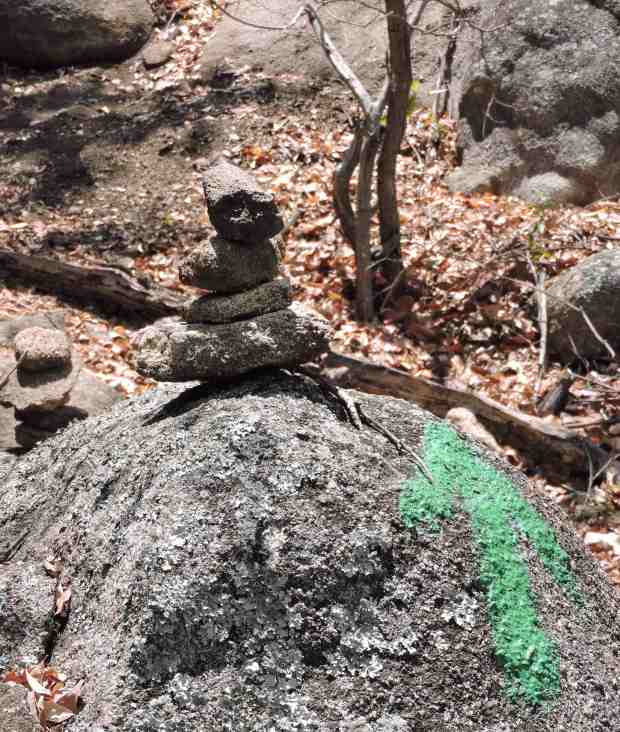
An imaginative marker on the way to Nswatugi cave.

The San paintings it displays are considered among the best in Southern Africa. The observer cannot fail to see a couple of giraffes above a mass of animals and people and a large number of red dots, rather unexplained apart from the artistic side of the author. My favourites were a zebra and the head of a female greater kudu. This cave was painted between 10,000 and 6,000 years ago. I have selected my best shots to attempt to illustrate these beautiful paintings.

I will comment on the scorpions in a future post. The latter aside, what we saw convinced us that the Matopos is worth further future visits.

Mistaken for carrion…

At a hot Mana Pools it was either me roasting some meat or eating from tins as my wife, usually an excellent cook, was feeling too hot to get involved in any heat-generating activities she was busy engaged in the opposite; cooling off with the aid of water and fans in order to survive another day! Resigned and lazy (independent from the heat), I lit a small fire taking some coals from the Tanganyika hot water boiler just at the time when the temperature started to go down.

I am an atypical Uruguayan. I am scared of horses and unable to ride them or -worse still- do a good asado[1]! Hearing only words of encouragement coming from the shower room I attempted at overcoming my shortcoming and managed to get a good fire going. I soon re-confirmed that one thing is to have a good fire and another is to use it well! I did not, as usual as the nice sirloin piece was well cooked top and bottom but very alive inside, even for us that like our meat rare! Anyway, we ate the better cooked pieces while leaving the rest too roast for a while longer until we managed to have a fairly decent dinner.

On account of the ambient temperature, the after dinner routine at Muchichiri was to seat outside by the river to listen and attempt to identify the many bush sounds that are heard in Mana Pools. Ocassionally the sounds or footsteps would be heard very close needing an inspection with our searchlight to identify the responsible both out of curiosity and self-preservation. The main “culprits” would be hippos but elephants and a number of antelope were often found around the lodge. At one stage we caught a slight movement between us and the river and we found a relatively scarce white-tailed mongoose scurrying through the undergrowth.

IMG_0260 copy

From the lodge my wife caught the bushsnob napping again, oblivious of the passers by. With the night visitors was different…

The mongoose gone, my wife read and I wrote notes for this posts. I got quite involved in what I was doing so when I heard a hushed “Have you seen it?” Coming from my wife I lifted my head with it still inmersed in my writing. The spotted hyena was looking at me from very close quarters, quite a shock when you do not expect a visitor like that! “!@#$%^&* its huge” was all I could profer. It was indeed a very large hyena that was looking at me from inside the camp light circle!

Although my wife assured me that she heard it coming and got a whiff of its pungent smell for a while, I was caught totally unawares. I experienced a mild panic attack as many years had passed since I had another similar encounter. All I managed to say was “ssshhhhhh”, the kind of noise that -in our culture- is usually reserved to scare away chickens! It was a pathetic and out of place gesture but it worked mainly because the hyena did not have hostile intentions towards me! I am sure it realized that, despite my years, I was yet to reach full carcass status! As usual, it moved off fast but remained around camp until we retired to bed.

The hyena did visit our place a couple of times later on as documented by a strategically placed camera trap (below) while I was safely in bed and inside my mosquito net on the top floor of the lodge, feeling like a safe animal!


[1] Roasted meat on the fire.

Spot the beasts (easy!)

While in Mana Pools last October most game were by the river. During one of our rare inland sorties we came across this sight. It looked rather battered and suffering from the heat as much as we were!

DSCN8433 copy


We also found this little beast at Hippo Pools, also in October.

DSCN8002 copy


And here are the beasts “revealed”:

A fox.

A fox.


DSCN8003 copy

A tree frog.

The fox was after this fellow:

An African hare.

An African hare.

And this fellow was after the tree frog!

A green grass snake.

A green grass snake.

The ways of nature!


Harare, 15 October 2015.