Transmara

Upset Maasai

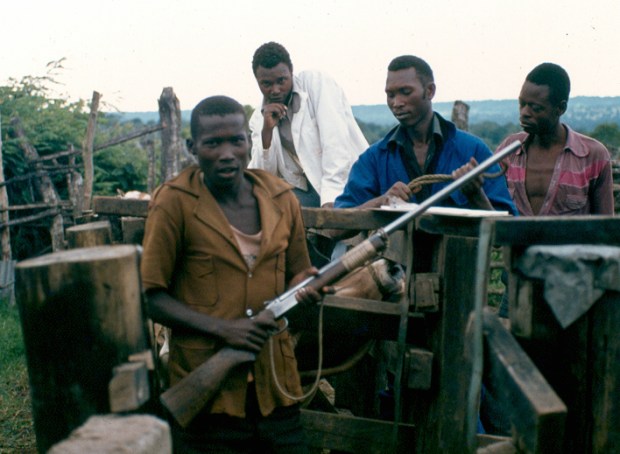
Intona 2 and Tommi copy

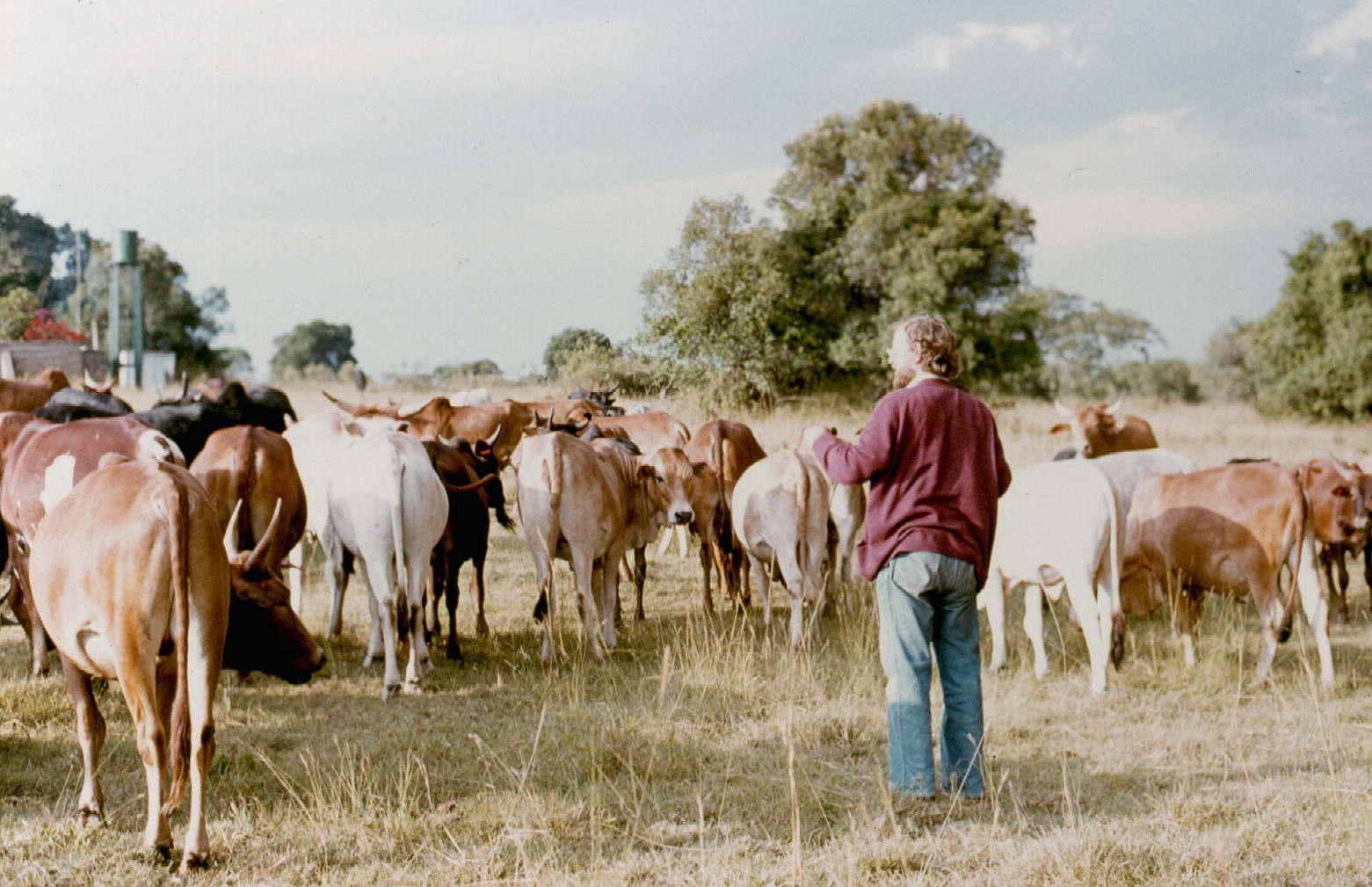
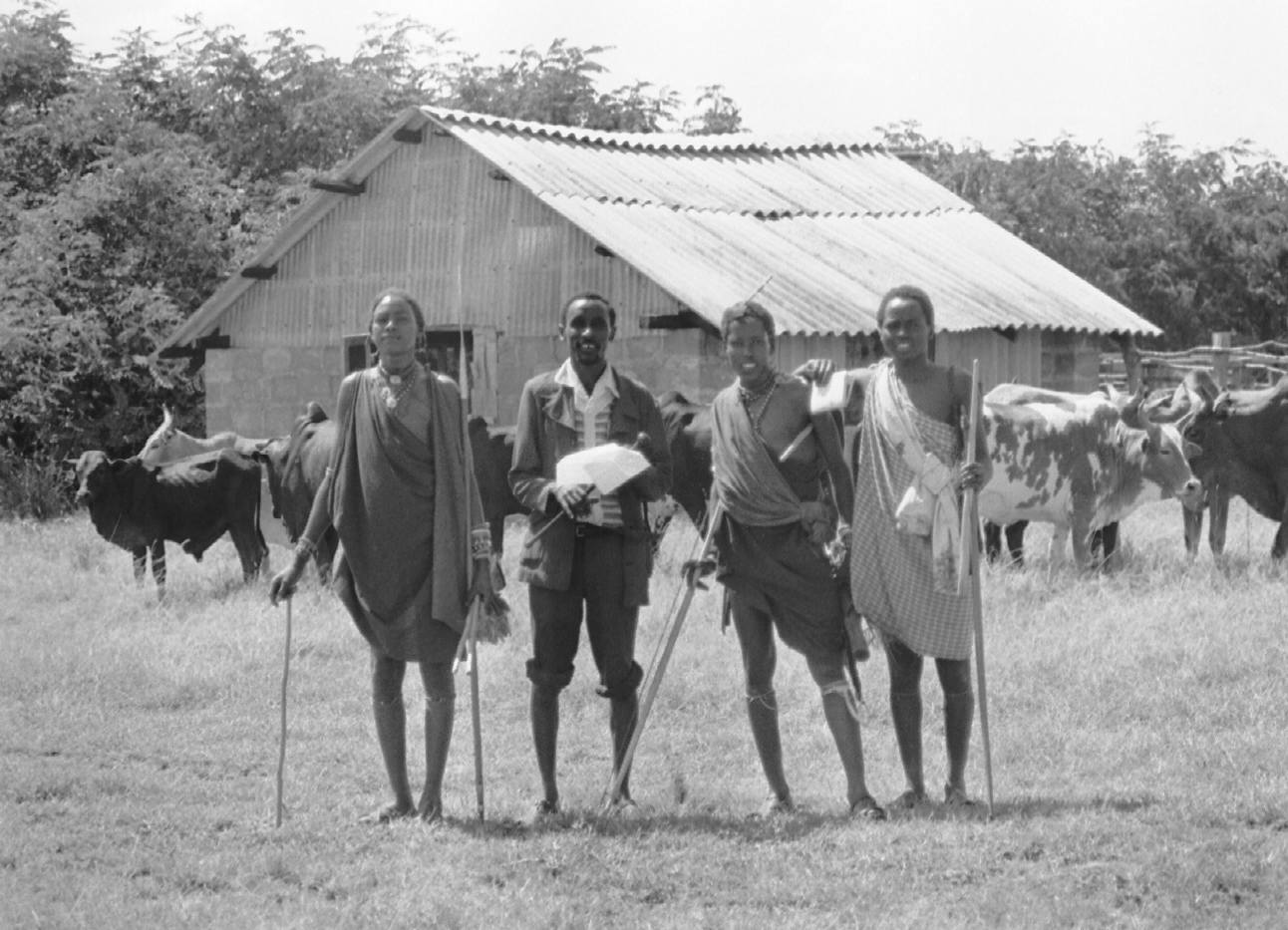
Tommi checking the cattle at Intona ranch.

As I mentioned in earlier posts about my work in Kenya, Tommi was one of the herdsmen working with me. Regrettably he passed away in a car accident a couple of years after I left Kenya, the sad consequence of a very common event in that country where unsafe public transport claims an excessive number of innocent lives.

Tommi frequently accompanied me to Intona ranch with great pleasure as for him it meant “going home”. He was not exactly from the Transmara area as he came from Narok but he was close enough to the Maasai around Intona to feel well among them.

This was a great contrast to herdsmen belonging to other ethnic groups, such as Benson above, that did not relish spending time in Maasailand. This was particularly obvious among the Kikuyu workers that could not wait for me to relieve them from their duties and take them back to their homeland. I still remember their voices getting louder as soon as the Kikuyu escarpment came into view after Narok! We, outsiders, do not often realize how foreign parts of a country can be to other nationals, product of some arbitrary divisions decided by their colonizers.

In the case of the Maasai people, their territory got split between Kenya and Tanzania when the straight line from lake Victoria to the Indian Ocean coast was drawn as the border between these two countries. Eventually the line did not end as a straight one. This was not the consequence of Queen Victoria giving Kilimanjaro to her grandson Wilhelm to meet his complaints of not having a high mountain in Tanzania as it is often believed, but part of the treaty of Heligoland through which Germany abandoned some places in the Kenya coast, receiving in compensation the Island of Heligoland in the North Sea.

Night watchmen Benson adn Tommi Intona copy

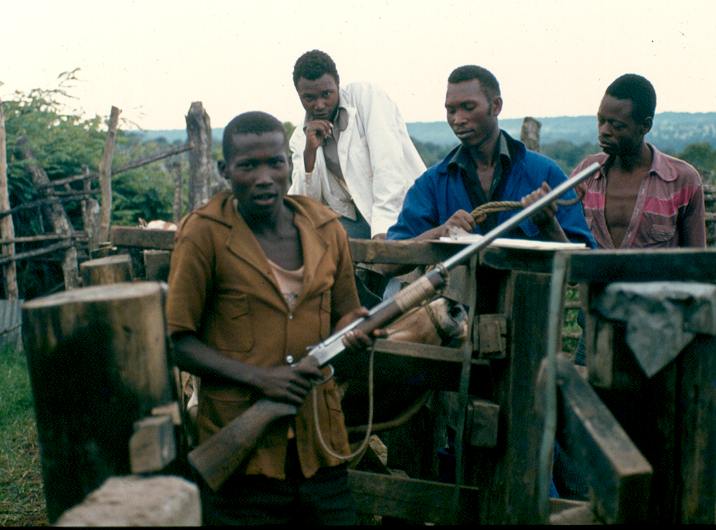
The herdsmen and cattle guards. Benson in blue and Tommi in white.

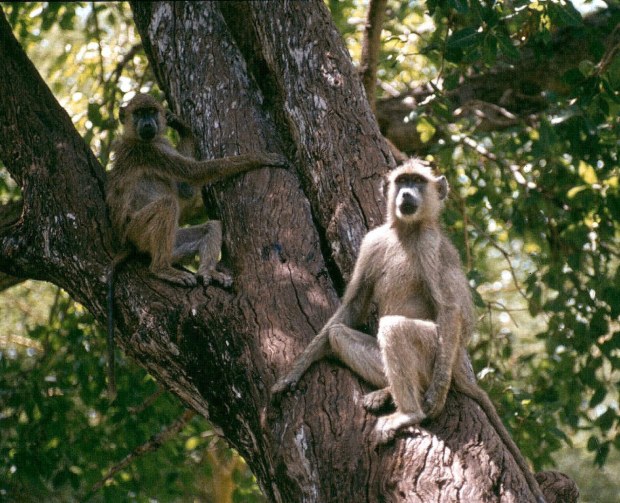
The herdsmen lived at a tented camp at Intona and their presence attracted both vervet monkeys and baboons. Over the years that the camp was there the monkeys gradually became more cheeky as they got used to taking food from the camp. This was an annoyance to the herdsmen and Tommi in particular took exception to the primates’ shenanigans.

Tsavo W baboon best copy

Mwizi’s relatives.

There was one particular individual that Tommi identified and called Mwizi that in Swahili means thief. He was able to recognize that particular animal and he maintained a long feud with it. The baboon seemed to know this and kept a wide berth from the man! For a few months a truce seemed to have been worked out but one day Mwizi overstepped the mark. (!!The baboon took advantage of a distraction and broke open Tommi’s bag of maize meal spilling its contents all over the tent.!!) This was the proverbial straw and the last act of misbehaviour that would be would tolerated.

Tommi decided to take exemplary action against the intruder. Before I tell you what happened, let me tell you that the Maasai social structure is based on a system of age-sets. This applies primarily to men, as women become members of the age-set of their husbands. Successive age sets, at about five year intervals, are initiated into adult life during the same period forming a cohesive and permanent grouping that lasts throughout the life of its members.

The age sets go through successive milestones that are celebrated as ceremonies. Among these are, to name a few, Emuratta (circumcision), Enkiama (marriage) and Eunoto (warrior-shaving ceremony)[1].

Tommi, like all Maasai boys had undergone their circumcision and became Sipolio (recluse). This is an important step into manhood (and warrior-hood) and, after this somehow dreaded event, the newly circumcised boys roam around the countryside dressed with dark garments and armed with bows and arrows. They shoot blunt arrows at girls as part of their social interaction. They also use the same arrows to kill small birds that they skin and place around their heads, together with ostrich feathers. During this time they acquire excellent skills with the various weapons.

In view of the above it is not difficult to imagine that Mwizi’s fate did not look good. I was not aware of the development of this feud at the time so its finale took me by surprise. After a day’s work, I was getting ready for a wash and tidying up my own camp when I heard the commotion, or rather Mwizi’s screams. It is not normal to hear a baboon screaming unless there is some kind of danger, so, expecting some leopard-mobbing, I rushed to the place where the screams where coming from.

There was no leopard but another kind of drama was unfolding. Tommi, looking upset, was circling a tree near the cattle kraal. Once closer, I realized that he had managed to tree the baboon and he was about to execute his revenge. He carried a few stones and he was trying to get the best angle from where to throw them at Mwizi! I felt sorry for the beast but the events moved too fast and the adrenalin was flowing on both sides so I could only watch from a distance, keeping my own head down!

I imagine that some stones had flown before I arrived and this explained the baboon’s alarm calls. The first stone I saw Tommis’s throw at the terrified beast missed it by a few inches and, Mwizi moved to the top of the tree. At that time Tommi said “I got it now” and threw another stone that must have passed a couple of cm from the baboon that now offered a clear view. This was too much for the monkey that was now in a serious panic with the consequence that it emptied its bladder first and soon afterwards the rest followed.

I have mentioned earlier that I do not like baboons while camping but I could not help feeling sorry for the poor creature so I did the unthinkable: I negotiated with Tommi on behalf of the victim! I managed to calm Tommi down and he agreed to leave the terrified animal alone. Seeing that the siege had relaxed, Mwizi climbed down in a flash and disappeared into the bush.

Vervet monkeys and baboons continued to visit our tents and behave in their usual opportunistic ways taking food items from us so we really needed to take care at all times. As I could not recognize individual baboons, I took Tommi’s word that Mwizi was not among them and that it had migrated to another troop in the Transmara, away from its deadly enemy.


[1] Among the many books describing the Maasai culture I would like to recommend “Maasai”, written by Tepilit Ole Saitoti and illustrated by Carol Beckwith.

Not just dinner

Kenya became independent on 12 December 1963 when Kenyatta became its first President and Odinga the Vice President. Not surprisingly, in 1965 Kenyatta and Odinga fell out, and Murumbi (Joe) was named Kenya’s second Vice-President for a few months until he resigned in December 1966[1].

As described before, I became involved with Joe through the work we did with Alan Young on tick and tick-borne diseases. He wholeheartedly supported our work. As with all scientific work, a substantial amount of time was spent writing research proposals in order to get the funds to continue with the research. Once the funding is secured, donors visit your field sites to see for themselves the activities being performed with their funds, the conditions of work, applications, progress, etc. These visits are critical for the future of your investigations and that was the way that they were also understood at the institute I was with. This meant that all should go smoothly and a good performance was expected.

I had several such visits but none as important as the final evaluation of our tick programme in the mid 80’s. Laboratory and field work came under the magnifying glass and, as it is quite normal our results were mixed. My part of the bargain was going well as we had good collaborators and achievable goals. Our partner with the highest profile was of course Joe and, in addition, nature was a great partner. Soon the donors knew that Intona ranch and its surrounding area -including the Maasai Mara- were beautiful areas worth a visit and this was good for us and we used it to our advantage!

The organization of a “high level” visit needed lot of work as guests would usually fly to the Maasai Mara where I would meet them and look after them until the following morning when we would climb the Oloololo escarpment and drive about three hours to Intona, hoping that the rains were light and we did not get stuck in the various tricky spots we needed to cross and spoil our trip! Usually our journey would take us to the manyatta (Maasai dwelling) of the Maasai Chief to inform him of our visit and to our GTZ collaborators, if applicable. The visit would last two days during which our work was shown and presented and future prospects discussed in detail. We were of course very fortunate that Joe and Sheila (his wife) allowed us to put them up in their magnificent house.

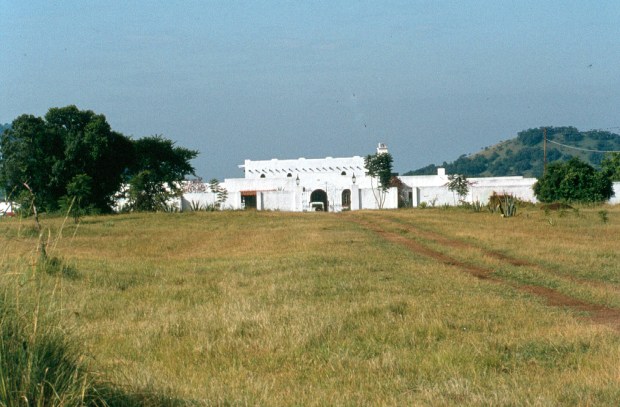
t mara intona ranch j murumbi 1

Joe and Sheila’s house at Intona ranch, Transmara, Kenya

During this particular visit Joe and Sheila were at Intona. They normally flew directly to the ranch, together with their dogs! Aware of the importance of the occasion they kindly offered to organize a dinner for our guests. This was not an everyday event, but I had joined them for dinner a few times before and I knew that it would be a formal occasion with excellent hospitality and very good food.

The day of the visit arrived and I collected our visitors from Kichwa Tembo Camp, located close to the Oloololo escarpment and, after a game drive that they thoroughly enjoyed in the surrounding area of the Maasai Mara

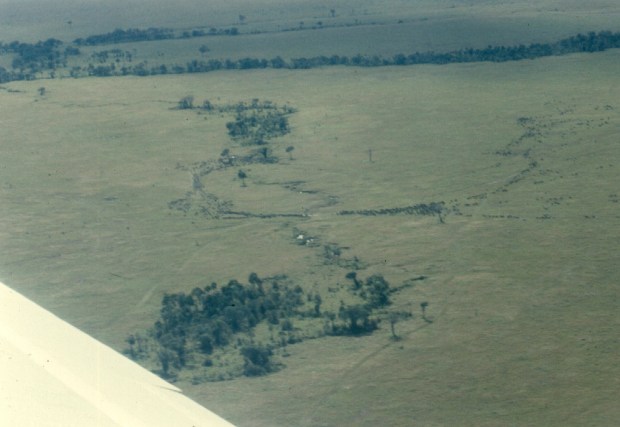
m mara small cropped

The Wildebeest moving through the reserve.

-that I knew very well- we spent the night there to leave early morning for Intona. The road was good and, once there, we devoted the rest of the day to visit our field activities. They seemed pleased with what they saw. I was also pleased and looking forward to the dinner to close a long day.

The Intona area is under the influence of the near lake Victoria and it frequently rains for a short spell in the afternoons. As a consequence the sun sets in a cloudy sky resulting in the most glorious and colourful sunsets. Aware of this Joe positioned the house in such a way to be able to make the most of them by having a wide west veranda where we congregated often to talk and have a drink before dinner. That day it was no exception and we joined Sheila and Joe for sun downers and polite conversation until Sheila, the perfect hostess and a very experienced one, announced that dinner was ready. While walking to the dining room she came close and whispered: “Julio, we have a new cook that came with us from Nairobi, I hope it will perform as he has excellent recommendations”. Knowing her standards I had no doubts and told her so.

trans mara

A view of Intona ranch in the Transmara parkland.

The dining room had a door to the kitchen and another one to the enormous and beautifully decorated sitting room. It had the most exquisite antique wooden table and chairs and antique rugs, most probably of Afghan origin, covered its floor. I knew from past dinners that under the rags at the place where Sheila sat there was a bell that she will press in order to call for assistance from the staff. This was her “secret weapon” that enabled her to coordinate things so perfectly that the guests would be amazed. Needless to say that it was a candlelight affair with lots of silverware and crystal!

When the first course came, brought by staff dressed in white with purple fezzes, it was a brownish coloured soup that looked rather disappointing. Trying it did not improve its look: it had a strong curry flavour and it was chilled! “I hope you like our Mulligatawny soup” said Sheila while she gave an approving look to the new cook that was overseeing the dinner from a discreet distance. Your concerns about the soup dissipated the moment your spoon found some submerged resistance that transformed itself in a spoon tip full of cranberry jam. The combination was simply amazing!

After our praise of the soup ended, the staff came back to collect our plates and this time the new cook looked happy and smiley, “the success with the soap was a boost for him” I thought while noting a serious-looking Sheila. By the time the roast beef with Yorkshire pudding and roast potatoes was brought in, the cook was definitely too happy and talking loudly to the visible embarrassment of our hosts. Sheila, used to deal with the highest-ranking world figures, ask to be excused and went to the kitchen, an unusual event. In the meantime, we enjoyed our roast that was really excellent.

Soon, Sheila came back announcing that all was well although she could not hide her concerned expression. We understood her fears the moment the cook opened the door of the kitchen when the staff came to collect the plates. The cook proffered, rather loudly, his hopes that we enjoyed the main course while trying to keep steady. By then we could not help noticing the strong alcohol whiff and knew that the worse had taken place! The spirit meant to go into the cooking had been “diverted”!

Although the guests and Joe were rather amused, Sheila was visibly upset! She excused herself again and went to the kitchen. We could not help overhearing a loud argument or rather Sheila’s shouts! There was a door banged and the sounds of a scuffle. She came back; her usual cool almost lost and red on her face. As an experienced host, she re-gained her composure fast and invited us to move next door to the sitting room for coffee and liquor. I stayed back with her as the guests and Joe moved out and Sheila -unseen by the guests- looked at me as if asking for support and understanding. I made my best “do not worry” gesture and moved to the sitting room together with the guests. She remained behind.

Intona sitting room copy

We all sat in the ornate sitting room and overlooked the cook’s episode, listening to Joe. Although soft spoken, he was a great host and a very engaging story teller with great tales and anecdotes from his many years in politics. We listened for quite a while until more noises coming from the kitchen area hinted that all was still not well and then Sheila reappeared –now with a grimace- to announce that the cook would like to say good bye to the guests! “Oh, no”, I thought, “is the situation that bad!”

The cook appeared escorted by the night watchman and a couple of staff and boisterously said “bye-bye!!!” but did not move and tried to say something but what came was a rather loud burp followed by another “bye-bye!!!” After this performance he was immediately manhandled out of the room, still saying “bye-bye!!!” and waving at us until the door was closed behind the group. I still vividly remember his final wave just before the door was shut! Confronted with this final act, even Joe was briefly embarrassed while the guests and I were quite amused!

The following morning Sheila and Joe were leaving for Nairobi and, as usual, I escorted them to the plane to assist them with their luggage, dogs and other items that they needed to take with them. They were sorry for what had happened. I felt very bad to have put them in this situation and explained them that I was very grateful for their hospitality and, to their obvious relief, I also told them that the donors were very pleased with the work and also very proud to have had the opportunity to have met them and enjoyed their hospitality, including the cook incident.

Before closing the door of the plane I spotted the cook. He was seated at the very back, looking penitent. I could not decide if his rather sombre looks were a consequence of his hangover, Sheila’s morning sermons or a combination of both!

The next time I was invited for dinner at Intona there was a new cook!


[1] See: https://bushsnobinafrica.wordpress.com/joseph-zuzarte-murumbi-1911-1990/ and https://bushsnobinafrica.wordpress.com/2015/06/22/joe-1/ in this blog.

Hyenas and planet-gazing

The morning after the Maasai chicken dinner a good breakfast was in order! We prepared bacon and eggs to compensate for our austere meal of the night before. In an attempt at avoiding another fasting episode I offered to take over the next dinner and to roast the beef we had brought from Nairobi.

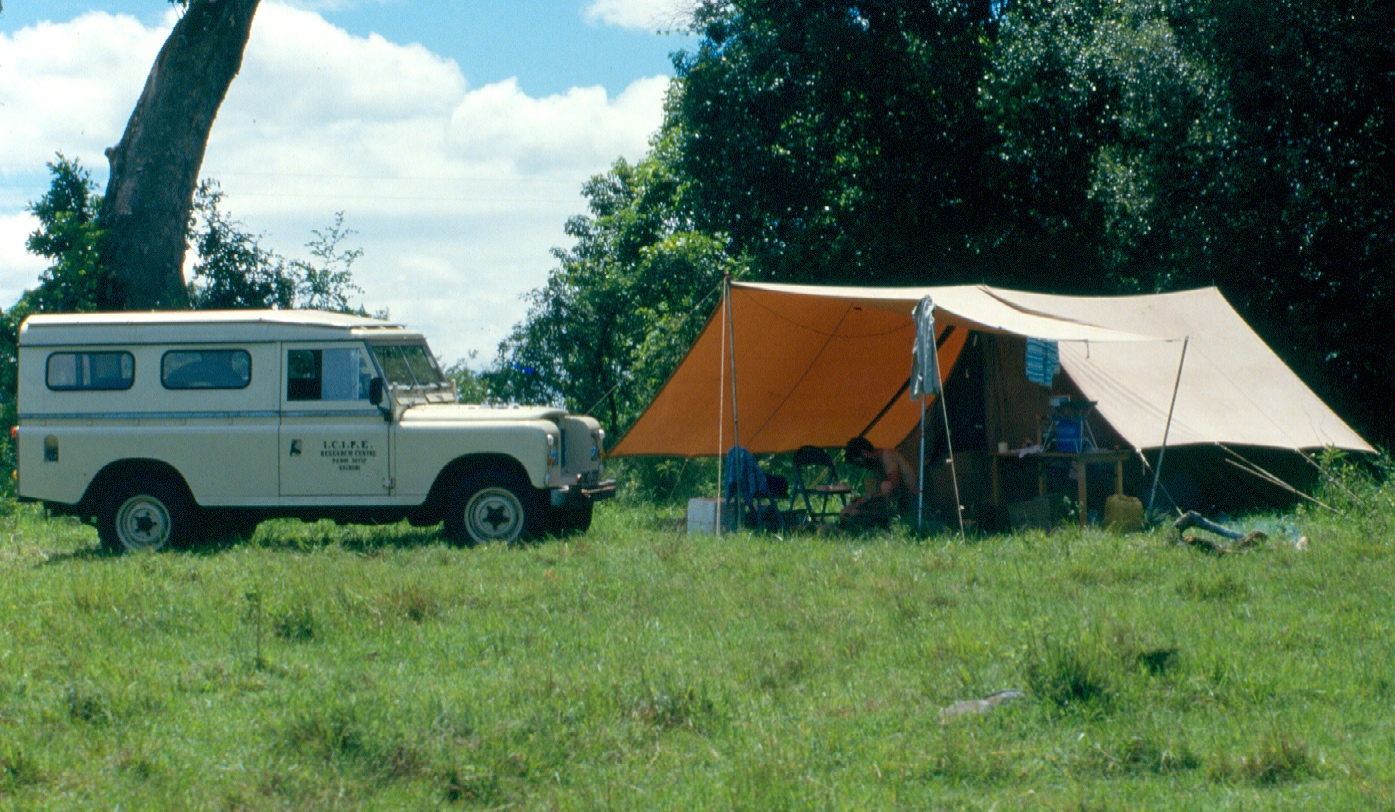
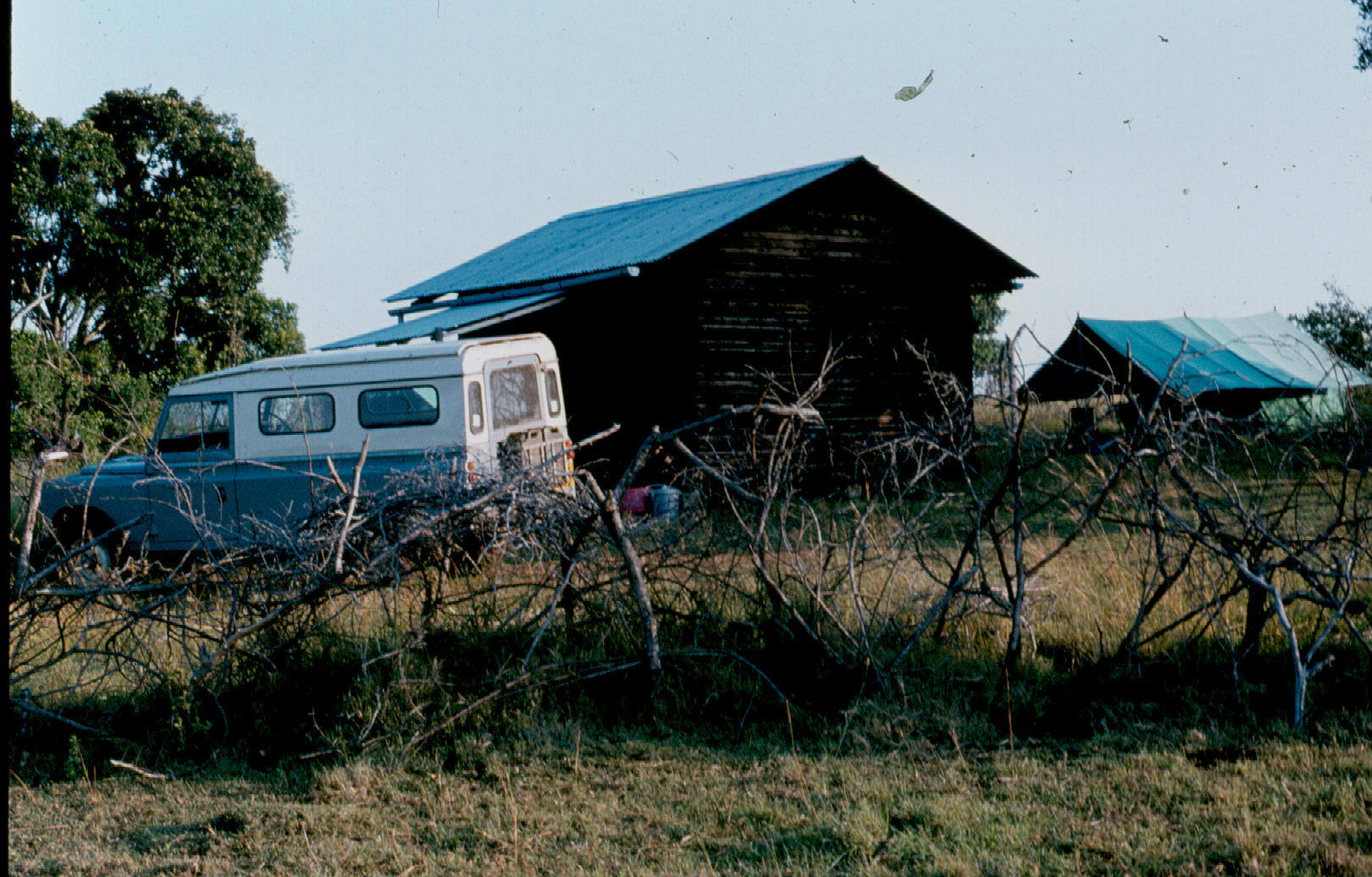
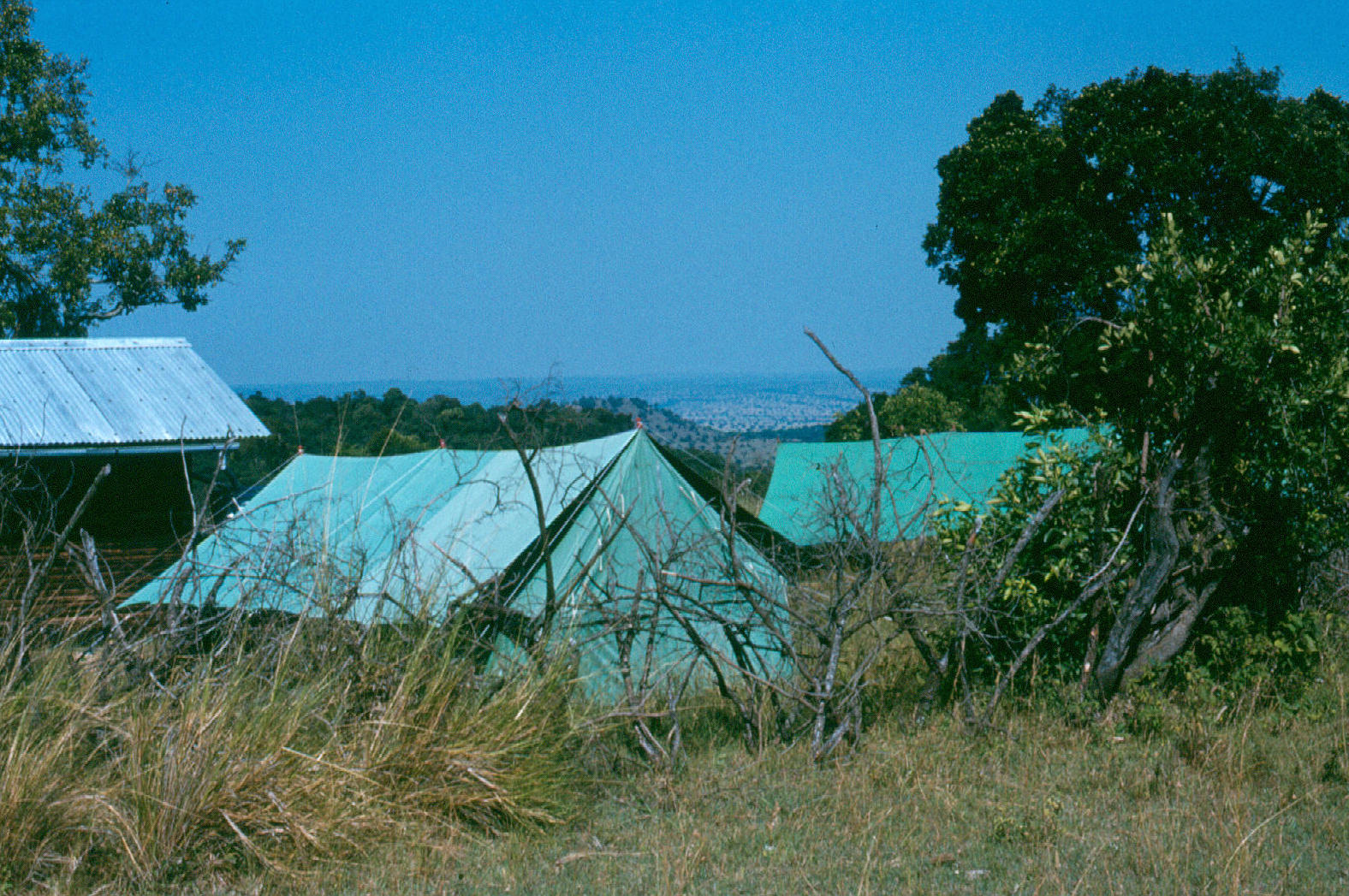
Camping at Intona ranch.

Camping at Intona ranch.

After breakfast, another day of routine field trials followed, as we needed to do many replicates of our tests in order to confirm the results. We worked without stopping until late afternoon when we decided that we had done enough and it was time for a shower and to prepare dinner. As a South American I am ashamed to confess that I am fearful of horses and prefer to keep a good distance from them. That is not all, I am a real disaster at barbequing! Therefore, on the occasion I struggled through and I made sure that the food was abundant and we ate our fill.

The night was truly spectacular. The relative short distance of Intona ranch from Lake Victoria meant that it rained very often. It poured in late afternoon and then the sky cleared at dusk. The consequence was that the rains cleaned the air and the night sky was always very sharp.

Ernest and I stayed awake until late talking and contemplating the pristine sky. We talked about many issues, occasionally stopping to listen to the night sounds, in particular the spotted hyena calls getting closer to our camp. Getting gradually bolder they moved close to the periphery of the light of our camp fire. I reassured Ernest that this was a normal event when camping at Intona and that “normally” hyenas would not be aggressive.

Despite the good time we were having, we have had a long day and we felt very tired so soon we went to bed. As soon as we were inside the tent we heard something sniffing all around our tent. A white-tailed mongoose was seen scurrying away when we shined our torches. That small mystery solved, it was back to bed, hoping that sleep would come soon.

Not so. This time it was a loud crush outside the tent that also merited investigation. This time a hyena was the culprit! The beast had grabbed a dirty pan and had taken off at speed. We run after the beast but it was a futile effort and came back to bed thinking on resuming the search for the pot in the morning.

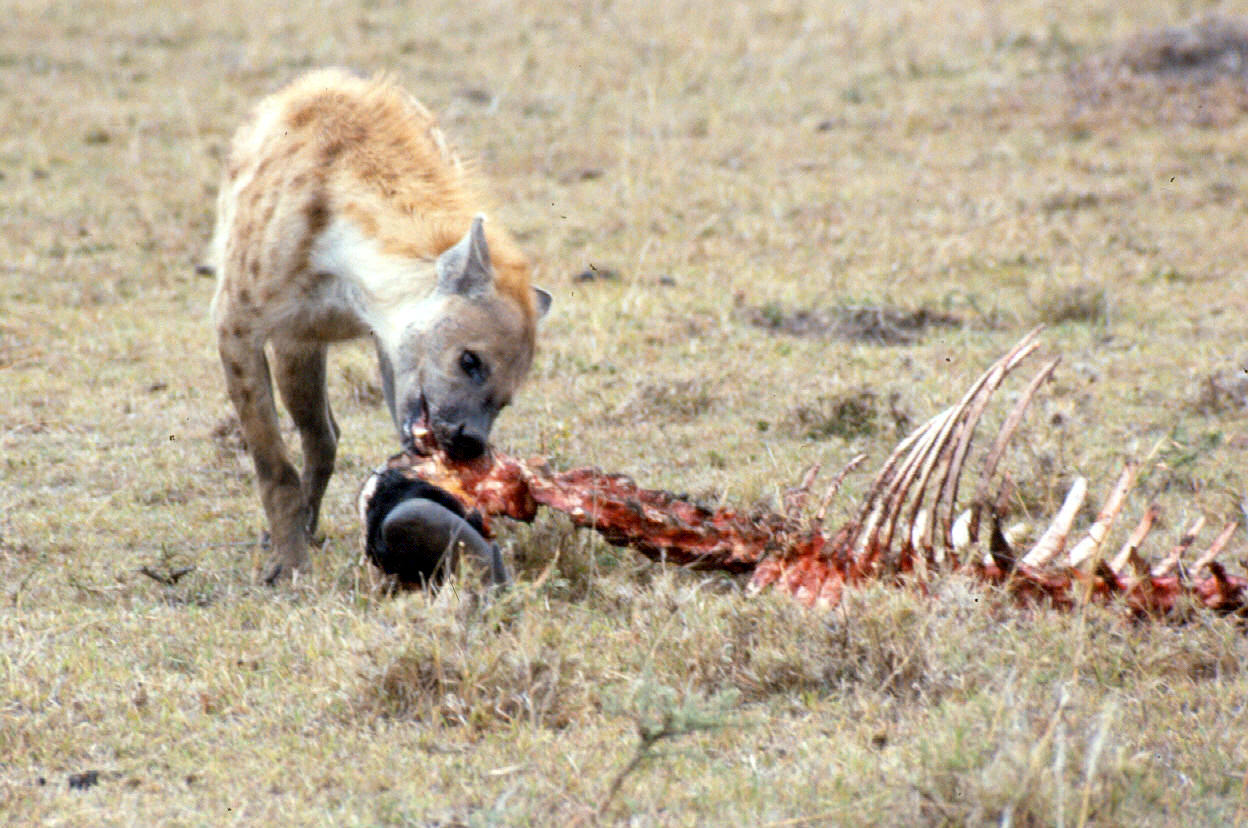
mmara hyena 2

A Brown hyena with wildebeest carcass in the Maasai Mara. Its cousins visited us nightly at Intona.

While thinking and hoping that normality would return, I finally fell sleep. Again, it did not last long. It may have been 03:00 hs when I heard Ernest opening the tent door zip. My first thought was that his gut had finally lost the fight against the filtered water drunk on the way in! In addition, aware of the hyenas I remained awake although without moving, hoping to go back to sleep immediately. No chance! Ernest came back and started to shake me up shouting “Wake up, the sky is perfect to look for planets!” I felt like slaying him but, remembering his partial deafness and on account of his contagious enthusiasm, I made the mistake of getting up!

By the time I managed to go out of the tent, Ernest was already looking through the binoculars, identifying the various noteworthy celestial bodies, accompanying his successive discoveries with shouts of joy! Although I had enjoyed contemplating the night sky both in Uruguay and in Kenya, I have never been that interested in astronomy. However, he convinced me to look at Jupiter (a small orange sphere) and even managed to see Saturn and what I though were its rings! Finally Ernest’s excitement subsided and we managed to hit the camp beds again, this time until the sun was up!

The large ball of crunched aluminium that we found about one hundred metres from our tent was not the remains of a recent asteroid that had narrowly missed us but all that remained from our cooking pan after the hyenas had squished it to get its juice.

Although our cooking options suffered another severe setback we still managed to produce some pan-less and chicken-less dinners during the following days!

Skewered Maasai chicken

When I was there in the 80’s the International Centre of Insect Physiology and Ecology (ICIPE) in Kenya had established various partnerships with universities and research centres outside Africa. I was involved with the collaboration with the University of Neuchâtel on tick pheromones. The idea was to explore ways of attracting ticks to pheromone-baited traps and, with the addition of a tickicide[1], to destroy them.

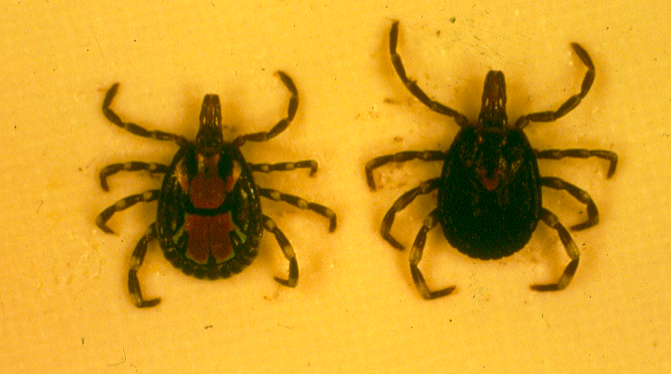
Bont ticks male (left) and female. A bad picture.

Bont ticks male (left) and female. A bad picture.

The composition of the aggregation pheromone of the Bont tick[2], one of the important cattle ticks, had just been discovered. It was a mixture of three chemicals that were available commercially. This offered us a good opportunity to test this compound in the field. Ernest was the scientist from Neuchâtel that would work with me at Intona ranch where natural populations of the tick occurred.

Ernest was a very enthusiastic and good-humoured Swiss that had a hearing problem as a consequence of firing cannons during his military service in the Swiss Alps, forgetting about wearing earmuffs! Luckily, we got on well from the start. So, armed with the necessary research tools, we departed for Intona to spend a few days doing fieldwork.

As a precaution, we did take a few ticks from the tick colony in case the bush ones would not cooperate! Crossing the Maasai Mara Game Reserve was never disappointing and, as usual, we spent a night there on the way to the Transmara where Intona was located. Ernest was delighted being able to see the plains game and we wee also lucky to spot elephants, lions and hyenas.

In the morning, as usual, we laboriously climbed the Oloololo escarpment and stopped to admire the breath taking view of the Mara triangle from its highpoint. The almost aerial view that it offered was really thrilling, even for me, a regular visitor to the area. Lines of wildebeest could be seen in the distance as well as dark patches that indicated buffalo herds. As I knew he would, Ernest loved the view. After spending a long while in contemplation, it was time to continue our long journey.

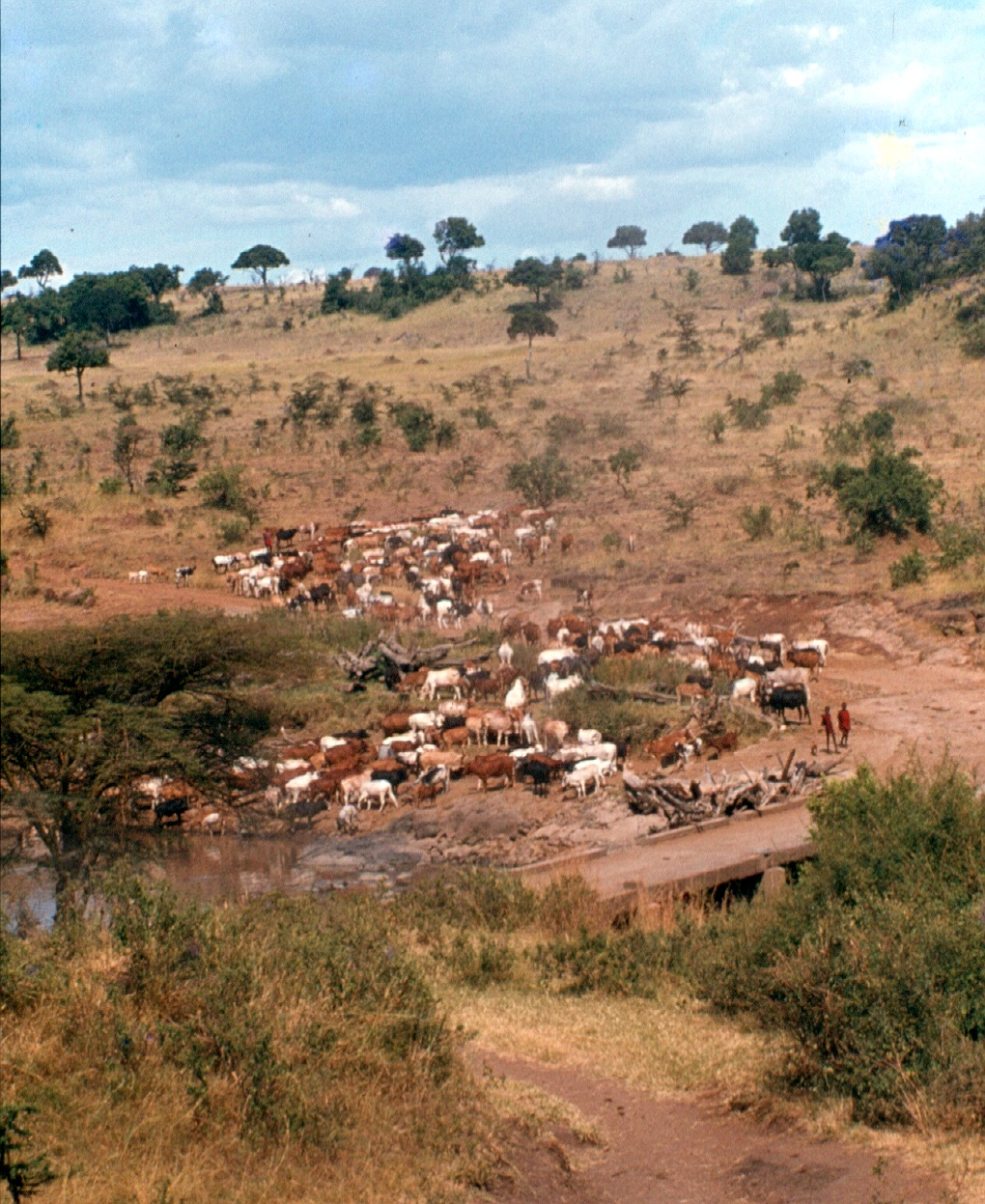
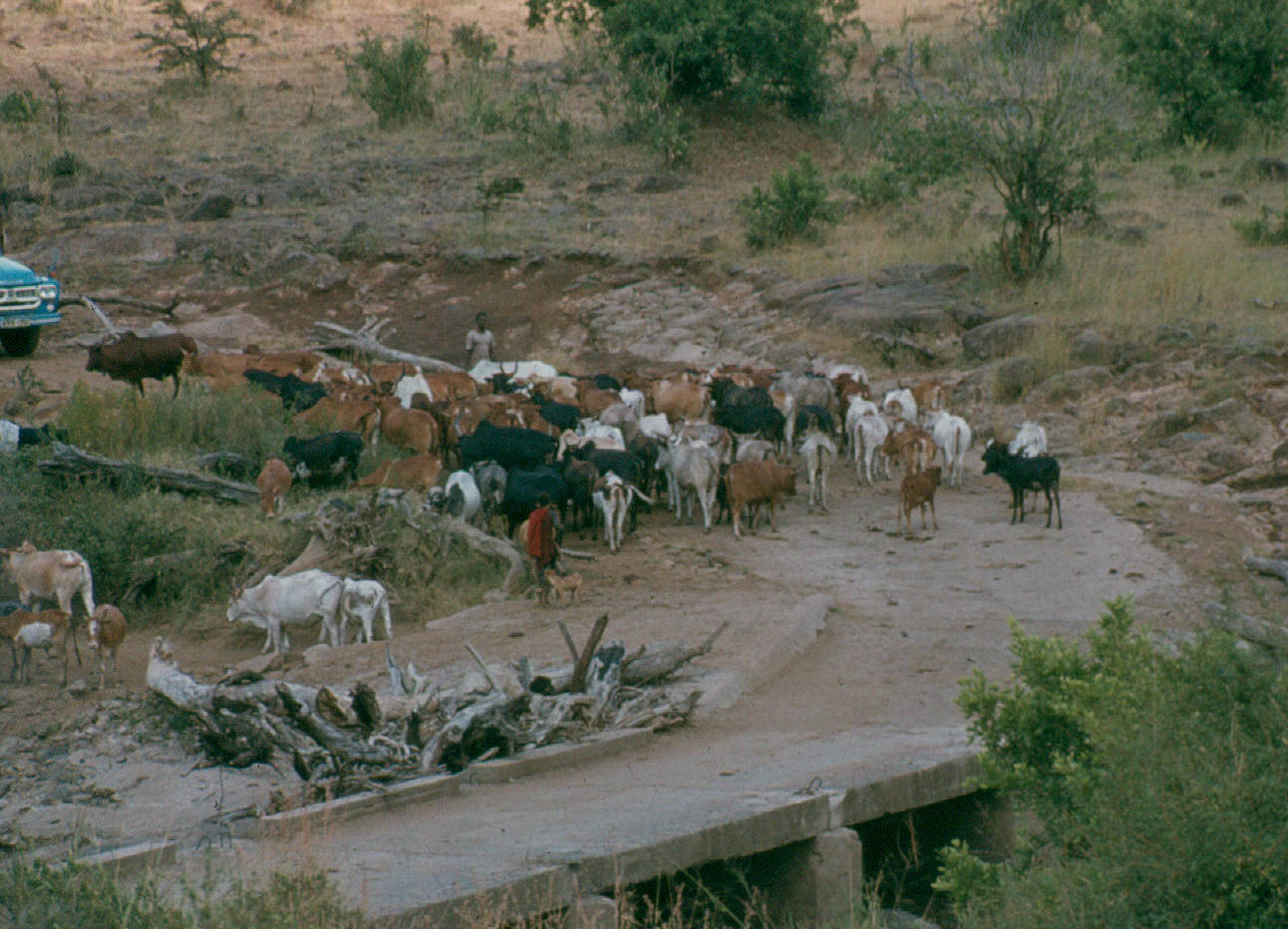
Maasai cattle at the Mara River bridge on the way to the Transmara.

Maasai cattle at the Mara River bridge on the way to the Transmara.

Following the escarpment the road was bad as usual but luckily this time it was dry. However, we needed to stop a few times, not because of getting stuck or having mechanical problems, but because Ernest was amazed at how bad the road was! “Ooohh no, please stop!” he would shout and then get out of the car to photograph it even before I managed to stop. Clearly he was comparing the Transmara tracks with the Swiss roads!

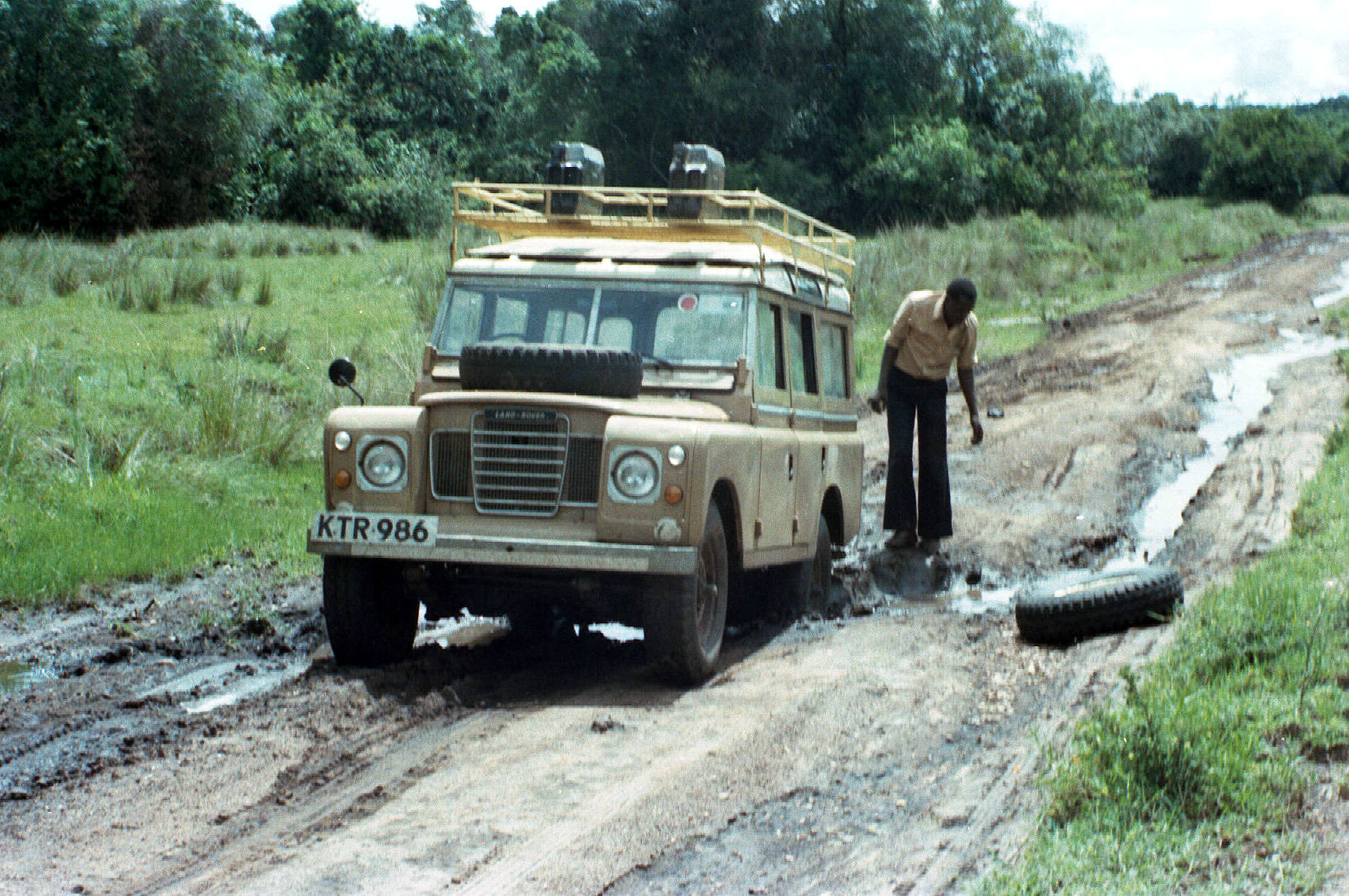
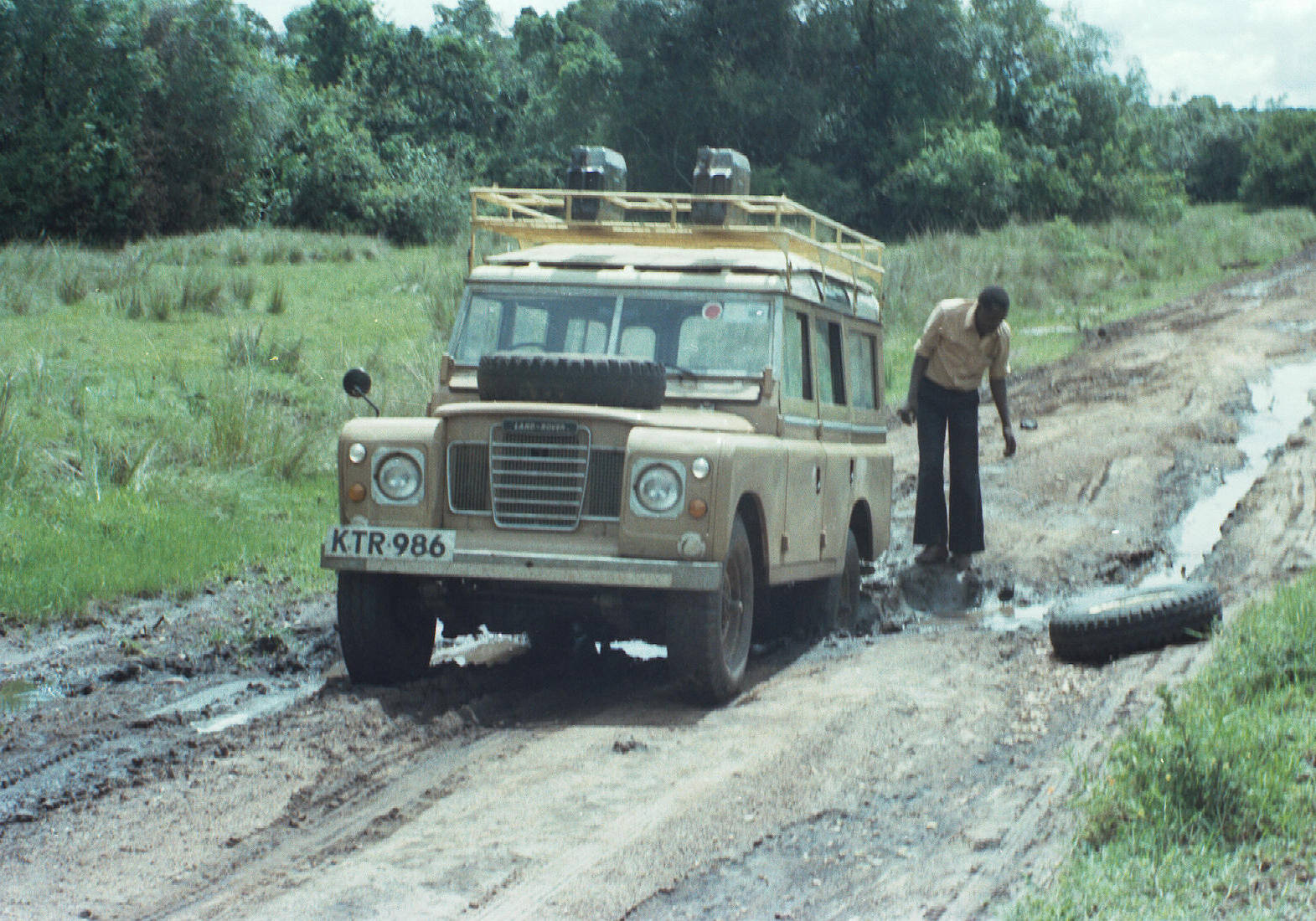
Stuck on the way to Intona on a rainy day.

Stuck on the way to Intona on a rainy day.

Eventually, after a few halts, he got used to the rough road but, being a very active person, his attention drifted to other things. As all first time visitors to the Transmara he took a great interest on the Maasai people and their cattle, a normal sight in the area for me but quite so for guests. As the Maasai were not keen on pictures, we did not stop.

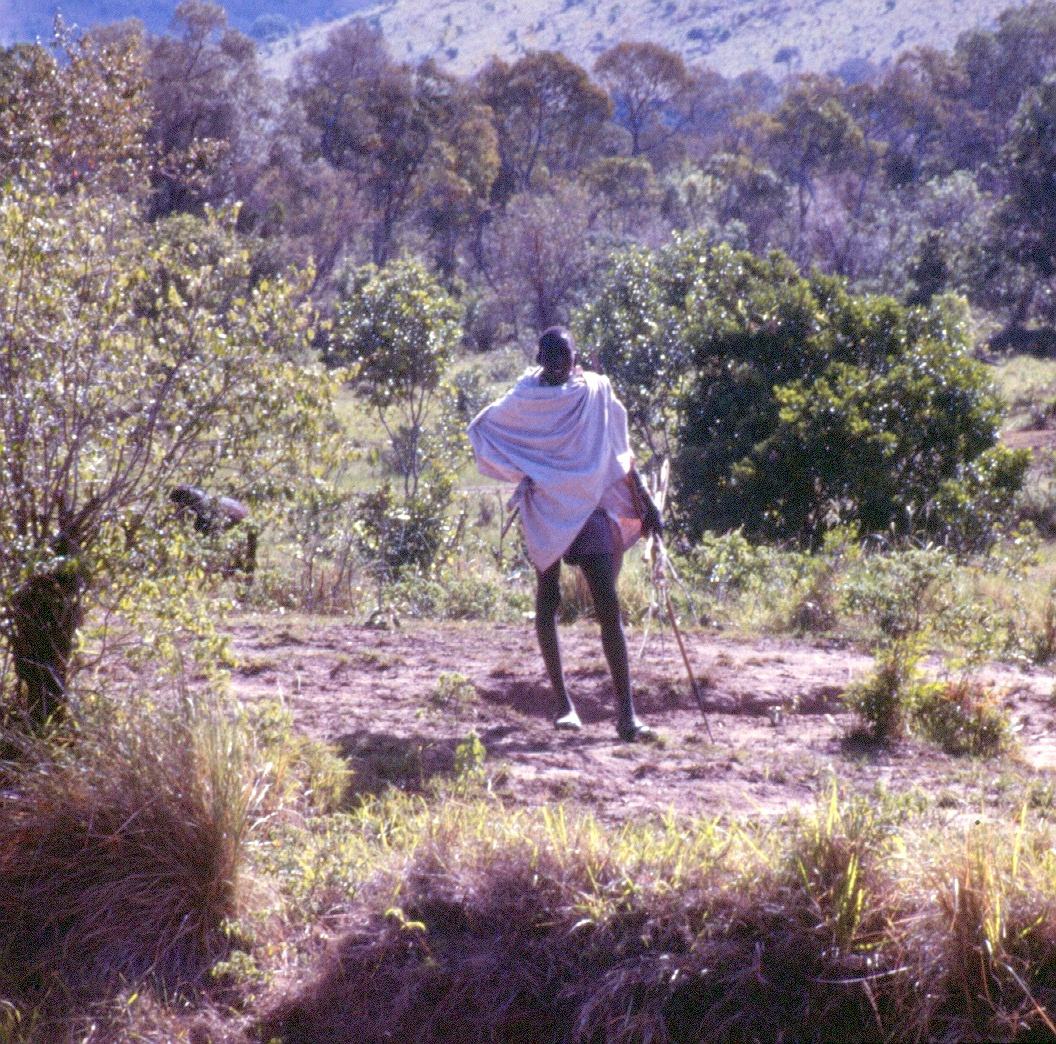
Maasai herdsman on the way to Intona.

Maasai herdsman on the way to Intona.

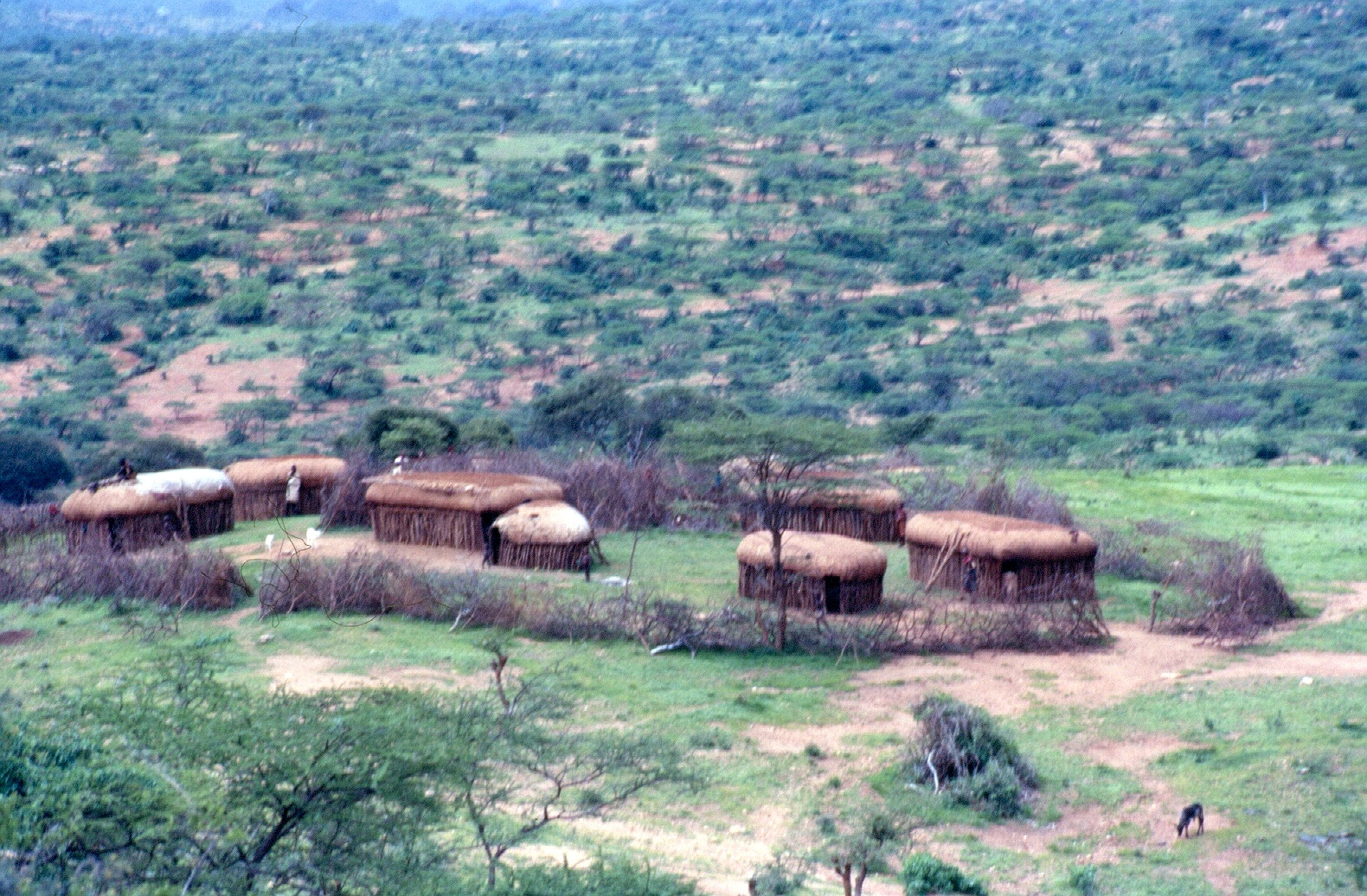
Maasai Manyatta (dwelling).

Maasai Manyatta (dwelling).

Maasai children looking after livestock.

Maasai children looking after livestock.

After about half an hour of hard going I heard “Stop” coming from Ernest as we approached a large muddy pond by the side of the road. While I stopped the car he rummaged in his rucksack from where he extracted what looked like an over-sized hypodermic syringe and a tumbler. I was not sure of what was going on and limited myself to watch, together with our herdsmen travel companions. “This is a Swiss water filter that will make any water suitable for drinking” he said as we were walking towards the mud and the terrapins swam away in fear! He added “It is recommended by the Swiss Tropical Institute, so it must be good!”

Without further ado he sucked water into the syringe and, once it was full, it poured into the glass. The water was indeed crystal clear! “You see,” he said, showing the glass. I must confess that it was an impressive feat as the puddle was truly a thick chocolate mud and I had not seen such a contraption before! Ernest offered the water to us and, when we all politely declined, he drank it himself before I could stop him, fearing for the consequences on his guts.

After praising the quality of what he had just drunk, he repeated the operation once more. This time one of the herdsmen agreed to try it and he agreed that it was indeed OK if with a bit of a muddy taste. “The filter must be getting clogged,” declared Ernest, “I must clean it when we get to Intona”. I refrain from commenting on the cost-effectiveness of the device and we resumed our trip, clearly ready for innovation.

Eventually we arrived at Intona ranch. It was almost dark so we rushed to assemble our tent, had an early dinner and went to bed as we both felt the long two-day trip.

The following day we started our work early and spent most of the day carrying out several trials that were quite successful. In the afternoon we decided that we would have roasted chicken for dinner so while Ernest continued working I went with Tommi, my Maasai assistant, in search of dinner. Eventually we managed to persuade a Maasai lady to sell us a cockerel.

Our prospective dinner was killed by me and plucked by Ernest. The size of its talons were unequivocal indicators of its seniority and its leanness qualified it as a Maasai chicken long-distance runner! Its muscular condition spoke of speed and endurance at the service of survival! Oblivious to all this, Ernest assembled a boy scout-like contraption with branches where, after impaling the chicken, it would be rotated over the fire. We invited our herdsmen to join us and they prepared their traditional “ugali[3]” to go with it.

The cooking of the chicken took a very long time. Ernest kept stabbing it and declaring that it was cooked but still tough. The lengthy turning process led to inexorable shrinking and darkening until it was declared fit for human consumption. The cockerel had turned into a “toasted baby chicken”. I saw the herdsmen exchanging doubtful glances over their Tusker beers, a bad omen!

Ernest cut it into equal pieces and -luckily- Joseph placed large chunks of ugali to go with it. Tommi bit the first piece and I heard a “Taargh” coming from him that became a clear “tough!” once he managed to swallow it. Bad news coming from a Maasai! Ernest agreed on its toughness but declared that it tasted like real chickens did a long time ago in Switzerland so he was happy! As for the rest of us, we could have done with a second runner Maasai chicken!

Transmara, Kenya, circa 1986.


[1] Also known as an acaricide, a substance that kills ticks.

[2] Amblyomma variegatum (the Bont tick) transmits Cowdria ruminantum that causes a deadly disease of ruminants known as Heartwater.

[3] From Swahili, maize flour cooked with water to a thick porridge. It is the staple food in Kenya.

Life and work in Kenya: Intona

The work at Intona Ranch involved the organization of a six-month field trial, a first for me. Luckily Alan had a system in place for his own trials and I just “piggybacked” on what he had created. As he was the Head of the project he kindly supported my work very generously and enthusiastically. He lent me his work Land Rover, herdsmen and the routine disease monitoring system. I needed to add the tick burden evaluation part by bringing in my own people to carry it out. Visits were required for monitoring purposes and to replace personnel every two weeks. As mentioned earlier, I had employed two people: Kimondo and Tommi. The latter was a Maasai who was no stranger to the Transmara and although he was not as hardworking as Kimondo his local knowledge would prove of immense usefulness. We were a good team!

Routine monitoring of experimental cattle is key.

The team. At the time doing routine monitoring of experimental cattle. From left to right: Chege, Kimondo, Tommi and Benson.

The work would consist in the creation of two groups of cattle immunized against Theileriosis by Alan and his group. This would enable me to stop applying tick-killing chemicals (acaricides) to one group while the other would be maintained with strict tick control. The comparison on their live weight gain and the tick species and burdens observed would enable me to estimate the expected losses that the ticks themselves would cause to the cattle. Clearly it was only a start but something that had not been possible to assess before.

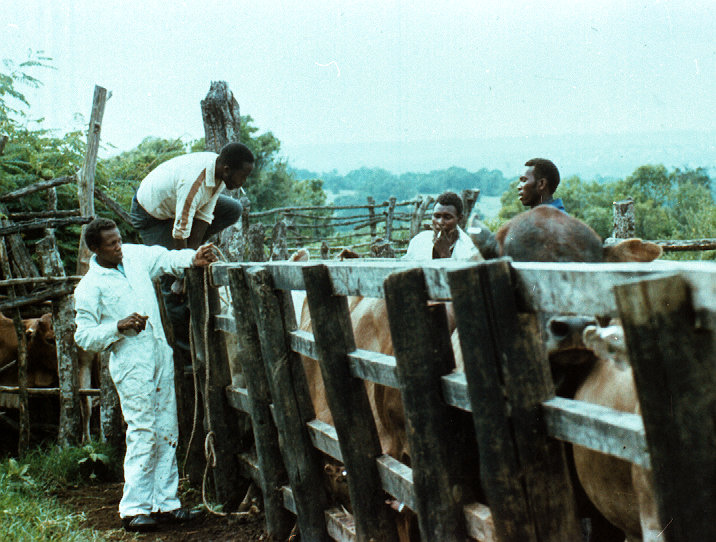
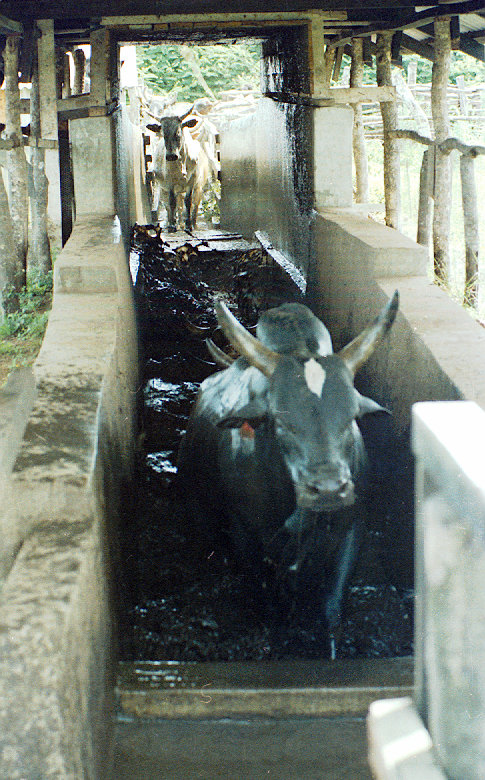
Cattle being dipped.

Cattle being dipped.

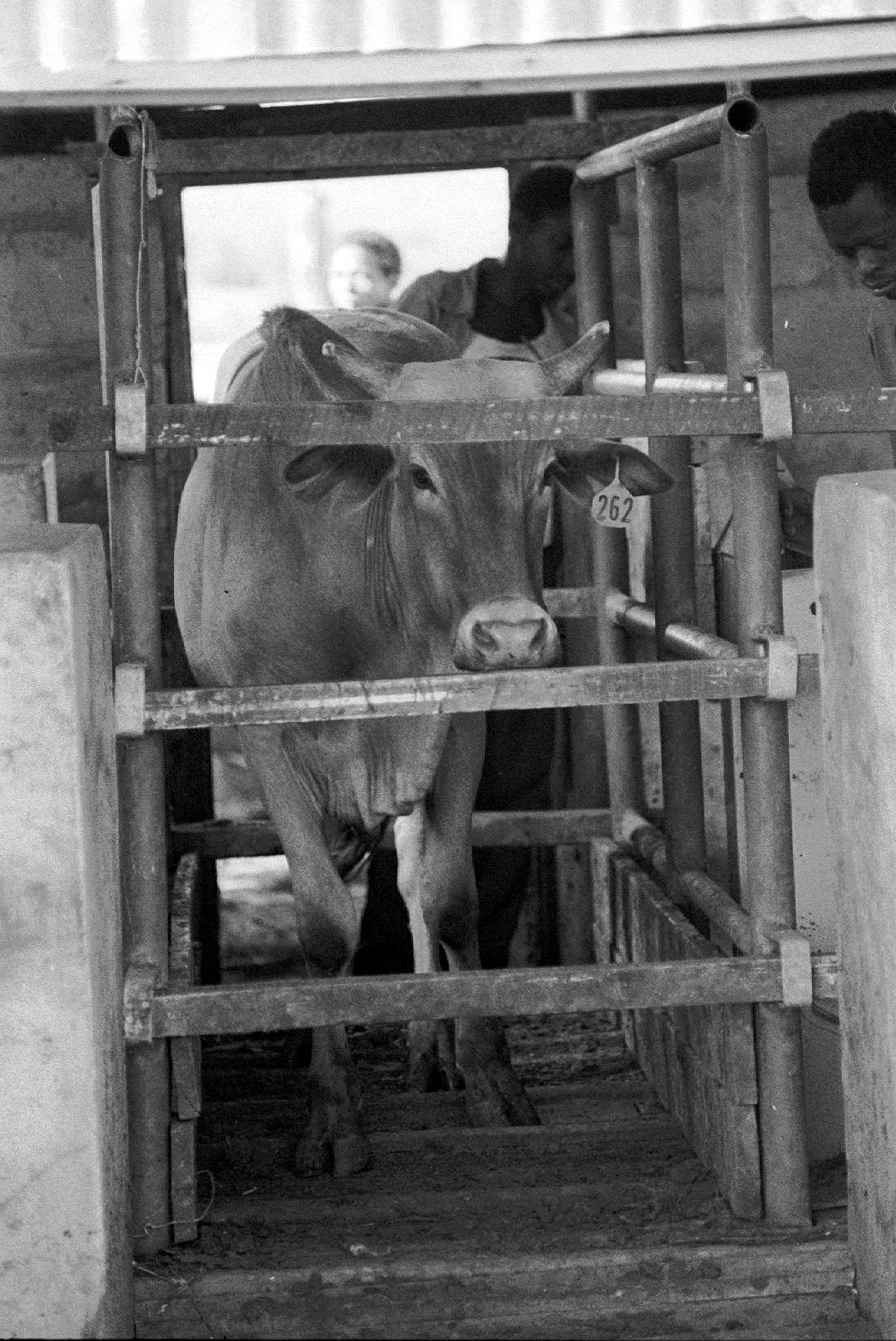
Liveweight gains were an important parameter in the trials.

Live weight gains were an important parameter in the trials.

Now I needed to find the right cattle for the trial and get them to Intona. This required some planning and involved travelling to Laikipia in Northern Kenya. I was searching for Boran, a Bos indicus breed as these would remain at Intona ranch once the trial ended and we knew that Joe would be very keen on them.

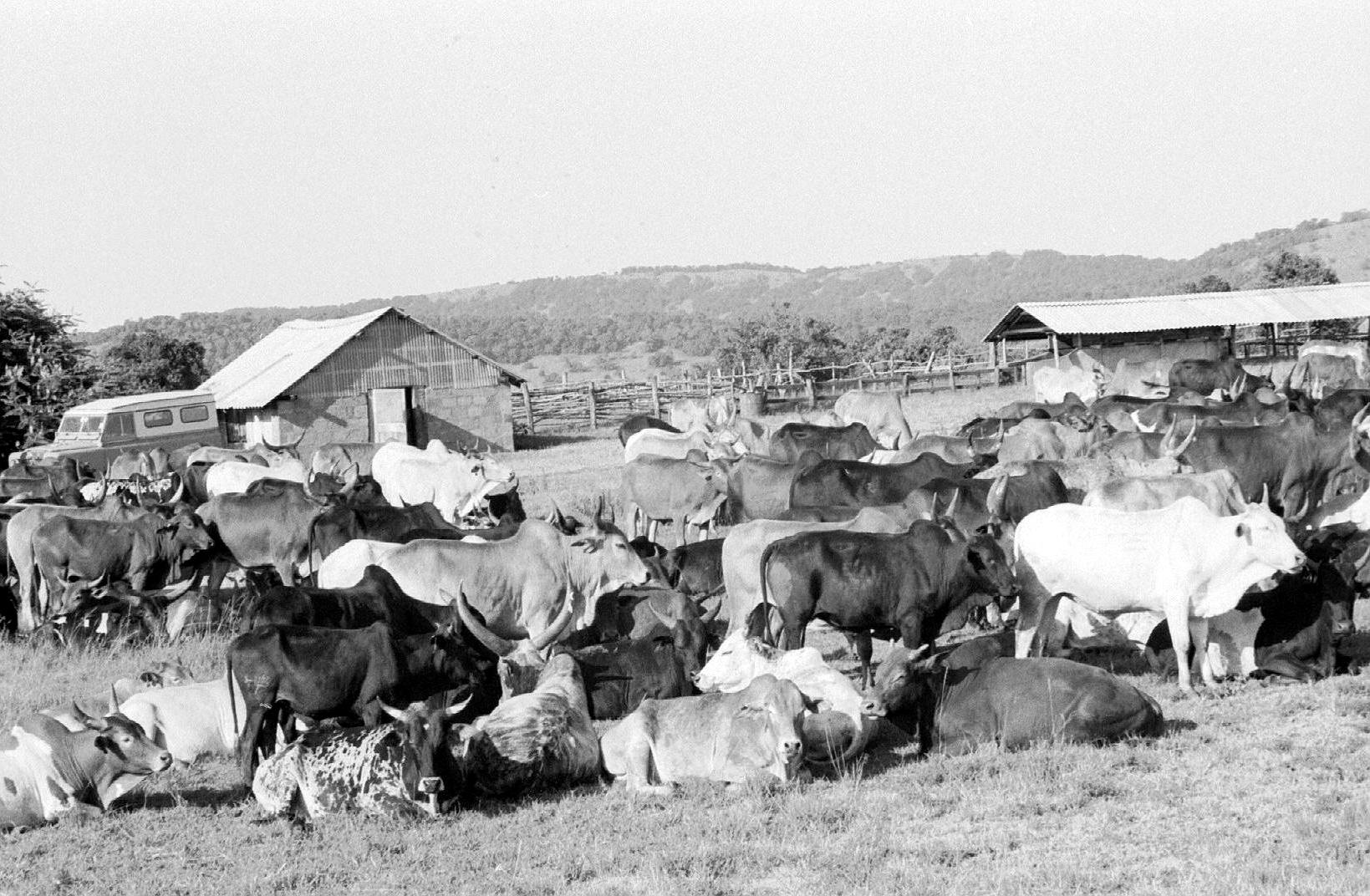
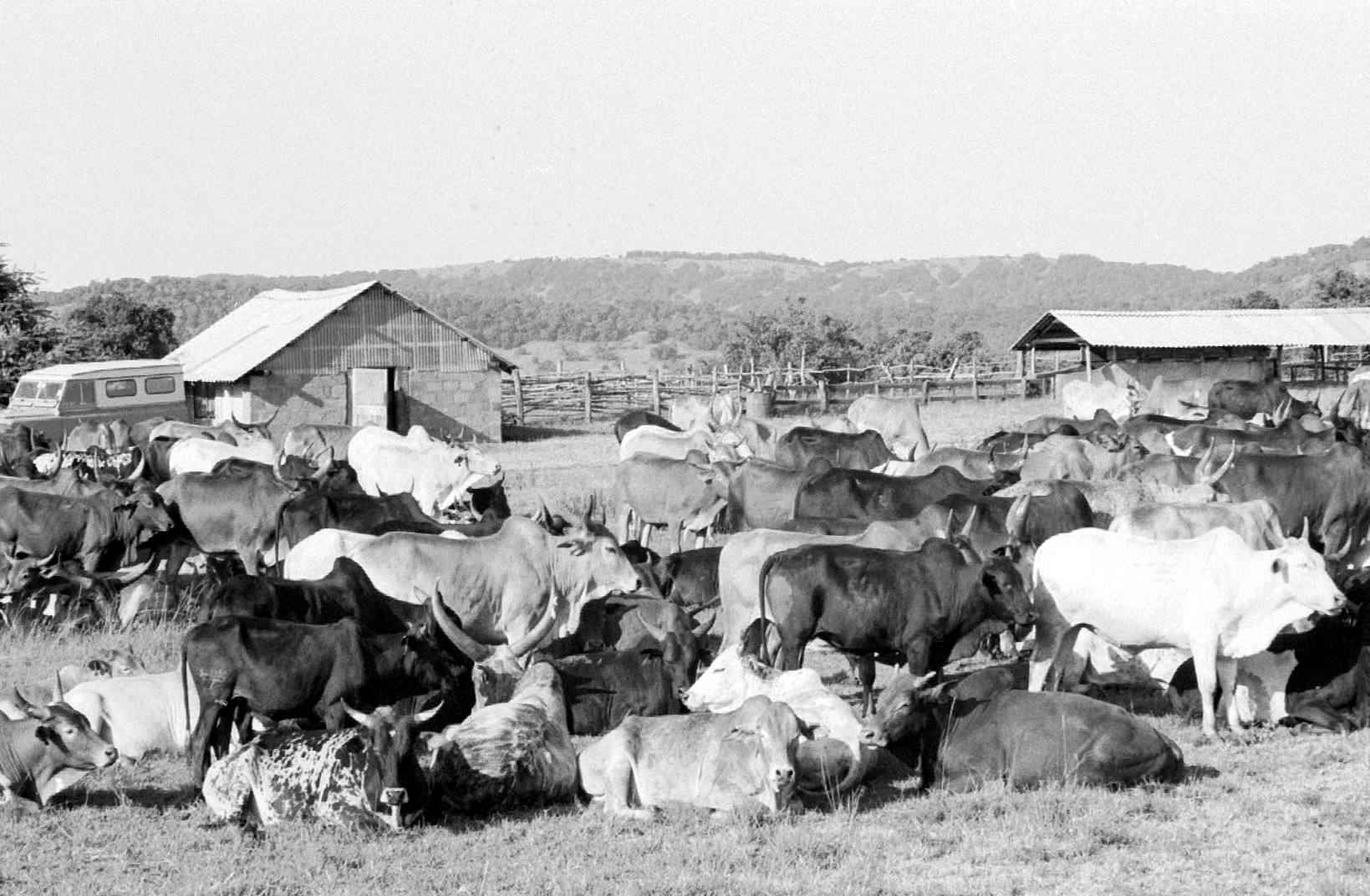
The cattle of Intona Ranch.

The cattle of Intona Ranch.

We did not take any chances...

We did not take any chances…

Gilfrid[1] had his ranch beyond the slopes of Mt. Kenya in Laikipia and he had the cattle we needed. I organized a “cattle-buying” trip. Luckily in Alan’s Land Rover, I departed for Laikipia with Kimondo and Tommi to assist me on the journey. A large lorry followed us to carry the animals. We drove past Murang’a with its amazing vegetable offer, Nyeri and Nanyuki on the slopes of Mt. Kenya. The views beyond Mt. Kenya into the very dry Northern Frontier District were worth stopping to take in. At Nanyuki we went West towards Rumuruti, gradually descending from the mountain into nomadic grazing land to finally arrive at the ranch. Gilfrid was waiting with the cattle on display for us to choose what we needed. The selection done, over a cup of tea we agreed on the final price and payment and then loaded the animals on the lorry. As the latter was slower than us, we agreed on the route to follow and told them to depart before us, as we were hoping to arrive at Nakuru to spend the night there.

We lingered a bit longer talking to Gilfrid while he showed me his ranch. He was clearly an interesting “character” and drove a “Hang over”, due to a modification he made to the back badge of the Range Rover! Returning to the house I saw three or four skulls on the roof of the verandah. I realized that they were lions’. Gilfrid explained that they had been “cattle-eaters” that needed to be shot, as they killed far more animals than they needed to eat. “I tolerate losing a few cattle but not that one lion needlessly kills ten cattle in one night!” he asserted. However, he reassured me that lions were still plentiful in the area and that he loved to hear them roaring in the evening, provided that they kept away from his cattle! I could not help asking for one and he promised to remember me the next time a lion overstepped the mark[2]. He agreed and after a while we said our farewells, as I needed to catch up with the lorry. I liked Gilfrid and would return to him for more cattle in the future.

After about an hour, the cloud of volcanic dust in front of us indicated that we were approaching our truck. As I positioned the car to overtake it and its dust plume, I saw a grid on the road that I just managed to avoid by braking and swerving to one side. Recovered from the sudden jolt we came close to the lorry again. “What on earth is going on!” I muttered while I tried to make sense of what I saw. The back door of the lorry was missing and a line of cattle were looking at me! The sudden appearance of the grid on the road suddenly became clear, it was in fact its back gate! I started hooting and flashing my lights hoping that the driver would stop. He ignored us or did no hear us so I took the risky decision of overtaking it to stop it from the front. The maneuver was not easy as it was a narrow dirt road but somehow I managed, probably helped by my stress!

We agreed that as soon as the lorry stopped we would jump out to stop the animals from jumping off and scampering into the endless savannah, as there are no fences in that part of Kenya! Luckily we managed to stop the lorry before any of the animals jumped and, while the herdsmen held the animals in check, I rushed back to collect the back gate that, luckily, somehow fit inside the Land Rover! I mentally thanked the cattle for being wise and verbally the herdsmen for keeping them at bay. The gate fixed, we resumed our journey with our car in the lead.

We managed to get as far as Kericho where we watered the animals and made sure that all was tightly secured before we retired for a fully deserved rest. As the lorry was much slower than us, we also agreed that it would depart at dawn towards Kisii and onwards until Kilgoris and eventually to Intona Ranch. I was really exhausted both physically and mentally and managed to count about three cattle jumping before I crashed into sound sleep!

When we were ready to go the next day, the lorry had already left as arranged. We headed for Kisii following the tarmac, expecting to find our lorry on the way. We got there and didn’t find it so I assumed that they must have continued towards Sotik, the next town so I proceeded to that destination. Still no lorry! I could not believe that they had already passed Sotik so I retraced my steps looking for it, as it was likely that they had stopped on the way and I had missed them. This proved to be a mistake as we still found nothing on the way back and by this stage I had lost too much time to catch up to it on the road!

My first and rather distressing thought was that my cattle had been stolen! There were lots of stories of cattle rustling taking place in that region of Kenya at the time and I had been warned about them prior to our departure. Not sure about which Police station to report the theft to, I decided to leave that as a last resort and instead pushed on to get to Kilgoris as this was our final meeting point before we took the rougher road to Intona Ranch.

We drove silently all the way and arrived at Kilgoris in the late afternoon, rather crestfallen and upset with myself for having been so careless. As Kilgoris is a small place, if the truck was there we would be able to see it, so we entered the town with a glimmer of hope. “There it is” exclaimed Kimondo and there it was, our lorry was almost the first vehicle we saw, parked at the prearranged meeting point in the town square. As expected, the lorry was totally surrounded by Maasai that were keenly watching our cattle. Through Tommi I learnt that they were really excited and very complimentary about our rather lovely and fat Boran yearlings! My worries increased again with the knowledge that Maasai believe that all cattle belong to them!

We finally found the driver at a nearby shop and told him of our adventure. Happy to see us again, he laughed at our obvious travel miscalculation. He had left Kericho earlier than we thought, as he was not sure of the condition of the road and got to Kisii and then Sotik with ease. Seeing this, he decided to push on to Kilgoris to save time and to arrive there before nightfall as I had recommended to him. He got to Kilgoris early, parked the lorry and waited! He shared my wariness about the curiosity shown by the Maasai crowd and we agreed that his “tout” would sleep on the lorry to avoid any nocturnal mishaps!

I was relieved to see that things were back to normal and I treated everyone to some “Nyama choma[3] and “ugali[4] and then went to the hotel to sleep. The place was rather basic, prepared for a Maasai clientele but I did not mind and slept soundly as we were reunited with our “lost” cattle!

The following morning we drove in front and, luckily, the road was dry. We reached Intona ranch without further disasters. The field trial could now start!

[1] See: http://suyiantrust.wildlifedirect.org/author/gilfrid-powys/

[2] See “Lion Skull” later in this blog.

[3] Barbequed beef.

[4] Maize meal.

Back to Nairobi[1]

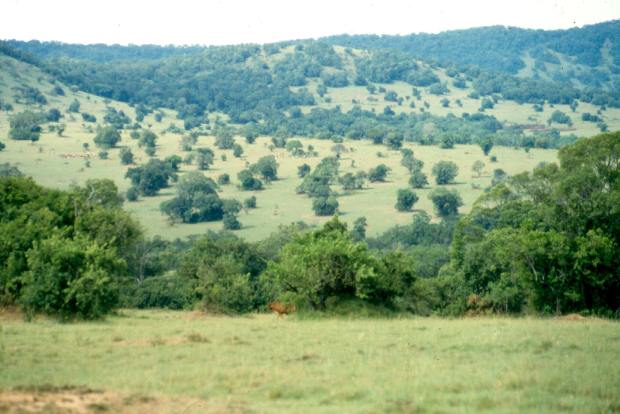
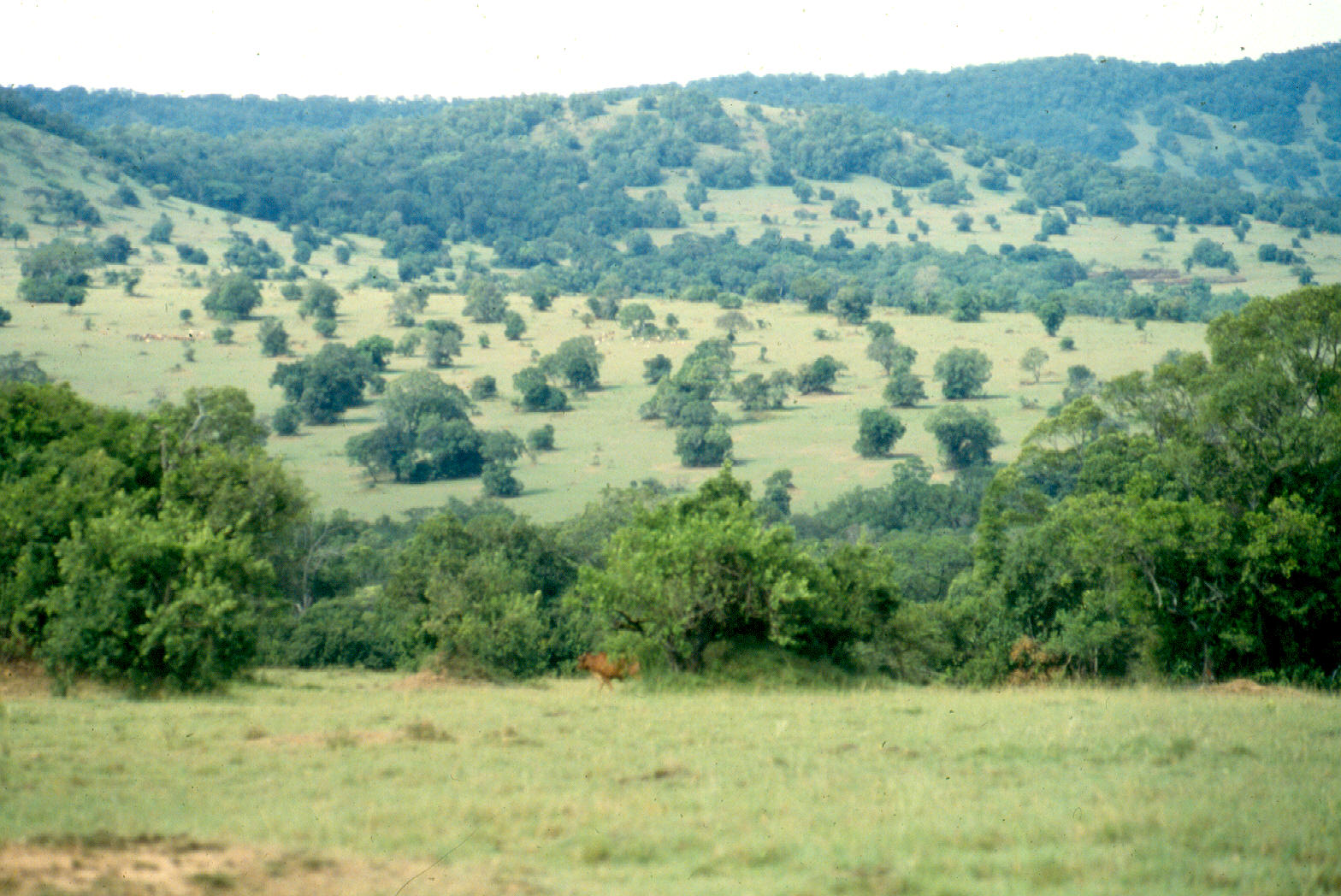
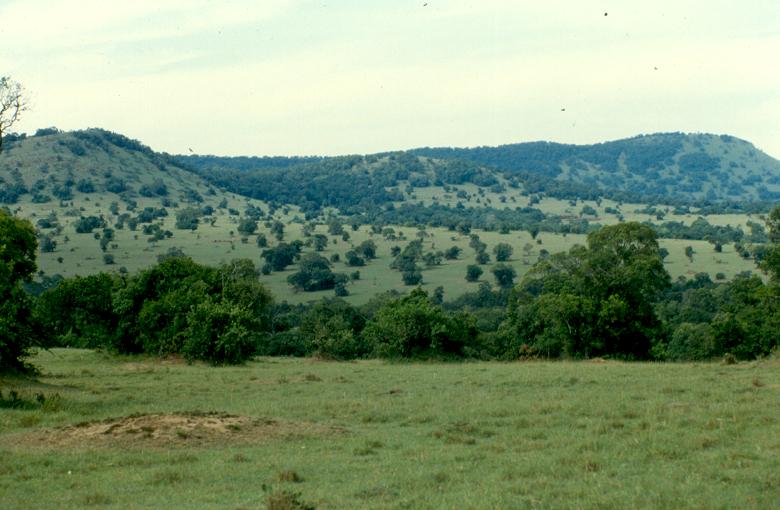
The return trip from Intona ranch took us through the attractive Transmara parkland where its green natural grasslands were splattered with islands of forest, usually associated with large termite mounds. These forest patches coalesced at times to form larger wooded areas, particularly when linked with a river. Talking about rivers, we crossed the Migori where Alan said a group of Giant Forest Hogs (Hylochoerus meinertzhageni) -a Transmara “special”- could be seen grazing in a forest clearing next to the road[2]. Other common game was plentiful, crisscrossing the road almost continuously. Alan informed me that the wildebeest had crossed the Mara River and were grazing in the area of the Mara triangle and some would climb the escarpment towards the Transmara. I was happy to know that we were heading in that direction!

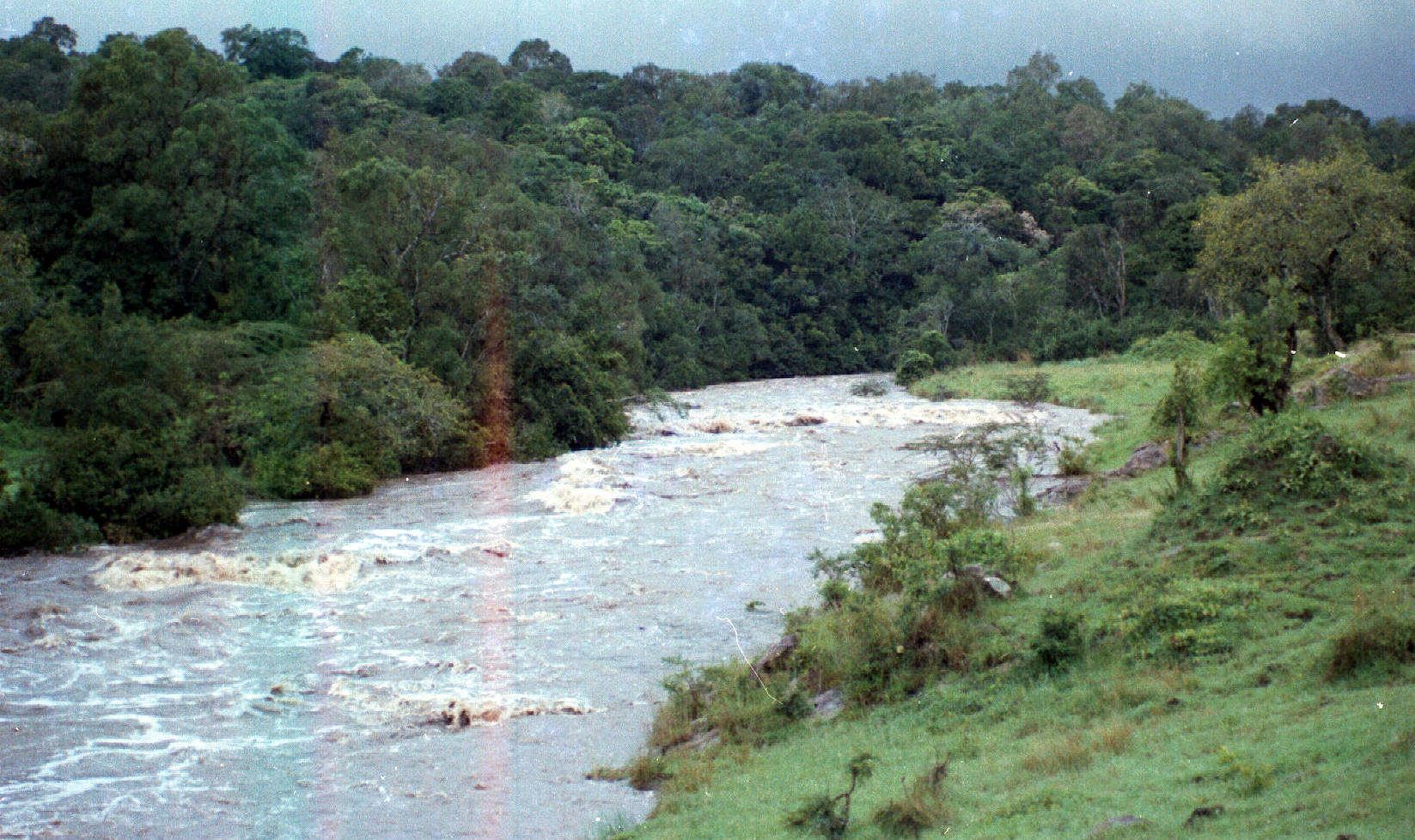
Migori river in flood.

Migori river in flood.

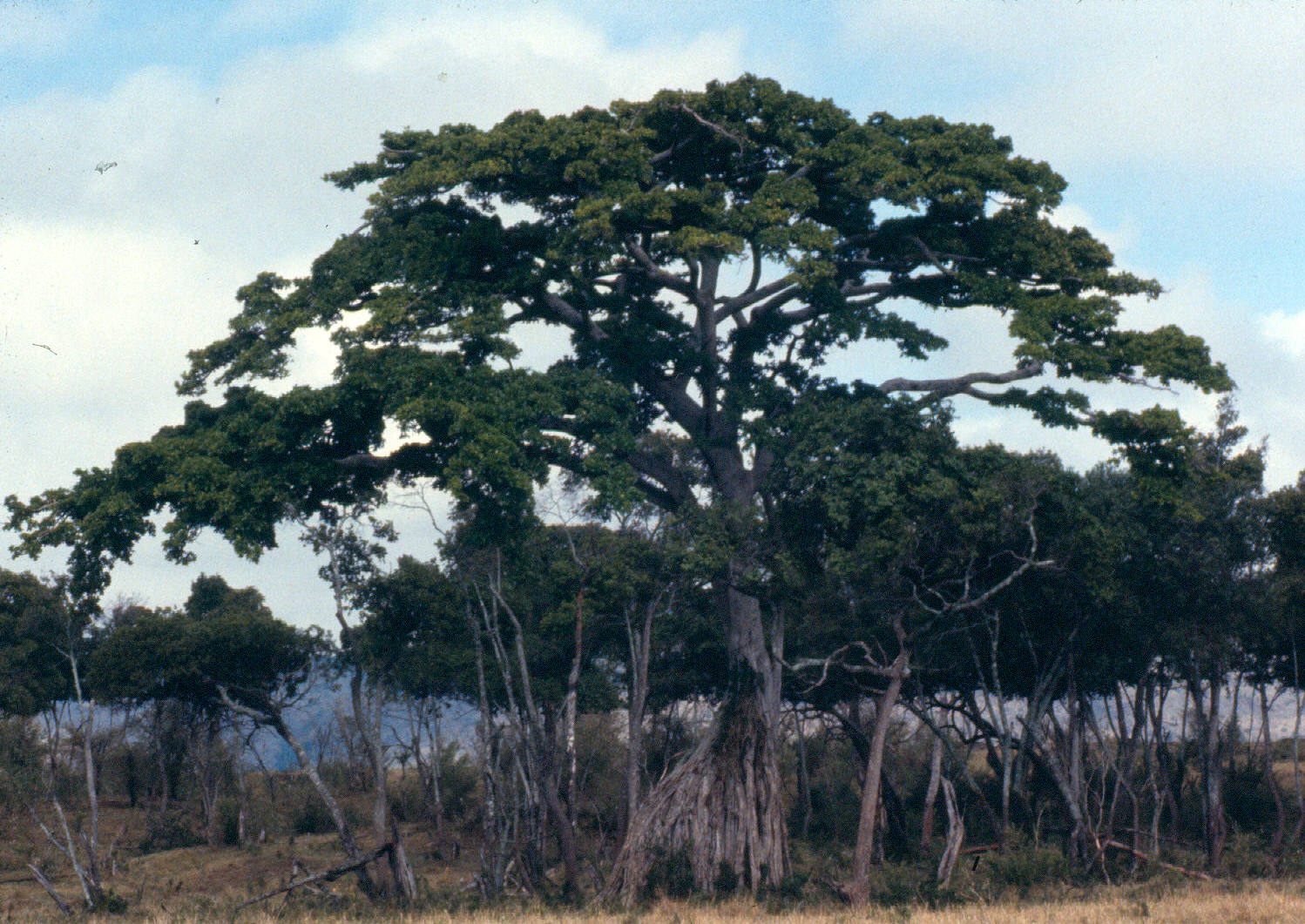
A large tree near the Migori river.

A large tree near the Migori river.

The dirt road took us through Lolgorian where two GTZ German animal health specialists were supporting the Government of Kenya by giving veterinary assistance to the Maasai. We stopped to greet them as Alan had some ground-breaking collaboration going on with them, as mentioned in the earlier post. It was the first time I saw a small field laboratory that could deal with most relevant diseases while keeping work simple and straightforward. It was known as “ILRAD II”[3], an irony that Alan found very funny although it took me longer to understand the humour behind it!

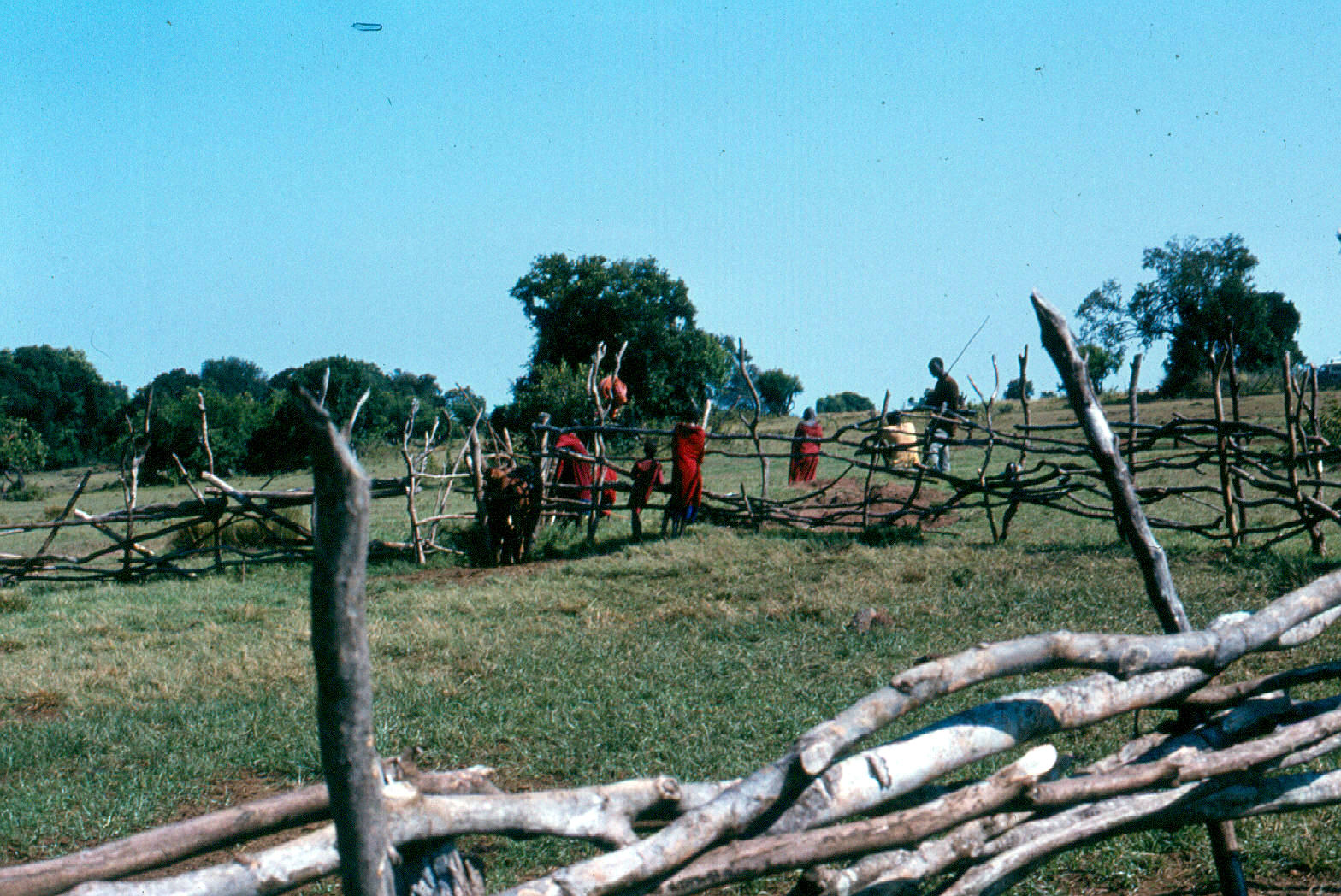
Maasai working with their animals at Kilae, near Lolgorien.

Maasai working with their animals at Kilae, near Lolgorien.

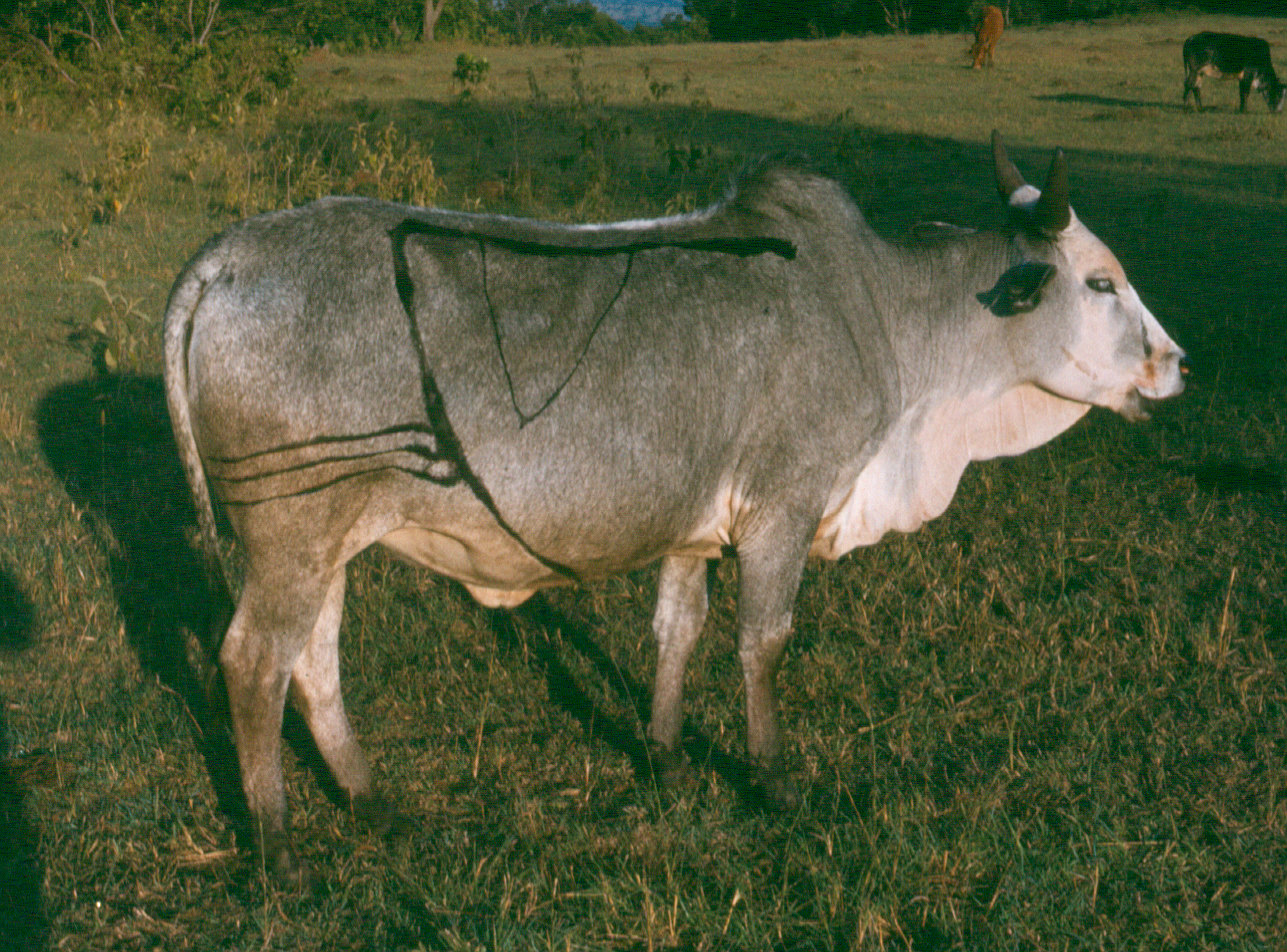
A Maasai heifer. Note the heavy branding.

A Maasai heifer. Note the heavy branding.

ILRAD II (outside).

ILRAD II (outside).

ILRAD II (inside).

ILRAD II (inside).

After that enlightening visit we continued and passed a religious mission where Father Frans Mol lived and worked. Although we did not stop, I met him on other occasions and learnt of his erudition when it came to the Maasai people.[4]

Moving on and still in the Transmara we came to the “red hill” an infamous stretch of road. “When it rains, it is like driving on a bar of soap” said Alan and added, “I hope it is dry today”. He went on: “Because of the proximity with Lake Victoria, it rains almost everyday here so it is tricky at the best of times!” “That is why you should leave in the morning as to avoid the afternoon rain”. Alan continued: “You should engage 4WD and advance slowly in second gear. If the car starts sliding off the road all you can do is to stop and hope that the car stops and that you can straighten it again”. And then laughing: “I know people that have spent the night here!”

A common occurrence at the Transmara!

A common occurrence at the Transmara!

Luckily we managed it without problems and then we came to a stretch of black cotton soil that looked menacing to me as it was fairly water-logged. However, we slowly moved forward and even gathered some speed, as the wheel ruts were deep enough to prevent us from going off the road and our only option was to go straight. The road became better and then we found large wheat and barley plantations where the Maasai had leased their land to commercial farmers.

Soon we got to the edge of the Oloololo Escarpment. I can claim to be many things but a poet is not one of them, so I am not able to describe the view that unfolded below us. It was a green sea that extended as far as you could see. In it you could just make out vast numbers of animals; those forming long lines were wildebeest and zebra while the small specks were Thomson’s gazelles. A few elephants could also be seen together with an almost black and compact herd of buffalo. This sight will be with me until I die![5] I asked Alan to stop for a while so that I could take in the view a bit longer while stretching our legs. While watching the green marvel, Alan explained that we were looking at the “Mara Triangle”. He pointed out the Mara River to me as well as where Tanzania and the mythic Serengeti were.

We started our descent and eventually crossed the Mara River at the bottom of the Escarpment. We passed Kichwa Tembo Camp and then deviated into the Maasai Mara Game Reserve to have a look at the animals before continuing on the way to Aitong, Narok and Nairobi. The place was magnificent and we saw vast numbers of wildebeest and zebra grazing as well as other animals roaming around. A special mention to the Thomson’s Gazelles that are ubiquitous in the Maasai Mara; they are an integral part of the ecosystem. The best description I have heard about these gazelles came from Paul, my Mentor in FAO, who visiting the place for the first time, told me that they look like shoals of tropical fish!

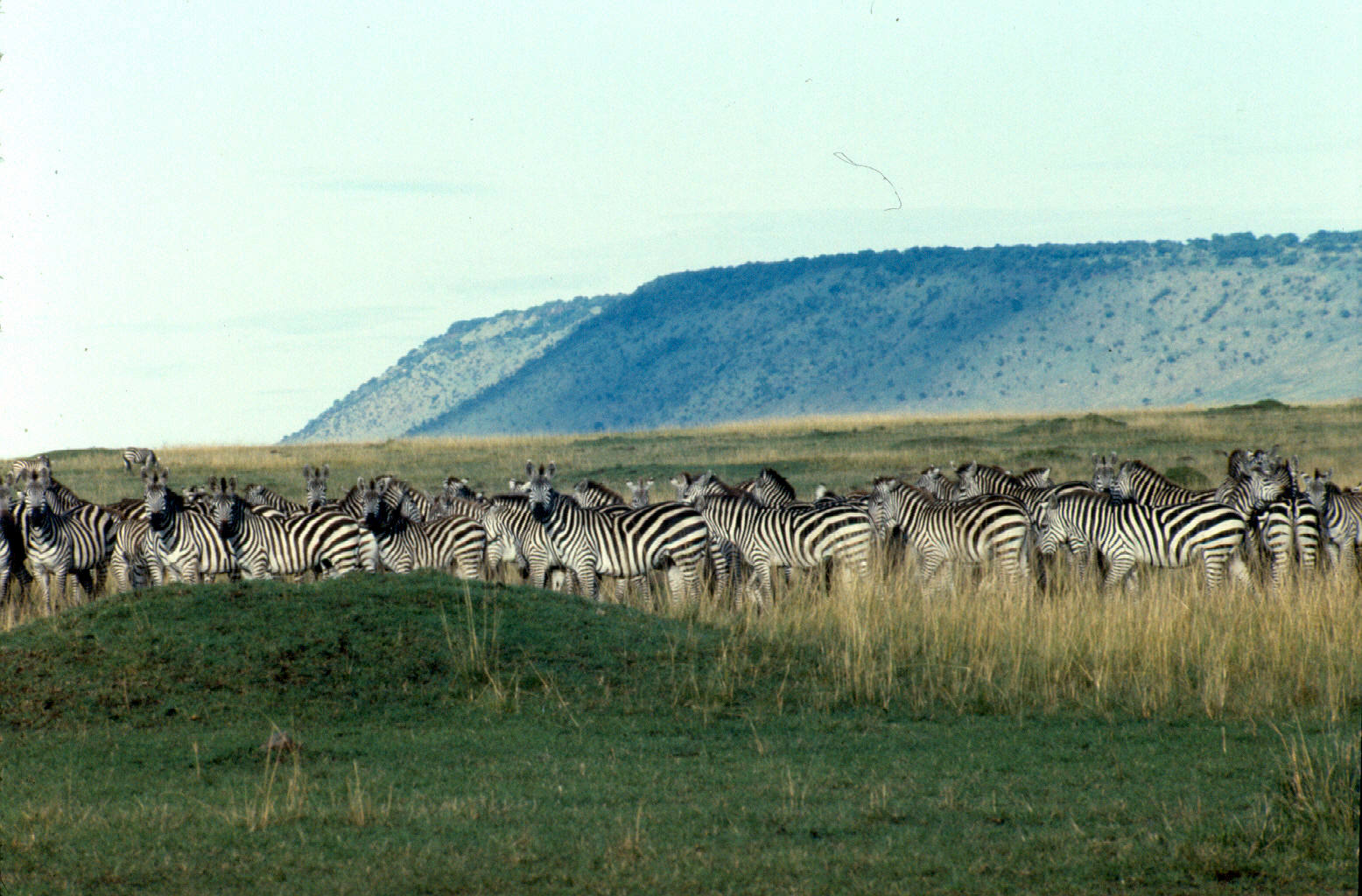
Zebra with the Oloololo Escarpment in the background (I will remove the dirt from the ski when I learn to do it!)

Zebra with the Oloololo Escarpment in the background (I will remove the dirt from the sky when I learn to do it!)

Maasai cattle at the Mara river bridge.

Maasai cattle at the Mara river bridge.

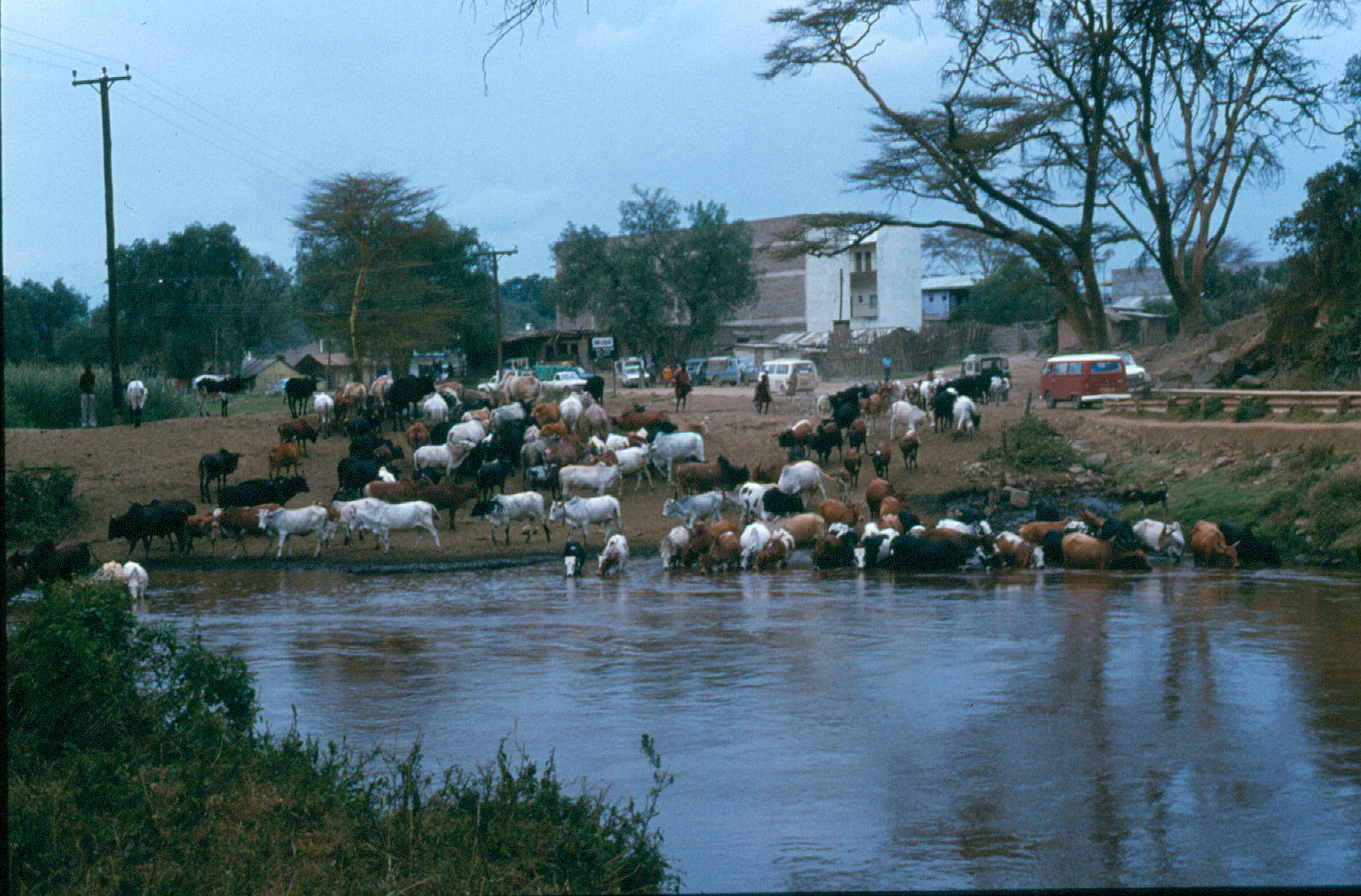
Cattle drinking at Narok dam. Note cars used at the time: VW Kombi, Land Rover Series III and Land Cruiser 50 series!

Cattle drinking at Narok dam. Note cars used at the time: VW Kombi, Land Rover Series III and Land Cruiser 50 Series!

As detailed at the Intona ranch post the return journey only served to strengthen my conviction that I should work at Intona ranch, something that with the help of Alan, Matt could be persuaded to accept, thus allowing me the privilege of driving through the Maasai Mara Game Reserve on the way!


[1] Follows “Joe”.

[2] I did see them very often in this spot where they were quite tolerant of my presence and could watch them during long spells.

[3] The International Laboratory for Research in Animal Diseases was a state of the art large facility located at Kabete, near Nairobi. Today is known as the International Livestock Research Institute (ILRI).

[4] Fr. Frans Mol MHM, affectionately known as the ‘Apostle to the Maasai’ worked at the Ngong Diocese covering most of Maasailand. He authored several books such as: Lessons in Maa: a grammar of Maasai language (1995) and Maasai Dictionary: Language & Culture (1996).

[5] We were at the very spot where Out of Africa’s famous final scene was filmed! Watch the movie and you will get the idea of what I saw in 1981!

Joe [1]

The trip to Intona ranch with Alan described in the post “Intona Ranch” put me in contact for the first time with Joseph (Joe) Murumbi and his wife Sheila. After this first encounter I shared many evenings with them at their beautiful if rather outlandish house. They had built it after retirement following the style of the houses found at the Kenya coast. It was a large house with many bedrooms, a large and complete kitchen and a sitting room bigger than a basketball field!

Although I stayed at the house several times, because of the work I was doing I normally camped at the ranch, as I preferred to keep my independence. Work started early and my timetable was rather different to their retired pace.

When we met, Joe had already suffered a stroke. He was recovering but still maintained the fire in his eyes and remembered a lot of stories of his life that he shared with Alan and me. They were very fond of Alan and they also got to like me. It helped that I was a veterinarian. They had a few dogs (5 or 6) that always had something wrong with them, despite the efforts of Kiza, their Ugandan resident veterinarian. Joe was always very supportive of our research and took a keen interest in our trials and their results! He could not wait to apply them on his cattle and those of his Maasai neighbours.

Although I will tell you more of my relationship with Joe and Sheila in future posts, I have a few reminiscences of our relationship that I will mention here.

Joe loved his cattle and he experienced great joy in going to the kraal in the evening to see them coming in. He was fair but tough with his employees and, as expected, he was feared by them on account of being a mzee[2] who had held power but also because of his short temper! I am sure his eyes had something to do with it as well, as he had a powerful look when fired up by anger or enthusiasm.

Sheila, conversely, did not care about cattle much. She loved plants and was a keen gardener. She kept a lovely greenhouse, which housed a collection of the orchids found at Intona and served as a nursery for the already beautiful garden and internal patios of the house.

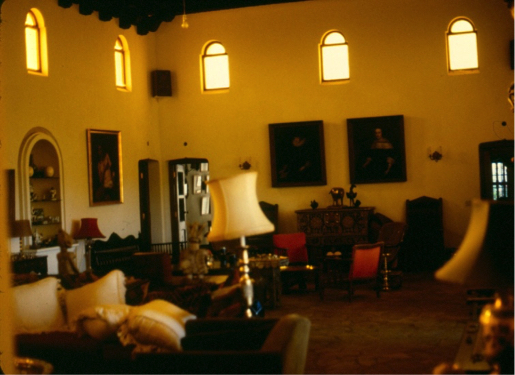
The "Dutch Masters" paintings in the background, the picture was taken from the place Joe used to sit.

The “Dutch Masters” paintings in the background, the picture was taken from the place Joe used to sit.

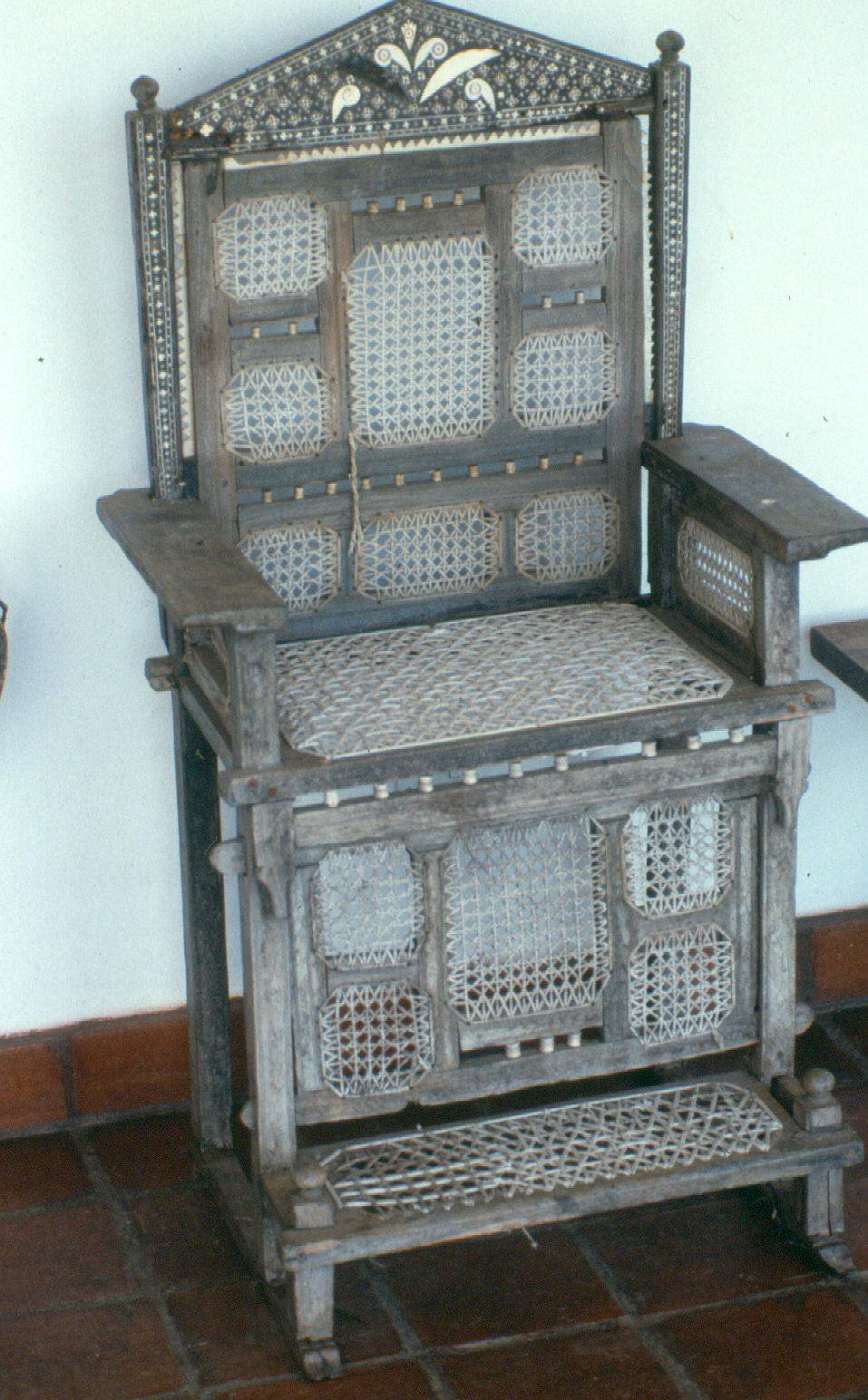
They both shared an incredible passion for culture and art and the house was a true museum of African art although there were several large paintings that I attributed to “Dutch Classic painters”. The sitting room I mentioned above was literally filled with art. Wood and metal carvings, masks, ancient trunks, antique chairs, oriental rugs, and large paintings decorated the place.

murumbi mask 1

murumbi mask 2

murumbi lamu chair

murumbi mask

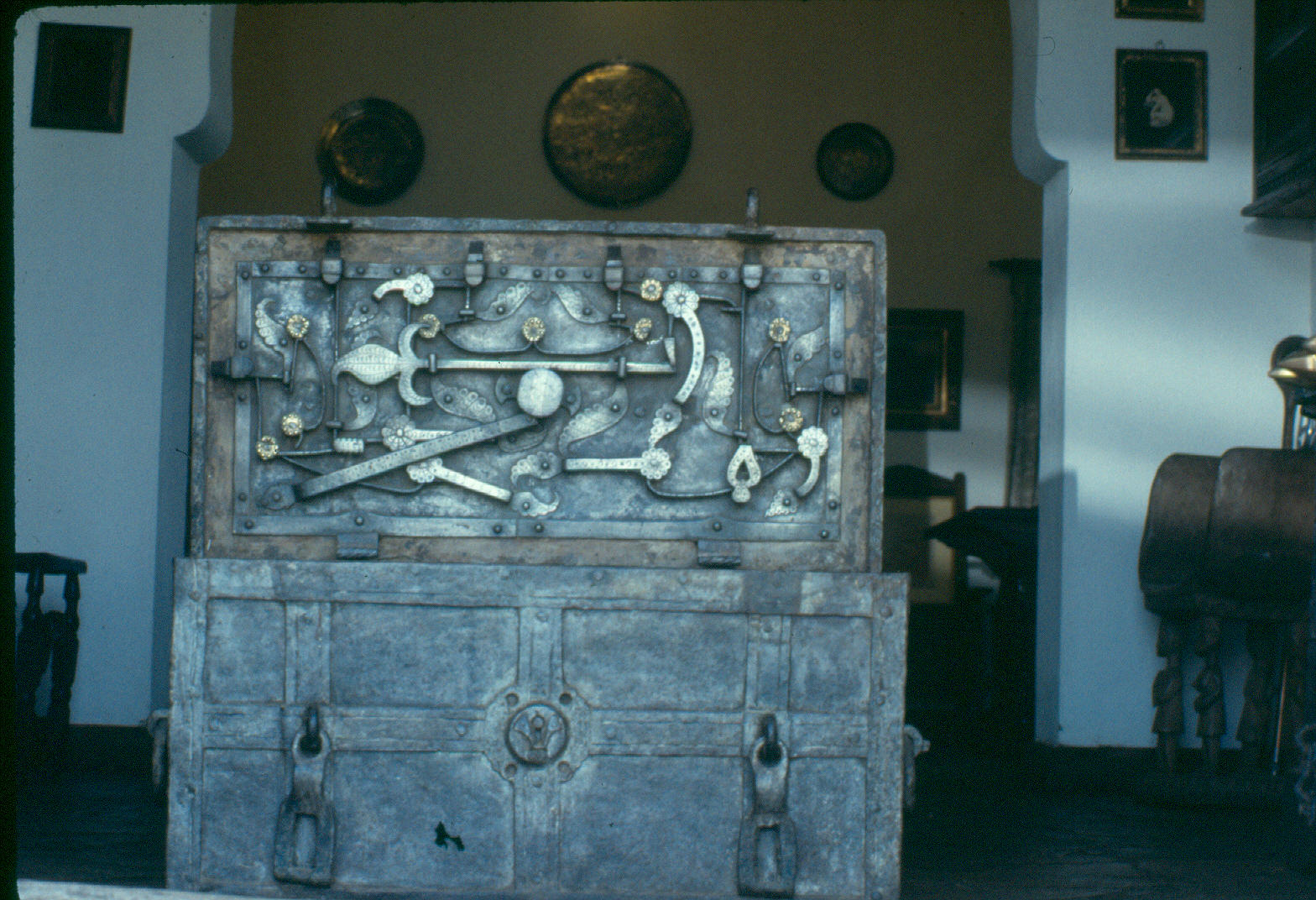
murumbi chest

And then there was his library! A large room with bookshelves all round and where all his diplomas, decorations and memorable photographs were kept. A young Joe could be seen in the company of Kenyatta, Nkurumah, Kaunda and Nyerere to name but a few. There was a large one of Joe with Haile Selassie and several more with other European leaders that he rubbed shoulders with during his political life. Clearly he had kept selected items after all his donations of books and documents to the Kenya Government.[3]

Although Joe was very enthusiastic about showing some of his unique books (he had all the first editions of the works by most African explorers, to name what I recall today!) his real joy was to open the many drawers that hosted his immense, comprehensive and very valuable stamp collection. He was very proud to show me some of the “specials” he possessed, including most of the first African stamps and even some of the earliest British ones that -apparently- were extremely rare and dear! Not being a collector myself, I listened and enjoyed his keenness more than anything else.

As if being shown the library by Joe himself would not have been enough, I was given the green light to roam free through his still vast book collection. This I did and spent long hours browsing through the many special books and documents that it housed. Among several, I particularly recall opening a proofreading specimen of Peter Beard’s “The End of the Game”[4] and finding inside it an exchange of letters between Joe and Peter about the book and its presentation! This was one surprise I remember but I have forgotten many, I am afraid!

Intona hosted a number of wild animals that intermingled with the cattle. Impala, Zebra and Topi were very common and herds of buffalo resided in the ranch. Lion were often heard but rarely seen (probably scared of the Maasai around us!) but a family of Cheetah resided at the ranch and were often seen. Spotted Hyenas were heard every evening and I was surprised if they did not visit my camp at night!

Buffalo herds often grazed in the meadows and frequently mixed with the cattle. Surprisingly they did not trouble the herdsmen, behaving like cattle but keeping their distance. The solitary males were a different issue and walking about Intona required great care as these rogues would seek shelter inside the clumps of forest that dotted the green grasslands at the ranch and come at you with anything but good intentions!

Buffalo were the main danger to watch out for while orchid collecting, an event that Robin -my good colleague from ICIPE- used to perform. As this involved entering the clumps of forest, it was a rather dangerous hobby. Luckily Joe had a hand-operated fire siren that a helper carried and used to scare the buffalo by sounding it before we entered the thicket. We were lucky not to encounter any buffalo, as I was doubtful of the effectiveness of the siren! Or maybe they ran away in the opposite direction? We did have a few scares when warthogs would crash out of their previously quiet resting areas because of our racket. We got a few adrenaline highs but fortunately they never came straight at us!

Alan’s closeness to Joe and Sheila meant that they relied on him for help at all times. I believe they saw Alan as the son they did not have! Their friendship was so close that once when Joe needed to go for an operation in the UK, Alan travelled with him! Alan did not travel alone, he had a most unusual companion: a nail-studded power figure[5] which was apparently rather expensive and Joe needed to sell it in the UK to cover the expenses of his medical intervention. So Alan was entrusted to fly with the sculpture for which I believe they booked a seat next to Alan! I do not know more details other than that Joe came back in better shape!

Joe greatly enjoyed having us for a drink in the evenings to talk about our work and tell us some of his stories. So we were often invited. Sheila was a great hostess and looked after us as if we would have been her newly discovered relatives! One of those occasions coincided with a rare and probably one of the last trips to Intona by road in his Range Rover. He mostly travelled by plane with the dogs!

On that occasion Joe was really upset about the condition of the road. The latter was really bad during normal times but at that particular occasion was impossible and -almost- impassable! Joe had a temper and that was the first time I saw him losing it! He was so upset that, after telling us about it, he picked the phone and started to call. At the time, Telephone calls from Intona were “difficult” to put it mildly so he insisted a few times until he managed to get through.

Despite his speech difficulties he managed to gather sufficient strength to speak in clearly strong terms and in Swahili. After a while his tone changed and, before he hung up, he burst into a hearty laugh. Still laughing and while shaking his head he said “That was Daniel[6] on the phone” and added “I was complaining to him on the conditions of the road and do you know what he replied?” he said looking amused “Joe, you know that I travel by helicopter!” I will keep Joe’s comments to myself!


[1] Follows Intona Ranch

[2] An elder in Swahili

[3] Ref. to details of his donation to the GoK

[4] Full title of the book

[5] See: http://www.sciencemuseum.org.uk/online_science/explore_our_collections/objects/index/smxg-105001

[6] Daniel arap Moi was President of Kenya from 1978 to 2002. He succeeded Joe as Vice-President after Joe’s resignation in 1967.

Intona ranch[1]

It took a while to disassemble the tent and to collect our scattered belongings; including the unwashed suferiers where the soon to be legendary and much talked about Chicken a la Rusinga had been created, surely for one and only time in the universe! We were late, packed the car in a rush and, rather casually, left Mbita Point for our rendezvous with Alan in Kilgoris. I would remain with Alan to visit his field trials and collaborators while Matt returned to Nairobi, probably to attend some important meeting (read trout fishing) over the weekend.

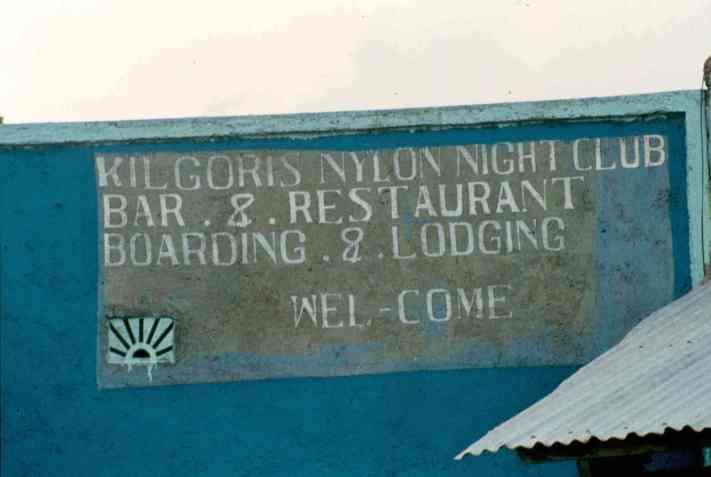
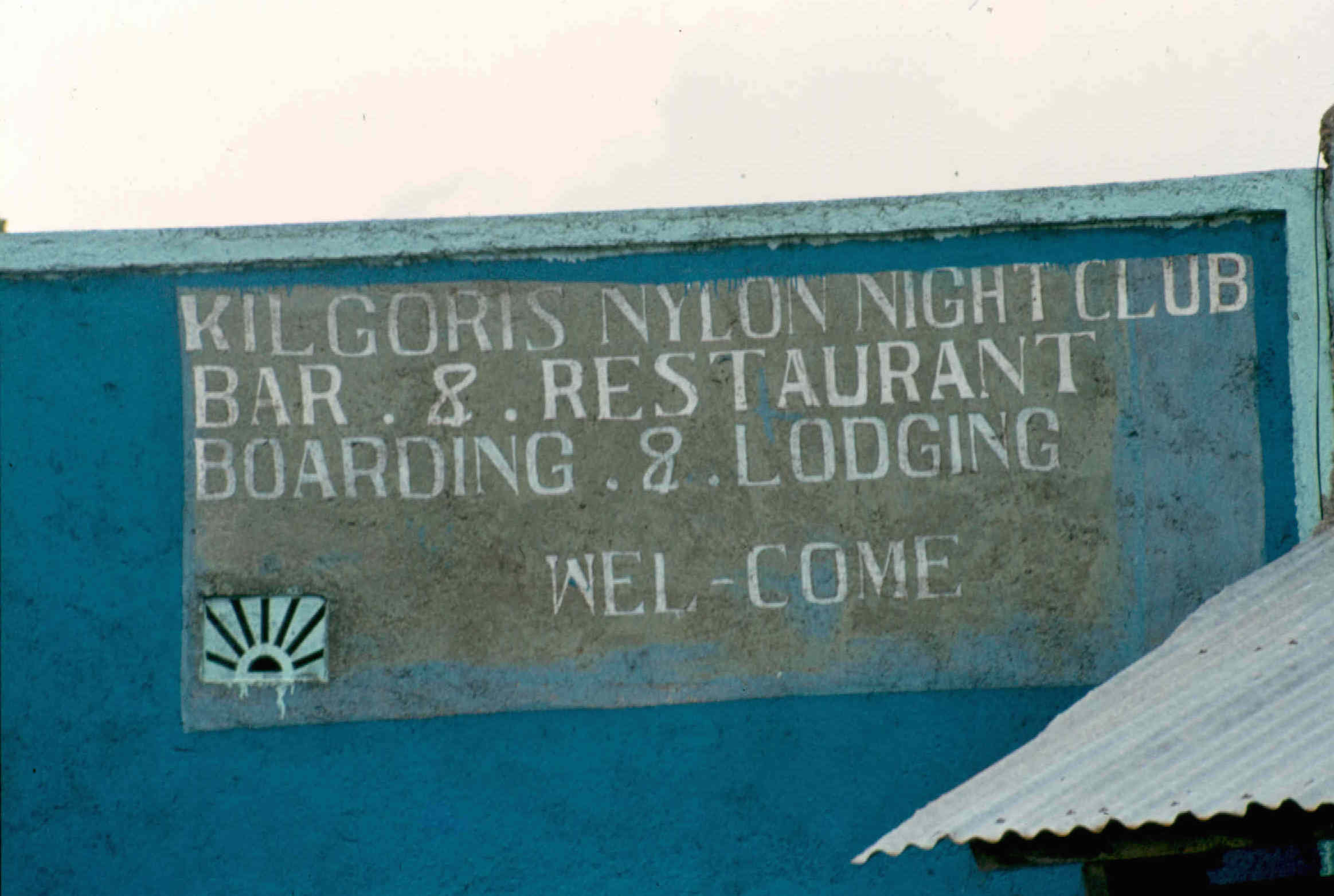
We got to our meeting point, an open field in Kilgoris, meant –at some point in future- to be the village’s main square but currently occupied by grazing Maasai cattle and found Alan waiting for us. A few dukas[2] were found around the field that were clearly taking care of Maasai needs: lots of red cloth[3] and assorted veterinary drugs among other essentials such as Tusker beer. Just across the road was the “Kilgoris Nylon Day and Night Club”, a name that took me a while to digest! Despite its interesting name, we refrained from exploring it and preferred to miss lunch. What we would have found in it will remain shrouded in mystery. Alan welcomed me and, after a quick exchange of news and greetings Matt went his way and we headed for Intona ranch.
The meeting point with Alan.

The meeting point with Alan.

Alan was a chain smoker of menthol cigarettes[4], he stammered in an Irish accent, had an easy laugh that he combined with rubbing his gold and gray goatee. As we moved on, it became evident that Alan was not concerned about potholes and I was treated to the unique experience of listening to his mostly one-way conversation while bumping around on a rough road. Luckily we were in a Land Rover Series III, an almost unbreakable vehicle.

Although I focused fully on Alan’s conversation I still needed to guess a lot of what he said. I learnt that he was born in Northern Ireland and studied parasitology in London. He had come to Kenya in 1968 where he remained since, with a few short spells back home. He was a great supporter of the infection and treatment method to protect cattle against this scourge and he had helped Matt to develop it. I also learnt that collaboration was everything for him and that he was already talking to me as if we were already working together. This was excellent after my earlier experience in Mbita Point. Things were looking good but I still needed more details. “That is the purpose of this trip”, I thought, and continued listening. Our budding friendship was further boosted when we discovered our shared passion for soccer and the fact that Alan knew and liked some of the Uruguayan soccer players of the day, particularly Rubén Sosa.

He explained that he first came to the Transmara to collaborate with a veterinary GTZ project near Lolgorian –another small Maasai town- where they had done some pioneer epidemiological studies on theileriosis. The fact that this information was available enabled him to select the prevalent Theileria parasites to be used for the immunization of cattle in the area, including Intona ranch. This breakthrough meant that tick control could now be relaxed and even stopped altogether. This, Alan said, would enable me to compare dipped and not dipped cattle subject to natural field tick challenge and, in this way, ascertain their impact to achieve my goal.

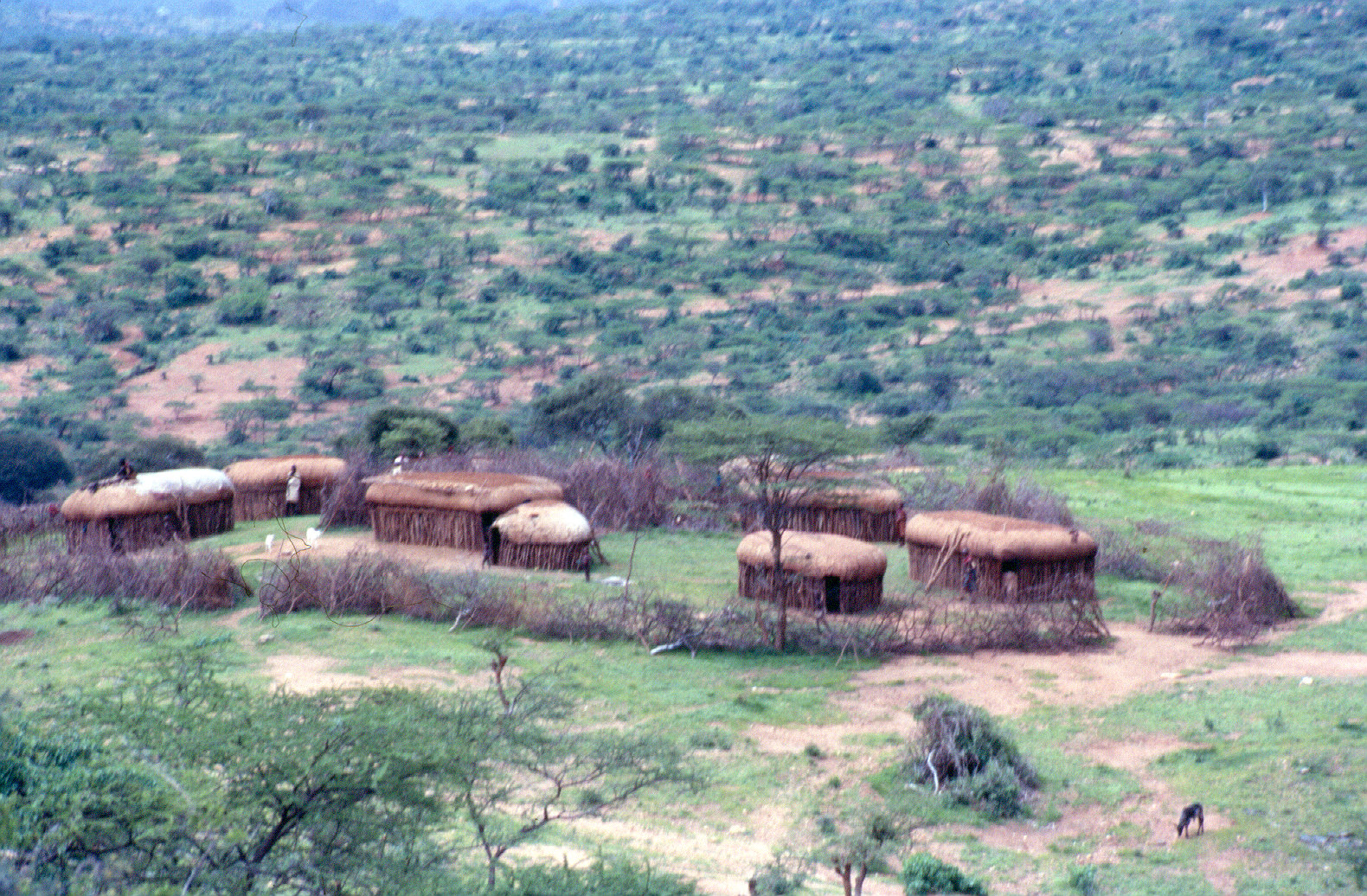
Kilgoris was a Maasai town, Alan explained, the shambas[5] we could see in the outskirts belonged to the Kisii people. The latter became less frequent as we moved out of the populated area and the landscape started to open up to a savannah ecosystem where Maasai cattle grazed, looked after by the usual herd boys or elders. The countryside was punctuated by brown manyattas[6], giant brown mushrooms scattered at regular intervals.
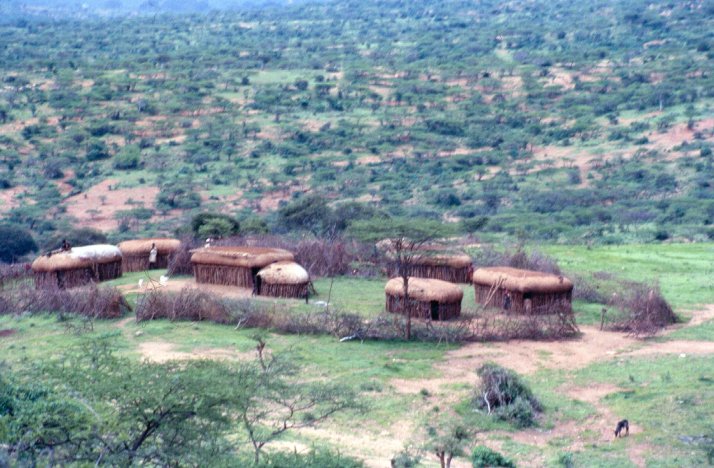
A Manyatta.

A Manyatta.

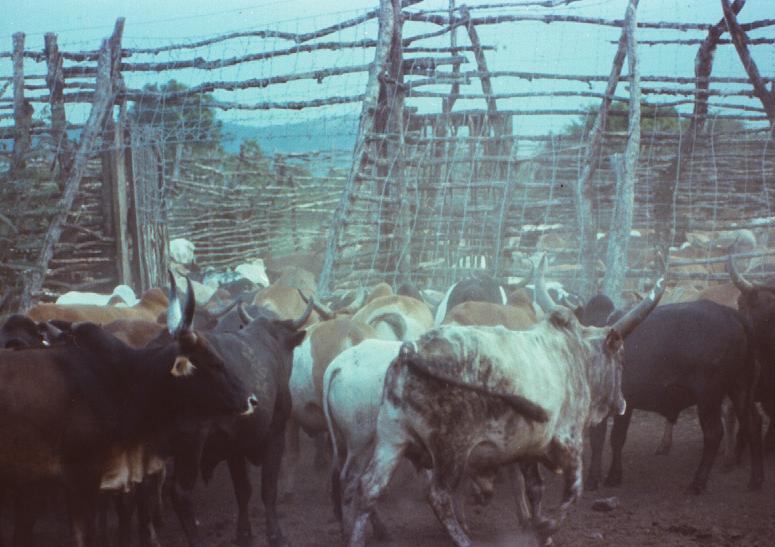
A manyatta is where the Maasai live. A strong thorn bush fenced area designed to keep all predators out and themselves and their livestock protected within, mainly during the night. Inside the enclosure there are any number of huts made of a rounded frame of branches and built with a mixture of mud and cattle dung. Most cattle are kept in the enclosure but there are smaller sub-enclosures for sheep and goats or animals belonging to the different dwellers of the manyatta. Cattle are heavily branded and their ancestry thoroughly known by their owners.

“I know you will not believe this”, said Alan, “but there is a war going on here. The Kisii are moving in to occupy the Maasai grazing land”. He went on: “the Kisii will eventually win and this beautiful place will get all planted with maize!” Looking around, I found this really unbelievable but I trusted Alan.

The mention of a war made me wary and I started to look for warring parties lurking behind the bushes. After a while of not seeing anything unusual I said with hope in my voice: “Luckily, I see nothing so there must be a truce at the moment.” Alan laughed heartily with profuse goatee rubbing and, after hitting a few more potholes, he explained that the fighting was in the bush and normally not obvious. He added: “the Kisii cultivate the soil and gradually they are being given land. The Maasai resist and there are frequent skirmishes and then the Government intervenes to bring back some degree of calm”.
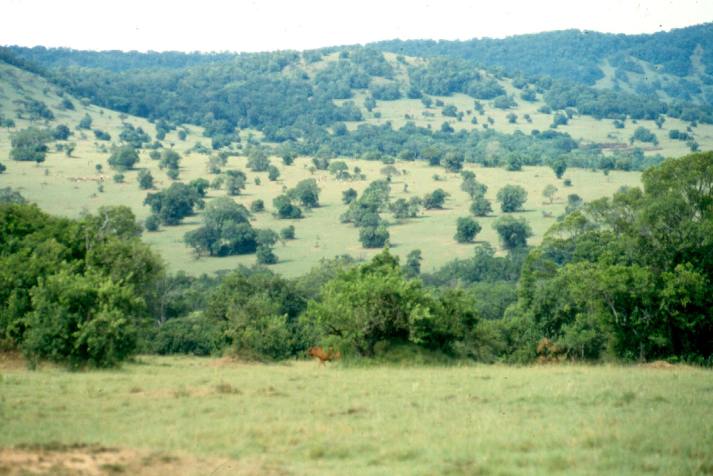
A view of Intona ranch in  the Transmara parkland.

A view of Intona ranch in the Transmara parkland.

Nearer to Intona ranch there was only lush green savannah with large tree islands. I noticed that these islands were always associated with bulky termite nests and I started wondering which appeared first, the trees of the termite mounds? I decided in favour of the trees. And then I saw the first game: a herd of Impala, shiny and healthy. Later, Topi and Zebras appeared to add a wild touch to the ever-present Maasai cattle. There were also Baboons and Vervet monkeys and a large number of Warthogs.

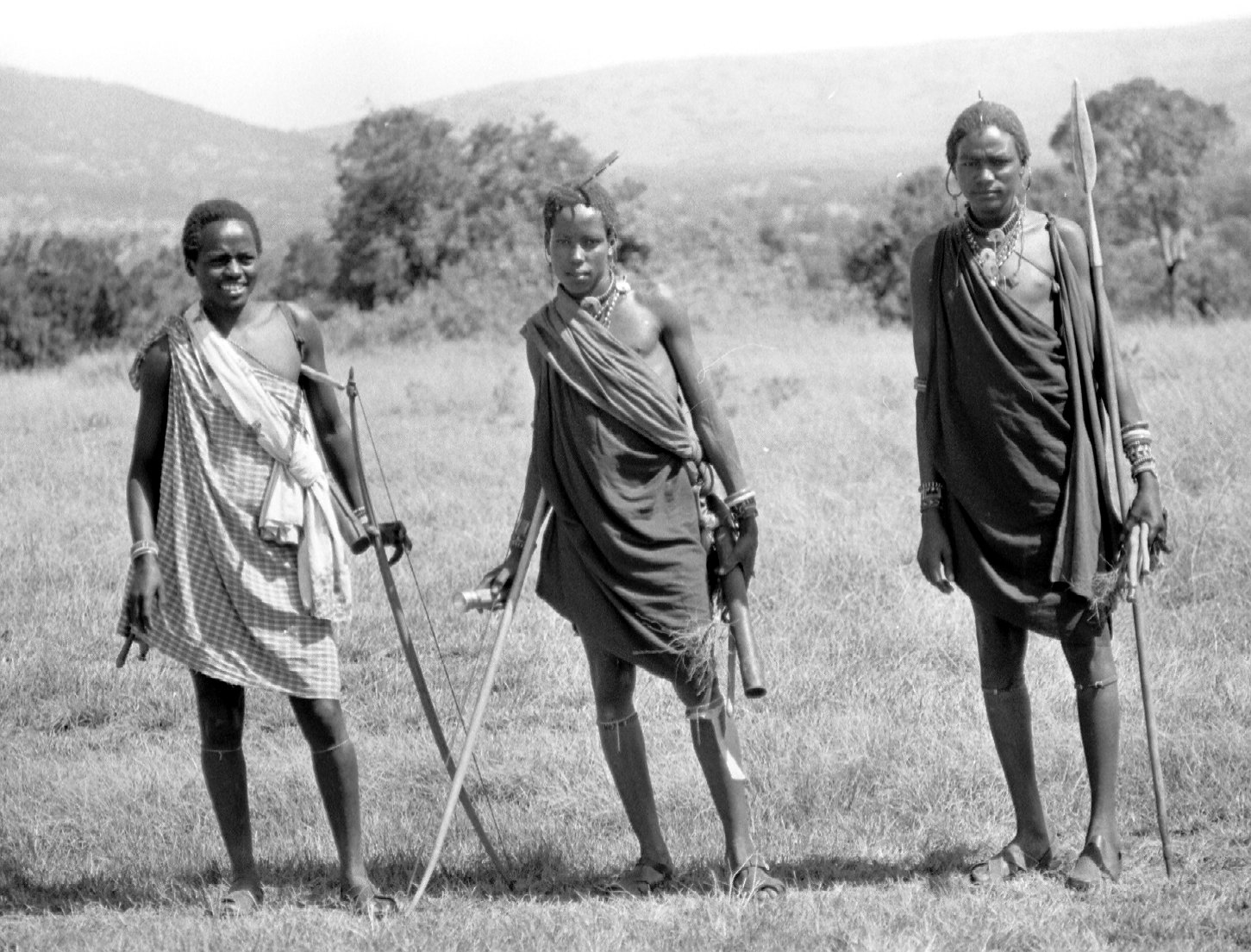
The manyattas in this area had significantly more dramatic thorn enclosures and the presence of large predators such as Lion, Leopard and hyena came to mind as the reason behind the need for greater protection, but I learnt from Alan that cattle rustling was rampant and probably more of a concern than predators. Clearly the Maasai were not taking any chances with their beloved livestock. This was in sharp contrast with their seemingly casual bearing when walking in the bush only carrying a spear and a simmi[7] with a few throwing sticks, their feet clad in recycled car tire sandals. They appeared to be carrying very light luggage considering all predators that were around, not to mention the on-going war!
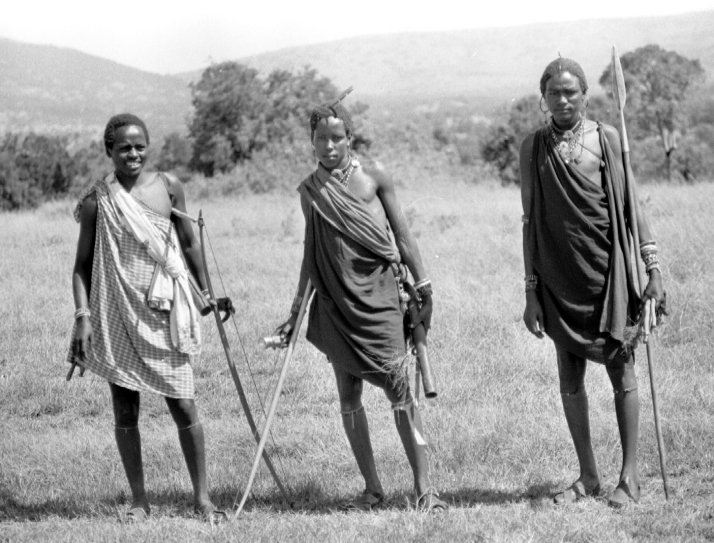
Maasai visitors with spears, bow and arrows and throwing sticks.

Maasai visitors with spears, bow and arrows and throwing sticks.

The Transmara District that we were traversing is close to the Maasai Mara Game Reserve and the latter is the northern extension of the Serengeti National Park in Tanzania. The Transmara is split into two by the Migori River with its riverine forest. It is here that, with luck, the Giant Forest hog (Hylochoerus meinertzhageni) can be spotted. A native of forest habitats in Africa, it is considered the largest wild pig, at over two metres in length and one in height, reaching more than 200kg of weight. Discovered by Richard Meinertzhagen in 1904, who shot the type specimen in Kenya. Another special of the area is the Blue Flycatcher (Elminia longicauda), a lovely cerulean blue bird with a beautiful tail-fanning display.

“Julio, remember that Maasai do not like to be photographed and they can get very agitated and even aggressive”, said Alan. “Why is that?” I asked with surprise. “I do not know for sure” came the reply. I started learning that he was not too interested in any issues apart from theileriosis!

During the trip I decided that I would work with Alan and started developing a plan to convince Matt that this was the best idea. Rather sleep-deprived by Matt’s snores, and despite the jerks and bumps, I dozed off. I woke up startled by the sudden stop. I prepared for a surprise attack by the warring parties! However, the herd of Wildebeest and Zebra in front of us did not look dangerous. They were frolicking about as only wildebeest can as they moved back into the parkland.

Alan decided to follow them so that I could observe them better and take a few pictures as he liked photography. We drove off-road following them and got some good shots. When we decided that we had enough good pictures and turned back we realized that we were lost in the green labyrinth. The workers travelling with us were of the Kikuyu ethnic group. They were foreigners like us and therefore as lost as we were! We drove rather aimlessly for a while following a few cues we thought correct but the road was nowhere to be seen.
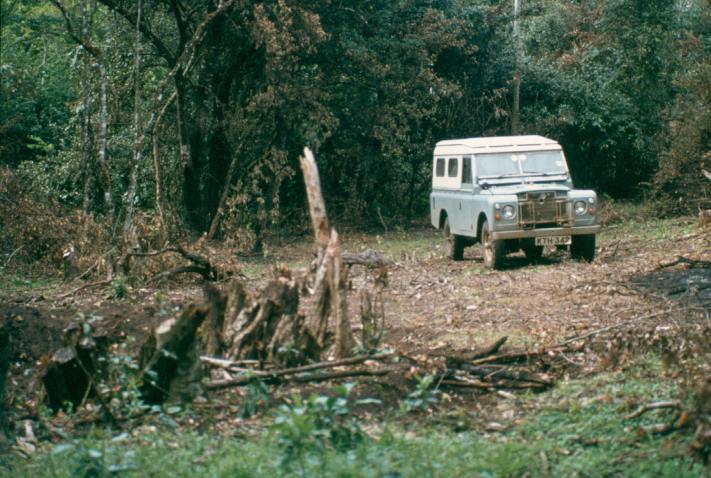
Lost in the bush with Alan, prior to finding our Maasai

Lost in the bush with Alan, prior to finding our Maasai “saviour”.

In one of our turns we found a Maasai elder who asked us for a lift! We gladly obliged and he jumped in. In a mix of English and Swahili we asked him to take us to the road. He sat next to me, half on my lap, as we were already three in the front seat of the Land Rover. We were ridiculously close to the road and were brought back to it immediately. Our saviour stayed with us as, apparently, we were going in the same direction!
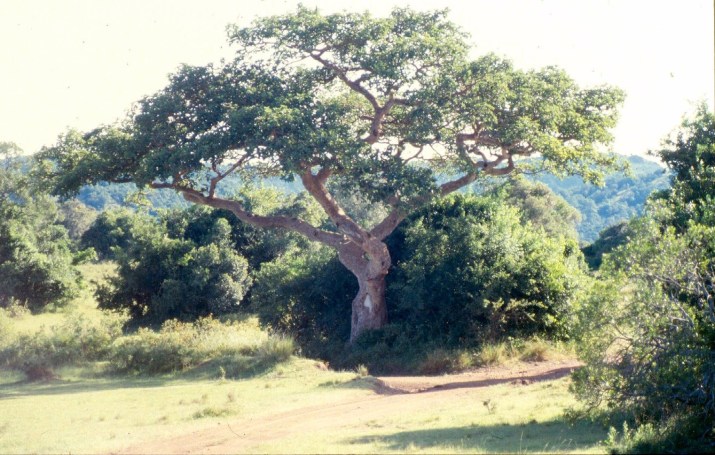
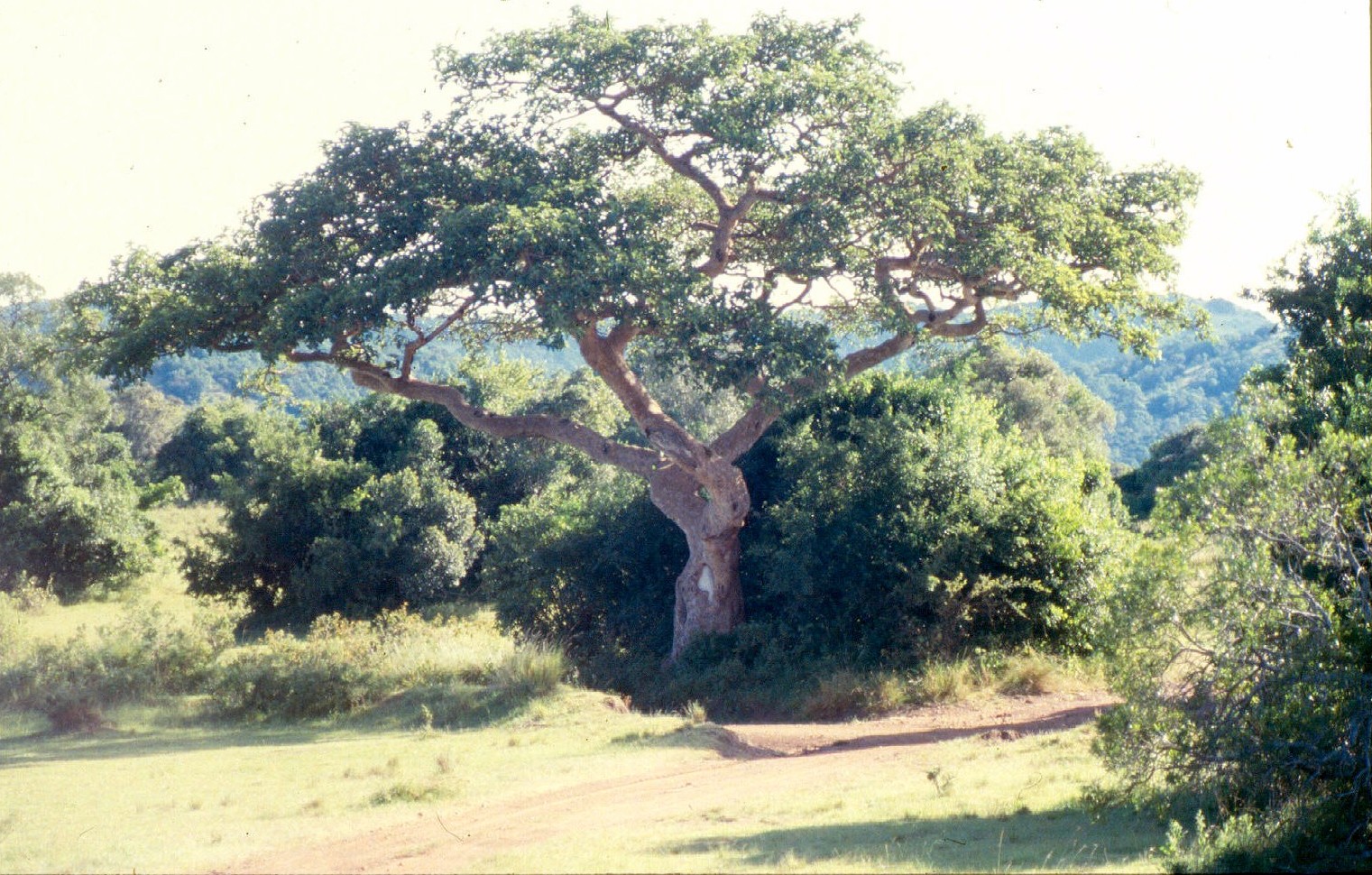
The fig tree,

The fig tree, “signpost” to Intona ranch.

Finally we got to a large fig tree on our right, the entrance to Intona Ranch and there the Maasai left us with our thanks. The ranch was still unfenced and largely undeveloped at the time. Its border was marked by a plough furrow! Alan drove through the ranch and showed me the crush pen, weighbridge and cattle boma[8]. The latter was a large wood and barbed wire fortress. He also showed me the ranch personnel quarters and other back up installations such as the generator house and store. “The cattle are out grazing”, said Alan, “they will not come back until dusk so let´s take the personnel to their camp and then go to meet Joe and Sheila” he added. During the journey I had learnt that Joe was in fact Joseph Murumbi, an important retired politician[9]. His mother was Maasai and he was given the land by them.
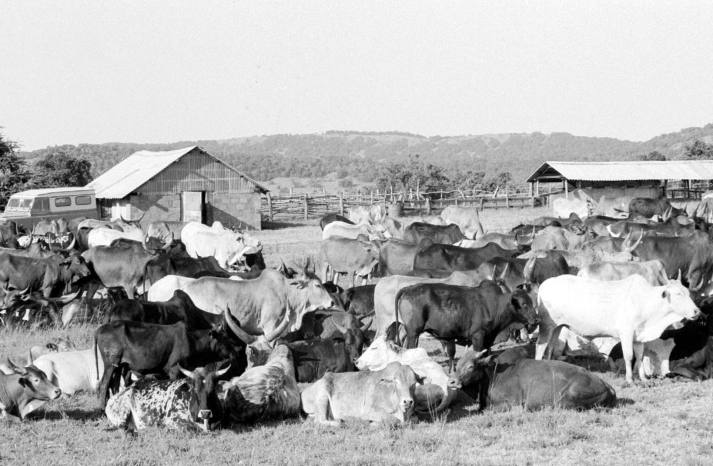
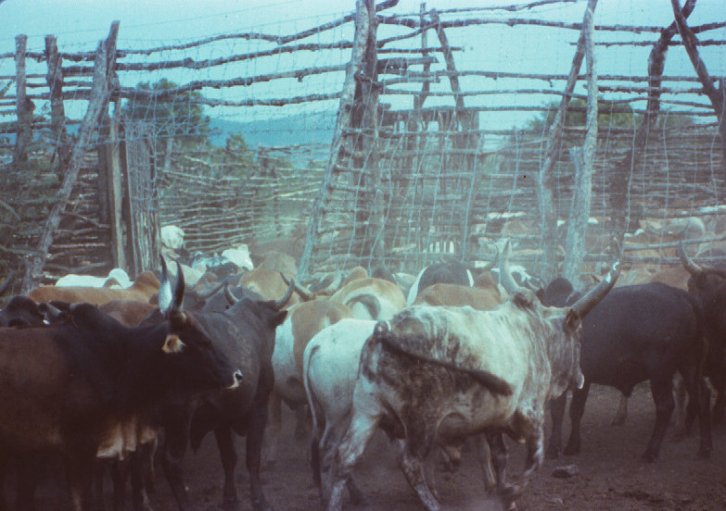
Cattle and facilities at Intona ranch.
Cattle and facilities at Intona ranch.

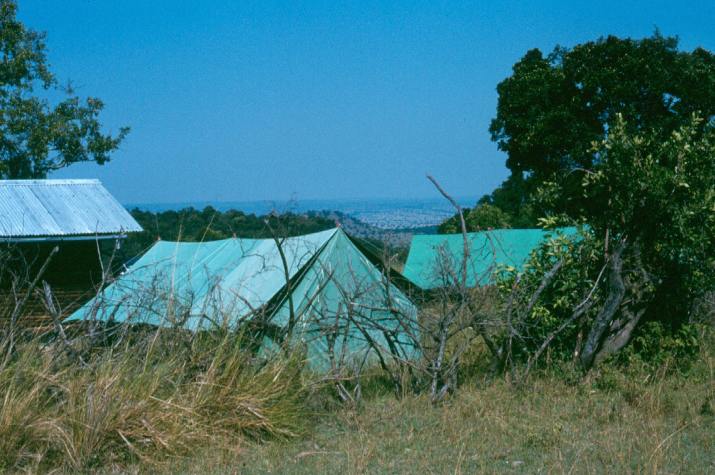
The herdsmen camp at Intona ranch.
The herdsmen camp at Intona ranch.

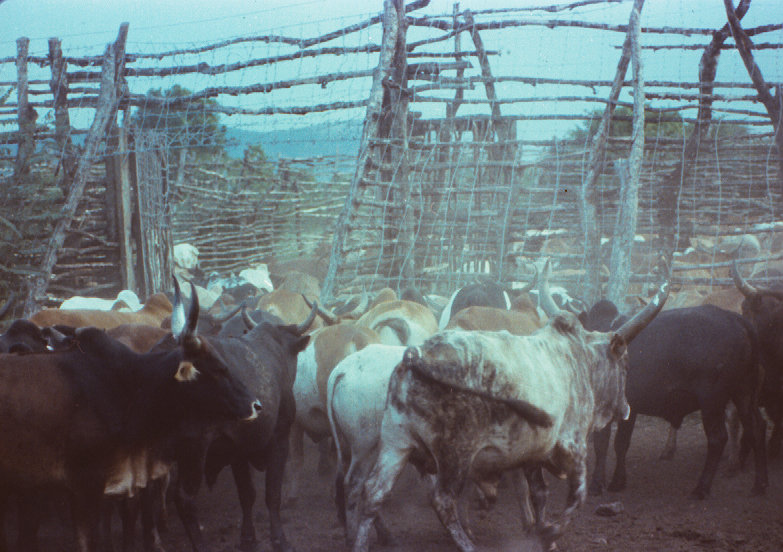
Intona cattle kraal cropped

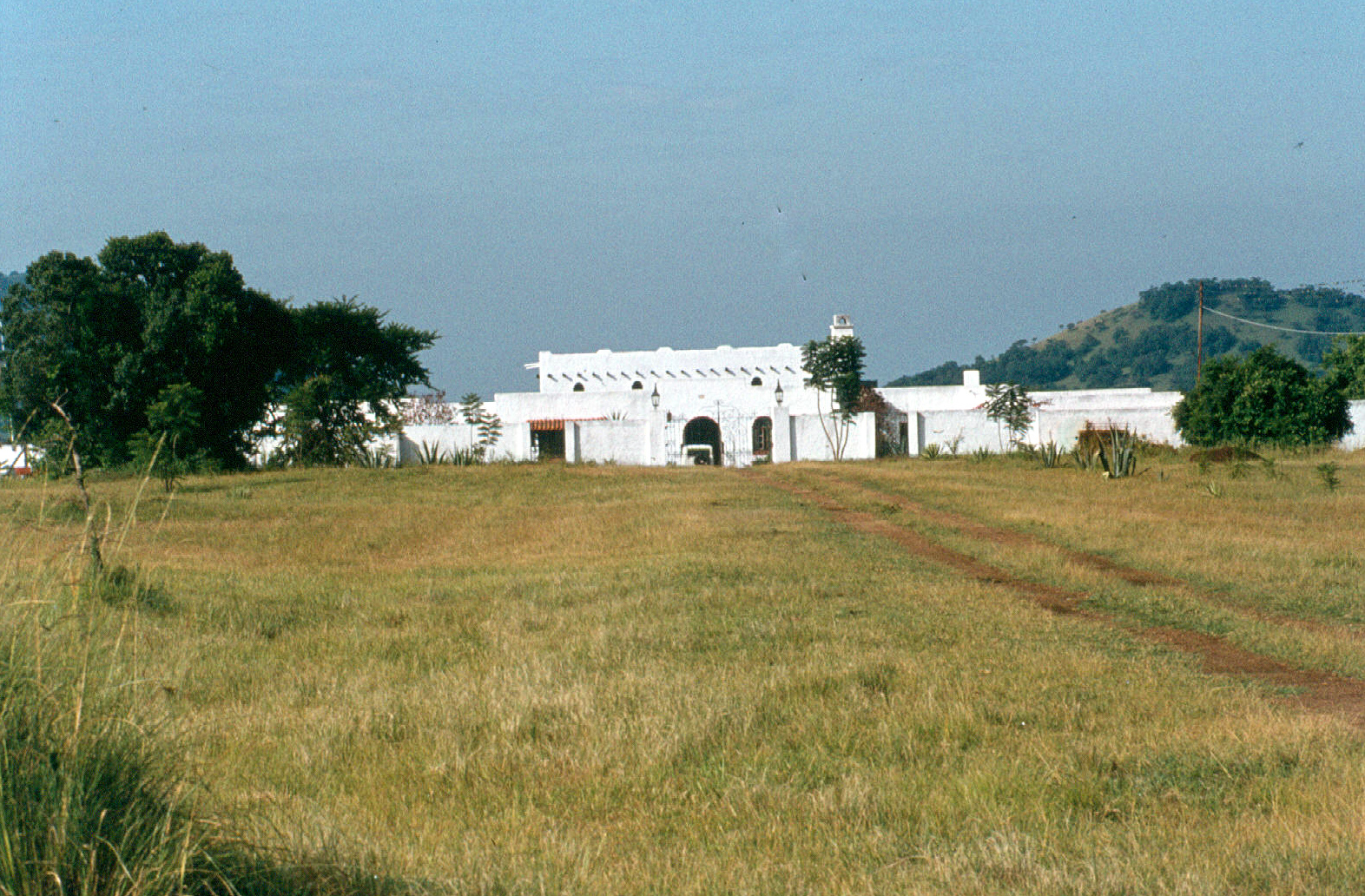
After about a kilometre a very large white house appeared, looking like a palace to me at that point. It looked newly built and was as beautiful as it was out of place. Its construction –I learnt from Alan- followed the Swahili style found at the Kenyan coast, complete with carved wooden doors brought all the way from Lamu and surrounded by a high white wall. We parked in one of the lateral entrances, announced our arrival and were shown in.
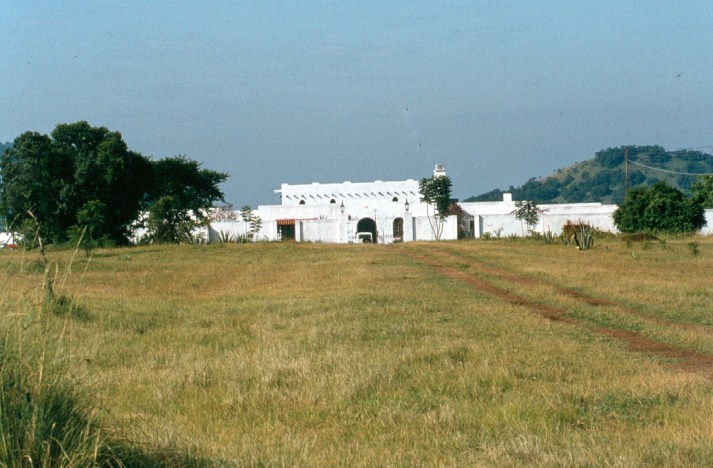
A large white house appeared in the distance!

A large white house appeared in the distance!

We walked into a very large rectangular living room, its walls covered with art objects. The chairs were large and made of forged iron, including the one where a coloured person with Indian features sat, atop lots of cushions and surrounded by small dogs. I guessed him to be in his late seventies. He stood up with some difficulty and came to greet us with a warm look on his face.

He was Joe. “How was the safari?” he asked and added: “they tell me the road is rough but I do not drive any more so I do not know”. Alan made a comment about the road and introduced me, explaining who I was and the reasons for my visit. Joe welcomed me and invited us to sit, while ringing a bell. Soon a white middle-aged woman in crutches came in. Joe introduced her to me as Sheila, his wife. As it was late afternoon some Tuskers were produced for us. “You must be tired Julio”, she said, “coming all the way from Mbita Point”. “We will have dinner very soon as Joe goes to bed early” she added.

Over the beer I gathered that Joe had a special interest in books, largely fired by his Goan father. “I have many books” Joe said “and art” he added. I also learnt that Joe was recovering from a stroke and that Sheila’s hips were in a bad state and that she needed an operation soon.

Dinner was a simple affair and we soon retired to our bedrooms. Alan´s had a microscope and piles of stained slides that he needed to examine, so he proceeded to check the health of his experimental cattle. I unpacked my belongings and feeling very tired I went to bed, leaving Alan with the microscope and the ubiquitous Tusker at hand.

The following morning Alan woke me up before sunrise as we needed to check the cattle before they went out for grazing. We did not see our hosts as they were resting when we left. Daily body temperature, blood and lymph node smears are routine monitoring activities when working with theileriosis. That day we also had to tag a few animals. We needed to write on the tags with a special pen known as the “magic marker”. Alan asked one of the herdsmen -Ephraim- to fetch it. He went to look for it while we went to look at the cattle boma. This was an enormous 3-metre tall barbed wire enclosure where Joe´s cattle were kept, together with the experimental cattle. After inspecting it we went back to the crush pen to continue with the work but Ephraim was not back yet! Alan asked what was happening and was told that “he is coming”, the usual reply in these situations. Finally, after Alan’s patience was almost gone Ephraim appeared carrying a basin with hot water! When Alan saw this, he became quite angry. “What is this?” he asked. “What you asked for” replied Ephraim “maji moto“. The incredulous look on Alan’s face was very funny to see, and suddenly he laughed at the confusion and all the tension disappeared everyone joined in! Magic marker was mistakenly taken for magi moto, Swahili for hot water!
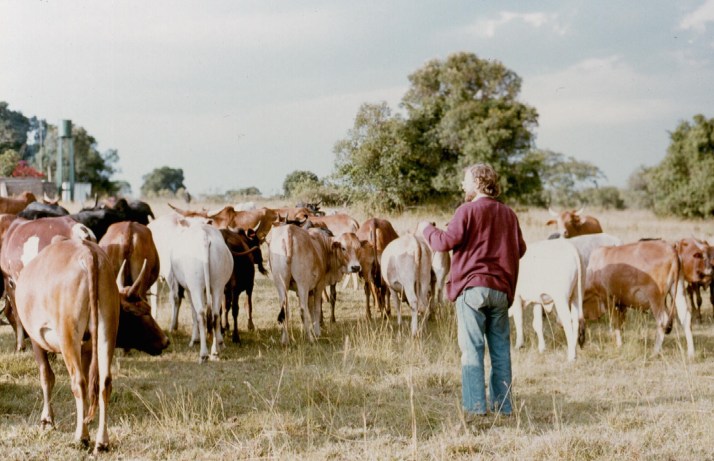
Alan watching the cattle leaving the boma.

Alan watching the cattle leaving the boma.

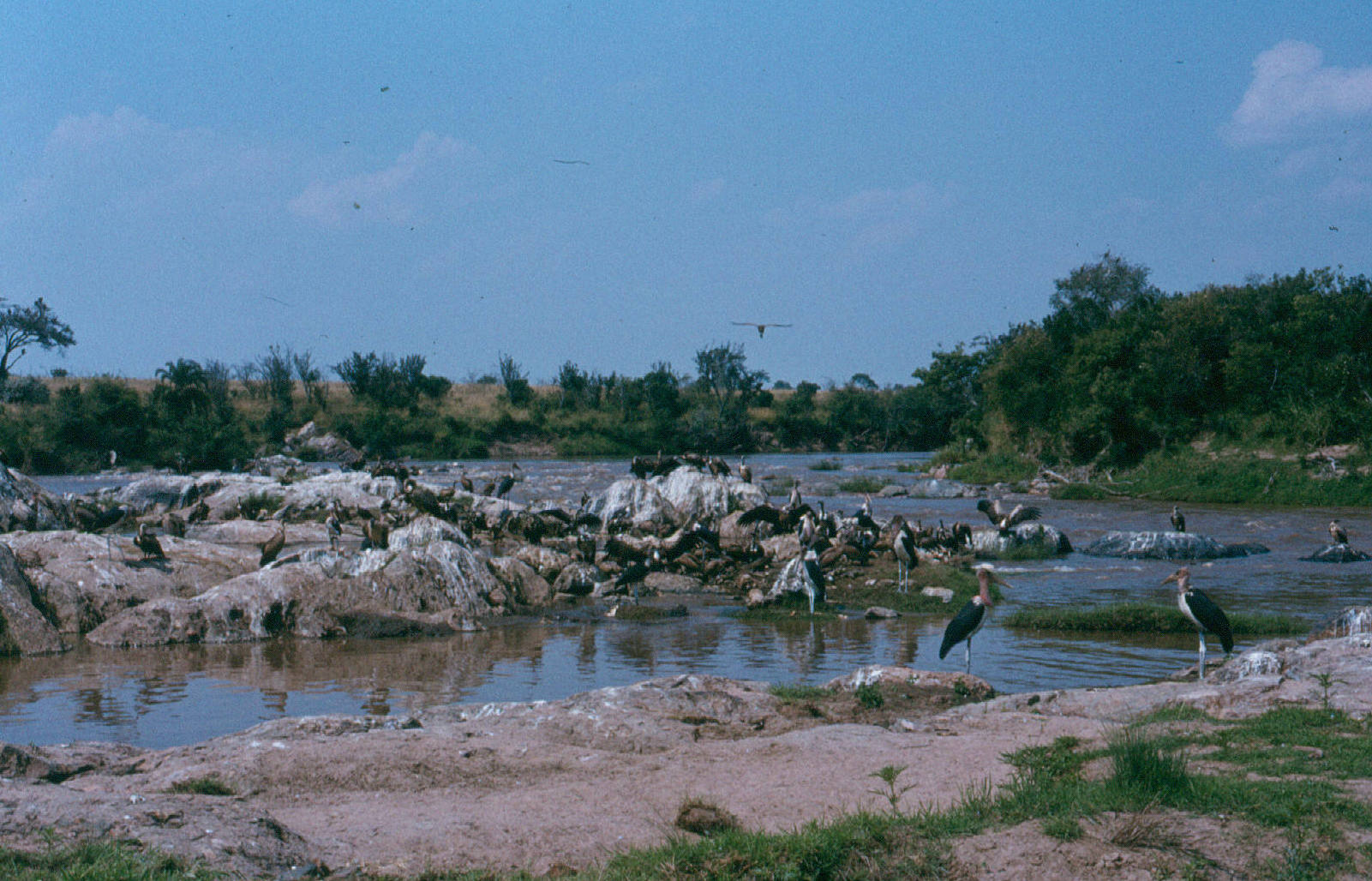
Our work completed, we left the following morning, driving through the Maasai Mara Game Reserve. I loved the place! We crossed the Mara River on our way and had the chance to see the aftermath of the Wildebeest river crossings: a solid mass of dead animals being feasted upon by crocodiles and vultures, after the remaining beasts successfully continued on their migratory route.
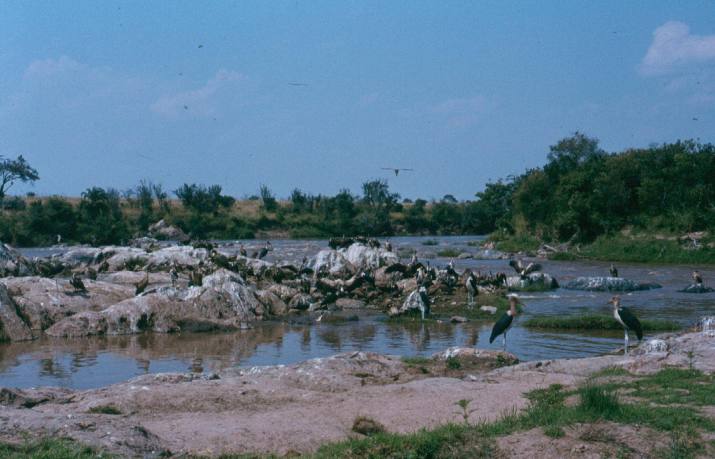
The aftermath of a wildebeest crossing of the Mara river.

The aftermath of a wildebeest crossing of the Mara river.

Seeing that natural marvel for the first time created a very strong impression on me. I believe that it was then that my life took a turn that would make me stay in Kenya and Africa. I decided that I would do all I could to persuade Matt that I should work at Intona ranch and, on my way to it, have the privilege of driving through the Maasai Mara Game Reserve!
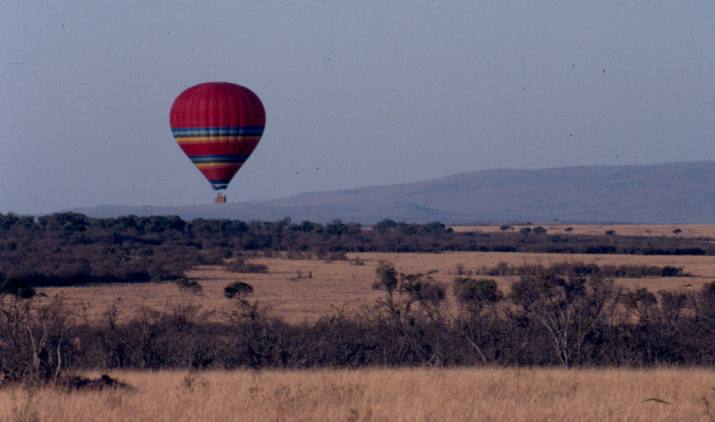
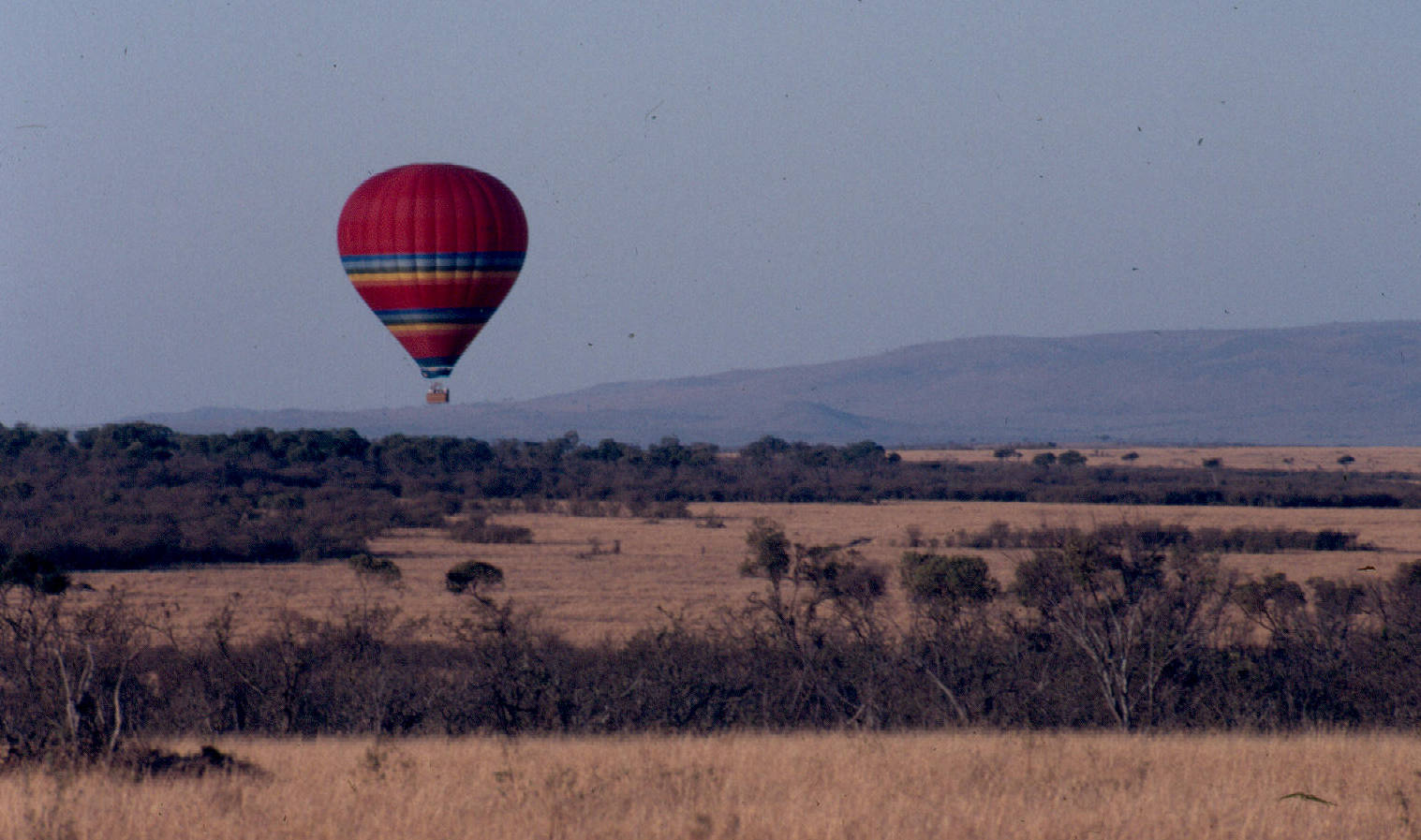
A hot air baloon flies over a rather dry Maasai Mara.

A hot air baloon flies over a rather dry Maasai Mara.

[1] Follows “Chicken a la Rusinga”.

[2] Swahili for a general store shop.

[3] Red was the dominant colour for the Maasai “tunics” at the time.

[4] Sadly he died on 15 March 1995. I placed his Obituary in the Pages section.

[5] Swahili for cultivated land or vegetable garden.

[6] Maasai for house.

[7] Short, double edged Maasai sword.

[8] Kraal in Swahili.

[9] See Pages for more info. The next post describes more of my relationship with Sheila and Joe.

The Cattle Are Gone!

Tongai came to see me today. Before he spoke I knew that there was something amiss so I braced myself for bad news. Information had come from his rural area that his cattle have disappeared. About one month ago, as the best possible saving strategy, through a loan from his employer i.e. me, he purchased four cows to start a herd in his home area.
Apparently the animals were taken to the dip tank, together with the family herd, for their periodic anti-tick treatment. This time they became very itchy and restless after the procedure which resulted in them breaking out of the holding pen. This means that they are now “bush-borne”. My immediate question, coming from someone that has spent his life in Africa, was “Why did only your cattle disappear?” The reply was convincing enough: “They are the new ones and they may have gone to their previous homes”. This sounded logical to me and we are still waiting (and hoping) for news that they have been found.

While talking to Tongai, memories of earlier cattle feats came rushing to my mind and I am now sitting at the breakfast table -the only sunny place on this Harare winter morning- writing this post to the detriment of the planned shopping that will need to wait until tomorrow.

The evergreen and beautiful Transmara area where Intona Ranch was located.

The evergreen and beautiful Transmara area where Intona Ranch was located.

In the page “The Blogger” I mentioned that my work in Kenya took me to Maasailand. I travelled there at monthly intervals for several years, crossing the Maasai Mara Game Reserve, up the Oloololo escarpment, into the Transmara District, pass Lolgorian and into Intona ranch where collaboration between the International Centre of Insect Physiology and Ecology and the Overseas Development Agency of the British Government (now the Department for International Development) was taking place on ticks and tick-borne diseases.

A calf ear showing a heavy infestation of Rhipicephalus appendiculatus, the Brown Ear Tick, vector of Theileriosis.

A calf ear showing a heavy infestation of Rhipicephalus appendiculatus, the Brown Ear Tick, vector of Theileriosis.

Please note that I will be referring to the Transmara and Intona ranch in future posts and I will satisfy your curiosity with further details as a lot of what I will tell you took place there or on the way there (see future posts under Memories). For the subject of this post it is enough to mention that I was in charge of a trial that involved the comparison of cattle with different levels of resistance to ticks. To this effect I had four groups of five cattle each in four adjacent paddocks, protected from large animals by an electric fence and from the many predators prevalent in the area by watchmen.

An "antique" blue slide to show the paddock design. There were five cattle in each of the sub-units 1 to 4.

An “antique” blue slide to show the paddock design. There were five cattle in each of the sub-units 1 to 4.

The Transmara District of Kenya is home to the Maasai of various clans (Uasin Gishu, Moitanik and Siria). Intona ranch was -and although now rather derelict- is located in Maasailand and people on foot moved freely through it. This meant that we were constantly being visited by our neighbouring Maasai who came to offer us milk and other produce.

More background is needed here before I continue with the story.

Cattle are the centre of Maasai life and cattle owners have a colossal wealth of information about their animals stored in their memories. They know not only the parents of a particular animal but also its grand parents and a couple of generations before that at least! They can tell you their colour, whether they were of good stock or not, how they died and other information on their cattle that they consider relevant. They are very proud of their animals and their aim is to get as many as possible as this gives them a better social status. One of the first things I learnt about them is their belief that God gave them all the cattle on earth and therefore rustling cattle from other people will just be recovering what is theirs.

Clearly then, being a veterinarian -able to treat their animals- meant that I was held in high esteem. This often resulted in them bringing their sick animals to me for check ups and treatments! It was a community service that I provided with great pleasure.

Now back to the story.

Try to picture me arriving at Intona one late afternoon with a large lorry full of young cattle and you start to get the picture. If to that you add that the animals were of the beautiful Boran breed, you get the full picture! The news of this Gods’ send spread like bushfire in the area so visitors trickled in to watch the animals for hours at the time for many days and participated in endless conversations about them. I am sure that I was providing the equivalent of a cinema premier!

The young Boran cattle at Intona Ranch being prepared for the trial. Please note that they have bags in their ears to test them for tick resistance.

The young Boran cattle at Intona Ranch being prepared for the trial. Please note that they have bags in their ears to test them for tick resistance.


The Maasai kept coming to watch our cattle.

The Maasai kept coming to watch our cattle.

Aware that I was bringing part of their cattle back home -as they I am convinced

believed- I needed to make sure that the animals would stay with us for science’s sake so I stayed while I took some measures that I thought would consolidate my situation as a “legitimate borrower” of their cattle! So, the holding kraal -already looking like a fortress because of feline predators- was reinforced with fresh thorn bushes secured with barbed wire and armed watchmen placed on 24 hour watch rather than the usual night watch. I am not exaggerating!

As if it would have been weak, the night enclosure was further reinforced...

As if it would have been weak, the night enclosure was further reinforced…

One of the night watchmen and co-workers.

One of the night watchmen and co-workers.

These security arrangements done, the animals were prepared and -as per the two-treatment groups- randomly allocated to their pens, five in each of the four enclosures. We were finally underway with our work! After a few days, when I judged that things had settled down, I returned to Nairobi as I had other duties to perform. A couple of months passed and interesting data were beginning to emerge so we were very pleased and already thinking of scientific glory!

A phone call from the owners of Intona ranch on a Sunday afternoon brought me back to reality. This was very unusual so I braced for something serious, thinking on an accident of the personnel stationed there, my ever-present main cause of concern. “A radio message had come from the ranch telling us that all your cattle are gone!” the voice said. I gulped and only managed to utter “Oh my word, the trial is ruined! And then asked: “When did it happen?” “Saturday night”, came the curt reply. I knew that over the weekends our vigilance would be more relaxed but I was not really prepared for such a blow! “OK”, I managed, “I will go there first thing tomorrow and deal with the situation, thank you”. I was at a loss as I had no plan for such an event! That night I counted cows to go to sleep… Despite this, I spent hours thinking about how I was going to recover the 20 cattle and if not, trying to prepare a good explanation for our donors! I hardly slept and I was up at dawn to travel as soon as I could!

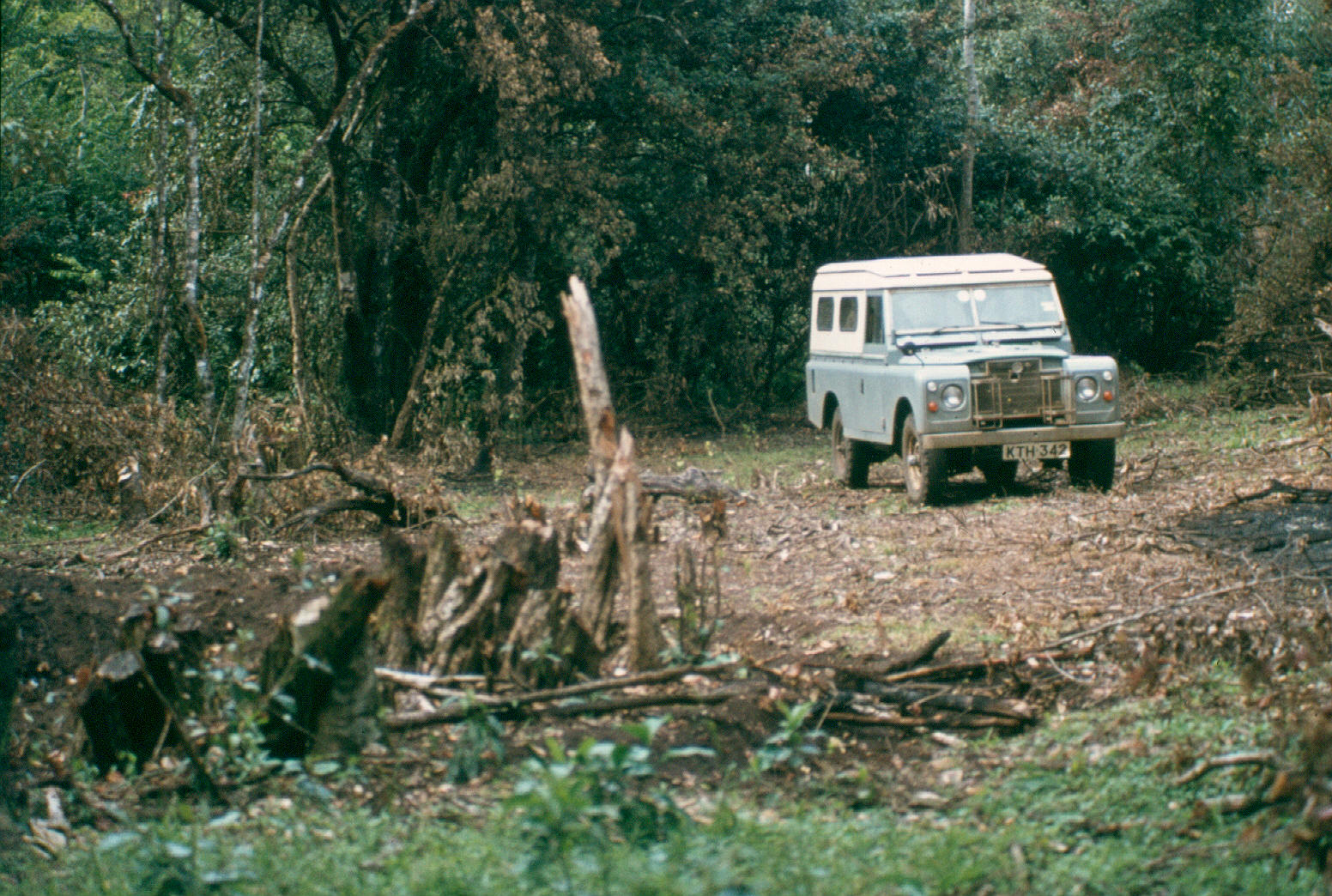
It normally took me one day to travel from Nairobi to Intona. It was not the distance that mattered but the condition of the road. It was rough from Narok to Aitong and it could be very muddy once on the Oloololo escarpment, particularly crossing the swamps and then the cherry on the cake: the infamous red hill, the nearest description would be to try and climb over a gigantic bar of red wet soap, stay on and come down on the right side!!! As in the Transmara it rained almost daily, I knew that was always waiting. None of this came to mind that day and I cannot recall the travel details. I pushed the faithful Land Rover -Series III panel van- slow but reliable, and I am sure that it was in this trip that I broke its chassis (something the mechanic discovered on the next service!).

On the way to Intona Ranch with co-workers.

On the way to Intona Ranch with co-workers.

As expected, a reception committee was waiting for me with worried looks. They had not slept well either. I was given full details of the disappearance, their conclusions, and recommendations. We inspected where the fence was cut and the animals removed. We needed to report the theft to a special branch of the Police known as the Anti Stock Theft Unit (ASTU). This required us to travel about 40 km towards Lake Victoria to Kilgoris, the capital of the Transmara District.

Without further delay we went there, accompanied by the ranch manager and Sami, the Maasai herdsman working in the trial. He had been with me for the last couple of years and he was trustworthy and, most importantly he could speak Maa (the Maasai language). He had already done some tracking and had an idea of the manyattas that could be involved. A manyatta is a Maasai settlement or compound, normally surrounded by thorn bushes where a family or group lives, either temporarily or permanently. Inside the fence are the houses and enclosures where cattle, sheep, goats and donkeys are kept during the night.

The Officers at the ASTU listened and logged our case and -as usual- were ready to assist us. As expected they needed transport. We agreed and immediately four hardy-looking Officers carrying their full gear, including the ubiquitous AK47s, boarded the car. Our cattle tracking had started!

While on the way back, Sami took over the communication with the ASTU contingent and I was given only scanty information as translating from Maa to English was the only way I could learn what was happening. I learnt that the fact that the ranch where we kept the cattle belonged to a very important -now retired- statesman worked in our favor! After a while I was informed that we would visit a few manyattas. I knew, from past experience, that this meant cross-country driving in heavily wooded land which would result in getting totally lost without the assistance of some local person. I trusted that Sami would be able to be such a person.

I did not need to worry as the ASTU guys knew the area very well, suggesting that what had happened to us had -perhaps- taken place earlier? It was a long field day. I drove to the various manyattas. Unable to understand the exchanges I limited my job to drive and to watch the various “interviews” that took place. At nightfall, after all manyattas had been visited, I took the people back to Kilgoris and got back to Intona very late at night, totally exhausted and looking forward to a good night sleep.

When I opened my eyes, after been shaken, I realized that I needed more sleep but I was able to recognize the ranch manager, his grin almost blinding. “The cattle are back!” he said and added, “They were returned to the paddock last night!” I jumped from the bed, all tiredness and lack of sleep instantly forgotten. We immediately went to the paddock and, effectively, the animals were back! Further, they were not just back, they were returned to the same places they were removed, five in each of the paddocks, no errors committed! They looked fine if a bit empty and thirsty. The only apparent damage was that the identification numbers had been burnt over to remove them and their plastic identification tags cut off. All things considered, this was a minor issue and they promptly healed and grazed their fill.

Greatly relieved we immediately travelled back to Kilgoris to report the resolution of the case to the ASTU and to close it. We also thanked them profusely as they had saved us (me!) from a potentially embarrassing situation.

After all formalities and acknowledgments were over, a question still burnt in my mind: How did they manage to have an almost instant response from the rustlers? I asked them as my curiosity needed to be satisfied! A matter of fact reply solved the puzzle: “We told them that if the cattle were not returned, we would shoot all their animals” Whether this threat would have been carried out or not, I will never know but it served its purpose and that was what I cared about at the time.

I hope that I will not need to resort to similar actions to recover Tongai’s cattle!