Month: August 2015

Moonlit Elephants

As usual, things did not go according to plan! Masuma dam -in Hwange National Park- had changed slightly. A small and shallow bay had been formed to the benefit of the thirsty animals, in particular the impala, who could now drink in relative safety as the crocodiles could not ambush them like last year.

The new drinking place made it safer for animals to drink. Philosophically, the crocodiles decided to sun themselves.

The new drinking place made it safer for animals to drink while the crocodiles wait.

This change in the architecture of the dam meant that the crocodiles (we counted six of them) were almost invariably sunning themselves on the banks of the dam in an apparent forced fast. There is no need to be concerned about them not eating, as they are able to survive long periods without food.

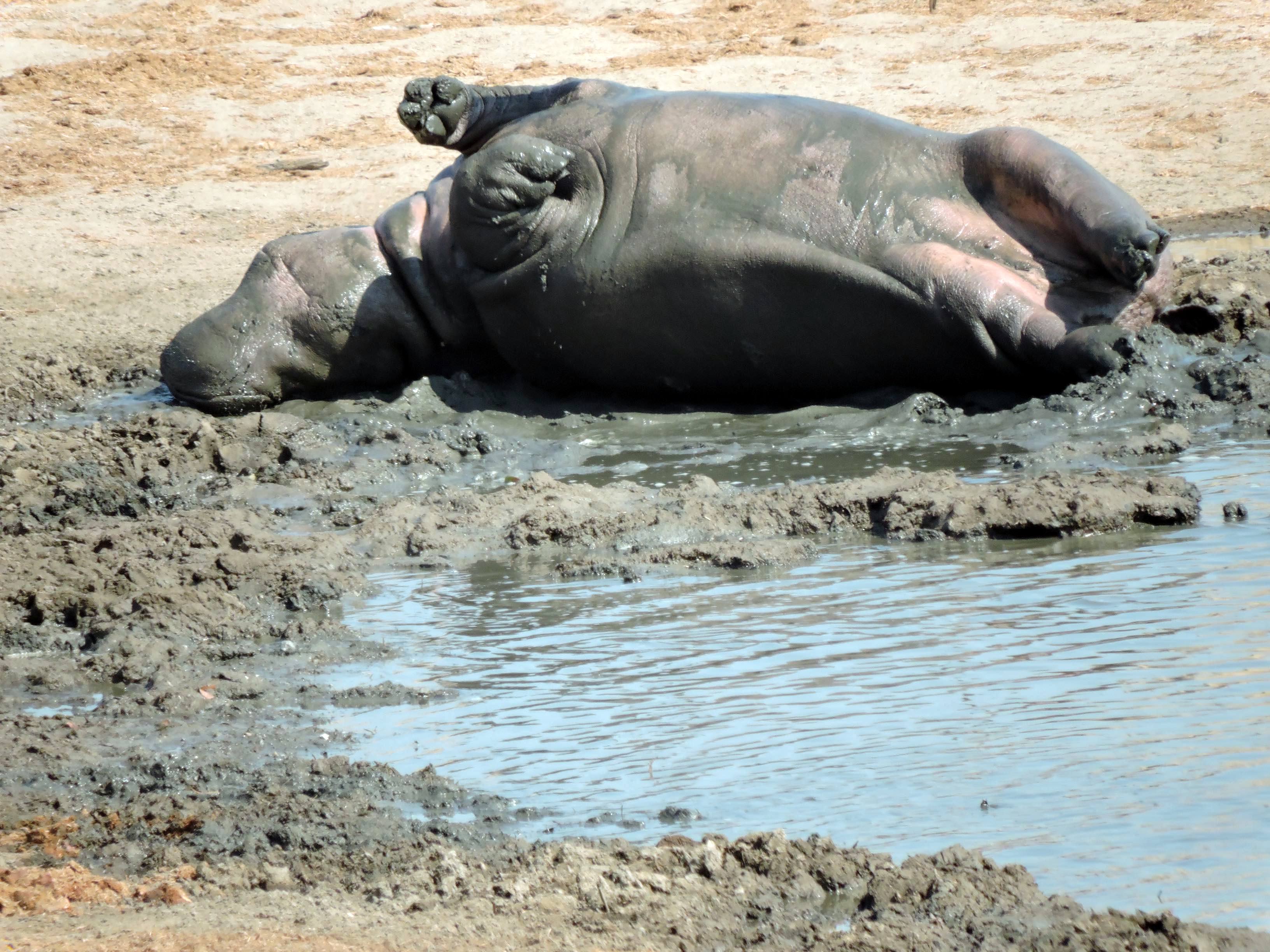
Hippo conversation!

Hippo discussion.

The sixteen hippos were also there. They behaved as one expects hippos to behave: most of the day time spent inside the water coming out for a “service” (sun, the occasional mud wallow and attention from oxpeckers) by lunch time and going out of the dam in the evening to graze. To achieve this they were forced to queue for sometime to squeeze between the drinking elephants! They spent most of their energy chasing each other inside the water snorting loudly and they were quite adept at showing us the end results of their digestion!
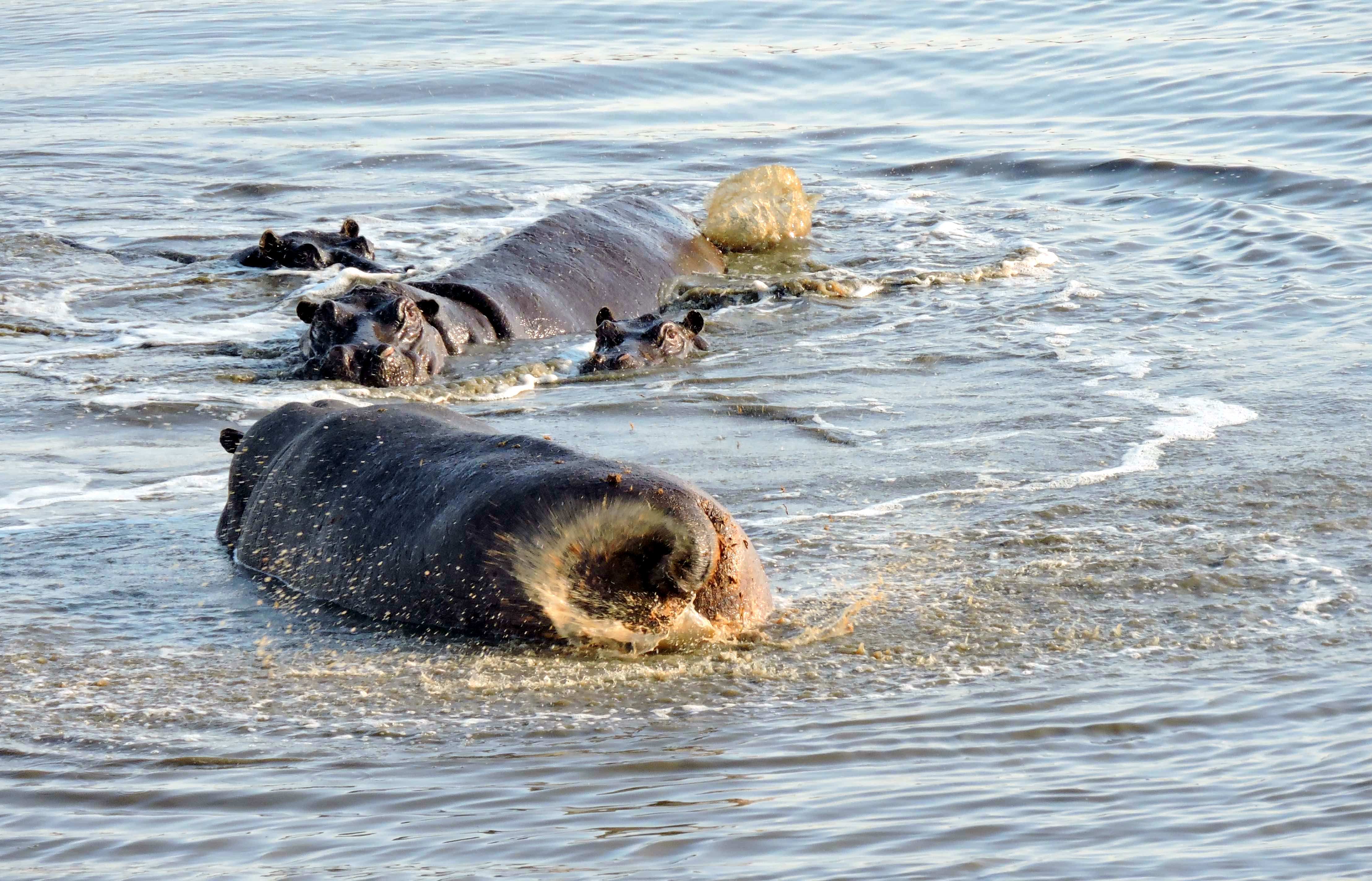
Hippos involved in "social" defecating...

Hippos involved in “social” defecation…

We arrived at Masuma at lunchtime. We spotted a few elephants drinking on the opposite side of the dam but no fresh water was being pumped in.
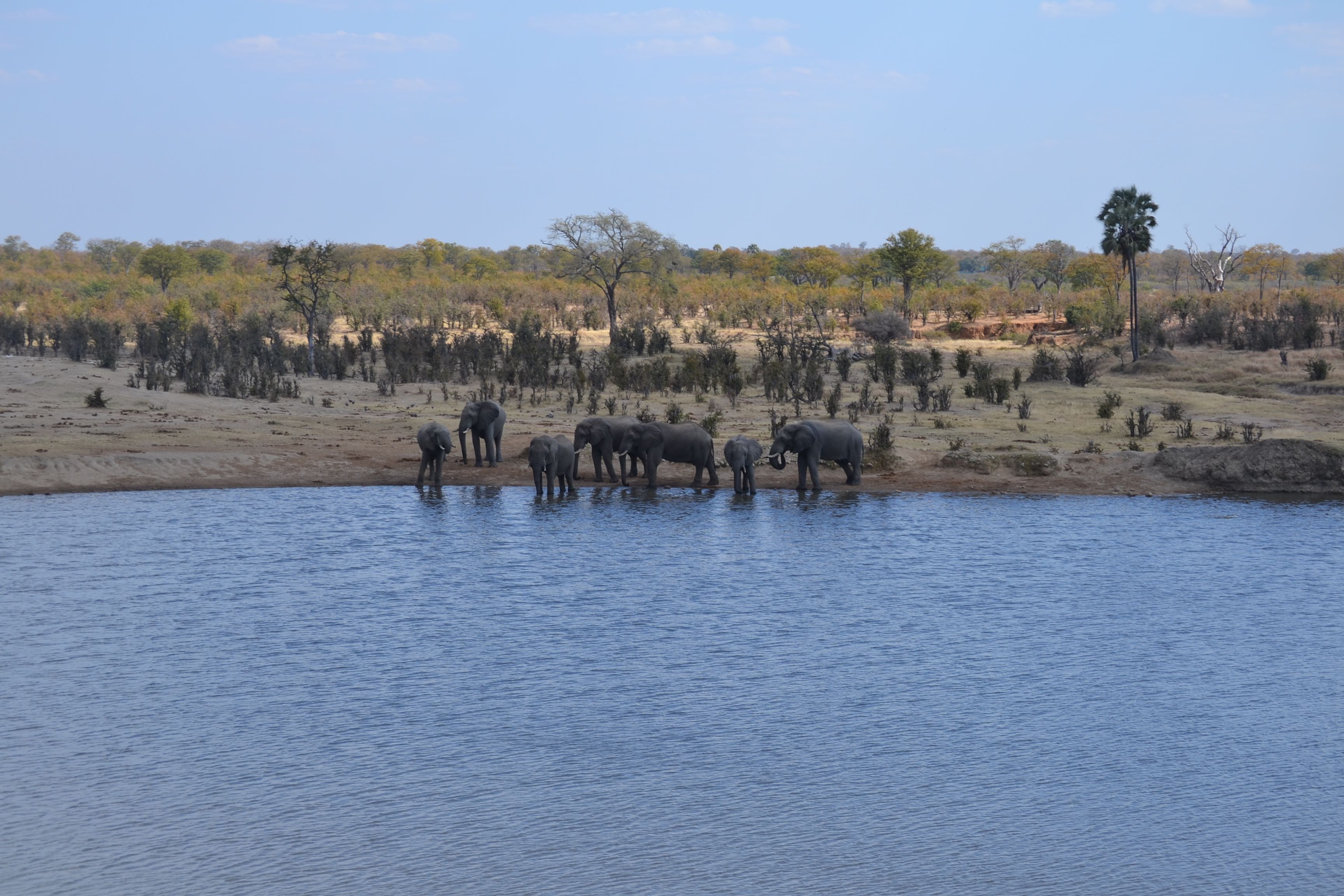
Elephants drinking before the pump was turned on.

The camp attendant anticipated my question telling me that lions were walking around the dam the night before and he did not dare to walk to switch on the pump! Needless to say that I obliged when he asked me for a lift to get there! While driving, keeping an eye for lions without seeing any, I learnt that a donor was providing diesel for the pump. “Once the pump is on the elephants will come” proclaimed the camp attendant after the engine started puffing. He also informed me that a full tank of diesel would operate the pump for twelve hours. “Twelve hours would take us through most of the night”, I thought while I mentally thanked the benefactor and hoped that the camp attendant was correct in his prediction.

All shyness lost when getting close to the water!

All shyness lost when getting close to the water!

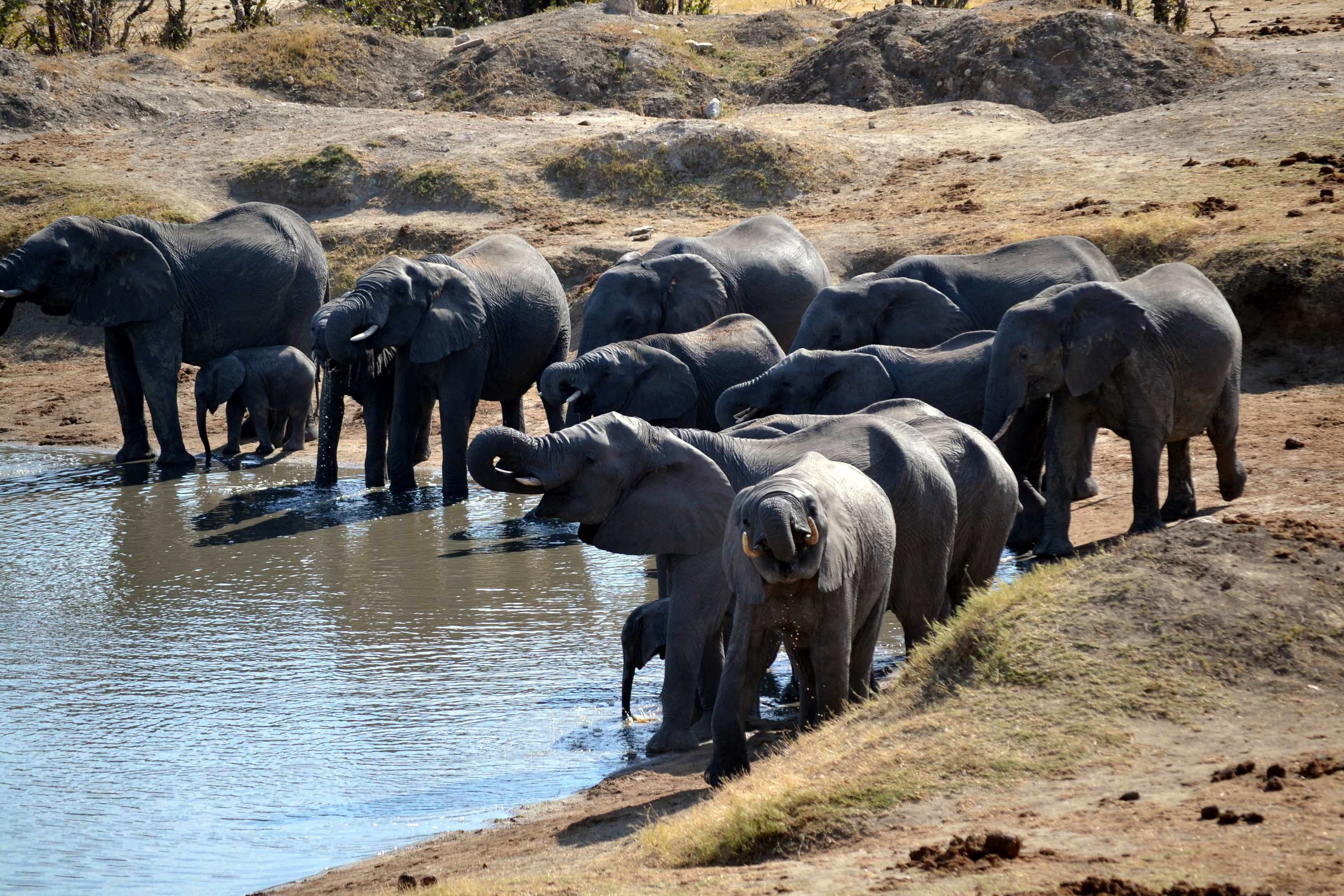
Fortunately, as predicted by the camp attendant, the first elephants started to arrive within an hour of our return! Whether they smelled the fresh water or associated the pump noise with fresh water I could not say but the latter seems the most likely. The fact was that they made a beeline for the pipe producing the fresh water, ignoring the rest of the dam if possible! However, as the place got more and more crowded, the incoming families had to wait until those that had arrived earlier satiated their thirst or enter into the dam and drink less clean water.

The arrival of the first elephants took place at about 14.00 hours. By then we had already set up camp so we were ready for one of the greatest sights on earth: herds of thirsty elephants coming to drink! Your eyes get tired of gazing towards the confines of the bush that surrounds the dam and you need to stop for your eyes to rest. A few seconds later, when you resume your watch there they are as if they magically appeared in front of your eyes! They come out of the bushes in what appears to be a slow motion walk.

The miracle continues as more come into sight. Their slowness does not last long as, with raised trunks, they sniff the fresh water and their pace gets gradually faster as they approach it. It all ends with them breaking into a run to cover the last few metres, the baggy trousers that are their back legs flapping! Their run ends at the water’s edge where they drink showing their pleasure by shaking the water with their trunks and spilling it all over the place while drinking. Sometimes their run takes them into the water where they not only drink but also proceed to frolic like young humans!
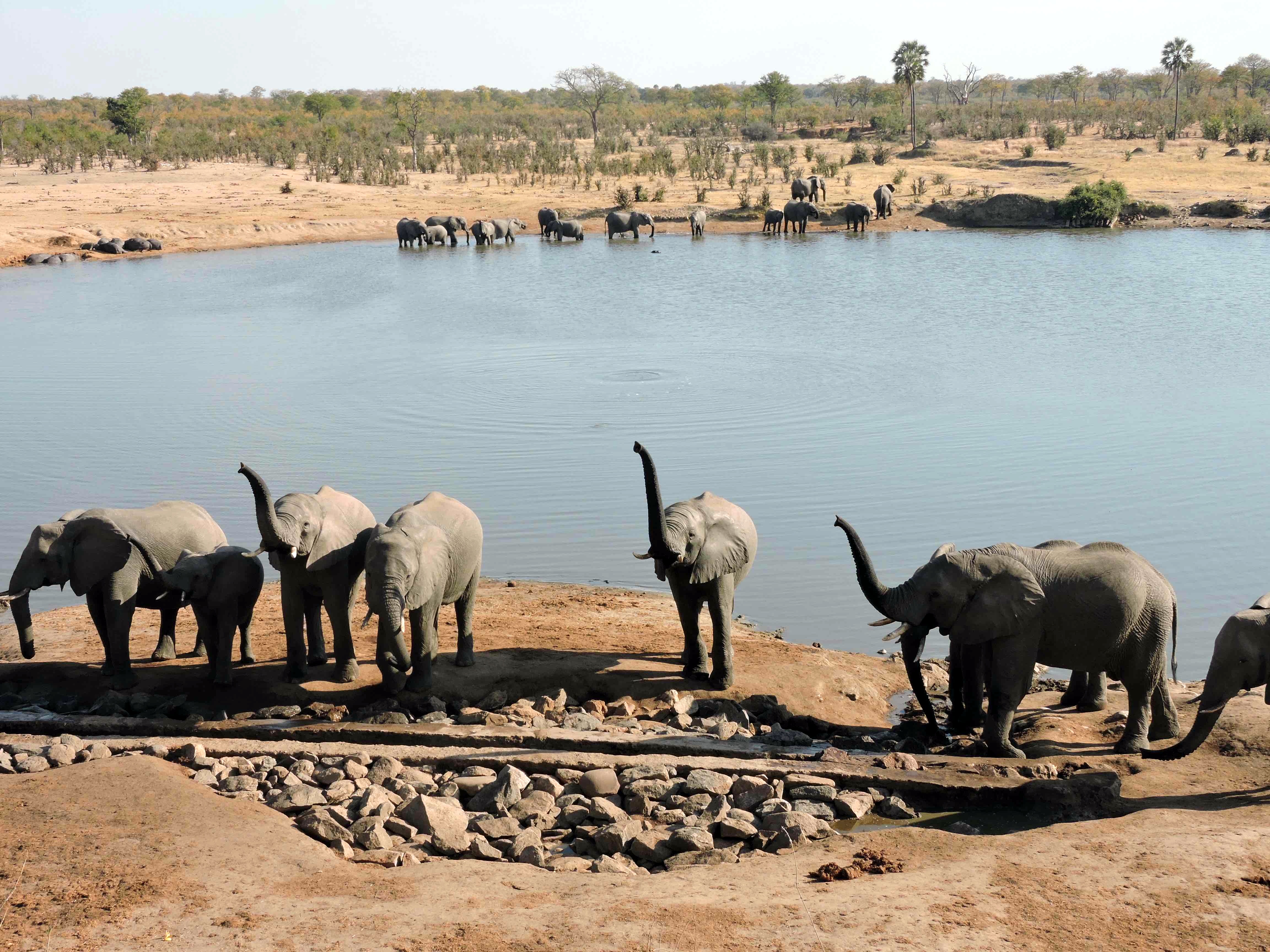
Smelling us!

Smelling us!

Although we are used to seeing large herds of thirsty herbivores coming to a water source, they do so in a rather apathetic way. There is nothing like that when thirsty elephants smell water and I can assure you that their emotions show!

Once in the waterhole, their immediate thirst abated, the animals become quiet while making the best of the available water. They do vie for the best position but they do so rather discretely. Normally the larger animals occupy the best spots. These are bulls that come either singly or in small groups and join the drinking party for a while and then leave the way they came: on their own as normally they only join the female family units when there is one on heat.
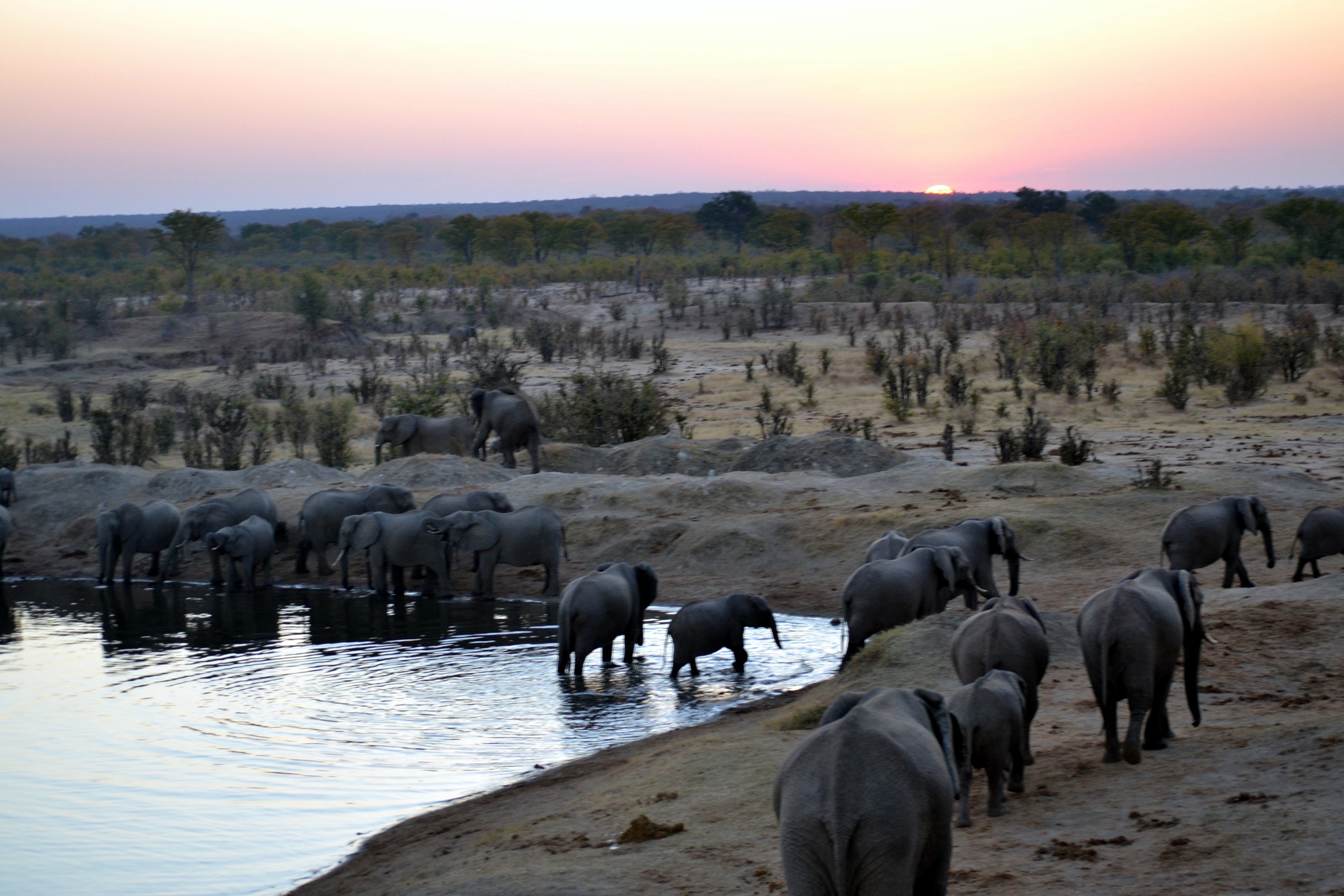
At sunset, the show continued unabated.
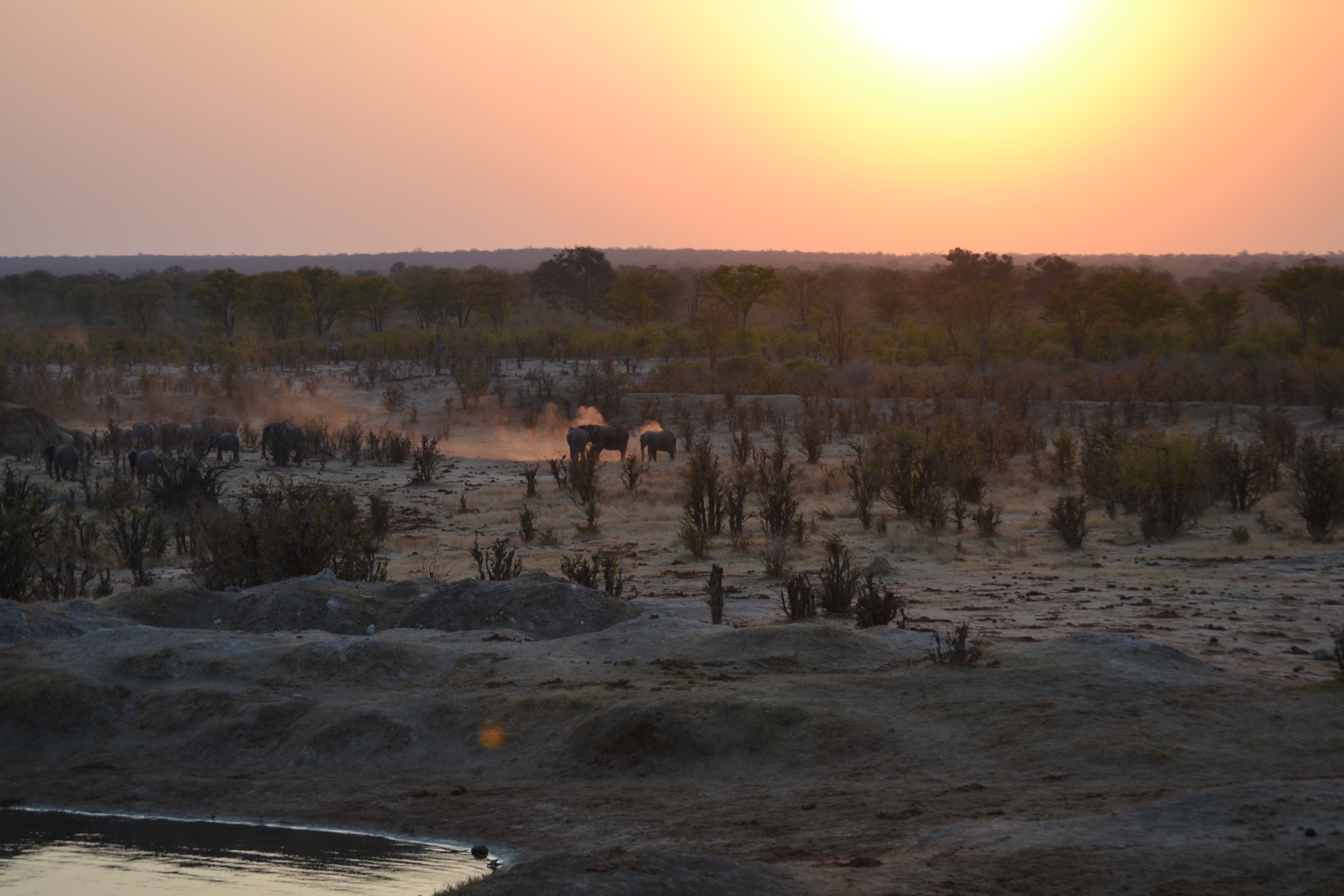
At sunset, the show continued unabated.

Sunset with elephants dusting themselves.

After bathing it was dusting time to cool off.

Occasionally youngsters manage to squeeze in between the tusker behemoths and timidly at first but quite boldly later manage to stick their small trunks into the right spot to get a share of the fresh flowing water. Loud squealing indicates when one of them oversteps the mark and is put back in its place with a shove! Adults show each other respect and only rarely do their interactions go beyond posturing. Overt aggression rarely takes place, and on the occasions that is does, it is normally short-lived. After an initial head clash, often quite violent, one of the rivals withdraws tail up and maintains a prudent distance thereafter! We saw this happening a few times at Masuma.

It is usually a rather gently affair.

It is usually a rather gently affair.

On occasions, however, things do go badly as shown by the chunks of ivory found at waterholes. The most extreme outcome I have ever seen is the skull with a hole made by a tusk on display at the Letaba Elephant Hall in the Kruger National Park. Wapiganapo tembo nyasi huumi” in Swahili means “When elephants fight the grass gets hurt”, a very accurate proverb to describe what you see in these situations! We saw quite a serious confrontation at Kennedy 2 dam near Ngweshla but, luckily, one of the bulls gave up before things got out of hand and the dust eventually settled.

Ocasionally things get out of hand.
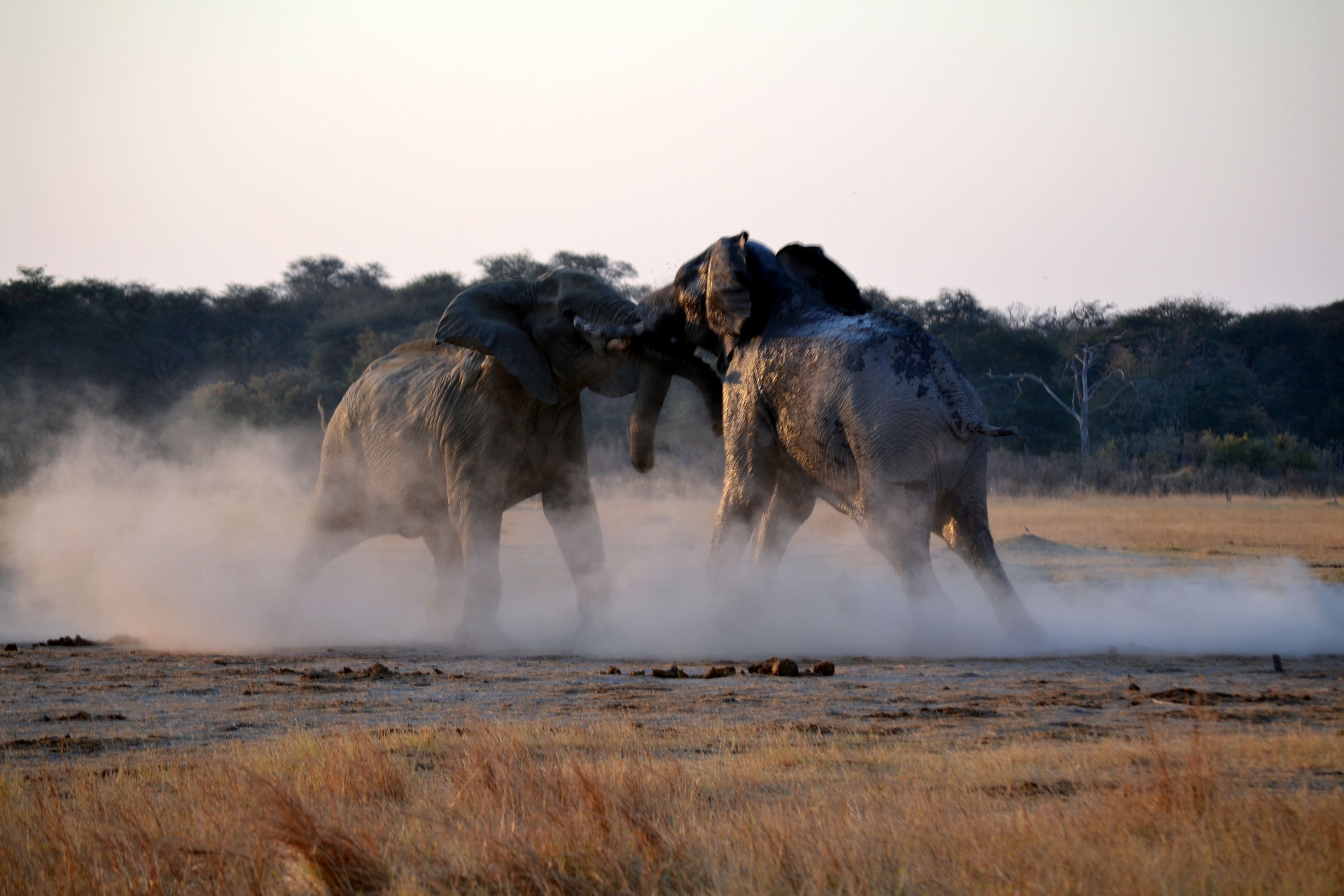
Ocasionally things get out of hand.

Their great strength is evident.

Their great strength is evident.

DSC_0003 copy 2

DSC_0004 copy 2

Eventually they separated.

Eventually they separate and the “loser” moves off .

The elephant parade at Masuma continued throughout the whole afternoon and well into the evening. They paid no attention to the noisy arrival and departure at dusk of large numbers of banded grouse.

Elephants drinking at sunset.

Elephants drinking at sunset.

We stopped watching them for a while to have dinner but their noise stayed with us, as the herds were a few steps from our elevated camp. With dinner over it was time to go back to observe them again with the fading light. They were clearly wearier and their trunks rose more often to smell us and confirm our presence. Belly rumbling also became more frequent and louder. I was aware that the latter is believed to be a communication method among elephants but I did not know that the rumbling moves from animal to animal in a herd, in order to make sure that it reaches the last individual in the herd. Fascinating stuff!
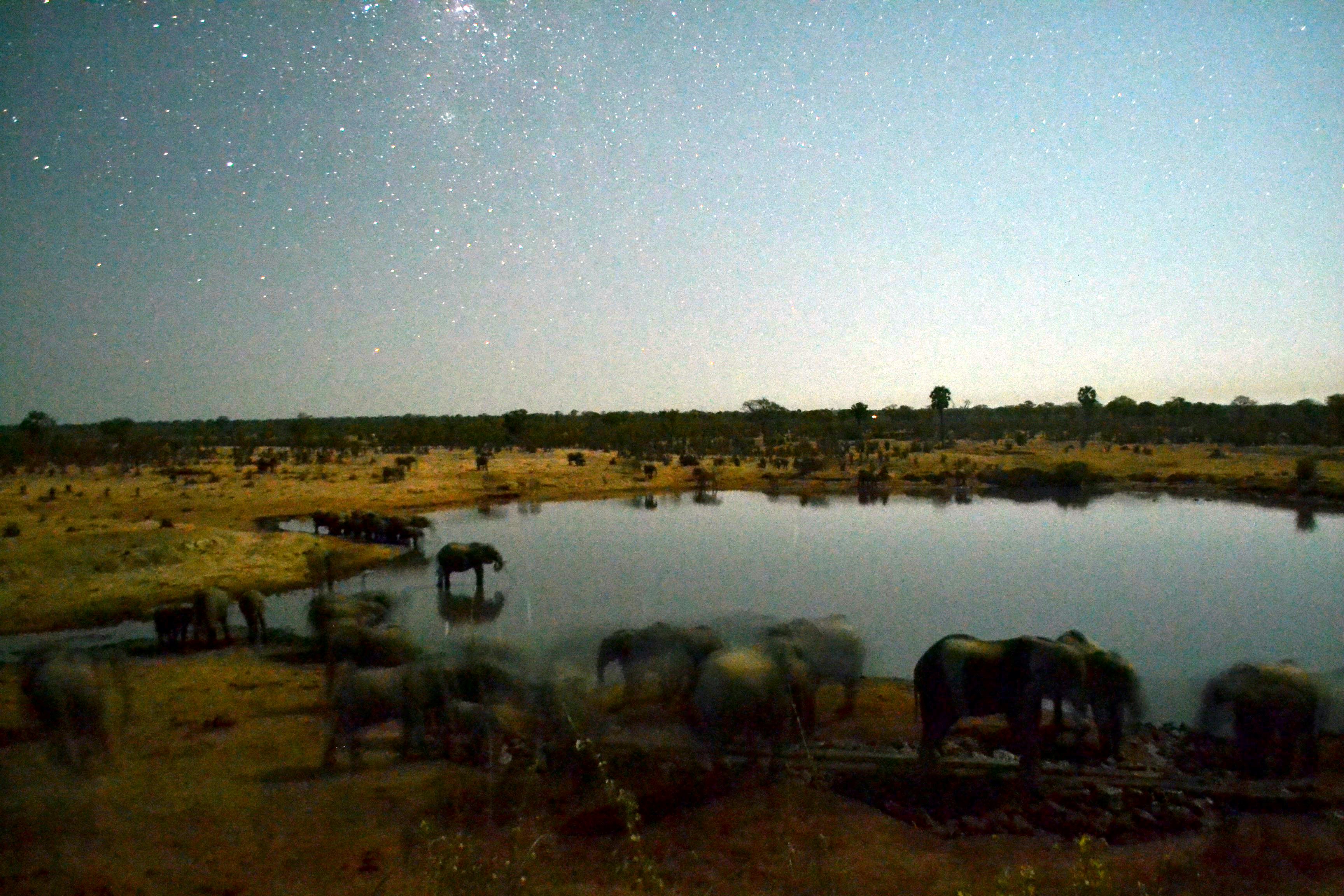
A night picture of the dam with drinking elephants. I applied the Picasa "I am feeling lucky" command to get light into the picture.

A night picture of the dam with drinking elephants. I applied the Picasa “I am feeling lucky” command to get light into the picture. Even the stars can be seen better!
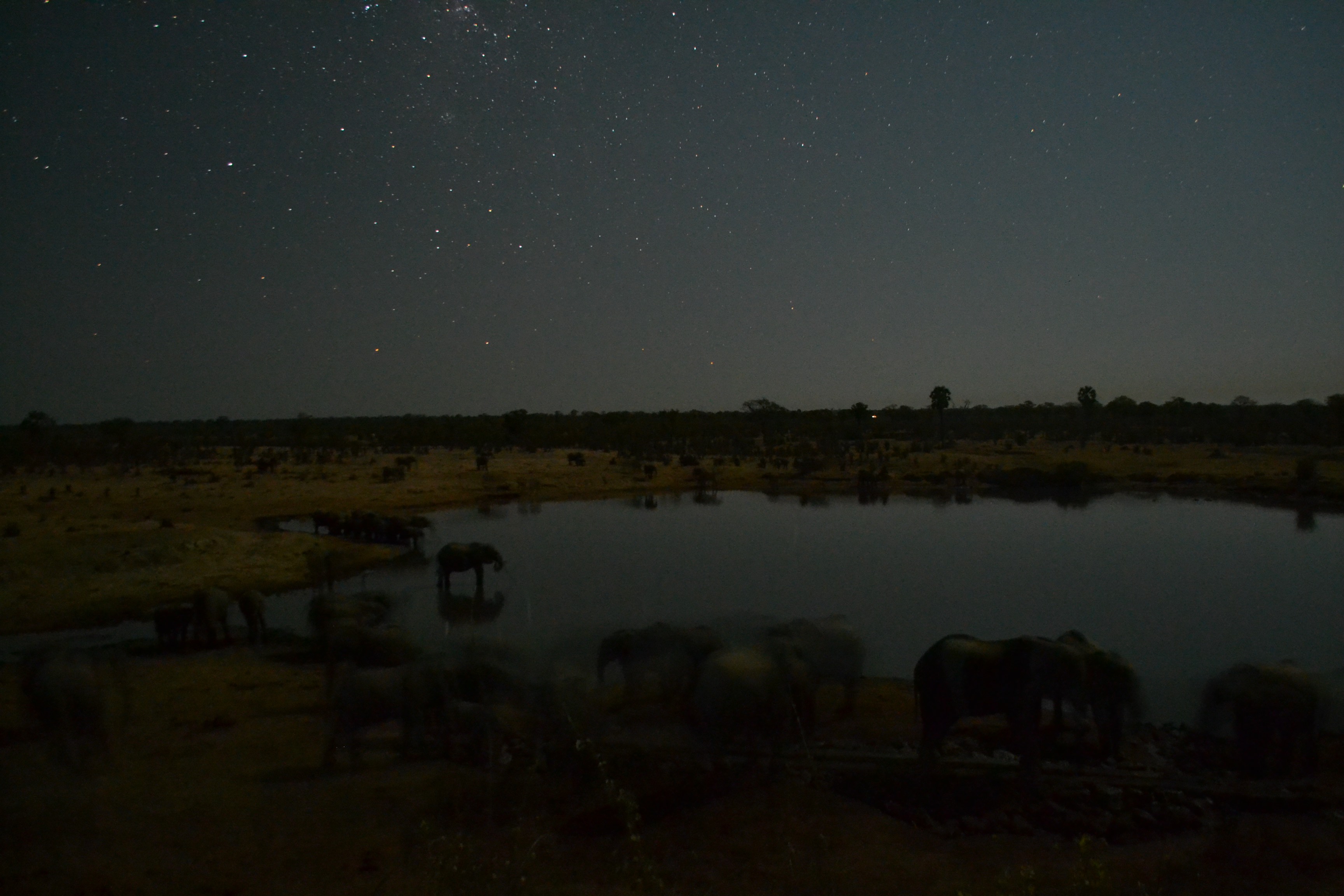
The original picture, above.

The original picture, above.

After a long while we were getting ready to go to bed when the moon started to illuminate the bush across the dam so we decided to wait a while longer. It was well worth it! The moon was almost full and it cast an eerie light over the moving dark grey masses. Absorbed by this rare vision we remained on the watch and for a while forgot our sleep. We stayed with them until they started to move off and only a handful of bulls remained until about 2 am. It is probable that their withdrawal matched the end of the pump’s diesel and their departure brought calm to the dam and we could enjoy a silent African night for a while until the lions started to roar in the distance!

The following morning, apart from the fresh droppings, nothing gave away what we had witnessed a few hours earlier.
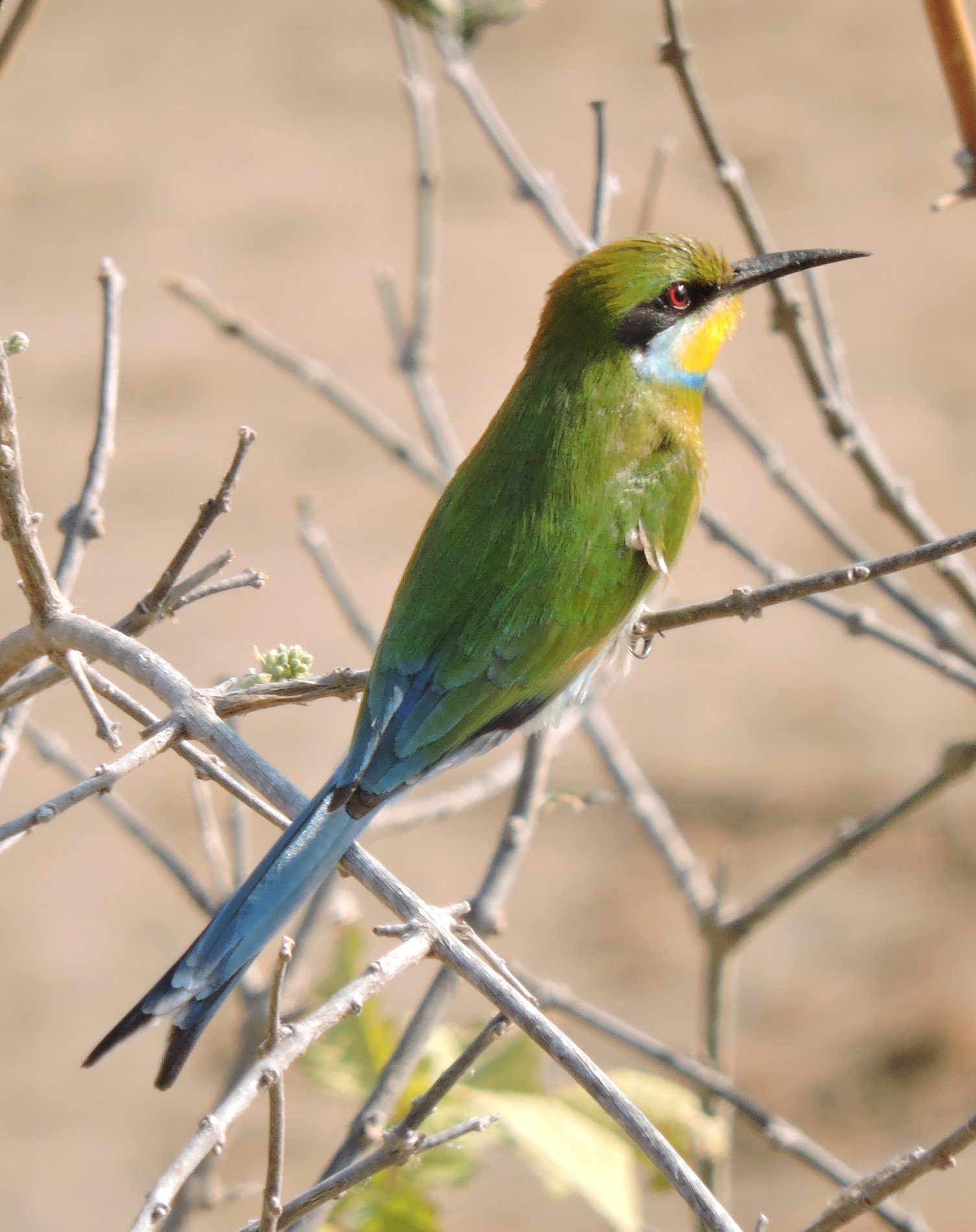
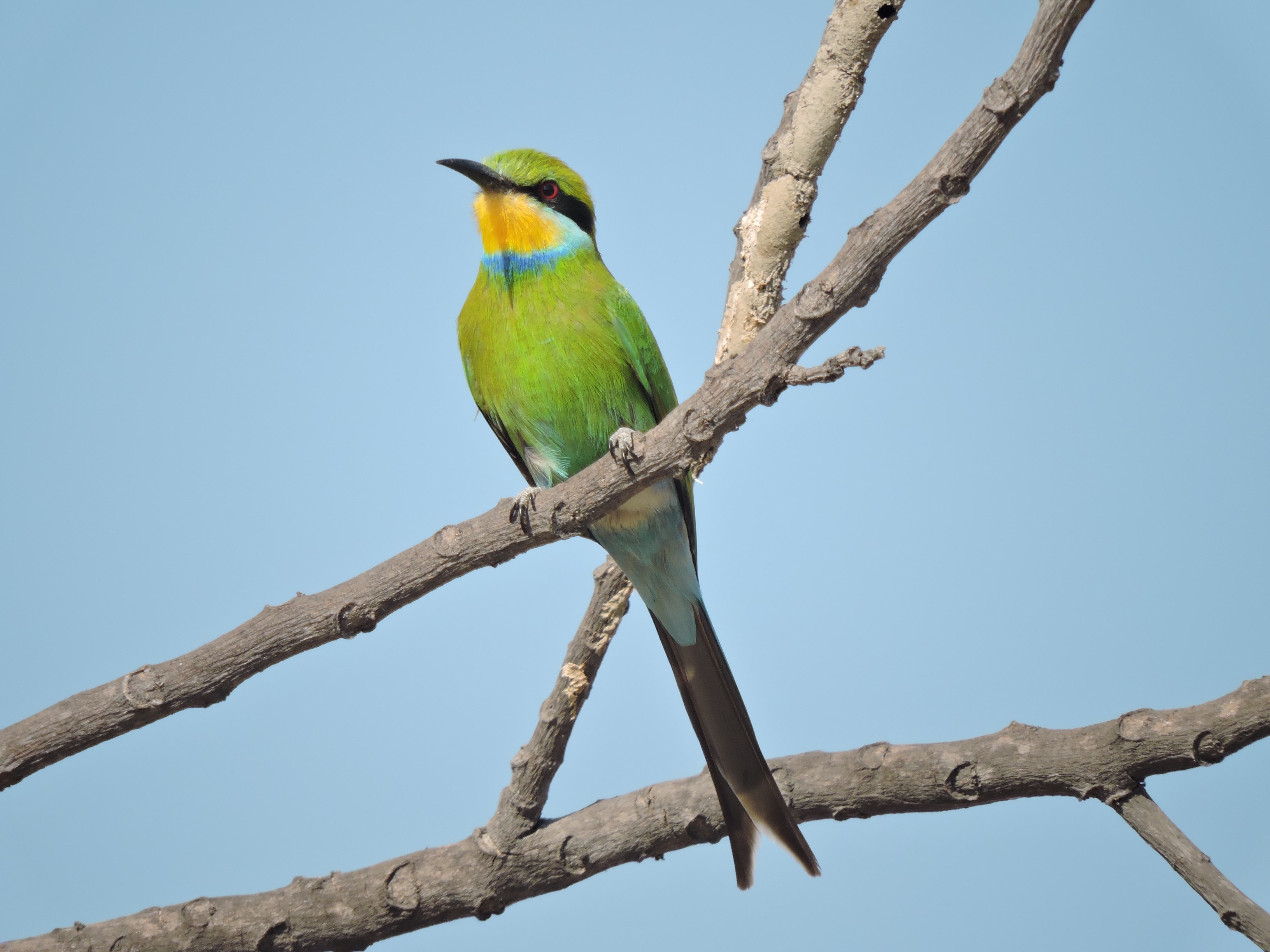
Fearless bee-eater

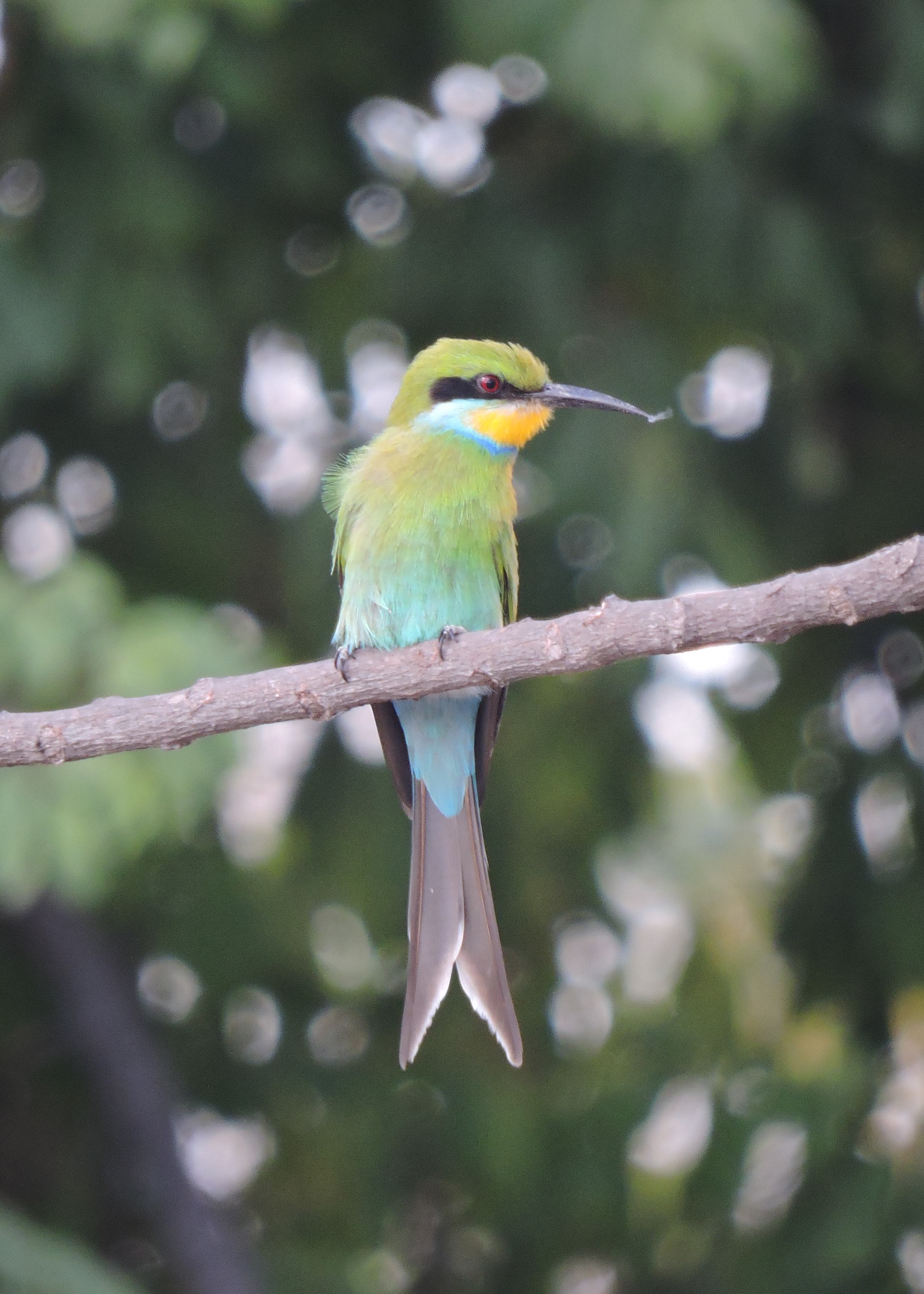
While at Masuma dam, we spent sometime identifying a bee-eater that we had not seen before. Fortunately at least one pair was residing at the dam’s campsite and we had time to have a good look and classify them as swallow-tailed bee-eaters (Merops hirundineus). As my new Roberts VII Multimedia Bird of Southern Africa App says, “The deeply forked blue tail is diagnostic”.

The first picture.

The first picture.

The birds were using two trees from which they would launch themselves in search of prey and come back to the same perch to either try again if they failed or to eat the unfortunate insect if successful. Having watched them for a while we decided that we needed a good picture.

My son is keen on bird watching and wildlife photography so he was given the task of taking “the picture” of the new bee-eater. He approached the birds and took a few shots. Not happy with the results, he tried to get a few steps closer and he got two good shots.

DSCN6573 copy


DSCN6577 copy 2

While moving forward still he saw a fly landing on the side of his shorts but he paid no attention to it as his eyes were fixed on the bee-eater. However, when he was about to shoot, the bird disappeared from the viewfinder. Before he could react he felt more than saw a touch on his shorts where the fly was and, to his surprise, he saw the bee-eater flying away with the fly in its beak! Luckily, he reacted fast and took a picture of the fly being eaten by the bird!

The bird with the prey caught on my son's shorts!

The bird with the prey caught on my son’s shorts!

I have seen garden birds coming to feed on people’s hands or even landing on their heads to feed from there but it was a first to see a wild bird being so daring!

Hwange National Park

Last year I reported on our stay at Shumba Picnic site in Hwange National Park in Zimbabwe (see: https://bushsnobinafrica.wordpress.com/2014/10/31/watched-at-shumba/) as well as the observations we made on the struggle we witnessed between crocodiles and hippos for the impala carcasses at Masuma dam (see: https://bushsnobinafrica.wordpress.com/2015/02/22/hippos-from-hell/ and https://bushsnobinafrica.wordpress.com/2015/03/23/hippos-from-hell-the-videos/).

Hippos were not interested in Impala meat this time!

Hippos were not interested in Impala meat this time! (Photo by Julio A. de Castro & Mariana Terra)

(Photo by Julio A. de Castro & Mariana Terra)

(Photo by Julio A. de Castro & Mariana Terra)

After our return from that safari we immediately booked the Masuma dam campsite so that we could stay closer to the action and see if we could observe something additional in the crocodile-hippo saga that caught our interest earlier. We also booked a place in Main Camp as we were sure we would have fun with elephants at Nyamandlovu pan. We knew that the elephants were plentiful there and we could watch them and enjoy their antics!

THis time there were lots of elephants at Masuma dam. (Photo by Julio A. de Castro & Mariana Terra)

This time there were lots of elephants at Masuma dam. (Photo by Julio A. de Castro & Mariana Terra)

We even saw pink elephants... (Photo by Julio A. de Castro & Mariana Terra)

We even saw pink elephants… (Photo by Julio A. de Castro & Mariana Terra)

As part of our “discovery drive” we also camped in the Ngweshla pan campsite as it has a reputation as the best place to camp in Hwange and is a place where predators are often seen because the area surrounding the various pans and water holes found there is quite open, a change from the thick bush of other areas in the park.

The safari took place between 22 and 29 July 2015 and I describe its highlights in four posts:

Fearless bee-eater

Moonlit elephants

Encounter with lions, and

Ngweshla cold.


I hope you will enjoy them.

Fire! A hot reflection

Sometime back I “reported” on a fire we witnessed at Rome. Again, on the subject of fire, the 1 July 2015 was the hottest July day on record in the UK -so far- with a maximum temperature of 36.7°C![1] We happened to be in Edinburgh at the time, departing to Newcastle by train. Why Newcastle? you would rightly ask. Because of the beauty of buying cheap plane tickets on line! There was a substantial diference flying from Newcastle to Paris than from Edinburgh. Paris was our stopover on our way to Johannesburg and eventually Harare.

Most people were feeling hot and bothered that day. We were quite comfortable with the first summer day we had encountered since our arrival in Scotland a few days earlier. I even managed to remove my thin polartec jumper and go about in a shirt for a couple of hours, until the sun got weaker and I needed it back again!
We arrived at Edinburgh Waverley Train station in mid morning, clearly too early for our 13:10 train to Newcastle. As we travel loaded with suitcases, we prefer to wait than to rush! Surrounded by lots of red-faced and sweaty people we found a quiet corner and prepared for the longish wait. I walked the station up and down to familiarize myself with its platforms, particularly ours. After that we talked -mostly about our son’s graduation, the suitability of our plane seats and our eagerness to arrive to Harare as soon as possible- until the time come to walk to platform 11, the right place according to the information board. Despite carrying large suitcases and hand luggage for our flight, our progress was good and we got there in good time.

The train arrived on time and people disembarked so we waited politely until the intructions to board came. We did not take two steps towards our coach before we got stunned rather than heard a really overwhelmingly loud siren followed by the announcement that there was an emergency and that the station needed to be immediately evacuated. I suddenly understood the sinking heart feeling! I had a last longing look at our train, the vanishing link with Harare, and started walking with our luggage uphill towards the exit. We were part of a multitude moving in a very orderly fashion with no apparent panic.

While walking my brain tried to come to grips with the situation. Missing the train meant missing all the flights for reasons not related to any of the airlines involved so they were under no obligation of putting us on a other flight! Even if they agreed to do this, would the right flights be available? I recalled the difficulties I have had earlier to get better seats for our long journeys, even at a cost and I new then that it was going to be expensive and difficult and asking for a refund did not event come to mind at the time!

While pondering on the vulnerability of present day plane travel, with every step towards the exit my desperation augmented as I could see no easy way out of it! Then, luckily and as fast as the crisis started, it ended! Railway employees came running to inform us that those passengers leaving within the next 30 minutes were allowed to turn back and board their respective trains as soon as possible as the alert had been cancelled!

Probably the intense heat triggered some fire alarm that brought about the evacuation order that, on further checking, was lifted. This was the fastest turn around I remember doing with heavy suitcases and I am sure that we went down towards the train at record speed although, unlike the temperature, no one recorded our movement! Luckily our train was still there and we did a boarding worth of a good pirate!

This post would have ended here except that four days later, on the 5 July there was another scare of a fire at Edinburgh Waverley that mobilized three fire engines to control it. This time the scare was caused by the passing of the Tornado steam locomotive[2] through the station![3] It seems that Edinburgh Waverley is rather jittery when it comes to fires so I made a mental note to avoid it in future.


[1] See: http://www.bbc.com/news/uk-england-33324881

[2] See: https://en.wikipedia.org/wiki/LNER_Peppercorn_Class_A1_60163_Tornado

[3] See: http://www.edinburghnews.scotsman.com/news/transport/fire-at-waverley-turns-out-to-be-steam-train-1-3822129

The growing problem of obesity

While in Edinburgh, one of the first things that we observed was that there seemed to be more overweight people now than when we lived here in the late 70s! While this is perhaps not a strictly valid comparison, further Internet search indicated that our observation was true[1]. But, we also noted that obesity is also affecting other creatures…

Although I never quite believed her, a good British friend had warned me about this problem before. Her mother and friends fed the birds in their gardens, particularly in winter as, apparently, natural bird food was short at that time. The result of this -she mantioned laughing- was that most birds in her mother’s garden were very fat! This condition affected the pigeons in particular but, according to her, even the little robins looked like meatballs! Until the visit to Edinburgh I thought she was exaggerating, but now I have seen the situation with my own eyes!

A heavy Wood pigeon searching.

A heavy Wood pigeon searching.

The pigeons in Edinburgh are unquestionably fat! I refer here to the Wood pigeons (Columba palumbus) reported by the BBC in 2015 as the most common bird in the UK.[2] Although the young of the species are expected to be fat on account of the crop milk they are fed by their parents, I was not prepared to find the adults fat as well to the point that some had difficulties on taking off, resembling well-fed vultures after spending a good night at a carcass![3]

Spotted!

Spotted!

Processing...

Processing…

What are you looking at?

What are you looking at?

The confirmation that the problem exists mad me ponder about possible solutions as the situation seems to be unfair on the birds. As usual, increasing public awareness came to mind first, perhaps because of my United Nations experience. This could be tried and people could be explained that birds could be fed but with moderations. The chances of success of such an initiative when they themselves are gaining weight did not seem too good. We are all aware of the apparent slow success of the anti-smoking drive! I decided that it should be tried as a long-term measure that would reduce obesity in future wood pigeon generations.

For the current portly population the problem is more difficult to solve. To expect people to stop feeding them overnight is out of the question. Attempts at them losing weight through natural pigeon methods such as flying would be difficult and it would probably result in their extinction!

I thought and looked harder and although I saw a lot of new developments in Edinburgh such as a pub that promised to look after the husband while the wife works and a teahouse where you can -for a fee- stroke cats while having your cappa tea, I did not come across any breakthroughs that could be used. Pigeon gyms or sliming bird food were not there!

A non suitable revolutionary offer...

A non suitable revolutionary offer…

Maybe a combined routine of feeding them low cholesterol food combined with Pilates to build upper body strength and jogging to reinforce their landing gear may work until they re-gain their ability to take off and land rather than hop about around people looking for food morsels.

However, judging by the predicted situation in humans, I do not expect these measures to be very successful and fear for the future of the wood pigeon that is why I post a few pictures so that they can be remember, even at their present plump condition!


[1] http://www.theguardian.com/society/2015/may/05/obesity-crisis-projections-uk-2030-men-women and http://www.nhs.uk/livewell/loseweight/pages/statistics-and-causes-of-the-obesity-epidemic-in-the-uk.aspx

[2] http://news.bbc.co.uk/2/hi/uk/4646685.stm

[3] The issue is -of course- well known and documented, mainly in a humorous fashion. See: http://www.londonpigeons.co.uk/ and http://www.thestudentroom.co.uk/showthread.php?t=2669897 and http://www.dailymail.co.uk/news/article-339636/A-pig-pigeon.html

Secret plans in Scotland

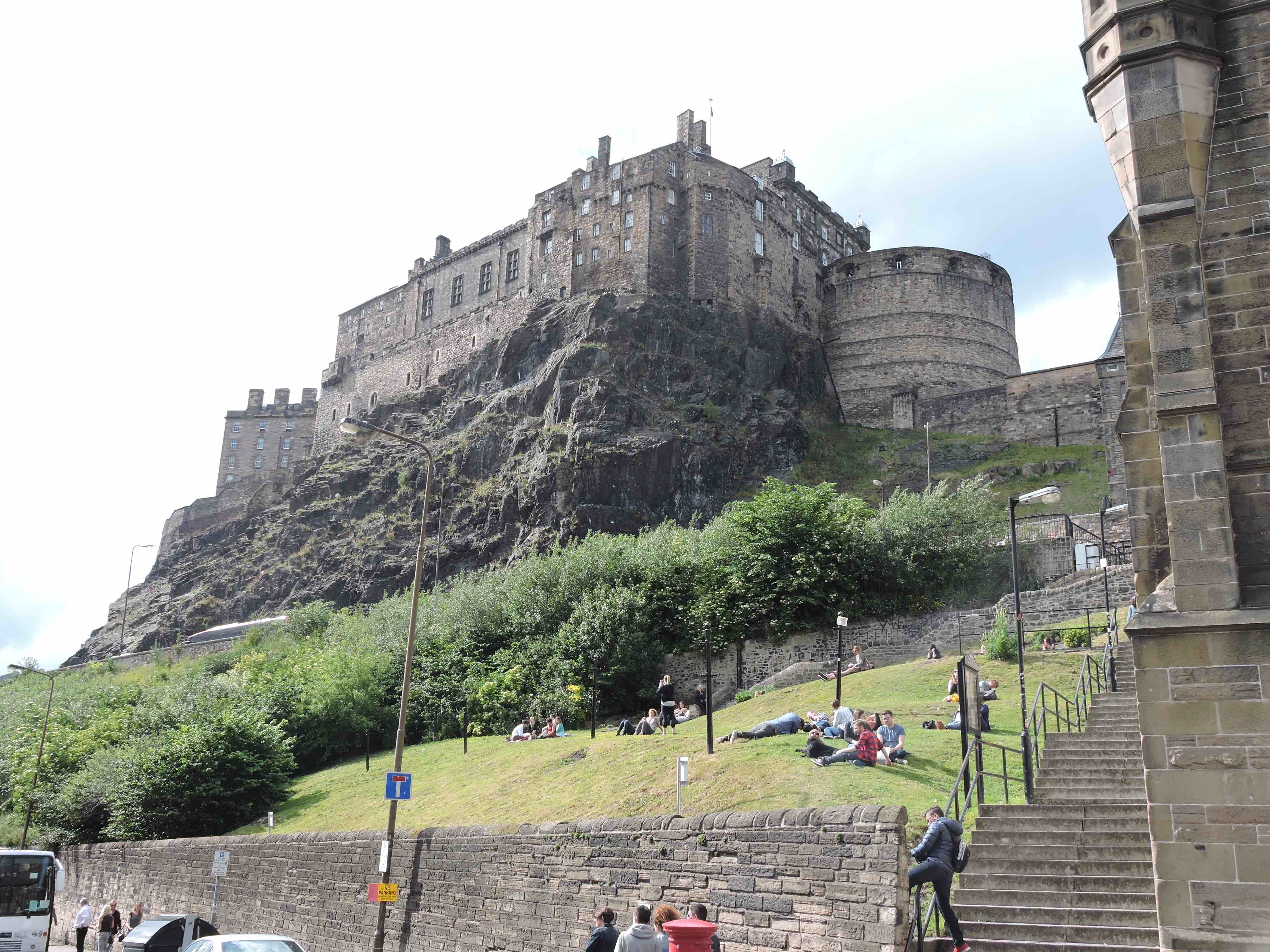
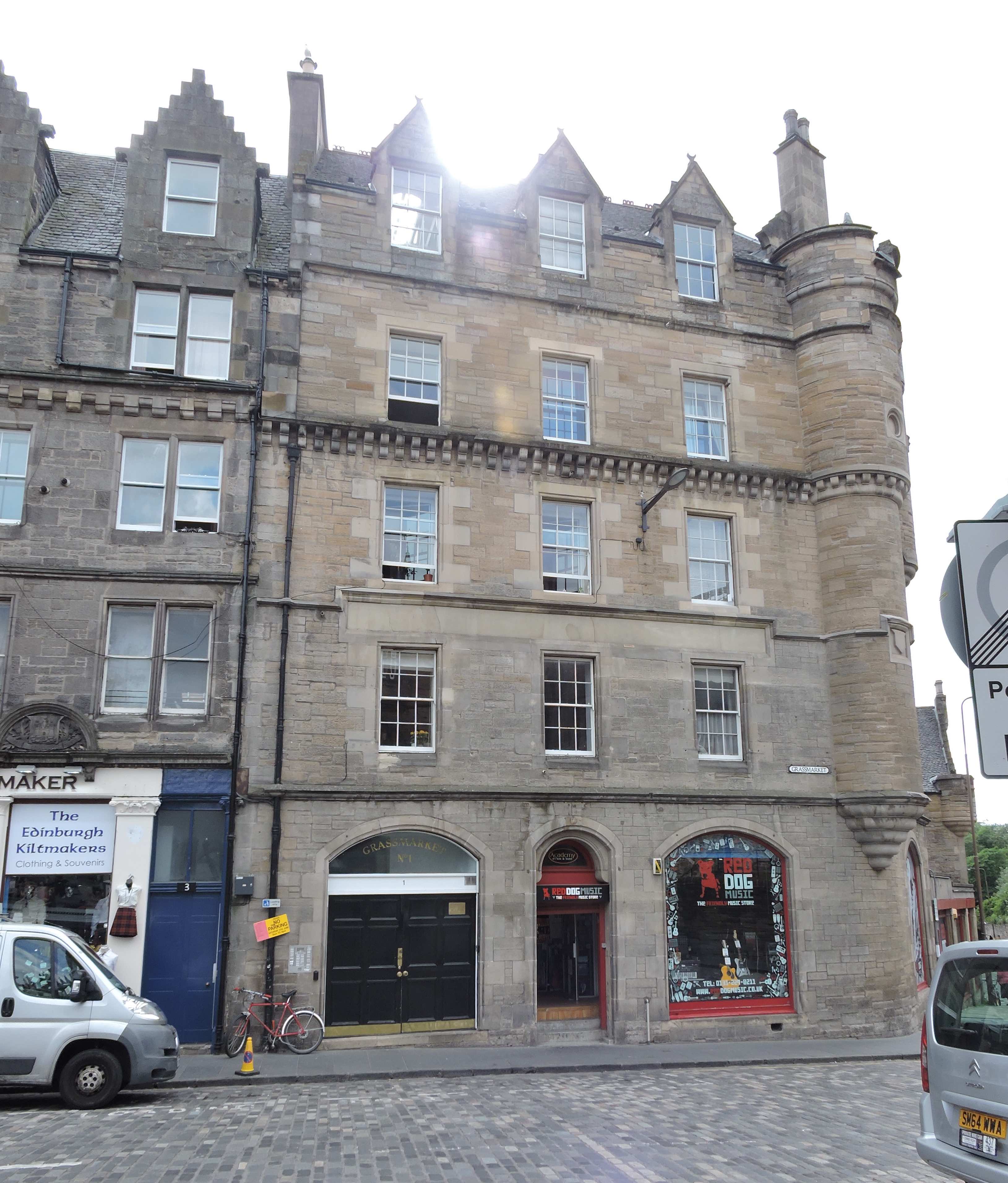
It was a rather short visit to attend our son’s graduation with a MEng in Chemical Engineering with Environmental Engineering at the University of Edinburgh as mentioned in the earlier post. Despite my severe reservations on the weather, Edinburgh is actually a nice city, dominated by its central feature: the Edinburgh Castle. We were fortunate to rent a flat very close to it that offered great diurnal and nocturnal views of the impressive building.

Edinburgh's castle, unmissable!

Edinburgh’s castle, unmissable!

Our flat building at Grassmarket.

Our flat building at Grassmarket.

The main event of the visit (for the rest of the family anyway), the graduation, was enjoyable for proud parents and attending friends. Once the celebrations and all university-related matters (packing personal effects, returning accommodation to University and tying of other lose ends) were concluded, it was time for the family to do some sightseeing and shopping in Edinburgh itself.

The Bushsnob however had different plans. The main reason for my visit to Scotland was not actually my son’s graduation but rather the prospect of searching for two of the world’s most famous mythical creatures: the haggis and Nessie. Unfortunately, due to a combination of economic constraints and a lack of kilts in the Bushsnob’s size, it was not possible to mount a proper expedition to search for both these creatures. As a result some compromises had to be made…

For the haggis, against my will, I had to settle for tasting it rather than finding it. This took place in a local pub and, frankly, it failed to impress!

For Nessie, a trip to Loch Ness in a rented car appeared to be our best option as at the time we began organizing the expedition the only day available for the activity was in fact the next day! Predictably, we failed to rent a car because although both proposed drivers, my son and I, had valid driving licenses, the latter was considered too old and the former too young! This issue with age resulted in substantially higher rental costs that we (read my family) could not justify.

This was a severe blow to the expedition’s hopes and it seemed that our only -very slim- chance was to try and find an organized tour to the Loch at the last minute. Despite our skepticism –which was shared by the agent attempting to find us a tour- we found four places in one leaving early the following morning! We booked our places and the expedition was back on! I was very excited as I thought I was sure to catch a glimpse of Nessie, given my usual luck with rare animals…

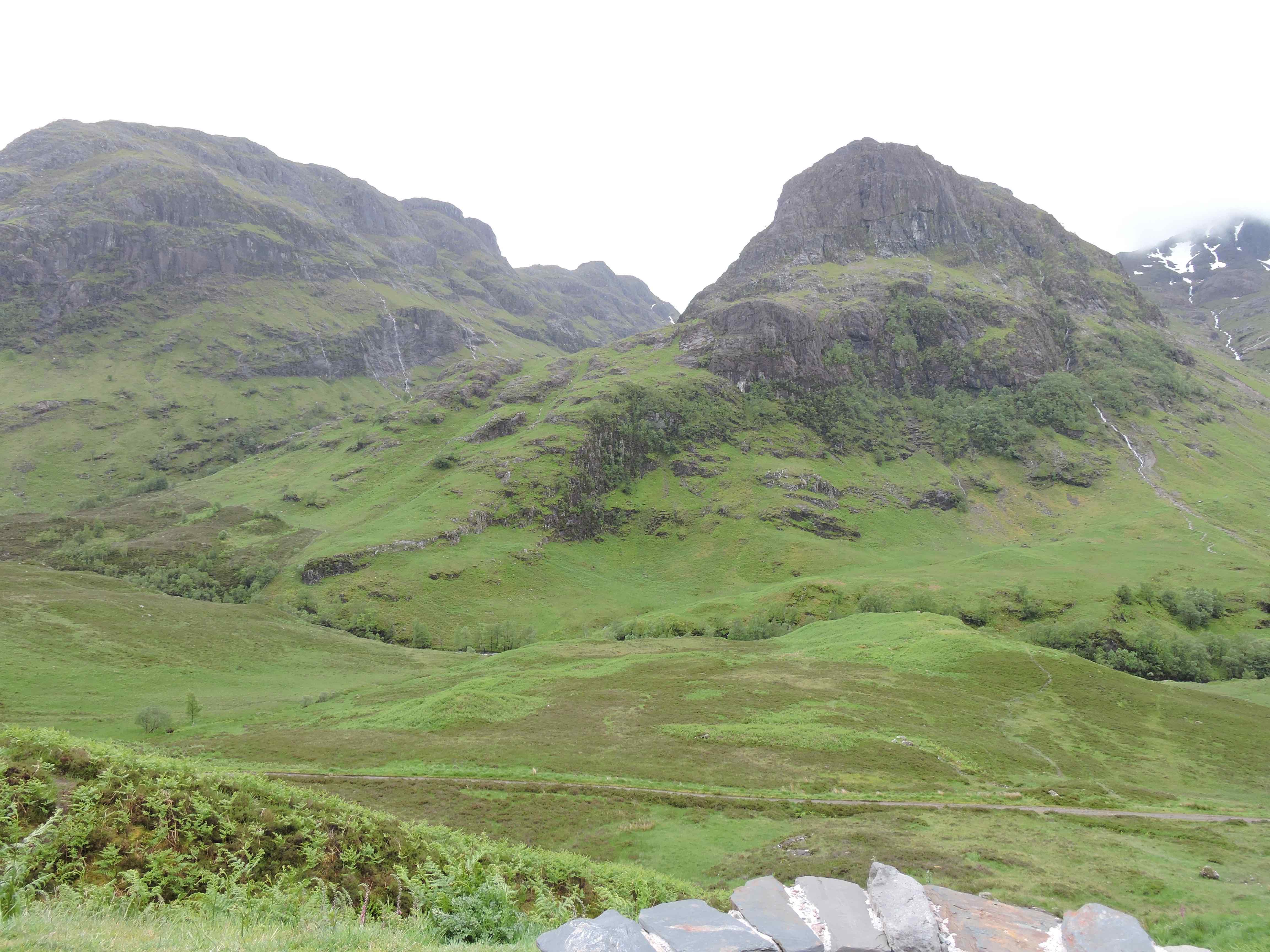
The trip took us through the evergreen and rather wet Scottish highlands although we were lucky that it only rained while in the bus! “A good omen”, I thought hoping that the good luck would last until the end of the tour.

The Highlands on the way to Loch Ness.

The Highlands on the way to Loch Ness.

After about six hours of travelling which included stopping at various landmarks (i.e. distractions) we arrived at our destination: Loch Ness. Lunch was waiting for us there in the shape of various types of sandwiches and pies ordered in advance by our entertaining and knowledgeable driver.

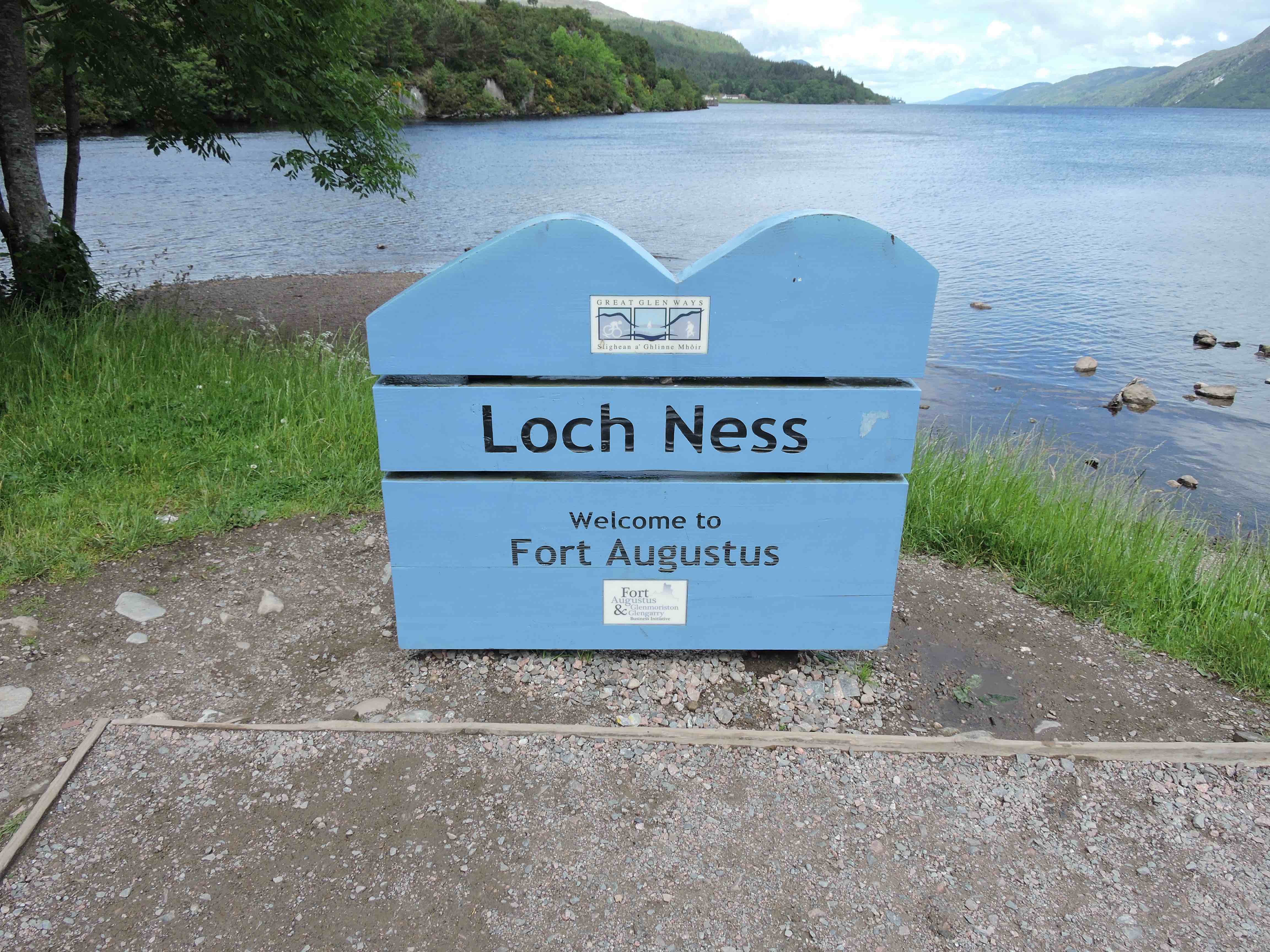
Openly displaying my anxiety I was on my feet before the bus had even stopped and even forgot my lunch as I hurriedly walked towards the lakeshore. I expected a cold and uninhabited place where, with enough attention, Nessie could be spotted hiding in plain sight. What I was met with however was totally unexpected: there was a town with several petrol stations and souvenir shops and the lake was nowhere to be seen! That is unless it was the pathetic narrow cove with several yachts and sailing boats moored in it that we had driven over with the bus? It was. I decided that lunch was a good idea after all, my deep disappointment clear for all to see.

First view of Loch Ness. Not what I expected!

First view of Loch Ness. Not what I expected!

Loch Ness. People oblivious to the monster lurking in its depths!

Loch Ness. People oblivious to the monster lurking in its depths!

Luckily over lunch my thoughts readjusted to reality and gradually my enthusiasm grew again. I fantasized that Nessie might enjoy a visit to the cove to have a look at human development. Surely I would be able to catch of glimpse of it then? I decided to give it a go despite the odds and walked a couple of hundred meters deeper into the cove carefully watching the water’s surface. I saw nothing apart from a few American ladies taking a dip in the loch that not even I could pretend looked like “Nessies”…

False alarm...

False alarm…

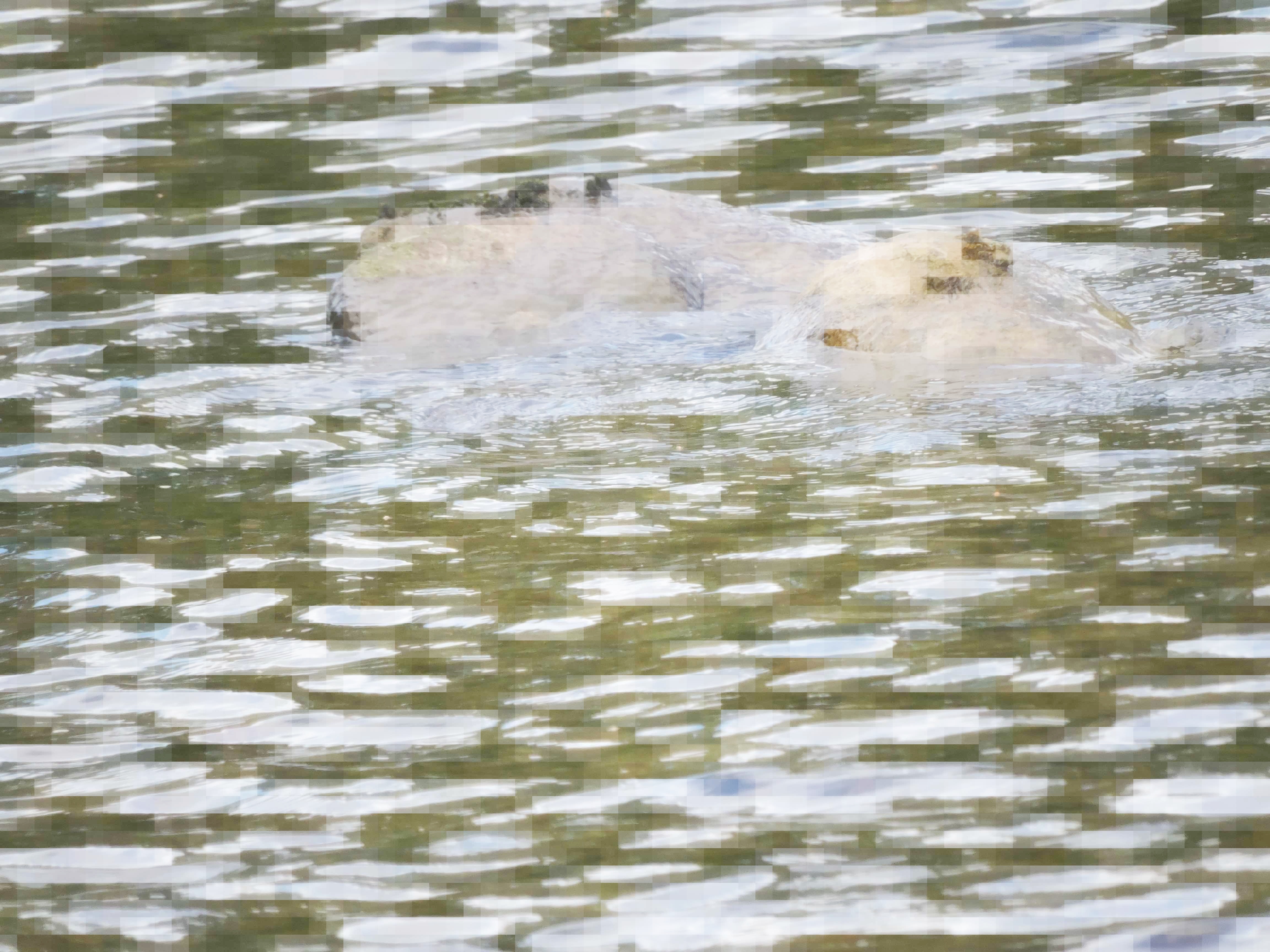
Just as I was about to give up on Nessie for a second time, I turned a corner and I saw her! She showed briefly above the waves created by one of the sightseeing launches that were ferrying tourists around the loch. The tourists on board were of course too busy having lunch and completely missed the mythical beast in the wake of their boat. Luckily, however, the Bushsnob had his camera handy and was able to take-two rather poor quality-pictures that will no doubt be enough for all of you, given my general trustworthiness and reputability.

The confirmation that Nessie exists.

The sharp confirmation that Nessie exists.

In addition, I also present to you Nessie’s passport photograph as a reference for you if you ever visit Loch Ness and do not have the Bushsnob’s luck!

Nessie.

Nessie.

EXPO Milano 2015

During our Milan visit, apart from churches, we did visit the EXPO Milano 2015 (the EXPO) where my daughter (yes, the Ed.) works. This was our first world event of this kind so I went to the official webpage to get the basics.

The EXPO’s core theme is (it runs until October 2015) “Feeding the Planet, Energy for Life” reflecting upon and seeking solutions to our present world contradictions: 870 million people undernourished in the period 2010-2012, approximately 2.8 million deaths from diseases related to obesity or to being overweight in the same period and 1.3 billion tons of foods wasted every year. “A rather difficult theme to dealt with” was my first thought.

In the EXPO website[1] the organizers say: “For these reasons, we need to make conscious political choices, develop sustainable lifestyles, and use the best technology to create a balance between the availability and the consumption of resources”… “Oh, I have heard this before” was my second contemplation but I continued getting information on the event despite the “deja-vu” sensation.

A view of the Decumano.

A view of the Decumano.

I learnt that the EXPO occupies 1.1 million square meters and that its design follows the ancient Romans’ urban planning of two intersecting wide avenues named Cardo and Decumano that cross in Piazza Italia. Along these two avenues you find the pavilions of the participating countries as well as public areas dedicated to squares, events and catering. Countries with no individual pavilions are grouped in nine clusters around the production of certain food: Islands, Sea and Food; Rice; Cocoa and Chocolate; Coffee; Fruits and Legumes; Spices; Cereals and Tubers; Bio-Mediterraneum (Sic) and Arid Zones.

There are also four thematic areas: the Pavilion Zero that presents the history of humankind through its links with food; the Future Food District, that describes how technology will change food storage, distribution, purchase, and consumption; the Biodiversity Park , a large garden that reproduces several ecosystems and the Children’s Park a fun area where youngsters learn about the EXPO.

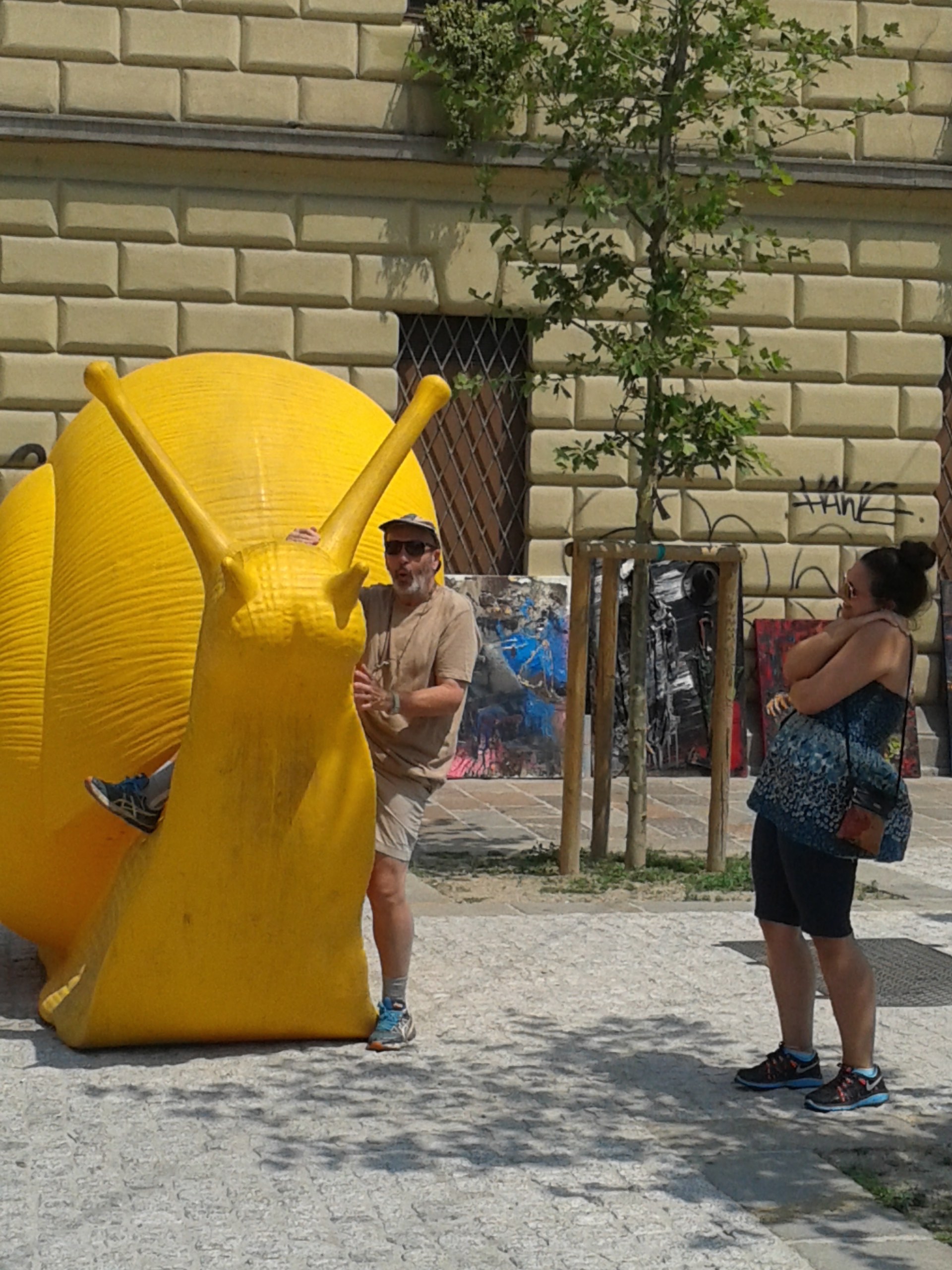
I felt dwarfed by such large event so I gave serious consideration to a suitable vehicle to move around its large area. During an earlier walk to the Navigli district I came across an option that looked appropriate: a giant snail. Clearly the complexity of the event justified slow movement in order to absorb its concepts and proposals so trials were done on its suitability. It was soon abandoned as the creature, despite being immobile, was quite aggressive against its mature rider and it refused to move despite my original verbal and subsequently physical encouragement!

The bushsnob attempting to board the snail under the amused watch of the Ed.

The Bushsnob attempting to board the snail under the amused watch of the Ed.

The bushsnob wedged on the snail, his discomfort apparent!

Wedged on the snail, his discomfort apparent!

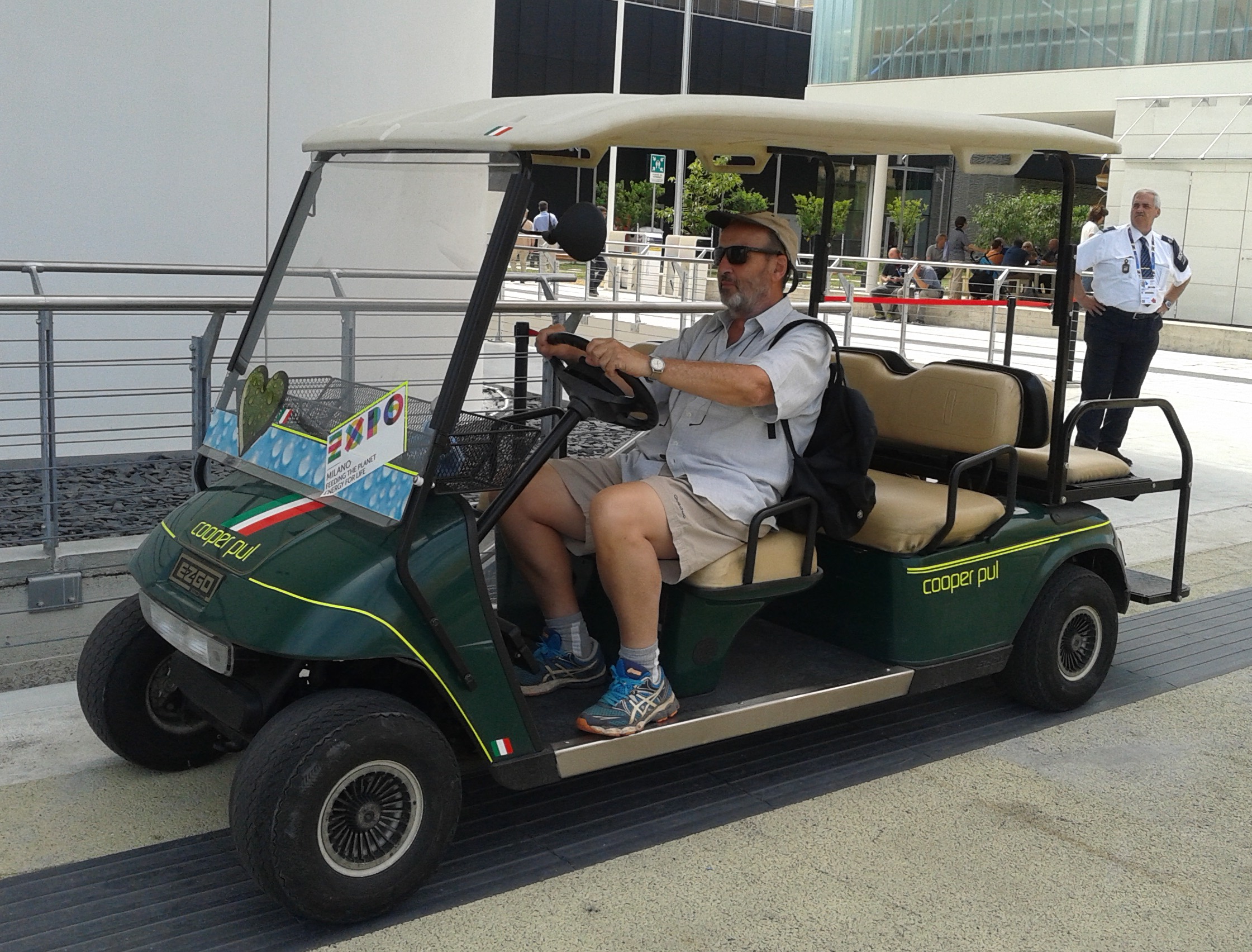
Being lazy by birth, the first priority on arrival at the EXPO was to find a means of transportation. Bicycles were out as these are restricted to EXPO staff. I saw a couple of other possibilities that were tried, again, unsuccessfully because of other technical reasons: either too expensive to rent or too large and limited to VIPs.

The bushsnob about to try one of the transport options...

About to try one of the transport options…

The VIP "EXPOmovil" was also tried.

The VIP “EXPOmovil” was also tried.

Our failure meant that walking was the only option and by the end of the day we completed -according to my pedometer- a staggering 26 km!

Our early morning arrival (to comply with our daughter’s office hours) meant that there were still very few visitors and, in my naive mind, I prepared to visit a few stands before it got too crowded. My enthusiasm was premature as stands only opened an hour later and, of course; by that time queues had already developed! As the Pavilion Zero was apparently the more emblematic, we joined its short queue.

It was impressively large and visually grand. From a spot with its creators at the EXPO web page[2] I quote the words of Davide Rampello: “We wanted to tell a story which begins from the earliest period of human history, through symbols and myths, the different stages of evolution and man’s relationship with Nature – the domestication of animals and plants, and the introduction of tools to work the land and conserve food. The story ends with the current paradox regarding nutrition…”

The display aims at creating the need to move towards something new, something different in the future. Although this is not clearly spelled out, the synergies between the “UN Zero Hunger Challenge. United for a Sustainable World” and the EXPO’s theme are highlighted through a number of UN panels. Although the display was visually stimulating, somehow the message did not get home to me. I attributed this to my “food security burnout” while thinking that it may be a statement suited to the new generation. However, a spark of worry appeared in my mind.

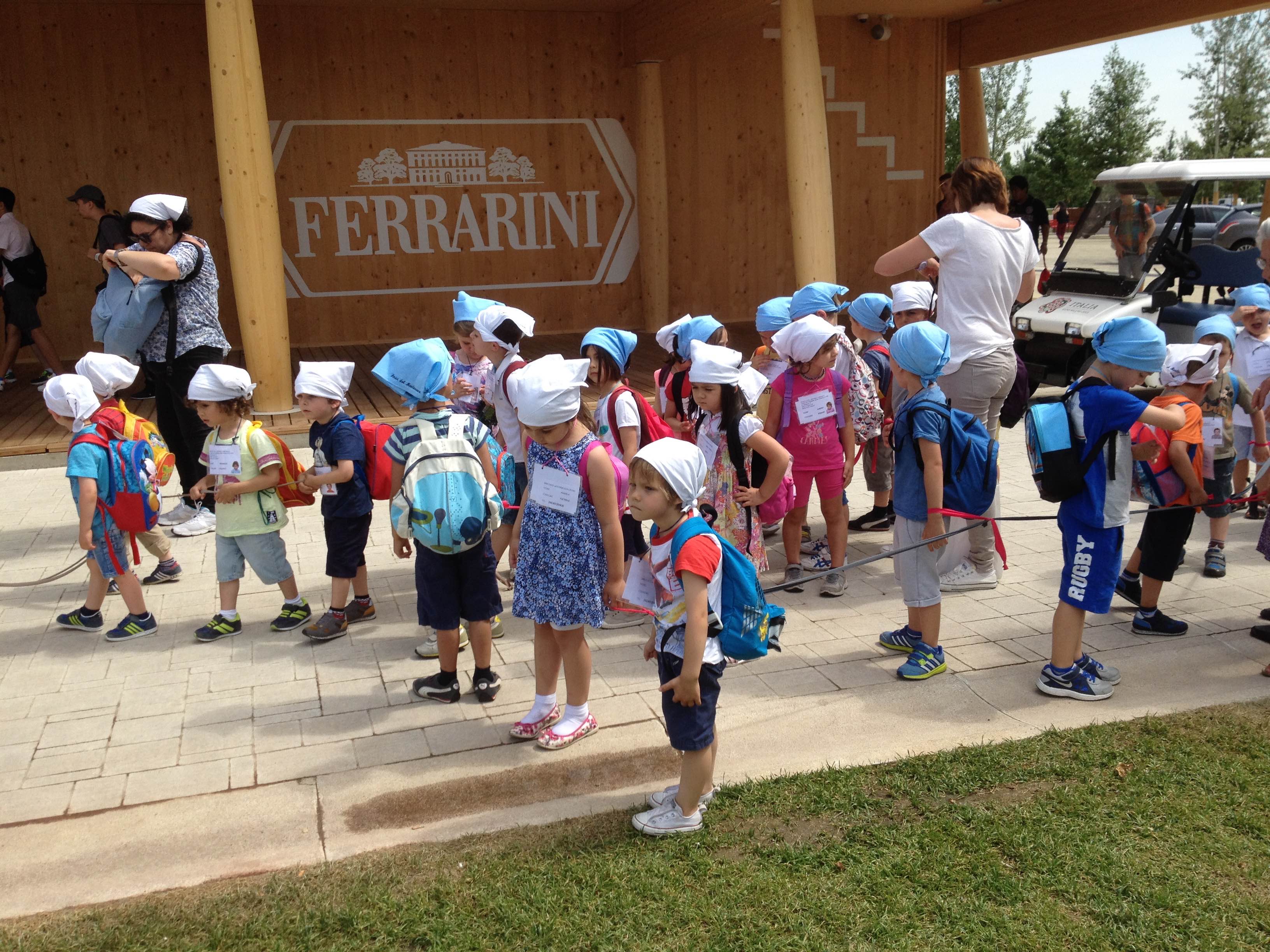
From the Pavilion Zero we walked through the Decumano where most other pavilions are. The popular ones, Brazil, Japan, UK and Israel to name a few that come to mind, were already showing long lines of visitors so we walked on and reached the Piazza Italia where the crowds really gathered. I noted that most of them were Italians, clearly keen to see what their country offered. Many companies and institutions were present, particularly from the food and drink sectors. There were also a myriad of school children at the Piazza. Realizing that some school-visiting day coincided with our visit, we moved on.

A group of school children. The well behaved held the rope while the naughty ones were tied to it!

A group of school children. The well behaved held the rope while the naughty ones were tied to it!

We did manage to visit some individual country pavilions such as the justifiably modest one from Uruguay and some -not so modest- from Arab countries. An extreme queuing effort eventually took us inside the UK pavilion as we had been tipped that it was very nice. In it you follow the journey of the honeybee while exploring some of the contributions that the UK brings to the global food challenge. The “cross-pollination” metaphor is used to describe the exchange of ideas, skills and knowledge and the theme also stresses that Britain is a “hive” of activity. Its highlight is a 17-metre high metal structure, a stylized beehive. While inside it somehow you experience sounds and lights that reflect the activity in a beehive. I found the concept very original and even more so when I understood that the beehive is an actual living one located in the UK!

Unfortunately, through a combination of deafness and placing myself in the wrong spots of the structure I failed to hear the bees! The failure was entirely mine as other people surrounding me were clearly enjoying what they heard! What I did not fail to see was the offer of British food (by famous chefs) and drink at rather high prices! A common motif throughout most exhibits!

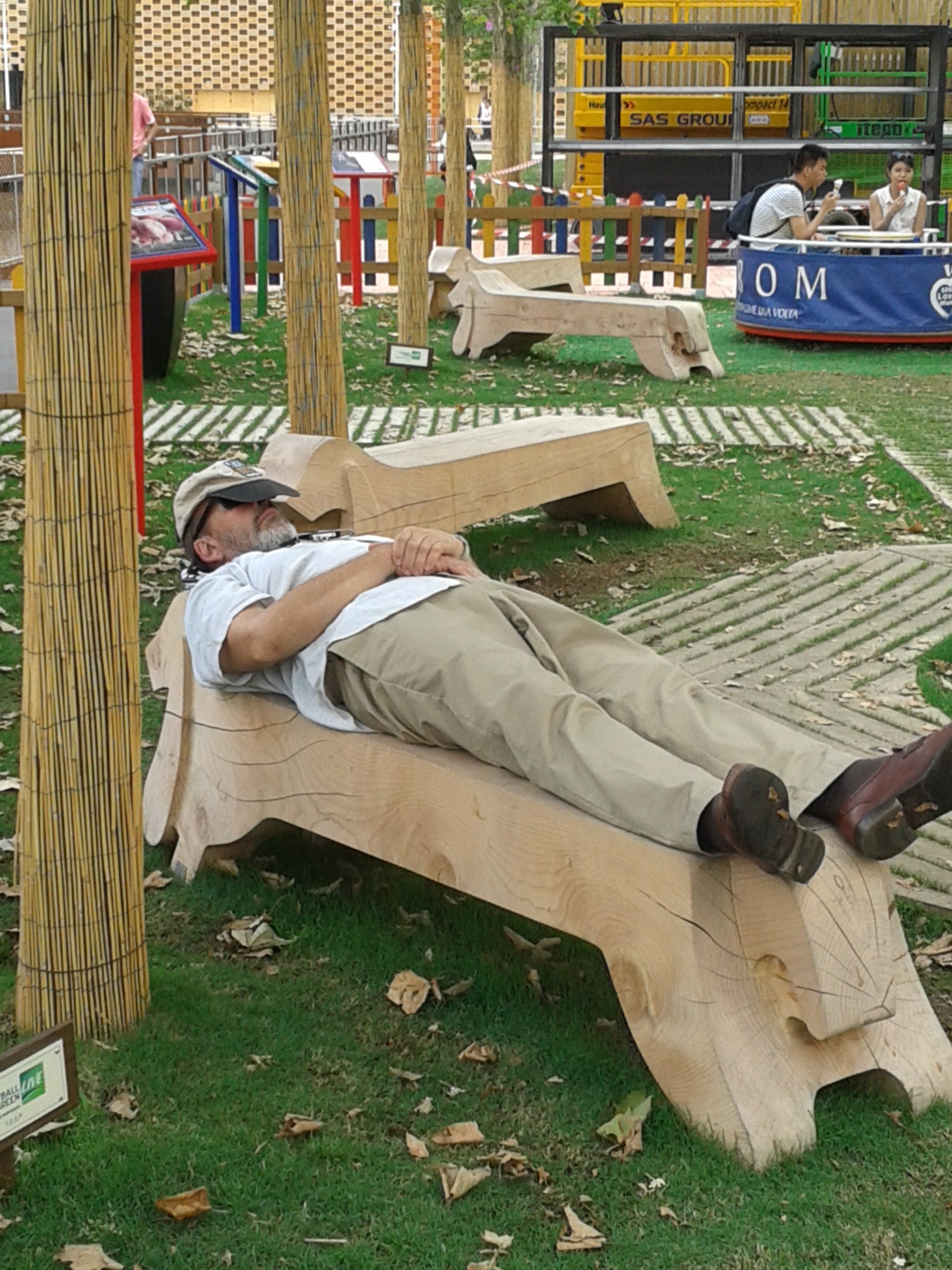
Crowds continued to grow and, as lunchtime arrived, we decided to have a break and join thousand others for lunch in one of the many venues available. While my wife and daughter caught up with their news after lunch, I sought a quiet place to hide from the masses. Unfortunately many other visitors had the same thought and all possible snug places were taken! As the need for the daily siesta intensified my standards lowered and I finally settled for what looked like a peaceful enough -though hard place- and moved in without hesitation.

Aided by listening to my favourite Argentinian radio over the Internet (a wonderful creation!) sleep did not take long to come. About half an hour later I woke up with the clear feeling of being watched.

The bushsnob "hard" dog siesta.

The “hard” dog siesta.

Once I located my brain and relocated myself in time and space I peered through my eyelids to explore my surroundings. I saw watching the old man were kids, probably attracted by my snoring? A quick check showed that I was free to move so I was not Gulliver! Luckily the little people became children and, smiling kindly, I stood up slowly, a bit sore but “recharged” and walked away. My siesta had clearly taken place at one of the Children’s Parks “…where the young folk can learn about the themes of Expo Milano 2015 while having fun.” I had clearly provided part of the amusement…

The queues were still there in the afternoon so we decided to spend the rest of the day visiting the much less crowded food clusters. It was very pleasing to see the various representations from countries we had lived in or visited. In particular time was spent at the Kenya and Zimbabwe stands where we immediately connected with the people there and spent a while talking and walking with them to see other stands in the neighborhood. I immediately understood what the Italians were doing!

THe bushsnob with Zimbabean acquaintances.

Walking with Zimbabean acquaintances.

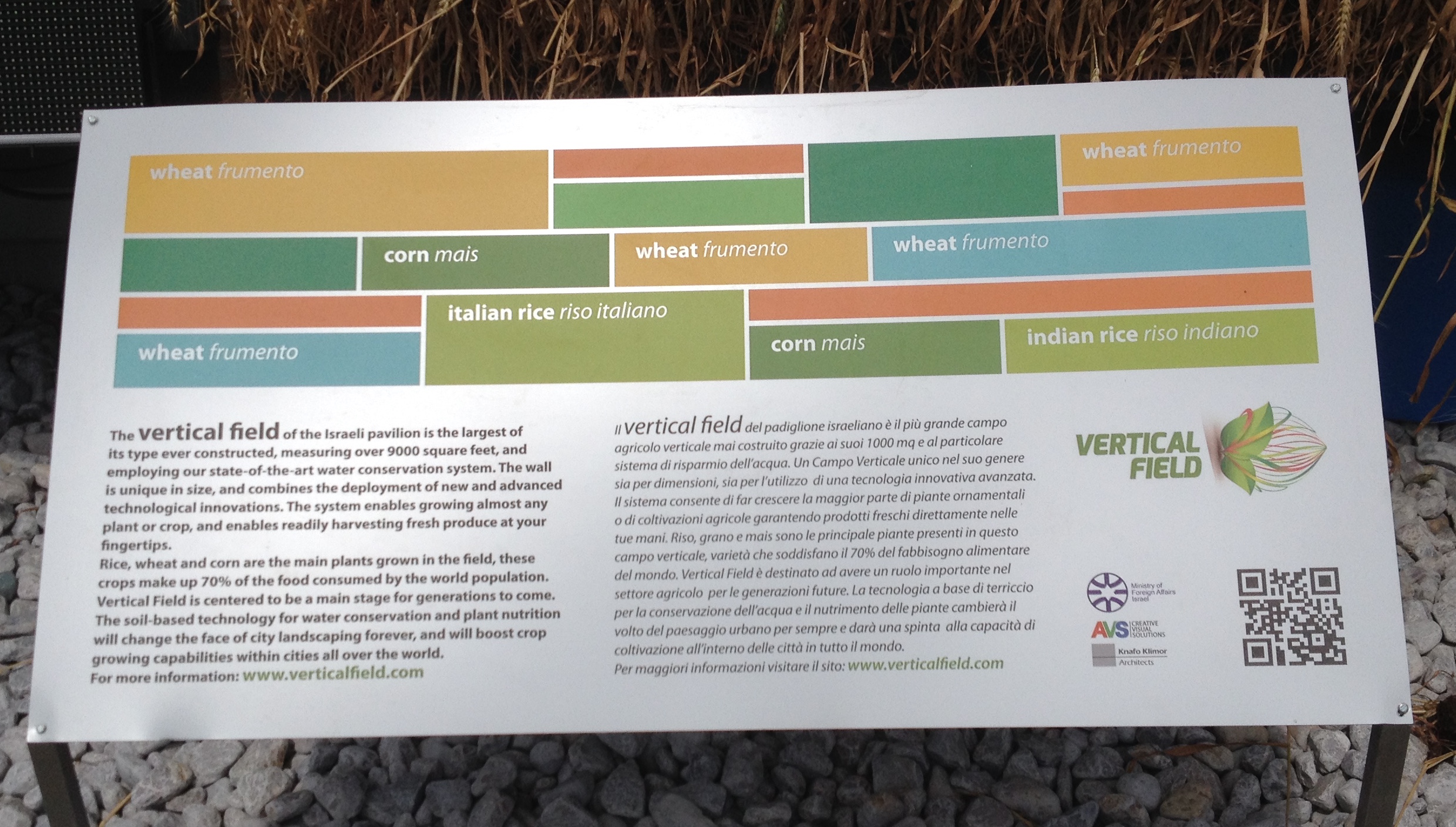
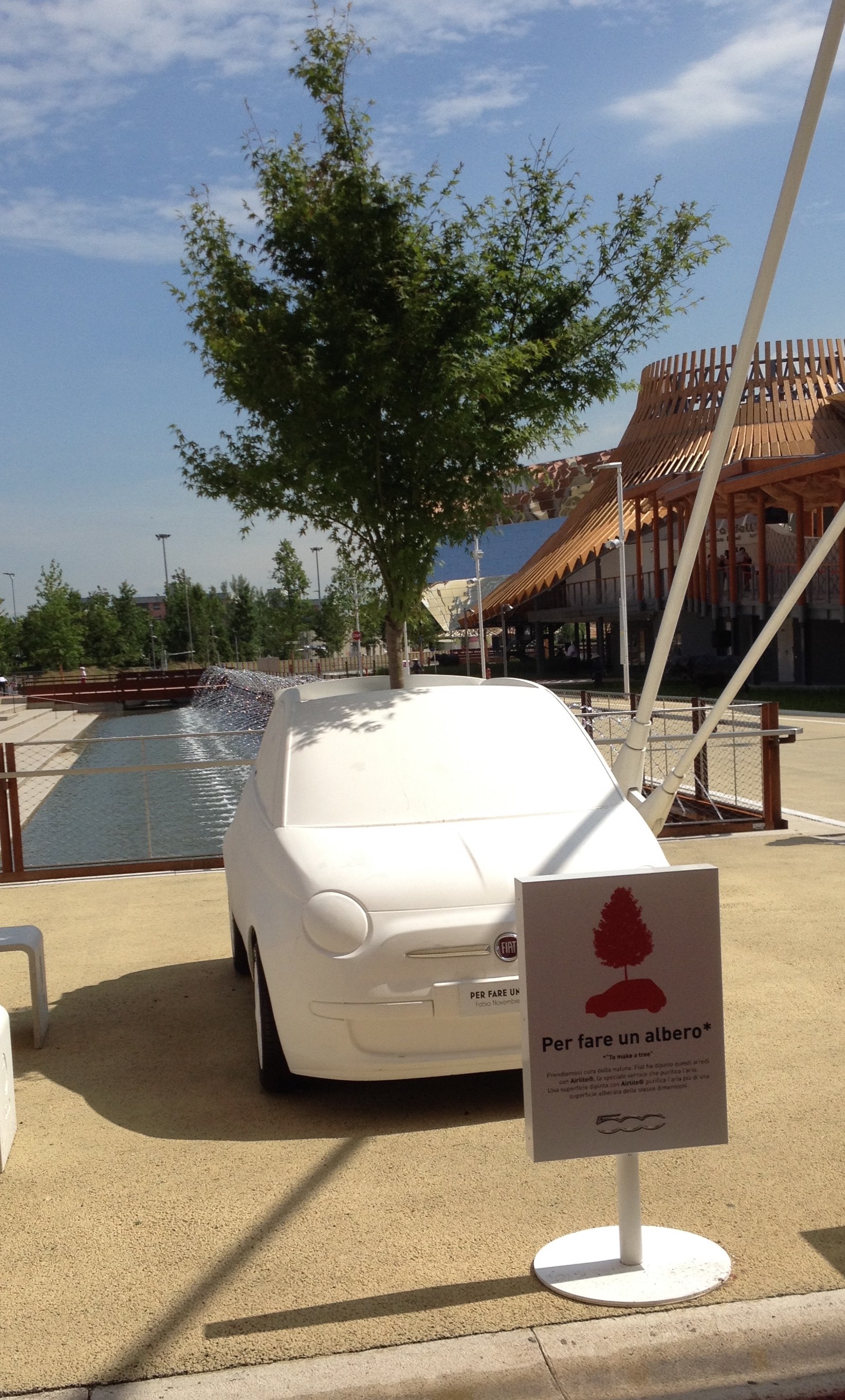
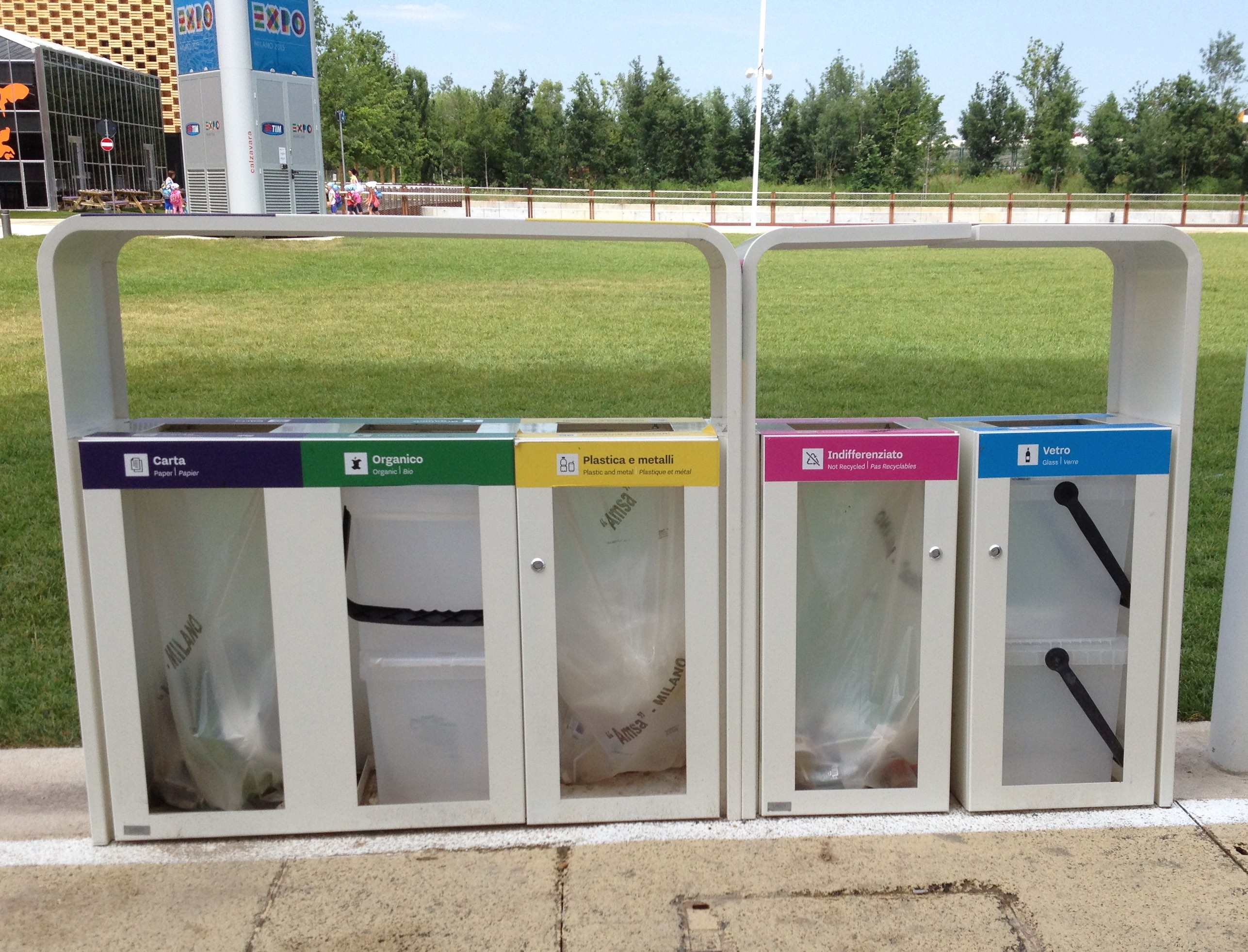
At sunset it was time to go. It was a tired group that walked back to the EXPO train station. I had flashes of vertical agriculture and hydroponics, proposed as useful technologies, air-purifying paint and scores of visiting VIPs and politicians (Mr. Putin was there visiting the Russian pavilion!), the final mountain of discarded food and garbage from the Pavilion Zero and the units used at the EXPO to collect five different litter types! However, solutions to food waste were not many or perhaps not clearly addressed and I missed them.

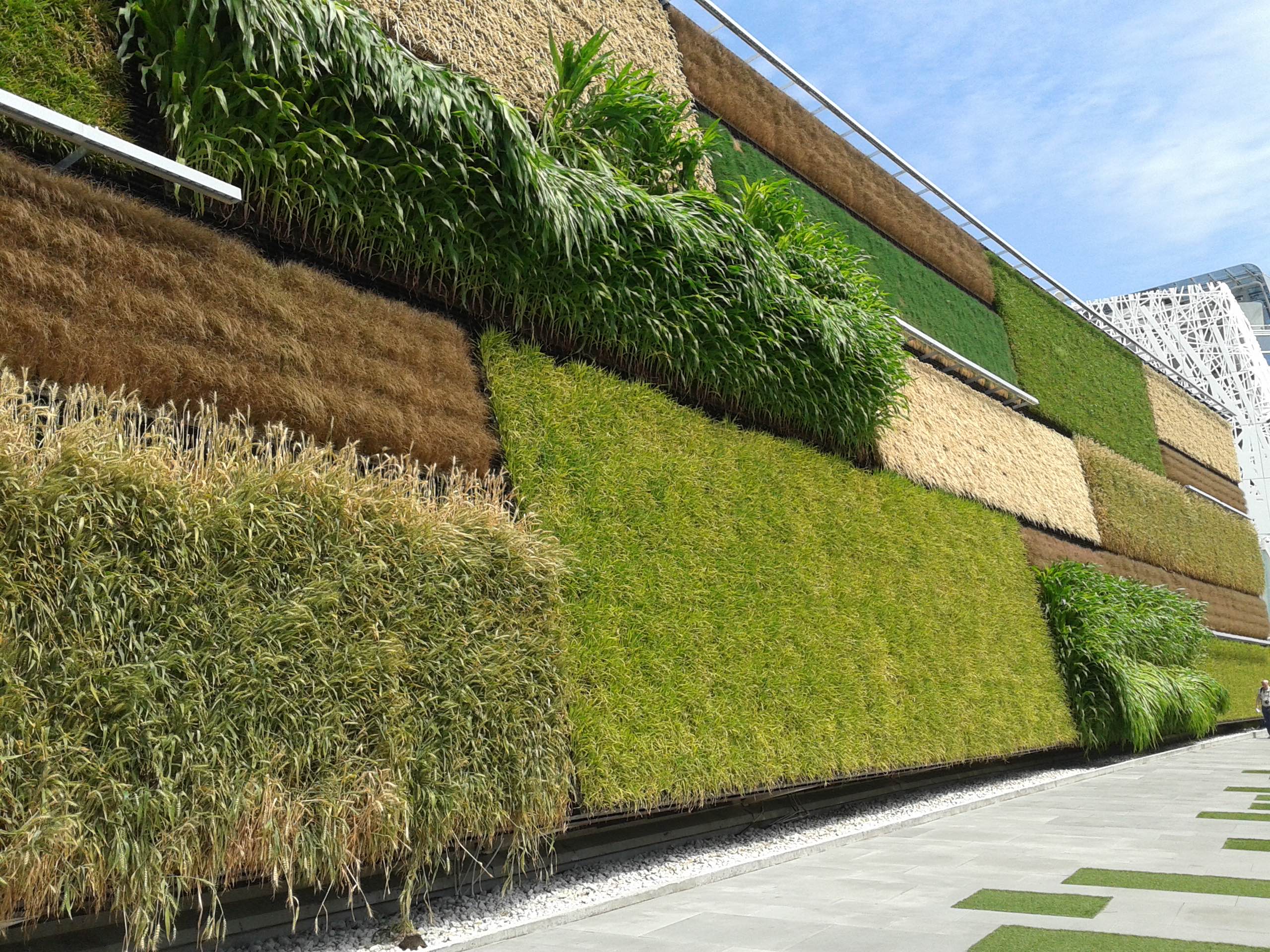
The "Vertical Field" approach to agriculture, one of the options on offer.

The “Vertical Field” approach to agriculture, one of the options on offer.

The "Vertical Field" explanatory sign.

The “Vertical Field” explanatory sign.

Cars painted with air purifying paint. At first hand a great idea!

Cars painted with air purifying paint. At first hand a great idea!

Litter management options open to the visitors.

Litter management options open to the visitors.

My lasting impression confirms my foreboding that the core theme of “Feeding the Planet, Energy for Life” was a hard one to tackle. Although a gallant effort is made to present it, my impression was that food was plentiful and available at the restaurants of the EXPO! Not much was presented on “energy for life” and how we would feed the ever-increasing world population. Has humanity run out of solid ideas on how to feed its ever growing self!


[1] See: http://www.expo2015.org

[2] The full text is in http://www.expo2015.org/en/pavillion-zero