When on safari, finding a leopard is the cherry on the cake. These scarce predators are hard to find as they are very secretive and cunning animals. The fact that protected areas are shrinking does not help their conservation status either. Luckily, as you will see, the Kruger National Park (KNP) still remains an excellent place to spot these elusive and beautiful cats.
This year our “out of Zimbabwe” travel included South Africa and Botswana where we visited the KNP at the beginning and at the end of our trip and the Kgalagadi Trans-frontier Park in between. Quite a journey (about seven thousand km!) but well worth it.
The first visit to the KNP included the northern section as this is the closest to Zimbabwe. We visited three camps: Sirheni Bushveld camp, Shingwedzi Rest camp and Bateleur Bushveld camp.
While we did find other interesting things in Sirheni and Shingwedzi (that I will tell you about soon), it was while arriving at Bateleur that things became really exciting. Near the “Red Rocks”, the main attraction near Bateleur, we found a dead impala under a tree. Fellow travellers informed us that a leopard had killed it and that it was a female with a cub. Scared by the vehicles they had left the kill and hid somewhere.
We decided to wait quietly and were rewarded. After about an hour we saw a movement up the tree just above the kill and, soon enough, we could see a leopard moving in the thick foliage. A few minutes later it climbed down. It was the youngster that, hungry, started to feed on the impala. The area was very bushy and photography was difficult but it was a good sight.
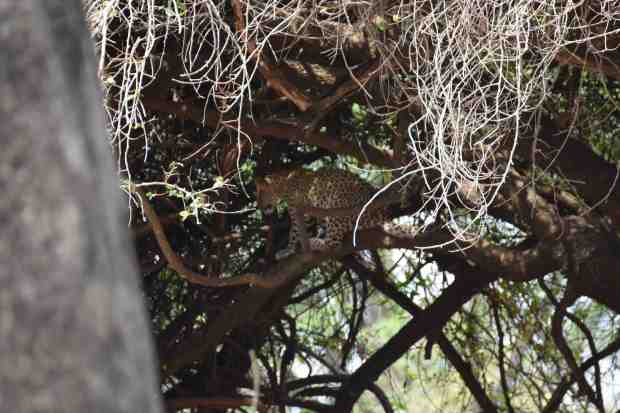
After a while the cub walked in front of us and briefly joined its mother. We had a glimpse of the female that immediately hid again in the long grass while the cub returned to the impala. We waited a bit more but as we still had to check-in at our camp we decided to leave making a note of the site to return later.
This slideshow requires JavaScript.
So, quite encouraged by our find we re-joined the road towards Bateleur camp. We had not travelled more than a couple of kilometres when we heard the alarm snorting of impala and found that a large number were looking in the same direction while calling in alarm! This situation can indicate the presence of a predator. I need to clarify that in the Southern Africa’s more bushy landscapes you need to take all possible signs into account to find game.
We stopped and waited and when we saw that the monkeys, guinea fowls and francolins -among others- joined the chorus, our belief that a predator was near firmed up. After a short while we spotted another leopard! It was waking in parallel to us in a direction that would take it to the river, on the other side of the road. The leopard ignored us and it never hesitated once on the direction it was traveling. We watched it walk, still followed by its mobbing retinue but completely unmoved, until it went down the river!
This slideshow requires JavaScript.
Finding three leopards in a couple of hours left us rather stunned and we thought that Bateleur was “the place” to spot leopards. Well, as usual we were wrong! During the four days we spent there the leopards carefully avoided us! However, there was more to come on our return to the KNP later on.
On the second visit to the KNP about two weeks later, we entered through the Paul Kruger’s gate and headed for the Olifants Rest camp. About one kilometre from the gate a bunch of cars marked the whereabouts of a sleeping leopard! As our journey was still long, we left it and continued towards Olifants where we arrived late in the afternoon.
Olifants Rest camp is probably the most spectacular of the KNP camps as it is built on a cliff that overlooks the Olifants river, located quite a way below, offering a breathtaking view of the river and its environment. We were fortunate to have booked one of the “river view” bungalows so we could just sit in our verandah and take in the scenery opening up below us!
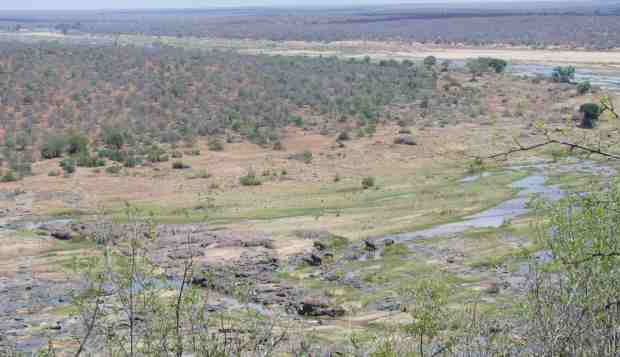
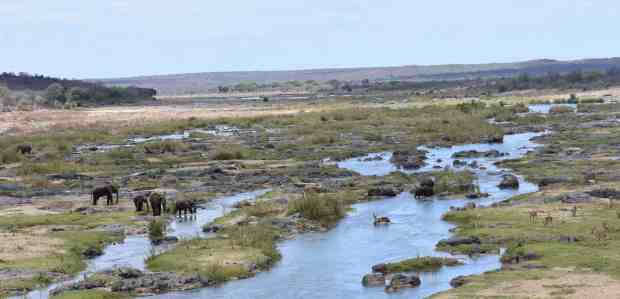
The morning after our arrival, after a “breakfast with a view” we drove towards Olifants satellite camp Balule [1] and then followed the Timbavati river, an area well known because of its white lions. The latter are not albinos but a leucistic form, similar to the starling reported in this blog [2].
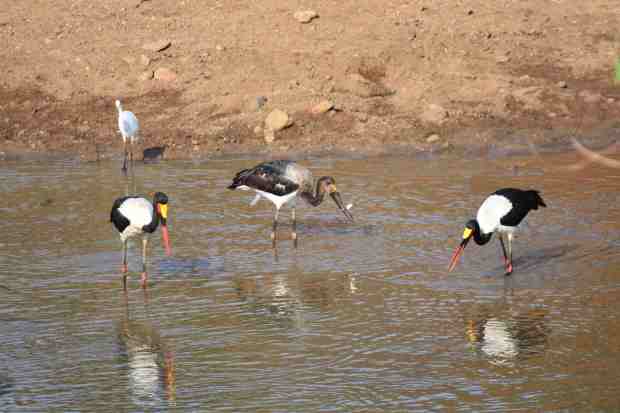
We knew that to find white lions was very unlikely as most of them are now in captivity or game reserves nearby but we had driven through this area earlier on another journey and found it very attractive. It did not disappoint us. Fortunately, the river had water and we found lots of water birds, including a family of saddle-bill storks fishing at a stagnant pool.
Further on, on another stretch of the river we spotted a pair of ibis and, while trying to confirm that they were the rarer purple rather than the more common glossy, I spanned the area a couple of metres to their left and I could not believe my eyes: a large leopard was lying down next to the birds! I was very excited, as I had never experienced such an accidental find! I believe that the leopard was walking to the river to drink at the time we appeared and its reaction was to crouch not to be seen!
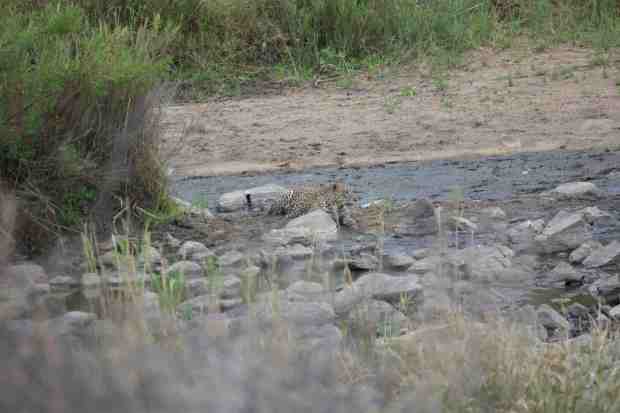
We waited and watched. After a couple of minutes, it stood up and walked to a small water pool where it drank for a couple of minutes and then, as it is often the case with leopards, it disappeared in the thicket.
This slideshow requires JavaScript.
We drove back really excited by the find and, before reaching our camp, we had a fleeting sighting of yet another leopard well inside the thick bush!
After a fruitless early drive looking for the leopard spotted near camp we decided to relax at our bungalow to take in the beauty of the Olifants river as we could lots of animals coming to drink and to graze there. That morning, apart from the usual hundreds of impala and dozens of waterbuck we could also see lots of greater kudu and a few bushbuck. However, our attention was focused on a couple of elephant families enjoying drinking and bathing.
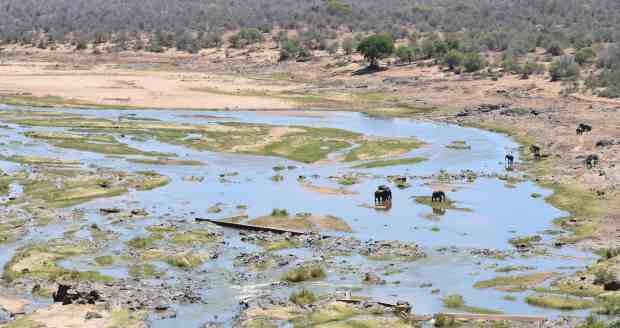
While busy watching I heard my wife saying, “the elephants are scared” and then I could hear their loud alarm calls. Immediately I heard her saying “there is a hyena walking behind the elephants towards the water” and immediately, “oh gosh, there is a leopard drinking also!” As I wanted to see it, she explained me where it was so I started looking and, after a while, I spotted it. After a while the leopard moved “it stood up” I said. “No” replied my wife, “it is still drinking”. We started to argue but then we realized that we were in fact looking at two different leopards on the river bed!
The afternoon of our last day we spent it back at the Timbavati river. It was during this time and before arriving to a pan called Ratel that, lo and behold, a leopard was looking at us from a donga and, of course, it immediately took off before we could do anything, as usual and we could not see it again!
So that was our experience in the KNP where we spotted nine leopards in a couple of weeks, a marvelous experience that we know it will not be repeated and certainly it will not be forgotten!.
[1] Interestingly, this was one of the few camps where people of all races were allowed during the Apartheid times!
[2] https://bushsnobinafrica.wordpress.com/2017/01/05/odd-bird/
 ?
?


 A Bushsnob out of Africa