“… Engai (the Maasai God – Ed) had three children to whom he gave three gifts. The first received an arrow to make his living by hunting, the second a hoe to dig the land and grow crops, and the third a stick to use in herding cattle. This third son, whose name was Natero Kop, was the father of the Maasai, who have since that time been the proud keepers of cattle.” [1]

When I arrived to work at Intona Ranch, I did not know much about the Maasai, apart from having seen them walking in Nairobi with their unmistakable attire and, later, during my first trip to Intona with Alan. At the time, Billy Konchellah was about twenty years old and getting ready to become a world sport idol by winning the 800 metres world title twice (1987 and 1991) and becoming, I guess, the most famous Kilgoris-born citizen.
Later, as I traveled to and from the Transmara I got to know the Maasai better. As soon as they learnt that I was a “Daktari wa mifugo” [2], my prestige among them instantly improved and, as soon as I arrived to Intona they would bring any sick animal they would have.
As I mentioned before, Intona was given to Joe Murumbi, the son of a Maasai lady, as homage for his distinguished career in Kenya politics. He was a father figure in the area and he had many visitors, many of them Maasai. Most came by foot and on the way to the main house they all stopped to look at the cattle, their main interest. In particular they spend an inordinate amount of time observing the nice-looking Boran cattle a novelty we brought into Intona from Northern Kenya for our trials and I already narrated what happened to some of the latter when some unscrupulous Maasai liked them too much! [3]

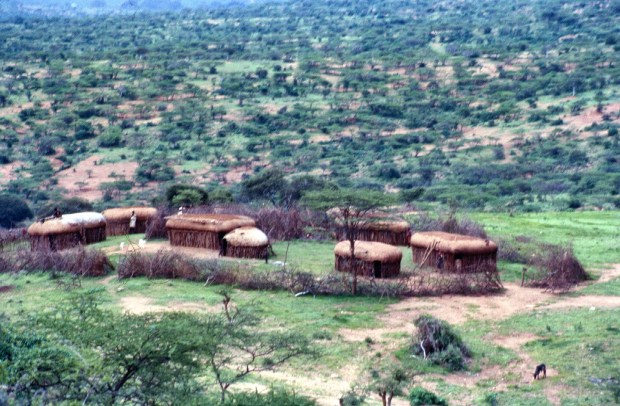
I also visited their dwellings known as manyattas [4] when called to check sick animals and I still feel the dung smoke in my nostrils at entering a dark manyatta for a visit. With no other ventilation than the entrance door, there was dense smoke as we sat down to talk while sharing a gourd of milk with the house owners. Occasionally I also participated in some of their ceremonies when my presence in Intona coincided with them.
I inherited a strong dislike of flies from my father who fought a lifelong war against flies. He always had a fly swatter at hand but when he did not, he would catch them with one hand by placing it open and about 20cm from the fly and then sweeping it fast to catch it. He would then kill it by throwing it against the floor! I inherited this ability and became as good as him!
As flies bred freely in the cattle dung around the manyattas they were extremely abundant and annoying. As I did not have a swatter I defended myself by catching them with my hand to the amusement of my hosts that just ignored them or used a fly whisk to scare them away. So, on a lighter note I am proud to say that I had ample opportunity to demonstrate my fly-catching skills in Maasailand and once, with one move of my hand, I caught twenty-seven of the pests! This feat, regrettably, did not enter the Guinness and, frankly, it was more a consequence of the amount of flies rather than my skills!
The Maasai are well known for their ancient enmity with lion -that yesteryear they would kill to reach adulthood- as well as for drinking the blood of their cattle on special circumstances. However, what I remember them for was their amazing relationship with their cattle and how much they love them and cared for them. Regardless of the number of animals owned, each one has a name and ancestry and rarely they would part from them.
One of their tales says that at the beginning of time the Maasai did not own any cattle and that one day God called Maasinta, the first Maasai, and asked him to build a large enclosure. One the latter was completed God said that the early the following day he would fill it with something called cattle and Maasinta must stay very silent. In anticipation, Maasinta went to the enclosure and waited. Suddenly there was loud thunder and cattle of all shapes and colours started to descend.
Although Maasinta just managed to keep silent, his Dorobo [5] companion woke up with the commotion and when he saw what was happening he proffered a loud cry. Thinking that Maasinta had shrieked, God stopped the flow of cattle and asked Maasinta if all the cattle that he had given him were not enough so he would stop sending anymore and this is the reason that the Maasai love cattle so much!
As I mentioned before, they brought animals for me to examine. Although sometimes I could get to a diagnostic and recommend a treatment, others they brought animals that, regardless of how much I checked them, I could not find anything wrong with them. When I told them so, usually a discussion ensued during which the owner (through an interpreter, usually Tommi, my Maasai herdsman) would protest bitterly as he claimed that the animal was not well and eventually he would leave shaking its head and rather upset at how little I knew!
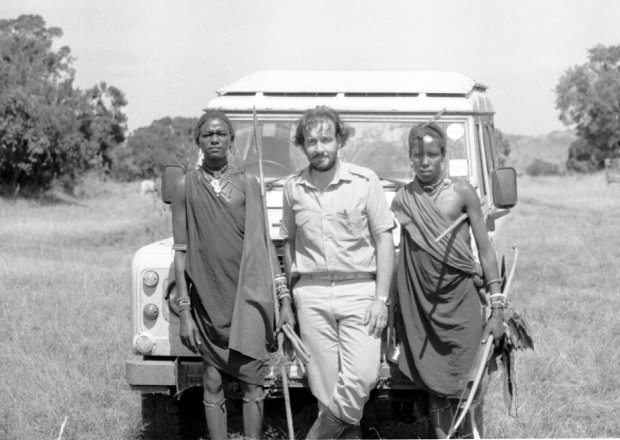
The author (centre and starting to loose hair!) with Maasai visitors.
Almost invariably the same farmer would bring the same animal back the following day with a clear clinical case of acute diarrhea, pneumonia or trypanosomosis that required immediate attention. I would then treat the animal and a happy Maasai would leave with his animal after reminding me that it was the same animal of the day before! Luckily not many came and I was not embarrassed very often!
I spent many hours with them just watching our cattle in Intona and through Tommi I got an insight of what they were saying. In short, they would note every detail of each animal and comment about it. Some liked the absence of horns of the Boran animals while others argued against it!
The coat colours were also discussed hotly. Our Boran were predominantly brown and, while some thought that this was a good colour, others preferred others such as white, black or barred. The arguments prolonged for a time I did not have so I needed to excuse myself and continue with my work while they continued arguing for a long while longer, the same way we would do while watching a sports cars show!
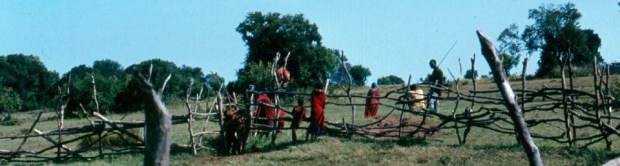
The true highlight was to visit their manyattas to look at their cattle. The best time to do this was in the late afternoons when the cattle returned from the day grazing to the safety of the thorny enclosure to spend the night away from four- and two-legged predators.
It will all start by greeting the owners that were usually delighted and proud to host us when they learnt that we had come to see their animals. After a while of talking with the herders you would start hearing bells in the distance that some emblematic member of the herd such as a preferred ox or cow would wear around their necks.
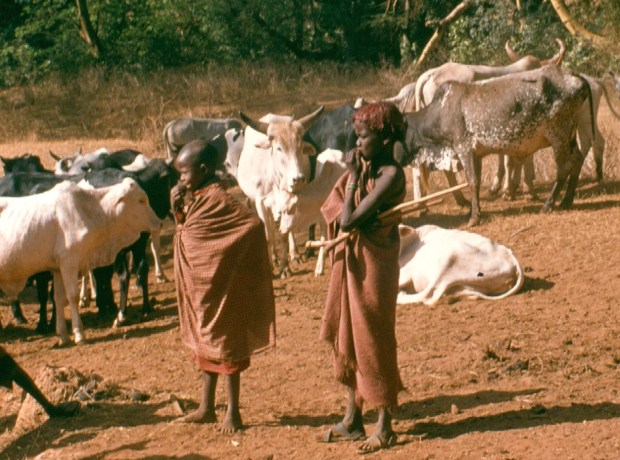
Maasai children looking after livestock.

Maasai cattle highway.
The first bellowing indicated that the herd was close and soon you could smell them well before their arrival. They soon appeared among the dust in the dry season or stopping to get the last mouthfuls of juicy grass during the rains. The animals were of many colours but sometimes they reflected the preference of their owner and a colour would predominate. The stripped and grey ones were spectacular, particularly the latter when heavily branded.
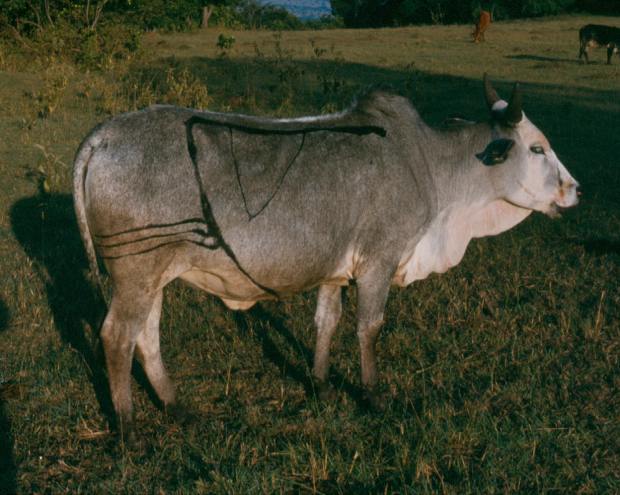
There were also different horn shapes and sizes, from the rather large ox horns to the rather unusual “scurred” horns only attached by the skin that moved loosely as the animal walks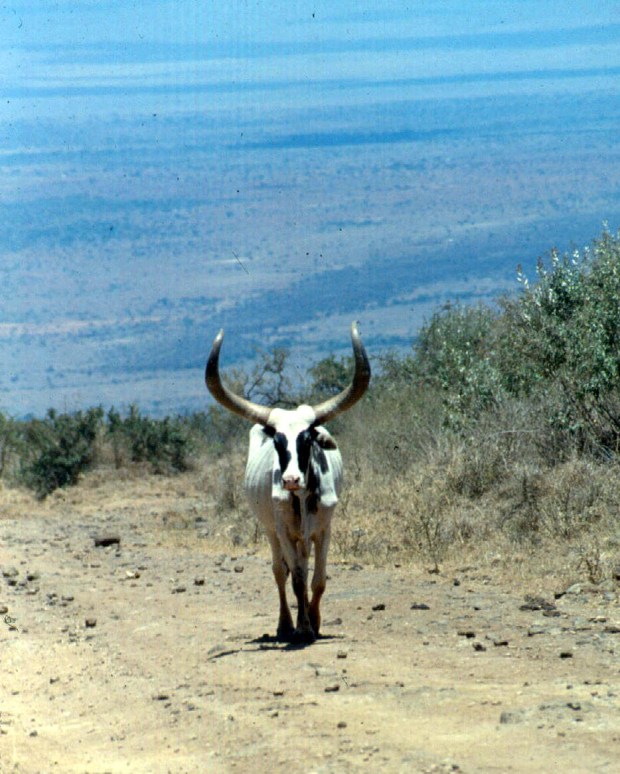
Keeping on the side, not to interfere with this daily ritual, I watched as the docile animals entered the enclosure under the careful scrutiny of the owners -both men and women- that apart from the sheer pleasure of seeing their favourite animals- checked for signs of trouble (the same I would miss when consulted!).
They will follow the progress of those that were sick, check for any newly-born calves, usually carried by the herdsmen as they were not able to walk at the speed of the adults. After all was checked the time would come for closing the thorn-bush gate and start with comments and praise of some particular animals that are special to the owners.
Gradually and gently the animals started finding their resting places inside the kraal and soon they would lay down to rest and chew their cud and eventually spend the night protected from lions and other predators that surely would look for a come to have a look for a chink in the manyatta’s armour to snatch the unaware animal.
These were among the best moments I spent in Kenya. I really felt fulfilled, realizing that I had come a long way from my former cattle work in Uruguay. I still long to return!
According to their oral history, the Maasai originated from the lower Nile valley north of Lake Turkana (Northwest Kenya) and began migrating south around the 15th century, arriving in a long trunk of land stretching from what is now northern Kenya to what is now central Tanzania between the 17th and late 18th century.
The Maasai are among the best known Africans internationally due to their residence near the many game parks of the African Great Rift Valley, and their distinctive customs and dress. There is even a theory that because their hair arrangements mimic the Roman helmets and that they wear a “toga-like” attire and a short assegai resembling the Roman sword, they had some Roman influence from some lost legions from Egypt.
While I worked in the Transmara, I met two of the people that were studying several aspects of the Maasai culture.
Fr. Frans Mol used to spend time at his Mission near Lolgorian where I found him and had a chance to talk to him, albeit briefly. I learnt that he had a great liking for the Maasai people and that he had been working as a missionary for the Mill Hill Church(?) for over 20 years at the time I met him [6].
He was fluent in the “Maa” language and got to know their cultural ways. Although he preached Christianity in several Maasai districts (Kajiado, Transmara, Laikipia and Narok), he also devoted his time to put his knowledge on paper and wrote a few books on the Maasai [7].”
Another character I knew that had great experience on the Maasai ways was a lady known in the Maasai Mara as Jacqueline. At the time we met her close to the Oloololo escarpment, in July 1982, she introduced herself as a French anthropologist that had come to the area to study the Maasai, fell in love with one of them and stayed behind.
Later on I learnt that she was Jacqueline Roumeguère-Eberhardt and that she had occupied important positions of research in France and carried out groundbreaking investigations in Southern Africa on the Venda, Tsonga, Shona, Lozi, Bushmen, apart from her on-going studies on the Maasai.

Before her death in 2006 Jaqueline amassed a wealth of knowledge on the people she studied and she produced many scientific papers, books and films in both English and French and interestingly she was involved in an interesting event when in 1978 she caused lots of excitement among the anthropologist community by claiming that she had found hominid that dwelled in thick Kenyan forests. She called them “X” and documented a number of encounters with them by Kenyans. Although she wrote a book about this discovery [8]. However, her finding was doubted by scientists and she failed to lead an expedition to find them and they were not seen again!
In her obituary [9] published by the … it says: ‘ …Despite their cultural differences – and the presence of eight other wives – Jacqueline Roumeguere-Eberhardt claimed that she and her husband got along famously: “Every time I’m with him I learn something new about human nature and problem solving,” she told an interviewer. All the same, standards had to be maintained, and, while living the life of a tribeswoman, she never went out without applying her red Chanel lipstick and nail polish.’
Although I am not able to say anything about the first issue, I can confirm that she was always elegantly dressed and looking great when we met her in the Maasai Mara bush although I cannot swear about the make of the lipstick!
[1] Ole Saitoti, T. and Beckwith, C. (1986). Maasai. Elm Tree Books/Hamish Hamilton Ltd. Eds. 276p.
[2] Veterinarian in Ki-Swahili.
[3] See: https://bushsnob.com/2014/07/19/the-cattle-are-gone/
[4] “Manyatta is the name always used for these Maasai villages, but the correct term is “engang.” Manyattas were built especially for the warriors with their mothers and girl-friends while the engang was the family dwelling.” From: Ole Saitoti, T. and Beckwith, C. (1986..). Maasai. Elm Tree Books/Hamish Hamilton Ltd. Eds. 276p. I use manyatta as this is the word I used at the time of the story.
[5] Hunter-gatherer groups of Kenya and Tanzania associated with the Maasai.
[6] Father Moll retired at 70 on 3 December 2002 after working 44 years in Kenya.
[7] Some of the books are: Maa, a dictionary of the Maasai language and folklore: English-Maasai (1978); Lessons in Maa: a grammar of Maasai language (1995) and Maasai language & culture: Dictionary (1996).
[8] Roumeguère-Eberhardt, J. (1984). Les hominidés non identifiés des forêts d’Afrique. Robert Laffont Ed.
[9] https://www.telegraph.co.uk/news/obituaries/1518217/Jacqueline-Roumeguere-Eberhardt.html Consulted on 27 May 2019.


 A Bushsnob out of Africa