Author: bushsnob

Sandwiched by ellies

After a few years we returned to the Gonarezhou National Park, now run by the Frankfurt Zoological Society under an agreement with the Zimbabwe National Parks. We drove to Mabalauta through the Masvingo road and turned off at Rutenga and continued towards the Sango border post until the Mabalauta entrance. The road was rough!

After our three nights at Mabalauta we drove North through the park to the Tented camp at Chipinda Pools.

Although we heard lion, leopard and hyenas at night, we did not see any and we also missed the wild dogs that are meant to be present in the area. Although the Mabalauta area was rather disappointing from the game side, the views were very beautiful from the area around Simiwini, at Buffalo bend. The latter rest camp has also been renovated and it looks very well maintained, still keeping its wonderful baobabs, impala lilies and herd of nyala.

We drove along the river and had a couple of picnics by the river at the Manangani picnic site and also drove to Rossi pools and searched -fruitlessly- for Wright tower. Later, when re-fueling at Makonde we learnt that it had been demolished as it was crambling and it was considered unsafe. I hope that the park authorities have kept the sign that would welcome the visitors to the tower.
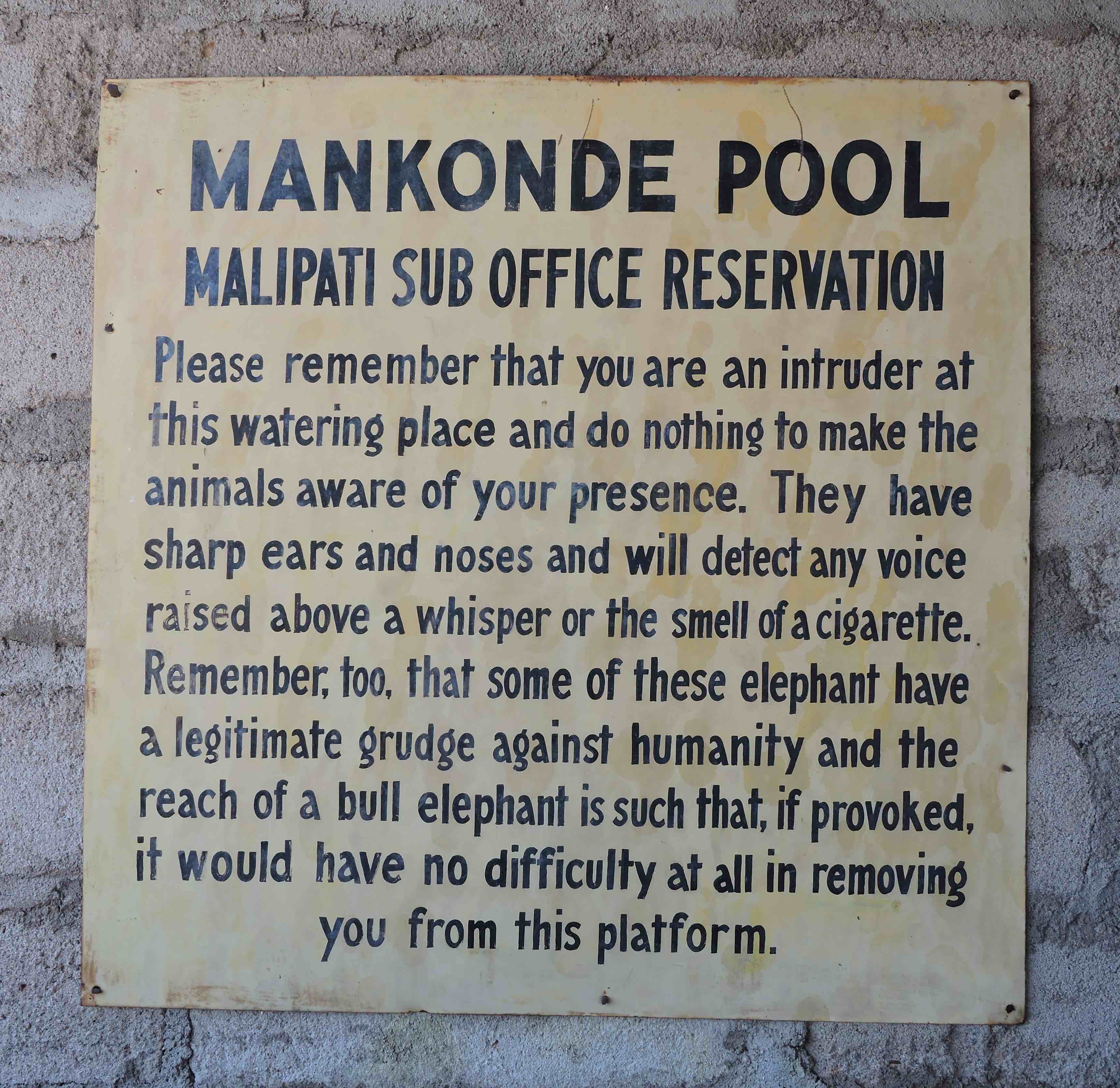
The sign in Wright’s tower.

Rossi pools is now also a campsite and we were very disappointed to find a party of South Africans with at least four 4×4 plus large trailers that occupied the whole area, including the supposedly public (from 6 to 18hs) viewing platform. So, after squeezing through cars, tables and people, we reached the viewing platform, only to find it full of their gear. When finally we managed to position ourselves and try to watch the pool we had to greet more people seated below the platform! We left in a hurry!

There are five large and shady campsites at Mabalauta with a good ablution block with lots of hot water although 2 showers and 2 toilets appeared to be hardly enough for a fully occupied camp but probably it is not full very often as it seemed to be a stopover place.

The drive to Chipinda Pools was long, rough, dusty and largely devoid of game. The tented camp at Chipinda was very comfortable and without frills (as such a place should be!). The four permanent tents had a great view over the Runde river from where we watched, not only mammals but also lots of birds. There were at least two resident genets that were seen every night. The first night, the smell of our BBQ attracted a spotted hyena that suddenly and silently came for a close inspection of our dining area. Luckily, these powerful carnivores rarely bother campers.

We drove to the Chilojo Cliffs and, although we knew them from previous visits, they still impressed us like the first time. The views of the river from the top of the cliffs were vast and beautiful with several elephants dwarfed by the height and distance to look like fleas.

On the way and coming back we crossed the Runde river at the Fishan causeway.

We had some difficulties with one of the cars to negotiate a causeway that were solved when 4WD was engaged!

At another crossing we had a more exciting time as the river was deeper and the wading route less clear. However, Patricia, my son’s girlfriend, performed as an expert during her first ever river crossing experience!

After a while our road back to camp was blocked by elephants with many infants and they formed a compact group, still on the road. Aware that time was passing, we reversed a while to see if this would relax the atmosphere but no great changes in behaviour were detected.

To make matters more complicated, another group placed themselves at our back, cutting any possibility of further backward movement. We were sandwiched by the elephants and truly stuck so we decided that our only (forced) option was to wait and watch. We did this for well over an hour until we noticed a slow movement towards the river guided by the older animals.

It was then that we realized that there were about 50-60 elephants in front of us and 20 at the back. We believe that their behaviour was probably protective to the youngsters.

Eventually, the road was clear and we managed to go through with some trepidation but unscathed! It was now too late to get back to camp in time so we got ready for a reprimand or worse, a fine for driving at night. It was indeed dark when we arrived at one of the internal gates that was -reasonably- closed. We thought we would have to spend the night there but soon a ranger came out of the darkness and, after asking our destination and checking with the park office by radio, after a while, we got authorization to continue. Later we noted that we were followed by a car and we realized that we were being escorted back!

We arrived with no further problems and no questions were asked!

To end this post, below I present you with a video and a picture slideshow of the sites and animals we saw during this great safari.

Prof Chris Barnard’s Farewell

The second post on Dr. Barnard by bewilderbeast.org. Grateful for your agreement to post them.

bewilderbeast's avatarBewilderbeast Droppings

At the airport yesterday I saw a new book on Professor Chris Barnard by James-Brent Styan: ‘Heartbreaker’.

It’s fifty years since the world’s first heart transplant and the famous surgeon and playboy is in the news again, as people use the anniversary to look back afresh . .

A while ago I had found Aitch’s 1983 diary. Her entries to record her overtime as a cardiovascular perfusionist assisting during heart ops had abbreviations likes “palliative VSD 1.5hrs; MVR 1.5hrs; CVG”.

One of her entries in December was ’17h00 Wed 14 Dec Farewell for CNB, Nurses Lounge, Clarendon House’. I knew that CNB meant Christiaan Neethling Barnard as she worked with him at the time. She would run the heart-lung machine to oxygenate the blood while he and the other surgeons worked on the patient’s heart.

I had time before my flight so I thought I wonder if they have…

View original post 67 more words

Jessie’s Show and Tell – and Aitch’s Legacy

This is the first post dealing with Dr. Barnard from bewilderbeast.org as he kindly commented on my earlier post and let me know about it. I believe it is very interesting and another proof that the world is smaller than we think!

bewilderbeast's avatarBewilderbeast Droppings

Jessie’s grade 10 class had Dr Chris Barnard and Heart Transplants as a subject last week.

When she told me I asked, ‘Did you tell them your Mama worked with him?’ Actually, no she hadn’t. She vaguely knew Mom had done it, but wasn’t confident enough to step forward. My shy Jess.

So out with Aitch’s old albums of her working next to the old sleazy charmer, still quite young back before 1983 (when he retired). She says he tried his luck to get her to go out with him one night, as he apparently did with all the nubiles on the team.

And there in the pics was Aitch in theatre greens and mask: The cardio-vascular perfusionist operating the heart-lung machine – ‘the oxygenator’ – that kept the patient alive once the blood circulation had been diverted away from their own heart and lungs. And there was the…

View original post 43 more words

What on earth?! (18)

While working in Mozambique about 12 years ago, we frequently visited the Kruger National Park as it was quite easy to get from Maputo to its southern entrance through the Crocodile bridge. Although the favourite camp for the family was Lower Sabie, we also visited Biyamiti Bush Camp, a favourite of mine.

“Biyamiti” is a word in the Shangaan language, which means “a fence of sharp wooden spears”(1). Built in 1991, it is the most recent of the bushveld camps in the Kruger Park and I like it as it has only 15 cottages and it has a small but interesting area that only the camp residents can drive in.

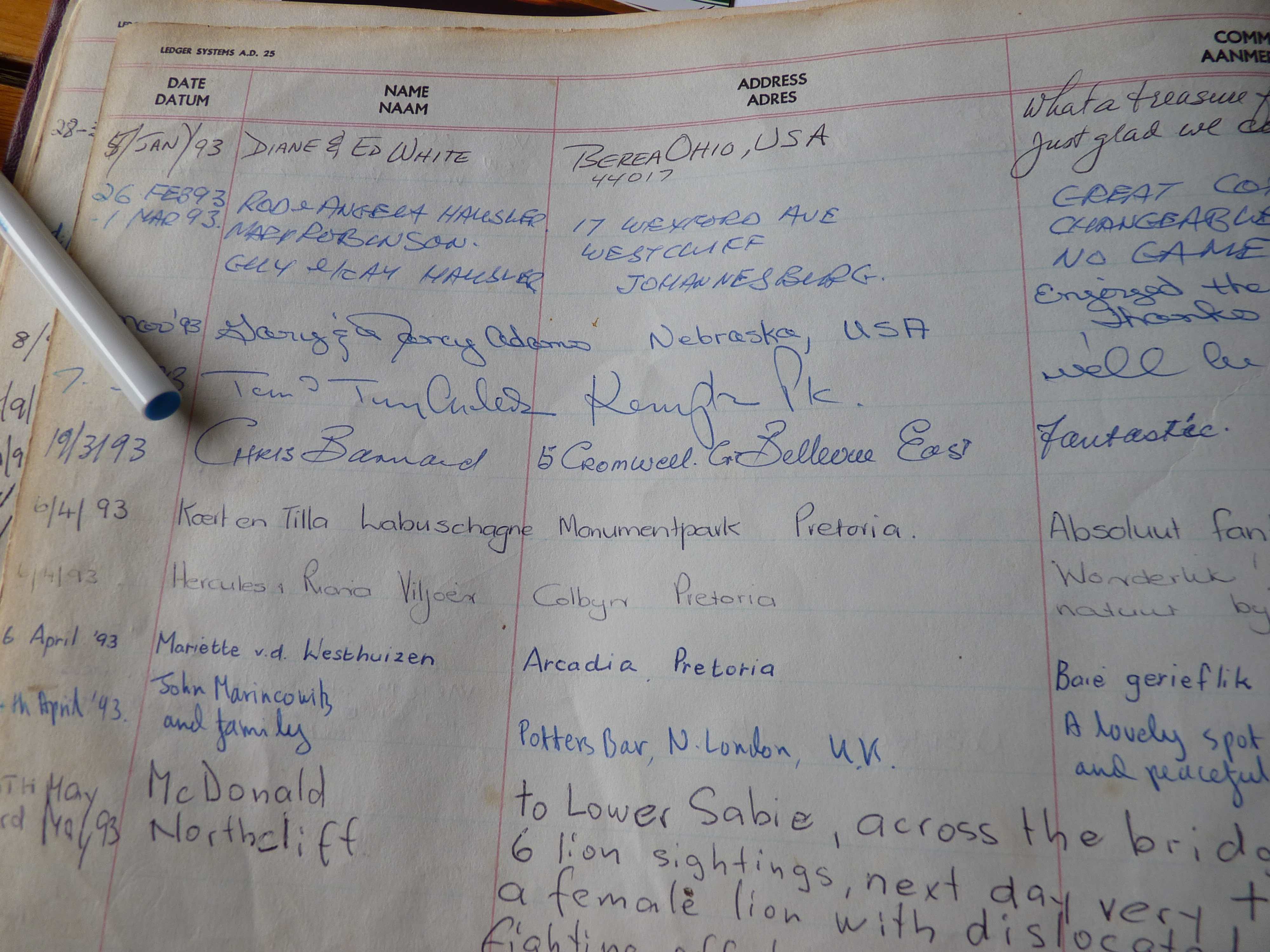
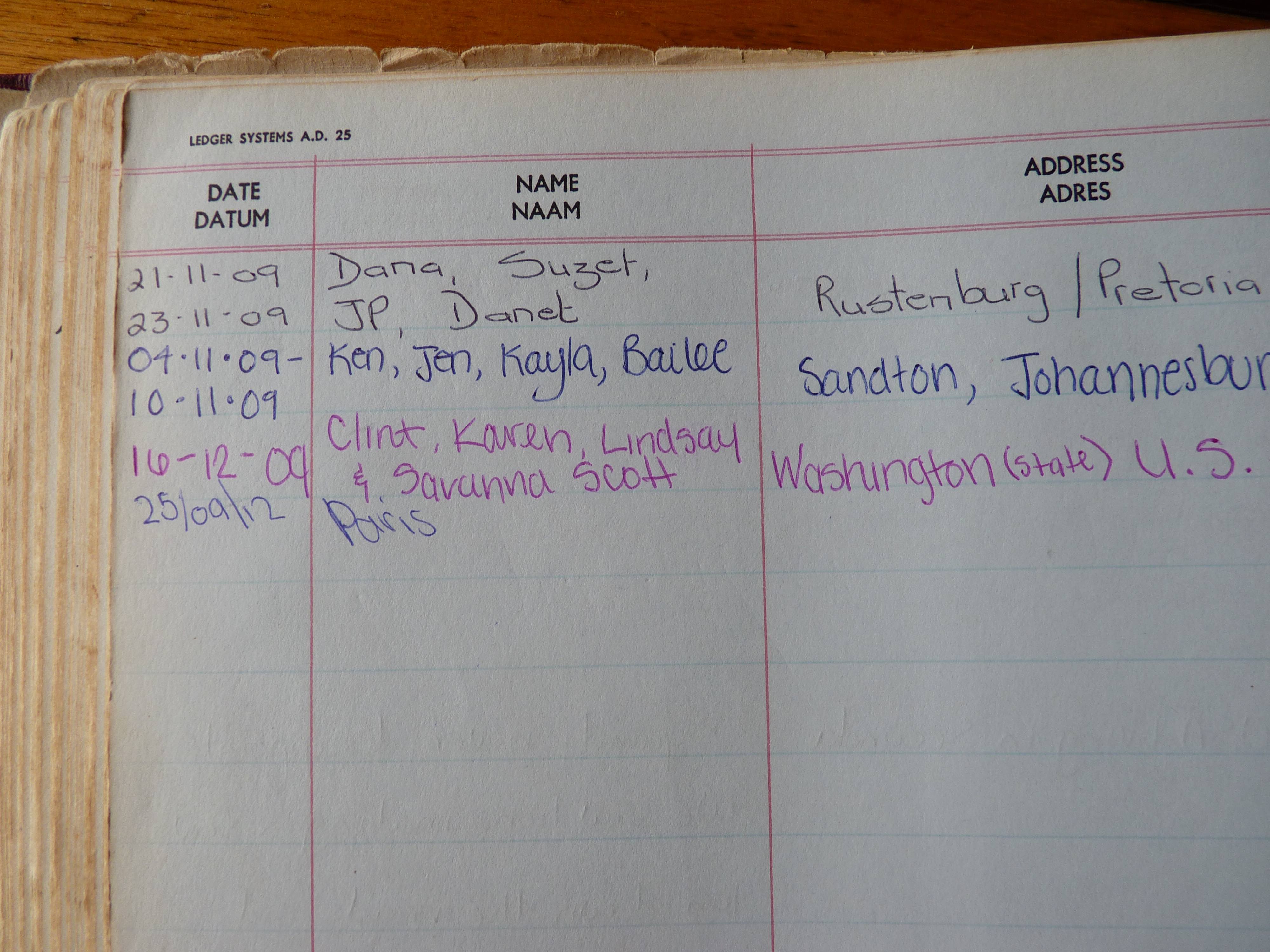
Some camps keep Visitors books that go back several years where people write their experiences while staying at that camp. I always read some of the more recent comments to get the latest information on animal sightings, just in case. At one of the bungalows a lady that clearly frequented the place talked about the “leopard tree” where, according to her, years back a leopard could frequently be seen with its kills (we looked for it but did not find it). There were also many references of finding leopards on the access road to the camp but we also missed them although we heard them close by at night!

At that bungalow I got my first surprise when I saw that someone that signed as Chris Barnard stayed there in 1993. I believe he was no other than Dr. Christiaan Barnard, the surgeon that performed the first heart transplant in 1967. (2)

At another bungalow I found that Lindsay Scott (with her family) stayed there in 2009. I believe her to have been the well-known Zimbabwean wildlife artist (3). Luckily I have bought some of her prints and a great painting of a pair of crowned cranes that I cherish greatly today!

(1) I think this is an ambitious translation for one word, but I cannot find another.

(2) Much less known is that he also did the first kidney transplant later the same year! See: https://www.sahistory.org.za/people/christiaan-neethling-barnard for more information.

(3) See: https://www.lindsay-scott.com/about.html and https://www.artbarbarians.com/gallery2/main.asp?artist=205

What on earth?! (17)

I have used Dalsey, Hillblom and Lynn for many years now and they have been good with one exception that will be at the end of this post. You may be asking yourself what is that company, a question that will be settled when I informed you that it is DHL, the international courier founded in 1969 when these three people finally accepted that there was no hope for improvement in the existing postal services worldwide and, in 1969 started their own mail service!

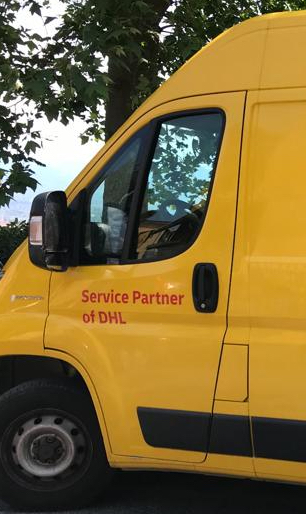
We are now on our usual italian break to see our daughter in Rome and, walking about I saw a van with this written on it:

This would not have been a surprise, except that, when I looked at the remaining of the van I saw that it was in fact a DHL van!

Either the sign on the door is a mistake or I stopped understanding how big companies work!

I was perhaps more perplexed a few years back when working in Rome.

Enjoying watching animals while working in Africa, I decided that it was time I got myself good binoculars. My friend Roger (that sadly passed away a few years back) recommended me a German make that, although very expensive, had, in his experience, an excellent customer support.

It was quite an investment but its optical quality was amazing and I was very pleased with them. However, from one day to the next I found that the vision was no longer crisp and, to my dismay, discovered that one of the eyepieces had an eyelash inside that had just moved to the center of the field! As the unit was sealed from the factory, I immediately phoned the manufacturer.

At first they were incredulous but when I insisted, they accepted to look at them and told me to send it to them immediately. I used DHL and they got to the manufacturers very fast. They gave my binoculars immediate attention and, very apologetically, confirmed the fault. Two days later I got a tracking code to collect then from a DHL office in Rome.

Anxious to get my binoculars back, I was there the following day, unprepared for the surprise waiting for me.

I was informed by the DHL attendant that their van had been robbed and that my parcel was among those that had gone!

I was devastated and immediately phoned the binoculars company that were also shocked. However, they said, there was an insurance and the product would be replaced. When I mentioned that I needed them for a trip abroad in a couple of days, they told me that they would send new binoculars to me immediately and claim the insurance later!

This second time DHL was not robbed and I got new binoculars to take with me during my travel. They have been with me ever since.

Small world!

If you search for “Bedele” in this blog, you will find a few stories of our stay there in 1988-9. During that time, we got to know several people, some were working in the project I was managing while others, although they worked in other sections of the veterinary laboratory, were neighbours in the housing compound where we lived.

Among our neighbours, Lea and Getahun (not their real names) were the closest and we fondly remember the time spent together up to the present day. We had a few laughs when Lea made great but unsuccessful efforts to teach me how to spin cotton by hand! A few occasions we joined efforts in neighbour activities such as to chase away the hungry mongooses that were after her chickens or scaring the monkeys from our vegetable garden. She also guided us on the food availability options in Bedele as well as keeping us supplied with “injera” (1) and other special breads and local food.

Tibetan woman spinning wool in Pokhara/Nepal. Credit: Clemensmarabu. Legend: Creative Commons CC0 1.0 Universal Public Domain Dedication.

I still remember the smell of burning incense and roasting coffee of Lea´s coffee traditional ceremony to which we were invited several times during our stay. She would welcome us to her house dressed in her traditional clothes, having prepared for the event by spreading grass and flowers on the floor. Once seated, she would go through the various stages of coffee preparation while painstakingly explaining us what she was doing (2). A most enjoyable and educational time!

An Ethiopian woman preparing Ethiopian coffee at a traditional ceremony. She roasts, crushes and brews the coffee on the spot. Credit: sameffron; permission: https://creativecommons.org/licenses/by-sa/2.0/deed.en

Ethiopian Airways has grown substantially from the airline that was in the late 80s. We took advantage of this to book our flight Harare-Buenos Aires-Rome-Harare as they now cover most world destinations.

During the long Buenos Aires-Addis Ababa leg of our travel, I talked to the stewardesses about Ethiopia and our time in Bedele. This did not fail as an ice breaker to start a conversation as there was plenty of time. While some of the attendants had not heard and or been in Bedele, most knew the area although none had been there and they were rather surprised to find someone coming from Uruguay that lived in Ethiopia! They were also curious to know what we were doing there!

Three days ago, during the flight between Addis Ababa and Rome, we were looked after by Sara, a very nice young stewardess. When she brought us our welcoming drinks, as always I mentioned that we had lived in Bedele for two years. “Oh, I was born there” she said and, before I could reply, she moved on to serve other passengers. So, Mabel and I waited for her return to get more details. We had to wait until we reached cruising altitude to get them.

Sara came back to take our food order and we immediately asked her “How come you were born in Bedele?” “My mother and father worked there” was her reply. She saw disbelief in our faces and, before we said anything, she added “my mother was a technician at a veterinary laboratory there”. There was only one veterinary laboratory in Bedele and I worked there!, I thought. So, immediately we asked for her mother´s name. “It was Lea” she said!

We were totally shaken by the news and it took us some time to recover and be able to ask for more details. We soon confirmed that we were talking about the person we knew by agreeing on details we both knew! Luckily, I had some pictures of Lea in Bedele in my computer that we showed to her. This time, she was the one gasping “Yes, she is my mother” adding “how young she was!”

She then told us that Lea and Getahun were well, near retirement. We did not know that they have had children and Sara told us that she also had an older brother, both approximately of the age of our own! So it was that we found Lea´s daughter, one Ethiopian among 123 million, quite a miraculous coincidence.

I kept thinking about the probability of finding one Ethiopian friend (including partners and children). For the sake of my calculation, I estimated that we struck a close friendship with 10 Ethiopians and that they all married and had two children (like Lea) and came up with 40 people in 123 million Ethiopians or a 1 in 3,075,000.

As this did not tell me much, I Googled on the probability of different events affecting me and selected a few to compare with the likelihood of our finding. There is a 1 in 220 chance that I would write a New York Times bestseller or 1 in 365 that I would die on my birthday. Less probable events include becoming a movie star (1 in 110,500). Being struck by lightning in a given year is given at 1 in 1,222,000 while getting hit by a bus at 1 in 2,200,000. So, our odds were lower than that but still higher than winning the lottery that is estimated at 1 in 45,057,474 (I imagine that there are lotteries with higher probability).

Living the trivia behind, it gave us great pleasure to have found Lea and we hope that, through her, we could get to our old friends in Ethiopia!

(1) A fermented spongy flatbread, made of teff (Eragrostis tef) flour.

(2) For details, see: https://en.wikipedia.org/wiki/Coffee_ceremony_of_Ethiopia_and_Eritrea#

What on earth?! (16)

I must confess that I only give perfunctory attention to airline safety cards. I identify where the nearest exit to me is and do not check anything else, undoubtedly a bad practice!

My son´s previous job included hundreds of hours of flying and he did check the safety cards and found this one. At first, when he showed it to me I saw it as one more card.

Paying more attention I saw that, in case of an emergency landing, to get out through the emergency you were required to jump 1m 80 type of exit and 1m 35cm in the other!

I am sure that in a life-threatening emergency you would jump but you would probably meet some of your fellow retired passengers like us in the trauma section of the nearest hospital!

What on earth?! (15)

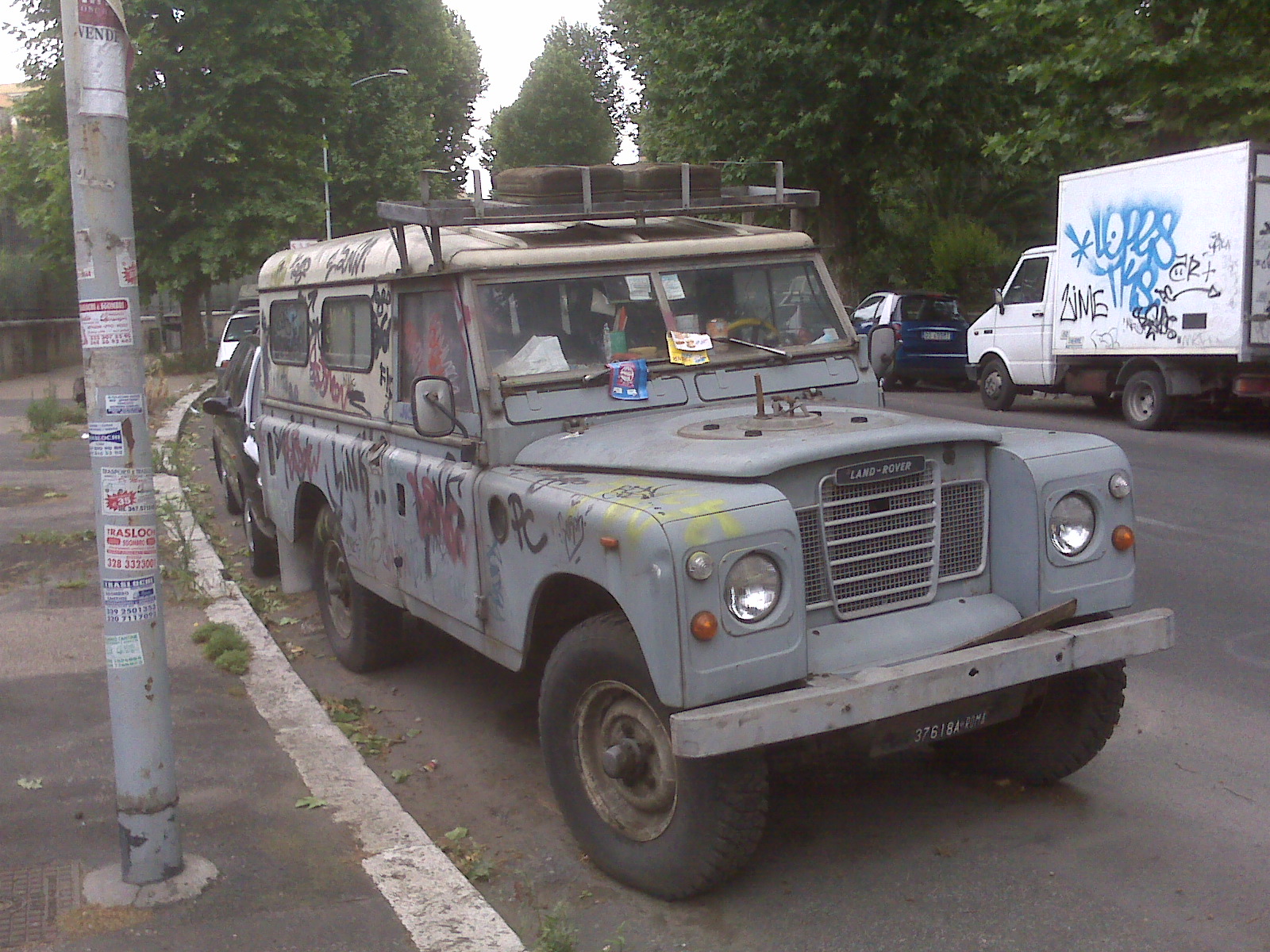
While working in Rome from 2006 to 2010 I walked from home to work and back. In that way, I managed to lose a good amount of weight. It was while walking through the Garbatella neighbourhood of Rome that I found this Land Rover, unfortunately abandoned.

It became a landmark during my walks and I could not help feeling pity for such a good machine to be left like that.

I drove a very similar one while working in Kenya in the 80´s and it never had a problem despite travelling about twenty 20 times a year for about five years to the Transmara area of Kenya.

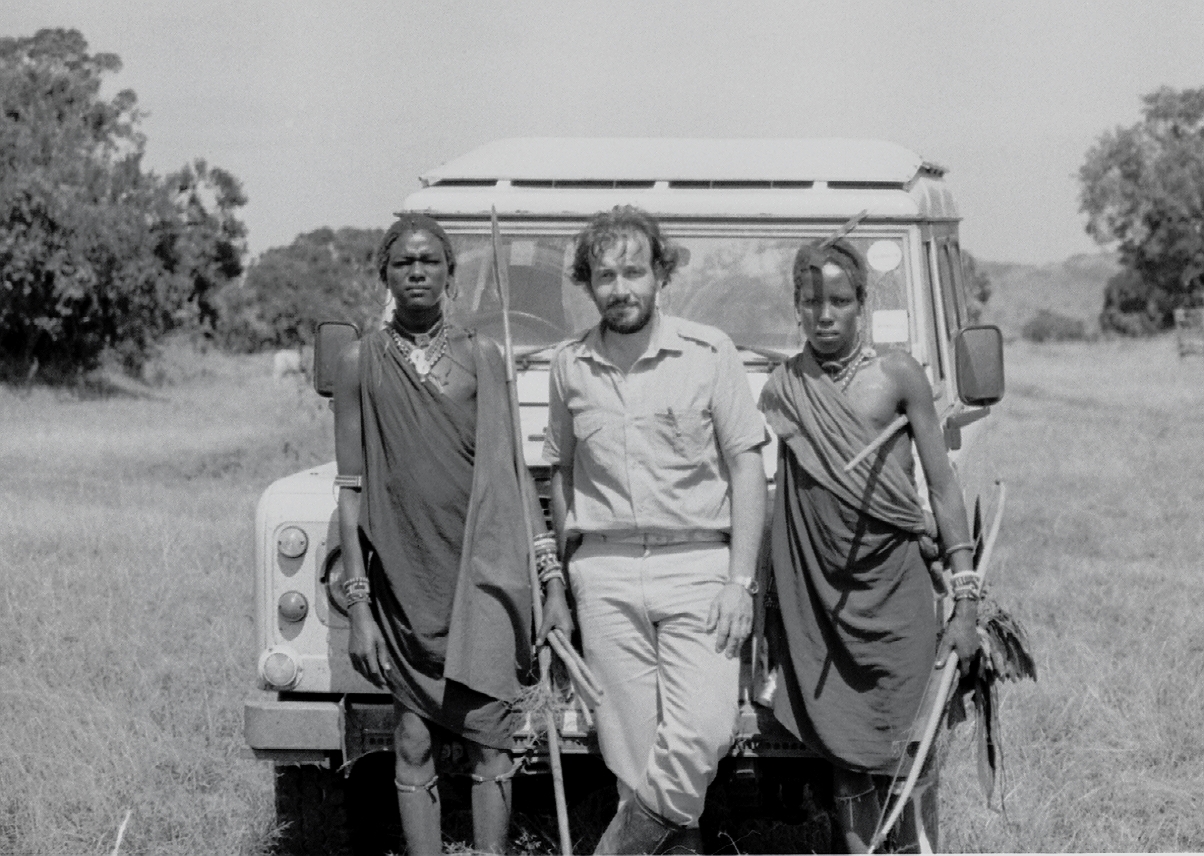
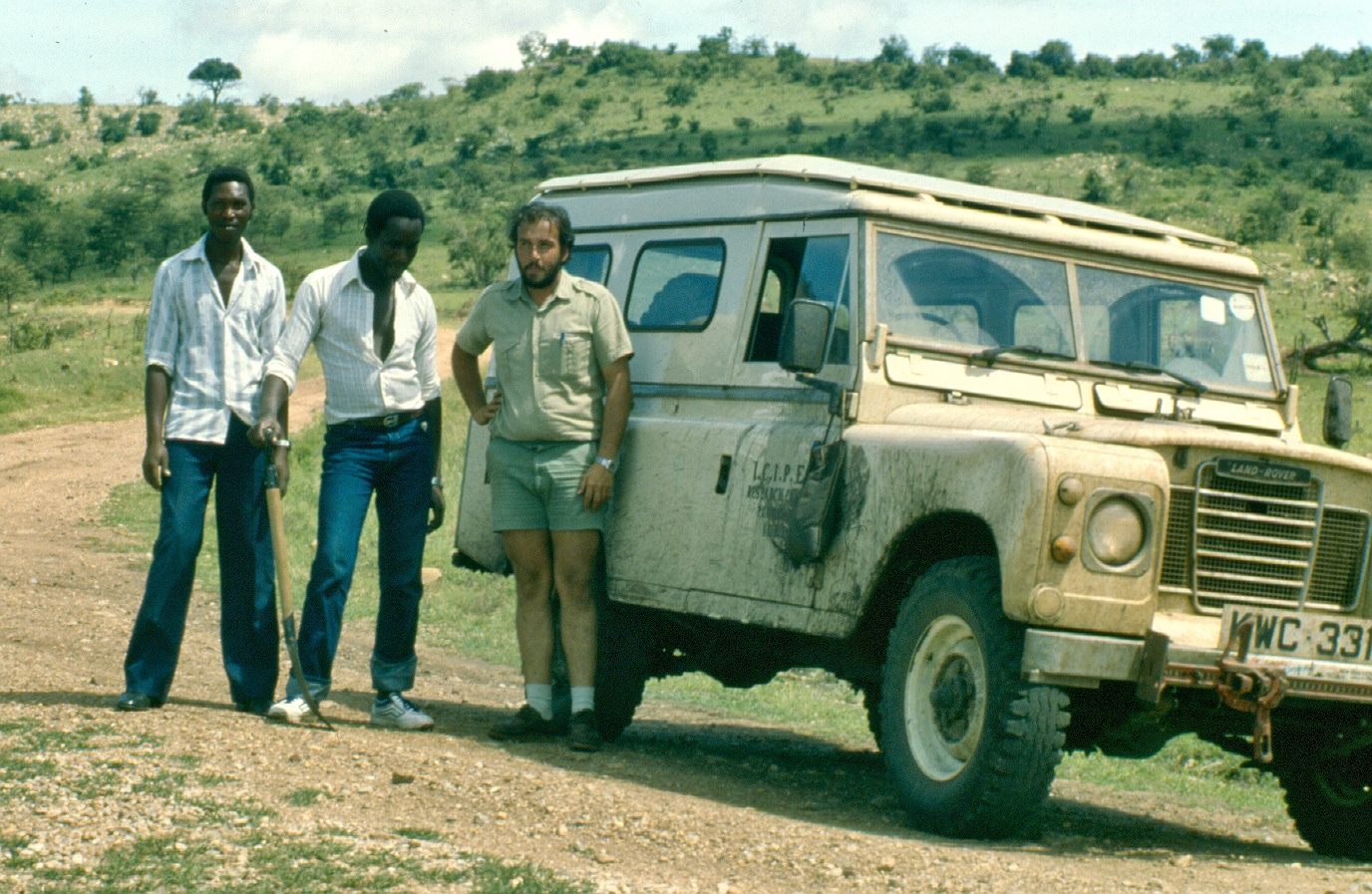
The pictures show the bushsnob with Maasai moran visitors at Intona ranch in the Transmara of Kenya (left) and returning to Nairobi after a tricky drive through a muddy road up the Oloololo escarpment with Benson (left) and Joseph.

What on earth?! (14)

In southern South America, horses are found everywhere. In my birthplace, a city called Carmelo in the west of Uruguay, you not only find horses all over, but they are still used for transportation of goods such as firewood, rubble, garbage and other movable stuff.

This cart had just crossed the bridge over the arroyo de las Vacas (stream of the Cows) and it is moving into the city among the other vehicles!

I walk daily to keep fit and here I go to the beach and back, about 9km. Usually I find horses during my walk, sometimes tied, sometimes walking or galloping loose in the street.

A couple of days ago I was walking with Mabel and she noticed the interesting markings on this beast that I would, otherwise, have missed.

I can assure you that the arrow is not a photoshop trick. I do not know what genetic twist took place during the conception of this horse but there you are!

I would call it the “follow me horse”!

What on earth?! (13)

This tree in Corrientes prompted me to write this post. I knew it as a “Palo borracho” or drunken stick and I have seen them in Zimbabwe as well as in Latin America. I thought that all of them belonged to the same genus, Bombax. This is not so!

Bombax spp. are native of western Africa, the Indian subcontinent, Southeast Asia, and the subtropical regions of East Asia and northern Australia while the ones we get in South America belong to the Ceiba genus and they are native of the tropical and subtropical forsts of that continent..

Bombax ceiba, like other trees of the genus Bombax, is commonly known as cotton tree. More specifically, it is sometimes known as Malabar silk-cotton tree; red silk-cotton; red cotton tree; or ambiguously as silk-cotton or kapok. These trees have straight tall trunks and red  flowers with five petals that will produce a capsule which, when ripe, contains white fibres like cotton. Its trunk bears spikes to deter attacks by animals.

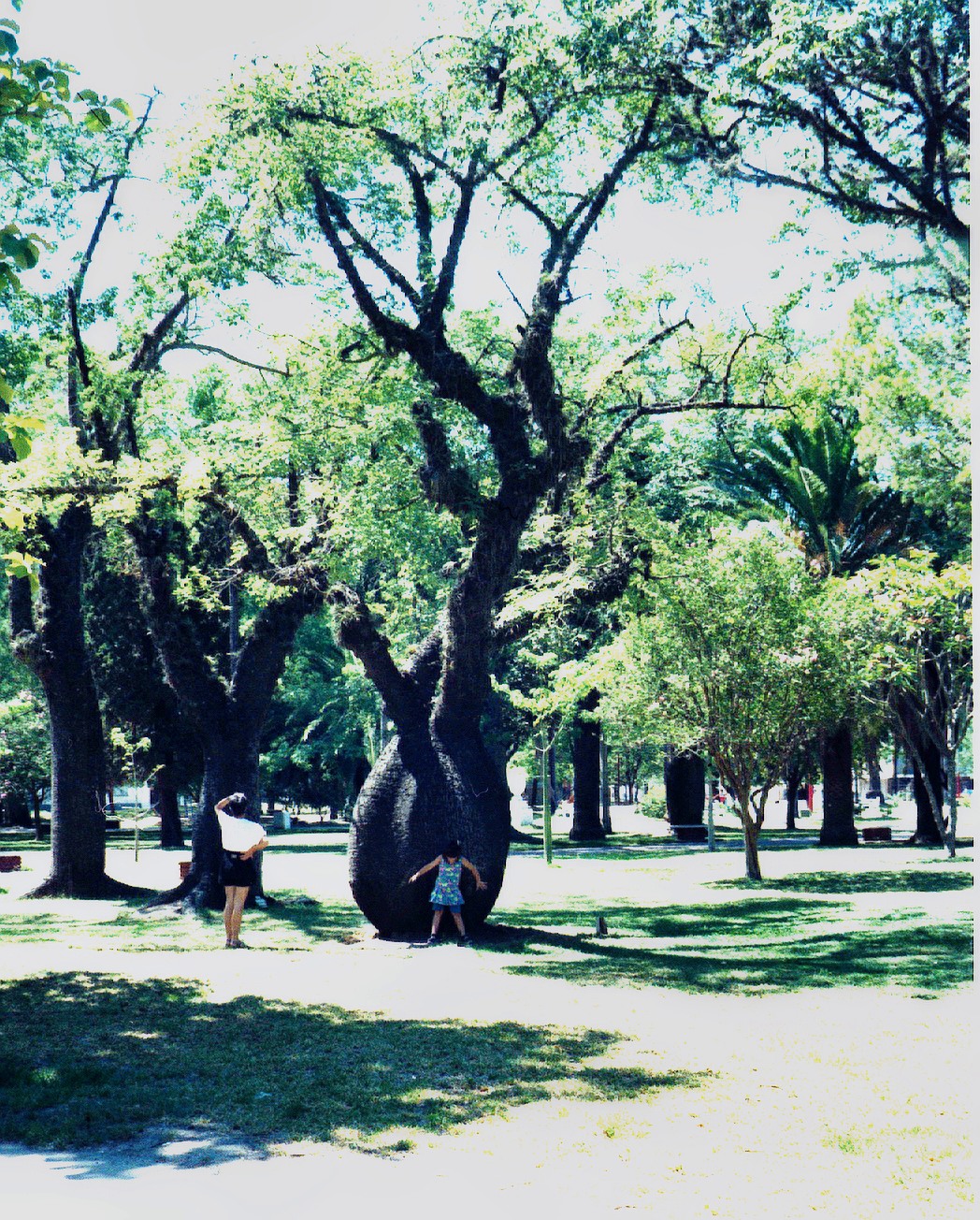
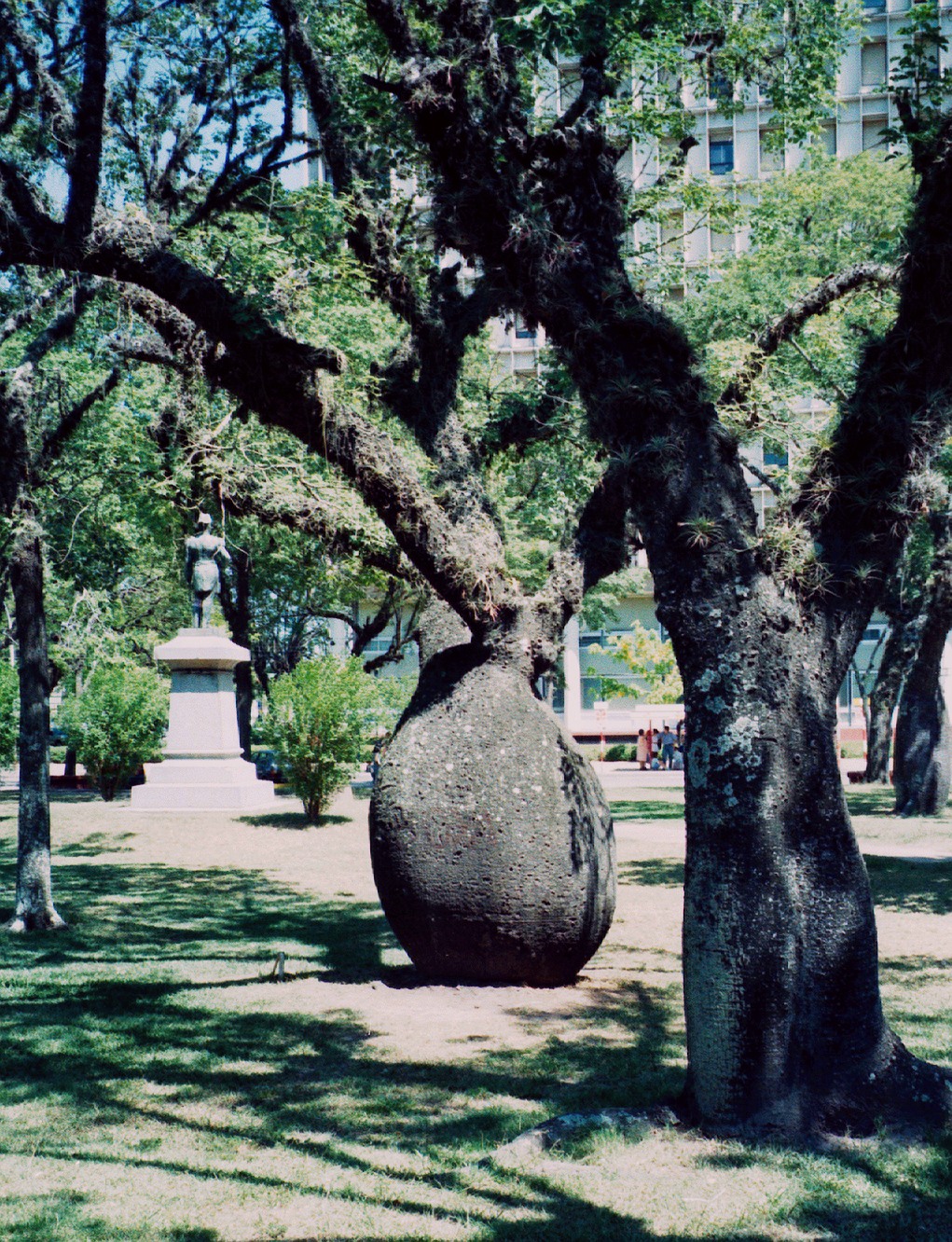
We have seen examples of what I now know are Ceiba spp. in Salta, Chaco, and Corrientes provinces of Argentina and they are rather special with their swollen trunks looking like bottles!

Above are pictures taken many years back of one of these trees that we found at the main square of Resistencia, the capital of Chaco Province.

Apart from “palo borracho”, the better known, Ceiba speciosa, is known as the floss silk tree in the USA is for “samu’ũ” (in Guarani), “paineira” (in Brazilian Portuguese), “toborochi” in Bolivia. It belongs to the same family as the baobab and the kapok.

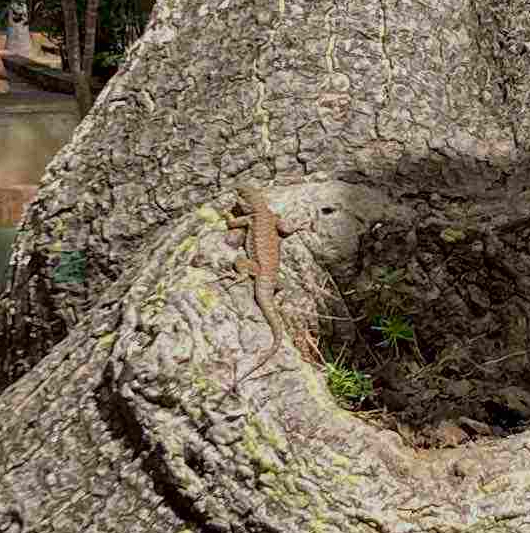
Spot the beast

Now that you are familiar with the “palo borracho”, perhaps it may be easy for you to spot the beast in the picture?

.

.

.

.

.

.

.

.

.