This tree in Corrientes prompted me to write this post. I knew it as a “Palo borracho” or drunken stick and I have seen them in Zimbabwe as well as in Latin America. I thought that all of them belonged to the same genus, Bombax. This is not so!
Bombax spp. are native of western Africa, the Indian subcontinent, Southeast Asia, and the subtropical regions of East Asia and northern Australia while the ones we get in South America belong to the Ceiba genus and they are native of the tropical and subtropical forsts of that continent..
Bombax ceiba, like other trees of the genus Bombax, is commonly known as cotton tree. More specifically, it is sometimes known as Malabar silk-cotton tree; red silk-cotton; red cotton tree; or ambiguously as silk-cotton or kapok. These trees have straight tall trunks and red flowers with five petals that will produce a capsule which, when ripe, contains white fibres like cotton. Its trunk bears spikes to deter attacks by animals.
We have seen examples of what I now know are Ceiba spp. in Salta, Chaco, and Corrientes provinces of Argentina and they are rather special with their swollen trunks looking like bottles!
Above are pictures taken many years back of one of these trees that we found at the main square of Resistencia, the capital of Chaco Province.
Apart from “palo borracho”, the better known, Ceiba speciosa, is known as the floss silk tree in the USA is for “samu’ũ” (in Guarani), “paineira” (in Brazilian Portuguese), “toborochi” in Bolivia. It belongs to the same family as the baobab and the kapok.
Spot the beast
Now that you are familiar with the “palo borracho”, perhaps it may be easy for you to spot the beast in the picture?
Observation of “mechanical miracles” are not very frequent. I have already presented you with the 3-wheeled tractor seen at the Chaco Province in Argentina (https://bushsnob.com/2022/10/07/what-on-earth-1/).
A few years back I travelled to Tajikistan a few times to supervise a project dealing with the veterinary services of that country. The work included travel to the countryside to see the veterinary outposts but also many meetings, most of which took place in the capital Dushanbe, a nice and safe city.
I used to walk a lot along the beautifully treed avenues of Dushanbe, trying to observe and understand the culture of the place as it was my first time in a country of Central Asia. While in one of my walks in the evening, I heard a loud noise coming from an engine being revved, showing some firing issues.
Through blue smoke I saw the culprit, a lorry clearly used for carrying garbage that was being started and moving down the street. Soon the smoke cleared and I could better observe the situation.
The vehicle had its bonnet open! I stopped to watch and saw someone (a mechanic I imagine) working on its engine while the lorry moved down the road somehow as I do not think its driver could see where he was going!
Luckily for the other motorists, the moving repair did not go on for a very long while and soon the lorry stopped and more conventional mechanical work took place!
A few years ago, I travelled to Zambia to backstop an emergency project that responded to one of the floods that hit part of that country. One of the consequences of this event was an expected increase in the prevalence of animal and plant diseases.
Evans Blue (EB) is one of the stains used to check the integrity of the cell membrane under the microscope. Normal cells keep the dye out, but it stains dead ones blue, indicating some pathology present and therefore a disease.
Fifty grammes of EB was about USD 250.00 (depending on the supplier). It is considered an expensive dye as blue is not an easy colour to find in nature.
So, when inspecting some of the purchases the project had done, I was rather surprised to find a bottle of 500g of the dye, produced in Zambia as, usually, EB is purchased from international chemical suppliers!
I believe that it was a rip-off from the local supplier that took advantage from the lack of knowledge of the client!
The rather large (and fake) Evans Blue bottle (left) and a true bottle on the right. The pen is for scale purposes.
This section of my blog deals with unusual finds, the majority concern with observations from the roads and streets we frequent that are mostly located in Zimbabwe, Argentina, and Italy.
I am well aware when, a long while ago, we were all politically incorrect for today standards. Driving was a man affair and, when there was a careless manoeuvre by a car, expressions like “woman driving!” or “what do you expect from a lady driver” to name two of the polite ones that were proffered!
Time passed and women had demonstrated that they are at least equal to men, and this includes driving a car (probably there are no F1 women champions because they cannot be bothered doing it!).
So, it was quite refreshing to see that nowadays women recognize themselves as drivers and even take advantage of their old “bad reputation” to advertise their presence and, probably, take advantage of it!
I spotted this car with the sign “ATTENTION! Lady driver” in Rome.
I keep thinking if the dent happened before or after the sign was placed!
Driving on Zimbabwean roads is full of surprises and there will be a few more entries under What on earth?! that are related to roads and streets in Zimbabwe!
Re-treading used tires is no longer common, probably because of safety regulations so people have found other uses for them. As far as Zimbabwe goes, door mats and sandals are the most common. Strips of tire rubber are also useful to hold car suspension parts in an emergency (and often permanently!) and there are many other uses, I am sure.
We overtook this pick-up (I should say bakkie) loaded with a very ingenious way of re-using old tires. I would like to sit on one to see how comfy they are!
I belong to a generation that did not lose telephones. The first ones I remember were known as crank phones (you needed to turn a handle to call the telephonist and tell her (I do not remember men doing this job!) the number you wished to talk to or, more recently, the dialling type. The arrival of the cell phone not only gradually made landlines obsolete but also placed phones, together with car and house keys and reading and sunglasses, among the losable items in our daily lives.
I do not like phones of any kind, and I admit not being very careful with cell phones misplacing mine quite often! Most of the time these are often only mild panics that disappear once the phone rings when called by Mabel and we reunite again.
The day before yesterday we went to Salta town in the morning. Mabel had a dentist appointment and I needed to get my hearing checked. After we completed our respective tasks, we met in town so that, together, we got some good (sugar-free) breakfast cereal. After that we drove to the shopping mall to get a few more things, including our laundry. The last stop was in Vaqueros, about 10km from our farm to get some of the great sausages that our butcher produces.
While waiting for Mabel to return with the susages, I noticed that my phone was not at its usual place in the car. As it has a tendency of falling from its place and hide under the seat I decided to search for it there, convinced that I would find it. When Mabel returned, I was undergoing a mild panic as the phone was not where I expected. A thorough inspection of the car and shopping bags produced no results. The same happened when we call my phone several times. Things were turning for the worse. The obvious conclusion was that I had left it in one of the shops we visited earlier or someone had taken it from my pocket while walking in town!
Before I go on with the story I need to clarify some technicalities. We have no cell phone network at the farm (being rather remote and surrounded by hills that interfere with the signal) but we do have a basic internet service that enables us the use of WhatsApp and Skype for phone calls. It is there where my MacBook resides from where I could look for my lost phone through the web.
Before we headed home, we decided to retrace our earlier movements in town and the shopping mall but we did not make any progress so, we drove to the farm to attempt to locate it from my computer. In its computers, tablets and phones, Apple places an app called “Find My” that is used when things like this happen. So, at the end of the afternoon we arrived at the farm and immediately “operation recovery” started!
After initial toothing problems I managed to get the app to work and found my phone. It was stationary at a shop in Salta town. I could see the shop (by using the street level view), but I failed to contact them by Skype to tell them that they had my phone. So, we decided to go back to Salta to visit the shop first thing in the morning.
After about an hour I looked again at the app´s map and, to my surprise, my phone was wandering through town! Spellbound, I saw it moving slowly for a while but then it gained momentum indicating that whoever had my phone walked for a while and then got either in a car or bus! I followed my cell phone journey for about an hour until it eventually stopped after nightfall. My phone had arrived to its new home! The fact that I knew where my phone was, made me somehow optimistic about recovering it.
The map from the “Find My” app showing both the location of my computer at the farm (top right) and that of my cellphone (bottom left) at night.
An enlarged image of the precise location of my cellphone.
The app indicated that my phone was “locked” and it offered me two options, to place a message so that the person could call me back or to apply the more drastic “erase” command. The latter would vaporize all my information from the phone if someone tried to unlock it. I chose the first option and placed a message, aware that we were not reachable at the farm, but hoping to get an SMS in Mabel´s phone when we were in town the next morning.
The news of the loss spread and friends and relatives recommended that I erase the phone and forget it as it would be impossible to recover it as the Police was unlikely to assist much. I took that into account but decided not to place the order to erase until the following day.
The morning brought a welcome heavy downpour as Salta had been going through a severe drought. However, the rain created an unexpected and serious drawback: the stream that we need to cross to leave the farm swelled and we could not cross it! That meant that we would not check for messages from the phone, increasing the risk, of someone breaking it. In view of this, I decided to place the “erase” command and, as recommended by friends, forget the phone and start planning for a replacement.
The swollen stream at our farm.
The day I lost my phone, and after my hearing exam I was recommended to start using a hearing aid on my right ear and this needed further tests to choose the right gadget. I tried to do this that same day but the place was busy so I could only do this three days later. I booked the appointment in the understanding that they would call me if there was a cancellation and they could see me earlier. While waiting for the stream to allow us to cross it, I decided to place a Skype call to them to see if an earlier appointment was possible.
I talked to the same receptionist I had seen who mentioned that she had called my cellphone several times to offer me an earlier appointment and that, eventually, a very concerned lady replied and informed her that she had found the phone on the street but could not contact its owner! Wisely the lady, called Eva, had left her cellphone number that the receptionist gave me.
From then on, it was all very easy! I called Eva and agreed to meet at a place in town where she returned my phone. I was very lucky!
Clearly, the world would be a great place if we would all be like Eva!
I must confess that until recently I was ignorant of the details of hair extensions (due to reasons that are apparent if you follow this blog!) and I was surprised to find out that hair extensions similarly to wine and other products can be marketed based on provenance! The following sign in Bulawayo, Zimbabwe provided my first insight into the, clearly more complex than I expected, business of hair extensions. I did not know that hair from various countries would be on offer until we came across this sign offering them to the ladies in Bulawayo.
This complexity was even further evident when a few days later we came across the below headline indicating that just like in other products, once in a while a bad batch appears with potentially adverse consequences for the end user!
I did not followed-up the issue further so I am unable to tell you in which way hair can be “harmful” and why this happened with Brazilian and not with hair from another origin!
This Christmas we decided to spend it in Zimbabwe, camping at Masuma dam and Robins Camp in Hwange National Park.
Our camp at Masuma.
Already in the rainy season our expectations of a green Hwange were confirmed, a marked change from our usual visits that take place in September, during the dry season. We also knew that the animals would not be so dependent on the permanent water holes and that they would be scattered in more remote and unreachable areas of this very large park. Finally, there was a good chance of having daily showers. Despite these drawbacks, it was a suitable time and place for a family reunion so, we took the challenge.
We prepared well for a wet camping experience adding a large awning to our usual dry season gear and packed our rainproof jackets, just in case. As it happened, the latter precautions were only useful for the first two days when we had a couple of showers as, luckily for us (but not for the park!) the weather continued being dry over us although there were some spectacular rainstorms around us.
We counted twenty-three hippos and about half a dozen crocodiles at the dam as well as a large population of geese (both Egyptian and Spurwing) as well as a few Knob-billed ducks. The few resident Senegal thick-knees were there, busy protecting their nests against the threatening advances of the monitor lizards.
Senegal Thicknee vs. Monitor lizard. Picture by Julio A. de Castro.
Numerous impalas, waterbuck and greater kudu frequently visited the dam, mainly to graze on its now lush green shores as they were drinking in safer places, avoiding the dam´s crocodiles. So, we did not witness any of the crocodile ambushes to drinking herbivores that we had witnessed before (See: https://bushsnob.com/2015/02/22/hippos-from-hell/ and related posts). Below there are pictures of some of the animals we saw:
Riding in comfort. A young baboon on mum´s back. Picture by Julio A. de Castro.
The rare Roan antelope. Picture by Patricia Ruiz Teixidor.
A male lion in good condition walks in front of the car. Picture by Julio A. de Castro.
A rainbow skink sunning itself. Picture by Julio A. de Castro.
Yawning before going grazing. Picture by Julio A. de Castro
Elephant fun. Picture by Patricia Ruiz Teixidor.
Elephants arriving at Masuma dam. Picture by Patricia Ruiz Teixidor.
Masuma dam with resident hippos, crocodiles and Egyptian geese. Picture by Patricia Ruiz Teixidor.
A curious giraffe. Picture by Patricia Ruiz Teixidor.
An elephant bull.
Although the elephants did not come in the we see in September, they still came, particularly during the days when fresh water was pumped into the dam, either they had a way of knowing this by the pump noise or they exhibited an amazing sense of smell! The later is more likely as the pumps are operated by solar energy and they are quiet!
Although we spent many hours at the water edge, we failed to see any predators coming for a drink or a possible kill. We did see a couple of young lions mating near Kapula Camp, and a family of two lioness with four cubs and a male on a buffalo kill, just opposite the Shumba picnic site. We heard them and hyenas almost every night at camp and Mabel heard the unmistakable rasping cough of a leopard while it walked up and down the new (rather weak) fence that now encloses the picnic area.
We had some nocturnal excitement on our first day. After midnight Flori and her boyfriend Giacomo (new at camping in Africa) were rudely awakened by very loud banging noises coming from the ablution area. The following morning a large hole was found in the fence through which an elephant had entered the enclosure, probably in search of clean water. His adventure got interrupted by the appearance of the camp attendant that stopped it from doing more damage. The elephant retreated, not through the entry hole but crashing the gate!
We needed to work hard to find large game but luckily had more luck in the bird department. We were able to watch and photograph a shaft-tailed wydah, a bird that we had not seen for years. We also watched several bee-eaters, rollers, and orioles, among other small birds. We were happy to see several groups of ground hornbills, including one feeding their young at a nest.
Great take of a flying Lilac-breasted roller. Picture by Patricia Ruiz Teixidor.
Carmine bee-eater. Picture by Julio A. de Castro.
Carmine bee-eater and beetle.
Yellow-billed stork. Picture by Patricia Ruiz Teixidor.
Grey Crown crane. Picture by Julio A. de Castro.
Grey Crown cranes. Picture by Julio A. de Castro.
Finally, on Christmas day we had some of a reward for our efforts. Flori, Giacomo and I went to have a look at Little Toms, a small stream near Robins Camp. I did not have much hope to find anything special based on earlier experience. I was wrong! Perhaps two hundred metres before we got there, we caught a glimpse of many elephants in and around it. Although we approached the water very slowly, to our dismay, they started to move back to the bush.
We were disappointed but we remained very still and quiet, waiting. After a few minutes of uncertainty, a few of the larger animals turned and started to come back. Soon we had a couple of hundred back at the water.
As I am not able to do justice to what we witnessed, I present you with two videos that Flori and I took of this truly magical thirty minutes!
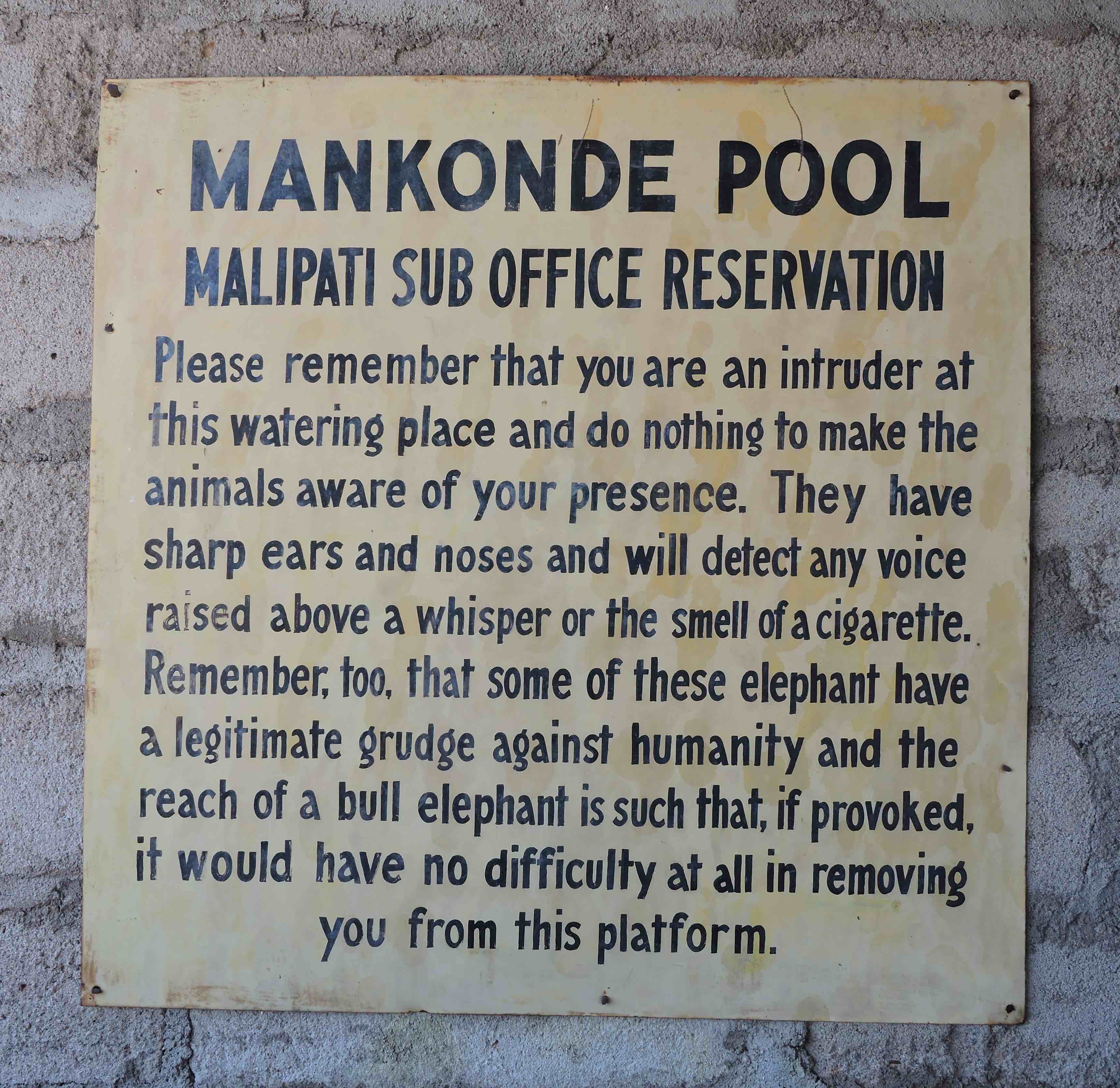
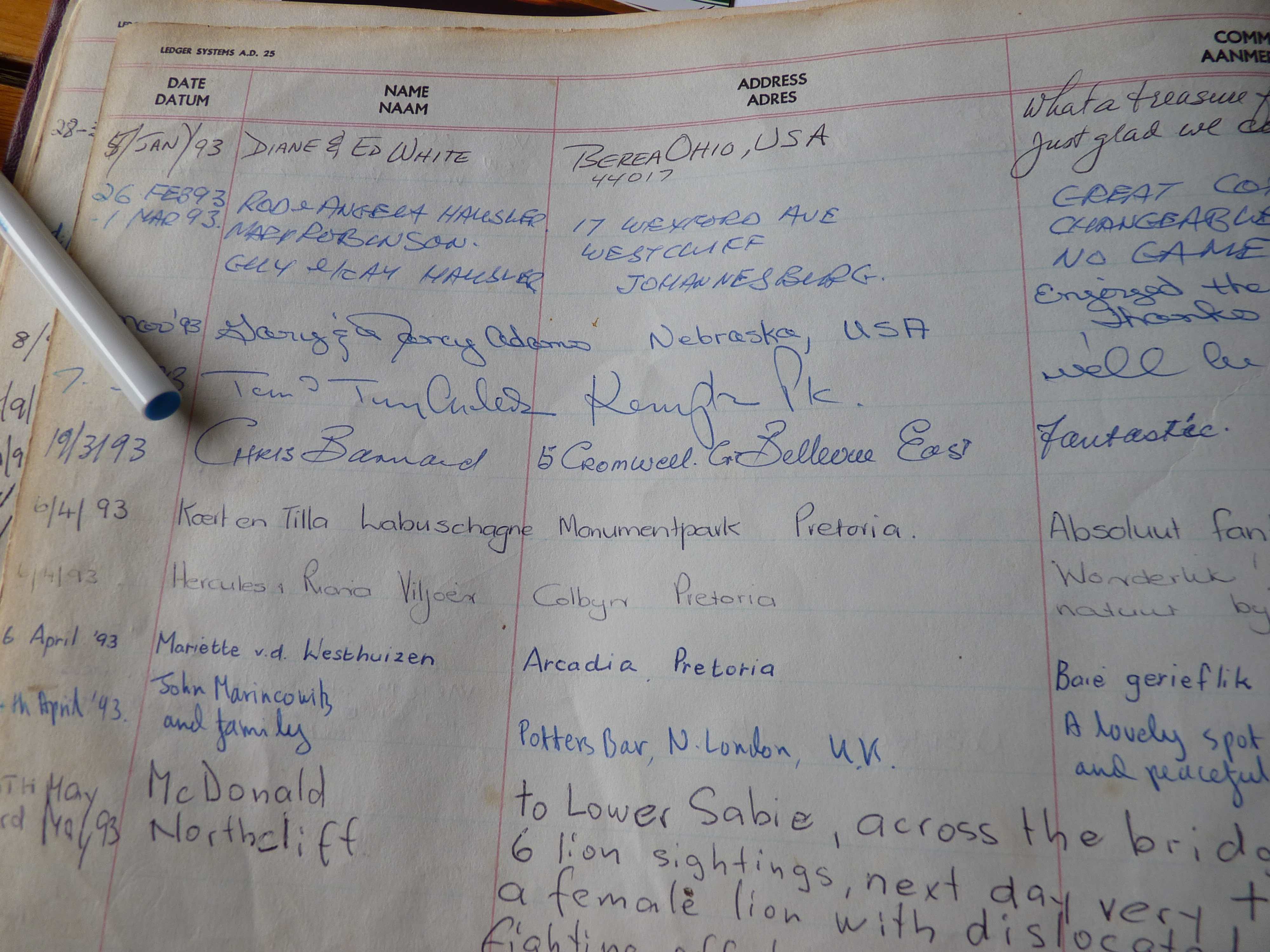
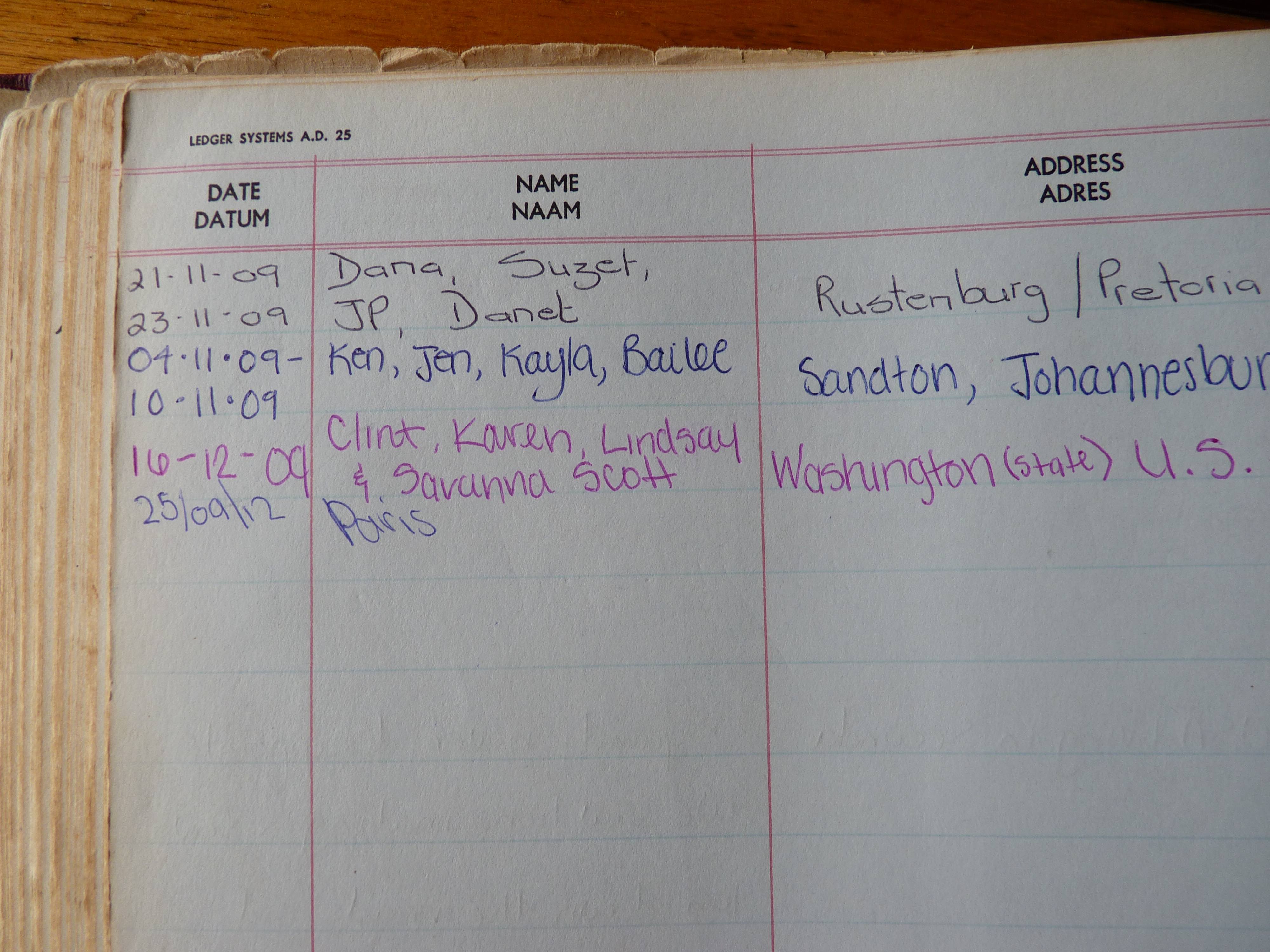
There is no doubt in my mind that Mana Pools National Park in Zimbabwe is one of the best places we have visited. Despite having the “Big five”, you are allowed to walk and animals are everywhere, including your campsite. Among several close encounters, we vividly remember the time a buffalo bull was killed by lions a few metres from the entrance to our bungalow posing some problems to our planned movements!
Despite this, we were not prepared to have an elephant welcoming comittee outside the reception!
It was also curious to see that the pachiderms in Mana Pools are exempt from the majority of the rules as can be seen below:
A few years back I bought a bottle of alcohol and it was only when it got finished a few days ago that I discovered its interesting label.
The following are three of the most common definitions of the word “contrite” that are available on line:
WordReference.com: filled with, or showing, a sense of guilt and the desire to make up for some wrongdoing.
Merriam-Webster: feeling or showing sorrow and remorse for improper or objectionable behavior, actions, etc.
Cambridge dictionary: feeling very sorry and guilty for something bad that you have done.
I wonder about the origin of such name… and I am pleased to know that the name has not affected its business as the company is still going strong, from its start in 1997!