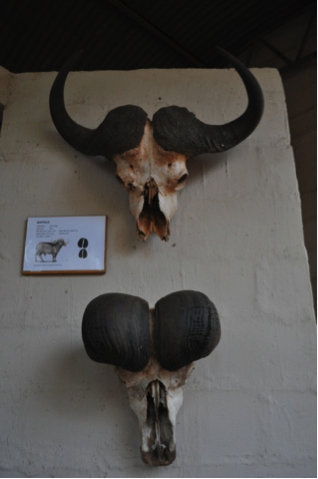
While staying at Mlilwane Wildlife Sanctuary in Swaziland in June 2012, we came across something oddly called a Wildlife “Interpretorium” and Training Centre. It was a nicely set up combination of animal exhibits with good working space for training purposes. I am sure that it is put to good use in educating the youngsters in Swaziland. Two things came to my attention there. The first was a bull buffalo skull of normal size but that has a perfectly developed boss[1] but totally lacking the actual horns (Fig. 1, bottom skull). Its apparent perfect symmetry suggests that it was a freakish genetic mishap and not the result of trauma or wear and tear. I imagine this to be a rare occurrence but that is only speculation. Clearly it was an adult male buffalo but we will never know if this malformation had any impact on its life, particularly regarding its sparring and fights with other bulls with the aim of reproduction.

A normal buffalo skull above and the malformation below. (Picture: Leonor Fernandez)
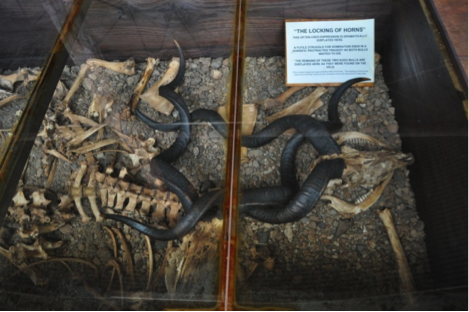
What I do know is that next to this exhibit there was a much more dramatic one showing what can happen when normally developed horns are locked (Fig.2). Clearly the two fully developed kudu bulls were engaged in a serious quarrel when the accident happened. According to the notice that accompanies the two skulls, their horns’ whacking could be heard from the camp for quite a while until it suddenly stopped. Only a couple of days later it became clear of what had taken place when their carcasses were found. Their horns had become inextricably jammed and their heads were twisted in such a way that their bodies, pointing in the same direction became parallel to each other. No one can live long in such a situation and, unable to separate, the stress, fatigue and lack of water rapidly put an end to their lives in what we can only imagine was a rather protracted agony. One can only hope that such magnificent animals had a chance to pass on their genes before this incident took their lives at their prime.

The display showing the locked kudu horns. (Picture; Leonor Fernandez)
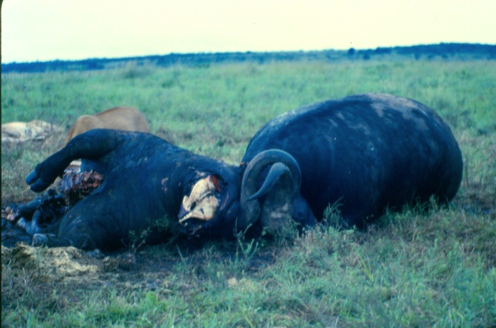
The kudu incident brought to mind a finding we came across in the Nairobi National Park, Kenya in the 80’s. While on a game drive in that magnificent park, our attention was caught by a couple of lionesses on a small hill and we went there to have a look. From the distance, it was clear that they were feeding on a large animal. At close quarters we could see that they were busy with a buffalo carcass that, when we got closer, became two buffaloes and, like the kudu in Swaziland, they had locked their horns (Fig. 3). In this case, however, they were facing each other.

The buffalo with locked horns in Nairobi National Park. The back of a lioness is visible over the one on the left.
Considering the shape of buffalo horns it is difficult to imagine that they can be locked but these two bulls managed it and ended their lives as a consequence. The knoll where the carcasses lay appeared ploughed, no doubt because of the titanic struggle that took place prior to their deaths. How they died will remain another mystery of nature but I would not be surprised that their violent confrontation attracted the lions and they may have had something to do with its ending.
I am sure that this is one risk that the “hornless” freak displayed at the Wildlife “Interpretorium” and Training Centre of Mlilwane did not face.
[1] An adult bull’s horns are fused at the base and this continuous bone structure is known as the “boss”.





 A Bushsnob out of Africa