A letter about unusual lion behaviour in the Serengeti National Park[1], brought back memories of our own observations in the Maasai Mara Game Reserve, Kenya, in the 1980’s.
A picture of the letter to Getaway.
As it can be seen above, the letter describes that, a couple of tourists on a photographic safari, witnessed a lioness kill a wildebeest cow and her calf. Afterwards the lioness suckled the cow, then consumed the calf and returned again to suckle and lick the milk from the now dead female.
While in the Maasai Mara one evening we witnessed a lioness kill a topi[2]. While the lioness was busy strangling the animal, two cubs appeared on the scene and, without hesitation, went directly to the Topi’s udder and suckled the animal for a few minutes.
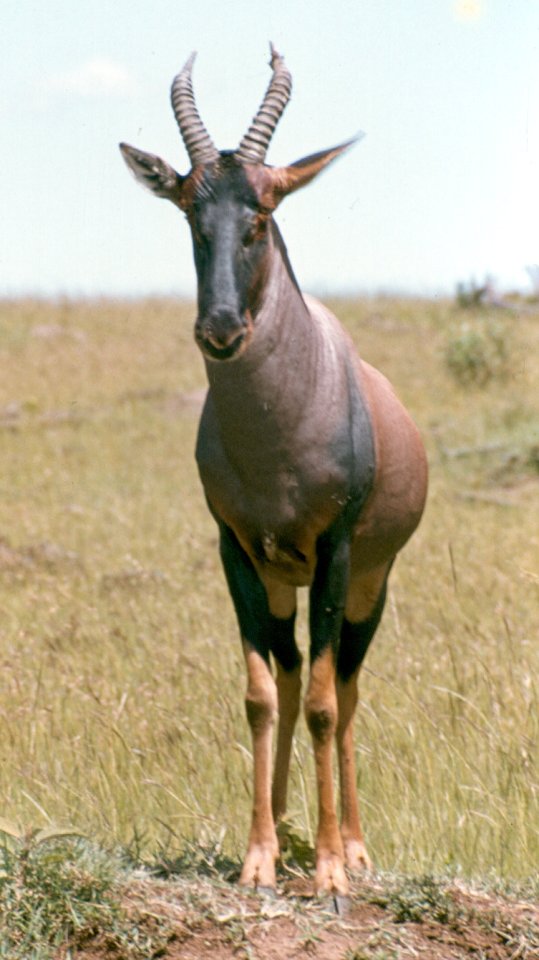
A Topi in their typical “watching” stance.
Eventually the animal died and the cubs stopped suckling and joined the mother at eating it. We did not see he lioness suckling.
The cubs we saw suckling were larger than this one.
The explanatory reply from Brian Jones, a very knowledgeable person on raising lions at the Moholoholo Wildlife Rehabilitation Centre (South Africa) among other activities, confirmed that lions do lick carcasses, a fact that I can also corroborate through personal observations. As he made no mention of the suckling of prey by lions, I decided to write to Brian to let him know of our own observations and somehow reinforce the tourists’ observations. The following is a record of our exchange:
16/11/2015
From: Julio de Castro <juliojdecastro@gmail.com>
To: Moholoholo <moholorehab@wol.co.za>
Dear Mr. Jones,
Reviewing old magazines I saw your comment of a couple of years ago (Getaway, May 2013, p.13) to a sighting of a lioness suckling and licking a wildebeest female in the Serengeti National Park.
In the 1980’s, while working in Kenya, one evening in the Maasai Mara we witnessed a lioness kill a Topi. While the lioness was busy strangling the animal, two cubs appeared on the scene and, without much hesitation, went directly to the Topi’s udder and suckled the animal for a few minutes. Eventually the animal died and the cubs stopped suckling and joined the mother at eating it. I do not recall if the death of the female Topi coincided with the cubs stopping to suckle. The cubs were about 6 months old or older (not suckling babies).
I have also witnessed lions licking wildebeest and zebra prey (mainly in the abdominal area) but I believe that there are two different phenomena, one is the deliberate suckling of a female prey and another is the licking of a dying/dead animal, including males.
I hope you find this interesting and look forward to your comments.
So interesting to hear of your experience witnessing the cubs trying to suckle from the Topi – really amazing!!!
Probably the smell of milk and I’d say the Topi must have had a youngster!!
Yes the licking of a dead animal is normal. I have often seen even cheetah licking their pray before eating!! I have a few tame Cheetah and they lick my friends on their arm, I tease them by saying “they always lick their prey before they eat them” (ha, ha).
Thank you so much for sharing your experience, it always a story I can tell to other folk.
All the Best
Brian
I thank Brian for his time to reply and his valuable contribution. Please visit http://www.moholoholo.co.za/ to see the valuable work that the Centre performs.
[1] Koetze, R. Unusual sighting. Getaway (Letters), May 2013, p.12.
[2] The Topi (Damaliscus lunatus jimela) and the Tsessebe (D. lunatus lunatus) are sub-species of D. lunatus.
After our spell at Matopos National Park in Zimbabwe in November 2015 we continued our journey towards the Caprivi area of Namibia, our final destination. To do this you need to cross the border into Botswana at Kazungula, drive into Botswana through the Chobe National Park and then enter Namibia at Ngoma. Luckily the border crossings were straightforward and we managed to arrive in Katima Mulilo in time for a necessary “safari shopping”.
We remembered Katima Mulilo from our visit in 1992 and did not have much difficulty finding the same hotel we stayed then, on the banks of the Zambezi river. The latter is one of the four main rivers in the Caprivi together with the Kavango, Chobe and Kwando. Often we had difficulties knowing which one we were crossing or looking at!
After an uneventful night at Katima Mulilo, we drove along the Caprivi for a few hundred kilometres to get to Ngepi Camp, on the banks of the Kavango river. From there we planned to explore the Mahango Game Park as well as the Popa falls area. Soon after taking the entrance road to the camp it became obvious that this was a camp with a sense of humour as the sign posts we found showed.
On arrival the camp did not look very impressive as the area outside its fence is severely overgrazed and cattle and goats abound! However, once you got to the camp things changed as, its proximity to the river, makes it a real green oasis with a nice view of the Kavango river and magnificent trees. Things were looking up! This lasted until we saw our acommodation! This time I had made the bookings and, looking for economy and without a lot of time to investigate, I had booked what was called a “Bush hut” as I thought it would be appropriate…
Unfortunately it did not pass my wife’s quality control procedure. The place had all the facilities expected from such accommodation but it was surrounded by thick bush in its four corners! Not only we could not see the river but there was no air moving and it felt like an oven! It was a bad start and we agreed to stay one night while we attempted to find an alternative. Eventually, the staff were very kind in swapping our hut for a house, known as a Tree house. This was a wooden contraption built overhanging the river and it was fresh and had a lovely view of the Kavango and its hippos. I even attempted to fish for tiger fish from our balcony (obviously without success, as usual…).
The large tree trunk came handy to hide from river traffic while showering!
The bedroom.
The bushsnob enjoying the view.
The sense of humour that we saw through signposts at the entrance became more “practical” at the camp itself! It clearly specializes in having special toilets and washing facilities that are, to put it mildly, rather surprising! My favourite was the “rocket”, a tower that looked like a water tank that has a toilet seat on top, offering an intersting view of the surrounding area!
The flower and shower interior.
Rocket toilet user’s instructions.
Inside the shower and flower.
The rocket…
A “tree” toilet.
Flower & shower toilet
Original toilet door!
Bar’s advice…
Our accommodation sorted out, we dedicated a couple of days to explore the Mahango Game Park and to visit Popa Falls. The northern section of Mahango was about 10 km from our camp, on the way to Botswana. It offered two tracks, one to the East, following the river and another one to the West, towards a waterhole.
While the former offered a variety of water birds, the road was a bit too far from the Kavango river and viewing was not ideal. Along the road to the waterhole, however, we found lots of elephants, wearier than the Zimbabwean colleagues. This took us by surprise at first as they stood their ground and even mock-charged us on a few occasions before retreating tail up.
The area have had some rains as numerous ponds and mud holes indicated. The elephants were enjoying them fully and, as usual, being the only occupants. We thought that they would be occupying all of them but we were wrong. A rather large one had a very different user: a land tortoise enjoying a swim! It was inside the water when we found it and, as we we approached, it actually swam away, something we have never seen before but not unexpected, of course.
Buffalo was the name of the remaining area of the reserve located across the Kavango. Entering it we drove through military ruins, a left over of the wars that ravaged this area not that long ago. After clearing this rather large area, we joined the Kavango river and drove over black cotton soil, luckily dry as we are well aware of its stickiness from our Kenya days. As if we needed a reminder, we found a young buffalo and an elephant that, mired in the black mud, had starved to death!
The saying “being in the right place at the right time” came to mind when we postponed our U-turn until the next river bend where we were taken aback by the sudden arrival of an elephant herd that decided to come for a drink and a swim in the river at that particular time! Luckily for us they changed our otherwise dull game-viewing into probably the best entertainment of the trip!
After Ngepi and Mahango we visited Popa Falls and were disenchanted to see that is now been taken over by the Namibia Wildlife Resorts organization and it is much more impersonal than when we visited twenty four years back!
I am afraid that our disenchantment continued with the final part of our trip that took us to the Kwando river area to explore the Mudumu Game Park Not only the Camp Kwando was devoid of character and badly managed but the long drive through the park failed to produce animals, despite the praise from both safari operators and park authorities met. We had clearly run out of luck and it was time to go home!
On our final day, after watching lions and birds, we planned a “sundowner” drink at Nyamandlovu pan to end our safari in style. Before it was time for drinks, we got busy watching the many migratory birds present at the pan. These were a large flock of Abdim Storks and Amur falcons that provided us with much entertainment while they fed on beetles and other insects found in the grass.
Abdim stork drying its wings.
White stork.
Crowned crane.
Wooly-necked stork.
A family of five jackals, probably residents of the pan, were also around. While four of them were gnawing at an old elephant carcass, a fifth came close to the viewing platform for a look. As I was on the ground at the time I saw it coming and prepared for pictures. Despite the warnings shouted from above by fellow game watchers for me to be careful, I remained motionless and was rewarded with the closest encounter I have had with a black-backed jackal!
While watching the jackal I heard loud splashing noises coming from the pan and I saw a large crocodile (one of the three present) coming out of the water holding a very large chunk of carcass. I left the jackal to its business and rushed up the platform for a better look. The beast, at the left end of the pan, was violently shaking the carcass and scattering pieces in the water while it swam off with the remains to the opposite end.
The crocodile feeding on the submerged carcass.
The slow approach of a hippo to the area where the carcass had been shaken apart came as no surprise to my family and I, all well aware by now of our earlier observations on meat-eating hippos at Masuma dam![1] We watched while the hippo approached and searched the area with its head submerged. Suddenly it lifted its head and chewed on what appeared to be a piece of the carcass that it had found! This was a very interesting observation, as we had not seen any of the three resident hippos engage in this activity before, despite having spent many hours there!
The hippo starts approaching…
Eating a chunk of the carcass that the crocodile left.
After munching on its find, the hippo left the area jumping in the water in a rather funny display that probably expressed approval at what it had just eaten! Fortunately I managed to take a picture of the crocodile (regrettably only after the carcass shaking took place…) and of the hippo finishing its snack and merrily moving off!
[1] See https://bushsnobinafrica.wordpress.com/2015/02/22/hippos-from-hell/ and https://bushsnobinafrica.wordpress.com/2015/03/23/hippos-from-hell-the-videos/ Muy Interesante also covered this issue: http://www.muyinteresante.es/naturaleza/articulo/los-hipopotamos-pueden-comer-carne-921450193942
Bush lions are normally tolerant of vehicles, even the open tourist ones. The only aggression we have seen was related to times when mating was taking place and the male normally leaves no doubt about how close you should be! The situation can be different on foot when the utmost care is needed where these cats are concerned to avoid accidents.
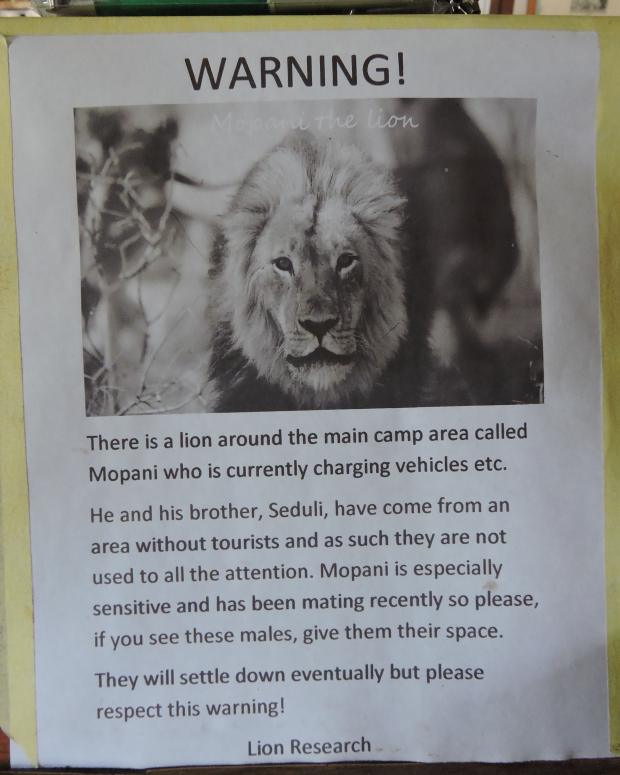
While checking in at Main Camp in Hwange National Park, we were warned of the existence of a new lion: Mopani[1]. The lion, explained a sign placed at the booking desk by the “Lion Project”, came from an area devoid of tourists and it was aggressive, charging vehicles! Siduli, another male, and two females accompanied it. We were also shown a video taken from a tourist vehicle being chased by Mopani and learnt that one of the females was in heat and mating with one of the males. We thought that Mopani’s progeny was assured and planned to keep our distance from him!
The lions had taken residence around the Main Camp area so we were delighted at our luck, as we were sure not to miss them! “Cecil may have gone but in comes Mopani!” was our thought!
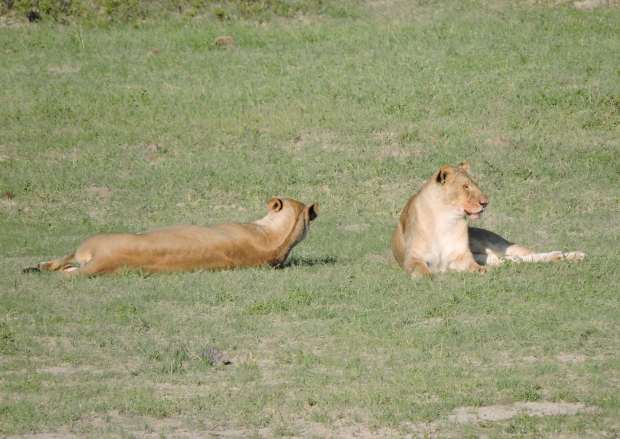
Although recently arrived from a longish trip, the possibility of spotting one of our all time favourite animals made us drop our luggage at the lodge and drive off in search of lions. We found the two females at Dom pan. They were clearly different: a paler one and a darker one. The latter appeared to be the older of the two.
After watching them for a while, a male came out of the bushes and greeted the darker one while the other moved away a short distance. Were we about to witness some mating? Not so as Mopani, who we assumed was the dominant male, only rubbed heads with the female and then moved off in the direction it came from, leaving the female pair alone until the day ended and it was time to get back to our lodge before the mandatory return time of 18:30hs.
We did not need to plan our next day activities as finding the lions again and spending time watching them was the only option! As a friend of mine says, “we slept in a hurry” and we were up before 06.00hs. No need for alarm clocks! We drove straight to Dom pan, as we believed that they would not have gone very far from there. On our way we realized that several migratory bird species were present at Hwange at the time. These were Crowned Cranes, Abdim and Woolly-Necked Storks, African Kites and Amur Falcons to name but a few!
White stork.
Abdim stork drying its wings.
Crowned crane.
Abdim stork with unfortunate dung beetle!
Wooly-necked stork.
We had little time for bird watching as the lions had killed a young elephant at Dom pan during the night and the two lionesses were feeding on it! After this find, most of our activities during the visit centred round Dom pan where we spent a lot of our time. We watched the lionesses feeding and interacting for several hours and I present you with a number of pictures and a video, as these are better than words. We only left them to return to the lodge for lunch and a rest.
When we came back during mid-afternoon, only the paler lioness was by the carcass. A search of the surrounding area revealed two lions laying together a few hundred metres from Dom. They were the mating pair: the darker female and a male that, to our surprise carried a radio collar. As we doubted that Mopani had one, it could only be Siduli. Clearly the lion that acts most ferociously towards cars is not necessarily the dominant when it comes to affairs of the heart! It was then clear that the male we had seen the day before was Siduli and that Mopani was hidden from view somewhere! But where?
Luckily my wife was with us as, if there was someone that could spot it, it would be her. And spot it she did, to our amazement, again! The wild-looking Mopani had been lying low under some bushes, unseen by anyone (except my wife) until then. It remained unobserved by our fellow game-spotters with the exception of another lady that clearly shared my wife’s eyesight. We thought it better that it remained unseen and got used to cars if it is to remain in a tourist area so we did not reveal its whereabouts.
All we saw of Mopani!
Another view of Mopani.
Mopani’s close-up
As Mopani was still not willing to socialize and remained sulking under a bush, we focussed on the others. Mating in lions is a long-lasting affair as the pair remains together and mating takes place often for a few days, while the female is still receptive to the male[2]. This was clearly the case, as they remained “occupied” for the rest of the time we were at Hwange. That left the other lioness guarding the elephant carcass and Mopani hidden from view! After a while it was time to move off.
Some of the birds we found on the way to Nyamandlovu.
We drove to the Nyamandlovu pan as our daughter is very partial to elephants. Despite the abundance of drinking water all over the area, we were extremely lucky to witness the visit of a herd of about fifty animals that, as usual, appeared suddenly as if the product of a magic tree-to-elephant metamorphosis. The result was about one hour of one of the greatest shows on earth: elephants enjoying life at a water hole! There were about five family groups, each led by a matriarch and composed of its progeny, including some really young and tiny babies that were the centre of our attention.
The elephants not only drank but also entered the water where many were seen frolicking about and playing as only elephants are able to do among wild animals! It seemed to us that the latter were at risk of drowning while entering the water with their huge siblings and that they were under even more danger while swimming among them! Somehow they managed to keep their tiny trunks above the water and their mothers were extremely protective and they were always in close contact and ready to assist them!
The three resident hippos felt very uncomfortable at this sudden disturbance and two moved to the very centre of the pan while the third moved to the shore where it put up brave stance against the elephants, only to return to join the others as it was not at all respected by the excited pachyderms! Again, a picture gallery and videos are better than my limited power of description to let you know what took place.
The elephants’ joyfulness in the water delayed our return so we only drove past Dom pan, catching a glimpse of the lions who unwittingly startled a herd of 30 odd elephants intent on drinking from the pan, who retreated in a cloud of dust as soon as they caught sight of the lionesses. We arrived late at the gate where we were told off by a rather grumpy lady game ranger! The justification for our tardiness did not go far with her, clearly used to all sorts of excuses from people arriving late to camp!
The following morning, as expected, the lion pair continued their courtship, the pale female was still guarding the carcass and about fifty vultures (white-backed, white-headed, hooded and lapped-faced) were waiting on the side-lines for her to leave it. While in waiting, the Lappet-faced vulture was seen having a snack by pulling and cutting the dry tendons and sinews from an older dry elephant carcass that other vultures also shared once it opened up the hard bits!
Mopani, the antisocial, still preferred to remain out of sight! We can only hope that he starts turning into a more car-tolerant lion by accepting their presence as part of his daily life. Who knows, maybe one day he could become Cecil’s successor.
[1] To name wild animals or not to name! This is the question… for which I have no clear answer!
[2] Both leopards and lions have the same mating procedure. They can mate as often as every fifteen minutes for up to five days. This is the consequence of weak sperm and mating-induced ovulation.
Our final visit to the Zimbabwean bush before leaving for South America took place from 8-10 January, and it was shared with our daughter who is also leaving for Italy later this week.
As usual, we enjoyed our safari in one of the jewels Zimbabwe has to offer. Learning from previous experience, we stayed at Main Camp as time was short and camping during the rainy season is not really a comfortable option! We were correct as it did rain and the sky -thankfully for the hitherto dry Hwange- was waterlogged so we expect and hope that the rains will continue.
Although there were a number of interesting observations during the trip, I will start with the one I feel “inspired” to write about, while I think about how to present the others to you.
Several memories of my past experience with African Rock Pythons (Python sebae) came to my mind when, on reaching the top of the Nyamandlovu viewing platform we were warned that there was a python in one of its corners!
My experience with rock pythons on safari is very poor. In fact, until this find I had never seen one in a national park or game reserve! My only encounters with these magnificent creatures were in Kenya, either first hand or through pictures and/or stories. I recall seeing a picture of a really humongous python (most often and most regrettably killed) that had swallowed a goat at Intona Ranch in the Transmara. It was probably about five metres long and about six people held it up for the picture. That was interesting but a real pity.
On a more optimistic note, we once met a Swiss fellow “safarier” at Meru National Park, also in Kenya in the 80’s, who told us the story of a python swiming towards his little daughter who happened to be near the water. The moment it approached her, the snake stopped swimming towards her! He also mentioned that when he kneeled next to it, the snake resumed its approach, only to stop again when he stood up, suggesting that there is some size-assessment from the python when stalking its prey.
Apart from stories and pictures, I also remember two first hand encounters. On one occasion, while staying at Elsamere[1] in lake Naivasha on a bass-fishing trip in lake Naivasha, other guests spent their time looking for pythons at the lakeshore! I was really sceptical about python-collecting so I was really surprised when two -albeit small ones- were found! I should also add that luckily they were small as my friend Paul jokingly hung them around my neck with the obvious result that I carried the scars of 2 python bites on my upper torso for a few days! I can testify that pythons bite at least as hard as laboratory rats!
The second encounter was when, perhaps inspired by the above incident, Jim, my wife and I decided to go on a python-safari! Jim was a good friend with whom I shared a liking for snakes. My wife does not like snakes so she came for the walk, hoping for a fruitless search! Our trip took us to Hell’s Gate[2], long before it was declared a National Park.
We did enjoy a magnificent walk along the gorge and dry riverbed. It was there, at a narrow, shady and wet passage between narrow cliffs that we found a young rock python that had recently moulted and was shiny and healthy. As until then, finding the python was just our pretext for the walk, we were as amazed to find it as I am sure the snake was to see the three large primates walking towards it!
Enough reminiscing and back to the present safari! The Nyamandlovu pan viewing platform offers a magnificent view of the water and the action that is always present there. This time the action was clearly inside it! The empty half of the platform was clear proof of the snake’s presence, fear of snakes prevailing even among animal lovers who preferred to pack themselves at the other end!
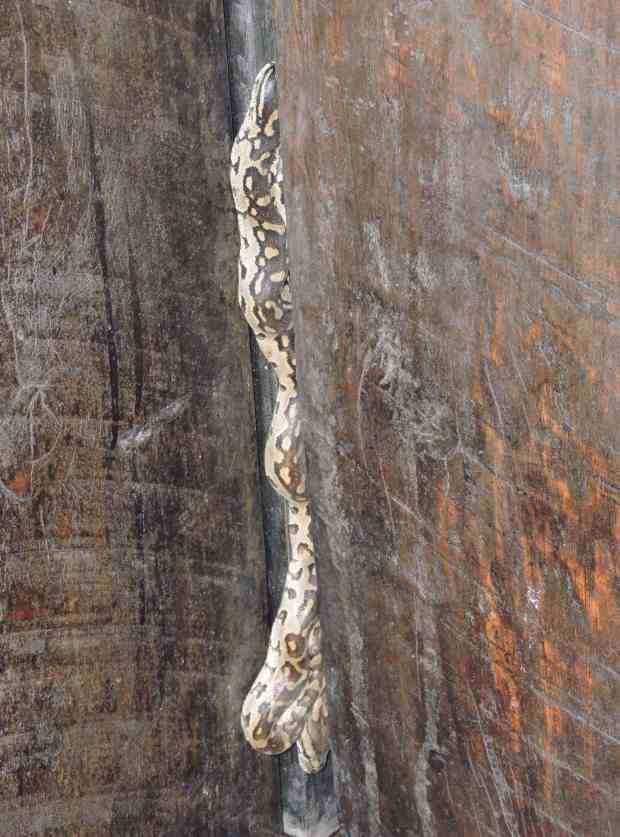
The young rock python wedged in a crevice of the platform, head down.
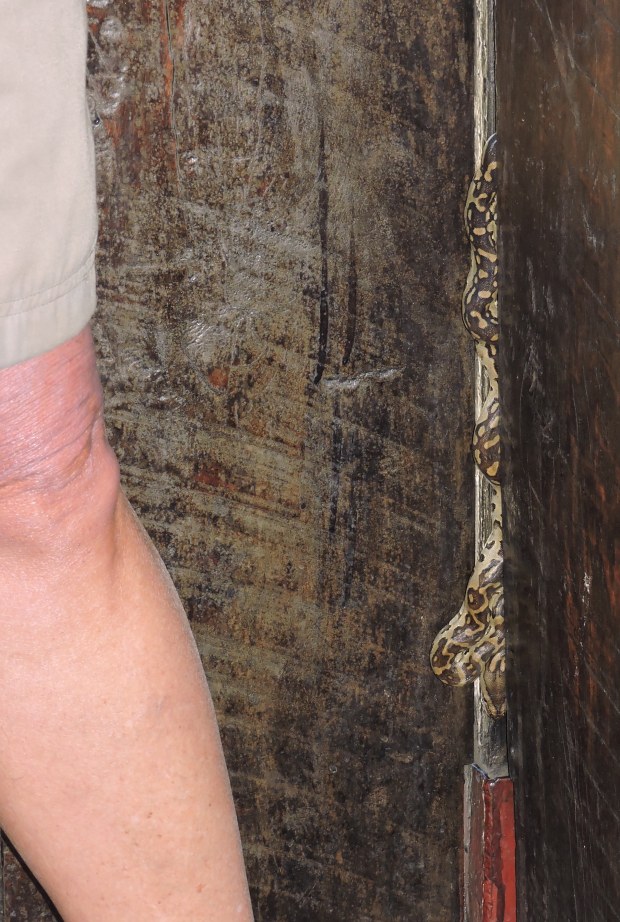
We were really thrilled by the news and moved closer to have a good look. The snake was a juvenile. It was comfortably wedged head-down in a gap of the railing, apparently enjoying an afternoon nap[3]. We took a few difficult pictures and sat in the empty corner next to it leaving it alone, happy to watch it every now and then while focusing on the events at the pan.
Regret the leg but it is only for comparison!
Amazingly not one of the several occupants of the platform came to have a look at the snake although all of them were aware of its presence. They preferred a packed platform end while we remained undisturbed at the “snake end”!
Needless to say that the snake did not move while we were there! It was still in exactly the same position when we left at the end of the day, still enjoying life. We were a bit concerned about it being rather vulnerable but hope that it will find its way and we will see it again.
[1] Elsamere Conservation Centre was the home of George and Joy Adamson for a time and it has accommodation facilities.
[2] It was named by Gustav Fischer and Joseph Thomson in 1833 after its narrow cliffs.
[3] Although snakes do not have eyelids, they still sleep by being able to close their pupils and sleep.
In mid December our garden had a few moth visitors that we had not seen in previous years. The first was discovered, as it is normal around here, by Stephen, our caretaker. Later on, Adam, his son brought another one and we also found another couple of them in the garden. Subsequently they entered the house, attracted by the light where they stayed for a few days.
I identified them as Bunaea alcinoe but the colours were, somehow, not completely right so, once more, I appealed to the internet for an answer and contacted www.africanmoths.com seeking clarification. I place our exchange below:
Just a short note to let you know that these moths turned up in our garden last night and I thought u may be interested. I believe them to be B. altinoe (sic) but, as usual, their colour pattern does not exactly match the pics I am seeing. Although this may not be great news for you, I find them incredible! Attached a picture of one of the moths with a ruler for reference. Kind regards. Julio de Castro
Roy was correct, of course, and I agreed for the picture to be used in their page.
As usual the moths died after a few days, after laying a large number of eggs. I collected as many as I could and attached them to the right trees where they have already hatched and the caterpillars disappeared!
Hoping that they will not rid our garden from trees, I expect more moths to visit us next year!
While searching for suitable pictures to post in Instagram (#bushsnob, just in case you are curious…) I found a picture of communal defecation by hippos at Masuma dam. As I have recently -and entirely by virtue of being observant- become involved with facts about hippos that will probably change the way we look at them, I thought this short post was justified.
Hippos chasing crocs to get at the impala carcass!
There are many great stories about animals in Africa and, although I learnt this one some time ago, it had been stored in a part of my brain that I no longer have access to, because of all the new activities I am involved in (the real reason will not be disclosed!).
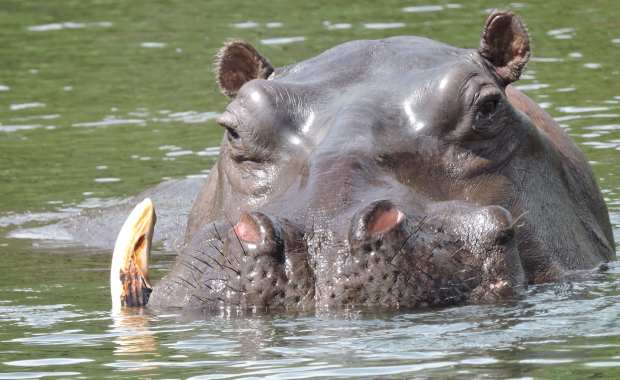
A hippo “tusker”. Note the left tusker also protruding in the upper lip.
Anyhow, apparently when the world was created, God, as you can easily imagine, encountered many problems. A lot of them God solved immediately but several remained, perhaps because God was busy solving the important ones. Among these was the “Hippo problem”. The latter found itself in a dilemma about its lifestyle that required a consultation with God.
“God” hippo said, “I know you have created me, but what do I do now? What do I eat? Where do I live?” A busy God did not have time for individual animal bellyaching so, from the top of his head said: “Well, you will live in the water but you will eat grass”. Surprised Hippo repeated “I will live in the water but I will eat grass?” This did not make too much sense to it as it had seen his reflection in the water: big mouth and big teeth! “How am I going to convince fish that I will not eat them? They will not let me enter the water!” he commented. Still busy, God told Hippo to make a plan!
Hippo left God’s office deep in thought and organized a meeting with the fish to convince them of his life plan. “I must prove to the fish that I have not eaten them!’ thought Hippo, and he met with the fish and eventually they came up with a pact: Hippo could spend the days with them in the water if he could prove he was not eating them. Hippo would prove this by spreading its dung each time, to prove to the fish that he was a trustworthy neighbour! Hippos still do to this very day.
Hippos defecating together in the water.
As you know, hippos spin their tails while defecating to distribute their excrement over the greatest possible area and, contrary to what I thought, hippo defecation occurs in the water and it is not rare to see fish following them. Male hippos in particular are very precise in the spreading of their excrement!
Funnily enough, I do not remember having witnessed a hippo peeing! Apparently they pee backwards and are known as are retromingent animals.
A well-known saying in Spanish goes something like “if you are born a whistle you will never be a cornet”. I am sure that there are many of these kinds of sayings that are applicable to the various walks of life. I am a whistle when it comes to sea fearing. However, as the family had the idea of a sea holiday, we travelled to Mozambique. The latter offers about 2,500 km of seacoast and beaches for all tastes.
DCIM100MEDIA
DCIM100MEDIA
Views of the sea and beaches around Vilankulos.
The road trip was good with the usual border hassle that added a dose of stress to my otherwise calm retired life. As usual the Zimbabwean side was very formal and rather time-consuming but with the pleasant manners that you almost take for granted in our “second” home.
Mozambique was something else! We had only crossed the border in and out of this country while being a UN employee and I did not have any issues apart from some queuing at peak times. Luckily this time there was no queuing, only confusion! We arrived at the border to be welcome by “helpers” to give them a name, all wearing identification badges. I noted that the badges were showing their plastic backs only while I was verbally overwhelmed in Portuguese and English about their offers for “help” and directions on how to perform the usual two steps: immigration and customs! I knew where this was leading!
Perhaps it was the proximity of the festive season as we were at the border before Christmas or perhaps this is always the case. I will find out in next visits but confusion took over, despite being aware of it. First it was a small piece of paper at the entrance gate where the car and occupants were to be recorded, about three words and a number. For some reason it took an inordinate amount of time and arguments between my self-appointed “helpers” and the official at the gate. Eventually I got the important paper and started to walk the plank towards the building to face the rest of the ordeal.
Not so. A lot of shouting behind me called my attention and I was informed that I had been given the paper of a lorry driver from the Democratic Republic of Congo! So, it was back to get the right one and resume the walk. We all had visas from Harare, except one of us who needed to get it in the border so the wait was longer than expected but acceptable. Finally we were ready to do customs. This required the filling of a form and I naively thought, driving off. Not to be. The need for a physical inspection of the vehicle was announced!
This was clearly what the “helpers” were waiting for. As the Customs official walked towards the vehicle, they advised me in hashed tone, on the various ways of handling this apparently difficult procedure. In addition, while the we approached the car, the word “Christmas” was repeated often by my “helper” entourage, now numbering five and growing.
We were two vehicles in this trip. Our friends did not require a visa so they had already been “helped” through the car check-up. We were about to open ours at the request of the Customs Officer when one of our friends came and whispered that he was asked for a USD 10 payment and that he had agreed and obtained Customs’ clearance and, more importantly, the key to freedom: the valuable gate pass. Assessing the situation surrounding us: utter confusion, a growing crowd of “helpers” and the already expectant Customs Officer, we had no option but to follow our friend’s arrangement and handed over our first Christmas present of the journey!
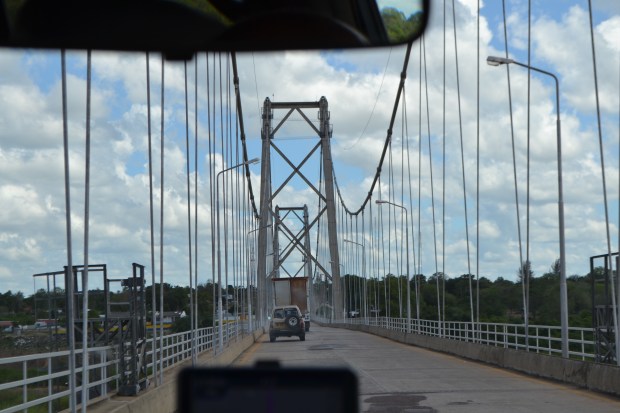
Crossing the bridge over the Save river.
We shared a house with our friends in Vilankulos and enjoyed the relaxed atmosphere while the younger members of the family were engaged in more muscle-demanding activities such as SCUBA diving and snorkeling.
Female Spectacled Weaver
Burchell’s Coucal
Purple-crested Turaco.
Under severe peer pressure I consented to accompany them on a snorkeling trip to a well-known area of coral called “Two mile reef”. Trying to improve my snorkeling experience, I had acquired a floating aid in order to be able to save my energy for swimming in search of coral formations and other creatures rather than spending most of them on trying to stay afloat.
DCIM100GOPRO
DCIM100GOPRO
DCIM100MEDIA
DCIM100MEDIA
DCIM100MEDIA
DCIM100MEDIA
DCIM100MEDIA
DCIM100GOPRO
DCIM100GOPRO
DCIM100GOPRO
DCIM100GOPRO
DCIM100GOPRO
DCIM100GOPRO
DCIM100GOPRO
DCIM100GOPRO
A selection of underwater finds. Pictures by Florencia de Castro, Mariana Terra and Julio A. de Castro.
I still had fresh in my mind an earlier experience at the same location when I got really exhausted and, eventually, seasick swimming in the rough sea! So I did not wish for a repeat! Luckily, the floating aid was a success and I did see some interesting coral formations and fish that I was not able to identify as I have decided that only terrestrial animals interest me in this life! Soon the tide changed and it was time to return; I was still swimming and could even climb on the boat unaided (I am not sure if this was me being fit or the ladder being lower but I prefer to think the former!).
About to depart after a day spent snorkeling. The Washing Machine was yet to come!
A final word on the return trip. The passage between Two-mile reef and Bazaruto and Benguerra islands is infamously and justifiably known as the “Washing machine”. I can assure you that this was violent rock and rollish to put it mildly. The rest of the return trip was just choppy! Fortunately, we all survived -just- and got to land in relatively good shape. Once more I promised myself that this was “curtains” on seafaring for me. I did this fully aware that I have declared similar resolutions before only to forget and backslide, caught in a vicious peer pressure circle!
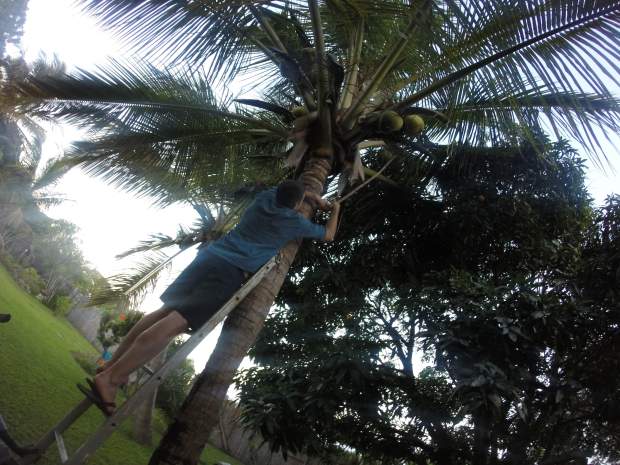
Coconut harvesting, the preliminary of coconut splitting.
Swimming at the beach, walking and coconut opening occupied the rest of my life in Vilankulos and I was really busy working on a novel that I have had in my mind for years and still refuses to be born! I was pleased to make some progress that encourages me to go on writing for a few more years.
The trip back was uneventful, including the border crossing, and we managed to get to the Vumba mountainous area in Zimbabwe in good time. We stayed the night at one of the Inns there and, after a good breakfast and a walk in the garden observing insects and birds (what a relief!), we headed back home where a rather green garden was waiting for us.
Luckily it is raining well in Harare. More than we expected so our pool -turned into a water reservoir for a few years now- spilled over and the area became a true wetland! Water was also running from the top of the garden in large rivulets that avoided our dikes and continued unstoppably to the bottom of the garden washing our scarce topsoil. The consequence was that we needed to perform some emergency repairs to our contention dikes.
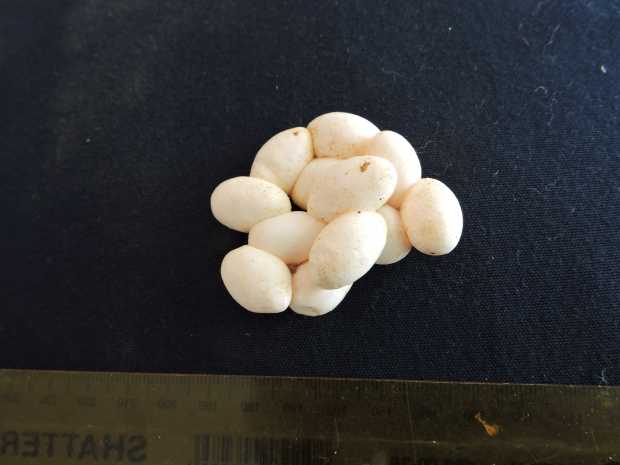
While digging from the sand the pile that we keep for this kind of work we found a cluster of twelve small eggs! Their shells were flexible so they clearly belonged to a reptile, probably a chameleon.
Stephen (our caretaker) and I were very excited to find them and went to communicate the good news to my wife as we were sure she would also be happy as I was quite sure them to be chameleon eggs. The news was received only with lukewarm enthusiasm and I was both disappointed and surprised!
It was after a few minutes of thinking that the penny finally dropped so I declared: “I am sure that they are not snake eggs”, trying to convince myself that there were not! “Why not?” was her immediate and rather expected reply. I could not argue so I decided to find out what they were!
I performed a rather thorough check in the Internet and could almost confirm that they were in fact what I thought. However, to keep the peace I agreed to leave them where they were found so that they will continue with their normal development.
Further reading educated me that it takes up to 300 days for chameleon eggs to hatch and the breeders of these animals in captivity start checking for hatching from day 220! So, if you had any hope of learning what came out of the eggs, you will need to wait until next year, if we are lucky to see the newly born emerging from the sand!
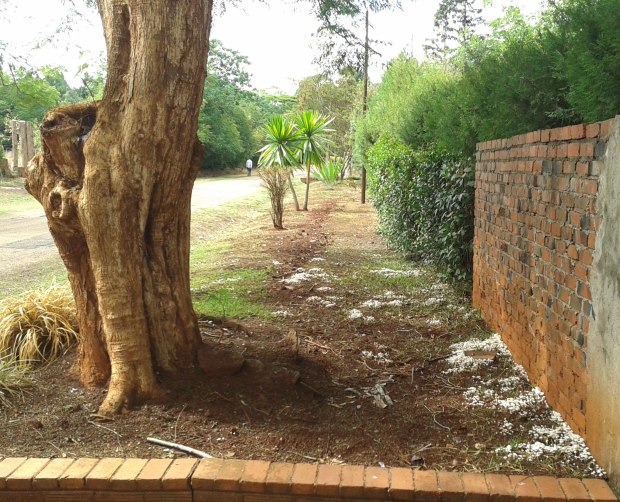
Although it rained again last night the morning started sunny so we managed to go for a walk. At some stage a carpet of white flowers growing near a house entrance called our attention.
As we found them a possible nice feature for our garden we got close to them to see what they were and, to our surprise, they were not flowers but small white mushrooms that I believe to be of the genus Termitomyces, probably T. clypeatus.
These are edible mushrooms that live in a mutualistic symbiosis with termites of the subfamily Macrotermitinae and quite common in Southern and Eastern Africa.

















 A Bushsnob out of Africa