Baobab Teenager

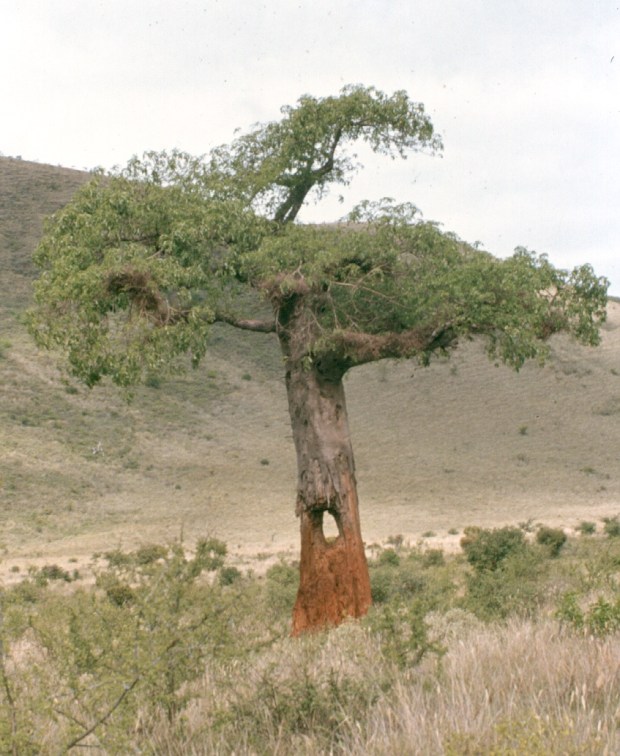
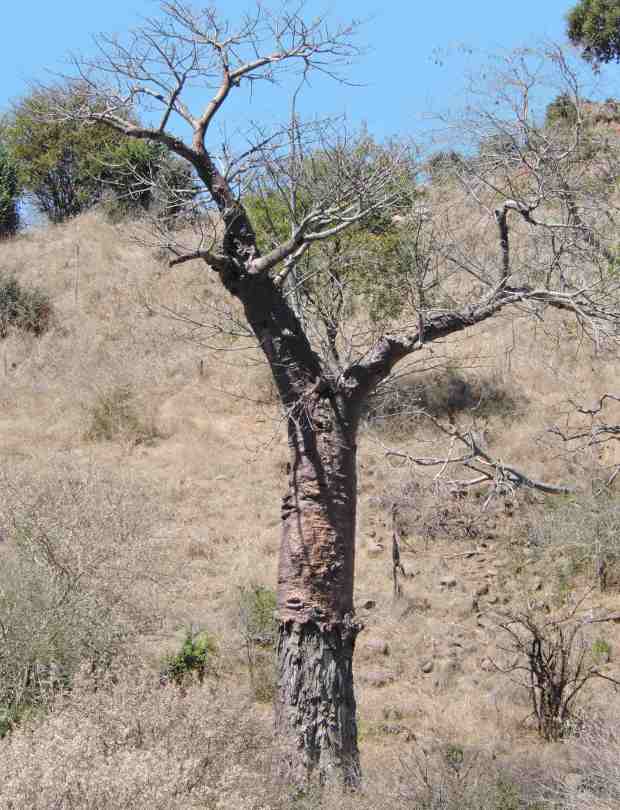
Last week, driving around Chipinda Pools in Gonarezhou National Park, we spotted this baobab that reminded me of a youngster when growing so fast that the clothes that fit today do not tomorrow! It seems that the young and growing baobab needs another pullover to cover its belly!

DSCN0067 copy

In fact, elephants had damaged the base of the tree and the absence of bark contrasts with the intact part of the trunk that shows a healthy coppery colour further up.

Elephants badly damage baobabs, particularly when food and water are scarce as they get the latter from the soft trunk. Lots of baobabs are damaged in this way and the problem is particularly noticeable in Gonarezhou.

The examples below are from Tsavo West National Park, Kenya in the eighties and Mana Pools National Park a couple of years back.

Hollow baobab Tsavo West copy

Baobab damaged by elephants in Tsavo West National Park.

DSCN8618

Another damaged baobab, this time at Mana Pools National Park.

Gonarezhou three years later. Northern area

We were last in Gonarezhou National Park almost three years ago and I wrote about our impressions then [1]. This time the idea was to try the Chipinda Pools Tented camp so we booked ourselves there for five nights from 21-26 August.

Interesting developments had taken place during our absence. The management of the park had changed when on 30 June 2016 the Frankfurt Zoological Society and the Zimbabwe Parks and Wildlife Management Authority signed an agreement for the creation of the Gonarezhou Trust. The latter represents a new management style for a National Park in Zimbabwe, aiming at running the park in a sustainable way on a long-term basis.

The first thing we noted was that the park can now be only booked at the Chipinda Pools office and not at the Harare Reservations office as all other national parks. Despite the distance from Harare (about 500km), the process was smooth and I soon arranged for our stay through an exchange of messages via Messenger and e-mail that ended with an advance payment to secure the bookings.

The trip went smoothly and we were not stopped at Police checkpoints at all despite the rather long distance! After Chiredzi we turned towards the park and drove through land managed by the Malilangwe Trust [2]. We wondered at the time if they would have accommodation that we could try another time [3]. We were soon at the Chipinda Pools gate where we produced our booking at the reception to a friendly lady.

As the checking of our papers was taking a while we took the opportunity to read some of the posters that explained the work on the various predators that is being carried out at the park. Our reading got interrupted when we heard the lady saying, “I have bad news!” As you can imagine, she was successful in calling our attention so we were with her in a second while we heard her adding: “Your booking is for the 21st all right but of September, not August!” and she handed me over the voucher I had given her moments before! While my heart was sinking, I confirmed my error and cursed myself for not checking the booking earlier!

It was about 16:30 hours so my wife and I looked at each other and both said the same thing: “Maybe we will need to see if Malilangwe has a lodge after all!” However, before playing that last card I asked whether there was any chance of putting us up for the night at the staff camp and then decide what we did the following morning as it was now too late to depart. I felt that I was wasting my words as the lady was on the phone and ignored my plea!

As we could not hear her conversation in the office, we waited, unaware of what was going on. The uncertainty lasted until she hanged up and informed us that she had just confirmed that the camp was full as it was time for school holidays in Zimbabwe. We were clearly in a tight spot and awaited again while she made another call before finally declaring gravely: “Sorry, no luck, we are full”.

At a loss, my jerk response was “So, we go back to Harare”, feeling rather upset with myself but ready to accept the situation and go away. Then, to our astonishment she burst out laughing as only Africans can do! “I was joking,” she said, “a colleague is coming to see if what we have would be OK with you”. After recovering from narrowly missing a heart attack, I calmed down and -internally- celebrated her sense of humour and I even managed what I thought it was a smile but probably it was a smirk!

Eventually we were shown into one of the tents that are normally used by researchers that happened to be empty. We were told that, unfortunately, we needed to share the ablutions with other people. We were so delighted with the offer that we immediately accepted it as it was for the duration of our booking! We noted that we even have our own painted dog couple residing at the tent although they were papier-mâché ones!

DSCN0108 copy

Our tent.

DSCN0111 copy

The veranda of our tent.

DSCN0120 copy

The setting.

The camp was composed of four tents with a communal kitchen and ablutions nestled by a small stream that flowed into the Save river a couple of hundred metres down the river. The camp was well shaded and it was very well kept. We finally settled down while noting that the tent had large windows closed only by mosquito mesh and curtains so we prepared for a cold night and we were happy to have our sleeping bags with us!

That night, now relaxed, we enjoyed our dinner and, after reinforcing the provided bedding with our own warm bags, went to bed for what I thought it was a well deserved rest while congratulating ourselves that we managed to survive a potential disaster. Later during the night, we heard lion roaring while it walked by our camp and we were happy to be smug in our strong tent! The following morning we learnt that there was a lone male lion stationed near camp at the time. Despite the lion living next to camp, we did not see it, unfortunately.

We spent the day exploring the area and we took a recommended route that brought us along the Sililijo stream. As soon as we left camp we climbed a hill and had a great view of a large tract of the park through which the Runde river meanders its way towards its meeting with the larger Save river.

DSCN0065 copy

The view of the Runde river.

Soon we had left the Runde river behind and, after a route that was rich in game we re-joined it near the Chilojo Cliffs, Gonarezhou’s famous landmark.

DSCN0096

The Chilojo cliffs. Gonarezhou’s landmark.

DSCN0098

Another view of the cliffs.

Among the animals we found on the way were elephants, buffalo, giraffe, impala, greater kudu and eland. Yet again we admired the numerous baobabs and realized that the plentiful rains have had a positive impact on the vegetation cover as the park was very bushy. This, of course, had a negative impact on game spotting but we did not mind that at all as it was clear that the game numbers are on the increase!
DSCN0082 copy

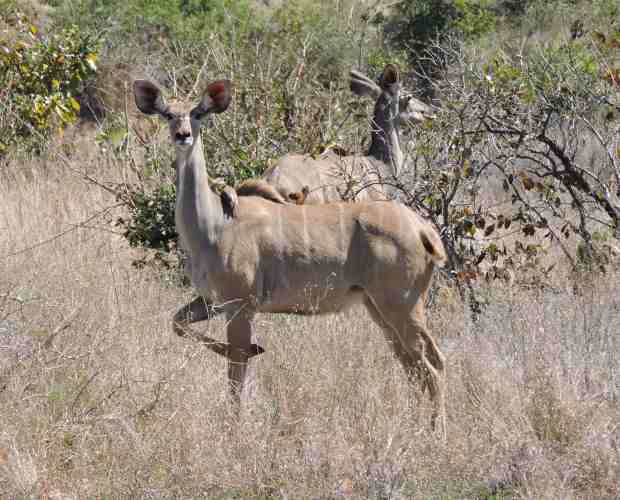
A female Greater kudu watches us.

After enjoying a picnic by the cliffs, followed by the mandatory bush siesta we waited a while longer for elephants to come to the river but, as they did not come, we decided to return to camp. As usual, we underestimated the distance and we arrived rather late as we took a wrong turning and, near the camp, we got charged by a loud trumpeting lone elephant bull that we just managed to see. The animal was very nervous and it kept coming towards us until we finally managed to avoid it and safely get back to camp. Later we learnt that the elephant was scared because of the proximity of the male lion.

We arrived tired and looking forward to a shower, dinner and bed. However, the appearance of the game ranger in charge of tourism, stopped us in our tracks. He was the bearer of more bad news: our tent was needed for some unexpected visitors! He asked us if we would mind moving to the Mabalauta area in the southern part of the park where there was room for us at Swimuwini Camp. Aware of the well known saying “beggars can’t be choosers”, we immediately and gladly agreed and convened that we could leave at about 09:00 hours the following morning.

The next day, before departure, we had a chance to talk to other guests that told us that it was possible to drive to the Mabalauta area through the park and that it was a nice and scenic drive. This was good for me as I also wished to have a look at a place called Lion pan as, years back, I was told that it was -obviously- good for lions… So, thanking the management for their hospitality we departed at a leisurely pace towards our new camp, about 100km south.

Our drive was, as expected, interesting although we did not see many animals. A rock monitor (Varanus albigularis) that crossed the road and a Purple roller (Coracias naevius) were the only animals of note we saw although there were plenty of hornbills and other common birds as well as a few squirrels. We found elephant spoor but no sign of the pachyderms anywhere. Unfortunately we missed the GPS point where we should have turned East for the Lion pan so we decided to explore it the next time we come.

DSCN0139 copy

A river on the way to Mabalauta in the south of the park.

DSCN0143 copy

Most pans had water, product of the excellent rains of last year. This one is on the way to Mabalauta in the south of the park.

DSCN0129 copy

A male namaqua dove.

DSCN0140 copy

The rock monitor that slowly crossed the road showing us its rather long tongue.

DSCN0142 copy

Close up of the rock monitor.

[1] See https://bushsnobinafrica.wordpress.com/2014/08/11/gonarezhou-national-park-safari-diary-day-1/ and the two posts that followed.

[2] See: http://www.malilangwe.org/

[3] After returning to Harare I learnt that they have a lodge called Singita Pamushana Lodge.


Spot the beast 27

We got back from Gonarezhou National Park yesterday evening and I have a lot to do before I am able to post anything yet! However, there is always time for a “Spot the beast” to keep your minds active until I can get mine starting!!!

This was the view from our tent at Chipinda Pools in the park. I am sure that you will agree with me that is a very nice spot: a river with a bit of water, lots of trees and lianas and the light filtering through the foliage.

There is a beast somewhere there (the reason why I took the picture) that it will take you some time to find, I think.

DSCN0120 copy

?

?

?

?

?

?

DSCN0121 copyIt is a male bushbuck that came down for a drink and we saw it (or rather my wife, again) spotted when it was climbing back to spend the rest of the day wherever the bushbucks do this.
(Please be aware that it was walking so the second picture shows it after it walked a about a metre to the right of the first picture)


First blood

To witness a lion kill is, despite its perceived cruelty, a highlight for the safari lover. We have been lucky to witness several kills and many more attempted kills during the many years that we have visited the bush. But the first one is the one that remains most vividly imprinted in your mind, particularly if it happens in full view and you witness it from a few metres away.

It happened in the Maasai Mara in the early 80’s, during one of my first camping experiences with Paul. We happened to be driving along monitoring the wildebeest movements when we saw a zebra limping badly. At close quarters it was clear that the animal had -somehow- damaged a front leg. Aware that wounded animals did not last long because of the large predator population in the area, we decided to wait for a few hours to see what happened.

Lion pride M Mara 6.54.19 AM copy

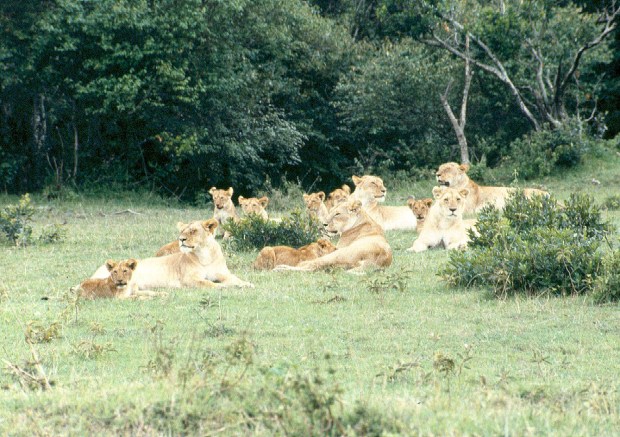
We knew that a large pride lived in the area.

At some point the zebra -a group of 8 to 10- stopped grazing and started to move. We followed. I was at the time sitting on the roof rack to have a better view of the plains so it was me that spotted the reason for the zebra nervousness. They had spotted a lioness watching them from a distance. The intentions of the predator were clear as she was walking in a general direction that would -eventually- get to the group of zebras. Excited, I prepared my camera and waited.

After a while we realized that in fact there were several lionesses and that, somehow, we were in fact used as part of a pincer movement from the huntresses! After about thirty minutes slowly following the zebras, we saw them break into a trot and, before we could see much more, they were galloping so we moved faster while trying to anticipate the event.

Suddenly we saw that the hunted were trying to avoid a second lioness that, after moving for quite a distance through a donga [1], was cutting diagonally and at full speed towards them. Things were now accelerating and so did the car and my heart while I held on to the roof rack while trying not to lose my camera or falling off myself!

The zebra were now at full gallop when, suddenly, they scattered in all directions, I am sure that this had something to do with confusing the chasers. However, as expected, the injured zebra was the target, being slower than the rest so the lioness -now joined by two more some distance behind her- was closing in. So were we, despite the irregularity of the terrain that was no obstacle for our excitment!

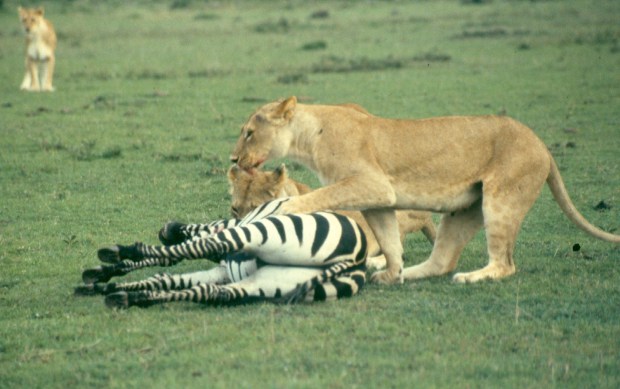
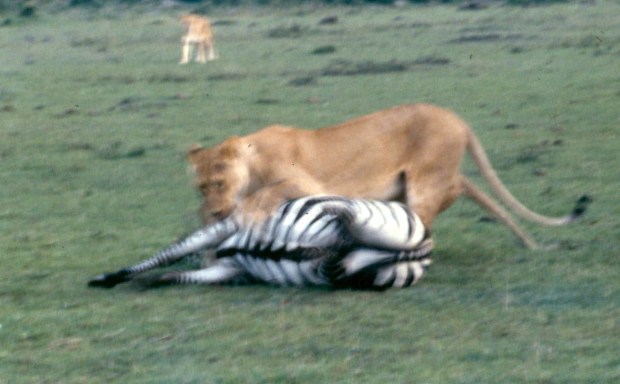
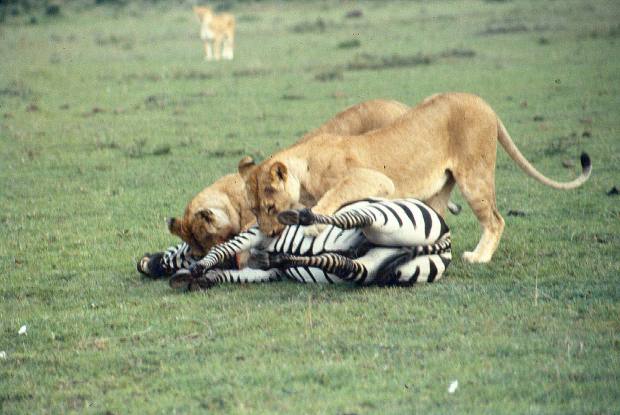
Soon it was clear that, despite the zebra’s final spirited effort, the chase outcome was a foregone conclusion as soon as the lioness reached the zebra and managed to place one paw on its rump, the zebra lost its equilibrium and crashed down to the ground while the lioness immediately reached for its throat. Luckily there was lots of grass and no dust so we could observe the action clearly. After a few seconds another lioness arrived and helped the first one to anchored the zebra down.

mmara lioness killing zebra copy

My first picture from the moving car shows the moment the second lioness joins the kill. A third one is seen coming in the background.

mmara lioness killing zebra 7 copy

A better photo once we stopped.

mmara lioness killing zebra 7 copy

A better take once we stopped.

Lions killing zebra m mara 7 copy

Mesmerized by what I was watching and photographing, I was still on the roof rack by the time we stopped to watch them only a few metres from them! Although they were clearly not interested in me, somehow I managed to dive into the car through the open window (not easily done with the sliding window of a Series II Land Rover but clearly possible under duress!). Once inside, I continue to watch the action and take more picturees. We were both speechless while more lions kept coming from various places to join the kill.

mmara lioness killing zebra best 3 copy

The arrival of the male. The white foggy marks are the windscreen wipers.

My romantic view that a lion kill was a clinical affair where the victim dies fast and in shock was shattered. The zebra took several minutes to die, while the whole lion pride arrived and some of them started to lick it while the animal was clearly alive although in deep shock by now. Eventually it expired and we were fortunate to have enough time to observe the interaction of the various members of the pride, including the arrival of the male that came “straight to the kill” and scattered all others while positioning himself near the hindquarters, ready to enjoy the best cuts!

We only left the scene at nightfall as -luckily- we knew the area well. The lions -mainly the younger- were still feeding while most of the adults were now doing nothing but washing themselves and then resting belly-up. We heard the jackals and the hyenas starting to call and soon they were approaching to the carcass that, by now, was more than half eaten. Thinking on seeing how it would be the following morning, we memorized a few features to be able to come back to the area that happened to be outside the reserve.

The following morning, we arrived to the spot but had difficulties to find the kill. Only after a careful search we stumbled upon the zebra’s clean skull and a couple of bones. That was all that remained from what yesterday had been a living zebra! Luckily, about 500,000 migrated every year intermingled with the wildebeest so one less was not going to make too much of a difference!


[1] In Africa, a narrow steep-sided ravine formed by water erosion but usually dry except in the rainy season.

Lion skull

field-100nn-test-intona-copy

Young Borana cattle at Intona undergoing tick resistance testing.

While visiting Godfrey at Laikipia to buy cattle for my Intona ranch trials, I was of course invited for a cup of tea by him and his wife. We sat in the veranda to enjoy the afternoon and talked about our activities for a while. It was soon time to go so I thanked them and stood up to leave. Then I noticed the skulls!

Four or five lion skulls were blanching on top of their house roof and Godfrey explained that they had been there for years. Some had been taken from lion carcasses found at the farm but others were from animals that needed to be destroyed as they would become “cattle-eaters” and be too much of a nuisance in a cattle ranch. Being a conservationist he expressed regret at this but it was necessary as trans location was not always advisable or even possible [1].

Without thinking much, before I left, I mentioned that if he ever had one skull too many, I would love to have it. He promised to remember my request and we soon parted company, as I needed to get back to Nairobi to organize the transportation of my recently acquired cattle herd.

For a few weeks after buying the cattle I was extremely busy organizing the two simultaneous trials in Muguga and Intona ranch to pay attention to anything else. So, when Veronica, our Muguga secretary, told me that Mr. Godfrey had called, I made a mental note to call him back but soon forgot about it. A couple of days later, I was at the office when a new phone call came, this time from Godfrey’s secretary. I picked up the phone to hear “Are you Mr. Castro?” [2]

I knew I had paid for the cattle so I was taken by surprise by the call. “Speaking” I said, “Mr. Castro, I have been calling you for a few days” she said rather too sternly I thought, “Could you please come to the office to collect a parcel that Mr. Godfrey left for you?” and added, “I do not know what is in it but it smells terribly”. I thanked her and rushed to their office in Nairobi having a fairly good idea of the contents…

The parcel was rather large and it was indeed very stinky! I thanked the relieved secretary and walked out. As I moved through the building, people let me pass while looking at me with expressions that varied from disgust to amusement but no one, not even the security guards approached me. I was clearly perceived as someone who could do with a bit of soap and water. The situation reminded me of boarding a public bus as a veterinarian in Uruguay after performing some post-mortem work. I could always find a an empty seat as people would keep clear of me and my “perfume”.

Although used to strong “natural” smells, as fast as I could, I got home. I unwrapped the parcel in the bath and a letter slipped out of it. It was signed by Godfrey and it said that this young male lion had roared nicely for a while until one day it decided to have a go at his cattle and in one night it killed several of them. He could have lived with that but the lion repeated the attack the following night without any obvious reason as it had plenty of beef to chose from already! So, unfortunately, he had to shoot it.

It was a great skull that I still keep today, together with the “covering” letter that I know I still have somewhere! I cleaned it thoroughly and boiled it for hours to get it totally clean. I was lucky that no one at the block of flats where I lived complained as the smell was still not nice!

As the skull is packed somewhere, I present you with an embedded picture for you to appreciate that they are really designed with emphasis on the eating rather than on the thinking!

Embed from Getty Images


Although I tried to phone Godfrey to thank him for the gift, I never managed to talk to him again.


[1] We saw the consequences of this while camping at Aberdares National Park in my earlier post. See: https://bushsnobinafrica.wordpress.com/2017/08/04/bad-lions/

[2] My surname has always been complicated as it is “de Castro” and not “De Castro” as the Spanish-speaking world wishes to write it. While this is a minor issue, in Africa it became more interesting as the “de” was normally dropped and then I became “Castro”, “Caster” or my favourite: “Castrol”

Magic realism?

The Merriam-Webster dictionary defines magic realism as “painting in a meticulously realistic style of imaginary or fantastic scenes or images”.[1] I thought that magic realism was the stuff of some writers in our presently far land of South America such as García Marquez or Borges. My mind changed yesterday morning.

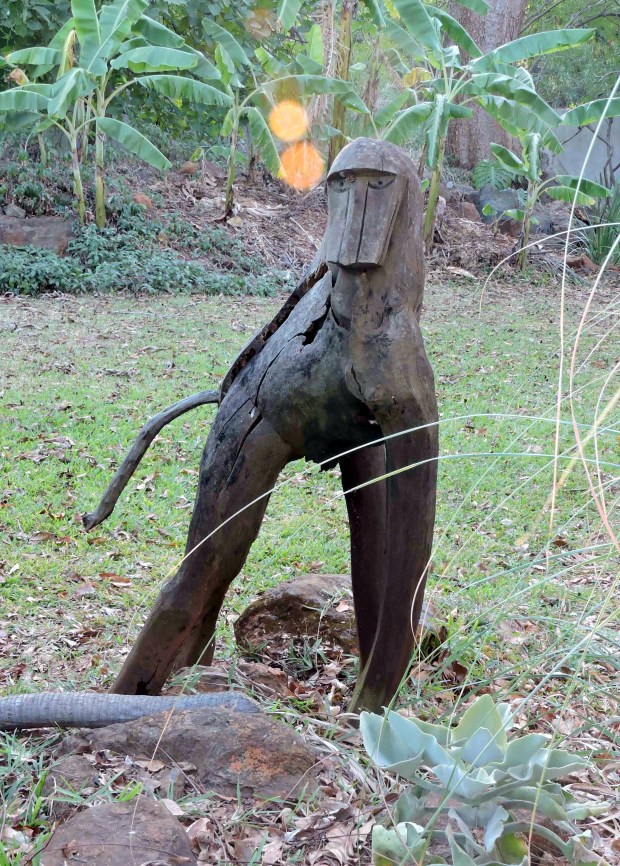
We found the wooden baboon behind the garage when we returned to our house in 2013. As the place had been rented to various tenants during our twelve-year absence, neither us nor Stephen-our caretaker- know how it got there. Although ugly, it has been allowed to stay as we are somehow fond of it.

DSCN0030 copy 2

So, yesterday when my wife shook my otherwise placid lunch hour by shouting “Look! Nero is chasing a baboon!” It took me a while to react and join her at the kitchen window, too late to actually see our dog breathing down a large and furry baboon’s neck across our driveway! However, I did spot the primate after it managed to climb a tree next to the garage. Although this gave the monkey a pause to rest, it soon jumped off and ran again with the dog in hot pursuit until, after a second, it was lost behind the garage.

By the time we managed to get out of the house and arrive to the seen, all that remained was a very agitated dog but there was no trace of the fugitive. We climbed to the vantage point that enables us to look at our neighbour”s garden but we saw no further signs of the baboon. It all happened so fast that I started to believe that it did not happen. For obvious reasons I will omit my wife’s reply when I hinted this to her!

Then, with the corner of my eye I saw the wooden baboon and understood it all. We had noted that over the years he had been gradually eaten by termites and transformed into a dry mud-filled wooden husk and I am convinced that yesterday it was the exact time when its spirit left the shell to go wherever baboon souls go, before the next rainy season finally dissolves its crust into oblivion! Unluckily for the soul, the dog saw it and hastened its departure.

I am convinced that this is what took place but, please note that I have not shared my explanation with anyone, yet…


[1] https://www.merriam-webster.com/dictionary/magic realism


Bad lions

Sometimes, because of the amount of work I had, we could not travel far during weekends and even when going to a place relatively near, our arrival would get delayed. Short safaris of this kind included lakes Naivasha, Nakuru and Bogoria, Amboseli and the Aberdares. We had visited the Aberdares National Park on day trips earlier but these had only given us a very superficial view of the park. This time we planned to spend one night camping and to explore the park a bit more. Unfortunately I had work to do and we could not leave before lunchtime.

Reading our Kenya guide [1] had prepared us for what we would face and I quote: “Steeper, starker and with denser rainforest, the Aberdares (save for the South and North Kinangop) were less settled and farmed than Mount Kenya. For this reason too, they sheltered Mau Mau strongholds, kept flora and fauna intact… and so warranted preclusion as a 228 square-mile National Park in 1950.” Hoping that all the Mau Mau had gone by the time we arrived, we got some charcoal and fresh plums from the roadside vendors near Limuru and went on.

We drove on tarmac towards lake Naivasha and turned eastwards just in front of the Longonot volcano. More from our guide: “Rainfall -80 inches p.a.- makes the steep tracks often impassable… if rain or mist waylays you en route, do not despair: the ‘black cotton’ may spin your car uncontrollably but is seldom deep. So rather than dodge the wheelruts… grit your teeth and stay in them, hard in second gear. They will keep you moving roughly frontwards and, even when waterlogged, should not bog you down.” I enjoyed the author’s sense of humour and thought on the power of our kombi’s engine!

Aberdares 2 5.32.37 PM-001

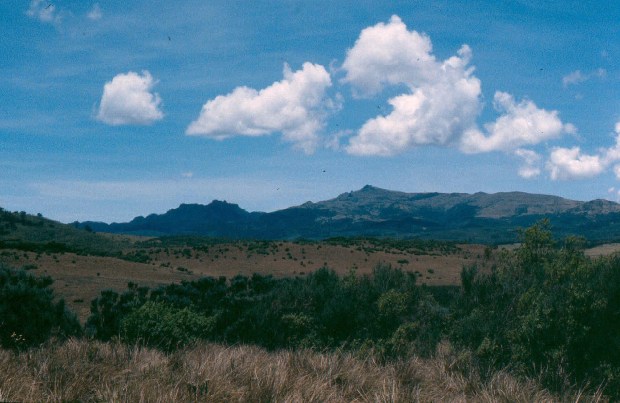
The Aberdares mountains from afar.

By the time we reached South Kinangop it began to rain and things started to get tricky. All the guide had said was true to the point that turning around would have been a risky manoeuvre! So, as usual, aware that our kombi had a good clearance, we decided to continue and skidded along for the remaining distance until, rather late, we managed to arrive at the gate. I think it was the Matubio gate but I am not sure. Despite our tardy arrival, the ranger let us entered. He probably saw the car’s mud and our look of desperation and thought that we could do with a altruistic welcome!

He mentioned that there was a campsite nearby that we could occupy so we paid and went on, following his directions, hoping to find the campsite soon. We were still driving in the dark after 20 minutes so we realized that we had missed the recommended campsite. Luckily, the rain had stopped but the way was still slippery and slow. We pushed on looking for a suitable spot where to pitch our small tent (at that time we had purchased a second hand mountain tent that although suitable for this occasion, it left us rather “exposed” to the potential night visitors!).

Eventually we found a flat moor and decided that it would do. I started to manoeuvre the kombi careful, avoiding getting into the mud as much as possible until I considered it to be on level ground. I was about to leave the car when I heard a loud “Stop!” coming from my wife. I looked up and, in the headlights of the car, there were about 8 adult lions watching us. They looked rather huge and very white considering the heavy rain we had experienced. As they were also dry, it was clear that they had come out from their rainproof shelter very recently. They started to walk towards us, not the usual behaviour from lions, we thought!

There were four adults and four almost full-grown individuals. The latter were the ones showing the greater interest on us! “We better move off”, my wife said firmly and, almost before she finished her sentence, I was reversing the car, hoping that we were not on soggy ground. We managed to put some distance from the lions and they stopped coming so I turned around and we departed. We drove a few more km until we considered that we were sufficiently far from the lions and then we held a short discussion regarding our camping options. It went something like this: do you want to sleep in a tent?” I said. “No” was my wife reply. Another short family discussion leading to an immediate agreement!

I removed the back seat of the kombi and put it outside while my wife was heating up some pre-prepared food we had brought as we normally did to make our camping lives easier. We dined sitting at the floor of the car and, when we were ready to sleep, we placed our mattresses on the floor. The place looked almost comfortable! While the rain started again we got into our sleeping bags and dozed off almost immediately. I briefly thought about being bogged down the following morning but I was too tired to care and convinced myself -easily- that that would be tomorrow’s problem, and I was gone.

The cold woke me up after midnight! It was a chill that was coming from my back so I started to assess the situation when realized that my wife was also awake. “Did you hear the lions?” she asked. “I would have done if my teeth would not shatter so much” I replied. Then they roared again so near that I was amazed with myself at not having heard them earlier! I felt well as we were better better sheltered than we would have been inside our small tent! But our metal cage was incredibly cold! Eventually, we managed to stick some carton and newspapers between the metal floor and our backs and this, plus putting on all suitable clothes made the trick and soon the roaring faded and I woke up well after dawn, unusually without the need of a night visit to the toilet!

The rain not only had stopped but the sun was shining. A good look at the surrounding grassland did not reveal any lions so we could perform our postponed bodily functions, re-assembled the car seat and have a much needed breakfast under the sun. We felt well and decided to look for the lions now that there was good lighting. We drove backwards and forwards for a while but failed to see anything. Disappointed we decided to explore the park further and enjoyed its beautiful vistas and amazing waterfalls and rivers.

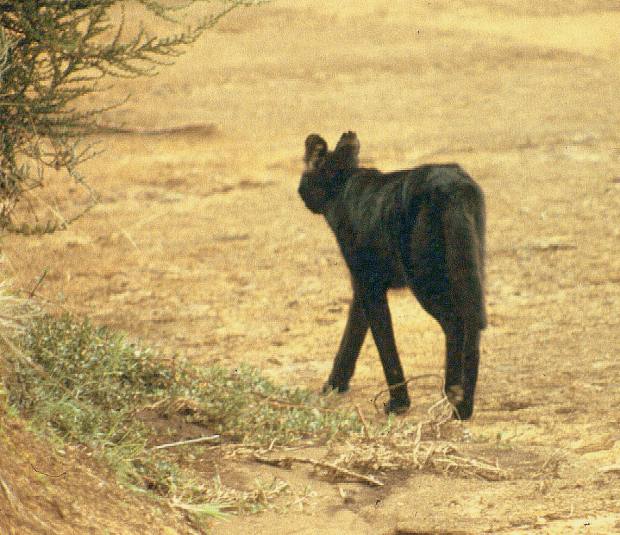
Soon it was time to start our return and, as usual, wishing that we could remain longer, we started our return. We had driven a few km when, as usual, my wife spotted something walking in the same direction we were driving. The animal was about 100m in front of us. We checked it with the binoculars and it was a black cat, smaller than a leopard! We drove slowly on and got a good view before it veered into the bush and disappeared. Its size and shape gave it away as a black caracal, an unusual sight.

We knew that melanistic animals did occur in the Kenya highlands and we had seen black Augurd buzzards earlier during the day.

Aberdares mel augurd buzzard-001

A melanistic Augurd buzzard in the Aberdares.

We had also heard about black leopards that were sometimes spotted there but the caracal was special!

Aberdares mel serval-001

The only snapshot possible of the Black serval just before it disappeared.

Our Kenya guide, however, added some light to the find: “Besides golden cat, bongo and Giant forest hog, the Aberdares’ rarities are Black leopard, Black serval and Black genet… Spotted lions remain unquestionably a legend”. The guide did not mention whether “huge white lions” were also mythical as we were sure that the ones we found the night before were unspotted and real!

nnp serval-001

A normal serval cat at Nairobi National Park.

Our trip back was dominated by the conversation about the lions and the Black serval. We enjoyed the good weather and we got to our house in Tigoni in good time. Days later, consulting other wildlife enthusiasts, we learnt that a number of “problem lions” that killed livestock had been relocated to the Aberdares and that this had sparked quite a degree of controversy as it made walking in the park a dangerous activity now. To make matters worse, it was believed that these lions were less wary of people than their “wild” relatives and were not afraid of approaching humans!

We were of course unaware of this bit of rather important information at the time of our visit and lucky we saw them before they found us! During late visits we spotted the lions again and they did not look as white and huge as the first time.

aberdares jc copy

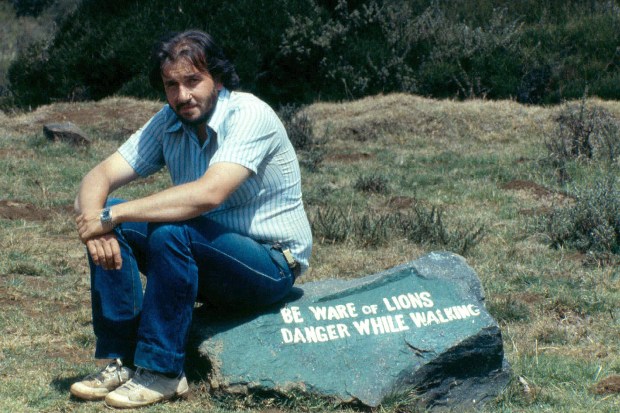
Later we saw the warning signs.

[1] Tomkinson, M. (1981). Kenya, a holiday guide. Ernest Benn Ltd, London. 144p.

The Kombi falls

I will be unfair if I would not say a few words about our VW Kombi. It seems that these days these vehicles still attract quite a lot of attention among car lovers. Although I never saw it in this light at the time we had it, they dominated the minibus market and most of the Kenya safari companies used them. Then VW came up with a new model that was not as good for rough roads as their back doors became undone and needed to be welded to keep them shut! Very soon afterwards the Japanese minibuses replaced them.

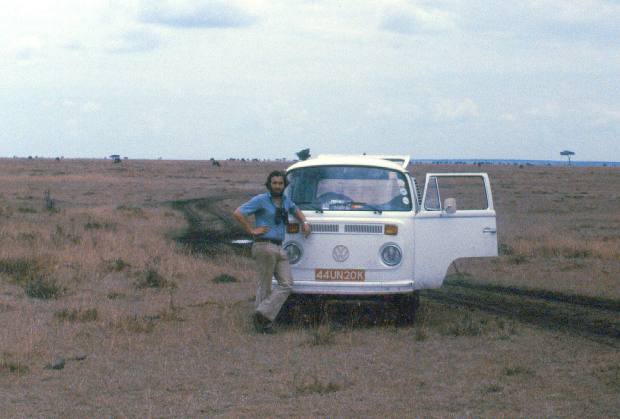
m mara kombi

A young-looking Bushsnob posing with the kombi after driving through a muddy Maasai Mara Game Reserve.

The Kombi had, like any vehicle, good and bad features. My first concern was safety, as I had never driven a car with the engine at the back and I felt rather vulnerable in case of an accident, particularly the way driving in Kenya was in those days! I also needed to fit seat belts, surprisingly absent in a UN vehicle! Its lack of 4WD was another rather serious drawback and I recall several instances of getting stuck in places that a 4WD would not even have skidded!

l naiv july 82 after being stuck

My wife (red shirt) and our friend Aurora resting after pushing the kombi out of the sand at Naivasha. July 1982.

One particularly bad instance was at Amboseli National Park when, trying to approach the swamp to get a better view of an elephant, we ended up into soft black cotton soil. This kind of mud sticks to your wheels filling their threads so your tyres soon become smooth! Fed-up of fruitlessly attempting to get the car unstuck I placed our BBQ grid under one of the wheels to see if I could get some better grip. It was good and bad. We got out of the spot but the grid got somehow ejected with such force into the thicket surrounding the swamp that we never found it again and had to cook our chicken on a stick that night!

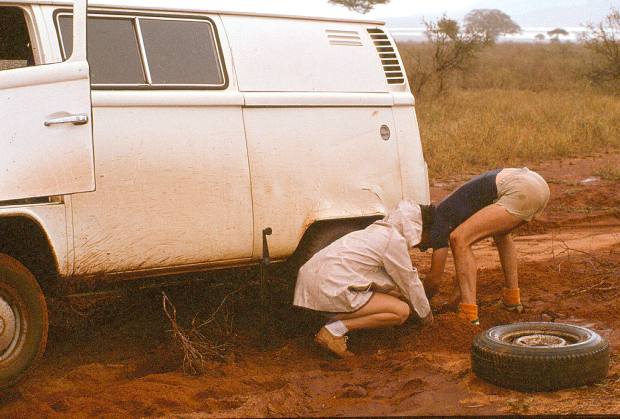
Tsavo W stuck with paul rossiter

Stuck again! This time on a rainy day at Tsavo West National Park. My wife -with the raincoat- and Paul lifting and digging to place the spare under the wheel to get some grip.

It also had the rare ability of losing traction and stopping while driving slowly over a gully or when crossing a culvert diagonally as its chassis somehow would get twisted leaving one wheel in the air spinning hopelessly! In order for the car to move again it needed the assistance of one passenger to stand on the back fender and sometimes to jump in order for the offending wheel to grip and the car to move. While this was not a great problem, imagine doing it on a ditch full of muddy water!

Snapping the clutch cable was another “Kombi special”. As you can imagine, this cable needed to transmit my left foot’s instructions for quite a distance before it reached its destination so it was a weak feature and one that left us stranded. Luckily only once. Eventually, apart from learning to fit a new cable and carrying a spare, I learnt to operate without the clutch thanks to Joseph, one of the Muguga herdsmen that taught me how to start it and drive it without a clutch! I would engage second gear and then start the engine. The car will shudder, shake and jump forward until it got going. After a while you could change gears upwards if you knew the right speed. Changing downwards was not easy so stalling at stop signs was unavoidable! Although not a long-term solution, it would get you back home or to the mechanic.

On the side of its virtues, it had great ground clearance, a reliable engine that never had a problem despite its mileage and, being two of us, it also had lots of space to carry supplies and materials for my work as well as to take all of our gear on safari (and that is a lot and increasing!). Removing the second seat we could sleep inside if the circumstances so demanded. Its sliding door made for great game watching; particularly driving around lakes (with the door facing the lakeshore, of course) enabled superb birding.

I drove the car intensely between Tigoni, Nairobi and Muguga during the week and all over Kenya during the weekends. That particular morning I had come to Ranjini´s house to bring her some vegetables that I got for her in the Limuru market, close to Tigoni. The clutch cable had snapped while entering her house but then there was worse to come…

Ranjini worked as a scientist with the then Overseas Development Administration (now the Department for International Development of the British Government attached to the Kenya Agriculture Research Institute (KARI) in Muguga where she also lived. We had met while sharing accommodation at Muguga House, KARI´s visitors hostel [1].

“Clutchless” I crawled into her garden and did a jerk-stop. Although I carried a spare cable and I woud have been able to fix it then, it was not a short exercise as its calibration took a while and I needed to get back home. Further, we had plans to travel far in a couple of days so it needed proper fixing. So, having given Ranjini her shopping I assured her that I would be fine and left her rather worried by means of another jerk-start departure.

With my mind focussed on keeping the car going I forgot to fasten my seatbelt, an essential precaution when driving in Kenya. I was going very slowly down Ranjini’ s driveway when I decided to buckle up. I had never noticed that particular pine tree but I am sure that it had been there for many years and not moved much so it was not the guilty party! Neither had I seen its protuberant roots reaching towards the driveway. I still did not that day, I only felt them!

Everybody know that buckling up in movement is not recommended. It requires a few seconds of focusing your mind on the belt as well as some handless driving. A lot can happen over those few seconds. I remember feeling the left wheel rising over the roots and, as I tried to break, the car shuddered, stalled and stopped. However, in a bewildering feat, it gradually started to tilt towards mi side. My surprise quickly turned to panic and then resignation: the car was falling on me in slow motion.

My immediate thought was to try to stop it by sticking my hands through the window but -luckily for me- events happened faster than my thoughts and a thump followed by a shower of spanners, driving licence, car book, nuts and bolts and all things that one carries in a car’s shelf fell on me! The Kombi was now securely resting on its right side and only the door separated me from the ground that I could touch as my window was down.

It was an upset Bushsnob that emerged through the passenger’s window! Once outside I could contemplate my sublimely stupid achievement and promised myself never to try the seat belt trick while driving again. To say that I was also embarrassed when I walked back to Ranjini’s house is an understatement. She had just sent me off and closed the front door and I there I was again! I am sure that she thought I had forgotten something. When I told her what had happened, her expression changed dramatically! “Are you all right?” she asked with genuine concern. I told her that I was fine and invited her to come and have a look at my masterpiece!

We walked to the beginning of the driveway and we had a clear vision of the Kombi peacefully resting on its side! She gasped and while she recovered, I asked her if Njuguna, her gardener, was around. She immediately called him. He came and joined the unbelieving crowd expressing his regrets.

“Njuguna, please give me a hand to put it up again” I said estimating that most of the weight should be on the underside and therefore not too difficult to bring the car back to its normal position. Looking somehow doubtful he came along. Although I did not look at Ranjini, I am sure that her expression had changed to amusement! I could not blame her.

The effort required to put the car upright again was easier than I thought and the car bounced on its wheels as it got upright again. Apart from a broken side mirror and a few small dents and scratches on the side, the car was in good condition and driveable. I thanked Njuguna, said farewell to Ranjini, buckled-up, jerk-started it and drove off, still upset at my stupidity.

It was only weeks after the event, after I had replaced the mirror and got the dents painted that I could see the funny side of this rather freakish accident that even today I find rather incredible. I regret not having a picture of the car and the faces of my rescuers when they saw it to show it to you. It was all memorable and -in retrospect- quite funny!


[1] See: https://bushsnobinafrica.wordpress.com/2015/03/10/kenya-muguga1/


Spot the beast 26

We are very pleased to be back in our marvelous garden in Harare, always full of interesting findings.

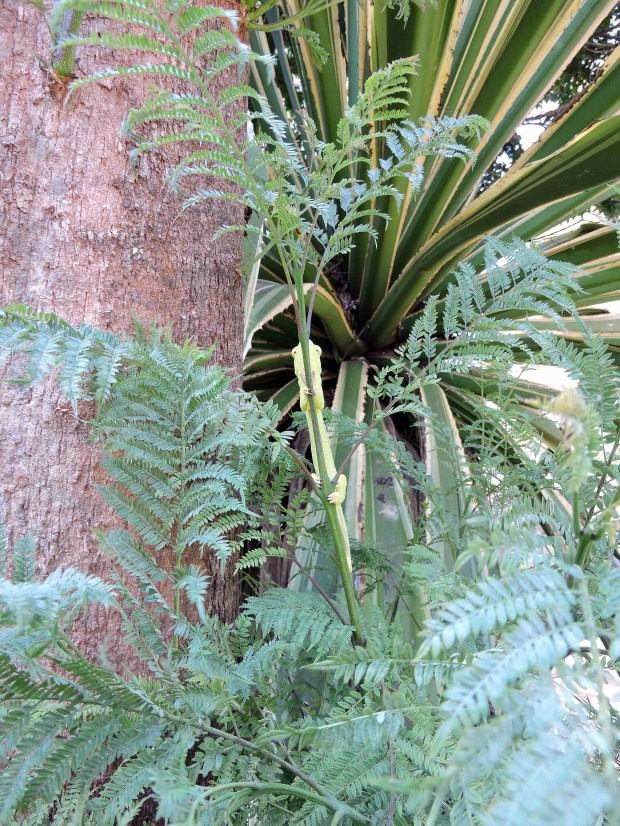
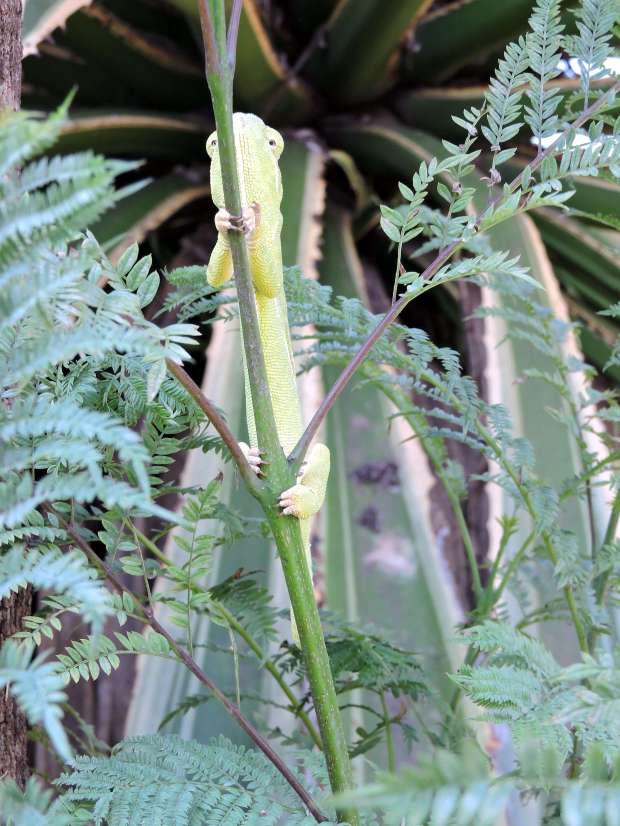
Because of the prevailing cold weather combined with the very good rains Zimbabwe had, most garden creatures are still keeping a low profile. However, as usual, my wife called me the other day to see what she had found. This is what she spotted:

DSCN9976 copy


DSCN9977 copy

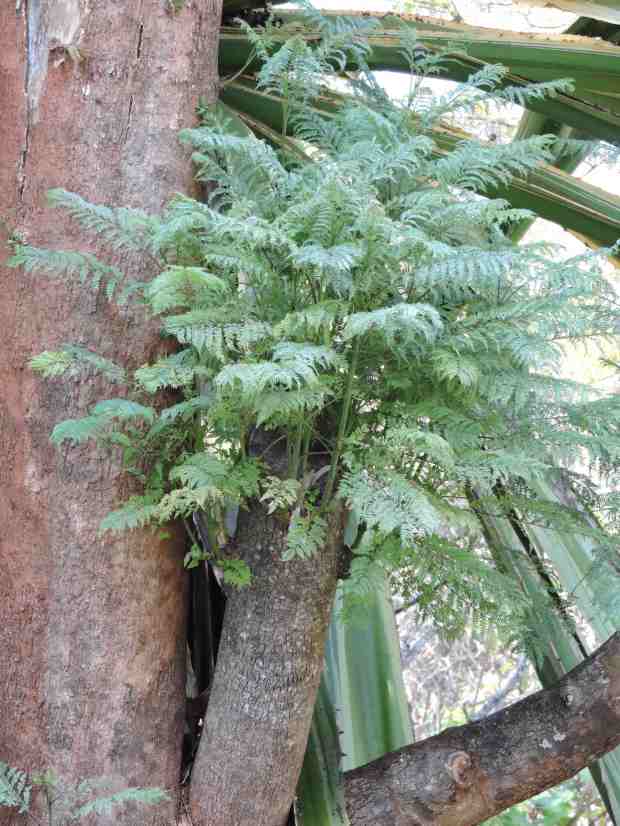
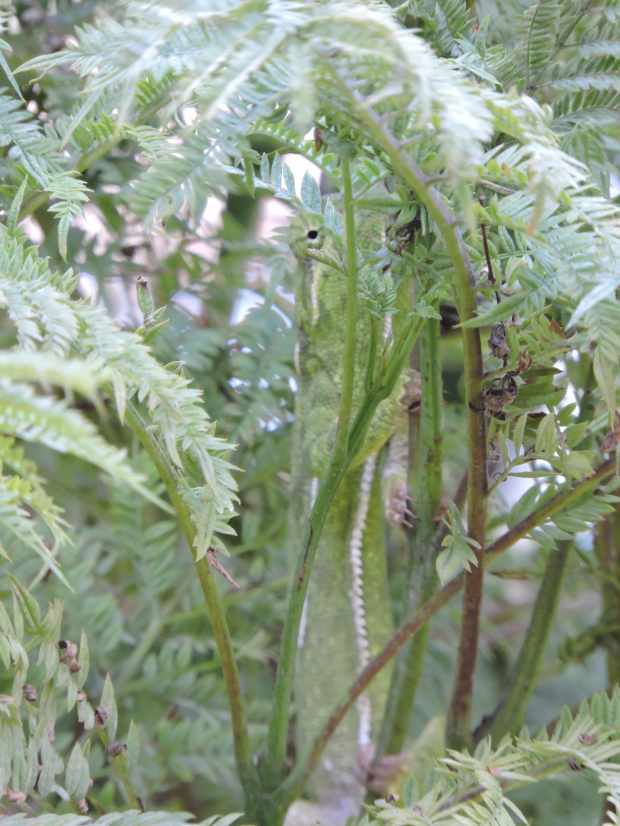
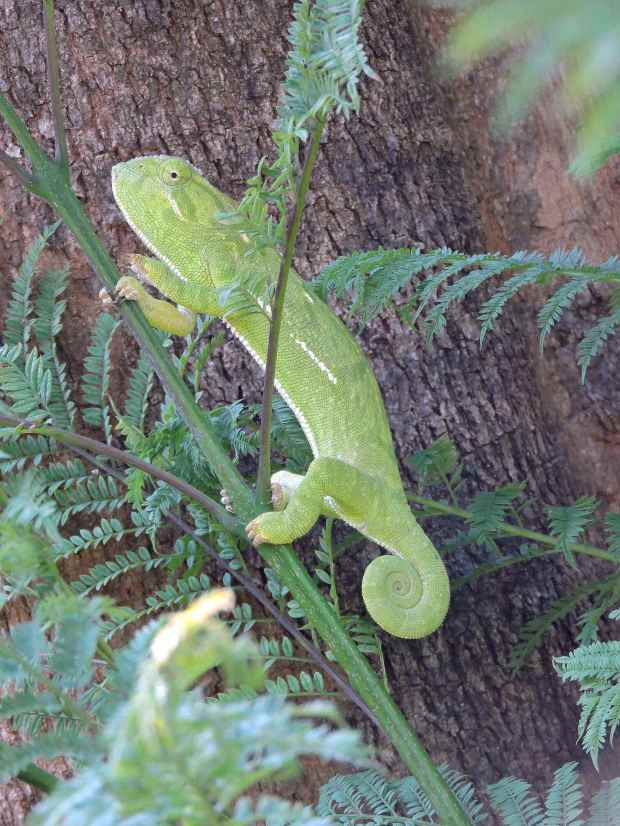
I know, it is a very easy one! However, when you look at the young shoots of the jacaranda where my wife found it, it would have been almost impossible for you to see it as it was for me in real life! This is the picture and I assure you that the chameleon is there somewhere!

DSCN9958 copy

Only the eyes reveal it below!

DSCN9960 copy

Finally, a proper picture of the beast in question. I really like its rolled up tail!

DSCN9979 copy

Kenya memoirs – Buying cattle

Once it was decided that my experimental work in Kenya would take place in Muguga and Intona ranch in the Transmara, I needed to get cattle. I was lucky that there were suitable animals available at the Kenya Veterinary Research Institute (KEVRI) at Muguga that I could select for my work there but I still needed to get the necessary animals for Intona.

Experimental cattle Isolation unit copy

The Muguga animals came from the KEVRI herd.

As I needed young cattle with no exposure to ticks and tick-borne diseases [1] I needed to go North where I could find them in an environment that would not allow the ticks to thrive. The purchased cattle would also have to be acceptable by Joe Murumbi [2] the owner of Intona ranch as, after the trials were completed, the cattle would remain there. That was not an easy choice! However Alan, helpful as usual, suggested that I bought Boran cattle from a ranch at Laikipia in Northern Kenya. He had purchased animals from there earlier and found them suitable. He immediately put me in touch with Godfrey, a rancher that bred Boran in Laikipia and I arranged with him to get there to chose about 30 young cattle.

Within a couple of days I had visited the farm and bought the animals. I also arranged that I would come to collect them a few days later, as soon as I could get transport organized. After my return I made enquiries among the veterinarians at KEVRI and found a lorry company that was prepared to go to Laikipia and then carry them all the way to Intona in the Transmara, a journey of about 700km that was not straight forward.

I would accompany the lorry throughout the trip to make sure that it would get there and to make sure that the cattle were well treated. I agreed with the company’s owner that I would get an experienced and responsible driver that knew the route and I also checked the vehicle to make sure -as far as I could- that it was in good nick and that it was suitable for the number of animals that we needed to transport.

I prepared the trip very carefully as I was spending a lot of my budget on this purchase. The final plan was that I would travel with Tommi, my Maasai herdsman (see the “Angry Maasai” post) and Mark, a young Kikuyu that I had also employed to assist me with the cattle work. They would keep me company, help with the cattle as well as performing communication duties on KiSwahili, Kikuyu and Maasai languages, just in case!

I planned a conservative itinerary that, leaving very early from Muguga would see us all the way to the ranch at Laikipia (260km), load the cattle and proceed as far as Nyahururu (160km) to spend the night there. During the following leg of the trip we would get to Kericho (170km) to spend the second night and finally travel from there to Intona via Kilgoris (110km). It was the “long way” to get to Intona (the normal one being through the Rift Valley, via Narok and Lolgorian) but, apart from the two ends -Laikipia and Intona- the roads were tarred and the loaded lorry would face less risk of a breakdown.

Despite all the planning, the departure got delayed! The lorry did not turn up on time and when it did, about an hour late, the driver handed me a letter. It was short: the experienced driver was sick with malaria so they had sent me a replacement! The new driver was praised and the company owner was also apologetic. Despite this “bad omen”, it was all set so I decided to continue with the planned operation.

Despite our late start we managed to get to the ranch, load the cattle and get back to Nyahururu. It was night by the time we drove into this highlands town as, to our late departure a rather bizarre incident delayed us further. While on the road about 50km after leaving the ranch through a dirt road I was in the front when, suddenly the lorry came to a grinding halt while flashing its headlights. I immediately turned back to see what the matter was and, as soon as we drove past the lorry, my heart sunk. There was no tailgate and we were being watched by a few Boran cattle about to jump off the back of the lorry! That would have been a disaster as in that part of the country there are no fences and probably the animals would have run away!

Luckily, before they could estimate the jumping height, Tommi and Mark were on them and managed to stoped them and to hold them onboard while I retraced our steps to look for the gate. I found it about 200m behind the truck. The securing bolts had vanished. I loaded the large and heavy gate as well as I could into the back of the Land Rover and drove back. Without hesitation, with the use of the ubiquitous piece of wire, it was soon secured back in its place. It was now probably safer than before, particularly against theft as it would be impossible to open it without a long struggle!

Our night at Nyahururu was very cold as usual but -luckily- uneventful. Despite the low temperature I did get up at midnight to make sure that truck and animals were still there. As usual the hotel’s watchman was sleeping and as usual immediately woke up to report that all was well. Feeling really cold I went fast back to bed and slept soundly until morning.

We left early for our second leg that would take us to the beautiful tea-planting area of Kericho. All was going well until we had a puncture. We told the lorry to go on as we were sure to catch up with it after the wheel change. So, as soon as we fitted the spare we moved on expecting to find the truck anytime. However, as we drove for a while we realized that although by then we should have found the truck, we had not! Eventually we entered Kericho “truckless” and worried!

We fruitlessly drove around Kericho, not a very large town then, and, empty-handed, decided to retrace our way for a few kilometres. Still no truck! As there were no cellphones, we had no way of communicating with our lorry so it was a despondent group that checked in our hotel that evening. We had no idea of what had happened and we could only hope that we would find the truck in the morning. We guessed that the driver must have gone past Kericho in the hope of covering more distance while he could but this was pure speculation.

I would not lie to say that my dreams were of cattle counting as I did not sleep very well that night. I blamed myself for not stopping the lorry to wait for us to change our wheel. Anyway, the night eventually over we set off towards Kilgoris, still searching for our lost truck! The more I drove without seeing the lorry, the more the idea of cattle theft became fixed in my brain but I kept quiet, hoping that I was wrong.

After driving to Kisii without luck, my hope of ever seeing the lorry started to fade fast! We got to Kilgoris and drove all over this small town and failed again to get any results. As Kilgoris was (and probably still is) a quiet Maasai town, we thought that a cattle-loaded lorry would be the town’s main attraction. Those who Tommi asked had not seen anything so we were convinced that the lorry had not been there!

We were parked at the Kilgoris “plaza” finding out how to get to the Kilgoris Anti Stock Theft Unit of the Kenya Police to report the incident when we heard a loud engine noise and our lorry (with our cattle still on it) suddenly arrived! I was so relieved to find it that I felt no longer any anger and I knew that I would be close to the lorry for the last 20km to Intona!

The driver was clearly as comforted to find us as we were to see him! He explained that, after overtaking us, he decided to pass Kericho and spend the night at Sotik, 50km further on, as this would save him travel time. He admitted that this was a mistake and he felt truly sorry. I accepted his apology and decided that it was time to move off towards Intona. We still had the final distance to cover through an often muddy track and I wanted to reach the place before nightfall to offload the cattle so that they could rest, eat and drink after such a long journey.

Luckily the road was passable and we managed to reach the ranch still with some minutes of daylight left that enabled us to see that all animals were in good condition despite their three-day ordeal.

They soon settled at the ranch to the constant admiration of our Maasai neighbours and visitors as well as some hitches [3]. They were not beautiful animals but an essential part of my field work.

I had never felt as exhausted in my entire life than that night at Intona ranch. Luckily I had a comfortable bed at a nice house to spend the night and recover.

field-100nn-test-intona-copy

The Boran cattle enjoying the green grass at Intona. The ear bags were part of a test to assess their resistance to ticks.

t-mara-intona-ranch-j-murumbi-1-copy

Murumbi’s house at Intona, where I spent the night.


[1] The Brown Ear Tick Rhipicephalus appendiculatus vector of theileriosis caused by Theileria parva.

[2] See: “Joseph Zuzarte Murumbi” under pages in this blog. https://bushsnobinafrica.wordpress.com/joseph-zuzarte-murumbi-1911-1990/

[3] See: “The cattle are gone”. https://bushsnobinafrica.wordpress.com/2014/07/19/the-cattle-are-gone/