Animals on the runway

On 16 August 2016, the El Sauce International airport in the top beach resort of Punta del Este, Uruguay stopped functioning for a few hours. The stoppage was not caused by a strike of air controllers, airline crews or baggage handlers. Although cold for going to the beach, the weather was clear and the visibility was excellent.

Taking advantage of the nice day a dairy cow had squeezed through a breach in the airport’s perimeter fence and decided to have a different grass variety for lunch. Her feeding activity near the 01-26 runway was immediately detected by the control tower that initiated the relevant emergency protocol.

This resulted in the closure of the airport. Messages for flight cancellations/delays were sent to all airports from where flights to El Sauce airport would depart. Aerolíneas Argentinas flight AR 2346 departing for Buenos Aires was also cancelled and the passengers travelled by taxi and airline bus to Montevideo for a rescheduled flight. Meanwhile, oblivious to the chaos it created, the cow continued grazing happily!

Part of the emergency protocol included the capture of the intruder and, although Army personnel were quickly mobilized, they were not immediately successful and at some stage the tension escalated when the cow disappeared from sight! Eventually the cow, belonging to the Army’s herd located at the nearby military base, was captured and returned to its lair. The all clear was given and the airport was reopened[1].

Luckily this did not take place at a busy airport and the disturbance did not cost as much as when a family of monitor lizards, jackals and raptors entered the New Delhi international airport’s secondary runway and remained there for one hour before being evicted by an animal rescue team. The incident forced the closure of the airport and approximately 100 flights were delayed at a cost of several USD million[2].

I can just imagine passenger losing connections in other airports and trying to get compensation mentioning that monitor lizards delayed their flights!

Obviously, when flying to tourist destinations in Africa, wild animals on the runway are an expected occurrence. The pilots, almost invariably, do a first low fly over to scare intruders and only land the aircraft when they see that the landing strip is clear, at least for the time. It is common to see the animals coming back to graze on the runway a few minutes after the disturbance is over!

Bush “airports” do not close due to stray animals on the runway, the latter are part of its “personnel”!


[1] http://www.elpais.com.uy/informacion/vaca-le-complico-dia-aeropuerto-laguna-sauce.html and http://www.lanacion.com.ar/1928651-una-vaca-paralizo-las-actividades-del-aeropuerto-de-punta-del-este

[2] http://www.atimes.com/atimes/South_Asia/JF21Df03.html

Spot the kudus

Just arrived from the Mana Pools safari.

While I organize the pictures and the posts written but yet not checked, I give you this task.

While watching animals at dusk in one of the Pools that give the name to the park, we spotted the two kudus of the picture. Can you spot them? It is not easy but I promise you that they are there somewhere.

DSCN9900 copy

As usual, below the “beasts” are revealed…


DSCN9899 copyIt was tough, I know!

Social beasts?

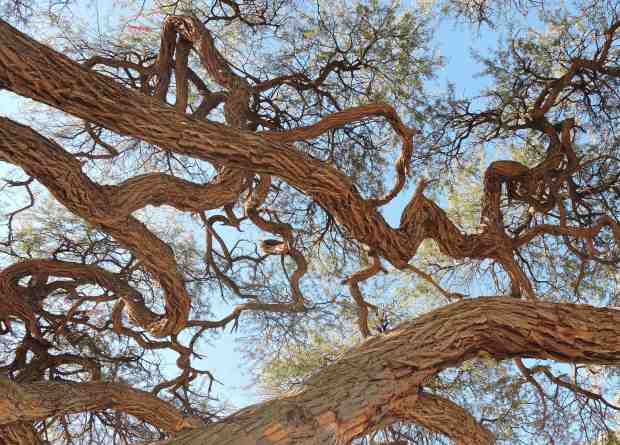
As you know if you followed this blog, this past August we visited Hwange National Park and camped at Ngweshla picnic site. The site is well shaded by some nice large trees that is very good during the hot months but that makes it very cold during the winter as we had suffered last year.[1]

DSCN9969 copy

A view of the canopy above us at Ngweshla.

This time the temperature was slightly higher and we were also much better prepared for the cold. I had even succumbed to peer pressure and acquired a pair of long johns to sleep in, in addition to a thermal bag that fitted inside the sleeping bag! The only challenge remaining were the possible night visits to the Gents that required little thought and fast action!

Camping at Ngweshla is always exciting as usually lions walked very close and their roaring reverberates strongly inside the tent! Only the experience of many such nights spent in the Maasai Mara and other wild places stops you from running to the car seeking the protection of the metal cage. I must confess, without shame, that we had done in earlier close encounters!

We need not had worried about lions but much smaller creatures!

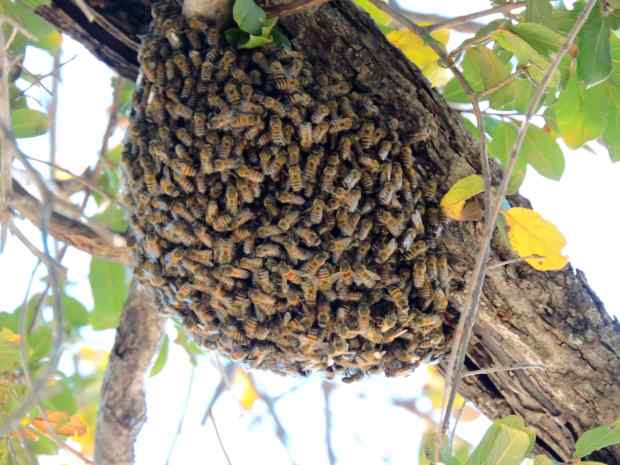
A small swarm of African bees decided to land on a tree above our dining area and, although at first they were polite, soon they became cheeky and started to descend on our food, particularly moist and sweet stuff. We have never had a problem with the infamous African bees and did not expect one. However, the fact that our son is hyper sensitive to wasp stings and needs to carry an epinephrine auto injector made us jitterier than usual.

DSCN9935 10.35.21 PM copy

Probably because I do not like bees, I was the first victim when I got stung in what I consider a self-defence act although my family unanimouly agree that it was an act of sheer foolishness! I was in the car peacefully enjoying elephants at the adjacent waterhole from the camp when a bee landed on my arm and I squashed violently. I was not violent enough as the beast, despite the smack, managed to leave her sting on me! I was not amused as, although my wife’s family and herself are beekeepers, I am not and I am not planning to learn the skills involved in stealing honey from them!

During the final day the situation got worse and at some point in the afternoon first my wife was stung and then me again! I did not move away fast enough from the seen of the attack and got a second sting. At that time we decided to reacted to lock our son in the toilet fearing a more severe onslaught and to vacate the camp and go on a game drive, after collecting our isolated son with the car from the toilet’s door!

Luckily that was our last day and by the time we returned to camp, after dusk as usual, the bees were sleeping. We left early the following morning, before they woke up, luckily without further incident.

Although the bees were annoying, they brought about some gain. Their presence attracted both the Little (Merops pusillus) and Swallow-tailed (Merops hirundineus) bee-eaters. These spent all day at camp enjoying easy pickings. Of more interest for me was the appearance of a Greater Honey-guide (Indicator indicator) a special bird indeed.

The Honey-guide, as its name implies, guide people to the nests of wild bees by attracting the person’s attention with various calls and flies to a bees nest repeating its call often spreading its tail and making itself conspicuous. Once the bees nest is raided by the honey hunters the bird eats what is left. The tradition of the San people is to thank the bird for its “services” by a gift of honey as they believe that not doing this risks that the bird will guide the hunter to a lion or poisonous snake!

Studies have shown a mutually beneficial partnership for two very different species:man and bird. The “use” of honeyguides by the Boran people of East Africa and the Yao people in Mozambique showed that the honeyguides reduce the search time for bees nest by approximately one third![2]

Although these birds are present all over Sub-Saharan Africa, this was my first encounter with a Greater Honeyguide. Although I knew their trade, I was happy to watch the bird from a cautious distance as I was not interested in obtaining its help but rather the opposite!


[1] https://bushsnobinafrica.wordpress.com/2015/09/08/ngweshla-cold/

[2] http://www.voanews.com/a/honeyguides-lead-human-hunters-to-honey/3432394.html


Boswell

It is irrelevant here to argue against or in favour of naming wild animals. It happens often among the big five and others that are singled out for certain notable characteristics or behaviour and I am sure it helps researchers in their work. There is a tusker-naming project at the Letaba Elephant Hall in the Kruger National Park and many notable animals have been given names, not only in Africa but also throughout the world.

Boswell in Mana Pools is a bull elephant that is one of the legitimate owners of the place. It kindly let us enjoy its home without a grudge while it goes about its business. Boswell is well known by all that, like us, are frequent visitors of this beautiful wilderness area. It has a distinct feature: it can reach for the apple ring acacia pods higher than its colleagues.

Over the years it has developed a trick that few others can match: it does not only stretch but over-stretches by standing on its hind legs in perfect balance while it feeds at incredible heights. I do not know how it learnt to do it but perhaps it is an elephant tradition that is passed from generation to generation at Mana Pools.

Whatever the origin of its skill, many brilliant pictures have been taken in the past by great photographers and these can easily be found in the Internet. However, one thing is to watch professional pictures and/or documentaries and another, rather different one, is to see it performing live, just like any artist!

We have seen Boswell often once we learnt to recognize it but we have not seen its trick as it only takes place at a certain time of the year when the right conditions are present. Even at that time, you must find Boswell and it has to be willing to perform. This is not as easy as you may think.

During our last visit to Mana Pools last July game was not yet abundant in the riverine part of the park so I decided to cut short my participation in a family game drive and stay in camp to take things easy and to watch what was going on there as its proximity to the river is always rewarding. We had been, as usual, “attacked” by monkeys and the baboons were particularly vicious when they did not find anything, pulling down one tent an even biting our solar-powered lamps!

I spent some time tidying up and eventually sat down to have a cuppa and to write notes on the trip. Although it passed about five metres from me I only saw Boswell’s bottom and looked for the camera only to realize that it was with the rest of the family! Luckily I had my iPad with me!

Boswell crossed the river fast and soon reached a couple of acacias on the other side, about one hundred metres from me. There it started feeding and I watched for the first time his two-legged feeding trick.

As usually happens, my pictures are rather pathetic but I am, nevertheless, proud to be able to say that I saw Boswell performing for me alone at its home!

Curious

A couple of mongooses at what we thought was their burrow inside a termite mound was the first we saw while on a game drive close to Ngweshla pan at Hwange National park.

See what happened next in the slide show and video below.

This slideshow requires JavaScript.

World Elephant Day

Yesterday (12 August)  it was World Elephant Day and I thought that what we saw last week at Ngweshla pan in Hwange National Park, Zimbabwe is a suitable scene to remember these amazing animals that the more I watch, the more I get entertained and admire.

I owe my increasing interest for these animals to my daughter (the intermittent Senior Editor of this blog) who, from very young age was fascinated by these animals and gradually “educated” me to appreciate them.

I hope you will find the video fun!

Spot the beast 10

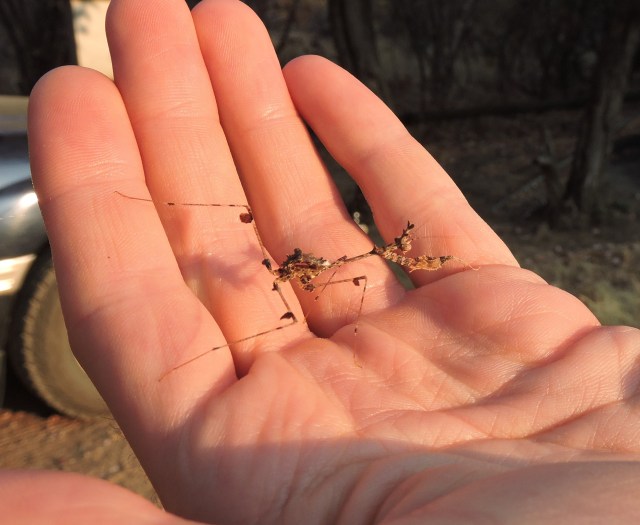
On our way to Hwange National Park in early August we stopped at Matopos National Park, near Bulawayo for one night. In the morning we found this creature that I present to you to challenge your observation powers.

As it is a difficult one, I inserted several pictures and below one in which you can see it well and a video to appreciate its incredible movement that mimics the wing shaking a leaf.

Sibylla pretiosa copy


I believe it is a L6 of the mantis Sybilla pretiosa.


Pachyderm GO!

Apparently there is a new, rather hazardous, cell phone game going around in selected places of the world, mainly the “developed” part of it where “players” follow creatures called Pokémons that somehow materialize in their cameras. Amazing technology that I hope can eventually be used for the good of humanity. But this is just another of my idealistic hopes.

In Zimbabwe, away from it all, as usual we decided to go in search of real creatures and, having our two children with us (knowledgeable on Pokéscience), we went to the bush where they assured us Pokémons do not yet dwell. We chose Mana Pools National Park, a jewel among the Zimbabwe parks. We were in for a surprise!

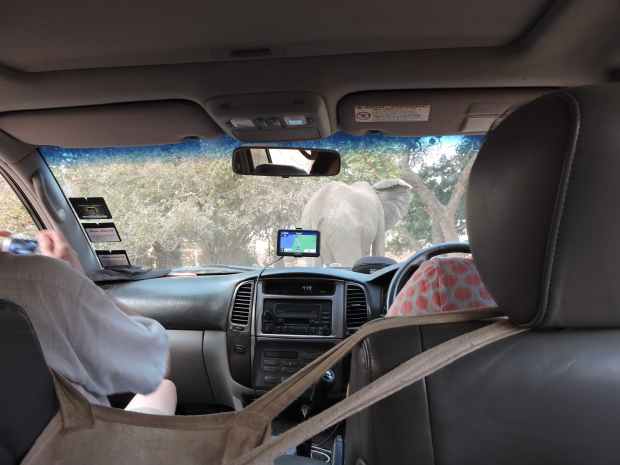
At some stage during our game drive I saw some elephants and stopped the car to watch them with the naked eye, together with my children. My wife, however, looked at them through her tablet to catch the best images of them. At some point, one of the elephants started to walk straight for the car.

I was enjoying its closeness when my son decided that the beast was too close and asked me to move a little to feel safer. My wife in the meantime continued trying to catch the beast.

DSCN9919 copy

Seeing that my wife was still looking through her device totally oblivious to the animal’s proximity, I started wondering whether she was watching the same beast that we were or if she was actually trying to throw a Poke Ball at a Phanpy[1] or a Donphan?

After the incident my wife explained that she did not realize how close it was until I moved the car. The creature had come within a couple of metres from us before I drove off but she said that she had managed to capture it.

We are all looking forward to get home to see what she caught!


[1] Phanpy is a small, blue elephant-like Pokémon that evolves into Donphan, a gray, elephant-like Pokémon with a thick, black band of hide running down the length of its back and extending to the tip of its long trunk.


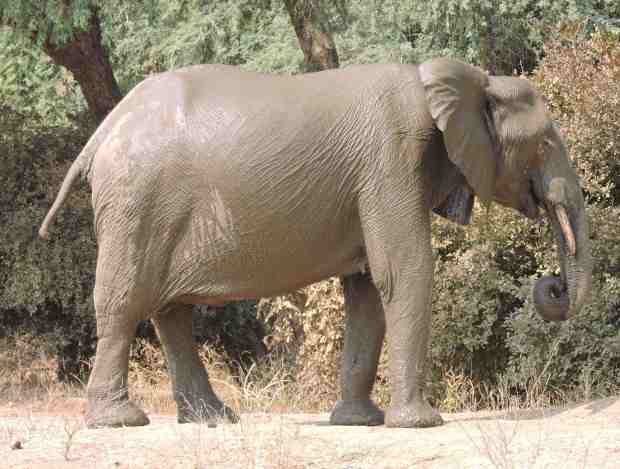
Follow up: The situation was clarified later and, luckily for Mana Pools, this is what she actually saw:

DSCN9950 copy


The battle of lake Tanganyika

While in Pretoria searching for the SMS Königsberg’s gun I saw an entry from Guadalupe, a Facebook friend, narrating her enriching experience of a few years back on board of the MV Liemba in lake Tanganyika. This inspired me to add a second part to the story of the gun of the Königsberg that actually includes the use of another one in the Battle of Lake Tanganyika. I hope you enjoy it.

In 1914 East Africa was the gem in the German imperial crown. It was strategically positioned to offer deep-water ports for the German Navy actions against British shipping in the Indian Ocean. It also enabled Germany to control the Great Lakes of the East African Great Rift Valley that splits the continent from north to south. The 644 km long lake Tanganyika had a particular strategic value as Germany and the Allies (Britain and Belgium) shared its shores.

The Germans controlled the lake with the aid of two small ships: the Kingani and the Hedwig von Wissman, although Belgium and Britain also had some ships as well. The following, in addition to other small craft, motorboats and dhows, was the composition of the respective vessels capable of carrying guns at the lake at the outbreak of WWI:

Germany: Hedwig von Wissman (60 ton passenger boat), Kingani (45 ton), (Graf von Goetzen, 1200 ton, under construction, launched on 9 February 1915).

Britain: Good News (The first steamship on Lake Tanganyika, launched in 1885), Cecil Rhodes (launched in 1900). Both these vessels were laid up with their engines removed, but were capable of being brought back into service and armed.

Belgium: Alexandre Delcommune (90 ton), Dix-Tonne (a powered river barge), Baron Dhanis (700 ton, awaiting construction).

Aware of the influence that controlling the lake would have on land operations taking place in the region, John R. Lee, a private game hunter conceived an idea that was, to put it mildly, mad to those that did not know the region as well as he did. Surprisingly, he managed to convince the British Admiralty and the idea became a plan! The Admiralty at the time was too concerned with the war in Europe to get too analytical of a minor episode that would take place in the “heart of darkness”!

The outlandish idea involved attacking the German ships in the lake with faster, smaller and therefore more maneuverable vessels. Lee found two wooden 12-metre motor launches equipped with a 100 HP motor each that could propel the boats through the water at a good 19 knots (about 35 km per hour) that were selected for the mission.

The launches had to be transported from London to the Cape by sea, by rail from the latter, through Elizabethville (today’s Lubumbashi), to Fungurume, the end of the rail line. From then on, it would be through broken terrain where there were no roads. The plan was to go through this last part of the journey through a combination of man, oxen and steam tractor power as well as a few km on a narrow gauge railway. The last leg would be travelled by river and then to the lake! The justification for this almost lunatic itinerary was that other possible routes were either too difficult to keep secret or too obvious and therefore vulnerable to a German attack!

Not being part of the Navy, Lee was hurriedly given a Navy position so that he could be part of it. Despite this, he could not be put in charge of the operation so the Admiralty needed to find an operation leader from within its ranks. The Admiralty did not wish to appoint a serving Commander as these were badly needed for the naval war closer to home so the search was difficult as suitable candidates were very few.

In view of the difficulties to be encountered during the expedition, efforts were made to find an officer of the Royal Marines, a selected branch of the Royal Navy. It is reported that the Officer selected examined the proposal and declared it as a “mission impossible” and refused to accept it! Lt. Commander Geoffrey B. Spicer-Simpson, dealing with Navy administrative matters was seated close to the place of the meeting and overheard the discussion. As soon as the meeting ended, he volunteered and he was accepted immediately and perhaps rather hastily as his service record was far from good.

At the start of his military career he had been responsible for his destroyer colliding and sinking a Liberty cargo ship and, later on, when given a second opportunity to show his worth, one of his gunboats was torpedoed in broad daylight while at anchor under his gaze while he entertained certain ladies on shore!

With the appointment of a Commander, the Naval Africa Expedition was born!

Soon Lee was sent to Africa to prepare the ground while Spicer-Simpson dealt with the organizing in Britain. The latter had a complex personality and, as many British commanders before him, he was an eccentric character. He was a bold, well-built and aggressive man but also enthusiastic and friendly. He was an unorthodox man and this would have qualified him entirely for an assignment such as this. He also had a tendency to be a loudmouth and wasted no time, after Lee’s departure, to start promoting the expedition as his own idea!

Still in London the weirdness of Spicer-Simpson started to show when it came to choose the names of the launches. He proposed “Cat” and “Dog” but the Admiralty rejected them with some trepidation. Unfazed, he put forward “Mimi’ and “Toutou”[1] and, amazingly, these were acceptable provided that “HMS”[2] was put in front of their names as it was customary in the Royal Navy!

Spicer-Simson departed London with a selected group of naval personnel (28 in total participated in the expedition) aboard the Llanstephen Castle on 15 June 1915 and arrived at Cape Town on 2 July, after a voyage of 9,700 km. From there, as planned, the launches were taken 3,700 km by railway to the rail-head at Fungurume (south of the then Belgian Congo), north of Elizabethville (present day Lubumbashi) in the Belgian Congo. The expedition arrived there on 26 July.

The difficulties really started at Fungurume. This was the stretch of the route that Lee had worked on for several months. The 240 km overland to Sankisia, was the most difficult through terrain ranging in altitude from 600 to 1,800 metres over the Mitumba Mountains. Lee had cut a track through the bush that crossed 140 rivers and gorges, building over 100 bridges! He had also arranged for two steam traction engines from Southern Rhodesia (present day Zimbabwe) to meet them at the Fungurume rail head. They were to haul the boats on their trailers for this part of the route. Managing only a few kilometres each day, the journey took over a month. Although the usefulness of the steam engines is questionable, they created a strong impression on the local inhabitants!

They eventually arrived at Sankisia on 28 September and from there they did 28 km by narrow gauge railway to Bukama. From there they took the launches down the Lualaba river for 740 km. The launches navigated using their own power for part of the route but the rest was done by placing them on lighters (platforms for shallow water). Finally, the expedition arrived to the small Belgian harbour of Lukuga on the western shore of Lake Tanganyika.

As it was true for all the great European expeditions in Africa, the burden of achieving what appeared as impossible fell on the nameless Africans rather than on the hyped Europeans! Not only the Africans carried a load of 27 kg on their heads but also hundreds of others eased the way ahead and provided much of the sheer brute force that was required to pull the launches. They did this chanting as the moved, finding a different rhythm for the various different activities performed!

Spicer-Simson had taken complete control of the expedition from Elizabethville where he had sacked Lee as soon as they met in a bar accusing him of insulting the Belgian while drunk, and generally revealing details of the Expedition to the public. Lee was ordered to return to Cape Town to await disciplinary action and, sadly, the brain behind the expedition, disappeared from the history books!

A new difficulty, however, lurked at the lake. Unknown to the British, the Germans, also aware of the critical importance of lake Tanganyika, were significantly more battle ready than had been previously thought. At Kigoma, they were busy assembling a new ship! The Goetzen was designed and built to serve as a passenger and cargo ferry in conjunction with the Ostafrikanische Eisenbahngesellschaft (East African Railway Company). It was then disassembled and shipped in 5,000 boxes to Dar es Salaam in German East Africa and taken from there by train to Kigoma.

Spicer-Simson had a good dose of luck. The absence of rain during the entire overland expedition was a very fortunate event and not the only one during the campaign. The fact that the skies opened up the moment Spicer-Simson set his feet in the lake was considered as a miracle to the supersticious local population even if the Europeans considered it a coincidence! His figure grew in stature and his eccentricity and actions greatly contributed to this.

Spicer-Simpson had his body covered in esoteric tattoos that he displayed often by walking about shirtless and wearing a skirt! The latter created a lot of speculation on whether it was a kilt, a kikoi[3] or a sarong. However, Spicer-Simpson himself – totally unconcerned- explained that his wife made various skirts for him, and that he found them very practical for tropical conditions. From then on the Belgians knew him as “Le Commandant á la Jupe” (The Skirt Commander).[4]

Soon after arriving, Spicer-Simson decided that the harbour at Lukuga was in an unsuitable position and built another one some distance away. By 23 December 1915, the boats had been launched on the Lake and soon afterwards kitted and ready for action. They were armed with a respectable little 3-pounder mounted forward on each, and a machine-gun mounted aft. Fully kitted the Mimi and Toutou averaged only 13 knots, less than the 19 that had been estimated, but yet far faster than the German steamboats, and therefore retaining a good tactical advantage.

On Christmas Eve all was declared shipshape and ready. They need not wait as the following day there was information that the Kingani was close and that it had slipped within range of the coastal battery once or twice trying to detect what was taking place on the enemy shore.

The first action of the Battle of Lake Tanganyika indeed took place on 26 December. At 09.00 hours while the Expedition members were at Mass, the Kingani was spotted about 13 kilometres from Lukuga steaming towards the southwest. Spicer-Simson calmly waited for the religious service to end and the Kingani to pass before ordering his flotilla to give chase as they knew that the Germans’ only gun was at the fore. With their superior speed, Mimi and Toutou attacked from the stern and port respectively until they managed to disable the Kingani killing its Captain and a few of the crew. The Kingani surrendered after eleven minutes and it was towed into the British harbour where it was repaired and fitted with a 12-pounder gun on her fore. No losses were experienced on the British launches but the latter structures suffered from the gun’s vibrations and needed repairs. The episode was followed with great excitement by thousands of lakeshore local inhabitants and Spicer-Simson’s image started to grow!

Later, the expedition received a message from the King that said: “His Majesty the King desires to express his appreciation of the wonderful work carried out by his most remote expedition.” Spicer-Simpson’s ego was boosted.

The Kingani was renamed “Fifi”, surely another of Spicer-Simson’s initiatives! With this latest addition to the British flotilla, its firepower was substantially increased. At the same time, the SMS Graf von Goetzen (Goetzen for short) was launched on 5 February 1915, armed with one of the 10.5 cm Königsberg guns. The latter would give the Germans a great advantage in firepower against British and Belgian forces.

Only on 8 February 1916 the Germans started looking for the missing Kingani and the German Commander -on board of the brand new Goetzen- ordered the Hedwig von Wissman to find out what had happened to her. So, the following day she was seen from the lakeside off Lukuga, following a similar course to the Kingani.

Mimi and Fifi were launched (Toutou was being repaired at the time). Although the Hedwig could outrun the Fifi, Mimi closed in and opened fire, avoiding the superior fire power of the German boat while allowing Fifi to catch up and, after about three hours, a shot of Fifi’s 12 pounder gun hit the boiler of the Hedwig and stopped it. The crew had no other option than scuttling it and surrender.

The day after Hedwig’s destruction the Goetzen went looking for it and when Spicer-Simpson saw it armed with the 10.5 cm bow gun from the Königsberg and being twenty times the size of Fifi, he realised that he could not attack it with his undersized forces with any chance of success or survival. So, at the end of February he went looking for a larger ship that could match the Goetzen.

He failed and returned to the lake crestfallen and sure that the domination of the lake still hanged in the balance despite his earlier successes. The final chapter in this saga -if there is still need for one- was that, unknown to Spicer-Simpson, the guns of the Goetzen had been removed as they were needed by the German ground forces.[5] So the ship was only armed with dummy wooden guns, with only a small working gun.

A stalemate now developed with the Goetzen armed with wooden guns and Spicer-Simpson, unaware of this, unwilling to attack a much larger and better-armed foe. The Belgians attacked the Goetzen by air but with no serious damage was done. While this took place the Allies were gradually winning the war on land and by July 1916 they threatened to isolate Kigoma leading the Germans to abandon the town.

The task of scuttling the Goetzen was given to the same engineers who had assembled it two years earlier. They decided, on their own, that they would try to facilitate a later salvage so they covered all engines with a thick layer of grease. They then filled it with sand and sunk it carefully on 26 July, in a depth of 20 metres near Katabe Bay.

With the Goetzen gone, the naval battle for the Lake was over and Spicer-Simpson and his small expedition became war heroes and medals and promotions were granted.

If, as my friend Guadalupe, you happen to travel across lake Tanganyika and spend time having a good look at the structure of the MV Liemba, you may discover German words written on its steel work. It is even possible that you may even spot the word Goetzen (Götzen) among the writing.

The MV Liemba is no other than SMS Graf von Goetzen that was refloated by the British and it is still transporting people and cargo up and down the lake. It transported Lord Baden-Powell’s widow from Northern Rhodesia (today Zambia) after his death on 7 January 1941 and more recently, in May 2015, it was hired by the United Nations to evacuate 50,000 refugees fleeing from Burundi.

The Goetzen/Liemba is the last floating ship of the German Navy of WWI and I am sure that its long life had something to do with two things: the impressive sight of the Königsberg gun that deterred the British from attacking it and the careful way the German engineers sunk her in 1916!

References consulted

Foden, G. (2005). Mimi and Toutou Go Forth: The Bizarre Battle Of Lake Tanganyika. Penguin, 256 p.

https://weaponsandwarfare.com/2015/08/08/the-naval-africa-expedition-and-the-battle-for-lake-tanganyika/

Magee, F. (1922). Transporting a navy through the jungles of Africa in war time. National Geographic Magazine 62, 331-362.

Shankland, P. The Phantom Flotilla. Mayflower, 127p.


[1] The names mean Meow and Fido in Parisian slang.

[2] Her Majesty’s Ship.

[3] A Swahili word for a piece of cotton cloth with coloured bands, worn wrapped around the body as a sarong in the Malay Archipelago.

[4] I could not help remembering a great read by Mary Russell “The Blessings of a Good Thick Skirt: Women Travellers and Their World”.

[5] The Königsberg gun taken from the Graf von Goetzen continued serving the German Army during its campaign against the allied forces until September 1916 when, at Korogwe, it was captured and later displayed in the Belgian Congo (today D.R. Congo).


SMS Königsberg’s gun

Apart from nature I am also interested in African history so this is the first post that I dwell on the issue to tell you about an interesting series of somehow related events that took place in East, Central and Southern Africa during World War I (WWI). I hope you will enjoy reading it as much as I did searching for information and writing it.

We spent last week in Pretoria, having a break from Zimbabwe, and doing some needed shopping. While there I took the opportunity to visit the Union Buildings not to meet the President of South Africa but to check on a piece of artillery that I once read it was there. Luckily, after checking the various guns placed there, I found it and it prompted me to write this post.

IMG_5019 copy

Wrong gun. One of the guns at the Union Buildings in Pretoria.

Let’s go back in time to the 1900’s, most precisely 1906 when the SMS Königsberg was launched and became the lead ship of her class of light cruisers in the German Navy. It was named after the capital of the then East Prussia and it was armed with a main battery of ten 10.5-centimeter (4.1 in) as well as other smaller guns.

In April 1914, the Königsberg was sent to German East Africa to take over patrol duties along the Indian Ocean coast. Its crew prepared for a tropical spell and many brought hunting guns to enjoy this activity that was common at the time. It arrived in Dar es Salaam on 5 June and its size and impressive appearance gained it the nickname Manowari na bomba tatu, or “the man of war with three pipes” among the local people.

The arrival to the area of the HMS Astraea, Hyacinth, and Pegasus of the British Navy (probably related with the deterioration of the situation in Europe) created concern in the Germans who, suspecting that the intentions of such unexpected visitors were to blockade the Königsberg in the German East African capital, on 31 July 1914 it went out to sea as soon as it could. The Königsberg, being a faster vessel left the three slower British ships behind until it broke contact and continued to Aden where news of the start of WWI reached it.

Ordered to attack British merchant ships, the cruiser remained in the Indian Ocean and sunk the SS City of Winchester, a merchant ship and only civilian casualty. Coal availability soon became the Achilles’ heel of the cruiser but somehow it got enough of it to enable it to seek refuge into the Rufiji River delta, recently surveyed by the Germans, as its engines were in need of an overhaul.

Aware of the presence of HMS Pegasus in the area, the Königsberg left its hiding place in a sortie and surprised and sunk the Pegasus on 20 September 1914 in what is known as the Battle of Zanzibar. After this event both the Königsberg and its loyal supply ship the Somali entered the delta of the Rufiji River to wait for the needed repairs that were to be carried out in Dar es Salaam.

While the two German ships were camouflaged inside the delta, following the Pegasus defeat, three more British cruisers; HMS Chatham, Dartmouth, and Weymouth arrived to the area and located the Königsberg and the Somali. However, not knowing the way into the delta, they were unable to steam into the river to attack them so they decided to set up a blockade. The battle of the Rufiji River had started!

The British attempted by air and sea to destroy the German ships but failed, as they could not get close enough for their guns to be accurate and the planes brought in were not able to cope with the heat. Seeking a safer position, the German ships moved further into the delta. However, the situation was deteriorating as the Germans were experiencing, apart from shortages of coal, scarcity of ammunition, food, and medical supplies. To the impossibility of escaping from this tropical prison, diseases such as malaria started affecting the crew so the moral fell to an all time low.

A short-lived hope was brought about by a plan to re-supply the Königsberg through the arrival of a German merchant ship loaded with supplies and pretending to be Danish in the hope to get through the British blockade. As the freighter approached East Africa, Königsberg prepared to come out fighting to meet it. Sadly for the Germans, the ruse was discovered and the “Danish” ship forced aground. Although still safe from their enemies, the Königsberg and the Somali were trapped!

To break the stalemate the resourceful British brought two monitors, the Mersey and Severn. These large gunboats of shallow draft were built before the start of WWI for the Brazilian Navy and taken over by the British at the onset of the war. As their intended use was the Amazon River, they were considered suitable to enter the Rufiji River and their voyage from the UK justified!

On 11 July 1915, the two monitors got close enough to severely damage the Königsberg, forcing her crew to scuttle it. The guns were removed and converted into field artillery pieces and coastal guns and, together with the ship’s crew, joined Lieutenant Colonel Paul von Lettow-Vorbeck’s guerrilla campaign in East Africa. One of these guns remained with the German Navy as it was mounted on the SS Graf von Goetzen in the German fleet in Lake Tanganyika.

Could that gun been the one seen at the Union Buildings at Pretoria? It may be but it is unlikely, as it is believed that it was taken to the Belgian Congo (now Democratic Republic of Congo). It is also believed that the gun at Pretoria is a hybrid of pieces coming from several different guns. Further, the plaque stating it to have been captured by South African forces at Kahe, East Africa on 21st March is also almost certainly inaccurate as the “Kahe gun” was blown up and severely damaged by the Germans before being captured.

The story of the Pretoria gun ends here. However there is a follow up that started with the mounting of the gun on the SS Graf von Goetzen, a participant in the Battle of Lake Tanganyika. However, this is the subject for the next post!


Note: The fate of the ten guns of the Königsberg have been thoroughly investigated and an outstanding report can be found @ http://s400910952.websitehome.co.uk/germancolonialuniforms/militaria/koenigsberggun.htm. I acknowledge this site for some of the information contained in this post.