Hwange National Park

Naughty hippo, again…

On our final day, after watching lions and birds, we planned a “sundowner” drink at Nyamandlovu pan to end our safari in style. Before it was time for drinks, we got busy watching the many migratory birds present at the pan. These were a large flock of Abdim Storks and Amur falcons that provided us with much entertainment while they fed on beetles and other insects found in the grass.

A family of five jackals, probably residents of the pan, were also around. While four of them were gnawing at an old elephant carcass, a fifth came close to the viewing platform for a look. As I was on the ground at the time I saw it coming and prepared for pictures. Despite the warnings shouted from above by fellow game watchers for me to be careful, I remained motionless and was rewarded with the closest encounter I have had with a black-backed jackal!

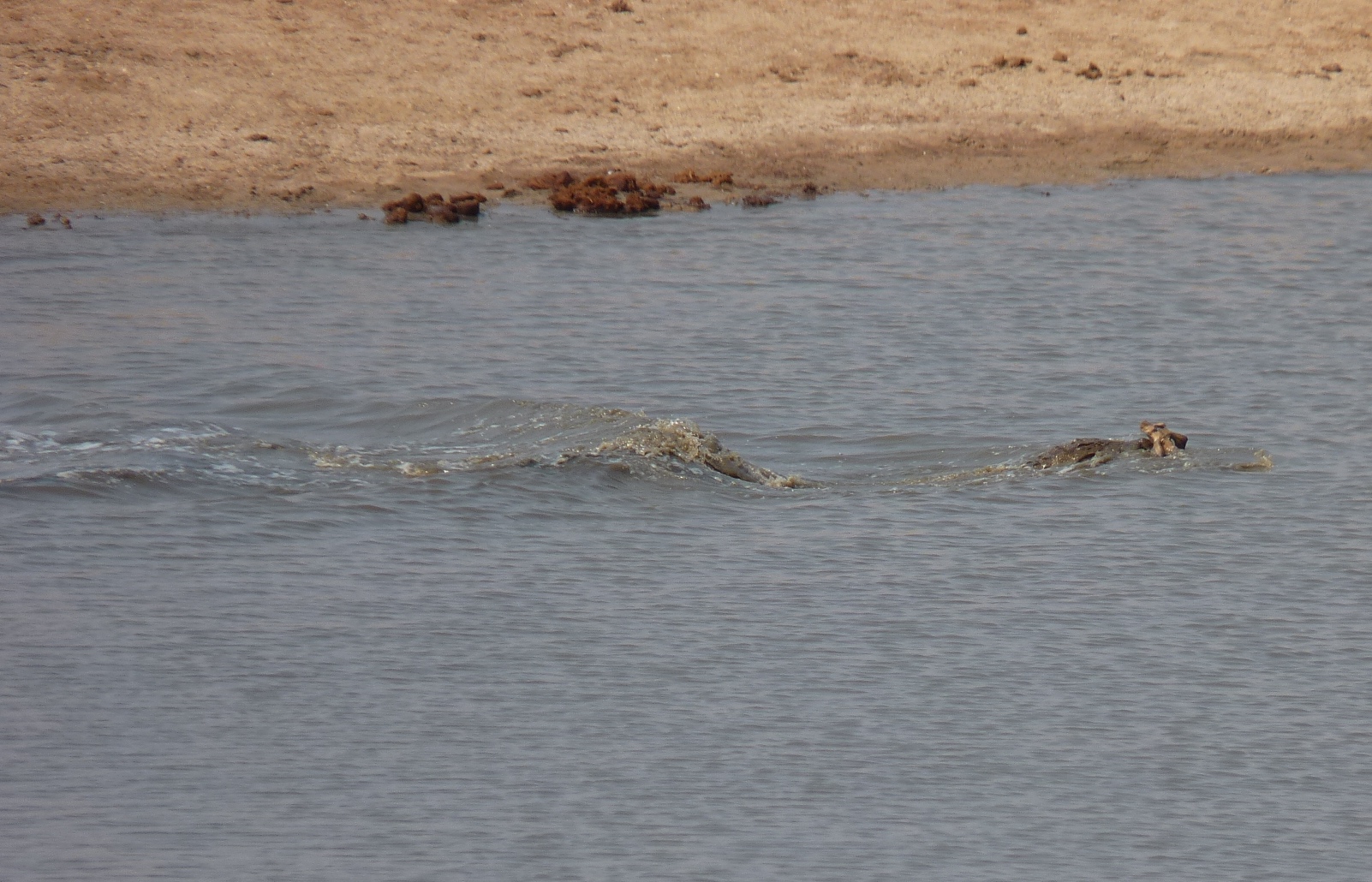
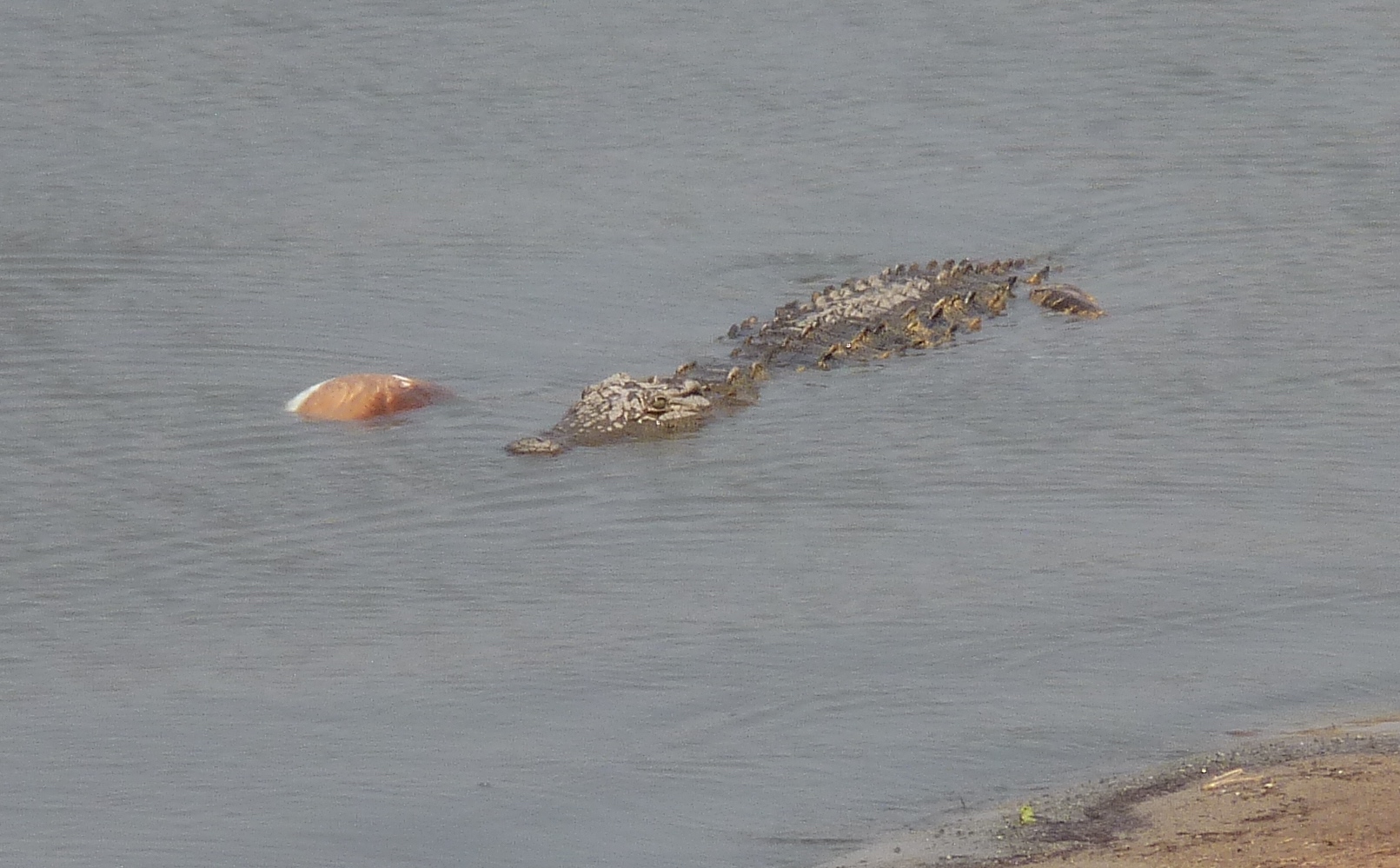
While watching the jackal I heard loud splashing noises coming from the pan and I saw a large crocodile (one of the three present) coming out of the water holding a very large chunk of carcass. I left the jackal to its business and rushed up the platform for a better look. The beast, at the left end of the pan, was violently shaking the carcass and scattering pieces in the water while it swam off with the remains to the opposite end.

DSCN9895 9.14.41 PM copy

The crocodile feeding on the submerged carcass.

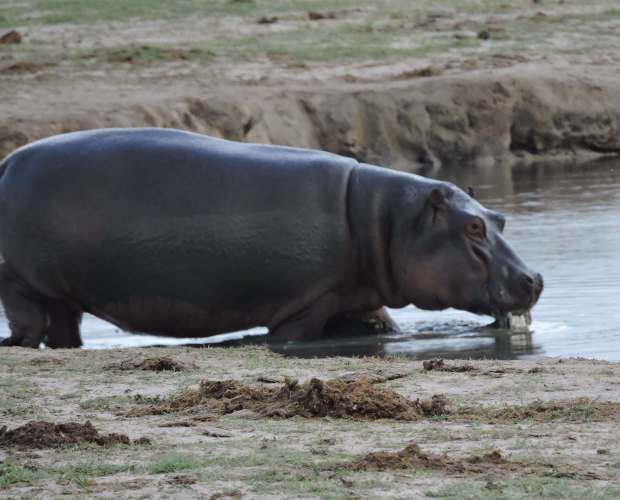
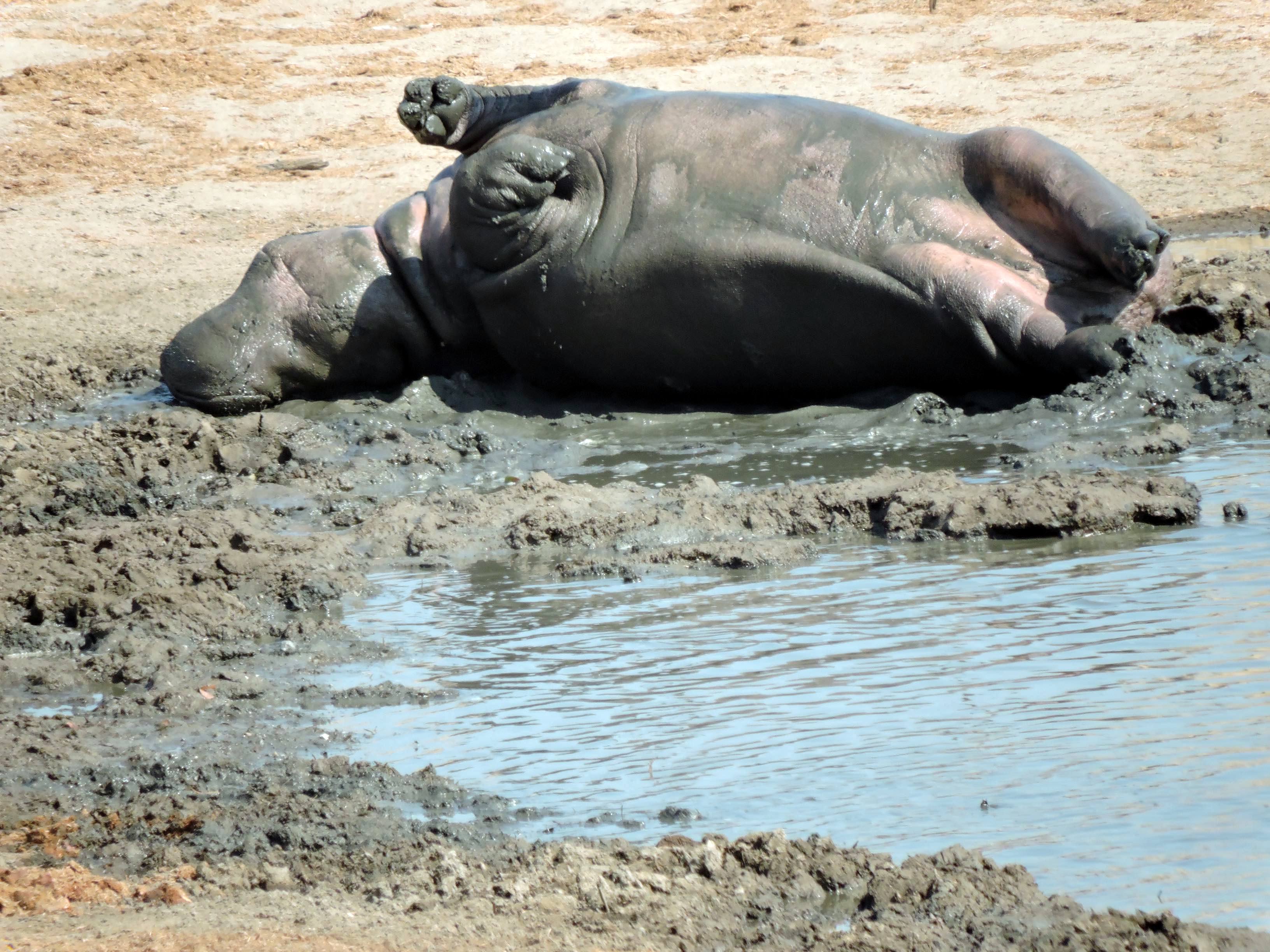
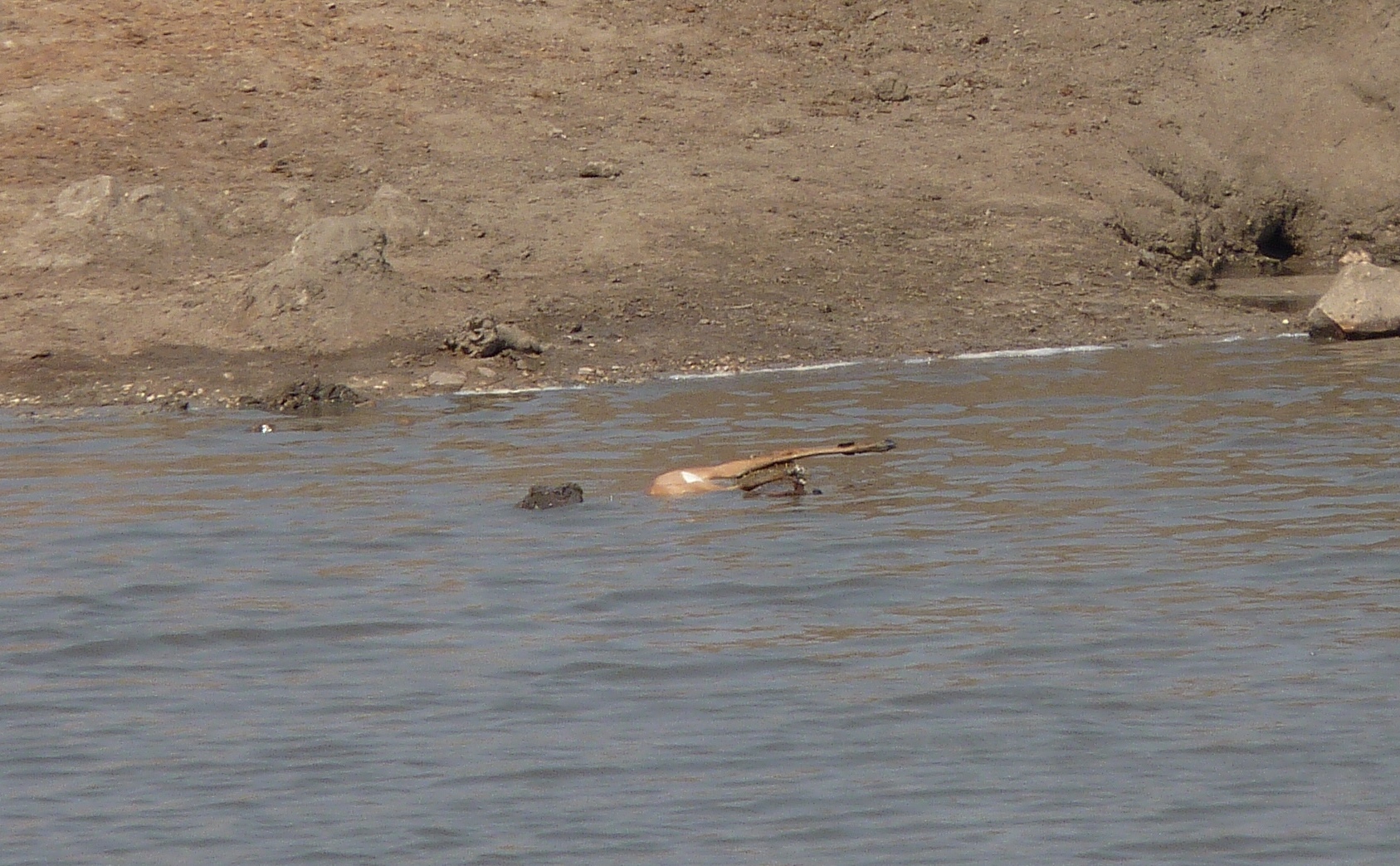
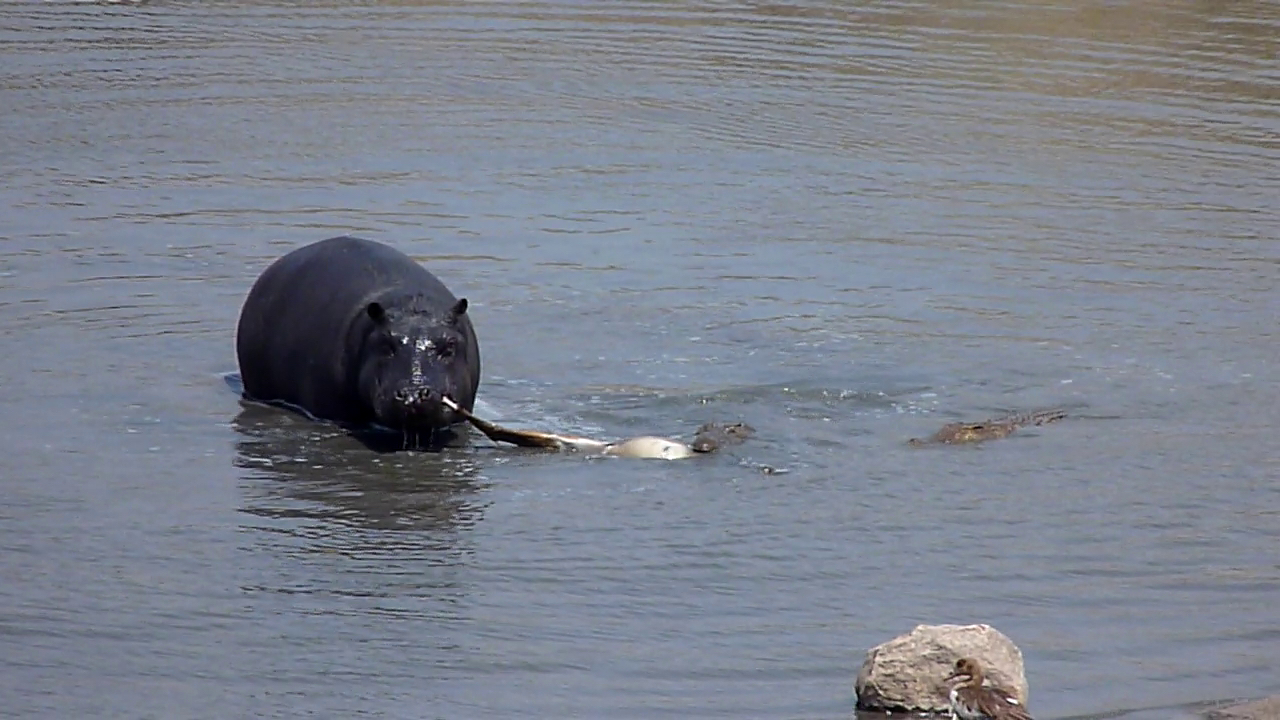
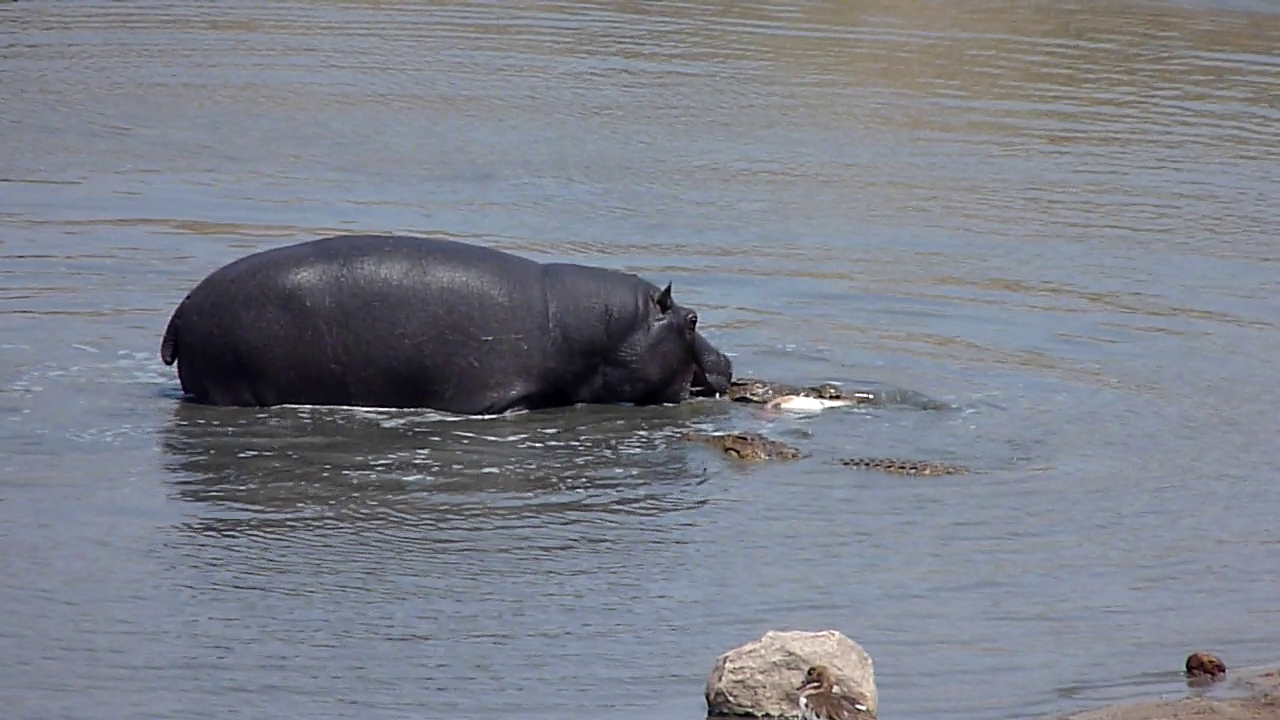
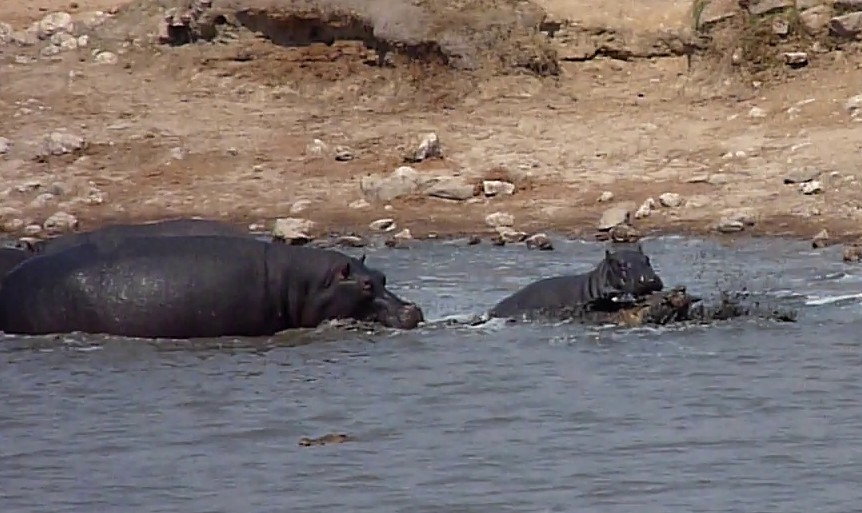
The slow approach of a hippo to the area where the carcass had been shaken apart came as no surprise to my family and I, all well aware by now of our earlier observations on meat-eating hippos at Masuma dam![1] We watched while the hippo approached and searched the area with its head submerged. Suddenly it lifted its head and chewed on what appeared to be a piece of the carcass that it had found! This was a very interesting observation, as we had not seen any of the three resident hippos engage in this activity before, despite having spent many hours there!

DSCN9898 9.14.41 PM copy

The hippo starts approaching…

DSCN9901 9.14.41 PM copy

Eating a chunk of the carcass that the crocodile left.

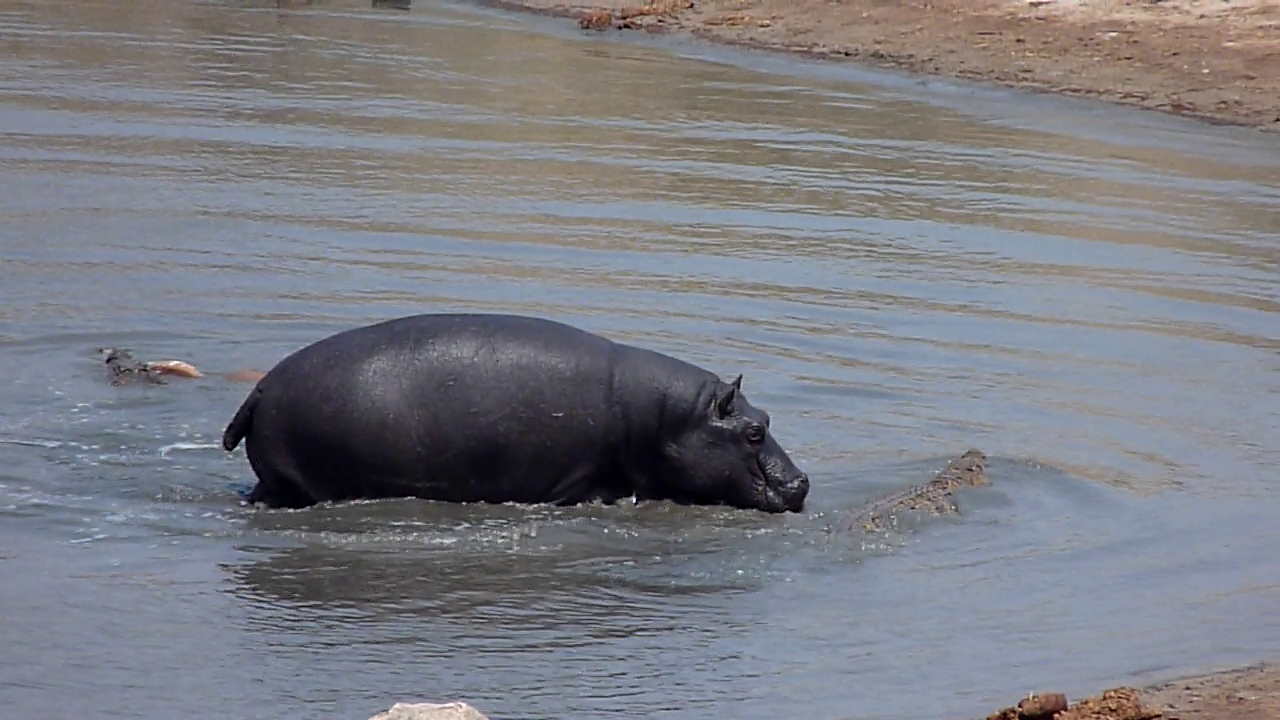
After munching on its find, the hippo left the area jumping in the water in a rather funny display that probably expressed approval at what it had just eaten! Fortunately I managed to take a picture of the crocodile (regrettably only after the carcass shaking took place…) and of the hippo finishing its snack and merrily moving off!


[1] See https://bushsnobinafrica.wordpress.com/2015/02/22/hippos-from-hell/ and https://bushsnobinafrica.wordpress.com/2015/03/23/hippos-from-hell-the-videos/ Muy Interesante also covered this issue: http://www.muyinteresante.es/naturaleza/articulo/los-hipopotamos-pueden-comer-carne-921450193942

Ngweshla cold

“Is it too hot in Africa?” is the question I get asked most often by people in Latin America. They have the image of lush forests and the very hot places of Central and West Africa, white man’s grave. I think they do not believe me when I tell them that Southern Africa can be bitterly cold at times. Frankly, I was also surprised when, on arrival, I found how cold it could get!

Muguga and Nairobi in Kenya and Addis Ababa in Ethiopia were cold, the latter very cold but Lusaka, technically in Southern Africa, was rather warm, sometimes even too warm. It was while living in Lusaka that we organized our first safari to Sinamatella in Hwange National Park in early 1991. We camped there during a weekend of July and it was so cold that we had to ask the game rangers to lend us blankets to outlast the bitterly cold nights. I We were there with our baby daughter and I still remember my wife’s concern of not being able to keep her warm! Survive we did but, clearly, we forgot about it.

In comes Ngweshla Picnic site, located in the Sinamatella area, during July! As we were moving through various camps we took small tents so that we could assemble and disassemble them without too much trouble. I hasten to add also that our new nylon tent was “untested” as we had just bought it for the trip.

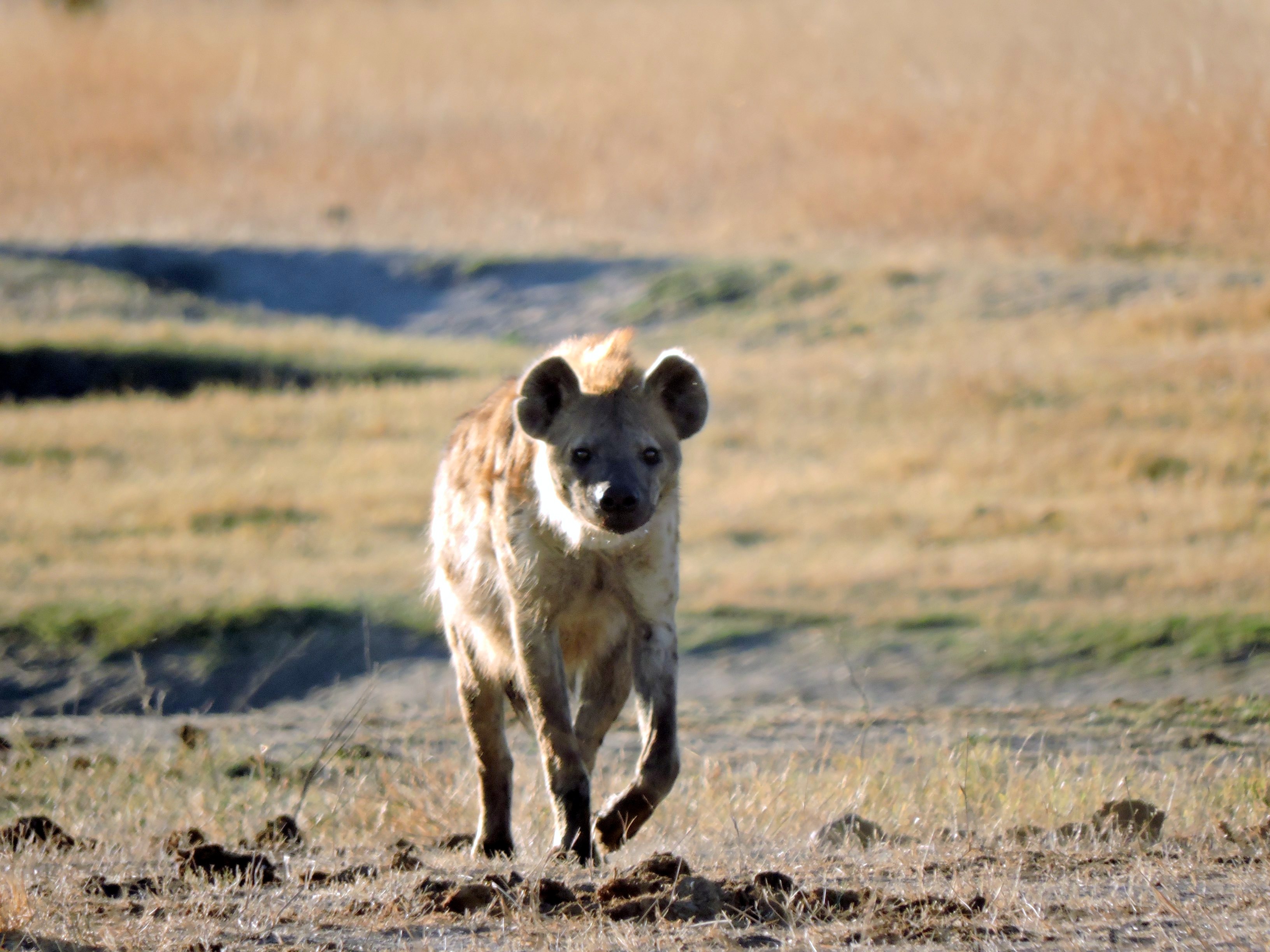
It was warm when we set up our camp after arriving at Ngweshla in the late morning. After lunch we went on a game drive to explore the area and, although we planned an earlier return, as usual we got delayed following a hungry-looking hyena on the prowl. The sun was setting by the time we got back to camp and there was a chill in the air already. Stupidly we had forgotten to organize our campfire so we did not bother and planned a quick dinner and an early night instead.

The hyena moving.

The hyena moving.

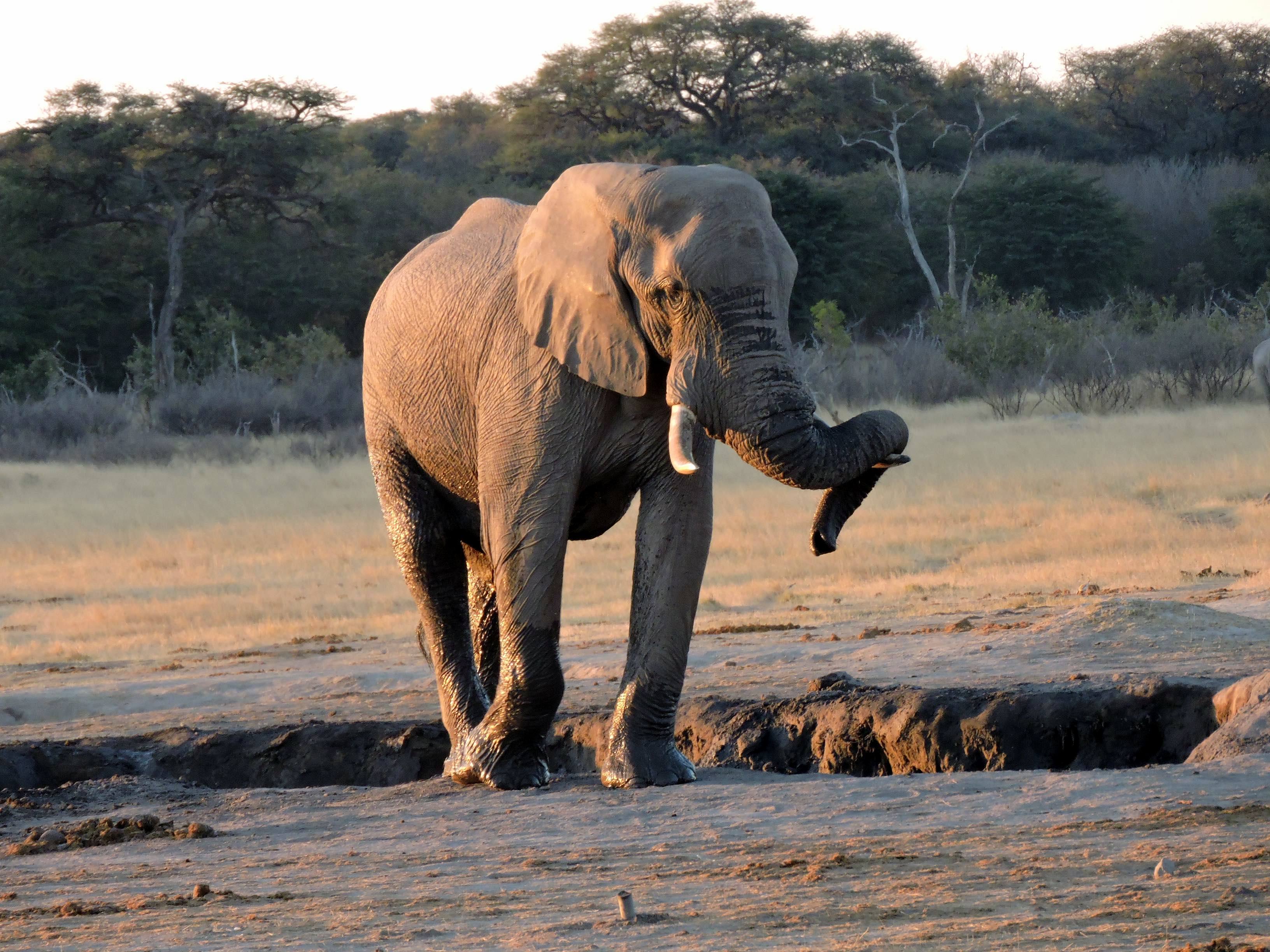
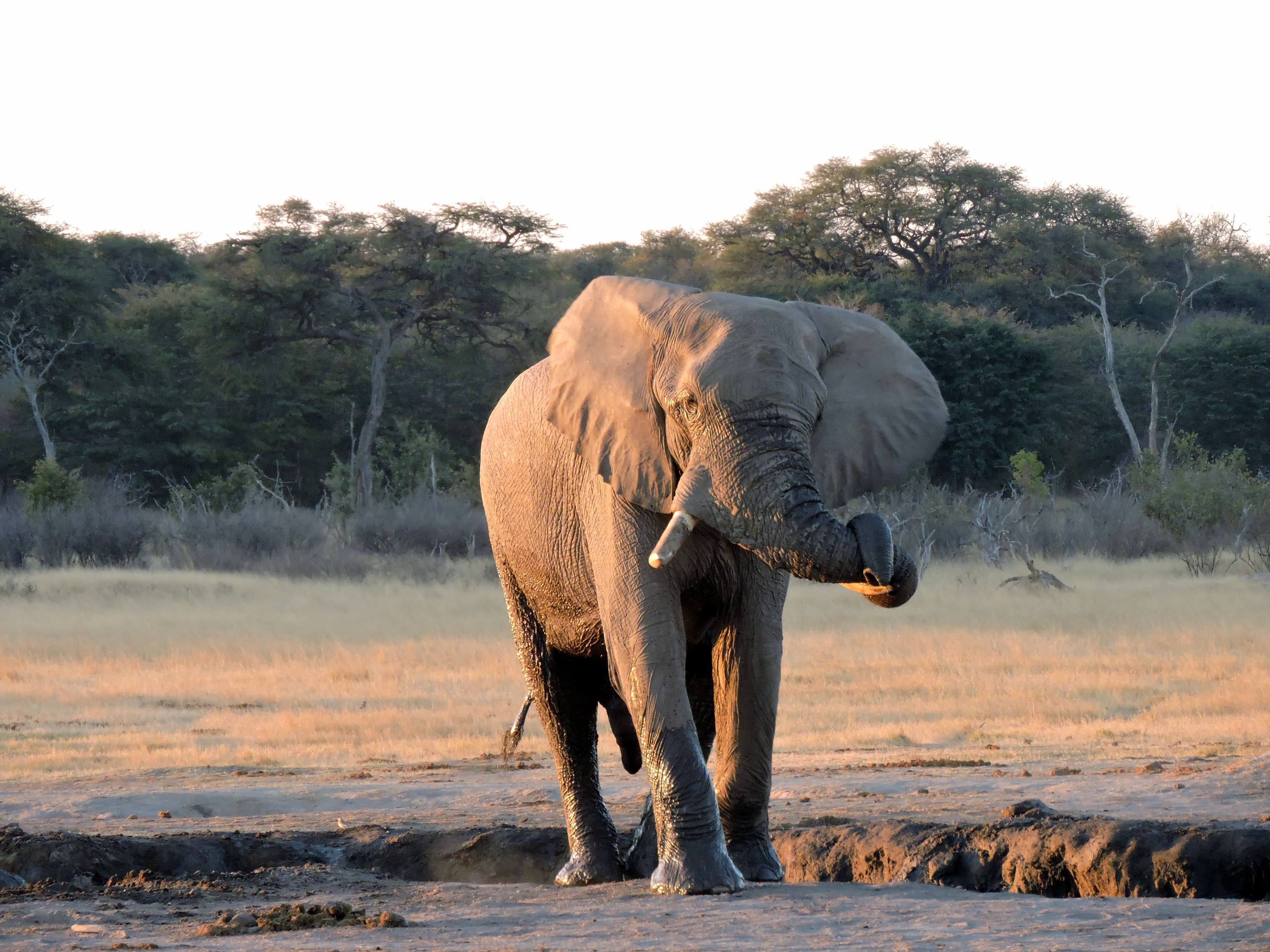
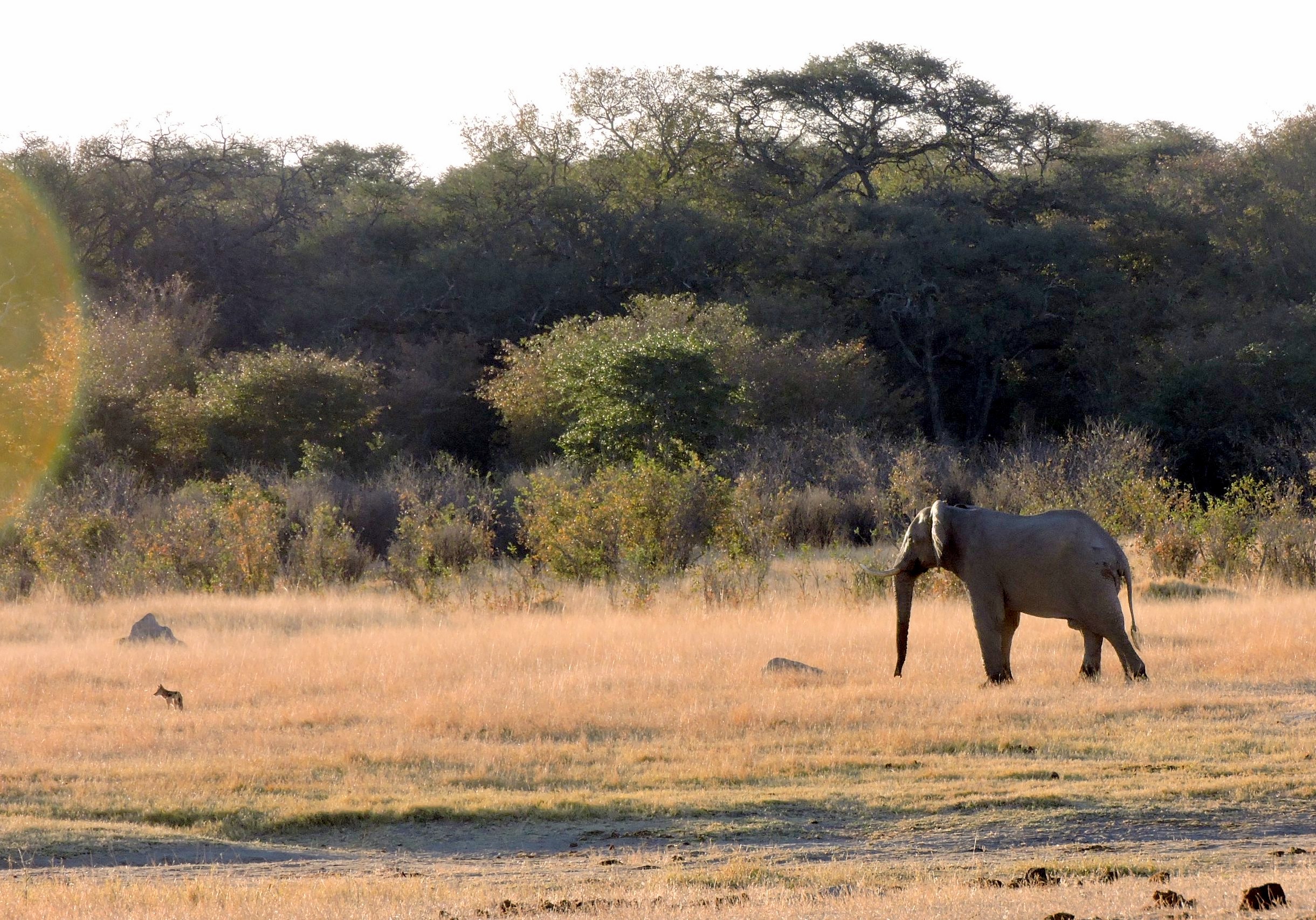
Elephant antiques delayed us...

Elephant antics further delayed us…

DSCN7680 copy

DSCN7679 copy

DSCN7678 copy

A truly funny stand off!

A truly funny stand off. The jackal looks really tiny!

By the time we had our dinner it was clear that it would be a cold night so we skipped showers and we went to bed early as the tents seemed to be the only warm place at the time. Following the routine I got into my soft pile inner bag and then into the 15°C sleeping bag. I normally sleep in my underwear but, this time, I left my socks on as a special measure! My wife, more cautious, was well covered in her pajamas and even a polar hat!

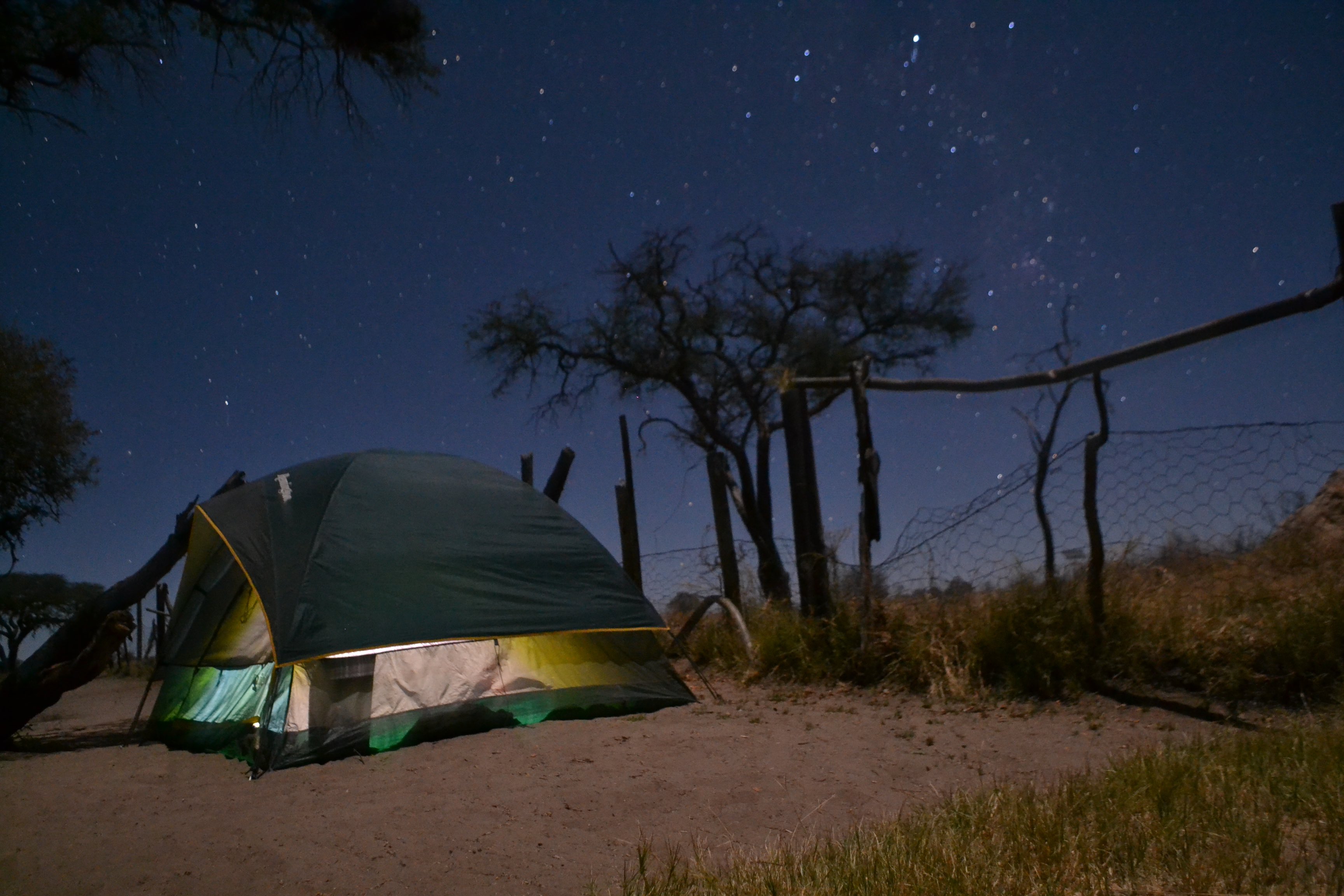
One of our small tents.

One of our small tents.

If there is one thing I am good at it is sleeping even on the floor with a thin mattress! So waking up in the middle of the night came as a surprise. The latter turned into mild panic when I could not feel my legs. I quickly went through the list of conditions that can leave you paralyzed from the waist down and, before I completed it, I realized that I was suffering from leg numbness due to cold or, put into more simple terms, I was frozen from my butt down, mainly at the back of my legs!

“This is ridiculous” I thought and proceeded to adopt a foetal position placing the warmer front of my leg against the cold back of the other in quick succession. This seemed to work at first but, although I regained the feeling in my limbs, they ended up warmer but far from ideal. My butt remained sub-zero. I beat it with my hands and, painfully, it also warmed up albeit slowly. The situation was bad as I was still far from being warm enough to go back to sleep.

While considering my predicament the little warmth I achieved clearly activated other organs apart from my brain and I felt the need to fulfill nature’s call! “This is great”, I thought while holding on and hoping against hope that I would go back to sleep. All this was taking place while listening to my favourite podcast of the “Two Mikes” in TalkSPORT as there is no Internet at Ngweshla. The topic at the time was how, Rod Stewart’s new wife, concerned about the impact of tight jeans on his reproductive gear, forced him to have cold baths to preserve them! I removed the earplugs immediately as this was not the kind of talk that a person in my current condition needed. Bathing in cold-water gave me uncontrollable shakes and this was not conducive to my bladder control!

To avert a wet disaster inside the tent I summed up my courage and left my tepid bags and put a jumper on and then placed my partially mobile lower extremities into my jogging pants. I was ready to face the cold so I proceeded to open the two tent zippers gently so as not to wake my wife up. My mind focused on my bladder control, I forgot to take a torch, a very useful thing when walking around a campsite at night as the moon was long gone!

Luckily my legs responded somehow and I made a mad rush to the toilet. It was evident that the outside temperature was unbelievably low although I was in no condition for estimates! In the dark and with my bladder nearing bursting point, the slippery step prior to entering the toilet was not in my mind. Earlier in life I had suffered the consequences of the lack of grip of my otherwise very comfortable Crocs clogs and this drawback was re-confirmed as soon as I landed on the smooth tiles of the toilet entrance. I am sure that my semi-numb legs contributed to me losing my footing to land on my cold bum. Luckily there was a buffalo skull placed next to the step for decoration and, providentially, it interrupted my mad bum race!

Miraculously I was unharmed and managed to relieve myself in time. The adrenaline burst of the fall had managed somehow to offset the cold I was feeling and I was slightly warmer by the time I re-entered the tent when I heard “hua wash fat nush” coming from the direction of my wife. I asked her to repeat her message as she was speaking through her nose, the only organ she had outside of her “cocoon”. She was keen on knowing what the noise had been and I reassured her that a buffalo had not mauled me but that I had fallen on the skull of one but survived!

After comparing notes on the temperature situation both inside and outside the tent with her and agreeing that it was in fact freezing I re-entered my sleeping bag, this time fully dressed with the addition of a sleeveless jacket wrapped around my bump not only to stop it from re-freezing but also as an added cushion to alleviate its soreness! Fortunately I felt much better all round despite my tender derriere and I managed to go back to sleep.

The following morning there was no early morning game drive and we remained inside the tents until the sun was up and strong. When we surfaced from our tent we met our son sunning himself. He also froze to death in his tent, despite his recently ended five years in Edinburgh.

Do I need to tell you that the next two nights we slept fully dressed and that I took my torch with me when going to the toilet at night?

DIY Eagle

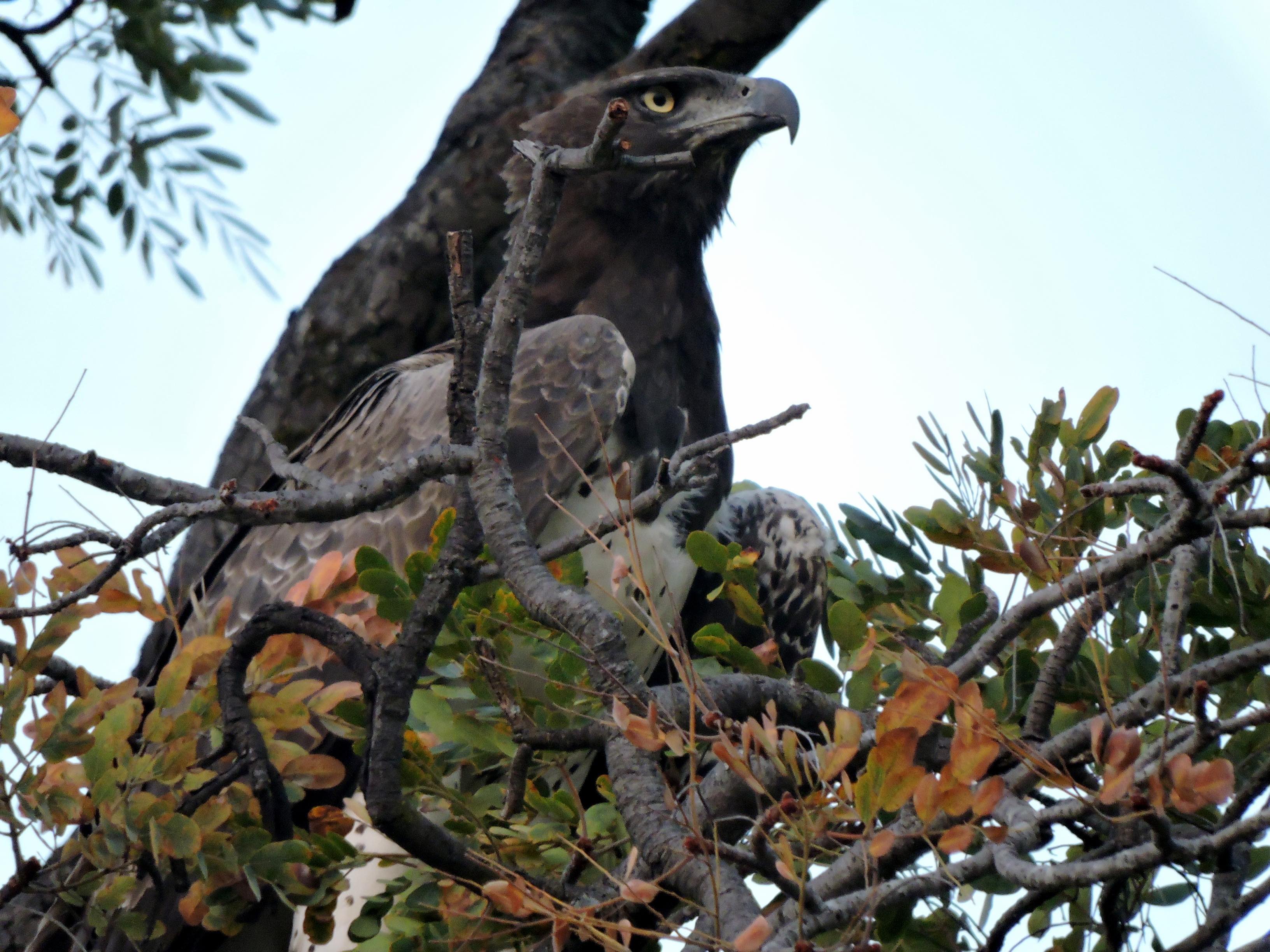
We spotted the large but simple nest at about 100m from the road between Main Camp and Nyamandlovu pan in Hwange National Park, (Zimbabwe) when we visited this park last July. We looked for its owner for a while and, a couple of hundred metres ahead, we found a suspect: an adult Martial Eagle perched on a large acacia tree at about four metres from the ground. To find the largest African eagle is always exciting as they are great hunters and able to kill rather large prey.

We stopped to take pictures and, as usual, we took the first one from a prudent distance and with the engine on, before getting a bit closer for better ones. We stayed put as we noticed that there was something odd. “Look!” one of us said, “it is entangled in a thorny branch” We all looked and, true to the observation, the eagle seemed to be hooked on thorns and making frantic movements with its head to release itself.

The only picture of the Martial eagle.

The only picture of the Martial eagle.

Awe-struck and concerned we forgot about pictures and started speculating on the sighting. Some of us maintained the entangling theory while others thought that it was catching or eating something. We all agreed, however, that something odd was taking place! We could only watch and wait…

After a few nervous minutes we noted that, apparently, the eagle did not have a prey. Immediately she also, somehow miraculously, stopped shaking its head and looked quite totally unconcerned. However, it was still holding a longish branch!

In fact, it had never been tangled or eating but in the process of cutting a thorny branch and it had just completed the task! Without more ado, the branch was placed in its talons and off it went, landing on the nest we had seen earlier!

A subsequent Internet search did not reveal a record of such behaviour. Although I believe it to be known to specialists in birds of prey, I reported it here just in case as it was an interesting, if anxious, observati

Encounter with lions

We left Masuma dam and its elephant parade and got to Main Camp, only to discover that our lodge was still occupied by the previous guests from South Africa. It seems that the latter rule in Zimbabwe and they appear to show little respect for the local regulations and arrangements. After a three-hour wait, we finally managed to move into our lodge and settled down with the apologies of the Park manager but not from the interlopers!

We enjoyed the area, particularly the outstanding Nyamandlovu pan and viewing platform that, as usual, was very popular with the elephants. However, as we had just enjoyed a private elephant act, we did not spend much time at the pan and instead looked for other forms of excitement.

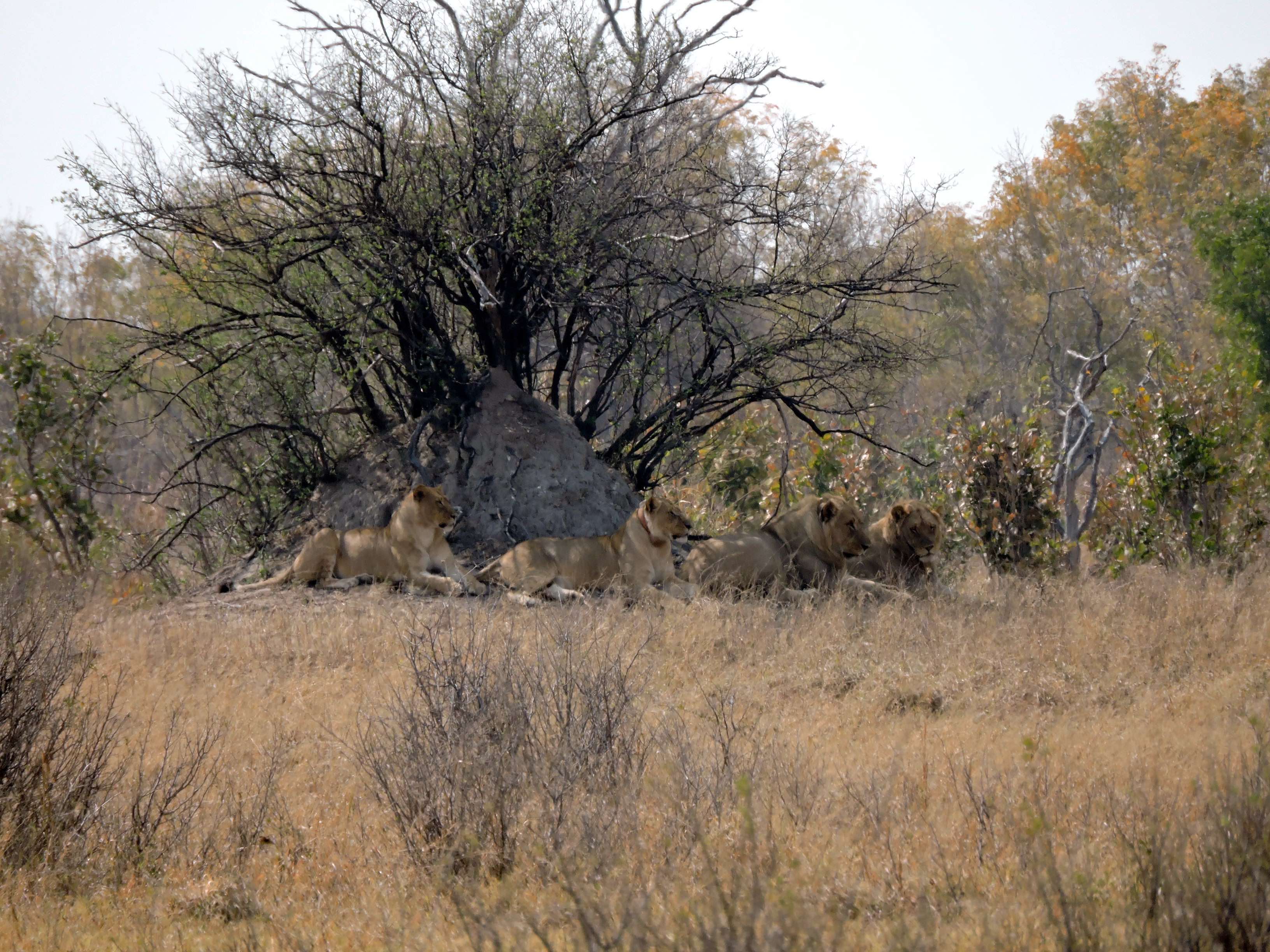
During one of our game drives a helpful fellow traveller proudly informed us that there was a lion pride on the prowl near the Dom pan nearby. Finding them did not take long (all credit to my wife, again!) and we watched them trying to see how many they were. After a while counting heads, legs and tails we concluded that they were one adult male, two younger males, three females and two cubs.

We spent some time watching the lions to see how many they were.

Counting lions.

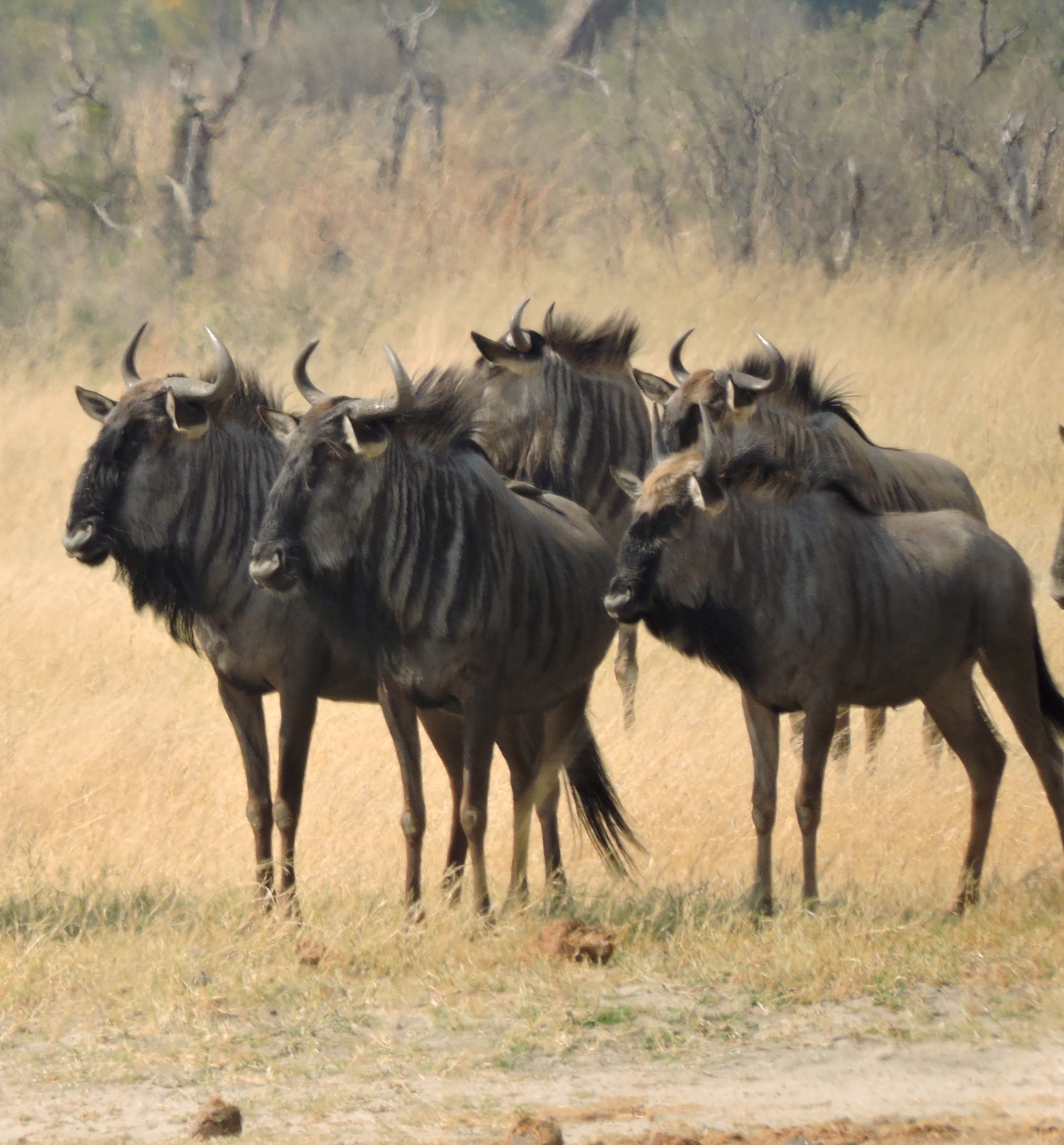
Although it was mid morning they were alert and clearly looking for prey. They moved towards Nyamandlovu pan and positioned themselves at a vantage point that enabled them to see the pan and, more interestingly, a small herd of wildebeest grazing in the dry grasslands, surrounding the pan. The lions kept a keen eye on potential prey but they seemed to ignore the wildebeest, to our surprise, as they would have been the obvious target.

The wildebeest did not take their eyes from the lions!

The wildebeest did not take their eyes from the lions!

As we waited, elephants walked in the background ignoring the lions and vice versa. Only when a couple of young adult female elephants, unaware of the lions’ presence, walked straight at them, was there a sign of fear when they quickly bolted and ran tail up while the lions stood up, preparing for a possible withdrawal. It seemed to us that the lions were not keen on the wildebeest but attentively watching something else that we could not see.

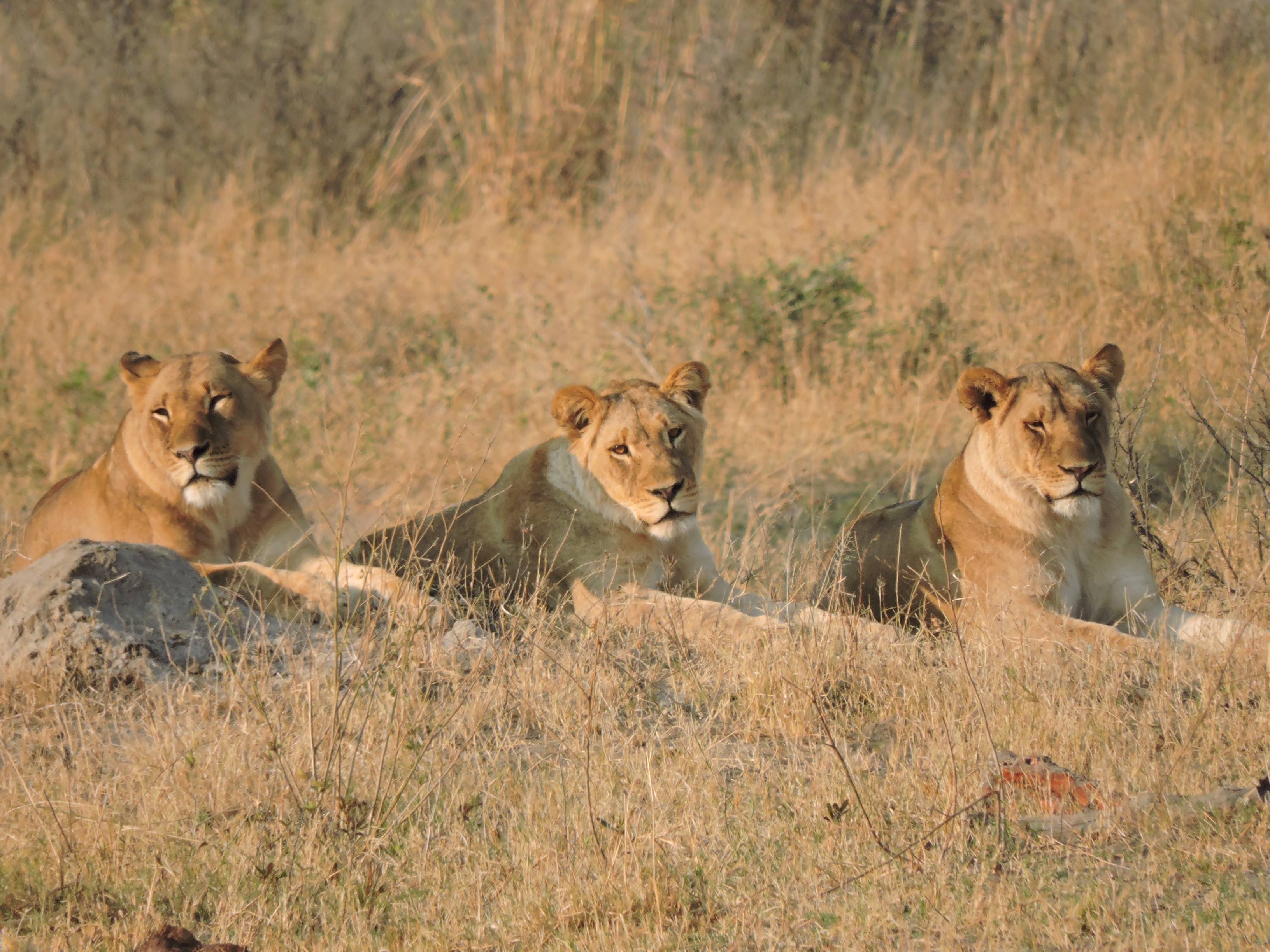
The three lionesses prior to the failed hunt.

The three lionesses.

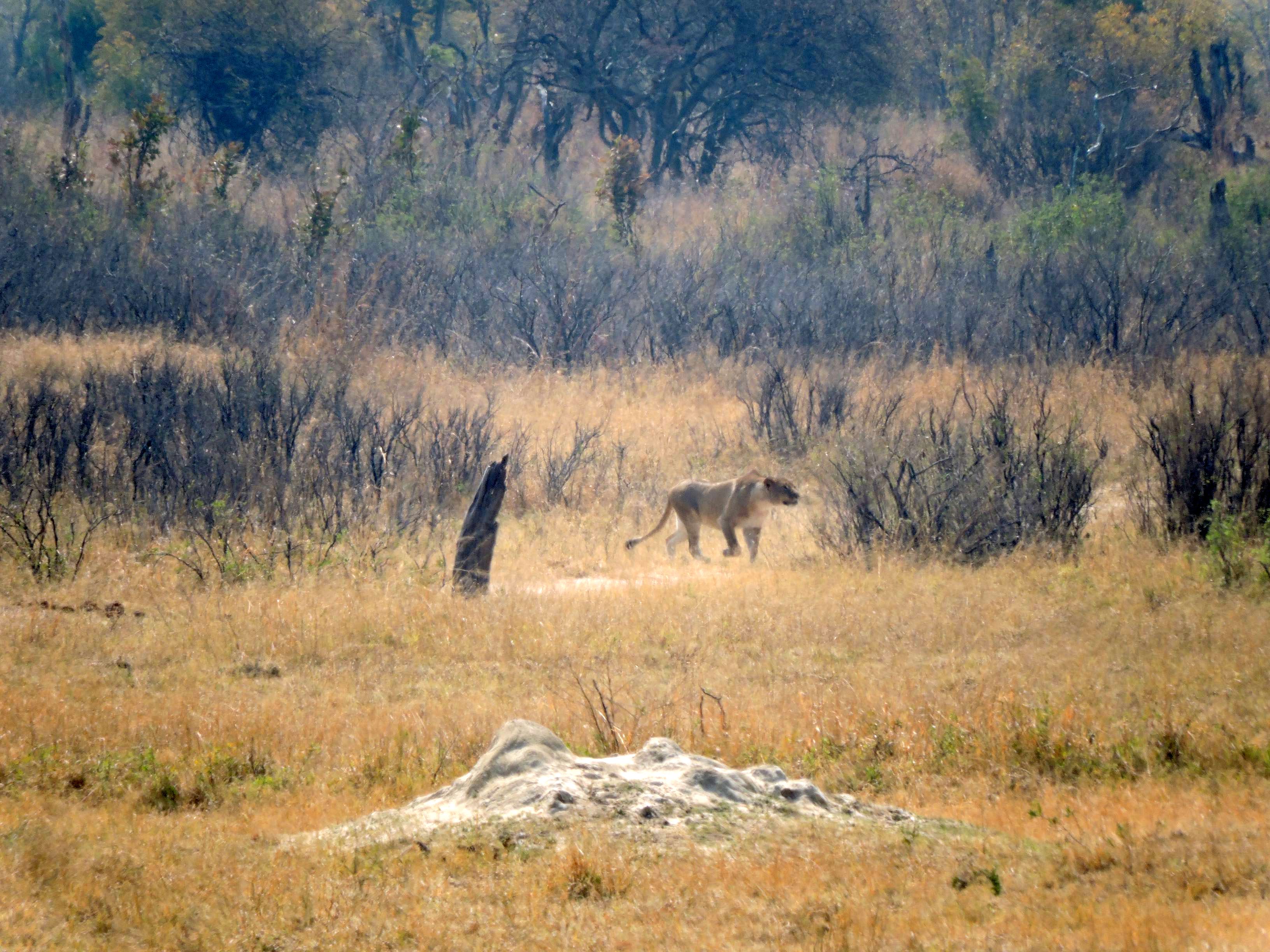
Suddenly one lioness stood up and started to walk with the clear “hunting gaze”: keeping her neck stretched straight out in line with her back and her head always leveled, despite walking over irregular terrain.

One of the lioness starts the hunt.

One of the lioness starts the hunt.

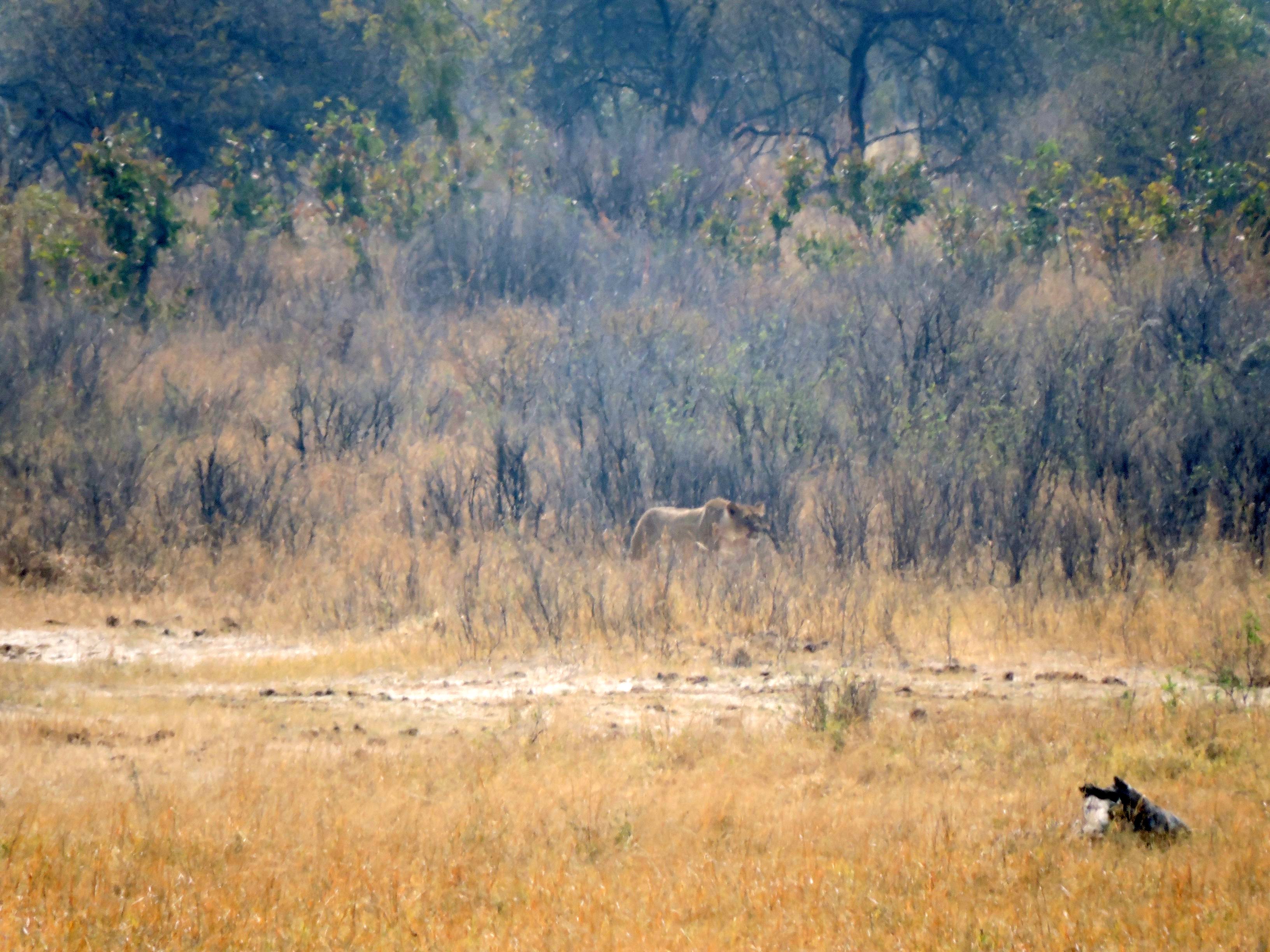
She is stalking somthing we did not see!

She is stalking something we did not see!

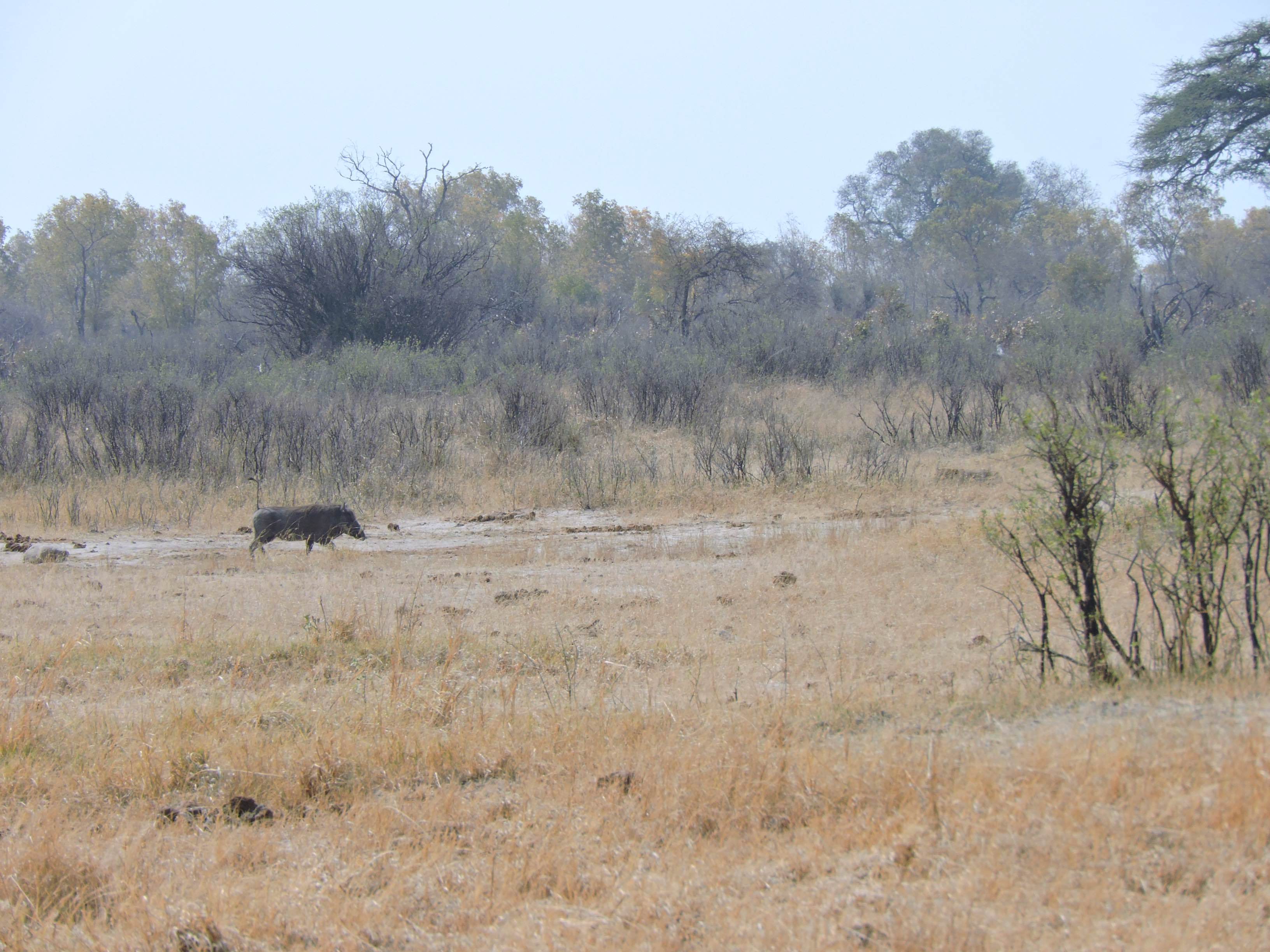
While watching her we lost sight of the other two and we realized that a hunt was on although we still did not see the prospective victim! We prepared ourselves for action and suddenly a couple of warthogs came running across the field, moving very fast and away from the visible lioness.

The warthog sees her and runs away!

One of the warthogs running away.

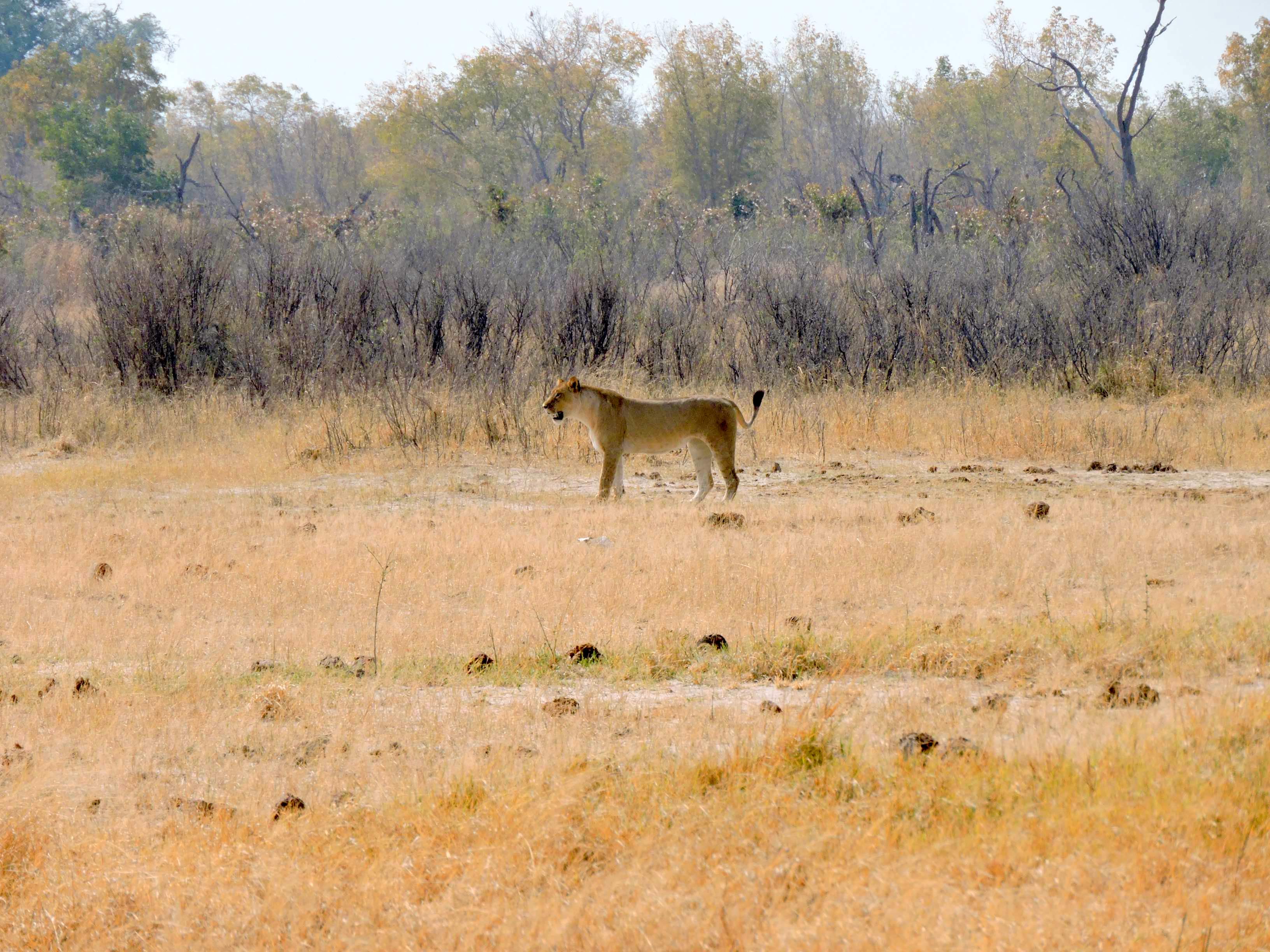
She went for them running at full speed for a short distance but quickly gave up the chase, as the warthogs at full speed were too much for her. While the warthogs disappeared, two more heads popped up in the grass in front of us. Something had failed in the ambush! Perhaps the warthogs smelled the lionesses or, as they looked young, they did not have the necessary skills to shut the trap. Whatever the reason for the failure the exercise proved to be too much and the females went back to the group and proceeded to do what lions do best: rest and sleep! We left them there hoping to find them again later.

The lioness gives up the hunt.

The lioness gives up the hunt.

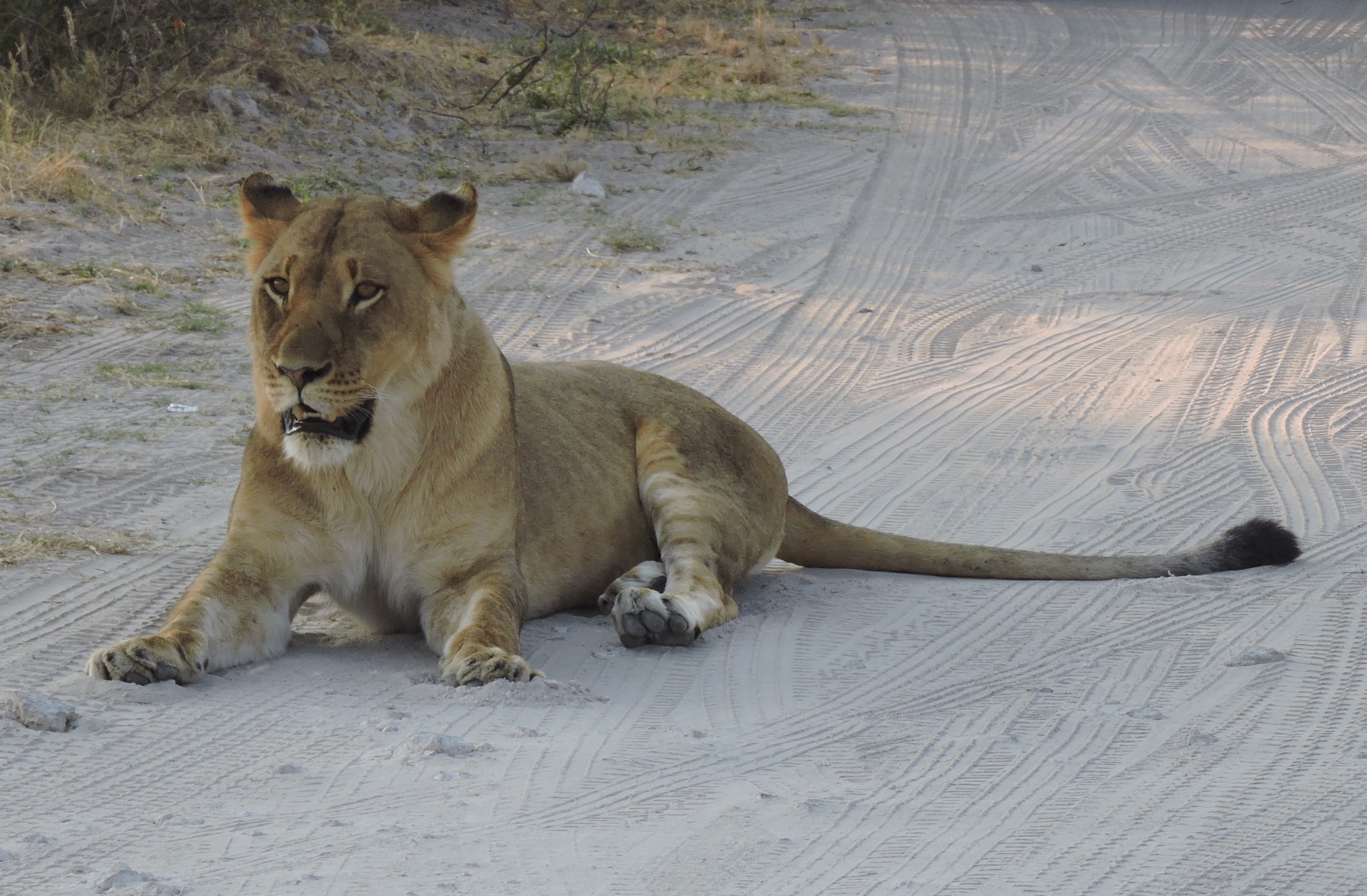
They were still there in the afternoon and, only when the day cooled down did they move into the bush where we lost them. Luckily they passed very close to us and we managed to take a few good pictures before they disappeared.

Resting on the road.

Resting on the road before moving off.

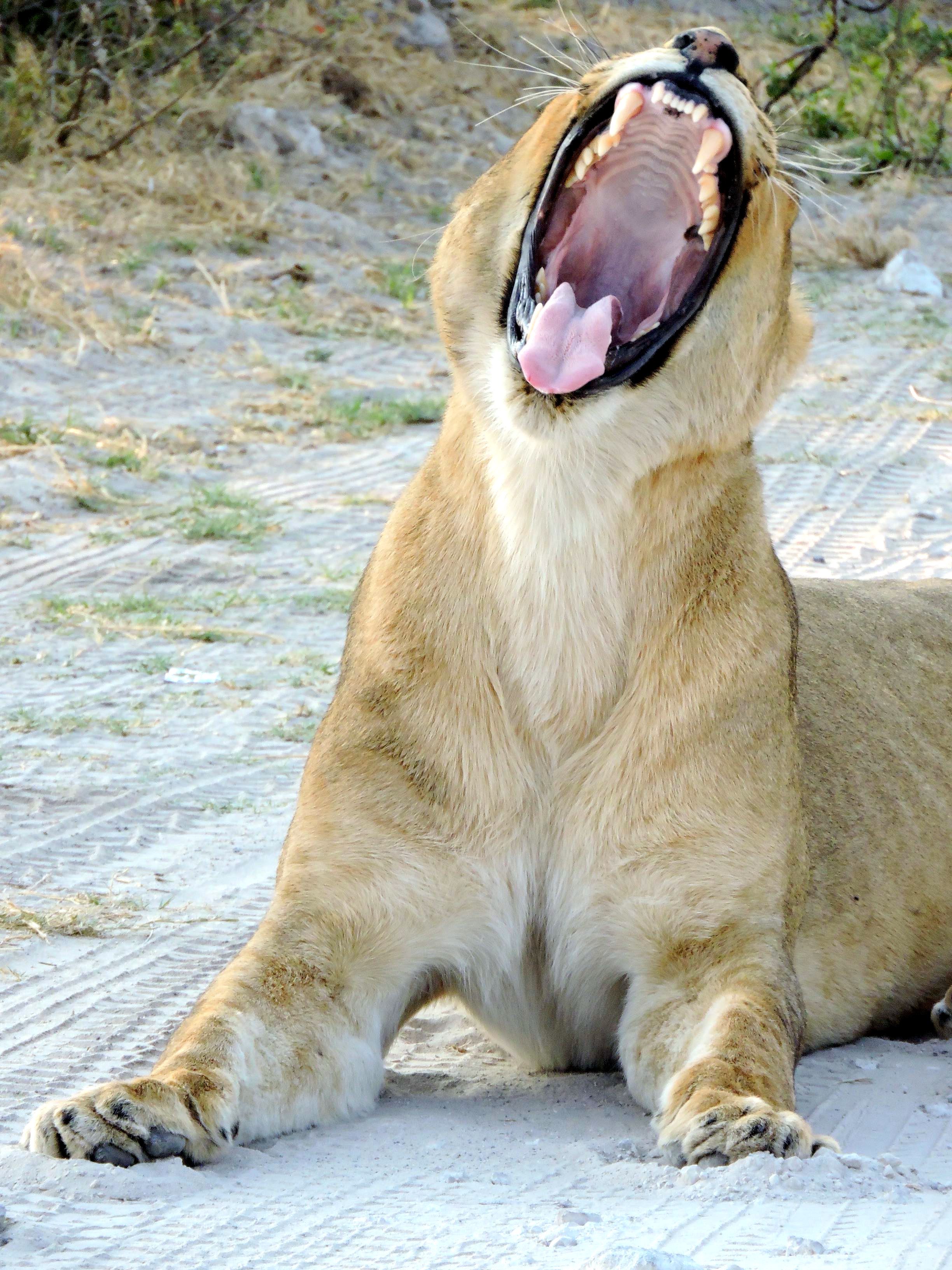
Showing us her "tools"...

Showing us her “tools”…

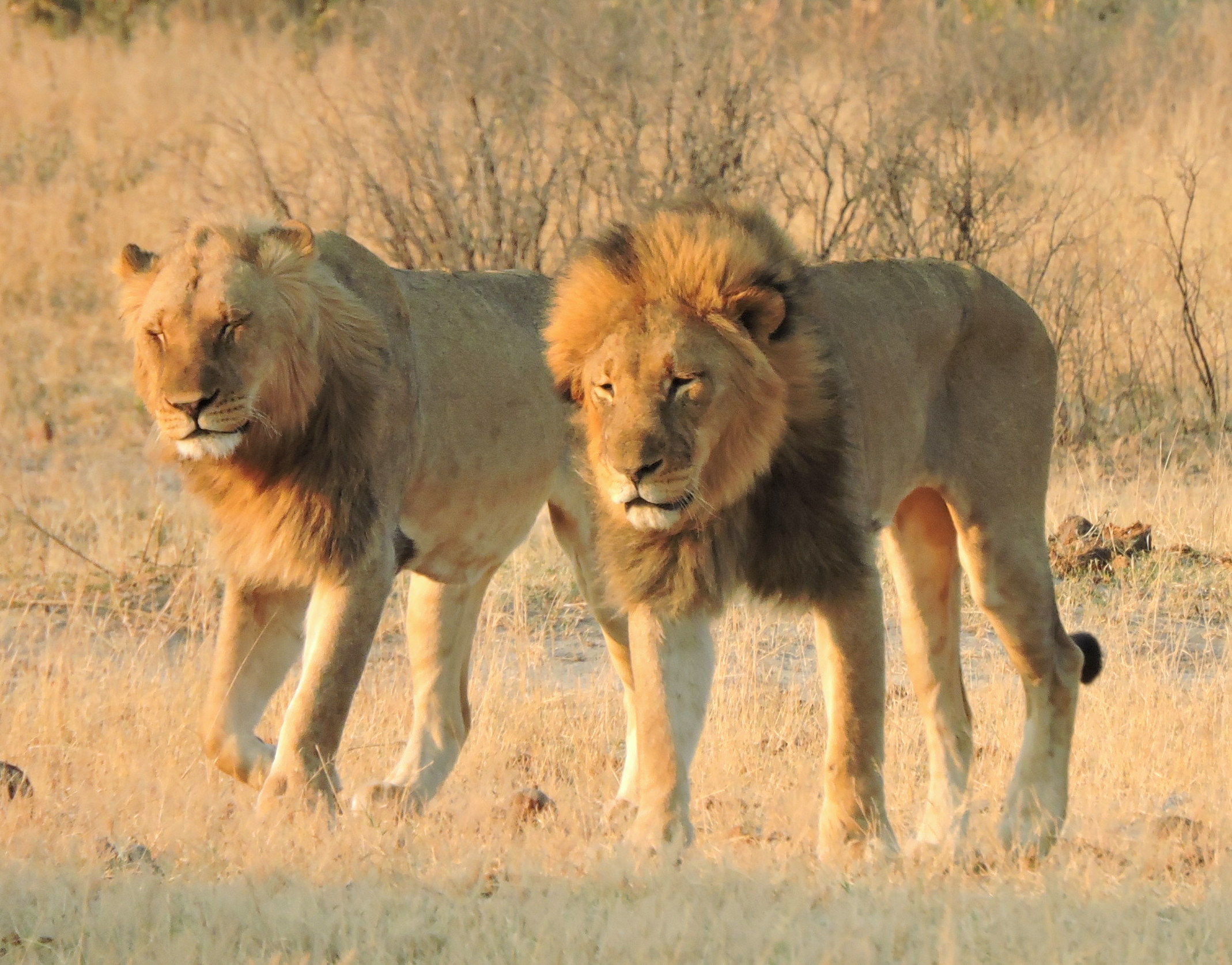
An older male joins in.

Two of the males moving off.

Moonlit Elephants

As usual, things did not go according to plan! Masuma dam -in Hwange National Park- had changed slightly. A small and shallow bay had been formed to the benefit of the thirsty animals, in particular the impala, who could now drink in relative safety as the crocodiles could not ambush them like last year.

The new drinking place made it safer for animals to drink. Philosophically, the crocodiles decided to sun themselves.

The new drinking place made it safer for animals to drink while the crocodiles wait.

This change in the architecture of the dam meant that the crocodiles (we counted six of them) were almost invariably sunning themselves on the banks of the dam in an apparent forced fast. There is no need to be concerned about them not eating, as they are able to survive long periods without food.

Hippo conversation!

Hippo discussion.

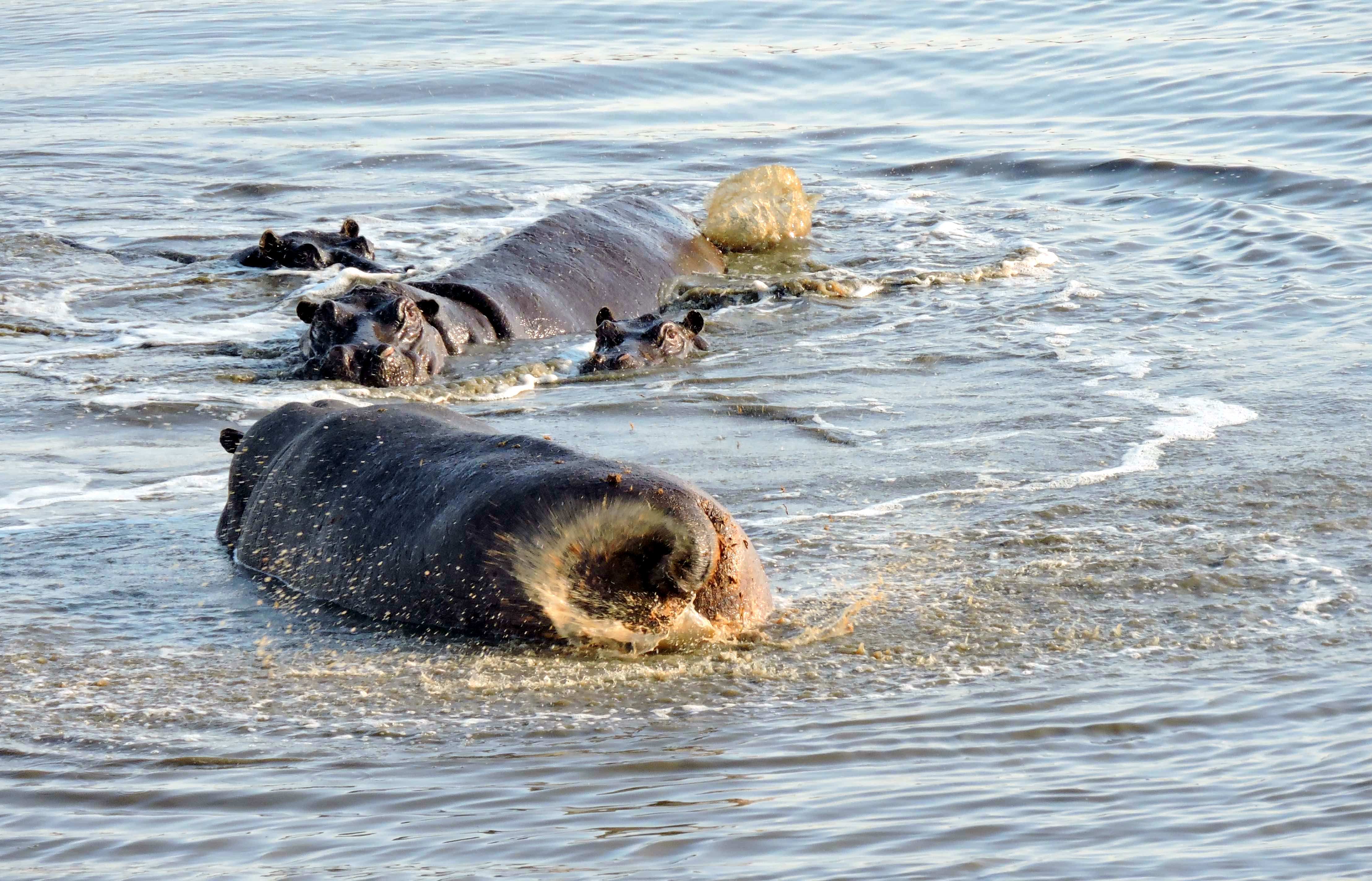
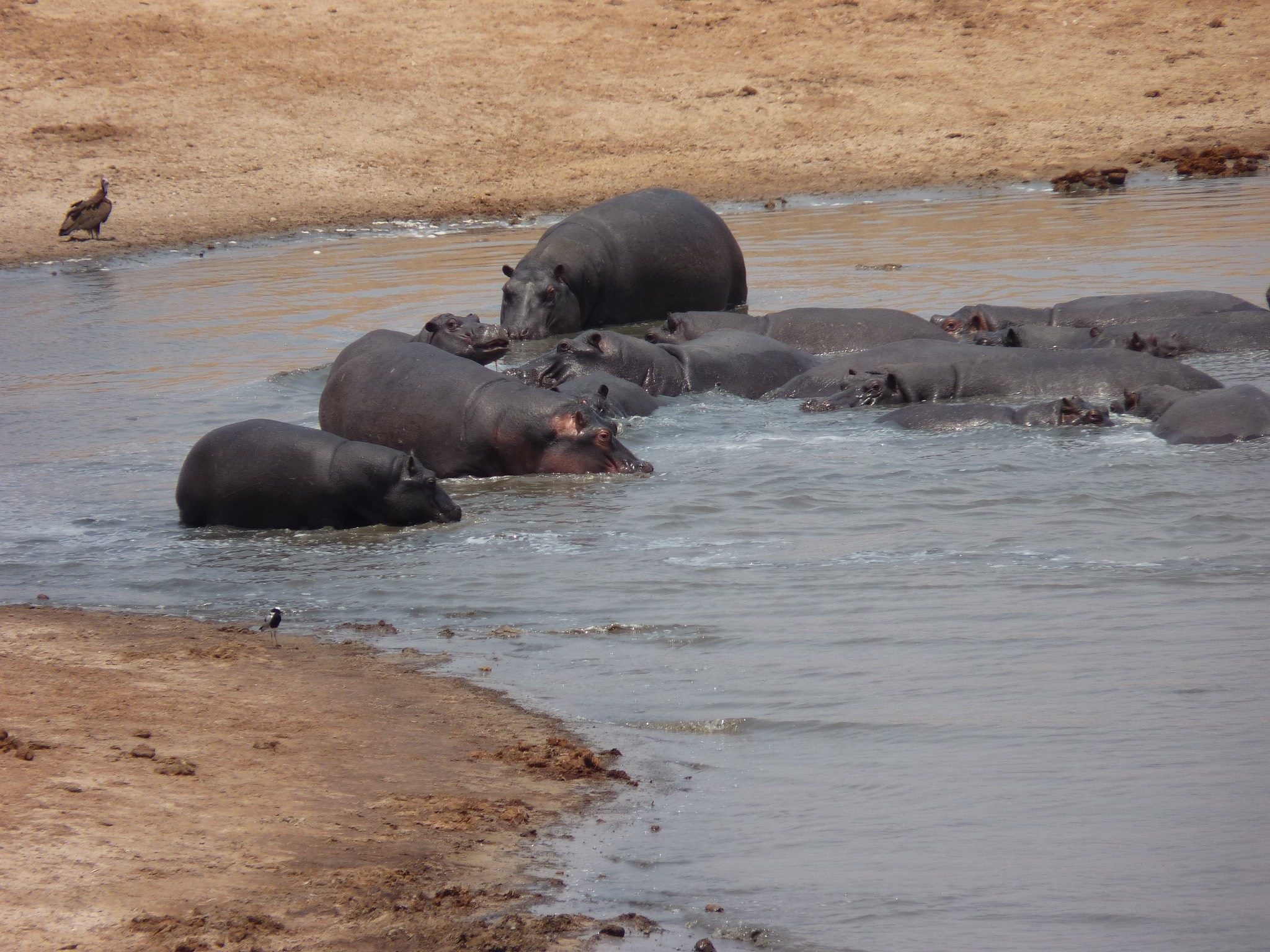
The sixteen hippos were also there. They behaved as one expects hippos to behave: most of the day time spent inside the water coming out for a “service” (sun, the occasional mud wallow and attention from oxpeckers) by lunch time and going out of the dam in the evening to graze. To achieve this they were forced to queue for sometime to squeeze between the drinking elephants! They spent most of their energy chasing each other inside the water snorting loudly and they were quite adept at showing us the end results of their digestion!

Hippos involved in "social" defecating...

Hippos involved in “social” defecation…

We arrived at Masuma at lunchtime. We spotted a few elephants drinking on the opposite side of the dam but no fresh water was being pumped in.

Elephants drinking before the pump was turned on.

The camp attendant anticipated my question telling me that lions were walking around the dam the night before and he did not dare to walk to switch on the pump! Needless to say that I obliged when he asked me for a lift to get there! While driving, keeping an eye for lions without seeing any, I learnt that a donor was providing diesel for the pump. “Once the pump is on the elephants will come” proclaimed the camp attendant after the engine started puffing. He also informed me that a full tank of diesel would operate the pump for twelve hours. “Twelve hours would take us through most of the night”, I thought while I mentally thanked the benefactor and hoped that the camp attendant was correct in his prediction.

All shyness lost when getting close to the water!

All shyness lost when getting close to the water!

Fortunately, as predicted by the camp attendant, the first elephants started to arrive within an hour of our return! Whether they smelled the fresh water or associated the pump noise with fresh water I could not say but the latter seems the most likely. The fact was that they made a beeline for the pipe producing the fresh water, ignoring the rest of the dam if possible! However, as the place got more and more crowded, the incoming families had to wait until those that had arrived earlier satiated their thirst or enter into the dam and drink less clean water.

The arrival of the first elephants took place at about 14.00 hours. By then we had already set up camp so we were ready for one of the greatest sights on earth: herds of thirsty elephants coming to drink! Your eyes get tired of gazing towards the confines of the bush that surrounds the dam and you need to stop for your eyes to rest. A few seconds later, when you resume your watch there they are as if they magically appeared in front of your eyes! They come out of the bushes in what appears to be a slow motion walk.

The miracle continues as more come into sight. Their slowness does not last long as, with raised trunks, they sniff the fresh water and their pace gets gradually faster as they approach it. It all ends with them breaking into a run to cover the last few metres, the baggy trousers that are their back legs flapping! Their run ends at the water’s edge where they drink showing their pleasure by shaking the water with their trunks and spilling it all over the place while drinking. Sometimes their run takes them into the water where they not only drink but also proceed to frolic like young humans!

Smelling us!

Smelling us!

Although we are used to seeing large herds of thirsty herbivores coming to a water source, they do so in a rather apathetic way. There is nothing like that when thirsty elephants smell water and I can assure you that their emotions show!

Once in the waterhole, their immediate thirst abated, the animals become quiet while making the best of the available water. They do vie for the best position but they do so rather discretely. Normally the larger animals occupy the best spots. These are bulls that come either singly or in small groups and join the drinking party for a while and then leave the way they came: on their own as normally they only join the female family units when there is one on heat.

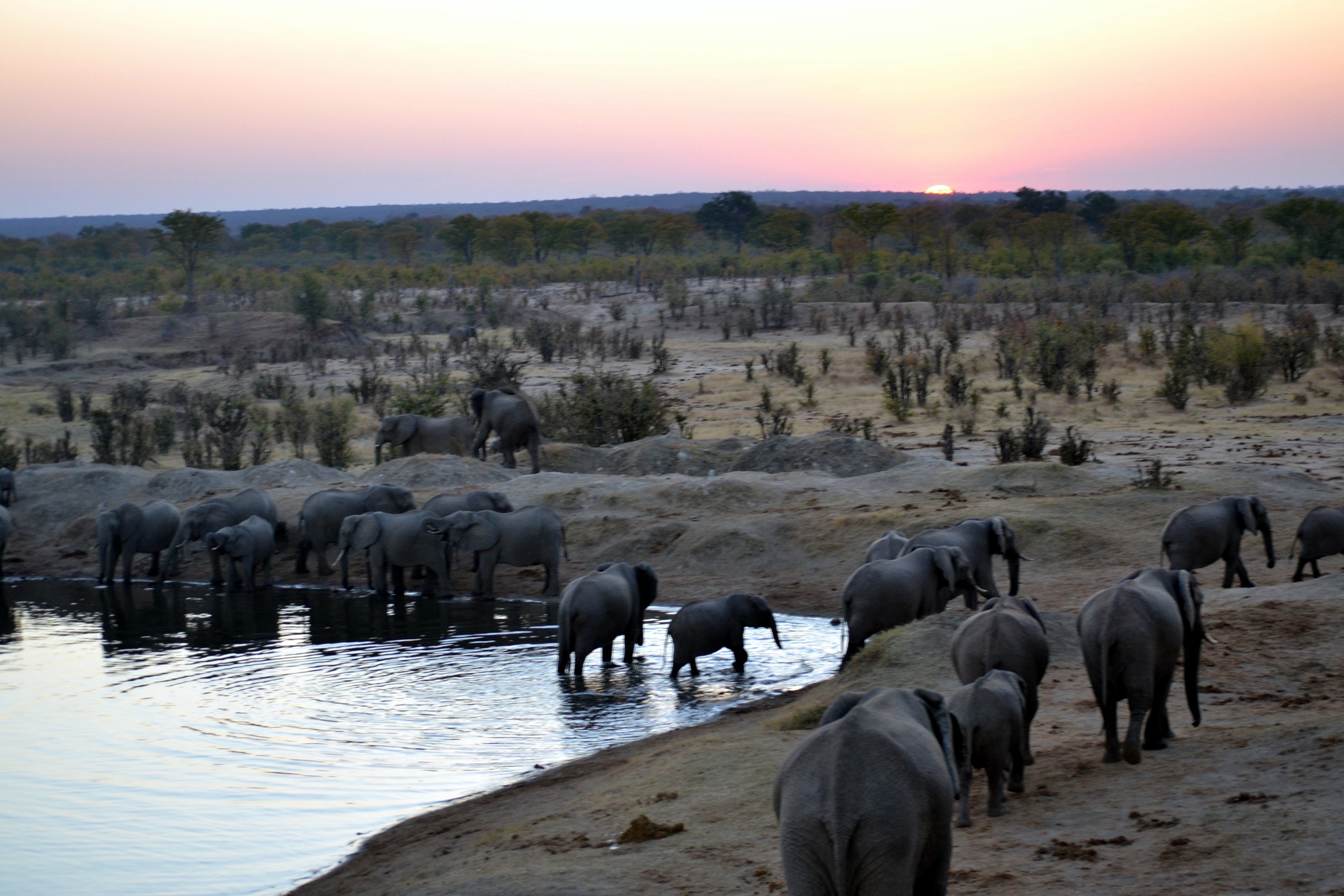
At sunset, the show continued unabated.

At sunset, the show continued unabated.

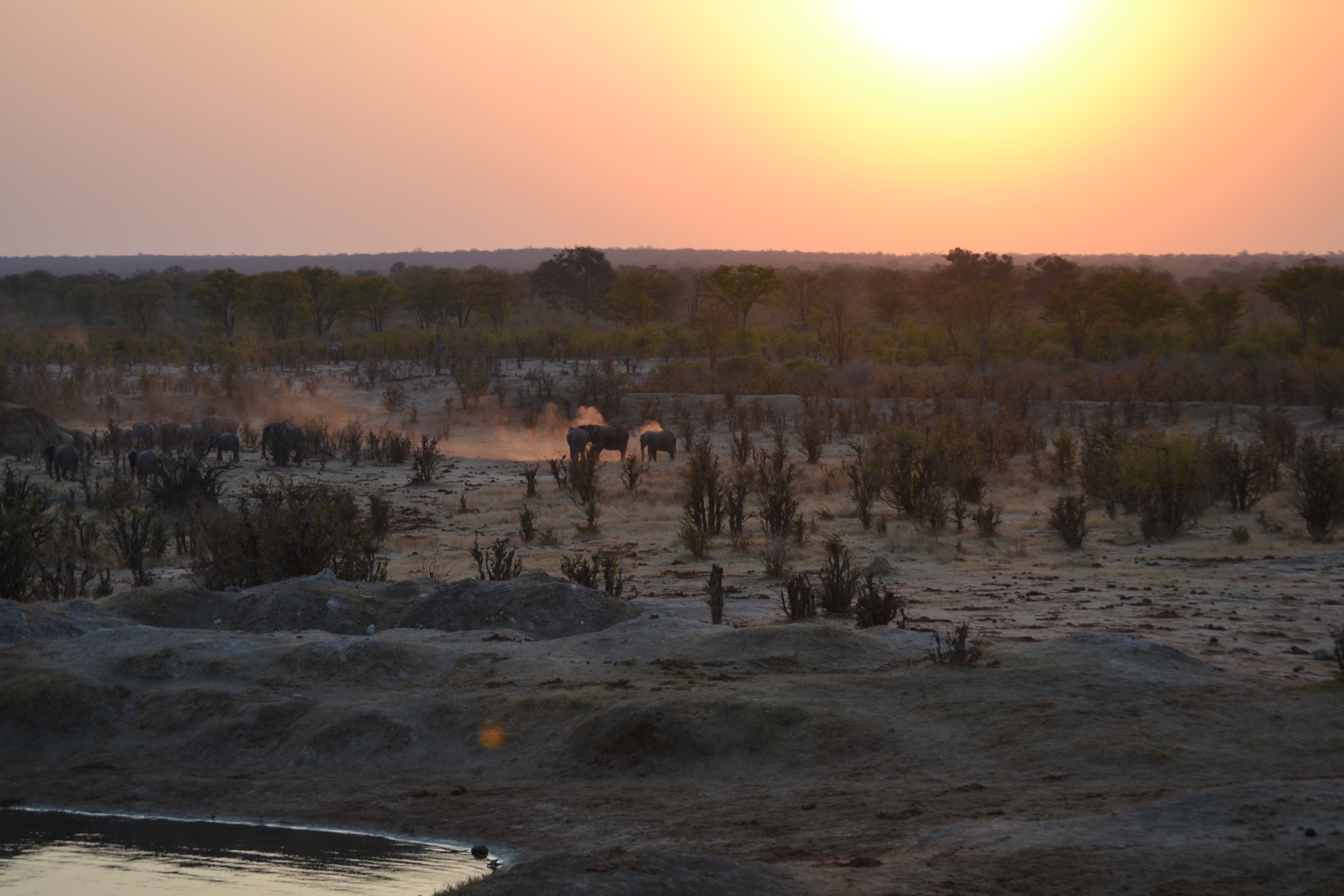
Sunset with elephants dusting themselves.

After bathing it was dusting time to cool off.

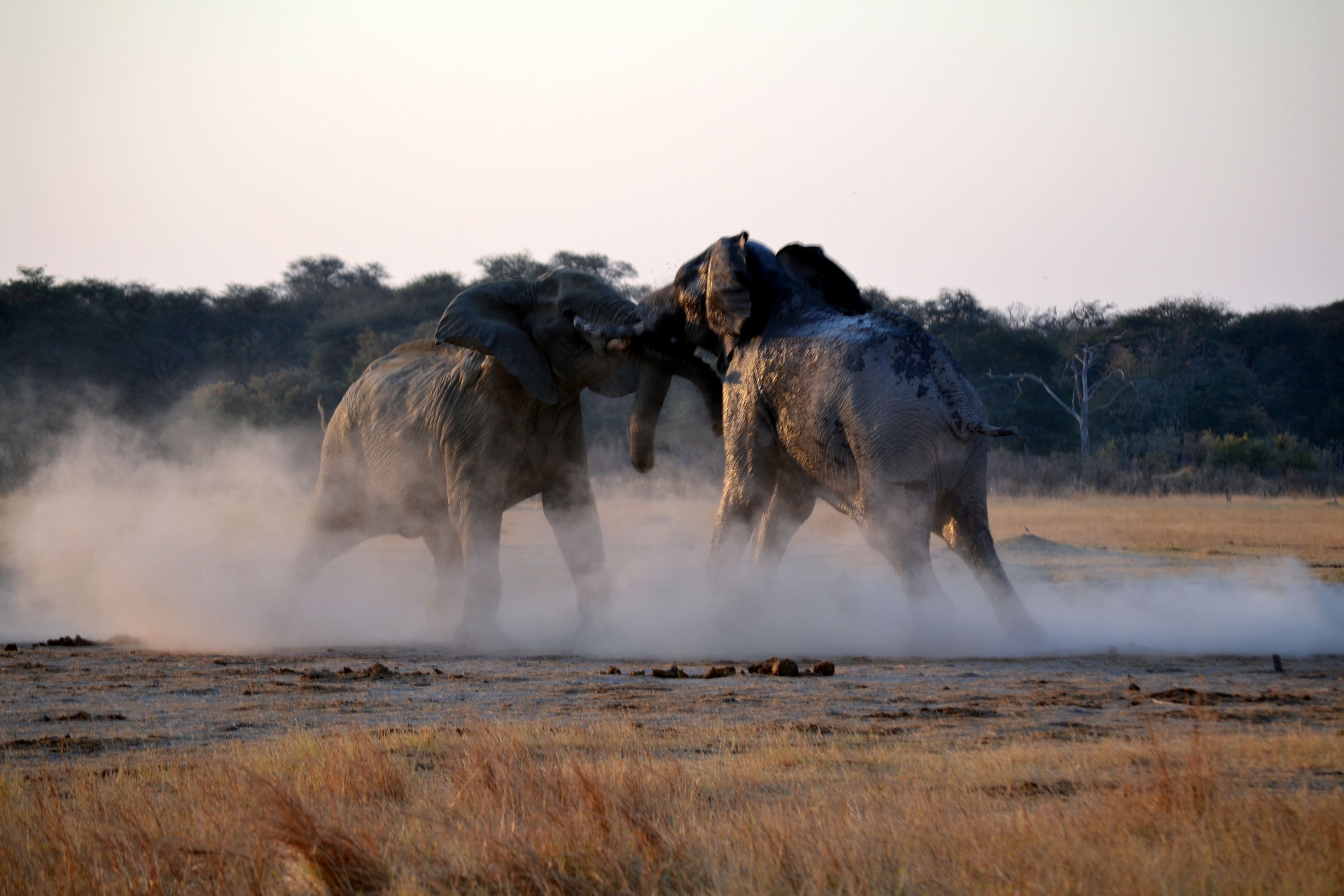
Occasionally youngsters manage to squeeze in between the tusker behemoths and timidly at first but quite boldly later manage to stick their small trunks into the right spot to get a share of the fresh flowing water. Loud squealing indicates when one of them oversteps the mark and is put back in its place with a shove! Adults show each other respect and only rarely do their interactions go beyond posturing. Overt aggression rarely takes place, and on the occasions that is does, it is normally short-lived. After an initial head clash, often quite violent, one of the rivals withdraws tail up and maintains a prudent distance thereafter! We saw this happening a few times at Masuma.

It is usually a rather gently affair.

It is usually a rather gently affair.

On occasions, however, things do go badly as shown by the chunks of ivory found at waterholes. The most extreme outcome I have ever seen is the skull with a hole made by a tusk on display at the Letaba Elephant Hall in the Kruger National Park. Wapiganapo tembo nyasi huumi” in Swahili means “When elephants fight the grass gets hurt”, a very accurate proverb to describe what you see in these situations! We saw quite a serious confrontation at Kennedy 2 dam near Ngweshla but, luckily, one of the bulls gave up before things got out of hand and the dust eventually settled.

Ocasionally things get out of hand.

Ocasionally things get out of hand.

Their great strength is evident.

Their great strength is evident.

DSC_0003 copy 2

DSC_0004 copy 2

Eventually they separated.

Eventually they separate and the “loser” moves off .

The elephant parade at Masuma continued throughout the whole afternoon and well into the evening. They paid no attention to the noisy arrival and departure at dusk of large numbers of banded grouse.

Elephants drinking at sunset.

Elephants drinking at sunset.

We stopped watching them for a while to have dinner but their noise stayed with us, as the herds were a few steps from our elevated camp. With dinner over it was time to go back to observe them again with the fading light. They were clearly wearier and their trunks rose more often to smell us and confirm our presence. Belly rumbling also became more frequent and louder. I was aware that the latter is believed to be a communication method among elephants but I did not know that the rumbling moves from animal to animal in a herd, in order to make sure that it reaches the last individual in the herd. Fascinating stuff!

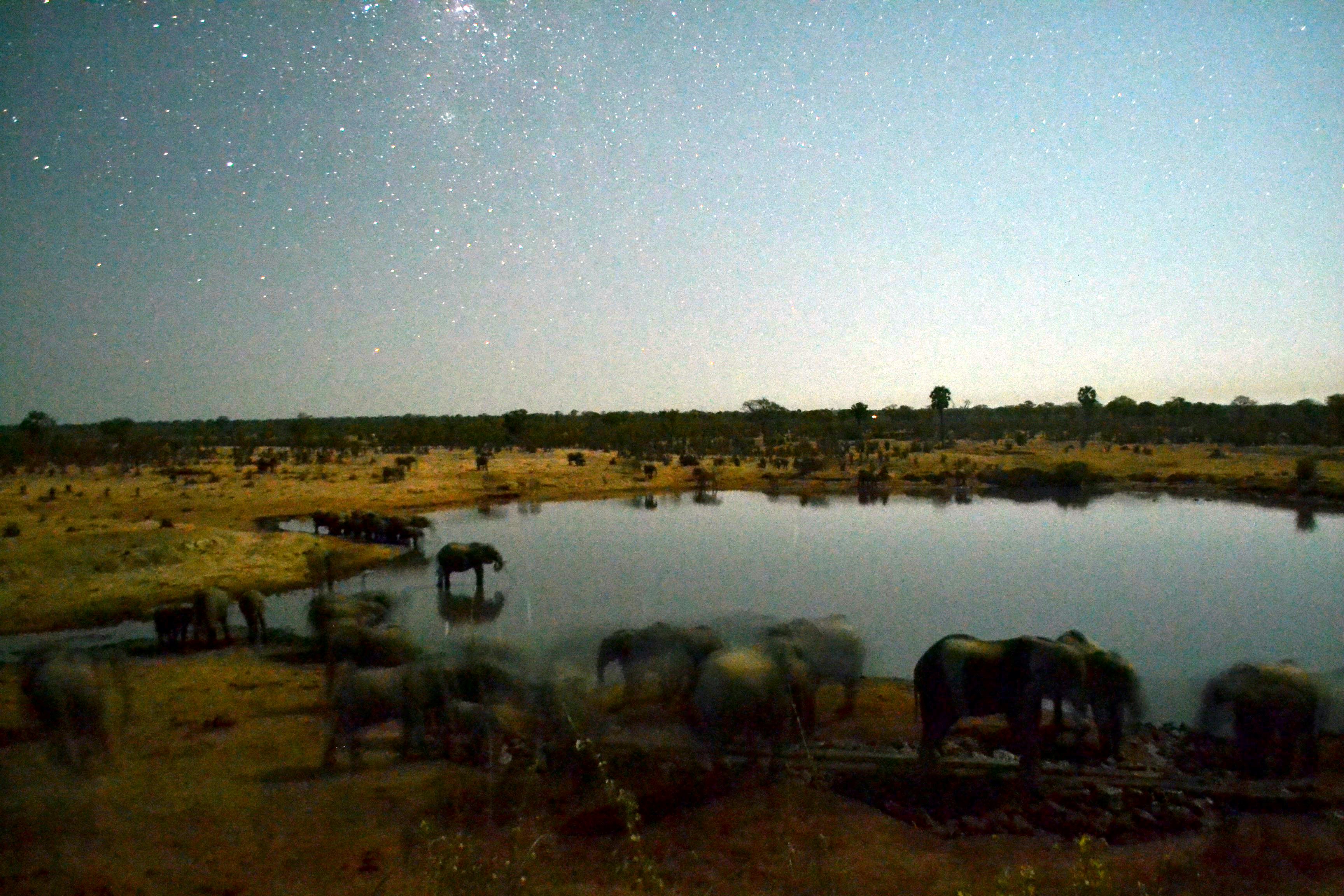
A night picture of the dam with drinking elephants. I applied the Picasa "I am feeling lucky" command to get light into the picture.

A night picture of the dam with drinking elephants. I applied the Picasa “I am feeling lucky” command to get light into the picture. Even the stars can be seen better!

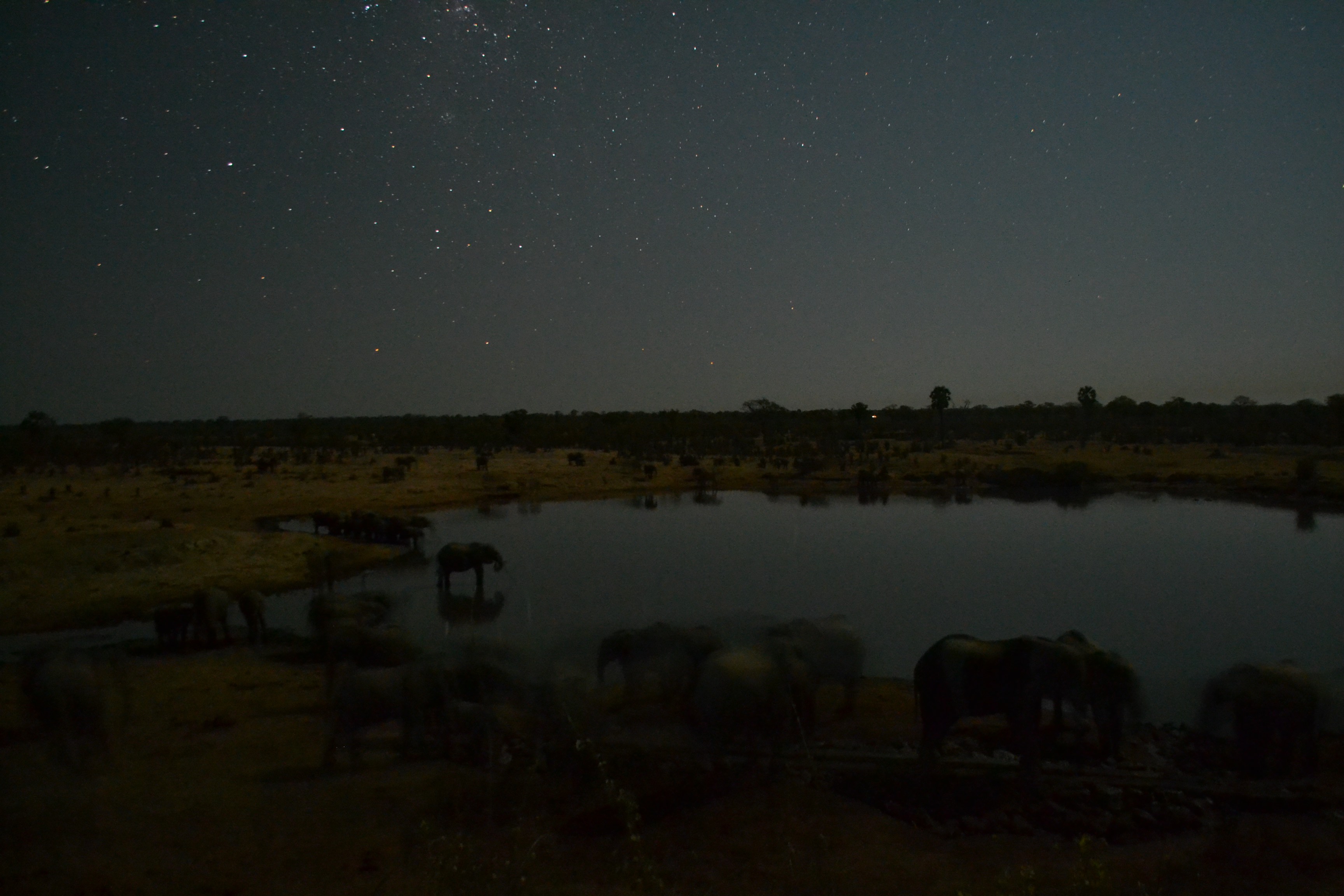
The original picture, above.

The original picture, above.

After a long while we were getting ready to go to bed when the moon started to illuminate the bush across the dam so we decided to wait a while longer. It was well worth it! The moon was almost full and it cast an eerie light over the moving dark grey masses. Absorbed by this rare vision we remained on the watch and for a while forgot our sleep. We stayed with them until they started to move off and only a handful of bulls remained until about 2 am. It is probable that their withdrawal matched the end of the pump’s diesel and their departure brought calm to the dam and we could enjoy a silent African night for a while until the lions started to roar in the distance!

The following morning, apart from the fresh droppings, nothing gave away what we had witnessed a few hours earlier.

Fearless bee-eater

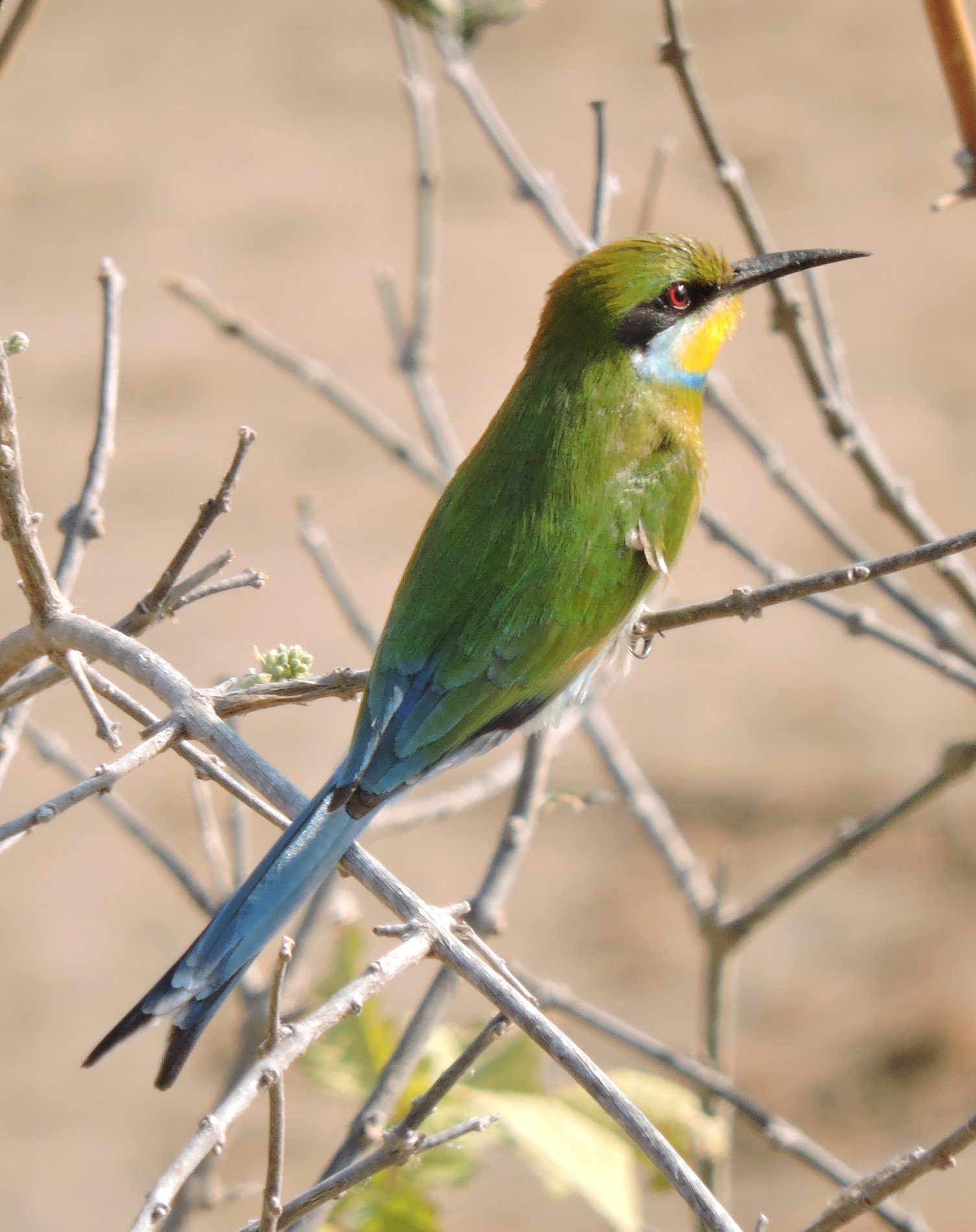
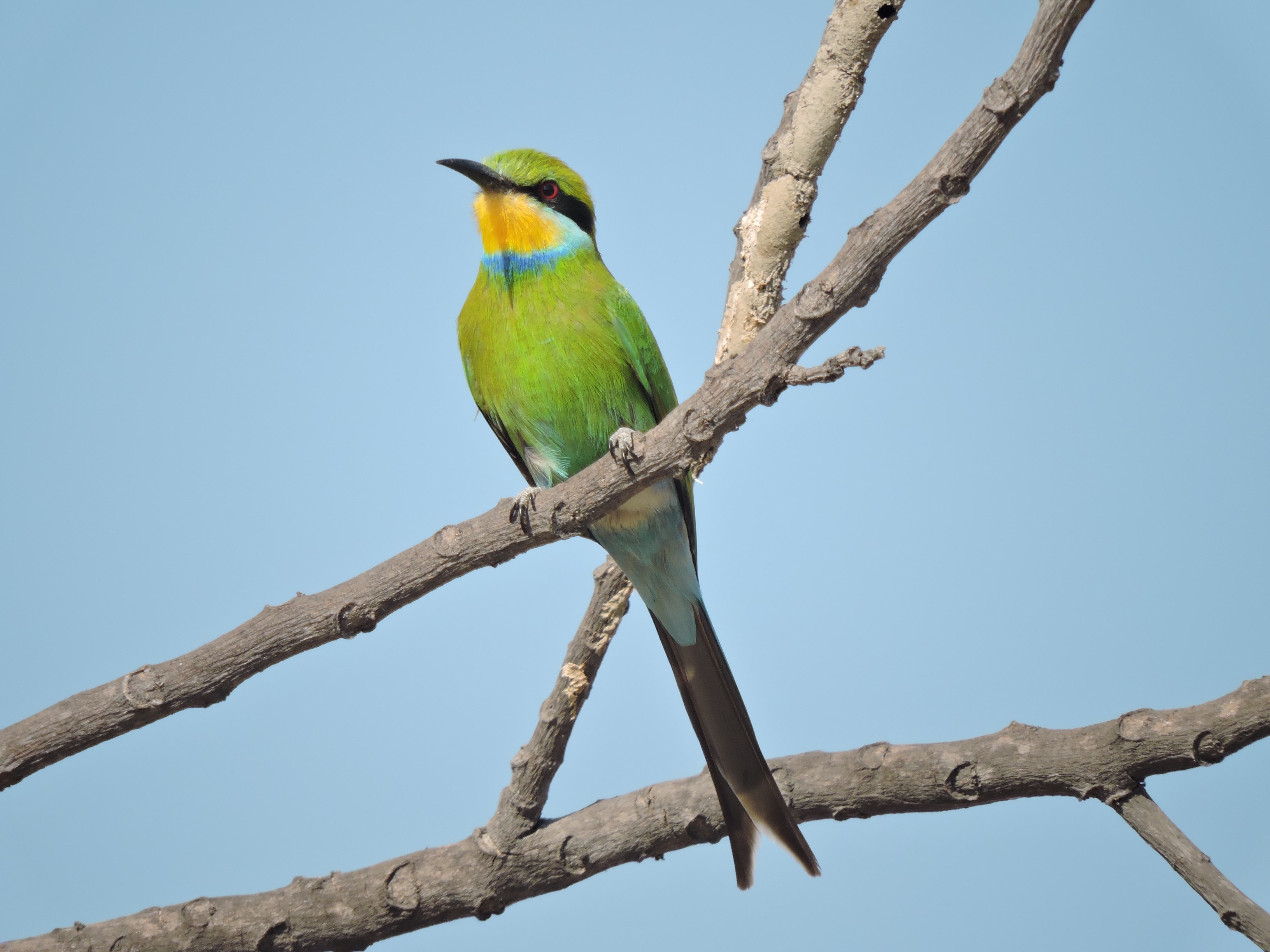
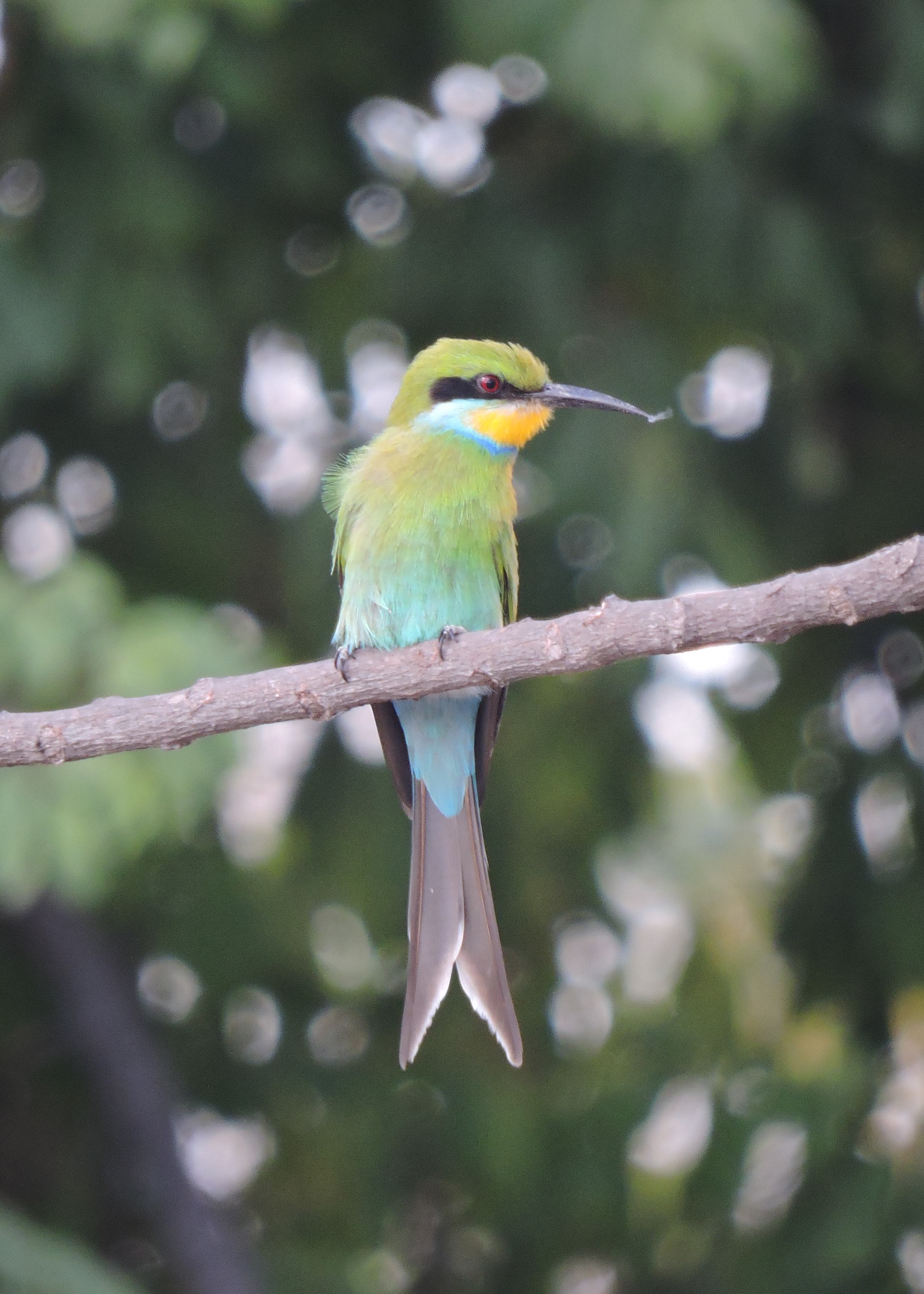
While at Masuma dam, we spent sometime identifying a bee-eater that we had not seen before. Fortunately at least one pair was residing at the dam’s campsite and we had time to have a good look and classify them as swallow-tailed bee-eaters (Merops hirundineus). As my new Roberts VII Multimedia Bird of Southern Africa App says, “The deeply forked blue tail is diagnostic”.

The first picture.

The first picture.

The birds were using two trees from which they would launch themselves in search of prey and come back to the same perch to either try again if they failed or to eat the unfortunate insect if successful. Having watched them for a while we decided that we needed a good picture.

My son is keen on bird watching and wildlife photography so he was given the task of taking “the picture” of the new bee-eater. He approached the birds and took a few shots. Not happy with the results, he tried to get a few steps closer and he got two good shots.

DSCN6573 copy


DSCN6577 copy 2

While moving forward still he saw a fly landing on the side of his shorts but he paid no attention to it as his eyes were fixed on the bee-eater. However, when he was about to shoot, the bird disappeared from the viewfinder. Before he could react he felt more than saw a touch on his shorts where the fly was and, to his surprise, he saw the bee-eater flying away with the fly in its beak! Luckily, he reacted fast and took a picture of the fly being eaten by the bird!

The bird with the prey caught on my son's shorts!

The bird with the prey caught on my son’s shorts!

I have seen garden birds coming to feed on people’s hands or even landing on their heads to feed from there but it was a first to see a wild bird being so daring!

Hwange National Park

Last year I reported on our stay at Shumba Picnic site in Hwange National Park in Zimbabwe (see: https://bushsnobinafrica.wordpress.com/2014/10/31/watched-at-shumba/) as well as the observations we made on the struggle we witnessed between crocodiles and hippos for the impala carcasses at Masuma dam (see: https://bushsnobinafrica.wordpress.com/2015/02/22/hippos-from-hell/ and https://bushsnobinafrica.wordpress.com/2015/03/23/hippos-from-hell-the-videos/).

Hippos were not interested in Impala meat this time!

Hippos were not interested in Impala meat this time! (Photo by Julio A. de Castro & Mariana Terra)

(Photo by Julio A. de Castro & Mariana Terra)

(Photo by Julio A. de Castro & Mariana Terra)

After our return from that safari we immediately booked the Masuma dam campsite so that we could stay closer to the action and see if we could observe something additional in the crocodile-hippo saga that caught our interest earlier. We also booked a place in Main Camp as we were sure we would have fun with elephants at Nyamandlovu pan. We knew that the elephants were plentiful there and we could watch them and enjoy their antics!

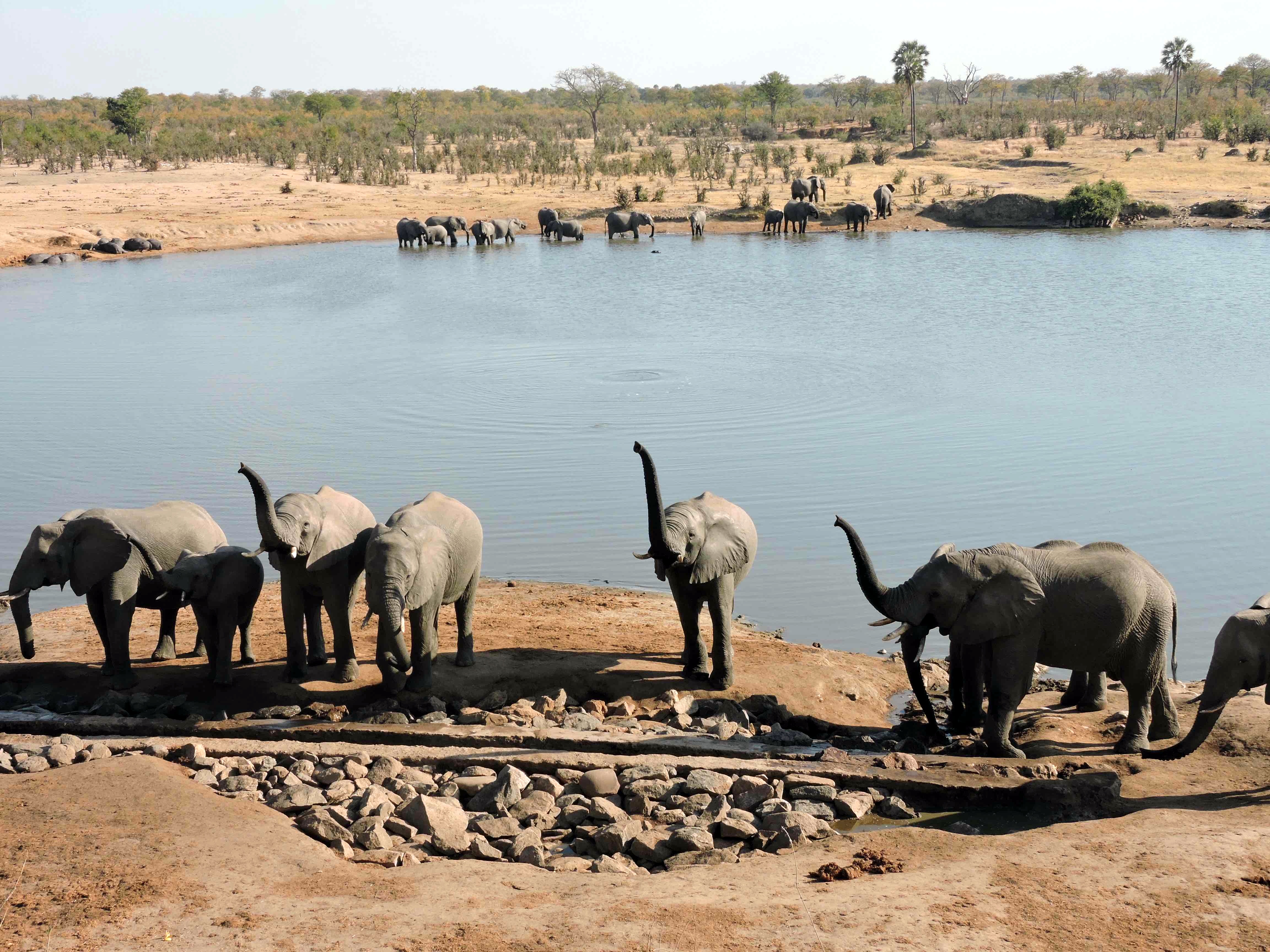
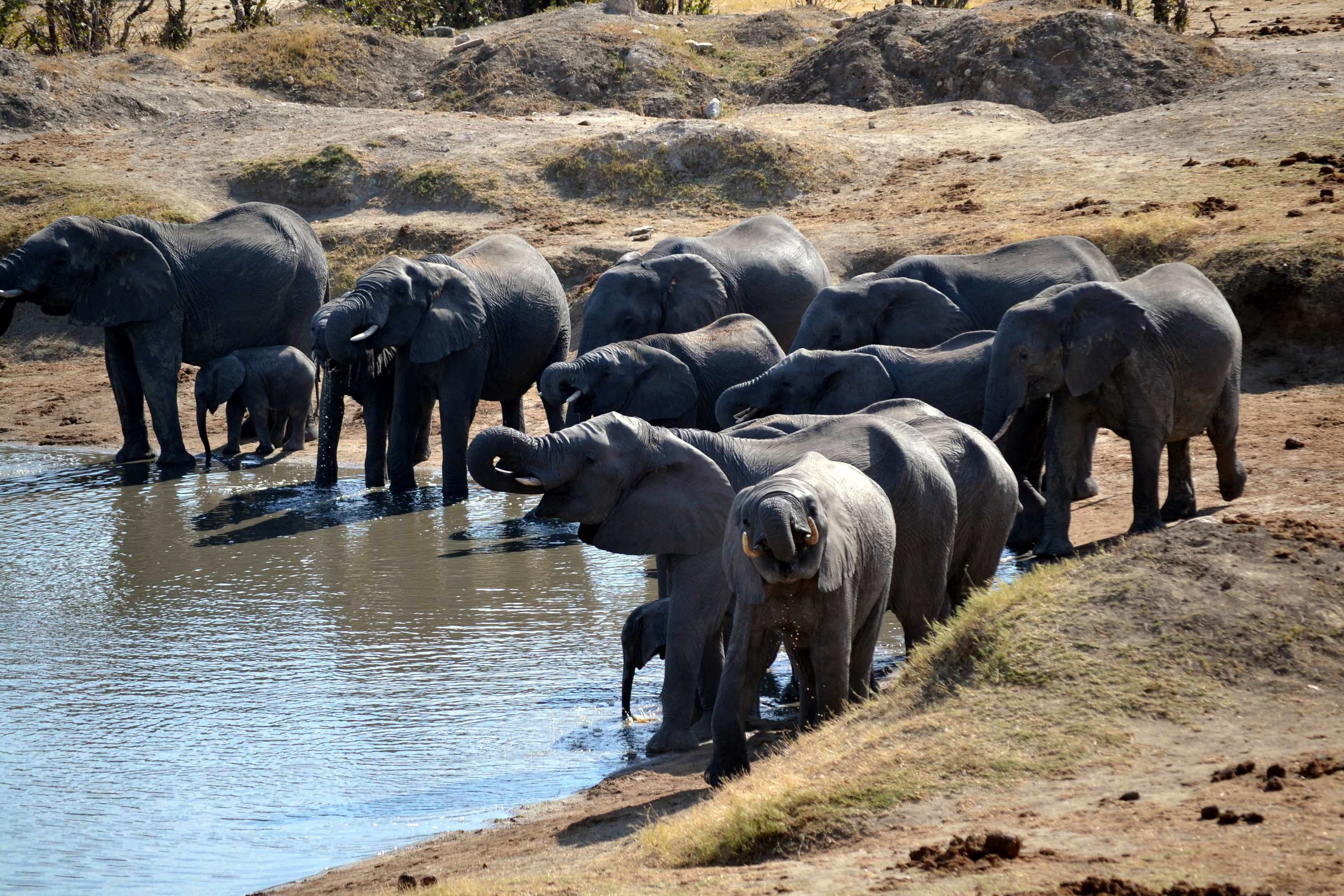
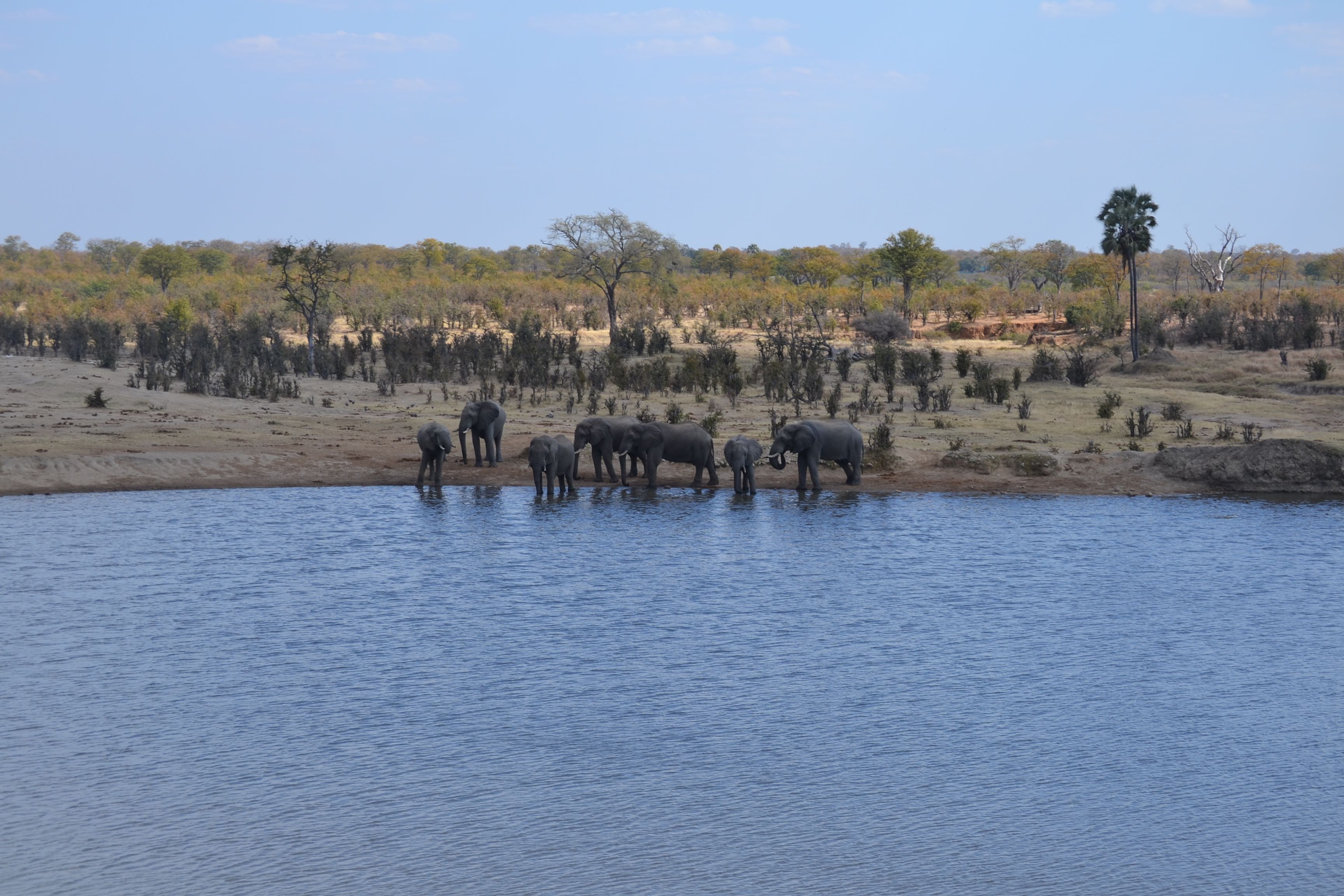
THis time there were lots of elephants at Masuma dam. (Photo by Julio A. de Castro & Mariana Terra)

This time there were lots of elephants at Masuma dam. (Photo by Julio A. de Castro & Mariana Terra)

We even saw pink elephants... (Photo by Julio A. de Castro & Mariana Terra)

We even saw pink elephants… (Photo by Julio A. de Castro & Mariana Terra)

As part of our “discovery drive” we also camped in the Ngweshla pan campsite as it has a reputation as the best place to camp in Hwange and is a place where predators are often seen because the area surrounding the various pans and water holes found there is quite open, a change from the thick bush of other areas in the park.

The safari took place between 22 and 29 July 2015 and I describe its highlights in four posts:

Fearless bee-eater

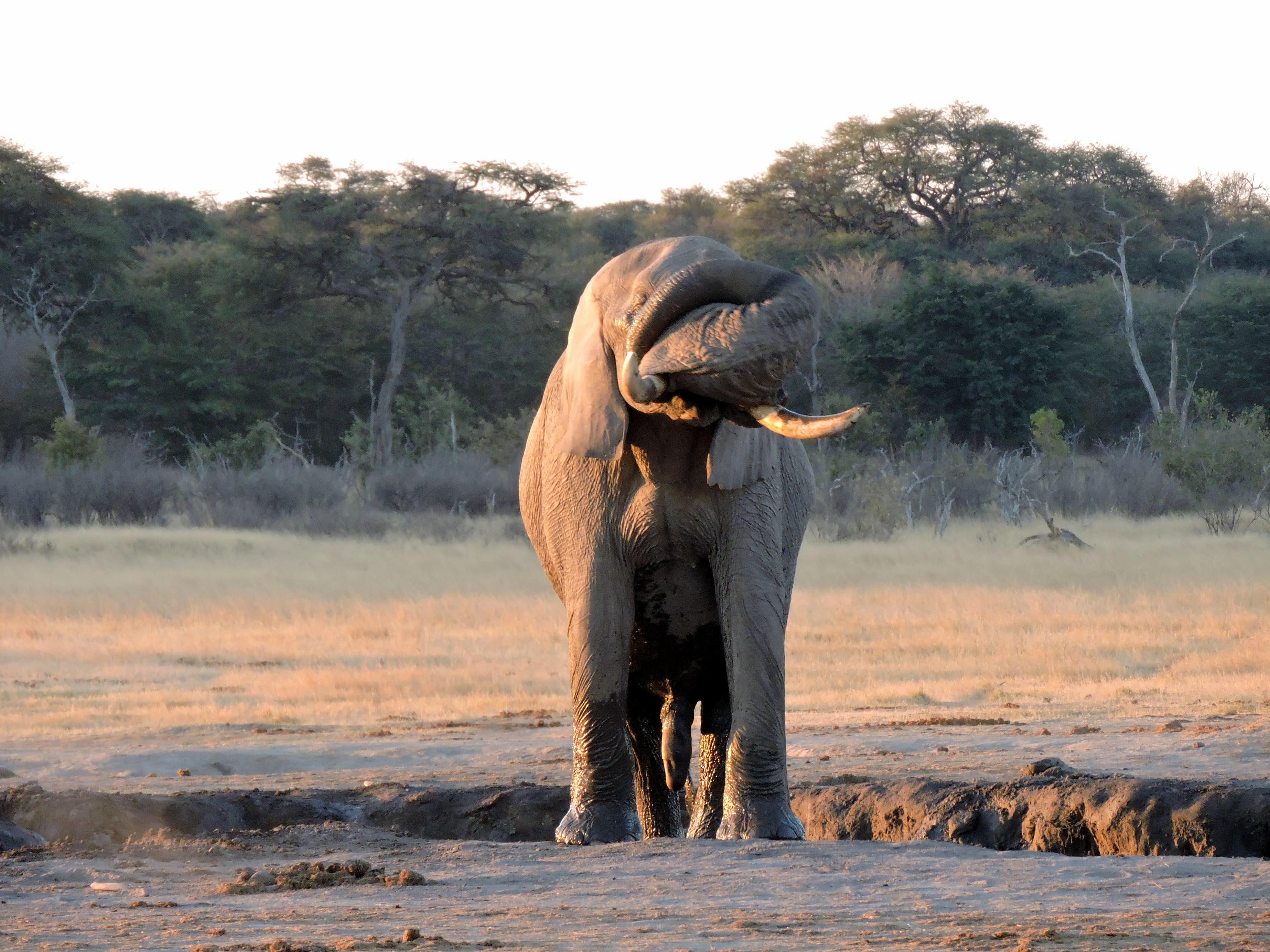
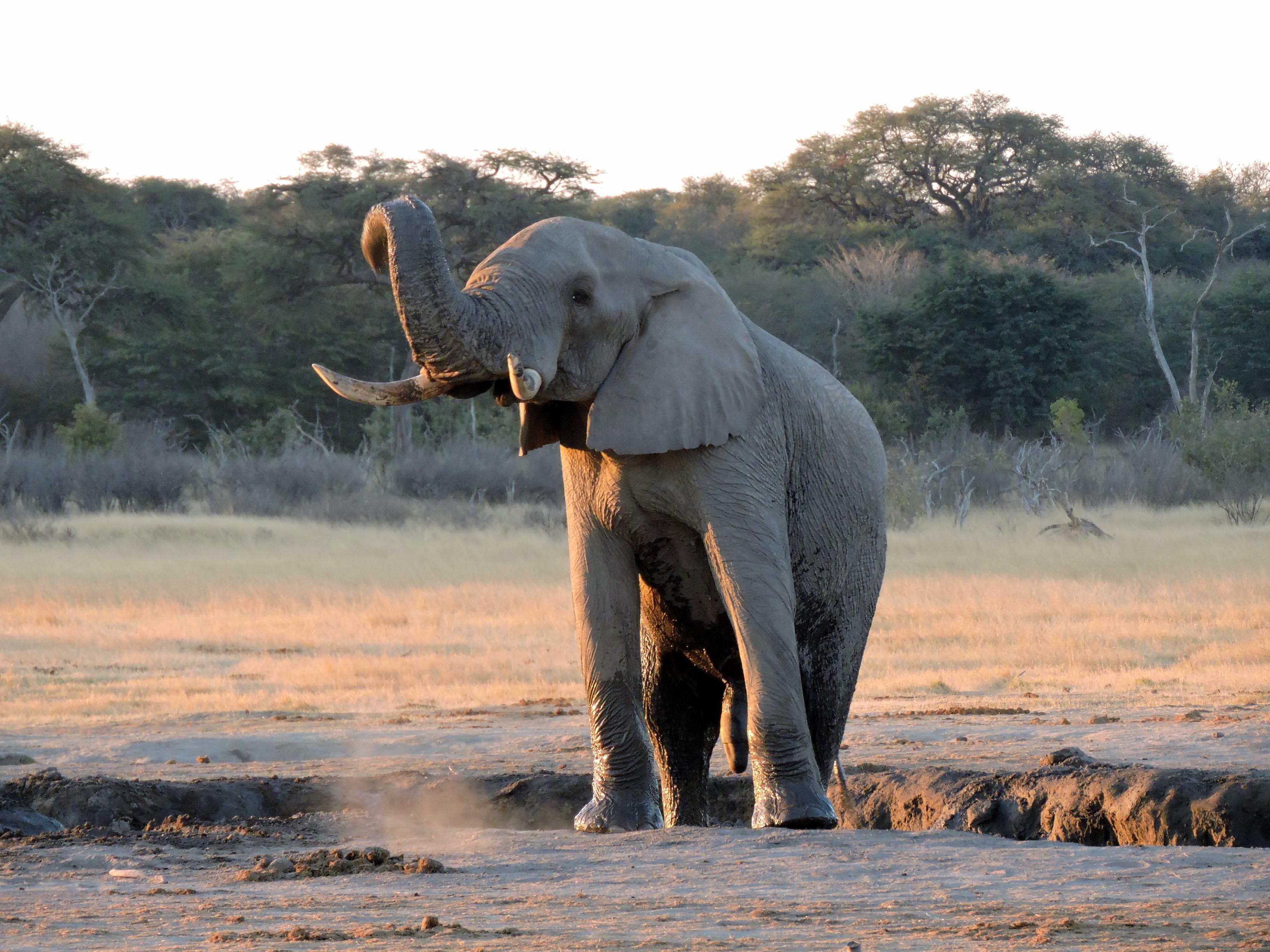
Moonlit elephants

Encounter with lions, and

Ngweshla cold.


I hope you will enjoy them.

Hippos from Hell

In an earlier post I described how Crocodiles[1] were stalking and catching Impala at Masuma dam[2]. What I did not mention yet was what happened next. You will not regret reading on!

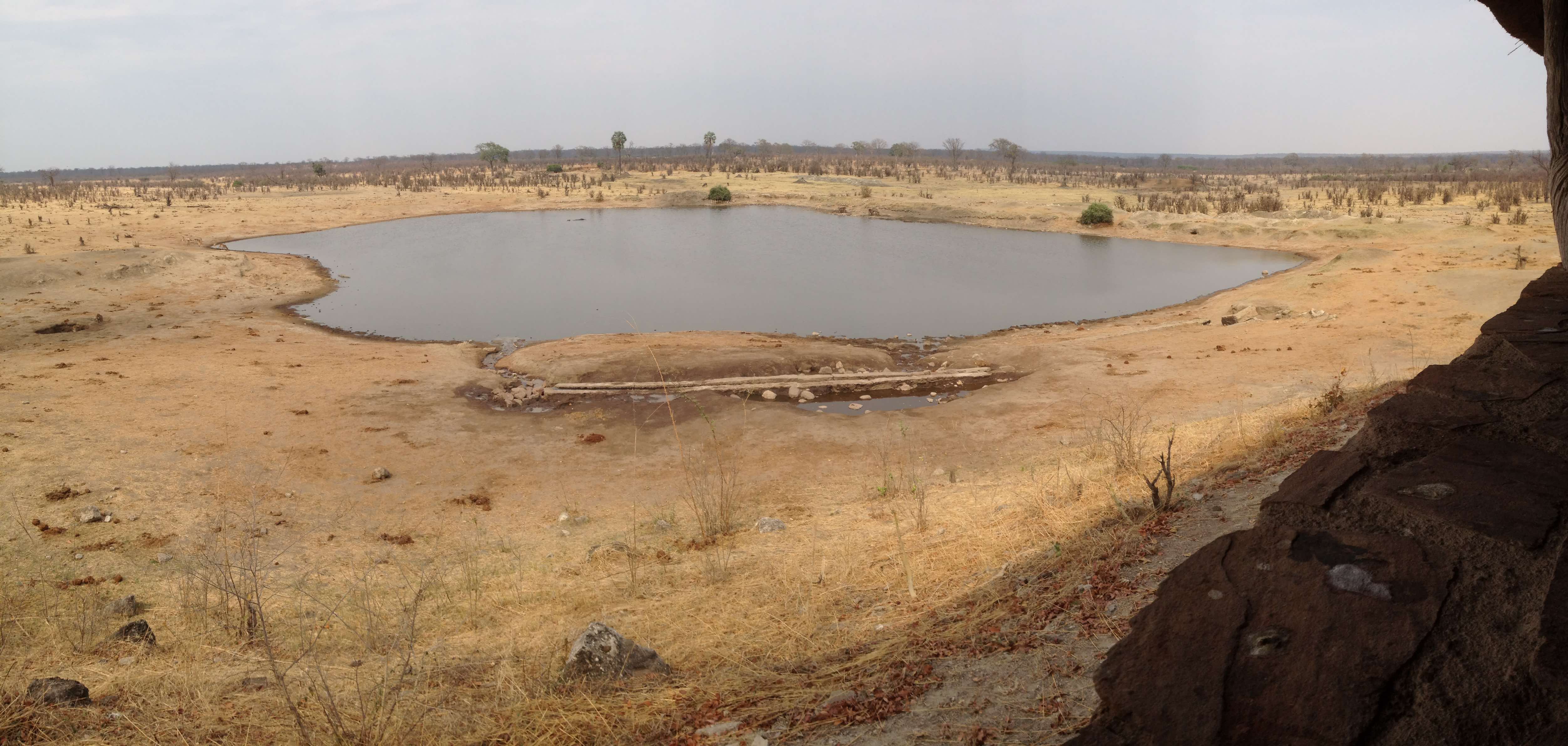
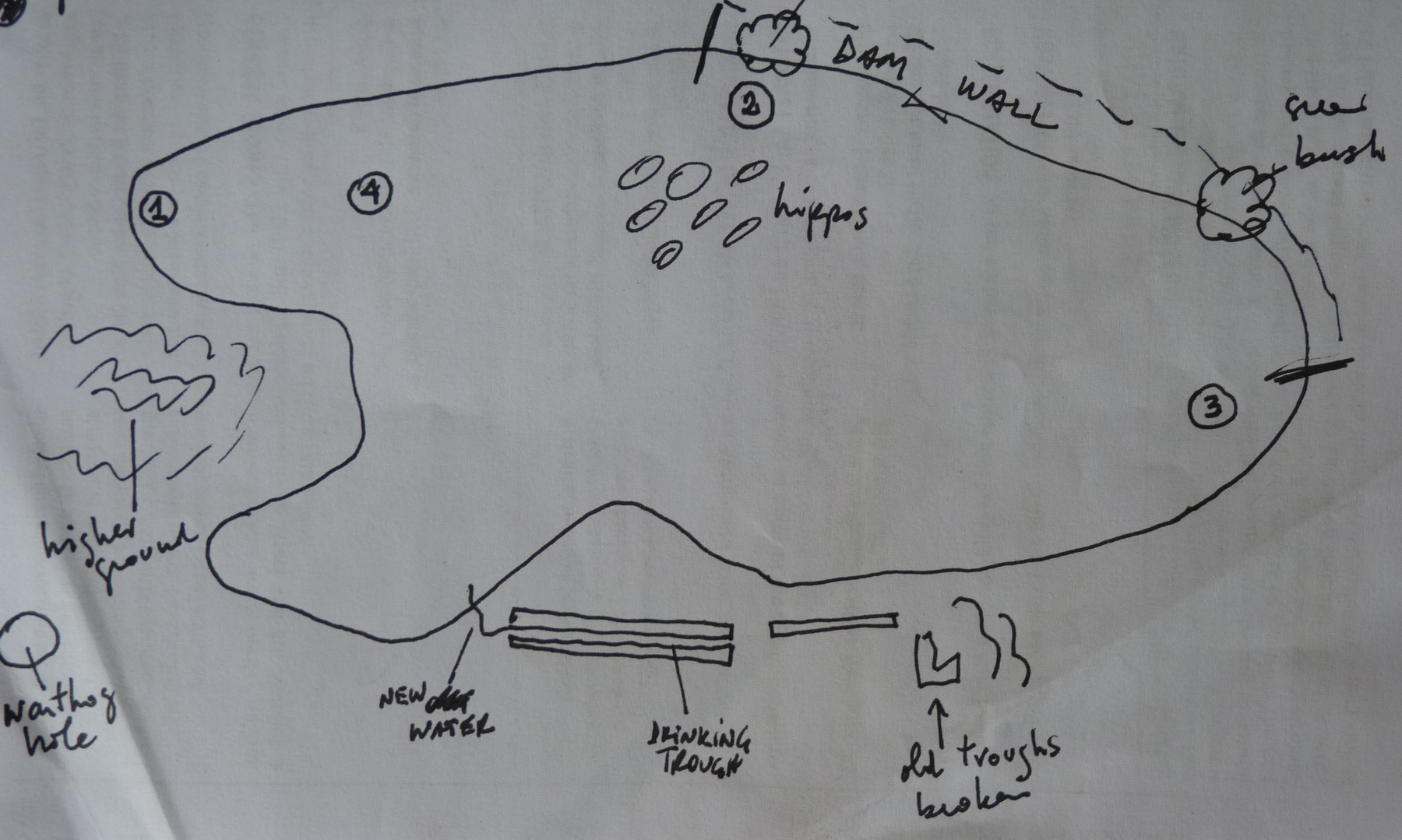
Masuma Dam is located in the Hwange National Park (18°43’52.20″S 26°16’47.82″E). The observations described here took place on 13/10/14 from 10.00 to 12.00 hours and on the 15/10/14 from 09.00 to 12.00 hours. The dam is about 120 by 100 metres and it has a roughly oval shape with the viewing platform located on one of the longer parts of the oval.

A "panorama" view of Masuma Dam.

A “panorama” view of Masuma Dam.

The time of the observations correspond to the end of the dry season. At this time of year many animals come regularly to drink at the dam. Apart from elephants, Greater Kudu, Waterbuck, Impala, Zebra and Warthogs were seen everyday. We also saw large flocks of guinea fowl, various doves, vultures, kites, buntings, starlings, among others. At the time there were sixteen resident Hippos, both adults and young animals as well as at least six mature Crocodiles.

Map of Masuma Dam showing the various places mentioned in the text.

Map of Masuma Dam showing the various places mentioned in the text.

Impala herds drank mainly in the morning, mostly at Point 1 in the drawing. Aware of this daily event, Crocodiles were observed to ambush the Impala by positioning themselves across the small bay where the antelopes drank. Usually one of the Crocodiles would approach the Impalas in full view up to 1 to 1.5 metres from them. This created noticeable nervousness on the part of the Impala but they would gradually calm down and drink. The Crocodiles would remain immobile for a few minutes and then slowly sink and completely disappear. Most of the time, the Impala continued to drink and moved off and the reptiles remained quietly submerged.

A Crocodile attack at the Impala drinking area.

A Crocodile attack at the Impala drinking area.

About two or three times in a morning, the hidden Crocodiles lunged towards the Impala. As soon as the swirl that precedes the attack was noted, the Impala scattered in all directions (including into the water!). The most common outcome was that the Crocodiles failed and went back to the water empty-jawed. On one occasion a young animal was caught from its leg and, after a short struggle, it was drowned. This happened only once out of 8-9 attacks we witnessed.

The Crocodile swims away with the freshly caught Impala just before it was chased by the Hippos for the first time.

The Crocodile swims away with the freshly caught Impala just before it was chased by the Hippos for the first time.

While the struggle between the Crocodile and the Impala was taking place, two Hippos approached the area and were seen chasing the Crocodile. The latter submerged and took off while the Hippos lost interest and we speculated on their noble “rescue” attempt.

The Crocodile with the Impala at Point 2.

The Crocodile with the Impala at Point 2.

Ten minutes later the white belly and legs of the Impala came to the surface at Point 2 and caught our attention. A Crocodile held the dead antelope and others came to feed on it. This, again, prompted a swift response from the Hippos, who came back and confronted them quite aggressively.

Insert pics 5 and 6
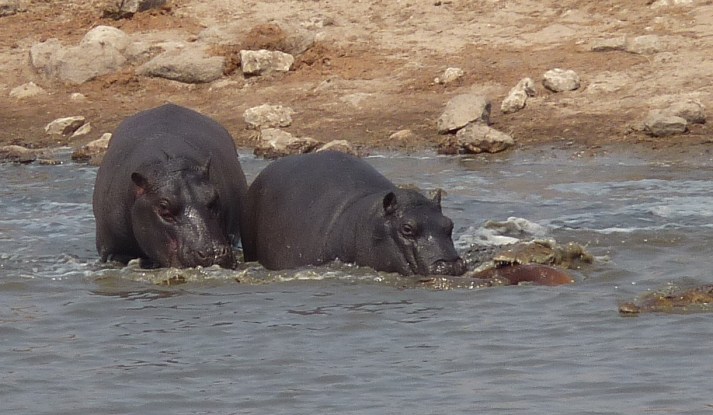
The Hippos "rescue" attempt at Point 2.

The Hippos “rescue” attempt at Point 2.
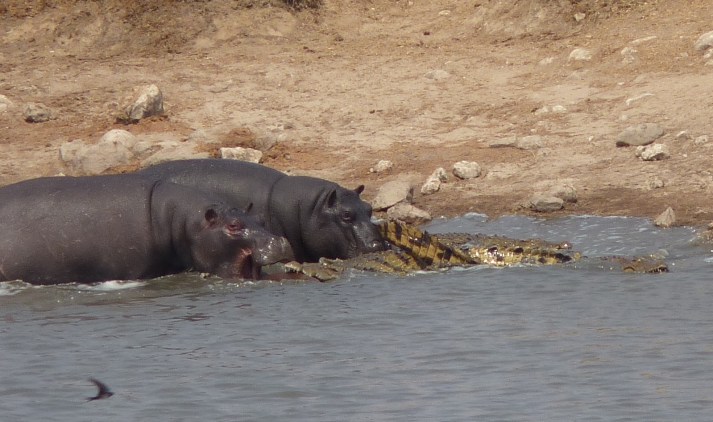
Another view of the Hippos' "rescue" attempt at Point 2.

Another view of the Hippos’ “rescue” attempt at Point 2.

The subsequent struggle involved a Hippo pulling from a leg while the Crocodile pulled from another part of the animal. As the Hippo did not have a good grip on the leg (its teeth and mouth do not facilitate tug of wars), the Crocodile retained the Impala and, again, swam off with the carcass (or part of it as we could not see if it was split or broken up) towards Point 3 in the drawing.

The Crocodile avoided the Hippos at Point 2 and moves to Point 3.

The Crocodile avoided the Hippos at Point 2 and moves to Point 3.

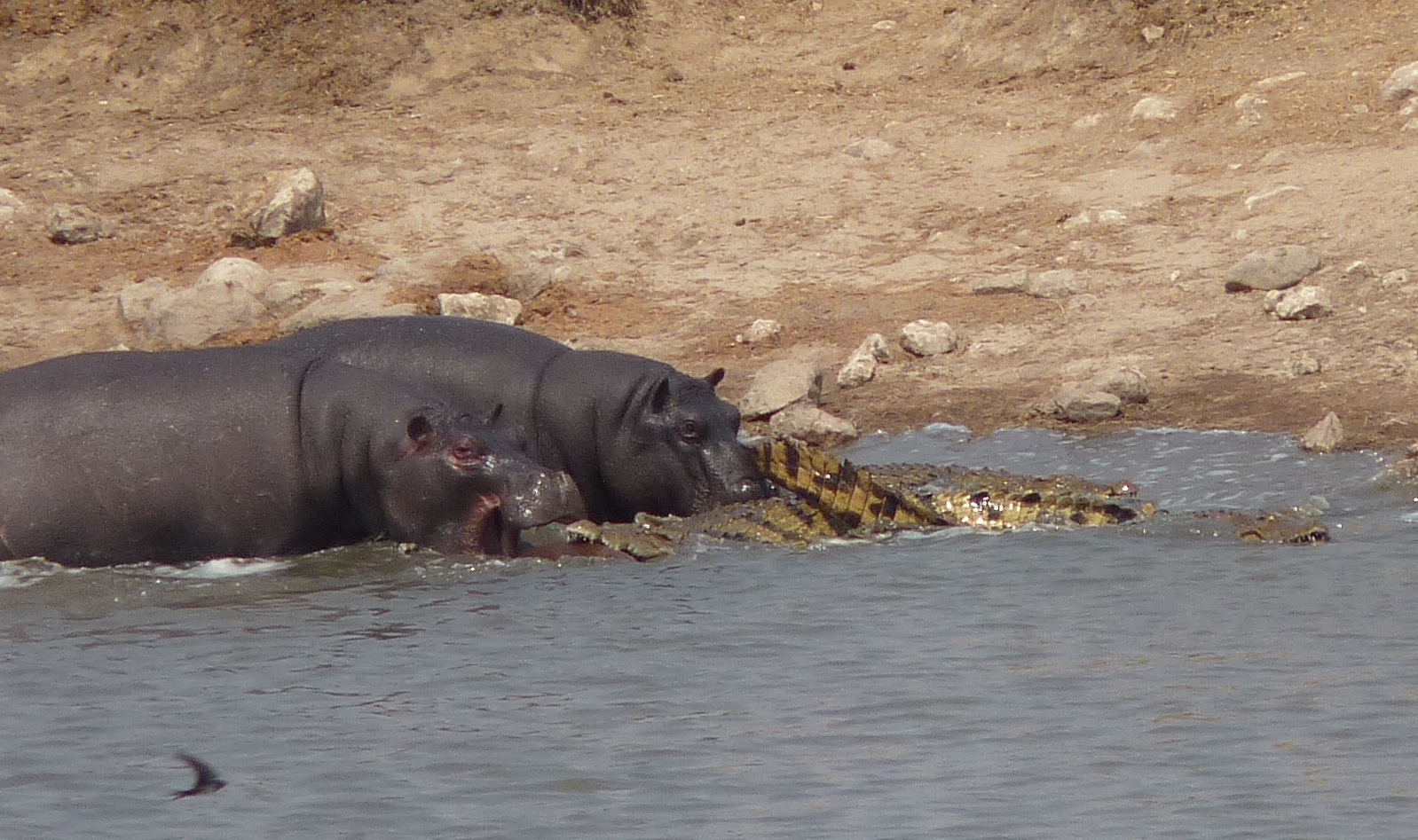
The crocodile stayed at Point 3 for about 30 minutes with the Impala (or a large part of it) in its mouth until another Crocodile came and started to pull and tear at the carcass. In about a minute, a hitherto unseen/submerged Hippo[3] burst into the middle of the tug forcing the Crocodiles to scamper again.
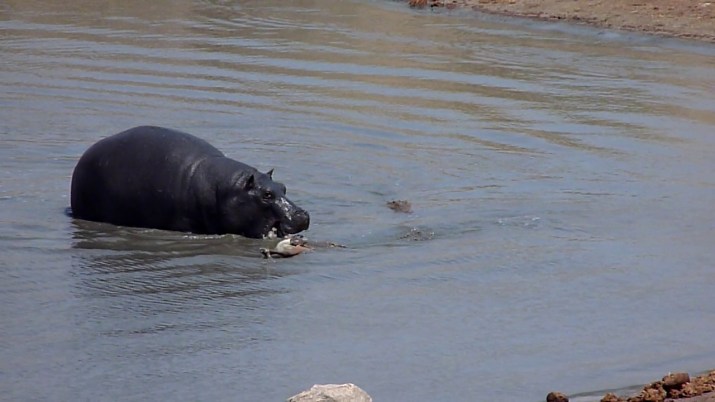
A Hippo moves towards the Crocodile at Point 3.
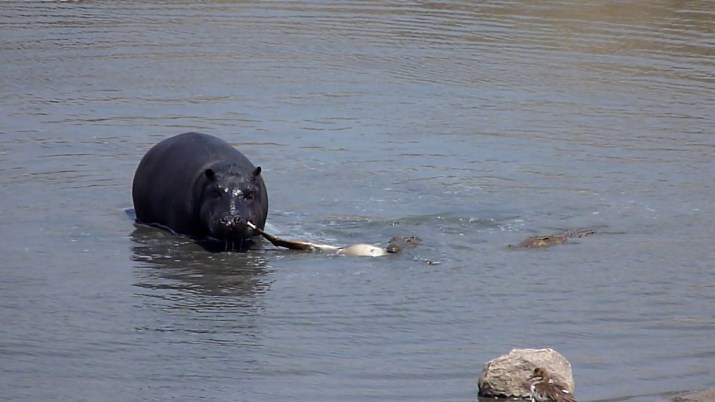
A Hippo moves towards the Crocodile at Point 3.

The Hippo tug of war with the Crocodile!
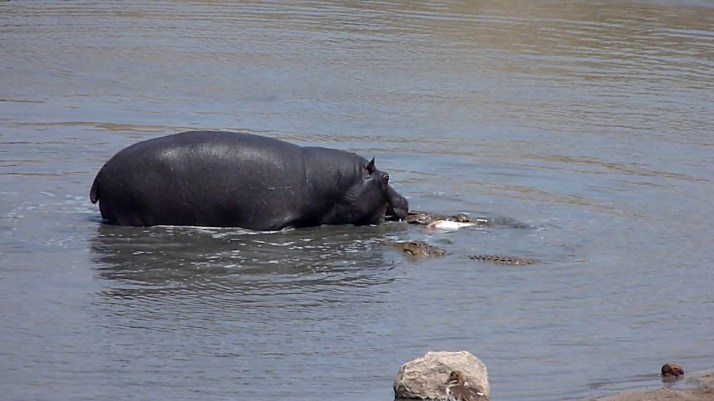
The Hippo tug of war with the Crocodile!

The Hippo tries to bite the Crocodile.
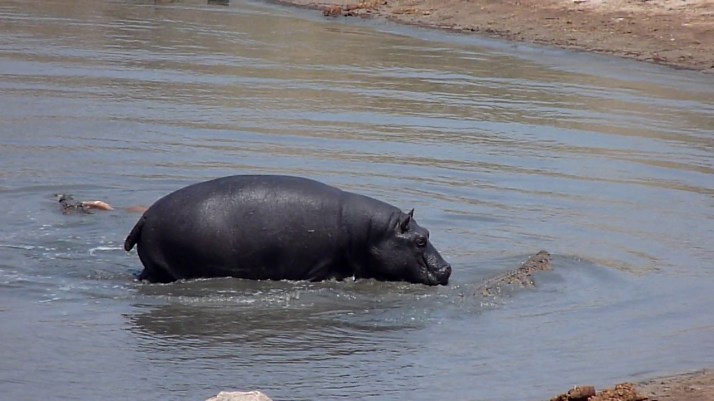
The Hippo tries to bite the Crocodile.

The Hippo chases a Crocodile while the other one escapes with the Impala towards Point 2.

The Hippo chases a Crocodile while the other one escapes with the Impala towards Point 2.

The Hippo keeps chasing the Crocodile while the other one swims away.

The Hippo keeps chasing the Crocodile while the other one swims away.

While the Hippo chased one Crocodile the other one, still holding the carcass, swam back to Point 2 where it remained for another 10-15 minutes when, once more, its companions arrived and started to tear at the carcass.

The Crocodile are attacked again after arriving at Point 2.
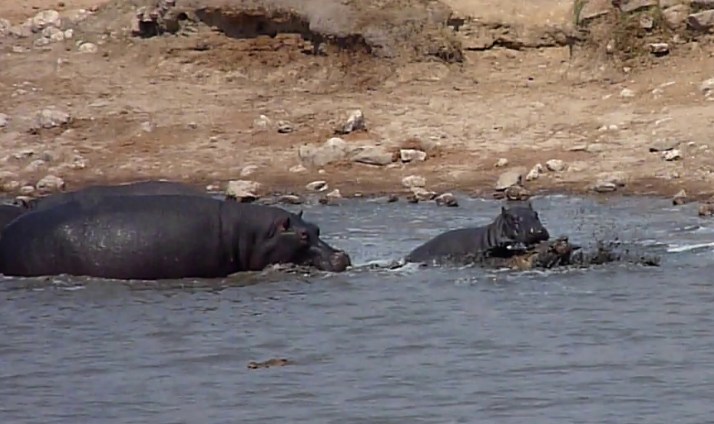
The Crocodile are attacked again after arriving at Point 2.

Another view of the struggle for the Impala at Point 2.

Another view of the struggle for the Impala at Point 2.

Another view of the Hippo vs. Crocodile struggle for the Impala at Point 2.

Another view of the Hippo vs. Crocodile struggle for the Impala at Point 2.

The Hippos came again and were seen clearly attacking the Crocodiles and even biting them.

One large Hippo bit the head of a Crocodile, who swiftly moved away to avoid severe consequences while other Hippos were also seen biting crocodiles on different parts of their bodies. In the commotion we lost sight of the

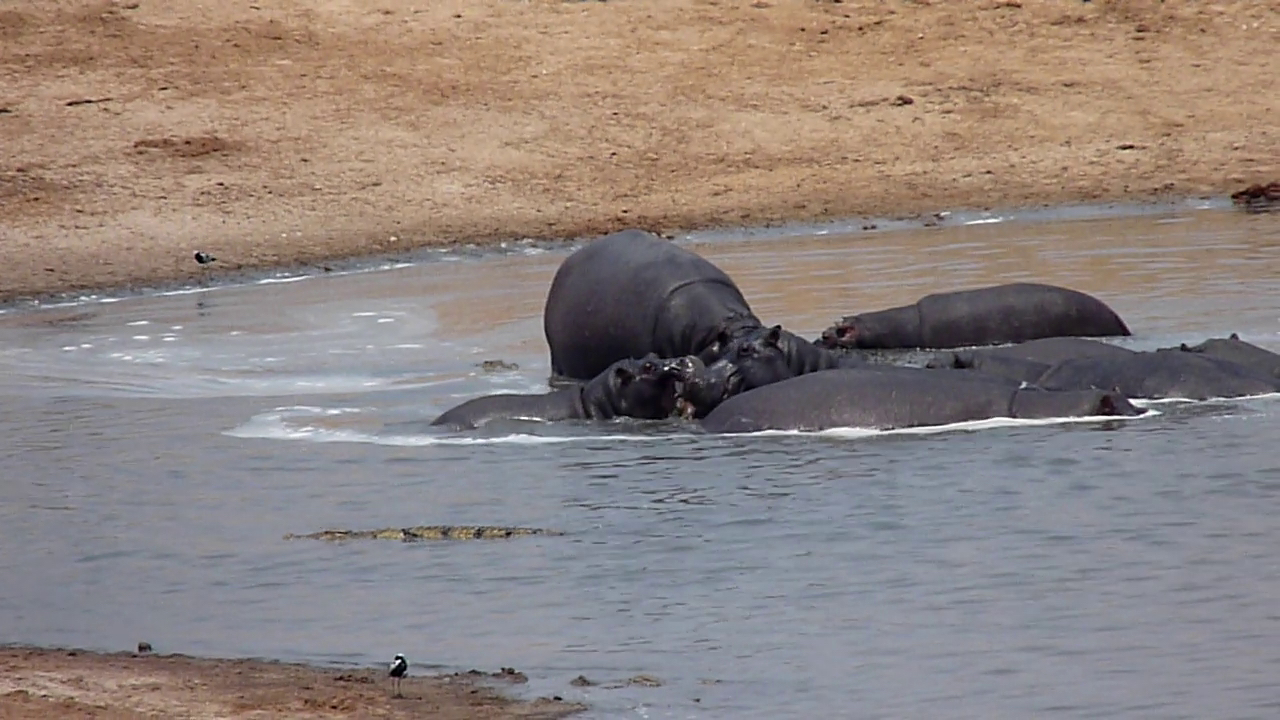
Calm was reinstated at the dam for about 20 minutes. The next thing we noticed was a great commotion at Point 4 where the Hippos began to congregate. They were clearly competing for something and eventually several were seen apparently “mouthing” the Impala. On closer observation they were actually chewing and apparently swallowing while bone-cracking noises were heard.

After snatching the Impala from the Crocodiles at Point 2, they congregate to feed on the Impala carcass.
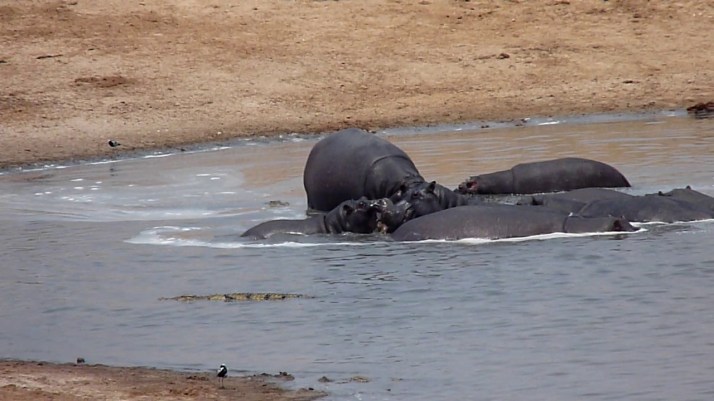
After snatching the Impala from the Crocodiles at Point 2, they congregate to feed on the Impala carcass.

Another view of the final stages of the Hippo feeding frenzy.

Another view of the final stages of the Hippo feeding frenzy.

Unbelievably to us, at the time of these observations, the Hippos were eating the Impala! After it was consumed the Hippos went back to their normal place and peace returned. The moment they lost the carcass, the Crocodiles did not try to recover it.

Confinement in the dam was the best possible explanation I could think at the time for such aberrant behaviour. The event appeared so unusual that, on arrival in Harare, I went straight to the computer to check the Internet. Not surprisingly, I found earlier references of similar incidents and the first report of carnivore behaviour in Hippos came from Masuma Dam![1]

As, very recently the BBC and National Geographic have both published articles on hippo cannibalism[2] I put together these observations to contribute to our general knowledge. I have also contacted Mr. Dudley and we are collaborating on the subject that may result in further work being published in the scientific literature.

[1] It was not easy to see the number of Crocodiles or Hippos involved in the various incidents described.

[2] https://bushsnobinafrica.wordpress.com/2014/10/27/crocodiles-and-impalas/

[3] I was excitedly filming the scene!

[4] Dudley, J.P. 1996. Record of carnivory, scavenging and predation for Hippopotamus amphibius in Hwange National Park, Zimbabwe. Mammalia 60 (3): 486-490.

[5] http://news.nationalgeographic.com/news/2015/01/150123-hippos-cannibalism-animals-food-science/?utm_source=Facebook&utm_medium=Social&utm_content=link_fb20150125news-hippos&utm_campaign=Content&sf7093531=1

and

http://www.bbc.com/earth/story/20150116-the-diet-secrets-of-hippos-herbivore-or-cannibal

Behind our backs

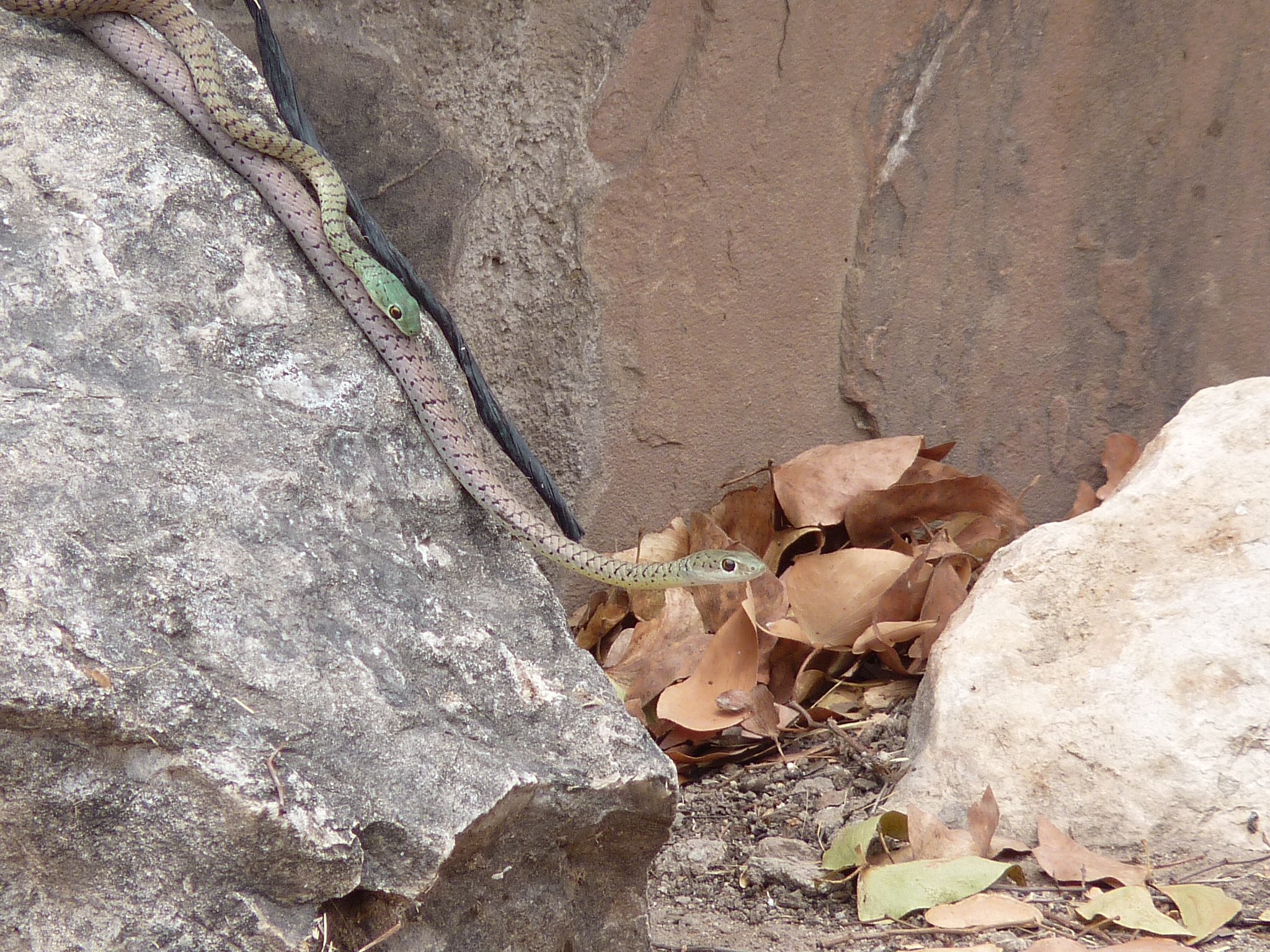
While we were engrossed watching the Crocodiles ambushing the Impalas at Masuma dam, lots of things were taking place around us. On the first day there, a snake was coming down exactly where my wife was sitting at the viewing platform! To say that she does not like snakes is an understatement, so she moved out of the snake’s possible path rather fast! I did not make things better when I identified it as a possible Boomslang!

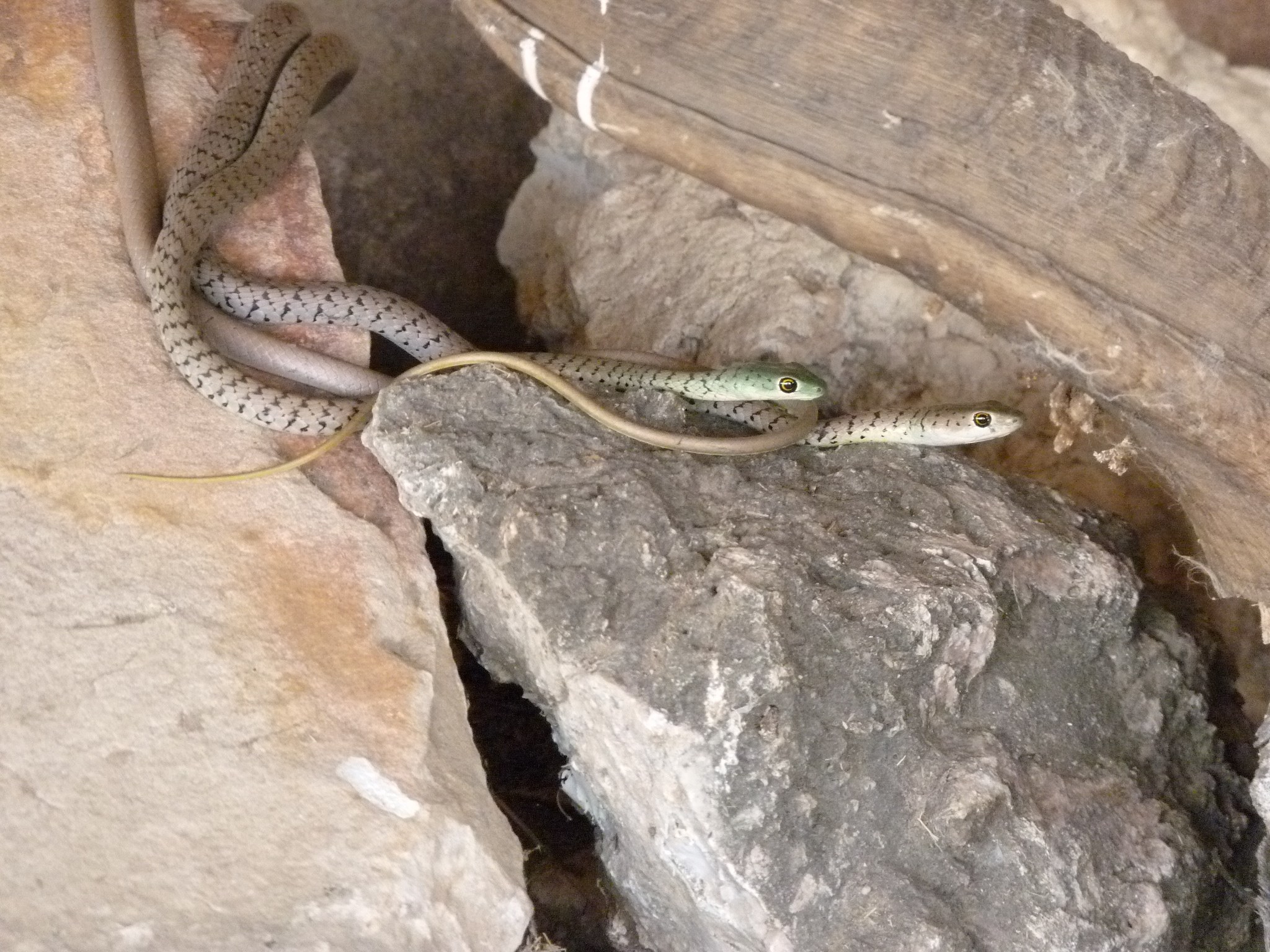
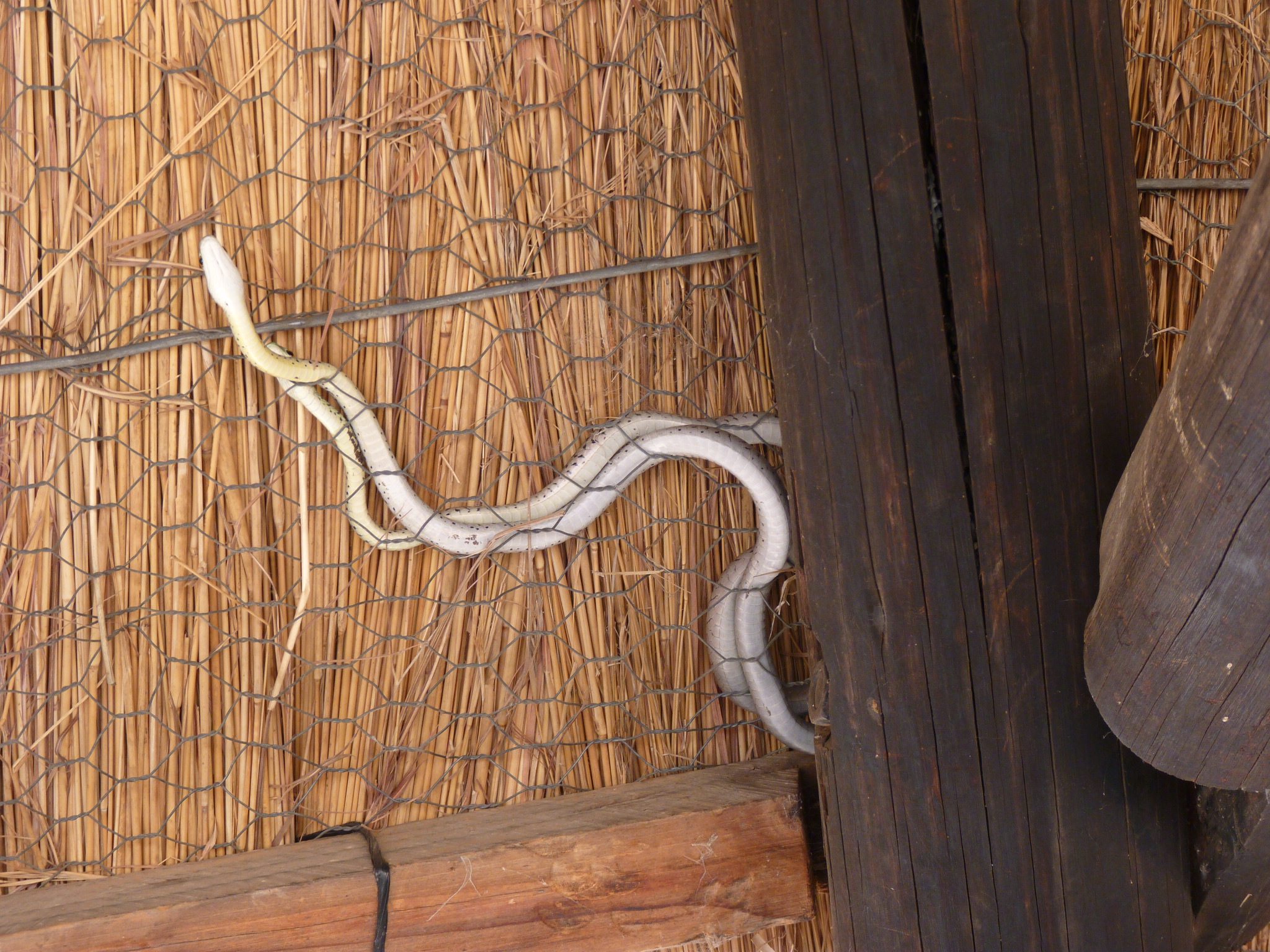
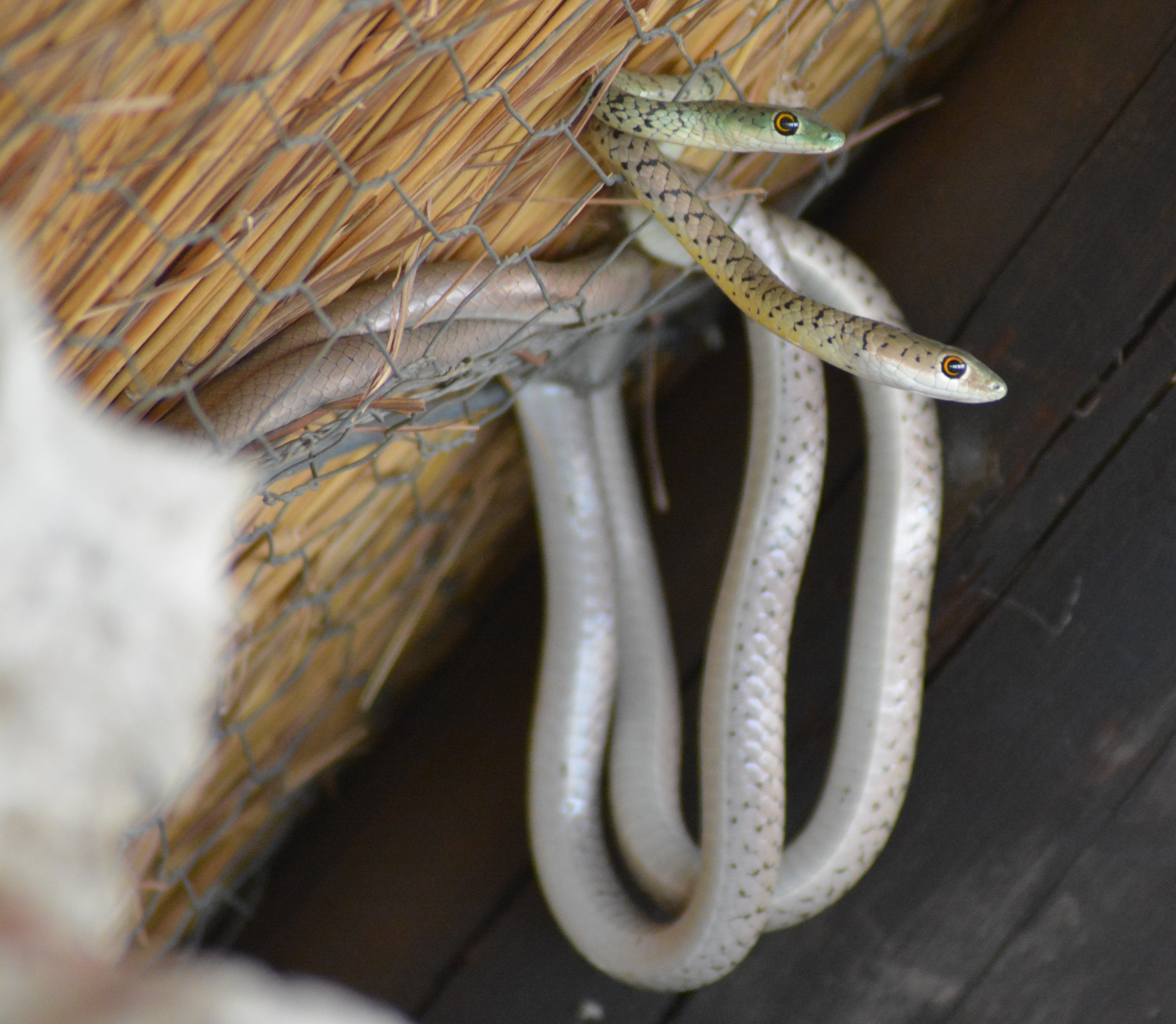
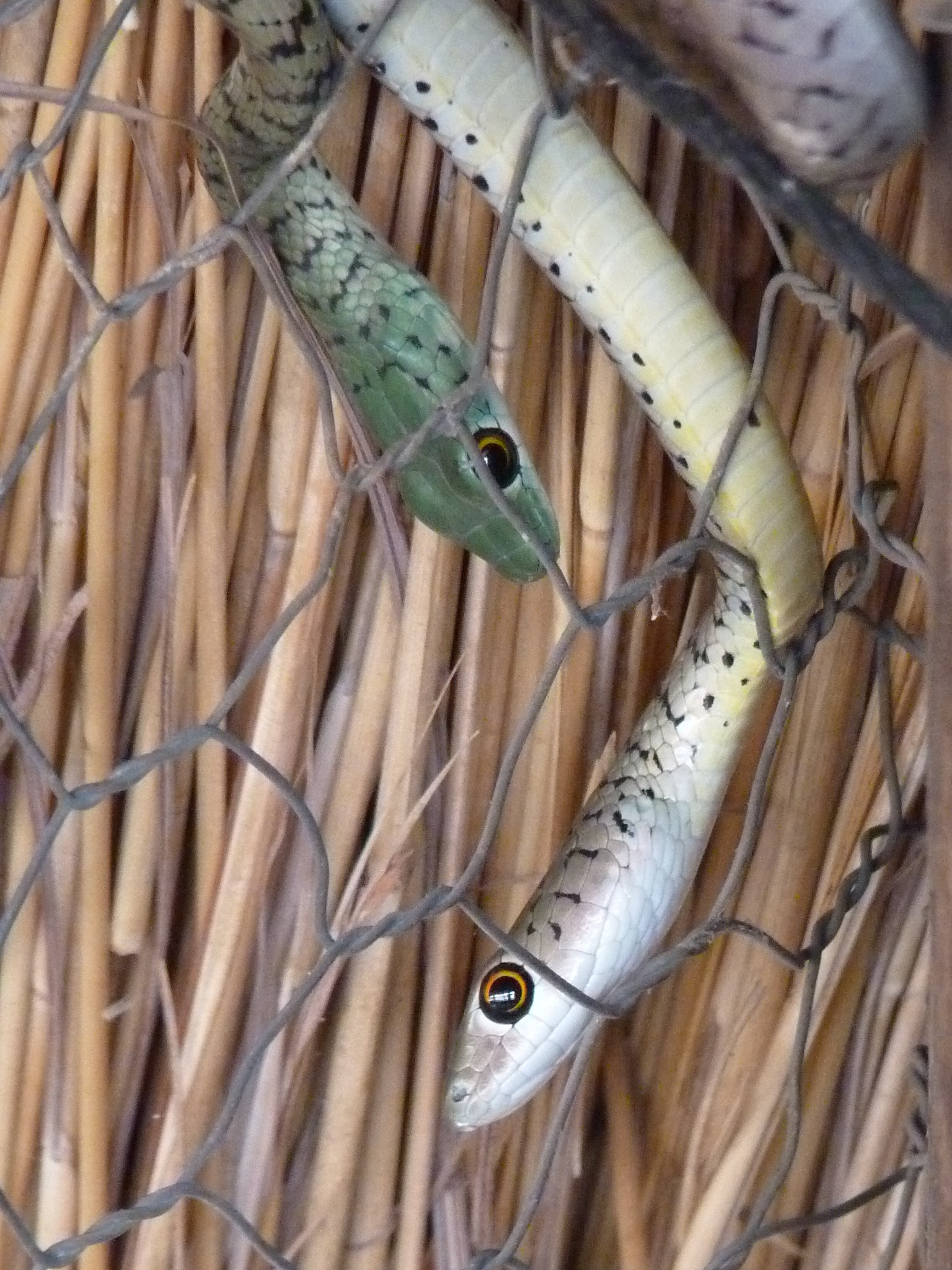
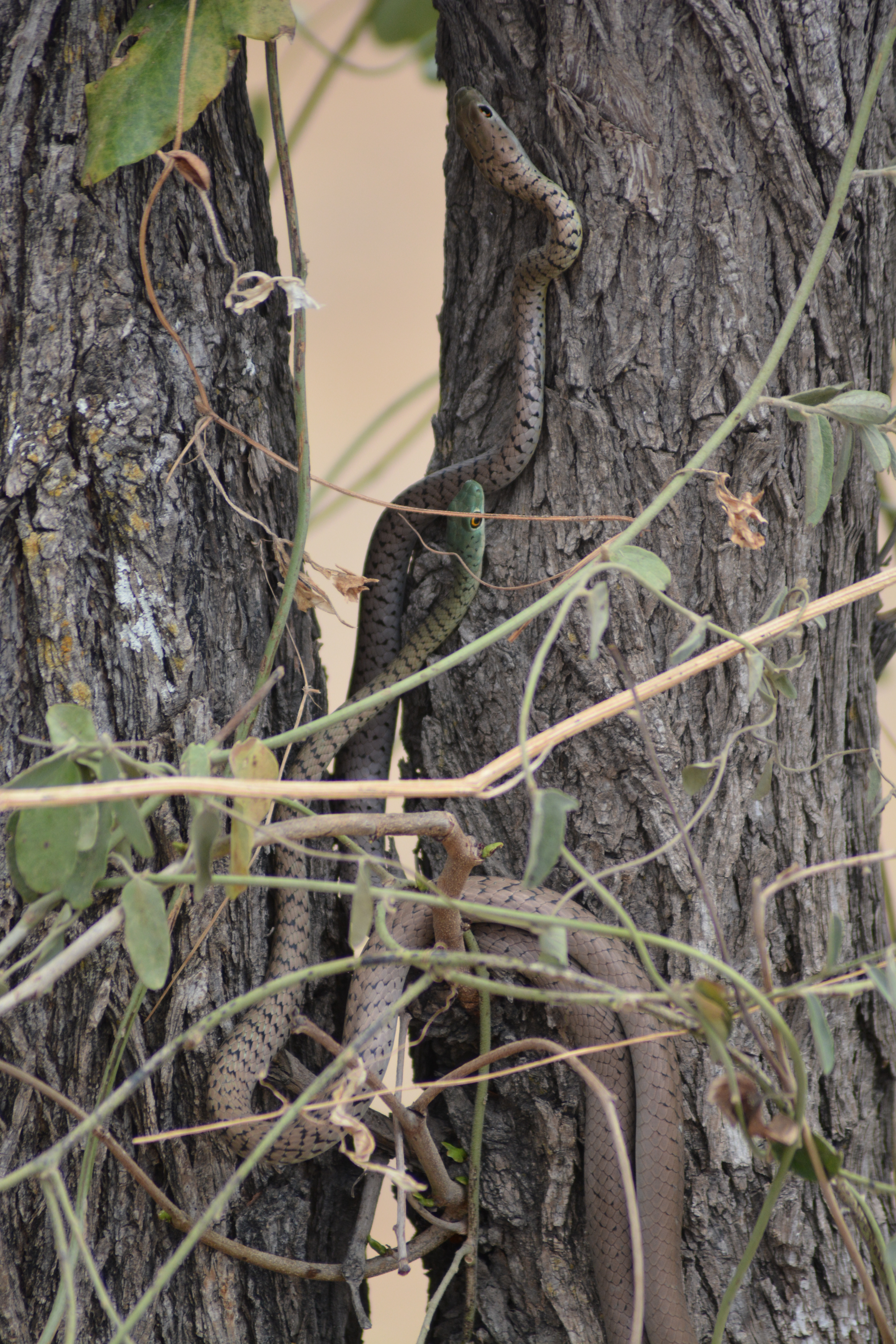
A couple of days later, while focusing on the waters-edge going ons, one of the Picnic Attendants called our attention to another snake act! This time they were two snakes, similar to the one seen before. Their behaviour indicated that they were mating. Basically the process involved the two snakes sliding together throughout the viewing platform as one, the female? moving away while the other one, the male? tried to come into contact with her. Once that was achieved they started to shiver and twist around each other.

First view of snakes outside 2

The snakes moving in.

snakes inside

TOM DSC_1023.1

Picture by Tom Milliken.

The process took about 30 minutes during which they were in command of the viewing platform as the human occupants were always at the opposite end, keeping an eye on their movements. The latter were rather fast and, as we suspected them to be the dangerous Boomslangs, there was no time for jokes while giving them a wide berth. At one stage they were mating at the door and several people were seen to leave the platform through any possible exit in order to get things from their cars or go to the toilet.
close up inside

Eventually their courtship took them outside and they were last seen twisting in a nearby tree.

TOM DSC_1039

They finally moved outside. Picture by Tom Milliken.

If such a thing as “relief post factum” exists, we need not have worried as, with the benefit of time and a good snake guide, they were identified as a pair of the slender Spotted Bush Snakes (Philothamnus semivariegatus). They are a rather common and harmless snake endemic to Africa that feed on lizards, tree frogs and geckos.

In light of this excitement, I promised myself to add an extra kg to our already heavy camping gear and include the snake book in the future!

Not rain but hail!

Elephants at w:hole prior to rain

Elephants drinking before the storm.

It was mid afternoon on the second day and we decided to visit a nearby pan where we had seen elephants with rather large tusks on our way into Shumba camp in the hopes of finding them again. It was very windy and the sky looked grey but we attributed it to the bush fires that prevail at this time of the year. “Too early to rain” I said but my wife was not convinced. “To me that looks like rain”, she said as we made our way to the pan.

There were a few elephants drinking but no large tuskers to be seen . While watching the animals, the wind picked up and we heard thunder. Clearly, the grey sky was indeed a storm in the making and I was wrong again! Soon, heavy raindrops started to fall. The elephants’ response was to rapidly move off from the water into the nearby bush, with the exception of a couple of bulls that had just arrived for whom the need for water overrode the need to seek shelter from the storm.

low visibility

It was a storm!

Raindrops turned into hail that, after two to three minutes, changed again into water in the form of a heavy downpour which was also short-lived. The two elephants put up with the inclement weather and continued to drink while the chickpea-sized stones bounced off their backs! What a relief from the heat and dust! In addition it released a wonderful wet earth smell that prompted us to open our car windows and enjoy the wetness of what, a few minutes earlier, was scorched earth!

elephants start to hail

elephants under hail

The two bulls drank despite the inclement weather!

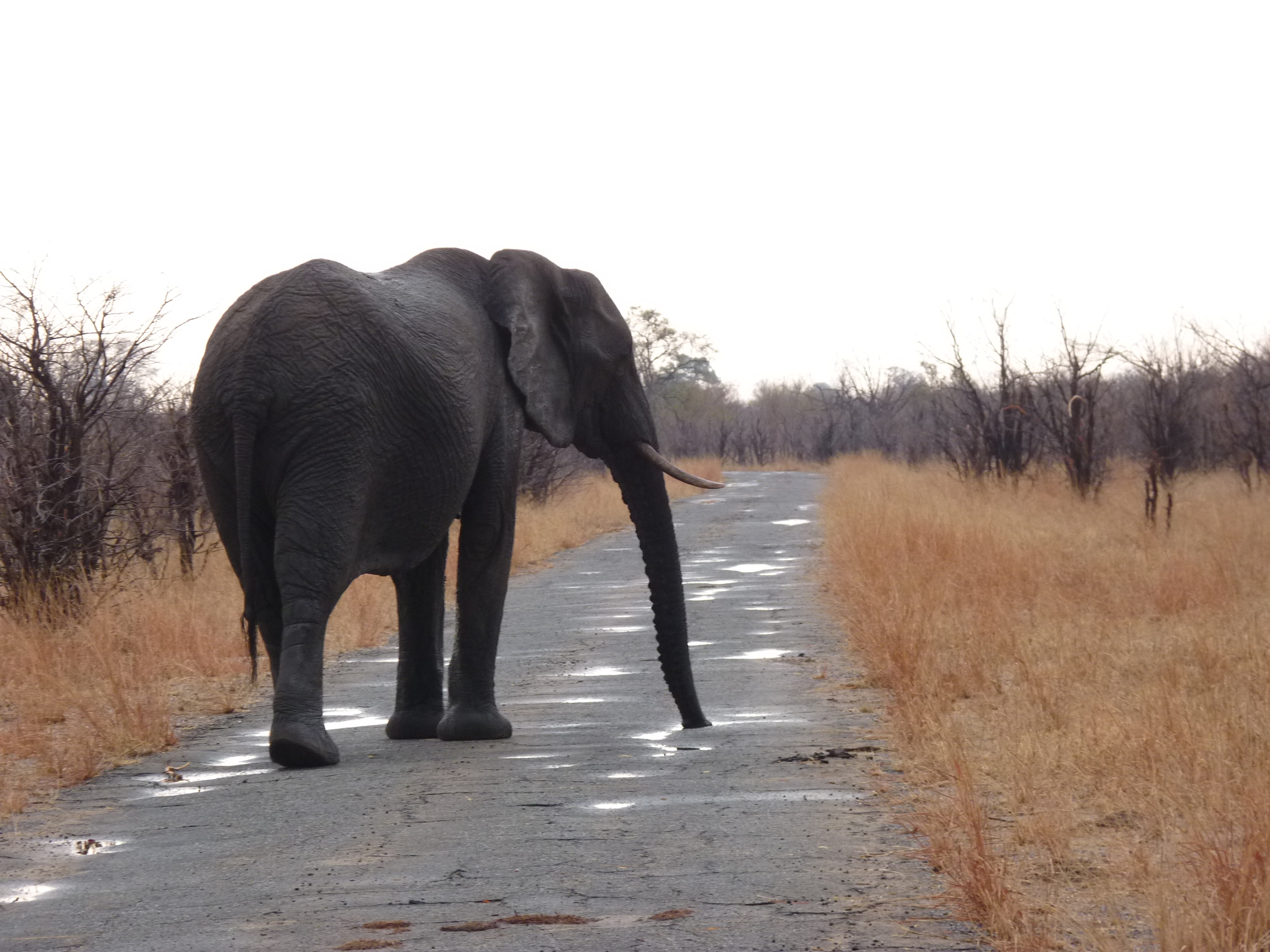
Once their thirst was quenched, the elephants moved off. We tailed them as they took to the road that headed for our camp. One went into the bush and started to feed, while the other continued to walk ahead of us, stopping every few metres to drink from the rain puddles that had formed on the tarmac. It was funny to see how it would effortlessly suck them dry! Clearly it could not resist fresh rainwater!

drinking from the puddles

Enjoying fresh rainwater.

We were still behind the elephant when we saw one rock on the road and farther on another one. The elephant carefully avoided them. The rocks turned out to be Leopard Tortoises coming out of their heatproof refuges to enjoy a dunk and a drink, probably their first since early last year! Watching these animals enjoy the rainwater served as a reminder that, in hostile environments, opportunism is the name of the game!

tortoise at puddle

Smiley…

I thought I saw them smiling but it may have been just the shape of their mouths… Well, at least we smiled and hope that the rains will be good this year!