Zimbabwe

Vundu!

Tiger fishing is one of the top sports in Southern and Central Africa and Zimbabwe is no exception. We had fished for tiger several times before not only in Zimbabwe but also in Lake Turkana and Tanganyika. Luckily I had caught a few good specimens that we always returned to the water. But, if size matters to you and you wish to display your catch, there is no need to kill your fish as fibre glass models exist that would fit your fish if you take a couple of quick measurements in addition to its weight!

Apart from tiger fishing, many people visit Kariba in search of bream (Tilapia spp.) but relatively few are after vundu (Heterobranchus longifilis). Excluding bull sharks, the vundu is the largest freshwater fish in southern Africa, reaching up to 1.5m in length and 55 kg in weight, quite a large fish for my coarse fishing standards! Interestingly, vundu only live below the Victoria Falls as none have been caught above the falls [1].

My wife’s dentist is one of the few fishermen I have heard of that “specializes” in vundu fishing and the re-telling of the fishing prowess of the dentist (30 to 40kg vundu caught!) had an influence on me when deciding this trip.

So, aware of the family’s love for nature, our daughter’s keenness for the sea, our son’s need for resting as well as my desire to fish for vundu, in mid 2017 we booked a trip in Lake Kariba. Unfortunately our son was not able to join us because of work and a couple of invited friends also declined our offer because of pressing domestic commitments. When it looked that we would be just three on a now rather outsized houseboat, Clara, a friend of Flori (our daughter and part-time Ed.) decided to join us all the way from cold Stockholm, her first trip to Africa, almost straight to the bush (and, after the experience, perhaps the last?).

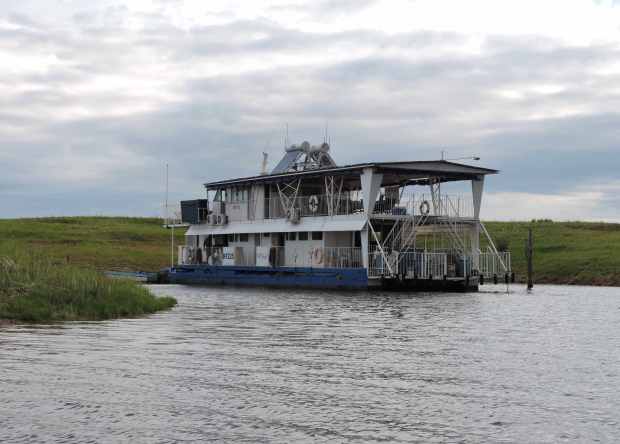
Our final destination was the Ume river, quite far from Kariba town, the place where houseboats leave from. We were told that to reach those far off places you required a minimum of six nights in the lake. After a long search comparing prices and comfort we had booked a rather spacious houseboat known as O B Joyful. We agreed on a self-catering basis so it was our responsibility to organize all food and drinks to last for the week as well as all needed items regarding fishing.
DSCN1301 copy

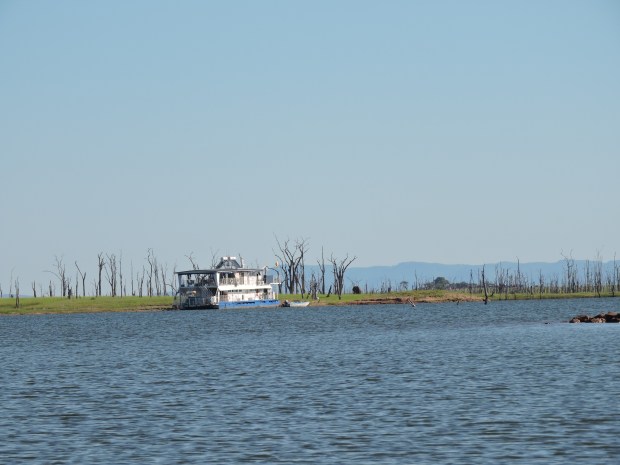
The moored house boat.

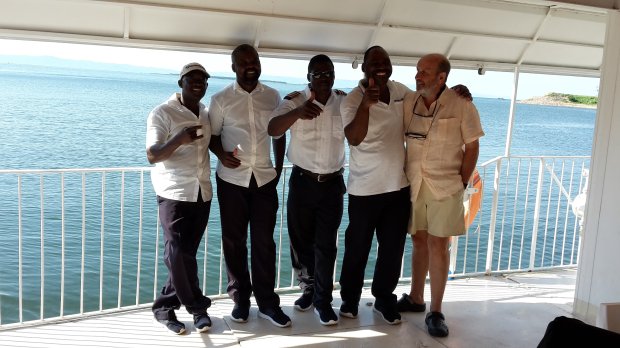
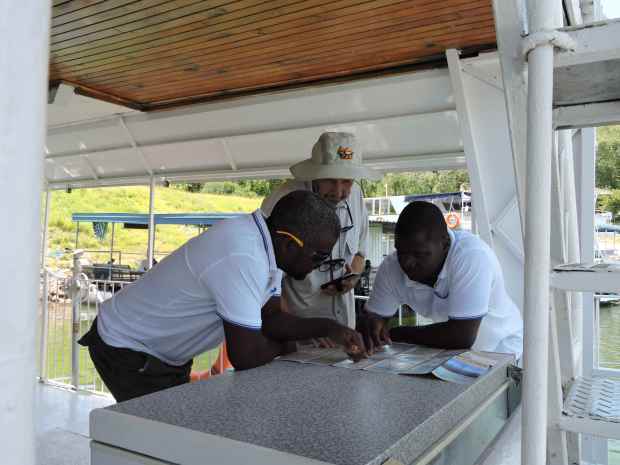
With a crew of four (Godfrey, the Captain, Warren the cook, Pilot the sub-Captain and Silas, the handyman) we sailed from 2 to 8 of January. They were really first class and pampered us thoroughly.
DSCN1293 copy

Plotting the trip’s course.

20180108_081444 copy

From left to right: Silas, Pilot, Godfrey, Warren and the Bushsnob.

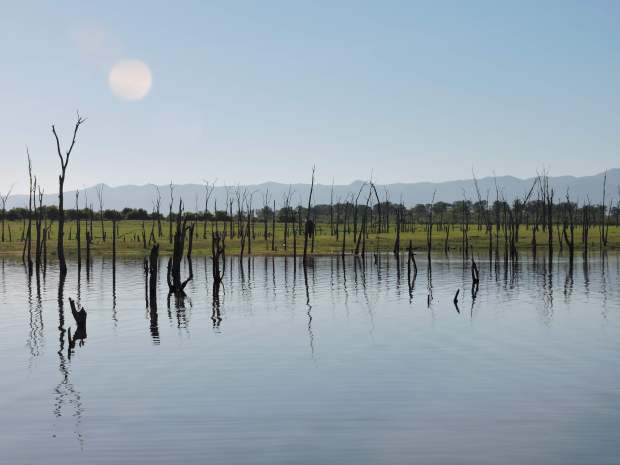
Although we had visited Kariba several times before, it is easy to forget its size and the incredible beauty of its blue water, green islands and grassy flood plains framed by the spectacular and distant hills, a hazy blue in the distance. The abundant birdlife, numerous hippos -both in and out of the water- and the usual elephants complete the general picture. Abundant fish eagles were a constant sight and their wild calls are missed now! In addition, we also watched a couple of fishing ospreys.
DSCN1343 copy

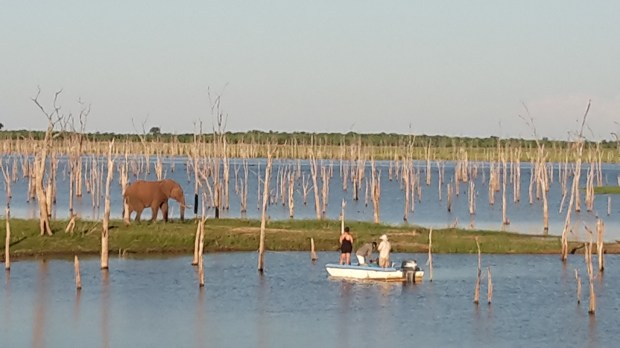
Lake Kariba at Elephant point.

DSCN1295 copy

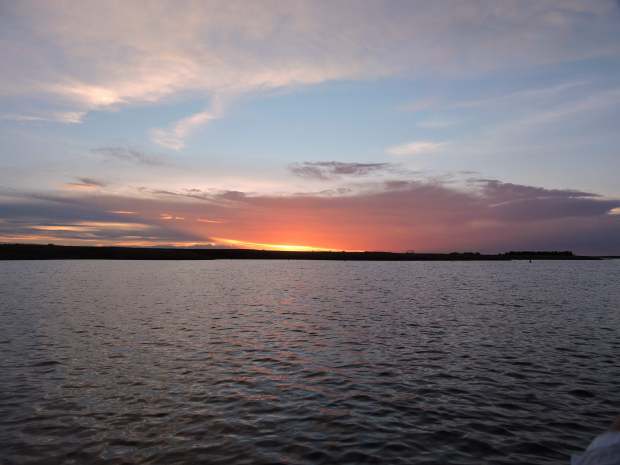
Kariba sunset.

At night you are immersed in a different world with a star-full sky where with patience you can detect a number of known constellations while listening to the noises of the night, particularly owls, frogs and toads with the occasional lion call and hyena whooping [2].
DSCN1304 copy

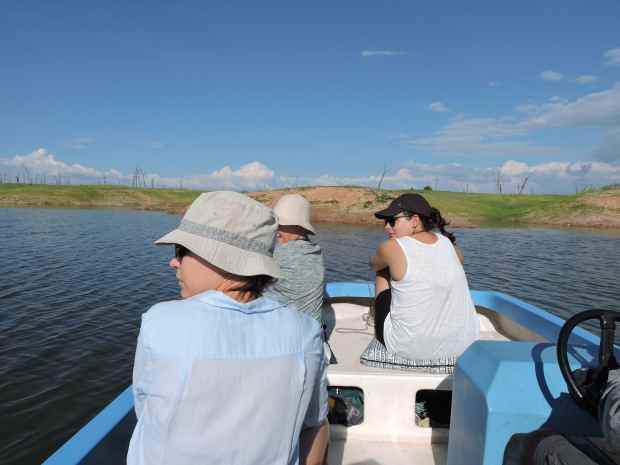
We also went of game watching trips.

Luckily Godfrey was keen on fishing and helped us all the way, not only getting us to potentially good vundu spots but also on the bream fishing as well. His patience with worms and fish netting was really remarkable! Luckily, fishing bream became a great entertainment for the whole group while waiting for the vundu to strike and we also had some frequent visitors to keep us busy…


20180105_180236 copy

The surprises of fishing in Kariba!
DSCN1367 copy FC

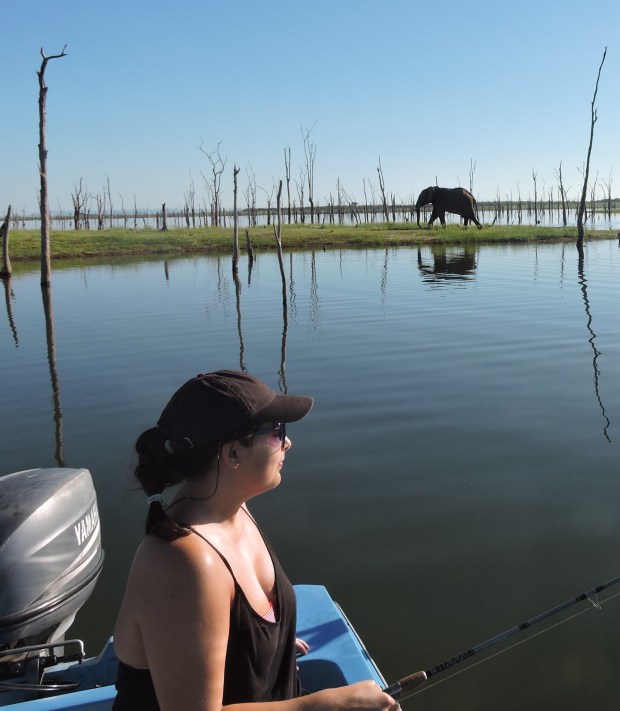
Flori and elephant returning.

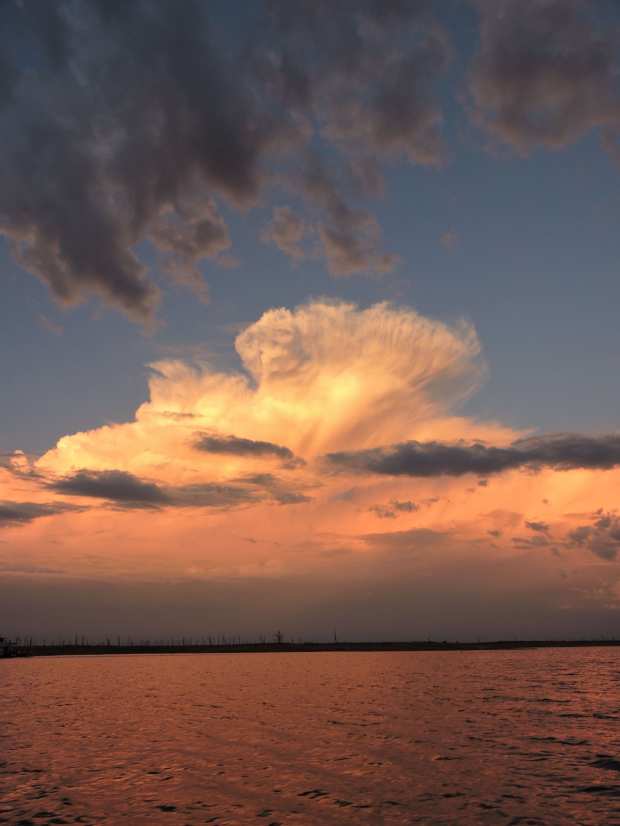
Although we knew that the Ume river was as far as we would go, the rest of the itinerary was open as we decided that we could chose where to spend our time. In addition, there was a factor we did not plan for: the weather! Storms are feared in Kariba and the fact that it was the rainy season added some uncertainty to our planned itinerary. Luckily, although the first two nights were stormy, the weather cleared and we were able to move at will.
DSCN1306 copy

Storm looming. Luckily it did not come our way.

Briefly and for reference, our first night was spent at Changachirere and fishing only produced a few bream. The place was clearly used to spend the first night at the lake by most houseboats so we were about eight boats. Luckily there was still ample space to moor. Following Godfrey’s advice the following morning we sailed towards Elephant point, five hours away. It was a good decision as clouds were gathering but we got there in good time and anchored at a safe spot. The boat was secured not only by tying it to some of the dead trees but also to some sizeable iron spikes that were laboriously hammered into the stony ground for about one metre!
DSCN1403

The houseboat moored at Elephant point.

Safely tied we organized ourselves for the next morning fishing. While Godfrey went to bait an area with the aid of a cattle-licking block (a new gadget for me!), we watched the hippos grazing out of the water and the elephants in the distance.

The next morning we were up early and headed for our baited spot but, well before arrival, we noticed that a rather large boat was fishing at our spot as they had also baited it and had arrived there earlier than us. Crestfallen, we moved off to another spot near our houseboat where there was no baiting but it was a deep channel that offered good possibilities. Godfrey was correct.

As soon as I finished casting my “vundu rods”, I hooked a tiger fish that I managed to land after a few nice jumps and a good fight. It was not large but fun and, as soon as I casted again, another one took the bait and it was also landed, luckily.

Too much -unprecedented- success prompted me to share my luck with Flori as she is a very keen fisherwoman. It only took a few minutes until one of the reels started buzzing and she landed a nice African Sharptooth catfish (Clarias gariepinus).

Things did not end there! As soon as she re-casted, the run that followed was “serious” and we all knew that she was into a good fish. After about ten minutes of reeling in, runs and more reeling in, she finally landed a nice vundu, the first one the family ever caught! As we had forgotten the fish scale, we estimated it to weigh about 12kg or more!

We were thrilled but we were also aware of the time and we needed to stop fishing to be able to sail our way to the Ume river.

Although we were quite close from the Ume, because of its size, our boat needed deep water. This meant that we needed to get back out on the main lake, turn and then enter the mouth of the Ume. Unfortunately, the weather was cloudy and windy so we had a wavy lake. It all went reasonably well going out but, the turning was tricky and we had a few serious shake-ups before we changed direction towards the Ume where we arrived five hours later.

We entered the Ume until we found a good bay where we could moor. The area was no longer open floodplains but hilly with bush and forest that would reach almost to the shore of the lake making game-spotting very difficult. Fishing was also a futile exercise and we unanimously decided that the next day we would spend it back at Elephant Point where not only our fishing had been good but we could also enjoy the landscape and its dwellers.

The following morning we left early and, with better weather now, we got to Elephant point faster and moored near the spot we had been before. Next morning we were fishing again and this time we had some party members going for bream “for the pot” while I was still attempting to catch the elusive vundu. Luckily, after about an hour of watching my companions pulling bream in I had the first strike and, after some work, brought in a vundu that weighed 9kg as this time we had the scale with us. I was moderately impressed…

Fortunately, an hour later I had another run and hooked another fish that gave me a lot of work to bring close to the boat. Eventually I managed to bring it and, while still in the water, we could see that it was a nice size. Suddenly I saw another fish coming towards it and I thought it was its friend! “That is interesting” I thought but Godfrey brought me down to reality when he identified as a crocodile having a look at “my” fish!

Luckily, the croc -smaller than the fish- only came up and then it was gone without damaging the fish and I could recover it whole! The vundu “busted” our balance that would only go to 25 lbs so I assume it to have been about 15kg and I was much more pleased with the achievement this time. Still, it was a far cry from the dentist’s 40kg ones!

All in all, my vundu “thirst” was by now somehow satiated and it was better that way as those were the only two that decided to offer themselves to my rods during the days remaining! I did have a few more bites and runs but missed whatever these were.

Although we did not get more vundu, we still had great fun catching bream and watching birds and mammals all the time. In addition, life on the boat was extremely pleasant and we had a good rest (those who needed) as well as lots of entertainment. Time passed really fast and we needed to return back to Kariba.

It was a great trip that left me still wanting as I realized not only the beauty of the area but also that there are still plenty of vundu lurking in Kariba’s depths and we are already thinking on ways to get them the next time.


[1] See http://www.karibahouseboatsafaris.com/vundu-catfish/

[2] We found the iPad app SkyView Lite a useful aid to identify the various celestial objects.


Seriously cute!

If you like chameleons like us, there are few things nicer than the start of the warm season when they become active and appear in the garden. They are incredible animals.

20151207_105244 6.57.45 PM copy

They are not only able to change their colour to adjust to their surroundings but also to independently change the colour of each side of their bodies in a feat I find amazing but that I only observed once and could not photograph.

Apart from that, I am also fascinated by their ability to move their eyes in all directions, another of their special talents.

However, you have seen nothing until you find a baby chameleon and yesterday Stephen (our caretaker) find not one but two of them!

The gestation period of the flap-necked chameleons (Chamaeleo dilepis) lasts about 30 days and the female bury the eggs that would hatch only nine months later, quite a long period for such a small animal!

But I do not delay you anymore and present you with a few pictures of our find.

20180110_165518 copy20180110_165516 copy20180110_165509 copy20180110_165457 copy

We released them immediately after taking these pictures to avoid them getting too stressed and we hope to see them as grown-ups next year!

Wild elephants…

As we were in the Zambezi valley, after Mana Pools we decided to spend some time in an area of the river that we knew through our earlier boating experiences when we were in Zambia in the early 90s (blog posts still pending, oh dear!). A number of fishing camps are located near Chirundu town, one of the border crossings to Zambia.

We had fished in the Zambezi before and had some great fun with tiger fish (Hydrocynus spp.) so we wished to try our luck again. We know that there are large Vundu (Heterobranchus longifilis) lurking somewhere[1] that we had, so far, failed to catch (and release, of course).

The road to Jecha Camp was easy to find just before Chirundu and we managed to slip through the very long lorry queues that are a feature at borders, not only in Africa but also in Latin America.

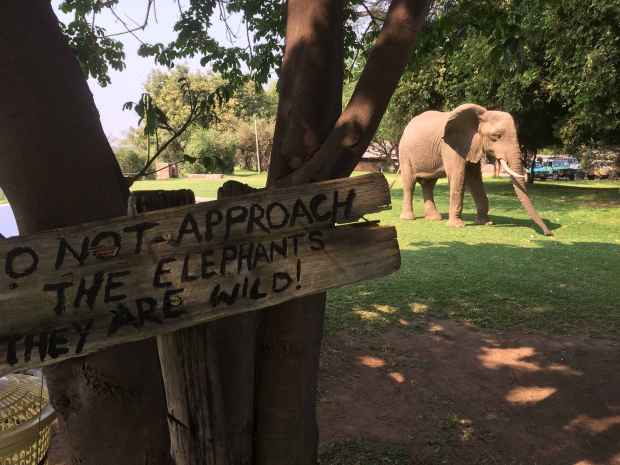
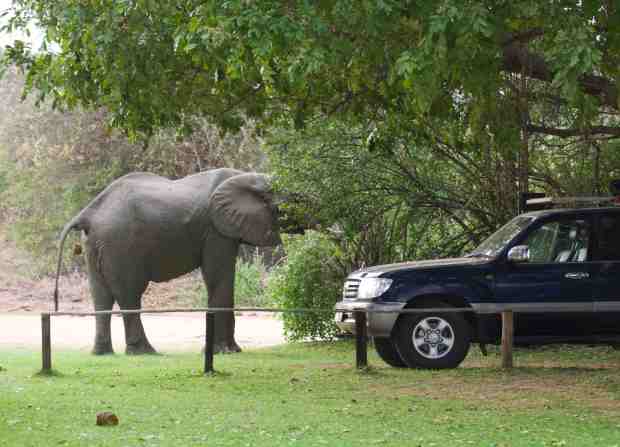
On arrival to this true green oasis after the Mana Pools dryness, we were warmly greeted by the owners of the camp and shown to our comfortable bungalows. In the meantime we were warned that elephants were frequentl visitors. It was stressed that the latter were wild elephants, unlike the ones in Mana Pools (?). We remembered our Nebbiolo wine incident but politely kept quiet. The elephants are part of a small population of about forty individuals that live in the area and that also visit Chirundu town where they -as expected- come into conflict with the local residents.

DSCN1057 copy

There were elephants all the time!

IMG_2967 copy“If an elephant approaches the swimming pool while you are there, move to the opposite side and wait” said the Manager and then added: “they are allowed to drink from the pool but not to bathe”. I immediately imagined the consequences of such an event and remembered the famous elephant in the pool scene of the movie “The Party” with the late Peter Sellers!

After arrival we spent the sunset at the hide overlooking a small stream where we spotted bushbuck and s few rats up the tree where the hide was built on. After dark we went back to camp (by car as advised) and we were greeted with the “elephants in camp” warning. We were advised to move carefully around the facilities in the dark. As we had no plans for “night walking” we were not too concerned but, indeed, the elephants were walking about feeding on the pods from the apple-ring acacia from the lawn. One of them -I thought smartly- was picking pods only from under one of the camp lights!

That night after going to bed, we heard a commotion at the back of our chalet and realized that two elephants were apparently busy unpacking our car! When we went to inspect the situation, we saw that, despite the watchman’s efforts to shoo them off, they were intent to get the contents of our roof rack! Only then we realized that we had -carelessly- forgotten our Mana Pools rubbish bag on the rack and that was the reason of their intense interest! Aware that there was nothing to be done -apart from re-collecting the rubbish the following day- we returned to bed, leaving a worried watchman that we failed to persuade to leave the animals alone!

DSC_0040 copy

One of the troublemakers near the car, after the rubbish incident.

Luckily, the following morning the car was still there, intact, but we spent quite sometime collecting all the bits and pieces that they had scattered around the area!

Elephants were not on camp sometimes but rather all the time! In several occasions we were forced to move away from our sitting areas to keep a prudent distance from the pod-collecting giants that would get too close for comfort.

Although we tried our hand at fishing, only our son caught a medium-sized tiger fish after a lot of boating efforts over the two days we spent in the river. However, fishing was only the excuse to travel the Zambezi! We had a great time remembering our old days when we navigated these waters in our inflatable rubber dinghy and we really enjoyed seeing the large pods of hippo and the occasional elephants drinking and feeding at the river shore.


[1] From https://en.wikipedia.org/wiki/Vundu: The vundu is the largest true freshwater fish in southern Africa, reaching up to 1.5 m (5 ft) in length and 55 kg (121 lb) in weight.


Check in…

Some “local customers’ heading for the Reception area at Mana Pools National Park.

IMG_2947 copy

Needless to say that we queued correctly while guessing what their business was!

Luckily, they seemed satisfied when they left a while after!

IMG_2952 copy

Only then we proceeded to check in!

This is the beauty of Mana Pools National Park: the unexpected is commonplace.

Nebbiolo wine

Our son visits us in Zimbabwe every year during his holidays and we usually include his favourite place, Mana Pools National Park, as part of the holiday. This year we managed to get a good spot at Nyamepi campsite, just a few metres from the mighty Zambezi river.

We had not yet set up camp and we knew that we were in for a bit of “camping fun” as one of the large elephant bulls found in the park was walking about the campsite making a clear statement of who are the owners of the place.

DSC_0156 copy 2

DSC_0424 copyWhen we saw it chasing one of the camp attendants we knew that it meant business! Luckily the charge was just a show of dislike and the man got away. The elephant walked after him into the park staff houses and nothing more was heard.

We had also been warned that monkeys and particularly baboons were worse than usual and fast becoming a real problem in the camp so we decided to ask the park for help and they allocated a guard to keep them off our tents as they have the habit of destroying them for no apparent reason! We were rather surprised when our guard came and we recognized him as the same man that was chased by the elephant earlier! Clearly they had some unfinished business among them. However, as his present terms of reference were to keep baboons and vervets away, we decided to give him a chance and we were not disappointed.

Although Mana Pools offers many attractions, we link it to elephants. I have already written in this blog about Big V and Boswell as two of the most notable of the pachyderms here. We did not spot them during our first afternoon drive but, when returning to camp in the evening, we noted that three large elephant bulls were there but we could not see them very well. However, this was nothing unusual as they are normally in camp!

DSC_0872 copy

We took some of our travel tiredness away through great bush showers and it was a refreshed team that tackle dinner preparation. Of course we always enjoy a good barbeque so our son took over as he is the expert while my wife’s territory is bush pasta dishes and mine, well, I keep them merry and busy… Eventually we sat at the table to enjoy some great T-bone steak (rare) and sausages. Our son had, as a special treat, brought a couple of wine bottles from Italy and we decided to go for the Nebbiolo the first night keeping the stronger Barbaresco for a later occasion.

Nebbiolo is the grape also used for the better known Barolo and Barbaresco varieties, all from the Piedmont region of Italy. Its name comes from “nebbia” which is fog in Italian, a frequent phenomenon in the region.

Elephants, despite their size, walk in almost total silence so when we noticed the three bulls, they were within ten metres from us, just at the edge of the circle of our camp light. We knew that they were feeding on the acacia pods from the apple-ring acacia (Faidherbia albida) on the ground so we ignored them and continued enjoying our food and drink. Suddenly we heard one of them head-butting one of the acacia trees closeby and we had a shower of pods around us on which the three colossi started to feed. So far, nothing new.

However, after a while we saw that one of them stopped feeding and came under our light. Now, to see an elephant at such close quarters is rather impressive and we stopped eating wondering what would happen next while reassuring ourselves that it was only interested in the pods. Just in case, we started coughing and knocking our glasses gently to let it know we were there!

The bull, clearly the boldest of the three, took a couple of more steps towards our table! We still -but just- kept our cool while continuing making various noises to make it change its mind but, eventually, the giant was so close that my wife and son stood up and moved a couple of metres behind the table. They were wise. We all know that elephants are large but, when you meet them at close quarters, seated and at night they are really humongous!

My attempt at holding the fort lasted for a few more seconds but my nerves left me when it took another step towards me despite my companions’ efforts at stopping him by banging pots and other noisy objects. I joined wife and son at a prudent distance: the other side of the table! As behind us was the river, we were really in a tight spot! All we could do now was to watch!

While the other two elephants remained a few metres back, our visitor took a final step and it literally leaned on our table. Its trunk delicately sniffed our dinner and I thought “End of table and dinner!” but it did not touch anything. However, at some stage its trunk went to my plastic wine glass, placed its trunk over it and spilled it, probably as a protest for the poor quality of the wine ware?

The spilling of the wine was the turning point of the visit and the elephant swiftly moved towards our tents. There it tried to walk between them. As the latter were separated by a one-metre gap the potential outcome was not good. “Gosh” my son said, “if it walks through there our tents are gone!” However, realizing the situation, the elephant luckily backtracked and moved off to join its two patient mates that were still watching the proceeds from a distance.

DSCN0751 copy

Our tents with one of the camp dwellers in the background.

Consulting the internet I learnt that the Nebbiolo wine has complex aromas, including roses, cherries, truffles, and mints and there can also be traces of tar, tobacco and leather. Clearly one or more of them were attractive to the jumbo.

Once the elephants moved away we resumed our dinner. Luckily the wine bottle was intact and I could refill my glass! During the next couple of days, the Nebbiolo, perceived as the new “elephant target”, was until its sad end, carefully corked and locked away in the deepest recesses of our car only to be opened after the “elephant all clear” announcement was made.

Spot the beast 29

While watching elephants at the Nyamugwe pan in Gonarezhou National Park, a small movement caught my eye up this dead tree. This is what I saw from the distance. Can you see the beast?

DSCN0322 copy

?
?
?
?
?
?
?
?
?

DSCN0327 copy

A curious squirrel keeping an eye on our movements. Squirrels -to us- look somehow out of place in Africa but they are a frequent sight in Southern Africa.


Night surprise!

At night, returning to our bungalow at Swimuwini after a hot shower I took a detour to investigate what looked like a small pond. From a distance I shone my torch in the general area and I froze in my tracks. There was a crocodile there!

DSCN0382 copy

Without moving I maintained the light on the reptile’s head -all I could see- and I not only saw it moving but also its eyes shone under the torch’s light! “This is amazing” I thought while watching the beast. I dropped my towel and other shower implements and slowly approached the pond in the dark until I estimated to be close enough to have a good view. Then I switched on my torch again.

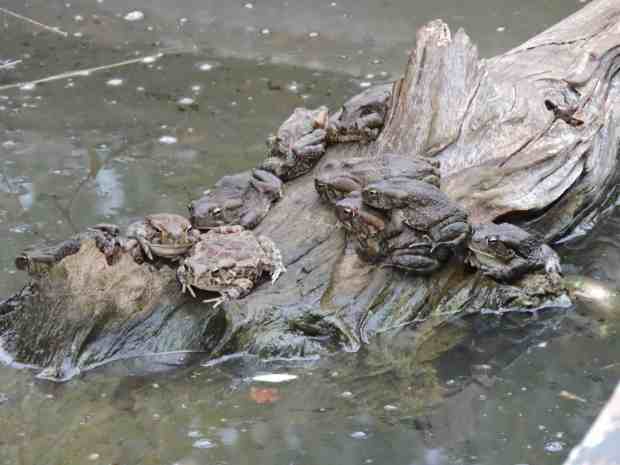
To my relief it was a false alarm but a clever ruse nevertheless! Someone had somehow placed a tree trunk semi-submerged in the pond with the intention of making it look like a croc. Whoever he/she was succeeded with me! The movement and shiny eyes were not fiction as the head was a resting place for a bunch of toads [1] that were using the wooden croc as their resting place!


I returned to the bungalow and the following morning I came back to the pond for a better look.

DSCN0368 copy

During the day the trunk was more obvious but less so when the toads were on it adding some greenish colour and movement to it!

DSCN0451 copyDSCN0446 copy

DSCN0459 copy

Luckily it was a wooden croc but it was nice as it offered a good opprtunity to see the toad’s interaction and to take some nice pictures of the batracian colony.


[1] From Wikipedia (https://en.wikipedia.org/wiki/Frog). “The use of the common names “frog” and “toad” has no taxonomic justification. From a classification perspective, all members of the order Anura are frogs, but only members of the family Bufonidae are considered “true toads”. The use of the term “frog” in common names usually refers to species that are aquatic or semi-aquatic and have smooth, moist skins; the term “toad” generally refers to species that are terrestrial with dry, warty skins”.

Place of many elephants

It is clear that the more places you see, the more you learn and the more you realize the little you know! Enough of philosophical exertions and focus of the post, I hear you thinking!

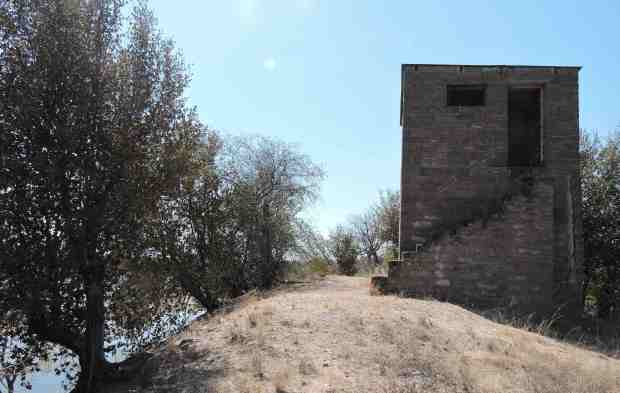
Climbing Wrights’s tower to look at the Mwenezi river below spurred my curiosity about who Mr. Wright was but also about the general area where the Gonarezhou[1] National Park is located. The Great Limpopo Trans-frontier Park and Conservation Area was created on 9 December 2002. It took another four years for parts of the fence separating Limpopo in Mozambique and the Kruger national parks to be removed allowing important movement of game across the hitherto fenced area. Things move slowly in conservation!

DSCN0235 copy

Wright’s tower.

DSCN0225 wright tower Gon Aug 17 copy

The sign in Wright’s tower.

Although in April 2014, Mozambique and South Africa signed a memorandum of understanding on biodiversity conservation and management of the area, particularly addressing rhino poaching in the Great Limpopo area, Gonarezhou is lagging behind in this integration. There are, however, fresh hopes that the unique agreement, signed in 2016, between the Frankfurt Zoological Society and the Zimbabwe Parks and Wildlife Management Authority to form the Gonarezhou Conservation Trust may facilitate further integration.

Allan Wright was a district Commissioner in Nuanetsi, the District where Gonarezhou is. He arrived to the area in 1958 and declared himself to be an “ardent conservationist”. After a quick exploration of the topography, soils and plants found in the area he was convinced that it was “…From and agricultural point of view the whole area was in the lowest category, almost a wasteland…”.

So, the plans to divide it into farms for African farmers were gradually scrapped and his intentions made clear when he proclaimed:

Before me, as far as the eye could see, was the vast, empty Gonakudzingwa Purchase Area – ’empty’ only in the human context for it teemed with animal life … the great wilderness looked mysterious, haze blue, inviting. What a heritage! What a wonderful national park this south-east corner of Rhodesia would make.”[2]

So, Mr. Wright managed to persuade the then Government of Rhodesia not only to spare the area from farming but also to give him funds to develop it. He describes his time at Nuanetsi in two books [3]. Mr. Wright’s efforts survived the years to come after his retirement and eventually crystalized in the creation of the Gonarezhou National Park in 1975.

Considering the Gonarezhou in the larger context of the Great Limpopo Trans-frontier Park and Conservation Area, the point where the borders of Mozambique, South Africa and Zimbabwe meet is known as Crook’s Corner. Suspecting that the name had its reasons, I investigate it further and this lead to the unraveling of some interesting facts!

It was because of its “tri-national” characteristic that Crook’s Corner attracted a number of outlaws that found the facility of moving among the three countries very advantageous. Apparently, the exact location of Crook’s Corner is on an island very close to the place where the Luvuvhu River flows into the Limpopo, near to the Pafuri area of the Kruger National Park.

Although there were other brigands, Stephanus Cecil Rutgert Barnard placed it in the world map. Barnard sought refuge there from his illegal activities related to hunting and poaching, two activities very difficult to tell apart in the 1900’s. “The one who swaggers as he walks” that is what his Shangaan nickname Bvekenya meant, arrived there in 1910.

Bvekenya’s derived his living from hunting and or poaching mainly elephants for ivory as well as illegally recruiting labour for the mines (known as blackbirding) as well as trading animal skins. It was a tough life, persecuted by police and exposed to malaria! Bvekenya functioned illegally over vast large tracts of Portuguese East Africa and Rhodesia, successfully running his ivory past the law.

It seems that Bvekenya was a bit of an oddball, to put it mildly and, during the twenty years that he operated in the region, based at Makhuleke, he carried out a number of interesting exploits, from taming a herd of eland for milking to praising lose the beacon indicating the frontier so that he could move it to “migrate” his camp to a different country according to which one was after him! A larger than life character that T.V. Bulpin immortalized in his book “The Ivory Trail” [4].

More amazing still were Bvekenya’s conservation ideas that led him to suggest the creation of a Trans-frontier park at that time (1900!)! It would take over one hundred years before the politicians in the various relevant Governments agreed on the issue and it is still unfinished!

Bvekenya’s hunting ground included the present Gonarezhou National Park. In that general area he shot a number of large elephants for their ivory. It is believed that he was not a careless hunter and that, before killing an animal, he would check the dung with his Shangaan trackers to ascertain the age of their quarry. Only elephants that had passed their prime would be shot and then nothing was wasted as the meat would be consumed by the local people.

Despite his hunting experience Bvekenya was mesmerized by the sight of a particular animal known as “taller than the trees” in the local Zulu language: Dhlulamithi! Bvekenya met this very large tusker while hunting somewhere in Gonarezhou or nearby, at a muddy pan. The bull elephant towered over the large herd he was with. The ivory that Dhlulamithi carried touched the ground while it walked, leaving grooves in the sand behind its path! Bvekenya attempted a shot at the giant but, luckily for Dhlulamithi, a younger bull that walked in front of it at the fatal moment was hit and Dhlulamithi got away unscathed.

Bvekenya never forgot Dhlulamithi and, while still hunting and or poaching other animals, he kept following it. It took Bvekenya many years to find it again and when he did, towards 1929, he had it in his rifle sights but did not shoot the animal exclaiming “Let it live”.

tusker wange waterhole

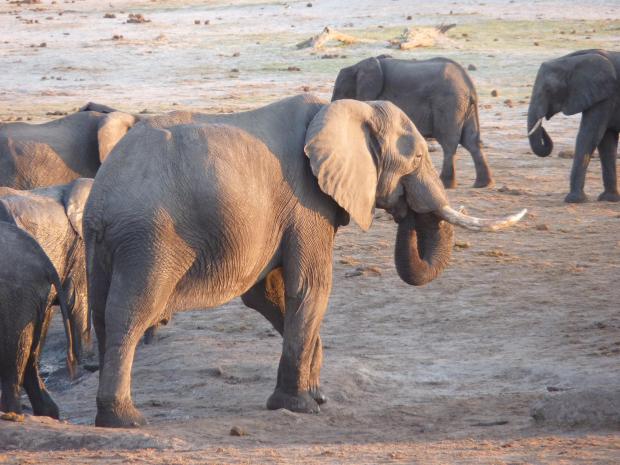
Tusk size and shape varies with the areas. This bull in Hwange National Park carries thick but rather short tusks.

Whether this took place or not is an issue of debate as other chroniclers claimed that Bvekenya -an inveterate commercial ivory trader- would not have missed such a tusker. This thesis is supported by the appearance in 1932 -a few years after Bvekenya ‘s retirement- of two humongous tusks that were claimed to be Dhlulamithi ‘s that were eventually auctioned in London. The tusks weighed 73 and 73.5 kg and their origin is unclear. They are meant to be now at a London Museum.

Luckily, there still are elephants carrying heavy ivory roaming in the Kruger National Park and, with patience they can be found at the various watering points, particularly in the Northern part of the park [4]. Whenever I see one of these colossuses I hope that Dhlulamithi ‘s genes are still present in them!

These two “friends” were leaving one of the waterholes in the north of the Kruger National Park.

masthulele 2

Masthulele seen at the Letaba river  (Kruger National Park), together with the tusker below, the largest tuskers I have seen so far.

If lucky, next time I see these colossuses I will remember this story and hope that what I see still carries Dhlulamithi’s genes that will be passed to future generations.

The above, seen by the bushsnob in 2014, is no longer an unknown tusker! (In this regard, see: https://bushsnobinafrica.wordpress.com/2014/08/20/a-tusk-task-2/ and https://bushsnobinafrica.wordpress.com/2014/09/21/unraveling-the-tusker-mystery/ and the next post coming soon!)


[1] “Place of many elephants” is the Shona language is the more accepted meaning of Gonarezhou. It is also translated less often as “sacred place of the elephants” or “elephant’s tusk”.

[2] Quoted from from Wolmer, W. (2007). From Wilderness Vision to Farm Invasions. Conservation & Development in Zimbabwe Southeast Lowveld. James Currey, Oxford. 247p.

[3] Wright, A. (1972). Valley of the ironwoods: A personal record of ten years served as District Commissioner in Rhodesia’s largest administrative area, Nuanetsi, in the south-eastern Lowveld (unknown publisher) and Wright, A. (1976). Grey Ghosts at Buffalo Bend, Galaxie Press. Both books are out of print.

[4] Bulpin, T.V. (2011). The Ivory Trail. Protea BoekhuisEds., 4 edition. 240p.


Postcript: Apart from T.V. Bulpin’s The Ivory Trail book I recommend to visit the following links that will provide you with more detail, if interested:

https://www.africahunting.com/threads/the-legend-of-dhlulamithi.15191/

http://www.pendukasafaris.com/history/remembering-bvekenya-country-life-february-2003/


Gonarezhou three years later. Northern area

We were last in Gonarezhou National Park almost three years ago and I wrote about our impressions then [1]. This time the idea was to try the Chipinda Pools Tented camp so we booked ourselves there for five nights from 21-26 August.

Interesting developments had taken place during our absence. The management of the park had changed when on 30 June 2016 the Frankfurt Zoological Society and the Zimbabwe Parks and Wildlife Management Authority signed an agreement for the creation of the Gonarezhou Trust. The latter represents a new management style for a National Park in Zimbabwe, aiming at running the park in a sustainable way on a long-term basis.

The first thing we noted was that the park can now be only booked at the Chipinda Pools office and not at the Harare Reservations office as all other national parks. Despite the distance from Harare (about 500km), the process was smooth and I soon arranged for our stay through an exchange of messages via Messenger and e-mail that ended with an advance payment to secure the bookings.

The trip went smoothly and we were not stopped at Police checkpoints at all despite the rather long distance! After Chiredzi we turned towards the park and drove through land managed by the Malilangwe Trust [2]. We wondered at the time if they would have accommodation that we could try another time [3]. We were soon at the Chipinda Pools gate where we produced our booking at the reception to a friendly lady.

As the checking of our papers was taking a while we took the opportunity to read some of the posters that explained the work on the various predators that is being carried out at the park. Our reading got interrupted when we heard the lady saying, “I have bad news!” As you can imagine, she was successful in calling our attention so we were with her in a second while we heard her adding: “Your booking is for the 21st all right but of September, not August!” and she handed me over the voucher I had given her moments before! While my heart was sinking, I confirmed my error and cursed myself for not checking the booking earlier!

It was about 16:30 hours so my wife and I looked at each other and both said the same thing: “Maybe we will need to see if Malilangwe has a lodge after all!” However, before playing that last card I asked whether there was any chance of putting us up for the night at the staff camp and then decide what we did the following morning as it was now too late to depart. I felt that I was wasting my words as the lady was on the phone and ignored my plea!

As we could not hear her conversation in the office, we waited, unaware of what was going on. The uncertainty lasted until she hanged up and informed us that she had just confirmed that the camp was full as it was time for school holidays in Zimbabwe. We were clearly in a tight spot and awaited again while she made another call before finally declaring gravely: “Sorry, no luck, we are full”.

At a loss, my jerk response was “So, we go back to Harare”, feeling rather upset with myself but ready to accept the situation and go away. Then, to our astonishment she burst out laughing as only Africans can do! “I was joking,” she said, “a colleague is coming to see if what we have would be OK with you”. After recovering from narrowly missing a heart attack, I calmed down and -internally- celebrated her sense of humour and I even managed what I thought it was a smile but probably it was a smirk!

Eventually we were shown into one of the tents that are normally used by researchers that happened to be empty. We were told that, unfortunately, we needed to share the ablutions with other people. We were so delighted with the offer that we immediately accepted it as it was for the duration of our booking! We noted that we even have our own painted dog couple residing at the tent although they were papier-mâché ones!

DSCN0108 copy

Our tent.

DSCN0111 copy

The veranda of our tent.

DSCN0120 copy

The setting.

The camp was composed of four tents with a communal kitchen and ablutions nestled by a small stream that flowed into the Save river a couple of hundred metres down the river. The camp was well shaded and it was very well kept. We finally settled down while noting that the tent had large windows closed only by mosquito mesh and curtains so we prepared for a cold night and we were happy to have our sleeping bags with us!

That night, now relaxed, we enjoyed our dinner and, after reinforcing the provided bedding with our own warm bags, went to bed for what I thought it was a well deserved rest while congratulating ourselves that we managed to survive a potential disaster. Later during the night, we heard lion roaring while it walked by our camp and we were happy to be smug in our strong tent! The following morning we learnt that there was a lone male lion stationed near camp at the time. Despite the lion living next to camp, we did not see it, unfortunately.

We spent the day exploring the area and we took a recommended route that brought us along the Sililijo stream. As soon as we left camp we climbed a hill and had a great view of a large tract of the park through which the Runde river meanders its way towards its meeting with the larger Save river.

DSCN0065 copy

The view of the Runde river.

Soon we had left the Runde river behind and, after a route that was rich in game we re-joined it near the Chilojo Cliffs, Gonarezhou’s famous landmark.

DSCN0096

The Chilojo cliffs. Gonarezhou’s landmark.

DSCN0098

Another view of the cliffs.

Among the animals we found on the way were elephants, buffalo, giraffe, impala, greater kudu and eland. Yet again we admired the numerous baobabs and realized that the plentiful rains have had a positive impact on the vegetation cover as the park was very bushy. This, of course, had a negative impact on game spotting but we did not mind that at all as it was clear that the game numbers are on the increase!

DSCN0082 copy

A female Greater kudu watches us.

After enjoying a picnic by the cliffs, followed by the mandatory bush siesta we waited a while longer for elephants to come to the river but, as they did not come, we decided to return to camp. As usual, we underestimated the distance and we arrived rather late as we took a wrong turning and, near the camp, we got charged by a loud trumpeting lone elephant bull that we just managed to see. The animal was very nervous and it kept coming towards us until we finally managed to avoid it and safely get back to camp. Later we learnt that the elephant was scared because of the proximity of the male lion.

We arrived tired and looking forward to a shower, dinner and bed. However, the appearance of the game ranger in charge of tourism, stopped us in our tracks. He was the bearer of more bad news: our tent was needed for some unexpected visitors! He asked us if we would mind moving to the Mabalauta area in the southern part of the park where there was room for us at Swimuwini Camp. Aware of the well known saying “beggars can’t be choosers”, we immediately and gladly agreed and convened that we could leave at about 09:00 hours the following morning.

The next day, before departure, we had a chance to talk to other guests that told us that it was possible to drive to the Mabalauta area through the park and that it was a nice and scenic drive. This was good for me as I also wished to have a look at a place called Lion pan as, years back, I was told that it was -obviously- good for lions… So, thanking the management for their hospitality we departed at a leisurely pace towards our new camp, about 100km south.

Our drive was, as expected, interesting although we did not see many animals. A rock monitor (Varanus albigularis) that crossed the road and a Purple roller (Coracias naevius) were the only animals of note we saw although there were plenty of hornbills and other common birds as well as a few squirrels. We found elephant spoor but no sign of the pachyderms anywhere. Unfortunately we missed the GPS point where we should have turned East for the Lion pan so we decided to explore it the next time we come.

DSCN0139 copy

A river on the way to Mabalauta in the south of the park.

DSCN0143 copy

Most pans had water, product of the excellent rains of last year. This one is on the way to Mabalauta in the south of the park.

DSCN0129 copy

A male namaqua dove.

DSCN0140 copy

The rock monitor that slowly crossed the road showing us its rather long tongue.

DSCN0142 copy

Close up of the rock monitor.

[1] See https://bushsnobinafrica.wordpress.com/2014/08/11/gonarezhou-national-park-safari-diary-day-1/ and the two posts that followed.

[2] See: http://www.malilangwe.org/

[3] After returning to Harare I learnt that they have a lodge called Singita Pamushana Lodge.


Spot the beast 27

We got back from Gonarezhou National Park yesterday evening and I have a lot to do before I am able to post anything yet! However, there is always time for a “Spot the beast” to keep your minds active until I can get mine starting!!!

This was the view from our tent at Chipinda Pools in the park. I am sure that you will agree with me that is a very nice spot: a river with a bit of water, lots of trees and lianas and the light filtering through the foliage.

There is a beast somewhere there (the reason why I took the picture) that it will take you some time to find, I think.

DSCN0120 copy

?

?

?

?

?

?

DSCN0121 copyIt is a male bushbuck that came down for a drink and we saw it (or rather my wife, again) spotted when it was climbing back to spend the rest of the day wherever the bushbucks do this.

(Please be aware that it was walking so the second picture shows it after it walked a about a metre to the right of the first picture)