While watching elephants at the Nyamugwe pan in Gonarezhou National Park, a small movement caught my eye up this dead tree. This is what I saw from the distance. Can you see the beast?
?
?
?
?
?
?
?
?
?
A curious squirrel keeping an eye on our movements. Squirrels -to us- look somehow out of place in Africa but they are a frequent sight in Southern Africa.
You will recall that on 20 August 2014 I published a post titled “A tusk task” (https://bushsnobinafrica.wordpress.com/2014/08/20/a-tusk-task-2/) where I presented the finding of ab elephant bull that, as far as I could tell, had not been identified before. I called this animal the “Balalala tusker” as we saw it near the Balalala area at Kruger National Park.
A month later in “Unraveling the tusker mystery” (https://bushsnobinafrica.wordpress.com/2014/09/21/unraveling-the-tusker-mystery/). I reported that I got confirmation that what we had seen was indeed a new tusker that “will definitely escalate him to the top of the list when the time for the naming review comes and hopefully at that time he will be confirmed as a new bull and named“.
The naming process took a while during which I kept asking the Emerging Tuskers Project (ETP) of the Letaba Elephant Hall of the Kruger National Park for progress but I had no news for over two years. When I was starting to lose hope, on 28 June 2017, I received an e-mail from the ETP that I reproduce below.
Dear Julio,
I am sure you are convinced by now I had forgotten you. I am sorry this process took so long… I finally got the media release and approvals done and I can formally tell you now that your bull is named Matlakusa.
It proved quiet an interesting story in the end, as once we had identified your bull as a new bull, we noted that with one of our other new bulls some of the submissions characteristics matched your bull better and we actually managed to split these sightings far more accurately after the great series of images you and another contributor provided so it actually helped link the two new bulls and discover a completely new bull and a new area for him as well.
Below is the link to the website as well as the info for Matlakusa (this is a summary of the info that is on file with the project), if you have any further questions please do not hesitate to contact me.
Origin of Name: ‘Matlakusa’ from tlakusa, in Tsonga meaning to ‘raise, lift up’, this is a large open pan and bore-hole, alongside the eastern border, southeast of Malonga in the Kruger National Park and links to this bull’s large home range.
Range: Northern and Far Northern KNP.
Special Features: This bull’s ivory closely resembles that of Xindzulundzulu, that it is fairly symmetrical, straight and widely splayed with a shallow curve from a side profile. The left ear holds the defining characteristics that separate these two bulls, there is a R5.00 sized hole in the tip of the lobe as well as an area of damaged cartilage at the top give a large v-shaped ‘collapse’ in the ear. A very small u-shaped notch and two R0.20 holes are visible on the middle of the lobe but only at close inspection and with the ears extended. The right earlobe had a R0.50 sized hole towards the bottom of the lobe that has recently been torn and is now a u-shaped notch with a small hole towards the inner lobe above this. Other than this the lobe is fairly clean edged. A small protrusion of skin is visible on the trunk at the top adjacent the left tusk. Visible from a side profile is a growth on the left foreleg behind the leg just above the joint.
General: Initial images of this bull from Joël and Di Roerig were identified as Xindzulundzulu due to his ivory shape. Later in 2014 a full series of images submitted by Julio de Castro [1] between Shingwedzi and Balalala created a dilemma as at the time as Xindzulundulu was known to only be local to Shingwedzi and a new bull was suspected. Additional images by regular contributor Frans van Achterbergh submitted showing his left and right side allowed the defining characteristic’s to be seen and to be able to determine that there were in fact two separate bulls. This revelation allowed two previous sightings one of which was by Ian & Deirdre Outram and the other by Forum member Lion Queen both in 2012 that were both previously thought to be Xindzulundzulu but could not be confirmed as the locations did not make sense and defining characteristics in these images were not very clear. However the receipt of the 2014 submission with clearer images could confirm these identifications. Several other images placed with Xindzulundzulu’s monitoring file could now also be separated out as being those of Matlakusa and in 2015/6 it was decided that sightings of him were sufficient to name the bull confirming his status.
Kind Regards
Kirsty Redman, Interpretive Officer, Nxanatseni Region, Kruger National Park, South African National Parks.
As you can imagine we are delighted that our contribution assisted the ETP to identify Matlakusa and separate it from Xindzulundzulu as a new tusker.
Matlakusa showing off its ivory!
We look forward to find Matlakusa again during our next safari to the KNP next week. We hope that Matlakusa will continue to live its peaceful life for many years to come and that its ivory stays with it, where it belongs!
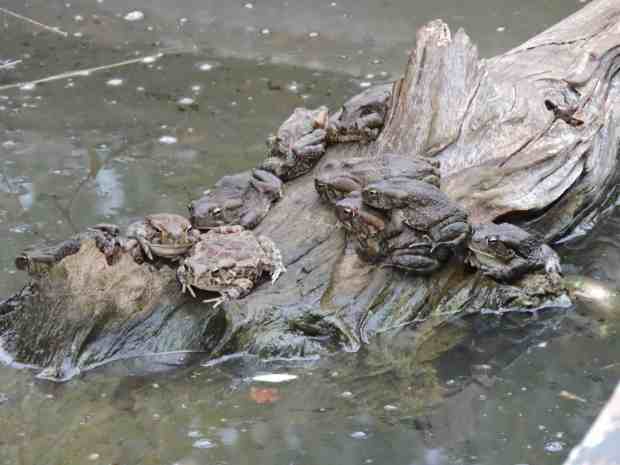
At night, returning to our bungalow at Swimuwini after a hot shower I took a detour to investigate what looked like a small pond. From a distance I shone my torch in the general area and I froze in my tracks. There was a crocodile there!
Without moving I maintained the light on the reptile’s head -all I could see- and I not only saw it moving but also its eyes shone under the torch’s light! “This is amazing” I thought while watching the beast. I dropped my towel and other shower implements and slowly approached the pond in the dark until I estimated to be close enough to have a good view. Then I switched on my torch again.
To my relief it was a false alarm but a clever ruse nevertheless! Someone had somehow placed a tree trunk semi-submerged in the pond with the intention of making it look like a croc. Whoever he/she was succeeded with me! The movement and shiny eyes were not fiction as the head was a resting place for a bunch of toads [1] that were using the wooden croc as their resting place!
I returned to the bungalow and the following morning I came back to the pond for a better look.
During the day the trunk was more obvious but less so when the toads were on it adding some greenish colour and movement to it!
Luckily it was a wooden croc but it was nice as it offered a good opprtunity to see the toad’s interaction and to take some nice pictures of the batracian colony.
[1] From Wikipedia (https://en.wikipedia.org/wiki/Frog). “The use of the common names “frog” and “toad” has no taxonomic justification. From a classification perspective, all members of the order Anura are frogs, but only members of the family Bufonidae are considered “true toads”. The use of the term “frog” in common names usually refers to species that are aquatic or semi-aquatic and have smooth, moist skins; the term “toad” generally refers to species that are terrestrial with dry, warty skins”.
It is clear that the more places you see, the more you learn and the more you realize the little you know! Enough of philosophical exertions and focus of the post, I hear you thinking!
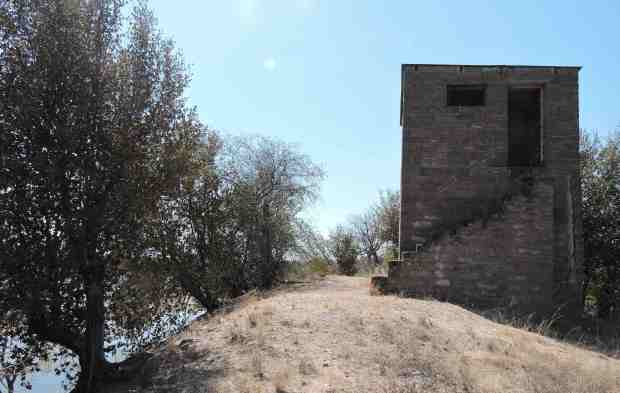
Climbing Wrights’s tower to look at the Mwenezi river below spurred my curiosity about who Mr. Wright was but also about the general area where the Gonarezhou[1] National Park is located. The Great Limpopo Trans-frontier Park and Conservation Area was created on 9 December 2002. It took another four years for parts of the fence separating Limpopo in Mozambique and the Kruger national parks to be removed allowing important movement of game across the hitherto fenced area. Things move slowly in conservation!
Wright’s tower.
The sign in Wright’s tower.
Although in April 2014, Mozambique and South Africa signed a memorandum of understanding on biodiversity conservation and management of the area, particularly addressing rhino poaching in the Great Limpopo area, Gonarezhou is lagging behind in this integration. There are, however, fresh hopes that the unique agreement, signed in 2016, between the Frankfurt Zoological Society and the Zimbabwe Parks and Wildlife Management Authority to form the Gonarezhou Conservation Trust may facilitate further integration.
Allan Wright was a district Commissioner in Nuanetsi, the District where Gonarezhou is. He arrived to the area in 1958 and declared himself to be an “ardent conservationist”. After a quick exploration of the topography, soils and plants found in the area he was convinced that it was “…From and agricultural point of view the whole area was in the lowest category, almost a wasteland…”.
So, the plans to divide it into farms for African farmers were gradually scrapped and his intentions made clear when he proclaimed:
“Before me, as far as the eye could see, was the vast, empty Gonakudzingwa Purchase Area – ’empty’ only in the human context for it teemed with animal life … the great wilderness looked mysterious, haze blue, inviting. What a heritage! What a wonderful national park this south-east corner of Rhodesia would make.”[2]
So, Mr. Wright managed to persuade the then Government of Rhodesia not only to spare the area from farming but also to give him funds to develop it. He describes his time at Nuanetsi in two books [3]. Mr. Wright’s efforts survived the years to come after his retirement and eventually crystalized in the creation of the Gonarezhou National Park in 1975.
Considering the Gonarezhou in the larger context of the Great Limpopo Trans-frontier Park and Conservation Area, the point where the borders of Mozambique, South Africa and Zimbabwe meet is known as Crook’s Corner. Suspecting that the name had its reasons, I investigate it further and this lead to the unraveling of some interesting facts!
It was because of its “tri-national” characteristic that Crook’s Corner attracted a number of outlaws that found the facility of moving among the three countries very advantageous. Apparently, the exact location of Crook’s Corner is on an island very close to the place where the Luvuvhu River flows into the Limpopo, near to the Pafuri area of the Kruger National Park.
Although there were other brigands, Stephanus Cecil Rutgert Barnard placed it in the world map. Barnard sought refuge there from his illegal activities related to hunting and poaching, two activities very difficult to tell apart in the 1900’s. “The one who swaggers as he walks” that is what his Shangaan nickname Bvekenya meant, arrived there in 1910.
Bvekenya’s derived his living from hunting and or poaching mainly elephants for ivory as well as illegally recruiting labour for the mines (known as blackbirding) as well as trading animal skins. It was a tough life, persecuted by police and exposed to malaria! Bvekenya functioned illegally over vast large tracts of Portuguese East Africa and Rhodesia, successfully running his ivory past the law.
It seems that Bvekenya was a bit of an oddball, to put it mildly and, during the twenty years that he operated in the region, based at Makhuleke, he carried out a number of interesting exploits, from taming a herd of eland for milking to praising lose the beacon indicating the frontier so that he could move it to “migrate” his camp to a different country according to which one was after him! A larger than life character that T.V. Bulpin immortalized in his book “The Ivory Trail” [4].
More amazing still were Bvekenya’s conservation ideas that led him to suggest the creation of a Trans-frontier park at that time (1900!)! It would take over one hundred years before the politicians in the various relevant Governments agreed on the issue and it is still unfinished!
Bvekenya’s hunting ground included the present Gonarezhou National Park. In that general area he shot a number of large elephants for their ivory. It is believed that he was not a careless hunter and that, before killing an animal, he would check the dung with his Shangaan trackers to ascertain the age of their quarry. Only elephants that had passed their prime would be shot and then nothing was wasted as the meat would be consumed by the local people.
Despite his hunting experience Bvekenya was mesmerized by the sight of a particular animal known as “taller than the trees” in the local Zulu language: Dhlulamithi! Bvekenya met this very large tusker while hunting somewhere in Gonarezhou or nearby, at a muddy pan. The bull elephant towered over the large herd he was with. The ivory that Dhlulamithi carried touched the ground while it walked, leaving grooves in the sand behind its path! Bvekenya attempted a shot at the giant but, luckily for Dhlulamithi, a younger bull that walked in front of it at the fatal moment was hit and Dhlulamithi got away unscathed.
Bvekenya never forgot Dhlulamithi and, while still hunting and or poaching other animals, he kept following it. It took Bvekenya many years to find it again and when he did, towards 1929, he had it in his rifle sights but did not shoot the animal exclaiming “Let it live”.
Tusk size and shape varies with the areas. This bull in Hwange National Park carries thick but rather short tusks.
Whether this took place or not is an issue of debate as other chroniclers claimed that Bvekenya -an inveterate commercial ivory trader- would not have missed such a tusker. This thesis is supported by the appearance in 1932 -a few years after Bvekenya ‘s retirement- of two humongous tusks that were claimed to be Dhlulamithi ‘s that were eventually auctioned in London. The tusks weighed 73 and 73.5 kg and their origin is unclear. They are meant to be now at a London Museum.
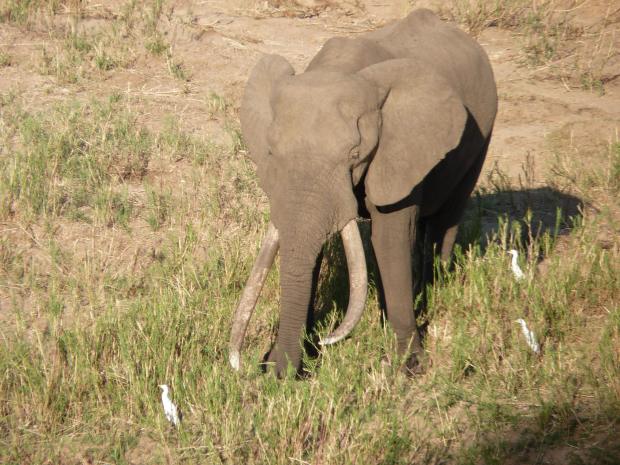
Luckily, there still are elephants carrying heavy ivory roaming in the Kruger National Park and, with patience they can be found at the various watering points, particularly in the Northern part of the park [4]. Whenever I see one of these colossuses I hope that Dhlulamithi ‘s genes are still present in them!
These two “friends” were leaving one of the waterholes in the north of the Kruger National Park.
Masthulele seen at the Letaba river (Kruger National Park), together with the tusker below, the largest tuskers I have seen so far.
If lucky, next time I see these colossuses I will remember this story and hope that what I see still carries Dhlulamithi’s genes that will be passed to future generations.
[1] “Place of many elephants” is the Shona language is the more accepted meaning of Gonarezhou. It is also translated less often as “sacred place of the elephants” or “elephant’s tusk”.
[2] Quoted from from Wolmer, W. (2007). From Wilderness Vision to Farm Invasions. Conservation & Development in Zimbabwe Southeast Lowveld. James Currey, Oxford. 247p.
[3] Wright, A. (1972). Valley of the ironwoods: A personal record of ten years served as District Commissioner in Rhodesia’s largest administrative area, Nuanetsi, in the south-eastern Lowveld (unknown publisher) and Wright, A. (1976). Grey Ghosts at Buffalo Bend, Galaxie Press. Both books are out of print.
Postcript: Apart from T.V. Bulpin’s The Ivory Trail book I recommend to visit the following links that will provide you with more detail, if interested:
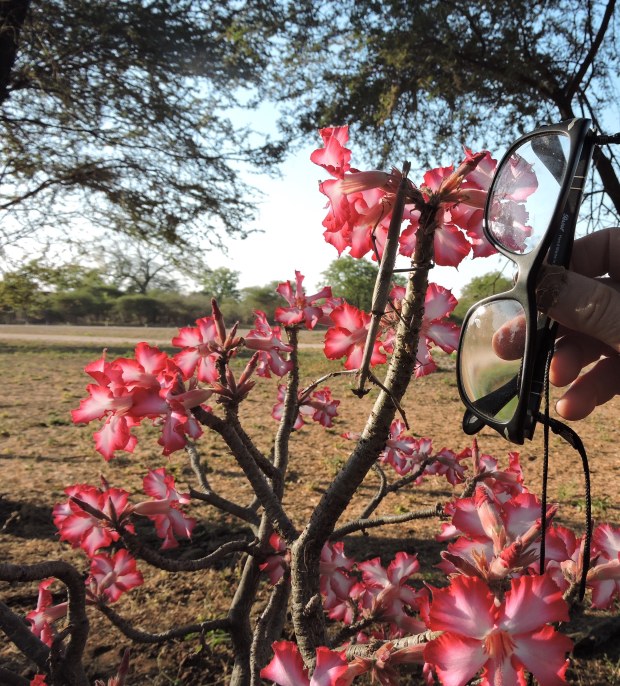
I am pretty sure that you did not spot the “beast” in one or two pictures I inserted in the impala lilies slide show that was part of the post Gonarezhou three years later. Southern area that I published on 3 September 2017.
The find took place at the Park reception in Mabalauta and I am giving you a second opportunity to discover the beast below:
?
?
?
?
?
?
?
?
?
A rather large praying mantis -head down- was patiently waiting for its lunch. It was spotted -as usual- by my wife that pointed it to me. After searching for it for about five minutes I gave up as I was unable to see it as it was immobile and blended well with the lily’s branches!
After our accidented Chipinda Pools stay, we got to Mabalauta in mid afternoon. By that time we were already famous, expected and treated like VIPs (or silly old folk?)!
Camp entrance.
A sensible request.
A booking was indeed ready for us at the reception but, on arrival to the Swimuwini camp itself we noted that our favourite bungalow was available. Negotiations follow as it was more expensive and finally, through an additional payment, we secured it.
Not only the bungalow was comfortable but it was beautiful. It had a great view of the vast expanse of the Mwenezi River below and it also had its own “resident” baobab next to its entrance.
Our bungalow by the river and the views from it, below.
The Mwenezi river at dusk from the “contemplation” chair.
The “contemplation” chair.
Giraffes in the distance.
It even had the added and valuable bonus of a bush cellular phone signal! We have learnt that cellphone signals are often found at weird places such as under the third marula tree facing the river or by placing your phone inside a cut out shampoo container hanging on the pole holding the entrance gate of a camp! In this case, the signal was obtained in the center of the backrest of the middle veranda armchair and, capriciously, nowhere else! So we were connected.
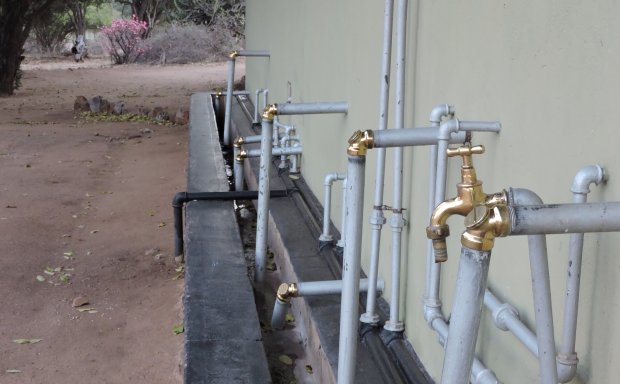
Fungisai, the camp attendant we knew from the last time, was still there as helpful as usual. This time she sported a bigger smile and she was very happy with the new park management as they were getting things done fast and their salaries were now being paid in time. There was a busy atmosphere around camp with the garden being refurbished and the various bungalows re-built. A look at the ablution block’s brass fittings’ condition further testified to the staff willingness to get on with the work!
Taking good care of the brass fittings!
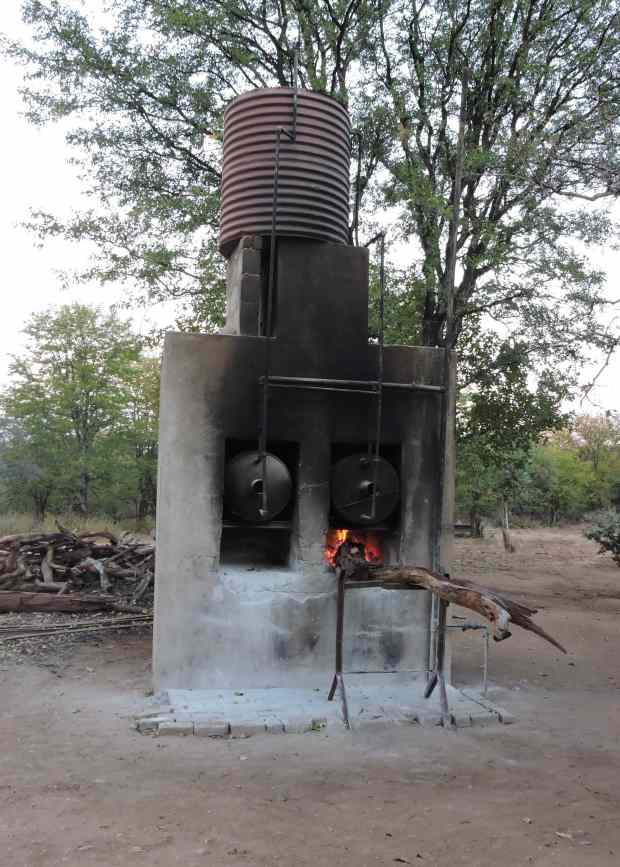
This time we had electricity and hot water at the ablutions block provided by a donkey boiler (also known as a Tanganyika boiler in East Africa) that worked great but that will soon be replaced by solar heaters. After enjoying its abundant hot water, we agreed with my wife that there are no better showers than these albeit their environmental friendship can be argued!
The donkey full blast.
Swimuwini (Place of baobabs) is one of the nicest national park camps we have ever stayed. It is not only small and beautiful but not many people stay there. For the first two nights we were alone and only then one more family arrived the third night. I believe that this will soon change when the on-going refurbishing work gets completed.
This slideshow requires JavaScript.
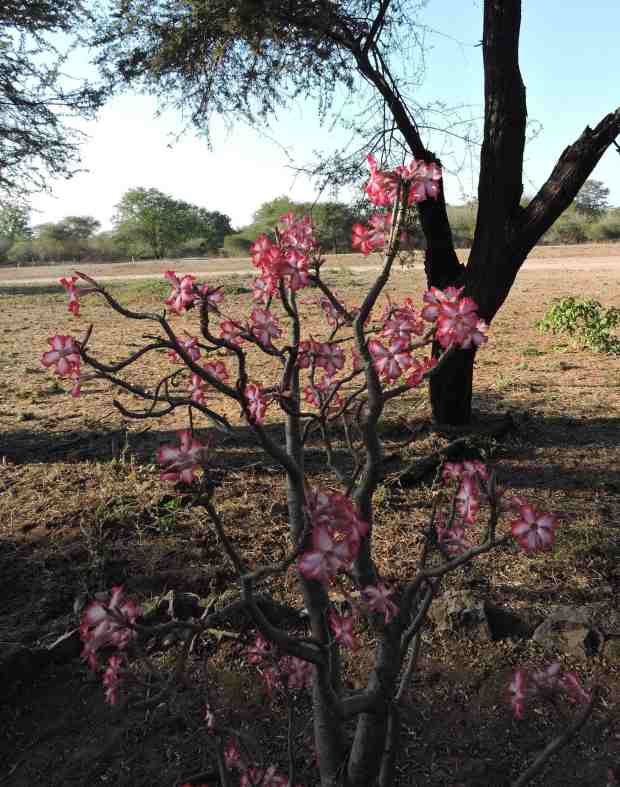
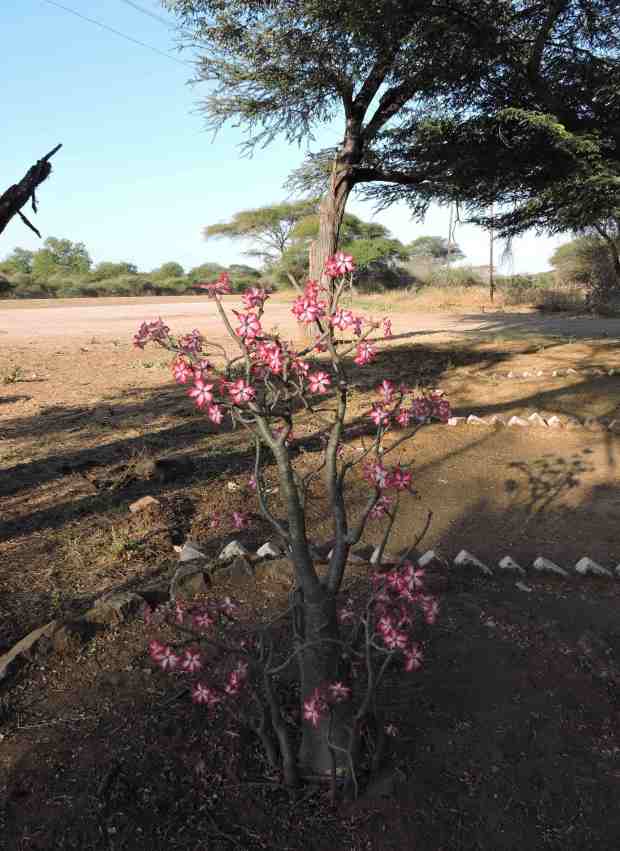
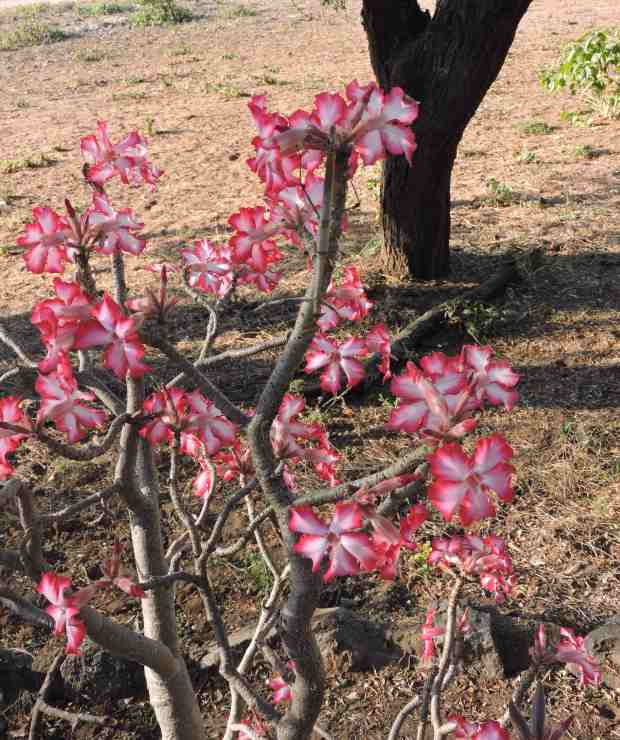
We spent some time exploring the camp admiring its plant and animal life. There are four bungalows that come with their own baobabs and a super tree is located at the staff village. In addition, the camp is splashed with impala lilies (desert roses in East Africa) that come in all shapes and sizes and are incredibly beautiful.
This slideshow requires JavaScript.
Another special of Swimuwini is the herd of Nyala (Tragelaphus angasii) that daily walks through the camp grazing and browsing on their way to and from the Mwenezi river. We remembered a rather large male from our previous visit but now, apart from it, there are at least two more young males and about ten females and young. They are tolerant of humans so we could approach them on foot and take a few pictures before they disappeared in the thicket behind the camp.
We drove many km carefully looking for game (we all know that my wife can spot anything that is there!). Impala were plentiful again but no Greater kudus were seen. A herd of about a dozen giraffe kept a prudent distance and they were seen mainly drinking in the distance down at the Mwenezi river (see above). This time we only heard jackals but did not see them but spotted three young hyenas walking around camp.
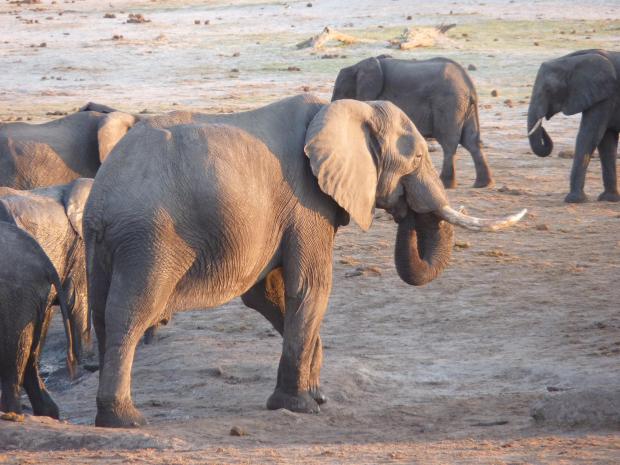
We saw a few elephant bottoms crushing through the brush and, eventually, caught a glimpse of two at the Nyamugwe pan. The sighting lasted for a minute perhaps and they were off! Clearly, despite the new management, it will still take time for the elephants to tolerate humans as it is clearly spelled at the sign that is found in Wright’s tower down the Mwenezi river, close to Malipati.
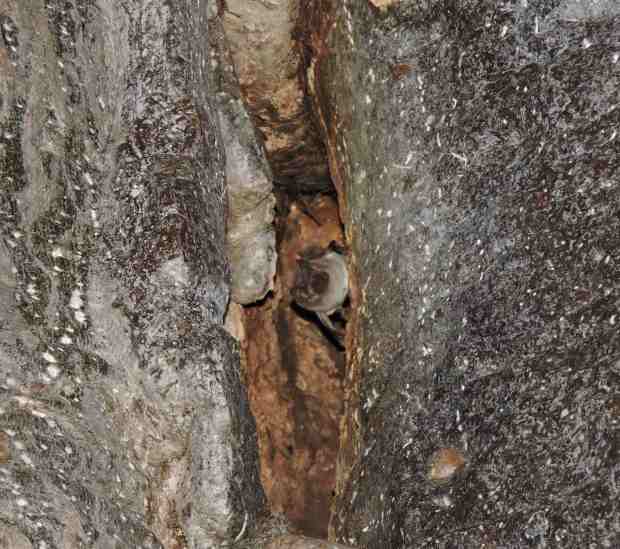
The camp offered further entertainment in the evening as the baobab crumples were the home of bats that would come out and hunt for insects under our veranda light.
The first night the camera trap -a great new addition to our safari gear- pictured a genet looking for left overs around our bungalow. In the camera we saw that it had started visiting our place between 19:30 and 20:00 hours so we decided to wait for it during the second night. We were immediately rewarded with several visits and a few (bad) pictures!
Albeit small, the Mabalauta section of Gonarezhou offers a nice drive along the river where a few river pools can be visited. Rossi pools offer a great view of the river where patience is rewarded with the arrival of different animals to the water. While you wait you will find entertainment counting the crocodiles either swimming or basking under the sun and, when the wind stops and the ripples settle, tilapia shoals can be easily seen moving about in the shallows while tiger fish patrol the deeper green pools in search of prey and the occasional terrapin surfaces to take a lungful.
Rossi pools.
A couple of kilometres further down the river the rather ugly Wright’s tower offers another nice view of the river. Searching for the origins of the tower I learnt that Allan Wright was a District Commissioner that was largely responsible for the establishment of the Gonarezhou National Park in 1975 so he probably built the tower [1].
It was also in this general area that S.C. ‘Bvekenya’ Barnard, the notorious hunter and poacher roamed during the early 1900’s avoiding the police by moving to different countries around Crook’s corner the point where the borders of Mozambique, South Africa and Zimbabwe converge. Bvekenya’s errands have been immortalized by T.V. Bulpin in his book “The Ivory Trail”.
But that is a different story.
[1] Allan Wright described his time in Nuanetsi District in his books Valley of the Ironwoods. A Personal Record of Ten Years Served as District Commissioner in Rhodesia Largest Administrative Area, Nuanetsi, in the South-Eastern Lowveld (1972) and Grey Ghosts at Buffalo Bend (1976) both now out of print.
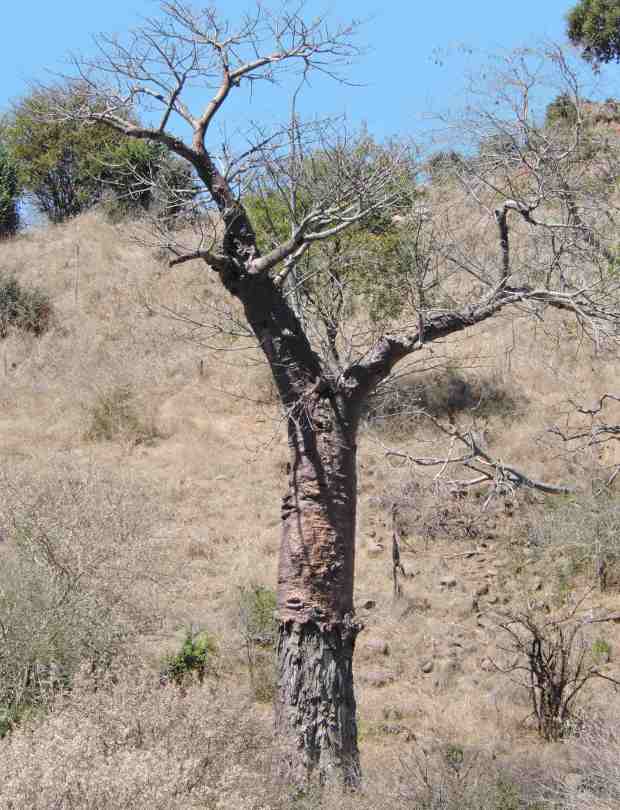
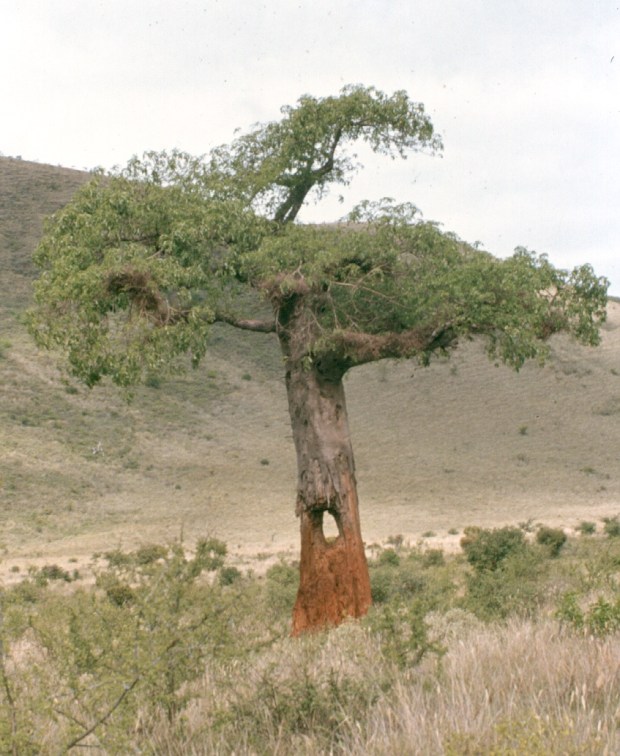
Last week, driving around Chipinda Pools in Gonarezhou National Park, we spotted this baobab that reminded me of a youngster when growing so fast that the clothes that fit today do not tomorrow! It seems that the young and growing baobab needs another pullover to cover its belly!
In fact, elephants had damaged the base of the tree and the absence of bark contrasts with the intact part of the trunk that shows a healthy coppery colour further up.
Elephants badly damage baobabs, particularly when food and water are scarce as they get the latter from the soft trunk. Lots of baobabs are damaged in this way and the problem is particularly noticeable in Gonarezhou.
The examples below are from Tsavo West National Park, Kenya in the eighties and Mana Pools National Park a couple of years back.
Baobab damaged by elephants in Tsavo West National Park.
Another damaged baobab, this time at Mana Pools National Park.












 A Bushsnob out of Africa