Bush stories and anecdotes

The heart of the blog, where I present observations, accounts, funny stories, etc.

Desperate ingenuity

Have you ever lived in a country with no embassy from your own? And if the whole continent has only three and the nearest is four thousand km away? Then, to ask you if you ever lost your passports in such a situation would probably be too much!

Well, this is what happened to us in Kenya so forgive me from what I needed to do to get out of that rather tight spot!

It was the end of 1983. My FAO fellowship was ending and we were getting ready to travel home to Uruguay -via Rome- after spending the last two years in Kenya as I have described in earlier posts.

We normally kept our passports at a safe place but we needed them to buy our tickets. It was during the second visit to collect our tickets that the worse thing that could have happened did happen: we lost them! It was only at that time that the location of the Uruguayan diplomatic representations became important to us! A couple of phone calls later (no internet then!) the news sunk in:

Johannesburg was the closest hope!

Luckily we had passport copies and our Uruguayan ID cards stored at home and we also had our Kenyan ID cards. While we could stay in Kenya (for a while at least), we could not do this indefinitely and absolutely not to travel on the 9 January 1984 as we had planned!

Although we immediately reported the loss to the Kenya Police, the passports had vanished and it looked like our journey had also gone down the drain as well! Before giving up hope completely, we decided to contact the Embassy of Uruguay in Johannesburg. We thought that in view of our “special” situation and the fact that we still have our original ID documents, a solution could be found.

After a frustrating phone call where I was repeatedly told that they would have had no problem issuing new passports but that we were required to be present in person in the embassy I gave up as they could or would not wish to understand that we were not able to travel from Kenya to South Africa without our passports!

My second hope -FAO- did not last long either as the Representative in Kenya -although very accommodating- could not help either. However, a couple of days later he told me that he could get FAO in Rome to arrange for our “special” entry to Italy [1]. That was some good news, albeit small.

Now we “only” needed to leave Kenya!

I can assure you that desperate situations enhances your imagination to find a solution. No, we did not walk at night all the way to Johannesburg to get our passports. Instead we decided that the most practical option was to tackle the Kenya Immigration authorities for a way out.

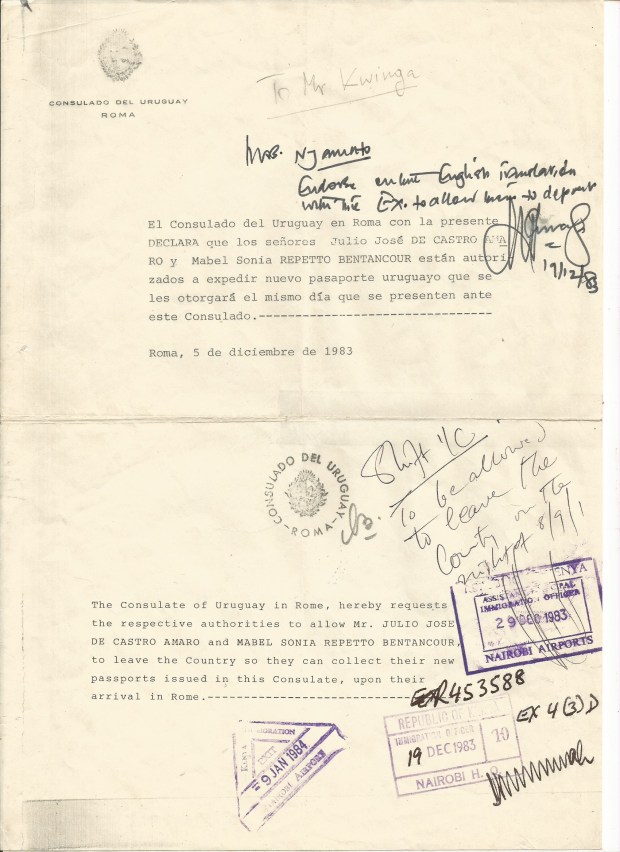
I booked an appointment and, not to go empty-handed, I decided to “prepare” a letter from the Uruguay Consulate in Rome as supporting documentation. I hoped that it would be not only a useful -and hopefully convincing- document but also a paper where stamps could be placed!

So, armed with our passports’ copies, Kenya IDs and the fake letter we ventured in the unknown recesses of the Kenya Immigration Department…

After going through a few offices as can be seen in the picture below, somehow we managed to get the needed clearance to leave the country! Very happy with the achievement but trying to be 100% safe, we found out the name of the officer that was to be at the airport at the time of our departure and we went to the airport to meet him and explain our predicament in person.

Clearly, the fact that we had the authorizations on the letter and also that we were leaving the country helped a lot and he kindly reassured us of our certain departure during his shift.

Kenya passport copy

The original authorization on top (19/12/83) by the boss of the office that instructs his junior to endorse the English translation instructing the responsible for shift 1/C to allow us to leave. We then went to meet the latter on 29/12/83 to get his agreement in person and finally departed on 9/1/84.

Luckily on the departure date Kenya Airways was on time and we managed to depart. The rest is history as we entered Italy, renewed our passports and continued our journey home to Uruguay, returning to Kenya a while later, now as a scientist with the International Centre of Insect Physiology and Ecology.


[1] I never found out the conditions of our entry but we were probably refugees!!!


Magic!

I thought that for a change I will treat you to a bit of bird magic.

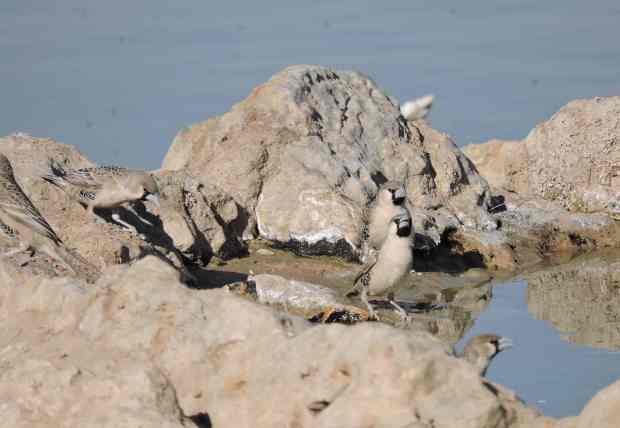
The sociable weaver (Philetairus socius), is a bird endemic to Southern Africa but mainly found within the Northern Cape Province of South Africa and, way before arriving to the Kgalagadi Transfrontier Park, their nests start to appear by the side of the road in their hundreds of shapes and sizes.

DSCN9929 7.45.54 PM 7.26.43 PM 5.38.50 PM 5.46.19 PM copy

Sociable weavers drinking.

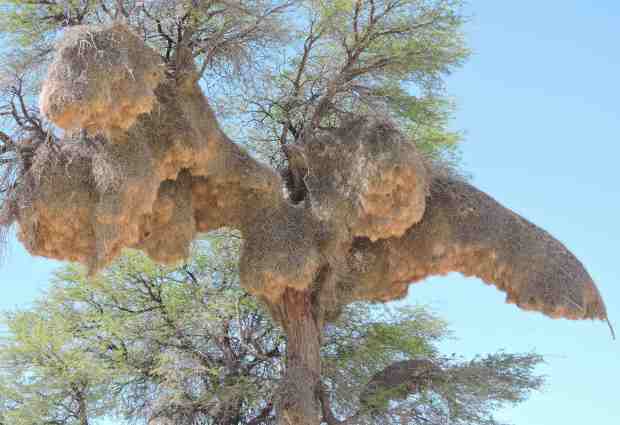
They are compound community nests and, as such, one of the unique and rather spectacular nests build by any bird! Nests are built around large and sturdy structures like acacia trees or sometimes even telephone poles.

DSCN9988 6.32.31 PM copy

A large nest.

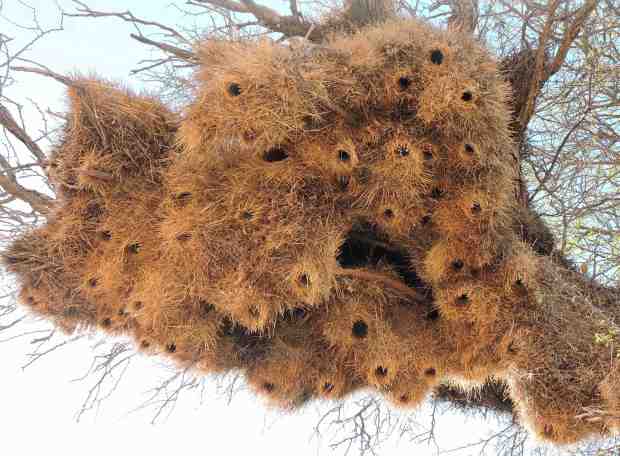
They can house several hundred birds that use the central -warmer- compartments to spend the nights while the peripheral ones are used to obtain shelter from the heat of the day as they are several degrees cooler than the outside.

DSCN9963 6.43.06 PM copy

The many entrances to a nest seen from below.

Some of the nests can weigh several tonnes and are built over many years, sometimes even over one hundred! However, their size and weight are sometimes their doom -particularly during the rains- as they collapse as the tree branches/support cannot cope with their immense weight!

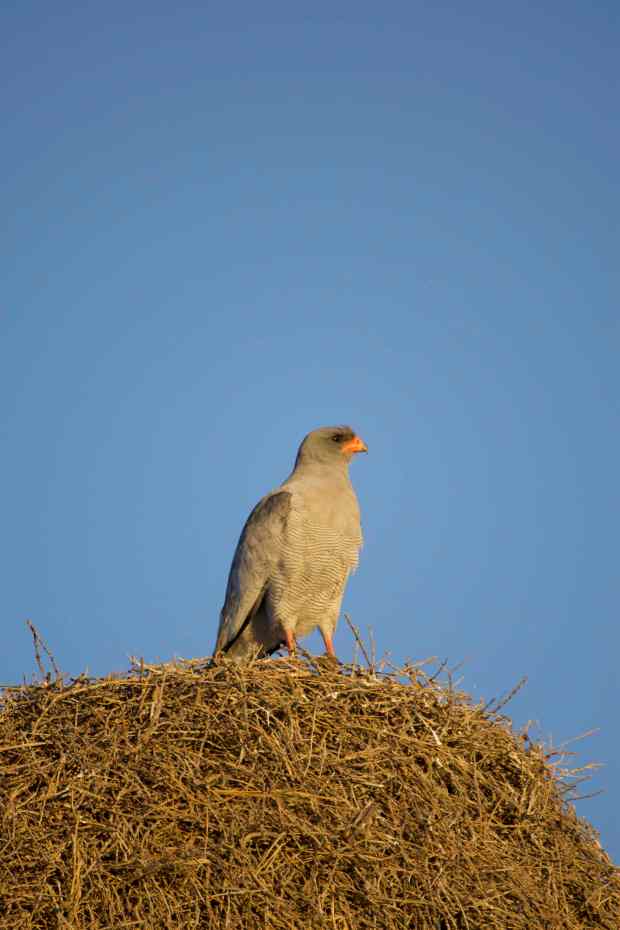
The nests offer shelter and vantage points to other birds such as the pygmy falcon and goshawks while red-headed finches and rosy-faced lovebird use them for breeding . Other bird species such as pied barbets and scaly-feathered finches, among others may use them for roosting while larger birds such as owls and vultures can build their own nests on top of the sociable weavers’.

DSC_0110 copy

Pale chanting goshawk on a nest.

As it can be imagined, such nests are targeted by many predators including snakes (black mambas, cape cobras and boomslangs), baboons, rats and genets. To avoid their natural enemies, sociable weavers build their nests on electricity poles or trees with long naked trunks.

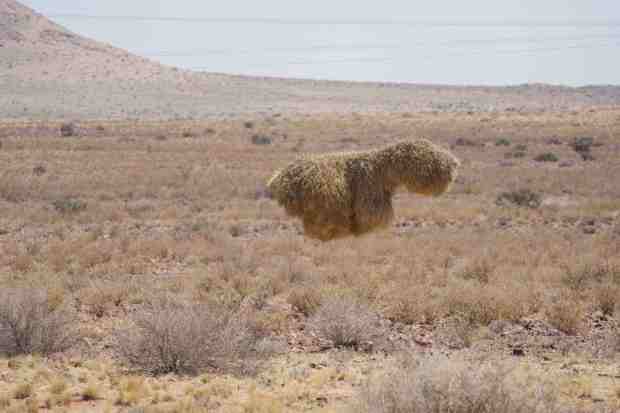
However, some of the birds near the Kgalagadi have taken their precautions much further: they build them on thin air!


DSC_0022 copy

In this way they clearly avoid a lot of the usual predators!


DSC_0023 copy

Well, in fact some birds have skillfully built their nest hanging on the electricity wires but, I am afraid, that was probably not such a good idea as it surely will be taken down by the maintenance team of the electricity company while it is possible thar their neighbours on the right may still be there next year!

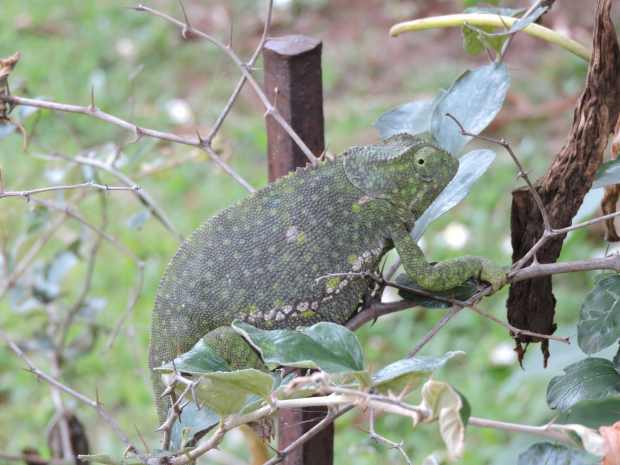
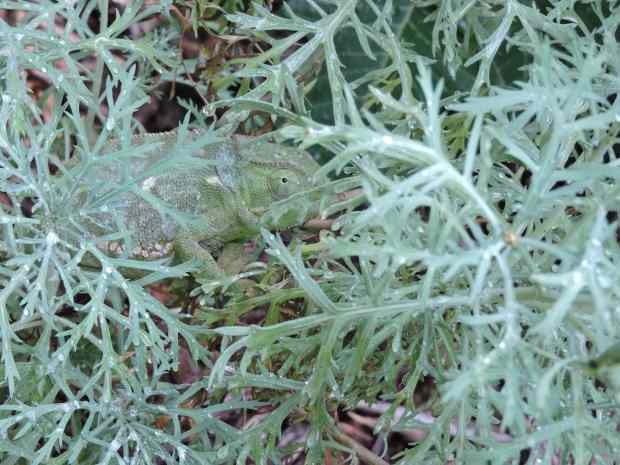
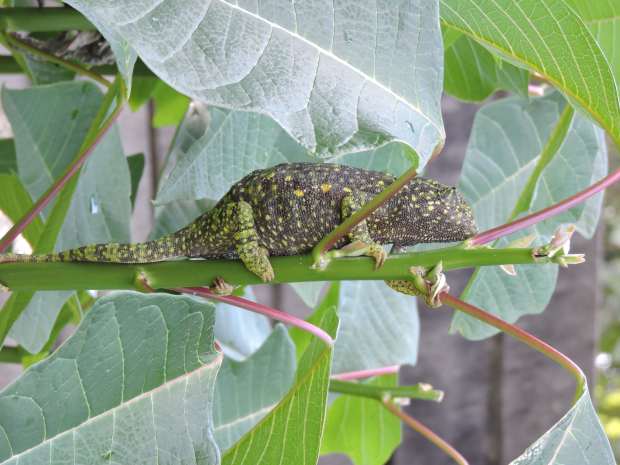
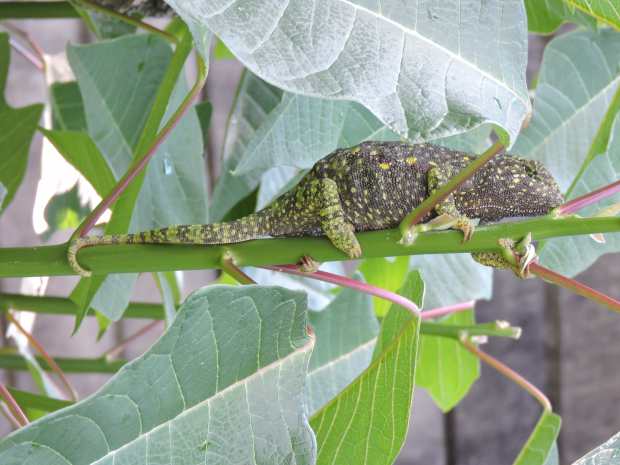
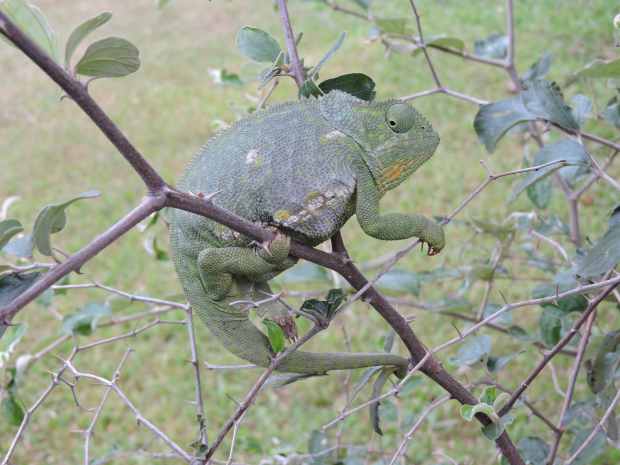
Live Cham 4

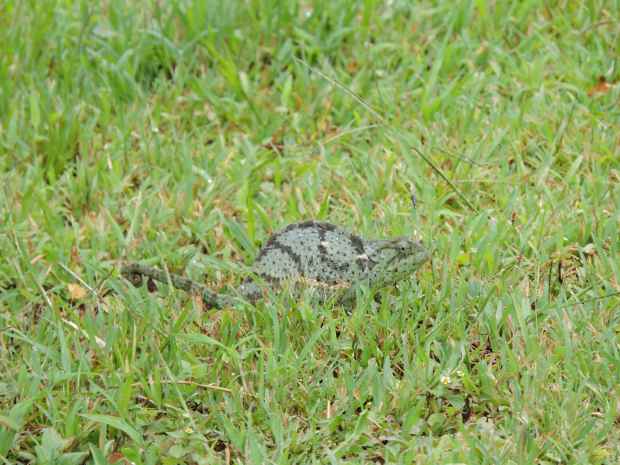
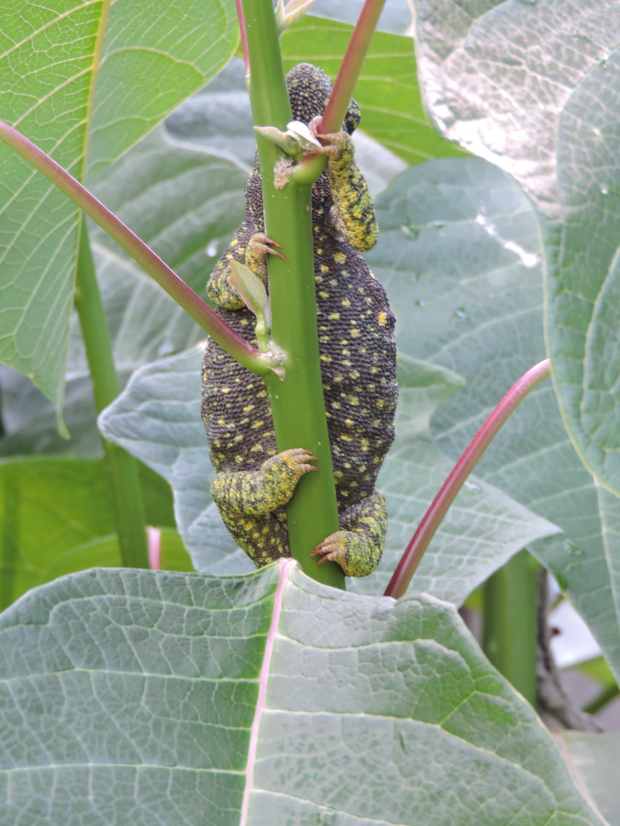
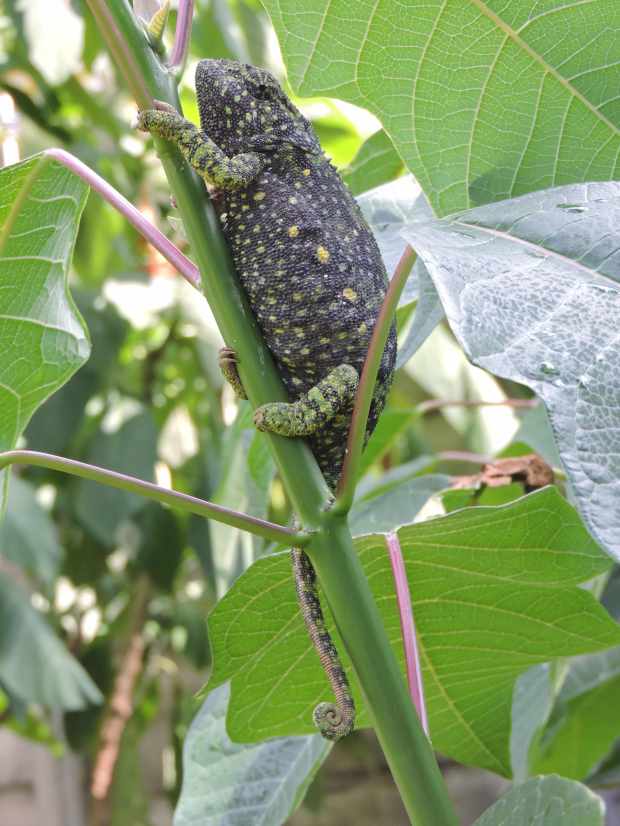
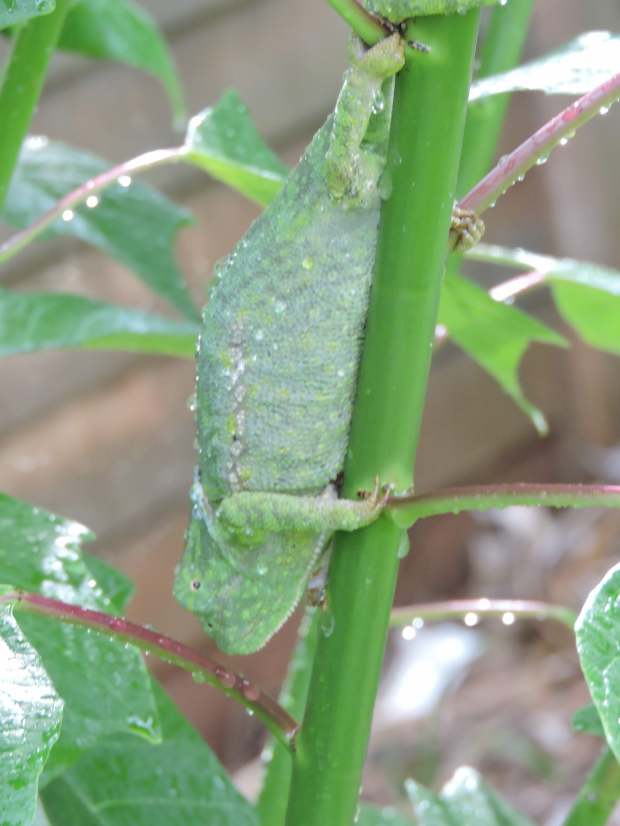
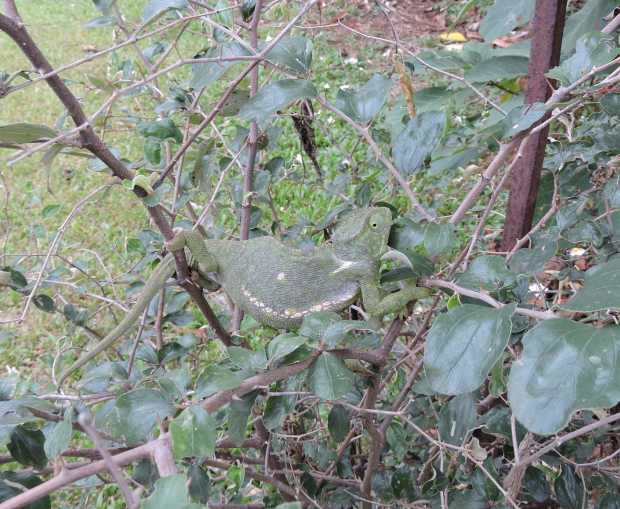
A short update of the situation with the gravid chameleon.

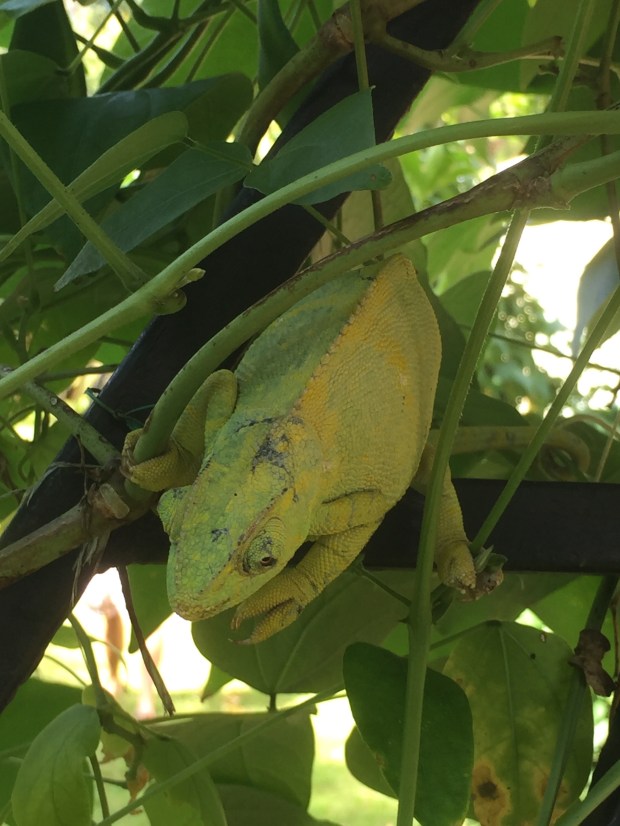
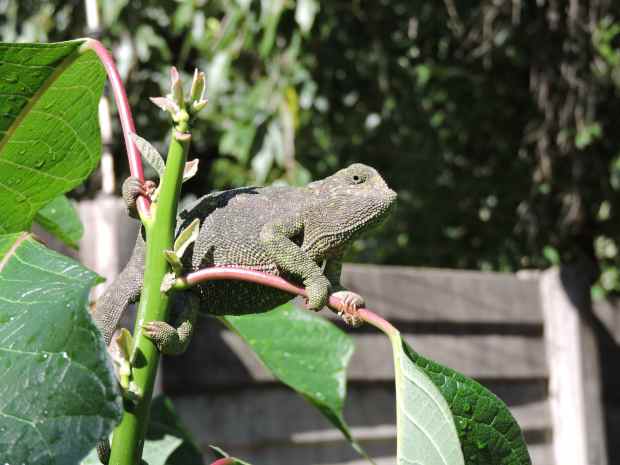
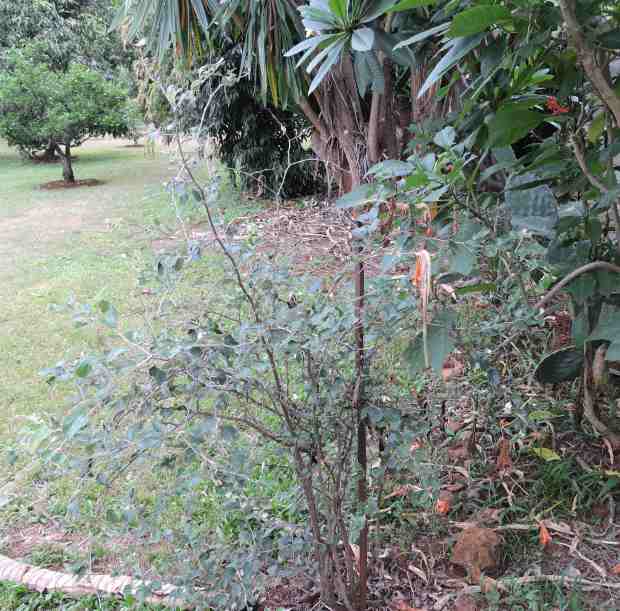
We saw the female again in the early hours of the 28 Jan and it was moving in the poinsettia bush. IMG_3156 copy

An hour later it had disappeared and despite our thorough search in the original poinsettia and surrounding bushes, we could not find it! We checked on the ground as we were convinced that it would not walk more than a few metres around the bush. Still nothing!

We got concerned about its fate as we know that pied crows are around and that they are capable of killing chameleons. However, there was not much else we could do. Stephen would have found it but it was his day off so there was no hope there.

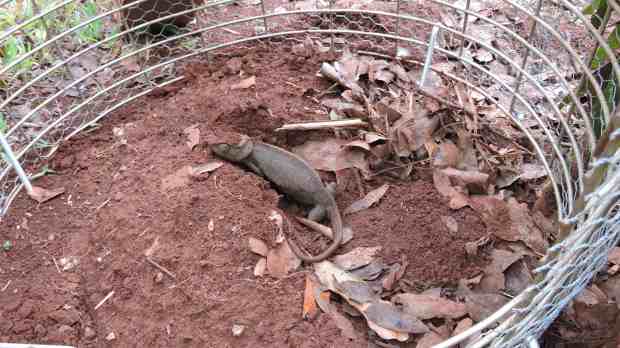
There was lots of hope in other parts of the garden though. The female we saw digging the nest during the night of the 26 Jan (Live Cham 3) had finished its job as described and then it left quietly. The nest area is now fenced and protected.

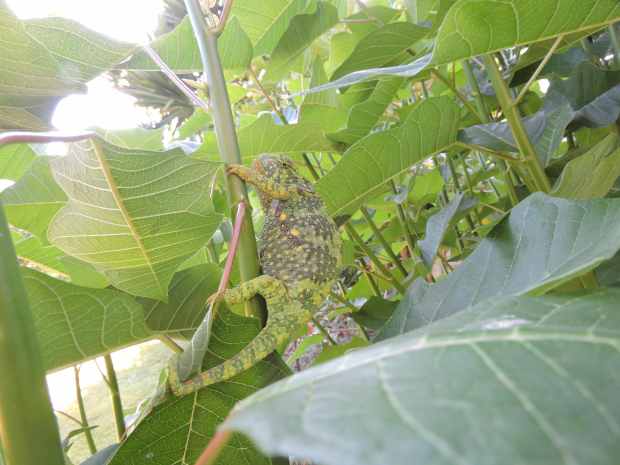
In addition, a third female was spotted at a passion fruit plant and she was also gravid and very active.

IMG_3162 copy.jpg

Yesterday (28 Jan) it changed position to a lemon tree, walking about 10m to get to it.

DSCN1601 copy

The female moving through the grass.

DSCN1604 copy

Searching for a suitable spot.

It climbed on the tree through a stick and remained on the tree for rest of the day.

DSCN1610 copy

It eventually decided to climb up a lemon tree. The eggs bulging through the skin can be seen in its ventral part.

Luckily yesterday (28 Jan) Stephen returned home by mid afternoon and immediately located the missing female that we had lost earlier during the morning! It had moved 33m! to another area of soft earth and it was busy digging, despite its rather bulgy belly. By the time we left it last night, it could go in its totality inside the hole but it was already dark for pictures. We protected her again to avoid dog interference and left.

This morning, as with the previous female, it had finished and covered the hole, looking dark and rather quiet. I am sure it will soon recover and move away.

DSCN1622 copy

So we are now left with the third female that has now climbed down from the lemon tree and it is -again- walking in the garden, looking for the right spot to lay her eggs.

As we are traveling to Uruguay before dawn tomorrow, this is the last post from Zimbabwe but I will resume once I touch down at the other end.

In any case, I am beginning to think that next year we will have a “chameleon population explosion”!


Live Cham 3

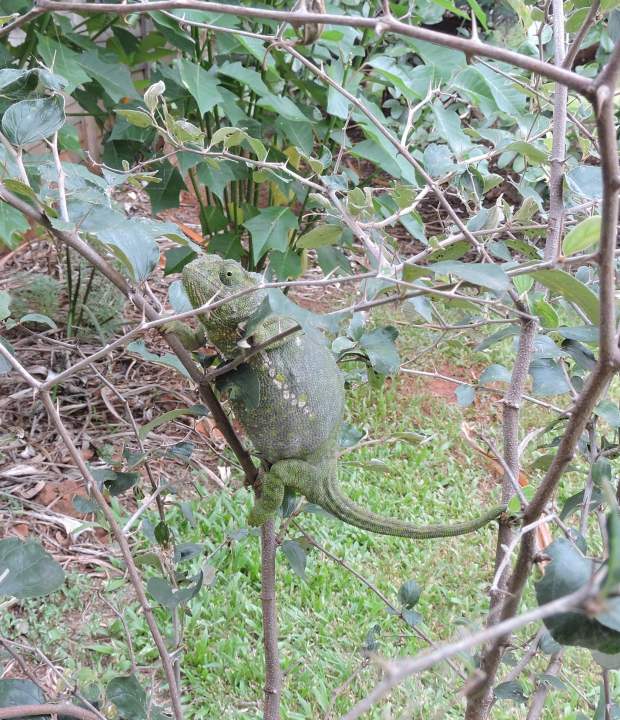
After the last post we have observed the gravid female until this morning (27 Jan) and she has hardly moved from the poinsettia bush. She is clearly waiting for her time to come. So, not a lot of news there, I am afraid. Only a few pictures of her.

DSCN1549 copy

She spent most of the 26 Jan on top of this bush.

DSCN1566 copy

Still there this morning (27 Jan)

However, lo and behold, three (yes, 3) more suspected females were found  in different places, looking in various degrees of gestation! The situation became almost out of control! But things got really bad when my post-siesta time was interrupted with calls of “it is digging, it is digging!” proffered by Stephen and my wife that were watching at the time.

After my first -sluggish- reaction I joined them to watch chameleon 2 effectively digging her egg nest project next to the bayleaf bush! I took a video (26/ Jan, late afternoon) of the action:

As the process was not done before dusk, we protected the site from our dogs and came back this morning.

The chameleon had finished laying, covered the hole and it is there, probably resting after such an effort!

DSCN1562 copy.jpg

The female after the effort!

One done, three to go… More info coming soon…

Live Cham 2

As promised, I had followed the evolution of the gravid chameleon throughout the day. These are the observations so far from this morning:

09:00 Still in the same bush but its colour changed.

DSCN1531 copy

12:00 Started to rain quite heavily. Cham still in the same bush when rain started.

12:30 Rain stopped. Found again. I had moved to another smaller flower bush about 1m apart:

DSCN1533 copy.jpg

12:30 to 1515 Observer’s lunch and siesta. No data!

15:35 Moved another metre to a Poinsettia bush (Euphorbia pulcherrima) and climbed about 150cm high. Colour changed again. It appears that coloration is more a reflection of the animal condition than its surroundings!

DSCN1539 copyDSCN1540 copyDSCN1541 copyDSCN1544 copy

1600 to 16:20 hs Shower.

1627 The chameleon is still a the same spot but head down and green in colour.

DSCN1545 copy.jpg

It is now 17:10 hs and I will have a last look before night fall.

Hope to find it tomorrow…

Live Cham

There was some excitement this morning when a chameleon was found in the garden. I thought it was a bit exaggerated for such event but I was not right (again).

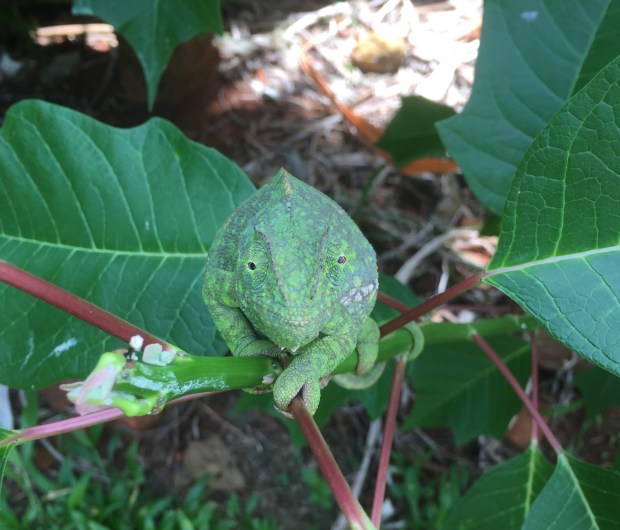
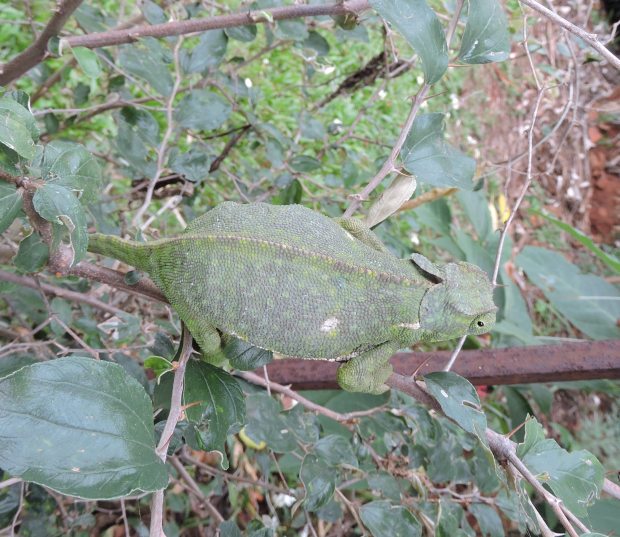
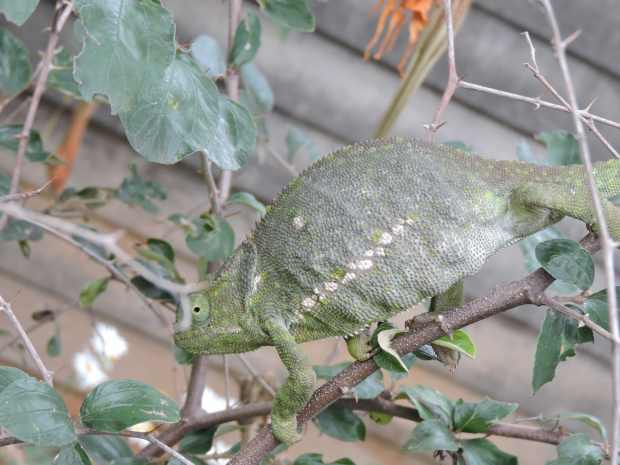
Stephen had spotted a rather fat chameleon that on close inspection revealed that it was gravid! So, as this is happening right now as I write, I post a few pics to show this great creature on its bush.

I am watching her every hour with the binocs to avoid disturbing her but to follow her “progress”.

DSCN1521 copy

“Spot the chameleon”. The Masau (Ziziphus mauritiana) bush where the female was found.

Here it is:

DSCN1522 copy

There she is hanging on!

A few more pictures to show you her condition:

DSCN1528 copy

From above to show her enlarged body. A true egg sac!!!

DSCN1523 copy

The eggs can be seen protruding in the ventral area.

DSCN1517 copy

A sideways picture that shows the mass of eggs better.

DSCN1512 copy

Despite her condition, her eyes still keep track of you!

As I think it is quite close to laying time and I hope to see her digging her nest, I am checking on her hourly hoping that it will happen soon and before nightfall!

I will keep you posted on developments…

Simba’s Bush Baptism

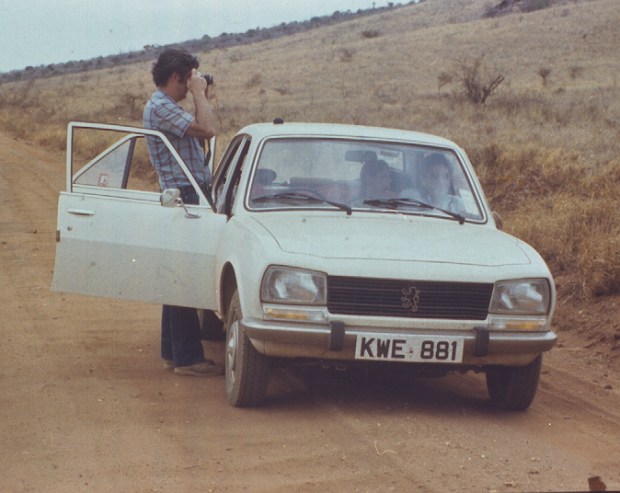
By 1985 we had saved enough money to be able to buy a new vehicle. At the time in Kenya –and in Africa in general- the only car to buy was a “Simba” (lion in kiSwahili) for its lion logo: a Peugeot 504.

Simba's twin brother:sister? Mendizabal Tsavo copy

Our 504 arrived later. It was a great car. Here we are at Tsavo West National Park with friends. Photo by Bushsnob

We agreed with our friend Paul that we both will order similar cars to get a discount that we did not in the end! For some reason his arrived first and it was a very excited Paul that turned up that Friday afternoon in his Simba with exactly 34 km on the clock to invite us to a safari to the Sasumua dam for the following day. This dam, located on the Sasumua stream, supplied water to Nairobi and it had been stocked with rainbow trout during the colonial times. Some very large trout were still being caught, although rarely  at the time. However, Paul did not lose hope of landing one of them [1].

The dam was located in the South Kinangop highlands where the scarcity of oxygen and the almost constant drizzle seemed to combine to lower the ambient temperature to almost unacceptable levels for us. It was, however, ideal weather for people of Northern Europe and Paul, being British did not mind it! My wife and I were not very keen on trout fishing but Paul explained that the idea was to test the new car going the “back way”. He did not specify the details but mentioned that we would stay in a Government of Kenya forestry lodge, close to the dam. Aware by now of his “innovative” ideas, we readily agreed.

We already had some experience at the dam with Paul and his Avon rubber dinghy. We had gone there earlier in search of trout and also to test a new anchor that Paul had brought from the UK. The anchor, he said, was specially designed to take a great grip at the bottom. Although we did not fish anything, we confirmed that the anchor was indeed very effective. Somehow the thinner “release” rope broke and eventually we needed to cut the anchor rope in order to be able to return home from our firm anchorage in the centre of the dam! But let me go back to the present story…

We left early the next morning, ready for the back road trip, the cold weather and the fishing. The back road was, I believe the Thika Gatura road, probably quite rough even today. To make matters worse we realised that there has been quite heavy rain in the area the night before. However, we decided to go on. From the junction to Karangi the road became quite narrow and soon it was just a narrow path. However, this was the right road, according to the map (and our wishful thinking!).

After a few kilometres driving through a slippery but still passable track we met a mud hole of about fifty metres in diametre where clearly a herd of elephants had wallowed probably the night before and their tracks entering and leaving the mud pool and going into the forest could clearly be seen. We stop to evaluate the obstacle and to take a critical decision. Careful scouting revealed that there was no elephant threat but also no way round it.

I am not sure why but we (Paul and myself) agreed that we could cross it. My wife, as usually outnumbered, was resigned to her fate! We agreed that all we needed to do was to reverse for a good distance and enter the mud hole fast enough so that our inertia would carry us to the opposite side. We were almost sure that the car would grip sufficiently dry ground to enable us to go through.

We reversed for about 150 metres and came rather fast –maybe too fast- so that we went a bit deeper than wished on first contact with the mud but, luckily, the car nose lifted above the mud and the car continued its movement towards the other shore. I believe that there was an element of buoyancy in this manoeuvre that Peugeot was not aware of… Whatever the reason, we crossed, just, and we were able to move on. “Oh, Oh” said Paul, “the speedometer stopped working!” Although this was bad news for a new car, it was not surprising after what we had gone through and, as it was of no relevance for our present situation, it was largely ignored after a couple of brief polite comments.

Encouraged by our success we moved on as going back was no longer an option! We continued our advance on the muddy track that was now cutting through thick forest. After a few kilometres we came to a bend and a junction and deep truck ruts appeared. Despite Paul being a good driver, soon the car’s belly was resting on the road and our back wheels could not turn anymore. To make matters more entertaining, it started to drizzle!

I hate getting my head wet and I could not find my hat! So getting wet we inspected the situation. It was bad! Jacking it up was not an option as 504s did not have good jacks and the latter, instead of lifting the car, would have become buried in the mud.The only possible solution would be to push the car back, and then again gather speed while my wife and pushed it forward hoping that it would gather enough speed to go through the muddy spot. But first we needed to unstuck the car and push it backwards! That took some doing as we had no shovel, but eventually it moved to the relief of our “wet selves”!

Paul -after all he was the owner of the creature- decided to go for it and my wife and I positioned ourselves in a place we calculated some extra push would be needed. Paul came fast and we joined our energies to the car’s to no avail. After a short meeting we concluded that the only chance was for my wife to drive and Paul and I to push. This had a small drawback: she had not driven very often and -in addition- she was not familiar with this particular vehicle. As there was no time for her to learn more and we were properly stuck, we had no choice. We explained the expected move to my wife and positioning the car for her, we placed ourselves to wait for our turn to push the moment she passed by.

Before I go on, I have some relevant additional information. I have always had a weight problem and only a few years ago I managed to get on top of it. However, at the time of this safari I was trying to lose weight through the Scarsdale diet. After five days I had lost a couple of kilogrammes but I was feeling a bit weak. That Saturday was day six and the menu recommended the consumption of as much fruit salad as you wished with coffee/Tea/diet Soda/water. Only dinner -if we were ever to have it- would bring some “real” food in the shape of roast turkey or chicken!

Kindly -and luckily- my wife had prepared a very large bowl of fruit salad and I tacked into it trying to increase my sugar level for the push. While I added energy to my weakened body, Paul explained my wife again what she needed to do. When the instructions and my refuelling were complete we were ready to go.

My wife, following the instructions, started the car and soon engaged second gear coming flat out towards us, clearly barely controlling the car and with a scary look on her face! Luckily, with the wheels well into the furrows there was little to deviate from! When the car started to slow down both Paul and myself pushed as hard as we could and, to our relief, it came unstuck! We had a brief instant of joy before we realized that the car did not stop and continued on its way, leaving us behind! We jumped and gesticulated wildly for my wife to stop until, finally, it stopped when it got lodged in a nearby bush. My wife got out visibly shaken and upset so we refrained from any comments. I collapsed in a mixture of exhaustion and mirth.

After a while, Paul -visibly pleased that we were unstuck- inspected his no longer new car for any additional damage while my wife and I sat nearby. She was trying to recover from her nerve-wrecking experience and I was tacking into the fruit salad bowl in search of sustenance! Eventually Paul announced that the car was fine and that we should move on as we were now after lunch and -according to his “GPS-less” calculations we still had a long way in front of us.

We moved on but things were still not looking good as we entered a forest concession and there were more ruts and mud ahead. As expected, after a few kilometres of what I would define as “heroic driving” by Paul, the car’s belly started touching the road and eventually it accumulated lots of mud underneath until it became hopelessly stuck, sitting on its belly! This time no amount of fruit salad consumption would have helped, as the situation was really hopeless. We were on a tight spot and the rain continued to soften the red mud!

While busy discussing our rather desperate situation, my wife interrupted us and told us to be quiet. “I can hear an engine”, she said. I could not but -as usual- she was correct and after a while we could all hear it. It was a slow revs engine and a long way away. However an engine meant a possible pull and -while waiting for it- we decided to open a Tusker beer to celebrate our luck and wait for the help coming.

The old red tractor arrived slowly pulling a trailer loaded with logs and puffing blue smoke. We did not need to say anything to his elderly driver. We were blocking his way anyway! Quietly, he unhooked the trailer and manoeuvred the tractor in front of the car. He then tied a wire to its underside from the three-point linkage and started to pull gently until the car moved. While Paul sat in the car my wife and I jumped on the tractor. The pull lasted for about ten kilometres until we reached a point where the forest estate ended and with it the groovy road. The old man untied us and assured that we should be fine from there to Sasumua. He turned back while we could not thank him enough!

We set off gingerly and managed to cover quite a distance through a now more populated area. The rain had been heavier heree so this time we just got stuck in mud. I had finished my fruit salad and did not have any strength left so I went for some solid food knowing that my Scarsdale gain –or rather loss- was going down the drain. Luckily this time there was people nearby and we managed to walk ,still under the rain, to a small village where we explained our predicament.

As usual they listened attentively and respectfully and eventually informed us that they had charged Safari rally drivers KShs 1000 to get them out and that this was their fee. We tried to explain that we were not rally drivers but fishermen but we only managed a small discount! We did manage to agree that payment would be the moment we were clear of the obstacle. The push was a formality as all able men from the small village came and we were out and also out of pocket at the same time.

By looking back at the mud hole I could not help feeling that we were probably the victims of a mud hole “improved” by the villagers by making it deeper and wider to make an additional income from Safari rally “victims”. I had seen this earlier in Maasailand and I could expect the same or better from the Kikuyu ingenuity to make some extra cash.

We eventually got to the high, cold and wet dam at night. We were very cold and soaked wet but we managed to find the forest huts and, luckily there was dry firewood. Soon we had a roaring fire going and we soon warmed up, ate well and had a good early night sleep.

Fishing the next day was the usually futile affair but somehow made enjoyable by having survived the earlier day’s ordeal. Luckily the return road was good tarmac and asphalt and only then Simba could demonstrate why it was so famous in Africa at the time!

On the positive note for Paul, the speedometer was not working so the car kept being new for quite some time!


[1] He eventually land one that was actually close to the Kenya record!


Breaking News: proof that unicorns exist!

Noah's ark copy

Noah’s Ark by Aurelio Luini.

In July 2015, after finding this beautiful painting of Noah’s ark in Milan, I produced a post on unicorns [1]. The following is a quote from it:

“… However, the most interesting feature is the pair of white unicorns joining the queue, just in front of the elephants. Why are they there if they did not exist? We will probably never know the reasons. But what if they existed and became extinct after checking in? There is a rumour that they got chewed up en route by the lions…”

I then mused on finding a scientific name for them and I concluded that Equus monocornis would be appropriate. I was really proud but, unfortunately, equally wrong!

Last October, while on safari to the Kalahari Trails in South Africa, without much hope of finding anything interesting, I placed the camera trap at the waterhole in front of our bungalow. What I found the next morning came as an unexpected shock: a live unicorn!

STC_0020 1

Based on this initial picture, strenuous walks over the red (and sometimes white) dunes of the Kalahari followed in search of the beast that had eluded humankind for milennia. Finally I found it and, despite my sweaty hands (emotion or heat?), I managed to take the necessary picture that proves beyond any doubt that unicorns do roam our planet, though undetected because of their scarcity.

DSC_0156 copy 2

Before you point it out to me, I am aware that the animal strongly resembles a gemsbok or oryx (Oryx gazella) but the sole horn is clearly the defining factor…

The finding forced me to review my previously proposed classification of the unicorn. It now stands as follows:

Kingdom:        Animalia

Phylum:          Chordata

Class:              Mammalia

Order:            Artiodactyla Perissodactyla

Family:           Bovidae Gray, 1821 Equidae Gray, 1821

Genus:            Oryx de Blainville, 1816 Equus Linnaeus, 1758 

Species:          monocornis Bushsnob, 2018 monocornis Bushsnob, 2015

Pleased with my discovery I have chosen to ignore those people that have suggested that I should include the word “sundowner” as part of its name.

Below I present you with the best picture that shows the beast in its full glory:

DSC_0155 copy 3

The perfect unicorn!!! I hope the issue has now been settled for good.


[1] See: https://bushsnobinafrica.wordpress.com/2015/07/19/noahs-ark/

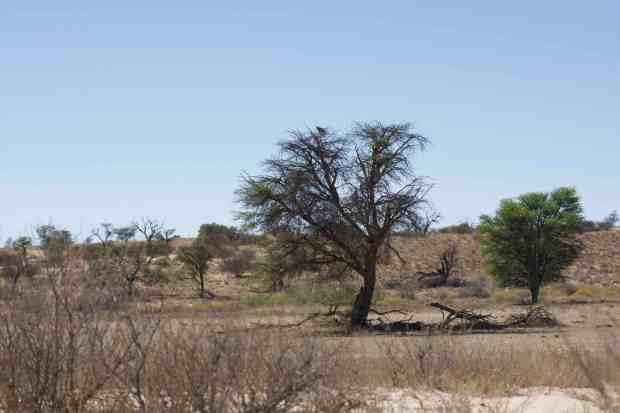
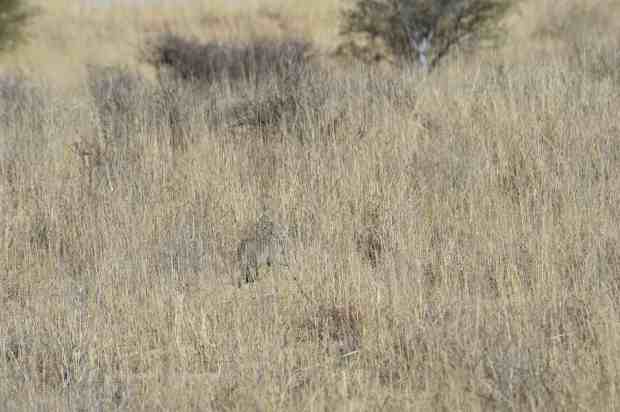
Spot the beast 35

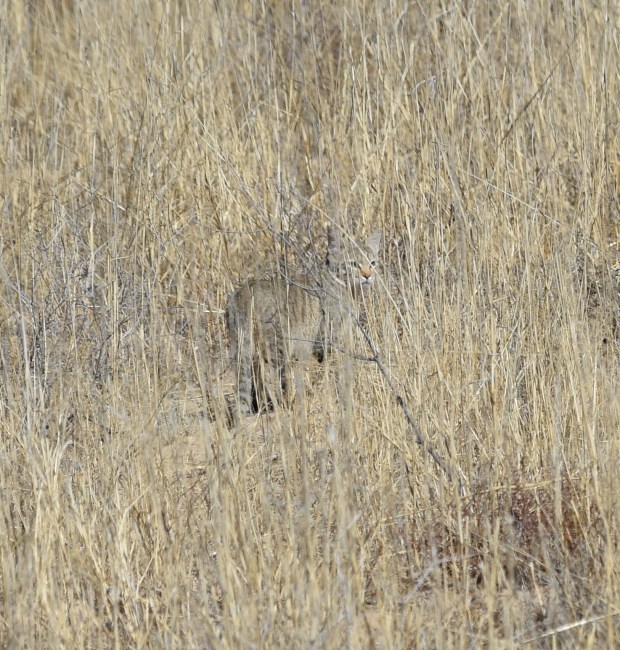
We found this beast while driving from Twee Rivieren to Nossob while heading towards the Mabuasehube area of the Kgalagadi Transfrontier Park. Although we did not have time to spare, we stopped and watched.

See if you can find it and identify it…

DSC_0137 copy

?
?
?
?
?
?
?
?
?
?
A zoomed version looks like this:

DSC_0135 copy

We found four African wildcats (Felis lybica kafra) that morning. Here is another one, also quite difficult to see as it moved away from us through the tawny grass.

1855 copy 1

1855 copy

A close-up.

It is the second time we see these interesting cats. Earlier last year we had a fleeting encounter with one while staying at Mopane rest camp in Kruger National Park.

Of interest is that these cats are threatened not by poachers or poisoning but by their tendency to interbreed with domestic cats anywhere near human habitations threatening the genetic purity of this subspecies!.


Vundu!

Tiger fishing is one of the top sports in Southern and Central Africa and Zimbabwe is no exception. We had fished for tiger several times before not only in Zimbabwe but also in Lake Turkana and Tanganyika. Luckily I had caught a few good specimens that we always returned to the water. But, if size matters to you and you wish to display your catch, there is no need to kill your fish as fibre glass models exist that would fit your fish if you take a couple of quick measurements in addition to its weight!

Apart from tiger fishing, many people visit Kariba in search of bream (Tilapia spp.) but relatively few are after vundu (Heterobranchus longifilis). Excluding bull sharks, the vundu is the largest freshwater fish in southern Africa, reaching up to 1.5m in length and 55 kg in weight, quite a large fish for my coarse fishing standards! Interestingly, vundu only live below the Victoria Falls as none have been caught above the falls [1].

My wife’s dentist is one of the few fishermen I have heard of that “specializes” in vundu fishing and the re-telling of the fishing prowess of the dentist (30 to 40kg vundu caught!) had an influence on me when deciding this trip.

So, aware of the family’s love for nature, our daughter’s keenness for the sea, our son’s need for resting as well as my desire to fish for vundu, in mid 2017 we booked a trip in Lake Kariba. Unfortunately our son was not able to join us because of work and a couple of invited friends also declined our offer because of pressing domestic commitments. When it looked that we would be just three on a now rather outsized houseboat, Clara, a friend of Flori (our daughter and part-time Ed.) decided to join us all the way from cold Stockholm, her first trip to Africa, almost straight to the bush (and, after the experience, perhaps the last?).

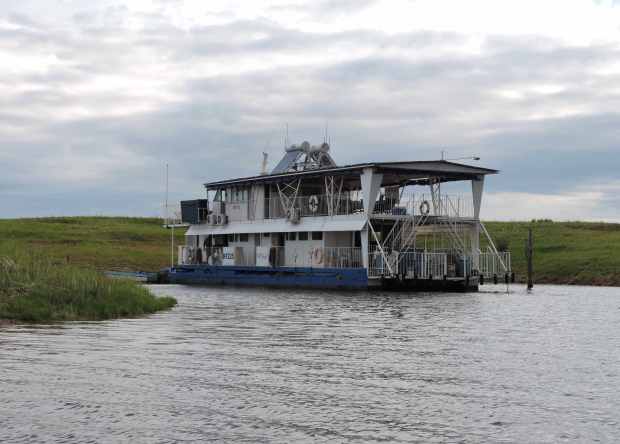
Our final destination was the Ume river, quite far from Kariba town, the place where houseboats leave from. We were told that to reach those far off places you required a minimum of six nights in the lake. After a long search comparing prices and comfort we had booked a rather spacious houseboat known as O B Joyful. We agreed on a self-catering basis so it was our responsibility to organize all food and drinks to last for the week as well as all needed items regarding fishing.
DSCN1301 copy

The moored house boat.

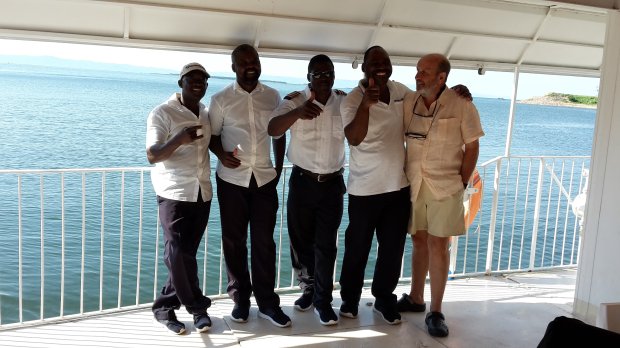
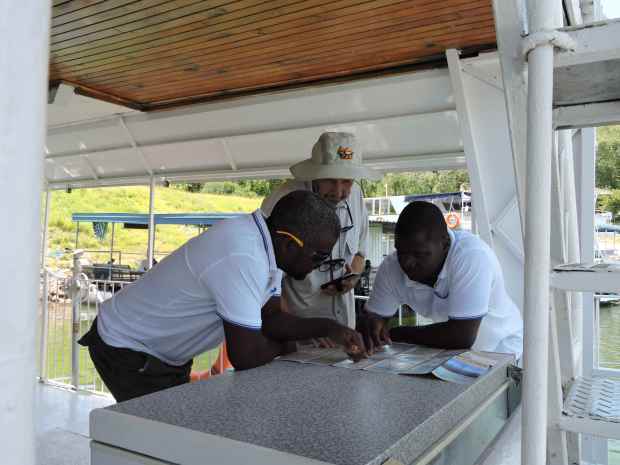
With a crew of four (Godfrey, the Captain, Warren the cook, Pilot the sub-Captain and Silas, the handyman) we sailed from 2 to 8 of January. They were really first class and pampered us thoroughly.
DSCN1293 copy

Plotting the trip’s course.

20180108_081444 copy

From left to right: Silas, Pilot, Godfrey, Warren and the Bushsnob.

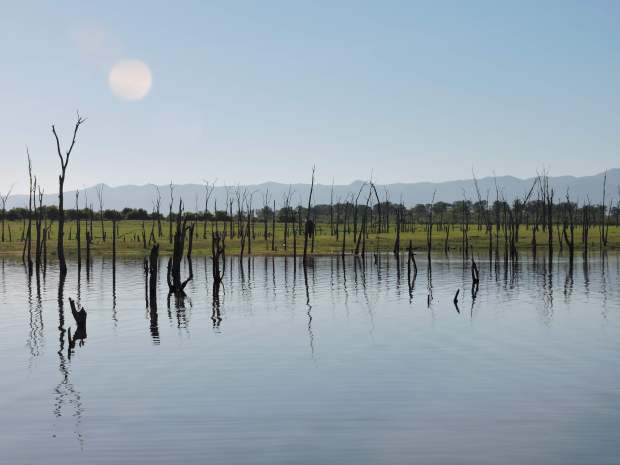
Although we had visited Kariba several times before, it is easy to forget its size and the incredible beauty of its blue water, green islands and grassy flood plains framed by the spectacular and distant hills, a hazy blue in the distance. The abundant birdlife, numerous hippos -both in and out of the water- and the usual elephants complete the general picture. Abundant fish eagles were a constant sight and their wild calls are missed now! In addition, we also watched a couple of fishing ospreys.
DSCN1343 copy

Lake Kariba at Elephant point.

DSCN1295 copy

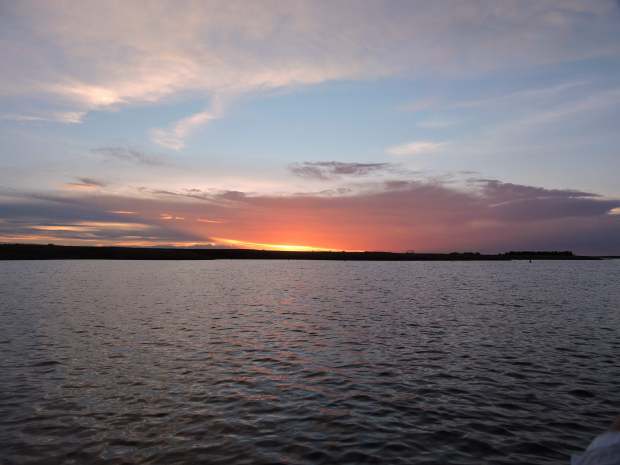
Kariba sunset.

At night you are immersed in a different world with a star-full sky where with patience you can detect a number of known constellations while listening to the noises of the night, particularly owls, frogs and toads with the occasional lion call and hyena whooping [2].
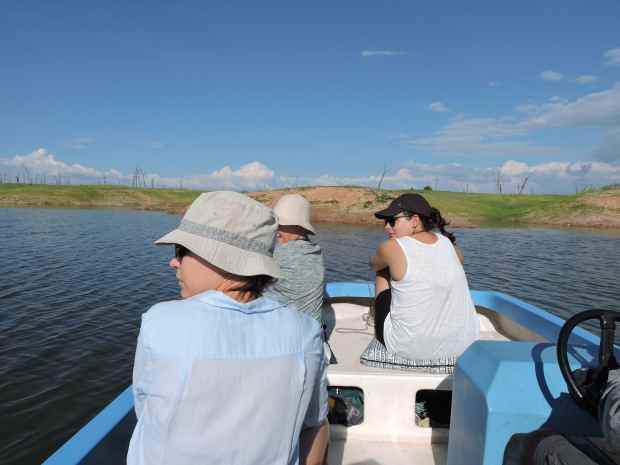
DSCN1304 copy

We also went of game watching trips.

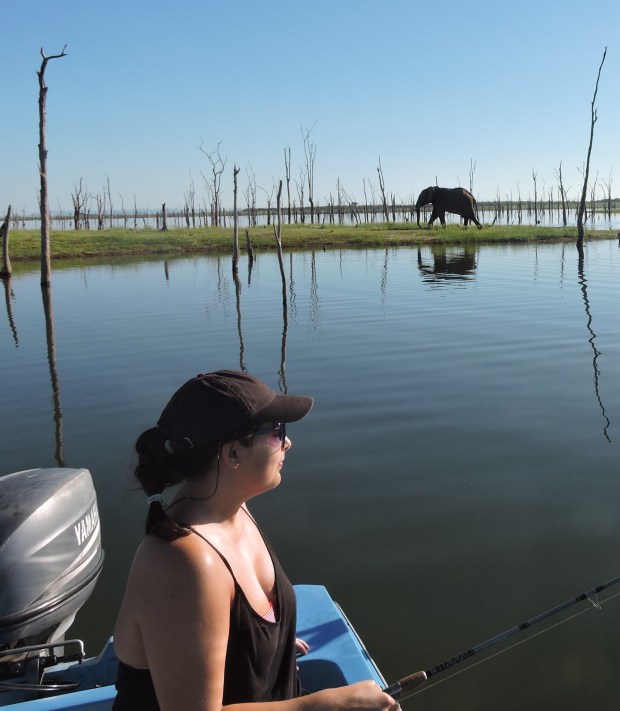
Luckily Godfrey was keen on fishing and helped us all the way, not only getting us to potentially good vundu spots but also on the bream fishing as well. His patience with worms and fish netting was really remarkable! Luckily, fishing bream became a great entertainment for the whole group while waiting for the vundu to strike and we also had some frequent visitors to keep us busy…


20180105_180236 copy

The surprises of fishing in Kariba!

DSCN1367 copy FC

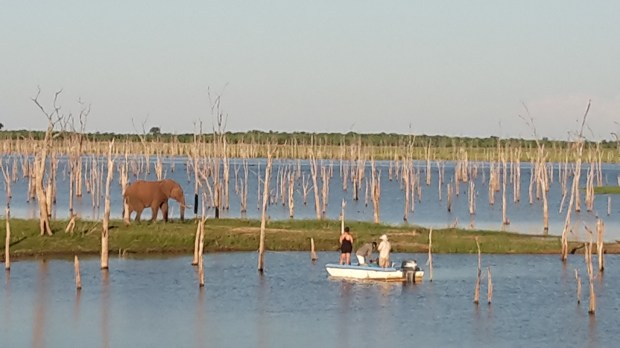
Flori and elephant returning.

Although we knew that the Ume river was as far as we would go, the rest of the itinerary was open as we decided that we could chose where to spend our time. In addition, there was a factor we did not plan for: the weather! Storms are feared in Kariba and the fact that it was the rainy season added some uncertainty to our planned itinerary. Luckily, although the first two nights were stormy, the weather cleared and we were able to move at will.
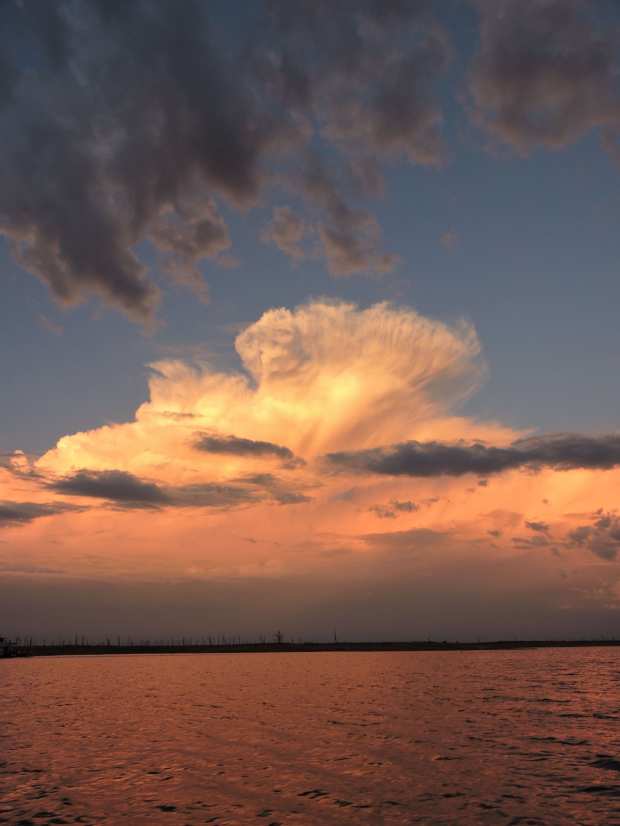
DSCN1306 copy

Storm looming. Luckily it did not come our way.

Briefly and for reference, our first night was spent at Changachirere and fishing only produced a few bream. The place was clearly used to spend the first night at the lake by most houseboats so we were about eight boats. Luckily there was still ample space to moor. Following Godfrey’s advice the following morning we sailed towards Elephant point, five hours away. It was a good decision as clouds were gathering but we got there in good time and anchored at a safe spot. The boat was secured not only by tying it to some of the dead trees but also to some sizeable iron spikes that were laboriously hammered into the stony ground for about one metre!
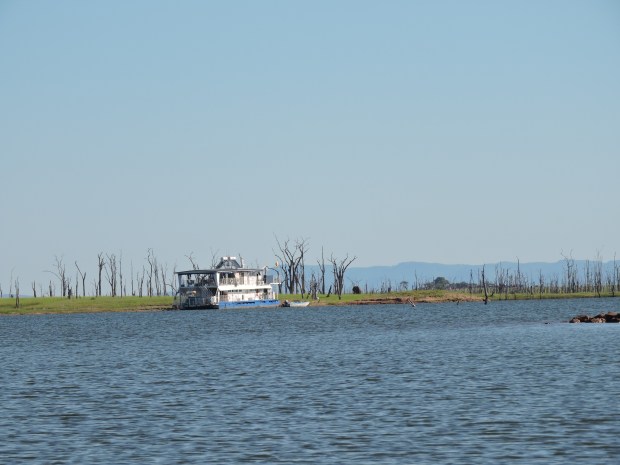
DSCN1403

The houseboat moored at Elephant point.

Safely tied we organized ourselves for the next morning fishing. While Godfrey went to bait an area with the aid of a cattle-licking block (a new gadget for me!), we watched the hippos grazing out of the water and the elephants in the distance.

The next morning we were up early and headed for our baited spot but, well before arrival, we noticed that a rather large boat was fishing at our spot as they had also baited it and had arrived there earlier than us. Crestfallen, we moved off to another spot near our houseboat where there was no baiting but it was a deep channel that offered good possibilities. Godfrey was correct.

As soon as I finished casting my “vundu rods”, I hooked a tiger fish that I managed to land after a few nice jumps and a good fight. It was not large but fun and, as soon as I casted again, another one took the bait and it was also landed, luckily.

Too much -unprecedented- success prompted me to share my luck with Flori as she is a very keen fisherwoman. It only took a few minutes until one of the reels started buzzing and she landed a nice African Sharptooth catfish (Clarias gariepinus).

Things did not end there! As soon as she re-casted, the run that followed was “serious” and we all knew that she was into a good fish. After about ten minutes of reeling in, runs and more reeling in, she finally landed a nice vundu, the first one the family ever caught! As we had forgotten the fish scale, we estimated it to weigh about 12kg or more!

We were thrilled but we were also aware of the time and we needed to stop fishing to be able to sail our way to the Ume river.

Although we were quite close from the Ume, because of its size, our boat needed deep water. This meant that we needed to get back out on the main lake, turn and then enter the mouth of the Ume. Unfortunately, the weather was cloudy and windy so we had a wavy lake. It all went reasonably well going out but, the turning was tricky and we had a few serious shake-ups before we changed direction towards the Ume where we arrived five hours later.

We entered the Ume until we found a good bay where we could moor. The area was no longer open floodplains but hilly with bush and forest that would reach almost to the shore of the lake making game-spotting very difficult. Fishing was also a futile exercise and we unanimously decided that the next day we would spend it back at Elephant Point where not only our fishing had been good but we could also enjoy the landscape and its dwellers.

The following morning we left early and, with better weather now, we got to Elephant point faster and moored near the spot we had been before. Next morning we were fishing again and this time we had some party members going for bream “for the pot” while I was still attempting to catch the elusive vundu. Luckily, after about an hour of watching my companions pulling bream in I had the first strike and, after some work, brought in a vundu that weighed 9kg as this time we had the scale with us. I was moderately impressed…

Fortunately, an hour later I had another run and hooked another fish that gave me a lot of work to bring close to the boat. Eventually I managed to bring it and, while still in the water, we could see that it was a nice size. Suddenly I saw another fish coming towards it and I thought it was its friend! “That is interesting” I thought but Godfrey brought me down to reality when he identified as a crocodile having a look at “my” fish!

Luckily, the croc -smaller than the fish- only came up and then it was gone without damaging the fish and I could recover it whole! The vundu “busted” our balance that would only go to 25 lbs so I assume it to have been about 15kg and I was much more pleased with the achievement this time. Still, it was a far cry from the dentist’s 40kg ones!

All in all, my vundu “thirst” was by now somehow satiated and it was better that way as those were the only two that decided to offer themselves to my rods during the days remaining! I did have a few more bites and runs but missed whatever these were.

Although we did not get more vundu, we still had great fun catching bream and watching birds and mammals all the time. In addition, life on the boat was extremely pleasant and we had a good rest (those who needed) as well as lots of entertainment. Time passed really fast and we needed to return back to Kariba.

It was a great trip that left me still wanting as I realized not only the beauty of the area but also that there are still plenty of vundu lurking in Kariba’s depths and we are already thinking on ways to get them the next time.


[1] See http://www.karibahouseboatsafaris.com/vundu-catfish/

[2] We found the iPad app SkyView Lite a useful aid to identify the various celestial objects.