We found this “beast” a few km from our farm. Lets see if you can spot it! Below I reveal it and show you a bit more of it as it is rather nice.

The answer is below.


We found this “beast” a few km from our farm. Lets see if you can spot it! Below I reveal it and show you a bit more of it as it is rather nice.
The answer is below.

The picture of my first view of lake Bogoria that prompted this post.
Recently, Pinkshade, a most appreciated reader, critic and contributor to this blog made comments to a poor vintage picture of lake Bogoria I shared on Facebook. This is what she wrote:
“(A) poor picture but it brings back those happy hours at Bogoria, the smell of the “maji moto” (hot water) and of the flamingoes, the noises of the water and the birds too. The souvenir of being badly stuck against a big rock with the car and going back on foot to try to find some help… that we didn’t find… and we ended up “undigging” the wheel by ourselves, sweating profusely! And the small spring, clear and refreshing, that we used to visit at mid-day for a bath, the parrots in the trees and all the fantastic atmosphere from that beautiful place… Lovely (wink emoticon).
So, confronted with that I am obliged to tell you our experiences at lake Bogoria that, to me, is the jewel of the Kenya Rift valley. I admit that my opinion may be biased as it was the first place I camped in, well really out, but more of that later. Lake Bogoria is not that far from Nairobi but it was somehow away from the normal tourist circuit that preferred Amboseli, Lake Nakuru, Lake Baringo and the Maasai Mara.
It was early days in Kenya for me and I was still alone living at Muguga House when Richard and Philip invited me to join them on a one-night visit to Lake Bogoria National Reserve. Because they used to work late, our Saturday departure got delayed and we did not make it to the park in time. We were then forced to “camp” near the entrance, under the flying pathway of the lesser flamingo flocks that seemed to be entering the lake in large numbers!
We only had one tent for two so Richard and Philip used it while I had the option of the front of the car (the back was full of our stuff) or sleeping “al fresco”. As I had a camp bed and a borrowed sleeping bag I chose the latter. The evening temperature was perfect, no mosquitoes (or mosquito net) so I was happy to sleep under the stars. The three of us were tired so, after a simple stew and rice we retired to bed early.
Murphy’s Law is always present, even in lake Bogoria so, about five minutes after closing my eyes the rain started. I resisted for a while but, when it became a true downpour, I rushed to the only shelter I had: the car as, at least it was dry. There were two seats that could not be reclined as the back was full so it was a question of sitting it out! It was a long night that I shared with the hand-brake that somehow kept getting between me and my dreams!
Despite the uncomfortable start, the first view of the lake stained pink with flamingoes and framed by emerald green hills will be forever imprinted in my mind. The sky was clear and thousands of flamingoes were flying all over the place on errands that only they knew the reason. The birds were mostly lesser flamingoes (Phoeniconaias minor); deep pink masses feeding on the blue-green algae (Spirulina platensis) that they filtered with their hollow beaks, their tongues acting like true vacuum pistons! The young, beige-white, were all together in the distance while the greater flamingoes (Phoenicopterus roseus) placed themselves in areas of the lake where fresher water was present so that they could find their invertebrate prey. The latter were, as usual, much fewer in numbers.
Frankly, I do not recall the rest of that safari but it really left an impression on me and I decided to get back there.
The opportunity to return presented itself about one year after, when my wife was with me and my work had been decided, agreed and initiated and I could afford to spend a Saturday night away from the laboratory. This time we decided to camp at the Fig Tree campsite as it offer the solid shade of these fantastic trees and a stream that, coming from the hills above the camp, meandered through and offered the needed water close by. THe water from the lake is alkaline and sulphurous and it is not drinkable.

Another view of the lake.
Notwithstanding its huge flamingo population, lake Bogoria was not a popular destination so, most of the time, we were on our own and this time was no exception. We chose a good spot and organized our camp that at that time was rather basic: a tent! It was only with time that we managed to learn the science of camping and started to purchase a few more essential items, mostly second hand and from friends leaving the country. So later on we added canvas chairs, table, jerry cans and other important elements that make camping a pleasurable activity. But, more of that later as this time, it was the tent, the VW Kombi and us!
We spent most of the remaining daytime watching the “flamingo show” and driving to the various sections of the lake. The smoke on the opposite shore turned out to be volcanic hot springs that gushed from cracks in the black rocks, feeding the lake with new foetid and almost boiling water. We explored them with great care as the few animal remains we saw in the various hot pools warned us of our fate in case of an accidental fall inside these true boiling cauldrons!

Part of the hots springs as seen from the circular road.
Dusk in Kenya does not linger on as in other latitudes so, as soon as light started fading, we called it a day and drove back to camp to settle down for the night. We found a welcoming committee composed of a large troop of baboons, maybe one hundred of them spread out around our chosen area that, clearly, was also theirs! As usual, when we arrived they moved off and stayed at a prudent distance but watching us, waiting for the opportunity to snatch our food. As darkness fell, they started to climb the trees to roost while we were warming up our dinner. They were very noisy as squabbles were frequent that normally ended up with youngsters been disciplined for not respecting the established pecking order!
Eventually, calm settled among our cousins and we decided that it was also time to retire. Soon we noticed that one thing is to sleep under the stars and another one to do it “under the baboons” as unfortunately they had placed themselves just above us. I will try to be restrained while I describe the situation we faced. What we first thought were falling twigs rapidly became dung and urine! Luckily not all of them fell on our canvas but there was enough to be bothersome and very smelly. The idea of moving the tent was considered and abandoned so we decided to put up with the situation as they would soon go to sleep, we hoped. They did and so did we!
Peace did not last long though. At about midnight, a generalized racket developed and there were baboons screaming and running all over the place in total panic. Something had really scared them although we will never know what. At the time we thought of a leopard attack but maybe one of them just fell off a branch! The result was good for us as, in their panic they moved away from “our” tree and decided to settle further on. We went back to sleep as the rain started and fortunately it soon washed off most of what the baboons left behind and the air became pure again!
We returned several times to lake Bogoria and we were careful in the choice of our campsite after that event. When we visited with Nazar and Aurora (our friends from “Unpredicted friends and unforgettable dates”) we chose to camp by the hot springs that, although smelly, offered good shade and a special feature: a dishwashing machine! Of course the latter was not what you may think today but it had a much simpler way of working as you would immerse your dirty crockery in one of the small hot pools and pick it up sparklingly clean a few minutes later! That was a trick that never failed to impress visitors!


Dish-washing made easy and the baboons’ absence at night convinced us to sacrifice beauty for peace. In addition, the fig tree camp suffered another severe blow when a good friend, while trekking up the hill from the camp, discovered that what was reputed as a cristal clear spring running through it was in fact used by the villagers up in the hills!
The mane of the lion is one of the indisputable dogmas with which we grow and, together with a giraffe and an elephant, a male lion with its mane is one of the first animals we learn to recognize as young children. Further, as we grow Panthera leo, it is one of the first creatures of which we understand sexual dimorphism when we learn that the lionesses do not have hair!
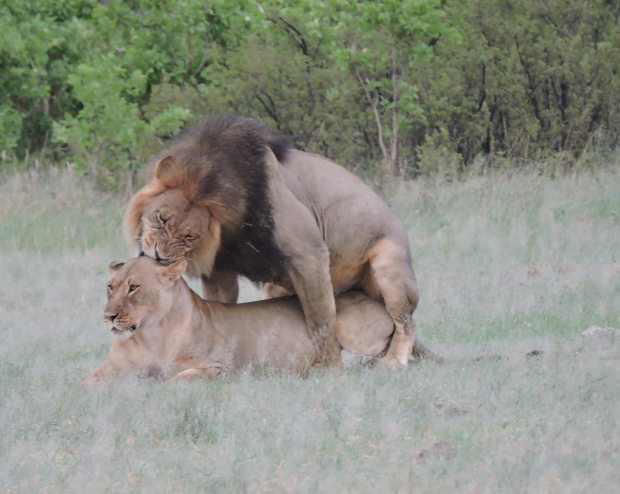
An heterosexual lion couple.
Well, my lion world has been shattered from now as the above is no longer true, well, at least it is not always true!
On 22 April 2016 I saw a photo posted on Instagram by @INSTA_BOTSWANA of two male lions mating. Although surprised, I am aware of the existence of homosexual behaviour in some animals and have observed it in giraffes where, apparently, it is quite frequent. However, I had no knowledge of this behaviour taking place among lions.
Still thinking about the picture I was about to move to the next image when its caption called my attention. The mating animals were in fact members of the opposite sex! Thinking that this was even more interesting, I followed up the issue and learnt that a few days earlier a similar picture had become “viral” in the social media and was extensively discussed.
I confess that I am skeptical about these kind of news and my first thought was that the original picture had been modified. To my surprise, lionesses with long hair have been observed both in captivity and in the wild. A well-known example is Mmamoriri that is part of a pride that resides somewhere in the Northern part of Chief’s Island in the Moremi Game Reserve.[1]
Scientists believe that the quality and abundance of the mane reflects the health of the animal: a thick, dark one shows a vigorous and healthy animal. In addition, females prefer these strong males to perpetuate their genetic material in future generations.
So, what is the reason for a female to grow a mane? Geneticists believe that the emergence of these “tomlions” is due to a disruption of the embryo at conception or during more advanced stages of the pregnancy when the foetus gets exposed to higher than normal levels of male hormone. Whatever their genetic origin, the maned females survive very well. Further, their deceiving appearance is advantageous in keeping intruder males away from the pride and hyenas away from kills!
Fortunately, an investigation is underway to address this phenomenon and it is likely that we will have interesting findings in the near future.[2]
This story would not be complete without mentioning that the opposite phenomenon -maneless lions- also occurs albeit more frequently and better known and studied. Such males are known from Benin (Pendjari National Park), Senegal, Sudan (Dinder National Park) and the first white lion of Timbavati in South Africa had no mane.
Without much doubt the most famous maneless lions were also man-eating ones. Two of them stopped the construction of the railway in the Tsavo River in Kenya for nine months and killed more than a hundred workers since March 1898. “The Man-eaters of Tsavo” written by Lt. Col. John Henry Patterson, who was in charge of the work and shot them, is a fascinating read! The book is also the subject of a 1996 movie “The Ghost and the Darkness” (Paramount) with Val Kilmer and Michael Douglas as the main protagonists, a poor substitute for a good read!
The area where these true human carnage took place is today part of the Tsavo National Park and, luckily, during one of our safaris to Tsavo East National Park in the 80’s, we were fortunate to find one of the possible descendants of these lions and attest that their manes are very scarce!
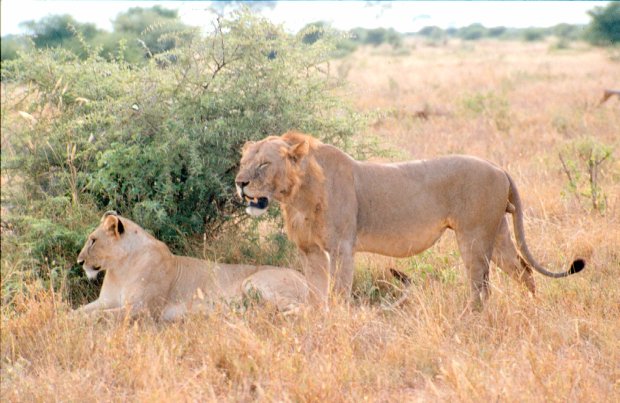
A “maneless” lion with a normal female at Tsavo East National Park.
The “baldness” in these lions is attributed to an adaptation to the thorny vegetation in the park as their hair could interfere with their hunting. As their colleagues in Tsavo West that live in a similar environment have normal manes, I personally believe that their baldness, as in humans, is due to high levels of testosterone that may also explain its aggressive reputation.
[1] http://africageographic.com/blog/unravelling-the-mystery-of-mmamoriri-the-maned-lioness/
[2] http://voices.nationalgeographic.com/2012/10/09/weird-wild-rare-maned-lionesses-explained/
Note: A similar article in Spanish was published in the “Muy Interesante” web page and it can be found here: http://www.muyinteresante.es/naturaleza/articulo/hay-leonas-con-melena-521461839096
The littoral of the Paraná and Uruguay rivers, forming the River Plate, has been the target of bad weather of late. We have had no sunshine for about ten days and we have suffered a tornado in the city of Dolores, located in the Soriano department -Uruguay- 100 km North of Carmelo. We had had very heavy rains in the region that, luckily, a couple of days ago have stopped and now we have sunny and cold weather.
Rains have caused havoc among people living in low areas that needed to be evacuated to refuges in order to survive while their houses were flooded and their personal effects damaged. Apart from affecting the population, the rains have damaged crops (estimates in Argentina are of about several million hectares!).
There has also been severe damage to roads and bridges that has resulted in the (relative) isolation of our town of Carmelo (Uruguay) for a couple of days. Luckily today the main roads are all passable again. Well, not all of them. The Víboras[1] stream cut the No. 21 route that connects Carmelo to the North of Uruguay via Nueva Palmira at a spot located 10 km from Carmelo.
A bridge dating from 1858 known as the “Camacho” bridge or the “Castells” bridge spans the Víboras stream. Jaime Castells made use of the watercourse to build a hydraulic mill to grind grain and he got permission to build the bridge on condition that it financed itself. This was the reason for it to become the first toll station of Uruguay. The bridge with its five stone arches is a pioneer of this building style in the country and it was declared a National Historical Monument in 1975.

The Castells bridge photographed in the 90s.

A view of the lovely setting near the Castells bridge in the 90s.
The news that the Víboras stream had cut the road spread like wildfire and rumours about what had taken place abounded. It was time to investigate. Driving there it was clear that the road had suffered the impact of the rain as the number of potholes had dramatically augmented!
The temporary Stop signs prior to the arrival to the bridge made us fear the worse and we were not wrong. The stream had dug a large trench on the road and taken down a few rather large trees! However, the bridge was intact, at least to the naked eye as the cut had taken place before the bridge!

The stream cut the road before the bridge that can be seen towards the back in the centre of the picture.

The bridge appears still intact!
Other roads were also damaged in Carmelo, including the very popular road to the beach where a trench was dug by the Municipality to drain a flooded suburb. We could appreciate the damage during one of our morning walks today, the second day of sunshine.
Apart from the road damage there was also a lot of standing water that will take a while to drain away as the rivers are still carrying a lot of water. It was while watching one of these new “lakes” that we noted some small brown floating bodies that we took for flotsam.


A better look indicated that there was some “vibrating” movement in the flotsam! It was alive and in fact these masses were made of several thousand ants.


Although we had not seen this phenomenon earlier, a quick look in the Internet indicated that it is a common event, well documented for the fire ants Solenopsis invicta in North America. I learnt that the ants link their bodies together to build these true waterproof bodies that are able to repel water through some miracle of physics and that can float for days without trouble, until the water recedes and they can reconstruct their lives!
The ants’ movement would suggest that this behaviour is a cooperative effort and that ants rotate from the more risky (wet?) periphery to the better guarded interior of the mass. I imagine that in this “wet socialism” lazy members of the society would be cast away?
[1] The name of the stream means “Snakes” in English.
The morning of Saturday 17 July 1982 (I remember this day well!) we got up early to pack our car with camping gear for a safari to the Maasai Mara Game Reserve. We had booked the Sand River campsite for a couple of nights.
We were about ready to go when, totally unexpectedly, someone walked into our front garden! It was a messenger from the Kenya Posts and Telecommunications Corporation coming to deliver a telegramme, the first we had ever received! As we had no working telephone in the house (and cellular phones were not yet invented!) a telegramme was almost the ultimate in urgent communications. Being far from home, it also carried a dose of dread as it could carry bad news from home. So, with wonder as well as some trepidation I read it, trying to prepare for the worst.
Its contents were surprising and shocking but good! It read: “We arrive tomorrow” and it was signed by two of our best friends: Nazar and Aurora. That was that, not even a date! We were thrilled that they had finally decided to come to Kenya. We knew they were travelling to Piediluco, Italy to accompany their son Juan José that was rowing at the 1982 World Rowing Junior Championships representing Uruguay and we had insisted that they extended their journey to visit us although we knew that this would be very difficult for them!
Our initial elation turned into mild panic when the fact that they could be at the Jomo Kenyatta International airport (JKIA) at the time of reading the telegramme sunked in! Expecting the worse we immediately drove to JKIA as we knew that most flights from Europe would arrive by mid morning. We were on a rather blind chase and during our journey we did a lot of speculation, not only about their arrival but also on contingency planning regarding our planned safari.
Our fears that they had arrived the day before and were stranded at the airport unable to communicate were unfounded and perhaps exaggerated as a thorough examination of the arrival area gave no results. Unable to get any passenger information from the possible airlines we decided to stay put and wait. After about an hour or so, a few flights from Europe arrived within thirty minutes. We crossed our fingers and, eventually, we were rewarded when our friends emerged looking dazzled at what they were seeing around them but otherwise unaware of our earlier dilemma and very happy to see us.
It was an emotional reunion and, after an exchange of the usual family news, I casually announced that we were aware of their long journey but that we were off to the Maasai Mara, leaving as soon as possible. As expected (they had no real choice!) they gallantly accepted the invitation and, after passing by our house to finish our packing, we set off with their luggage still unopened!
Nazar, had a tiring trip, and he was also suffering from a gut complaint. His time during the journey to the Maasai Mara was spent drinking abundant amounts of warm cola and going into episodes of slumber until, by the time we got to Aitong, a few hours later, he started to talk nonsense with me, a sure sign of his slow recovery. Aurora, on the contrary, was wide awake and did not miss detail, asking questions all the time and gaining in excitement as we moved from Nairobi to the Kikuyu escarpment, the breathtaking Rift Valley views, Narok and beyond into the great green plains of the Mara-Serengeti ecosystem.
Because of our late departure, I drove non-stop and despite the rough road, we managed to get to the gate in time to get to the Sand river camp by the Mara river at dusk. Without delay we started unpacking and finished setting up camp using our car headlamps, as was the norm with us then.
While this was on going, our friends watched, not moving too far from the car, still rather confused with their situation. Our work was cut short, as already in Nairobi they had decided to sleep in the car. Luckily for them, removing the second seat of our loyal VW Kombi was relatively easy so soon they had their nest ready. As soon as we finished with the car arrangements my wife had heated our ready-made dinner brought from home and, although we still had a lot to talk about, we were so exhausted that we went to sleep early.
Camping at the Sand River was ever exciting as there were always plain game in its neighborhood, particularly wildebeest and zebra that, somehow enjoyed crisscrossing the Mara river offering, apparently unnecessary opportunities to their reptilian predators. Their presence also attracted lion and hyena so there were always nocturnal happenings! That night was quieter than expected but still the hyenas came close to camp, their calling amplified by the river. We did not fail to hear lions roaring in various degrees of proximity, above the constant wildebeest snorting and zebra whinnying. Thinking on our friends’ time in the car, we paid the price for our rather busy day and passed out before long.
The following morning, recovered, I got up early as usual and prepared tea and coffee waiting for the other fellow campers to show life signs. My wife emerged eventually but no movement was detected inside the car! A quiet inspection of it showed it to be unscratched. Its windows were totally foggy and I had some concern about whether our friends have had enough oxygen inside there as the car was tightly shut!
My fears were unfounded as, eventually, a hand started to remove the fog from the side window and the smiling faces of our friends showed gradually behind the glass. Eventually they left their protective and damp metal cage to join us for a rather late breakfast and they shared their mate[1].
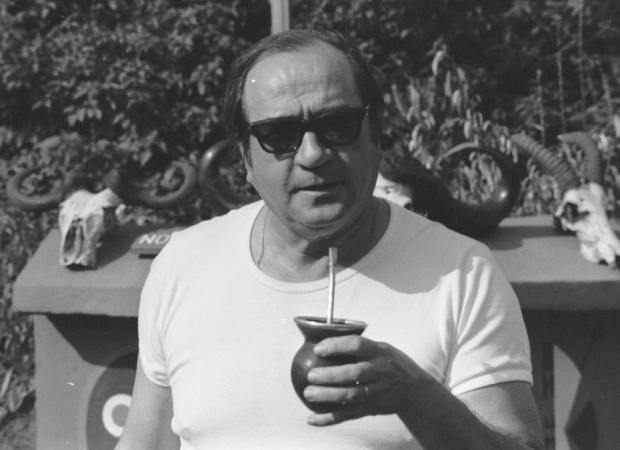
Nazar offers a mate to the photographer.
As usual with first time visitors, they have heard nothing the whole night as they had slept like logs! We finally had a chance to finish exchanging pending news at leisure.
Fortunately they were fast to adjust and gradually they became used to our ‘bush ways” joining us on a couple of game drives during which they greatly enjoyed what they saw. The frequent appearances of the imprudent hyenas and the lions roaring were not conducive to us persuading them to abandon their cage the following night and they still preferred their airtight environment to the risks of camping in the bush. We understood them well as it had taken us longer than that to get used to camping “al fresco” surrounded by wild beasts!
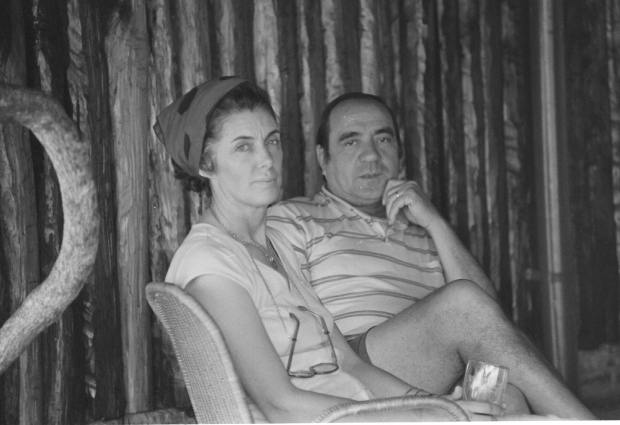
Our friends relaxing at the Mara Serena lodge.
We returned to Nairobi after two nights. This time they were able to appreciate their surroundings much better, including the always-interesting sight of the Maasai people and their manyattas and livestock and they were delighted with the daylight return journey.


Later on during the week we showed them Nairobi and the wonderful Nairobi National Park and later travelled to Nakuru and Bogoria for a view of the Rift valley, its hot springs and flamingoes. Luckily, they loved the experience but time passed very fast and it was soon time for them to depart, too soon for us!


Their plane left back to Europe at midnight on Saturday 31 July 1982 so we took them to the airport early and made sure that they went through all the departing procedures early until the time came to leave them once they have checked-in to return to Tigoni late at night. Unused to driving at night, we negotiated several road blocks that we thought too many but, as we drove a car with red diplomatic plates, our going was smooth and we got home safely.
The following morning we had arranged with our friend Ranjini to go to the Nairobi National Park so we travelled to Muguga through back-roads to fetch her. Once there she announced that an attempt to overthrow President Moi’s government had taken place at midnight and that there were serious confrontations going on in Nairobi between the Police and students! Apparently, a group of soldiers from the Kenya Air Force had taken over the Voice of Kenya[2] and announced that they had overthrown the government!
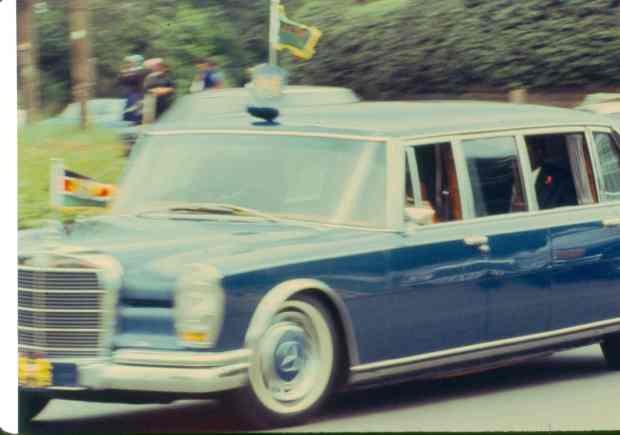
A bad picture I took of Moi’s cavalcade before knowing the risks involved!
We thanked Ranjini for the news and quickly turn around heading for home as fast as we could! During the journey we met a large military convoy ready for war heading for Nairobi but we did not know what their stance was at the time! Luckily they ignored us and we, the sole occupants of the road by now, got home safely where we remained -listening to the BBC radio for the latest news- for the following three days until it was confirmed that the attempt had failed[3].
It was lucky that our friends just managed to get away (a while) before the Kenya airspace was closed and that they were over the clouds when all this happened! They remained unaware of their narrow escape until we met them back in Uruguay a year later when they listened to us in disbelief!
[1] Traditional South American caffeine-rich infused drink, prepared by steeping dried leaves of yerba mate (Ilex paraguariensis) in hot water and is served with a metal straw from a shared hollow calabash gourd and shared among drinkers.
[2] From 1989 it became the Kenya Broadcasting Corporation.
[3] The coup failed. The Air force pilots that meant to bomb State House dropped their bombs over Mount Kenya and eventually, after ruling Kenya for a few hours, Hezekiah Ochuka, a soldier in the Kenya army, escaped to Tanzania. He was eventually extradited back to Kenya, found guilty at a high profile trial that involved both Oginga Odinga and Raila Odinga, and eventually executed in 1987.
While staying in Muguga House, transport was a problem as, to get to Nairobi it meant a 10km ride to access the main road and then find public transportation to and from the capital city. That meant that the shortest of the trips would involve a full day! The situation improved later when I got the VW Kombi. This allowed us also to move out of the temporary Muguga House’s bungalow to a proper house in Tigoni.
In the meantime, we explored the Muguga surroundings on foot following the many tracks used by the local inhabitants in their daily errands. The soil was red, seriously red, and slippery and the paths narrow and sinuous! Falls were funny affairs until we realized that to wash the red stains from our clothes demanded quite an effort so, after the first experience we strode with great care! It was good exercise and it gave us a chance to come into contact with the local people, particularly the women and children.
Among the colleagues sharing Muguga House was Ranjini, a British expert on plant viruses, particularly maize streak, who was also starting her career with the Overseas Development Administration[2] on the plant health section of the Kenya Agriculture Research Institute. Although she was reserved at first, my wife and I became friends with her (up to today!). She had a sharp sense of humour that, according to her, she inherited from her Sri Lankan father. She had very long dark hair worn loose.
Ranjini and other British colleagues of hers were used to walking and they did it frequently. Walking was not an activity that was performed in Uruguay so we were rather unfit and the few ocassions we tried it was a bit of an embarrassment as we lagged behind! Of course we attributed this to the Muguga altitude knowing very well that we were unfit! The situation improved after a while and we could join the ramblers more comfortably although we could not match them. We frequently walked with Ranjini, who had a slower pace and with whom we shared more interests.
The day in question was a Sunday and we left a bit late. We took the path towards a patch of indigenous forest as there were always interesting birds to be seen there. Mabel and Ranjini were walking in the front and I followed. As usual we met a few people who greeted us with the well known “jambo“[3] or its Kikuyu equivalent. A few women were on their daily errands which included carrying a 20lt jerry can of water on their heads, and a bunch of firewood on their backs all while knitting some pullover for their children. I never stopped admiring them! Oh yes, and walking more steadily and faster than me. Others were going to catch a “matatu“[4] to go to town or visit relatives while quite a number were dressed for mass.
We were traversing a bit of open ground and a little boy of about 4 years dressed in his best Sunday clothes never saw us coming, busy looking where he was stepping, probably following his mother’s directions to keep his shoes clean! Two of his sisters, his mother and another lady (his auntie?) accompanied him, also dressed up. The boy was at the front of the group.
The moment the boy heard people coming towards him, he looked up. Until that instant he wore a happy face and we had seen it. It took only a split second for his expression to change into a look of terror, followed by a loud scream. He immediately started crying. Unfortunately for him he had just seen three white aliens without warning! I am sure that what was particularly terrifying for him was to face two of them with very long hair advancing on him. His instinctive response, after the initial shock, was to turn and run for the safety of his mother. It would have worked if only he would not have slipped and fallen.


Although his mother moved towards him, the witches were closer and got to him first with the intention of helping. Somehow, this was not the little boy’s perception of the situation and, finding himself “alien handled” he cried even louder in a fit of deeper terror! While his immediate relatives started to chuckle at the scene unfolding, eventually, with the help provided by the witches, he regained the needed mobility and rushed to his mother, burying himself in her skirts and almost disappearing from sight!
Our concern for the boy’s welfare turned into amusement the moment we saw his family laughing whole-heartedly at the incident. I am sure that somehow the encounter remained with the youngster for sometime!
[1] See also: https://bushsnobinafrica.wordpress.com/2015/03/10/kenya-muguga1/ and https://bushsnobinafrica.wordpress.com/2015/06/30/life-and-work-in-kenya-muguga1/
[2] Now known as The Department for International Development (DFID).
[3] Swahili for “Hello”.
[4] Swahili for a minibus used for public transportation.
Important issues such as passport renewal and visits to our family doctor compelled us to leave Salta for our small town of Carmelo in the shores of the river Plate. The night before our departure my wife and I were busy with the packing and other arrangements to leave our farm in good order for our return towards the end of April.
At some stage we were both outside engaged on different tasks when I heard my wife saying, “was that you rattling?” “As far as I know, I still move about freely and free from rattles” was my curt reply, slightly upset by her sarcasm. And then I also heard the noise, an “shhhhh, shhhhh” coming from the garden. “You are right, there is some rattling but is not me” I said to her and added, “I think it is moving this way…” Before I could finish my sentence, my wife interrupted me saying in a voice she reserves only for some creepy-crawlies (snakes, mice, and sometimes myself!) “a snake is coming there”. She pointed towards the general area and that was the last I saw of her for a while, disappearing behind the verandah’s door into the house at a speed.
The snake was in the dark and I could not see it well but I suspected it to be a rattlesnake (Crotalus durissus terrificus) judging by the noise it made. I knew these snakes were present in the area although they are not commonly seen.
I managed to switch the outside light on without losing sight of the visitor that was heading for our house. I was immediately reminded by an invisible wife to keep the back door closed. So it was the snake and I!
Now, what do you do when one of the dangerous creatures from Nature comes for a visit? Ninety-nine per cent of the people around the area will immediately kill it as, reasonably, they regard this as a threat to themselves, children and pets. I could have done this and save myself lots of trouble but I did not!
I watched the snake moving gently towards me and veering off at about a metre from me to seek shelter under one of our large plant vases. I waited and it did not come out so I guessed that I would have sufficient time to run into the house, get a hook from the fire place and come back to check on it. I did and it was still there so I decided that I could now search for our “chameleon box” that was somewhere in the house. Luckily I found it quite fast so I was ready for the capture.

The bushsnob with the fire hook.

Hooking the snake and dropping it into the chameleon box.
The rather large pot was moved to get a chance to hook it but, as expected, the snake moved off but I managed to hook it and lift it inside the box, rather skillfully I thought, pleased with myself. The box was perfect as it is very well built, with a glass front and a metal grid on top. The snake was secure and safe. I won the first round.
After a detailed conversation over dinner I managed to convince my wife that the best course of action was to release the snake far from our farm and, after lot of discussion, a distance of about 4 km was considered safe, as it would be difficult that the snake would return! My victory had a pyrrhic side to it, as now I needed to move the snake from its present location to a suitable container so that I could carry it away.
I considered the various options and settled for a cardboard box with high walls as to avoid it from climbing out before I closed it safely. I like snakes in general but I respect poisonous ones very much so I like to play safe and keep a good distance to avoid surprises!
Luckily the following morning the snake was probably cold and scared so it allowed itself to be lifted from the cage into the box rather easily and I even had time for a picture taken by my wife. (Between you and me, it was trickier to persuade my wife to take the picture than to handle the snake into the box!).

Safely inside the box. Luckily the snake was more scared than I.

Coiled and rattling.
We then loaded the snake at the back of our pick-up and departed for Uruguay stopping after 4 km to let it go. I opened the box, readied the camera and expected an elegant exit to take a few pictures to illustrate this for this post. As the snake did not leave the box after a couple of minutes, I tilted it and the snake finally slid off, still coiled up. However, before I could even think on a picture, it took off at a speed, luckily away from us and into the bush. I had no time to take a shot but, amazingly, my wife did, I am not sure how!


The snake took off at a speed towards the bush.
After watching the snake getting into some cracks in the rocks and out of sight, we rattled off.
From our first visits to our farm in Salta it became apparent that its insect wealth was enormous. In particular, as you have read here, butterflies and moths really rule. The latter in particular are very varied and abundant. Being attracted by the light makes them easy to capture, observe, photograph and, eventually, release. In the early morning the trick is to be there before the insectivorous birds that do not care for beauty but taste!
I have described and published posts mainly on butterflies for two main reasons: they are colourful and photogenic but also better known in the area. Moths are difficult and, although I have taken pictures of a few hundred specimens, I am still waiting for their identification as the group’s taxonomy does not seem to be well known. The consequence of this is that most of the time I do not know what I am looking at in a taxonomical way. I then need to resort to my own classification by colour, shape and size that produces specimens such as “mottled brown medium size”, “barred brown with delta wings” or “large and smooth hawk moth”, etc.
A couple of days ago I came across one specimen that, although I have seen before, it is infrequent but rather attractive. Looking at it from its dorsal part, I could see a figure on its back that looked like a face (with Ray-Ban seafarer glasses?) or a cat face.


My wife saw a butterfly and, in December 2014 when I first saw it, I described as a moth “white with skull on back” It was like a psychological test I undertook in my childhood where you are asked to describe what you saw!
Later, looking at the pictures, there were more creatures to come out!
A dorsal view of its head showed a monkey face (agreed by my wife this time although the discussion centered on whether it was a baby Colobus or a Vervet!).


The final surprise was when we looked at it from the front. I saw a clear dog’s face while my wife saw a rabbit head!


Amazed by the various beasts we saw, we almost forgot that we were looking at a simple moth. However, it was one of Nature’s specials depicting three different creatures, apart from itself, a feat that I believe is difficult to match!
Burrowing owls (Athene cunicularia) used to be very common in Uruguay in the past and I remember, about 50 years back, seeing them perched on fence posts at frequent intervals. Regrettably, the advent of generalized use of pesticides meant that they almost disappeared and they are now relatively rare.
We were happy to find that in the Yungas of Salta, where our small farm is located, they are quite common, particularly in an area devoid of tree cover a short distance beyond our farm where we watch them from time to time. Luckily pesticide use here is still rare!
It was during one of these visits that we found the group composed of probably two adults (placed at both ends) and two babies showing only their heads, ready to disappear down their burrow in case of emergency.

I was busy taking the first set of pictures when the adult on the left started to run towards me. I was quite impressed by its threatening behaviour as -I thought- it takes courage to attempt to scare off a large ape! It bobbed its head repeatedly, a normal behaviour of these birds and a couple of times it actually appeared to dig and scratch the soil with its beak. After a while it ran back to join the rest of its family and stood again where it was earlier.


After a while we left them to enjoy their owl family life and we returned to our log fire at home. Much later, while checking the pictures taken that day, I realized that in fact the owl was not threatening me but that it was after prey! I had missed the details in vivo but these were apparent when I looked at the various pictures.


The owl had spotted a large beetle half way from me and it rushed to get it (rather than to scare me off!), caught it, tried it and spat it out, as it must have tasted bad! I can only assume that he discarded it, as I believe that eating it would have taken some effort! Although I fear for the beetle after the rough treatment received, these insects are quite common around here and I do not believe that its absence will be noted…


Probably, through earlier posts I gave you the impression that living at the foot of the Andes is a dream. While this is true to a very large extent, it also has climatic and technological shortcomings that need to be accepted to enjoy it.
The climate is dry and cool in winter with most days being sunny and warm in the middle of the day when it is possible to be outside wearing a short-sleeved shirt. At that time some frost does take place at night, responsible for our failures with our tree and plant growing efforts but otherwise life is great at that time. Unfortunately, we visit Salta in summer and autumn!
The summer is hotter and rather humid. The rain in some areas reaches up to 2,500 mm (2.5 metres!) and cloud forests are the predominant kind of vegetation around us. For a cloud forest to be such the clouds must meet the trees and we are in the middle of this get-together as our farm ranges in altitude roughly from 1,300 to 1,900 metres. As these meetings take place rather often, sunshine is not the most common phenomenon around here now!


As a consequence of this heavy precipitation the area gets waterlogged and the water must drain somehow towards the larger water bodies, in our case the Mojotoro River in the gorge below. As gradients are marked, water runs wild and swells up fast. Sometimes this surprises you as it may rain higher up in the hills and you get the water rush but not the rain.
The entrance to our small-holding crosses a small watercourse that in winter is just a small dry ditch. The fun takes place in summer when, once the rains arrive, it again becomes a stream. This adds a touch of beauty to the farm until we have heavy rains! When this happens, the normally peaceful stream “comes out of the bottle” and transforms itself into a torrent that we can only watch while waiting for it to subside. This normally takes a few hours during which our lack of communication is wide-ranging.

For a few hours we are either in or out!
This brings me to the technological issues. The high hills surrounding us interfere with the telephone and Internet signals at the best of times. Well, there is a cell phone signal 3 km away on the access road and, of late, a basic Internet signal across the road, at the door of the public primary school. While the lack of communications makes the place a true nirvana to read and write, it has a negative impact on blogging and “Instagramming” productivity that, at this time, tends to be rather infrequent as you have probably noted by now…

The bushsnob taking advantage of the public internet to reach the world.
On the bright side, a recent study in the farm next door[1] detected the existence of 152 species of butterflies (Hesperioidea y Papilionoidea), 14 spp. of amphibians, 23 spp. of reptiles, 216 spp. of birds and 28 spp. of native mammals.
Believe me, it is worth getting your feet wet to be able to reach our communication “hot spots” when you can watch new creatures daily while reaching them!

One of the frequent photographic interruptions getting to the cell phone signal.
[1] Moschione, F.N. (2014). Relevamiento de Fauna. Finca El Gallinato, La Caldera, Provincia de Salta. Informe Relevamiento 2013-2014, julio de 2014. Proyecto de Conservación de Bosque Nativo. 55p.
 A Bushsnob out of Africa