Memoirs

Episodes of my life in Africa.

Camping in Africa. Kenya (Spotted cat)

During one of the trips to the Transmara, while camping next to the Mara River, I had the surprise visit of the Manager of the Mara Buffalo Camp. As this had never happened before, I prepared to hear that I was not allowed to camp near the camp anymore so we stopped setting up our camp and went to meet him. I was wrong. He was a friendly Swiss that came to give me some good news.

He explained that at a rocky outcrop nearby there was a female leopard with two cubs that, unusually for East Africa in general and the Maasai Mara in particular, was very relaxed and let you watch her and her cubs without getting scared by human presence. He even offered to take us there at that precise moment if interested as he was taking a friend with him  for that purpose. We instantly forgot what we were doing, jumped on the car and followed him!

After driving towards the reserve, we arrived to a rocky gorge where there was a cave high in the rocks where, to our great surprise we found a small leopard cub resting at the entrance. He said that the mother may have been hunting or, perhaps, sleeping inside, together with the other absent cub. We could not believe our luck and after waiting for a while we thanked our Swiss benefactor profusely and left him in contemplation as we still needed to set up camp, cook and rest to continue with our journey the following day.

The leopard and her cubs became an added attraction to our frequent journeys to the Transmara and we found her again a few times during subsequent trips until one day she disappeared. For a few weeks we did not know what happened to her until, again by chance, found her again later, together with Jonathan Scott. The now well known photographer, film maker and book publisher was not that well known then as he was starting his rather successful stay at the Maasai Mara.

Jonathan was watching a female leopard with young cubs with all his equipment on the ready as the cubs played and the mother rested up a rocky outcrop. We learnt that it was the same female and after that encounter we saw her a few more times. The trick was to find  Jonathan’s green car  when driving through the general area where the leopard dwelled! It was clearly easier than looking for her!

Leopard M mara tree copy

Relaxing…

I still recall one day when we found the leopard family in a very playful mood up and down a beautiful fig tree. It was such fun to watch them at play that I only stopped taking pictures the moment I ran out of film! I was really excited and very pleased with the pictures I had taken, although in those days you needed to wait until they were developed to see the results.

Before leaving, we approached Jonathan who we had met also at Kichwa Tembo Camp earlier and, feeling pleased with myself, I made a comment on how great what was taking place was and mentioned that I had taken lots of pictures as it was a fantastic opportunity. Jonathan listened to me and then gave me a reply that I have had in my mind since then: “I have not taken any pictures because the light is wrong”.

My heart sunk and I left crestfallen and in disbelief. When back in Nairobi the moment of truth of the pictures came I must confess that Jonathan had been right. Although some pictures were “rescuable”, the majority showed cat silhouettes against the sky! Later on, when I got Jonathan’s books I realized what he meant that day as the quality of his work is frankly superb!

As for us, despite our poor pictures, the memories remain and they at least serve the purpose to bring these back and to stimulate me to write posts such as this one!

Leopard M mara sitting cropped copy

Surprised in the open.

Snakeworld

The place still exists. It is located a few km outside Harare, on the Bulawayo Road. We do not go there often nowadays. In fact, we have not visited it since we returned to reside in Harare after my retirement in 2013.

However, in the late 90’s we brought our children there a few times. The idea was to familiarize them with the various reptiles they were likely to find in Africa and avoid or at least minimize the “yuck” factor.

I still remember our first visit when we were fortunate to meet George, one of the guides working in the place. He was a small skinny man probably in his late forties. George only had one arm, his left. My recollection is that he had lost it after the bite of a cobra but the rest of the family believes that a crocodile was responsible for the loss. I am sure I am wrong!

The first time he guided us through the reptile collection it left such an impression that, whenever we came back for a visit, we looked for him as our chaperone. It was well worth it. He was not only extremely kind and patient with our children, but had a natural way of putting them in “direct contact” with the various reptiles. With him they handled for the first time varios beasts such as the resident monitor lizard, chameleons and a number of harmless snakes.

DSCN9945 12.10.31 PM copy

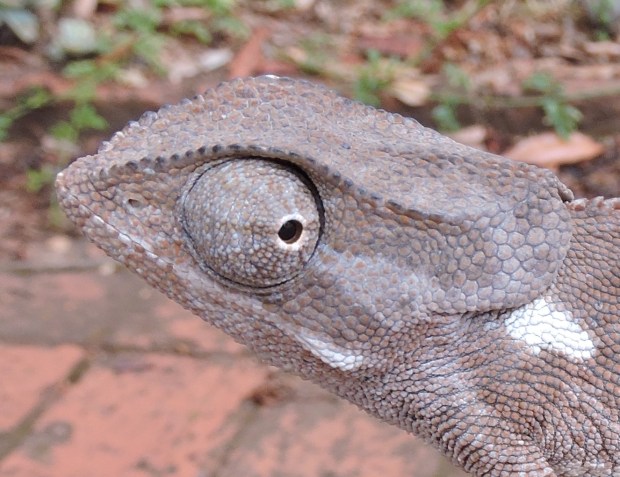
A chameleon from our Harare garden.

What really made the visit to Snakeworld different was George’s guided tour through the successive enclosures that hosted the snake collection. These were a succession of glass windows where the various African snakes were on display. You started from the various non venomous snakes and gradually worked your way through a crescendo in poison severity that reflected on our level of excitement.

The tour started with a quick walk through the harmless beasts. As some of these had already been handled, they attracted mild interest.

tom-dsc_1023-1

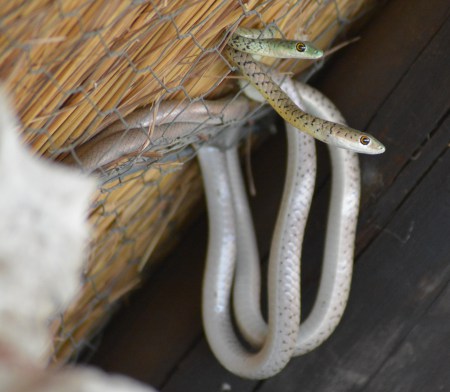
Mating Spotted bushsnakes at Masuma dam, Hwange National park.

The exception were the African pythons, located at the end of the “non-poisonous” wing. Their enclosure was large and populated by a few specimens, one of which was especially large if not very active. The ability of these snakes to kill and swallow prey much larger than themselves by virtue of being able to stretch their jaws was the main comment George made about them.

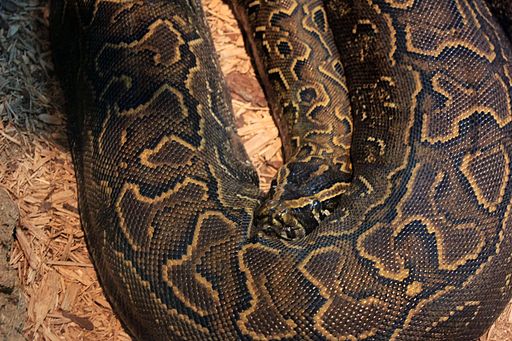
Gfp-african-rock-python

African rock python. Picture By Yinan Chen (www.goodfreephotos.com (gallery, image)) [Public Domain], via Wikimedia Commons.

While moving to the “poisonous” wing a few metres on, George prepared his audience for what was coming giving facts about the various snake teeth arrangements and various venoms.

The first dangerous ones were the boomslangs that only awoke mild interest on the youngsters. Conversely, I found their beautiful bluish-green colour and arboreal habits really fascinating and to see them brought to my memory and incident that happened a few years earlier while camping in Chobe National Park with our very young kids. We were sitting at our camp during lunchtime waiting for the heat to subside when, without warning, a green bundle landed between us with a thump. It was a boomslang that had just caught a lizard and clearly lost its balance! Almost before we could recover from our severe fright the snake re-climbed the tree and it was gone in seconds, only its bluish tinge and typical scales made me guess its identity.

But let’s go back to Snakeworld.

The twig snakes with their great ability to mimic -yes you guessed well- twigs, are always attractive as you can spend a few minutes before spotting them among the branches, even when you know they are there, looking at you!

While waiting for us to find them, George would give information about the biology of the various snakes, their distribution, conservation status and prey. Through him we learnt that Eastern Zimbabwe (the valley of the River Honde) was the place where the most dangerous snakes were likely to be found.

Then we moved to the final part of the exhibit, where George gave facts about each snake species. The latter ended with a statement about their lethality and this was the real “pièce de résistance” of the visit!

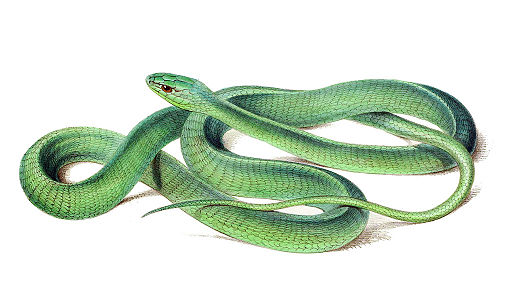
Dispholidus_typus1

A rather green boomslang. Picture by Day & Haghe [Public domain], via Wikimedia Commons

While boomslangs and twig snakes would kill you if they could get hold of some part of your body, death would occur after days of agony. The situation was more dramatic with the few that followed.

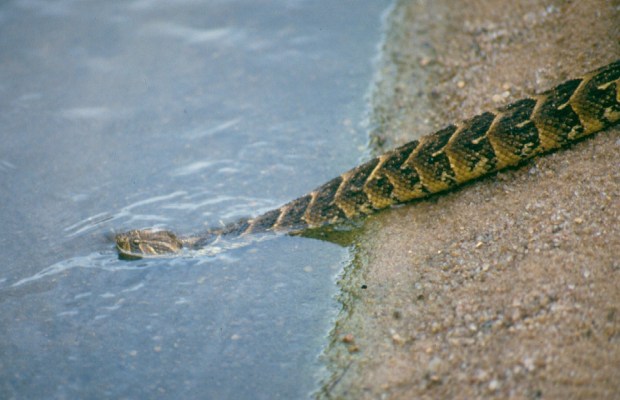
The gloated-looking puff adders with their excellent camouflage and slow slug-like displacement were striking as I could understand that stepping on one would be the most likely snake accident that could happen, as George confirmed.

Puff adder Sand river camp m mara copy

A freshly moulted and slow-moving Puff adder goes for a swim at the Sand River, Maasai Mara, Kenya in the 80’s.

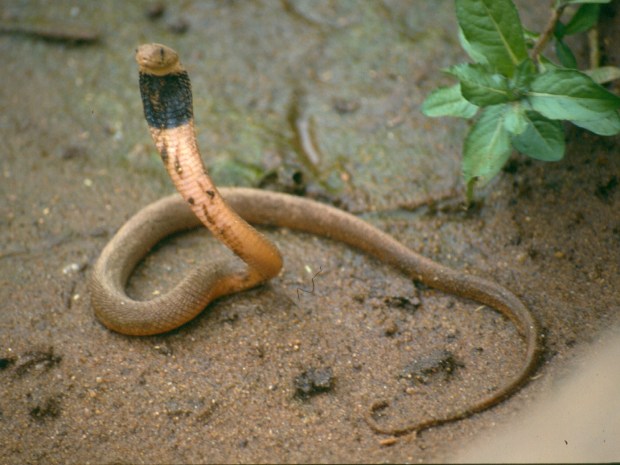
The “cobra parade” started with the most common Egyptian cobra, that would kill you in a couple of days if not treated. We were getting anxious to continue but he would walk a couple of displays on and stop again showing us what looked like water stains inside one of the glass panels. Pointing at some beautiful terracota coloured snakes, he would explain that they would blind you if they would manage to hit your eyes with their spray of venom. I immediately remembered Alan and Joan Root filming spitting cobras in “Two in the Bush” where Joan wearing glasses was the target of a large spitting cobra while Alan filmed the scene! Two in the Bush is a great documentary worth watching!

spitting cobra b wackers copy

Young Spitting cobra pictured by bushsnob in Bushwhackers Camp, Kenya in the 80’s.

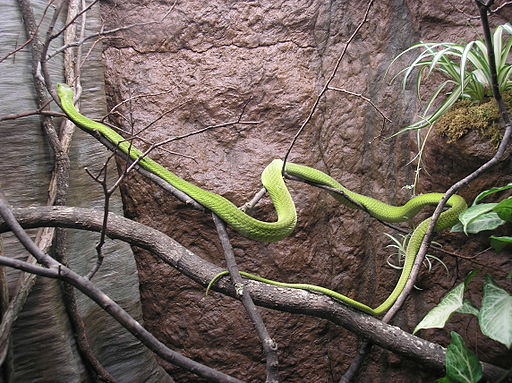
After the cobras it was the turn of the mythical mambas. The beautiful and deadly green mambas were first and they took us aback, honouring their names by sporting the most wonderful and shining pale green colour. George would explain that these were rare in Zimbabwe but rapidly lethal if not treated by the right anti-venom. We were all in awe at their almost “smiley” face that made them look deceivable friendly. “Luckily they live up trees”, George said to calm things down ‘but if beaten, you only last a couple of hours” he concluded.

Eastern_green_mamba_P9240107

Green mamba. By Picture taken by deror avi on 24th September 2006. (Own work) [Attribution], via Wikimedia Commons.

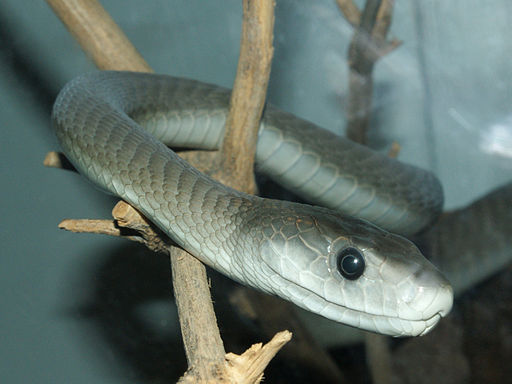
The black mambas were unnerving, not black but grey and reaching a size both in thickness and length that is not what you expect. Clearly an impossible foe to escape in the field if angry as, George told us, they can reach a speed far greater than a running human! Luckily, like most snakes, they are shy and move away way before we know they are there. “Do you enter their cage?” I asked George. His answer was short and clear: “No. If bitten you would only last a short time, maybe one hour”. “In South Africa, the black mamba’s bite is known as the kiss of death”, he added. The atmosphere was getting tense!

Dendroaspis_polylepis_(14)

Black mamba. Picture by TimVickers (Own work) [Public domain], via Wikimedia Commons.

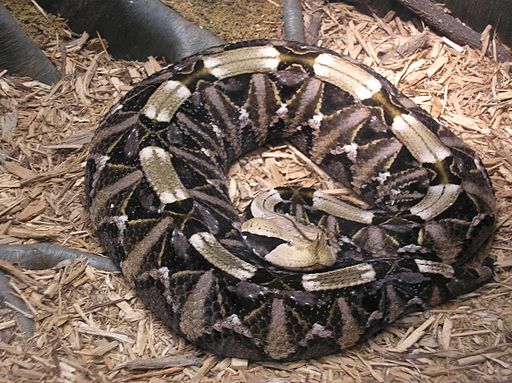
Trying to control our excitement and imaginations we came to the last window where we could not see anything. When George pointed it to us, a humongous and colourful snake suddenly came together. One very large Gaboon viper (Bitis gabonica), its thickest part like my forearm and with a large head, lied totally immobile in front of our eyes.

Gabon_Viper_P9240109

Gaboon viper. Picture taken by deror avi on 24th September 2006. (Own work) [Attribution], via Wikimedia Commons.

Adorned with the most beautiful colouring, waiting to explode in a strike that would take care of its prey. Its colouring consists of a succession of cream coloured sub-rectangular splotches running down the center of the back, interspaced with dark brown hourglass markings with yellow edges while its sides have a series of fawn or brown rhomboidal shapes, with light vertical central bars.

Although its colouring seems to be rather obvious, it gives the snake an excellent camouflage on its tropical habitat littered with tree leaves. George, showing it his utmost respect, mentioned that this snake was only found in the Eastern Lowlands but that it was -luckily- rather uncommon. He also mentioned that the one we were looking at had been at Snakeworld for many years and that it was extremely aggressive. Then he added: “we call it two steps”. Although I realized why, our kids immediately asked him the reason. That was what George had been waiting for! “You get bitten by this one and you can only walk two steps, then you die”.

Although I am not able to confirm his statement, the snake was massive and at the time I could imagine that the amount of toxin it could inoculate through a good bite would be very large and rapidly lethal[1]. I can assure you that George’s “two step” statement had an impact on the family and to listen to George saying it again become one of the reasons to return to Snakeworld.

As time goes on we mature things. In our case we have incorporated George’s “step” scale into our own family “bush language” and, in the rare cases we spot a snake, the immediate comment is “was this a two-step one or a ten-step one?” I must admit that we get lots of amusement with what follows.


[1] The Gaboon viper is the world heaviest viper with two-inch long fangs! Not surprisingly, it dispenses the highest amount of venom of any snake. See: https://en.wikipedia.org/wiki/Gaboon_viper


Super moms

This post has been adapted from the Spanish original that appeared in the magazine Muy Interesante. I am grateful to the magazine for publishing the article and those readers interested in it can find it @ http://www.muyinteresante.es/naturaleza/fotos/vida-y-curiosidades-de-los-guepardos

After writing “A chase”[1]. late last year, I did research on cheetahs and found some useful information that I used to prepare “Super moms” and later I realized that I had forgotten that I had written “A chase” earlier! So now, I think that the present post follows it nicely as it offers what I hope is interesting facts on the cheetah, one of the most beautiful animals on this earth.

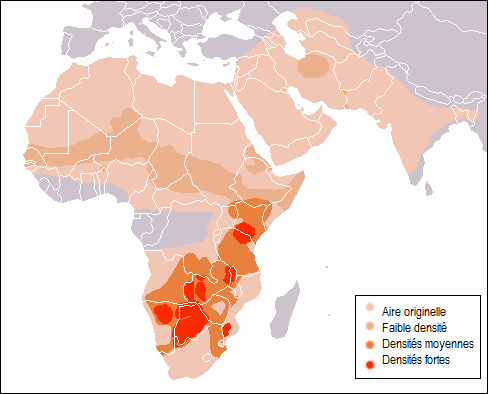
The vast majority of cheetahs (Acinonyx jubatus) live in Southern and Eastern Africa and also in some parts of Iran.

MAP OF CHEETAH DISTRIBUTION

acijubrep-copy

Areas with high (red), medium (brown) and low (pale brown) population density. In pink is its original range. Map credit: Attribution: By Al Pereira puis traduit par Deliryc64 [Public domain], via Wikimedia Commons.

It is one of the great cats although it has unique characteristics that place it in its own genus describing that its claws are semi-retractile unlike other felids that can retract them totally. While the latter use their claws to climb trees and tear flesh, cheetahs’ have a grip function to favour their acceleration, similar to the sprinters’ shoes.

foto-1Young cheetah in the Nairobi National Park, Kenya.

Although its taxonomic location is being reviewed at the moment, its closest relatives are the puma (Puma concolor) and the jaguarundi (Puma yagouaroundi). These three species together form the Puma lineage, one of eight that make up the Felidae family.

Since its discovery in 1775 by von Schreber the population of cheetahs has declined dramatically to the present situation. The International Union for the Conservation of Nature (IUCN) estimates that there are 6,700 adult and young animals distributed in 29 sub-populations and it is classified as a vulnerable species.

The cheetah needs large tracts of land and is currently heavily threatened by the loss of habitat due to the advance of the agricultural and industrial frontier. In addition, unlike the leopard (Panthera pardus) that can adapt to live close to people, the cheetah, a timid animal, is unable to do so.


Its relative docility and tolerance to humans has contributed significantly to its decline. Apart from being hunted as trophies, since the time of ancient Egypt, four thousand years ago, they were captured and kept as pets. This custom is still maintained today as they are displayed as status symbols and used for hunting in several countries. The consequence of this is that these animals have disappeared from much of their habitat.

In addition, these animals are very vulnerable in the wild because of the way they obtain their food. Cheetahs use their great speed to hunt but to be effective they need open spaces and excellent visibility since a false step can mean an injury that may condemn them to hunger since they are too timid to steal prey from other animals.

Female hunting springboks in the Kgalagadi Transfrontier Park.

The hunting of their prey, medium-sized gazelles, begins with their stalking until they reach a distance of between one and three hundred meters. From that moment a real “life race” between hunter and prey starts. After three leaps the cheetah is already about 45kph and during the chase it can reach over 110kph in short stretches. This makes it the fastest mammal on earth as we all learn at school but also one that enjoys an exquisite elegance of movement.

foto-3

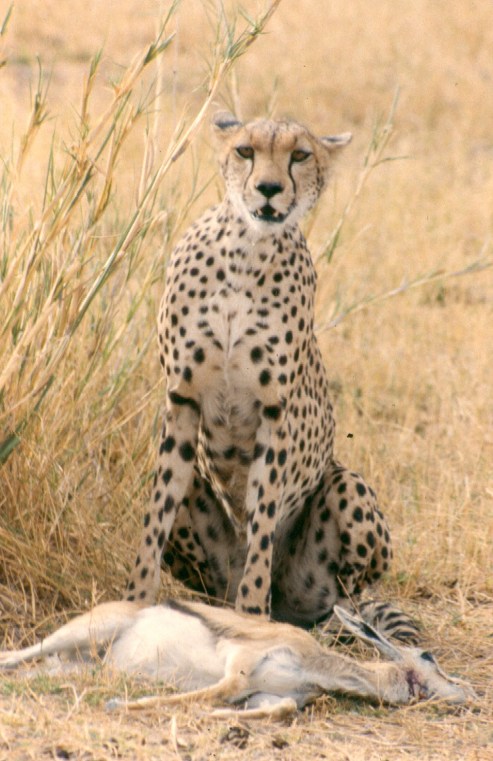
Resting after hunting and strangling a Thomson gazelle in Amboseli National Park, Kenya. See the teeth marks on the gazelle’s neck.

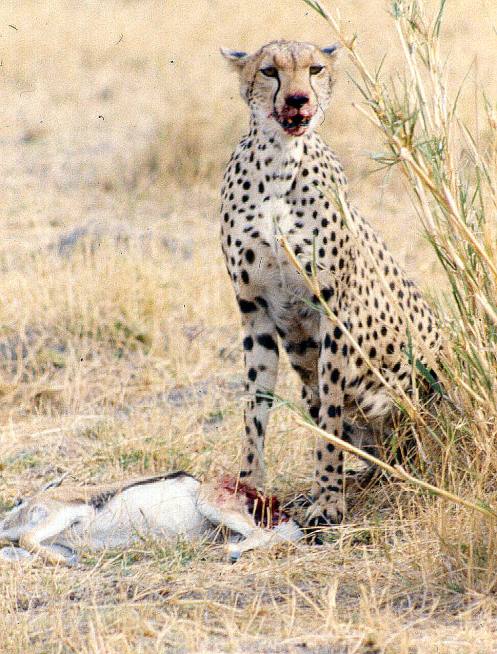
When it reaches the prey it makes it makes it trips it and, after it falls down it chokes it and kills it quite fast. The cheetah, usually exhausted after the chase needs to catch its breath and it only starts feeding after a while that can be as short as five or as long as fifty minutes. At that time it is common for other larger predators to steal its prey. Knowing that this can occur at any time, the cheetah eats fast and much, starting with the muscular hindquarters and it is able to eat up to 10kg of meat from a sitting.

foto-4

Eating a Thomson’s Gazelle.

The “public” life of the cheetah not only exposes them to losing their prey because of the interference of irresponsible tourists that, eager to obtain a better picture, interfere with their hunt but they can also lose one to two quarries every ten to stronger predators and, in some places, losses can reach up to fifty percent.

Cheetahs breed throughout the year and females ovulate when they have sexual contact with the male. For this reason their pups may be from different fathers boosting genetic diversity, an important factor in shrinking animal populations.

They gestate for almost three months and between three and five cubs are born, although in rare cases up to eight offspring have been observed. It is easy to imagine that for an animal that relies on speed to eat, being pregnant adds another complication to its life.

Cheetahs, especially females with cubs need to hunt almost daily and they are constantly monitoring their surroundings from a vantage point that can be a termite hill, a tree[2] and even a car!

This behavior not only allows them to detect possible prey but also prevent attacks on their offspring by lions, leopards and hyenas that would not hesitate to kill them. Failure to hunt either due to natural shortages or human interference may also mean that the cubs would starve.

foto-5-copy

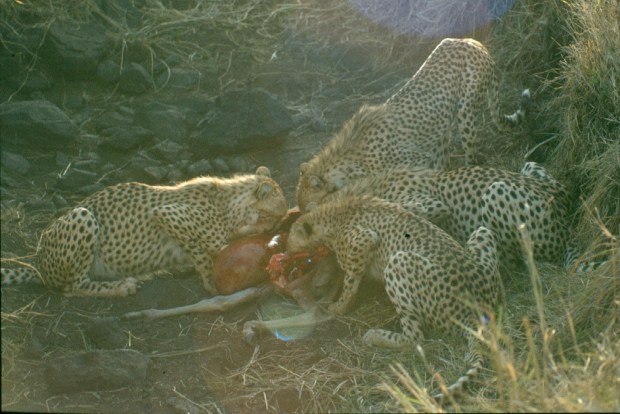
Four cheetah cubs with prey. National Park of Nairobi, Kenya.

Fortunately for the species, there are females that manage to breed the vast majority of their cubs and these are known as “super mothers.” Some even raise the cubs of other females! These super moms are not only successful hunters who manage to kill prey on a daily basis but that also know how to protect their offspring from predators.

One of these females called “Eleanor” is well known in the Serengeti National Park in Tanzania for having raised 10% of all the cheetahs that today live in the South of that huge park. This finding is one of the important achievements of the Serengeti Cheetah Project, led by researcher Sarah Durant[3].


[1] See: https://bushsnobinafrica.wordpress.com/2017/02/02/a-chase/

[2] For a rather extreme example see: https://bushsnobinafrica.wordpress.com/2014/06/30/tree-cheetahs-2/

[3] For interesting information on the subject see: http://www.tanzaniacarnivores.org/

Camping in Kenya. Mara River fishing

Although I do not like eating fish, I am what the British fishing community know as a “coarse fisherman” and I have been engaged on this activity all my life, although I do not fish much these days. At the time we were in Kenya I was already returning the fish, unless someone would be interested in eating them. Tobias, Paul’s camp hand, was such a guy and if he was around there was no way that a fish would escape his attentions and invariably it would end up in the sufuria[1]!

Tobias was from the Luo ethnic group that dwells around lake Victoria both in Kenya and Uganda and, naturally, they eat fish in contrast to the Kikuyu and Maasai that very rarely, if ever, consume them. The rare event of a Maasai herdsman fishing with me was described a while ago in this blog[2] although whether he would have eaten the fish or not will never be known!

As only driving with your eyes closed would stop you from seeing animals while traveling through the Maasai Mara area, sometimes, for a change, we decided to just chill out around camp and on occasions, try our hand at fishing in the shadowy Mara River. We were able to do this as, by virtue of being outside the reserve, we enjoyed freedom of movement within the limits of common sense and/or lessons learnt!

In the area we regularly camped there were a couple of nice grassy spots from where we believed that fishing could be attempted. The problem was that we knew that crocodiles were plentiful in the River and there was no doubt that they were lurking anywhere under the muddy waters. We had already seen them in action snatching wildebeest during their river crossings. Clearly in this setting, fishing would be a hazardous sport.

After careful consideration we chose a nice opening in the riverine forest that not only offered a good view of the river but also towards our back, an important consideration in the Maasai Mara as dangerous animals were also around us inland! As there were no trees nearby we could handle our fishing gear without major mishaps. I have the innate ability to get carried away with the fishing and end up “hooking” a few trees! Although there were lots of hippos cruising up and downriver, we did not consider them a major problem.

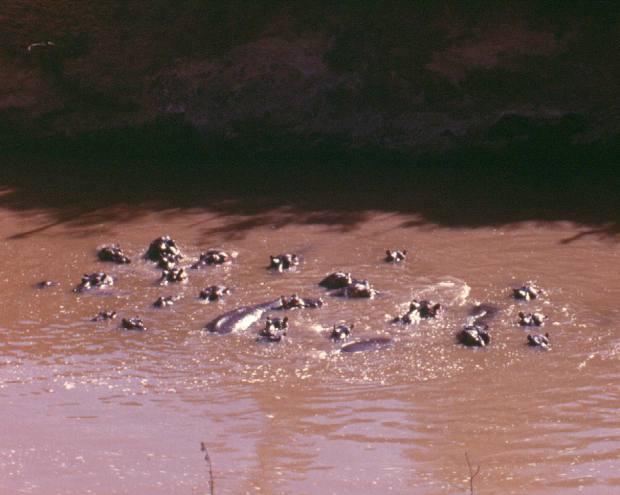
m-mara-hippo-pools

A view of a Mara River hippo pool to show the colour of the water.

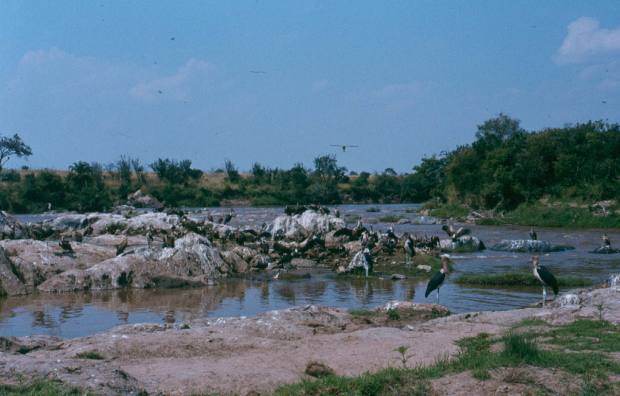
mara-river-after-the-wbeest-crossing

The aftermath of a wildebeest river crossing.

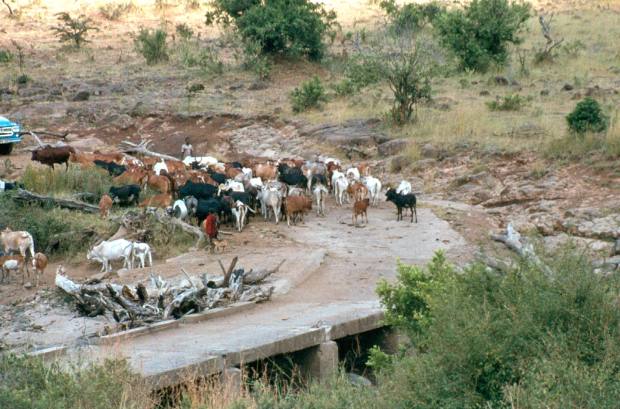
maasai-cattle-mara-bridge-2

The Mara River bridge on the way to the Transmara. A lorry and us wait for a herd of Maasai cattle to cross.

So, one of the trips to the Transmara coincided with Paul doing some work with wildebeest on malignant catarrh, a viral disease that affected cattle, and we decided to try fishing. I brought fishing gear and cow liver so we were ready to try our luck. Our intended target was the common and ubiquitous African catfish (Clarias gariepinus). Immediately a worldwide event was born as we represented three Continents: Europe (Britain), represented by Paul, Africa (Kenya, Luoland), represented by Tobias while I was the America representative from Uruguay. Similar to the spear throwing competition earlier[3], it was an intercontinental fishing tournament!

The river was at its normal and flowing gently so that was favourable. What was not were the abundance of submerged trees and branches that poised great difficulties to a normal line recovery. The consequence was severe loss of equipment and we were soon running out of hooks and our lines were getting shorter! In addition, I spent lots of time disentangling my line from the trees that seemed to jump towards me every time I would try to get my bait in the water!

m-mara-air

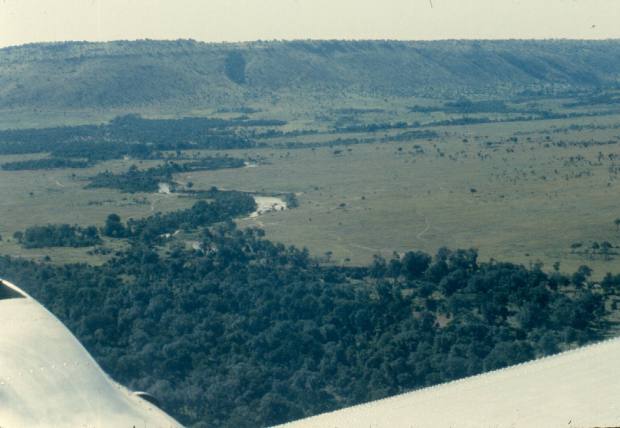
The Mara River from the DC3 when it did regular flights between Nairobi and the Maasai Mara.

A fish bite was invariably followed by frantic efforts to recover the line in an attempt to get it out while avoiding it getting entangled in the various branches and water plants. However, if you were lucky or perhaps unlucky? and hooked a large fish, the task would become much more difficult as the fish would try to escape by getting inside the branches. In addition, there was the “crocodile problem” as the reptilians would be alerted by the fish splashes and immediately come to “investigate” and get our fish so fast recovery was a must to avoid losing our trophies as those lost “en route” to anything such as snags or crocs would not count.

Paul did quite well and caught more than me. However, Tobias was the star and clear winner. He probably knew things we did not, through years of fishing “for the pot” during his early years near lake Victoria. His technique was simple, almost too simple. He chose to use a hand line and threw it very close to the shore. In this way, he avoided a lot of the snagging and did not suffer too badly from line and hooks losses like us wazungu[4]. He will then wait a short while and pull them out, almost unfairly easily!

mmara-camping-with-catfish-and-tobias-copy

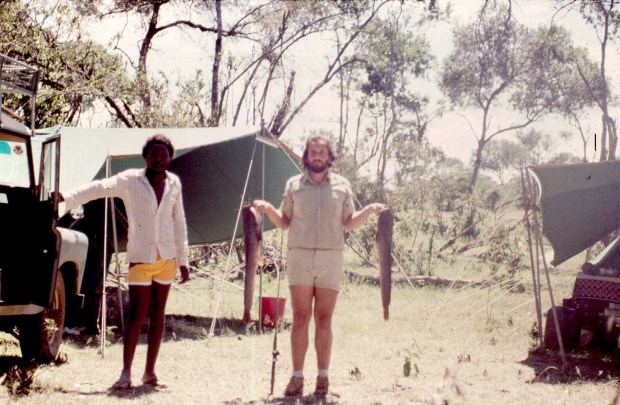
Tobias and the Bushsnob with some of the spoils.

Tobias was delighted, not so much for having won the contest but, much more importantly for him, for having the possibility of feasting on fish for a few days! Although later on we tried the catfish, Paul and I agreed that they tasted like we imagine the Mara River mud would do and, luckily for Tobias, we declined further offerings.


[1] Saucepan in Kiswahili.

[2] See: https://bushsnobinafrica.wordpress.com/2016/12/13/memories-a-fishing-trip/

[3] See: https://bushsnobinafrica.wordpress.com/2015/11/05/javelin-throwing-almost-olympics-games/

[4] In Kiswahili, white man. See: https://en.wikipedia.org/wiki/Mzungu

Two dhows

Traveling to the warm Kenya coast was an attractive break from working inland in the cooler and often cold highlands. After trying a few options, the preferred choice was to rent a house for a few days at Watamu and, from there, to explore the surrounding area or to enjoy the beach for my wife and practice windsurfing for me. But that is another story.

Our first visit to the coast included staying at a rather hot camp in Diani beach that we did not repeat. During that visit we explored Mombasa and we got lasting impressions of its ocean and coastal area, particularly Fort Jesus and the old Mombasa harbour.

While at the Mombasa harbour, apart from the ubiquitous fishing boats we saw some larger vessels that seemed to be dedicated to cargo activities. It was also the first time that we saw (or learn of) dhows. These, rather elegant vessels anchored some distance away from the shore and surrounded by smaller boats that were busy offloading them during the cooler hours of the day.

boats-mombasa-harbour-8-16-03-pm-copy

The Kenya coast in the 80s.

To add to their rather romantic reputation, we also learnt that these sailing boats, with their main masts pointing forward and lanteen sails, would use the trade winds to commute between Africa and Asia with exotic cargo.

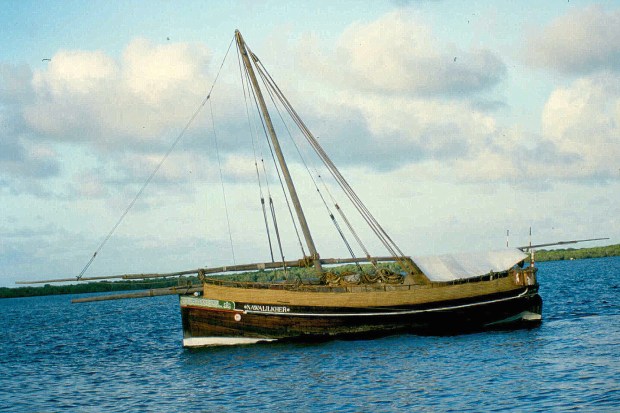
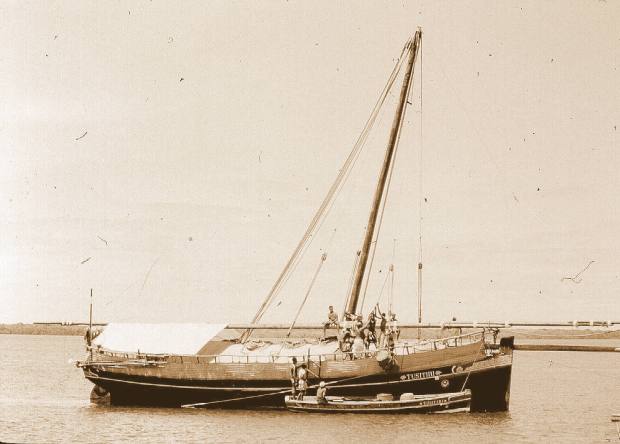
I found pictures of the dhows recently while looking for images to place in my Instagram page. As the photographs were originally taken as slides with a film camera and later on scanned by myself, I was checking them critically to decide on their quality for the intended use. It was during this process that I noted the names of the dhows: Nawalilkher and Tusitiri.

dow-mombasa

Nawalilkher in the 80s.

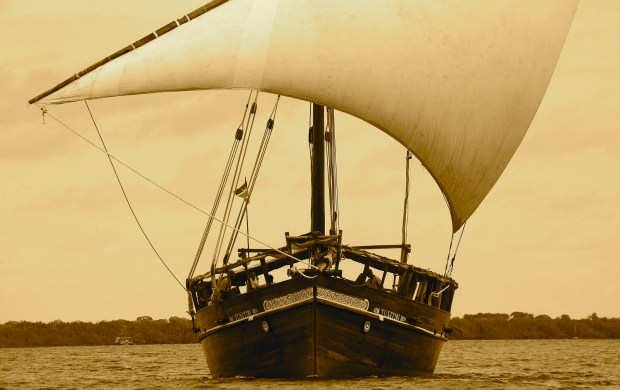
lamu-7-sepia

Tusitiri as we saw it in the 80s.

Curious, I Googled the names to see if, by any chance, they were still with us. To my surprise I not only found them but learnt that they seemed to be still in “active service” forty years after I took the pictures and probably quite a few more from the time they were built.

I then contacted the owners and they confirmed that the vessels were the same after looking at my photographs and I got some interesting information.

Nawalilkher is now a floating restaurant with the Tamarind Group and they call it “Nawali” for short. The dhow was refurbished to a five star cruising restaurant now moored at the Mombasa Tamarind jetty. The vessel can accommodate seventy commensals for dinner, leaving room for dancing on the night cruises. It sails everyday except Sunday for both the day and evening cruises. Unfortunately, the company would not let me use their pictures to illustrate this post and referred me to their web site for more information[1].

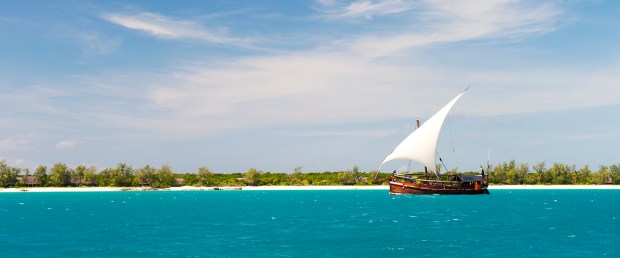
Tusitiri, nicely restored, is sailing as an exclusive floating lodge along the Indian Ocean coast, owned by the Enasoit Collection[2]. It is believed that it was bought by its present owners around 1995 in Lamu where she was also originally built. I was also assured that the dhow is being treasured by them and is very much loved as I can see by the way it is being kept. It mainly stays within the Lamu archipelago but it has gone as far as Mozambique and she is considered by its owners as “…without doubt the most beautiful dhow on the East African coast”.

vamizi2012_1115cr-copy

The restored Tusitiri sailing somewhere at the Kenya coast. Picture credit: The Enasoit Collection.

sea14_highres-copy

A great picture of the restored Tusitiri. Picture credit: The Enasoit Collection.

I must admit that I am quite pleased to have found the dhows again and clearly it is worthwhile to follow up certain things, as you never know where your search will take you.


[1] See: http://www.tamarind.co.ke/tamarind-dhow/

[2] See: http://www.enasoit.com/


Acknowledgements and credits

John and Lulu Clark, Managers of Tusitiri Dhow, The Enasoit Collection for the information and use of Tusitiri pictures. Pictures of Tusitiri by Robin Moore Photography and/or Stevie Mann Photography.

Akoko Vivian of Dhow & Rest Reservations of The Tamarind Group confirmed the identity of Nawalilkher and assisted me with useful information.

Lord of the (dead) flies

While living in Maputo (Mozambique) we rented a house that came with a gardener, as it is usually the case very in these places. His name was Erasmus and he was a very easy-going and religious young man. Often in the afternoon we were regularly treated to a choir of holy hymns when he and the afternoon security guard sang together. We later learnt that they were at the choir at the same church and they were rehearsing. I must admit that -as it is the norm in Africa- they sang very well.

The house was built in an area of Maputo liable to flooding and, perhaps because of the humidity and heat, we had a serious problem with flies. The latter became an issue during the rainy season, despite us keeping all rubbish in sealed containers that were removed regularly.

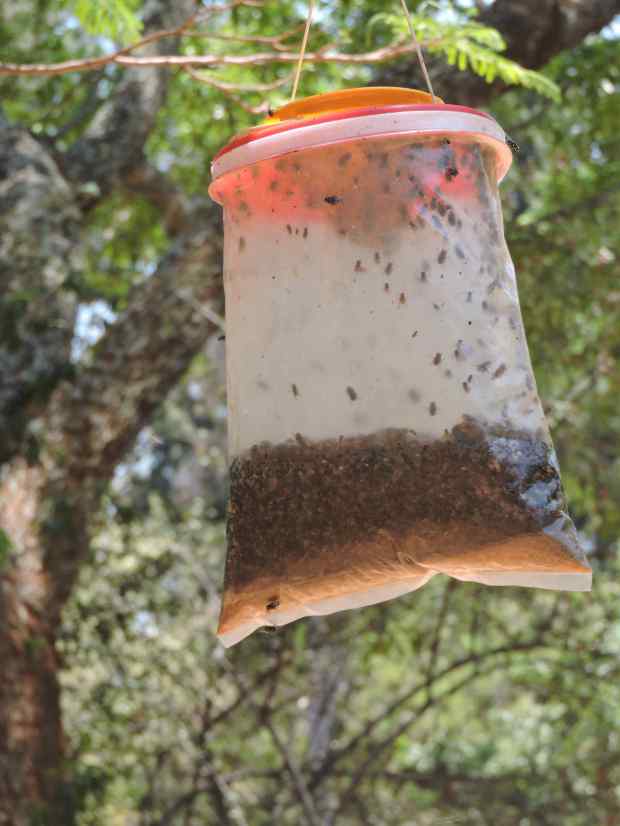
After some search we found the solution: a flytrap, a transparent plastic contraption that, when filled with a smelly solution, would attract flies to it where, unable to escape, they would die.

cropped-dscn9926-copy.jpg


In consultation with Odette, our housemaid, the trap was placed by the kitchen door with the objective of intercepting the flies before getting into the house. The siting was an instant success as, after a few days, flies began to get trapped. Then we confronted a problem: the smell! It gradually increased as more flies accumulated and soon Odette started to make remarks about the fedor[1] that started to emanate from the offending trap.

After a couple of days of putting up with the stink, Odette moved the trap away from the house without opposition as, despite being of small complexion, she was clearly in charge of the household personnel by virtue of being the employee closest to us.

The trap stayed in the new location, close to the security guards’ changing quarters, for a few days until they staged a “mini demo” to protest about the stench and Odette agreed to hang it far away, under a casuarina tree where its smell did not interfere with anyone.

Peace restored, the contraption continued to hammer the flies but soon it filled to near bursting point and it became less effective as no more flies would be able to get in anymore. So, Odette stroke again! She asked Erasmus to empty it. Poor old Erasmus had no option but to accept Odette’s request, being her sidekick.

The above background to this saga has been reconstructed afterwards talking to the various participants and witnesses as at the time I still had working duties.

I was at home when I heard a strange noise in the garden and went out to investigate. I saw Odette overseeing Erasmus work from a prudent distance. Erasmus -looking quite sick- was busy emptying the trap while pausing frequently to move away and take deep breaths of pure air while trying to keep his lunch down! Eventually, the job was done and Erasmus started to look his normal self while Odette looked rather amused! I am sure that it was probably his toughest assignment ever.

It was a very quiet Erasmus that walked past after completing the cleaning and that got into the toilet. It was too evident that he needed a long shower to be allowed on public transport to get back home!

After the operation, the trap was not cleaned again, a decision that I suspect followed some hard bargaining between Erasmus and Odette. In 2013 I retired and we left Maputo so the flytrap was packed away and it disappeared from our memories. Since then we have commuted between Uruguay, Argentina and Zimbabwe, avoiding the winter as much as possible.

Harare, being at about 1,500m of altitude has an extremely pleasant climate and it is almost fly- and mosquito-free for most of the year but some flies start to appear just before the rains and their numbers increase when it gets wet. Last year (2016) , the rains started on time and the flies were more numerous than normal.

A consensus was reached between my wife and Stephen -our caretaker- that preventive action was indicated to keep the flies in check. So, lo and behold, the infamous flytrap re-appeared! I immediately remembered Erasmus and felt sorry for Stephen but kept quiet…

This time, as experienced users and with the benefit of hindsight, we placed the trap far from all forms of human and pet habitation and positive results did not take long as the trap had not lost any of its effectiveness. Flies came in in numbers, again probably from the whole of our neighbourhood and, as it happened in Maputo, after about a week, it was obvious that a cleanup was needed.

dscn9924-copy

My thoughts immediately went to Stephen and I was totally taken by surprise when my wife asked me to do the cleaning! “What about Stephen?” was my immediate response. “He is going to the rural area tomorrow, to prepare the land for planting” was her reply. I found this as a very suspect situation and I even thought that Erasmus had intervened in a long-distance revenge!

So it was the trap and I! I decided to take the only course of action left to me: my often practiced procrastination to see if I could last until Stephen’s return and delegate the task to him. To my regret I failed as some flies were spotted in the kitchen despite my efforts to kill and hide the corpses.

So, like Erasmus before me, I braved the cleanup. I have to confess that I had an advantage over Erasmus as my training and practice as a veterinarian had exposed me to a variety of emanations from decomposing nature. I also found a good face mask (from the times of the flu pandemic scare!) that I decided to wear, apart from rubber gloves.

When I believed I was ready, I went for it! Remembering Erasmus, I refrained from eating prior to the event. I unhooked the trap from the tree without major problems and I sprayed its contents with insecticide to kill the flies that were still alive inside. Emptying it was not as easy as it looked. Being lazy I tried to do it without removing the lid but this was not possible. Opening it became inevitable.

img_2744-copy

This action created a blast of malodorous miasma that hit my covered nostrils at full blast. The smell nearly knocked me off my feet and I decided that it was time for a pause to think (read “to keep all my innards in their right places”). At that stage I remember poor old Erasmus again as even the photographer used a powerful zoom to take the shots shown!

The pause worked and I managed to empty the trap from its burden and re-charge it with fresh water and powder so that it could continue functioning. I was quite happy to set it up again as I knew that the next cleanup would fall on Stephen and it would be my time to watch!

After hanging the newly-charged contraption I needed to dispose of the fly bodies by burying them as recommended to prevent any flies’ eggs from hatching. As an added precaution I also sprayed the fly mass with an insecticide and buried them deep.

The procedure over, I was triumphant for a while, until flies started to come towards me, mistaking me for the trap (now clean and smell-less) as I must have stunk badly although I was unable to smell anything at the time and for a while afterwards. Flies still followed me into the house when I entered to have a badly needed shower.


[1] Stink in Portuguese.

Black tea in Maasailand

There are incidents in life that have a strong influence in the future and although the improper use of a microhaematocrit centrifuge may not be the commonest of examples, it had an impact on mine.

In short, while working at a colleague’s laboratory in Muguga, I forgot to place the inner lid over the blood-filled capillaries. The result of a short spin -I switched the machine off immediately- was a bloodstain at tummy height all around, including the people present! Basil, the Head of the Laboratory while watching his own red mark at waist level, made only one comment in the best British understated style: “Julio, you need a PhD” and abandoned the room leaving me alone to clean up the mess!

muguga-isolation-unit

My usual “laboratory”, quite far from Basil’s!

Basil’s words sunk in my mind and I decided to attempt a PhD as, clearly, I needed more scientific training, in addition to learn how to properly use a microhaematocrit centrifuge! Through a Muguga colleague I managed to get in touch with Cambridge University in the UK where I was -to my surprise- accepted. Unfortunately my initial enthusiasm got quickly dampened when I learnt about the university fees and the option was quickly discarded.

After more enquiries I learnt that I could do a PhD as an external student at my former Department of Applied Zoology of the University of Wales. So, very soon, I had organized the study at a small fraction of the cost. Luckily Ian, a Lecturer and friend from the Department, agreed to be my external supervisor while my ICIPE colleague Robin kindly agreed -apart from being my tick ecology teacher- to take on the day-to-day supervision of my work.

The rules of the PhD were very strict and they included a visit by the external supervisor to Kenya. Fortunately, Ian planned to present a scientific paper at an International Protozoology Conference[1] held in Nairobi in 1985 and the time was very suitable for the review of my work.

int-conf-protozoology-nbo-ian-herbert-copy

Ian, right, and a smart Bushsnob attending the Conference.

Most of my fieldwork was carried out at Intona ranch[2] in the Transmara. So, when the time for Ian to come to oversee my work, apart from the more routine visits to the main ICIPE office in Nairobi and to our Muguga laboratory, the exciting part was a trip to Intona itself. In those days, the Transmara area was an uncommon and rather exciting destination in Kenya.

As usual, the trip required some organizing, particularly as I did not wish to give a bad impression to my Supervisor during his only review of my work! I got authorization from the always kind Murumbis to stay at the main house at the ranch and to get their staff to look after us.

t-mara-intona-ranch-j-murumbi-1-copy

The main house at Intona ranch.

The one-day journey to Intona was an enjoyable one as we drove by the Maasai Mara Game Reserve where animales were always very abundant and then crossed the bridge over the Mara river to climb the Oloololo escarpment through Lolgorian to, finally, get to the ranch where we settled down and spent the next three days looking at our trials and analyzing my data.

Images of the journey, above and, below, some of the work we reviewed at Intona ranch.

The afternoon of the day after arriving, knowing that Ian was a great tea drinker[3], I decided to treat him to some five o’clock tea at the house’s back verandah where there was not only a beautiful view of the parkland and wildlife surrounding the house but also some very snug chairs.

I asked the cook to use some good Kenya tea I had brought for the occasion and we sat to chat, waiting for the fresh brew to arrive. We did not wait for long before the teapot came with the necessary milk and sugar. Tea was served while we contemplated the various art objects that decorated the verandah while the cook -trained by Sheila- discreetly withdrew.

I poured the tea and the milk and drank it while enjoying the both the taste as well as the view while Ian drank his. We talked about the journey and the animals we had seen, particularly during our stopover at the Maasai Mara but also during our trip when close to Intona. Seeing that Ian had finished his cup, I offered him more. To my great surprise, he politely declined!

When I insisted, making a comment about the tea being good, Ian mentioned that he found it with smoky flavour that he found rather unusual and too strong to his liking. Then I realized that our milk supplier was a Maasai lady from a manyatta nearby and, when I had a look at the milk, I confirmed that I had overlooked a detail: the milk was grey with a rim of dark froth!

With my apologies, I confessed to Ian that, in my enthusiasm to treat him to a proper “cuppa”, I had overlooked that our milk came from the Maasai who added a few pieces of charcoal to the milk gourd! Although Ian did not change his mind regarding drinking a second cup, he was very amused about the reason for the smoky flavour.

Although I knew that a few drops of cow urine were also added as a preservative to the milk, I did not mention it to Ian!


[1] The VII International Congress of Protozoology Held at the Kenyatta International Conference Centre, Nairobi, Kenya, 22-29 June 1985.

[2] See: https://bushsnobinafrica.wordpress.com/2015/07/08/life-and-work-in-kenya-intona-2/ and https://bushsnobinafrica.wordpress.com/2015/06/01/intona-ranch1/

[3] His favourite saying was: “Whenever there is a crisis, have a cup of tea. Many times the problem goes away after that”.

Bush cats…

While in Kenya, when a couple of friends departed, we inherited two neutered cats. They could not have been more different. One was a marmalade coloured male that went by the name of Tigger. The other one a seal-point Siamese female named Inky. While Tigger was an indoors fat and lazy youngster, Inky was an outside cat and an excellent hunter that forced us to make our bird feeder and bath cat-proof to prevent a disaster.

When our time to leave Kenya came, we were very attached to them and we decided to take them with us. After the needed health certificates and a special double box that would enable them to have eye contact through wire mesh, we were ready to go. The plane trip was not too far as we were going to Addis Ababa.

It was an easy trip and we found no difficulties on arrival at Bole airport. However, negotiating their stay at the Harambee Hotel in Addis Ababa for the days needed to prepare our long trip to Bedele in West Ethiopia was more time-consuming and it required some protracted negotiations. Eventually, permission was granted, provided that they remained inside our room!

After a few days, our travel permits were ready, we had a vehicle, petrol and petrol coupons as well as a stockpile of food to last us for a couple of weeks. We were ready to set off, at last. The journey from Addis Ababa to Bedele via Jimma was about 420 km in terms of physical distance but because of the traffic -particularly people and livestock walking on the road- it took the whole day to complete, with a bit of luck!

finchaa-tick-count-2-copy

On the way to Bedele.

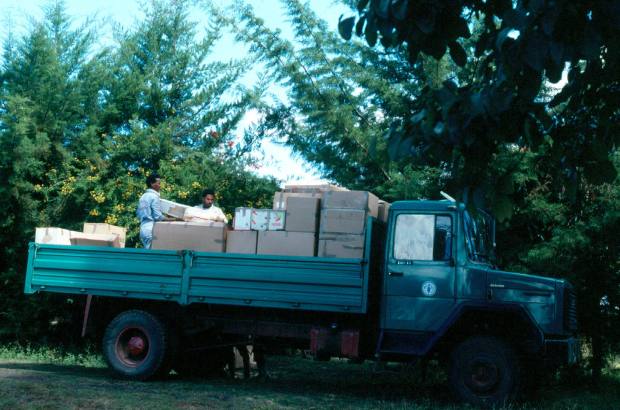
Auspiciously, our maiden voyage went well and we eventually arrived in Bedele in late evening. We managed to get the keys of our cottage from the Administrator of the Veterinary Laboratory and moved into the house we would live in during the following two years. That night we camped in the house as we were only able to travel with the few possessions that we could carry in the pick-up. Our furniture and other household items would arrive later via an FAO lorry as, at that time, there were no moving companies operating in Ethiopia’s countryside.
bedele-packing-fao-lorry

The arrival of our personal effects.

Immediately after arrival our cats got on with their job: Tigger found a place to sleep and Inky started to inspect the house and its environs while calling for attention, before settling down with us to spend the first night in the Ethiopian bush. Starting the following morning, our interaction with our Ethiopian and foreign colleagues assisted us greatly to settle in and, with the arrival of our belongings a few weeks later, we managed to make the place quite comfortable. Eventually we developed a very good vegetable garden and, while Tigger relaxed, Inky was active keeping garden enemies at bay.

Unexpectedly Tigger started to follow Inky during her sorties to the outside world, cautiously at first but eventually accompanying her on her hunting expeditions although we did not think much of his contribution!

It was during an evening that we were involved in book-reading while listening to some opera music, our favourite evening activity in Bedele, that Tigger stunned us. It all started when we heard a kind of meowing that was new to us. Fearing some cat tragedy we immediately went to investigate its origin. We did not need to go too far as we met Tigger while entering the house carrying something in his mouth, followed by Inky.

As soon as he was under the entrance lamp we could see that he was triumphantly carrying in his mouth the most humongous rat I have ever seen. While I was amazed to see this my wife was consternated as she has a problem with rodents, particularly rats and mice. It was not a Giant rat or a Cane rat but one of the grey rats that are a pest the world over. But it was a “super rat”!

I failed to calm things down by saying: “he brought the rat to us to show off…” Before I finished my sentence, I noticed that the rat was alive and, sooner than I could say anything else Tigger let the rat go inside the house! I expected that he was just playing with it as normal cats do but, to my dismay, not only Tigger but also Inky (the huntress) were looking the other way while the rat made frantic efforts to escape from the house!

The situation was a bad one and I will never know why he opened his mouth! My theory is that, as soon as he saw his catch under the house light, he got so terrified that preferred to forget the possible glory and cut his losses! Although I failed to see it at the time, today, many years later I can understand the cats’ reaction as the rat was a true monster. However, I am still to forgive them because their indifference meant that it was up to me to sort out the situation!

Mayhem followed the rat’s release! My wife climbed on a chair threatening me with going on a cooking strike if I did not kill it while the guilty cats disappeared with their tails between their legs!  I was alone with Super rat! The first thing I noted was that it had no plans to surrender peacefully. As usual, it was fast and it immediately found a crack in my defenses and it squeezed through a badly closed door and got inside the kitchen, the worst scenario as far as my wife was concerned. My situation deteriorated by the second!

I followed it but when I entered the kitchen and managed to switch the light on, the rat had vanished! Swiftly, my wife slammed the door behind my back, oblivious to the fate of her husband, and then it was Super rat and I in a duel to the death, if I could find the villain.

Although our kitchen was a small affair it was rather packed with goods for us to survive our rather isolated life in a war-thorn country and away from shops! I had a look and realized that the rat could have been anywhere and that to find it would have been a laborious and even dangerous task that could prolong well beyond midnight!

So, I procrastinated -not for the first or last time in my life- and sat there for a while before announcing the rat’s absence to the incredulity and displeasure of my wife. However, she eventually though reluctantly accepted the status quo. Swearing at the cats we went to bed and, luckily, the following morning I opened the door of the kitchen and convinced my wife that the rat had gone. It worked and I was thrilled to be unharmed.

The rat incident forgotten, our cats continued to live regal lives, enjoying the large track of land surrounding our house and stalking the various birds that visited us. Luckily, I did not see them catching any but they did repeatedly ambushed a “rescued” Egyptian goose we kept for a while until it decided to depart, and watched for hours on end a pigmy kingfisher that was brought to us by a boy from the village and eventually released. They also enjoyed playing with a young duiker that outsmarted and outran them all the time.

As they seemed to be well entertained and busy, I cannot understand why they decided to expand their circle of friends and get in touch with some wild neighbours at the back of the garden…

We learnt about the new situation when we started to hear a high pitch barking in the evenings that we attributed to foxes. Eventually we saw them at about one hundred metres from our house, near the perimeter fence of the station. After watching them for a few days we identified them as a pair of side-striped jackals (Canis adustus) not without some surprise. We decided to keep the find to ourselves for fearing of they being chased off or killed.

mc-and-pets-bed

My wife walking in the garden with cats and duiker. At the back is where the jackals were.

We realized that the jackals were residing under some heavy iron pieces that should have been an incinerator that was never assembled. Our sightings became more frequent and then we realized that pups had arrived so we derived good entertainment from them as we saw them often and heard them every night.

One day the cats were nowhere to be found. At first we were not alarmed, as occasionally they would temporarily disappear. However, when they did not turn-up by the afternoon, we decided to search for them before it was too dark. After fruitlessly checking around the houses, we extended our search to the compound, increasingly worried.

Eventually we saw them at the bottom of the garden, in the area where the jackals were! “Gosh”, I thought, “They are dead meat” and run towards the area to see what I could do while cursing them for their stupidity. When I got closer, however, I noticed that not only the cats were unharmed, but that they were engaged in a kind of hide and seek exercise with the wild jackals, both adults and pups!

I then realized that this was not a new development but a relationship that had existed for a while and a kind of “friendship” had developed between our lazy and well-fed cats and the wild canids. I left them alone and the cats returned to our house later unharmed. The cat-jackal interaction continued for a few weeks but they never came close to the houses and eventually, when the pups matured, the jackals moved off.

As for the giant rat, a few days after the jackals’ disappearance, while blindly searching for some cans in the kitchen, I touched a hairy and warm “entity” and realized that this was not what I expected to find. Careful removal of the surrounding cans and jars caused the rat to jump out -almost hitting my face and stopping my heart- and run off into the open, never to be seen again. I believe that Super rat had taken residence there since the time of its arrival.

Luckily my wife was not there while I removed all evidence of the presence of Super rat. It was a tough job that required that I cleaned the nest in which I could identify shreds from some of my working reports and documents that I thought I had misplaced!
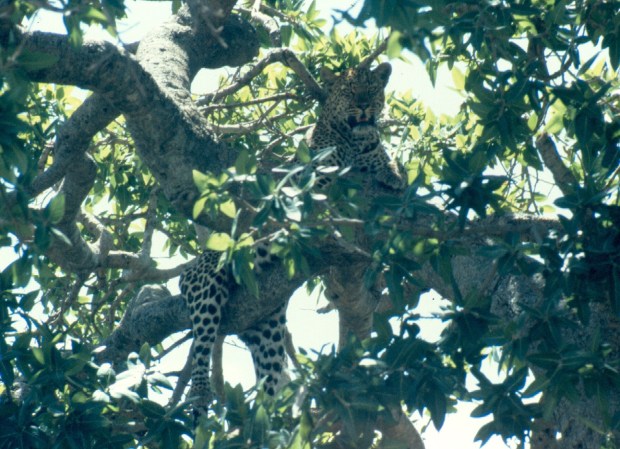
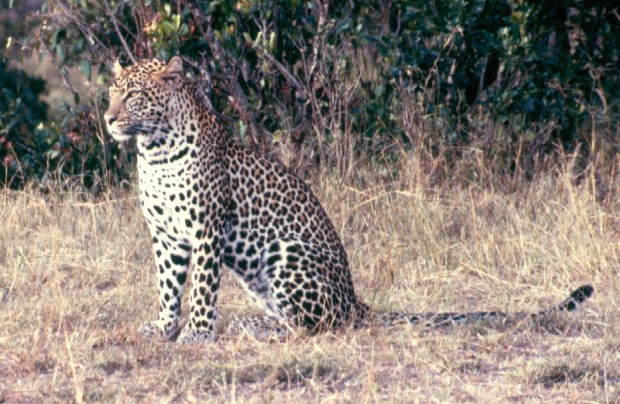


Memories – A fishing trip

Thomas was one of our Maasai askaris[1] at Intona ranch. He liked cattle so, in addition to his guard duties, he often volunteered to take them for grazing. This was welcome as he was fearless when it came to walk in the bush and dealing with the buffalo herd that often intermingled with our cattle. It was rather amazing to see the herdsmen and Thomas separating our cattle from the buffalo herd!

Intona cattle grazing

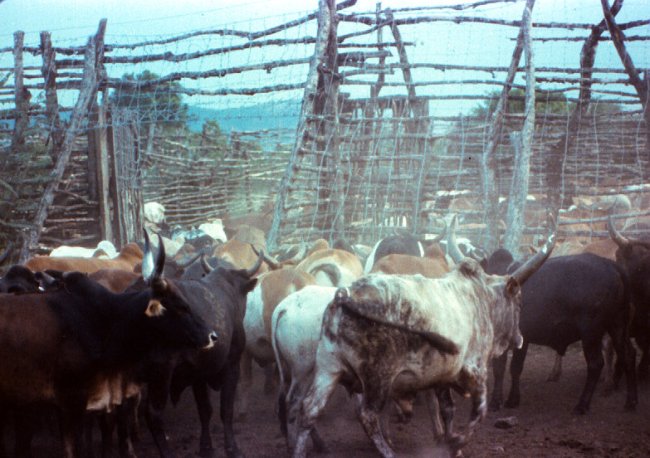
Intona cattle kraal

Thomas was a very friendly young man and he got on very well with the other workers so, when I proposed to the workers to join me in a fishing trip, Thomas was very keen on the idea and he came along.

During the time of the fieldwork I often travelled to Intona ranch over the weekends, as I also needed to spend time working in Muguga on the laboratory trial during the week so time was short. Although there was some work to be done on Sundays, we tried to keep this to a minimum so that we had time off to rest and relax. Being rather restless I was always looking for some activity to do during this free hours. For this visit I had brought some fishing gear as I wished to try my luck in the Migori river, one of the boundaries of Intona ranch.

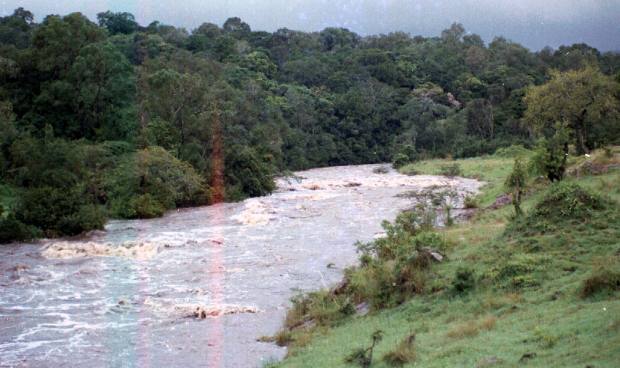
migori-flooded-cropped

The Migori in flood. We fished from these banks.

The Migori river water ends in lake Victoria after it joins the Gucha river forming the Gucha-Migori river basin. During every trip that we came to Intona via the Maasai Mara we crossed the Migori river bridge about 10 km before we arrived to Intona ranch. The area was well forested and there were a number of large fig trees in its vecinity making it a very attractive area as the shore of the river before the bridge was open grassland and seemed safe from the presence of buffalo, the main danger in the area.
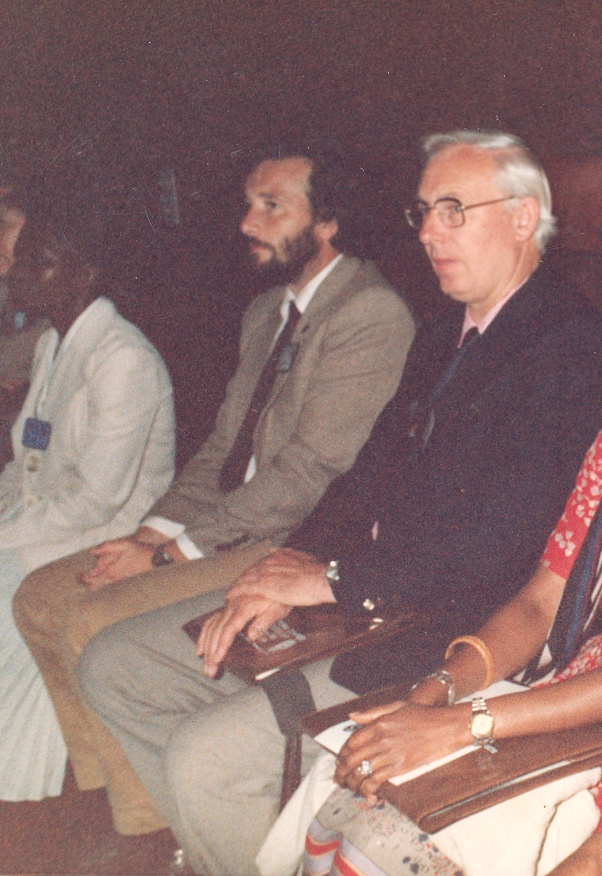
It was in this bend by the river that we often saw a sounder of Giant Forest hogs[2] (Hylochoerus meinertzhageni) grazing in this clearing. As these dark grey animals were a rare sight, it was a highlight of the journey for me whenever we spotted them, as they were quite tolerant of our presence with their impressive size, the males being about 100cm high and up to 190cm long with a mass ranging from 180 to 275 kg. Their name honours Richard Meinertzhagen who shot the type specimen in Kenya and had it shipped to the Natural History Museum in England in the early 1900s.

This “hog spot” is what I chose for our fishing expedition as, apart from catching fish, I also hoped to get a glimpse of these animals towards the evening. Our fishing targets were Clarias gariepinus or African sharptooth catfish. We had fish them earlier in the Mara river just outside of the game reserve and I saw no reason for them not to be in the Migori.

After fruitlessly digging for earthworms at various places in the bush I remembered Mrs. Murumbi’s greenhouse and garden at the main house and, after a short commando sortie we managed to get a handful from the large compost kept there.

The final preparation for the fishing trip was to run a tutorial on the basics of fishing as none of my companions had done this before, as they did not come from fish-eating ethnic groups. Aware that it had taken me some time before I could master the proper use of rod and reel, I decided that I would handle these equipment and prepared a couple of hand lines for my companions to use. We chose an open field and, after a while I judged that the team was as good at fishing as it could be so we went.

We left before lunch and took some food and non-alcoholic drinks for lunch and my companions were quite excited at the prospect of trying a new activity. Thomas in particular could hardly control his excitement and this somehow dented my understanding that the Maasai did not care for fish. Maybe Thomas was the exception?

After a quick lunch under the shade it was time to try our luck. I gave hand lines to Thomas and Joseph, I kept one rod and gave the other one to Mark. As expected, the earthworms were attractive as I felt them biting as soon as my hook landed.

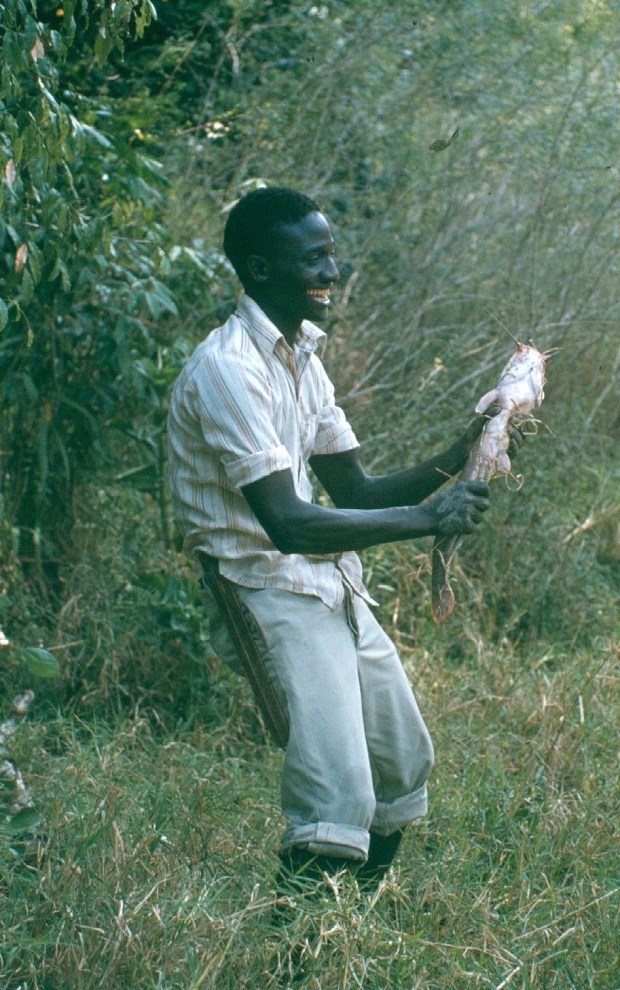
Somehow, Thomas got lucky and hooked something that after a short struggle with a rather thick hand line happened to be a reasonable catfish. After a short squabble he soon had it out of the water and his happiness at his feat was incredible. It held the fish with both hands looking at it and laughing while talking to it. He said that he would eat it, something I found strange but, busy with my own fishing, I did not pay much attention. So, Thomas departed to clean his fish. We continued fishing and had some bites that, regrettably, resulted in clean hooks.

maasai-that-got-cut-with-fish-migori-river-copy

Thomas and the fish!

After a while we noted Thomas’ absence but, distracted by our own fishing, did not think much of it. After a while longer of not seeing him and knowing that many dangerous animals were present, we stopped fishing and went searching for him. Joseph went one way and I took another path thinking that like that we increased our chances of success.

After walking perhaps 100 m following the river I saw Thomas seating down against a tree and I called him but did not reply. I called him again but still no reply so I assumed him to be sleeping and got closer to wake him up and then I saw his unsheathed simi[3] and the pool of blood. He had a bad cut in the palm of his right hand that was bleeding profusely and he was very pale.

I shook him and he opened his eyes and, still smiling, looked at me. He was weak but alive and, lifting his wounded hand above his head, I helped him to walk towards the car, calling Joseph to come and help. He appeared and, between both of us, we took him to the car and drove him with his hand bandaged and up outside the car towards the Lolgorian seeking medical assistance.

Maasai lived rather dangerous lives. Not only they fought often among themselves with serious consequences but also, as I described in an earlier post, they were constant skirmishes taking place at the time with the Kisii ethnical group that was moving into the Transmara. As if this would not be enough, they walked through the bush where many dangerous animals dwell. Although they do not fear them, they often suffer the consequences of encounters with wild animals, in particular with African buffaloes as these animals camouflage well and attack by surprise and without notice.

This way of life explained why the Lolgorian clinic was very busy that Sunday afternoon. Concerned about Thomas’ condition, I entered the hospital running and went straight to the emergency room asking for a doctor. A nurse pointed me to an European young guy in white that I assumed – correctly as it turned out – that he was a doctor.

I hastily mentioned that I had an injured person that needed his help and he gave me a rather tired look and motioned to me to look around. In my haste I had not paid attention to the “waiting room”! There were at least five people waiting before Thomas. A couple looked sick with malaria but the others were suffering from various traumatic accidents. I remember one that was holding his bloodied abdomen and another that had almost severed his large toe. It was clear that Thomas would need to wait.

Without much ado the doctor asked me to help him and I spent that Sunday afternoon cleaning wounds and helping him to stitch the severed toe and to close an abdominal wound caused by a buffalo horn! I was shocked by how stoic people were throughout the proceeds and this included Thomas’ stitching, comparatively a minor affair.

After finishing with Thomas, we thanked the doctor and left. During the return journey with a much more recovered Thomas, we learnt that while gutting the fish he had tripped and fell. During the fall his right hand had slipped over the length of the simi’s blade and had cut his hand very deeply.

With a much-recovered Thomas we arrived to the fishing spot at dusk where, before we collected all our fishing gear abandoned earlier, we had the privilege of watching the gian forest hogs! Thomas, now feeling strong again, collected his fish and, laughing again, assured us that he was going to eat it!


[1] An askari (from Arabic) was a local soldier serving in the armies of the European colonial powers in Africa. The term is still used today to informally describe security guards.

[2]  Listed as of “Least Concern” as they are relatively widespread, it is acknowledged that there is a general decreasing trend for the species across its range. In Kenya, Ethiopia and South Sudan Giant Forest hogs live also in very fragmented populations.

[3] A short sword used by the Maasai people with a leaf-shaped blade. It is kept in a scabbard made of wood and covered with rawhide.

Upset Maasai

Intona 2 and Tommi copy

Tommi checking the cattle at Intona ranch.

As I mentioned in earlier posts about my work in Kenya, Tommi was one of the herdsmen working with me. Regrettably he passed away in a car accident a couple of years after I left Kenya, the sad consequence of a very common event in that country where unsafe public transport claims an excessive number of innocent lives.

Tommi frequently accompanied me to Intona ranch with great pleasure as for him it meant “going home”. He was not exactly from the Transmara area as he came from Narok but he was close enough to the Maasai around Intona to feel well among them.

This was a great contrast to herdsmen belonging to other ethnic groups, such as Benson above, that did not relish spending time in Maasailand. This was particularly obvious among the Kikuyu workers that could not wait for me to relieve them from their duties and take them back to their homeland. I still remember their voices getting louder as soon as the Kikuyu escarpment came into view after Narok! We, outsiders, do not often realize how foreign parts of a country can be to other nationals, product of some arbitrary divisions decided by their colonizers.

In the case of the Maasai people, their territory got split between Kenya and Tanzania when the straight line from lake Victoria to the Indian Ocean coast was drawn as the border between these two countries. Eventually the line did not end as a straight one. This was not the consequence of Queen Victoria giving Kilimanjaro to her grandson Wilhelm to meet his complaints of not having a high mountain in Tanzania as it is often believed, but part of the treaty of Heligoland through which Germany abandoned some places in the Kenya coast, receiving in compensation the Island of Heligoland in the North Sea.

Night watchmen Benson adn Tommi Intona copy

The herdsmen and cattle guards. Benson in blue and Tommi in white.

The herdsmen lived at a tented camp at Intona and their presence attracted both vervet monkeys and baboons. Over the years that the camp was there the monkeys gradually became more cheeky as they got used to taking food from the camp. This was an annoyance to the herdsmen and Tommi in particular took exception to the primates’ shenanigans.

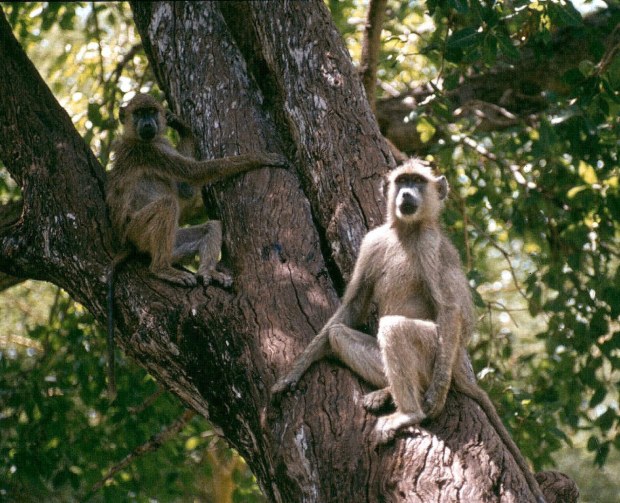
Tsavo W baboon best copy

Mwizi’s relatives.

There was one particular individual that Tommi identified and called Mwizi that in Swahili means thief. He was able to recognize that particular animal and he maintained a long feud with it. The baboon seemed to know this and kept a wide berth from the man! For a few months a truce seemed to have been worked out but one day Mwizi overstepped the mark. (!!The baboon took advantage of a distraction and broke open Tommi’s bag of maize meal spilling its contents all over the tent.!!) This was the proverbial straw and the last act of misbehaviour that would be would tolerated.

Tommi decided to take exemplary action against the intruder. Before I tell you what happened, let me tell you that the Maasai social structure is based on a system of age-sets. This applies primarily to men, as women become members of the age-set of their husbands. Successive age sets, at about five year intervals, are initiated into adult life during the same period forming a cohesive and permanent grouping that lasts throughout the life of its members.

The age sets go through successive milestones that are celebrated as ceremonies. Among these are, to name a few, Emuratta (circumcision), Enkiama (marriage) and Eunoto (warrior-shaving ceremony)[1].

Tommi, like all Maasai boys had undergone their circumcision and became Sipolio (recluse). This is an important step into manhood (and warrior-hood) and, after this somehow dreaded event, the newly circumcised boys roam around the countryside dressed with dark garments and armed with bows and arrows. They shoot blunt arrows at girls as part of their social interaction. They also use the same arrows to kill small birds that they skin and place around their heads, together with ostrich feathers. During this time they acquire excellent skills with the various weapons.

In view of the above it is not difficult to imagine that Mwizi’s fate did not look good. I was not aware of the development of this feud at the time so its finale took me by surprise. After a day’s work, I was getting ready for a wash and tidying up my own camp when I heard the commotion, or rather Mwizi’s screams. It is not normal to hear a baboon screaming unless there is some kind of danger, so, expecting some leopard-mobbing, I rushed to the place where the screams where coming from.

There was no leopard but another kind of drama was unfolding. Tommi, looking upset, was circling a tree near the cattle kraal. Once closer, I realized that he had managed to tree the baboon and he was about to execute his revenge. He carried a few stones and he was trying to get the best angle from where to throw them at Mwizi! I felt sorry for the beast but the events moved too fast and the adrenalin was flowing on both sides so I could only watch from a distance, keeping my own head down!

I imagine that some stones had flown before I arrived and this explained the baboon’s alarm calls. The first stone I saw Tommis’s throw at the terrified beast missed it by a few inches and, Mwizi moved to the top of the tree. At that time Tommi said “I got it now” and threw another stone that must have passed a couple of cm from the baboon that now offered a clear view. This was too much for the monkey that was now in a serious panic with the consequence that it emptied its bladder first and soon afterwards the rest followed.

I have mentioned earlier that I do not like baboons while camping but I could not help feeling sorry for the poor creature so I did the unthinkable: I negotiated with Tommi on behalf of the victim! I managed to calm Tommi down and he agreed to leave the terrified animal alone. Seeing that the siege had relaxed, Mwizi climbed down in a flash and disappeared into the bush.

Vervet monkeys and baboons continued to visit our tents and behave in their usual opportunistic ways taking food items from us so we really needed to take care at all times. As I could not recognize individual baboons, I took Tommi’s word that Mwizi was not among them and that it had migrated to another troop in the Transmara, away from its deadly enemy.


[1] Among the many books describing the Maasai culture I would like to recommend “Maasai”, written by Tepilit Ole Saitoti and illustrated by Carol Beckwith.