Memoirs

Episodes of my life in Africa.

Unpredicted friends and unforgettable dates

The morning of Saturday 17 July 1982 (I remember this day well!) we got up early to pack our car with camping gear for a safari to the Maasai Mara Game Reserve. We had booked the Sand River campsite for a couple of nights.

We were about ready to go when, totally unexpectedly, someone walked into our front garden! It was a messenger from the Kenya Posts and Telecommunications Corporation coming to deliver a telegramme, the first we had ever received! As we had no working telephone in the house (and cellular phones were not yet invented!) a telegramme was almost the ultimate in urgent communications. Being far from home, it also carried a dose of dread as it could carry bad news from home. So, with wonder as well as some trepidation I read it, trying to prepare for the worst.

Its contents were surprising and shocking but good! It read: “We arrive tomorrow” and it was signed by two of our best friends: Nazar and Aurora. That was that, not even a date! We were thrilled that they had finally decided to come to Kenya. We knew they were travelling to Piediluco, Italy to accompany their son Juan José that was rowing at the 1982 World Rowing Junior Championships representing Uruguay and we had insisted that they extended their journey to visit us although we knew that this would be very difficult for them!

Our initial elation turned into mild panic when the fact that they could be at the Jomo Kenyatta International airport (JKIA) at the time of reading the telegramme sunked in! Expecting the worse we immediately drove to JKIA as we knew that most flights from Europe would arrive by mid morning. We were on a rather blind chase and during our journey we did a lot of speculation, not only about their arrival but also on contingency planning regarding our planned safari.

Our fears that they had arrived the day before and were stranded at the airport unable to communicate were unfounded and perhaps exaggerated as a thorough examination of the arrival area gave no results. Unable to get any passenger information from the possible airlines we decided to stay put and wait. After about an hour or so, a few flights from Europe arrived within thirty minutes. We crossed our fingers and, eventually, we were rewarded when our friends emerged looking dazzled at what they were seeing around them but otherwise unaware of our earlier dilemma and very happy to see us.

It was an emotional reunion and, after an exchange of the usual family news, I casually announced that we were aware of their long journey but that we were off to the Maasai Mara, leaving as soon as possible. As expected (they had no real choice!) they gallantly accepted the invitation and, after passing by our house to finish our packing, we set off with their luggage still unopened!

Nazar, had a tiring trip, and he was also suffering from a gut complaint. His time during the journey to the Maasai Mara was spent drinking abundant amounts of warm cola and going into episodes of slumber until, by the time we got to Aitong, a few hours later, he started to talk nonsense with me, a sure sign of his slow recovery. Aurora, on the contrary, was wide awake and did not miss detail, asking questions all the time and gaining in excitement as we moved from Nairobi to the Kikuyu escarpment, the breathtaking Rift Valley views, Narok and beyond into the great green plains of the Mara-Serengeti ecosystem.

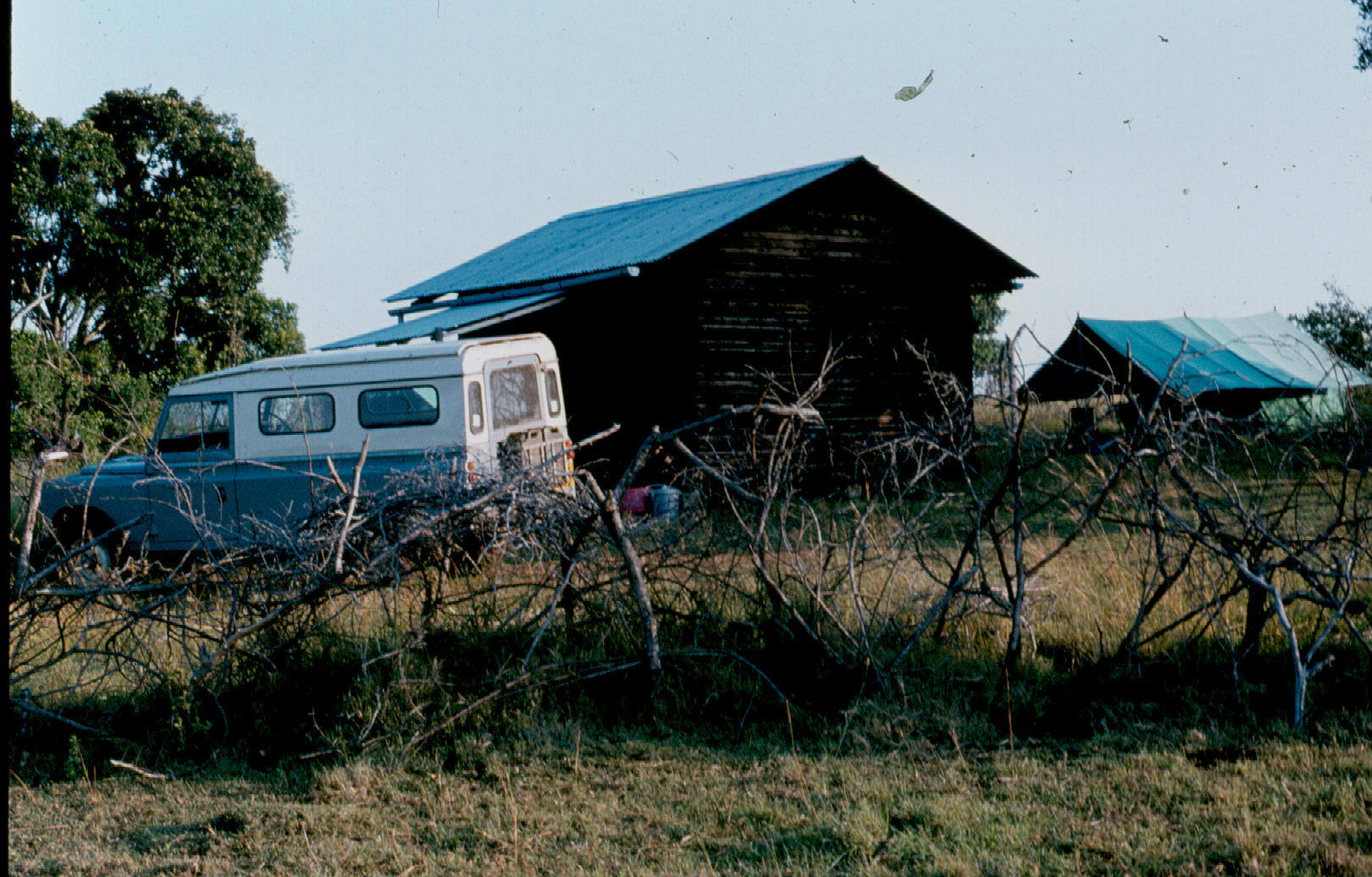
Because of our late departure, I drove non-stop and despite the rough road, we managed to get to the gate in time to get to the Sand river camp by the Mara river at dusk. Without delay we started unpacking and finished setting up camp using our car headlamps, as was the norm with us then.

While this was on going, our friends watched, not moving too far from the car, still rather confused with their situation. Our work was cut short, as already in Nairobi they had decided to sleep in the car. Luckily for them, removing the second seat of our loyal VW Kombi was relatively easy so soon they had their nest ready. As soon as we finished with the car arrangements my wife had heated our ready-made dinner brought from home and, although we still had a lot to talk about, we were so exhausted that we went to sleep early.

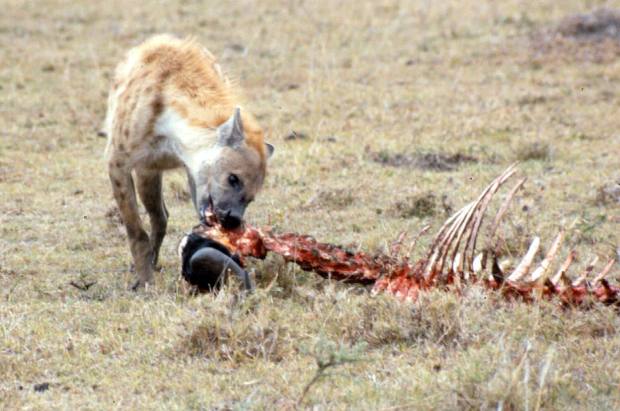
Camping at the Sand River was ever exciting as there were always plain game in its neighborhood, particularly wildebeest and zebra that, somehow enjoyed crisscrossing the Mara river offering, apparently unnecessary opportunities to their reptilian predators. Their presence also attracted lion and hyena so there were always nocturnal happenings! That night was quieter than expected but still the hyenas came close to camp, their calling amplified by the river. We did not fail to hear lions roaring in various degrees of proximity, above the constant wildebeest snorting and zebra whinnying. Thinking on our friends’ time in the car, we paid the price for our rather busy day and passed out before long.
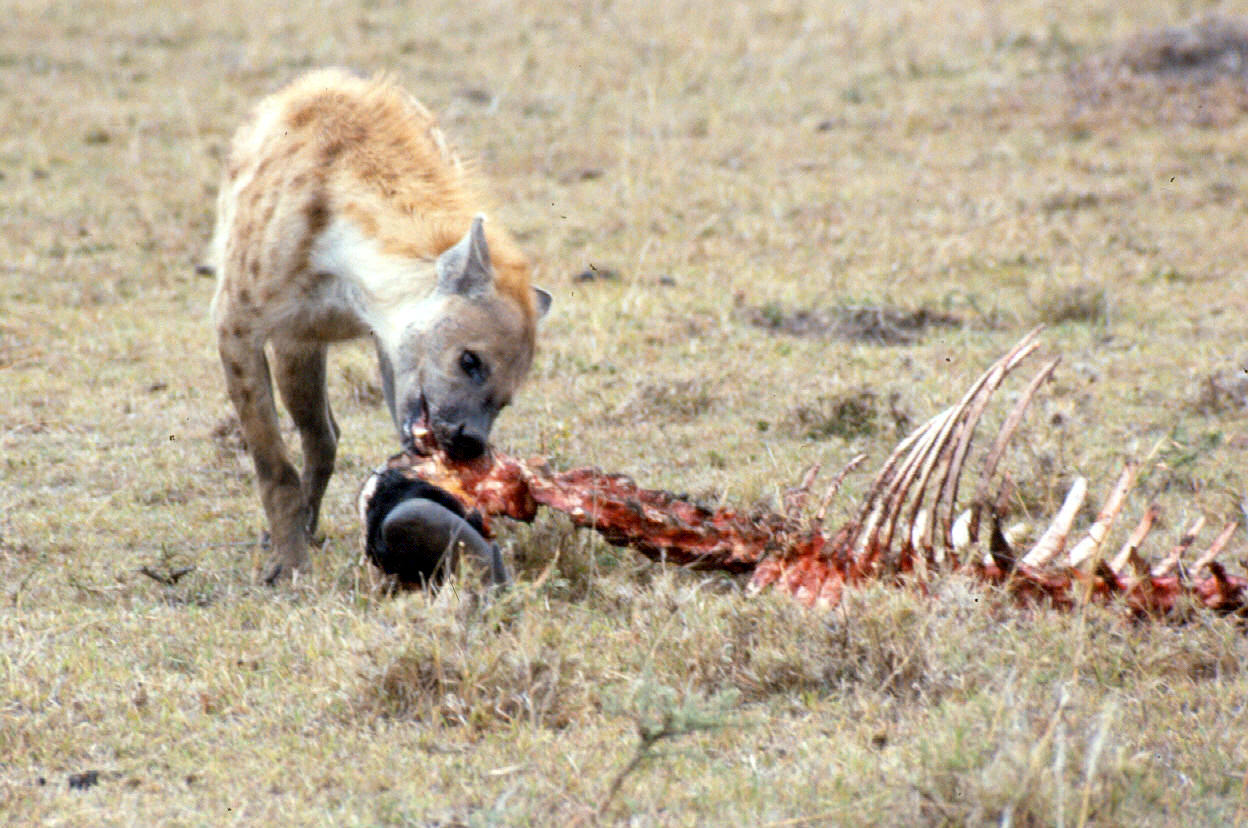
mmara hyena 2

The following morning, recovered, I got up early as usual and prepared tea and coffee waiting for the other fellow campers to show life signs. My wife emerged eventually but no movement was detected inside the car! A quiet inspection of it showed it to be unscratched. Its windows were totally foggy and I had some concern about whether our friends have had enough oxygen inside there as the car was tightly shut!

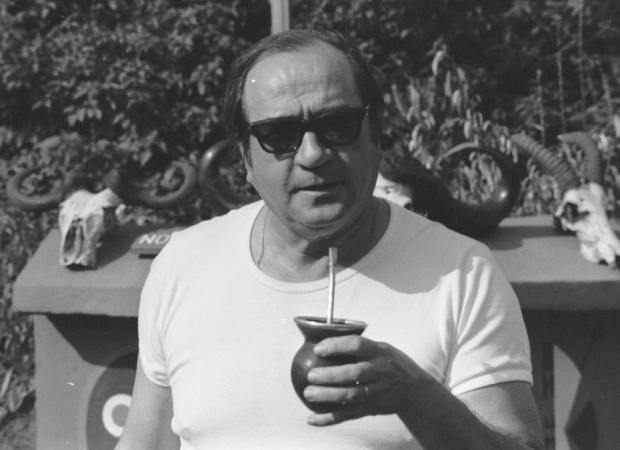
My fears were unfounded as, eventually, a hand started to remove the fog from the side window and the smiling faces of our friends showed gradually behind the glass. Eventually they left their protective and damp metal cage to join us for a rather late breakfast and they shared their mate[1].
nazar m mara

Nazar offers a mate to the photographer.

As usual with first time visitors, they have heard nothing the whole night as they had slept like logs! We finally had a chance to finish exchanging pending news at leisure.

Fortunately they were fast to adjust and gradually they became used to our ‘bush ways” joining us on a couple of game drives during which they greatly enjoyed what they saw. The frequent appearances of the imprudent hyenas and the lions roaring were not conducive to us persuading them to abandon their cage the following night and they still preferred their airtight environment to the risks of camping in the bush. We understood them well as it had taken us longer than that to get used to camping “al fresco” surrounded by wild beasts!
nazar y aurora 8.35.44 PM

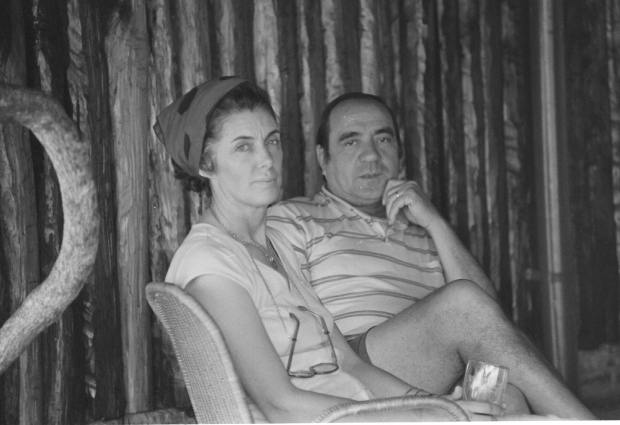
Our friends relaxing at the Mara Serena lodge.

We returned to Nairobi after two nights. This time they were able to appreciate their surroundings much better, including the always-interesting sight of the Maasai people and their manyattas and livestock and they were delighted with the daylight return journey.

Later on during the week we showed them Nairobi and the wonderful Nairobi National Park and later travelled to Nakuru and Bogoria for a view of the Rift valley, its hot springs and flamingoes. Luckily, they loved the experience but time passed very fast and it was soon time for them to depart, too soon for us!

Their plane left back to Europe at midnight on Saturday 31 July 1982 so we took them to the airport early and made sure that they went through all the departing procedures early until the time came to leave them once they have checked-in to return to Tigoni late at night. Unused to driving at night, we negotiated several road blocks that we thought too many but, as we drove a car with red diplomatic plates, our going was smooth and we got home safely.

The following morning we had arranged with our friend Ranjini to go to the Nairobi National Park so we travelled to Muguga through back-roads to fetch her. Once there she announced that an attempt to overthrow President Moi’s government had taken place at midnight and that there were serious confrontations going on in Nairobi between the Police and students! Apparently, a group of soldiers from the Kenya Air Force had taken over the Voice of Kenya[2] and announced that they had overthrown the government!
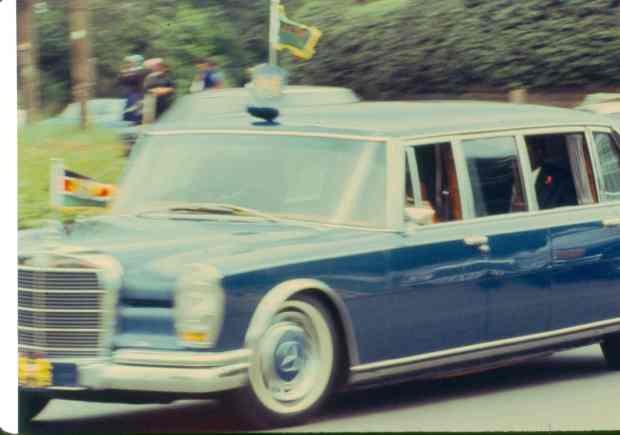
moi

A bad picture I took of Moi’s cavalcade before knowing the risks involved!

We thanked Ranjini for the news and quickly turn around heading for home as fast as we could! During the journey we met a large military convoy ready for war heading for Nairobi but we did not know what their stance was at the time! Luckily they ignored us and we, the sole occupants of the road by now, got home safely where we remained -listening to the BBC radio for the latest news- for the following three days until it was confirmed that the attempt had failed[3].

It was lucky that our friends just managed to get away (a while) before the Kenya airspace was closed and that they were over the clouds when all this happened! They remained unaware of their narrow escape until we met them back in Uruguay a year later when they listened to us in disbelief!


[1] Traditional South American caffeine-rich infused drink, prepared by steeping dried leaves of yerba mate (Ilex paraguariensis) in hot water and is served with a metal straw from a shared hollow calabash gourd and shared among drinkers.

[2] From 1989 it became the Kenya Broadcasting Corporation.

[3] The coup failed. The Air force pilots that meant to bomb State House dropped their bombs over Mount Kenya and eventually, after ruling Kenya for a few hours, Hezekiah Ochuka, a soldier in the Kenya army, escaped to Tanzania. He was eventually extradited back to Kenya, found guilty at a high profile trial that involved both Oginga Odinga and Raila Odinga, and eventually executed in 1987.
 

Fire down below

After a few months after our arrival in Kenya in the 80’s[1] we eventually left the Muguga House hostel for Tigoni where we rented a large house belonging to the Harvey family. Tigoni is about 40km northwest of Nairobi, on the eastern side of the Rift Valley at over two thousand metres of altitude. Indigenous forest islands still remained then, among the large tea plantations. Several animal species still inhabited the area, the most notable being the conspicuous Black-and-white Colobus monkeys during the day and the bush babies at night, with their loud and somehow scary calls.
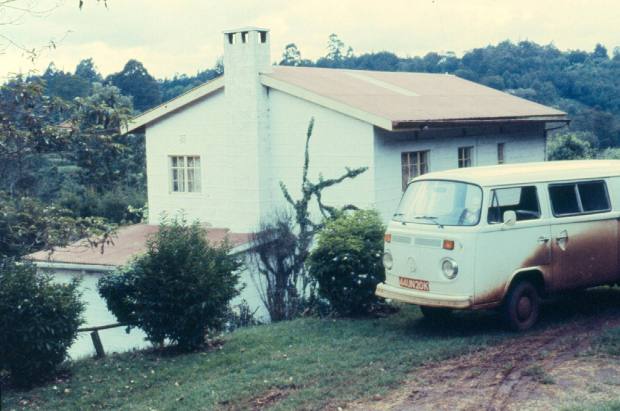
tigoni house

The land at the back of the house had no fence or wall (imagine that today!) and therefore we were able to walk towards the nearby stream located about two thousand metres down hill.

A Sunday that we were not camping in the bush, we invited our friend Ranjini for lunch and,  afterwards, we decided that going down to the river was a good idea to help digest our food. So, armed with our binoculars and wearing long trousers to protect ourselves from thorns and ticks, we set off. About half way down the red and slippery hill our “private” path joined a “public” wider lane where the local inhabitants went about their business rather than fun walking like us.

tigoni hse bfast 1

We soon arrived to the stream and, after walking about the area for a while; we found a shady spot where we decided to have a small walkers consultation to decide our next steps. The ideas put forward were whether to continue up the other side of the ravine or to return the way we came and enjoy a cup of tea at home. The latter was gaining consensus when, without warning, a fire started in my ankles and started spreading up my legs. I saw no smoke but noticed that I was standing in the middle of a colony of siafu![2]

The nasty meat-eaters, amazed by their lucky find, were not wasting any time in processing it! Without wasting a second and forgetting about being normally shy (?), I downed my trousers in a flash (excuse the pun) and checked my hurting parts. What I found was not encouraging: a few dozen soldier ants had climbed up the inside of my trousers. While some had already locked their jaws on my pink flesh, others were still going “upwards”…

Yelling “siafu!!!” to alert my companions, I started to grab and remove those still trying to reach tender places and, only when I smashed them all, I focused on removing those that had already bitten me and were going nowhere. This is easier said than done! Pulling them in a hurry (what else can you do?) only makes their bodies detach, leaving their heads with their rather outsized jaws still embedded in you! While this was going on, my companions, luckily looking the other way, moved off fast and left me alone to deal with the aggressors. Before they moved off, I caught a glimpse of their expressions that did not help. Instead of seeing sympathetic concern or at least indifference towards my predicament, they were amused! I am still trying to forgive them for this!

It was in the middle of my painful struggle when I became aware that I was still being watched. I turned around and saw that my antics had gathered some public! A growing bunch of Kikuyu kids were carefully watching me. Once discovered, they started to make comments, pointing at my nakedness and, worse of all, they laughed loud! I was clearly a “first” for them but that failed to amuse me. I told them -mainly with gestures aided by my basic Swahili- to go away. They only moved back a couple of paces, unwilling to stop watching the sight of their childhood: how a half-naked muzungu[3] “danced with ants”.

(Almost) embarrassed and in a desperate effort at damage control I immediately lifted up my trousers. Although this calmed down the young Kikuyu crowd, it did nothing to placate my traitorous companions’ enjoyment of the scene of my distress! So, ignoring everybody, with a great effort I put on my best neutral face, and started walking back to the house, still bringing with me a considerable number of large ant jaws for later extraction.

Despite my rather unpleasant experience, siafu are not a bad thing as they control a number of otherwise harmful pests for crops and their storage. They also take care of other undesired beasts such as ants, roaches, spiders, and everything else that crawls or creeps. Later, while busy un-plucking mandibles my thoughts did focussed of their beneficial side but, although I could somehow see it, it did nothing to relieve the consequences of my encounter!


[1] See: https://bushsnobinafrica.wordpress.com/2015/06/30/life-and-work-in-kenya-muguga1/ and https://bushsnobinafrica.wordpress.com/2015/03/10/kenya-muguga1/

[2] Siafu (in Swahili) are members of the Dorylus genus, also known as driver or safari ants. They are army ants between 1-15 mm in length found primarily in central and east Africa in large colonies (up to several million individuals). They move in columns as they travel from their lair to the hunting field or they spread when actively hunting by sensing the carbon dioxide that insects and animals breath out. Aggressive soldiers protect the colonies.

[3] A common term used to refer to “white” people.

Not just dinner

Kenya became independent on 12 December 1963 when Kenyatta became its first President and Odinga the Vice President. Not surprisingly, in 1965 Kenyatta and Odinga fell out, and Murumbi (Joe) was named Kenya’s second Vice-President for a few months until he resigned in December 1966[1].

As described before, I became involved with Joe through the work we did with Alan Young on tick and tick-borne diseases. He wholeheartedly supported our work. As with all scientific work, a substantial amount of time was spent writing research proposals in order to get the funds to continue with the research. Once the funding is secured, donors visit your field sites to see for themselves the activities being performed with their funds, the conditions of work, applications, progress, etc. These visits are critical for the future of your investigations and that was the way that they were also understood at the institute I was with. This meant that all should go smoothly and a good performance was expected.

I had several such visits but none as important as the final evaluation of our tick programme in the mid 80’s. Laboratory and field work came under the magnifying glass and, as it is quite normal our results were mixed. My part of the bargain was going well as we had good collaborators and achievable goals. Our partner with the highest profile was of course Joe and, in addition, nature was a great partner. Soon the donors knew that Intona ranch and its surrounding area -including the Maasai Mara- were beautiful areas worth a visit and this was good for us and we used it to our advantage!

The organization of a “high level” visit needed lot of work as guests would usually fly to the Maasai Mara where I would meet them and look after them until the following morning when we would climb the Oloololo escarpment and drive about three hours to Intona, hoping that the rains were light and we did not get stuck in the various tricky spots we needed to cross and spoil our trip! Usually our journey would take us to the manyatta (Maasai dwelling) of the Maasai Chief to inform him of our visit and to our GTZ collaborators, if applicable. The visit would last two days during which our work was shown and presented and future prospects discussed in detail. We were of course very fortunate that Joe and Sheila (his wife) allowed us to put them up in their magnificent house.

t mara intona ranch j murumbi 1

Joe and Sheila’s house at Intona ranch, Transmara, Kenya

During this particular visit Joe and Sheila were at Intona. They normally flew directly to the ranch, together with their dogs! Aware of the importance of the occasion they kindly offered to organize a dinner for our guests. This was not an everyday event, but I had joined them for dinner a few times before and I knew that it would be a formal occasion with excellent hospitality and very good food.

The day of the visit arrived and I collected our visitors from Kichwa Tembo Camp, located close to the Oloololo escarpment and, after a game drive that they thoroughly enjoyed in the surrounding area of the Maasai Mara

m mara small cropped

The Wildebeest moving through the reserve.

-that I knew very well- we spent the night there to leave early morning for Intona. The road was good and, once there, we devoted the rest of the day to visit our field activities. They seemed pleased with what they saw. I was also pleased and looking forward to the dinner to close a long day.

The Intona area is under the influence of the near lake Victoria and it frequently rains for a short spell in the afternoons. As a consequence the sun sets in a cloudy sky resulting in the most glorious and colourful sunsets. Aware of this Joe positioned the house in such a way to be able to make the most of them by having a wide west veranda where we congregated often to talk and have a drink before dinner. That day it was no exception and we joined Sheila and Joe for sun downers and polite conversation until Sheila, the perfect hostess and a very experienced one, announced that dinner was ready. While walking to the dining room she came close and whispered: “Julio, we have a new cook that came with us from Nairobi, I hope it will perform as he has excellent recommendations”. Knowing her standards I had no doubts and told her so.

trans mara

A view of Intona ranch in the Transmara parkland.

The dining room had a door to the kitchen and another one to the enormous and beautifully decorated sitting room. It had the most exquisite antique wooden table and chairs and antique rugs, most probably of Afghan origin, covered its floor. I knew from past dinners that under the rags at the place where Sheila sat there was a bell that she will press in order to call for assistance from the staff. This was her “secret weapon” that enabled her to coordinate things so perfectly that the guests would be amazed. Needless to say that it was a candlelight affair with lots of silverware and crystal!

When the first course came, brought by staff dressed in white with purple fezzes, it was a brownish coloured soup that looked rather disappointing. Trying it did not improve its look: it had a strong curry flavour and it was chilled! “I hope you like our Mulligatawny soup” said Sheila while she gave an approving look to the new cook that was overseeing the dinner from a discreet distance. Your concerns about the soup dissipated the moment your spoon found some submerged resistance that transformed itself in a spoon tip full of cranberry jam. The combination was simply amazing!

After our praise of the soup ended, the staff came back to collect our plates and this time the new cook looked happy and smiley, “the success with the soap was a boost for him” I thought while noting a serious-looking Sheila. By the time the roast beef with Yorkshire pudding and roast potatoes was brought in, the cook was definitely too happy and talking loudly to the visible embarrassment of our hosts. Sheila, used to deal with the highest-ranking world figures, ask to be excused and went to the kitchen, an unusual event. In the meantime, we enjoyed our roast that was really excellent.

Soon, Sheila came back announcing that all was well although she could not hide her concerned expression. We understood her fears the moment the cook opened the door of the kitchen when the staff came to collect the plates. The cook proffered, rather loudly, his hopes that we enjoyed the main course while trying to keep steady. By then we could not help noticing the strong alcohol whiff and knew that the worse had taken place! The spirit meant to go into the cooking had been “diverted”!

Although the guests and Joe were rather amused, Sheila was visibly upset! She excused herself again and went to the kitchen. We could not help overhearing a loud argument or rather Sheila’s shouts! There was a door banged and the sounds of a scuffle. She came back; her usual cool almost lost and red on her face. As an experienced host, she re-gained her composure fast and invited us to move next door to the sitting room for coffee and liquor. I stayed back with her as the guests and Joe moved out and Sheila -unseen by the guests- looked at me as if asking for support and understanding. I made my best “do not worry” gesture and moved to the sitting room together with the guests. She remained behind.

Intona sitting room copy

We all sat in the ornate sitting room and overlooked the cook’s episode, listening to Joe. Although soft spoken, he was a great host and a very engaging story teller with great tales and anecdotes from his many years in politics. We listened for quite a while until more noises coming from the kitchen area hinted that all was still not well and then Sheila reappeared –now with a grimace- to announce that the cook would like to say good bye to the guests! “Oh, no”, I thought, “is the situation that bad!”

The cook appeared escorted by the night watchman and a couple of staff and boisterously said “bye-bye!!!” but did not move and tried to say something but what came was a rather loud burp followed by another “bye-bye!!!” After this performance he was immediately manhandled out of the room, still saying “bye-bye!!!” and waving at us until the door was closed behind the group. I still vividly remember his final wave just before the door was shut! Confronted with this final act, even Joe was briefly embarrassed while the guests and I were quite amused!

The following morning Sheila and Joe were leaving for Nairobi and, as usual, I escorted them to the plane to assist them with their luggage, dogs and other items that they needed to take with them. They were sorry for what had happened. I felt very bad to have put them in this situation and explained them that I was very grateful for their hospitality and, to their obvious relief, I also told them that the donors were very pleased with the work and also very proud to have had the opportunity to have met them and enjoyed their hospitality, including the cook incident.

Before closing the door of the plane I spotted the cook. He was seated at the very back, looking penitent. I could not decide if his rather sombre looks were a consequence of his hangover, Sheila’s morning sermons or a combination of both!

The next time I was invited for dinner at Intona there was a new cook!


[1] See: https://bushsnobinafrica.wordpress.com/joseph-zuzarte-murumbi-1911-1990/ and https://bushsnobinafrica.wordpress.com/2015/06/22/joe-1/ in this blog.

Hyenas and planet-gazing

The morning after the Maasai chicken dinner a good breakfast was in order! We prepared bacon and eggs to compensate for our austere meal of the night before. In an attempt at avoiding another fasting episode I offered to take over the next dinner and to roast the beef we had brought from Nairobi.

Camping at Intona ranch.

Camping at Intona ranch.

After breakfast, another day of routine field trials followed, as we needed to do many replicates of our tests in order to confirm the results. We worked without stopping until late afternoon when we decided that we had done enough and it was time for a shower and to prepare dinner. As a South American I am ashamed to confess that I am fearful of horses and prefer to keep a good distance from them. That is not all, I am a real disaster at barbequing! Therefore, on the occasion I struggled through and I made sure that the food was abundant and we ate our fill.

The night was truly spectacular. The relative short distance of Intona ranch from Lake Victoria meant that it rained very often. It poured in late afternoon and then the sky cleared at dusk. The consequence was that the rains cleaned the air and the night sky was always very sharp.

Ernest and I stayed awake until late talking and contemplating the pristine sky. We talked about many issues, occasionally stopping to listen to the night sounds, in particular the spotted hyena calls getting closer to our camp. Getting gradually bolder they moved close to the periphery of the light of our camp fire. I reassured Ernest that this was a normal event when camping at Intona and that “normally” hyenas would not be aggressive.

Despite the good time we were having, we have had a long day and we felt very tired so soon we went to bed. As soon as we were inside the tent we heard something sniffing all around our tent. A white-tailed mongoose was seen scurrying away when we shined our torches. That small mystery solved, it was back to bed, hoping that sleep would come soon.

Not so. This time it was a loud crush outside the tent that also merited investigation. This time a hyena was the culprit! The beast had grabbed a dirty pan and had taken off at speed. We run after the beast but it was a futile effort and came back to bed thinking on resuming the search for the pot in the morning.

mmara hyena 2

A Brown hyena with wildebeest carcass in the Maasai Mara. Its cousins visited us nightly at Intona.

While thinking and hoping that normality would return, I finally fell sleep. Again, it did not last long. It may have been 03:00 hs when I heard Ernest opening the tent door zip. My first thought was that his gut had finally lost the fight against the filtered water drunk on the way in! In addition, aware of the hyenas I remained awake although without moving, hoping to go back to sleep immediately. No chance! Ernest came back and started to shake me up shouting “Wake up, the sky is perfect to look for planets!” I felt like slaying him but, remembering his partial deafness and on account of his contagious enthusiasm, I made the mistake of getting up!

By the time I managed to go out of the tent, Ernest was already looking through the binoculars, identifying the various noteworthy celestial bodies, accompanying his successive discoveries with shouts of joy! Although I had enjoyed contemplating the night sky both in Uruguay and in Kenya, I have never been that interested in astronomy. However, he convinced me to look at Jupiter (a small orange sphere) and even managed to see Saturn and what I though were its rings! Finally Ernest’s excitement subsided and we managed to hit the camp beds again, this time until the sun was up!

The large ball of crunched aluminium that we found about one hundred metres from our tent was not the remains of a recent asteroid that had narrowly missed us but all that remained from our cooking pan after the hyenas had squished it to get its juice.

Although our cooking options suffered another severe setback we still managed to produce some pan-less and chicken-less dinners during the following days!

Skewered Maasai chicken

When I was there in the 80’s the International Centre of Insect Physiology and Ecology (ICIPE) in Kenya had established various partnerships with universities and research centres outside Africa. I was involved with the collaboration with the University of Neuchâtel on tick pheromones. The idea was to explore ways of attracting ticks to pheromone-baited traps and, with the addition of a tickicide[1], to destroy them.

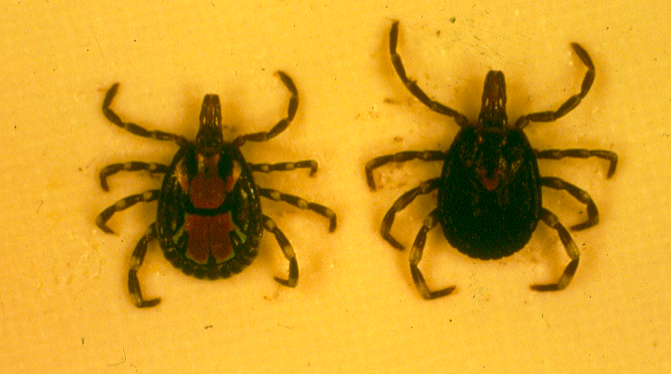
Bont ticks male (left) and female. A bad picture.

Bont ticks male (left) and female. A bad picture.

The composition of the aggregation pheromone of the Bont tick[2], one of the important cattle ticks, had just been discovered. It was a mixture of three chemicals that were available commercially. This offered us a good opportunity to test this compound in the field. Ernest was the scientist from Neuchâtel that would work with me at Intona ranch where natural populations of the tick occurred.

Ernest was a very enthusiastic and good-humoured Swiss that had a hearing problem as a consequence of firing cannons during his military service in the Swiss Alps, forgetting about wearing earmuffs! Luckily, we got on well from the start. So, armed with the necessary research tools, we departed for Intona to spend a few days doing fieldwork.

As a precaution, we did take a few ticks from the tick colony in case the bush ones would not cooperate! Crossing the Maasai Mara Game Reserve was never disappointing and, as usual, we spent a night there on the way to the Transmara where Intona was located. Ernest was delighted being able to see the plains game and we wee also lucky to spot elephants, lions and hyenas.

In the morning, as usual, we laboriously climbed the Oloololo escarpment and stopped to admire the breath taking view of the Mara triangle from its highpoint. The almost aerial view that it offered was really thrilling, even for me, a regular visitor to the area. Lines of wildebeest could be seen in the distance as well as dark patches that indicated buffalo herds. As I knew he would, Ernest loved the view. After spending a long while in contemplation, it was time to continue our long journey.

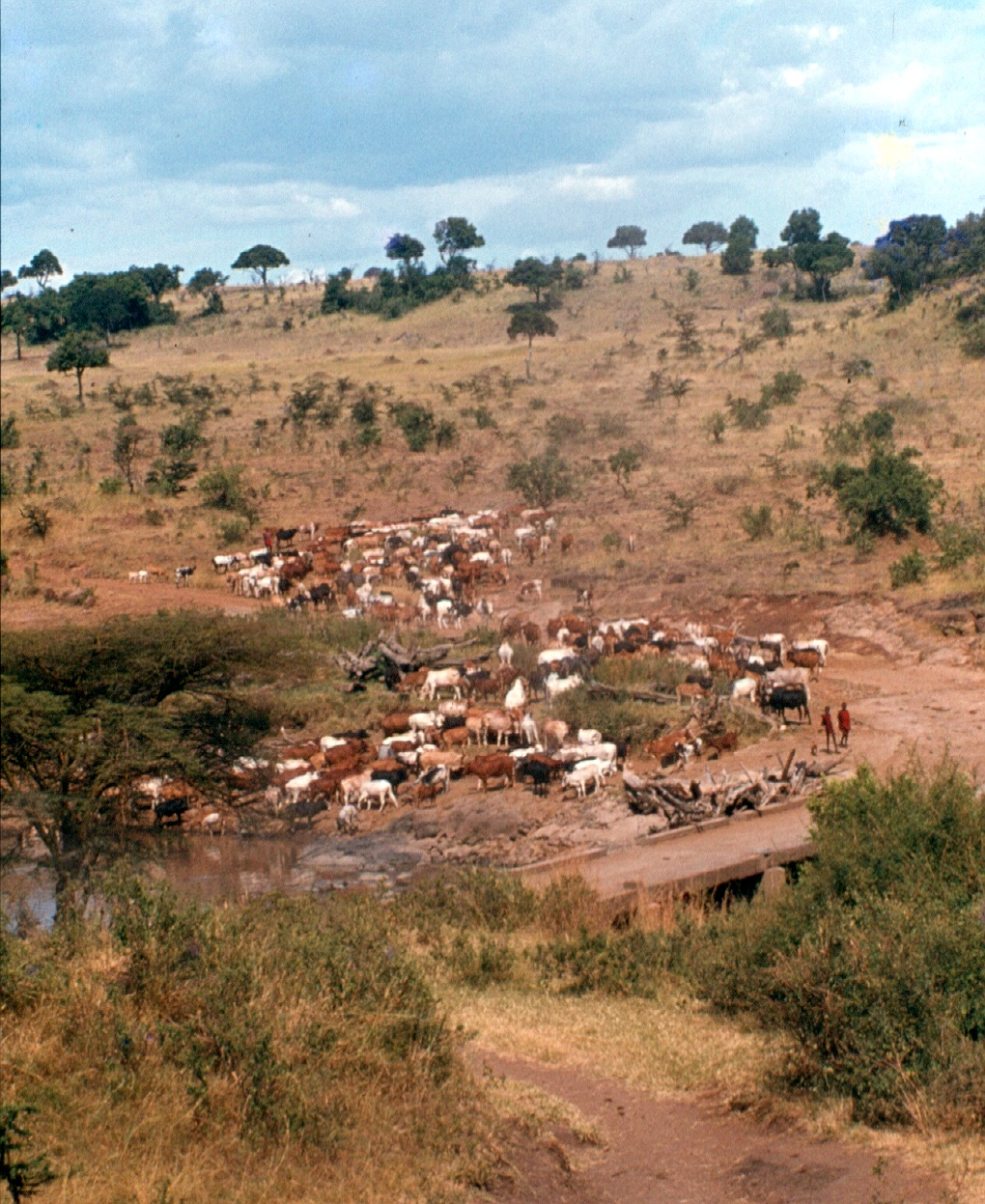
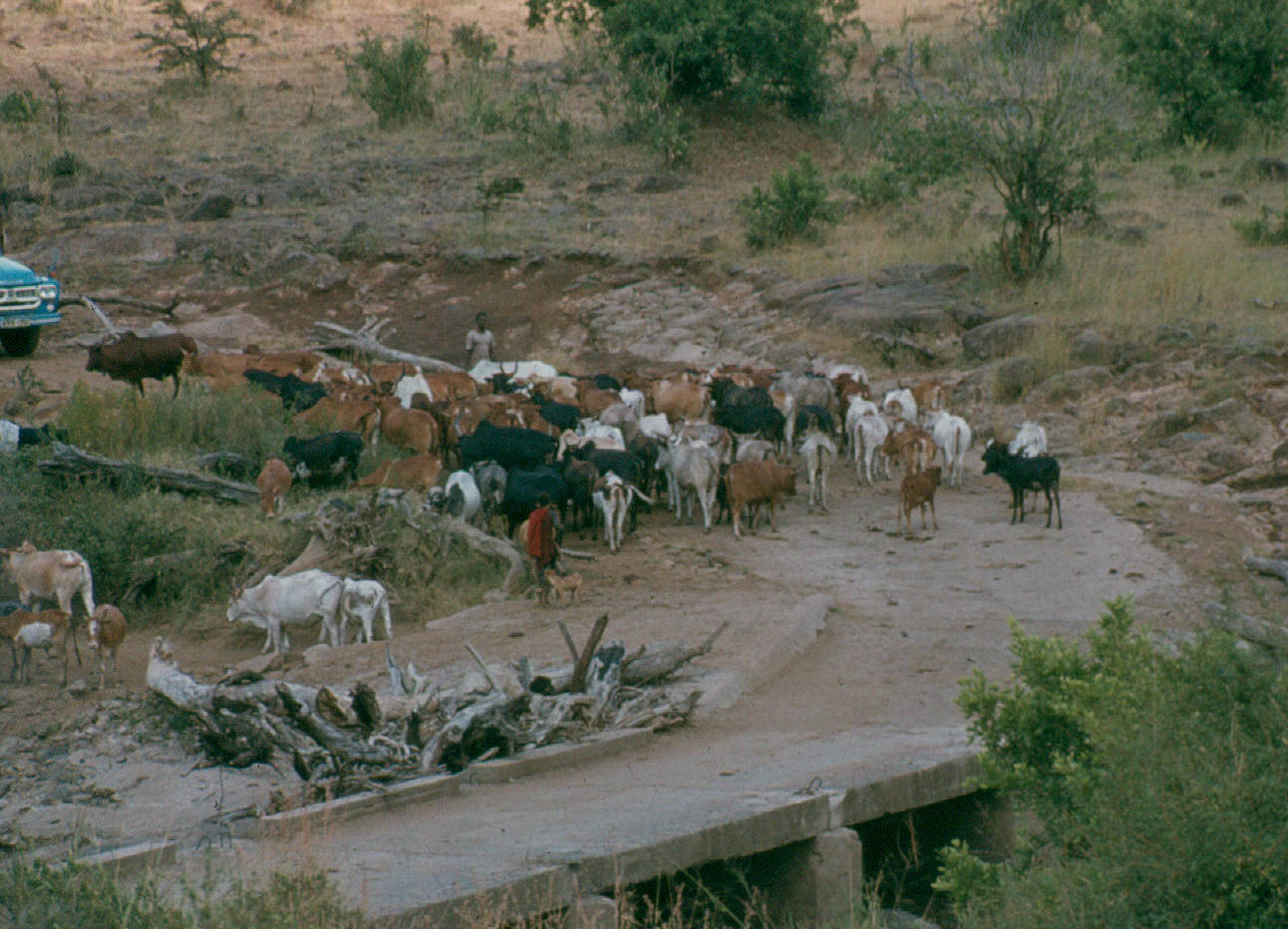
Maasai cattle at the Mara River bridge on the way to the Transmara.

Maasai cattle at the Mara River bridge on the way to the Transmara.

Following the escarpment the road was bad as usual but luckily this time it was dry. However, we needed to stop a few times, not because of getting stuck or having mechanical problems, but because Ernest was amazed at how bad the road was! “Ooohh no, please stop!” he would shout and then get out of the car to photograph it even before I managed to stop. Clearly he was comparing the Transmara tracks with the Swiss roads!

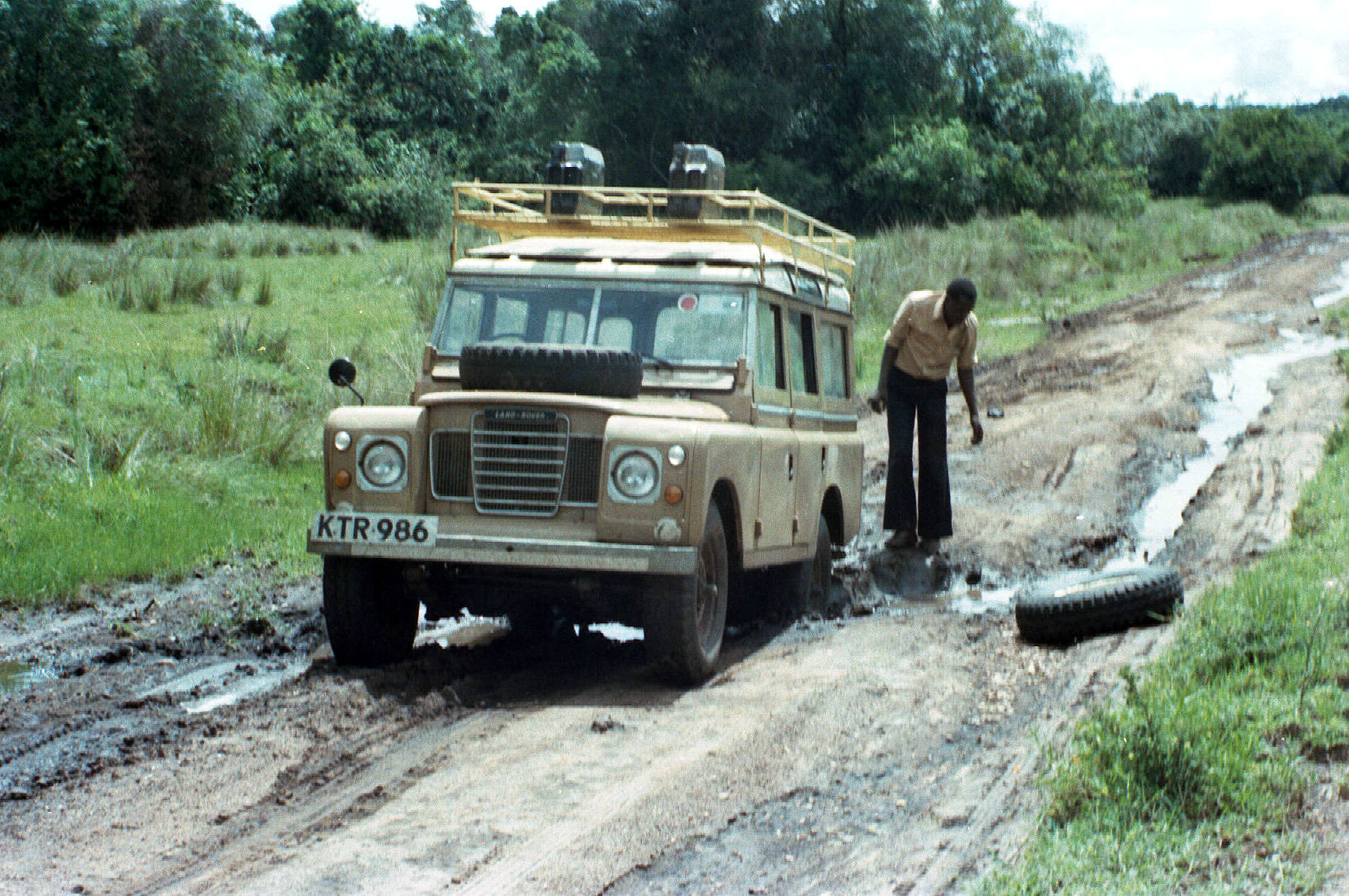
Stuck on the way to Intona on a rainy day.

Stuck on the way to Intona on a rainy day.

Eventually, after a few halts, he got used to the rough road but, being a very active person, his attention drifted to other things. As all first time visitors to the Transmara he took a great interest on the Maasai people and their cattle, a normal sight in the area for me but quite so for guests. As the Maasai were not keen on pictures, we did not stop.

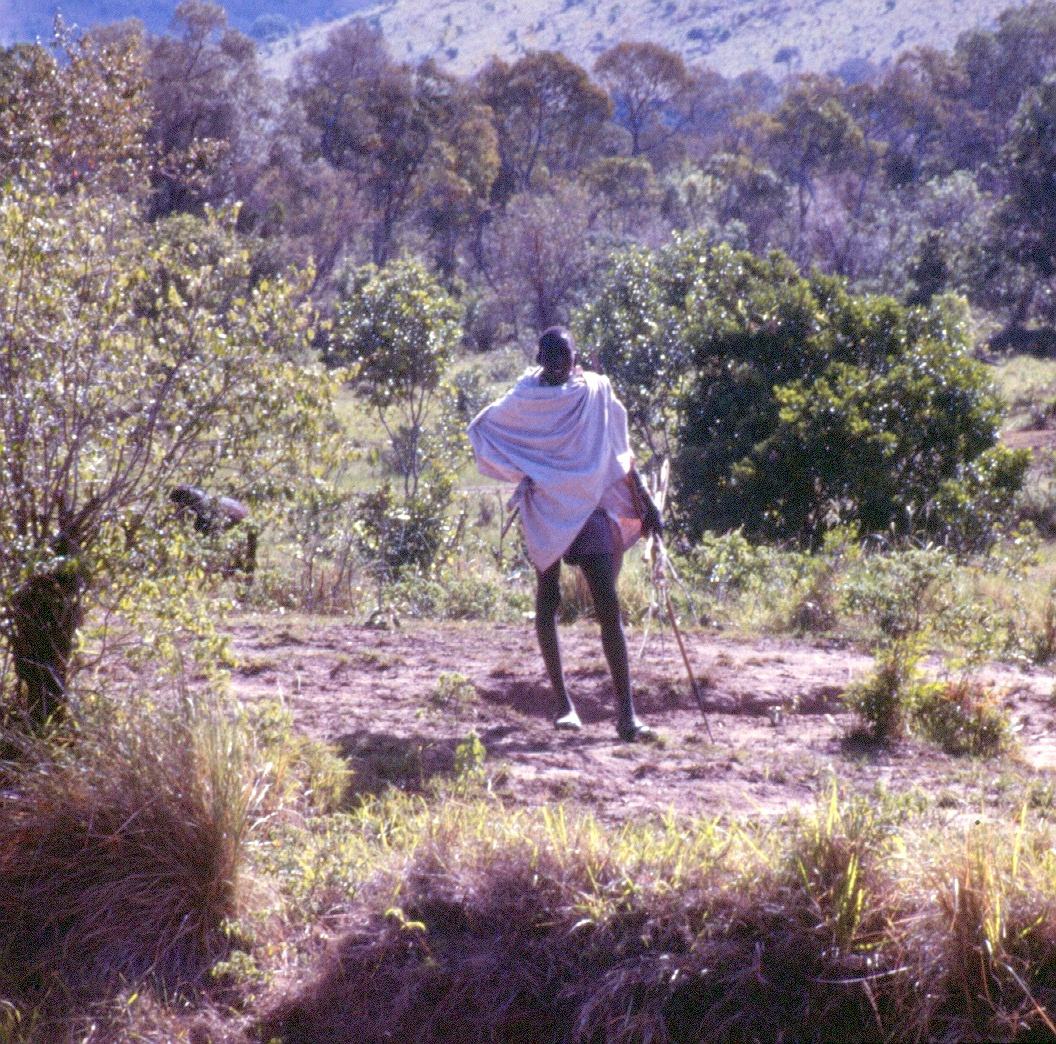
Maasai herdsman on the way to Intona.

Maasai herdsman on the way to Intona.

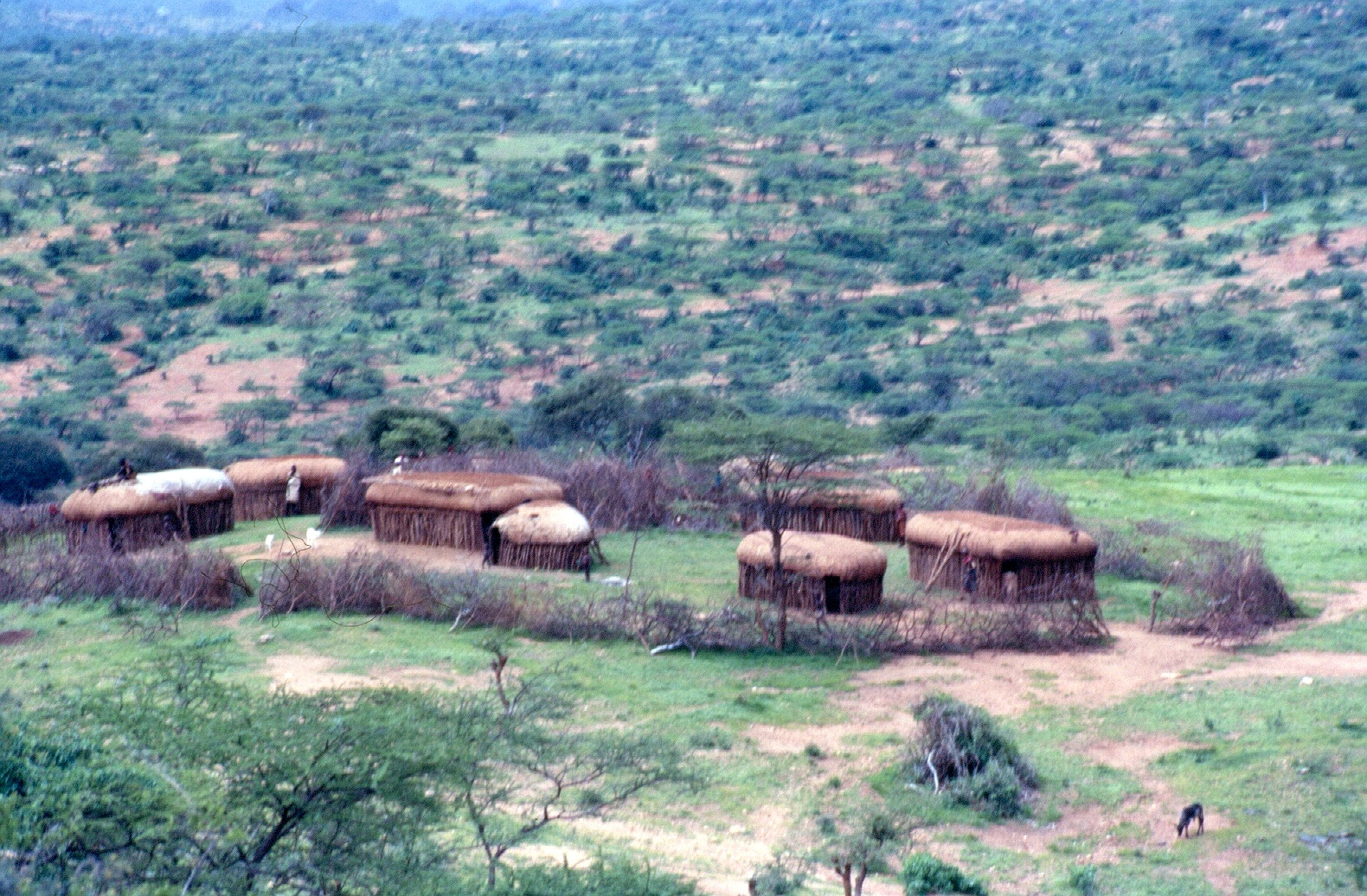
Maasai Manyatta (dwelling).

Maasai Manyatta (dwelling).

Maasai children looking after livestock.

Maasai children looking after livestock.

After about half an hour of hard going I heard “Stop” coming from Ernest as we approached a large muddy pond by the side of the road. While I stopped the car he rummaged in his rucksack from where he extracted what looked like an over-sized hypodermic syringe and a tumbler. I was not sure of what was going on and limited myself to watch, together with our herdsmen travel companions. “This is a Swiss water filter that will make any water suitable for drinking” he said as we were walking towards the mud and the terrapins swam away in fear! He added “It is recommended by the Swiss Tropical Institute, so it must be good!”

Without further ado he sucked water into the syringe and, once it was full, it poured into the glass. The water was indeed crystal clear! “You see,” he said, showing the glass. I must confess that it was an impressive feat as the puddle was truly a thick chocolate mud and I had not seen such a contraption before! Ernest offered the water to us and, when we all politely declined, he drank it himself before I could stop him, fearing for the consequences on his guts.

After praising the quality of what he had just drunk, he repeated the operation once more. This time one of the herdsmen agreed to try it and he agreed that it was indeed OK if with a bit of a muddy taste. “The filter must be getting clogged,” declared Ernest, “I must clean it when we get to Intona”. I refrain from commenting on the cost-effectiveness of the device and we resumed our trip, clearly ready for innovation.

Eventually we arrived at Intona ranch. It was almost dark so we rushed to assemble our tent, had an early dinner and went to bed as we both felt the long two-day trip.

The following day we started our work early and spent most of the day carrying out several trials that were quite successful. In the afternoon we decided that we would have roasted chicken for dinner so while Ernest continued working I went with Tommi, my Maasai assistant, in search of dinner. Eventually we managed to persuade a Maasai lady to sell us a cockerel.

Our prospective dinner was killed by me and plucked by Ernest. The size of its talons were unequivocal indicators of its seniority and its leanness qualified it as a Maasai chicken long-distance runner! Its muscular condition spoke of speed and endurance at the service of survival! Oblivious to all this, Ernest assembled a boy scout-like contraption with branches where, after impaling the chicken, it would be rotated over the fire. We invited our herdsmen to join us and they prepared their traditional “ugali[3]” to go with it.

The cooking of the chicken took a very long time. Ernest kept stabbing it and declaring that it was cooked but still tough. The lengthy turning process led to inexorable shrinking and darkening until it was declared fit for human consumption. The cockerel had turned into a “toasted baby chicken”. I saw the herdsmen exchanging doubtful glances over their Tusker beers, a bad omen!

Ernest cut it into equal pieces and -luckily- Joseph placed large chunks of ugali to go with it. Tommi bit the first piece and I heard a “Taargh” coming from him that became a clear “tough!” once he managed to swallow it. Bad news coming from a Maasai! Ernest agreed on its toughness but declared that it tasted like real chickens did a long time ago in Switzerland so he was happy! As for the rest of us, we could have done with a second runner Maasai chicken!

Transmara, Kenya, circa 1986.


[1] Also known as an acaricide, a substance that kills ticks.

[2] Amblyomma variegatum (the Bont tick) transmits Cowdria ruminantum that causes a deadly disease of ruminants known as Heartwater.

[3] From Swahili, maize flour cooked with water to a thick porridge. It is the staple food in Kenya.

Harvesting from the effort[1]

The following is a concise account of my working life. More details can be found in the “Pages” section of this blog. The intention of this short account is to set the seen for the next historical posts that will deal only with episodes that took place during these years and that I consider to offer some interesting aspect worth mentioning.

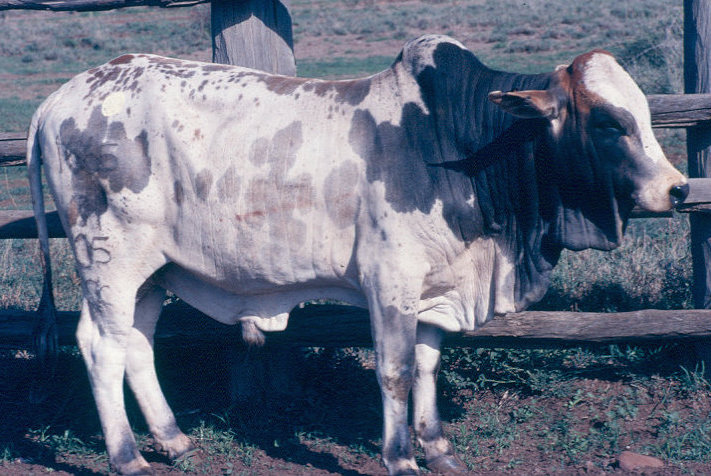
A Boran young bull at Mutara ranch, Kenya.

A Boran young bull at Mutara ranch, Kenya.

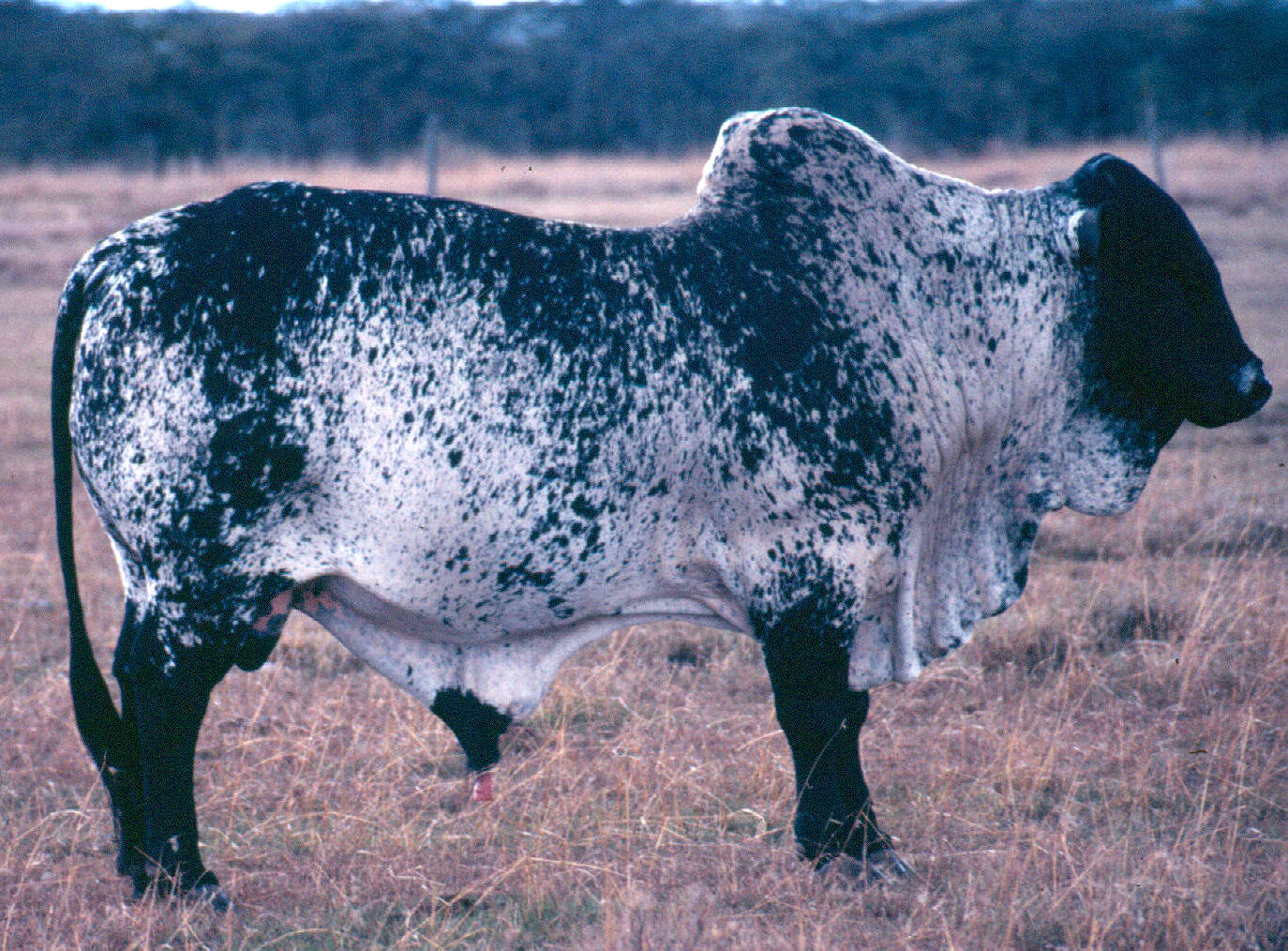
Boran young bulls at Mutara ranch, Kenya.

The work at Muguga and Intona described earlier (give link) yielded fruit and I was able to publish the results in good scientific journals, together with my co-workers, Matt, Alan and Robin included. My research added some knowledge to a large regional programme on ticks and tickborne diseases that FAO had initiated at the time of my arrival in Kenya and that covered several countries in East, Central and Southern Africa.

Mutara tick selection work.

Mutara tick selection work.

Once my fellowship ended, although I had a lot to learn yet, I had somehow found a niche for my work at ICIPE and, with Matt’s blessing, I joined the Tick Programme as a scientist. My work on tick impact had ended and now my work would have to fall within the Tick Programme’s goals and funding. The main target was to control ticks using the cattle resistance to them. I had come across this fact while doing my research as some animals showed resistance while others not.

At that time I also decided to start my PhD studies as an external student with my former Department of Applied Zoology at the University of Wales. Four years of hard work were in front of me, as I needed to work and study, not an easy feat! I was lucky to be surrounded by knowledgeable colleagues and to find a great supervisor, the late Ian Herbert from the Department.

While working on my PhD I got involved with the work on ticks and tickborne diseases on-going at Muguga and I also continued with field work at Intona. Later on we started more work at Mutara Ranch, then the Boran cattle stud for Kenya, where we started work on selection of cattle for tick resistance that sadly needed to be abandoned for lack of resources. The initial study got published and this added to my growing reputation in the tick world. I completed the PhD in 1986 while still in Kenya.

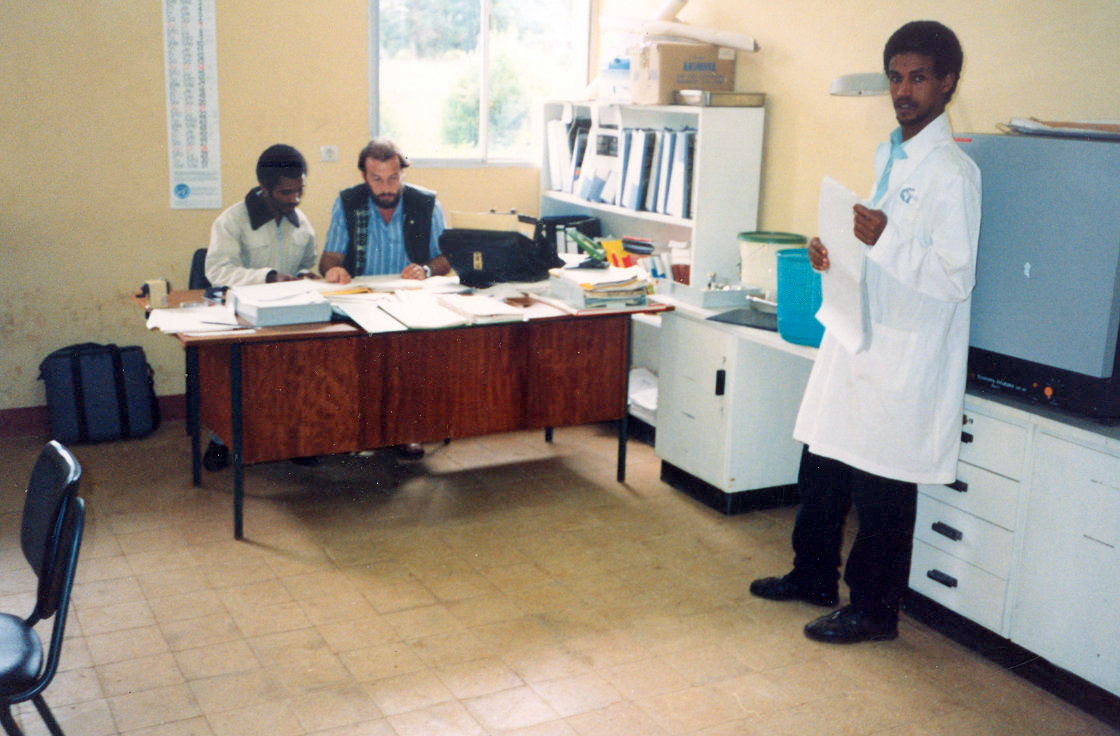
The laboratory at Bedele, Ethiopia.

The laboratory at Bedele, Ethiopia.

In 1988 FAO offered me a position as a Leader of the Ethiopian component of their regional tick and tickborne disease programme I mentioned above. I accepted the offer as it had very favourable conditions but left ICIPE and Kenya with a heavy heart after so many years of enjoying life and work there.

Villagers at Gambela, West Ethiopia.

Villagers at Gambela, West Ethiopia.

Ethiopia was a big change as we arrived in a country at war with Eritrea and under a comunist regime led by Mengistu Haile Mariam, a ruthless leader. My duty station was Bedele in West Ethiopia, still green and wooded with a rainfall of about two thousand mm per year! It was a remote place where FAO has assisted the Government in building a Veterinary Diagnostic Laboratory. Bedele’s main claim to worldwide fame is ob being the place where coffee originated from.

The work was more routine than challenging and it required the collection of ticks from cattle at different locations both to get to know the species and to understand their population dynamics. My assignment there lasted under two years as I was replacing another tick officer that needed to be evacuated with a severe heart condition. Despite the political and economical difficulties the country was going through, the work was completed and, as the possibilities of continuing the work were not there, it was tie to move on.

The project site at Lutale, Central Province of Zambia.

The project site at Lutale, Central Province of Zambia.

I was transferred to Zambia where I was to continue a long-term trial on the effects of ticks on traditional cattle productivity both of milk and beef under different tick control regimes: no control, intensive control and “strategic” control. The latter meant to treat only to prevent tick numbers from building up. The trial run for three years and it was completed successfully. It was during this time that our children were born and our lives changed!

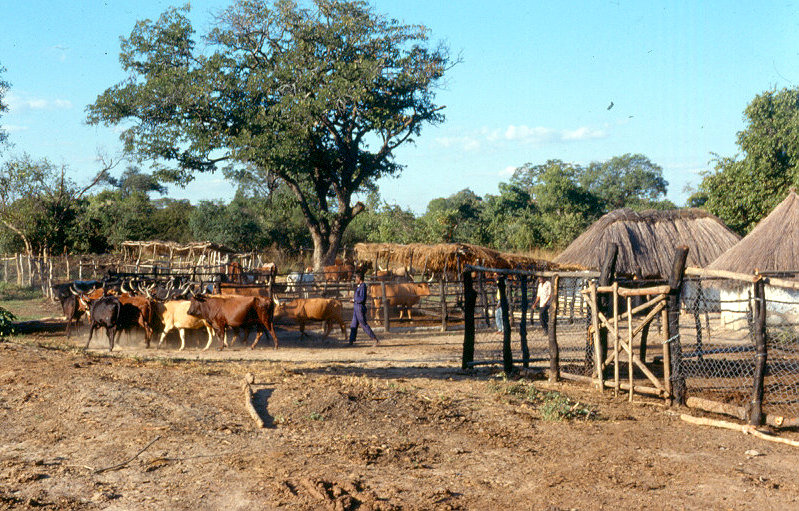
Cattle work in Southern Province, Zambia.

Cattle work in Southern Province, Zambia.

After three busy and productive years in Zambia the regional programme was going through important changes. Its coordinator based at FAO HQs in Rome was about to retire and more funding was coming in to continue the work for another phase of four years. Somehow I landed the coordinator’s job and moved to Rome in a move that removed me from scientific work and converted me into an international bureaucrat!

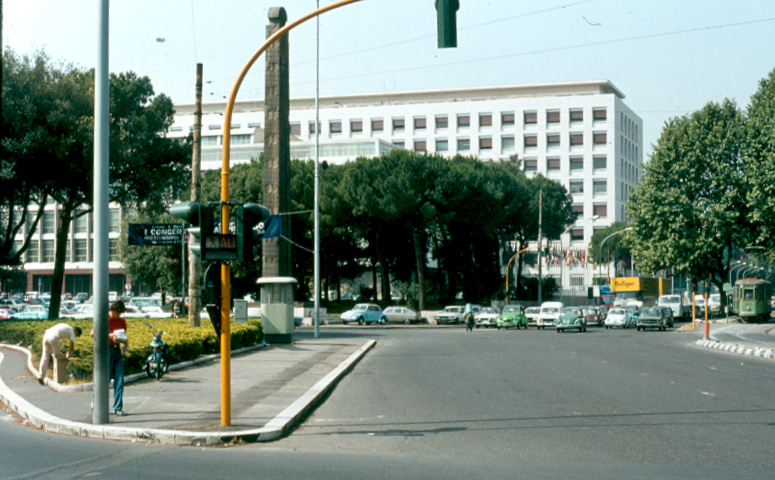
FAO in the 90s. Please note the Axum stele that was returned in 2005.

FAO in the 90s. Please note the Axum stele that was returned in 2005.

After a few months in Rome, once the “glamour” of the job waned, I realized that I needed to get back to the field as the work I was doing did not appeal to me.

Mudanza a Hre copy 2

Moving again! This time to Zimbabwe.

The opportunity to move to the field -again to Africa- presented itself in 1997 and I did not hesitate! We moved to Harare, Zimbabwe where I took up the role of sub-regional animal production and health officer, an even broader professional role as it also involved animal production. As compensation, however, the job was restricted to Southern and Eastern Africa. Although it was not “hands on” scientific work, it was closer to the action than what I was doing from Rome!

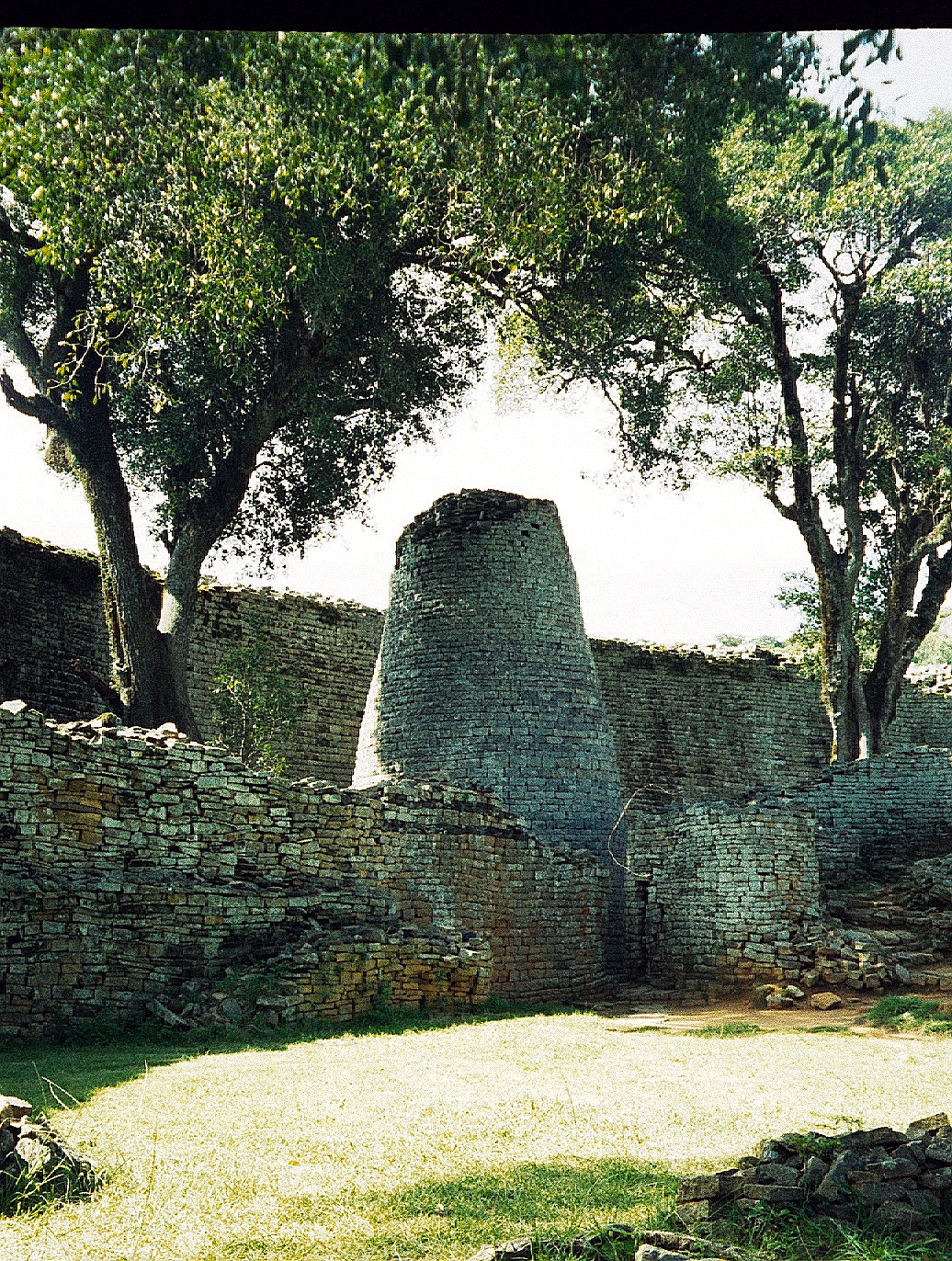
Great Zimbabwe ruins, Zimbabwe, 1998.

Great Zimbabwe ruins, Zimbabwe, 1998.

After four years in Harare I realized with regret that I needed to move to get a career improvement. At the end of 2000 I put my name for a FAO Representative job and succeeded getting designated FAOR in Bolivia so in mid 2001 we left for La Paz, Bolivia. This would be my first assignment in a Spanish-speaking country and it also meant becoming the head of an office with a large multi-sectorial programme and several employees both in the office and in the field. In addition, as the representative of the organization in the country I also carried a political role having to develop strong links with the host government.

Sewing in Bolivia.

Sewing in Bolivia.

Market street of La Paz, Bolivia.

Market street of La Paz, Bolivia.

I worked in Bolivia for five incredible years and, in 2005 I returned to Rome, again as a technical expert to continue working on animal diseases, in particular I returned to ticks and TBD. Again I did not find this assignment enjoyable and, after four years I had had enough of desk work and it was either another field post or retirement!

The Appia Antica road, Rome.

The Appia Antica road, Rome.

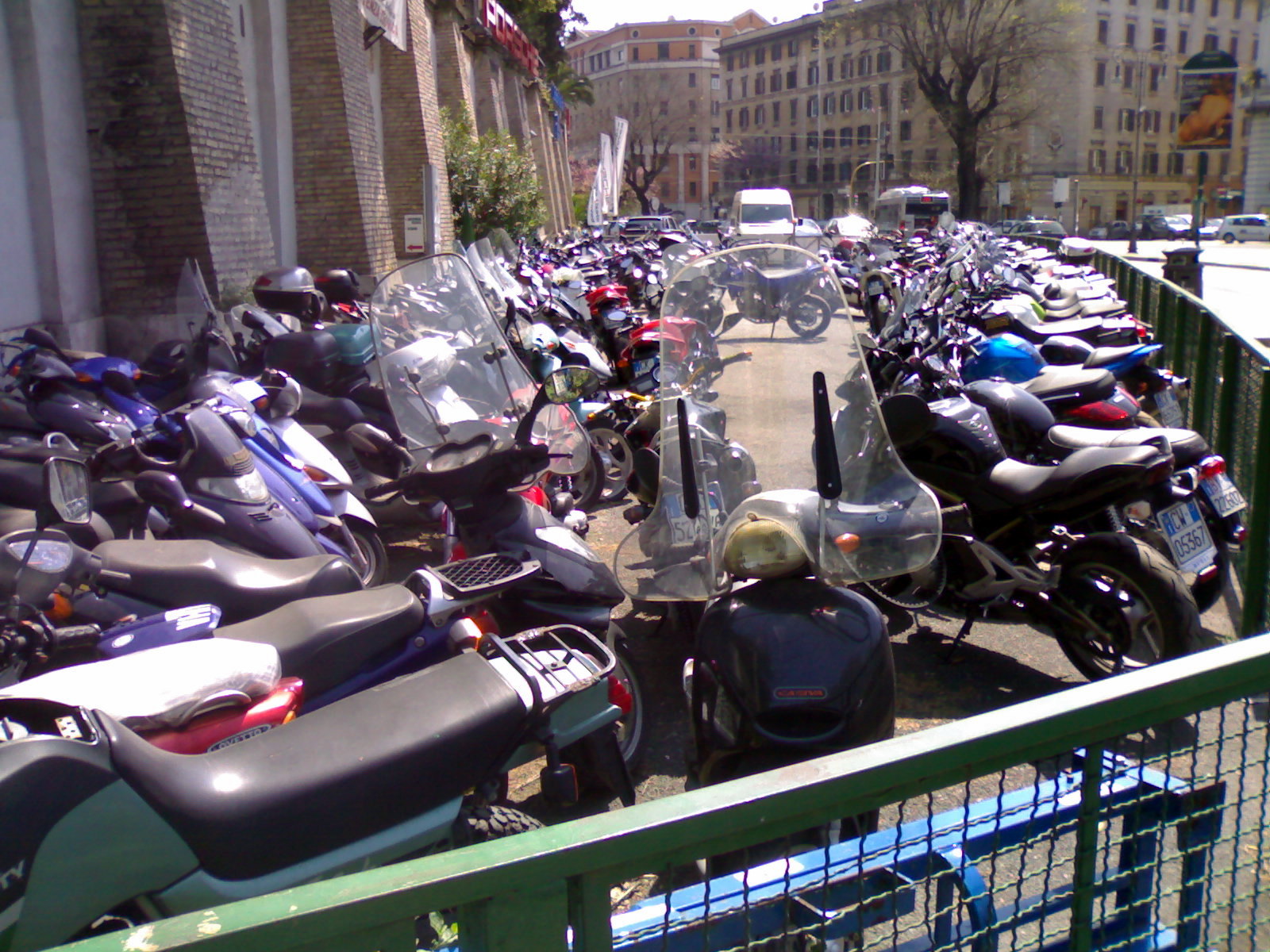
Rome, 2009!

Rome, 2009!

Fortunately I was selected for the position of FAO Representative in Mozambique where I worked until my retirement, from mid 2010 to the end of June 2013 when I reached 62 years, the mandatory retirement age of the United Nations.

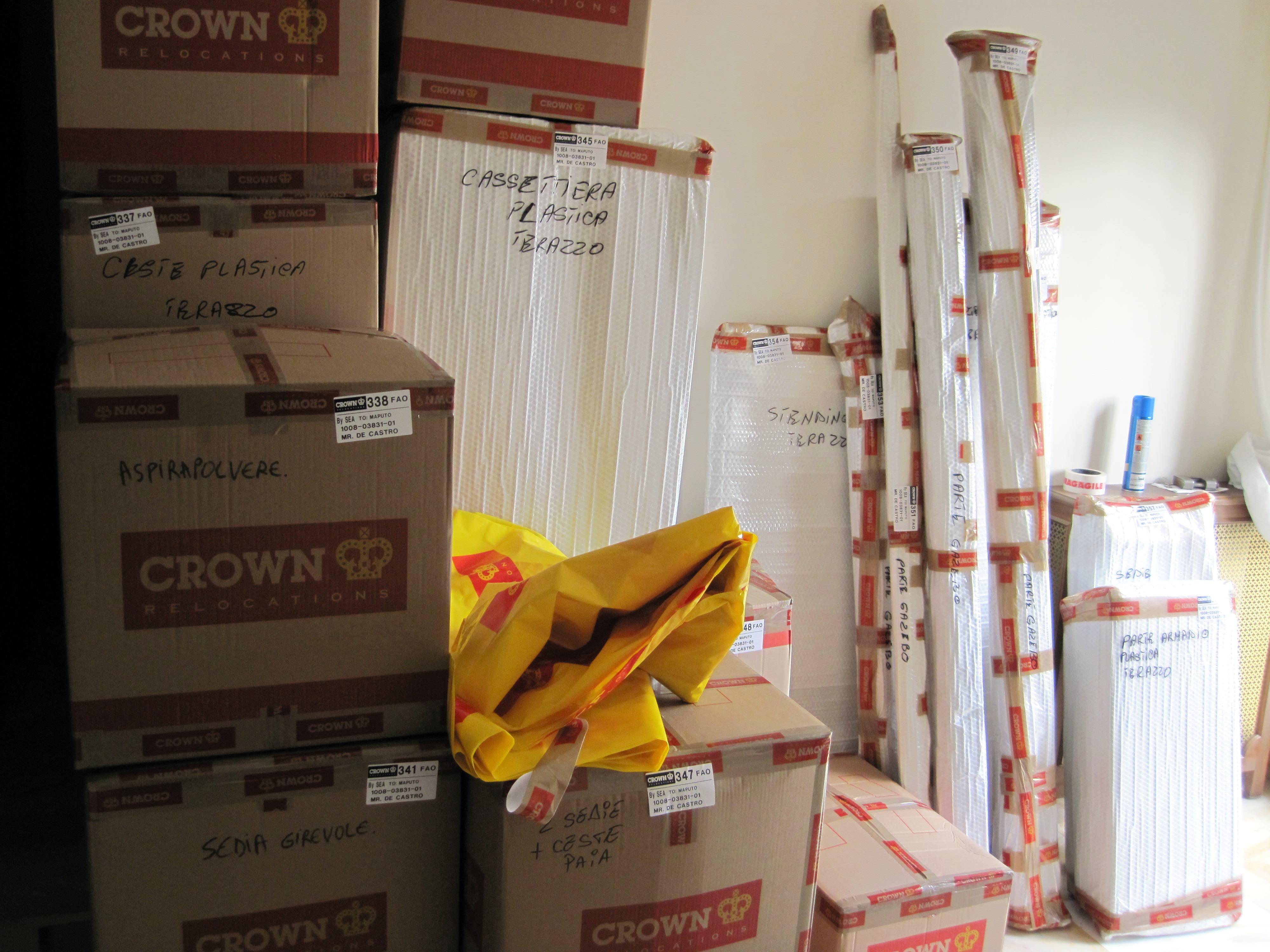
Time to move to Mozambique.

Time to move to Mozambique.

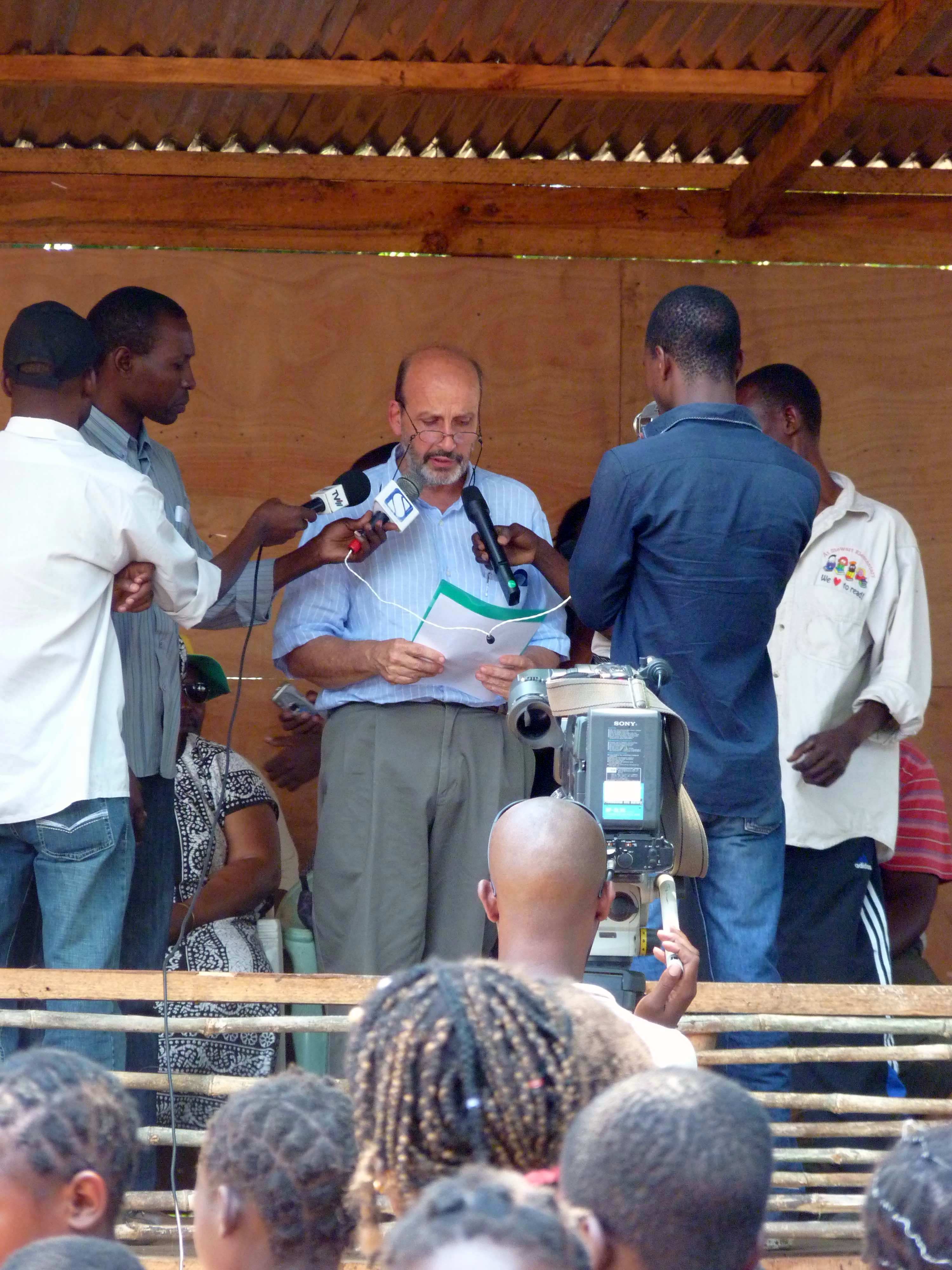
Speaking on World Food Day in Mozambique.

Speaking on World Food Day in Mozambique.

Interviewed by the press.

Being interviewed by the press.

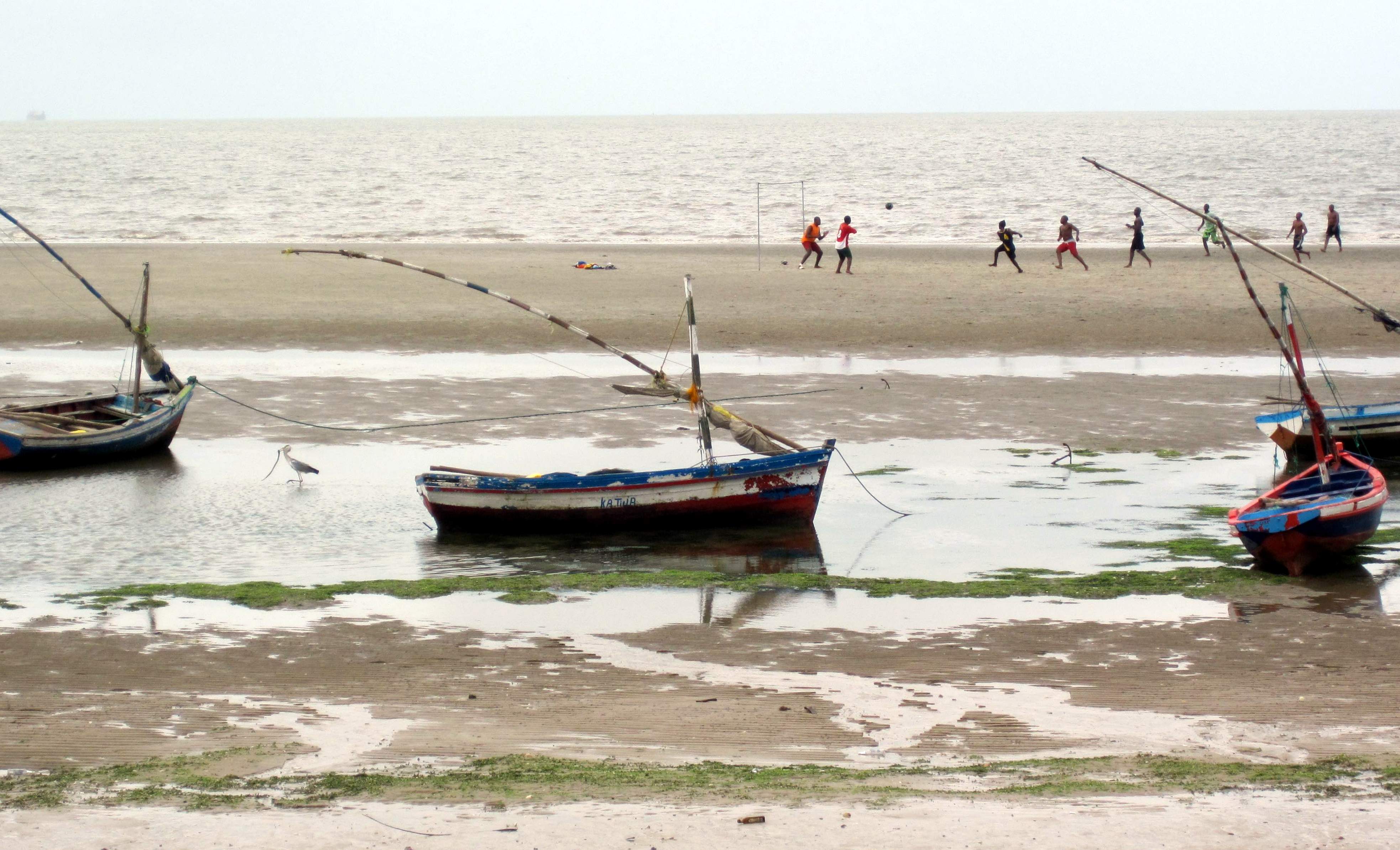
Maputo's beach in Mozambique.

Maputo’s beach.

Needless to say that I write in first person but my life has been shared with my wife and later my children. She has been a main support throughout and the kids added their part!

I hope you enjoy reading what I have to say.


[1] This post follows “Life and work in Kenya: Intona”.

Life and work in Kenya: Intona

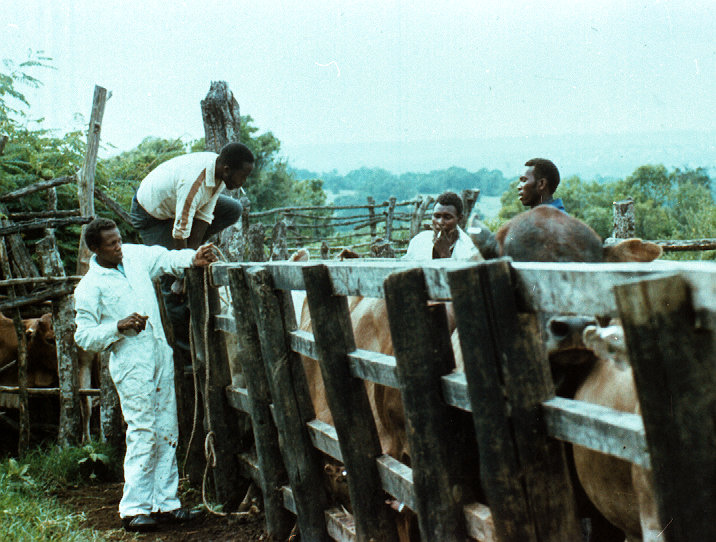
The work at Intona Ranch involved the organization of a six-month field trial, a first for me. Luckily Alan had a system in place for his own trials and I just “piggybacked” on what he had created. As he was the Head of the project he kindly supported my work very generously and enthusiastically. He lent me his work Land Rover, herdsmen and the routine disease monitoring system. I needed to add the tick burden evaluation part by bringing in my own people to carry it out. Visits were required for monitoring purposes and to replace personnel every two weeks. As mentioned earlier, I had employed two people: Kimondo and Tommi. The latter was a Maasai who was no stranger to the Transmara and although he was not as hardworking as Kimondo his local knowledge would prove of immense usefulness. We were a good team!

Routine monitoring of experimental cattle is key.

The team. At the time doing routine monitoring of experimental cattle. From left to right: Chege, Kimondo, Tommi and Benson.

The work would consist in the creation of two groups of cattle immunized against Theileriosis by Alan and his group. This would enable me to stop applying tick-killing chemicals (acaricides) to one group while the other would be maintained with strict tick control. The comparison on their live weight gain and the tick species and burdens observed would enable me to estimate the expected losses that the ticks themselves would cause to the cattle. Clearly it was only a start but something that had not been possible to assess before.

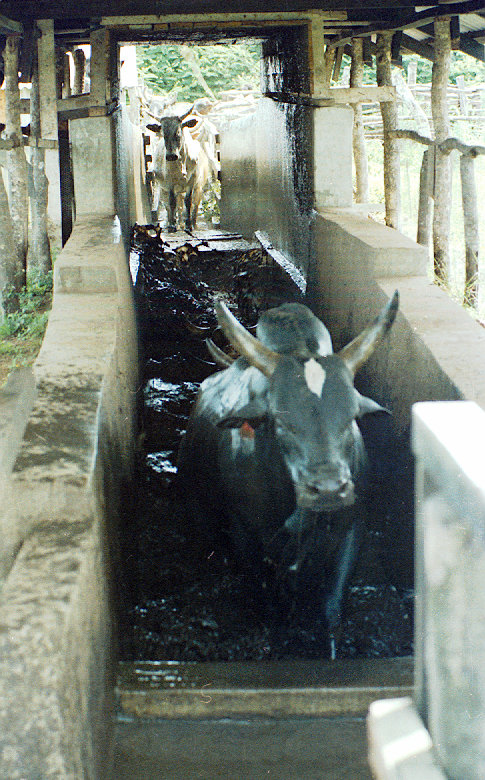
Cattle being dipped.

Cattle being dipped.

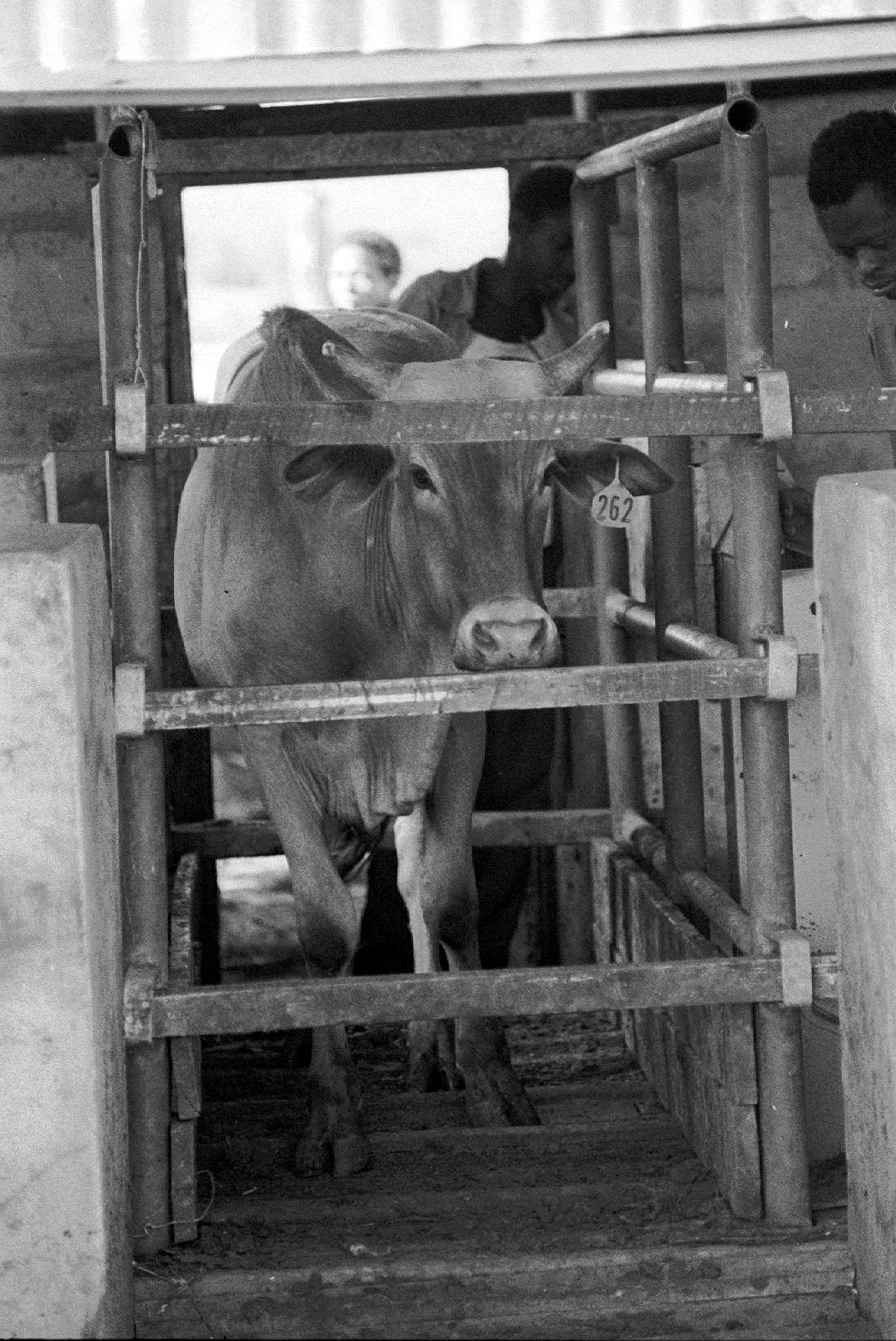
Liveweight gains were an important parameter in the trials.

Live weight gains were an important parameter in the trials.

Now I needed to find the right cattle for the trial and get them to Intona. This required some planning and involved travelling to Laikipia in Northern Kenya. I was searching for Boran, a Bos indicus breed as these would remain at Intona ranch once the trial ended and we knew that Joe would be very keen on them.

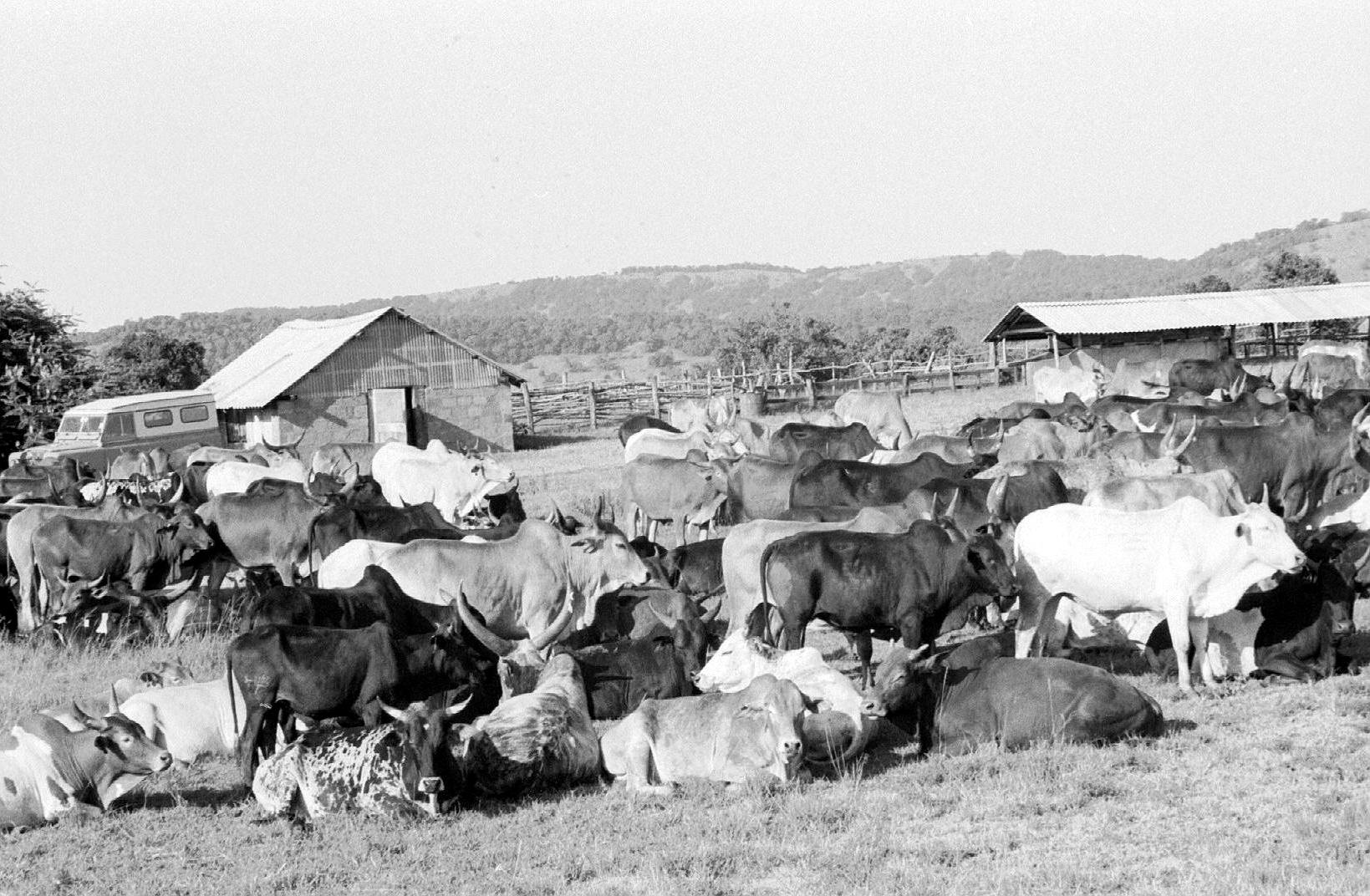
The cattle of Intona Ranch.

The cattle of Intona Ranch.

We did not take any chances...

We did not take any chances…

Gilfrid[1] had his ranch beyond the slopes of Mt. Kenya in Laikipia and he had the cattle we needed. I organized a “cattle-buying” trip. Luckily in Alan’s Land Rover, I departed for Laikipia with Kimondo and Tommi to assist me on the journey. A large lorry followed us to carry the animals. We drove past Murang’a with its amazing vegetable offer, Nyeri and Nanyuki on the slopes of Mt. Kenya. The views beyond Mt. Kenya into the very dry Northern Frontier District were worth stopping to take in. At Nanyuki we went West towards Rumuruti, gradually descending from the mountain into nomadic grazing land to finally arrive at the ranch. Gilfrid was waiting with the cattle on display for us to choose what we needed. The selection done, over a cup of tea we agreed on the final price and payment and then loaded the animals on the lorry. As the latter was slower than us, we agreed on the route to follow and told them to depart before us, as we were hoping to arrive at Nakuru to spend the night there.

We lingered a bit longer talking to Gilfrid while he showed me his ranch. He was clearly an interesting “character” and drove a “Hang over”, due to a modification he made to the back badge of the Range Rover! Returning to the house I saw three or four skulls on the roof of the verandah. I realized that they were lions’. Gilfrid explained that they had been “cattle-eaters” that needed to be shot, as they killed far more animals than they needed to eat. “I tolerate losing a few cattle but not that one lion needlessly kills ten cattle in one night!” he asserted. However, he reassured me that lions were still plentiful in the area and that he loved to hear them roaring in the evening, provided that they kept away from his cattle! I could not help asking for one and he promised to remember me the next time a lion overstepped the mark[2]. He agreed and after a while we said our farewells, as I needed to catch up with the lorry. I liked Gilfrid and would return to him for more cattle in the future.

After about an hour, the cloud of volcanic dust in front of us indicated that we were approaching our truck. As I positioned the car to overtake it and its dust plume, I saw a grid on the road that I just managed to avoid by braking and swerving to one side. Recovered from the sudden jolt we came close to the lorry again. “What on earth is going on!” I muttered while I tried to make sense of what I saw. The back door of the lorry was missing and a line of cattle were looking at me! The sudden appearance of the grid on the road suddenly became clear, it was in fact its back gate! I started hooting and flashing my lights hoping that the driver would stop. He ignored us or did no hear us so I took the risky decision of overtaking it to stop it from the front. The maneuver was not easy as it was a narrow dirt road but somehow I managed, probably helped by my stress!

We agreed that as soon as the lorry stopped we would jump out to stop the animals from jumping off and scampering into the endless savannah, as there are no fences in that part of Kenya! Luckily we managed to stop the lorry before any of the animals jumped and, while the herdsmen held the animals in check, I rushed back to collect the back gate that, luckily, somehow fit inside the Land Rover! I mentally thanked the cattle for being wise and verbally the herdsmen for keeping them at bay. The gate fixed, we resumed our journey with our car in the lead.

We managed to get as far as Kericho where we watered the animals and made sure that all was tightly secured before we retired for a fully deserved rest. As the lorry was much slower than us, we also agreed that it would depart at dawn towards Kisii and onwards until Kilgoris and eventually to Intona Ranch. I was really exhausted both physically and mentally and managed to count about three cattle jumping before I crashed into sound sleep!

When we were ready to go the next day, the lorry had already left as arranged. We headed for Kisii following the tarmac, expecting to find our lorry on the way. We got there and didn’t find it so I assumed that they must have continued towards Sotik, the next town so I proceeded to that destination. Still no lorry! I could not believe that they had already passed Sotik so I retraced my steps looking for it, as it was likely that they had stopped on the way and I had missed them. This proved to be a mistake as we still found nothing on the way back and by this stage I had lost too much time to catch up to it on the road!

My first and rather distressing thought was that my cattle had been stolen! There were lots of stories of cattle rustling taking place in that region of Kenya at the time and I had been warned about them prior to our departure. Not sure about which Police station to report the theft to, I decided to leave that as a last resort and instead pushed on to get to Kilgoris as this was our final meeting point before we took the rougher road to Intona Ranch.

We drove silently all the way and arrived at Kilgoris in the late afternoon, rather crestfallen and upset with myself for having been so careless. As Kilgoris is a small place, if the truck was there we would be able to see it, so we entered the town with a glimmer of hope. “There it is” exclaimed Kimondo and there it was, our lorry was almost the first vehicle we saw, parked at the prearranged meeting point in the town square. As expected, the lorry was totally surrounded by Maasai that were keenly watching our cattle. Through Tommi I learnt that they were really excited and very complimentary about our rather lovely and fat Boran yearlings! My worries increased again with the knowledge that Maasai believe that all cattle belong to them!

We finally found the driver at a nearby shop and told him of our adventure. Happy to see us again, he laughed at our obvious travel miscalculation. He had left Kericho earlier than we thought, as he was not sure of the condition of the road and got to Kisii and then Sotik with ease. Seeing this, he decided to push on to Kilgoris to save time and to arrive there before nightfall as I had recommended to him. He got to Kilgoris early, parked the lorry and waited! He shared my wariness about the curiosity shown by the Maasai crowd and we agreed that his “tout” would sleep on the lorry to avoid any nocturnal mishaps!

I was relieved to see that things were back to normal and I treated everyone to some “Nyama choma[3] and “ugali[4] and then went to the hotel to sleep. The place was rather basic, prepared for a Maasai clientele but I did not mind and slept soundly as we were reunited with our “lost” cattle!

The following morning we drove in front and, luckily, the road was dry. We reached Intona ranch without further disasters. The field trial could now start!

[1] See: http://suyiantrust.wildlifedirect.org/author/gilfrid-powys/

[2] See “Lion Skull” later in this blog.

[3] Barbequed beef.

[4] Maize meal.

Life and work in Kenya: Muguga[1]

The next time I met Matt, after my return from Intona Ranch, he was very positive about my collaboration with Alan at Intona ranch. That was good news as I did not need to present to him all the arguments I had prepared. However he tersely informed me that there was still one more hurdle: a final meeting with all institutions to settle the issue. Apparently, a new idea had come to the fore that needed discussion. The Director of KEVRI from Western Kenya had proposed an alternative area of work in Busia, his home area, of course. “You would live at a former leprosy hospice there”, said Matt just managing to suppress a chuckle! I was not amused at his Scottish sense of humour.

The meeting was large and long and then it was closed. I was dismayed as for me, nothing was decided and I felt like holding the participants in place until they reached a decision. As clearly this was not possible, I also left rather crestfallen at the apparent lack of agreement. Matt came to me and said “We are fine, it will be Muguga and Intona!” I looked at him totally perplexed. He saw my expression and said “Julio, you should be happy as things went your way!” I accepted his words in amazement and learnt that meetings in the Kenya environment did not involve heated discussions as they did in Latin America, but rather polite exchanges where things are often left unsaid but at the end decisions are taken. I learnt another valuable lesson!

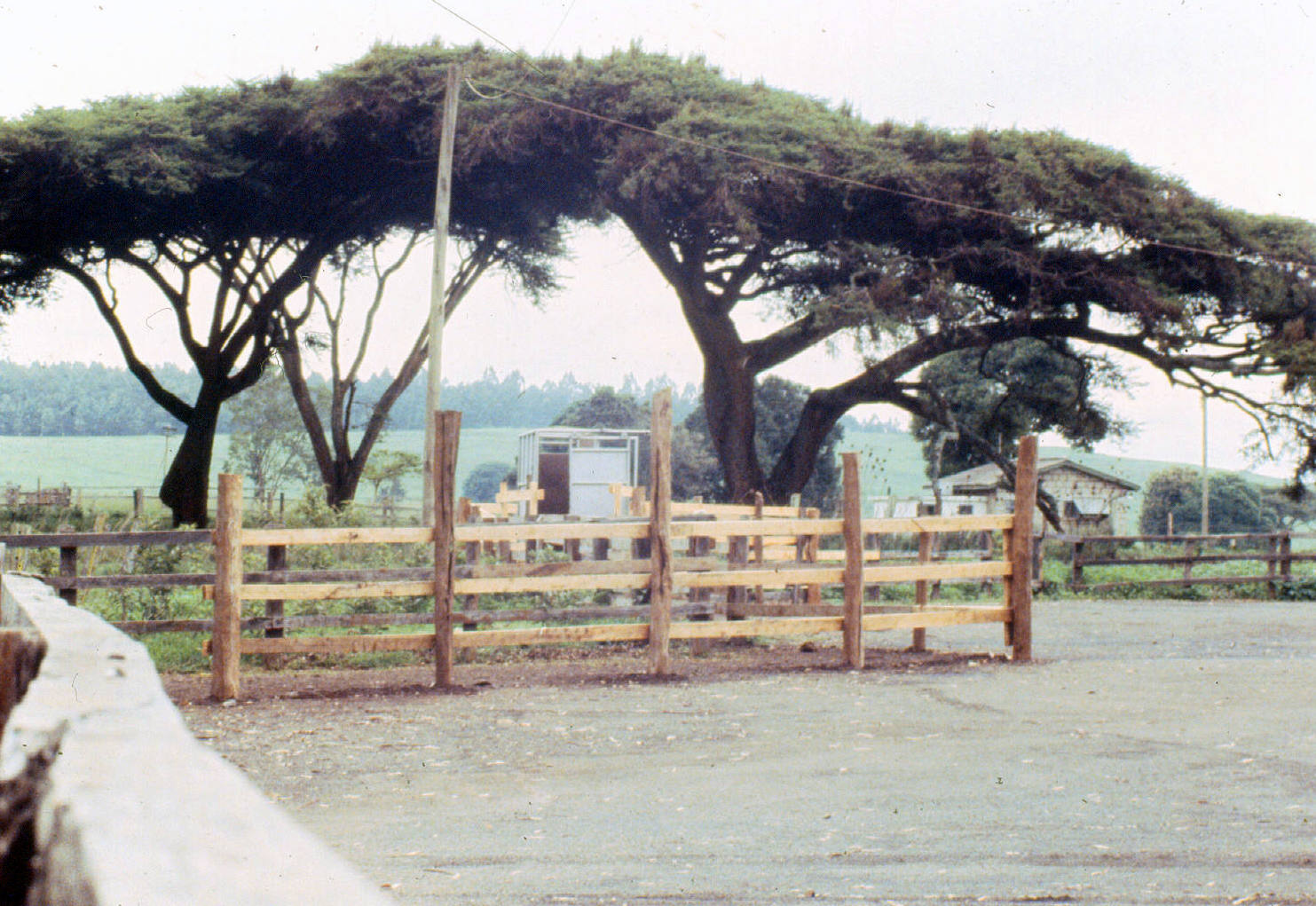
A view of the Isolation Unit showing the flat top acacias under which I spent long hours writing.

A view of the Isolation Unit showing the flat top acacias under which I spent long hours writing.

Believing Matt and having confirmation from Alan, the agreement was that I would use a two-pronged approach to tackle my goal of evaluating the impact of ticks on cattle live weight gain: a controlled trial where I would infest three groups of young cattle with a known number of adult ticks and therefore attempt a finer quantification of their impact under controlled conditions and a field trial where I would compare cattle with and without tick control. This was possible as Alan had a reliable method to engender immunity against Theileriosis, enabling us to stop chemically treating the cattle against ticks[2].

The controlled experiment would take place at the then empty Isolation Unit in KEVRI (Muguga) itself while the field trial would take place at Intona ranch. I set to work immediately as time was short and there were many issues to settle before the work would start. I needed herdsmen, ticks, cattle, housing, feed, drugs and transport to name only the basic needs. The FAO funding was a modest USD 20,000 so I needed to collaborate with others to achieve my goal in the two years I had left!

Tommi preparing an animal for tick infestation.

Tommi preparing an animal for tick infestation.

With my colleagues’ assistance I recruited two herdsmen for the Muguga trial (Chegue and Karanja) and two for the Intona ranch work, Kimondo and Tommi. The latter was a Maasai and this would prove to be an immense advantage working in Maasailand! The others were of Kikuyu origin, very hard working although rather fixated with money!

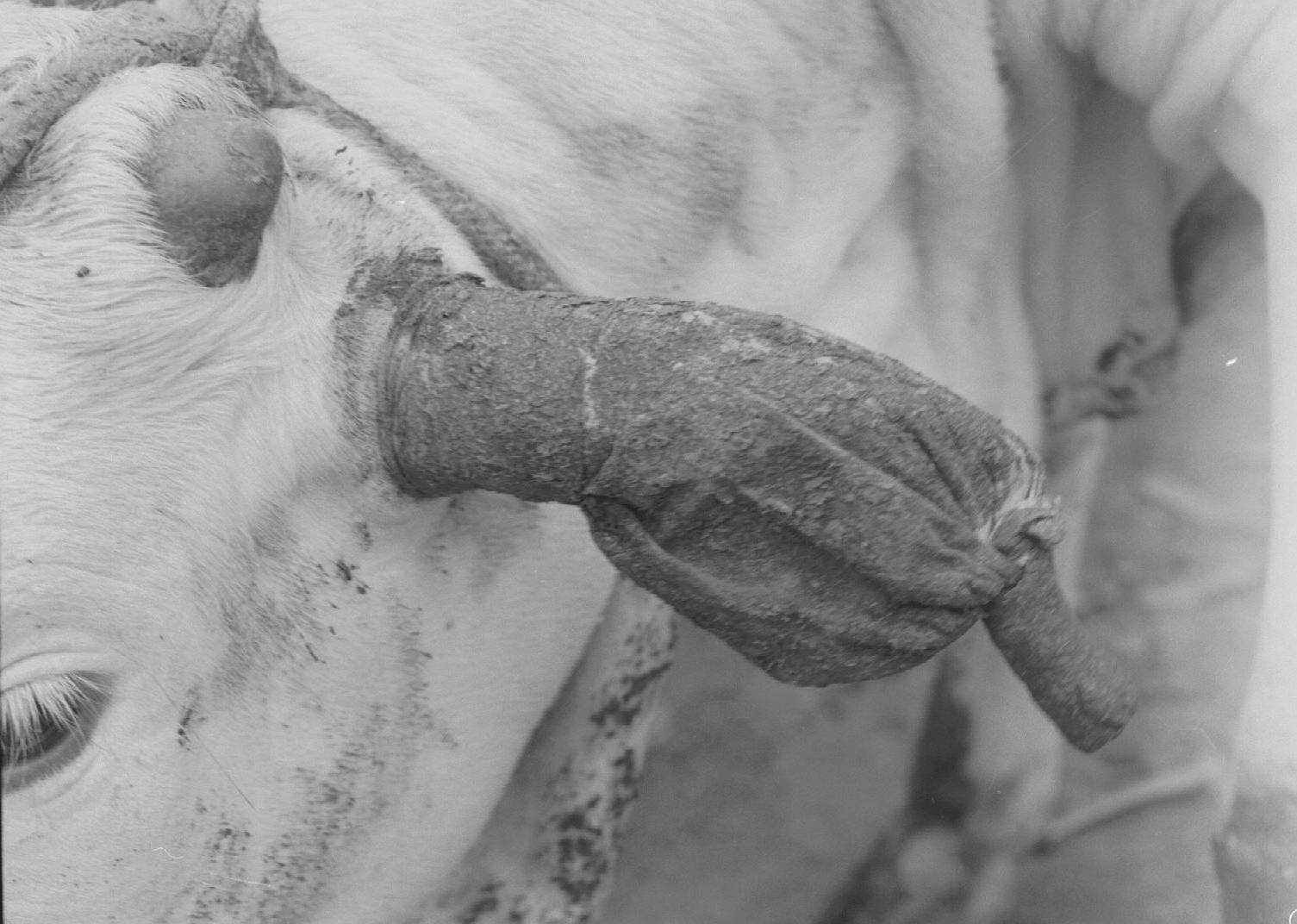
An animal with an artificial tick infestation applied by means of an ear bag.

An animal with an artificial tick infestation applied by means of an ear bag.

For the Muguga experiment I needed to purchase cattle and feed as well as secure a weekly supply of adult Brown Ear ticks to infest the cattle. A constant supply of ticks needs a “tick breeding colony” where you could breed them and, after planning ahead, you “harvest” them weekly to infest your animals. As the trial would last for six months, this meant 24 tick installments to be applied weekly on the animals. One of the reasons ICIPE had accepted my fellowship was that they maintained such a colony, managed by Fred, a very smart guy that became an essential clog in my machinery! Together with Robin we planned our needs and, luckily, it worked very well.

I bought the calves for the Muguga trial locally and randomly placed them into two groups with different levels of tick challenge and a control tick-free group. I needed to measure the feed given to them and I would weigh them weekly and take blood samples and other measurements to check them for other possible clinical signs associated with tick infestations.

The Isolation Unit accommodation was suitable and I had a storeroom where all consumables such as cattle feed and drugs were kept as well as a scale to weigh the cattle. Although I spent long spells at the Isolation Unit, I did not have an office apart from a table and chair under a beautiful flat top acacia that was only good for the dry season! I did have a place at the ICIPE laboratory. The latter was a Spartan contraption built of cement blocks and surrounded by a water moat (to avoid ticks walking away) where a large number of guppies (Poecilia reticulata) introduced to control mosquito larvae, also lived.

The “laboratory” consisted of a front area with a long bench under a window of the same length. There were also two windowless rooms where the tick colony was housed. The back of the building had cattle pens used for tick feeding as well as other experiments being carried out, mainly looking at cattle resistance to ticks. In addition to Matt and Robin there were a number of Kenyan scientists and PhD students working there as well as about ten technicians and herdsmen.

I occupied a slot on the bench between Matt on my right and near the entrance door and Robin, near the other end of the bench. Matt (a Scottish Vet from Glasgow) and Robin (an English PhD from Oxford) could not be more different but somehow they endured each other. In between these opposite characters I sat and worked. In retrospect I had a privileged location, as from my left came thorough knowledge of tick ecology and from my right a veterinary insight including vast experience as well as all sort of ideas for future projects! Work would start at 08:00hs, break for lunch at 13:00hs and resume at 14:00hs until 17:00hs where it was back to Muguga House. This timetable had been established years back during the FAO project and it was maintained until that time.

Matt was very punctual when he was at Muguga. At 13:00hs sharp he would announce that it was lunchtime, leave the building to go to his car to fetch a litre of milk and a book. He would come back, drink the milk, place his feet up (on my part of the bench!) and start reading his book (a Western paperback novel from the back pocket of his trousers!). Soon his by now familiar snoring invaded the laboratory! I was surprised the first time it happened and was going to object when I saw Robin’s resigned look, which led me to understand that any effort in that direction would be futile so I learnt to live with Matt’s antics as I did earlier at Mbita Point!

Luckily for my work Matt was not always at Muguga as he was the Tick Programme Leader and needed to be at several places such as the central ICIPE HQs at Chiromo and another place being built at the moment known as “Duduville”. For this reason his car was his office and he kept all documents on the back seat. In fact Matt was a shrewd operator that was difficult to find as he “rotated” between offices (no cell phones then).

I suspect that he spent some time fishing for trout as well! I often found him parked on the road from his house at Tigoni to Muguga reading “The Standard” newspaper and enjoying his Sportsman cigarettes.

While working at Muguga I learnt that Joseph was in charge of all workers at the laboratory and instructions should be passed on through him only. His authority did not include my newly recruited workers with whom I had a “direct” working relationship. The staff feared both Matt and Robin. As I was a temporary addition to the group, somehow I kept a closer relationship with them, despite Matt’s advice to the contrary!

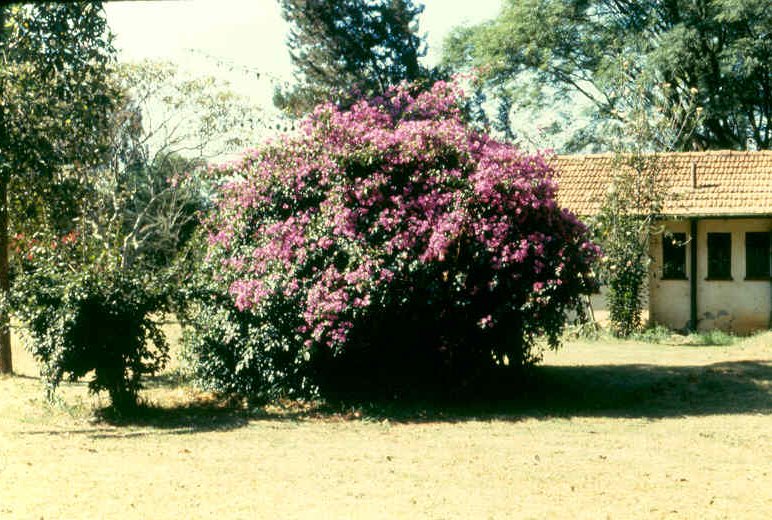
The Muguga House garden.

The Muguga House garden.

Time after work during the first few months was mostly spent at Muguga House, a place we shared with other lodgers of several nationalities: Kenyans, Tanzanians and Ugandans were the majority but there were also a few British and now two Uruguayans, probably the first and possibly the last! It was clear that the place had seen better days during the colonial time and when the East Africa Community was functional. It had a large area where the bungalows were scattered and it offered its lodgers a couple of tennis courts and bowling greens. It also had a bar where darts were a popular pastime, only second to talking about Kenyan politics!

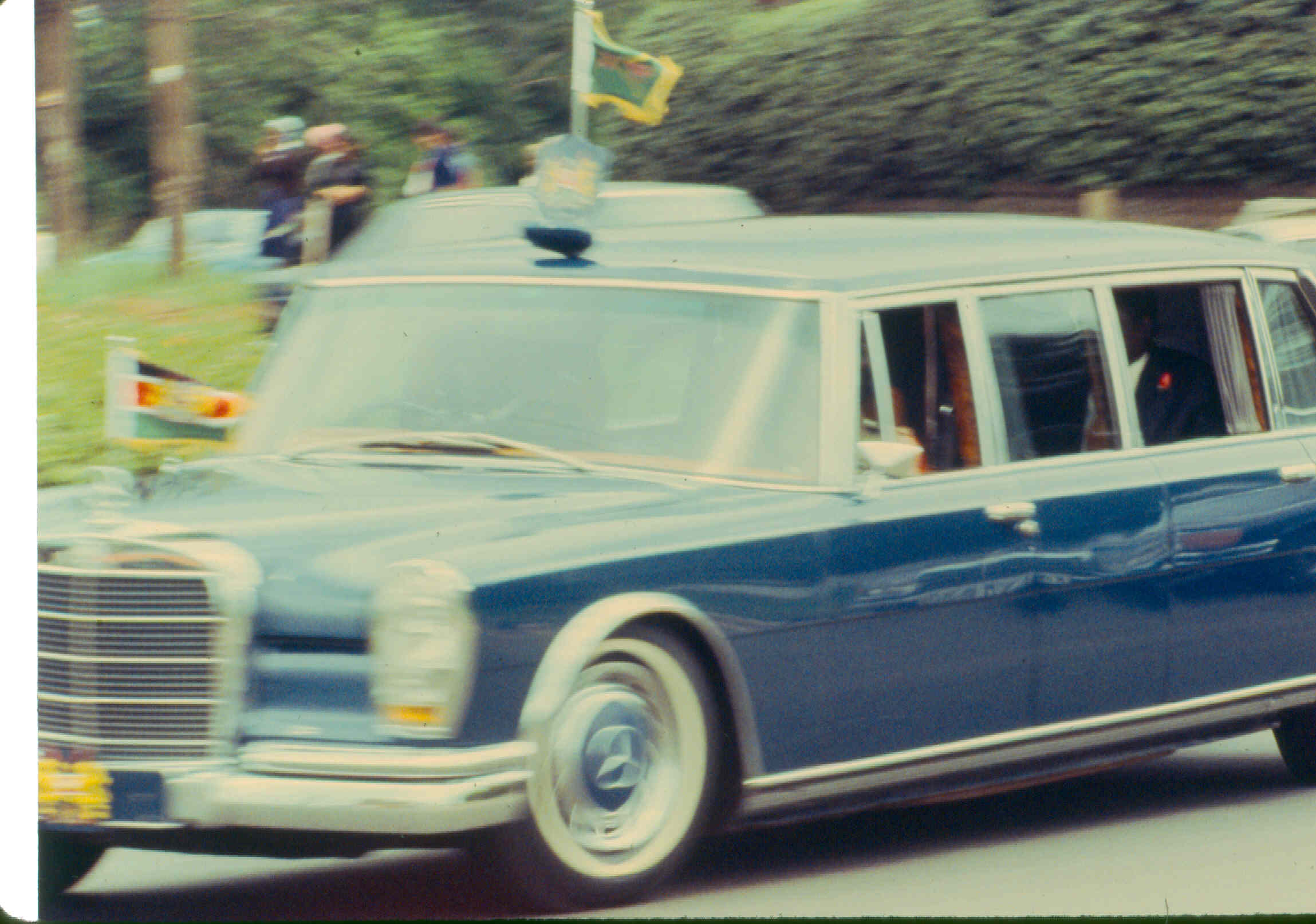
I took this picture of President's Moi motorcade. Later I learnt that this was not allowed!

I took this picture of President’s Moi motorcade. Later I learnt that this was not allowed!

Joyce did not or could not manage Muguga House very well. Despite this the place was still reasonable and although the bungalows were basic, they were kept clean. Food, however, was another story and the daily topic of conversation. The British-style breakfast was good and I skipped lunch as I remained at work. Dinner was another matter. It consisted of dishes such as egg curries (with no yolks!) twice a week, very tough and overcooked meat with ugali and sukuma wiki[3] (twice a week) and other bland dishes during the remaining three days.

Desert did not shine either and we were given artificial egg custard and rice pudding (both made with water), jelly (orange and red) and bread pudding with “flies” (tiny raisins). Cape gooseberries either boiled or as part of a crumble were there permanently and you could -if you dared- consumed them “ad lib“. We did get five o’clock Kenya tea and biscuits. Food would greatly improve whenever important visitors came for lunch or dinner!

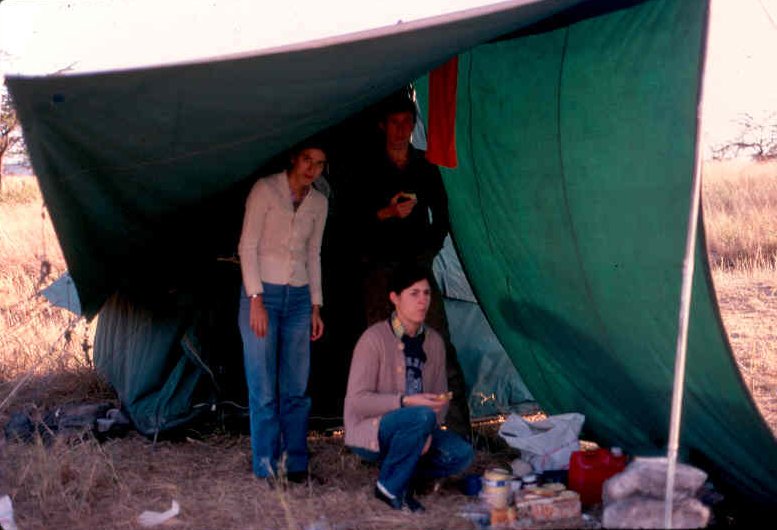
Our first camping experience at the Maasai Mara. From left to right: Ranjini, Kevin and my wife.

Our first camping experience at the Maasai Mara. From left to right: Ranjini, Kevin and my wife.

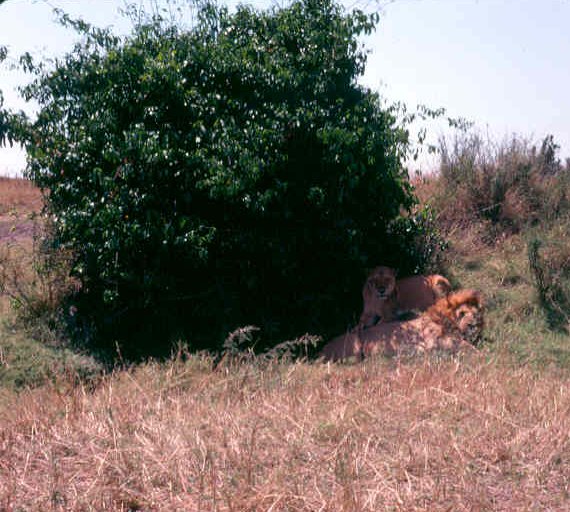
Our first lions. Exciting despite doing what they do most of the time: rest and sleep!

Our first lions. Exciting despite doing what they do most of the time: rest and sleep!

After dinner conversations were well attended and, again, Kenyan politics was the main topic. I participated with stories of South America that generally horrified our British colleagues. I do recall my stories of pest control in Uruguay, in particular the elimination of the enormous numbers of damaging parrots that left one of them, a Cambridge graduate called Richard, speechless. Only much later was I to discover that he owned an African Grey parrot and suffered for the cruel fate undergone by its relatives!

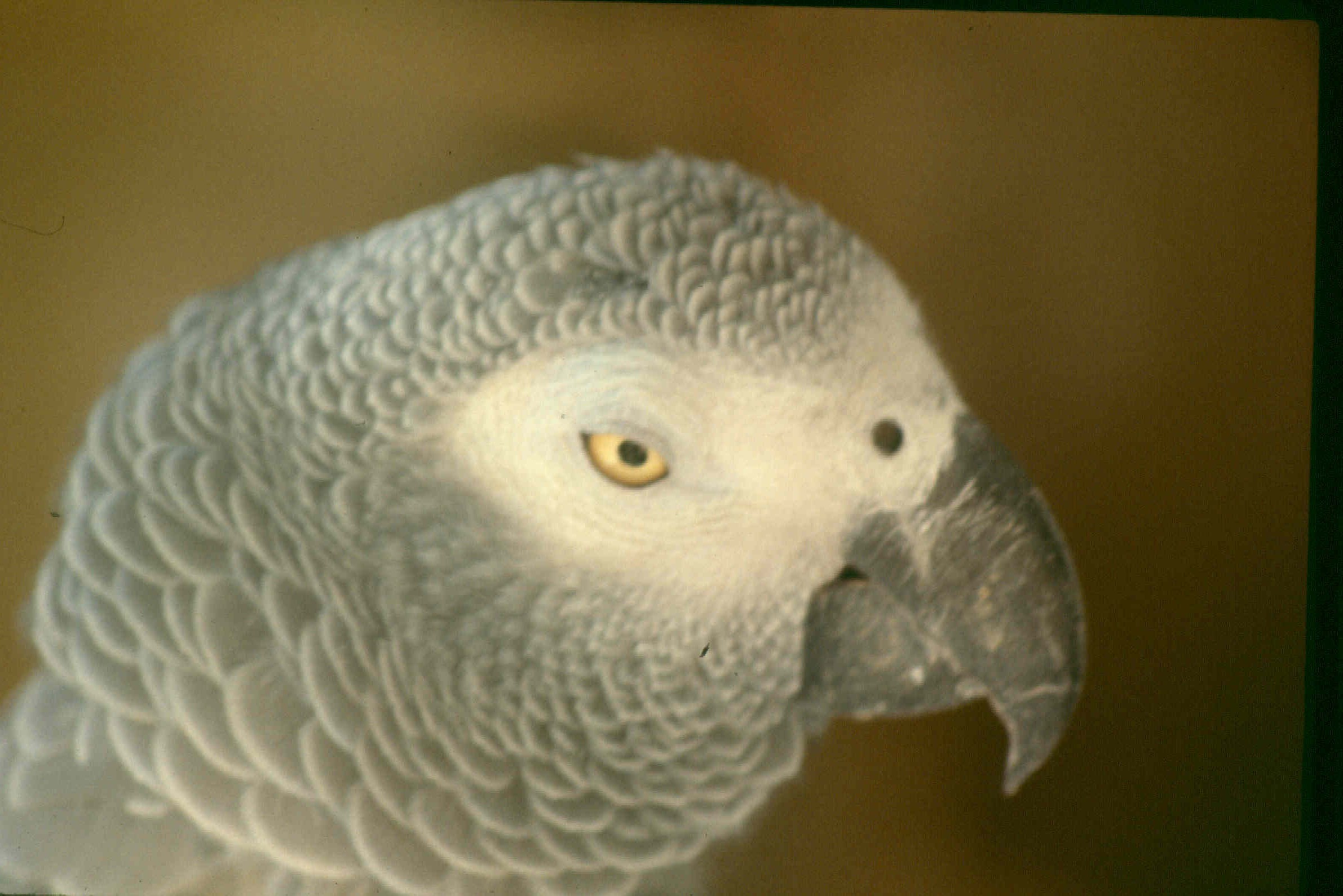
Richard's parrot.

Richard’s parrot.

Through Richard we learnt of the existence of a house for rent at Tigoni in the outskirts of Nairobi, where many British lived, including Matt, Paul and Alan. We rented a house next to Richard’s, from a former Game Warden of the Serengeti National Park called Gordon. It was a superb location with tea plantations and remaining patches of virgin forest where many animals lived such as bushbabies and our favourite, the Colobus monkeys, surrounded us!

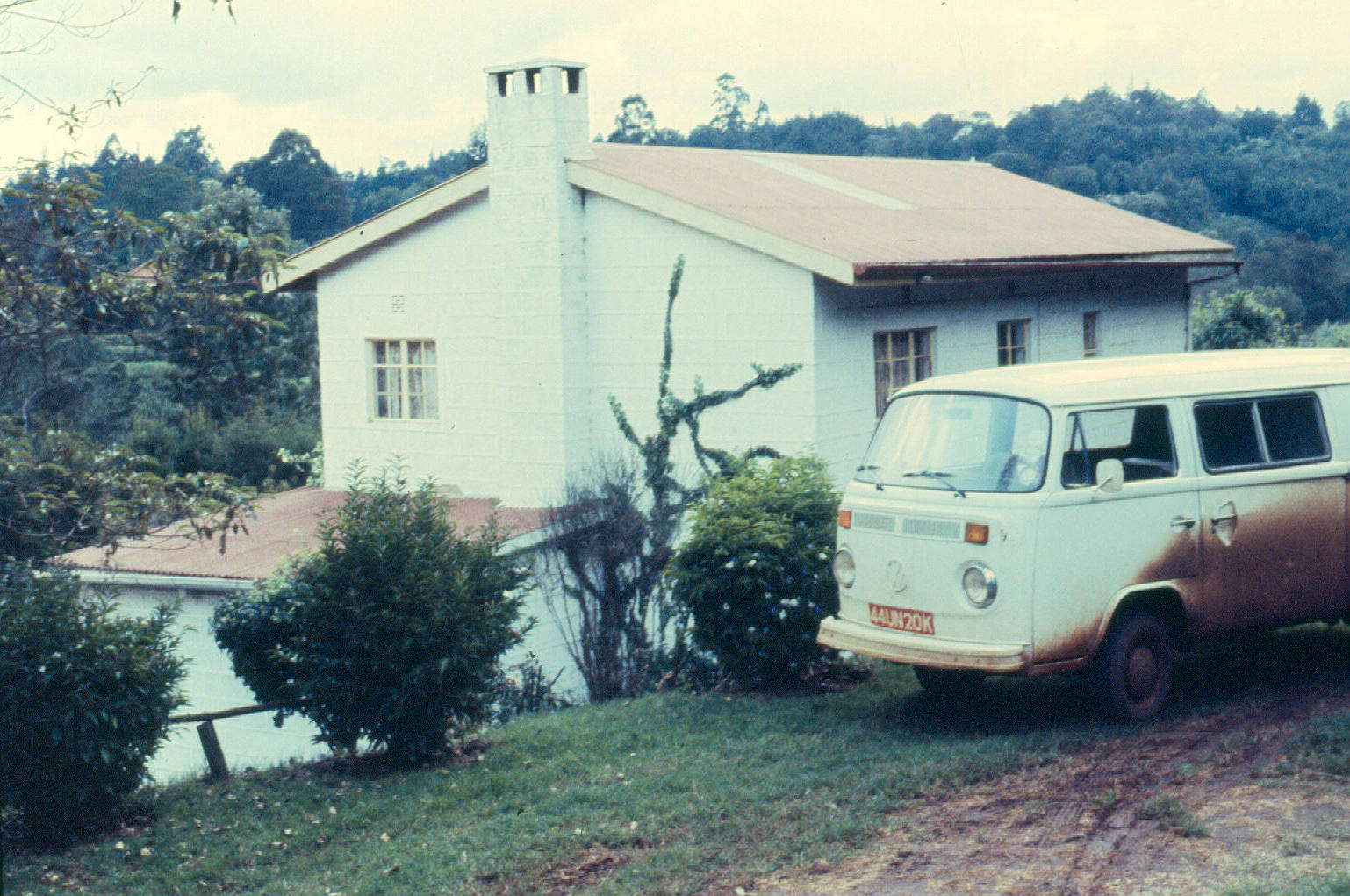
Our house at Tigoni.

Our house at Tigoni.

[1] Follows “Back to Nairobi”

[2] Ticks are killed by means of a toxic chemical known as an acaricide. The animals are normally “washed” with it but the chemical can also be applied by injection or poured on the back of the animal.

[3] In Swahili: maize meal and kale. The term “Sukuma wiki” means “push the week” in the sense that being a cheap dish, it helps to keep going.

Back to Nairobi[1]

The return trip from Intona ranch took us through the attractive Transmara parkland where its green natural grasslands were splattered with islands of forest, usually associated with large termite mounds. These forest patches coalesced at times to form larger wooded areas, particularly when linked with a river. Talking about rivers, we crossed the Migori where Alan said a group of Giant Forest Hogs (Hylochoerus meinertzhageni) -a Transmara “special”- could be seen grazing in a forest clearing next to the road[2]. Other common game was plentiful, crisscrossing the road almost continuously. Alan informed me that the wildebeest had crossed the Mara River and were grazing in the area of the Mara triangle and some would climb the escarpment towards the Transmara. I was happy to know that we were heading in that direction!

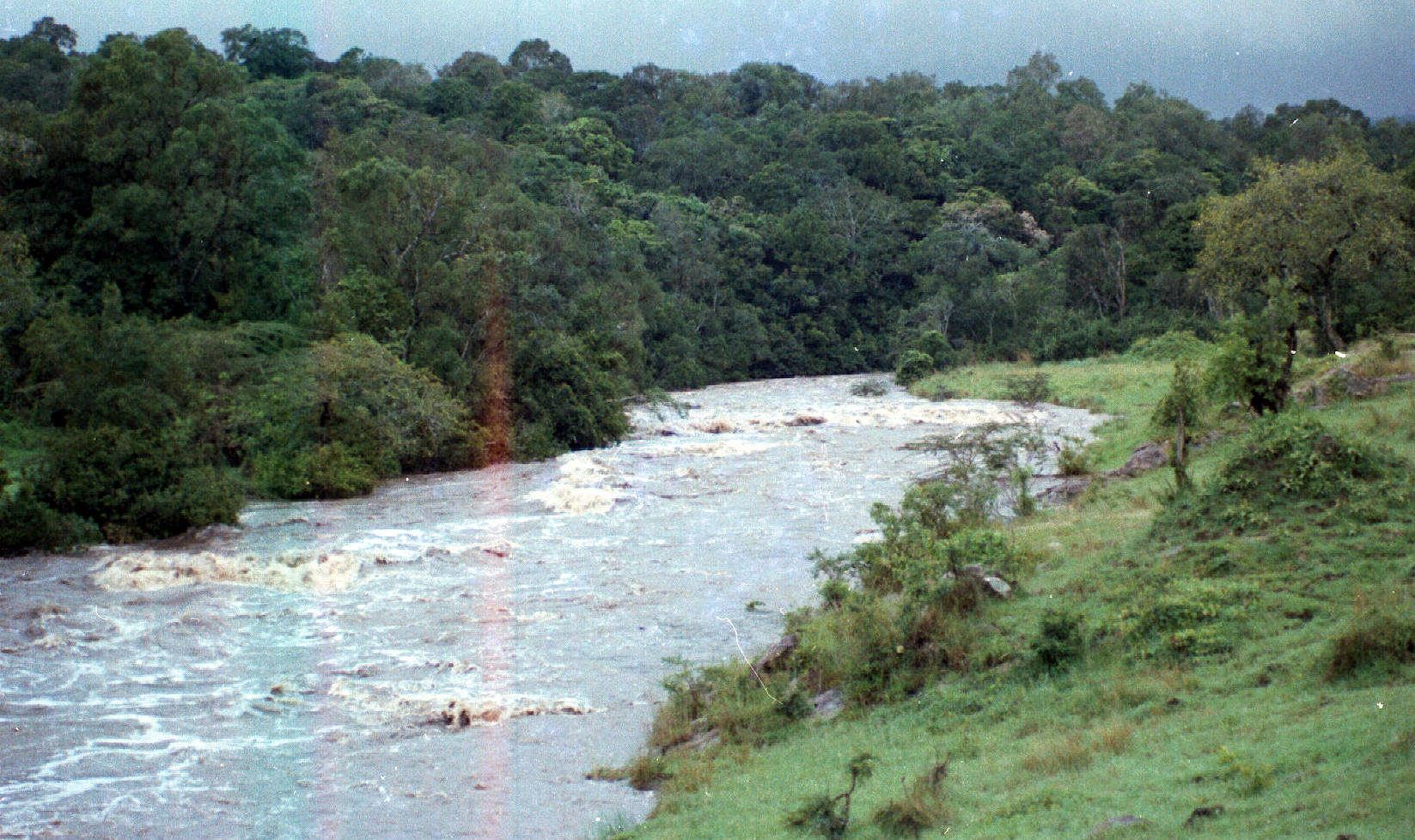
Migori river in flood.

Migori river in flood.

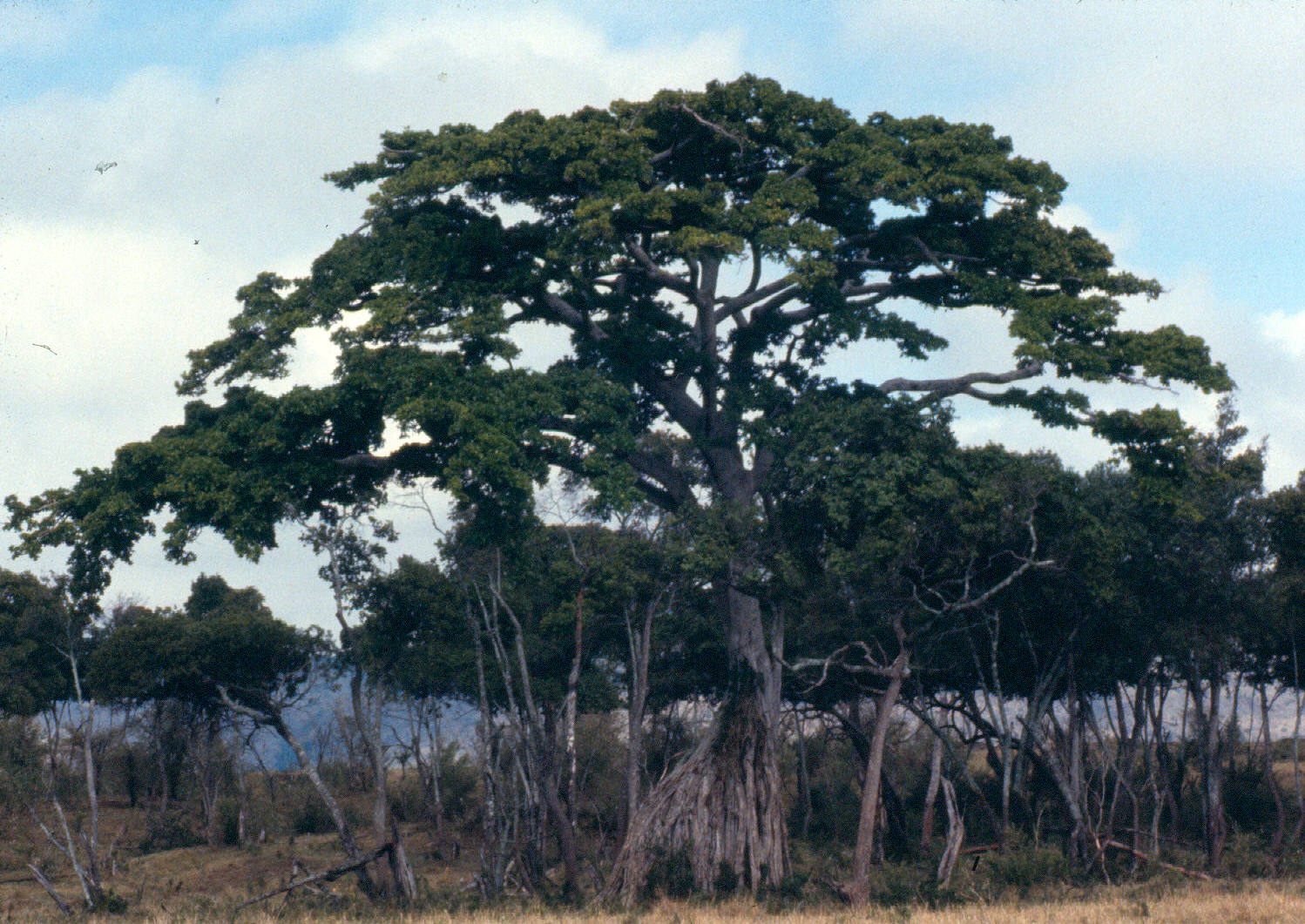
A large tree near the Migori river.

A large tree near the Migori river.

The dirt road took us through Lolgorian where two GTZ German animal health specialists were supporting the Government of Kenya by giving veterinary assistance to the Maasai. We stopped to greet them as Alan had some ground-breaking collaboration going on with them, as mentioned in the earlier post. It was the first time I saw a small field laboratory that could deal with most relevant diseases while keeping work simple and straightforward. It was known as “ILRAD II”[3], an irony that Alan found very funny although it took me longer to understand the humour behind it!

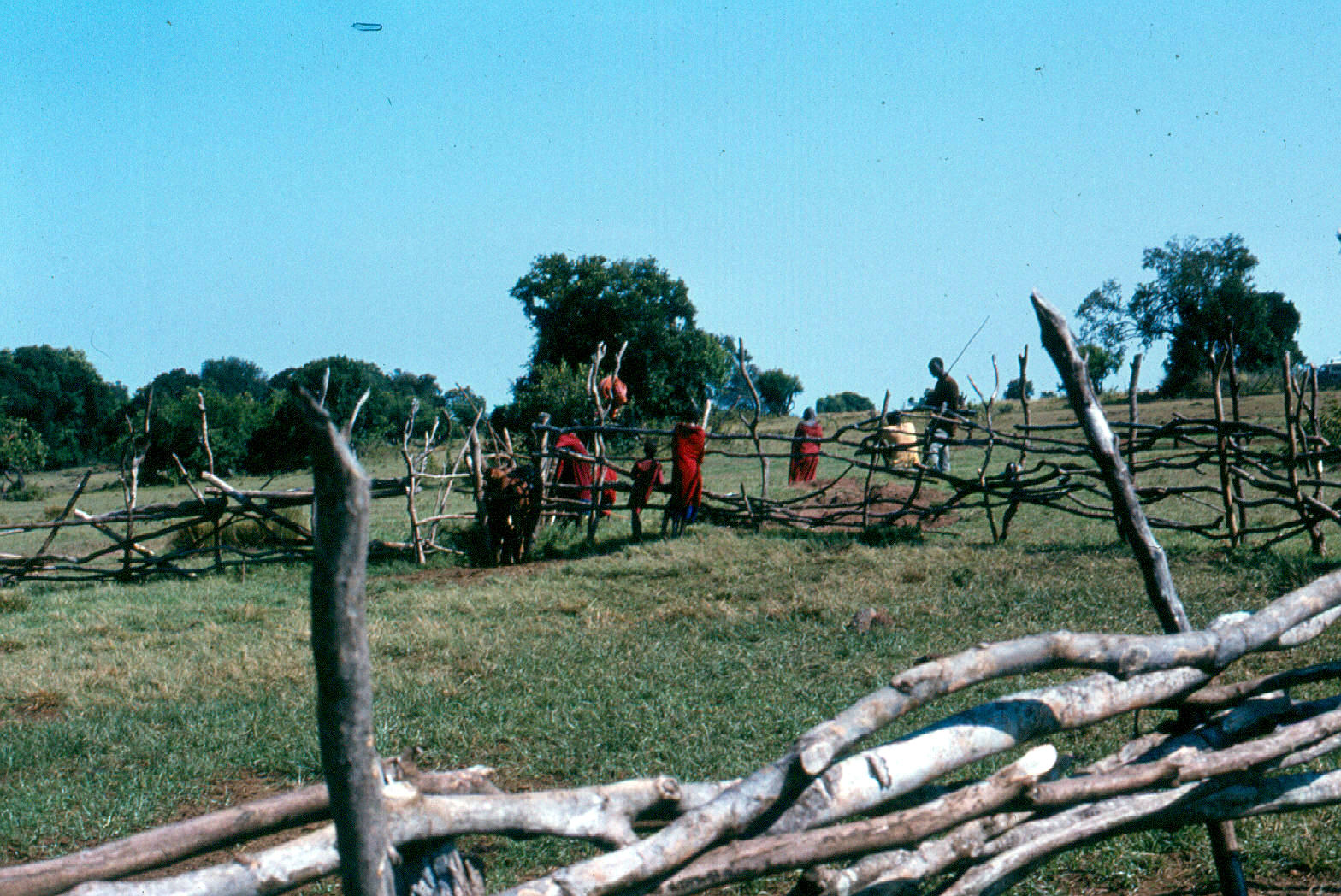
Maasai working with their animals at Kilae, near Lolgorien.

Maasai working with their animals at Kilae, near Lolgorien.

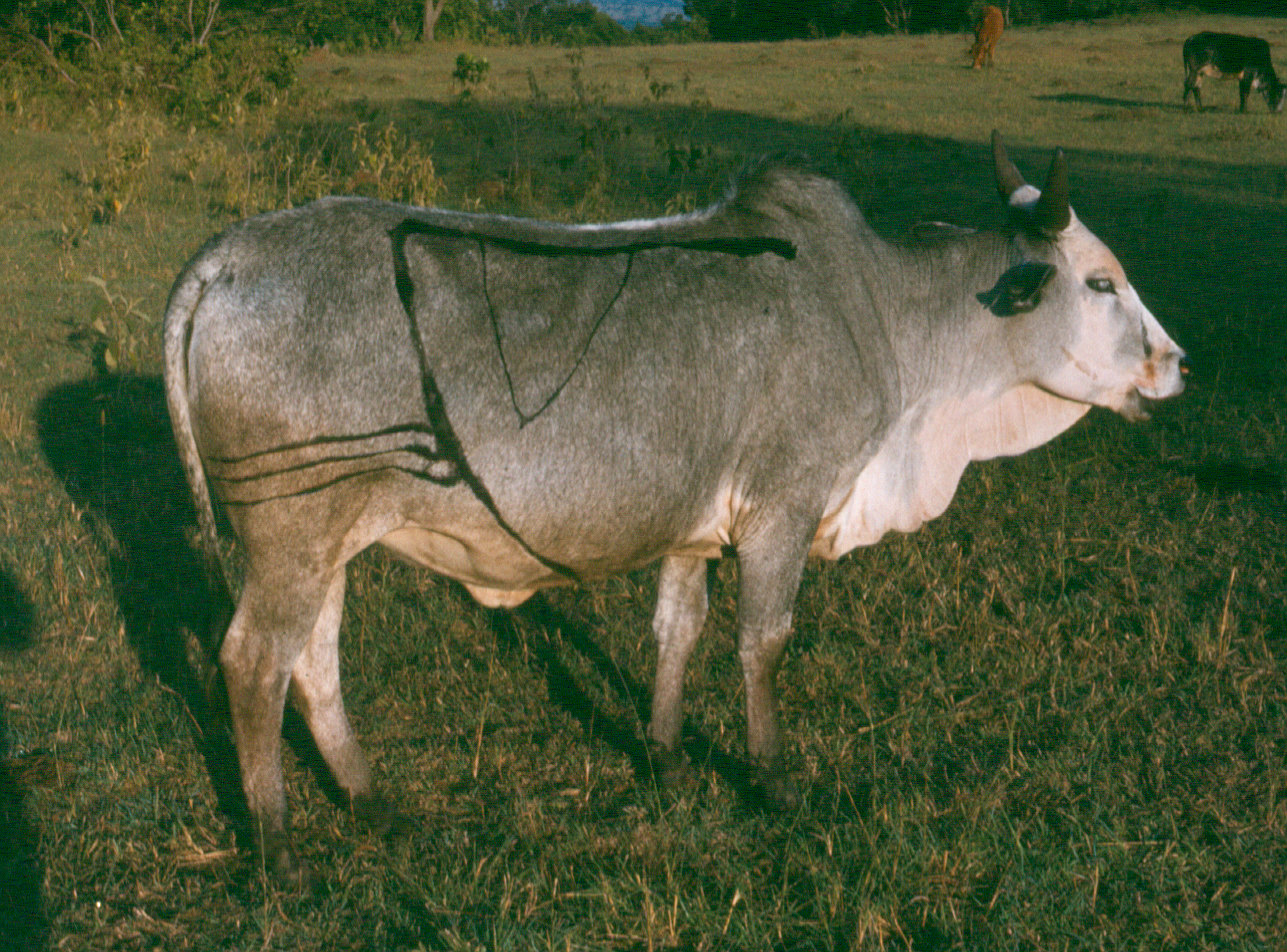
A Maasai heifer. Note the heavy branding.

A Maasai heifer. Note the heavy branding.

ILRAD II (outside).

ILRAD II (outside).

ILRAD II (inside).

ILRAD II (inside).

After that enlightening visit we continued and passed a religious mission where Father Frans Mol lived and worked. Although we did not stop, I met him on other occasions and learnt of his erudition when it came to the Maasai people.[4]

Moving on and still in the Transmara we came to the “red hill” an infamous stretch of road. “When it rains, it is like driving on a bar of soap” said Alan and added, “I hope it is dry today”. He went on: “Because of the proximity with Lake Victoria, it rains almost everyday here so it is tricky at the best of times!” “That is why you should leave in the morning as to avoid the afternoon rain”. Alan continued: “You should engage 4WD and advance slowly in second gear. If the car starts sliding off the road all you can do is to stop and hope that the car stops and that you can straighten it again”. And then laughing: “I know people that have spent the night here!”

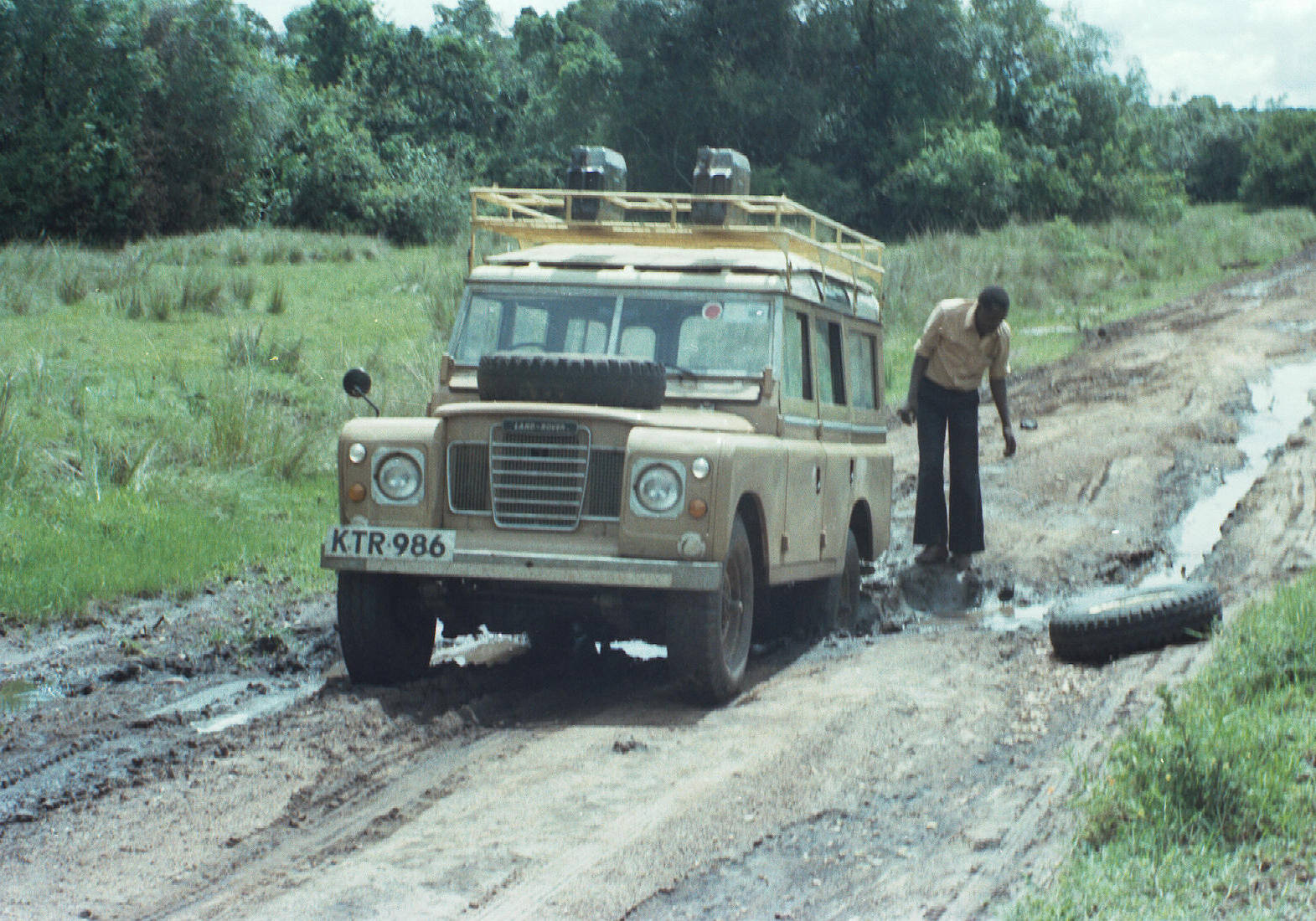
A common occurrence at the Transmara!

A common occurrence at the Transmara!

Luckily we managed it without problems and then we came to a stretch of black cotton soil that looked menacing to me as it was fairly water-logged. However, we slowly moved forward and even gathered some speed, as the wheel ruts were deep enough to prevent us from going off the road and our only option was to go straight. The road became better and then we found large wheat and barley plantations where the Maasai had leased their land to commercial farmers.

Soon we got to the edge of the Oloololo Escarpment. I can claim to be many things but a poet is not one of them, so I am not able to describe the view that unfolded below us. It was a green sea that extended as far as you could see. In it you could just make out vast numbers of animals; those forming long lines were wildebeest and zebra while the small specks were Thomson’s gazelles. A few elephants could also be seen together with an almost black and compact herd of buffalo. This sight will be with me until I die![5] I asked Alan to stop for a while so that I could take in the view a bit longer while stretching our legs. While watching the green marvel, Alan explained that we were looking at the “Mara Triangle”. He pointed out the Mara River to me as well as where Tanzania and the mythic Serengeti were.

We started our descent and eventually crossed the Mara River at the bottom of the Escarpment. We passed Kichwa Tembo Camp and then deviated into the Maasai Mara Game Reserve to have a look at the animals before continuing on the way to Aitong, Narok and Nairobi. The place was magnificent and we saw vast numbers of wildebeest and zebra grazing as well as other animals roaming around. A special mention to the Thomson’s Gazelles that are ubiquitous in the Maasai Mara; they are an integral part of the ecosystem. The best description I have heard about these gazelles came from Paul, my Mentor in FAO, who visiting the place for the first time, told me that they look like shoals of tropical fish!

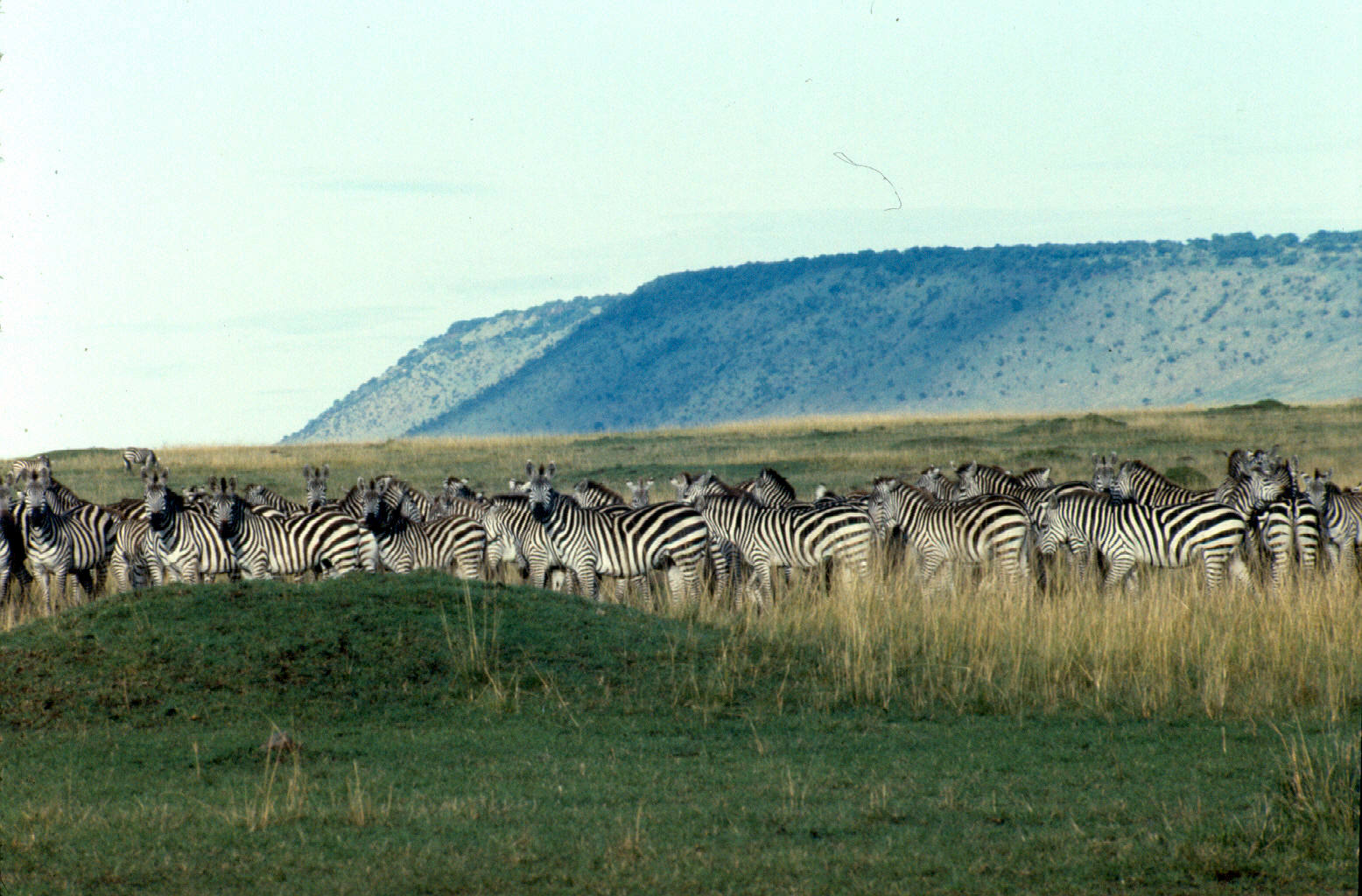
Zebra with the Oloololo Escarpment in the background (I will remove the dirt from the ski when I learn to do it!)

Zebra with the Oloololo Escarpment in the background (I will remove the dirt from the sky when I learn to do it!)

Maasai cattle at the Mara river bridge.

Maasai cattle at the Mara river bridge.

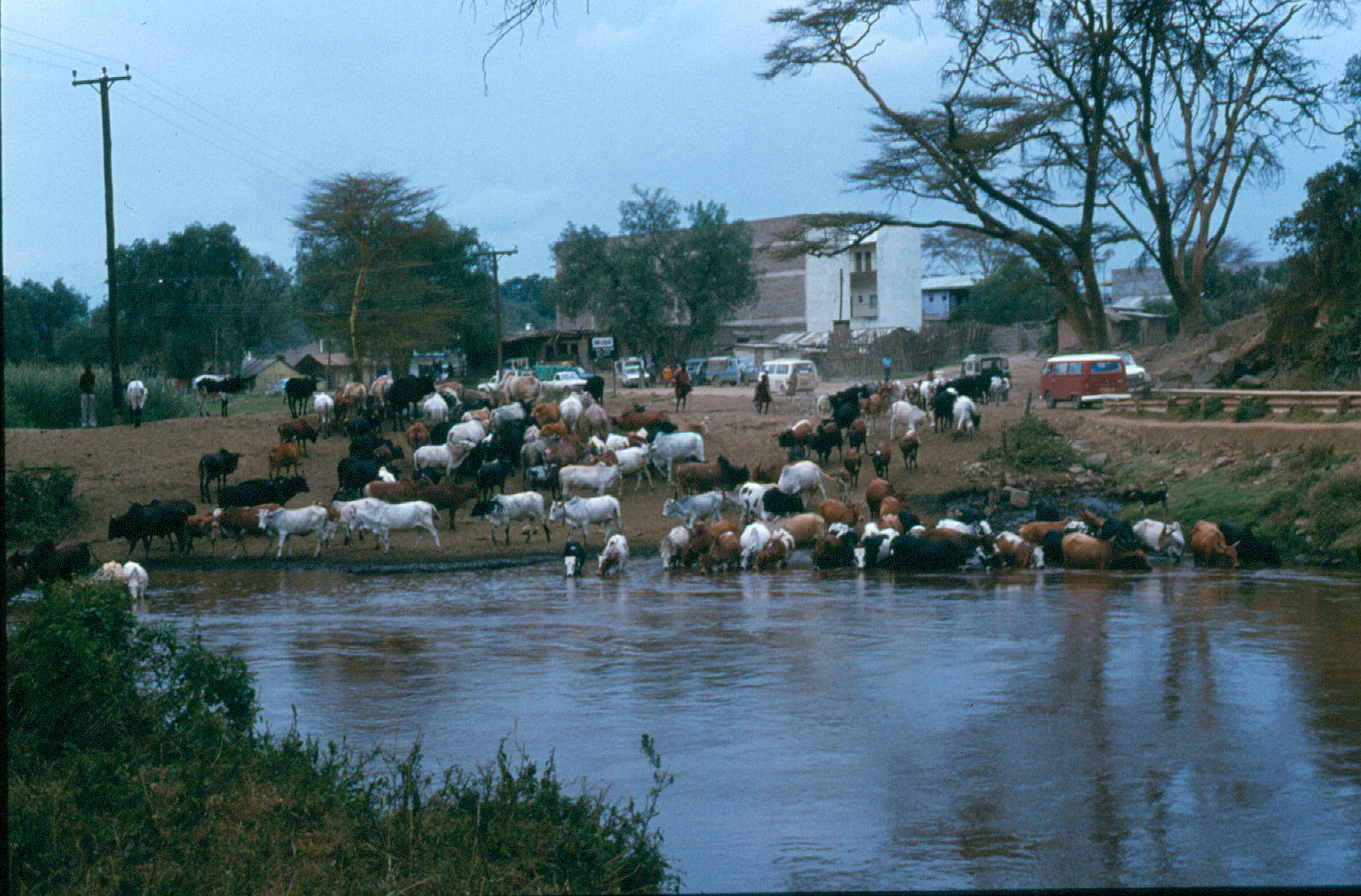
Cattle drinking at Narok dam. Note cars used at the time: VW Kombi, Land Rover Series III and Land Cruiser 50 series!

Cattle drinking at Narok dam. Note cars used at the time: VW Kombi, Land Rover Series III and Land Cruiser 50 Series!

As detailed at the Intona ranch post the return journey only served to strengthen my conviction that I should work at Intona ranch, something that with the help of Alan, Matt could be persuaded to accept, thus allowing me the privilege of driving through the Maasai Mara Game Reserve on the way!


[1] Follows “Joe”.

[2] I did see them very often in this spot where they were quite tolerant of my presence and could watch them during long spells.

[3] The International Laboratory for Research in Animal Diseases was a state of the art large facility located at Kabete, near Nairobi. Today is known as the International Livestock Research Institute (ILRI).

[4] Fr. Frans Mol MHM, affectionately known as the ‘Apostle to the Maasai’ worked at the Ngong Diocese covering most of Maasailand. He authored several books such as: Lessons in Maa: a grammar of Maasai language (1995) and Maasai Dictionary: Language & Culture (1996).

[5] We were at the very spot where Out of Africa’s famous final scene was filmed! Watch the movie and you will get the idea of what I saw in 1981!

Joe [1]

The trip to Intona ranch with Alan described in the post “Intona Ranch” put me in contact for the first time with Joseph (Joe) Murumbi and his wife Sheila. After this first encounter I shared many evenings with them at their beautiful if rather outlandish house. They had built it after retirement following the style of the houses found at the Kenya coast. It was a large house with many bedrooms, a large and complete kitchen and a sitting room bigger than a basketball field!

Although I stayed at the house several times, because of the work I was doing I normally camped at the ranch, as I preferred to keep my independence. Work started early and my timetable was rather different to their retired pace.

When we met, Joe had already suffered a stroke. He was recovering but still maintained the fire in his eyes and remembered a lot of stories of his life that he shared with Alan and me. They were very fond of Alan and they also got to like me. It helped that I was a veterinarian. They had a few dogs (5 or 6) that always had something wrong with them, despite the efforts of Kiza, their Ugandan resident veterinarian. Joe was always very supportive of our research and took a keen interest in our trials and their results! He could not wait to apply them on his cattle and those of his Maasai neighbours.

Although I will tell you more of my relationship with Joe and Sheila in future posts, I have a few reminiscences of our relationship that I will mention here.

Joe loved his cattle and he experienced great joy in going to the kraal in the evening to see them coming in. He was fair but tough with his employees and, as expected, he was feared by them on account of being a mzee[2] who had held power but also because of his short temper! I am sure his eyes had something to do with it as well, as he had a powerful look when fired up by anger or enthusiasm.

Sheila, conversely, did not care about cattle much. She loved plants and was a keen gardener. She kept a lovely greenhouse, which housed a collection of the orchids found at Intona and served as a nursery for the already beautiful garden and internal patios of the house.

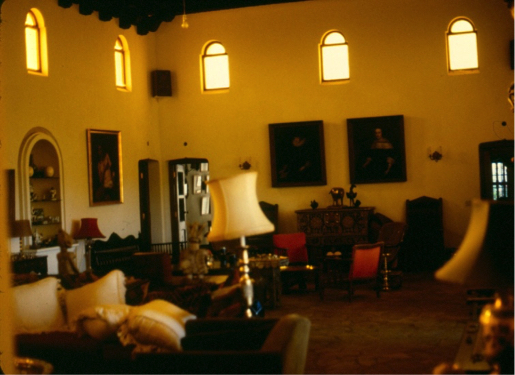
The "Dutch Masters" paintings in the background, the picture was taken from the place Joe used to sit.

The “Dutch Masters” paintings in the background, the picture was taken from the place Joe used to sit.

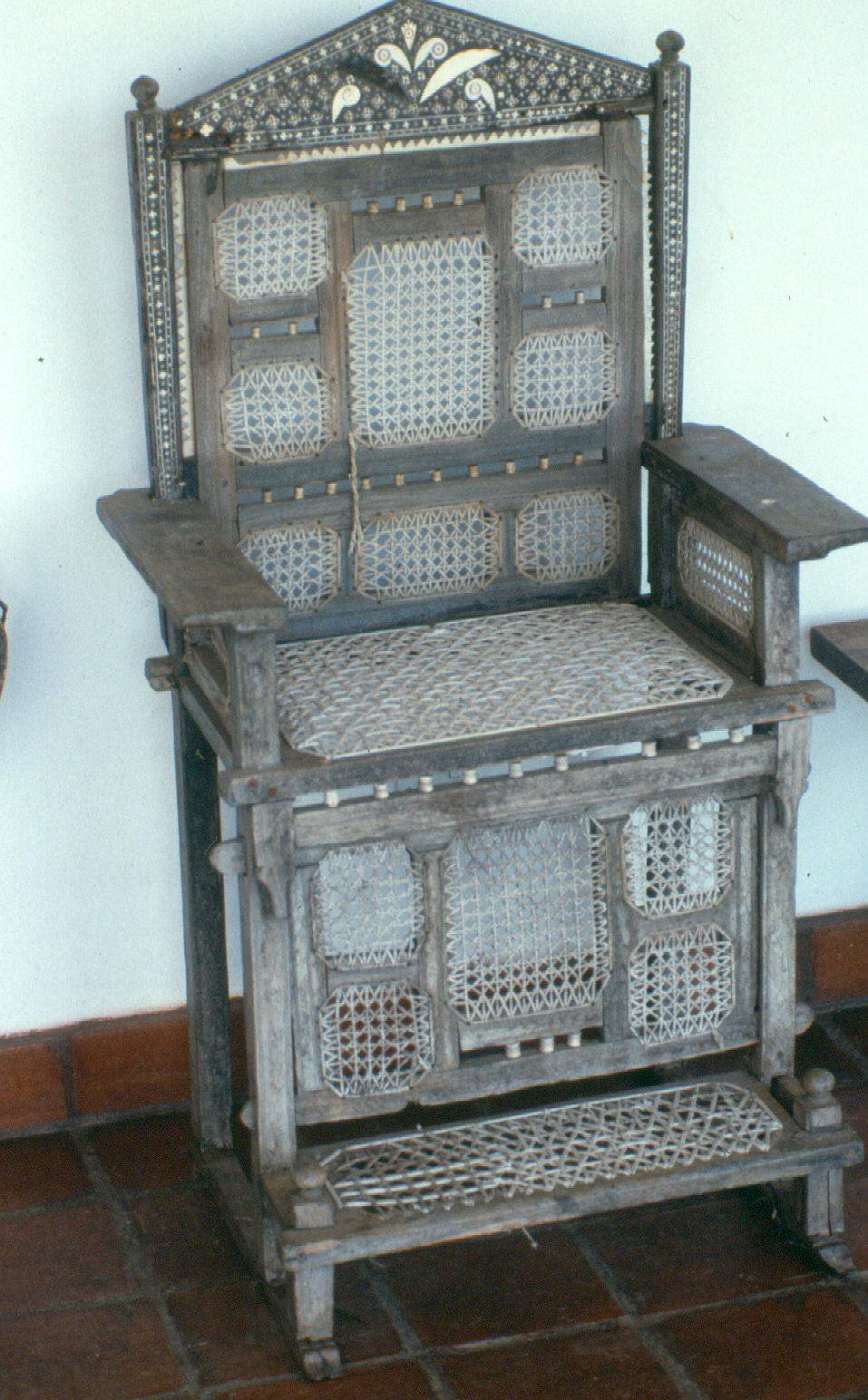
They both shared an incredible passion for culture and art and the house was a true museum of African art although there were several large paintings that I attributed to “Dutch Classic painters”. The sitting room I mentioned above was literally filled with art. Wood and metal carvings, masks, ancient trunks, antique chairs, oriental rugs, and large paintings decorated the place.

murumbi mask 1

murumbi mask 2

murumbi lamu chair

murumbi mask

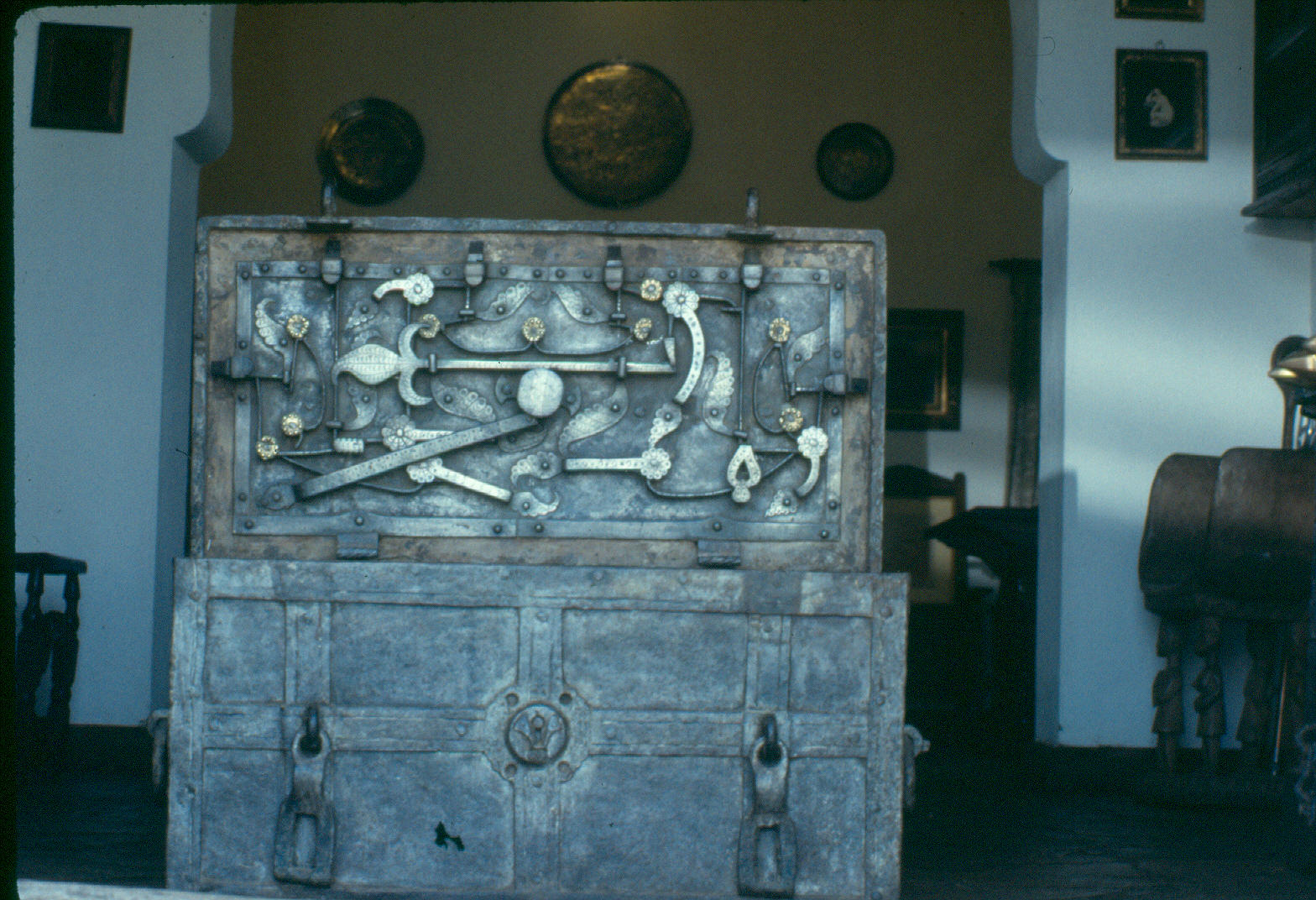
murumbi chest

And then there was his library! A large room with bookshelves all round and where all his diplomas, decorations and memorable photographs were kept. A young Joe could be seen in the company of Kenyatta, Nkurumah, Kaunda and Nyerere to name but a few. There was a large one of Joe with Haile Selassie and several more with other European leaders that he rubbed shoulders with during his political life. Clearly he had kept selected items after all his donations of books and documents to the Kenya Government.[3]

Although Joe was very enthusiastic about showing some of his unique books (he had all the first editions of the works by most African explorers, to name what I recall today!) his real joy was to open the many drawers that hosted his immense, comprehensive and very valuable stamp collection. He was very proud to show me some of the “specials” he possessed, including most of the first African stamps and even some of the earliest British ones that -apparently- were extremely rare and dear! Not being a collector myself, I listened and enjoyed his keenness more than anything else.

As if being shown the library by Joe himself would not have been enough, I was given the green light to roam free through his still vast book collection. This I did and spent long hours browsing through the many special books and documents that it housed. Among several, I particularly recall opening a proofreading specimen of Peter Beard’s “The End of the Game”[4] and finding inside it an exchange of letters between Joe and Peter about the book and its presentation! This was one surprise I remember but I have forgotten many, I am afraid!

Intona hosted a number of wild animals that intermingled with the cattle. Impala, Zebra and Topi were very common and herds of buffalo resided in the ranch. Lion were often heard but rarely seen (probably scared of the Maasai around us!) but a family of Cheetah resided at the ranch and were often seen. Spotted Hyenas were heard every evening and I was surprised if they did not visit my camp at night!

Buffalo herds often grazed in the meadows and frequently mixed with the cattle. Surprisingly they did not trouble the herdsmen, behaving like cattle but keeping their distance. The solitary males were a different issue and walking about Intona required great care as these rogues would seek shelter inside the clumps of forest that dotted the green grasslands at the ranch and come at you with anything but good intentions!

Buffalo were the main danger to watch out for while orchid collecting, an event that Robin -my good colleague from ICIPE- used to perform. As this involved entering the clumps of forest, it was a rather dangerous hobby. Luckily Joe had a hand-operated fire siren that a helper carried and used to scare the buffalo by sounding it before we entered the thicket. We were lucky not to encounter any buffalo, as I was doubtful of the effectiveness of the siren! Or maybe they ran away in the opposite direction? We did have a few scares when warthogs would crash out of their previously quiet resting areas because of our racket. We got a few adrenaline highs but fortunately they never came straight at us!

Alan’s closeness to Joe and Sheila meant that they relied on him for help at all times. I believe they saw Alan as the son they did not have! Their friendship was so close that once when Joe needed to go for an operation in the UK, Alan travelled with him! Alan did not travel alone, he had a most unusual companion: a nail-studded power figure[5] which was apparently rather expensive and Joe needed to sell it in the UK to cover the expenses of his medical intervention. So Alan was entrusted to fly with the sculpture for which I believe they booked a seat next to Alan! I do not know more details other than that Joe came back in better shape!

Joe greatly enjoyed having us for a drink in the evenings to talk about our work and tell us some of his stories. So we were often invited. Sheila was a great hostess and looked after us as if we would have been her newly discovered relatives! One of those occasions coincided with a rare and probably one of the last trips to Intona by road in his Range Rover. He mostly travelled by plane with the dogs!

On that occasion Joe was really upset about the condition of the road. The latter was really bad during normal times but at that particular occasion was impossible and -almost- impassable! Joe had a temper and that was the first time I saw him losing it! He was so upset that, after telling us about it, he picked the phone and started to call. At the time, Telephone calls from Intona were “difficult” to put it mildly so he insisted a few times until he managed to get through.

Despite his speech difficulties he managed to gather sufficient strength to speak in clearly strong terms and in Swahili. After a while his tone changed and, before he hung up, he burst into a hearty laugh. Still laughing and while shaking his head he said “That was Daniel[6] on the phone” and added “I was complaining to him on the conditions of the road and do you know what he replied?” he said looking amused “Joe, you know that I travel by helicopter!” I will keep Joe’s comments to myself!


[1] Follows Intona Ranch

[2] An elder in Swahili

[3] Ref. to details of his donation to the GoK

[4] Full title of the book

[5] See: http://www.sciencemuseum.org.uk/online_science/explore_our_collections/objects/index/smxg-105001

[6] Daniel arap Moi was President of Kenya from 1978 to 2002. He succeeded Joe as Vice-President after Joe’s resignation in 1967.