After watching Big V and the other elephants until the light faded, we decided to get back to our lodge, as you are not allowed to drive in the dark. Shortly after the turn off to our lodge my wife heard a strange call. As it was unusual we stopped and listened.
At first we thought that it was an owl or some other large bird. Whatever its origin, we were sure that we had not heard it before so we decided to retrace our “tyre marks” and see if we could spot the originator.
We returned to the main road and, immediately, my wife spotted three ghosts that, as they got closer, gradually became African wild dogs (painted dogs) walking in the dry bush. We stopped, watched and listened. Suddenly, one dog crossed the road in front of us and started emitting the sound we have heard earlier. It was a plaintive sound repeated three or four times. The call was repeated a few times and then the dogs got together again and walked into the darkness.
Wild dogs seen on another occasion in Mana Pools during the day.
The only option I had to record the sound was to take a video and hope that the sound if not the image will reflect what we heard. The results are a dark video with the wild dog call repeated three times.
Later on I learnt that when wild dogs get separated from their packs they get very concerned and in these situations they emit the call we heard that aims at getting a reply from the pack in order to reunite with them. This call is known -rather appropriately- as a “hoo” call.
So, what we saw were probably three dogs trying to re-join their pack by hoo calling. Later on we learnt that there was indeed a pack of about twenty dogs roaming around Mana Pools at the time so we probably saw three members of that group.
After that, we lost them but their plaintive call got “recorded” in our minds.
The hoo call (and the bad video!):
I am sure that you will agree with me that you do not expect such a sound to come from a wild dog!
Boswell and Big V[1] are the best-known elephant bulls in Mana Pools National Park. I recently reported about Boswell’s skills to feed on his hind legs[2], a rather unique trick. When we witnessed an elephant feeding on Acacia pods overhead and I reported in an earlier post[3] was Big V so I have already introduced both to you.
Mana Pools this August was extremely dry, as last year the rains were not good. For this reason the area looks more as it does towards the end of the dry season in November than it should be in August: a dust bowl! I believe that the animals are in for a tough two to three months until new rains arrive, if they do as these days weather patterns have changed.
Luckily for most of the animals in Mana the Zambezi River is there and, together with the pools that lend the name to the park, they provide water and fodder to keep the grazers going while the trees such as the apple-ring acacia (Faidherbia albida) will supply elephants with browsing. The animals that seemed hardest hit at the moment were the hippos that need to consume large amounts of grass so it was common to see them walking about during late afternoon already far from the water.
While checking in we learnt that lions had been spotted around an area known as Mana mouth. After recovering from the six-hour journey from Harare and, after unpacking and organizing our lodge, we decided to go there as it is close and the sunsets there are usually beautiful, even without lions! We never reach our destination as on our way we found Big V!
With him were, in addition to his usual young male retinue, a young female and its small calf, something unusual as large bulls tend to hang out on their own or with a few askaris[4]. He towered over the lot and he was clearly the undisputed leader of the group.
In an interesting contrast to his dominance over other elephants, Big V is an extremely relaxed elephant that allows the human observer to approach him either in the car or on foot. In contrast, the younger males can be more boisterous and occasionally perform threatening displays and mock charges that remind us that we are dealing with wild animals!
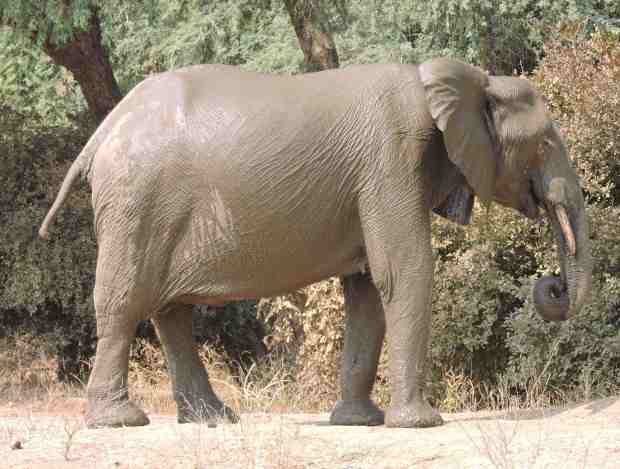
On this occasion it appeared that Big V was doing some “community” work by pulling down branches from an apple-ring acacia. Clearly, for the elephants this was the equivalent of eating at a Michelin-starred restaurant!
Although Big V was not standing on its hind legs “Boswell style” it stretched and reached high up the tree, to a height the others could not. As a result of its efforts large branches were brought down showing a great dexterity with his nose (it is easy to forget that he was breathing while doing this!) as well as the damage elephants can do to trees!
He will then fed on them, including the main branches, some of which were really thick! While Big V was eating, the other elephants were eager to collect any fallen pods or small branches but from a distance as Big V’s belly rumblings were sufficient to keep them all at bay! Well, not all…
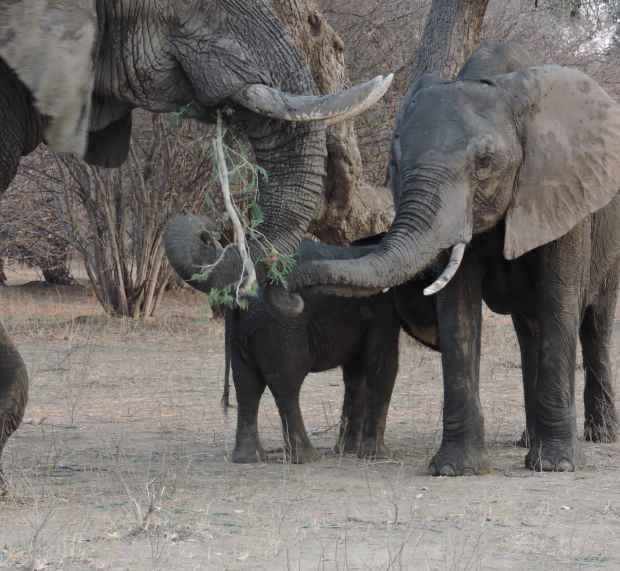
The small female and her calf approached the feeding giant ignoring his rumblings. Expecting some rebuke we were surprised to see that they slowly got closer and closer she started to steal bits of the branch to feed. The calf was also allowed into Big V’s inner circle and managed to pick some scraps. The large bull completely ignored them!
At one stage, the female even took bits of the branch from Big V’s mouth!
The reasons for this closeness I ignore but it was unexpected and we spent a few minutes watching how it developed. Spellbound with these interactions, we forgot about the lions and when the light was fading we returned to our lodge still talking about what amazing creatures elephants are!
[1] This elephant has a large v-shaped notch on its left ear.
[4] From Arabic, an askari was a local soldier serving in the armies of the European colonial powers in Africa. It is also used for security guards and the young bulls that accompany large bull elephants.
A visit to Lake Chivero Recreational Park, just over 30 km from Harare, does not sound like a grand outing when you have just come back from a family trip to Mana Pools and Hwange National Parks. However, it was a Sunday and our good friends Tom and Chizuki had time to share so we decided to explore the area and have a picnic lunch there.
Lake Chivero had some influence on our daughter’s life, the Senior Editor of this blog. My wife and I visited the area on 27 October 1990 and she still remembers that I had to help her to climb over the rocky terrain to see some of the San (Bushman) paintings as she was heavily pregnant. She claims, possibly with some justification, that this accelerated the arrival of our daughter the following day!
It was also at Chivero a few years later, when we were living in Zimbabwe, that our friend John invited our daughter -about eight years old then- to join him as part of a crew of two on a sailing regatta. We all went there and watched the race and also the moment when they capsized in the middle of the lake. We watched the events from the shore with great concern! Luckily, they managed to straightened the sailing craft and continued racing! This probably had something to do with our daughters’ love of the water and her keenness on sailing!
During the present visit we aimed for the game park area of the park as it was still unknown to us. We were aware that the park is somehow too close to the city so we did not have high expectations.
The total area of Lake Chivero Recreational Park is 6,100 hectares including the 16 km long lake. The animals that populate the game park, of about 1,900 hectares, came from Hwange National Park. Additional animals were brought in from Lake Kariba during the game rescue operation better known as “Operation Noah” that took place between 1958 and 1964.
We enjoyed watching several impala, tsessebe (Damaliscus lunatus lunatus), wildebeest, giraffe, zebra, wild pig and a slender mongoose as well as a number of ostriches and other birds. Busy watching animals we were, very soon it seemed, faced with our lunch! We decided to stop by the lake where the lodges are. The area was clean and the personnel very friendly. They pointed us to a viewpoint on the lake where we could have our sandwiches.
As soon as we stopped the car we were pleasantly surprised to hear a fish eagle (Haliaeetus vocifer), a call that we regard as the quintessence of the African wilderness. Usually fish eagles occur in pairs and their territories are large so you find them a good distance apart. What we saw in this area of the lake was different. There were many eagles and we estimated the number at between 40 and 50 birds, both adults and immature. They were all over the place, at the lakeshore, flying about and perched on the trees above and around us!
Picture credit: Tom Milliken.
The fish discarded under the eagles. Picture credit: bushsnob.
A view of the lake shore from our picnic site. Picture by bushsnob.
At some point we noted fast forming ripples on the surface of the lake and,after a while, we realized that shoals of fish were responsible for them. The latter would take place spontaneously or when the walking marabous or the eagles scared them by either wading or flying over them. We observed lots of interaction between eagles and between them and the marabous, particularly when fishing.
Picture credit: Tom Milliken.
Picture credit: Tom Milliken.
Picture credit: Tom Milliken.
Picture credit: Tom Milliken.
An area among the trees seemed to attract the attention of the eagles and, on close inspection, we found several dead fish that looked like Tilapia. Judging by the amount of guano present the spot was probably used for sleeping by some of the eagles.
Clearly there was a lot of fish at the lake and the eagles were profiting from it! It was by far the larges concentration of fish eagles I have ever seen and we were pleased to be able to watch them at close quarters. However, as this was the first time where we had seen such a congregation of fish eagles, I made a point to follow up the subject later.
Our lunch over we left the eagles thinking that a return visit to watch them at leisure would be justified. On our way out of the game park we were surprised to spot three white rhinos grazing placidly about 100 metres from us, a rare sight these days that added another justification for a re-visit!
Back home, searching the internet, I learnt that lake Chivero showed high levels of pollution in the 1970s but that the toxic levels had since declined. However, the lake is now highly eutrophic[1] and this, through the abundance of fish feeding on the increased amount of nutrients, has had a positive impact on the fish eagles’ increase in numbers[2].
Although the increase in nutrients may benefit bird populations -in our case the fish eagles- this may be at the expense of other species that require other -more fragile- resources that may be altered by nutrient changes and/or pollution and the overall environmental health may be in fact poorer[3].
So, what in principle appeared as a good thing, it may turn out badly for the lake habitat. It will be interesting to come back to the lake in a few years to see how things develop.
Below you will find four videos of what we heard and saw so that you can get the atmosphere at the lake that day.
A fish eagle flying over the lake shore and attempting to catch fish a few times. The response of the fish every time the bird approaches them can be seen as ripples on the water surface.
Fish moving ahead of the walking marabou storks.
Listen to the calls of the fish eagles!
Spontaneous fish runs indicating the large fish population in the area.
[1] Euthropic (From Greek eutrophos = well-nourished). Eutrophication of a pond or lake arises from the oversupply of nutrients of various origins, which induces explosive growth of plants and algae.
[2] Mundy, P.J. & Couto, J.T. 2000. High productivity by Fish Eagles on a polluted dam near Harare. Ostrich 71 (1 & 2): 11–14.
[3] MacDonald, M.A. (2006). The indirect effects of increased nutrient inputs on birds in the UK: a review. RSPB Research Report 21. Royal Society for the Protection of Birds. 204p.
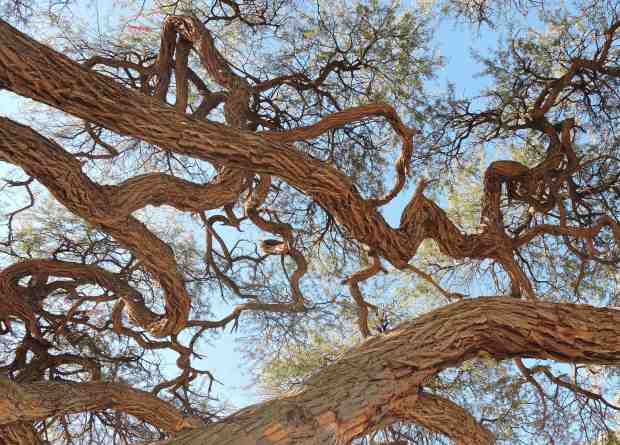
As you know if you followed this blog, this past August we visited Hwange National Park and camped at Ngweshla picnic site. The site is well shaded by some nice large trees that is very good during the hot months but that makes it very cold during the winter as we had suffered last year.[1]
A view of the canopy above us at Ngweshla.
This time the temperature was slightly higher and we were also much better prepared for the cold. I had even succumbed to peer pressure and acquired a pair of long johns to sleep in, in addition to a thermal bag that fitted inside the sleeping bag! The only challenge remaining were the possible night visits to the Gents that required little thought and fast action!
Camping at Ngweshla is always exciting as usually lions walked very close and their roaring reverberates strongly inside the tent! Only the experience of many such nights spent in the Maasai Mara and other wild places stops you from running to the car seeking the protection of the metal cage. I must confess, without shame, that we had done in earlier close encounters!
We need not had worried about lions but much smaller creatures!
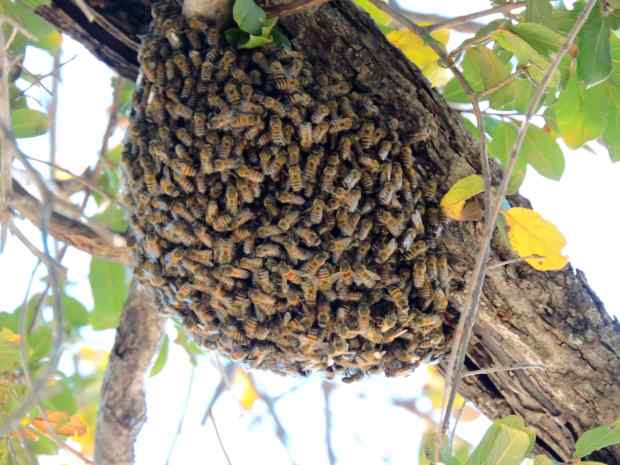
A small swarm of African bees decided to land on a tree above our dining area and, although at first they were polite, soon they became cheeky and started to descend on our food, particularly moist and sweet stuff. We have never had a problem with the infamous African bees and did not expect one. However, the fact that our son is hyper sensitive to wasp stings and needs to carry an epinephrine auto injector made us jitterier than usual.
Probably because I do not like bees, I was the first victim when I got stung in what I consider a self-defence act although my family unanimouly agree that it was an act of sheer foolishness! I was in the car peacefully enjoying elephants at the adjacent waterhole from the camp when a bee landed on my arm and I squashed violently. I was not violent enough as the beast, despite the smack, managed to leave her sting on me! I was not amused as, although my wife’s family and herself are beekeepers, I am not and I am not planning to learn the skills involved in stealing honey from them!
During the final day the situation got worse and at some point in the afternoon first my wife was stung and then me again! I did not move away fast enough from the seen of the attack and got a second sting. At that time we decided to reacted to lock our son in the toilet fearing a more severe onslaught and to vacate the camp and go on a game drive, after collecting our isolated son with the car from the toilet’s door!
Luckily that was our last day and by the time we returned to camp, after dusk as usual, the bees were sleeping. We left early the following morning, before they woke up, luckily without further incident.
Although the bees were annoying, they brought about some gain. Their presence attracted both the Little (Merops pusillus) and Swallow-tailed (Merops hirundineus) bee-eaters. These spent all day at camp enjoying easy pickings. Of more interest for me was the appearance of a Greater Honey-guide (Indicator indicator) a special bird indeed.
Greater honeyguide.
Swallow-tailed bee-eater.
Little bee-eater.
The Honey-guide, as its name implies, guide people to the nests of wild bees by attracting the person’s attention with various calls and flies to a bees nest repeating its call often spreading its tail and making itself conspicuous. Once the bees nest is raided by the honey hunters the bird eats what is left. The tradition of the San people is to thank the bird for its “services” by a gift of honey as they believe that not doing this risks that the bird will guide the hunter to a lion or poisonous snake!
Studies have shown a mutually beneficial partnership for two very different species:man and bird. The “use” of honeyguides by the Boran people of East Africa and the Yao people in Mozambique showed that the honeyguides reduce the search time for bees nest by approximately one third![2]
Although these birds are present all over Sub-Saharan Africa, this was my first encounter with a Greater Honeyguide. Although I knew their trade, I was happy to watch the bird from a cautious distance as I was not interested in obtaining its help but rather the opposite!
It is irrelevant here to argue against or in favour of naming wild animals. It happens often among the big five and others that are singled out for certain notable characteristics or behaviour and I am sure it helps researchers in their work. There is a tusker-naming project at the Letaba Elephant Hall in the Kruger National Park and many notable animals have been given names, not only in Africa but also throughout the world.
Boswell in Mana Pools is a bull elephant that is one of the legitimate owners of the place. It kindly let us enjoy its home without a grudge while it goes about its business. Boswell is well known by all that, like us, are frequent visitors of this beautiful wilderness area. It has a distinct feature: it can reach for the apple ring acacia pods higher than its colleagues.
Over the years it has developed a trick that few others can match: it does not only stretch but over-stretches by standing on its hind legs in perfect balance while it feeds at incredible heights. I do not know how it learnt to do it but perhaps it is an elephant tradition that is passed from generation to generation at Mana Pools.
Whatever the origin of its skill, many brilliant pictures have been taken in the past by great photographers and these can easily be found in the Internet. However, one thing is to watch professional pictures and/or documentaries and another, rather different one, is to see it performing live, just like any artist!
We have seen Boswell often once we learnt to recognize it but we have not seen its trick as it only takes place at a certain time of the year when the right conditions are present. Even at that time, you must find Boswell and it has to be willing to perform. This is not as easy as you may think.
During our last visit to Mana Pools last July game was not yet abundant in the riverine part of the park so I decided to cut short my participation in a family game drive and stay in camp to take things easy and to watch what was going on there as its proximity to the river is always rewarding. We had been, as usual, “attacked” by monkeys and the baboons were particularly vicious when they did not find anything, pulling down one tent an even biting our solar-powered lamps!
I spent some time tidying up and eventually sat down to have a cuppa and to write notes on the trip. Although it passed about five metres from me I only saw Boswell’s bottom and looked for the camera only to realize that it was with the rest of the family! Luckily I had my iPad with me!
Boswell crossed the river fast and soon reached a couple of acacias on the other side, about one hundred metres from me. There it started feeding and I watched for the first time his two-legged feeding trick.
As usually happens, my pictures are rather pathetic but I am, nevertheless, proud to be able to say that I saw Boswell performing for me alone at its home!
A couple of mongooses at what we thought was their burrow inside a termite mound was the first we saw while on a game drive close to Ngweshla pan at Hwange National park.
See what happened next in the slide show and video below.
Yesterday (12 August) it was World Elephant Day and I thought that what we saw last week at Ngweshla pan in Hwange National Park, Zimbabwe is a suitable scene to remember these amazing animals that the more I watch, the more I get entertained and admire.
I owe my increasing interest for these animals to my daughter (the intermittent Senior Editor of this blog) who, from very young age was fascinated by these animals and gradually “educated” me to appreciate them.
Apparently there is a new, rather hazardous, cell phone game going around in selected places of the world, mainly the “developed” part of it where “players” follow creatures called Pokémons that somehow materialize in their cameras. Amazing technology that I hope can eventually be used for the good of humanity. But this is just another of my idealistic hopes.
In Zimbabwe, away from it all, as usual we decided to go in search of real creatures and, having our two children with us (knowledgeable on Pokéscience), we went to the bush where they assured us Pokémons do not yet dwell. We chose Mana Pools National Park, a jewel among the Zimbabwe parks. We were in for a surprise!
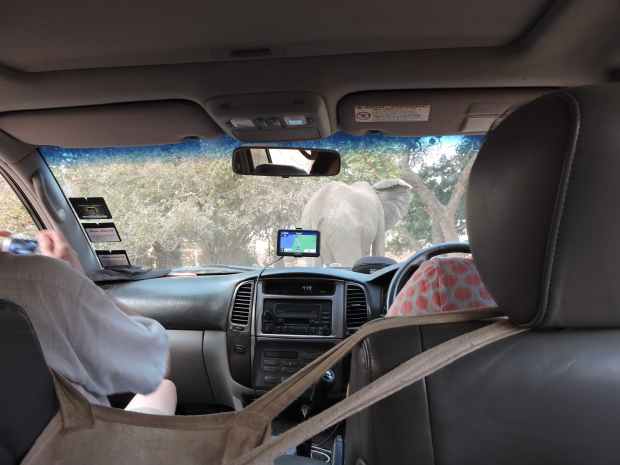
At some stage during our game drive I saw some elephants and stopped the car to watch them with the naked eye, together with my children. My wife, however, looked at them through her tablet to catch the best images of them. At some point, one of the elephants started to walk straight for the car.
I was enjoying its closeness when my son decided that the beast was too close and asked me to move a little to feel safer. My wife in the meantime continued trying to catch the beast.
Seeing that my wife was still looking through her device totally oblivious to the animal’s proximity, I started wondering whether she was watching the same beast that we were or if she was actually trying to throw a Poke Ball at a Phanpy[1] or a Donphan?
After the incident my wife explained that she did not realize how close it was until I moved the car. The creature had come within a couple of metres from us before I drove off but she said that she had managed to capture it.
We are all looking forward to get home to see what she caught!
[1] Phanpy is a small, blue elephant-like Pokémon that evolves into Donphan, a gray, elephant-like Pokémon with a thick, black band of hide running down the length of its back and extending to the tip of its long trunk.
Follow up: The situation was clarified later and, luckily for Mana Pools, this is what she actually saw:
As I mentioned in earlier posts about my work in Kenya, Tommi was one of the herdsmen working with me. Regrettably he passed away in a car accident a couple of years after I left Kenya, the sad consequence of a very common event in that country where unsafe public transport claims an excessive number of innocent lives.
Tommi frequently accompanied me to Intona ranch with great pleasure as for him it meant “going home”. He was not exactly from the Transmara area as he came from Narok but he was close enough to the Maasai around Intona to feel well among them.
Young Maasai herdsmen on the way to Intona.
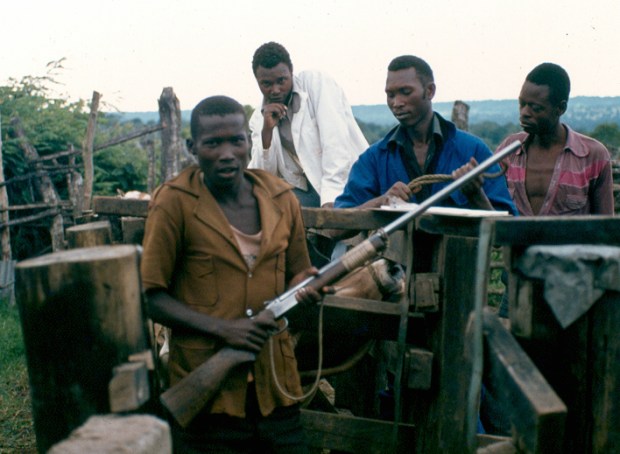
Tommi (left) and Benson (right) with the Maasai after “negotiating” for the picture.
This was a great contrast to herdsmen belonging to other ethnic groups, such as Benson above, that did not relish spending time in Maasailand. This was particularly obvious among the Kikuyu workers that could not wait for me to relieve them from their duties and take them back to their homeland. I still remember their voices getting louder as soon as the Kikuyu escarpment came into view after Narok! We, outsiders, do not often realize how foreign parts of a country can be to other nationals, product of some arbitrary divisions decided by their colonizers.
In the case of the Maasai people, their territory got split between Kenya and Tanzania when the straight line from lake Victoria to the Indian Ocean coast was drawn as the border between these two countries. Eventually the line did not end as a straight one. This was not the consequence of Queen Victoria giving Kilimanjaro to her grandson Wilhelm to meet his complaints of not having a high mountain in Tanzania as it is often believed, but part of the treaty of Heligoland through which Germany abandoned some places in the Kenya coast, receiving in compensation the Island of Heligoland in the North Sea.
The herdsmen and cattle guards. Benson in blue and Tommi in white.
The herdsmen lived at a tented camp at Intona and their presence attracted both vervet monkeys and baboons. Over the years that the camp was there the monkeys gradually became more cheeky as they got used to taking food from the camp. This was an annoyance to the herdsmen and Tommi in particular took exception to the primates’ shenanigans.
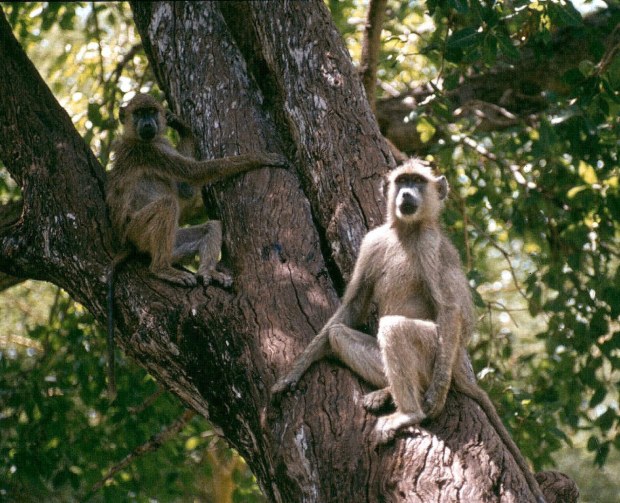
Mwizi’s relatives.
There was one particular individual that Tommi identified and called Mwizi that in Swahili means thief. He was able to recognize that particular animal and he maintained a long feud with it. The baboon seemed to know this and kept a wide berth from the man! For a few months a truce seemed to have been worked out but one day Mwizi overstepped the mark. (!!The baboon took advantage of a distraction and broke open Tommi’s bag of maize meal spilling its contents all over the tent.!!) This was the proverbial straw and the last act of misbehaviour that would be would tolerated.
Tommi decided to take exemplary action against the intruder. Before I tell you what happened, let me tell you that the Maasai social structure is based on a system of age-sets. This applies primarily to men, as women become members of the age-set of their husbands. Successive age sets, at about five year intervals, are initiated into adult life during the same period forming a cohesive and permanent grouping that lasts throughout the life of its members.
The age sets go through successive milestones that are celebrated as ceremonies. Among these are, to name a few, Emuratta (circumcision), Enkiama (marriage) and Eunoto (warrior-shaving ceremony)[1].
Tommi, like all Maasai boys had undergone their circumcision and became Sipolio (recluse). This is an important step into manhood (and warrior-hood) and, after this somehow dreaded event, the newly circumcised boys roam around the countryside dressed with dark garments and armed with bows and arrows. They shoot blunt arrows at girls as part of their social interaction. They also use the same arrows to kill small birds that they skin and place around their heads, together with ostrich feathers. During this time they acquire excellent skills with the various weapons.
In view of the above it is not difficult to imagine that Mwizi’s fate did not look good. I was not aware of the development of this feud at the time so its finale took me by surprise. After a day’s work, I was getting ready for a wash and tidying up my own camp when I heard the commotion, or rather Mwizi’s screams. It is not normal to hear a baboon screaming unless there is some kind of danger, so, expecting some leopard-mobbing, I rushed to the place where the screams where coming from.
There was no leopard but another kind of drama was unfolding. Tommi, looking upset, was circling a tree near the cattle kraal. Once closer, I realized that he had managed to tree the baboon and he was about to execute his revenge. He carried a few stones and he was trying to get the best angle from where to throw them at Mwizi! I felt sorry for the beast but the events moved too fast and the adrenalin was flowing on both sides so I could only watch from a distance, keeping my own head down!
I imagine that some stones had flown before I arrived and this explained the baboon’s alarm calls. The first stone I saw Tommis’s throw at the terrified beast missed it by a few inches and, Mwizi moved to the top of the tree. At that time Tommi said “I got it now” and threw another stone that must have passed a couple of cm from the baboon that now offered a clear view. This was too much for the monkey that was now in a serious panic with the consequence that it emptied its bladder first and soon afterwards the rest followed.
I have mentioned earlier that I do not like baboons while camping but I could not help feeling sorry for the poor creature so I did the unthinkable: I negotiated with Tommi on behalf of the victim! I managed to calm Tommi down and he agreed to leave the terrified animal alone. Seeing that the siege had relaxed, Mwizi climbed down in a flash and disappeared into the bush.
Vervet monkeys and baboons continued to visit our tents and behave in their usual opportunistic ways taking food items from us so we really needed to take care at all times. As I could not recognize individual baboons, I took Tommi’s word that Mwizi was not among them and that it had migrated to another troop in the Transmara, away from its deadly enemy.
[1] Among the many books describing the Maasai culture I would like to recommend “Maasai”, written by Tepilit Ole Saitoti and illustrated by Carol Beckwith.
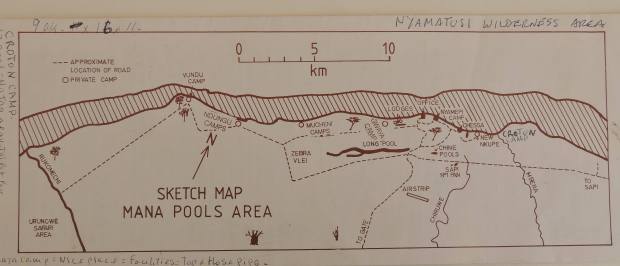
The final day of our stay at Mana Pools we drove all morning and hardly saw any mammals. Our drive started towards the west, following the river frontage (from right to left in the map below), towards Vundu camp. Although the views of the river in that area are really beautiful, after a while we decided to take another road in a southerly direction, towards the Kanga pan area (outside the map). Although the sighting of crowned eagle lifted our spirits for a while, our luck did not change.
Crowned eagle.
Map of the Mana Pools area adjacent to the Zambezi River.
Our last hope of finding some interesting action was to re-visit the “carnage” at Long pool of the day before but our bad luck continued! Professional-looking photographers had moved in and probably paid some good money to film the birds so we did not wish to interfere with their work and drove on and back to our lodge.
The view from our lodge.
To recompense ourselves for our rather poor morning performance we decided to go for a late hearty English breakfast, also known as brunch. We enjoyed bacon, scrambled eggs and fried tomatoes. The siesta under the trees that followed recharged the “morale batteries” and, by 16:00 hours, we went out again. This time we headed towards the Nkupe campsite and the Zambezi shore near Mana mouth where earlier we had some interesting sightings.
When you start getting carried away by watching Matabele ants (Megaponera analis) and photographing armoured crickets and dragonflies you know that Mana is on one of the occasions that it hides its booty from you. Clearly the park had water “up country” and most animals were spread out beyond the area that we could cover by car.
To be fair, we actually enjoyed watching the ants[1] that reminded someone of the fierce Matabele warriors of the past, hence their name. It was a rather large colony moving over the ground as a coordinated force. The major workers of this group were carrying brown capsules that were not prey as we initially thought but their own cocoons as I later learnt. One of these major workers would have also carried their queen but we did not pay sufficient attention to spot that.
Eventually we managed to see some zebra and even three shy eland bulls that quickly moved off as soon as they spotted us. Because of their premature departure we did not hear the unique clicks that are normally loud enough to be heard from some distance away. A knee tendon slides over a bone and vibrates causing the clicks. The larger the animal and the thicker and longer the tendon, the graver the sound and the higher place the animal occupies in the pecking order. The clicks, therefore, prevent fighting.
Soon the shadows started to lengthen and it was time to return to our lodge. We decided to spend the last minutes of the day checking our mail so we drove via the park’s office to access their Wi-Fi. It was close to 17:30 hours and the sun had already dropped behind the escarpment on the Zambian shore of the Zambezi.
On arrival to the office our luck turned! At the parking area we met head on with a large bull elephant and we stopped mesmerized at such a great animal so relaxed yet so powerful and potentially dangerous. Ignoring us it kept feeding as we drove within a couple of metres from it to park the car. We have had the privilege of having been close to these bull elephants before[2] but the experience is always exhilarating.
Good stretch!
I got out of the car to watch the animal and joined onlookers from the park’s office that were also there enjoying the moment. It was one of bulls that reside around the most popular area of the park and clearly used to humans. In pursuit of good food it was performing some really funny contortions.
Boswell is probably the best-known bull elephant at Mana Pools. It has developed the ability of standing only on its hind legs while stretching an amazing length to reach the highest of branches. Although the elephant we found was not Boswell, it was probably one of its disciples as I am sure that at some stage it was actually on its hind legs though hidden by bushes!
I got carried away taking pictures and, rather carelessly, I forgot that I was photographing an adult bull elephant a couple of metres away! At one point, after removing my eye from the camera’s viewfinder, the animal was actually towering over me and I thought that I was ridiculously close for comfort and hastily retreated concerned about my bush-future! Luckily, harming me was not in the pachyderm’s mind and it continued feeding and keeping the distance that it thought prudent for both!
Bushsnob repositioned and elephant stretching.
Coming closer.
Unfortunately, the light soon faltered and I was forced to stop taking pictures so we parted company and we returned to our lodge. Our experience confirmed yet again the nature of Mana Pools: you can go through a frustrating day and then, suddenly, you find yourself in a unique situation that not only makes you forget the tedious drive but that leaves an enduring memory!


 At one stage, the female even took bits of the branch from Big V’s mouth!











 A Bushsnob out of Africa