Safari

Carnage at Long pool

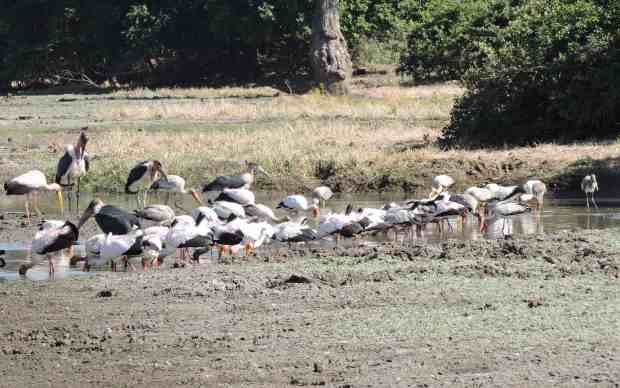
In the morning, as expected, we failed to locate the lions again but, driving over a small bridge nearby we found about twenty marabou storks (Leptoptilos crumenifer) congregated by a pond of green stagnant water. That was all that remained from the stream that flows there during the rainy season. As soon as we stopped they slowly moved away to what they considered to be a safe distance from us, away from the water. We moved off to a bend in the dry riverbed to watch them undisturbed. As soon as we withdrew they returned to the pool and resumed their activity.

DSCN9918 copy

The first group of marabou storks we saw.

The storks were feeding on stranded fish, probably catfish judging by the frequent rises they made to breath on the surface, opportunity immediately taken up by the storks that would rush towards the water movement ready to snap one up. We left them undisturbed and continued with our drive. A couple of hours later when we returned they were gone but there were still fish there. The African sharptooth catfish (Clarias gariepinus) are special in that they can bury themselves in the mud when the water evaporates and they can also survive in muddy water as they have a special breathing system that they can use in addition to their normal gills.

However, I am sure that despite their toughness the catfish days were numbered as the next rains will only come in December if the rains are good, far too late for them. At that time the ground would be bone dry. It was surprising that the marabous had abandoned what looked like easy food but we are used to Nature’s ways!

We soon forgot about the storks as we continued with our quest for new sightings. Our hopes of finding the lions seemed to revive when we found their fresh footprints. Judging that they had been left there during the early morning we tracked them for a long while, trying to guess what their aim was, only to lose them when they moved away from the road. Following lions on foot through the bush and without an experienced ranger is not recommended so we decided to leave them alone. As it happened, they eluded us for the rest of the trip.

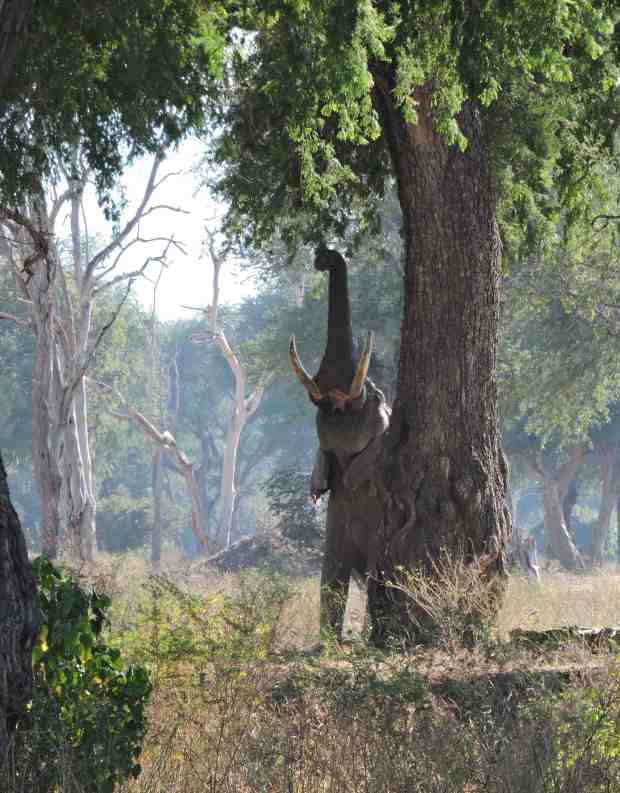
We normally do not see large elephant herds at Mana Pools. Some family groups come together at the height of the dry season while staying near the river. At the time of our visit, although the rains had not been abundant, there was still water inland and the elephant population was still spread out all over the park. The few elephants we saw were the usual resident bulls that seem to hang around the shores of the Zambezi. It was one of these that we found that morning and we derived entertainment watching it stretch for the apple-ring acacia branches and leaves. The pods, their favourite food later on in the dry season, were still small and immature so they were not the elephants’ target at the moment.
DSCN9962 copy

A bull elephant stretches to feed under the special Mana Pools light.

Returning to camp at about eleven, we saw a large number of yellow-billed storks (Mycteria ibis) in one of the smaller segments of Long pool that usually dries up during the dry season. There was clearly something special going on that attracted such large number of birds so we decided to go and have a look. Getting closer we saw that there were also African spoonbills (Platalea alba), a few herons and also a few marabou storks. “So here they are”, I thought while stopping the car to get closer on foot.

DSCN9928 copy

We saw a large number of storks congregated at Long pool.

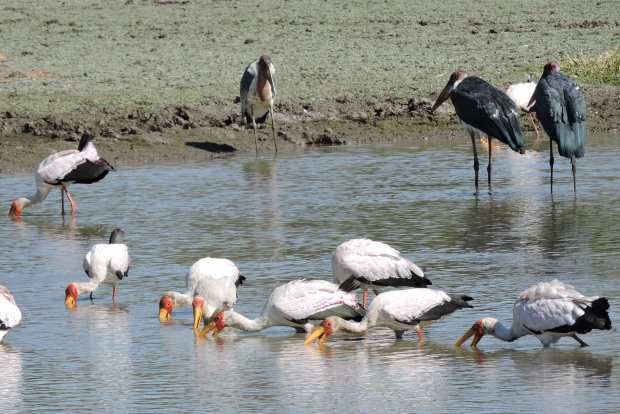
The pool was full of birds and it appeared that mostly the yellow-billed storks were -again- catching other shoal of stranded fish.

They seemed to be alternatively “driving” the fish towards one of the narrow and shallow ends of the pond and, once there, they would pounce on their victims. Both the yellow-billed and the marabous seemed to be on the same wavelength and after fish. The few African spoonbills present, however, continued wading in their usual fashion as individuals and they did not seem to take any notice of the other birds.
DSCN0019 copy

The yellow-billed storks chasing the fish in a coordinated fashion.
DSCN0023 copy

Marabous waiting for the right time to join in.

DSCN0029 copy

African spoonbill.

At first we assumed that the prey were catfish as we had seen earlier at the small bridge and on other occasions in Kenya (Maasai Mara) and Mozambique (Gorongosa). We soon saw, however, that this time the victims were silvery fish of 5 to 15 cm that were being picked in large numbers by the birds. Whether they were immature Chessa (Distichodus schenga) or Nkupe (Distichodus mossambicus) both common inhabitants of the lower Zambezi, or perhaps some other small fish I could not be sure. It was interesting to note that, as the pool was dry last year, the fish must have come in during the wet season through a connection between the pool and the Zambezi.

The yellow-billed storks outnumbered the marabous about 10:1 and they strode in groups following what looked like a cooperative fishing strategy. They would wade together towards one end of the pool driving the fish in front of them and then they will pick them from the reduced area they had created. They fished in their usual fashion; by placing their half open bills inside the water and snapping them shut when feeling a touch through a very fast reflex. They frequently caught fish but if they missed they would do a short chase that soon ended with or without a fish being caught and back to their feeding posture.

While this would take place, the marabous watched like smartly dressed supervisors. The moment the fish were trapped they would lose their bogus formality and join in the feeding frenzy with gusto! They would jump or fly in spreading their wings to make room for themselves submerging their heads under water to catch the fish. Often their feeding enthusiasm would be such that they would plunge almost totally in pursuit of the fish. Many of them had their gular sacs[1] inflated and probably their pouches full of fish. Many of them were also flashing a bright red bubble-like sack at the back of their necks, probably a consequence of their excited condition!

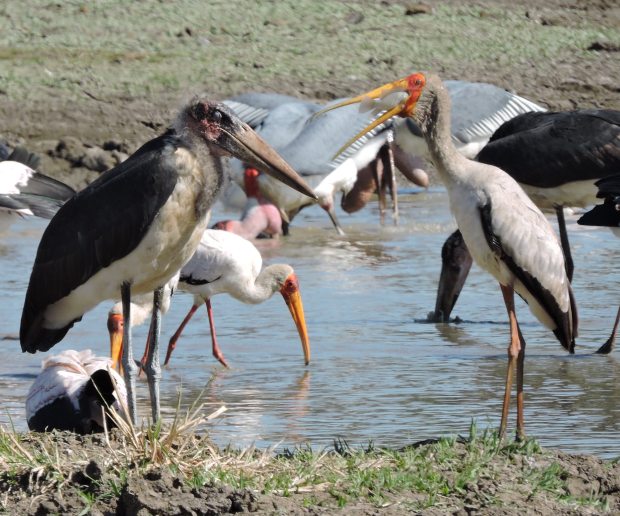
Although we witnessed the occasional confrontation between the two stork species, these were minor incidents and we saw no physical contact.
DSCN9964 copy

A brief stand-off or “don’t step on my toes”

Conversely, there was a lot of interaction among the yellow-billed storks in the form of bill clattering, chasing and jumping facing each other. Occasionally the opponents would interlock their beaks as if involved in some kind of courtship. All these encounters were of short duration and the temporary “rivals” quickly got back to feeding. The grey immature yellow-billed storks congregated at the periphery of the pond, not taking part of the adults’ activities but trying their fishing technique as best they could where there were clearly less fish and I did not witnessed any catch.

While the collective fishing took place, a pair of fish eagles, perched on a tall dead tree, watched the storks attentively. They called regularly and, from time to time, they would swoop down among the alarmed storks and, at least once, one of them managed to snatch a fish although we could not see if it caught it itself or it robbed it from one of the fishing storks.


The following video gives a dynamic view of what we witnessed.

Note: I recommend that you watch it first as it is and then you use the cog wheel at the bottom right corner of the screen to slow it down and see things with more detail.


[1] Later, reading about marabous, I learnt that the large sacks that hang under their heads are not crops but gular sacs. The latter are cooling devices as well as used for displaying purposes.

Note added on 3 July 2016. One of the pictures above shows what I thought was a confrontation between a Marabou and a Yellow-billed stork. I saw that the Marabou was rather indifferent but I thought it was because of its size. However, looking at the picture again, I realized that the Yellow-billed stork was swallowing a fish! Additionally, the fish looks like a young Tilapia so the birds may have been feeding on these rather than on the other possible species I mentioned. Bushsnob

Lions first

Although we agreed that we were in no hurry to leave for Mana Pools National Park, somehow we found ourselves getting up early and soon enough we were on our way before what we had planned. Fortunately the road from Harare to Chirundu in the border with Zambia was rather quiet. We were able to travel fast and well until we found ourselves snaking our way up and down Marongora or the Zambezi escarpment.

This is the worse part of the journey as long lorry lines coming and going between Zambia and Zimbabwe are formed here and the pace can be very slow if not nil as frequently we find serious accidents that cause long delays. The road is littered with lorry remains to the point that we call it the “lorry cemetery”. This time, even this infamous place offered us no difficulties.

We turned into the Mana Pools turn off in good time. As usual, the first 30 km are as rough and corrugated as ever and we decided to break the journey over half way entering the track leading to the Rukomechi Research station where groundbreaking research on tsetse fly control was carried out in the 70s and 80s. The idea was to see the place and to find a place to have our lunch away from the main road.

The station was rather quiet and, after a quick drive through, we returned towards the main road, stopping at a dry river bed that we had identified early as a “lunch spot” to enjoy our sandwiches. The halt did not last long as the stingless Mopani bees (also known as Mopani flies) Plebeina hildebrandti kept getting into our eyes, a very uncivilized behaviour!

Worse still were the stinging honeybees that started coming the moment we opened our lunch boxes and kept landing on our food and drinks. Soon we were fed up with both bee types and decided to abandon our lunch break and continue our trip.

We were greatly relieved when we reached the gate into the park with the car apparently in one piece. A quick check confirmed that this was so, at least all the expected parts were there! The road corrugations were such that the usual trick of driving fast to “skim” over them did not really work and to drive slowly was even worse so we tried both hoping to get an improvement that we did not achieve! Satisfied with the toughness of our car, we continued for the final 40 km on a much smoother track.

DSCN9890 copy

The first lioness.

We aimed for the park’s office to check in our lodge called Nyati[1]. As it happened, a couple of kilometres before, my wife spotted a tawny shape that turned out to be a resting lioness. We stopped and for sometime forgot our immediate plans. After scanning the area with our binoculars, another two females were found. We stayed with them for some time but, as they did not seem to move, we decided to go back to our plan and to sort out our lodge. The latter was very nice, on the Zambezi River shore, clean and ready for us.

After organizing our belongings and food supplies, we decided that it was time to get back to the lions. As these are our number one interest in the bush we were happy to go and try to find them again!

DSCN9899 copy

A long distance shot.

Luckily they were still there. Other visitors had also found them and two cars were watching them but, as it often happens, they soon left. I always question myself about what could be better than staying with a pride of lions waiting for action! However, more often than not, most people have other ideas and, after a few minutes, they invariably move on. I find this conduct surprising but they probably have other bush tastes such as elephants or perhaps sundowners by the river? We, the wiser, stayed with the lions.

A few minutes of observation later and we had seven individuals: six females -in excellent condition- and one young cub. We found this a bit strange as we expected more youngsters but we did not see another one. Typically, for about an hour nothing much happened. As the afternoon became evening all of a sudden they were off. It happened very fast and they entered the tall grass towards our left, leaving the cub behind.

Trying to stay ahead of the game, we moved forward looking for the reason of their exploit while trying to position ourselves at a place from where we could see what would happen next. About one hundred metres ahead we found a clearing with some male impalas grazing and, apparently, oblivious to the lions.

“Could the lionesses be after the impalas?” we asked ourselves, as these antelope are not the number one choice in a lion’s diet. We had seen lions in past years at Mana feeding on buffalos and even elephants so these rather small antelope did not qualify even as a snack for such a group! However, in the absence of other possible candidates we stopped and waited.

I immediately switched on the camera and soon I was looking at the impalas through the camera’s viewfinder when first I heard the noise of animals running to my right and immediately caught a glimpse of the lionesses through the corner of my eye. Three of them came out of the bushes at full speed towards the impalas that reacted immediately and started running away. The lionesses picked one as their target and got closer and closer.

The impala, aware of the mortal danger it was in, quickly recovered from the surprise of the attack and ran for its life leaping and zigzagging with great skill as the terrain was uneven and bushy. Despite this, the lionesses were getting desperately close and, when all seemed lost for the antelope, it jumped and turned sharply to its right. This final feat of nimbleness put the lionesses off balance and the impala managed to escape snorting loudly as it realized that it was still alive! What I described took place over a few seconds and well before I could move my finger to take a picture!

DSCN9894 copy

When I could press the shutter, the chase had ended…

The impala snorting was answered, to our surprise, from somewhere in the midst of the lionesses! At first we thought that the huntresses had got another impala and what we were hearing were its last throes. Soon, however, the truth revealed itself as another impala came running flat out from the “lionesses-hot area” and soon joined its colleagues at a prudent distance. We had clearly missed this impala that had turned towards the opposite side from the others and probably saved its life because of it!

The short chase over, the huntresses relaxed and one by one they broke their cover and we saw seven female lions. Realizing that the chase was over, they returned to the place where the cub was. After a while we saw another rather large head emerging from the tall grass: a large male lion could not be bothered to lose its royal status chasing impalas and wished to have a look around!

Soon the light started fading and we left them, convinced that they would hunt later on. We agreed to return and look for them the following morning but, as they can move long distances, we did not hope for another sighting.

Back at the camp the donkey boiler[2] supplied ample hot water for a good bush shower to wash off the thick dust from the already very dry Mana Pools roads. As for the various aches from the journey, I appealed to a few sips of a South African Cabernet Sauvignon, with therapeutic meticulousness! The latter also greatly helped with the writing of this post!


[1] Nyati in Shona language means buffalo.

[2] Known as Tanganyika boiler in East Africa. It is basically a metal drum over a wood fire.

Manes

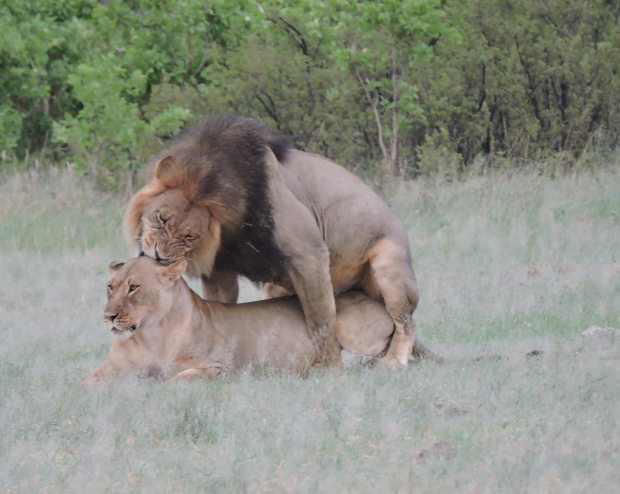
The mane of the lion is one of the indisputable dogmas with which we grow and, together with a giraffe and an elephant, a male lion with its mane is one of the first animals we learn to recognize as young children. Further, as we grow Panthera leo, it is one of the first creatures of which we understand sexual dimorphism when we learn that the lionesses do not have hair!

DSCN0007 9.19.55 PM copy 7.34.34 PM 7.35.55 PM

An heterosexual lion couple.

Well, my lion world has been shattered from now as the above is no longer true, well, at least it is not always true!

On 22 April 2016 I saw a photo posted on Instagram by @INSTA_BOTSWANA of two male lions mating. Although surprised, I am aware of the existence of homosexual behaviour in some animals and have observed it in giraffes where, apparently, it is quite frequent. However, I had no knowledge of this behaviour taking place among lions.

Still thinking about the picture I was about to move to the next image when its caption called my attention. The mating animals were in fact members of the opposite sex! Thinking that this was even more interesting, I followed up the issue and learnt that a few days earlier a similar picture had become “viral” in the social media and was extensively discussed.

I confess that I am skeptical about these kind of news and my first thought was that the original picture had been modified. To my surprise, lionesses with long hair have been observed both in captivity and in the wild. A well-known example is Mmamoriri that is part of a pride that resides somewhere in the Northern part of Chief’s Island in the Moremi Game Reserve.[1]

Scientists believe that the quality and abundance of the mane reflects the health of the animal: a thick, dark one shows a vigorous and healthy animal. In addition, females prefer these strong males to perpetuate their genetic material in future generations.

So, what is the reason for a female to grow a mane? Geneticists believe that the emergence of these “tomlions” is due to a disruption of the embryo at conception or during more advanced stages of the pregnancy when the foetus gets exposed to higher than normal levels of male hormone. Whatever their genetic origin, the maned females survive very well. Further, their deceiving appearance is advantageous in keeping intruder males away from the pride and hyenas away from kills!

Fortunately, an investigation is underway to address this phenomenon and it is likely that we will have interesting findings in the near future.[2]

This story would not be complete without mentioning that the opposite phenomenon -maneless lions- also occurs albeit more frequently and better known and studied. Such males are known from Benin (Pendjari National Park), Senegal, Sudan (Dinder National Park) and the first white lion of Timbavati in South Africa had no mane.

Without much doubt the most famous maneless lions were also man-eating ones. Two of them stopped the construction of the railway in the Tsavo River in Kenya for nine months and killed more than a hundred workers since March 1898. “The Man-eaters of Tsavo” written by Lt. Col. John Henry Patterson, who was in charge of the work and shot them, is a fascinating read! The book is also the subject of a 1996 movie “The Ghost and the Darkness” (Paramount) with Val Kilmer and Michael Douglas as the main protagonists, a poor substitute for a good read!

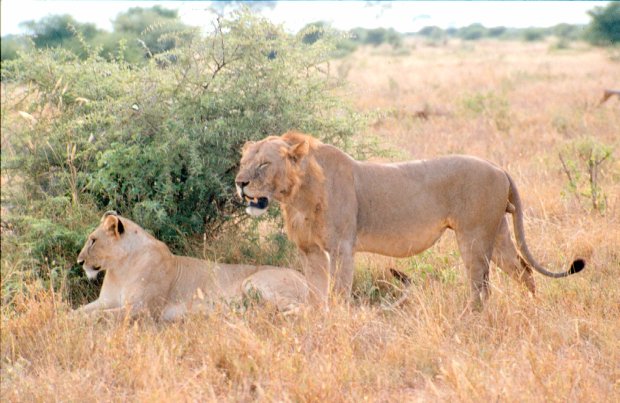
The area where these true human carnage took place is today part of the Tsavo National Park and, luckily, during one of our safaris to Tsavo East National Park in the 80’s, we were fortunate to find one of the possible descendants of these lions and attest that their manes are very scarce!

lions maneless male and fem T East

A “maneless” lion with a normal female at Tsavo East National Park.

The “baldness” in these lions is attributed to an adaptation to the thorny vegetation in the park as their hair could interfere with their hunting. As their colleagues in Tsavo West that live in a similar environment have normal manes, I personally believe that their baldness, as in humans, is due to high levels of testosterone that may also explain its aggressive reputation.


[1] http://africageographic.com/blog/unravelling-the-mystery-of-mmamoriri-the-maned-lioness/

[2] http://voices.nationalgeographic.com/2012/10/09/weird-wild-rare-maned-lionesses-explained/


Note: A similar article in Spanish was published in the “Muy Interesante” web page and it can be found here: http://www.muyinteresante.es/naturaleza/articulo/hay-leonas-con-melena-521461839096

Unpredicted friends and unforgettable dates

The morning of Saturday 17 July 1982 (I remember this day well!) we got up early to pack our car with camping gear for a safari to the Maasai Mara Game Reserve. We had booked the Sand River campsite for a couple of nights.

We were about ready to go when, totally unexpectedly, someone walked into our front garden! It was a messenger from the Kenya Posts and Telecommunications Corporation coming to deliver a telegramme, the first we had ever received! As we had no working telephone in the house (and cellular phones were not yet invented!) a telegramme was almost the ultimate in urgent communications. Being far from home, it also carried a dose of dread as it could carry bad news from home. So, with wonder as well as some trepidation I read it, trying to prepare for the worst.

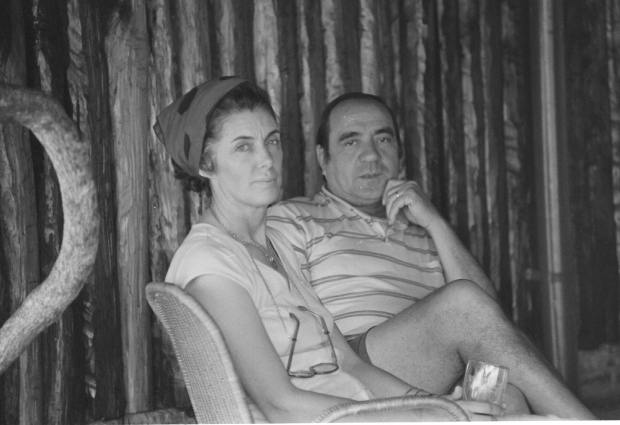
Its contents were surprising and shocking but good! It read: “We arrive tomorrow” and it was signed by two of our best friends: Nazar and Aurora. That was that, not even a date! We were thrilled that they had finally decided to come to Kenya. We knew they were travelling to Piediluco, Italy to accompany their son Juan José that was rowing at the 1982 World Rowing Junior Championships representing Uruguay and we had insisted that they extended their journey to visit us although we knew that this would be very difficult for them!

Our initial elation turned into mild panic when the fact that they could be at the Jomo Kenyatta International airport (JKIA) at the time of reading the telegramme sunked in! Expecting the worse we immediately drove to JKIA as we knew that most flights from Europe would arrive by mid morning. We were on a rather blind chase and during our journey we did a lot of speculation, not only about their arrival but also on contingency planning regarding our planned safari.

Our fears that they had arrived the day before and were stranded at the airport unable to communicate were unfounded and perhaps exaggerated as a thorough examination of the arrival area gave no results. Unable to get any passenger information from the possible airlines we decided to stay put and wait. After about an hour or so, a few flights from Europe arrived within thirty minutes. We crossed our fingers and, eventually, we were rewarded when our friends emerged looking dazzled at what they were seeing around them but otherwise unaware of our earlier dilemma and very happy to see us.

It was an emotional reunion and, after an exchange of the usual family news, I casually announced that we were aware of their long journey but that we were off to the Maasai Mara, leaving as soon as possible. As expected (they had no real choice!) they gallantly accepted the invitation and, after passing by our house to finish our packing, we set off with their luggage still unopened!

Nazar, had a tiring trip, and he was also suffering from a gut complaint. His time during the journey to the Maasai Mara was spent drinking abundant amounts of warm cola and going into episodes of slumber until, by the time we got to Aitong, a few hours later, he started to talk nonsense with me, a sure sign of his slow recovery. Aurora, on the contrary, was wide awake and did not miss detail, asking questions all the time and gaining in excitement as we moved from Nairobi to the Kikuyu escarpment, the breathtaking Rift Valley views, Narok and beyond into the great green plains of the Mara-Serengeti ecosystem.

Because of our late departure, I drove non-stop and despite the rough road, we managed to get to the gate in time to get to the Sand river camp by the Mara river at dusk. Without delay we started unpacking and finished setting up camp using our car headlamps, as was the norm with us then.

While this was on going, our friends watched, not moving too far from the car, still rather confused with their situation. Our work was cut short, as already in Nairobi they had decided to sleep in the car. Luckily for them, removing the second seat of our loyal VW Kombi was relatively easy so soon they had their nest ready. As soon as we finished with the car arrangements my wife had heated our ready-made dinner brought from home and, although we still had a lot to talk about, we were so exhausted that we went to sleep early.

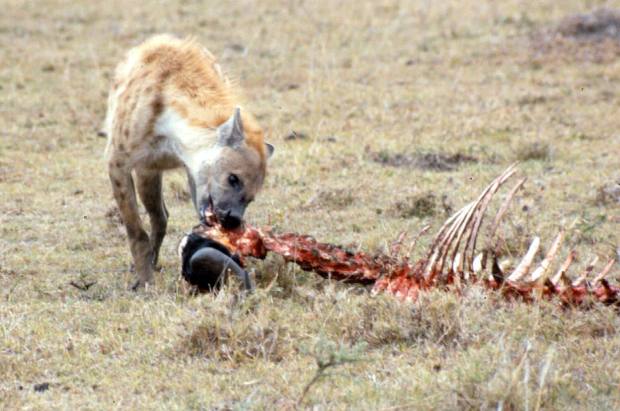
Camping at the Sand River was ever exciting as there were always plain game in its neighborhood, particularly wildebeest and zebra that, somehow enjoyed crisscrossing the Mara river offering, apparently unnecessary opportunities to their reptilian predators. Their presence also attracted lion and hyena so there were always nocturnal happenings! That night was quieter than expected but still the hyenas came close to camp, their calling amplified by the river. We did not fail to hear lions roaring in various degrees of proximity, above the constant wildebeest snorting and zebra whinnying. Thinking on our friends’ time in the car, we paid the price for our rather busy day and passed out before long.

mmara hyena 2

The following morning, recovered, I got up early as usual and prepared tea and coffee waiting for the other fellow campers to show life signs. My wife emerged eventually but no movement was detected inside the car! A quiet inspection of it showed it to be unscratched. Its windows were totally foggy and I had some concern about whether our friends have had enough oxygen inside there as the car was tightly shut!

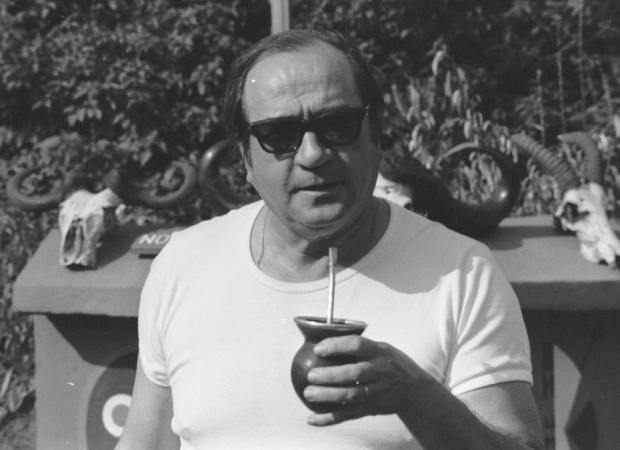
My fears were unfounded as, eventually, a hand started to remove the fog from the side window and the smiling faces of our friends showed gradually behind the glass. Eventually they left their protective and damp metal cage to join us for a rather late breakfast and they shared their mate[1].

nazar m mara

Nazar offers a mate to the photographer.

As usual with first time visitors, they have heard nothing the whole night as they had slept like logs! We finally had a chance to finish exchanging pending news at leisure.

Fortunately they were fast to adjust and gradually they became used to our ‘bush ways” joining us on a couple of game drives during which they greatly enjoyed what they saw. The frequent appearances of the imprudent hyenas and the lions roaring were not conducive to us persuading them to abandon their cage the following night and they still preferred their airtight environment to the risks of camping in the bush. We understood them well as it had taken us longer than that to get used to camping “al fresco” surrounded by wild beasts!

nazar y aurora 8.35.44 PM

Our friends relaxing at the Mara Serena lodge.

We returned to Nairobi after two nights. This time they were able to appreciate their surroundings much better, including the always-interesting sight of the Maasai people and their manyattas and livestock and they were delighted with the daylight return journey.

Later on during the week we showed them Nairobi and the wonderful Nairobi National Park and later travelled to Nakuru and Bogoria for a view of the Rift valley, its hot springs and flamingoes. Luckily, they loved the experience but time passed very fast and it was soon time for them to depart, too soon for us!

Their plane left back to Europe at midnight on Saturday 31 July 1982 so we took them to the airport early and made sure that they went through all the departing procedures early until the time came to leave them once they have checked-in to return to Tigoni late at night. Unused to driving at night, we negotiated several road blocks that we thought too many but, as we drove a car with red diplomatic plates, our going was smooth and we got home safely.

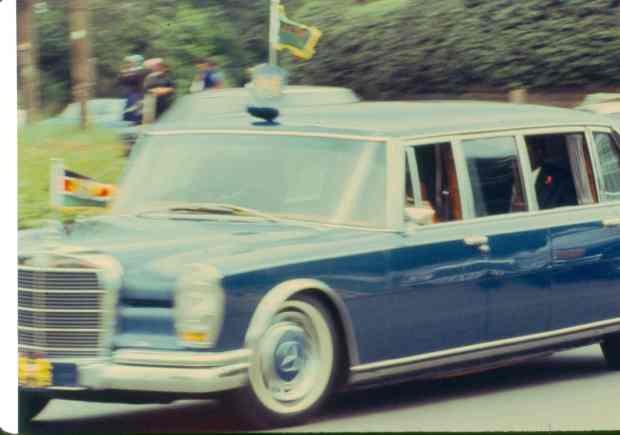
The following morning we had arranged with our friend Ranjini to go to the Nairobi National Park so we travelled to Muguga through back-roads to fetch her. Once there she announced that an attempt to overthrow President Moi’s government had taken place at midnight and that there were serious confrontations going on in Nairobi between the Police and students! Apparently, a group of soldiers from the Kenya Air Force had taken over the Voice of Kenya[2] and announced that they had overthrown the government!

moi

A bad picture I took of Moi’s cavalcade before knowing the risks involved!

We thanked Ranjini for the news and quickly turn around heading for home as fast as we could! During the journey we met a large military convoy ready for war heading for Nairobi but we did not know what their stance was at the time! Luckily they ignored us and we, the sole occupants of the road by now, got home safely where we remained -listening to the BBC radio for the latest news- for the following three days until it was confirmed that the attempt had failed[3].

It was lucky that our friends just managed to get away (a while) before the Kenya airspace was closed and that they were over the clouds when all this happened! They remained unaware of their narrow escape until we met them back in Uruguay a year later when they listened to us in disbelief!


[1] Traditional South American caffeine-rich infused drink, prepared by steeping dried leaves of yerba mate (Ilex paraguariensis) in hot water and is served with a metal straw from a shared hollow calabash gourd and shared among drinkers.

[2] From 1989 it became the Kenya Broadcasting Corporation.

[3] The coup failed. The Air force pilots that meant to bomb State House dropped their bombs over Mount Kenya and eventually, after ruling Kenya for a few hours, Hezekiah Ochuka, a soldier in the Kenya army, escaped to Tanzania. He was eventually extradited back to Kenya, found guilty at a high profile trial that involved both Oginga Odinga and Raila Odinga, and eventually executed in 1987.


Help for a widower…?

At the end of the post “Toilet and Tortoises”[1] I expressed our disappointment with the setting and management of Camp Kwando and surrounding area. There was however an area by the jetty that yielded some interesting sightings and observations.

A large Common cluster fig tree (Ficus sycomorus) acted as a giant umbrella, providing good shade. Its fruits were intensively consumed by a number of birds among which we saw Grey go-away bird, Green pigeon, Black-collared barbet and a Squirrel among others. They offered some good photography that I present below, including a nice shot of a Brown-hooded kingfisher that was taking advantage of the insects attracted by the shade.

DSCN9995 8.33.22 PM 10.04.12 PM copy

DSCN9932 8.33.21 PM copy

Brown-hooded kingfisher.

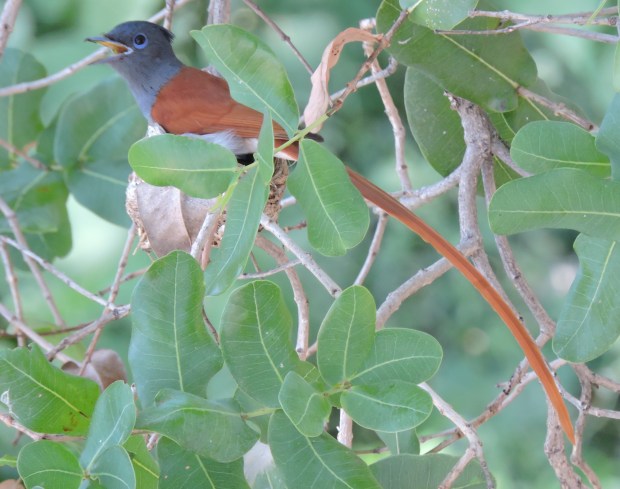
In addition to the birds-fig tree interaction, we (rather my wife again!) spotted a male Paradise flycatcher (Terpsiphone viridis) sitting at a nest within easy photographic reach. I took advantage of the nest’s location and took several pictures at different times during the first day of our visit. During that time, while the male was absent, we noted that there was at least one egg.

0742hs 26-11-15 adult copy

Adult Paradise flycatcher male.

In the evening, as usual, I checked the pictures to select only the best ones to save space in the camera’s memory card. It was while doing this that I noted that all my pictures were of a male bird and, although I re-checked all pictures I confirmed that there was no female! The male bird had the lovely pale blue beak, cere and peri-orbital markings although these were not visible in some of the pictures. I then realized that there were two male birds sharing the task of sitting on the nest: one adult (bright colours) and a sub-adult (duller).

1308hs 25-11-15 young3 copy

The immature Paradise flycatcher sitting on the nest.

As soon as I could I checked the available literature to find out more about what we saw. I confirmed that “cooperative breeding” or when sub-adults assist adults incubating the eggs. This behaviour is quite common among several species of birds[2].

In the case of the Paradise flycatcher, it is believed that the female does most of the night sitting on the eggs and cooperative breeding although “possible” it was still unconfirmed and not been seen![3] Things were getting really interesting now and at that point we decided that the observations were worth reporting to a wider audience.

After some enquiries with bird experts we found an on-line journal in South Africa known as Ornithological Observations where we submitted a short paper that they agreed to publish on 23 February 2016. [4]

Although this could be taken as an isolated observation and a rather anecdotic one, it unequivocally shows the involvement of a second male, showing unequivocally that cooperative breeding in the African Paradise Flycatcher takes place as suspected. It is possible that the young male was from the previous year and assisting the adult male.

No female was observed during the time the observations were carried out. Weather it was alive or not would remain a mystery. However, it cannot be excluded that it could have been at the nest during periods when we were not there or taking care of the incubating during the night.


[1] https://bushsnobinafrica.wordpress.com/2016/01/26/toilets-and-tortoises/

[2] Stacey, P. B. and Koenig, W. D. (1990). Cooperative Breeding in Birds: Long Term

Studies of Ecology and Behaviour. Cambridge University Press. p.636.

[3] Roberts VII Multimedia Birds of Southern Africa iPad Edition, 2012-2013.

[4] http://bo.adu.org.za/content.php?id=202

Spot the beasts

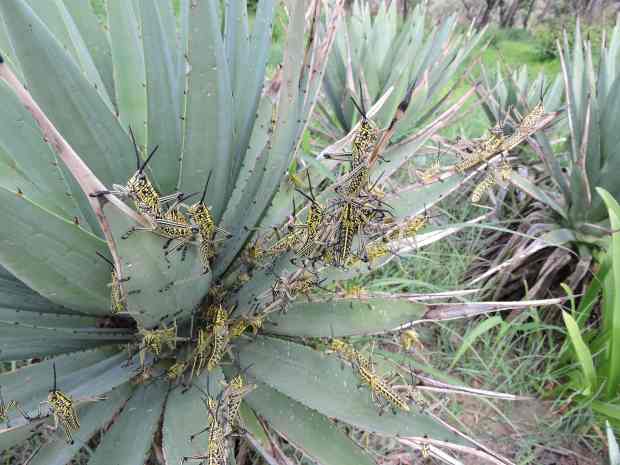
While walking in the garden of the Inn in the Vumba in December last year, we came across this sight:

DSCN9947 copy

Here they are, closer:

DSCN9946 copy

They were a swarm of locusts bunched up together. A very striking and interesting find.

As far as I could find out, they are nymphs of the Green Milkweed locusts (Phymateus viridipes).

.

Lions suckling

A letter about unusual lion behaviour in the Serengeti National Park[1], brought back memories of our own observations in the Maasai Mara Game Reserve, Kenya, in the 1980’s.

P1120930 copy.jpg

A picture of the letter to Getaway.

As it can be seen above, the letter describes that, a couple of tourists on a photographic safari, witnessed a lioness kill a wildebeest cow and her calf. Afterwards the lioness suckled the cow, then consumed the calf and returned again to suckle and lick the milk from the now dead female.

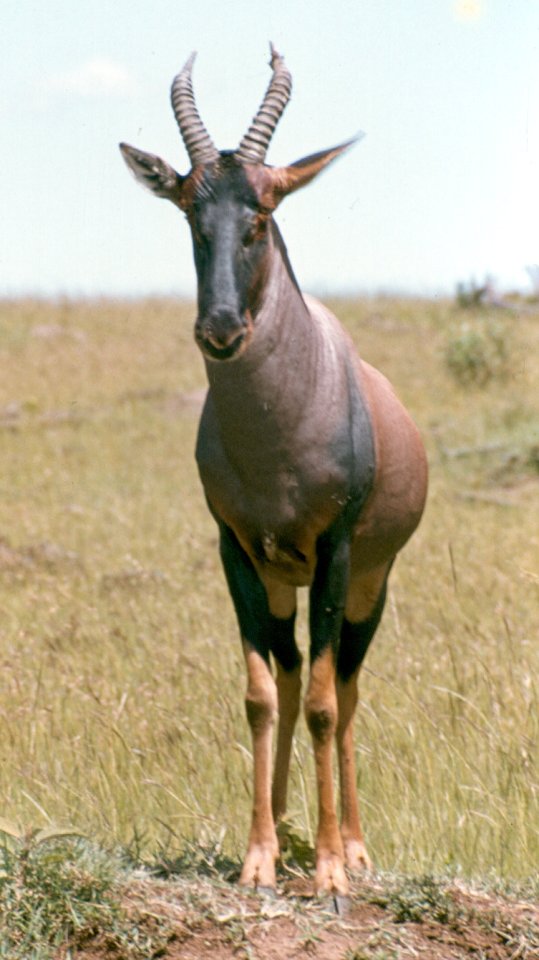
While in the Maasai Mara one evening we witnessed a lioness kill a topi[2]. While the lioness was busy strangling the animal, two cubs appeared on the scene and, without hesitation, went directly to the Topi’s udder and suckled the animal for a few minutes.

Topi m mara

A Topi in their typical “watching” stance.

Eventually the animal died and the cubs stopped suckling and joined the mother at eating it. We did not see he lioness suckling.

lioness and cubs other copy

The cubs we saw suckling were larger than this one.

The explanatory reply from Brian Jones, a very knowledgeable person on raising lions at the Moholoholo Wildlife Rehabilitation Centre (South Africa) among other activities, confirmed that lions do lick carcasses, a fact that I can also corroborate through personal observations. As he made no mention of the suckling of prey by lions, I decided to write to Brian to let him know of our own observations and somehow reinforce the tourists’ observations. The following is a record of our exchange:


16/11/2015

From:              Julio de Castro <juliojdecastro@gmail.com>

To:                  Moholoholo <moholorehab@wol.co.za>

Dear Mr. Jones,

Reviewing old magazines I saw your comment of a couple of years ago (Getaway, May 2013, p.13) to a sighting of a lioness suckling and licking a wildebeest female in the Serengeti National Park.

In the 1980’s, while working in Kenya, one evening in the Maasai Mara we witnessed a lioness kill a Topi. While the lioness was busy strangling the animal, two cubs appeared on the scene and, without much hesitation, went directly to the Topi’s udder and suckled the animal for a few minutes. Eventually the animal died and the cubs stopped suckling and joined the mother at eating it. I do not recall if the death of the female Topi coincided with the cubs stopping to suckle. The cubs were about 6 months old or older (not suckling babies).

I have also witnessed lions licking wildebeest and zebra prey (mainly in the abdominal area) but I believe that there are two different phenomena, one is the deliberate suckling of a female prey and another is the licking of a dying/dead animal, including males.

I hope you find this interesting and look forward to your comments.

Kind regards.

Julio de Castro

http://www.bushsnobinafrica.wordpress.com


19 November 2015

From:              Moholoholo <moholorehab@wol.co.za>

To:                  Julio de Castro <juliojdecastro@gmail.com>

Good morning Julio,

Thank you very much for your e–mail.

So interesting to hear of your experience witnessing the cubs trying to suckle from the Topi – really amazing!!!

Probably the smell of milk and I’d say the Topi must have had a youngster!!

Yes the licking of a dead animal is normal. I  have often seen even cheetah licking their pray before eating!! I have a few tame Cheetah and they lick my friends on their arm, I tease them by saying “they always lick their prey before they eat them” (ha, ha).

Thank you so much for sharing your experience, it always a story I can tell to other folk.

All the Best

Brian


I thank Brian for his time to reply and his valuable contribution. Please visit http://www.moholoholo.co.za/ to see the valuable work that the Centre performs.


[1] Koetze, R. Unusual sighting. Getaway (Letters), May 2013, p.12.

[2] The Topi (Damaliscus lunatus jimela) and the Tsessebe (D. lunatus lunatus) are sub-species of D. lunatus.

Naughty hippo, again…

On our final day, after watching lions and birds, we planned a “sundowner” drink at Nyamandlovu pan to end our safari in style. Before it was time for drinks, we got busy watching the many migratory birds present at the pan. These were a large flock of Abdim Storks and Amur falcons that provided us with much entertainment while they fed on beetles and other insects found in the grass.

A family of five jackals, probably residents of the pan, were also around. While four of them were gnawing at an old elephant carcass, a fifth came close to the viewing platform for a look. As I was on the ground at the time I saw it coming and prepared for pictures. Despite the warnings shouted from above by fellow game watchers for me to be careful, I remained motionless and was rewarded with the closest encounter I have had with a black-backed jackal!

While watching the jackal I heard loud splashing noises coming from the pan and I saw a large crocodile (one of the three present) coming out of the water holding a very large chunk of carcass. I left the jackal to its business and rushed up the platform for a better look. The beast, at the left end of the pan, was violently shaking the carcass and scattering pieces in the water while it swam off with the remains to the opposite end.

DSCN9895 9.14.41 PM copy

The crocodile feeding on the submerged carcass.

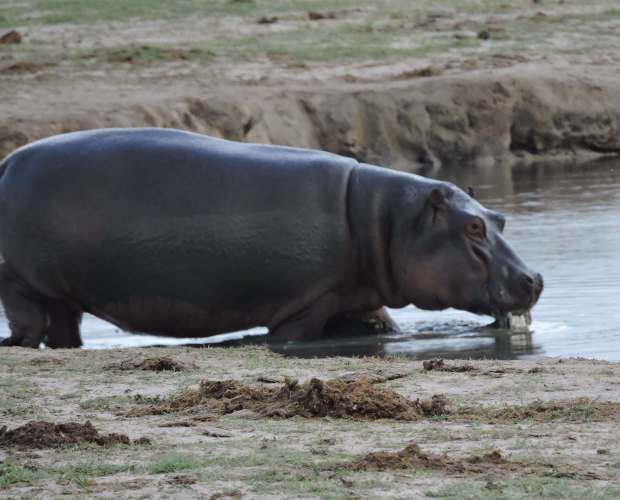
The slow approach of a hippo to the area where the carcass had been shaken apart came as no surprise to my family and I, all well aware by now of our earlier observations on meat-eating hippos at Masuma dam![1] We watched while the hippo approached and searched the area with its head submerged. Suddenly it lifted its head and chewed on what appeared to be a piece of the carcass that it had found! This was a very interesting observation, as we had not seen any of the three resident hippos engage in this activity before, despite having spent many hours there!

DSCN9898 9.14.41 PM copy

The hippo starts approaching…

DSCN9901 9.14.41 PM copy

Eating a chunk of the carcass that the crocodile left.

After munching on its find, the hippo left the area jumping in the water in a rather funny display that probably expressed approval at what it had just eaten! Fortunately I managed to take a picture of the crocodile (regrettably only after the carcass shaking took place…) and of the hippo finishing its snack and merrily moving off!


[1] See https://bushsnobinafrica.wordpress.com/2015/02/22/hippos-from-hell/ and https://bushsnobinafrica.wordpress.com/2015/03/23/hippos-from-hell-the-videos/ Muy Interesante also covered this issue: http://www.muyinteresante.es/naturaleza/articulo/los-hipopotamos-pueden-comer-carne-921450193942

An antisocial lion!

Bush lions are normally tolerant of vehicles, even the open tourist ones. The only aggression we have seen was related to times when mating was taking place and the male normally leaves no doubt about how close you should be! The situation can be different on foot when the utmost care is needed where these cats are concerned to avoid accidents.

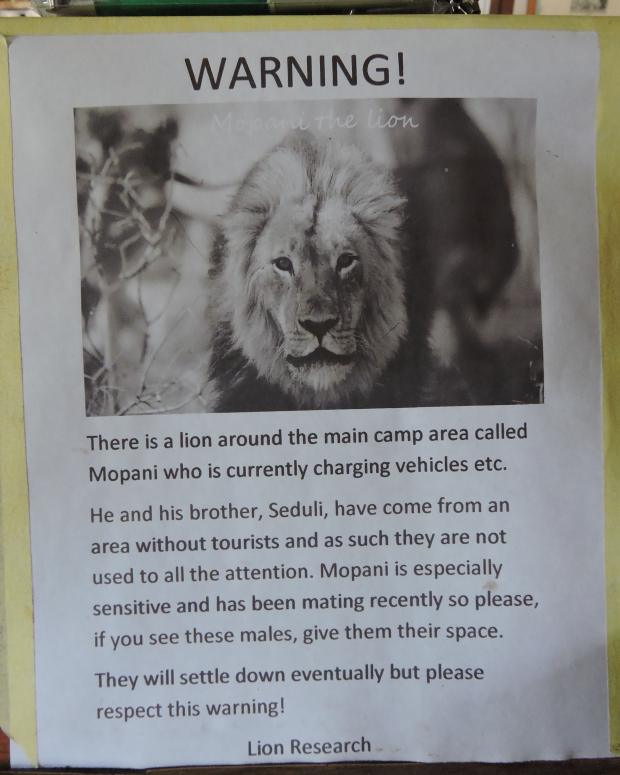
While checking in at Main Camp in Hwange National Park, we were warned of the existence of a new lion: Mopani[1]. The lion, explained a sign placed at the booking desk by the “Lion Project”, came from an area devoid of tourists and it was aggressive, charging vehicles! Siduli, another male, and two females accompanied it. We were also shown a video taken from a tourist vehicle being chased by Mopani and learnt that one of the females was in heat and mating with one of the males. We thought that Mopani’s progeny was assured and planned to keep our distance from him!DSCN9991 9.04.30 PM copy

The lions had taken residence around the Main Camp area so we were delighted at our luck, as we were sure not to miss them! “Cecil may have gone but in comes Mopani!” was our thought!

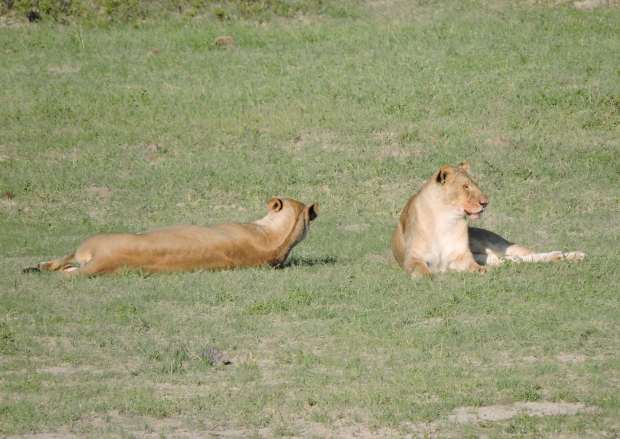
Although recently arrived from a longish trip, the possibility of spotting one of our all time favourite animals made us drop our luggage at the lodge and drive off in search of lions. We found the two females at Dom pan. They were clearly different: a paler one and a darker one. The latter appeared to be the older of the two.

DSCN9902 copy.jpg

After watching them for a while, a male came out of the bushes and greeted the darker one while the other moved away a short distance. Were we about to witness some mating? Not so as Mopani, who we assumed was the dominant male, only rubbed heads with the female and then moved off in the direction it came from, leaving the female pair alone until the day ended and it was time to get back to our lodge before the mandatory return time of 18:30hs.

DSCN9996 9.04.30 PM copy.jpg

We did not need to plan our next day activities as finding the lions again and spending time watching them was the only option! As a friend of mine says, “we slept in a hurry” and we were up before 06.00hs. No need for alarm clocks! We drove straight to Dom pan, as we believed that they would not have gone very far from there. On our way we realized that several migratory bird species were present at Hwange at the time. These were Crowned Cranes, Abdim and Woolly-Necked Storks, African Kites and Amur Falcons to name but a few!

We had little time for bird watching as the lions had killed a young elephant at Dom pan during the night and the two lionesses were feeding on it! After this find, most of our activities during the visit centred round Dom pan where we spent a lot of our time. We watched the lionesses feeding and interacting for several hours and I present you with a number of pictures and a video, as these are better than words. We only left them to return to the lodge for lunch and a rest.

When we came back during mid-afternoon, only the paler lioness was by the carcass. A search of the surrounding area revealed two lions laying together a few hundred metres from Dom. They were the mating pair: the darker female and a male that, to our surprise carried a radio collar. As we doubted that Mopani had one, it could only be Siduli. Clearly the lion that acts most ferociously towards cars is not necessarily the dominant when it comes to affairs of the heart! It was then clear that the male we had seen the day before was Siduli and that Mopani was hidden from view somewhere! But where?

Luckily my wife was with us as, if there was someone that could spot it, it would be her. And spot it she did, to our amazement, again! The wild-looking Mopani had been lying low under some bushes, unseen by anyone (except my wife) until then. It remained unobserved by our fellow game-spotters with the exception of another lady that clearly shared my wife’s eyesight. We thought it better that it remained unseen and got used to cars if it is to remain in a tourist area so we did not reveal its whereabouts.

As Mopani was still not willing to socialize and remained sulking under a bush, we focussed on the others. Mating in lions is a long-lasting affair as the pair remains together and mating takes place often for a few days, while the female is still receptive to the male[2]. This was clearly the case, as they remained “occupied” for the rest of the time we were at Hwange. That left the other lioness guarding the elephant carcass and Mopani hidden from view! After a while it was time to move off.

We drove to the Nyamandlovu pan as our daughter is very partial to elephants. Despite the abundance of drinking water all over the area, we were extremely lucky to witness the visit of a herd of about fifty animals that, as usual, appeared suddenly as if the product of a magic tree-to-elephant metamorphosis. The result was about one hour of one of the greatest shows on earth: elephants enjoying life at a water hole! There were about five family groups, each led by a matriarch and composed of its progeny, including some really young and tiny babies that were the centre of our attention.

The elephants not only drank but also entered the water where many were seen frolicking about and playing as only elephants are able to do among wild animals! It seemed to us that the latter were at risk of drowning while entering the water with their huge siblings and that they were under even more danger while swimming among them! Somehow they managed to keep their tiny trunks above the water and their mothers were extremely protective and they were always in close contact and ready to assist them!

The three resident hippos felt very uncomfortable at this sudden disturbance and two moved to the very centre of the pan while the third moved to the shore where it put up brave stance against the elephants, only to return to join the others as it was not at all respected by the excited pachyderms! Again, a picture gallery and videos are better than my limited power of description to let you know what took place.

The elephants’ joyfulness in the water delayed our return so we only drove past Dom pan, catching a glimpse of the lions who unwittingly startled a herd of 30 odd elephants intent on drinking from the pan, who retreated in a cloud of dust as soon as they caught sight of the lionesses. We arrived late at the gate where we were told off by a rather grumpy lady game ranger! The justification for our tardiness did not go far with her, clearly used to all sorts of excuses from people arriving late to camp!

The following morning, as expected, the lion pair continued their courtship, the pale female was still guarding the carcass and about fifty vultures (white-backed, white-headed, hooded and lapped-faced) were waiting on the side-lines for her to leave it. While in waiting, the Lappet-faced vulture was seen having a snack by pulling and cutting the dry tendons and sinews from an older dry elephant carcass that other vultures also shared once it opened up the hard bits!

Mopani, the antisocial, still preferred to remain out of sight! We can only hope that he starts turning into a more car-tolerant lion by accepting their presence as part of his daily life. Who knows, maybe one day he could become Cecil’s successor.


[1] To name wild animals or not to name! This is the question… for which I have no clear answer!

[2] Both leopards and lions have the same mating procedure. They can mate as often as every fifteen minutes for up to five days. This is the consequence of weak sperm and mating-induced ovulation.

Sleeping rock python

Our final visit to the Zimbabwean bush before leaving for South America took place from 8-10 January, and it was shared with our daughter who is also leaving for Italy later this week.

As usual, we enjoyed our safari in one of the jewels Zimbabwe has to offer. Learning from previous experience, we stayed at Main Camp as time was short and camping during the rainy season is not really a comfortable option! We were correct as it did rain and the sky -thankfully for the hitherto dry Hwange- was waterlogged so we expect and hope that the rains will continue.

Although there were a number of interesting observations during the trip, I will start with the one I feel “inspired” to write about, while I think about how to present the others to you.

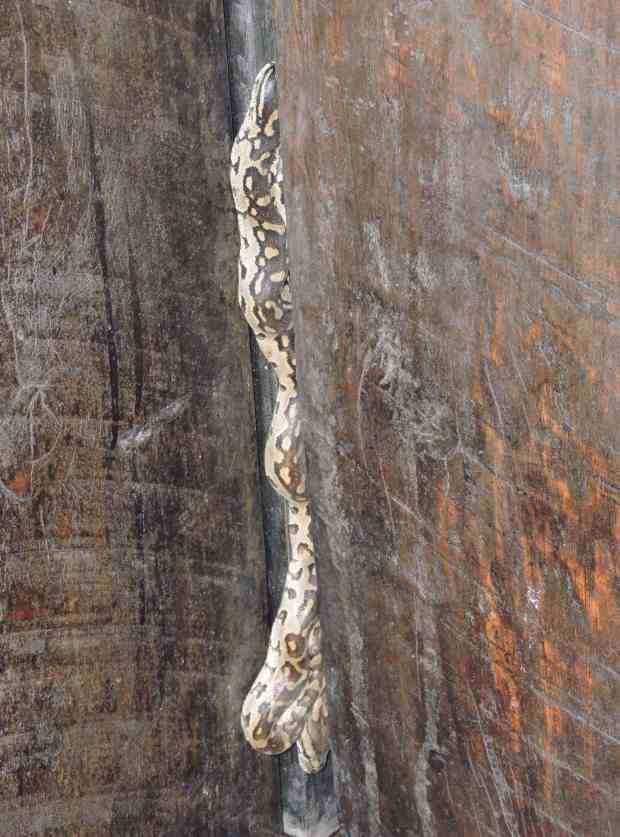
Several memories of my past experience with African Rock Pythons (Python sebae) came to my mind when, on reaching the top of the Nyamandlovu viewing platform we were warned that there was a python in one of its corners!

My experience with rock pythons on safari is very poor. In fact, until this find I had never seen one in a national park or game reserve! My only encounters with these magnificent creatures were in Kenya, either first hand or through pictures and/or stories. I recall seeing a picture of a really humongous python (most often and most regrettably killed) that had swallowed a goat at Intona Ranch in the Transmara. It was probably about five metres long and about six people held it up for the picture. That was interesting but a real pity.

On a more optimistic note, we once met a Swiss fellow “safarier” at Meru National Park, also in Kenya in the 80’s, who told us the story of a python swiming towards his little daughter who happened to be near the water. The moment it approached her, the snake stopped swimming towards her! He also mentioned that when he kneeled next to it, the snake resumed its approach, only to stop again when he stood up, suggesting that there is some size-assessment from the python when stalking its prey.

Apart from stories and pictures, I also remember two first hand encounters. On one occasion, while staying at Elsamere[1] in lake Naivasha on a bass-fishing trip in lake Naivasha, other guests spent their time looking for pythons at the lakeshore! I was really sceptical about python-collecting so I was really surprised when two -albeit small ones- were found! I should also add that luckily they were small as my friend Paul jokingly hung them around my neck with the obvious result that I carried the scars of 2 python bites on my upper torso for a few days! I can testify that pythons bite at least as hard as laboratory rats!

The second encounter was when, perhaps inspired by the above incident, Jim, my wife and I decided to go on a python-safari! Jim was a good friend with whom I shared a liking for snakes. My wife does not like snakes so she came for the walk, hoping for a fruitless search! Our trip took us to Hell’s Gate[2], long before it was declared a National Park.

We did enjoy a magnificent walk along the gorge and dry riverbed. It was there, at a narrow, shady and wet passage between narrow cliffs that we found a young rock python that had recently moulted and was shiny and healthy. As until then, finding the python was just our pretext for the walk, we were as amazed to find it as I am sure the snake was to see the three large primates walking towards it!

Enough reminiscing and back to the present safari! The Nyamandlovu pan viewing platform offers a magnificent view of the water and the action that is always present there. This time the action was clearly inside it! The empty half of the platform was clear proof of the snake’s presence, fear of snakes prevailing even among animal lovers who preferred to pack themselves at the other end!

DSCN9989 9.28.32 PM copy

The young  rock python wedged in a crevice of the platform, head down.

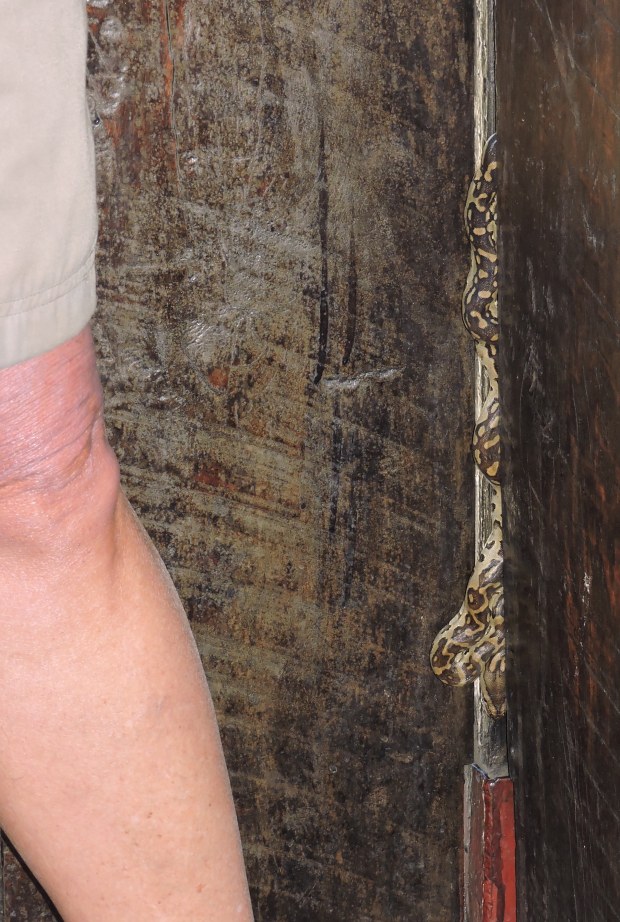
We were really thrilled by the news and moved closer to have a good look. The snake was a juvenile. It was comfortably wedged head-down in a gap of the railing, apparently enjoying an afternoon nap[3]. We took a few difficult pictures and sat in the empty corner next to it leaving it alone, happy to watch it every now and then while focusing on the events at the pan.

DSCN9990 9.28.32 PM

Regret the leg but it is only for comparison!

Amazingly not one of the several occupants of the platform came to have a look at the snake although all of them were aware of its presence. They preferred a packed platform end while we remained undisturbed at the “snake end”!

Needless to say that the snake did not move while we were there! It was still in exactly the same position when we left at the end of the day, still enjoying life. We were a bit concerned about it being rather vulnerable but hope that it will find its way and we will see it again.


[1] Elsamere Conservation Centre was the home of George and Joy Adamson for a time and it has accommodation facilities.

[2] It was named by Gustav Fischer and Joseph Thomson in 1833 after its narrow cliffs.

[3] Although snakes do not have eyelids, they still sleep by being able to close their pupils and sleep.