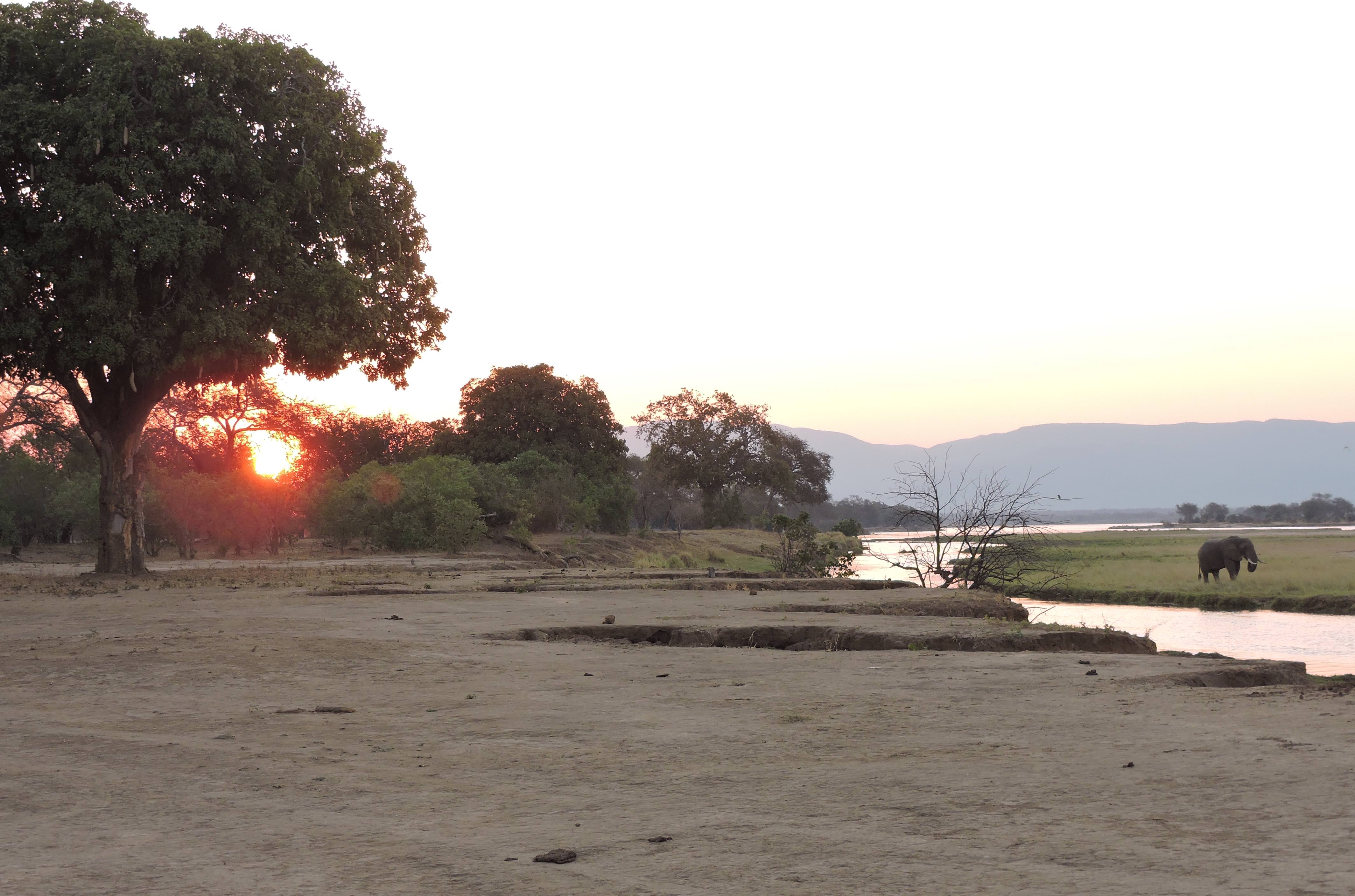
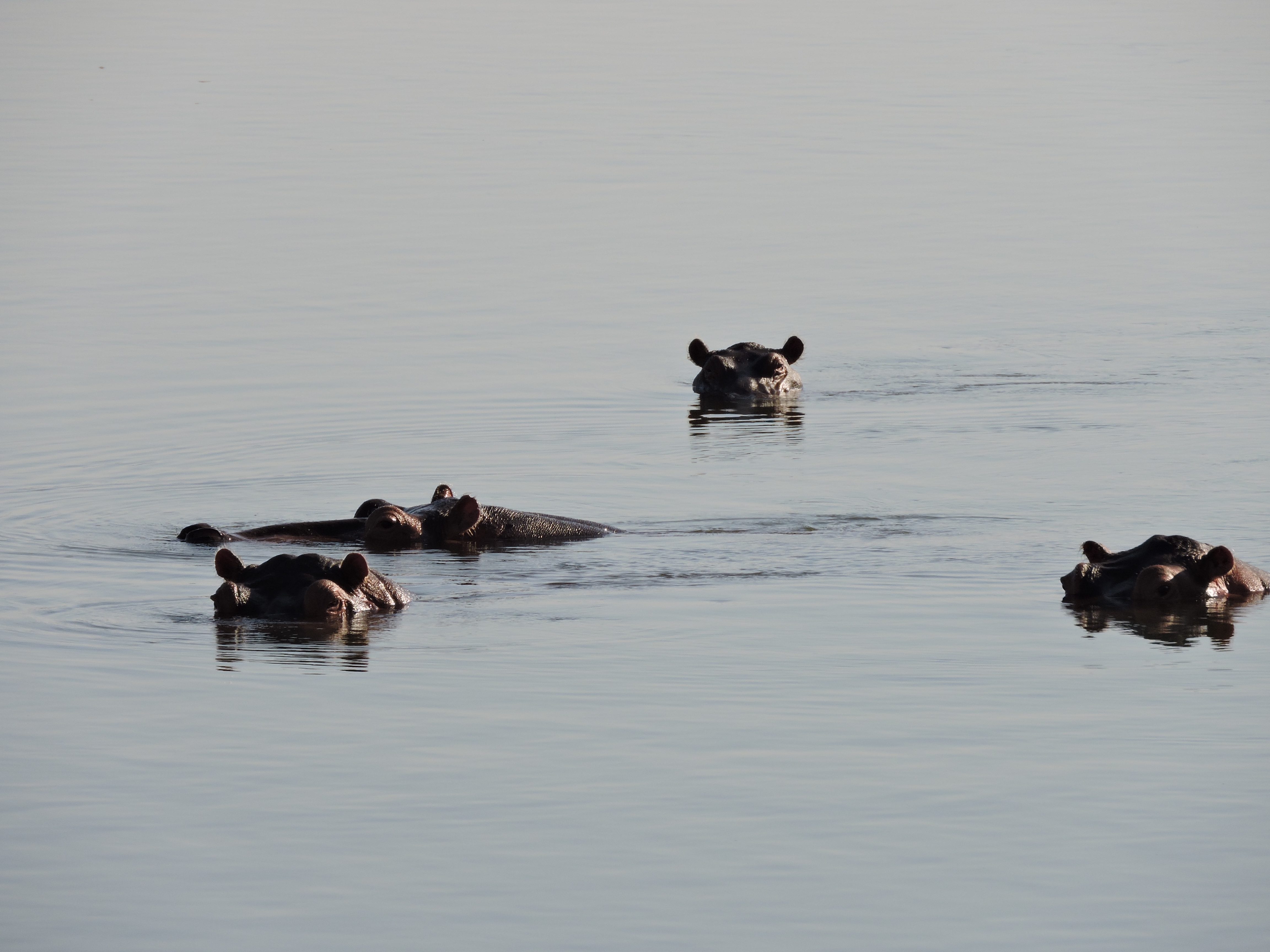
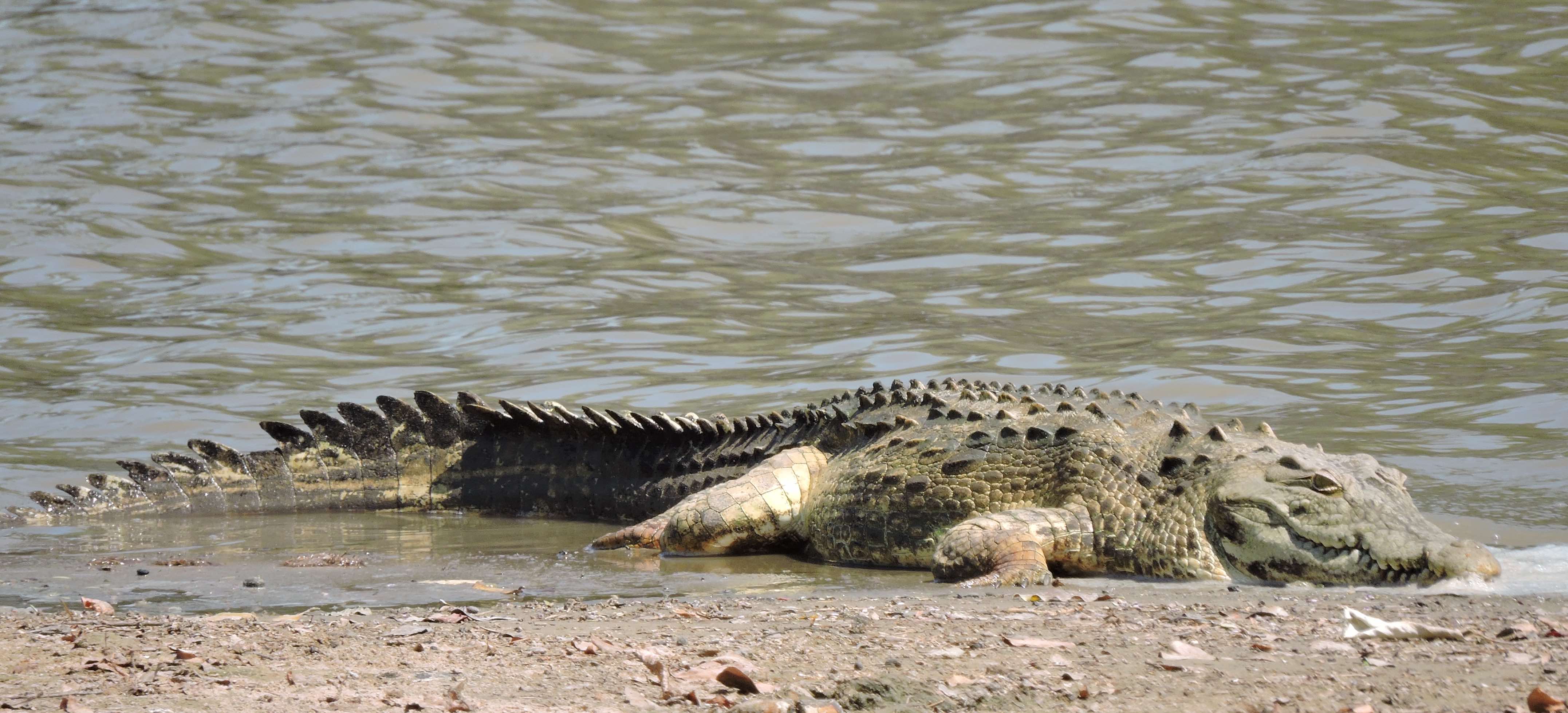
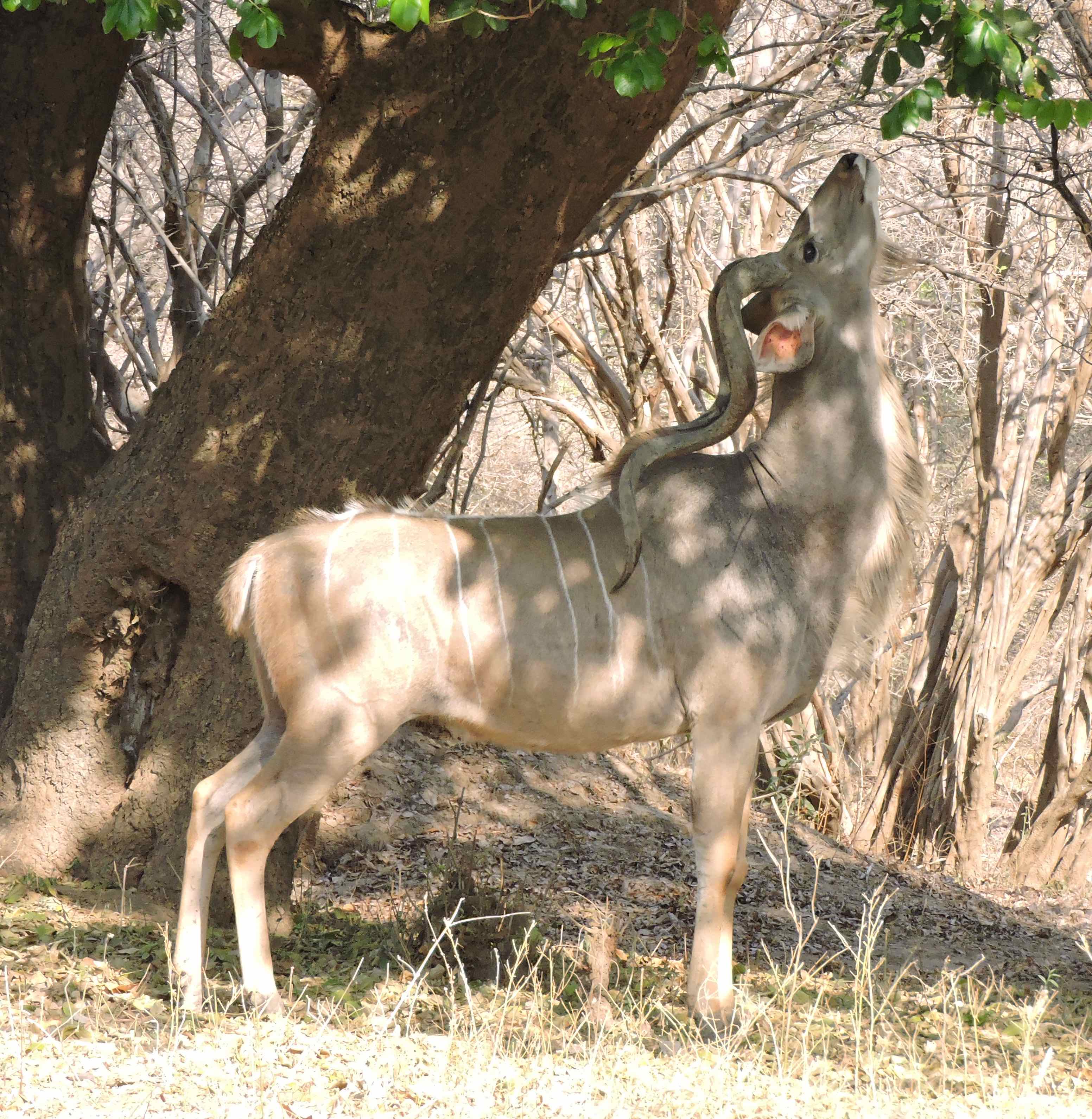
Safari

Hippo disclosure

While searching for suitable pictures to post in Instagram (#bushsnob, just in case you are curious…) I found a picture of communal defecation by hippos at Masuma dam. As I have recently -and entirely by virtue of being observant- become involved with facts about hippos that will probably change the way we look at them, I thought this short post was justified.

5 - Hippo rescue attempt at 2 second view

Hippos chasing crocs to get at the impala carcass!

There are many great stories about animals in Africa and, although I learnt this one some time ago, it had been stored in a part of my brain that I no longer have access to, because of all the new activities I am involved in (the real reason will not be disclosed!).

DSCN9972 9.11.44 PM copy

A hippo “tusker”. Note the left tusker also protruding in the upper lip.

Anyhow, apparently when the world was created, God, as you can easily imagine, encountered many problems. A lot of them God solved immediately but several remained, perhaps because God was busy solving the important ones. Among these was the “Hippo problem”. The latter found itself in a dilemma about its lifestyle that required a consultation with God.

“God” hippo said, “I know you have created me, but what do I do now? What do I eat? Where do I live?” A busy God did not have time for individual animal bellyaching so, from the top of his head said: “Well, you will live in the water but you will eat grass”. Surprised Hippo repeated “I will live in the water but I will eat grass?” This did not make too much sense to it as it had seen his reflection in the water: big mouth and big teeth! “How am I going to convince fish that I will not eat them? They will not let me enter the water!” he commented. Still busy, God told Hippo to make a plan!

Hippo left God’s office deep in thought and organized a meeting with the fish to convince them of his life plan. “I must prove to the fish that I have not eaten them!’ thought Hippo, and he met with the fish and eventually they came up with a pact: Hippo could spend the days with them in the water if he could prove he was not eating them. Hippo would prove this by spreading its dung each time, to prove to the fish that he was a trustworthy neighbour! Hippos still do to this very day.

DSCN6337 copy 2

Hippos defecating together in the water.

As you know, hippos spin their tails while defecating to distribute their excrement over the greatest possible area and, contrary to what I thought, hippo defecation occurs in the water and it is not rare to see fish following them. Male hippos in particular are very precise in the spreading of their excrement!

Funnily enough, I do not remember having witnessed a hippo peeing! Apparently they pee backwards and are known as are retromingent animals.

Enough of hippo’s bodily functions!

Born a whistle!

A well-known saying in Spanish goes something like “if you are born a whistle you will never be a cornet”. I am sure that there are many of these kinds of sayings that are applicable to the various walks of life. I am a whistle when it comes to sea fearing. However, as the family had the idea of a sea holiday, we travelled to Mozambique. The latter offers about 2,500 km of seacoast and beaches for all tastes.

Views of the sea and beaches around Vilankulos.

The road trip was good with the usual border hassle that added a dose of stress to my otherwise calm retired life. As usual the Zimbabwean side was very formal and rather time-consuming but with the pleasant manners that you almost take for granted in our “second” home.

Mozambique was something else! We had only crossed the border in and out of this country while being a UN employee and I did not have any issues apart from some queuing at peak times. Luckily this time there was no queuing, only confusion! We arrived at the border to be welcome by “helpers” to give them a name, all wearing identification badges. I noted that the badges were showing their plastic backs only while I was verbally overwhelmed in Portuguese and English about their offers for “help” and directions on how to perform the usual two steps: immigration and customs! I knew where this was leading!

Perhaps it was the proximity of the festive season as we were at the border before Christmas or perhaps this is always the case. I will find out in next visits but confusion took over, despite being aware of it. First it was a small piece of paper at the entrance gate where the car and occupants were to be recorded, about three words and a number. For some reason it took an inordinate amount of time and arguments between my self-appointed “helpers” and the official at the gate. Eventually I got the important paper and started to walk the plank towards the building to face the rest of the ordeal.

Not so. A lot of shouting behind me called my attention and I was informed that I had been given the paper of a lorry driver from the Democratic Republic of Congo! So, it was back to get the right one and resume the walk. We all had visas from Harare, except one of us who needed to get it in the border so the wait was longer than expected but acceptable. Finally we were ready to do customs. This required the filling of a form and I naively thought, driving off. Not to be. The need for a physical inspection of the vehicle was announced!

This was clearly what the “helpers” were waiting for. As the Customs official walked towards the vehicle, they advised me in hashed tone, on the various ways of handling this apparently difficult procedure. In addition, while the we approached the car, the word “Christmas” was repeated often by my “helper” entourage, now numbering five and growing.

We were two vehicles in this trip. Our friends did not require a visa so they had already been “helped” through the car check-up. We were about to open ours at the request of the Customs Officer when one of our friends came and whispered that he was asked for a USD 10 payment and that he had agreed and obtained Customs’ clearance and, more importantly, the key to freedom: the valuable gate pass. Assessing the situation surrounding us: utter confusion, a growing crowd of “helpers” and the already expectant Customs Officer, we had no option but to follow our friend’s arrangement and handed over our first Christmas present of the journey!

DSC_0161 - Copy 3.34.12 PM copy

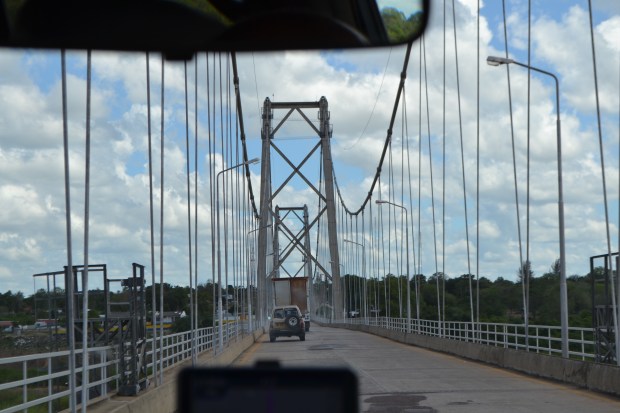
Crossing the bridge over the Save river.

We shared a house with our friends in Vilankulos and enjoyed the relaxed atmosphere while the younger members of the family were engaged in more muscle-demanding activities such as SCUBA diving and snorkeling.

Under severe peer pressure I consented to accompany them on a snorkeling trip to a well-known area of coral called “Two mile reef”. Trying to improve my snorkeling experience, I had acquired a floating aid in order to be able to save my energy for swimming in search of coral formations and other creatures rather than spending most of them on trying to stay afloat.

A selection of underwater finds. Pictures by Florencia de Castro, Mariana Terra and Julio A. de Castro.

I still had fresh in my mind an earlier experience at the same location when I got really exhausted and, eventually, seasick swimming in the rough sea! So I did not wish for a repeat! Luckily, the floating aid was a success and I did see some interesting coral formations and fish that I was not able to identify as I have decided that only terrestrial animals interest me in this life! Soon the tide changed and it was time to return; I was still swimming and could even climb on the boat unaided (I am not sure if this was me being fit or the ladder being lower but I prefer to think the former!).

DCIM100GOPRO

About to depart after a day spent snorkeling. The Washing Machine was yet to come!

A final word on the return trip. The passage between Two-mile reef and Bazaruto and Benguerra islands is infamously and justifiably known as the “Washing machine”. I can assure you that this was violent rock and rollish to put it mildly. The rest of the return trip was just choppy! Fortunately, we all survived -just- and got to land in relatively good shape. Once more I promised myself that this was “curtains” on seafaring for me. I did this fully aware that I have declared similar resolutions before only to forget and backslide, caught in a vicious peer pressure circle!

DCIM100GOPRO

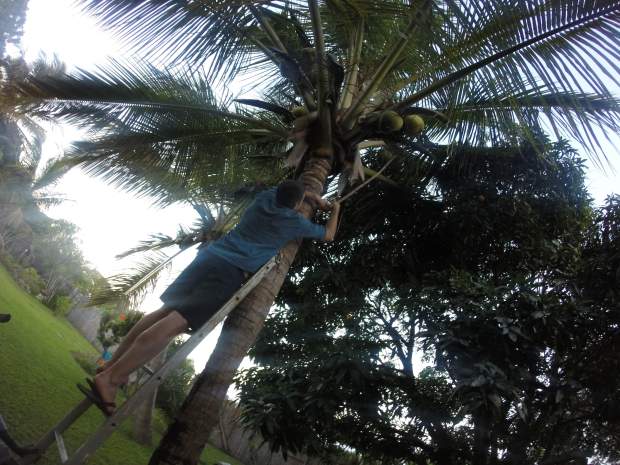
Coconut harvesting, the preliminary of coconut splitting.

Swimming at the beach, walking and coconut opening occupied the rest of my life in Vilankulos and I was really busy working on a novel that I have had in my mind for years and still refuses to be born! I was pleased to make some progress that encourages me to go on writing for a few more years.

The trip back was uneventful, including the border crossing, and we managed to get to the Vumba mountainous area in Zimbabwe in good time. We stayed the night at one of the Inns there and, after a good breakfast and a walk in the garden observing insects and birds (what a relief!), we headed back home where a rather green garden was waiting for us.

A “new” hippo

DSCN6469 copy

Those of you who have read this blog on 22 February 2015 (https://bushsnobinafrica.wordpress.com/2015/02/22/hippos-from-hell/) and watched the videos I posted later (https://bushsnobinafrica.wordpress.com/2015/03/23/hippos-from-hell-the-videos/) would remember the extraordinary observations that the hippos present at Masuma dam at Hwange National Park were actually eating Impala meat. A reminder below:

This observation was so incredible to us –seeing it happening in front of our eyes without previous knowledge- that it was almost the sole topic of conversation for the rest of the trip! It was only after we returned and I found an earlier record of a similar event also observed at Masuma almost 20 years earlier[1] that my mind relaxed, but only for a short while. What we thought that happened it was what actually took place! I believed that the observations were of great importance and that they merited further follow up!

Luckily, establishing contact with Joseph Dudley (Joe), the responsible of the observations and publication, was straight forward and he replied to my message telling him of our experience within 24 hours! The possibility of some collaboration to write our observations was considered from the start. Later on Joe realized that there were a few reports and that it was worthwhile attempting a joint paper. On 20 October 2014 he wrote: ” I think that it would be good to connect the dots between these three recent observations ………..”[2] This was the start of Joe’s efforts to put together the people that have had experience on hippo carnivory and although he asserted to me recently (2 December 2015) that ” It was your contacting me after your experience in Hwange that pushed me to made this paper happen…” the idea of the joint paper and the effort of writing and coordinating it was his! My contribution to the exercise was minimal and I could safely say that I was only the straw that broke the camel’s back!

Civilities aside, Joe managed to put together a group of people with complementary expertise and steered it to the publication of a paper that I believe will change the way we look at hippos in the future[3].

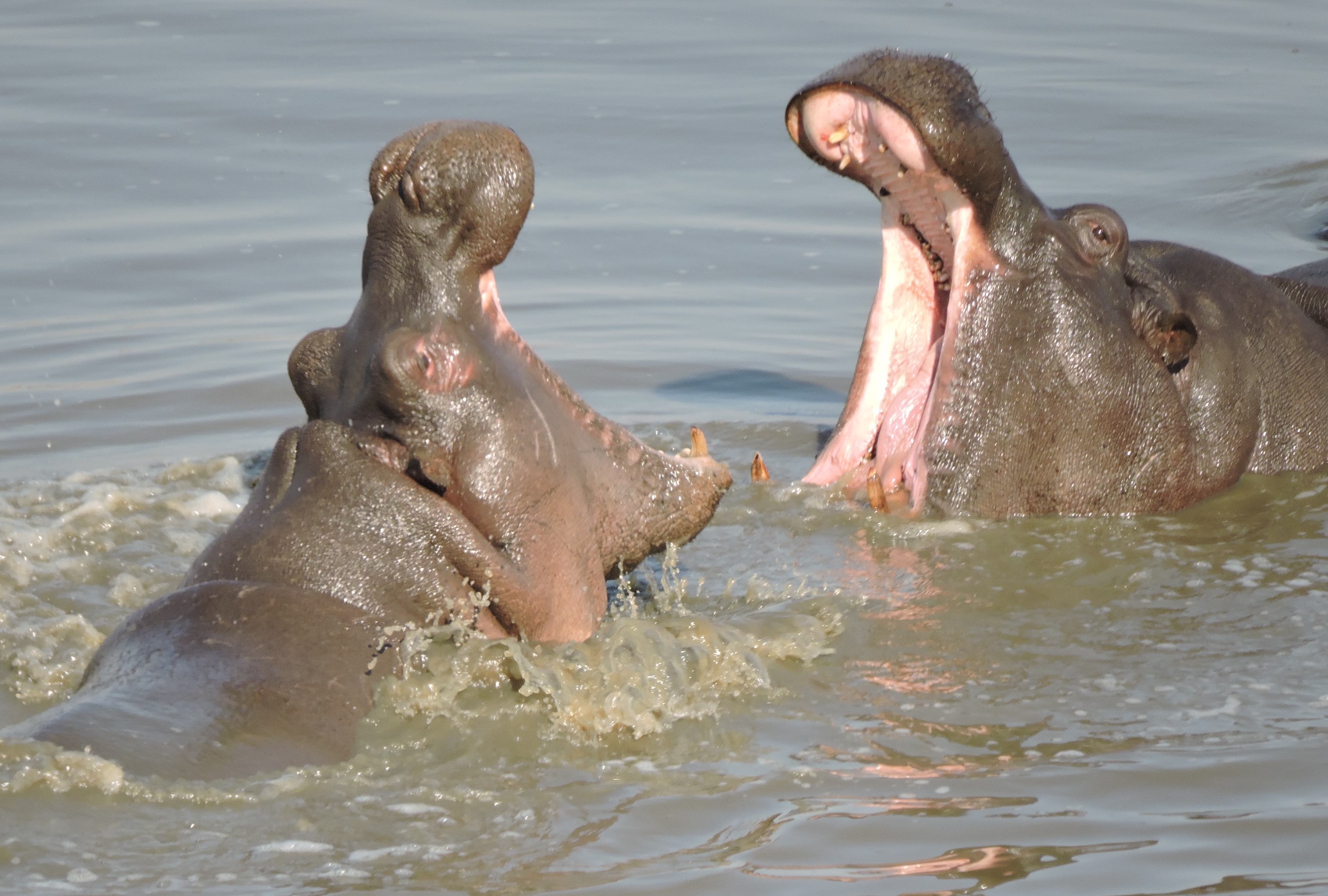
In brief the paper postulates that hippos, an essential species within their ecosystem, should be considered not as obligate herbivores as at present but rather as facultative carnivores able to consume carcasses from other animals. Carnivory is not an aberrant behaviour confined to certain instances but a behavioral trait that takes place throughout the hippo’s distribution.

The accelerated rate of transmission of the deadly zoonotic disease anthrax recorded among hippos as compared with other animals is attributed to their habit of consuming meat from various animals, including the hippos themselves. This fact can have important implications for a better understanding and better management of future anthrax outbreaks not just in wildlife populations but, much more critically, in humans. The publication is receiving a rather wide coverage by the world press that I include on a separate page for reference. See: Hippo carnivory press coverage.

Just today (10 December 2015) Joe sent me a video from YouTube that I think is very timely as it rather eloquently shows hippos consuming a zebra and fending off crocodiles while doing so. You can watch the video below although it may be a bit too strong for some. Please accept my apologies but I think it is within the very interesting subject of this post.

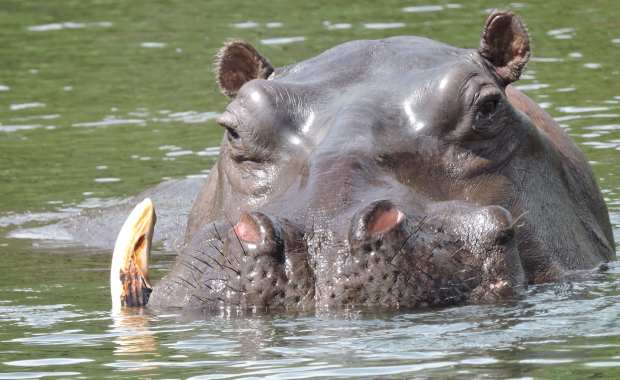
I end this post with a picture of a hippo taken on the Kavango river during our recent trip to Namibia that I will cover soon. Does it not look too fierce to be a herbivore?

DSCN9972 9.11.44 PM copy


[1] Dudley, J.P. (1998). Report of carnivory in the common hippo Hippopotamus amphibious. South African Journal of Wildlife Research 28, 58-59.

[2] At the time he had additional information on the subject from other colleagues.

[3] Dudley, J. P., Hang’Ombe, B. M., Leendertz, F. H., Dorward, L. J., de Castro, J., Subalusky, A. L. and Clauss, M. (2015), Carnivory in the common hippopotamus Hippopotamus amphibius: implications for the ecology and epidemiology of anthrax in African landscapes. Mammal Review. doi: 10.1111/mam.12056. The paper can be downloaded free from the following link for the next couple of weeks: http://wileyonlinelibrary.com/journal/mam ffollhttp://onlinelibrary.wiley.com/doi/10.1111/mam.12056/abstract for the next two weeks and then the Abstract will remain there.


Stones and gravestones

I never thought much of the Matopos National Park, until now! The park, located less than an hour drive from Bulawayo, the second city of Zimbabwe, was a great find for us. Until now we had only stayed outside the park and only entered briefly to visit its main landmarks, quite a while ago.

This time, on our way to the Caprivi in Namibia, we decided to stay in the park to get a better feel for the place. In addition, I was reliably informed that some (very) large scorpions dwelled in its rocks. As rocks abound there the expectations were high and I anticipated to unearth a truly scorpion paradise!

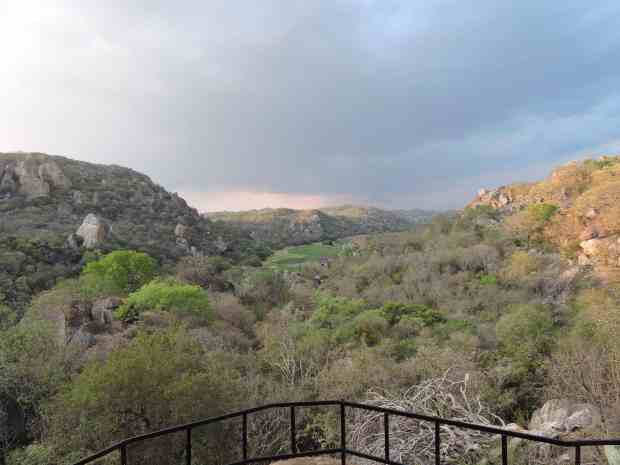
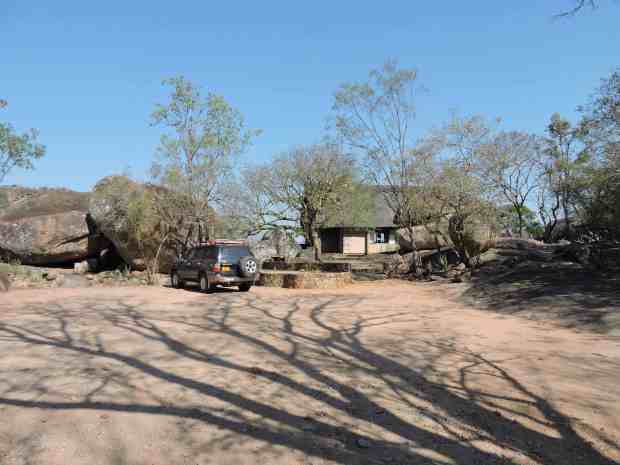
We stayed at the Black Eagle Lodge in the Maleme area of the park. Apart from being comfortable, it is sited on a rock outcrop with magnificent views of a dam below, all framed by the rocky hills. An amazing place to relax! An added bonus was that we had first row seats for the first storms appearing over the park as the rains were just starting after the long dry season.

DSCN9457 copy

The Black Eagle Lodge and its view, below.

DSCN9400 copy

DSCN9714 copy

DSCN9706 copy

The storm in full swing seen from the Black Eagle Lodge.

DSCN9729 copy

The sun rays break through the heavy clouds.

During our visit we decided to drive around rather than embarking on the few possible walks, some of them quite long. We also did not go into the game area of the park as we felt that we could see large animals in Namibia. The game section hosts two of the big five: white rhino (number and location undisclosed) as well as the elusive leopard.

DSCN9670 copy

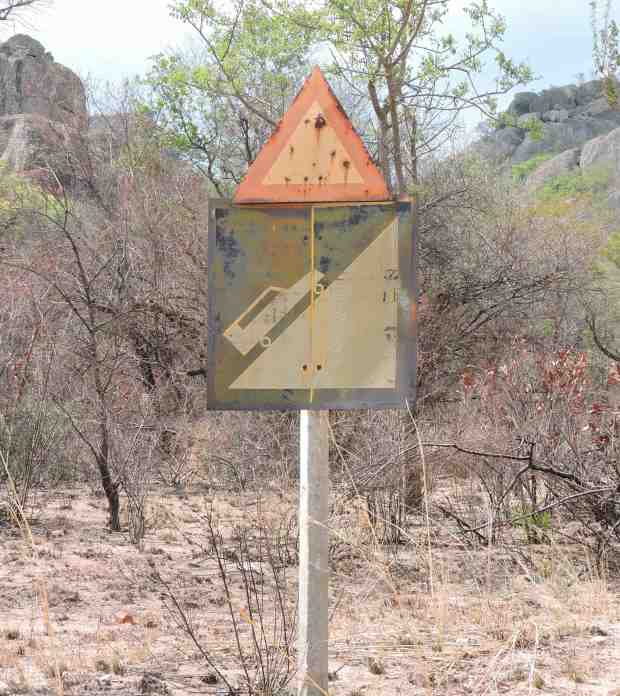
An old sign gives an idea of the kind or roads that expect you at Matopos.

We relished the landscape and were amazed by the rocky hills and their beautiful stone formations resembling castles and buildings to me but other things to more artistic people, I am sure. Particularly astonishing were a few weird stone formations that seem to be kept in equilibrium by some supernatural forces. The formations were like those depicted in the old Zimbabwe Dollar notes.

We also spent some time visiting Cecil Rhodes’ grave, reputed to be the most visited place in Zimbabwe after Victoria Falls! The short walk to reach it was well worth it as it offered an unsurpassed view of the surrounds. The view from the top of the hill, known as “World’s View”, was breathtaking.

Although we only had one full day at Matopos, we also managed to visit Nswatugi cave, after negotiating a rather tough track only possible with a 4WD and a rather short walk.

DSCN9605 copy

An imaginative marker on the way to Nswatugi cave.

The San paintings it displays are considered among the best in Southern Africa. The observer cannot fail to see a couple of giraffes above a mass of animals and people and a large number of red dots, rather unexplained apart from the artistic side of the author. My favourites were a zebra and the head of a female greater kudu. This cave was painted between 10,000 and 6,000 years ago. I have selected my best shots to attempt to illustrate these beautiful paintings.

I will comment on the scorpions in a future post. The latter aside, what we saw convinced us that the Matopos is worth further future visits.

Mistaken for carrion…

At a hot Mana Pools it was either me roasting some meat or eating from tins as my wife, usually an excellent cook, was feeling too hot to get involved in any heat-generating activities she was busy engaged in the opposite; cooling off with the aid of water and fans in order to survive another day! Resigned and lazy (independent from the heat), I lit a small fire taking some coals from the Tanganyika hot water boiler just at the time when the temperature started to go down.

I am an atypical Uruguayan. I am scared of horses and unable to ride them or -worse still- do a good asado[1]! Hearing only words of encouragement coming from the shower room I attempted at overcoming my shortcoming and managed to get a good fire going. I soon re-confirmed that one thing is to have a good fire and another is to use it well! I did not, as usual as the nice sirloin piece was well cooked top and bottom but very alive inside, even for us that like our meat rare! Anyway, we ate the better cooked pieces while leaving the rest too roast for a while longer until we managed to have a fairly decent dinner.

On account of the ambient temperature, the after dinner routine at Muchichiri was to seat outside by the river to listen and attempt to identify the many bush sounds that are heard in Mana Pools. Ocassionally the sounds or footsteps would be heard very close needing an inspection with our searchlight to identify the responsible both out of curiosity and self-preservation. The main “culprits” would be hippos but elephants and a number of antelope were often found around the lodge. At one stage we caught a slight movement between us and the river and we found a relatively scarce white-tailed mongoose scurrying through the undergrowth.

IMG_0260 copy

From the lodge my wife caught the bushsnob napping again, oblivious of the passers by. With the night visitors was different…

The mongoose gone, my wife read and I wrote notes for this posts. I got quite involved in what I was doing so when I heard a hushed “Have you seen it?” Coming from my wife I lifted my head with it still inmersed in my writing. The spotted hyena was looking at me from very close quarters, quite a shock when you do not expect a visitor like that! “!@#$%^&* its huge” was all I could profer. It was indeed a very large hyena that was looking at me from inside the camp light circle!

Although my wife assured me that she heard it coming and got a whiff of its pungent smell for a while, I was caught totally unawares. I experienced a mild panic attack as many years had passed since I had another similar encounter. All I managed to say was “ssshhhhhh”, the kind of noise that -in our culture- is usually reserved to scare away chickens! It was a pathetic and out of place gesture but it worked mainly because the hyena did not have hostile intentions towards me! I am sure it realized that, despite my years, I was yet to reach full carcass status! As usual, it moved off fast but remained around camp until we retired to bed.

The hyena did visit our place a couple of times later on as documented by a strategically placed camera trap (below) while I was safely in bed and inside my mosquito net on the top floor of the lodge, feeling like a safe animal!


[1] Roasted meat on the fire.

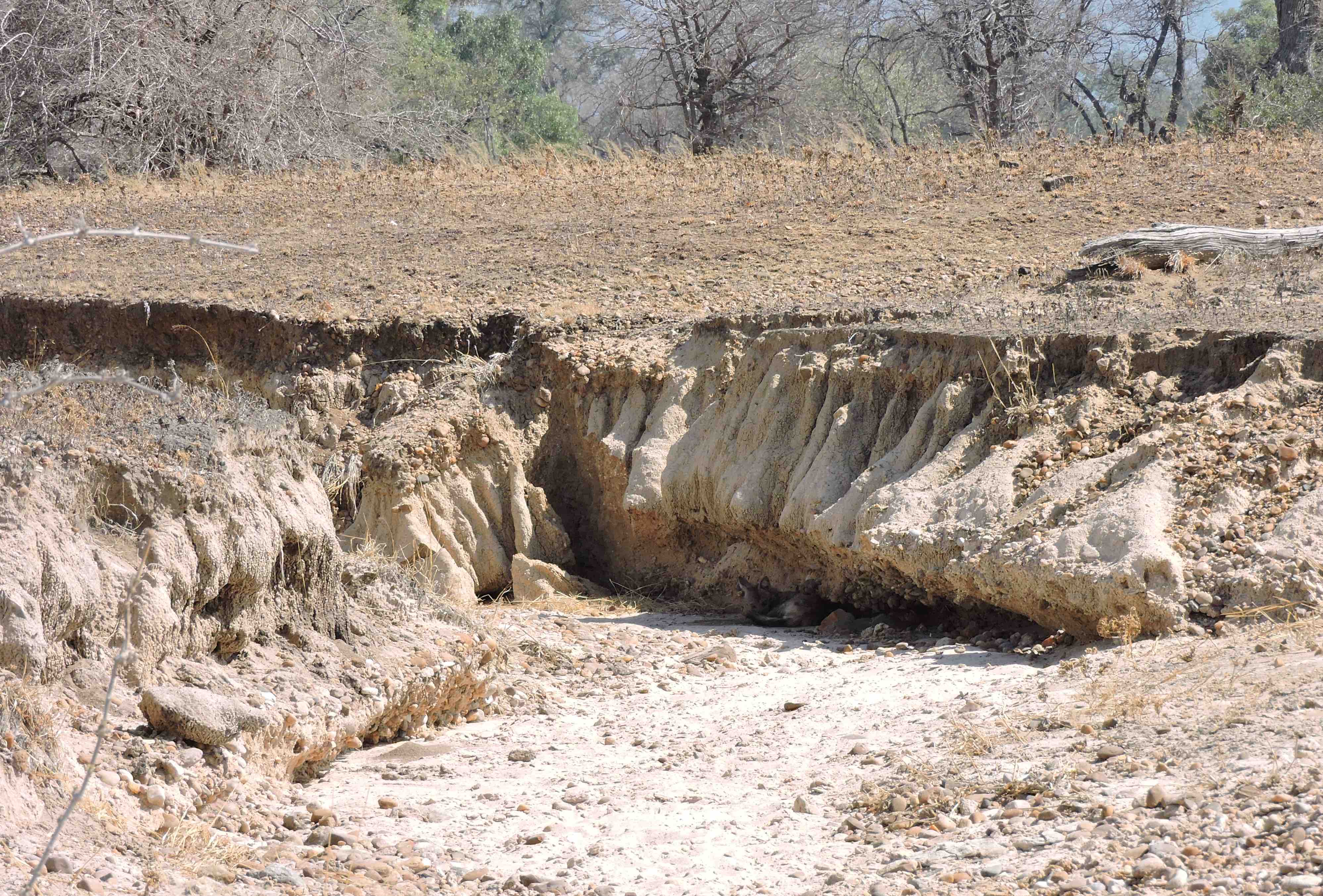
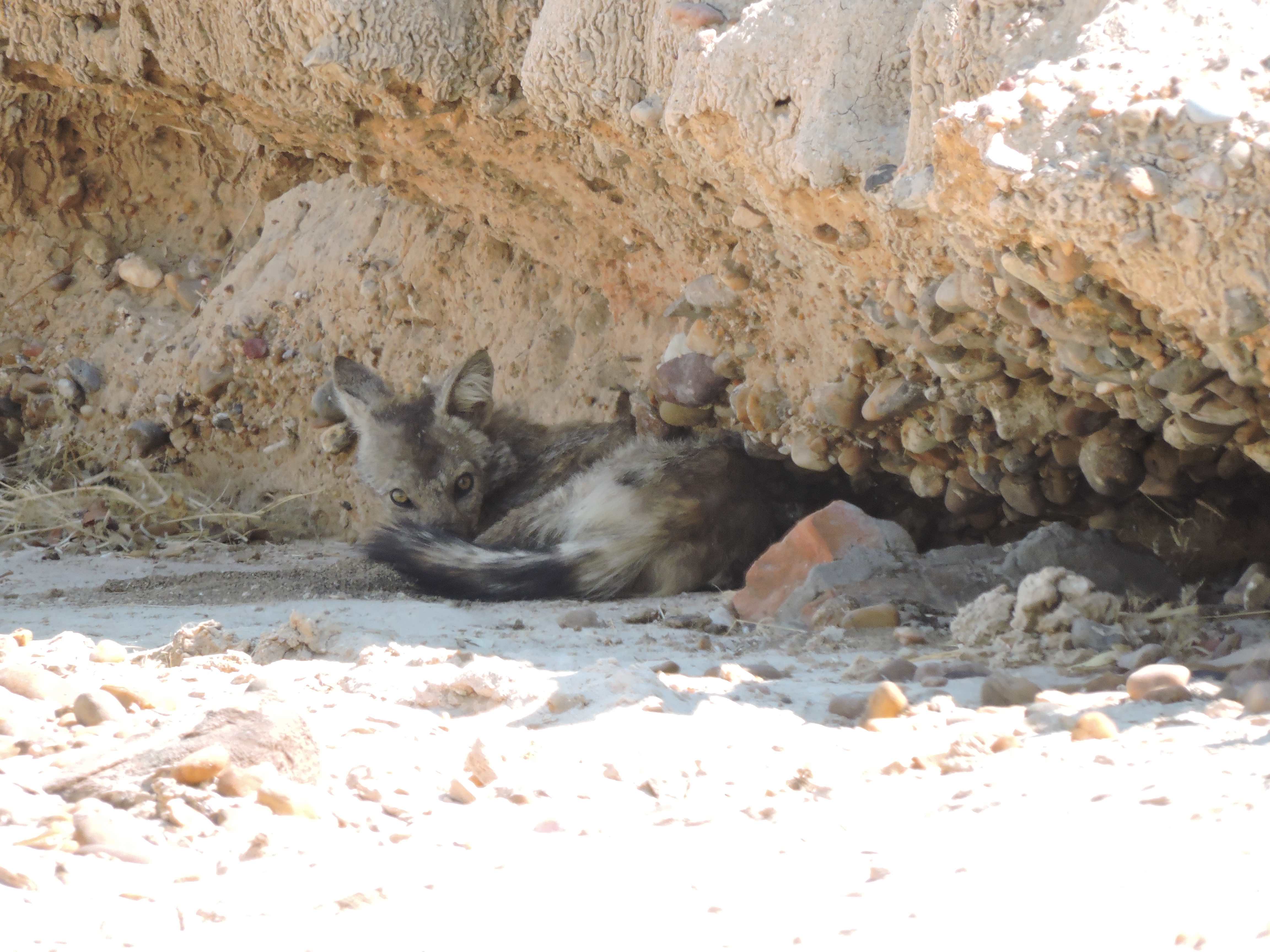
Spot the beasts (easy!)

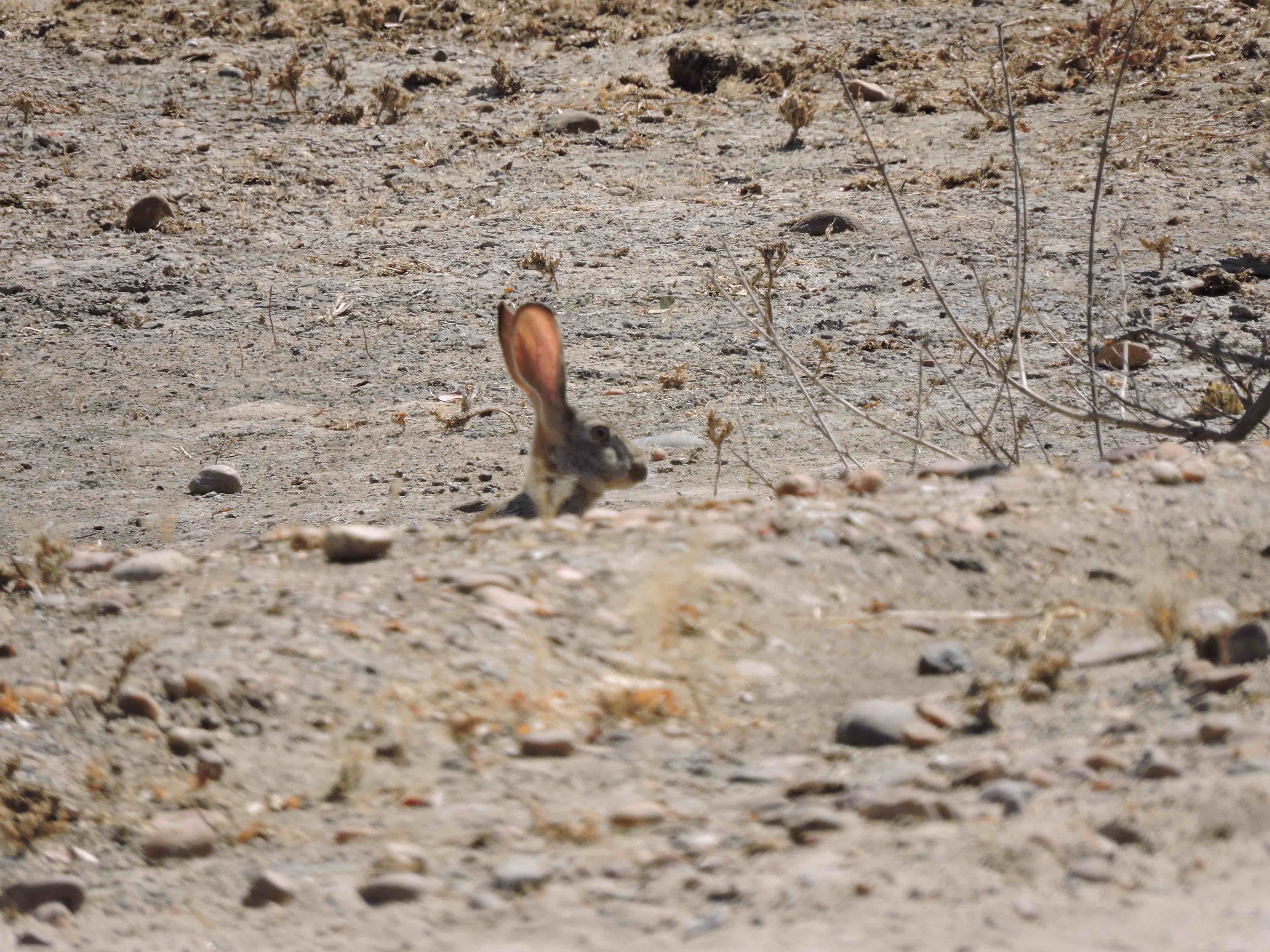
While in Mana Pools last October most game were by the river. During one of our rare inland sorties we came across this sight. It looked rather battered and suffering from the heat as much as we were!

DSCN8433 copy


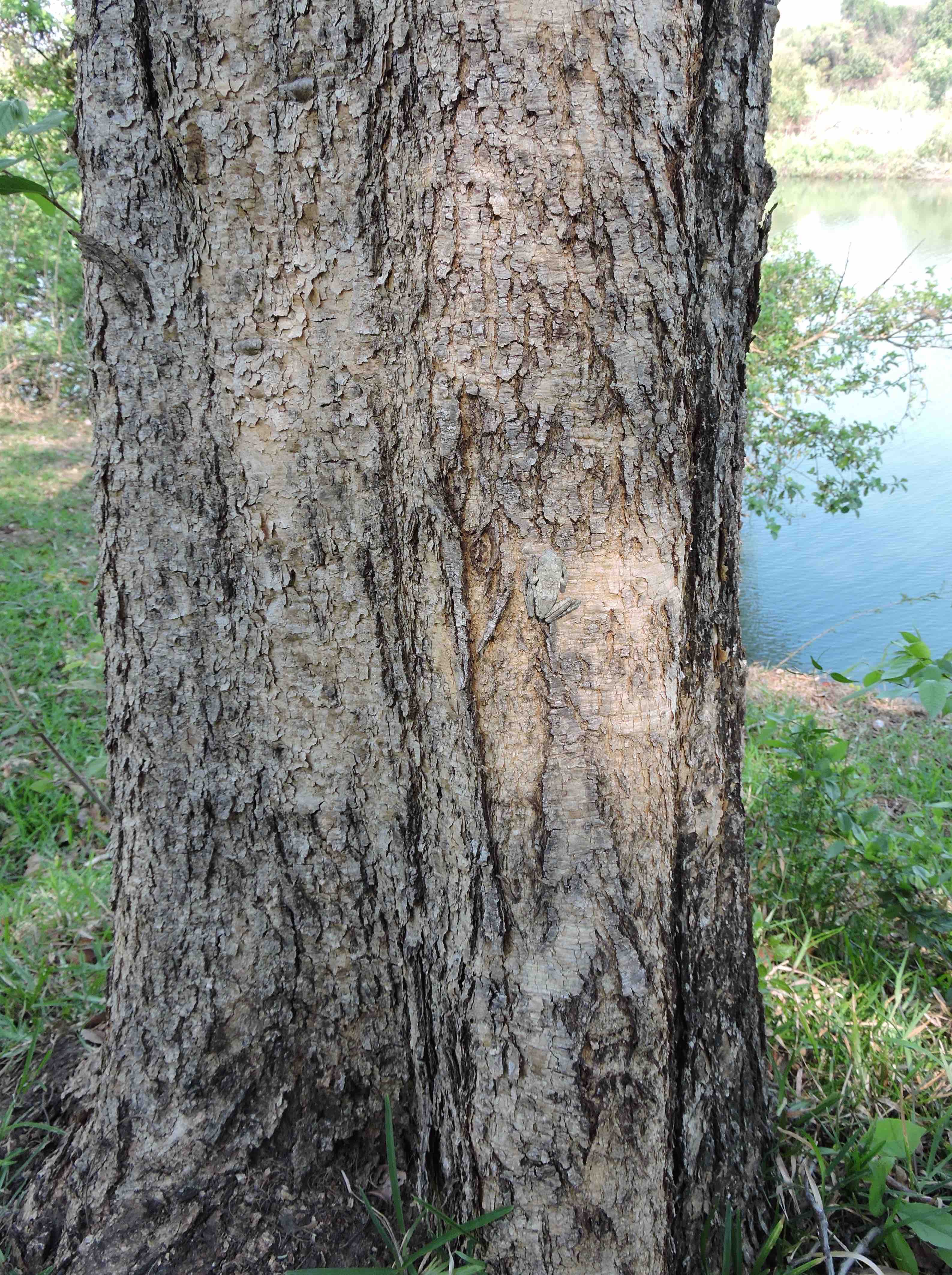
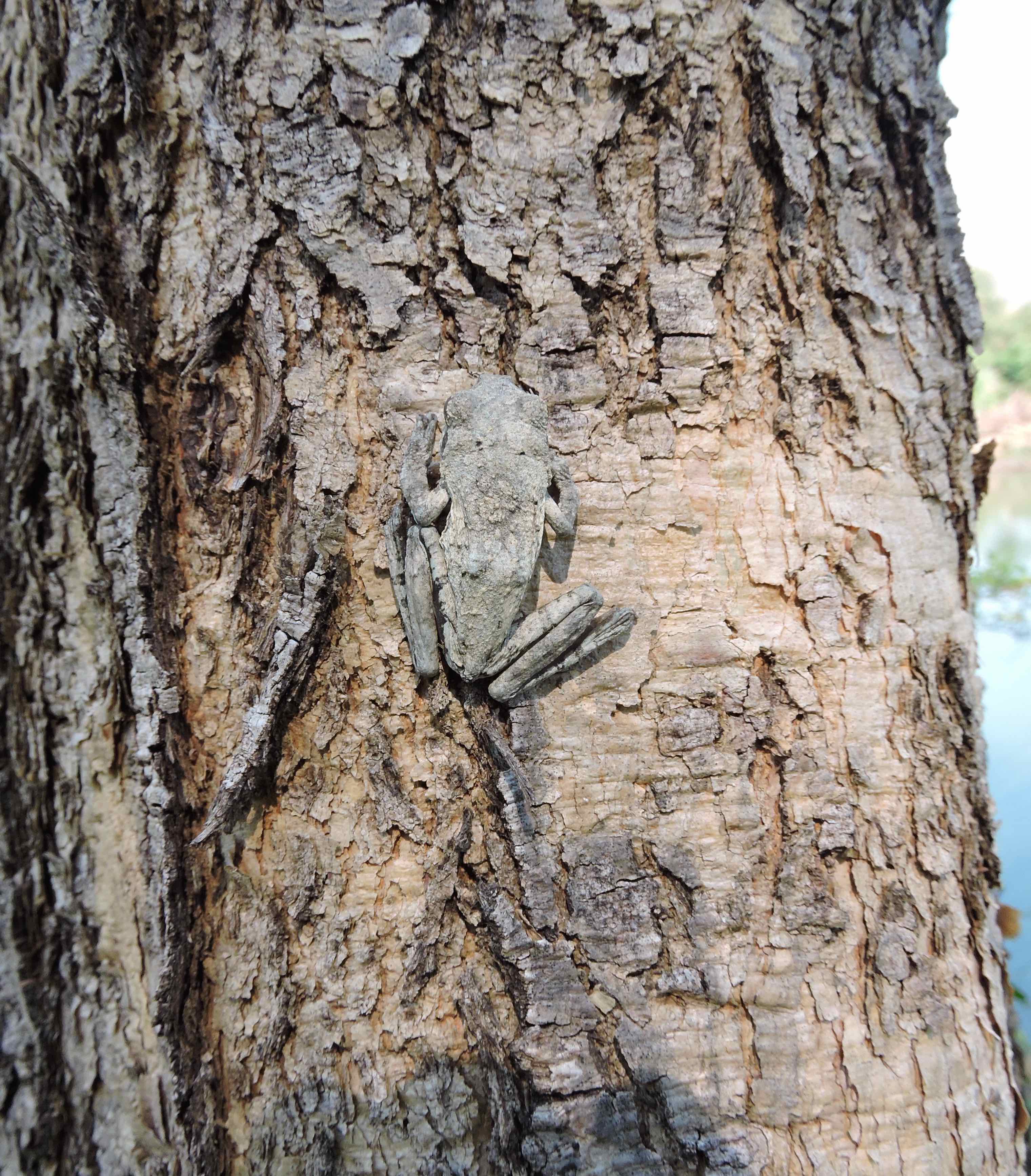
We also found this little beast at Hippo Pools, also in October.

DSCN8002 copy


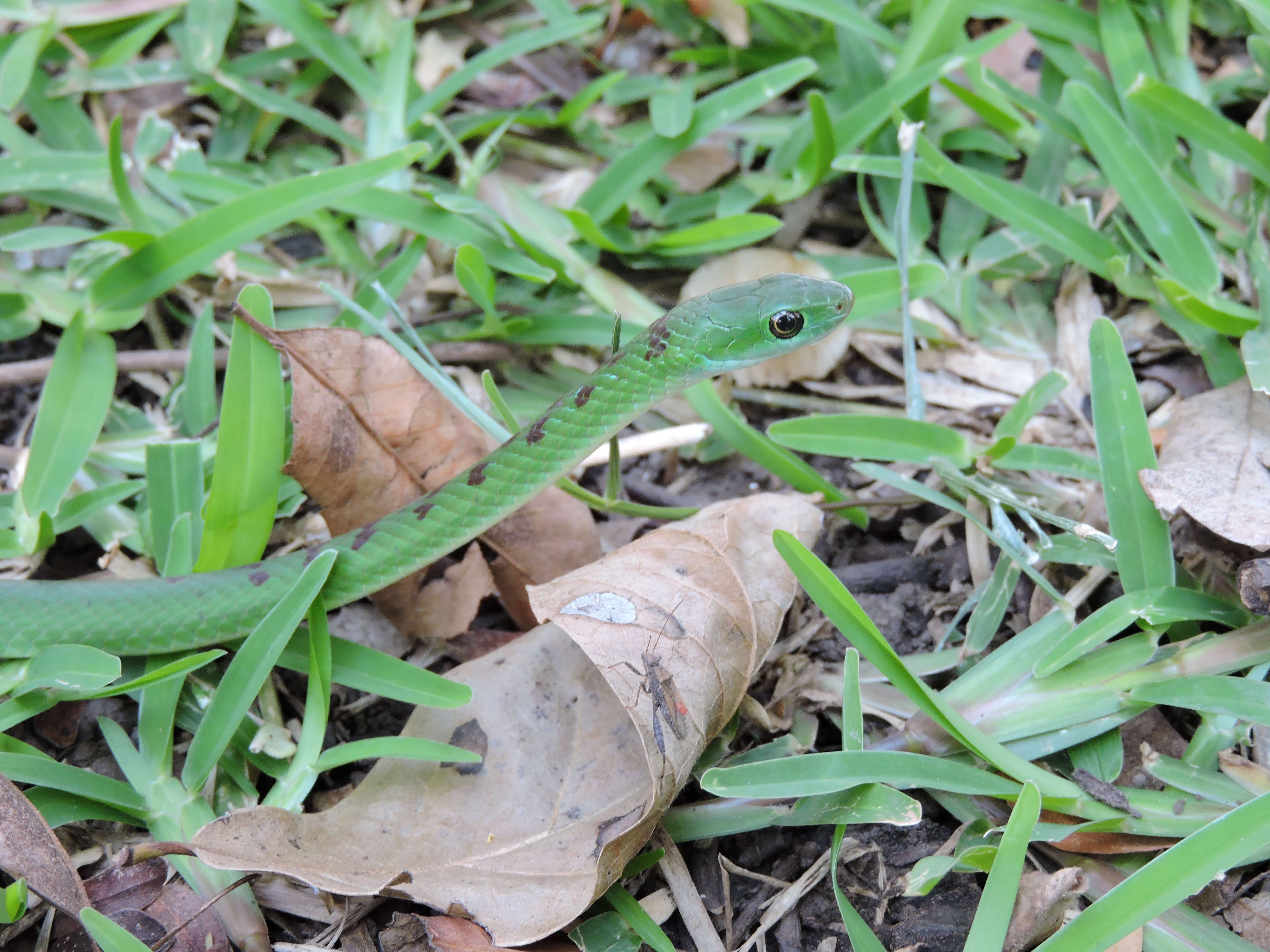
And here are the beasts “revealed”:

A fox.

A fox.


DSCN8003 copy

A tree frog.

The fox was after this fellow:

An African hare.

An African hare.

And this fellow was after the tree frog!

A green grass snake.

A green grass snake.

The ways of nature!


Harare, 15 October 2015.


Butterflies

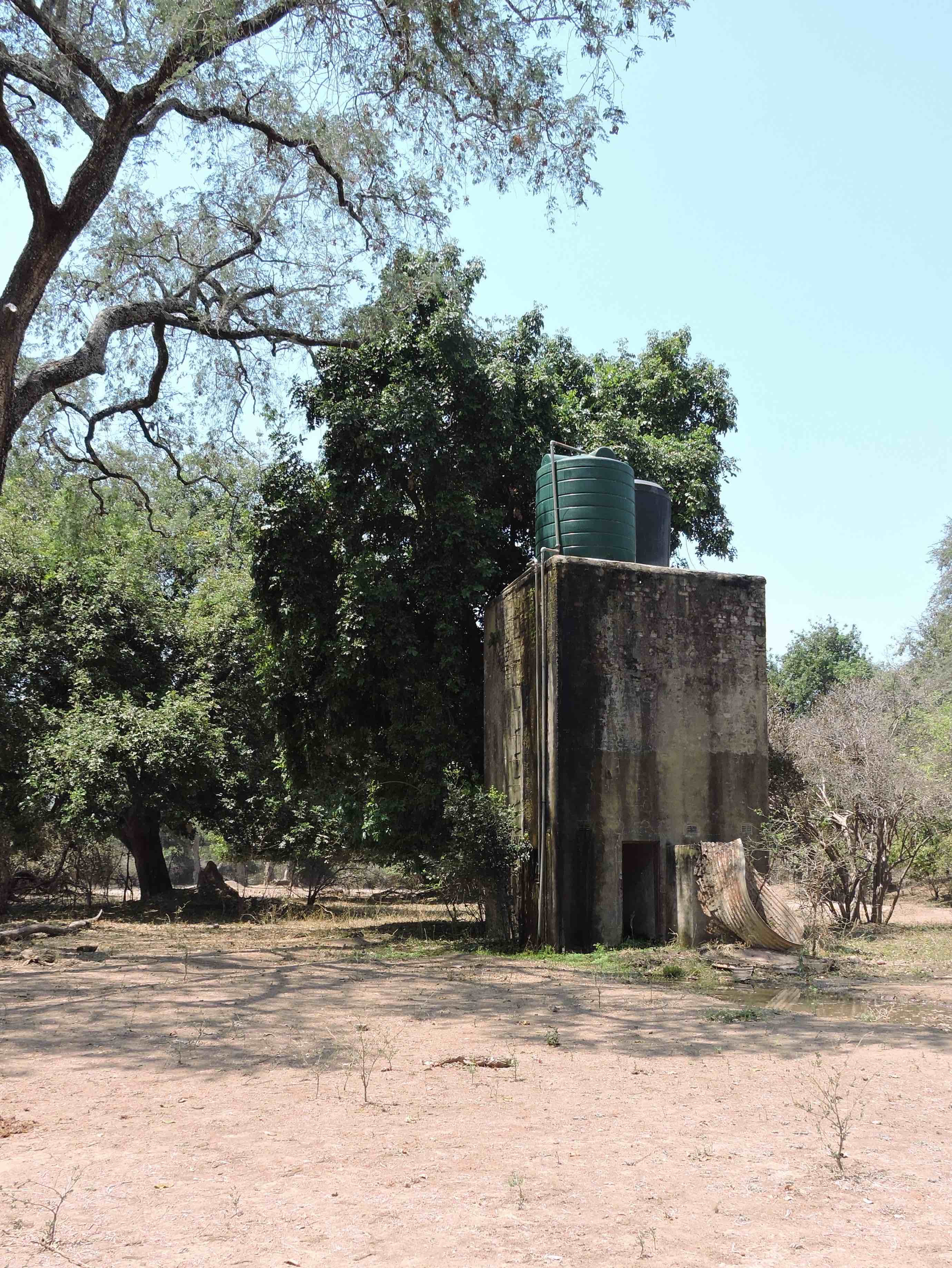
During our previous visit to Mana Pools in September[1] we stayed at Gwaya camp. In one of the walks around camp I found a rather derelict water tower that still supplied us with this important liquid. A leaking water tank sat over a square and now door less room. The latter and the surrounding area were very damp on account of the long-term water leakages that run down its walls ending up feeding a number of puddles where animals came for a drink. The area was a green blotch on an otherwise bone dry landscape.

The water tower.

The water tower.

It was near to this spot that my hidden camera trap almost remained secret for good as buffalo and lions moved in[2]. At that time, with my attention focused on recovering the camera I had a brief look inside the base of the tower expecting to find bats. I found butterflies instead but did not spend time there, as I was more concerned about avoiding lions and/or buffaloes!

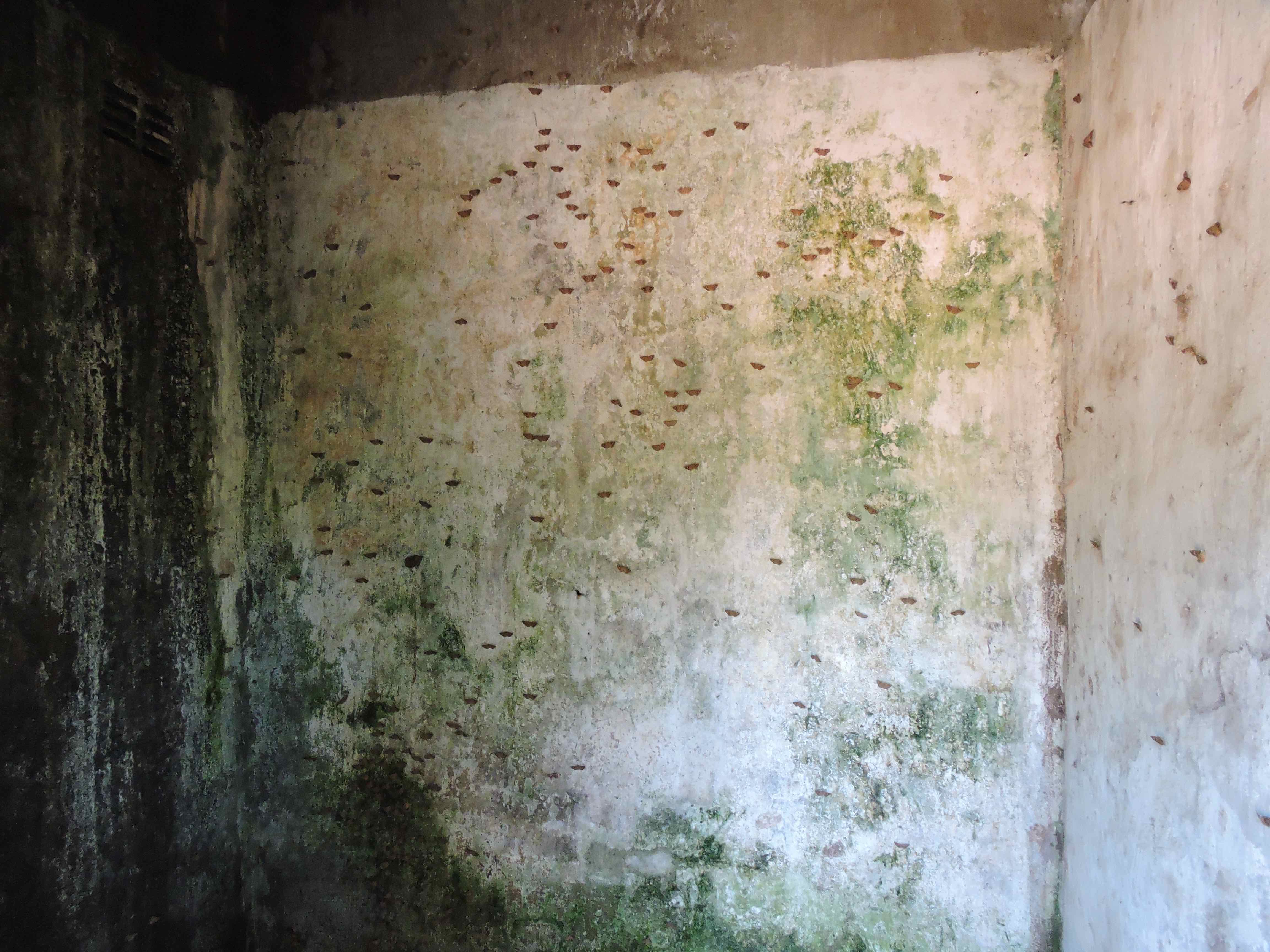
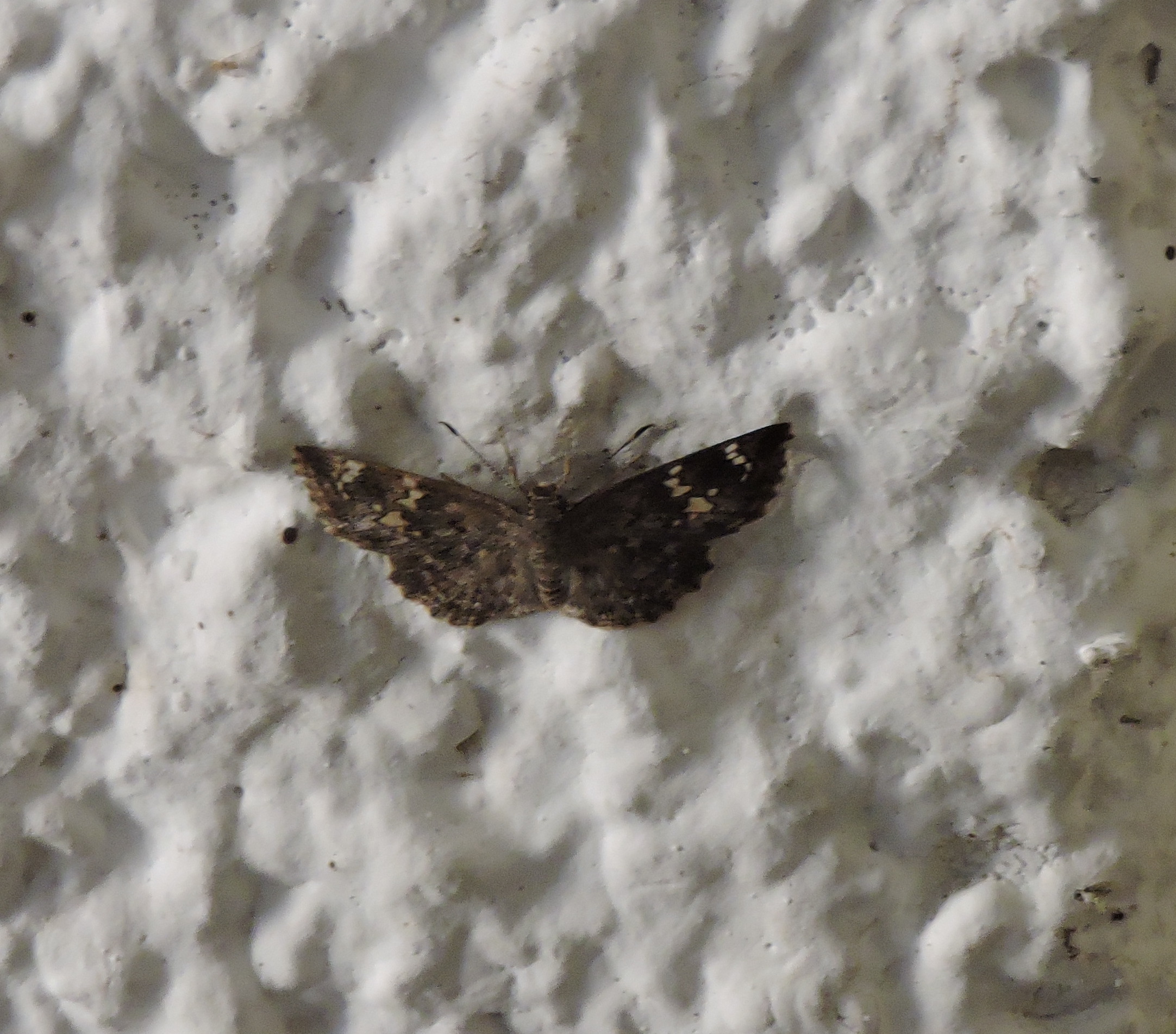
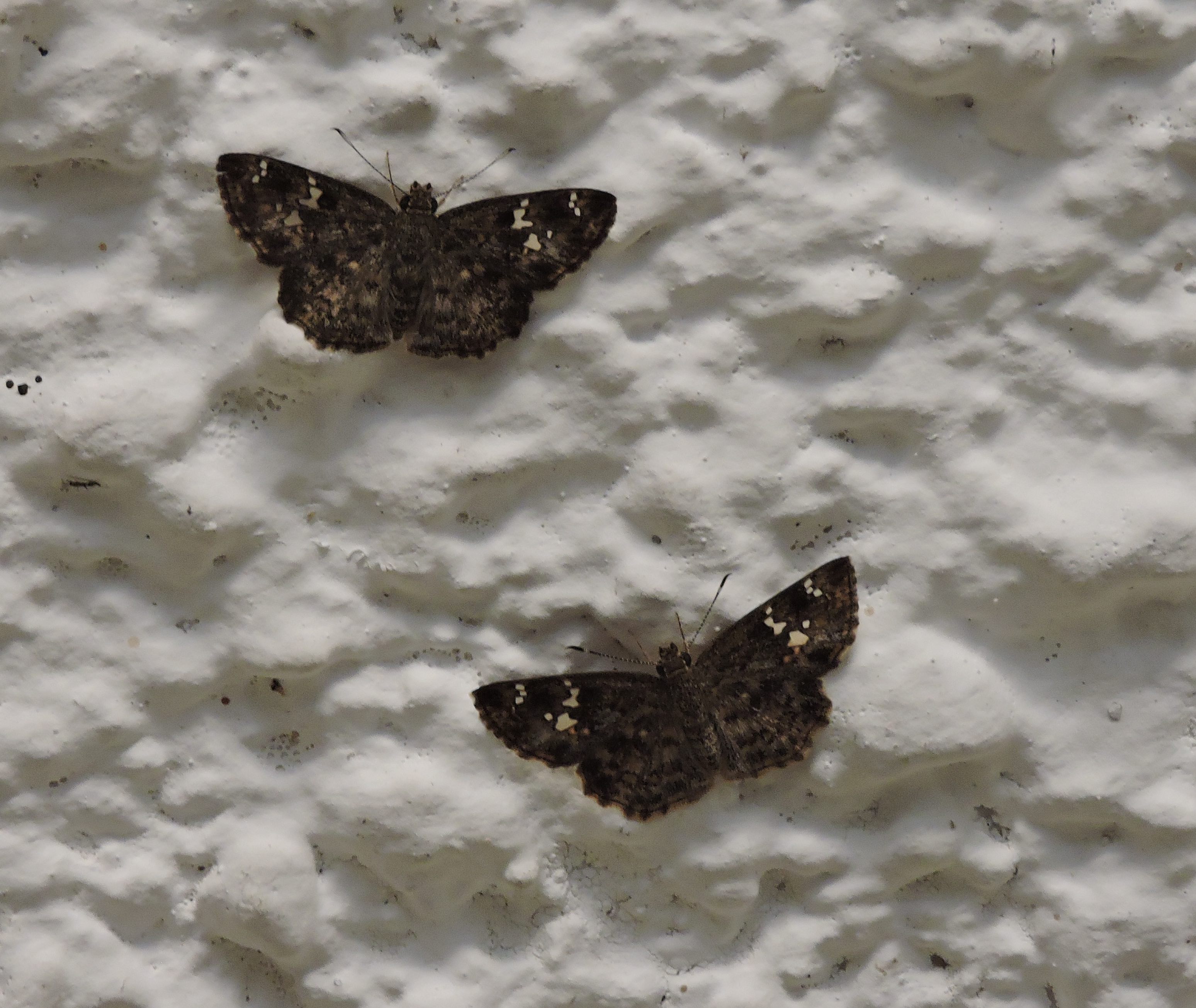
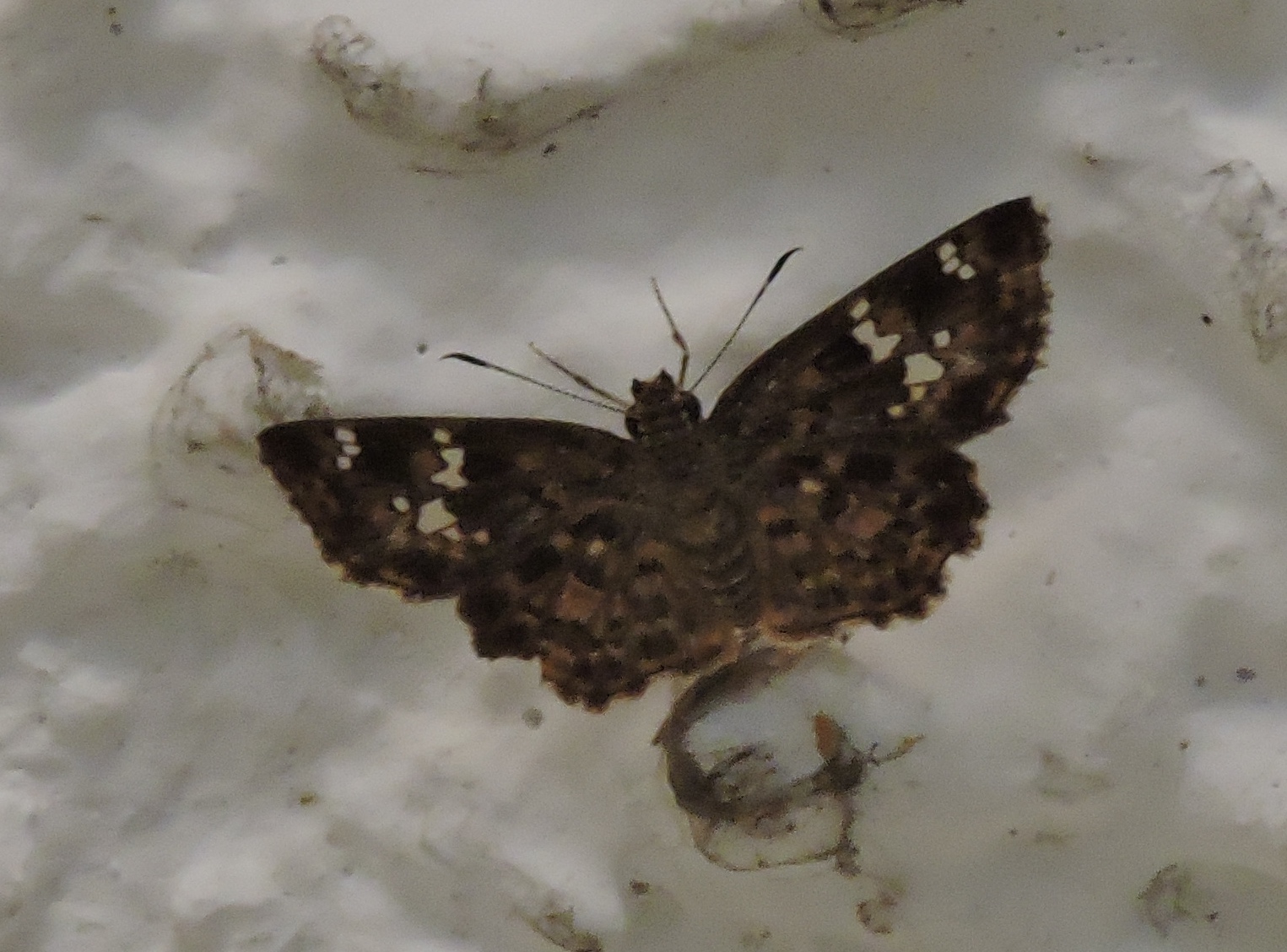
During the last visit in October 2015, we noted that Gwaya was deserted from both campers and dangerous animals, so we went back to the water tower to have a better look, hoping that the butterflies were still there. There were! This time I managed to enter the room although its floor was waterlogged as water was also filtering in the inside of the tower. The combination of intense heat and abundant water had created a tropical microhabitat that was still home to hundreds of small butterflies, settled on the walls.

The view from the door.

The view from the door.

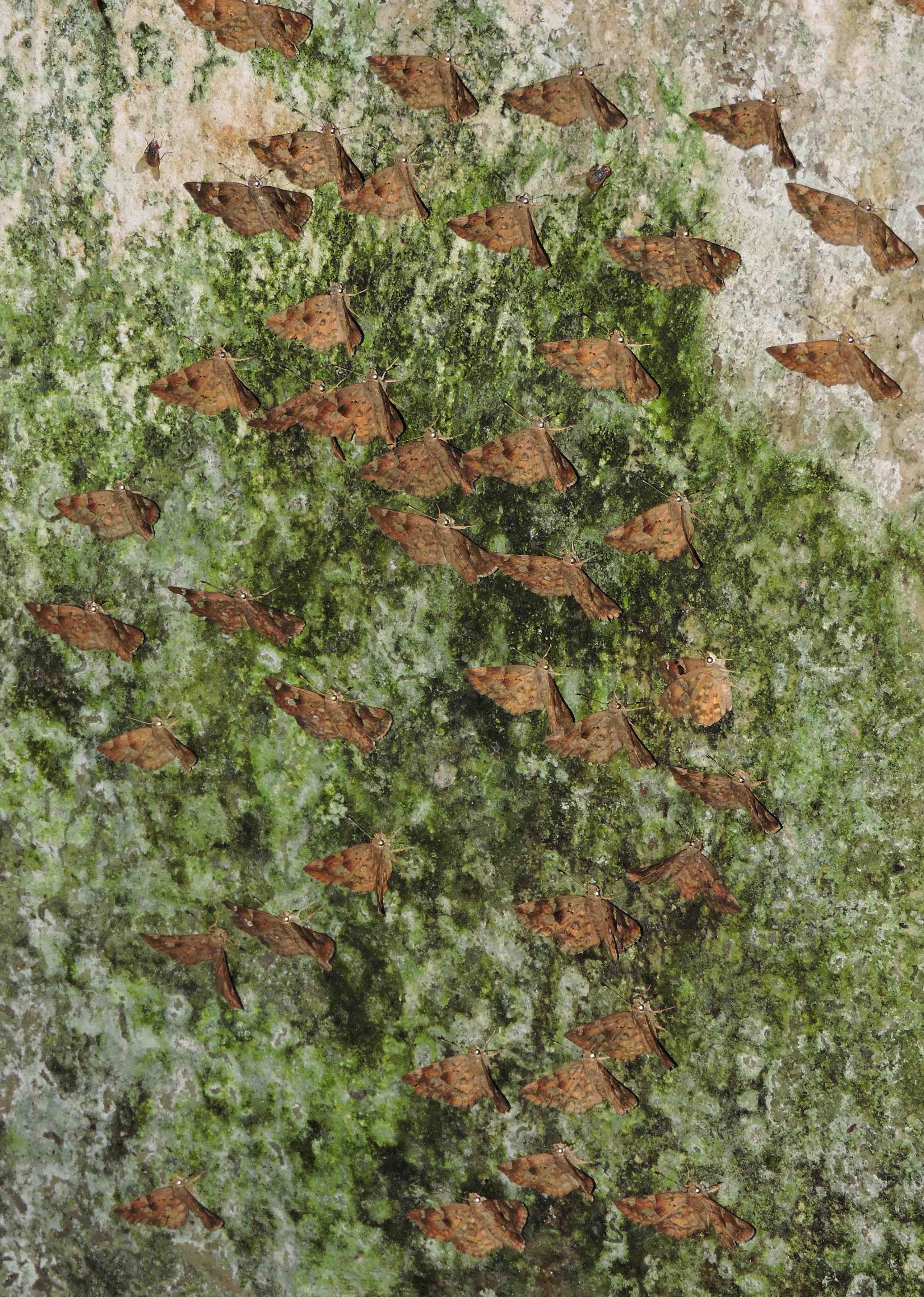
A closer view of the butterflies.

A closer view of the butterflies.

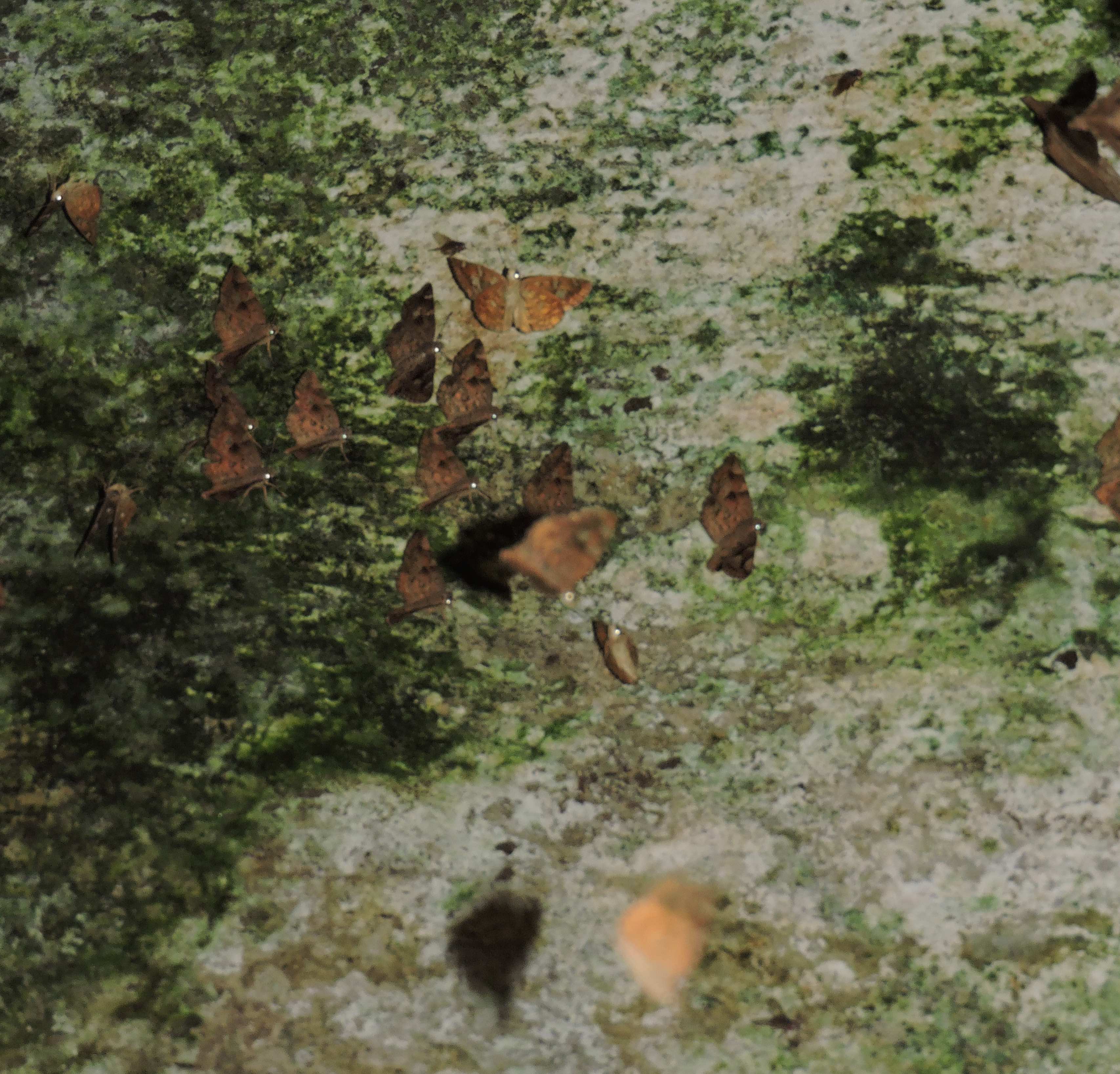
My entrance disturbed them and they took off all at once. As they did not wish to leave the dark damp area, a large cloud of them formed and flew around my head. For a while I felt like Mauricio Babilonia of Macondo[3] with the difference that these butterflies were brown and not yellow! Eventually they settled down again and I managed to take the pictures that illustrate this post.

They took off when I entered.

They took off when I entered.

I believe that they were Elfin Skippers (Sarangesa motozi) that Migdoll’s Field Guide to the Butterflies of Southern Africa describes as an uncommon species found mainly in rain-forests in the region where it feeds on Barleria, Justicia and Perithrophe, members of the Acanthaceae flowering plants.

DSCN8683 copy

DSCN8682 copy

DSCN8684 copy

A lone and rather bloated gecko also resided in the room, his condition revealing that it did not know what hunger is!

I am sure that this resident colony of butterflies would offer a thrilling study to a lepidopterist! Not being one, I left them thinking on how much I enjoyed reading García Marquez’s magic realism and that I should revisit his work.

Muchichiri lodge, Mana Pools, October 2015.

[1] See: https://bushsnobinafrica.wordpress.com/2015/09/23/mana1-pools-safari/

[2] See: https://bushsnobinafrica.wordpress.com/2015/10/06/camera-recovered/

[3] Interestingly, to get to Mana Pools you cross the Makonde District!!!

Hot nights

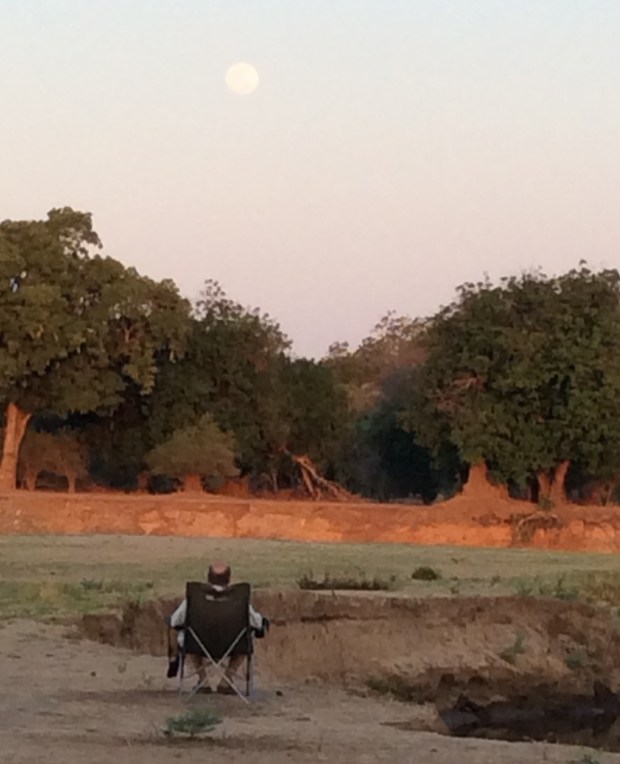
We confirmed once again that Mana Pools in October is hot, really hot, specially from 12:00 to 16:30 hours. During that spell all you can do is to find a shady spot and sit it out whilst hoping that the Zambezi breeze continues to blow removing the warm air that your body generates. Frequent applications of water help as the evaporation refreshes you, at least for a few minutes. Luckily the air humidity is very low so at least you are not soaked wet.
IMG_0273 copy

The bushsnob enduring the heat while enjoying the view.

To have the sight of a beautiful but “out of bounds” river with clean water running a few metres from you is really counter productive! To make matters worse, when the hippos look at you with their exaggerated mouths, they seem to smile while enjoying the cool water!
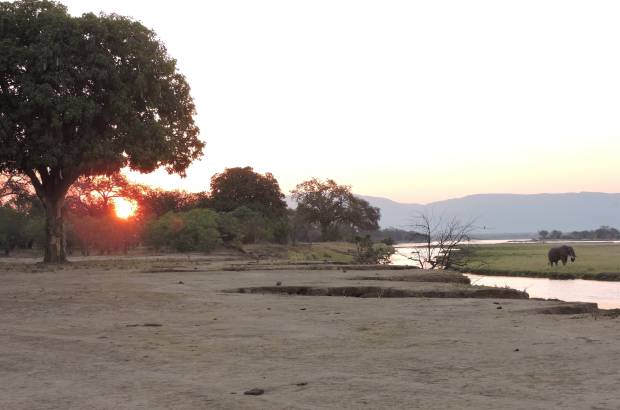
Zambezi dusk.
Zambezi dusk.

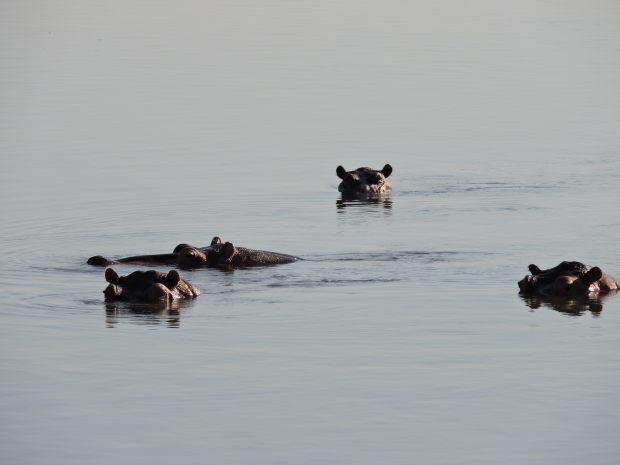
DSCN8571 copy

Hippos enjoying the coolness of the river seem to be smiling at you.

Although the Zambezi offers nice sandy banks and beaches, you will enter its waters at your own risk. The latter is rather high as, if you are lucky to remain undetected by the numerous and some really huge crocodiles, you may pick up the invisible but equally bad Bilharzia parasites.
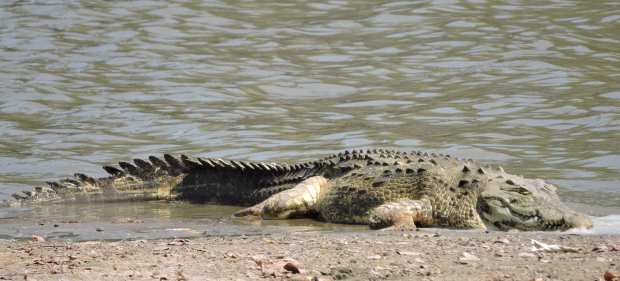
A Zambezi hazard.

A Zambezi hazard in wait.

The heat affects all and for the game is a tough time. The inland pans are dry and the last blade of desiccated grass has been consumed, transforming the Zambezi terraces in the proverbial dust bowl. Luckily the park has many trees that provide shelter to the animals that remain there from the blistering sun, mainly the greater kudu that still manage to find nourishment by browsing.
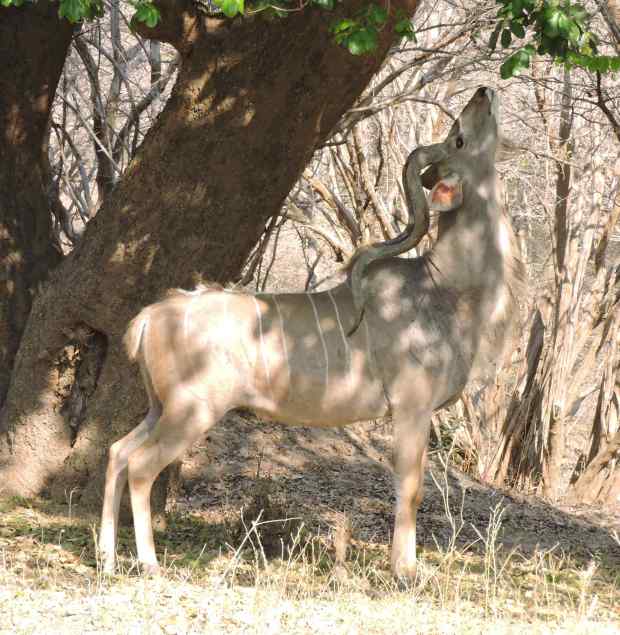
Greater kudu browsing under the shade.

Greater kudu browsing under the shade.

Although the trees offer good shade, their fruits are by now almost exhausted. The pods and flowers from the apple ring acacias and sausage trees respectively are very few now and the amount available does not justify the effort the animals require to collect sufficient to live upon. The fruits from the sycamore fig trees are ripening fast but they are being quickly consumed by birds and monkeys alike so that they hardly hit the ground!
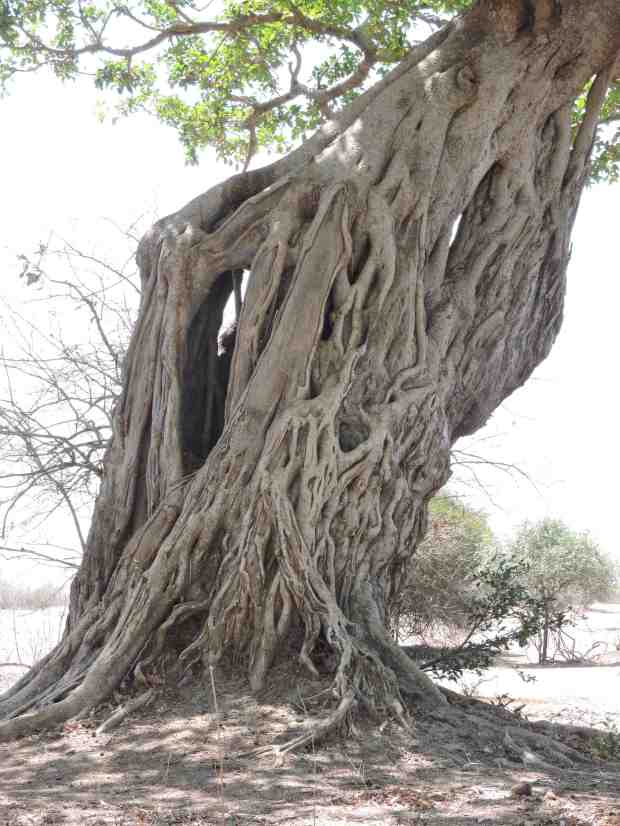
DSCN8441 copy

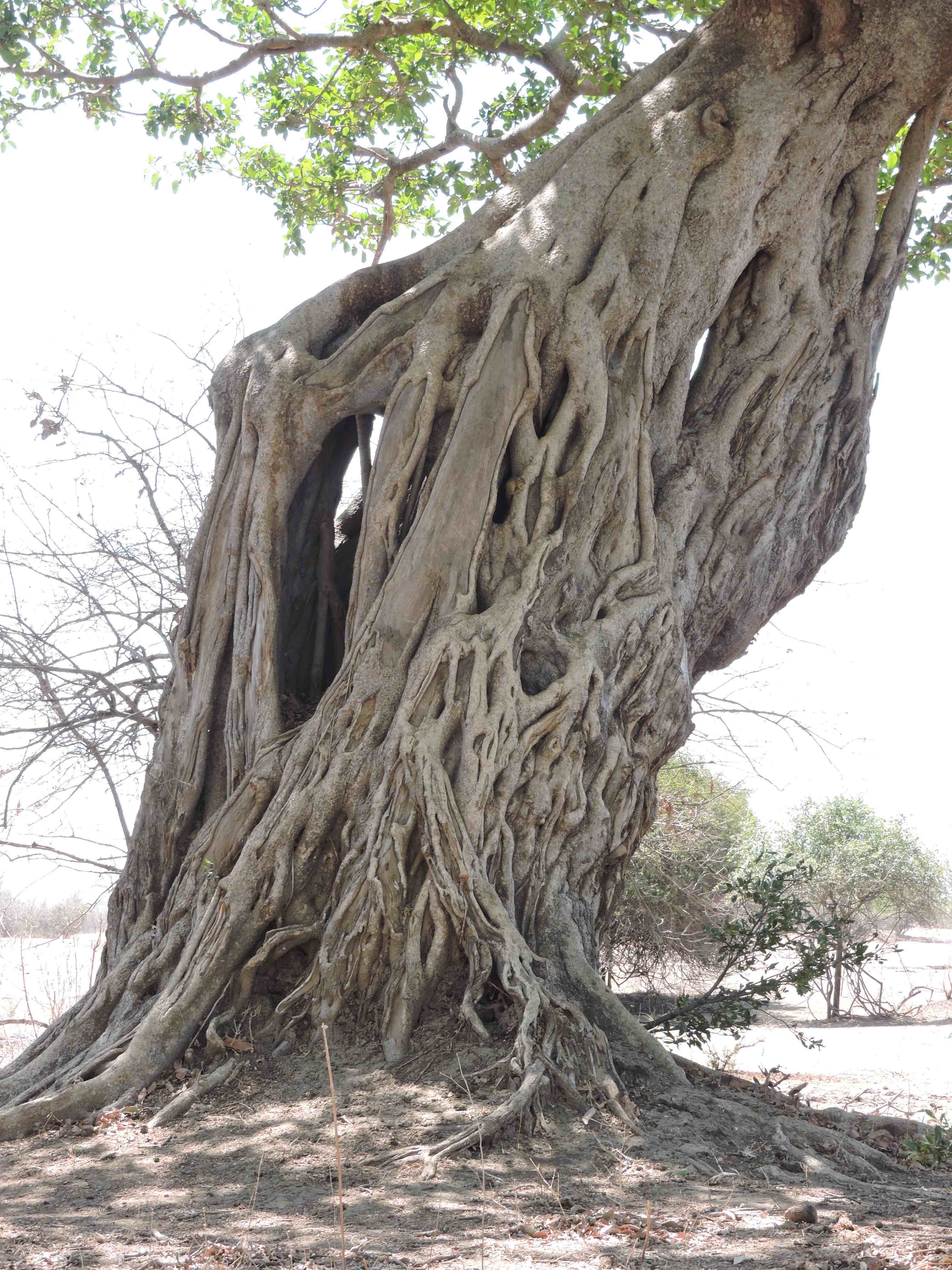
A fig tree showing its beautiful trunk.

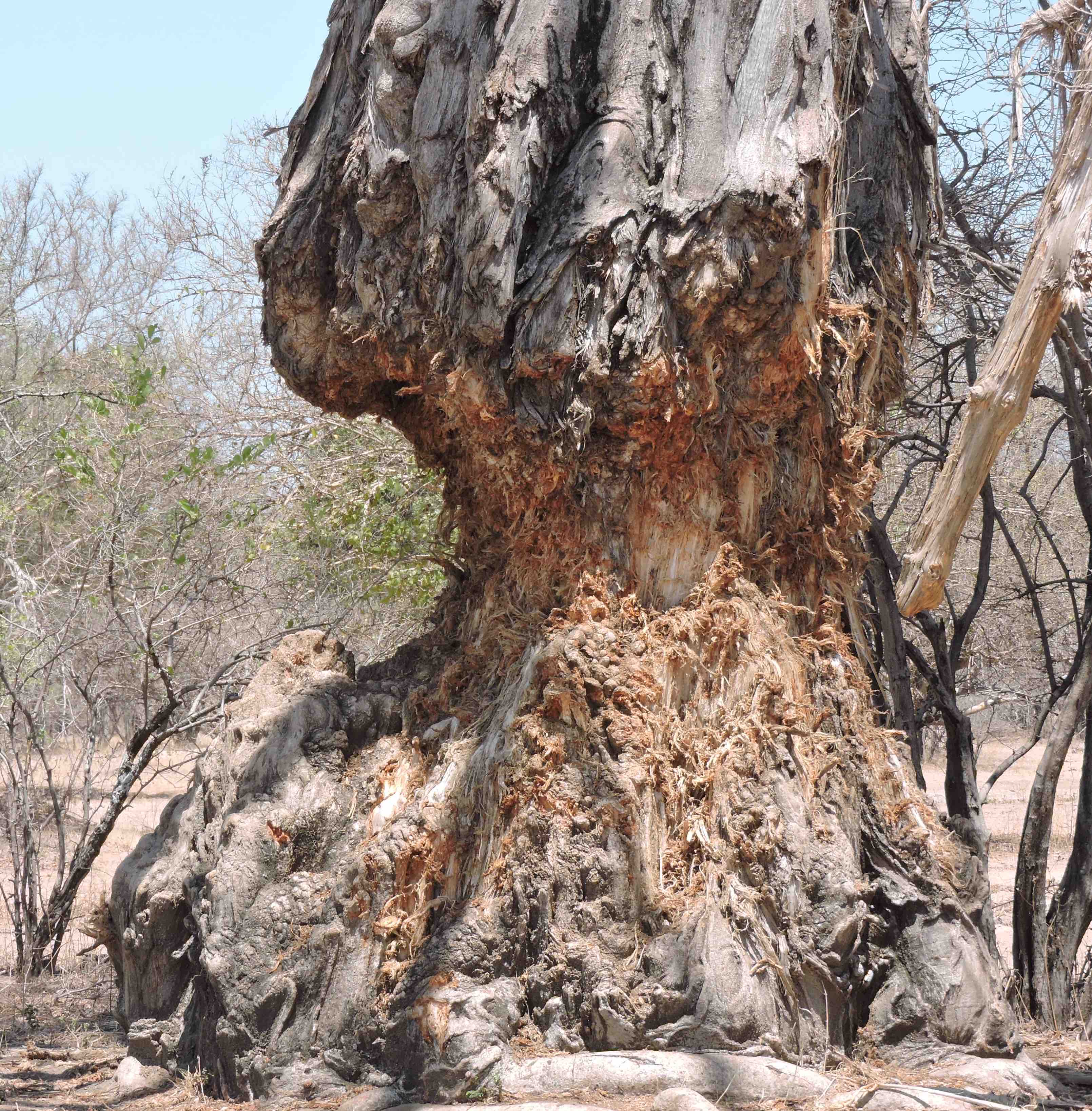
Even the apparently dry baobabs are being consumed, mainly by elephants!
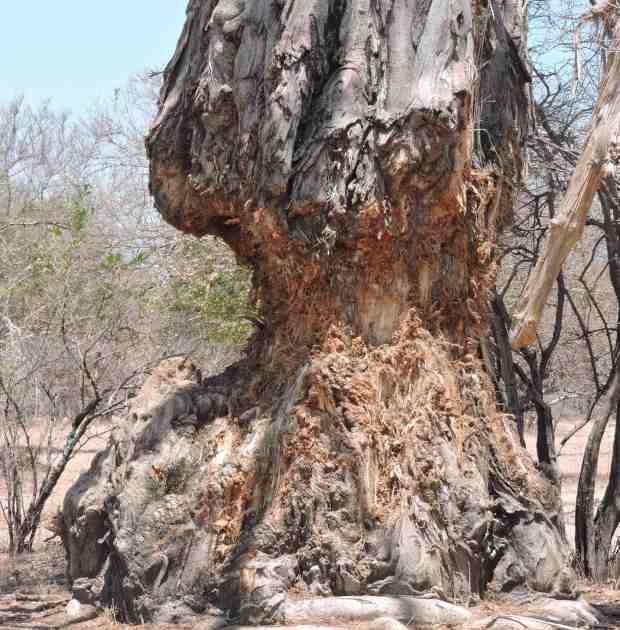
The elephant bite!

The elephant bite!

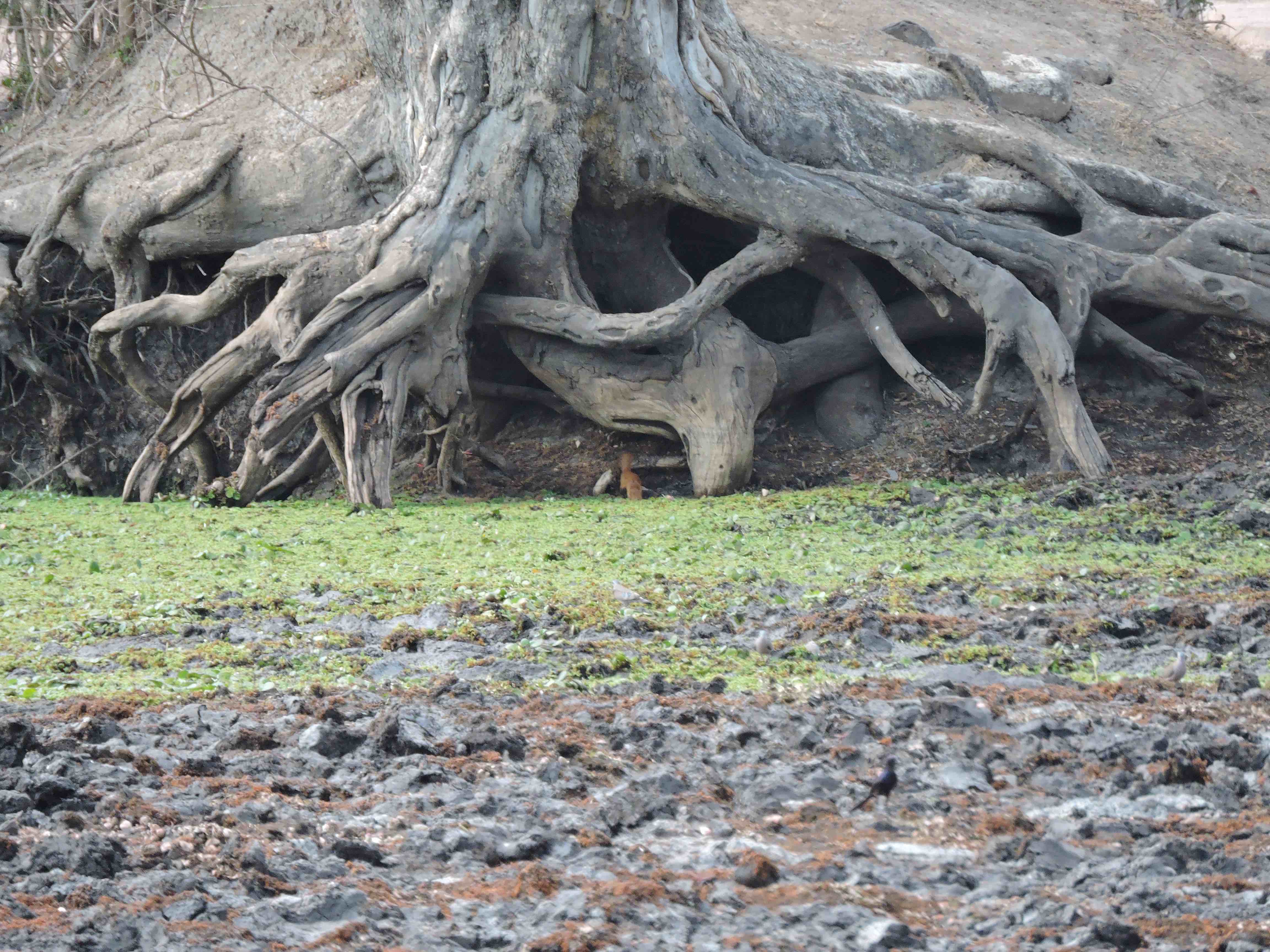
Both Chisasiko and Long pools still  have lots of water but it is brackish and not liked by all. Although we have seen impala and waterbuck drinking there, we are yet to see an elephant! Chine pool, now just a green ribbon, attracts plains game as it seems to be fed by a fresh water spring. We did not see how Green pool was but I suspect that it is also getting dry[1].
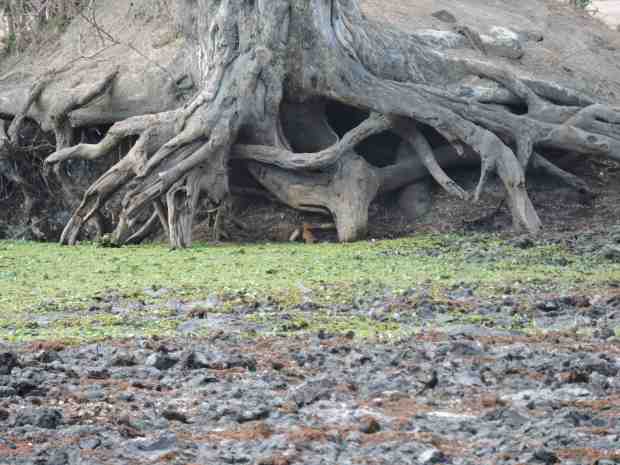
A rather dry Chine pool with a slender mongoose in the tree roots at the back.

A rather dry Chine pool with a slender mongoose in the tree roots at the back.

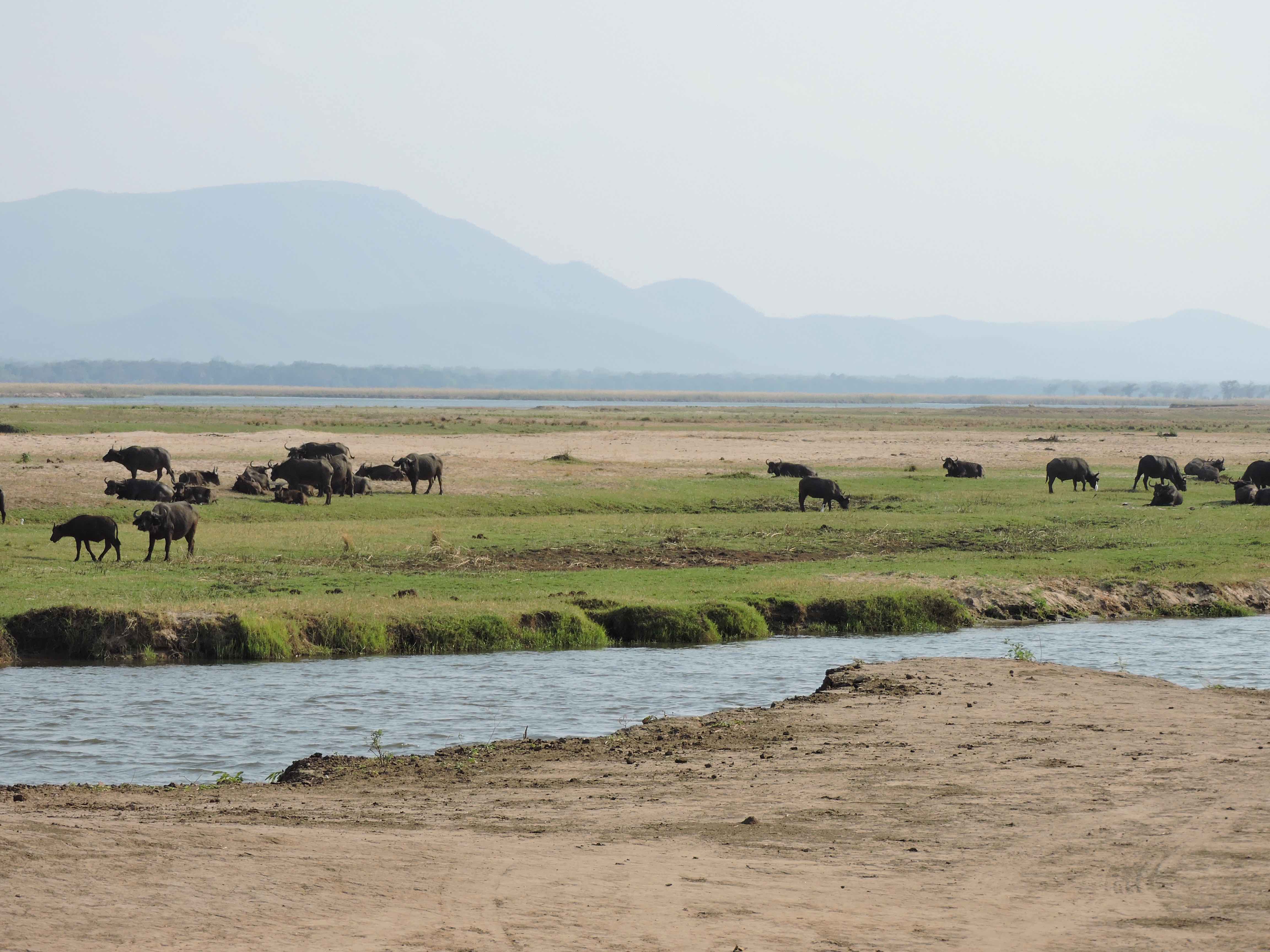
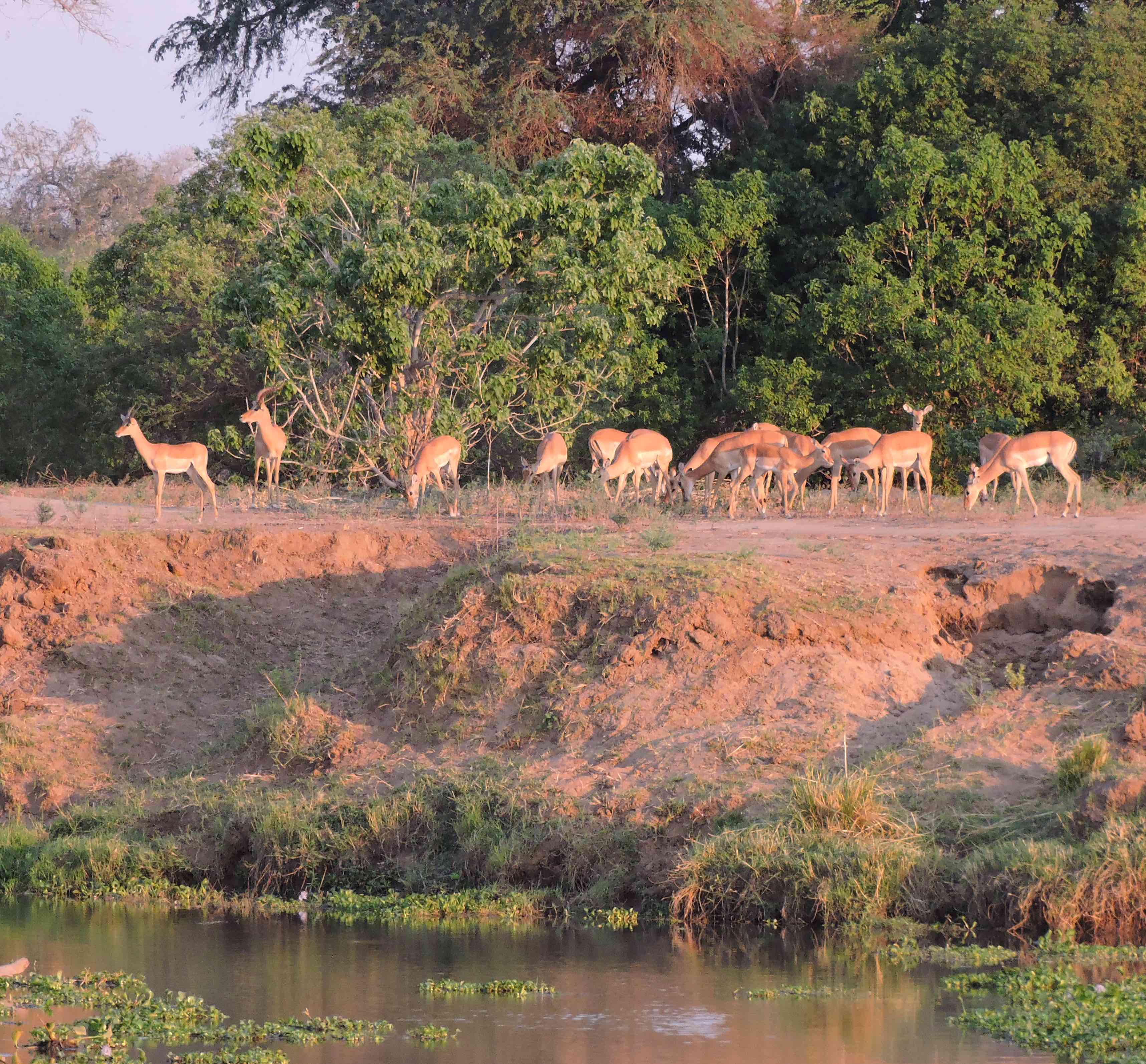
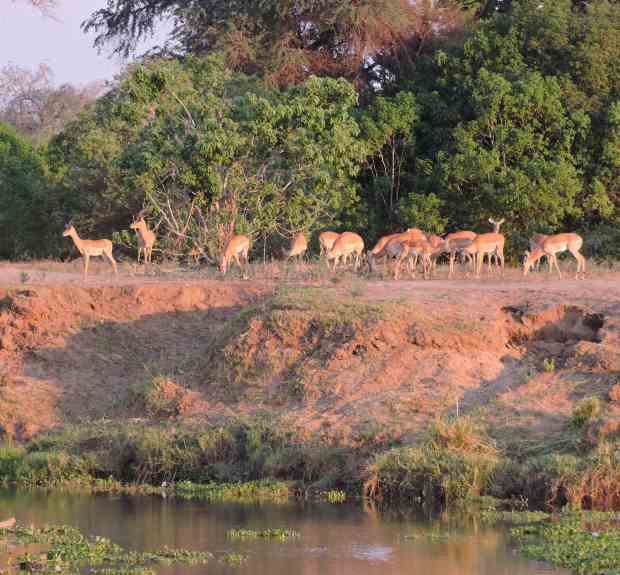
As expected, most game now gathers around the only permanent source of water, the Zambezi river. Adjacent to it the plains are still green and teeming with animals grazing intensively in a fragile and unstable truce between different links of the food chain. There are thousands of impala within a kilometre from the river as well as buffalo, eland, zebra and waterbuck that have also moved residence to this true “food land”.
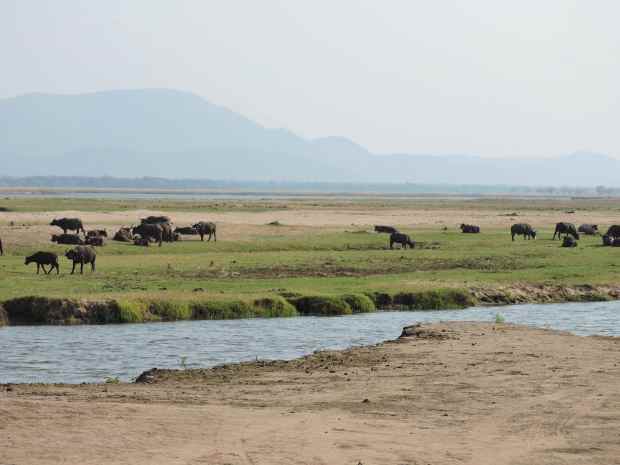
Buffalo taking advantage of the grass by the river.
Buffalo taking advantage of the grass by the river.

Impala by the river.

Impala at Mana mouth, very close to the Zambezi.

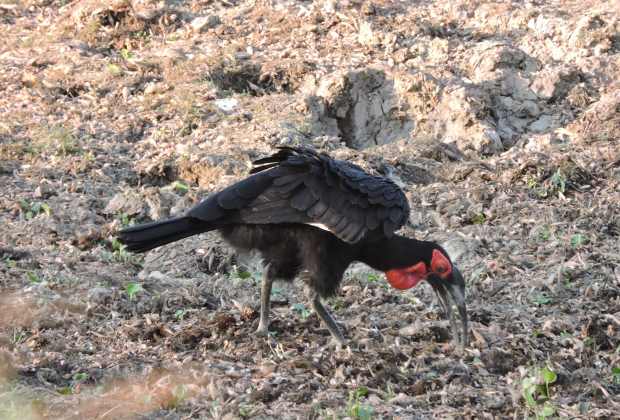
Aware of this, the area is now also the home of the predators. These range from water and land birds consuming prey that gets caught in small pools or drying mud to hyenas, leopards and lions on the prowl for larger animals.
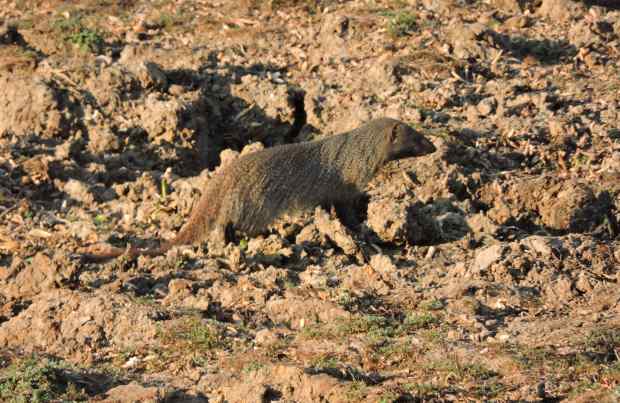
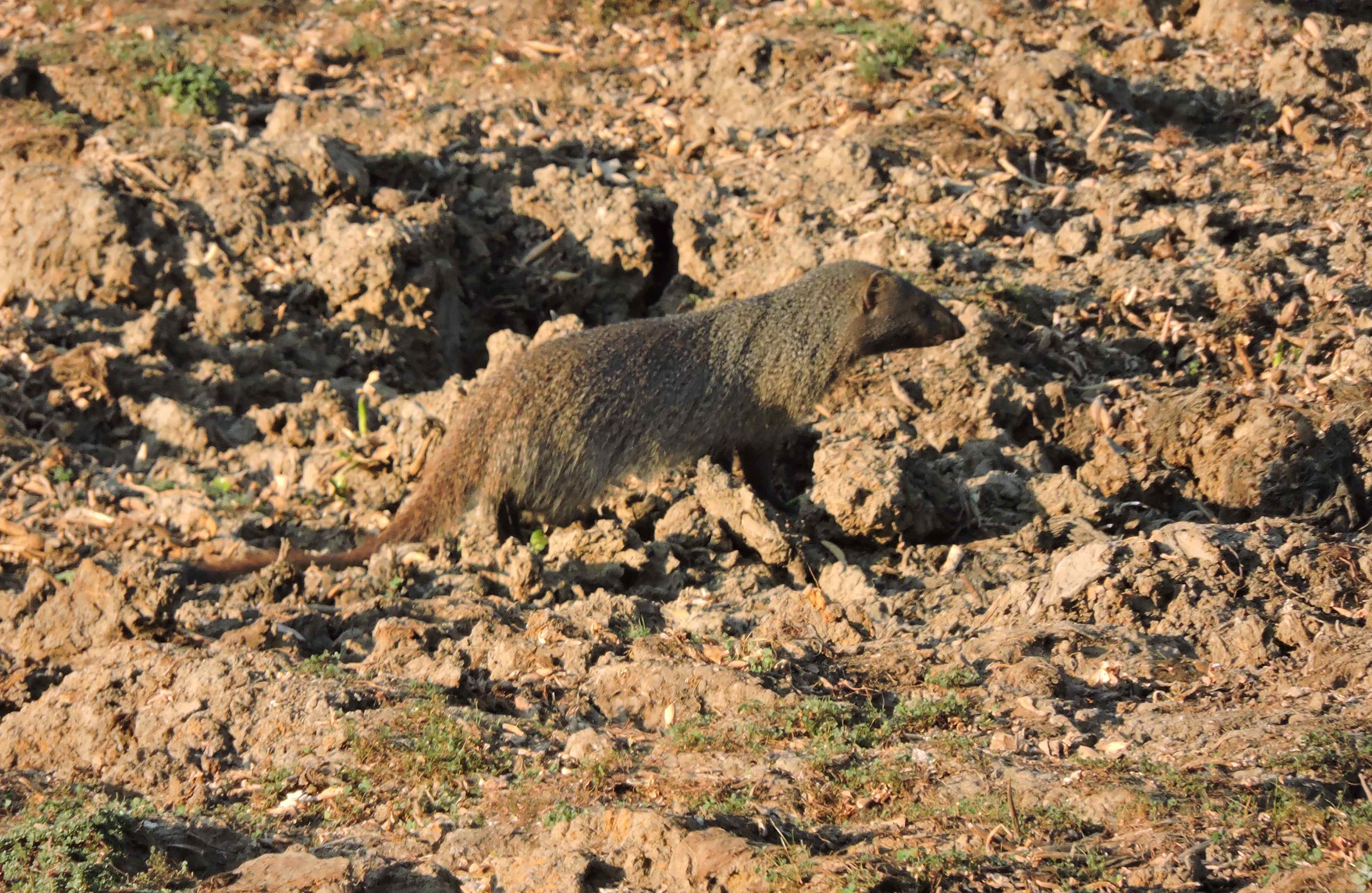
A grey mongoose searching for food in the drying mud.
A large grey mongoose searching for food in the drying mud.

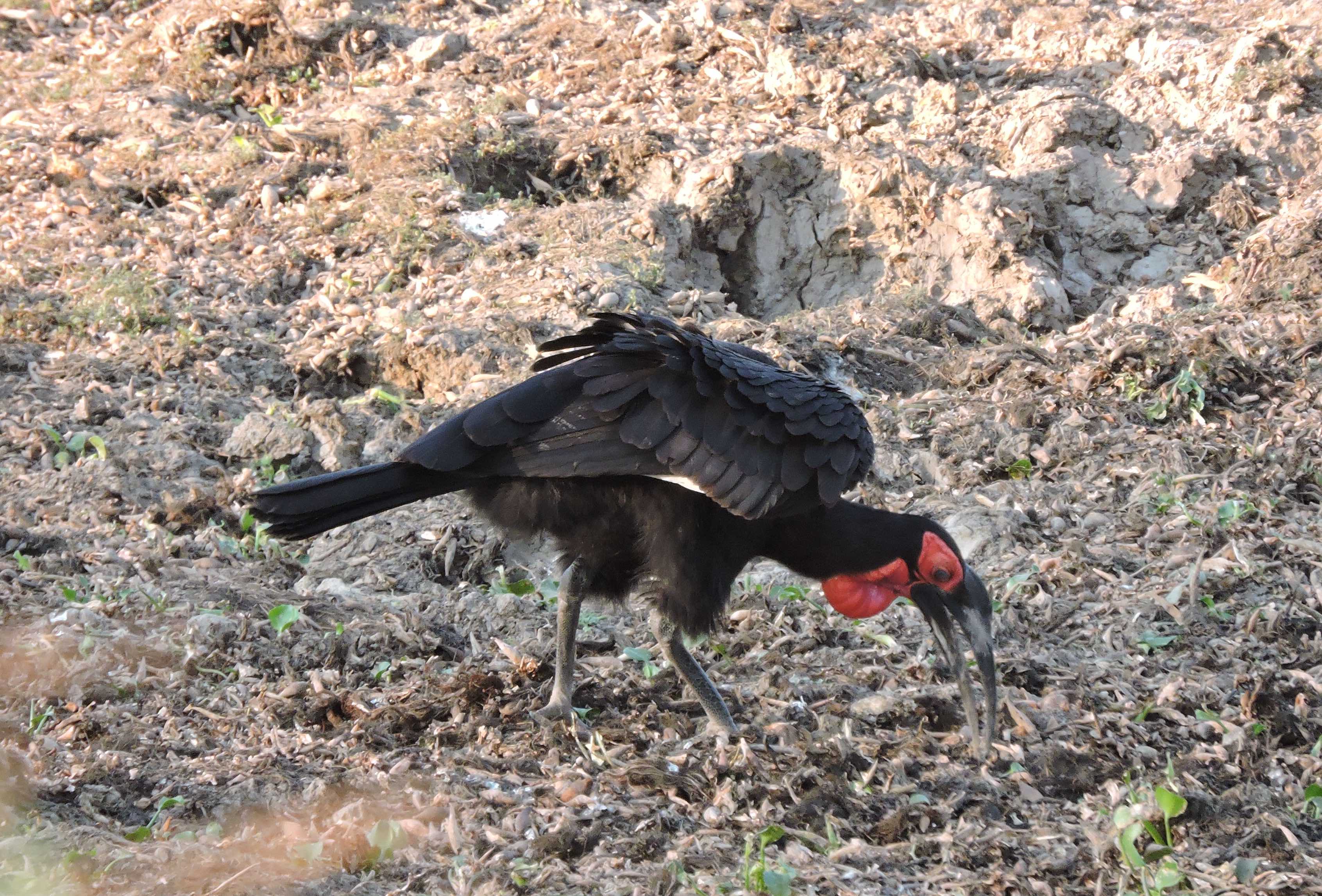
A ground hornbill also taking advantage of the dry river bed.

A ground hornbill also taking advantage of the dry river bed, feeding on what looked like snails.

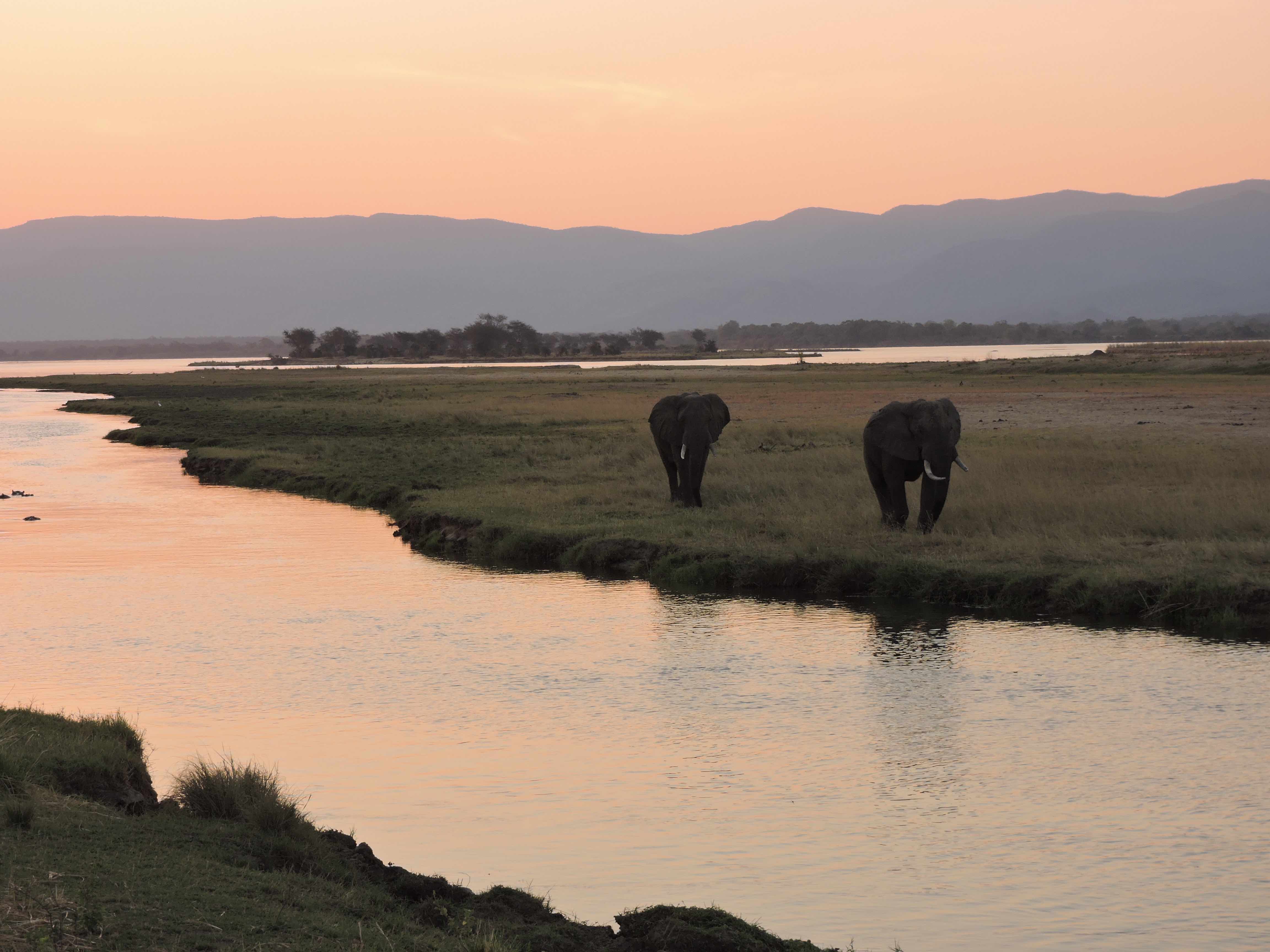
The elephants dot the plains with the relaxed attitude that their size allows them. They are all over the place. There are family groups composed of a matriarch and her progeny as well as bulls in small groups or preferring their own company.
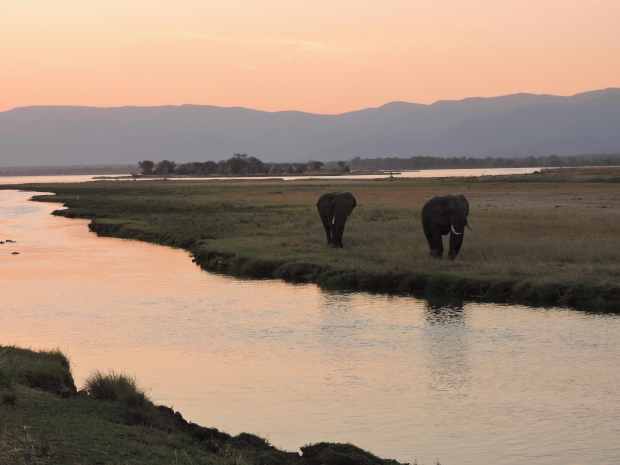
DSCN8537 copy

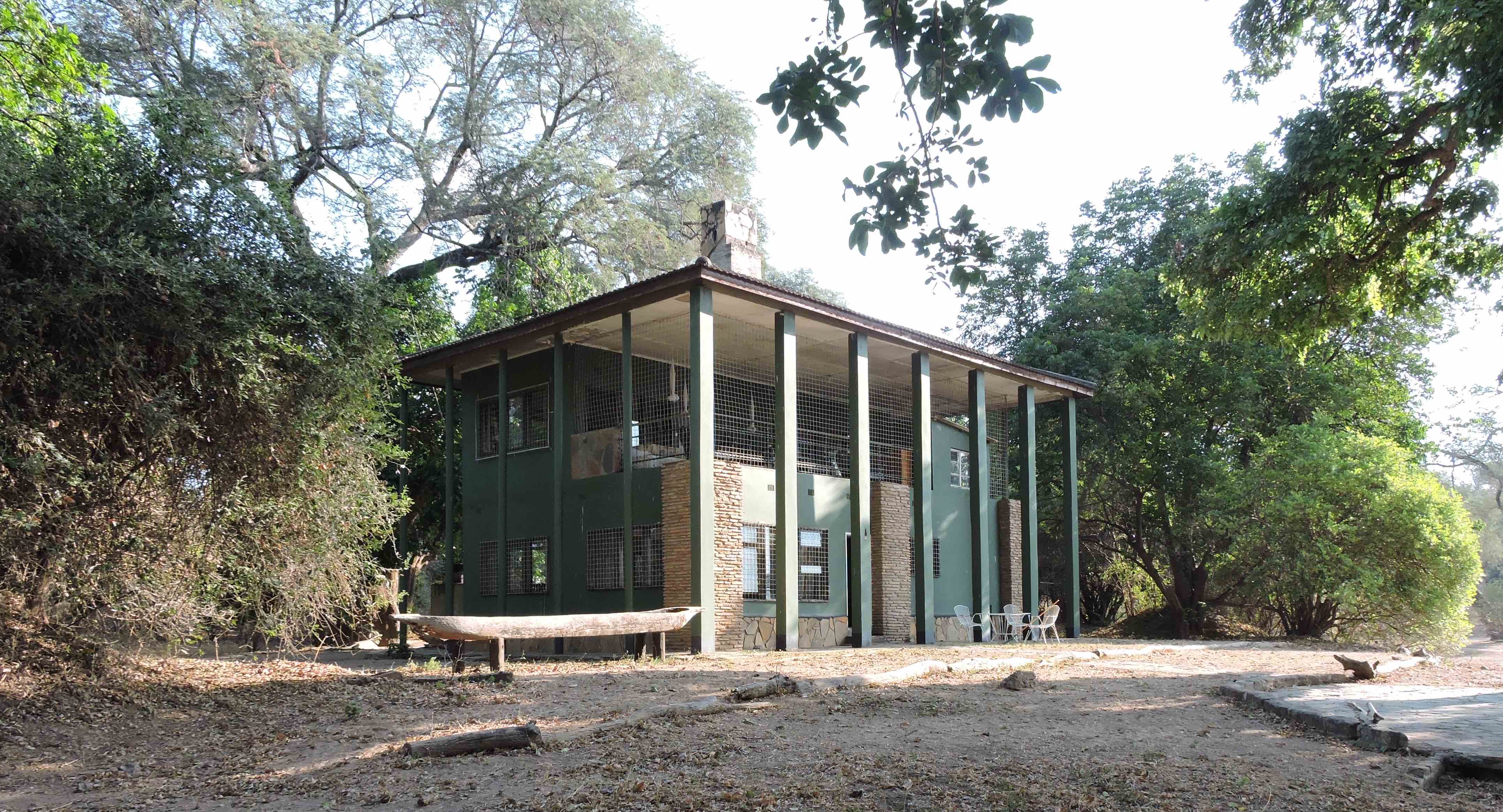
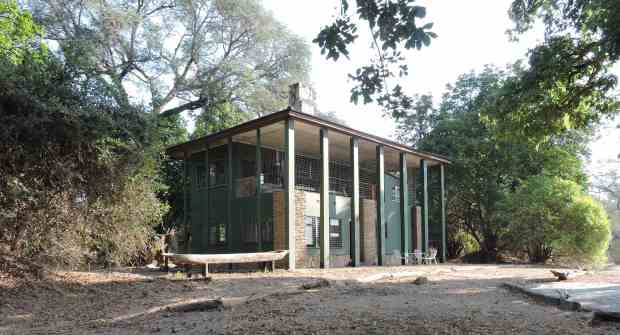
Game drives inland only find the ocasional heat-enduring animal so game watching focusses on the river area where being comfortably seated with open eyes normally rewards the observer with good finds. We were well placed at Mucichiri lodge, a two floor building offering an open upper deck from where a great view of the river was available. While hippos were always in the neighbourhood either in or out of the river, impala and waterbuck grazed under the shade.
DSCN8253 copy

Muchichiri lodge seen from the river side.

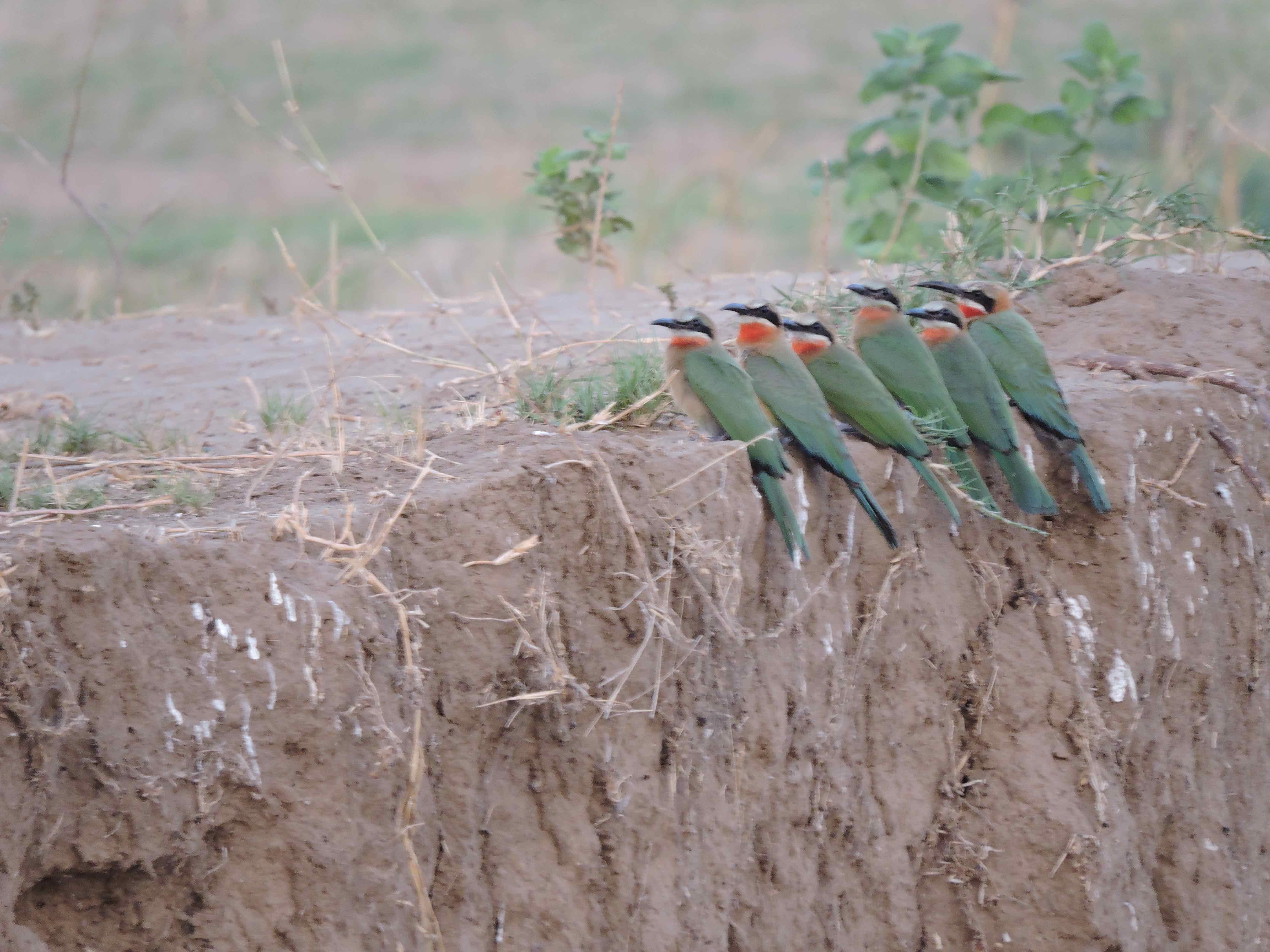
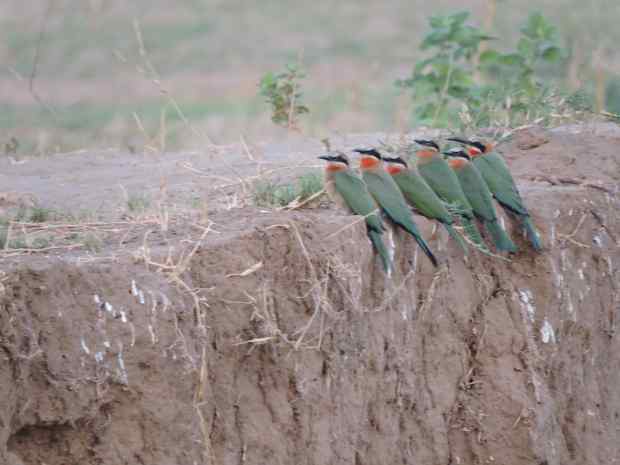
The birds were busy nesting, anticipating the rainy season that it is just round the corner. In addition to spur-wings and Egyptian geese, the bee-eaters were very numerous, both white-fronted and carmine. They were busy going in and out of their burrows in the alluvial banks of the river found on the oposite margin.
DSCN8714 copy

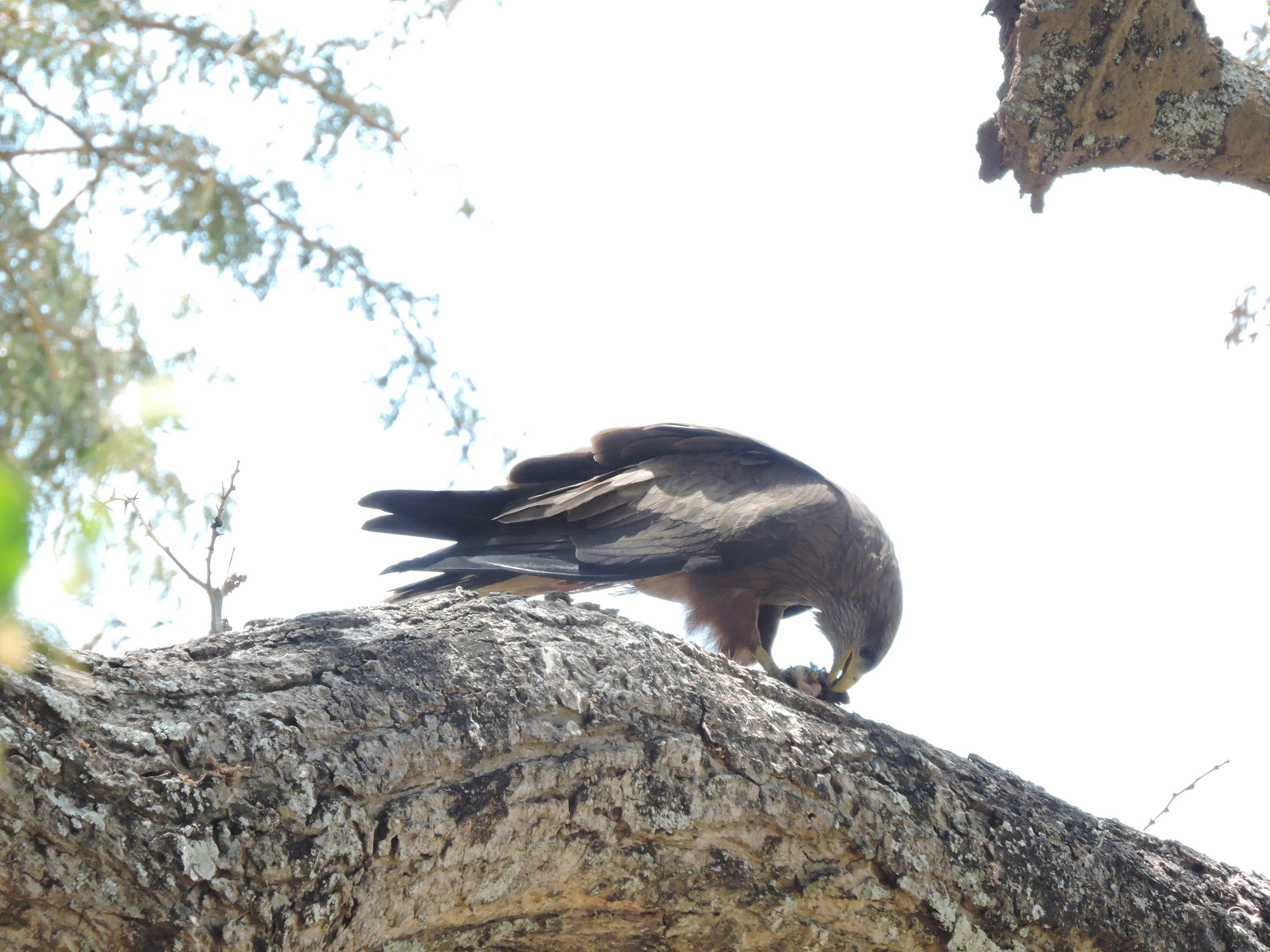
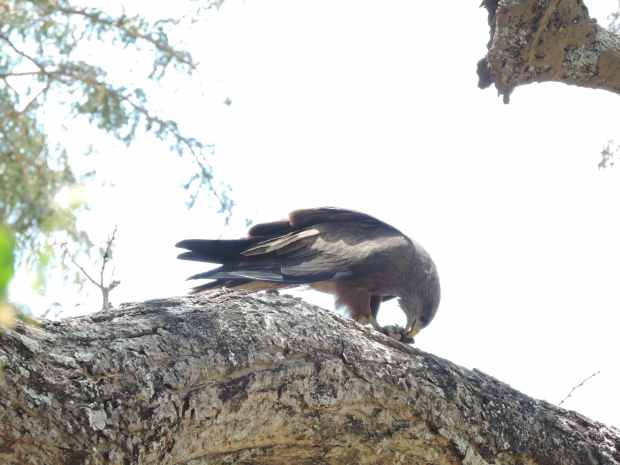
A few times a day they their constant chirping noises ceased for a few seconds and then all would take off screeching loudly in alarm as some threat approached.The most common predator seen was the Yellow-billed Kite (Milvus parasitus). The latter would come from high and then gradually descend as it approached the river banks. Although birds did all possible to disuade the attackers, the kite would continue relentlessly on the hunt and it would  suddenly swoop down fast and land, either on the banks or on the trees near our lodge. Twice I saw it catching fledglings and land nearby to eat them. Once prey was taken, the predator was quickly forgotten by the birds that will soon return to their socializing, clearly showing “short memories” or being resigned to the inevitable!
The kite feeding.

The kite feeding.

By mid afternoon Mana Pools was a furnace with the shade offered by the large trees and the hot wind as the only relief. Luckily the lodge has a bathtub and a shower and we took turns seeking refreshment until the sun power finally slacked and we slowly revived. It was time for the evening game viewing drive and, on return, a barbecue kept simple and managed from a distance to avoid getting too close to the fire!

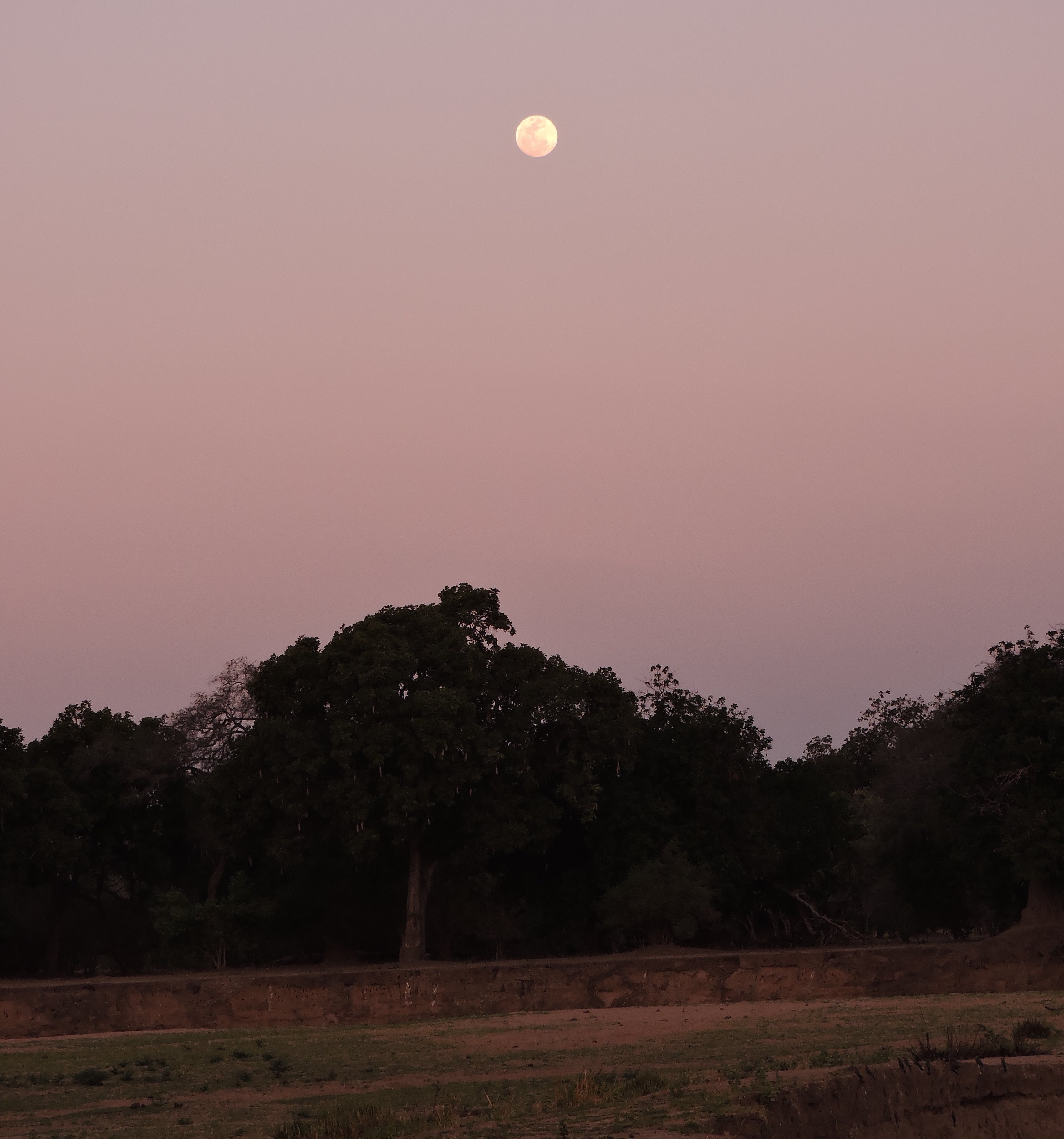
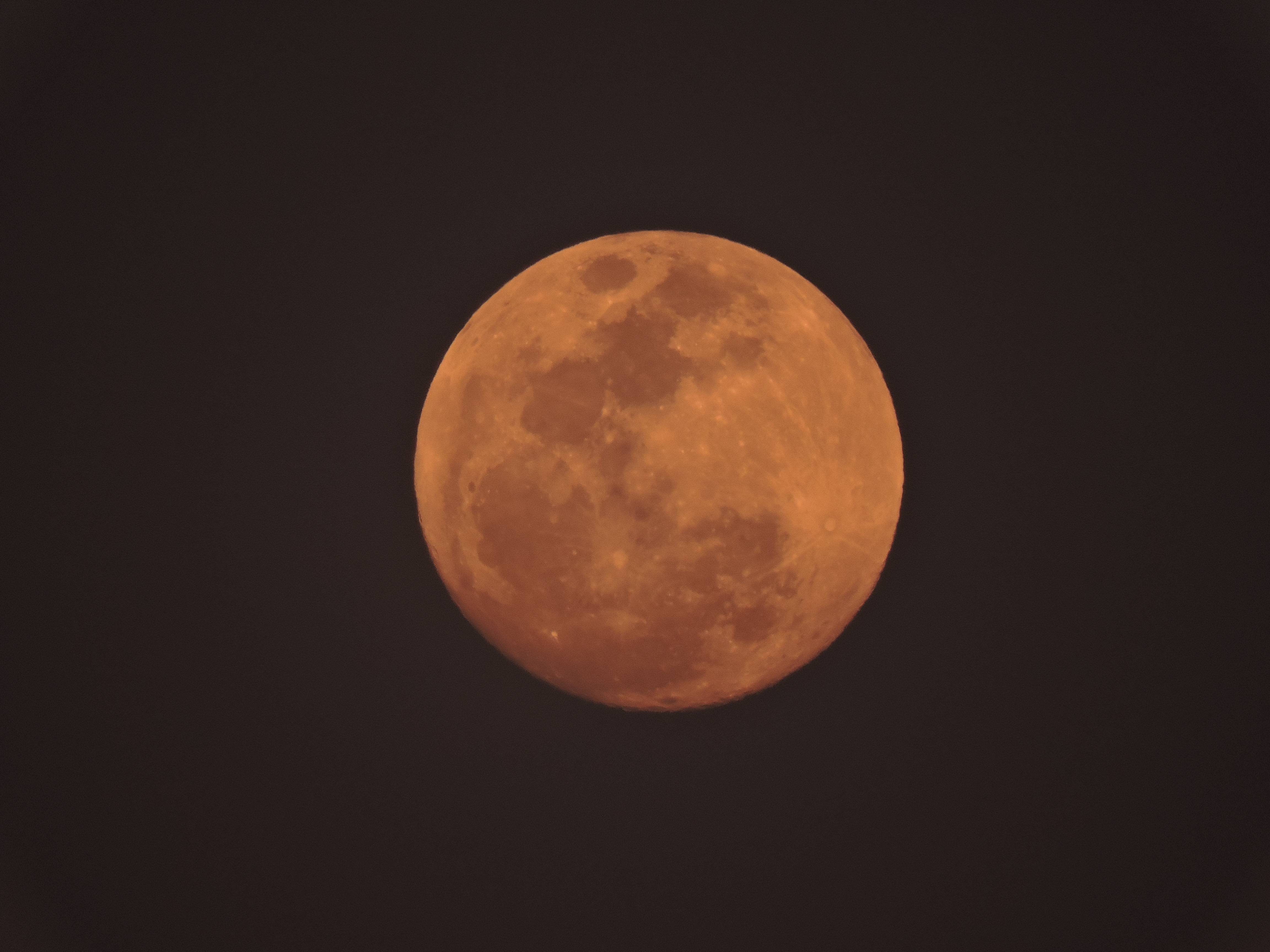
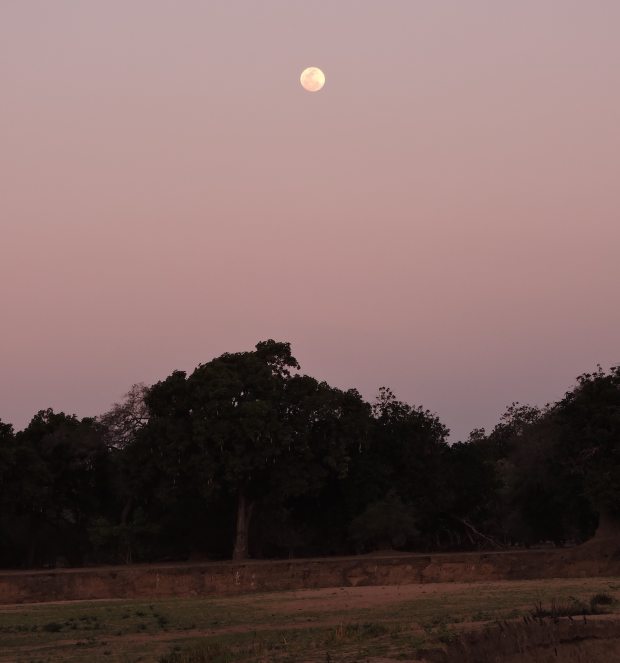
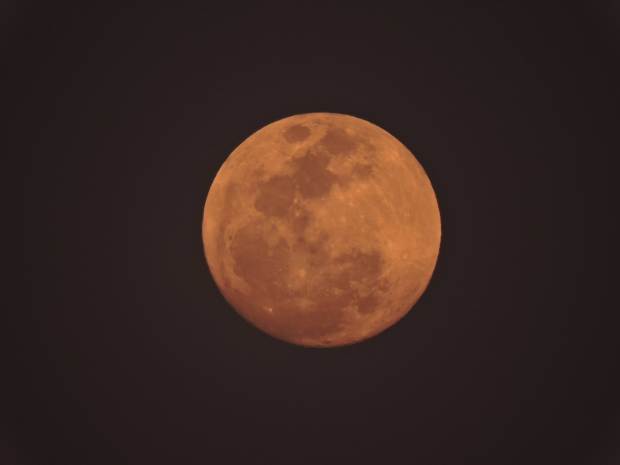
At night the wind dropped and, unfortunately, the little that blew got stopped by the mosquito net. The consequence was that sleep was hard to find. Fortunately there was a full moon and the animals outside the lodge were very active. We are surrounded by impala and waterbuck while the hippos grazed in the grassy banks, their bulk easier seen while they walk about as true lawn mowers.
DSCN8740 copy

The full moon gave us good light.

The full moon gave us good light.

The elephants also passed by in numbers, as usual, in total silence but rather obvious to us sitting only a few metres from them! Loud calls preceded the arrival of hyenas checking for some left overs before embarking into their longer missions in search of substantial prey. Lions were only heard once and far away, clearly hunting much further downriver.

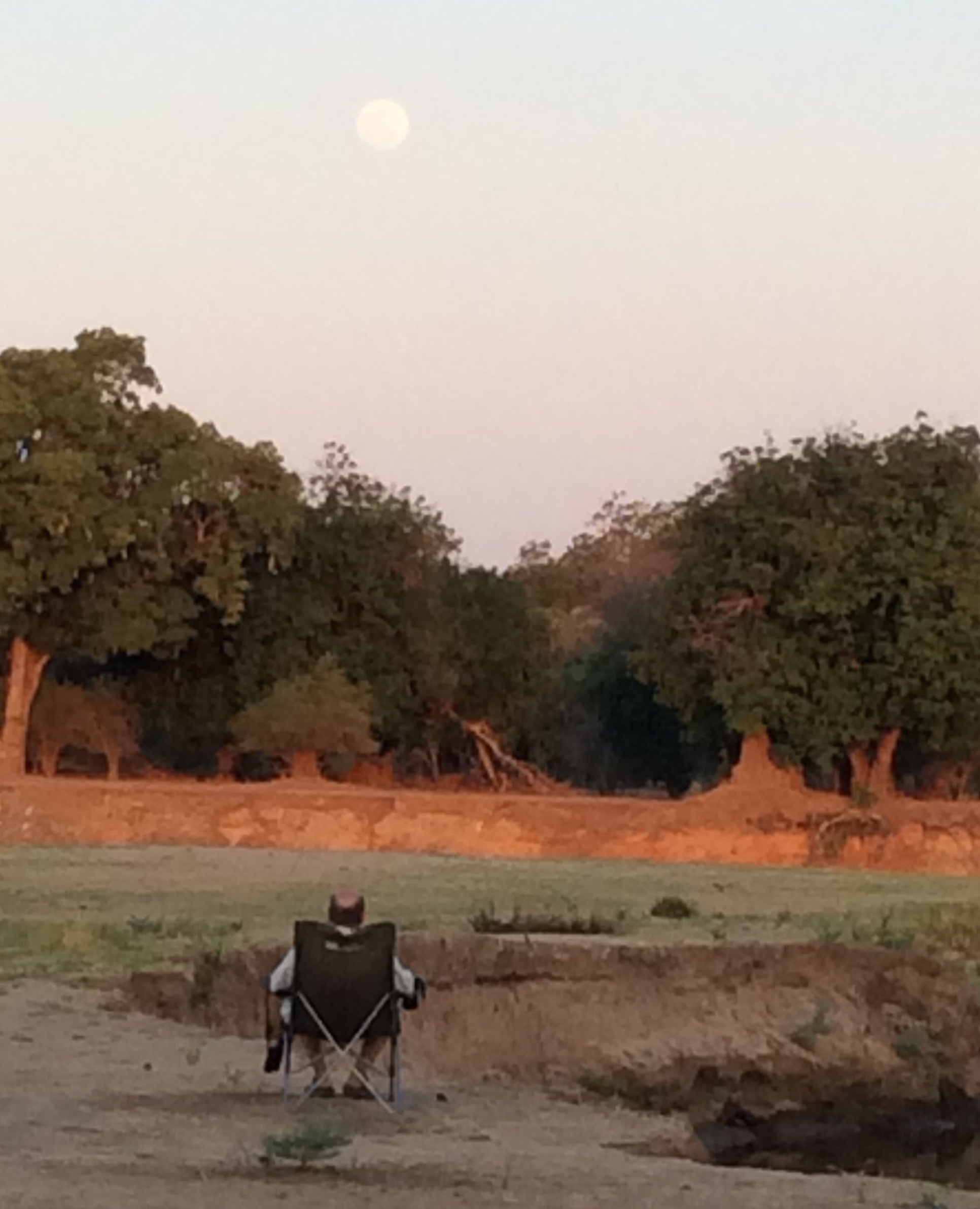
While watching and listening to the Mana inhabitants the temperature eventually dropped to “sleepable” levels and we went to sleep aware that we needed an early start to our game drives the next day, before the heat would set in. Looking at the clear sky we could be sure that on the morrow we could find anything, except rain. 

 Mana Pools, Zimbabwe, October 2015.


[1] You will note that I now know the names of the four pools, courtesy of a helpful park ranger that we met during this visit.

Hyenas and planet-gazing

The morning after the Maasai chicken dinner a good breakfast was in order! We prepared bacon and eggs to compensate for our austere meal of the night before. In an attempt at avoiding another fasting episode I offered to take over the next dinner and to roast the beef we had brought from Nairobi.

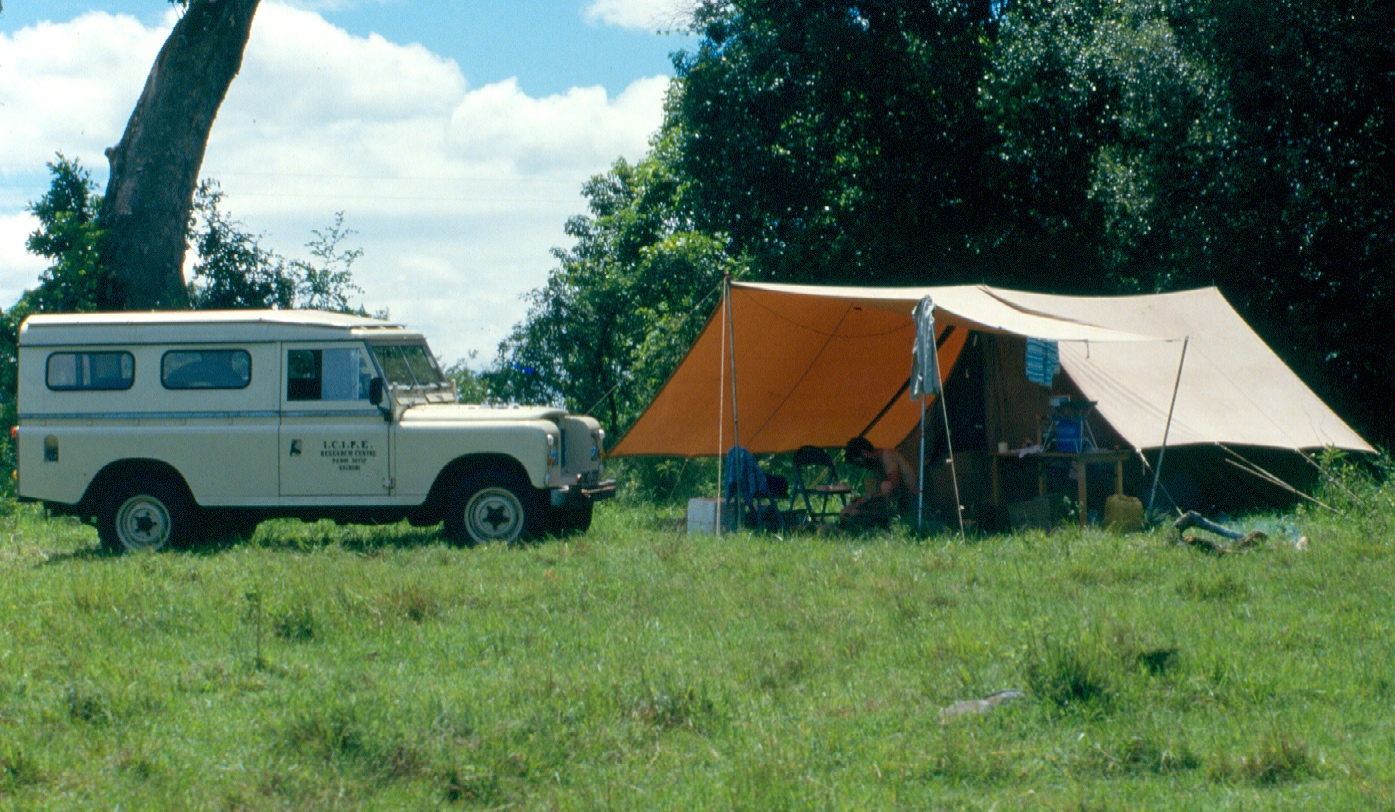
Camping at Intona ranch.

Camping at Intona ranch.

After breakfast, another day of routine field trials followed, as we needed to do many replicates of our tests in order to confirm the results. We worked without stopping until late afternoon when we decided that we had done enough and it was time for a shower and to prepare dinner. As a South American I am ashamed to confess that I am fearful of horses and prefer to keep a good distance from them. That is not all, I am a real disaster at barbequing! Therefore, on the occasion I struggled through and I made sure that the food was abundant and we ate our fill.

The night was truly spectacular. The relative short distance of Intona ranch from Lake Victoria meant that it rained very often. It poured in late afternoon and then the sky cleared at dusk. The consequence was that the rains cleaned the air and the night sky was always very sharp.

Ernest and I stayed awake until late talking and contemplating the pristine sky. We talked about many issues, occasionally stopping to listen to the night sounds, in particular the spotted hyena calls getting closer to our camp. Getting gradually bolder they moved close to the periphery of the light of our camp fire. I reassured Ernest that this was a normal event when camping at Intona and that “normally” hyenas would not be aggressive.

Despite the good time we were having, we have had a long day and we felt very tired so soon we went to bed. As soon as we were inside the tent we heard something sniffing all around our tent. A white-tailed mongoose was seen scurrying away when we shined our torches. That small mystery solved, it was back to bed, hoping that sleep would come soon.

Not so. This time it was a loud crush outside the tent that also merited investigation. This time a hyena was the culprit! The beast had grabbed a dirty pan and had taken off at speed. We run after the beast but it was a futile effort and came back to bed thinking on resuming the search for the pot in the morning.

mmara hyena 2

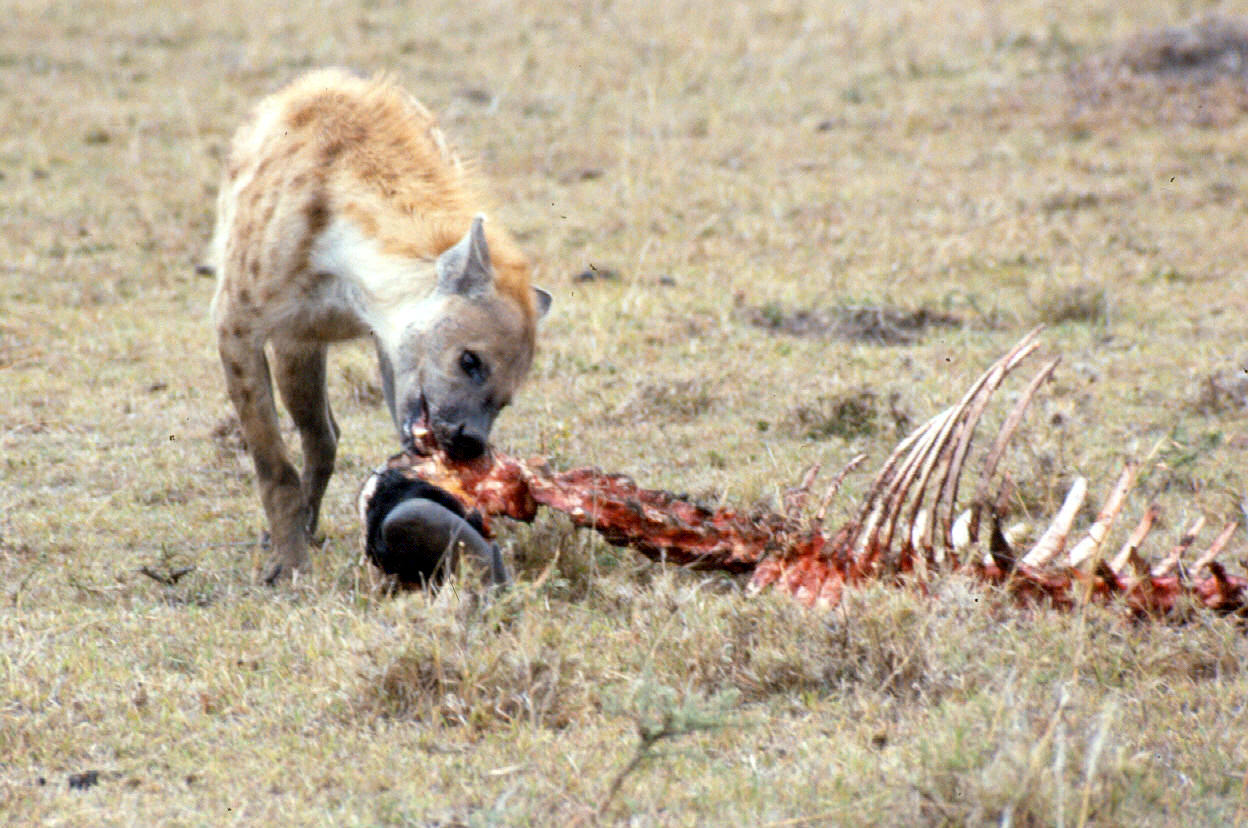
A Brown hyena with wildebeest carcass in the Maasai Mara. Its cousins visited us nightly at Intona.

While thinking and hoping that normality would return, I finally fell sleep. Again, it did not last long. It may have been 03:00 hs when I heard Ernest opening the tent door zip. My first thought was that his gut had finally lost the fight against the filtered water drunk on the way in! In addition, aware of the hyenas I remained awake although without moving, hoping to go back to sleep immediately. No chance! Ernest came back and started to shake me up shouting “Wake up, the sky is perfect to look for planets!” I felt like slaying him but, remembering his partial deafness and on account of his contagious enthusiasm, I made the mistake of getting up!

By the time I managed to go out of the tent, Ernest was already looking through the binoculars, identifying the various noteworthy celestial bodies, accompanying his successive discoveries with shouts of joy! Although I had enjoyed contemplating the night sky both in Uruguay and in Kenya, I have never been that interested in astronomy. However, he convinced me to look at Jupiter (a small orange sphere) and even managed to see Saturn and what I though were its rings! Finally Ernest’s excitement subsided and we managed to hit the camp beds again, this time until the sun was up!

The large ball of crunched aluminium that we found about one hundred metres from our tent was not the remains of a recent asteroid that had narrowly missed us but all that remained from our cooking pan after the hyenas had squished it to get its juice.

Although our cooking options suffered another severe setback we still managed to produce some pan-less and chicken-less dinners during the following days!

The Eagle and the Baobab

Keep reading, this is not a children’s story, despite the title!

I knew this project would be difficult from the beginning as war movies dealing with eagles show a lot of hard work and heavy casualties!

In earlier visits to Hippo Pools Wilderness camp[1] ( and even earlier ones) I learnt that the camp offers a number of attractions for those feeling like trekking. Among these are old ruins, San paintings, several viewpoints a large baobab and various eagle nests. I was aware that both Verreaux’s and Crowned eagles had nested nearby for many years but I had not seen them before.

Aware of this possibility on arrival I enquired about the eagles’ and I was informed that there was also one of an African Hawk Eagle that had a fledgling. I expressed my interest on a walk to the site but later on I was informed -to my regret- that the bird was no longer where it had been seen before. However, before I could feel too bad, I was told that an egg had been spotted at the Crown’s eagle nest and that we could go there instead! I immediately booked a walk for the following morning.

The walking party.

The walking party.

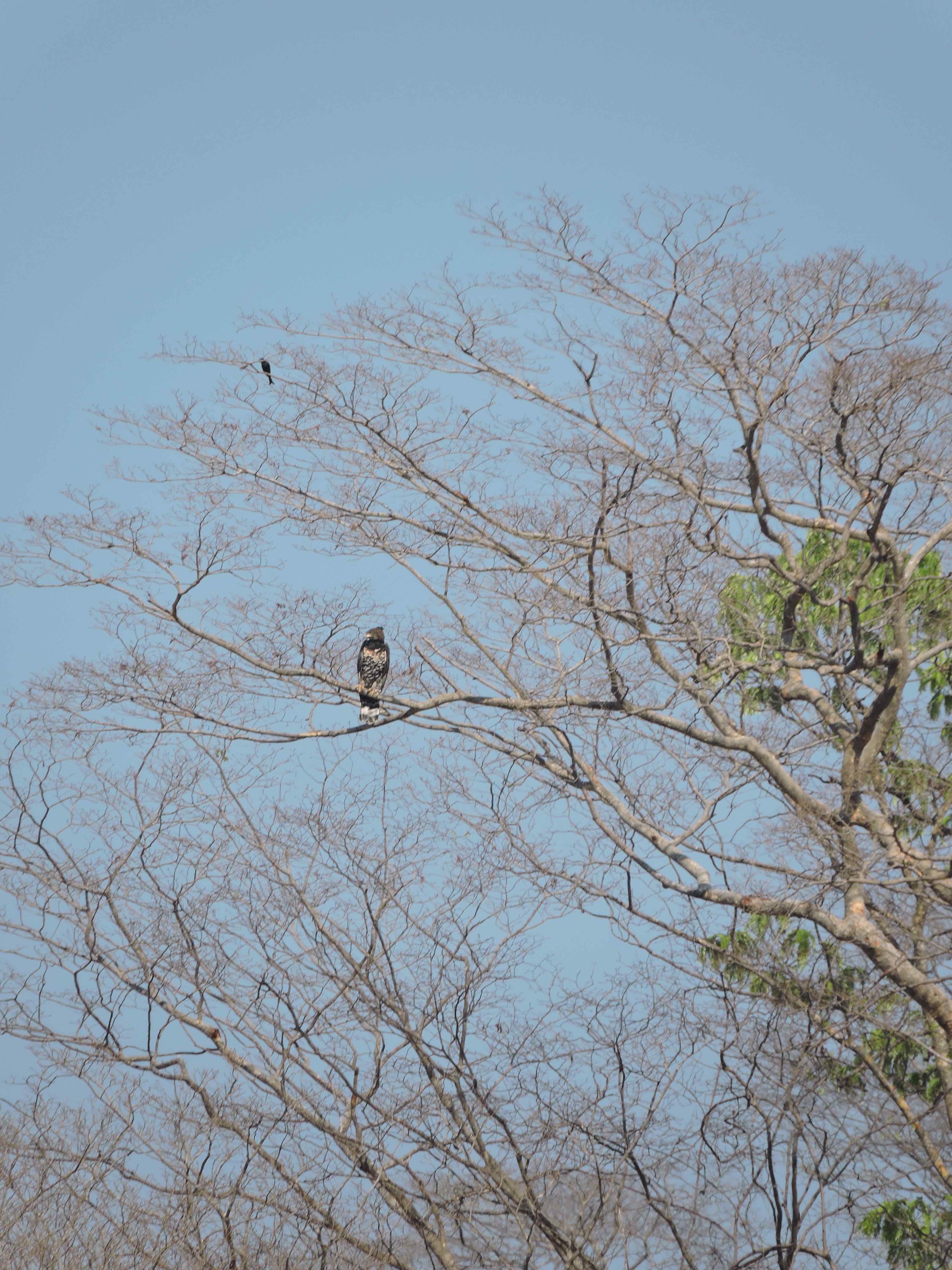
We left about 07:00 hours and walked for about one and one half hours over rather broken terrain and mainly uphill. After going for about an hour we spotted one of the eagles perched a long way away. However, we were advised that the nest was not in that direction but up the hill! It was clearly one of the pair, probably the male eagle scouting for food as these eagles are special in that the male often feeds the female while she incubates.

The first eagle.

The first eagle.

Close-up of the first eagle.

Close-up of the first eagle.

It should be noted that these eagles are not common and rather secretive and as Roberts VII Multimedia Birds of Southern Africa puts it, “Normally chooses the tallest canopy tree in which to build its large stick platform nest”. Luckily I did not know this while our trek was in progress as I was having additional difficulties with my recently acquired hiking shoes that were destroying my toes!

Examining an interesting cave en route to the nest.

Examining an interesting cave en route to the nest.

After another thirty minutes of steep uphill walk, we got to the general area where the nest was. Although I could not yet see it, my companions did and they got excited about what they saw. Eventually I spotted the nest as well as the second eagle perched about one metre above it.
Getting close to the nest meant that our up hill walk changed into a steep climb until we managed to get to a large rock above the nest. From this really great vantage point we could appreciate the situation and observe. We sat down and remained quiet while my toes throbbed, also quietly…
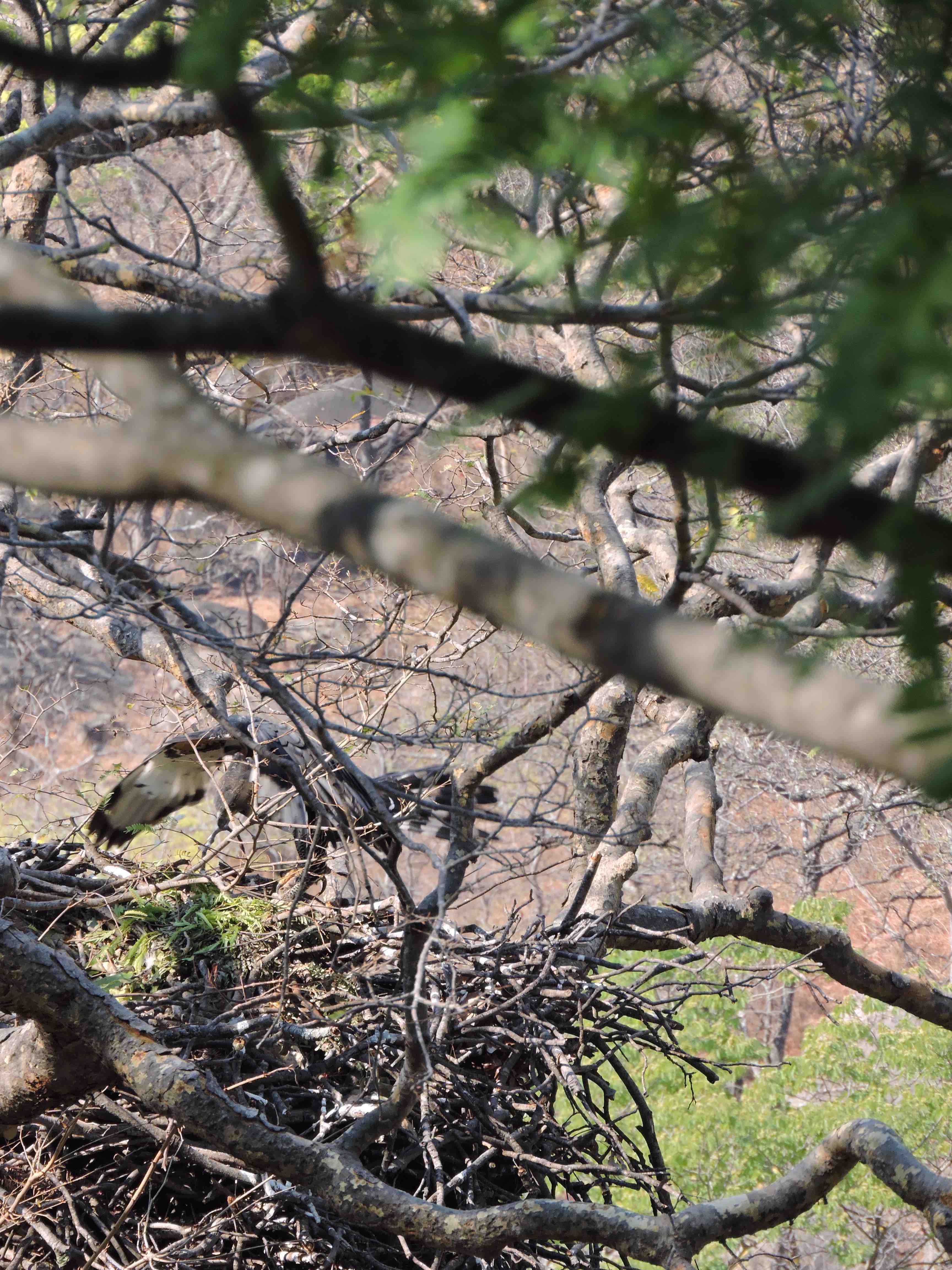
The return of the eagle to the nest and egg moving.

The return of the eagle to the nest and egg moving.

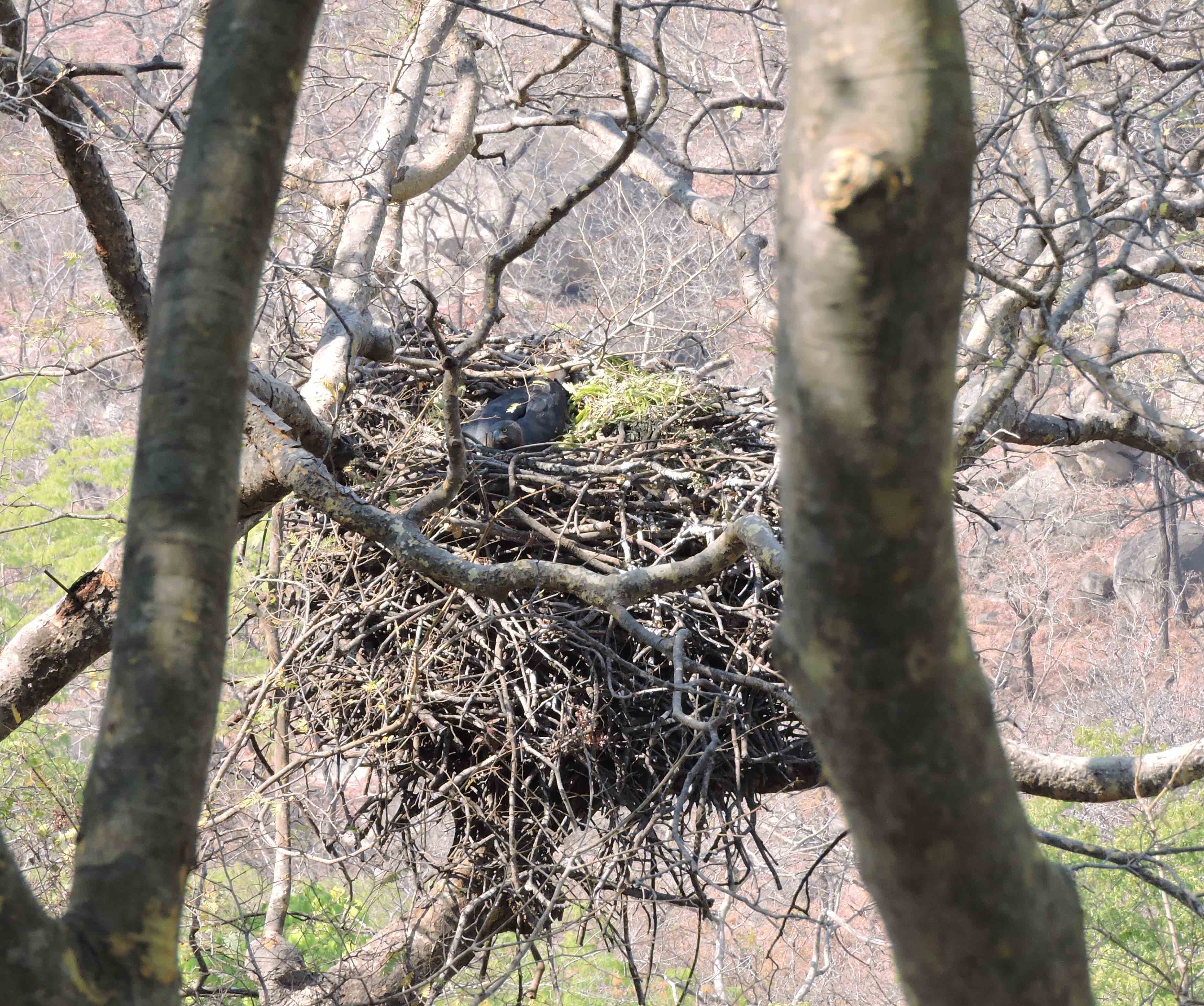
The nest was large, much larger than I had anticipated! Clearly it had been there for a number of years and its occupants had made a good job at building it. It must have been about two metres across and at least one and one half metres deep! This was a large nest for the species as Roberts VII Multimedia mentions an average diametre of 1.5-1.8 m with a height of up to 70 cm but old nests -such as this one- can reach up to two to three metres in diametre and three metres in height as the eagles add new material every year.
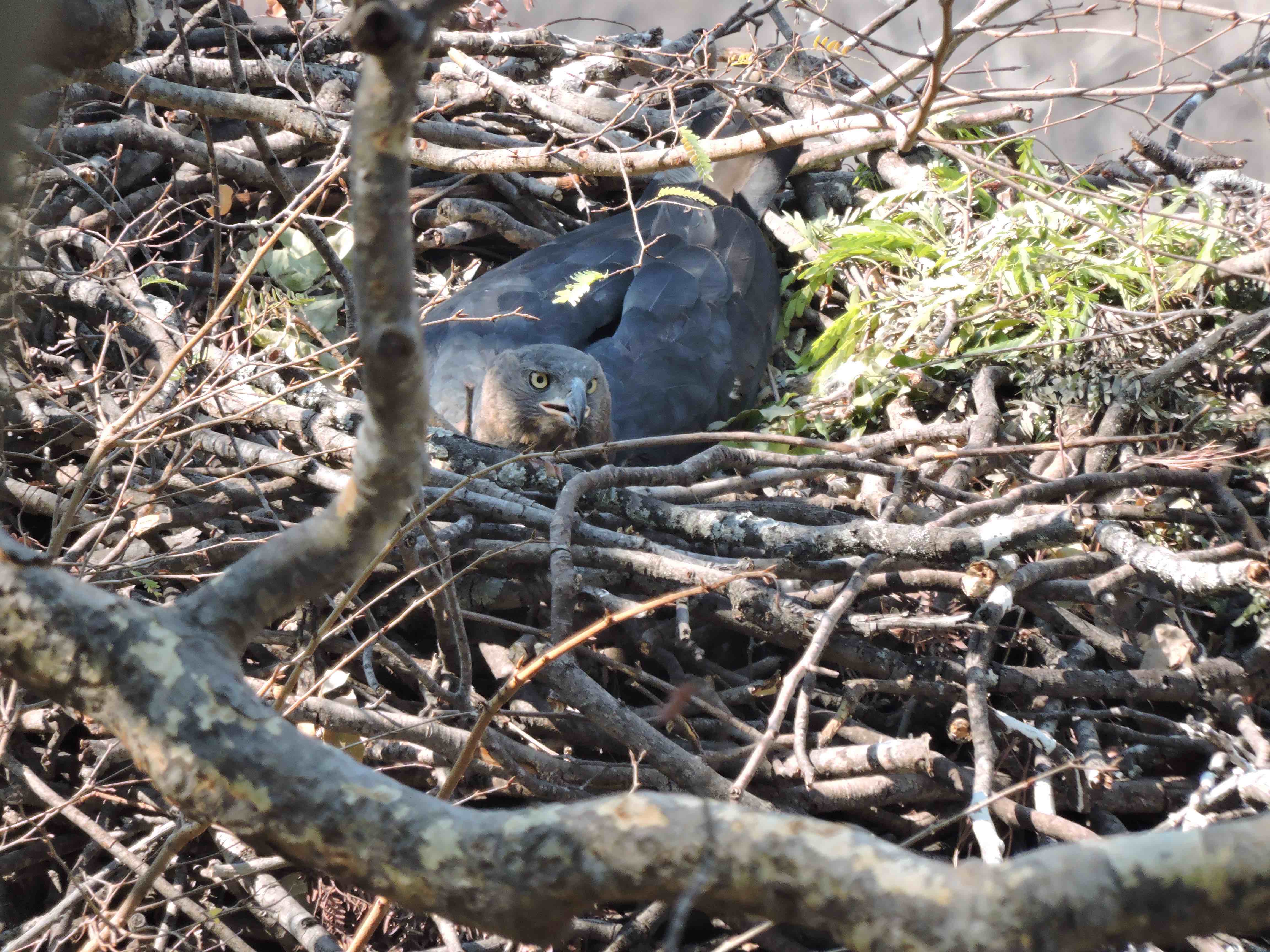
By the time we reached the “watching rock” the eagle was no longer there and we (or rather my companions) could see the egg that, on further observation, turned out to be two! While watching the nest the eagle came back and, after turning the eggs with its beak, literally “sunk” over them and stayed there unmoved by our presence for the rest of the time. Crown eagles are large birds reaching a height of up to 99 cm (tail included) being the fifth longest eagle that exists weighing about 4 kg with a wingspan of 1.50 to 1.80 m, comparatively short for the bird’s bulk. Mainly the female incubates for about 50 days and two eggs laid but normally only one chick goes through as siblicide is the norm. Only after 9-11 weeks the new bird is fully feathered and able to leave nest for nearby branches at 110-115 days. Despite its large size, the bird was truly dwarfed by its nest!

The eagle "sunk" in the nest.
The eagle “sunk” in the nest.
DSCN8074 copy

Over 95 per cent of this eagle’s prey are mammals and they have a reputation for being great fliers and being able to take off vertically inside the forest. I was wrong in thinking that they fed mainly on monkeys, as these mammals are only 7 per cent of its diet. Their usual prey are hyraxes and small/young antelope (65 per cent).

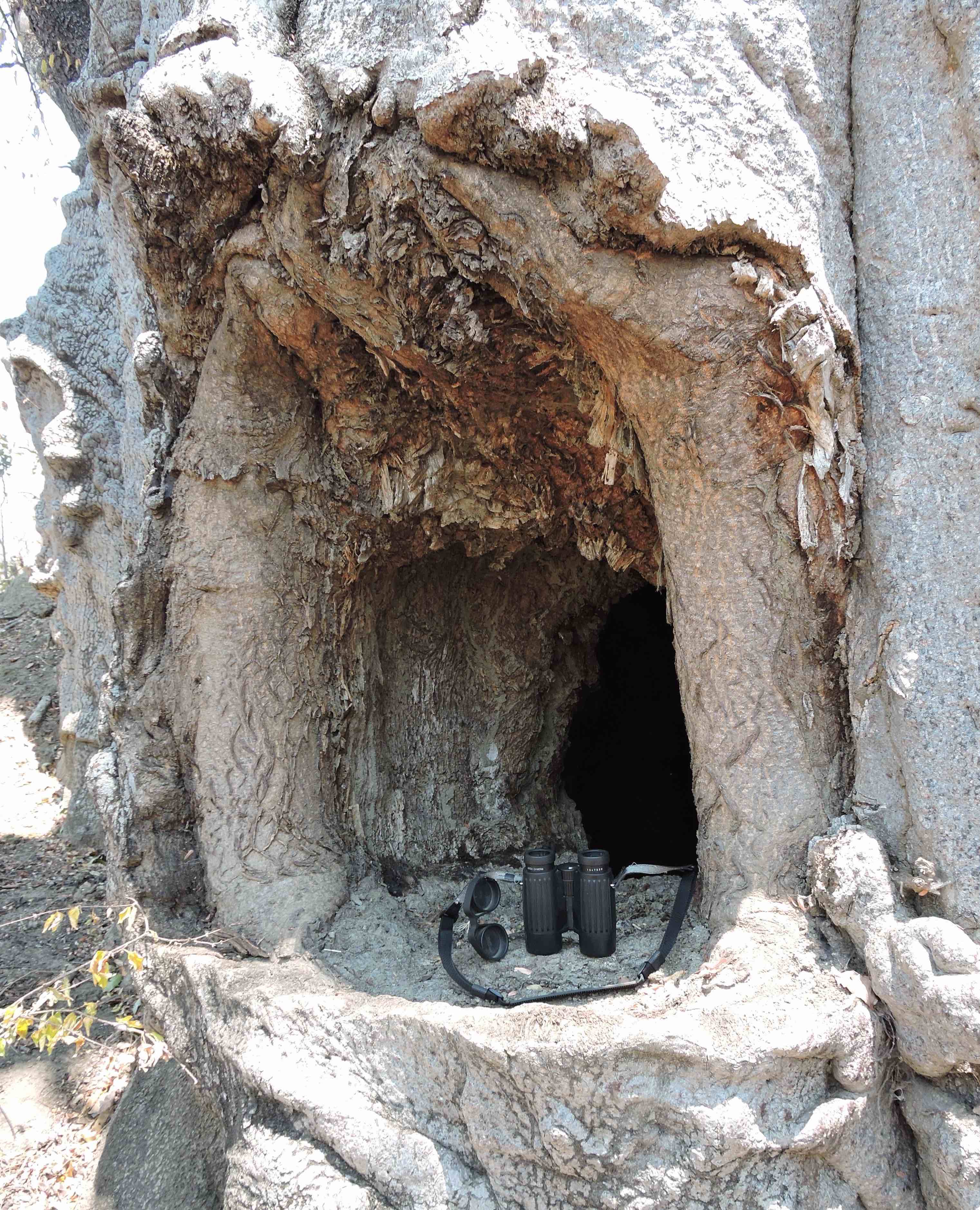
We returned to camp from the eagle’s nest via the baobab tree. I have already spent time on these fantastic trees in a recent post on Chitake so I will not waste too many words. This particular baobab has two main visible features: spikes driven up its trunk and a hole that allows you to see the inside and even enter the tree if you are interested and adventurous. Probably the spikes are there to enable people to collect either tree produce or honey but we could not tell.

The baobab.

The baobab.

The large hole.

The large hole.

The spikes.

The spikes.

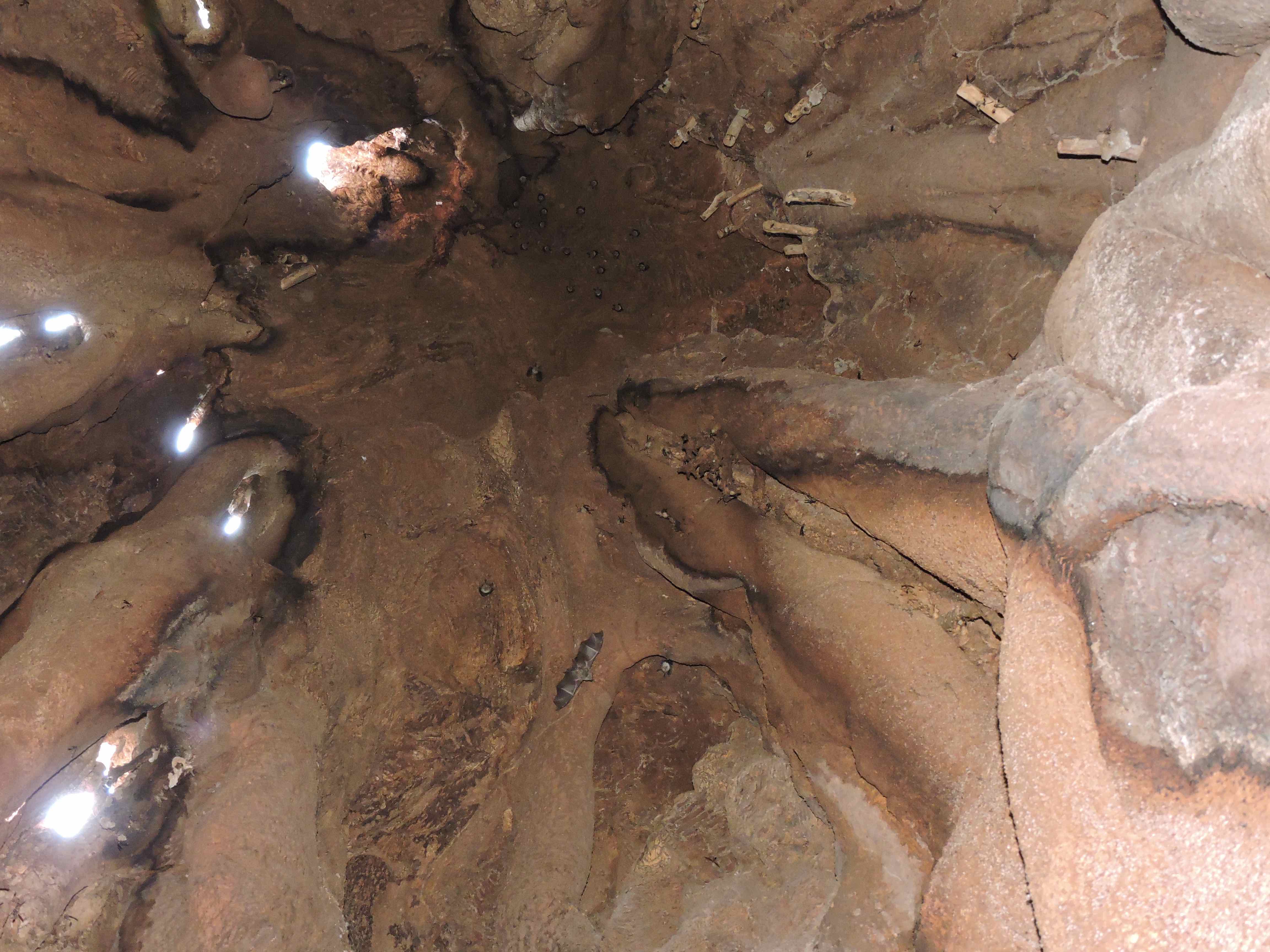
As we did not carry torches while looking for eagle nests during the day, there was not enough light to undertake a proper examination of the tree’s interior. We saw that there were some sun rays that filtered through small gaps on the roof, where the branches had sprouted, indicating that the top of the tree is not sealed tightly (as I thought) but there are gaps in its cortex. The holes were small and the light was not enough for us to see inside so we appealed to the trick of using the camera flash to look inside.

The inside of the tree. The spikes are seen on the right upper corner. The flying bat (centre bottom) and stationary bats (centre top), The small light spots are gaps on the top of the tree.

The inside of the tree. The spikes are seen on the right upper corner. The flying bat (centre bottom) and stationary bats (centre top), The small light spots are gaps on the top of the tree.

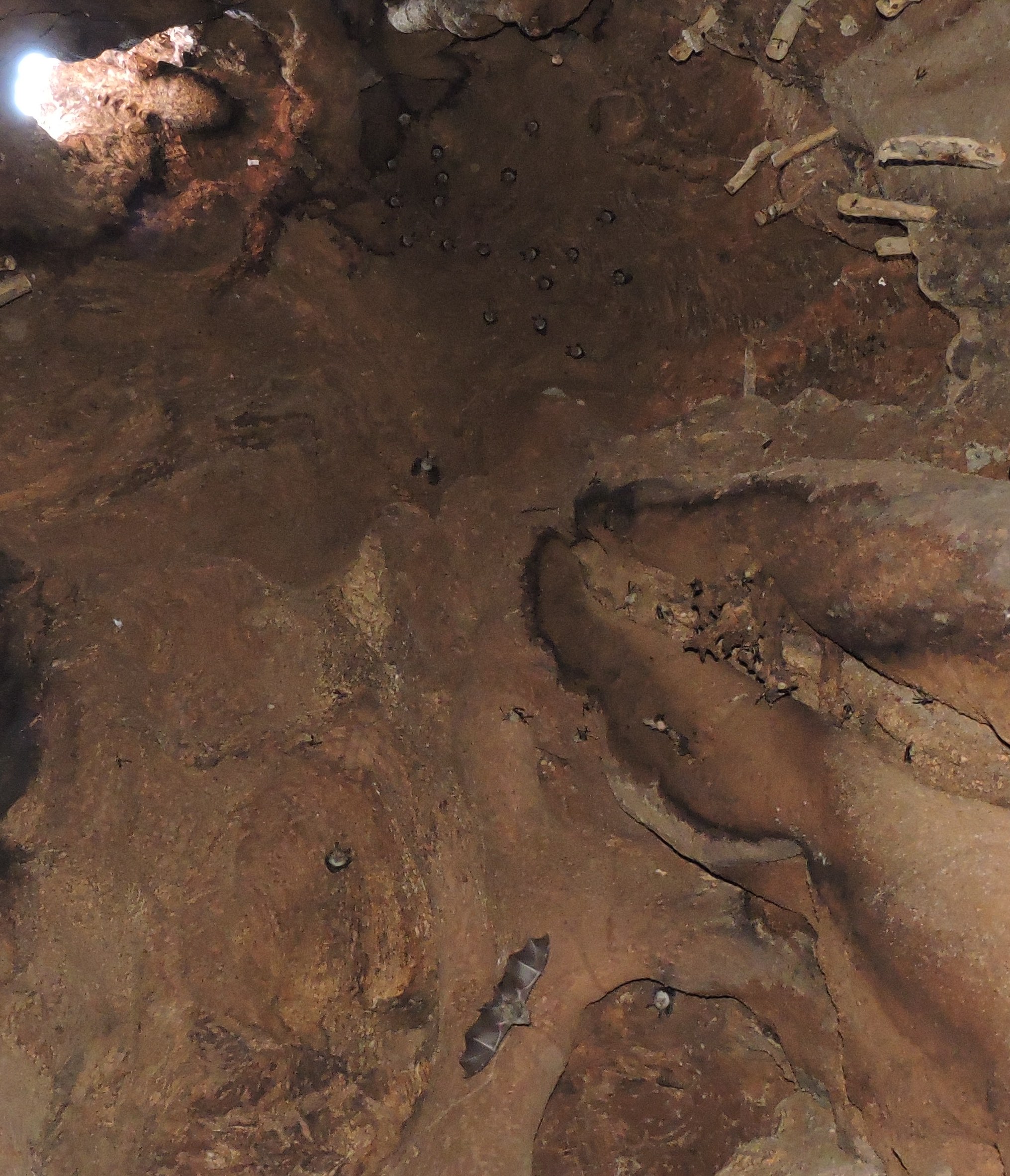
We saw that there were also spikes inside the tree! Although we did not detect any animal presence or smell (particularly the pungent bat smell!) inside the trunk, we took some pictures and, later examination of these, we noticed a small dark spot on its pale brown interior. It was a bat caught in flight! Further observation and enlargement of the pictures revealed other bats hanging from the roof, not in bunches but keeping distance from one another.

Close-up of the bats.

Close-up of the bats.

By the time we finished our observations of the baobab it was lunchtime and hot so we took walked back to camp, my toes still complaining in silence!

Hippo Pools Camp, Zimbabwe, 8 October 2015.


[1] https://bushsnobinafrica.wordpress.com/2014/08/29/hippo-pools-revisited-2/