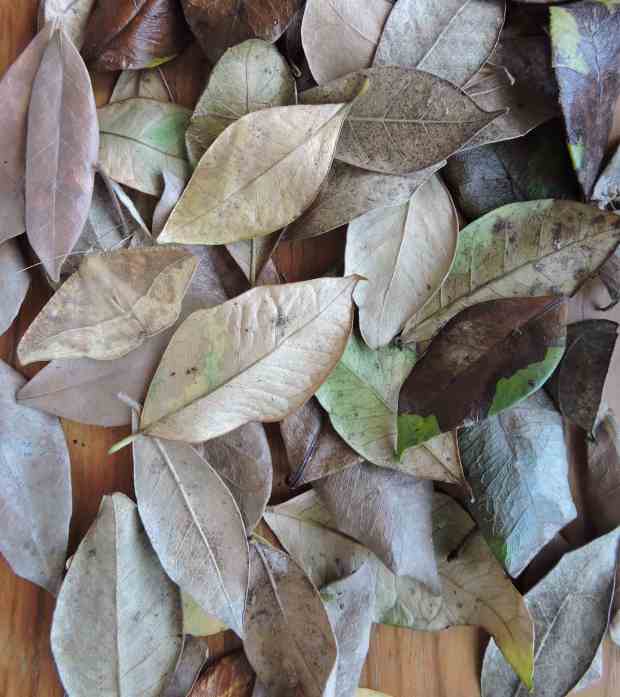
This beast had somehow fallen through the cracks and I found it while organizing my pictures. It is very “spotable” displaying again the wonders of Nature’s ways.
?
?
?
?
?
?
?
?
?
?
?
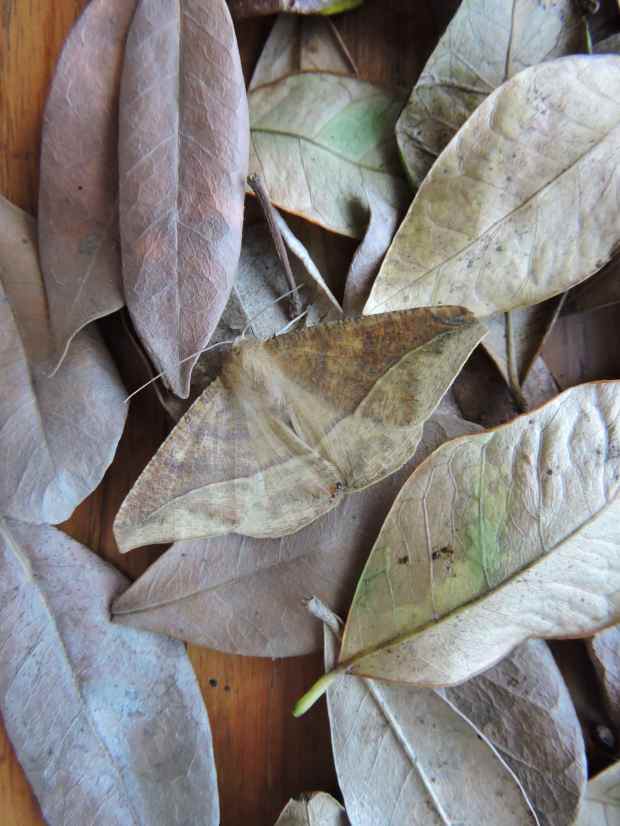
Another “leaf butterfly”.
This beast had somehow fallen through the cracks and I found it while organizing my pictures. It is very “spotable” displaying again the wonders of Nature’s ways.
?
?
?
?
?
?
?
?
?
?
?
Another “leaf butterfly”.
Walking through the various quarters of Rome in summer is a pleasure. Despite its apparent (and real) chaos, Rome has so many facets that every walk reveals new sights. Even old -and apparently commonplace- sights become interesting once we learn more about them.
Although I had walked through the Piazza della Minerva in the past, it had been to get to other of Rome’s main attractions such as the Piazza Navona or the Pantheon. I had noticed the obelisk in the centre but my attention somehow was directed to a plaque informing the public that the Argentinian General José de San Martín stayed at the Grand Hotel de la Minerve in 1846, four years before his death in 1850.

The plaque on San Martín placed on the front of the hotel.
During this visit, my daughter mentioned that, apart from the Fontana delle Tartarughe (Turtle Fountain) -close to her flat- she also enjoyed seeing the small elephant. So one afternoon we walked there and we got to the Piazza delle Minerva again. Not being one of the popular attractions, this small and rather overlooked piazza does not have the crowds and endless tourists’ queues to stick their hands in the Bocca della Veritá or to enter San Peter’s in the Vatican.
So, with time, we had a look at the obelisk. At the time we noted its rather the rather elongated trunk and agreed that it was a rather peculiar sculpture. Further investigation on its origins and development followed and its creation and symbolism is worth describing.
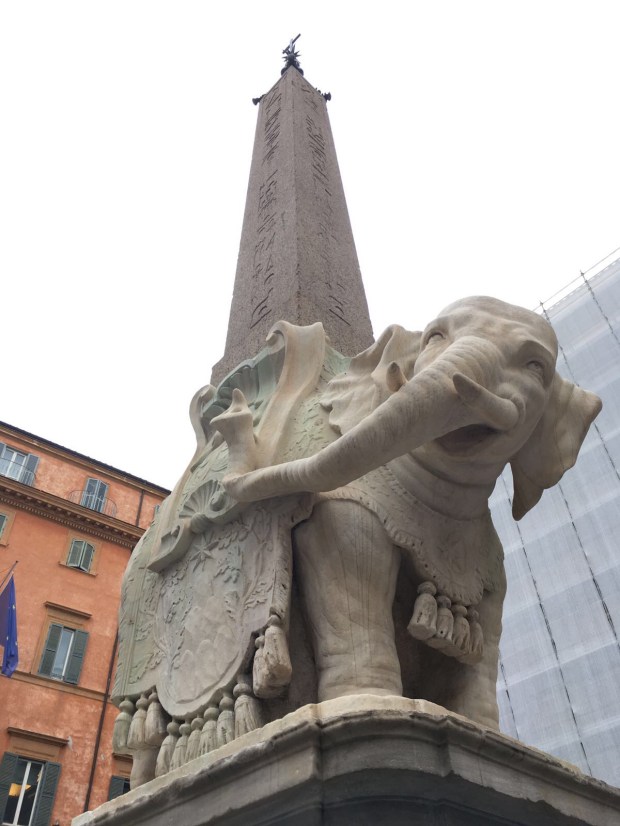
The rather long trunk of the marble elephant.
The monument consists of two parts, an Egyptian obelisk -unearthed during some excavations carried out before the 17th Century- and the elephant that carries it. The latter is believed to have been the work of Ercole Ferrata, a disciple of the well-known sculptor Gian Lorenzo Bernini [1].
At the time of the unearthing of the Egyptian obelisk, Fabio Chigi (Pope Alexander VII) wanted to build a monument to display it. Father Domenico Paglia proposed the idea of the Obelisk resting over six small hills, as well as a dog in each corner, the dog being a symbol of the Dominican priests, the Order he belonged to. The hills recalled the six hills depicted on the Chigi family crest. By depicting the latter he hoped to convince the Pope. However, to Paglia’s surprise, Alexander rejected his design.
The Pope then asked Bernini for an alternative design. Bernini’s first reaction was to place four seated figures holding the obelisk at each corner of a pedestal. As this was not to Alexander’s liking, he presented another option showing the Obelisk resting on a rock and a later proposal depicted Hercules with his knees semi-bent as he hoists the obelisk upward and recalls Atlantis holding up the world.
Eventually Bernini got the agreement of the Pope with a design of an elephant carrying the Obelisk on its back, inspired by a popular novel of the time called “Hypnerotomachia Poliphili” (“Poliphilo’s The Strife of Love in a Dream” )[2] authored by Francesco Colonna in 1499.
In Bernini’s original drawings, the obelisk’s weight would have fully rested on the legs of the animal. However father Paglia -envious of Bernini receiving the commission and being an architect himself- convinced the Pope that “according to traditional cannons, no weight should rest vertically above an empty space, as it would not be steady nor long lasting” so he strongly recommended that the obelisk should be placed upon a stone block. Bernini was opposed to this modification, especially as he had already proven that he could accomplish such a design in his “Four Rivers Fountain” in Piazza Navona.
Despite Bernini’s opinion, the Pope finally followed Paglia’s advice and decided that a marble cube should be inserted under the elephant. He also had the Latin phrase “These symbols of the science of Egypt, which you see engraved on the obelisk borne by the elephant, the most powerful of all animals, show that a strong mind is needed to support a solid knowledge” inscribed on the base.
Although Bernini tried to hide the heavy look of the block placed between the elephant’s legs by adding a saddle to the elephant’s back, this was not enough and the elephant acquired a rather heavy appearance that -I am sure to Bernini’s annoyance- originated its nick name of Minerva’s Piggy [3]!
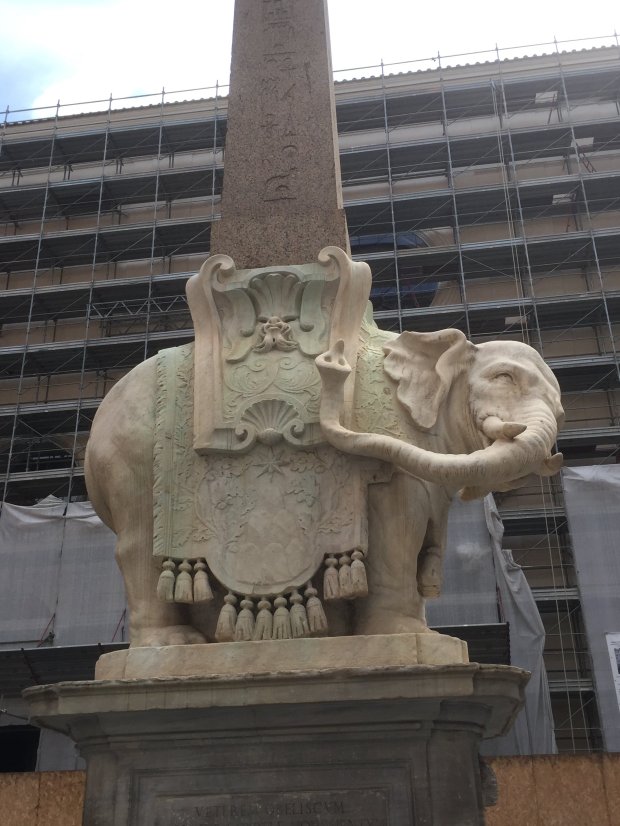
Despite the addition of the saddle the marble block supporting the obelisk is rather obvious.
The complete work was unveiled in February 1667 and it turned out to be the last commission of Pope Alexander VII as he died a few months later.
There is still a final twist to the story.
Bernini was able to take his revenge upon Paglia and the Pope by shifting the elephant’s tail slightly to the left and in that way pointing its rear end rather obscenely toward the Dominican Monastery sited in the square!
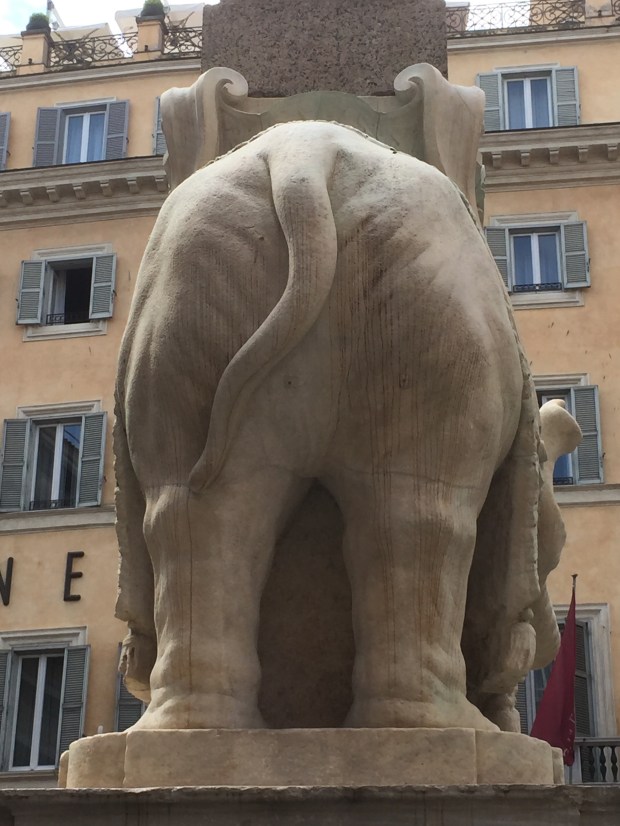
The elephant’s rear end.

The elephant with its rear end pointing towards the Dominican Monastery.
[1] https://en.wikipedia.org/wiki/Gian_Lorenzo_Bernini
[2] https://echoesofegypt.peabody.yale.edu/hieroglyphs/hypnerotomachia-poliphili
[3] Today the sculpture is popularly known as Minerva’s chick as the Roman dialect word for piggy (“procino”) has been replaced by chick (“pulcino”).
The incident I will narrate took place during our last year’s trip to the Mabuasehube area of the Kgalagadi Transfrontier Park in Botswana. As the observation was being published, I delayed its writing until this took place on 8 July 2018 [1]. For easy access I have also inserted the published document (Hornbill predation) as a PDF file under Pages in this blog.
Let me start by saying that if you find the Southern Yellow-billed Hornbills likeable, you may need to review your stand after you read this piece.
While at Camp No. 2 at Monamodi Pan in October 2017 we were startled by the dryness of the place. Birds from the surrounding area will immediately come to drink in any water that we had around the camp. Common visitors were Southern Grey-headed Sparrows (Passer diffusus) but Cape Sparrows (Passer melanurus), Violet-eared Waxbills (Uraeginthus granatinus) and Sociable Weavers (Philetairus socius) were present in large numbers.
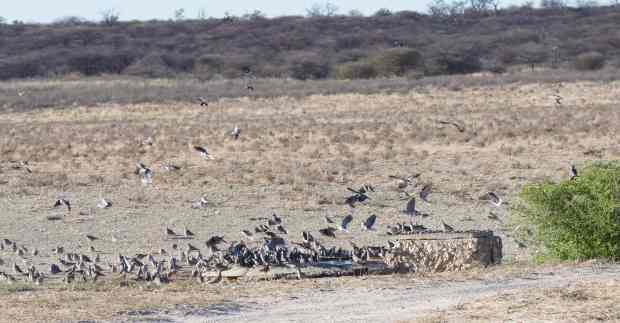
There was a constant stream of birds drinking at the waterholes.
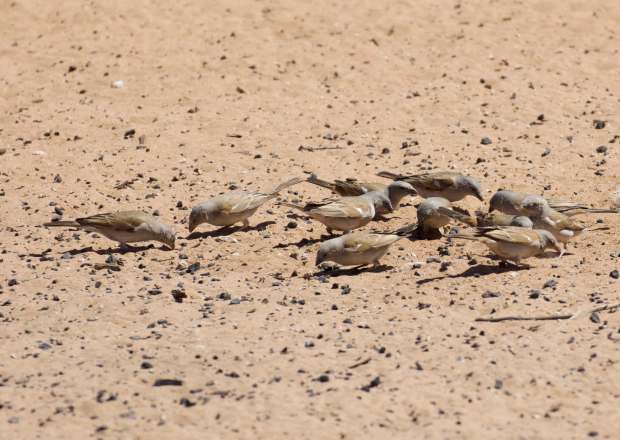
Birds looking for food and water around our camp.
In addition, a few Southern Yellow-billed Hornbills (Tockus leucomelas) were residents at the camp and were regularly seen on the ground.
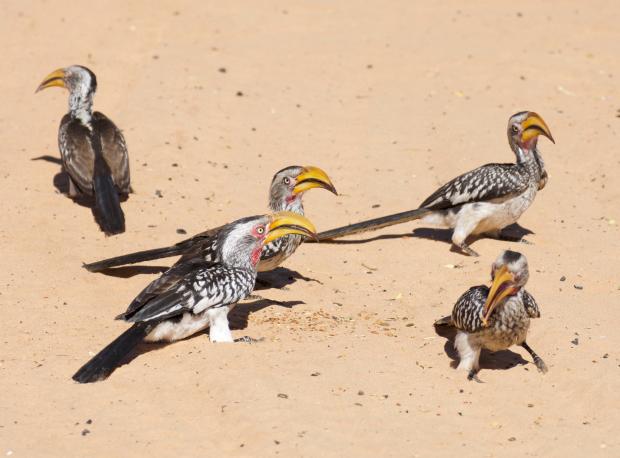
Southern Yellow-billed Hornbills scavenging around the camp.
At mid-morning during the second day of our stay some of the small birds suddenly flew off where they were foraging in a response usually observed when there detect danger such as an attack by a predator.
They all flew away but one! A Southern Yellow-billed Hornbill had caught one of the adult Southern Grey-headed Sparrow and it was in the process of killing it by violently shaking it and thrashing it against the ground. We were startled as we did not expect this to happen.
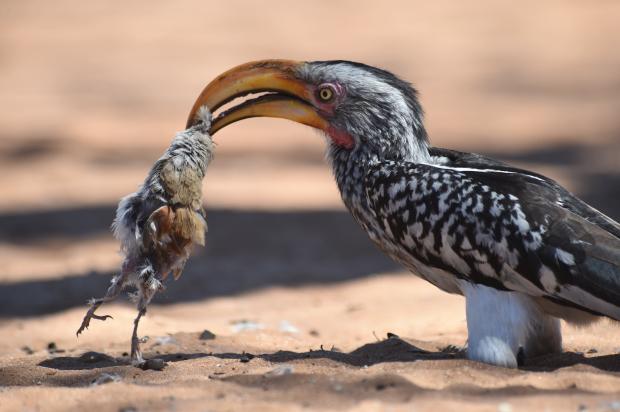
Picture by Frank Rijnders.
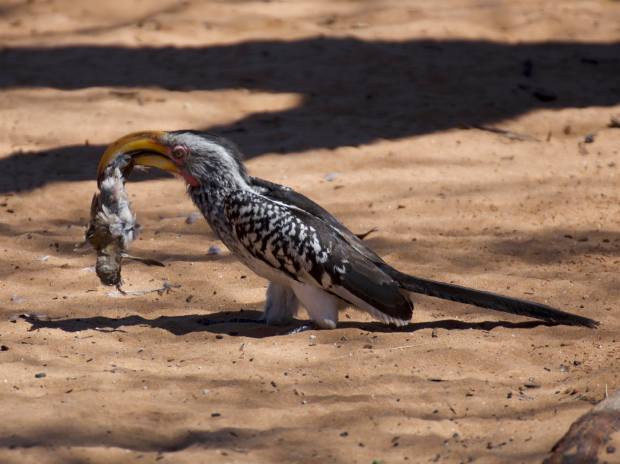
The sparrow died fast and the hornbill started removing its feathers and then it took its victim up a nearby tree where it continued defeathering it by vigorously hitting and rubbing the sparrow against the tree. Interestingly, there was no panic reaction or mobbing of the predator by the small birds that returned to the water only after a few minutes.
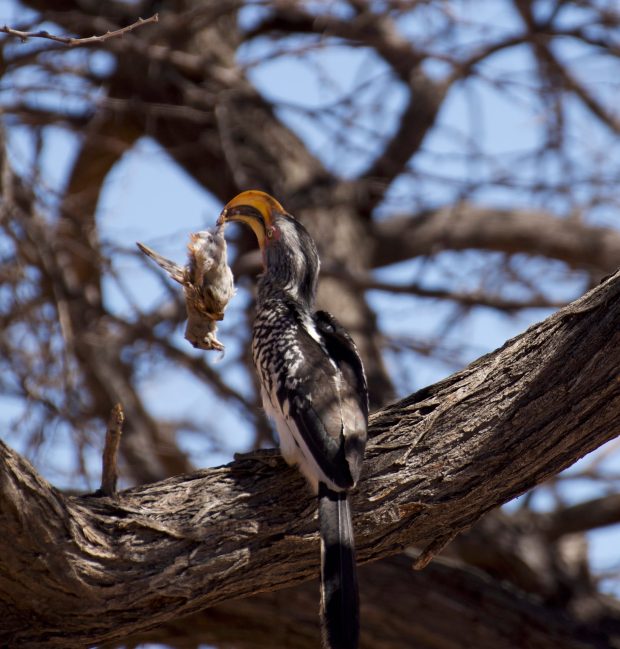
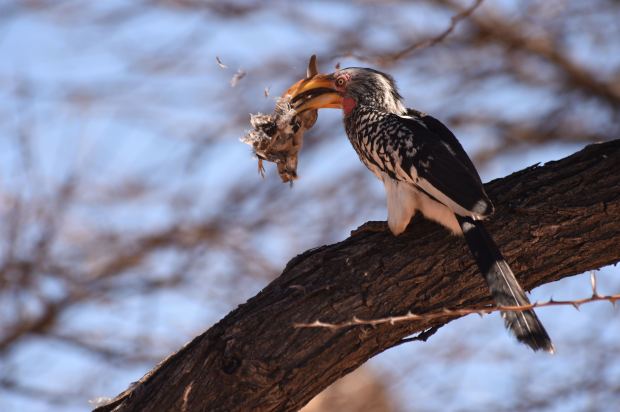
Picture by Frank Rijnders.
After about 30 minutes the hornbill decided that the victim was naked enough for it to be swallowed!
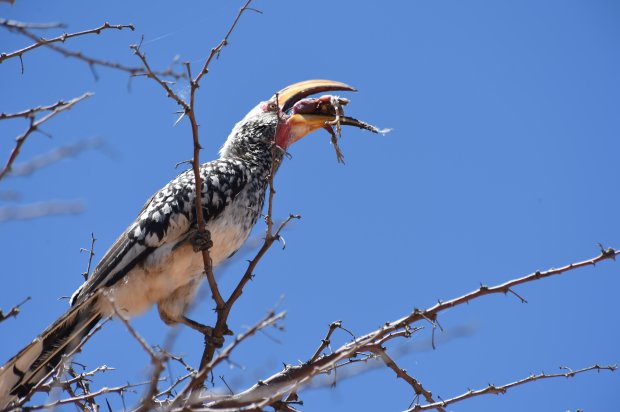
Picture by Frank Rijnders.
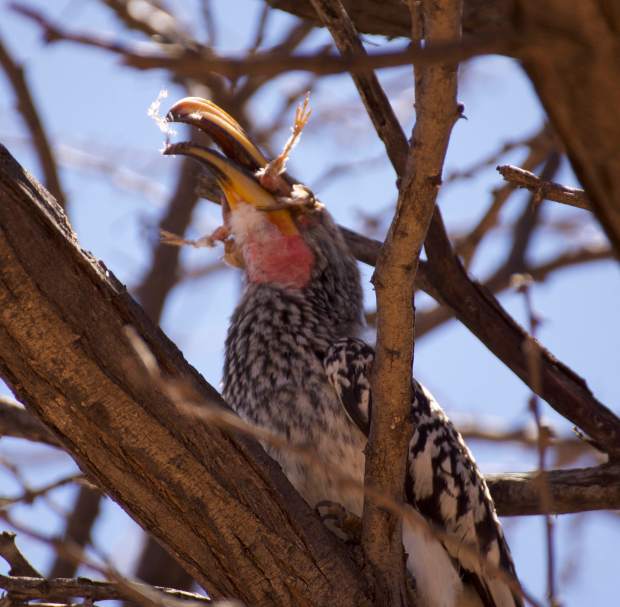
Although it was known that the Southern Yellow-billed Hornbill’s diet included “a wide range of invertebrates and small vertebrates” such as nestlings of Red-billed Quelea (Quelea quelea) the list does not mention predation on adult birds [2].
It is possible that the observed behaviour was incidental. However it seems realistic to expect that the hornbill was prepared to take advantage of the chaos created when large numbers of birds gather at waterholes or are distracted when foraging together to catch their prey unaware.
So, like with the observed carnivory in hippos [3] the present observation may not be nice but, again, it goes to show how nature works.
[1] https://journals.uct.ac.za/index.php/BO/article/view/500
[2] Hockey PAR, Dean WRJ and Ryan PG 2005. Roberts – Birds of Southern Africa. The Trustees of the John Voelcker Bird Book Fund.
[3] https://bushsnobinafrica.wordpress.com/2015/02/22/hippos-from-hell/ and https://bushsnobinafrica.wordpress.com/2015/03/23/hippos-from-hell-the-videos/
My thanks go to Biodiversity Observations for publishing this observation.
After a few weeks of silence, I return to blogging for one day to let you have this beast for you to search for.

?
?
?
?
?
?
?
?
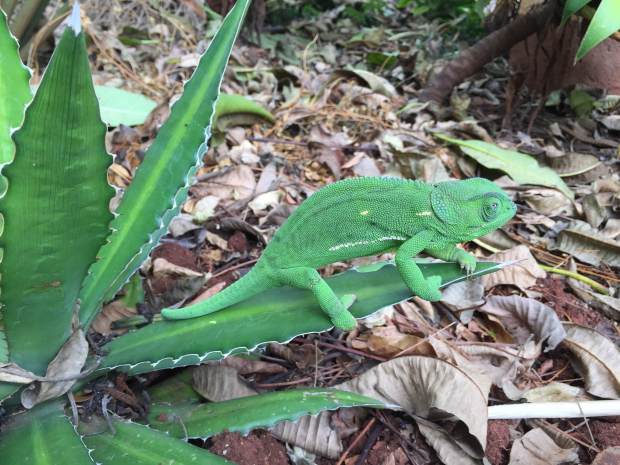
I am sure it was not that hard. It is the first chameleon we find this year in our Harare garden. I think it came out a bit early as it is still quite cold and it was in good condition but moving slowly like the bushsnob in cold weather!
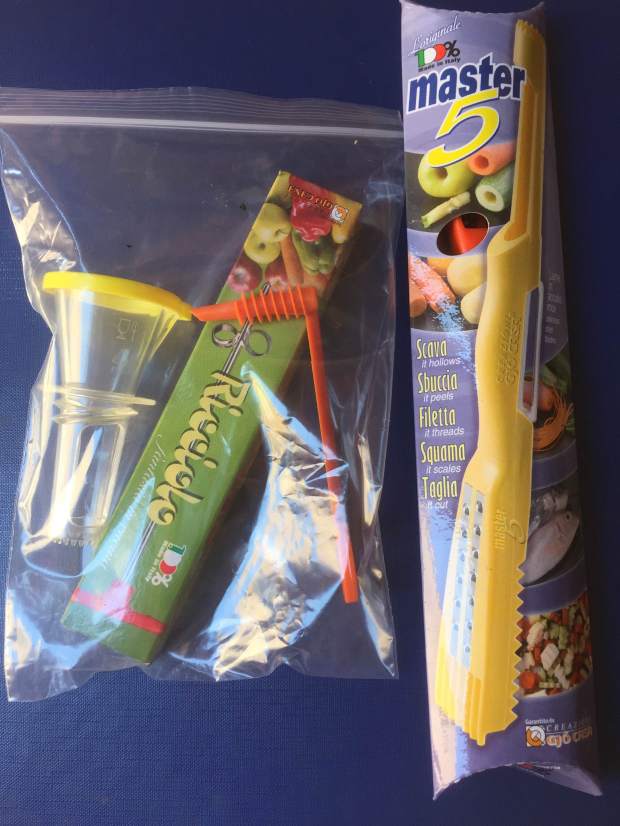
Another character from the streets of Rome and one of the most engaging. He is called Mustafa and spends his time selling gadgets to prepare veggies in an imaginative way. We had heard and then seen him in earlier visits at the Porta Portese flea market. This time he was trading at the Campo di Fiori market. I can assure you that you cannot fail to stop and watch!!!

Mustafa’s stand.
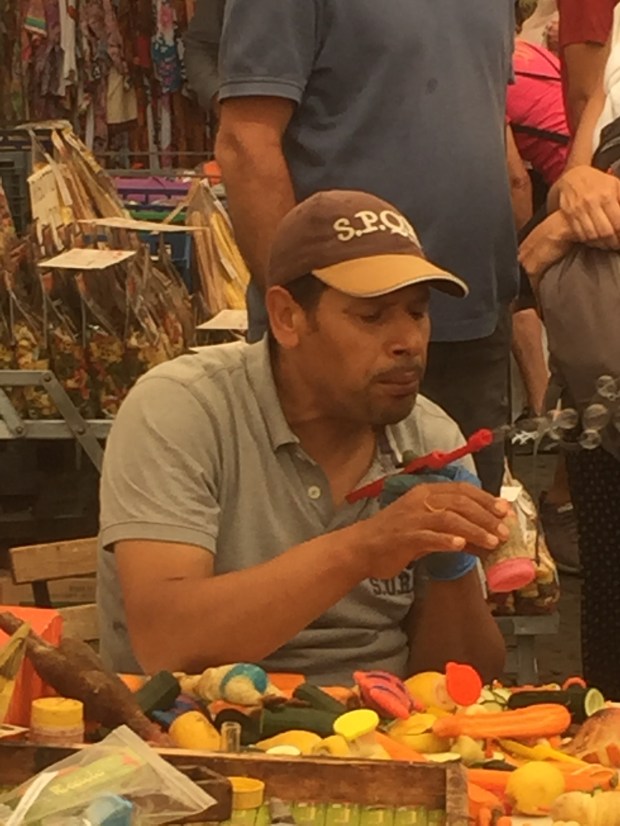
Mustafa blowing bubbles to demonstrate the versatility of his ware.
While selling ,Mustafa mentioned that he had over 5 million hits in his video at Youtube so I did not film him but went to Youtube where I found many videos of “Mustafa Patata e Carota” performance.
So, rather than filming him yet again, I decided to embed the video where he speaks English. There is another one in Italian with 2,5 million hits in Youtube! [1]
Mustafa was so convincing that we ended up buying his tools without really needing them! I am now practicing and destroying a few veggies but I am getting there…
[1] The video in Italian can be seen at https://www.youtube.com/watch?v=KbPBN6kvnCU.
If you know a bit about Rome, you will also know that it is full of surprises. This visit has been no exception and I found this scene during some rains we had yesterday while walking through the historical centre towards our rented flat in the Jewish quarter.
 These two gladiators took advantage of the rain-break in their fighting to the death activities to catch up with life events and have a puff rather than sharpening their swords! This is something expected of the current Millennial generation but they are clearly beyond that, probably Xennials[1]
Whatever their generation, the sight was really amusing!
[1] The term “Xennials” is a portmanteau blending the names of Generation X and the Millennials to describe individuals born during the Generation X/Millennial cusp years of the late 1970s to the early 1980s. (https://en.wikipedia.org/wiki/Xennials)
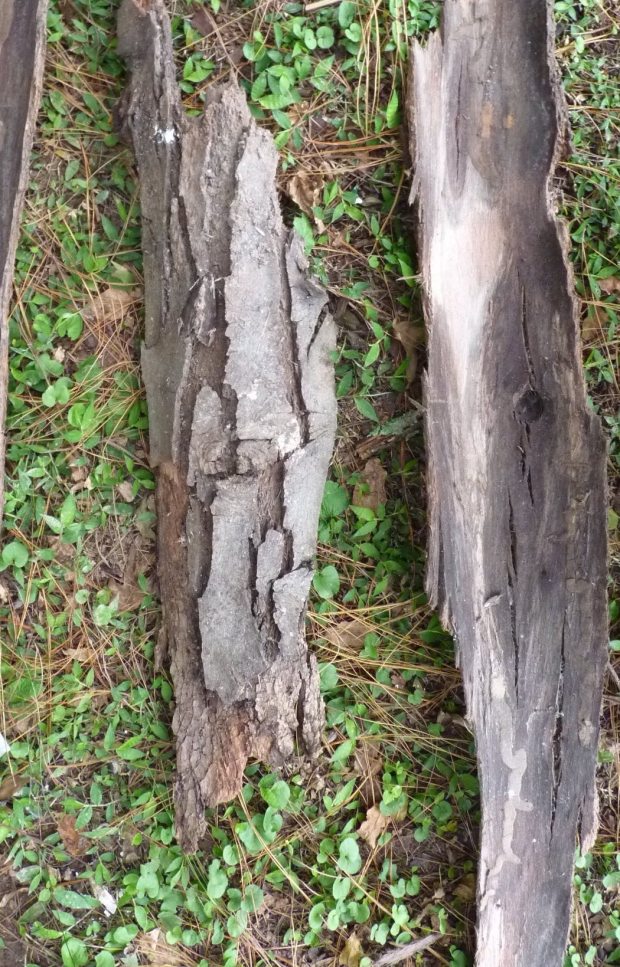
The final beast from Salta as we are now moving to Africa again. It was spotted on some tree bark that stayed on the ground after collecting some firewood. See if you can see it.
?
?
?
?
?
?
?
?
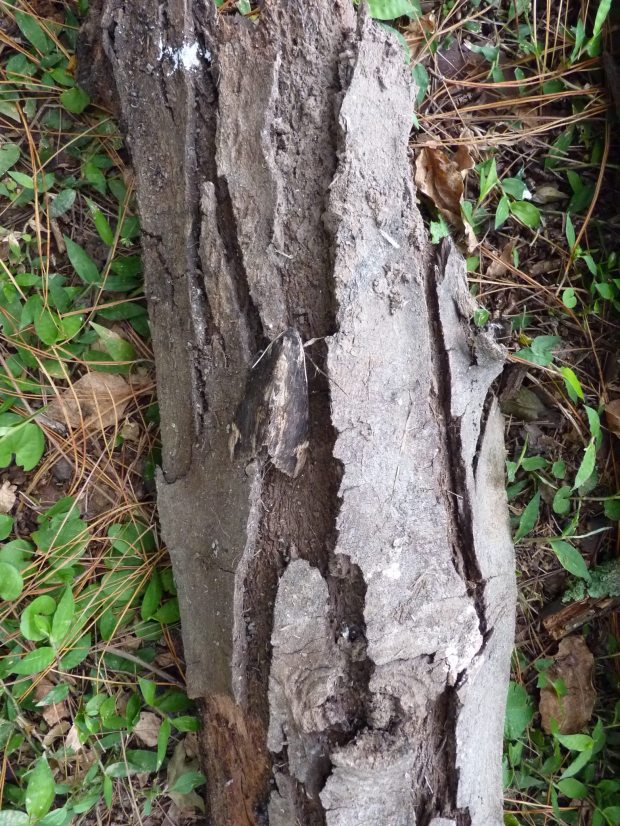
I do not think that it was too hard… I should do better next time.
This event took place in August 2008, when I was not aware of the existence of blogs and even less that I would be writing one! It took place at our farm in Salta.


It all started with the death of a steer at a neighbour’s farm on the 17th of that month. The animal’s hide was removed on the 18th and left to rot. Over the next couple of days a number of Black Vultures (Coragyps atratus), Southern Crested Caracaras (Caracara plancus) and Chimango Caracaras (Milvago chimango) were seen feeding on it during the day. On the 20th we saw a fox and a tawny wild cat on the road, near the carcass but we were not able to identify them. As things were getting interesting and as we were used to waiting for hours for predators and scavengers at carcasses in Africa, we made a point of returning that night to see what could spot.
At about 21:30hs my wife and I drove to the area and pointed the car headlights towards the carcass, as unfortunately we did not have a spotlight. While I was maneuvering to get the best illumination of the dead animal, my wife -already known for her keen eyesight- said almost shouting with excitement “There is a large cat feeding!” I stopped the car and brusquely moved towards her seat to get a better angle.
What I saw left me amazed. At about 30 metres from us a large cat was crouching on the other side of the carcass, apparently feeding on it. It looked at us three times and bounded off towards the bushes. As we could not follow it with our lights, we could not see if it was spotted or not. What we both agree is that it was a large cat (at least the size of a large leopard) with a rather sizeable and rounded head that we saw clearly as it stared at us. That was it! Although we both knew that seeing a jaguar (Panthera onca) in this area was extremely unlikely, we were both convinced that this was what we saw.
Embed from Getty ImagesWe knew that the chances of seeing it again that night were not high and, after a while, we returned to the farm, about 1.5 km away. We were so excited that we invited relatives staying with us at the time and our children to come back to the spot with us but failed to see it again!
The following morning we checked the area around the carcass for footprints but the soil was too hard and we failed to find any around the carcass or in the area we saw it moving towards, where there was a small stream.
When I spoke to our neighbor about this, I had the feeling that he thought I was joking but finally the concept sank in and he considered it as an impossible occurrence. After searching on the Internet I came across a publication that dealt with the distribution of the Jaguar[1] and decided to contact the author.
Below I translate our exchange.
4/12/2008
Dear Mr. Perovic,
Maybe this message surprises you but I have a farm in El Gallinato, Salta and wished to consult you about the possibility of having seen a Jaguar in this area. The coordinates of the place are: 24°40′ 23.10″S and 65°21′ 35.99″W.
In this place in August of this year a cow died and, aware that in Africa carnivores are spotted many times feeding on dead animals at night, we went with my wife to see what was feeding on it and we were surprised to see a large cat with rounded ears and green eyes that looked at us a couple of times, ate a bit and left. Regrettably we only had the car lights and a small torch that did not help us much to see the body. It looked rather dark but we do not know if melanistic specimens are present here or not. Around this area we have already seen wild cats and a puma but we do not publicize this to avoid hunters finding out and finishing off the few that may be around. Of course we returned to the carcass the following night but we only saw dogs feeding.
As I found your work on the distribution of the jaguar in the Argentinian North West, I thought that you would be interested in this information. I would also like to know if what we saw could have been a Jaguar or if it is that we are too old and having visions!!! Maybe some day when we are in Salta we could meet.
Kind regards.
His answer came the following day:
Dear Julio,
Many thanks for your message. Regarding your query, regrettably, I must tell you that is unlikely that it was a jaguar, I do not say impossible as one should never loose hope that their distribution will increase again to its original area which included the El Gallinato. But I do not think that nowadays it could have been a jaguar.
Regarding the article you mention, (although old) you would note that sites close to El Gallinato are mentioned (the mountain road towards Jujuy). These are data on footprints and some other signs, but regrettably 8 or 9 years have passed during which we cannot find new evidence.
I reside in Vaqueros and travel frequently to Jujuy (I am from there) in the mountain road. At the moment I work with jaguar and other cats (that are just as important as the one you saw) in several places, but mainly in the Yungas and Andes highlands.
If you wish when you pass through Salta, you could write and we could talk about this, about things that need to be taken into account about the predatory attitude of the different species, and I could also give you some useful material.
I thank you for your interest and initiative.
Many thanks and I remain at your disposal for any doubts you may have.
Greetings.
Pablo
Although we had a couple of additional e-mail exchanges, I have not yet met Pablo. I was in Rome at the time of the exchanges and in the past and present our visits to the farm were (and are) always short for time as there is always other more urgent and or important things to do!
Thinking back, perhaps the situation called for the probably first and last use of my “yaguareté” (jaguar) caller that I had acquired earlier in the Beni of Bolivia with the absolute guarantee (from the seller!) that it would attract jaguars! Luckily, the contraption remained forgotten in a corner of our farmhouse!


Incredibly ten years have passed since the sighting and, although I take in what Pablo said, writing this post brought back the memories of the large cat we saw that night whose identity will probably always remain unexplained for us!
[1] Perovic, P.G. and Herrán, M. Distribución del Jaguar en las Provincias de Jujuy y Salta. Noroeste de Argentina. (http://www.jaguares.com.ar/datos-personales/distribucion/distribucion-noroeste.html)
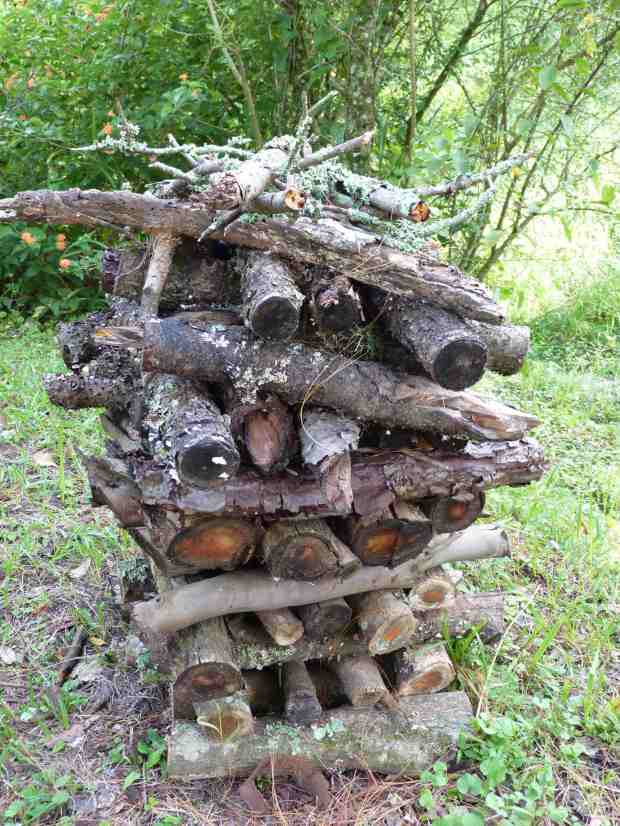
Although winters at our farm in Salta are mild, sometimes we have cold nights and the occasional frost.
We buy some hardwood for our fireplace and also use fallen trees and branches to complement it.
The picture shows a pile of pine wood getting dry for next year. It also hosts an inhabitant rather tricky to spot.
?
?
?
?
?
?
?
?
?
?
?
?
?
?
Here it is, revealed for you. It was quite difficult, I know! A real master at camouflage!

This year Salta has been unusually wet and we still have warm weather and rather heavy rains in April. This has created a true green revolution accompanied by an insect explosion. The moths are still coming in numbers to our outside lights and midgets and mosquitoes are still around.
We found a cicada that had been attracted to the verandah lights. It was rather quiet and, unusually, stayed after daybreak. I collected it without much difficulty to have a look at it as there was clearly something wrong. While having a look, my wife noted pinkish silky filaments where its abdomen should have been! In addition, it was opening its wings from time to time but not making any effort to fly.

Dorsal view of the cicada.
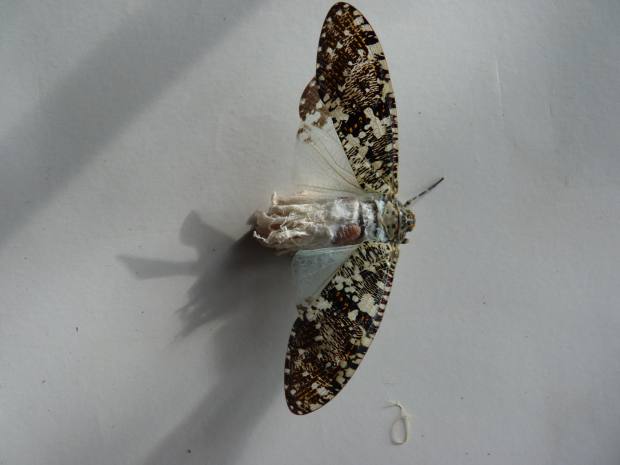
The parasitoid larva can be seen at the joint between the thorax and the abdomen.
It was during one of these wing movements that she also noted a protuberance on its dorsal area that, after some careful inspection became a small pink worm-like creature apparently lodged in it. It was about 3 mm long and somehow it reminded me of a small warble fly larva.
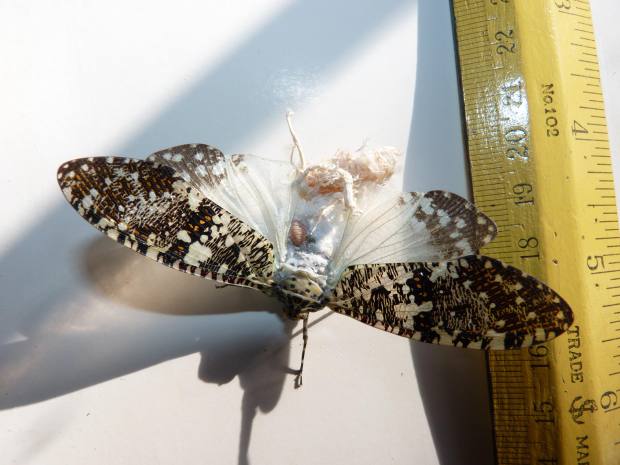
The pink parasitoid seen from above with a size reference.

A close-up of the parasitoid larva.
Further inspection revealed another couple of worms also lodged on the cicada’s flesh. The larvae were still alive as they moved when I touched them!
We decided to keep the “sick” cicada under observation. As expected it died the following day but the larvae were still there so we left it undisturbed.
It is now about one month after the find. One of the larvae that detached soon after the death of its host has apparently built a small cocoon attached to the glass jar but the other two that stayed on the dead cicada turned grey and are apparently dead.
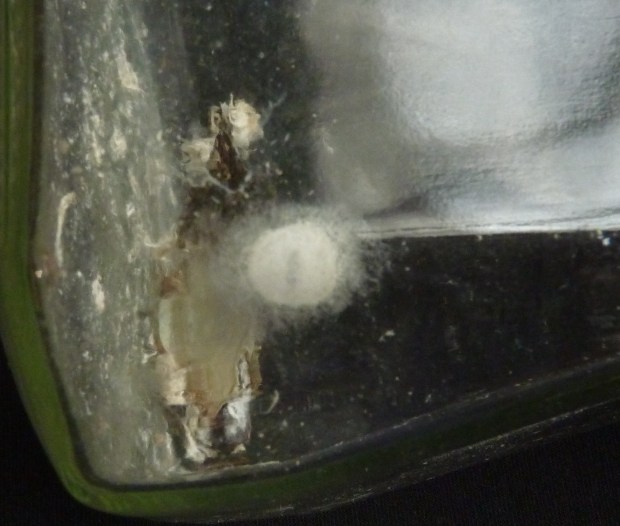
What I believe hatched from the cicada and made a cocoon in the glass jar.
I am afraid that the outcome of the cocoon will probably have to wait until our next visit, hopefully in 2019. In the meantime I can only speculate that, as it happens with caterpillars and other arthropods, the cicada was the victim of some parasitoids that have somehow colonized it. It is likely, as we other situations like this, that the larvae had eaten the cicada slowly until the damage created caused it to perish but not before the parasitoids, or at least some, were ready to leave the body and develop.
I will venture that these are larvae of a parasitoid wasp but I cannot be sure until the small cocoon hatches, if it ever does. However, having seen such an interesting interaction, I will watch for another cicada showing similar signs and follow it up.
Postcript: In the internet I learnt that some flies are important parasitoids of cicadas and that they locate them through their sound. It is also possible that the silky, pinkish filaments could be a fungal infection that follows the parasitoid’s damage of the host.
 A Bushsnob out of Africa