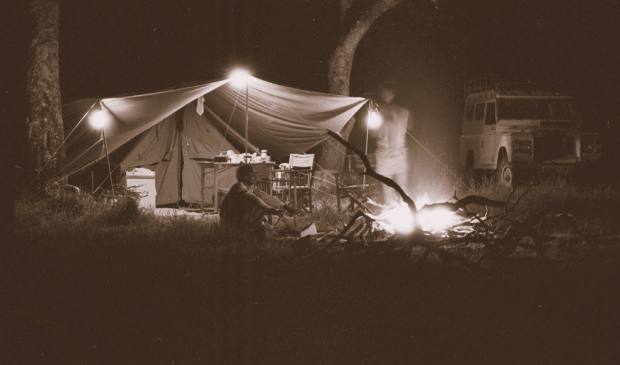
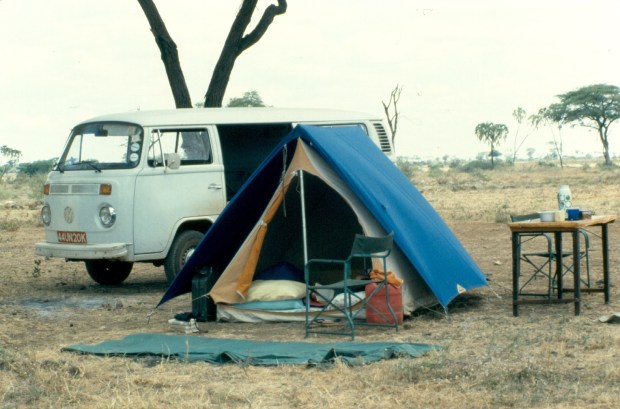
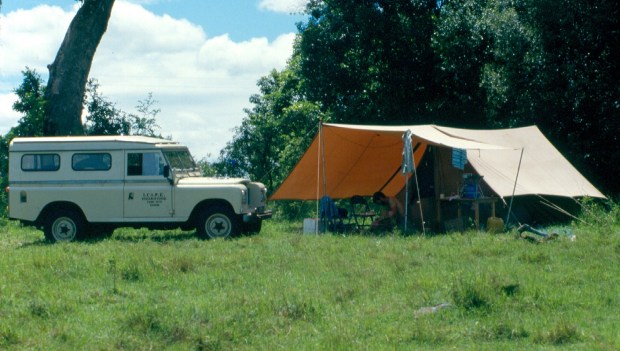
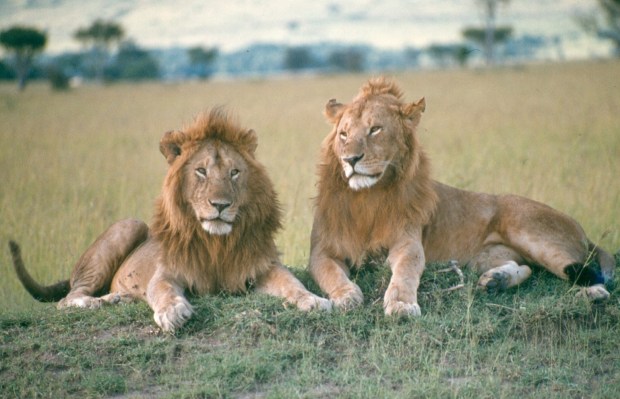
Black tea in Maasailand

There are incidents in life that have a strong influence in the future and although the improper use of a microhaematocrit centrifuge may not be the commonest of examples, it had an impact on mine.

In short, while working at a colleague’s laboratory in Muguga, I forgot to place the inner lid over the blood-filled capillaries. The result of a short spin -I switched the machine off immediately- was a bloodstain at tummy height all around, including the people present! Basil, the Head of the Laboratory while watching his own red mark at waist level, made only one comment in the best British understated style: “Julio, you need a PhD” and abandoned the room leaving me alone to clean up the mess!

muguga-isolation-unit

My usual “laboratory”, quite far from Basil’s!

Basil’s words sunk in my mind and I decided to attempt a PhD as, clearly, I needed more scientific training, in addition to learn how to properly use a microhaematocrit centrifuge! Through a Muguga colleague I managed to get in touch with Cambridge University in the UK where I was -to my surprise- accepted. Unfortunately my initial enthusiasm got quickly dampened when I learnt about the university fees and the option was quickly discarded.

After more enquiries I learnt that I could do a PhD as an external student at my former Department of Applied Zoology of the University of Wales. So, very soon, I had organized the study at a small fraction of the cost. Luckily Ian, a Lecturer and friend from the Department, agreed to be my external supervisor while my ICIPE colleague Robin kindly agreed -apart from being my tick ecology teacher- to take on the day-to-day supervision of my work.

The rules of the PhD were very strict and they included a visit by the external supervisor to Kenya. Fortunately, Ian planned to present a scientific paper at an International Protozoology Conference[1] held in Nairobi in 1985 and the time was very suitable for the review of my work.

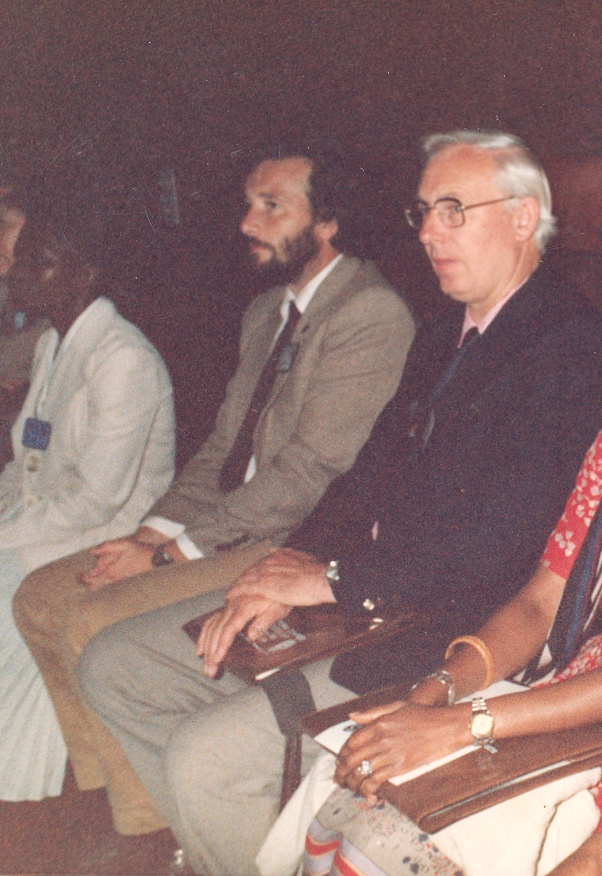
int-conf-protozoology-nbo-ian-herbert-copy

Ian, right, and a smart Bushsnob attending the Conference.

Most of my fieldwork was carried out at Intona ranch[2] in the Transmara. So, when the time for Ian to come to oversee my work, apart from the more routine visits to the main ICIPE office in Nairobi and to our Muguga laboratory, the exciting part was a trip to Intona itself. In those days, the Transmara area was an uncommon and rather exciting destination in Kenya.

As usual, the trip required some organizing, particularly as I did not wish to give a bad impression to my Supervisor during his only review of my work! I got authorization from the always kind Murumbis to stay at the main house at the ranch and to get their staff to look after us.

t-mara-intona-ranch-j-murumbi-1-copy

The main house at Intona ranch.

The one-day journey to Intona was an enjoyable one as we drove by the Maasai Mara Game Reserve where animales were always very abundant and then crossed the bridge over the Mara river to climb the Oloololo escarpment through Lolgorian to, finally, get to the ranch where we settled down and spent the next three days looking at our trials and analyzing my data.

Images of the journey, above and, below, some of the work we reviewed at Intona ranch.

The afternoon of the day after arriving, knowing that Ian was a great tea drinker[3], I decided to treat him to some five o’clock tea at the house’s back verandah where there was not only a beautiful view of the parkland and wildlife surrounding the house but also some very snug chairs.

I asked the cook to use some good Kenya tea I had brought for the occasion and we sat to chat, waiting for the fresh brew to arrive. We did not wait for long before the teapot came with the necessary milk and sugar. Tea was served while we contemplated the various art objects that decorated the verandah while the cook -trained by Sheila- discreetly withdrew.

I poured the tea and the milk and drank it while enjoying the both the taste as well as the view while Ian drank his. We talked about the journey and the animals we had seen, particularly during our stopover at the Maasai Mara but also during our trip when close to Intona. Seeing that Ian had finished his cup, I offered him more. To my great surprise, he politely declined!

When I insisted, making a comment about the tea being good, Ian mentioned that he found it with smoky flavour that he found rather unusual and too strong to his liking. Then I realized that our milk supplier was a Maasai lady from a manyatta nearby and, when I had a look at the milk, I confirmed that I had overlooked a detail: the milk was grey with a rim of dark froth!

With my apologies, I confessed to Ian that, in my enthusiasm to treat him to a proper “cuppa”, I had overlooked that our milk came from the Maasai who added a few pieces of charcoal to the milk gourd! Although Ian did not change his mind regarding drinking a second cup, he was very amused about the reason for the smoky flavour.

Although I knew that a few drops of cow urine were also added as a preservative to the milk, I did not mention it to Ian!


[1] The VII International Congress of Protozoology Held at the Kenyatta International Conference Centre, Nairobi, Kenya, 22-29 June 1985.

[2] See: https://bushsnobinafrica.wordpress.com/2015/07/08/life-and-work-in-kenya-intona-2/ and https://bushsnobinafrica.wordpress.com/2015/06/01/intona-ranch1/

[3] His favourite saying was: “Whenever there is a crisis, have a cup of tea. Many times the problem goes away after that”.

Spot the beast 17

As easy as it is beautiful. This “beast” was seen cruising on the grass looking for prey.

DSCN8015 copy.jpgFrankly, I thought it would be easier to spot!

?

?

?

However, here it is the creature for you, a harmless Spotted bush snake (Philothamnus semivariegatus) seen at Hippo Pools Wilderness camp by the Mazowe river in the Umfurudzi Park of Zimbabwe.

dscn8005-9-25-00-am-copy

dscn8018-copy

These snakes are harmless and very beautiful!

Hairy binoculars

Eyeglasses are essential for observing wildlife, particularly birds. I really believe that these optical aids make the difference between a good and a bad wildlife experience and I am amazed when I see people visiting wildlife parks without them after having travelled many thousand kilometres to do so.

For a long time I used mediocre binoculars until one day my friend Roger -a reader of this blog- showed me his Leica binoculars and I realized what German optical quality meant. He also told me that once he had a problem with his binoculars and the company immediately came to the rescue and even upgraded his binoculars to compensate him for having had a problem.

So, following his example, as soon as I could, I proudly bought my own Leica Trinovid 10X32 BN 8×32, rubber-coated and waterproof down to five metres. To use them added a new dimension to my game watching and I enjoyed them from the first use as they were easy to calibrate and use. For a while until I noticed the flaw…

To my dismay, I realized that the unthinkable had happened with my marvelous piece of optics. Somewhere inside their rubber-shielded-sealed right ocular lens system there was a hair, more precisely an eyelash, presumably of German origin!

yungas-rio-selva-2004-2-copy

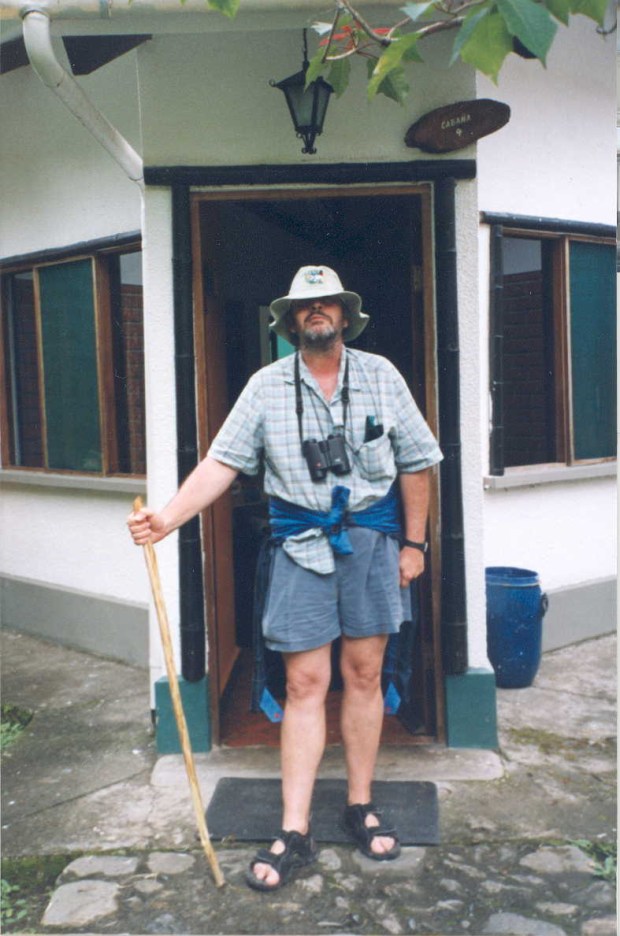
Bushsnob in Coroico, near La Paz, Bolivia. The hairy binoculars are round his neck…

You will not be able to fathom my disappointment! At Leica in Germany they were horrified when I reported the find and they offered immediate assistance. However, at the time we were living in La Paz, Bolivia and there was no official Leica representative that I could contact to mend the problem. The alternative of sending them to Germany meant being “binocularless” for a while, something far from ideal.

As the problem was manageable, I decided to continue using my hairy binoculars for a couple of years. Having spotted the intruder, now I saw it more often but it did not really interfere with my vision so I was able to use the instrument. Some time later, when transferred to Rome, I could send them via courier for a free fix, as per their lifelong guarantee with all expenses paid. So, as soon as I could, I sent them to Germany.

About a week later, I got an e-mail confirming that the now eyelash-free binoculars were ready and that they had been sent by courier back to me to arrive the next day. It was a very pleased me that went to the courier office at the FAO building as I was anxious to get them back.

I was so excited that I was there even before the courier office opened! When I managed to get in, the binoculars had not yet arrived and I was told to come back in the afternoon as the delivery was expected by late morning. Disappointed, I went back to my office until it was time to return.

I knew, by looking at the face of the courier employee, that there was a problem before she spoke. “Sir, we have a problem. Unfortunately our van carrying all parcels for today was robbed and your parcel is one of the ones lost”. My heart sunk and, although I heard that the Police was investigating the event , bla, bla, bla… I was sure of the final outcome so I thanked her and walked away, distraught.

Back in the office I called Germany and my technical contact went mute for a long while. Then I said that the parcel should have been insured but, surprisingly, he was quite cagey about it and I had the impression that it was not![1] In desperation I told him that I had an imminent bird watching trip to Uganda and that I needed them badly.

Luckily my plead worked and he offered to send me a replacement immediately, item that I got next day. I checked it and it was -luckily- hairless this time and I have enjoyed their great clean optics ever since.

p1100623-copy

Bushsnob with hairless binoculars. Of course the only visible difference is the ageing of the user!!!


[1] I still do not know if the parcel was insured or not!

Growing up

In November 2014 I shared with you the finding of a “River Plate zebra” youngster.[1]

Although I walked almost daily -when in Carmelo, Uruguay- through that area, I did not see it again so I had almost forgotten it. That is why I was pleasantly surprised when this week, almost two years later, I saw a similar animal, now almost an adult and still “approachable”.

At first sight I was convinced that it was the same horse. However, comparing today’s pictures with those above (from 2014) I had some doubts as the coloration had somehow changed. Although I would be surprised that another animal such as this could exist in my town, I consulted some “experts” with who I share beach afternoons and I was assured that changes in colour do take place when the animal grows.

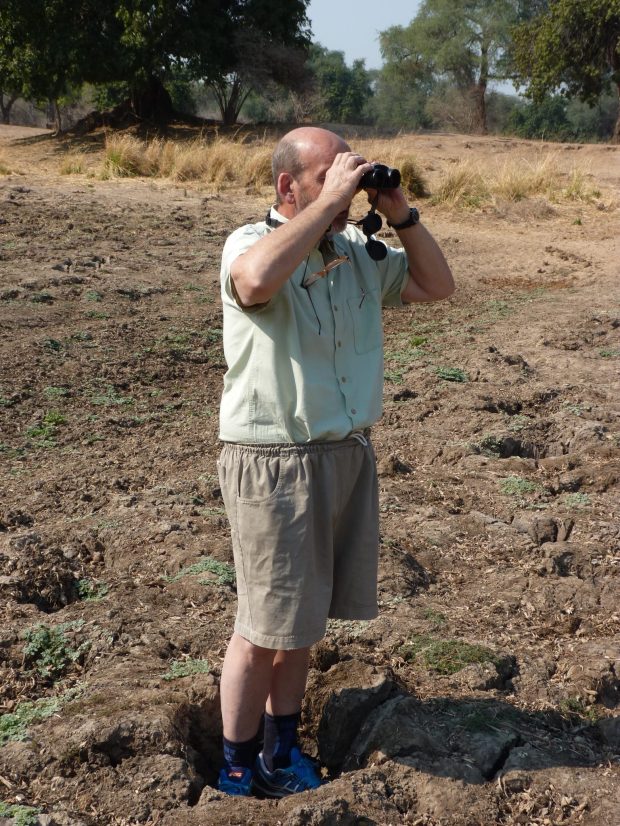
I did not dare to get close and ask her if she was the same I saw in 2014. I was fearing “horse bite” and -much more importantly- possible rude comments from some readers, particularly those from “down under”. So, I only managed to take new pictures of her from a prudent distance and speculate on its real identity.

Growing up has somehow changed her but it is still an eye-catching animal!


[1] https://bushsnobinafrica.wordpress.com/2014/11/13/almost-a-zebra/

Odd bird

While at the Kgalagadi Transfrontier Park we spent some time resting at the various camps during the hotter hours of the day. Apart from the badly needed siestas we also spent time at the various camps’ waterholes or just sitting under the shade, waiting for the sun to go down to be able to do one more game drive before the day was over.

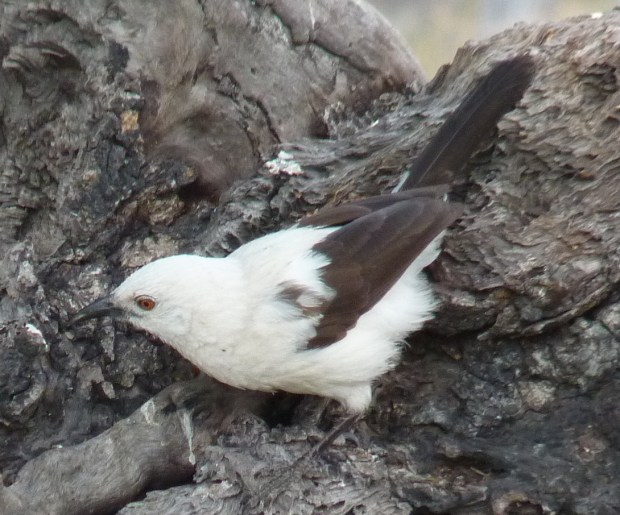
It was during one of these breaks at Twee Rivieren -the main camp at the park- that we spotted a bird that, at first, I took for a Southern Pied Babbler (Turdoides bicolor) that I had spotted earlier at Hwange National Park.

p1110004-copy

Southern Pied Babbler.

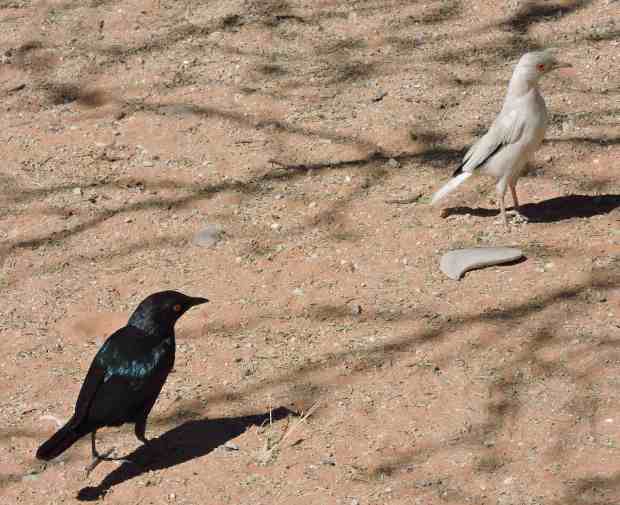
As the bird was resident among the bungalows we were staying in, I could watch it at length. After a while I noted that it was among several Cape Glossy Starlings (Lamprotornis nitens) and only then I realized that it was in fact a white starling, an odd bird!

The bird was of a dirty white colour overall with the exception of its primaries that were dark blue. Its bill and legs were pinkish and the eyes were the normal bright orange-yellow colour[1]. Its behaviour and call did not differ from other normally coloured starlings of the same species present in the area. The white bird seemed to be totally accepted by the other members of the flock and it was oblivious to its strikingly different coloration behaving as one more of the group!

dscn9917-8-59-24-pm-copy

I took several pictures of the find and decided that it was worthwhile following it up as it was the first time that I had seen such a variant. So, I Googled it once back in Harare and I came across very interesting information that convinced me that it was worth reporting it in a journal[2]. This post is based on the publication that followed.

Animal coloration can deviate from the standard, from complete melanism to albinism. Leucism (leukism) is one of the intermediate forms defined as a phenotype resulting from blemishes in pigment cell differentiation during development with the consequence that the entire animal or patches of its body being white as they lack the cells capable of making pigment[3].

The most commonly seen leucistic animals are “blotchy” and a number of bird species showing various degrees of leucism in the UK and elsewhere have been recorded, including Blackbird (Turdus merula), Jackdaw (Corvus monedula), House sparrow (Passer domesticus), Chaffinch (Fringilla coelebs) and Starling (Sturnus vulgaris) among others.[4]

As expected, leucism also takes place in southern Africa in several species including Blue Crane (Anthropoides paradiseus), Cape Sugarbird (Promerops cafer), Natal Spurfowl (Pternistes natalensis), African Stonechat (Saxicola torquatus), Fiscal Flycatcher (Sigelus silens), Magpie Shrike (Corvinella melanoleuca), Spotted Eagle-Owl (Bubo africanus) and Ludwig’s Bustard (Neotis ludwigii).[5],[6]. A blotchy Cape Glossy Starling has also been recorded from the Kalahari[5].

As the bird was resident at Twee Rivieren and it appeared strong, it would be interesting to follow its life to determine if it is able to pass on its leucistic characteristics to future progenies in the area.


[1] Roberts 2012-2013. Roberts VII Multimedia Birds of Southern Africa. iPhone and iPad Edition, Version 2. 2012-2013.

[2] de Castro J and de Castro M (2016). Leucistic Cape Glossy Starling, Lamprotornis nitens. Biodiversity Observations, Vol 7.74: 1-3. URL: http://bo.adu.org.za/content.php?id=267Published online: 10 October 2016

[3] Sibley, D 2011. Abnormal coloration in birds: Melanin reduction. Accessed on 1 October 2016. http://www.sibleyguides.com/2011/08/abnormal-coloration-in-birdsmelanin-reduction/

[4] British Trust for Ornithology (no date). Accessed on 4 January 2017. https://www.bto.org/volunteer-surveys/gbw/gardens-wildlife/garden-birds/behaviour/plumage/leucism

[5] Benadie, M 2007. Avian Colour Oddities. Accessed on 27 September 2016.http://www.birdinfo.co.za/rarebirds/25_avian_colour_oddities.htm

[6] Little, R 2014. Bright white. Leucism and albinism in birds. African Birdlife July/August p14-15. Accessed on 27 September 2016. http://www.fitzpatrick.uct.ac.za/sites/default/files/image_tool/images/275/Publications/semi-popular/2014/AB02(5)14-15.pdf

Bush cats…

While in Kenya, when a couple of friends departed, we inherited two neutered cats. They could not have been more different. One was a marmalade coloured male that went by the name of Tigger. The other one a seal-point Siamese female named Inky. While Tigger was an indoors fat and lazy youngster, Inky was an outside cat and an excellent hunter that forced us to make our bird feeder and bath cat-proof to prevent a disaster.

When our time to leave Kenya came, we were very attached to them and we decided to take them with us. After the needed health certificates and a special double box that would enable them to have eye contact through wire mesh, we were ready to go. The plane trip was not too far as we were going to Addis Ababa.

It was an easy trip and we found no difficulties on arrival at Bole airport. However, negotiating their stay at the Harambee Hotel in Addis Ababa for the days needed to prepare our long trip to Bedele in West Ethiopia was more time-consuming and it required some protracted negotiations. Eventually, permission was granted, provided that they remained inside our room!

After a few days, our travel permits were ready, we had a vehicle, petrol and petrol coupons as well as a stockpile of food to last us for a couple of weeks. We were ready to set off, at last. The journey from Addis Ababa to Bedele via Jimma was about 420 km in terms of physical distance but because of the traffic -particularly people and livestock walking on the road- it took the whole day to complete, with a bit of luck!

finchaa-tick-count-2-copy

On the way to Bedele.

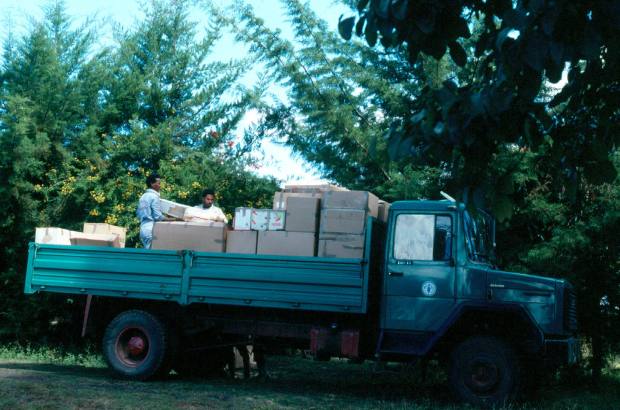
Auspiciously, our maiden voyage went well and we eventually arrived in Bedele in late evening. We managed to get the keys of our cottage from the Administrator of the Veterinary Laboratory and moved into the house we would live in during the following two years. That night we camped in the house as we were only able to travel with the few possessions that we could carry in the pick-up. Our furniture and other household items would arrive later via an FAO lorry as, at that time, there were no moving companies operating in Ethiopia’s countryside.

bedele-packing-fao-lorry

The arrival of our personal effects.

Immediately after arrival our cats got on with their job: Tigger found a place to sleep and Inky started to inspect the house and its environs while calling for attention, before settling down with us to spend the first night in the Ethiopian bush. Starting the following morning, our interaction with our Ethiopian and foreign colleagues assisted us greatly to settle in and, with the arrival of our belongings a few weeks later, we managed to make the place quite comfortable. Eventually we developed a very good vegetable garden and, while Tigger relaxed, Inky was active keeping garden enemies at bay.

Unexpectedly Tigger started to follow Inky during her sorties to the outside world, cautiously at first but eventually accompanying her on her hunting expeditions although we did not think much of his contribution!

It was during an evening that we were involved in book-reading while listening to some opera music, our favourite evening activity in Bedele, that Tigger stunned us. It all started when we heard a kind of meowing that was new to us. Fearing some cat tragedy we immediately went to investigate its origin. We did not need to go too far as we met Tigger while entering the house carrying something in his mouth, followed by Inky.

As soon as he was under the entrance lamp we could see that he was triumphantly carrying in his mouth the most humongous rat I have ever seen. While I was amazed to see this my wife was consternated as she has a problem with rodents, particularly rats and mice. It was not a Giant rat or a Cane rat but one of the grey rats that are a pest the world over. But it was a “super rat”!

I failed to calm things down by saying: “he brought the rat to us to show off…” Before I finished my sentence, I noticed that the rat was alive and, sooner than I could say anything else Tigger let the rat go inside the house! I expected that he was just playing with it as normal cats do but, to my dismay, not only Tigger but also Inky (the huntress) were looking the other way while the rat made frantic efforts to escape from the house!

The situation was a bad one and I will never know why he opened his mouth! My theory is that, as soon as he saw his catch under the house light, he got so terrified that preferred to forget the possible glory and cut his losses! Although I failed to see it at the time, today, many years later I can understand the cats’ reaction as the rat was a true monster. However, I am still to forgive them because their indifference meant that it was up to me to sort out the situation!

Mayhem followed the rat’s release! My wife climbed on a chair threatening me with going on a cooking strike if I did not kill it while the guilty cats disappeared with their tails between their legs!  I was alone with Super rat! The first thing I noted was that it had no plans to surrender peacefully. As usual, it was fast and it immediately found a crack in my defenses and it squeezed through a badly closed door and got inside the kitchen, the worst scenario as far as my wife was concerned. My situation deteriorated by the second!

I followed it but when I entered the kitchen and managed to switch the light on, the rat had vanished! Swiftly, my wife slammed the door behind my back, oblivious to the fate of her husband, and then it was Super rat and I in a duel to the death, if I could find the villain.

Although our kitchen was a small affair it was rather packed with goods for us to survive our rather isolated life in a war-thorn country and away from shops! I had a look and realized that the rat could have been anywhere and that to find it would have been a laborious and even dangerous task that could prolong well beyond midnight!

So, I procrastinated -not for the first or last time in my life- and sat there for a while before announcing the rat’s absence to the incredulity and displeasure of my wife. However, she eventually though reluctantly accepted the status quo. Swearing at the cats we went to bed and, luckily, the following morning I opened the door of the kitchen and convinced my wife that the rat had gone. It worked and I was thrilled to be unharmed.

The rat incident forgotten, our cats continued to live regal lives, enjoying the large track of land surrounding our house and stalking the various birds that visited us. Luckily, I did not see them catching any but they did repeatedly ambushed a “rescued” Egyptian goose we kept for a while until it decided to depart, and watched for hours on end a pigmy kingfisher that was brought to us by a boy from the village and eventually released. They also enjoyed playing with a young duiker that outsmarted and outran them all the time.

As they seemed to be well entertained and busy, I cannot understand why they decided to expand their circle of friends and get in touch with some wild neighbours at the back of the garden…

We learnt about the new situation when we started to hear a high pitch barking in the evenings that we attributed to foxes. Eventually we saw them at about one hundred metres from our house, near the perimeter fence of the station. After watching them for a few days we identified them as a pair of side-striped jackals (Canis adustus) not without some surprise. We decided to keep the find to ourselves for fearing of they being chased off or killed.

mc-and-pets-bed

My wife walking in the garden with cats and duiker. At the back is where the jackals were.

We realized that the jackals were residing under some heavy iron pieces that should have been an incinerator that was never assembled. Our sightings became more frequent and then we realized that pups had arrived so we derived good entertainment from them as we saw them often and heard them every night.

One day the cats were nowhere to be found. At first we were not alarmed, as occasionally they would temporarily disappear. However, when they did not turn-up by the afternoon, we decided to search for them before it was too dark. After fruitlessly checking around the houses, we extended our search to the compound, increasingly worried.

Eventually we saw them at the bottom of the garden, in the area where the jackals were! “Gosh”, I thought, “They are dead meat” and run towards the area to see what I could do while cursing them for their stupidity. When I got closer, however, I noticed that not only the cats were unharmed, but that they were engaged in a kind of hide and seek exercise with the wild jackals, both adults and pups!

I then realized that this was not a new development but a relationship that had existed for a while and a kind of “friendship” had developed between our lazy and well-fed cats and the wild canids. I left them alone and the cats returned to our house later unharmed. The cat-jackal interaction continued for a few weeks but they never came close to the houses and eventually, when the pups matured, the jackals moved off.

As for the giant rat, a few days after the jackals’ disappearance, while blindly searching for some cans in the kitchen, I touched a hairy and warm “entity” and realized that this was not what I expected to find. Careful removal of the surrounding cans and jars caused the rat to jump out -almost hitting my face and stopping my heart- and run off into the open, never to be seen again. I believe that Super rat had taken residence there since the time of its arrival.

Luckily my wife was not there while I removed all evidence of the presence of Super rat. It was a tough job that required that I cleaned the nest in which I could identify shreds from some of my working reports and documents that I thought I had misplaced!


Spot the beast 16

The rain offers numerous blogging opportunities on the “spot the beast department”! Here is another one for you to find (Only look at the next picture below if you cannot find it!)

DSCN9914 12.17.44 PM copy

?

?

?

?

?

?

?

?

?

DSCN9912 12.17.44 PM copyIt was difficult but it was spot on in the center of the picture! It had a sad expression also!

It is the flap-necked chameleon (Chamaeleo dilepis) the most common sub-Saharan chameleon.

Of least concern according to the International Union for the Conservation of Nature, I have the impression that their numbers are declining, at least in urban Harare. Some attributed this to the proliferation of security electric fences that, apparently, can kill them.

The flap-necked chameleon lays 10-40 eggs in a hole dug in soil. The latter take an amazing 10–12 months to hatch! A very long time if we compare it with other animals such as the Nile crocodile that takes 90 days! To watch the hatching of the perfectly formed and miniature young is simply amazing.

Luckily, this rainy season we have found a few so the situation may not be as bad or the frequent electricity cuts had yielded some benefits!

Beetlemania

J.B.S. Haldane, a  British-born Indian scientist in the early 20th century, when asked if there were anything that could be concluded about God from the study of natural history, replied “An inordinate fondness for beetles.” There are 380,000 catalogued species of beetle, making them the most species-rich group of insects—and insects are the most species-rich group of animals.[1] 

Beetles are some of the creatures that the rains also bring out and I thought it interesting to present you with those that we have found in our garden in Harare. I trust that you will enjoy the pictures.

A few of what I believe are Darkling beetles:

dscn9932-copy

dscn9934-copy

anomalipus-elephas-large-armored-darkling-beetle-copy

Large armoured darkling beetle, Anomalipus elephas.


Darkling beetles belong to the family Tenebrionidae. Like Tenebrio, the beetles seek dark places, demonstrating a preference for the absence of light.

Another Tenebrid beetle, the Striped Tok tokkie, Psammodes striatus -below- tap out a rhythm on the ground to attract and locate mates.

psammodes-striatus-striped-toktokkie-copy


Below is a rather nice beetle that was found while walking in the neighbourhood and was returned to the wild after the pictures were taken, after it had a look at its close relatives in the Southern Africa insects book from where it is absent, as shown below…

Small Goliath beetle, Cheirolasia burkei.

dscn9998-copy

The beetle visiting relatives…

Below is the first Giant Longhorn beetle (Tithoes confinis) we have seen, after a “close encounter” with our Jack Russell bitch that clearly won the fight as the beetle lost a few legs and one of its antennae, regrettably. However, it managed to fly off after I took the pictures. I am really impressed by its mandibles!


Below, a female of the Orange-Spotted Fruit Chafer, Mecynorhina passerinii:

mecynorhina-passerinii-the-orange-spotted-fruit-chafer-copy

Rhinoceros beetle, Oryctes boas, is a nice-looking beetle that, regrettably, is a pest of the coconut palm (Cocos nucifera). The insect burrows into the tree’s trunk and is difficult to control, causing about 2% of the losses of coconut palm trees along the Kenya Coast.


[1] http://www.economist.com/news/science-and-technology/21646647-why-are-there-so-many-species-coleptera-beetlemania

Memories – A fishing trip

Thomas was one of our Maasai askaris[1] at Intona ranch. He liked cattle so, in addition to his guard duties, he often volunteered to take them for grazing. This was welcome as he was fearless when it came to walk in the bush and dealing with the buffalo herd that often intermingled with our cattle. It was rather amazing to see the herdsmen and Thomas separating our cattle from the buffalo herd!

Intona cattle grazing

Intona cattle kraal

Thomas was a very friendly young man and he got on very well with the other workers so, when I proposed to the workers to join me in a fishing trip, Thomas was very keen on the idea and he came along.

During the time of the fieldwork I often travelled to Intona ranch over the weekends, as I also needed to spend time working in Muguga on the laboratory trial during the week so time was short. Although there was some work to be done on Sundays, we tried to keep this to a minimum so that we had time off to rest and relax. Being rather restless I was always looking for some activity to do during this free hours. For this visit I had brought some fishing gear as I wished to try my luck in the Migori river, one of the boundaries of Intona ranch.

migori-flooded-cropped

The Migori in flood. We fished from these banks.

The Migori river water ends in lake Victoria after it joins the Gucha river forming the Gucha-Migori river basin. During every trip that we came to Intona via the Maasai Mara we crossed the Migori river bridge about 10 km before we arrived to Intona ranch. The area was well forested and there were a number of large fig trees in its vecinity making it a very attractive area as the shore of the river before the bridge was open grassland and seemed safe from the presence of buffalo, the main danger in the area.

It was in this bend by the river that we often saw a sounder of Giant Forest hogs[2] (Hylochoerus meinertzhageni) grazing in this clearing. As these dark grey animals were a rare sight, it was a highlight of the journey for me whenever we spotted them, as they were quite tolerant of our presence with their impressive size, the males being about 100cm high and up to 190cm long with a mass ranging from 180 to 275 kg. Their name honours Richard Meinertzhagen who shot the type specimen in Kenya and had it shipped to the Natural History Museum in England in the early 1900s.

This “hog spot” is what I chose for our fishing expedition as, apart from catching fish, I also hoped to get a glimpse of these animals towards the evening. Our fishing targets were Clarias gariepinus or African sharptooth catfish. We had fish them earlier in the Mara river just outside of the game reserve and I saw no reason for them not to be in the Migori.

After fruitlessly digging for earthworms at various places in the bush I remembered Mrs. Murumbi’s greenhouse and garden at the main house and, after a short commando sortie we managed to get a handful from the large compost kept there.

The final preparation for the fishing trip was to run a tutorial on the basics of fishing as none of my companions had done this before, as they did not come from fish-eating ethnic groups. Aware that it had taken me some time before I could master the proper use of rod and reel, I decided that I would handle these equipment and prepared a couple of hand lines for my companions to use. We chose an open field and, after a while I judged that the team was as good at fishing as it could be so we went.

We left before lunch and took some food and non-alcoholic drinks for lunch and my companions were quite excited at the prospect of trying a new activity. Thomas in particular could hardly control his excitement and this somehow dented my understanding that the Maasai did not care for fish. Maybe Thomas was the exception?

After a quick lunch under the shade it was time to try our luck. I gave hand lines to Thomas and Joseph, I kept one rod and gave the other one to Mark. As expected, the earthworms were attractive as I felt them biting as soon as my hook landed.

Somehow, Thomas got lucky and hooked something that after a short struggle with a rather thick hand line happened to be a reasonable catfish. After a short squabble he soon had it out of the water and his happiness at his feat was incredible. It held the fish with both hands looking at it and laughing while talking to it. He said that he would eat it, something I found strange but, busy with my own fishing, I did not pay much attention. So, Thomas departed to clean his fish. We continued fishing and had some bites that, regrettably, resulted in clean hooks.

maasai-that-got-cut-with-fish-migori-river-copy

Thomas and the fish!

After a while we noted Thomas’ absence but, distracted by our own fishing, did not think much of it. After a while longer of not seeing him and knowing that many dangerous animals were present, we stopped fishing and went searching for him. Joseph went one way and I took another path thinking that like that we increased our chances of success.

After walking perhaps 100 m following the river I saw Thomas seating down against a tree and I called him but did not reply. I called him again but still no reply so I assumed him to be sleeping and got closer to wake him up and then I saw his unsheathed simi[3] and the pool of blood. He had a bad cut in the palm of his right hand that was bleeding profusely and he was very pale.

I shook him and he opened his eyes and, still smiling, looked at me. He was weak but alive and, lifting his wounded hand above his head, I helped him to walk towards the car, calling Joseph to come and help. He appeared and, between both of us, we took him to the car and drove him with his hand bandaged and up outside the car towards the Lolgorian seeking medical assistance.

Maasai lived rather dangerous lives. Not only they fought often among themselves with serious consequences but also, as I described in an earlier post, they were constant skirmishes taking place at the time with the Kisii ethnical group that was moving into the Transmara. As if this would not be enough, they walked through the bush where many dangerous animals dwell. Although they do not fear them, they often suffer the consequences of encounters with wild animals, in particular with African buffaloes as these animals camouflage well and attack by surprise and without notice.

This way of life explained why the Lolgorian clinic was very busy that Sunday afternoon. Concerned about Thomas’ condition, I entered the hospital running and went straight to the emergency room asking for a doctor. A nurse pointed me to an European young guy in white that I assumed – correctly as it turned out – that he was a doctor.

I hastily mentioned that I had an injured person that needed his help and he gave me a rather tired look and motioned to me to look around. In my haste I had not paid attention to the “waiting room”! There were at least five people waiting before Thomas. A couple looked sick with malaria but the others were suffering from various traumatic accidents. I remember one that was holding his bloodied abdomen and another that had almost severed his large toe. It was clear that Thomas would need to wait.

Without much ado the doctor asked me to help him and I spent that Sunday afternoon cleaning wounds and helping him to stitch the severed toe and to close an abdominal wound caused by a buffalo horn! I was shocked by how stoic people were throughout the proceeds and this included Thomas’ stitching, comparatively a minor affair.

After finishing with Thomas, we thanked the doctor and left. During the return journey with a much more recovered Thomas, we learnt that while gutting the fish he had tripped and fell. During the fall his right hand had slipped over the length of the simi’s blade and had cut his hand very deeply.

With a much-recovered Thomas we arrived to the fishing spot at dusk where, before we collected all our fishing gear abandoned earlier, we had the privilege of watching the gian forest hogs! Thomas, now feeling strong again, collected his fish and, laughing again, assured us that he was going to eat it!


[1] An askari (from Arabic) was a local soldier serving in the armies of the European colonial powers in Africa. The term is still used today to informally describe security guards.

[2]  Listed as of “Least Concern” as they are relatively widespread, it is acknowledged that there is a general decreasing trend for the species across its range. In Kenya, Ethiopia and South Sudan Giant Forest hogs live also in very fragmented populations.

[3] A short sword used by the Maasai people with a leaf-shaped blade. It is kept in a scabbard made of wood and covered with rawhide.

Impaled

While walking in our neighbourhood we came across an interesting find. A small beetle had been impaled on a thorn of a fever tree. It looked like one of the abundant blister beetles so I was not too worried about it. Although it was the first we had spotted, it is not a surprise as we know that a few shrike species are present around our area.

dscn447-copy

Shrikes are carnivorous birds that, despite their small size, can tackle much larger prey than the beetle we found. We had seen many impaled insects while in Kenya.

One of the “skewers”, the Common Fiscal (Lanius collaris) have been reported diving for tadpoles and small trout and they eat a variety of prey including snails, moths, lizards, chameleons, snakes, frogs, rodents and other birds, even as large as a laughing dove![1]

The find reminded me of another interesting accident that we witnessed years back while visiting Tsavo West National Park, although it was clearly unrelated to shrikes!

It happened while on a game drive near Kilaguni lodge. There we always stopped to watch a tree that marabou storks (Leptoptilos crumenifer) used for roosting as it was nice to observe their preparations for the night.

That afternoon, we noted that one of them was in an odd position. It was immobile and swinging with the little wind there was. Closer inspection revealed that the poor bird was impaled from its gular sac on one of the powerful thorns of the tree.

DSCN9892 8.51.32 PM copy

A good shot of a Marabou’s gular sac in Mana Pools, Zimbabwe.

It was a very unusual find and up to today we debate the possible reasons. The most likely explanation is that it somehow got its sac hooked on a thorn and it was unable to extricate itself from it, dying in the process. Luckily, I found the only picture I took!

kilaguni-t-west-hanging-marabou

Not all is nice in the bush but, again, Nature is like that.


[1] Roberts VII Multimedia Birds of Southern Africa. iPad Edition, 2012-2013.