Witches[1]

While staying in Muguga House, transport was a problem as, to get to Nairobi it meant a 10km ride to access the main road and then find public transportation to and from the capital city. That meant that the shortest of the trips would involve a full day! The situation improved later when I got the VW Kombi. This allowed us also to move out of the temporary Muguga House’s bungalow to a proper house in Tigoni.

In the meantime, we explored the Muguga surroundings on foot following the many tracks used by the local inhabitants in their daily errands. The soil was red, seriously red, and slippery and the paths narrow and sinuous! Falls were funny affairs until we realized that to wash the red stains from our clothes demanded quite an effort so, after the first experience we strode with great care! It was good exercise and it gave us a chance to come into contact with the local people, particularly the women and children.

Among the colleagues sharing Muguga House was Ranjini, a British expert on plant viruses, particularly maize streak, who was also starting her career with the Overseas Development Administration[2] on the plant health section of the Kenya Agriculture Research Institute. Although she was reserved at first, my wife and I became friends with her (up to today!). She had a sharp sense of humour that, according to her, she inherited from her Sri Lankan father. She had very long dark hair worn loose.

Ranjini and other British colleagues of hers were used to walking and they did it frequently. Walking was not an activity that was performed in Uruguay so we were rather unfit and the few ocassions we tried it was a bit of an embarrassment as we lagged behind! Of course we attributed this to the Muguga altitude knowing very well that we were unfit! The situation improved after a while and we could join the ramblers more comfortably although we could not match them. We frequently walked with Ranjini, who had a slower pace and with whom we shared more interests.

The day in question was a Sunday and we left a bit late. We took the path towards a patch of indigenous forest as there were always interesting birds to be seen there. Mabel and Ranjini were walking in the front and I followed. As usual we met a few people who greeted us with the well known “jambo[3] or its Kikuyu equivalent. A few women were on their daily errands which included carrying a 20lt jerry can of water on their heads, and a bunch of firewood on their backs all while knitting some pullover for their children. I never stopped admiring them! Oh yes, and walking more steadily and faster than me. Others were going to catch a “matatu[4] to go to town or visit relatives while quite a number were dressed for mass.

We were traversing a bit of open ground and a little boy of about 4 years dressed in his best Sunday clothes never saw us coming, busy looking where he was stepping, probably following his mother’s directions to keep his shoes clean! Two of his sisters, his mother and another lady (his auntie?) accompanied him, also dressed up. The boy was at the front of the group.

The moment the boy heard people coming towards him, he looked up. Until that instant he wore a happy face and we had seen it. It took only a split second for his expression to change into a look of terror, followed by a loud scream. He immediately started crying. Unfortunately for him he had just seen three white aliens without warning! I am sure that what was particularly terrifying for him was to face two of them with very long hair advancing on him. His instinctive response, after the initial shock, was to turn and run for the safety of his mother. It would have worked if only he would not have slipped and fallen.

Although his mother moved towards him, the witches were closer and got to him first with the intention of helping. Somehow, this was not the little boy’s perception of the situation and, finding himself “alien handled” he cried even louder in a fit of deeper terror! While his immediate relatives started to chuckle at the scene unfolding, eventually, with the help provided by the witches, he regained the needed mobility and rushed to his mother, burying himself in her skirts and almost disappearing from sight!

Our concern for the boy’s welfare turned into amusement the moment we saw his family laughing whole-heartedly at the incident. I am sure that somehow the encounter remained with the youngster for sometime!


[1] See also: https://bushsnobinafrica.wordpress.com/2015/03/10/kenya-muguga1/ and https://bushsnobinafrica.wordpress.com/2015/06/30/life-and-work-in-kenya-muguga1/

[2] Now known as The Department for International Development (DFID).

[3] Swahili for “Hello”.

[4] Swahili for a minibus used for public transportation.

Rattled!

Important issues such as passport renewal and visits to our family doctor compelled us to leave Salta for our small town of Carmelo in the shores of the river Plate. The night before our departure my wife and I were busy with the packing and other arrangements to leave our farm in good order for our return towards the end of April.

At some stage we were both outside engaged on different tasks when I heard my wife saying, “was that you rattling?” “As far as I know, I still move about freely and free from rattles” was my curt reply, slightly upset by her sarcasm. And then I also heard the noise, an “shhhhh, shhhhh” coming from the garden. “You are right, there is some rattling but is not me” I said to her and added, “I think it is moving this way…” Before I could finish my sentence, my wife interrupted me saying in a voice she reserves only for some creepy-crawlies (snakes, mice, and sometimes myself!) “a snake is coming there”. She pointed towards the general area and that was the last I saw of her for a while, disappearing behind the verandah’s door into the house at a speed.

The snake was in the dark and I could not see it well but I suspected it to be a rattlesnake (Crotalus durissus terrificus) judging by the noise it made. I knew these snakes were present in the area although they are not commonly seen.

I managed to switch the outside light on without losing sight of the visitor that was heading for our house. I was immediately reminded by an invisible wife to keep the back door closed. So it was the snake and I!

Now, what do you do when one of the dangerous creatures from Nature comes for a visit? Ninety-nine per cent of the people around the area will immediately kill it as, reasonably, they regard this as a threat to themselves, children and pets. I could have done this and save myself lots of trouble but I did not!

I watched the snake moving gently towards me and veering off at about a metre from me to seek shelter under one of our large plant vases. I waited and it did not come out so I guessed that I would have sufficient time to run into the house, get a hook from the fire place and come back to check on it. I did and it was still there so I decided that I could now search for our “chameleon box” that was somewhere in the house. Luckily I found it quite fast so I was ready for the capture.

IMG_0851 copy

The bushsnob with the fire hook.

IMG_0855 copy

Hooking the snake and dropping it into the chameleon box.

The rather large pot was moved to get a chance to hook it but, as expected, the snake moved off but I managed to hook it and lift it inside the box, rather skillfully I thought, pleased with myself. The box was perfect as it is very well built, with a glass front and a metal grid on top. The snake was secure and safe. I won the first round.

After a detailed conversation over dinner I managed to convince my wife that the best course of action was to release the snake far from our farm and, after lot of discussion, a distance of about 4 km was considered safe, as it would be difficult that the snake would return! My victory had a pyrrhic side to it, as now I needed to move the snake from its present location to a suitable container so that I could carry it away.

I considered the various options and settled for a cardboard box with high walls as to avoid it from climbing out before I closed it safely. I like snakes in general but I respect poisonous ones very much so I like to play safe and keep a good distance to avoid surprises!

Luckily the following morning the snake was probably cold and scared so it allowed itself to be lifted from the cage into the box rather easily and I even had time for a picture taken by my wife. (Between you and me, it was trickier to persuade my wife to take the picture than to handle the snake into the box!).

P1150718

Safely inside the box. Luckily the snake was more scared than I.

P1150720 copy

Coiled and rattling.

We then loaded the snake at the back of our pick-up and departed for Uruguay stopping after 4 km to let it go. I opened the box, readied the camera and expected an elegant exit to take a few pictures to illustrate this for this post. As the snake did not leave the box after a couple of minutes, I tilted it and the snake finally slid off, still coiled up. However, before I could even think on a picture, it took off at a speed, luckily away from us and into the bush. I had no time to take a shot but, amazingly, my wife did, I am not sure how!

IMG_0862 copy

The snake took off at a speed towards the bush.

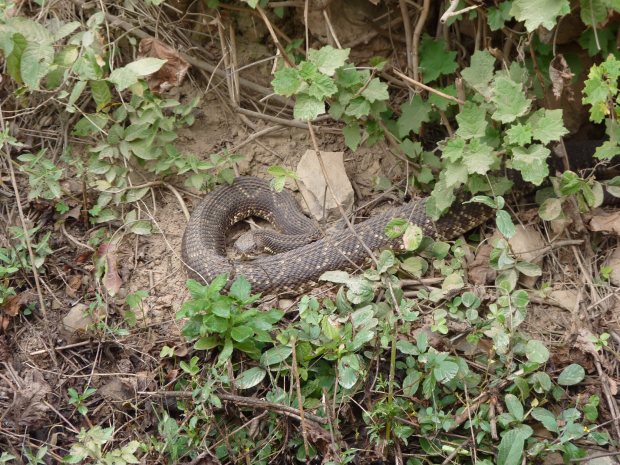
After watching the snake getting into some cracks in the rocks and out of sight, we rattled off.

Four in one

From our first visits to our farm in Salta it became apparent that its insect wealth was enormous. In particular, as you have read here, butterflies and moths really rule. The latter in particular are very varied and abundant. Being attracted by the light makes them easy to capture, observe, photograph and, eventually, release. In the early morning the trick is to be there before the insectivorous birds that do not care for beauty but taste!

I have described and published posts mainly on butterflies for two main reasons: they are colourful and photogenic but also better known in the area. Moths are difficult and, although I have taken pictures of a few hundred specimens, I am still waiting for their identification as the group’s taxonomy does not seem to be well known. The consequence of this is that most of the time I do not know what I am looking at in a taxonomical way. I then need to resort to my own classification by colour, shape and size that produces specimens such as “mottled brown medium size”, “barred brown with delta wings” or “large and smooth hawk moth”, etc.

A couple of days ago I came across one specimen that, although I have seen before, it is infrequent but rather attractive. Looking at it from its dorsal part, I could see a figure on its back that looked like a face (with Ray-Ban seafarer glasses?) or a cat face.

My wife saw a butterfly and, in December 2014 when I first saw it, I described as a moth “white with skull on back” It was like a psychological test I undertook in my childhood where you are asked to describe what you saw!

Later, looking at the pictures, there were more creatures to come out!

A dorsal view of its head showed a monkey face (agreed by my wife this time although the discussion centered on whether it was a baby Colobus or a Vervet!).

The final surprise was when we looked at it from the front. I saw a clear dog’s face while my wife saw a rabbit head!

Amazed by the various beasts we saw, we almost forgot that we were looking at a simple moth. However, it was one of Nature’s specials depicting three different creatures, apart from itself, a feat that I believe is difficult to match!

A tough owl…

Burrowing owls (Athene cunicularia) used to be very common in Uruguay in the past and I remember, about 50 years back, seeing them perched on fence posts at frequent intervals. Regrettably, the advent of generalized use of pesticides meant that they almost disappeared and they are now relatively rare.

We were happy to find that in the Yungas of Salta, where our small farm is located, they are quite common, particularly in an area devoid of tree cover a short distance beyond our farm where we watch them from time to time. Luckily pesticide use here is still rare!

It was during one of these visits that we found the group composed of probably two adults (placed at both ends) and two babies showing only their heads, ready to disappear down their burrow in case of emergency.

P1150264 copy

I was busy taking the first set of pictures when the adult on the left started to run towards me. I was quite impressed by its threatening behaviour as -I thought- it takes courage to attempt to scare off a large ape! It bobbed its head repeatedly, a normal behaviour of these birds and a couple of times it actually appeared to dig and scratch the soil with its beak. After a while it ran back to join the rest of its family and stood again where it was earlier.

P1150240


P1150237 copy

P1150244

After a while we left them to enjoy their owl family life and we returned to our log fire at home. Much later, while checking the pictures taken that day, I realized that in fact the owl was not threatening me but that it was after prey! I had missed the details in vivo but these were apparent when I looked at the various pictures.

The owl had spotted a large beetle half way from me and it rushed to get it (rather than to scare me off!), caught it, tried it and spat it out, as it must have tasted bad! I can only assume that he discarded it, as I believe that eating it would have taken some effort! Although I fear for the beetle after the rough treatment received, these insects are quite common around here and I do not believe that its absence will be noted…


Wet blogging!

Probably, through earlier posts I gave you the impression that living at the foot of the Andes is a dream. While this is true to a very large extent, it also has climatic and technological shortcomings that need to be accepted to enjoy it.

The climate is dry and cool in winter with most days being sunny and warm in the middle of the day when it is possible to be outside wearing a short-sleeved shirt. At that time some frost does take place at night, responsible for our failures with our tree and plant growing efforts but otherwise life is great at that time. Unfortunately, we visit Salta in summer and autumn!

The summer is hotter and rather humid. The rain in some areas reaches up to 2,500 mm (2.5 metres!) and cloud forests are the predominant kind of vegetation around us. For a cloud forest to be such the clouds must meet the trees and we are in the middle of this get-together as our farm ranges in altitude roughly from 1,300 to 1,900 metres. As these meetings take place rather often, sunshine is not the most common phenomenon around here now!

As a consequence of this heavy precipitation the area gets waterlogged and the water must drain somehow towards the larger water bodies, in our case the Mojotoro River in the gorge below. As gradients are marked, water runs wild and swells up fast. Sometimes this surprises you as it may rain higher up in the hills and you get the water rush but not the rain.

The entrance to our small-holding crosses a small watercourse that in winter is just a small dry ditch. The fun takes place in summer when, once the rains arrive, it again becomes a stream. This adds a touch of beauty to the farm until we have heavy rains! When this happens, the normally peaceful stream “comes out of the bottle” and transforms itself into a torrent that we can only watch while waiting for it to subside. This normally takes a few hours during which our lack of communication is wide-ranging.

20160224_133413 copy

For a few hours we are either in or out!

This brings me to the technological issues. The high hills surrounding us interfere with the telephone and Internet signals at the best of times. Well, there is a cell phone signal 3 km away on the access road and, of late, a basic Internet signal across the road, at the door of the public primary school. While the lack of communications makes the place a true nirvana to read and write, it has a negative impact on blogging and “Instagramming” productivity that, at this time, tends to be rather infrequent as you have probably noted by now…

IMG-20160325-WA0005 copy

The bushsnob taking advantage of the public internet to reach the world.

On the bright side, a recent study in the farm next door[1] detected the existence of 152 species of butterflies (Hesperioidea y Papilionoidea), 14 spp. of amphibians, 23 spp. of reptiles, 216 spp. of birds and 28 spp. of native mammals.

Believe me, it is worth getting your feet wet to be able to reach our communication “hot spots” when you can watch new creatures daily while reaching them!

20160225_094352 copy

One of the frequent photographic interruptions getting to the cell phone signal.


[1] Moschione, F.N. (2014). Relevamiento de Fauna. Finca El Gallinato, La Caldera, Provincia de Salta. Informe Relevamiento 2013-2014, julio de 2014. Proyecto de Conservación de Bosque Nativo. 55p.


Jumping lichen

Grasshoppers and/or locusts -I cannot tell them apart- are also plentiful in our farm and surrounding area. Dazzled with more colourful critters we tend to overlook them as they normally jump off and they are gone into the grass, quite far away from the observer to enable it to re-discover them. In addition, they immediately seek further shelter under the leaves.

Sometimes, however, we do find some, either because they are still young and prefer to stick together rather than use their strong legs or because they make the error of entering the house or the car or, who knows? maybe because they are lazy.

P1130552 copy

Being attractive creatures I present you with a couple of pictures as an introduction to the subject that let’s me tell you about one particular grasshopper I “discovered” yesterday.

I was in one of my insect-watching sorties, focusing on moths the morning after to take a few pictures for my “collection” when a greenish flying insect caught my eye. Luckily I saw it landing and went for a look. Its flight took it to a pine tree trunk, covered with lichen and moss. I spent a few minutes searching the landing spot and I only detected the insect as it shifted its position slightly and moved some lichen that caught my eye.

P1140969 copy

When I focused on the movement I realized that the lichen had not moved but it was in fact the creature shifting position! It is the most perfect example of camouflage I have seen so far (well, perhaps of green camouflage…) and I prefer to show it rather than trying to explain how it looked. It was about 3-4 cm long

P1140968 copy

P1140966 copy

P1140964 copy

P1140963 copy

P1140962 copy

A series of pictures showing the very well camouflaged “hopper”. I could not believe how well its head mimics some of the “leaves” from the lichen around it!

Unfortunately while I was busy taking the pictures it jumped off and I am still trying to find it again…


NB: I found a younger brother that I managed to keep until I can get some more pictures of it to show you!


Mutant moth!

I have spent three years photographing butterflies and moths at our farm located in the phytogeographic area of the Yungas that belongs to the Neo-tropical Amazonian domain. Its warm and humid climate acts as a true insect incubator that I find extremely interesting and entertaining.

Most butterflies are pictured while walking on the access road where they abound in certain areas while the moths are attracted by a while light left on overnight. I can guarantee that both walks and light offer new discoveries almost daily. The problem is to be able to take the necessary pictures, often with poor light and with moving and flying subjects as the only dead ones come from “road kills”.

Very often I doubt if I am looking at a butterfly or a moth as the division is not as clear as between bats and birds! Broadly I considered that butterflies were diurnal, colourful insects that fold their wings vertically while the opposite applied to moths: rather dull, nocturnal and with horizontally-placed wings.

To be sure, I consulted the only butterfly guide I have handy[1] that confirmed my views adding that there are also differences in the shape of their antennae as well as an academic difference regarding humeral lobes and frenula that is beyond me dealing with live insects.

What I also learnt is that there are some exceptions to this general rules, as usual!

What the book did not tell me is that some moths further complicate the budding lepidopterist’s life by pretending to be butterflies and vice-versa!

What I did not know was that confusion would also be possible while identifying one individual moth, depending on the wing you look at! I came across this example of a bicolor moth that I did not know it could happen.

No doubt this has been observed before but I thought it worth reporting it while I follow this issue up with the “experts”.

DSCN4120.JPG

The “mutant”…


[1] Williams, J.G. (1969). A field guide to the butterflies of Africa. Collins. 238p.

See-through

After finding the 80 zig-zag we thought that the day was done and I was telling my wife that there was another “special” one that I really wished to find. It was what I called the “flying skeleton”, a “see-through” butterfly that I had seen in reference books and believed to have spotted a couple of times in past years. However, it was always flying high and never stopped for a possibility of a photo.

We walked another few metres and she interrupted my story saying: “Do you mean something like that?” My now “frozen” wife was pointing at the road in front of her A quick look was enough to confirm that one of my most “Wanted” butterflies was just there, waiting for me to get the camera!

P1130885 copy

Still somehow amazed by our luck and thinking “who else but her could spot such an insect in the middle of the road at the right time?” I managed to get the camera in time and photograph it.


Luckily, it was very tolerant and I managed to photograph it before it disappeared into the bush. It was the Yungas vitreous (Methona confusa).

While in the issue of translucent butterflies, I take the opportunity to show you a couple of pictures of Rothschildia maurus, a very large moth that comes very occasionally to our verandah light. The first one came in 2014 and we did not see another one until another (smaller one) turned up a couple of days ago. We observed some differences in the wing pattern of the various specimens seen and we need to consult an expert to determine its possible meaning.

I trust that you will agree with me that these are something really special!

Finally, other butterflies also show “windows” in their wings and I could not see any logical explanation for them. However, Nature has its ways!


80 zig-zag

We are back at the foot of the Andes, in our small farm in Salta where we will spend a couple of months. It is warm and humid and, although there are numerous creatures, at the moment the butterflies rule!

I have already described a few in an earlier post[1] but I need to do them justice so I will present you with a few more observations as we find them. Some of them exist in abundance while others are rare.

The 80 zig-zag (eighty zig-zag) (Callicore sorana) is one of them. I had spotted it before but invariably it flew up and into the woodlands as soon as I tried to approach it. I was beginning to think that I would not get a picture of it… until now.

For some reason, one of them showed some patience towards the bushsnob and I managed a few shots that, not only justify its name but show it in all its beautiful tones. This butterfly sits with its wings closed and flashes them open every few seconds showing its “true colours”. As my finger in the trigger was invariably slower than the insect, I took about 100 pictures until I got the few ones that show it with its wings open.

Under sunlight the colours were really outrageous and I hope the pictures can show this unique insect!

This slideshow requires JavaScript.


[1] See: https://bushsnobinafrica.wordpress.com/2015/02/27/flying-gems/

Help for a widower…?

At the end of the post “Toilet and Tortoises”[1] I expressed our disappointment with the setting and management of Camp Kwando and surrounding area. There was however an area by the jetty that yielded some interesting sightings and observations.

A large Common cluster fig tree (Ficus sycomorus) acted as a giant umbrella, providing good shade. Its fruits were intensively consumed by a number of birds among which we saw Grey go-away bird, Green pigeon, Black-collared barbet and a Squirrel among others. They offered some good photography that I present below, including a nice shot of a Brown-hooded kingfisher that was taking advantage of the insects attracted by the shade.

DSCN9995 8.33.22 PM 10.04.12 PM copy

DSCN9932 8.33.21 PM copy

Brown-hooded kingfisher.

In addition to the birds-fig tree interaction, we (rather my wife again!) spotted a male Paradise flycatcher (Terpsiphone viridis) sitting at a nest within easy photographic reach. I took advantage of the nest’s location and took several pictures at different times during the first day of our visit. During that time, while the male was absent, we noted that there was at least one egg.

0742hs 26-11-15 adult copy

Adult Paradise flycatcher male.

In the evening, as usual, I checked the pictures to select only the best ones to save space in the camera’s memory card. It was while doing this that I noted that all my pictures were of a male bird and, although I re-checked all pictures I confirmed that there was no female! The male bird had the lovely pale blue beak, cere and peri-orbital markings although these were not visible in some of the pictures. I then realized that there were two male birds sharing the task of sitting on the nest: one adult (bright colours) and a sub-adult (duller).

1308hs 25-11-15 young3 copy

The immature Paradise flycatcher sitting on the nest.

As soon as I could I checked the available literature to find out more about what we saw. I confirmed that “cooperative breeding” or when sub-adults assist adults incubating the eggs. This behaviour is quite common among several species of birds[2].

In the case of the Paradise flycatcher, it is believed that the female does most of the night sitting on the eggs and cooperative breeding although “possible” it was still unconfirmed and not been seen![3] Things were getting really interesting now and at that point we decided that the observations were worth reporting to a wider audience.

After some enquiries with bird experts we found an on-line journal in South Africa known as Ornithological Observations where we submitted a short paper that they agreed to publish on 23 February 2016. [4]

Although this could be taken as an isolated observation and a rather anecdotic one, it unequivocally shows the involvement of a second male, showing unequivocally that cooperative breeding in the African Paradise Flycatcher takes place as suspected. It is possible that the young male was from the previous year and assisting the adult male.

No female was observed during the time the observations were carried out. Weather it was alive or not would remain a mystery. However, it cannot be excluded that it could have been at the nest during periods when we were not there or taking care of the incubating during the night.


[1] https://bushsnobinafrica.wordpress.com/2016/01/26/toilets-and-tortoises/

[2] Stacey, P. B. and Koenig, W. D. (1990). Cooperative Breeding in Birds: Long Term

Studies of Ecology and Behaviour. Cambridge University Press. p.636.

[3] Roberts VII Multimedia Birds of Southern Africa iPad Edition, 2012-2013.

[4] http://bo.adu.org.za/content.php?id=202