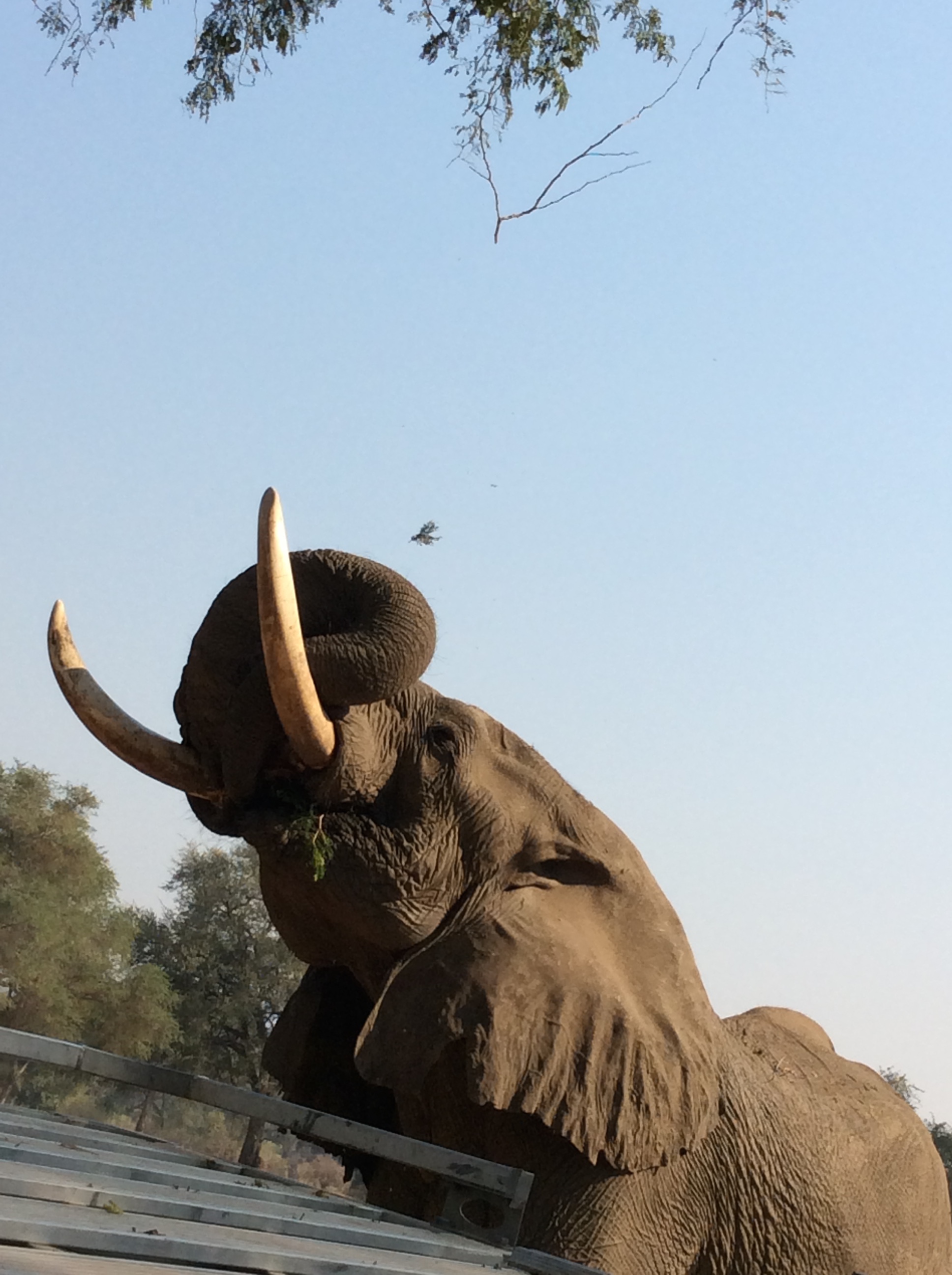
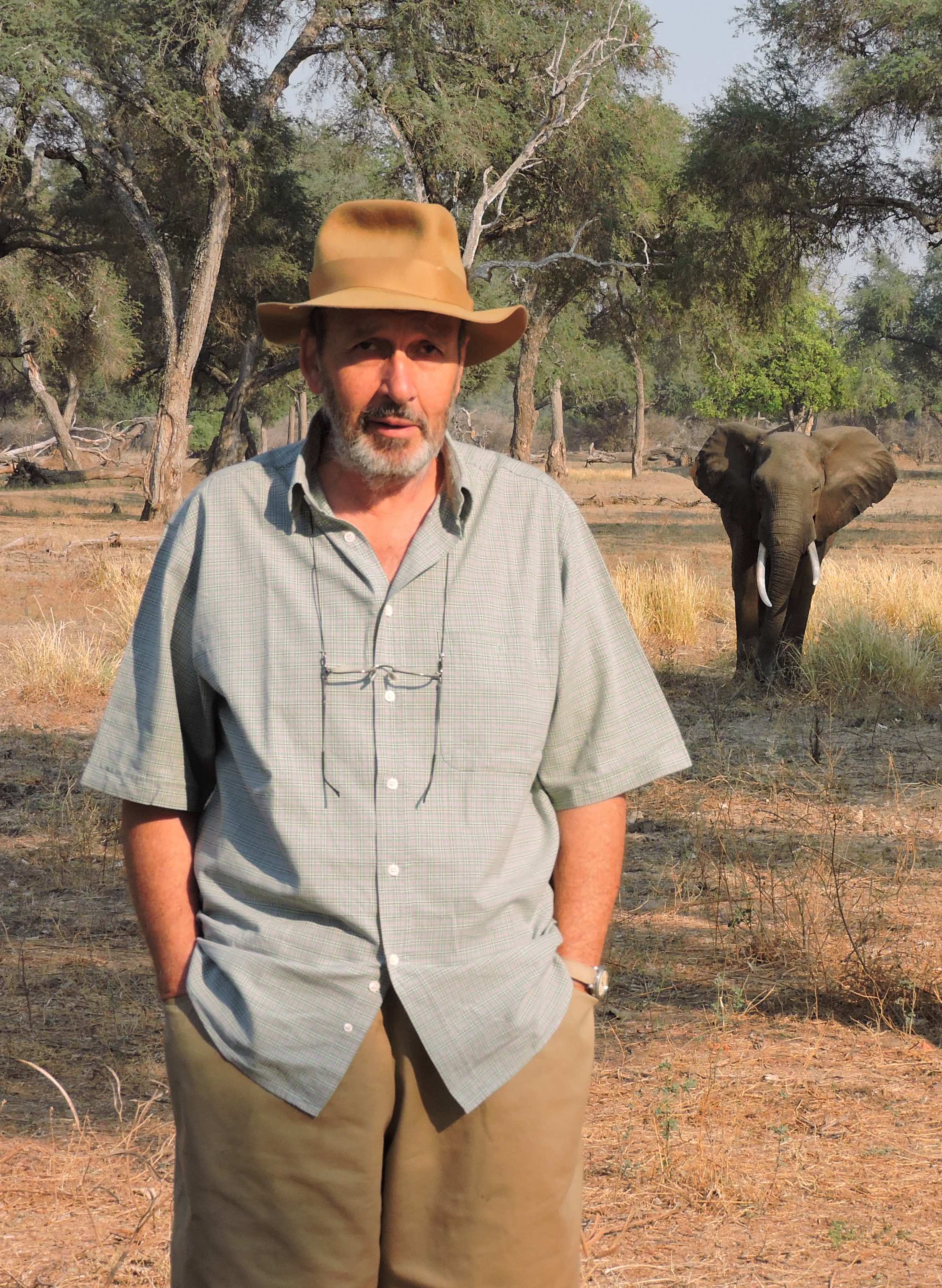
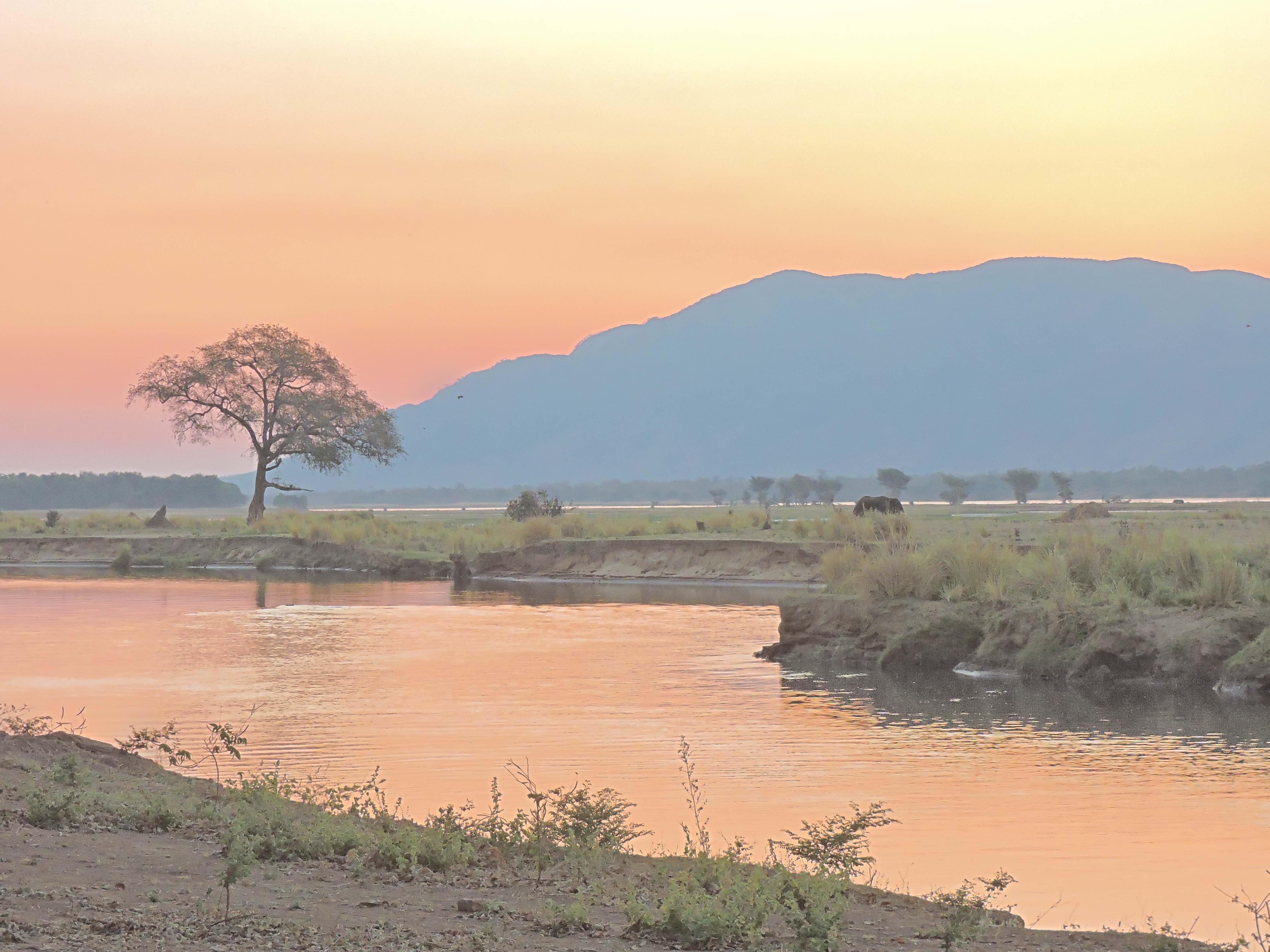
elephants

Baobab Teenager

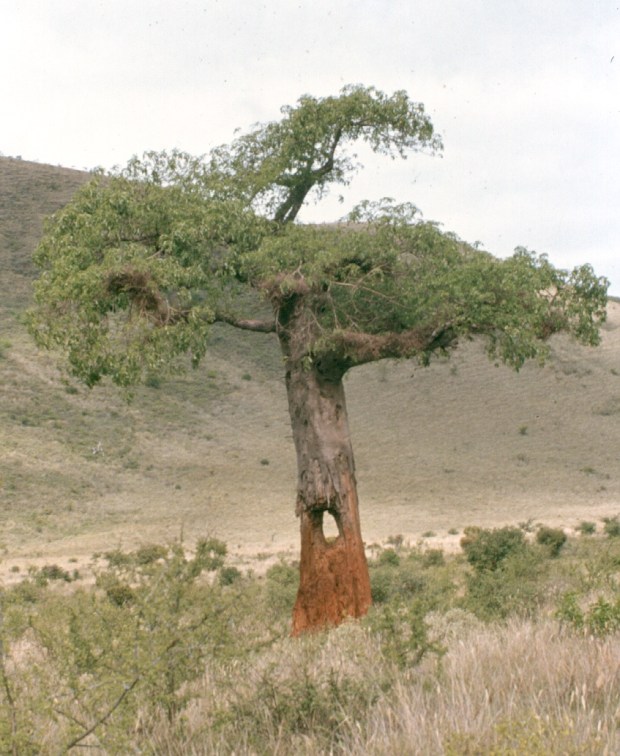
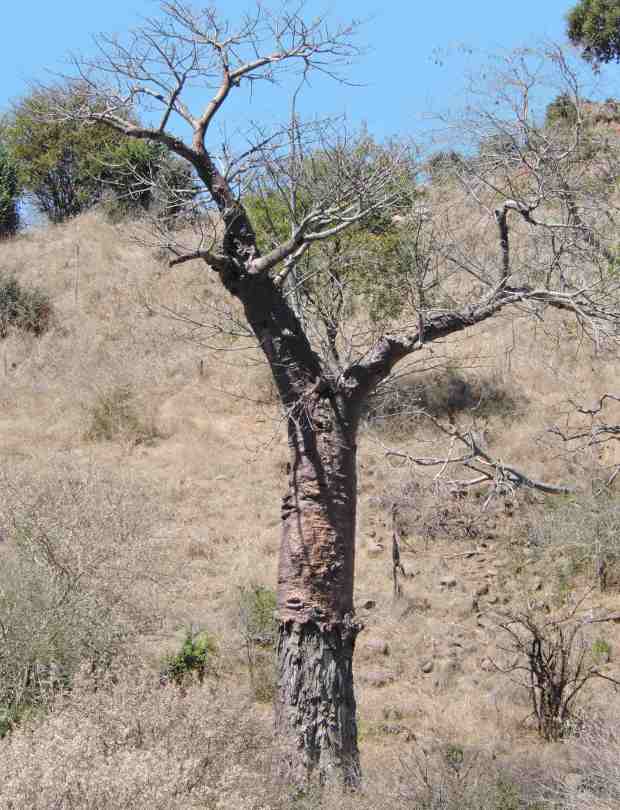
Last week, driving around Chipinda Pools in Gonarezhou National Park, we spotted this baobab that reminded me of a youngster when growing so fast that the clothes that fit today do not tomorrow! It seems that the young and growing baobab needs another pullover to cover its belly!

DSCN0067 copy

In fact, elephants had damaged the base of the tree and the absence of bark contrasts with the intact part of the trunk that shows a healthy coppery colour further up.

Elephants badly damage baobabs, particularly when food and water are scarce as they get the latter from the soft trunk. Lots of baobabs are damaged in this way and the problem is particularly noticeable in Gonarezhou.

The examples below are from Tsavo West National Park, Kenya in the eighties and Mana Pools National Park a couple of years back.

Hollow baobab Tsavo West copy

Baobab damaged by elephants in Tsavo West National Park.

DSCN8618

Another damaged baobab, this time at Mana Pools National Park.

Gonarezhou three years later. Northern area

We were last in Gonarezhou National Park almost three years ago and I wrote about our impressions then [1]. This time the idea was to try the Chipinda Pools Tented camp so we booked ourselves there for five nights from 21-26 August.

Interesting developments had taken place during our absence. The management of the park had changed when on 30 June 2016 the Frankfurt Zoological Society and the Zimbabwe Parks and Wildlife Management Authority signed an agreement for the creation of the Gonarezhou Trust. The latter represents a new management style for a National Park in Zimbabwe, aiming at running the park in a sustainable way on a long-term basis.

The first thing we noted was that the park can now be only booked at the Chipinda Pools office and not at the Harare Reservations office as all other national parks. Despite the distance from Harare (about 500km), the process was smooth and I soon arranged for our stay through an exchange of messages via Messenger and e-mail that ended with an advance payment to secure the bookings.

The trip went smoothly and we were not stopped at Police checkpoints at all despite the rather long distance! After Chiredzi we turned towards the park and drove through land managed by the Malilangwe Trust [2]. We wondered at the time if they would have accommodation that we could try another time [3]. We were soon at the Chipinda Pools gate where we produced our booking at the reception to a friendly lady.

As the checking of our papers was taking a while we took the opportunity to read some of the posters that explained the work on the various predators that is being carried out at the park. Our reading got interrupted when we heard the lady saying, “I have bad news!” As you can imagine, she was successful in calling our attention so we were with her in a second while we heard her adding: “Your booking is for the 21st all right but of September, not August!” and she handed me over the voucher I had given her moments before! While my heart was sinking, I confirmed my error and cursed myself for not checking the booking earlier!

It was about 16:30 hours so my wife and I looked at each other and both said the same thing: “Maybe we will need to see if Malilangwe has a lodge after all!” However, before playing that last card I asked whether there was any chance of putting us up for the night at the staff camp and then decide what we did the following morning as it was now too late to depart. I felt that I was wasting my words as the lady was on the phone and ignored my plea!

As we could not hear her conversation in the office, we waited, unaware of what was going on. The uncertainty lasted until she hanged up and informed us that she had just confirmed that the camp was full as it was time for school holidays in Zimbabwe. We were clearly in a tight spot and awaited again while she made another call before finally declaring gravely: “Sorry, no luck, we are full”.

At a loss, my jerk response was “So, we go back to Harare”, feeling rather upset with myself but ready to accept the situation and go away. Then, to our astonishment she burst out laughing as only Africans can do! “I was joking,” she said, “a colleague is coming to see if what we have would be OK with you”. After recovering from narrowly missing a heart attack, I calmed down and -internally- celebrated her sense of humour and I even managed what I thought it was a smile but probably it was a smirk!

Eventually we were shown into one of the tents that are normally used by researchers that happened to be empty. We were told that, unfortunately, we needed to share the ablutions with other people. We were so delighted with the offer that we immediately accepted it as it was for the duration of our booking! We noted that we even have our own painted dog couple residing at the tent although they were papier-mâché ones!

DSCN0108 copy

Our tent.

DSCN0111 copy

The veranda of our tent.

DSCN0120 copy

The setting.

The camp was composed of four tents with a communal kitchen and ablutions nestled by a small stream that flowed into the Save river a couple of hundred metres down the river. The camp was well shaded and it was very well kept. We finally settled down while noting that the tent had large windows closed only by mosquito mesh and curtains so we prepared for a cold night and we were happy to have our sleeping bags with us!

That night, now relaxed, we enjoyed our dinner and, after reinforcing the provided bedding with our own warm bags, went to bed for what I thought it was a well deserved rest while congratulating ourselves that we managed to survive a potential disaster. Later during the night, we heard lion roaring while it walked by our camp and we were happy to be smug in our strong tent! The following morning we learnt that there was a lone male lion stationed near camp at the time. Despite the lion living next to camp, we did not see it, unfortunately.

We spent the day exploring the area and we took a recommended route that brought us along the Sililijo stream. As soon as we left camp we climbed a hill and had a great view of a large tract of the park through which the Runde river meanders its way towards its meeting with the larger Save river.

DSCN0065 copy

The view of the Runde river.

Soon we had left the Runde river behind and, after a route that was rich in game we re-joined it near the Chilojo Cliffs, Gonarezhou’s famous landmark.

DSCN0096

The Chilojo cliffs. Gonarezhou’s landmark.

DSCN0098

Another view of the cliffs.

Among the animals we found on the way were elephants, buffalo, giraffe, impala, greater kudu and eland. Yet again we admired the numerous baobabs and realized that the plentiful rains have had a positive impact on the vegetation cover as the park was very bushy. This, of course, had a negative impact on game spotting but we did not mind that at all as it was clear that the game numbers are on the increase!
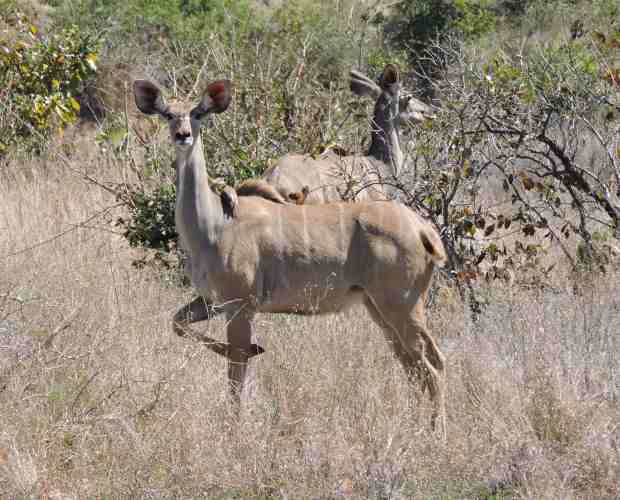
DSCN0082 copy

A female Greater kudu watches us.

After enjoying a picnic by the cliffs, followed by the mandatory bush siesta we waited a while longer for elephants to come to the river but, as they did not come, we decided to return to camp. As usual, we underestimated the distance and we arrived rather late as we took a wrong turning and, near the camp, we got charged by a loud trumpeting lone elephant bull that we just managed to see. The animal was very nervous and it kept coming towards us until we finally managed to avoid it and safely get back to camp. Later we learnt that the elephant was scared because of the proximity of the male lion.

We arrived tired and looking forward to a shower, dinner and bed. However, the appearance of the game ranger in charge of tourism, stopped us in our tracks. He was the bearer of more bad news: our tent was needed for some unexpected visitors! He asked us if we would mind moving to the Mabalauta area in the southern part of the park where there was room for us at Swimuwini Camp. Aware of the well known saying “beggars can’t be choosers”, we immediately and gladly agreed and convened that we could leave at about 09:00 hours the following morning.

The next day, before departure, we had a chance to talk to other guests that told us that it was possible to drive to the Mabalauta area through the park and that it was a nice and scenic drive. This was good for me as I also wished to have a look at a place called Lion pan as, years back, I was told that it was -obviously- good for lions… So, thanking the management for their hospitality we departed at a leisurely pace towards our new camp, about 100km south.

Our drive was, as expected, interesting although we did not see many animals. A rock monitor (Varanus albigularis) that crossed the road and a Purple roller (Coracias naevius) were the only animals of note we saw although there were plenty of hornbills and other common birds as well as a few squirrels. We found elephant spoor but no sign of the pachyderms anywhere. Unfortunately we missed the GPS point where we should have turned East for the Lion pan so we decided to explore it the next time we come.

DSCN0139 copy

A river on the way to Mabalauta in the south of the park.

DSCN0143 copy

Most pans had water, product of the excellent rains of last year. This one is on the way to Mabalauta in the south of the park.

DSCN0129 copy

A male namaqua dove.

DSCN0140 copy

The rock monitor that slowly crossed the road showing us its rather long tongue.

DSCN0142 copy

Close up of the rock monitor.

[1] See https://bushsnobinafrica.wordpress.com/2014/08/11/gonarezhou-national-park-safari-diary-day-1/ and the two posts that followed.

[2] See: http://www.malilangwe.org/

[3] After returning to Harare I learnt that they have a lodge called Singita Pamushana Lodge.


The water elephant

For hundreds of years humanity has discovered and classified the organisms that inhabit our planet. However, even today we continue to find new species. These are not tiny insects but fish, reptiles, birds and mammals, some even very large!

In 2004, while we were working there, United States scientists discovered a new species of monkey in the jungle of the Madidi National Park in Bolivia. The ape, of the group of the marmosets, was placed in the genus Callicebus. Following a novel initiative, its species naming was the result of a contest in Internet won by the Golden Palace Casino. This institution paid U$S 650,000[1] for the name Callicebus aureipalatii that -in Latin- means Golden Palace![2]

So far in 2016 several new species have been found. Some of them are small animals that can be considered difficult to see. However, this is not the case of the seven-metre long Black Whale defined as a new species this year. The finding is so recent that it still does not have its scientific name![3]

In addition, there is a new shark called Ninja lantern shark (Etmopterus benchleyi), found in the sea near Costa Rica in 2015.[4] Again, United States scientists studying aboard the Spanish research vessel Spanish B/O Miguel Oliver, discovered it. The species name refers to Peter Benchley, author of the novel Jaws.[5]

So far we have dealt with the amazing animals that have been discovered. But what about those animals suspected to exist but that we have not yet found? Cryptozoology is the study of animals -“cryptids”- that are believed to exist. The example that comes immediately to mind is “Nessie” the Loch Ness “monster” in Scotland that, despite a long search, continues to be the epitome of the elusive creature.

dscn5491-copy

However, other instances exist of other beasts that had been seen but never confirmed. One of them is supposed to dwell in the Belgian Congo (now Democratic Republic of Congo) and the information comes from a professional hunter called R.J. Cunninghame. This experienced hunter became world famous when he shot dead a hippo that attacked the then US President Theodore Roosevelt while on safari in East Africa in 1909.

A Frenchman named Le Petit told Cunninghame about Water Elephants that he saw in 1907 during his five-year stay in the Congo. Le Petit saw them for the first time while traveling through the river in the wetlands between Lake Leopold II (now Lake Mai-Ndombe) and Lake Tumba.

The first time he saw just a head and a neck that appeared on the water surface. His companions, natives of the place, told him that what he had just seen was a Water Elephant. Later he saw the animals again. This time they were five and he allegedly watched them for about a minute. He described them as between 180-240cm tall with relatively short legs and curved backs, elephant-like.

elephant-poilu-du-zaire

The water elephant by artist and writer Philippe Coudray. Reprinted with permission of the author.

Their heads were ovoid and elongated with a short trunk of about 60cm in length (tapir-like), but no tusks were seen. Their skin reminded him of hippo skin but it was darker. They walked with an “elephantine” gait that left footprints in the sand with four separate toes. This was the last time they were seen as they quickly disappeared into deep water. His fellow local companions reaffirmed Le Petit that the animals were common in that area and that they spent much time in the water, like hippos.

Interestingly, in the same general area another animal is reputed to exist, known as the Mokele-Mbembe, a creature believed by cryptozoologists to have a prehistoric look similar to “Nessie”. Although several expeditions have searched this area of the Congo, none have found it or the Water Elephant.

However, the Water Elephant existence came to the fore again when in 2005 a pilot flying over Lake Tumba apparently spotted them again. The animals seen would fit the description of Le Petit!

Not many scientists believe that a beast of this size can still be unknown to science. However, the Congo region -like Bolivia and others- has surprised us earlier with the discovery of other interesting creatures. You may also think that what Le Petit saw were African Forest Elephants (Loxodonta cyclotis), considered as pygmy elephants for quite some time but now as small specimens of L. cyclotis. This is unlikely for an experienced observer.

Le Petit’s description would fit that of the Moeritherium if the latter had been taller than its estimated one metre height.[6] Philippe Coudray, who I thank for his permission to use his picture of the Water Elephant, theorizes that elephants regarded as extinct -such as the Water Elephant- could still exist. He bases its reasoning on the finding of a tusk with a reverse curvature to normal elephants in 1904 in Ethiopia. The fact that the tusk was not fossilized would indicate that the animal did not live so long ago. The cryptid species postulated would be smaller than a prehistoric elephant known as the Deinotherium.

During our safaris we have seen elephants with weird-looking tusks.

THis year, while visiting the Kruger National Park, we spotted an elephant with one of its tusks pointing downwards so these tusks are still on live elephants! It reminded me of the Deinotherium-like cryptid!

dscn9919-7-02-44-pm-7-01-05-am-copy-12-58-08-pm

Did the Water Elephant ever exist or what Le Petit saw were the smaller forest elephants? The area of Congo where they could be is still difficult to access so a final solution to the mystery may yet take a long time. In the meantime we can only wait.


[1] Donated to the Madidi National Park.

[2] http://www.nbcnews.com/id/7493711/ns/technology_and_science-science/t/internet-casino-buys-monkey-naming-rights/#.V7brlZN97-Y

[3] http://www.livescience.com/55623-new-species-black-whale-in-pacific.html

[4] http://www.oceansciencefoundation.org/josf/josf17d.pdf

[5] https://es.wikipedia.org/wiki/Etmopterus_benchleyi

[6] http://carnivoraforum.com/topic/9742488/2/

Note: This post is a translation and adaptation of an article published in the Spanish on-line Muy Interesante magazine. If interested see: http://www.muyinteresante.es/naturaleza/articulo/el-elefante-de-agua-y-otros-animales-que-no-sabemos-si-existen-721474540407

Nota: Este artículo es una traducción y adaptación de uno publicado en la revista Muy Interesante. Si tiene interés vea: http://www.muyinteresante.es/naturaleza/articulo/el-elefante-de-agua-y-otros-animales-que-no-sabemos-si-existen-721474540407

Big V

Boswell and Big V[1]  are the best-known elephant bulls in Mana Pools National Park. I recently reported about Boswell’s skills to feed on his hind legs[2], a rather unique trick. When we witnessed an elephant feeding on Acacia pods overhead and I reported in an earlier post[3] was Big V so I have already introduced both to you.

Mana Pools this August was extremely dry, as last year the rains were not good. For this reason the area looks more as it does towards the end of the dry season in November than it should be in August: a dust bowl! I believe that the animals are in for a tough two to three months until new rains arrive, if they do as these days weather patterns have changed.

Luckily for most of the animals in Mana the Zambezi River is there and, together with the pools that lend the name to the park, they provide water and fodder to keep the grazers going while the trees such as the apple-ring acacia (Faidherbia albida) will supply elephants with browsing. The animals that seemed hardest hit at the moment were the hippos that need to consume large amounts of grass so it was common to see them walking about during late afternoon already far from the water.

While checking in we learnt that lions had been spotted around an area known as Mana mouth. After recovering from the six-hour journey from Harare and, after unpacking and organizing our lodge, we decided to go there as it is close and the sunsets there are usually beautiful, even without lions! We never reach our destination as on our way we found Big V!

With him were, in addition to his usual young male retinue, a young female and its small calf, something unusual as large bulls tend to hang out on their own or with a few askaris[4]. He towered over the lot and he was clearly the undisputed leader of the group.

In an interesting contrast to his dominance over other elephants, Big V is an extremely relaxed elephant that allows the human observer to approach him either in the car or on foot. In contrast, the younger males can be more boisterous and occasionally perform threatening displays and mock charges that remind us that we are dealing with wild animals!

On this occasion it appeared that Big V was doing some “community” work by pulling down branches from an apple-ring acacia. Clearly, for the elephants this was the equivalent of eating at a Michelin-starred restaurant!

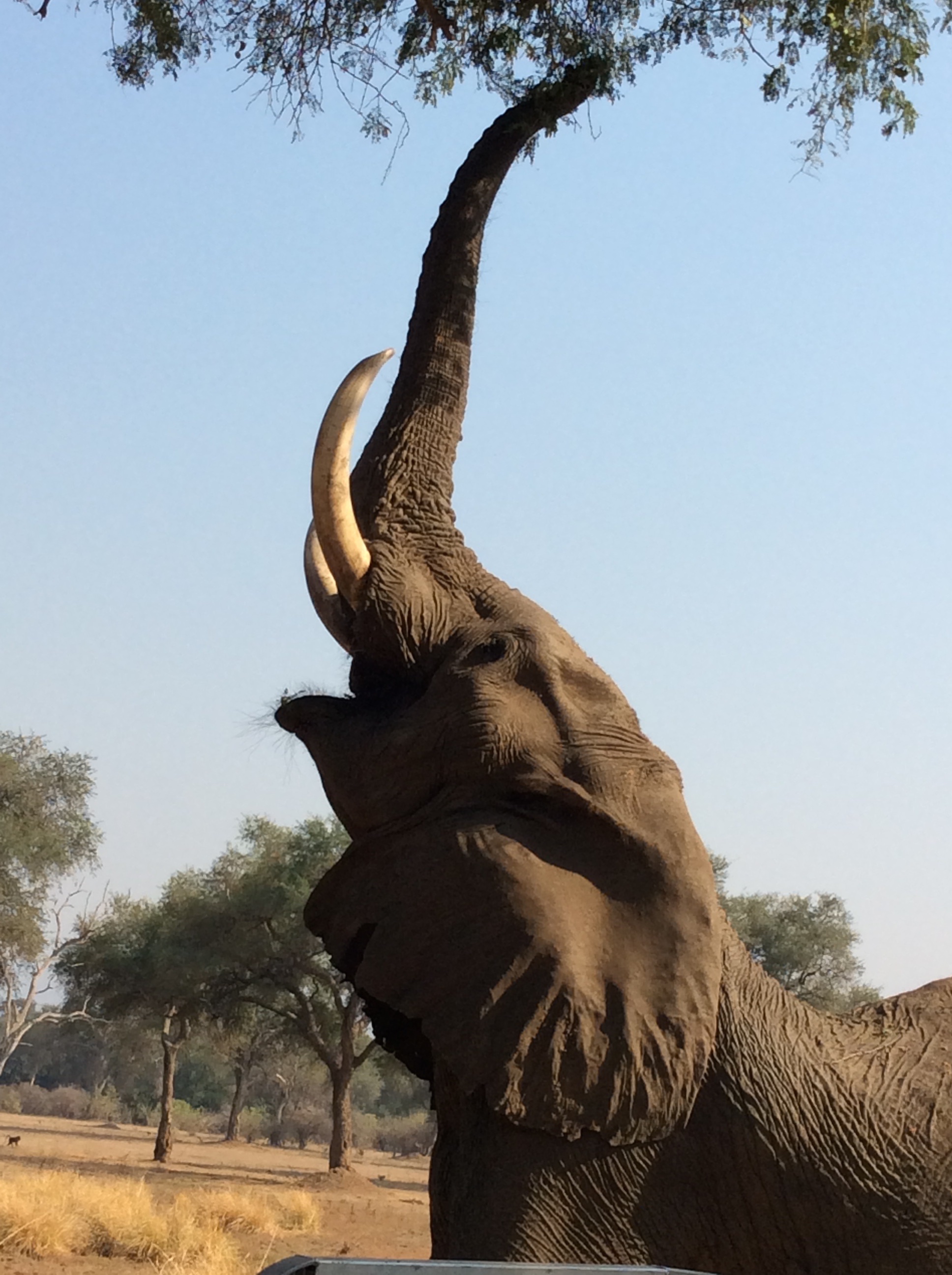
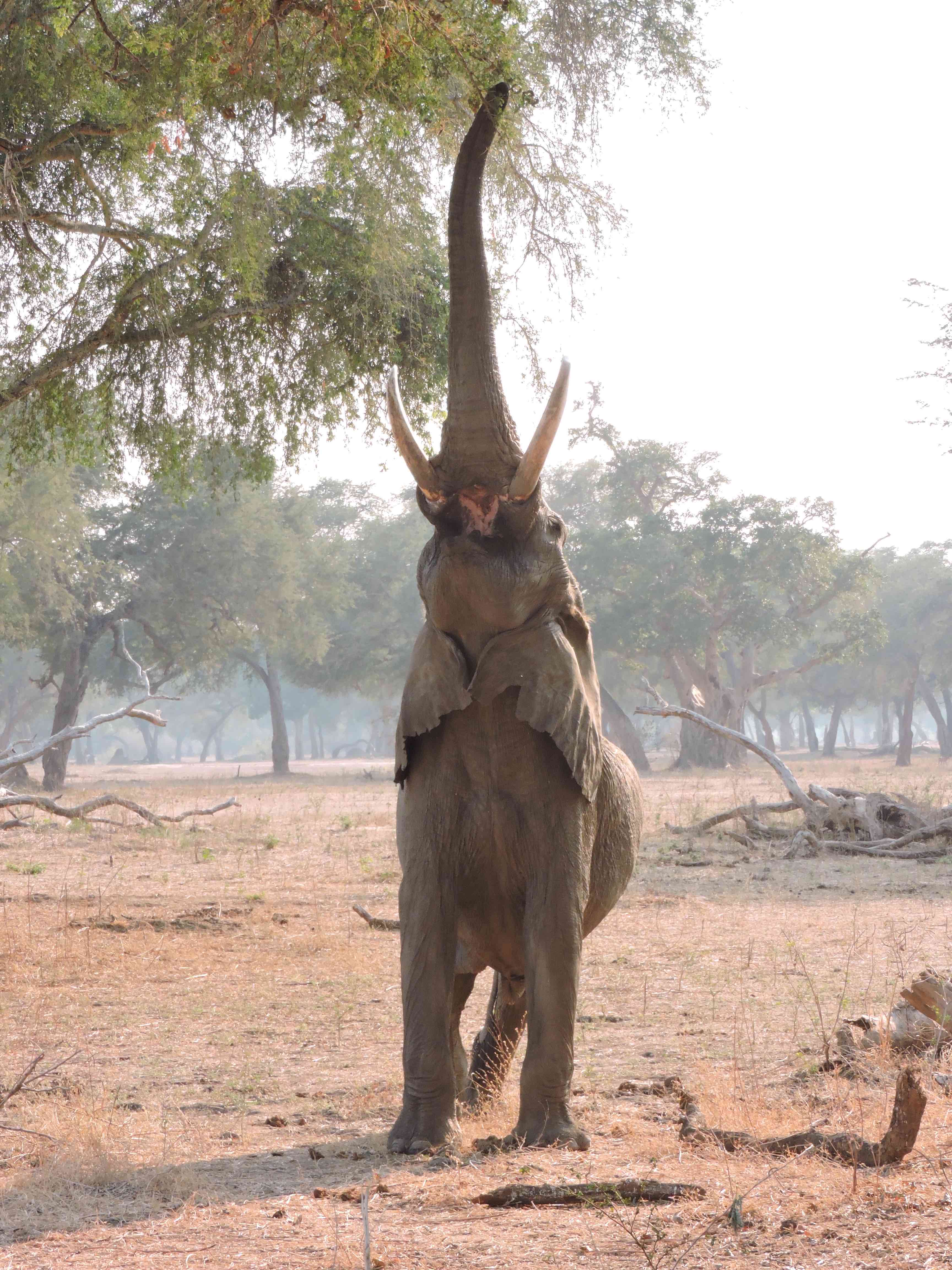
Although Big V was not standing on its hind legs “Boswell style” it stretched and reached high up the tree, to a height the others could not. As a result of its efforts large branches were brought down showing a great dexterity with his nose (it is easy to forget that he was breathing while doing this!) as well as the damage elephants can do to trees!

He will then fed on them, including the main branches, some of which were really thick! While Big V was eating, the other elephants were eager to collect any fallen pods or small branches but from a distance as Big V’s belly rumblings were sufficient to keep them all at bay! Well, not all…

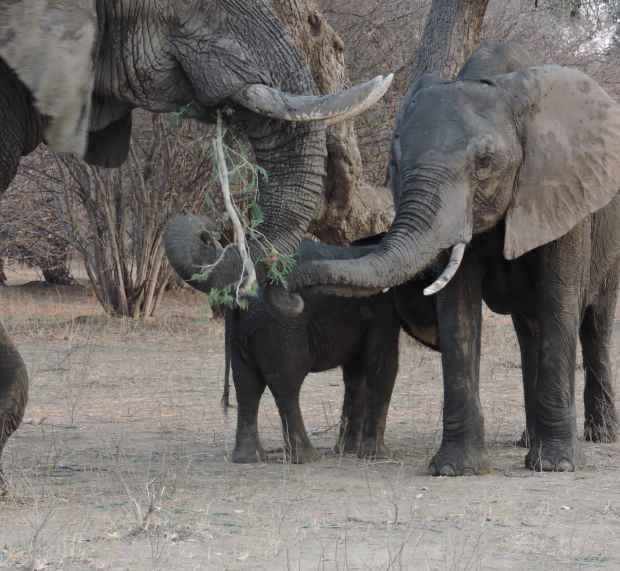
The small female and her calf approached the feeding giant ignoring his rumblings. Expecting some rebuke we were surprised to see that they slowly got closer and closer  she started to steal bits of the branch to feed. The calf was also allowed into Big V’s inner circle and managed to pick some scraps. The large bull completely ignored them!


DSCN0022 8.49.54 PM copyAt one stage, the female even took bits of the branch from Big V’s mouth!

The reasons for this closeness I ignore but it was unexpected and we spent a few minutes watching how it developed. Spellbound with these interactions, we forgot about the lions and when the light was fading we returned to our lodge still talking about what amazing creatures elephants are!


[1] This elephant has a large v-shaped notch on its left ear.

[2] https://bushsnobinafrica.wordpress.com/2016/08/17/boswell/

[3] https://bushsnobinafrica.wordpress.com/2015/10/14/elephant-overhead-and-it-was-not-dumbo/

[4] From Arabic, an askari was a local soldier serving in the armies of the European colonial powers in Africa. It is also used for security guards and the young bulls that accompany large bull elephants.

Boswell

It is irrelevant here to argue against or in favour of naming wild animals. It happens often among the big five and others that are singled out for certain notable characteristics or behaviour and I am sure it helps researchers in their work. There is a tusker-naming project at the Letaba Elephant Hall in the Kruger National Park and many notable animals have been given names, not only in Africa but also throughout the world.

Boswell in Mana Pools is a bull elephant that is one of the legitimate owners of the place. It kindly let us enjoy its home without a grudge while it goes about its business. Boswell is well known by all that, like us, are frequent visitors of this beautiful wilderness area. It has a distinct feature: it can reach for the apple ring acacia pods higher than its colleagues.

Over the years it has developed a trick that few others can match: it does not only stretch but over-stretches by standing on its hind legs in perfect balance while it feeds at incredible heights. I do not know how it learnt to do it but perhaps it is an elephant tradition that is passed from generation to generation at Mana Pools.

Whatever the origin of its skill, many brilliant pictures have been taken in the past by great photographers and these can easily be found in the Internet. However, one thing is to watch professional pictures and/or documentaries and another, rather different one, is to see it performing live, just like any artist!

We have seen Boswell often once we learnt to recognize it but we have not seen its trick as it only takes place at a certain time of the year when the right conditions are present. Even at that time, you must find Boswell and it has to be willing to perform. This is not as easy as you may think.

During our last visit to Mana Pools last July game was not yet abundant in the riverine part of the park so I decided to cut short my participation in a family game drive and stay in camp to take things easy and to watch what was going on there as its proximity to the river is always rewarding. We had been, as usual, “attacked” by monkeys and the baboons were particularly vicious when they did not find anything, pulling down one tent an even biting our solar-powered lamps!

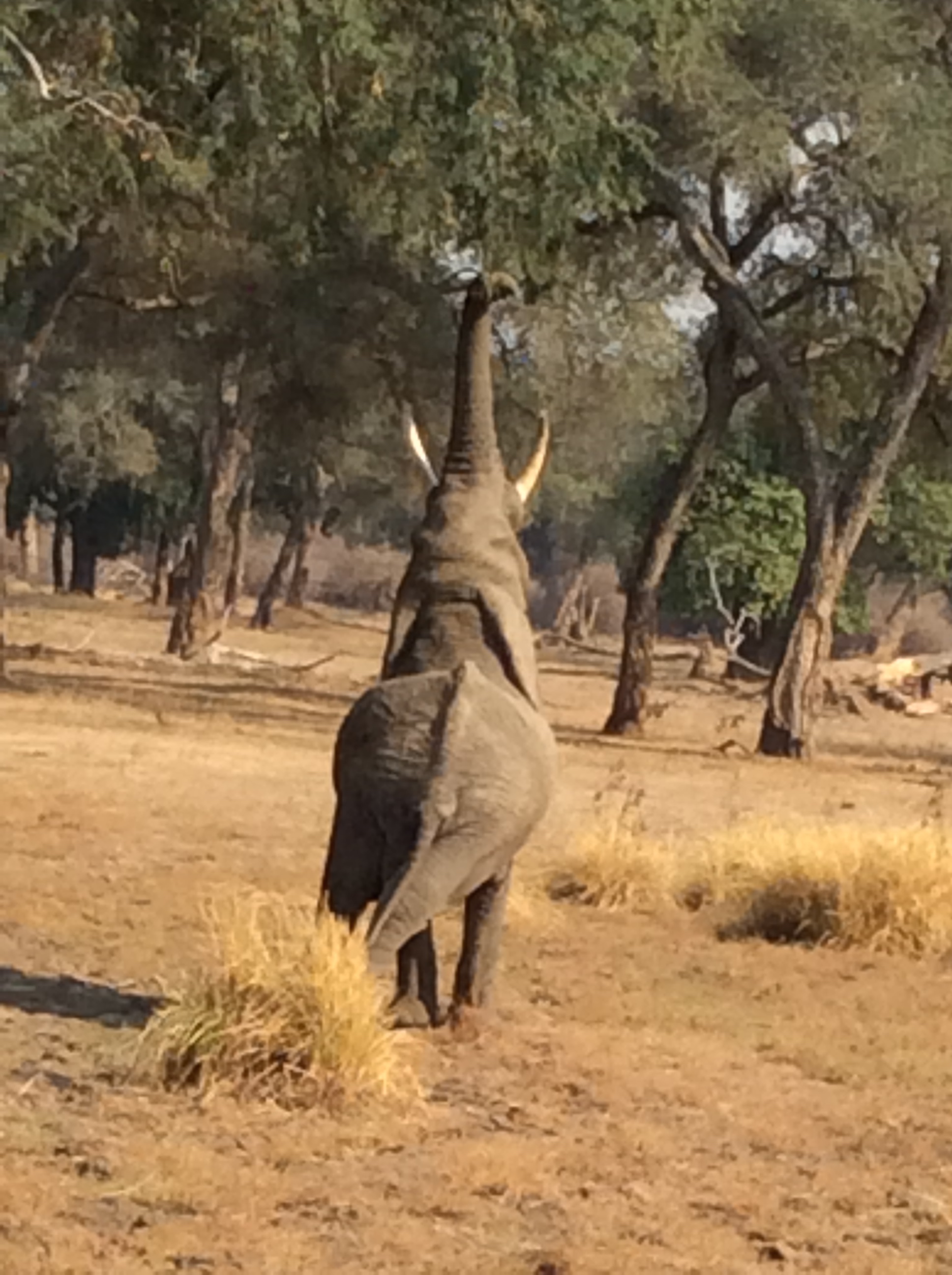
I spent some time tidying up and eventually sat down to have a cuppa and to write notes on the trip. Although it passed about five metres from me I only saw Boswell’s bottom and looked for the camera only to realize that it was with the rest of the family! Luckily I had my iPad with me!

Boswell crossed the river fast and soon reached a couple of acacias on the other side, about one hundred metres from me. There it started feeding and I watched for the first time his two-legged feeding trick.

As usually happens, my pictures are rather pathetic but I am, nevertheless, proud to be able to say that I saw Boswell performing for me alone at its home!

Pachyderm GO!

Apparently there is a new, rather hazardous, cell phone game going around in selected places of the world, mainly the “developed” part of it where “players” follow creatures called Pokémons that somehow materialize in their cameras. Amazing technology that I hope can eventually be used for the good of humanity. But this is just another of my idealistic hopes.

In Zimbabwe, away from it all, as usual we decided to go in search of real creatures and, having our two children with us (knowledgeable on Pokéscience), we went to the bush where they assured us Pokémons do not yet dwell. We chose Mana Pools National Park, a jewel among the Zimbabwe parks. We were in for a surprise!

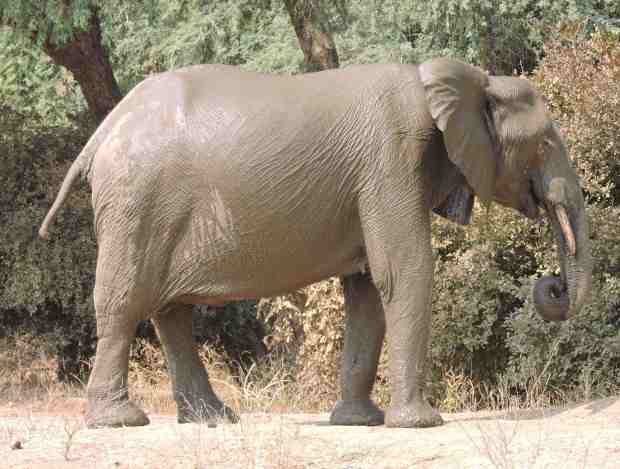
At some stage during our game drive I saw some elephants and stopped the car to watch them with the naked eye, together with my children. My wife, however, looked at them through her tablet to catch the best images of them. At some point, one of the elephants started to walk straight for the car.

I was enjoying its closeness when my son decided that the beast was too close and asked me to move a little to feel safer. My wife in the meantime continued trying to catch the beast.

DSCN9919 copy

Seeing that my wife was still looking through her device totally oblivious to the animal’s proximity, I started wondering whether she was watching the same beast that we were or if she was actually trying to throw a Poke Ball at a Phanpy[1] or a Donphan?

After the incident my wife explained that she did not realize how close it was until I moved the car. The creature had come within a couple of metres from us before I drove off but she said that she had managed to capture it.

We are all looking forward to get home to see what she caught!


[1] Phanpy is a small, blue elephant-like Pokémon that evolves into Donphan, a gray, elephant-like Pokémon with a thick, black band of hide running down the length of its back and extending to the tip of its long trunk.


Follow up: The situation was clarified later and, luckily for Mana Pools, this is what she actually saw:

DSCN9950 copy


Ups and downs


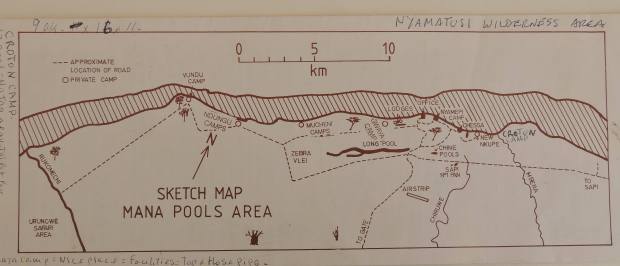
The final day of our stay at Mana Pools we drove all morning and hardly saw any mammals. Our drive started towards the west, following the river frontage (from right to left in the map below), towards Vundu camp. Although the views of the river in that area are really beautiful, after a while we decided to take another road in a southerly direction, towards the Kanga pan area (outside the map). Although the sighting of  crowned eagle lifted our spirits for a while, our luck did not change.

DSCN9960 copy

Crowned eagle.

DSCN9944 copy

Map of the Mana Pools area adjacent to the Zambezi River.

Our last hope of finding some interesting action was to re-visit the “carnage” at Long pool of the day before but our bad luck continued! Professional-looking photographers had moved in and probably paid some good money to film the birds so we did not wish to interfere with their work and drove on and back to our lodge.

To recompense ourselves for our rather poor morning performance we decided to go for a late hearty English breakfast, also known as brunch. We enjoyed bacon, scrambled eggs and fried tomatoes. The siesta under the trees that followed recharged the “morale batteries” and, by 16:00 hours, we went out again. This time we headed towards the Nkupe campsite and the Zambezi shore near Mana mouth where earlier we had some interesting sightings.

When you start getting carried away by watching Matabele ants (Megaponera analis) and photographing armoured crickets and dragonflies you know that Mana is on one of the occasions that it hides its booty from you. Clearly the park had water “up country” and most animals were spread out beyond the area that we could cover by car.

To be fair, we actually enjoyed watching the ants[1] that reminded someone of the fierce Matabele warriors of the past, hence their name. It was a rather large colony moving over the ground as a coordinated force. The major workers of this group were carrying brown capsules that were not prey as we initially thought but their own cocoons as I later learnt. One of these major workers would have also carried their queen but we did not pay sufficient attention to spot that.

Eventually we managed to see some zebra and even three shy eland bulls that quickly moved off as soon as they spotted us. Because of their premature departure we did not hear the unique clicks that are normally loud enough to be heard from some distance away. A knee tendon slides over a bone and vibrates causing the clicks. The larger the animal and the thicker and longer the tendon, the graver the sound and the higher place the animal occupies in the pecking order. The clicks, therefore, prevent fighting.

Soon the shadows started to lengthen and it was time to return to our lodge. We decided to spend the last minutes of the day checking our mail so we drove via the park’s office to access their Wi-Fi. It was close to 17:30 hours and the sun had already dropped behind the escarpment on the Zambian shore of the Zambezi.

On arrival to the office our luck turned! At the parking area we met head on with a large bull elephant and we stopped mesmerized at such a great animal so relaxed yet so powerful and potentially dangerous. Ignoring us it kept feeding as we drove within a couple of metres from it to park the car. We have had the privilege of having been close to these bull elephants before[2] but the experience is always exhilarating.

I got out of the car to watch the animal and joined onlookers from the park’s office that were also there enjoying the moment. It was one of bulls that reside around the most popular area of the park and clearly used to humans. In pursuit of good food it was performing some really funny contortions.

Boswell is probably the best-known bull elephant at Mana Pools. It has developed the ability of standing only on its hind legs while stretching an amazing length to reach the highest of branches. Although the elephant we found was not Boswell, it was probably one of its disciples as I am sure that at some stage it was actually on its hind legs though hidden by bushes!

I got carried away taking pictures and, rather carelessly, I forgot that I was photographing an adult bull elephant a couple of metres away! At one point, after removing my eye from the camera’s viewfinder, the animal was actually towering over me and I thought that I was ridiculously close for comfort and hastily retreated concerned about my bush-future! Luckily, harming me was not in the pachyderm’s mind and it continued feeding and keeping the distance that it thought prudent for both!

Unfortunately, the light soon faltered and I was forced to stop taking pictures so we parted company and we returned to our lodge. Our experience confirmed yet again the nature of Mana Pools: you can go through a frustrating day and then, suddenly, you find yourself in a unique situation that not only makes you forget the tedious drive but that leaves an enduring memory!


[1] For more information, see https://bushsnobinafrica.wordpress.com/2015/10/03/talking-ants/

[2] See: https://bushsnobinafrica.wordpress.com/2015/10/14/elephant-overhead-and-it-was-not-dumbo/

An antisocial lion!
Bush lions are normally tolerant of vehicles, even the open tourist ones. The only aggression we have seen was related to times when mating was taking place and the male normally leaves no doubt about how close you should be! The situation can be different on foot when the utmost care is needed where these cats are concerned to avoid accidents.

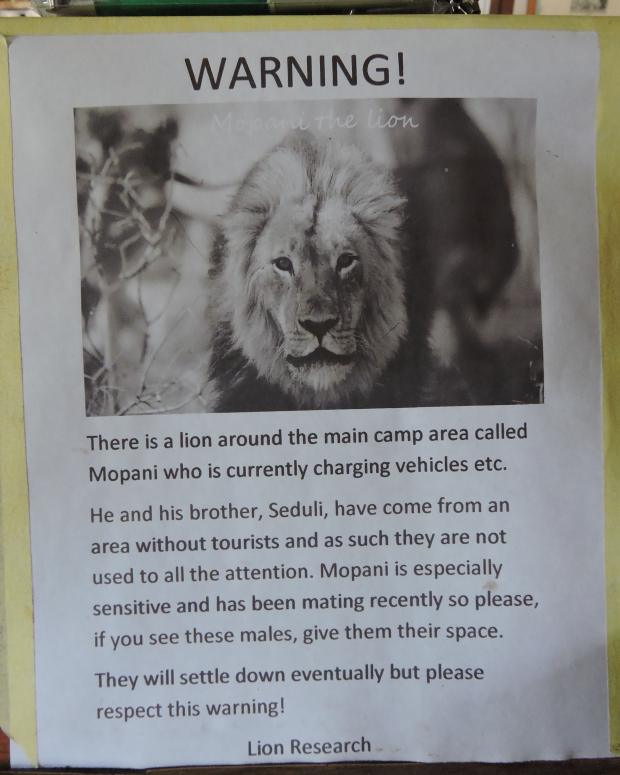
While checking in at Main Camp in Hwange National Park, we were warned of the existence of a new lion: Mopani[1]. The lion, explained a sign placed at the booking desk by the “Lion Project”, came from an area devoid of tourists and it was aggressive, charging vehicles! Siduli, another male, and two females accompanied it. We were also shown a video taken from a tourist vehicle being chased by Mopani and learnt that one of the females was in heat and mating with one of the males. We thought that Mopani’s progeny was assured and planned to keep our distance from him!DSCN9991 9.04.30 PM copy

The lions had taken residence around the Main Camp area so we were delighted at our luck, as we were sure not to miss them! “Cecil may have gone but in comes Mopani!” was our thought!

Although recently arrived from a longish trip, the possibility of spotting one of our all time favourite animals made us drop our luggage at the lodge and drive off in search of lions. We found the two females at Dom pan. They were clearly different: a paler one and a darker one. The latter appeared to be the older of the two.

DSCN9902 copy.jpg

After watching them for a while, a male came out of the bushes and greeted the darker one while the other moved away a short distance. Were we about to witness some mating? Not so as Mopani, who we assumed was the dominant male, only rubbed heads with the female and then moved off in the direction it came from, leaving the female pair alone until the day ended and it was time to get back to our lodge before the mandatory return time of 18:30hs.

DSCN9996 9.04.30 PM copy.jpg

We did not need to plan our next day activities as finding the lions again and spending time watching them was the only option! As a friend of mine says, “we slept in a hurry” and we were up before 06.00hs. No need for alarm clocks! We drove straight to Dom pan, as we believed that they would not have gone very far from there. On our way we realized that several migratory bird species were present at Hwange at the time. These were Crowned Cranes, Abdim and Woolly-Necked Storks, African Kites and Amur Falcons to name but a few!

We had little time for bird watching as the lions had killed a young elephant at Dom pan during the night and the two lionesses were feeding on it! After this find, most of our activities during the visit centred round Dom pan where we spent a lot of our time. We watched the lionesses feeding and interacting for several hours and I present you with a number of pictures and a video, as these are better than words. We only left them to return to the lodge for lunch and a rest.

When we came back during mid-afternoon, only the paler lioness was by the carcass. A search of the surrounding area revealed two lions laying together a few hundred metres from Dom. They were the mating pair: the darker female and a male that, to our surprise carried a radio collar. As we doubted that Mopani had one, it could only be Siduli. Clearly the lion that acts most ferociously towards cars is not necessarily the dominant when it comes to affairs of the heart! It was then clear that the male we had seen the day before was Siduli and that Mopani was hidden from view somewhere! But where?

Luckily my wife was with us as, if there was someone that could spot it, it would be her. And spot it she did, to our amazement, again! The wild-looking Mopani had been lying low under some bushes, unseen by anyone (except my wife) until then. It remained unobserved by our fellow game-spotters with the exception of another lady that clearly shared my wife’s eyesight. We thought it better that it remained unseen and got used to cars if it is to remain in a tourist area so we did not reveal its whereabouts.

As Mopani was still not willing to socialize and remained sulking under a bush, we focussed on the others. Mating in lions is a long-lasting affair as the pair remains together and mating takes place often for a few days, while the female is still receptive to the male[2]. This was clearly the case, as they remained “occupied” for the rest of the time we were at Hwange. That left the other lioness guarding the elephant carcass and Mopani hidden from view! After a while it was time to move off.

We drove to the Nyamandlovu pan as our daughter is very partial to elephants. Despite the abundance of drinking water all over the area, we were extremely lucky to witness the visit of a herd of about fifty animals that, as usual, appeared suddenly as if the product of a magic tree-to-elephant metamorphosis. The result was about one hour of one of the greatest shows on earth: elephants enjoying life at a water hole! There were about five family groups, each led by a matriarch and composed of its progeny, including some really young and tiny babies that were the centre of our attention.

The elephants not only drank but also entered the water where many were seen frolicking about and playing as only elephants are able to do among wild animals! It seemed to us that the latter were at risk of drowning while entering the water with their huge siblings and that they were under even more danger while swimming among them! Somehow they managed to keep their tiny trunks above the water and their mothers were extremely protective and they were always in close contact and ready to assist them!

The three resident hippos felt very uncomfortable at this sudden disturbance and two moved to the very centre of the pan while the third moved to the shore where it put up brave stance against the elephants, only to return to join the others as it was not at all respected by the excited pachyderms! Again, a picture gallery and videos are better than my limited power of description to let you know what took place.

The elephants’ joyfulness in the water delayed our return so we only drove past Dom pan, catching a glimpse of the lions who unwittingly startled a herd of 30 odd elephants intent on drinking from the pan, who retreated in a cloud of dust as soon as they caught sight of the lionesses. We arrived late at the gate where we were told off by a rather grumpy lady game ranger! The justification for our tardiness did not go far with her, clearly used to all sorts of excuses from people arriving late to camp!

The following morning, as expected, the lion pair continued their courtship, the pale female was still guarding the carcass and about fifty vultures (white-backed, white-headed, hooded and lapped-faced) were waiting on the side-lines for her to leave it. While in waiting, the Lappet-faced vulture was seen having a snack by pulling and cutting the dry tendons and sinews from an older dry elephant carcass that other vultures also shared once it opened up the hard bits!

Mopani, the antisocial, still preferred to remain out of sight! We can only hope that he starts turning into a more car-tolerant lion by accepting their presence as part of his daily life. Who knows, maybe one day he could become Cecil’s successor.


[1] To name wild animals or not to name! This is the question… for which I have no clear answer!

[2] Both leopards and lions have the same mating procedure. They can mate as often as every fifteen minutes for up to five days. This is the consequence of weak sperm and mating-induced ovulation.

Elephant overhead (and it was not Dumbo…)

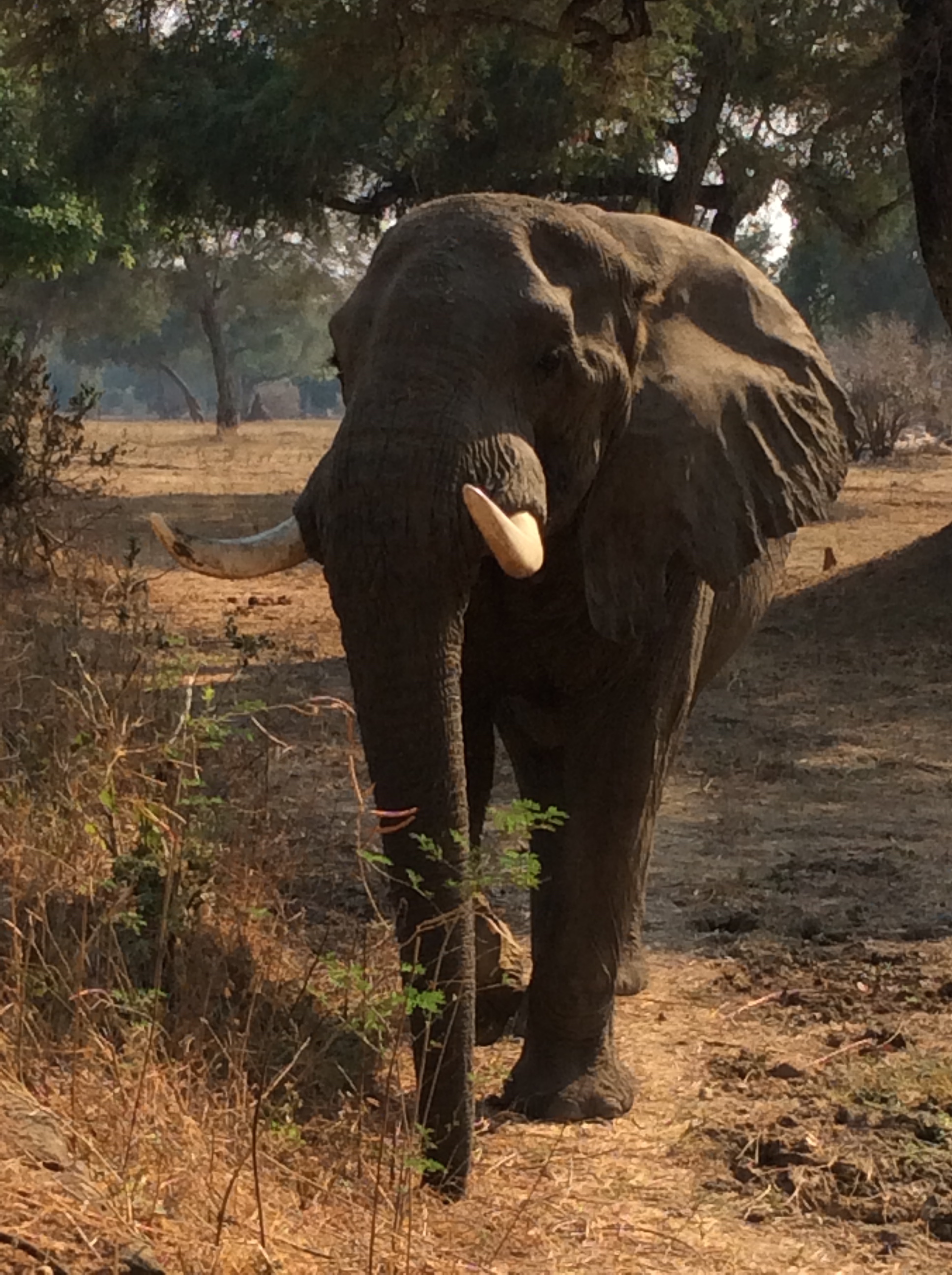
During one of our game drives we came across a couple of cars parked in the woods and we noticed two elephants nearby, a large bull and a younger companion, also known as an “askari”[1]. From close quarters we immediately recognized the large one as “Big V”, a well known and placid bull that a game ranger first pointed it out to us on another visit to the park. His name derives from a large notch shaped as an inverted “V” on the lower edge of its left ear.

The viewing and photographing.

DSCN9998 copy

Big V coming.

We approached the animals, parked the car and got out to join the elephant-watching crowd (two people in one car!). Big V was busy chewing through an acacia branch the size of my forearm! “This is ridiculous”, I thought while I watched it in amazement as it crunched it loudly and started to swallow the splinters. While this was taking place, a game-viewing car with only one passenger came and Big V got somehow separated from the askari while we kept watching, trying to make the best of this photo opportunity.

Equipment comparison!

Equipment comparison!

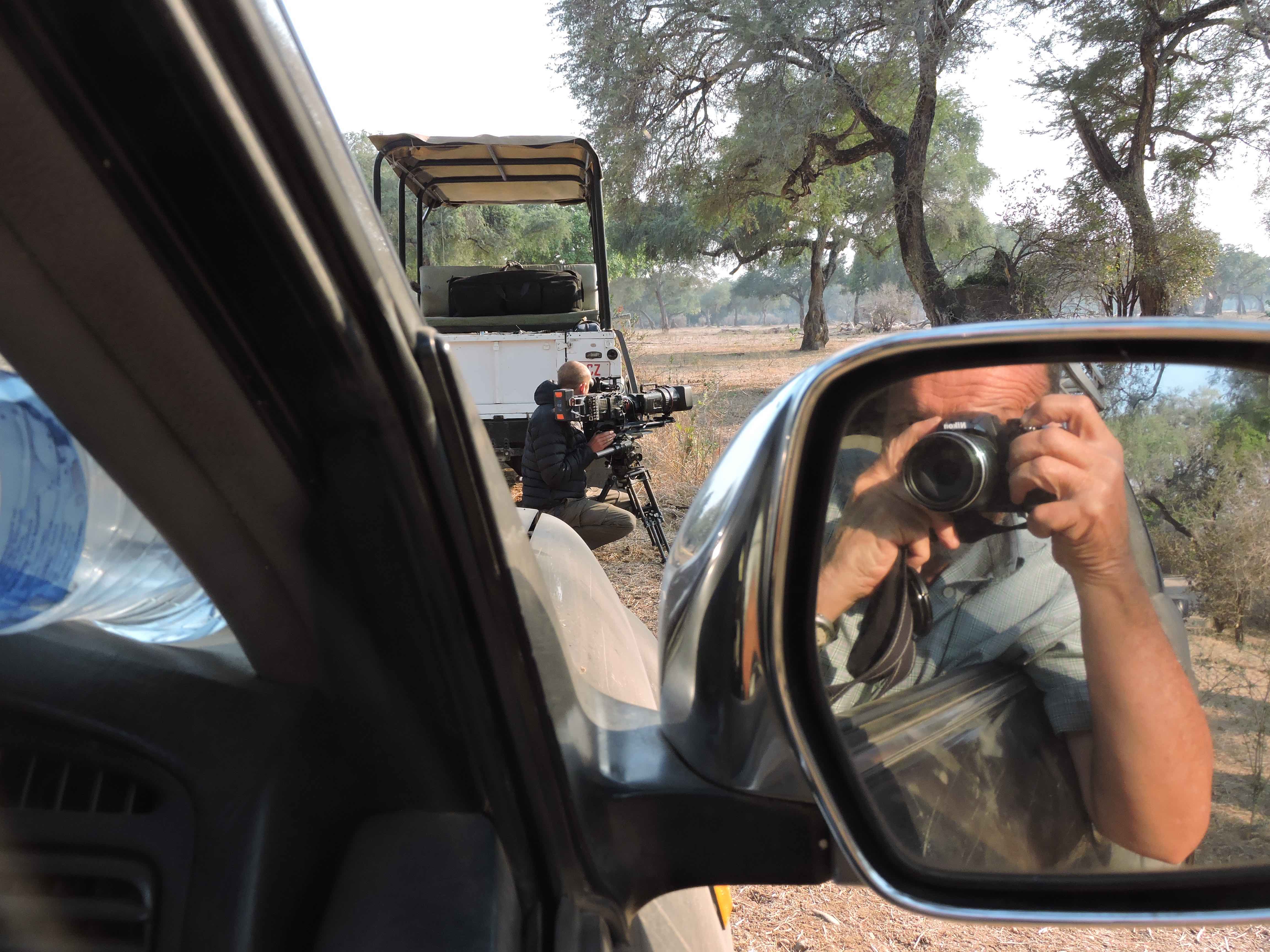
The sole occupant of the newly arrived vehicle clearly thought that this was a good sight and proceeded to offload a humongous filming camera on a tripod. “This is not fair”, I thought as I tried to make do with my comparatively modest Nikon Coolpix! After spending quite a while assembling the equipment, he filmed for about one minute and they were off!

While we continued watching the elephants in awe, another two cars with South African plates arrived, full of people with spectacularly long lenses. They took hundreds of pictures at the elephants and, as soon as they arrived, they also left. I speculated for a while on a better game viewing opportunity and failed to understand where were they rushing! I still need to learn a lot about my fellow humans…

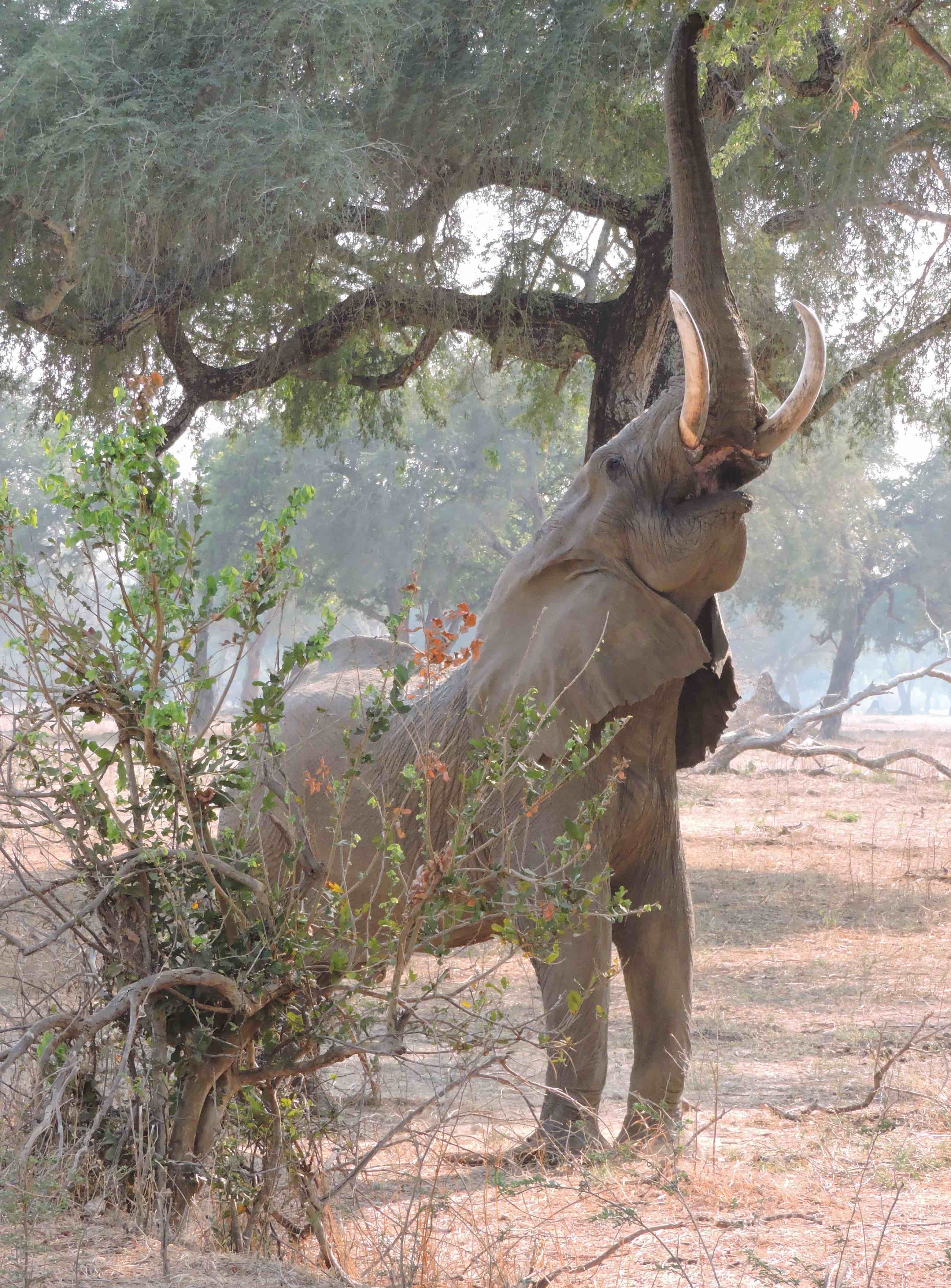
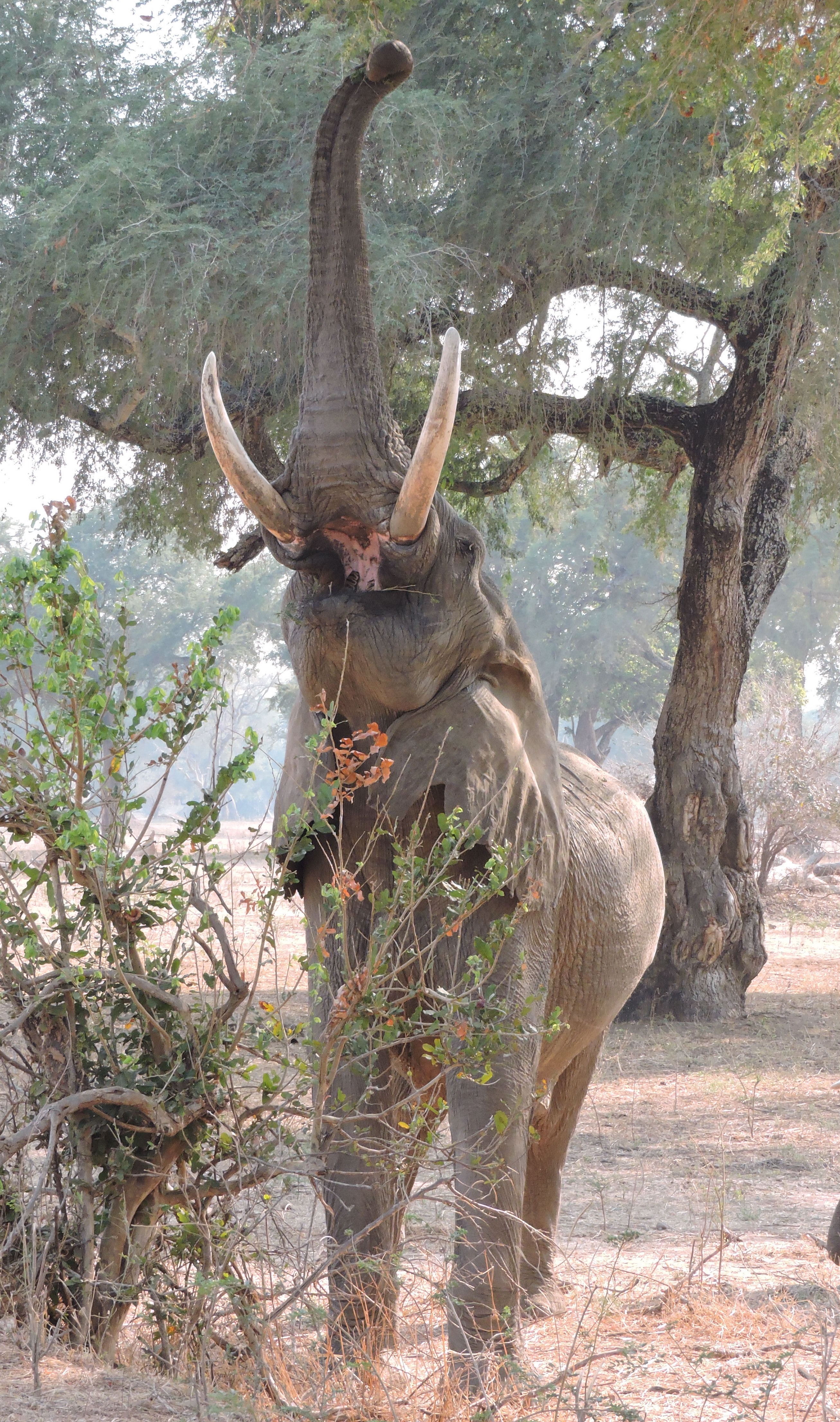
Finally we were alone. We waited as we knew that at this time of the year elephants in Mana Pools feed on the pods of the Apple ring acacia (Acacia albida) and we estimated that this was the intention of Big V as we were in acacia woodland. After a while, with calm restored, he obliged and started stretching to get at the pods, offering us some photo opportunities that are the heart of this post.

IMG_0105_2 copy

DSCN6464 copy

DSCN6501 copy

DSCN6504 copyI have some difficulties taking pictures looking at the camera screen so I use its viewfinder, a hang up from my SLR’s days! On this occasion I was so engrossed taking pictures of Big V at full stretch nearby that when I heard “the other one is coming” from my wife, the askari was almost stepping on my toes!

I was caught “between a car and an elephant” and, although I made myself as thin as possible by contracting my stomach, I could feel its body heat while busy watching his feet to avoid being maimed for life! Luckily the elephant was so focused on feeding that did not even look at me!

IMG_0083_2 copy

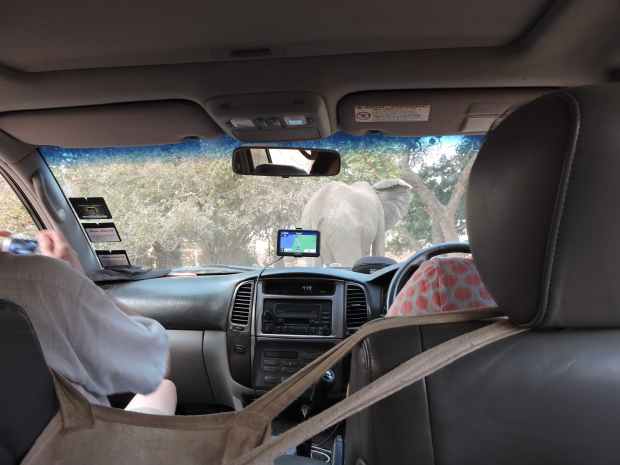
Before my pulse went back to normal I saw Big V coming the same way. I am not good at mathematics (in fact that is one of the reasons I became a vet!) but it was not too difficult to calculate that I have just had a near miss with a smallish bull in that spot and there was a much larger animal coming… I jumped in the car, relieved to be a coward!

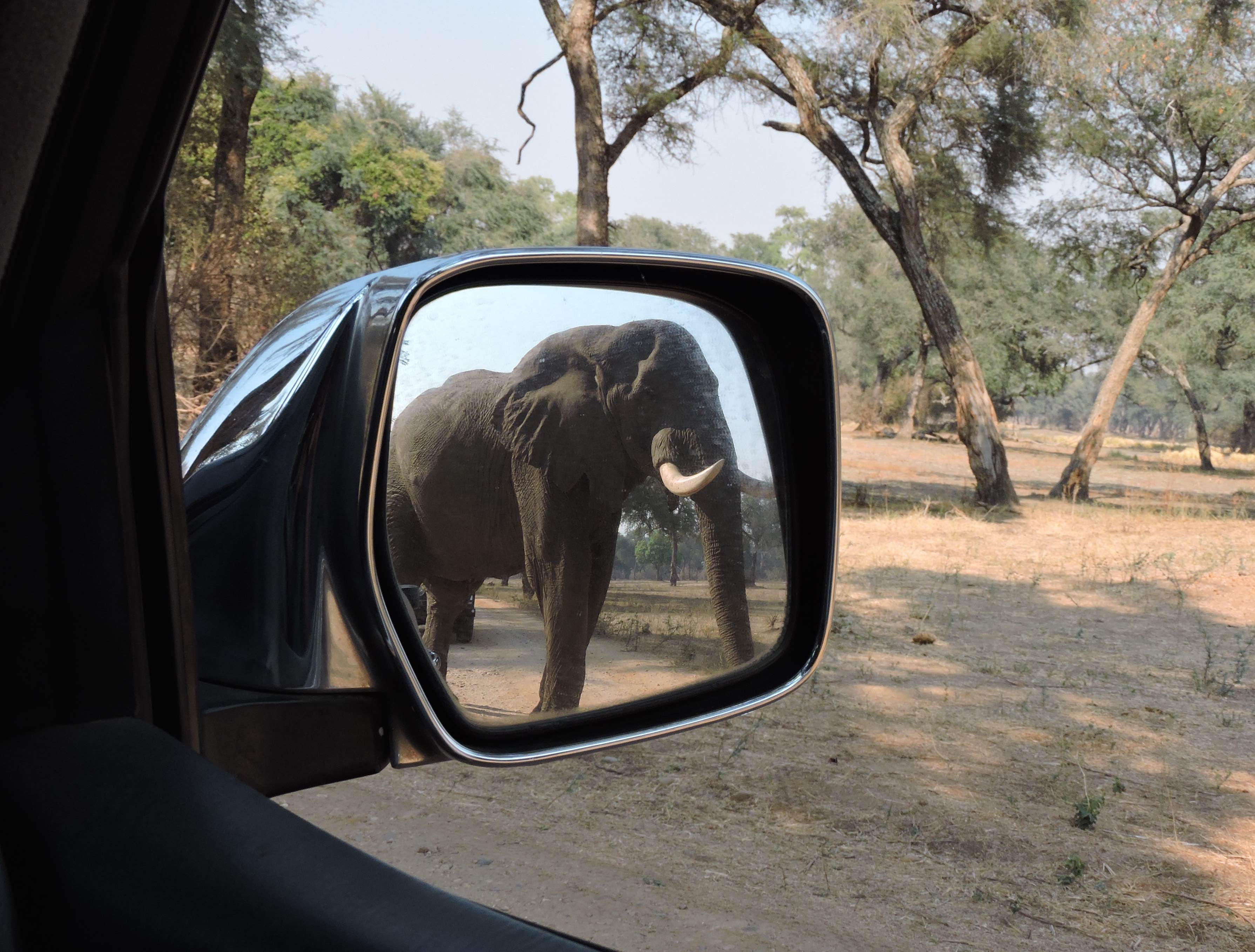
The view through the mirror was a warning.

Watching events from the relative security of the car!

My wife meantime had cleverly placed herself on the other side of the car and was watching and taking pictures of my predicament while chuckling seeing me being squeezed…! Once inside the car I felt more secure and continued to shoot as the situation was amazing to miss even in fear!

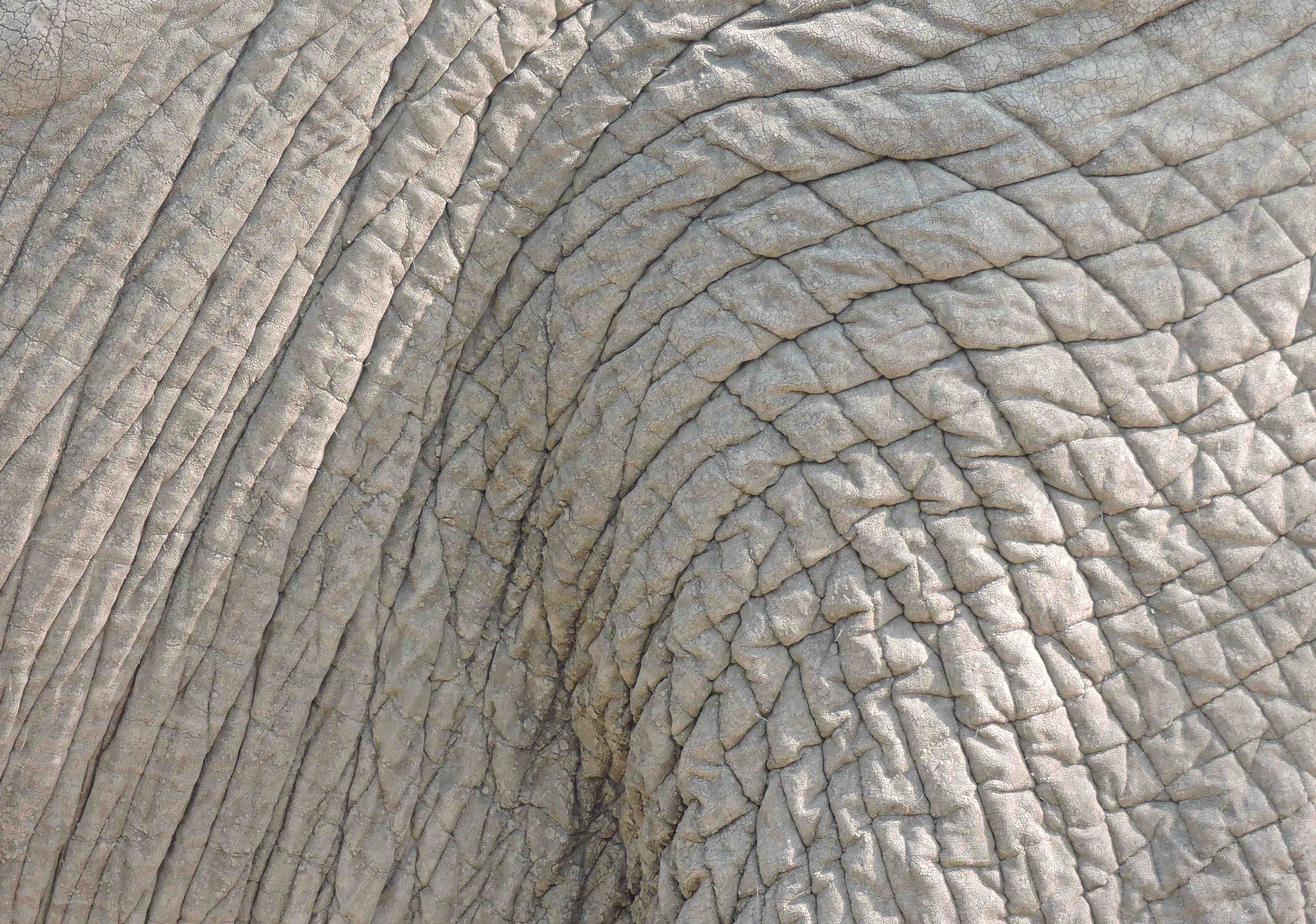
Big V passed a metre from me and, once by my side its head moved towards me and I could see that he had dry skin as well as every detail of its tusks ivory quality.

My view suddenly got blocked...

My view suddenly got blocked by Big V’s dry skin!

“This is ridiculous” I thought, “what is it doing?” I thought in a kind of resigned panic as I was totally at its mercy! Before I could find an answer his head disappeared from my sight as it stretched over the car to get at a particularly attractive pod!

IMG_0089_2 copy

I prepared for the bang (and how to explain the damage to the insurance company) thinking on the branch or branches that it was going to break and bring over the car! Luckily, it only got small twigs and I only had a “leaf-rain”.

IMG_0085 copy

I am afraid that my fingers did not respond to my mental commands for a while so perhaps my pictures do not reflect proximity too well! It was fortunate that my wife managed to capture the moment, even if between chuckles.

(A brief video taken by my wife showing the situation)

The elephant munched the result of its effort fast and moved on leaving me with the incredible feeling of having been under its shadow and survived, showing how tolerant of people the elephants in Mana Pools are!

A more relaxed bushsnob, posing.

Survived! A more relaxed bushsnob, posing after the event with the askari in the background.


Gwaya camp, Mana Pools, Zimbabwe, September 2015.


[1] One or more younger males often accompany older bull elephants staying away from herds and these are referred to as “askari” a word from Arabic meaning “soldier”.

Mana[1] Pools safari

Mana Pools National Park is found in the middle Zambezi valley. It extends from the Zambezi river in the North (Zimbabwe-Zambia border) to the summit of the Zambezi escarpment 50 km to the South. The park includes the river itself, a broad area of acacia and mahogany woodland on a belt of alluvial terraces. Although this is the area where most of the animals congregate during the dry season and therefore the most visited, the Park also includes large areas of mopane and jesse-bush (Combretum celastroides) and the rocky hills that flank the Zambezi valley. The Park and adjacent areas are regarded by many as the finest wilderness area in Zimbabwe.

Sunset at Mana Pools.

Sunset at Mana Pools.

This was our second visit this year as we had been in Mana. At that time it was cold and the animals, particularly the elephants, were still spread around in the park and therefore less abundant by the river. The absence of elephants then was largely compensated by sightings of wild dogs, lions and a leopard near our camp site.

This visit was different. It was much warmer and, as the dry season had advanced, the animals were indeed massing in the northern part of the park where water and grazing are still available. We stayed at Chitake One and at Gwaya private camp sites so we enjoyed a true wilderness feeling by being alone. Without doubt the elephants were the main actors during our visit and I hope to be able to describe the various events in an amenable way for you to enjoy.

[1] “Mana” in Shona means Four, describing the four pools that the Zambezi river left behind in its meandering.