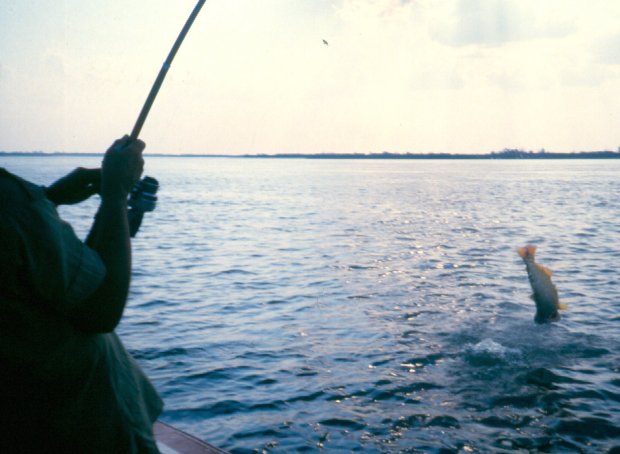
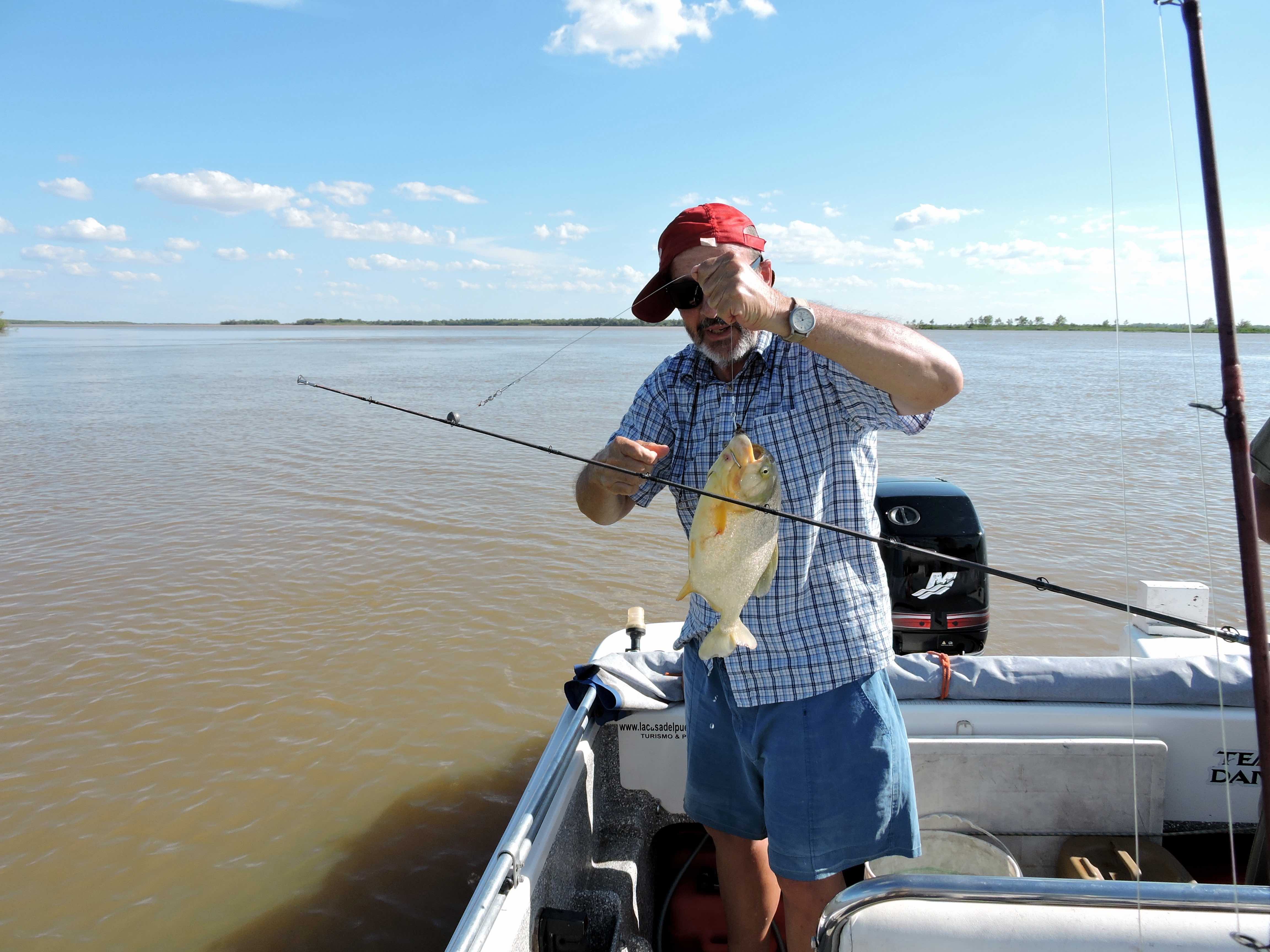
Playing a Dorado before bringing it in.
While in Kenya, we shared a few fishing trips with our friend Paul, a great fisherman and our undisputed “African Bush Mentor”. We fished together at Sasamua dam for trout, lake Naivasha for bass and lakes Victoria and Turkana for Nile Perch (and Crocodiles…)[1]. It was unavoidable that we would talk about our fishing dreams: sea fishing for Paul and fishing in Corrientes, Argentina for us, among other more whacky ideas.
Although I knew Paul from the beginning of our stay in Kenya, our friendship started when he invited me to spend some time in the Maasai Mara Game Reserve while he was doing research on Malignant Catarrh, a disease of cattle (particularly Maasai cattle) transmitted by wildebeest. I still remember clearly sitting at a knoll in the reserve waiting for a Wildebeest calf to rush to the site in order to get samples from the placenta! The trick was to be faster than the hyenas and other predators!
The idea of a fishing trip to the, to us almost mythical, Paso de la Patria in Corrientes slowly took shape while siting by campfires. Eventually we made the decision but it was regrettably postponed when Argentina and Britain decided to go to war for the Falklands/Malvinas Isles in 1982. I followed the short-lived war from the safety of Kenya alongside the British as there was a strong team of British Overseas Development Administration[2] veterinarians working at the Kenya Veterinary Research Institute in Muguga and I was collaborating with some of them.
I still remember one morning in early May 1982 when the Argentinian cruiser Belgrano was sunk by a British submarine. The following day a drawing of a sinking ship with the words “Belgrano” written under it appeared on a blackboard in the staff room. It clearly provoked someone who, a few days later, wrote “HMS Sheffield” under the same drawing, announcing the sinking of the British ship by the Argentinians! In retrospect, it was a very sad time.
Finally and thankfully the war ended and we resumed our fishing conversations that included the planning of the trip to Corrientes. Although the decision had been taken, the actual dates were repeatedly postponed because of working commitments on both our parts. Finally in late 1984 we started to get our act together and on 9 October I wrote to a couple of fishing operators found in an Argentinian fishing magazine asking for information on fishing in Paso de la Patria. We had learnt through experience that -at least for the first time- it was advisable to fish with someone who knew the rivers well.
Only one answer came back and it arrived rather fast, on 24 October. It was from Mr. Coco Barthe’s PIKIPÉ (the acronym of his company) who informed us that currently in January of each year -the time we could travel- there was a ban on Dorado, Pacu and Manguruyú[3] as this was their reproduction period. However, “catch and release’ was possible. As this is our normal practice it did not offer any problems. We read and re-read the letter! The fishing seemed to be excellent and the sizes of the Dorados caught could not be believed. Needless to say that this information was thrilling to us and, although we allowed for some fisherman’s exaggeration from Coco’s part, it still sounded amazing.
He also gave us useful details on accommodation and transport options as well as other fishing details. The key information for us were the costs involved. Thankfully (for us!) Argentina was at the time undergoing one of its recurrent economic crises so costs were affordable and we decided to go for it. January 1986 was fixed as “F Day” so we were committed!
Although today it seems almost incredible, at that time there were no available faxes or electronic communications so all arrangements were done through the Post Office and airmail letters between Nairobi and Paso de la Patria took about three weeks! Emergencies were dealt with by telegramme or telephone calls, the latter a rather expensive method reserved for extreme situations.
Several letters were exchanged from October 1984 until my last one of 4 Dec 85 when I announced our arrival at Corrientes on 6 Jan 1986 on Aerolíneas Argentinas AR 774 at 18:45. We had booked fishing time from the 8th to the 11th. This encompassed the services of a boat and a guide, with other related expenses such as petrol, lures, bait, etc. at an additional cost. Accommodation was arranged -by Coco- at what was then the only hostel in Paso de la Patria. It offered individual air-conditioned chalets under shady flamboyant trees. The place also offered meals at reasonable prices.
Suddenly we hit a serious snag! Carried away with our enthusiasm for the trip we somehow overlooked the fact that Paul was British and the latter had beaten Argentina in the Falklands/Malvinas war. Although more than two years had elapsed since the end of the conflict, relations between the two countries were still tense and the granting of a Visa for a British national seemed difficult not to say impossible!
As we only realized this at the eleventh hour, we had a panic as this threatened to derail the whole project! While considering our options, we wrote to Coco to contact the Ministry of Foreign Affairs in Argentina. This he did but the news was still bad: no Tourist Visas were being given to British nationals! There was a hope though: a Business Visa and Coco, of his own decision, wrote a letter to the Minister informing him that Paul was coming for a visit to discuss the possibility of bringing Kenyan clients to Argentina for tourism, fishing and hunting!
We also took action locally. The Latin American community in Nairobi was small and we all knew each other. Among our friends were Argentinian Diplomats, we met with them and they promised to help. Luckily, our two-pronged approach worked and we were told that Paul could get a Tourist Visa and there was no need to go for Coco’s white lies. If not the first, he was probably among the first British nationals entering Argentina after the war. We jumped this fence and we were ready to go!
Paul arrived in Uruguay after we had been there for a couple of weeks and, after spending a few days in Carmelo -our town- we met in Montevideo and from there we flew to Corrientes as planned. Coco was waiting to take us to our hostel in Paso de la Patria, about 45 km towards the Northeast. We travelled in his car, an enormous mustard-coloured Chevrolet “Chevy” with an equally large engine, showing some wear and tear and being rather noisy with a boot that required a laborious intervention with a large screwdriver to pop it open.
The following day -7/1/86- we needed to exchange money so Coco took us to the bank in Corrientes only to learn that bank employees were on strike. However, we managed to get some money to see us through for a few days and pay the hostel. We did have credit cards so we were not too concerned at the time. While travelling to the city with Coco, we asked him if it would be possible to go and watch wild animals somewhere. He agreed and promised that late in the afternoon he would take us for a boat ride on the Paraguay River, where we could see some interesting birds as well as animal’s footprints. Now, that was exciting!
Paso de la Patria in January is very, very hot! Nothing moves from about 12:00 to 16:00hs as the heat is just unbearable. We put on our air conditioner and decided to stay inside, away from the furnace. We never thought about Paul’s ideas. In an act only explained by the maxim “Only mad dogs and Englishmen go out in the midday sun” he decided to go for a walk! Luckily he was an intelligent Englishman and returned after only a few minutes, rather suffocated!
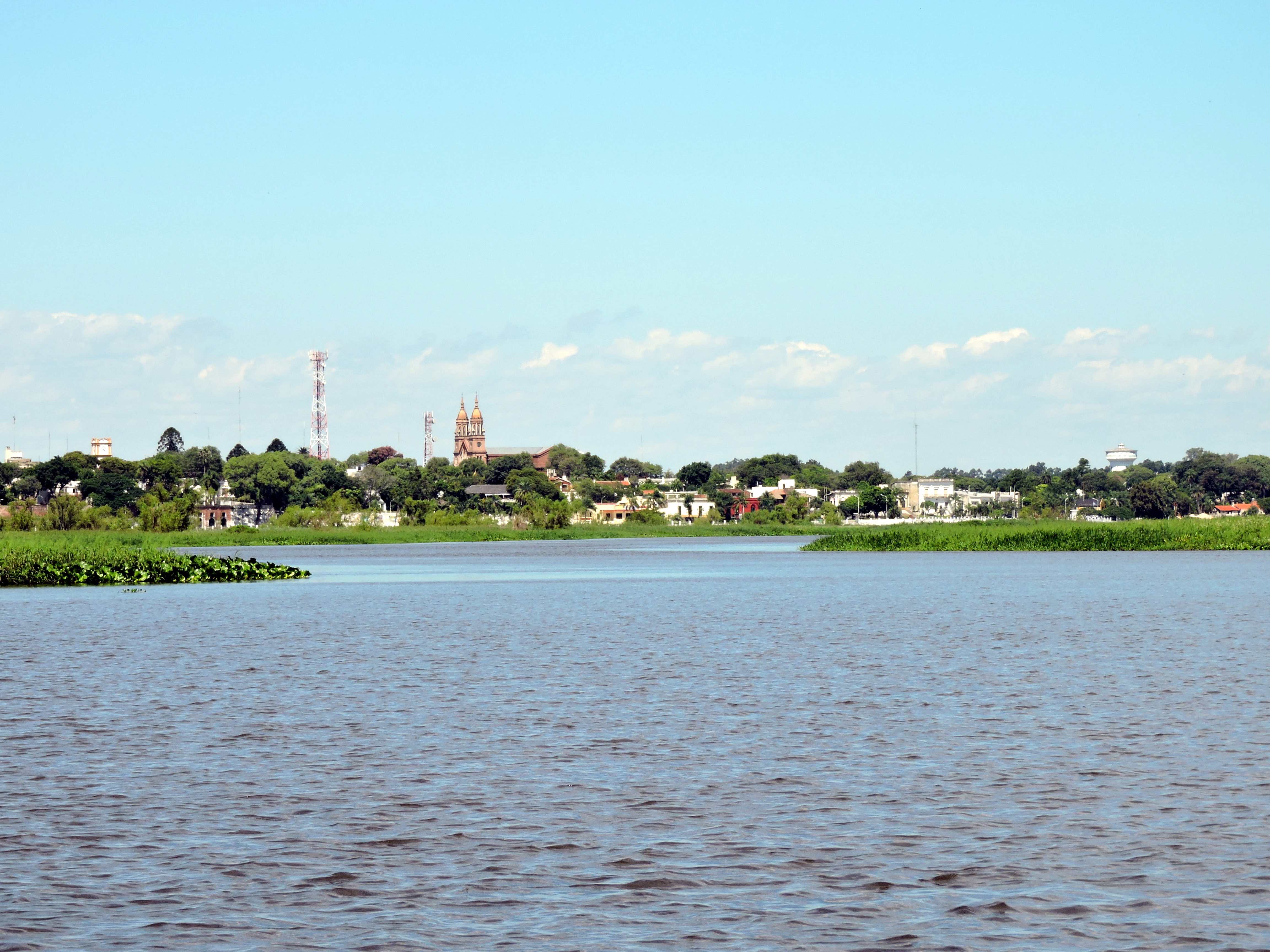
Eventually the time for the excursion came and we were picked-up by Coco and his teen son, towing a very large and magnificent boat with an enormous engine (150HP) placed on a large 4-wheeled trailer. Coco had borrowed the boat from a good friend. “We need a fast boat for the trip I have in mind” said Coco. Things were looking good, we thought, while sharing excited and satisfied looks and comments in anticipation. We all jumped on the Chevy and went to the river. This was our first real look at the mighty Paraná River that, in Paso de la Patria, is about four km wide. Its width and the strength of its rather clear water were the features that called our attention. There were sand banks, sandy beaches and islands all over.
The Paraguay river joined the Paraná in the Cerrito Island, a place we could see in the distance. That was the start of our adventure up the Paraguay. With the fading light, the river and its environs was a beautiful sight. Coco informed us that the water was very low and clean for the season and the fishing excellent.
While we were lost in contemplation we had glimpses of Coco maneuvering the Chevy into position and dextrously reversing the trailer into the river, something that could have taken me at least an hour to do. This drew our attention for a while and we also saw him unhooking the trailer from the car in order to immerse it sufficiently to release the launch.
Our attention went back to the river as we could see splashes and ripples created by fish all over the river and, to our surprise, an osprey fishing. Coco’s voice brought us back to the boat launching. We saw him standing with the water above its waist. He was clearly under great strain holding the trailer. His son was frantically trying to unfasten the boat. Somehow this took longer than anticipated or the teenager did not know exactly what to untie. Regardless, the end result was that Coco, the trailer and the boat were going deeper into the river while he kept shouting instructions to the increasingly ineffective and nervous youngster!
Eventually, successfully released, the boat floated free and, to the relief of all, the son brought it to the shore, smiling. We prepared to board our first Paraná adventure. But we were not there yet… The release of the boat meant that the weight of the trailer was solely on Coco. We could see the strain in his head and shoulder muscles and he muttered something like “I cannot hold this much longer” while moving to chest depth. “Hang on Coco” we shouted while running towards him. However, before we could reach him we witnessed the final and uneven battle between Coco and the mighty Paraná. Abruptly his body relaxed and we saw his empty hands above the water “Shit” he exclaimed, “the trailer is gone!” a rather obvious statement but something I would have also said!
Once we recovered from our disbelief, we felt pity for Coco and then tried to guess where the trailer had gone! We had just witnessed the loss of an expensive-looking trailer, probably forever! Coco was very brave about it, considering that probably more than our fishing trip’s revenue was “gone with the river” before the fishing even started and, without one word of lamentation, he prepared the boat and off we went.
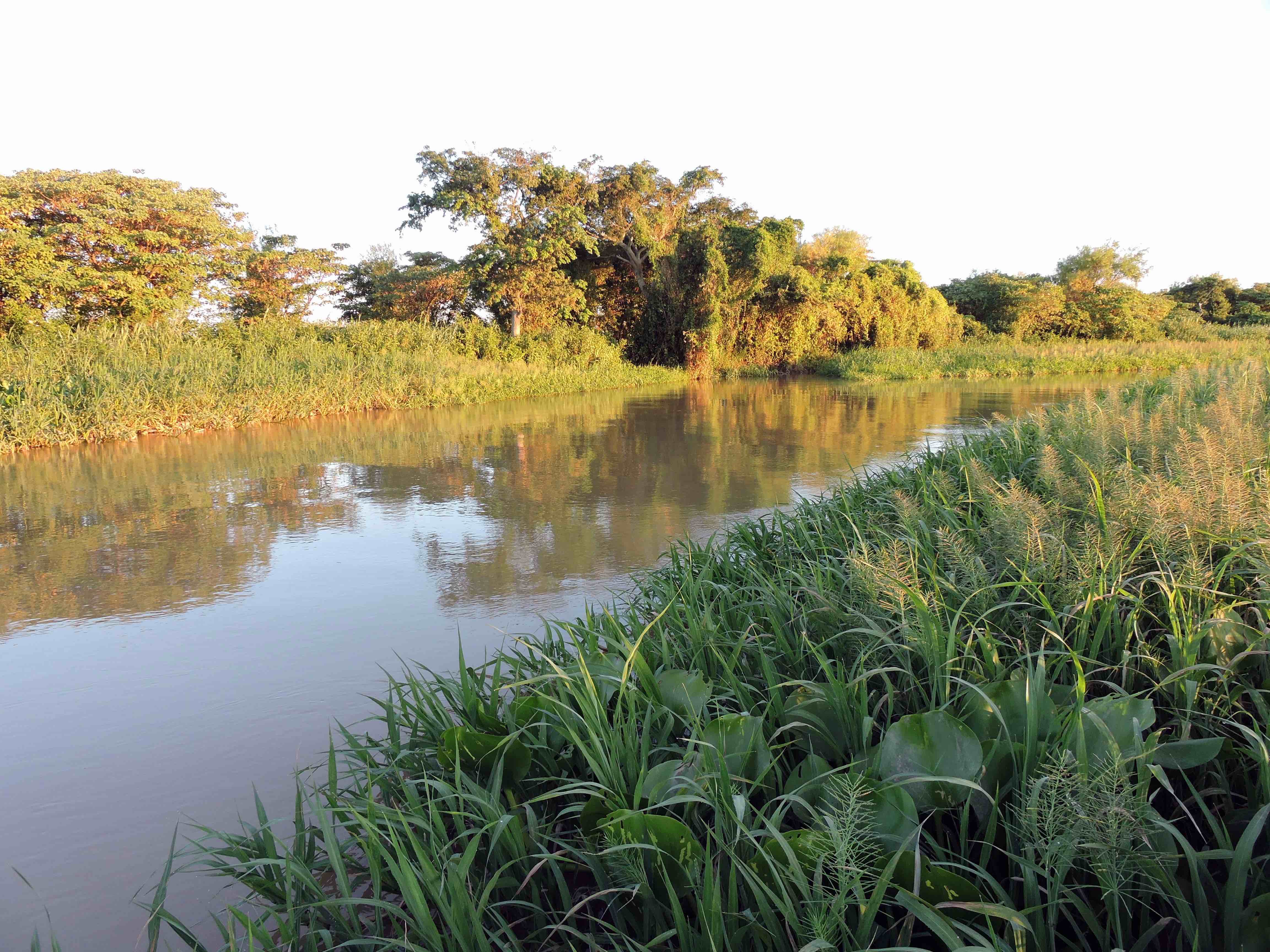
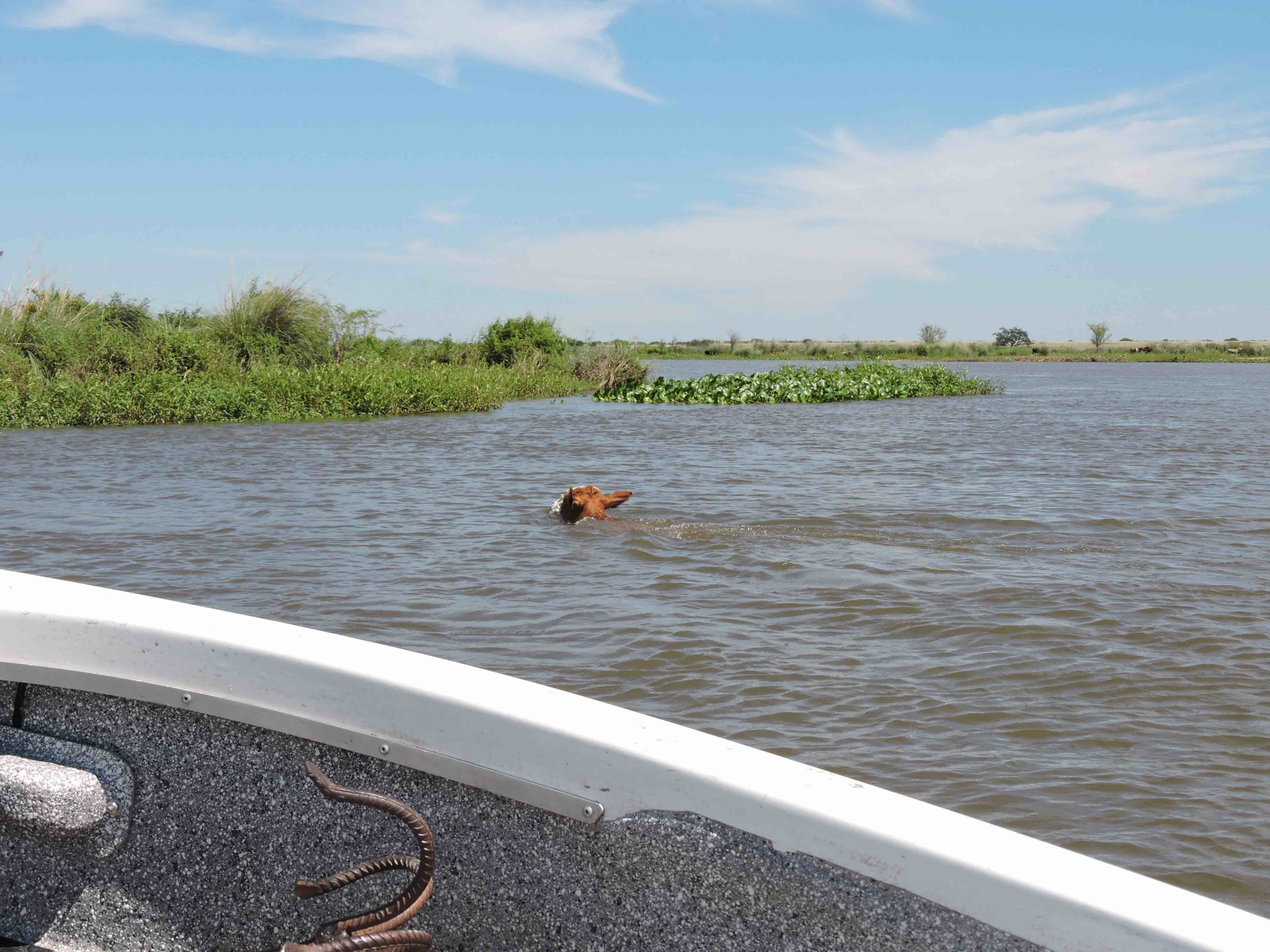
Our itinerary took us across the Parana river towards Paraguay and we entered the Paraguay River. While the Paraná’s water was very clean, the smaller Paraguay was very flooded, running fast and muddy and full of floating plants and trees. Clearly the rains were in full swing up river. Into the Paraguay we went, always at very high speed, navigated by Coco who seemed to be enjoying the ride as much as we were and had clearly forgotten the trailer by then.
The boat was really fast and the ride exhilarating. Then, at about 100 metres we saw a humongous full tree coming towards us at speed. Our mild surprise at Coco not taking evasive action became an alarm call as the behemoth was almost upon us. Coco was unruffled and, before we could scream in pre-death desperation Coco avoided it at the last second swerving violently to the right only to resume our course. A nervous calm was restored when another fishing Osprey was sighted and pointed out by Coco. The next floating forest colossus that tried to kill us was avoided the same way so we relaxed a bit and endured the following ones in a much calmer way as the situation seemed normal. We did disembark to see some Puma footprints but the general feeling was of relief, as at least on the way back the trees would be travelling in our direction!
We were soon back in the Paraná and we travelled downriver for a while as Coco wanted us to see how, for a few km, the two rivers go side by side without mixing and with a clear line separating them in similar fashion to the White and Blue Niles near Khartoum. Back in Paso de la Patria Coco left the boat at the small harbour and took us to our hostel where we talked a lot about the lost trailer and the boat ride.
So that was the start of our river adventure in Paso de la Patria and the fishing would only begin the next day at 06:00hs!
As Paul and I scribbled some notes day by day, I will start each fishing day with these in Bold and then add my own recollections.
Day 1. 8/1/86. Trolling above rocks. 8+ kg, 15+ kg, 3 of 5-6 kg, 4 of 5-7 kg. 115 HP Mercury engine. Moreno. After a good night’s sleep (aided by the air condition again) we were up and about at 05:00hs, excitedly waiting for the start of the actual fishing. As the hostel was actually on the river, we walked to the harbour to meet our guide. Coco and son were also there with a grappling hook, trying to retrieve the sunken trailer. Our guide presented himself as “Moreno” and he was indeed dark skinned. He was quiet but friendly so we were happy with him and looking forward to sharing the boat with him for the next few days. He explained that today we would be going for large Dorados and this would mean mainly trolling over rocks where water moves fast and Dorado wait for their prey.
The Paraná River has a number of game fish that attract fishing lovers from all over the world. The Dorado is the King of the river as it is a very strong fish that, when hooked, fights to the bitter end with spectacular jumps and runs that very often result in the fish going away. Apart from the Dorado, the Surubí (Pseudoplatystoma corruscans) is also sought, as it is a very large fish attaining up to 80kg although these are now rare. When hooked they resist by swimming away and, because of its weight, they are difficult to reel in until it tires. Finally, there is a third fish, the Pacú, who takes dough and or fruits. It can also reach a large size and it offers a good fight as, being a wide-bodied fish, it swims sideways, making its recovery very difficult.
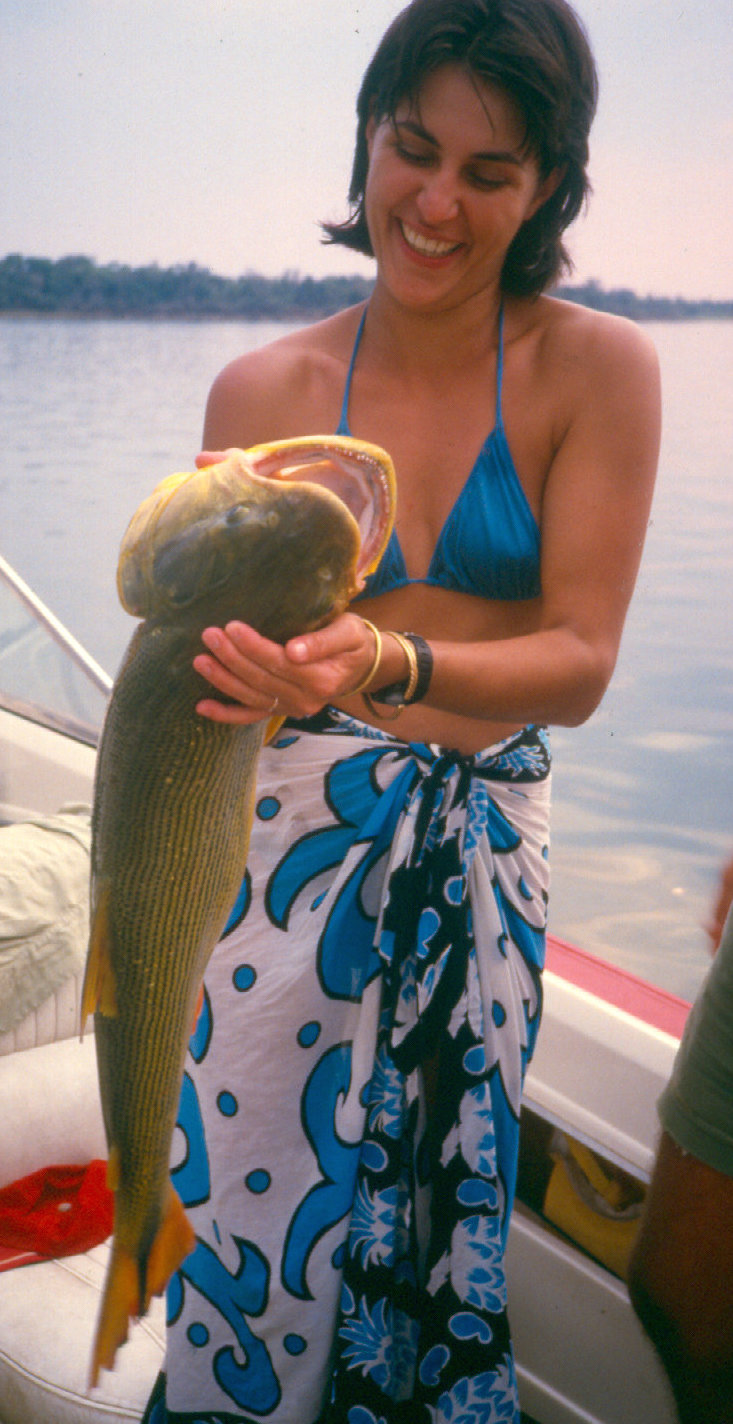
We left Coco throwing his hook and headed for our eagerly anticipated fishing trip. From previous experience we knew that trolling can be tedious so we prepared for a long wait after we put two rods in the water. Moreno manoeuvred the boat through fast running water, trying to get our lures to pass where the Dorados were poised for ambush. This was risky and we had a couple of snags. The first strike happened after 30 minutes and during the course of the morning we experienced the best fishing I have ever had. We caught about ten Dorado, a couple of which were above the 12-14 kg mark and the largest -as usual caught by my wife- that struggled bravely for a while to bring it in! We all fished as we took turns but none of us was left wanting!
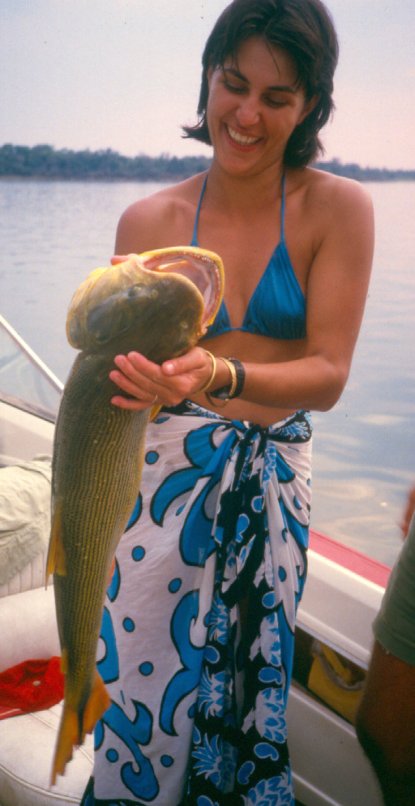
A good fish caught by my wife.
By lunchtime the sun was too strong and, despite our willingness to continue, we returned to the shade of the hostel for a cool shower, a light lunch and a siesta. This time we managed to persuade Paul to lie down. At about 16:30hs it was time to go to the river again but there was no sign of Paul. We decided to call him and he gave a feeble reply. After a while he came out of his bungalow and said “Good morning!” in his cheerful way. We burst out laughing at his confusion but, at the same time, we knew that he had rested well as this is a common mistake one makes after a good siesta! We congratulated him for having achieved this despite his Anglo Saxon origins!
The shorter trolling of the afternoon complemented the morning’s success and rounded up an excellent day that ended up dining with Coco at a local Parrillada (BBQ place) sitting “al fresco” to enjoy the fresh evening air while partaking of typical roasted beef and insides. We praised the fishing to Coco’s delight while Coco informed us that the trailer was still under water!
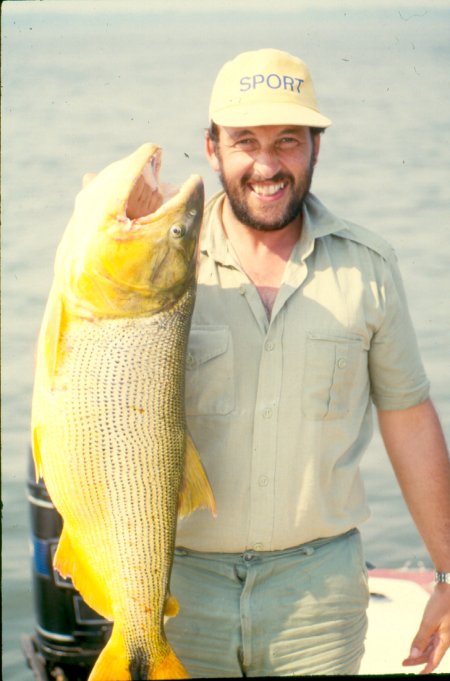
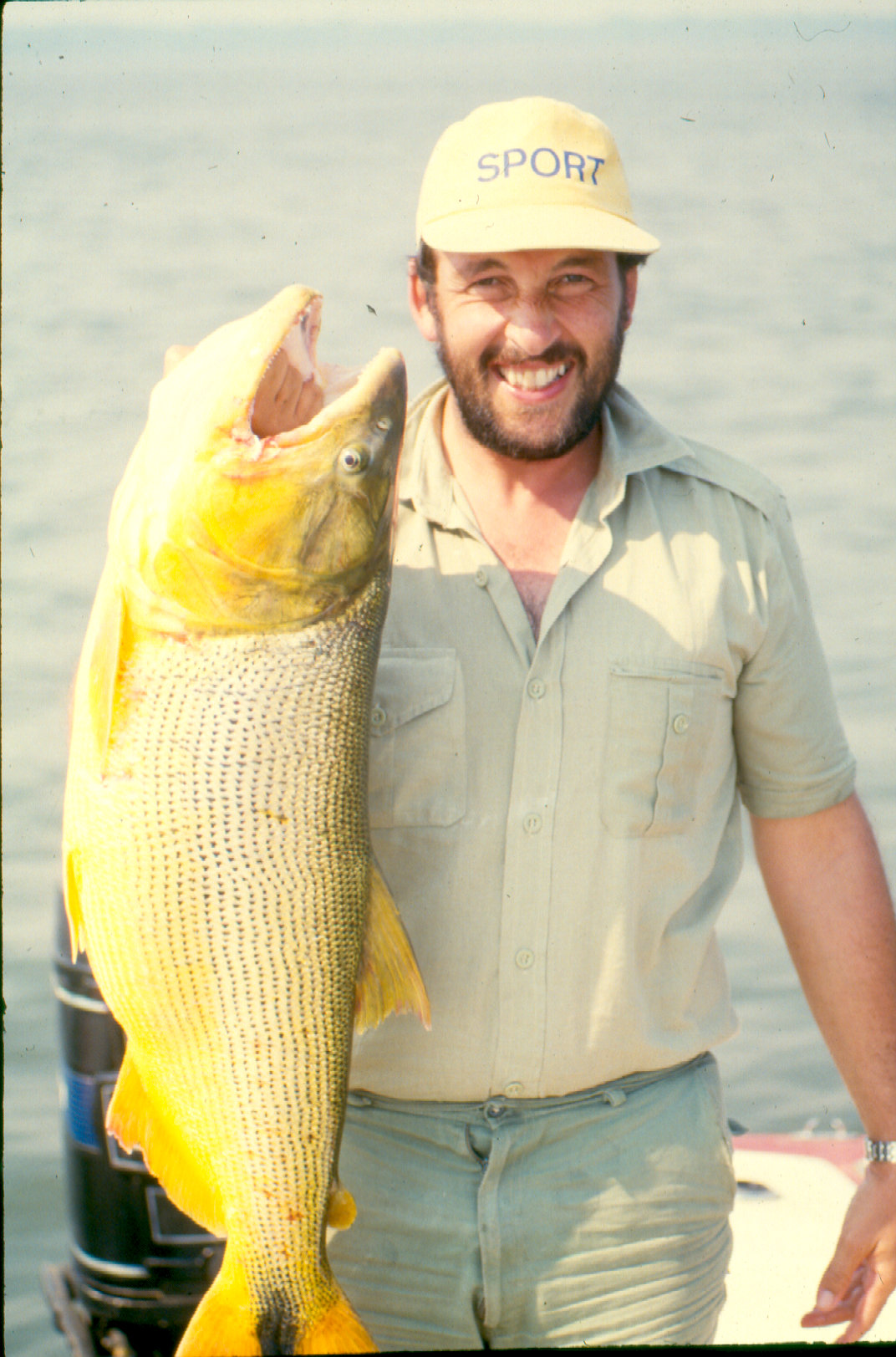
The largest Dorado I have fished.
Day 2. 9/1/86. AM Itatí trolling, 6+kg (tumour) eaten, 12+kg, 7+kg, 7+kg, Basilica, shopping, grilled fish on island, swimming, finger chewing. PM hit the Sábalo, initially with lures, then anchored upstream letting bait drift down. Six Dorado 5-7 kg. The excellent fishing we had the day before had lowered our anxiety level. However, Moreno still wanted us to enjoy the day so he took us up the river towards Itatí, an area well known for its submerged rocky formations where Dorado and Surubí are found. The fishing was similar to the previous day but we caught less fish. In my enthusiasm for a picture my finger inadvertently ended up in the mouth of one. As these fish have a reflex that causes them to clamp their jaws shut when touched, my finger suffered the consequences of a “Dorado chew” and it was kept in its toothy mouth until it decided to open its mouth; attempting to pull my finger out would have ended badly! We noticed that one of the Dorado caught had a large tumour on its side and it was chosen to be barbecued.

Satisfied with the fishing, at about 11:00 we docked at Itatí to buy salt and lemon for our lunch. A small village, Itatí is well known because of its Basílica to the Virgin Mary that attracts great displays of devoutness to the wooden image of the Virgin. The walls of the Basilica are literally covered both inside and outside with ex-votos or votive offerings. Its small size and its design are apparently unique for the region. It can hold up to nine thousand people and its 88 metre high dome is the highest in South America and it can be seen from a long distance away.
Later on we visited the local market where Paul bought traditional trinkets and we got a mate made of Ilex paraguayensis, the wood from the bush that produces yerba mate, the typical drink of the region and a bombilla[4] with the effigy of the Itatí virgin on it.
Itatí done, we boated to a lone sand bank/island where the Dorado was quickly barbequed by Moreno with only salt and lemon. It was a good fish, its usually dry white meat quite juicy and even tasty to me (I must confess that fish is not my dish!). While the fish was cooked we bathed and swam to keep fresh. With lunch finished, it was time to go back to the hostel to recover.
In the afternoon, as the river was low and very clean and the sun rays were at the right angle, fish could actually be seen near the surface, something that I had not thought possible. There were huge shoals of thousands of fish. They were the herbivorous Sábalo (Prochilodus lineatus) Moreno informed us. They are the natural prey for the Dorado. It was almost at the same time that we all said that the situation somehow reminded us of the wildebeest vs. predators in the Maasai Mara Game Reserve!
The idea was to fish a few Sábalo in order to use them for bait and let the chunks of silvery flesh drift down with the current waiting for the Dorado to find them. The issue was the catching of the Sábalo. No problem said Moreno as he was preparing a single hook with a weight that he threw into the river and retrieved by pulling it strongly. By the second pull he foul-hooked the first fish to Paul’s horror “He is foul-hooking them” he said with a derogatory tone. “That is the way” I replied. “Very unsporting” came Paul’s reply.
Soon we had a couple of fish in the boat and fillets were distributed among the three of us. We threw them and let them drift for about 60 metres. As soon as we stopped the line from going out, we could feel the gentle pulls of small fish nibbling the bait. “These are the small fish, be attentive as the Dorado will hit next”. He had not finished the sentence when each of us had a Dorado running with our fillets! Although we had many bites and lots of fun, the result were just a handful of Dorado as lots of them took the food away and left us with an empty hook. We liked this way of fishing and agreed with Moreno to repeat it the following day.
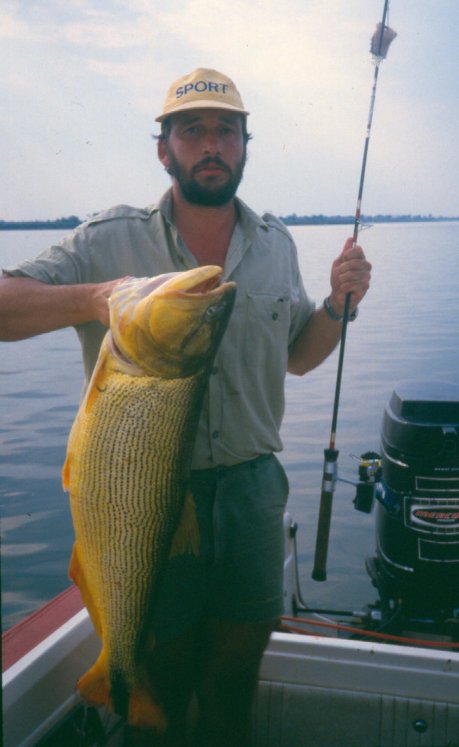
Another Dorado caught with Sabalo bait.
Day 3. 10/1/86. AM Back to Sábalos. Shoal feeding. Catch several (6) Sábalo by foul hooking. 1 Sábalo of 3+kg. Dorado – 8. PM 3 more Sábalos. Dorado feeding well, another 12-15 Dorado 2.5 – 8+ kg. Many fish lost. Amazing fishing. Amazing sunset. Cicadas. Back early because of wind. (I added: Fantastic Dorado hunting and feast over Sábalo). As agreed, we went straight for Sábalo fishing. I was surprised to see Paul being the first attempting to foul-hook Sábalo but refrained from make a rude comment as he was enjoying it like a child! The climax for him came when he got a rather large fish of about 3 kg that gave him an almost a harder fight than a larger Dorado. While we fished for bait, we witnessed a spectacle that delayed our fishing for a long while.
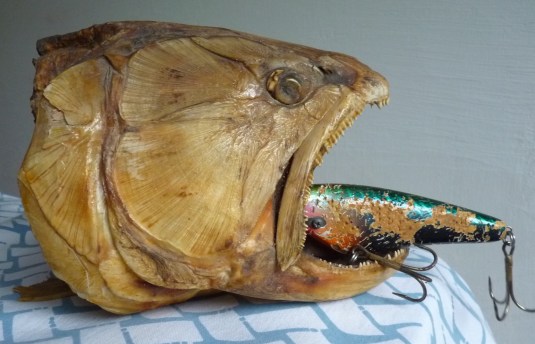
They have a large mouth.
The Sábalo shoals were, again, all over the place, shining silver as they rolled in the clear water. There were thousands of them feeding on the clay riverbanks. At frequent intervals you could see and/or hear splashes: Dorado attacks! They seemed to be cruising among the shoals and striking at the Sábalo. Paying closer attention we could actually see the dynamics of the hunt on the surface but we could not agree if they were hunting in packs or whenever a Sábalo was caught several Dorado congregated to feed. This was the only time I have ever witnessed this amazing event, despite having returned to fish there several times by now!
Regarding the fishing, the fun continued and it was increased when we decided to change to very light gear. This meant that we needed to play the fish for a long time before they were sufficiently tired to bring them in. It also resulted in fish swimming in all directions, passing under the boat, jumping behind you only to return the moment you turned around. Fishing people bumped into each other and several times we nearly pushed each other into the water as a result of our excited movements. Soon we were exhausted and decided to call it a morning. We all agreed that it was great fun even when it resulted in substantial loss of equipment! We thanked Moreno profusely for his guidance.
The afternoon outing started with a very loud Cicada choir that, according to Moreno, indicated the brewing of a storm. We repeated the same fishing approach and witnessed more Dorado kills. Even Moreno was impressed in his quiet way! Then the wind picked up and while Nature was putting together a most beautiful sunset it was time to return as a heavy storm was indeed brewing. We managed to get back just before a small tornado hit Paso de la Patria with the usual consequences of broken branches and other light damage.
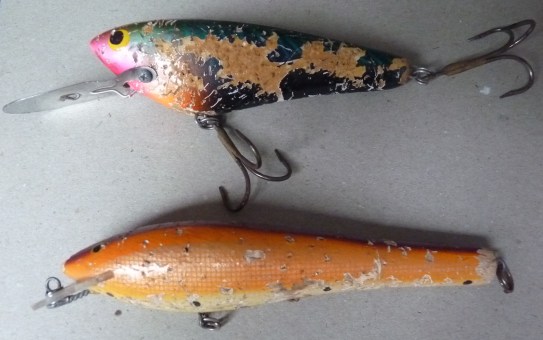
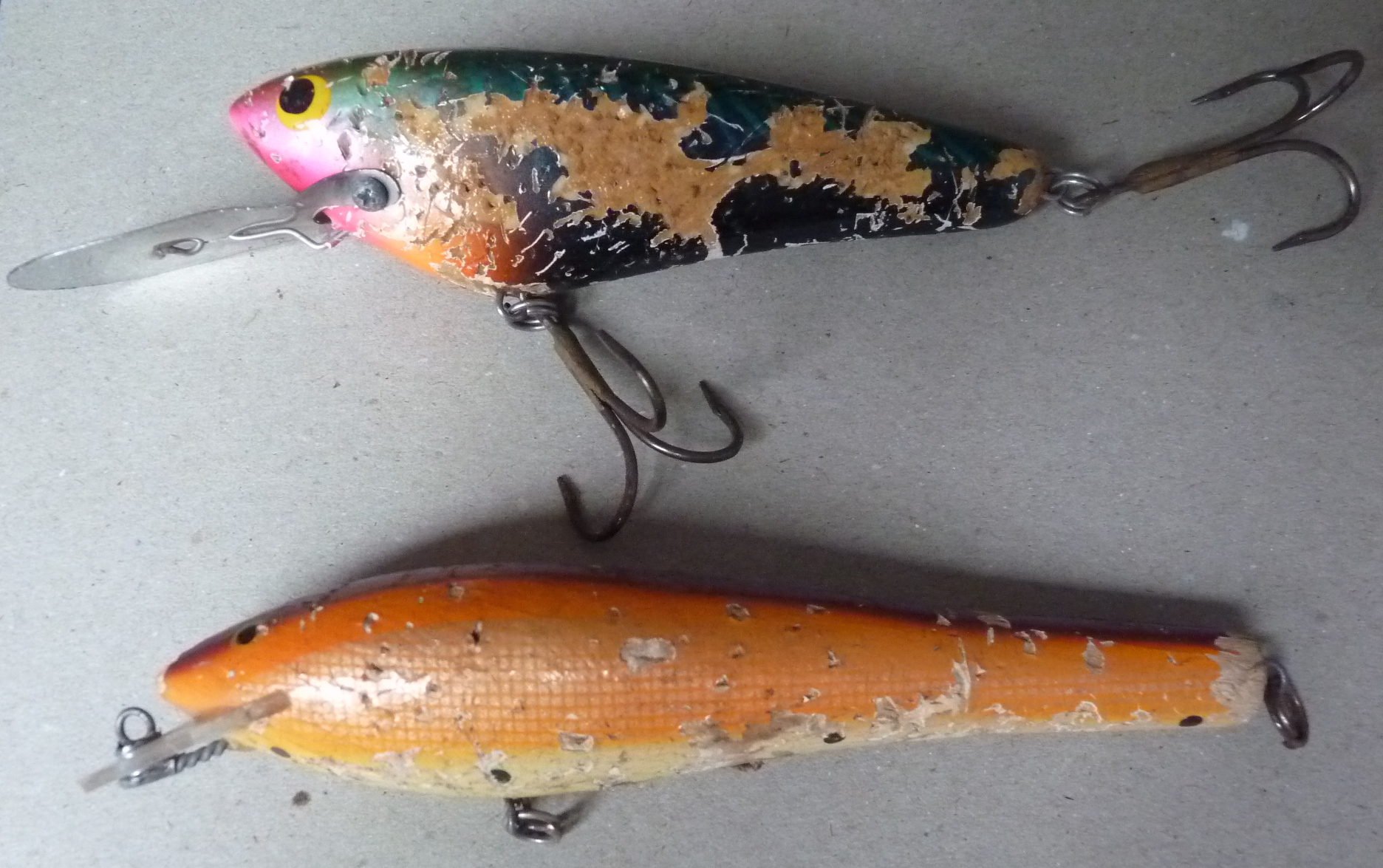
The condition of the lures after a day fishing!
Day 4. AM Topadoras in the river. Dionisio Romero (“Moreno”). Went 56km up river, past Itatí. Tried for Surubí and hooked one Dorado 4kg – lost (JJC). Then tried Pacú no luck. 11:30 Went for big Dorado from Itatí stones. Hooked Dorado (big) and the steel trace gave in but recovered although damaged. The storm calmed down at dawn and all we were ready to go. As we had had sufficient Dorado fishing by then, we focused our interest in attempting to catch Surubí and Pacú while travelling around. An outstanding feature of travelling upriver was the densely forested river margin in Paraguay and the amazing noise that Black Howler Monkeys make early in the morning.
We travelled many km to get to places where our target fish could be caught but failed to find them. On our way back we tried the Itatí stones again and hooked some large Dorado that we could not get out. In the afternoon we accepted an invitation from Moreno to cross into Paraguay to visit the shops, as it was cheap there. Not knowing really what to expect, we accepted.
After boating along the Paraguay River for a distance we entered into a tributary and docked near a large wooden building on stilts. It looked as a makeshift contraption and we looked at each other anticipating time wasted. We climbed the stairs and entered. Our surprise was huge at finding all the electronic equipment you could dream existed and wished to buy as well as all the alcohol and cigarette makes and amounts you wanted. Although we wasted time as we did not buy anything, it was an amazing find in the middle of nowhere. Clearly smuggling was involved!
We had come to the end of our fishing trip and we had a final meeting with Coco to whom we needed to explain that we could not pay in cash for the fishing as our travellers cheques from Kenya could not be cashed in Argentina but that we could pay him with a credit card. He mentioned that he did not have the means yet to accept credit cards so we agreed that we would send him the payment once we were back in Kenya. This was the coronation of Coco’s bad luck with us: he lost the trailer and, at the end of our safari, did not get any money from us! However, he continued to be a friendly and helpful host.
So, the following day it was time to catch our plane from Corrientes to Buenos Aires and he was there to pick us up. Unknown to us, the time for departure had been anticipated. At first we did not think much when we saw a plane approaching the Corrientes airport while parking Coco’s car. The truth became clear when we arrived and the plane was taxing its way to the departure area and, when we were explaining the situation to the check in desk we heard the engine noise and it was gone.
We were told that there was some hope for us as the plane stopped in Resistencia before continuing to Buenos Aires. We rushed our farewells to Coco and took a taxi to Resistencia, faster and safer than the Chevy! Despite our mad rush, it was a “deja vu” in Resistencia and we had to book another later flight from Resistencia. Not a great problem really. While at the airport we met an Australian lady tourist visiting family in Asunción that had not been allowed on her plane, as she did not have a Visa for Paraguay. As she was having communication problems we assisted her and, in the process, ended up inviting her for lunch! Naturally we went to a BBQ place in Resistencia where we went through the normal carnivorous diet of the region to her horror!
Eventually we walked with her to the Paraguayan Consulate where she got the Visa and placed her on a bus to Asunción. We were still in time to get to the airport and, this time without snags, leave for Buenos Aires with the best fishing memories ever!
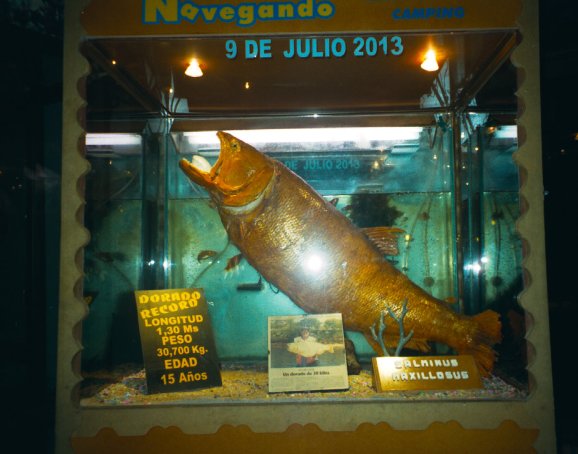
The record of Dorado: 30.7kg!
[1] Some of these trips deserve a separate account that will come, eventually.
[2] Now the Department for International Development.
[3] Salminus maxillosus, Piaractus mesopotamicus and Paulicea luetkeni respectively.
[4] Mate is the main traditional drink from this region of South America. The dry ground up leaves of the yerba mate plant (Ilex paraguayensis) are placed into a container and hot water poured on it. The infusion is then sucked up through the bombilla, a metal drinking straw with a bulbous strainer at the end.

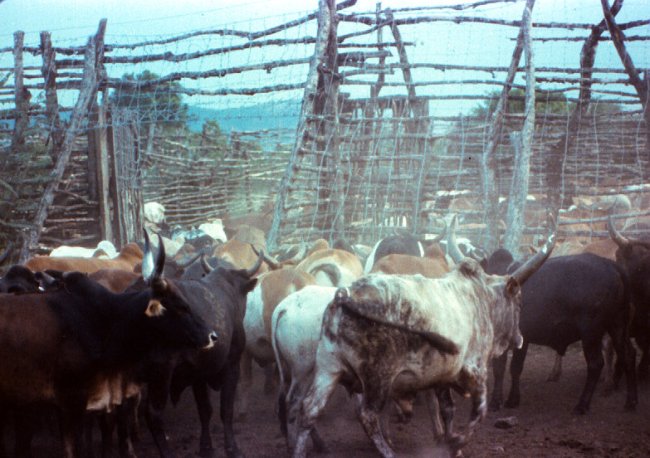













 A Bushsnob out of Africa