South Africa

Predators’ Eden

Having stressed the negative consequences of a drought like the one the Kruger National Park is going through in the previous post (3/10/16) it is now the time to mention one of the positive aspects of this situation for the game-spotter.

The lack of grass transformed the thicket into a very dry wooded savannah. In addition, the riverine areas that usually offer some cover to herbivores were now denuded from a lot of the vegetation so there was a lot of visibility. Most animals were near the river as most need to drink regularly so most of the “action” took place there.

Even without the assistance of the existing apps[1] we were able to find lions and leopards in numbers that are usually unthinkable, even for my wife.  11 September 2016 will go down in our bush lore as the day of the cats! In the morning, during a 20 km drive we spotted three different groups of lions, two separate leopards on trees and two walking by the river! We almost did not stop when we found a hyena walking by the road! As if this would not have been enough, after (my) siesta time, we revisited the nearby causeway over the Lower Sabie River to see if anything remained of the zebra being fed on by crocodiles of the day before.[2]

We crossed the bridge but found no trace of the zebra. As usual, there were a few cars on the bridge so we decided to turn around and, after re-crossing the bridge, to do a short drive following the river to enjoy the evening. By the time I had turned the car around all other vehicles had gone and we were on the bridge on our own, a rare occurrence.

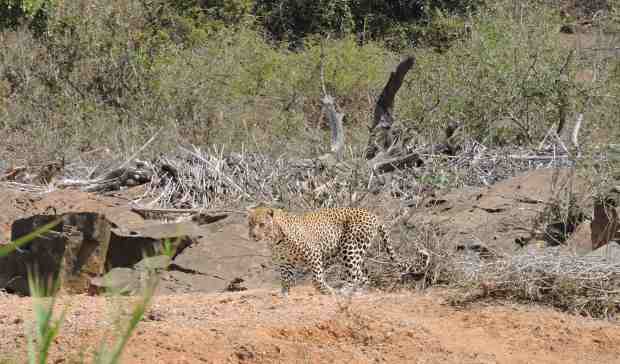
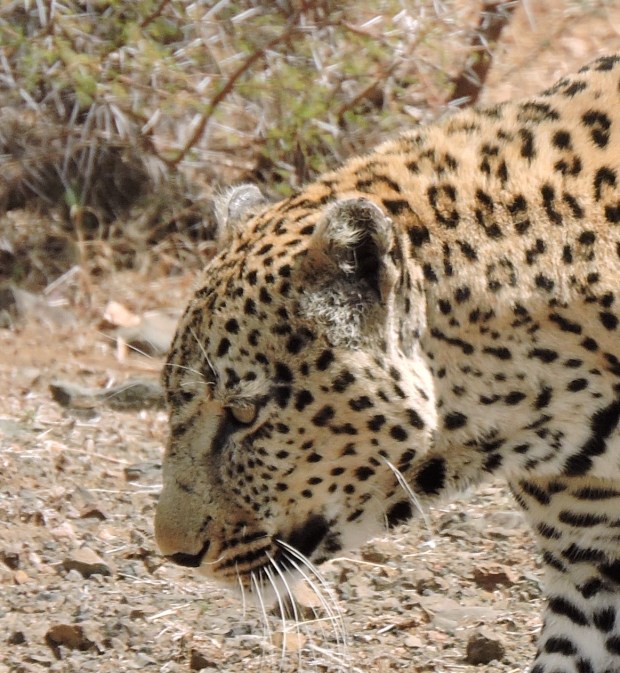
As the bridge is narrow, I was paying attention to my driving when, just before ending our crossing, I heard my wife saying, “Look!” A leopard had just appeared out of nowhere on the shore of the river. I switched off the engine and we both grabbed cameras and took the pictures we could as the animal did not stop much and never took notice of our presence while it crossed the bridge just in front of us!
dscn9899-copy

The first picture of the leopard.

It was a large male and its right hind leg was apparently painful as it was limping.
dscn9902-copy

The sighting did not last more than three minutes and, by the time a few vehicles arrived to the bridge (that we were totally blocking), the leopard had moved off and it was hardly visible, although it had been spotted by others! I decided to move on and “share” our find only to realize that the car was dead! Suspecting a disconnected battery terminal I got out of the car to fix it. Although it did not take much time to get the car running again, by the time we moved off, the leopard had already disappeared and I was probably the least popular driver in the park!

Although the 11th was our most productive day, over the next couple of days we continued to find predators. We also continued to have problems with our battery! So, when I needed to get out of the car to fix it next to a group of lions, we decided that it was time to take the car to Skukuza for a long-lasting solution! This we got from one the very helpful camp mechanics that, with the right spanner, tightened the nuts and ended the problem for good.
dscn9920-7-29-26-pm-copy

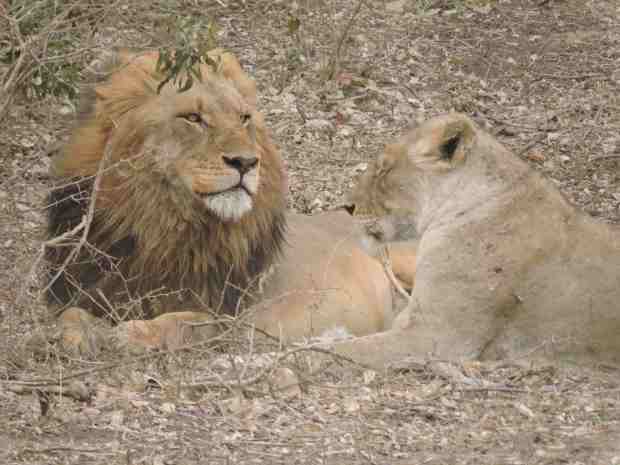
Luckily the lions were more interested in their romance than in the bushsnob fixing the battery!

Feeling now safer, on the way back to Lower Sabie Camp my wife (who else?), continued to excel and spotted more cats! The first sighting took place after we both noticed a few vultures on the ground by the Lower Sabie River. While I was watching them my wife noted that the cause was a buffalo kill where two magnificent male lions were feeding! Frankly, I would not have seen them.


As road speed limits and gate closing times in the park are very strict, we decided that we needed to start our journey back to arrive to our camp in time. Our planned timely arrival only lasted a few kilometres, until my wife spotted yet another leopard!
dscn9948-copy

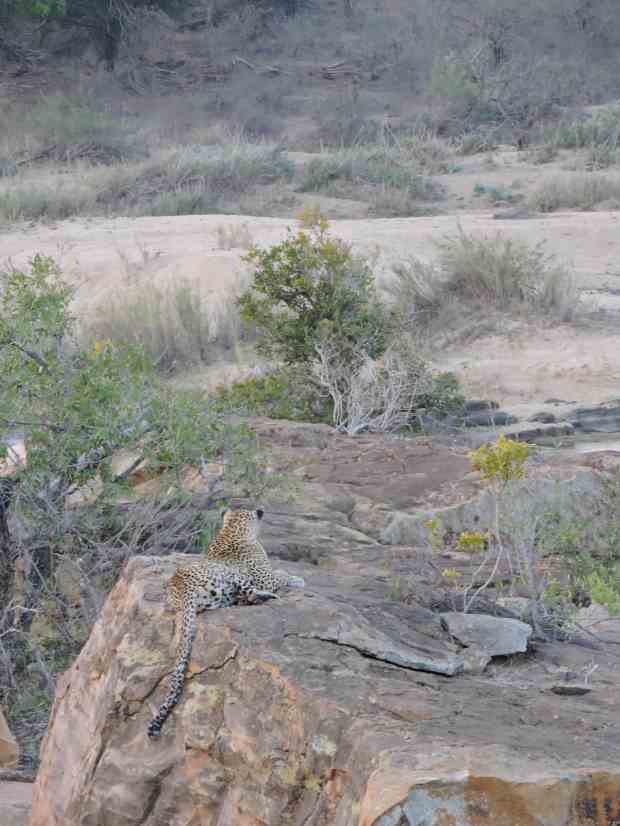
This time it was a female sunning itself on a rocky outcrop overlooking the river. A beautiful sight worth risking a fine from the park as we both agreed. It was beautiful to watch the animal with the evening light and we stayed there until it decided to move off and we lost it.

Aware that we were late, we prepared our usual excuse of engine malfunction (this time it was quite close to the truth!) and returned. Luckily we just managed to squeeze through as the gates were being shut!

That night, staying at one of Lower Sabie’s tents paid off. Despite the rather sad absence of hippo grunts, the elephants were noisily feeding nearby and they were very vocal. Later, several lions started roaring up and down river, their loud calls amplified at night and the chorus continued well into the night. At some stage, a leopard joined in with its own regular grunts ending in an amazing ensemble that we do not recall having heard before. We were late sleeping as did not wish to miss the wild concert!


[1] See the earlier post: https://bushsnobinafrica.wordpress.com/2016/09/30/animal-go/

[2] See: https://bushsnobinafrica.wordpress.com/2016/09/16/hungry-crocodiles/

Hippo drama

The drought that Southern Africa is experiencing this year was evident already during our visit to Mana Pools in September. Despite the Zambezi River providing sufficient water, grazing was the main issue as the riverine pastures were very low and the patches of green left were those that are inedible.

Browsers and grazer/browsers were still in good shape but large grazers such as hippos and buffalos were already walking longer distances to get to areas that still had grass cover and these were dwindling fast. The hippos’ normal timetable was visibly altered as we “bumped” on several walking far from the water during the mornings and afternoons when, during normal years, they are in the water or sunning themselves by it.

Despite the Mana Pools “warning” the situation we found in the Kruger National Park (KNP) -Lower Sabie and Satara areas- was worse than expected. According to Swemmer (2016)[1] rainfall at Phalaborwa, one of the KNP’s camps, during 2014-15 was 255mm (the long-term average being 533mm) and the 2015-16 figures are extremely low. Two consecutive years of very low rain, combined with very high temperatures is regarded as rare and extreme. It is even likely that this drought will be the most severe since records started to be collected in 1954!

Different views of a very dry KNP (pictures by Mabel de Castro).

The consequences are there for all to see!

In the dry season the park usually has reasonable grass cover. This year there was almost no grass to be seen! The consequences of this could be immediately seen as few live hippos remained in the Lower Sabie River and the nearby Sunset dam. The ones we found looked rather strange and rather long-legged as their normally bulging bellies had shrunk enhancing their legs’ length! In addition, their skin hanged in folds, a consequence of their loss in body condition.

I regret that some of the pictures are disturbing but I need to show what was taking place.

We also noticed that the hippos did not move much and grazed on whatever they would find near the water bodies. As grass was scanty, they would just gradually weaken and die. Buffalo were also having a rough time and we only saw small groups looking thin. Interestingly, in some areas, both hippos and buffalo were doing better.

It is clear that the drought will have a severe impact on the animal population of the park but also on the vegetation cover as we also saw dry or drying trees that were also damaged by elephants searching for their own food. The re-establishment of grass, shrubs and trees will probably take years. The same applies to the animal populations that may not reach previous levels if the observed drier conditions become the norm in the future. In addition the drought will also accelerate soil erosion and modify the watercourses and other water bodies. Interestingly and somehow alarmingly, this is the first time that no Mopane worms have been recorded since surveys began in 2009 (Swemmer, 2016).

Trying to be optimistic about the future, it is possible that the current dry spell will have some beneficial impact by fine-tunning the situation to a future drier climate by reducing the herbivore populations while allowing vegetation to recover and, in a longer term, prevent overgrazing and environmental degradation.

Independently of the various possible interpretations of the impact of the drought on the environment, it is clear that even if the rains would come now, more animals will surely die before food becomes available. These are the ways of Nature, again.


[1] Swemmer, T. (2016). The Lowveld’s worst drought in 33 years? Understanding the long-term impacts. Consulted on 2/10/16. http://www.saeon.ac.za/enewsletter/archives/2016/february2016/doc02


Animal GO

I guess that the use of apps in African game parks was unavoidable as I am sure these already exist in parks in the “developed” world. Well, they have now arrived to the delight of the bush snobs (please note the space between the words) and bush executives that, not happy with looking at the sighting boards in the South Africa’s National Parks lodges and camps, required something more efficient.

A couple of years back I got the first indication that times were changing when a friend gave me -for my birthday- the app for Roberts VII Multimedia Birds of Southern Africa iPad Edition, 2012-2013. Although I have misgivings about using a tablet for bird identification rather than my loyal Sassol guide, I tried it. The result is that the Sassol guide is collecting dust in a recess of the car!

img_2990-copy

I have to announce that the same did not happen with the newish apps that -like with Pokemons- show you where the animals are so that you do not waste your valuable time driving around and can go to the hot spots straight away while the normal (or now abnormal?) game viewing enthusiasts “sweat the fat drop” (as we say in Spanish) to find interesting animals!

On a previous visit to the Kruger National Park I had heard that visitors were communicating interesting finds among them through a cellphone system. So, this time I searched the apps store and found a few and even some free. I downloaded one that looked popular called “Kruger Sightings” before our visit to this park.

The app is very straightforward to use and its information comes from what the users themselves feed in. After entering the park you are visiting and the kind of animals you wish to see, the programme will give you live updates with details of what is being found, where and other details of the sighting. It reminded me of a similar app from Brazil where users enter information regarding the location of speed traps and Police check points so that motorists can avoid them!

We followed the information it provided and easily found several other people watching what was alleged to be there! A leopard was the animal to be watched at the time and, after a long wait, we managed to progress through the traffic jam until we saw some spots up a tree!

After that first experience, we switched off the app for the rest of the safari. However, many visitors seemed to be using this and/or another similar app. We observed them drive from sighting 1 to sighting 2 at the maximum allowed speed and, as with our first trial, we found them “en masse” at the different locations where animals were supposed to be! I imagine that they did not wish to waste their lunch or dinner times?

Luckily for us and other “purists”, every cloud has a silver lining! The producers of the apps had, unintentionally given the no users a great advantage. The app groups its followers around a few of the big five, mainly lion and leopard, leaving the rest of the park for us to drive around in relative solitude and being able to find animals without cars around them. Luckily, with patience, luck and good eyesight, we managed a few good sightings of our own. Of course, our they remained incognito!

I promised myself only to use this kind of apps the day I become so important that I need to jet to parks with a few hours to spare and wish to impress some important client. I think that there is no fear of this so our game spotting will continue to be done the hard way!

The future worries me though. Rocket science is not required to see the gradual decline in animal numbers that elaborate and costly surveys and studies will confirm three years from now, three years too late to take any meaningful action! I know this sounds negative but it is what we observe.

Regrettably, the present generations had not really seen how it was, as I did not see how it was either but I guess it was better than what I saw!


See also: https://bushsnobinafrica.wordpress.com/2016/08/08/pachyderm-go/