Zimbabwe

Beyond our means

Our son and girlfriend gave us a totally unexpected and amazing present: two nights at the Victoria Falls Hotel, an unheard of luxury for our usual camping standards! So, before continuing to camp at Hwange National Park we took the “colonial plunge”. However, we had a small problem: as the booking was a surprise, we were not prepared to face such serious and traditional establishment!

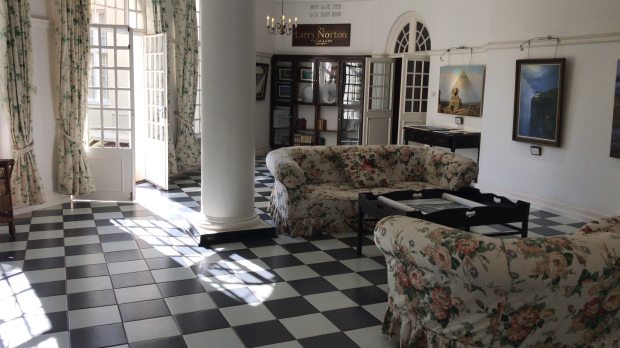
Our start could not have been more promising as the Head Concierge (Duly Chitimbire) received us as VIPs by the main entrance and then everything worked out very smoothly until we were comfortably settled in our room, located a few steps from the Larry Norton Gallery on the ground floor. We had visited the place to commemorate the birth of our son in 1991, a few years after David Livingstone found Mosi-oa-Tunya (smoke that thunders) in 1855 and stayed in that same area of the hotel.

IMG_20190912_101656 copy

The VIP reception.

2044F294-C9E1-4C8A-B919-FE0869018F5A copy

Entrance to the Larry Norton gallery.

P1000769 copy

The stairway to the upper floor.

After leaving our belongings we started to explore this real museum of Zimbabwe colonial history. We took advantage to visit the various public rooms as staying guests, unlike previous recent visits that we were outside visitors. We admired the main Palm lounge with its incredible dried plant display and the adjoining Bulawayo lounge with its show of historical artefacts and Punch caricatures of important colonial personalities including Cecil Rhodes and Frederick C. Selous, all presided by a painting of King Lobengula above the fireplace.

Our plans to enjoy the opulent seven-course degustation menu and dancing to a live band at the Edwardian-style Livingstone Room (voted the seventh finest Restaurant in the World by The Daily Meal in 2013) were immediately dashed when we read the notice on the door saying “Strictly no safari wear, shorts, sandals or sneakers.” A very quick mental inventory of our luggage (geared for camping) confirmed our poor preparation on this department and saved us some money!

This restaurant is a reminder of the hotel’s glorious past that started in 1904 when it was opened to take care of the personnel of the railways when they arrived at Victoria Falls. At that stage it was a 16-room wood and corrugated iron roof building that has now increased tenfold. Interestingly, steam for the laundry was produced from the boiler of a scrapped locomotive![1]

After WWII a Royal visit took place in 1947 and the party took over the entire hotel, which was not as large as today. At that time the British Overseas Airways Corporation (BOAC) started a mail and passenger service from Southampton to the Vaal dam near Johannesburg in South Africa with Solent S45 class flying boats. These great hydroplanes flew at 338 km per hour at low altitude stopping in Sicily, Luxor, Kampala and Victoria Falls [2].
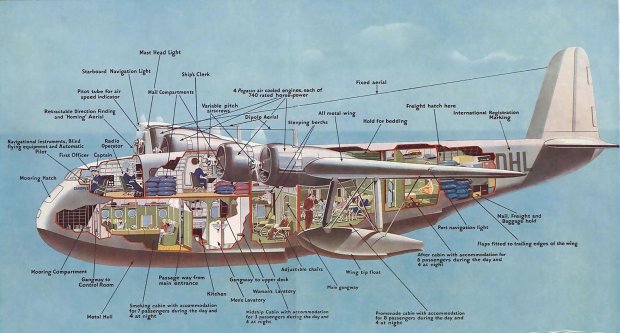
flying boat

Details of the Solent planes.

The twice-weekly flights offered an innovative way of traveling and the visitors would land upstream from the falls to spend time at the hotel in a stop that became known as the “Jungle Junction”, hence the name of one of the hotel’s restaurants.

Exploring the garden and admiring the view of the falls and the bridge spanning Zambia and Zimbabwe, located where Rhodes wished so that the falls’ spray would wet the train carriages, took a lot of our time. The humongous mango trees offer abundant shade to the guests and the bushsnob took advantage of the latter to perform his siestas, surrounded by an international crowd!

Although the famous baobab known as the Big Tree is found at Victoria Falls, its hotel colleagues failed to impress the bushsnob.

P1000722 copy

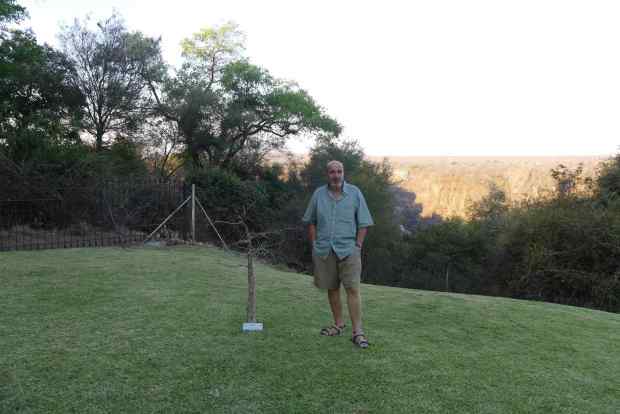
Baobab dwarfed by the bushsnob.

However, the large and solitary msasa tree [3] (Brachystegia spiciformis), usually part of the Miombo woodland, estimated to be 200 years old appears as a very impressive frame to the magnificent view of the falls area from the hotel lawn, usually visited by monkeys and warthogs as well as Hadada ibises.

IMG_7773 copy

Flags at half-mast at the entrance due to the death of former president Robert Mugabe.

Before visiting the falls, we extended our walk to the hotel’s surrounding area including the Victoria Falls railway station located nearby in the hope of seeing some of the steam trains that are still functioning. As the tracks are easily accessible, we hoped to flatten a few coins by placing them on the rails. We were unlucky as the next train was expected late in the evening when we had a dinner appointment at a traditional restaurant.
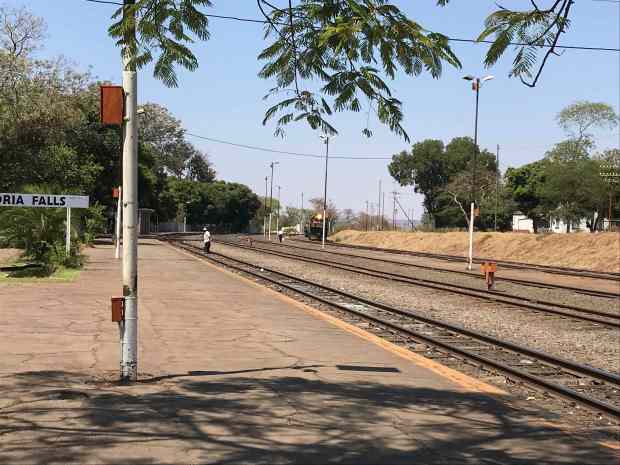
IMG_2462 copy

However, a walk revealed a couple of steam engines and old carriages being restored for future use.

This slideshow requires JavaScript.

Unfortunately during the walk the bushsnob lost the soles of both walking shoes and this jeopardized the plans of a visit to the falls.


The last hope of reaching them was boarding the 1920’s hand-worked rail trolley service that replaced rickshaw rides! Unfortunately, we suffer another blow as it has been out of action since December 1957!

So, we had no other consolation than to join the other guests at the lovely Stanley’s Terrace and order high tea following the British tradition stretching back to the mid-1700s. [4] Luckily, despite its strictly formal beginnings, the affair at the hotel allowed guests dressed for safari and even sole-less! We enjoyed a range of savoury and sweet treats with an excellent Zimbabwean tea served on fine silverware, bone china, and vintage cutlery and crockery whilst relaxing looking forward to our camping experience at Hwange National Park, our familiar treat!


[1] It stopped functioning only in 1996!

[2] See: https://www.tothevictoriafalls.com/vfpages/tourism/flyingboats.html

[3] In Shona language.

[4] This is an afternoon meal, usually served between 15-16hs. and served at the dining room table contrary to the ‘afternoon tea’, served in comfort while the guests are on chairs or sofas.

Baboon tragedy

WARNING: Some pictures may be disturbing.

Walking through the extensive gardens of the Victoria Falls Hotel at Victoria Falls in Zimbabwe I was enjoying the visit when a group of baboons called my attention as there was something odd going on. I approached as close as I could and watched.

The primates were following one of the individuals that was carrying an object that, at first I could not identify as the animal was rather restless. I then noticed that it was a female showing the vivid red rear end that usually indicated that is on heat. That explained the followers but not her cargo.

After spending time following the animals I saw that she was carrying her dead baby that, by then, had dried and looked like a strip of dried hide. I had observed this kind of behaviour before years back in Kenya.

Most of the time the female would carry the dead offspring with her mouth as this allowed her almost to run and climb.

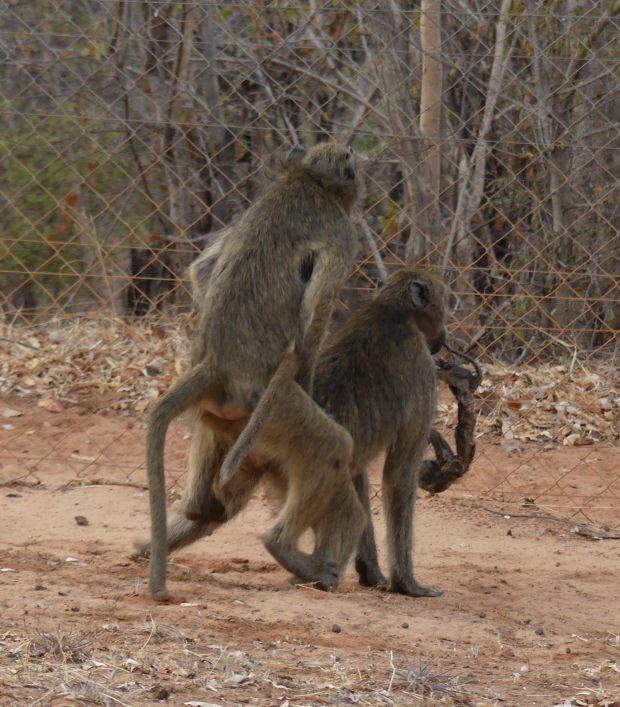
As the final pictures show, carrying her baby did not stop the female to accept mating with one of the members of the troop.

P1000760 copy

Baboons wasted no time in “compensating” for the loss!

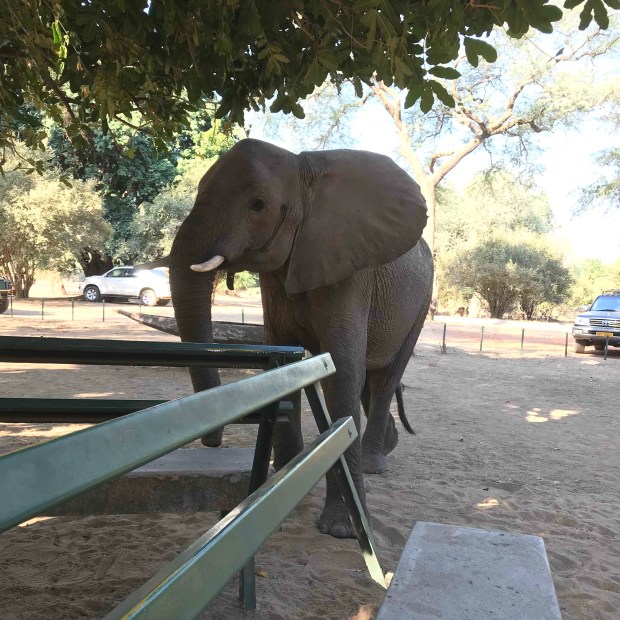
Mana Pools reception

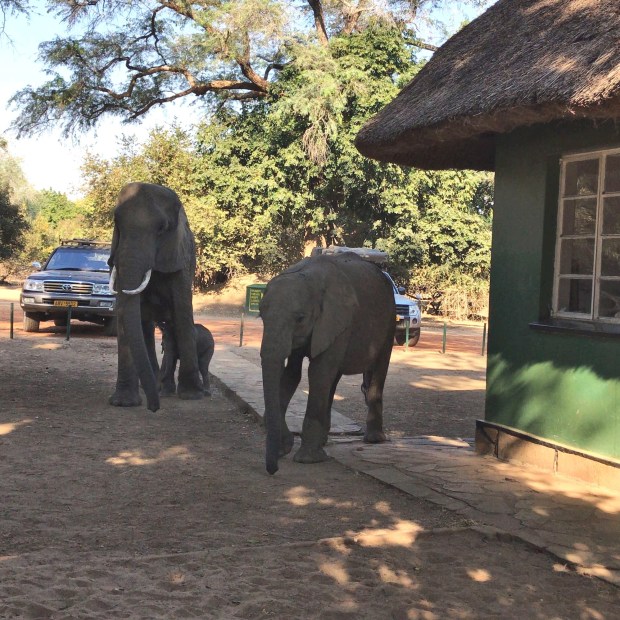
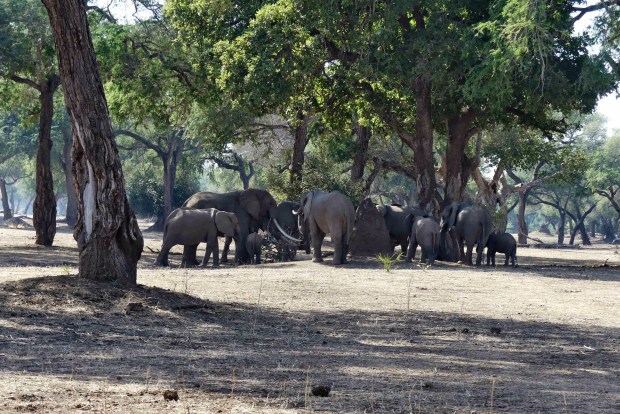
The unexpected is commonplace at Mana Pools National Park in Zimbabwe! Below are the receptionists!!!

4f41caf6-cf03-4ff2-81bd-5b78129a1157-mc-copy.jpg

We just waited a bit while they approved of us…

Later Mabel, my wife, experienced a close encounter with another elephant while sitting at this bench checking her WhatsApp!

img_2810-copy.jpg

The unique experience of Mana Pools!

Boswell’s genes

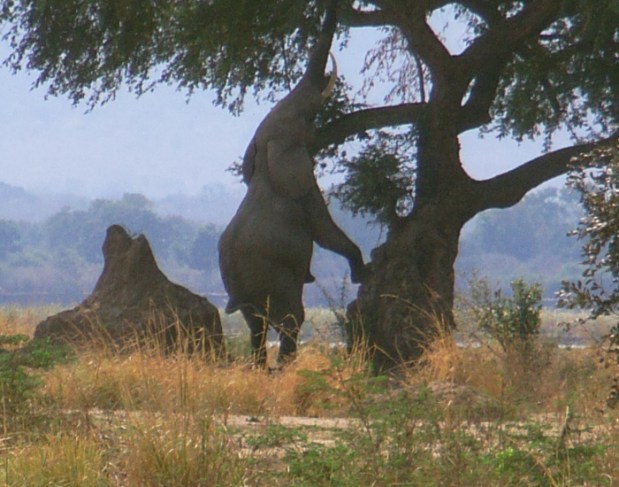
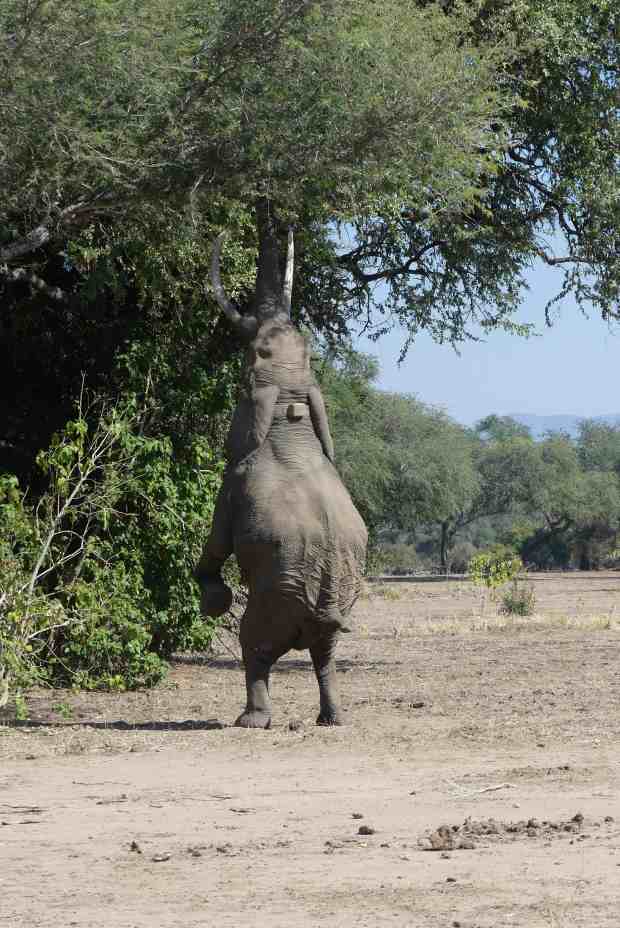
Three years back I wrote a post about a really iconic elephant in Mana Pools known as Boswell [1]. At the time I mentioned its ability to reach heights that other elephants (and even giraffes if they would exist in Mana Pools) cannot by stretching and standing on its hind legs. I showed a rather bad set of pictures that I took on an island in the middle of the Zambezi river and regretted that the animal did not “perform” closer to us.

pict0021-copy

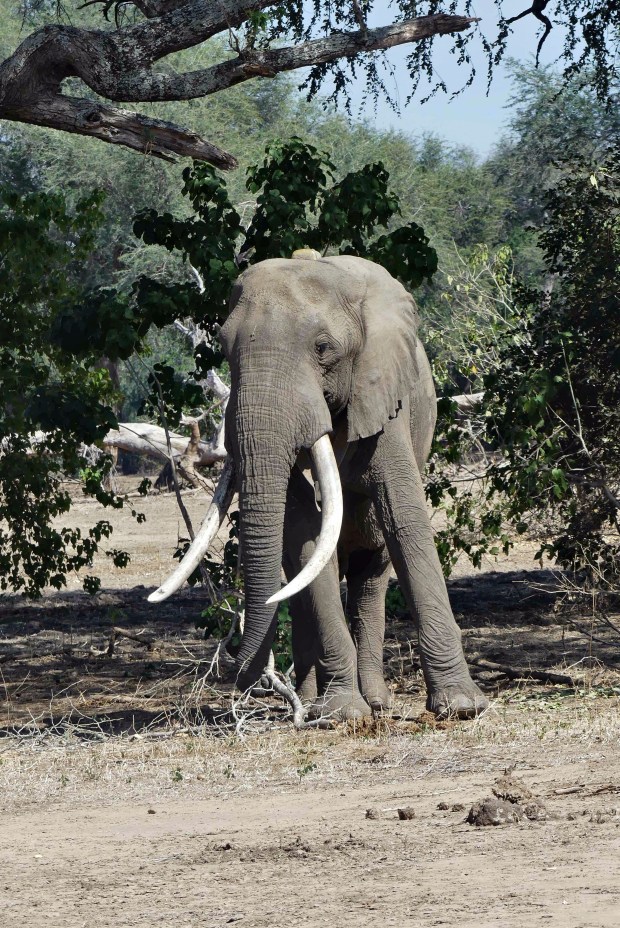
Undoubtedly Boswell is the best known of Mana Pools’ elephants and it one of the classic sights of the park.

My brother Agustín and his wife Gloria had visited us in Zimbabwe in the late 90s and, to our delight, they decided to come back this year. As we had taken them to Hwange National Park and Victoria Falls in their previous visit, we decided this time to visit Mana Pools for game viewing and Kariba to attempt to fish for vundu.

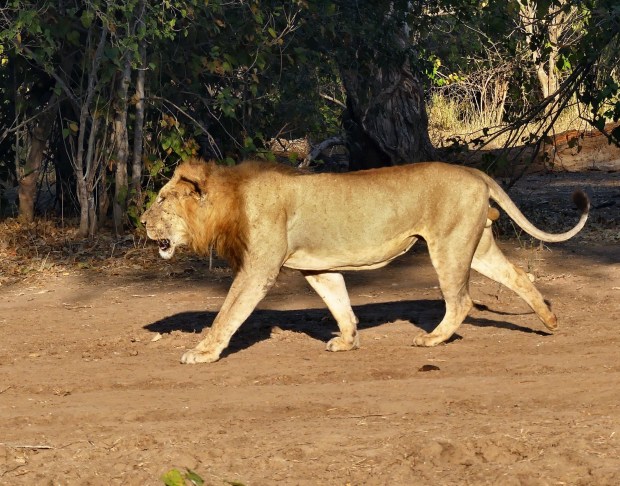
In the previous visit we failed to find any lions at Hwange despite our great efforts so one of the goals at Mana was to find wild lions. Fortunately we achieved this goal and spent sometime watching them. As lions are normally sleeping and these were not the exception, we soon decided to move on and return later to see if they decide to be more active.

P1000424 copy.jpg

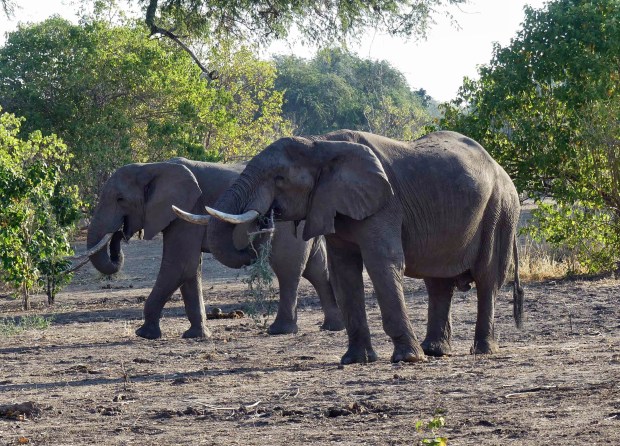
Luckily, after a while in the distance we saw the unmistakable shape of Boswell and we noted that it was slowly walking towards the river and we happened to be on its path. We placed the vehicle in a discrete spot not to interfere and waited for its arrival. Luckily we were alone! Boswell was accompanied by a few more elephants, two adult but younger males, a couple of females with babies and a young male.

P1000305 copy

Boswell.

Mana Pools was extremely dry as last year’s rains had largely failed so there was little greenery apart from the large trees. Further, the preferred food for the Mana elephants, the pods of the Apple-ring acacia (Faidherbia albida), we not yet mature so we were curious to see what would Boswell do.

As usual the very relaxed group came really close and when they were under a Sausage tree (Kigelia africana) Boswell started to lift its trunk clearly sizing it up.  Clearly satisfied with what it saw it started to stretch, arched its back and it was on its hind legs trying to secure a good grip on a branch! I desperately grabbed the camera and shot while it remained standing. After sometime we heard a mighty crack and down the elephant came with a huge piece of the tree!

This slideshow requires JavaScript.

Boswell starting eating the large branch while keeping the young males away by a combination of aggressive gestures, vocalisations and, with the too daring, pushing and shoving and some trumpeting as well. It did not liked to be disturbed during its meal! Conversely, he did allow the young females some bites and did not mind if the youngster came really close to him to feed, the latter often getting between its legs!

After a while, although there was still greenery left on the branch, it moved on leaving part of its bounty behind and, while it started to find another arboreal victim, the followers got busy finishing the spoils.

P1000292 copy

The event was repeated a couple of times slightly further from us and trickier to photograph. As the group continued its placid sojourn towards the water we moved off, very pleased with our luck and trying to explain this to our visitors.

P1000311 copy

Perhaps we had driven five km when we found another elephant, much smaller, also feeding. We then watched in disbelief when it also stretched and stood only on its hind legs! We made a comment to a safari car that was watching the action with us and the driver told us that this particular elephant was known as Harry! We were really lucky and elephants was the conversation at camp that night, despite the visits by vervets, baboons and hyenas!

The following morning, following the tip of a kind tour driver we found a large group of lions at a dry river bed and, after watching them for a while, we continued our game drive. While commenting on the very few greater kudu that we had seen we spotted an elephant standing on two legs. As we saw it from its back we thought it was Boswell again as we could see a radio collar. In fact it was a much smaller male that clearly knew how to look for the tender leaves of the Mana Pools’ trees!

The final act in this saga was yet to unfold when we were about to end the game drive and go back to camp for a well deserved branch. A dust cloud called our attention and we saw two elephant bulls clearly settling some kind of dispute. After a while we saw that one of the contenders gave up and moved off at a speed.

The “victor” stayed put and after a few minutes it decided to look for some food. It was at that time that we saw it well and the large notch on its left ear identified it as “Big V”, another of Mana’s “specials” that we have seen stretching to bet acacia pods before[2].

P1000509 copy

So it was Big V that delivered the final act when it also decided to go for some juicy branch and, lo and behold, before we knew it it was also standing on its hind legs!

We were now really impressed with the Mana Pools elephants and agreed that we have had our quota of elephant stretching while we can happily confirm that Boswell has been able to pass its genes to its heirs that will keep future visitors to Mana Pools amazed at their feeding habits!


[1] See: https://bushsnob.com/2016/08/17/boswell/

[2]: See: https://bushsnob.com/2016/08/31/big-v/

Too close!

During our recent visit to Mana Pools National Park we saw a Yellow-billed stork (Mycteria ibis) feeding in one of the pools that give the name to the park. This was nothing strange as we often see these birds in that pool.

What was unusual was that the stork was feeding very close to a semi-submerged crocodile of a size that could have gone for it!

What else can I add? My immediate thought was that the stork meat must be so bad tasting that this is its best defence!

News from Africa – Goats trouble

Although we are in Argentina at the moment, Stephen, our Zimbabwe housekeeper for the past 20 years, periodically keeps us up to date of the situation in the country, city and house. Like this we learnt that the rains in Harare have been good so far and that he is already starting to enjoy the first fresh mealies (corns) from his nearby field. Unfortunately this event, together with the ripening of the mangoes in the garden happens when we are away!

Through his message we learnt that he spotted a gravid chameleon laying eggs in the garden and we hope they will hatch next year. In our experience, chameleon eggs spend the entire dry season buried and only hatch during the rains the following year, probably when the earth gets soft and they can dig themselves out of the ground in a wise “delayed” development.

We also had an account of what happened to him recently that I believe is worth telling in his own words. The news came in a Whatsapp message we got on 18 February. I have only inserted clarifications in brackets.

“…I have been so busy since late Friday afternoon (15 February) running around to try and find my goats which I almost lost to thieves in the rural area (near Mukumbura in the border with Mozambique), if it wasn’t for my brother who quickly alerted me that they have gone missing the previous day. I agreed with the suspicion because there had been a truck seen loaded with goats in the area destined for sale in Harare where they fetch good prices.

After getting the news, I asked if there was anyone with the contacts of the driver or anyone amongst the people in the truck. When I got the driver’s number, I phoned him pretending to be someone who was in the business of buying and selling goats and wanted to know to which abattoir he had gone to sale the animals or if he had encountered any problem with police along the way.

He told me he was at one of the abattoirs along Seke road, close to the airport in Harare (about 25km from our house).

I quickly boarded a commuter omnibus to the abattoir. When I arrived I was shocked to discover and identify my six goats among the animals, which were about to be sold and slaughtered.

I managed to recover them and they arrived back home late evening yesterday. The same truck was asked to take them back. Unfortunately, with (the) difficulties people are facing, they are grabbing and selling anything they see can give them money to survive.

There was lots of celebration in my rural area.”

Later he gave more details:

“They were boys from my village and happen to be my relative even though not close, he raided them from the grazing area. In my area goats move freely and the owners only collect them in the evening and check if they are none missing to lock them in the kraal and open in the morning.

I had to make a report to the police to make it easy for them to facilitate the transportation of the goats back home (otherwise) it was not going to be easy for me to get them back home because I should have spent money to hire a truck, get a permit & explain to the police how the reason the goats end up in Harare.”

As you can see from the story, the “bush telegraph” is working more efficiently these days and I cannot but admire Stephen’s quick reaction that enabled him not only to recover the stolen goats but also to arrange for the culprits to return them to his home in the bush!

Season’s Greetings

All the best from one of the most beautiful countries on earth where we are lucky to live for one half of each year. Enjoy the view…


Felicidades desde una de los países más hermosos donde tenemos la suerte de vivir por la mitad de cada año! Disfruten de los paisajes…


Thieves…

We have a few macadamia trees at home that have not yielded very much for luck of water. Last year we had very good rains so we were rewarded with a good harvest and we are busy drying them under the sun so that I can then proceed with the rather time-consuming exercise of opening them.

Macadamia’s shells are extremely hard and, after trying various methods, I have resorted to a vise in the workshop that so far is still working until its thread gives in!

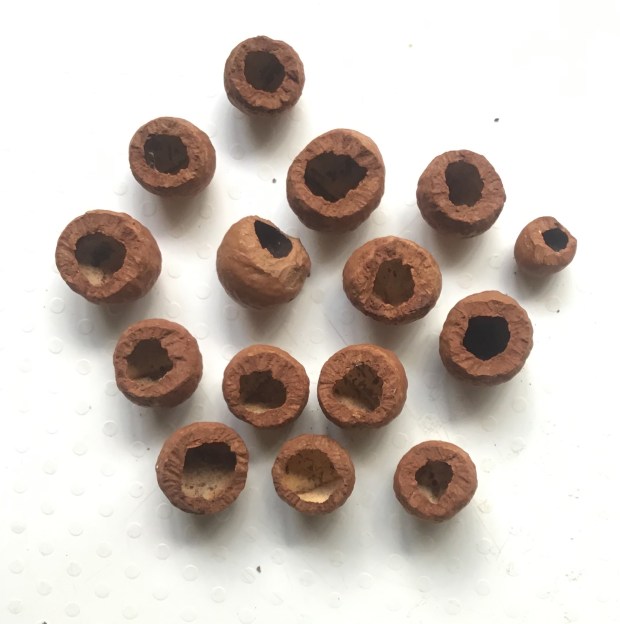
Some time ago we have discovered hollowed out nuts in the garden and we could not believe that an animal could be so powerful as to gnaw such thick and hard shells! Eventually we found lots of empty nuts near a large hole and realized that we had a colony of Southern Giant Pouched Rats (Cricetomys ansorgei) [1].

After a while we stopped seeing them and they disappeared. Apparently they moved off our house one night in a group and entered under the gate of a neighbouring house but I was not a witness to this Pied-piper of Hamelin-like migration!

IMG-4401

The empty shells after the rats ate the tasty inside.

More recently, we noted that the nuts we were drying were being peeled from their green outer cover and taken away whole from the sunning box. We “smelled a rat”!

A search up and down the garden was organized and, eventually, a large hole was discovered at the farther corner of the garden. Suspecting that the giant rats were there I set up a camera trap pointing towards the suspected burrow and this is what I got:

We confirmed our fears as the various videos taken showed one rat at a time either entering or leaving the burrow. As I was curious to see how many there were, I decided to put some food hoping that they would gather to feed. Although I got over 180 ten-second videos, I still failed to get a rat gathering! However, I got a few that prompted me to write this post!

I have selected a few that I find interesting and/or funny. Please note that one is eating a few carrot pieces on the ground while the others are chewing a chunk of (delicious for humans at least) butternut hanging from a bush, the idea being that they would not drag it into their nest!

This giant rats are widely distributed in mainly tropical regions of southern Africa, notably Zimbabwe, Kenya, Tanzania, Zambia, and the Democratic Republic of Congo. I first saw them in Monze, Zambia while driving on the main road and I had difficulties stopping my Zambian workers from jumping from the moving vehicle to catch them as they consider them a delicacy!

Later, also in Zambia, Bruno, a colleague from Belgium, invited me with a surprise roast that happened to be delicious and it was a giant rat -as tasty as a piglet- with baked potatoes (tasting like potatoes!)! Giant rats were very abundant in that area at the time and I am sure contributed to food security of the village where the project was based.

Giant pouched rats are named after their large cheek pouches and they are only distantly related to the true rats. Recent studies place them in the family Nesomyidae and not in the Muridae as they used to be [2].

They are able to produce up to 10 litters of one to five young per annum and they are nocturnal and omnivorous with special taste for palm nuts and, as we have experienced, also for macadamia nuts. Interestingly, they are hind gut fermenters and coprophagous, producing pellets of semi-digested food that are consumed.

They are not only easily tamed as pets but useful for detecting land mines as they have an excellent sense of smell, particularly sniffing TNT while being too light to detonate the mines! But this is not all. They are also being trained to detect tuberculosis by smelling sputum samples. This procedure is faster than the normal diagnostic test and remarkably increases the sample processing. [3]

So a few disappeared nuts ended up producing an interesting story and  I am now positive that we  have a colony of rats (being fed on expensive macadamia nuts) that could potentially be bred to remove mines and improve human lives!

I regret now having eaten one (and liked it!) and I will not do it again!


[1] I am not a rat taxonomist so I base my identification more on distribution and abundance than on their morphology. The other possible species in Zimbabwe would be C. gambianus but the whole pouched rat taxonomy is under review. See: Olayemi, A. et. al. (2012). Taxonomy of the African giant pouched rats (Nesomyidae: Cricetomys): molecular and craniometric evidence support an unexpected high species diversity. Zoological Journal of the Linnean Society 165, 700–719.

[2] https://en.wikipedia.org/wiki/Giant_pouched_rat#cite_note-MetH-1. Seen on 6/12/18.

[3] https://www.apopo.org/en. Seen on 6/12/18.


Surfing heron!

Someone made a positive comment in YouTube about this video I took in Mana Pools and I looked at it again and liked it!!!

Hope you enjoy it also.

Ticks growing on trees!

I devoted my scientific life to study ticks in Africa. For this reason, Sterculia africana, the Tick tree or African star-chestnut caught my interest during our recent trip to Zambia.

We had seen this tree at Kariba, Zimbabwe and collected some “ticks” from it. I somehow remember the sight of the tree and driving from lake Kariba to Lusaka I stopped to have a look and managed to collect some of its interesting fruits. Unfortunately, grass burning had taken place and it was difficult to find the nicest seeds (ticks).

IMG_5184 copy

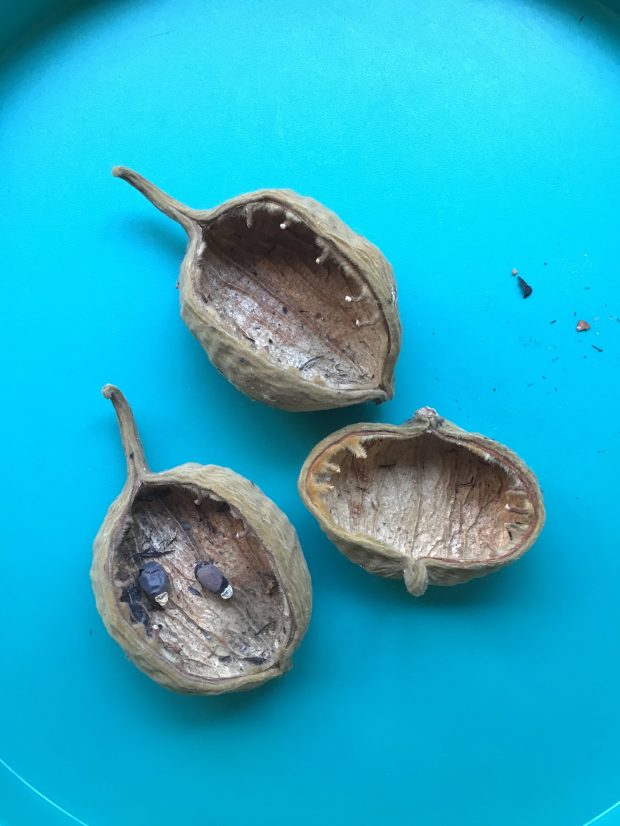
Three fruits of the Tick tree.

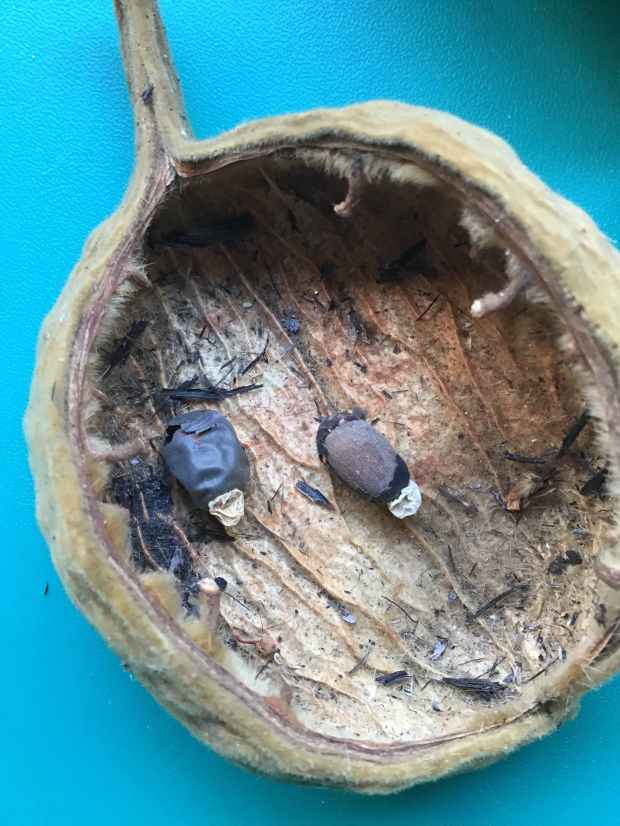
A small to medium size tree of dry areas with a smooth silver-white papery bark, it produces bunches of yellowish flowers marked with reddish lines. The fruits are boat shaped of up to 140mm long with tapering ends of a golden velvety appearance. They are loaded with blue-grey seeds that, amazingly, resemble engorged female ticks.

IMG_4459 copy

Two “ticks” collected from the ground and placed inside the dry fruits.

IMG_9420 copy

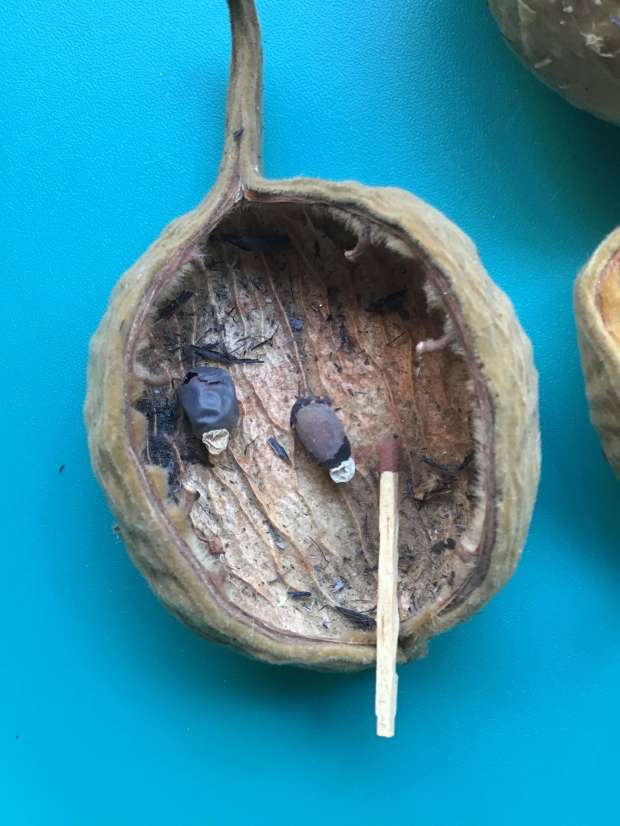
The fruits and “ticks” with a match for a scale.

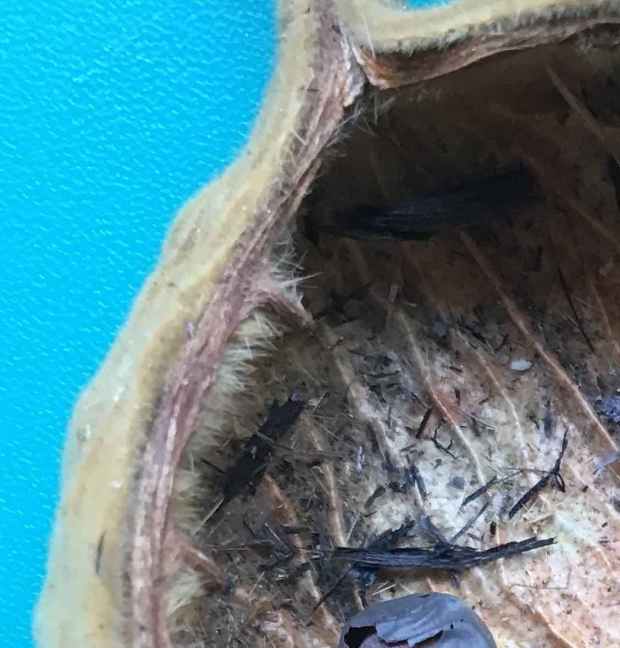
The “ticks” are attached among hairs which, I forgot, are extremely thin but able to embed easily in the skin. Once lodged, they are very irritating as I learnt (again) this time. Luckily, I managed to remove them and was able to use my fingers (again) to write this post.

IMG_4459 copy 2

A close up to show the nasty hairs.