Month: November 2016

Easy pickings

Last September, after a few early morning drives at the Kalahari Transfrontier Park, we took it easy for a couple of days, visiting the waterholes late in the mornings and afternoons. The day before our departure from our last camp, Twee Rivieren, I suggested to go for an early drive but my wife preferred to continue relaxing so I went on my own. It was a bad idea as, somehow, the whole camp shared this thought and the only road out of the camp was a dust cloud, despite the 50kph speed limit.

Aware that the morning had not started as I dreamt, I drove slowly until I found a waterhole to stay and wait for the travelers to quiet down as it usually happens. I stopped after about 20km at the Rooiputs waterhole. I was alone there and, as expected, soon the traffic died down and I could enjoy some dustless tranquility.

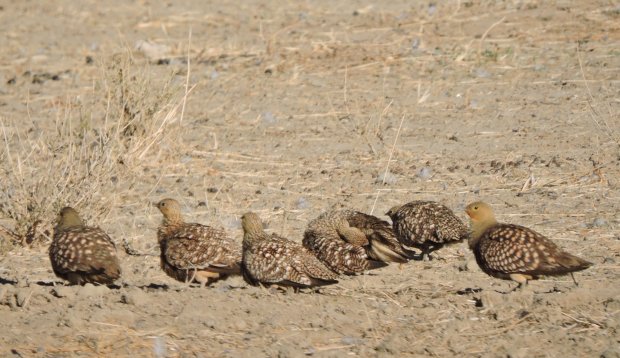
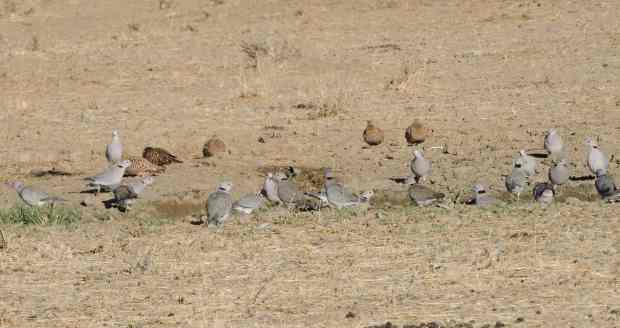
Apart from a few gemsbok staying a couple of hundred metres from the water and a lone jackal that was clearly mice-hunting in the dunes at the back, the waterhole had been completely taken over by birds. I spotted a good number of Namaqua sandgrouse on the ground and decided to take a few pictures of them.
dscn0019-8-36-37-pm-copy

The trees around the water were laden with small birds, mainly red-billed queleas, sociable weavers and red headed finches among others.

There were also a great number of laughing doves and ring-necked doves. The latter were in such numbers that it was like a curtain of moving birds that often obscured the water source as they flew in and out.
dscn0002-3-24-26-pm-copy

Hundreds of doves were “queuing” on the nearby trees to get to the water. Most of the time the available water was literally covered with birds and every now and then an explosion of birds flying in all directions followed a perceived threat. Often these were false alarms and the scared birds returned to drink immediately.

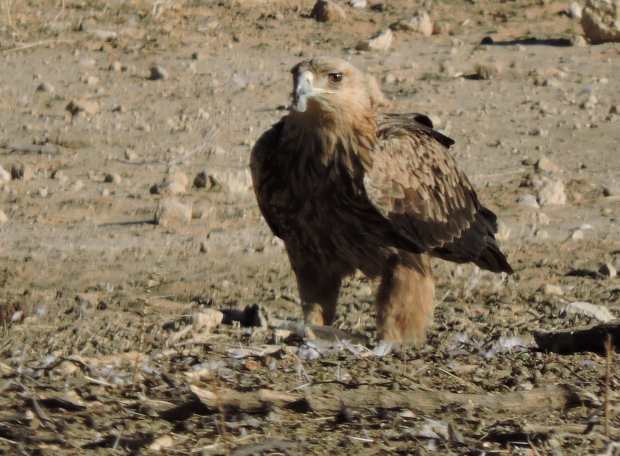
It was following one of these bird explosions that I saw a tawny eagle in the midst of the doves. When I spotted the eagle it had already caught a dove and it soon landed to eat it. “This is incredibly easy”, I thought and decided to stay there and wait for more action. When it finished eating it flew away but I was sure that it would come for more. It did.

Unexpectedly, the eagle did not return at great speed, just flew above the doves, lost altitude and then it entered the “dove cloud” and, almost effortlessly, grabbed another dove with its talons and landed to pluck it and eat it!
dscn0009-8-34-43-pm-copy

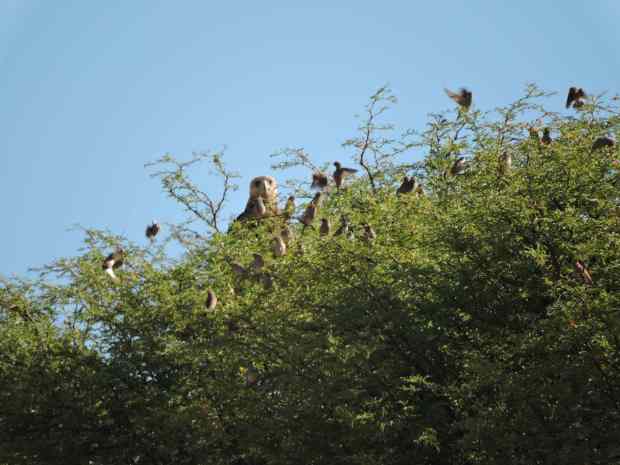
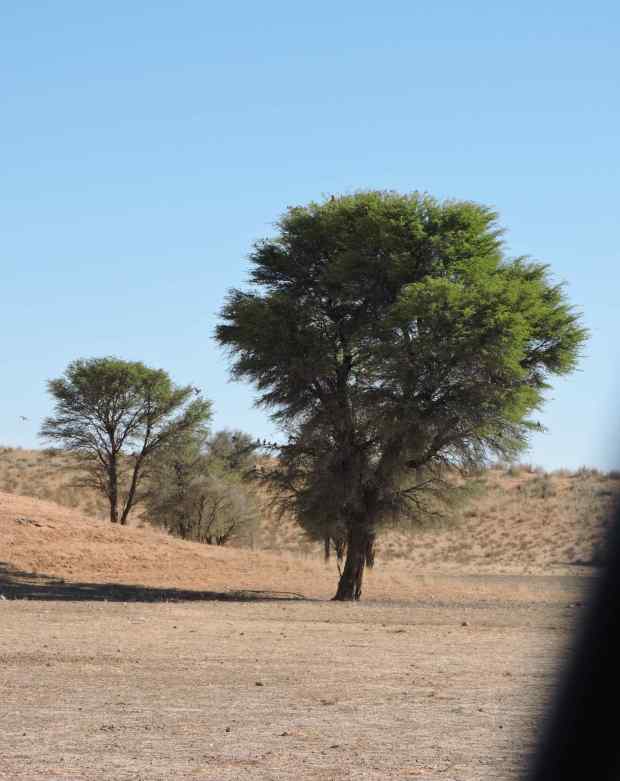
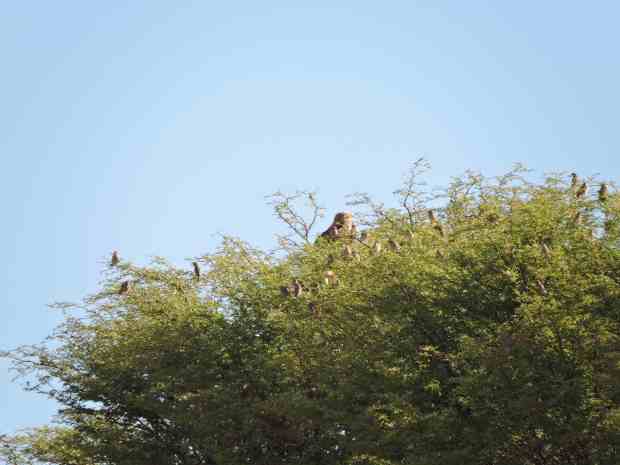
It all happened too fast for me and I only managed to take pictures of the raptor feeding about twenty metres from me. After eating, the eagle flew away again and landed on top of a nearby tree followed by a large retinue of small birds busy mobbing it.
dscn9900-8-45-15-pm-copy

dscn9895-8-44-50-pm-copy

dscn9892-8-44-50-pm-copy

I continued watching the birds’ drinking dynamics when, after about ten minutes, the eagle (or another one?) repeated the operation and, again, caught another dove! After its third dove, the eagle flew to the same tree and then I saw a second eagle. Further inspection revealed that the clever eagles were nesting about fifty metres away, taking advantage of the easy pickings that the waterhole offered them!
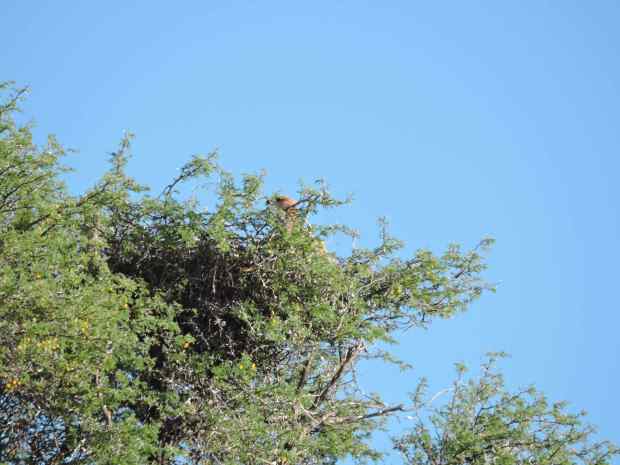
dscn0079-copy

As they only need to fly a few hundred metres a day to get a full crop and feed their fledglings, I started wondering -like with the Scottish pigeons of my earlier post-about eagle obesity!

Luckily, my fears were dispelled as the next time one came for another pigeon it looked really mean and I did not detect any accumulation of fat round its waist!


Spot the beast 14

dscn9936-copy

Of course I was not serious (this time)…

The fat caterpillar of the Death head hawkmoth measures over 10cm in length and it does not need a description.

It was found by Stephen, our caretaker, in the garden and I thought it is an incredible beast that rather than using camouflage it advertises itself without fear!

I will come back to this “beast” in a few days with more information.

Rain!

There is a great song by Lady Blacksmith Mambazo called Rain, rain, beautiful rain[1] that, as many of their songs, I strongly recommend! But it is only when you have two successive extreme dry seasons such as the ones we have gone through in Zimbabwe that you really understand the song!

I already described the seriousness of the drought at the Kruger National Park[2] and things are equally bad further north, in Zimbabwe and Harare where we are.

When we bought our house in the 90’s, we had a good borehole as well as water from the Harare Municipality. Today, the latter is erratic and, as a consequence, over the years many people have sunk boreholes and now there are thousands. As a result, the underground water table is no longer where it was and, probably the deepest end of our own old borehole is 30 meters above the water level! We have dug for water four more times since the original hole dried early in the XXI Century but we have only managed to extract grey stone dust!

Following our failures with various reputed rhabdomantists, in 2013 we decided to change our water management strategy. We gradually moved from water-thirsty plants to succulents and cacti and we buy water from the many suppliers that bring it to your house. Our swimming pool is now a water reservoir -and toad breeding ground- that we fill with the rainfall from the roof of the house (when it rains!) and take showers standing on a basin to collect and use the grey water for watering a few selected plants!

The availability of water is gradually decreasing and many of our plants and trees are no more and others are just surviving from year to year. We have lost pecans, almonds, mulberries and avocados to mention a few. Luckily, we still have a few fruit trees left although their production is near zero. The indigenous trees are still doing well, despite the clear impact of global warming.

But enough of bad news as the rains have just arrived a few days ago, precisely on 10 November. You remember the date now as rain is becoming really critical!

As usual, just before the rains our children’s leopard tortoise “George” (or Georgina?) made an appearance only to disappear again soon afterwards, as usual. In addition, the chameleons materialized out of nowhere, following their own clock, just before the rains. At this time the number of birds increased dramatically as drinking water was really scarce. Miraculously, as soon as the rains came, many species disappeared and we remained with the resident ones that are here the year round.

Another amazing phenomenon is the “greening” speed of the brown grass in our “lawn”! I can assure you that it becomes green in a few hours after the first rain drops. I often think that it is like watching lyophilized grass being reconstituted in front of one’s eyes!

Together with the greenery some interesting insects appear. Among others, the termites immediately start preparing their chimneys and, although they wait before “exploding”, they do so after a couple of days with when they detect that the ground has reached the adequate humidity for them to dig themselves.

The millipedes[3], known locally as tshongololos[4], are the next to make an appearance after spending the dry spell in chambers dug underground. They appear in all sizes, from 2-3 cm to 10-12 cm and are very fond on fruits and cucumber. They live up to seven years in the wild and they need to moult frequently as their calcified exoskeleton does not expand. They have about 270 legs and they carry some specialized mites[5] that clean their bodies.[6]

Apart from the animal life, the rains also create an explosion of colour as the plants and trees suddenly revive. The show starts with the flowering of the exotic jacarandas that turns Harare purple just before the rains. Soon the time of the flamboyant trees come and, the moment the rains start, the frangipanis become really outrageous not only in terms of colour but also by adding their wonderful scent to the garden.

img_3234-copy

If the rains are good, our garden will become so green that it will make you forget the drought until next year when we hope that we will have a “normal” one although these are nowadays the exception!


[1] If you wish to hear it, it is at this link: https://www.youtube.com/watch?v=iUH7PM0-cpI

[2] https://bushsnobinafrica.wordpress.com/2016/10/03/hippo-drama/

[3] Subphylum: Myriapoda; Class: Diplopoda.

[4] It means “steam train” in the local language.

[5] Neomegistus julidicola Trägärdh 1906 (Acari, Mesostigmata)

[6] They are extremely interesting creatures and, if interested, you could read more about them here: http://www.earthlife.net/insects/diplopoda.html

Spot the beast 13

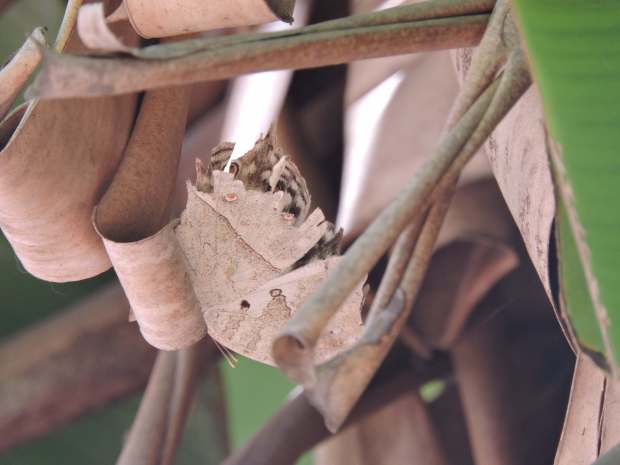
Following on the subject of the earlier post, here you have another cryptic creature for you to find:

dscn9978-copy

It is hard but possible… Below I show it to you.


dscn9976-copy

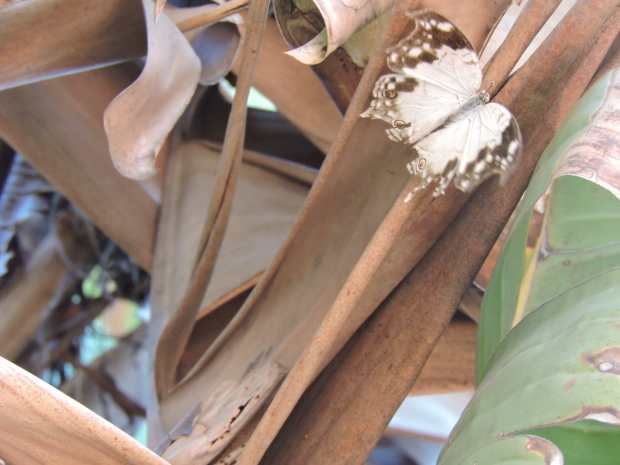
The fact that its wings were in tatters adds to its camouflage. For obvious reasons it did not open its wings very often so it was tricky to get a good shot. However, this is what I could do:

dscn9981-copy

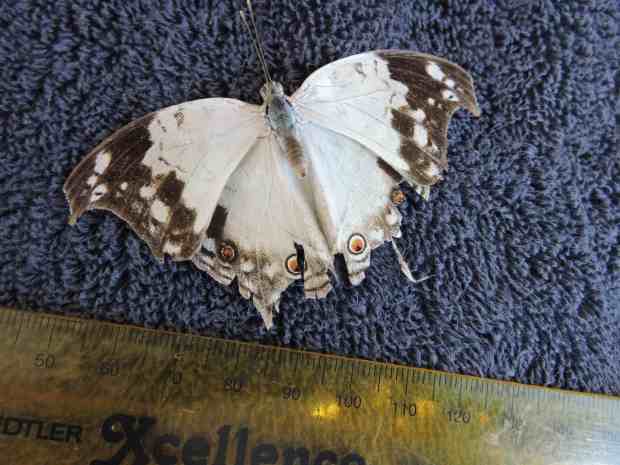
I believe it to be a Clouded mother-of-pearl (Protogoniomorpha anacardi nebulosa).

After a few attempts and with patience I caught it and, after having it inside the house for a while, eventually it landed on a towel and it settled down. With the patience I do not have and moving very slowly, I managed to get a better picture with a ruler! Wingspan about 7 cm.

dscn9985-copy

It disappeared soon after.


The water elephant

For hundreds of years humanity has discovered and classified the organisms that inhabit our planet. However, even today we continue to find new species. These are not tiny insects but fish, reptiles, birds and mammals, some even very large!

In 2004, while we were working there, United States scientists discovered a new species of monkey in the jungle of the Madidi National Park in Bolivia. The ape, of the group of the marmosets, was placed in the genus Callicebus. Following a novel initiative, its species naming was the result of a contest in Internet won by the Golden Palace Casino. This institution paid U$S 650,000[1] for the name Callicebus aureipalatii that -in Latin- means Golden Palace![2]

So far in 2016 several new species have been found. Some of them are small animals that can be considered difficult to see. However, this is not the case of the seven-metre long Black Whale defined as a new species this year. The finding is so recent that it still does not have its scientific name![3]

In addition, there is a new shark called Ninja lantern shark (Etmopterus benchleyi), found in the sea near Costa Rica in 2015.[4] Again, United States scientists studying aboard the Spanish research vessel Spanish B/O Miguel Oliver, discovered it. The species name refers to Peter Benchley, author of the novel Jaws.[5]

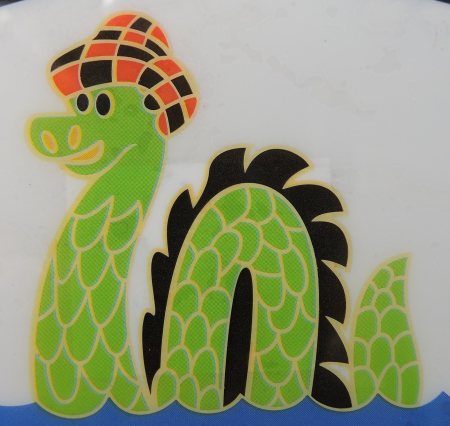
So far we have dealt with the amazing animals that have been discovered. But what about those animals suspected to exist but that we have not yet found? Cryptozoology is the study of animals -“cryptids”- that are believed to exist. The example that comes immediately to mind is “Nessie” the Loch Ness “monster” in Scotland that, despite a long search, continues to be the epitome of the elusive creature.

dscn5491-copy

However, other instances exist of other beasts that had been seen but never confirmed. One of them is supposed to dwell in the Belgian Congo (now Democratic Republic of Congo) and the information comes from a professional hunter called R.J. Cunninghame. This experienced hunter became world famous when he shot dead a hippo that attacked the then US President Theodore Roosevelt while on safari in East Africa in 1909.

A Frenchman named Le Petit told Cunninghame about Water Elephants that he saw in 1907 during his five-year stay in the Congo. Le Petit saw them for the first time while traveling through the river in the wetlands between Lake Leopold II (now Lake Mai-Ndombe) and Lake Tumba.

The first time he saw just a head and a neck that appeared on the water surface. His companions, natives of the place, told him that what he had just seen was a Water Elephant. Later he saw the animals again. This time they were five and he allegedly watched them for about a minute. He described them as between 180-240cm tall with relatively short legs and curved backs, elephant-like.

elephant-poilu-du-zaire

The water elephant by artist and writer Philippe Coudray. Reprinted with permission of the author.

Their heads were ovoid and elongated with a short trunk of about 60cm in length (tapir-like), but no tusks were seen. Their skin reminded him of hippo skin but it was darker. They walked with an “elephantine” gait that left footprints in the sand with four separate toes. This was the last time they were seen as they quickly disappeared into deep water. His fellow local companions reaffirmed Le Petit that the animals were common in that area and that they spent much time in the water, like hippos.

Interestingly, in the same general area another animal is reputed to exist, known as the Mokele-Mbembe, a creature believed by cryptozoologists to have a prehistoric look similar to “Nessie”. Although several expeditions have searched this area of the Congo, none have found it or the Water Elephant.

However, the Water Elephant existence came to the fore again when in 2005 a pilot flying over Lake Tumba apparently spotted them again. The animals seen would fit the description of Le Petit!

Not many scientists believe that a beast of this size can still be unknown to science. However, the Congo region -like Bolivia and others- has surprised us earlier with the discovery of other interesting creatures. You may also think that what Le Petit saw were African Forest Elephants (Loxodonta cyclotis), considered as pygmy elephants for quite some time but now as small specimens of L. cyclotis. This is unlikely for an experienced observer.

Le Petit’s description would fit that of the Moeritherium if the latter had been taller than its estimated one metre height.[6] Philippe Coudray, who I thank for his permission to use his picture of the Water Elephant, theorizes that elephants regarded as extinct -such as the Water Elephant- could still exist. He bases its reasoning on the finding of a tusk with a reverse curvature to normal elephants in 1904 in Ethiopia. The fact that the tusk was not fossilized would indicate that the animal did not live so long ago. The cryptid species postulated would be smaller than a prehistoric elephant known as the Deinotherium.

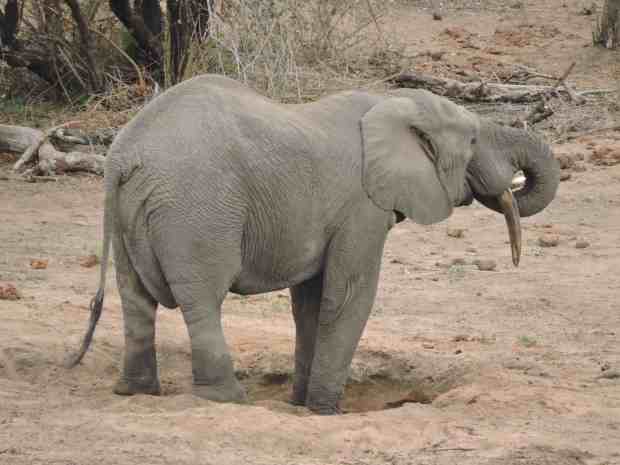
During our safaris we have seen elephants with weird-looking tusks.

THis year, while visiting the Kruger National Park, we spotted an elephant with one of its tusks pointing downwards so these tusks are still on live elephants! It reminded me of the Deinotherium-like cryptid!

dscn9919-7-02-44-pm-7-01-05-am-copy-12-58-08-pm

Did the Water Elephant ever exist or what Le Petit saw were the smaller forest elephants? The area of Congo where they could be is still difficult to access so a final solution to the mystery may yet take a long time. In the meantime we can only wait.


[1] Donated to the Madidi National Park.

[2] http://www.nbcnews.com/id/7493711/ns/technology_and_science-science/t/internet-casino-buys-monkey-naming-rights/#.V7brlZN97-Y

[3] http://www.livescience.com/55623-new-species-black-whale-in-pacific.html

[4] http://www.oceansciencefoundation.org/josf/josf17d.pdf

[5] https://es.wikipedia.org/wiki/Etmopterus_benchleyi

[6] http://carnivoraforum.com/topic/9742488/2/

Note: This post is a translation and adaptation of an article published in the Spanish on-line Muy Interesante magazine. If interested see: http://www.muyinteresante.es/naturaleza/articulo/el-elefante-de-agua-y-otros-animales-que-no-sabemos-si-existen-721474540407

Nota: Este artículo es una traducción y adaptación de uno publicado en la revista Muy Interesante. Si tiene interés vea: http://www.muyinteresante.es/naturaleza/articulo/el-elefante-de-agua-y-otros-animales-que-no-sabemos-si-existen-721474540407

Cool birds

October is usually Harare’s hottest month with a maximum and minimum temperature averages of 29oC and 15oC respectively[1]. Surface water is very scarce so the garden birdbaths surprise you with their visitors.

Among the guests there are a few small birds of prey that are not “regulars” but that come sometimes: the Lizard Buzzard (Kaupifalco monogrammicus) and the Gabar goshawk (Miconisus gabar).

dscn9991-copy-2

The Lizard Buzzard standing in the water.

While at the water I noted that they both behaved in a similar fashion. Apart from drinking (the Gabar Goshawk also bathed), both species spent a long time (over thirty minutes two or three times a day on the days observed) standing on the water baths during the hot hours of the day, around midday.

dscn9903-copy-3-52-35-pm

The Gabar Goshawk standing in the bird bath, having had a bath.

Was it a coincidence or did they find relief by the freshness of the water in their legs?

I subsequently learnt that birds lower their temperatures through a variety of different mechanisms[2]. The bare skin on their legs and feet helps them to dissipate heat. Water birds stand in the water, presumably to enhance the cooling[3]. Some birds such as vultures and storks also use urohidrosis, the habit of urinating/defecating on their bare legs to cool down by evaporative cooling.

It seems likely that both birds were using the water of the bird baths to cool down their legs and feet and in this way, as the water birds, increasing the cooling effect of their bare skin.

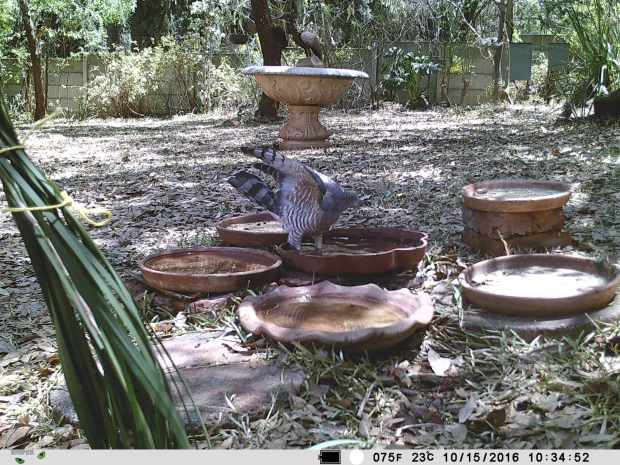
Interestingly, since I wrote these observations[4], two more birds of prey had come and both species had stood with their feet in the water: an African cuckoo hawk, (Aviceda cuculoides) and what I believe to be an African Marsh Owl (Asio capensis)[5].

pict0226-copy-2

The more recent observation of the African Cuckoo Hawk (landing on the water) and the African March Owl below. These  4 pictures were taken with a Camera trap.

[1] World Weather Online 2016. Harare Monthly Climate Average, Zimbabwe. Accessed on 10/10/2016. http://www.worldweatheronline.com/harare-weatheraverages/mashonaland-east/zw.aspx

[2] Mayntz, M 2016. How Do Wild Birds Keep Cool in Summer? Accessed on 10/10/2016. http://birding.about.com/od/birdingbasics/a/howbirdskeepcool.htm

[3] Shriner, J 2012. 15 Unusual Ways Some Birds Beat the Heat. Accessed on 10/10/2016. http://www.birdinginformation.com/15-unusualways-some-birds-beat-the-heat/

[4] de Castro J. (2016). Feet bathing as a cooling down mechanism in two species of birds of prey. Biodiversity Observations 7.77: 1–2. URL: http://bo.adu.org.za/content.php?id=270. Published online: 22 October 2016

[5] Identification to be confirmed as the pictures of the owl have been taken with a camera trap late at night.

Duck tenderness

The distance between Carmelo in Uruguay and Salta in Argentina is about 1800 km by road so we usually divided the trip in three legs of roughly 600km each as to avoid driving too much in a day. The first stop is usually Curuzú Cuatiá in the province of Corrientes that we reach after crossing the border and a rather monotonous drive.

The second day takes us through a nice area known as the Iberá wetlands where bird life makes the trip very entertaining and interesting. Our second stop is found about 200 km towards the north-west, after crossing the mighty Paraná River in Presidencia Roque Sanz Peña, the second largest city of the Chaco Province. The main attraction of the city are its thermal waters but it also has a rather hidden treasure: a zoo of native animals. As the latter are difficult to see in the wild, the zoo helps preparing the observer for real life!

During one of the stop-overs we needed to kill time for a hotel room to be ready so we decided to defy the intense heat and spend some time at the zoo! We only learnt on arrival that mosquitoes were also on display and in large numbers! Luckily we had a strong repellent[1] otherwise the tour would have been abandoned!

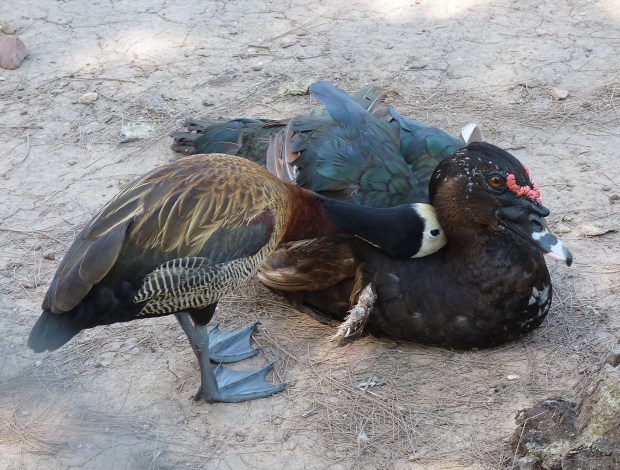
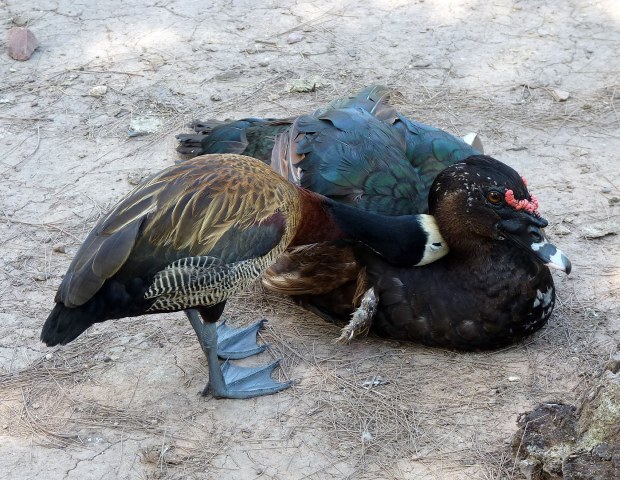
Towards the end of the visit we walked passed a pond that was home to several duck species including domestic ducks. While watching the pond, we saw a few wild ducks known as sirirí cariblanco or white-faced whistling duck (Dendrocygna viduata), one of the handful of species that occurs both in South America and Africa, just like us! While making a comment about its world distribution we noticed one that had a “relationship” with a domestic duck.

As this was unusual, we watched as the whistling duck approached the much larger “friend” and placed its beak and part of its head behind the neck of the larger duck!

20160216_160638-001-copy

The careful approach.

20160216_160650-001-copy

Getting in place.

p1130380-001-copy-2

Smugly in place.

At first we thought that it was looking for something there but it just kept its head there without moving for the whole time we were there and it was still in that position when we left them! The domestic duck, clearly used to this “treatment” did not move and accepted the wild duck indifferently!

p1130381-001-copy

Closing the eyes!


[1] Repellents in South America can make the difference between misery and enjoyment and you need strong stuff to survive the various biting insects that wait for you there!

Horn-borer moths

One of the advantages of being a “safari veteran” apart from a bushsnob is that I am now able to enjoy what I found, even the small things that were overlooked while seeking large game. The years of long game drives and walks, some of them starting very early and with freezing temperatures, are a thing of the past. Apart from seeing a pangolin in the wild, I have few wishes left about finding new beasts.

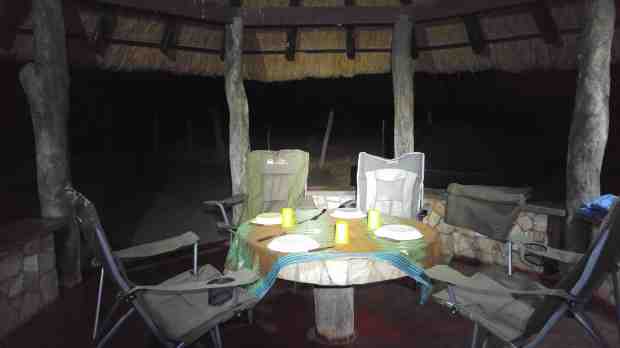
At Ngweshla Picnic site, Hwange National Park, you are allowed to camp and have the site for yourself from 18:00 to 06:00. During the day you share it with picnic site users but there is still plenty of room for everybody. Although rather unique, this is a good arrangement as most of the day you are game-watching away from the site and the camp attendants keep the camp tidy and the toilets sparkling at all times!

20160803_184901-copy

The site has seen better days and, as a consequence, it has a rather “porous” fence that would, if the animals wished, allow them to mingle with the campers, a rare occurrence though. The site entrance has been “decorated” with many animal bones. Although it is debatable whether these are suitable for the purpose, I find the skulls, useful to explain various issues regarding wild animals to our visitors.

The more recent antelope and buffalo skulls on display still had their horns and, as it is common if Africa, most showed little brown tubes protruding from them. I had seen this phenomenon many times before but I never followed its origin in detail. A short search educated me that the Horn-borer moths (Ceratophaga vastella) were responsible.

The larva of this moth, related to the one that upsets us by eating our woolies, are able to digest keratin and, although there are reports of them entering the horns of live animals, it is generally accepted that they only penetrate the horns post-mortem.

dscn9992-10-35-21-pm-copy

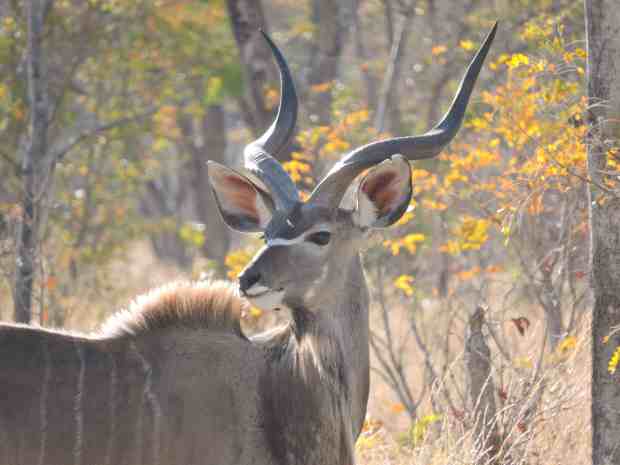
A nice and “mothless” Greater kudu bull.

The protuberances on the horns are the cases of the larvae that the latter built using their own faeces. The cases protect the soft insects from predators and the climate until they pupate and emerge as adults to fly away and colonize new horns.

Ceratophaga vastella, known as a detritivore[1], is widespread in the Afro-tropic ecozone[2]. Thus far there are 16 described species in the genus, with 12 found in Africa. The larvae are cream-coloured and bulky, with a brown head and tip of abdomen. The adult moth is a typical tineid[3], having a conspicuous tuft of yellow hair on the head.

Whenever an animal dies or is killed it will eventually be consumed by the killers and/or depredators including various mammals such as hyenas and jackals, birds such as vultures and others, fly maggots and ants until only bones, horns and hooves are left. The horn-borer moths are one of the last participants turning the carcasses to dust.


[1]An organism that feeds on and breaks down dead plant or animal matter, returning essential nutrients to the ecosystem.

[2] One of Earth’s eight ecozones. It includes Africa south of the Sahara, the southern and eastern fringes of the Arabian Peninsula, Madagascar, southern Iran and extreme southwestern Pakistan, and the islands of the western Indian Ocean.

[3] Moths of the Tineidae family, also known as fungus moths includes more than 3,000 species, unusual among Lepidoptera as most feed on fungi, lichens, and detritus. Apart from the clothes moths, which have adapted to feeding on stored fabrics, others feed on carpets and the feathers in bird nests.