Author: bushsnob

Rome – Gladiators

If you know a bit about Rome, you will also know that it is full of surprises. This visit has been no exception and I found this scene during some rains we had yesterday while walking through the historical centre towards our rented flat in the Jewish quarter.

IMG_3474 copy.jpgThese two gladiators took advantage of the rain-break in their fighting to the death activities to catch up with life events and have a puff rather than sharpening their swords! This is something expected of the current Millennial generation but they are clearly beyond that, probably Xennials[1]

Whatever their generation, the sight was really amusing!


[1] The term “Xennials” is a portmanteau blending the names of Generation X and the Millennials to describe individuals born during the Generation X/Millennial cusp years of the late 1970s to the early 1980s. (https://en.wikipedia.org/wiki/Xennials)

Spot the beast 44

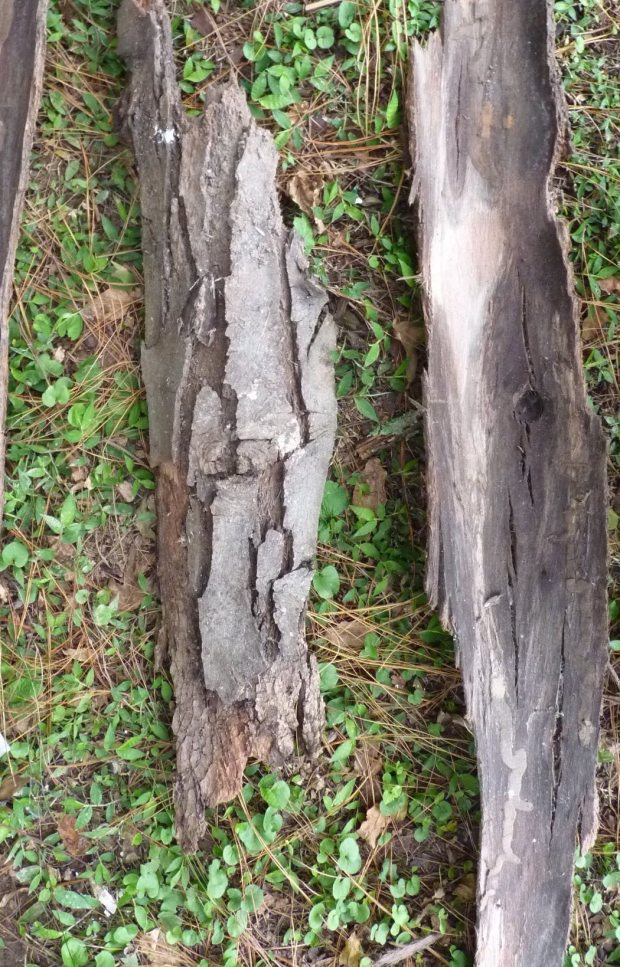
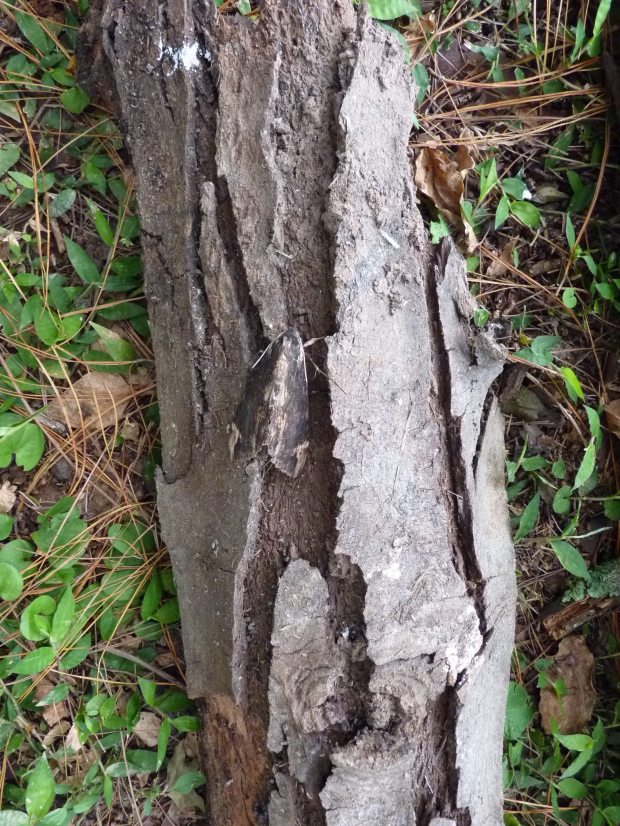
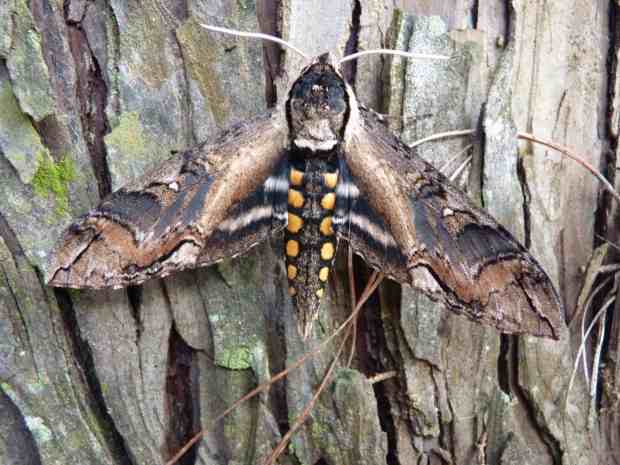
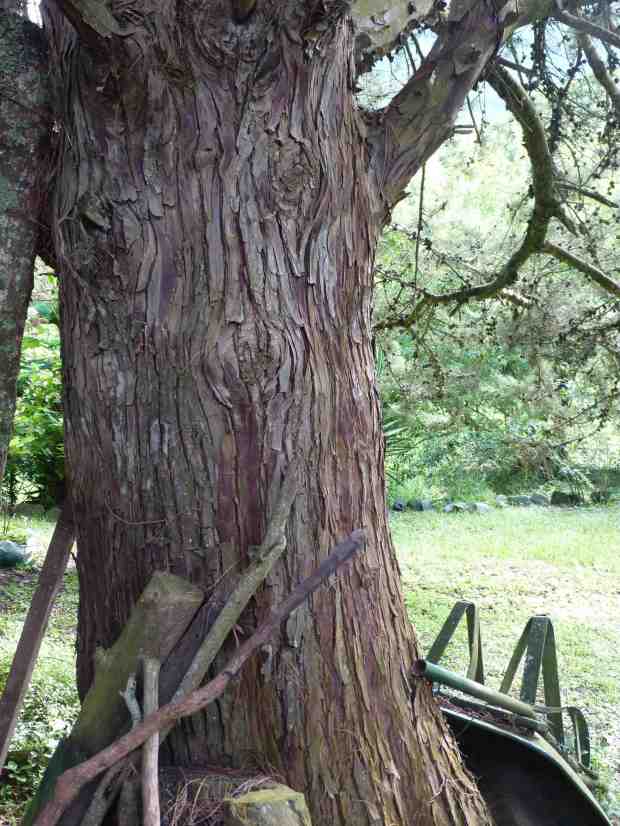
The final beast from Salta as we are now moving to Africa again. It was spotted on some tree bark that stayed on the ground after collecting some firewood. See if you can see it.

P1190257 copy

?

?

?

?

?

?

?

?

P1190259 copy

I do not think that it was too hard… I should do better next time.

Forever in doubt!

This event took place in August 2008, when I was not aware of the existence of blogs and even less that I would be writing one! It took place at our farm in Salta.

It all started with the death of a steer at a neighbour’s farm on the 17th of that month. The animal’s hide was removed on the 18th and left to rot. Over the next couple of days a number of Black Vultures (Coragyps atratus), Southern Crested Caracaras (Caracara plancus) and Chimango Caracaras (Milvago chimango) were seen feeding on it during the day. On the 20th we saw a fox and a tawny wild cat on the road, near the carcass but we were not able to identify them. As things were getting interesting and as we were used to waiting for hours for predators and scavengers at carcasses in Africa, we made a point of returning that night to see what could spot.

At about 21:30hs my wife and I drove to the area and pointed the car headlights towards the carcass, as unfortunately we did not have a spotlight. While I was maneuvering to get the best illumination of the dead animal, my wife -already known for her keen eyesight- said almost shouting with excitement “There is a large cat feeding!” I stopped the car and brusquely moved towards her seat to get a better angle.

What I saw left me amazed. At about 30 metres from us a large cat was crouching on the other side of the carcass, apparently feeding on it. It looked at us three times and bounded off towards the bushes. As we could not follow it with our lights, we could not see if it was spotted or not. What we both agree is that it was a large cat (at least the size of a large leopard) with a rather sizeable and rounded head that we saw clearly as it stared at us. That was it! Although we both knew that seeing a jaguar (Panthera onca) in this area was extremely unlikely, we were both convinced that this was what we saw.

We knew that the chances of seeing it again that night were not high and, after a while, we returned to the farm, about 1.5 km away. We were so excited that we invited relatives staying with us at the time and our children to come back to the spot with us but failed to see it again!

The following morning we checked the area around the carcass for footprints but the soil was too hard and we failed to find any around the carcass or in the area we saw it moving towards, where there was a small stream.

When I spoke to our neighbor about this, I had the feeling that he thought I was joking but finally the concept sank in and he considered it as an impossible occurrence. After searching on the Internet I came across a publication that dealt with the distribution of the Jaguar[1] and decided to contact the author.

Below I translate our exchange.

4/12/2008

Dear Mr. Perovic,

Maybe this message surprises you but I have a farm in El Gallinato, Salta and wished to consult you about the possibility of having seen a Jaguar in this area. The coordinates of the place are: 24°40′ 23.10″S and 65°21′ 35.99″W.

In this place in August of this year a cow died and, aware that in Africa carnivores are spotted many times feeding on dead animals at night, we went with my wife to see what was feeding on it and we were surprised to see a large cat with rounded ears and green eyes that looked at us a couple of times, ate a bit and left. Regrettably we only had the car lights and a small torch that did not help us much to see the body. It looked rather dark but we do not know if melanistic specimens are present here or not. Around this area we have already seen wild cats and a puma but we do not publicize this to avoid hunters finding out and finishing off the few that may be around. Of course we returned to the carcass the following night but we only saw dogs feeding.

As I found your work on the distribution of the jaguar in the Argentinian North West, I thought that you would be interested in this information. I would also like to know if what we saw could have been a Jaguar or if it is that we are too old and having visions!!! Maybe some day when we are in Salta we could meet.

Kind regards.

His answer came the following day:

Dear Julio,

Many thanks for your message. Regarding your query, regrettably, I must tell you that is unlikely that it was a jaguar, I do not say impossible as one should never loose hope that their distribution will increase again to its original area which included the El Gallinato. But I do not think that nowadays it could have been a jaguar.

Regarding the article you mention, (although old) you would note that sites close to El Gallinato are mentioned (the mountain road towards Jujuy). These are data on footprints and some other signs, but regrettably 8 or 9 years have passed during which we cannot find new evidence.

I reside in Vaqueros and travel frequently to Jujuy (I am from there) in the mountain road. At the moment I work with jaguar and other cats (that are just as important as the one you saw) in several places, but mainly in the Yungas and Andes highlands.

If you wish when you pass through Salta, you could write and we could talk about this, about things that need to be taken into account about the predatory attitude of the different species, and I could also give you some useful material.

I thank you for your interest and initiative.

Many thanks and I remain at your disposal for any doubts you may have.

Greetings.

Pablo

Although we had a couple of additional e-mail exchanges, I have not yet met Pablo. I was in Rome at the time of the exchanges and in the past and present our visits to the farm were (and are) always short for time as there is always other more urgent and or important things to do!

Thinking back, perhaps the situation called for the probably first and last use of my “yaguareté” (jaguar) caller that I had acquired earlier in the Beni of Bolivia with the absolute guarantee (from the seller!) that it would attract jaguars! Luckily, the contraption remained forgotten in a corner of our farmhouse!

Incredibly ten years have passed since the sighting and, although I take in what Pablo said, writing this post brought back the memories of the large cat we saw that night whose identity will probably always remain unexplained for us!


[1] Perovic, P.G. and Herrán, M. Distribución del Jaguar en las Provincias de Jujuy y Salta. Noroeste de Argentina. (http://www.jaguares.com.ar/datos-personales/distribucion/distribucion-noroeste.html)

Spot the beast 43

Although winters at our farm in Salta are mild, sometimes we have cold nights and the occasional frost.

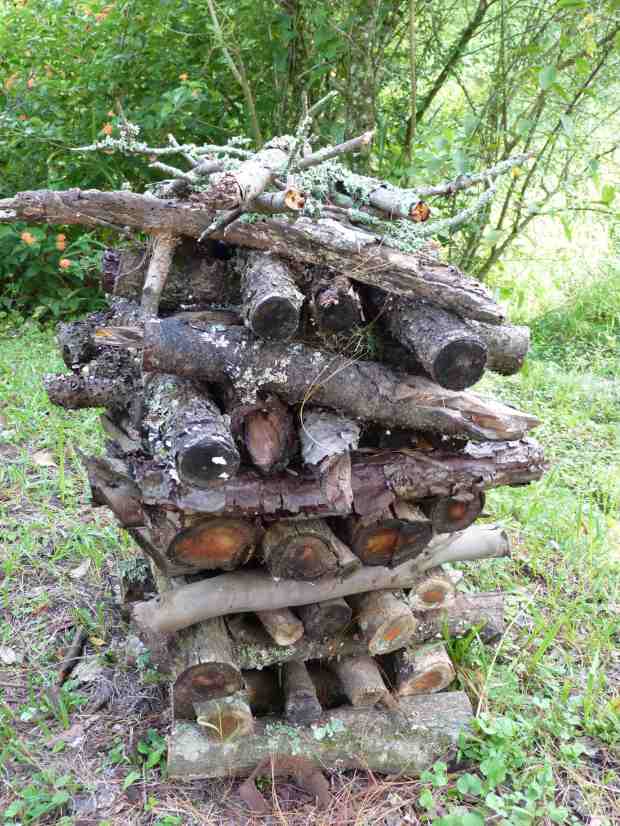
We buy some hardwood for our fireplace and also use fallen trees and branches to complement it.

The picture shows a pile of pine wood getting dry for next year. It also hosts an inhabitant rather tricky to spot.

P1190137 copy

?
?
?
?
?
?
?
?
?
?
?
?
?
?

Here it is, revealed for you. It was quite difficult, I know! A real master at camouflage!

P1190140 copy

Alien

This year Salta has been unusually wet and we still have warm weather and rather heavy rains in April. This has created a true green revolution accompanied by an insect explosion. The moths are still coming in numbers to our outside lights and midgets and mosquitoes are still around.

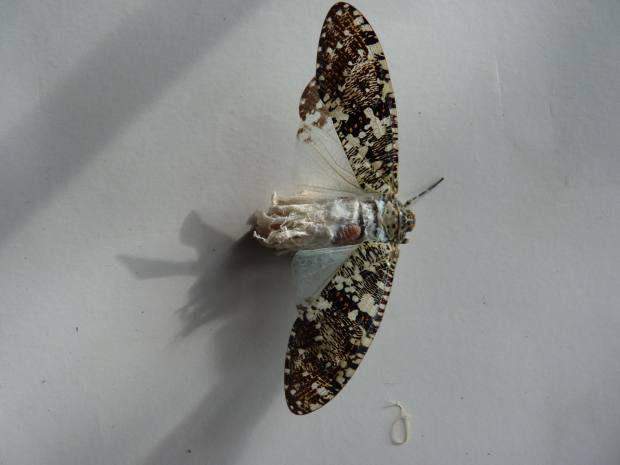
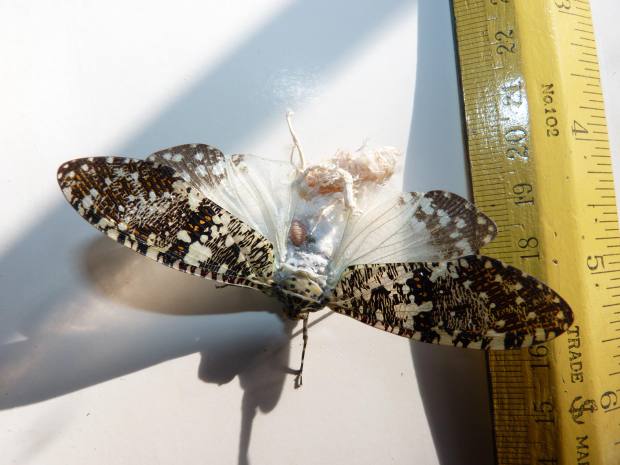
We found a cicada that had been attracted to the verandah lights. It was rather quiet and, unusually, stayed after daybreak. I collected it without much difficulty to have a look at it as there was clearly something wrong. While having a look, my wife noted pinkish silky filaments where its abdomen should have been! In addition, it was opening its wings from time to time but not making any effort to fly.

P1190074 copy

Dorsal view of the cicada.

P1190075 copy

The parasitoid larva can be seen at the joint between the thorax and the abdomen.

It was during one of these wing movements that she also noted a protuberance on its dorsal area that, after some careful inspection became a small pink worm-like creature apparently lodged in it. It was about 3 mm long and somehow it reminded me of a small warble fly larva.

P1190085 copy

The pink parasitoid seen from above with a size reference.

P1190085 copy 2

A close-up of the parasitoid larva.

Further inspection revealed another couple of worms also lodged on the cicada’s flesh. The larvae were still alive as they moved when I touched them!

We decided to keep the “sick” cicada under observation. As expected it died the following day but the larvae were still there so we left it undisturbed.

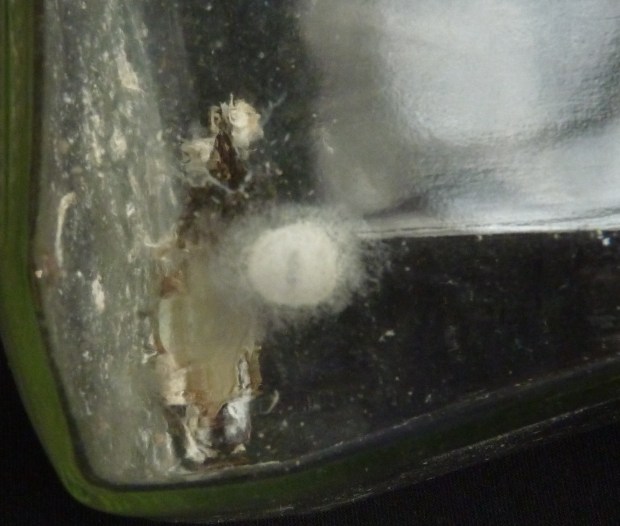
It is now about one month after the find. One of the larvae that detached soon after the death of its host has apparently built a small cocoon attached to the glass jar but the other two that stayed on the dead cicada turned grey and are apparently dead.

P1190248 copy

What I believe hatched from the cicada and made a cocoon in the glass jar.

I am afraid that the outcome of the cocoon will probably have to wait until our next visit, hopefully in 2019. In the meantime I can only speculate that, as it happens with caterpillars and other arthropods, the cicada was the victim of some parasitoids that have somehow colonized it. It is likely, as we other situations like this, that the larvae had eaten the cicada slowly until the damage created caused it to perish but not before the parasitoids, or at least some, were ready to leave the body and develop.

I will venture that these are larvae of a parasitoid wasp but I cannot be sure until the small cocoon hatches, if it ever does. However, having seen such an interesting interaction, I will watch for another cicada showing similar signs and follow it up.


Postcript: In the internet I learnt that some flies are important parasitoids of cicadas and that they locate them through their sound. It is also possible that the silky, pinkish filaments could be a fungal infection that follows the parasitoid’s damage of the host.


Collision

The fall of the VW kombi [1] was not the only car mishap I was involved in during my Kenya driving life. There was another more serious one that was not amusing.

It happened one morning that I was driving my brand new Peugeot 504 going to work. I needed to turn right from Fifth Ngong avenue into Jomo Kenyatta avenue, a normally risky move as it meant crossing the traffic to get to the left traffic lane heading towards the city centre.

As usual I waited for a gap and went for it. The moment I entered the large avenue I saw (too late) a small motorbike coming rather fast towards me. I had no time to change anything and in horror I watched the bike and its occupant hit me on my side of the car! Very luckily for him (in retrospect), the rider flew over the bonnet landing heavily on the tarmac on the other side.

Shocked, I helped the rider to get into a passing car to be taken to the hospital while we agreed that I would look after the vehicles and wait for the Police and his brother to collect the bike. While waiting, my landlord drove past and gave me encouragement while recommending me his lawyer as, according to him, he had gone through issues like this a few times! When I told him that I was charged with dangerous driving, in my view a terrible thing, he dismissed it explaining to me that that was the usual charge when there was an injury.

After dealing with the vehicles and the Police I visited the bike rider in hospital and found him, despite having an injured arm, in good spirits and being discharged. He was not only shaken by the experience but also for not having a Driver’s License!

Although the civil details were dealt with between the insurance companies, according to Kenya Law, a court case was set where I needed to appear to hear my case. I had some earlier experience appearing in court as a witness when my cattle feed was stolen [2].

As the date of my meeting with the Kenyan Justice drew nearer I went to see the lawyer my landlord recommended me. His studio was in a rather affluent area of the city. After hearing me for a couple of minutes he dismissed me arguing that he was too busy at the time (probably my case was too small for him!) and he recommended me Dr. Shah [3], an experienced lawyer. I noted that the latter’s office was sited on a less elegant part of Nairobi.

I drove to Dr. Shah’s office and met him that same morning. I explained what had happened and also that the accident had been my fault. He accepted to represent me but he recommended me not to accept the charges and plead “not guilty”. Although I resisted, at the end he convinced me arguing that “no lawyer would represent a guilty person”. I finally gave in and agreed to employ Mr. Shah to represent me. The USD 50 fee seemed reasonable at the time.

As it is normal, the day of my case the Court was brimming with people. Things were to happen in Court No. 2. It was another case of “controlled chaos” a common situation in many places where, despite apparent confusion, things do happen. The room was filled to capacity by about fifty people of all ages and sexes. Facing the public sat the judge, a small lady dressed in a black robe with the rather odd white wig.

My lawyer and I sat next to the bike driver and his own lawyer, both of Indian descent. The lawyers knew each other, of course. While a case was on-going a clerk came to inform us that our case would be the next so we waited in silence for a few more minutes. While waiting I was worried and nervous and I realized that I knew I was guilty despite the lawyer’s argument and also that it was too late to change things!

Eventually our turn came, the charges were read and I was asked to plead. As instructed by my lawyer I said “not guilty”. As soon as I said this I regretted and somehow I felt that the Judge did not like it. She then informed us that the case was adjourned to about two months in the future. That was too much for me as I wished to finish the business.

I asked the Judge to wait a minute and she agreed. I then called my lawyer aside. I told him that his job was terminated. I then returned to my post and asked to talk directly to the judge. She agreed and then I changed my earlier plead to “guilty”. I was not sure that this was possible but she accepted it and passed sentence.

She said that as it was my first offense and that, considering the circumstances of the accident, she would reduce the charge to “careless driving”. She indicated that I needed to pay a fine of about USD 20!

I was very relieved and congratulated myself for changing my mind. I left the room and met my lawyer. Although he was still unhappy, he agreed that the outcome had been good. I paid him what at the end accounted to more than double the fine and went home with a clear conscience!


[1] https://bushsnobinafrica.wordpress.com/2017/07/29/the-kombi-falls/

[2] https://bushsnobinafrica.wordpress.com/2016/06/13/cattle-feed-on-wheels/

[3] Not his real name.

Spot the beast 42

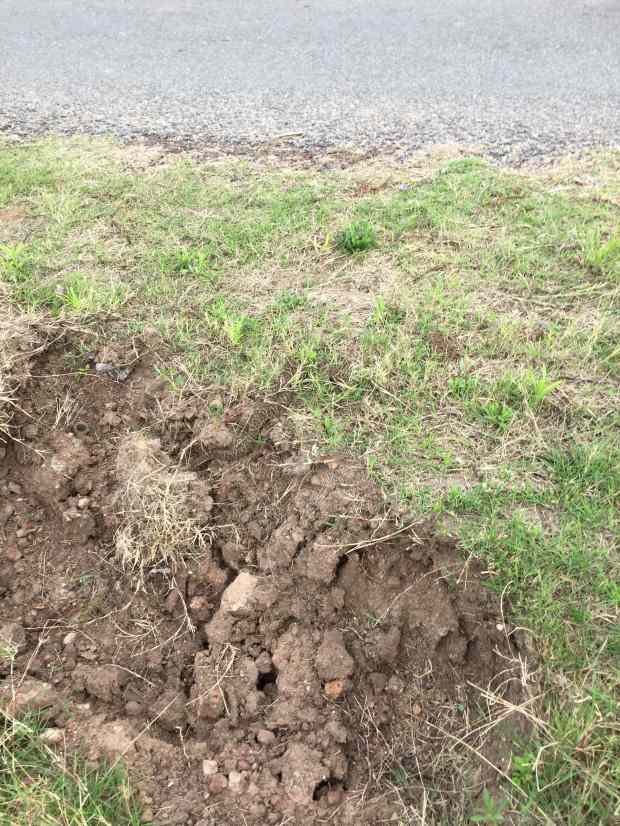
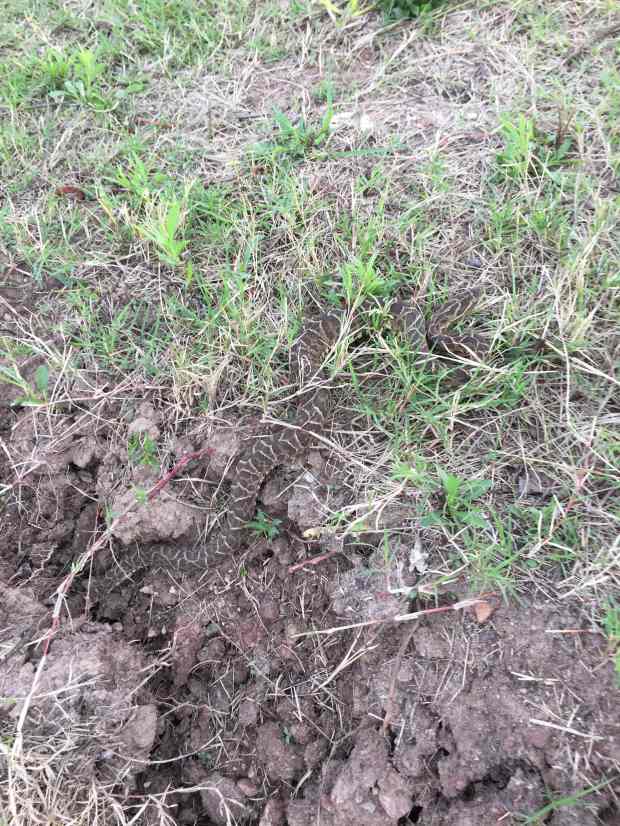
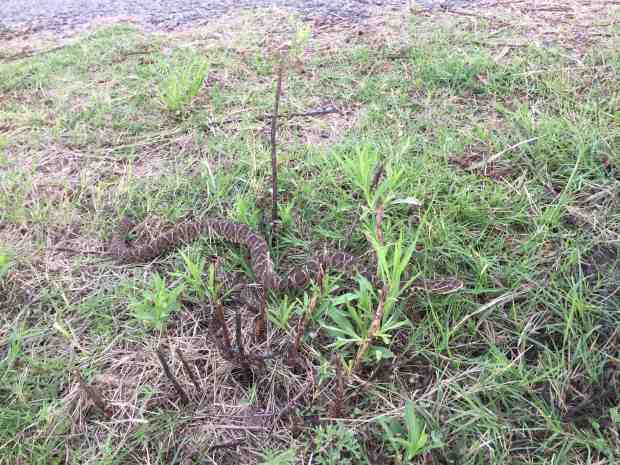
I am still thinking that Spot the beast 41 was too difficult! To make up for this, I am presenting you with this (more dangerous) creature we found while walking in Carmelo, Uruguay.

IMG_3321 copy

?
?
?
?
?
?
?
?
?
?
?
?
?

IMG_3322 copy

IMG_3324 copy

It is a venomous snake known locally as “crucera” (Bothrops alternatus). It is found in Brazil, Paraguay, Uruguay and Argentina and, although not naturally aggressive, it is an important cause of snakebite. The reason for this is its reliance on its comouflage for protection. It is then easy to either step on it or nearby causing a defensive reaction that can end in a bite.

The venom is haemolytic and can cause serious tissue damage although is not as deadly as it is generally believed.


80, 89…

Why nature decided to make butterflies so colourful defeats me. I can understand the role colours may play in predator protection, easy recognition among conspecific individuals, reproductive behaviour and all sorts of other properties that colours may have but, still, why being so outrageous with butterflies?

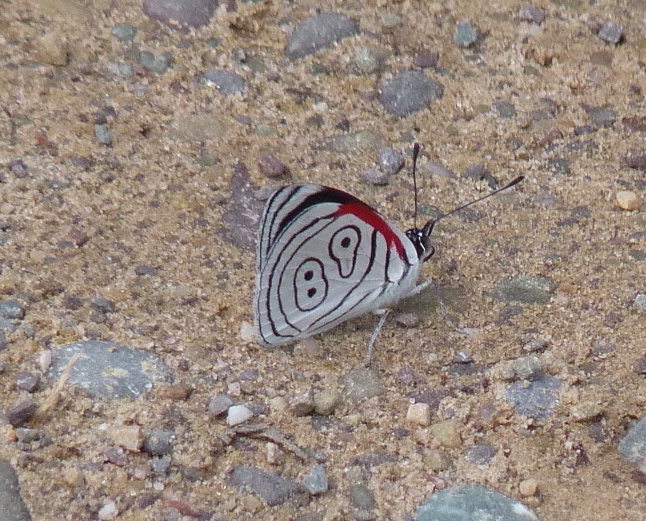
So, you would think that Nature would have been content with allocating them the whole colour spectrum? Not so, some of them have also been numbered! These are some of the members of the Diaethria genus and I do not think that this was done to help the taxonomists!

You know from earlier posts that the Yungas region where our farm is located host a great many colourful butterfly and moth species and to take a walk on a sunny summer day is a true challenge to your eyes!

I have probably photographed over one hundred butterflies (and perhaps double that number of moths) and I had covered the butterflies issue earlier in this blog [1]. Despite having seen most of the available butterflies, I am still surprised at what I find!

One of the posts deals with one of the numbered butterflies: the 80 (or 08) , depending how you look at it. It is known as Diaethria candrena.

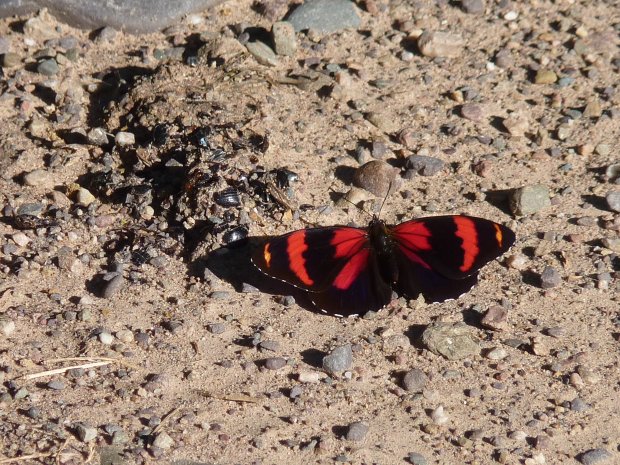
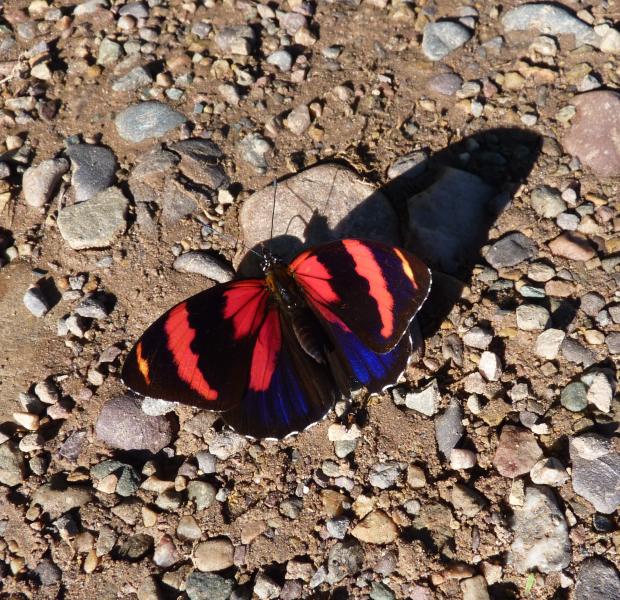
P1130769 copyP1130829 copyP1130858 copyVery recently we briefly saw a new and strikingly iridescent butterfly flying very fast and we soon lost it. Luckily the following day we found it again and, with lots of patience, I managed to take a few reasonable pictures of it. To my surprise it also carried a number: 89 (or 98) and I believe it to be Diaethria neglecta, also known as the 89 butterfly!

89 butterfly copy89 butterfly 2 copyP1190177 copyI then learnt that the numerals which appear on the underside hindwings of these butterflies are present in the twelve species of Diaethria but vary in colour and shapes, some of them do not show recognizable numbers.
There is also the 88 butterfly that would complete the numbered ones: Diathria clymena. I have not yet found it although I believe that it is also in the area. To find the third butterfly numbered by Nature adds another motive to continue with my daily walks.


[1] https://bushsnobinafrica.wordpress.com/2015/02/27/flying-gems/ and https://bushsnobinafrica.wordpress.com/2016/03/02/80-zig-zag/


Spot the beast 41

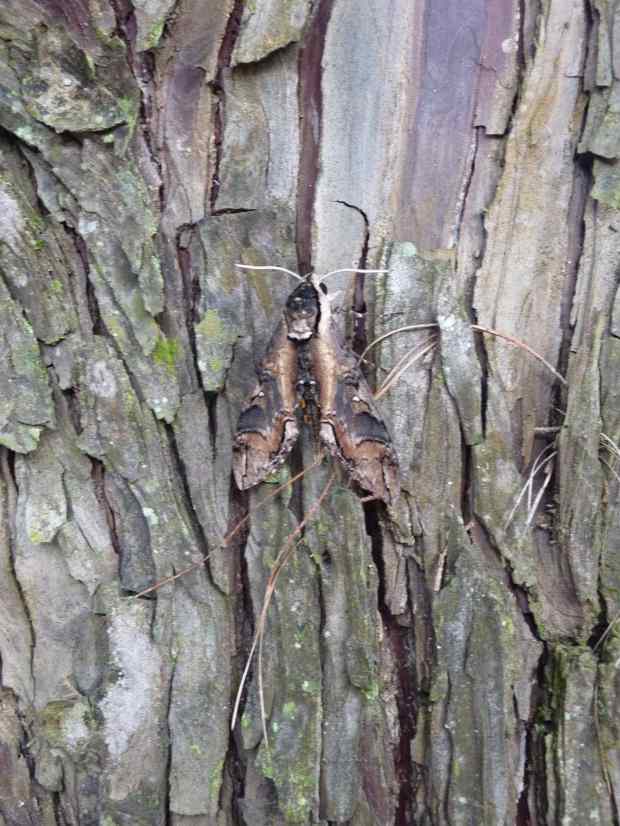
I consider this “Spot” a tough one. Once again it shows the amazing camouflage that some creatures have developed to survive. Look for it!

P1190142 copy

?
?
?
?
?
?
?
?
?
?
?
?
?

P1190143 copy

Its colours do not matter once it is able to fly off!

P1190144 copy

A WWII relic

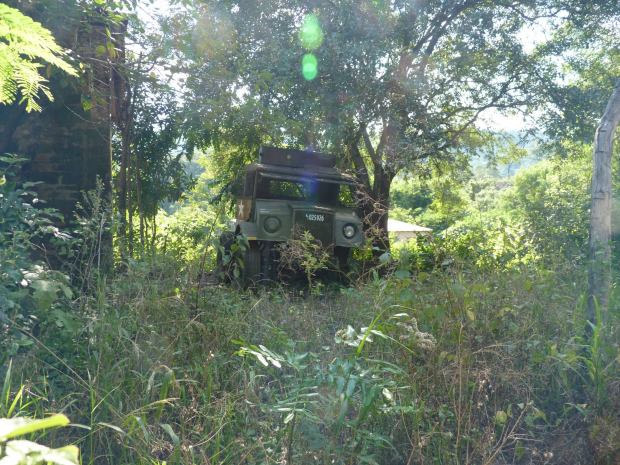
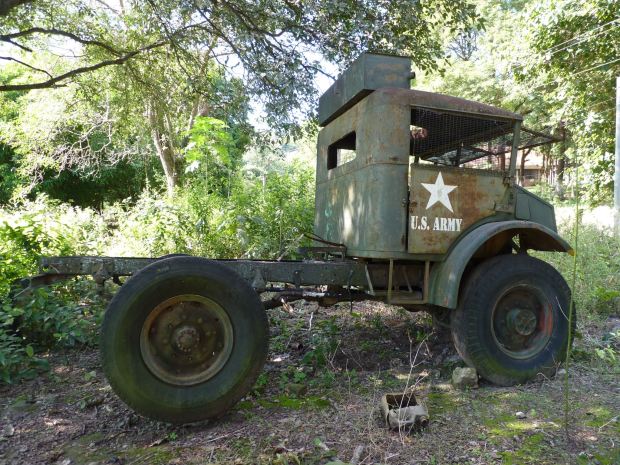
On the way back from our macaw walk [1] Oscar mentioned that there was an old truck parked nearby. Curious we agreed to get there and -as usual- do a bit of “controlled trespassing” to investigate.

P1190027 copy1

First view.

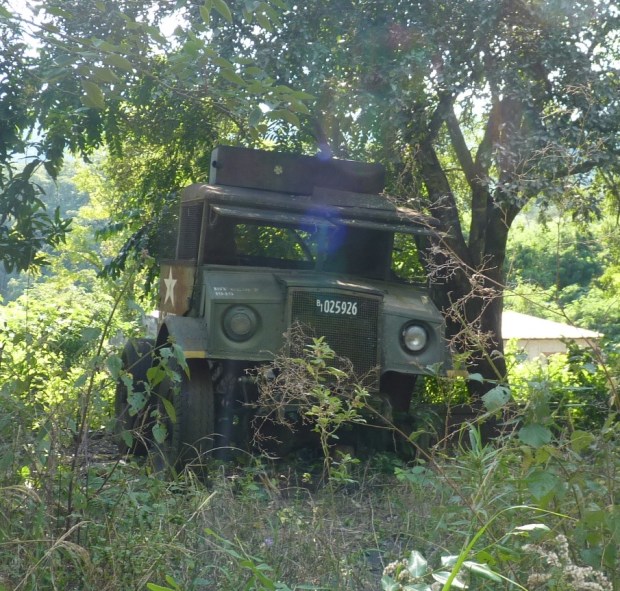
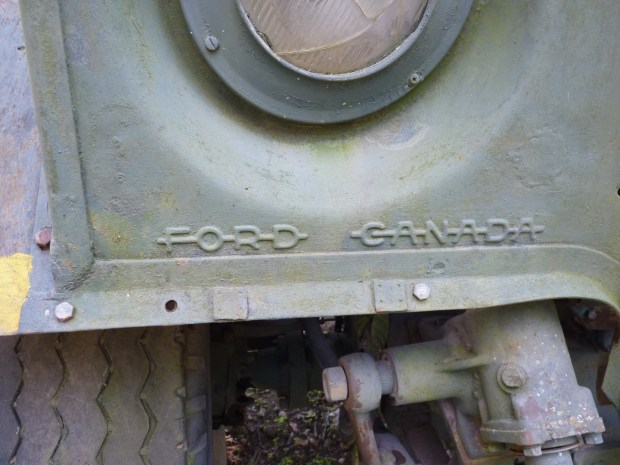
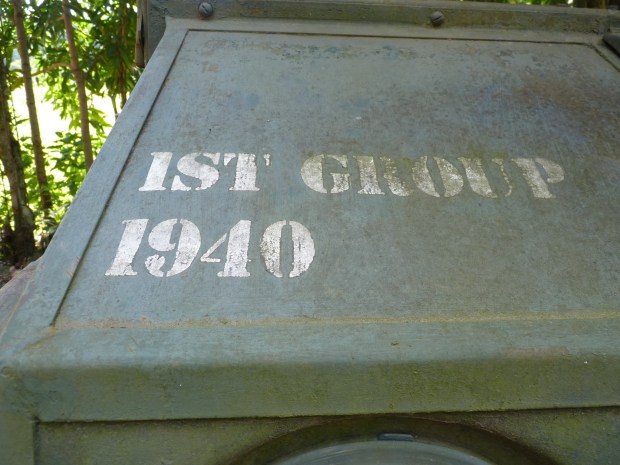
The truck was still there and it still showed its original painting as well as its make: Ford Canada.

P1190027 copy

P1190014 copy

P1190010 copy

P1190013 copyP1190015 copyAlthough the truck showed the signs of time, it still was quite well preserved. Surprised, I took a few pictures and went to the Internet in search of answers. This is what I found mainly via Wikipedia [2].
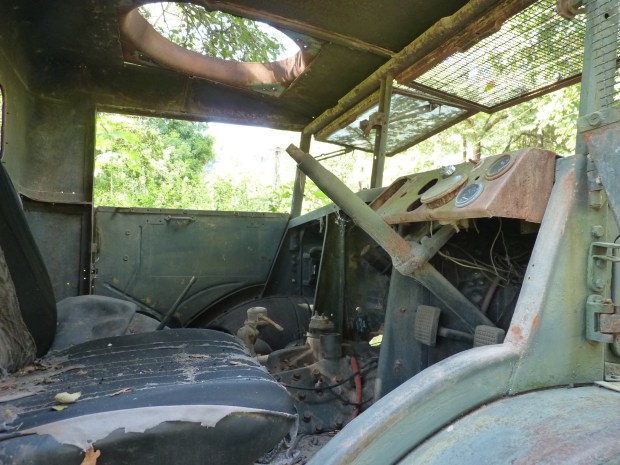
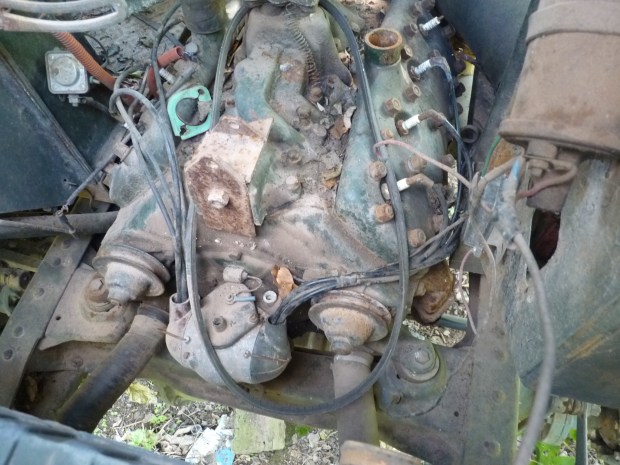
I believe that it is a Canadian Military Pattern (CMP) truck. This truck was produced in large numbers and several types in Canada during World War II. Standard designs following British Army specifications for use by the armies of the British Empire and allies were prepared before the beginning of the war coincident with the rise to power in Germany of Hitler and the Nazi party in 1933.

By 1939, mass production in Canada of CMP military vehicles was on the way and the Canadian-built vehicles were to serve widely in the forces of other countries. At the outbreak of World War II, Canada’s large and modern automobile industry was shifted over to the production of military vehicles out-producing Germany. Truck production was focused on a broad range of medium-capacity vehicles.

Over 500,000 CMP trucks were manufactured in Canada. They were right-hand drive and they formed the basis of a wide variety of different truck types and armoured vehicles.

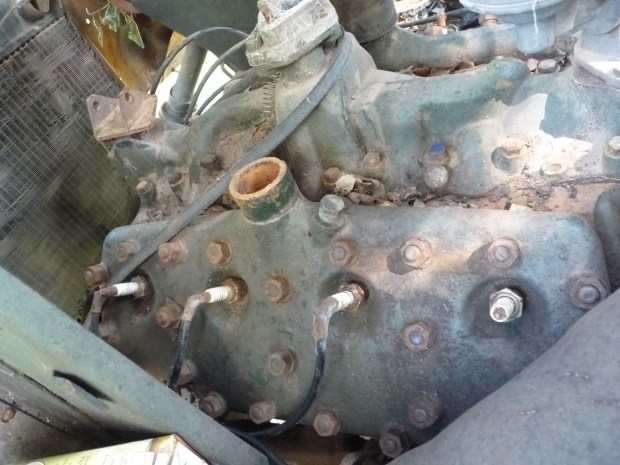
All the CMP cab designs had a short, “cab forward” configuration that gave them a typical boxer-nosed profile, a design required for a more efficient transport by ship. Internally the cab had to accommodate the comparatively large North American engines and it was generally cramped.

P1190011 copy

P1190025 copy

Eight cylinder engine.

P1190021 copyNewly manufactured, or as modified war surplus, CMP trucks were widely used after 1945 in several European armies and around the world, among them in Argentina. CMP trucks were adapted after the war for a variety of civilian roles including forestry, grain transport, fire-fighting trucks, and snow-ploughs.
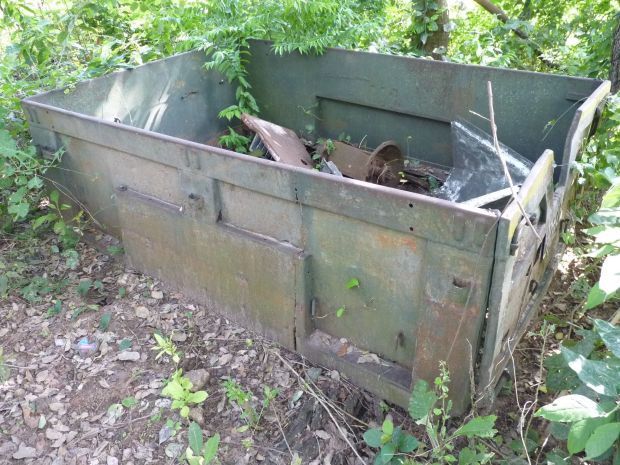
Focusing on our find, while I wait for a response from the experts available in the web (if it ever comes!) I would classify our find as a Ford CMP truck of the cargo type as its back part was resting nearby.

P1190019 copy

Summary of technical specifications:

Ford F15. 3 ton 4×4 Cargo produced by Ford Canada. Designed in 1936–1940. Produced in 1940–1945. Service history: From 1940. World War II. Engine: Ford 239 239 cu in (3.9 L) petrol V8, 95 hp (71 kW). Wheel 4×4. Speed 50 mph (80 km/h)

Now, how did it get to Itiyuro?

Although the Argentine Army is listed among the world armies that got CMP trucks [2] they would have been re-painted with the proper livery and they would have had special Army number plates.

The answer to the origin of the truck relates to oil prospection work in the area [3].

Oil had been detected near Tartagal (Northern Salta) in the 17th Century although interest for its extraction only started in the mid 1920’s through the arrival in Salta of the Jersey Standard Oil Company (SOC), attracted by the area’s potential.

The SOC finally started to extract oil industrially from 1926 but soon slowed down its intervention as the Government YPF moved in. During 1938-9 extraction by SOC declined as the YPF’s increased and by the late 1940’s, in view of the poor production of its wells, the SOC withdrew from Salta.

It is possible that the truck is one of the few remnants in the Itiyuro area left by the SOC or one of its engineers that brought the truck as a war surplus. I am not sure that we will know but, anyway, it was an interesting find.


[1] http://www.bushsnobinafrica.wordpress.com/2018/04/10/safari-to-itiyuro/

[2] https://en.wikipedia.org/wiki/Canadian_Military_Pattern_truck. Consulted on 6 April 2018.

[3] Benclowicz, J.D. (2011). Aportes para la Historia del Norte de Salta. Conformación y desarrollo de las localidades de Tartagal y General Mosconi durante la primera mitad del siglo XX (Contributions to the History of Northern Salta. Formation and Development of the Towns of Tartagal and General Mosconi in The First Half of the Twentieth Century). Andes vol.22 no.1 Salta ene./jun. Consulted on 6 April 2018.