Author: bushsnob

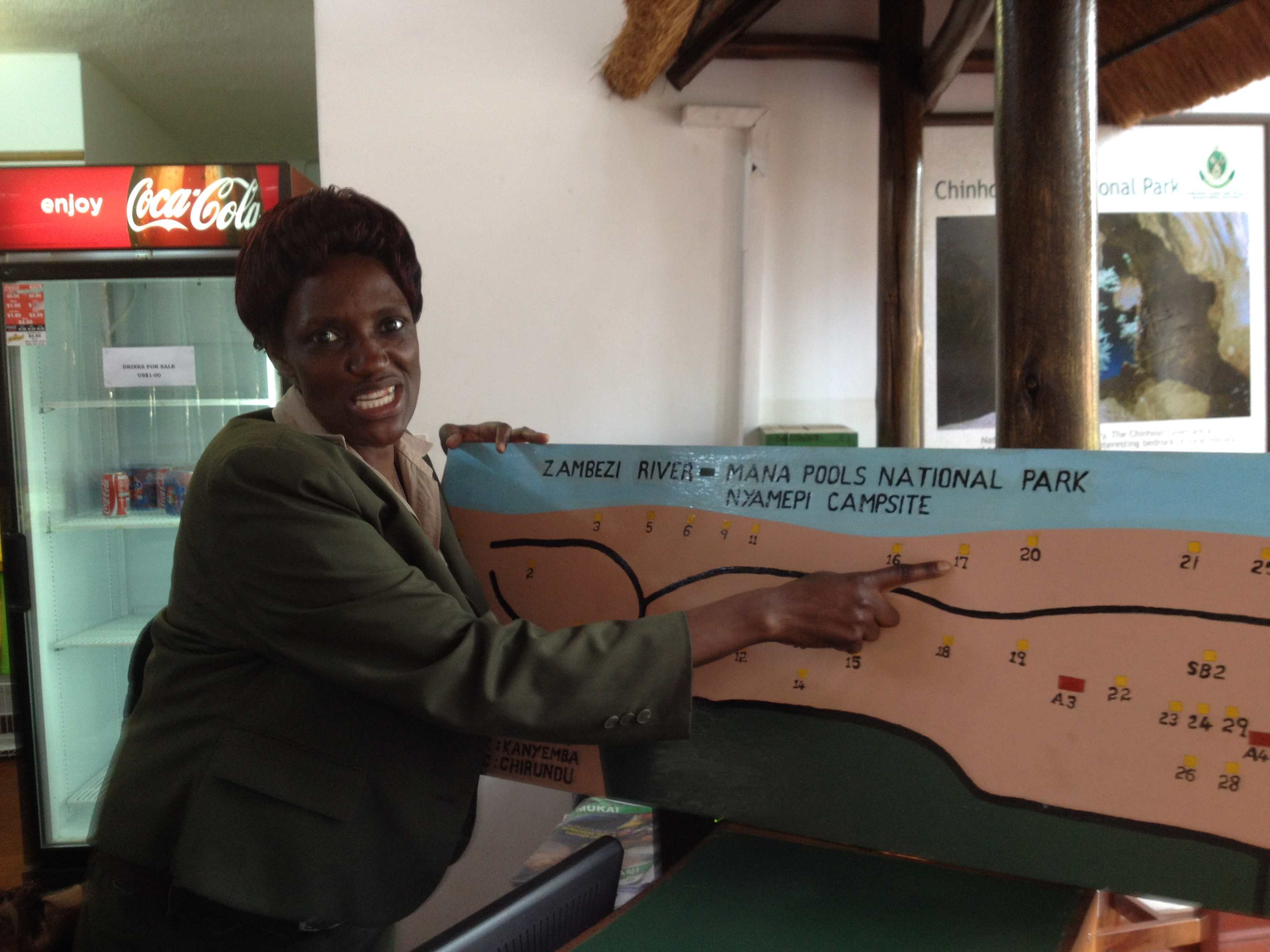
Christine, the booking wizard!

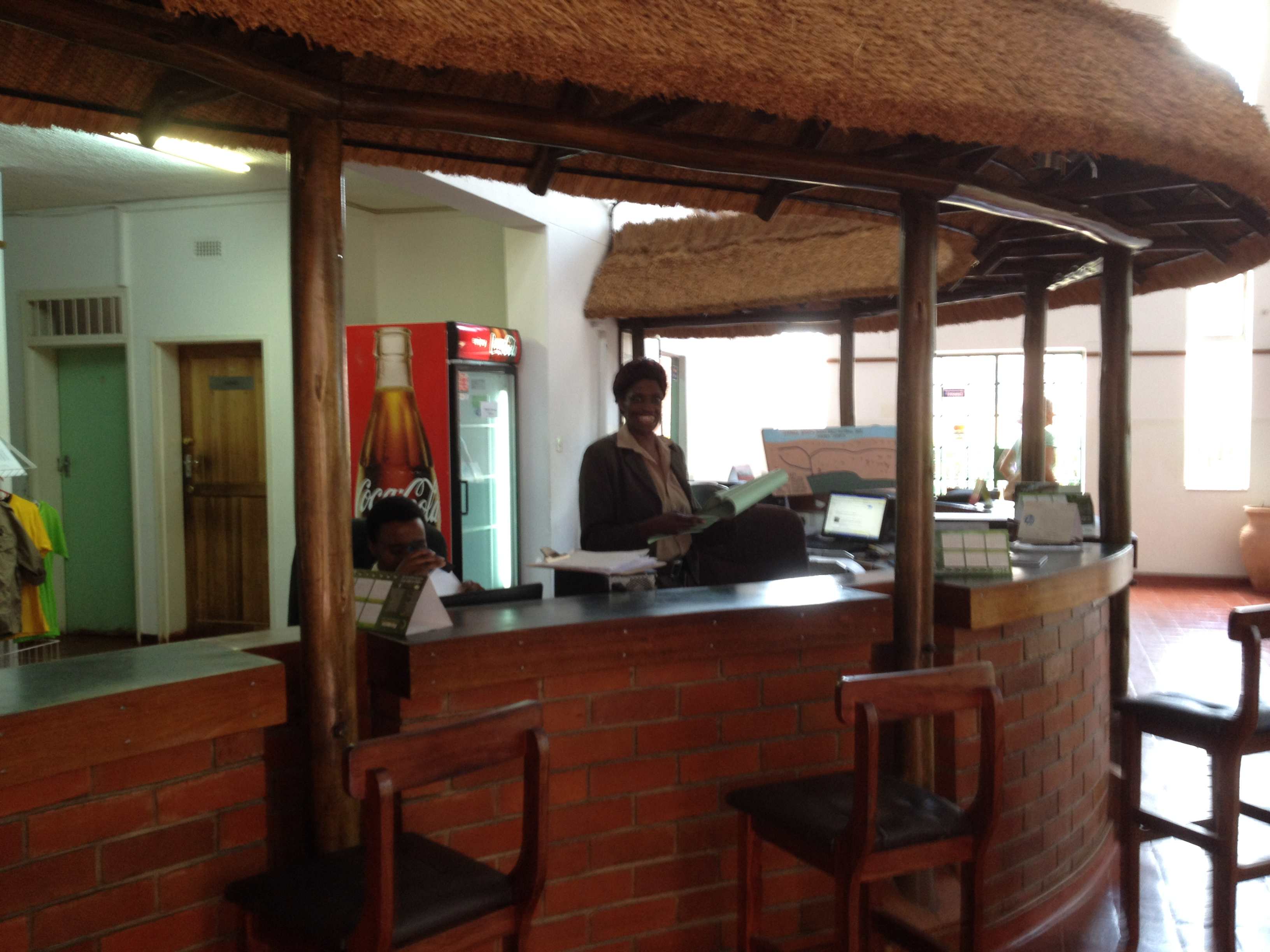
The booking office of the ...

The booking office of the Parks and Wildlife Management Authority in Harare.

More important than the right preparations, adequate bookings are the key to a successful safari. There is nothing worse than arriving at your favourite place and finding that you are double booked or that you “are not on our list”.

Worse still is dealing with a booking office with staff that just do a routine job and are completely indifferent to the client across the counter and their expectations. Unfortunately, this occurs more frequently than necessary, and even efficiency does not compensate for it.

Luckily, people booking at the office of the Parks and Wildlife Management Authority (PWMA) in Harare, Zimbabwe need not worry!

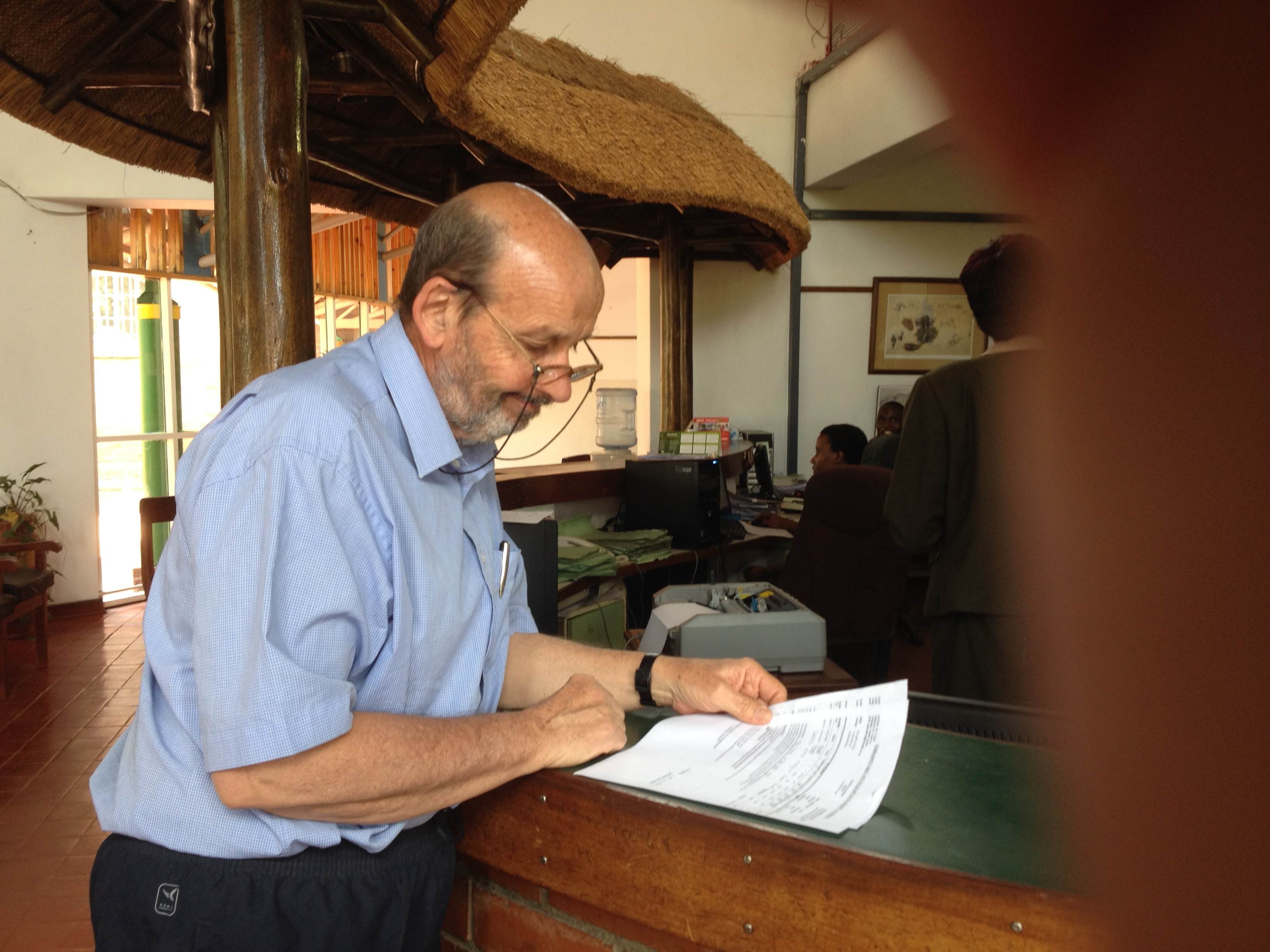
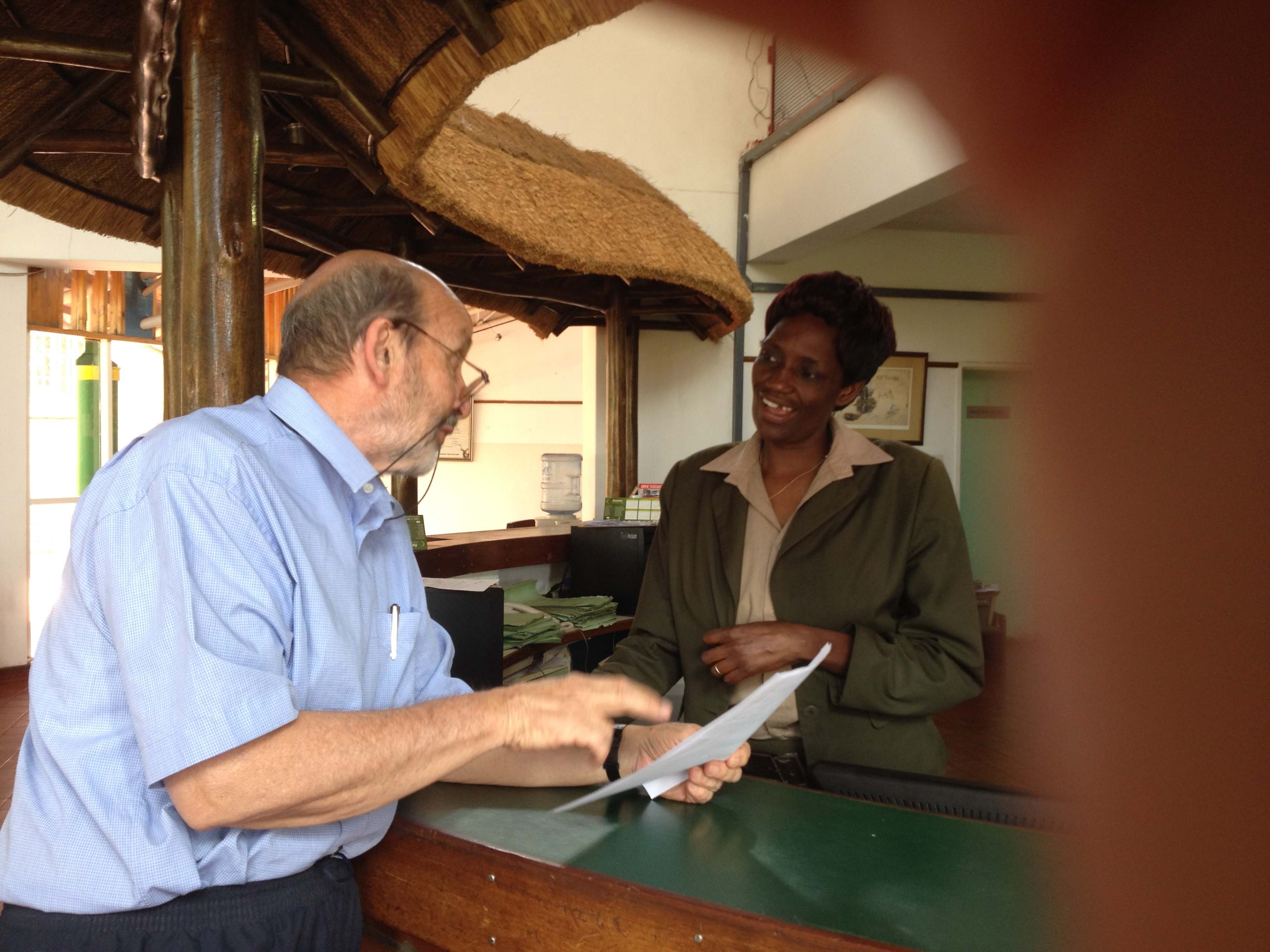
Christine is officially called a “Reservation Agent” but I would rename her as a “Reservation Friend”! With her team (Audrey, Peter and Catherin) she is always ready to assist and look -in the renowned large green accommodation books- for the place you wish, always with a smile, even when her telephone is constantly ringing and she is dealing with several issues at the same time.

This is the best campsite. I recommend it!

This is the best campsite. I recommend it!

She knows about the facilities offered, condition of the roads and best times to visit. She also acts as a guide, recommending the best places available and not hesitating to tell you their drawbacks and or advantages.

This is not too good...

This is not too good…

... a solution is found!

… a solution is found!

Married, a mother of two (boy of 28 and girl of 25) and recently a grandmother, Christina has been helping guests to get bookings to the wonderful places in Zimbabwe for the last 26 years. I would go as far as saying that she is the “face and voice” of the PWMA to the outside world.

Christine at work.

Christine at work.

Today I was there booking several places for both 2014 and 2015 and had a chance to enjoy her sense of humour and efficiency so I thought I would document my experience in the blog for all to know that here you will find a service like no other!

Thank you Christine and, please, do not scare me by talking about retirement again!

Unraveling the tusker mystery

The sighting of the large tusker described in “A tusk task” was the subject of an intense exchange of messages between the bushsnob and the Emerging Tuskers Project (ETP) of the Letaba Elephant Hall of Kruger National Park.

I supplied the ETP with all the pictures and a video of the elephant. I also reviewed the approximate location of the site where the animal was observed and corrected it to the area around Shingwedzi Rest Camp. This was done after revising our route on the day of the sighting, based on bookings and pictures (both their contents and times taken).

The ETP then studied all available information and compared the unknown tusker with their elephant database and came to the following conclusion, communicated to me on 15 September 2014:

“Thank you very much for sending the additional images and narrowing down the location it did help considerably, I did receive all 11 (pictures).

 In regards to your bull the answer is perhaps not one you were expecting but nonetheless very good news in that we have what appears to be a new tusker.

 This bull is definitely not Mavalanga* as neither the ear markings from the left ear that are prominent nor is what I call the “donut”, the thickening on the middle of the trunk present. I have looked in detail at the ear markings and having compared them along with the shape of the ivory with all the possible bulls that we are currently monitoring as well as the known bulls and they do not match. The location and side images you provided eliminated my only other suspected bull, so the only feasible conclusion is a new bull.

 Interestingly we received a second image from a guest who also suspected his sighting to be Mavalanga around the same time as your image was taken. We can see the ear markings clearly in this image so I am confident in my assessment.

 It never ceases to fascinate me how these bulls can go for so long without being noticed especially with ivory this substantial, it also highlights the value of guest submissions to the project as this is how we learn about these wonderful bulls.

 I have created a file for this bull and will definitely escalate him to the top of the list when the time for the naming review comes and hopefully at that time he will be confirmed as a new bull and named.

Kind Regards,

 ETP”

Of course the bushsnob and his wife are both very excited to have contributed to the ETP by spotting such a remarkable tusker and, hopefully, they will be kept in the loop regarding the future naming of the tusker by the ETP.

* (see: http://www.sanparks.org/parks/kruger/elephants/tuskers/emerging.php#mavalanga)

new tusker cropped

A frontal view.

Chewed snake cropped

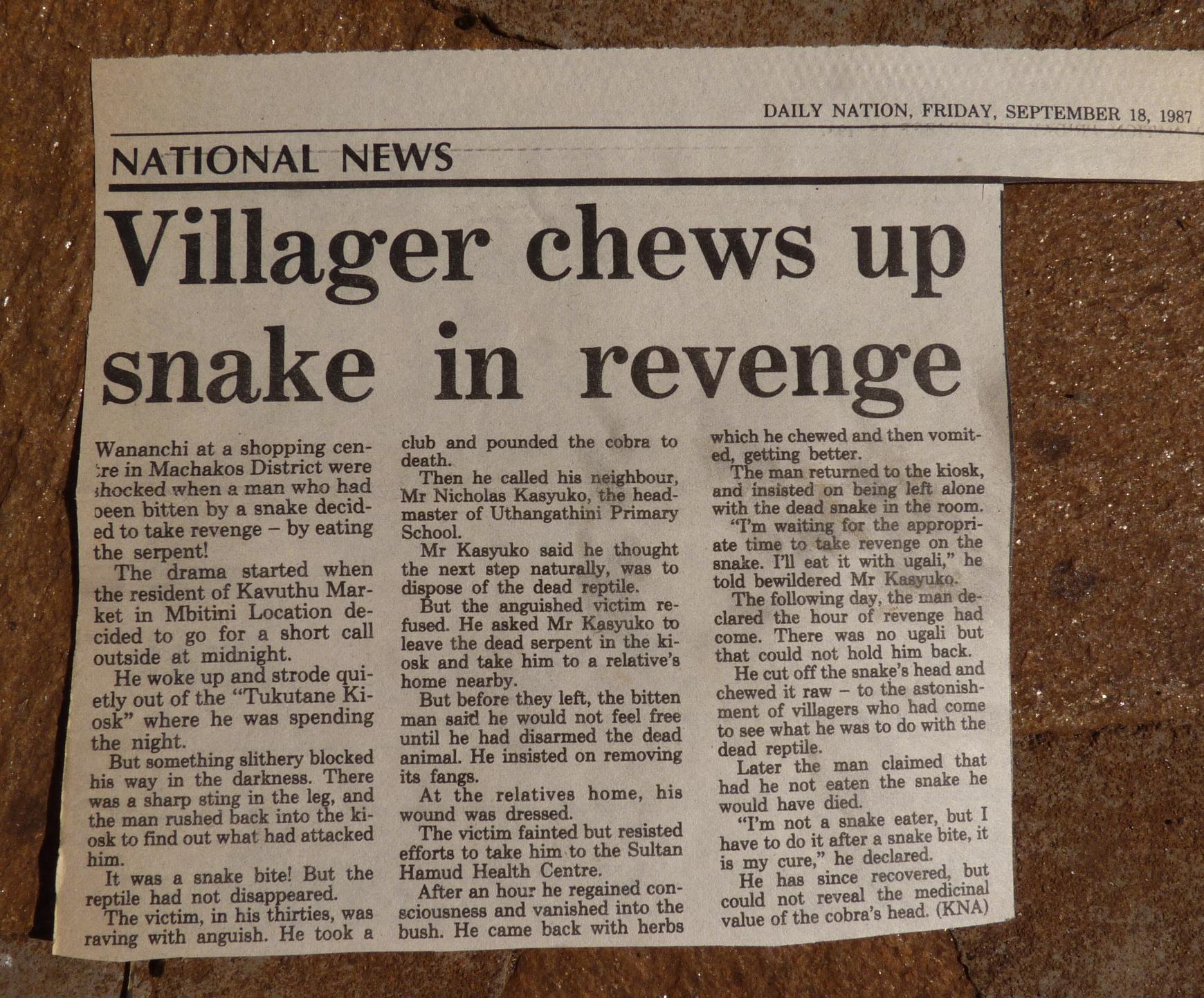
Recently I was identifying a snake for a coming post and the following newspaper cutting from  25 years ago slid out of the snake book. I had totally forgotten it but, clearly, being “snake-related”, I kept it there for future reference! I did not only found the story amusing but I also liked the way the reporter covered!

The text is small but if you click on it you can magnify the picture and read it (even I could do it!).

As a matter of terminology, wananchi in KiSwahili means “citizens or people” and ugali is the cooked stiff white maize porridge (polenta-like), the staple diet in Kenya.

Waltzing in the wild

cropped-videoclip-marabou-on-land.jpg

At the last minute after leaving Moremi Game Reserve, we decided to spend the night at Magkadigadi Pan National Park. We managed to get a last minute booking at Khumaga camp as we knew that animals -mainly zebra and wildebeest- were migrating through that area at the time. Additionally, we had been there in 1999 and we were curious to see it again as we had good memories of the place, particularly the games drives along the dry Boteti river where we often saw lions as well as a huge crocodile that used to live in a water pool that somehow survived the prevailing drought.

Makgadigadi Bot kumaga camp dry boteti 99 small

A view of the Boteti river in 1999.

Boteti river 2014 2 P1090801 small

A similar view to the above, but in 2014!

We noticed that things would be different when, after going through Khumaga town and just before arriving at the Boteti River, our GPS stewardess announced, “in 300 metres board the ferry”. “This machine is confused again” I said and there was general agreement in the car so we ignored her and continued driving. And then we saw a mighty river with very clean water and, surprise, surprise, a ferry parked at the end of the road, waiting for us! So we apologized to the GPS’ lady and approached the ferry.

While driving towards the water’s edge we remembered hearing, sometime ago, that the water was flowing again in the Boteti (later literature check up mentioned 2012 as the year that this happened). The view was totally different and new to us, suddenly making the idea of coming to Makgadikgadi National Park much more interesting! I am sure it was a great positive change for the wild animals (clearly also for the domestic stock as well!!!) that suffered water shortage for many years and their recovery must be on the way

Khumaga ferry small

Waiting to board the ferry at the “new” Boteti river.

After successfully getting the car on the ferry, under the expert guidance of the ferryman, we crossed the river in 15 minutes and arrived at the gate of the park, located on the other side of the river. We passed through the gate, drove a few km and, after seeing a large herd of zebra clearly returning from their afternoon drink in the river, we arrived at the campsite. The place was the same but now it was on the bank of a normal river, with water flowing and surrounded by green vegetation, a sharp contrast with our memories! It was a bitterly cold evening so we lit a good fire and were in bed early without seeing much!

Makgadigadi Bot safari 1 Khumaga 99 small

Our campsite in 1999.

The following morning, the coldest I remember while on safari, we decided to go for a game drive before departing for Francistown and Harare. This time the drive took us along the now green river banks rather than through its dry bottom and we could not help but express our admiration for nature for having recovered so fast from what earlier resembled a bone-dry place.

The road afforded us the chance to drive closer to the water in some areas and observe its prolific birdlife. We did not see many mammals, as they were probably grazing on the plains. The exception was a beautiful Greater Kudu bull with great horns.

Greater Kudu bull near the Boteti river.

The Greater Kudu bull.

It was during one of these river loops that we saw the marabou storks (Leptoptilos crumeniferus). There were a few hundred adult birds. The first impression was of a group of elegant men in suits with coat-tails at a gentlemen’s club, getting ready for a ball and waiting for the ladies! However, the ladies were already there, dressed like men!

Sand driving P1090802

The “waltzers” from far…

Marabou storks BotetiP1090803 cropped and small 1

They were well dressed… (Picture by Julio A. de Castro)

Marabous 2P1090806 marabou cropped and small 1

The orchestra Director. (Picture by Julio A. de Castro)

Marabou P1090807 cropped and small

Showing off before finding a dancing partner? (Picture by Julio A. de Castro)

We saw a lot of interaction as birds were clearly courting and getting ready to nest. Apart from some birds trying their hand at various acrobatics and showing their superb flying and gliding skills, the more frequent activities were less spectacular. They consisted of offerings of grass to each other, accompanied by short jumps and beak clattering. The latter was a rather noisy activity, considering the size of their beaks!

After a long while observing their antics, a boat full of tourists approached and disturbed the birds, which flew away and landed again at a distance. However, the “magic” had been broken for us and we, unanimously, decided that it was time to get back to Zimbabwe while the bird spectacle was still fresh in our memories.

marabou flying snapshot

A video snapshot of the birds moving off. (Picture by Julio A. de Castro)


Moremi

cropped-giraffe-and-zebra-small.jpg

We arrived at the South Gate Camp in Moremi Game Reserve after re-stocking fuel and food at Maun. At the gate we learnt that our 1999 map was outdated! So we bought an updated one as a new area of the reserve, the Black Pools, Mogogelo area adjacent to the camp, had been opened to the public after our map was printed! This was good news as other known places looked quite far from us.

The campsite followed the same general lines of Nxai Pan with similar anti elephant fields in place. Fortunately the only stinkbugs present were those coming out of our car and unfolded gear that lived rather ephemeral lives, being rapidly consumed by the various birds that were attracted to them; clearly birds without taste!

The area around the camp was drying up but there were still a number of roads that we could not cross so there was a lot of turning around and/or looking for alternative routes. This was further complicated by differences between our new map and the reality of the drives that got us “lost” a few times with the result that some time was wasted finding the right way. Often when this was finally found, it was still blocked by the water and not fordable! This served as a reminder that this was a real safari and not a smoothly presented wildlife TV or video!

As water was still rather plentiful, the animals were scattered around the area, particularly the elephants. We did not see many predators although we heard lions and hyenas every night. We also found five hyenas on our way Khwai camp. An interesting find were the abundant Southern Lechwe (Kobus leche), the first ones we had seen since our days in Zambia in the early nineties. This is an interesting antelope that is found in marshes feeding on aquatic vegetation and seeking refuge from predators by going into rather deep-water areas. There they have an advantage as the skin of their legs is greasy and repels water. This fact gives them an advantage as it prevents them from getting water logged, which would slow them down in case of a needed exit.

Birds and mammals provided some amusement at the almost empty campsite and luckily, this time it did not smell. We did have the expected evening visits by spotted hyenas but they kept a polite distance from our tents. A Lesser Bush baby (Galago senegalensis), a tiny mammal of about 35 cm (tail included) and weighing about 150g was also seen every night. First we would hear its ‘louder than life’ screeching and, shining the torch in its general direction, we would spot its comparatively enormous eyes! Even so it was tricky to see it as it was busy jumping between trees, achieving almost impossible leaps for such a miniature animal and behaving more like a furry frog or perhaps a winged insect!

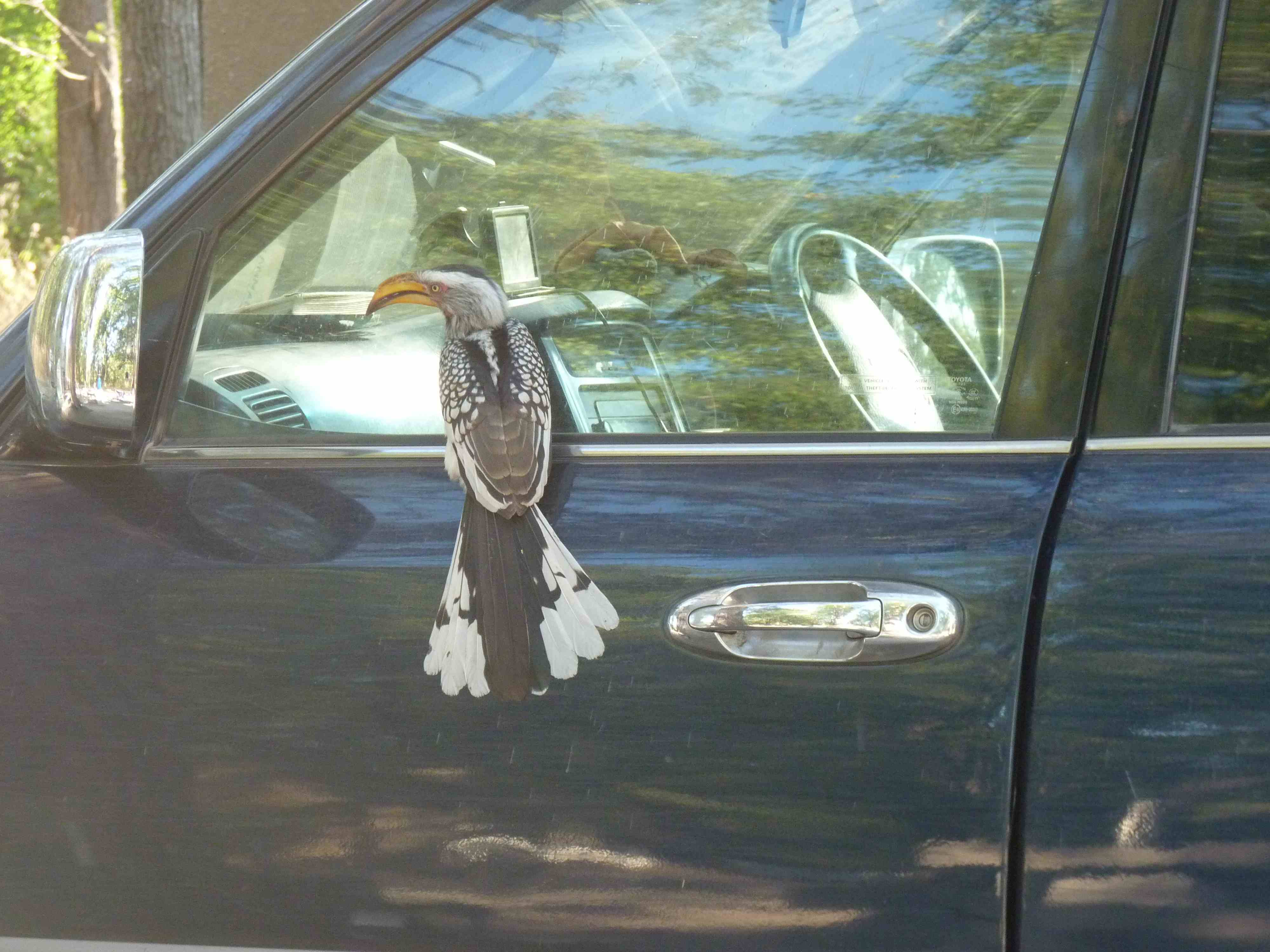
Redbilled woodhoopoes (Phoeniculus purpureus), White Helmetshrikes (Prionops retzii) and several Hornbills species also provided us with hours of entertainment. Both the Redbilled (Tockus erythrorhynchus) and Southern Yellowbilled (T. leucomelas) hornbills were present; the latter were particularly daring. These birds gained movie notoriety after Alan Root produced his documentary of the female raising her chicks while locked inside her nest, fed by her mate. A few of them hung around our camp and one, clearly a narcissist, spent a long time in front of the car window, trying to chase himself away in a prolonged and futile territorial dispute (with himself) that had no possible outcome, except possibly cracking the glass!

hornbill on glass small

The Yellowbilled hornbill chasing himself away…

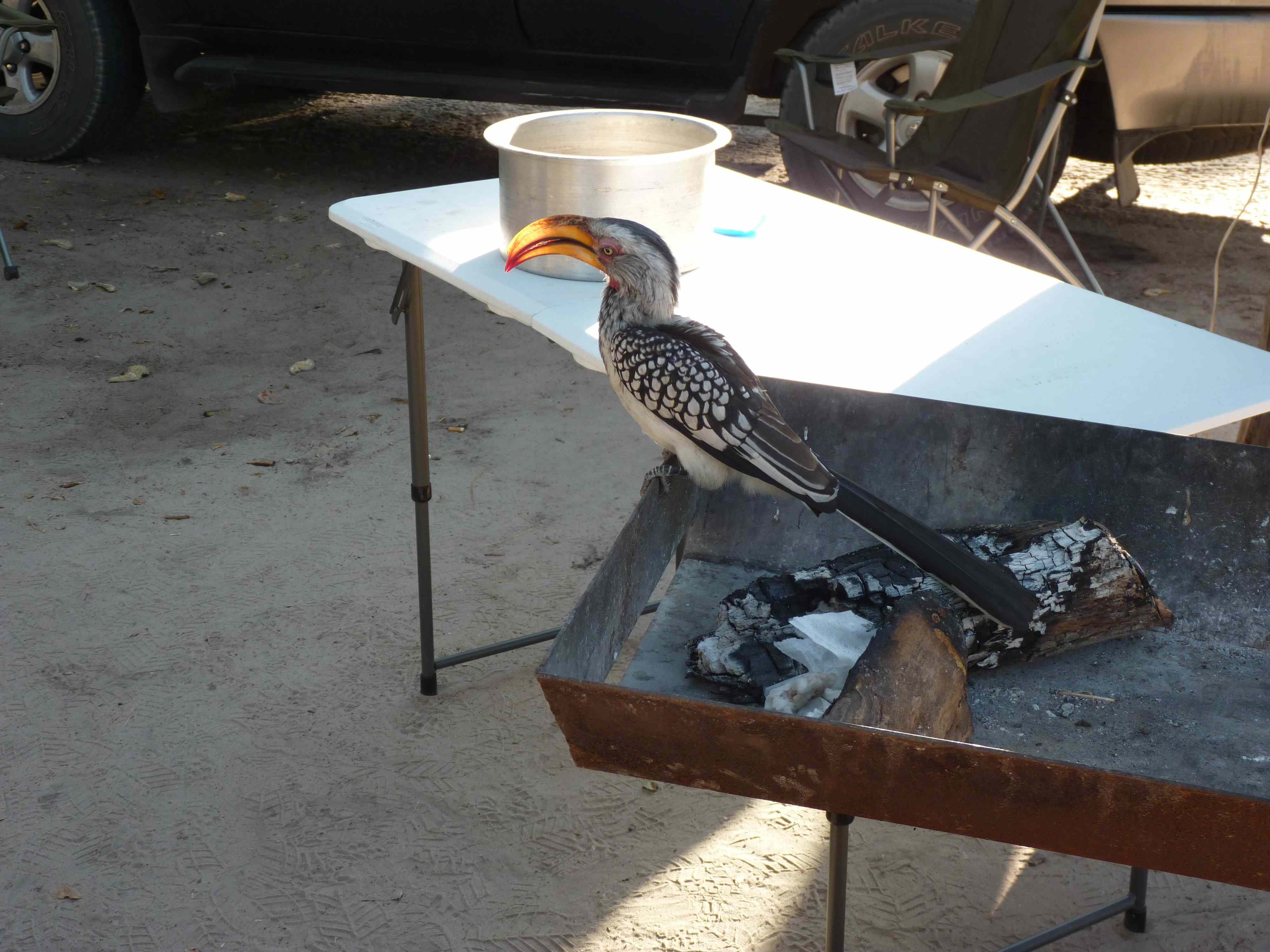
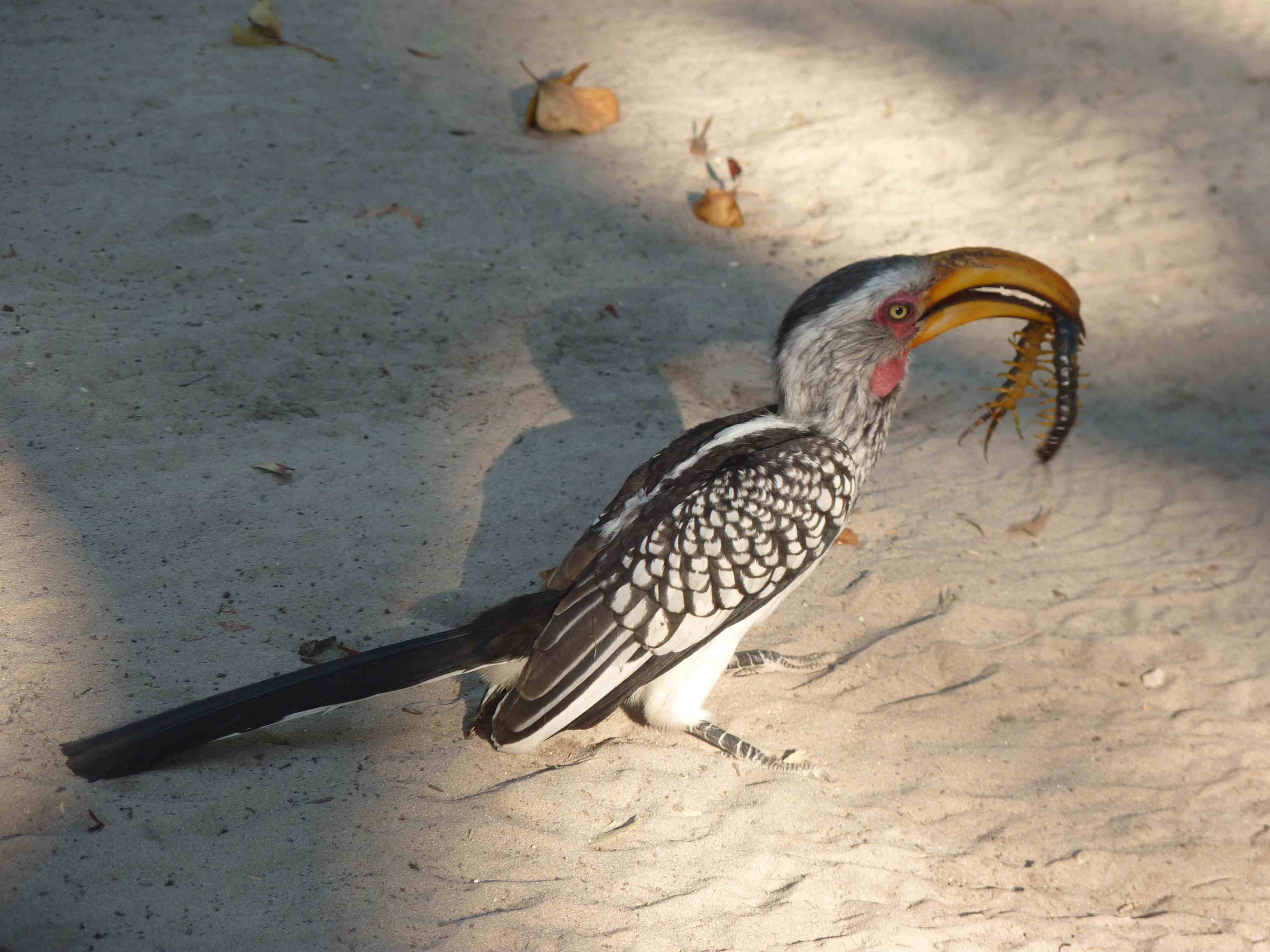
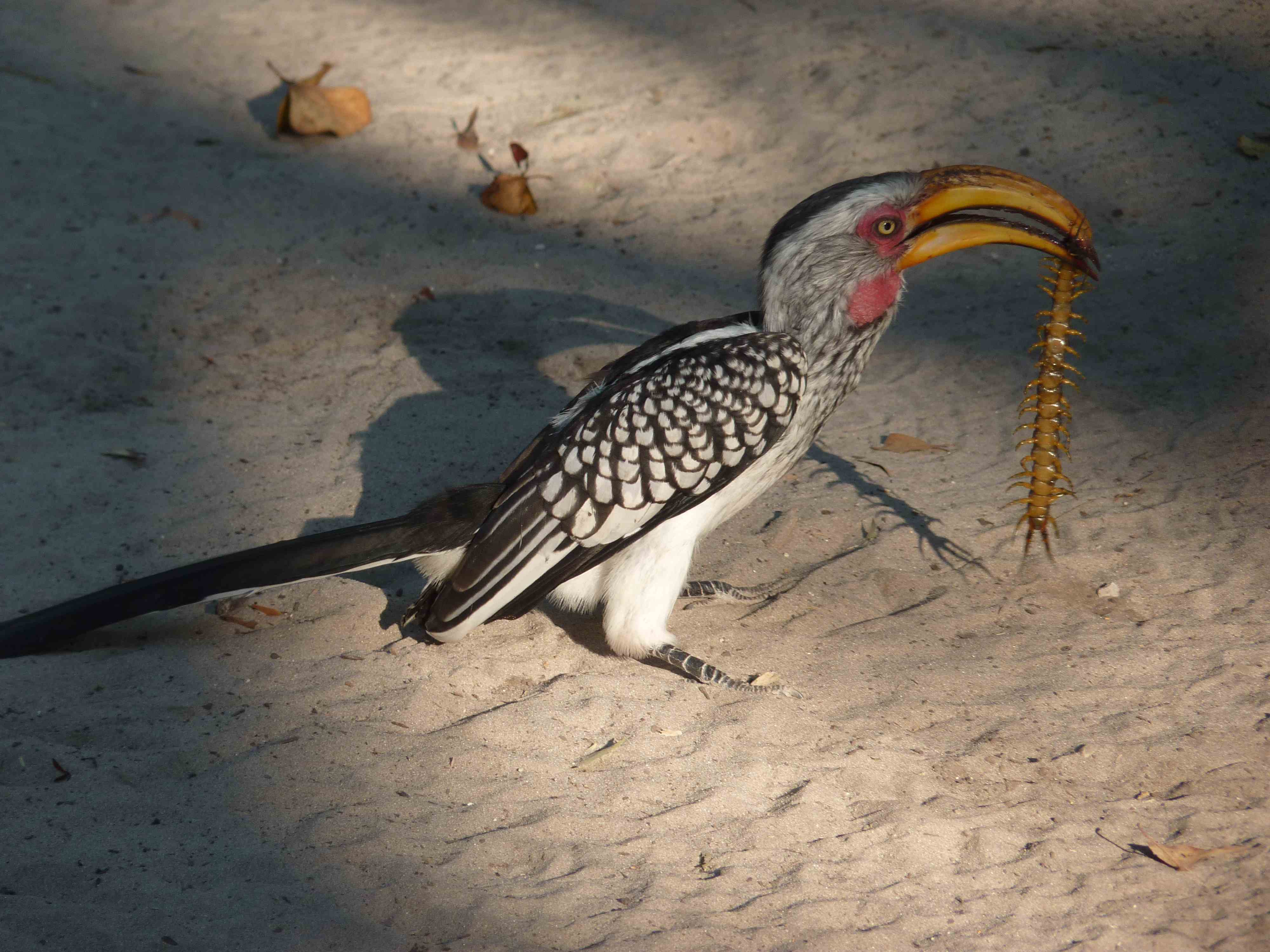
The hornbills kept landing at our table and trying to snatch morsels from us during meal times. However, just to show that they were not human-dependent, at some stage a Red-billed hornbill caught a rather large centipede that became a coveted prize among several contenders. Finally it became the property of a Yellow-billed that proceeded to batter it out of existence and to swallow it, not without difficulty.

hornbill at camp 2 moremi small

Visiting.

Hornbill with centipede at Nxai camp site small

Yellowbilled hornbill bashing the centipede.

Yellowbilled hornbill bashing the centipede.

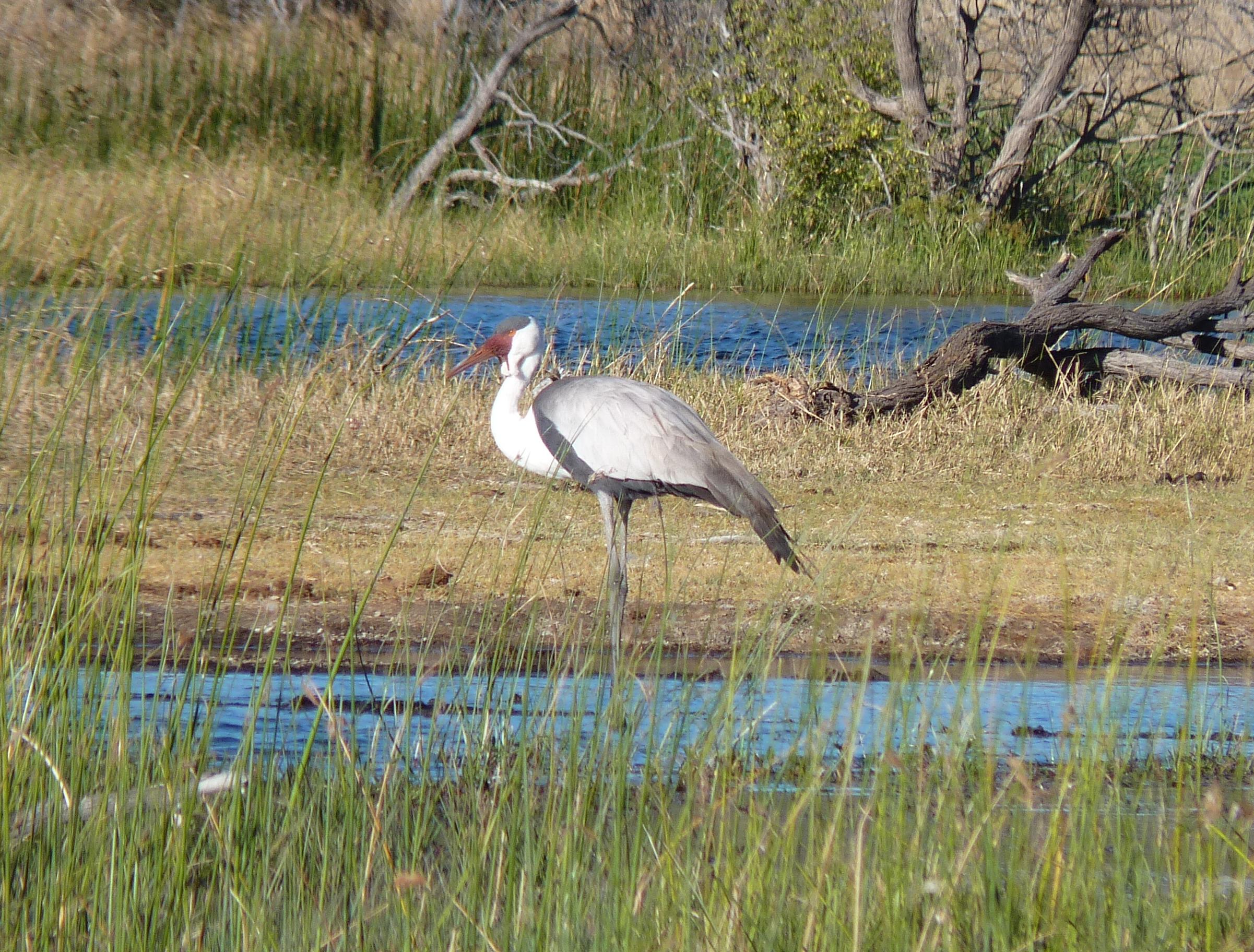
Our record of this area of Moremi will not be complete without mentioning that we were fortunate enough to see a group of Wattled cranes (Grus carunculatus). The Sassol Birds of Southern Africa guide describes these birds as “enormous”, rare, resident and endangered. I hasten to add that they were also shy and solitary, keeping their distance from other inhabitants of the swamps.

crane cropped and small

A solitary wattled crane.

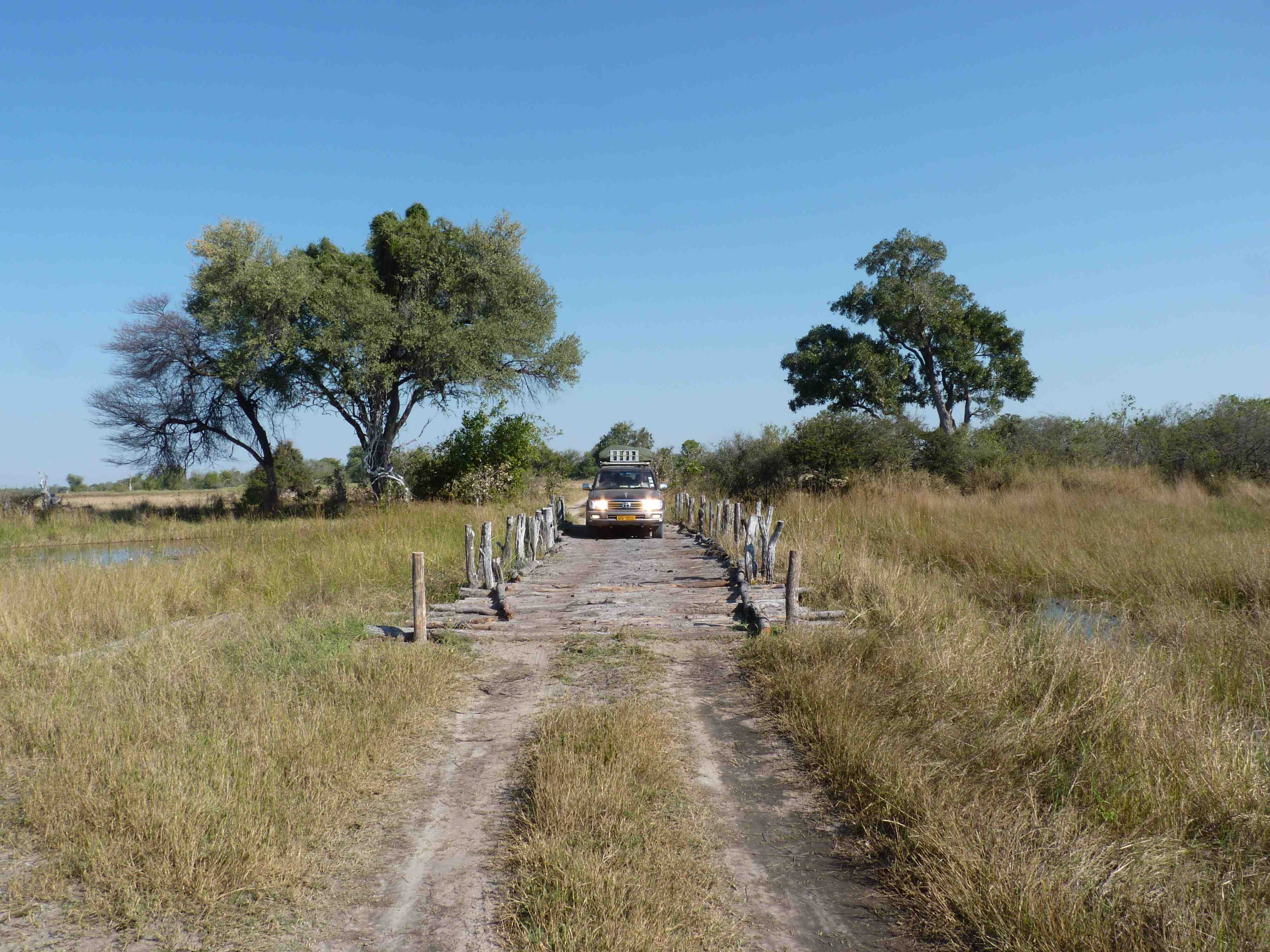
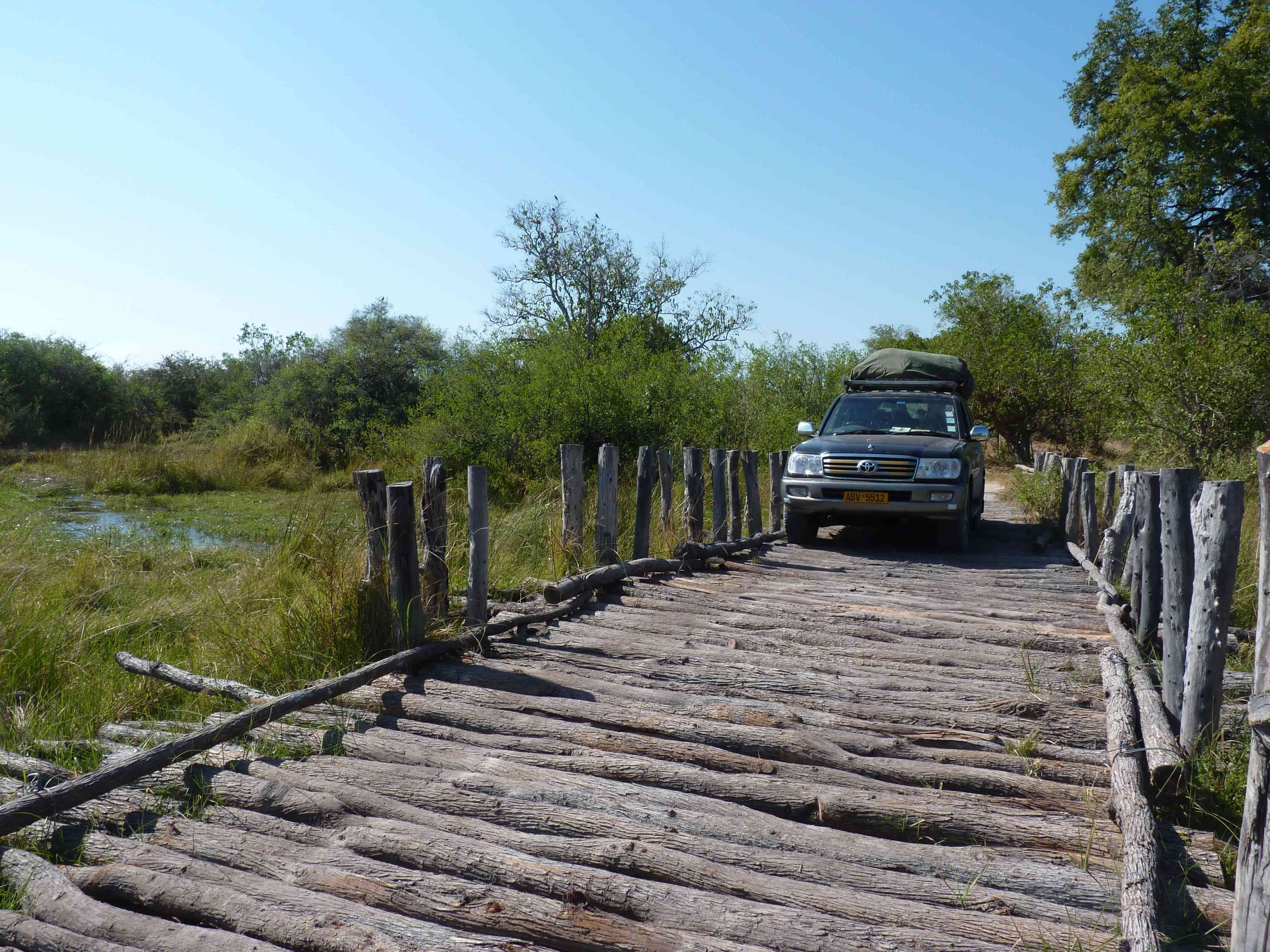
The trip to Third Bridge did not offer anything special apart from two bridges (First and Second) made with trunks that enabled us to ford the various channels before arriving to the mythical Third Bridge. We also learnt that there is a Fourth bridge beyond the Third! There seems to be a bit of a lack of imagination in naming but there may be a reason -unknown to me- for this nomenclature. At some stage we were quietly watching a beautiful herd of Greater kudu when a car stopped next to ours and someone shouted “Hi, nice place but there are no ‘hanimals’!” And then as the now scared Kudu bolted he added, “Oh, there they were some!” We bit our tongues and did not tell him off as he deserved! Later on we found them buried in the sand, being helped by an angry tour operator who needed to extricate them in order to continue his own trip!moremi bridge small

Crossing a bridge on the way to Third Bridge.

Bridges on the way to… Third Bridge.

While game watching we kept bumping into someone in a pickup with a very impressive camera array. We saw him (or rather his cameras) while watching the tree Cheetahs and later on while he was, in his own words, “getting the definitive picture of a roller”! We ended up talking to him and exchanged cards. Then we learnt that his name was Paul Souders and that he was 2013 Wildlife Photographer of the Year! Allow me to recommend his web site if you wish to see wonderful photographs at http://www.worldfoto.com/ and http://photoboy.com/2013/10/15/hudson-bay-canada-2/ where his winner picture can be found.

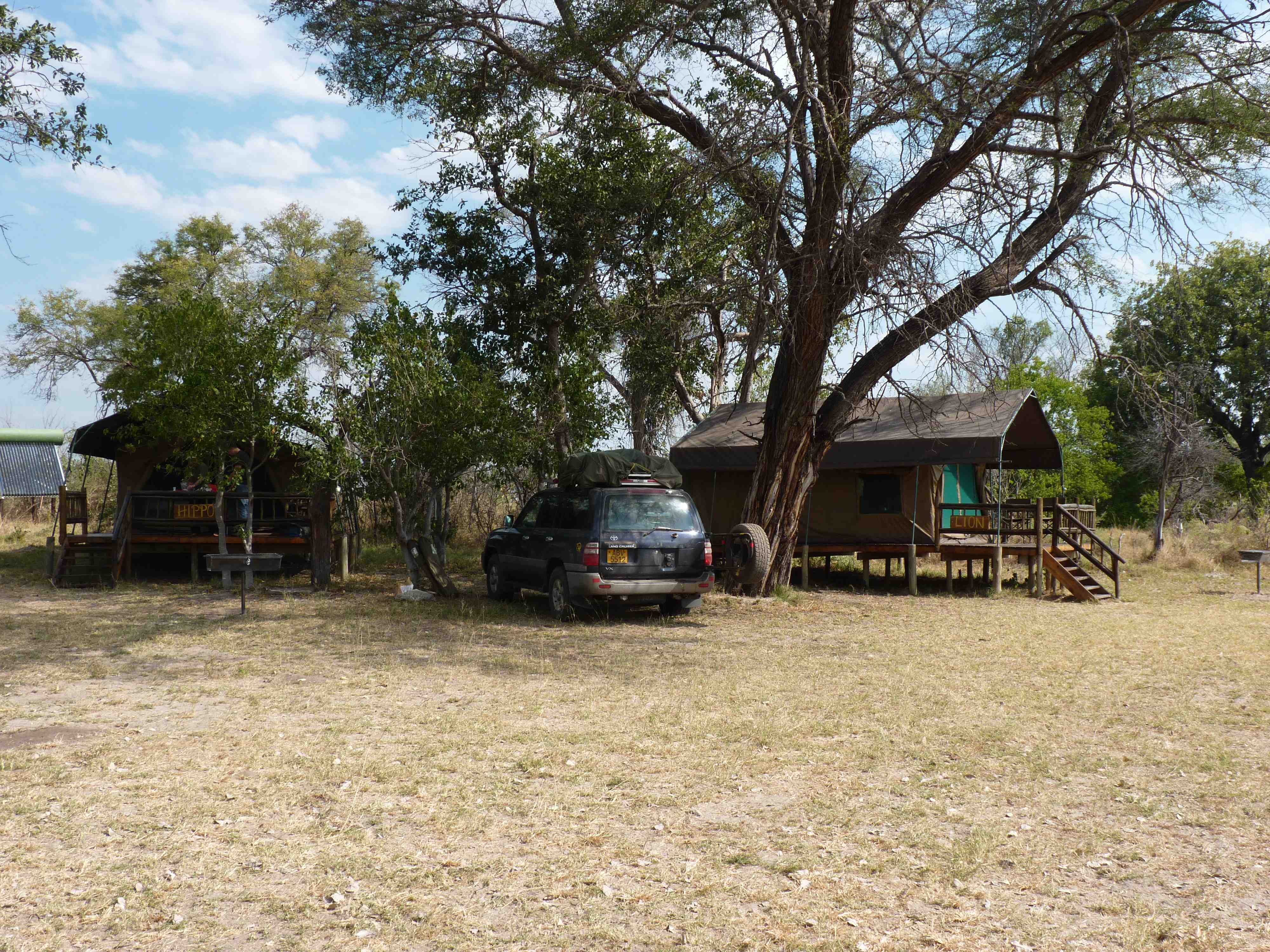
Our tent at the Third Bridge tented camp.

Our tent at the Third Bridge tented camp.

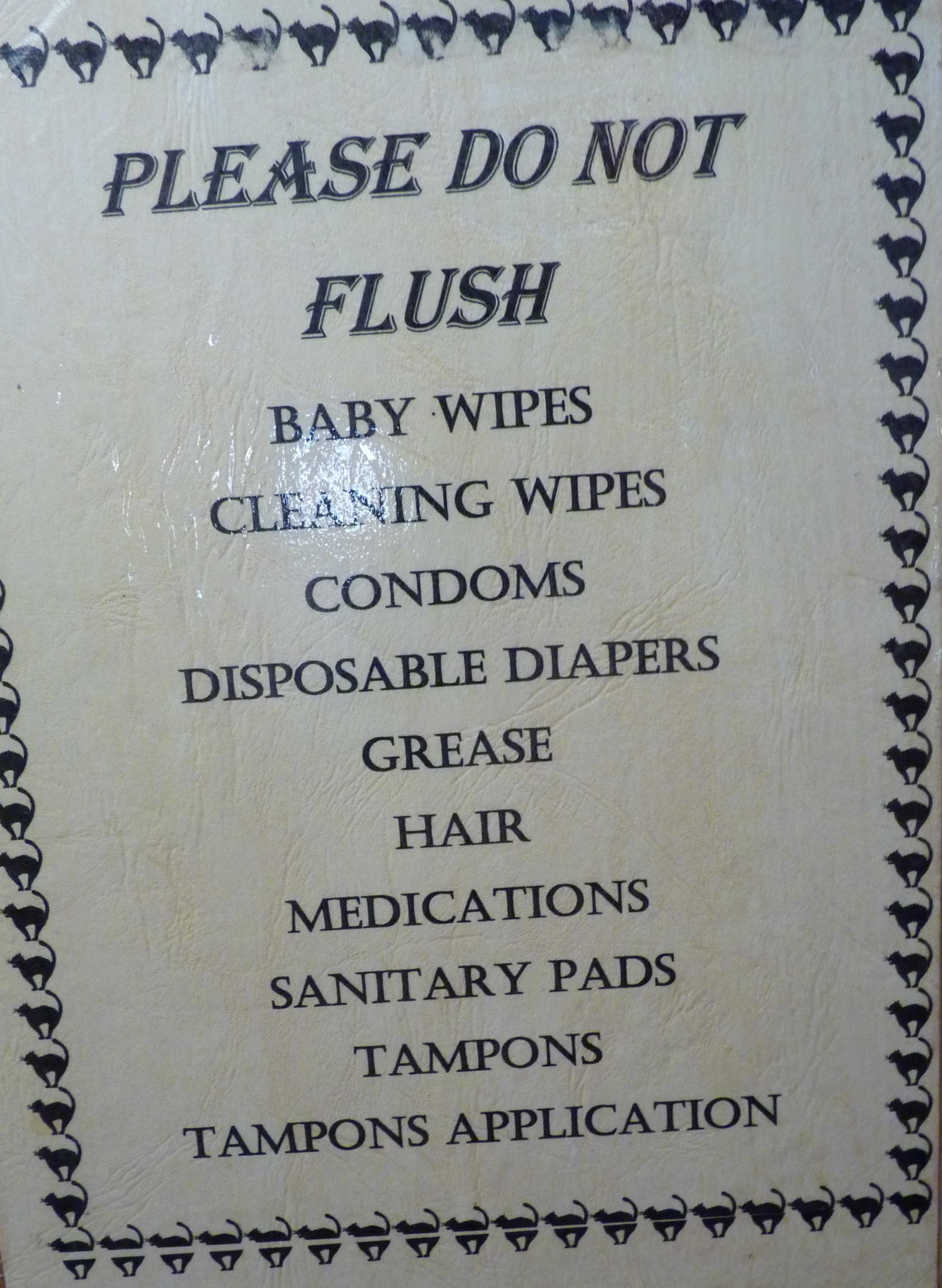
The sIgn from the Third Bridge tent. Do people really throw all this down the toilet?

The sIgn from the Third Bridge tent. Do people really throw all this down the toilet?

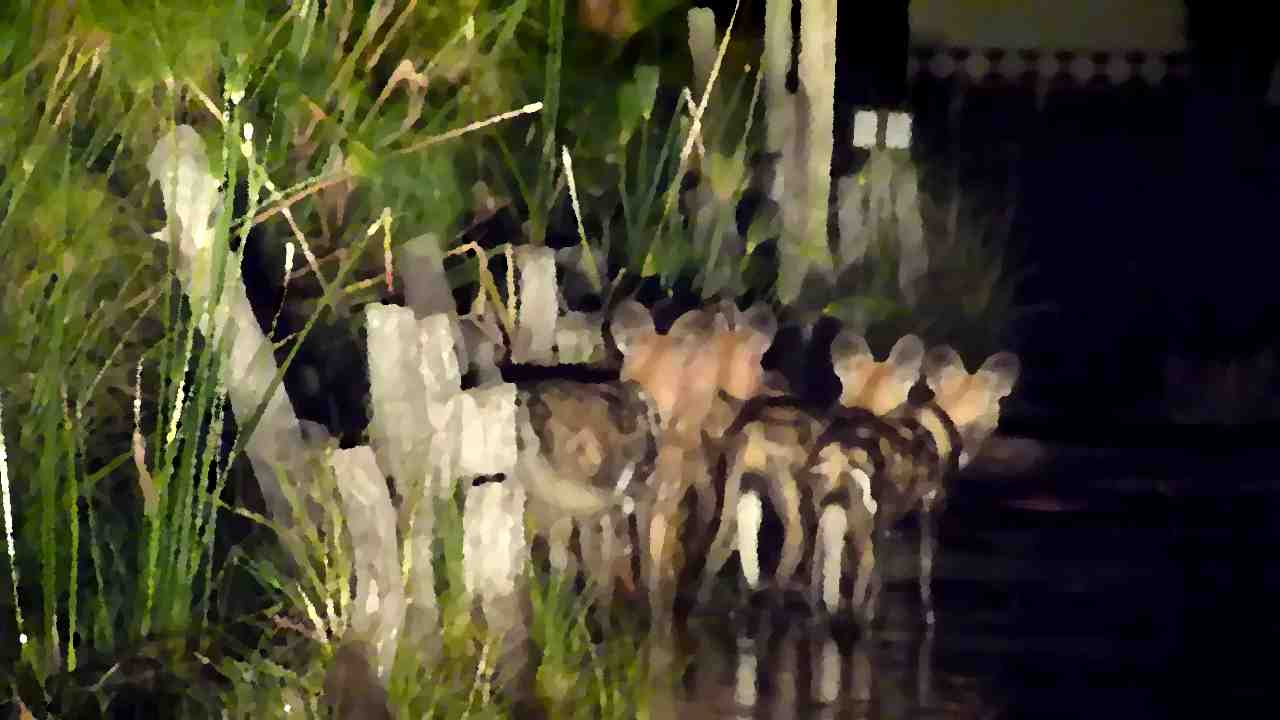
On the second night, we were returning to our camp rather late and before crossing the Third bridge to get back to camp, we had to stop and queue as a group of about 10 painted dogs got there before us! As the water runs over most of the bridge, the dogs were hesitant to cross (we learnt later that there is a crocodile at the bridge).

Painted dogs at Third Bridge. It was a very poor picture taken with the car lights so I smudged it to try to be "artistic"...

Painted dogs at Third Bridge. A bad still from a video taken with the car lights so I smudged it to try to be “artistic”…

After several minutes of goings and comings and not without a few jolts and recoils, one dared to take the first leap into the water. Soon all others followed and rapidly vanished into the dusky bush so fast that a car that came a minute after us did not see anything! Such as the nature of a real safari, a few minutes or even seconds can make a difference between a memorable sight or just MMBA (Miles and Miles of B… Africa)!


Note: All pictures by Julio A. de Castro

De-bugging

cropped-baines-baobabs-panoramic-june-14-small.jpg

Moremi Game Reserve has been on our list of “places to visit before dying” for several years. Although in 1999 we visited Botswana, we had limited time and focused on Makgadikgadi Pans National Park and then flew into the Okavango delta where we stayed at a camp known as Oddballs.

Fifteen years later in May 2014, and taking advantage of our son’s holidays, we re-visited Botswana with the main objective of seeing Moremi Game Reserve. We made an additional effort to adjust our accommodation to the itinerary of the President of Botswana, as his visit to the area coincided with ours and, for some reason (perhaps justified?) he had priority over us!

Our itinerary was:

Nxai Pan National Park, South Camp (29 – 31 May).

Moremi Game Reserve, South Gate Camp (31 May – 3 June) and Third Bridge Tented Camp (3 – 5 June). The earlier post “Tree Cheetahs” is part of this visit.

Makgadikgadi Pans National Park, Khumaga Camp (5-6 June).

As the trip was long, we included two nights at Nxai Pan. We remembered the place because of the very large baobabs known as Baines’ baobabs, found on an island in the saltpan with not much else!

Regrettably, during our trip we lost one of the camera’s memory cards so many pictures are lost to humanity!

An innovation during this trip was that the Department of Wildlife and National Parks of Botswana (the Department) has tendered the management of its camps to different private companies. While this may be good for the maintenance of the camps and other reasons important to the Department, booking and paying becomes cumbersome. In our case, we had to pay three different companies to secure our bookings! (here I will insert link to Department’s page with info on bookings)

Coming from Zimbabwe, the entrance to Nxai Pan is 65 km from Gweta. We registered at this first gate where we learnt that the President had been there in the morning and that he had left already, leaving a good impression among the staff there! After negotiating another 37 km, most of which over deep sandy tracks, you arrive at the final entrance gate. A note referring to this road on the Department’s web page puts things into perspective, so I should have been prepared:

“The sandiness of this track should not be underestimated and only 4×4 vehicles should attempt the journey, engaging 4-wheel drive before negotiating the deep sand – carrying a spade is also wise!”

Wisely we did carry a still uninitiated spade and arrived at South Camp without problems. The place was well shaded and all facilities were excellent.

When it was time to use the ablution blocks, we encountered a surprise. They were protected by a field of hundreds of cement blocks aligned at a 10 cm distance from each other. Each block ended in a 5 cm sharp iron spike. We had seen similar but simpler arrangements of concentric stones to deter elephants from damaging trees. However, this was an advanced version, almost resembling anti-personnel barriers seen in WWII pictures! As the use of showers and toilets was essential, crossing them was imperative! (pic of baobab with stones?)

Careful exploration of the barrier revealed a slightly wider gap, large enough to plant our feet toe-to-heel and make slow progress, taking care not to lose our balance. This was challenging enough during the day. At night it became a potentially mortal field where all senses needed to be focused on the task to avoid falling to what it looked like sure maiming!

We arrived at the campsite quite late and after putting our tents up (and surviving the visit to the ablution blocks) we went to the nearby water hole for a quick look. This is perhaps the focal attraction of Nxai . It is near the campsite, in the heart of a large grassy plain and dotted with umbrella thorn trees. Here, several animal species can be seen, drawn by the availability of water.

Nxai Pan’s is at its best during the rain season when a multitude of animals congregate there (including large numbers of springbok) and various species reside there permanently. Although it was the dry season, we were lucky enough to see a pride of lions made up of two adult lionesses with five cubs, together with two adult males. They were well fed and being their usual lazy selves, totally ignoring possible prey such as giraffe, zebra and greater kudu that came (in numbers) to drink.

Unknown to us, a surprise was waiting for us back at the camp. As earlier we were focused on the “spike-crossing”, we had not noticed that the camp was crawling with small stinkbugs. Although they were rather nice looking with a combination of brown and orange, crushing them released their strong and rather pungent odour. To our great consternation, there were hundreds of the smelly things!

P1090861 stinkbug cropped and small

A green relative of the campsite invaders. Their pictures were lost with the camera card.

To make matters worse, like most insects, being attracted to light is in their genome! Protecting your glass of wine, cooking pots and dinner plates from their dive-bombing became a high priority, as there was not much else to be done about their presence! Despite our efforts, some drowned or got burnt to death in our pots. Fortunately no unexpected crunchy bits were found in our food!

Unlike dinner, achieving a stinkbug-free sleep was infinitely more complicated! The first alarm was sounded by our son when he discovered that they were getting inside the tents, despite the tight zippers: “my tent is full of bugs!” he said with a touch of exaggeration and adding a few epithets that I omit for the sake of the under-aged readers.

I was very pleased in my sleeping bag -having successfully negotiated the ablution spikes at night, so I decided to weather out the bug storm. I did so by adopting the ostrich trick of burying my head deeper in the bag, trusting that my poor sense of smell would not betray me. My companions did not join me in the use of this tactic, being of different genetic make up (my wife) and having inherited a lot of that (my son).

Although I believed it to be a fruitless procedure and told them so, they proceeded to methodically review all their belongings to remove the invaders from their clothing and shoes. This required a prolonged de-bugging session that was painstakingly achieved. They then proceeded to extract all the bugs from the tent. As this was all done with the aid of light and torches, it was a near never-ending exercise as new bugs kept getting in while others were being extracted.

Eventually an equilibrium that favoured the humans was achieved, the lights were turned off and calm was restored while I tried to keep first my chuckle and then my rude remarks to myself. The calm did not last too long as I heard my son say: “Shit, I just crushed another bug!” and opening the zipper to take it out. We spent a “perfumed” night, some of us resigned and others fighting the bugs to the bitter end!

Despite the rather “bugged night”, the following morning we left early for Baines’ baobabs. They were painted in 1862 by Thomas Baines, a famous painter and explorer of the last century during his journeys through southern Africa. Today, the same scene that entranced Baines is still there, unchanged as these trees take hundreds of years to grow! Perched on the edge of the large Kudiakam pan, dry for most of the year, they preside majestically over the salty flat span surrounding them. However, if the rains are good, the place becomes an island in a large sheet of water where water lilies appear, along with abundant waterfowl life. Needless to say that the place looked the same as in 1999…

Baines' baobabs in 1999.

Baines’ baobabs in 1999.

You get to the baobabs after driving a couple of hours over sand dunes on a rather rough and undulated road that eventually delivers you to the open area of the pan where you immediately spot the clump of trees in the distance. Luckily some pictures taken with the cell phone survived and I include them in this post.

The trees are rather dark and coppery, standing quite close to each other. One of the colossi has fallen but it is still growing on its side! I must confess that I did not count them and, judging by Baines’ own account of his discovery, he was not very precise either after seeing them for the first time when he wrote:

“… five full sized trees and two or three young ones were standing, so that when in leaf their foliage must form one magnificent shade. One gigantic trunk had fallen and lay prostrate, but still losing none of its vitality, sent forth branches and leaves like the rest.”

After watching a Secretary bird in search of snakes, a rather rare sight in this latitude, the trio of “stinkbug-wise” campers returned to the camp later in the evening. After an excellent shower to rid ourselves of the dust collected during our drive, and a hearty pasta dinner to settle us down, we soon were in our tents without bothering too much about our smelly foes.

The bugs were a real nuisance while we disassembled our camp, as the beasts contrived to find their way into all the folds of our tents, empty bags, chairs and any item that offered a crevice to be filled. It took a lot of work to remove them and, despite our efforts, we carried a few fragrant reminders of Nxai Pan with us to our next destination: South Gate at Moremi Game Reserve.


Note: Header picture by Julio A. de Castro.
A tame lion: a Kenyan tale

black mane cottars small

A tale told to me by a friend while enjoying a drink at a campfire in the Maasai Mara Game Reserve in Kenya. As lions are among our favourite animals, this short story stuck in my mind. I hope you enjoy it!
I believe that the event took place in the 50s. There was either a farmer or a game warden that resided at a camp in the Athi plains, a few kilometres from Nairobi. Somehow he had acquired a lion cub that he raised to become, as usual, a rather large and potentially dangerous male lion that lived with him and his workers at his camp.

He was well known in Nairobi as he came to get his provisions from the duka (store in KiSwahili), leaving the lion tied up in the back of his truck. This was rather unusual at the time and therefore it attracted some curiosity among shoppers!

For some reason, on this particular occasion he came to Nairobi with a loaded truck and he was forced to leave his lion at camp, together with his camp staff. The jobs he needed to do that day took him longer than he anticipated so he left late and it was dark when he got back to his camp.

It was the norm that his vehicle lights would warn the camp of his imminent arrival and people would be waiting for him to report on the events of the day and help him to unload. The camp was by the river and he could see it from above just before he came down to it. The camp appeared deserted. He slowed down and had a good look, still nothing. “This is odd” he thought and then caught a slight movement with the corner of his eye. A male lion was trotting towards the bush and it was not his!

It was not rare that lions “visited” his camp so he moved on, while keeping an eye on the situation. He regretted leaving his rifle behind! After making sure that there were no more lions in camp by using the car’s headlights, he decided to get out of the car. Being cautious, before he entered the camp, he called his staff but no one replied. After waiting for a while in the dark, he carefully walked to his staff quarters. There was no one there either! He then decided to fetch his hunting gun from his tent.

The tent was zipped up. He unzipped it as gently as possible, and put the light on. He could not believe what he saw! All his workers were there; looking rather frightened and, also with them was the lion, looking equally terrified and shaky!


Gardening in the wild (I)

After I was offered a job in Ethiopia in 1988 and while still in Kenya, in my anxiety to know where we were getting to, I contacted a consultant that had just been there to get preliminary information. We knew each other quite well and he was frank with me. “The place is beautiful” he said, and he added “if you can get there with your car in one piece! We blew a tire, went off the road and had a near miss as we hit a large rock that stopped us from going down a steep slope”. I am sure he was enjoying this -probably the look on my face- when he added “but don’t let me put you off!” Trying to digest this and making fruitless efforts to hide my discomfort, I asked for details about the living quarters and the work. He complied with the latter and then said: “You are lucky as you will have a very large garden”. This somehow lifted my spirits and then he finished me off by saying: “the whole of Ethiopia will be your back garden!” I refrained from more questions…


Contemplating our "enlarged' garden with a visiting friend.

Contemplating our back garden with a visiting friend.

So we prepared for self-sufficiency through gardening! We bought seeds and tools and this was the beginning of our gardening experience in Africa. Our first visit to the local market confirmed that we had taken the right decision. There was a market every Saturday where farmers brought their produce, often walking very long distances over very hard terrain. A look at their feet clad in the ubiquitous sandals made from car tires vouched to that! Clearly their farming efforts were not directed towards the “forengis” (foreigners in Ethiopia) and fresh vegetables were rare. You could find tomatoes and, occasionally, onions. Both were sold by rows of farmers (mostly women) seated behind piles of 3 to 5 fruits. Attempts at buying all the tomatoes offered by any one of the sellers -through a kind Oromo interpreter- provoked a strong negative response as they were only happy to part with one or at most two units. That meant that to get a kg you needed to negotiate with about six farmers! A time consuming exercise!


A local market.

A local market.

There was also a number of produce that was utterly unknown to us and I do not even recall their names or use. I do recall seeing Oromo potatoes (Coleus edulis) and ensete (Ensete ventricosum). The former is widely consumed in Oromia and we did enjoy them steamed or boiled. The ensete is an important contributor to food security in the region and “kocho” was on offer. This greyish paste is prepared from the fermented pulverised trunk and inflorescence. This is a delicacy consumed at weddings and other important feasts. We did eat it occasionally but it did not leave a lasting impression.

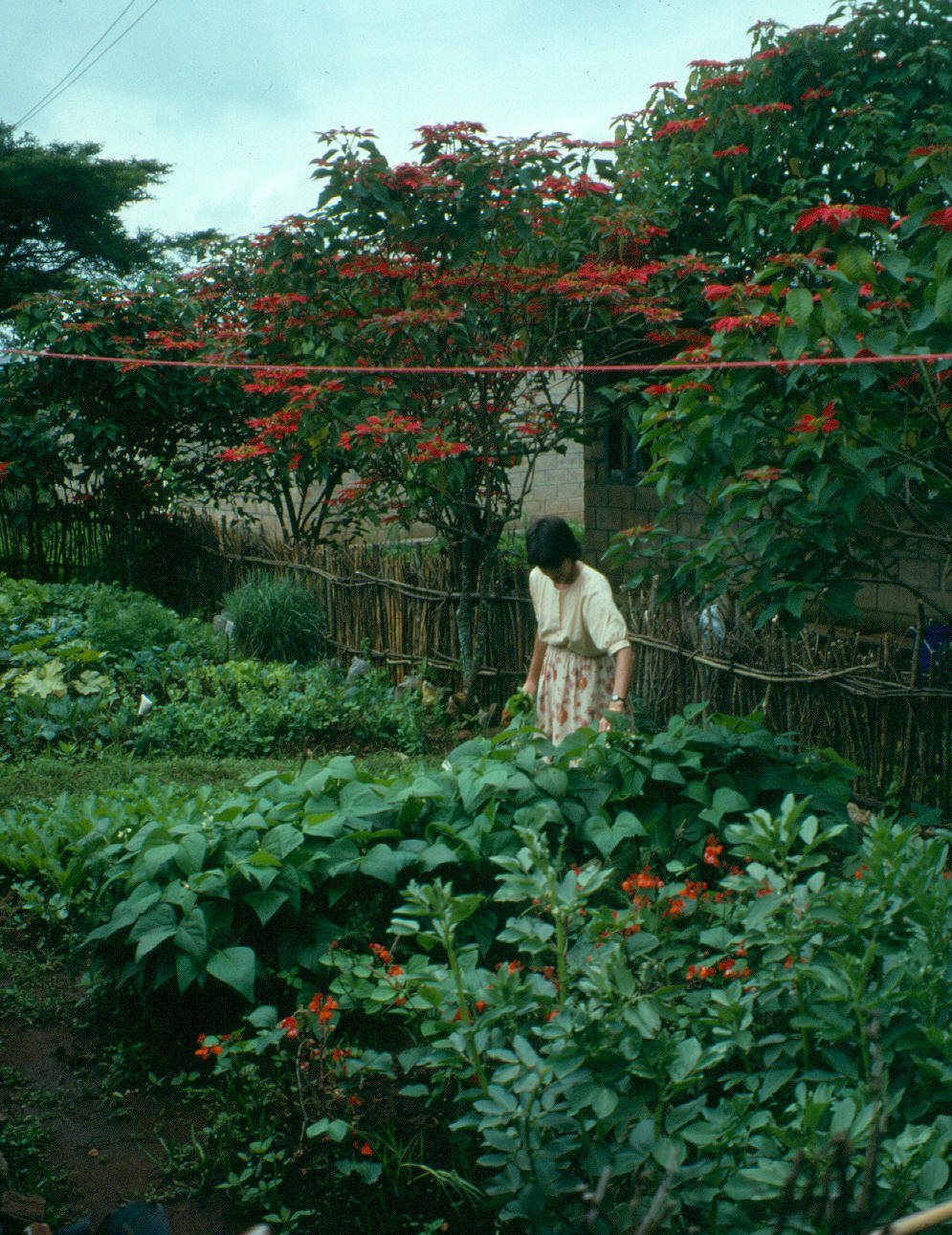
Through her dedication, after a few months, my wife had transformed our backyard into a vegetable haven that was the topic of conversation in the laboratory. There were tomatoes, Chinese cabbage, lettuce, spinach, beans, peas and various spices. We were enjoying our fresh produce!

We discovered Seven year beans (scarlet runner beans) in Ethiopia.

We discovered Seven year beans (scarlet runner beans) in Ethiopia.

My wife tendering the garden.

My wife tendering the garden.

This lasted until the monkeys discovered it! To enlighten you, we were dealing with two main species: the vervet (Chlorocebus aethiops) and the mantled guereza (Colobus guereza), also known as black and white colobus. We loved watching them in the wild but not in our garden. The vervets were the main menace but the colobus, a hervivorous species, would also come down from their normal arboreal habitat to enjoy our garden. It is one thing to deal with small pests (insects, mollusks) and another one to control birds and/or mammals! To make matters worse, monkeys have quite developed brains, are very daring and they arrive in troops! After the first rather devastating visit, the superior primates -us- needed to deploy appropriate measures to prevent this from happening again! Clearly, we were not able to take pest protection measures applied in developed countries (enclosing the garden in chicken wire, flash guns, etc.). We had a problem and needed to act fast!


Colobus monkeys keeping an eye on the garden.

Colobus monkeys keeping an eye on the garden.

We did not invent anything new when we decided to consult the local farmers to seek their wisdom on the problem. At the end of the “expert consultations” we came to the conclusion that the best and probably only acceptable solution was to scare them. So, following their advice, we needed to find someone to watch our garden. It is common to see planted areas being watched by farmers from small raised towers from where they can see the crop area and take measures to scare pests away, such as stone throwing, shouting, running after them and other measures that vary according to the intruder. It is a different thing to scare monkeys flock than to chase away an elephant or a hippo!

Acting as per the recommendations, we proceeded to find the suitable candidate by consultating with other neighbours. We were fortunate to find a young relative of one of the veterinarins that was presented to us as the solution and he was duly employed to carry out the task. After this measure, although the monkeys at first continued to besiege our garden, they soon gave up and moved off.

A Vervet monkey feeding on stolen produce.

A Vervet monkey feeding on stolen produce.

Once this major problem was dealt with successfully, vegetables were produced in abundance as the climate there is very favourable for plant growth with an average temperature of 18°C and an annual rainfall of about 1800mm and insects were not a major problem.

International Women’s Conference

Latter rain church cropped and small

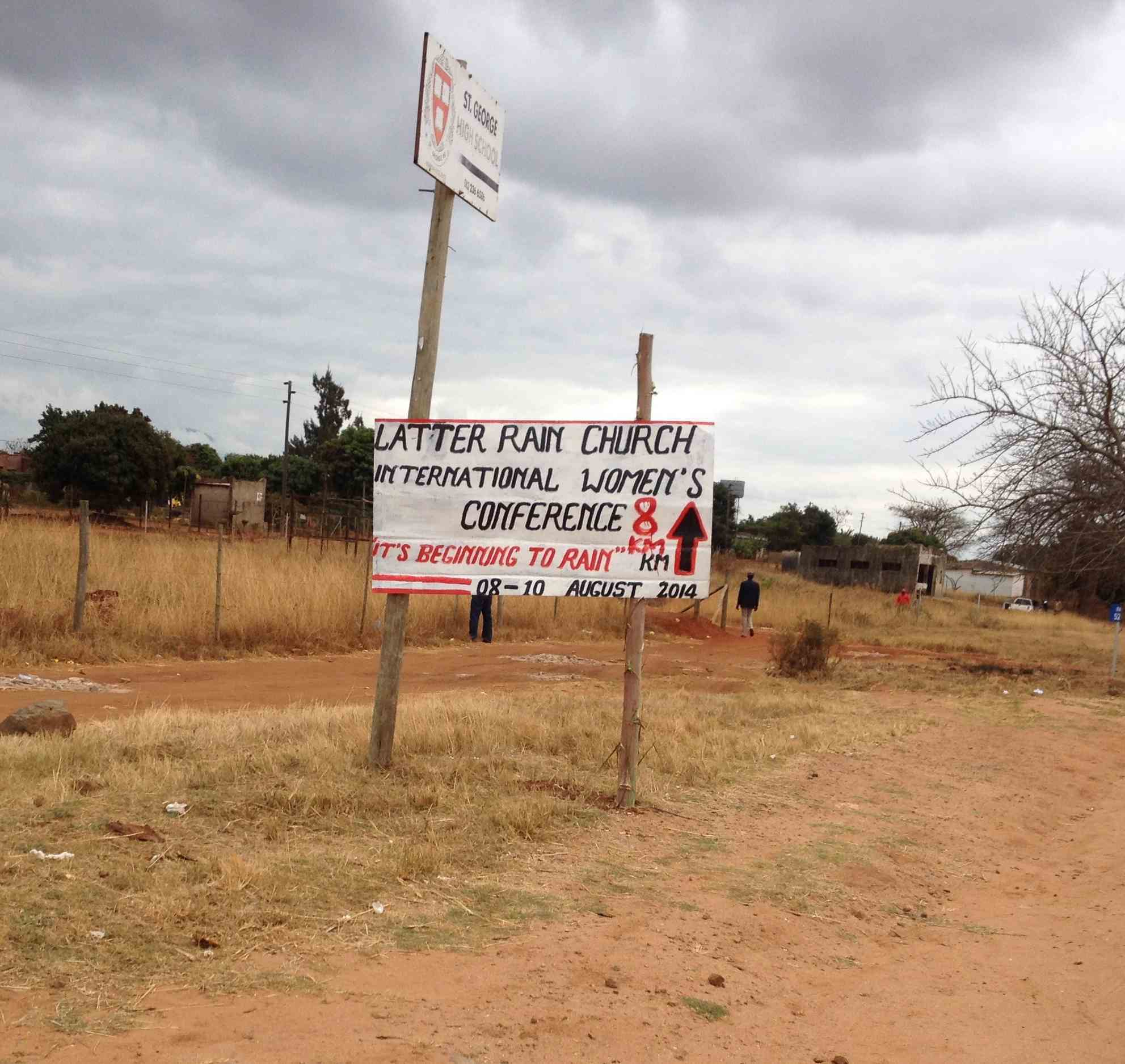
We spotted this signpost near Acornhoek in South Africa while returning from our trip to Kruger National Park. The ‘Latter Rain Church’ organized the event. Would you agree with me that this church is perhaps related to the ‘Lutheran Church’?


On 30 September 2014 the Bushsnob wrote:

The Latter Rain Church in not related to the Lutheran Church. Check this link if interested in following this issue further:

http://en.wikipedia.org/wiki/Latter_Rain_(post–World_War_II_movement)


Tree war

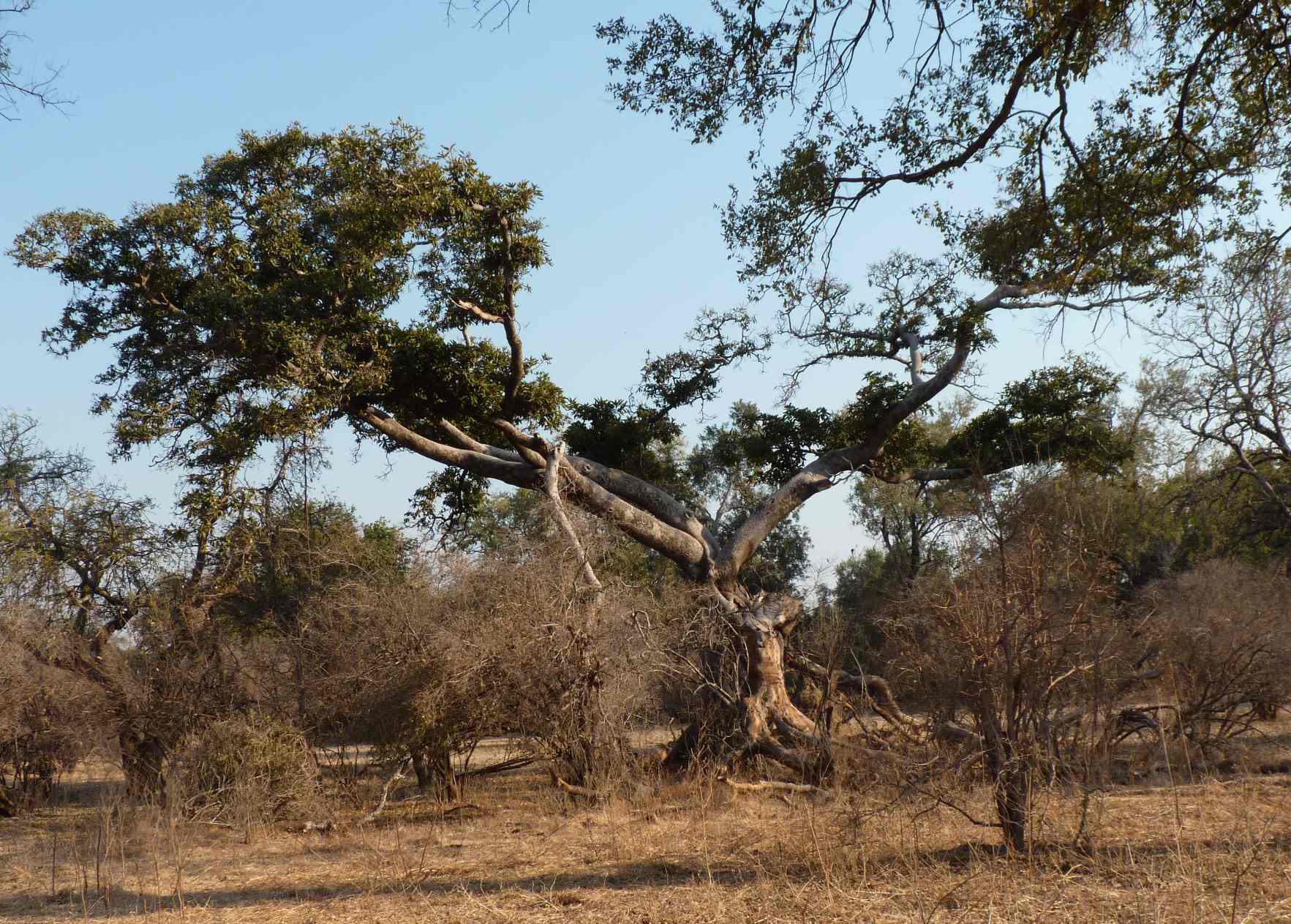
Fig tree and tusker.

I said earlier that I am not a botanist and I am interested in the animal rather than the plant world. However, a visit to Mana Pools National Park would not be complete without spending time “tree-watching” . Here I present some facts that I trust you will find of interest.

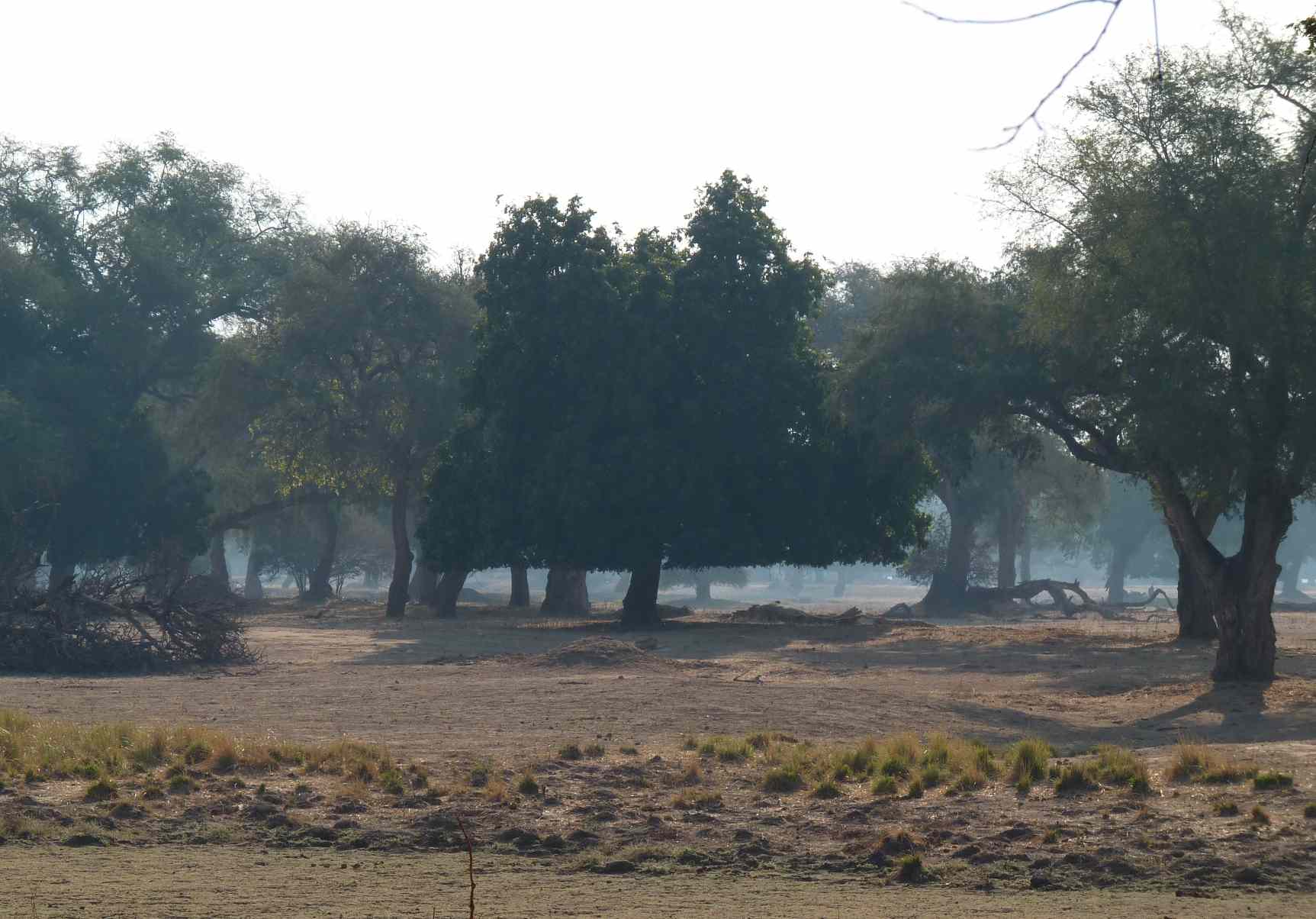
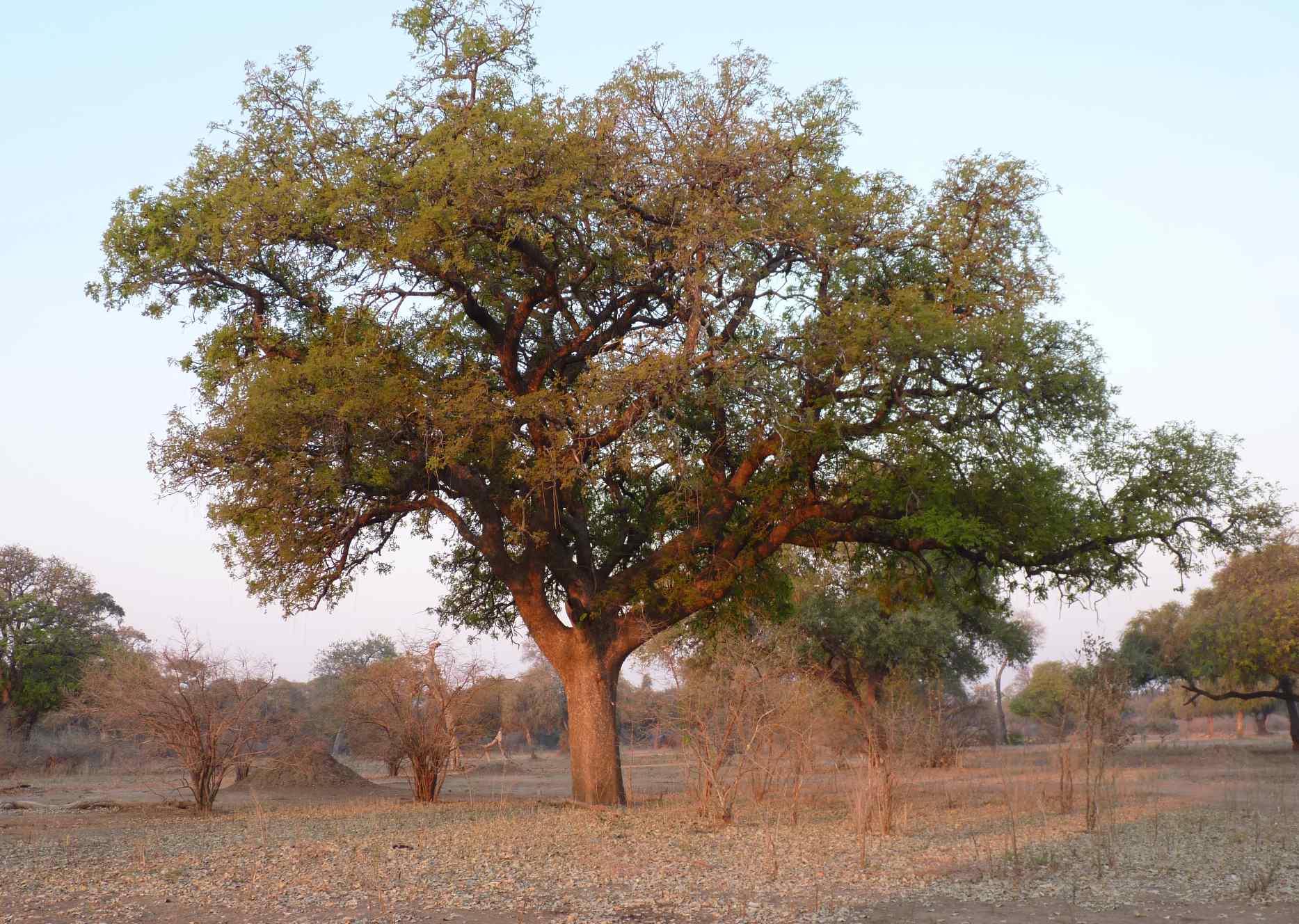
It’s difficult to describe the various Mana Pools’ habitats. They range from clumps of green Natal mahogany (Trichilia emetica), Sausage trees (Kigelia africana) and Zambezi fig trees (Ficus bussei) to the rather sparsely populated Apple ring acacia (Faidherbia albida) woodlands, not to mention the areas of dense bush (known in this region as “jesse”) found further inland in the hillier parts. The result is an amazing, if rather fragile, bio-diverse habitat that many animals share, including more than 300 bird species. The above pictures, hopefully give you a better idea of what I fail to describe!

Although the experts list many tree species, the uninitiated (like me) feel attracted by the most striking ones. The Apple ring acacia trees are the main species of the riverine Mana Pools’ woodlands scattered all over the flat plains. They are large trees that, with time, develop a characteristic knobby trunk and as mentioned in an earlier post, they produce pods rich in protein that constitute important food for the animals during the dry season. Regrettably, a friend told me that for some reason they have stopped multiplying. This is rather surprising as the seeds are found all over the place.

Apple rig Acacia woodlands.

Apple ring Acacia woodlands.

The large Sausage trees were beginning to produce their strings of strongly scented dark red flowers. Many animals, including monkeys, also consume them. I remember seeing buffalo sniffing the ground for long periods at dusk at the campsite in Mana Pools on an earlier visit and to wonder what they were doing. It was only after a while that I realized that they were feeding on the Sausage tree flowers that had dropped to the otherwise dusty ground. Its fruits -rather large sausages weighing up to several kg- develop later on during the year, and various animals such as baboons, elephants and hippos consume them, while people also use them in beer brewing.

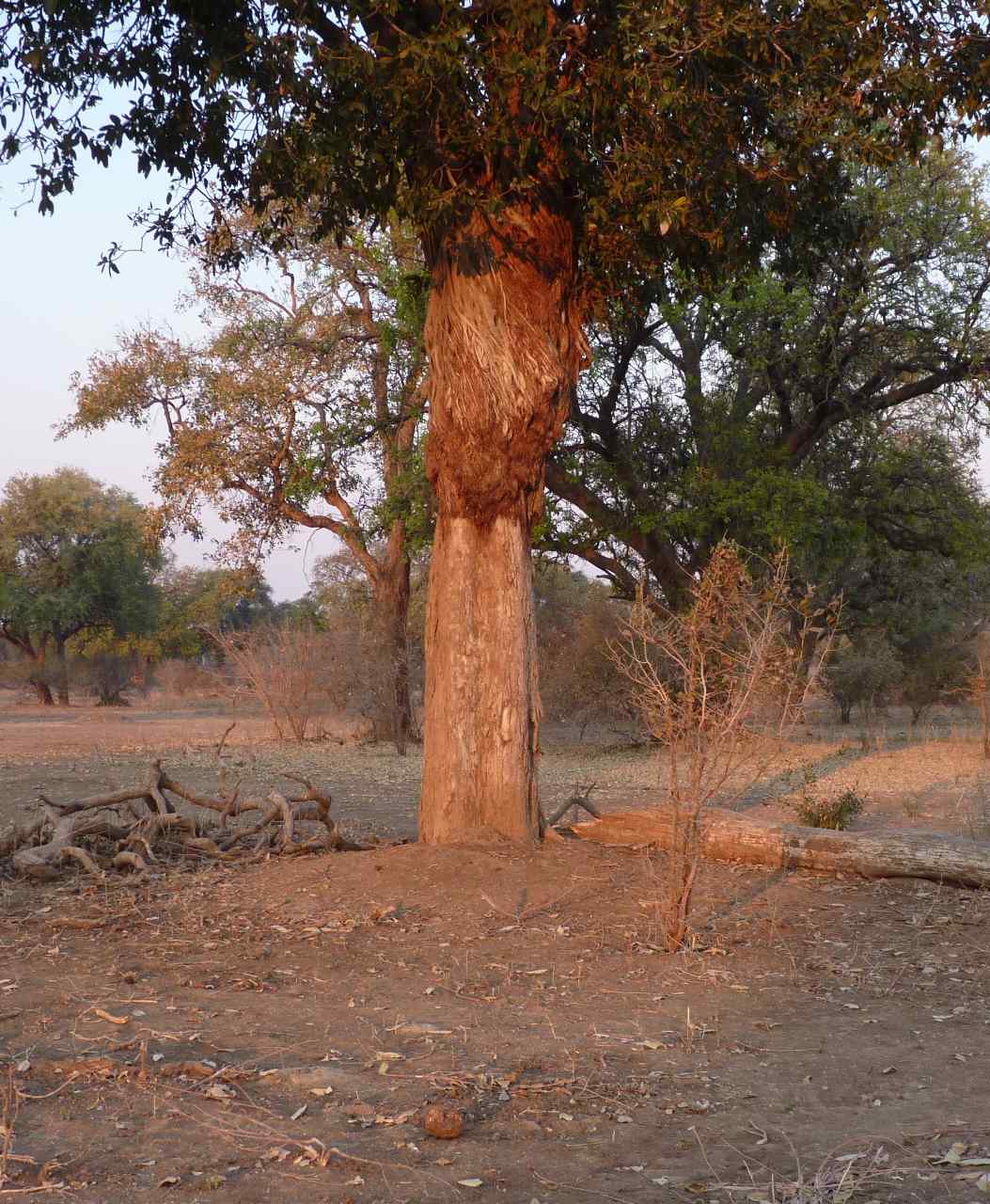
The Natal mahogany are large, dark green trees whose crowns in Mana Pools show a characteristic bottom foliage with an evenly trimmed horizontal lower edge, which is an example of the wild art of the master topiarist-browsers that feed on them, among whom are impala and greater kudu.

Can a human achieve such perfection?

Can a human achieve such trim?

All trees complement each other to achieve this beautiful landscape. However, and perhaps surprisingly to the reader, there is a silent and long-term tree war being waged while we watch… I am not talking about Lord of the Rings’ Ents but rather a combination of several battles being fought by stationary trees since time immemorial. It all starts with a bird or monkey feeding on a fig and dropping its seeds in a suitable place up a tree, where a hollow filled with soil allows germination to take place.

One more tree...

One more tree…

Good eyes are needed to spot the "baby" Zambezi fig tree...

Good eyes are needed to spot the “enemy”…

The birth of a Zambezi fig tree.

A further close-up reveals the birth of a Zambezi fig tree.

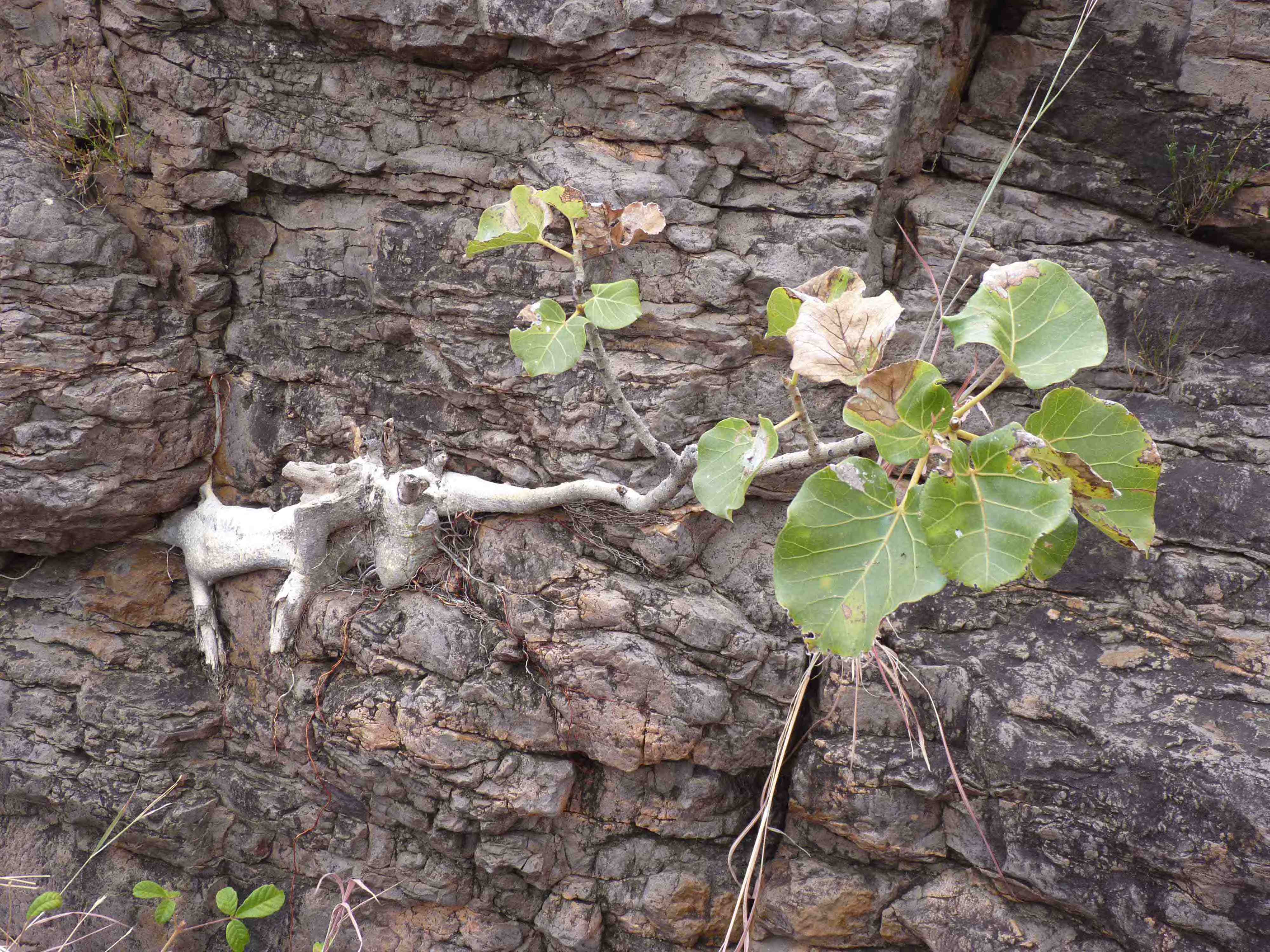
Soon, an innocent-looking two-leaf seedling appears. After consolidating itself, it starts sending down aerial roots that surround the host tree and that will eventually reach the ground to bury themselves, becoming true roots. The fig tree uses the host to gain support and structure in its growth; the host is like a guiding stick similar to those used to support grapevines or tomato plants. In their quest for support and with their uncanny ability to survive in the most unlikely places, fig trees produce natural sculptural Masterpieces that occasionally damage ruins, which is an entirely different problem.

Fig tree growth can even crack rocks and buildings.

Fig tree growth can even crack rocks and buildings.

At some stage during the battle, it seems as if the two trees coexist naturally, adding great beauty to the forest. However, the process continues inexorably and the invader eventually strangles the host tree. This is purely mechanical as the pressure applied is such that it has the same effect as if the host tree would be ring-barked, interrupting the flow of water and nutrients between roots and the rest.

Watching a fig embrace. The branch on the left belongs to the host tree.

Watching a fig embrace. The host tree is still strong and visible on the left.

Luckily for some (in rare cases) animals may come to the rescue. The aerial roots are eaten by elephants and, in this way, these animals become an unwitting ally of the host tree, halting the growth of the fig and saving the host tree at least for a while.

A closer view of the fig tree being browsed and stopped from engulfing the host tree.

A closer view of the fig tree being browsed and stopped from engulfing the host tree.

However, this is an exception and the usual outcome is that the Zambezi fig tree becomes established, winning another battle.

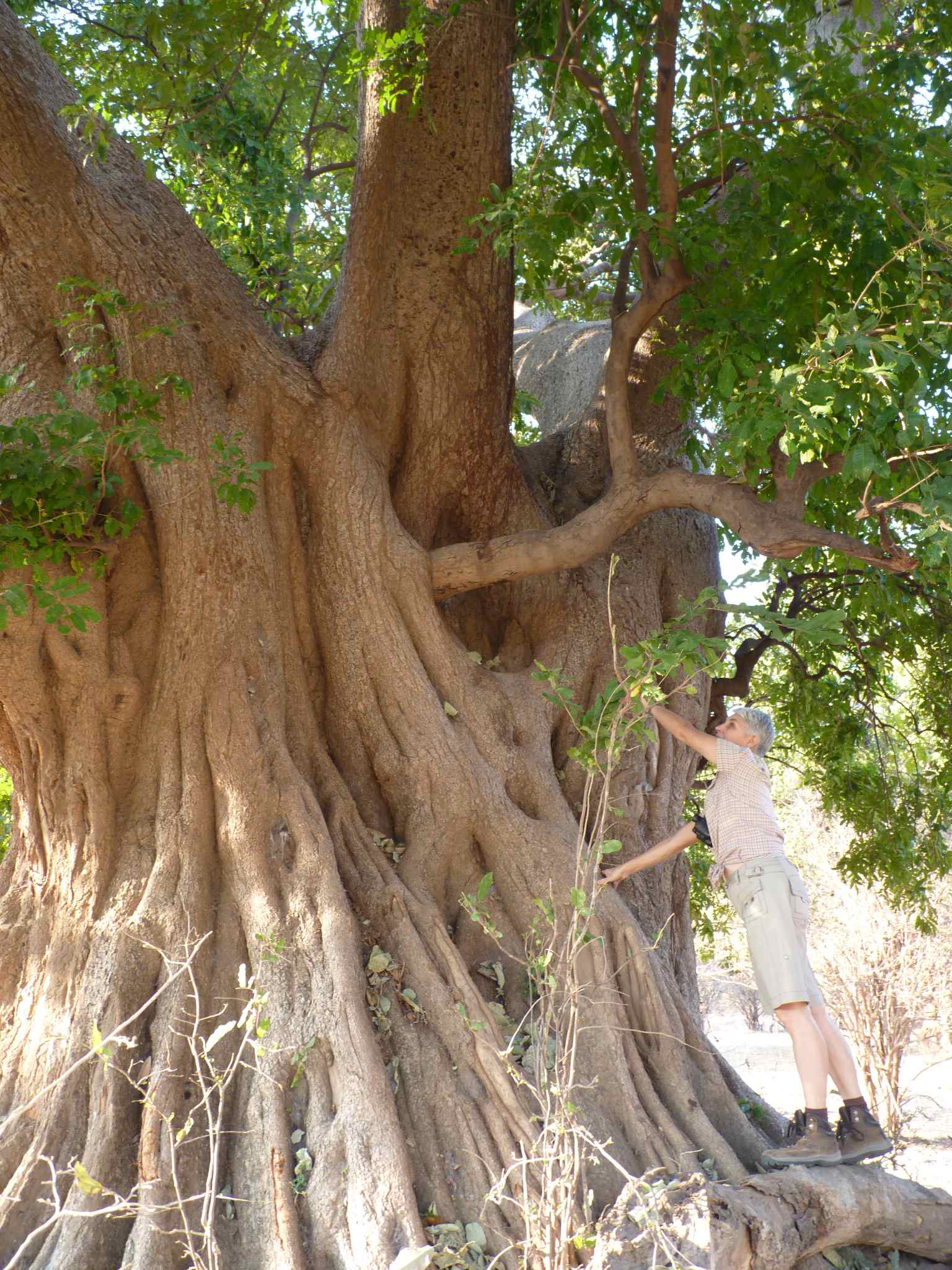
A battle going on. The branch on the right, above my wife, belongs to the host tree being engulfed by the fig tree.

The branch on the right, above my wife, is what remains of the host tree.

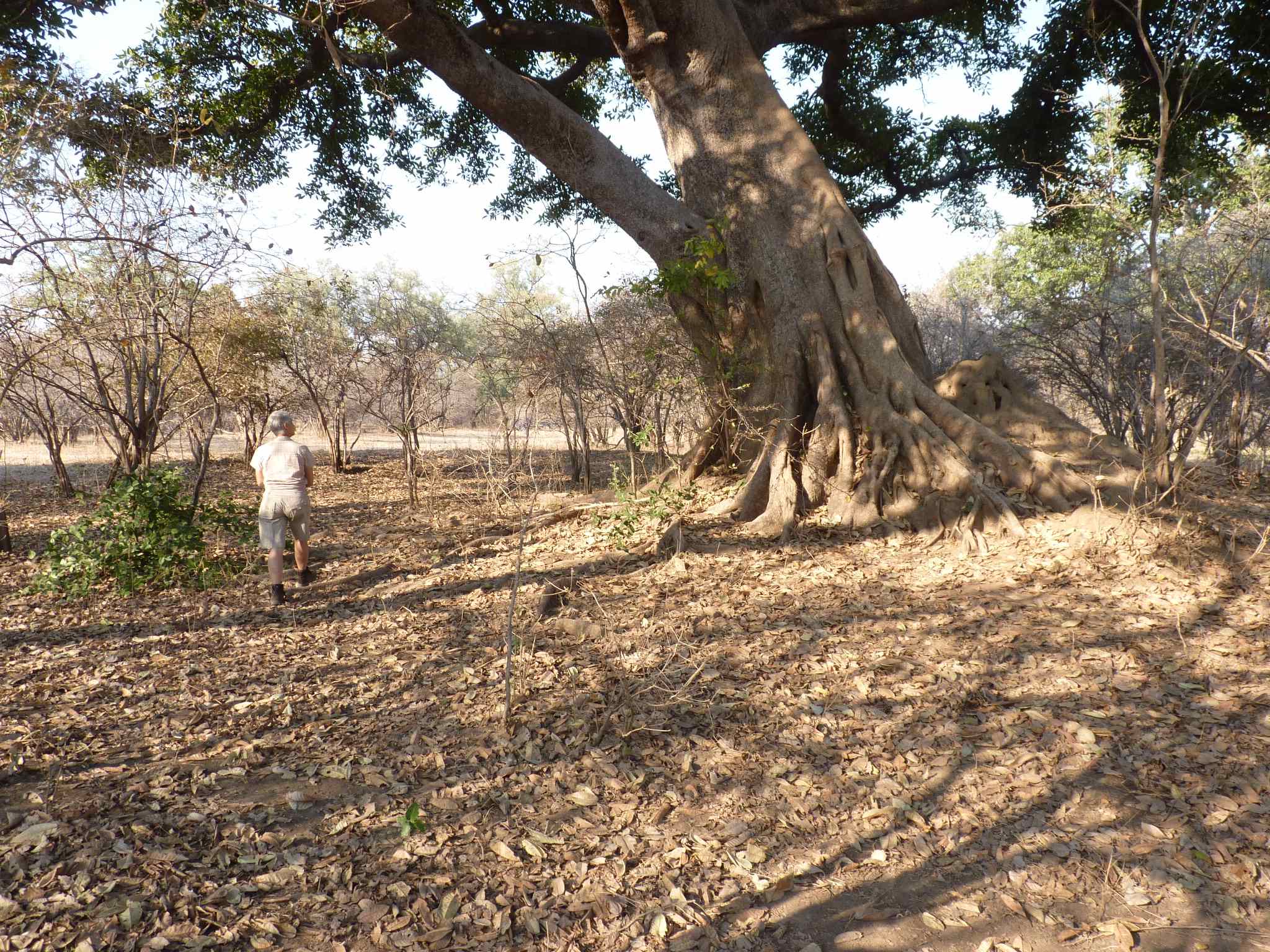
A very large Zambezi fig tree.

Fig trees are beautiful shady trees with a great canopy that extends further than most trees, considering the size of their main trunk. This is often their weakness as, being soft, they often crack and fall which leads to the death of the tree.

A collapsing fig tree.

A collapsing fig tree.

Despite these battles that rage silently in plain sight, we should not worry as the outcome is by no means the doom of the striking Mana Pools woodlands!