Bush stories and anecdotes

The heart of the blog, where I present observations, accounts, funny stories, etc.

Hippos from Hell: the videos

After posting “Hippos from Hell” I have now managed to upload all the videos that I took while the events narrated took place.

The videos follow the sequence of events narrated in the post with a short explanation of what you see in them.

Here they are:

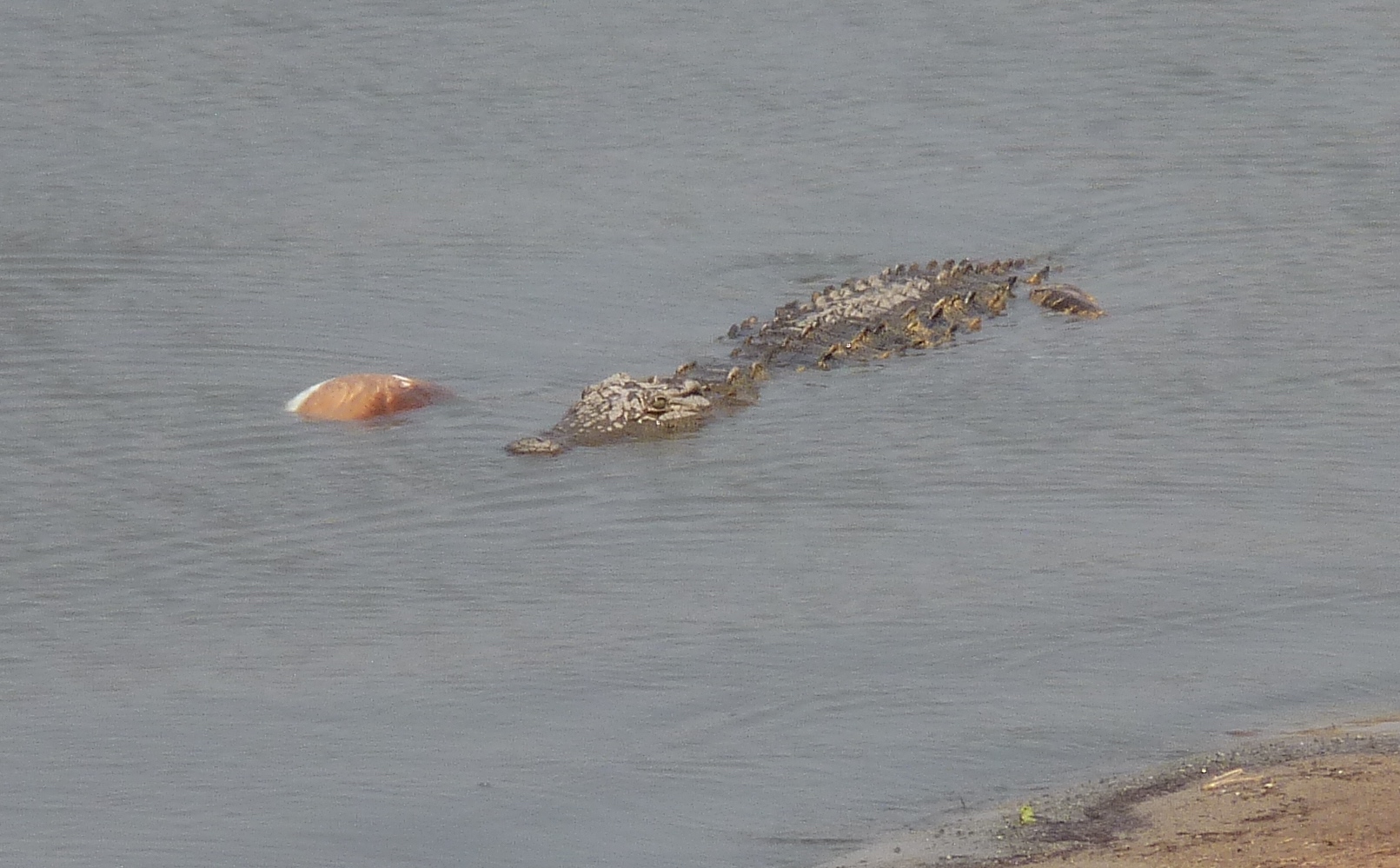
A crocodile in full view can be seen approaching the drinking impala! It positions itself at its vantage point and then it disappears from the surface. The ambush is set and all that remains is to wait for new impalas to come or for the ones there to forget about it!

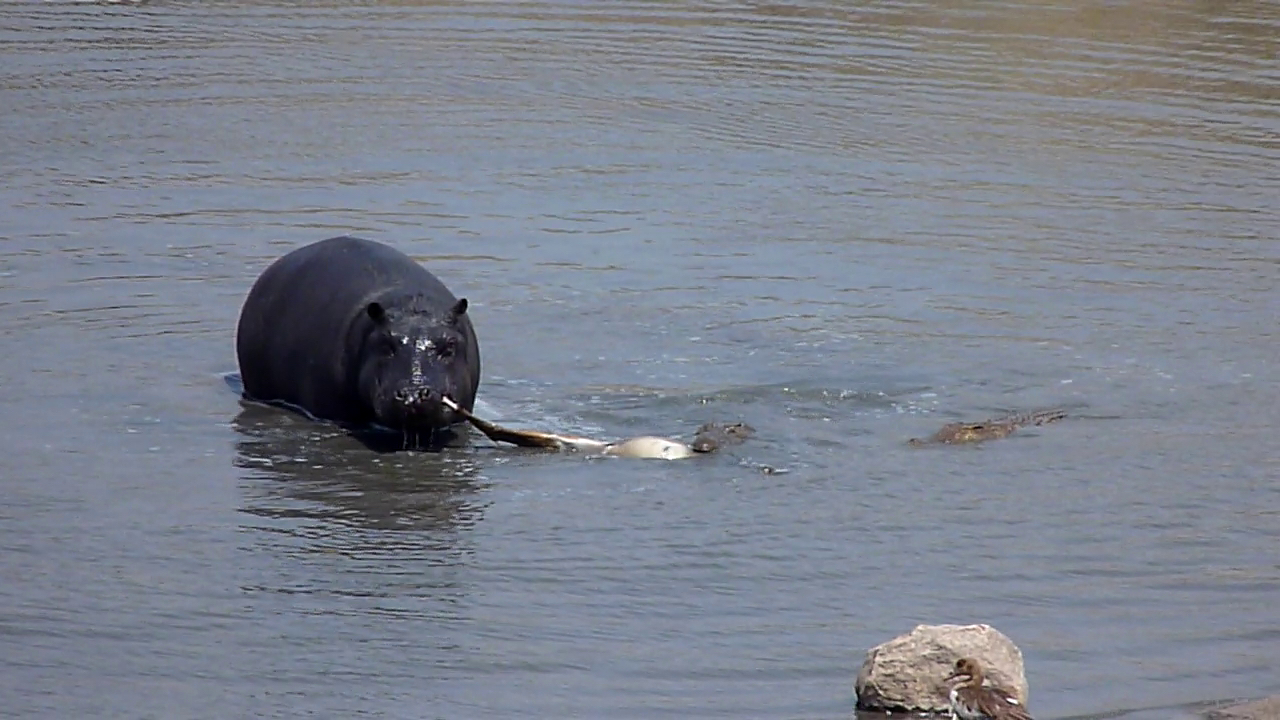
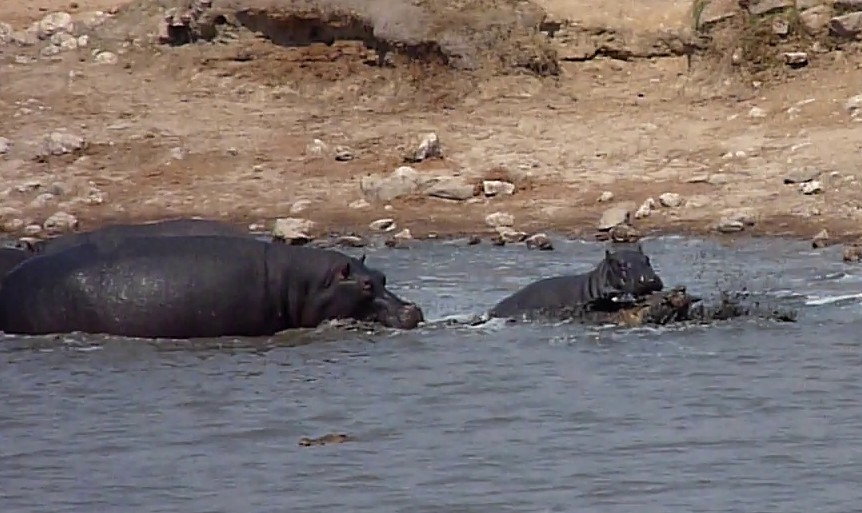
After catching an impala, the crocodile(s) resurfaced at point 2. The hippos moved in to wrestle the impala from them but failed. A crocodile is seen slipping through towards point 3.

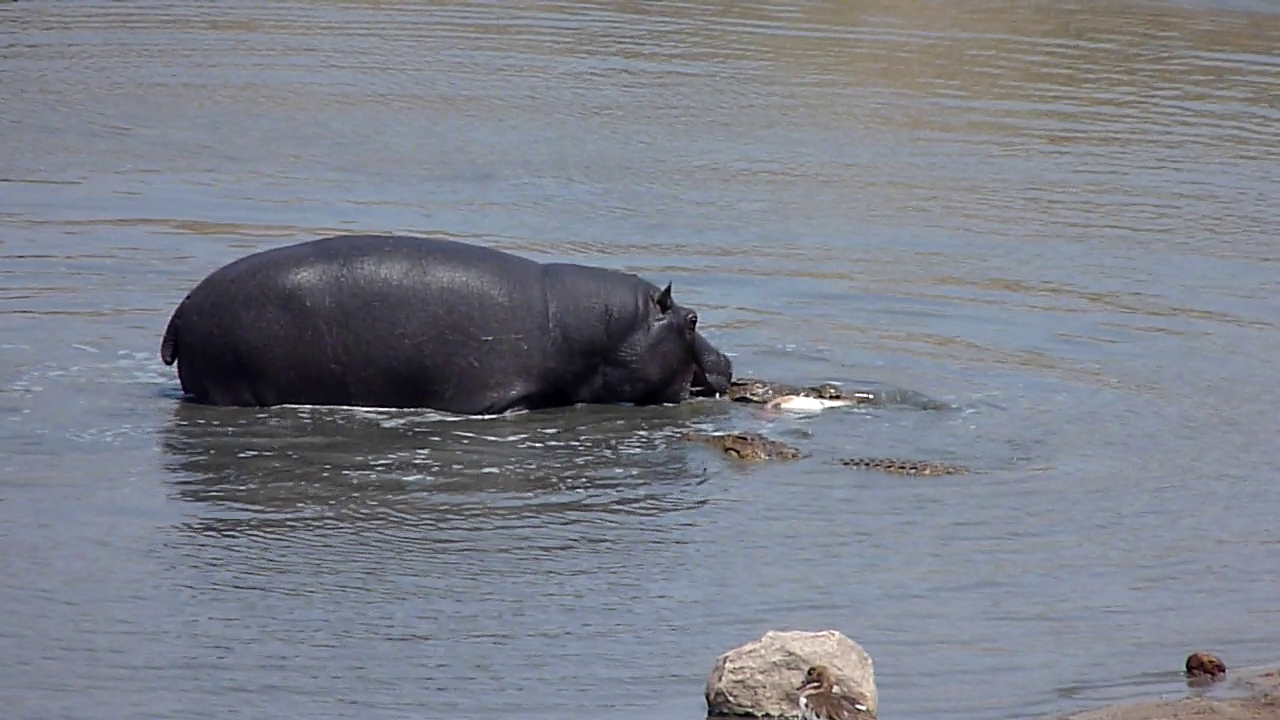
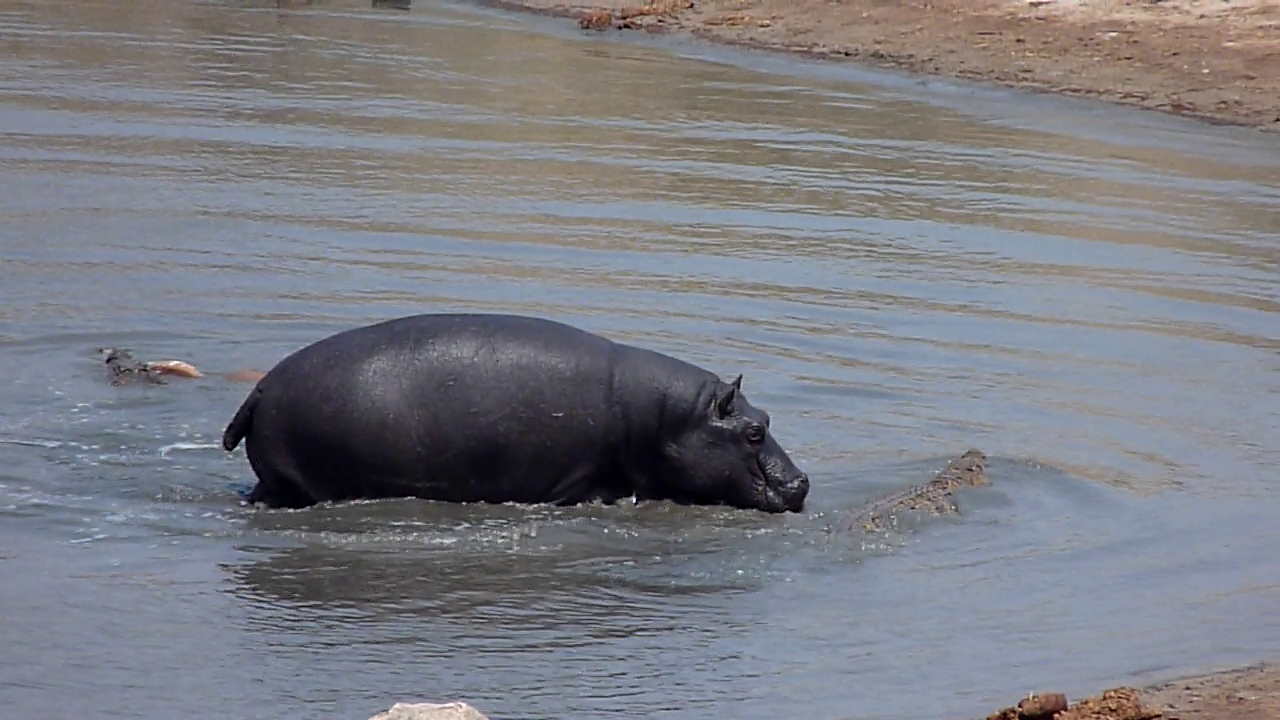
After avoiding the hippos at point 2, the crocodiles regrouped at point 3 and started to go at the carcass. Almost immediately hippos came to the area of the commotion to try and get the impala. The hippo somehow chases the wrong crocodile and misses the one with the carcass that slips away, back to point 2.

A pair of male kudu watched on while the crocodile takes the impala back to point 2.

This video show the hippo going for the antelope at point 2. After this incident the hippo stole the carcass from the crocodiles at some point (not filmed) and this becomes apparent when the whole hippo community of about 16 animals is seen eating the impala!!! These videos complement the pictures of the Hippos from Hell post.

A similar situation was observed the following day when another impala was taken by the crocodiles.

While the crocodile and hippo drama was unfolding, this warthog was busy mud bathing and looking after his “mudtub”!!!

Nature does not stop…

Although the authors interpret the videos below as hippo attempts at “saving” other animals, I believe that they were, again, trying to snatch them from the crocodiles. Watch and judge!

Beware: they are strong!

https://www.youtube.com/watch?v=USfCieXuQrs

https://www.youtube.com/watch?v=zBbMmkMapj8

Steeplechase shower

Ingredients:

A gas-operated water heater

Low shower curtain and thick rod

Washing machine outlet inside the bath (with stone)

Donkey-skin towel

The list of ingredients alone should give you an idea of the setting. However, I will elaborate a bit further so that you can get an idea of the predicament I was in. The rains this year in El Gallinato, Salta, Argentina have been abundant so there is plenty of water in our borehole, a welcome change from previous years. The end result of this is that “abundant” and or frequent showers are possible if you so wish. This is not our case as we are programmed to save water but the possibility is there.

Getting ready for the dentist appointment, I decided to shower, as smelling foul would surely increase dentist’s aggressiveness above my perceived Mengele’s level. So I went for it.

To have a shower with a gas water heater requires opening the tap so that the flow of water triggers a flow of gas that gets lit by the pilot lamp and hot water comes out the other end. For the system to operate, the water has to have pressure and the gas cylinder gas! Both were estimated OK and I went for it, after opening the tap for the water to reach the right temperature.

Regrettably, the shower curtain to enter the bathtub where the shower is located is lower than me so “bang” went my bold cranium and, although severe, I managed to keep my balance and the hot water relieved my pain so that I could proceed with the cleanup. After finishing the operation to my satisfaction – though probably not my family’s – I decided to close the tap and leave, this time minding the wooden bar to avoid further brain damage.

I aligned my agile physique to avoid the bar and, again, unlucky I stepped on the stone weighing down the outlet pipe of the washing machine, which is also located in the bathtub. The pipe spluttered all over the place the first time the machine was used and I attached a rather large stone to it, to hold it and the shower curtain down. This time I lost my balance and went into the start of a headlong and inelegant fall that I managed to control by holding onto-and ripping off- the shower curtain. Thankfully the rod that hit me earlier withstood my weight and somehow I survived this second attempt on my life!

Remembering that I am retired and should look after my health, I paused, took a deep breath and I promise you I did not curse… I recovered and looked forward to a good drying and rub down with a dry towel. The final disappointment was waiting for me in the shape of a well known and hated towel known as the “donkey hide”, an ass-coloured cloth that I hate as it has the unbelievable property of only moving the water around your body without absorbing any water or drying it! So, after pushing the water down my body and into the floor drain with the assistance of the donkey hide, I ended up -still wet- sunning myself naked in the garden in an attempt to get dry, under the midday sun, with a bump on my head and checking to make sure that my ankle was OK.

Farm showering for you!

Police Road Block (Tanzania)

There is nothing unusual about a police roadblock in Africa. I have dealt with many in different countries and in different situations. Luckily I never got fined or needed to bribe my way through. The occasion I have been closest to a fine was driving between Muguga and Nairobi in the early 80s. I was caught in double radar trick. This is a simple, crafty and frequently practiced manoeuvre that involves placing two speed traps separated by a few km. You pass one and then, thinking that you escaped, you speed away only to be caught by the real thing a few km further on. On that occasion the policeman had even written the fine but I still managed to get off the hook, I do not know how or why he let me go! A colleague in Kenya said I manage to say the right words in most situations, and my own family fully agrees! I do not know!

In 2010 I went to Arusha for a meeting to discuss a cattle vaccine that was very successful among the Maasai of Tanzania. The meeting over we had the Saturday free as I was flying out on the Sunday. So, we decided to go for a drive to enjoy the countryside, to visit some Maasai manyattas where my veterinary friends needed to do routine check-ups at and end with a visit to the snake park, nothing too exotic.

We left in Beppe and Lieve’s ancient but still serviceable Nissan Patrol with Lieve driving and Beppe as our navigator. I was in the back seat, chatting away with them, trying to catch up on several years of news. After a few km driving towards Moshi we came to a police road block. “Nothing unusual” I thought and my companions agreed, remarking: “They are always here”. There were several cars queuing and also quite a few police officers in sight.

After queuing for a few more minutes, a polite police officer approached and he explained that they were performing a roadworthiness inspection on vehicles “today we are looking at fire extinguishers” he declared. The exchange of looks and a few familiar Italian words in the front seat indicated to me that we may not be within the expected roadworthy condition. After all, the car was quite old and I have never come across anyone who checks their fire extinguisher at regular intervals. It is just there, normally at the feet of the passenger. Well, in our case it was not even there!

Calmly we all argued with the policeman that this was not a very useful check-up, that we were vets in a great hurry to deliver a calf and other plausible excuses that we could think of at the time. No results. The police stood his ground and continued to demand to see our fire extinguisher. Calmly, Beppe got out of the car and walked slowly to the back. Lieve and I waited; we could only talk to each other in English so we remained silent. Noise of objects being shifted around came from the back and, after a while we could here Beppe’s “ecco!” (Italian for “I found it”) and we relaxed a bit. Beppe closed the back doors and walked with the extinguisher towards the police, smiling. “Here it is, bwana” and then added “it is a bit old but still good”. What an optimistic remark! It was a rusty cylinder, once red, with arather defaced label, consequence of many years of dust rubbing against the car tools and the jack. We all nodded our approval and waited for the outcome.

The policeman, unmoved, had a look at the piece of rust and declared that it was totally unsuitable and, worse still, that we could not drive the car until we acquired a new one that followed the Tanzania road specifications that we clearly ignored. There was apparently no “fine and go” involved but a prohibition of movement on the spot! We pleaded in various ways to no avail and then got rather frustrated with the situation and asked what the solution was, fearing the possible bribe. “You can buy a new one” he announced. “But where?” we said in a pathetic choir and added, “there is no shop/petrol station here”. “You can buy one from me now” he said. We looked at each other and could not help a chuckle but kept our straight faces as much as we could. We asked the cost and tried to bargain but it was not possible so we asked him to bring it while we collected the money.

Beppe was still outside, holding our rusted tool while the policeman walked towards the sentry box, and opened the door. We could not believe our eyes: the box was full to the brim with extinguishers!. He picked one and came back to offer it to Beppe. The latter, in a last ditch attempt of avoiding buying the item at an inflated price proceeded to compare the kind of fires that each could put out in what I thought was a probably unfruitful but clever and brave attempt, nonetheless. It was clear that he had hatched the plan while we waited for the policeman and had spent a great deal of time reading the damaged label. He held both in his hands and explained that both could put off petrol, plastic and electric fires but that ours could also stamp out fabric fires! Beppe grasped the opportunity and declared “Mine is better than yours as it can control more kinds of fires”

For the first time the policeman showed hesitance and Beppe seized his chance: “no need to buy an inferior product” he declared with aplomb and conviction. The policeman recovered fast and suggested that we checked the functioning of our rotten tool. Beppe removed the safety pin and pressed the trigger. Nothing happened. He tried again and, again, he got nothing. A third attempt that involved violent shaking of the extinguisher and hard pressing produced about 3 cm of a substance resembling yellow toothpaste! Without saying another word, Beppe threw the rusted cylinder into the nearest ditch, collected our money, counted it, paid, got the new cylinder, gave the policeman a handshake and quietly got in the car. “Let’s go” was the only thing he said. We went and, for a long while none of us had anything to say and then we all burst out laughing.

We moved on with a new extinguisher towards an enjoyable day together.

Hippos from Hell

In an earlier post I described how Crocodiles[1] were stalking and catching Impala at Masuma dam[2]. What I did not mention yet was what happened next. You will not regret reading on!

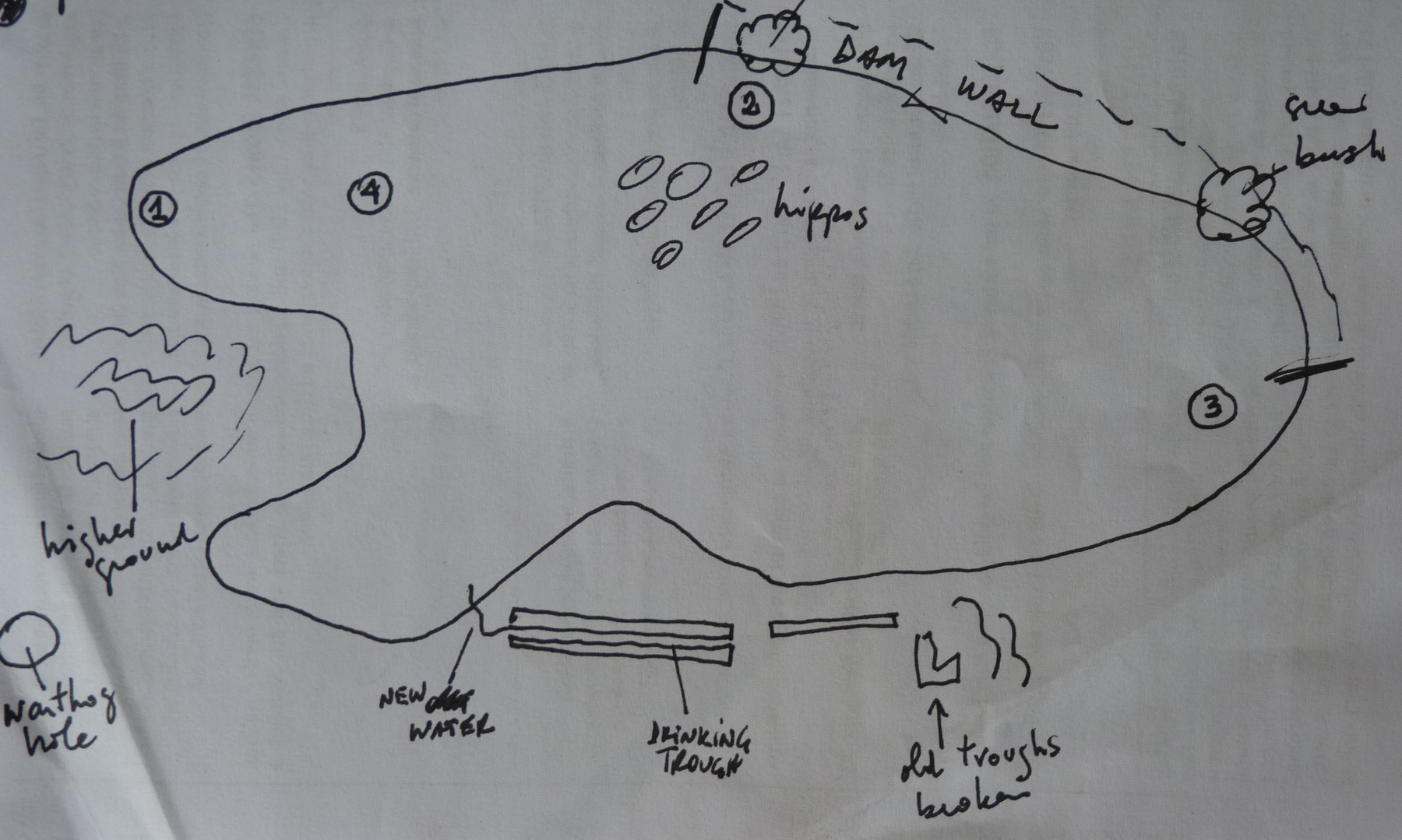
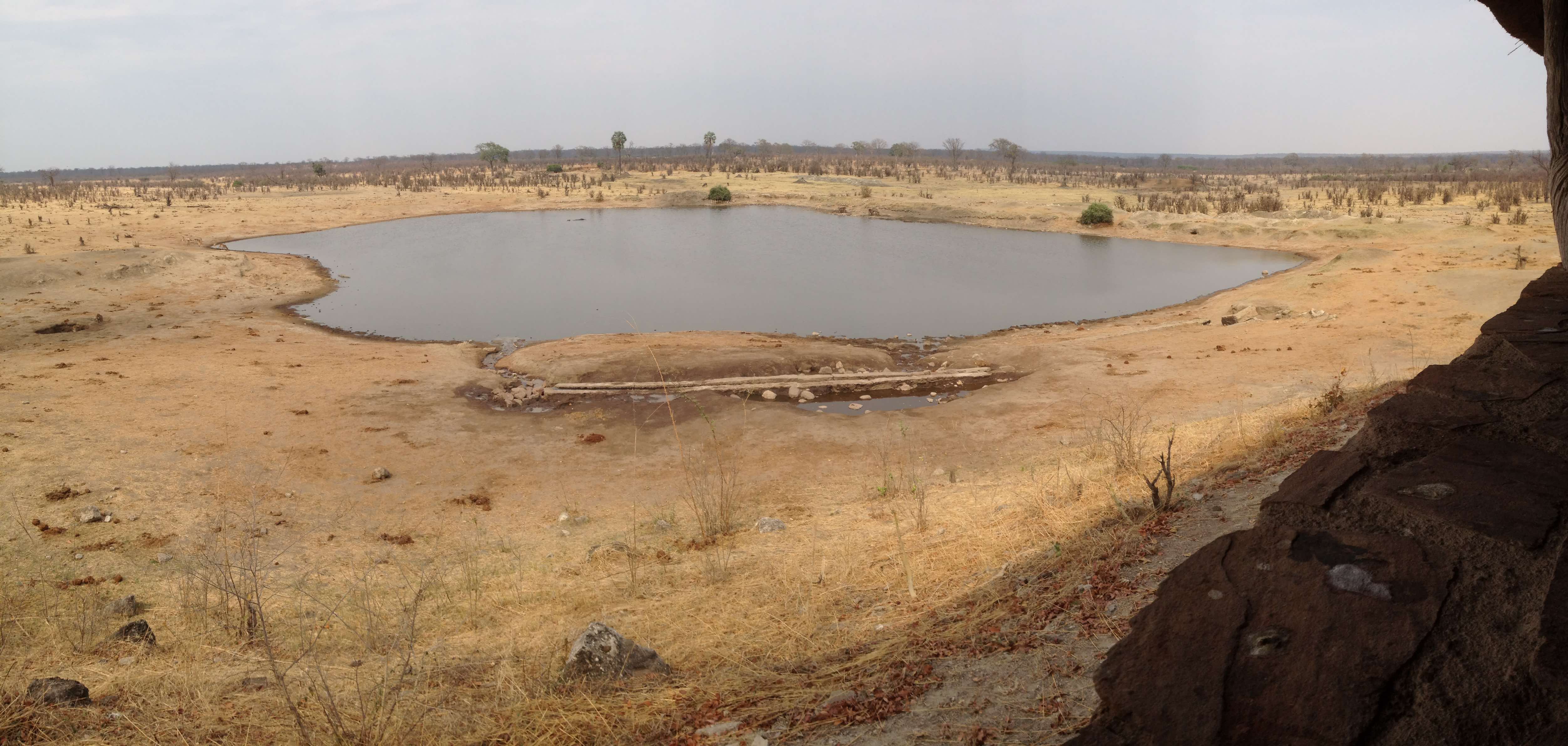
Masuma Dam is located in the Hwange National Park (18°43’52.20″S 26°16’47.82″E). The observations described here took place on 13/10/14 from 10.00 to 12.00 hours and on the 15/10/14 from 09.00 to 12.00 hours. The dam is about 120 by 100 metres and it has a roughly oval shape with the viewing platform located on one of the longer parts of the oval.

A "panorama" view of Masuma Dam.

A “panorama” view of Masuma Dam.

The time of the observations correspond to the end of the dry season. At this time of year many animals come regularly to drink at the dam. Apart from elephants, Greater Kudu, Waterbuck, Impala, Zebra and Warthogs were seen everyday. We also saw large flocks of guinea fowl, various doves, vultures, kites, buntings, starlings, among others. At the time there were sixteen resident Hippos, both adults and young animals as well as at least six mature Crocodiles.

Map of Masuma Dam showing the various places mentioned in the text.

Map of Masuma Dam showing the various places mentioned in the text.

Impala herds drank mainly in the morning, mostly at Point 1 in the drawing. Aware of this daily event, Crocodiles were observed to ambush the Impala by positioning themselves across the small bay where the antelopes drank. Usually one of the Crocodiles would approach the Impalas in full view up to 1 to 1.5 metres from them. This created noticeable nervousness on the part of the Impala but they would gradually calm down and drink. The Crocodiles would remain immobile for a few minutes and then slowly sink and completely disappear. Most of the time, the Impala continued to drink and moved off and the reptiles remained quietly submerged.

A Crocodile attack at the Impala drinking area.

A Crocodile attack at the Impala drinking area.

About two or three times in a morning, the hidden Crocodiles lunged towards the Impala. As soon as the swirl that precedes the attack was noted, the Impala scattered in all directions (including into the water!). The most common outcome was that the Crocodiles failed and went back to the water empty-jawed. On one occasion a young animal was caught from its leg and, after a short struggle, it was drowned. This happened only once out of 8-9 attacks we witnessed.

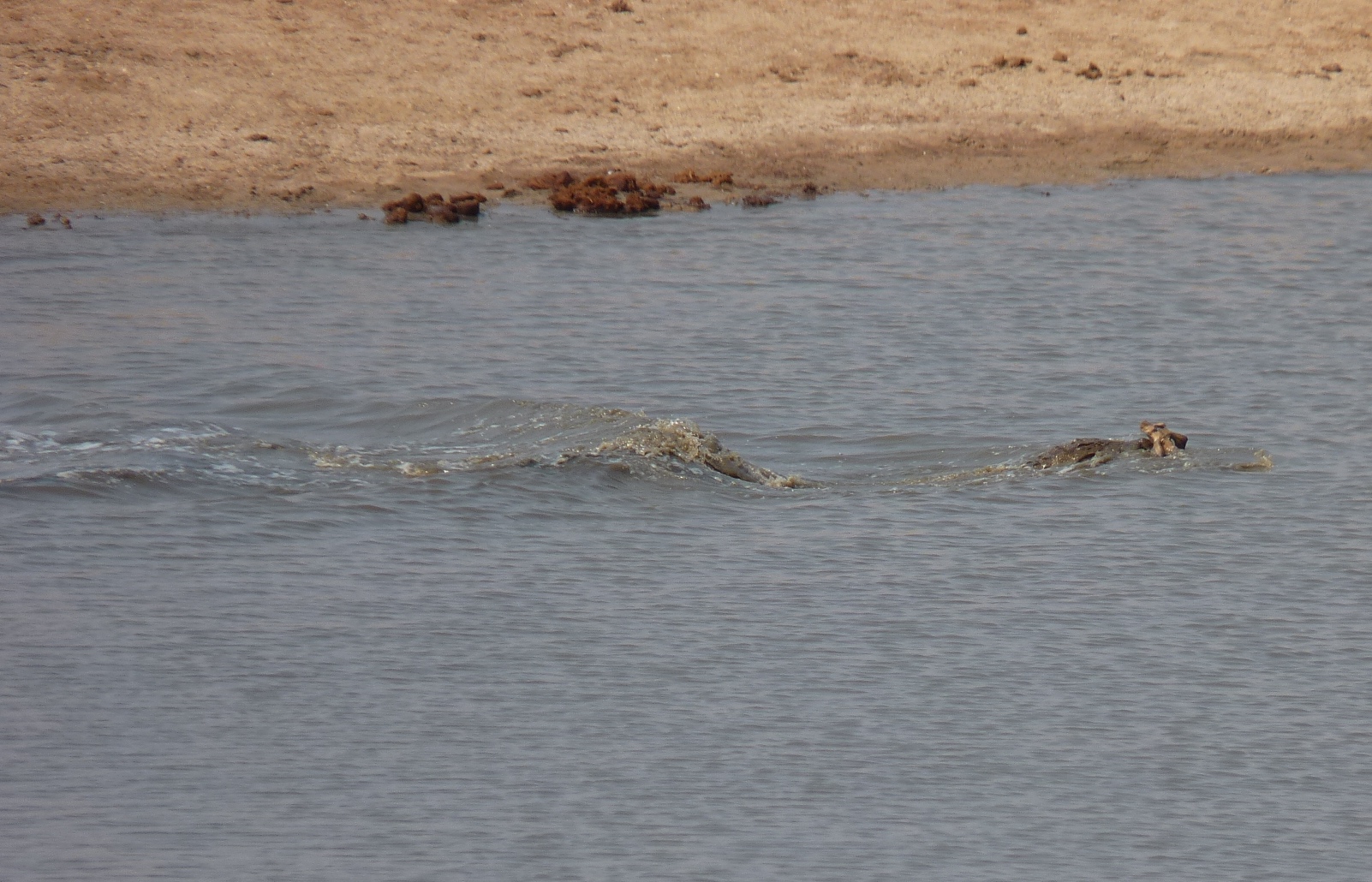
The Crocodile swims away with the freshly caught Impala just before it was chased by the Hippos for the first time.

The Crocodile swims away with the freshly caught Impala just before it was chased by the Hippos for the first time.

While the struggle between the Crocodile and the Impala was taking place, two Hippos approached the area and were seen chasing the Crocodile. The latter submerged and took off while the Hippos lost interest and we speculated on their noble “rescue” attempt.

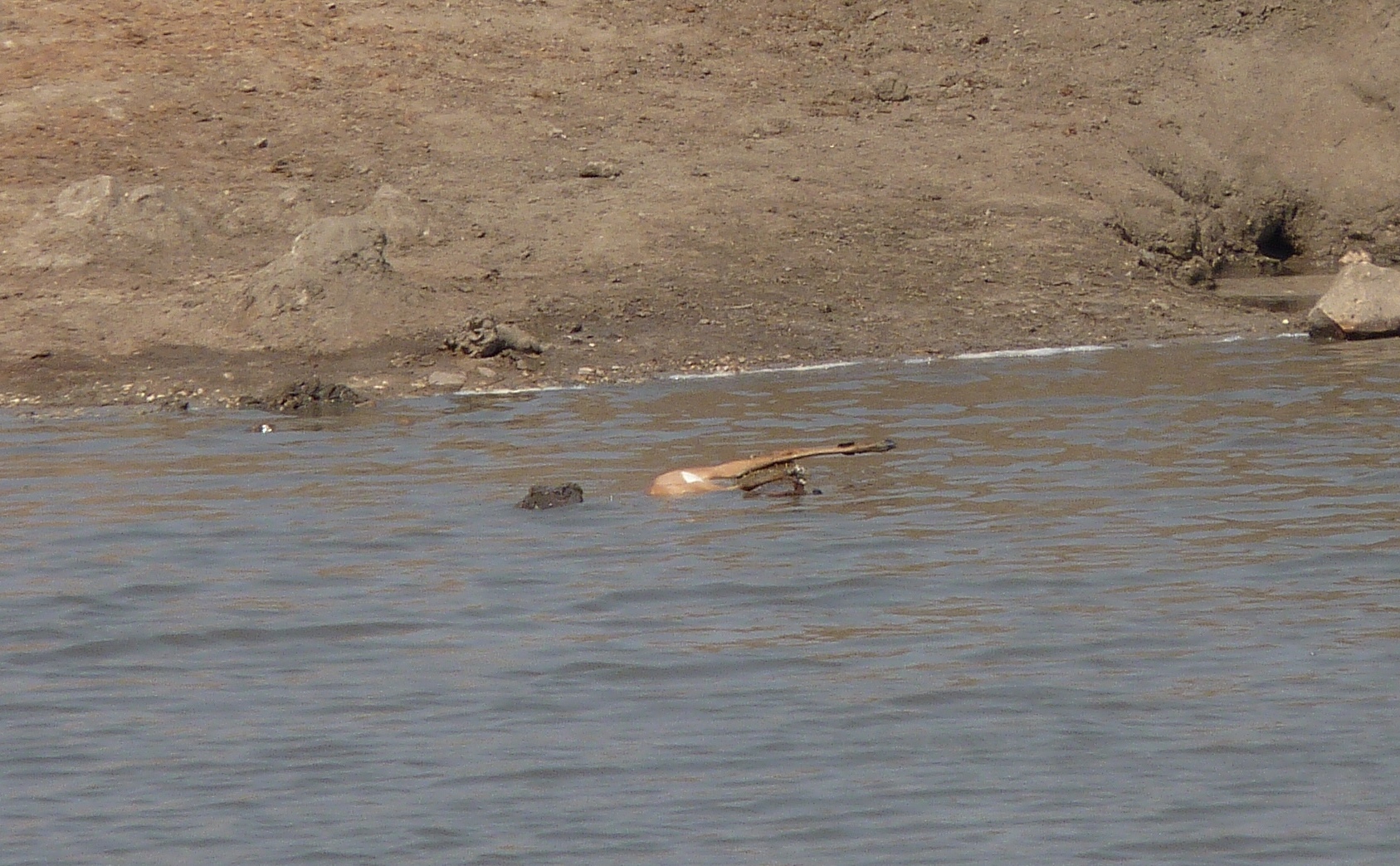
The Crocodile with the Impala at Point 2.

The Crocodile with the Impala at Point 2.

Ten minutes later the white belly and legs of the Impala came to the surface at Point 2 and caught our attention. A Crocodile held the dead antelope and others came to feed on it. This, again, prompted a swift response from the Hippos, who came back and confronted them quite aggressively.

Insert pics 5 and 6
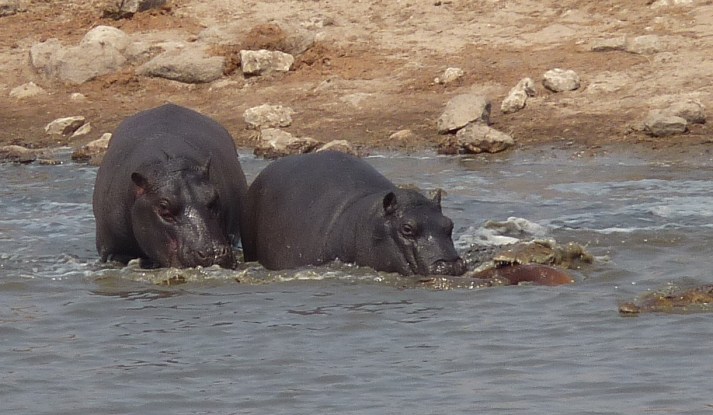
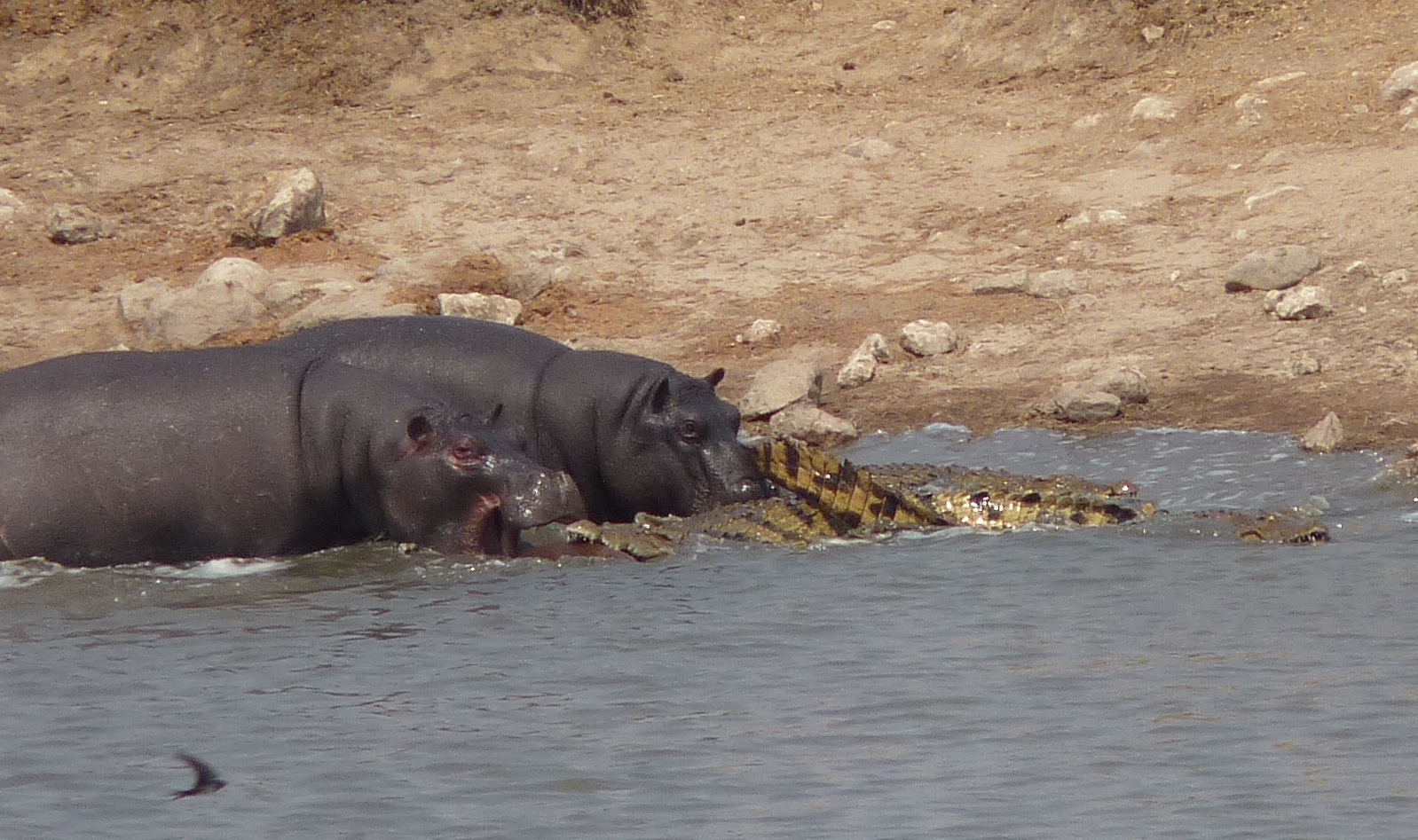
The Hippos "rescue" attempt at Point 2.

The Hippos “rescue” attempt at Point 2.
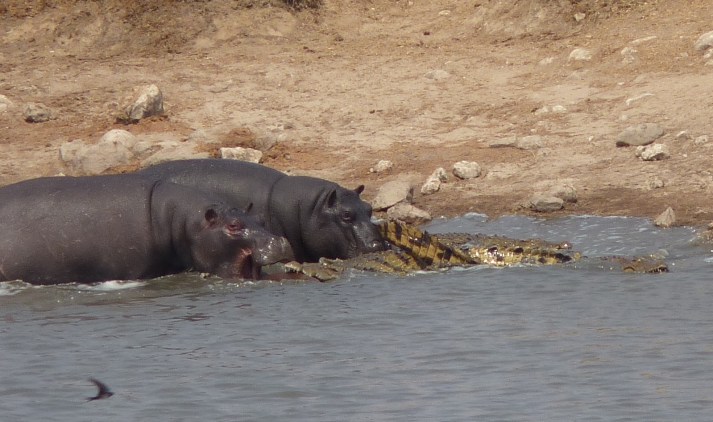
Another view of the Hippos' "rescue" attempt at Point 2.

Another view of the Hippos’ “rescue” attempt at Point 2.

The subsequent struggle involved a Hippo pulling from a leg while the Crocodile pulled from another part of the animal. As the Hippo did not have a good grip on the leg (its teeth and mouth do not facilitate tug of wars), the Crocodile retained the Impala and, again, swam off with the carcass (or part of it as we could not see if it was split or broken up) towards Point 3 in the drawing.

The Crocodile avoided the Hippos at Point 2 and moves to Point 3.

The Crocodile avoided the Hippos at Point 2 and moves to Point 3.

The crocodile stayed at Point 3 for about 30 minutes with the Impala (or a large part of it) in its mouth until another Crocodile came and started to pull and tear at the carcass. In about a minute, a hitherto unseen/submerged Hippo[3] burst into the middle of the tug forcing the Crocodiles to scamper again.
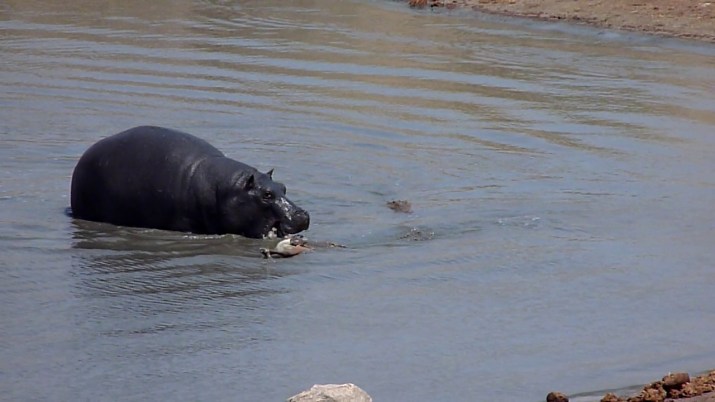
A Hippo moves towards the Crocodile at Point 3.
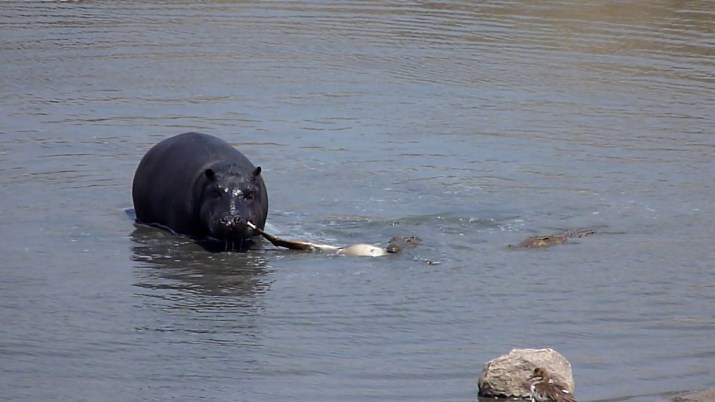
A Hippo moves towards the Crocodile at Point 3.

The Hippo tug of war with the Crocodile!
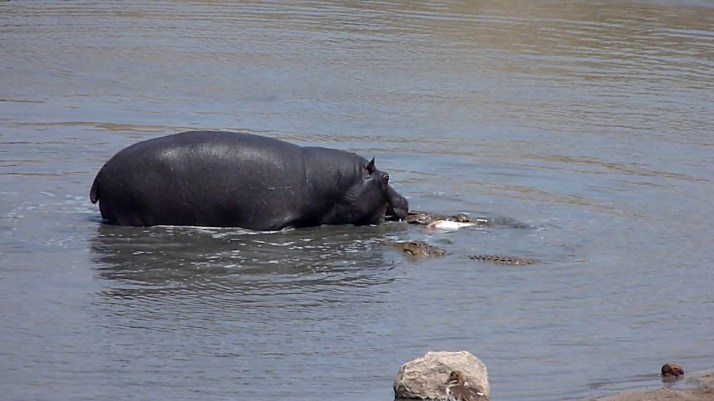
The Hippo tug of war with the Crocodile!

The Hippo tries to bite the Crocodile.
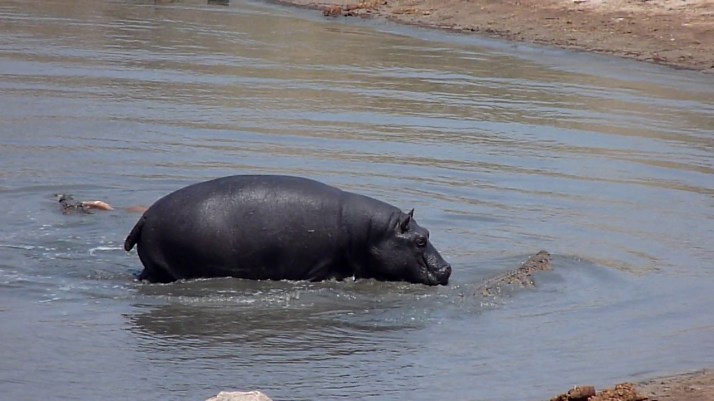
The Hippo tries to bite the Crocodile.

The Hippo chases a Crocodile while the other one escapes with the Impala towards Point 2.

The Hippo chases a Crocodile while the other one escapes with the Impala towards Point 2.

The Hippo keeps chasing the Crocodile while the other one swims away.

The Hippo keeps chasing the Crocodile while the other one swims away.

While the Hippo chased one Crocodile the other one, still holding the carcass, swam back to Point 2 where it remained for another 10-15 minutes when, once more, its companions arrived and started to tear at the carcass.

The Crocodile are attacked again after arriving at Point 2.
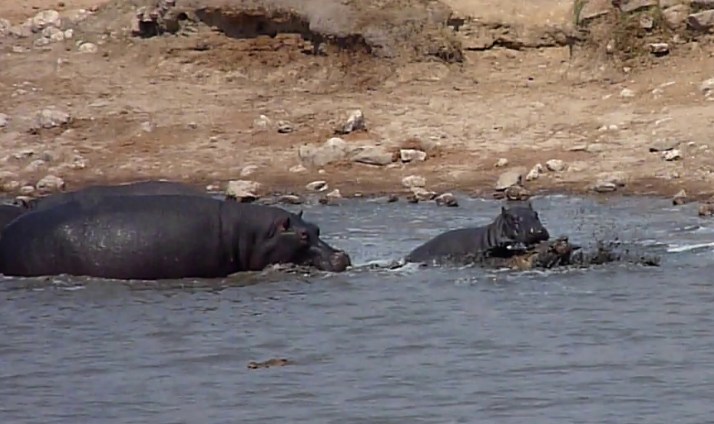
The Crocodile are attacked again after arriving at Point 2.

Another view of the struggle for the Impala at Point 2.

Another view of the struggle for the Impala at Point 2.

Another view of the Hippo vs. Crocodile struggle for the Impala at Point 2.

Another view of the Hippo vs. Crocodile struggle for the Impala at Point 2.

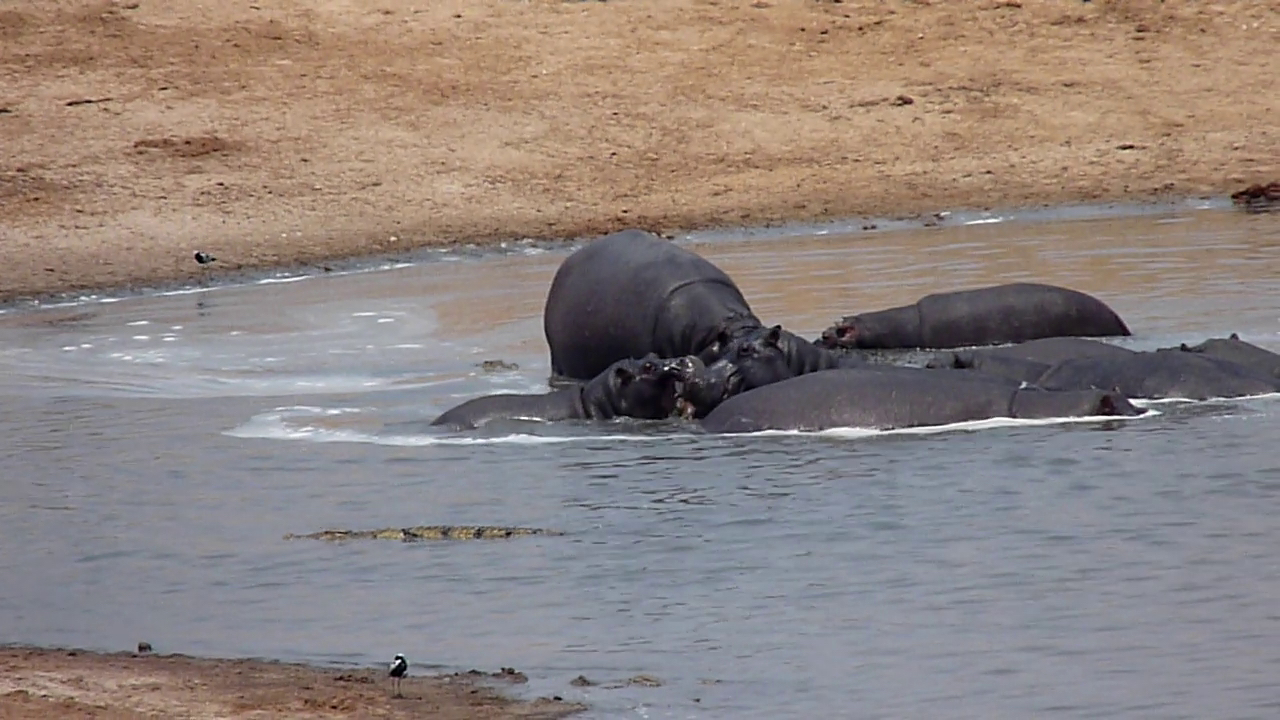
The Hippos came again and were seen clearly attacking the Crocodiles and even biting them.

One large Hippo bit the head of a Crocodile, who swiftly moved away to avoid severe consequences while other Hippos were also seen biting crocodiles on different parts of their bodies. In the commotion we lost sight of the

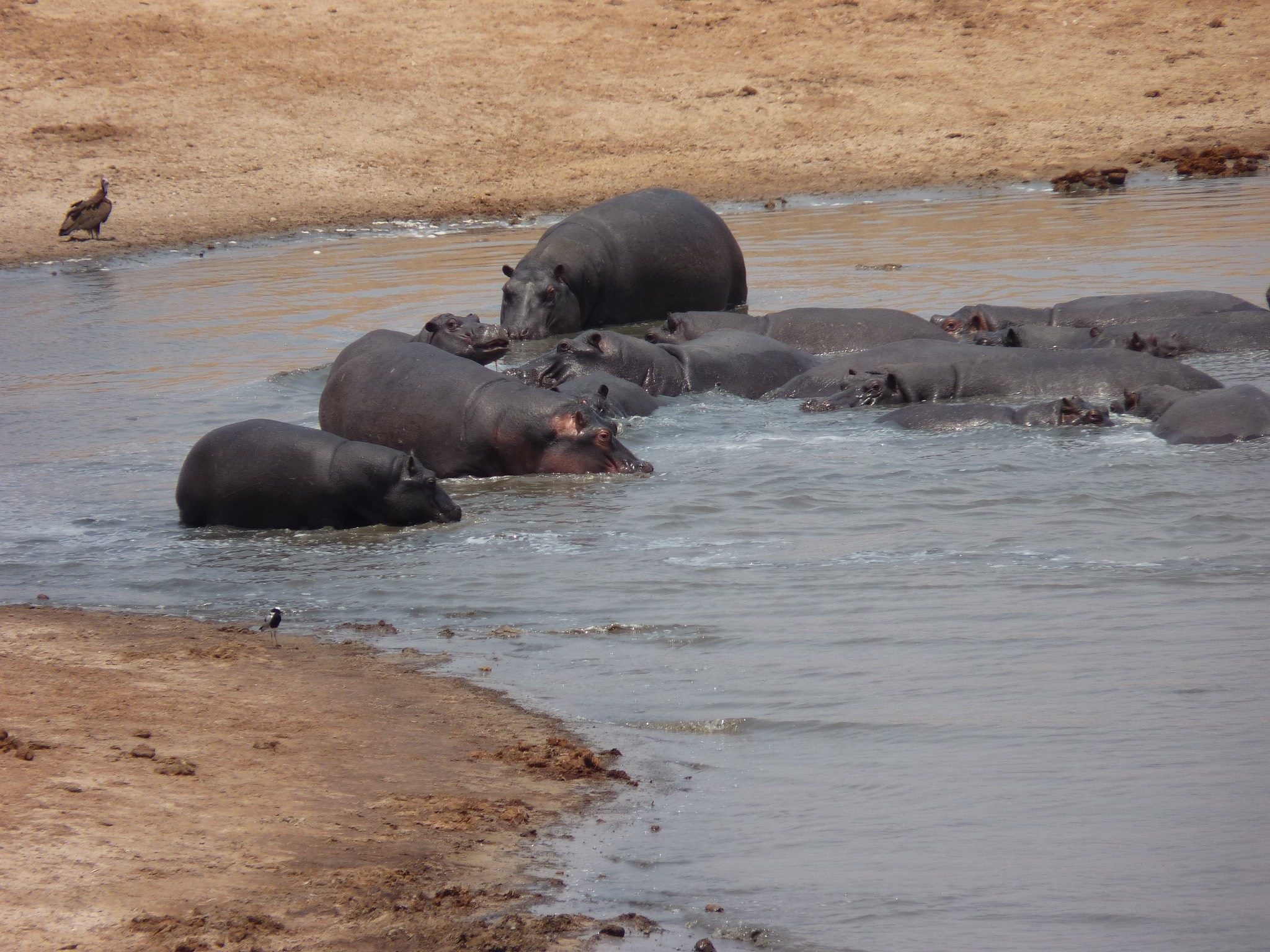
Calm was reinstated at the dam for about 20 minutes. The next thing we noticed was a great commotion at Point 4 where the Hippos began to congregate. They were clearly competing for something and eventually several were seen apparently “mouthing” the Impala. On closer observation they were actually chewing and apparently swallowing while bone-cracking noises were heard.

After snatching the Impala from the Crocodiles at Point 2, they congregate to feed on the Impala carcass.
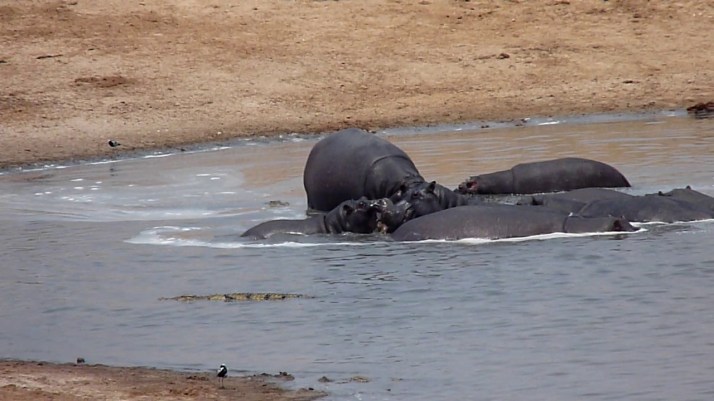
After snatching the Impala from the Crocodiles at Point 2, they congregate to feed on the Impala carcass.

Another view of the final stages of the Hippo feeding frenzy.

Another view of the final stages of the Hippo feeding frenzy.

Unbelievably to us, at the time of these observations, the Hippos were eating the Impala! After it was consumed the Hippos went back to their normal place and peace returned. The moment they lost the carcass, the Crocodiles did not try to recover it.

Confinement in the dam was the best possible explanation I could think at the time for such aberrant behaviour. The event appeared so unusual that, on arrival in Harare, I went straight to the computer to check the Internet. Not surprisingly, I found earlier references of similar incidents and the first report of carnivore behaviour in Hippos came from Masuma Dam![1]

As, very recently the BBC and National Geographic have both published articles on hippo cannibalism[2] I put together these observations to contribute to our general knowledge. I have also contacted Mr. Dudley and we are collaborating on the subject that may result in further work being published in the scientific literature.

[1] It was not easy to see the number of Crocodiles or Hippos involved in the various incidents described.

[2] https://bushsnobinafrica.wordpress.com/2014/10/27/crocodiles-and-impalas/

[3] I was excitedly filming the scene!

[4] Dudley, J.P. 1996. Record of carnivory, scavenging and predation for Hippopotamus amphibius in Hwange National Park, Zimbabwe. Mammalia 60 (3): 486-490.

[5] http://news.nationalgeographic.com/news/2015/01/150123-hippos-cannibalism-animals-food-science/?utm_source=Facebook&utm_medium=Social&utm_content=link_fb20150125news-hippos&utm_campaign=Content&sf7093531=1

and

http://www.bbc.com/earth/story/20150116-the-diet-secrets-of-hippos-herbivore-or-cannibal
Tigre!

During my earlier post on fishing (A Fishing Expedition) I mentioned the hairy moments we spent during our short trip up the inundated Paraguay River. While writing it I recalled the experience I am writing now, as it also is related to floods and what they may bring to our latitude in Uruguay.

The River Plate Estuary is the outlet into the Atlantic Ocean of the River Plate basin that drains water from over four million square kilometres of land in Argentina, Brazil, Bolivia, Paraguay and Uruguay. The start of the River Plate is the meeting of the Paraná and Uruguay Rivers at a place known as Punta Gorda (“Fat Point”), a few kilometres down river from Nueva Palmira, which is today a very important deep water harbour. The Paraná and the Uruguay Rivers, before meeting in Punta Gorda, collect a number of important tributaries aside from the Paraguay River such as Pilcomayo, Bermejo, Salado, Iguazú, Mocoretá, Gualeguaychú, Negro and Samborombón Rivers to name a few.

Perhaps once a year, floods take place and a lot of debris comes down the River Plate as a consequence of heavy rains that fall in areas where some of the smaller rivers mentioned are located. Brown, muddy water points towards the Paraguay River while a brick red colouring to the Bermejo River. Floods bring huge water hyacinth islands drifting past at high speed and, during severe flooding, it is not strange to see colossal trees floating past as well. Not surprisingly then, animals are also seen populating them and I have heard stories of monkeys holding on for dear life. Sometimes the animals land here. I remember a pair of Anacondas seen by a friend at Punta Gorda last year! I also remember the famous 1959 floods when dried exotic insects and small animals such as snakes and mice could be seen stuck on the walls, indicating the how high the water reached on the walls of flooded houses.

In order to tell you about the real event that a member of my family lived through, we need to go back in time to the end of the 19th Century. My father, who was one of the nephews of the main protagonist, called Manuel, told the tale. His family lived in Nueva Palmira at the time in a Spanish style house composed of several rooms around a central patio that opened behind to the backyard where fruit trees and poultry were kept. The only toilet of the house was located there. A large Ombú (Phytolacca dioica) provided abundant shade in the main central patio. It was there where the family congregated in summer to drink mate and entertain visitors. As the household was located in the centre of the town’s social hustle and bustle, it was not strange for several characters to pay a visit. Among these were business people, politicians and the town’s Priest, as the family also belonged to the Catholic Church.

The time of the event was April and the town was undergoing one of its periodic floods, although I have no further details of its severity. It was a cool autumn evening and the family was congregated indoors, in the large kitchen. The daughters were probably doing crochet or embroidery and the adults, drinking mate, gossiping or talking about the events of the day. It was before dinner and probably a “Puchero”[1] was being cooked. The arrival of the Priest was expected and, after the formal greetings, he went in to see the grandmother and to take her weekly Confession. Voices were lowered and the conversation switched to more formal issues. His task completed, the Priest returned to the kitchen and he was, as usual, invited for dinner that, as usual, he declined. He did politely accept the offer to drink a few mates before leaving though.

After a while, probably as a consequence of mate drinking, the Priest excused himself and went to the toilet. Although it was dark outside, he knew the place and, with the help of the ubiquitous oil lamp he got there. After about 20 minutes of the Priest’s absence, one of the daughters made a comment about his delay but they decided to wait a bit longer before checking on him “to avoid embarrassment” as the mother put it. A few more minutes passed and then suddenly they heard strange sounds outside. Manuel stood up and rushed to investigate.

Once outdoors he heard moaning. Nothing prepared him for what he saw next as it was as unexpected as it was shocking. The priest was leaning against one of the patio wooden columns, holding it and as pale as a ghost. He was the source of the cries Manuel had heard. Manuel ran towards him and just managed to reach him before he fell. He heard a soft “Tigre!” before his companion went limp and almost fell despite Manuel’s hold. He felt the unmistakable slippery and sticky blood on the Priest’s back while the word the priest had uttered sunk in! They were in grave danger in the dark so he made a supreme effort and rushed with the Priest towards the door that he kicked open to enter. He dropped the apparently lifeless Priest inside the house, shouted for the door to be closed as soon as he managed to enter and while cleaning his hands on his trousers he rushed to fetch his gun.

His arrival in the kitchen with the bloody and inert Priest created great confusion. The girls froze in horror but his wife immediately reacted and, together with the house staff, they placed the Priest on the large dinner table. It was clear that he was badly mauled, particularly on his back. While Manuel fetched his gun, his wife, staff and daughters, started to remove the Priest’s cassock to be able to stem the bleeding and clean the wounds. Although the Doctor lived a few houses away, there was no chance of going out to fetch him while the thing responsible for such an attack was still at large!

Armed with his Mauser rifle, Manuel went out. He forbade the ladies to leave until he returned. Before he went, the Priest came to and let them know that he had been attacked while leaving the long drop by a “Tigre”[2]. This was confirmed by the severity and depth of the claw marks. He was lucky that it did not bite his neck and kill him. The Jaguar was probably stalking the chickens at the time the unlucky Priest’s nature call brought him out!

Either Manuel was brave or he did not think much when he left the house to gain his vantage position up the large tree. He knew the tree so he chose a good spot and waited. Not long after, the first light helped him and he saw the unmistakable silhouette of the jaguar, still near the log drop. Although the light was not yet ideal, afraid of the animal running away, he took aim and shot. The Jaguar fell and, without waiting he shot it twice again. He waited for a few minutes and, seeing that the cat did not move, decided that it was safe to climb down. The cat, a young adult, had found its demise thousands of kilometres away from its home range.

Once the outcome of the hunt became known, the Doctor was fetched and with him came the whole town, which had been woken up by the loud shots, wanting to find out what had happened! The animal was skinned and his head was displayed at the History Museum in Montevideo for many years where I saw it while visiting the place with my father in the late 1960s. It took a while for the Priest to recover from his infected wounds but he survived.

[1] A traditional dish made up of boiled vegetables and tubers with pieces of mouton or beef.

[2] The name Tigre was given to the Jaguar (Panthera onca) by the Spanish Conquistadores as they found it similar to the Asiatic Tiger. The name has stuck in large parts of its area of distribution.

Capybara(wet)land

Capybara and rider. Picture by Mariana Terra.

Capybara and rider. Picture by Mariana Terra.

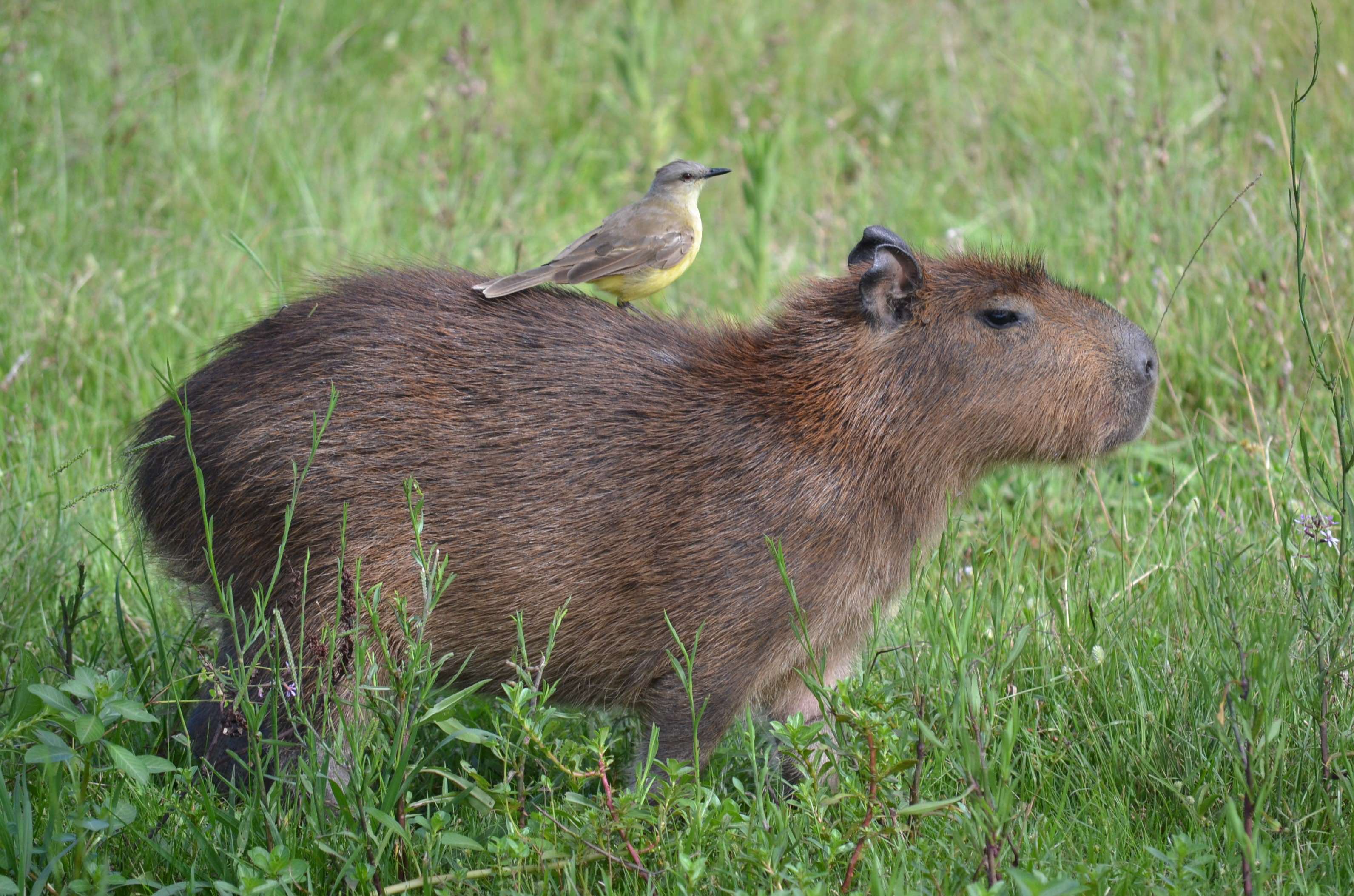
The Capybara (Hydrochoerus hydrochaeris) is the largest rodent in the world. Surprisingly (for me), while reading about this animal I learnt that there is another species found in Colombia, Panamá and Venezuela known as the Lesser Capybara (Hydrochoerus isthmius). The Capybara is native of South America where it dwells near bodies of water. It is a social animal that forms large groups (up to 100 individuals) although smaller groups are more common.

On the road.

On the road. Picture by Julio A. de Castro.

Capybaras were not new to us as we had been fortunate to see them in the past while fishing in Ita Ibaté on the Paraná River, in the Beni region in Bolivia and in the Pantanal in Brasil, apart from the occasional sightings in Uruguay. I did not consider them to be very exciting animals hence they were not high on my list of “things to see” in the Iberá wetlands. My wish list included rarer mammals such as Giant Anteaters and Manned Wolves[1].

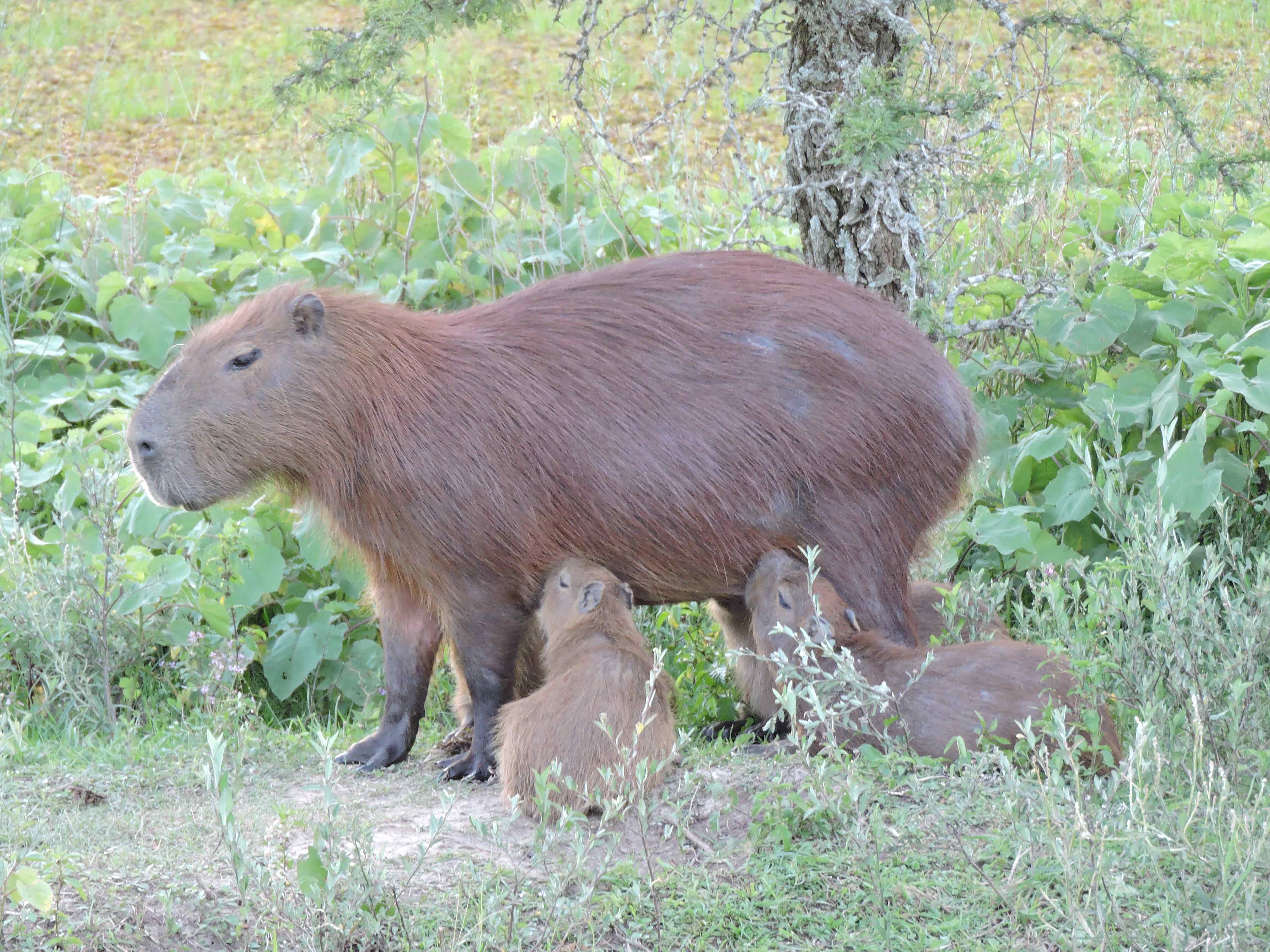
Suckling Capybaras.

Breakfast time…. Picture by Julio A. de Castro.

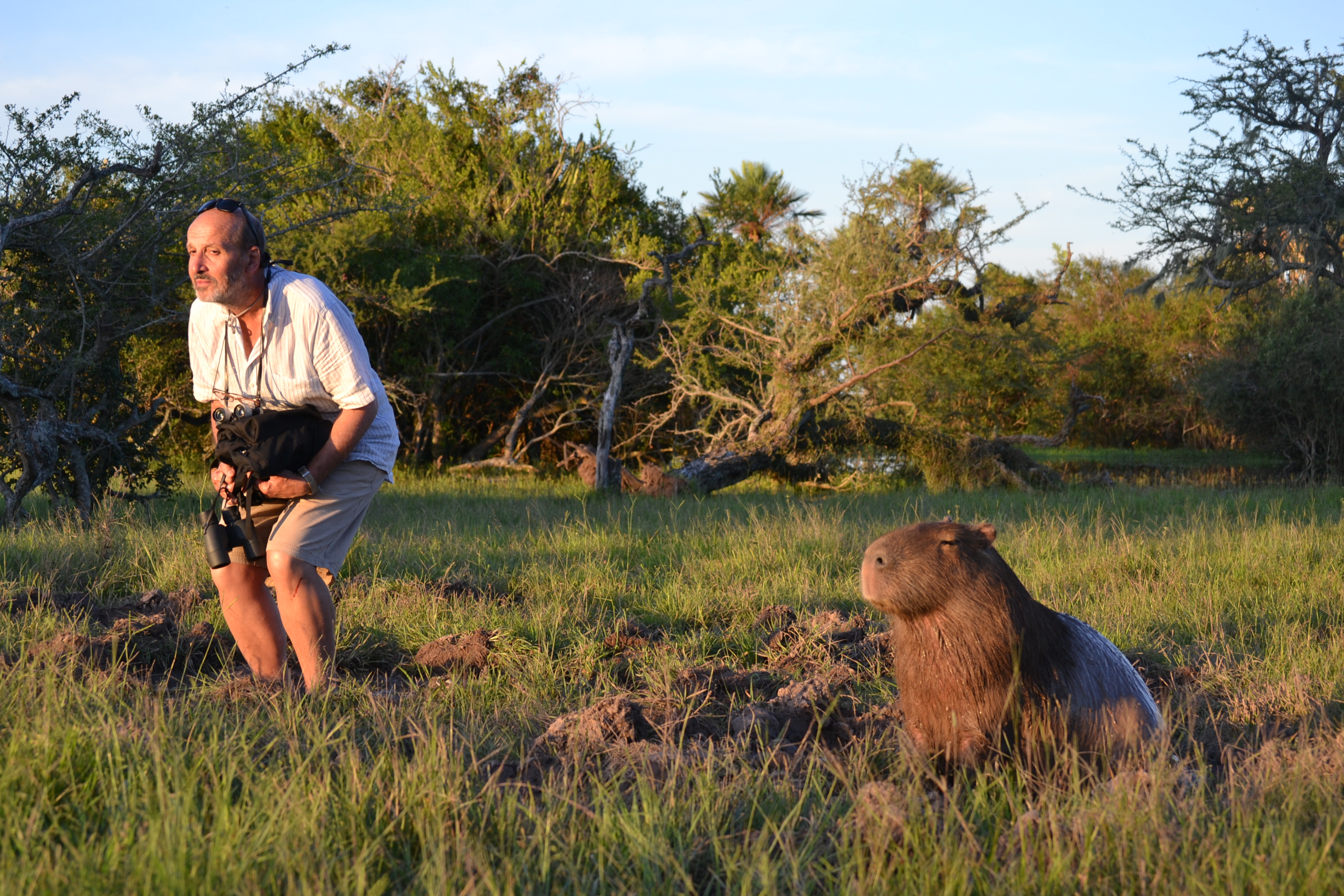
In retrospect, I was really unfair and I should have considered these giant rodents as a “must see” as well! Their sheer abundance made them interesting and the fact that they showed great tolerance to us while walking, bordering on indifference, added an element of intimacy that facilitated some close encounters. The latter were not too close, as adults would bark in warning while babies would squeal before moving off. This closeness -with our help I admit- made our walks in the area much more fun and detracted from our failure to find the “specials” mentioned above.

A moment of closeness... Picture by Mariana Terra.

A moment of closeness… Picture by Mariana Terra.

Seeing life through the Capybara's eyes (and brain). Picture by Mariana Terra.

Seeing life through the Capybara’s eyes (and brain). Picture by Mariana Terra.

There were capybaras all over the place, of all sizes and colours. With regards to colouring, we noted the brown hair colour of those living in the Iberá lagoon vs. the red hair of their relatives dwelling in the waterlogged savannah. Although a few theories were discussed, some of them rather eccentric, we did not come to a logical explanation for this difference. What we all agreed upon was their clear alopecia that we were informed was a kind of mange. Further reading revealed that 90% of the Capybaras in an area of the Iberá wetlands suffers from mange caused by Sarcoptes scabiei, a common form of the disease and 42% showed signs of severe infestation.[2]

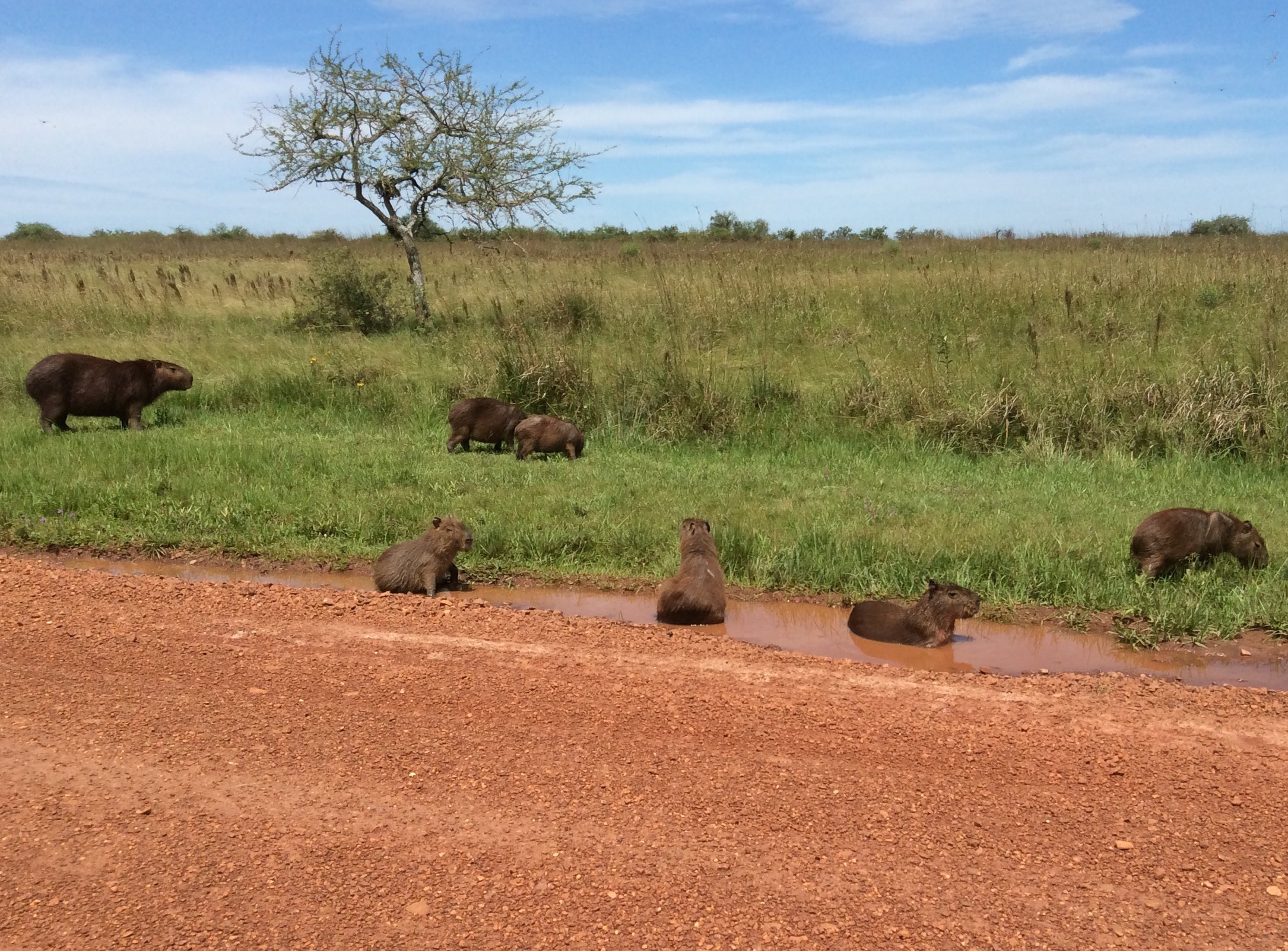
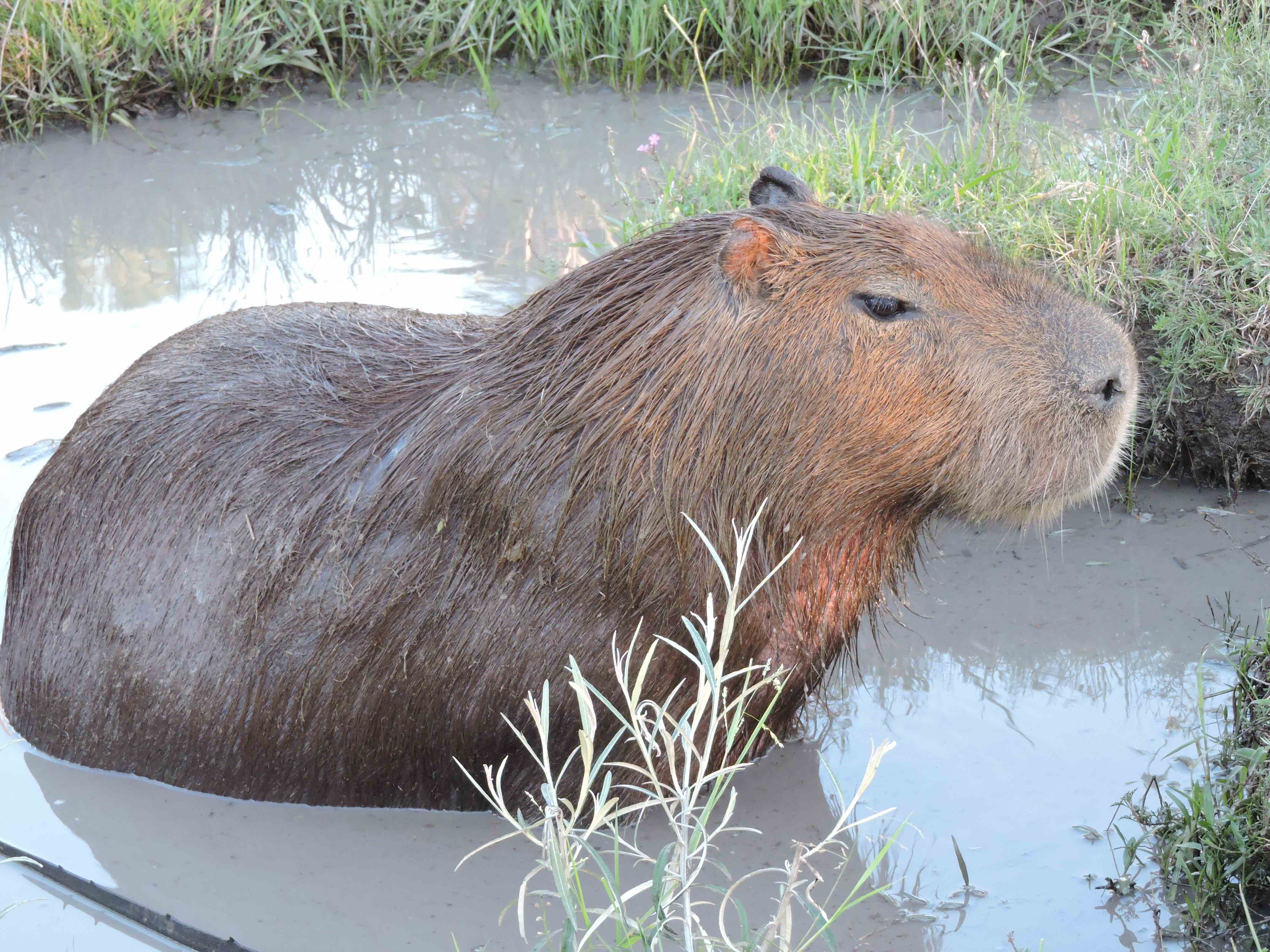
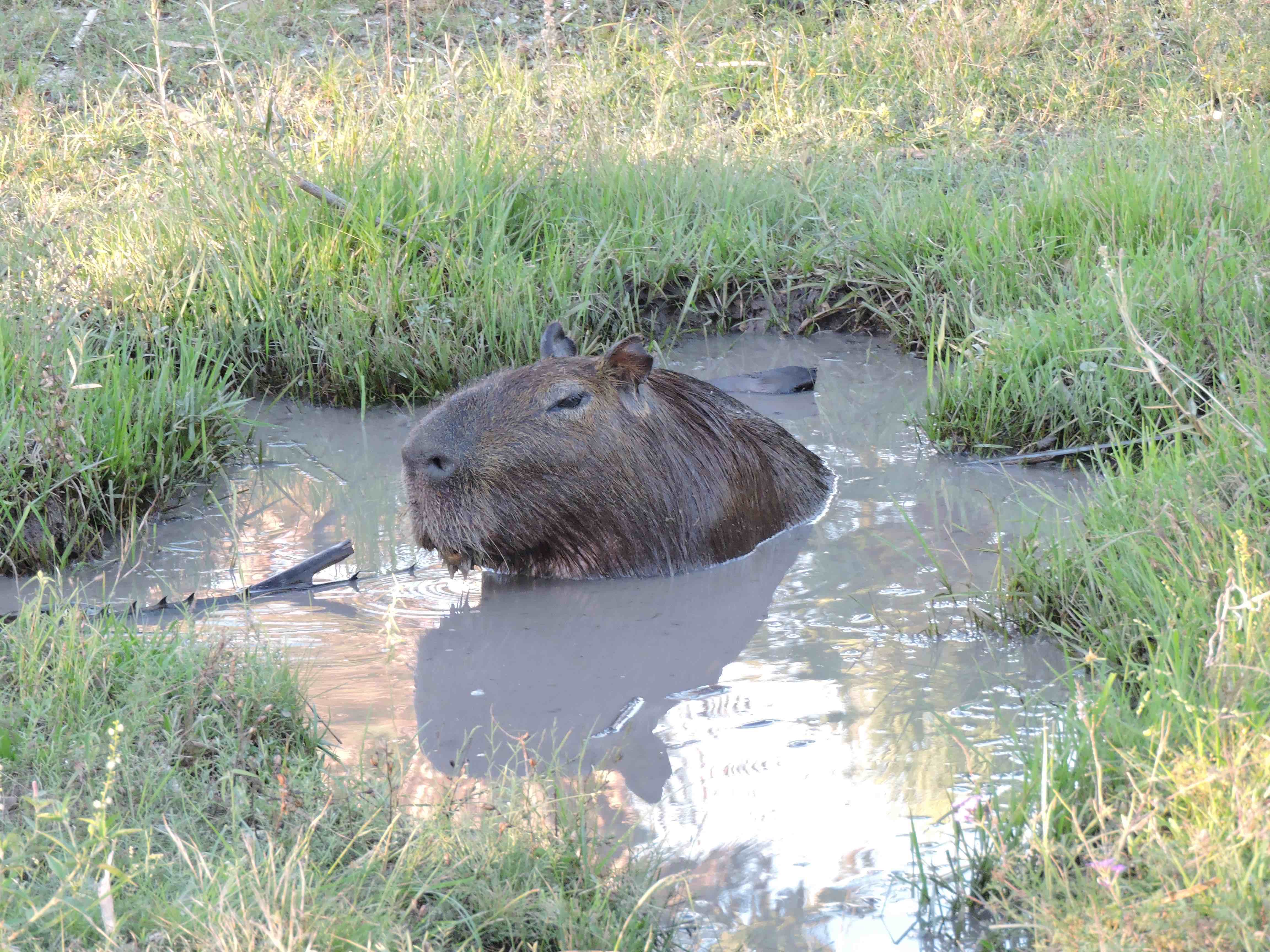
The animals were seen grazing, often doing this lying down more like herbivours than rodents They were also seen swimming alone or in groups. However, and perhaps the more interesting find was the habit of these animals to occupy almost all hollows filled with water. They seemed to enjoy being quietly immersed in water and they were really reluctant to depart from these truly private bathtubs!

VIew of Capybara in bathtub.

Capybara in its bathtub. Picture by Julio A. de Castro.

The Bushsnob waiting for his turn to enter the bathtub.

The Bushsnob waiting for his turn to enter the bathtub.Picture by Julio A. de Castro.

VIew of Capybara in bathtub.

VIew of Capybara in bathtub. Picture by Julio A. de Castro.

Somehow you expect Capybaras to gnaw! This they may do but a bit of reading reveals that they are herbivores and selective in what they graze, choosing plants with high protein content. They have a simple stomach but a large caecum that acts as the fermentation chamber. However, their most extraordinary digestive feat is that they produce two types of faeces: individual oval balls of green olive color and another of glutinous consistency and clear coloration. Cecotrophy is the name given to their habit of eating the clear droppings as, when excreted, they are still rich in nutrients.

We did not know about cecotrophy while at Iberá but we did watch an interesting phenomenon: tadpoles feeding on Capybara pellets dropped in the water. Clearly there was still nourishment left there for the benefit of other creatures as well.

We will be back to re-inspect the droppings more carefully next time!


A FEW INTERESTING VIDEOS OF THE IBERA WETLANDS:


[1] Myrmecophaga tridactyla and Chrysocyon brachyurus respectively.

[2] María J. Corriale, M.J., Orozco, M.M. y Ignacio Jiménez Perez, I. (2013). Parámetros poblacionales y estado sanitario de Carpinchos (Hydrochoerus hydrochaeris) en lagunas artificiales de los Esteros del Iberá. Mastozool. neotrop. vol. 20 no.1 Mendoza.

Riding my fears

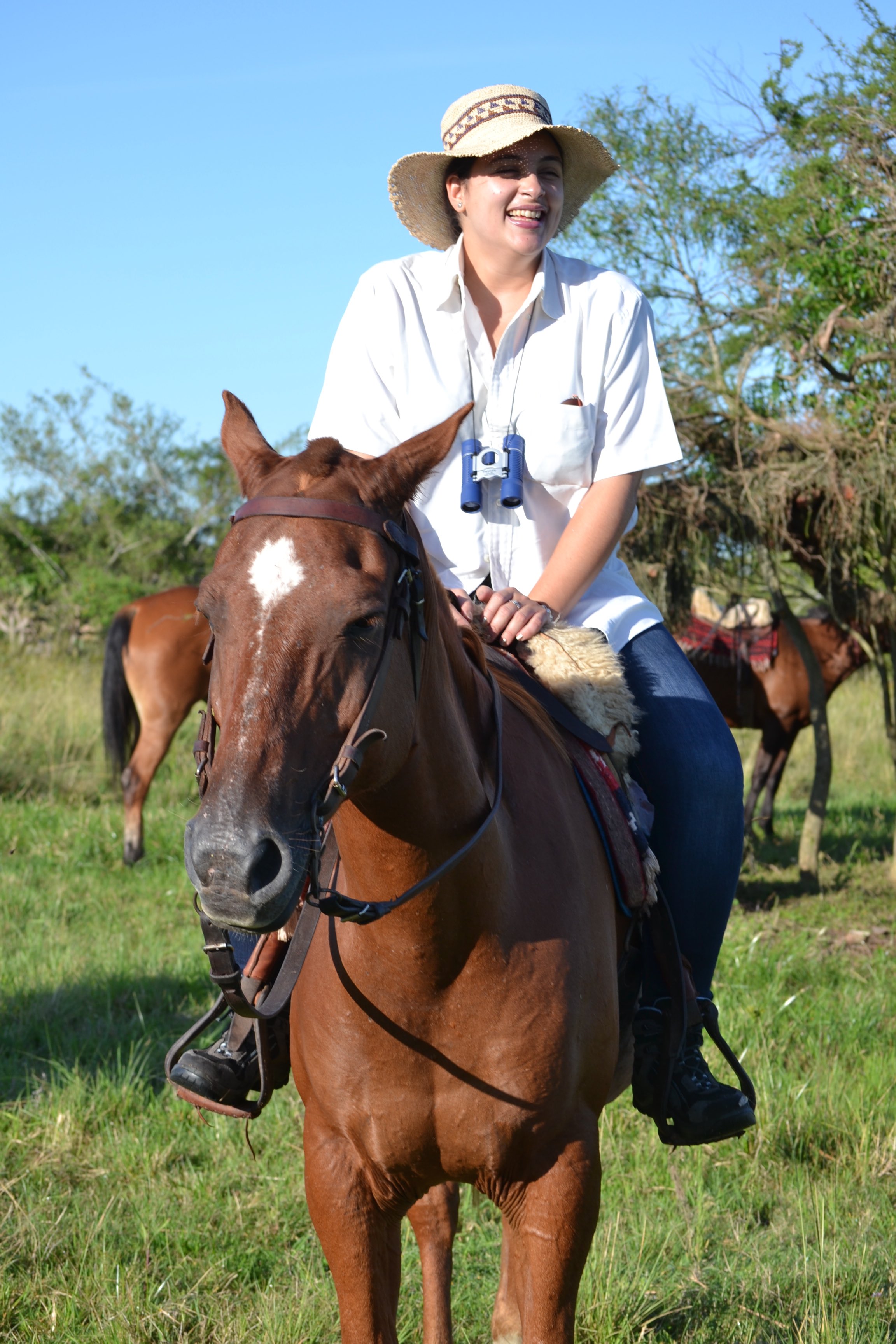
The Senior Editor (daughter) certifying in person that what is written is real...

The Senior Editor (daughter) certifying in person that what is written is true…

One of the activities offered at Rincon del Socorro, during our visit to the Iberá Wetlands, was horse riding. Unlike all other members of the team that eagerly awaited the day, I dismissed it without thinking and made an alternative plan with our guide Mingo. I do not like horses or rather I am scared of them! The worse part is that they detect my fear from a mile away!

I have no doubts that it all started when, as a baby, a cousin placed me on a horse. I have a pictorial record of the event and my face while enduring the experience is telling! I am sure that although I cannot remember the event, it left a mark that I am not able to overcome without expensive intense psychiatric therapy! As avoiding horses is an easier solution, this is the path I have chosen after -as an adult- I became aware of this “trauma”.

Dodging horses during my four-year stint as a practitioner in Uruguay, a country where these beasts are revered and left to die of natural causes to reward their loyalty was, to put it mildly, difficult! So I tried to overcome my dreads and did what I could. Most of this involved referring the cases over to other colleagues!

To actually sit on a horse is an even more terrifying experience for me as I become rigid with fear and tend to fall off the horse at the first unexpected movement. I studied veterinary medicine with Álvaro, the second of nine brothers who owned a cattle ranch in the centre of Uruguay. They were a horse-loving family and each brother had a few riding horses as a lot of the tasks were carried out on horseback. The few times I visited the ranch it involved joining the routine cattle work. While I like working with cattle on foot, I had difficulties joining the necessary horse-dependent preliminary preparations inherent to cattle work.

My first time on a horse started early in the morning with the saddling of the beasts. As all were aware of my limitations I was given the tamest horse. In retrospect, as the mare’s name was Tarántula (the local name for a hairy spider!) I should have politely refused the offer but I did not! I received “riding instructions” from all and I was declared “ready to go”! I mounted and sat on the horse and followed the others, or rather Tarántula followed the others. It all went well while we walked towards the field where the rather lively Aberdeen Angus cows and calves were. The task was to separate them, as we needed to vaccinate the calves.

We entered the field and, before I knew what to do, Tarántula started moving faster and trotting in anticipation. I discovered too late that the mare was tame but not stupid… She had clearly identified a “separable” cow-calf pair and went straight towards it to perform the task. I followed (I had no option!) and managed to stay on during the trotting-galloping-trotting that took place and began to feel proud of myself as we were succeeding. My elation came too early! The moment Tarántula got between the pair and the mother lost contact with the calf it veered back to join its offspring. Tarántula reacted swiftly by swerving to the left to avoid their reunion in a great move for her equine brain. Although my more advanced brain understood a millisecond earlier what the horse was attempting, time was not enough to adjust my body to hers! What happened next lasted at most a couple of seconds: I went over the side head-first and hit the ground, luckily absorbing some of the knock with my arms. In the process I destroyed my watch and got badly knocked. To make matters worse my foot went through the stirrup and I became trapped. Flashes of western movies seen in earlier life of cowboys being dragged all over fields and disintegrating in the process assaulted me. Luckily, the mare did not watch the same movies and, confused and I am sure amused, she stopped in her tracks and looked at me in surprise, not understanding what had happened to the rather rigid human she had been carrying!

My working companions’ help with my condition was severely delayed by hilarity and rude remarks. Eventually I was released and, enduring all imaginable jokes, I abandoned the exercise to lick my wounds while, after tying the horse on a tree, I decided to watch and admire my friends’ riding skills!

Although funny in retrospect, this experience has remained in my mind all my life and it was the reason for making alternative plans for the Iberá horse-riding proposition! However, human folly has no limits and, when time arrived and after thinking about it, for the sake of teamwork (and under silent and subtle peer pressure…) I decided to join the equine adventurers not without obtaining assurances beforehand from the organizer that the mounts were tame almost to a stupid level.

I hasten to inform you that I did not fall and I feel so proud about it that I fail to find the right words to describe this feeling. In fact, with the exception of a couple of hitches, I enjoyed the trial.

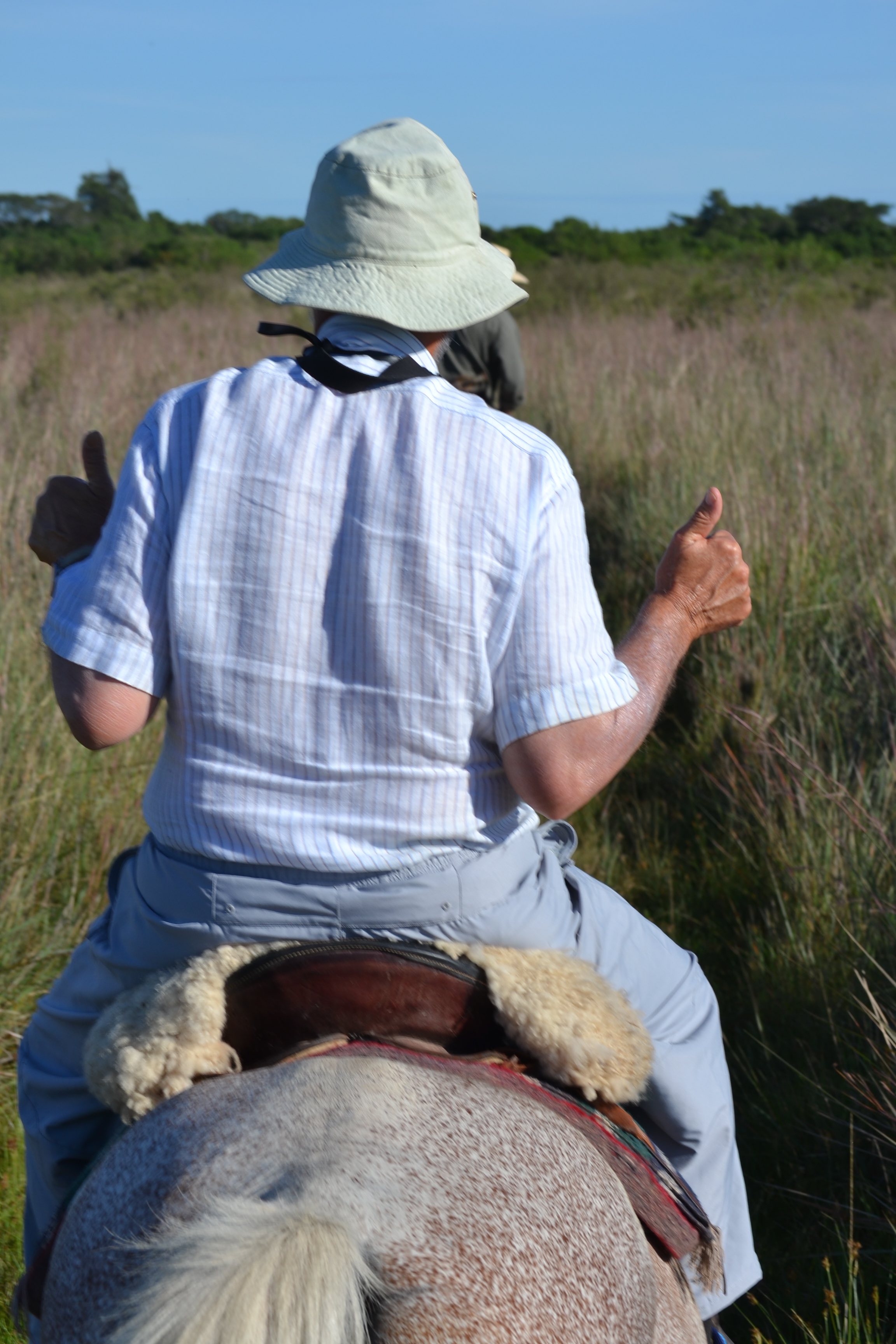
The Bushsnob being optimistic about the challenge. Picture by Mariana Terra.

A rigid Bushsnob being optimistic about the challenge. Picture by Mariana Terra.

The first challenge came when we needed to cross a rather deep river that implied a brisk descent, water fording and a steep climb up the other side! I got my feet and legs water-logged as all my attention and extremities were holding on to avoid a worse fate. After that success I felt physically soggy but spiritually high. This glorious feeling lasted for a few minutes until the horse skidded on the muddy ground and my heart missed a beat. Luckily the four legs quickly recovered their verticality and I continued my triumphant parade all the way through the obstacle course and back to the ranch.

The Bushsnob being looked after by a member of the team.

The Bushsnob being looked after by a member of the team.

The ride took us through areas of tall grass, difficult to walk through, that opened up in a large flooded area where lots of water birds were present. An interesting sight was a lone Marsh Deer (Blastocerus dichotomus), the largest deer species from South America.

The good news is that I quite enjoyed the ride as it was far more comfortable than anticipated and the fact that I managed to stay on the horse made it 100% better than earlier experiences! The bad news is that, after this success, I may try again!

Tarántula Terminator

Picture by Mariana Terra.

Picture by Mariana Terra.

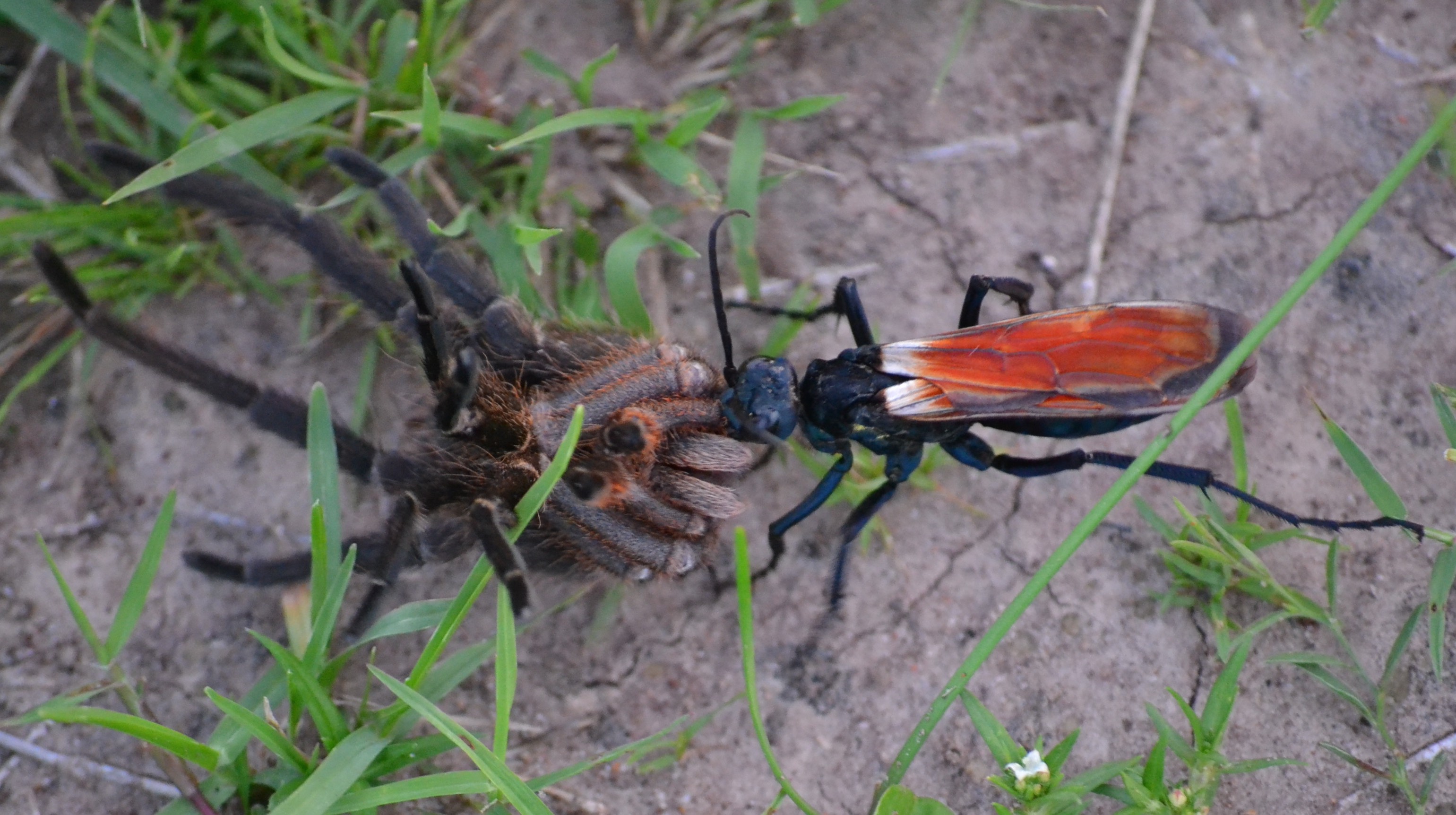
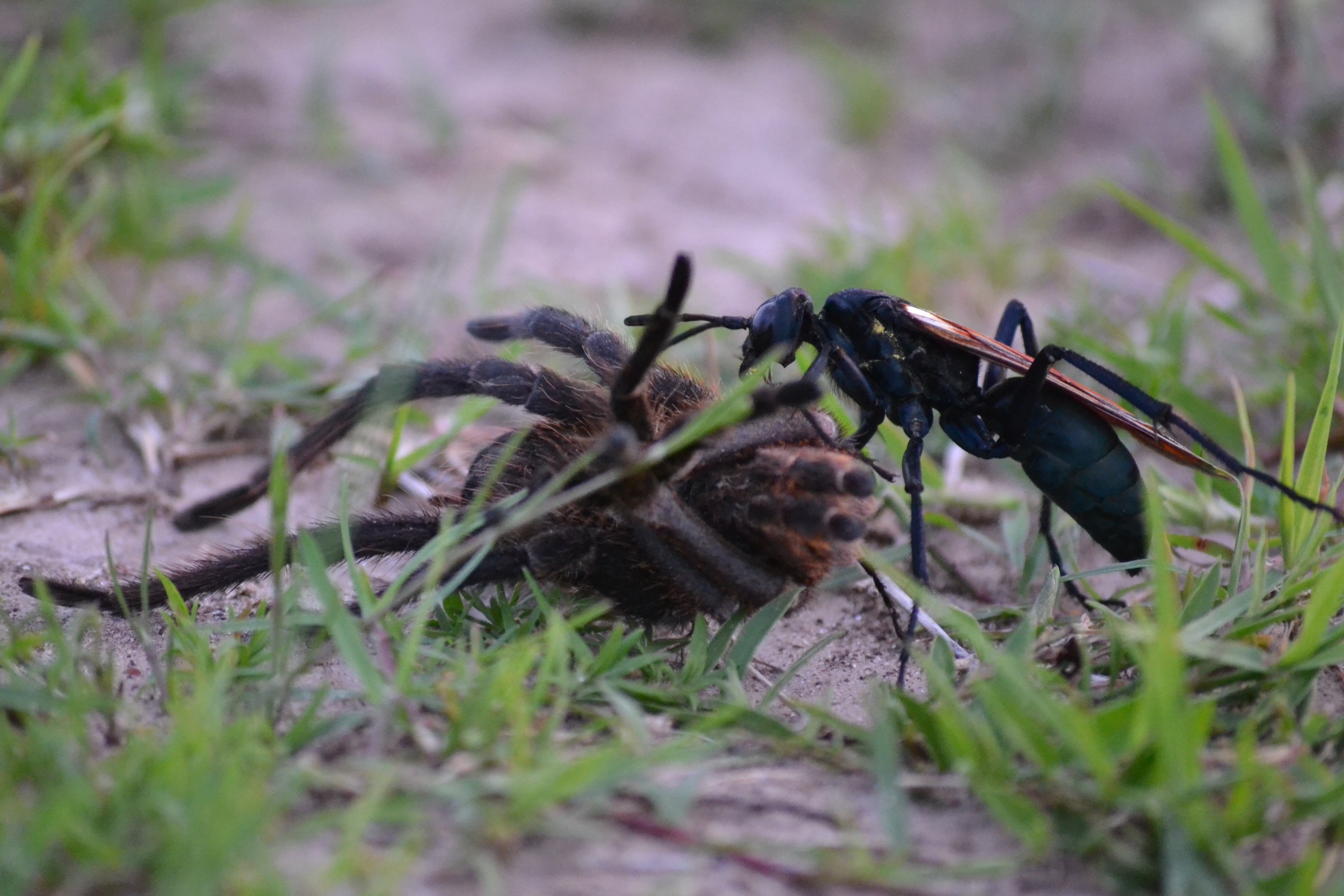
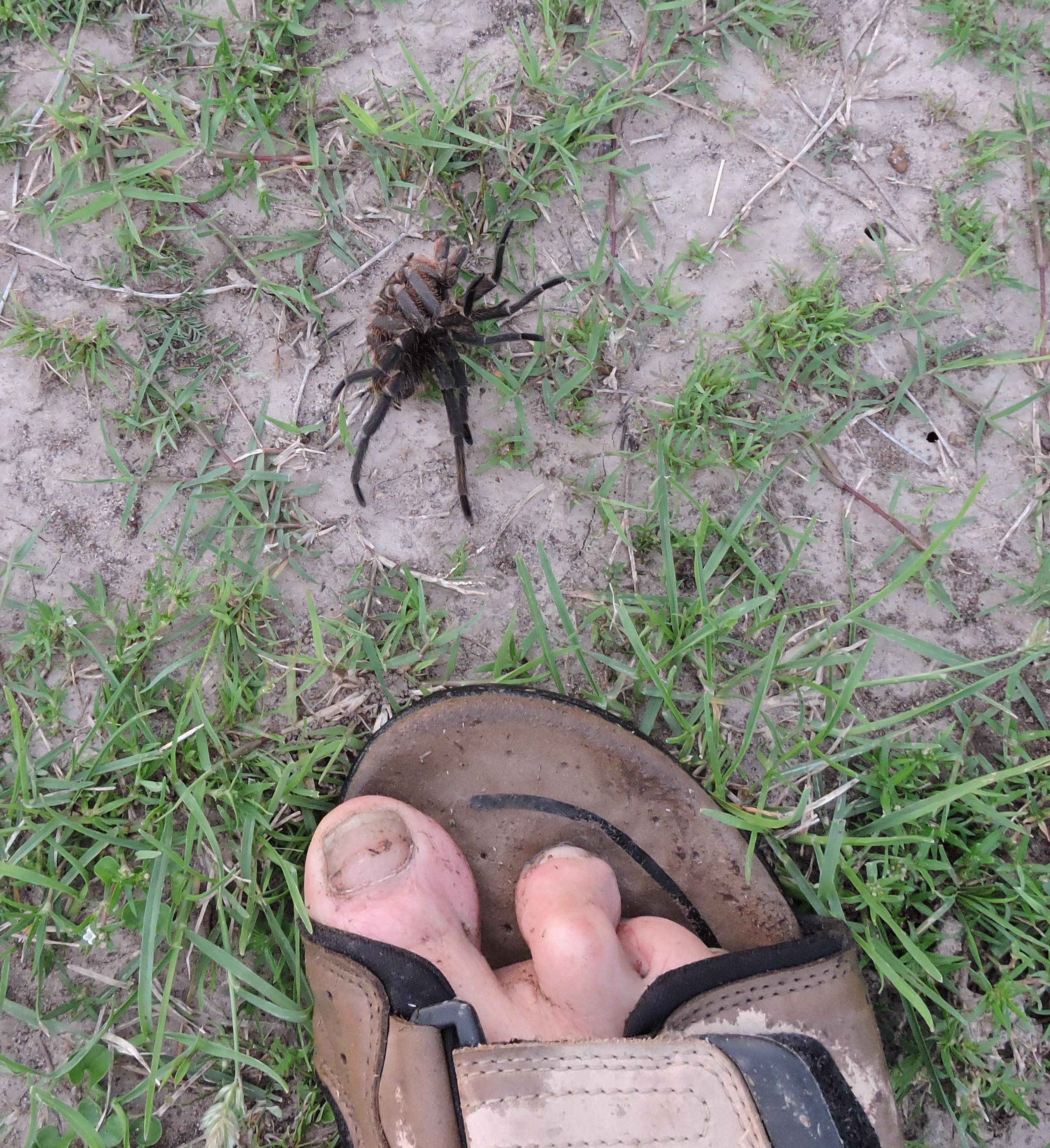
During our first walk around the Rincón del Socorro ranch we came across a large wasp dragging a spider. Although we have seen this several times both in Africa and Latin America, it was the first time we witnessed a confrontation of such large and colourful adversaries. The wasp was about six centimetres long and the spider even larger!

Picture by Mariana Terra.

Picture by Mariana Terra.

Before our arrival a Tarántula Hawk (a wasp of the Pompillidae family) caught a large Tarántula (Grammostola sp.) and was dragging it through the grass. The wasp stings the spider in order to paralyze it and later it lays an egg on it so that its offspring can feed on the inert -but living- arachnid. Apparently (see link below) the young wasp eats the spider’s non-vital organs first so that the paralyzed spider remain as a supply of fresh food for some time.

The Spider compared with a -muddy- foot...

The Spider compared with a -muddy- foot…

The female wasp (males do not hunt) was determined to keep hold of her prey, and clearly looking for her burrow or a place to bury the spider.

Life is, albeit rarely, also dangerous for the wasp as she deals with dangerous prey as sometimes she fails and becomes the prey instead of the predator. Even if she wins the battle, she is still very vulnerable while she drags her prey across rough terrain; she is earth bound and reluctant to abandon it.

If you are interested in more details I recommend you to consult the following link:

http://www.bbc.com/earth/story/20150109-the-wasp-that-scares-tarantulas

One Tusker…

twisted tusker tusk tip small

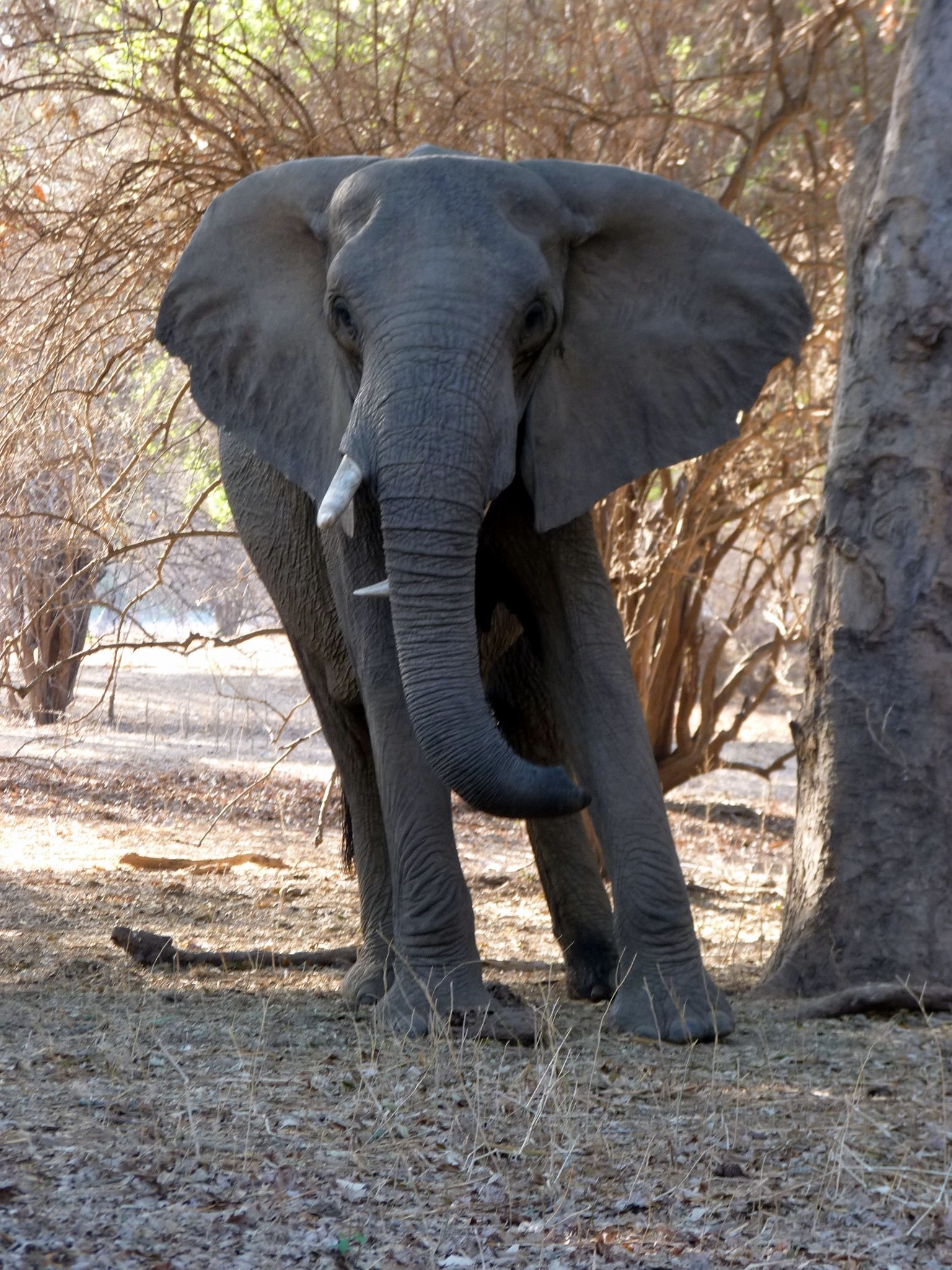
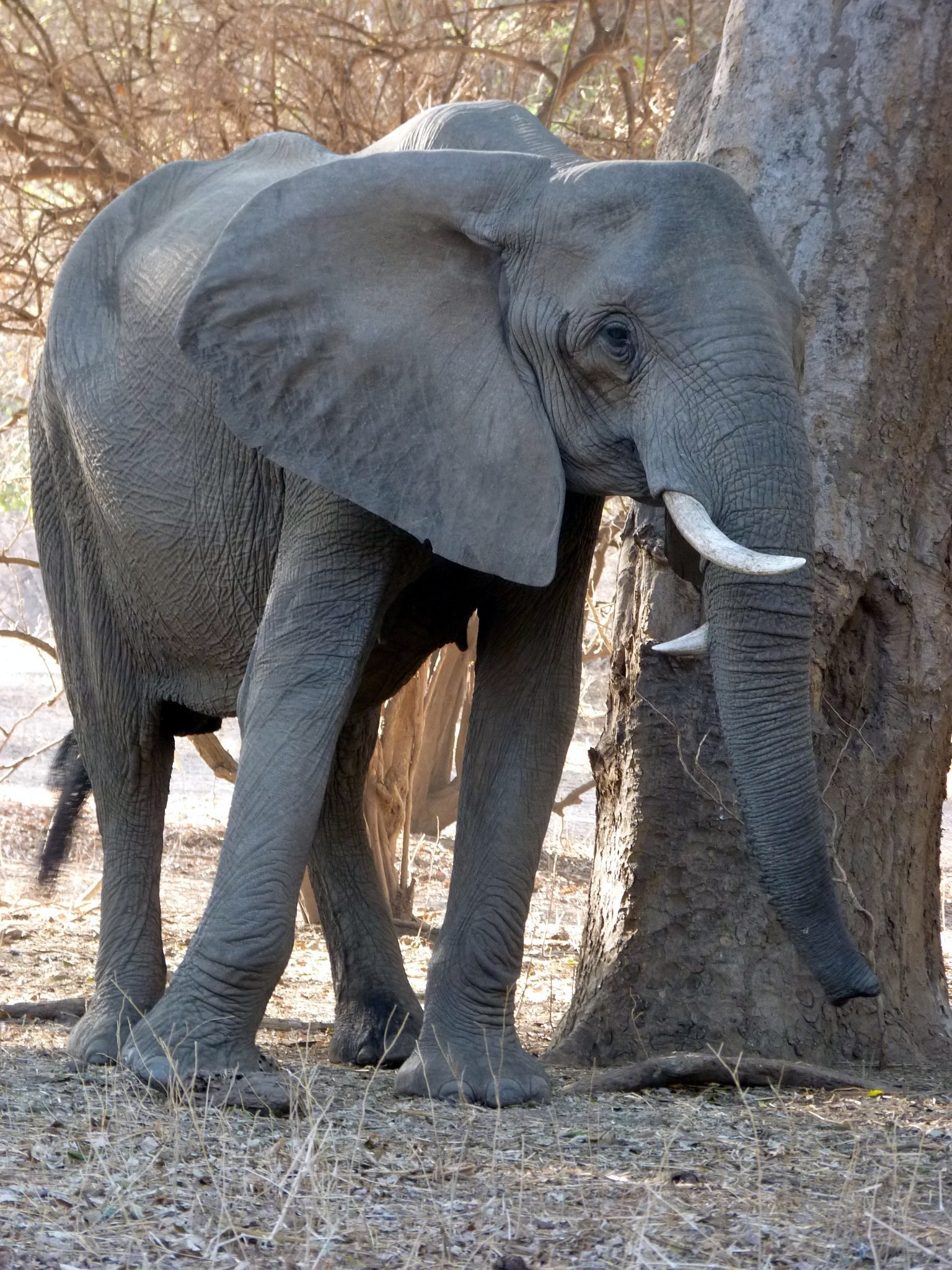
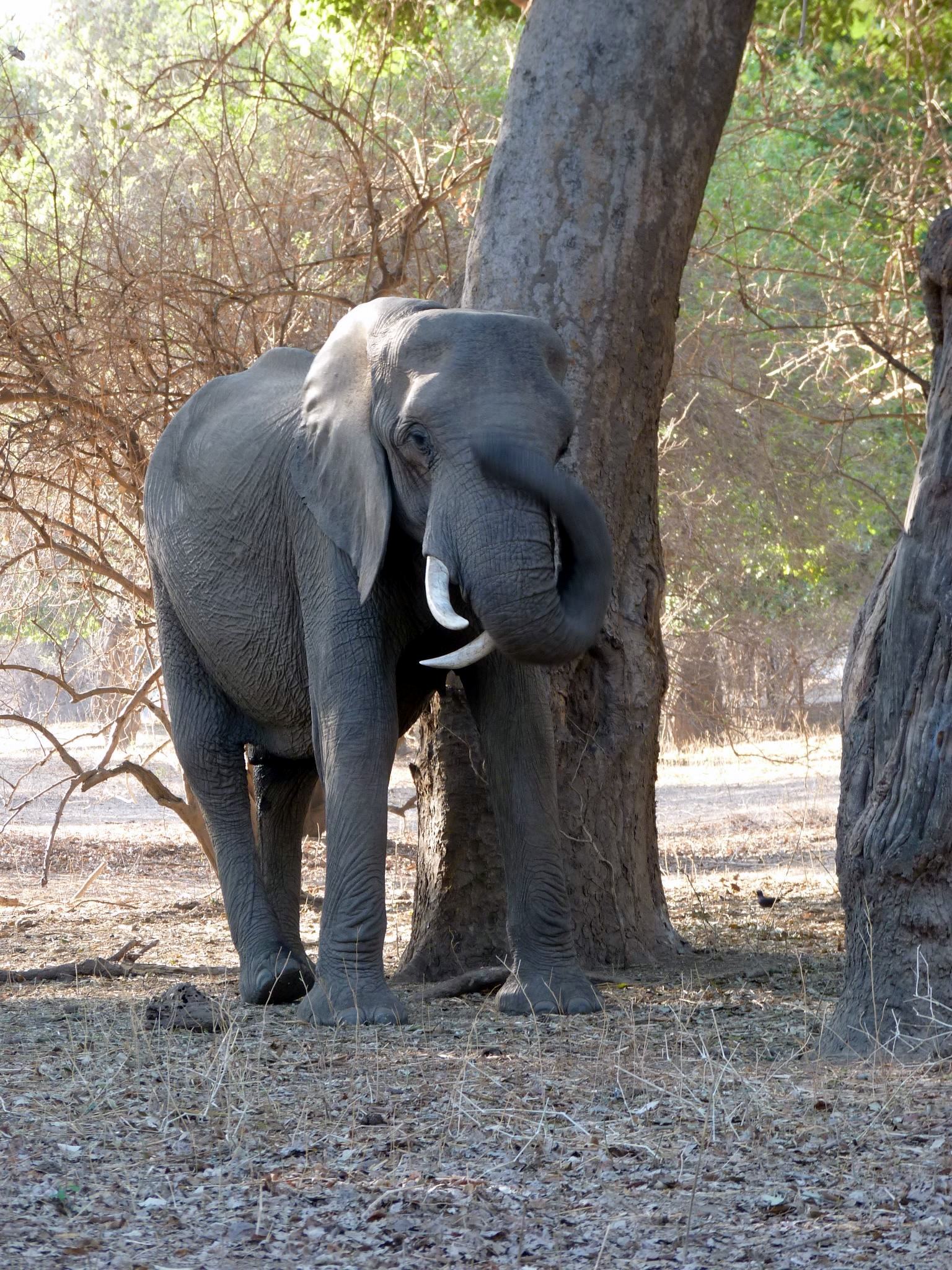
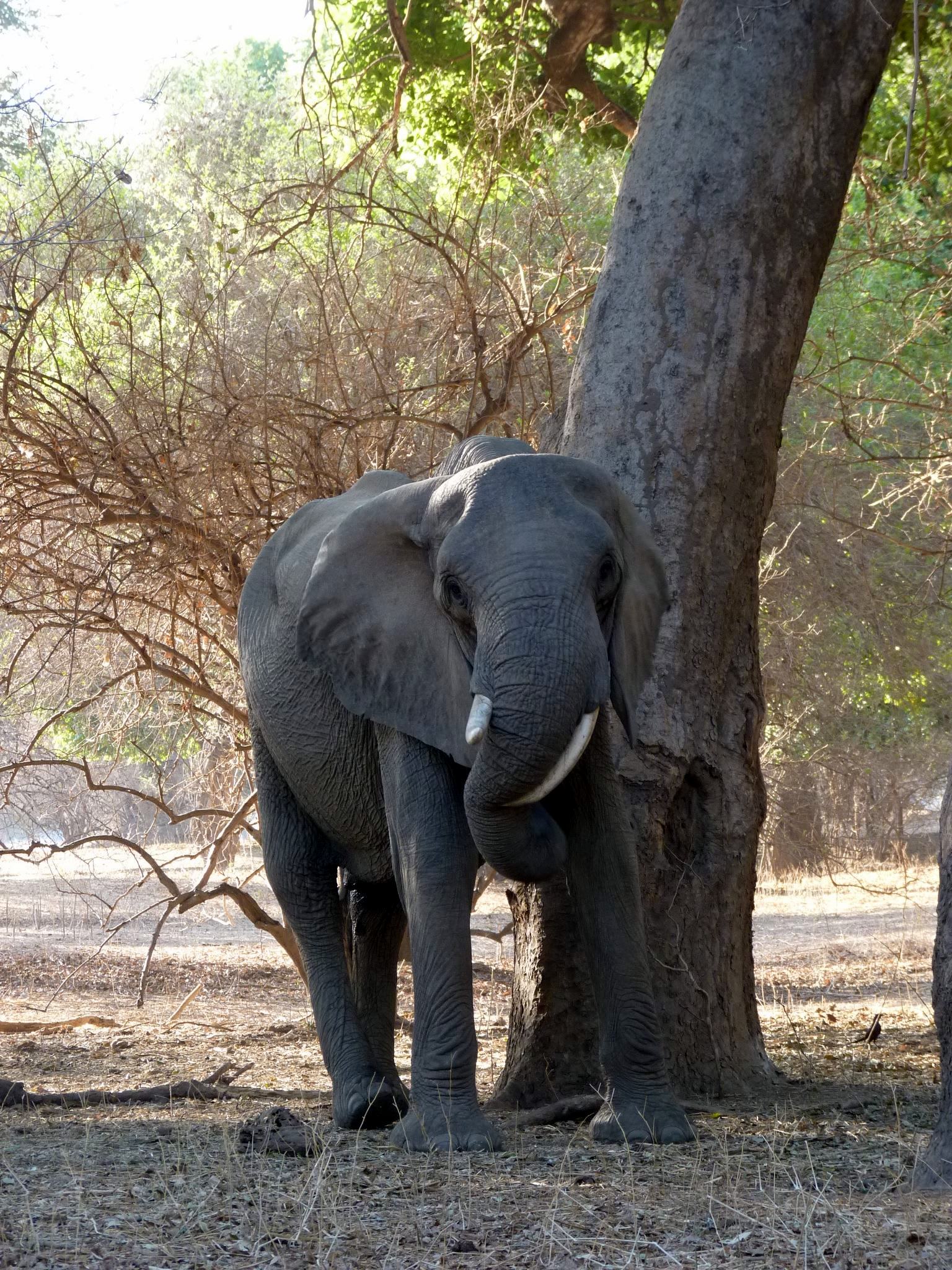
While at Mana Pools National Park we met this elephant. At first we dismissed it as a “one tusker” but when we looked at it from a different angle it immediately became clear that we were wrong!

While its right tusk looked healthy and nicely curved, its left tusk had grown in the wrong direction and it was pointing down and towards the back.

twisted tusker small 1

I have seen pictures and references in the literature of elephants with weird tusk arrangements so this find is not really an unusual one. It is much more rare to find an elephant with three tusks and I recall a hunter (probably Ionides) who tracked a famous three-tusker. More recently, an animal with this same rare characteristic was spotted in Nxai Pan National Park in Botswana by Stuart Arnold (http://www.exploreafrica.net/whats-happening-now/3-tusk-elephant-nxai-pan/).

Twisted tusker small

In our case, what made this animal interesting was its habit of placing its trunk behind its left tusk, giving it a weird look.

Twisted tusker trunk

Based on its size and condition, the bent tusk does not appear to have had a negative impact on its life and it is unlikely that it will affect it in the future. We will keep an eye open for it in our upcoming visits to the Park.

African Videos – Elephants 1

As today is a holiday and I imagine you can do with some entertainment, I decided to post a few videos about elephants. Please put up with my usual lack of photographic/filming skills and enjoy the moment!


1. What I call the Babalala Tusker for lack of another more appropriate name until it is -eventually- named by the Kruger National Park authorities.


2. I believe this to be a magnificent view of elephants at a waterhole in Hwange National Park in October 2013. This sight really hooked me on the pachyderms (with help from family and friends…)


3. Another view of elephants drinking at a smaller waterhole.


4. Elephants are the only animals that show “emotions” when approaching the water! Just watch…