Safari

Christmases with lions

I remember at least two year-end holidays spent in the Maasai Mara.

The fact that we camped outside the reserve gave us some liberties and sometimes we returned late to camp. That particular Christmas eve we were ending our game drive and looking forward to our Christmans eve dinner when we bumped on a group of six lionesses walking through the plains, clearly hunting.

As this offered a great opportunity because of the number of game present in the area, I managed to convince Mabel that it was a good idea to follow them for a while to see whether we could watch a kill. She reluctantly agreed.

After following them for a while, darkness fell and we realized that, oh surprise, we were lost again!

Unable to return to camp we decided to continue with our plan and kept following the lionesses and, to avoid interfering with the hunt, we kept the lights of the car off and navigated under increasing darkness until we only had the moonlight. We did switch our lights on sporadically to see where we were going and to avoid losing our quarry.

Suddenly the lionesses started trotting and soon we lost them. My attempt at finding them took us through some stony ground until we came to one where the bottom of our car touched the rocks and we got stuck on rocks!

Getting out of the car to jack it up was not an option so I revved the engine and moved the car backwards and forwards until with a metal tearing noise the Land Rover jerked backwards and we were free.

We were now alone as the lionesses had continued with their hunt and disappeared into the thicket! It was clear that our optimistic project had come to its (natural) end and we had no idea where we were!

Wisely for once, we decided that setting up our small tent and sleep in the open surrounded by lions (and other beasts of the darkness!) was out of the question so the decision was taken to slowly look for a flat piece of land, stop the car and settled down for our Christmas eve night.

Searching the car we found water and a panettone [1] baked by Mabel! We did not wait for midnight to celebrate Christmas but opened our bottle of water and toasted while we cut slices of panettone that we finished. After our improvised dinner we started listening to the lions roaring around us, probably also celebrating a successful hunt that we had just missed to witness. We thought that, after all, it was a good way to spend the night!
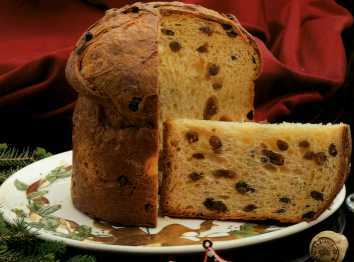
Panettone. Credit: Codice1000 at Italian Wikipedia [Public domain]

Things started to lose their glamour when the time came to sleep as we did not carry blankets or sleeping bags with us so it would be a chilly night. I had ceded the front bench of the car to Mabel and I tried to find sleeping room at the back of our short wheel base Land Rover, an impossible task despite throwing out all hard objects through the back door. Despite this, there was still very little room there and, after trying a foetal position and then sitting with my back against the front seat without luck I must have passed out as I woke up with the first light.

But our troubles were not yet over!

It was a lovely Christmas day and we soon realized that we had driven inside the reserve and had spent the night at an area we knew and from where we could see the Mara Serena Lodge.
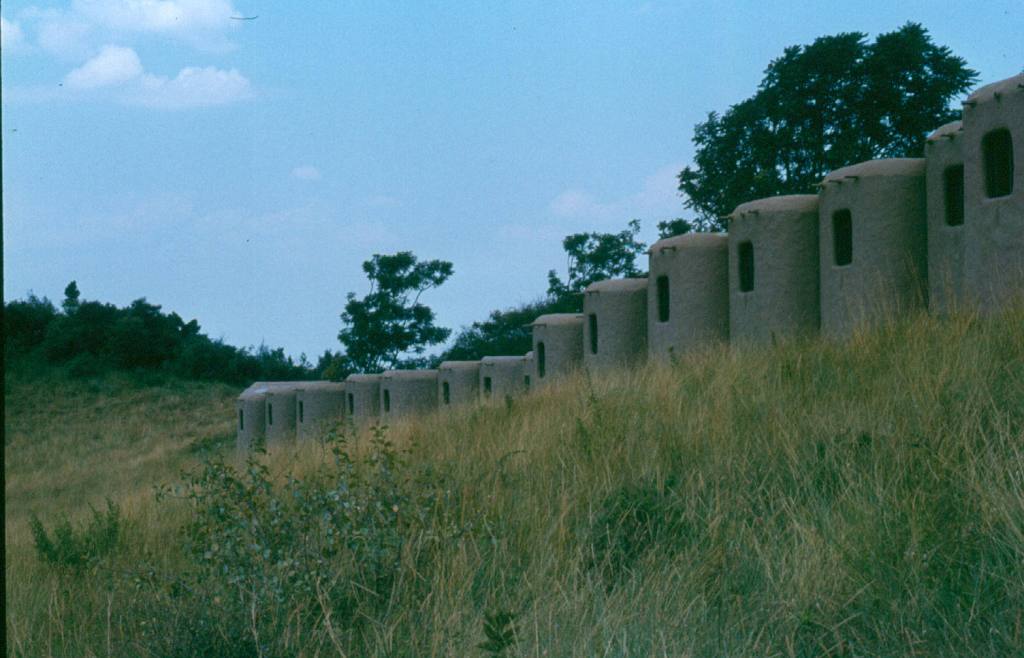
The Mara Serena lodge.

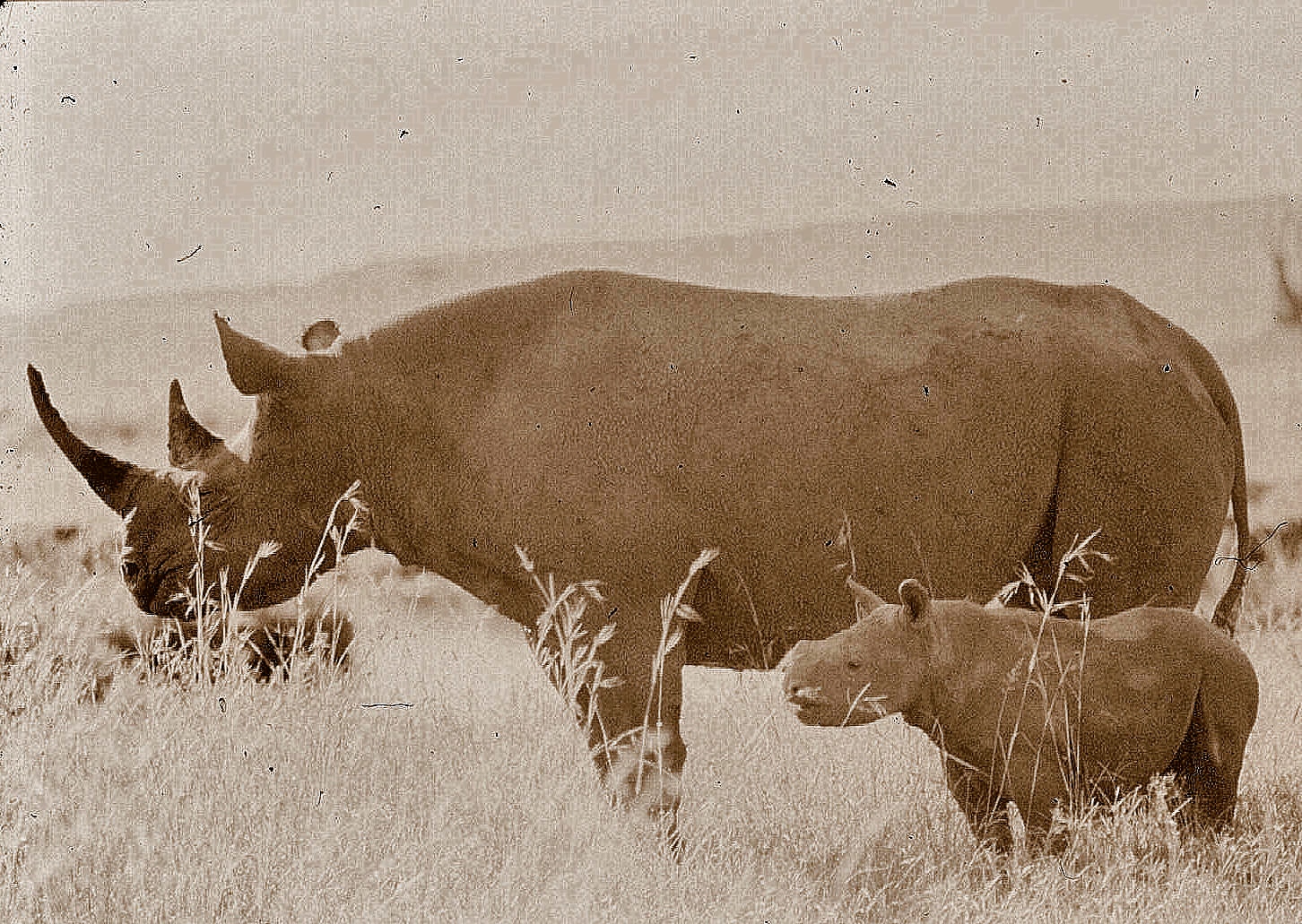
And then we got our Christmas presents: a female black rhino came walking slowly towards us, followed by a really small calf, very cute and playful. I believe that it had been named “Toto” (child), one of the attractions of the reserve at the time.

A female back rhino and her calf, the same sight that we found in the Maasai Mara on Christmas morning.

Unfortunately for us, with the rhino came the reserve rangers that were guarding it 24/7 and they drove straight at us as we were rather obvious and there was no way that we could have driven into the park to be there at that time in the morning! We told them that we had lost our way the day before and decided to spend the night where we stopped. Luckily, they understood our explanation of how we ended up there and pointed us the way back towards the area we had left our camp.

We wished each other a Merry Christmas and parted our ways, they keeping an eye on the rhinos and we, stiff but happy at the way that Christmas had finally arrived although we did not see our lion hunt.

The following year we decided to have a comfortable Christmas holiday and we started early to save to be able to spend it at Kitchwa Tembo, the tented lodge close to the Mara River bridge where I used to get help with punctures and fuel while traveling up the Oloololo escarpment on my way to Intona ranch.

So, when the time arrived we booked seats in the daily flights between Nairobi and the Maasai Mara that were carried out by means of an Airkenya Douglas DC 3 plane that would take about 45 minutes to complete a journey that by road would take the best of one day!
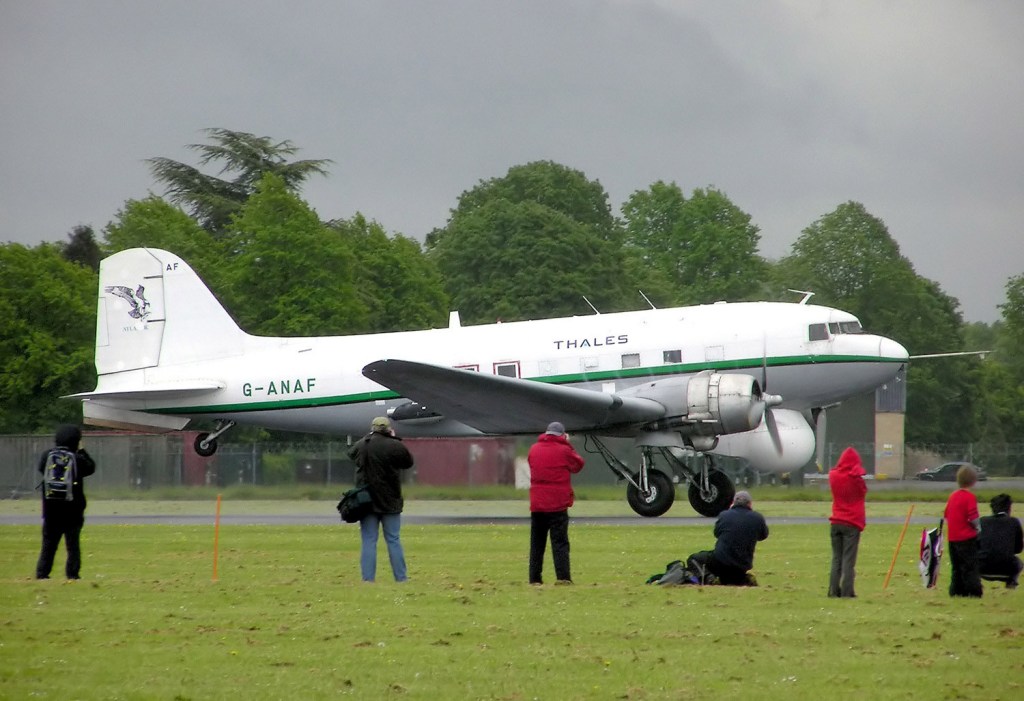
A Douglas DC3 taking off. Credit- Arpingstone / Public domain

We boarded the plane at Wilson airport and we sat really looking up so when the plain started taxiing I immediately started thinking how could the pilot see the runway looking up! Luckily, once we started our take off the tail came up very rapidly and we became horizontal, and a few seconds later we were noisily airborne.

Our route took us over the Ngong Hills – former home of Karen Blixen, of Out of Africa fame – and then beyond the edge of the Rift Valley, magnificent views. After a while the pilot announced that we were flying at 10,500 feet and drinks were offered. Conversation was difficult as the two engines were quite noisy but it was a small price to pay for our first flight in an antique plane!

We approached the narrow paved strip at Musiara and the strong shiver indicated that we had lowered our landing gear and a smooth touchdown followed. Ten minutes later, after loading more passengers the plane hopped a few kilometres over the river to the Kichwa Tembo strip where, after checking that no animals were on the runway, we landed and boarded open vehicles that took us to our tent.

Walking in camp was “interesting” as a number of old male buffalo resided in the camp, probably seeking protection from lions so we were given a strong warning not to walk alone in the evenings but get one of the “askaris” to accompany us. These were Maasai warriors employed by the camp for this purpose.

Christmas Eve at the camp was quite different from the one we spent the previous year. The festivities started early with loud shouts of “elephant!, elephant!” by the staff while we were getting ready to have a cup of tea before our afternoon game drive. We rushed to a prudent distance and witnessed how a young female elephant and her calf walked among the now empty tables pulling table cloths and spilling crockery all over the garden until, clearly satisfied, they walked away leaving behind a devastated garden.

The incident, we were told, was quite common and the solicitous staff quickly re-assembled the tables and, soon and “elephantless” we could have our tea drinking. Once we finished, we went looking for game. This was a new experience as, for once, I could spend all the time looking for game rather than driving. The friendly guides knew the area and they showed us all the usual game, including elephants, lions and buffalo. We returned at sunset and enjoyed good showers and got ready for dinner.

We ate while waiting for midnight and we were treated to a great singing and dancing show by the camp staff that managed to create a really merry atmosphere, fun to watch and to participate. It was funny to see the staff of the lodge in Maasai costumes dancing around.

Eventually we celebrated Christmas with a glass of champagne and retired to our extremely comfortable tent, escorted by our usual askari that was now himself after having been a great dancer earlier.

Later that night we had high drama as it was obvious that lions also wished to celebrate the Season holidays in style and, apparently, they had gone for a buffalo. We heard the struggle and bellows of the “victim” for quite a while until silence returned and we assumed that the buffalo was a goner.

We anticipated an interesting game drive the following morning prior to our return flight but, although we found a pride of lions, we did not find a dead buffalo so we assumed that the animal -if that was what happened- had managed to escape!

Too soon the time came for our departing flight and we boarded the plane, together with other fellow tourists. Our return trip to Nairobi essentially retraced our outward journey and it was rather spectacular to see our approach to the Rift valley wall that, luckily, we climbed and soon we landed with tires squeaking on the Wilson’s tarmac runway. Our “antique” flight was successfully over.

Unfortunately, in 1992 one of Airkenya’s DC-3 was damaged in a landing accident at Musiara, luckily without any victims. Although that plane was not repaired but rather shipped back piecemeal by road to Nairobi, the service continued until 1997 when the DC3s were replaced by newer planes.

[1] Panettone is an Italian type of sweet bread loaf usually enjoyed for Christmas and New Year in many Latin countries. It required a well processed dough and it contains, among other possibilities, candied fruits, raisins and various nuts. It is served in wedge shapes, vertically cut, accompanied, in Uruguay, with cider, prosecco or champagne.
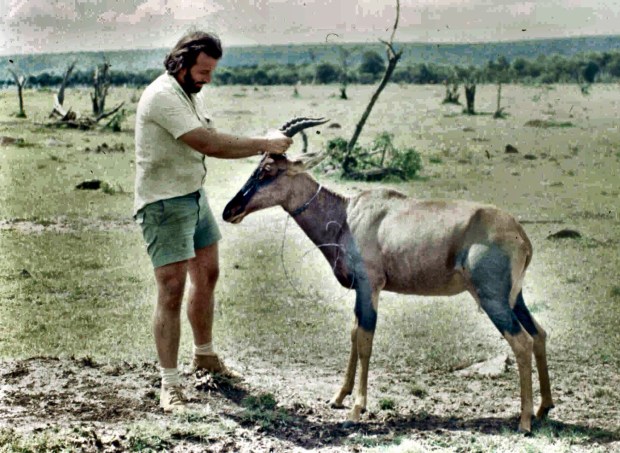
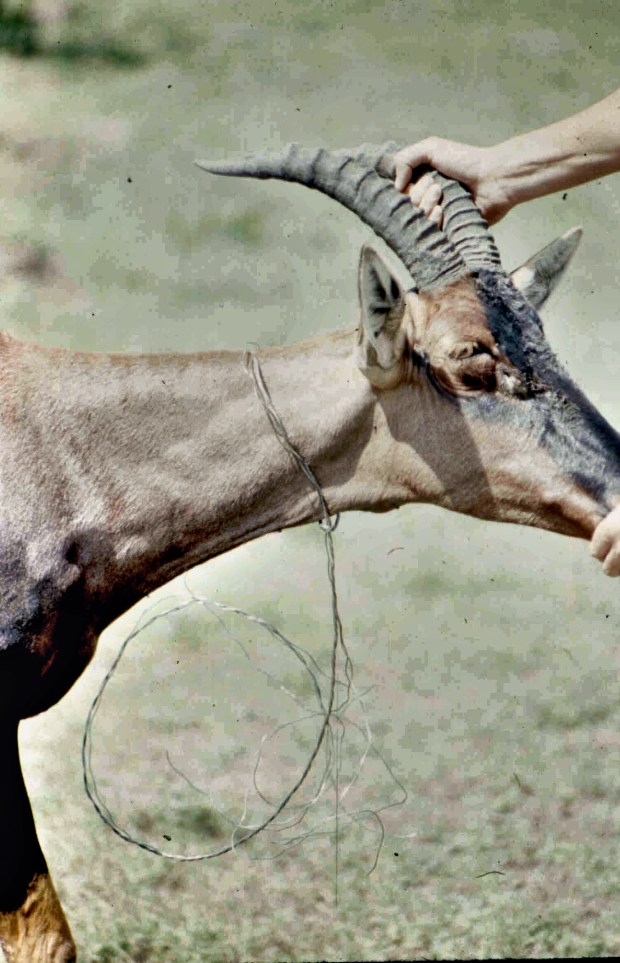
Baby in trouble

There were lots of topi (Damaliscus lunatus jimela) and kongoni (Alcelaphus buselaphus), also known as hartebeest, roaming the Maasai Mara and they would calf at the same time as the wildebeest so we would see them with their newly born calves while looking for the wildebeests giving birth.

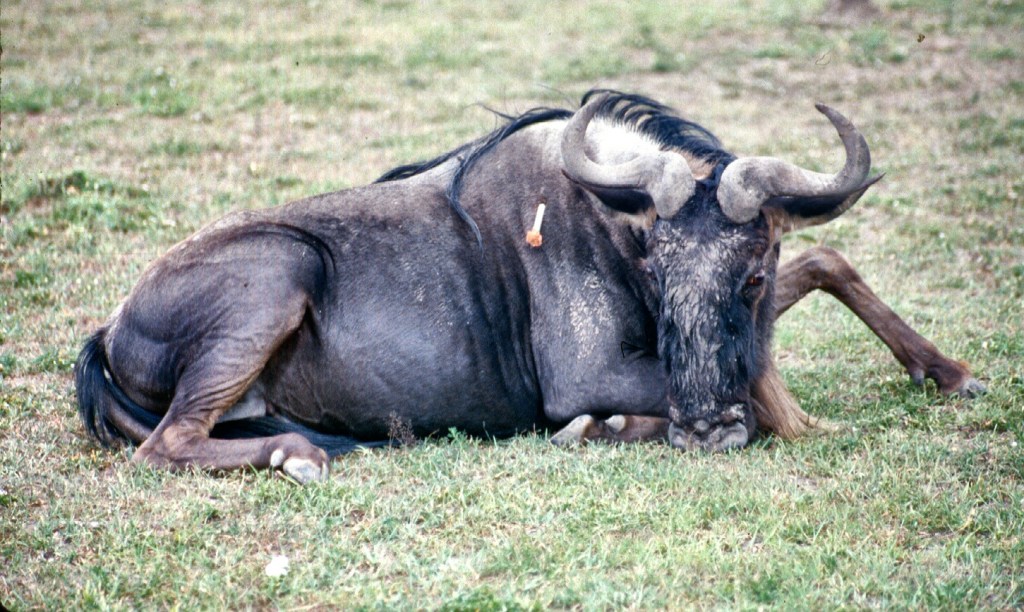
During the course of darting wildebeest we removed snares whenever we saw animals with them.

On one of these occasions we saw a very young kongoni, probably one or two days old that was not only on its own but also very restless. Through the binoculars we saw that it carried an arrow on its forehead! It was most probably a Maasai arrow that was shot from behind the animal and entered the top of the skin of its head going through and it was hanging on its face, bothering him.

As Paul judged the animal too young for darting we decided to catch it to remove the arrow! The idea was to chase it with the car until we were close enough to jump out to grab it and remove the offending weapon. As the car we were driving only had seats at the front, we decided that Mabel (wisely not too interested in our antics!) would stay enjoying the sunshine on some nearby rocks.

We then removed the doors and we were ready for action and started to approach our target slowly. The strategy was to get close to the small calf and then -again- I would jump on it, immobilize it and then remove the arrow. We thought that it would tire fast and enable us to ghrab it.

After a while pursuing it we realized that our “tiring hypothesis” was wrong and the calf had much more energy than we anticipated. We would drive close to it but, just before I could jump on it, it would accelerate again or do a zig-zag movement that would leave us facing in another direction.

We drove an inordinate time, up and down the plain and we were close to get it a few times but it will always avoid us at the last second. drove up and down and passed in front of Mabel a couple of times. Eventually, during one of these turns it entered a rocky area where its mother had gone and we could no longer follow it. So, defeated we returned to collect Mabel.

She was not amused. During our absence she stopped following our fruitless activity not to place herself under the sun but to keep an eye on some lions that she had spotted some distance away so she remained very still to avoid attracting their attention. She had tried to stopped us while we passed by by shaking her arms and she was not amused when we told her that we thought she was greeting us!

Luckily the lions were full of wildebeest!

Wild rodeo

I mentioned earlier that our friend Paul was working on animal diseases at various places, including the Maasai Mara Game Reserve where he was investigating the epidemiology of Malignant Catarrh fever. Apart from collecting placentas [1] he was also collecting blood samples to ascertain the presence of antibodies against this disease among the wildebeest population.

When I had time on my way to Intona ranch via the Maasai Mara or over weekends we joined him to spend time together enjoying the bush, which also included enjoying helping him with his work!

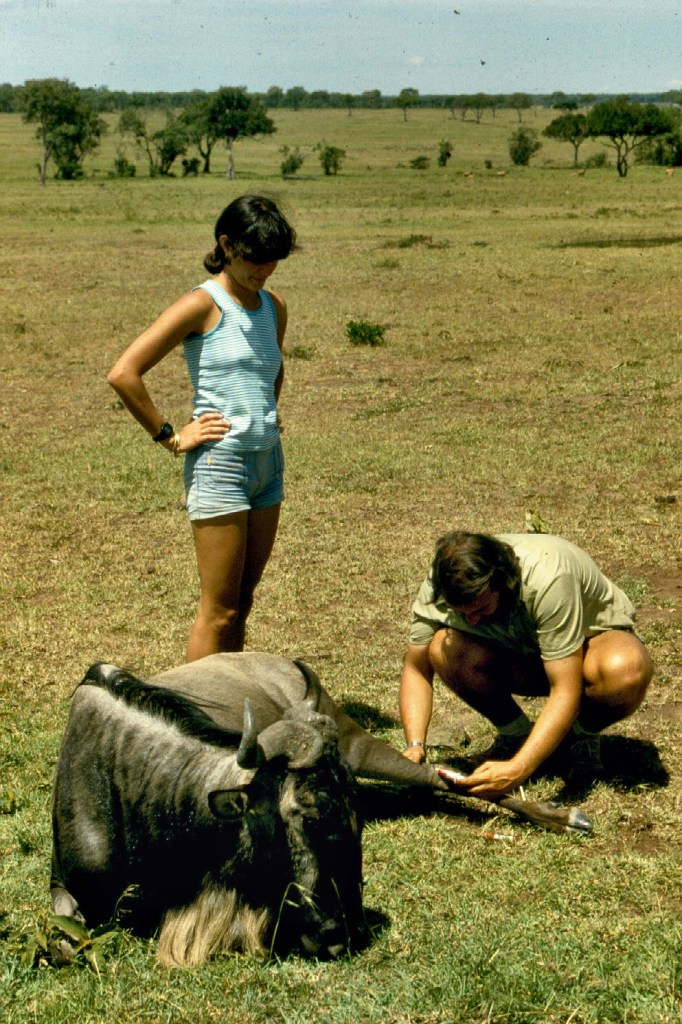
Taking a blood sample while Mabel looks on.

Clearly, to bleed the animals there was the need to immobilize them and this was done by firing a dart that in fact was a flying metal syringe that, on impact with the animal, would have a tiny detonation that would push the anesthetic into the animal. Although interesting, the procedure had risks as an accidental inoculation to a human was life-threatening and a syringe loaded with the antidote was prepared every time we went out.

The effect of the immobilizing drug was very fast and the animal would lie down within a few minutes. During that time, we needed to follow the animal until it started to slow down and finally stopped and became recumbent. Then, there was no need for much holding, as it did not struggle.

After finishing the work and removing the dart, we would apply a gentian violet spray to help with the healing of the small wound as well as to alert us that the animal had already been captured. Then we would inject the antidote intravenously and we literally jumped back as the animal will immediately recover, stand-up and move off as if nothing had happened! This was essential when darting animals in a place notorious for its large predators that were always on the prowl.

Although I had a chance to dart a few animals, I mostly drove as the work needed a two-person team to be performed. I needed to learn how to drive in order to come within “shooting” distance of the animals. You needed to come obliquely as not to start them and then stop the car to allow the shooter to do the job. Breaking a branch or even a twig was sufficient to have to start all over again!

A dart placed at the right spot.

The shoulder was your target. Being in the centre of the animal you would still hit the neck if it went back or the flank if it happened to go forward. Although this sounds simple, sometimes the dart would go over or under the animal or it would jump and the dart would miss it. A missed shot meant an interruption of the work until the dart -usually half-buried in the grass- was recovered. Project resources were limited and a dart was costly. Luckily they had a coloured flight stabilizers that helped locating them.

Although the work proceeded smoothly, there was one instance when things did not go as planned.

At a time that most of the wildebeest had traveled to the Serengeti, there was a need to get some samples despite the low number of animals present. The work involved a lot of searching until individual animals were found and then approached for them to be darted.

After a lot of hard work we managed to dart one adult male that we processed fast to continue looking for others. We covered a lot of bush but found that the animals were particularly jittery and difficult to approach. Eventually we got a female and continued trying to the last one for the day.

During mid-afternoon we found another male, we darted it and started to follow it waiting for it to go down. After a while -surprised- we saw that it would not go down as expected. We followed it and then when it turned we saw the gentian violet spray we had left on it when we had darted earlier!

Clearly, the animal was still under the influence of the antidote and the new dose of tranquilizer would only slow it down but it was not enough for it to lie down. We were in a fix as we could not leave it in that condition and more tranquilizing drug was not advisable.

Desperate situations demand desperate solutions so I volunteer to ambush it by hiding behind a bush while Paul drove it towards me. I thought it would require the same effort as holding a young steer, something I had done this before so I estimated it doable. After all, I only needed to hold it for a sufficiently long time to allow Paul to come and help me, overpower it and remove the dart.

We found a suitable area with woodlands on both sides and I hid behind some bushes with some rocks behind me (to prevent unwanted visitors surprising me) and waited. Although I did not see the car, I heard it coming closer so I got ready for the animal to walk in front of me and then jump to get it.

To my surprise, before I could move, quite a large head (much larger than I expected) was sniffing me! Despite my surprise I reacted by grabbing the animal’s neck hoping to keep it still. As I started being dragged over the plains of the Maasai Mara I realized that I had underestimated the strength of a male wildebeest, even a drugged one!

I soon lost my footing and remained hanging from my embrace of its rather muscular neck. The neck of a wildebeest from a car window is one thing but to actually try to span it with your arms while the creature runs, although groggy, is another one.  

After about three leaps, my grip slackened and I ended up grabbing one of its front legs. My hold was rather short-lived as I was now under the beast being dragged, stepped on and knocking me against all ground irregularities. I let it go and stayedlying on the ground recovering from the ill treatment received.

I was not really hurt but a bit knocked and soon recovered and sat-up to wait for Paul while removing a few thorns from my arms and legs. Paul took a while to come as he was laughing so much at the scene! I understood his mirth as it must have been quite a funny act to watch!

Despite what I thought it was a brave attempt, the problem remained. The wildebeest was still groggy and vulnerable and it carried a valuable dart! We needed another plan as the animal was trotting just a few metres from us. So, plan B was hatched that would involve my cattle-lassoing skills I had acquired in Uruguay.

With the car’s towing rope I improvised my lasso and placed myself between the front of the car and the bull bar where I could keep in place while I could use both hands as I could not use a lasso with only one. I was a bit unstable on my perch but decided that it will have to do. As a precaution I tied the end of the improvised lasso to the bull bar.
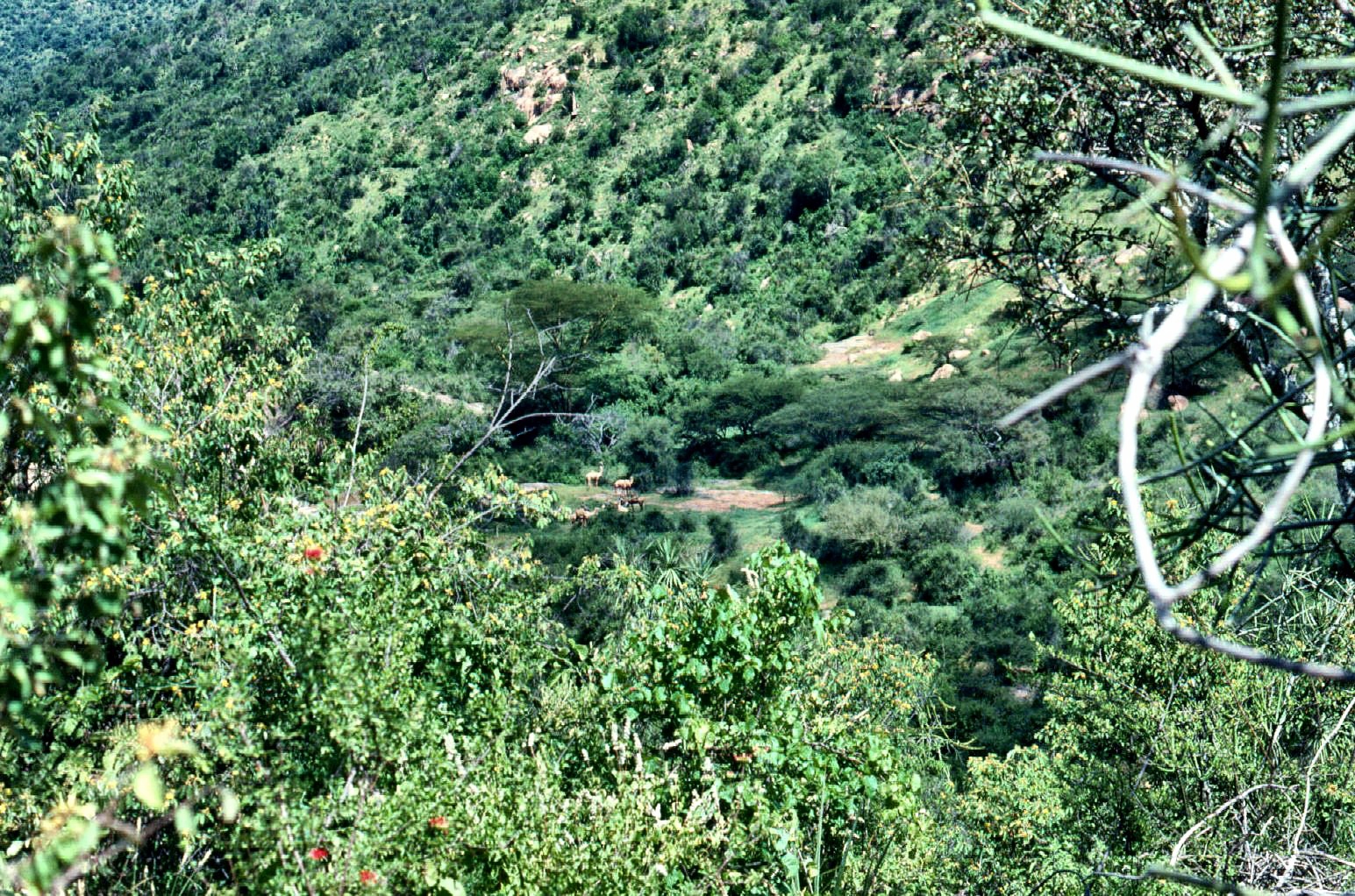
As soon as the car approached the beast I threw my improvised lasso until, after the third or fourth try, I managed to get it from the horns. That was not my idea as I aimed for the neck but it will have to do. Seen that the lasso was firm I signalled Paul to slow down and stop. The animal continued trotting as far as the rope allowed it and then, gradually, we pulled it to bring it close and finally managed to extricate the dart, spray it again (this time on the other side as well) and, with some difficulty but with the aid of a wire, remove the lasso from its horns.

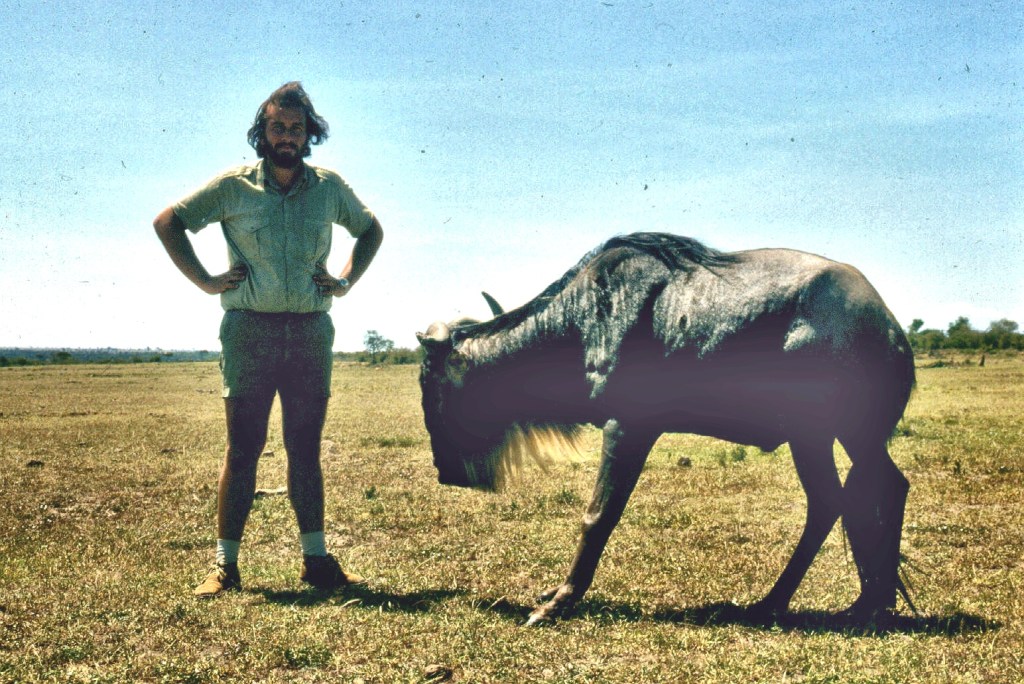
A rather dishevelled bushsnob posing with the exhausted wildebeest, waiting until it recovered fully.

[1] See: https://bushsnob.com/2019/09/01/learning-to-camp-among-the-wildebeest/

Paris-Maasai Mara

The title does not refer -luckily- to a new extravagant car rally but a tale of a French couple, friends of Paul, who arrived from Paris in the morning and that same night they were camping in the Maasai Mara, after driving all the way from Nairobi!

By chance, we arrived that same afternoon and found them looking rather bewildered after enduring not only the overnight flight but, the long rough ride afterwards following Paul’s rather ambitious programme! The camp this time was a few km downstream from the Mara Buffalo Camp -where we usually camped- and only a faint track led to it. It was a nice place, the Mara river very close and the Oloololo escarpment, the same I climbed every time I needed to go to Intona, at the back.

Paul was busy with his field work, so we came at the right time for him and we agreed to take care of the French contingent the following morning. In any case, they managed to speak some English and we knew some French words from our high school so we were sure that we would understand each other as, after all, both our languages branched off from Latin.

We waited to start our morning drive until the French were ready, which was earlier than I expected. So, soon after sunrise we set off hoping, as usual, that we would be lucky with our game drive. The wildebeest migration was in full swing and I planned to drive in the general direction of Governors Camp and be back for lunch.

By then we knew how to enter into the reserve through the “back door” and also, through Paul, we also knew the general area where the wildebeest were grazing at that time. Finding the wildebeest increased the chances of meeting large predators, particularly lions and that is what most first time visitors to the Maasai Mara wish to see.

The drive was slow as everything was new for our guests and we needed to stop for them to take snapshots of most animals that for us were rather commonplace but we understood how they felt and happily obliged. After a while we spotted the first wildebeest and soon we could see the expected large herds. We stopped to take the view in and continued driving slowly, following the woodland’s margins where the cats could be hiding.

After going for about an hour Mabel spotted a lioness. We were lucky and we stopped to watch it and to take a few more pictures. The lioness was quite active and obviously hunting so we joined her in watching the wildebeest stopping the car at a prudent distance and searching for more lions that we suspected should be around.

The lioness watching the wildebeests.

We whispered to our visitors what we thought it may happen next and we waited. After a few minutes she stood up and, undetected, walked towards the grazing wildebeest and hid in long grass, still looking towards the wildebeests. We kept scanning the surrounding area and soon we caught a glimpse of another lioness some distance away.

It seemed that the lions were coming from several directions, preparing an ambush. We calculated where the hunt could take place and slowly drove towards it still leaving a wide berth for the animals to move without interference. We switched off the engine and stopped, being the only witnesses of what was happening.

We did not have to wait too long before the what it was a peaceful scene transformed itself into a chaotic one when suddenly the bush burst with wildebeest running in all directions around us and some of them nearly bumped our car in their zest to run away! Luckily there was no dust and we spotted five or six lionesses chasing wildebeests.

Some followed wildebeests that had run into the woodlands but a couple of them run in the open. Soon we heard the agonic bleats of a wildebeest and I drove straight to the area while I heard shouts of “oh là là”, “quelle chance!” and other expressions of amazement by our Gallic visitors.

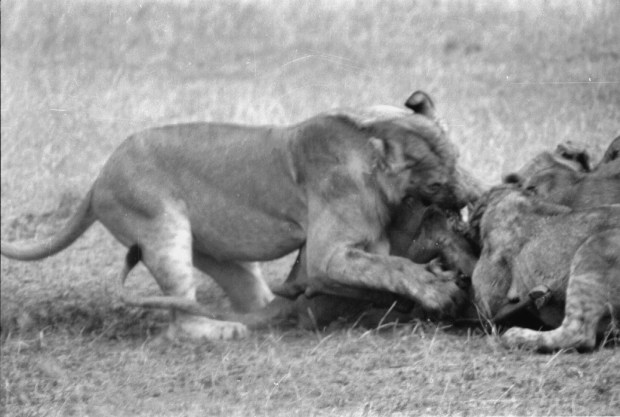
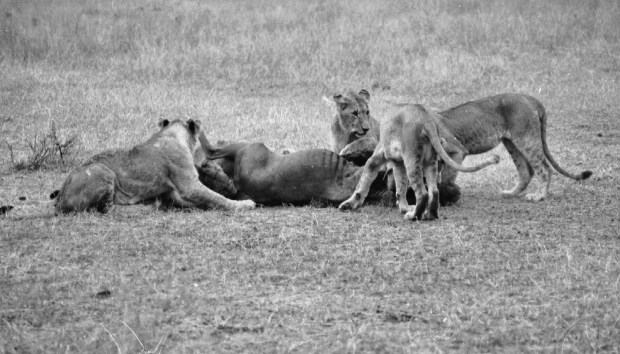
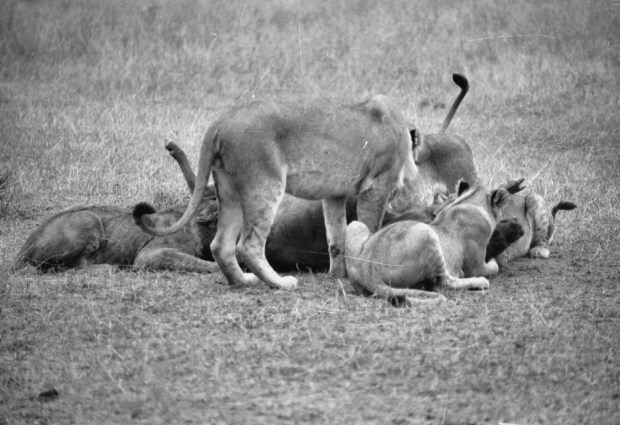
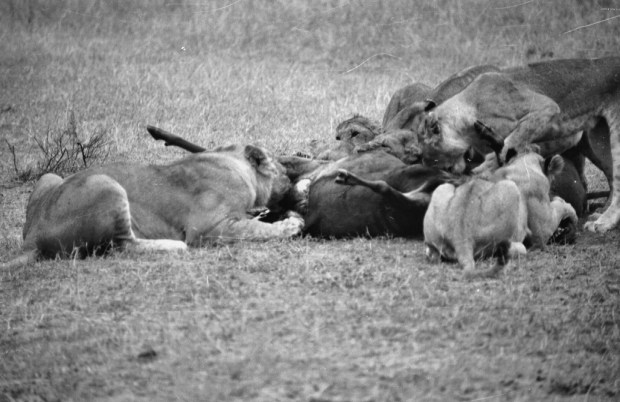
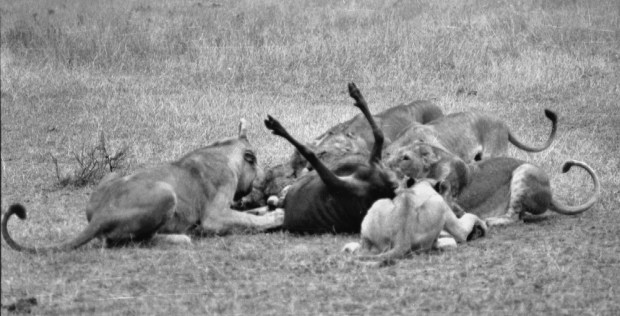
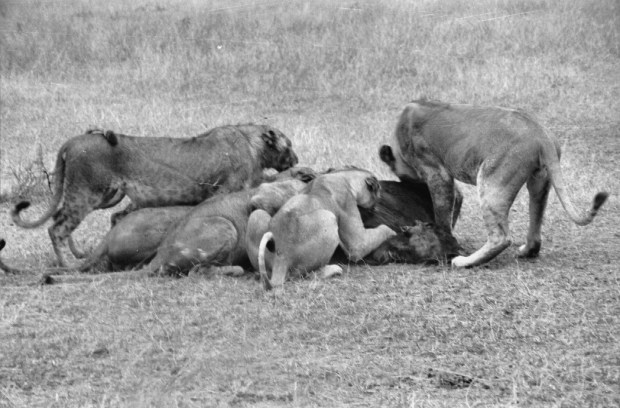
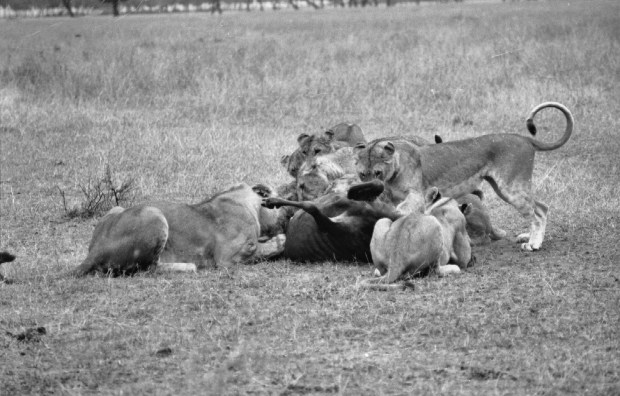
We were also excited as to watch a hunt is not an everyday event, even in the Maasai Mara, and we watched as two lionesses were busy suffocating a wildebeest by a hold in its throat while other lions, that had chased other wildebeests and failed, were trotting towards the ongoing kill. Soon, not only the females we had seen earlier but the whole pride, including adult males and young of different ages, were vying for position at the carcass and as often happens, started licking the dying animal and even feeding.

After a few minutes a couple of cars arrived but we were well placed and we spent about an hour watching the lions feast in all detail. As usual, fights broke out when the dominance of some individuals was challenged and the stronger took “the lion share”! We watched the scene mesmerized for a long while until the meat starting to run out.

Although the arrival of a few spotted hyenas and black-backed jackals was interesting, we resumed our drive I thought “after this, what else can we find that is more exciting?” but continued searching hoping that the visitors, that 48 hours earlier were in busy Paris had arrived for the first time in África and watched what some people that live there for years never manages to find!

We realized that lunchtime had passed unnoticed and we, unanimously, decided that we were not hungry so we agreed to drive following the Mara River to get to the hippo pools that were not too far. There we spent time observing hippos and the huge crocodiles that shared the pools with them. Judging by their girth, the latter were benefitting from the wildebeest presence and their frequent river crossings.

Engrossed watching animals we did not notice that a storm had gathered and we were somehow surprised to note the first raindrops. After a while the sight of the pools were obscured by the rain. Although it was a welcome thunderstorm, I knew that the kombi, although with a good clearance, did not have 4WD and therefore it was not a mud-wise vehicle. So, I took the decision to return to camp before it was too late, strongly suspecting that it was too late already!

I knew that the roads would soon be very sticky and as it started to get dark, I regretted that we have not paid more attention to the time and the weather. We moved a few kilometres back still under the rain and there was a lot of thunder and lightening. Things were not getting any better.

Rapidly, the road became a quagmire that forced me to gradually slow down to avoid skidding off it. Eventually I was forced to engage second and first gear as the going became laborious and I knew by previous experience that we were in trouble. We continued, just, and eventually the black cotton soil stopped us while the rain did not show signs to stop.

A quick and rather wet inspection revealed that one of the back wheels was stuck while the other spun uselessly. Under heavy rain I got one of the French to stand on the fender to get the wheel to grip while Mabel and the French lady pushed. I moved at full throttle with the French guy hanging on for dear life and splattering the “pushers” with black mud until I reached a drier, higher spot. I waited for the helpers to clean up and get back in the car to resume our journey. Luckily it was not too cold.

We continued to move on, push, wait and go again for a while and we managed a few more kilometres before we were stuck again and now, it was dark and we needed the car lights to see the road. I noted that our friends were not so excited leaving the car to push in the dark! Their fears were justified and now the “m” word started to be heard very frequently!

Somehow, we had enough adrenaline to keep us going and I managed to get the car up to a good speed, more than it was prudent but necessary to keep our momentum. At that time, we met a line of wildebeest on the road and I needed to slow down to avoid a head-on collision. I managed to avoid all of them but one. This particular beast came running from the side and hit us with one of its horns, leaving a deep dent all along the kombi, a scar that remained there from then on as a reminder of that trip!

Luckily, the rain decreased and the risk of getting stuck diminished but we realized that we were lost! Being dark did not help to find our bearings (we are hopeless at finding places, anyway) as we had passed a number of bush tracks any of which could have been the correct one. Then we realized that the storm was now our best ally. Every time that there was lightning we could see Oloololo escarpment and we knew that it ran parallel to the Mara river and that the camp was close to the river!

So we drove in that general direction, hoping to come to some known terrain, a difficult thing at night. Then, Mabel spotted a beam of light in the sky that we could not read at first but then Mabel speculated that it was Paul with his strong torch trying to pinpoint the camp for us.

We decided that a light meant human inhabitants so, without any arguments, we headed for the light. At some stage we recognized the track that led to our camp and we arrived a few minutes later, soaked wet, muddy and very tired.

After washing ourselves as well as we could and getting dry clothes, we met for a quick dinner heated under the tent’s flysheet as the rain was still falling on and off. Paul had heard an engine and thinking that we could be the only ones driving at night, decided to shine the torch saving us from an otherwise sure night in the bush.

As we had all gone through a lot over the last 12 hours and we started to mix languages, we decided that a camp bed was needed and we retired to our tents, still under the rain. Fortunately, our tents have kept the rain outside so soon we fell sleep with the memories of the day still fresh in our minds.

Regrettably we needed to return to Nairobi the following morning but not before sharing a good breakfast with Paul and his friends during which, well rested and calmer we re-lived our experiences, and we agreed that we had lived through a very lucky day indeed.

Green sea

I thought we were fortunate when the decision was taken for me to work at Intona ranch in the Transmara as this would enable us to frequently drive through the fringes of the Maasai Mara Game Reserve, the northern extension of the Serengeti National Park in Tanzania and the jewel of the Kenya wildlife areas.

In fact, I had no idea of the joy that this decision would bring to our lives, something we only came to understand later on and even now the great memories of our time there still linger.

To be able to soak up the immensity of its grass plains during the various seasons was indeed a privilege. We swallowed dust traveling during the dry season on roads that, when the wet season arrived, you would be skidding all over even applying the best wheel control possible! We camped in the open with no fences many times in different places and enjoyed lots of different experiences over the years, some of them I did not do today. It was there where we started to learn “the ways of the bush” with our friend Paul [1].

Even considering that we were not strictly inside the reserve most of the time, the wild animals took the centre stage as you could not fail to find them, even if you wished to! [2] At its most empty the Maasai Mara plains would be dotted with Thomson’s gazelles, zebras, topis, kongonis and the resident wildebeests. As a good friend put it while looking mainly at the herd of Thomson’s gazelle: “they look shoals of tropical fish”.

The elephants and buffaloes were always making an appearance and of course, the lions -our favourite predators- were present, first as random finds and later less so when we knew their territories and places they favoured. The spotted hyenas could be counted in dozens and they were very common and we frankly took them for granted and never looked for them as they were always there!

But when the wildebeest and zebra migration arrived from the Serengeti, the plains were so full of animals that it was even difficult to drive because of the animal density! You would also hear them all the time as they were everywhere, always on the move, even while having their young. Sights and sounds difficult to imagine (and to forget!) unless you have been there!

Apart from their main migration Serengeti-Maasai Mara, they had “mini migrations” within the Maasai Mara. Often, we thought that their motives were to look for fresh grass, but we came to realize that they followed hints we could not get, and we often thought that they were playing a game of follow the leader!

During those times of abundance predators somehow became more obvious and numerous as many would come in pursuing the migration. In particular the packs of spotted hyenas would be seen very often as well as lions, now not only the prides we were somehow familiar with but other nomadic individuals that came and went with the migration.

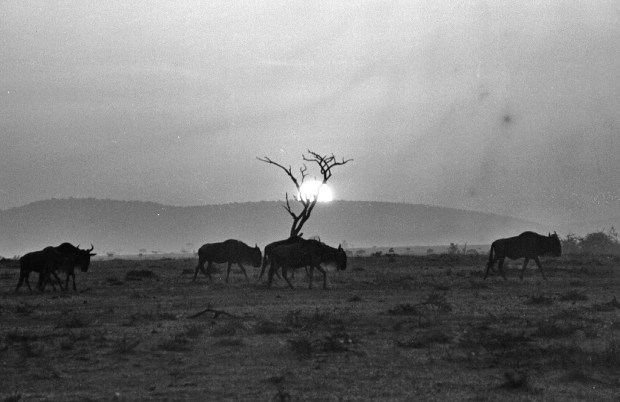
Gnus at sunrise

We spent hundreds of hours watching lions, searching for leopards, waiting for cheetah to go for the chase, trying to second-guess packs of spotted hyena while chasing their prey or watching the hippo antics at the several pools in the Mara River, while keeping an eye for the opportunistic crocodile to take the unaware drinker.

m mara rhino and calf...-001 8.55.16 AM 8.56.48 AM
Some of the few black rhinos we encountered in Kenya. These were at Amboseli National Park.
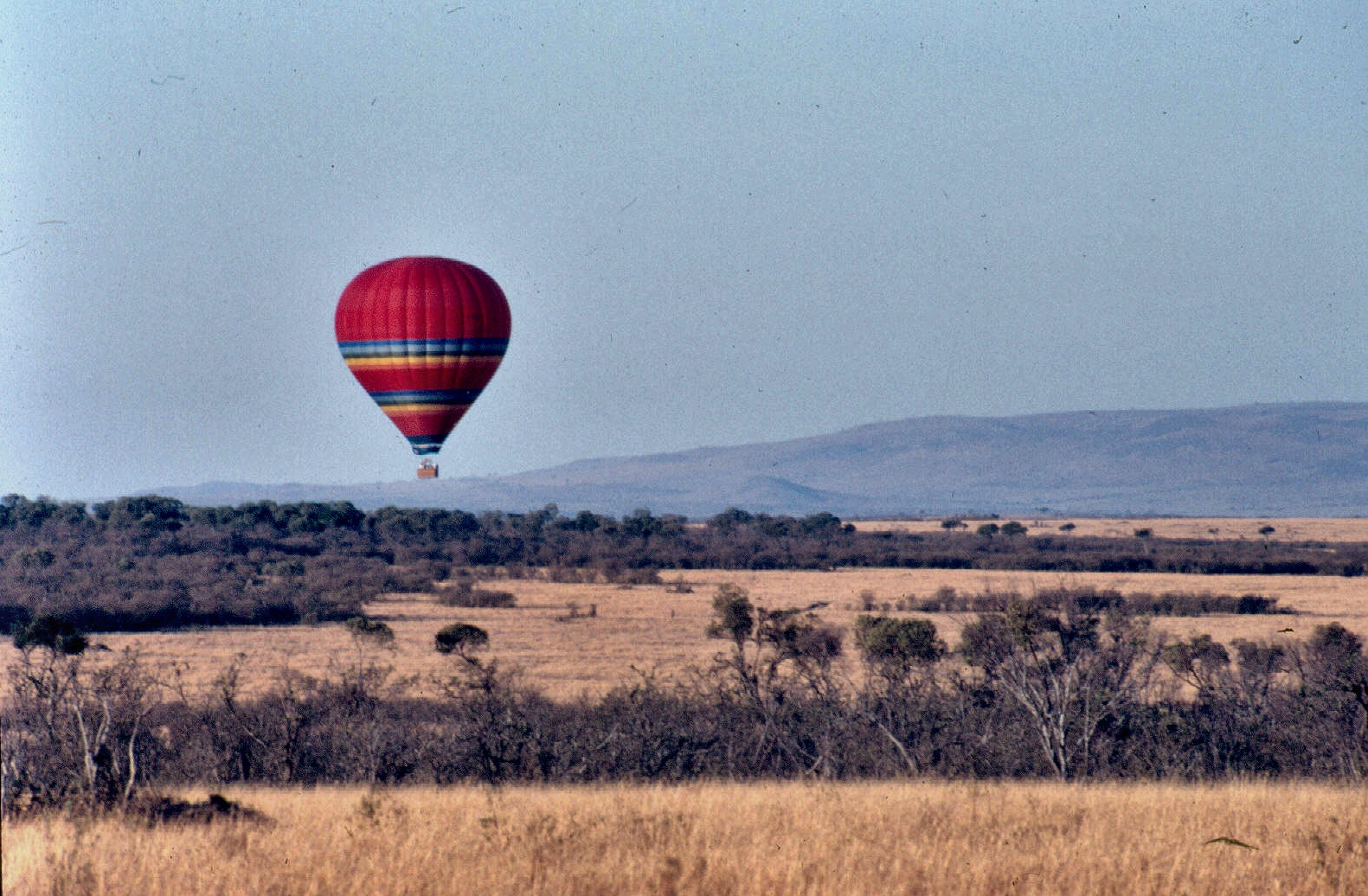
m mara baloon 1.jpg

Visiting this wildlife paradise also offered the chance of seeing the Maasai pastoralists walking on the various tracks, red specks in the vast distances, apparently oblivious to the myriads of animals surrounding them, their full attention on the welfare of their own animals.

As expected, over the years we lived through many events, luckily nothing that went wrong could not be righted and that was a very important condition to enjoy our experiences. I will try to narrate to you some of the anecdotes that took place during that time that I still remember so many years later.

I already described my journey to the Transmara that included passing through the periphery of the reserve [3]. There was a tar road from Nairobi to Narok, the Maasai capital and the last town to load fuel and any last minute items you forgot, although the choice was not that great. There was, however, a chemist and a restaurant where you could have “nyama choma” (roasted beef) with ugali (maize meal) easily and fast or, if you were feeling picky, the more elaborate chicken and chips (oil-soaked) for which you needed to wait quite a while longer. Your commensals would be mainly Maasai that were only too happy to have you with them after having deposited their spears and “rungus” (wooden throwing clubs or batons) nearby.

We never stayed there longer than a couple of hours and, usually we would drive through after refuelling. The stop at the petrol station was, at first, nothing out of the ordinary. However, later on we started noticing that the minibuses also stopped there, and, during the pause, they offloaded their passengers. The wealthy among the latter took their safari to Kenya very seriously and dressed better than the real hunters with clothes from famous brands!

The road from Narok until you reached the Maasai Mara Game Reserve proper was about 130 km, depending where in the reserve you would go. The first 85 km to Aitong were rough, dusty and corrugated but never muddy as it was a well consolidated road. But it will hammer your suspension severely.

A series II Land Rover we saw there holds our most extreme record of suspension destruction we have seen. It was returning to Narok with still about 20 km to go and it came towards us zigzagging badly. We moved off the road and stopped to let it pass. It was crawling to get back to Narok with the front spring leaves (on both sides!) sticking up the front of the car, as high as the bonnet, I believe soon to come out with unknown consequences, its crew looking rather anxious!

From Aitong you followed straight on through a smaller track, gentler on your car but dusty most of the time and muddy during the rains. Luckily, either when going there for work in the strong LWB panel van Land Rovers or in our kombi first and then our SWB Land Rover, we never broke down and had only punctures and mud-related delays.

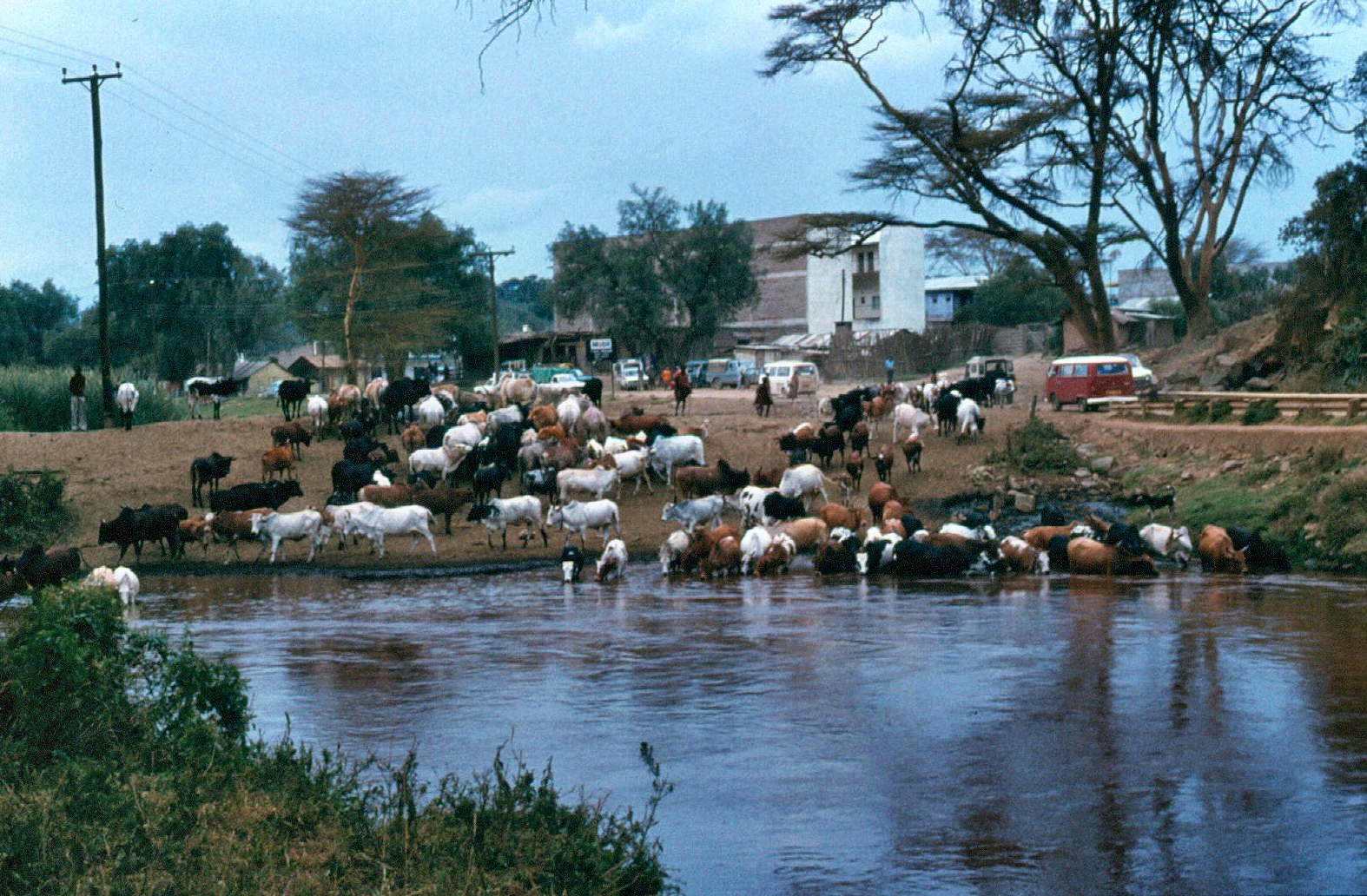
narok town and maasai cattle copy
Going out of Narok. Maasai cattle drinks at the dam while the traffic goes by. Note the red VW kombi, the dominant minibus at the time.

During the first three or four years the VW kombis were the kings of the tourist minibuses and there were hundreds of them moving people to and from Nairobi so spares and service were available all over. Incredibly, later, VW introduced a new model and it was immediately apparent that it had a few shortcomings. Its large back doors kept opening and even bending so the owners resorted to welding them all around to avoid the problem with the result that loading them became a challenge!

We had a first-hand experience with one of those new models when we were following it at a distance to avoid the dust. At some stage we saw its right back wheel starting to separate from the car! We slowed down expecting a serious accident, but the wheel continued parallel to the car.

We then noted that the wheel had the axle attached to it still and this saved the car from a more serious accident giving it some stability albeit precarious. We hooted and made light signals but the driver did not stop and, eventually wheel and axle went their own way, and the minibus entered the bushes and came to an abrupt stop!

This was the beginning of the end of the VW domination and the start of the Toyota and Nissan era!

But not only the new VW kombis suffered from the “open backdoor syndrome”, we did too! It happened once we were returning from the reserve in our Land Rover and suddenly, we felt a welcome breeze, quite an improvement from what the small windows and front vents provided.

It was not until most of our cargo had gone that we noted that our -rather wide- backdoor was open. Perhaps we had driven two hundred metres like but it was sufficient to offload most of our belongings, including our cool box, tent, chairs, sleeping bags and personal luggage that rested in the middle of the road. Luckily no cars were coming behind us and we managed to pick up all the stuff. We needed a new cool box though!

Unfortunately, during the same journey when perhaps we were in a hurry or more casual than usual, we also lost our double mattress that “flew” from the roof. That was a great loss as it had been specially cut to fit within the roof rack if you wished to sleep in the first floor during hot nights. We only noted its absence after we arrived home and I am sure that there was a happy Maasai couple that slept comfortably from then on!

Another inattention led us through a more interesting situation. While driving during the rainy season, as we were prone to get stuck and also to find people stuck, we always carried a thick jute rope that, depending on its last use, it would be tied up either to the front or the back of the car and rolled up there as it was usually very muddy and also it occupied lots of space inside our short Land Rover.

Somehow, during one of our game drives the rope, that at the time happened to be at the back, became undone and, inadvertently, we were dragging it behind the car. We would have discovered this in due course but as it happened, a third party did it before us!

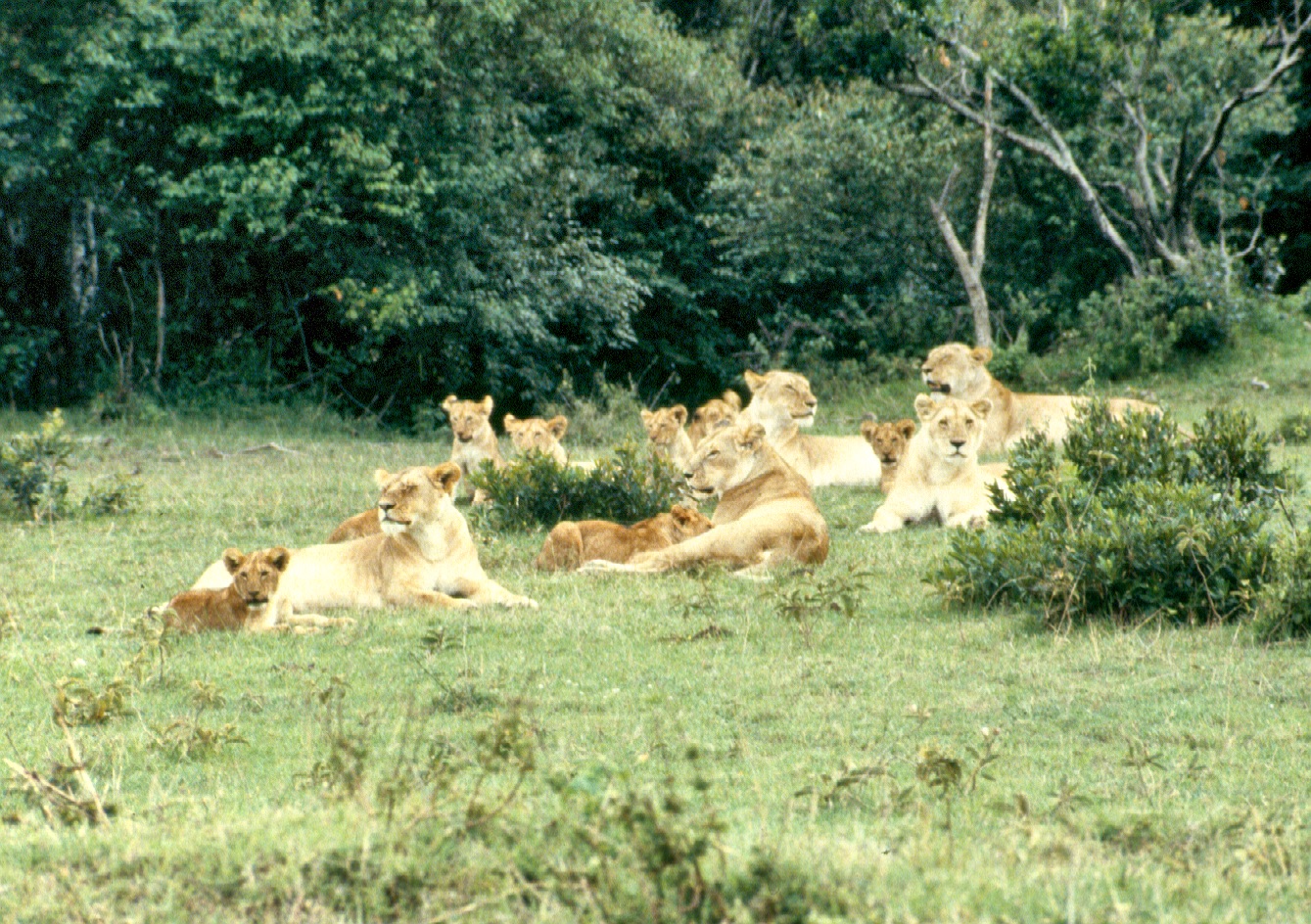
Lion pride M Mara 6.54.19 AM copy
A lion pride, similar to the playful one.

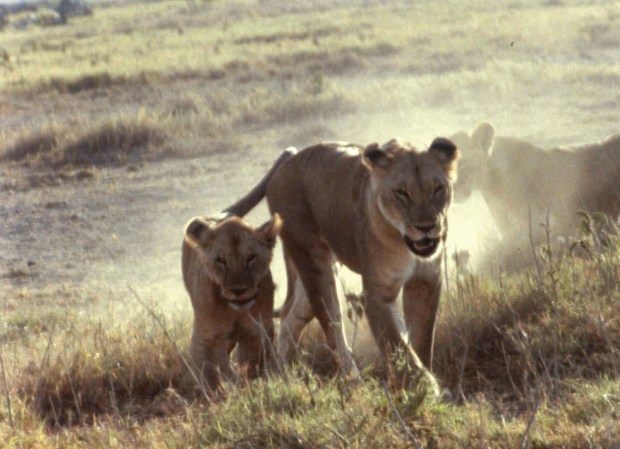
The pride of lions we found resting around a termite mound, like pussycats do, unusually, started following our car. Things started to unravel when a few seconds later we felt a light jerk and, when we stopped we could see that about four or five cubs and three lionesses had grabbed our rope and were busy trying to kill it while being dragged by us.

Trying to free ourselves, we stopped and re-started but the lions, clearly in a playful mood, still held on! With no other option, as we were not going to get out of the car to chase them off, we continued driving slowly for a while with them behind until they started leaving the rope to return to their friends that had not bothered to leave their resting place.

The abundance of lions offered good opportunities to watch them hunting, either spectacularly chasing their prey or setting up ambushes and waiting for the possible victims to walk past. Sometimes their job was made easy by the victims’ accidental contribution.

One early afternoon we witnessed an unexpected kill while watching one of the large prides resting. Most of the lions were snoozing or just resting under the shade when suddenly we saw that some lionesses stirred and instantly they were fully alert before we knew what was happening.

Scanning the area, we saw a young warthog running towards the lions, unaware of their presence until it found itself among them and, by then, it was too late. Although the lions had eaten, they could not resist a chase and a couple of lionesses went for it. As the warthog was coming at a speed, it managed to avoid the attackers by swerving around them as these animals are very fast on short runs and the lionesses were full of meat.

Unfortunately for the warthog, after managing to cross a rather large pride it almost bumped on a large male lion that all it had to do to catch it was open its mouth! That was the end of an intrepid but careless warthog.

While on the subject of warthogs, we loved them running with their tails up as if having radio aerial to keep in touch with each other! As it sometmes happens, driving through a narrow track we surprised a family of warthogs that crossed in front of us. Unfortunately, one of the piglets (despite having its antenna up!) got separated from the others and started running on the other side of the road trying to reunite with its siblings.

We stopped to let it do it and then we heard a rather loud “swooosh” and saw the huge shape of a Martial Eagle coming straight and fast towards the separated youngster. The eagle hit the piglet with its talons and held on to it while the poor victim squealed and squirmed trying to get away. Then the eagle tried to take off and flew a few metres with its prey but it soon dropped it. The piglet hit the floor running in the direction where we had last seen its family. The eagle did not chase it but I guess that the unlucky warthog could not live too long after such an attack.

The opportunism of the eagle still amazes us. It must have been watching the warthogs either from a nearby tree or flying above them when the incident happened.

It is well known that cheetah -due to the need to see where they step when they reach high speeds- are diurnal hunters. The Maasai Mara offered them perfect ground to reach their top speeds while chasing their favourite prey ther, Thomson’s gazelles. We did find cheetah sometimes and were lucky to witness a couple of chases, one of which ended successfully.

This particular cheetah was a female and, after strangling its prey and resting, it started to emit high pitch calls that were answered by the arrival of two very young cubs that she allowed to play with the dying gazelle and, after a while, the female killed it and started to feed. It ate quite a bit of the hindquarters and only then allowed its cubs to try it although I think they were still too small to eat too much meat.

After a while of watching the trio we noted the approach of a large spotted hyena, clearly attracted by the commotion and the smell of death as it usually happened there. Clearly the hyena was stronger than the cheetah and its cubs were also at risk.

We expected the cheetah to yield and move away as it had eaten a good part of the animal already. It did not happen! Following some signal from their mother, the cubs vanished, and the cheetah stayed to face the intruder. We feared for its life as the hyena was clearly stronger and appeared determined to fight. Amazingly, the cheetah almost doubled its size as it bristled. Then, the new “super cheetah” went for the hyena.

As the hyena did not retreat, a prolonged face-off over the half-eaten gazelle followed but the cheetah would not back down either. Finally the hyena decided that what was left of the prey was not worth it and scampered off. Once alone, the cheetah returned to its normal size again, called its cubs and resumed feeding on the gazelle until most of their hindquarters, its richest part, were gone.

At that time in the Maasai Mara there was good “bush solidarity” and people would exchange information on their sightings. I confess that at first we relied a lot on the tourist vehicles from the various lodges to find game without asking them and by following them at a prudent distance.

As we started to learn our ways we gradually stopped this practice but we kept finding very helpful people that gave us great information. The Manager of the Mara Buffalo Camp was a good example. Apart from letting us camp in the area and use the lodge “facilities”, he was also a good source of information.

Through him we learnt that a female leopard had come to inhabit in a rocky gorge nearby. The animal was, unusually, very relaxed and allowed vehicles to approach her. The Manager, very excited about the find, asked us to follow him to show us where it lived and we obliged. We found it rather easily and from then on “Leopard gorge” as we called it became a constant feature of our trips to Intona ranch as, invariably, we would do the detour that went through the gorge to see if we could spot the leopard.

After a while the leopard disappeared and we did not see it until, a fortuitous encounter with Jonathan Scott at Kichwa Tembo. Exchanging news, he told us that he was following a female leopard with cubs and explained where to find it. “In any case”, he said, “if you miss her, you will spot my car!”

A few days later, we found Jonathan’s green Land Cruiser before we could spot the leopard and then, nearby, we spotted the three leopards. The mother was putting up with her bothersome cubs and their rough play. The cubs were still very young and rather dark, and they enjoyed climbing rocks and trees in a never-ending active mood. I took all the pictures I could and soon run out of film!

After a while we needed to continue our journey to so we went to thank Jonathan for such a great tip. I made a passing comment of how great it was to watch the animals and that I had taken lots of pictures. His reply clearly marked the difference between a real pro and an amateur like me “I did not take any today because the light is not right”. I kept quiet and eventually bought his great book on the leopard [4] to enjoy the pictures I could never had taken but with the nice feeling that we knew both, author and subject!

While on the issue of the rare observation of leopards we did have another close and surprising encounter. With our friend Luis, we had been driving over the plains for a while when we decided to stop for a rest and a bite. So, we parked under a nice tree near a rock ledge and we were eating when an agitated driver of an open safari vehicle came to tell us that we had stopped under a sleeping leopard! We checked and, effectively, it was resting above us. Luckily it had ignored the three large monkeys sitting, eating, drinking and talking below.

So these was a collection of brief observations and experiences we went through during our many visits to the fringes of the Maasai Mara and the reserve itself. More lengthy adventures follow soon.

[1] See: https://bushsnob.com/2017/01/25/camping-in-kenya-maasai-mara-game-reserve/ and related posts.

[2] Southern Africans say, with a tinge of jealousy, that animals seem to be tied to pegs on the ground, so visible they are compared with their game watching in the “jesse”.

[3] See: https://bushsnob.com/2019/05/31/traveling-to-intona/

[4] The well-known photographer and author that was based at Kichwa Tembo at the time, working on his books. “The Leopard’s Tale” is about this female leopard. See: https://en.wikipedia.org/wiki/Jonathan_Scott_(zoologist)

Deep sea fishing

Watamu was one of the best places for deep sea fishing in the African side of the Indian Ocean so, a group of male friends (bushsnob included) decided to travel there a weekend to try our luck, despite the displeasure of the wives that were left behind!

We left Nairobi on a Friday afternoon in a rather luxurious car for that time, a Peugeot 604 belonging to one of my friends. As the trip was organized at the last minute, we did not have any bookings for a fishing boat but we were sure to find one ready to take us. We were spending our two nights at the Ocean Sports Club and there were lots of fishermen with boats for rent there.

My friend drove fast -too fast for my taste- but the car responded and we got to Ocean Sports before sunset. Later, at the bar, we managed to find a boat for the next day that would take us fishing. The idea was to fish from 06:00hs to 16:00hs and to share all expenses between the four of us.

So it was that, full of anticipation, we got up before sunrise and drove to the harbour from where our fishing boat operated. To prevent seasickness I took a strong dose of dimenhydrinate (Dramamine) and I was ready to go.

We traveled quite a distance until we did not see land anymore. I was fine as I also avoided looking close to the boat but far away. Although I did not feel seasick, I felt half-sleep because of the drug for a good part of the morning until I started to regain consciousness. Nothing, however, prepared me for the inhaling of the engine fumes at the back of the boat and we soon decided to travel at the front, at least until the fishing started.

Once we reached the right place that I must say looked like any area of the sea we had sailed through, we slowed down and a number of rods with the expected large reels chained to the boat were thrown while we solemnly drew straws to determine the order of the fisherman in the “hot chair”, the one with the best chances of getting strikes.

I had the shortest so if the fishing was bad, I may not even had a chance to fish! However, it was fun to be there anyway. Luckily I was wrong because at some stage we went through a shoal of tuna when all rods had fish in them and chaos followed as they were running in all directions and the lines got badly entangled!

I had one in one of the rods and quickly learnt that in the sea, as compared with a river, there is practically no bottom and the fish can run for many metres aiming for the deep, something that was disconcerting at first but I got used to after a while.

Soon lines broke or needed to be cut and only one of us managed to land a tuna while the crew aptly guided us on what to do in a situation like this and quickly repared the damage as they were clearly used to this kind of incidents.

The ultimate goal of the trip was to catch a large marlin as these beautiful gamefish are known to be present in these waters. We agreed that we would attempt marlin fishing later but before we would try for other species such as falusi (dorado), kingfish, tuna, bonito and barracuda to name a few of the most common. If we were lucky we could catch sailfish but they were not easy.

After a couple of hours fishing my friends had caught their fish, including a sailfish, a truly beautiful fish. By then it was very hot and the situation was not too good as one of my friends was sick on starboard while a member of the crew was suffering from diarrhea and he was occupying the bow. that we, politely, left empty until he recovered.

That was the situation when I started my turn, under a strong sun, sweating and waiting, focused on fishing to avoid seasickness or worse!

After about an hour of nothing happening I saw the unmistakable head of a sailfish with its open bill breaking the surface of the sea towards the back of the boat and I shouted “look, there is a sail…!” but I could finish the sentence as a fish took off with my lure! It was the very sailfish I saw that had taken my lure and I only realized what it was when it jumped entirely outside of the water. (I could not find any pictures of this fishing trip and I failed to embed one from Getty with the new WordPress editor!, sorry).

Sailfish leaping, just thrown the hook, the one that got away. Credit iStock by Getty Images.

The fish fought well, jumping repeatedly and, after about thirty minutes I landed a 37 kg sailfish, the biggest fish I have caught! I would have loved to put it back (as we normally do with all fish) but I was explained that all fish caught would go to a local fishing community that would sell it to the Watamu lodges so I had no option.

Although later we trolled deep seeking to hook a marlin by using a humongous hook with a whole -although small- tuna as a bait, we failed. However, we returned to port with some glory and displaying the fish flags that indicated our catch!

That evening at the bar our fish grew to amazing proportions … We were tired, sunburnt and quite dehydrated so, after a light meal and drinking lots of water and some beer we were ready to go to bed.

The following morning we left for Nairobi, again, at a high speed. too much for me as the car was quite loaded and it was very hot. So we drove until Voi when a red light was noticed but it was ignored by the driver as, apparently, it often appeared often for no apparent reason.

By the time we got near Mtito Andei with still 233 km still to go, the car lost power and we crawled into Mtito Andei where we stopped. Thick blue smoke was coming from the engine compartment and it got worse when we opened the bonnet as the engine was boiling! We waited for it to cool down but it would not start again and we suspected that it had ceased.

We then decided that the car should be left there for it to be recovered the following day and we decided to wait for the next Akamba bus to Nairobi that only appeared when it was already dark. We arrived at Nairobi at midnight and Mabel was not amused with my performance and explanations and it took her a few days to calm down!

Cannibals!

I already described hippos competing with crocodiles to eat their impala prey at Masuma dam in Hwange National Park [1] and this observation was part of a comprehensive publication on the transmission of anthrax among hippo populations [2].

5 - Hippo rescue attempt at 2 second view

Hippos trying to get an impala carcass away from the crocs.

The 2018-19 rainy season in Zimbabwe was very poor and Hwange National Park was no exception receiving much less than its 576 mm yearly average. So, during a visit in mid-September 2019 the park was very dry and several of the pans were drying or already dry.

This situation was also severely affecting some of the dams that require pumping to keep an acceptable water level. Both Nyamandhlovu and Masuma dam pumps were hardly able to cope with evaporation and elephants’ thirst despite working full time.

IMG-0099

Only one hippo was seen at Masuma of the usual number of about sixteen individuals that we had seen during earlier visits. We believe that the missing hippos had moved to Mandavu reservoir, a much larger water body situated 15km away.

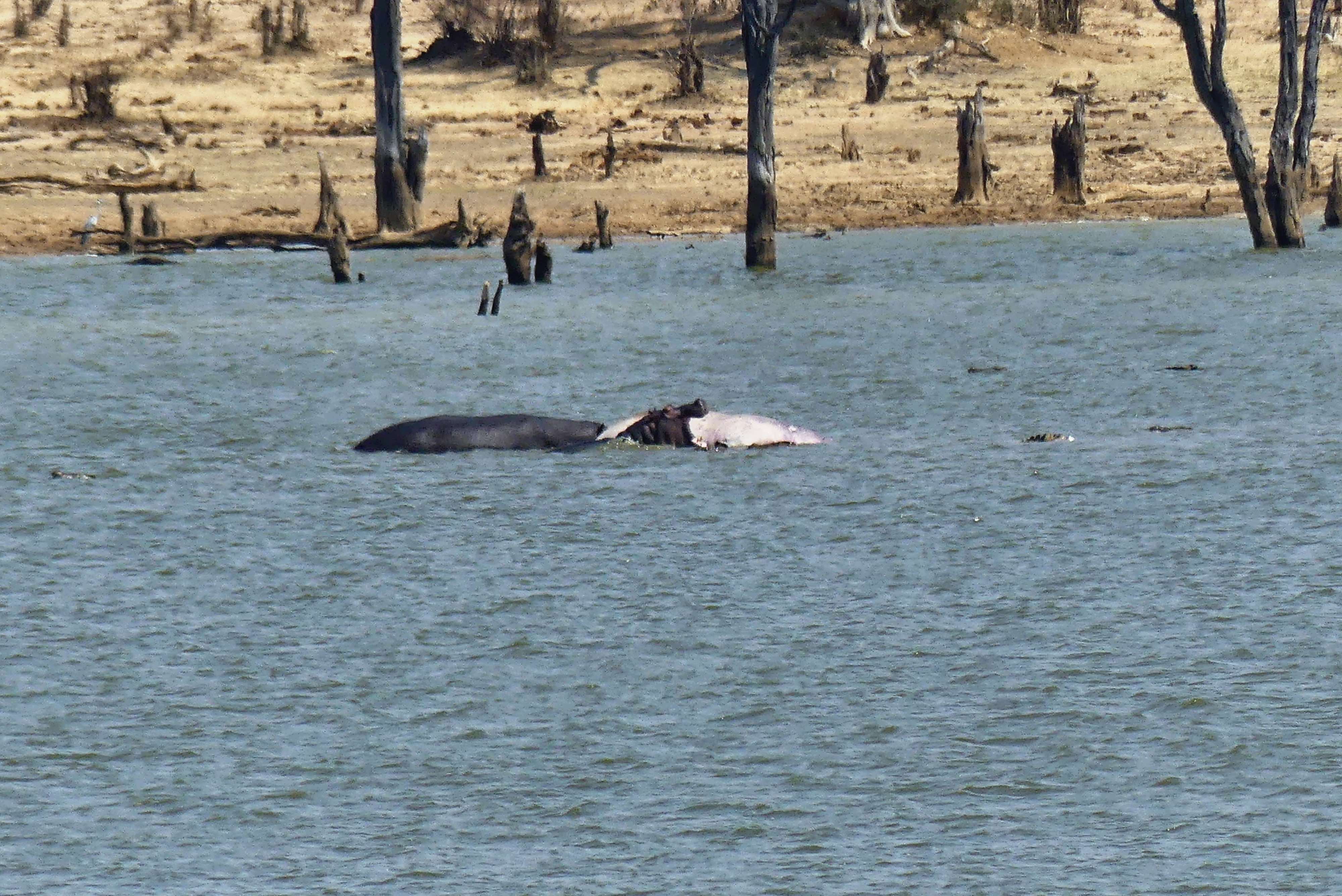
So, we went to visit Mandavu and noted a large number of hippos still there as there was plenty of water. While observing the hippos we noted a dead one floating close to the shore opposite to the picnic site and, as expected, there were a number of crocodiles surrounding it.

1 Pic JA copy

Hippos and crocodiles around the dead hippo carcass. Credit: Julio A. de Castro.

There were also a few hippos and they were feeding on their dead relative!

2 Pic JC copy

Hippo feeding on the carcass. Credit: Julio J. de Castro.

Joe Dudley has mentioned to me that he believes that hippos are not able to open up a carcass and that they depend on natural fermentation or on other carnivores to do so in order for them to feed. It is likely that the crocodiles had eaten part of the carcass and the hippos were taking their share. The hippos were seen pushing the carcass and submerging to later emerge chewing and swallowing.

After about one hour the wind started blowing the carcass towards the centre of the lake and the hippos did not pursue it, staying at the opposite shore with their pod.

This is not the first report of hippo cannibalism [3] but the present observation adds the Mandavu reservoir to other areas in Africa where this phenomenon has been reported.


[1] See: https://bushsnob.com/2015/02/22/hippos-from-hell/

[2] Dudley, J. P., Hang’Ombe, B. M., Leendertz, F. H., Dorward, L. J., de Castro, J., Subalusky, A. L. and Clauss, M. (2016), Carnivory in the common hippopotamus Hippopotamus amphibius: implications for the ecology and epidemiology of anthrax in African landscapes. Mammal Review 46 (2016): 191-203.

[3] Dorward LJ (2015) New record of cannibalism in the common hippo, Hippopotamus amphibius (Linnaeus, 1758). African Journal of Ecology 53: 385–387.


NOTE: This post has been adapted from the following publication: de Castro JJ, de Castro M, de Castro JA, and Ruiz Teixidor P. 2019. Hippo cannibalism. Biodiversity Observations 10.14:1-3. https://journals.uct.ac.za/index.php/BO/article/view/828


Camel safari [1]

While in Kenya we always wanted to explore the north on a camel safari but the cost was an important deterrent so we left Kenya for Ethiopia in 1988 without achieving this goal. However, two years later, while on our way to a new job in Zambia, we stopped in Kenya for a while and decided to join forces with our friend Susan and to go for it.

She knew a company [2] that organized these activities and made the bookings for the three of us. A couple of days before we were to depart, some unavoidable work commitment cropped up and Susan were unable to go. She volunteered her very good friend Gai to come with us. We had met Gai a couple of times while visiting Susan during our earlier Kenya days. Although we did not know each other that well we agreed to travel together.

We drove Susan’s car to Rumuruti and from there we were taken to the company’s base camp where the journey was due to start. The idea was to travel for four days along the Milgis River and then get picked-up by a car and taken to Rumuruti to spend the night, collect our car and return to Nairobi the following day.


We arrived in the morning and already the camp showed great activity as the camels, really huge when you stand next to them, were being loaded. Dromedaries are the tallest of the three species of camel and adults can reach 1.7 to 2 m at the shoulder and weigh between 300 and 600 kg.

While the beasts complained loudly while their loads were tighten we were given a brief on what to expect and other useful information for the trip. With us was a group of four Europeans that kept very much for themselves, and a British couple that, as expected, was very polite!

We learnt that the idea was to walk or ride for a few hours each morning, have a lunch break and a rest and continue for another two to three hours until we arrived to the next camp that would have been organized ahead of time. We would stay there the night and the exercise repeated for the remaining days. It all sounded very civilized and we were ready to start.

There was a senior guide and a number of camp hands, most of them Samburu that, although did not speak great English we could communicate with our basic Swahili. However, we were very pleased to see that Gai was very good at it, the fruit of her many years of work as a teacher in Baringo. In any case, they were all nice and helpful so the atmosphere was positive and we started to get on well with Gai and it became clear that we would enjoy our time together.

Observing the camels being organized, we noted that they played different roles. Immediately we started making our own groups. That is how we defined camping camels (carrying tents, chairs, tables, etc.), riding camels, first aid and laggards camel (to mend blisters and pick up strugglers, just like in the cycling races!), bad camel (called Sungura [3]) and food and bar camel. The latter Gai and I attempted to follow, not because of being hungry, but the longer legged beast was always moving faster than us so we could only catch up with it at the end of the day when we did our best to lighten its liquid cargo.

Daily, the camping and bar camels would go ahead to set up the next camp while the others would stay with us and we were careful to keep our distance from Sungura that showed its bad temper at all times and repeatedly attempted to chew us, particularly Gai that, for some reason, became its preferred target!

camel safari 4

Sungura makes sure to be heard!


camel safari 5 copy 2

A view of the camels ahead of us.

Our relations with the other travellers were going well until we discovered that the European contingent, of the kind that attach their flags to their rucksacks, had borrowed our sunblock cream without asking! This was an offence that gave us ammo to criticize them whenever the opportunity allowed. From then on we kept our suntan cream under tight control so that it would last until the end of the safari.

After a couple of days walking in Samburu country where we found numerous cattle, sheep and goat flocks, we detected that one of the members of the European group was showing clear signs of crotch rash (inner thigh rash) and walking was becoming increasingly difficult for him. We decided that camel riding would alleviate his predicament and had a go at it.

Apart from intimidating prospective predators (and riders!) by its share size and strength, camels can defend themselves very well and have a number of ways of doing so, apart from their unpleasant screaming and grunting. They can stamp their feet, kick in all directions with the four legs, bite, belch and spit so to mount on one is not something to be taken lightly.

After you overcome your ancestral fears -but always thinking, “why am I doing this?” you approach a lying down camel making sure that it was not Sungura. The beast looks inoffensive enough and with the help of the herder you take your seat in the middle of the one hump. You have a precarious siting arrangement as in front of you there is the neck and head and behind is the camel abrupt end so you need to hold on.

Once you are firmly wedged on your riding saddle the action starts by the beast standing up. This is a most traumatic event as it first stretches its back legs and, suddenly you are in danger of killing yourself by falling over its head. Before you fall, luckily, the beast stretches its front legs and up comes its massive head that misses yours narrowly and, if you are still on, you find yourself very high from the ground and in great danger of a serious fall.

I had grim misgivings about driving my camel as I was sure it would end bad for me. Luckily the handler would hold the reins and walk you following the path. The ride is very comfortable as your backside is well pampered and the animal’s gait is really pleasant, more so than horses. The position affords you a great view of the countryside over the surrounding bushes and I must admit that I enjoyed the ride.

Unfortunately this only lasted for a few minutes as my beast, perhaps sensing my dislike or because I was heavy, decided that it had enough of me and it started to walk closer and closer to the abundant thorn bushes. Then, despite the efforts of the handler, the inevitable happened and my naked legs got painfully rubbed against thorns.

That was enough for me and I immediately asked to be spared from such a torture as I would have ended without skin in my legs if I would have continued. Relieved, I descended from the beast while promising myself never to do this again

Gai suffered a similar experience and we both compared our scratches later while trying to clean and disinfect them. Mabel, as usual and to our annoyance, enjoyed the ride tremendously looking as if she had done this her entire life! She spent about an hour traveling by camel and spotting birds and animals that we were not able to see from our lower position and finished looking as fresh as ever!

Unfortunately the camel ride did not help the European rash sufferer and, from a distance we witnessed a Europeans-only meeting with the lame guy as the centre of attention. Although at the time we did not know what the outcome of the meeting was, the answer became clear when the following morning the Europeans were evacuated. Probably walking in the heat was too much for them to bear coming from a place near the North Pole!

Our party got reduced to five and we were happy that there would be more resources (read food and drinks) to be shared among the “survivors”.

Every evening at the end of the day we would arrive at our flying camp that had been set up at some chosen location by the river that never disappointed. The camping chairs were set up overlooking the flowing water where we enjoyed sundowners after our hot bucket showers.

That was the time for talking and to compare notes with the only remaining companions, the British couple. We learnt that he had been very successful with a lighting company in the UK and that he had sold part of it and, retired, were doing the best to enjoy life.

While we talked and drank, dinner was being prepared. It was simple but tasty and to be eaten under a the stars while the camels lied down and chewed their cud and the herders got ready to settle for the night among the beasts. After dinner we also settled down in the tents already assembled for an early night.

The day before our departure, after a good English breakfast, we walked for a few kilometres until we stopped for lunch at a place with a great view of the river below us. We could appreciate the palms that fringed the Milgis margins and we could also see a few animals in the distance, particularly giraffes and greater kudu.

The final camp was a more permanent affair composed of simple reed huts fitted with mosquito nets where all our bedding was already prepared for us. I decided to go for a shower but before starting, I spotted that the two people usually in charge of the showers, were seated together looking at something and brandishing a Samburu “seme” [4].

Curious, I approached them and although we had communications difficulties they showed me laughing that they were trying to repair something that on more close inspection happened to be a wristwatch! Quite sure about the outcome of the operation I left them to it and went on to enjoy my shower.

cam saf watching repair with panga while shower water copy

Wrist watch fixing…

Eventually, after a very enjoyable four days it was time to return and we were taken to Rumuruti, our starting point, where we spent the night at the Laikipia Country Club (founded in 1926) where Gai barely slept as the hyraxes screamed on the roof of her cottage all night! We did not hear a thing and slept through.

It was a great experience not only because the walk was very enjoyable but also because we became friends with Gai, a friendship that lasts until today.


[1] Although I refer to them as “camels” in fact the animals that accompanied us were dromedaries or one humped camels (Camelus dromedarius).

[2] Nowadays called Wild Frontiers Safaris that also runs the Milgis Trust, see: https://www.milgistrust.com/

[3] The KiSwahili word “Sungura” in English means rabbit.

[4] A “seme” or “simi” is a Maasai word to describe a short sword with a leaf-shaped blade and a relatively rounded tip.

To the cradle of mankind – The return

Someplace in the Chalbi desert

turkana safari chalbi desert...

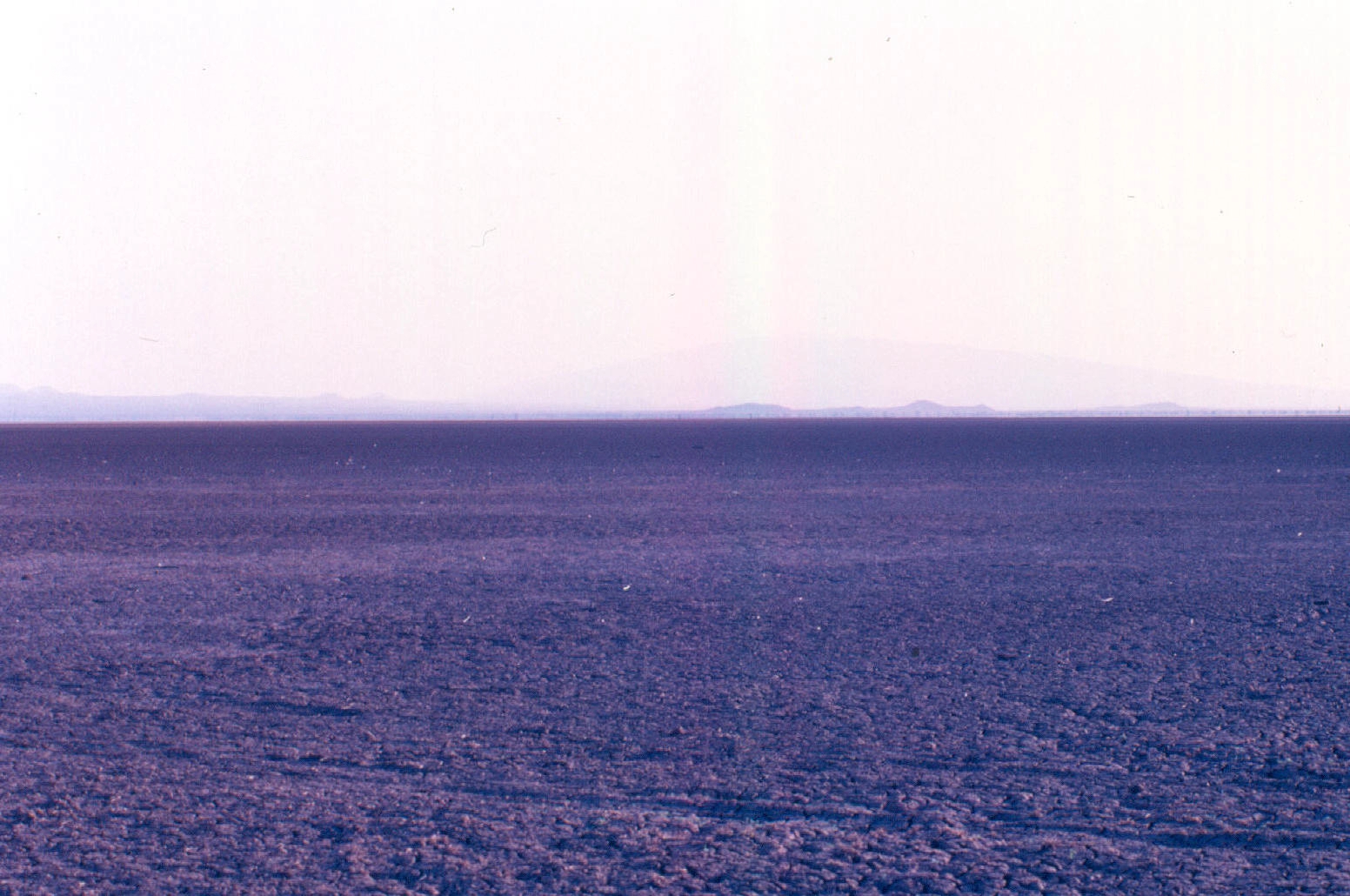
The vastness of the area.

Too soon the time to leave Koobi Fora arrived and we headed back to Nairobi. Luckily we would still visit a couple of unknown and hopefully interesting places. We planned a different route that would take us across the Chalbi desert to Marsabit National Park and then to Nairobi, via Archer’s Post and Isiolo and the start of the asphalt.

Turkana safari Land Rovers copy

A stop on the way.

The road was very rough and, after a while we started having punctures, first in the trailer, then Paul’s car had two more and, finally, we had one. We were in a tight spot as we had no more spares and from then on, we would need to disassemble them to patch the inner tubes, a hard job with large wheels such as those of the Land Rover, particularly pumping them back to the needed pressure!

We continued our journey and after a while got to a vast expanse of cracked red soil where soon became the only feature we saw. We had arrived to the Chalbi desert, a little known desert outside Kenia. We planned to cross it assuming that we would be able to follow the wheel marks from earlier vehicles as we carried no electronic orientation devices then. Despite following a few tracks that, luckily, soon ended nowhere, we managed to get to a promising track although we did not find anyone to consult!

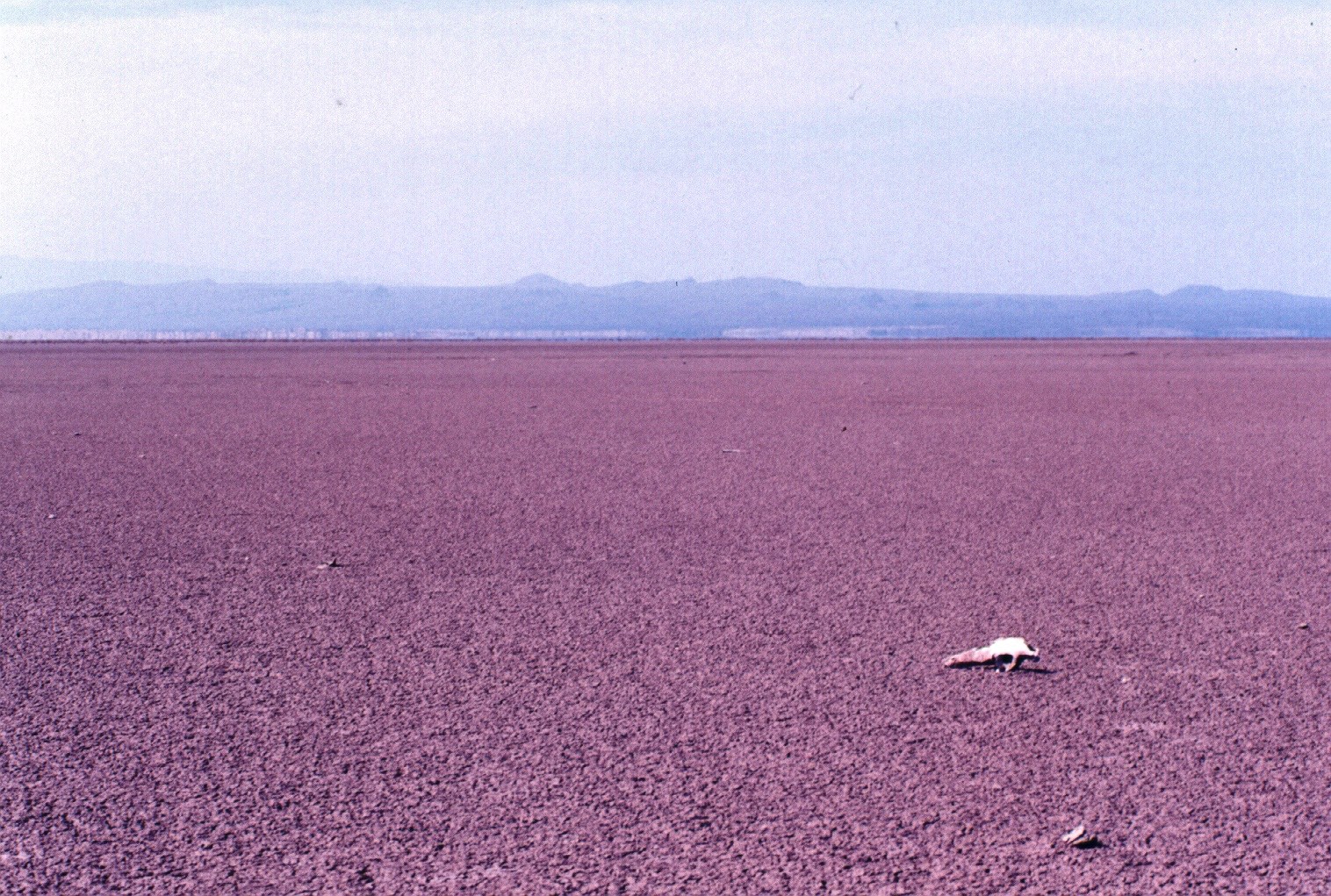
We were still crossing the Chalbi when dusk caught up with us. We then decided to leave the main track to get the full desert experience while be less conspicuous to potential unwanted visitors. The evening was very warm and there was not a drop of wind and just nothing apart from reddish sand as far as we could see, except for a lone zebra skull. It was a totally new experience.

Turkana Chalbi desert with skull copy 2

The redness of the Chalbi desert with the lake behind.

We did not bother to set up tents and judged that no mosquitoes would be alive there so we just slept on our camp beds, after a tinned dinner. The biggest disappointment of the day, apart from having to change four wheels, was that our watermelons kept on the roof racks for a night like this, were rotten and we could not enjoy them after having saved them for days! Laying on our beds, we witnesses one of the most incredible skies we have ever seen and we watched it mesmerized until sleep defeated us.

turkana safari chalbi desert 1...

The cracked earth of the Chalbi desert.

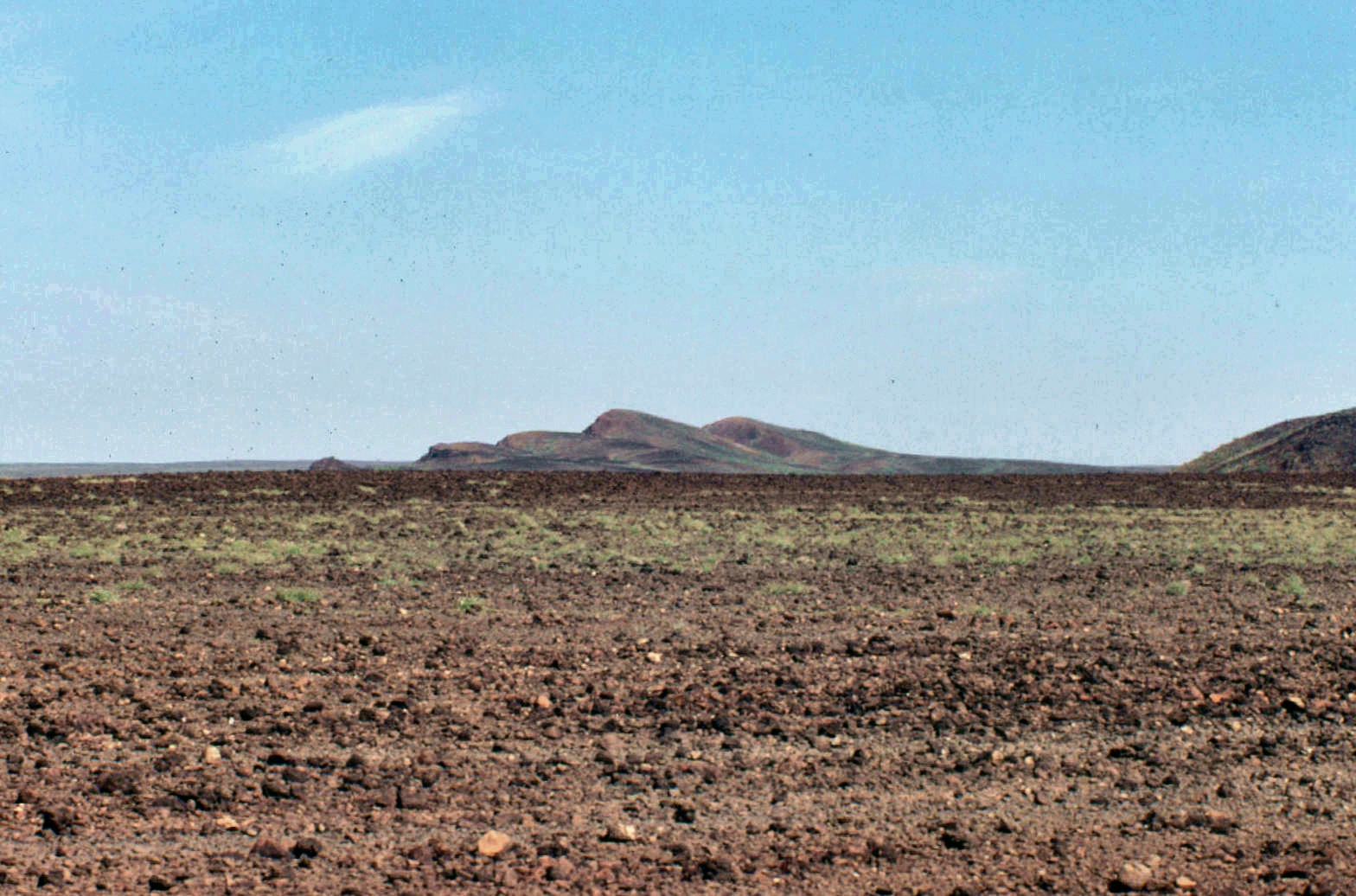
The following morning, the discovery of our fifth another puncture, this time in the trailer delayed us for about an hour while we did the repair. Although we still had no spares, we trusted -rightly this time- that we would get to our next destination without another puncture. We managed to negotiate the Chalbi successfully and soon we found ourselves back at a track that we believed looked respectable enough to take us to the Marsabit mountain and its homonymous National Park.

turkana safari 2

On the way to Marsabit.

Our spirits soared when we saw spotted the outline of a large mountain in the distance that could only be Marsabit. It was and, as we approached it, we could see its green hue becoming sharper after every kilometre we traveled. We were soon climbing and the green vegetation was quite a novelty after spending almost a week without seen much in terms of trees! So, we entered Marsabit National Park and went straight to the Park Headquarters to leave our tires to get mended and then to a nearby hotel for a cold drink, just refraining ourselves from rolling on the lush green grass of the garden!

The mountain was a true oasis with a large forested area where elephants dwelled. In particular it had been the home of one of the most famous elephants known, Ahmed, the King of Marsabit that carried very large tusks that prompted President Jomo Kenyatta in 1970 to declare it a national treasure and was given special protection against poachers in the form of 24 hours custody by two hunters.

By the time of our visit Ahmed was dead (it died in 1974) but his fame was still very much alive and we were familiar with its shape and tusks from its monument at the Kenya National Museum in Nairobi. Ahmed was a loner and quite evasive and the stories about him became mythical after several years. It is said that when it died at the age of 55, the King was leaning against a tree, resting on his tusks.

Marsabit was a great stop and we explored its lush green forest and lakes without seeing any of Ahmed’s offspring but getting refreshed by its greenness before embarking on the final leg of our journey. We had still about 260 km of very corrugated road in front of us before we would get to the better road at Isiolo.

To Nairobi

Refreshed after so much greenery and with the full complement of fuel and repaired tires, we started our descent from Marsabit on the wide and corrugated road army-built that would eventually see us through to Isiolo. After a while we reached flat ground and we started meeting a succession of truly large herds of cattle moving north, we imagined towards Marsabit in search of greener pastures. There were thousands of animals being herded by nomadic people, probably Rendile.

After about 100 kilometres we passed Laisamis, a small settlement with a Catholic church dedicated to St George and continued our journey south with us leading the way. The driving on such corrugated road with a trailer was a new experience for us and a rather hard one as the trailer was still very heavy.

All went well for a long while until suddenly the trailer violently veered to the right forcing me to correct to the left to keep the car on the road and from then on I lost control and the next thing I remember is that we abandoned the road and started a mad race through broken terrain and thorn bushes until the car came to a halt by getting lodged into a low and very thorny acacia where we rested luckily still on our four wheels with the trailer at a right angle.

We, luckily managed to miss the deep “dongas” that crisscrossed the bush but we were lodges so deep inside the bush that we were not able to open the car doors. Luckily help, in the shape of Paul and his brother arrived soon and hacked the branches enabling us to get out of the car. “I saw a large cloud of dust and then you were gone” Paul said adding “I am glad that you managed to keep things on their wheels”. I replied that I had done nothing to achieve this as I have had no time to do anything once I lost control!

Regardless of how the despiste? took place it was a lucky one and, after quite a lot of maneuvering, we managed to get back on the road and resumed our trip with no obvious damage to the car or the trailer.

This time Paul went in front and we both drove carefully, having realized that things can go wrong in just a fraction of a second. The remaining 100 km passed very slowly but, eventually, we approached the familiar settlement of Archer’s Post.

Perhaps it was the anxiety of getting back or maybe he just forgot but Paul entered Archer’s Post quite fast and forgot that there were a few respectable bumps to slow the traffic down. He hit the first bump and, realizing that there was a second one, he tried to brake but still hit the second one rather fast with disastrous consequences.

Now it was our time to watch events from the rear and witnessed how, after hitting the first bump the u-bolts the hold the back axle to the car’s body went and the wheels were bouncing rather than turning. The second bump completed the damage by dislodging the axle completely and the car stopped with one rear wheel under the car and the other one behind at a right angle to the car!

We pushed the car to the side of the road knowing that we have finally found some serious trouble and, with the high-lift jack, attempted to lift the car and bring the axle to its original location. Among the tons of spares we had new u-bolts but, although we brought the axle back, we needed to lift the body and for that we needed a bottle jack that we did not carry with us!

Refusing to believe that we could not repair the car we wrestled with it fruitlessly for about an hour under the curious gaze of members of the public and having declined help from an African gentleman wearing a blue overall, probably a mechanic. We decided that we should borrow the essential jack from the Catholic Mission nearby but we went there and, being the end of the year holidays, no one could assist us.

Empty-handed and crestfallen we returned to the car to find that the ladies we had left behind, showing their practical approach, had discussed our situation with the gentleman with the overalls who had assured them that he fix the car. Beaten, we concurred and negotiated for assistance with him.

Once we agreed, the gentleman disappeared and returned with just three tools: the bottle jack, one large spanner and a long steel tube. We looked at each other with Paul and shook our heads. However, we decided to wait and see. It was immediately obvious that the man was indeed a bush mechanic and he knew what he was doing.

After removing the broken u-bolts with his spanner he lifted the body of the car with the jack and he used the steel tube as a lever to gradually align the axle until the new u-bolts could be fitted! So, after about an hour we were on the road again not without thanking the bush mechanic profusely and settling our account well beyond our earlier agreement.

Mobile again but unable to reach Nairobi on the day we decided to spend the night in Samburu National Park so we got to one of the camps near the entrance. We had a very pleasant surprise as our good friends François, Genevieve and her mother Paula were camping there and we joined them at their camp in Samburu to enjoy some of their fresh food and to share our tins with them!

SamburuTousNY87 copy

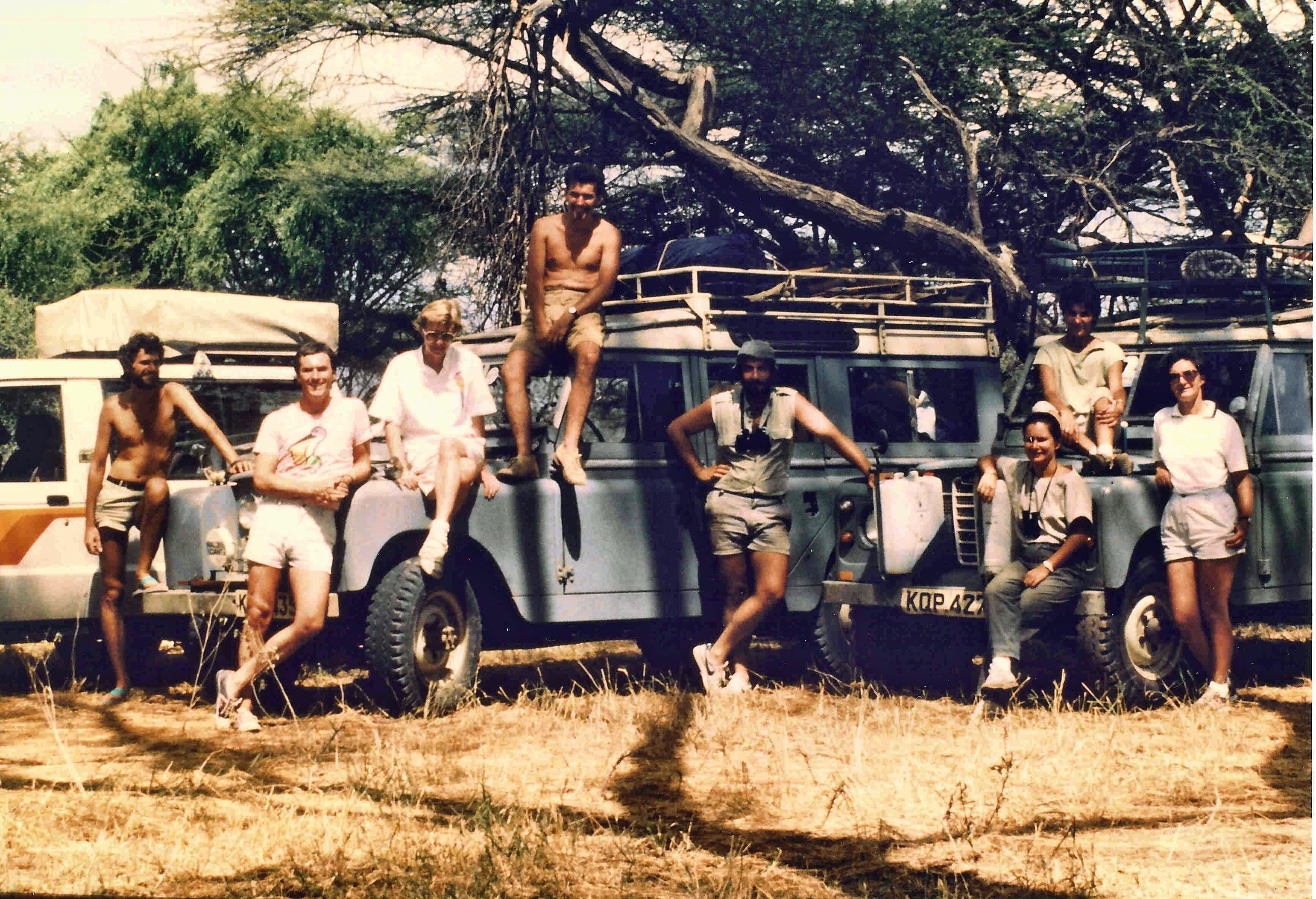
The survivors and friends at the end of the journey in Samburu Mational Park. From left to right: Francois, Paul. Else, Paul’s brother, Bushsnob, Genevieve, Mabel and Paula.

It was the 31 December 1986 and we started the New Year in the bush before continuing home the next day, this time with a smooth drive all the way to Nairobi.


At the cradle of mankind

We saw the camp way before we got there and, involuntarily speeded up to finally arrive and have a break in our journey. Our entrance was far from a triumphal one. We got to the camp near the shore of the lake where the track suddenly changed into deep sand and we got buried as our car was not able to pull the trailer in the sand. Despite unhooking it, it would not bulge and, worse still, when Paul tried to help, he got also stuck.

Turkana safari Land Rovers jc and pr copy

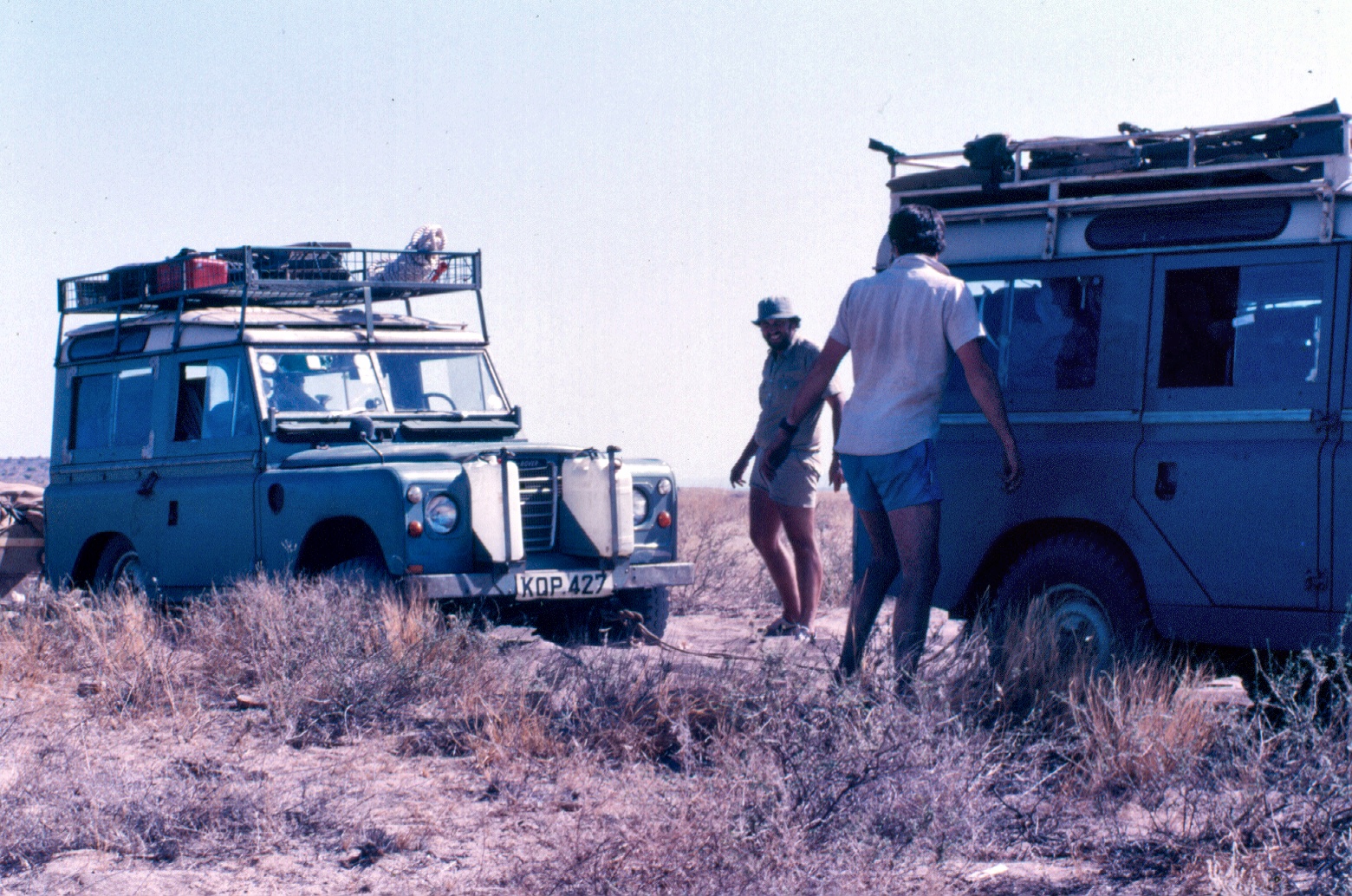
Stuck on arrival at Koobi Fora.

Too tired to dig them out we decided to leave them for later when the day was cooler. So, we walked to the camp and did a few trips bringing our luggage. Luckily messages sent to the camp via the National Museum of Kenya had arrived and they were waiting us so our bandas were ready and very well equipped and comfortable so we could have a shower and relax during the rest of the day.

turkana koobi fora

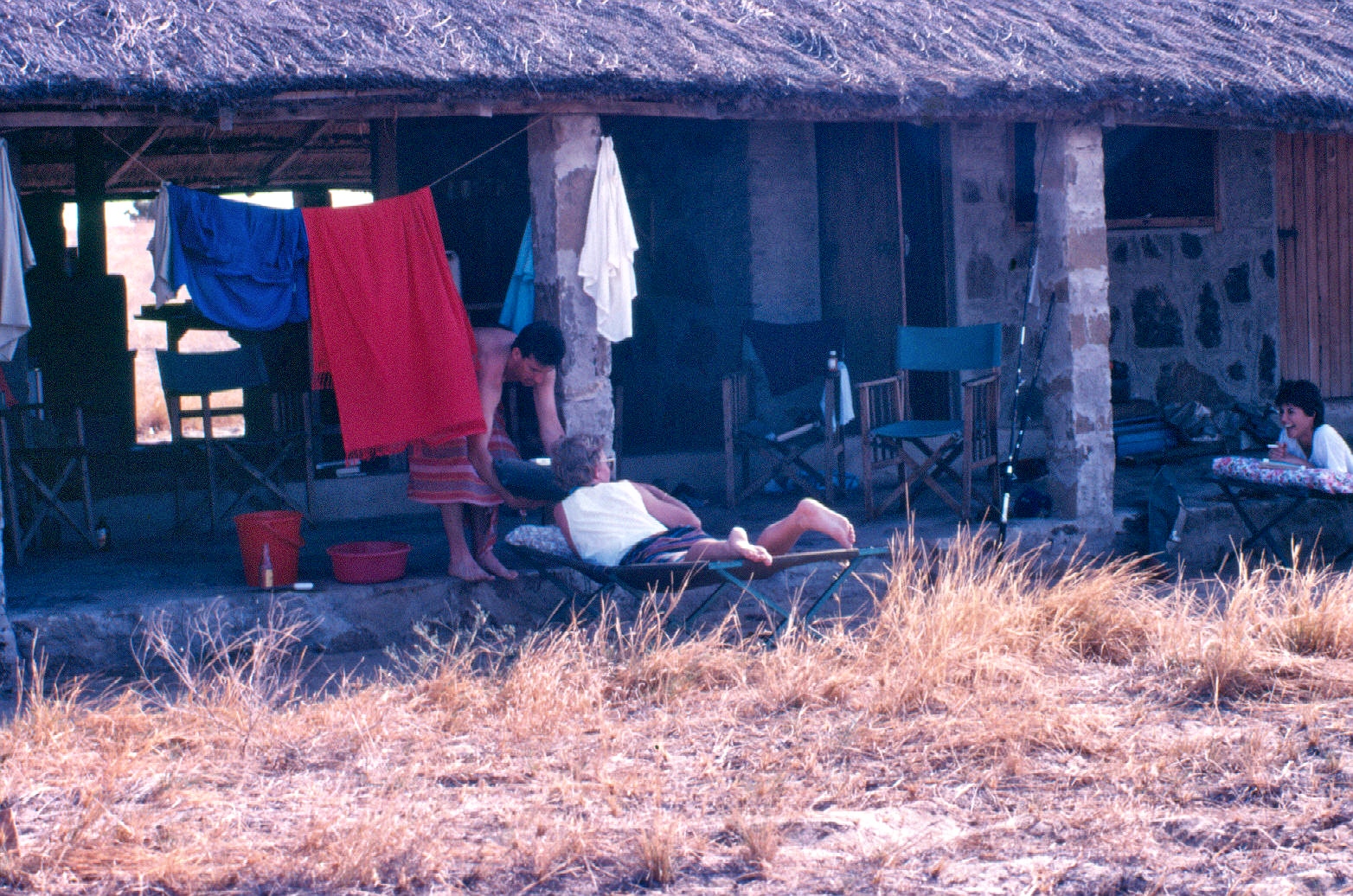
Relaxing at camp.

Later on we decided to tackle the cars, more out of embarrassment than real need.

With the help of a few camp hands, we succeeded and we were ready to re-enter the camp now as a proper expedition, after a quick wash in the lake to freshen up. While digging our cars we learnt that the Koobi Fora sand spit was the best area for fishing and we had decided to try our luck the following morning and, with this in mind we had an early night as we were rather tired after a busy day.

Early the following morning we assembled the boat and a party ventured into the lake, heading for the sand spit as advised. The idea was to do trolling with our largest lures in search of Nile Perch or Tiger Fish as we had done in Lake Victoria, hoping to catch some sizeable fish.

We knew that the lake had a large population of crocodiles, some of them truly humongous, and that some of the lake dwellers hunted them [1]. Crocodiles were not new for us so, as usual we kept an eye for them but did not worry too much.

The sight that waited for us at the sand spit was as unexpected as frightening. The people at the camp had omitted that the place was the parking area where the they enyoyed their daily sunbathing. The whole length of the spit, between two and three hundred metres, was “green” with crocodiles.

In view of this unexpected and rather perturbing find, we decided to keep our distance from the area and fish some good distance away. As we approached the spit the crocodiles started sliding into the water, an even more unsettling situation as now we could not see them!

Despite this, we stuck to our plan and fished, perhaps at a greater distance from the sand as previously thought. We trolled along the spit and, every time we passed, the crocodiles -clearly with large mouths but small brains- kept jumping into the water only to climb back again on the sandy spit once we had passed! We trolled the whole morning but only caught a couple of small Nile perch and one Tiger fish. We were not impressed and decided to come back in the afternoon.

The lake has no outlet and water levels are kept by a delicate combination of the river waters, volcanic springs, rain (if it ever falls!) and evaporation. We noted that the water was a bit cloudier in this area, probably due to the entry of the Omo river from the north and we thought that this interfered with the fish seeing our lures. A good excuse for our failure!

The afternoon fishing, again, did not live up to our expectations and we only had a couple of bites but the fish got away. Busy fishing somehow we forgot the rather predictable crocs an we nearly came to grief when the boat shuddered violently and unexpectedly! A fraction of a second later, looking back we saw a commotion in the water and a large crocodile turned and showed itself clearly! The beast, I believe as shaken as us, crash-dived and disappeared.

turkana sunset in k fora croc.jpg

Sunset view of the sand spit and one of its occupants…

Luckily we did not hear any hissing so we assumed that the rubber dinghy was intact and, to our great relief, we saw no obvious damage. However, the crash shook us badly and, unanimously, decided that we had fished enough and that it was time to return to land doubting whether we hit the crocodile by chance or it came towards us with bad intentions or just got too close while having a look.

The crash with the crocodile rather than our rather poor fishing anecdotes dominated our conversation during and after the trip and, at the time, we did not of any one that had had a similar experience although today a few can be seen in YouTube.

That afternoon, after resting, we decided to have a swim in the beach shallows where we had seen people bathing earlier. While we were washing ourselves at dusk we detected a circle of red eyes at a distance and we withdrew rather fast from the water, ending our wash with buckets of water, quite away from the lakeshore!

Before we left Koobi Fora, we had a walk along the sand spit and, although we did not find any new hominids to make us famous, we saw the crocodiles from a different angle and we realized their true sizes and were rather impressed despite having seen many during our bush life. We also found lion footprints and decided that the wiser move would be to return to camp where we were informed that there was a lioness that “specialized” in hunting crocodiles.

That afternoon we packed our cars and got ready to start our return to Nairobi after a rather exciting time at the camp.


[1] Graham, A. and Beard, P. (1990). Eyelids of Morning: Mingled Destinies of Crocodiles and Men. Chronicle Books. 260p.