Aberdares and The Ark

“The nearer to Nyeri the nearer to bliss” remarked Robert Baden-Powell, best known for having started the Boy Scout movement. In 1939 he and his wife Olave moved to a one-room cottage named Paxtu, now a small Scouting museum located on the grounds of the Outspan Hotel. He died two years later and was buried at St Peter’s Cemetery in Nyeri.

At that time the owner of Outspan also owned the Treetops Hotel, approximately 17 km out in the Aberdares Mountains, often visited by Baden-Powell and made famous when Princess Elizabeth became Queen on the night of 5 February 1952 and the renowned hunter Jim Corbett, her bodyguard at the time, wrote the now famous lines in the visitors’ log book: “For the first time in the history of the world, a young girl climbed into a tree one day a Princess and after having what she described as her most thrilling experience she climbed down from the tree next day a Queen – God bless her”.

There was another well-known hotel in the Aberdares, the Ark, built literally in the shape of Noah’s Ark, and -like Treetops- beautifully situated overlooking waterholes in the Aberdares National Park.

Aberdares 2 5.32.37 PM-001 copy

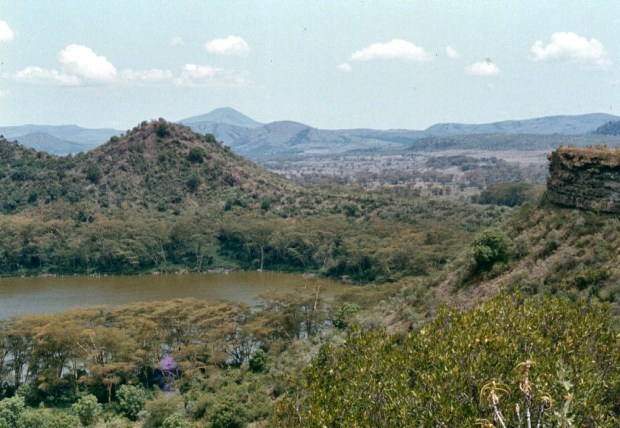
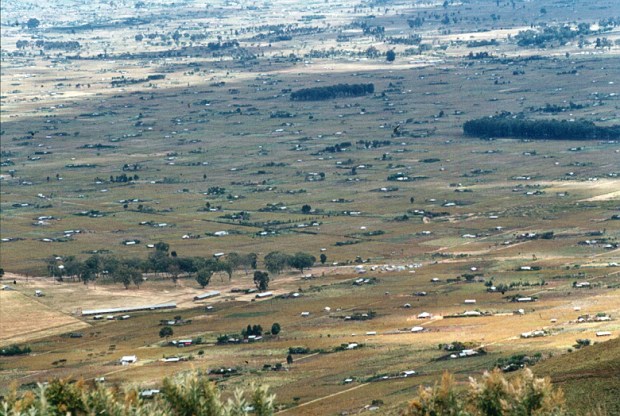
The Aberdares National Park is a part of the Aberdares mountains located east of the East African Rift Valley about 100 km north of Nairobi with an altitude of 2-4,000 metres. Established in May 1950, the park covers an area of 766 km2. Nicknamed ‘Scotland with lions’, the park is very rich on mountain peaks that go up to 4000 metres to its deep valleys where crystal clear streams run with numerous waterfalls, moorland, bamboo and rainforests at lower altitudes. The streams run through ranges that are often covered in mist and heaths and they have been seeded with trout.

This slideshow requires JavaScript.

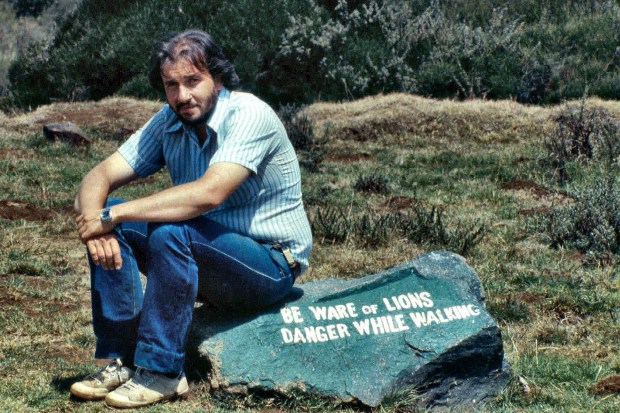
Although bongos (Tragelaphus eurycerus) were already a very rare sight, a number of other interesting species made up for this. Leopards -including black ones- were known to occur and lion had been relocated from cattle ranches further north. Elephants and buffalo were common and there were also giant forest hogs and a number of rare antelopes such as the suni (Neotragus moschatus) and the mountain reedbuck (Redunca fulvorufula).
aberdares jc copy 2

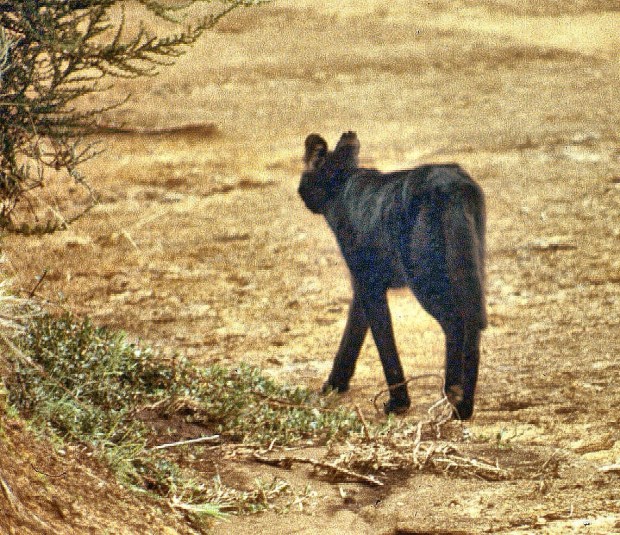
It was also a great place to see black and white colobus and sykes monkeys, apart from over 250 species of birds and it was common to spot black Augur buzzards as melanism was a feature of the park and we were very fortunate to see a black serval cat walking on the road in front of us.
Aberdares mel serval-001

Black Serval.

Aberdares mel augurd buzzard-001

Melanistic form of Augur buzzard.

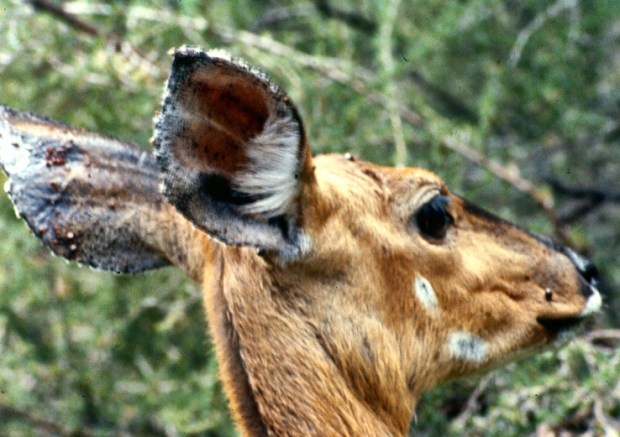
We usually camped at the park’s public campsites. These were frequently visited by very tame bushbucks that, interestingly for me at the time, carried heavy tick loads on their ears.
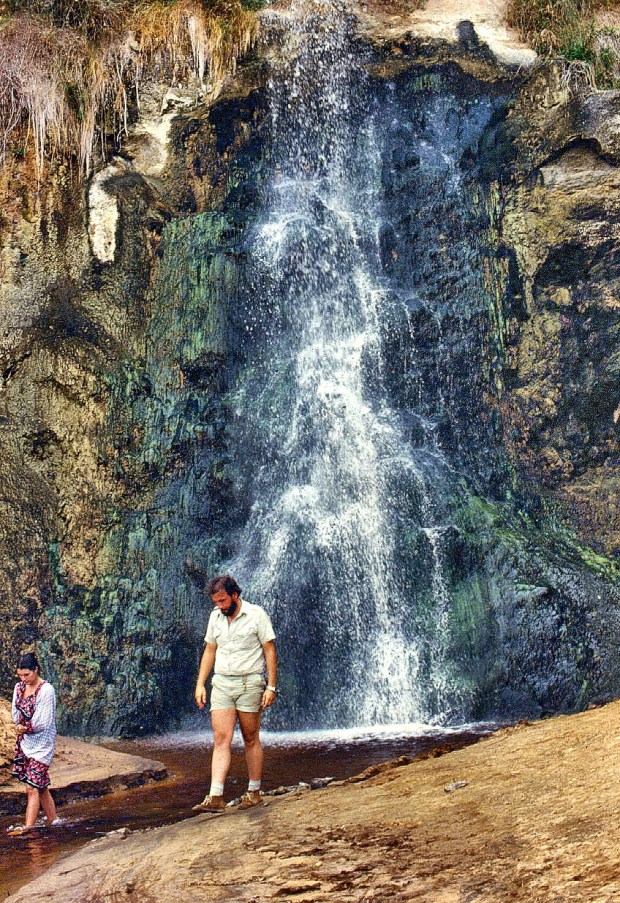
bbuck Aberdares copySome of the falls offered an opportunity of a refreshing shower that Mabel took often although I did not as the water was truly freezing for me!
aberdares 1-001 copy

Towards the end of our stay we decided to try one of the lodges, either fame and character at Treetops or the more luxurious Ark. Because of availability we went for a weekend at the Ark. We booked a special -read cheap- package to stay two nights during the low season when more rainfall meant more water available and the game was less dependent on the artificially fed waterholes and saltlicks of the Ark.

The lodge was built in 1969 and many “famous” guests have stayed there: President Tito, Geraldine Chaplin, Peter Scott and Hugh Hefner to name a few. It also had it share of royalty as Prince Bernhard of The Netherlands and the Danish royal family.

We got to the Aberdares Country Club mid afternoon after driving from Nairobi. Although we spent a rather short time in it, we realized that it was worth of a proper visit and we did return later to enjoy its manicured lawns and gardens and to look at Rena Fennessy’s bird pictures [1].

After about an hour we were taken to the Ark by minibus and we arrived after 18 km driven through beautiful forest until we went through the Ark’s gate to enter the park. A short distance later we were left at the entrance of the hotel, a wooden walkway that brings you to the Ark.

It was a while before dinner so we settled in our room, small but comfortable. It had a system of communication through which you could be warned if something interesting arrived at the waterhole after you had gone to bed so you could decide whether to get up to go and watch or not.

After settling in it was time to explore the lodge. There were a number of areas where you could watch the water holes -at that time almost empty of interesting game- and we chose what we thought was the nicest to return later. It was a large window that allowed unimpeded views of the swamp and, those who so desired could also go outside to enjoy the view from a balcony.

While we explored the Ark we immediately realized that the stay was going to be memorable, but for the wrong reasons, a large school party had decided to fill lots of the lodge’s sixty rooms!

So, we had our dinner surrounded by children while the teachers and parents made frantic efforts to keep things under control but failing to do so, at least to my taste! I was quite upset thinking that I had paid good money to enjoy the place one time and found it full of kids, particularly when silence is critical in this kind of places that are in fact large and glorified game hides!

After dinner we marched to our chosen window onto wilderness only to find the room packed with kids shouting the names of the few animals that ventured out of the forest and into a very noisy water hole. Clearly only the desperately thirsty showed up!

We were a few adults in the lodge wishing to see special animals and all we could do was to exchange resigned looks with each other as the situation was hopeless! If we had any expectations that the children would go to bed early, they soon dissipated as they had come to enjoy the place their own way and were determined to stay awake to the bitter end!

As expected, we did not see much coming to the water that night and the next apart from some elephants and a few antelope that were always hanging about the water edge. We also realized that there was no point in complaining to the teachers as there was not their fault but that of the hotel managers that should not have mixed a large school party with a few paying adults.

As soon as we got back to Nairobi I went straight to the booking office of the Ark and, after presenting my case in rather strong terms, I was given a full refund for our stay. However, this did not really compensate for what we had anticipated to be a memorable stay and ended up being a disappointment. We did not return.


[1] Rena Fennessy created art for most of the post independent East African countries for about 25 years. She also drew birds and animals for field guides while creating her own artwork of East African wildlife and scenery. No much information is available about her. She lived in Nairobi and was possibly British.
 

Fighting itself!

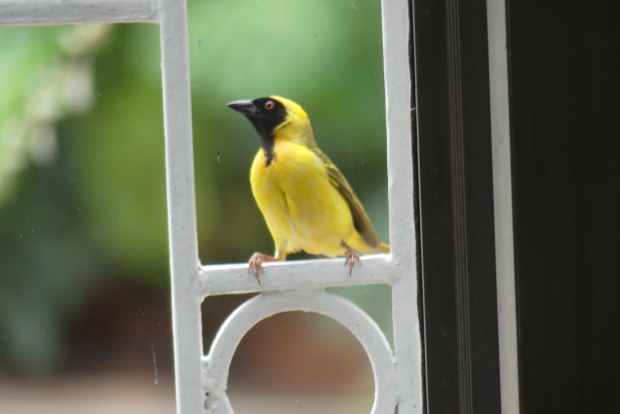
There was a “tap-tap-tap” noise in the bedroom window and we discovered that a Southern Masked Weaver (Ploceus velatus) was pecking at its own image reflected on the window.

P1020365 copy

This male bird had, for the last few weeks, been busy building nests, trying to convince its girlfriend that they were nice but failing to do so, as usual in these cases.

As the bird pecked the window for a few hours, we decided to close the curtains to give it a break.

The following day we opened the curtains again, and very soon it returned to fighting with itself in an effort to keep its territory free of male competitors while trying to get his architectural skills improved.


I smell a rat…

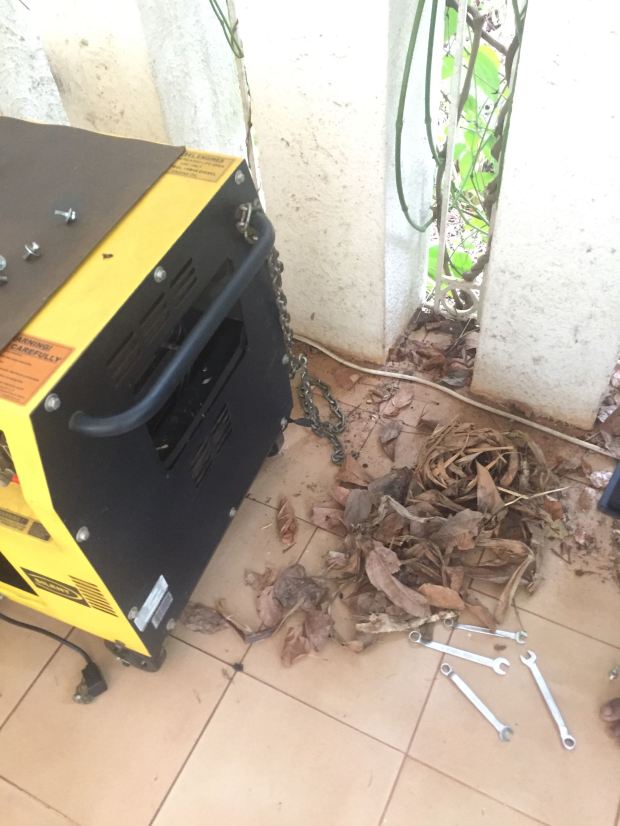
When “Bella”, our Jack Russell bitch, spent about three hours fixed on the generator, we knew that there was trouble in that area of the house.

IMG_5265 copy

We checked all around, including the firewood -my candidate- that was next to it without success. We did detect chewed bits of insulating sponge lining on the floor, though.
We decided to open up the generator and have a look.
We expected to find the damage to the sponge lining material but not what we found, a full nest that occuppied half of the free space inside the machine!

IMG_5273 copy

I must confess that I saw the nest builder often walking in front of me while seating in the veranda writing but I did not think that the beast would get inside the generator so I chose to share my life with it!

It clearly abused my hospitality and it paid for it as todaya trap was set by Stephen means that there is one less rat in Harare!

Safari Rally

Soon after our arrival we heard about the Safari Rally, one of the yearly attractions that Kenya had to offer and that had been going since 1953 as the East African Safari Rally and as the Safari Rally from 1974, a few years before the breaking up of the East African Community.

Although we could not watch the race on our arrival in 1981 we learnt that the Kenyans Shekhar Mehta and Mike Doughty won it. The pair seemed unbeatable, as they had already won in 1979 and 1980.

By 1982 we had our car and we decided to follow the rally with daily trips to a couple of places near Nairobi as well as watch the cars arrive in Nairobi at the end of the rally. We studied the route of the three stages and selected areas near Kajiado and in the Kinangop plateau.

Without experience on watching races of this kind, we thought it wise to leave early to find a good and safe spot. We also carried our safari chairs and food and water to last us for the whole day. The rally was held when the long rains were meant to begin so you either had a dry or a wet rally. It was dry that year so our concern with potential mud traps did not came up until in later editions!

We learned a few things about the rally that first time. Seeking some excitement we searched for a place where we could see the cars coming from far and that, close by, would offer a bend or a culvert that they needed to do some exciting turning or a nice jump.

n kinangop safari rally kombi

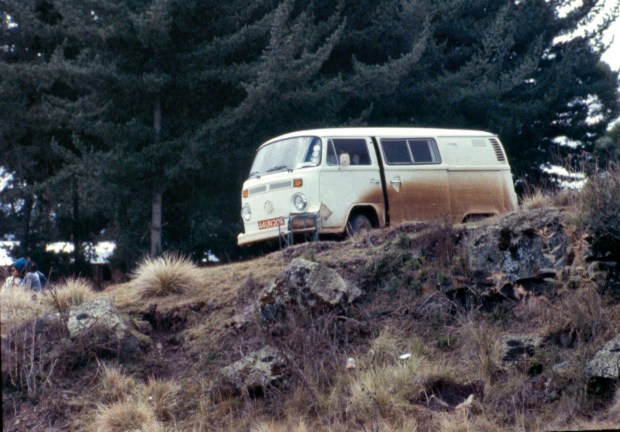
A good and safe vantage point to watch the rally.

As we were in the selected area early, we had sufficient time to drive for a while until we perched on a high slope that offered a great view where we set up our camp and waited. Gradually the place started to fill up with other visitors in cars but also of people on foot coming from the surrounding areas. The latter really enjoyed seeing and hearing the powerful cars driving past as, in those areas there was no much traffic otherwise. I was also amazed that there were no accidents as people, unaware of the danger, placed themselves in large numbers in exposed spots, very close to the cars!

We waited for a couple of hours and then the crowd -quite a sizeable one by then- started to stir and soon we could also see the dust plume far away. The first car was coming so I prepared myself to take my first “speed priority” shot at a fast moving car from a good spot, near the road.

As the dust got close we could actually see the numerous and very strong lights that they carried and I had no doubt that the car coming was from the rally so I shot and got covered in dust at the same time! To add insult to injury, after the event I realized that it was a support car! Another lesson learnt: support cars look just like the real ones minus a number on the door!

1982 saf rally altonen opel

The dust of Altonen’s support car!

Eventually we watched the “real thing” or rather the first one of the race because, after the first car drove past, a succession followed in hot pursuit and the dust cloud got fed by each one of them and spectators’ visibility was severely reduced. I could not believe how the drivers could see the road, leaving alone trying to overtake! I took some poor pictures. Luckily, once the aces past, gaps between cars increased while speed decreased so we could actually see some of the cars!

Once most of the cars passed we could initiate our return home. We thought we had breathed and eaten dust but there was much more to come while driving home among a convoy of motorists doing the same. There were still some of the slowest cars coming and this added an extra touch of adventure to our trip.

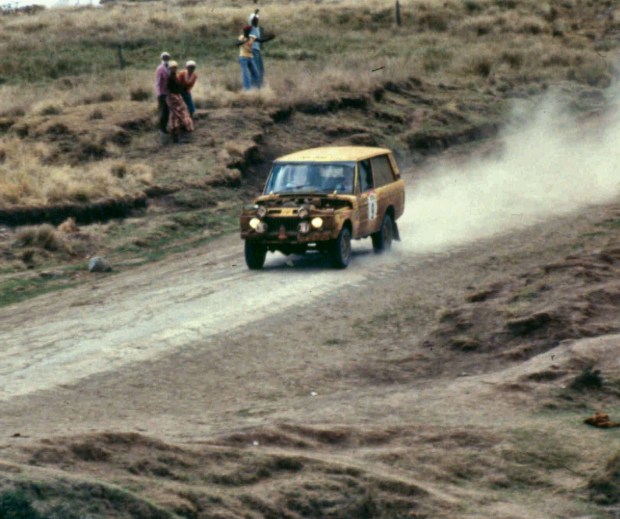
Finally, the duo Mehta-Doughty won for a fourth time that year but our hearts were with Robert Collinge and Mike Fraser that were racing in a “normal” Range Rover! After a gallant race where they had all sorts of problems (I believe they hit a cow and lost their bonnet) but still they managed to arrive in 6th. place, a great achievement, still remembered in rally circles.

1982 north kinangop safari rally collinge's r rover

The Collinge and Fraser’s Range Rover minus bonet going for the finish line.

Apart from the big rally teams, individual entries were also present and they relied on friends for repairs and to bring fuel and spares to strategic places in order to continue with the race! For those private participants just to arrive was a great achievement and we witnessed scenes charged with emotion when the crew of a private participant embraced celebrating their arrival at the end of the third stage, regardless of the position, with true sport spirit.

We did follow the rally in subsequent years but nothing compared to the first one in 1982 and we eventually stopped but not before having a test of a wet rally in 1985 where things dramatically changed as cars did not cover you in dust but in mud and water! A video below illustrates the point.

Credit: vipersan1 from Youtube.

During that rally we also learnt that it was one thing to drive through a muddy road before the cars passed and another very different and frustrating to try and return home with our kombi VW. We got stuck a few times! Things were not made any easier when some clever Kenyans started to “improve” existing potholes both lengthwise and in depth so that, once you fell in “their” mud trap, they would push you out for a small fee! African entrepreneurship at its best!


Windsurfing with hippos

As you will learn later, I took up windsurfing during our holidays at the Kenyan coast but I never got beyond the beginner’s level, basically due to lack of practice.

There are two fresh water lakes in the Kenya Rift Valley, Naivasha and Baringo. The former is a weekend destination for many people in Nairobi that we use to call “water babies”. The lake was not a reserve and it was open to people to sail and fish at will while staying in the various luxury hotels spread along its shores [1].

Lake Baringo is much further away to the dry north and to get there requires quite an effort and it is not really suitable for a weekend break. We visited it sometimes as a stopover when heading for other destinations and perhaps twice as our final destination.

Lake Baringo has an area of 130 square kilometres and the Molo, Perkerra and Ol Arabel Rivers are the rivers that feed it. It has no known outlet but it is believed that its water seeps through the bottom into some underground current where it finds an impermeable layer. There are over 470 species of birds there, occasionally including migrating greater flamingos as well as a Goliath heronry located on a rocky islet known as Gibraltar that is an amazing sight!

baringo island camp

Island camp.

The lake was believed to bee free from Schistosoma parasites and also that its crocodilian inhabitants, because they were not disturbed, also did not bothered swimmers and sailors. The hippos, however, were “normal” and it was advised to give them a wide berth, as there were quite a number, particularly near the shores. Despite this potential danger the local Njemps fishermen moved about the lake in tiny boats and rowed with some special paddles that they fitted in their hands!

baringo best

Young Njemp rowing in the lake.

We always camped at Robert’s Camp and we spent time walking and driving around the lake in search of some of the rare birds that were present there. One occasion we shared the camp with some colleagues from Muguga that were keen on sailing and they had also brought their windsurfing gear.

They insisted that I borrowed it to have a go. I put forward the excuse of the low temperature of the water trying not to mention my concern for the hippos and, to a lesser extent, the crocs but they insisted.

I had seen the abundant hippos present at the lake and pointed this out to them but they convinced me that, as far as they knew, there had never been an accident with either hippos or crocs. Seeking consolation in the way the Njemps fishermen move around the lake, I thought that the windsurfing table must have been at least twice the size of their boats and, therefore offer more protection in case of an attack.

So I bit the bullet and ventured into the lake! It all went well starting in the open water, far from the shore and eventually my friends, seeing that I would manage on my own, went on sailing, faster than me and soon I was forgotten by all!

JC windsurfing from slides 1 copy

Preparing to start.

After about an hour of sport, not being really used to it, I got tired and decided to head back to our camp. This meant coming closer to shore where the hippos were! Luckily I managed to sail in the right direction and eventually I got within a short distance from our camp. Now I needed to get there! This was easier said than done.

Between me and the camp there was a shallower area that could only be negotiated through a narrow canal and there, in the middle of it, a pod of hippos were doing whatever hippos do when they are inside the water as a family!

I was in a tight spot and quite concerned! I decided to do an exploratory approach to the beasts to see how they would react to my presence and then stop. I did so at about twenty metres from them and they replied with some grunting but nothing else happened. I took this as a half-hearted warning to the semi-naked human that was approaching them.

The situation was becoming tricky but in what I now regard as a foolish (but rather courageous) move, decided to go for it and gathered speed, trying to keep to the side of the channel where I saw no hippos.

Although I thought I was going fast, I am sure I would have been dead meat if the hippos wished to go for me. Luckily, they only watched me pass and snubbed me by showing me their fat rear ends! Eventually I managed to hit the coast at full speed and felt very relieved.

JC windsurfing from negatives 1 copy

Going for it.

When my colleagues returned to collect the table I was already relaxed and kept the incident of the hippos to myself.

baringo

Evening at lake Baringo.

[1] See: https://bushsnob.com/2019/11/23/lake-naivasha/

Mount Kenya

mt kenya 2

Mt. Kenya (5,200m), the second highest mountain in Africa after Mt. Kilimanjaro (5,900m) could be seen from some parts of the Muguga road on a very clear day as if inviting us for a visit. It was a rugged mountain with snow and three main peaks: Batian (5,199m), Nelion (5,188m) and Lenana (4,985m). They are named after Mbatian (a Maasai Medicine Man), Nelieng, his brother, and Lenana, one his sons.

mt kenya way to shaba 1

In 1849 Krapf found the mountain, located a few km south of the equator, following a similar story of the finding of Kilimanjaro described earlier. It was Krapf who gave the mountain the name “Kenya”, likely to derive from the words KirinyagaKirenyaa and Kiinyaa which mean “God’s resting place” in the language of three of the main ethnic groups that live around the mountain: Kikuyu, Embu and Kamba respectively. The mountain gave the country its name.

mt kenya best

Mount Kenya surged approximately three million years after the formation of the East African rift valley and it has suffered the impact of erosion resulting in what we see today: weather-beaten slopes, valleys and shrinking glaciers. Mount Kenya is the main water catchment area for two large rivers in Kenya: the Tana, the largest Kenyan river and the Ewaso Nyiro than runs north through very dry country.

The vegetation in Mt. Kenya changes with altitude. Around the base of the mountain we saw fertile farmland extending as far as you could see and I recall the amazing horticultural wealth of the Murang’a market where, among an enormous amount of horticultural produce, I have seen the largest cabbages! Unfortunately, althogh necessary, it was clear that the agriculture frontier was gradually encroaching the forests.

This slideshow requires JavaScript.

The nature of the forests found in Mt. Kenya depend on rainfall and whether they grow in the south- or north-facing slopes. Above the forest there is a wide band of almost pure bamboo and above it we find the timberline forest with smaller trees. The heathland (wet) and chaparral (dry) zones start at about three thousand metres. The former, located in the wetter part has giant heathers while the latter is found in the drier areas and it consists mainly of grasses.

As we continue our virtual climb, the temperature fluctuations increase to extremes and the air’s oxygen decreases and we enter into the most known place of the mountain: the Afro-alpine zone, an area with several endemic plant species such as giant groundsels (senecios) and giant lobelias. After this there are glaciers and rock in the areas that the latter had retreated and no vegetation is present there.

Not being climbers or hikers we had a limited interest in mountains and preferred to spend our time in the more manageable lower grasslands of Kenya. However, we decided to give it go.

During our first visit to Mt. Kenya we entered through the west of the mountain, through the Naro Moru gate, one of the busiest. Although we intended to camp near the gate, we decided to go up the mountain on a exploratory trip through a road that got progressively worse until we reached a point where the kombi’s torque and the altitude became even and there we stopped. It was already late so we decided to spend the night in the car, cold and wet, not appreciating the beauty of the place.

meru mt kenya lodge walking

Icy stream.

The following day we managed to turn the car around in the mud and descended to more manageable roads where we had some joy by watching the vegetation and views of the peaks that, luckily, were uncovered that day. We returned to Nairobi and we promised ourselves to come back.

We did return another year. This time we followed a different route on the eastern side through the Chogoria gate that led to our bungalow at the Meru Mt. Kenya Lodge. It was freezing but luckily there was hot water although the firewood was wet and to make a fire was quite a job. It soon became misty and we could not see anything around us, apart from the buffaloes that apparently found the bungalows a protection against predators!

meru mt kenya lodge getting there 1

Avoiding a tree recently pulled down by elephants on the way to Mt. Kenya.

The following morning the buffaloes had gone and the mist lifted so we decided to go for a guided hike to Lake Ellis and suffered the effects of altitude and cold. This was the country where “Icy Mike” an elephant that lived (and died) at 4,400m, an unusual event as it demands very high energy consumption, not typical of elephants and that is still unexplained.

meru mt kenya lodge lake ellis

Lake Ellis.

Like the first, the second visit was not a great success and it was the end of our attempts at ‘enjoying’ the mountain. We left early and got to Nairobi in time to go to the Fox Drive In cinema to enjoy a good movie and an Indian dinner and, later, a hot shower and a rest. We decided that we had done enough and that from then on we would watch Mt. Kenya from a distance and enjoy it!


Spot the beast 62

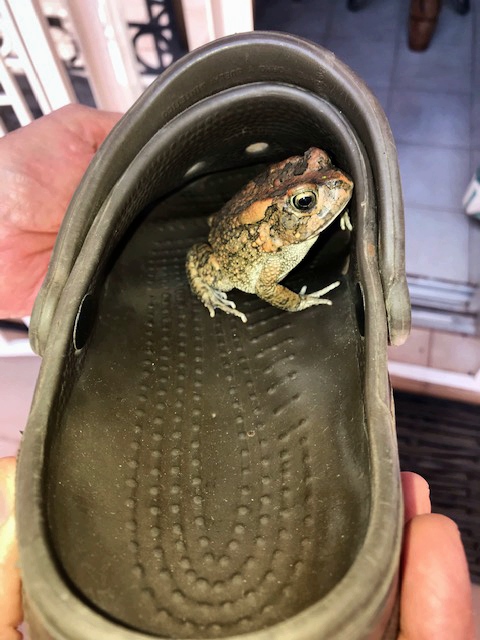
Today I needed to go to the garden and, as usual, I went for my Crocs shoes. When I tried to slip my left foot inside I found some resistance and I was surprised and amused to find a best inside. See if you can identify it…

IMG_4762

I know that it is not a very good picture but otherwise you would get it too fast!

?
?
?
?
?
?
?
?
?
?
?
?
?
?
?
?
I am sure that you have guessed what it was:

IMG_4763

IMG_4764

Understandably it wanted out of my shoe in a hurry! Soon it was released back to where it come from.

IMG_4769

I believe it was an African common toad or guttural toad (Sclerophrys gutturalis) of widespread distribution in Zimbabwe.

Luckily it was not a scorpion or worse!

Lake Nakuru [1]

Being 160 km from Nairobi made Lake Nakuru a favourite weekend escapade as it was well known for its prolific bird life. Unfortunately but at the same time inevitable, the strongly alkaline 62 km2 lake was an island inside farmland and its borders were clearly under pressure from the rural dwellers next door as well as from the town of Nakuru looming nearby and threatening this true bird paradise with its effluent. However, at the time of our visits the park offered unique birding opportunities.

nakuru 1-- 13 6 82

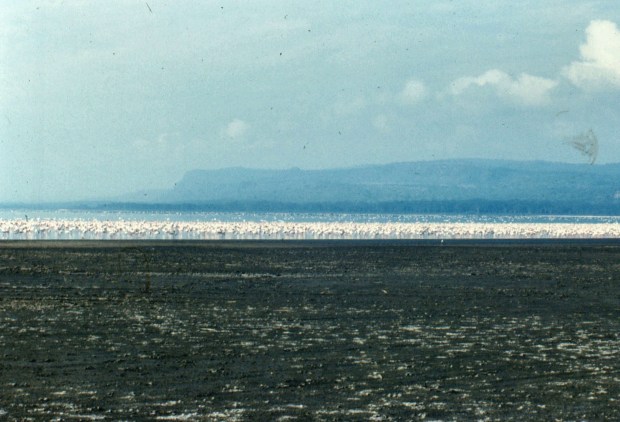
A view of the lake from one of the viewpoints.

The explanation of why there are soda lakes is geological. Rift valley volcanoes spewed alkaline ashes rich in sodium carbonate that the rainwater carried to the lakes. Those without drainage allowed the sodium to accumulate and the water became alkaline. All alkaline lakes are near a volcano: Lake Natron (Tanzania) and Lake Magadi (Kenya) are near Shombole and Olorgesailie respectively, lake Elmenteita near Eburu crater, lake Nakuru near Menengai crater and lake Bogoria near the Laikipia volcanic escarpment.


nakuru 01

Approaching the lake shore.

Lake Nakuru National Park, including the lake itself, has 188 km2 and it was created to protect the soda lake that gives it its name and that lies in the center of the Rift Valley following the arrival of more than 1.5 million of flamingos to the lake in 1960. In 1961 the famous American bird artist and author Roger Tory Peterson called the massed flamingos on the lake “the world’s greatest ornithological spectacle” and this prompted the authorities to declare it a National Park in 1963, mainly as a bird sanctuary.

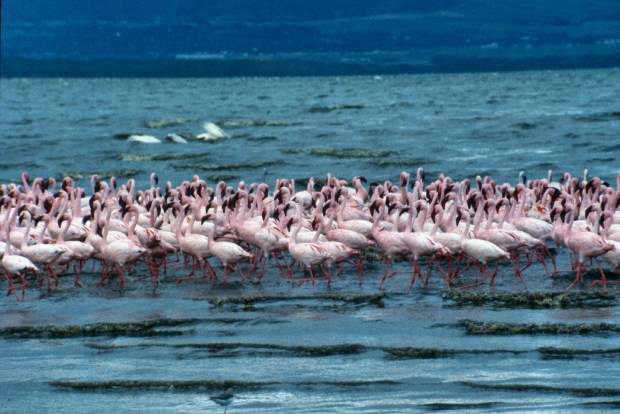
Clearly the flamingoes, both the lesser flamingoes (Phoenicoparrus minor) and the greater ones (Phoenicopterus roseus) were still the main attraction at the time of our visits and they alone justified the trip although the park had an amazing bird wealth as well as several interesting mammal and plant species. The lesser flamingo, by far the most numerous, had dark pink plumage as well as a magenta beak with a black tip. The greater flamingo was larger and had a pink bill and a whitish-pink plumage.

nakuru 13 6 82 mabel

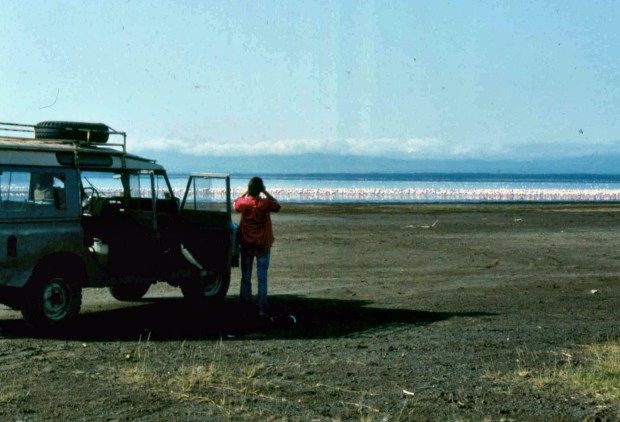
Mabel watching the flamingoes.

From afar and from the various viewpoints that surrounded the lake they could be seen as a wide pink ring enclosing the lake’s water and flying over the water continuously changing positions. Approaching the shore the ring would start vibrating and soon transformed itself in tens of thousands of birds feeding, displaying, fighting, taking-off, landing, being attacked by predators from both land (baboons and hyenas) and air (birds of prey of all sorts).

Flamingoes Nakuru copy

Lesser flamingoes.

Surprisingly the two flamingo species do not breed in Nakuru and they are only there to feed, their numbers largely determined by food availability and this, in turn, depends chiefly on rainfall. If conditions are not right they move to other rift valley lakes, notably Bogoria.

The lesser flamingoes feed almost exclusively on the free-floating algae that grow only in alkaline water. These algae, known as Spirulina, had grown over thousands of years and the millions of flamingoes that feed on them are the final result. With their heads upside-down, their tongues pump the water that gets filtered in their specially modified spongy beaks trapping the algae. To thrive they need about 150g of food per day, that had been calculated to be a total of 150 metric tons per day to feed the more than a million birds that constituted the Kenya bird colony!

The greater flamingo, much less numerous, fed on shrimps and small fishes and they were present in most lakes, including sometimes in the freshwater ones.

For some visitors the lake was as beautiful as treacherous. The road around the lake was an innocent looking track made of volcanic ash and soda that, although it was dry, it was in fact very soft and muddy below. Some motorists ignored the warning signs and their car wheels would break through the thin crust and sink. They would then find themselves helplessly buried in soft and sticky ash and it was not unusual to find abandoned cars waiting for the park authorities to be able to enter with a tractor to recover them!

Although we admired the flamingoes, the great white pelicans (Pelecanus onocrotalus) were our favorites. Their numbers estimated at nine thousand, they stayed apart from the flamingoes and mainly grouped at the southern end of the lake at the appropriately named Pelican Corner where, in a horse shoe formation dipping their heads in unison they would feed on Alcolapia grahami, an alkaline-tolerant fish very close to the Tilapia species. The group surrounded and gradually forced fish into shallow and warmer water, flapping wings and plunging bills to catch them along the way.

But it was flying that they were truly astonishing. When the air’s temperature started to increase they would take off and, like the vultures do, find the right upward-moving thermals and climb until they reached the right altitude and then they would move on like a squadron of bomber planes, hardly beating their wings towards other lakes such as to Naivasha to the south. Although they can be seen as ugly on land, they are one of the most graceful birds I have seen flying!

This slideshow requires JavaScript.

Bird life was so prolific and abundant (more than 450 species of birds had been recorded at the time we were there) that a challenge we aimed for when we felt active enough was to get up early in the morning and return for “brunch” having spotted one hundred different species! Perhaps because we were not “true” birdwatchers we never achieved this goal but it was not rare to arrive at 80 species and above every time we attempted it!

Lake Nakuru is very picturesque as it is surrounded by several volcanoes: to the north is Menengai crater, northeast the Bahati hills, east by the Lion hill, south by the Eburu crater and west by the Mau escarpment. The road around the park was a great way of seeing the lake and its many features as well as seeing how close the farmers were on the other side of the fence!

It was a long drive to complete the circuit as the lake has a surface of 62 km2. The road went through rocky hills and our favourite were the Baboon cliffs that, in addition to the strong hyrax urine smell, offered great views across the lake. It was from there that we watched the pelicans fishing and flying.

bushbuck

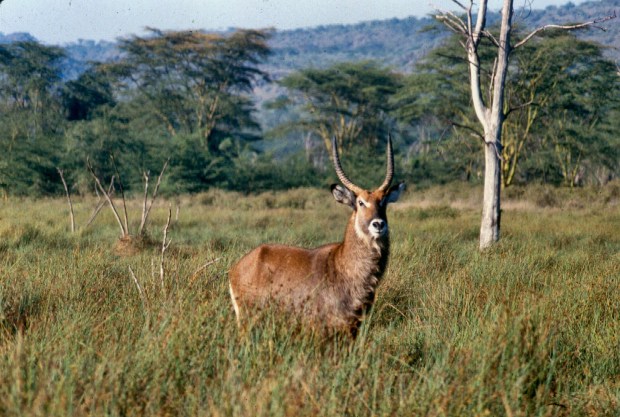
Defassa waterbuck in Nakuru.

Defassa waterbuck predominated in the areas of high grass and hippos were present in the northeastern corner of the lake where the alkalinity of the water was lower because of the entry of fresh water from the Njoro river and other springs. There was a small pod of hippopotamus living in that area. Nakuru was also a good place to see Bohor reedbuck and black and white Colobus monkeys.

Rotschild’s giraffes were successfully reintroduced in the late 70s and a rhino sanctuary was started in 1987 that was managed by our friend Jock, the one that we had met in Naivasha earlier. Unfortunately, despite several invitations, we never visited it as we were getting ready to move from Kenya at the time the sanctuary started.

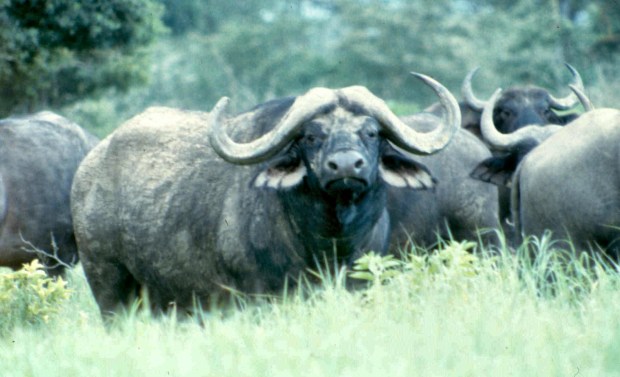
The absence of lions and the few buffalo present made the park safe for limited walking and, although spotted hyenas would visit your camp nightly, they never troubled us and, over the several years we visited the park, we only saw a leopard once from the car while driving after sunset.

nakuru buffaloes best

Some of the few buffalo we spotted in Nakuru.

nakuru 01.jpg

We always camped near the main entrance at a grassy campsite under the shade of very large yellow bark acacias (Vachellia xanthophloea) in the company of the beautiful black and white colobus monkeys as well as the less pleasant visits of vervet monkeys and baboons. The place provided great freshness and I recall spending long hours writing scientific papers there while Mabel put up with me walking about the camp always finding entertainment and finding interesting things to watch.

When our Uruguayan lady friends Elcira and Marta came to visit us in Kenya as part of their life-long world-trotting, Nakuru was the place we took them camping, precisely because of its safety and the spectacular sight of the thousands of flamingoes and other birdlife. It was a great success and we spend a long time watching the flamingo antics [2].

Nakuru has diverse vegetation including woodlands with sedge marshes, dry and seasonally flooded grasslands, and various types of dry wood and scrubland that occupy the land between the lake waters and the escarpment and ridges. Of note are the patches of large yellow bark acacia woodlands as well as the nicest Euphorbia candelabrum forest near the Lion Hill Camp.


[1] The meaning of Nakuru: “the place of the waterbuck”; “the place where the cows won’t eat”; “the dusty place”, “the shifting place”; “the place of smoke”; “the place of the dust devils” See: https://archive.org/stream/cbarchive_101865_meaningofthenamenakuru1960/XXIII_No.7__104__303_1960_Kirby_djvu.txt

[2] See: https://bushsnob.com/2019/09/08/the-joys-of-camping/

Lake Naivasha

We went to lake Naivasha often as it was an easy weekend out of Nairobi and I still have vivid memories from those visits.

naivasha

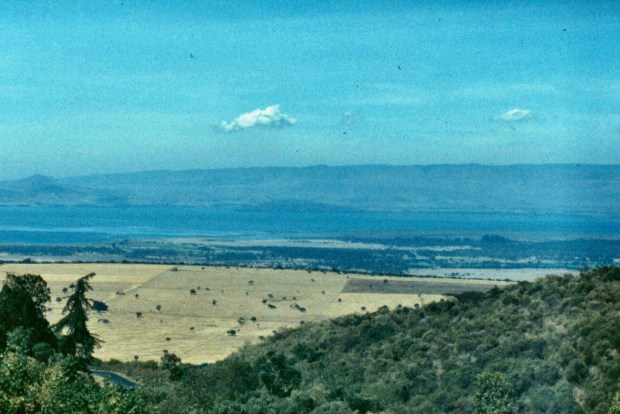
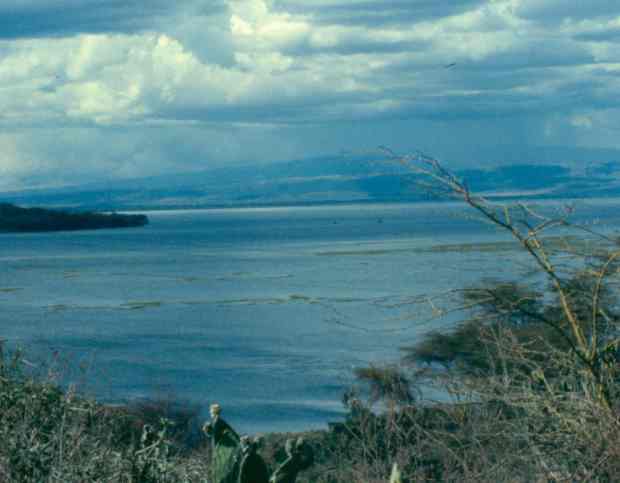
View of the lake.

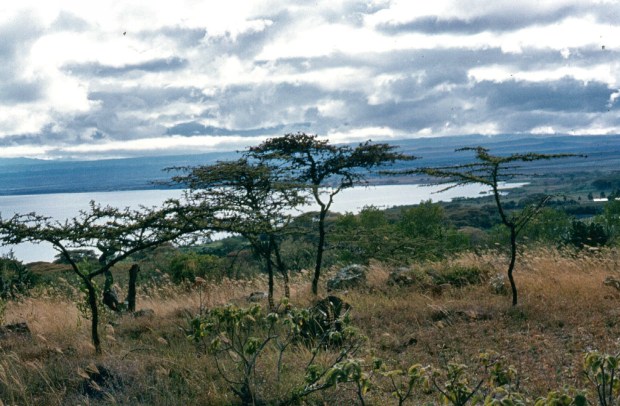
Usually we drove down the rift valley wall, passed the catholic chapel built by the Italian WWII prisoners after 50 km, then the junction to Narok and the Maasai Mara (B3). Further we found Mt. Longonot, the volcano on the left and kept driving, already seeing the shiny blue lake in the distance framed by fertile cultivated farmland with the spectacular backdrop of the Mau escarpment.

l naivasha from n kinangop rd

Lake Naivasha in the distance on the left behind which is the Mau escarpment.

Gustav Fischer, a German naturalist, found the lake it 1883, while heading north and before the then hostile Maasai found his expedition and forced him to turn back! However, the Europeans kept coming and, after Joseph Thomson arrived, the colonization of the area followed.

lake naivasha

A few kilometres ahead we would drive through the small town of Naivasha and soon we were at the lake. Although sometimes we stopped at the upmarket Lake Naivasha hotel or the Safariland lodge for a refreshment, a bite or simply to soak-up under the shade of their Yellow-barked acacias (Vachellia xanthophloea) [1] or Fever trees. The latter name given by the first pioneers when they blamed them for catching malaria well before the role of mosquitoes in its transmission was known!

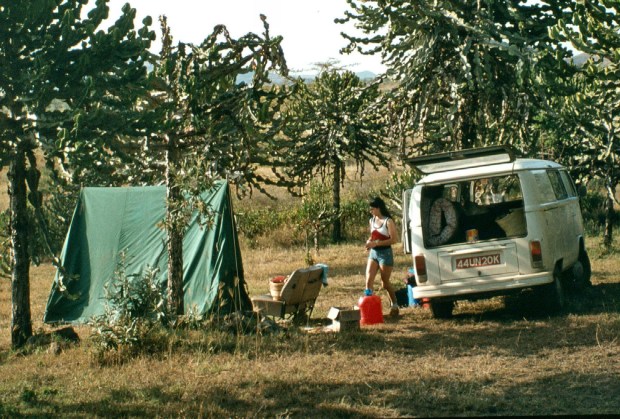
Usually we kept driving by the lake to our final destination, the modest Fisherman’s Camp up in a dry hill where at first we “camped” with our rather basic gear under the scanty shade and thorny company of the candelabra trees (Euphorbia spp.)! It was while driving towards this camp that Mabel spotted the “antelope up the tree” [2].

naivasha fishermans camp top camp 1

Our early camp! Note the use of the car seat and absence of chairs that did not dampen our enthusiasm.

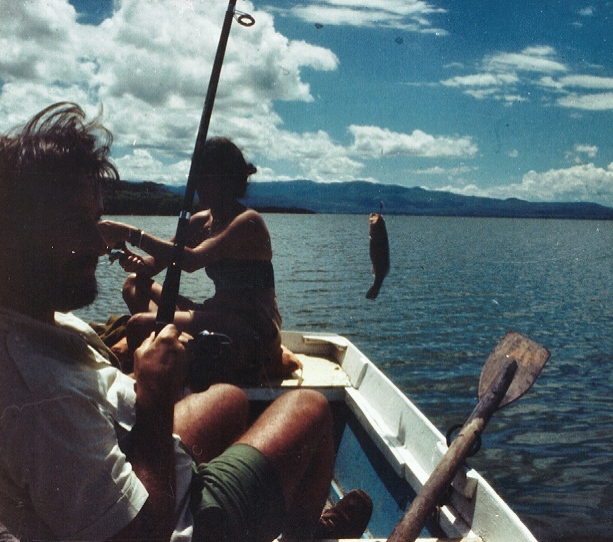
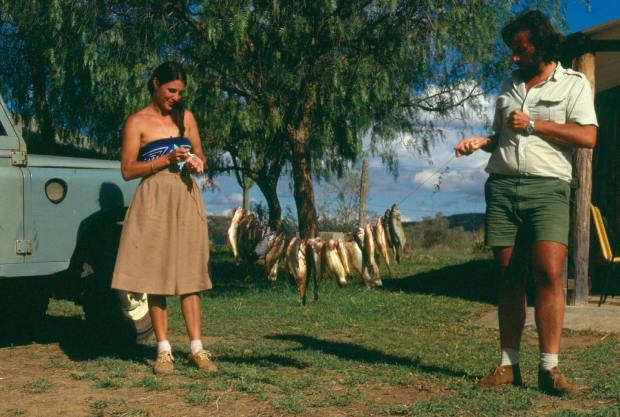
After our first rather tentative and exploratory visits, we got to know the area better and participated in a number of activities, many of which with our friend Paul that had a rubber dinghy, an ideal vehicle to explore the lake. It goes without saying that fishing was one of the main activities we practiced at the lake that had been seeded with black bass (Micropterus salmoides) and that it was “crocodile-free”.

MC fishing bass L Naivasha copy

Our first fishing attempt fn a rowing boat from Fisherman’s camp.

These adult black bass feed on crayfish, small fish and frogs and we caught them with a variety of lures and spoons and every fisherman has its favourite. I was not a great bass fisherman and did not find them good fighters compared with the Dorado (Salminus spp.) I used to catch in Uruguay before our Kenya days. Despite this I never refused an invitation to fish and we had great fun doing it. Paul, conversely, was good at fishing in general and had no difficulties getting bass also.

I lacked practice with my casting that very often ended up with my lure entangled in the shore reeds, a feat that I maintain even today and my family expects it from me when we go out to fish! It was during one of these “failed” casts that my green frog-like lure landed on land, even beyond the reeds.

As usual Paul started to make a rude comment but before he could complete it, a long green snake went for my plastic frog! Startled, I pulled and recovered it while we laughed at the incident. I then re-casted to the same spot and, again, the snake attacked it for a second time. This time I was ready so, to avoid hooking the aggressor, I withdrew the lure and continued casting to a different spot.

Although usually we did not catch many bass, sometimes we did and, after a while, we looked for some added entertainment and threw some fish to the very common fish eagles to catch. These birds were usually perched at more or less regular intervals along the lakeshore, in their territories.

fisherman camp naiv

After our best day fishing in Naivasha.

They position themselves high up the trees and there are always watching, not only for fish but also any movement in the water or potential prey of any kind. So, throwing a fish overboard almost instantly called their attention, and before it had moved too far, the eagle will come and take it. This was great fun to watch and we decided to photograph it for posterity!

The idea was to get one eagle at the exact moment that it grabbed the fish with its talons or while lifting it from the water! Easier said than done. I was chosen as the photographer and Mabel and Paul were the observers that would tell me when to shoot as, with my eye in the viewfinder, I could not see very well the eagle approaching.

We used a lot of fish and, needless to say, after several tries I have dozens of pictures of a floating fish or water splashing. The best I could manage is one with a brown blob on the left that was an eagle’s tail! After that attempt, we abandoned the idea and decided to eat the fish!

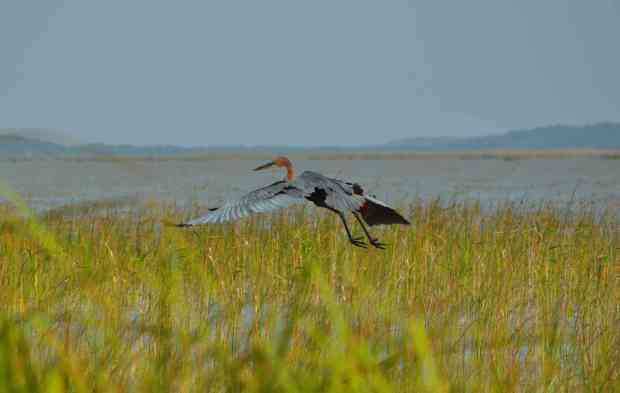
On one of these fishing trips we witnessed a Fish Eagle attack a Goliath Heron while it was flying a few metres from us. I do not know the reasons for the aggression but the result was unusual. The attack took the heron by surprise and in its effort to avoid the attacker it dived but, being too near the lake surface, it crash-landed on the water rather awkwardly.

DSC_0214 small

A Goliath heron in flight. The world’s largest living heron with a height of 120–152 cm and a wingspan of 185–230 cm.

Herons, unlike ducks and geese are waders and not built for take offs from water. Worse still, it was totally soaked. So it floated there for a while like a “goliath crested grebe”. Luckily the eagle lost interest and there were no crocodiles at the lake so, once it recovered its wits, it swam rather fast considering its long legs! It soon reached the shore and it just stood there among the papyrus, drying itself with extended wings!

elsamere

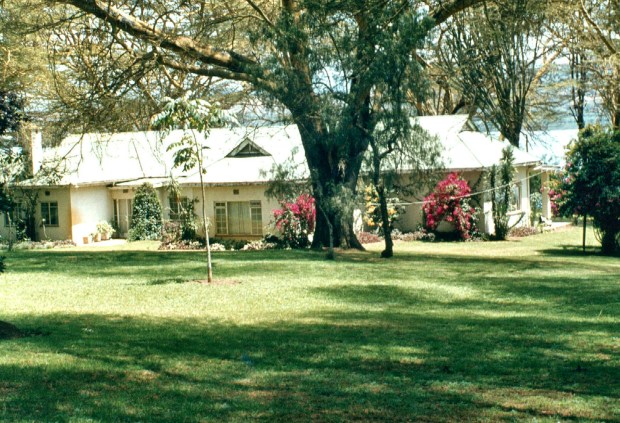
Elsamere.

Some time later we discovered Elsamere, a beautiful house by the lake shore that belonged to Joy Adamson, hence named after the famous Elsa the lioness. It was run by the Elsa Foundation after Joy’s sad demise a few years earlier. Because of our work we were admitted there and it was very affordable. It was a wonderful experience to stay in such a nice house where Joy had lived. In addition, the personnel really pampered us and served very good food. As a curiosity, Elsamere was next to the Djinn (Gin!) Palace, made “famous” by the Happy Valley crowd years before our arrival [3].

Jock Dawson [4] had been recently designated Honorary Game Warden of Naivasha and lived with his wife Enid very near Elsamere where they had some magnificent Spotted Eagle Owls in their garden. Through Paul we got to know them and spent time in their very interesting company and joined him on a number of activities related with his work as Game Warden.

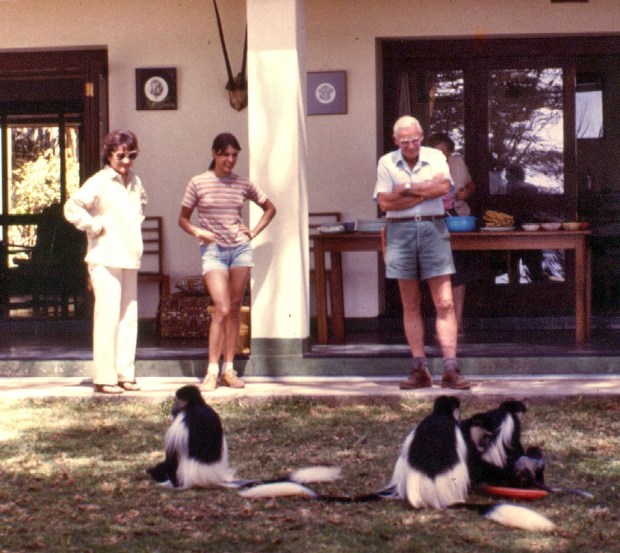
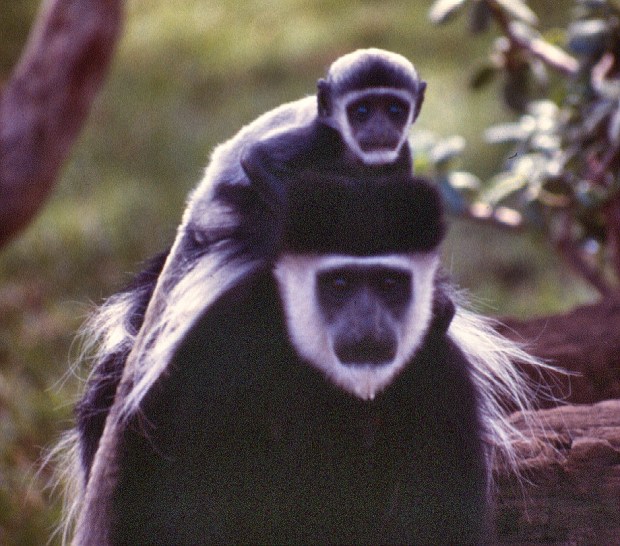
At Elsamere there were still some animals from the time of Joy Adamson, most notably the Black and White Colobus monkeys that -unusually- would come down from the trees to visit us and feed in the lawn. It was great to see them often and to approach them closely as they were used to human presence. We had great views of females with tiny (woolly white) babies!

elsamere colobus jock et al

Enid, Mabel and Jock watching the black and white colobus’ antics.

Colobus Elsamere Naiv

A colobus mother and baby.

Apart from the monkeys there was also an orphan Zebra, once a baby, that was now a fully-grown animal that maintained its playful nature without realizing its size. So its favourite trick was to surprise guests and try to bite them -soetimes with success-  or engage them in “zebra-play”. Not surprisingly, the decision was taken to relocate it to Nakuru National Park.

The operation was simple as the zebra was easy to catch by the people that fed it daily so we soon ended up with a sedated and tied-up zebra in the back of a Land Rover with Jock at the wheel and Paul and I at the back, with the rather large zebra. It all went well until about half of the journey when our cargo started to wake up as it was under mild sedation.

There was no much room left at the back so when it became more and more restless we asked Jock to go faster but the Land Rover would not cooperate and we were forced to manhandle the zebra to keep it down until we reached our destination! Once there, we rushed out of the car, lucky to have avoided being kicked to death!

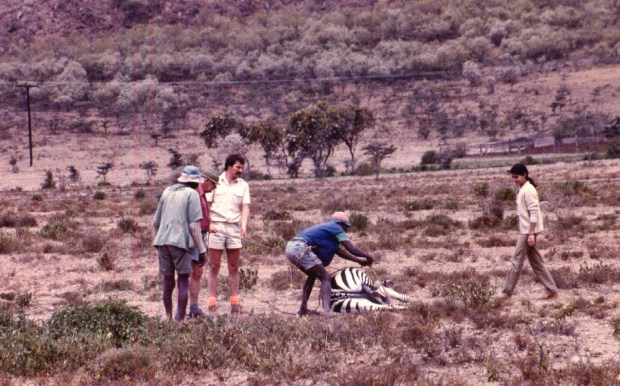
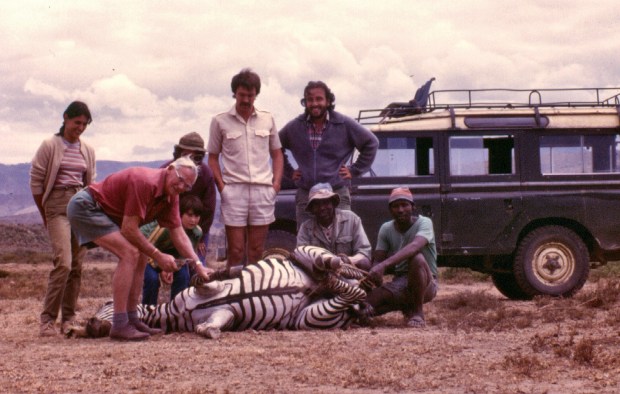
At some stage in Elsamere there were American scientists studying animal behaviour and one day they returned with the news that they had seen a lame zebra in one of the areas they were studying. The leg was quite swollen and Jock suspected that it had been snared.

Off we went to have a look and confirmed that it was indeed a wire that was embedded on the foreleg, just above the hoof and the decision was taken to dart the zebra to remove it.

We left the car so that Jock and Paul would do the chasing and darting and re-joined them to help holding the animal while the wire was removed. The animal recovered quite quickly.

zebra darting naiv copy

The zebra being restrained with Mabel approaching.

Darting zebra Naivasha copy

Posing before the action.

Naivasha was also known for its flower plantations and thousands of carnations were exported by plane to the European market every week but Naivasha also had buffalo and they are herbivorous and enjoyed carnations! So, Jock had received a complaint from a farm nearby that they had suffered a “visit” by a few buffalo that were busy chomping the flowers that were meant for Europe!

Under the circumstances, the only thing that could be done was to destroy the intruders with the hope that the rest would move away to the uninhabited bush higher up in the hills.

That is how I participated in my only African hunt ever as part of a group of curious onlookers that followed the hunters at a prudent distance. Although I did not care for the hunt, it gave the great opportunity to see how the trackers worked while following their quarry. We walked up and down the dry hills for a couple of hours until the order came to stay still and quiet. We then heard a few shots and two of the offending buffalo had been killed and their meat would be shared among the workers of the carnation estate and other nearby villagers.

Our exploring of the lake took us on the road that goes around it, first climbing ridges to get to a small lake separated from the main body of water called, very originally, the Small lake! In this place, away from visitors, hippos abounded among the papyrus and under the shade of a dense yellow-bark acacia forest. It was here that the Great White Pelicans were also found.

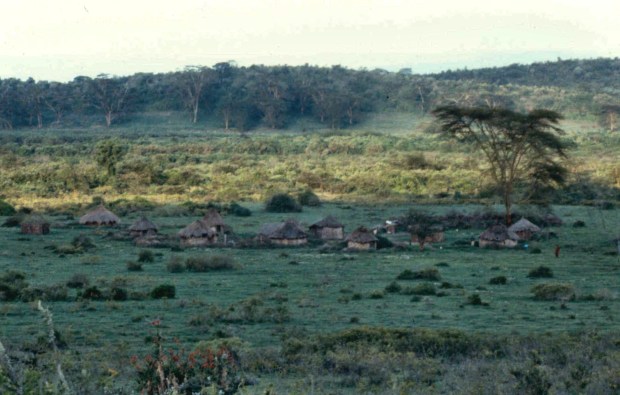
Following the lake shore towards the north, we discovered an area that was more remote with abundant game as well as where the Maasai grazed their cattle, often organized into group ranches [5].

l naivasha group ranch west shore

A Maasai group ranch.

We were in posession of a secret. We had been told that there was a Secret lake in the area and that to reach it we needed to enter through an unmarked farm gate! Eventually we found the entrance and went in. We followed a very narrow track uphill and, suddenly, below us we saw a small crater full of water the colour of pea soup.

The lake was fringed by large yellow-barked acacia trees and it seemed to be fed by rain water although the existence of springs could not be ruled out.

naivasha secret lake 1

naivasha secret lakeA steep walk down the crater, following a track made by the Maasai when taking their animals down to the lake allowed you to reach the water edge. The Maasai were known to bring their cattle to this little lake as, apparently, its mineral-reach water would do them good, a fact corroborated by Tommi, the Maasai herdsman that worked with me at Intona. He came from this area and he knew of the existence of the lake and the curative properties of its water [6].

We did go all the way round the lake once but this had little more to offer and we decided that we better continued frequenting Elsamere and its surrounding area where we enjoyed our closeness to nature with comfort.

Rift valley Kenya copy

Small farmers in the rift valley on the way to Naivasha.

[1] Former Acacia xanthophloea.

[2] See: https://bushsnob.com/2014/08/24/green-eyes-in-the-wild-2/

[3] A classic book about the Happy Valley era was written by James Fox: White Mischief. Publisher: Vintage; New Ed edition 320p. The book was made into a movie of the same title by Sony Pictures in 2011.

[4] A well-known professional hunter who transformed himself into a respected conservationist after Kenya banned hunting in 1977, and -after his time in Naivasha- headed the Rhino Rescue Trust in Nakuru. Unknown to me at the time but of interest is that Jock had bought the gun that belonged to Dennis Finch-Hatton, Karen Blixen’s lover (for Stg. 100). After Jock’s death in 2004 his son took the gun, minus the case, to the UK. For the specialized, the gun was a .450 3 1/4″ Nitro Express by Charles Lancaster. John Ormiston (a UK gun trader) had bought a case with the initials D F-H (Dennis Finch-Hatton) and looked for its missing contents for years until he found the gun in 2009 and bought it for £ 27,000 at an auction in the UK (beating Madonna!). For more details see: https://www.africahunting.com/threads/the-450-double-rifle-of-dennis-finch-hatton.40240/

[5] Group ranches are defined as a livestock production system where a group of people jointly hold title to land, maintain agreed herd sizes, and own livestock individually but herd them together. Boundaries are demarcated and members are registered. See: http://www.focusonland.com/countries/rise-and-fall-of-group-ranches-in-kenya/

[6] Today the Crater lake is a game sanctuary where you are charged a fee to enter and there are walking paths and camping sites near it.

Spot the beast 61

We are having a slow start of the rainy season this year but, searching among my pictures, I found this ones that show a beast of some sort from one of Nature’s kingdoms…

See if you can spot it!

img_3139-1-copy.jpg?
?
?
?
?
?
?
?
?
?
?
?
?
?

Here it is. As you have realized by now, it is not a giant fern sprouting but a chameleon digging its egg-laying hole with the rolled tail out!

IMG_3140 cropped copy


This is the culprit laying, darker after the effort.

DSCN1562 copy