October is usually Harare’s hottest month with a maximum and minimum temperature averages of 29oC and 15oC respectively[1]. Surface water is very scarce so the garden birdbaths surprise you with their visitors.
Among the guests there are a few small birds of prey that are not “regulars” but that come sometimes: the Lizard Buzzard (Kaupifalco monogrammicus) and the Gabar goshawk (Miconisus gabar).
The Lizard Buzzard standing in the water.
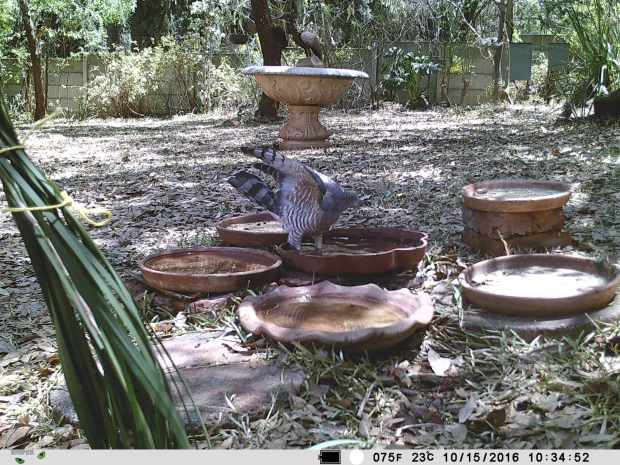
While at the water I noted that they both behaved in a similar fashion. Apart from drinking (the Gabar Goshawk also bathed), both species spent a long time (over thirty minutes two or three times a day on the days observed) standing on the water baths during the hot hours of the day, around midday.
The Gabar Goshawk standing in the bird bath, having had a bath.
Was it a coincidence or did they find relief by the freshness of the water in their legs?
I subsequently learnt that birds lower their temperatures through a variety of different mechanisms[2]. The bare skin on their legs and feet helps them to dissipate heat. Water birds stand in the water, presumably to enhance the cooling[3]. Some birds such as vultures and storks also use urohidrosis, the habit of urinating/defecating on their bare legs to cool down by evaporative cooling.
It seems likely that both birds were using the water of the bird baths to cool down their legs and feet and in this way, as the water birds, increasing the cooling effect of their bare skin.
Interestingly, since I wrote these observations[4], two more birds of prey had come and both species had stood with their feet in the water: an African cuckoo hawk, (Aviceda cuculoides) and what I believe to be an African Marsh Owl (Asio capensis)[5].
The more recent observation of the African Cuckoo Hawk (landing on the water) and the African March Owl below. These 4 pictures were taken with a Camera trap.
[4] de Castro J. (2016). Feet bathing as a cooling down mechanism in two species of birds of prey. Biodiversity Observations 7.77: 1–2. URL: http://bo.adu.org.za/content.php?id=270. Published online: 22 October 2016
[5] Identification to be confirmed as the pictures of the owl have been taken with a camera trap late at night.
The distance between Carmelo in Uruguay and Salta in Argentina is about 1800 km by road so we usually divided the trip in three legs of roughly 600km each as to avoid driving too much in a day. The first stop is usually Curuzú Cuatiá in the province of Corrientes that we reach after crossing the border and a rather monotonous drive.
The second day takes us through a nice area known as the Iberá wetlands where bird life makes the trip very entertaining and interesting. Our second stop is found about 200 km towards the north-west, after crossing the mighty Paraná River in Presidencia Roque Sanz Peña, the second largest city of the Chaco Province. The main attraction of the city are its thermal waters but it also has a rather hidden treasure: a zoo of native animals. As the latter are difficult to see in the wild, the zoo helps preparing the observer for real life!
During one of the stop-overs we needed to kill time for a hotel room to be ready so we decided to defy the intense heat and spend some time at the zoo! We only learnt on arrival that mosquitoes were also on display and in large numbers! Luckily we had a strong repellent[1] otherwise the tour would have been abandoned!
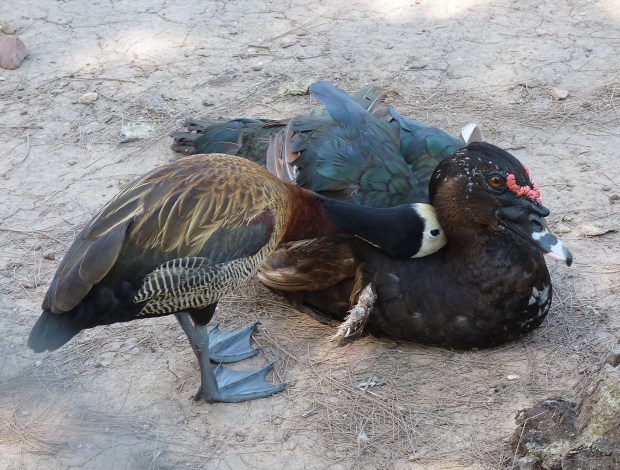
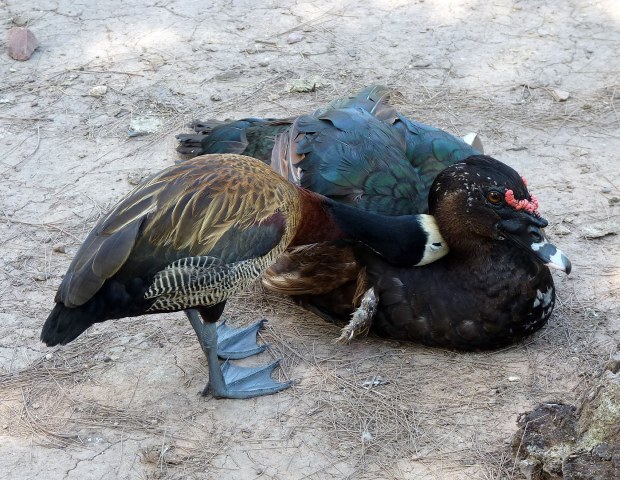
Towards the end of the visit we walked passed a pond that was home to several duck species including domestic ducks. While watching the pond, we saw a few wild ducks known as sirirí cariblanco or white-faced whistling duck (Dendrocygna viduata), one of the handful of species that occurs both in South America and Africa, just like us! While making a comment about its world distribution we noticed one that had a “relationship” with a domestic duck.
As this was unusual, we watched as the whistling duck approached the much larger “friend” and placed its beak and part of its head behind the neck of the larger duck!
The careful approach.
Getting in place.
Smugly in place.
At first we thought that it was looking for something there but it just kept its head there without moving for the whole time we were there and it was still in that position when we left them! The domestic duck, clearly used to this “treatment” did not move and accepted the wild duck indifferently!
Closing the eyes!
[1] Repellents in South America can make the difference between misery and enjoyment and you need strong stuff to survive the various biting insects that wait for you there!
One of the advantages of being a “safari veteran” apart from a bushsnob is that I am now able to enjoy what I found, even the small things that were overlooked while seeking large game. The years of long game drives and walks, some of them starting very early and with freezing temperatures, are a thing of the past. Apart from seeing a pangolin in the wild, I have few wishes left about finding new beasts.
At Ngweshla Picnic site, Hwange National Park, you are allowed to camp and have the site for yourself from 18:00 to 06:00. During the day you share it with picnic site users but there is still plenty of room for everybody. Although rather unique, this is a good arrangement as most of the day you are game-watching away from the site and the camp attendants keep the camp tidy and the toilets sparkling at all times!
The site has seen better days and, as a consequence, it has a rather “porous” fence that would, if the animals wished, allow them to mingle with the campers, a rare occurrence though. The site entrance has been “decorated” with many animal bones. Although it is debatable whether these are suitable for the purpose, I find the skulls, useful to explain various issues regarding wild animals to our visitors.
The more recent antelope and buffalo skulls on display still had their horns and, as it is common if Africa, most showed little brown tubes protruding from them. I had seen this phenomenon many times before but I never followed its origin in detail. A short search educated me that the Horn-borer moths (Ceratophaga vastella) were responsible.
The larva of this moth, related to the one that upsets us by eating our woolies, are able to digest keratin and, although there are reports of them entering the horns of live animals, it is generally accepted that they only penetrate the horns post-mortem.
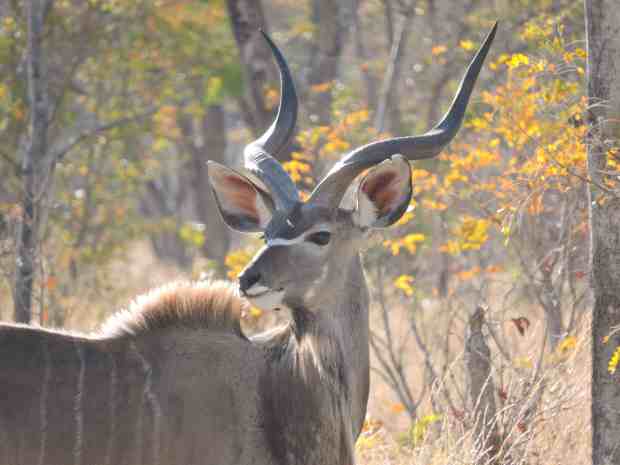
A nice and “mothless” Greater kudu bull.
The protuberances on the horns are the cases of the larvae that the latter built using their own faeces. The cases protect the soft insects from predators and the climate until they pupate and emerge as adults to fly away and colonize new horns.
Ceratophaga vastella, known as a detritivore[1], is widespread in the Afro-tropic ecozone[2]. Thus far there are 16 described species in the genus, with 12 found in Africa. The larvae are cream-coloured and bulky, with a brown head and tip of abdomen. The adult moth is a typical tineid[3], having a conspicuous tuft of yellow hair on the head.
Whenever an animal dies or is killed it will eventually be consumed by the killers and/or depredators including various mammals such as hyenas and jackals, birds such as vultures and others, fly maggots and ants until only bones, horns and hooves are left. The horn-borer moths are one of the last participants turning the carcasses to dust.
[1]An organism that feeds on and breaks down dead plant or animal matter, returning essential nutrients to the ecosystem.
[2] One of Earth’s eight ecozones. It includes Africa south of the Sahara, the southern and eastern fringes of the Arabian Peninsula, Madagascar, southern Iran and extreme southwestern Pakistan, and the islands of the western Indian Ocean.
[3] Moths of the Tineidae family, also known as fungus moths includes more than 3,000 species, unusual among Lepidoptera as most feed on fungi, lichens, and detritus. Apart from the clothes moths, which have adapted to feeding on stored fabrics, others feed on carpets and the feathers in bird nests.
Staying at Satara Rest Camp, following the advice of our Kruger National Park guidebook, we opted to drive along the Timbavati River hoping that there still was some water left and the animals were drinking there. We also had the white lions in mind! We drove to the picnic site but it was almost totally dry so we decided to carry on along the river.
We did not!
Driving along the Timvabati River.
The carapace of a Leopard tortoise highlights the dryness of the Kruger.
Eventually we found some large pools that still had water and, as expected, several animal species were congregated there. We spent some time observing their interaction until it was time to return to our camp.
On the way back we spotted a dead elephant. Although the sight was pitiful, we were already “death-conditioned” after witnessing several dead and dying hippos earlier on along the Lower Sabie River[1]. The animal was laying in an odd position that seemed to indicate a sudden collapse.
We could see that the elephant had some small tusks and, planning on reporting the find to the KNP authorities, we took the GPS coordinates. We looked at it through our binoculars and could not observe any breathing movement. Before we moved on, we noted that there were a couple of other elephants nearby and, aware that elephants have a special attitude when confronted with a dead mate, we decided to stay and observe their reaction.
We were somehow surprised when they just walked passed it without even looking at it! Sooner, our surprise became shock when, suddenly, the dead elephant moved an ear and resuscitated. Eventually, it stood up, stretched and started to feed totally unconcerned.
It was a case of “death by deep siesta”, something we had earlier observed with humans after a heavy lunch in tropical South America.
“What on earth is that?” I asked while driving towards Upington on our way to the Augrabies Falls last September. My wife and copilot to who the question was directed could not understand what we were seeing either!
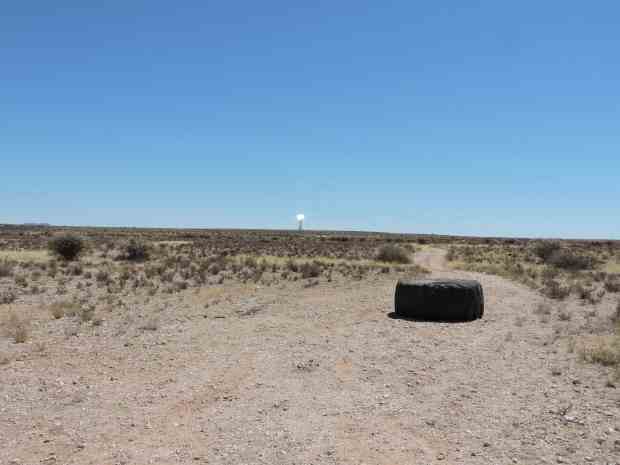
Somewhere in the horizon, well above the city’s buildings, there was a very bright source of white light. From a very long distance, it looked like the reflection of the sun on one of the new glass-covered sky scrappers that are found in places such as Dubai or Singapore. But in Upington? It could not be.
The first sighting of the light.
Getting closer it became clear that the light was coming from a rather tall structure as it really dominated the landscape as a second (white) sun! As we drove past Upington towards the falls, the light remained to our starboard for about 40 km until we no longer saw it.
While we drove we discussed the “phenomenon”. The first theory involved visitors from another galaxy. We have watched District 9[1] and we knew that this had taken place in South Africa but in another city. Additionally, UFOs are not normally stationary for long and they tend to move at amazing speed doing weird things in the sky. So, unless it was an extraterrestrial contraption that had unlikely just crash-landed, the object should be terrestrial.
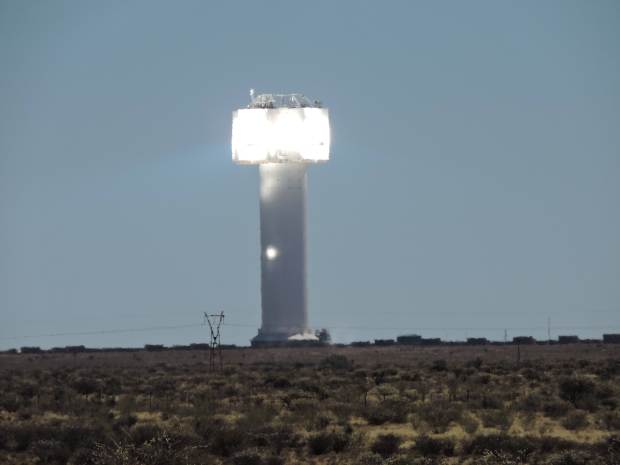
At some point we drove closer and we were able to see more details. It was a humongous tower that, from its top, emitted a very strong white light like a gigantic white LED. We realized that it was something to do with electricity generation from sunlight and a quick WhatsApp (with pictures) consultation with our offspring in Europe confirmed that theory.
A view of the tower and surrounding structures.
The tower came back to life during our return to Upington, after enjoying the visit to the Augrabies falls. Now ready to find more information, we paid attention to all roads going in its direction and eventually found one with a large signpost that said “Solar One”. We confirmed our suspicions that this was a large energy project.
A close up of the top of the tower. The sun rays are focused on the “windows” where they heat up the steam.
That night, while in Upington, I was able to Google it and, what I read was rather remarkable.
The full name of the contraption is Khi Solar One (KSO) and it is a solar thermal power plant capable of producing 50 megawatts of electricity. It is the first solar tower plant in Africa and the first to achieve 24 hours of operation with solar energy only. Not that there are many in the world anyway! In fact, there are about twelve towers (1 in South Africa, 1 in Turkey 3 in USA, 3 in Spain, 1 in India, 1 in Germany and 2 in China).[2]
The KSO solar field is made of more than four thousand heliostats[3], totaling up to 576,800 m2 of mirror surface placed on an area of 140 hectares. In this case, the mirrors focus the sun rays on a boiler located on top of the cement tower. The latter is over 200m high! The KSO uses a superheated steam cycle that is able to reach a maximum operating temperature of 530°C and the energy can be concentrated as much as 1,500 times that of the energy coming in from the sun!
The steam generated is then converted into mechanical energy in a turbine, which powers a generator to produce electricity. The plant is able to accumulate steam to provide up to two hours of thermal storage at the plant. Apparently, power towers must be large to be economical. This clearly explains its size!
The project was developed by Abengoa from Spain and financed by the Industrial Development Corporation and community group, Khi Community Trust. According to Abengoa, the 50 MW, steam-driven solar thermal plant which recently began commercial operation in early February 2016, supplies enough clean energy to power around 45,000 South African households.[4]
Of note is that Abengoa has been going through tough financial times recently and KSO is one of its assets that it may need to sell if a planned company restructure does not work.
I am sure that we all agree that baobabs (Adansonia digitata) are special trees. To see these true behemoths of the vegetal world in the African bush is always visually attractive and these trees have an important contribution to human as well as animal food security.
A large number of “famous” baobabs are scattered throughout Africa and Walker (2013)[1] has done a great job documenting forty special baobabs in Southern Africa while writing about his life devoted to conservation.
I have always regarded them as primeval trees that would take hundreds if not thousands of years to reach their monumental sizes. That is why what I saw after crossing the border from Botswana into South Africa shook the foundations of my baobab world…
This year we decided to do our annual trip to South Africa through Botswana for two main reasons: to avoid the normally chaotic border post at Beitbridge and to see more of Botswana. After spending the night in Palapye we crossed the border at Martin’s Drift and, after the event, we congratulated ourselves for the choice as, dealing with the border, only took a few minutes!
Still enjoying the “high” that an easy border crossing gives you we came across a farmstead with an access road lined by trees! Well, you would be thinking that the border crossing really affected my mind as most farms have such an entrance! Not so. The trees were fully grown baobabs! In addition, the land surrounding the farmhouse was also littered with the giants!
The trees I saw were not baby baobabs, not even teenagers! They belonged to my “adult baobab” category that includes trees that are hundreds or even thousands years old. Did early settlers plant the trees? Considering that the first Europeans arrived in the Limpopo Province (then the Transvaal) in 1836 via the Great Trek this could be possible. However, I believe that the trekkers had other more pressing activities than planting baobabs! This is confirmed by the finding of the first gold fields in the Transvaal fifty years later.
It was also unlikely that the trees, like the famous Morondava’s Avenue of the Baobabs in Madagascar were the remnants of a far greater baobab forest which existed in the past and not planted on purpose to grow as an avenue.
So, the mystery of the Limpopo baobab avenue remained in my mind throughout the journey through South Africa. It was only when back in Harare that I found time to Google the name of the farm and learnt that it is a hunting company[2]. Keen on finding out the origin of the trees I sent them an e-mail but I did not get a reply. I continued searching.
While looking up the issue, I remembered that a good Italian friend had bought really ancient olive trees that were moved from Southern Italy to his farm near Rome where they were planted! Apparently a trench is dug around the tree to uproot it, one side every year, then it gets pruned and, in about 4 years, it is ready to be “transplanted”. Could something like that be done with baobabs? The answer is yes!
There are 380 transplanted baobabs at the Lost City forest at Sun City, the heaviest weighed 75 tons at the time of the move! De Beers Venetia mine has relocated 110 baobabs to avoid them being damaged by its mining activities and, more recently, a large baobab in Musina, South Africa was moved from the new Musina Mall parking area and placed in a roundabout a few hundred metres away[3].
So, in the absence of a response from Choronga Safaris we can only say that there is a farm in the Limpopo Province of South Africa with an amazing baobab-lined entrance that, regardless of their origin is amazing but that we suspect that the trees were placed there rather recently.
I nearly fainted when, after this baobab revelation, I went out to have a look at the one I planted two years ago in a strategic place of the garden. There it was, about 60cm tall and starting to sprout. Although healthy, its growth is almost imperceptible and it still looks like a bonsai!
Seeing my pathetic project, I was tempted by a transplantation and a few baobab candidates I know came to mind! However, I abandoned the idea as it felt like cheating! I have planted the baobab for future members of the family to enjoy it and I will stick to this idea.
My “bonsai” baobab in Harare. The ruler is 30 cm long.
Well, to tell you the truth, the possible cost of a transplant really persuaded me not to do it so I will increase the amount of water it gets although I do not think that this will accelerate its growth. The only certainty is that I will not be able to drink tea under its shade.
[1] Walker, C. (2013). Baobab Trails. An Artist’s Journey of Wilderness and Wanderings. Ultra Litho (Pty) Ltd., Johannesburg. 287p.
It was during a “pit stop” while returning from Mana Pools National Park to Harare in August when we found an interesting beetle aggregation. As usual, it was my wife who detected the “funny-coloured leaves” on the tree.
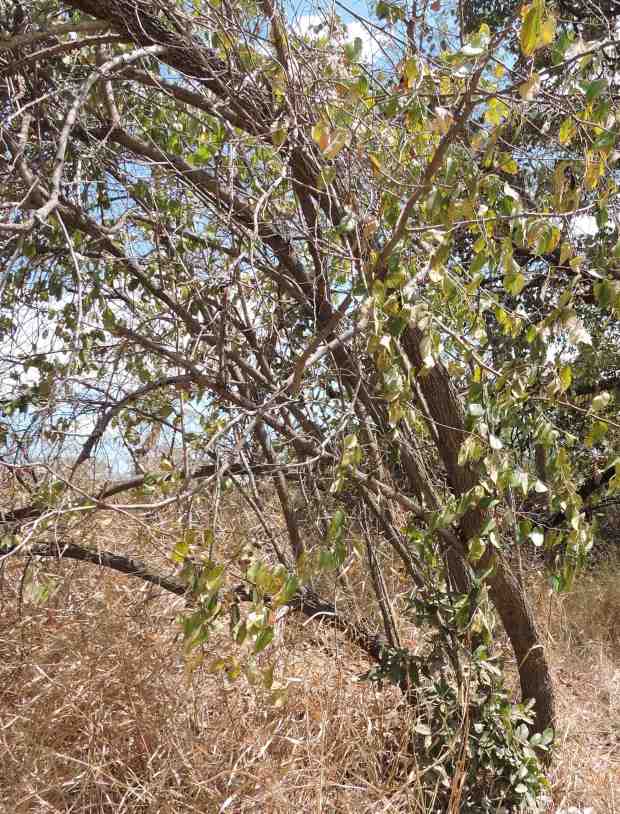
The tree where the bug meeting was taking place. The bugs are the darker spots on the right.
We had a good look at the tree and took a few leaves and fruits from it to see if we could identify it. We also took pictures and videos of the insects as it was a really interesting find. Later, after some time we decided that the tree was a Buffalo-thorn, Ziziphus mucronata. Thinking that the finding was interesting, I followed it up and consulted the experts.
I sent pictures to the Biosystematics Division of the Agriculture Research Council-Plant Protection Research Institute in South Africa from where I got a very helpful response the following day! Luckily, they agreed with our tree identification and clarified that the beetle was in fact a bug of the Plataspidae family and not a beetle.
Close-up view of the bugs.
The tree where the bugs can be seen aggregated on its leaves.
As expected, to positively identify a bug through photographs is not really possible. However, the creatures’ identity was narrowed down to either Brachyplatya testudonigra or B.rubromaculatus. However, more important than the identification was the fact that the bugs were swarming, not a common phenomenon.
Things then turned a bit more scientific when I tried to get more information on swarming and learnt that Sithole and Oelofse (no date) described the rather unusual swarming of the green stink bug, Piezodorus purus. The latter was observed in several areas of the Kruger National Park but their aggregation reached large numbers at the Mooiplaas area where the bugs became a nuisance for the park personnel living there.
I also learnt that there is actually a stink bug considered to be a delicacy! This beast, aptly named the edible stink bug (Encosternum delegorguei) found in northern South Africa and Zimbabwe, does swarm during years that the conditions for such event are right (Stiller, personal communication). If interested, Nelwamondo (2015) gives very interesting information on this species.
Sisterson (no date) mentions insect aggregation in general as a phenomenon that obeys to three main reasons:
environment: e.g. low temperature and/or low humidity forcing the bugs to migrate searching for better conditions,
mating strategy: it seems that although swarming could be positive by allowing weak females (after debilitating winters) to be able to mate with multiple males, it can also create confusion among active seeking males that would spend energy chasing each other in addition to the females) and,
defensive strategy: aposematic[1] insects aggregate. It is believed that they do so to become more obvious and, in this way, better deter predators.
The aggregation pheromone is responsible for this behaviour that, although it can be used in pest control it can also have deleterious effects on some attractive insects such as butterflies as their aggregation sites get degraded with the risk of their number diminishing below critical levels.
The behaviour observed in the Green Milkweed locusts (Phymateus viridipes) reported earlier in this blog[2] was probably migratory as they were not feeding on the cacti. However, feeding is another reason for insect aggregation. Stiller (personal communication) mentioned that he has observed leafhoppers swarm on the trunks of trees, that are probably their feeding plants and the pest Bagrada hilaris, can occur in very large numbers on feeding plants.
The introduction of the bean plataspid, Megacopta cribraria, into the United States in October 2009 has attracted considerable research on this bug as it has become a pest of soybean in Georgia and South Carolina (Poplin and Hodges, 2015). These researchers mention the overwintering congregation of the bugs on buildings as a possible nuisance, a similar situation as the one described above that took place in the Kruger National Park.
It is interesting how a rather casual observation of a cup of coffee stop during a road trip could develop into a motivating investigation on the aggregation behaviour of insects. Of course, after all the reading and writing, I still do not know the exact nature of the bug but I learnt something about the biology of the plataspids, a group of insects I totally ignored.
Acknowledgements.
The assistance of Elizabeth Grobbelaar and Michael Stiller of the Agriculture Research Council-Plant Protection Research Institute of South Africa was critical in checking the identity of the bugs.
References
Nelwamondo, V. (2015). Edible stinkbug. SANBI – Zoology systematics. Accessed on 15 October 2016. http://www.sanbi.org/creature/edible-stinkbug
Poplin, A. and Hodges, A. (2015) Bean Plataspid: Megacopta cribraria (Fabricius) (Insecta: Hemiptera: Heteroptera: Plataspidae). Document EENY527, Department of Entomology and Nematology; UF/IFAS Extension, USA.
Sisterson, M. (no date). Insect Aggregations; The Phenomena Itself, Why It Occurs, And Its Implications To Us. Accessed: 15 Oct 2016. http://www.earthlife.net/insects/aggregat.html
In the evening, after returning from a game drive, the traditional endeavor is to have a shower, taking advantage of the excellent facilities that exist in all camps at the Kruger National Park. I, as usual the gentleman, let my wife go first while I kept busy selecting the best pictures to free some valuable memory card space in the always full camera.
That evening at Satara Rest Camp my wife praised the shower quality so, as soon as I was done with the pictures, I hastily took my turn. It was an experience I was not ready for. No amount of tap opening would produce hot water and a cold shower has never been in my agenda, not even in the hottest deserts! Swearing at the new solar power water-heating technology, I aborted the mission and put back my dirty clothes. As usual, my wife overlooked this hazard while -I am sure- suppressing yet another chuckle…
Those who had shared safaris with me would not be fussed about this kind of event taking place. “I have had a good dust shower during the game drive and, after all, animals roll themselves in the dust for a reason!” I was reasoning with myself when my wife called me for dinner. Confronted with her usually outstanding delicacies, I soon forgot about my dusty condition and, after enjoying the meal, my frustration rapidly faded and soon it was time to sleep.
Without thinking clearly, the following morning I went straight into the shower convinced that the (solar!) water heater should have recovered during the night. After a while of running cold water I remembered that the night sun only shines much further North and only at certain times of the year! Hearing my resumed loud protestations my wife intervened and informed me, rather casually, that for some reason in this shower the hot water tap was on the right hand side!
Feeling rather stupid I tried opening the other tap and hot water immediately gushed out and I had a great shower during which I voiced all my conceivable praise for solar water heaters…
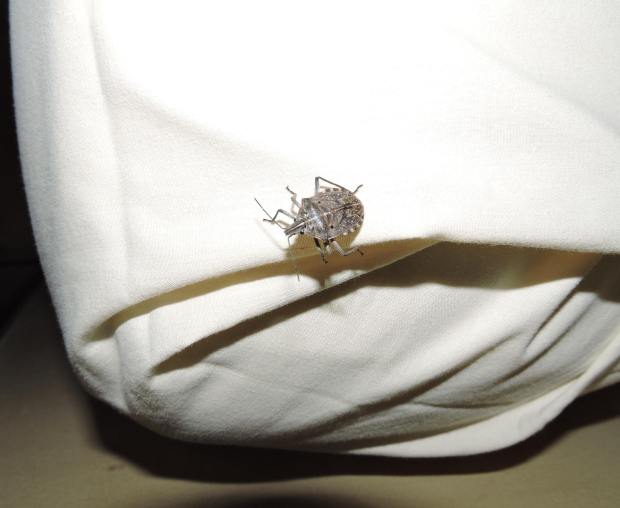
The story, however, does not end there. Before leaving the bed to go into the shower, I smelled something really unpleasant in my bed. Thinking that it was probably the residual effect of my unwashed status, I did not know the truth until I returned to the bedroom to dress up, and spotted a rather large stink bug crawling out of the sheets!
First sighting of the bug.
Although I do not know what took place during the night while I shared my sleep with the invertebrate, the latter was in poor condition and it sadly died a few minutes later! Luckily I managed to record its last living minutes so that I can show them to you.
It was immediately apparent that the beast was suffering.
It expired soon afterwards.
There was no doubt in my mind that overnighting with me in my “showerless” status had taken care of it!
Unfazed by the temporary bug relationship, the bushsnob, sporting at least a clean shirt continued with his activities.
While in Kruger National Park we stopped at the Nkhulu picnic site in the Southern part of the park to have a break and stretch our legs. The place is adjacent to a small river that was still having some water. This fact made the place attractive for birds and mammals alike.
As soon as we walked in we noticed great excitement as people were congregated by the river edge watching the opposite margin. We soon discovered the reason for such a hoo-ha: a pair of leopards were having a stroll! We postponed our coffee for a while and watched the magnificent animals until they moved off into the thicket. Now, that is an arrival!
We did have our coffee among the excitement that gradually faded but that was somehow renewed every time we were raided by the baboons that were also numerous in the site and a pest throughout the park nowadays. After a while of fending off monkeys and with the image of the leopards still in our minds, it was time to resume our drive so we returned to the car park. Another surprise awaited us.
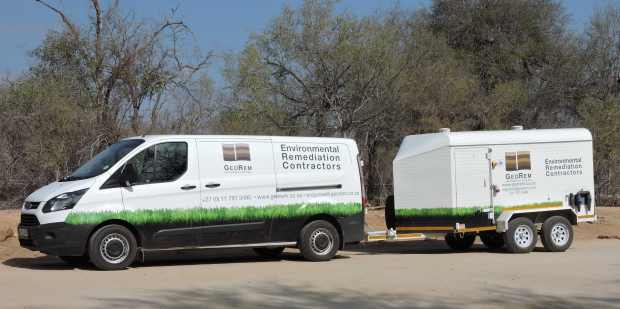
A car offering “Environmental Remediation” was parked near ours. My first thought was that the Park authorities had already sought a solution to prevent the future problems that the Park would face because of the drought. The knowledge that such an alternative existed made me also forget my concerns about the future of the world while realizing that I had been wrong all along!
Regrettably and almost immediately my common sense brought me down to earth on that to clean up the latter we need more than that! As I have seen septic tank-emptying tankers labeled under some weird names such as “Honey sucker” I thought that it was probably another one. In any case, I soon forgot about the unusual find!
Once at home, I Googled the company and, to set the record straight, they define their activities as: “… a specialist environmental contracting service, providing assistance to consultants and industry in the monitoring, management and remediation of contaminated land and water throughout the African Continent.”[1]
So, they would not be able to solve the earth’s environmental degradation but I am sure that they provide useful services in their field.
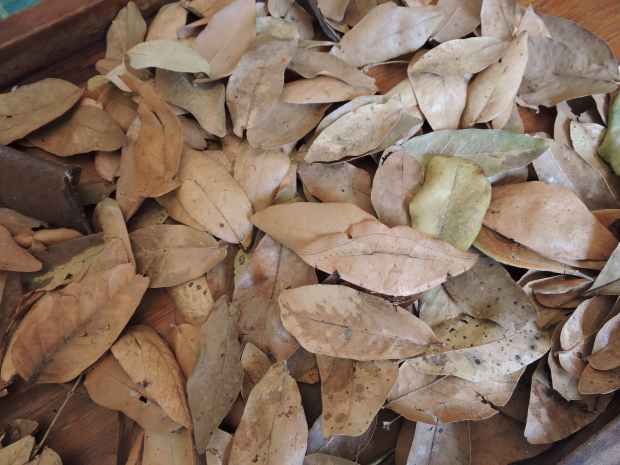
I was not planning to blog today, Sunday. However, there are no rest days for Nature so I found this creature in the garden and took a picture for you to find it. This time it is not very difficult…
I am sure that you spotted it but, just in case I give you a close-up.
It is (I believe) a Red Tail moth (Hypopyra capensis), a common moth of Southern Africa that has a cryptic upperside that blends very well with dead leaves this time of the year.
Its under-wings and abdomen, however, are bright orange-red hence its common name.
As I try not to handle them, I thought I would not able to show you its underside as it flew away. Luckily it decided to land on the floor of the patio for a while where I could photograph it under direct sunshine and the underside colour can be seen, even from above!
The larvae of this beautiful large moth of about 70mm wingspan feed on false-thorn (Albizia) and its range goes up to equatorial Africa.[1]
[1] Picker, M., Griffiths, C., and Weaving, A. (2004). Field Guide to Insects of South Africa. Struik Nature. pp366.














 I am sure that you spotted it but, just in case I give you a close-up.
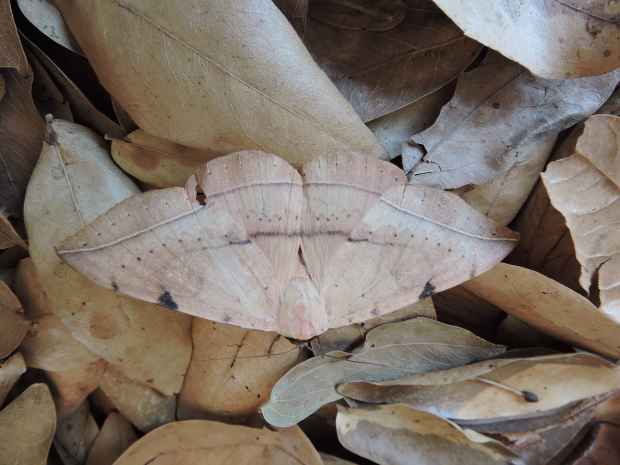 It is (I believe) a Red Tail moth (Hypopyra capensis), a common moth of Southern Africa that has a cryptic upperside that blends very well with dead leaves this time of the year.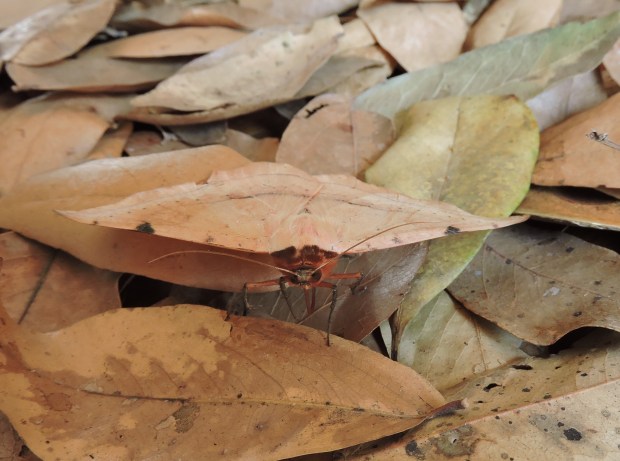
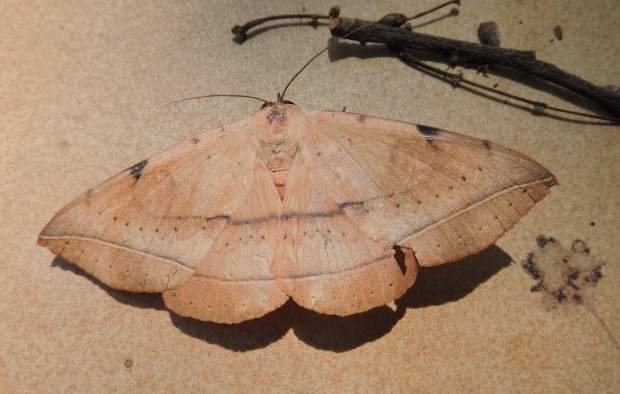
 A Bushsnob out of Africa