Bush cats…

While in Kenya, when a couple of friends departed, we inherited two neutered cats. They could not have been more different. One was a marmalade coloured male that went by the name of Tigger. The other one a seal-point Siamese female named Inky. While Tigger was an indoors fat and lazy youngster, Inky was an outside cat and an excellent hunter that forced us to make our bird feeder and bath cat-proof to prevent a disaster.

When our time to leave Kenya came, we were very attached to them and we decided to take them with us. After the needed health certificates and a special double box that would enable them to have eye contact through wire mesh, we were ready to go. The plane trip was not too far as we were going to Addis Ababa.

It was an easy trip and we found no difficulties on arrival at Bole airport. However, negotiating their stay at the Harambee Hotel in Addis Ababa for the days needed to prepare our long trip to Bedele in West Ethiopia was more time-consuming and it required some protracted negotiations. Eventually, permission was granted, provided that they remained inside our room!

After a few days, our travel permits were ready, we had a vehicle, petrol and petrol coupons as well as a stockpile of food to last us for a couple of weeks. We were ready to set off, at last. The journey from Addis Ababa to Bedele via Jimma was about 420 km in terms of physical distance but because of the traffic -particularly people and livestock walking on the road- it took the whole day to complete, with a bit of luck!

finchaa-tick-count-2-copy

On the way to Bedele.

Auspiciously, our maiden voyage went well and we eventually arrived in Bedele in late evening. We managed to get the keys of our cottage from the Administrator of the Veterinary Laboratory and moved into the house we would live in during the following two years. That night we camped in the house as we were only able to travel with the few possessions that we could carry in the pick-up. Our furniture and other household items would arrive later via an FAO lorry as, at that time, there were no moving companies operating in Ethiopia’s countryside.
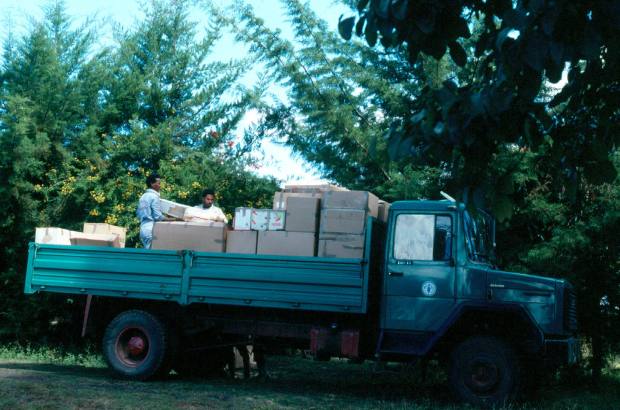
bedele-packing-fao-lorry

The arrival of our personal effects.

Immediately after arrival our cats got on with their job: Tigger found a place to sleep and Inky started to inspect the house and its environs while calling for attention, before settling down with us to spend the first night in the Ethiopian bush. Starting the following morning, our interaction with our Ethiopian and foreign colleagues assisted us greatly to settle in and, with the arrival of our belongings a few weeks later, we managed to make the place quite comfortable. Eventually we developed a very good vegetable garden and, while Tigger relaxed, Inky was active keeping garden enemies at bay.

Unexpectedly Tigger started to follow Inky during her sorties to the outside world, cautiously at first but eventually accompanying her on her hunting expeditions although we did not think much of his contribution!

It was during an evening that we were involved in book-reading while listening to some opera music, our favourite evening activity in Bedele, that Tigger stunned us. It all started when we heard a kind of meowing that was new to us. Fearing some cat tragedy we immediately went to investigate its origin. We did not need to go too far as we met Tigger while entering the house carrying something in his mouth, followed by Inky.

As soon as he was under the entrance lamp we could see that he was triumphantly carrying in his mouth the most humongous rat I have ever seen. While I was amazed to see this my wife was consternated as she has a problem with rodents, particularly rats and mice. It was not a Giant rat or a Cane rat but one of the grey rats that are a pest the world over. But it was a “super rat”!

I failed to calm things down by saying: “he brought the rat to us to show off…” Before I finished my sentence, I noticed that the rat was alive and, sooner than I could say anything else Tigger let the rat go inside the house! I expected that he was just playing with it as normal cats do but, to my dismay, not only Tigger but also Inky (the huntress) were looking the other way while the rat made frantic efforts to escape from the house!

The situation was a bad one and I will never know why he opened his mouth! My theory is that, as soon as he saw his catch under the house light, he got so terrified that preferred to forget the possible glory and cut his losses! Although I failed to see it at the time, today, many years later I can understand the cats’ reaction as the rat was a true monster. However, I am still to forgive them because their indifference meant that it was up to me to sort out the situation!

Mayhem followed the rat’s release! My wife climbed on a chair threatening me with going on a cooking strike if I did not kill it while the guilty cats disappeared with their tails between their legs!  I was alone with Super rat! The first thing I noted was that it had no plans to surrender peacefully. As usual, it was fast and it immediately found a crack in my defenses and it squeezed through a badly closed door and got inside the kitchen, the worst scenario as far as my wife was concerned. My situation deteriorated by the second!

I followed it but when I entered the kitchen and managed to switch the light on, the rat had vanished! Swiftly, my wife slammed the door behind my back, oblivious to the fate of her husband, and then it was Super rat and I in a duel to the death, if I could find the villain.

Although our kitchen was a small affair it was rather packed with goods for us to survive our rather isolated life in a war-thorn country and away from shops! I had a look and realized that the rat could have been anywhere and that to find it would have been a laborious and even dangerous task that could prolong well beyond midnight!

So, I procrastinated -not for the first or last time in my life- and sat there for a while before announcing the rat’s absence to the incredulity and displeasure of my wife. However, she eventually though reluctantly accepted the status quo. Swearing at the cats we went to bed and, luckily, the following morning I opened the door of the kitchen and convinced my wife that the rat had gone. It worked and I was thrilled to be unharmed.

The rat incident forgotten, our cats continued to live regal lives, enjoying the large track of land surrounding our house and stalking the various birds that visited us. Luckily, I did not see them catching any but they did repeatedly ambushed a “rescued” Egyptian goose we kept for a while until it decided to depart, and watched for hours on end a pigmy kingfisher that was brought to us by a boy from the village and eventually released. They also enjoyed playing with a young duiker that outsmarted and outran them all the time.

As they seemed to be well entertained and busy, I cannot understand why they decided to expand their circle of friends and get in touch with some wild neighbours at the back of the garden…

We learnt about the new situation when we started to hear a high pitch barking in the evenings that we attributed to foxes. Eventually we saw them at about one hundred metres from our house, near the perimeter fence of the station. After watching them for a few days we identified them as a pair of side-striped jackals (Canis adustus) not without some surprise. We decided to keep the find to ourselves for fearing of they being chased off or killed.

mc-and-pets-bed

My wife walking in the garden with cats and duiker. At the back is where the jackals were.

We realized that the jackals were residing under some heavy iron pieces that should have been an incinerator that was never assembled. Our sightings became more frequent and then we realized that pups had arrived so we derived good entertainment from them as we saw them often and heard them every night.

One day the cats were nowhere to be found. At first we were not alarmed, as occasionally they would temporarily disappear. However, when they did not turn-up by the afternoon, we decided to search for them before it was too dark. After fruitlessly checking around the houses, we extended our search to the compound, increasingly worried.

Eventually we saw them at the bottom of the garden, in the area where the jackals were! “Gosh”, I thought, “They are dead meat” and run towards the area to see what I could do while cursing them for their stupidity. When I got closer, however, I noticed that not only the cats were unharmed, but that they were engaged in a kind of hide and seek exercise with the wild jackals, both adults and pups!

I then realized that this was not a new development but a relationship that had existed for a while and a kind of “friendship” had developed between our lazy and well-fed cats and the wild canids. I left them alone and the cats returned to our house later unharmed. The cat-jackal interaction continued for a few weeks but they never came close to the houses and eventually, when the pups matured, the jackals moved off.

As for the giant rat, a few days after the jackals’ disappearance, while blindly searching for some cans in the kitchen, I touched a hairy and warm “entity” and realized that this was not what I expected to find. Careful removal of the surrounding cans and jars caused the rat to jump out -almost hitting my face and stopping my heart- and run off into the open, never to be seen again. I believe that Super rat had taken residence there since the time of its arrival.

Luckily my wife was not there while I removed all evidence of the presence of Super rat. It was a tough job that required that I cleaned the nest in which I could identify shreds from some of my working reports and documents that I thought I had misplaced!


Spot the beast 16

The rain offers numerous blogging opportunities on the “spot the beast department”! Here is another one for you to find (Only look at the next picture below if you cannot find it!)

DSCN9914 12.17.44 PM copy

?

?

?

?

?

?

?

?

?

DSCN9912 12.17.44 PM copyIt was difficult but it was spot on in the center of the picture! It had a sad expression also!

It is the flap-necked chameleon (Chamaeleo dilepis) the most common sub-Saharan chameleon.

Of least concern according to the International Union for the Conservation of Nature, I have the impression that their numbers are declining, at least in urban Harare. Some attributed this to the proliferation of security electric fences that, apparently, can kill them.

The flap-necked chameleon lays 10-40 eggs in a hole dug in soil. The latter take an amazing 10–12 months to hatch! A very long time if we compare it with other animals such as the Nile crocodile that takes 90 days! To watch the hatching of the perfectly formed and miniature young is simply amazing.

Luckily, this rainy season we have found a few so the situation may not be as bad or the frequent electricity cuts had yielded some benefits!

Beetlemania

J.B.S. Haldane, a  British-born Indian scientist in the early 20th century, when asked if there were anything that could be concluded about God from the study of natural history, replied “An inordinate fondness for beetles.” There are 380,000 catalogued species of beetle, making them the most species-rich group of insects—and insects are the most species-rich group of animals.[1] 

Beetles are some of the creatures that the rains also bring out and I thought it interesting to present you with those that we have found in our garden in Harare. I trust that you will enjoy the pictures.

A few of what I believe are Darkling beetles:

dscn9932-copy

dscn9934-copy

anomalipus-elephas-large-armored-darkling-beetle-copy

Large armoured darkling beetle, Anomalipus elephas.


Darkling beetles belong to the family Tenebrionidae. Like Tenebrio, the beetles seek dark places, demonstrating a preference for the absence of light.

Another Tenebrid beetle, the Striped Tok tokkie, Psammodes striatus -below- tap out a rhythm on the ground to attract and locate mates.

psammodes-striatus-striped-toktokkie-copy


Below is a rather nice beetle that was found while walking in the neighbourhood and was returned to the wild after the pictures were taken, after it had a look at its close relatives in the Southern Africa insects book from where it is absent, as shown below…

Small Goliath beetle, Cheirolasia burkei.

dscn9998-copy

The beetle visiting relatives…

Below is the first Giant Longhorn beetle (Tithoes confinis) we have seen, after a “close encounter” with our Jack Russell bitch that clearly won the fight as the beetle lost a few legs and one of its antennae, regrettably. However, it managed to fly off after I took the pictures. I am really impressed by its mandibles!


Below, a female of the Orange-Spotted Fruit Chafer, Mecynorhina passerinii:

mecynorhina-passerinii-the-orange-spotted-fruit-chafer-copy

Rhinoceros beetle, Oryctes boas, is a nice-looking beetle that, regrettably, is a pest of the coconut palm (Cocos nucifera). The insect burrows into the tree’s trunk and is difficult to control, causing about 2% of the losses of coconut palm trees along the Kenya Coast.


[1] http://www.economist.com/news/science-and-technology/21646647-why-are-there-so-many-species-coleptera-beetlemania

Memories – A fishing trip

Thomas was one of our Maasai askaris[1] at Intona ranch. He liked cattle so, in addition to his guard duties, he often volunteered to take them for grazing. This was welcome as he was fearless when it came to walk in the bush and dealing with the buffalo herd that often intermingled with our cattle. It was rather amazing to see the herdsmen and Thomas separating our cattle from the buffalo herd!

Intona cattle grazing

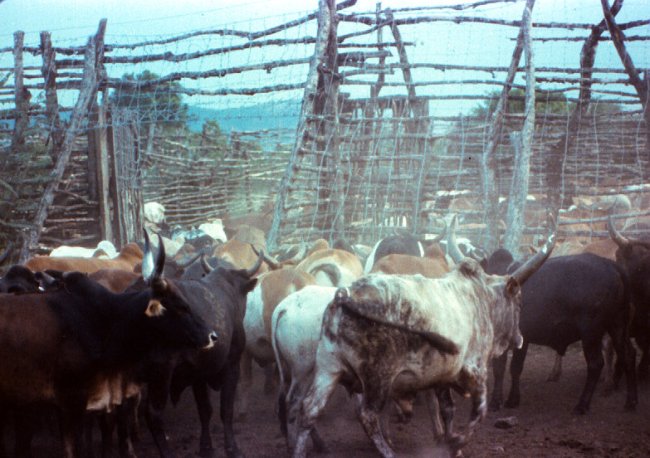
Intona cattle kraal

Thomas was a very friendly young man and he got on very well with the other workers so, when I proposed to the workers to join me in a fishing trip, Thomas was very keen on the idea and he came along.

During the time of the fieldwork I often travelled to Intona ranch over the weekends, as I also needed to spend time working in Muguga on the laboratory trial during the week so time was short. Although there was some work to be done on Sundays, we tried to keep this to a minimum so that we had time off to rest and relax. Being rather restless I was always looking for some activity to do during this free hours. For this visit I had brought some fishing gear as I wished to try my luck in the Migori river, one of the boundaries of Intona ranch.

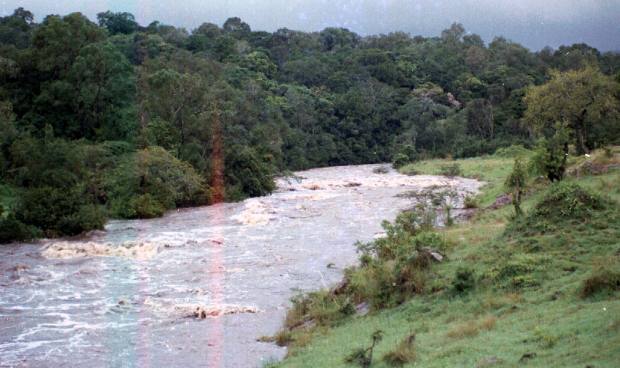
migori-flooded-cropped

The Migori in flood. We fished from these banks.

The Migori river water ends in lake Victoria after it joins the Gucha river forming the Gucha-Migori river basin. During every trip that we came to Intona via the Maasai Mara we crossed the Migori river bridge about 10 km before we arrived to Intona ranch. The area was well forested and there were a number of large fig trees in its vecinity making it a very attractive area as the shore of the river before the bridge was open grassland and seemed safe from the presence of buffalo, the main danger in the area.

It was in this bend by the river that we often saw a sounder of Giant Forest hogs[2] (Hylochoerus meinertzhageni) grazing in this clearing. As these dark grey animals were a rare sight, it was a highlight of the journey for me whenever we spotted them, as they were quite tolerant of our presence with their impressive size, the males being about 100cm high and up to 190cm long with a mass ranging from 180 to 275 kg. Their name honours Richard Meinertzhagen who shot the type specimen in Kenya and had it shipped to the Natural History Museum in England in the early 1900s.

This “hog spot” is what I chose for our fishing expedition as, apart from catching fish, I also hoped to get a glimpse of these animals towards the evening. Our fishing targets were Clarias gariepinus or African sharptooth catfish. We had fish them earlier in the Mara river just outside of the game reserve and I saw no reason for them not to be in the Migori.

After fruitlessly digging for earthworms at various places in the bush I remembered Mrs. Murumbi’s greenhouse and garden at the main house and, after a short commando sortie we managed to get a handful from the large compost kept there.

The final preparation for the fishing trip was to run a tutorial on the basics of fishing as none of my companions had done this before, as they did not come from fish-eating ethnic groups. Aware that it had taken me some time before I could master the proper use of rod and reel, I decided that I would handle these equipment and prepared a couple of hand lines for my companions to use. We chose an open field and, after a while I judged that the team was as good at fishing as it could be so we went.

We left before lunch and took some food and non-alcoholic drinks for lunch and my companions were quite excited at the prospect of trying a new activity. Thomas in particular could hardly control his excitement and this somehow dented my understanding that the Maasai did not care for fish. Maybe Thomas was the exception?

After a quick lunch under the shade it was time to try our luck. I gave hand lines to Thomas and Joseph, I kept one rod and gave the other one to Mark. As expected, the earthworms were attractive as I felt them biting as soon as my hook landed.

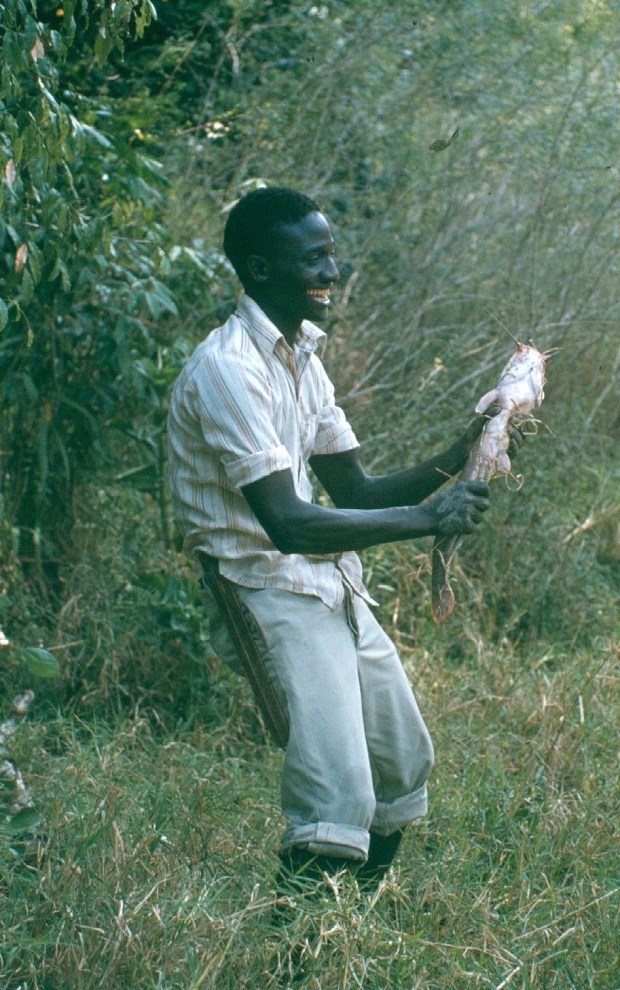
Somehow, Thomas got lucky and hooked something that after a short struggle with a rather thick hand line happened to be a reasonable catfish. After a short squabble he soon had it out of the water and his happiness at his feat was incredible. It held the fish with both hands looking at it and laughing while talking to it. He said that he would eat it, something I found strange but, busy with my own fishing, I did not pay much attention. So, Thomas departed to clean his fish. We continued fishing and had some bites that, regrettably, resulted in clean hooks.

maasai-that-got-cut-with-fish-migori-river-copy

Thomas and the fish!

After a while we noted Thomas’ absence but, distracted by our own fishing, did not think much of it. After a while longer of not seeing him and knowing that many dangerous animals were present, we stopped fishing and went searching for him. Joseph went one way and I took another path thinking that like that we increased our chances of success.

After walking perhaps 100 m following the river I saw Thomas seating down against a tree and I called him but did not reply. I called him again but still no reply so I assumed him to be sleeping and got closer to wake him up and then I saw his unsheathed simi[3] and the pool of blood. He had a bad cut in the palm of his right hand that was bleeding profusely and he was very pale.

I shook him and he opened his eyes and, still smiling, looked at me. He was weak but alive and, lifting his wounded hand above his head, I helped him to walk towards the car, calling Joseph to come and help. He appeared and, between both of us, we took him to the car and drove him with his hand bandaged and up outside the car towards the Lolgorian seeking medical assistance.

Maasai lived rather dangerous lives. Not only they fought often among themselves with serious consequences but also, as I described in an earlier post, they were constant skirmishes taking place at the time with the Kisii ethnical group that was moving into the Transmara. As if this would not be enough, they walked through the bush where many dangerous animals dwell. Although they do not fear them, they often suffer the consequences of encounters with wild animals, in particular with African buffaloes as these animals camouflage well and attack by surprise and without notice.

This way of life explained why the Lolgorian clinic was very busy that Sunday afternoon. Concerned about Thomas’ condition, I entered the hospital running and went straight to the emergency room asking for a doctor. A nurse pointed me to an European young guy in white that I assumed – correctly as it turned out – that he was a doctor.

I hastily mentioned that I had an injured person that needed his help and he gave me a rather tired look and motioned to me to look around. In my haste I had not paid attention to the “waiting room”! There were at least five people waiting before Thomas. A couple looked sick with malaria but the others were suffering from various traumatic accidents. I remember one that was holding his bloodied abdomen and another that had almost severed his large toe. It was clear that Thomas would need to wait.

Without much ado the doctor asked me to help him and I spent that Sunday afternoon cleaning wounds and helping him to stitch the severed toe and to close an abdominal wound caused by a buffalo horn! I was shocked by how stoic people were throughout the proceeds and this included Thomas’ stitching, comparatively a minor affair.

After finishing with Thomas, we thanked the doctor and left. During the return journey with a much more recovered Thomas, we learnt that while gutting the fish he had tripped and fell. During the fall his right hand had slipped over the length of the simi’s blade and had cut his hand very deeply.

With a much-recovered Thomas we arrived to the fishing spot at dusk where, before we collected all our fishing gear abandoned earlier, we had the privilege of watching the gian forest hogs! Thomas, now feeling strong again, collected his fish and, laughing again, assured us that he was going to eat it!


[1] An askari (from Arabic) was a local soldier serving in the armies of the European colonial powers in Africa. The term is still used today to informally describe security guards.

[2]  Listed as of “Least Concern” as they are relatively widespread, it is acknowledged that there is a general decreasing trend for the species across its range. In Kenya, Ethiopia and South Sudan Giant Forest hogs live also in very fragmented populations.

[3] A short sword used by the Maasai people with a leaf-shaped blade. It is kept in a scabbard made of wood and covered with rawhide.

Impaled

While walking in our neighbourhood we came across an interesting find. A small beetle had been impaled on a thorn of a fever tree. It looked like one of the abundant blister beetles so I was not too worried about it. Although it was the first we had spotted, it is not a surprise as we know that a few shrike species are present around our area.

dscn447-copy

Shrikes are carnivorous birds that, despite their small size, can tackle much larger prey than the beetle we found. We had seen many impaled insects while in Kenya.

One of the “skewers”, the Common Fiscal (Lanius collaris) have been reported diving for tadpoles and small trout and they eat a variety of prey including snails, moths, lizards, chameleons, snakes, frogs, rodents and other birds, even as large as a laughing dove![1]

The find reminded me of another interesting accident that we witnessed years back while visiting Tsavo West National Park, although it was clearly unrelated to shrikes!

It happened while on a game drive near Kilaguni lodge. There we always stopped to watch a tree that marabou storks (Leptoptilos crumenifer) used for roosting as it was nice to observe their preparations for the night.

That afternoon, we noted that one of them was in an odd position. It was immobile and swinging with the little wind there was. Closer inspection revealed that the poor bird was impaled from its gular sac on one of the powerful thorns of the tree.

DSCN9892 8.51.32 PM copy

A good shot of a Marabou’s gular sac in Mana Pools, Zimbabwe.

It was a very unusual find and up to today we debate the possible reasons. The most likely explanation is that it somehow got its sac hooked on a thorn and it was unable to extricate itself from it, dying in the process. Luckily, I found the only picture I took!

kilaguni-t-west-hanging-marabou

Not all is nice in the bush but, again, Nature is like that.


[1] Roberts VII Multimedia Birds of Southern Africa. iPad Edition, 2012-2013.

Spot the beast 15

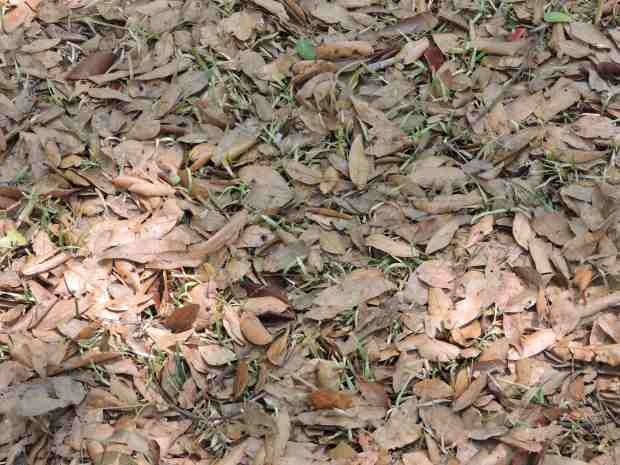
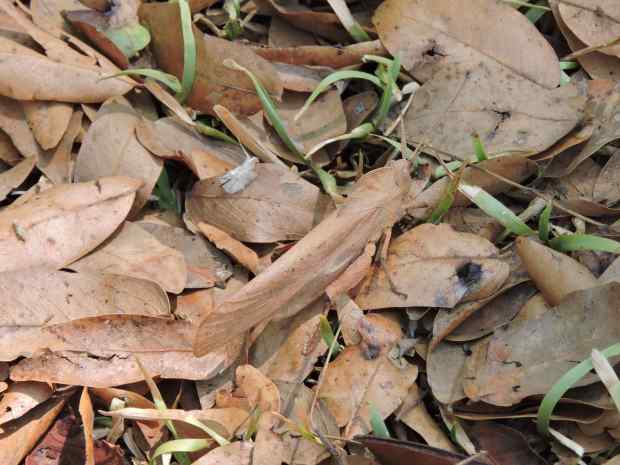
While walking on the dried leaves of the Msasa trees (Brachystegia spiciformis) also known as zebrawood, I came across this “beast”. I spotted it because it moved. Can you see it?

dscn9941-copy

OK. I agree that it was tricky so here you have a larger version.

dscn9942-copy

The wait

Entering the Kgalagadi Transfrontier Park (KTP) we were given instructions on how to manage the place. Technically, we should drive at a maximum speed of 50 kph and deflate our tyres to 1.5 BAR to better navigate the severe corrugations. We were also advised to wait for the animals at the waterholes rather than drive long distances over this very dry park.

In fact, despite my initial doubt, was useful because of the way the park is. On the South African side, the KTP has two basic roads: one follows the Auob[1] dry river and the other one the Nossob[2] dry river in a North to South fashion.[3] The rivers and the roads that accompany them meet at Twee Rivieren where the main camp of the park is located.

The dry riverbeds were not the expected sand rivers we see elsewhere but rather wide grassy valleys beyond which is the -inaccessible- Kalahari. Water for the animals is provided by waterholes that were sunk by the (Union of) South Africa to provide their troops with water in case South Africa wanted to use the area to invade South West Africa (Namibia). The waterholes are at roughly ten km intervals and most animals congregate around them.

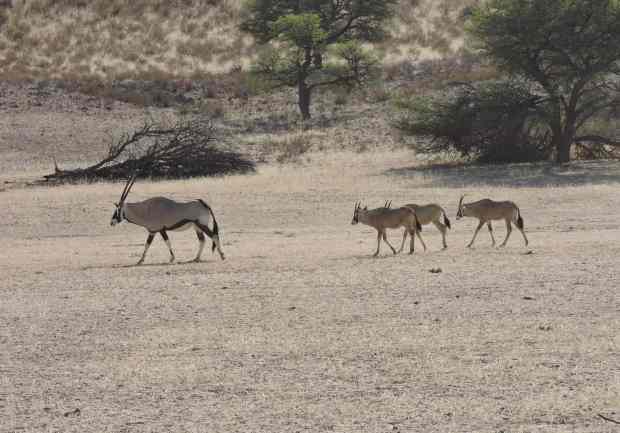
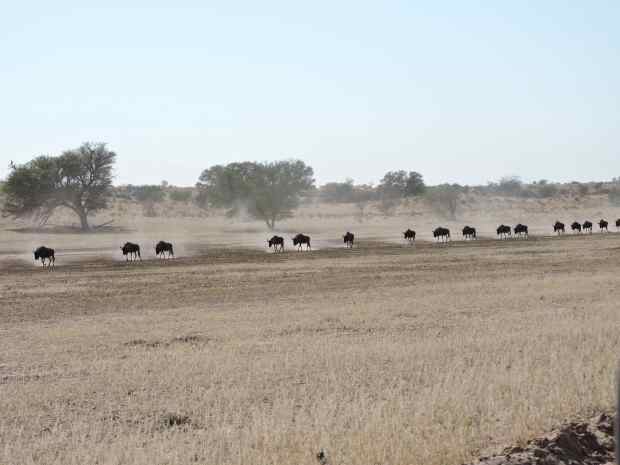
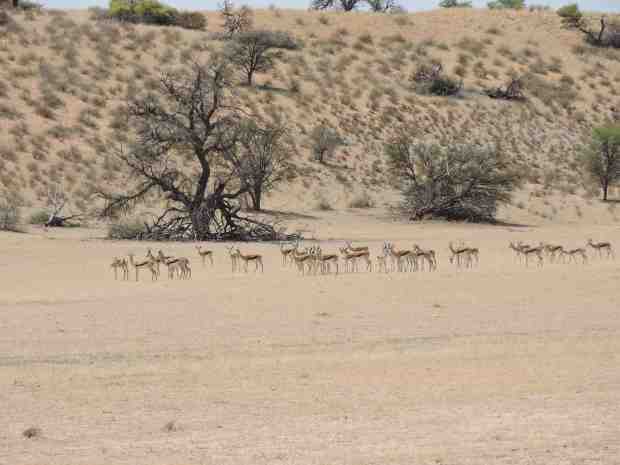
Wherever you stay, you tend to drive a lot over the same stretches of roads to go and come back to camp every day so the recommendation of “sitting and waiting” at waterholes made sense. In some you have a constant parade of herbivores such as gemsbok, wildebeest and springbok as well as large number of birds such as various pigeons, sand grouse, sociable weavers and quelea. Jackals were the main predators we saw.

dscn9895-6-27-18-pm-copy

dscn9902-6-27-18-pm-copy

dscn9967-copy

At other waterholes we waited long spells for something to happen to no avail. After a while of looking at an empty place I got bored and I could not help thinking that surely the animals were at the next hole! After waiting a bit longer, this line of thought became a conviction and my unrest grew to such a point that my wife needed to coerce me to stay using her strongest argument: “I am not cooking tonight”.

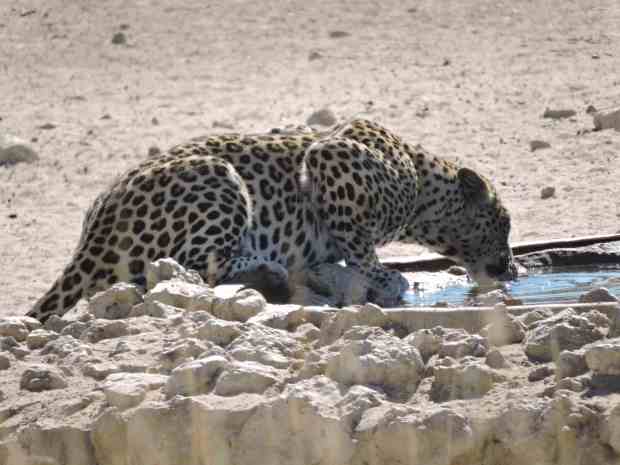
After our stay in Nossob camp, on our way to Twee Rivieren, we stopped at yet another empty waterhole. As we had seen nothing in the previous two we had visited, we were looking carefully at the surrounding area as well as to the actual water hole. I was the first to see it and, surprised, said “look, a hyena coming”.

dscn0008-copy

My “hyena”…

My wife looked and, as usual but rather excitedly, she corrected me “it is a leopard” almost at the same time that I realized my error.

dscn0007-copy

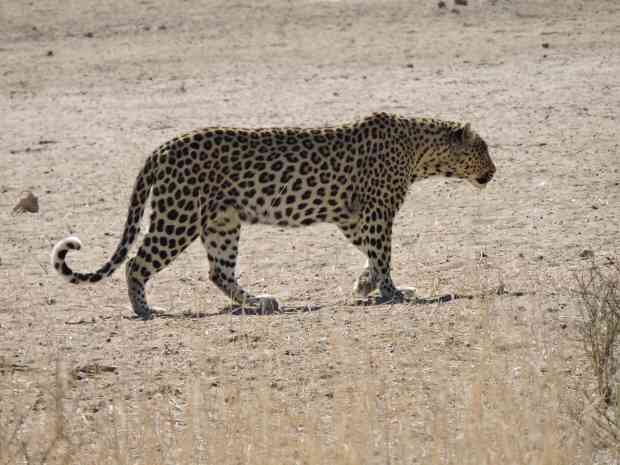
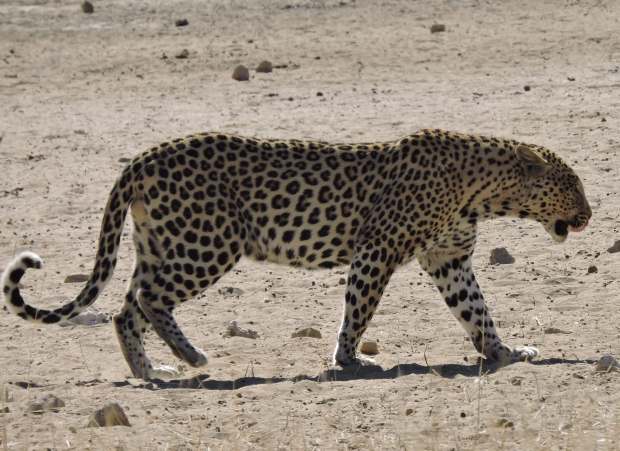
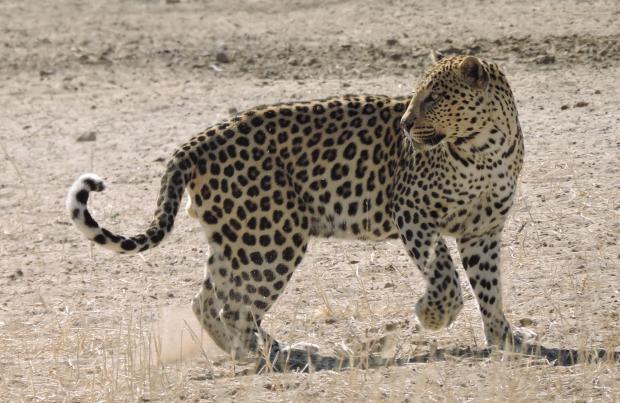
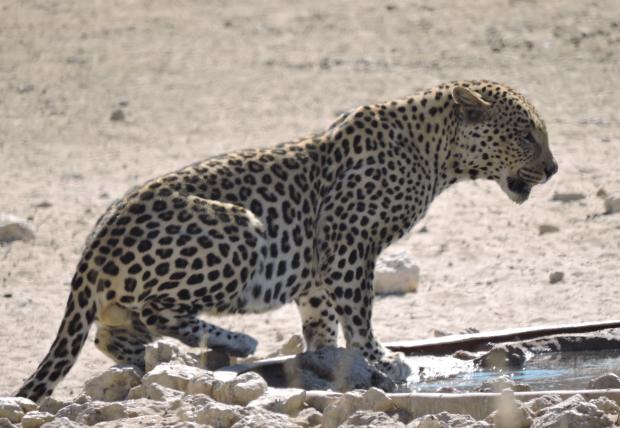
dscn0009-copydscn0004-copydscn9998-copyA leopard it was! A large male, that walked passed us and, arriving at the water it crouched to drink to placate its thirst. After a few minutes it walked off, marking a few key spots as it went slowly up the bushy riverbank. We followed it and saw it on and off as it walked up the dunes until we did not see it anymore.
dscn0011-copy

The leopard withdrawal followed closely by gemsbok.

At that precise time a car arrived to join us. When they asked what we were watching and we told them that a male leopard had just moved off from the water three minutes ago, they were stunned and I did not blame them and I did not dare to show them our pictures either!

The leopard fleeting visit not only helped us to consider the KTP a great place but also further justified the waiting strategy at the waterholes. It also stressed the fact that a few minutes can make a huge difference and there is no amount of planning and organizing that can replace your good luck!


[1] Meaning bitter water.

[2] Meaning dark clay.

[3] The Auob last flowed in 1974 and the Nossob in 1964.

Mutant moth – Advance

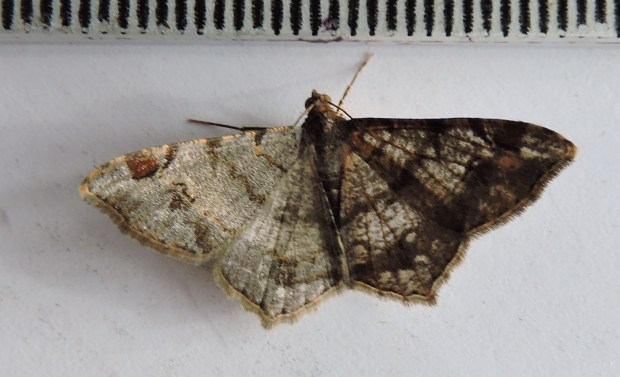
Eight months ago I published a post where I showed a picture of a moth that had the wings of different colour and I speculated that it was a kind of “alien” creature[1].

dscn4120

Then I mentioned that I would follow-up the issue with the “experts” but I am afraid I did not!

However, luckily, searching for information on Southern African moths and butterflies I stumbled upon a site that deals with the kind of anomaly I came across, though in a more colourful butterfly[2]. This gave me the first indication that I was probably dealing with gyandromorphism.

In entomology, a gynandromorph is an insect that contains both male and female features that in butterflies -moths in our case- can be seen physically (in their wings) because of their sexual dimorphism.[3]

This is as far as I has been able to go for the moment but the search continues.


[1] https://bushsnobinafrica.wordpress.com/2016/03/18/mutant-moth/

[2] http://insectdesignsnews.blogspot.com/2010/11/charaxes-cynthia-gyandromorph.html

[3] https://en.wikipedia.org/wiki/Gynandromorphism

Easy pickings

Last September, after a few early morning drives at the Kalahari Transfrontier Park, we took it easy for a couple of days, visiting the waterholes late in the mornings and afternoons. The day before our departure from our last camp, Twee Rivieren, I suggested to go for an early drive but my wife preferred to continue relaxing so I went on my own. It was a bad idea as, somehow, the whole camp shared this thought and the only road out of the camp was a dust cloud, despite the 50kph speed limit.

Aware that the morning had not started as I dreamt, I drove slowly until I found a waterhole to stay and wait for the travelers to quiet down as it usually happens. I stopped after about 20km at the Rooiputs waterhole. I was alone there and, as expected, soon the traffic died down and I could enjoy some dustless tranquility.

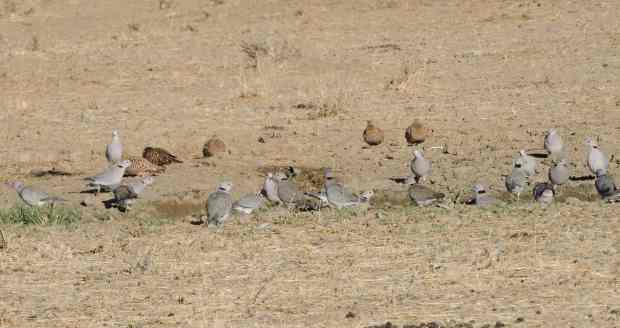
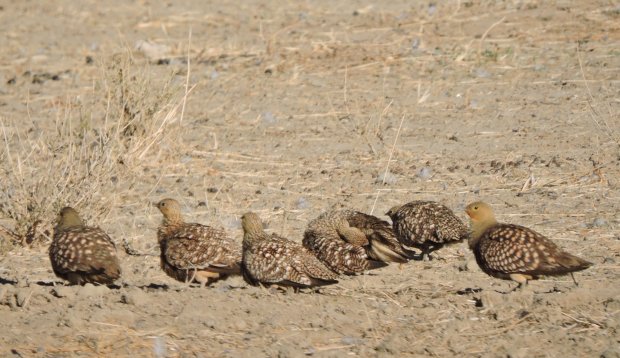
Apart from a few gemsbok staying a couple of hundred metres from the water and a lone jackal that was clearly mice-hunting in the dunes at the back, the waterhole had been completely taken over by birds. I spotted a good number of Namaqua sandgrouse on the ground and decided to take a few pictures of them.

dscn0019-8-36-37-pm-copy

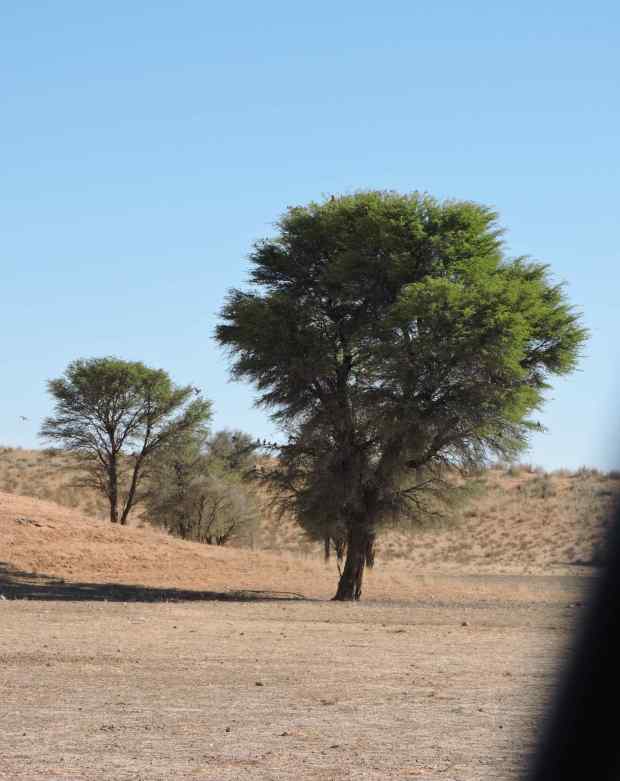
The trees around the water were laden with small birds, mainly red-billed queleas, sociable weavers and red headed finches among others.

There were also a great number of laughing doves and ring-necked doves. The latter were in such numbers that it was like a curtain of moving birds that often obscured the water source as they flew in and out.

dscn0002-3-24-26-pm-copy

Hundreds of doves were “queuing” on the nearby trees to get to the water. Most of the time the available water was literally covered with birds and every now and then an explosion of birds flying in all directions followed a perceived threat. Often these were false alarms and the scared birds returned to drink immediately.

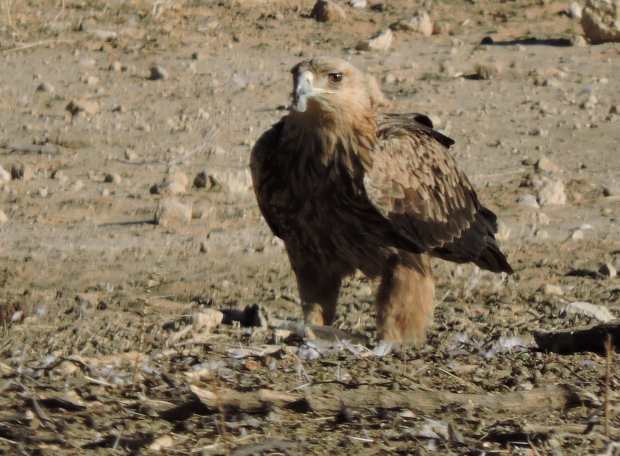
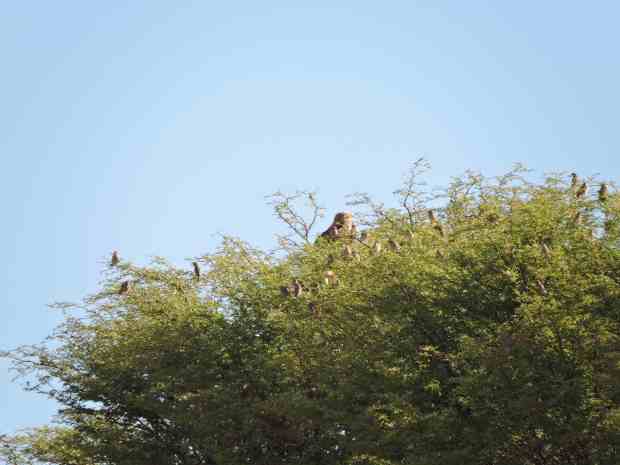
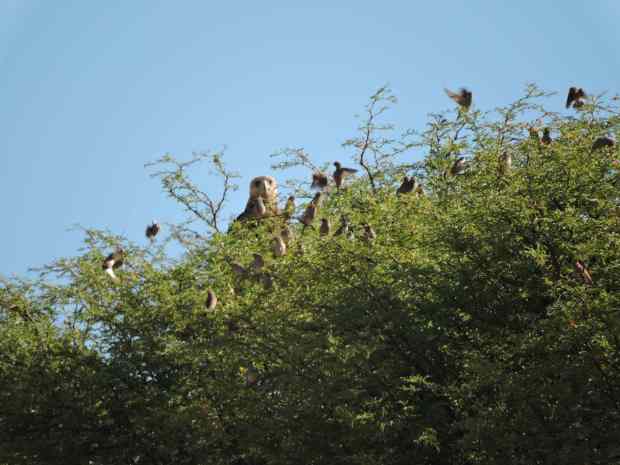
It was following one of these bird explosions that I saw a tawny eagle in the midst of the doves. When I spotted the eagle it had already caught a dove and it soon landed to eat it. “This is incredibly easy”, I thought and decided to stay there and wait for more action. When it finished eating it flew away but I was sure that it would come for more. It did.

Unexpectedly, the eagle did not return at great speed, just flew above the doves, lost altitude and then it entered the “dove cloud” and, almost effortlessly, grabbed another dove with its talons and landed to pluck it and eat it!

dscn0009-8-34-43-pm-copy

It all happened too fast for me and I only managed to take pictures of the raptor feeding about twenty metres from me. After eating, the eagle flew away again and landed on top of a nearby tree followed by a large retinue of small birds busy mobbing it.

dscn9900-8-45-15-pm-copy

dscn9895-8-44-50-pm-copy

dscn9892-8-44-50-pm-copy

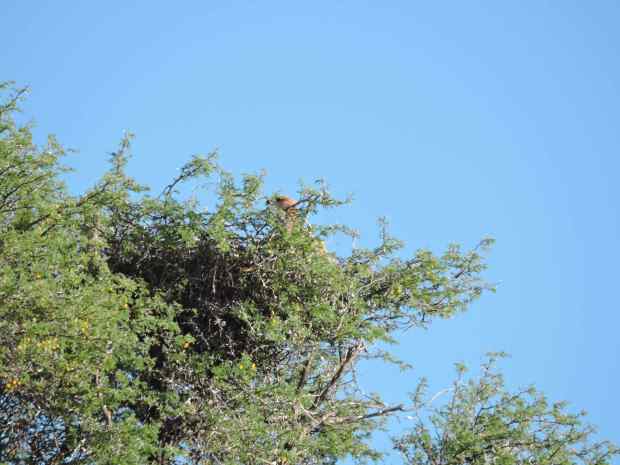
I continued watching the birds’ drinking dynamics when, after about ten minutes, the eagle (or another one?) repeated the operation and, again, caught another dove! After its third dove, the eagle flew to the same tree and then I saw a second eagle. Further inspection revealed that the clever eagles were nesting about fifty metres away, taking advantage of the easy pickings that the waterhole offered them!

dscn0079-copy

As they only need to fly a few hundred metres a day to get a full crop and feed their fledglings, I started wondering -like with the Scottish pigeons of my earlier post-about eagle obesity!

Luckily, my fears were dispelled as the next time one came for another pigeon it looked really mean and I did not detect any accumulation of fat round its waist!


Spot the beast 14

dscn9936-copy

Of course I was not serious (this time)…

The fat caterpillar of the Death head hawkmoth measures over 10cm in length and it does not need a description.

It was found by Stephen, our caretaker, in the garden and I thought it is an incredible beast that rather than using camouflage it advertises itself without fear!

I will come back to this “beast” in a few days with more information.