Upset Maasai

Intona 2 and Tommi copy

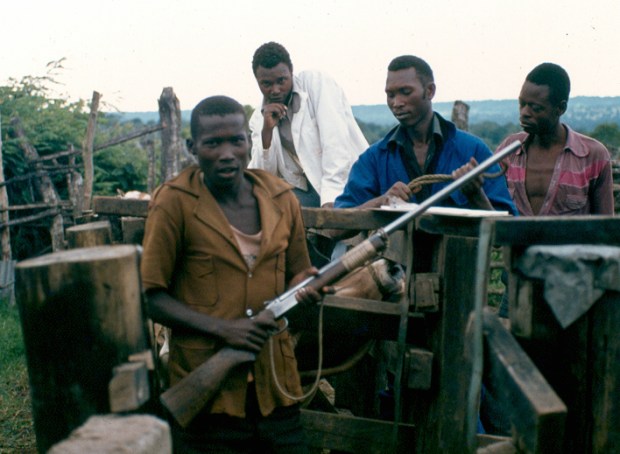
Tommi checking the cattle at Intona ranch.

As I mentioned in earlier posts about my work in Kenya, Tommi was one of the herdsmen working with me. Regrettably he passed away in a car accident a couple of years after I left Kenya, the sad consequence of a very common event in that country where unsafe public transport claims an excessive number of innocent lives.

Tommi frequently accompanied me to Intona ranch with great pleasure as for him it meant “going home”. He was not exactly from the Transmara area as he came from Narok but he was close enough to the Maasai around Intona to feel well among them.

This was a great contrast to herdsmen belonging to other ethnic groups, such as Benson above, that did not relish spending time in Maasailand. This was particularly obvious among the Kikuyu workers that could not wait for me to relieve them from their duties and take them back to their homeland. I still remember their voices getting louder as soon as the Kikuyu escarpment came into view after Narok! We, outsiders, do not often realize how foreign parts of a country can be to other nationals, product of some arbitrary divisions decided by their colonizers.

In the case of the Maasai people, their territory got split between Kenya and Tanzania when the straight line from lake Victoria to the Indian Ocean coast was drawn as the border between these two countries. Eventually the line did not end as a straight one. This was not the consequence of Queen Victoria giving Kilimanjaro to her grandson Wilhelm to meet his complaints of not having a high mountain in Tanzania as it is often believed, but part of the treaty of Heligoland through which Germany abandoned some places in the Kenya coast, receiving in compensation the Island of Heligoland in the North Sea.

Night watchmen Benson adn Tommi Intona copy

The herdsmen and cattle guards. Benson in blue and Tommi in white.

The herdsmen lived at a tented camp at Intona and their presence attracted both vervet monkeys and baboons. Over the years that the camp was there the monkeys gradually became more cheeky as they got used to taking food from the camp. This was an annoyance to the herdsmen and Tommi in particular took exception to the primates’ shenanigans.

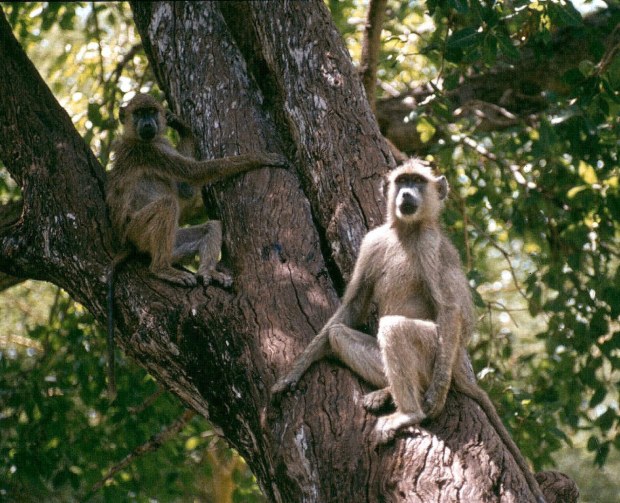
Tsavo W baboon best copy

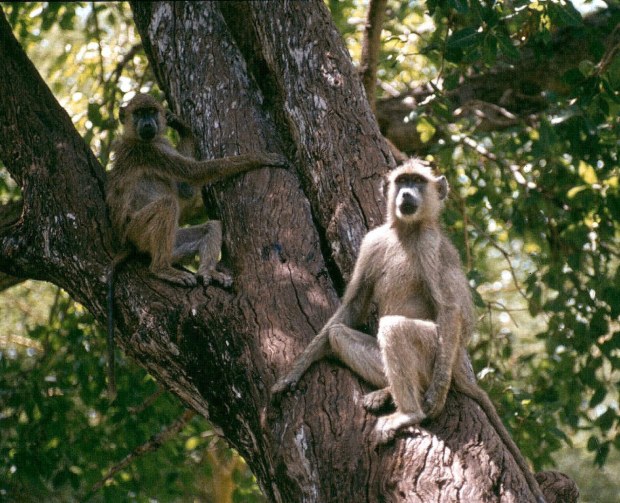
Mwizi’s relatives.

There was one particular individual that Tommi identified and called Mwizi that in Swahili means thief. He was able to recognize that particular animal and he maintained a long feud with it. The baboon seemed to know this and kept a wide berth from the man! For a few months a truce seemed to have been worked out but one day Mwizi overstepped the mark. (!!The baboon took advantage of a distraction and broke open Tommi’s bag of maize meal spilling its contents all over the tent.!!) This was the proverbial straw and the last act of misbehaviour that would be would tolerated.

Tommi decided to take exemplary action against the intruder. Before I tell you what happened, let me tell you that the Maasai social structure is based on a system of age-sets. This applies primarily to men, as women become members of the age-set of their husbands. Successive age sets, at about five year intervals, are initiated into adult life during the same period forming a cohesive and permanent grouping that lasts throughout the life of its members.

The age sets go through successive milestones that are celebrated as ceremonies. Among these are, to name a few, Emuratta (circumcision), Enkiama (marriage) and Eunoto (warrior-shaving ceremony)[1].

Tommi, like all Maasai boys had undergone their circumcision and became Sipolio (recluse). This is an important step into manhood (and warrior-hood) and, after this somehow dreaded event, the newly circumcised boys roam around the countryside dressed with dark garments and armed with bows and arrows. They shoot blunt arrows at girls as part of their social interaction. They also use the same arrows to kill small birds that they skin and place around their heads, together with ostrich feathers. During this time they acquire excellent skills with the various weapons.

In view of the above it is not difficult to imagine that Mwizi’s fate did not look good. I was not aware of the development of this feud at the time so its finale took me by surprise. After a day’s work, I was getting ready for a wash and tidying up my own camp when I heard the commotion, or rather Mwizi’s screams. It is not normal to hear a baboon screaming unless there is some kind of danger, so, expecting some leopard-mobbing, I rushed to the place where the screams where coming from.

There was no leopard but another kind of drama was unfolding. Tommi, looking upset, was circling a tree near the cattle kraal. Once closer, I realized that he had managed to tree the baboon and he was about to execute his revenge. He carried a few stones and he was trying to get the best angle from where to throw them at Mwizi! I felt sorry for the beast but the events moved too fast and the adrenalin was flowing on both sides so I could only watch from a distance, keeping my own head down!

I imagine that some stones had flown before I arrived and this explained the baboon’s alarm calls. The first stone I saw Tommis’s throw at the terrified beast missed it by a few inches and, Mwizi moved to the top of the tree. At that time Tommi said “I got it now” and threw another stone that must have passed a couple of cm from the baboon that now offered a clear view. This was too much for the monkey that was now in a serious panic with the consequence that it emptied its bladder first and soon afterwards the rest followed.

I have mentioned earlier that I do not like baboons while camping but I could not help feeling sorry for the poor creature so I did the unthinkable: I negotiated with Tommi on behalf of the victim! I managed to calm Tommi down and he agreed to leave the terrified animal alone. Seeing that the siege had relaxed, Mwizi climbed down in a flash and disappeared into the bush.

Vervet monkeys and baboons continued to visit our tents and behave in their usual opportunistic ways taking food items from us so we really needed to take care at all times. As I could not recognize individual baboons, I took Tommi’s word that Mwizi was not among them and that it had migrated to another troop in the Transmara, away from its deadly enemy.


[1] Among the many books describing the Maasai culture I would like to recommend “Maasai”, written by Tepilit Ole Saitoti and illustrated by Carol Beckwith.

Ups and downs


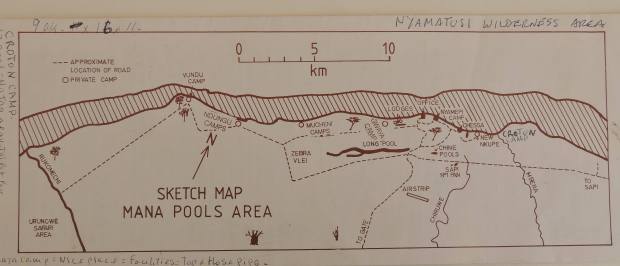
The final day of our stay at Mana Pools we drove all morning and hardly saw any mammals. Our drive started towards the west, following the river frontage (from right to left in the map below), towards Vundu camp. Although the views of the river in that area are really beautiful, after a while we decided to take another road in a southerly direction, towards the Kanga pan area (outside the map). Although the sighting of  crowned eagle lifted our spirits for a while, our luck did not change.

DSCN9960 copy

Crowned eagle.

DSCN9944 copy

Map of the Mana Pools area adjacent to the Zambezi River.

Our last hope of finding some interesting action was to re-visit the “carnage” at Long pool of the day before but our bad luck continued! Professional-looking photographers had moved in and probably paid some good money to film the birds so we did not wish to interfere with their work and drove on and back to our lodge.

To recompense ourselves for our rather poor morning performance we decided to go for a late hearty English breakfast, also known as brunch. We enjoyed bacon, scrambled eggs and fried tomatoes. The siesta under the trees that followed recharged the “morale batteries” and, by 16:00 hours, we went out again. This time we headed towards the Nkupe campsite and the Zambezi shore near Mana mouth where earlier we had some interesting sightings.

When you start getting carried away by watching Matabele ants (Megaponera analis) and photographing armoured crickets and dragonflies you know that Mana is on one of the occasions that it hides its booty from you. Clearly the park had water “up country” and most animals were spread out beyond the area that we could cover by car.

To be fair, we actually enjoyed watching the ants[1] that reminded someone of the fierce Matabele warriors of the past, hence their name. It was a rather large colony moving over the ground as a coordinated force. The major workers of this group were carrying brown capsules that were not prey as we initially thought but their own cocoons as I later learnt. One of these major workers would have also carried their queen but we did not pay sufficient attention to spot that.

Eventually we managed to see some zebra and even three shy eland bulls that quickly moved off as soon as they spotted us. Because of their premature departure we did not hear the unique clicks that are normally loud enough to be heard from some distance away. A knee tendon slides over a bone and vibrates causing the clicks. The larger the animal and the thicker and longer the tendon, the graver the sound and the higher place the animal occupies in the pecking order. The clicks, therefore, prevent fighting.

Soon the shadows started to lengthen and it was time to return to our lodge. We decided to spend the last minutes of the day checking our mail so we drove via the park’s office to access their Wi-Fi. It was close to 17:30 hours and the sun had already dropped behind the escarpment on the Zambian shore of the Zambezi.

On arrival to the office our luck turned! At the parking area we met head on with a large bull elephant and we stopped mesmerized at such a great animal so relaxed yet so powerful and potentially dangerous. Ignoring us it kept feeding as we drove within a couple of metres from it to park the car. We have had the privilege of having been close to these bull elephants before[2] but the experience is always exhilarating.

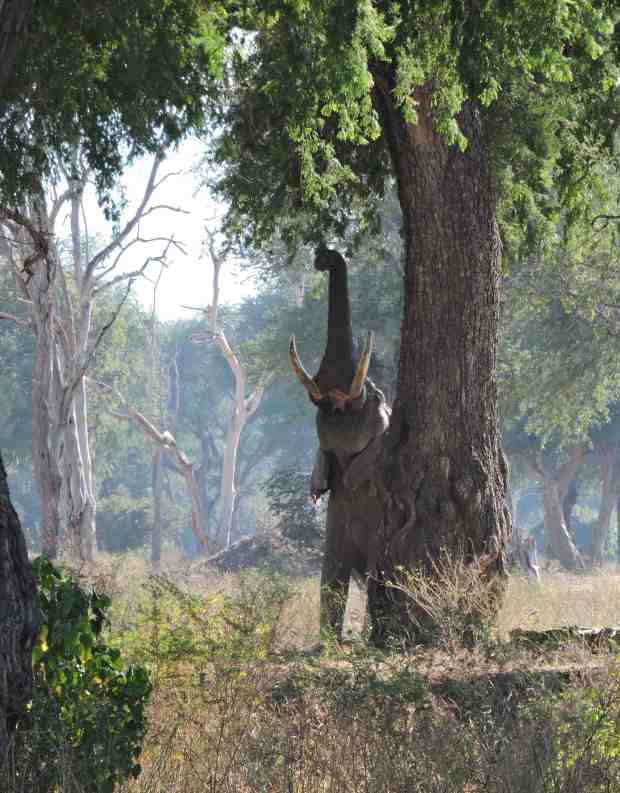
I got out of the car to watch the animal and joined onlookers from the park’s office that were also there enjoying the moment. It was one of bulls that reside around the most popular area of the park and clearly used to humans. In pursuit of good food it was performing some really funny contortions.

Boswell is probably the best-known bull elephant at Mana Pools. It has developed the ability of standing only on its hind legs while stretching an amazing length to reach the highest of branches. Although the elephant we found was not Boswell, it was probably one of its disciples as I am sure that at some stage it was actually on its hind legs though hidden by bushes!

I got carried away taking pictures and, rather carelessly, I forgot that I was photographing an adult bull elephant a couple of metres away! At one point, after removing my eye from the camera’s viewfinder, the animal was actually towering over me and I thought that I was ridiculously close for comfort and hastily retreated concerned about my bush-future! Luckily, harming me was not in the pachyderm’s mind and it continued feeding and keeping the distance that it thought prudent for both!

Unfortunately, the light soon faltered and I was forced to stop taking pictures so we parted company and we returned to our lodge. Our experience confirmed yet again the nature of Mana Pools: you can go through a frustrating day and then, suddenly, you find yourself in a unique situation that not only makes you forget the tedious drive but that leaves an enduring memory!


[1] For more information, see https://bushsnobinafrica.wordpress.com/2015/10/03/talking-ants/

[2] See: https://bushsnobinafrica.wordpress.com/2015/10/14/elephant-overhead-and-it-was-not-dumbo/

Carnage at Long pool

In the morning, as expected, we failed to locate the lions again but, driving over a small bridge nearby we found about twenty marabou storks (Leptoptilos crumenifer) congregated by a pond of green stagnant water. That was all that remained from the stream that flows there during the rainy season. As soon as we stopped they slowly moved away to what they considered to be a safe distance from us, away from the water. We moved off to a bend in the dry riverbed to watch them undisturbed. As soon as we withdrew they returned to the pool and resumed their activity.

DSCN9918 copy

The first group of marabou storks we saw.

The storks were feeding on stranded fish, probably catfish judging by the frequent rises they made to breath on the surface, opportunity immediately taken up by the storks that would rush towards the water movement ready to snap one up. We left them undisturbed and continued with our drive. A couple of hours later when we returned they were gone but there were still fish there. The African sharptooth catfish (Clarias gariepinus) are special in that they can bury themselves in the mud when the water evaporates and they can also survive in muddy water as they have a special breathing system that they can use in addition to their normal gills.

However, I am sure that despite their toughness the catfish days were numbered as the next rains will only come in December if the rains are good, far too late for them. At that time the ground would be bone dry. It was surprising that the marabous had abandoned what looked like easy food but we are used to Nature’s ways!

We soon forgot about the storks as we continued with our quest for new sightings. Our hopes of finding the lions seemed to revive when we found their fresh footprints. Judging that they had been left there during the early morning we tracked them for a long while, trying to guess what their aim was, only to lose them when they moved away from the road. Following lions on foot through the bush and without an experienced ranger is not recommended so we decided to leave them alone. As it happened, they eluded us for the rest of the trip.

We normally do not see large elephant herds at Mana Pools. Some family groups come together at the height of the dry season while staying near the river. At the time of our visit, although the rains had not been abundant, there was still water inland and the elephant population was still spread out all over the park. The few elephants we saw were the usual resident bulls that seem to hang around the shores of the Zambezi. It was one of these that we found that morning and we derived entertainment watching it stretch for the apple-ring acacia branches and leaves. The pods, their favourite food later on in the dry season, were still small and immature so they were not the elephants’ target at the moment.

DSCN9962 copy

A bull elephant stretches to feed under the special Mana Pools light.

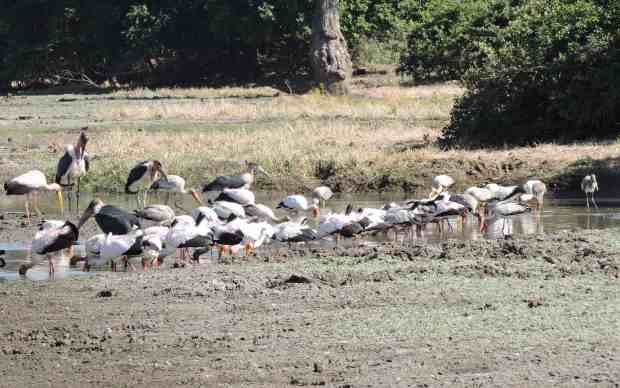
Returning to camp at about eleven, we saw a large number of yellow-billed storks (Mycteria ibis) in one of the smaller segments of Long pool that usually dries up during the dry season. There was clearly something special going on that attracted such large number of birds so we decided to go and have a look. Getting closer we saw that there were also African spoonbills (Platalea alba), a few herons and also a few marabou storks. “So here they are”, I thought while stopping the car to get closer on foot.

DSCN9928 copy

We saw a large number of storks congregated at Long pool.

The pool was full of birds and it appeared that mostly the yellow-billed storks were -again- catching other shoal of stranded fish.

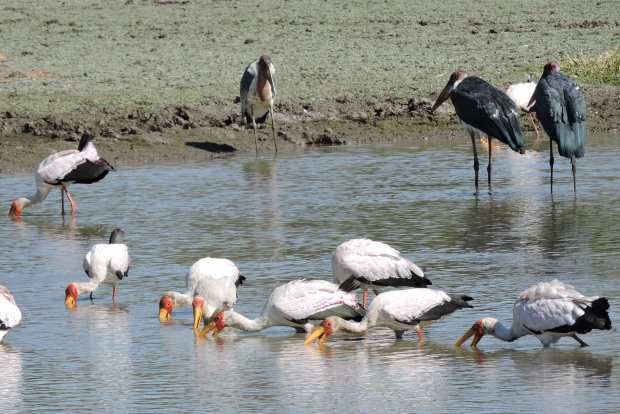
They seemed to be alternatively “driving” the fish towards one of the narrow and shallow ends of the pond and, once there, they would pounce on their victims. Both the yellow-billed and the marabous seemed to be on the same wavelength and after fish. The few African spoonbills present, however, continued wading in their usual fashion as individuals and they did not seem to take any notice of the other birds.

DSCN0019 copy

The yellow-billed storks chasing the fish in a coordinated fashion.

DSCN0023 copy

Marabous waiting for the right time to join in.

DSCN0029 copy

African spoonbill.

At first we assumed that the prey were catfish as we had seen earlier at the small bridge and on other occasions in Kenya (Maasai Mara) and Mozambique (Gorongosa). We soon saw, however, that this time the victims were silvery fish of 5 to 15 cm that were being picked in large numbers by the birds. Whether they were immature Chessa (Distichodus schenga) or Nkupe (Distichodus mossambicus) both common inhabitants of the lower Zambezi, or perhaps some other small fish I could not be sure. It was interesting to note that, as the pool was dry last year, the fish must have come in during the wet season through a connection between the pool and the Zambezi.

The yellow-billed storks outnumbered the marabous about 10:1 and they strode in groups following what looked like a cooperative fishing strategy. They would wade together towards one end of the pool driving the fish in front of them and then they will pick them from the reduced area they had created. They fished in their usual fashion; by placing their half open bills inside the water and snapping them shut when feeling a touch through a very fast reflex. They frequently caught fish but if they missed they would do a short chase that soon ended with or without a fish being caught and back to their feeding posture.

While this would take place, the marabous watched like smartly dressed supervisors. The moment the fish were trapped they would lose their bogus formality and join in the feeding frenzy with gusto! They would jump or fly in spreading their wings to make room for themselves submerging their heads under water to catch the fish. Often their feeding enthusiasm would be such that they would plunge almost totally in pursuit of the fish. Many of them had their gular sacs[1] inflated and probably their pouches full of fish. Many of them were also flashing a bright red bubble-like sack at the back of their necks, probably a consequence of their excited condition!

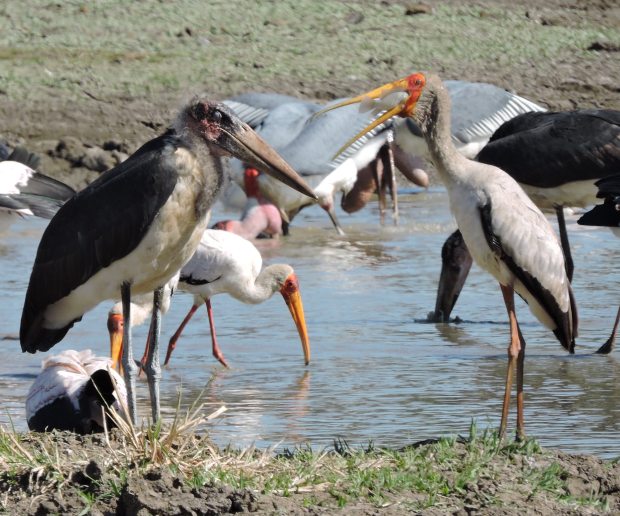
Although we witnessed the occasional confrontation between the two stork species, these were minor incidents and we saw no physical contact.

DSCN9964 copy

A brief stand-off or “don’t step on my toes”

Conversely, there was a lot of interaction among the yellow-billed storks in the form of bill clattering, chasing and jumping facing each other. Occasionally the opponents would interlock their beaks as if involved in some kind of courtship. All these encounters were of short duration and the temporary “rivals” quickly got back to feeding. The grey immature yellow-billed storks congregated at the periphery of the pond, not taking part of the adults’ activities but trying their fishing technique as best they could where there were clearly less fish and I did not witnessed any catch.

While the collective fishing took place, a pair of fish eagles, perched on a tall dead tree, watched the storks attentively. They called regularly and, from time to time, they would swoop down among the alarmed storks and, at least once, one of them managed to snatch a fish although we could not see if it caught it itself or it robbed it from one of the fishing storks.


The following video gives a dynamic view of what we witnessed.

Note: I recommend that you watch it first as it is and then you use the cog wheel at the bottom right corner of the screen to slow it down and see things with more detail.


[1] Later, reading about marabous, I learnt that the large sacks that hang under their heads are not crops but gular sacs. The latter are cooling devices as well as used for displaying purposes.

Note added on 3 July 2016. One of the pictures above shows what I thought was a confrontation between a Marabou and a Yellow-billed stork. I saw that the Marabou was rather indifferent but I thought it was because of its size. However, looking at the picture again, I realized that the Yellow-billed stork was swallowing a fish! Additionally, the fish looks like a young Tilapia so the birds may have been feeding on these rather than on the other possible species I mentioned. Bushsnob

Lions first

Although we agreed that we were in no hurry to leave for Mana Pools National Park, somehow we found ourselves getting up early and soon enough we were on our way before what we had planned. Fortunately the road from Harare to Chirundu in the border with Zambia was rather quiet. We were able to travel fast and well until we found ourselves snaking our way up and down Marongora or the Zambezi escarpment.

This is the worse part of the journey as long lorry lines coming and going between Zambia and Zimbabwe are formed here and the pace can be very slow if not nil as frequently we find serious accidents that cause long delays. The road is littered with lorry remains to the point that we call it the “lorry cemetery”. This time, even this infamous place offered us no difficulties.

We turned into the Mana Pools turn off in good time. As usual, the first 30 km are as rough and corrugated as ever and we decided to break the journey over half way entering the track leading to the Rukomechi Research station where groundbreaking research on tsetse fly control was carried out in the 70s and 80s. The idea was to see the place and to find a place to have our lunch away from the main road.

The station was rather quiet and, after a quick drive through, we returned towards the main road, stopping at a dry river bed that we had identified early as a “lunch spot” to enjoy our sandwiches. The halt did not last long as the stingless Mopani bees (also known as Mopani flies) Plebeina hildebrandti kept getting into our eyes, a very uncivilized behaviour!

Worse still were the stinging honeybees that started coming the moment we opened our lunch boxes and kept landing on our food and drinks. Soon we were fed up with both bee types and decided to abandon our lunch break and continue our trip.

We were greatly relieved when we reached the gate into the park with the car apparently in one piece. A quick check confirmed that this was so, at least all the expected parts were there! The road corrugations were such that the usual trick of driving fast to “skim” over them did not really work and to drive slowly was even worse so we tried both hoping to get an improvement that we did not achieve! Satisfied with the toughness of our car, we continued for the final 40 km on a much smoother track.

DSCN9890 copy

The first lioness.

We aimed for the park’s office to check in our lodge called Nyati[1]. As it happened, a couple of kilometres before, my wife spotted a tawny shape that turned out to be a resting lioness. We stopped and for sometime forgot our immediate plans. After scanning the area with our binoculars, another two females were found. We stayed with them for some time but, as they did not seem to move, we decided to go back to our plan and to sort out our lodge. The latter was very nice, on the Zambezi River shore, clean and ready for us.

After organizing our belongings and food supplies, we decided that it was time to get back to the lions. As these are our number one interest in the bush we were happy to go and try to find them again!

DSCN9899 copy

A long distance shot.

Luckily they were still there. Other visitors had also found them and two cars were watching them but, as it often happens, they soon left. I always question myself about what could be better than staying with a pride of lions waiting for action! However, more often than not, most people have other ideas and, after a few minutes, they invariably move on. I find this conduct surprising but they probably have other bush tastes such as elephants or perhaps sundowners by the river? We, the wiser, stayed with the lions.

A few minutes of observation later and we had seven individuals: six females -in excellent condition- and one young cub. We found this a bit strange as we expected more youngsters but we did not see another one. Typically, for about an hour nothing much happened. As the afternoon became evening all of a sudden they were off. It happened very fast and they entered the tall grass towards our left, leaving the cub behind.

Trying to stay ahead of the game, we moved forward looking for the reason of their exploit while trying to position ourselves at a place from where we could see what would happen next. About one hundred metres ahead we found a clearing with some male impalas grazing and, apparently, oblivious to the lions.

“Could the lionesses be after the impalas?” we asked ourselves, as these antelope are not the number one choice in a lion’s diet. We had seen lions in past years at Mana feeding on buffalos and even elephants so these rather small antelope did not qualify even as a snack for such a group! However, in the absence of other possible candidates we stopped and waited.

I immediately switched on the camera and soon I was looking at the impalas through the camera’s viewfinder when first I heard the noise of animals running to my right and immediately caught a glimpse of the lionesses through the corner of my eye. Three of them came out of the bushes at full speed towards the impalas that reacted immediately and started running away. The lionesses picked one as their target and got closer and closer.

The impala, aware of the mortal danger it was in, quickly recovered from the surprise of the attack and ran for its life leaping and zigzagging with great skill as the terrain was uneven and bushy. Despite this, the lionesses were getting desperately close and, when all seemed lost for the antelope, it jumped and turned sharply to its right. This final feat of nimbleness put the lionesses off balance and the impala managed to escape snorting loudly as it realized that it was still alive! What I described took place over a few seconds and well before I could move my finger to take a picture!

DSCN9894 copy

When I could press the shutter, the chase had ended…

The impala snorting was answered, to our surprise, from somewhere in the midst of the lionesses! At first we thought that the huntresses had got another impala and what we were hearing were its last throes. Soon, however, the truth revealed itself as another impala came running flat out from the “lionesses-hot area” and soon joined its colleagues at a prudent distance. We had clearly missed this impala that had turned towards the opposite side from the others and probably saved its life because of it!

The short chase over, the huntresses relaxed and one by one they broke their cover and we saw seven female lions. Realizing that the chase was over, they returned to the place where the cub was. After a while we saw another rather large head emerging from the tall grass: a large male lion could not be bothered to lose its royal status chasing impalas and wished to have a look around!

Soon the light started fading and we left them, convinced that they would hunt later on. We agreed to return and look for them the following morning but, as they can move long distances, we did not hope for another sighting.

Back at the camp the donkey boiler[2] supplied ample hot water for a good bush shower to wash off the thick dust from the already very dry Mana Pools roads. As for the various aches from the journey, I appealed to a few sips of a South African Cabernet Sauvignon, with therapeutic meticulousness! The latter also greatly helped with the writing of this post!


[1] Nyati in Shona language means buffalo.

[2] Known as Tanganyika boiler in East Africa. It is basically a metal drum over a wood fire.

Crocodile!

When in my favorite Argentinian radio talk show I heard the terrible news that a crocodile had taken a young boy at the Disney’s Grand Floridian Resort & Spa in Orlando, Florida a few days ago I thought that they really wanted to say that an American alligator (Alligator mississippiensis) was the culprit.

However, checking on the crocodilian fauna in the Americas I was surprised that in fact there is a crocodile there! It is known as the American crocodile (Crocodylus acutus) and it is distributed from the Atlantic and Pacific coasts of southern Mexico to South America as far as Peru and Venezuela. It is also reported to occur in the Caribbean. In the United States it is found in Puerto Rico and the southern half of Florida.

Orlando is therefore to far North in Florida for an American crocodile to have been the culprit so it was probably an alligator and they were saying crocodile in error. Irrespective of the culprit an attack by any of these rather prehistoric animals is always terrifying because of their suddenness and viciousness.

I must confess that during my early days in Kenya I was not really aware of the danger posed by Nile crocodiles (Crocodylus niloticus) in the wild. I was lucky not to have had any accidents despite the number of activities near water I carried out (in the wild!). However, through reading and observation, I started to respect them more and more as time passed. In particular, when our children arrived, very strict rules on how to behave near water were imposed that luckily allowed us to enjoy the proximity of water while fishing and walking. These strict rules still apply to all of us and they are as critical as not crossing a red light!

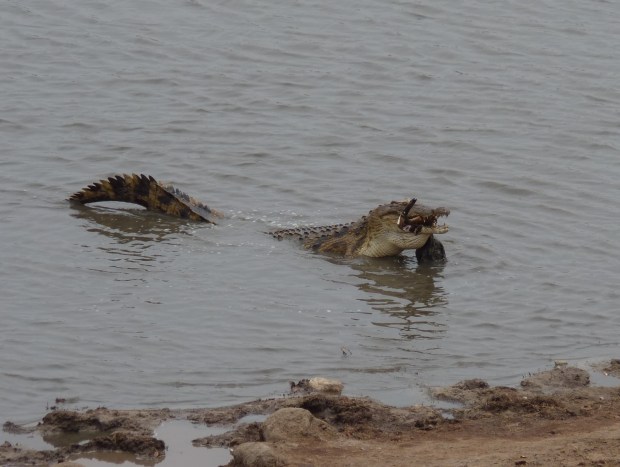
Crocodile JC copy

Crocodile feeding at Masuma dam in Hwange National Park.

One of the earlier “eye openers” on the subject of Nile crocodiles took place after some time of being in Kenya, while enjoying time at Joe Murumbi’s library at Intona ranch in the Transmara. Among the many treasures it contained I found a book called “Eyelids of Morning” by Alistair Graham and Peter Beard. This “coffee table” book attracted my attention not only by its peculiar title but also by the picture in the cover showing a truly gigantic crocodile being held by a man in lake Turkana.

As soon as I opened it I realized that it was a truly unique volume for several reasons. It was an early copy clearly sent by the authors to Joe before publication and that Joe had clearly proof-red, judging by the annotations he had made. In it, there was a graphic testimony of the dangers of crocodiles in Africa with the most amazing collection of stories and pictures.

It narrated and graphically illustrated the fate of an American Peace Corps volunteer that decided to take a swim on Ethiopia’s Baro River, a place I was able to visit in the late eighties while working in Ethiopia. This young man, after swimming in its muddy waters, sat with his legs in the river to enjoy the sunshine. Suddenly, a very large crocodile, seen by some observers, dragged him into the water and disappeared. The following day his remains were recovered when the crocodile was shot by a hunter and cut open. I will not forget the pictures of his remains the book contains.

Later on I also learnt of the unfortunate accident of the son of a colleague that was attacked by a relatively small crocodile at a really small stream at the Buffalo Springs game reserve where the presence of such an animal was very unlikely. The story went that luckily hearing the commotion, the mother managed to hold on to the boy while the father manhandled him away from the predator. Although he was severely injured, the boy survived the attack after a long recovery due to the injuries and infections associated with the crocodile tearing bites. I visited the exact spot where the incident took place and it was hard to believe that it could have taken place there!

Crocodiles are responsible for killing 2,500 people per year[1], mainly in Africa where most victims are people collecting water, fishing or washing clothes. Sharks kill or maim 15 people in the same period but these gets much wider world coverage!

Luckily, a number of conservation and humanitarian organizations are working in the introduction of palliative measures to minimize this on-going tragedy. In particular, the International Union for the Conservation of Nature Crocodile Specialist Group[2] is not only involved in the conservation of wild crocodilians worldwide but also in protecting the people that are exposed to them. Among several initiatives, they are introducing Crocodile Exclusion Enclosures, a rather academic name for fenced areas in the water that exclude crocodilians and reduce the risk of attack to human users.

For the fishing lovers in Africa, crocodiles (and hippos) are the main blatant threats while on a boat. Crocodiles are mainly a threat near the shores while hippos are hazardous everywhere and a much more dangerous animal. I have heard many stories of hippos attacking boats but none involving crocodiles and boats.

My first fishing experience in Kenya was trying for bass on board a rubber dinghy at lake Naivasha with our friend Paul. Although there were numerous hippos, there were no crocodiles there despite a rumour that one had been released at the lake but never seen.

We fished in lake Naivasha quite often and then we went on to fish for trout at Sasamua dam and for Nile perch in Lakes Victoria and Turkana both having sizeable crocodile populations, particularly the latter. Although we saw them frequently, many at close quarter, they did not show any interest on our boat and always kept their distance.

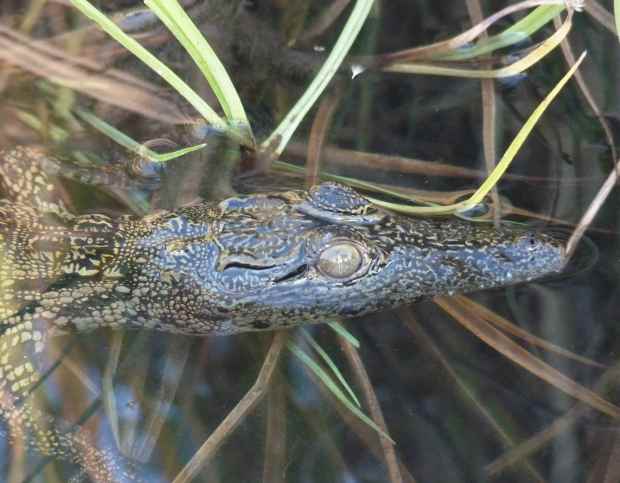
Small croc P1090715 cropped and small copy

A baby crocodile at the Okavango River.

Although I will return to some of my fishing exploits in future posts, our experience fishing in Kenya convinced me that rubber dinghies were safe and I eventually bought one that we used extensively in Southern Africa. Being portable, we took it everywhere and it became a new medium that opened up a different field of wildlife enjoyment while fishing but always having a “crocodile and hippo spotter” -usually my wife with her keen eyes- to keep us out of trouble.


[1] http://www.pravdareport.com/society/stories/13-12-2010/116179-crocodiles-0/#sthash.SpjslxCj.dpuf

[2] http://www.iucncsg.org/pages/About-the-CSG.html

Cattle feed on wheels

As described in earlier posts on my Kenya days, part of the two-pronged approach to study the impact of ticks on cattle was to take place at the Isolation Unit of the Kenya Veterinary Research Institute (KEVRI) at Muguga. The place, reserved for possible outbreaks of some of the dangerous diseases the place worked on, was unoccupied at the time so it was allocated to my research as there was no other suitable place.

The facility had several pens, water, a storeroom, a weigh bridge and a good crush pen where we could work with the cattle, as the trial would require intensive animal monitoring. I was pleased with the place as it saved me not only the time and effort needed to build something similar but also, as my budget was meagre, spared me valuable funds. Luckily, on the understanding that the animals would be returned at the end of the trial, Matt and I also managed to negotiate the loan of the animals from the Director of KEVRI, saving substantial funds that I could keep for any future contingencies.

muguga isolation unit

With minor improvements, the Isolation Unit became suitable.

Once the facility was settled, I brought in the cattle and formed the three experimental groups. The trial was ready to start but, before this could take place, I needed to find two herdsmen to help me managing the experiment, planned to last for six months.

Experimental cattle Isolation unit copy

Some of the experimental cattle at the start of the trial.

More negotiations, this time internal -with Matt and Robin- yielded Kevin, the lowest ranked herdsmen at the ICIPE laboratory at Muguga. He was considered suitable for the job so I accepted him. The second one, Karungu, was identified almost immediately as he was the brother of another ICIPE herdsman. Karungu was unemployed and willing to join the project. Kevin knew Karungu and agreed that they could work together so I was ready to go!

I had already procured in advance most of the needed supplies for the trial and the store was full of veterinary essentials as well as feed. As the latter was critical, I had procured a large amount of both concentrates and hay. I estimated to have sufficient feed to last for three months and during this time I trusted that I would secure the rest. The rat population at the unit was abundant so I spent lots of time and effort making the place rat-proof until I thought it to be unassailable!

The following morning Kevin and Karungu reported to work in my new “laboratory” and soon they were wearing first hand uniforms and boots and getting on with the work of cleaning and watering the animals. Trying to establish a good rapport with them from the onset, I decided to treat them to a hot cup of tea that I prepared the usual “English” way. Muguga was a cold place, nestled in the Kikuyu highlands so I thought that a hot drink would be welcome in that chilly morning.

Tea in Kenya was cheap and abundant at the time so I prepared a strong black tea and called my new assistants to share it with me. I thought it was strong but drinkable but, to my surprise and disappointment, they took a sip and at unison they asserted that it was too bitter and undrinkable! I tried to convince them otherwise but they flatly refused to have a second sip making animated comments in Kikuyu language that I missed! I later understood that, in general, Kenyans would boil the milk and add the tea directly to it and continue boiling the mixture. The milk gradually acquires a pale brown tinge and it is then judged to be ready. In addition, sugar is added generously making the beverage very sweet. I refrained from offering my kind of tea to them again and I did not like their milk tea so, although we shared tea time, we kept our tea making separate!

In preparation for the work to come I spent long hours explaining the new employees the fundamentals of what we were doing and why and how we needed to work the way I was instructing them. Among other issues, it was essential that the animals were kept separate and the feed was weighed and given to them according to the experimental protocol. From early work done in Australia I knew that I would be dealing with small differences between tick-infested and tick-free animals so I needed to take great care with the way the animals were fed in order to compare them validly.

Cattle grroming copy

Apart from this trial, I was also running a similar field trial at Intona ranch. This meant that I would be absent for some days travelling to Intona so it was essential that the basics of running the experiment were understood as well as the daily tasks of cleaning the pens, watering and other regular jobs.

The trial started by monitoring all the animals for about a month both to get their baseline weight gain and to allow time for the ticks to be bred artificially. The trial needed large numbers of adult ticks and this, in turn, required a boost to the ICIPE tick colony. Despite my impatience to start, to produce the necessary tick amounts took a great deal of work and time. The latter was critical as if applied too young they would still be soft and unable to attach and you would get the same result if too old as they would not have enough energy reserves to attach. Luckily I had Robin to advise me about the right timing!

tick applic

Tommi, my Maasai herdsmen, placing ear bags to one of the animals.

Eventually, the day arrived when we were ready to apply the first batch of ticks and to start the trial. The ticks are known as the Brown Ear ticks for a reason so the use of the normal application method by means of ear bags was chosen over other possible techniques considered. We managed to apply them successfully and the trial “officially” started. It was a great feeling as I was finally working!

I was aware that we needed to repeat the infestations every week for six months and hoped that the tick supply would be well planned. For that to happen, again I trusted Robin’s knowledge and fully depended on him. Luckily, we also had the support and skills of Fred that managed to prepare all ticks needed at the right time with only one exception because of a problem with an incubator that went bonkers and “cooked” all the ticks!

boran heifer with earbags Intona copy

Earbags applied.

R app 3

Ticks attached.

After a couple of weeks of work Karungu and Kevin took the opportunity of a break during the work to come and talk to me. They were requesting “the project” to buy them bicycles on account of the long distance they needed to travel to come to work. Their argument was that the time they saved travelling during mornings and afternoons would be invested in the project. I thought that the request was reasonable and the following day, we went to a bicycle repair shop in Kikuyu town where, after a protracted discussion and the expected bargaining -as they later informed me as it was in Kikuyu- they managed to get a good deal for two good second hand ones. Little I knew at the time that this, regrettably, would be the beginning of the end

It all went well with the work for a couple of months afterwards until one morning that neither Kevin nor Karungu turned up! It had happened that one of them was absent or late but never both of them. Luckily I was there that week as this was a real problem for the continiuity of the work. After feeding and watering the animals myself I went to talk to my ICIPE colleagues to get some assistance and to see if Karungu’s brother knew anything.

I managed to get temporary help but I got no news so, hoping that the double absence was due to chance; I went back to my laboratory to continue with the job. Involved in the work and having others to help me, I soon forgot their absence until I had an unexpected visitor: a KEVRI watchman. He had been sent to notify me that both my employees had been caught stealing cattle feed! Shocked and dismayed I asked for details. He explained that they were caught leaving KEVRI on the bicycles I had agreed to buy for them, carrying a bag of feed each!

I felt a real fool and enraged for what, at the time, I perceived as a betrayal by people I was beginning to trust and shared time with. I also knew that I was in trouble since I had bought the bicycles against Matt’s advice! Despite that, I also somehow admired their planning skills and wicked dexterity! The information given left me in no doubt that the report was true and also that this would bring potentially serious complications, as I urgently needed to find new people to continue the work as these two would not come back.

Before leaving, the guard informed me that the pair was under arrest at the Kikuyu Police Station charged with theft. The trial would take place on the morrow afternoon and I was summoned to appear at the trial to press the charges. He was coming with me so, after making arrangements to travel together, I left for home. I have had a long day and I felt tired and upset at what had taken place.

As usually happens, the following morning things were clearer and I made up my mind on what to do next and how to handle the situation. First, I reported the incident to Matt who, to put it mildly, was unhappy. Although the only comment he made was “Yulio, you should have listened to me when I told you not to buy them the bicycles as you cannot trust these people”, his face spoke much more! I thought about arguing back on poverty and its needs but I knew that it would be futile so I remained silent and accepted his wrath. He told me to sack them immediately and to go to court and deal with the issue severely.

The tough meeting with Matt and the impending drama that expected me in the afternoon kept me unsettled for the rest of the morning. I had never been to a court, as I had not committed any offence anywhere, so it was to be my debut! At the agreed time I picked the security guard and drove to Kikuyu for my “court experience”.

Judging by the number of people outside the court building, this was a busy place and I would be there for a while. I followed the security guard inside the building, his uniform opening us the way through the crowd. The room was really jam-packed with people of all ages and I could just distinguish a judge sitting at the very front of the room. He was a mature judge, and to my surprise, he worn the white and woolly wig that I had seen British British judges wear on movies and that I find funny. “A legacy from the British rule” I thought while waiting to learn what was expected from me.

The security guard had clearly been there before and, after talking to a court employee, he soon returned to tell me that we were the next case. We sat at the back and I instantly became a distracting factor in the proceeds as it was, apparently, not common that a mzungu[1] would be in a Kenyan court! Expecting to be asked to leave the room to avoid disrupting the process of law I took the time available to watch the events that surrounded me.

The room was large, similar to a chapel, with a desk at the front where the judge sat. Next to him there were other smaller desks and tables where defence and prosecution were located. The public sat in long benches and there was little room left. It was cold and, the open windows did not help to save the only source of warmth: the body heat. It may as well as the place was rather stuffy already.

Once I settled down I identified a rather small man looking battered and contrite that I imagined being the accused. However, as I did not understand Kikuyu, I started imagining why he was there and the crime committed. Before long, the security guard, himself from the Akamba ethnic group and able to understand Kikuyu, started to translate for me. I was right about the man being the accused but, instead of my thoughts that placed him at the receiving end of his wife, he was there because he had stolen money from a market lady. He had been caught by the crowd and given a hiding before the Police detained him, saving him from further damage.

A rather plump Kikuyu lady looking fierce and very upset, the victim, was charging him with theft. The guilty verdict came fast and the man was sentenced to spend time in jail, despite his own defence arguments, as he had no defence lawyer. Once that case ended, part of the public moved out and, after a few minutes, Karungu and Kevin, both handcuffed, were brought in. The two bicycles -still with the bags tied up on them- as evidence followed. Both walked looking at the floor and they did not return my gaze.

To my relief, and clearly for my benefit, the clerk in charge of the cases spoke better English than me and so did everybody else! The charges were read and I was then asked if I recognized them, their bicycles and the feed. I replied that I did. The time then came for me to press charges. I did not. I had already thought about the issue at length and decided that sacking them was sufficient punishment. I knew that the Kenya Law was rather harsh on thieves and I did not wish them to spend a long time in jail or worse! They were freed and the case was quickly closed. The security guard was surprised at my decision but he did not say anything. Clearly, he also knew the fate of thieves. We loaded the bicycles and feed on the kombi and returned to the laboratory.

Later that day when Matt came to see me, I explained what I had done. He was livid and proceeded to give me a long lecture on why I had been wrong and that people should be punished for their crimes. I knew that he was probably right and listened in silence and, although I apologized, I did not regret my decision. I also underwent another similar session with the Director of KEVRI. Luckily, the incident was soon forgotten and the work continued. I sold the two bicycles and soon had new herdsmen to help me!

I never saw Karungu or Kevin again.


[1] A common Ki-Swahili term used to call a white person.

Mean kin

After our early experience with baboons at lake Bogoria[1] many others followed.

Although we all know that animals in parks and reserves are wild and that they should be treated as such, there is a strong temptation to give them food either to attract them closer for a picture or because we believe -wrongly of course- that they need food “poor little things”! Because of that the animals expect to be fed and if they do not get it they look for it! In so doing, they become a pest and, as the situation worsens, they are destroyed by the wildlife authorities to protect the same people that sentenced them to death! Although the worse offenders are the primates, other species such as elephants and hyenas can also get rather daring and hazardous.

DSCN9990 copy

Hmmmm…

So, over the many years on safari you experience an encounter with monkeys almost every time you camp. Most of these are just commonplace incidents of small theft that get resolved by “common agreement”. Although not funny at the time, I recall one of the first we experienced when my wife, while walking in Mzima springs in Tsavo West, was aggressively approached by a troop of vervet monkeys that left her shaken but, luckily, not scared or discouraged about walking in the bush!

Sometimes, however, we had gone through some “special” encounters that are -I believe- worth mentioning and it is on a few of these that this posts focuses on.

Whether you stay at a fenced or unfenced camp does not make any difference for the monkeys: they are watching you, waiting for an opportunity!

Tsavo W baboon best copy

Baboons keeping an eye on campers.

Most incidents take place on arrival, while the offloading of you car means open doors! The instant that you leave the car unattended for a few seconds, something is taken and it is often the only item of this kind you have! “There goes our butter for the fruit crumble”, or “we’ll drink coffee without sugar” are some of the remarks often heard while trying to cope with the incidents! In addition, to witness the various members of the party running after the interlopers shouting abuse at them is both funny and tragic as we have never recovered anything that had been taken!

2 vervets small copy 2

Whispering instructions on how to proceed!

Although food is their usual target, we have lost various other objects to monkeys and I always remember the case of a friend whose wallet was taken at a hotel in Diani beach. She needed to follow the monkeys through the hotel’s garden collecting money and credit cards as, after tasting them, they dropped them! Unfortunately she could not pay her bill as her credit card showed a magnetic band with a tooth hole in it! My worst nightmare, however, is that they get the car keys and for this reason I never leave them unattended and always carry a spare key in my luggage, away from food.

Camping Meru NP.tif copy

One of our early camps at Meru National Park, very vulnerable to monkey incursions.

Camping Wamba trip with PR 1.tif copy

A well armed local escort helping to keep the camp “monkey-free”!

My first close encounter with a monkey took place at the Nairobi National Park in Kenya in the early 80’s. I was “monkey-naive” at the time. In the park there is an area known as Hippo Pools where you can leave your car and walk along the Athi River watching water birds and, if you are lucky, catch a glimpse of a hippo’s bottom. It was a warm afternoon and, at the time of getting out of the car, I was -stupidly you may correctly think- eating the universally-known favourite monkey food: a banana! I had not yet closed the door when I heard a slight noise in the tree above me and “magically” my banana was no longer! Once I recovered my wits, my surprise turned to anger when I realized that a vervet monkey was, far above me, enjoying its favourite meal!

P1080474 vervet cropped and small copy

A vervet monkey, a cousin of the one that took my banana!

Unbelievably enough, either I did not learn or I forgot this incident as some time later a similar but perhaps potentially more serious encounter took place at the Man-Eaters Petrol Station in the Mombasa road, a place hosting lots of baboons walking about. These are rather long-legged and slim animals that I believe to be yellow baboons (Papio cynocephalus). I was out of the car waiting for the tank to get full and walking about watching the baboons, this time I was -again unwisely- eating a packet of crisps! I was busy putting back the fuel cap when I first noticed the beast. A very tall and mean-looking male baboon was sizing me up.

I did not believe that it would do anything to an ape twice its size so I did not pay much notice of it. It was only when it kept coming that I realize that I could be in its sights! My suspicion was regrettably right but only partially. It was after my crisps and it looked seriously interested in them! I tried to scare the bully but it insisted and at some point it bared his teeth at me! I am not sure that you have come face to face with a large threating baboon but I am quite sure that you would have undergone the same reaction I did and surrendered whatever you had in your hands if that would make it go away! I offered it my crisps showing phony pleasure.

Despite my friendly, if forced offering, the brute had no manners and it snatched them rather violently from my hand and I would swear that it also slapped me on the face although this may have been a panic-driven sequel. Luckily for me, satisfied, the thief just turned its back on me and walked away casually disposing of the empty bag with its mouth overstuffed! All I could do was to wish (in other words, of course) that it suffered from a severe enteritis for the rest of the day!

Monkeys can also damage equipment and one of the first things the camper learns is not to leave food inside the tent when going for a walk or a game drive. Many first-time visitors are completely unaware of this and they are not forgiven! This was the case of a European couple at the now closed Serondela camp site at Chobe National Park in Botswana. It was our first time in that beautiful elephant heaven and, by then, we were monkey-wiser, but they were not and the baboons there were “tourist-wise” and excelled in their malice!

That time we took our baby daughter so we were extra careful with monkeys just in case. We got to Serondela -from Victoria Falls- at lunchtime and, after setting up camp and resting for a while, we went for an afternoon game drive leaving behind an empty tent. We had a great time by the riverfront but, as our daughter needed to be fed early, we came back to our camp. To get to our tent we needed to pass by the camp of the European couple. The place had been turned into mayhem by the baboons.

The beasts had reduced the tent to tatters and they had taken all their belongings out and scattered them far and wide. While the dominant monkeys ate, the lower ranking individuals waited performing acrobatic jumps between the tent and the trees! We managed to chase them away and collected what we could. It was a complete mess as the place had also been used as a toilet by the large troop!

After a while, shouts and lamentation heralded the arrival of our neighbours-victims. Moved, we walked over to offer help. We learnt that they had arrived from Europe a couple of days early and rented a car and camping gear. This was their first night camping in Africa and, clearly, not a very good start! However, they put a brave face to their predicament, washed and sorted out the usable stuff. Luckily, they still had part of their gear and food in the car with them and they could also sleep in it until the following day when they could get some new gear and food from Kasane, the nearest town.

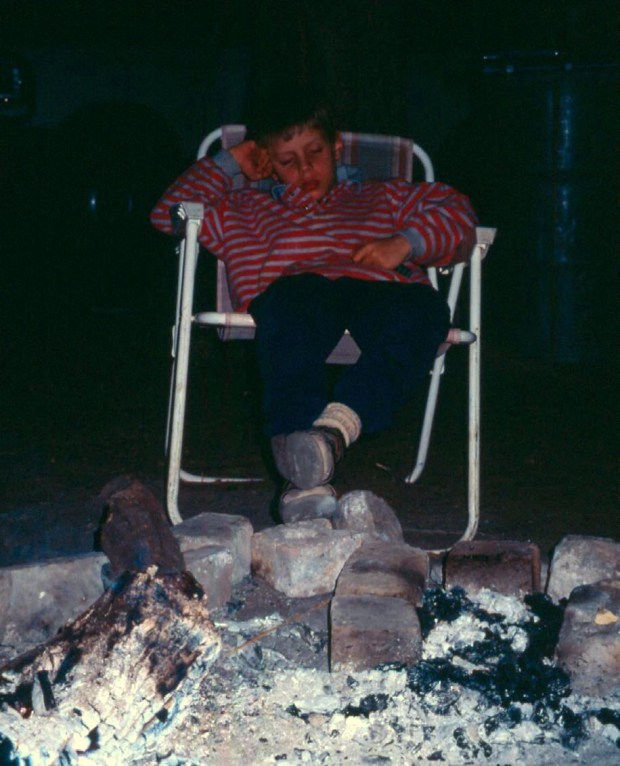
In later years, when our family expanded to the four of us, our young son was given the job of “monkey slayer” and provided with a catapult and stones to perform his duties. Although he enjoyed the concept, his success was limited, not only because of his bad aim but also because he would tire fast and get easily distracted!

Makgadigadi Bot kumaga camp jc asleep 99 small copy

The “monkey-slayer” not doing his job!

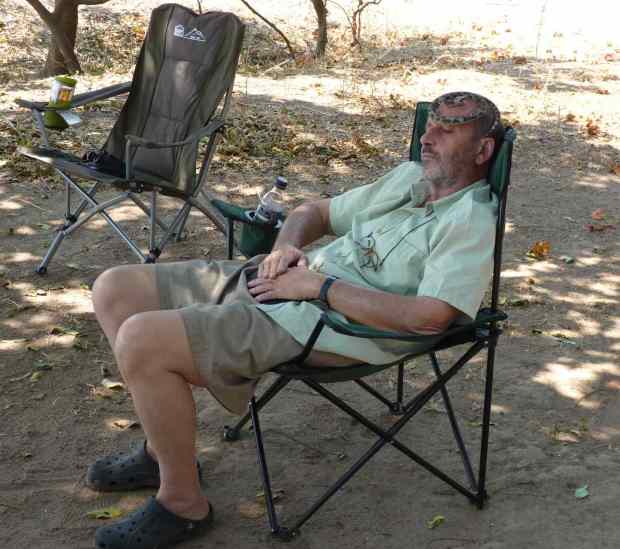
So, the only solution is to prepare for them by being attentive as more violent means such as “stone throwing” or “scary” ones such as spreading rubber snakes all over the camp do not bring the expected results but only amusement to our relatives!

jc sleeping with snake on head copy

The latest anti-monkey technology -the rubber snake- protecting the bushsnob from at siesta time!


[1] Pink gem (but smelly!)

Spot the beast 9

Two days ago the sun appeared at our farm in “El Gallinato” in Salta for the first time since we came, seventeen days ago! Luckily it was still sunny this morning when we left for Uruguay via the Argentinian Chaco. The temperature in the farm dropped and last night it reached 5°C, already too cold for me. However, as usual, at about midday we do have beautiful sunshine so we can walk around in the garden.

Taking advantage of the nice weather, we got busy outside as we have had only very short spells without rain earlier. It was at lunchtime that I spotted this beast. As you know, it is usually my wife that spots things in the bush and/or garden (in fact all over the place!).

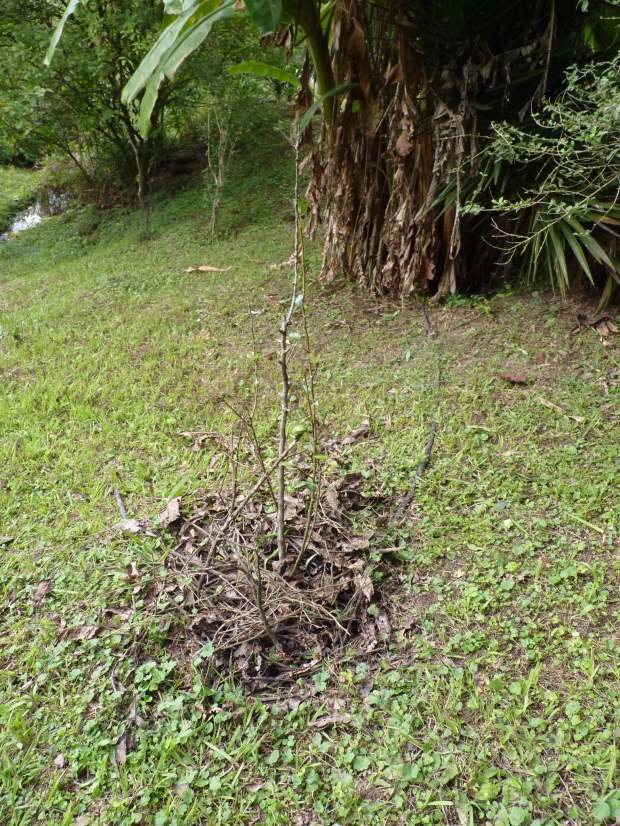
However, this time she was focusing on gardening and telling our caretaker/gardener what to do and how with plants and trees so she was distracted. I took the opportunity to spot this particular beast sunning itself to the surprise of all, including the beast itself! After dancing around it in celebration, I took a few pictures. P1150982 copy

Here I zoom it in so that you can actually see it well:


P1150986 copy

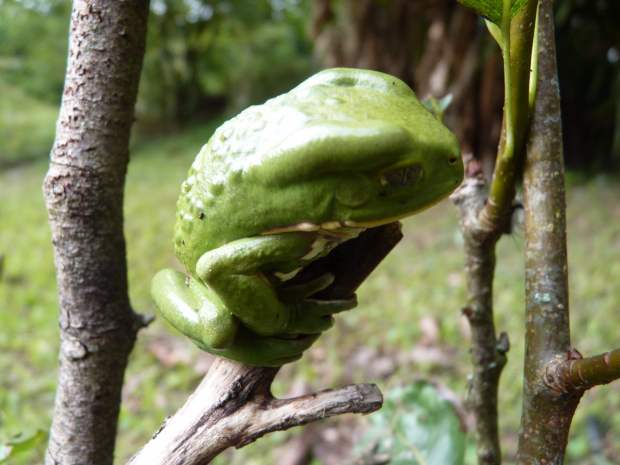
I trust that you will agree with me that is a lovely frog. It was very sluggish under the sun with its eyes closed when I spotted it. I assume that I only beat my wife to finding it because of some law of physics that a green object interfered with her usually very sharp eyes of the same colour as I have already described before… Whatever the reason, this event enabled me to score some useful points on the game-spotting department and I am about to be selected as “green frog spotter” for the future!

As for its identity, this is also interesting, as I believe it to be the Waxy Monkey Frog Phyllomedusa sauvagi a frog that is reluctant to jump but rather walks like a monkey, hence his name! I am still reading about its distribution and other biological data and I will revert to you accordingly.

In the meantime, enjoy some more pictures of the frog that the bushsnob spotted alone!

Spot the beast 8

For the first three days after arriving to our farm in Salta we were housebound as it rained constantly. In addition, as we decided to come via Brasil, our trip got prolongued and we also needed some extra time to recover so it was not that bad.

So, the first day we had fair weather we went for a badly needed walk to stretch our legs and to explore how the place was in autumn as, when we left about 30 days ago, it was still rather warm with sunny spells. Our normal walk takes us along the entrance road for about eight to ten kilometres in total. We have three main objectives: (i) reaching the cell phone signal found at four kilometres away (longer when cloudy!), (ii) keeping fit and (iii) take in the beautiful natural surroundings, particularly when the mountains in the distance start getting dusted with snow.

This time the insect life had reduced markedly and we only met two butterflies compared with the thousands we spotted last month so the cold temperatures have stopped them almost completely. Against our expectations, we did not spot many birds either so we were getting a bit disappointed with the luck of animal life but, s,uddenly my wife, as usual, spotted the beast!

Although I am familiar with her sharp eyes I was, again, surprised and sure that the creature was not visible to a “normal” human being as it was immobile and very well hidden! But there it was! I present you with a picture of the general area where the beast is for you to, again, check your ability to spot it. Remember that you have an advantage over my wife as you know that there is something in there!

P1150875 copy

There is a creature in there, check carefully…

I imagine that you found it but, however, I present you with a few more pictures so that I leave you in no doubt about its identity! It was a large rattlesnake (Crotalus durissus terrificus) about 1.2 metres long and quite thick, about the circumference of my wrist. As, for self-preservation reasons I was unable to place anything close to the snake, you will have to believe me that it was a large snake.

P1150876 copy

There it is!

It was quite relaxed and only coiled up when I got closer to takes the pictures and video. Soon we left it to its dealings and continued our walk, a bit concerned over its safety as normally people kill snakes on sight and this one was sunning itself by the road. However, we trusted that it knew what to do and it will manage to continue with its life.


Since we first spotted the rattlesnake we have seen it every time we walked past it so we assume that this is its place. It seems to be doing fine for the time being and we hope that it will soon go into hibernation and away from the most dangerous animal of all…