We allowed plants to take over our water reservoir (former swimming pool) hoping that they would slow down the evaporation. Whether water plants do this is probably debatable but they did enable the African clawed frogs (Xenopus laevis) to multiply really well.
As the frogs are happy to stay in this small “wetland”, the population reached large numbers and, although they devoured all the guppies placed there for mosquito control, the population has not yet crashed. They are also tolerated as they are rather quiet, unlike other visitors we have had in past years.
Luckily, attracted by the “fast food” on offer at least one (I am not good in identifying individual birds yet…) hammerkop[1] became a frequent customer. It walks around the pool stalking the frogs that it catches them often. It is nice to have these birds in the garden and we hope that some of them will eventually come and nest here as there are a few trees that would be able to hold one of their humongous nests.
On a Sunday in January last, before we went for lunch to a nearby place, a hammerkop arrived. It was late morning and it perched by the pool’s edge with its sights fixed on the water plants, undoubtedly waiting for its prey. We watched it for a while but it did not move so we left it to find its food while we found ours.
Being patient pays.
About to take off after abandoning the toad!
Moving to a better stalking spot!
Itchy while waiting.
After a nice lunch we returned home (for a siesta…) and found the hammerkop still there. It had caught a frog larger than anything I had seen before. It was already dead and the bird was busy “hammering” it against the floor. It seemed that the technique was to break its bones to be able to swallow it and it was really going for it!
Wetting the toad to help swallowing it.
The last attempt at swallowing it, before abandoning it.
We watched the bird “tenderizing” the frog for about one hour until it was totally limp. At that stage the hammerkop attempted to swallow it a couple of times and failed so it decided to wet it and try again but it was still a “mouth full” and it was not able to gobble it up completely so, after swallowing about half, it was forced to expel it out or it would have choked!
Eventually, after wetting it again, the bird had another swallowing attempt that nearly succeed but clearly the frog was larger than its throat so it came back out again. This time the bird, probably fed-up (my interpretation!), just dropped it in the water and left!
I thought that this was a real waste of a meal and, to avoid the toad rotting inside the pool, I fished it out to dispose of it. While getting it I noticed that despite all the hammering the carcass received, the skin was not broken anywhere, an indication that the rather large beak of the hammerkop is not used for piercing and also that it was “all or nothing”!
This post was meant to be part of the previous “Up the patience ladder”. However, in my literary incapacity, I failed to link the two in a convincing way. However, I think that the issue of the present post is worth it as my attempt at expanding it enabled me to learn more about Nature and I wish to share it with you!
I am not sure that all of you know about the Monkey-ladder, a vine called Entada gigas, found in Central America, the Caribbean, northern South America, and Africa.
A bunch of seeds of the Sea heart, Entada gigas with a wallnut as a comparison.
We first came across its seeds in the Kenya coast where, in the eighties, we collected a couple of these rather interesting kernels among a few stones. They remained stacked away while we stayed in Kenya and Ethiopia, only to resurface in Zambia, after the birth of our daughter. It was a frightening re-discovery.
Somehow our daughter, a toddler at the time, unearthened one of the pods and placed it in her mouth! We thought that her choking was certain but, somehow, we persuaded her -to our relief- to give it back to us. At that time we realized that its size was such that it was impossible either to choke with it or to swallow it! The seeds range in size but they are normally about six centimetres in diameter and about two centimetres thick, far larger than my own throat! So the seed was forgotten and became the favourite teething aid for both of our children! If the seeds are impressive, the pods are even more as they are truly humongous, reaching up to two metres long and twelve centimetres across!
The pods are large. Please note that each floor tile is 25cm long. The wallnut also serves as a comparison.
Once out of the pods, the seeds that reach the water are able to float as they have an air bubble inside. They eventually find their way to the oceans and are able to drift very long distance on ocean currents turning up in far off places where they can germinate even when they are two years old!
Our “teething aids” were forgotten and lost again after our children grew up and they would have joined other facts and objects in the recesses of our minds (and house!) if we would not have re-found them again in the beaches of the Maputo Special Reserve, Mozambique, in 2011. There were many and came in different sizes and shapes. Of course, we duly collected a few more! Subsequently we found the actual vine in Maputo and were able to appreciate the pods in situ. Do I need to add that we also collected a couple of pods too?
A segment of the pod once it released the seeds that I -before this post- thought gave the name to the plant as they looked like a ladder.
Now we come to the new part of the story. I thought that the name Monkey ladder came from the look of the pods once they release the seeds. However, when looking for an explanation of the name I found another vine known as Monkey ladder! This is Bauhinia guianensis a different plant named in such a way as its flat trunk resembles a true ladder going up to the trees above.
Having found the “true” Monkey ladder, I haste to add that this post has now the wrong title! Entaba gigas should really be known by its other names of Sea bean, Cœur de la Mer or Sea Heart. I prefer the latter as some of the seeds (about fiver per cent) are heart-shaped. In addition, it gives a dreamy touch to the name!
Our acquittance with Vervet monkeys in Harare started with friends telling us that they were lucky to have the frequent visit of a troop of vervets in their garden that they enjoyed very much. We felt mild envy but there was not much we could do. Their house is about one km from ours and located in a less populated and wooded area.
We forgot about monkeys until one day last year when, to our delight, a monkey was spotted in our garden. The original sighting was done by Stephen, our caretaker, and we were soon searching for the primates up our trees.
Our very first picture of a Vervet monkey in our garden!
A close-up of the intruder.
Of course, we found them eating our passion fruits, behind our backs! They had climbed the first step of the ladder!
We forgave their sins as they were nice to watch! However, as often happens, soon they reached the second step that consisted of opening dozens of seven-year bean pods only to eat a few of them. This produced a change of mood among the humans of the household and instructions were passed around (by my wife, the serious gardener) that the monkeys should be “discouraged” from being in the garden! The method to be used was left often and it fell on Stephen to decide. As he is, I am afraid, is softer than my wife, I imagine that he only shouted and ran after them!
The monkey caught with the camera trap.
Despite the soft methods employed to keep them at bay, a period of relative calm ensued and we were all happy sharing the garden in harmony. Soon, however, with the progress of the dry season, the monkeys accelerated their climb up the ladder going through the avocados, the guavas and even the tomatoes! This was the situation when we left Harare in late January but we believed that the advent of the rains had re-established acceptable human-monkey interactions but, as usual, we were off the mark…
Yesterday (5 February 2016) we learnt that the “status quo” was broken and that the monkeys had reached the very top of the ladder: they had destroyed the weaver nests killing the fledgelings and they were taking bites from Stephen’s butternuts. The weavers had just moved into the garden this year and the butternuts are highly appreciated for our pasta sauce! This was indeed a very serious escalation and, during the phone conversation between my wife and Stephen I could not help overhearing the exchange of unusually strong adjectives as well as one name: catapult!
I trust that a new equilibrium will be found before there is bloodshed…
I am very pleased and proud as well as most grateful to the “Muy Interesante” publication of Spain that printed a spot on my blog in the Issue printed on 20 January 2016!
To María Victoria Gonzalez Rodríguez, Coordinadora de Contenidos y Comunidad Muyinteresante.es, Coordinadora de Contenidos y Comunidad MuyHistoria.es and
Redactora Mundo-geo.es as well as other colleagues of the “Muy Interesante” printed magazine, many thanks!
Translation to English (by Bushsnob).
Julio de Castro, a veterinary parasitologist, former employee of the FAO of the United Nations and traveler, is the author of the blog bushsnobinafrica.wordpress.com. He has lived many years in Africa and now from his retirement in Zimbabwe he has a lot of curious things on his blog, illustrated with nature photos that he himself takes during his excursions.
Among the reasons for having undertaken writing the blog, de Castro cites sharing his knowledge, acquired after many years of working and visiting places of Eastern and Southern Africa, and to know their landscapes, wild nature and people. No reader who likes to dig into these issues should miss this miscellany that brings together memories of past activities, business trips or fun and curious facts about various fields. As a sample it is worth mentioning two recent entries: a family trip to the Mozambique’s coast and a post on the custom of hippos’ group defecation.
***
NB. I can hear (some of) my friends and (both my) children saying “how typical of him” when referring to the end of the spot! Please do not pay any attention and keep reading the blog…
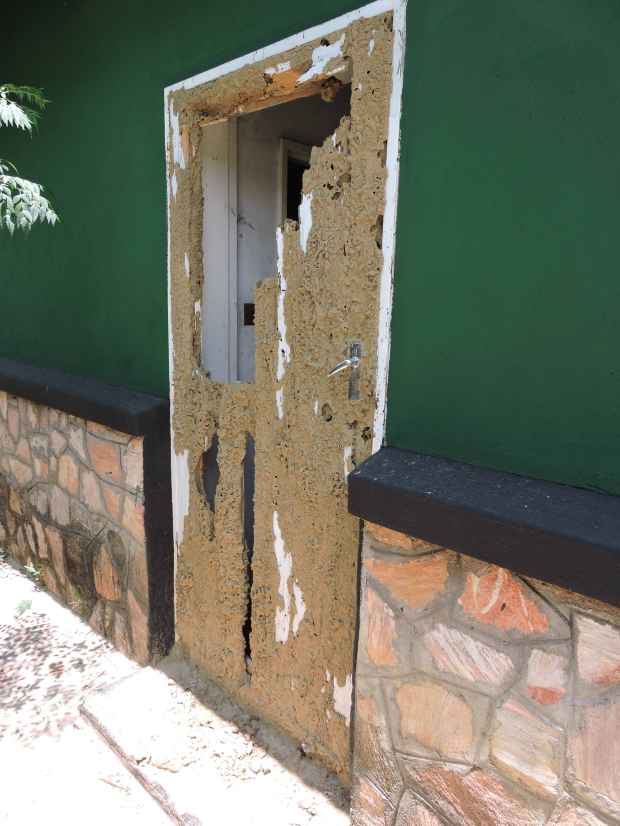
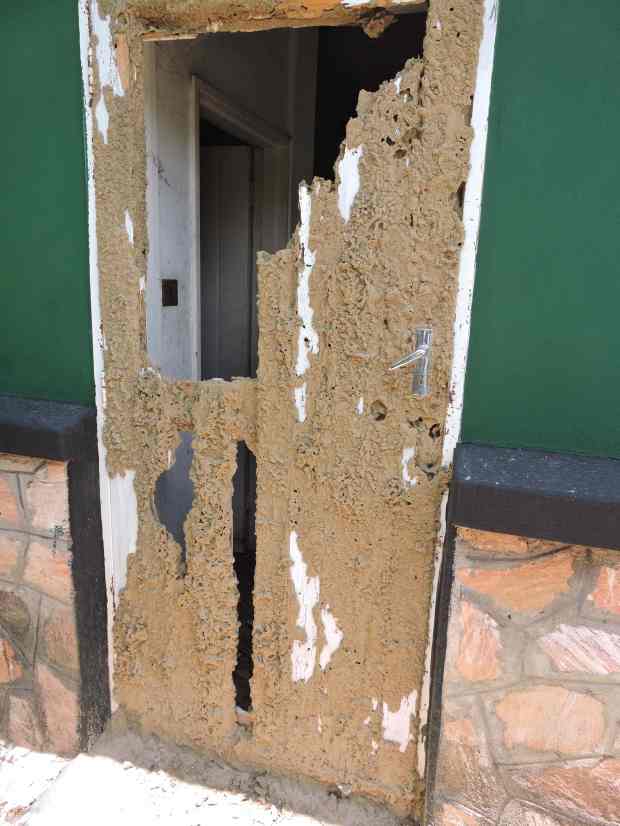
While at Main Camp in Hwange National Park last January, we repeatedly drove through the accommodation exit gate and in front of the door without detecting it until a walk around the camp brought us behind a hedge that was hiding it from “public” view.
An important and well known benefit of termites is that they break down tough vegetable matter, burying dead and decaying trees into new soil. While doing this, they dig tunnels and in so doing they not only bring down wood material but also aerate the soil, increasing soil fertility.
Aware that the door’s days were clearly counted and that it will never open again, I decided that it was worth taking a picture of before the termites finish their job.
You may agree with me that the metal handle is the only sign that behind the really thorough termite work, a door used to be there!
The location of the door made picture-taking difficult so perhaps I am not able to show its real condition.
A letter about unusual lion behaviour in the Serengeti National Park[1], brought back memories of our own observations in the Maasai Mara Game Reserve, Kenya, in the 1980’s.
A picture of the letter to Getaway.
As it can be seen above, the letter describes that, a couple of tourists on a photographic safari, witnessed a lioness kill a wildebeest cow and her calf. Afterwards the lioness suckled the cow, then consumed the calf and returned again to suckle and lick the milk from the now dead female.
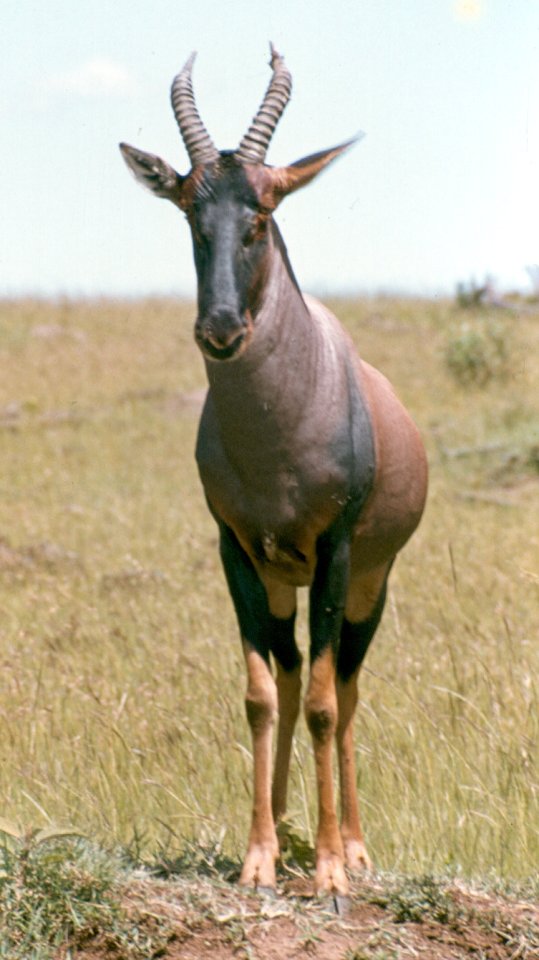
While in the Maasai Mara one evening we witnessed a lioness kill a topi[2]. While the lioness was busy strangling the animal, two cubs appeared on the scene and, without hesitation, went directly to the Topi’s udder and suckled the animal for a few minutes.
A Topi in their typical “watching” stance.
Eventually the animal died and the cubs stopped suckling and joined the mother at eating it. We did not see he lioness suckling.
The cubs we saw suckling were larger than this one.
The explanatory reply from Brian Jones, a very knowledgeable person on raising lions at the Moholoholo Wildlife Rehabilitation Centre (South Africa) among other activities, confirmed that lions do lick carcasses, a fact that I can also corroborate through personal observations. As he made no mention of the suckling of prey by lions, I decided to write to Brian to let him know of our own observations and somehow reinforce the tourists’ observations. The following is a record of our exchange:
16/11/2015
From: Julio de Castro <juliojdecastro@gmail.com>
To: Moholoholo <moholorehab@wol.co.za>
Dear Mr. Jones,
Reviewing old magazines I saw your comment of a couple of years ago (Getaway, May 2013, p.13) to a sighting of a lioness suckling and licking a wildebeest female in the Serengeti National Park.
In the 1980’s, while working in Kenya, one evening in the Maasai Mara we witnessed a lioness kill a Topi. While the lioness was busy strangling the animal, two cubs appeared on the scene and, without much hesitation, went directly to the Topi’s udder and suckled the animal for a few minutes. Eventually the animal died and the cubs stopped suckling and joined the mother at eating it. I do not recall if the death of the female Topi coincided with the cubs stopping to suckle. The cubs were about 6 months old or older (not suckling babies).
I have also witnessed lions licking wildebeest and zebra prey (mainly in the abdominal area) but I believe that there are two different phenomena, one is the deliberate suckling of a female prey and another is the licking of a dying/dead animal, including males.
I hope you find this interesting and look forward to your comments.
So interesting to hear of your experience witnessing the cubs trying to suckle from the Topi – really amazing!!!
Probably the smell of milk and I’d say the Topi must have had a youngster!!
Yes the licking of a dead animal is normal. I have often seen even cheetah licking their pray before eating!! I have a few tame Cheetah and they lick my friends on their arm, I tease them by saying “they always lick their prey before they eat them” (ha, ha).
Thank you so much for sharing your experience, it always a story I can tell to other folk.
All the Best
Brian
I thank Brian for his time to reply and his valuable contribution. Please visit http://www.moholoholo.co.za/ to see the valuable work that the Centre performs.
[1] Koetze, R. Unusual sighting. Getaway (Letters), May 2013, p.12.
[2] The Topi (Damaliscus lunatus jimela) and the Tsessebe (D. lunatus lunatus) are sub-species of D. lunatus.
After our spell at Matopos National Park in Zimbabwe in November 2015 we continued our journey towards the Caprivi area of Namibia, our final destination. To do this you need to cross the border into Botswana at Kazungula, drive into Botswana through the Chobe National Park and then enter Namibia at Ngoma. Luckily the border crossings were straightforward and we managed to arrive in Katima Mulilo in time for a necessary “safari shopping”.
We remembered Katima Mulilo from our visit in 1992 and did not have much difficulty finding the same hotel we stayed then, on the banks of the Zambezi river. The latter is one of the four main rivers in the Caprivi together with the Kavango, Chobe and Kwando. Often we had difficulties knowing which one we were crossing or looking at!
After an uneventful night at Katima Mulilo, we drove along the Caprivi for a few hundred kilometres to get to Ngepi Camp, on the banks of the Kavango river. From there we planned to explore the Mahango Game Park as well as the Popa falls area. Soon after taking the entrance road to the camp it became obvious that this was a camp with a sense of humour as the sign posts we found showed.
On arrival the camp did not look very impressive as the area outside its fence is severely overgrazed and cattle and goats abound! However, once you got to the camp things changed as, its proximity to the river, makes it a real green oasis with a nice view of the Kavango river and magnificent trees. Things were looking up! This lasted until we saw our acommodation! This time I had made the bookings and, looking for economy and without a lot of time to investigate, I had booked what was called a “Bush hut” as I thought it would be appropriate…
Unfortunately it did not pass my wife’s quality control procedure. The place had all the facilities expected from such accommodation but it was surrounded by thick bush in its four corners! Not only we could not see the river but there was no air moving and it felt like an oven! It was a bad start and we agreed to stay one night while we attempted to find an alternative. Eventually, the staff were very kind in swapping our hut for a house, known as a Tree house. This was a wooden contraption built overhanging the river and it was fresh and had a lovely view of the Kavango and its hippos. I even attempted to fish for tiger fish from our balcony (obviously without success, as usual…).
The large tree trunk came handy to hide from river traffic while showering!
The bedroom.
The bushsnob enjoying the view.
The sense of humour that we saw through signposts at the entrance became more “practical” at the camp itself! It clearly specializes in having special toilets and washing facilities that are, to put it mildly, rather surprising! My favourite was the “rocket”, a tower that looked like a water tank that has a toilet seat on top, offering an intersting view of the surrounding area!
The flower and shower interior.
Rocket toilet user’s instructions.
Inside the shower and flower.
The rocket…
A “tree” toilet.
Flower & shower toilet
Original toilet door!
Bar’s advice…
Our accommodation sorted out, we dedicated a couple of days to explore the Mahango Game Park and to visit Popa Falls. The northern section of Mahango was about 10 km from our camp, on the way to Botswana. It offered two tracks, one to the East, following the river and another one to the West, towards a waterhole.
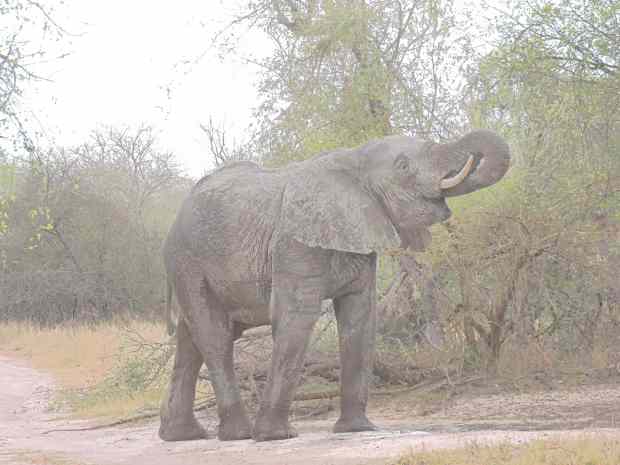
While the former offered a variety of water birds, the road was a bit too far from the Kavango river and viewing was not ideal. Along the road to the waterhole, however, we found lots of elephants, wearier than the Zimbabwean colleagues. This took us by surprise at first as they stood their ground and even mock-charged us on a few occasions before retreating tail up.
The area have had some rains as numerous ponds and mud holes indicated. The elephants were enjoying them fully and, as usual, being the only occupants. We thought that they would be occupying all of them but we were wrong. A rather large one had a very different user: a land tortoise enjoying a swim! It was inside the water when we found it and, as we we approached, it actually swam away, something we have never seen before but not unexpected, of course.
Buffalo was the name of the remaining area of the reserve located across the Kavango. Entering it we drove through military ruins, a left over of the wars that ravaged this area not that long ago. After clearing this rather large area, we joined the Kavango river and drove over black cotton soil, luckily dry as we are well aware of its stickiness from our Kenya days. As if we needed a reminder, we found a young buffalo and an elephant that, mired in the black mud, had starved to death!
The saying “being in the right place at the right time” came to mind when we postponed our U-turn until the next river bend where we were taken aback by the sudden arrival of an elephant herd that decided to come for a drink and a swim in the river at that particular time! Luckily for us they changed our otherwise dull game-viewing into probably the best entertainment of the trip!
After Ngepi and Mahango we visited Popa Falls and were disenchanted to see that is now been taken over by the Namibia Wildlife Resorts organization and it is much more impersonal than when we visited twenty four years back!
I am afraid that our disenchantment continued with the final part of our trip that took us to the Kwando river area to explore the Mudumu Game Park Not only the Camp Kwando was devoid of character and badly managed but the long drive through the park failed to produce animals, despite the praise from both safari operators and park authorities met. We had clearly run out of luck and it was time to go home!
On our final day, after watching lions and birds, we planned a “sundowner” drink at Nyamandlovu pan to end our safari in style. Before it was time for drinks, we got busy watching the many migratory birds present at the pan. These were a large flock of Abdim Storks and Amur falcons that provided us with much entertainment while they fed on beetles and other insects found in the grass.
Abdim stork drying its wings.
White stork.
Crowned crane.
Wooly-necked stork.
A family of five jackals, probably residents of the pan, were also around. While four of them were gnawing at an old elephant carcass, a fifth came close to the viewing platform for a look. As I was on the ground at the time I saw it coming and prepared for pictures. Despite the warnings shouted from above by fellow game watchers for me to be careful, I remained motionless and was rewarded with the closest encounter I have had with a black-backed jackal!
While watching the jackal I heard loud splashing noises coming from the pan and I saw a large crocodile (one of the three present) coming out of the water holding a very large chunk of carcass. I left the jackal to its business and rushed up the platform for a better look. The beast, at the left end of the pan, was violently shaking the carcass and scattering pieces in the water while it swam off with the remains to the opposite end.
The crocodile feeding on the submerged carcass.
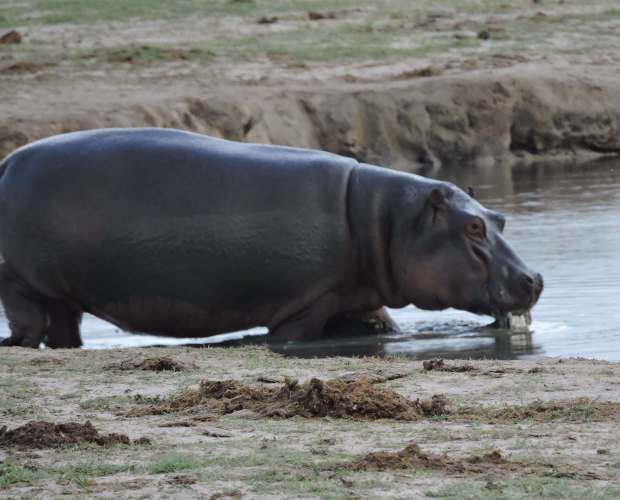
The slow approach of a hippo to the area where the carcass had been shaken apart came as no surprise to my family and I, all well aware by now of our earlier observations on meat-eating hippos at Masuma dam![1] We watched while the hippo approached and searched the area with its head submerged. Suddenly it lifted its head and chewed on what appeared to be a piece of the carcass that it had found! This was a very interesting observation, as we had not seen any of the three resident hippos engage in this activity before, despite having spent many hours there!
The hippo starts approaching…
Eating a chunk of the carcass that the crocodile left.
After munching on its find, the hippo left the area jumping in the water in a rather funny display that probably expressed approval at what it had just eaten! Fortunately I managed to take a picture of the crocodile (regrettably only after the carcass shaking took place…) and of the hippo finishing its snack and merrily moving off!
[1] See https://bushsnobinafrica.wordpress.com/2015/02/22/hippos-from-hell/ and https://bushsnobinafrica.wordpress.com/2015/03/23/hippos-from-hell-the-videos/ Muy Interesante also covered this issue: http://www.muyinteresante.es/naturaleza/articulo/los-hipopotamos-pueden-comer-carne-921450193942
Bush lions are normally tolerant of vehicles, even the open tourist ones. The only aggression we have seen was related to times when mating was taking place and the male normally leaves no doubt about how close you should be! The situation can be different on foot when the utmost care is needed where these cats are concerned to avoid accidents.
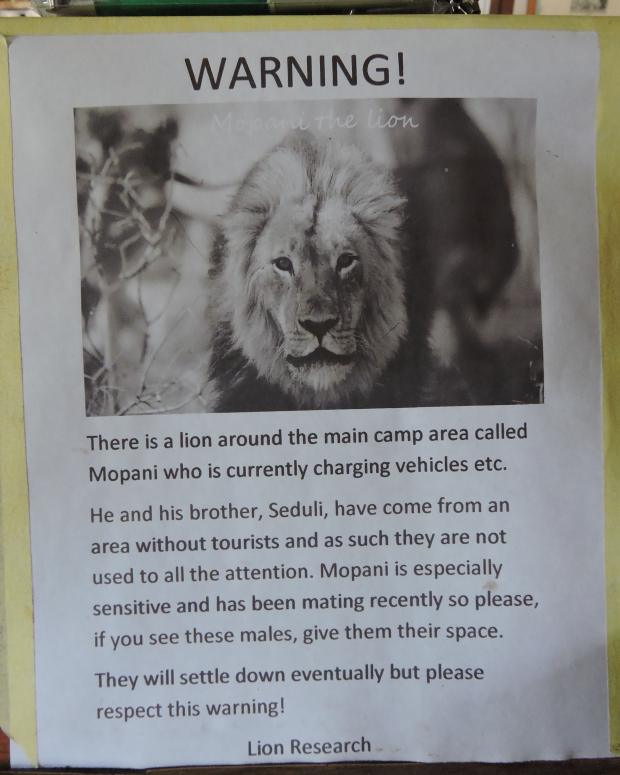
While checking in at Main Camp in Hwange National Park, we were warned of the existence of a new lion: Mopani[1]. The lion, explained a sign placed at the booking desk by the “Lion Project”, came from an area devoid of tourists and it was aggressive, charging vehicles! Siduli, another male, and two females accompanied it. We were also shown a video taken from a tourist vehicle being chased by Mopani and learnt that one of the females was in heat and mating with one of the males. We thought that Mopani’s progeny was assured and planned to keep our distance from him!
The lions had taken residence around the Main Camp area so we were delighted at our luck, as we were sure not to miss them! “Cecil may have gone but in comes Mopani!” was our thought!
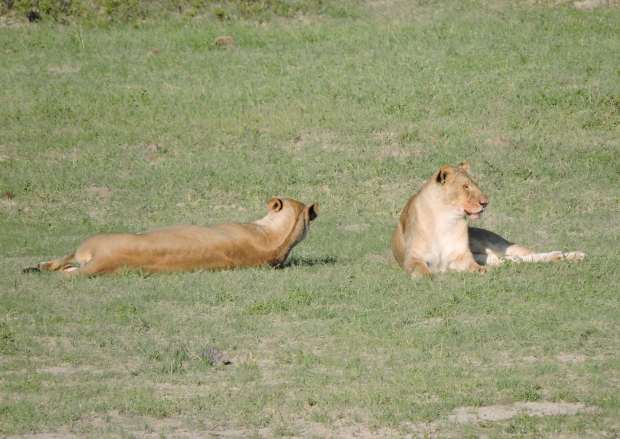
Although recently arrived from a longish trip, the possibility of spotting one of our all time favourite animals made us drop our luggage at the lodge and drive off in search of lions. We found the two females at Dom pan. They were clearly different: a paler one and a darker one. The latter appeared to be the older of the two.
After watching them for a while, a male came out of the bushes and greeted the darker one while the other moved away a short distance. Were we about to witness some mating? Not so as Mopani, who we assumed was the dominant male, only rubbed heads with the female and then moved off in the direction it came from, leaving the female pair alone until the day ended and it was time to get back to our lodge before the mandatory return time of 18:30hs.
We did not need to plan our next day activities as finding the lions again and spending time watching them was the only option! As a friend of mine says, “we slept in a hurry” and we were up before 06.00hs. No need for alarm clocks! We drove straight to Dom pan, as we believed that they would not have gone very far from there. On our way we realized that several migratory bird species were present at Hwange at the time. These were Crowned Cranes, Abdim and Woolly-Necked Storks, African Kites and Amur Falcons to name but a few!
Abdim stork with unfortunate dung beetle!
Wooly-necked stork.
Crowned crane.
Abdim stork drying its wings.
White stork.
We had little time for bird watching as the lions had killed a young elephant at Dom pan during the night and the two lionesses were feeding on it! After this find, most of our activities during the visit centred round Dom pan where we spent a lot of our time. We watched the lionesses feeding and interacting for several hours and I present you with a number of pictures and a video, as these are better than words. We only left them to return to the lodge for lunch and a rest.
When we came back during mid-afternoon, only the paler lioness was by the carcass. A search of the surrounding area revealed two lions laying together a few hundred metres from Dom. They were the mating pair: the darker female and a male that, to our surprise carried a radio collar. As we doubted that Mopani had one, it could only be Siduli. Clearly the lion that acts most ferociously towards cars is not necessarily the dominant when it comes to affairs of the heart! It was then clear that the male we had seen the day before was Siduli and that Mopani was hidden from view somewhere! But where?
Luckily my wife was with us as, if there was someone that could spot it, it would be her. And spot it she did, to our amazement, again! The wild-looking Mopani had been lying low under some bushes, unseen by anyone (except my wife) until then. It remained unobserved by our fellow game-spotters with the exception of another lady that clearly shared my wife’s eyesight. We thought it better that it remained unseen and got used to cars if it is to remain in a tourist area so we did not reveal its whereabouts.
All we saw of Mopani!
Another view of Mopani.
Mopani’s close-up
As Mopani was still not willing to socialize and remained sulking under a bush, we focussed on the others. Mating in lions is a long-lasting affair as the pair remains together and mating takes place often for a few days, while the female is still receptive to the male[2]. This was clearly the case, as they remained “occupied” for the rest of the time we were at Hwange. That left the other lioness guarding the elephant carcass and Mopani hidden from view! After a while it was time to move off.
Some of the birds we found on the way to Nyamandlovu.
We drove to the Nyamandlovu pan as our daughter is very partial to elephants. Despite the abundance of drinking water all over the area, we were extremely lucky to witness the visit of a herd of about fifty animals that, as usual, appeared suddenly as if the product of a magic tree-to-elephant metamorphosis. The result was about one hour of one of the greatest shows on earth: elephants enjoying life at a water hole! There were about five family groups, each led by a matriarch and composed of its progeny, including some really young and tiny babies that were the centre of our attention.
The elephants not only drank but also entered the water where many were seen frolicking about and playing as only elephants are able to do among wild animals! It seemed to us that the latter were at risk of drowning while entering the water with their huge siblings and that they were under even more danger while swimming among them! Somehow they managed to keep their tiny trunks above the water and their mothers were extremely protective and they were always in close contact and ready to assist them!
The three resident hippos felt very uncomfortable at this sudden disturbance and two moved to the very centre of the pan while the third moved to the shore where it put up brave stance against the elephants, only to return to join the others as it was not at all respected by the excited pachyderms! Again, a picture gallery and videos are better than my limited power of description to let you know what took place.
The elephants’ joyfulness in the water delayed our return so we only drove past Dom pan, catching a glimpse of the lions who unwittingly startled a herd of 30 odd elephants intent on drinking from the pan, who retreated in a cloud of dust as soon as they caught sight of the lionesses. We arrived late at the gate where we were told off by a rather grumpy lady game ranger! The justification for our tardiness did not go far with her, clearly used to all sorts of excuses from people arriving late to camp!
The following morning, as expected, the lion pair continued their courtship, the pale female was still guarding the carcass and about fifty vultures (white-backed, white-headed, hooded and lapped-faced) were waiting on the side-lines for her to leave it. While in waiting, the Lappet-faced vulture was seen having a snack by pulling and cutting the dry tendons and sinews from an older dry elephant carcass that other vultures also shared once it opened up the hard bits!
Mopani, the antisocial, still preferred to remain out of sight! We can only hope that he starts turning into a more car-tolerant lion by accepting their presence as part of his daily life. Who knows, maybe one day he could become Cecil’s successor.
[1] To name wild animals or not to name! This is the question… for which I have no clear answer!
[2] Both leopards and lions have the same mating procedure. They can mate as often as every fifteen minutes for up to five days. This is the consequence of weak sperm and mating-induced ovulation.











 A Bushsnob out of Africa