I am now able to let you have the videos that further illustrate the earlier post. I trust that you will enjoy them.
A picture of an “engorged” lion cub resting belly-up posted recently on Facebook by my son reminded me of an elephant kill we witnessed together in Mana Pools in October 2013 when that picture was taken.
Apart from being a wonderful wilderness place teeming with wild animals, Mana Pools offers a number of add-ons. Apart from being allowed to walk unaccompanied in a park where the “Big 5” are present, the presence of the mighty Zambezi river adds an unsurpassed touch of beauty to the area.
In addition, camping there is an experience on its own as -like in the good old days- there are no fences or trenches separating you from the wild inhabitants. Camping in these conditions increases solidarity among fellow colleagues and information on the “state of the wild” circulates freely. In Mana Pools it is usual to have- in addition to the harmless buck- hyenas, buffalos and elephants of all sizes walking about at all times.
I vividly remember a nocturnal incident with an elephant. My wife and I shared a tent while our daughter had her own a few metres away. It was late at night and we could hear the breaking of branches around us as the elephants fed. Suddenly we heard loud elephantine intestinal rumblings followed by the unmistakable noise of heavy droppings being dropped! Judging by the direction of the noise we guessed that her tent could have been compromised by the event. Before I could ask her about the situation I heard her “Phew, that was close!” and went on to say, “It just missed my tent but I can smell it very well!” So could we although a few more metres separated us from the “object”.
Under these conditions of proximity with wild animals it is not surprising to have visitors at your camp bearing news such as “There are a few lions near the ablution block at the end, so refrain from using it tonight” or “we have just spotted a leopard walking near the entrance”.
Fellow campers also share their sightings and experiences in a friendly atmosphere.
The elephant incident I described above brings me to the issue of the wild life experience and the importance of the senses in it. Smells -together with the natural shine and subtle sounds of a live animal- are among the details wildlife documentaries are not able to transmit! It is common to drive or walk in the bush and be literally assaulted by different smells, both pleasant and otherwise.
October 2013 saw the whole family camping at Mana Pools and in the evening after our arrival we learnt that lions had killed a young elephant in the Mucheni area. This is apparently not surprising in Mana Pools where lions are skillful at killing elephants. Quite excited, the following morning we drove there as early as we could. The area of the kill was easy to find as, unusually for Mana Pools, there were a few vehicles watching the scene. A young elephant had indeed been killed the day before and it still had food to offer the lion pride that was resting next to it. We counted around 16 animals of all ages.
As it is common in these instances, satiated lions were lying all over the place, trying to take advantage of the little shade available. As the morning heat increased the vying for shade became more intense and, to add a touch of reality, the foul smell also gradually augmented. When a kill is available lions tend to gorge on meat to the point of becoming uncomfortable. It is therefore not difficult to understand that to have such a large number of individuals quite close to us multiplied the final outcome of their digestion and its vapours! I sharply recall our desperate spluttering every time the wind shifted and one of the lions rolled over as well as the family’s diving into the car through its roof hatch in an attempt to escape a particularly fetid eruption…
The situation was rather smelly, so much so that this was one of the few times when watching the scene through a documentary would have been preferred! So, being nice to you I present an odourless picture gallery as well as videos for you to enjoy. I am aware that seeing a kill is never pleasant but these are wild lives!
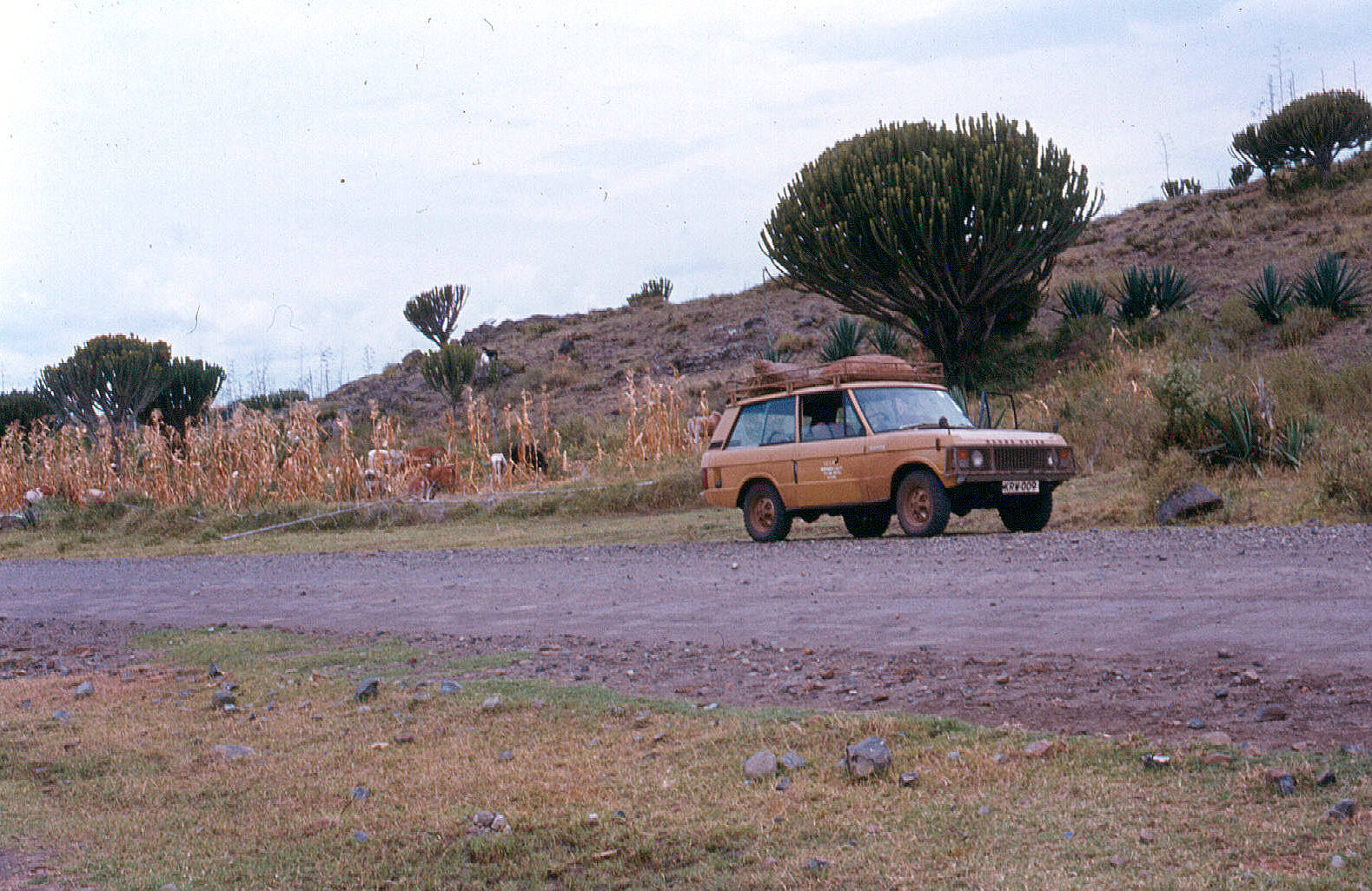
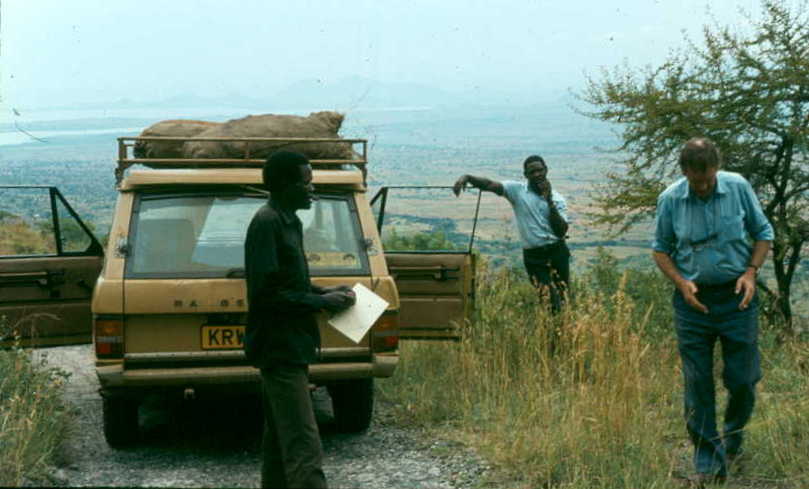
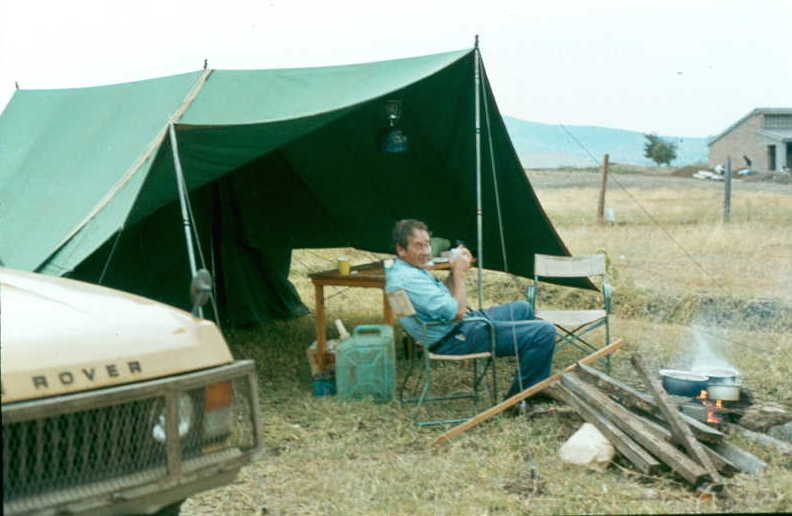
Matt, driven in a Range Rover, came to fetch me early in the morning for our rather long trip to Western Kenya. We would travel northwest, first following the Great Rift Valley then Kericho, Kisii and afterwards to Homa Bay. From the latter, already on the shores of Lake Victoria, we would proceed to Mbita Point. Rusinga Island was just across, separated by a narrow channel.
Matt enjoyed travelling. He was very cheerful while constantly giving me details of the route, Kenya, his work and other interesting facts. While going down the dramatic Kikuyu escarpment he pointed at a little chapel and said in his heavy Glaswegian accent “This road and this wee church were built by the Italian prisoners during the war” and he added “and you know, one of the guys that came from the Italian Alps longed to climb Mount Kenya, poor bugger”. He continued: “You know what he did? He organized other prisoners and secretly prepared the climb, including all necessary gear that they secretly made, escaped, climbed it and returned!” “That was good,” he said with amusement and respect for his enemy[2].
Going further down we saw Longonot, my first volcanic cone, then Suswa in the distance with its much larger caldera. As the Range Rover continued descending we spotted the blue waters of lake Naivasha with its freshwater, later lake Elementaita and finally lake Nakuru with their soda-charged waters, harbouring prolific birdlife. I made a mental note to return to this magnificent pink lake that on a more careful look revealed its secret: hundreds of thousands of flamingoes feeding on its blue green algae-rich soup. An ornithological sight difficult to match and to forget![3]
From there we continued to Kericho through extensive and manicured tea plantations that slowly became smaller areas as we moved through smallholder owned tea plots that somehow interrupted the large extensions of the commercial plantations. The area offered a great contrast between the tea and the clumps of forest that still remained, adding shady green to the yellowish green of the tea bushes. People, mainly women, were busy picking tea leaves, placing them in their back baskets while lorries were seen at points where the bulk of the tea was collected to be taken to the processing plants. We stopped at the Kericho hotel for lunch and then moved on past Kisii. Finally we entered the final dirt road towards our destination. The going was tough as the road was dusty and rough. I noted that the area got gradually more arid as we drove on towards lower altitude.
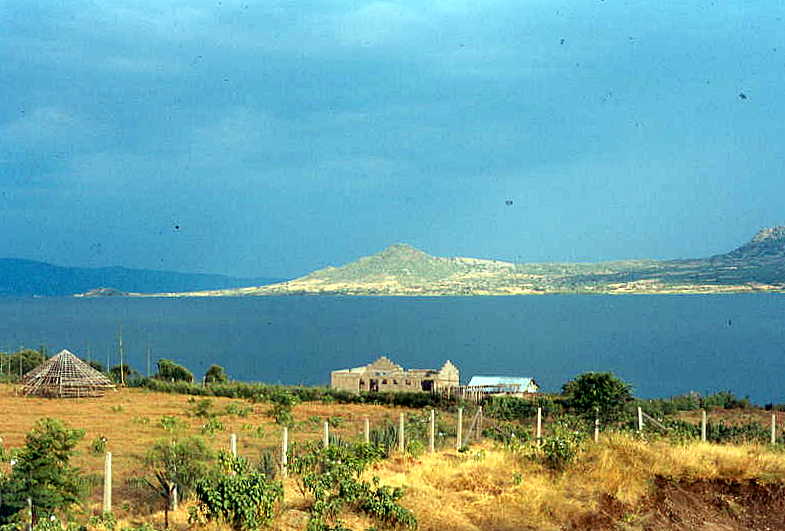
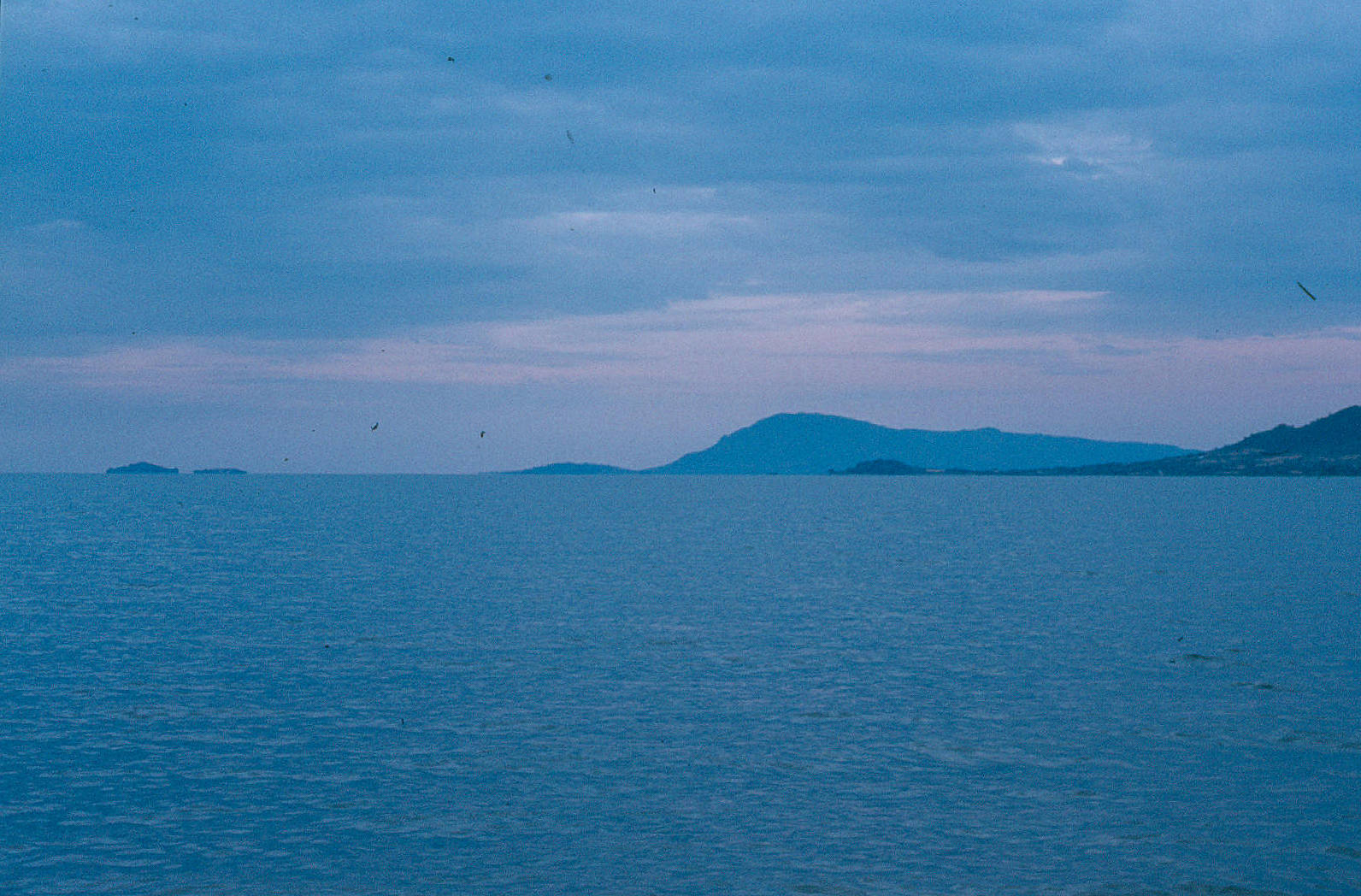
After a while, suddenly, Lake Victoria came into view. The sight did not match my expectations. It was framed by fairly bare and brownish rolling hills in a rather dry landscape that contrasted nicely with its blue water. It was humongous, a true inland sea! I thought on how the early explorers would have felt at finding the main suspect for the Nile source!
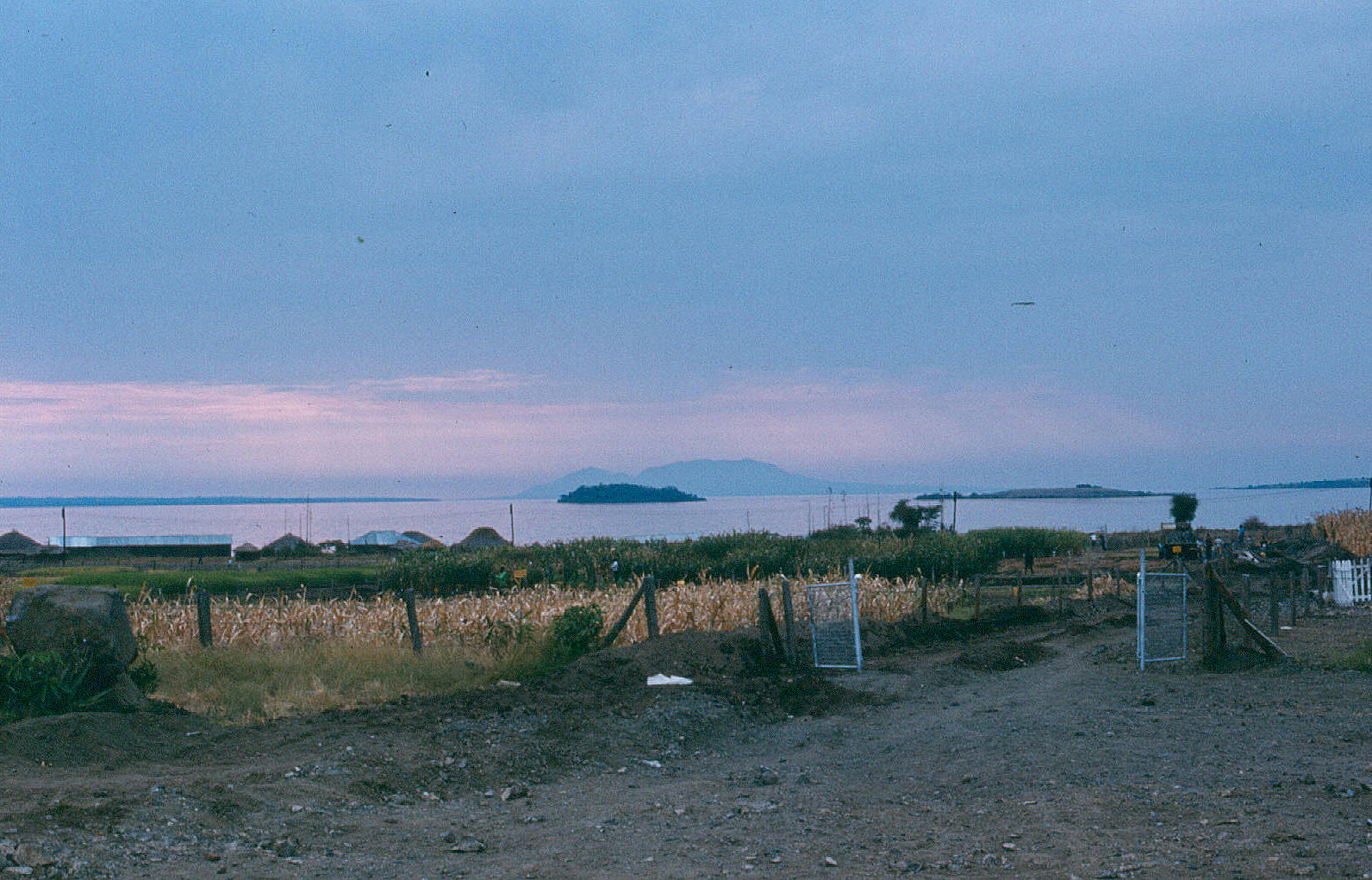
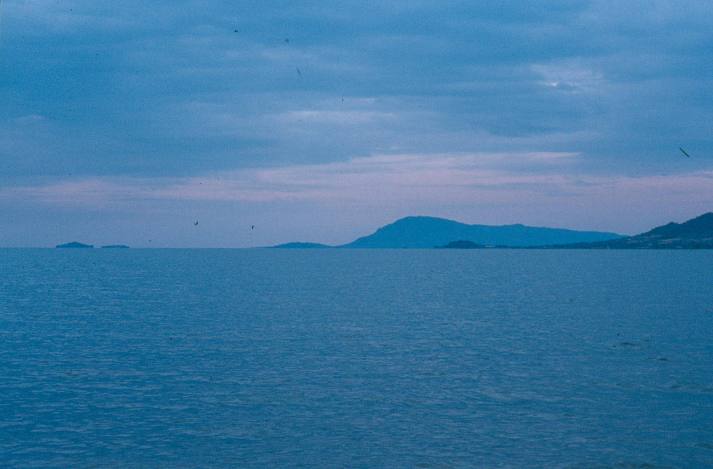
Eventually by mid afternoon we passed Homa Bay and after dustier travelling we got to Mbita Point and, just across, before my very eyes was the now “mythical” Rusinga Island! It looked beautiful by twilight and it suddenly hit me that I had come a long way from Uruguay! However, there was no time for soppiness as we needed to focus on practical issues: to find accommodation and dinner.
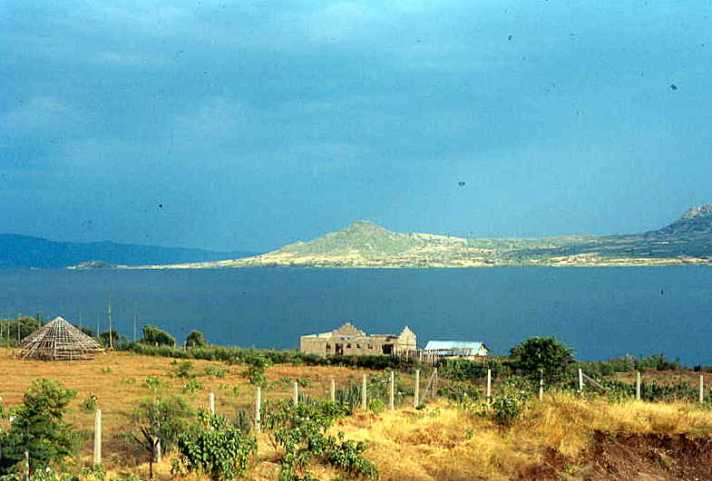
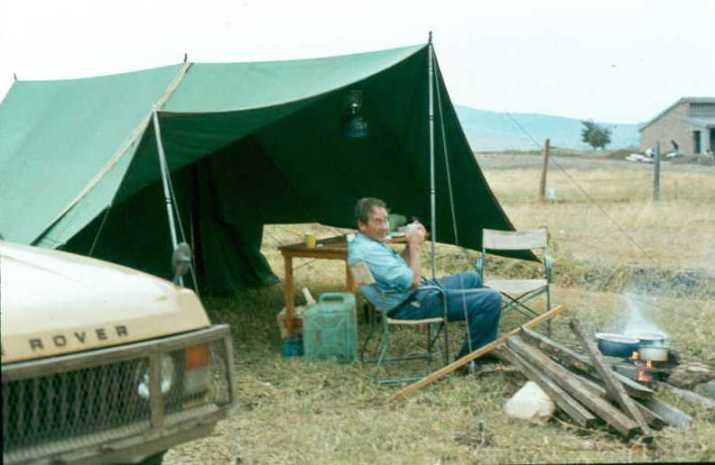
During the trip I had learnt -rather to my shock- that this was also Matt´s first trip to Mbita Point so he was as keen as me to see the place. The Head of the station, warned in advance of our coming, was there to welcome us. He apologized for the absence of accommodation and recommended a place for us to camp within the perimeter of the station. We agreed to meet again in the morning and got ourselves to put the tent up and unpack our belongings. While we organized the camp, Matt dispatched the Driver to find a kuku[4] and to bring it ready for cooking.
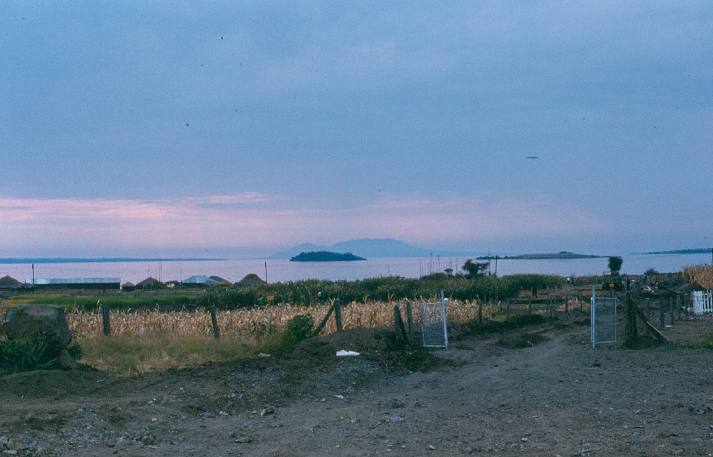
Matt had organized the food for the two nights we would spend there. I saw potatoes in the car and we had also acquired a large cabbage, bananas and charcoal on the road, as it is routine in Kenya. He had also brought a couple of sufurias[5], cooking oil, salt and pepper. Evidently food was not Matt’s main goal in life!
The tent job done, we opened the ubiquitous Tusker beers and proceeded to sit and wait for our soon-to-be dinner to arrive while contemplating the lake, peeling a few potatoes and boiling water. We spent some time discussing whether the Schistosoma[6] parasite would be present in the tap water of the station as we knew of its high prevalence in the area. As this parasite enters a person through the skin, we evaluated the risks of showering with lake water. After some discussion we agreed that we did not know but, more importantly, there was no shower on sight so the discussion ended with a hearty laugh while agreeing to continue in our dirty condition just in case. We left it at that and then changed the subject to the late Tom Mboya, a famous young politician that lived in Rusinga Island[7]. Matt told me that his house would be a good place for me to live. “Typical Matt” I though, “He has never been on the Island but he has already found me a house” but I refrained from making a comment!
We heard the return of the car and we looked at each other as we also heard a chicken! Dinner would be delayed as the Driver had difficulties to persuade farmers to part from one! Eventually, through the old trick of adding more Kenyan Schillings, had managed to buy one. It was a tough-looking country cock and, judging by the size of its talons, an elderly one! Matt was not impressed with the price paid but supervised its killing and cleaning by the Driver and myself. He then placed the whole animal in a sufuria of boiling water adding salt and pepper. The peeled potatoes were placed to boil in a separate one.
While we waited, time was passing when we heard “Jambo“[8] pronounced in the way foreigners speak. It was a crop protection specialist from Ghana -resident at Mbita Point- that learning of our arrival had come to greet us. He knew Matt from Nairobi and he was pleased to see him again. He politely declined Matt’s invitation for dinner but he did accept a Tusker beer and stayed a while.
From him we learnt that at that time the station consisted of temporary prefabricated facilities to house staff and carry out basic laboratory work while the definitive laboratories, staff quarters, school and hostel were slowly being built. We joined him in a short walk by the lakeshore while he explained that he was there with his Dutch wife and that they had two girls aged four and six. He was a specialist on integrated crop insect control and was working on cassava, an abundant crop in the lake region.
The walk by the shore of the lake was very pleasant; the sun had already disappeared behind the hilly Rusinga Island leaving its trail of red –smoke-fed- haze with an amazing cloud frame, product of the high humidity that prevails around the lake. More basic needs suddenly interrupted our inspiring walk when Matt remembered our chicken! We rushed to our camp while our visitor, laughing at Matt’s panic, hastily departed not without inviting us for dinner on the morrow. We shouted our acceptance over our shoulders and kept running to attempt to save our dinner.
Not a chance! The water -clearly not enough in the first place- had evaporated for a while now and our dinner looked black and crusty on the bottom side and raw and very juicy on the top. The potatoes were also dried and rather burnt but had feared slightly better.
As dinner looked rather inedible and there was no way of preparing something else I braced myself for a hungry night. Conversely, Matt found the whole thing very amusing and, oblivious to its apparent inedibility, pulled bits of chicken apart and placed them on our plates together with pieces of the burnt potatoes. He passed me a plate with a Tusker and said: “Julio, welcome to Mbita” and then added with a sardonic smile: “Enjoy our Chiken a la Rusinga!” Unknown to me then, this event became our connection from then on and the anecdote came up in many conversations afterwards, helping us to connect. I must confess that I was so tired and hungry that I actually found the contrast between burnt and raw chicken meat tasty… but I think it was probably the beer that did the trick.
Dinner over, Matt got his whisky bottle from the car and, diluting it with water, started enjoying it. He cheerfully said: “Julio, I know you will be all right!” and, after a few more minutes of night contemplation, he stood up and, after wishing me good night entered the tent. I decided to follow him after brushing my teeth, still thinking of the lake water and its risks! He was already asleep when I finished undressing. Like him I passed out instantly and slept soundly until the morning, no doubt assisted by the Tuskers I have had but also by a belly filled with our newly created delicacy…
Somehow we survived the potentially severe Salmonella challenge and we were both alive in the morning. After coffee and bananas, we went to meet the Head of the station for a tour of the facilities. The fresh foundations showed the layout of the future buildings and the walls of the more advanced constructions had reached about one metre high. Clearly things were far from ready and I could detect some concern from the Head.
Despite the glaring unsuitability of the place Matt -to my surprise and growing irritation- kept insisting that I would be based here! This was music for the Head’s ears, eager to get new staff to “his” station. I kept quiet but my heart was sinking as to do all that was expected from me under these conditions would have been impossible and I saw myself having to build both house and laboratory to be able to move forward. “We have plans for Julio to stay in Tom Mboya’s house in Rusinga”, Matt repeated and the Head smiled and nodded in agreement. My concern was turning into desperation!
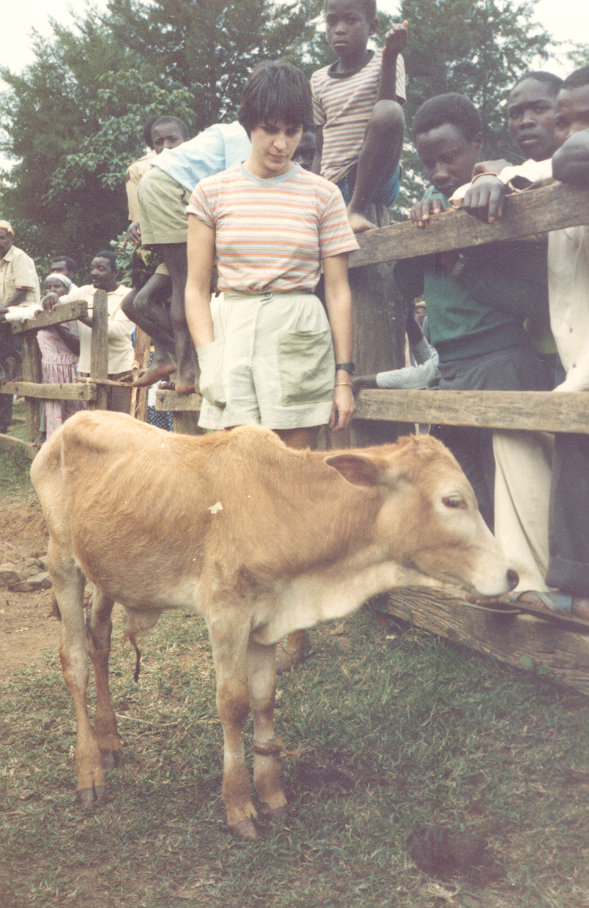
In accordance with what was there to see, the tour lasted a short time and we decided to visit the surrounding rural area, accompanied by a local technician to act as guide and show us the way and interpret for us. I found this much more interesting as it enabled me to have my first exchanges with the local farmers and to get a first hand feeling for their problems that, in regard to their livestock, were blatantly obvious! For the first time I saw dwarf cattle! They were the consequence of surviving trypanosomiasis and theileriosis as well as other diseases and parasites that will dispatch European cattle in days if not hours! To reduce the risk of trypanosomiasis cattle were kept tethered until late morning to protect them from the bites of the tsetse fly vectors and they were only left out to graze for literally half day.
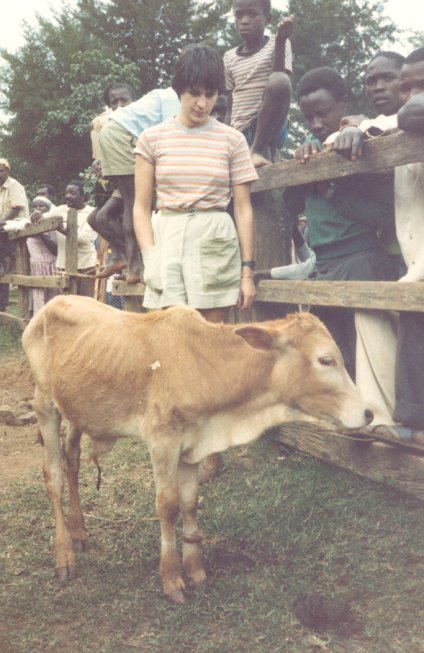
A survivor! An adult steer with my wife and members of the public!. Please note that this picture was taken during a subsequent trip to the area.
“What do this animals produce” I asked, realizing that it was a rather inept question before I finished asking it! I was told that they gave a calf every 18 to 24 months and that they produced meat and little milk. However, I was explained that other factors are also important in Africa as cattle are not valued only by their productivity but by their many other functions: savings, status and as a source of dowry money. I could not fail to note that they were also covered in ticks of different species! I was starting to learn about African cattle!
The field trip took us until mid afternoon as Matt kept asking to see more and spent time telling them that their productivity would increase once ICIPE developed the tick vaccine! I thought of it as a rather far-fetched promise but that was Matt. We got back from our trip dusty and sweaty but there was no chance of swimming in the lake! If you were spared by crocodile and hippos you were still likely to contract schistosomiasis and spend days under treatment with no guarantee of a full recovery. So a bucket-wash with lake water, the less risky option, is what I took. While I was on cleaning duties behind bushes Matt sat and drunk a Tusker with no intention of improving his personal hygiene and still wearing the same clothes from Nairobi!
I was ready when the Ghanaian colleague came to fetch us for dinner. His blond wife and their two lovely dark skinned and blond girls greeted us on arrival to their wooden prefabricated house. Although the house was small it transmitted a warm feeling where you could see a woman’s touch and the children’s influence. Our dinner of Nile perch was excellent and our conversation started with Matt mentioning the Chicken a la Rusinga of the night before! While having our dessert I asked how was life in Mbita Point as I was curious and needed to prepare for it. Suddenly our hostess that had remained mostly silent came to life and said bitterly: “No drinking water, no electricity, no transport and endemic cerebral malaria” and then she added with a grin of dejection: “apart from that, it is fine!”
Sensing trouble her husband tried to change the subject but she continued, getting more upset when she mentioned that they had all been sick with malaria several times, concluding her horror story. Hearing this Matt tried to comfort her saying that things were improving. However, her reaction was not what he expected and she broke down and started to cry saying finally: “Matt, please do not send Julio here with his young wife, this is no life for them!”
After this acme the lady calmed down but the situation had become very awkward and we soon decided that it was time to depart. We thanked them for their kindness and left walking in silence towards our tent, her words “this is no life for them” ringing in my ears while trying to develop a valid strategy to convince Matt -and ICIPE- of the absurd of having to stay in Mbita Point. Matt did not say a word until we got to the tent and then he only said “Good night” and went in. I sat outside for a while, still thinking. Then I decided that sleep, away from mosquitoes, was the best possible course of action and went to bed.
I heard Matt loud snuffles before I entered the tent. Until then I was the one that snored and my wife had put up with it rather stoically. This time the tables changed and I needed to continue my adjustment to Matt’s ways, this time even while he slept! I came in silently, climbed on my camp bed and closed my eyes. Matt was quiet now so I relaxed and waited for the sleep to come. Soon I started to drift off when suddenly I heard a loud grunt followed by a longish silence and then the start of a chained sequence of snorts that became louder and louder to almost be unbearable and then as suddenly as they had started stopped, before Matt breaking apart! He had gone into an apnea that I associated with his passing. I was wrong; he was alive and well and would repeat the whole shenanigans again and again during the whole night!
His snoring beat my most extreme ideas on the subject and I lied there with open eyes in a moral dilemma: I wanted him to stop but I had heard that waking a snoring person suddenly could be fatal. I also wanted -and needed- him to live so I decided to bite the bullet. Gradually my tiredness got the best of me and with a parting thought that it would be easier to handle his dead body in the morning rather than worrying for each of his “deaths” during the night I also joined in with my own snoring contribution. I am confident in assuring you that our combined efforts kept Rusinga Island awake for a while!
Amazingly the following morning Matt was not only alive but had also already brewed some coffee for both by the time I woke up. “Did you rest well?” he asked knowing that I had not. Then he added “Julio, we need to find another place for you to work as this place is shit!” Startled by his change of heart, all I could do was to nod gravely making a supreme effort not to laugh and shout in joy! I did silently thanked the unhappy Dutch lady, my saviour!
It was time to travel to Kilgoris to meet Alan and to decide my fate and, by en large, my future life.
[1] Follows Kenya: Friends and Foes.
[2] See Felice Benuzzi in the “Pages” section of this Blog for more details.
[3] I am told that today the lake is not what it was as the flamingoes are not there in large number anymore.
[4] Swahili for chicken.
[5] Swahili for handless saucepans.
[6] See http://www.who.int/mediacentre/factsheets/fs115/
[7] See Thomas Joseph Mboya under “Pages” for more information on him.
[8] Swahili for Hello!
After our trip to the Iberá wetlands reported earlier in this blog, my mind remained on the fishing, as I almost could not remember when the last time I caught a fish worth lying about was!
A very simple armchair exploration showed me that the above-mentioned wetlands drained into the Paraná River, via the Corriente River. Further investigation revealed that in this area there is a town called Esquina in the Corrientes Province where people go fishing! I had heard about this place before but never gave it sufficient attention as it is closer to Buenos Aires than other fishing spots in the region and my belief is that large cities and fishing do not go together.
So, taking advantage of the need to travel from the Andes foothills to Carmelo, our town in Uruguay, I decided to explore the Esquina area with a view to go fishing there in the future.
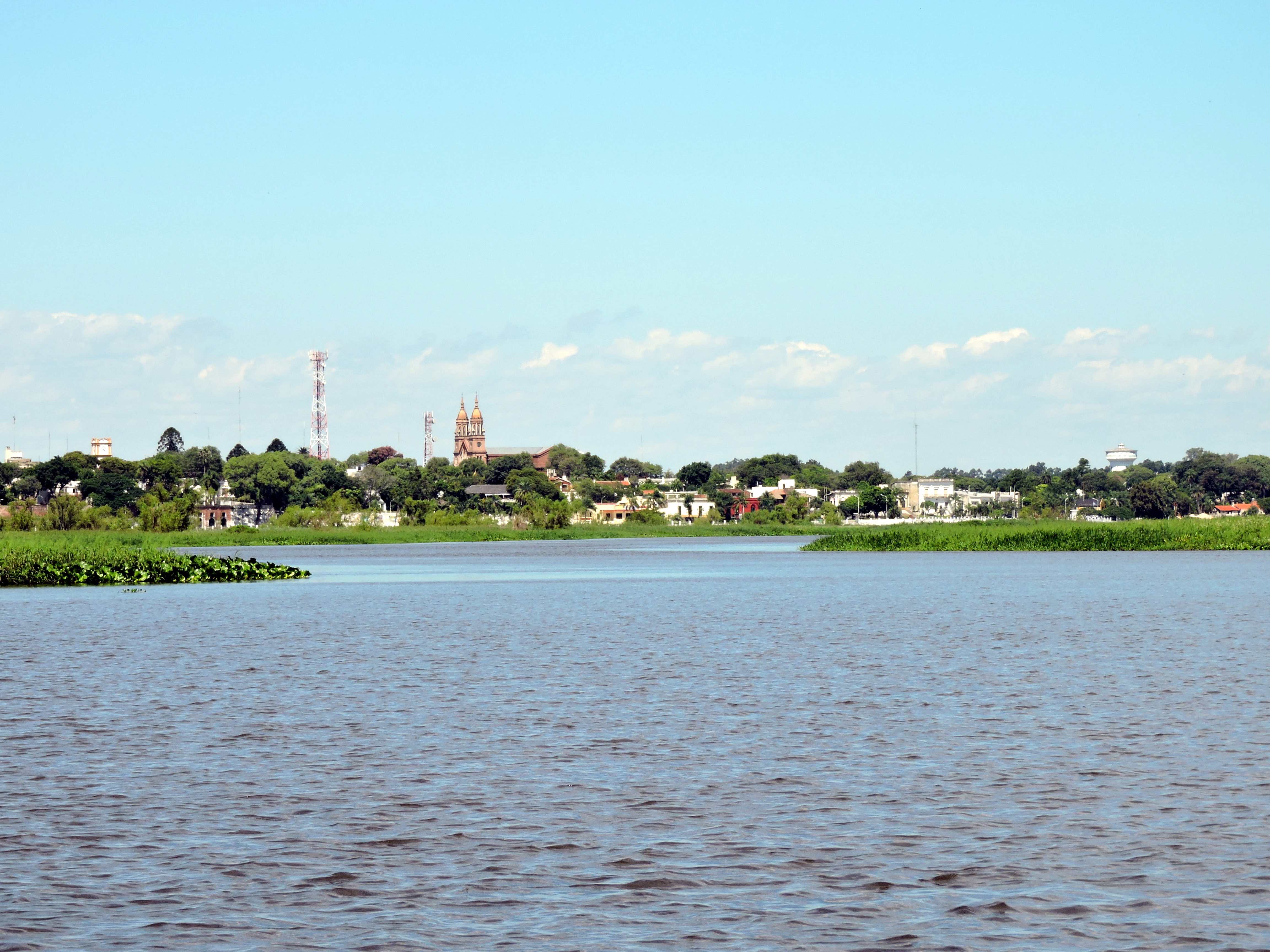
Esquina, founded with the name of Santa Rita de la Esquina del río Corriente started its life in 1785 when fifteen families of which six were of Italian origin settled in the area. It is located on the left (eastern) margin of the Paraná River, about 670km North from Buenos Aires. Predominantly a cattle-rearing area it is also known for its watermelon production!
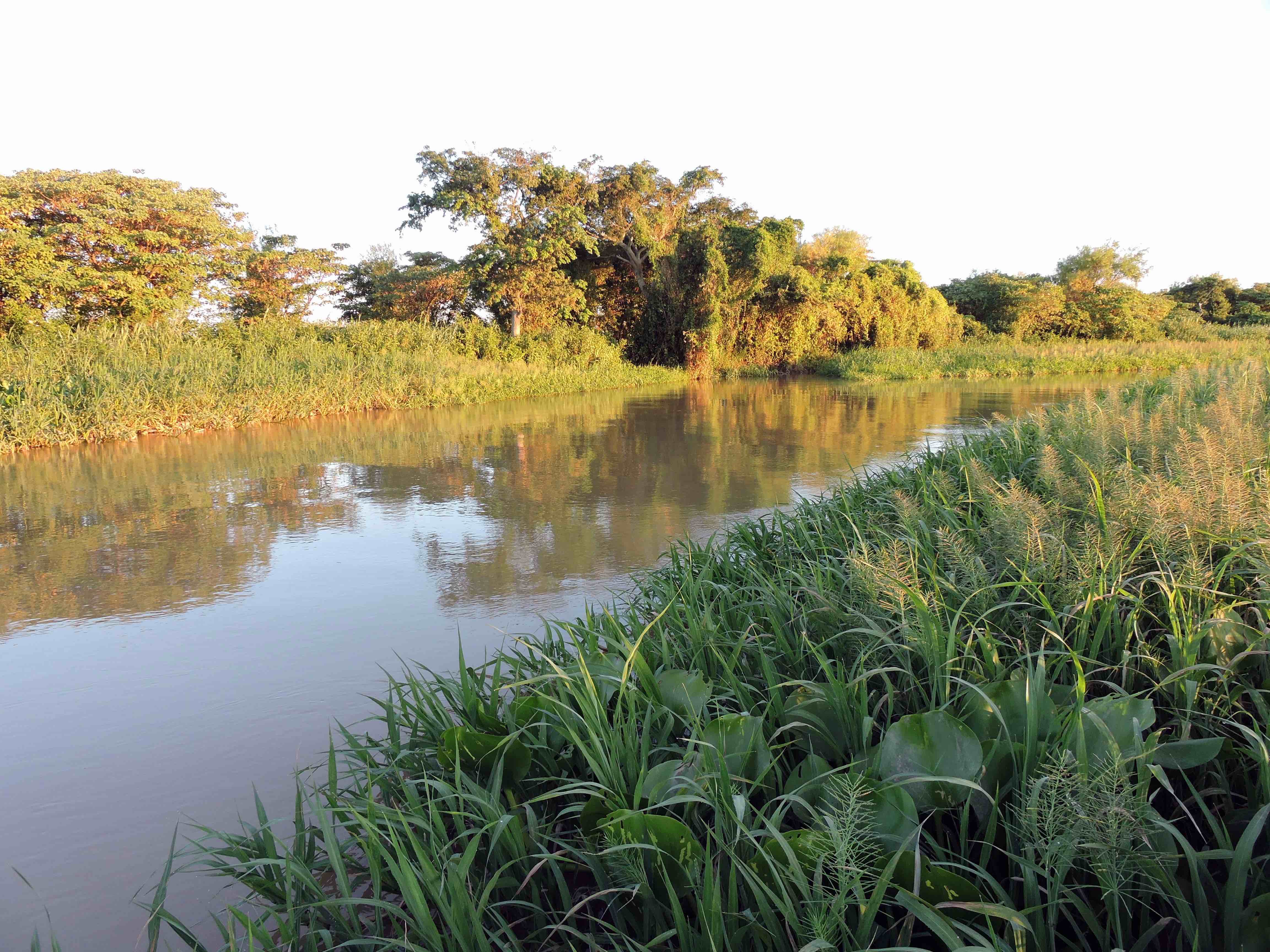
The city still maintains the air of a colonial town where its low houses -of Italian influence- are shaded by large trees. Esquina’s main attraction resides in its riverine location where it enjoys the calm waters of the Corriente River delta that connects to the Paraná -located further West- through a man-made channel.
Enough history and back to our trip!
The town can accommodate up to two thousand visitors. This large bed availability for a city of 26,000 people is explained by its hosting of street carnivals in January and February and the Fiesta Nacional del Pacú (National Pacú Festival), a fishing competition that attracts around 25,000 visitors, in May of each year. So, in view of this situation we did not book in advance and left the choice of accommodation to an in situ choice.
It did not take too much time to find a place to stay, the very nice “Casa del Puerto” that offers reasonable B&B and its lawns end at the river. Seeing the beauty of the riverfront, exploration turned into action and it was not long before a fishing trip was booked for the following day while we spent the rest of the afternoon walking about town and resting, after the rather long journey.
Fishing started at 07:00 hours when our guide José came to meet us at the hostel’s small jetty. All was taken care of and we agreed to fish in two stages, morning and afternoon with time in between to avoid the heat of lunchtime and have a siesta to recharge our batteries. We left with high hopes, as the setting was clearly fishing-friendly!
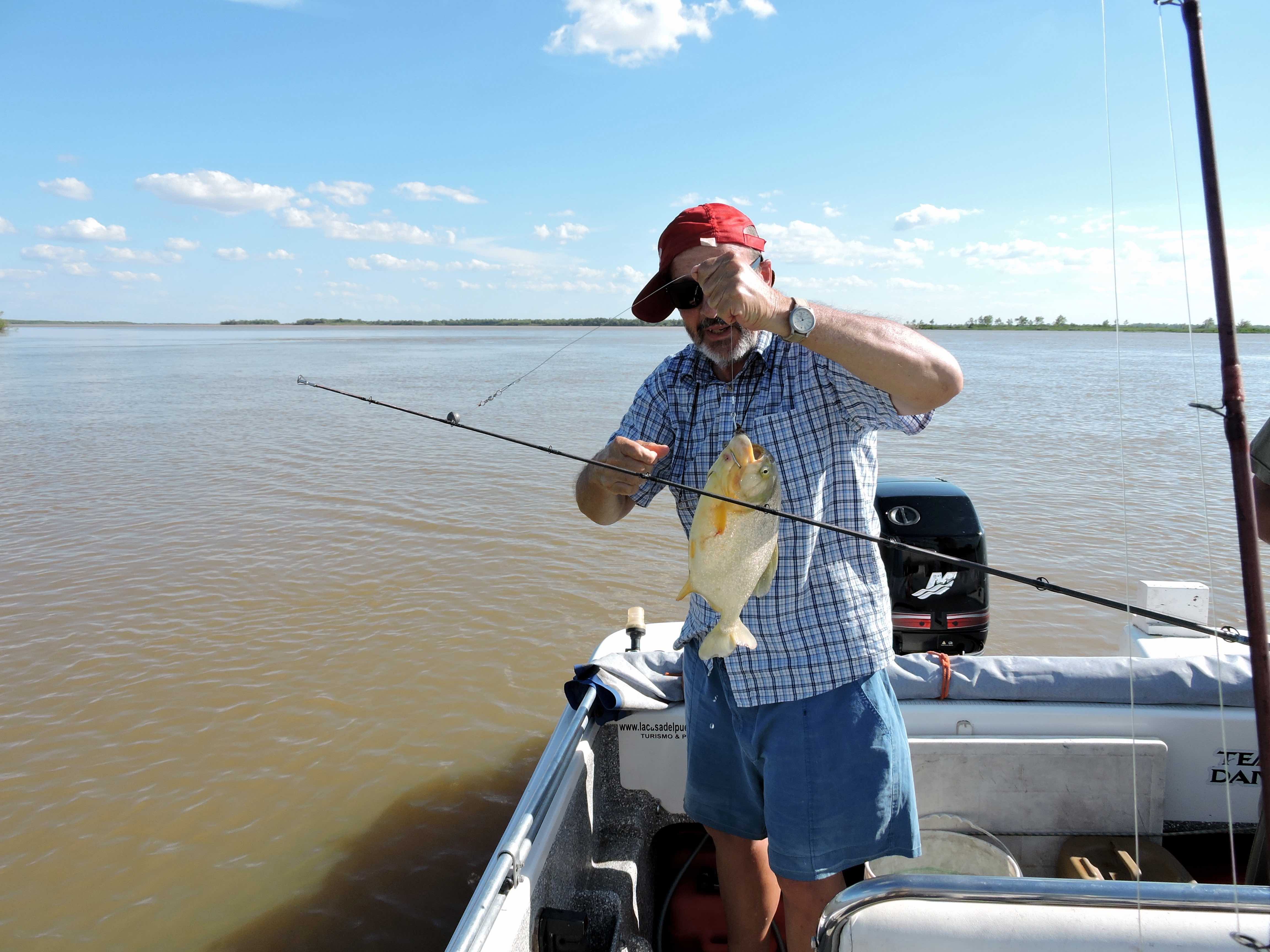
Despite the predictions by the hostel owner and our guide, fishing did not live up to our expectations and none of the “Big Three” Dorado, Surubí and Pacú were caught. To save you reading time, we did fish three “Palometas” (also called “Piranhas”) of the Serrasalmus genus (probably S. aureus) and one “Patí” (Luciopimelodus pati).
The affair was rather disappointing and we remained with the doubt of whether it was a strike of bad luck or the area has too many fishing enthusiasts! Although we fear the latter, we will come back to find out and report accordingly.
Despite the poor fishing, boating through the various channels of the Corriente River delta was a beautiful experience. We saw many water birds and even managed to spot one capybara, a sign that they are either very shy or few as hunting goes on in the area.
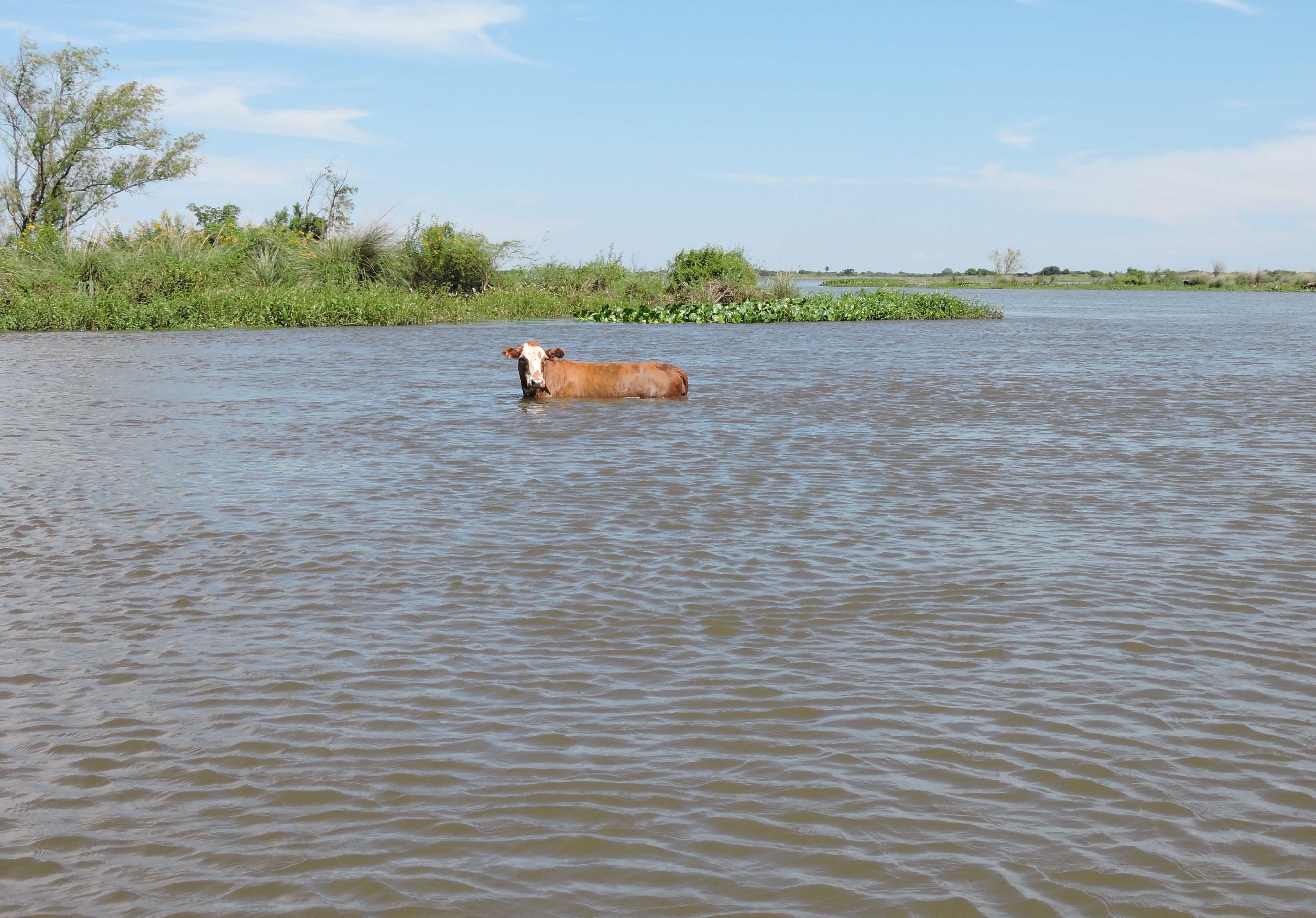
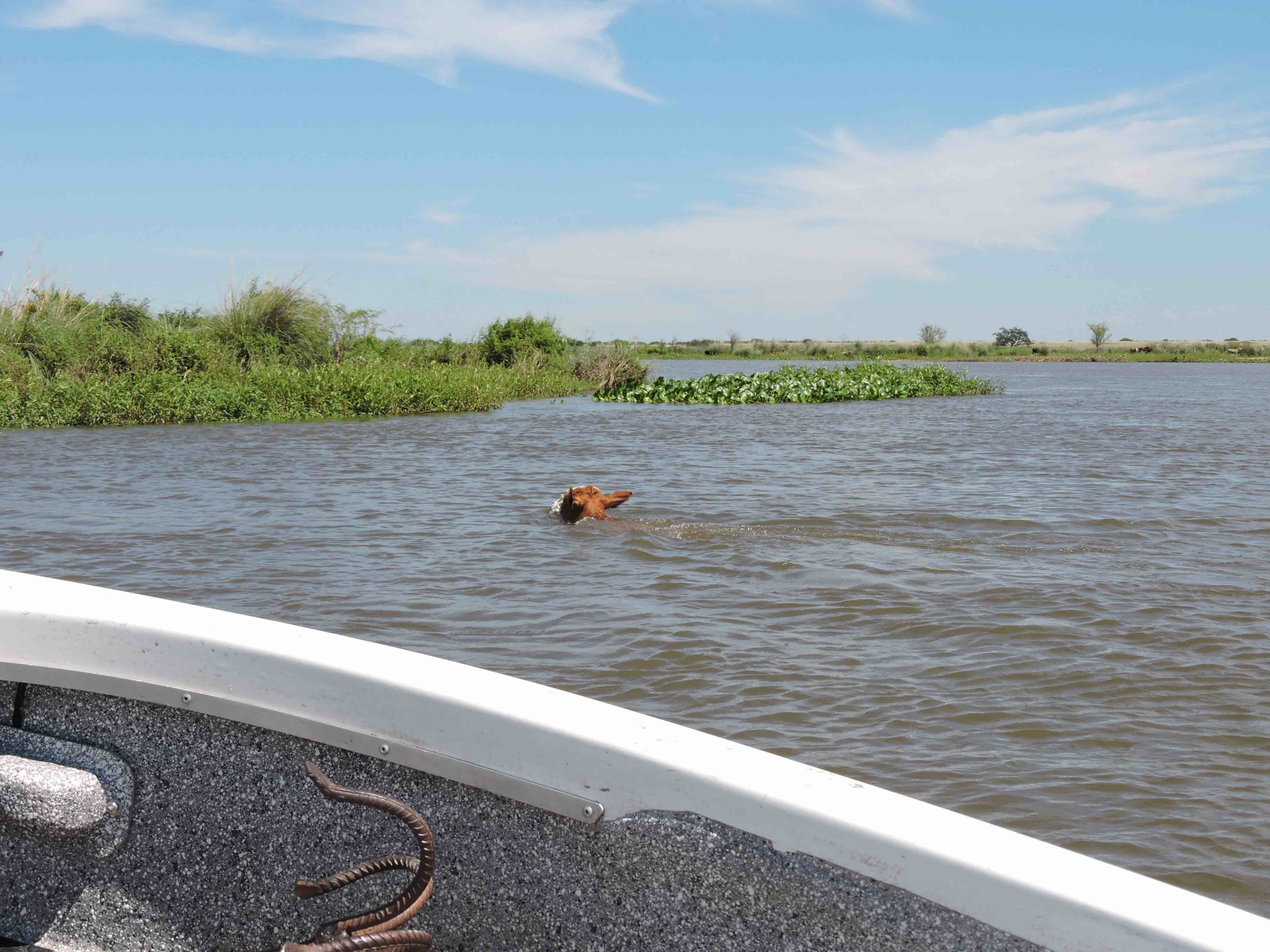
And then, while cruising through the channels, we saw it! A large head bobbing in a channel ahead of us that, for a few seconds, brought us back to an African river! We were aware that hippos in South America are still confined to Colombian rivers and it was not a semi-submerged capybara or tapir head either! It was a humble cow swimming to move from island to island in search of greener -or different- pastures. Clearly, to be a successful cow in the area you need to be a good swimmer!
We watched and followed the “water cow” for a while and learnt from José that, although the animals are used to water, when floods come cattle still need to be evacuated to dry land to save them from drowning. Further, I could also appreciate the difficulties of rearing cattle in such an amphibian environment and pondered the difficulties of mustering the cattle and the need for good (water) horses as well!
I mentioned earlier that I worked as a veterinary practitioner in Uruguay for four years after my graduation in 1975. It was after a couple of years of this work that the events narrated here took place.
It was a luminous autumn day that, as usual, started very early with a mate breakfast[1] before going to work at the clinic. The latter, as most clinics in Uruguay, was a mix of agro-business (belonging to a third party) with our clinic attached to it. At the time we were three partners, myself being the newest.
The shop was a popular meeting place, close to the main bank and it was normally busy. Apart from customers seeking to purchase agriculture-related products as well as getting advice on veterinary issues from us, there were friends and hangers-on all the time. That morning was not an exception and, when I got there, Gerardo, one of my partners was talking animatedly with one of the visitors, Pozzo, a well known farmer from a neighbouring farming area.
The topic of conversation was the then-current situation of the River Plate which was undergoing an extreme low tide that, according to a veteran like Pozzo, had not been seen since he had “use of a memory” as he put it. Pozzo was known as a colorful character reputed to eat eighteen fried eggs for breakfast among other colourful stories attached to his name!
Clearly the situation was interesting and I suggested that, once the business of the day was dealt with, we should go and investigate. Pozzo said he would join us, as he wanted to see what the Carmelo coastline looked like at low tide. So, before lunch the three of us climbed in my car and left for the beach, located a few kilometres away. At the time I had bought a 1959 Series II SWB Land Rover, after trading in my first car, a beautiful red and black voiturette Chrysler 1931 that was too expensive to run on paraffin leave alone petrol!
On arrival at the beach it was clear that the situation was extreme and I had never seen a sight like that before. There was no water for at least a couple of kilometres into the river where only wet sand could be seen except for the navigation channel where the river was still “wet”! Spectacular situations require equally remarkable responses… and I rose to the challenge! For some reason I hatched the idea of going down to the beach and then to drive all they way to Conchillas to surprise my wife -then my girlfriend- with a glorious and an unexpected virgin voyage after 30 kilometres of beach drive!
With the agreement of my eager companions we set off driving over wet sand for a few kilometres without stopping, looking for possible Spanish galleons carrying gold that sunk during the conquest… Of course we found no trace of them but found a large and shallow lagoon where several rather large fish had become temporarily trapped. They were bogas (Leporinus obtusidens) a good fish both to catch and to eat. We watched their futile swims towards the normally deeper areas that ended in them almost coming out of the water! It was a unique sight as these were large fish, apparently doomed. After watching their comings and goings for a while we left to continue our journey.
The way ahead looked clear, apparently all the way and we felt encouraged to go on. So we climbed back to the car and I engaged first gear. The car did not move forward but rather down, or at least its rear end did. I revved the engine but -of course- made matters worse by sinking further into the wet sand. We got out to inspect the situation and realized that we were in a tight spot, particularly bearing in mind that the front wheel transmission in my ancient Land Rover had become somehow disconnected some time back and I had not repaired it!
So, it was a matter of digging and pushing, which we did for a while. After each attempt the car would move a bit and then sink again. We were in trouble! As if being stuck was not enough of a problem, we heard Pozzo say: “I think the tide is coming in”. As I revealed before, he had a reputation for being witty so we did not pay attention to his words and kept on digging frantically.
After a few minutes I could see that not only was he correct, but also that the water was coming in remarkably fast! After a few more attempts the water reached the wheels and the sand became liquid rendering all our efforts totally futile. As the loss of the car became a certain probability I reacted and decided to look for help ashore. “I will go and find a tractor to pull us out” I said not before agreeing with my companions that they would take out all movables from the car, preparing for the worst. I ran to the shore and, very luckily, found someone driving a tractor cutting bulrushes, taking advantage of the lack of water. My hopes increased when I realized that I knew him. A mixture of the absurdity of the situation and my heavy breathing due to the running did not help my explanation. Eventually he understood and agreed to have a look.
My heart sank when he announced that it was too risky to enter the water to pull the car because he could also get stuck in the river as the bottom would be very soft. I insisted but he steadfastly refused so I gave up. I believe that my dismay helped in his decision to take me in the tractor to seek further help. We drove up the steep bank to see if the owner of another tractor would dare to go in as they had a larger tractor.
Luckily the owner was there. This time I did not need to explain much as, before our eyes and into the river we could see my Land Rover being progressively denuded of its movable parts by my trip companions. “There is no way we can pull it with a tractor” he said and added, “If we get stuck, we lose everything!” Somehow my mind moved to what story I was going to tell the insurance company about how I lost the car and then the idea of bringing a wreath every year to the spot also came to mind but it was quickly discarded as superfluous!
“I will try to pull it with horses” the voice of the farmer brought me back from my total loss-related thoughts. “What?” I just managed. “Yes” he said, “I have horses and a pulling harness. I think the horses will pull it out”. He called a couple of workers to bring three horses, the harness and ropes and, before ten minutes had passed we were going down the bank towards the “sinking” Land Rover.
The situation was now desperate! The water has come in fast and it had already covered the wheels. My companions had been waiting, wondering whether I was coming back. We entered the water and walked towards the car with the horses. The car was a pathetic sight as all movable items were no longer there and the water was now covering the engine and flowing inside it! Realizing that time was not on our side we got to work fast and harnessed two of the horses to the submerged bumper. A guy sat on the bonnet with the reins and I sat under water behind the wheel as, although the engine was flooded, there was still a need to steer! A horse was kept in reserve and all other hands got ready to push.
Despite my strong reservations about success, we agreed to push and pull at the count of three. What happened next was unexpected. Under the strength of the horses the Land Rover rolled forward with ease and moved to the triumphant shouts of my rescuers! “Do not stop now!” I shouted, my adrenaline flowing while seated in water to up to my breast steering and watching the back of the farmer on the bonnet that was controlling the horses, our real saviours. Stop we did not and, eventually, we managed to get the car on dry ground and away from the highest tide line mark to a safe zone. I was a happy man and, at the same time amazed that two horses could move a stuck car so easily. Later I realized that the increase in water depth helped greatly in making the car lighter.
News moved fast and, by the time our rescue was over and we were wondering what to do next, my father had come and witnessed the action. Being a photographer, he took the only picture I have of the event that I present you with here. It is a bad scan of the print he took but I hope it shows the absurd situation I got into and, luckily, out of.

The speck in the background is the semi-submerged Land Rover then there is open water and in the forefront an extensive area of water covered with bulrushes.
The aftermath was an anticlimax! My father towed us back to Carmelo where we arrived after dark and straight to the mechanic. After dropping the car and when we were alone, as expected he lectured me on my lack of prudence!
In addition to the failure to achieve the feat -and impress my girlfriend- I also suffered financial humiliation when the time came to pay the bill for the car repair!
[1] Mate is a traditional drink where hot water is drank after sucking it through ground dried leaves of yerba mate (Ilex paraguariensis) with the aid of a bombilla (metal straw) from a calabash gourd (mate).
See also http://en.wikipedia.org/wiki/Mate_%28beverage%29 for more details.
After the initial rather intensive contact with Matt, a time of waiting followed while settling down at Muguga House. I saw Matt less often as he was busy running the Tick Programme. It was time for waiting, he had said earlier, as possible collaborators needed to return from their home leave when the European summer ended.
I was still busy! My attention was fully dedicated to my wife’s arrival as this offered some logistical issues both locally but also en route. The local issues were easier: obtaining a more comfortable bungalow at Muguga House and persuading a colleague to provide us with night transportation to and from the airport as her arrival was late at night. The issue of her Visa was a serious concern, though. For some reason better known to the intricate recesses of international diplomacy, Uruguayans get a Visa at the airport in both Kenya and South Africa, a rather convenient procedure. All very well then. Not so: my wife needed an overnight stopover in Johannesburg and needed a Visa for South Africa.
Flight connections were not as frequent as today. Nothing wrong with that you may think. However, I had learnt while in Kenya that, because of South Africa’s apartheid being in full swing at the time (1981), passengers arriving in Kenya with their passports stamped by the “racist regime” would be denied entrance and sent back! This was part of the blockade being imposed by all African countries to South Africa at the time.
I could expect no assistance from the Embassy of Uruguay in Kenya as there wasn’t one![2] There were only three Uruguayan embassies in Africa: Egypt, Nigeria and South Africa. Aware of that there was no South African High Commission in Kenya I decided to first see the airline and then, if all else failed, to call the Uruguayan Embassy in South Africa seeking help. Cellphones did not exist and landlines between Muguga and Nairobi did not work very well so the best thing to do was to go to Nairobi to meet the airline, Varig at the time.
As her arrival was imminent I decided to travel to Nairobi the following day using public transport, no doubt encouraged by the experience I had on arrival[3]. The trip consisted in finding a way from Muguga to the main road and then another one to Nairobi, both ways.
The trip started well as I was lucky to find transport straightaway and got to the main road in good time. I joined a crowd of waiting passengers and, soon enough, a matatu[4] was waved down. It was a VW minibus, the brand that at the time dominated the minibus world in Kenya.
My hopes of a good ride in the front evaporated fast as this was apparently reserved for women and friends and currently overflowing. With moderate pushing and shuffling I entered, after paying the tout the necessary fare. “Not too bad” I thought while finding a seat in the back. “At least I will learn the dynamics of public transportation”. I also thought that the trip would have been fast as the bus was pretty full -by my standards- already. Nothing could have been more wrong! People needed to get out but many more got in until there were over twenty people in the back (I cannot say how many there were in the front seat as visibility was severely impaired!). Amazingly, we still accommodated a few more before we reached the Post Office stop at Nairobi city centre.
I literally popped out of the jam-packed bus and walked to the Varig office, almost on a “high” due to the sudden increase in oxygen levels, despite Nairobi’s high altitude! I hasten to add that, despite the large number of people and the scarcity of water in the rural areas, there was no more human body smell in the bus than in any minibus or lift in my country or the UK for that matter!
The Varig representative, fortunately, was not at all concerned by my predicament. “All you need to do is to ask your wife to get her Visa on a separate paper” she said. And she added, “She gets that paper stamped, makes sure that her passport is clean when she presents it to Immigration here”. Those were the tricks of countries under UN sanctions! The rather fast resolution of the Visa issue left me with time in my hands so I decided to look for Matt at ICIPE and I was lucky to get a most welcome return ride all the way to Muguga with him. He was rather surprised that I was so grateful and, after explaining the reasons, luckily he agreed to approach FAO in Nairobi to get me a vehicle. A rather good outcome from the matatu ride!
My wife’s travel went without hitches and I soon had her with me at Muguga House. Her arrival coincided with the return of most of the potential collaborators and I had the chance to meet some of them as well as do a lot of reading about tick and tick-borne diseases, working at the KARI library, an excellent source of historical research documents on the subject. I prepared a new work plan everyday, only to abandon it as my knowledge augmented!
Over the following days Matt took me for a round of official meetings to meet several people relevant to my future stay in Kenya. We had a rather difficult and cold meeting with the Government Veterinary Department and I could detect negative vibrations. In the end I was given the green light. Matt did not enjoy the meeting and he was rather short-tempered for the rest of the day. I, conversely, was happy that I was in Kenya to stay!
We also met the FAO Representative to update him on my plans as well as to plead for transport. Luckily, his response was positive and he asked the Administrator to identify a suitable vehicle for my use. This produced a VW Kombi, redundant from an earlier project, that was allocated to me for private as well as official use! An added advantage was that it had one of the most coveted items: a red -diplomatic- plate, a road opener. So we were finally mobile. The new car was ideal for us. Although it did not have 4WD, it had the necessary road clearance to take us all over Kenya.
At Muguga we met the Director of KEVRI, a highly qualified, very friendly and smooth Kenyan that was very welcoming. He was the Chairman of one of the two most popular soccer teams of Kenya and very involved with soccer in the country. We connected immediately when he learnt that I was coming from a country with such a good soccer pedigree and, although we talked about my future work and how collaboration could be strengthened, the main topic of our first meeting was soccer! Among the issues we covered was the possibility of me getting a Latin American coach for his team! This was the beginning of a friendly relationship through which I got very good support at work and also shared a few soccer matches with him.
The final of the “obligatory” meetings was with the Director of ICIPE. He was a highly educated and suave Kenyan Professor that was difficult to meet as he was constantly in meetings, running the Centre and meeting Donors and partners. He was pleased to see me and gave me valuable directions on what my situation as a Fellow within ICIPE would be and, of course, directed me to his Deputy for further issues. During the meeting he was very clear that I was awaited at Rusinga Island as ICIPE’s new research station at Mbita Point needed scientists settling down there. After the meeting was over, I learnt from Matt that the Director’s home area was precisely Western Kenya and that was the reason for his keenness for me to get there. Apparently the die was cast!
After these meetings I saw Matt less frequently for a while. Luckily Robin, the ICIPE ecologist, returned and I started going to the ICIPE laboratory at Muguga to be with him and learn. He was a very kind man, graduated in Oxford, who never refused to answer my questions and be of help. I was really lucky to find him and with him I learnt most of what I know about ticks and their ecology!
I had been in Kenya for about two months by now and I still did not know about what I would be doing so, concerned, I decided to ask Matt what was happening. The opportunity presented itself when he came to Muguga for a meeting. I managed to get a moment alone with him and asked him about the situation. Matt’s reply left me cold: “Julio, if you are not happy with the situation you tell me now and we cancel all arrangements and you go back to Uruguay and nothing happens”. I was shocked and worried but perhaps I had insisted a trifle too much or perhaps he was having a bad day as his mood sometimes seemed to swing. However, as the FAO Fellowship was all I had, I replied that I trusted him and would wait. I said: “Matt, the idea is not to leave but to let you know that I am worried for the delays”, I answered. “I understand your problem but this is Kenya and things work differently and at a slower pace. This should be clear to you from the start, otherwise you will not be able to work here” he said, in a way that was meant to close this uncomfortable encounter. I got his message and began my adjustment process to Kenya, Africa and to Matt’s ways and moods!
A few days later Matt came to see me at Muguga. He was in a jovial disposition. “Julio, Alan is back and we are meeting him now” he said. The meeting was timely and good. Alan was aware of my arrival and very keen to work with me as he saw the collaboration as very promising. The various work options were discussed and it also transpired that Matt had been under great pressure from the Government regarding my work as the latter had different ideas[5]. There had also been some administrative difficulties between FAO and ICIPE regarding the administration of the Fellowship’s funds. However, it had all been solved by now and we were, apparently, ready to go.
Matt was as idealistic as Alan was practical so they were a good combination: ideas and execution. I liked Alan from the start. During the meeting it was agreed that I would do some work at Muguga itself as well as field work. We would therefore visit Mbita Point and Rusinga Island with Matt. On the way back to Nairobi, we would take the opportunity to visit the ranch in the Transmara where Alan had his research on immunization. Finally, the return would be across the Maasai Mara Game Reserve, an added bonus.
It was agreed that, after that visit we would be in a better situation to take a decision on my future research work. In a way they kicked the ball forward! Nevertheless, I was happy to see movement at last. We agreed to leave as soon as possible.
[1] Follows “Kenya: Muguga”
[2] A complication that affected our lives and I will refer to in a future post.
[3] See “Africa – Arrival” in this blog.
[4] In Swahili, passenger minibuses or closed pick-ups.
[5] A couple of years later I learnt that the Kenyan Government had their own candidate for the FAO Fellowship that I got and my appointment did not go down well.
After posting “Hippos from Hell” I have now managed to upload all the videos that I took while the events narrated took place.
The videos follow the sequence of events narrated in the post with a short explanation of what you see in them.
Here they are:
A crocodile in full view can be seen approaching the drinking impala! It positions itself at its vantage point and then it disappears from the surface. The ambush is set and all that remains is to wait for new impalas to come or for the ones there to forget about it!
After catching an impala, the crocodile(s) resurfaced at point 2. The hippos moved in to wrestle the impala from them but failed. A crocodile is seen slipping through towards point 3.
After avoiding the hippos at point 2, the crocodiles regrouped at point 3 and started to go at the carcass. Almost immediately hippos came to the area of the commotion to try and get the impala. The hippo somehow chases the wrong crocodile and misses the one with the carcass that slips away, back to point 2.
A pair of male kudu watched on while the crocodile takes the impala back to point 2.
This video show the hippo going for the antelope at point 2. After this incident the hippo stole the carcass from the crocodiles at some point (not filmed) and this becomes apparent when the whole hippo community of about 16 animals is seen eating the impala!!! These videos complement the pictures of the Hippos from Hell post.
A similar situation was observed the following day when another impala was taken by the crocodiles.
While the crocodile and hippo drama was unfolding, this warthog was busy mud bathing and looking after his “mudtub”!!!
Nature does not stop…
Although the authors interpret the videos below as hippo attempts at “saving” other animals, I believe that they were, again, trying to snatch them from the crocodiles. Watch and judge!
Beware: they are strong!
Most of the time we have been “rained in” at our farm in Salta with only the occasional sunny spell, reminiscent of our time in Bedele, Ethiopia or worse, the UK! Well not as bad as the latter… The longest sunny spell lasted twelve hours but the normal sun appearances were a couple of hours long!
Butterflies were totally absent during the rainy spells and, as soon as the sunshine appeared, they were out in full force almost magically! Watching this event a few times the question of the title came: where are they when it rains? One theory was that they hatched with the sunshine but it was discarded, as they were too fast to respond! The idea of sheltering themselves against the rain gained strength but where?
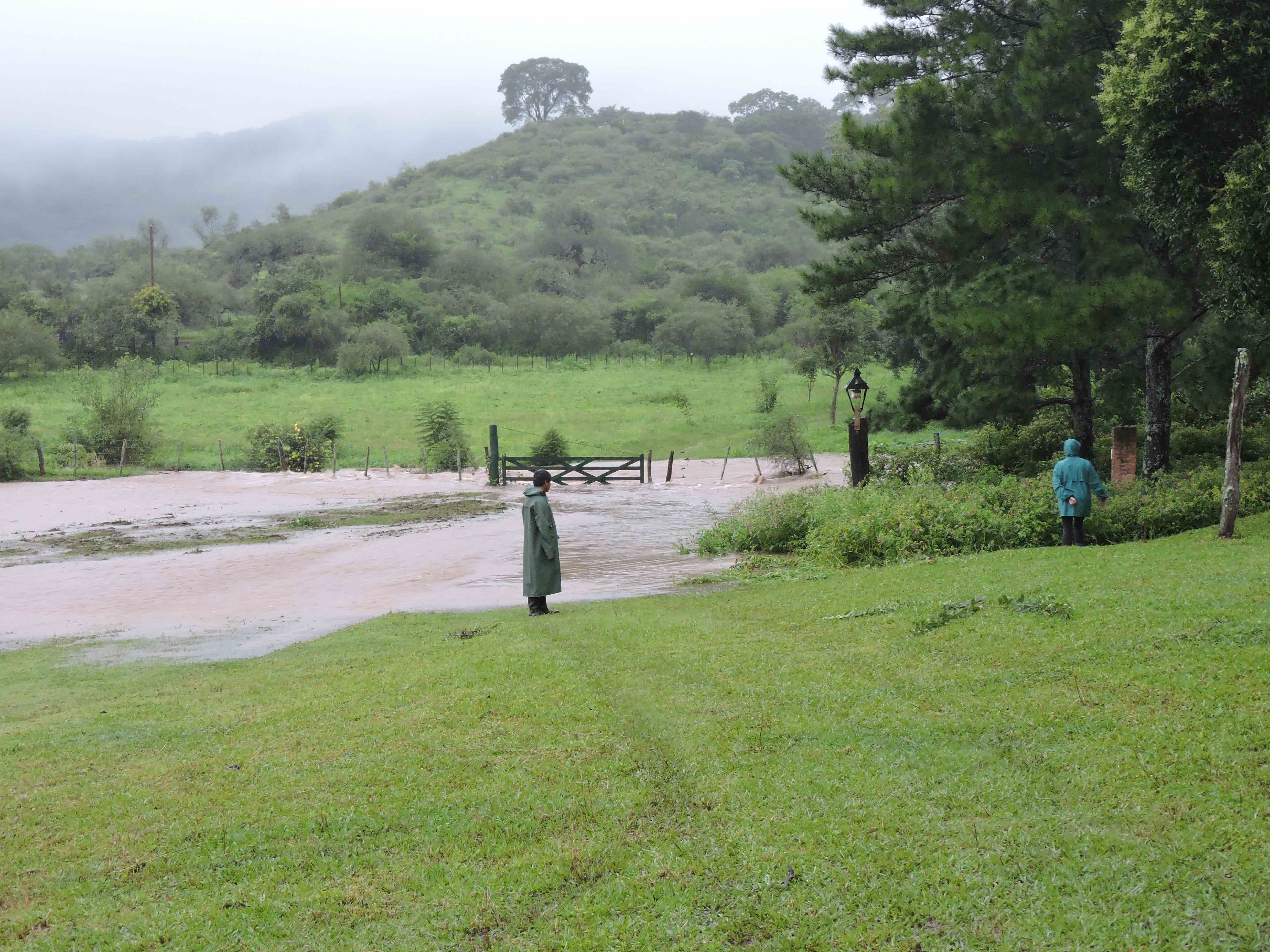
As often happens, an answer came out of a spin off from another observation. The rain was so much that our river flooded, stopping us from leaving the farm.
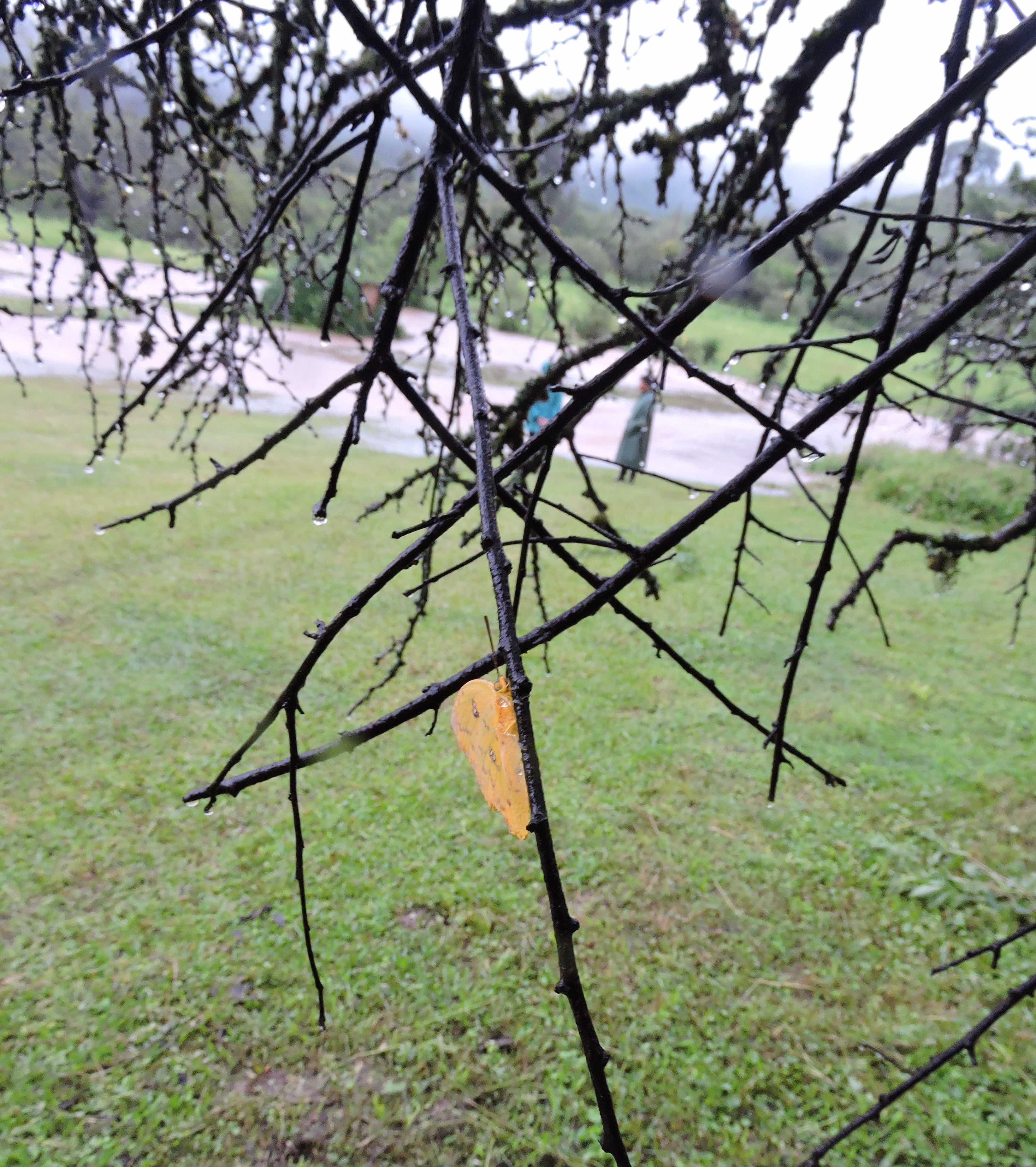
While taking stock of the situation under the rain, I could not fail to see a large orange spot in a tree. Closer inspection revealed a large butterfly hanging upside down. On closer inspection I noted that it had aligned its body to the branch above it and it was perfectly protected from the raindrops.
Unfortunately my camera would refuse to focus on the insect, as there were raindrops and small branches interfering with its electronic “brain”. Unfortunately it moved off before I could take a better shot.
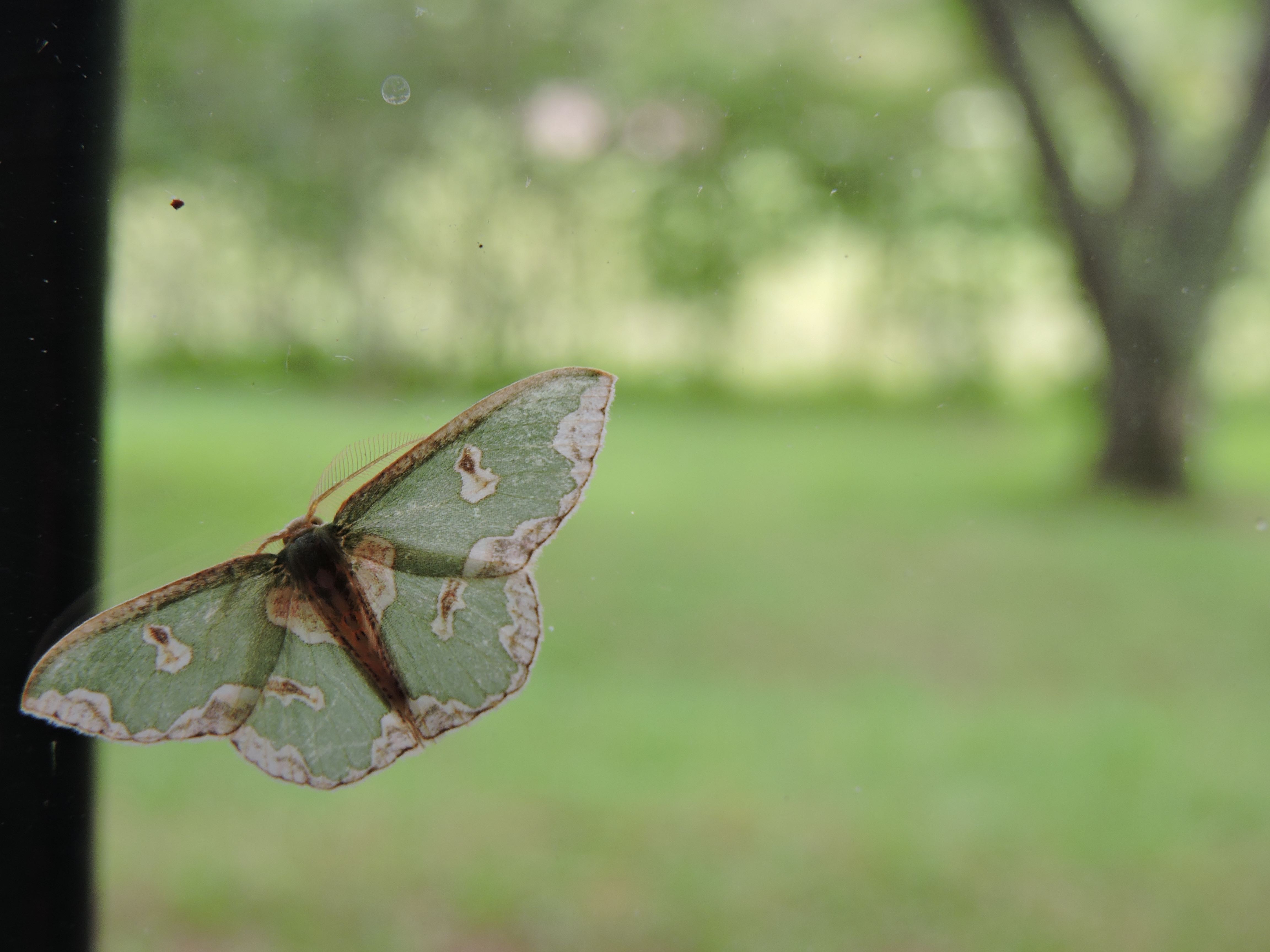
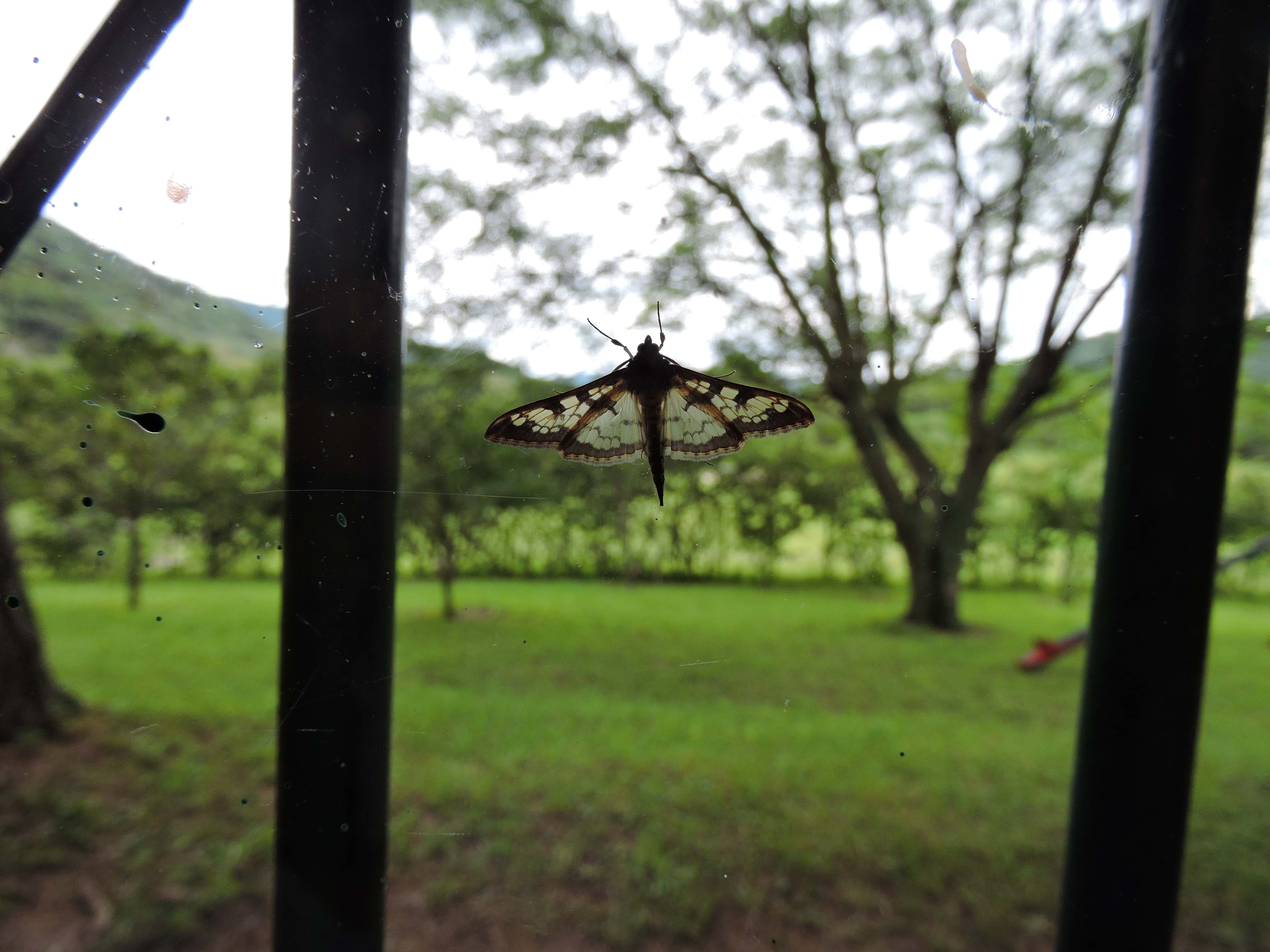
Although you may think that this was a clever ruse from the yellow butterfly, it was really nothing compared with the two shown below that found shelter inside our house!
As I mentioned earlier butterflies and moths are a prominent feature at our farm in Salta. As we are going through a long wet spell, I have taken the time to take pictures of some of the examples of camouflage that I have observed.
Rather than extending this over a few posts as I had done in the past, I decided to collect a few pictures for you to see five real finds that illustrate how Nature designed some of its creations to aid them in their survival. Have a look!
Several moths and butterflies come to our verandah light at night and I am taking pictures of them for a possible checklist. A number of them mimic leaves or tree bark. I then hatched the idea of collecting dry leaves from the garden and release a number of live moths on them hoping that they would stay on the leaves. Well, I can assure you that it was not easy!
However, after a few trials and frustrations I managed to get one shot for you to “admire” and spot the moths. To help you finding them I can tell you that there are more than one but less than fifteen![1]
I will reveal all creatures in the next post, hopefully this Saturday…
[1] I am learning to insert arrows to point them out.